
THE GAME’S AFOOT: Murder, Mystery, and Mayhem for the Holidays

THE GAME’S AFOOT: Holmes for the Holidays

A Theater Review by Julinda D. Lewis

VirginiaRep

At: Hanover Tavern, 13181 Hanover Courthouse Road, Hanover, VA 23069

Performances: November 30, 2018 – January 6, 2019

Ticket Prices: $44

Info: (804) 282-2620 or va-rep.org

Ken Ludwig’s hilarious whodunit, The Game’s Afoot, continues the comedic theme of this season’s holiday shows. (See my reviews of A Doublewide, Texas Christmas November 30, A 1940s Radio Christmas Carol November 25, and Who’s Holiday November 18). Debra Clinton directs this murderous farce that has more twists and turns than a roller coaster, a task that must have been made easier by her stellar cast of characters, most of whom are no strangers to the Hanover Tavern stage.

Scott Wichmann stars as Broadway actor William Gillette (a real life actor who made a name for himself playing Sherlock Holmes on Broadway). There’s a play within a play, and life imitates art as Gillette is shot by an unknown assailant while taking his bows at the end of his show. Recuperating at his palatial Connecticut mansion (also real, and now known as Gillette Castle State Park, in Lyme, CT), Gillette invites his friends and fellow cast members to spend the Christmas holidays with him and his mother, Martha (Catherine Shaffner).

Gillette, however, has an ulterior motive. Having blurred the line between his own life and that of the character he portrayed for two decades, he fancies himself a sleuth and sets out to uncover the identify of his mystery assailant – and solve a few other mysteries along the way. Mayhem and misdirection ensue, and Clinton keeps things moving at a fast pace. There is physical comedy and lines that depend on split second timing are delivered flawlessly. There are plenty of clues and possible motives, so it’s not a complete surprise when we find out “whodunit,” but the ride is so much fun that the end is not the focal point.

Wichmann makes Gillette, who tends to be pompous, a bit more endearing, but there’s no mistaking who is the star here. Shaffner is hilarious as his mother, who always has a flask close at hand. Joe Pabst plays the role of Gillette’s best friend, Felix and his bumbling attempts at subterfuge are a highlight of the show. Donna Marie Miller is the villain here – a vengeful theatre critic named Daria Chase who has dirt on everyone and knows how to use it.  However, I was taken aback when she had a meltdown and demanded to be left alone – in Gillette’s house. Umm, that’s now how things work. . .

Meg Carnahan and Caleb Wade play the newlywed couple Aggie Wheeler and Simon Bright and Lisa Kotula is Felix’s wife, Madge whose big scene involves a seance. All have secrets that come to light when a strange detective, Inspector Goring, arrives to investigate a murder that may or may not have happened. Audra Honaker makes the role of Goring most interesting, alternately staring off into space or spouting off lines from Shakespeare. Given that the characters are all actors, there is much grandstanding, with each trying to outdo the other with dramatic delivery of drama and poetry.

The play’s isolated location and limited pool of suspects give this all the major requirements of the locked-room mystery genre, and Terrie Powers’ set attempts to capture the spirit of the genre as well. Derek Dumais and B.J. Wilkinson apparently had great fun with the sound and light design, creating lightning (it must have been a thundersnow storm) and thumps, bumps, and mysterious knocks and Sue Griffin’s costumes are in keeping with the period and the holiday spirit.

If this sounds a bit vague, some of the best moments and funniest situations cannot be mentioned here without spoiling it for those who have yet to see it. What I can say is that there are multiple doors and a secret room, as well as a wall full of weapons, which may or may not be loaded.  There are plots and subplots, motives and alibis, and even false confessions. Everyone is a suspect except the butler, because he was given the night off, it being Christmas Eve and all.

Julinda D. Lewis is a dancer, teacher, and writer who was born in Brooklyn, NY and now lives in Eastern Henrico County.

———-

Photo Credits: Aaron Sutten.
This slideshow requires JavaScript.

YES! DANCE FESTIVAL: Nationally Acclaimed Dance on a Local Stage

20TH ANNUAL YES! DANCE FESTIVAL: Presented by K Dance

A Dance-Theater Review by Julinda D. Lewis

At: The Firehouse Theatre, 1609 West Broad Street., RVA 23220

Performances: November 30 & December 1, 2018

Ticket Prices: $25; $15 Students & RVATA Members

Info: (804) 804-355-2001 or firehousetheatre.org

This year marks the 20th anniversary of artistic director Kaye Weinstein Gary’s Yes! Dance Festival. The festival has brought 150 national and international artists to Richmond and enriched the small but resilient local dance community. This year’s program was quite remarkable for its scope and diversity, with performances by Lucky Plush Productions from Chicago, Illinois; Sandra Lacy from Maryland; Pas de Monkéy from Ohio; slowdanger (Taylor Knight and Anna Thompson) from Pittsburgh, Pennsylvania; Courtney D. Jones/CDJ Dance from Houston, Texas; and Carrots Carrying Water (Logan McGill and Ching Ching Wong) from Salt Lake City, Utah; as well as an offering from the host company, K Dance of Richmond, Virginia.

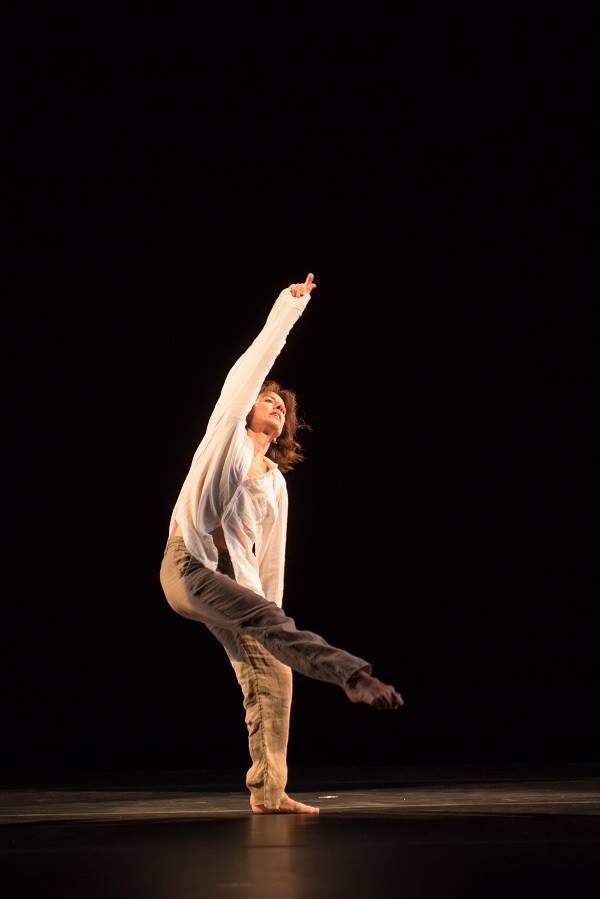
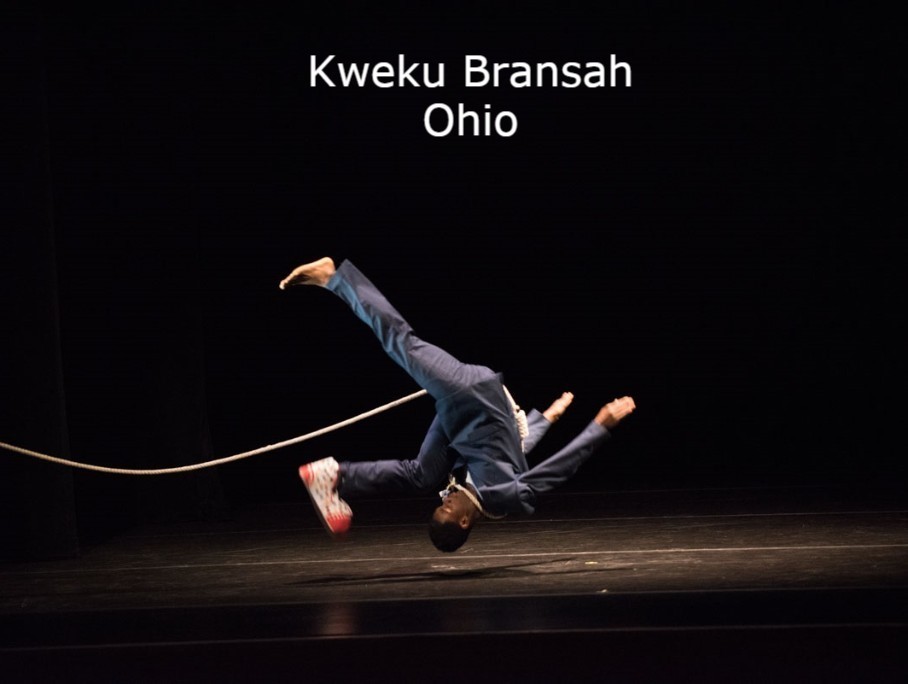
Pas de Monkéy proved to be a surprising departure from previous years’ guest artists and stood out from others on this year’s program as well due to the hip hop infused genre and subject matter that touched on political hot topics. “Lose It All” was the first dance on the program, following an opening video of excerpts from previous festivals. Kweku Bransah choreographed and performed the solo that held the audience spellbound with his isolations, flowing transitions, and breathtaking muscular control. Bransah pops, waves, breakdances, and glides and his movements also reflect a foundation of pantomime that carries a story of lost love.

Bransah returned in the second half of the program to perform Robin Prichard’s “The Art of Making Dances (Not About Ferguson).”  Set to the music of The Whites, Nat King Cole, Ella Fitzgerald and Louis Armstrong, Sweet Honey in the Rock and the voice of a grieving mother, “The Art of Making Dances” is overflowing with negative social, political, and racial symbolism. Bransah begins the solo with a noose around his neck, one gigantic clown shoe and one bare foot, and an oversized boutonniere, dancing to the lyrics, “Keep on the sunny side of life.” He looks like a caricature of an American minstrel, a representation that was already an unflattering caricature of black people.

Freed from the noose, Bransah speaks, asking, “How can dance be meaningful when people are getting shot in the streets?” A mother’s voice grieves, a youth cries, and song lyrics urge the dancer to “smile.” This intriguing solo blends hip hop with ballet, turning the dancer upside down to perform pas de bourée while standing on his head, and leaves the audience with the question, “How do you take actions that matter?”

Another highlight of the program was “Let’s Be Honest,” performed by Logan McGill and Ching Ching Wong from the Salt Lake City-based company with the fascinating name of Carrots Carrying Water. A world premiere, the duet featured a couple dealing with and avoiding their emotions. They started in business attire, she in a pencil-skirted suit and heels (worn with socks) and he in a light-toned suit, but the stage was soon strewn with their clothes and shoes as the two engaged in a tension-filled test of wills. The way the two connected – whether touching or not – was intimate and palpable.

Not all was tense or political. Lucky Plush Productions out of Chicago presented a delightfully refreshing trio, “Cinderbox 2.0 Remix” choreographed by founder and artistic director Julia Rhoads, that reshapes parts of an evening length work based on reality culture experiences. The three dancers, Michel Rodriguez Cintra, Elizabeth Luse, and Meghann Wilkinson dance in unison, upstage one another, and take turns sitting on metal folding chairs and one another – all while sipping from a shared bottle of Fiji water. Their dialogue incorporates moments from earlier dances on the program, including the feathers from Sandra Lacy’s “Giving Up the Ghost,” and the teapot table from K Dance’s short play, “Helen Keller visits Martha Graham’s Dance Studio.”

Written by Stephan Kaplan and directed by Jacqueline Jones, “Helen Keller visits Martha Graham’s Dance Studio” is the program’s second premiere. Based on real life, the short scene introduces the audience to an intimate moment in which Helen Keller (Maggie Roop) visits the studio of her friend choreographer Martha Graham (Kaye Weinstein Gary) Kelly Kennedy fills the role of Polly Thompson, Keller’s interpreter and companion. Not only was this friendship news to me, a student of dance history, but the piece also made an impression because of a unique teapot shaped table created especially for this work by Juliet Wiebe.

The program also included Sandra Lacy’s spiral-filled and feather-finished solo, “Giving Up the Ghost,” Courtney D. Jones’ intense solo about life in solitary confinement, “Hell is a Very small Place,” and slowdanger’s sci-fi thriller, “hybrid memory | reflector,” choreographed and performed by Taylor Knight and Anna Thompson. Kudos to Kaye Weinstein Gary for an all-around excellent program and for bringing international and nationally known artists to our local stages. Among this year’s guest artists, Courtney D. Jones, Ching Ching Wong, Julia Rhoads, and slowdanger have been included on Dance Magazine’s prestigious 25 to Watch list. All are well worth watching.

Julinda D. Lewis is a dancer, teacher, and writer who was born in Brooklyn, NY and now lives in Eastern Henrico County.

———-

Photo Credits: individual photos as labeled

Yes.2
Kweku Bransah. Photo by Dale Dong.
Yes.1
Robin Prichard. Photo by Chris Golden.
Yes.5
Sandra Lacy. Photo by Marlayna Demond.
Yes.3
Courtney Jones. Photo Credit: dabfoto creative, University of Houston Cynthia Woods Mitchell Center for the Arts
Yes,4
slowdanger. Photo by Umi Akiyoshi.


A DOUBLEWIDE, TEXAS CHRISTMAS: A Trailer Park Carol

DOUBLEWIDE, TEXAS CHRISTMAS: The Tiny Town Tackles the Nativity

A Theater Review by Julinda D. Lewis

At: CAT Theatre, 419 No. Wilkinson Rd., RVA 23227

Performances: November 30 – December 15, 2018

Ticket Prices: $23 Adults; $18 RVATA Members; $13 Students

Info: (804) 804-262-9760 or cat@cattheatre.com

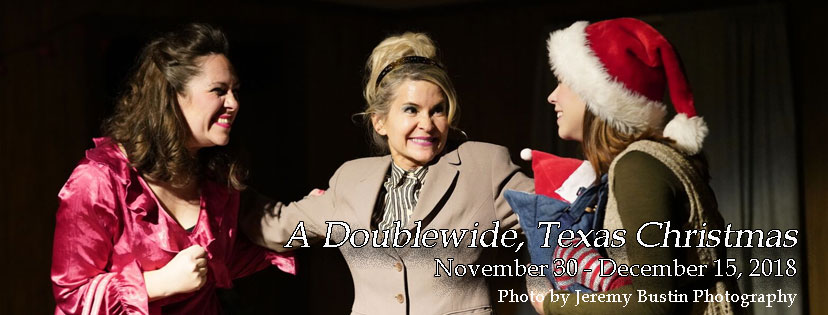
The citizens of the tiny town of Doublewide, Texas, population 10, are back and so is the fun. A Doublewide, Texas Christmas, written by the trio of Jessie Jones, Nicholas Hope, and Jamie Wooten, is written, directed, and played strictly for laughs. There is no hidden agenda, no deep message, just plain old stupid fun, filled with Texas stereotypes, exaggerated hair and costumes, and a set that looks like a cross section of a dilapidated doublewide trailer park home.

Picking up where Doublewide, Texas left off last June, the town, under the leadership of Mayor Joveeta Crumpler is eagerly awaiting their incorporation papers from the country board, but there are complications. The county is making one more attempt to annex Doublewide, and then there are the added twists of revenge and reunion.

Three actors have returned in their same roles: Crystal Oakley as the beleaguered and frumpy Joveeta, Jeanie Goodyear as Joveeta’s barfly mother, Caprice Crumpler, and Wally Jones as the once crotchety Haywood Sloggett.

Other roles were recast, with Laura McFarland-Bukalski as the hilariously droll Big Ethel Satterwhite and Lisa Way Piper as Georgia Dean Rudd, manager of the local Bronco Betty’s Buffeteria. Lorin Hope Turner now plays the millennial flower child Lark Barken, and Hunter Mass, who simultaneously serves as Assistant Stage Manager is Norwayne “Baby” Crumpler. New characters include Rebekah Spence as Haywood’s vengeful sister Patsy Sloggett Price and Michael Edward McClain as the long lost Harley Dobbs, who is Haywood’s estranged son and Lark’s unknown father. If this all sounds like a soap opera, I am sure that was the intention.

Highlights include Big Ethel’s scenes with the residents of the Stairway to Heaven Retirement Village at the beginning of each act, and Caprice’s overly inflated pretensions of celebrity as the spokesperson for the local funeral home. This time there is only one commercial recording scene, and Caprice is called upon to use her celebrity to entice new residents to move to Doublewide within the week – a condition of approving the town’s incorporation papers.  Big Ethel must lecture the retirees on their extra-curricular activities, having found yet another pair of boxer briefs and a peek-a-boo nightie hooked in the bushes on the retirement village grounds.

“Baby” was not required to wear a dress or heels this time, but he did don a pink frilly apron while preparing a sweet potato casserole and the town entered a Battle of the Mangers competition with the patriotic theme of “Nativity at the Alamo.” Plot twists and turns involve Patsy’s narcissistic need to get revenge on a competitor from her former town, which she was forced to leave in disgrace, a family of belligerent raccoons, a celebrity yam, a budding attraction between Caprice and Haywood, and a Christmas wish that Lark’s father, who is also Haywood’s son and Georgia Dean’s long lost true love, might be found and enticed to return home for the holidays.

It was interesting to see the evolution of Haywood from crotchety old man to loving family member, but I think there was more comedic value in the role of villain. Patsy partially filled this much-needed role, and Spence embraced ownership of this role; she even threw in an evil laugh or two for good measure.

Crystal Oakley had to be mic’d on opening night as she was just getting over a case of laryngitis. Her character, Joveeta, was plagued by back pain, so Oakley, a real trooper, was beleaguered on two fronts. Other cast members were also hit with illnesses and accidents, requiring last minute and behind the scenes adjustments. Considering all that CAT Theatre has had to go through this year, starting with the uncertainty of whether they would, in fact, be able to have a season due to the looming possibility of losing their long-time home, it is nothing less than amazing that opening night went as smoothly as it did and this cast and crew, including Mike Fletcher who directed both Doublewides on the CAT stage, deserve an extra round of applause for pulling this off without any obvious signs, other than Oakley’s microphone.

Mike Fletcher’s pacing kept the laughs coming, although I found the actor’s blocking was sometimes awkward, making me aware that they were directed to face the audience. Scott Bergman’s set included dilapidated, mismatched furniture in a cut-away of a doublewide trailer with the standard wood panel walls, insulation showing, a Santa on the roof, and a plethora a blinking Christmas lights framing the entire set. Sheila Russ’s costumes ranged from Joveeta’s frumpy sweaters and slacks to Caprice’s holiday print leggings and wildly curled wig. It’s Texas, so almost everyone wore cowboy boots. And since it was Christmas, Buddy Bishop and Mike Fletcher’s sound design included songs from the traditional to the silly, such as “White Trash Christmas.” People who enjoyed Doublewide, Texas or Always a Bridesmaid, by these same authors, or those who enjoy the 1970s style sitcom genre, will feel right at home with A Doublewide, Texas Christmas, as will anyone who just wants an excuse to laugh steadily over a two hour period.

Julinda D. Lewis is a dancer, teacher, and writer who was born in Brooklyn, NY and now lives in Eastern Henrico County.

———-

Photo Credits: Jeremy Bustin Photography (photos to come)

Doublewide TX Christmas

Doublewide TX Christmas.2
Lisa Way Piper, Crystal Oakley, and Lorin Hope Turner

A 1940s RADIO CHRISTMAS CAROL: Tradition With a Delightful Twist

A 1940s RADIO CHRISTMAS CAROL: An Un-classic Classic

A Theater Review by Julinda D. Lewis

At: Swift Creek Mill Theatre, 17401 Jefferson Davis Highway, Colonial Heights, VA 23834

Performances: November 17, 2018 – January 5, 2019

Ticket Prices: $40 Theater only; $57 Dinner & Theater

Info: (804) 748-5203 or swiftcreekmill.com

If you like both holiday traditions as well as comedy, then A 1940s Radio Christmas Carol is the holiday show for you. Author Walton Jones, composer David Wohl, and lyricist Faye Greenberg have taken the traditional Dickens tale and set it to music in a shabby radio station in Newark, NJ in the early 1940s. The audience has a role too – as the live studio audience that interacts with the cast who pass out souvenir programs and instruct us in how to respond to the APPLAUSE and LAUGH signs.

The fictional radio station WOV broadcasts from the Hotel Aberdeen. The live show is subject to interruptions from loud plumbing, a rowdy crowd of Shriners who are celebrating their annual Christmas parade with an after-party in the same hotel, and frequent phone calls from the mother of the youngest member of the cast. In addition, there is a special guest, a seasoned movie actor and Broadway veteran, William St. Claire (Bill Blair) who has been brought in to play the role of Scrooge. In addition to his increasingly worrisome quirks – such as bringing a huge trunk full of costumes for a radio broadcast and ignoring cues – St. Claire has some personal issues that lead to an on-air breakdown forcing the rest of the cast to improvise an ending. An odd assortment of characters from detectives to seductresses are tossed into the mix resulting in comedic mayhem.

Lucky for them and for us, the ensemble – both the scripted one and the one that was cast on the Swift Creek stage – is more than capable of handling this unexpected development. This is truly an ensemble piece that is no stronger than its weakest link – and there was no weak link. PJ Llewellyn as Fritz Canigliaro took every opportunity to draw attention to his shoes; apparently Fritz had been a Florsheim salesman in the recent past. Kenneth Putnam was endearingly annoying as Charles “Cholly” Butts, a baker with an intense love for his own product. John Mincks was convincing as the teen-aged Jackie Sparks, whose mother kept calling to check on him; he also has an adorable crush on Sally. Tara Callahan Carroll had the role of the company comedienne, Margie O’Brien, and Elisabeth Ashby played Judith Davenport, a serious actress who caught the attention of all the men, while declaring that she already had two kids and two exes and didn’t want more of either. Mike White held down the role of the struggling company’s director, Clifton Feddington.

Director Tom Width, who also designed the set, has also shared his love of the radio play and the studios in which they were performed. He has filled the stage with all sorts of mysterious and enticing objects that are used to create the many special effects that were necessary to create the magic of radio. There are bells and blocks, locks and boards, a sheet of aluminum, mallets and sticks, and gadgets and gizmos, and even a carafe of celery stalks (one of my favorites). These items are controlled by Isadore “Buzz” Crenshaw, the “sound effectician” who unexpectedly announces that he has recently enlisted, with the capable assistance of Sally Simpson, a young woman who spends her days working for an aviation company. These two roles are in the capable hands of Gordon Graham and Claire M. Gates. This is the 1940s, and the War play an important and ever-present role.

There were lots of 1940s references, such as cigarette commercials, statements from doctors recommending certain brands of cigarettes, and many references to the war. The show’s sponsors included brands such as BVD underwear, Ovaltine drink mix, and Lucky Strike cigarettes. (Nostalgia break: I still remember when cigarettes were advertised on the radio and television. Even little kids knew that LSMFT stood for the slogan “Lucks Strike means fine tobacco.” The last cigarette commercial aired in 1970, but prior to that time, I can remember going to the corner store to pick up a pack of cigarettes for my grandmother.) The script also incorporates a lot of double entendre and snappy word play, including lines such as “All the boys at school loved my little Fannie, too.” Fannie, of course was the name of the speaker’s little sister.

The 1940s radio show device makes this stand out from all other Christmas shows. The laughs come easily and frequently. The cast was well-chosen, and the direction is well-paced, although the second act did seem to drag just a little bit. The music is lively and occurs in short bursts. Unlike musicals where people suddenly break into song for no apparent reason, the songs are naturally woven into the radio show format.  Musical direction is by Shellie Johnson; lighting by Joe Doran; technical direction by Jason “Blue” Herbert;  and costumes by Maura Lynch Cravey.

While suitable for all ages, I think A 1940s Radio Christmas Carol will hold a special appeal to those old enough to still remember when cigarettes were advertised on television. But for many, the best part is getting to see how all those special effects were created.


Julinda D. Lewis is a dancer, teacher, and writer who was born in Brooklyn, NY and now lives in Eastern Henrico County.

———-

Photo Credits: Robyn O’Neill

This slideshow requires JavaScript.

SISTER ACT: The Singing Nuns Are Back!

SISTER ACT: Take Us to Heaven

A Theater Review by Julinda D. Lewis

At: The November Theatre Marjorie Arenstein Stage

Performances: November 23, 2018 – January 6, 2019

Ticket Prices: $36-63

Info: (804) 282-2620 or www.virginiarep.org

Sister Act is a familiar, feel good musical that does all the right things. On opening night there were moments when the audience spontaneously clapped along, and many jumped to their feet for a rousing standing ovation as the company belted out their final song, “Spread the Love Around.” I had nearly as much fun watching other audience members enjoying the musical as I had watching the musical itself.

Felicia Curry, the petite powerhouse from Dreamgirls (2016) and The Color Purple (2014) has returned to Richmond inhabit the role of Deloris Van Cartier, the singer on the run from her mobster boyfriend who goes into witness protection in a convent. Curry commands the stage with high voltage energy and a voice that seems too big to be contained by her physical body.

Curry shares the spotlight with Andrea Rivette as Mother Superior. Interestingly, Rivette’s role often requires her to use her clear and strong voice to sing through lines, rather than say her lines or sing actual songs. Both Curry and Rivette bring strength of character and a willingness to change or at least to compromise which imbues these near-caricatures into more full-fleshed characters. These two – the showgirl and the Mother Superior – both embody growth, strength, and sisterhood from vastly different perspectives, and in doing so demonstrate a level of tolerance that many of us could benefit from in today’s world.

One of Deloris’ tasks, as the newly appointed director of the choir, is to bring the shy Sister Mary Robert out of her shell, and Gwynne Wood fills this role to perfection. Her round-faced innocence makes Wood’s second act solo, “The Life I Never Led,” even more stunning. When she sheds her mousy demeanor and allows her voice to soar and holds that final note, there is no turning back.

Other supporting characters that added color, flavor, and humor included Durron Marquis Tyre as Eddie, the police officer who helps Deloris; and two of my favorite nuns – the exuberantly optimistic Sister Mary Patrick (Kelsey Cordrey) and the cranky Sister Mary Lazarus (Susan Sanford) under whose leadership the choir couldn’t carry a tune if it had been placed in a bucket for them. And we cannot forget Michael Hawke as Monsignor O’Hara, the priest whose calling seems to have been sidetracked by the need for fiscal restraint in the face of a dying congregation and the threat of the church being sold to a pair of antiques entrepreneurs. As the church’s bottom line goes up, and the church’s books move from red to black, the Monsignor’s priestly garments become increasingly flamboyant.

While women were the stars of this show as well as the show-within-the-show, the men of the cast also turned in some notable performances. Sincée J. Daniels played the role of the notorious Curtis whose big number is the darkly humorous “When I Find My Baby” and its subsequent reprise. Daniels’ afro wig, slick suits, and thuggish demeanor, however, relied almost entirely on parody. He reminded me of Eddie Murphy in one of his less savory character roles. Sister Act offer no redemption for Curtis or his trio of bumbling sidekicks: nephew TJ (the versatile Anthony Cosby); Joey (the consistently and confidently funny Paul S. Major); and Pablo (the hilarious Mark Parello, Jr.) who always speaks Spanish even though no one else around him speaks or understands the language. The trio plots to break into the convent, seduce the nuns and abduct Deloris via the song “Lady in the Long Black Dress.” Their old school seduction lines (you know, the old name and zodiac sign line) and accompanying dance movements make this one of my favorite numbers of the show.  Major dropping to the floor in his sexy pose and Cosby doing a body role are indelibly etched on my retinas. Their actual execution of the ill-fated raid on the convent is a hilariously well-timed bit of choreographed movement.

On opening night, something weird was going on with the lights. A light in the lobby seemed to be going on and off, and the dimmer on the house lights kept going up and down at odd intervals prior to the show. But once the show started, there didn’t seem to be any electrical problem, although I did find the lights that illuminated the upper arches of the set distracting, as they seemed to be moving or waving at times. Otherwise, I was quite impressed by some of designer BJ Wilkinson’s work, especially the heavenly light that spread over the choir of nuns in Act 2.

Sarah Grady designed the costumes, and there were some wonderful moments involving costumes and choreography. If you want to be surprised, do not read the rest of this paragraph, just skip down to the start of the next paragraph. But, given that some of these changes happen so suddenly, you might want to know what to watch out for. Officer Eddie delighted with a double tear-away costume: he appeared in a police uniform, worn over a white Saturday Night Live vest and slacks ensemble, which was in turn worn over another police uniform. The choir had several changes of habit, adding increasingly glittery scapulars or aprons to their basic black dresses as their vocal talents increased, ending in full-glitter habits. And of course, there are the increasingly ornate cape-like chasubles worn by the monsignor.

Ron Keller’s set included soaring arches and cathedral windows. I did not have any preconceived ideas of how the set should look but I was surprisingly disappointed; I found it functional but minimal. And the three holes in the floor – for the orchestra and a surprise “cameo” appearance near the end of Act 2 – made the choreography and the wild chase scene just a bit more challenging and breathless than they needed to be.

Set in Philadelphia in 1977, Sister Act is filled with 1970s icons and references and local signatures from Philly cheesesteaks and “Rapper’s Delight” to R&B, Pop, and Disco complete with a spinning disco ball. As with other highly popular musicals which have also been movies (e.g.  The Color Purple, Dreamgirls, West Side Story), I suspect Sister Act will bring people to the theater who don’t normally come to many of the local theater productions. At intermission, I overheard one man say, “What a wonderfully fantastic show.” My companion liked the 1970s musical genres, the Philadelphia-specific references, and “a story I could follow.”

Sister Act, based on the 1992 film starring Whoopie Goldberg, is written by Cheri Steinkellner and Bill Steinkellner, with music by Alan Menken and lyrics by Glenn Slater and additional book material by Douglas Carter Beane. Robin Arthur, who directed last year’s Beauty and the Beast, directed and choreographed – keeping things moving at a lively pace.  The Virginia Rep website admonishes that Sister Act has adult themes and language, but I didn’t find it particularly strong and not at all offensive. The show runs about 2 ½ hours, with one intermission, but it moves along at such a good clip that you’re not even aware of the passage of time.


Julinda D. Lewis is a dancer, teacher, and writer who was born in Brooklyn, NY and now lives in Eastern Henrico County.

———-

Photo Credits: Aaron Sutten

This slideshow requires JavaScript.

WHO’S HOLIDAY: A Christmas Parody for Adults Only

Who’s Holiday!: The Story Dr. Seuss Didn’t Want You to See

A Theater Review by Julinda D. Lewis

Richmond Triangle Players

At: The Robert B Moss Theatre, 1300 Altamont Avenue, RVA 23230

Performances: November 14 – December 15, 2018

Ticket Prices: $10-35

Info: (804) 346-8113 or rtriangle.org


Who’s Holiday! is an irreverent, adult Christmas story. This one-woman show told by a grown-up Cindy Lou Who takes the audience on a rip-roaring sleigh ride that provides eye-opening details about Cindy Lou Who and her pal the Grinch.

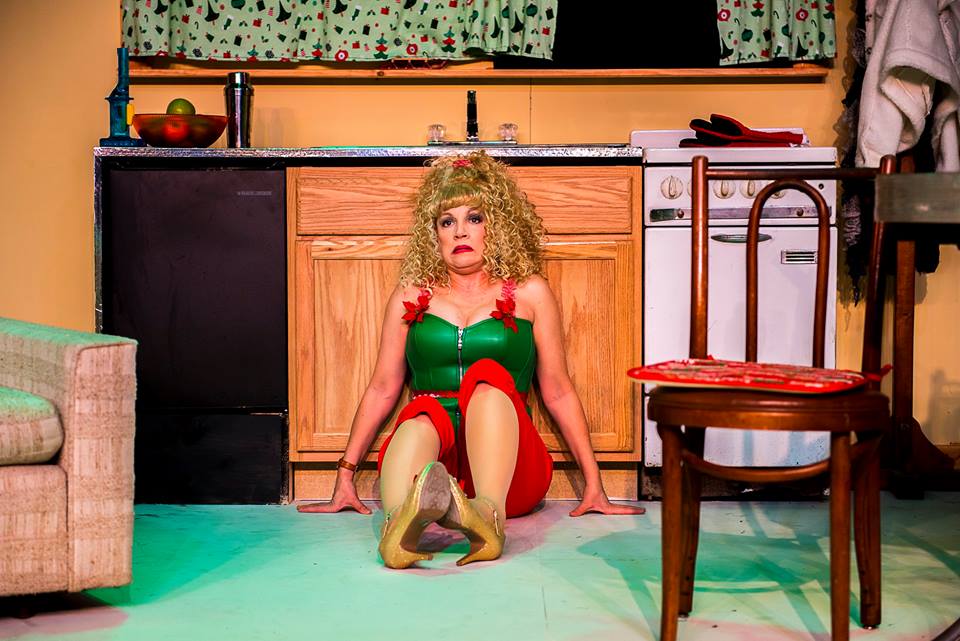
Cindy Lou has outgrown her cute pink pajamas in favor of a bright red shirtwaist dress with multicolored trim which is turn gives way to a green corset with a sparkly red skirt. Both are worn with glittery gold stilettos and a curly blond wig. Thank Ruth Hedberg for the festively tacky costume design.

Cindy Lou has only recently returned home after a rather long stint away. She now lives in a trailer left to her by her late uncle, and it’s parked on Mount Crumpit, apparently not far from the Grinch’s old lair. The sparsely furnished interior feature lots of green accents – and there’s a reason for the Wicked poster on the wall – but T. Ross Aitken’s design seemed surprisingly spacious for a trailer.

And where, exactly is the old green Grinch, and how has he fared over these past years? Well, to tell you that would give away most of the plot. It’s not for nothing that this play is subtitled “The Story Dr. Seuss Didn’t Want You to See!” Apparently, in 2016, Dr. Seuss Enterprises took playwright Matthew Lombardo to court for copyright violation, but Lombardo successfully countersued claiming parody is protected under “fair use” laws and the play opened off-Broadway in 2017.

Kids would not recognize this Cindy Lou Who, played by the talented and versatile Kimberly Jones Clark, most recently seen as Margery in Hand to God co-produced by TheatreLAB and 5th Wall Theatre. I’m not trying to say Clark is making a habit of playing dysfunctional middle-aged women, but lately she has done it extremely well. Middle-aged Cindy Lou starts off greeting the audience, including a shout-out to “the queer in the rear.” She tests the waters of offensiveness with gays and lesbians, as well as Jews, and at one point asks if the word “ghetto” is offensive, but quickly dismisses that suggestion with a flippant, “it gets worse.”

Cindy Lou scrounges a Tramadol from the floor and washes it down with liquor. She takes a hit from a bong and describes some parts of the Grinch that most of us never thought of – and hope never to see – in great detail. Who’s Christmas! is hilarious and also quite dark (and I’m not sure if this is the intent of author Matthew Lombardo, director Dexter Ramey, star Kimberly Jones Clark, or a combination of the three): it deals with drugs, alcohol, domestic violence, bestiality, animal cruelty, murder, and prison culture. Along the way, Jones grabs a handheld microphone and throws in a totally unexpected rap, a deadpan execution of “Merry Little Christmas,” which invited audience participation, and – my personal favorite – a rather skillful rendition of “Blue Christmas.”

There are laughs aplenty; the audience seemed well-pleased, and Clark did an excellent job holding down this zany one-woman show. It just wasn’t my cup of tea – I laughed, I enjoyed it, but it isn’t my favorite adult Christmas show. Maybe I was hoping it would be more like Christmas on the Rocks whose grown up Ralphie, Cindy Lou Who, Charlie Brown, and other characters simultaneously tore and warmed my heartstrings.

Who’s Holiday! runs just about an hour, with no intermission, and is followed by a holiday cabaret with Joshua Worsham on piano and Georgia Roger Farmer and/or Shannon Gibson Brown. I didn’t stay for the cabaret, but it seems like a great deal – an unexpected after party!

Julinda D. Lewis is a dancer, teacher, and writer who was born in Brooklyn, NY and now lives in Eastern Henrico County.

———-

Photo Credits: Photos from RTP Facebook page

This slideshow requires JavaScript.

LIVIN’ FAT: Living Large

LIVIN’ FAT: The Return of Good Times

A Theater Review by Julinda D. Lewis

At: Pine Camp Community Center, 4901 Old Brook Road, RVA 23227

Performances: November 8-17, 2018 with performances at 8:00 pm November 8, 9, 10, 15, 16 & 17; 10:00 am November 14 and 4:00 pm November 17.

Ticket Prices: $10 for Groups of 10 or more; $12 for Students and Seniors; $15 General Admission

Info: thetheatreubuntu@gmail.com or https://livinfat.brownpapertickets.com/

If Livin’ Fat, the current production by the Heritage Ensemble Theatre at the Pine Camp Cultural Arts and Community Center has the look and feel of a 1970s era sitcom, there is a good reason. It was written by Judi Ann Mason, whose work includes Good Times, Sanford and Son, and A Different World, as well as the film Sister Act 2: Back in the Habit. Director dl Hopkins remained true to the sitcom genre, using snappy pacing and staging that made the audience feel as if we were, at times, peering into the Carter family’s living room through an invisible screen. Characters even approached the edge of the stage to look out the window, and often crossed one another precariously close to the edge of the stage.

What’s even more remarkable about Livin’ Fat is that Mason (1955-2009) wrote it when she was a 19-year-old drama student at Grambling State University and it earned her the Norman Lear Award for comedy writing. Given that distinguished history – and the strong cast – I’m upset that I did not, could not love this production.

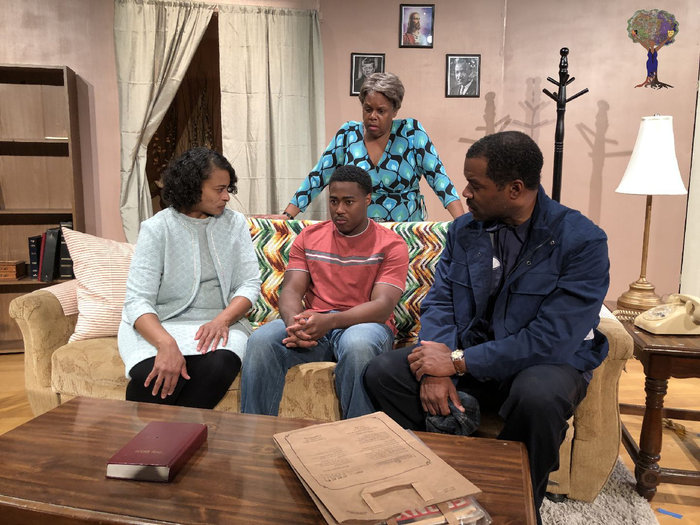
Livin’ Fat takes place in the “front room” of the Carter family home in the Black Quarter of an unnamed southern town. Yes, that’s what my grandmother called our living room, too. The room is spotless but shabby, and on the wall behind the sofa is the obligatory triptych: Jesus, Martin Luther King, Jr., and John F. Kennedy. Big Mama (Sharalyn Garrard) is a disillusioned widow, given to snappy comebacks. She also has a surprising affinity for the young people in her life and often sides with her grandchildren much to the chagrin of her daughter. Mama (Andrea Shantell Dunnaville) has a direct line to God and can quote scripture for any situation. She is equally yoked to husband Calvin (Arthur Muhammad), who works two jobs to support his family and is a stalwart deacon at their church. The parents’ faith and the family’s future are tested when their son, David, comes into an unexpected windfall.

David (Akiel Baldwin) is a college graduate who, upon returning home, could find no other work than as a janitor at a bank. A fate would have it, one day while working at the bank, the bank gets robbed and no one noticed that a bundle of money was dropped on the floor where it found its way into David’s dust rag. Later references to the “dust” in his pocket, therefore, have two meanings – the “dust” from his cleaning rag and an old slang term for being so poor there is “nothing but dust” in your pockets.

Garrard is consistently funny, tossing off sarcasm like breathing, waving her wig in the air, referring to her television set as if it were her lover, eating ex-lax chocolate laxatives like candy to soothe her unnamed “condition,” and being contrary just for sport. Dunnaville takes broad comedy to extremes, often to the point of making her character a caricature. On the positive side, her projection and diction are excellent, and we never have any trouble understanding her, even when her daughter Candy (Imani Banks) is blasting music from her bedroom. Muhammad’s portrayal of the father is the most moderate, contained, and realistic of any of the play’s six characters. He is, therefore, a positive role-model and a model black father. Candy is the least developed of the characters in the family, yet Banks takes advantage of every moment on stage. She is the cute but annoying little sister, given to exaggeration, and does not know the meaning of giving up. When sent to her room, she silently reappears in the background, listening to what the grown-ups don’t want her to hear.

As David, Baldwin must walk a delicate line. College educated – and probably the first in his family to attend college – he is expected to do better than his parents’ generation yet must show respect while living in their home. He does not complain about his menial job, but he talks of his dreams with his best friend. For the most part, Baldwin achieves this balance with aplomb, with the assistance of his side-kick Boo (Marsalis McKeever). Boo, who has not gone to college and seems to have no plan at all for his life, is David’s ride-or-die friend who stands out for two characteristics: when he comes into some money, he spends it all on loud clothes; and he speaks out of the side of his mouth, as if he has marbles in his mouth, making it difficult to clearly hear anything he says.

As appealing as these characters are, and as much as they made me laugh, I found the overall production uneven and underwhelming. The juxtaposition of Dunnaville’s broad sitcom comedy with Muhammad’s more conservative portrayal, Dunnaville’s over-enunciation in contrast to McKeever’s muffled utterances, the frequent (and utterly accurate) use of the word “nigger,” (I hate the euphemism, “n-word”), and author Mason and director Hopkins’ adherence to the sitcom genre just didn’t connect for me. After the show, my constant companion and theater date suggested that (a) I wasn’t really black and (b) Livin’ Large would really, really appeal to older black churchgoers (except, perhaps for that word I mentioned above) and potential black theatergoers who don’t go to the theater because they don’t see enough representations of themselves and their lives onstage.

There is, after all a moral dilemma – a foundational element of good storytelling: should David be allowed to keep the “found” money or should he return it? Has he, in fact, committed a crime? Calvin, the head of the household, takes the question to God, and after a period of prayer, the family abides by his decision. To find out what he decided, and how the play ends, I suggest you go see Livin’ Fat for yourself. (Dates and times are listed above.)

Livin’ Fat: written by Judi Ann Mason; directed by dl Hopkins; with lighting by Geno Brantley; sound by dl Hopkins (a nice 70s playlist); costumes (character and period appropriate) by LaWanda Raines; set by Margarette Joyner; carpentry by Vinnie Gonzalez; photography by Pamela Archer-Shaw; and videography by Dewey Collins.

Julinda D. Lewis is a dancer, teacher, and writer who was born in Brooklyn, NY and now lives in Eastern Henrico County.

———-

Link to WRIC interview with director dl Hopkins and Sharalyn Garrard (Big Mama): https://www.wric.com/community/-livin-fat-hits-the-stage-in-rva/1576260858

Photo Credits: Photos courtesy of Heritage Ensemble Theatre Company

This slideshow requires JavaScript.


This slideshow requires JavaScript.


RICHMOND BALLET: A Requiem Into the Night

RICHMOND BALLET:  Studio One

A Dance Review by Julinda D. Lewis

At: Richmond Ballet Studio Theatre, 407 E. Canal St. RVA 23219

Performances: November 6-11, 2018

Ticket Prices: $26-46

Info: (804) 344-0906 or richmondballet.com

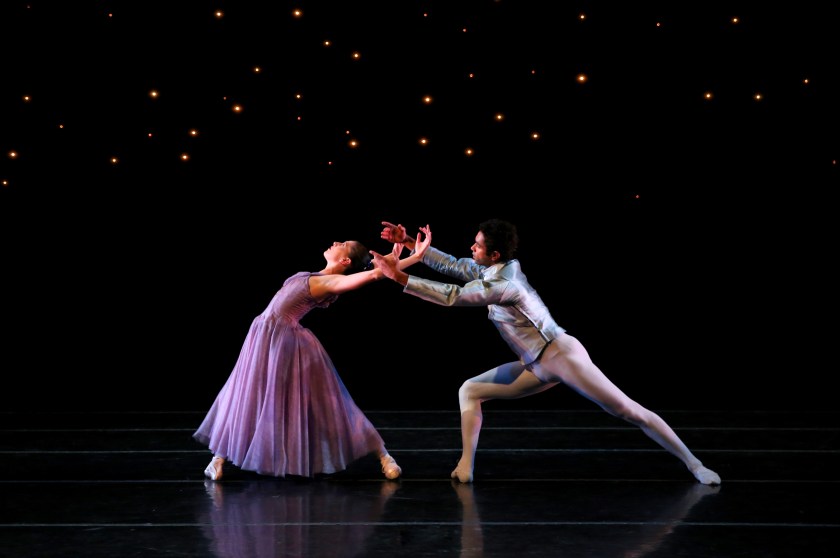
The Richmond Ballet Studio Series is unique and alluring for the intimacy of the space and the presentation of two or three works in an atmosphere that encourages reflection. The current Studio One production continues this tradition. On Tuesday, the Richmond Ballet presented Jerome Robbins’ In the Night, a company premiere of Robbins’ 1970 work for the New York City Ballet, and the world premiere of Nicole Haskins’ Requiem, inspired by the music of Gabriel Fauré.

In the Night is composed of three pas de deux featuring three couples of different temperaments, possibly different ages, at different stages of their relationships.  On Wednesday night, the couples were Melissa Robinson and Marty Davis, Eri Nishihara and Khalyom Khojaev, and Maggie Small and Fernando Sabino. Robinson and Davis embodied youthful elegance, she in a softly flowing purple dress, he is a blue-gray waistcoat and ascot. Their movements were sustained, romantic, controlled, yet effortless. Nishihara and Khojaev had a more mature posture, and the earth tones of their costumes added weight. At the same time, their movements were more fanciful, with bigger, bolder jumps and lifts. Finally, Small and Sabino presented a more passionate duo. Her black dress with red underskirt suggested a smoldering temperament, and his darker gray jacket was smoky, matching the teasing sensuality verging on conflict – sort of like classical ballet with a tango temperament. The final section of the beautiful Chopin nocturnes, played live onstage by pianist Joanne Kong, brought all three couple together. In one beautiful moment they briefly acknowledged one another before dancing off.

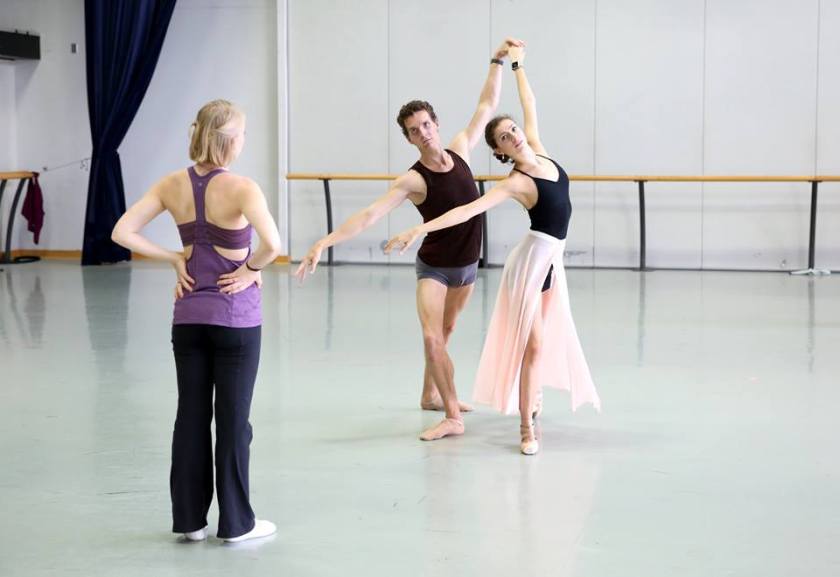
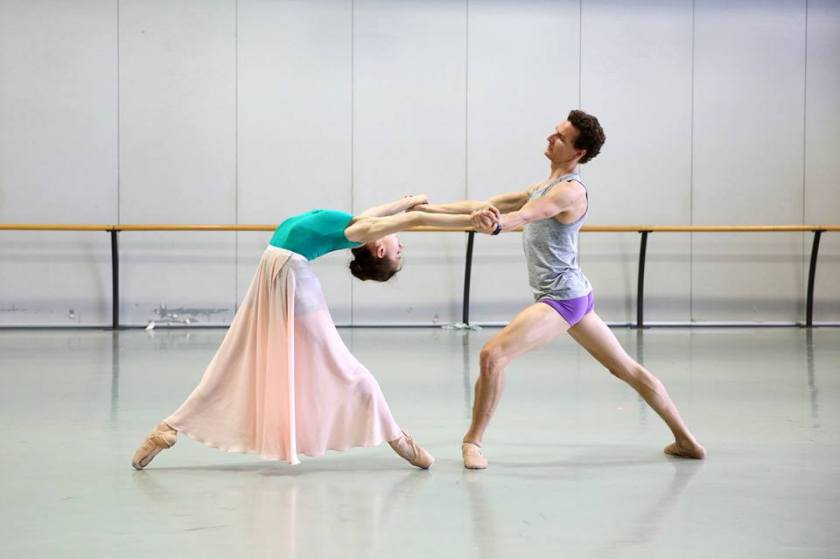
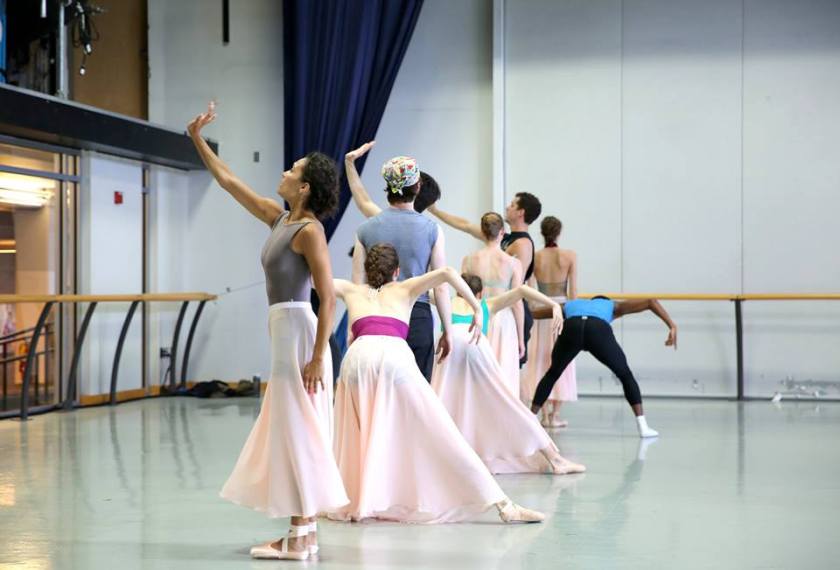
In her video reflections, Haskins described Fauré’s Requiem as “a lullaby for death, not dark or sad.” The women’s flowing skirts, designed by Emily Morgan, were designed to make the movement linger, like the memories of loved ones. The work opens with lights like memorial candles and the women, seated with their skirts pooled around them, also look like candles. The stage is kept dim, and groups of dancers are bathed in the amber glow of the lights. The dancers’ formations are fascinating and delightfully unpredictable: clusters, solos, duos, small groups, diagonal facings, patterns that flow and change organically. While Haskins assured us the work was not dark or sad, it did seem to go on just a little too long.

Julinda D. Lewis is a dancer, teacher, and writer who was born in Brooklyn, NY and now lives in Eastern Henrico County.

———-

Photo Credits:

Rehearsal Photos from Richmond Ballet Facebook posts & Photos by Sarah Ferguson

ballet1
Sabrina Holland and Fernando Sabino in In The Night by Jerome Robbins. Richmond Ballet 2018. All Rights Reserved. Photo by Sarah Ferguson.
ballet2
Abi Goldstein and Thel Moore III in In The Night by Jerome Robbins. Richmond Ballet 2018. All Rights Reserved. Photo by Sarah Ferguson.
ballet3
Dancers of Richmond Ballet in Requiem by Nicole Haskins. Richmond Ballet 2018. Photo by Sarah Ferguson.
ballet4
Dancers of Richmond Ballet in Requiem by Nicole Haskins. Richmond Ballet 2018. Photo by Sarah Ferguson.
ballet.1
Richmond Ballet dancers rehearsing “Requiem”
ballet.5
Choreographer Nicole Haskins with Richmond Ballet dancers Abi Goldstein and Mate Szentes
ballet.4
Cody Beaton and Mate Szentes rehearsing “Requiem”
ballet.3
Richmond Ballet dancers rehearsing “Requiem”

MR. POPPER’S PENGUINS: A Holiday Heartwarmer

MR. POPPER’S PENGUINS: When Dreams Come True

A Theater Review by Julinda D. Lewis

At: Virginia Rep’s Children’s Theatre at Willow Lawn; 1601 Willow Lawn Drive, Richmond, Virginia 23230

Performances: October 27 – December 30, 2018

Ticket Prices: Start at $21

Info: (804) 282-2620 or virginiarep.org

Mr. Popper’s Penguins is a musical adaptation of a children’s book by Richard and Florence Atwater, and the book for the musical is by Robert Kauzlaric with music and lyrics by George Howe. It is a book unfamiliar to me, my daughter, and my two grandsons, but after spending Sunday afternoon at the Virginia Rep’s Children’s Theatre at Willow Lawn it will likely find it way onto our bookshelves this coming holiday season. It has comedy, adventure, and penguins.

Richard Popper is a house painter and decorator of modest means; he and his wife Florence live on a strict budget that does not allow for the travel and adventures Mr. Popper dreams of. He is especially fond of Antarctic exploration and penguins. Of course, there’s more to the story. Imagine their surprise when the Poppers hear on the radio that Mr. Popper’s favorite explorer, Admiral Drake, has received Mr. Popper’s fan letter and is responding with a surprise. Soon a large crate is delivered to the Popper’s Stillwater, Minnesota home and inside is a genuine Gentoo penguin from Antartica that quickly becomes a part of the Popper’s little family. (In the book, it seems the Poppers were British and have two children, but in the musical the live in the USA and their only children are the feathered kind.)

The Popper’s household soon expands, as their male penguin, Captain Cook, eventually grows lonely, and an aquarium that Mr. Popper contacts for help has a lonely female penguin, Greta, that they generously ship to the Popper’s residence. The next thing you know, there are ten penguin chicks and the poor Poppers have to figure out how to keep all these penguin bellies full of fresh fish and frozen shrimp. Their solution – Popper’s Performing Penguins – leads to more hilarity and the gradual realization that touring on the vaudeville circuit is no way for a family of birds to live.

Yes, I said vaudeville. Mr. Popper’s Penguins was written in 1938 and vaudeville as well as references to the WPA (the federal government’s New Deal Administration program called the Works Progress Administration from 1935-1939, when it was renamed the Work Projects Administration), along with Mrs. Popper’s job search and the family’s focus on finances will likely go over the heads of the young audience members as well as most of their parents. Let’s face it, I’m a grandmother, and this was before my time, too. I only know about these things because I teach dance history! My daughter did ask what WPA was, but neither grandson seemed to notice or care.

All the shenanigans are skillfully handled by director Josh Chenard, with musical direction by Jason Marks and choreography by Wes Seals. A cast of five talented actors play all the roles – some thirteen different characters, with Derrick Jacques as Mr. Popper and Renee McGowan as Mrs. Popper. Keaton Hillman Emma-Claire Polich, (both ensemble) and Eve Marie Tuck (swing) play all the other characters. Both Kingston (age 10) and his mom Soleil were impressed by Keaton Hillman who changed characters, costumes and accents with the dexterity of a magician, and manipulated the Captain Cook penguin puppet as well.

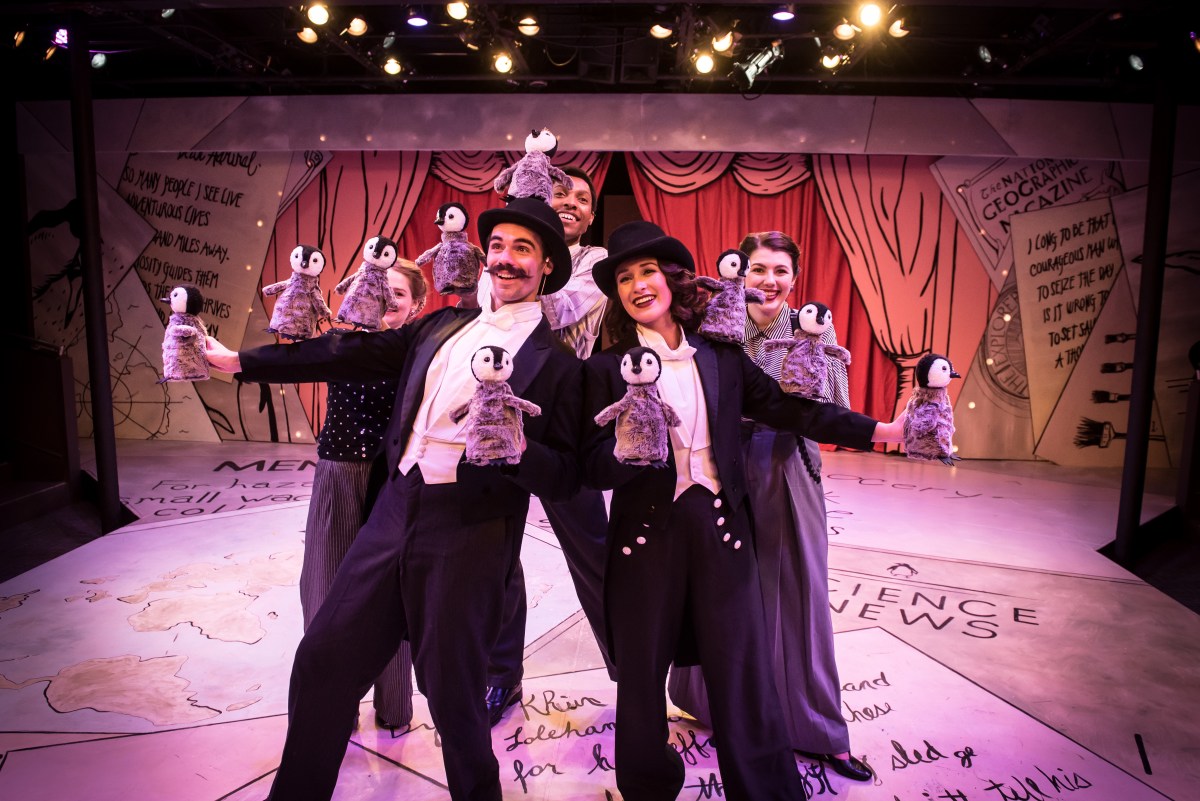
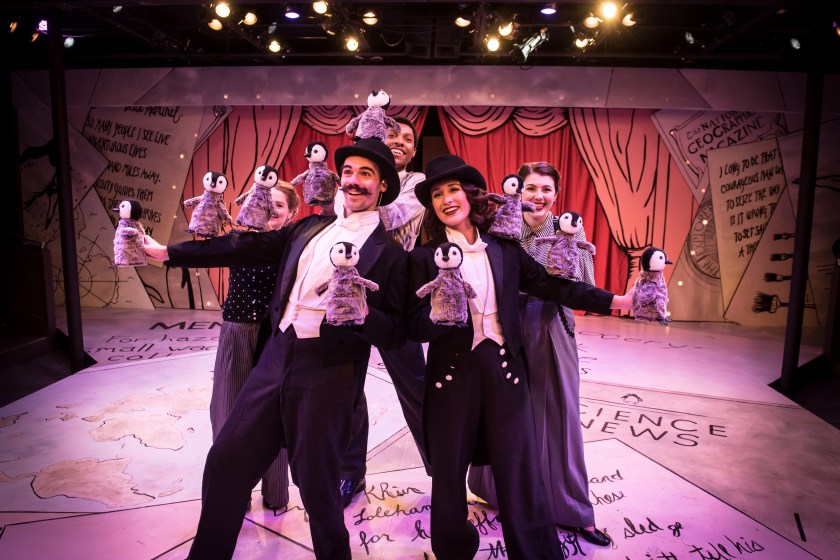
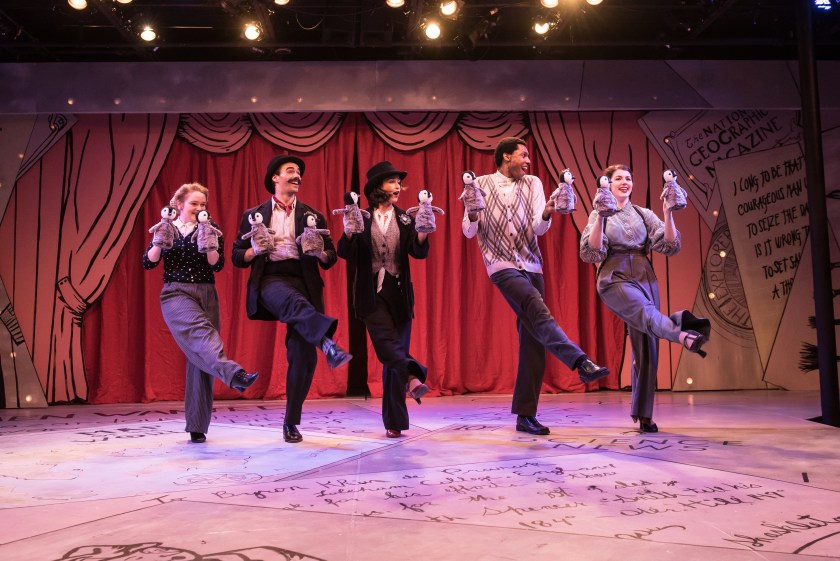
Yes, the two adult penguins were large puppets (credit Kylie Clark with the puppet design – something Virginia Rep Children’s Theatre does so well) while the 10 penguin chicks were smaller, stuffed versions. Emmitt (age 4) was enthralled by the penguins. He spent most of the hour (no intermission) perched on the edge of his seat, his eyes wide open so as not to miss anything. He did tear his eyes away from the stage to lean in and ask his mom, “Can I have a pet penguin?” He made a second earnest plea out in the parking lot, adding that the penguin could live in the refrigerator.

With about six musical numbers, Mr. Popper’s Penguins moved at a fairly rapid pace – but never felt rushed. Jaques and McGowan carried most of the story, and their voices are strong and clear, making it easy for attendees of all ages to understand the lyrics. Jeanne Nugent’s costumes are lovely – especially the women’s wide-legged pants that remind me of Ms. Celie’s pants from The Color Purple. Mrs. Popper’s apron, Mr. Popper’s bow tie, and painter’s coveralls, and the props used by the various characters (a wooden dog, a hat with the gray hair attached, Mr. Popper’s painter’s ladder and pipe) are all overly exaggerated, almost cartoonish.

Taking this theme about as far as it could go, Chris Raintree’s set includes larger than life library books that open up to reveal entire rooms. “Atkinson’s Kitchen Companion” houses the Popper’s kitchen while their living room is housed within a tome entitled “432 Proudfoot Avenue” and the admiral’s ship is docked inside a book on Antarctic exploration. The production is visually stimulating but not over stimulating.

There’s also lots of word play. Captain Cook and Greta’s brood are given the names of famous explorers, such as Ferdinand, Columbus, and Magellan. There’s also Isabella and Victoria, who wears a tiara. Finally, but not least, there is all the alliteration! Mr. Popper’s Penguins alliterates just about every “p” word you can think of, and when they run out of “p” words they alliterate other letters of the alphabet.

Recommended for ages 4 and up, Mr. Popper’s Penguins is a family-friendly production that is perfect for the younger members of the audience and is being offered as an alternative or addition to holiday staples, such as The Nutcracker. Unlike many productions of past seasons, there is none of the double entendre and innuendo that seemed to be intended for the adults. Here, the focus is all on the pleasure of the kids, and Kingston and Emmitt would give this production a combined two thumbs up.


Julinda D. Lewis is a dancer, teacher, and writer who was born in Brooklyn, NY and now lives in Eastern Henrico County.

———-

Photo Credits: Aaron Sutten

Mr Popper's Penguins
Renée McGowan and Derrick Jaques. Photo by Aaron Sutten.
Mr Popper's Penguins
Renée McGowan and Derrick Jaques. Photo by Aaron Sutten.
Mr Popper's Penguins
Eve Marie Tuck, Derrick Jaques, Renée McGowan, Keaton Hillman, Emma-Claire Polich. Photo by Aaron Sutten.

ANANYA DANCE THEATRE: People Powered Dances of Transformation

ANANYA DANCE THEATRE: How Do We Show Up For Each Other?

A Dance Review by Julinda D. Lewis

At: Virginia Commonwealth University School Grace Street Theater, 934 West Grace Street, RVA 23220

Performances: October 26 & 27, 2018

Ticket Prices: $20 Adults; $15 Students

Info: (804) 828-2020 or http://arts.vcu.edu/dance/


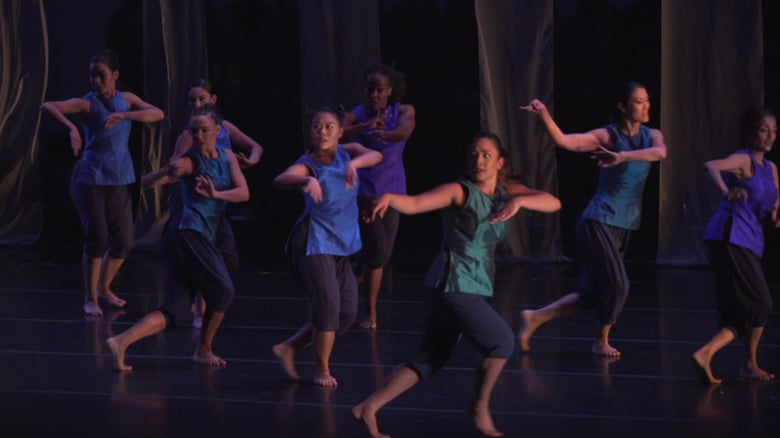
Ananya Dance Theatre, under the artistic direction of Ananya Chatterjea, presents dance within a social, feminist/womanist, human context. Entertaining is only a part of what they do. There were no spectators in the Grace Street Theater on Saturday night when I attended Shaatranga: Women Weaving Worlds. Oh, there were plenty of people in the audience, but Chatterjea and her troupe of seven powerful women did not allow us to sit and be entertained.

Several times the house lights came up and those who may have been under the impression they had come to see a show were asked to take a stand, to raise a fist, to clap and stomp our feet. We participated in an invocation of breath and watching a dance performance may never be the same. Stand up (one woman did). Raise your first (most did). Clap your hands. Stomp your feet. Chant: Public fury; public joy; public love; public dance!

Shaatranga, which means “seven colors” in Bānglā, is the culmination of a quintet of works exploring work women do. The dance was created in four movements and runs 95 minutes with no intermission and is based on research, history, and cultural connections. The two main themes are ancient Indian Ocean trade routes that connected Asia, Africa, and South America, and the shared practices of indigo-dyeing. Visually, an abstract navigation star represents the compass that “enables us to remain on the path of a complexly woven notion of justice.” At the beginning of the work, the navigation star is broken but by the end it has been healed. The sections of the dance bear names like “Voyage,” “Shipwreck,” and “Desolation.” There are “Rituals of Mourning” and “Dancing to Heal.”

Chatterjea’s movement vocabulary uses classical Indian dance as a foundation and there are layers contemporary dance woven throughout. There is yoga, martial arts, rage and joy. The movement that stood out most to me is a spiral that starts from deep inside the core then winds its way up and out. There is also spoken word, ritual, and sound: grunts, screams, the sound of helicopter rotors as the women’s hands reach up, the sound of feet slapping and stomping, the sound of drums, and even, I think, the faint sound of birds and monkeys chattering.

At the beginning, there was a curtain hung asymmetrically so that it reminded me simultaneously of a simple curtain or covering, a woman’s veil, and a ship’s sail. Later, the black curtains opened just a bit to reveal a portion of white wall bathed in red light with Chatterjea splattered on the wall, feet up, arms splayed out on the floor. There is beauty, hunger, pain, distortion, and there is power.

Projections and simple design elements created an all-encompassing world that kept me on the edge of my seat for most of the evening. There were rolling waves and animated billows of indigo that morphed into hands, and there were ceiling-to-floor ribbons of indigo, interwoven like the lives of the women represented, remembered, and honored. Throughout, the women wore loose-fitting dark blue pants (a knee-length Indian salwar, similar to Victorian knickers or bloomers) but changed their tops for each movement (peplum tunics, athletic leotards, high necked tops) in shades of blue, sometimes with splashed of color, but always indigo. Musical composition, vocals, sound design, poetry, costume, lighting, scenic design, animations and projections all united in a seamless manifestation of Chatterjea’s concept.

Often, a program is unnecessary, except to identify the names of the dances. In this case, the program was an essential guide to the work, filled with background, history, poetry, definitions, and questions: How do we show up for each other? This company, this work must be seen. Writing about it does not do it justice.

Julinda D. Lewis is a dancer, teacher, and writer who was born in Brooklyn, NY and now lives in Eastern Henrico County.

———-

Photo Credits:

Company photos and photos from the company website.

Ananya.1Ananya.2Ananya.3