AN OCTOROON: We Need to Talk

AN OCTOROON: The Point is to Make You Feel Something

A Theater Review by Julinda D. Lewis

At: TheatreLab, The Basement, 300 E. Broad St, RVA 23219

Performances: May 16 – June 1, 2019

Ticket Prices: $35 general admission; $25 seniors & industry/RVATA; $15 students and teachers with ID

Info: (804) 506-3533 or theatrelabrva.org

When is it okay to laugh at racist stereotypes?

When a smart award-winning playwright named Branden Jacobs-Jenkins writes a play called An Octoroon and incorporates racist stereotypes and historical images that are guaranteed to make every member of the audience feel uncomfortable at some point, even while laughing – especially while laughing. Every. Single. Member. Not you, you say? We’ll see about that.

There is a plantation. In Louisiana. The kind with slaves. There is a cast system with field slaves and house slaves. The title character is a slave who is the daughter of the recently deceased master. The old master’s wife – who is never seen, because she spends the entire play on her deathbed – has an affection for her late husband’s love child. A neighboring overseer plots to buy the failing plantation and have his way with his former rival’s illegitimate daughter, the octoroon. There is a black man wearing blackface with huge red lips, a black man wearing white face with a blond wig, and a white man wearing red face and a feather headdress. There is a lot of shucking and jiving — or dancing elaborately for the entertainment of the white man. There is lying, cheating, stealing, and classism, sexism, and age-ism. There is a noose. And there is a creepy rabbit. An Octoroon is an equal opportunity oppressor.

I think people who attended opening night could be divided into three types. The majority loved it. A few hated it. And a large portion were not sure what to think. And this is one play where race does matter! Everyone’s reaction was tempered not only by aesthetic preferences, but by the viewer’s race as well. Black viewers may have felt freer to laugh but may also have identified more closely with the characters and the historical and social time period. White viewers, on the other hand, may have hesitated to laugh for fear of seeming insensitive, or being accused of appropriating black culture. These dilemmas may have been heightened by recent news stories of politicians, teachers, and prom-posers wearing blackface, and of possible lynchings – even though the last officially documented lynching in America occurred in 1981 (Michael Donald in Mobile, Alabama).

So, what could there possibly be to laugh about?

An Octoroon is a classic melodrama that is anything but standard. It deconstructs not only the genre but the whole idea of what theater should be, how the performers should interact, and how the audience should perceive it.

Jacobs-Jenkins won the Obie Award for Best New American Play in 2014 for An Octoroon as well as for his play Appropriate (produced here in Richmond by Cadence Theatre last fall). An Octoroon is an adaptation of Dion Boucicault’s similarly-titled play The Octoroon, written in 1859. An Irishman wrote a play about slavery in America, and now a black American playwright has revamped it. Using the original characters and plot,  (BTW, an octoroon is a person who is one-eighth black, invoking the “one drop” rule that was used to legally classify people of mixed race as black) Jacobs-Jenkins has included contemporary language (e.g., women referring to one another as “girl,” and the use of the word “ghetto” as an adjective) and modern-day references (e.g., contemporary dances, a boom box, some R-rated rap music, and a cell phone).

Director Dr. Tawnya Pettiford-Wates recognizes, in her director’s note, that this melodrama is challenging for both the audience and the actors. Participating in the experience of An Octoroon, one might even begin to question the role of the director! But Pettiford-Wates raises some questions of her own. “How did we arrive at the place where race, class, and identity are what determines who succeeds and who does not?” she asks. And further, “And more importantly, where do we go from here?”

An Octoroon opens with a lengthy prologue that introduces us to BJJ, a black playwright working through an identity crisis with his therapist. BJJ is played by Jamar Jones, a young black male actor whose recent roles in Red Velvet, Free Man of Color, and Choir Boy have shown him to be a highly talented and versatile actor who is rapidly rising to the top of his game. Here Jones plays the characters of BJJ as well as the two white slave masters, George and M’Closky. At one point he appears in a vest with different patterns on each half and wears half a mustache, as he has to portray both characters onstage in the same scene.

The prologue also introduces us to Playwright, a character based on Dion Boucicault, the author of the original The Octoroon. Cole Metz also plays the roles of Wahnotee, a Native American and Lafouche, an auctioneer who has come to help dispose of the Terrebone Plantation, including its slaves. Each of Metz’ characters has an affectation that makes him either endearing or unbearable. Playwright is pompous, entitled, and bitter. Wahnotee speaks in broken, Pidgeon English and some version of patois. He walks with a lumbering gait and makes that stereotypical open-palmed “how” hand sign. Lafouche walks with a little catch step and keeps scratching the reddened side of his face. Metz can make his normally innocent, rosy-cheeked baby face turn pouty and whiny or menacing in the blink of an eye. He uses physical humor with restraint and allows his face to express his every thought.

The Playwright’s Assistant is played by Jeremy V. Morris, who is silent and seemingly resentful in his service to the Playwright, but overly enthusiastic in his later portrayal of two of the plantation’s slaves, the elderly Pete who manages the household, and the young Paul who is allowed to run freely with Wahnotee, and has been given few if any chores. Like the octoroon, he is also a favored child, but his circumstances are much lower down the social scale – even in the slave hierarchy.

Minnie and Dido (Asjah Janece and Khadijah Franks) are two house slaves who are friends. Dido has recently arrived from another plantation, and Minnie was born and raised on the Terrebonne Plantation. She believes there is nothing beyond the swamps, but by the end of the play both are looking forward with hope and fear to life beyond the plantation. Realizing they are not ready for freedom, they determine that working on a steam ship is the next best step.

Trinitee Pearson has the role of Grace, a pregnant field slave who shows attitude whenever she is in the presence of Minnie and Dido. Pearson also has the role of Br’er Rabbit, who serves as a sort of cautionary mascot for An Octoroon. Br’er Rabbit is a reminder of the trickster who lives by his wits, a sort of Anansi figure with both African and Cherokee roots. I personally found the Br’er Rabbit character somewhat creepy. Perhaps it was because rabbits are usually not the size of a petite woman, or maybe it was the mime-like half-mask Pearson wore and the limp-wristed, hovering stance she adopts.

Maggie Roop plays Dora, a wealthy white heiress who has her eye on George, even though she knows his only interest in her would be because of her ability to save the family plantation from a short sale. Roop is deliciously over the top in her stylized interpretation of the delicate southern belle, dressed in a bell-shaped white dress with crinolines and hoops, and enough pink bows and frills to stock a small emporium. In her first scene, she demands that Minnie fan her. Even though she is a socialite, it seems Dora’s only friend is Zoe, the Octoroon.

The octoroon is played by Juliana Caycedo, who I have only ever seen before in Cadence Theatre’s production of Between Riverside and Crazy. Caycedo looks the part of the beautiful octoroon with her olive skin, long curly hair, and huge, innocent eyes.  She happily joins in with Roop in prancing and flouncing around the stage, twirling in her green dress, also supported by crinolines as she and her friend and so to be rival, Dora, feign fainting spells and swoon at the drop of a hat. It is obvious these are ladies who never sweat but merely “dew.” Caught between two worlds, Zoe belongs to neither.

Also in the cast, is Liam Joseph Finn, holding down the small but significant roll of Ratts, a tall, handsome ship’s captain who comes to the auction to buy slaves. Dasia Gregg’s scenic design is deliberately rustic and dusty looking. She has lined the walls with jagged boards and littered the floor with crates and overturned chairs. This setting suggests a sense of impermanence, decay, and danger. Erin Barclay’s lighting maintains the dark and dreary theme, making it all the more startling and effective with the space lights up with the flash of George’s old-fashioned camera – the kind with a black curtain on a tripod. Projections by Gregg and Kelsey Cordrey keep the audience informed of the progress of the five acts, written in an elaborate old-fashioned font, and occasionally draw interest with animated flames, or the photograph of an actual modern day lynching. The latter is so disturbing that even BJJ asks to have it removed.

Breaking with all sorts of tradition, instead of performing the fourth act or the “sensation” act of the melodrama, BJJ, Playwright, and Assistant tell us about it, using a few props, and even rewinding to back up when BJJ loses his train of thought.

An Octoroon raises so many questions. This is the sort of play that cries out for a talk-back. (Dr. Pettiford-Wates indicated three are scheduled for later in the run.) There is more here than meets the eye. As one actor says at the end of Act Four, “the point of this whole thing was to make you feel something.” Having tapped into those feelings, they need to be discussed, examined, analyzed, and shared with others. This is not theater designed to merely entertain. Few would leave saying, “I liked it,” or “I enjoyed it.” More likely, others, as I did, left saying, “we need to talk about this!”

Julinda D. Lewis is a dancer, teacher, and writer who was born in Brooklyn, NY and now lives in Eastern Henrico County.

———-

Photo Credits: Tom Topinka

An Octoroon 3
Jamar Jones
An Octoroon 2
Maggie Roop as Dora in An Octoroon
An Octoroon 1
Jamar Jones as playwright BJJ in An Octoroon


MISS GULCH RETURNS!: When Fiction Becomes Reality

MISS GULCH RETURNS!: The Bitch is Back!

A Theater Review by Julinda D. Lewis

Richmond Triangle Players

At: The Robert B Moss Theatre, 1300 Altamont Avenue, RVA 23230

Performances: May 15-25, 2019.

Ticket Prices: $10-35

Info: (804) 346-8113 or rtriangle.org

Ding, dong, the bitch is back!

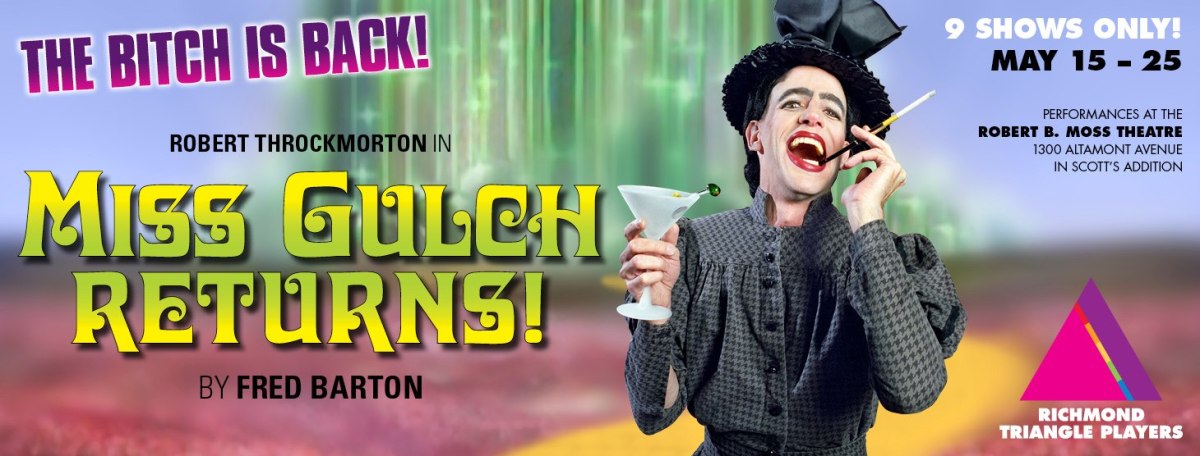
Some shows teach lessons, some force the audience to adjust their perspective, some raise questions, and others tug at your heartstrings. Fred Barton’s one-man show, Miss Gulch Returns!, does not require anything of its audience but that you sit back and enjoy it – preferably with a drink at hand. Performed by Robert Throckmorton, who is revising the role he first performed more than a decade ago, to great acclaim Miss Gulch Returns! is a musical parody, based on the character of Almira Gulch, the bicycle riding neighbor of Aunt Em, Uncle Henry, and Dorothy in the 1939 film version of The Wizard of Oz.

In the film, Gulch threatens to have Dorothy’s dog, Toto, put to sleep, claiming he has bitten her. Aunt Em is not intimidated, and tells Miss Gulch, “Almira Gulch, just because you own half the county doesn’t mean you have the power to run the rest of us.” Later, Dorothy sees Miss Gulch transform into the Wicked Witch of the West, and her bicycle transform into a flying broom.  Barton has woven many Oz-related references into Miss Gulch Returns!

What makes this even funnier is that Barton’s Miss Gulch is a spin-off of a fictional character who is the “real-life” embodiment of a fictious character!

Throckmorton first appears onstage in dark pants and a jacket – with a piano on one side and a bar on the other, it looks and sounds as if we are about to experience a traditional cabaret. The Robert B. Moss Theatre has been slightly rearranged; where there are usually a few tables at the rear, tables have been added to alternate rows, starting with the very front row – where I sat. And there is an extra table set up at the foot of the stage with a candle, a drink, and a basket with Miss Gulch’s hat on top.

After just brief introduction and a couple of songs, Throckmorton approaches this little table and engages in a seductive conversation with an invisible Miss Gulch before suddenly ripping off his tear-away clothing to reveal Miss Gulch’s spinsterly gray dress and the show is off and running at breakneck speed with nonstop laughs fueled by double and triple (if that’s possible) entendre.

Barton’s Miss Gulch assumes that the Wizard of Oz Miss Gulch has a life as an actress and cabaret singer after the film and follows her life in songs, some half spoken and some sung full out with Throckmorton’s subtle but delightfully strong voice. These include self-descriptive and advice-filled torch songs, including “I’m a Bitch” and “Pour Me a Man” in the first act and “I’m Your Bitch” and “I Poured Me a Man” in the second act. My favorite one-liner, bar none, was venomously delivered near the top of the second act, when Miss Gulch was bemoaning being the recipient of all her married and partnered friends’ complaints: “Defecate or de-commode!”

The music and lyrics are by Barton as well as the book, Joshua N. Wortham, the musical director, accompanies Throckmorton on piano, and occasionally acts as Miss Gulch’s straight man or handler. Miss Gulch Returns! is staged by Throckmorton and Steve Perigard, with moody lighting by Amy Ariel (who has a lengthy resume of lighting designs and just finished her third year as a lighting design and engineering student at VCU) and the scenic and sound design is by RTP associate producing director Lucian Restivo. The set, on three levels, had a sort of timeless feel of unspecified era, and there was a lovely slide show of iconic movie stars (e.g., Audrey Hepburn, Marilyn Monroe, Cher, and Lena Horne, to name a few) that heightened the vintage visual element.

I never saw Throckmorton’s earlier portrayal of Miss Gulch, but there were many in the audience who did. At least one came specifically because she had heard that Throckmorton was recreating the role and she had retained fond memories of it for more than a decade. Ready or not, perhaps it’s time for a new generation to meet Miss Gulch as she continues to hilariously blur the line between reality and fiction.

Julinda D. Lewis is a dancer, teacher, and writer who was born in Brooklyn, NY and now lives in Eastern Henrico County.

———-

Photo Credits: as noted

MissGulch_468
Robert Throckmorton as Almira Gulch (Dorothy’s nemesis from “The Wizard of Oz”) in the musical comedy “Miss Gulch Returns!”, playing at Richmond Triangle Players’ Robert B. Moss Theatre through May 25. Photo by John MacLellan
MissGulch_289
Robert Throckmorton as Almira Gulch (Dorothy’s nemesis from “The Wizard of Oz”) in the musical comedy “Miss Gulch Returns!”, playing at Richmond Triangle Players’ Robert B. Moss Theatre through May 25. Photo by John MacLellan.

Miss Gulch 1

Miss Gulch 2
Photo by Joshua N. Wortham


GLORIA: In Trouble or In Excelsis Deo

GLORIA: In All Its Glory

A Theater Review by Julinda D. Lewis

By: Virginia Rep/Cadence Theatre Company

At: Theatre Gym, Virginia Repertory Center, 114 W. Broad St., RVA 23220

Performances: May 11 – June 2, 2019

Ticket Prices: Single tickets start at $35

Info: (804) 282-2620 or va-rep.org

Gloria is an intriguing play by Branden Jacobs-Jenkins, who also wrote Appropriate, which Cadence Theatre produced in 2018 and An Octoroon, which opens at TheatreLAB the basement on May 16. Not only does Jacobs-Jenkins appear to be a prolific playwright, but several of his works have won awards and other have been recognized by being nominated.* Of the two works I have seen so far, Appropriate and now Gloria, it is clear why Richmond theaters and directors want to share his work with our local theater audiences. His work is relevant and thought provoking, often addresses sensitive issues such as racism, suicide, mass shootings in the workplace, and family and social dysfunction with a clear eye and familiar settings that augment the surprise of the deliberately shocking actions or revelations of his otherwise ordinary characters.

In order not to spoil the surprises of Gloria, it may be necessary to talk around some issues and scenes, rather than to address them directly. With little knowledge of Gloria prior to attending the opening on Saturday night, I was totally unprepared for the culminating actions in the first act. Suffice it to say this play does come with a warning: “Please be advised that Gloria contains sudden, loud sound effects and realistic depictions of violence that may not be suitable for all audience members. For more information, we encourage patrons to contact the box office at 804-282-2620.”

Set in the offices of a prestigious but fictitious Arthur Kimble Publishing company in Manhattan, the first act of Gloria draws us into the stressful workday lives of a group of young editorial assistants who are all striving to succeed in the cutthroat world of writing and editing. Friendships aren’t really about social interaction as much as they are about networking and keeping the enemy in plain sight. Even interns are regarded as potential threats to one’s job security.

Cadence’s artistic director Anna Senechal Johnson directed a dynamic cast in this two hour production – including one intermission – with an intensity that made the viewer forget all about time. Laine Satterfield played the title role of Gloria with a wide-eyed and wild-eyed edginess that affected the energy and actions of all the other actors even when she wasn’t onstage. Satterfield also plays the role of Nan, a senior editor who is heard during the first act but not seen until the second act. Described by her employees as cold and distant, Satterfield focuses attention on the humanity of her character during the second act.

Anne Michelle Forbes as the hyper-active Kendra brought humor and style to the office and the stage and I was delighted to be introduced to Joel Ashur, who played the intern, Miles. One of several cast members who played multiple roles, Ashur indicated after the show that Miles was his personal favorite. Other roles include a very attentive barista and a vapid film producer.

The cast also included Jessie Jennison as a young office assistant named Ani, Matt Polson as a senior office associate named Dean, and Happy Mahaney as the disenchanted Lorin, a fact checker who works in an office down the hall from the cubicled quartet. While the play is called Gloria the character of Gloria touches the thoughts and actions of all the other characters from the beginning of the first act to the closing scene of the second act – which occurs some two years later.

A major theme of the play is how people perceive and process trauma and grief. Kendra, Dean, Nan, and Lorin all have different memories and perspectives of the trauma that ties them together. This seems to be a strength of author Jacob-Jenkins – presenting the good, the bad, and the ugly of his characters, making them three-dimensional and real to the viewer. Their responses to loss and their differing personal experiences with the same trauma make one question who owns loss? Who owns trauma? Who, if anyone, has the right to profit from it? To this end, Johnson has included detailed program notes, including a full paragraph about the setting, an organizational hierarchy of the fictitious publishing company (identifying staff members as Baby Boomers, Generation X, Generation Y, and Generation Z), and discussion questions to guide viewers through this experience.

Music plays a prominent role in this play – which is not a musical. There is original music by Nicholas Caviness and Ali Thibodeau, with Thibodeau credited with the unseen role of singer Sarah Tweed. There is also some very amusing singing by Forbes and Jennison in a major scene in which they mourn the death of the singer. The Sarah Tweed of Gloria is fictitious, but I did find a real singer named Sarah Tweed in an online search after the show.

Rich Mason is the scenic designer for Gloria. The set features clean lines and multi-use wooden tables and translucent panels that reflect the natural lighting effects created by Weston Corey and Michael Jarett and changes from a New York publishing office to a familiar facsimile of a Starbucks coffee shop to the offices of a television and film production company in Los Angeles.

Having presented the audience with multiple perspectives, neither the author nor the director wraps up with a tidy ending or even explanations for the questions that are raised, explored, but never answered. Of course, people lingered in the lobby after opening night, but I wouldn’t be surprised if this occurs every night. Gloria could very well have been offered as an entry into the Acts of Faith festival. This is not theater for those who want to be entertained, but for those who desire to be challenged.


*Playwright Branden Jacobs-Jenkins has won numerous awards, including the Windham-Campbell Literature Prize for Drama, the PEN/Laura Pels International Foundation Award, the Benjamin H. Danks Award, the Steinberg Playwrights Award, the Sundance Theatre Institute’s Tennessee Williams Award, the Helen Merrill Award, the Paula Vogel Award, and the  Princess Grace Award. Gloria was a Pulitzer Prize finalist and received two Lucille Lortel Award nominations as well as a 2016 Drama League Award for Outstanding Production of a Broadway or Off-Broadway Play and two 2016 Outer Critics Circle Awards.


Julinda D. Lewis is a dancer, teacher, and writer who was born in Brooklyn, NY and now lives in Eastern Henrico County.

———-

Photo Credits: Jason Collins Photography

This slideshow requires JavaScript.

https://www.amazon.com/promocode/A1PKKZJSY30F1H?ref_=assoc_tag_ph_1524210990188&_encoding=UTF8&camp=1789&creative=9325&linkCode=pf4&tag=rvartreview-20&linkId=bdf9837050fcb57dd6a990efddfa826f

https://www.amazon.com/promocode/A2KNJIC64RPUKN?ref_=assoc_tag_ph_1524210989955&_encoding=UTF8&camp=1789&creative=9325&linkCode=pf4&tag=rvartreview-20&linkId=89b4be643bd09de9465e2a08bf683b81

ATLANTIS: The Truth Will Rise. . .

ATLANTIS: A New Musical

A Theater Review by Julinda D. Lewis

At: The November Theatre Marjorie Arenstein Stage

Performances: April 12 – May 5, 2019

Ticket Prices: $36-63

Info: (804) 282-2620 or www.virginiarep.org

Keep in mind that Atlantis is the fictionalized representation of an ideal society – a utopia – and you will have an idea of the strengths and weaknesses of the new musical, Atlantis: a new musical. Atlantis is being developed by Virginia Rep in partnership with Glass Half Full Productions and Greg Schaffert (Peter and the Starcatcher) as well as PowerArts and support from the Muriel McAuley Fund for New Plays and Contemporary Theatre.

This production boasts a boatload of designers and artists. Matthew Lee Robinson wrote the music and lyrics, while the book was a joint effort of Ken Cerniglia, Robinson, and Scott Anderson Morris. The story, which involves the uncovering of secrets that make this idyllic island possible and a young girl who questions the status quo, reminded me of the Disney children’s film, Moana, that I unwittingly watched while spending quality time with my Miami grandchildren one visit. The music was well written, but the lyrics were not memorable – and not always easy to understand.

Jason Sherwood’s seaside fantasy set with its billows of fabric that suggested fish scales and waves, the neon arches, and the moveable structure that could be a mountain, a boat, or whatever it needed to be, was attractive and purposeful, creating a feeling that was both ancient and futuristic at the same time. BJ Wilkinson’s lighting and Derek Dumais’ sound design enhanced this effect and the overall feeling of another world, sometimes shadowy and sometimes brilliantly colored. Anthony Smith was the musical director and Kikau Alvaro did the choreography – both of which worked with Tony award nominee Kristin Hanggi’s direction to keep things moving along at a good pace. Amy Clark’s costumes seemed to be in search of an era, with some garments – as well as hairstyles – appearing to be inspired by ancient times and other by futurism. Think Star Trek meets Ancient Greece.

I enjoyed the cast, although many of the characters seemed underdeveloped. There were a lot of people in the cast, but it seems only a few had names we needed to learn or remember. Antoinette Comer was both skillful and interesting in the lead role of Maya, the ruler’s daughter who was determined to rock the proverbial boat, but the role of her counterpart, Kaden, played by Julian R. Decker seemed to have been given less thought – although he did get the most soaring solo of the show,  with  “Let’s Start a War.” Marcus Jordan was interesting but a little stiff as the ship wrecked stranger, Arah, who washed ashore and confirmed Maya’s long-held suspicions and The Order’s worst fears – that there was, indeed, something beyond “the seam” where the sky meets the ocean. A favorite character was Lucy Caudle as the ever-present and deeply observant little sister, Alexa.

Jerold E. Solomon, Katrinah Carol Lewis, Susan Sanford, and Debra Wagoner as some of the adult leaders and parents all had distinct and interesting roles that were not yet fully developed – sort of like the adults in Peanuts who are often depicted as instruments whose sounds are not fully articulated. Of course, this could have been done on purpose, to emphasize the secrecy that shadowed this utopian community.  It will be interesting to see how, as this work is developed and refined, these characters are developed without substantially lengthening the show, which currently runs around two and half hours, with one intermission.

So, like a true utopia, which exists only in the mind, Atlantis is not perfect, but it is an enjoyable musical that is quite unlike all the other offerings of this current season. And it’s definitely worth seeing. For some, it’s pure entertainment, and for others, it represents an opportunity to study a production from its inception and watch how it changes over time.

Julinda D. Lewis is a dancer, teacher, and writer who was born in Brooklyn, NY and now lives in Eastern Henrico County.

———-

Photo Credits: Aaron Sutten

This slideshow requires JavaScript.

BINGO! The Winning Musical: Grab Your Dauber and a Rabbit’s Foot

BINGO! The Winning Musical: A Birthday Tribute

A Theater Review by Julinda D. Lewis

At: CAT Theatre, 419 No. Wilkinson Rd., RVA 23227

Performances: April 19-May 4, 2019

Ticket Prices: $23 General admission; $18 RVATA Members; $13 Students

Info: (804) 804-262-9760 or cat@cattheatre.com

The invitation to “come play Bingo with us” is not just hollow words. The first thing I noticed when I entered the CAT Theatre space on Tuesday evening was the aroma of popcorn. After checking in at Will Call and obtaining my program, I was given a set of bingo cards, a dauber, and a ticket that could be exchanged for a cup of popcorn before the show or during intermission. Inside the theater half the audience seats had been replaced by tables for six, transforming the space into a reasonable replica of a bingo hall.

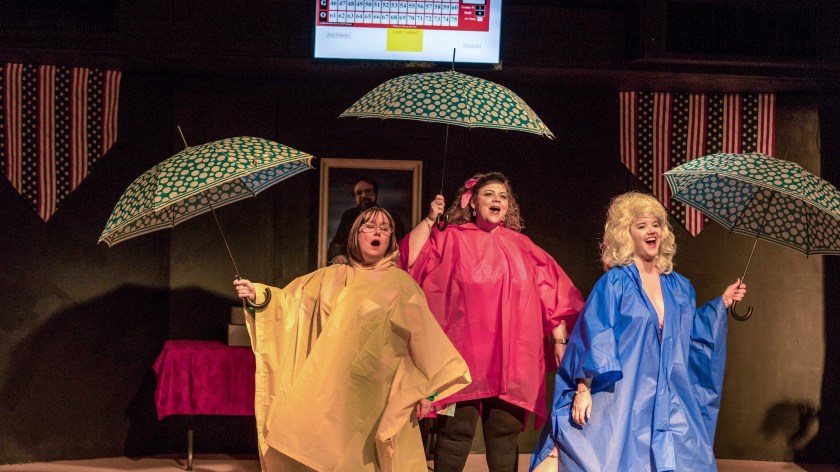
Bingo! The Winning Musical, with book by Michael Heitzman and Ilene Reid and music and lyrics by Hietzman, Reid, and David Holcenberg, is an interactive comedy that kept the audience engaged with three fairly fast-paced rounds of standard bingo (five-in-a-row) while the actors participated in more advanced versions of the game, such as covering numbers in the shape of a happy face or an airplane. The play, directed by Pat Walker, opens on three friends staring out the window observing a raging storm, and briefly debating the wisdom of attending their weekly bingo storm. Bingo wins out over safety, and they show up late at their favorite bingo hall only to find that they have missed the early bird game and even worse, some newcomers (i.e., theater patrons) have taken their lucky seats.

Honey (Caitlin St. Clair) is a blonde bombshell with a heart of gold. A rather dim bulb, she is three-times divorced and has her eye on Sam (David Atkins), an ex-con auto mechanic who calls the numbers for the bingo games. Patsy (Sandra Clayton) is a petite woman in a brightly colored jogging suit who has adopted a number of superstitious rituals involving troll dolls and rabbits’ feet. She won’t play bingo without performing her rituals, although it has apparently been years since she has actually won a game. Finally, there is the sharp-tongued Vern (Amber Dawn dePass), the leader of ladies’ night out by virtue of her strong personality.

Bingo! The Winning Musical is set in a fictitious suburb in Pennsylvania in current times on the 90th anniversary of the birth of bingo. For some reason, it seems as if the group is celebrating the birthday of Edwin S. Lowe, who popularized – but did not invent – the game of Bingo. Lowe’s portrait has a prominent place center stage, there are birthday cakes, and the cast sings “Happy Birthday” as a postlude. (Interestingly, while it is known that Lowe died on February 23, 1986 in his Manhattan home, his exact birthdate is unknown, other that it was sometime in 1910 in Poland.)

In flashbacks, we learn that fifteen years ago Vern had a major falling out with her best friend, Bernice (Vanessa Fetcher) over a winning bingo card, and the two haven’t spoken since. Since this is a comedy, Bernice’s daughter Alison (Emma Grace Bailey) shows up in the present to try to reconcile her mother and Vern as Bernice is dying. And since this is a comedy, Alison has disguised her long brown hair with a long brown wig – and no one recognizes her except Minnie, the manager of the bingo hall, who tags her as a soap opera actress.

At one point Vern heckles an audience member who is sitting in “her” lucky seat because he has won the door prize – which she even attempts to take from him. Minnie Martinelli, the manager of the bingo hall, maintains order among the ladies, assists the patrons of the bingo hall (including the audience members), and does basic maintenance. This includes everything from keeping everyone calm when the power goes out because of the storm to sweeping up discarded bingo cards to sucking the gas out of a patron’s car to refuel the generator when it runs out of gas.


Martinelli, who is played by Cynthia Mitchell, Executive Producer of the Bifocals theater of senior actors and a CAT Theatre Board member, does of all this with a soft voice and surprisingly subtle comedic timing, while dePass and Fletcher carry off the broader, more physical comedy. Bailey’s over the top solo, Nurse Ratched’s Lament from Cuckoo, the musical version of One Flew Over the Cuckoo’s Nest had actors in the audience roaring with laughter.

There are humorous scenes involving a moving portrait and a hidden door, and a “surprise” ending. With all of this going on, it’s a mystery that the first act seemed to drag on far longer than the hour it actually took. And it’s almost possible to forget this is a musical, even though there are at least half a dozen songs and reprises of several. The reason for this, I think, is that while the actors have pleasant voices, they rarely project and soar, but rather sing as if trying not to disturb the neighbors. I’m not sure if this was an artistic decision by music director dePass or due to acoustic limitations. There’s that and also that the music is recorded rather than live. At one point I found myself considering the word parody to describe this show.

In addition to dePass who played Vern and was Music Director, St. Clair did double duty as Honey and the show’s Dance Captain. And Pat Walker was both Director and set designer.  There were several dance numbers featuring umbrellas as props. The minimal set – unusual for CAT Theatre – consisted mostly of black walls, a portrait, a desk for Sam, a table for the Bingo!  ladies, and, of course, the tables for the audience.  Atkins, Fletcher, and Mitchell were all making their debut on the CAT stage. Walker previously directed Enchanted April for CAT a few years ago and has directed the Bifocals senior theater for both Barksdale/Virginia Rep and now Bifocals at CAT.

On leaving the theater, many people remarked how cute Bingo! is, with one describing it as adorable. There is nothing remarkable about Bingo! The Winning Musical. It is an enjoyable, stress—free two hours of musical comedy that doesn’t require the audience to think or make decisions or judgments. And you get to play along.


Julinda D. Lewis is a dancer, teacher, and writer who was born in Brooklyn, NY and now lives in Eastern Henrico County.

———-

Photo Credits: Courtesy of Ann Davis

Bingo.1
Sandra Clayton, Amber Dawn dePass, and Caitlin St. Clair
Bingo.2
Sandra Clayto, Caitlin St. Clair, David Atkins, Emma Grace Bailey, and Cynthia Mitchell
Bingo.3
Sandra Clayton, Emma Grace Bailey (front), Amber Dawn dePass (rear), and Caitlin St. Clair

ANIMAL CONTROL: People Are Just Animals Who Talk and Wear Clothes

ANIMAL CONTROL: A BAD DAWG TALE

A Theater Review by Julinda D. Lewis

At: The Firehouse Theatre, 1609 W. Broad Street, RVA 23220

Performances: April 17 – May 12, 2019

Ticket Prices: $15/student; $25/military; $35/general admission

Info: (804) 355-2001 or firehousetheatre.org


Richmonders who are familiar with the name Chandler Hubbard probably know him as an actor, but this month Hubbard is making his debut as author of the new play Animal Control for which he received the 2019 Martha Hill Newell Playwrights Fund award. Like most comedies, Animal Control tackles some tough, real-life subjects and their accompanying emotions – anger, blame, justice, and ultimately compassion. Sometimes it’s difficult to decide whether to laugh or cry.

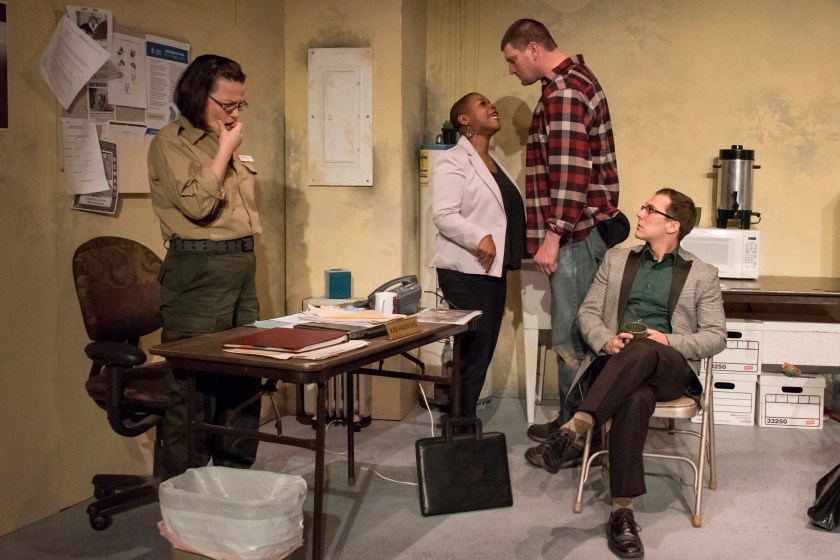
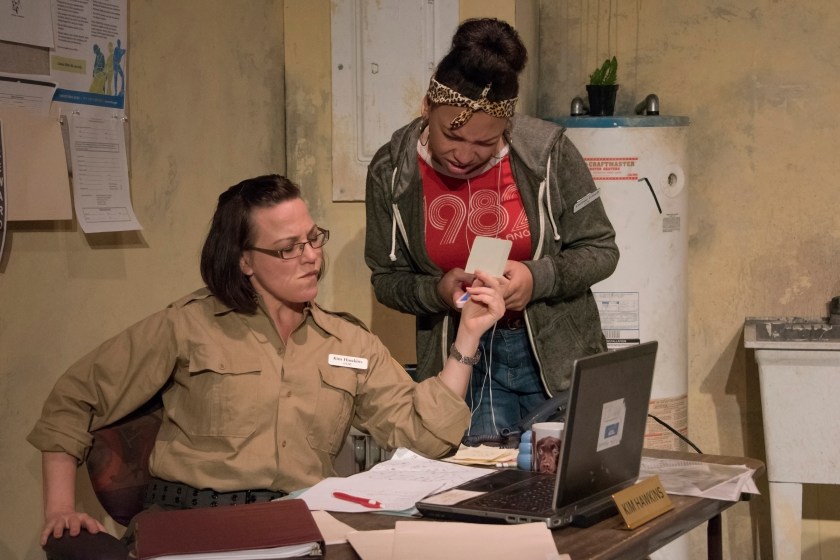
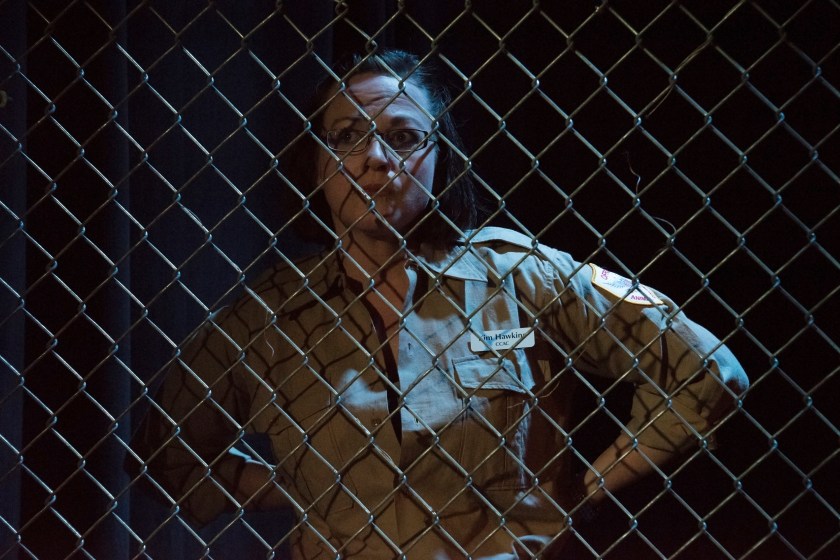
Director Joel Bassin, Producing Artistic Director of the Firehouse Theatre, noted that during the dress rehearsal and first two showings it became obvious that pet-owners were more likely to take the quiet route as they found the issues close to their hearts. Set in a dingy office in the Carson County Pound, the play opens as the center’s newly appointed director, Kim Hawkins (played by the versatile Donna Marie Miller), deals with complaints and repeat offenders. The main offender, a three-legged pit bull rescue named Bailey, who has been adopted by the equally menacing owner, Dan Stanley (played by Arik Cullen who towers over everyone at well over 6’), has allegedly attacked another dog at the dog park.

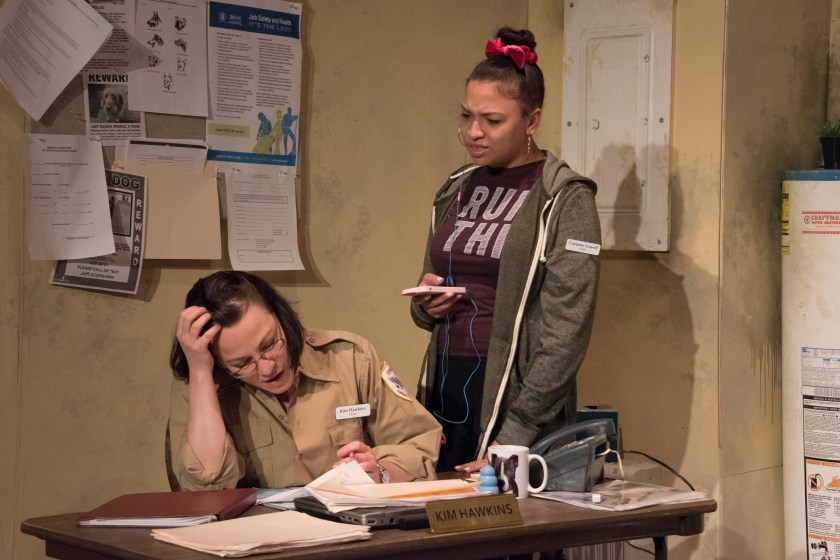
Adam Turck plays Marc Hanson, the persnickety owner of Winnie – short for Winston, as in Churchill – who files the most damning complaint against Dan and Bailey.  Marc (with a “c” he takes pains to explain) has pictures of the injuries his dog sustained and as the tension piles on, Dan’s neighbor, another frequent phoner of complaints, Patty Smith (Lucretia Marie Anderson) also shows up in Ms. Hawkins’ office. All of this is overwhelming for Hawkins, who would rather deal with dogs than people, but she has the dubious back-up of her office associate, Corrine Lowell (Journey Entzminger), an insolent college student who has an affinity for the dogs and an unlikely friendship with her frazzled supervisor.

Bassin directs this eclectic cast of characters with an ebb and flow, a cycle of tension and release that sometimes reaches explosive levels. Expletives fly, Dan towers over everyone, and Corrine is an ever constant presence with her irreverent but much needed wit and sarcasm. Patty seems at first to be an extraneous presence, but she has a key scene with Hawkins and her role is integral to the final resolution. Miller makes Hawkins sympathetic, offsetting moments of indecision with insight and clarity. I’m not familiar with Entzminger, so I’m not sure how much of a stretch it was for her – a junior Business Management student at VCU – to play the insolent college student so convincingly. Surprisingly, she has the final word. Adam Turk is fittingly annoying as the owner of the injured dog, and Arik Cullen, who seemed to enjoy the role of the bad boy, holds the key to the compassionate conclusion.

At the beginning of each scene two actors stand behind the chain link fences on either side of the stage, smoking, texting, or just thinking. While I found this transition interesting, I was distracted by the set. Phil Hayes designed an authentically drab break room that doubles as Kim Hawkins office – with just a folding table for a desk. What bothered me was that the sides of the set were not built all the way out to the theater’s walls, so we could see the scaffold-like edges and supporting brace just behind the chain link fences. I know it’s a set, but I don’t want to see the behind-the-scenes workings. Andrew Bonniwell designed the lighting – no special effects needed here – and Ryan Dygert designed the sound – with dogs barking in the background.

Without giving away too much of the show, Hubbard makes it impossible to take sides by presenting multiple sides of the issue and throwing in a couple of emotionally loaded surprises.

Animal Control is written in three scenes (The Prosecution, The Defense, and The Verdict), with two intermissions and runs a little over two hours, including the intermissions. I thought it was rather well paced, but my partner found it a bit too long. It should be mentioned that neither of us owns a pet, which I think makes a difference. I heard more than one sniffle, that I do not attribute to seasonal allergies, and observed at least one attendee feeling a bit verklempt, waving a hand to ward off tears in the lobby after the show.


Julinda D. Lewis is a dancer, teacher, and writer who was born in Brooklyn, NY and now lives in Eastern Henrico County.

———-

Photo Credits: Tom Topinka

Animal Control.7_Donna Marie Miller, Lucretia Marie Anderson, Arik Cullen, Adam Turck (photo by Tom Topinka)
Donna Marie Miller, Lucretia Marie Anderson, Arik Cullen and Adam Turck
Animal Control.6_Adam Turck, Arik Cullen (photo by Tom Topinka)
Adam Turck and Arik Cullen
Animal Control.4_Donna Marie Miller, Adam Turck, Arik Cullen (photo by Tom Topinka)
Donna Marie Miller, Adam Turck and Arik Cullen
Animal Control.3_Donna Marie Miller, Journey Entzminger (photo by Tom Topinka)
Donna Marie Miller and Journey Entzminger
Animal Control.2_Donna Marie Miller, Journey Entzminger (photo by Tom Topinka)
Donna Marie Miller and Journey Entzminger
Animal Control.1_Donna Marie Miller (photo by Tom Topinka)
Donna Marie Miller


https://www.amazon.com/b?node=17869251011&ref_=assoc_tag_ph_1524210812458&_encoding=UTF8&camp=1789&creative=9325&linkCode=pf4&tag=rvartreview-20&linkId=44cc6aa41d879b2bbdfcf9a36fd354ab


https://www.amazon.com/b?node=17869251011&ref_=assoc_tag_ph_1524210642832&_encoding=UTF8&camp=1789&creative=9325&linkCode=pf4&tag=rvartreview-20&linkId=b929623c39f25eb8717d52c818509d1c


https://www.amazon.com/b/?ie=UTF8&node=10825011011&ref_=assoc_tag_ph_1524210607401&_encoding=UTF8&camp=1789&creative=9325&linkCode=pf4&tag=rvartreview-20&linkId=dbd577f25bec2fb0d914c72908031ba2


https://www.amazon.com/l/16256994011?ref_=assoc_tag_ph_1501285904297&_encoding=UTF8&camp=1789&creative=9325&linkCode=pf4&tag=rvartreview-20&linkId=5fdf6f2c853419c2097c60d96226fc30

WOMEN’S THEATRE FESTIVAL: The Best Man in the Government – גּוֹלְדָּה מֵאִיר

WOMEN’S THEATRE FESTIVAL: Golda’s Balcony

A Theater Review by Julinda D. Lewis

At: TheatreLab, The Basement, 300 E. Broad St, RVA 23219

Performances: March 28, April 3, 7, 13 & 18, 2019

Ticket Prices: $25 general admission; $20 for RAPT card holders; $15 for students

Info: (804) 359-2003 or 5thwalltheatre.org

Isaiah 56:5 (NIV)

to them I will give within my temple and its walls
    a memorial and a name
    better than sons and daughters;
I will give them an everlasting name
    that will endure forever.

Golda’s Balcony, a one-woman play about the Israeli stateswoman, Golda Meir, is a heart-touching work of historical fiction by William Gibson. Written in 2003, Golda’s Balcony was Gibson’s second attempt to capture Meir on stage; he was not quite satisfied with his earlier multi-character work, Golda (1977) and it is said that Meir herself saw it and hated it. Meir died in 1978 of lymphoma, and so never got a chance to see Golda’s Balcony.

This is not a pretty play. It is full of war: talk of war; sounds of war; thoughts, feelings, results, and regrets of war. It begins with the start off the Yom Kippur War, in 1973 and Meir, played with heart and gusto by none other than Jacqueline Jones, is clad in a bathrobe, looking every inch the Jewish grandmother. This image is soon dispelled, however, as she is thrust into the midst of an unending and seemingly unwinnable (by either side) war. She sheds the bathrobe for a power suit and takes up the banner of the Jewish state of Israel.

“Survival is maybe a synonym for Jewish,” Meir says at one point. Later, she conjures up the image of a biblical “Abraham messing around with the house maid” being responsible for the ongoing political and religious conflict of two groups of people fighting over one piece of land.

Jones owns this role. During the talkback following the final showing of this work, director Debra Clinton, who worked with Jones during her first performance of this show at Weinstein JCC in 2010, said that the passing of time had made Jones even better in this role, and that at times – when she leaned across the Prime Minister’s desk, for example – she actually looked like Meir. I personally think Jones looks much softer than the images I’ve seen of Golda Meir, but nonetheless, her performance was both emotionally charged and historically eye-opening.

Playwright Gibson, director Clinton, and Jones presented tough, controversial subject matter in a way that opened a door onto the humanity of a world leader – and more than that, they offered insight into a woman operating in a man’s world. Among many nicknames – some less flattering than others – Meir was known as the Iron Lady of Israeli politics and the best man in government.

“We intend to live. Our neighbors intend for us to die. There’s not much room for compromise.” These words refer to the Palestinian-Israeli conflict but seem to apply as well to recent and current headlines in the US and right here in the state of Virginia.

Golda’s Balcony – a term that refers both to the physical balcony on which the elderly Meir sat to tell this story and to the nickname for Meir’s nuclear weapons facility – is not without moments of humor. Periodically, as melancholy cello music plays, Jones breaks the fourth wall to snap, “I can do without that music.” Near the end of the journey – about ninety minutes of intense drama, with no intermission – we learn that the music is connected to both Meir’s husband, Morris, who was a music lover, and her son, Menachem Meyerson, who was a professional cellist. The story-telling was both a powerful tribute to women, and a heartfelt performance by Jones.

The quartet of one-woman shows that made up the Women’s Theatre Festival concludes with final productions of Margaret Joyner’s Message from a Slave starring Pamela Archer-Shaw on April 19 and Theresa Rebeck’s Bad Dates starring Maggie Bavolack on April 20. Charlayne Woodard’s Pretty Fire, starring Haliya Roberts, closed April 17. I believe the Women’s Theatre Festival – a co-production of 5th Wall Theatre (Carol Piersol) and TheatreLAB (Deejay Gray) was a new concept here in Richmond, but I hope it won’t be a one-time event. The stories were compelling, the performances stellar, and I hope new audiences were introduced to the richness of Richmond theater.

Julinda D. Lewis is a dancer, teacher, and writer who was born in Brooklyn, NY and now lives in Eastern Henrico County.

———-

Photo Credits: Destiny Martinez Photography


https://www.amazon.com/dp/B07BFRHZLB?ref_=assoc_tag_ph_1524210913746&_encoding=UTF8&camp=1789&creative=9325&linkCode=pf4&tag=rvartreview-20&linkId=a4ce1217385e77ea50fa9017a932fe2a

https://www.amazon.com/dp/B07DLPWYB7?ref_=assoc_tag_ph_1524210885446&_encoding=UTF8&camp=1789&creative=9325&linkCode=pf4&tag=rvartreview-20&linkId=1ebab116dd8323f2fae25777042f5d34

https://www.amazon.com/b?node=17869251011&ref_=assoc_tag_ph_1524210812458&_encoding=UTF8&camp=1789&creative=9325&linkCode=pf4&tag=rvartreview-20&linkId=117ef9da1d6ef658059002f2b6b28ab6

SEVEN HOMELESS MAMMOTHS WANDER NEW ENGLAND: Who Needs a Sub-heading After That?

Seven Homeless mammoths Wander New England: & Alternative Kinship Structures!

A Theater Review by Julinda D. Lewis

Richmond Triangle Players

At: The Robert B Moss Theatre, 1300 Altamont Avenue, RVA 23230

Performances: April 10 – May 4, 2019. (Opening Night – April 12)

Ticket Prices: $10-35

Info: (804) 346-8113 or rtriangle.org

Some works of art just defy categorization. Seven Homeless Mammoths Wander New England  by Madeleine George is described as a comedy, but even though there is no lack of humorous moments, the play’s focus on complicated relationships and the academic community make it so much more. There are actually three entwined stories that are related but barely connect onstage, and each has its own cast of characters.

The main story revolves around the volatile relationship between a hyperactive, middle-aged college administrator, Dean Wreen (Annie Zanetti); her former lover Greer (Shaneeka Harrell), a professor of philosophy who has stage four cancer; and the Dean’s new, young lover, Andromeda (Meg Carnahan), a recent graduate of the university and new age apprentice. Wreen invites Greer to move in with her and Andromeda while Greer undergoes experimental treatment for her cancer, leading to awkward moments of stifled and raucous love-making between Wreen and Andromeda and tests of jealousy and monogamy involving Greer and Wreen, Greer and Andromeda, and Wreen and Andromeda.

The three women are each so fascinatingly different, but I was particularly drawn to the character Greer. Harrell has a deep, rich voice and a malleable face that speaks volumes even when her mouth isn’t moving. But it should come as no surprise that Harrell is so physically engaging, as she has extensive experience working with two of my all-time favorite dance companies: Bill T. Jones/Arnie Zane Dance Company and Urban Bush Women.

Meg Carnahan was appropriately spacy as Andromeda – whom Greer initially called by a variety of celestial names, other than her chosen one – but there’s more to Andromeda than aimless passion. She is at odds with the Dean about closing the dusty and underutilized natural history museum and becomes active in the protests to save the museum. Her obsession with watching reruns of “Friends” leads to a memorable moment of tenderness with the bristly Greer, and even brings the three women together in unexpected kinship.

Annie Zanetti, whose performance I most recently admired in a Whistle Stop Theater production of The Little Match Girl, gave the same commitment to Dean Wreen as I remember her giving to previous roles. And while it was fascinating watching her navigate the nuances of her past and present love relationships, one of the most notable scenes was with David Clark, The Caretaker of the university’s little museum that was the object of academic and personal controversy. Stopping by The Caretaker’s office to offer him an alternative position, he silently offered her a flask from his desk drawer, and Dean Wreen unexpectedly accepted. She poured out her soul to the man who had, up until then, acted as the play’s raconteur, and left his office more than a little tipsy. I think she walked home.

Clark has a solo role as a sort of narrator, keeping the audience informed of updates in the progress of the plans to shut down the university’s museum – home to seven rare mammoth skeletons, and a few dioramas of indigenous life – by reading aloud from the local newspaper. The details of planned student protests and the activities of the local town council are both informative and amusing, as read with gusto by Clark.

The final section of this trilogy is the strangest and, in some ways, the funniest – or at least the oddest. Maura Mazurowski and Ray Wrightstone play Early Man 1 and Early Man 2, respectively. They are figures in the museum’s dioramas who give voice to the random students who come into the rarely used museum. In fact, the museum is so rarely used that it has become a favorite rendezvous spot, where students can engage in romantic activities in relative privacy – except for the supposedly unseeing eyes of the mammoths and the diorama figures.

Listening to the two caveman-like figures speaking in the vernacular of modern-day students is both amusing and disturbing. In fact, it takes, like, a few scenes to figure out what’s really going on here. To make these supporting characters more challenging, they are allowed to move only their mouths, while maintaining their frozen poses.

Relationships, commitment, change, love, and passion fuel Seven Homeless Mammoths Wander New England and its tightly knit and eclectic cast. Lucian Restivo’s direction provides a variety of pacing choices. The women’s characters ring true, right down to their rituals and bickering The Caretaker’s character provides direction and humor, and the diorama characters are. . .well, different.

Chris Raintree’s multileveled set provides separate work and living spaces although I’m not sure if the ancient refrigerator was just something Dean Wreen was holding onto out of eccentricity or of it was a true marker of the time period. Perhaps it was a metaphor for the complications of her life.

Seven Homeless Mammoths Wander New England might not be everyone’s cup of tea, but if you like satire and droll humor, and have an interest in alternative kinship structures, you ought to go see this production.


Julinda D. Lewis is a dancer, teacher, and writer who was born in Brooklyn, NY and now lives in Eastern Henrico County.

———-

Photo Credits: John MacLellan

This slideshow requires JavaScript.


WOMEN’S THEATRE FESTIVAL: The Bug Guy is Looking Pretty Good

WOMEN’S THEATRE FESTIVAL: Bad Dates

A Theater Review by Julinda D. Lewis

At: TheatreLab, The Basement, 300 E. Broad St, RVA 23219

Performances: March 30 & April 5, April 11, April 16 & April 20, 2019

Ticket Prices: $25 general admission; $20 for RAPT card holders; $15 for students

Info: (804) 359-2003 or 5thwalltheatre.org

Fresh off another one-woman show (if you disregard the two supporting angels in RTP’s An Act of God), Maggie Bavolack is tackling another comedic role, this time as a single mother and idiot savant restaurateur in Theresa Rebeck’s Bad Dates – a play that features more than two dozen pairs of shoes and a mysterious shoebox full of cash. Briefly referencing Imelda Marcos, our heroine admits to owning 600 pairs of shoes, including designs by Jimmy Choo, Joan & David, and Chanel. (The red stilettos are hot, but I personally prefer the purple suede platform pumps.)

Bavolack plays Hayley Walker, the successful manager of a restaurant whose Romanian owner is in prison for money laundering. She is divorced and has a daughter named Vera (who is described in the first act as 13 years old and later in the second act as 12 years old), a ride or die friend named Eileen who is her bartender, and a brother named BJ who gives her dating advice.

We hear Vera’s rock music selections emanating from her room each time Hayley goes to ask her fashion advice and all the communications between Hayley and the unseen Eileen and BJ take place on Hayley’s animal print princess phone. At one point Hayley produces an actual phone book – something my friends aged 30 and under may have never seen, much less used – but I wondered why she was using the yellow pages (which listed business numbers) when she appeared to be making a personal call to her cheating boyfriend’s home (residential numbers were listed in the white pages). Bad Dates was first produced in 2003, when both wired and cell phones were in use in many homes, but the telephone, the phone book, Hayley’s eclectic wardrobe, and the nondescript setting make it difficult to identify the time and place.

The heart of the play revolves around Hayley’s horrible dating experiences which range from fantasizing about the “bug guy” at a Buddhist party where everyone sat in the rain to a date with a gay lawyer that her mother arranged to a short-lived relationship with a man named Lewis who seemed like the perfect guy until he failed to show up one night. Hayley doesn’t just have bad luck with men, she’s been out of the dating game for a long time and some of the men she meets are perfectly awful!

Bavolack evokes endless chuckles discussing Hayley’s trials and tribulations while parading through a seemingly endless collection of shoes and changing clothes several times with ease – without benefit of a mirror. But even with the intimacy of the TheatreLAB Basement space, I often felt that Rebeck’s script was lacking. Hayley addressed the audience, breaking the wall, but Rebeck never really allowed her to connect with the audience. Director Melissa Rayford kept the pace moving, and I enjoyed Bavolack’s effortless familiarity with the material, but the script just seemed to lack consistency and did not take advantage of opportunities to connect more closely with the audience.

Speaking of inconsistencies, the set (I did not see a designer credit) featured a single bed with a nice comforter and a comfortable looking hassock, but the dressing table and chair were scarred and battered, and Hayley’s closet was just a metal clothing rack. A simple black curtain separated Hayley’s room from the rest of the apartment which seemed to be a dark, windowless space that could have been in a basement. I would have expected at least a nice rug and painted walls for a woman who was managing a successful restaurant. This threadbare setting made the line, “Brooklyn, it’s not as bad as you think it is,” seem quite odd. Later, describing a scene in a Manhattan police station, Hayley says, “What we see on television is really quite accurate.” The same cannot be said of Bad Dates. It is quite amusing, but somewhat less than accurate.


Julinda D. Lewis is a dancer, teacher, and writer who was born in Brooklyn, NY and now lives in Eastern Henrico County.

———-

Photo Credits: Destiny Martinez Photography

Bad Dates.1
Maggie Bavolack
Women's Theatre Festival.1
The Women’s Theatre Festival Team

Women's Theatre Festival.2


PINOCCHIO: Bright and Shining Son

Pinocchio: The Nose Knows

A Theater Review by Julinda D. Lewis (with input from Emmitt, Kingston & Soleil)

At: Virginia Rep’s Children’s Theatre at Willow Lawn; 1601 Willow Lawn Drive, RVA 23230

Performances: Mach 29 – May 5, 2019

Ticket Prices: $21

Info: (804) 282-2620 or virginiarep.org

The third production of the Virginia Rep Children’s season at Willow Lawn is the children’s classic Pinocchio. I’m glad I usually take children with me to these shows, because our perspectives are often vastly different.

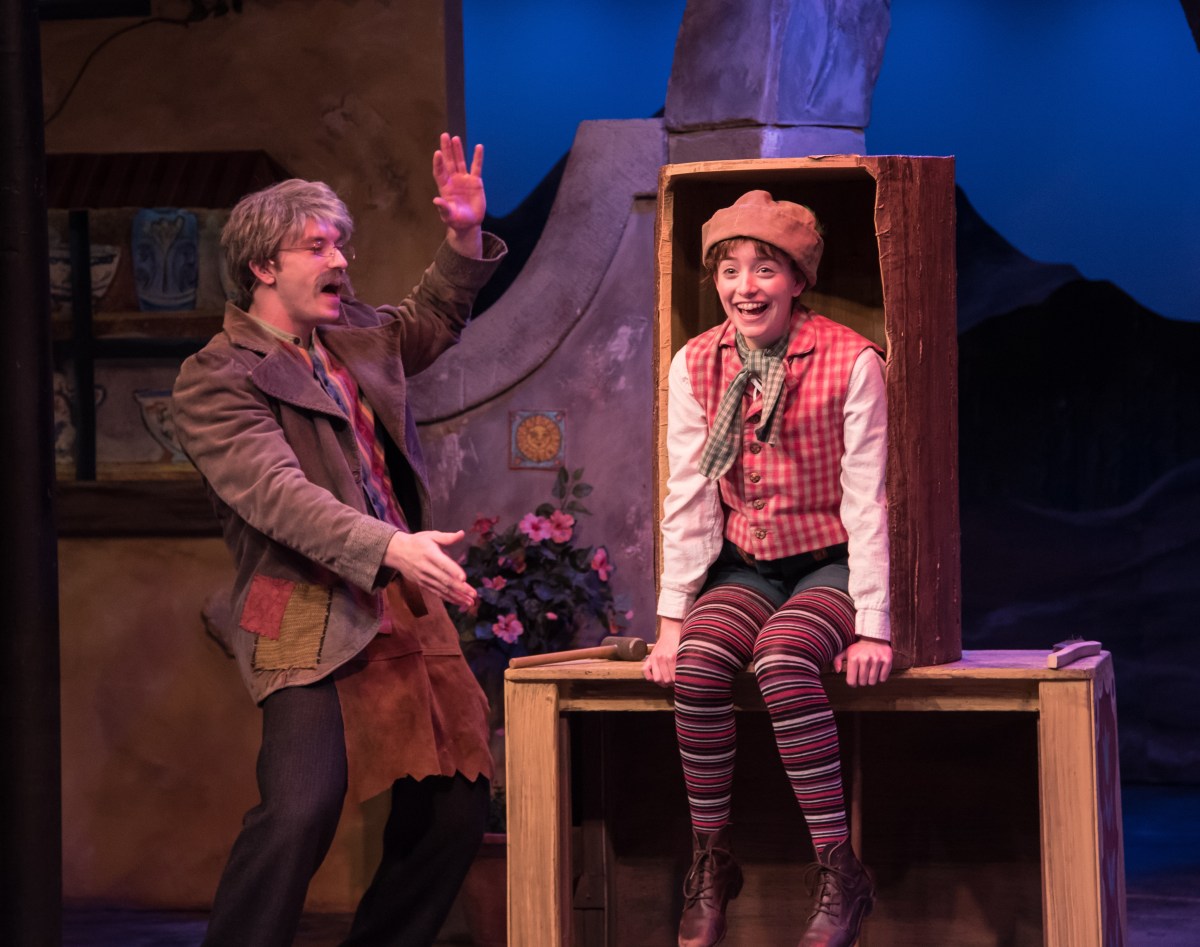
First, a disclaimer. I am truly glad that Pinocchio is played by a real person, Bridget Sindelar, who last appeared on this stage as Ginny/Little Blue in The Little Engine That Could. I find articulated marionettes creepy – almost as creepy as ventriloquist dummies. Sindelar adopted a herky jerky walk, like a windup toy about to wind down, with uplifted elbows to mimic the posture of a marionette.

Sunday afternoon found a nearly full house for this show, with book, lyrics, and direction by Bruce Craig Miller, who will soon start his new job as head of the Chesterfield Cultural Arts Foundation. Running a little under one hour with no intermission, Pinocchio is recommended for ages 4 and up, and that seems about right. There were a few criers in the audience, but most of the young attendees were enthralled. My 4-year-old grandson Emmitt was fully attentive. As always, he is especially fond of the musical numbers. His favorite was “The Eating Song.”

When asked which characters he liked the most, his first response was the Blue Fairy (played by Renee McGowan) but then he changed it to Pinocchio. He also did not hesitate to let his mom know that he did not like the scene where Pinocchio got tied up with a noose. (It might have been around that time that he moved from his seat to her lap.) The set, by Terrie Powers, also caught his attention, “It looks like a real city,” he said in unsolicited awe shortly after we took our seats.

Kingston, at 10, is the more seasoned theater-goer, but he liked the entire show, especially Tevin Davis as the Fox and Eve Marie Tuck as the Cat. He did not have any problem with the rope scene or even with what I saw as totally improbable, illogical, and unsubstantiated scenes and events. Their mom, Soleil, who between the ages of 7-17 spent more time on stages than in theater seats, acknowledged the inconsistencies, but was most struck that this version of Pinocchio reminded her of the book of classic fairy tales her father and I had bought for her and her siblings. One scene she reminisced about was the scene where Pinocchio and his father Geppetto are reunit4ed in the belly of a giant dogfish – a scenario I did not remember at all. So, thank you, family, for your input. I appreciate your perspectives, but do not fully agree.

From my perspective, I found Bridget Sindelar charming as Pinocchio, but I was repelled by Pinocchio’s bratty behavior. I, too, was enamored of Tevin Davis’s Fox, a rakish character who seemed to have adopted some of the mannerisms of a 1970s Blaxploitation movie pimp. Geppetto, played by Landon Dufrene, seemed underdeveloped, as was the relationship between Geppetto and Pinocchio. The jump from freshly carved puppet to a runaway puppet to real boy was sudden and lacking in explanation. Okay, I know it’s a fairy tale, so logic isn’t required, but still, it seemed to me as if chunks of the story were missing. This is why I think it’s helpful to attend a children’s show with children – especially if I’m going to write about it. They weren’t bothered by, in fact didn’t even notice, any of the things I found lacking or distracting.

Over all, Miller kept the pacing swift but smooth; the time passed quickly. The cast performed with energy and enthusiasm, often making light contact with the audience, asking a question or pointing to a child or two to include them in the decision making process. I liked the opening, with the actors switching between English and Italian to set the scene – but they dropped that after the opening scene. The costumes by Marcia Miller Halley were quite well done and enhanced the fairy tale atmosphere while complementing Powers’ colorful little village set design.

Pinocchio delighted its intended audience and is largely devoid of the double entendre that so many playwrights cleverly insert into children’s plays, apparently in an attempt to keep the attention of the accompanying adults. Like most good children’s tales, there is an underlying lesson or two. In this case, the messages that are woven throughout are about telling the truth and not being afraid to grow up.


Sensory Friendly Performances

A Sensory Friendly family performance will be offered on Saturday, April 27, 2019 at 10:30 a.m. Please see the website for more details: http://va-rep.org/sensory_friendly.html


Audio Described Performances

In collaboration with Virginia Voice, Virginia Rep is pleased to offer Audio Described performances, in which actions, expressions and gestures are described during gaps between dialogue throughout the performance for patrons with low vision or blindness. In addition to live audio description during performances, patrons are also invited to participate in a tactile tour before the performance. An Audio Described performance will be offered on Sunday, April 7, 2019 at 2 p.m. Please see the website for more details: https://va-rep.org/access_for_the_blind.html


Performance Schedule

Evening performances at 7:00 p.m. on select Fridays

Matinee performances at 2:00 p.m. every Saturday and Sunday

Matinee performances at 10:30 a.m. on select Saturdays


Julinda D. Lewis is a dancer, teacher, and writer who was born in Brooklyn, NY and now lives in Eastern Henrico County.

———-

Photo Credits: Aaron Sutten

This slideshow requires JavaScript.