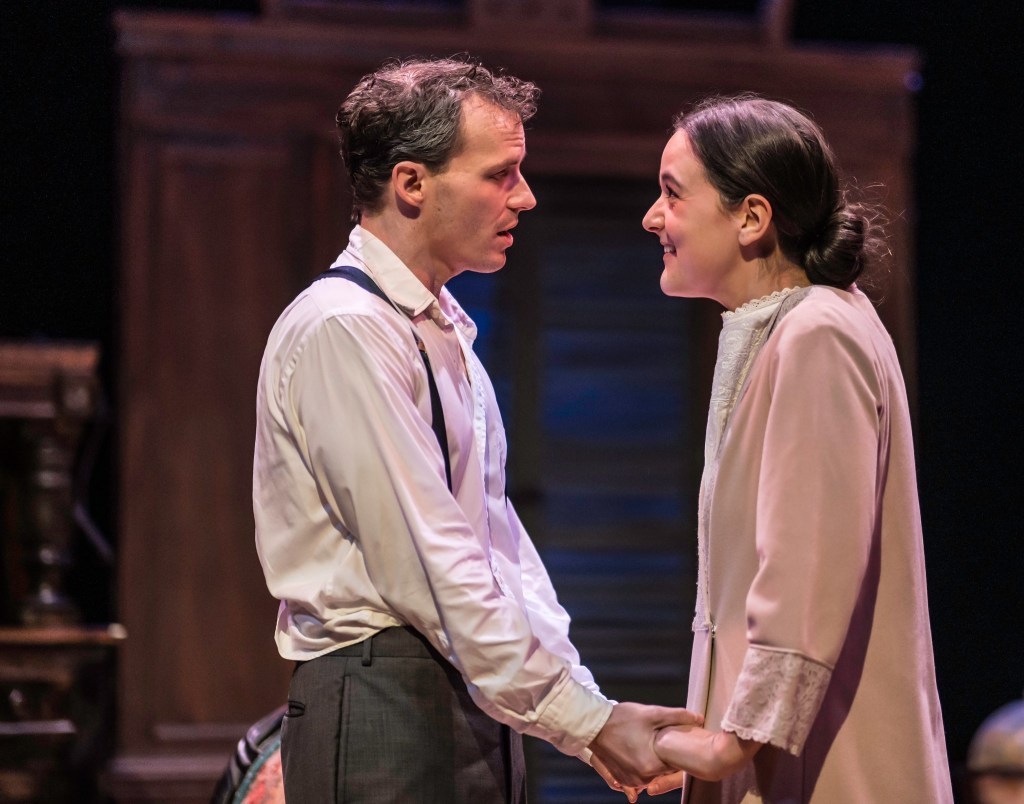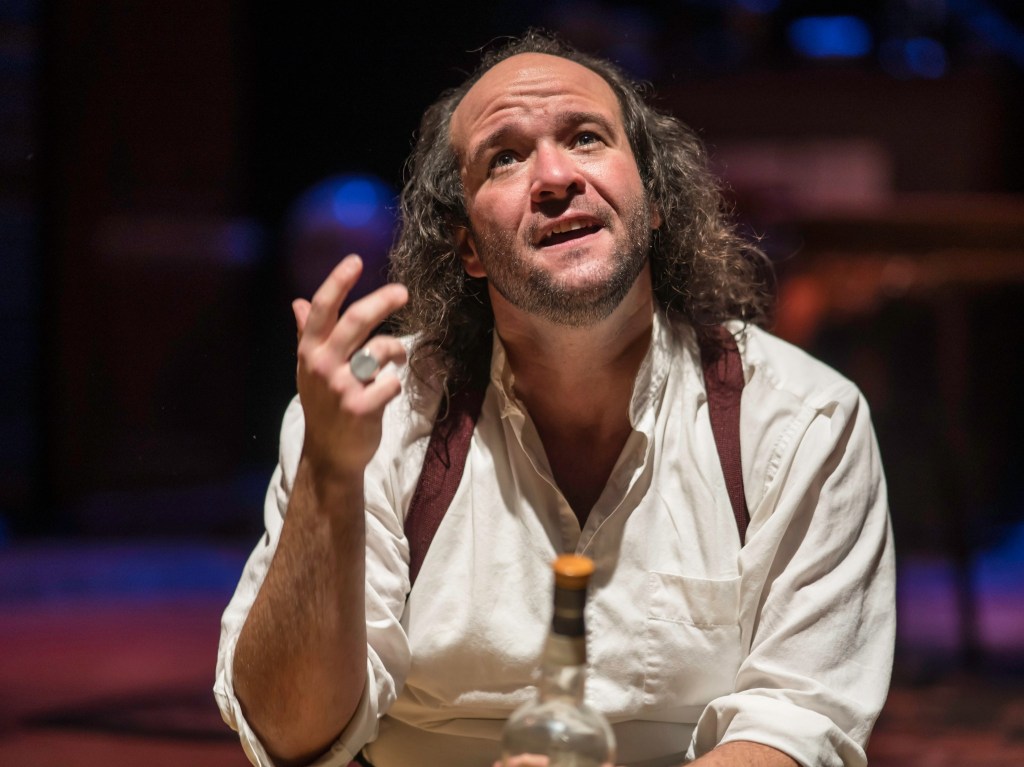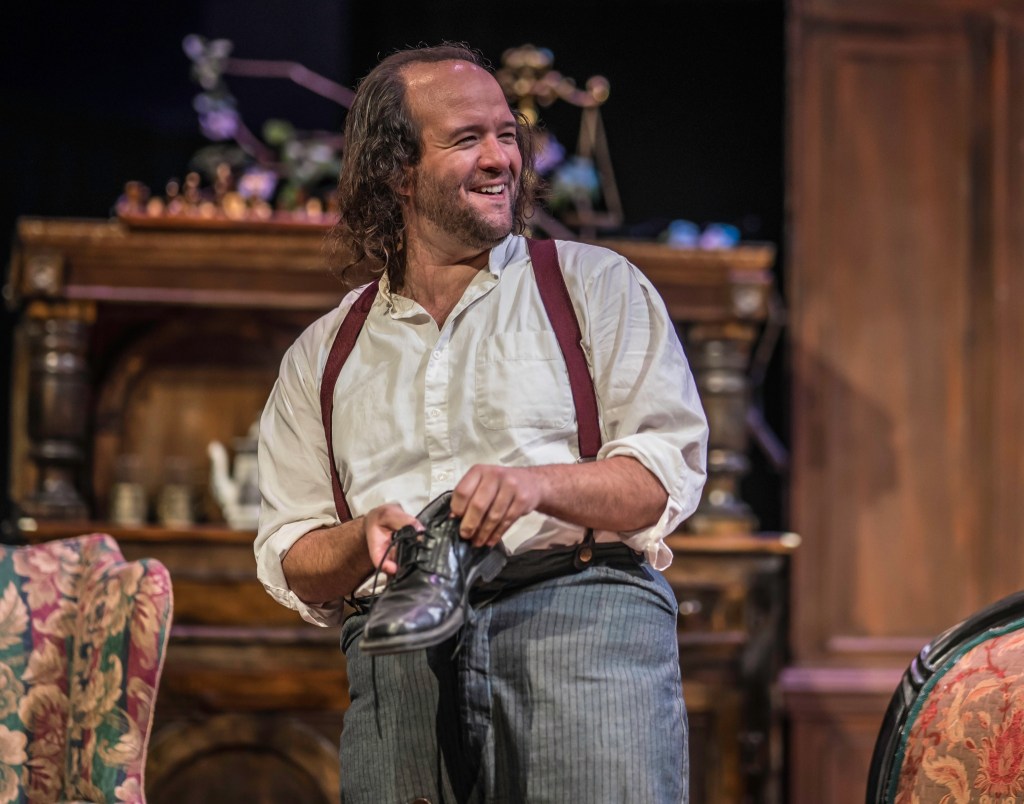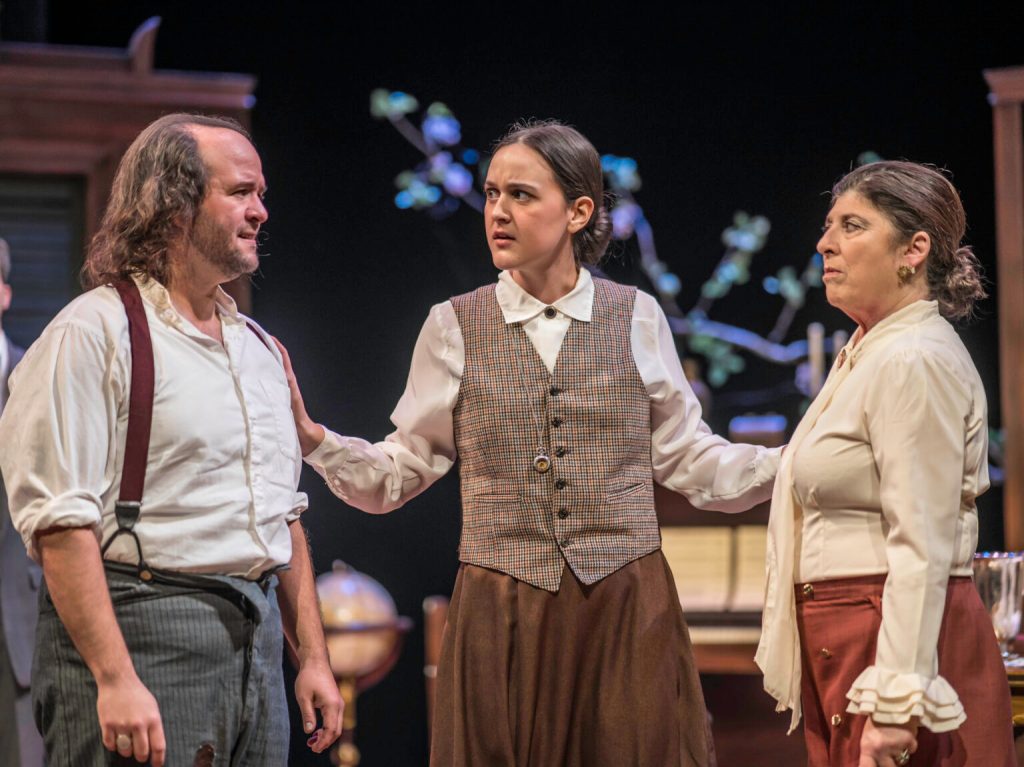
A SOLDIER’S PLAY

They still hate you!: Racism Institutionalized, Internalized, Ignited

At: The Swift Creek Mill Theatre, 17401 U.S. Route 1, S. Chesterfield, VA 23834

Performances: January 28 – March 4, 2023

Ticket Prices: $15-$49

Info: (804) 748-5203 or https://www.swiftcreekmill.com

Charles Fuller’s A Soldier’s Play is set on a fictitious Army base, Fort Neal, Louisiana, in 1944 – at a time when the U.S. Army was still legally segregated. But the mystery and inflammatory speculation surrounding the murder of Tech/Sergeant Vernon C. Waters could have been taken directly from the latest news in 2023.

When I think of this Pulitzer Prize-winning play, the first thing that comes to mind is Adolph Caesar who played the role of Sergeant Waters in the original off-Broadway production by the Negro Ensemble Company, New York, 1981. In that production, Denzel Washington also appeared as Private First Class Melvin Peterson and Samuel L. Jackson played the role of Private Louis Henson.

I can’t help but wonder, how did the actors and audiences of 1981 feel about A Soldier’s Play and how do their thoughts and experiences compare to those of the actors and audiences of 2023? The more things change (?) the more they stay the same – and this trope especially rings true when it comes to matters of race in America.

Along those same lines, the ”trigger warnings” of  strong language, racial slurs, physical violence and gunshot effects may have been startling 40 years ago, but seem de rigueur by today’s standards where life imitates art imitates life. Director Shanea N. Taylor wrote in her notes, “Charles Fuller believed, ‘You can change the world with words.’ 40 some years later from winning the Pulitzer Prize for his words, we find ourselves in a position where we might question whether this rings true.”

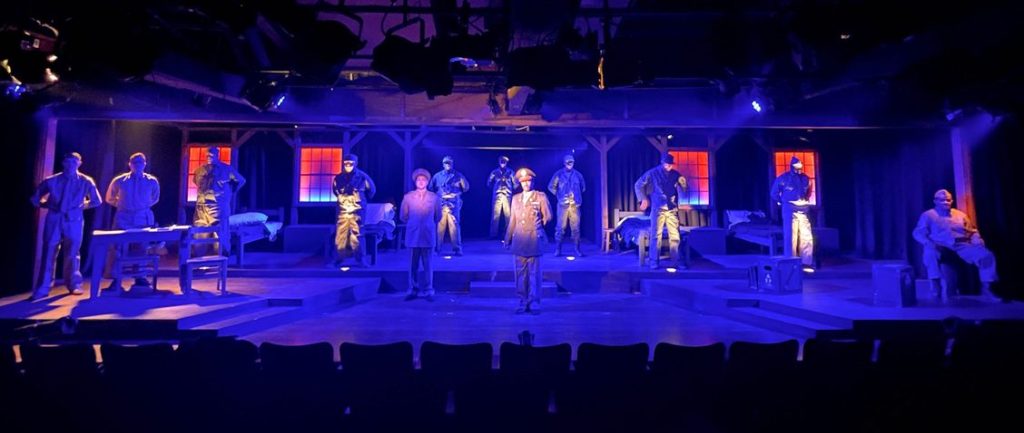
In A Soldier’s Play we get to see – and internalize – the impact of 9 Black men sharing a stage and sharing words and thoughts normally reserved for the relative safety of Black spaces (e.g., home, the barber shop). Do Fuller’s words sufficiently explain the burden of how racism can make a Black man hate himself? Or are we so committed to the fallacy that racism is over that only those directly affected can truly understand? A Soldier’s Play opens the door to further understanding.

This deeply troubling story shines as an ensemble work. The comraderie and banter between the characters feels authentic (coming from one who has never been in a military environment). It comes as no surprise that the Black soldiers are given the most menial and dirtiest tasks: painting, cleaning, manual labor. In spite of their sub par treatment, they want to serve the only country they know. When orders come to ship out, they are excited. Ike wants to know if the colored boys can fight? There is only one response, “I’ve been fighting all my life.”

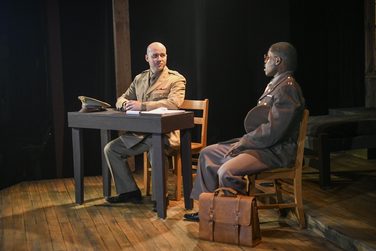
The soldiers’ relationships seem even more solidified by the passive aggressive racism of their white Captain, played by Chandler Hubbard. You see, Captain Taylor is aware of his own racism, and readily admits that he is disgusted by the very thought of Captain Davenport (Keydron Dunn), the Black lawyer sent to investigate the murder of Sergeant Waters. At the same time, he holds on to a sense of justice in wanting to solve the murder – but not so much so that he is willing to discipline the white officers under his command who are overtly racist (Hunter Keck and Gordon Little Eagle Graham). Waters is – or was – an ambitious Black officer who is himself offended by the presence of southern Black men who do not live up to his standards. This information gives added meaning to his final words before being shot, “They still hate you!” No matter how hard he tries to assimilate, no matter if he works hard and send his children to predominantly white schools, he is still Black, and still the recipient of institutional and personal racism.

There were some standouts in the ensemble: Joshua Maurice Carter as Private C.J. Memphis, the innocent young man who was driven to suicide by Sergeant Waters’ mental attacks; Kamau “Mu Cuzzo” Akinwole as Private James Wilkie, an unwilling pawn in Waters’ machinations; Erich Appleby as the earnest Corporal Bernard Cobb. Hubbard did an amazing job establishing a balance between doing the eight thing and embracing the comfort of his upbringing. But A Soldier’s Play works best within the framework of the ensemble. The one weak link, unfortunately, seemed to be Keydron Dunn in the import role of the key figure, Captain Richard Davenport. I found out later that Dunn was under the weather the night I saw the show, so that may account for the fumbled lines and uneven performance – so unlike his usual execution.

Mercedes Schaum has designed a stark barracks, consisting of just a few cots and footlockers, but Joe Doran’s lighting adds satisfying emotional depth and visual dimension. Taylor’s direction allows the story to unfold at a natural pace – perhaps less inflammatory than I was expecting, or less shocking that my memory allowed for – but nonetheless satisfying. If you have never seen A Soldier’s Play or, like me, have not revisited it in some 40 years, please see it. It’s the kind of theatre that stays with you for a lifetime.

———-

Julinda D. Lewis is a dancer, teacher, and writer who was born in Brooklyn, NY and now lives in Eastern Henrico County.

———-

A SOLDIER’S PLAY

By Charles Fuller

Directed by Shanea Taylor

Cast:

Tech/Sergeant Vernon C. Waters: Larry Akin Smith

Captain Charles Taylor: Chandler Hubbard

Corporal Bernard Cobb: Erich Appleby

Private First Class Melvin Peterson: K’Hari Zy’on

Corporal Ellis: Gary King

Private Louis Henson: Tre’ LaRon

Private James Wilkie: Kamau “Mu Cuzzo” Akinwole

Private Tony Smalls: Kieryn Burton

Captain Richard Davenport: Keydron Dunn

Private C.J. Memphis: Joshua Maurice Carter

Lieutenant Byrd: Hunter Keck

Captain Wilcox: Gordon Little Eagle Graham

Creative Team:

Directed by Shanea Taylor

Scenic Design by Mercedes Schaum

Lighting Design by Joe Doran

Costume Design by Maura Lynch Cravey

Technical Direction by Liz Allmon

Fighting/Intimacy Consulting by Stephanie “Tippi” Hart

Run Time:

About two hours with one intermission

Tickets:

Regular $49. Seniors, Military & First Responders $44. Students $15.

Photos: Kieran Rundle

GHOST QUARTET

A Song Cycle About Love, Death, and Whiskey

An Immersive Theatrical Experience Review by Julinda D. Lewis

At: The Firehouse 1609 West Broad St., Richmond, RVA 23220

Performances: January 19 – February 18, 2023 [NOTE: This includes extended dates]

Ticket Prices: $35 general admission, $45 VIP two-top, $20 students

Info: (804) 355-2001 or firehousetheatre.org.

If you like the unique and different, if you are comfortable with ambiguity, if dramatic explorations of death and non-linear story-telling pique your interest, then GHOST QUARTET  was written for you. Not fully a play, not fully a musical, more akin to an opera, Dave Malloy’s creation was first produced in 2014 and was soon after nominated for awards for Best Music and Best Musical.

While I assert that the term “musical” is too confining to describe Ghost Quartet, there is no doubt that the music – much of which is played or engineered by Amy L Oblinger – is amazing. There are vocals and instrumental music involving a piano, a cello, a violin, and percussion. At one point small percussion instruments – a tambourine, a rattle, small rattles – are distributed to audience members.

Two of the Quartet members perform a delightfully unexpected tap and clog dance. And most of the cast members are quite comfortable breaking the fourth wall and addressing the audience – some of whom, the  VIPs, are seated at small table right on stage where they are served whiskey shots by the cast members who are gathered for a reunion of sorts at a bar that is apparently owned by one of the Quartet members.

Whew! That’s just by way of introduction, and doesn’t even begin to explain Ghost Quartet, Instead of Acts and Scenes, Ghost Quartet is divided into Sides and Tracks – which are announced at the top of each segment. While intentionally non-linear in structure, the sections are, in fact, related to one another. So, “The Camera Shop” in Side 1, Track 2 is related to “The Photograph” in Side 3, Track 2 and there is an “Usher” track – as in Poe’s “The Fall of the House of User” – in Sides 1, 2, and 3.

Family is another common theme woven throughout the production in which cast members play multiple characters, across generations, and encompassing – the program says – seven centuries. This makes it possible for Ghost Quartet to seamlessly discuss and conquer death, include sassy little girls and monks, have storytelling by Schéhérazade (yes, the one from Arabian nights), and sing an ode to whiskey (e.g., Jamieson, Maker’s Mark, Lagavulin), call a family meeting to deliver an ultimatum about an invisible friend, and conflate monks (the religious kind) with Thelonious Monk (the musician).

Bringing a wide range of talents, sass, and gifts to this production: Jaylin Brown, Valerie Chinn, Céilí Galante, Marjie Southerland, and Musical Director Amy L. Oblinger. They sing, they dance, they act, tell stories, play instruments, and drink whiskey for two hours (including one intermission).  Todd Labelle’s design, featuring a standard wooden bar as well as a vertical “floating” bar and walls of wide-spaced wooden slats, is simultaneously minimalist and luxurious. It provides a welcoming backdrop for an unfamiliar performance genre. Andrew Bonniwell’s lighting organically partners with the live music, electronic arrangements, and some surprisingly stunning vocal moments.

If, as Director PJ Freebourn wrote in their notes, the goal is to transport the audience and take us on a surreal journey that explores, among other things, love, family, hope, memory, and emotions, then Ghost Quartet is a smashing success. If you leave still wondering just what the hell happened and why it made you feel confused and amazed, if you leave talking about it, thinking about it, or asking questions about it — it was successful. February 4 was originally supposed to be the final performance, but four additional performances have been added over the next two weekends – Friday evenings, February 10 and 17, and Saturday matinees, February 11 and 18. If you haven’t seen it yet, recommend you try to reserve a ticket or two to one of these performances – then we can talk about it together.

———-

Julinda D. Lewis is a dancer, teacher, and writer who was born in Brooklyn, NY and now lives in Eastern Henrico County.

———-

GHOST QUARTET

By Dave Malloy

Directed by PJ Freebourn

Performers:

The Ghost Quartet

Jaylin Brown
Valerie Chinn
Céilí Galante
Marjie Southerland

Musician

Amy L. Oblinger

​Production Team

PJ Freebourn – Director

Amy L. Oblinger – Music Director

​Niccolo Seligmann – Electronic Arrangements, Synth Programming, Foley Art

Céilí Galante – Additional Arrangements

Nicole Morris-Anastasi – Choreographer

Todd Labelle – Production Designer

Andrew Bonniwell – Lighting Designer

Katherine Brand – Costume Designer
Grace Labelle, Emily Vial, Talon Bleacher – Stage Managers

Performance Schedule:

Thu Jan 19 @ 8pm (preview)

Fri Jan 20 @ 8pm (preview)

Sat Jan 21 @ 4pm (preview)

Sat Jan 21 @ 8pm

Fri Jan 27 @ 8pm

Sat Jan 28 @ 4pm

Sat Jan 28 @ 8pm

Fri Feb 3 @ 8pm

Sat Feb 4 @ 4pm

Sat Feb 4 @ 8pm

EXTENDED: Additional Performances!

Fri Feb 10 @ 8pm

Sat Feb 11 @ 4pm

Fri Feb 17 @ 8pm

Sat Feb 18 @ 4pm

Ticket Prices

$35 general admission, $45 VIP two-top, $20 students

Run Time:  Approximately 2 hours with one intermission

Photo Credits: Bill Sigafoos

HOW BLACK MOTHERS SAY I LOVE YOU

“Do not press me to leave you,
    to turn back from following you!
Where you go, I will go;
    where you lodge, I will lodge;
your people shall be my people
    and your God my God. – Ruth 1:16 (NRSV)

A Theater Review by Julinda D. Lewis

At: Richmond Triangle Players at the Robert B. Moss Theatre,

1300 Altamont Ave, RVA 23230

Performances: February 1-25, 2023

Ticket Prices: $10 – $40

Info: (804) 346-8113 or rtriangle.org

———-

Sometimes a production takes awhile to grow on you. Some shows are hard to connect with on a personal, emotional, social, literary, cultural or any other level. Just the opposite is true of Trey Anthony’s tender and amusing two-act family drama, HOW BLACK MOTHERS SAY I LOVE YOU. The author identifies as “a queer, black, Canadian, West Indian womyn” but their story is familiar to many Black women in Canada, the US, and the UK. I attended with my eldest daughter, and throughout the evening we looked at one another knowingly over our masks, reached for each other’s hands, cried out in instant recognition, or just cried.

The author may be a Canadian of Jamaican heritage, but the play is set in the Brooklyn, NY home of a Jamaican immigrant woman in 2014 (although I thought the furniture and kitchen appliances harkened back a decade or two – or three? – before then). Claudette (Zakiyyah Jackson), the prodigal queer daughter of Daphne (Dorothy “Dee-D” Miller) has returned home unannounced after several silent years in Montreal, Canada. Claudette finds her mother in poor health and her younger sister Valerie (Shalandis Wheeler Smith) doing her best to care for her, despite Daphne’s refusal to follow doctor’s orders – and the added complications of Valerie’s own personal struggles. Claudette has questions that her mother is not willing to answer. Daphne left Claudette and Valerie with their grandmother in Jamaica for six years while she got established in the US.

Family secrets are painfully and reluctantly revealed, along with social and cultural histories that could bringing health and healing to many families and enlightenment to many allies. The story is brought to life by a small but mighty cast, led by Miller, the matriarch. I’m not Jamaican but I married into a Jamaican family and I found Miller’s accent spot on. She dropped the “h” where you expected to hear it and added it where you did not expect it. She called children “pickney” and pronounced the word “little” as if it were spelled with two k’s instead of two t’s. She won me over completely when she spoke about the baby’s “ackee seed eyes.” That’s how my mother-in-law used to refer to my children! My daughter looked at each other and shrieked in unison as my heart melted into a puddle on the floor. (Don’t worry, RTP staff, melted hearts do not stain the carpet.) Of course I looked to see who the dialect coach was and just as I suspected, it’s Erica Hughes. Kudos to Hughes for another amazing job.

[If you are familiar with ackee, you can skip this next paragraph.]

BTW: the ackee fruit is a Jamaican dietary staple, an essential ingredient in the Jamaica national dish of ackee and saltfish (i.e., salted cod). When ripe, the ackee plant yields fleshy yellow lobes that somewhat resemble scrambled eggs when cooked with saltfish. The fruit has shiny black seeds that people – especially Jamaican grandmothers – liken to the shiny bright eyes of babies and young children. The kicker is that, in its un-ripened state, ackee is quite poisonous.

Jackson and Wheeler Smith achieved a remarkable balance between sibling rivalry and sisterly love. Their affection appeared genuine and as the story unfolded we found that it was grounded in a history of collective trauma – unique to them, but familiar to many families whose histories are defined by the African diaspora. Significantly, my daughter wondered how these themes spoke to white viewers. This would be an interesting dialogue to introduce in a talk-back…

Let me not forget to mention Cloe. The younger, American-born sister of Claudette and Valerie who died in childhood from an unnamed illness, Cloe appears as a silent ghost. Dressed in white from head to toe, Bailey Robinson, a Henrico County Public Schools student, made her professional debut as the sometimes meddlesome, but mostly caring specter of young Cloe whose presence is welcomed and visible to Daphne – and sometimes, it seems, to Valerie. Claudette knows she is there, but cannot see her. The presence of Cloe is another strong symbol of ancestors and spirituality.

The set is a Brooklyn home sturdily and lovingly crafted by William Luther and tenderly lit by Dakota Carter. I did wonder, however, why there were several long periods of darkness or dimmed lights. Perhaps these stretches were meant to serve a visual equivalent of the dramatic pause, or to contrast with the bright white heavenly light that illuminated the runway that Cloe used to transition between the present and the hereafter. Or maybe it was just to allow for a costume change.

Margarette Joyner (founder and artistic director of the Heritage Theater that formerly closed its doors in 2022) designed the costumes, with special attention to Daphne’s collection of church hats and Valerie’s collection of coordinating handbags and shoes. Desirée Dabney directed through the eyes of a storyteller. The work and words flow with a sense of real time and a feeling of intimacy and immediacy.

HOW BLACK MOTHERS SAY I LOVE YOU is a stunningly beautiful work of theatre, one I was not familiar with, one I will not forget. See it with your mother or daughter. And take tissues.

———-

Julinda D. Lewis is a dancer, teacher, and writer who was born in Brooklyn, NY and now lives in Eastern Henrico County.

———-

HOW BLACK MOTHERS SAY I LOVE YOU

By Trey Anthony

Directed by Desirée Dabney

CAST

Daphne            …………….Dorothy “Dee-D” Miller

Claudette        …………….Shalandis Wheeler-Smith

Valerie             ……………. Zakiyyah Jackson

Cloe                 ……………. Bailey Robinson

Daphne Understudy: Diana Carver

Claudette Understudy: Nora Ogunleye

Valerie Understudy: Chayla Simpson

Cloe Understudy: Sydnee Logan

THE CREATIVE TEAM

Director/Sound Design: Desirée Dabney

Assistant Director/Dramaturg: Chayla Simpson

Production Stage Manager: Jennipher Murphy-Whitcomb

Assistant Stage Manager: Nathan Ramos

Scenic Design: William Luther

Lighting Design: Dakota Carter

Props Design: Tim Moehring

Costume Design: Margarette Joyner

Hair & Make Up Design: Jahara Jennae

Intimacy Choreographer: Raja Benz

Dialect Coach: Erica Hughes

Technical Director/Scenic Painter: Becka Russo

Covid Safety Officer: William Luther

Marketing Videos: Aisthesis Productions

Photo Credits: Pre-production photos from RTP Facebook page

UNCLE VANYA

Every Family Has a Drunk Uncle…

A Theater Review by Julinda D. Lewis

By: Richmond Shakes (formerly Quill Theatre)

At: Dominion Energy Center’s Libby S. Gottwald Playhouse, 600 E. Grace St., RVA 23219

Performances: January 26 – February 12, 2023

Ticket Prices: $22-$42

Info: (804) 340-0115 or https://richmondshakespeare.org/

Rarely – if ever – have I described a production as a sad comedy, but that would be an accurate description of UNCLE VANYA, written by Anton Chekhov and  adapted by Conor McPherson. First performed at the turn of the twentieth century, UNCLE VANYA remains relevant and contemporary as adapted by McPherson and under the expert direction of Dr. Jan Powell.

One thing – well, eight really– that made this production successful was the uniformly outstanding cast. Bryan Austin was relentlessly amusing yet authentic and endearing in the title role and it was his authenticity that kept his moments of wallowing in self-pity and regret from becoming shallow and vainglorious tropes. Calie Bain was a breakout star as Vanya’s niece, Sonya. In spite of the early death of her mother, her father’s re-marriage to a woman seemingly closer in age to Sonya than her father, and her unrequited love – made even more soul-crushing by the geographical isolation of their country estate – Sonja remained a bright light of hopefulness. She was the connection that made it possible for this stunningly dysfunctional family to attempt reconciliation and settle on renovation.

Lindsey Zelli as the beautiful young second wife, Yelena, displayed unexpected and sometimes uncomfortable depth. In spite of past estrangements and current rivalrous entanglements, Yelena demonstrated genuine fondness and care for Sonya. Matt Hackman’s Dr. Astrov was also multi-faceted. Totally unaware of Sonja’s love for him (really???), he was equally infatuated with her step mother, and focused on ecological issues with a passion that I am sure was way ahead of his time.
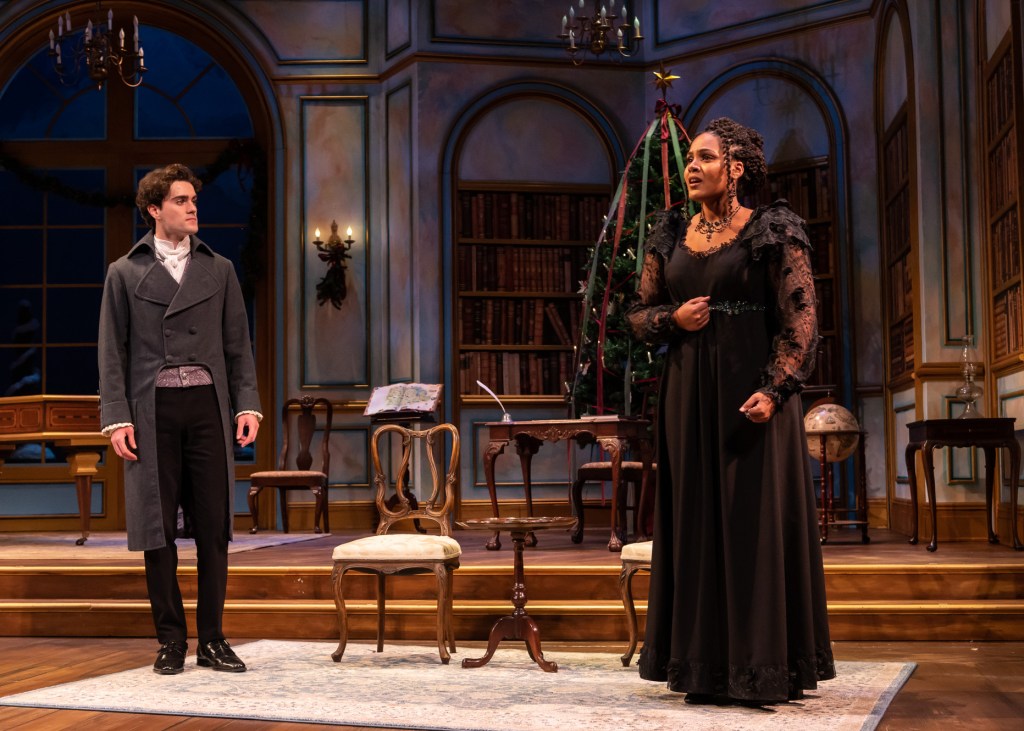
Kelly Kennedy made the most of her nearly innocuous supporting role as Nana – not, as one might think, the grandmother, but an elderly nurse who has become the family caretaker. Sitting in her chair, quietly observing or serving up hot tea, her knitting needles seemed to be a metaphor for her role in the family drama.

Alan Sader and Debra Clinton’s characters infuriated me. Sader played the pompous and manipulative Professor Alexandr Serebryakov (father of Sonya, husband of Yelena, son of Mariya, and brother-in-law of Vanya) and of course he is really good at it. It’s the kind of role where you don’t want to meet the actor soon after because you want to curl your lip and turn up your nose at his character. Clinton’s character was infuriating for a different reason. Mariya’s favoritism for her more successful son, Alexandr and disdain for the hard-working Vanya seemed passive-aggressive and possibly the result of oppression or lack of fulfillment in her own life.

For those, like me, unfamiliar with the characters, it took awhile to get a handle on the role of Telegin (Bill Blair). Affectionately called Waffles (apparently because of the condition of his skin), Telegin is a family friend, neighbor, and hanger-on who tries to fit in where he can – often with awkward results.

What makes Uncle Vanya resonate with me is these lovingly developed and multi-dimensional characters. They are familiar and seem to fit right in with contemporary issues: family dysfunction, changing inter-generational roles, the troublesome hierarchy of inheritance, and even the forced soul-searching of pandemic isolation.

Reed West’s set design – much more elaborate than Richmond Shakes’ usually sparse environments – is solidly built of sturdy, dark wood. Little details, like a chess set atop a cabinet, Nana’s knitting basket, and the clean but worn rugs support the narrative of crumbling gentility. And what can I say about the individual application of autumn leaves on the tree branches during intermission? Gretta Daughtrey’s lighting is effective and unintrusive; the storm, for example, is subtle but unmistakable. So, too, are James Ricks’ sound design, that included gentle ambient sounds, and Anna Bialkowski’s earth-toned costumes – with a jewel-toned garment or two for Yelena, and a caped-overcoat for the Professor. 

Uncle Vanya is a satisfying evening of theater performed by a stellar cast – and I say this even though I am not in the least a fan of Chekhov. There isn’t much action. Plot is virtually non-existent. But the characters are immersed in the words and that fully engages the audience in a way that creates the best kind of theater magic. Try to see it before it closes.

Uncle Vanya

By Anton Chekhov

Adapted by Conor McPherson

Cast

Nana    ………. Kelly Kennedy

Astrov ………. Matt Hackman

Vanya  ………. Bryan Austin

Telegin………. Bill Blair

Serebryakov………. Alan Sader

Sonya  ………. Calie Bain

Yelena ………. Lindsey Zelli

Mariya ……….Debra Clinton

Production Team

Artistic Director: James Ricks

Managing Director: Jase Sullivan

Director: Dr. Jan Powell

Assistant Director: Sarbajeet Das

Stage Manager: Lauren Langston

Assistant Stage Manager: Carrisa Lanstra

Costume Design: Anna Bialkowski

Light Designer: Gretta Daughtrey

Scenic Design: W. Reed West III

Sound Design: James Ricks

Properties Design: Emily Hicks

Map Art Work: Katherine Wright

Promotional Photography: Peyton Lyons

Run Time: About 2 ½ hours including one intermission

Julinda D. Lewis is a dancer, teacher, and writer who was born in Brooklyn, NY and now lives in Eastern Henrico County.

———-

Photo Credits: Peyton Lyons and David Parrish Photography

 TOP LEFT: Bryan Austin, Bill Blair, Matt Hackman. TOP CENTER: Matt Hackman and Calie Bain. TOP RIGHT: Bryan Austin. BOTTOM LEFT: Bryan Austin. BOTTOM RIGHT: Bryan Austin, Calie Bain and Debra Clinton

MIRACLE ON SOUTH DIVISION STREET

Pride, Prejudice & Identity: A Comedy Fueled by Family Secrets, Polish Pastries, & Gefilte Fish

At: The Swift Creek Mill Theatre, 17401 U.S. Route 1, S. Chesterfield, VA 23834

Performances: January 29 – February November 19 – December 31, 2022

Ticket Prices: $15-$49

Info: (804) 748-5203 or https://www.swiftcreekmill.com

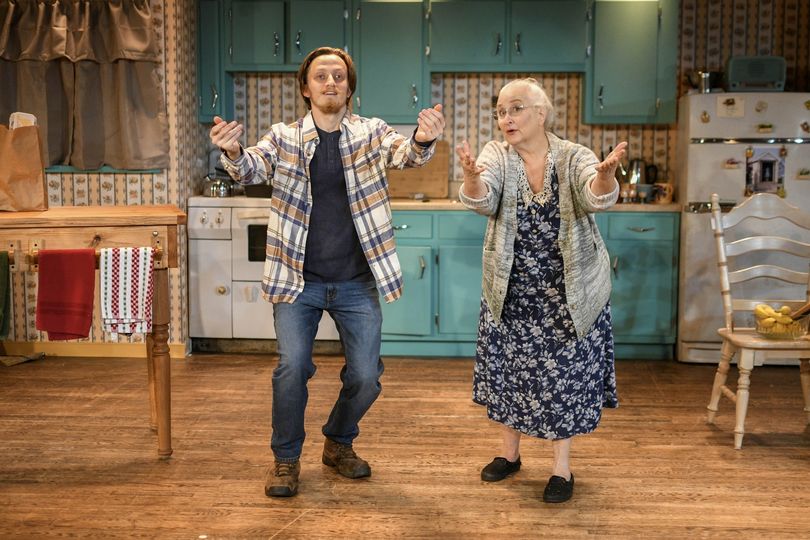
We all know that we’re special, but some of us are more special than others. Take the Nowak family of Buffalo, NY, for instance. In 1942 the Blessed Virgin Mary “appeared” – emphasis required! – to an ordinary barber, and his family would never be the same. This miracle led to people being healed, spawned the birth of a soup kitchen, and became the anchoring event that made an otherwise average family special.

But all is not what it seems in MIRACLE ON SOUTH DIVISION STREET. A deathbed confession turns everything upside down, making the Nowak family question everything they have known and based their lives on for two generations.

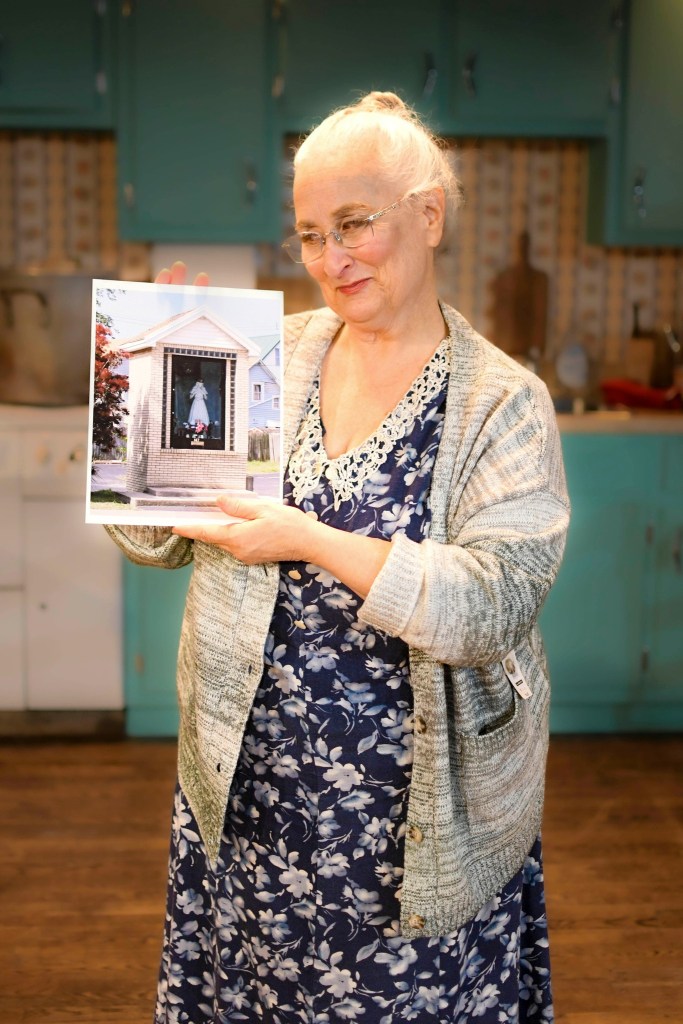
While the play and its characters are fictitious, the premise of the story is based on fact. There is an actual Our Lady of Seneca Street Shrine in Buffalo, NY – which just happens to be the author’s hometown. In the 1950s a barber named Joe Battaglia lived at 849 Seneca Street in the apartment above his shop. Apparently, one night Battaglia was awakened from his sleep by a shining light outside his window that beckoned to him. When he went outside to investigate, it is reported that he encountered nothing less than an image of the Virgin Mary. The image spoke to him, telling him not to be afraid and instructed him to help spread a message of world peace.

Battaglia commemorated the occasion by building a 20-foot tall brick and glass structure that houses a life-sized statue of the Holy Mother. After the barber’s death, the shrine fell into disrepair and was slated to be torn down but local residents fought to preserve it. To this day the  Lady of Seneca Street Shrine is still maintained by a dedicated local caretaker committed to preserving the history and continuing the legend. The shrine has its own address – 847 Seneca Street – and a mail slot to receive donations and the prayers that come from all around the world.

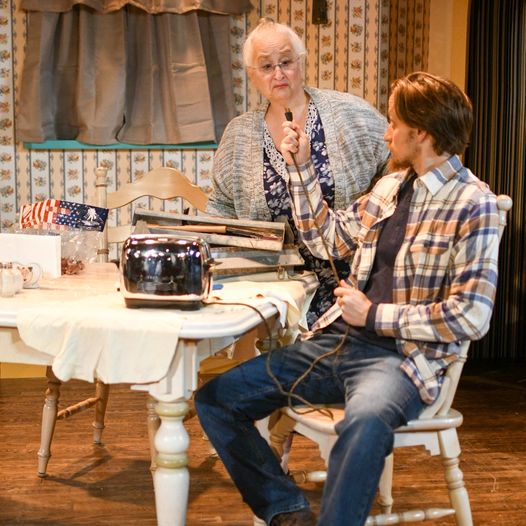
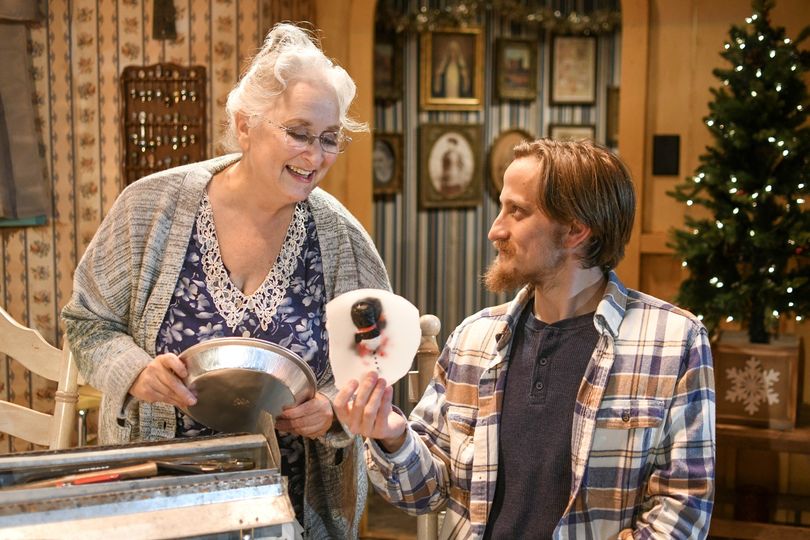
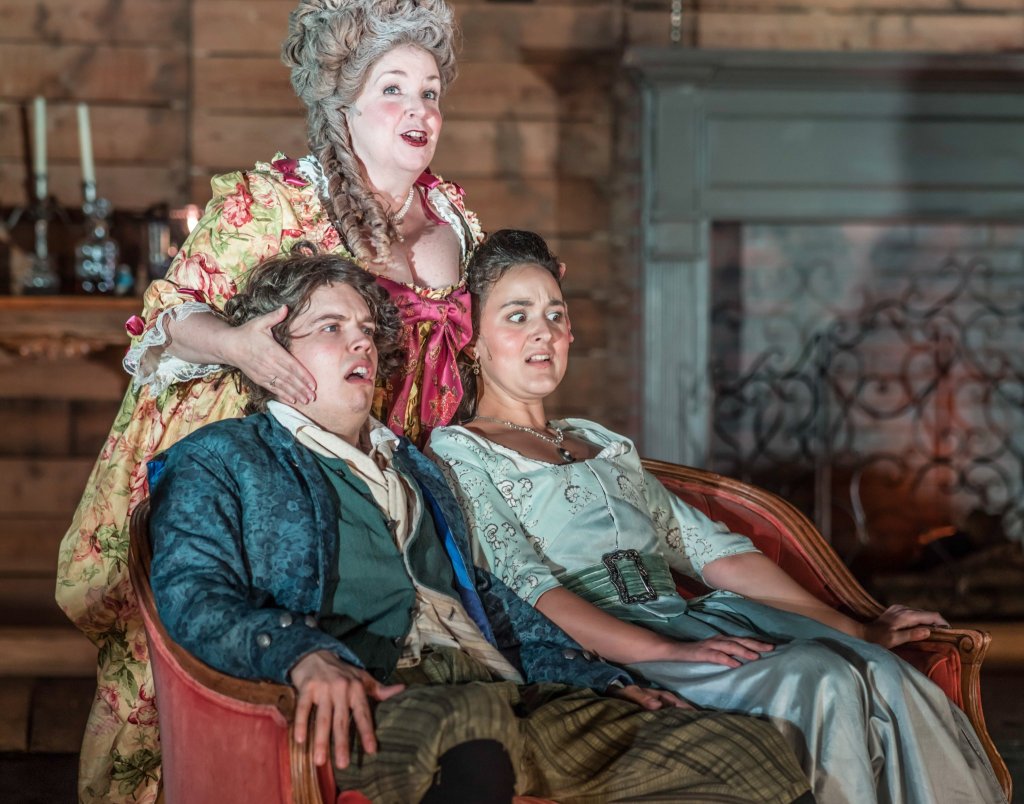
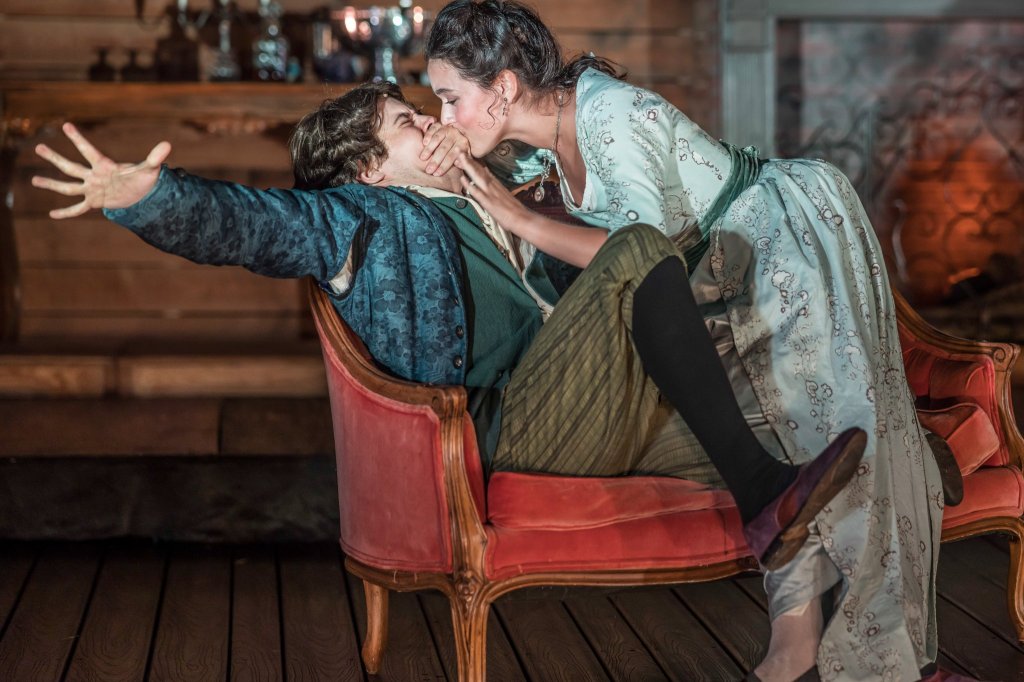
With this background, Dudzick re-imagined the story of the barber’s vision and the resulting shrine. Instead of the Battaglia family, we meet the Nowaks who are about to have a family meeting in which daughter Ruth (Audra Honaker) is about to reveal startling news that will shake the family to its core. After preparing a lunch of fruit salad (why didn’t she rinse the blueberries and strawberries…) her efforts are thwarted by her older sister, Beverly (Donna Marie Miller) who is more than a little self-centered and has her sights centered on (a) a bowling tournament and (b) a new boyfriend – an ex-priest candidate. There’s also a brother, Jimmy (Neal Gallini-Burdick) whose impending engagement is also the cause of a controversial subtext. The Nowaks, you see, are devote Catholics – at least according to their mother Clara (Jacqueline Jones) – and this is a key component of the script.

The plot twists and unending life-changing revelations create both tension and comedy – often and most successfully when they occur simultaneously. Honaker and Miller are recreating the roles I saw them portray when this play was performed at Virginia Rep’s Hanover Tavern in 2017. But with Jones as Clara and Gallini-Burdick as Jimmy the energy in the Swift Creek production is quite different and the cast’s timing, under the steady-handed direction of Tom Width, hits different notes as well. (In case you’re wondering, in the 2017 production mentioned above the mother was played by Catherine Shaffner and the son by John Mincks, both of whom filled these roles with distinction.)

MIRACLE ON SOUTH DIVISION STREET is a delightful feel-good play, but it touches on some very real, very serious, and still relevant topics: identity, faith, family, love, loyalty, ritual, and more. By making this a comedy and placing it in a different time period, we are encouraged to examine some important and controversial topics from a distance – it’s not me, it’s the Nowaks. But every family has secrets, prejudices, and inside jokes. But how much of it – if any – should be shared outside the family, and to what purpose. Ruth struggles with these questions through the lens of a one-woman show; many today look at – or ignore – the same questions through the multiple lenses of social media. Makes you wonder if the miracle is what resulted from the vision – or what occurred in the Nowak kitchen.

Honaker delivers the tough lines with ease and patience that defies human understanding. Miller behaves like a bratty younger sibling rather than the eldest, but manages to remain likeable, while Gallini-Burdick manages to remain a voice of reason throughout it all. Jones vacillates between wide-eyed innocence and wisdom. She is also at the center of my favorite scene – where Clara, the Catholic mother first discovers that Jesus was Jewish, and later delivers one of my favorite lines – the final line of the play.

ADDENDUM: This review has been edited. I was roundly chastised by the playwright for giving away the final line. But, dear readers,in over forty years of writing about dance and theater, this is the first time I EVER received a comment directly from the playwright. I am humbled – and humbly edited this text. jdl
Just in case I didn’t make it clear in my ponderings, above, I highly recommend MIRACLE ON SOUTH DIVISION STREET. It’s a Christmas story with a purpose; it’s entertaining and thought-provoking, predictable, and surprising at the same time. The cast is outstanding, the story intriguing, and Width’s direction reflects his genuine love and affection for each show he directs, and his scenic design is homey and welcoming. Cue Christmas (or Chanukah) music and enjoy.

Julinda D. Lewis is a dancer, teacher, and writer who was born in Brooklyn, NY and now lives in Eastern Henrico County.

MIRACLE ON SOUTH DIVISION STREET

By Tom Dudzick

Directed by Tom Width

Cast:

Jimmy Nowak – Neal Gallini-Burdock

Ruth Nowak – Audra Honaker

Clara Nowak – Jacqueline Jones

Beverly Nowak – Donna Marie Miller

Creative Team:

Directed by Tom Width

Costume Design by Maura Lynch Cravey

Lighting Design by Joe Doran

Scenic Design by Tom Width

Technical Direction by Liz Allmon

Run Time:

90 minutes, no intermission

Tickets:

$15-$49

Photos: Kieran Rundle

CHRISTMAS ON THE ROCKS

The Kids From Your Favorite Christmas Shows, All Grown Up

A Theater Review by Julinda D. Lewis

At: Richmond Triangle Players at the Robert B. Moss Theatre, 1300 Altamont Ave, RVA 23230

Performances: November 16 – December 18, 2022

Ticket Prices: $10 – $45

Info: (804) 346-8113 or rtriangle.org

———-

We can always depend on Richmond Triangle Players to give us an edgy, snarky, comedic, or dark Christmas offering. Christmas on the Rocks, a collection of short plays or scenes by various authors, does not disappoint – it gives us all of the above.

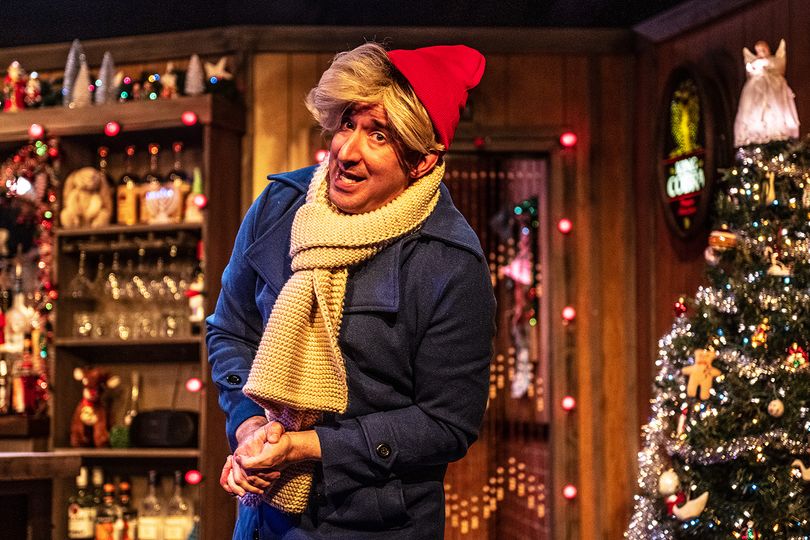
This year, the authors are John Cariani, Jenn Harris & Matthew Wilkas, Jeffrey Hatcher, Jacques Lamarre, Theresa Rebeck, and Edwin Sanchez. The “kids,” a slightly  different cast of characters than RTP’s 2015 production, include Ralphie from A Christmas Story, Zuzu Bailey from It’s A Wonderful Life,  Hermey, the Elf from Rudolph the Red-Nosed Reindeer and Rudolph and the Island of Misfit Toys, Karen, an internet influencer, Tiny Tim from A Christmas Carol, Clara from The Nutcracker ballet, and the hapless Charlie Brown. Zuzu and Karen replaced Susan (Miracle on 34th Street) and Cindy Lou Who (The Grinch Who Stole Christmas). Regional productions may feature different characters.

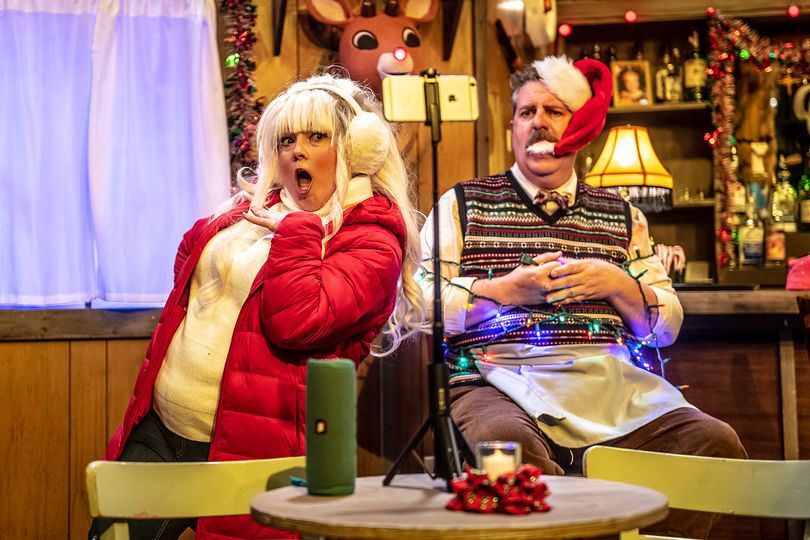
All these characters are portrayed by two highly talented and versatile actors. Theresa Mantiply plays all the women and Eddie Webster plays all the men. The motley cast of characters wander, one by one, into a local bar, where the friendly bartender, played by Joe Pabst, is at first surprised and ultimately perplexed at the increasingly colorful parade of characters who enter, seeking solace from the loneliness of Christmas Eve.

In the first scene, we see Ralphie, wearing an eye patch, peek through the window of the unimposing little bar – beautifully designed by William Luther with important inclusive details that provide something each of the characters can relate to on a personal level.

To answer the obvious question, yes, Ralphie finally did get his eye shot out, but it was not self-inflicted. A firearms safety instructor for the NRA, he was shot by a student and is now unemployed. On top of that, he has intimacy issues due to that infamous pink bunny suit his Aunt Clara sent, but not for the reasons one might expect.  You see, he actually liked it.
Little Zuzu Bailey who, as a child, declared that every time a bell rings, an angel gets its wings, has been harassed by angels for decades – and responds in nonsensical rhyming platitudes, while Hermey, the Elf who had dreams of becoming a dentist, has become a gossipy hater who holds a long-time grudge against Rudolf – not realizing that his own misfit status makes him more like Rudolph than not.

Karen, an entitled but untalented influencer, holds the Bartender hostage, posting increasingly unhinged videos for her unfortunate followers. Tiny Tim drops by, displaying Scrooge-like qualities and Clara’s cheating Prince has left her alone for the holiday. The last customer is none other than Charlie Brown, complete with a yellow sweater with a black zigzag line. Wonder of wonders – it’s a Christmas miracle – he finally gets to talk to The Little Red Haired Girl in the only scene shared by Mantiply and Webster. Through it all, Pabst calmy mixes drinks and offers gentle advice.

Christmas on the Rocks is a non-traditional Christmas story – or collection of sequels – billed as “an offbeat collection of twisted holiday tales” for the grown up kids in all of us who love a good laugh – especially when it’s at our own expense. There are limited performances left, so ditch the kids and go see it.

Julinda D. Lewis is a dancer, teacher, and writer who was born in Brooklyn, NY and now lives in Eastern Henrico County.

———-

CHRISTMAS ON THE ROCKS:

An Epic Offbeat Collection of Twisted Holiday Tales

Written by John Cariani, Jenn Harris & Matthew Wilkas, Jeffrey hatcher, Jacques Lamarre, Theresa Rebeck, and Edwin Sanchez

Conceived by Rob Ruggiero

Sponsored by David Peake

Directed by Axle Burtness

CAST:

Theresa Mantiply – Woman

Eddie Webster – Man

Joe Pabst – the Bartender

Understudies: Rachel Garmon-Williams and Travis Williams

CREATIVE TEAM:

Scenic & Costume Design       – William Luther

Lighting Design                       – Nathan Wunderlich

Sound & Projections Design   – Lucian Restivo

Hair & Make Up Design          – Luke Newsome

Props Design                           – Tim Moehring

Dialect Coach                          – Donna E. Cogbill

Technical Direction                 – William Luther

Assistant Scenic & Costume Design – Kendall Walker

Production Stage Manager – Saskia Price

Photo Credits: John MacLellan

MISS BENNET: CHRISTMAS AT PEMBERLEY

A Wonderfully Predictable Christmas Romance

MISS BENNET: CHRISTMAS AT PEMBERLEY

After Pride and Prejudice, The Sequel

A Theater Review by Julinda D. Lewis

At: The November Theatre Arenstein Stage, 114 West Broad Street, RVA 23220

Performances: November 25, 2022 – January 1, 2023

Ticket Prices: $39-$62.

Info: (804) 282-2620 or www.virginiarep.org

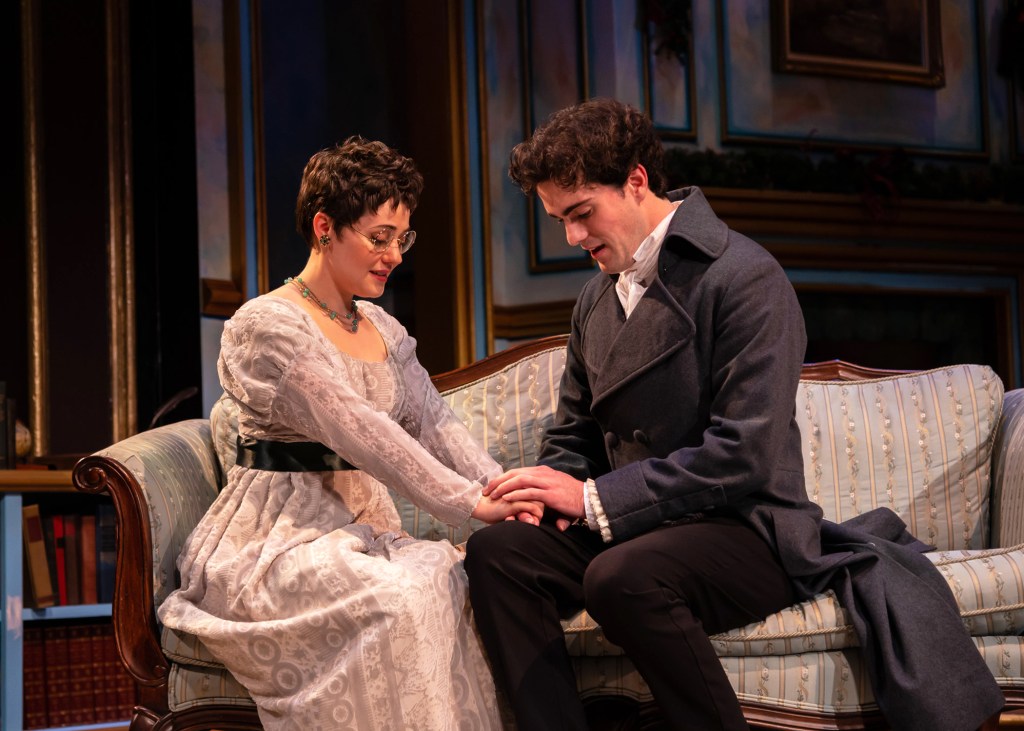
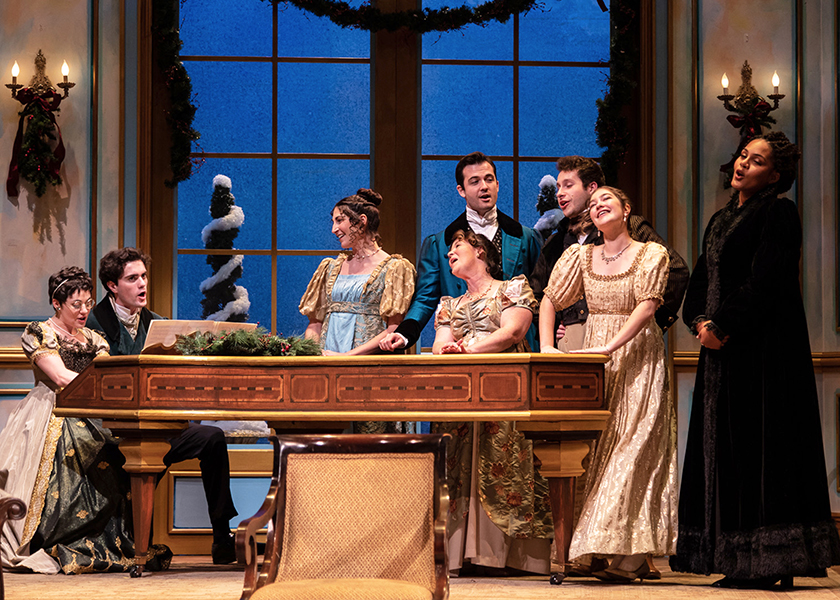
MISS BENNET: CHRISTMAS AT PEMBERLEY is like a Hallmark Christmas movie that came to life on stage: amusing, heartwarming, romantic, and predictable. The focus of Lauren Gunderson and Margot Melcon’s 2016 play is Miss Mary Bennet, the middle sister from Jane Austen’s Pride and Prejudice (1813). The bookish Miss Bennet, who is fast approaching the dreaded season of spinsterhood, accepts an invitation to spend Christmas with her happily married older sister, Elizabeth, and her husband Fitzwilliam Darcy at their estate – Pemberley.

Naturally, a single man, Lord Arthur de Bourgh, is also invited and to no one’s surprise, de Bourgh turns out to be a perfect match for Mary. Shy and socially awkward, de Bourgh reminds me of a Regency-era Sheldon Cooper (of The Big Bang Theory). The two love-nerds bond over books, maps, and wordplay – a perfect meeting of two sapiosexual minds. (Yes, there really is a word that describes people who are sexually attracted to intelligence, and this is the first time I actually had a chance to use it.)

In addition to being a matchmaker, Elizabeth also happens to be a trendsetter. The German custom of displaying Christmas trees inside one’s home was introduced in England sometime in the first half of the 19th century. That makes Elizabeth’s holiday tree something of an oddity and the subject of a running joke throughout Christmas at Pemberley. Act I ends with a Christmas tree bare of decorations except for half a dozen paper stars, but Act II opens with a fully decorated tree – part of the Christmas magic. Act I also closes with a cliff-hanger – a mystery fiancée.

The cast is populated with a number of actors making their Va-Rep debut, as well as a number of performers who are current VCU theatre students or recent graduates of the department where Christmas at Pemberley director Sharon Ott serves as an Associate Professor and the department’s Artistic Director. The show moves along at a relaxed pace, giving the characters ample opportunity to unfold and reveal various facets of their personalities. Given that this is a shamelessly feel-good story, there isn’t much to reveal. The four sisters (the happily married Elizabeth and Jane, the less-happily married Lydia, and our leading lady, Mary) bicker relentlessly, but by the end declare their love for one another. The youngest sister, Kitty, is mentioned, but never makes an appearance – arriving with her parents (all offstage) in the final scene.

There are a few amusingly awkward scenes between the men as well. Mr. Darcy and his brother-in-law Charles Bingley sit in awkward silence, but when Bingley attempts to initiate conversation, it quickly becomes apparent that conversation is even more awkward than silence. Darcy returns to his book, and Bingley resumes staring into space. However, both muster themselves from their introversion to give advice to de Bourgh. Britt Michael Gordon (Darcy), Cameron Nickel (Bingley), and Lukas D’Errico (de Bourgh) embrace their roles, hiding behind manners and protocol, and clothed in stylish Regency attire.

The four sisters are the main attraction. There is a very pregnant Jane Bingley (Patricia Austin), the annoyingly unhappy Lydia Wickham (Naomi Bertha), the wise and conciliatory Elizabeth Darcy (Ally Farzetta, who is Gordon’s real-life wife), and the still single but ready to mingle Mary Bennet (Emily Franch). They trace the patterns of a dance choreographed with equal parts hilarity and love. Sometimes their interactions are heavy-handed and sometimes quite delicate, establishing a balance that kept the Saturday afternoon audience engaged and amused.

Oh, and let’s not forget the surprise fiancée, Ann de Bourgh (Tatjana Shields), the twice-scorned bride-to-be. I found Shields delightful as Mrs. Dickson in a VCU production of Intimate Apparel, another period piece, but her character was overbearing and off-putting in Pemberton. This was an unfortunate manifestation of her character – which was apparently written that way – as there was no opportunity for her to redeem herself and win over the audience. The estate was kept in order by a nameless Maid, a thankless – and silent – supporting role played alternately by Nicole Boisseau and Emma Tolley.

Kudos to Carolan Corcoran for the luscious costumes, although I did wonder why the women were usually in sleeveless dresses in England in the winter – with snow falling outside the window. Hmm. Ah well, it’s fiction, it’s fun, and a good time was had by all.


Julinda D. Lewis is a dancer, teacher, and writer who was born in Brooklyn, NY and now lives in Eastern Henrico County.


MISS BENNET: CHRISTMAS AT PEMBERLEY

By Lauren Gunderson and Margot Melcon

Directed by Sharon Ott

Cast

Jane Bingley                            – Patricia Austin

Lydia Wickham                    – Naomi Bertha

Arthur de Bourgh                  – Lukas D’Errico

Elizabeth Darcy                       – Ally Farzetta

Mary Bennet                            – Emily Franch

Fitzwilliam Darcy                   – Britt Michael Gordon

Charles Bingley                       – Cameron Nickel

Anne de Bourgh                      – Tatjana Shields

Maid                                       – Nicole Boisseau, Emma Tolly (alternating)

Jane Bingley/Lydia Wickham u/s – Reese Bucher

Charles Bingley u/s                 – Robert McNickle

Creative Team/Direction and Design

Direction                                 – Sharon Ott

Assistant Director/Dramaturg – Mia Richards

Scenic Design                          – Mercedes Schaum

Costume Design                      – Carolan Corcoran

Lighting Design                        – Lynne M. Hartman

Sound Design                           – Jacob Mishler

Stage Management                 – Justin Janke

Assistant Stage Manager      – Courtney Holmes

Dialect Direction                     – Karen Kopryanski

Run Time: 2 hours, including one 15-minute intermission

Ticket Information

Box Office: 804-282-2620

http://www.virginiarep.org

Tickets range from $36 – $67

Discounted Group Rates and Rush tickets available.

Photo Credits: Aaron Sutten

VA-REP Covid Safety Statement

Virginia Rep encourages wearing masks for our patrons’ safety, but we do not require that you wear a mask in our lobbies or within the theatres. They are now optional.

We continue to follow CDC guidelines and local risk levels. All Virginia Rep staff will continue to wear masks while serving you.

SHE STOOPS TO CONQUER:

THE PLAY THAT USHERED IN A NEW WAVE OF HUMOR

A Theater Review by Julinda D. Lewis

By: Quill Theatre’s Richmond Shakespeare Festival

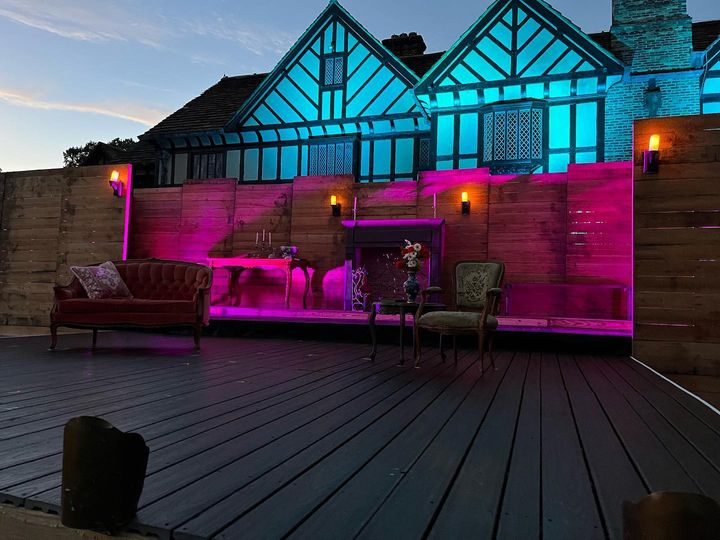
At: Agecroft Hall & Gardens, 4305 Sulgrave Road, Richmond, VA 23221

Performances: July 7-31, 2022

Ticket Prices: $20-$33

Info: (804) 353-4241 or quilltheatre.org

Dating back to 1773, She Stoops to Conquer has long been considered one of the most popular English-language comedies. Interestingly, it was a major theatrical success by a relatively unknown playwright – Oliver Goldsmith – and the play that set Director James Ricks, then a middle school student, ablaze with a passion for live theater. It is also credited with being the source of the phrase, “ask me no questions and I’ll tell you no lies.”

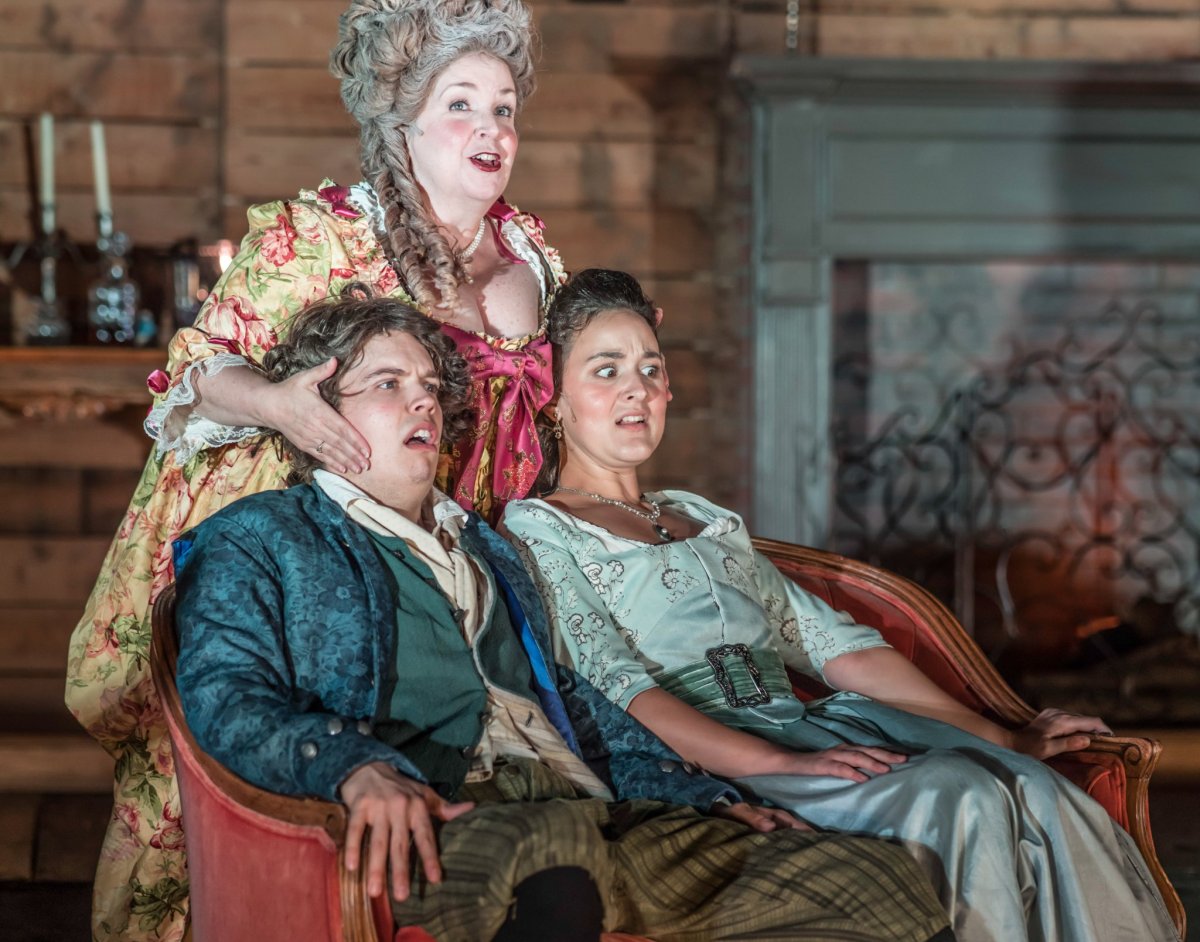
The plot is a familiar one – two affluent families, the Hardcastles and the Marlows, arrange to introduce their children, Kate and Charles, with an end goal of marriage. But Kate’s spoiled, immature older half-brother Tony Lumpkin sees this as an excellent opportunity to wreak havoc of monumental proportions. Tony likes to hang out with the masses at the local pub – at one point Mr. Hardcastle say of him, disparagingly, “the only school he’ll ever go to is the ale house.” And that is precisely where he is when he intercepts his sister’s would-be suitor and his traveling companion – at the local pub – as they search for the remotely-located country home of the Hardcastle family. Tony convinces Charles that the Hardcastle estate is an inn. There ensues a “comedy of errors,” and one fascinating result is that young Charles Marlow, who has been described as educated and shy, imperiously treats his unsuspecting hosts as servants, displaying a side Kate was not expecting. Kate, however, has her own agenda, and disguises herself as a barmaid to further explore the character of her would-be suitor.

Like any good sitcom, there are subplots and counter-plots to the main theme. These include a secret love-affair between Kate’s cousin Constance and young Marlow’s friend George Hastings, Mrs. Marlow’s attempts to hide an inheritance, and Tony’s attempts to avoid an arranged marriage of his own. This simplified synopsis does not do justice to the live production. She Stoops to Conquer is neither trite nor stereotypical. Supporting characters are as interesting as leading characters – establishing a sort of social equality that was far ahead of its time.

Debra Wagoner was delightful in the role of Mrs. Hardcastle, the master (or mistress) of much of the seemingly unintended humor. In one of the latter scenes, she gets her comeuppance when her own son (Josh Mullins as Tony Lumpkin) tricks her into thinking she is lost in the wilderness. Mark Persinger as her husband, proved to be a stark contrast to Wagoner’s character and brought his own unique style of humor. Hardcastle, you see, is decidedly old-fashioned, stuck in the past and despises anything modern, while his wife (a social climber) and daughter (a sensible young woman with a mind of her own) yearn for modern fashions and are attracted by the lure of the city. Wagoner proved to be a capable antagonist, while Katy Feldhahn (Kate) was more than capable of conquering.

Josh Mullins, as Mrs. Hardcastle’s spoiled son, happily wreaked havoc at every turn. Calie Bain as Kate and Tony’s cousin (and Tony’s reluctant intended) Constance Neville was solid and dependable in a somewhat predictable and unremarkable role while Ian Page played his role close to the edge and over the top as the socially challenged Young Marlow.

That being said, She Stoops to Conquer was a delightful summer divertissement, comedically ahead of its time, pleasant and fairly well-paced, with direction by James Ricks. It just wasn’t my cup of tea, but I would certainly give it a second chance in the future.

NOTE: Unfortunately, this summer’s Shakespeare Festival took the brunt of the summer storms. Both productions at Agecroft Hall were plagued by cancellations due to weather, and, alas, the closing production of She Stoops to Conquer was no exception.

She Stoops to Conquer

By Oliver Goldsmith

Directed by James Ricks

Cast

Mrs. Hardcastle……………  Debra Wagoner

Mr. Hardcastle ……………   Mark Persinger

Tony Lumpkin ……………   Josh Mullins

Kate Hardcastle ..…………   Katy Feldhahn

Constance Neville…………   Calie Bain

Young Marlow….…………   Ian Page

George Hastings.…………    William Cardozo

Sir Charles/Landlord ……  John Cauthen

Pimple/Betty ………………..   Els Dusek

Diggory/Fellow ..…………    Alex Chapman

Roger/Jeremy .……….……    Audrey Sparrow

Production Team

Director:  James Ricks

Stage Manager: Nata Moriconi

Costume Designer: Cora Delbridge

Lighting Designer: Andrew Bonniwell

Props Designer: Emily Hicks

Music Director: Jason Marks

Choreographer: Nicole Morris-Anastasi

Dialect Coach: Harrison Runion

Assistant Stage Manager: Hope Jewell

Stage Construction: Kevin Johnson

Production Manager: James  Ricks

Run Time: About 2 ½ hours with one intermission

Julinda D. Lewis is a dancer, teacher, and writer who was born in Brooklyn, NY and now lives in Eastern Henrico County.

———-

Photo Credits: David Parrish Photography

THE BARBER OF MOVILLE

Molly has a PLAN – if only she could remember what it was…

The US Premiere of a New Play by Ronan Carr

A Theater Review by Julinda D. Lewis

At: The Firehouse, 1609 West Broad St., Richmond, RVA 23220

Performances: June 23 – July 17, 2022

Ticket Prices: $30

Info: (804) 355-2001 or firehousetheatre.org.

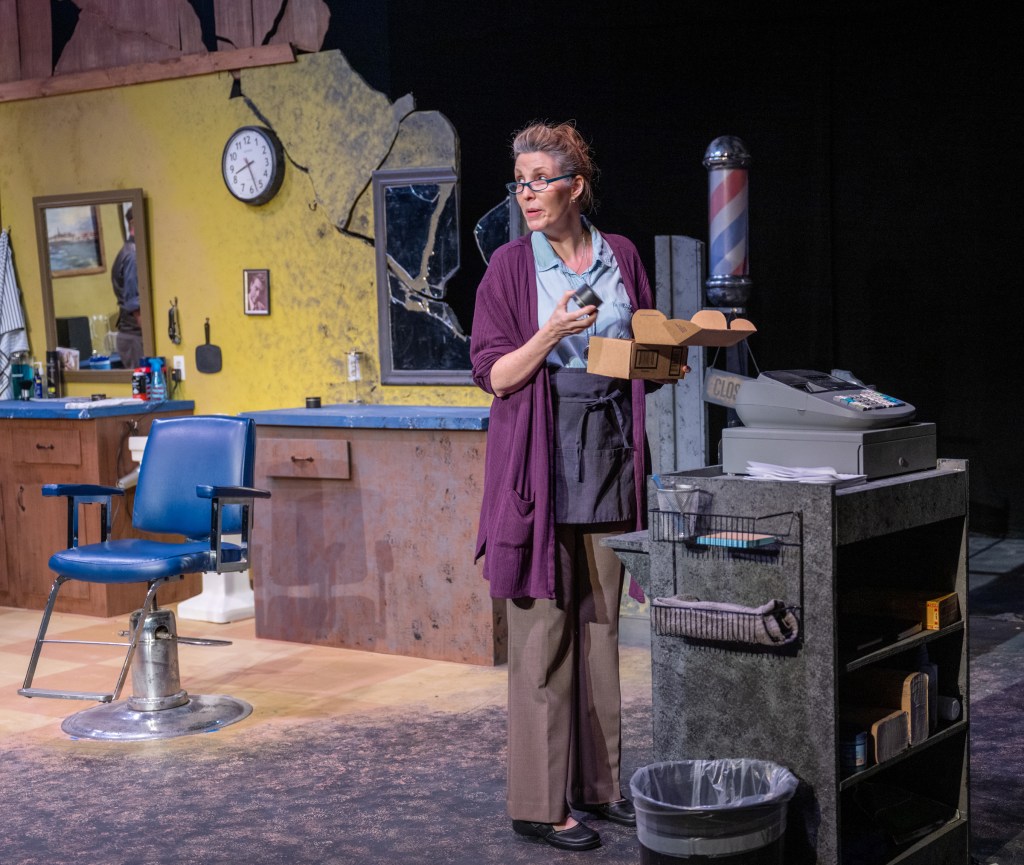
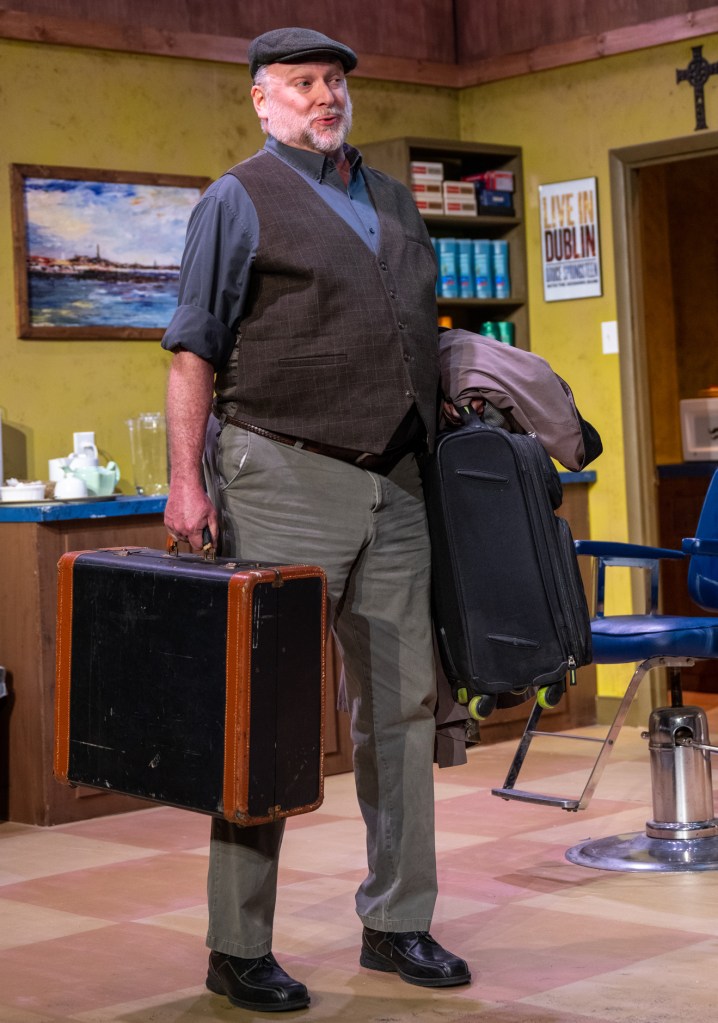
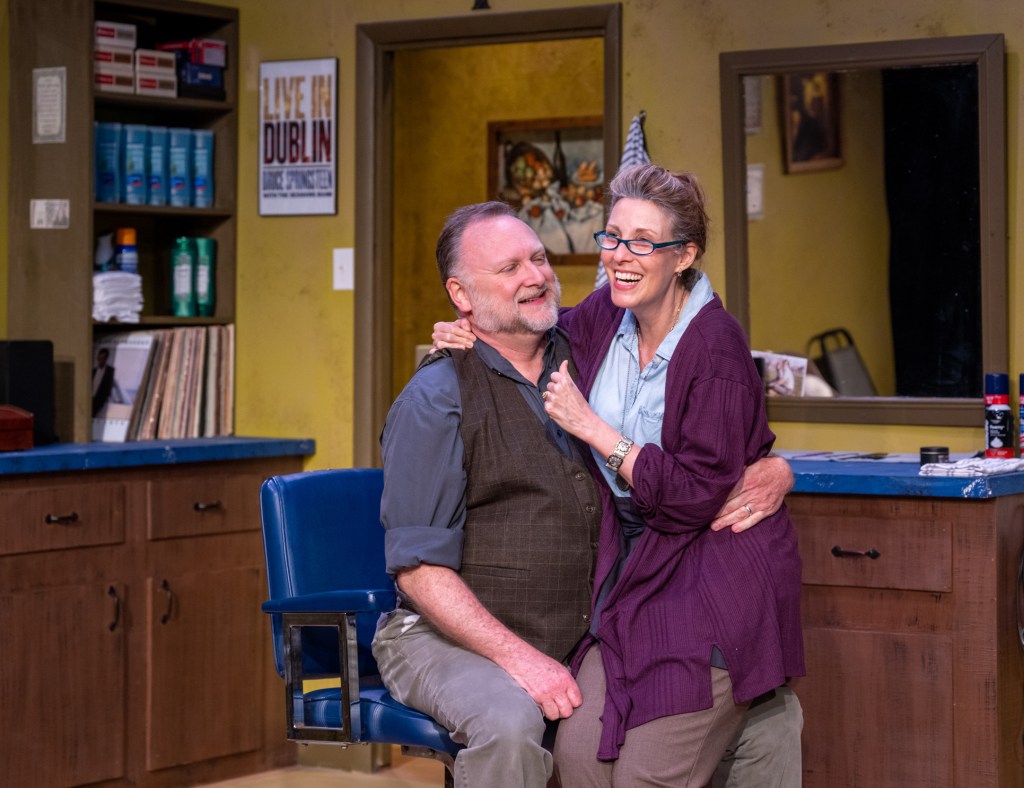
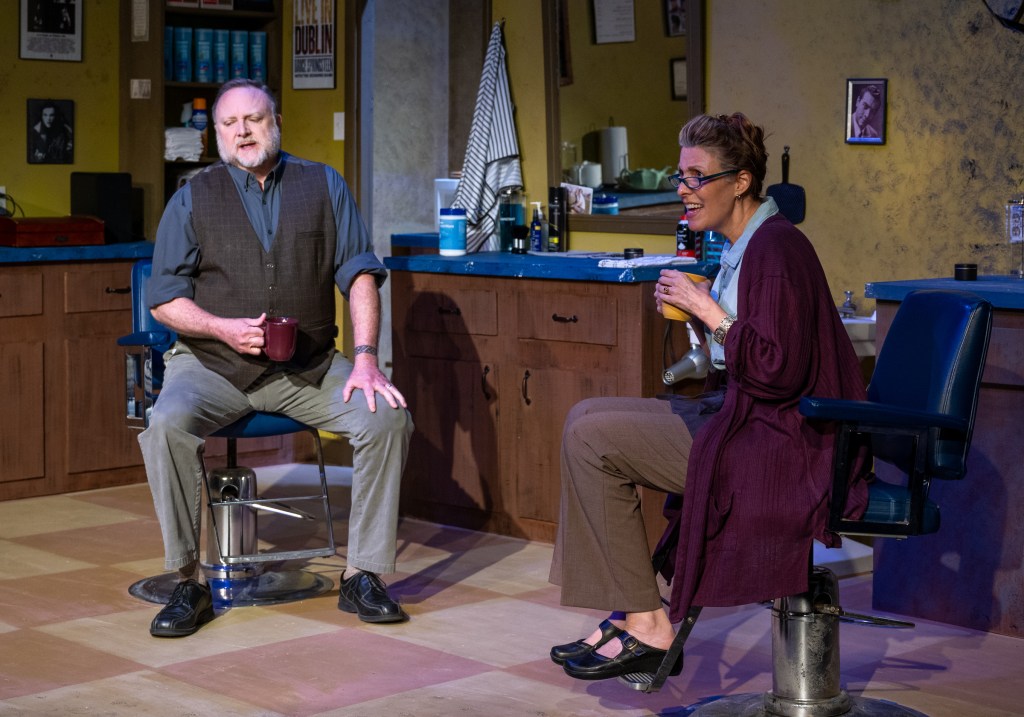
THE BARBER OF MOVILLE is one of the most touching plays I’ve seen all season – perhaps ever. And by touching, I mean you will need tissues. As the play opens, Molly (Katie McCall) is preparing to open up the barber shop she took over after her father died. She heats water for tea – this is, after all, Ireland – and listens to opera as she prepares to receive her first customer, a Wednesday regular. Molly’s husband Dommo (David Bridgewater) soon comes into the shop from the attached living quarters. He’s carrying two suitcases and appears surprised to see that Molly is preparing to open shop. He gently explains that is has been several years since the regular customer Molly is expecting has come into the shop.

It doesn’t take long for the audience to figure out that Molly has Alzheimer’s and despite how put-together and fit she looks, her memory appears to be rapidly deteriorating. But the couple has a Plan. That explains the suitcases: a modern rolling bag and a clunky vintage number. They are about to leave their outdated little barber shop in Derry City, Ireland for an adventure in Zurich, Switzerland, where they plan to check into a fine hotel, attend the opera, and then take Molly to see the doctor. The well-planned trip, Molly’s idea actually, has been carefully documented in Molly’s little black book as Dommo calls it – or notebook, as she insists – and the couple even has a written contract spelling out all the details of their trip. That seems a little excessive, you say? Well, not when you understand that Dommo has a round-trip ticket and Molly doesn’t…

Before leaving, the obviously loving couple takes a trip down memory lane – a tricky proposition when one’s memory has become your arch enemy. There are warm and even humorous moments as we eavesdrop on the couple’s joyous if sometimes frustrating conversation. We hear of their youthful days in art college and learn that Molly prefers Bruce Springsteen while Dommo leans towards Meatloaf, but then there is also a darker side to their story. Molly’s Aunt Christine apparently also had the same disease that is eroding Molly’s sense of self and then there is the uneasy revelation of her beloved father’s true character.

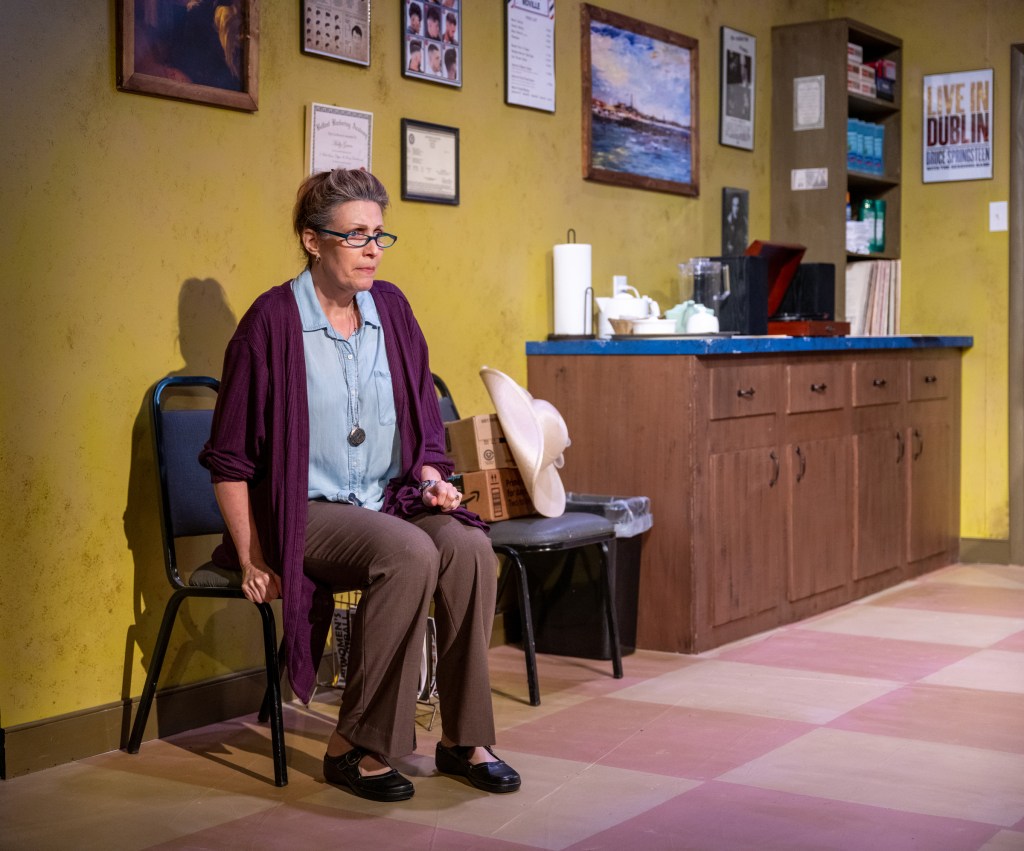
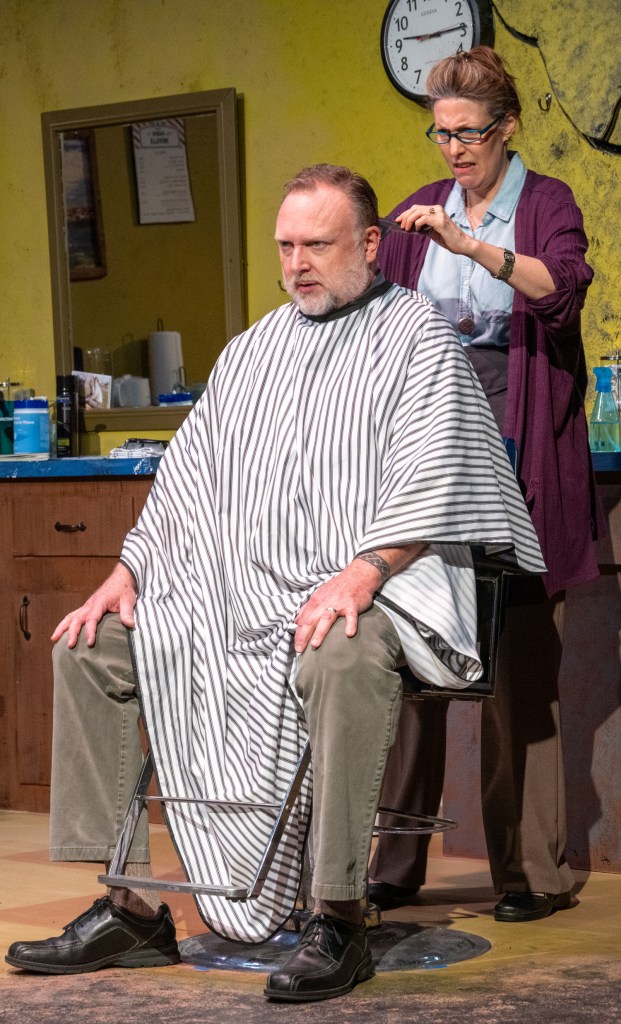
Katie McCall and David Bridgewater inhabit these characters with dignity, with faith. They infuse them with warmth, humanity, and authenticity far beyond mere acting technique. Nathaniel Shaw’s directing is also gentle, yet refuses to hide any of the details of the mental, physical, and emotional toll that Alzheimer’s can wreck on an individual and on a relationship.  A clock on the wall of the barber shop has been set to run in real time and we can see the entire play unfold in 60 minutes. At the end of that 60 minutes, Dommo rips up the contract, and I wiped my eyes. By the end, it felt as if I had been watching something sacred and private, not just watching a play for entertainment. At the end, I could go home and leave Molly and Dommo behind, but that will not be an option for everyone who sees this play. Wisely, for this run Firehouse has partnered with the Alzheimer’s Association, and scheduled several post-show talkbacks.

Set in the present, in a little town that is stuck in the past, the ambience reflects the disarray of Molly’s mind. So does Chris Raintree’s scenic design: a two-chair barber shop complete with the traditional red, white and blue pole. But the left two-thirds of the set is orderly, if a bit dated, while the right third reflects chaos – a broken mirror, cracks in the wall. So many of the pieces fit together perfectly, from Molly’s long, loose sweater and comfortable shoes (thanks to Costume designer Colin Lowrey II) to McCall’s and Bridgewater’s soft Irish accents (kudos, once again, to Dialect Coach Erica Hughes). I have never once been disappointed or felt confused when I’ve seen Hughes listed in a program as the Dialect Coach.

THE BARBER OF MOVILLE is a beautiful play that makes me want to see more of Carr’s work. It runs at the Firehouse through July 17.

THE BARBER OF MOVILLE

The US Premiere of a New Play by Ronan Carr

Directed by Nathaniel Shaw

Cast:

Molly Green ……………….. Katie McCall

Dommo Green ……………….. David Bridgewater

​Production Team:

Nathaniel Shaw – Director

Chris Raintree – Scenic Designer

Colin Lowrey II – Costume Designer

Todd Labelle – Lighting and Sound Designer

Erica Hughes – Dialect Coach

Dennis Bowe – Stage Manager

Bill Sigafoos – Photographer

​Performance Schedule:

Thu June 23 @ 7:30pm (preview)

Fri June 24 @ 7:30pm (preview/post show talkback)

Sat June 25 @ 7:30pm (opening)

Fri July 1 @ 7:30pm (post show talkback)

Sat July 2 @ 7:30pm

Sun July 3 @ 3pm (post show talkback)

Fri July 8 @ 7:30pm

Sat July 9 @ 7:30pm

Sun July 10 @ 3pm (post show talkback)

Fri July 15 @ 7:30pm

Sat July 16 @ 7:30pm

Sun July 17 @ 3pm (post show talkback)

​Tickets: $30

Run time: 60 minutes with no intermission

The Firehouse Theatre requires all audience members to be fully vaccinated and to wear face masks inside the Firehouse.

Photo Credits: Bill Sigafoos

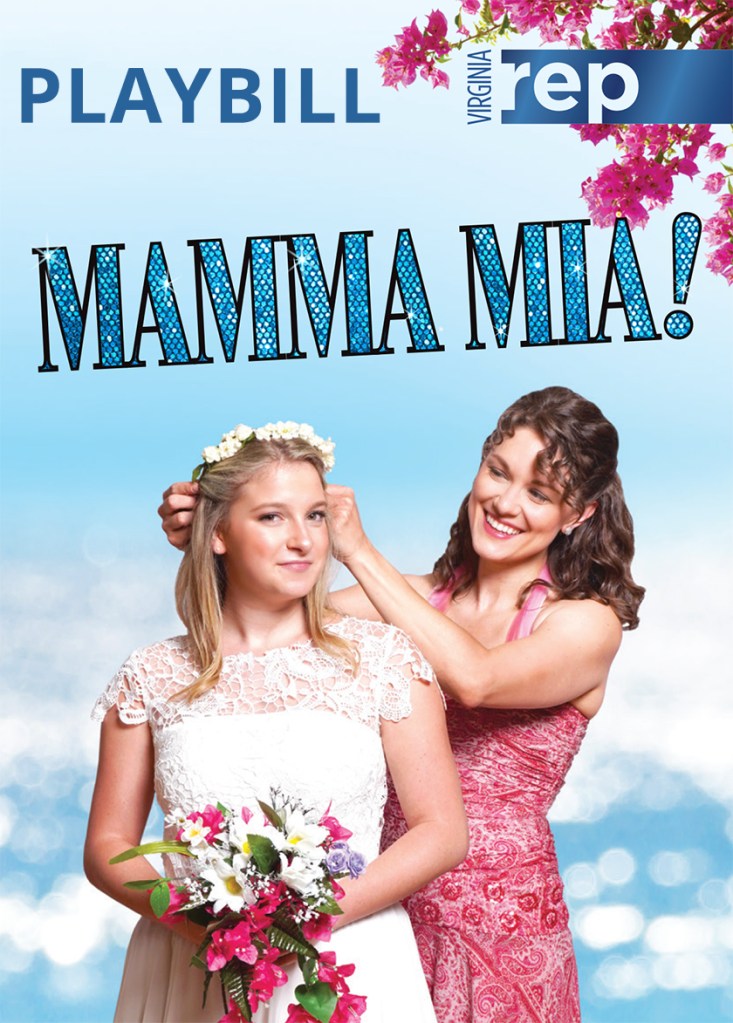
MAMMA MIA!

Will the Real Dad Please Stand Up!

A Theater Review by Julinda D. Lewis

At: The November Theatre Arenstein Stage, 114 West Broad Street, RVA 23220

Performances: June 24 – August 7, 2022

Ticket Prices: $36-$67

Info: (804) 282-2620 or www.virginiarep.org

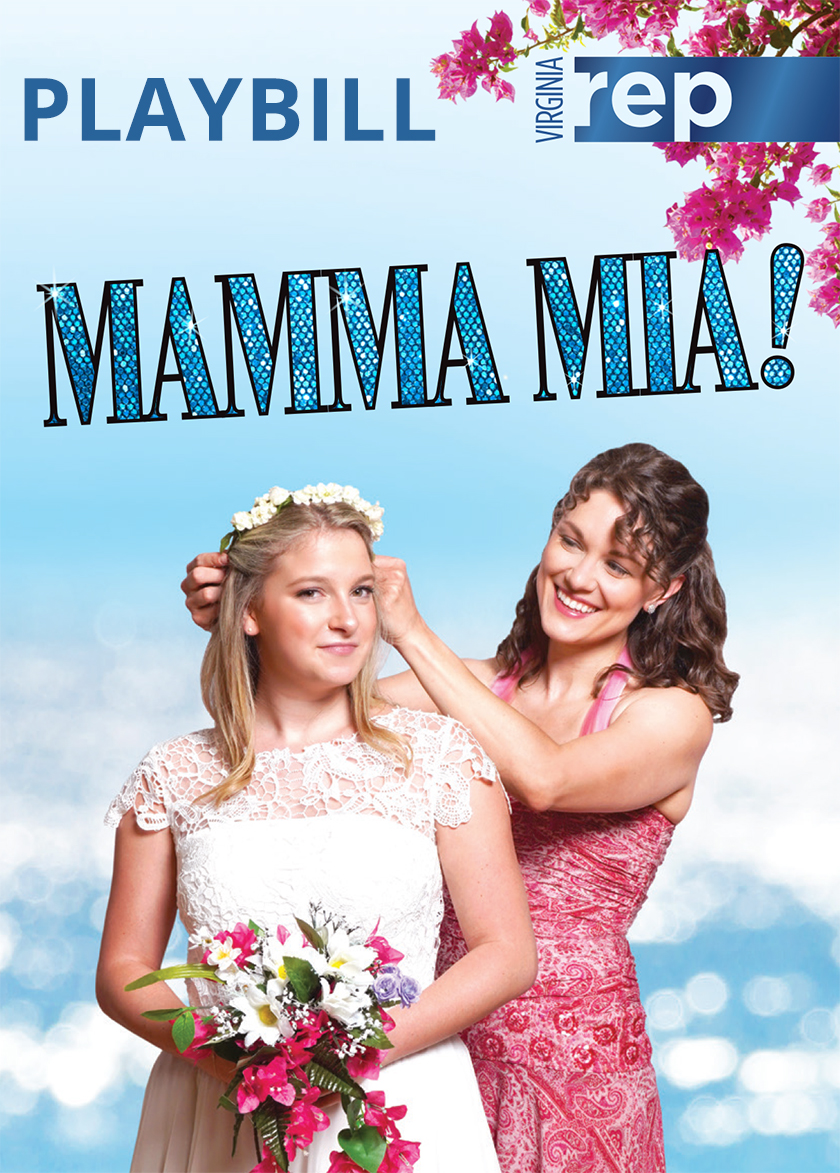
Some shows are meant to tell a story, some teach a lesson, some have a moral, and then there are those that are just pure and joyful entertainment. With its energetic and danceable music, familiar songs made popular in the 1970s by the group ABBA, and a stage filled with colorful costumes, throngs of dancers, and even dancing lights (thank you, Joe Doran), Mamma Mia! belongs to the latter category.

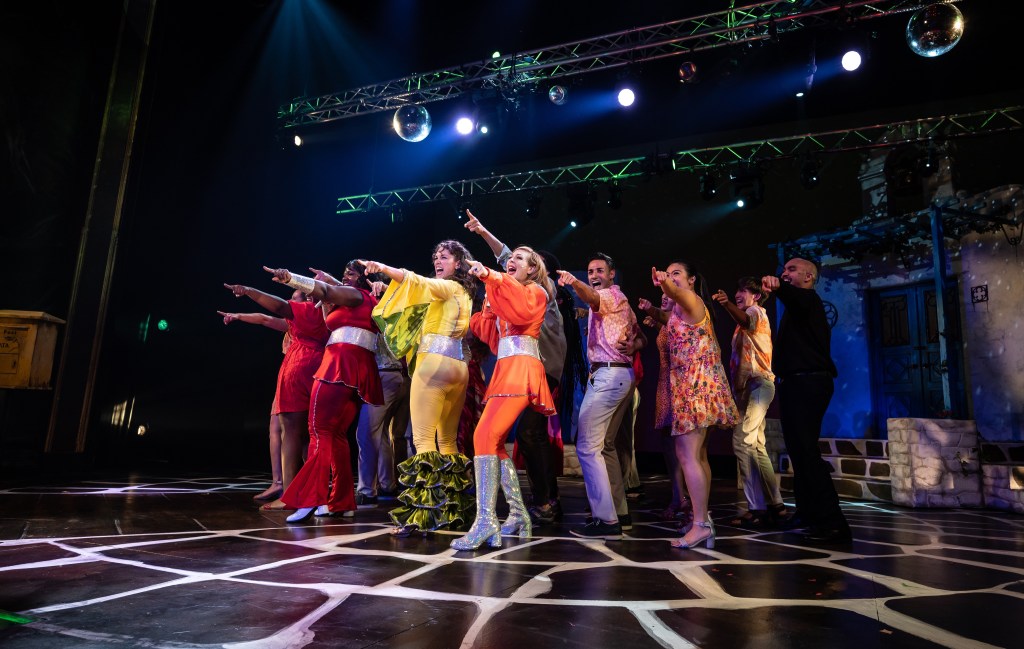
Things got off to a good start with a two or three minute Overture. The dancing lights, and upbeat music created a sense of anticipation, and then the company solidly delivered on its promise. After briefly introducing the main characters, Mamma Mia! jumped right into a large ensemble production of “Money, Money, Money” that soon led to the popular “Dancing Queen.” Not to be outdone by the women, the groomsmen and men of the ensemble danced out in flippers (swim fins) and a huge ensemble closed out the first act with a highly animated “Voulez Vous.” The second act was dominated by a series of duets with all the main characters taking turns and ended with a mini concert disguised as an extended encore. Some in the audience came prepared to party, with feather boas and animated applause. I hope the cast felt the positive energy. I know I laughed and smiled until my face hurt.

Background and Spoiler Alert

Most everyone has heard of Mamma Mia! but there are a few – like me – who had somehow never seen any version of it, neither the long-running Broadway hit show or the film series. Mamma Mia!, in spite of its Italian title, was created by a team of British artists and set on the fictitious Greek island of Kalokairi. There we find Sophie, the love-child of a former free-spirited hippie, Donna who once led a girl band, the Dynamos. Sophie is twenty and about to get married, something her mother cannot get on board with, not because she doesn’t like Sophie’s beloved, Sky, but because she doesn’t believe in marriage. To complicate things – because after all, without conflict there would be no plot – at this momentous occasion in her life, Sophie has discovered a deep need to know who her father is, so she scours her mother’s diary, uncovers three possible candidates, and without her mother’s knowledge or permission invites them all to her wedding in hopes of having her father walk her down the aisle for her traditional “white wedding.”

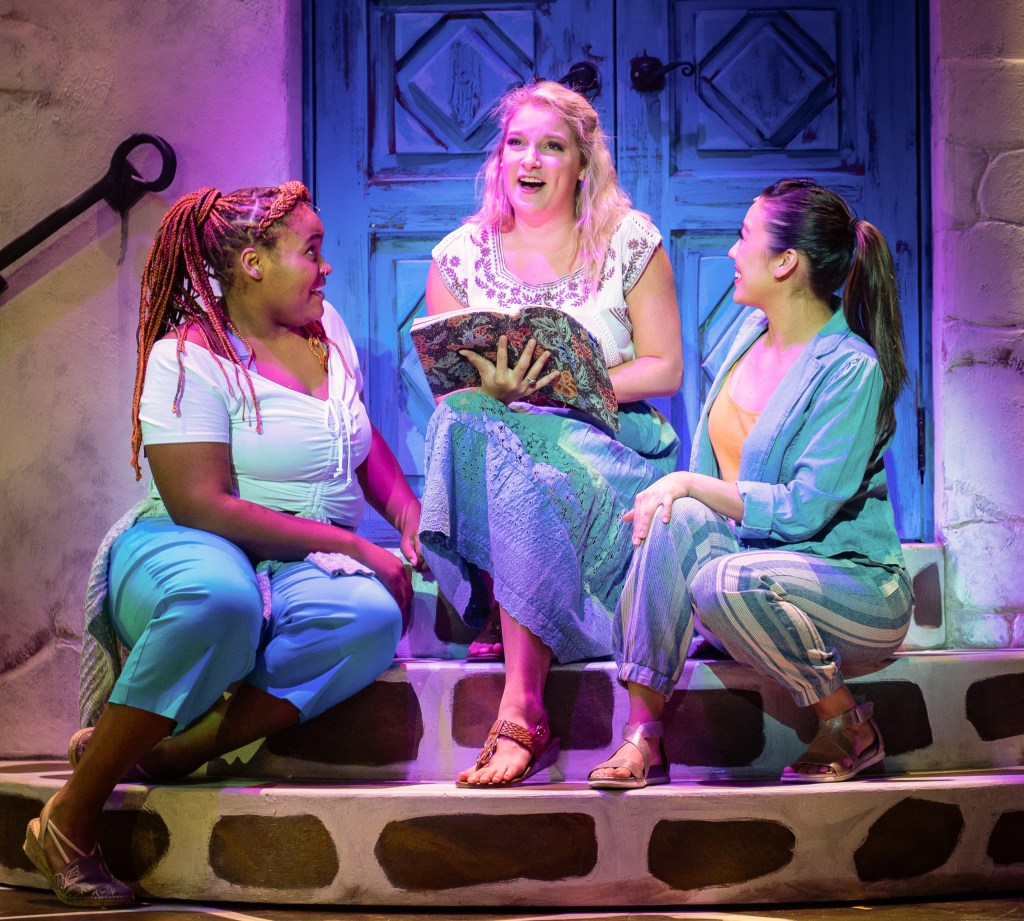
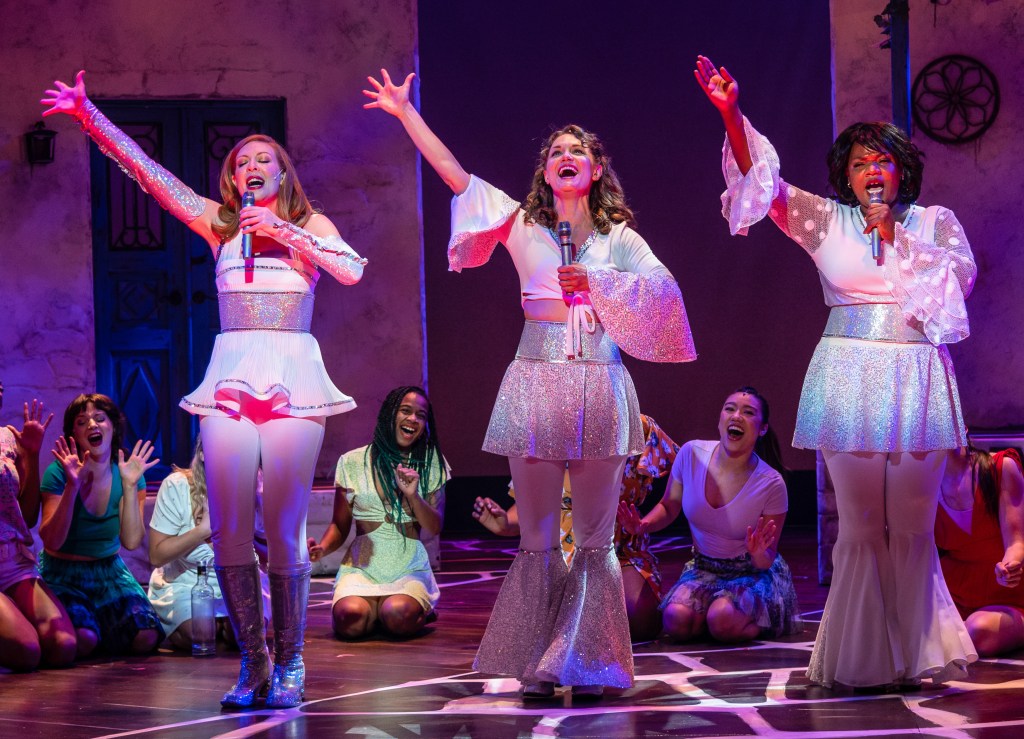
The cast is populated by familiar and new-to-Richmond/VaRep names and faces, and I loved them all. Hannah Jennison played bride-to-be Sophie with a credible grounded freshness. Emelie Faith Thompson gave Sophie’s mother Donna generous doses of sassiness and vulnerability and released her character’s personality in measured doses, as if well aware that too much Donna all at once was more than the average person could handle. Grey Garrett, as Donna’s friend Tanya, drew applause and cheers from the audience even before she spoke her first word, and like the glamorous, thrice-divorced auntie that most families seem to have – and who shows up to all the family celebrations – she was equally comfortable flirting with men half her age and offering wise guidance to her niece.

You are(not) the father!

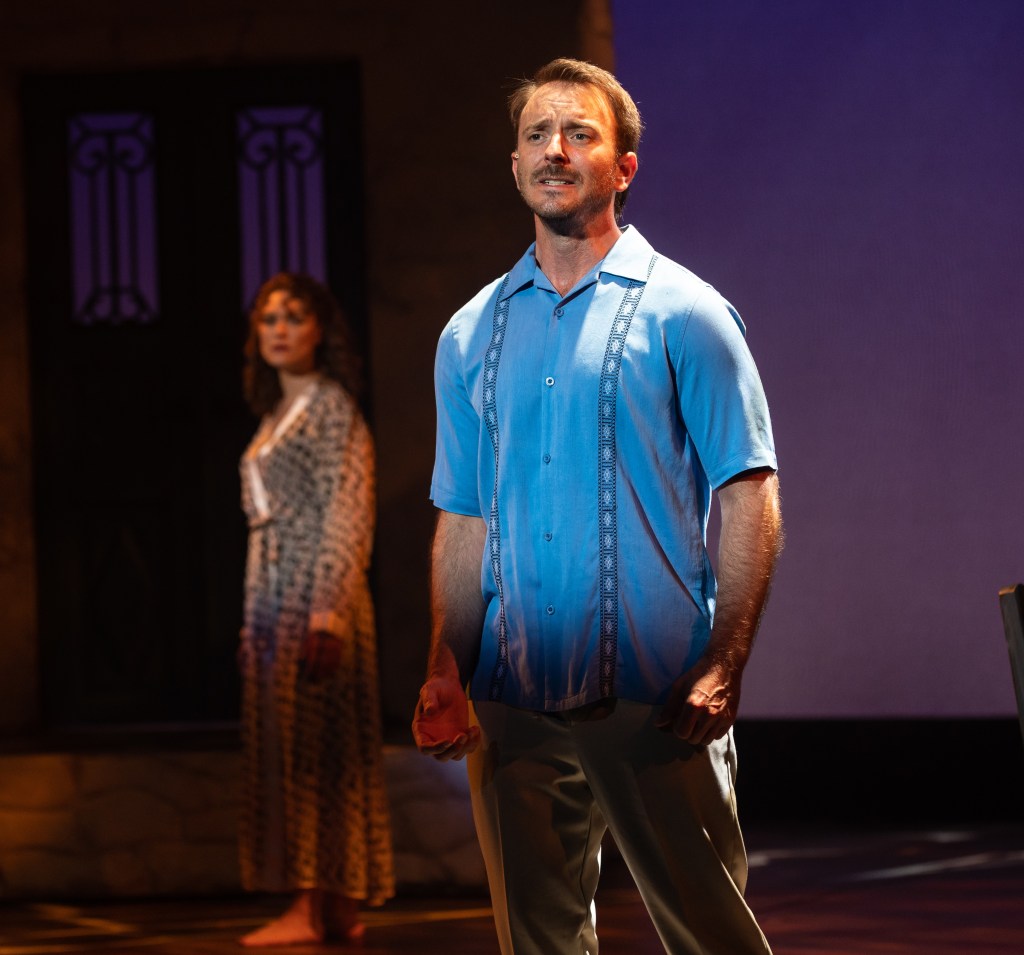
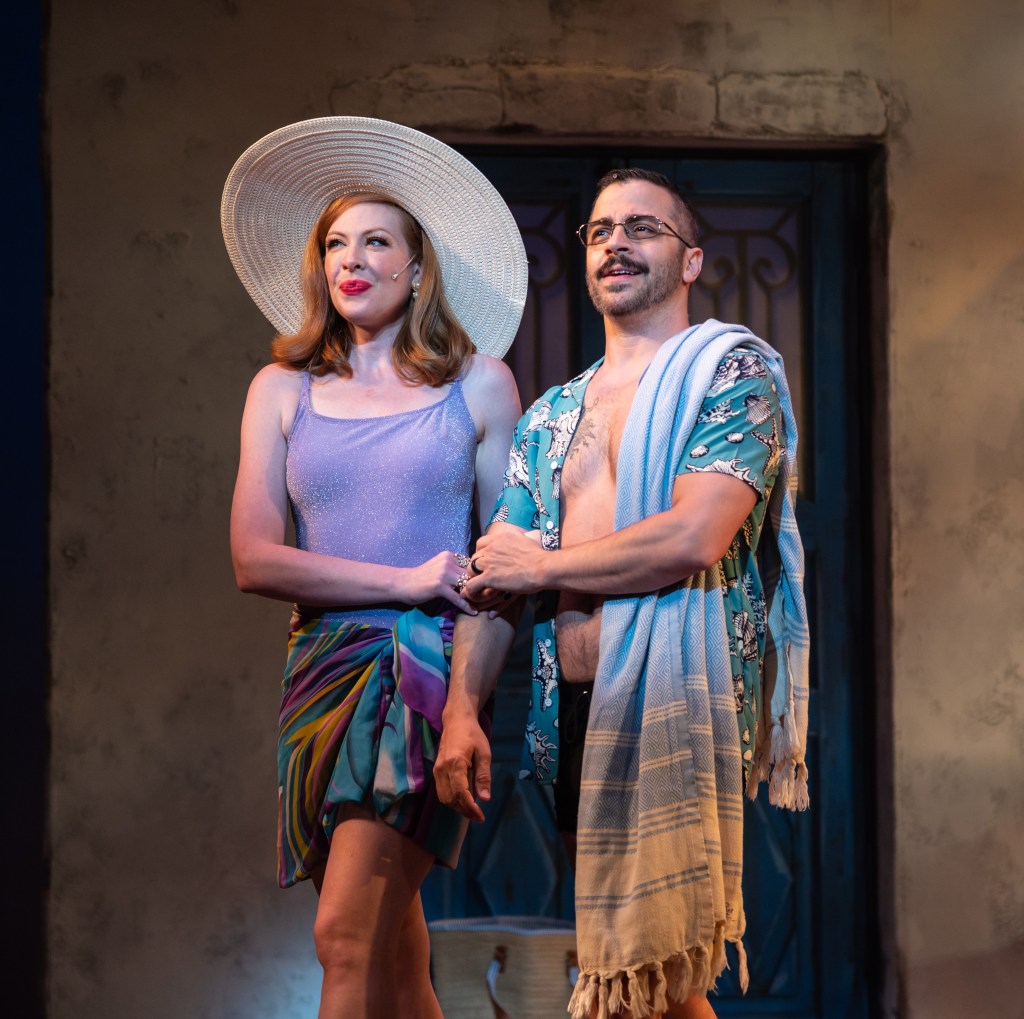
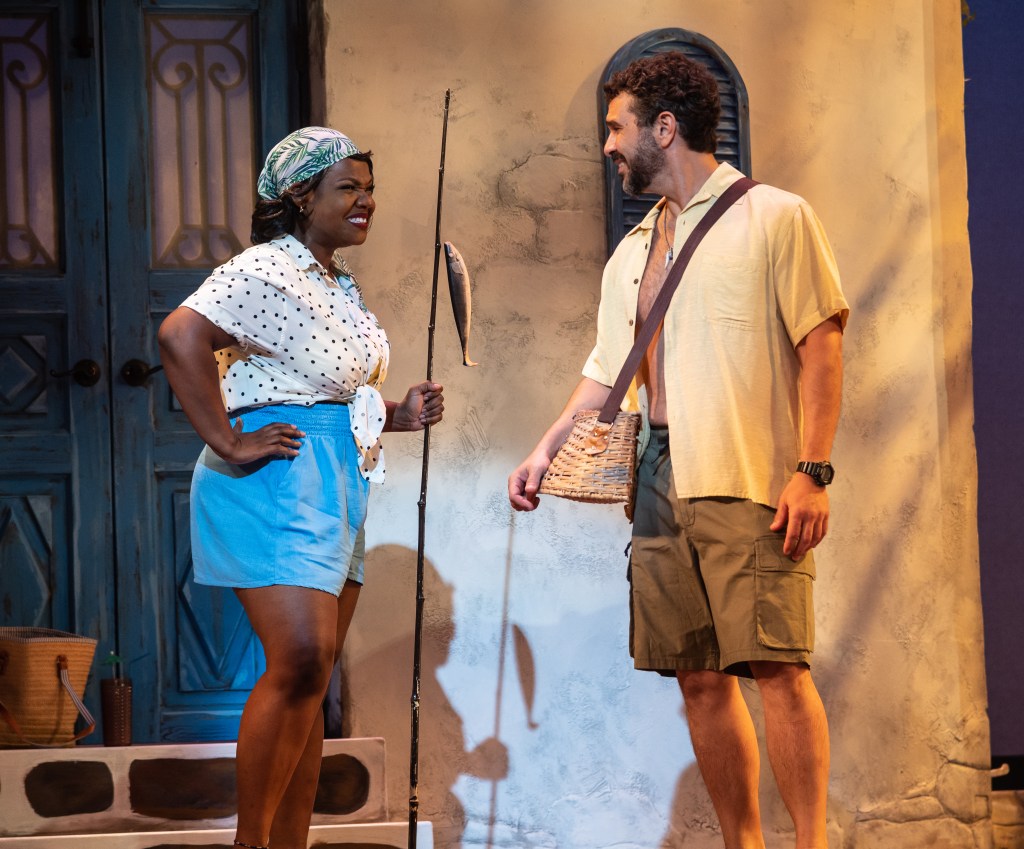
Now, to return, even if only briefly, to the main plot, the three possible dads are Harry (Anthony CeFaia), Bill (Jason Krypos), and Sam (Alexander Sapp). Each had a special relationship with Donna, and Donna was never one to kiss and tell: dot, dot, dot (inside joke). Each also had a compelling reason to be revealed as Sophie’s father, but, driven by secrecy – both Donna’s reticence about her past and her own unauthorized inspection of her mother’s diary – Sophie had no DNA test results to clear up the mystery.

Good/Bad News Comes in Threes

Just as there were three possible dads, the women were cast in groups of three as well. Donna had two best friends, her former back-up singers, Tanya (Garrett) and Rosie (Catrina Brenae), and so did Sophie: Ali (Havy Nguyen) and Lisa (Jana Prentiss). Even Sky (Micah Cook on opening night; a character who was never as fully developed as the women) had two close friends, the flirtatious Pepper (Connor Macchi) and the more dependable Eddie (Johnny Reardon), both of whom worked at the taverna (a Greek restaurant, this one included a B&B) built and run by Sophie’s mother Donna (Thompson).

It comes as no surprise that the planned wedding does not go on as scheduled, but there is a surprise wedding (I guess you don’t need a license in Greece, at least not in musical Greece) as well as a surprise romance, which comes as no surprise.

Encore and Finale

One of the best parts of Mamma Mia!  is the encore and finale. I noticed Donna and a few others disappear during the final bows, and sure enough Donna and the Dynamos reappeared in brightly colored, ABBA-inspired costumes in red, orange, and yellow – exaggerated bell bottoms, futuristic extended shoulders, and blinged out to the max – only to be joined by the Dads wearing matching outfits and silver platform boots. The company sent the audience out dancing and singing along to “Mamma Mia!” “Dancing Queen,” and more. Mamma Mia! may or may not be perfect, but it is perfectly suited to these times. For some audience members, it was the first time out to a live show since “the time before,” and for others it was a much-needed release after months of disturbing breaking news reports. First produced onstage in 1999, the music is popular enough to span generations, popular enough to be familiar, and old enough to not stir up any controversy or salt any open wounds – it’s a feel-good musical through and through.

With a large cast and lots of choreography, the set was kept simple with a minimalist rotating design representing Donna’s taverna – which looked somewhat Spanish or Moorish to my untrained eye. Most of the visual effects were wisely focused on the costumes and lighting. The band was placed in the orchestra pit, instead of hidden behind the scrim, adding even more of a Broadway, big-stage feeling. The direction (Happy Mahaney), music (Sandy Dacus), and choreography (Ashleigh King) appeared to work together seamlessly, maintaining a fast pace, a high level of energy, and drawing the audience in willingly. A plot was hardly necessary, but there is an actual story-line, and a sub-plot that make sense and is easy to follow. Mamma Mia! hits the target as a summer musical.

Julinda D. Lewis is a dancer, teacher, and writer who was born in Brooklyn, NY and now lives in Eastern Henrico County.

MAMMA MIA!

Music and Lyrics by Benny Andersson and Björn Ulvaeus

and some songs with Stig Anderson

Book by Catherine Johnson

Originally conceived by Judy Crayner

Direction by Happy Mahaney

Cast

Sophie Sheridan          —–      Hannah Jennison

Ali                                  —–      Havy Nguyen

Lisa                              —–      Jana Prentiss

Donna Sheridan          —–      Emelie Faith Thompson

Tanya                          —–      Grey Garrett

Rosie                           —–      Catrina Brenae

Sky (through 6/26)    —–      Micah Cook

Sky (beginning 6/29) —–      Donathan Arnold

Pepper                         —–      Connor Macchi

Eddie                            —–      Johnny Reardon

Harry Bright                —–      Anthony CeFala

Bill Austin                    —–      Jason Kypros

Sam Carmichael         —–      Alexander Sapp

Ensemble                    —–      Mikaela Craft, Emily Dandridge, Paul Dandridge,

                                          Janiece Deveaux, Evelyn Dumeer, Jianna Hurt,

                                          Brandon McKinney, Chandler James Pettus, David Ramirez,

                                          Shannon Schilstra, Caleb Wade, Kayla Xavier

Creative Team

Scenic Design                          – Josafath Reynoso

Costume Design                      – Sue Griffin and Marcia Miller Hailey

Lighting Design                       – Joe Doran

Sound Design                           – Jacob Mishler

Stage Management                – Justin Janke

Music Direction                       – Sandy Dacus

Choreography                          – Ashleigh King

Direction                                  – Happy Mahaney

Band

Keyboard 1/Conductor       – Sandy Dacus

Keyboard 2                              – Leilani Fenick

Keyboard 3                              – David C. Robbins, Joy Weaver*

Keyboard 4                              – Ian Krauss

Bass                                          – Jeff Smick

Guitar 1                                    – Ed Drake

Guitar 2                                   – Hannon D. Lane, Rinatt Montoya*

Drums/Percussion              – Bentley Cobb, Joe Lubman*

*(substituting at select performances)

Run Time: 2 hours and 20 minutes including one 15-minute intermission

Ticket Information

Box Office: 804-282-2620

http://www.virginiarep.org

Tickets range from $36 – $67

Discounted Group Rates and Rush tickets available.

Photo Credits: Aaron Sutten

———-

Updated Virginia Rep COVID Guidelines

Masks, covering the face and nose, are required for all patrons while inside VaRep venues, lobbies and restrooms except when actively eating or drinking.

(Note: on opening night, the bar was open for the first time since the start of the pandemic, with canned and bottle drinks and snacks.)