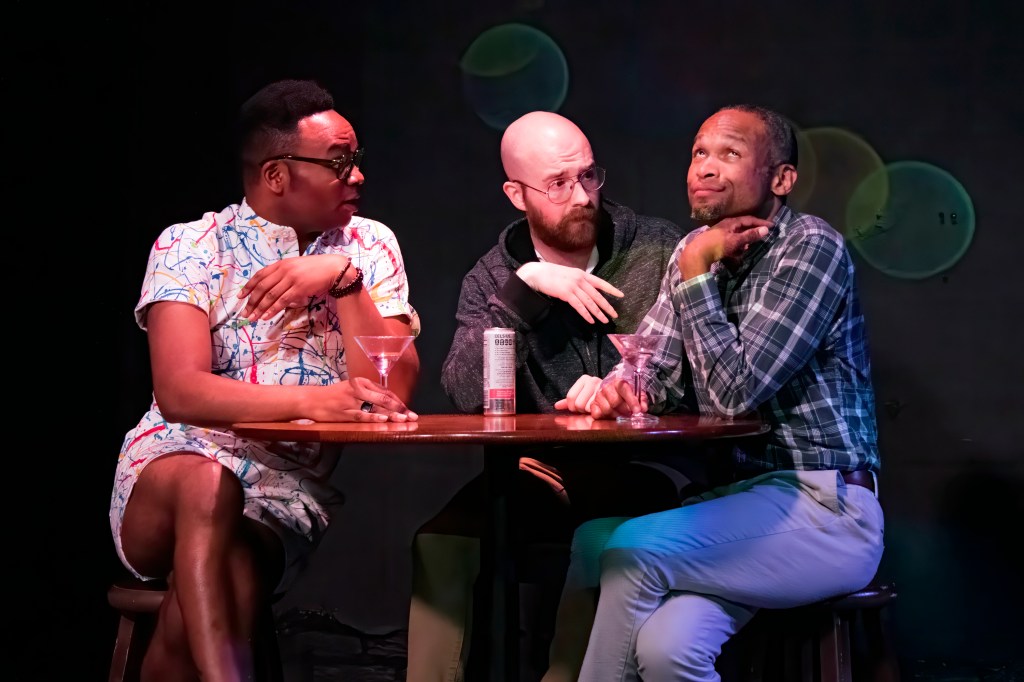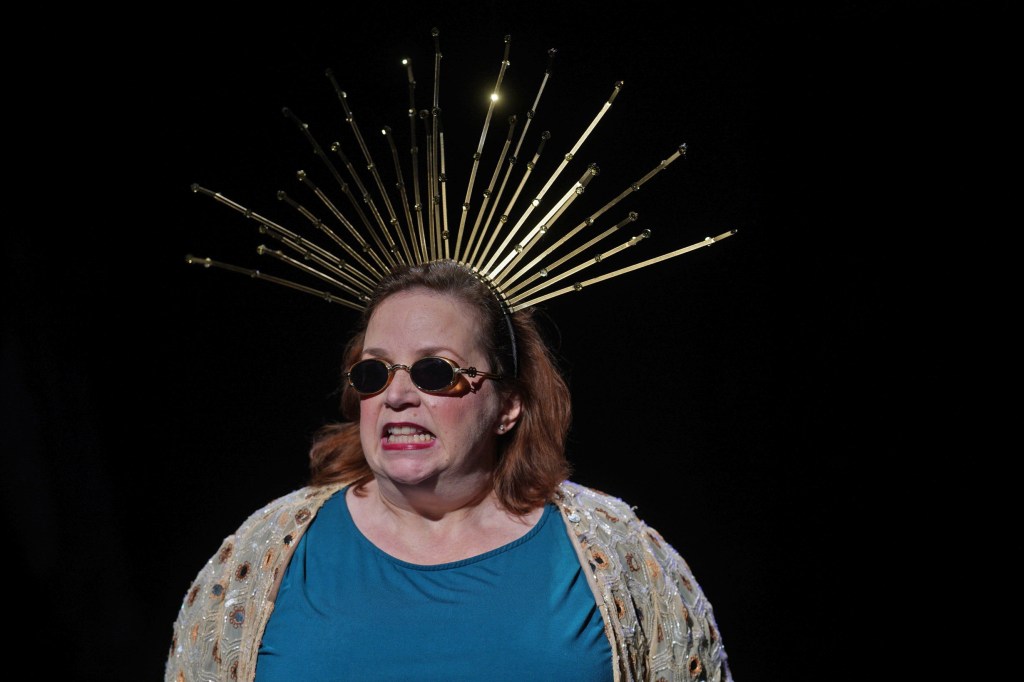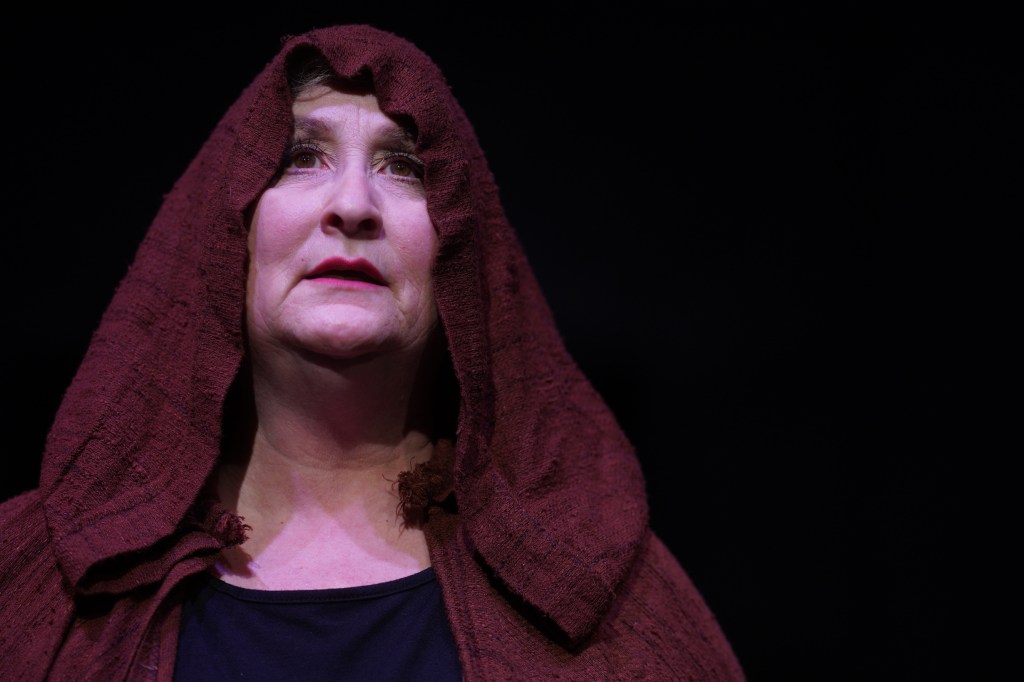
FIREFLIES

“Beautiful dreamer, wake unto me…”

or “You cain’t unpeck a fig.”

A Theater Review by Julinda D. Lewis

CAT – Chamberlayne Actor’s Theatre

At: HATTheatre, 1124 Westbriar Dr., Richmond, VA 23238

Performances: June 10-12 & June 17-19, 2022

Ticket Prices: $24.00 General Admission. $20.00 Seniors

Info: http://www.cattheatre.com

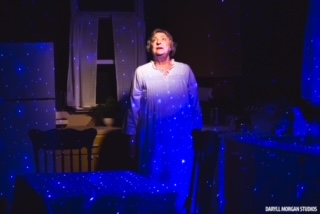
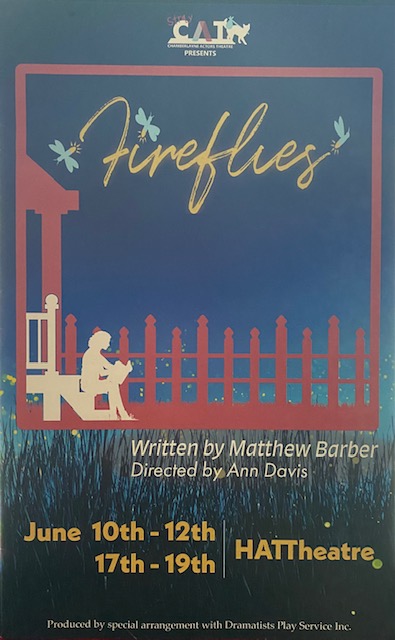
I usually avoid words like charming and endearing, but in the case of Fireflies those are the words that seem most appropriate. Fireflies is a story of opening up and letting go, and it is a love story between two mature people that is not played as a spoof or a sitcom. Fireflies, the insect, represent love; their soft luminescence is part of their mating ritual, and they remind us of summer nights as children, chasing fireflies and trying to capture them in a jar to make their elusive light last. The symbolism of fireflies is indirectly alluded to throughout the play, but it’s there.

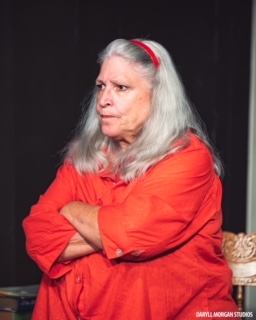
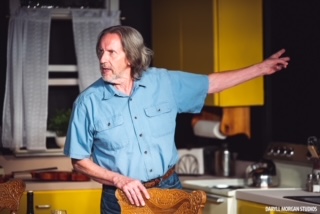
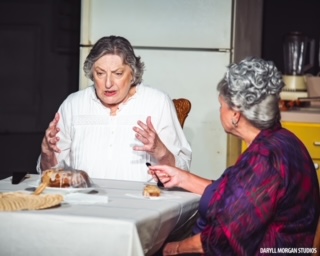
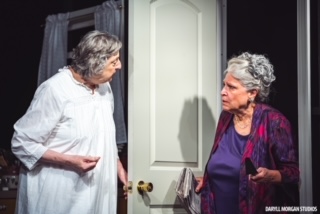
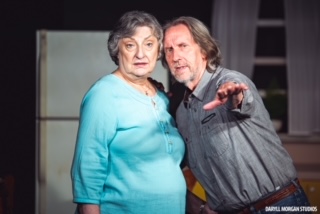
Ms. Eleanor Bannister (played by Jean Roberts) is a retired teacher in the small Texas town of Groverdell. She never married, and has settled into a comfortable life of respectability. Eleanor still lives in the house she grew up in, and rents the “honeymoon cottage” her father built for her that was never used for its intended purpose. At times, Roberts seems to channel the spirit of the late Bea Arthur. Ms. Grace Bodell (played by Linda Snyder) is Eleanor’s loyal, caring – read “nosy” – friend and neighbor, an archetype familiar to the residents of every small town or cul-de-sac. It is a role Snyder approaches with just the right balance of humor and temperance. One day a charming drifter appears and shakes up Eleanor’s routine, pulling her out of her comfort zone and, in the process, gives the town something to talk about. William Henry brings the necessary tension and mystery to his portrayal of Abel Brown, keeping us interested and never quite sure if he is who he says he is. There is always a lingering question. . .

Abel Brown fixes a hole in the roof of Eleanor’s rental property, and in the process opens Eleanor’s heart to the possibility of romance. In the relatively short span of about a week, spread over five acts and two scenes, we are drawn willingly into Eleanor’s unfamiliar and unexpected journey and get to experience familiarity with her plight, longing for adventure, and recognition of her dilemma.

In addition to fixing the roof and doing other repairs, Abel Brown – whose character seems to require being referred to by his full name – serenades Eleanor by playing “Beautiful Dreamer” on her father’s antique violin, and impresses her with his peanut butter and jelly sandwich-making skills. The beauty of FIREFLIES lies largely in its simplicity. Eleanor and Grace chat over homemade cake and a glass of milk and comment on the weather, the state of Eleanor’s house, and Grace’s “Sunday hair.”

The play is set in Eleanor’s kitchen and the atmosphere is dominated by the easy banter between the two friends. The natural pacing and familiarity of the scenes makes the electricity sizzle all the more when Abel Brown makes his appearances and introduces much-needed excitement and tension. The Sunday I attended, the space had been affected by a summer storm that left the house lights and air-conditioning off, providing an unintended touch of authenticity to the Texas summer scenes.

Director Ann Davis kept the pace sultry but interesting, and seemed to have a genuine connection with the author’s vision for this show. A second-act appearance by Alvino Medina as Eugene, the local sheriff’s deputy – and Eleanor’s former student –  may have been necessary from the author’s point of view, but did not seem to quite fit in with the rhythm already established by Roberts, Henry, and Snyder. Nevertheless, Fireflies is a delightful and heartwarming story with a few unexpected twists and turns that upset the flow of predictability and makes for a satisfying evening of theater.

Julinda D. Lewis is a dancer, teacher, and writer who was born in Brooklyn, NY and now lives in Eastern Henrico County.

FIREFLIES

Written by Matthew Barber

Directed by Ann Davis

Cast

Jean Roberts as Eleanor Bannister

Linda Snyder as Grace Bodell

William Henry as Abel Brown

Alvino Medina as Eugene Claymire

Creative Design Team

Director – Ann Davis

Stage Manager – Brandy Stevens

Set Designer – Scott Bergman

Costume Designer – Sheila Russ

Lighting Designer – Chris Stepp

Properties Master – Ellie Wilder

Sound Designer – Buddy Bishop

Backstage Crew – Ashton Lee & Dinah Lee S. Mason

Dates

Fri. Jun 10th 2022, 8:00 pm

Sat. Jun 11th 2022, 8:00 pm

Sun. Jun 12th 2022, 2:30 pm

Fri. Jun 17th 2022, 8:00 pm

Sat. Jun 18th 2022, 8:00 pm

Sun. Jun 19th 2022, 2:30 pm

Ticket Information

www.cattheatre.com

Ticket prices range from $24.00 General Admission. $20.00 Seniors.

Run Time

The play runs about 2 hours with 1 intermission

Photo Credits: Daryll Morgan Studios
BOOTYCANDY:

It Probably Doesn’t Mean What You Think It Means

A Theater Review by Julinda D. Lewis

Produced by: TheatreLAB

At: The Basement, 300 E. Broad Street, RVA 23219

Performances: June 9-18, 2022

Ticket Prices: $20 General Admission; $10 Teachers & Students

Info: (804) 349-7616 or https://tlab-internet.choicecrm.net/templates/TLAB/#/events

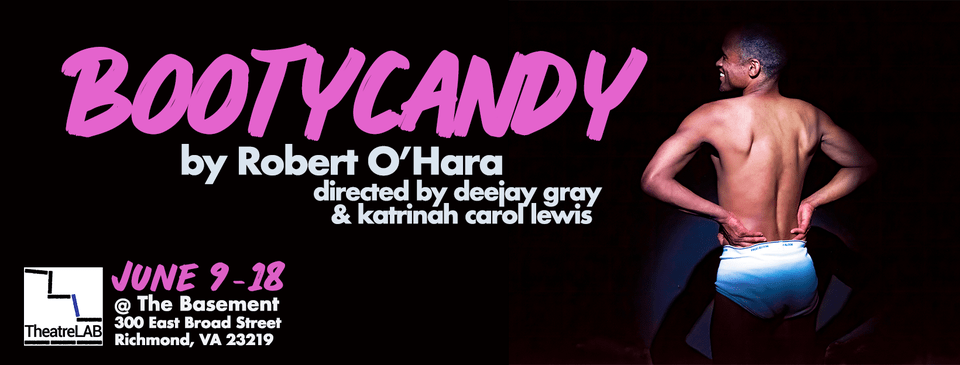
Robert O’Hara’s BOOTYCANDY is a “semi-biographical subversive comedy” performed as a series of non-linear vignettes. The central character is Sutter and the central premise is Sutter’s journey growing up black and gay. It is hilarious, it is touching, it is relatable across genders, generations, and sexual orientations, and it is an exemplar of contemporary Africanist story-telling. It is, without a doubt, one of my favorite shows of the season – and I see my fair share of shows.

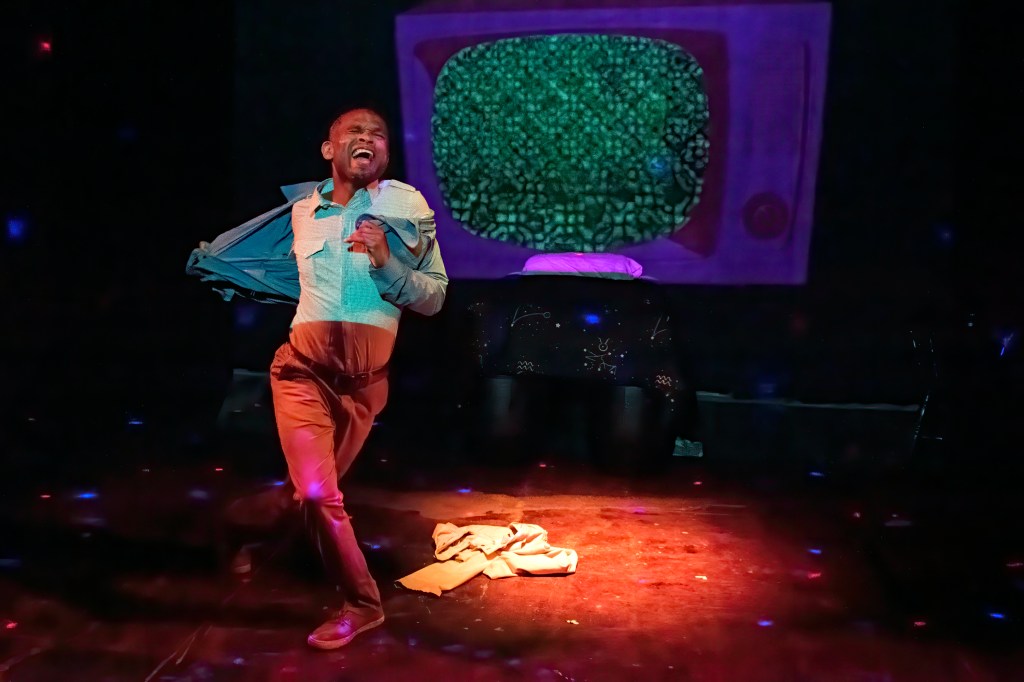
Todd Patterson shines in the lead role as Sutter. The five actors are identified only as Actor One, Actor Two, etc., and all but Patterson take on a number of different roles in Sutter’s life. Patterson dances between each scene – indeed, his “grandmother” and other relatives request that he “do that step Michael Jackson liked to do.” The playwright, O’Hara, has specified that Jackson’s music be used throughout, and the music of Michael Jackson, Prince, and perhaps a few others energizes the space from the moment you walk through The Basement doors.

Patterson strips for us, and dances with a manic energy that reflects his character’s inner landscape. But as much as I was impressed by Patterson’s performance, this is truly an ensemble production – starting with the symbiotic directing team of Deejay Gray and Katrinah Carol Lewis. I’ve seen each of these actors in several productions, and this one cast them each in a new light and presented them with new challenges.

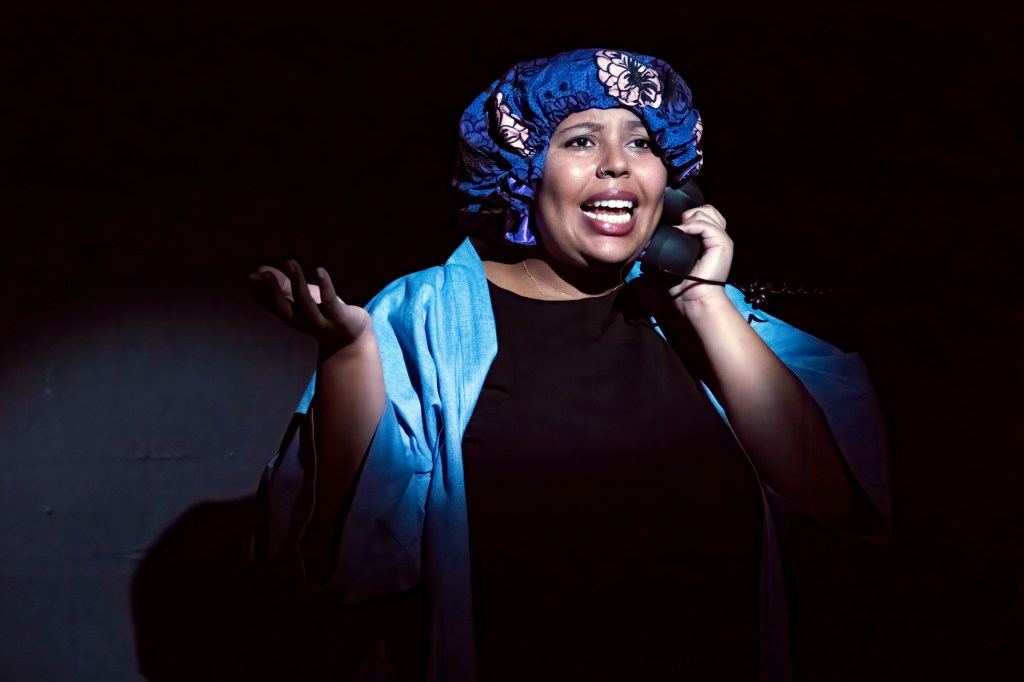
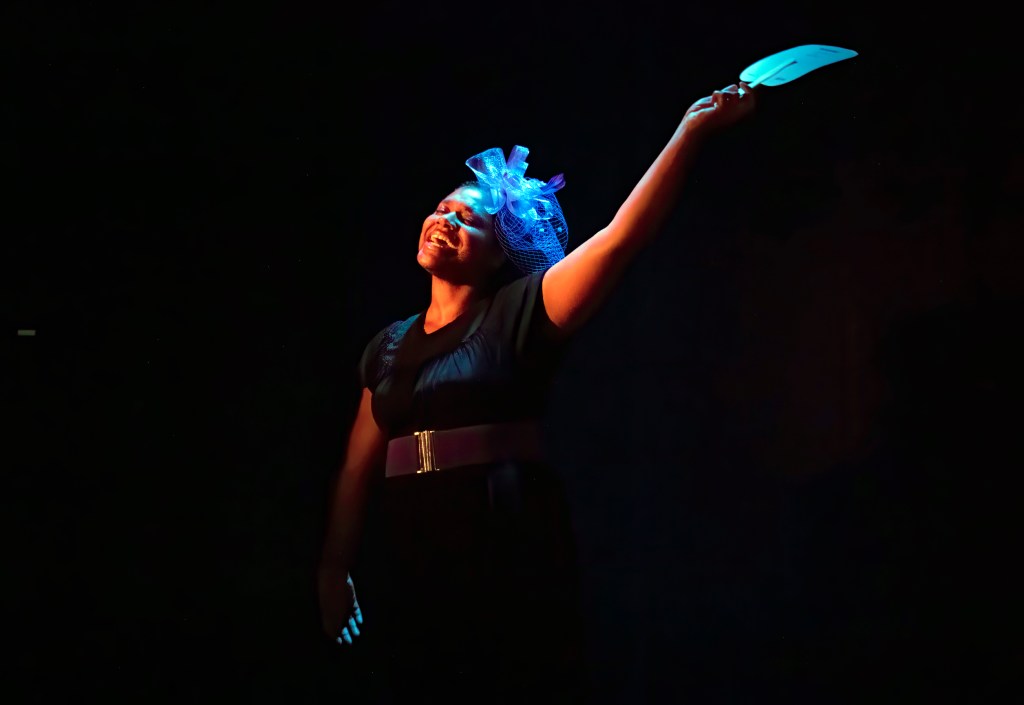
Dylan Jones and Zakiyyah Jackson hold down most of the female roles in Sutter’s life. Both play his mother, at different ages, as well as aunties, friends, a sister, and church ladies. In one scene they portray a quartet of women gossiping on the telephone, highlighted by rapid costume changes but my favorite is their second act “non-committal ceremony,” a nasty same-sex divorce officiated by a Zen-like Cashwell. This scene is the embodiment of the adage, “same sex, same problems!”

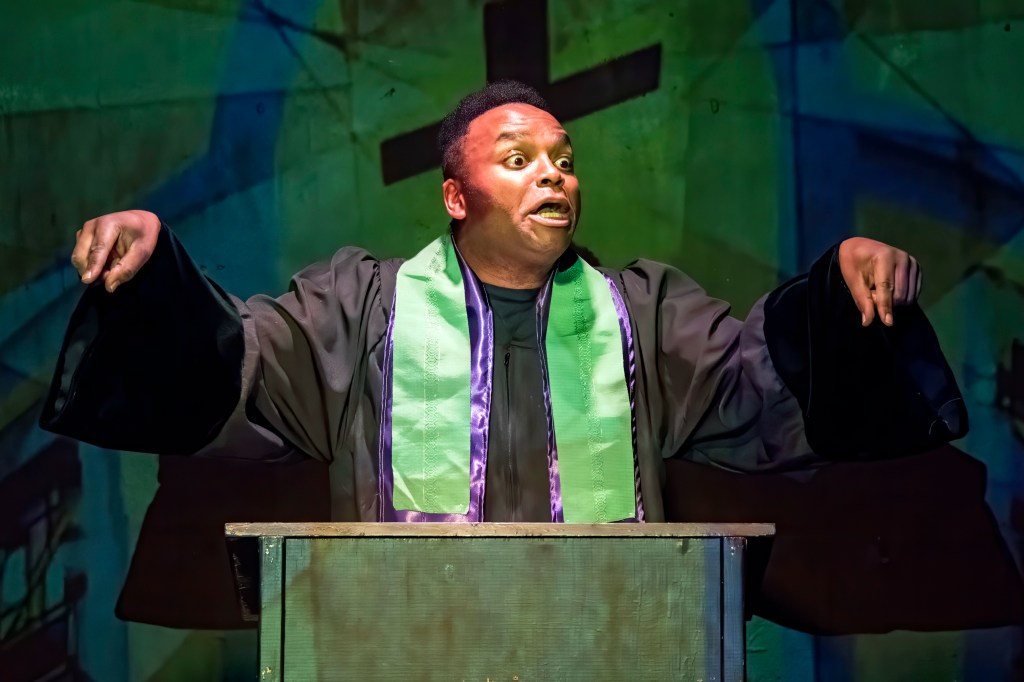
Durron Marquis Tyre transforms into several characters, but my favorites are the right reverend who comes out in a sermon delivered to his outraged congregation. Instead of coming out of the closet, he emerges from behind his pulpit to reveal fishnet stockings, blinged out silver slingback heels, a wig, and finally a clingy little red dress and matching lipstick. This is where Jones and Jackson begin their magic as they subtly change from gossip-mongers to staunch supporters.

In the second act, Tyre portrays Sutter’s grandmother who offers him comfort in a time of need as she slyly extracts some cash to tuck into her bosom and a delivery of forbidden soul food. For a moment, I thought Tyre had been speaking with my own late grandmother to develop this character because his mannerisms and speech brought back memories directly from my own past. And that is part of the beauty of this play: it is relatable. In a post-show talkback the day I saw it, everyone who spoke found some point of connection. The scene where Sutter realizes he is under stress is a turning point – he stops the show, has a verbal interaction with the Stage Manager, Crimson Piazza, and the tone and tenor of the play shifts. This is , undoubtedly, one of the author’s genuine auto-biographical moments. Its poignancy highlights the humorous aspects of the previous scenes, and reminds us that often laughter is the only things that helps us make it through the tough or uncertain times.

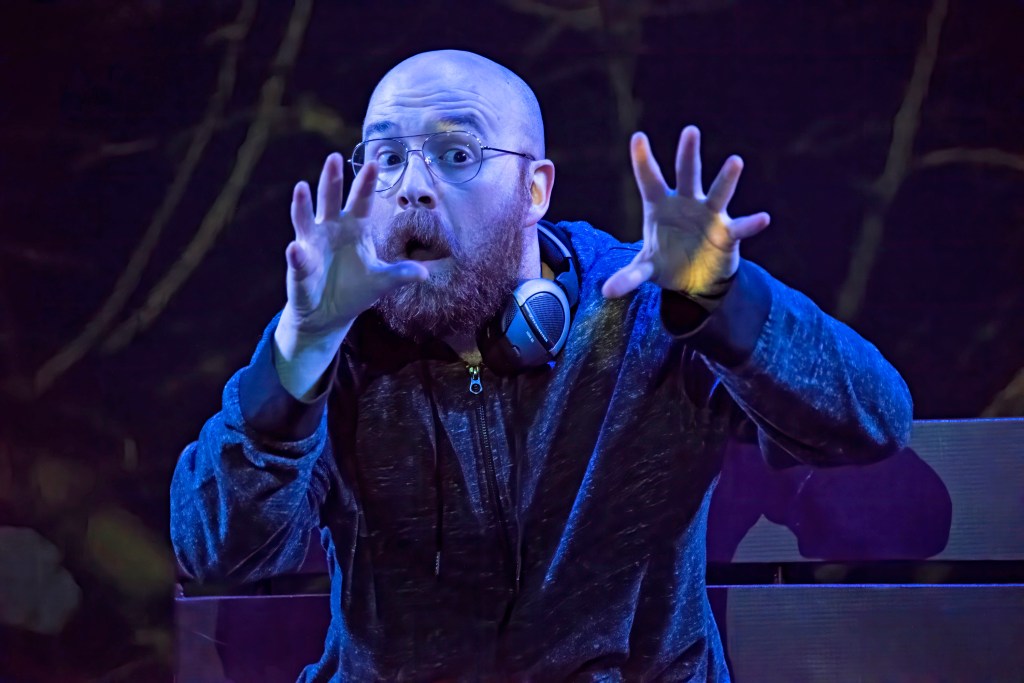
And of course I cannot forget Dixon Cashwell – the only white guy in the cast. He plays several characters, but my favorites are his portrayal of a clueless conference facilitator for the scene that closes the first act. Cashwell’s character strolls obliviously into a minefield of micro-aggressions that elicit yelps of incredulity from the cast as well as at least one audience member. In other scenes, Cashwell becomes a gay-curious male sharing an uncomfortable relationship with his brother-in-law, and has a spellbinding turn as an intoxicated man at a lonely bus stop at 3:00 AM who amazingly talks himself out of being mugged.

There are a number of little things that make BOOTYCANDY as close to perfect as it can possibly get. The subject of the women’s telephone scene is the name one young mother has chosen for her baby girl: Genitalia! It is a spoof of the unique names and exotic naming conventions of Black American families and a nod to the sort of urban legends many of us educators have passed down through the decades: the little boy named Shi-Thead, the little girls named Vagina, Clitoris, and Female (pronounced Fah-MA-ley), or the twins named Orangejello and Lemonjello (pronounced a-RON-zhello and le-MON-zhello).

By the time you read this, BOOTYCANDY may have ended its all-too-brief run, but just in case, consider this a SPOILER ALERT: BOOTYCANDY does not refer to a sexually attractive booty or a hot gay guy. Quite innocently – and oddly – it is the word the young Sutter’s mother uses to refer to his penis, and an excellent advertisement for teaching children the real words for their body parts.

I haven’t laughed so hard or so often I the theater in recent memory. In the words of one viewer, BOOTYCANDY is no entry-level theater, meaning it is not linear or predictable, and there is no happily-ever-after fairytale conclusion. In the mind of this reviewer, that is what makes it so special.

THE CAST

Actor One ………………………….        Dylan Jones

Actor Two ……………………….…        Todd Patterson

Actor Three …………..…………..       Zakiyyah Jackson

Actor Four ………………………….       Durron Marquis Tyre

Actor Five ………………………….       Dixon Cashwell

THE TEAM

Direction: Deejay Gray & Katrinah Carol Lewis

Scenic Design: Deejay Gray

Projection Design: Dasia Gregg

Lighting Design: Michael Jarett

Costume Design: Nia Safarr Banks

Sound Design: Kelsey Cordrey

Properties Design: Kathy O’Kane Kreutzer

Production Stage Management: Crimson Piazza

THE SCHEDULE

Thursday, June 9 at 7:30 [Preview Performance]

Friday, June 10 at 7:30 [Opening Night]

Saturday, June 11 at 7:30 [Post-Show Dialogue]

Sunday, June 12 at 7:30

Wednesday, June 15 at 7:30 [ADDED SHOW]

Thursday, June 16 at 7:30

Friday, June 17 at 7:30

Saturday, June 18 at 7:30 [Closing Night]

NOTE: All performances are at 7:30pm at The Basement:

300 East Broad Street, Richmond VA 23219

THE TICKETS

$20 – General Admission

$10 – Teachers & Students

LINK: https://tlab-internet.choicecrm.net/templates/TLAB/#/events

*PROOF OF VACCINATION / A NEGATIVE COVID TEST REQUIRED* The Basement is a fully vaccinated venue. Proof of vaccination or a negative COVID-19 test (within 48 hours of the performance) are required upon entry. For the safety of our artists and audiences, masks must be worn while at the theatre. Thank you for keeping our community safe!

Julinda D. Lewis is a dancer, teacher, and writer who was born in Brooklyn, NY and now lives in Eastern Henrico County.

———-

Photo Credits: Photos by Tom Topinka

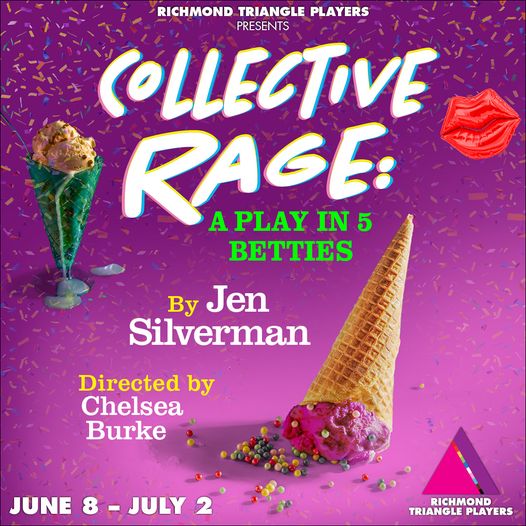
COLLECTIVE RAGE: A Play in 5 Betties

. . .Imagine the Arctic as a Pussy; It’s Sort of Like That

A Theater Review by Julinda D. Lewis

At: Richmond Triangle Players at the Robert B. Moss Theatre, 1300 Altamont Ave, RVA 23230

Performances: June 8 – July 2, 2022

Ticket Prices: $30-35; $10 for Students.

Info: (804) 346-8113 or rtriangle.org

In Essence, A Queer and Occasionally Hazardous Exploration; Do You Remember When You Were In Middle School And You Read About Shackleton And How He Explored The Antarctic?:

Imagine The Antarctic As a Pussy And It’s Sort Of Like That

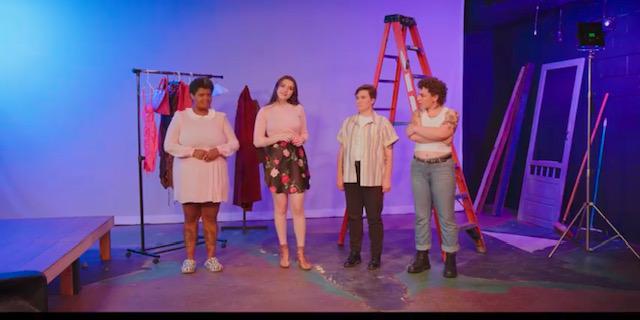
There are 5 characters in COLLECTIVE RAGE and they are all named Betty. Betty #1, Lenaya Van Driesen) is married to a man of wealth who has no time for her; Betty #2, Nora Ogunleye, is in a sexless marriage; Betty #3, Zoe Cotzias, is a celebrity lesbian who works at Sephora; Betty #4, August Hundley, is a sensitive queer woman with a truck and a crush on Betty #3; and Betty #5, with Rachel Garmon-Williams subbing for Kasey Brett is a non-binary male presenting female who runs a boxing gym – and owns a truck.

After Betties #2 and #3 attend a boring dinner party given by Betty #1, Betty #3 throws her own dinner party, where she gives the shy and friendless Betty #2 a hand mirror and invites her to use it to look at her pussy. This act opens up a whole new world for Betty #2 who spends the rest of the play on a journey of self-exploration and empowerment.

Betty #3 attends a play with a friend, becomes enamored of the “thea-tah” and decides to devise a play of her own. Betty’s play involves a prologue, a wall, a lion, and moonshine; it borrows blindly and liberally from the mechanicals’ play-within-a-play in Shakespeare’s Midsummer Night’s Dream – whose title Betty repeatedly butchers.

When they all get together to rehearse for “the thea-tah,” the ensuing chaos both defines and defies their collective rage. Set in New York in the present  and first performed in 2016, COLLECTIVE RAGE is described as a “lesbian/bi-curious/genderqueer/Shakespearean comedy for everyone.” COLLECTIVE RAGE feels like a fusion of satire, cabaret, and improv. It’s hilarious and touching at the same time. There’s a cheating husband, a contrast between femme and butch, stereotypes of lesbians with trucks, and all the elements are used to explore growth, individual and collective, in multiples areas of life.

Directed seamlessly by Chelsea Burke, COLLECTIVE RAGE is more than just a niche production; it’s relatable across economic, ethnic, and gender boundaries. Van Driesen is sharp and dangerously edgy, both in her verbal delivery and her physical presentation. Ogunleye is endearing in her eurotophobia (yes, there is a word that means fear of one’s vagina or female genitalia). Cotzias aptly and appealingly encapsulates every video of a vacuous influencer I’ve ever seen. Hundley nailed their portrayal of a caring but insecure character, while Garmon-Williams uses body language and physicality on equal footing with words. COLLECTIVE RAGE offers the viewer options: you can enjoy it as a comedy, as social commentary, or both.

———-

Julinda D. Lewis is a dancer, teacher, and writer who was born in Brooklyn, NY and now lives in Eastern Henrico County.

———-

COLLECTICE RAGE: A Play in 5 Betties

Written by Jen Silverman

Directed by Chelsea Burke

CAST:

Betty #1 …………………………………….  Lanaya Van Driesen

Betty #2 …………………………………….  Nora Ogunleye

Betty #3 …………………………………….  Zoe Cotzias

Betty #4 …………………………………….  August Hundley

Betty #5 …………………………………….  Kasey Britt

Understudies

For Betty #1 ……………………………………. Amanda Spellman

For Betties #2 & #3………………………….. Leanna Hicks

For Betties #4 & #5 …………………………. Rachel-Garmon-Williams

CREATIVE TEAM:

Costume, Hair & Make-Up Design      – Dasia Gregg

Costume, Hair and Make-up Design   – Carolann Corcoran

Lighting Design                                   – Deryn Gabor

Sound Design                                      – Candace Hudert

Intimacy Choreographer                    – Stephanie Tippi Hart

Properties Design                               – Tim Moehring

Assistant Director                               – Katie Fitzgerald

Technical Director                              – Tom Holt

Production Stage Manager                – Lauren Langston

Sound Design                                      – Candace Hudert

Intimacy Choreographer                    – Stephanie Tippi Hart

Properties Design                               – Tim Moehring

Photo Credits: No production photos available at the time of publication

EVERYBODY

Everybody Has to Die but Nobody Wants to Make This Journey Alone

A Theater Review by Julinda D. Lewis

At: Theatre Gym, 114 West Broad Street, Richmond, VA 23220

Performances: June 2-19, 2022

Ticket Prices: $40

Info: (804) 282-2620 or https://tickets.va-rep.org/events

EVERYBODY is a modern play about an age-old problem: death. Written by award-winning playwright Branden Jacobs-Jenkins, it is a morality play based – with few significant changes – on a 15th century morality play, Everyman, believed to be one of the earliest recorded plays in the English language. Set in the here and now, EVERYBODYhas been revamped to reflect today’s politics, belief systems, and world views and to be inclusive of current racial, religious, and gender concerns.

The morality play is a once-popular genre designed to teach a lesson – in this case, how to live better and be a better person in general – and features characters who are personifications of abstract qualities. In EVERYBODY the original qualities of Fellowship, Kindred, Goods, Discretion, Five Wits, and Knowledge have been rebranded as Friendship, Kinship, Stuff, Mind, Five Senses, and Understanding. With a few exceptions, the stellar cast of talented actors (Debra Wagoner, Jacqueline Jones, Audra Honaker, Jamar Jones, Katrinah Carol Lewis, Maggie Roop, Tyer Stevens, Desirée Dabney, alternate Tatjana Shields, and supporting actors Keeley Maddux and Charlotte Hall) must memorize the entire play, because at each performance the roles are chosen by lottery at the start of the play. Among the fixed roles, Wagoner appears as the Usher, God, and Understanding, Jacqueline Jones plays Death, and Dabney is Love.

With Debra Wagoner providing much of the narration, actors emerging from the audience and entering and exiting from the center aisle, and projected titles, there is a sense of controlled chaos – an appropriate response, one might concede, to the unexpected summoning of God and the unwelcome appearance of Death. God has summoned Death to bring Everybody for an accounting. But since it’s today, the accounting takes the form of a final presentation – you know, like a PowerPoint presentation. Feeling unprepared, Everybody negotiates for more time, and goes looking for someone willing to accompany them on this journey. Friendship and Kinship are the first to excuse themselves, providing a list of reasons ranging from the valid to the humorous. Even Stuff, decked out in a poncho-like garment covered with, well, a collection of stuff, makes a fast exit, while Mind and the Five Senses initially promise to accompany Everybody to the grave but both flake out at the last minute. In the end, it is only Love who completes the journey with Everybody – but only after making them strip down and perform a humiliating act of contrition (involving the repetition of the confession, “my body is just meat”).

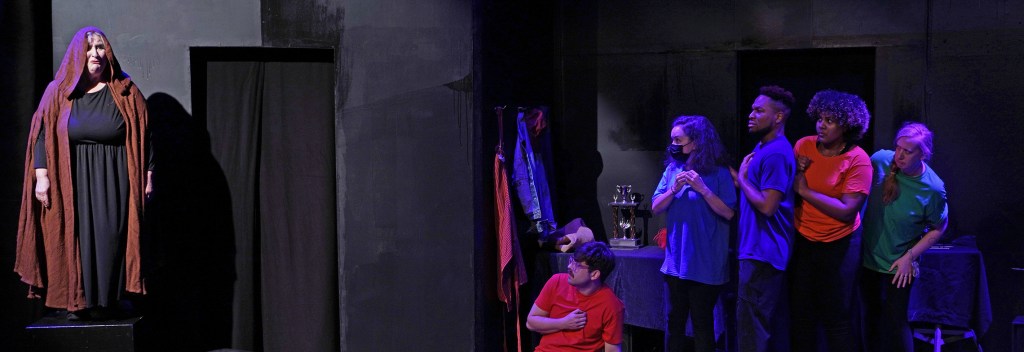
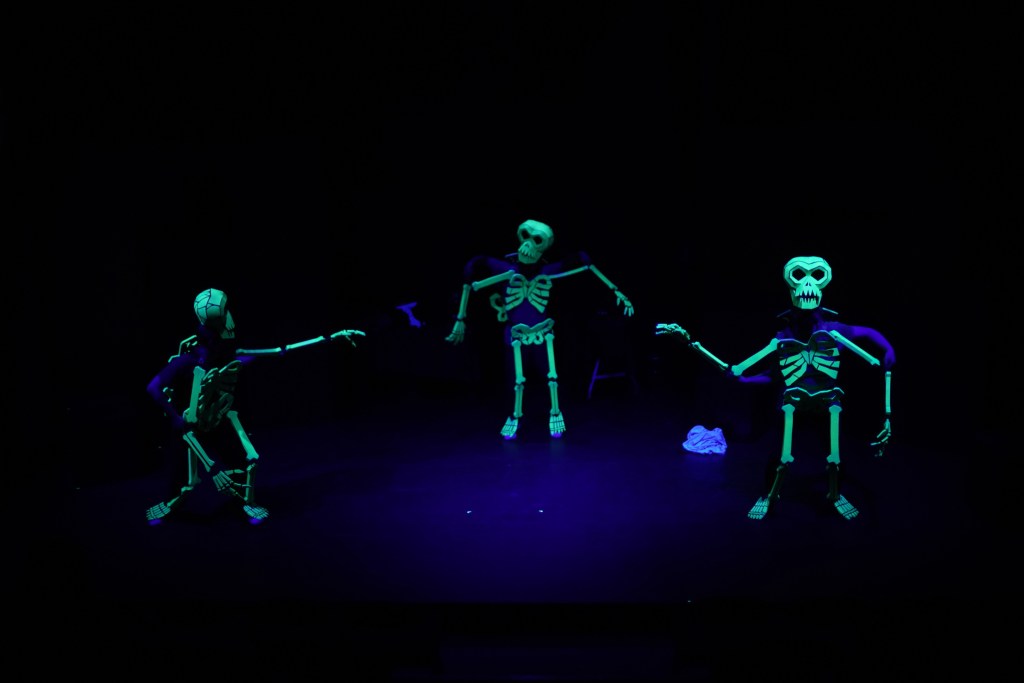
EVERYBODY is performed on a nearly bare black stage, with minimal props and costumes, and disconcerting voice over scenes that occur in complete blackness. It is a play of universal themes leading to an inevitable conclusion, performed in earnestness by a fully committed cast. I particularly enjoyed the simultaneously funny and terrifying Skeleton Dance and there is no denying that Debra Wagoner and Jacqueline Jones fully inhabited their roles However, much like Zombie Life (Firehouse, August 2021, https://jdldancesrva.com/2021/08/26/the-zombie-life/) which I heard more than once actor compare to EVERYBODY, I can only admire it from a detached distance; it just isn’t my cup of tea. But if well-crafted existentialism and humor-infused treatises on the meaning of life excite you, you can – and should – see EVERYBODY through June 19.

Julinda D. Lewis is a dancer, teacher, and writer who was born in Brooklyn, NY and now lives in Eastern Henrico County.

EVERYBODY

By Branden Jacobs-Jenkins

Directed by Rusty Wilson

CAST

Usher/God/Understanding     Debra Wagoner

Death                                     Jacqueline Jones

Somebody                               Audra Honaker

Somebody                               Jamar Jones

Somebody                               Katrinah Carol Lewis

Somebody                               Maggie Roop

Somebody                               Tyler Stevens

Somebody alternate           Tatjana Shields

Girl/Time                                Keeley Maddux

Girl/Time                                Charlotte Hall

Love                                         Desirée Dabney

Voice-Over Artists               Juliana Caycedo

                                                Anne Michelle Forbes

                                                Tyandria Jaaber

                                                Elle Meerovich

                                                 Hannah Hoffert

CREATIVE TEAM:

Director                                    Rusty Wilson

Assistant Director                   Tim Glover

Scenic Designer                       Emily Hake Massie

Costume Designer                   Sarah Grady

Lighting Designer                    Alleigh Scantling

Properties Designer                Ellie Wilder

Scenic Charge                          Emily Hake Massie

Sound Designer                       Joey Luck

Technical Director                   Chris Foote

Stage Manager                        Maggie Higginbotham

Production Manager              Alleigh Scantling

Skeleton Dance Choreographer Laine Satterfield

Puppet Designer                     Kylie Clark

Photos by                                Jay Paul

UPDATED POLICIES: Virginia Rep has been following local, state, and federal health guidelines, and keeping a close eye on the policies of peer theatre companies regionally and nationally. As a result, proof of vaccination is no longer required. Masks, covering the face and nose, are required for all patrons while inside all VaRep venues, lobbies, and restrooms. At this time, no food or drink is allowed in the theatre.

Photo Credits: Jay Paul

BEEHIVE: THE ’60s MUSICAL

Jukebox Full of Girl Groups and Phenomenal Female Vocalists Comes Alive on Stage

A Theater Review by Julinda D. Lewis

At: The November Theatre Arenstein Stage, 114 West Broad Street, RVA 23220

Performances: April 8 – May 15, 2022

Ticket Prices: $36-$67.

Info: (804) 282-2620 or www.virginiarep.org

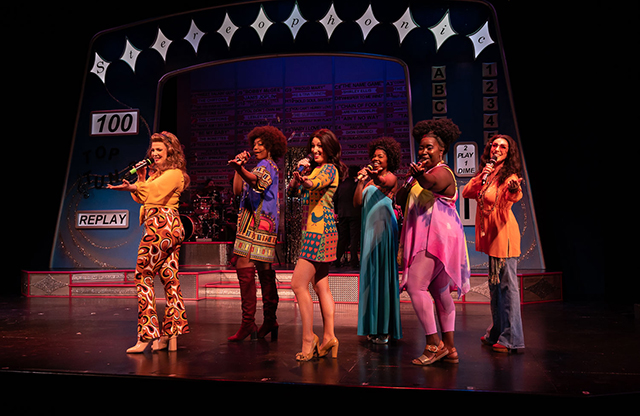
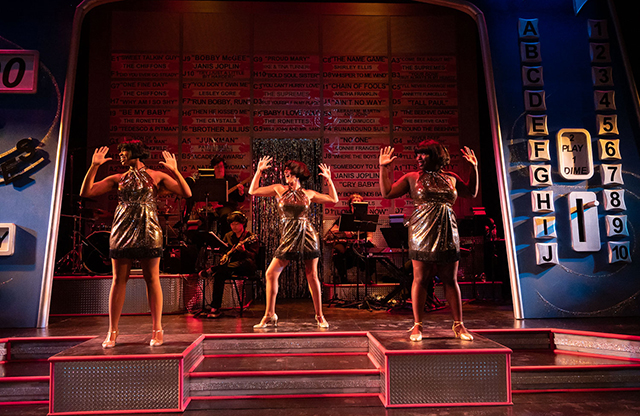
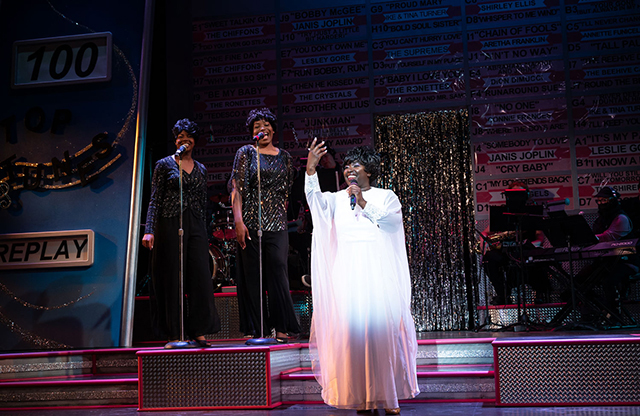
Competing harmonies emerged from a gigantic jukebox mockup at the start of Beehive: the ‘60s Musical: “It’s My Party [and I’ll cry if I want to]” versus “My Boyfriend’s Back [and your gonna be in trouble.” Before you knew it, the audience was pulled into a bit of interaction with one of my childhood favorites, “The  Name Game” and was also invited to sing along to The Ronette’s “Be My Baby.” There was also an entertaining pre-show slide presentation of 1960s trivia to get the audience warmed up.

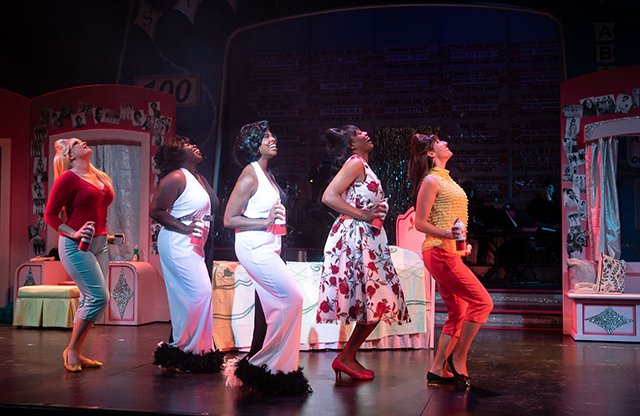
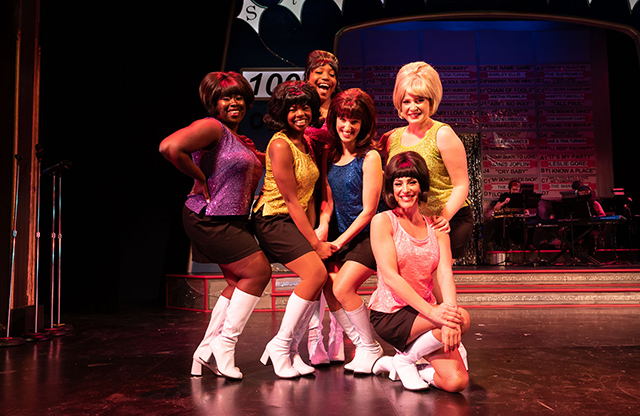
Beehive: the ‘60s Musical is not so much a musical as a retrospective concert of 1960s hits by women and girl groups: “Proud Mary,” “One Fine Day,” “A Natural Woman,” “Son of a Preacher Man,” “To Sir, With Love,” “Me and Bobby McGee,” all transported those of us of a certain age back in time. Decked out in glittery shirts, kitten heels, go go boots (I remember craving a pair of those in intermediate school), and mini-skirts Nicole Baggesen, Madison Paige Buck, Jianna Hurt, Temperance Jones,  Mallory Keane, and Awa Sal Secka recreated one hit after another.

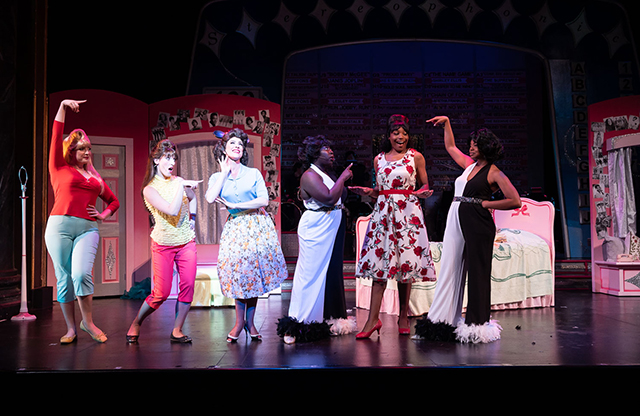
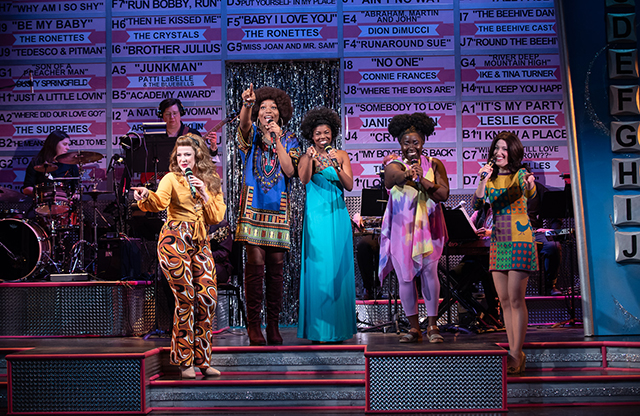
Costumes, hair styles, props, and set elements provided visual and historical interest. Pedal-pushers (i.e. short pants), beehive hairdos, transistor radios, and pink wall-papered bedrooms were all pulled out of the designers’ magical musical hats. And when specific stars were referenced the details were even more detailed. There was no mistaking Aretha Franklin’s elegant gown, Tina Turner’s shimmy dress, or Janis Joplin’s fringes and beads – and bottle of Southern Comfort.

The ensemble started out looking like a rainbow, each wearing a different color – purple, pink, blue, golden yellow, orange, and green – with their little heels and beehive hairdos but changed clothes and hairstyles as they progressed through the decade. By the finale, they were wearing afros and dashikis or long free-flowing hair and paisley pants or print dresses. The decades dances were acknowledged as well, including the Pony, the Jerk, the Mashed Potato, the Twist, the Swim, and the Monkey.

The cast, thanks to the wise decisions of the creator Larry Gallagher, director/choreographer Leslie Owens-Harrington, and musical director Billy Dye, the cast did not so much impersonate the formidable female vocalists of the 1960s as they paid homage to them. To do otherwise might not have ended well.

So Hurt’s rendition of Tina Turner’s songs, included a lot of hair flinging and shimmy dancing, but not a direct impersonation of the star’s million dollar legs. (They were actually insured for $3.2 million.) Aretha Franklin’s songs were given a heartfelt rendition by Secka that reflected her gospel roots, and Baggesen’s Janis Joplin set was honestly painful and painfully honest, while simultaneously and somewhat irreverently humorous..

Thanks to colorful – and frequent – costume changes and an abundance of choreography, the show was well-paced and visually compelling as well as musically comprehensive. A photo montage reminded us of the somber reality of the 1960s as well, including PG-rated scenes of the assassination of President Kennedy, the war in Vietnam, and the Civil Rights Movement. All-in-all, Beehive, the musical was 90 minutes of pure foot-tapping joy and unadulterated entertainment – for my generation. I do wonder what younger viewers might think of it.

Julinda D. Lewis is a dancer, teacher, and writer who was born in Brooklyn, NY and now lives in Eastern Henrico County.

BEEHIVE

Created by Larry Gallagher

Direction and Choreography by Leslie Owens-Harrington

Musical Direction by Billy Dye

Cast

Wanda – Jianna Hurt

Pattie – Madison Paige Buck

Alison – Mallory Keene

Laura – Nicole Baggesen

Jasmine – Temperance Jones

Gina – Awa Sal Secka

Band

Piano/Conductor – Shellie Johnson

Tenor Sax – Deb Saidel

Trumpet, Tambourine – Craig Taylor

Guitar – Hannon D. Lane

Bass – Mary Fender O’Brien

Drum Set – Paige Miller

Direction & Design

Direction/Choreography by Leslie Owens-Harrington

Music Direction by Billy Dye

Scenic Design by Mercedes Schaum and Amy Bale

Costume Design by Sue Griffin and Marcia Miller Hailey

Lighting Design by Lynne M. Hartman

Sound and Projection Design by Jacob Mishler

Stage Management by Hannah Hoffert

Wig Design by Kevin S. Foster, II

Run Time: 90 minutes with no intermission

Ticket Information

Box Office: 804-282-2620

http://www.virginiarep.org

Tickets range from $36 – $67

Discounted Group Rates and Rush tickets available.

Photo Credits: Aaron Sutten [production photos were not yet available at the time of publication]

———-

Virginia Rep COVID Guidelines

To provide the highest level of safety, all patrons are required to show proof of vaccination, or proof that they have received a negative COVID test by a professional technician within 48 hours of the performance date/time.

Patrons must show your vaccination card or a photo of the card on your phone, along with a valid photo ID, when you arrive for the performance. If you are unable to be vaccinated, you may provide proof of a Rapid COVID-19 antigen test taken within 48 hours of your performance. At home tests will not be accepted.

Please see the Virginia Rep Covid Safety FAQ for details.

In accordance with current city, state, and CDC guidance, face masks are REQUIRED at all times while you are in the building, regardless of whether or not you have been vaccinated.
At this time, no food or drink is allowed in the theatre.

–

BONNIE AND CLAIRE

A Tender New Comedy by Bo Wilson

A Theater Review by Julinda D. Lewis

At: Hanover Tavern, 13181 Hanover  Courthouse Rd, Hanover, VA 2309

Performances: May 13 – June 12, 2022

Ticket Prices: $48 (subject to change during the run)

Info: (804) 282-2620 or www.virginiarep.org

Richmond-based playwright Bo Wilson’s new play, Bonnie and Claire, is not only humorous, but also a gentle treatment of aging and the often unexpected and unintentional toll it takes on those we love. Two extra years in the making – due to that pesky little pandemic – Bonnie and Claire made its debut on Virginia Repertory Theatre’s Hanover Tavern stage May 13. Well worth the wait, it landed exactly right and hit all the feels.

Bonnie (Melissa Johnston Price) and Claire (Jan Guarino) are two sisters who have been estranged for decades, but life’s circumstances and advancing age have brought them together in  Bonnie’s small town home. The reunion is rocky, but their niece, Zoe (Sydnee S. Graves) is there to ease the transition – and drive the two wherever they need to go. At the beginning of the play, Zoe is chauffeuring Bonnie who is hobbled by crutches after, we soon learn, a car accident. With each subsequent scene, Bonnie appears with a new injury – an arm sling, a neck brace. All are due to accidents in which she was driving – such as driving into a 7-11 – and none of them were her fault. According to her.

Wilson and his phenomenal cast have impressively balanced the element humor with the reality that comes with aging and the declining ability to do the things we love, the things that give us our freedom and independence. It is understandable that Bonnie is cranky and even appears somewhat ungrateful that she has to rely on her niece Zoe, and at first Zoe is caring, polite, and deferential. But as the accidents escalate over the nearly ten years this play encapsulates (from 1990 to 1999) the burden of being a care-giver to Bonnie and mediator between the two sisters, who have vastly different worldviews, begins to wear on Zoe, who is trying to start a new business and a new relationship.

ADVISORY: Skip the next paragraph if you plan to see the show and want to be surprised!

Claire, who has worked as an actress for decades, lived in the city and never learned to drive. Of the three, she initially seems flighty and superficial, and her character takes the longest to develop, but gradually we see the chasm close between the two sisters. Bonnie outwardly remains her crotchety old self, but underneath the gruffness even she has some soft edges and begins to smile and even laugh a bit as the years pass and the two sisters are drawn together by past memories and the reality of the present and future challenges. The greatest change is seen in Zoe, whose apprenticeship as a caregiver and relationship with her aunts helps her transition into adulthood. Zoe learns to draw boundaries, falls in love with her business partner (who happens to be another woman), and by the final scene they are ready to start a family. So here we are privy to another dichotomy, another delicate balance, between growth and decline, between dependence and independence.

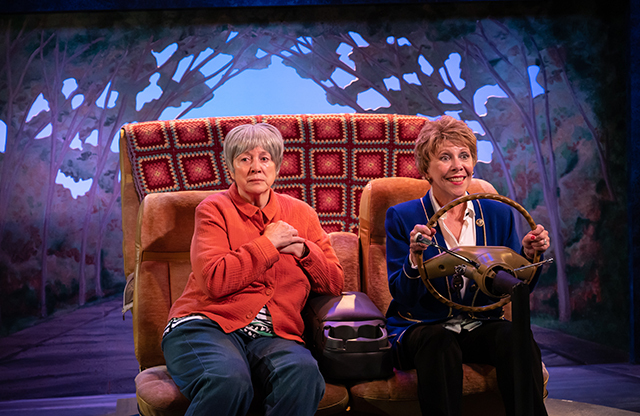
The entire play takes place in a car – first in Zoe’s fluffy ride and later in Bonnie’s old Buick. Kudos to Jacob Mishler’s sound design – every time a door was closed, an ignition was started, or any other vehicle related sound was required, it happened – perfectly timed and at an appropriate volume. Every. Single. Time. (Sometimes it’s the little things that make a big difference.) Dr. Jan Powell’s direction infused Bonnie and Claire with a satisfyingly rhythmic ebb and flow of humor and compassion. The ensemble – veteran Melissa Johnston Price with her wide range and droll humor; Jan Guarino, who directed VirginiaRep’s first show after the pandemic shutdown, Barefoot in the Park, and the wife of the playwright, Bo Wilson; and Sydnee S. Graves, who is making her Hanover Tavern debut – appeared to be a tight-knit unit even on opening night, so one can only expect their chemistry to increase throughout the run, which concludes June 12.

ADVISORY: Another possible spoiler!

After Zoe puts her foot down, takes away Bonnie’s car key, and pretty much orders her two elderly aunts to play nice and behave, the two giddily decide to go for a short ride. Bonnie had a spare key! Now, mind you, Bonnie’s license has been revoked and Claire hasn’t been behind the wheel of a car since she was about fifteen with a learner’s permit! Of course their planned outing to get ice cream ends with them getting lost and Zoe has to come rescue them.

Hijinks and shenanigans abound – and many of us can relate to the family dynamics – all of which makes Bonnie and Claire a marvelous theater experience that I highly recommend.


Julinda D. Lewis is a dancer, teacher, and writer who was born in Brooklyn, NY and now lives in Eastern Henrico County.


BONNIE AND CLAIRE

By Bo Wilson

Directed by Jan Powell

Cast

Bonnie ………………..       Melissa Johnston Price

Claire …………………         Jan Guarino

Zoe ……………………         Sydnee Graves

Design Team

Scenic Design  …….….         Terrie Powers

Costume Design ……..        Marcia Miller Hailey

Lighting Design ………        Matt Landwehr

Sound and Projection Design … Jacob Mishler

Stage Management ……     Joe Pabst

Ticket Information

Box Office: 804-282-2620

or http://www.virginiarep.org

Tickets prices start from $48

Discounted Group Rates and Rush tickets available.

Run Time

The show runs 90 minutes with no intermission

Photo Credits: Aaron Sutten

SUGAR IN OUR WOUNDS

A Tale of Queer Love and Ancestral Voices

A Theater Review by Julinda D. Lewis

At: Richmond Triangle Players at the Robert B. Moss Theatre, 1300 Altamont Ave, RVA 23230

Performances: April 20-May 14, 2022.

Ticket Prices: $30-35; $18 for Preview nights; $10 for Students.

Info: (804) 346-8113 or rtriangle.org. Richmond Triangle Theater has returned to full-capacity seating and requires proof of vaccine or recent negative PCR test results for entry. See the theater’s website for their COVID-19 precautions, digital programs, and more.

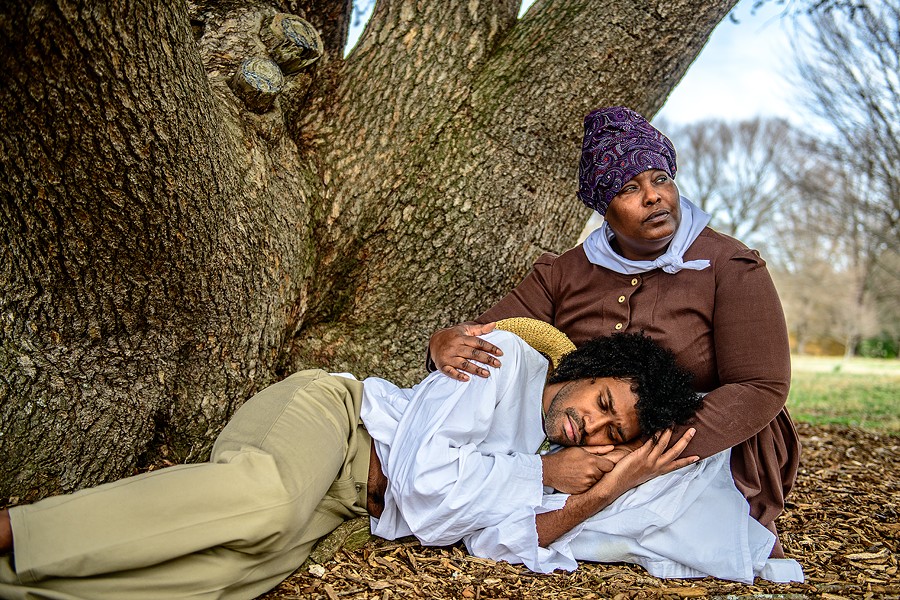
Just as every now and then someone says, does, or creates something so wonderful that I enviously wish I had done it. Similarly, every now and then someone creates a play, poem, or story that is so unique or so wonderful that I wonder why I never thought of or heard of the idea before. Sugar in Our Wounds by Philadelphia-based Afro-Queer playwright, poet, and filmmaker Donja R. Love is a prime example of this type of work. Rescheduled from 2020, you know, when that little thing called The Pandemic stopped by, Sugar in Our Wounds was well worth the wait. Set on a plantation in the summer of 1862, during the Civil War, “somewhere down South, by a tall, tall tree,” Sugar in Our Wounds examines the intersection of freedom and love.

“Ain’t no roamin’ the world, for a weak nigger. – Henry

STRANGE FRUIT

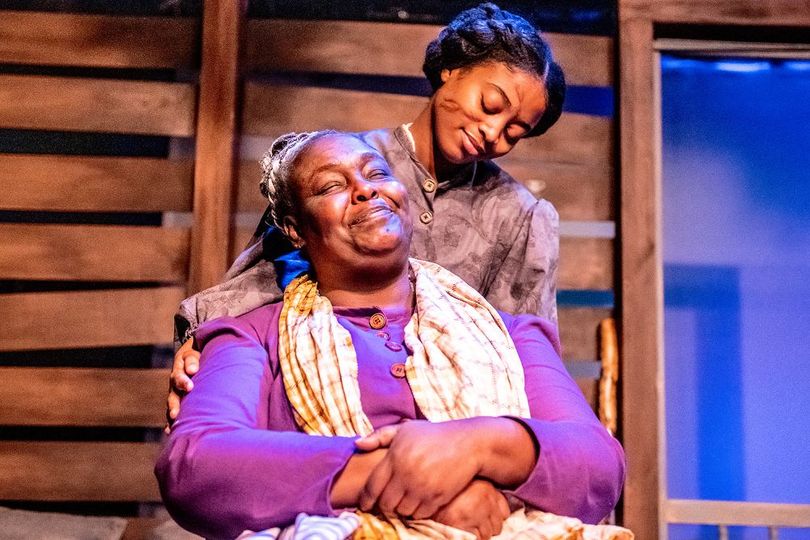
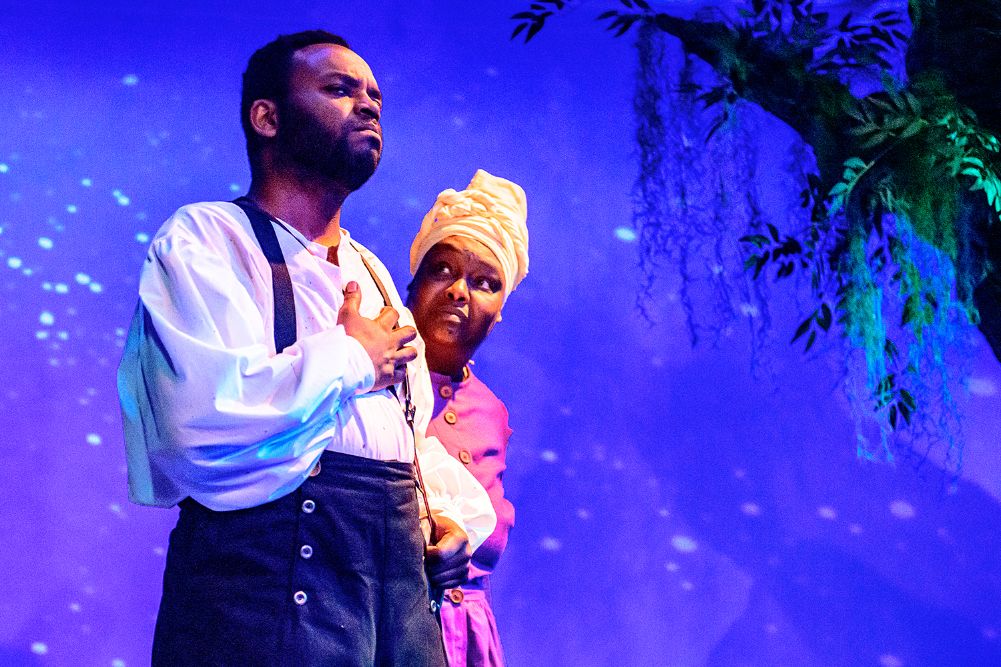
An elder, Aunt Mama, and her makeshift family, James and Mattie, occupy a cabin on a plantation that has a striking feature – a mystical whispering tree so tall no one can see the top. Generations of enslaved people have been hung from this tree, but James is determined this particular generational curse will stop with him. James is smart. He keeps his head down – both literally and figuratively – and follows the rules – except for one. The master’s daughter, Isabel, sneaks down to the cabin periodically to teach James how to read.  She’s bored, because her husband is away fighting the war, and predictably, at some point, like Potiphar’s wife in the Old Testament, she begins to take a dangerous interest in the only available men around, but that’s not the real story here.

The real story is about love, across time and generations, and involves a young stranger who arrives and is accepted by Aunt Mama and her little family. Mattie, who also happens to be the master’s daughter, is in a precarious position, trusted by no one. Although we never see or hear from other enslaved people on the plantation, we know there are others, but only Aunt Mama and James feel safe in the company of Mattie, who like many others in her situation, is not welcome in either of the worlds she straddles. So of course, Mattie is attracted to this able-bodied stranger, Henry, but we soon find out that Henry, while he does not entirely rebuff Mattie, is far more interested in James than he is in Mattie.

“The darker you is, the more questions you got.” – also Henry

HISTORY LESSONS

There are so many significant details in Sugar in Our Wounds that it would be nearly impossible to notice them all on just one viewing. The show opens with projections of legs and feet, photos on the rocks and trees, the “strange fruit” many of us were first introduced to by Billie Holiday’s recording of the mournful song of the same name. The tree hums and whispers, and James and Aunt Mama can hear it and communicate with it, with the ancestral spirits who reside in or around it and who use it to teach and warn their descendants. One notices a fancy chair that seems out of place in the little cabin, that is sparsely furnished with a tiny communal bed, shared by the three occupants, an all-purpose that serves as a seat or a table, and a bucket whose aroma Isabel finds offensive.  The chair, of course, belongs to Isabel. Aunt Mama refuses to keep the bucket (aka chamber pot) outside because it is a precious commodity and might be stolen by nearby residents – another way we know this little family is not alone on this plantation. At one point there is an authentic feeling ring shout for the upcoming freedom. But there were also a few moments that seemed out of time and place. Sometimes the men are barefoot, and sometimes they wear shoes – and socks. Would enslaved young men have owned socks? During one visit to teach James to read the bible Isabel says the slop bucket smells “funky” and moments later she to James, “you blow me away.” The Oxford dictionary says the word “funky” originated in the late 17th century, so maybe it would have been used, and idiomorigins.org says “blow me away” phrases date back to the 16th century.  Later, James says, “Don’t act new!” It seems people were saying something similar back in the day – as far back as the 1560s. Shakespeare even had a variation, “fire-new.” Both “brand new” and “fire-new” meant fresh from the fire. Who knew?

THE SPIRIT OF LOVE

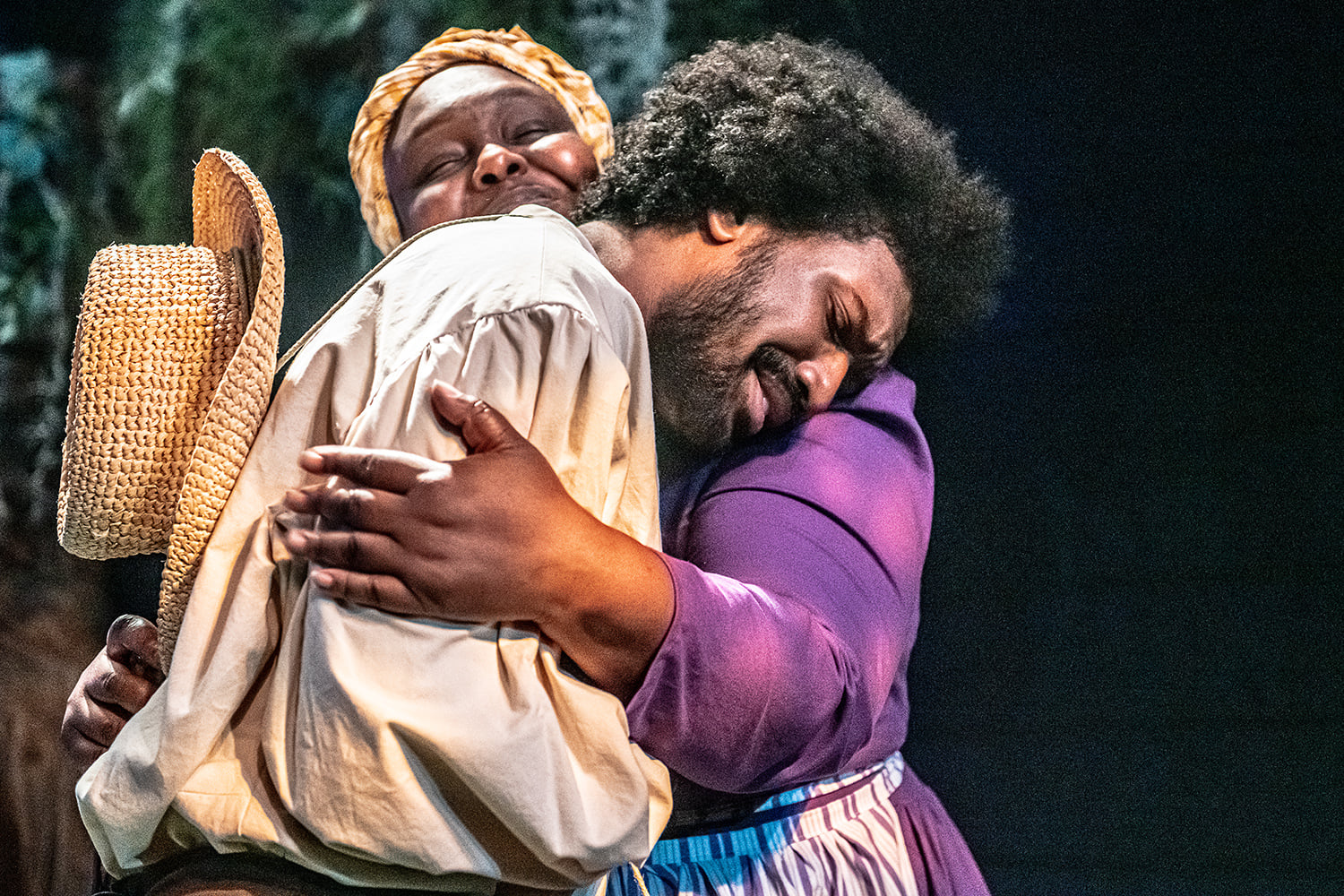
The cast, the story, the execution of this production more than just a play, more than a love story. It felt like a work of love that was more than just acting, but more like a spiritual offering. Dorothy Dee D. Miller inhabited the persona of Aunt Mama like an act of faith, as if she did not just choose to act this role, but as if she HAD to share this role. Jónel Jones, whom I had recently seen as a scammer in a TheatreVCU production of Intimate Apparel took on a quite different role here as the hero, giving a strong yet gentle, nuanced performance that lingered some time after the final bows. Duron Marquis Tyre as Henry, the mysterious new-comer similarly maintained a balance of mystery, danger, and tenderness. Tyra Huckaby maintained a relatively low-key supporting role until the end, when the seed she was carrying elevated her to a place of prominence as the last remaining hope for the future, while Charlotte Grace Smith was a necessary but negligible presence – not because she wasn’t good enough but because Sugar in Our Wounds wasn’t about her.

Director Lucretia Marie did an excellent job, creating, maintaining, and drawing the audience into this mystical world in a way that educated, entertained, and enlightened all at once. The pacing, the acting, the setting, the atmosphere, all worked together to create that magic that every show aims for but few actually achieve. Sugar in Our Wounds is one of the most memorable and moving shows I’ve seen in recent memory, and I hope to have a chance to see it again in the future to see if it hits the same.

———-

Julinda D. Lewis is a dancer, teacher, and writer who was born in Brooklyn, NY and now lives in Eastern Henrico County.

———-

SUGAR IN OUR WOUNDS

Written by Donja R. Love

Directed by Lucretia Marie

CAST:

James …………………………………….          Jónel Jones

Aunt Mama ……………………………          Dorothy “Dee D.” Miller

Isabel …………………………………….          Charlotte Grace Smith

Mattie …………………………………..           Tyra Huckaby

Henry ……………………………………           Durron Marquis Tyre

Understudies

For Isabel – Juliette Aaslestad

For Aunt Mama – Sharalyn Bailey

For Mattie – Ayana Flowers

For Henry – Calvin Graves

For James – Makai Walker

CREATIVE TEAM:

Scenic Design by William Luther

Costume, Hair & Make-Up Design by Margarette Joyner

Lighting Design by Steven Koehler

Sound Design and Original Music by Kyle Epps

Projections Design by Dasia Gregg

Props Design by Tim Moehring

Intimacy Choreographer – Kirsten Baity

Violence/Asst Intimacy Choreographer – Stephanie Tippi Hart

Assistant to the Properties Designer – Nicole Pisaniello

Dialect Coach – Evamarii Johnson

Dramaturg – Shinji Elspeth Oh

Assistant Director – David Powell

Original Scenic Concept – Mercedes Schaum

Technical Director – Rebecka Russo

Assistant Stage Manager – Dwight Merritt

Production State Manager – Shawanna Hall

Photo Credits: John MacClellan

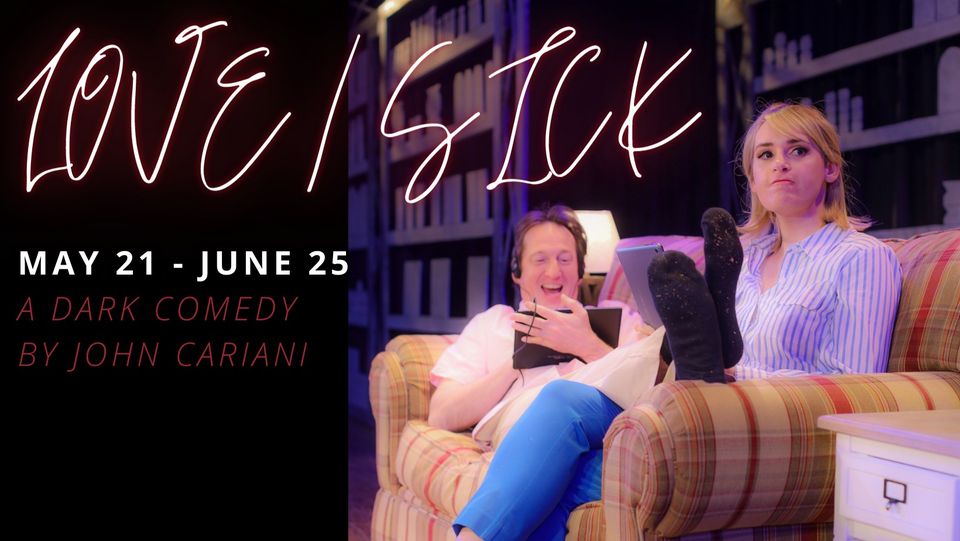
LOVE/SICK

It’s 7:30 on a Friday Night in June in a Big Box Store Somewhere in Suburbia

A Theater Review by Julinda D. Lewis

At: The Swift Creek Mill Theatre, 17401 U.S. Route 1, S. Chesterfield, VA 23834

Performances: May 21 – June 25, 2022

Ticket Prices: $49. $44 for seniors, students, military, and first responders.

Info: (804) 748-5203 or https://www.swiftcreekmill.com

Lovesick – adjective. in love, or missing the person one loves, so much that one is unable to act normally.

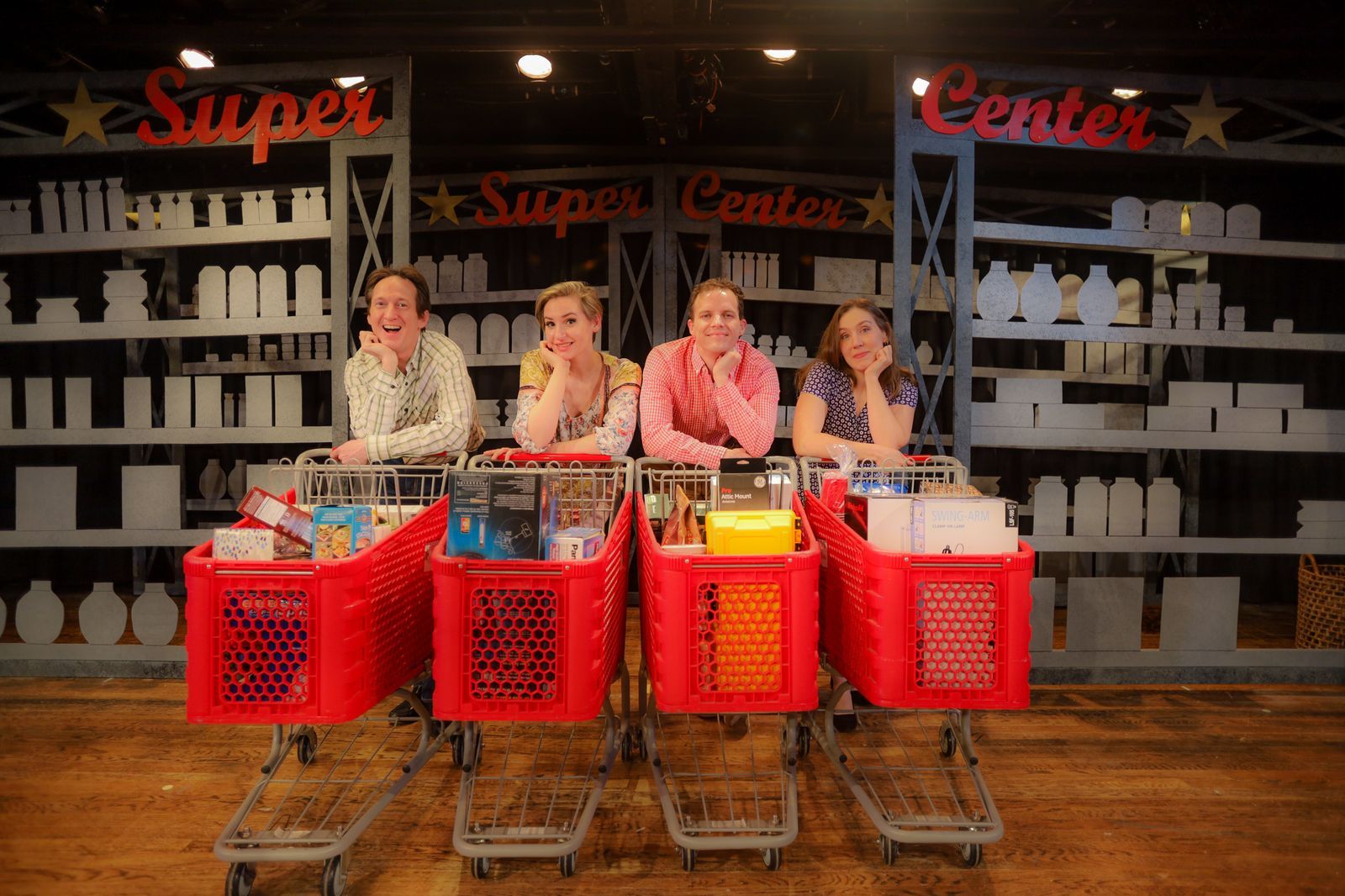
It’s spring and love is in the air – only not in the way you might expect. For LOVE/SICK John Cariani (author of Almost Maine) has constructed nine discrete tales in which love falls somewhere on a spectrum of, well, mental illness. Each ten-minute play is set “at 7:30 PM on a Friday night in June, in an alternate suburban reality.” The backdrop for this suburban reality is The Super Store – a generic mock-up of a big box store, in which some of the silhouettes on the shelves remind me of miniature tombstones.

The nine couples are portrayed by four actors who zanily and adeptly transform from character to character between scenes: costumes, hair, voices, mannerisms, posture. Before the pandemic, it was fairly unusual to see a show in which actors played multiple roles, but that seems to have become a necessary skill in the new normal we are all adapting to. Described as Almost Maine’s “darker cousin,” each Love/Sick  story line has an unexpected twist.

Among my favorites: “The Singing Telegram” man (Matt Hackman) hesitates to deliver his message because the sender is using the singing telegram to break up with his girlfriend (Katherine Wright). This is probably the saddest of the collection, while “Uh-Oh” is probably the sickest and displays the most twisted humor. In “Uh-Oh” a bored wife (also Wright) seeks to bring some excitement into her one and a half year old marriage – by fabricating a story about a research article and then assaulting her unsuspecting husband with a very real looking squirt gun.

“The Answer” starts off with a groom (Hackman) hiding in a bathroom, crying and ends on a somber note, while “Lunch and Dinner” is filled with Freudian slips of the tongue. When lawyer husband Mark (Freebourn) asks his corporate wife (Reisenfeld) what she had to eat at her business luncheon, she inadvertently responds, “sex.” And so it goes, until we come full circle ending up back at The Super Center where two exes (Hackman and Wright) are reunited and the original “Obsessive Impulsive” couple (Reisenfeld and Freebourne) bump carts again. Occasionally a profound thought punctuates the hilarity, as when Jake (Hackman) wonders why, “when you meet and fall in love and it doesn’t work out, how come we don’t call THAT destiny?”

Two monitors on either side of the stage announce the titles of the scenes while the scenery and the actors change, and Width keeps the pace and the laughs moving along with the smooth regularity of a train schedule. Of course, what makes it work, what makes it funny, is that we can recognize bits and pieces of ourselves – or our partners – in many of these characters. Have you or someone you know thought about killing their spouse – even jokingly – or considered getting back together with an ex? Still, ninety minutes without an intermission is hard on some of us with mature bones and joints that need to move periodically. Oh, and one more thing – the transition music between scenes was (perhaps intentionally?) unnecessarily irritating, but not enough so to interfere with my enjoyment of this hilarious show.

LOVE/SICK

By John Cariani

Directed by Tom Width

Cast:

PJ Freebourn

Matt Hackman

Paige Reisenfeld

Katherine Wright

​​

Production Team:

Directed by Tom Width

Costume Design by Maura Lynch Cravey

Lighting Design by Joe Doran

Scenic Design by  Tom Width

Technical Direction by Liz Allmon

Incidental Music by Julian Fleisher

“No Lie” composed by John Cariani

Performance Schedule:

Fridays @ 8:00PM: May 27, June 3, June 10, June 17, June 24

Saturdays @ 2:30PM: June 11, June 25

Saturdays @ 8:00PM: May 21, May 28, June 4, June 11, June 18, June 25

Sundays @ 2:30 PM: June 5, June 19

Wednesdays @ 2:30 PM: June 8, June 15

Thursdays @ 8:00PM: June 16, June 23

​

Tickets:

$44-49

Run Time:  Approximately 90 minutes with no intermission

A SINGLE PRAYER

A New Play by K. Jenkins

A Theater Review by Julinda D. Lewis

At: The Firehouse 1609 West Broad St., Richmond, RVA 23220

Performances: April 20 – May 8, 2022

Ticket Prices: $30

Info: (804) 355-2001 or firehousetheatre.org.

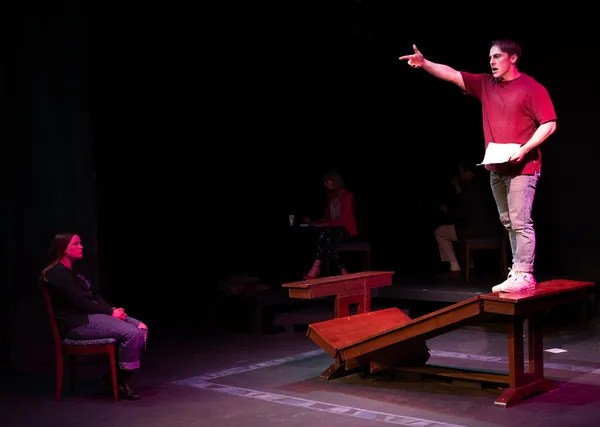
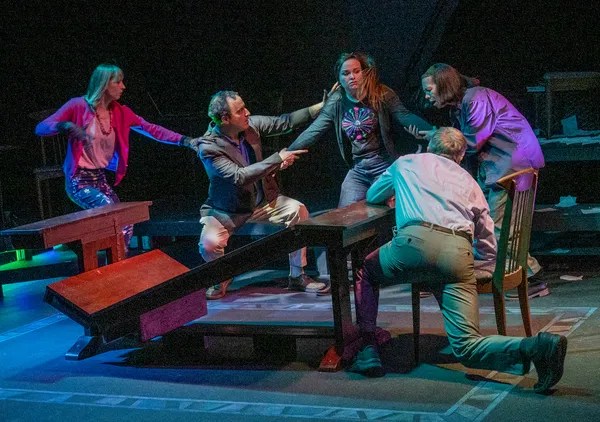
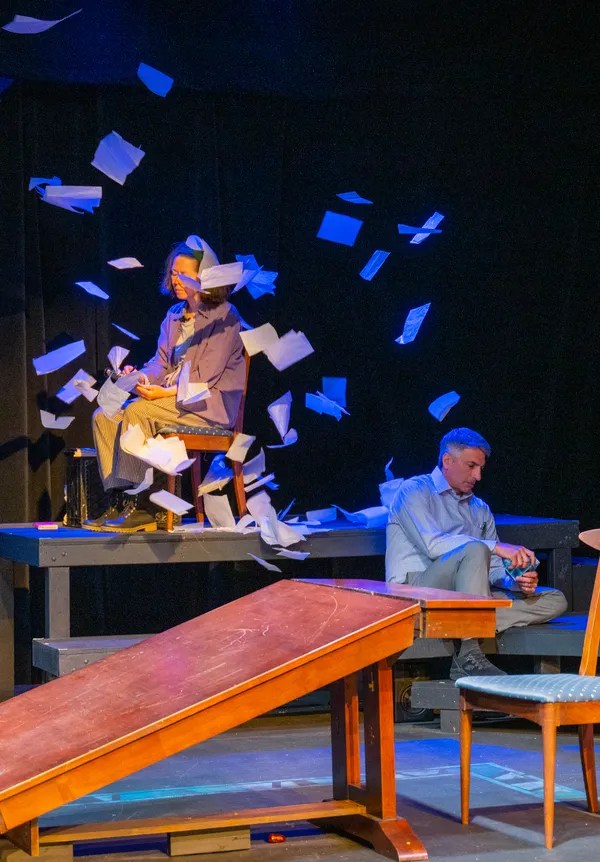
A Single Prayer was originally scheduled for its world premiere in March 2020, but then along came a little disruptor call The Pandemic. This unusual and provocative play finally made its debut April 20, two years later, with a blast.  A literal blast – the show opens with a storm. Blinding light, thunder, the sounds of birds and rain and waves accompany the destruction of the neatly set stage. A long table, covered with a cloth, four chairs, a bowl of fruit are all dislodged. The tablecloth becomes a billow representing the storm waves and when everything has settled down a broken and disjointed table remains centerstage – perhaps a metaphor for this tale of family dysfunction and a young person who must find their place in a blended family and navigate through the challenges that accompany all that follows.
The cast of characters is centered around Clem (Madison Hatfield). There is Juniper (Maggie McGurn), Clem’s stepmother, a nail model whose nails change color to reflect her mood, while Clem’s mother (Laura Shelton Bassin) remains mute, apparently by choice, and chooses to communicate by drawing disturbing pictures of birds. Clem’s Dan (Matthew R. Dubroff) is chained to his laptop and tries to remain distant from anything remotely emotional or ontrover3sial, while Stan (Fred Iacovo), Clem’s geneticist stepdad makes futile attempts to bring a semblance of normalcy to this family. Perhaps the most interesting character is Michael (Adam Turck), Clem’s friend, who seems to embody the spirit of the birds and all that goes through Clem’s mind. And Charlie (Ed Whitacre), who emerges from a front row seat in the audience, where he has been observing with the rest of the audience, has the unfortunate and futile task of being the family therapist for this family.
Set “Here” in the Past, Present, and Future, A SINGLE PRAYER is mythical, mystical, metaphorical, and mysterious.

Clem: ​This is my blended family. That’s what Charlie says, he’s our therapist. But blended isn’t really the right word. It’s more like shaken up in a ride like at the carnival where the seats are all dirty and scratched and you’re not sure if it might fall apart all at once from the rusty nails and something that got put together after a couple of beers, and then taken apart again in pieces everywhere and then put back together again so that you wonder how it all ever got together in the first place.

Jenkins, the author, holds degrees in religious studies and sociology and has written extensively on relationships, but don’t expect any answers to life’s big questions to arise from this work. It is, instead, a poetic journey that offers alternate routes to navigate life’s complex and divergent paths.

Kudos to Tennessee Dixon for the intriguingly minimalist scenic design and Joan Gavaler for the movement. It seems Adam Turck has been moving as much as if not more than speaking in several of his most recent productions, and he does it with a compelling, quirky confidence. Mark J. Lerman’s direction is organic and invisible, by which I mean the direction is not heavy-handed and the words and actions seem to flow naturally and unpredictably. Perhaps the beauty of A SINGLE PRAYER lies in its acceptance of the exceptional.

A SINGLE PRAYER

By K. Jenkins

Directed by Mark J. Lerman

Performers:

Laura Shelton Bassin – Mom / Clem’s Mother

Matthew R. Dubroff – Dad / Clem’s Father

Madison Hatfield – Clem

Fred Iacovo – Stan / Clem’s Stepfather

​Maggie McGurn – Juniper / Clem’s Stepmother

​​Adam Turck – Michael

Ed Whitacre – Charlie

​​

Production Team:

Director – Mark J. Lerman

Set Designer – Tennessee Dixon

Costume Designer – Alex Valentin

Lighting Designer – Andrew Bonniwell

Composers and Sound Designers – Mark Messing, Kate Statelman

Movement/Dance Director – Joan Gavaler

Stage Manager – Emily Vial

Asst. Stage Manager – Dennis Bowe

​

Performance Schedule:

Wed April 20 @ 7:30pm (preview)

Thu April 21 @ 7:30pm (preview)

Fri April 22 @ 7:30pm (preview)

Sat April 23 @ 7:30pm

Thu April 28 @ 7:30pm

Fri April 29 @ 7:30pm

Sat April 30 @ 7:30pm

Sun May 1 @ 3pm

Thu May 5 @ 7:30pm

Fri May 6 @ 7:30pm

Sat May 7 @ 7:30pm

Sun May 8 @ 3pm

​

Tickets:

$30

Run Time:  Approximately 80 minutes with no intermission

PHOTO CREDITS: Bill Sigafoos

DEAR JACK, DEAR LOUISE

A Timeless Love Story

A Theater Review by Julinda D. Lewis

At: Hanover Tavern, 13181 Hanover  Courthouse Rd, Hanover, VA 2309

Performances: March 18 – April 17, 2022

Ticket Prices: $48.

Info: (804) 282-2620 or www.virginiarep.org

It was inevitable that Dear Jack, Dear Louise would prove to be such a heart-warming story. It is the story of playwright Ken Ludwig’s parents’ courtship, performed by a couple of actors who are married to each other in real life.

The story begins when aspiring actress Louise Rabiner received a letter from U.S. Army Captain Jack Ludwig, a military doctor stationed in Medford, Oregon. The first letter is dated June 1, 1942. The tentative and touching relationship grows warmer with each exchange of letters until August of 1943, when Louise is preparing for a big audition and Jack is awaiting orders to deploy overseas, they each sign off their letters with “love.” For those of us accustomed to the fast pace of modern life and the directness of relationships initiated through dating apps, the leisurely pace and storybook romanticism of this budding relationship is both shocking and sobering – in a delightfully endearing way.  

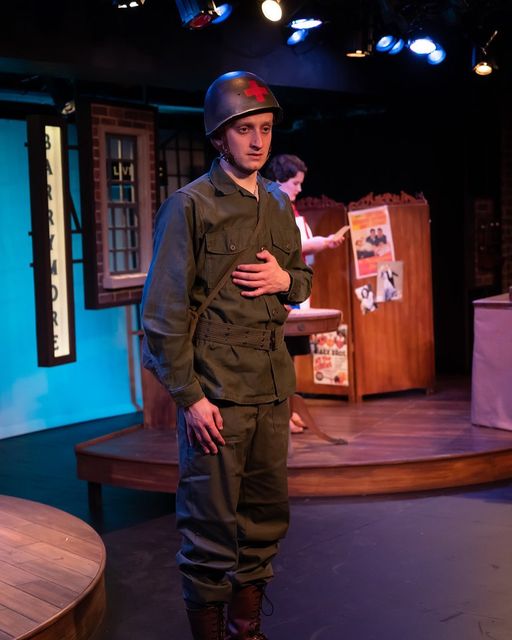
Set mostly in Jack’s office in Oregon – and later, his undisclosed overseas deployment – and the New York City boarding house and various dressing rooms occupied by Louise, Dear Jack, Dear Louise is not just a story of a romance, but also a story of war and how it touches individuals who are powerless to affect the outcome, or even control their own involvement. After months of planning, Jack and Louise must postpone their first date due to escalating war activities.

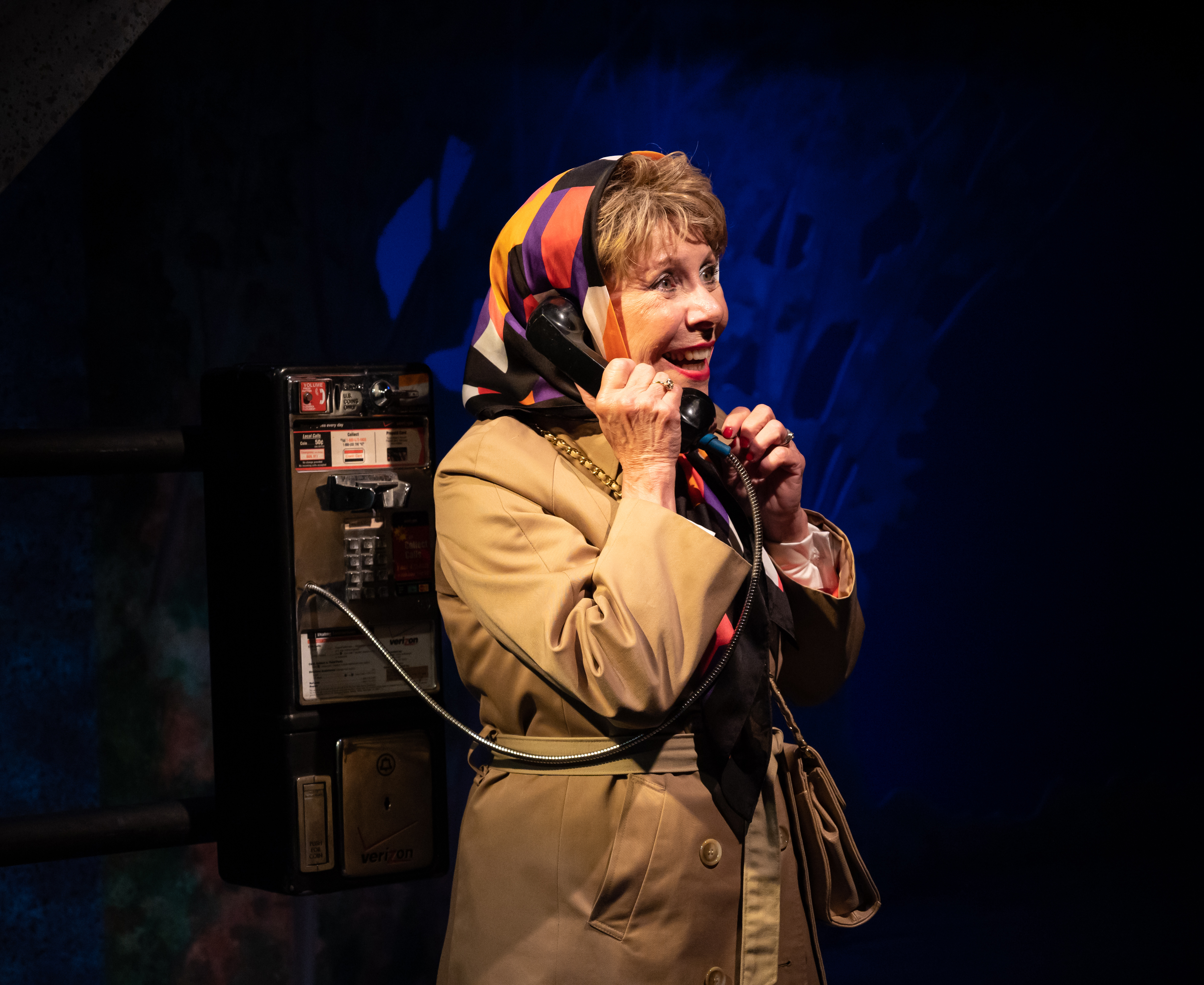
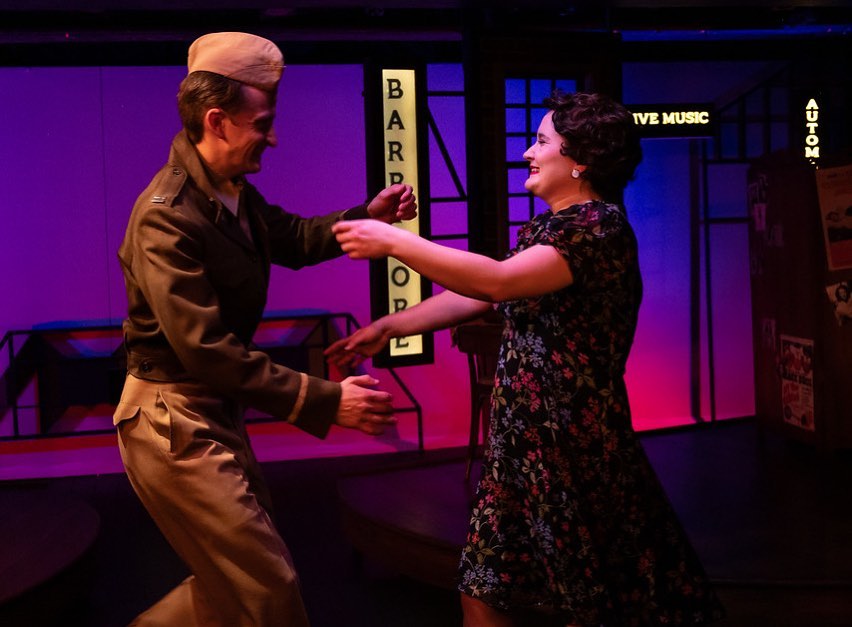
Louise’s side of the stage is populated by signs for a NYC automat, the Barrymore Theatre, and 42nd Street, while Jack’s side has the drab accoutrements of a military base and a sign for a diner. There are wall telephones with cords and Jack even sends Louise a telegram when he needs to get an important message to her quickly. Further drawing us into this historical fiction, Ludwig (the author, not the character) has the audience join his characters  in listening to songs, like, “Yes, We Have No Bananas” (first published in 1923 and resurrected during periods of rationing during WWII), and Louise’s big audition is for Hellzapoppin’ (1938), the longest running Broadway show during that time period.

Sue Griffin and Marcia Miller Hailey’s costuming for Louise is a veritable fashion show of WWII women’s garments, from the sweater with one black sheep to the classy plaid traveling suit to the high-waisted pants that remind me of the pants worn in The Color Purple (that I have yearned for since the VaRep production of that show some years ago).

When date night rolls around, (October 2, 1943), Louise is on tour in Cincinnati and Jack is in Ft. Houston en route to his deployment. October 31, that same year, Jack received a care package from Louise. She’s in Tennessee and he’s now somewhere in England. And then the letters stop. Louise receives a letter from Jack’s friend, informing her that Jack is MIA. But we know this is a love story, and it has a happy ending. Miraculously, Jack returns home, some three years after that first fateful letter, and the play ends with a first kiss.

Lydia Hundley has some wonderfully meaty comedic turns, and Neal Gallini-Burdick comes across mostly as sincere and delightfully awkward in matters of the heart. Debra Clinton’s direction is nicely paced, and somehow even the pauses – the times when communication between Jack and Louise breaks off – never become boring. Hundley and Gallini-Burdick, who met in college and married in May 2021, have appeared in five shows together, and may have had the advantage of drawing on their own love story to bring authenticity to Dear Jack, Dear Louise. And, if course, once cannot watch a wartime play these days without reflecting on current events in the Ukraine.

Comedy, romance, war, two actors with great chemistry, and good direction equals a heart-warming play that effectively meets the challenge of balancing love and war, reality and fiction.

Julinda D. Lewis is a dancer, teacher, and writer who was born in Brooklyn, NY and now lives in Eastern Henrico County.

Cast

Jack Ludwig……….Neal Gallini-Burdick

Louise Rabiner…….Lydia Hundley

Direction & Design

Direction: Debra Clinton

Scenic Design: Dasia Gregg

Costume Design: Sue Griffin, Marcia Miller Hailey

Lighting Design: Matt Landwehr

Sound Design: Jacob Mishler

Stage Management: Joe Pabst

Assistant Stage Management: Amber Hooper

Photo Credits: Aaron Sutten