CAMILLE A. BROWN & DANCERS: More Than Art

CAMILLE A. BROWN & DANCERS: Celebrating Black Identity in the Arts

Reflections on a Performance Art Experience by Julinda D. Lewis

At: Alice Jepson Theatre, Modlin Center for the Arts at University of Richmond, 453 Westhampton Way, Richmond, VA 23173

Performance: September 27, 2019 at 7:30pm

Ticket Prices: $40 General Admission; $32 Subscribers; $20 Students

Info: (804) 289-8980 or modlin.richmond.edu

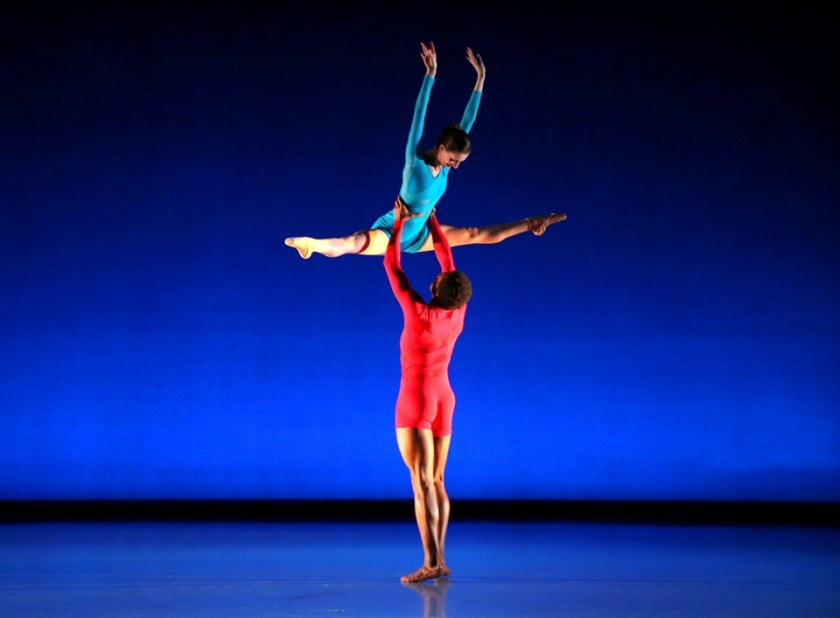
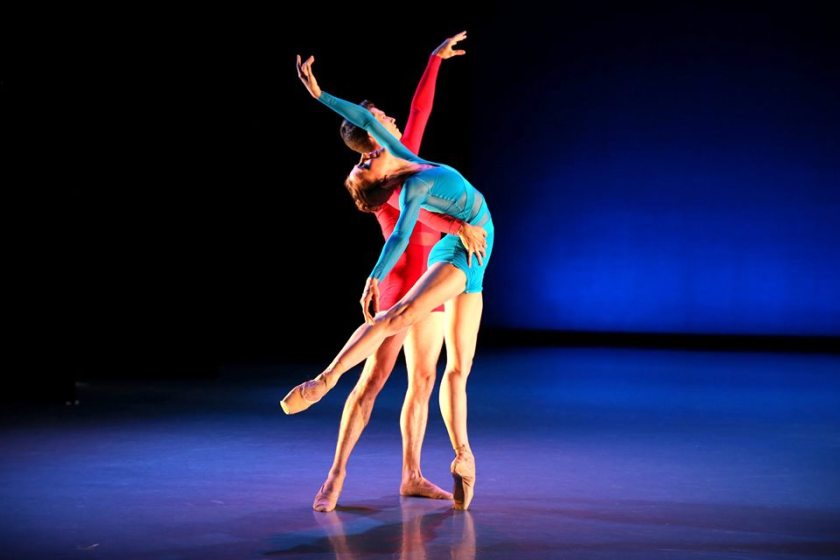
When Camille A. Brown & Dancers (CABD) comes to town (from NYC) it’s worth rearranging your schedule to make sure you see them. It’s been five years since Richmond was last graced by CABD and the dynamic company’s recent visit to the River City culminated in one-night of performances at the Modlin Center for the Arts. One night is not enough.

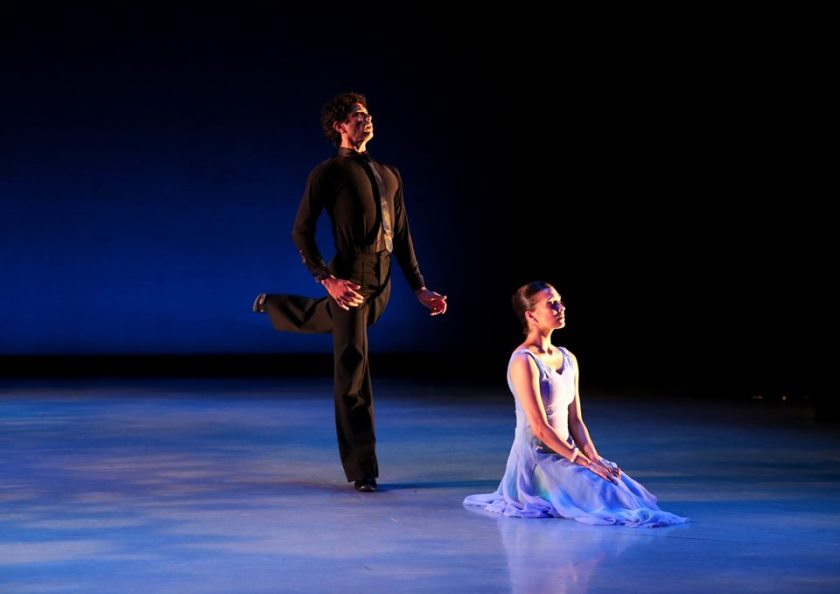
The program consisted of a trilogy of CABD’s work on black identity: Act I of the evening-length work “Mr. TOL E. RAncE” (2012); an excerpt of  “BLACK GIRL: Linguistic Play” (2105); and excerpts of  “ink” (2017). “Mr. TOL E RAncE” was performed in its entirety when the company performed at VCU’s Grace Street Theater in 2014, and if memory serves correctly, it has changed and evolved since then. (A link to my review of that 2014 performance is attached, below.)

“Mr. TOL E RAncE” is a complete theatrical event all on its own. In the beginning, CABD highjacks the usual pre-show housekeeping message, using the performers’ voices to remind people to turn off their cell phones and pointing out the locations of the exit doors. Animation by Isabela Dos Santos provides a humorous and historic homage to black entertainers and artists from the early days of minstrelsy to recent television shows featuring black actors – mostly sit coms. There a projection of a red theater curtain as animated figures with over-sized heads of the likenesses of Dave Chapelle, Moms Mabley, Flip Wilson, Amos and Andy, Whoopie Goldberg, Sherman Helmsley, Richard Pryor, and many more usher the audience into the world CABD has created for us.

And what a world it is, full of color, and rhythm, resonating with sound and movement and history. The piece moves in the vocabulary of minstrelsy, tap, soft shoe, jazz, even children’s games. We catch glimpses of JJ Walker and the Carlton Dance. On at least two occasions the dancers break out into song, jamming to the themes of “The Jeffersons” and “The Fresh Prince of Bel Air.” And in case you had forgotten – or never knew – there was also “Living Single,” “The Cosby Show” and more before “Black-ish” or “Insecure” ever hit the small screen. Mr. TOLE E RAnCE is both commentary on the stereotypes of minstrelsy and a celebration of the resilience of black artists.

“BLACK GIRL: Linguistic Play,” performed by Catherine Foster and Camille A. Brown, is a celebration of Black Girl Magic, filled with hand-clapping games, rhythmic sassiness, double dutch, stepping, and tap. And there are distinct, if fleeting, glimpses into the African roots of it all.

Finally, “Ink” began with a similar perspective of Black Boy Joy, as two of the men from the company performed a duet that carried us from the carefree days of childhood to the complexities of discovering you are a Black man in America. The rapid interplay of rhythm in collaboration with live musicians brings new life to old rituals and moves into the Afro-futurism of superheroes with superpowers. The exercising of superpowers, we realize with a jolt, is the normative operating mode for black people in America.

Brown and her dancers – most of whom are also choreographers and many of whom are conversant in visual and spoken arts as well – are not just dancers. They are actors. They are musicians. They are consummate artists whose work is not just a reflection of their lives, but whose work is a mirror that reveals our own lives. Artistically, Brown’s work most reminds me of the work of Dianne McIntyre and her former group, Sounds in Motion. (If you are not familiar with the work of this phenomenal artist, then look her up!) The music is such an integral part of the work, with Kwinton Gray remaining onstage the entire evening, playing the piano that sometimes provides a resting place – or a hiding place – for the dancers.  There is no separating the movement, the music, the word, the costumes, the lighting, the animation. This work is restorative. It is refreshing. It is healing. It is exhausting. It is art.

———-

Here’s a link to my review of Camille A. Brown & Dancers in Richmond in 2014:

https://www.richmond.com/entertainment/dance-review-dancers-more-than-entertaining/article_3f67e7bf-dc15-5b77-a408-110f7cde5f3c.html


Here’s a link to my preview and interview of Camille A. Brown for the company’s 2019 Richmond program:

https://richmondmagazine.com/arts-entertainment/stage-screen/camille-a-brown-and-dancers-modlin-center/


Julinda D. Lewis is a dancer, teacher, and writer who was born in Brooklyn, NY and now lives in Eastern Henrico County.

———-

Photo Credits: Christopher Duggan, Whitney Brown, Modlin Center for the Arts website


Amazon.com shopping recommendations:


STARR FOSTER DANCE: HERE and Now

STARR FOSTER DANCE: New Works

A Dance Review by Julinda D. Lewis

At: Grace Street Theater, 934 West Grace Street, RVA 23220

Performances: September 20-22, Friday and Saturday at 8:00pm, Saturday and Sunday at 3:00pm
Ticket Prices: $20; $15 for students
Info: (804) 304-1523, https://www.brownpapertickets.com/event/4331425

Starr Foster Dance presented six works, including two premieres and one Richmond premiere. A highlight of the program was a purposeful and compelling new work, HERE, part of the company’s domestic violence initiative.

Piercing lighting design by Michael Jarrett and dramatic music by Eighth Blackbird (“Doublespeak”) and Snowflake, Wolf Sebastian & Spinning Merkaba (“Orc March”) guides the movement and the narrative from the mundane to the explosive. In the beginning, dancers remove their button down shirts. In retrospect, what started off as innocently as Mr. Rogers removing his jacket and exchanging it for a sweater is much more ominous. In the context of domestic violence, it becomes the passing along of a generational curse, normalizing the abnormal. The almost hypnotic intersecting chains of movement phrases become the links that bind victims of domestic violence like vines that start off gently winding around a trellis and eventually chokes all other growth and pulls down the entire wall. The piece ends in a brilliant, explosive outburst.

HERE, the dance, and HERE, the project, were created by Foster and company under the mentorship of domestic violence survivor Lisette Johnson to share information and resources. As part of the project, Foster’s company has initiated a program to collect gas, grocery, and cell phone gift card to distribute through the YWCA. For more information on HERE, visit Starr Foster Dance https://www.starrfosterdance.org/heredetail and for information about domestic violence, visit Lisette Johnson’s website http://shamelesssurvivors.com/.

A second premiere, Land Shadows, is set to apprehensive music by Teho Teardo (“Wake Up the Bear” and “A Bit About Ghosts” ). Foster’s musical choices are original, intricate, and have deep psychological impact. Land Shadows, a work eight dancers, is an intriguing interplay of balance, weight, and dynamics in a three-dimensional setting made of shafts and cones of light, enhanced by a bit of smoke. The dancers’ lime green and teal tanks and matching briefs are unobtrusive yet attractive and add a surprising touch of color to this world of shadows.

I’ve often remarked how dark many of Foster’s works are – both in content and visually, but this show seemed brighter than many in the past. Ironically, this was true even of  At Your Darkest, a duet performed on Saturday by Caitlin Cunningham and Fran Beaumont (and by Cunningham and Erick Hooten on Friday and Sunday). The two dancers begin in separate shafts of line, move into a shared space in the middle of the work, and end up entwined and rolling downstage. Helping to lighten the darkness of this Richmond premiere was Elvis Presley’s “Can’t Stop Falling in Love with You” and Anne Muller’s “Walzer fur Robert.”

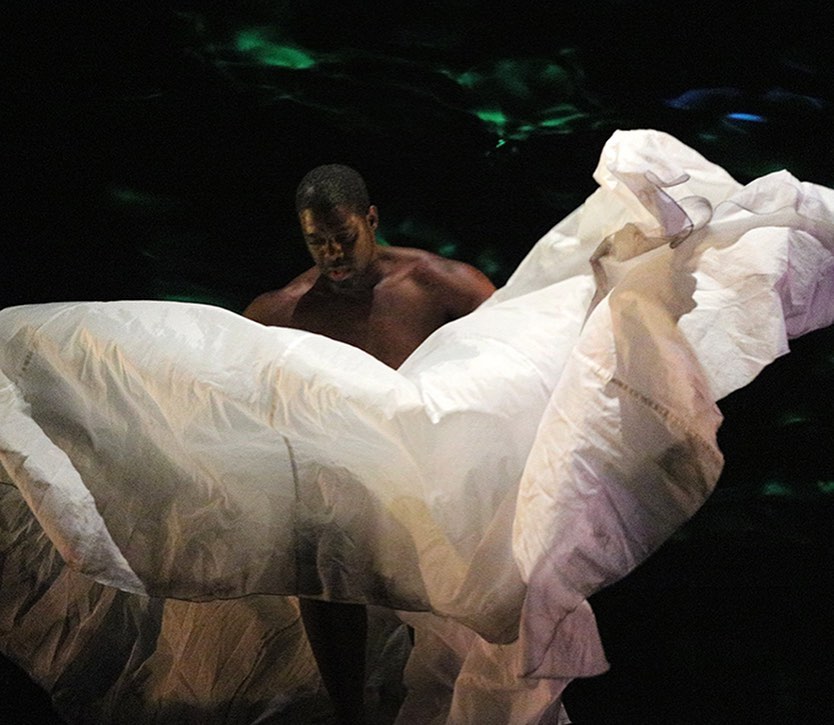
The program also included Saltwater Bones, a beautiful solo performed by Erick Hooten against a backdrop of ripping water (film by Douglas Hayes and original music score composed and performed by Joey Luck). Hooten, who is topless, manipulates yards and yards of white fabric in a diaphanous white skirt. The skirt is both costume and prop, and creates fascinating images: a cloud, a comforter, a wedding dress, an entrapment, and more.

Saltwater Bones was part of Foster’s January 2018 program at TheatreLAB The Basement, Spitting Image, a collaborative series of eight dances inspired by the works of eight photographers.  On that program, however, Saltwater Bones was performed by Heather Rhea O’Connor, and I wrote:

The second half of the program began with what turned out to be one of my personal favorites of the evening, a voluminous skirt solo, Saltwater Bones, inspired by the underwater photography of Cristina Peters. O’Connor’s white skirt, designed and constructed by Foster, performed doubly duty as costume and prop. Sometimes it billowed out gracefully, other times it appeared to entrap her. At the end, I found myself releasing the breath I did not realize I had been holding.

I think I found it even more beautiful and more powerful when performed by Hooten. (See my full review of that program here: https://jdldancesrva.com/2018/01/13/spitting-image-a-collaboration-of-dance-and-photography-featuring-choreography-by-starr-foster.)

The program was rounded out with the mysterious ripples of movement in Stray and the rituals of Falling to Earth. All choreography is by Starrene Foster, with lighting by Michael Jarett. This season the company of dancers consists of Fran Beaumont, Anna Branch, Caitlin Cunningham, Kylie Hester, Kierstin Kratzer, Shelby Gratz, Erick Hooten, Cristina Peters, and Mattie Rogers.

If you’re reading this Saturday night or Sunday morning, there is one more chance to see this fulfilling program, Sunday afternoon at 3:00pm.

Julinda D. Lewis is a dancer, teacher, and writer who was born in Brooklyn, NY and now lives in Eastern Henrico County.

———-

Photo Credits: Starr Foster Dance by Starr Foster and Douglas Hayes.

———-

Alvin Ailey
https://www.amazon.com/gp/product/1093389303/ref=as_li_tl?ie=UTF8&tag=rvartreview-20&camp=1789&creative=9325&linkCode=as2&creativeASIN=1093389303&linkId=c39a9d5181692735b3b75883d732cd03
Whistlin Women
https://www.amazon.com/gp/product/1072107546/ref=as_li_tl?ie=UTF8&tag=rvartreview-20&camp=1789&creative=9325&linkCode=as2&creativeASIN=1072107546&linkId=78c578738db659724289dda2116d985c
41SR4yCI7aL._SL160_
https://www.amazon.com/gp/product/B0791TX5P5/ref=as_li_qf_asin_il_tl?ie=UTF8&tag=rvartreview-20&creative=9325&linkCode=as2&creativeASIN=B0791TX5P5&linkId=08cacc62054100f00d2a6fcfbf97f3e4
Apple Watch
https://www.amazon.com/gp/product/B07K37HKT8/ref=as_li_qf_asin_il_tl?ie=UTF8&tag=rvartreview-20&creative=9325&linkCode=as2&creativeASIN=B07K37HKT8&linkId=c73d0d03604f60526a472839af36bdc0

CHRISTINE WYATT: Affirmative Reactions

PROVOCATIONS PERFORMANCE: Christine Wyatt | Affirmative Reactions

Observations on a Performance Art Experience by Julinda D. Lewis

At: ICA (Institute for Contemporary Art), 601 W. Broad Street, RVA 23220

Performances: September 20 & 21, 2019 at 4:00pm

Ticket Prices: FREE

Info: (804) 828-2823 or ica@vcu.edu

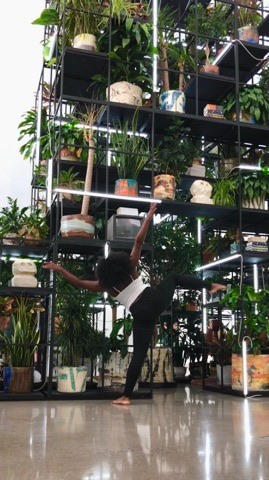
Stepping off the spacious and artistically designed elevator at the ICA into the soaring space of the third floor True Farr Luck Gallery on Friday afternoon was a transformative experience. The open airy space is filled with Rashid Johnson’s installation – a modern yet historically and culturally evocative structure ironically titled Monument. Constructed of steel, it is simultaneously modern architecture and ancient temple. It invites the viewer/participant to sit in quiet contemplation or to walk around and through its structure and absorb the rhythms of long-forgotten memories.

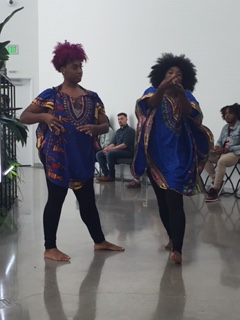
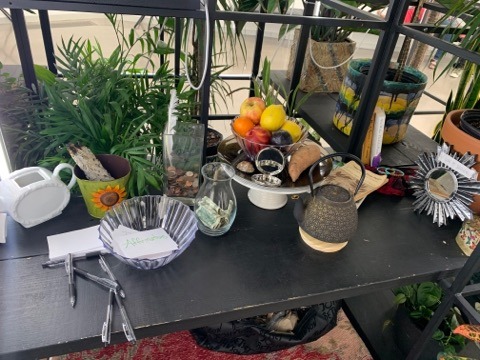
Both calming and energizing, it is provocative, and on this occasion, the space was being activated by an Africanist dance ensemble led by choreographer Christine Wyatt. A libation was poured, and  ancestors acknowledged. Some of the participant/observers joined in, others were shy or unfamiliar with the custom. Six dancers and three musicians – although these are both artificial and arbitrary labels, as the musicians move through the space and the dancers sing and speak – then began to move around Johnson’s structure, first walking in silence, gradually adding gentle movements that hinted of ritual and blood memories.

One woman activated our heartstrings, pulling a bow across her violin. Soon, the space was activated with childhood stories of constructing and playing Chinese jump-rope, the soul-stirring strains of spirituals, and the wordless and universal communication of scat. At one point, the energy rose, the dancers moved faster, slicing through space and time. Some of us rose from our seats to follow their movement while others remained seated in quiet contemplation, as wave after wave of movement was birthed. Both responses were correct and necessary. At one point, the dancing women removed their royal blue dashiki-patterned caftans, stripped down to white tank tops and black leggings. They built a pyramid – that echoed the Johnson’s structure – only to collapse in laughter. The gathered in a circle on a rug – sharing a moment of unity, sharing this time of contemplation and collaboration. Their final act was to gather quietly in the center of the space and just. . .breathe.

Provocations offers a new/old way of experiencing art. It is not visual art or sculpture or music or dance. All the elements, sight, sound, movement – even smell, as I was taken back in time by the aroma of Florida water from the libation – united to create a life-affirming experience. “Affirmative Reactions” is a much-needed reminder to breathe, to take time to remember who and where we come from, to recognize and honor our ancestors and each other. It connects the past, the present, and the future.

It is a liberating experience and if you have the time and ability to get to the ICA on Saturday, please go. “Affirmative Reactions” starts promptly at 4:00pm and runs for about 30 minutes.

ADDENDUM: The cast of “Affirmative Reactions” includes Amena Durant, Lani Corey, MiKayla Young, Mary Manzari, Christina Collins, Jaylin Brown, Kenneka Cook, Reyna Pannell, and Christine Wyatt.

Julinda D. Lewis is a dancer, teacher, and writer who was born in Brooklyn, NY and now lives in Eastern Henrico County.

———-

Photo Credits: Julinda D. Lewis & additional photos courtesy Christine Wyatt


ChristineBChristineA

Whistlin Women
https://www.amazon.com/gp/product/1072107546/ref=as_li_tl?ie=UTF8&tag=rvartreview-20&camp=1789&creative=9325&linkCode=as2&creativeASIN=1072107546&linkId=78c578738db659724289dda2116d985c
Alvin Ailey
https://www.amazon.com/gp/product/1093389303/ref=as_li_tl?ie=UTF8&tag=rvartreview-20&camp=1789&creative=9325&linkCode=as2&creativeASIN=1093389303&linkId=c39a9d5181692735b3b75883d732cd03
41SR4yCI7aL._SL160_
https://www.amazon.com/gp/product/B0791TX5P5/ref=as_li_qf_asin_il_tl?ie=UTF8&tag=rvartreview-20&creative=9325&linkCode=as2&creativeASIN=B0791TX5P5&linkId=08cacc62054100f00d2a6fcfbf97f3e4

RENDEZVOUS: 1 Woman, 2 Men, 3 Choreographers, 4 Nights

RENDEZVOUS: A Meeting of 3 Choreographers

An Extended Dance Review by Julinda D. Lewis

At: The Grace Street Theater, 934 W. Grace St., RVA 23220

Performances: September 6 & 7 and 13 & 14 at 8:00pm

Ticket Prices: $10 general admission

Info: Grace Street Theater Box Office (804) 828-2020 or https://bit.ly/2Z1dtdk

RENDEZVOUS: A Meeting of 3 Choreographers is the first dance performance of the 2019 Fall season. It is also the first joint performance by this trio of young, contemporary performers. So, this is not going to be a traditional review, but more of an introduction and overview of some of the artists and the works that represent the future of contemporary dance in RVA and the region.

In a brief program, running exactly one hour, Callie Moore, Robert Rubama, and Jelani Taylor offered a sampling of their new and recent works.

Moore’s three selections stood out due to her use of videography.  In “Snap Soup” she has her dancers placed against a blindingly white background that delightfully challenges the viewer’s sense of space and perspective. Due to the lack of shadows six dancers, dressed in black tops and pants in shades of blue and purple, appear to float when they lay down. When one dancer passes behind another, it creates the illusion that she is rising to another level. Moore’s movements, accompanied by Julia Wolfe’s “Dark Full Ride,” a composition of light percussion (snare drums, cymbals) are playful and athletic, punctuated by unusually long pauses and empty white space. The performers: Hallie Chametzky, Courtney Darlington, Eslie Djemmal, Len Foyle, Katlyn Lawhorne, and Zoe Wampler.

“Melodramatic and Self-Indulgent” is almost the complete opposite of “Snap Soup.” In this solo, a woman (Callie Moore) in denim shorts and a white tank top performs small movements, subtly shifting her weight or wrapping her arms around her torso. She is backed into a dark corner and accompanied by a sound score of  “Brown Noise” (think super-amplified white noise and you get an idea of what it sounds like). The subtlety of the movement and occasional close-ups, focusing on the pulsing of the dancer’s breathing, her hand pinching the tight skin of her sternum, or her taped and battered toes, is a philosophically interesting exercise, but eventually becomes less and less interesting to watch.

In Moore’s third selection, “Rosy,” two women (Brittany Powers and Jada Willis) drive to the country, park their car, and dance outdoors in beds of leaves, on gravel, and on the pedestrian crosswalk of a bridge. Nature and traffic provide abundant scenery and I was enamored of the opening scene where the two women walked off into the distance and as they faded away in the background they simultaneously re-emerged in the foreground – a sort of reverse fade out leading to the main movement. Overall I truly enjoyed Moore’s experiments with videography. Her work is visually compelling and emotionally challenging.

Robert Rubama, interestingly, presented the opening and closing works. The program opened with his duet, “::flux,” which he performed with Robin Auerswald to the accompaniment of Steve Reich’s “Music for 18.” Rubama established a motif of organic movement fueled by loops and spirals that extend. His solo, “Down,” set to Bobby Vinton’s “Mr. Lonely” and “A fool persists” by Infinite Body (an instrumental piece that reminds me of the opening of an epic film) is a sensuous indulgence, long-limbed and languid. Even his sharp movements are smooth. His falls are soft, and he offered more of those lush spiraling movements that extend into infinite space as he articulates every possible muscle – back, neck, wrist.

Jelani Taylor – who, disappointingly did not dance in any of the works – presented two duets, “Solemn Wish” performed by Michelle Knight and Sydney Wiggins to the plaintive, prayerful song, “Father, Father” by Laura Mvula with Metropole Orkest and “Remembering Memory,” performed by Jenna Beardsley and Taylor Bonadies to the familiar Joni Mitchell song, “Both Sides Now.” Both duets are emotionally charged and full of yearning. “Solemn Wish” repeats variations of a slow walk with one arm raised, and the dancers execute long, slow looks that seem sadly unfulfilled. “Remembering Memory” begins with the dancers entwined, and at one point they roll, pressed together, as if clinging to life. Holding hands leads to a fall, which leads to a spin, which leads to a lunge. The movements are simple, what is compelling is the transitions, which are subtle and almost imperceptible, making the work fluid and organic.

It’s hard to produce new work. It’s hard to produce dance here in Richmond. People are familiar with the Richmond Ballet; the Latin Ballet of Virginia has a target audience and loyal following; Starr Foster has been around long enough to have developed a reputation, and Kaye Weinstein Gary has integrated dance and theater to find her niche, and both Foster and Gary annually produce festivals that bring a wide range of dance from the region and sometimes from abroad to enrich Richmond. The University of Richmond annually brings at least two internationally known dance performances to the Modlin Center, but the world of dance in Richmond does not attract the numbers that the Richmond theater community can expect – and many of them struggle to fill seats. If residents are surprised at the variety of theater companies we have, many know even less about our dance talent. That said, I have a few thoughts about Rendezvous.

The printed program was nicely executed and attractive, but I would have liked a bit of information about the participants and a few moments between dances when the house lights come up enough to allow the audience to glance at the program, so we know what’s coming up next. I overheard someone in the lobby remark that there were no posters advertising the show. I heard about it through social media, and posters can be posted there – saving both printing costs and trees. One thing the presenters were able to do that I have been advocating for is that the program is being presented over two weekends, not just one. So, while opening night had, sadly, fewer than a dozen audience members in attendance, there is still time to get out there and support our local artists. The show runs exactly one hour and it’s only $10!

Need some additional encouragement? Below is a link to Jelani Taylor’s work, “Remembering Memory” and some biographical information on each of the three choreographers. My work here is done.

Follow this link to Jelani Taylor’s work, “Remembering Memory.”

https://www.facebook.com/eradanceco/videos/421815151760206/

Choreographer, film-maker, and dancer Callie Moore graduated from VCU with a BFA in Dance and Choreography in May 2017 and founded her company Snap Soup Dance (yes, the same as the name of one of the works she presented) in 2018, with the goal of captivating everyone with her work, not just “dancers” and “artists.” Based in Richmond, VA, Snap Soup seeks to work with artists and creators across all disciplines to further their mission of making dance and art more accessible to all.

Robert Rubama is a native of Virginia Beach, Virginia and a graduate of George Mason University with a BFA in Dance. He has performed in works by Andrea Miller, Donald Byrd, Mark Morris, Soon Ho Park, Nick Pupillo, Ivan Perez, and Yin Yue as well as with Agora Dance and RawArts Dance at various venues in the Washington D.C area. He is the founder of Terre Dance Collective, a DC-based dance company that has presented works in New York City and Washington D.C.

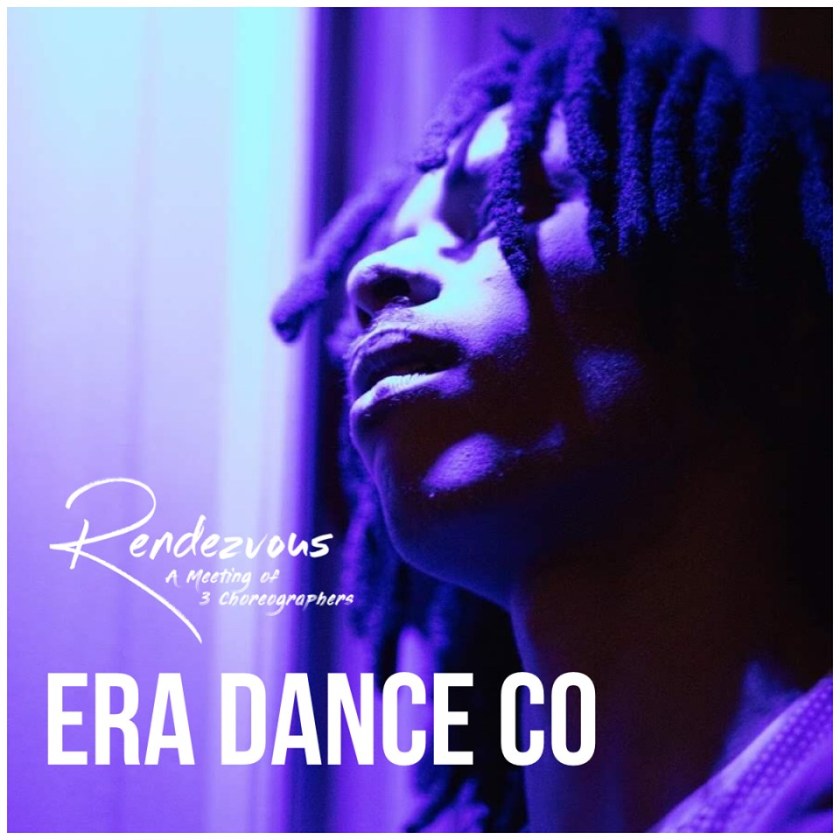
Jelani Taylor is a dancer and choreographer from Virginia Beach, Virginia and a recent graduate of Virginia Commonwealth University with a BFA in Dance and Choreography. At VCU Jelani performed in works by Melanie Richards, Martha Curtis, Helen Simoneau (Guest Artist), Ching-I Chang Bigelow (Guest Artist), Scott Putman, and Dr. E. Gaynell Sherrod. He has also performed in works by Johnnie Cruise Mercer and Rady Nget. Jelani’s own choreography has been showcased at Inside/Out at Jacob’s Pillow Dance Festival, the International Association of Blacks in Dance Conference (IABD), American College Dance Association’s (ACDA) National College Dance Festival, National Dance Society Conference (NDS), Sans Limite Dance Festival, Small Plates Choreography Festival, Dogtown Dance Theater, Grace Street Theater, and ODU University Theater. Jelani is the artistic visionary of Richmond-based ERA Dance Company, a contemporary modern dance company with a mission to create a body of work that is reflective of cultural truths that are intended to engage and empower the larger community.


Julinda D. Lewis is a dancer, teacher, and writer who was born in Brooklyn, NY and now lives in Eastern Henrico County.

———-

Photo Credits: Photos and posters courtesy of Jelani Taylor.

Rendevous1

Rendezvous1
Callie Moore
Rendezvous3
Robert Rubama
Rendezvous2
Jelani Taylor


https://www.amazon.com/gp/product/1072107546/ref=as_li_qf_asin_il_tl?ie=UTF8&tag=rvartreview-20&creative=9325&linkCode=as2&creativeASIN=1072107546&linkId=2091bcd4a793de0cb3c8335ee66be472


RICHMOND BALLET: STUDIO THREE

Richmond Ballet Studio Three: Three Beautiful Dances

A Dance Review by Julinda D. Lewis

At: The Richmond Ballet Studio Theatre, 407 E. Canal St., RVA 23219

Performances: May 7-12, 2019

Ticket Prices: $26-$46

Info: (804) 344-0906 x224 or etix.com

The Richmond Ballet concludes its current Studio Series with a program of three beautiful ballets, each different in style, look, and feeling.

Ron Cunningham, who spent 30 years as director of the Sacramento Ballet (along with his wife, Carinne Binda) choreographed Summerset in 1981. (The couple transitioned to Emeritus status with the Sacramento Ballet in 2018.) Summerset was first performed by the Boston Ballet in 1981 and the Richmond Ballet introduced it on the stage of the Carpenter Center for the Performing Arts in 1988.

Performed by three couples, led by Sabrina Holland and Mate Szentes, with Lauren Archer and Thel Moore, III and Abi Goldstein and Anthony Oates, the ballet features contemporary choreography with classic lines and vocabulary. Said to have been inspired by the royal wedding – not, not that one, but the wedding of Prince Charles and Princess Diana – Summerset is mostly flirtatious and light, but there were some moments that seemed out of character, as when Archer was pulled across the floor while in a full split or when the three women all landed in a split and were pulled up by their partners. That particular movement and posture seemed overly gymnastic and less, well, royal, and took me out of the lyrical fantasy and romantic mood created by the otherwise winning combination of Cunningham’s choreography with Edward Elgar’s music. The most beautiful moment, for me, was an incredibly gentle and sustained phrase where Szentes slowly lowered Holland from his shoulder to the floor, as if she were the most precious woman on earth and he did not want to shatter her, and the very thought of her feet touching the floor was troublesome.

The lovely and ageless 2017 Kennedy Center Honor award winner Carmen de Lavallade returned to set Sweet Bitter Love on the company, having first worked with Richmond Ballet on Portrait of Billie in the fall of 2017. Initially created as a solo for herself, Sweet Bitter Love (2000) developed, over time, into a duet, set to two songs sung by Roberta Flack (“Until It’s Time For You To Go” and “Sweet Bitter Love”) and one sung by Donny Hathaway (“For All We Know”). It’s the kind of music you listen to when you are home alone, with the lights dimmed, and a glass of wine nearby.

Performed by my favorite dance couple, Maggie Small and Fernando Sabino, Sweet Bitter Love presents both the woman’s and the man’s perspective of a love affair that must end – seemingly before it has even had time to really begin. From Sabino’s hinged jazz turns to Small’s sustained movements and poignant moments of stillness, the work pulled on the acting skills of the two dancers as much as their dance technique. There are heartrending moments as when Sabino backs away from Small, who is kneeling with her back to him. While backing away, he shakes his hands in helpless frustration. Later, as she mourns the loss of love, arms stretched over head and then reaching empty arms in front, we see him briefly in an upstage corner, buttoning his jacket as he takes one last glance. The costumes for Sweet Bitter Love were designed by de Lavallade’s husband, the late Geoffrey Holder, and Chenault Spence lighting lovingly echoed the blues of Smalls’ gown and caught the delicate sparks of glitter in her hair, gown, and shoes. The overall effect – music, movement, costumes – is breathtaking.

The program closed with Symphonic Dances (world premiere, May 7, 2019), created by the London-born choreographer Rex Wheeler, who also created Lenten Rose for the Richmond Ballet in 2015. Bringing the program full circle, Wheeler also has a history of creating works for the Sacramento Ballet.

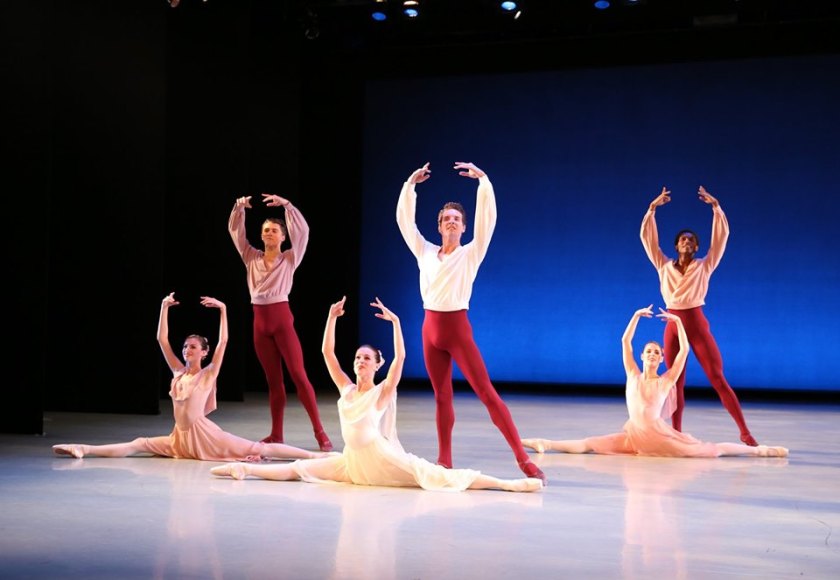
Symphonic Dances, performed by six couples, is a work in two parts set to the first and third sections of Sergei Rachmaninov’s music of the same name, which he composed in 1940. Interestingly, Rachmaninov is believed to have discussed the possibility of Russian choreographer Michel Fokine creating a ballet set to this work, but Fokine’s death in 1942 prevented any collaboration on this work between the two artists.

In the first part, the dancers wear lavender and fuchsia, the partnering is more traditional, and the lighting more muted. In the second part, the dancers wear bold red and blue (more of a turquoise blue, perhaps), and the lighting, likewise, shifts into bold washes of red, purple, and blue that seems to reflect the boldness of the music in this section, as well, which has rhythmic drums and clashing cymbals. The colors and movements are in harmony with the shifting tones of the music, creating a total environment of sound, color, and movement as the dancers move both gracefully and energetically through Wheeler’s three-dimensional shifting patterns.

It was a wise decision to place intermission between Sweet Bitter Love and Symphonic Dances. Pretty as Symphonic Dances appeared, and as good as it sounded, it was somewhat of a difficult transition to move from the drama of de Lavallade’s love ballad to the more contemporary interactions of Wheeler’s work.

The Studio Three performance run through Mother’s Day (hint, hint), with the remaining performances on Friday and Saturday at 6:30pm and 8:30pm, and Sunday at 2:00pm and 4:00pm.


Julinda D. Lewis is a dancer, teacher, and writer who was born in Brooklyn, NY and now lives in Eastern Henrico County.

———-

Photo Credits: Sarah Ferguso

RB Studio 3.1
Abi Goldstein and Anthony Oates, Sabrina Holland and Mate Szentes, Lauren Archer and Thel Moore, III in Summerset
RB Studio 3.5
Abi Goldstein and Anthony Oates, Sabrina Holland and Mate Szentes, Lauren Archer and Thel Moore, III
RB Studio 311
Maggie Small and Fernando Sabino in
RB Studio 310
Fernando Sabino and Maggie Small in Sweet Bitter Love
RB Studio 3.9
Abi Goldstein and Thel Moore, III
RB Studio 3.8
Cody Beaton and Trevor Davis
RB Studio 3.7
Cody Beaton and the men of Symphonic Dances
RB Studio 3.6
Abi Goldstein and Thel Moore, III
RB Studio 3.4
Eri Nishihara and Mate Szentes in
RB Studio 3.3
Eri Nishihara
RB Studio 3.0
Mate Szentes, Eri Nishihaqra and the company in Symphonic Dances

https://www.amazon.com/promocode/A2NUZ6DSZXT7KE?ref_=assoc_tag_ph_1524210985981&_encoding=UTF8&camp=1789&creative=9325&linkCode=pf4&tag=rvartreview-20&linkId=f7e7bec028ac17fba2aa19a32945a71e

https://www.amazon.com/dp/B0791TX5P5?ref_=assoc_tag_ph_1524210971463&_encoding=UTF8&camp=1789&creative=9325&linkCode=pf4&tag=rvartreview-20&linkId=2e2f5a01af271965320e35bccfcc74d5

https://www.amazon.com/dp/B01I499BNA/?ref_=assoc_tag_ph_1524210971413&_encoding=UTF8&camp=1789&creative=9325&linkCode=pf4&tag=rvartreview-20&linkId=fbc214e4c1d8136529d08566a380d2cf


6th RICHMOND DANCE FESTIVAL: Week 2 of 3

RICHMOND DANCE FESTIVAL 2019: Entanglements – Week Two

A Dance Review by Julinda D. Lewis

At: Dogtown Dance Theatre, 109 W. 15th Street, RVA 23224

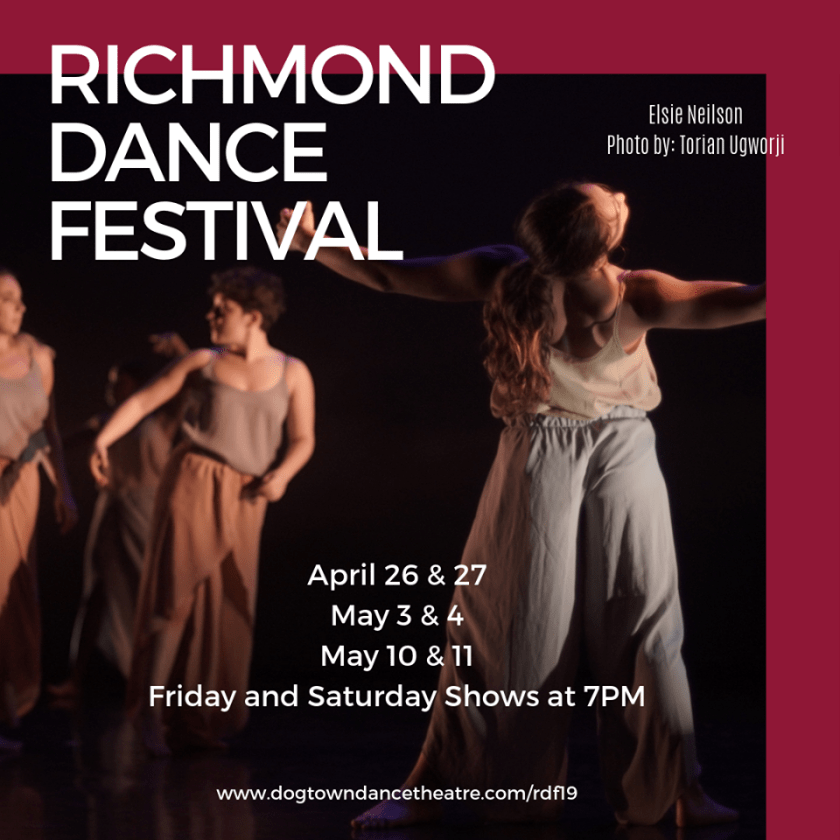
Performances: April 26-27, May 3-4 & May 10-11 @ 7PM + Next Generation May 4 @ 2:30PM

Ticket Prices: $20 General; $15 Students

Info: (804) 230-8780, dogtowndancetheatre.com or https://rdf2019.brownpapertickets.com/

I couldn’t attend the first weekend of the 6th Annual Richmond Dance Festival presented by Dogtown Dance Theatre. After seeing Weekend Two I feel even worse about missing the first weekend.

The program featured 8 dances and 3 dance films which showcased works by local choreographers (Len Foyle of Snap Soup Dance, Kara Robertson of Karar Dance Company, Boris Karabashev of RVA Salsa Bachata Foundation, LaWanda Raines of RVA Dance Collective, and Shannon Hester of Pole Pressure), and choreographers from the DMV region (Natalie Boegel; and Paul Emerson Gordon of Company | E,  and Robbie Priore of Prioredance, both of Washington, D.C.­). The dance films hailed from the USA and abroad (Holly Wilder, Wilton, CT; Mateo Galindo Torres, Toronto, Canada; and Maria Piva, London, England). It may look overwhelming when spelled out like this, but all 11 works were spaced out in a well-paced program that ran just a bit over two hours, including one intermission.

It was a diverse program, but I had several personal favorites. The film Weightless, directed by German Prieto with Mateo Galindo Torres and Falciony Patiño, and choreography by Torres and Patiño broke all the physical laws. After a while, I stopped trying to figure out which way was up, and whether the dancers were pushing off from or suspended over a wall, the ceiling, or the floor and disembodied body parts drifted into our field of vision or a dancer twisted impossibly on the back of his wrist while suspended seemingly in midair. This beautifully made film created a whole new dimension of movement.

Another film, The Field, by Holly Wilder movingly showed a woman freeing herself from the ties that bound her. Her Inner Monologue, The Past, her Body Image, and her Support System were literally and figuratively woven into her hair with yards of rope held by others who gave voice to the voices in her head, until, using a pair of golden shears, she cut herself free. With each cut, a voice was silenced, leaving her free – in a large field. This piece was so simple, yet so powerful, and ultimately so relatable.

Another piece I could relate to was LaWanda S. Raines’ precautionary tale, Inappropriate Miss. Six dancers, four of whom emerged from beneath a giant white billow, moved as they spoke words of caution that many young girls are taught: don’t tell all your business; don’t tell the truth; don’t talk to strangers; sit with your legs closed; and most of all, don’t try to save nobody! The trouble is, many of these cautions are inhibiting and Raines did an excellent job giving voice to the duality of growing up female. Even more poignantly, one of the dancers was her own 16-year-old daughter, and one was male.

The program also included Paul Gordon Emerson’s duet Entangled, set to Ella Fitzgerald’s Summertime. The lyrical duet included some of the heat of a tango, an effect that was enhanced by a touch of acoustic guitar. Natalie Boegel’s Loud Right was accompanied by the dancers making murmurs, clicks, and raspberries (you know, that thing you do with your tongue on babies’ tummies), graduating to screeches, claps, and even spanking. At one point, they ask, “Do you wanna hear the most annoying sound in the world?”

Len Foyle and Jonathan Starr had the duo in Just Who Are You to Tell Me So? approach the stage from behind the audience. Their simple movements of walking, skipping, and jumping were accented with gestures from a simple turn of the head to one dancer poking the other with her foot – all done with poker faces that made it feel less supernatural and just a tad humorous. The red splotches of Katy Pumphrey’s projections for Kara Robertson’s The In-Between reminded me of splatters of menstrual blood while the dancers’ actions of walking, running, gathering, watching and waiting took on classical lines, ending with a formal procession.

Perhaps most unusual or unexpected were RVA Salsa Bachata Foundation Team’s performance of I Want You Back, with three couples dancing to Tony Succar’s cover of the song of the same name, from album The Latin Tribute to Michael Jackson, and Schannon Hester’s Shore Leave, a beautifully athletic work performed on two poles.

Maria Piva’s film, Respira, featured four women wearing masks attached to long hoses, and the program closed with an excerpt from Robert J. Priore’s Casita, a contemporary dance using a folk dance vocabulary infused with humor and costumed in black lace.

So often, when there are this many works on a single program, they all start to run together, creating a blurry memory. Not so with this program; each work was distinct and memorable on its own terms, and each choreographer’s voice was unique and legible, if that word can be applied to choreography. This program runs one more time, Saturday, May 4 at 7:00pm, and there is a new program for the third and final weekend, May 10 & 11. Also, on Saturday, May 4 at 2:00 in the afternoon, more than 164 youth from RVA, Harrisonburg, and my hometown of Brooklyn will perform in the second annual Next Generation program. Dogtown Dance Theatre’s Artistic & Executive Director, Jess C. Burgess, believes Richmond has all it needs to be a “dance destination city.”


Julinda D. Lewis is a dancer, teacher, and writer who was born in Brooklyn, NY and now lives in Eastern Henrico County.

———-

Photo Credits: See individual photos.

RDF

RDF Snap Soup
Snap Soup Dance, Richmond
RDF Salsa Bachata Foundatiob
RVA Salsa Bachata Foundation Team, Richmond
RDF Karar Dance
Karar Dance Company, Richmond
RDF Maria Piva
Director: Maria Piva, London

RDF2

https://www.amazon.com/promocode/A1GM5M28L5YHPM?ref_=assoc_tag_ph_1524210971465&_encoding=UTF8&camp=1789&creative=9325&linkCode=pf4&tag=rvartreview-20&linkId=911d9d2e86b356432bd15a82a58f52e5

https://www.amazon.com/promocode/A2XUMUPM7LAAIK?ref_=assoc_tag_ph_1524210971461&_encoding=UTF8&camp=1789&creative=9325&linkCode=pf4&tag=rvartreview-20&linkId=97d9199716c2bd1f9a9299a1aa744808


17th ANNUAL MID-ATLANTIC CHOREOGRAPHERS SHOWCASE: Selected for Diversity

17th ANNUAL MID-ATLANTIC CHOREOGRAPHERS SHOWCASE

A Dance Review by Julinda D. Lewis

At: Grace Street Theater, 934 West Grace Street, RVA 23220

Performances: March 30 at 5:00 and 8:00 pm and March 31 at 2:00 pm

Ticket Prices: $15

Info: (804) 304-1523, www.showwclix.com, or www.starrfosterdance.org

For 17 years, Starr Foster has curated the Mid-Atlantic Choreographers Showcase of internationally recognized choreographers – and one university student.

This year’s program included works by Megan Payne (Charlotte, NC), Sadie Weinberg of LITVAK Dance (San Diego, CA), Mariah Eastman (a Seattle, WA native who graduated from the VCU Dance program), Zachary Frazee (Rochester, NY), Lauren Lambert (a University of Richmond senior majoring in Psychology with minors in Dance and Healthcare Studies), and Starr Foster (Richmond, VA).

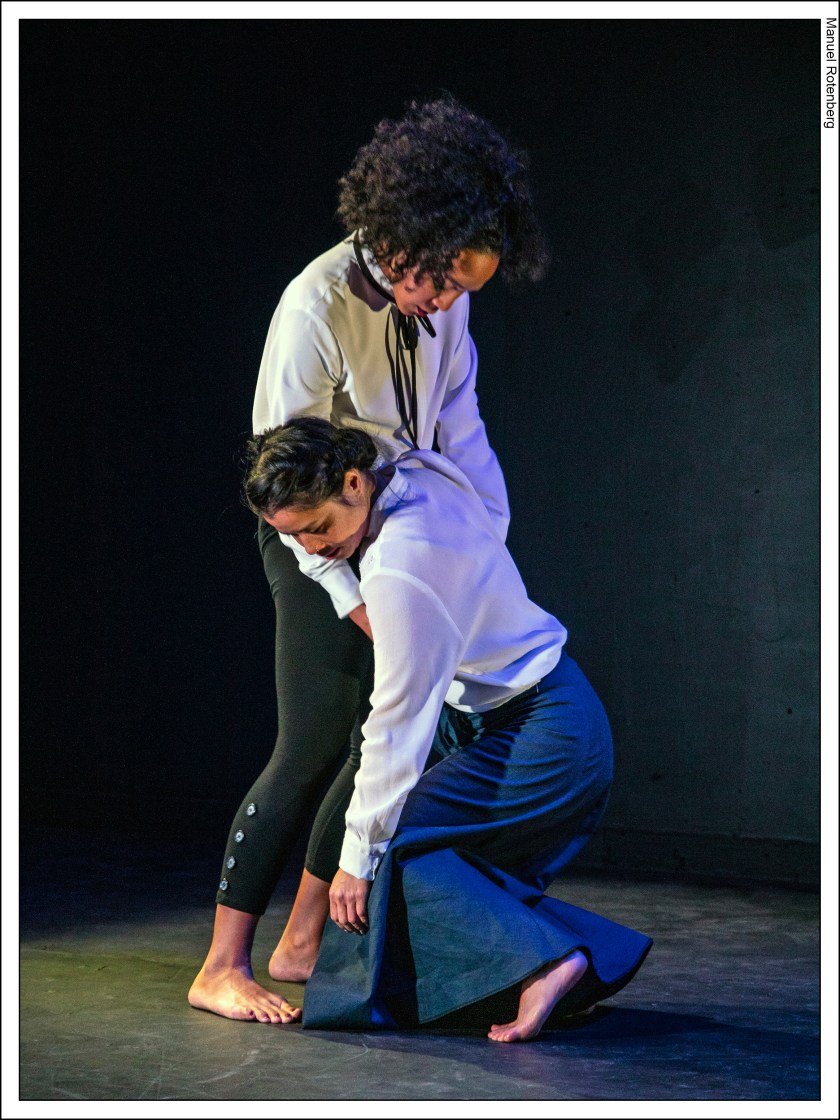
Payne was the only choreographer to have two works on the program with one of them a dance on film, “rib.” The title immediately made me think of biblical themes, of Eve, and the work, in fact, is an exploration of the female experience. Set in a dark, damp, windowless room, the trio is lit primarily by a single, bare bulb hanging from the ceiling. It reminds me of the light in an interrogation room on a television detective show. Rather than an outward focus on line and technique, the movement is internally focused and motivated. The dancers move as a group, suggesting the three women may be components of a whole – a sort of trinity – and the two most striking movements, for me, were when they faced a blank wall, searching it with their hands, and when one violently swung her hair.

Payne also presented a live work, “Bleached Dreams.” This duet is an exploration of how our bodies experience grief and seemed mysterious and somewhat alien as it began with the two women bent over, backsides to the audience – a position they held for quite some time. Much of the movement took place on the floor, such as a head-to-head crawl, with one dancer moving forward while the other moved backward – picture conjoined twins, with the dominant twin controlling the direction of travel. The lighting and sound contributed to the alienated, shadowy effect.

Speaking of lighting, Lauren Lambert’s work, “Eudaimonia,” described in a quote from Dr. Colin Zimbleman (likely one of the psychologists Lambert encountered in her major) as “a chance to glimpse an awe-filled vision of the world,” included some beautiful lighting effects – a “cyclorama lighting design concept” by Shanna Gerlach. Golden streaks occasionally flashed in the background, creating an other-worldly effect, and I liked the simplicity of the rotating circle of women moving as if supported by water, washed in a golden pool of light. “Eudaimonia,” by the way, translates from the Greek as happiness or prosperity.

I enjoyed the evocatively lit opening and period costumes of “considering the difference between stillness and waiting” by Sadie Weinberg and dancers of LITVAKdance. Inspired by Arthur Schnitzler’s controversial 1897 play, “La Ronde,” the duo moved through interesting partner variations – but without the sexually provocative nature of the work that inspired it. Mariah Eastman’s solo, “Efforts of Contemplation,” displayed a quiet intensity powered by detailed, articulated movement phrases, while Zachary Frazee’s “Remain in My Heart” had six dancers in primary colors transitioning through a variety of interactions. The satisfyingly diverse program closed with “Stray,” a work by Starr Foster which, despite its title, demonstrated the smooth, organic quality of Foster’s movement vocabulary and the mesmerizing mastery of her ensemble.

Julinda D. Lewis is a dancer, teacher, and writer who was born in Brooklyn, NY and now lives in Eastern Henrico County.

———-

Photo Credits: accompany each photo.

17th.Mariah Eastman_Kyle Netzeband Credit
Mariah Eastman. Photo by Kyle Netzeband.
17th-Frazee Feet Dance_Demian Spindler Credit
Frazee Feet Dance. Photo by Demian Spindler.
17th-Lauren Lambert_Eibhlin Villalta credit
Lauren Lambert. Photo by Eibhlin Villalta.
17th-LITVAKdance_Manuel Rotenberg
LITVAKdance. Photo by Manuel Rotenberg.
17th-Megan Payne
Megan Payne Dance. Photo by Taylor Jones.
17th-Starr Foster Dance_Doug Hayes Credit
Starr Foster Dance. Photo by Doug Hayes.


SHORTS 2019: Small Plays with Dance Make Big Impact

K DANCE PRESENTS SHORTS: Short Plays & Contemporary Dance

A Dance & Theater Review by Julinda D. Lewis

At: The Firehouse Theatre, 1609 W. Broad St, RVA 23220

Performances: March 28-30, 2019 at 7:30pm & March 30 at 4:00pm

Ticket Prices: $25 general; $15 for RAPT (RVA Theatre Alliance) & Students

Info: (804) 270-4944 or firehousetheatre.org

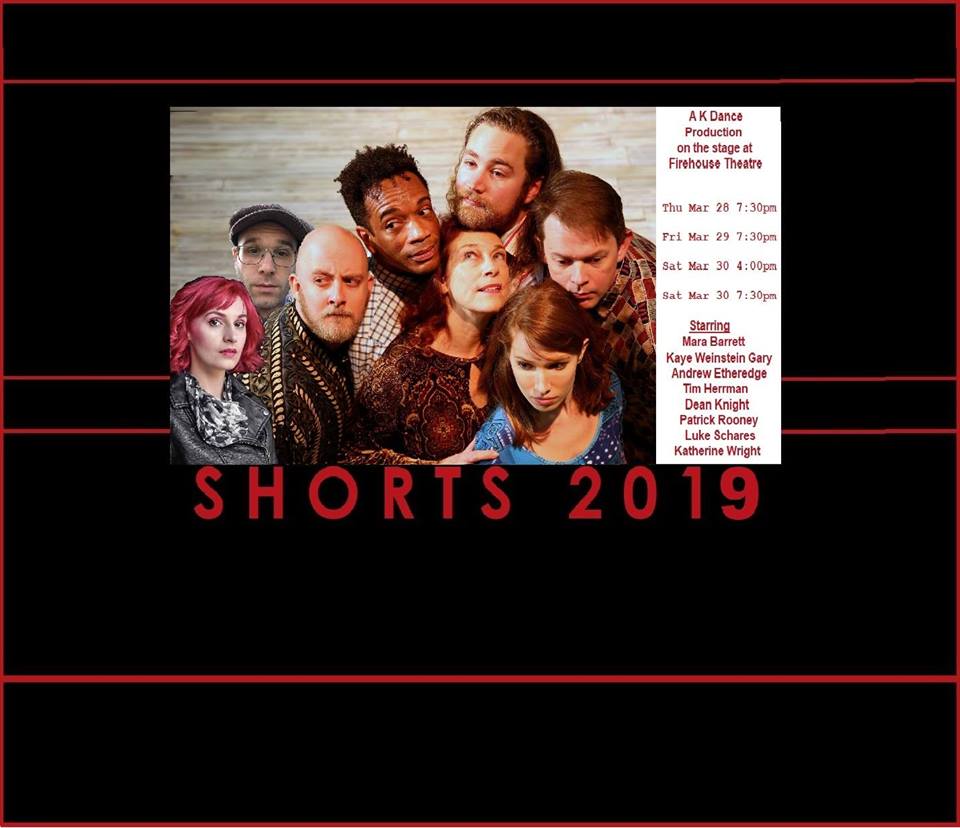
K Dance’s 2019 production of Shorts, five short plays interwoven with choreography by Kaye Weinstein Gary, challenged performers to express themselves through words and dance and treated the audience to a delightfully diverse evening of performances. Now in its seventh year, the Shorts brand appears to have been refined and enhanced in terms of timing (the program ran just under 90 minutes, including intermission), talent (there were some new faces and bodies onstage and off), and technical aspects (the lighting, sound design, and costuming seemed particularly creative).

Jacqueline Jones directed two of the small plays. “Chicks (Biology Etc. Day 3)” written by Grace McKeany featured Dean Knight as Miss Mary Margaret Phallon (I’m surprised he wasn’t Sister Mary Margaret) as a Kindergarten teacher giving life lessons on wholly inappropriate topics, such as sex and adult deception. The lesson relied on word play that resulted in double entendre and other age-inappropriate pronouncements. Knight, by the way, looked the part in what I’ll call light drag – a simple dress and conservative wig.

Jones also directed one of the more serious scenarios of the program. “Just Before the Drop” written by David-Matthew Barnes, featured Kaye Weinstein Gary and Andrew Etheridge in a weird and strangely touching story about a wife who first meets her husband’s male lover right after the husband has jumped to his death from the roof of a building. The encounter occurs on the roof top after the police and ambulance and nosy neighbors have left, and between the delicate steps of a deadly dance discuss which of them will keep their loved one’s shoes.

Luke Schares and Patrick Rooney contributed perhaps the funniest moments of evening as a pair of cockroach brothers who, along with a lone critic, were the only survivors of an apocalypse that apparently occurred in and around a struggling theater. Surrounded by trash and a gigantic candy bar wrapper, the two wore hilariously accurate cockroach costumes – complete with extra legs and arching antenna – designed by Kylie Clark. Reminiscent of the adults in “Peanuts” cartoons who are represented only be a saxophone sound, the critic was represented by a piggish grunt. (“They were not looking in your direction,” a friend reassured me after the show.) This humorous tale by Jacquelyn Reingold bears the improbable title of “Joe and Stew’s Theatre of Brotherly Love and Financial Success.”

But wait, there’s more. The lovely and lithe Mara Elizbeth Barrett and Tim Herrman warily negotiated the roles of a couple attempting to reunite after some sort of unspecified absence or separation. Andrew Etheredge directed the piece which effortlessly integrated contemporary dance movements into the fabric of the story and speaking of fabric, he also designed the actor/dancers’ patterned bodysuits. This was the one play that left me with unanswered questions. Why did they break up? Why did he come back? Without some background information or additional context, “In Transit,” written by Steve McMahon, was decidedly unfulfilling.

Thankfully, this was not the final play. That honor was saved for “The Closet,” by Aoise Stratford. “The Closet” gave us an inside look at abandoned toys. Etheredge, a gruff-voiced toy dinosaur named Bernard was the senior resident of the closet, along with Twinkles, a simple-minded and somewhat annoying “Tubby” toy names Twinkles, played by Katherine Wright with a vertical red pony tail. (You might want to Google “tubby toys” to get the full effect.) These two abandoned toys were joined by a reluctant Bart Sponge (Round Trousers), played by Dean Knight in a button down shirt and khaki shorts with suspenders. Like every good movie villain, he pleaded his innocence until Bernard/Etheredge pulled a confession out of him – thanks to his cigarette fueled gravelly voice, no doubt.

Even though Shorts is a dance theater experience, like most Richmond dance programs it has a short run (no pun intended) of just a few days, so if you’d like to see it – and I think you should – don’t hesitate but purchase your tickets and go – just do it!

Julinda D. Lewis is a dancer, teacher, and writer who was born in Brooklyn, NY and now lives in Eastern Henrico County.

———-

Photo Credits: Sarah Ferguson


RICHMOND BALLET STUDIO TWO: Looking Back, Looking Forward

Richmond Ballet Studio Two: The Moor’s Pavane & Figure in the Distance

A Dance Review by Julinda D. Lewis

At: The Richmond Ballet Studio Theatre, 407 E. Canal St., RVA 23219

Performances: March 26-31 @ 6:30pm Tuesday-Saturday; 8:30pm Friday & Saturday; 2:00pm & 4:00pm Sunday

Ticket Prices: Start at $25

Info: (804) 344-0906 x224 or etix.com

On Tuesday night Richmond Ballet’s artistic director, Stoner Winslett, reminisced on the theme “Looking Back, Looking Forward.” As an example of looking back, she gave us Ira White, once a “cute fourth grader” participating in the Minds in Motion outreach program at Mary Munford Elementary School. On Tuesday night, White danced the role of The Moor in José Limόn’s legendary ballet, “The Moor’s Pavane” choreographed in 1949. For looking forward, she brought us the Chicago-based choreographer Tom Mattingly and his new collaborative ballet, “Figure in the Distance,” based on a sketch he presented for the Richmond Ballet’s 2018 New Works Festival. Mattingly choreographed one of his early works for the Richmond Ballet trainees.

Mexican-born José Limόn (1908-1972) remains one of my favorite choreographers of all time, and “The Moor’s Pavane: Variations on the Theme of Othello” is probably his most well-known work. Set to music by Henry Purcell, the stately framework of the pavane – a courtly dance – contains and restrains the passion of the tragedy of Othello. On Tuesday The Moor was danced by Ira White, His Friend/Iago was Trevor Davis, Iago’s Wife was Lauren Archer, and The Moor’s Wife/Desdemona was danced by Sabrina Holland. On alternate programs, the roles are filled by Fernando Sabino, Matthew Frain, Maggie Small, and Cody Beaton. “Follow the hanky,” Winslett advised; that is the secret to uncovering the deception that results in Desdemona’s unfortunate death.

This is one ballet that does not set the women on pedestals. As the quartet moves through the figures of the pavane, they maintain a distant, courtly demeanor, but we see the women grasped tightly by an upper arm, pushed or pulled, and ultimately the Moor’s wife is killed. White and Davis were often at odds, sometimes even combative. Archer and Holland were treated like trophy wives, commodities more than true loves. The rich – and most likely heavy – costumes are constructed after the original design by Pauline Lawrence, with full, layered skirts for the women with puffy, detached sleeves (showing lots of bare shoulder), and princely robes or tunics for the men.

But even with all its historic status, “The Moor’s Pavane” was not the highlight of the evening. Rather, that honor goes to Tom Mattingly’s “Figure in the Distance,” a work inspired by the artwork of Taylor A. Moore – work Mattingly first encountered on Instagram. An even dozen dancers move through a succession of phrases and configurations. Some of the group phrases brought me to the edge of my seat, including a line of dancers that rippled from front to back, and a moment when the men lifted the women straight up in front of them, one by one. I was also intrigued by a couple walking offstage: the woman walking backwards while her partner mirrored her, walking forward. There was just something somewhat frightening or menacing about that, in contrast to another pair of dancers who shared a gentle caress. There was such a range of emotions, all backed by a series of paintings by Taylor A. Moore. First there was a blue painting of what appeared to be a lake with faint figures in the background. Most striking was a red painting with bold strokes that suggested both a forest and figures hidden in the trees. Another had the shape of a cat’s eye, but the slit of the eye could have been the opening to a cave, and a final had only faint brush strokes except on the far right where there was a large. . .limb? But all the bold, unidentifiable brush strokes could be interpreted as figures, hence, “Figure in the Distance.”

Emily Morgan designed the dark red body suits worn by both the men and the women. The fabric was richly yet subtly patterned, with sheer sleeves and back panels so that, at first glance, it seemed one dancer had a tattoo on her shoulder, and then I noticed more shapes and colors. It turns out that Morgan hand painted sections of the fabric to coordinate with the paintings. The work was set to the multi-layered music of Philip Glass: “Violin Concerto No. 1,” “Piano Etude No. 2” and “String Quartet No. 2” (also known as “Company”), and “Primacy of a Number.”

The lighting was designed by Catherine Girardi who has worked as assistant lighting designer for the Ballet’s “Nutcracker” performances. This was her first original design on her own for the Richmond Ballet.

What made this a collaboration more so than many other ballets is the communication that occurred between the artists (choreographer, painter, costumer designer and lighting designer) during the creative process. Mattingly was given three works to work with the company. Mattingly’s impetus was Moore’s paintings and Morgan had to dress the moving bodies in garments whose brush strokes would reflect the paintings at appropriate times, with Girardi’s lighting. All worked together to suggest what Mattingly conceived of as “an idealized version of yourself,” making the audience, in a sense, collaborators after the fact. “Figure in the Distance” is a beautiful work that is highly satisfying on many sensory levels.

Julinda D. Lewis is a dancer, teacher, and writer who was born in Brooklyn, NY and now lives in Eastern Henrico County.

———-

Photo Credits: Photos to follow.

studio-two-web-slider

This slideshow requires JavaScript.

//ws-na.amazon-adsystem.com/widgets/q?ServiceVersion=20070822&OneJS=1&Operation=GetAdHtml&MarketPlace=US&source=ac&ref=tf_til&ad_type=product_link&tracking_id=rvartreview-20&marketplace=amazon&region=US&placement=B00LH3DMUO&asins=B00LH3DMUO&linkId=cd73c62518534f775ac8b3c914e0de60&show_border=false&link_opens_in_new_window=false&price_color=333333&title_color=0066c0&bg_color=ffffff


//ws-na.amazon-adsystem.com/widgets/q?ServiceVersion=20070822&OneJS=1&Operation=GetAdHtml&MarketPlace=US&source=ac&ref=tf_til&ad_type=product_link&tracking_id=rvartreview-20&marketplace=amazon&region=US&placement=B01415QHYW&asins=B01415QHYW&linkId=a6d75822968263d794f0dc9b51d0fe5a&show_border=false&link_opens_in_new_window=false&price_color=333333&title_color=0066c0&bg_color=ffffff

CONCERT BALLET OF VIRGINIA: It’s a Circus Out There

CONCERT BALLET OF VIRGINIA:  43rd Annual Winter Repertory Gala

A Dance Review & Some Random Thoughts by Julinda D. Lewis

At: The Woman’s Club Auditorium, 211 East Franklin St., RVA 23219

Performances: February 8 – March 3, 2019

Ticket Prices: $18 for adults; $15 for seniors and students (with valid ID); and $12 for children

Info: (804) 798-0945 or www.concertballet.com

It has been awhile – at least two years, maybe three – since I’ve seen a performance by the Concert Ballet of Virginia. This company, which describes itself a “collection of unsalaried Virginians. . .operating within the framework of a full-scale professional dance company” occupies a unique position. Based on a mission to reach large, diverse audiences, the performing company itself is a form of outreach, offering performing opportunities to many who want to experience ballet without the commitment of a full-time professional career. Many performances take place in schools, bringing storybook ballets and dance exploration to students of all levels.

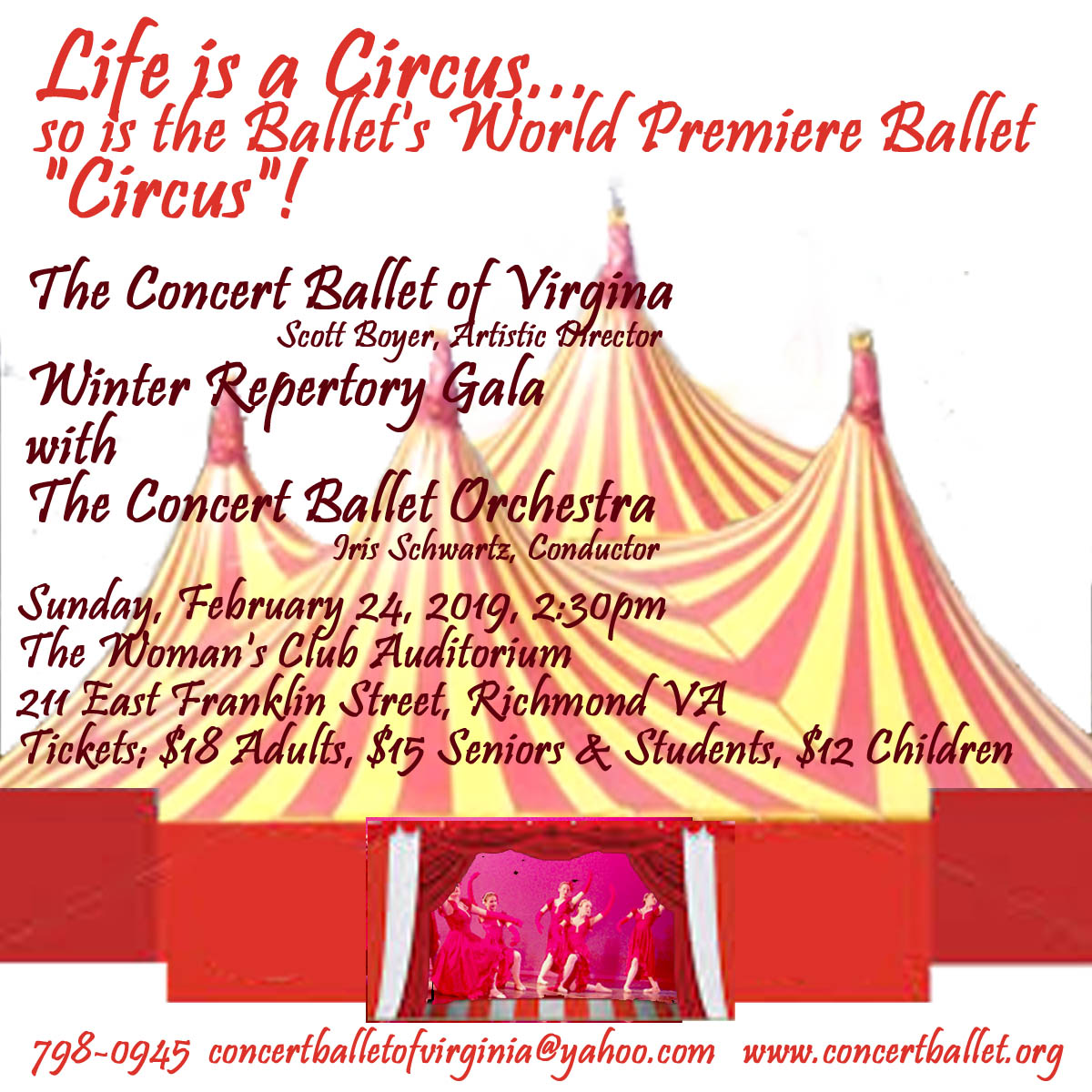
The company also offers two annual gala programs at The Woman’s Club Auditorium on East Franklin St. The recent 43rd Annual Winter Gala, held February 24, included live music by The Concert Ballet Orchestra and two new works, The Banks of Green Willow, choreographed by Concert Ballet dancers Allie Davis and Will Taylor and Circus, a collaborative story ballet created by three Concert Ballet dancers – Toni Lathan, Allie Davis, and Valerie Shcherbakova –to Norman Dello Joio’s “Satiric Dances.”

The Banks of Green Willow, set to music arranged by Richard Schwartz (Symphonic Winds and The Concert Ballet Orchestra), tells the story of an elegant couple in evening dress returning home through a park after enjoying an evening at the ballet. The rich black and green costumes work well with what appears to be a Victorian-era set, featuring gas lamps and a park bench. Concert Ballet dancers Allie Davis and Will Taylor choreographed the piece, keeping the choreography sweet, uncomplicated, and effective for the scene they created.

Circus is a colorful finale piece that includes dancers of all ages and abilities. There are acrobats and tumblers, a snake charmer, tigers, monkeys, a strong man, and more, all under the big top. Company director Scott Boyer takes on the role of an evil Magician, who appears to be vying with the troupe’s Snake Charmer for the affections of the circus’ Tightrope Walker – who looks like the ballerina atop a classic music box.

The program also included works from the Concert Ballet repertory, including an East Indian inspired Sleeping Beauty ballet, Naila, for the junior dancers with stylized movements, a very red-themed and festive Fledermaus, choreographed by Scott Boyer to music by Johann Strauss, and a revival of the company’s “Emperor Waltz.” If I am economical with details, it is because the programs were mis-printed, and The Concert Ballet Orchestra conductor, Iris Schwartz, announced the music and dance selections – without benefit of a microphone.

One thing this company does very well is backdrops and sets. The Fledermaus set included three gigantic chandeliers against the all-red backdrop; The Emperor Waltz featured Greek goddess dresses with Grecian pillars and candelabra – some with real lights – and Naila had some very pretty Alladin-esque costumes.

Another thing they do well is provide live music. Between dances, the orchestra offered a variety of selections from patriotic marches to Gilbert and Sullivan to Big Band.

At the Woman’s Club, there are a couple dozen tables where audience members can sit cabaret-style and order desserts and coffee prior to the start of the program, and during intermission. Most of the audience members appeared to be family and friends of the performers. The program is family friendly, and there were many toddlers in attendance – most of whom were surprisingly attentive! At least one dad ignored the pre-show announcement not to take photographs or make video recordings, and no one seemed to mind.

I chatted with a young woman seated near me – we weren’t seated at a table but sat on chairs in two rows at the rear of the room.  (There were also seats in the balcony – the program was well attended. It was, in fact, a full house.) She didn’t have family or friends in the cast but had seen the program listed on Facebook and decided to come as she’s trying to sample more of the culture that Richmond has to offer. While I enjoyed the music and admired the sets and costumes, I had some major private thoughts about the caliber of the dancing: flexed feet; uneven lines; unsteady balances; dancers looking at other dancers for cues, and more. But my companion for the day had no such reservations and indicated that she plans to come to the next performance as well. I think that is just the sort of outreach education The Concert Ballet of Virginia aims for. Some of the characteristics I consider signs of professionalism might be deterrents to someone who is new to dance, or who wants to be entertained, but not. . .challenged. Perhaps she will come again. Perhaps she will also want to sample some of the contemporary dance and other local offerings. Did I witness the birth of a new audience member – a potential patron of the arts? I hope I see her again.

Julinda D. Lewis is a dancer, teacher, and writer who was born in Brooklyn, NY and now lives in Eastern Henrico County.

———-

Photo Credits: There were no photographs available at the time of publication.

Concert Ballet