VICTOR, THE TRUE SPIRIT OF LOVE: Love, Light, and Faith; the Healing Power of Dance

The Latin Ballet of Virginia: VICTOR, THE TRUE SPIRIT OF LOVE

A Dance Review by Julinda D. Lewis

At: The Grace Street Theater, 934 West Grace Street, RVA 23220

Performance: September 7-9, at 7:30 p.m. Friday, Sept. 7, 4 p.m. and 7:30 p.m. Saturday, Sept. 8, and 4 p.m. Sunday, Sept. 9.

Ticket Prices: $10-$20

Info: (804) 828-2020 or http://www.latinballet.com

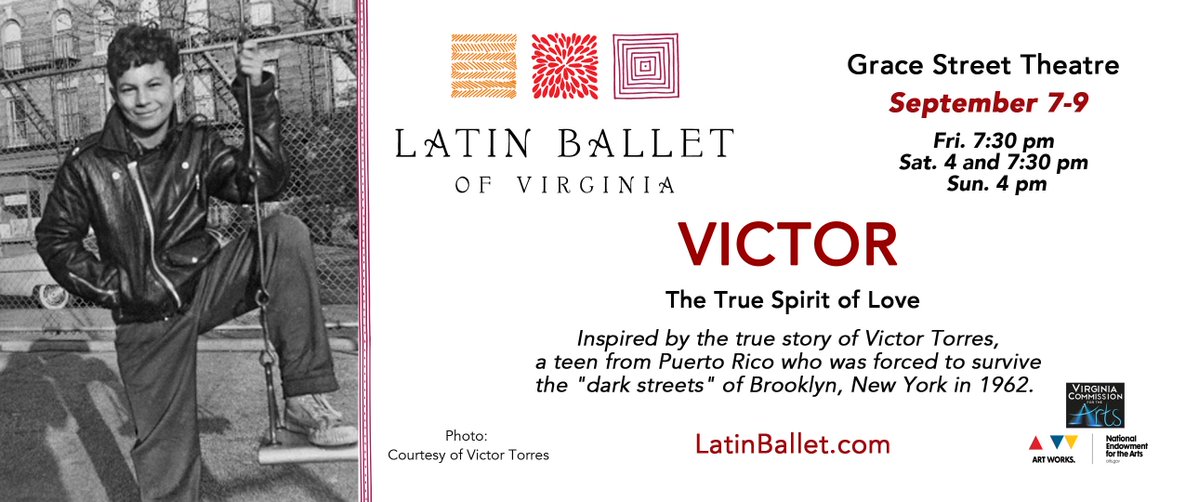
I’ve seen many performances by the Latin Ballet of Virginia (LBV) over the years. Some have been fiction, some fantasy, and others, like, Victor: the True Spirit of Love, are based on fact. But this one was different. This one touched my heart and had me weeping unashamedly in my seat.

Unlike many LBV programs, this one did not have elaborate scenery, although there were larger-than-life projections of photographs from Victor Torres’ life, scenes from the documentary about his life, and background photos of buildings and cars and alleyways representing Brooklyn, NY in the 1960s. These projections were often so well integrated into the live performance that they became part of the choreography.

Rather than a range of choreography representing the Latino music and dance, heritage, and history, there were poignant selections ranging from R&B to Mambo to Christian songs and instrumental music. Some were upbeat, but all seemed carefully chosen to help carry the emotion and narrative of the story, using movement and music and very few words – so when words are used they have the utmost impact.

Victor tells the story of Victor Torres, a former gang member and drug addict and current pastor of the New Life for Youth Ministries and New Life Outreach Church, right here in Richmond, VA. But more than that, Victor is a story of redemption, of hope, of people helping people. It is a story of victory. It is about finding God, but it is not about religion. It is about faith, but it does not preach. It is about the power of a mother’s love.

It’s not so much the choreography, which is sometimes powerful but mostly quite simple. It is not so much the dancers’ technique, which is sometimes quite stunning, but sometimes uneven – involving, as it always does, both professional and pre-professional dancers and children. But the collaboration of all the elements, culminating in the surprising appearance of three graduates of Pastor Torres’ program as their recorded images and voices give testimony of their dark past and hopeful present – and shines light on their future. This is dance with a purpose that is more than just entertainment. It tells a story. It offers the possibility of healing.

Pastor Torres came onstage after Saturday evening’s performance to take questions, and to offer congratulations to the performers. Roberto Whitaker danced the role of the young Torres – bringing the man himself to tears, by his own admission. Whitaker, who I have watched grow from a promising young hip hop dancer to a versatile professional, led the company, appearing in nearly all of the twelve scenes, from a hip hop and capoeira infused fight (“The Roman Lords”) to a 1960s style jitterbug (“Rock & Roll with My Mama”) to acted and pantomimed scenes of overdosing and recovery and a lyrical dance duet of faith with his savior. Artistic director Ana Ines King danced the role of Victor’s mother, Layla, and with her usual enthusiasm moved from mambo (“It is Mambo Time!”) through ballet, modern, and lyrical (“The Power of Mother’s Love” and “La Esperanza/Our Only Hope”), with an extra dose of drama (going into her prayer closet, and running to the rooftop to save her beloved son from being tossed off by gang members).

Teri Buschman and Marisol Cristina Betancourt Sotolongo made beautiful angels, while DeShon Rollins wore white as the spirit of hope and the saving grace of love. The scenes featuring four of the company’s men were powerful and beautiful, whether they were fighting or creating a smoke-filled, surrealistic scene of drug-fueled gang activity. This production would be a valuable contribution to the programs of churches, community centers, and youth agencies. I’ll just close with the words of the final selection, “Si Dios ama a un rebelde como yo, todo es possible/if God can love a rebel like me, anything is possible.”

Julinda D. Lewis is a dancer, teacher, and writer who was born in Brooklyn, NY and now lives in Eastern Henrico County.

Photo Credit: Jay Paul

Video Link: Victor, motion picture, official trailer: https://youtu.be/m9ub4w-DJVg

Video Link: One More Life, the Victor Torres Story, full documentary: https://youtu.be/i2UlLWJQFZY

This slideshow requires JavaScript.


BOEING BOEING: CAT’s 55th Season Opens with a French Farce

BOEING BOEING: Who’s Behind Door Number 2?

A Theater Review by Julinda D. Lewis

At: CAT Theatre, 419 No. Wilkinson Rd., RVA 23227

Performances: September 7-22, 2018

Ticket Prices: $23 Adults; $18 RVATA Members; $13 Students

Info: (804) 804-262-9760 or cat@cattheatre.com


  • Desperate times call for laughter. This was my second night in a row attending a comedy (see my discussion of Invalid at The Firehouse Theatre, September 6, 2018).
  • In addition, after 54 years of producing theater in Richmond, CAT Theatre announced barely a month ago that they would be going dark after this show. They had not been being able to secure a lease for the space they’ve been renting long-term. Just hours before the opening night curtain of what would have been their final show, it was announced that the matter has been resolved. The company will be staying at the No. Wilkinson Road space they rent from the Northern Henrico Civic Association for the remainder of this season and possibly into the future. In a press release from the Virginia Repertory Theatre, CAT Board President Kelly St. Clair stated, in part, “We have every expectation that this will be a long term fix to our short term challenges,” and added, “Plans call for CAT’s productions to continue in place for many years to come.”

———————————-

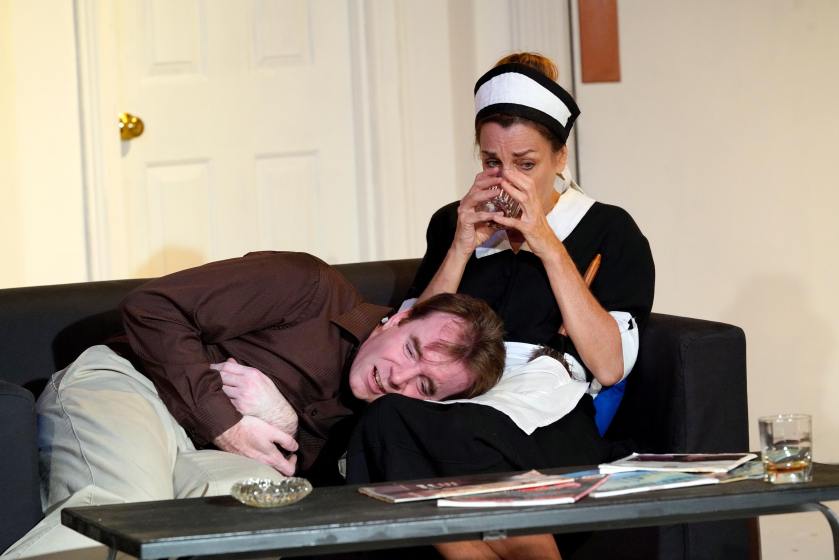
Boeing Boeing is a 1960 French farce, written by Marc Camoletti and translated into English by Beverley Cross and Francis Evans. I first (and last) saw it at Hanover Tavern in 2011. A fast-paced romp that depends on physical comedy, slamming doors, and perfect timing, the three-act play drew barrels of laughter from the opening night audience, but dragged noticeably during the third act, which comes after the intermission.


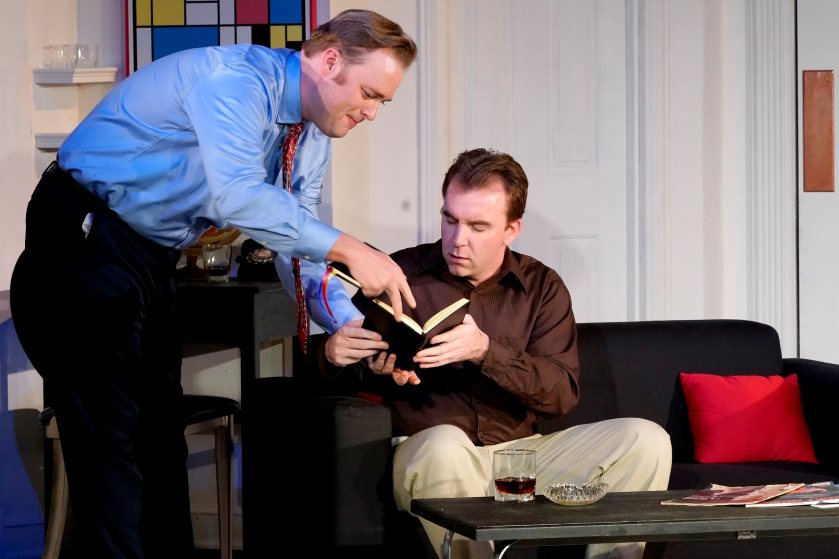
The plot revolves around Bernard (Brent Deekins), a Paris-based American architect who spends most of his time juggling his three fiancées. Yes, three. Each is an airline hostess with a different airline. Gloria (Rylee Daniels) is American, Gabriella (Marcia Cunning) is Italian, and Gretchen (Paige Reisenfeld) is German. Each is distinguished by the color of her airline uniform, red, blue, or yellow. Bernard has a French maid, Berthe (Sara Sommers) who spends more time bemoaning her fate as a servant and her role in helping Bernard keep his airline schedules straight than actually cooking and cleaning. Berthe changes the sofa cushions to match the uniform of each fiancée. The cast is rounded out by Bernard’s old school friend Robert (Travis Williams) who drops by for an unexpected visit just hours before the airlines change their schedules resulting in the obligatory comedy of errors.


Pat Walker’s bright and serviceable set included seven doors, most of which were thrust open and slammed with regularity during the two and one half hours or so running time, but there were few clues to indicate that this was set in Paris, or near Orly airport, or in the 1960s. It did seem odd that the front door opened into the hallway, as outer doors traditionally open into the house or apartment. Another oddity is that, at the end, Travis Williams took the stage last for the final bow, rather than Brent Deekins, suggesting that Robert was the star rather than Bernard. Hmm.


There’s a lot of shouting and loud cross talking, which makes it unlikely that anyone in one room would not have heard what was going on in the other rooms – but the nature of a farce often requires the audience to willingly relinquish any remaining remnant of reality. I thought Reisenfeld had the best handle on her character, striking a good balance between physical comedy, emotional swings, and comedic timing. Cunning’s character was, ironically a bit too trusting, but Daniels’ character was too cold and calculating, and while that artistic decision suited the final scene, it made her less likeable overall. I thoroughly enjoyed Sommer’s portrayal of the salty maid, but I found the men’s characters were painted broad and flat, making them appear to be flat and cartoonish. The result was that their loud outbursts of laughter and increasingly ineffectual attempts at subterfuge seemed more forced than farce. Glenn Abernathy, who directed, is a recent graduate of Christopher Newport University’s theater department, and this is his first time directing in the Richmond community.


There is much to enjoy about Boeing Boeing, and when I did laugh – which was frequently – I was laughing with the characters as well as at their antics, but things speed towards an inevitable conclusion that is not what one would expect. As in real life, people often don’t get what they deserve. Go, enjoy, be entertained. There really isn’t anything deep or serious hiding here.


Julinda D. Lewis is a dancer, teacher, and writer who was born in Brooklyn, NY and now lives in Eastern Henrico County.

———-

Photo Credits: Jeremy Bustin Photography

Boeing-4
Paige Reisenfeld and Travis Williams. Brent Deekins and Marcia Cunning.
Boeing-3
Sara ommer and Paige Reisenfeld
Boeing-2
Travis Williams and Sara Sommers
Boeing-1
Brent Deekins and Travis Williams

INVALID: When What Ails You Hits the Fan

INVALID: Modern Adaptation of a Classic Comedy

A Theater Review by Julinda D. Lewis

At: The Firehouse Theatre, 1609 W. Broad Street, RVA 23220

Performances: August 30 – September 29, 2018, Thu-Sat @ 7:30pm; Sun @ 4:00pm [check the website for specific dates as the days vary each week]

Ticket Prices: $15 – $35;

Info: (804) 355-2001 or info@firehousetheatre.org


If silliness and slapstick are your schtick, Josh Chenard and Jane Mattingly’s modern adaptation of Moliere’s The Imaginary Invalid (aka The Hypochondriac) is right up your alley. If not, the Firehouse production of Invalid is still worth seeing, for a number of reasons.

First, there is Chris Raintree’s set. Simple, yet elegant, the tiled floor and single wall remind you of those perspective rooms in the children’s museums – you know, the ones that make you look very tall or very short, depending on which side you stand. The set also includes a quartet of beautiful metal chairs – ornate barstools, really – for which Blair Rath is given a credit in the program as “chair fabricator.” They really don’t have anything to do with either the 19th century in which the play is set, the 17th century, in which the original version premiered, or today, but they are quite lovely, if a bit uncomfortable without the addition some plush cushions.

The pre-show curtain talk includes some discussion about the pronunciation of the title, whether it should be IN-va-led (i.e., unwell) or in-VAL-ed (i.e., null and void). It is, of course, open to interpretation. The main character, Argan (Andrew Firda), is, after all, a hypochondriac, but the modern references to universal healthcare and politics – there’s even a reference to the Artsies nominations – make the second definition just as, well, valid. And, to get the audience warmed up, everyone passes through a team of medical professionals on the way to their seats and gets treated to a taste of “laugh yoga” by Slash Coleman. Don’t forget to fill your prescription at the bar and get your bill on the way out! Yes, there is a lot going on here.

Moliere’s three-act farce has been adapted as a two-act comedy, with many modern references, but it retains most of the original characters and plot.  Argan, a wealthy hypochondriac, plots to marry his daughter Angelica (played with delightful gusto by Allison Paige Gilman) to Thomas Diaforus (Kenneth W. Putnam), the inept son of his physician, Dr. Diaforus (Christopher Dunn). But Angelica is in love with Cleante (Jamar Jones) and enlists the help of her father’s sassy maid, Toinette (Donna Marie Miller) to thwart her father’s plans as well as protect her inheritance from her scheming stepmother, Beline (played by Kirk Morton in elegant drag). And if no one else has mentioned it, I will: the hesitation over the unannounced appearance of Cleante took on a whole new dimension given that Jones is, shall we say, “not white.”

There ensues a comedy of error with much slamming of doors (even though there are only two actual doors) and people hiding in plain sight or behind silly masks that disguise nothing.

It’s all done in good fun, and rhyming couplets. The play retains a deliberately inserted unnecessary musical number, a hilariously bad operetta, countless fart jokes, a messy enema scene that requires the assistance of a stagehand and some plastic ponchos (I thought I could actually smell the. . .never mind), and the voice of Mel Brooks as God. And yes, Brooks gets a credit in the program, too. (This is a program that deserves to be read.)

Miller is delightfully over the top as Toinette. I enjoyed Firda as Argan and Gilman as his daughter, Angelica. Dunn brought a slightly sinister edge to Dr. Diaforus, and Putnam was hilarious as Thomas (with the accent on the second syllable), providing the best physical comedy of the evening. Morton’s portrayal of Beline was divine, and Jones’s constant correction of everyone’s mispronunciation of his name may or may not have been a sly reference to the difficulty many people have with some “black sounding” names. Hmm. Race. Gender. Politics. Class. Misogyny. Did anyone or any issue get overlooked?

There’s a lot going on, and the laughs flowed steadily throughout the evening – which runs just under two hours, including an intermission. Chenard’s well-paced direction reflects not just an eye and an ear, but a heart for comedy. But for all the effort and effects and interaction, at the end, I felt maybe they tried too hard, maybe there was a bit too much hype, maybe they raised our expectations too high. It was a delightful evening, but I somehow expected just a little more.


Julinda D. Lewis is a dancer, teacher, and writer who was born in Brooklyn, NY and now lives in Eastern Henrico County.

———-

Photo Credits: Bill Sigafoos


This slideshow requires JavaScript.


SONDHEIM ON SONDHEIM: A Musical Revue Featuring Stephen Sondheim Himself

SONDHEIM ON SONDHEIM: A Musical Love Fest

A Theater Review by Julinda D. Lewis

Richmond Triangle Players

At: The Robert B Moss Theatre, 1300 Altamont Avenue, RVA 23230

Performances: August 8 – September 1, 2018

Ticket Prices: $10-30

Info: (804) 346-8113 or rtriangle.org


I generally get to new shows during the first week, but Sondheim on Sondheim opened while I was away on our annual family vacation, and shortly after returning I went into the hospital for a knee replacement. Much to my surprise, I had no pain after surgery, so I found myself tiptoeing into RTP with crutches in the middle of a rainstorm on closing night. I am SO glad I got a chance to see this show.

The night I attended was also a popular night for many industry professionals, at least one of whom wept openly during a particularly touching number. Sondheim on Sondheim (with music and lyrics by Stephen Sondheim, conceived and directed on Broadway by James Lapine) is not at all what I expected from a musical – but it is what I have come to expect from Richmond Triangle Players, which is not above bringing even a reviewer to tears on occasion.

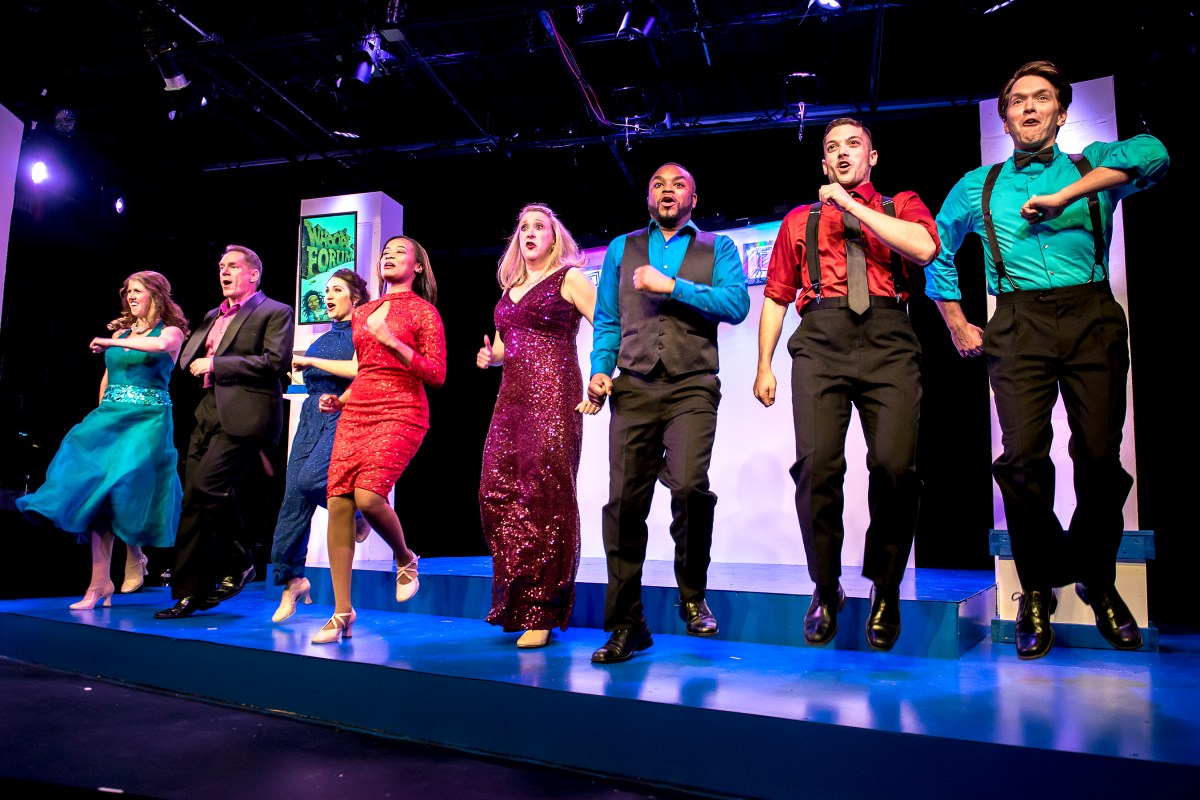
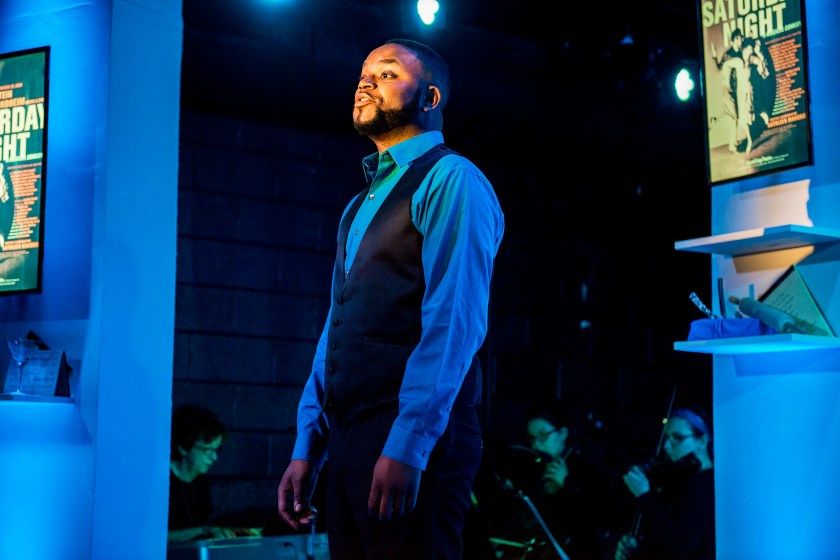
This autobiographical musical features about 40 – yes FORTY – musical numbers, and a stellar cast of eight, each of whom had a chance to shine in at least one song. Frank Foster’s set reminded me of a museum exhibit, with its three slim columns, each holding a memento of Stephen Sondheim’s life and career, some notes, and a light. There were posters from Sondheim’s many productions, and a screen where we got to see and hear the man himself talk about his work and share heartbreaking memories of his childhood. Talk about dysfunctional! Now that it’s over, it won’t be spoiler to say that his mother once sent him a note telling him that her only regret in life was giving birth to him!

While I cannot say that I love every song or even every play he ever worked on (and no, I have not seen all of them), I can honestly say that I am so glad he overcame the seemingly impossible obstacles in his life to leave us with a legacy of musical theater that includes a range of such diverse works that have earned him 8 Tony awards, 8 Grammy awards, a Pulitzer Prize, a Laurence Olivier award, and a Presidential Medal of Freedom. As a composer and lyricist, who is NOT known for hummable tunes, he left his mark on West Side Story, Gypsy, A Funny Thing Happened on the Way to the Forum, Company, Follies, A Little Night Music, Sweeney Todd, Merrily WE Roll Along, Sunday in the Park with George, Into the Woods, Assassins, and many others.

Standouts of the evening included Durron Tyre singing Being Alive and Susan Sanford’s rendition of Send in the Clowns. Then there was Alona Metcalf (Do I Hear a Waltz) and Dan Cimo, Matt Polson, and Rachel Rose Gilmour (Franklin Shepard, Inc.), and the entire company, including Mariah Mazyck, and Scott Melton) in Weekend in the Country, Sunday, and the finale Company – Old Friends and Anyone Can Whistle.

I call it a love fest not only because the audience was so vocal in its enthusiasm and praise, but also because the entire cast seemed to so thoroughly enjoy this often challenging work. In addition to Sondheim’s pitiful family life, we also learned of his life-saving friendship with Oscar Hammerstein and his family and heard his thoughts on his life’s work. Assassins came closest to meeting the writers’ vision, and Sunday in the Park with George was the closest to his own heart, while he didn’t much care for Do I Hear a Waltz.

With direction and vocal coaching by Doug Schneider, and musical direction by Kim Fox (I think she said there are several books and more than 400 pages of music!), all the elements just seemed to come together flawlessly. Sheila Ross designed the costumes, Michael Jarett did the lighting and projections, with video by Peter Flaherty, sound design by Joey Luck, and choreography by Emily Dandridge. What a delightful start to this theater’s 26th season!


Julinda D. Lewis is a dancer, teacher, and writer who was born in Brooklyn, NY and now lives in Eastern Henrico County.

———-

Photo Credits: John MacLellan

SONDHEIM_0187
Durron Tyre singing “Being Alive”
SONDHEIM_0130
L-R: Alona Metcalf, Scott Melton, Rachel Rose Gilmour, Marian Mazyck, Susan Sanford, Durron Tyre, Dan Cimo, Matt Polson. The cast of “Sondheim on Sondheim”
SONDHEIM_0268
Rachel Rose Gilmour

CRIMES OF THE HEART: A Southern Sister Reunion

CRIMES OF THE HEART: Tales of Southern Sisterhood

A Theater Review by Julinda D. Lewis

VirginiaRep

At: Hanover Tavern, 13181 Hanover Courthouse Road, Hanover, VA 23069

Performances: July 20 – August 26, 2018

Ticket Prices: $42

Info: (804) 282-2620 or va-rep.org

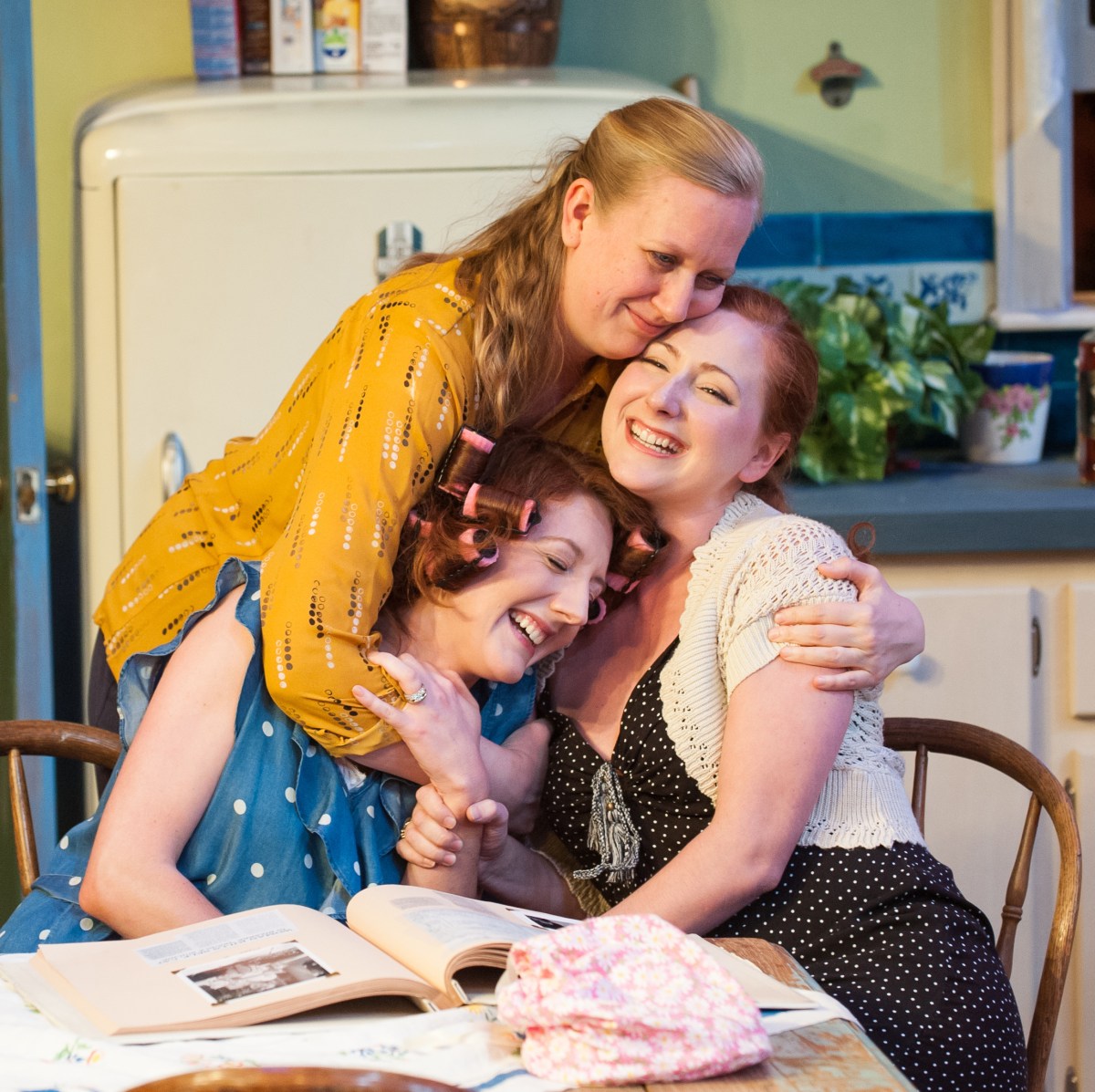
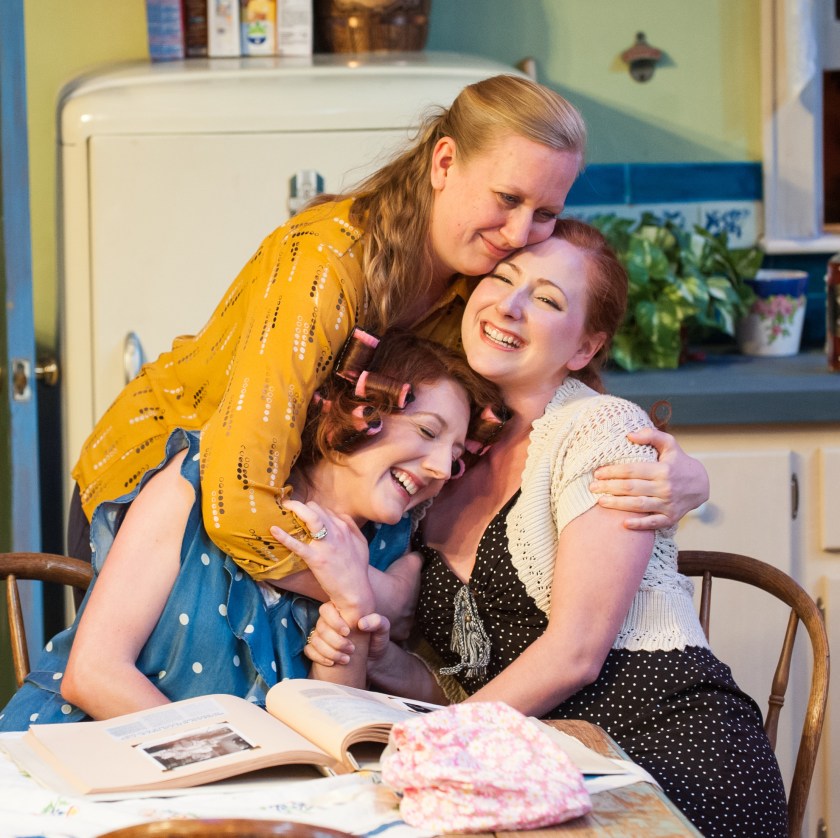
The final show of the 2017-2018 season,  Beth Henley’s Pulitzer Prize-winning three-act southern tragicomedy, boasts outstanding performances by three highly individual women and a beautifully designed and detailed set created by Terrie Powers. It also has near flawless direction by Steve Perigard (who also directed Da and Brighton Beach for this same stage – “near flawless” because, with three acts, it does seem to get lulled into a light sleepy southern languor about halfway through.

There was a time when I would, if given a chance, watch daytime talk shows because the dysfunctional guests made me feel so much better about my own life. To some extent, the quirky Magrath sisters make me feel the same way about my own family. Irene Kuykendall deftly navigates the surprising complexities of Meg, the black sheep of the family, gradually revealing that she is not a complete narcissist, but has hopes and dashed dreams, and holds a deep and abiding love with her two sisters. She’s also the middle child.

Lexi Langs, who last appeared in a VaRep performance ins 2007, is fascinating as the youngest sister, Babe or Rebecca. Physically enchanting with her wide eyes and sometimes vacant stare, we first meet Babe when she returns to Old Grandad’s home after being released from jail where she spent the night after shooting her husband in the stomach. Langs gives Babe a childlike quality that is unnerving; we are never quite sure if Babe has a true mental illness or just an advanced case of “the vapors.”

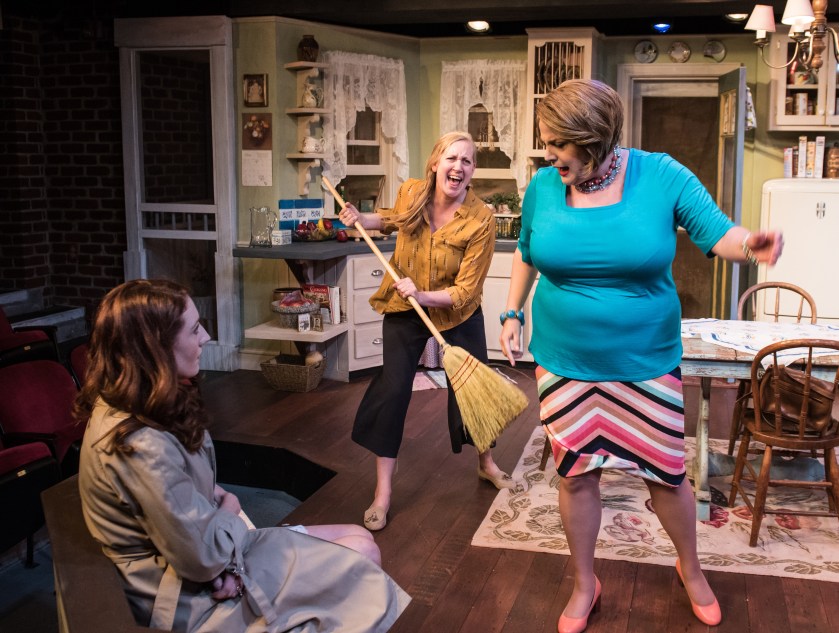
But the true star of this ensemble is Maggie Roop who shoulders the burdens of the family upon the sloping shoulders of Lenny, the eldest of the three sisters. There’s usually one in every family – the one who takes care of everyone and everything, but no one ever thinks she needs taking care of.  Roop spends much of the play trying to keep the peace; there are dark circles under her eyes, and she is obsessed with cleaning, which is, perhaps, the only thing over which she has any control. Roop brings unforced depth to the character of Lenny. For most of the three acts, I wanted to give Lenny a hug, so it was doubly rewarding when, in the third act, she took a broom to the butt of her obnoxious, social climbing first cousin, Chick (Maggie Bavolack). Whiny and annoying, Chick opens the first scene with a hilarious and unexpected reverse strip-tease, in which she elaborately squeezes into a pair of “petite” pantyhose.

Crimes of the Heart tackles real-life trauma: suicide; the illness of an aging grandparent; spousal abuse; dishonest politicians; social pressure; regret; vendetta; attempted murder; low self-esteem. Set in the small town of Hazlehurst, Mississippi (a real town about 30 miles south of the state capital of Jackson) five years after Hurricane Camille (which blew through in August of 1969), there are subtle references to the racial politics of the day, but more disturbingly, because of the racial politics of the times, a major issue of statutory rape is swept under the table, so to speak.

The overall outstanding ensemble is focused on the relationships between the women, but there are also credible performances by Arik Cullen as Meg’s former love interest, Doc Porter, and Tyler Stevens as the young lawyer, Barnette Lloyd.

There are thought-provoking lines, like, “She works out in the garden wearing the lime green gloves of a dead woman” physical humor, as when Babe prepares a glass of lemonade for Meg that makes Meg’s face – not just her lips, but her entire face – pucker, but adds so much sugar to her own glass that we can almost hear it crunch when she sips it. But despite – or maybe because of – our better judgment, Crimes of the Heart makes us laugh at such taboo topics as attempted murder and an old man falling into a coma. Babe may have shot her husband, but each sister has to face up to her own “crimes of the heart.”

Julinda D. Lewis is a dancer, teacher, and writer who was born in Brooklyn, NY and now lives in Eastern Henrico County.

———-

Photo Credits: Aaron Sutton

Crimes of the Heart
Lexi Langs, Maggie Roop, and Irene Kuykendall
Crimes of the Heart
Lexi Langs, Maggie Roop, Irene Kuykendall. Photo by Aaron Sutten.
Crimes of the Heart
Maggie Roop, Lexi Langs, and Irene Kuykendall
Crimes of the Heart
Lexi Langs, Maggie Roop, Maggie Bavolack. Photo by Aaron Sutten.
Crimes of the Heart
Maggie Roop, Maggie Bavolack, Irene Kuykendall. Photo by Aaron Sutten.

TOMFOOLERY: Swift Creek Shenanigans

TOMFOOLERY: A Politically Incorrect Musical Satire

A Theater Review by Julinda D. Lewis

At: Swift Creek Mill Theatre, 17401 Jefferson Davis Highway, Colonial Heights, VA 23834

Performances: July 14 – August 18, 2018

Ticket Prices: $38 Theater only; $55 Dinner & Theater

Info: (804) 748-5203 or swiftcreekmill.com


Swift Creek Mill Theatre’s final show of the 2017-2018 season, Tom Lehrer’s Tomfoolery, features four cast members, 28 musical numbers, a five-piece orchestra, and a sense that anything goes. The satirical musical revue, whose title has nothing to do with Swift Creek Mill Theatre’s artistic director Tom Width, has no plot. Rather, it allows Width to share with the Mill audience his own love of the silly, satirical, politically incorrect songs written and performed by Lehrer between 1953 and 1965 – and even one he wrote for the PBS children’s show, The Electric Company, popular in the 1970s. Surprisingly, other than the era-specific references, such as the names of political candidates and talk of bombs and drills to prepare for nuclear war, much of the humor remains relevant, while the music (book, music, and lyrics are all by Lehrer, adapted by Cameron MacKintosh and Robin Ray) seems more attuned to the ears of those whose college years were marked by folk songs and protest marches.

Width keeps things moving, with a simple, colorful set with the musicians settled upstage right and a small bar set up stage left where the actors congregate while waiting their turn. Maura Lynch Cravey has Richard Koch in a vested suit that is vaguely vaudevillian, while Bryan Harris and PJ Llewellyn are dressed less distinctively, and, but for one outstanding exception, Debra Wagoner’s wardrobe seems to be mostly an afterthought. Robes, suspenders, hats, canes, stools, and other props provide visual interest and cues, and the actors use their own names throughout the revue, which runs under two hours, including one fifteen-minute intermission.

Tomfoolery opens with “Be Prepared,” an homage to the Boy Scout oath, and closes with “We Will All Go Together When We Go,” an irreverent post-apocalyptic sendup. In between, no topic is off-limits. “Bright College Days” (Richard and Bryan) contains my favorite lyric of the evening: “Soon we’ll be sliding down the razor blade of life.” Bryan sings my favorite song, “Elements,” which sets the periodic table of the elements to the music of Sir Arthur Sullivan (to the theme of a song from Gilbert and Sullivan’s Pirates of Penzance). “The Hunting Song” tells of bagging “two game wardens, seven hunters, and a cow,” while “Smut” is an ode to pornography.

There’s a song dedicated to Wernher Von Braun, a German engineer and rocket scientist who was a member of the Nazi party and an SS officer before coming to the US to work for NASA while “Who’s Next” speculates on which nation will be next to get a bomb. And just in case you haven’t been offended by the end of the first act, “National Brotherhood Week” reminds you of who hates you and who you should hate in return.

Oh, and the one time Debra Wagoner was dressed in a glitzy glamourous dress with a blinged out feather boa was for “Oedipus Rex,” her second act homage to incest which allowed her to belt out a song full-out as only she can and make you wish you could sing like that, too.

Great theater? By no means. An entertaining evening with good music that is beautifully played under the direction of Paul Deiss (who even gets to sing one number, “The Old Dope Peddler”)? Absolutely. And don’t forget to get your Swift Creek Mill “sippy cup” so you can take your preferred beverage – hot, cold, or alcoholic – into the theater (new this season).


Julinda D. Lewis is a dancer, teacher, and writer who was born in Brooklyn, NY and now lives in Eastern Henrico County.

———-

Photo Credits: Robyn O’Neill

This slideshow requires JavaScript.

KNUFFLE BUNNY: Musical Theater for the Whole Family

KNUFFLE BUNNY: A Cautionary Musical

A Family Theater Review by Julinda D. Lewis, with input by Emmitt, Kingston, and Soleil

At: Virginia Rep’s Children’s Theatre at Willow Lawn; 1601 Willow Lawn Drive, Richmond, Virginia 23230

Performances: July 13 – August 12, 2018

Ticket Prices: Start at $18

Info: (804) 282-2620 or virginiarep.org

Knuffle Bunny is a hilarious family-friendly musical that held the attention of even the youngest audience members. With a running time of just under 45 minutes, and no intermission, I thought it might be worth a test run with my youngest grandson, Emmitt, who just turned 4.

Emmitt sat attentively for the entire show, sometimes singing along, eyes big as saucers, feet swinging happily. He was the first in our party of four to predict that the “rat with wings” would be making a comeback – an event which would open up the possibility for a sequel. His final pronouncement, “Awesome!”

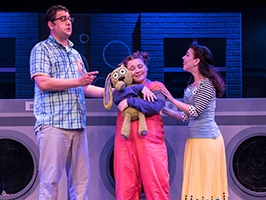
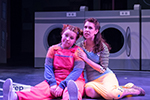
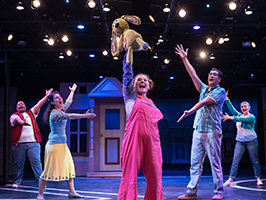
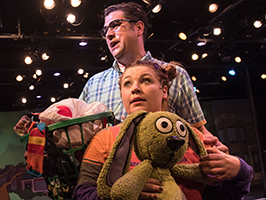
Knuffle Bunny – much to my surprise, the “k” is pronounced – is based on the book of the same name by Mo Willems, who also wrote the script and lyrics. The music is by Michael Silversher. Upbeat and colorful, with a simple, uncluttered set designed by Emily Hake Massie and lighting by BJ Wilkinson, Knuffle Bunny is a cautionary tale about the adventure that ensues when pre-verbal toddler Trixie, played by Christina Ramsey, leaves her beloved stuffed bunny at the laundromat. Her poor dad (David Janosik) is cast as the somewhat incompetent rube by his beloved wife (Louise Ricks) who from the beginning doubts his ability to successfully take a basket of laundry to the laundromat with Trixie in tow. Hilarity ensues.

There is a chorus kick line, some striking air guitar play, animated puppetry of gigantic pieces of laundry (a necktie a onesie, a brassiere, and a man’s shirt), and a local geography lesson as the ensemble (Brandon James Johns and Corinne MacLean) runs across the stage holding signs reading Broad Street, Boulevard, and Cary Street as the little family makes their way from their house to the laundromat.

There is plenty for the adults to enjoy, as well. Trixie’s sad ballad to her beloved Knuffle Bunny has the ensemble holding up their lighters, as is customary at concerts – a feature that may be over the heads of the littlest audience members but did not go unnoticed by the adults.  (I couldn’t resist – here’s a link to an article on the practice of holding up lighters at concerts: https://beat.media/history-of-the-lighter-at-concerts)

My adult daughter, Soleil, could hardly contain her composure as Trixie’s big number was set up – the dramatic lighting, the mood music, all to accompany a heart-wrenching song made up entirely of nonsense syllables, “Aggle Flaggle Klabble.”  When asked by the cast members during the post-show meet and greet what he thought of the show, my seasoned assistant Kingston (older brother to Emmitt) responded that he enjoyed the songs and wanted more like “Aggle Flaggle Klabble.” I know that Willems wrote lyrics, but I wonder if the “words” to “Aggle Flaggle Klabble” come out the same each time – and if they didn’t, would anyone notice?

Susan Sanford directed this delightful musical – which really caters to the youngest of audiences without boring older siblings or the adults who accompany them. Go. Enjoy. And don’t forget to take a young person or two. Copies of the book Knuffle Bunny: A Cautionary Tale are available for purchase at the bar.

Julinda D. Lewis is a dancer, teacher, and writer who was born in Brooklyn, NY and now lives in Eastern Henrico County.

———-

Photo Credits: Aaron Sutten

Knuffle Bunny
Christina Ramsey and Louise Ricks
Knuffle Bunny
David Janosik, Christina Ramsey, Knuffle Bunny, and Louise Ricks
Knuffle Bunny
Louise Ricks, Christina Ramsey, Knuffle Bunny, and David Janosik
Knuffle Bunny
Knuffle Bunny, Christina Ramsey, and David Janosik

HAND TO GOD: The Invention of the Devil

HAND TO GOD: The Devil Made Me Do It

A Theater Review by Julinda D. Lewis

A co-production of  TheatreLAB and 5th Wall Theatre

At: TheatreLab, The Basement, 300 E. Broad St, RVA 23219

Performances: July 13-28, 2018

Ticket Prices: $15

Info: (804) 359-2003 or 5thwalltheatre.org


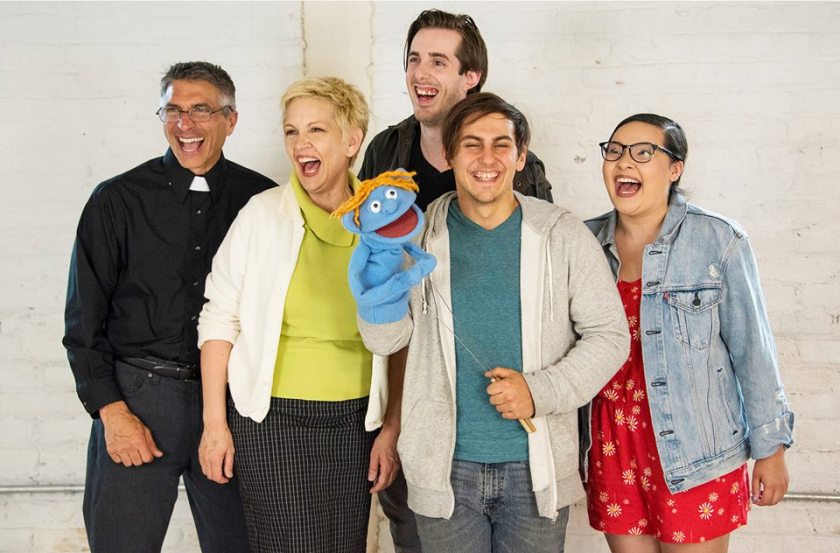
Weird – in a very creepy way – and funny – in a very irreverent way – Robert Askin’s Hand to God is probably the most unsettling study in family dysfunction I’ve yet so see on a stage. A co-production of TheatreLAB and 5th Wall Theatre directed by Gary C. Hopper, Hand to God features a remarkable performance by Adam Turck and a commendable performance by Kimberly Jones Clark – who will not soon be nominated for mother of the year.

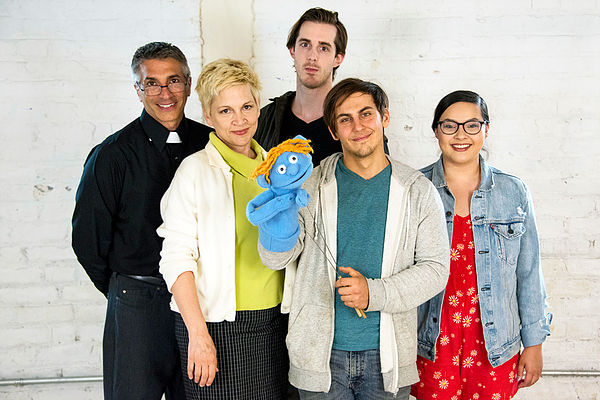
The recently widowed Margery (Jones Clark) and her teen-aged son Jason (Turck) have not fared well in the six months or so since Margery’s husband died of a heart attack. Margery has been depending on her son for support and Jason seems to alternate between blaming his mother for his father’s death and blaming his father for abandoning the family. Their kind-hearted Pastor Greg (Fred Iacovo) – who apparently skipped the seminary coursework in grief counseling – has ill-advisedly placed Margery in charge of the church’s puppet ministry, hoping to fill her idle time and distract her from her grief.  Iacovo initially comes off as mild-mannered as Mr. Rogers, but in the second act he boldly and surprisingly confronts the evil Tyrone. I guess this is where I should mention that Tyrone is Jason’s puppet.

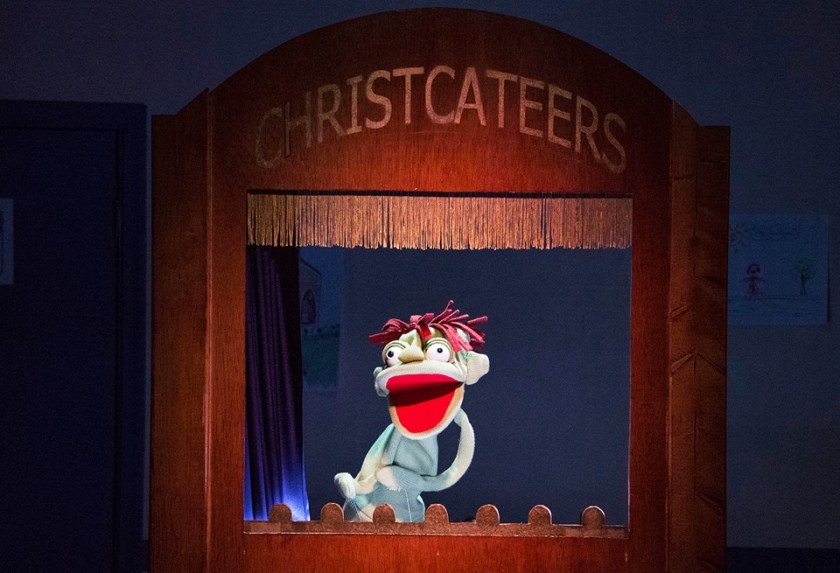
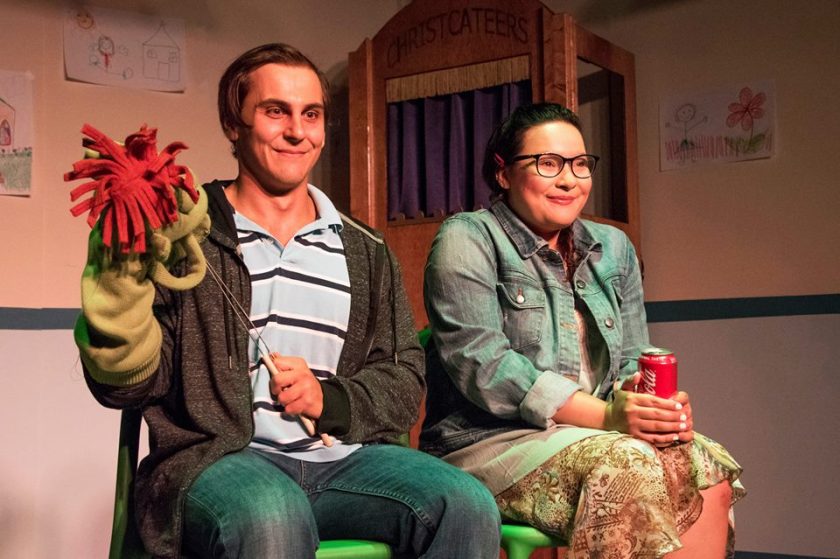
Hand to God is set in a church basement in a small town somewhere in Texas. On entering The Basement, many of  us will take one look at David P. Melton’s set design and immediately have flash backs to Vacation Bible School, otherwise known simple as VBS. There are the inspirational posters, the pictures partially colored by children, and the ubiquitous puppet stage.

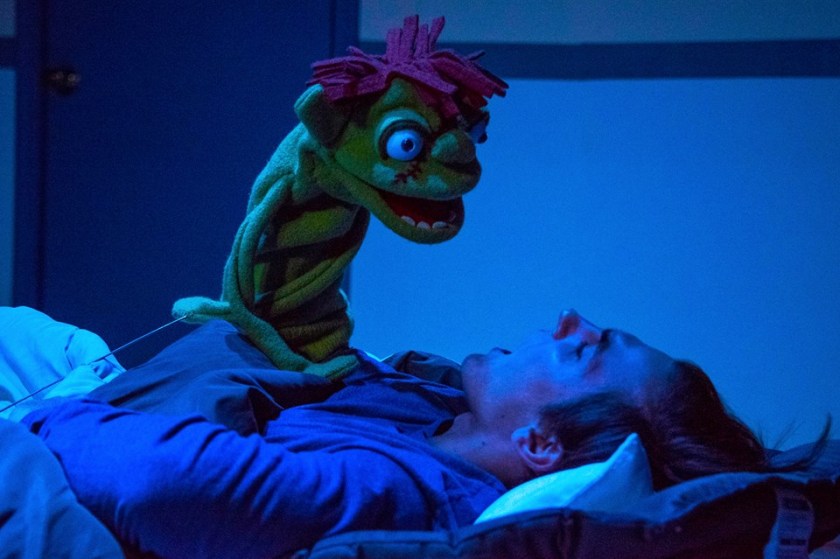
In spite of the popularity of the puppet ministry in many churches, many children are terrified of puppets. My own son, in his youth, would scream at the sight of clowns, masks, mimes, and puppets. But Tyrone takes it to a whole new level. Tyrone actually opens and closes the show with his own prologue and epilogue, and in Acts 1 and 2 he demonically possesses young Jason. We’re talking bloody mutilations and violent sexual acts. We’re talking foul-mouthed verbal assaults and  blood curdling laughter. Imagination? Psychological transference? Doesn’t matter – we’re talking spine-tingling horror.

Turck switches between the mild-mannered Jason and the evil Tyrone throughout the show, which runs nearly two hours with one intermission. The rough-edged voice he uses for Tyrone as well as the shouting must wreak havoc on his vocal cords, but he doesn’t hold back. He goes full out and is the only character that really earns our sympathy. Jones Clark turns in an edgy performance as his mother, and as much as she’s obviously hurting, her actions do not generate much sympathy. One wonders what’s going on in this small town, as Margery is pursued by both Pastor Greg (Iacovo) and the foul-mouthed bully, Timmy (Adam Valentine), who reluctantly attends the puppet ministry while his mother is otherwise engaged in her AA meetings. The third young member of the puppet ministry is Jessica (Anne Michelle Forbes), a shy teen who uses her buxom female puppet to get through to Jason/Tyrone in a most surprising way in the second act.

Hopper’s direction keeps things moving, but I found some scene changes in the first act ran a little long, and while Melton’s set authentically captured VBS, it was surprisingly unsteady and had a noticeable gap in the rear wall – both of which are probably due to the need to unfold several panels to reveal the pastor’s office in the second act. The puppet theater, also designed by Melton, actually seemed much sturdier than the actual set. Joey Luck created the sound design with his usual impeccable touch, and Michael Jarett did the  lighting – which included some impressive lightning.  Heidi Rugg is credited with the puppetry, ranging from Timmy’s simple sock puppet to Jessica’s femme fatale and Jason’s two versions of Tyrone – one of which featured teeth and horns.

There is nothing delicate about Hand to God: Askins – and this well-chosen cast – tackle family dynamics, sexual issues, religious hypocrisy, and more with rawness and humor. There is no happy ending. There is no clear-cut good or bad. Major, life-changing decisions made by the characters raise more questions than they answer – all of which sounds, to me, like the elements of good theater.

Julinda D. Lewis is a dancer, teacher, and writer who was born in Brooklyn, NY and now lives in Eastern Henrico County.

———-

Photo Credits: Tom Topinka

Hand to God.5
Fred Iacovo, Kimberly Jones Clark, Adam Valentine, Adam Turck, and Anne Michelle Forbes
Hand to God.4
Tyrone
Hand to God.3
Adam Turck and Anne Michelle Forbes
Hand to God.2
Tyrone and Adam Turck


AS YOU LIKE IT: All the World’s a Stage

AS YOU LIKE IT: Pastoral Comedy Under the Stars

A Theater Review by Julinda D. Lewis

By: Quill Theatre/20th Annual Richmond Shakespeare Festival

At: Agecroft Hall & Gardens, 4305 Sulgrave Road, RVA 23221

Performances: July 6-29, 2018, Thursdays – Sundays at 7:30pm

Ticket Prices: $30 Adults; $25 Seniors; $20 Students & RVATA Members (with ID)

Info: (804) 353-4241 or quilltheatre.org


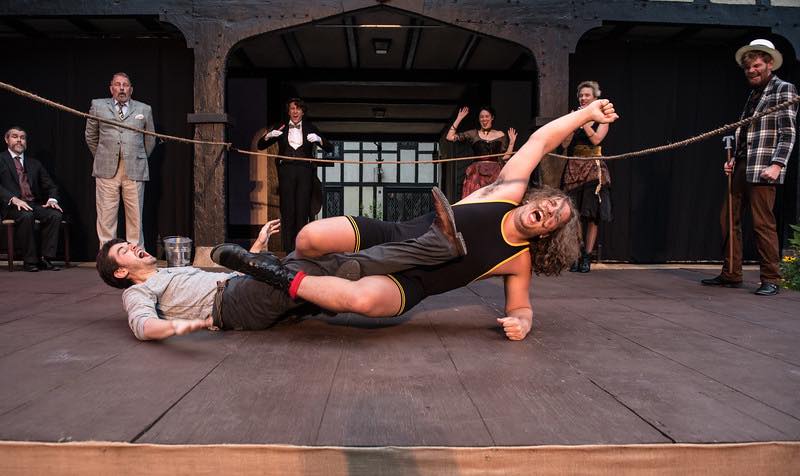
As You Like It is one of the bard’s zaniest comedies. Set initially in the French court of the evil Duke Frederick, formerly the domain of his banished brother Duke Senior, but mostly in the idealized Forest of Arden, As You Like It is filled with improbable disguises and misidentification, sibling rivalry and love at first sight. There’s also an awesome wrestling scene in the first act (fight choreography by James Ricks) and a rowdy dance at the end (choreography by Nicole Morris-Anastasi). There’s plenty of action, plenty of laughs, and – as they say – it’s complicated.

C.J. Bergin plays the love-struck Orlando, the youngest and sadly disinherited son of the late Sir Rowland de Boys. Bergin is both sympathetic and brave, first facing the ferocious wrestler, Charles, then posting odes to his beloved Rosalind on trees in the forest. Rebecca Turner is Rosalind, the object of his affections and daughter of the banished Duked Senior. Shortly into the play, Rosalind finds herself fallen head over heels for Orlando after he quite unexpectedly overpowers the professional wrestler Charles (Tommy Ryan). Accompanied by two ring girls dressed as Shakespearian wenches, Charles is a real moustache-twirling villain. His satin embroidered robe and vainglorious long locks, in stark contrast to the women’s more traditional costumes, typifies Cora Delbridge’s time-bending, era-mixing costumes. The fight was fixed by Oliver (Matt Bloch), Orlando’s older brother, but Orlando, facing defeat and having nothing to lose, knocked out Charles with a folding chair, WWE style, and as a result must flee for his life.

Rosalind’s mercurial uncle, Duke Frederick (John Cauthen – who also plays the brother, Duke Senior) not only has it in for his own brother, but also counted Orlando’s father among his enemies. After the wrestling match does not go according to plan, Duke Frederick turns his wrath on the fair Lady Rosalind, his niece and his daughter’s best friend. He gives her ten days to vacate the court, but his daughter, Celia (Jocelyn Honoré) decides to join her.

Rosalind, disguised as a young man with the fictitious name Ganymede, embarks on a hair-brained scheme to join her father and his band of merry men who have been subsisting in the forest, and here Turner get to shine as a woman impersonating a man who is in turn impersonating a woman. [In Shakespeare’s day, when all roles were played by men, Rosalind would have been a male (actor) impersonating a woman (Rosalind) impersonating a man (Ganymede) impersonating a woman (Rosalind).] Celia sticks by her cousin, but once in the forest, Honoré seems to fade into obscurity more than necessary. The character of Rosalind is, undoubtedly, the most developed female character of the play and perhaps of Shakespeare’s entire body of plays, and Turner embodies equally well the sometimes overlapping comedic, dramatic, and romantic aspects of her character.

John Mincks, as Touchstone, the court jester and Rosalind and Celia’s servant and protector, is a standout. His dandy wardrobe of plaid jacket and straw hat marries the look of the traditional court jester with the more modern look of a minstrel, his lines consist of humorous sometimes rhyming, sometimes philosophical speeches that are delivered with a speed and sassiness that could easily trip up any lesser actor. In the second act, a shepherd couple, Silvius (Cooper Sved) and the unresponsive Phoebe (Nicole Morris-Anastasi) provide a humorous diversion, with Morris-Anastasi’s character falling for Ganymede – not knowing the object of her affections is actually Rosalind in disguise. The quick-tongued Rosalind/Ganymede delivers one of the play’s most cutting lines – and perhaps one of literature’s first recorded instances of body-shaming – to Phoebe, telling the nerdy-looking and socially awkward young woman, “Sell when you can, you are not for all markets.”

Another favorite is the melancholy Jaques, played with laid-back élan by Luke Schares. A nomadic traveler who also frequents the forest, it eventually becomes clear that he is actually the middle son of Sir Rowland de Boys, younger brother of Oliver and older brother to Orlando. You may not be familiar with Jaques or the play, but you will remember his line, “All the world’s a stage. . .” If it seems difficult to keep all these characters straight, it is. It’s helpful to read the synopsis and list of cast members before the show – and again during intermission. It doesn’t help that several cast members play multiple roles.

My daughter and I went on Friday, opening night, but after a fifteen-minute rain delay and wearing a poncho as protection from the light rain that fell during the first act, the show had to be cancelled due to a storm cell and lightning. So, having a second chance to watch the first act was actually helpful in keeping all the characters and their relationships straight. The humor is unrelenting, but it’s even better when you can keep the players organized. The cast also included Derek Kannemeyer as Orlando’s faithful old “yet strong and lusty” servant, Adam; Taylor Lyn Dawson as both Amiens, Duke Senior’s musician and Audrey, the object of Touchstone’s affections; and Bill Blair as both Corin, an elderly shepherd, and Le Beau, a member of Duke Frederick’s court.

Rain pace or fair weather – and Saturday was perfect, with clear skies, cool temperatures, no humidity – As You Like It is hilarious, with well-timed direction by artistic director James Ricks, atmospheric music provided by Juan Harmon on accordion, and satisfying ensemble work by a cast of thirteen actors.

Julinda D. Lewis is a dancer, teacher, and writer who was born in Brooklyn, NY and now lives in Eastern Henrico County.

———-

Photo Credits: Photos by Aaron Sutten; Audience selfie by Noah Downs.

This slideshow requires JavaScript.

SMALL PLATES CHOREOGRAPHY FESTIVAL: Whetting the Appetite for Dance in RVA

SMALL PLATES CHOREOGRAPHY FESTIVAL: Merging Emerging Choreographers and Audiences

A Dance Review by Julinda D. Lewis

At: Dogtown Dance Theatre, 109 W. 15th Street, RVA 23224

Performances: June 29 & 30, 2018 @ 8:00pm

Ticket Prices: $10 General

Info: (804) 230-8780, dogtowndancetheatre.com

Kelly Hamlin, founder and artistic director of Krash!Dance Theater, and Jess Burgess, artistic and executive director of Dogtown Dance Theatre and founder and co-artistic director of RVA Dance Collective, Dogtown’s resident dance company, are on a mission to make Richmond as much a home for dance as it has become for theater. Hamlin hosted the Small Plates Choreography Festival at Dogtown June 29 and 30. The curated performance series accepts applications for ensemble works up to 10-minutes in length and solo works up to 8-minutes long. Festival performances occur over a 2-day period, with a Q&A session after each performance. Upcoming performances are scheduled for Brooklyn, NY, Newburgh, NY, and Lorton, VA.

The June Festival at Dogtown provided a showcase for more than a dozen choreographers – some local and some from as far away as Pittsburgh, PA and Brooklyn, NY. Saturday evening’s program was a virtual smorgasbord of dance: contemporary, hip hop, lyrical/liturgical. There was spoken word and live music – all done with a minimum of lighting and little or no props.

The handstands, headstands, and hair tossing of marge dances + Shelleysillerdance demonstrated awesome physical control, and no wonder as choreographer Margaret Allen, a graduate of the VCU dance program, is a professional circus artist with a specialty in hand balancing and dance acrobatics. Allen partnered with Shelley Siller, who has a strong background in ballet, for Las Brujas (The Witches), a sort of modern-day incantation filled with the aforementioned handstands and headstands, and delightfully awkward positions that reminded me of historic photos of Mary Wigman’s Hexantanz (Witch Dance). It was a memorable opening piece that made you want to see more work by these choreographers, but for some reason, the moments when the two touched did not fully connect for me. Allen (RVA) and Siller (DC/VA) also each presented solos for the Friday evening program.

The second half of the program also opened with a strong, memorable work. A Memorable Diversion is a duet filled with exuberant and childlike enthusiasm – mostly on the part of  William Sterling Walker, who seemed determined to meet and interact with the object of his affection, LaWanda Raines. These two have a natural chemistry – familiar to those who saw them dancing together with The Latin Ballet of Virginia, where both were long-time members before pursuing independent work. At one point, Sterling’s feet lifted off the floor into that “happy feet” movement often performed by toddlers when they get a taste of their favorite food! In perfect contrast to this beautifully free and uninhibited delight was the beautifully classic live music, a Rachmaninoff song sung by Marjory Saunders accompanied by Miriam C. Walton on keyboard.

During the audience discussion, another piece that drew notable comment was the Inner City Blues: Excerpt, a solo choreographed by Michelle Isaac of Ntrinsik Movement (Brooklyn, NY). The solo, performed by Briana Raheem to a Marvin Gaye’s Wholy Holy had a soulful, liturgical feeling, no doubt a reflection of Isaac’s early start, dancing in church at age 4.

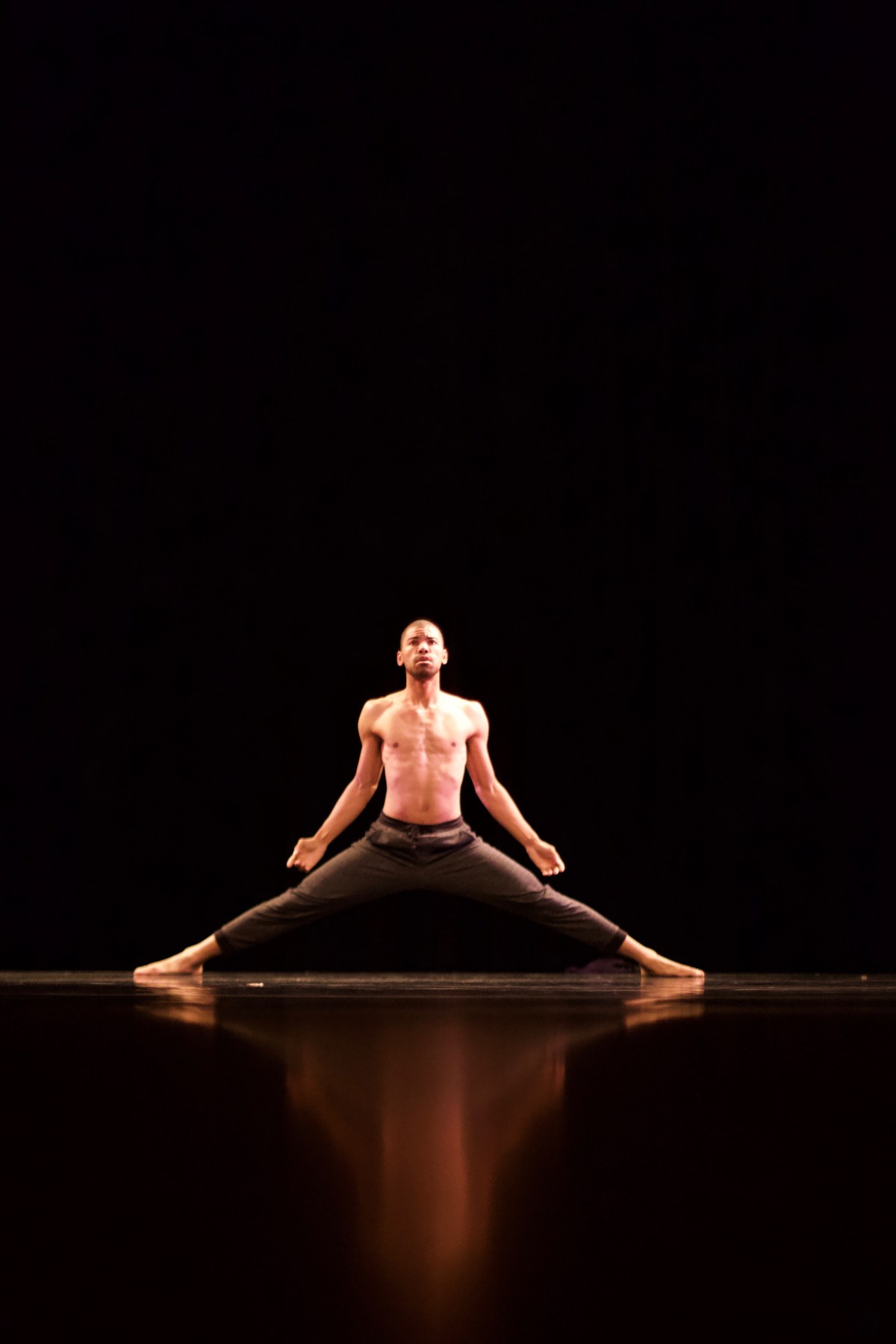
Desmin Taylor (RVA) presented Rebuild, an intimate, introspective solo that is actually his first solo creation. Host Kelly Hamlin performed an amusing solo to a short story written and read by Chris McDaniel (who is also Dogtown’s operations manager and grants writer). White employed a variety of colorful masks and even a sweater or two tossed from the wings as Hamlin danced to, acted out, and sometimes mimed the lovingly awkward story of a first date, punctuated by easy eye-ball interactions between Hamlin and McDaniel.

Jess Burgess’s Continuum, performed earlier this year, was tightened and condensed in order to fit with the time limits of the Small Plates Festival, and somehow, without the atmospheric fog and full lighting, it seemed sharper, more emotional and impactful. Kista Tucker (Kista Tucker Insights, Bristow, VA) presented excerpts from The Factory Project, complete with train or factory engine sounds. Another work with an industrial theme or feel was Marissa Graham’s ((in))teroception. Graham, a member of eSKay Arts Collective (NY), appears to have conceived of this intriguing work as a study in contrasts – machine versus organism, mechanical versus organic, interacting versus co-existing.

Fixated, a solo by Therese Gahl (NOVA/DC) created a unique physical and emotional effect by using the very detailed instructions on how to suture a wound. Gahl’s loose-jointed, flexible movement vocabulary made me wonder if she was the wound or the suturing thread closing the edges of the wound. Kaitlin Flynn Goodwin (Pittsburgh, PA) presented Standing in the Gap, a solo of controlled, measured release; but once she released, there was no holding back. Heartbeats, blips, beeps, and pings accompanied Heidi Murr’s (MURRdance, Pittsburgh, PA) What I Know About Living, an unusual and mysterious piece to close the evening.

Other works on the program included a high-impact hip hop work, Power, collaboratively choreographed and presented by Studio 4 Dance Company (Richmond, VA), under the direction of Deandra Clarke and  Jelani Taylor’s The Cry, a dark work punctuated by gunshots that I interpreted as a statement on today’s political atmosphere and oppression in general. Taylor, also a product of the VCU dance program, was, unfortunately not available for the post-show discussion.

It was inspiring to see the variety of works as well as the diversity of the audience. During intermission and after the show, performers could be overheard praising the works and accomplishments of other artists, and many – performers as well as audience members – were exposed to works and performers they had never seen before. The works are generally finished, as in not works-in-progress, but neither are they fully set with unlimited or extended time, props, full lighting, and complex production elements. The Small Plates Choreography Festival, like its culinary namesake, allows the audience to sample a lot of different “dishes” in one sitting, and whets the appetite for more of the ones that seem particularly interesting or appetizing. The Small Plates Choreography Festival was created by Beth Elliott for the purpose of “merging choreographers and dance audiences in meaningful performance experiences.” [https://smallplatesdance.com/] Kudos to Kelly Hamlin and Jess Burgess for this summer dance treat.


Julinda D. Lewis is a dancer, teacher, and writer who was born in Brooklyn, NY and now lives in Eastern Henrico County.

———-

Video Links:

MURRdance

https://www.facebook.com/smallplatesdance/videos/1860386244021784/


Margaret Allen

https://www.facebook.com/allenmh/videos/10211627484393746/UzpfSTgwMjg4MTE1MzEwNTYzNzoxODUyNTQzOTgxNDcyNjc3/


Jelani Taylor

https://youtu.be/x-kcNuYWVa8


RVA Dance Collective

https://youtu.be/jPOMN1mOaKE


Photo Credits: Small Plates Choreography Festival Richmond, VA production photos by Mike Keeling

Dogtown - Small Plates 1
Beth Elliot – Small Plates creator, and Kelly Hamlin, Small Plates Richmond host

Dogtown - Small Plates 2

Dogtown - Small Plates 3
Kelly Hamlin and Chris McDaniel
Dogtown - Small Plates 4
Desmin Taylor