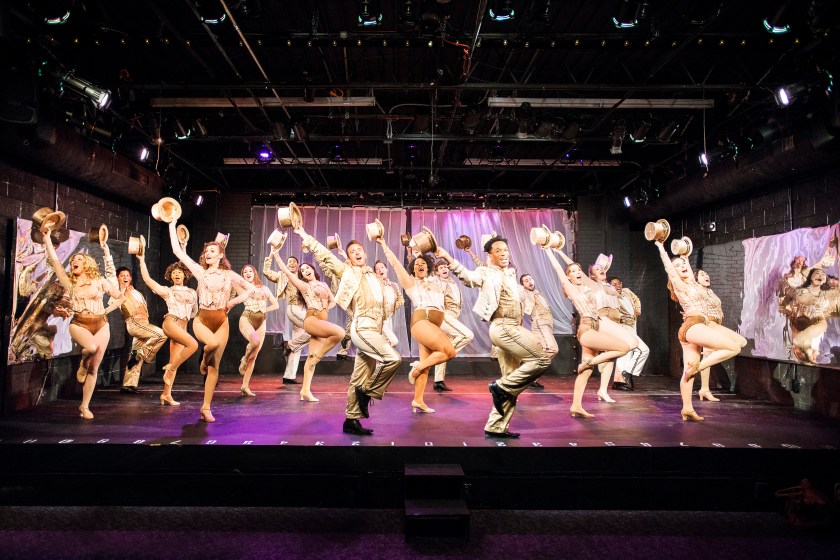
SONDHEIM ON SONDHEIM: A Musical Revue Featuring Stephen Sondheim Himself

SONDHEIM ON SONDHEIM: A Musical Love Fest

A Theater Review by Julinda D. Lewis

Richmond Triangle Players

At: The Robert B Moss Theatre, 1300 Altamont Avenue, RVA 23230

Performances: August 8 – September 1, 2018

Ticket Prices: $10-30

Info: (804) 346-8113 or rtriangle.org


I generally get to new shows during the first week, but Sondheim on Sondheim opened while I was away on our annual family vacation, and shortly after returning I went into the hospital for a knee replacement. Much to my surprise, I had no pain after surgery, so I found myself tiptoeing into RTP with crutches in the middle of a rainstorm on closing night. I am SO glad I got a chance to see this show.

The night I attended was also a popular night for many industry professionals, at least one of whom wept openly during a particularly touching number. Sondheim on Sondheim (with music and lyrics by Stephen Sondheim, conceived and directed on Broadway by James Lapine) is not at all what I expected from a musical – but it is what I have come to expect from Richmond Triangle Players, which is not above bringing even a reviewer to tears on occasion.

This autobiographical musical features about 40 – yes FORTY – musical numbers, and a stellar cast of eight, each of whom had a chance to shine in at least one song. Frank Foster’s set reminded me of a museum exhibit, with its three slim columns, each holding a memento of Stephen Sondheim’s life and career, some notes, and a light. There were posters from Sondheim’s many productions, and a screen where we got to see and hear the man himself talk about his work and share heartbreaking memories of his childhood. Talk about dysfunctional! Now that it’s over, it won’t be spoiler to say that his mother once sent him a note telling him that her only regret in life was giving birth to him!

While I cannot say that I love every song or even every play he ever worked on (and no, I have not seen all of them), I can honestly say that I am so glad he overcame the seemingly impossible obstacles in his life to leave us with a legacy of musical theater that includes a range of such diverse works that have earned him 8 Tony awards, 8 Grammy awards, a Pulitzer Prize, a Laurence Olivier award, and a Presidential Medal of Freedom. As a composer and lyricist, who is NOT known for hummable tunes, he left his mark on West Side Story, Gypsy, A Funny Thing Happened on the Way to the Forum, Company, Follies, A Little Night Music, Sweeney Todd, Merrily WE Roll Along, Sunday in the Park with George, Into the Woods, Assassins, and many others.

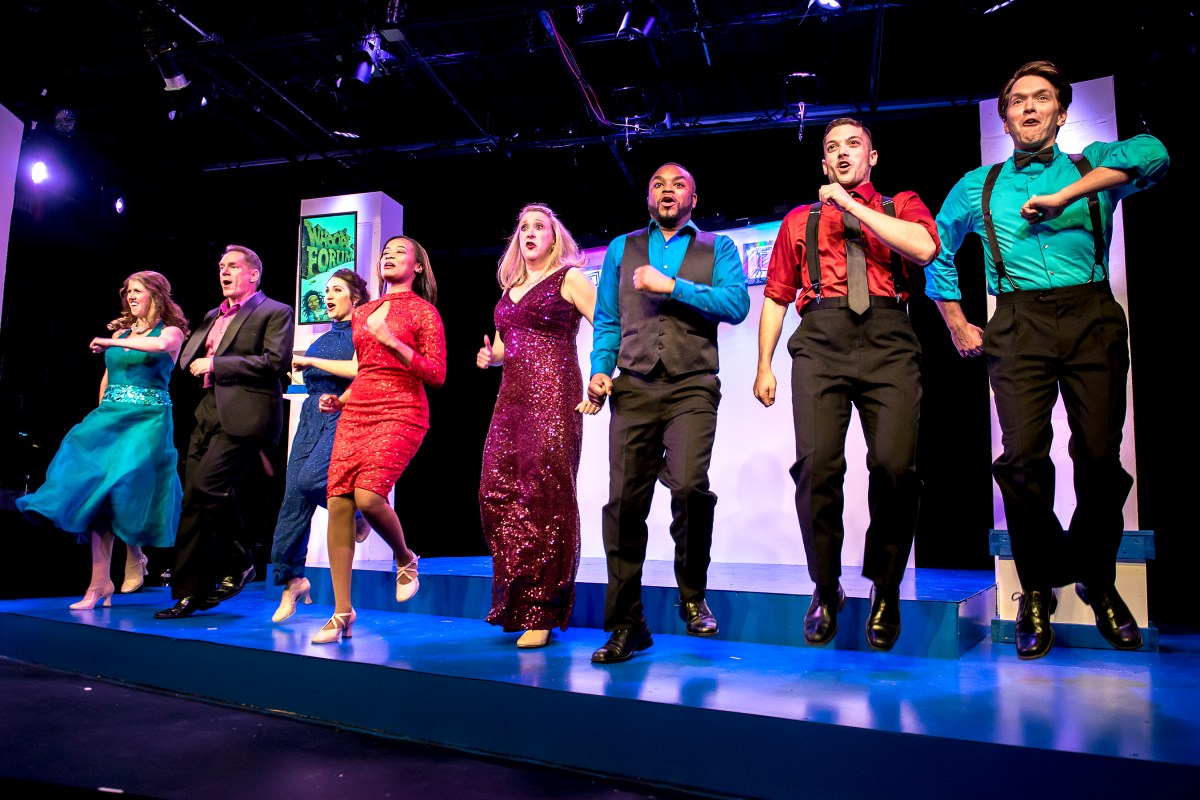
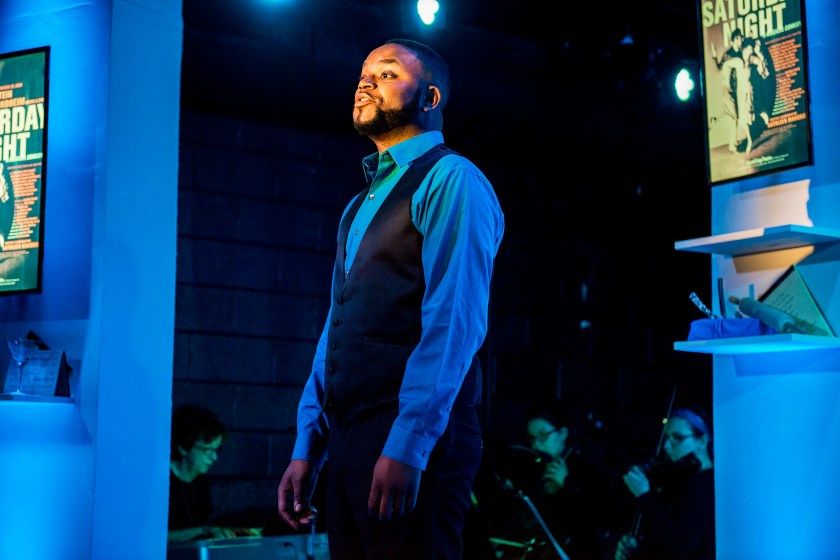
Standouts of the evening included Durron Tyre singing Being Alive and Susan Sanford’s rendition of Send in the Clowns. Then there was Alona Metcalf (Do I Hear a Waltz) and Dan Cimo, Matt Polson, and Rachel Rose Gilmour (Franklin Shepard, Inc.), and the entire company, including Mariah Mazyck, and Scott Melton) in Weekend in the Country, Sunday, and the finale Company – Old Friends and Anyone Can Whistle.

I call it a love fest not only because the audience was so vocal in its enthusiasm and praise, but also because the entire cast seemed to so thoroughly enjoy this often challenging work. In addition to Sondheim’s pitiful family life, we also learned of his life-saving friendship with Oscar Hammerstein and his family and heard his thoughts on his life’s work. Assassins came closest to meeting the writers’ vision, and Sunday in the Park with George was the closest to his own heart, while he didn’t much care for Do I Hear a Waltz.

With direction and vocal coaching by Doug Schneider, and musical direction by Kim Fox (I think she said there are several books and more than 400 pages of music!), all the elements just seemed to come together flawlessly. Sheila Ross designed the costumes, Michael Jarett did the lighting and projections, with video by Peter Flaherty, sound design by Joey Luck, and choreography by Emily Dandridge. What a delightful start to this theater’s 26th season!


Julinda D. Lewis is a dancer, teacher, and writer who was born in Brooklyn, NY and now lives in Eastern Henrico County.

———-

Photo Credits: John MacLellan
SONDHEIM_0187
Durron Tyre singing “Being Alive”
SONDHEIM_0130
L-R: Alona Metcalf, Scott Melton, Rachel Rose Gilmour, Marian Mazyck, Susan Sanford, Durron Tyre, Dan Cimo, Matt Polson. The cast of “Sondheim on Sondheim”
SONDHEIM_0268
Rachel Rose Gilmour

CRIMES OF THE HEART: A Southern Sister Reunion

CRIMES OF THE HEART: Tales of Southern Sisterhood

A Theater Review by Julinda D. Lewis

VirginiaRep

At: Hanover Tavern, 13181 Hanover Courthouse Road, Hanover, VA 23069

Performances: July 20 – August 26, 2018

Ticket Prices: $42

Info: (804) 282-2620 or va-rep.org

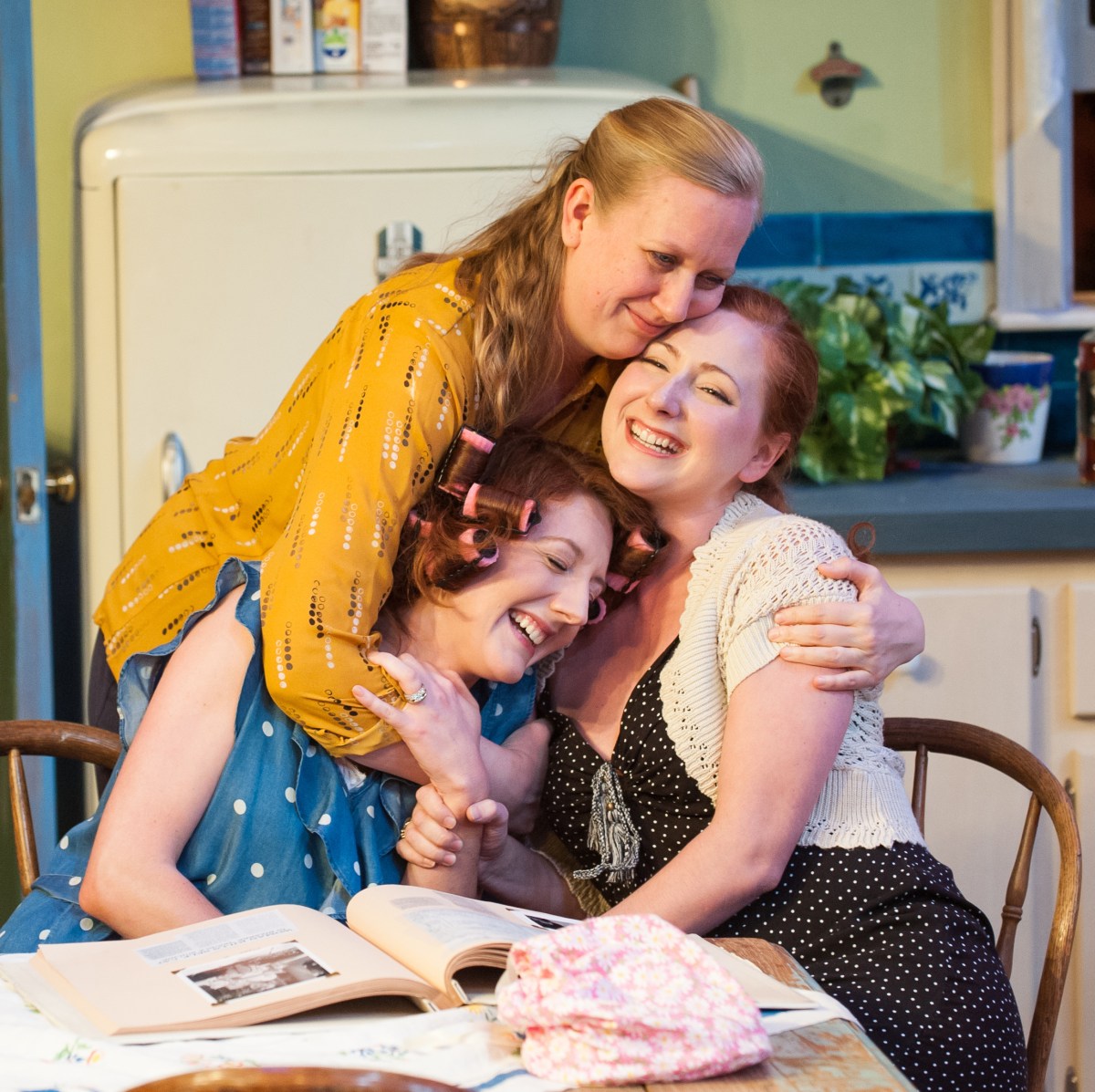
The final show of the 2017-2018 season,  Beth Henley’s Pulitzer Prize-winning three-act southern tragicomedy, boasts outstanding performances by three highly individual women and a beautifully designed and detailed set created by Terrie Powers. It also has near flawless direction by Steve Perigard (who also directed Da and Brighton Beach for this same stage – “near flawless” because, with three acts, it does seem to get lulled into a light sleepy southern languor about halfway through.

There was a time when I would, if given a chance, watch daytime talk shows because the dysfunctional guests made me feel so much better about my own life. To some extent, the quirky Magrath sisters make me feel the same way about my own family. Irene Kuykendall deftly navigates the surprising complexities of Meg, the black sheep of the family, gradually revealing that she is not a complete narcissist, but has hopes and dashed dreams, and holds a deep and abiding love with her two sisters. She’s also the middle child.

Lexi Langs, who last appeared in a VaRep performance ins 2007, is fascinating as the youngest sister, Babe or Rebecca. Physically enchanting with her wide eyes and sometimes vacant stare, we first meet Babe when she returns to Old Grandad’s home after being released from jail where she spent the night after shooting her husband in the stomach. Langs gives Babe a childlike quality that is unnerving; we are never quite sure if Babe has a true mental illness or just an advanced case of “the vapors.”

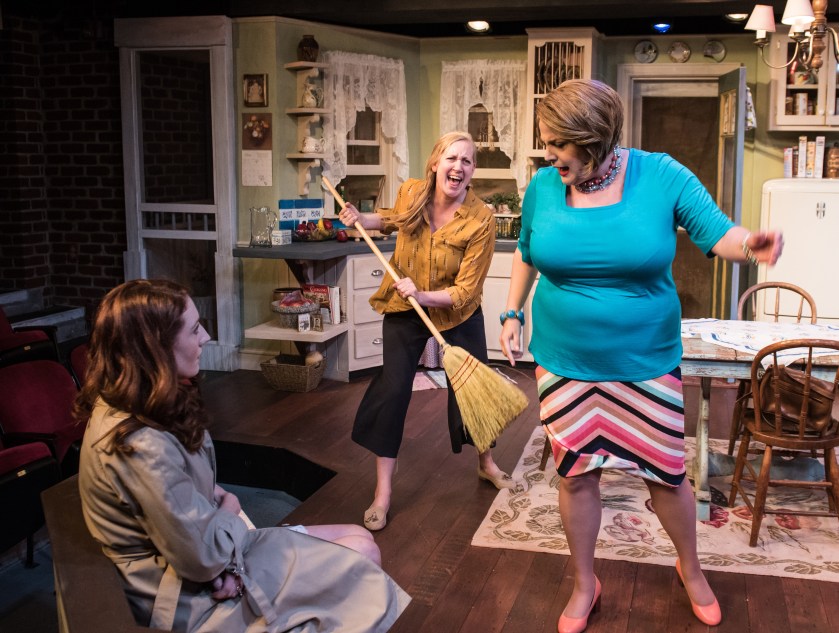
But the true star of this ensemble is Maggie Roop who shoulders the burdens of the family upon the sloping shoulders of Lenny, the eldest of the three sisters. There’s usually one in every family – the one who takes care of everyone and everything, but no one ever thinks she needs taking care of.  Roop spends much of the play trying to keep the peace; there are dark circles under her eyes, and she is obsessed with cleaning, which is, perhaps, the only thing over which she has any control. Roop brings unforced depth to the character of Lenny. For most of the three acts, I wanted to give Lenny a hug, so it was doubly rewarding when, in the third act, she took a broom to the butt of her obnoxious, social climbing first cousin, Chick (Maggie Bavolack). Whiny and annoying, Chick opens the first scene with a hilarious and unexpected reverse strip-tease, in which she elaborately squeezes into a pair of “petite” pantyhose.

Crimes of the Heart tackles real-life trauma: suicide; the illness of an aging grandparent; spousal abuse; dishonest politicians; social pressure; regret; vendetta; attempted murder; low self-esteem. Set in the small town of Hazlehurst, Mississippi (a real town about 30 miles south of the state capital of Jackson) five years after Hurricane Camille (which blew through in August of 1969), there are subtle references to the racial politics of the day, but more disturbingly, because of the racial politics of the times, a major issue of statutory rape is swept under the table, so to speak.

The overall outstanding ensemble is focused on the relationships between the women, but there are also credible performances by Arik Cullen as Meg’s former love interest, Doc Porter, and Tyler Stevens as the young lawyer, Barnette Lloyd.

There are thought-provoking lines, like, “She works out in the garden wearing the lime green gloves of a dead woman” physical humor, as when Babe prepares a glass of lemonade for Meg that makes Meg’s face – not just her lips, but her entire face – pucker, but adds so much sugar to her own glass that we can almost hear it crunch when she sips it. But despite – or maybe because of – our better judgment, Crimes of the Heart makes us laugh at such taboo topics as attempted murder and an old man falling into a coma. Babe may have shot her husband, but each sister has to face up to her own “crimes of the heart.”

Julinda D. Lewis is a dancer, teacher, and writer who was born in Brooklyn, NY and now lives in Eastern Henrico County.

———-

Photo Credits: Aaron Sutton

Crimes of the Heart
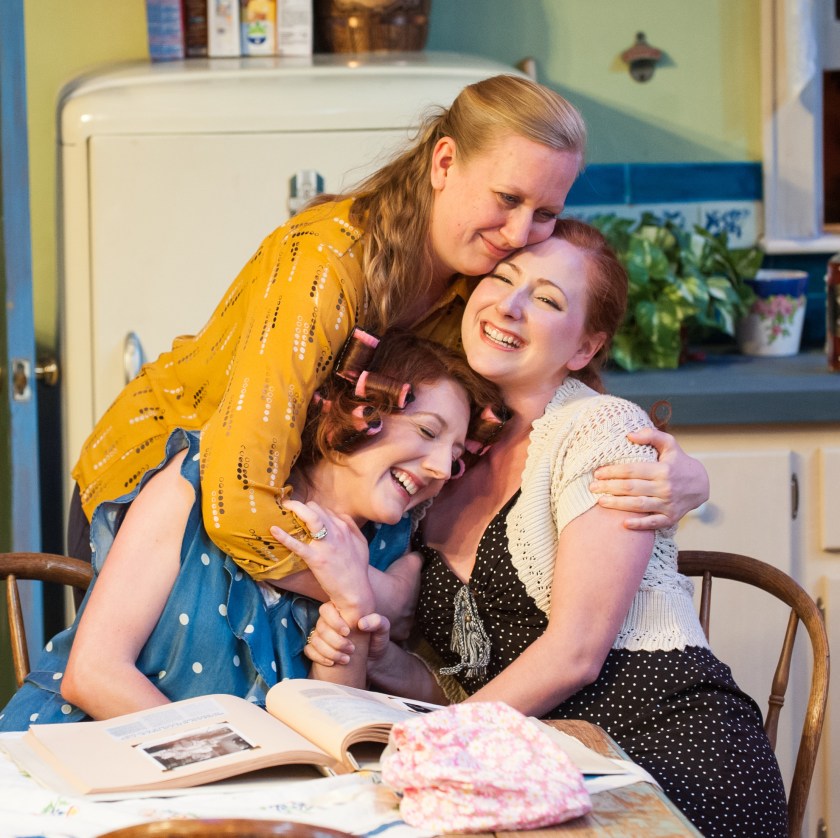
Lexi Langs, Maggie Roop, and Irene Kuykendall
Crimes of the Heart
Lexi Langs, Maggie Roop, Irene Kuykendall. Photo by Aaron Sutten.
Crimes of the Heart
Maggie Roop, Lexi Langs, and Irene Kuykendall
Crimes of the Heart
Lexi Langs, Maggie Roop, Maggie Bavolack. Photo by Aaron Sutten.
Crimes of the Heart
Maggie Roop, Maggie Bavolack, Irene Kuykendall. Photo by Aaron Sutten.

TOMFOOLERY: Swift Creek Shenanigans

TOMFOOLERY: A Politically Incorrect Musical Satire

A Theater Review by Julinda D. Lewis

At: Swift Creek Mill Theatre, 17401 Jefferson Davis Highway, Colonial Heights, VA 23834

Performances: July 14 – August 18, 2018

Ticket Prices: $38 Theater only; $55 Dinner & Theater

Info: (804) 748-5203 or swiftcreekmill.com


Swift Creek Mill Theatre’s final show of the 2017-2018 season, Tom Lehrer’s Tomfoolery, features four cast members, 28 musical numbers, a five-piece orchestra, and a sense that anything goes. The satirical musical revue, whose title has nothing to do with Swift Creek Mill Theatre’s artistic director Tom Width, has no plot. Rather, it allows Width to share with the Mill audience his own love of the silly, satirical, politically incorrect songs written and performed by Lehrer between 1953 and 1965 – and even one he wrote for the PBS children’s show, The Electric Company, popular in the 1970s. Surprisingly, other than the era-specific references, such as the names of political candidates and talk of bombs and drills to prepare for nuclear war, much of the humor remains relevant, while the music (book, music, and lyrics are all by Lehrer, adapted by Cameron MacKintosh and Robin Ray) seems more attuned to the ears of those whose college years were marked by folk songs and protest marches.

Width keeps things moving, with a simple, colorful set with the musicians settled upstage right and a small bar set up stage left where the actors congregate while waiting their turn. Maura Lynch Cravey has Richard Koch in a vested suit that is vaguely vaudevillian, while Bryan Harris and PJ Llewellyn are dressed less distinctively, and, but for one outstanding exception, Debra Wagoner’s wardrobe seems to be mostly an afterthought. Robes, suspenders, hats, canes, stools, and other props provide visual interest and cues, and the actors use their own names throughout the revue, which runs under two hours, including one fifteen-minute intermission.

Tomfoolery opens with “Be Prepared,” an homage to the Boy Scout oath, and closes with “We Will All Go Together When We Go,” an irreverent post-apocalyptic sendup. In between, no topic is off-limits. “Bright College Days” (Richard and Bryan) contains my favorite lyric of the evening: “Soon we’ll be sliding down the razor blade of life.” Bryan sings my favorite song, “Elements,” which sets the periodic table of the elements to the music of Sir Arthur Sullivan (to the theme of a song from Gilbert and Sullivan’s Pirates of Penzance). “The Hunting Song” tells of bagging “two game wardens, seven hunters, and a cow,” while “Smut” is an ode to pornography.

There’s a song dedicated to Wernher Von Braun, a German engineer and rocket scientist who was a member of the Nazi party and an SS officer before coming to the US to work for NASA while “Who’s Next” speculates on which nation will be next to get a bomb. And just in case you haven’t been offended by the end of the first act, “National Brotherhood Week” reminds you of who hates you and who you should hate in return.

Oh, and the one time Debra Wagoner was dressed in a glitzy glamourous dress with a blinged out feather boa was for “Oedipus Rex,” her second act homage to incest which allowed her to belt out a song full-out as only she can and make you wish you could sing like that, too.

Great theater? By no means. An entertaining evening with good music that is beautifully played under the direction of Paul Deiss (who even gets to sing one number, “The Old Dope Peddler”)? Absolutely. And don’t forget to get your Swift Creek Mill “sippy cup” so you can take your preferred beverage – hot, cold, or alcoholic – into the theater (new this season).


Julinda D. Lewis is a dancer, teacher, and writer who was born in Brooklyn, NY and now lives in Eastern Henrico County.

———-

Photo Credits: Robyn O’Neill

This slideshow requires JavaScript.

KNUFFLE BUNNY: Musical Theater for the Whole Family

KNUFFLE BUNNY: A Cautionary Musical

A Family Theater Review by Julinda D. Lewis, with input by Emmitt, Kingston, and Soleil

At: Virginia Rep’s Children’s Theatre at Willow Lawn; 1601 Willow Lawn Drive, Richmond, Virginia 23230

Performances: July 13 – August 12, 2018

Ticket Prices: Start at $18

Info: (804) 282-2620 or virginiarep.org

Knuffle Bunny is a hilarious family-friendly musical that held the attention of even the youngest audience members. With a running time of just under 45 minutes, and no intermission, I thought it might be worth a test run with my youngest grandson, Emmitt, who just turned 4.

Emmitt sat attentively for the entire show, sometimes singing along, eyes big as saucers, feet swinging happily. He was the first in our party of four to predict that the “rat with wings” would be making a comeback – an event which would open up the possibility for a sequel. His final pronouncement, “Awesome!”

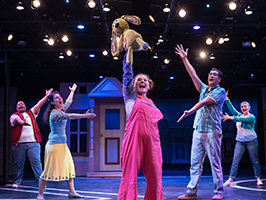
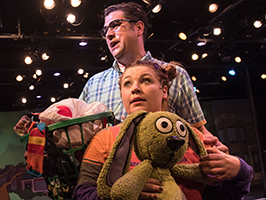
Knuffle Bunny – much to my surprise, the “k” is pronounced – is based on the book of the same name by Mo Willems, who also wrote the script and lyrics. The music is by Michael Silversher. Upbeat and colorful, with a simple, uncluttered set designed by Emily Hake Massie and lighting by BJ Wilkinson, Knuffle Bunny is a cautionary tale about the adventure that ensues when pre-verbal toddler Trixie, played by Christina Ramsey, leaves her beloved stuffed bunny at the laundromat. Her poor dad (David Janosik) is cast as the somewhat incompetent rube by his beloved wife (Louise Ricks) who from the beginning doubts his ability to successfully take a basket of laundry to the laundromat with Trixie in tow. Hilarity ensues.

There is a chorus kick line, some striking air guitar play, animated puppetry of gigantic pieces of laundry (a necktie a onesie, a brassiere, and a man’s shirt), and a local geography lesson as the ensemble (Brandon James Johns and Corinne MacLean) runs across the stage holding signs reading Broad Street, Boulevard, and Cary Street as the little family makes their way from their house to the laundromat.

There is plenty for the adults to enjoy, as well. Trixie’s sad ballad to her beloved Knuffle Bunny has the ensemble holding up their lighters, as is customary at concerts – a feature that may be over the heads of the littlest audience members but did not go unnoticed by the adults.  (I couldn’t resist – here’s a link to an article on the practice of holding up lighters at concerts: https://beat.media/history-of-the-lighter-at-concerts)

My adult daughter, Soleil, could hardly contain her composure as Trixie’s big number was set up – the dramatic lighting, the mood music, all to accompany a heart-wrenching song made up entirely of nonsense syllables, “Aggle Flaggle Klabble.”  When asked by the cast members during the post-show meet and greet what he thought of the show, my seasoned assistant Kingston (older brother to Emmitt) responded that he enjoyed the songs and wanted more like “Aggle Flaggle Klabble.” I know that Willems wrote lyrics, but I wonder if the “words” to “Aggle Flaggle Klabble” come out the same each time – and if they didn’t, would anyone notice?

Susan Sanford directed this delightful musical – which really caters to the youngest of audiences without boring older siblings or the adults who accompany them. Go. Enjoy. And don’t forget to take a young person or two. Copies of the book Knuffle Bunny: A Cautionary Tale are available for purchase at the bar.

Julinda D. Lewis is a dancer, teacher, and writer who was born in Brooklyn, NY and now lives in Eastern Henrico County.

———-

Photo Credits: Aaron Sutten

Knuffle Bunny
Christina Ramsey and Louise Ricks
Knuffle Bunny
David Janosik, Christina Ramsey, Knuffle Bunny, and Louise Ricks
Knuffle Bunny
Louise Ricks, Christina Ramsey, Knuffle Bunny, and David Janosik
Knuffle Bunny
Knuffle Bunny, Christina Ramsey, and David Janosik

HAND TO GOD: The Invention of the Devil

HAND TO GOD: The Devil Made Me Do It

A Theater Review by Julinda D. Lewis

A co-production of  TheatreLAB and 5th Wall Theatre

At: TheatreLab, The Basement, 300 E. Broad St, RVA 23219

Performances: July 13-28, 2018

Ticket Prices: $15

Info: (804) 359-2003 or 5thwalltheatre.org


Weird – in a very creepy way – and funny – in a very irreverent way – Robert Askin’s Hand to God is probably the most unsettling study in family dysfunction I’ve yet so see on a stage. A co-production of TheatreLAB and 5th Wall Theatre directed by Gary C. Hopper, Hand to God features a remarkable performance by Adam Turck and a commendable performance by Kimberly Jones Clark – who will not soon be nominated for mother of the year.

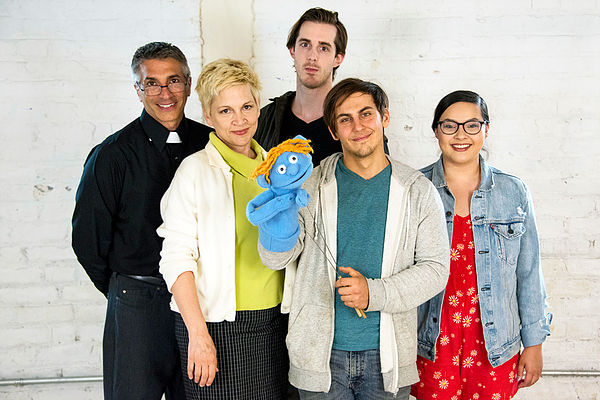
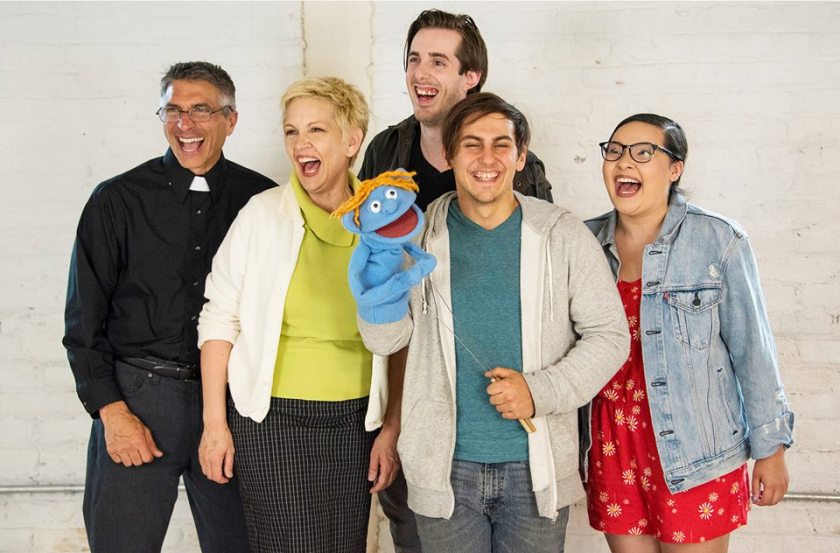
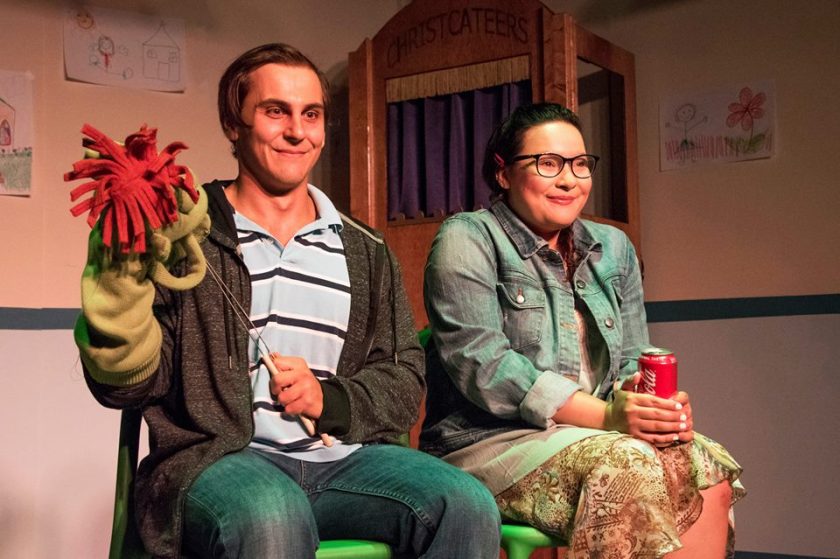
The recently widowed Margery (Jones Clark) and her teen-aged son Jason (Turck) have not fared well in the six months or so since Margery’s husband died of a heart attack. Margery has been depending on her son for support and Jason seems to alternate between blaming his mother for his father’s death and blaming his father for abandoning the family. Their kind-hearted Pastor Greg (Fred Iacovo) – who apparently skipped the seminary coursework in grief counseling – has ill-advisedly placed Margery in charge of the church’s puppet ministry, hoping to fill her idle time and distract her from her grief.  Iacovo initially comes off as mild-mannered as Mr. Rogers, but in the second act he boldly and surprisingly confronts the evil Tyrone. I guess this is where I should mention that Tyrone is Jason’s puppet.

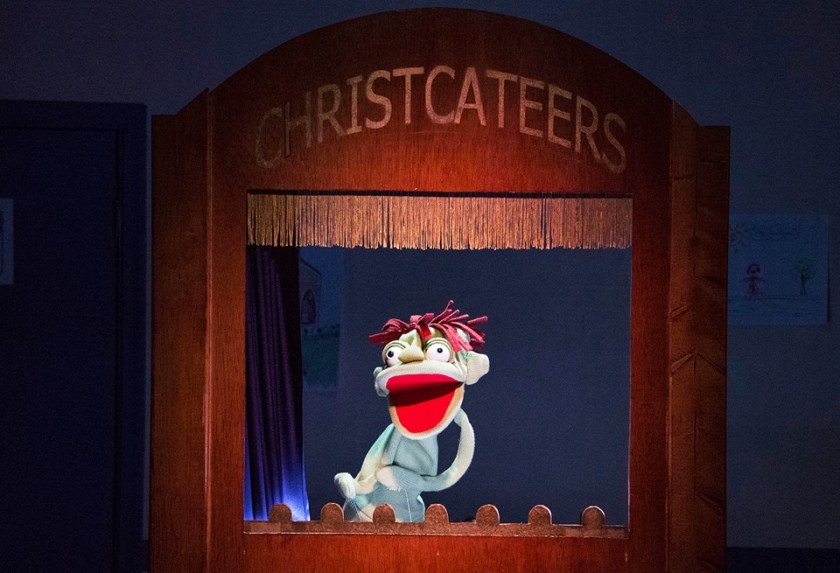
Hand to God is set in a church basement in a small town somewhere in Texas. On entering The Basement, many of  us will take one look at David P. Melton’s set design and immediately have flash backs to Vacation Bible School, otherwise known simple as VBS. There are the inspirational posters, the pictures partially colored by children, and the ubiquitous puppet stage.

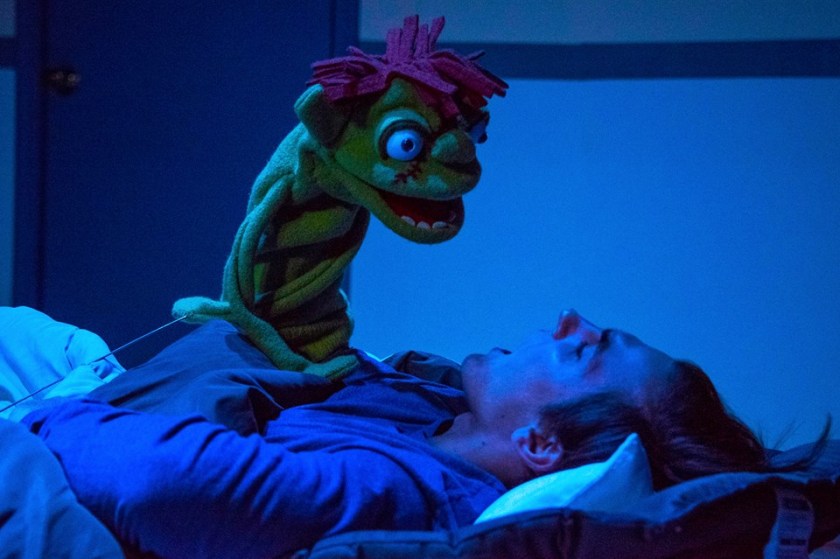
In spite of the popularity of the puppet ministry in many churches, many children are terrified of puppets. My own son, in his youth, would scream at the sight of clowns, masks, mimes, and puppets. But Tyrone takes it to a whole new level. Tyrone actually opens and closes the show with his own prologue and epilogue, and in Acts 1 and 2 he demonically possesses young Jason. We’re talking bloody mutilations and violent sexual acts. We’re talking foul-mouthed verbal assaults and  blood curdling laughter. Imagination? Psychological transference? Doesn’t matter – we’re talking spine-tingling horror.

Turck switches between the mild-mannered Jason and the evil Tyrone throughout the show, which runs nearly two hours with one intermission. The rough-edged voice he uses for Tyrone as well as the shouting must wreak havoc on his vocal cords, but he doesn’t hold back. He goes full out and is the only character that really earns our sympathy. Jones Clark turns in an edgy performance as his mother, and as much as she’s obviously hurting, her actions do not generate much sympathy. One wonders what’s going on in this small town, as Margery is pursued by both Pastor Greg (Iacovo) and the foul-mouthed bully, Timmy (Adam Valentine), who reluctantly attends the puppet ministry while his mother is otherwise engaged in her AA meetings. The third young member of the puppet ministry is Jessica (Anne Michelle Forbes), a shy teen who uses her buxom female puppet to get through to Jason/Tyrone in a most surprising way in the second act.

Hopper’s direction keeps things moving, but I found some scene changes in the first act ran a little long, and while Melton’s set authentically captured VBS, it was surprisingly unsteady and had a noticeable gap in the rear wall – both of which are probably due to the need to unfold several panels to reveal the pastor’s office in the second act. The puppet theater, also designed by Melton, actually seemed much sturdier than the actual set. Joey Luck created the sound design with his usual impeccable touch, and Michael Jarett did the  lighting – which included some impressive lightning.  Heidi Rugg is credited with the puppetry, ranging from Timmy’s simple sock puppet to Jessica’s femme fatale and Jason’s two versions of Tyrone – one of which featured teeth and horns.

There is nothing delicate about Hand to God: Askins – and this well-chosen cast – tackle family dynamics, sexual issues, religious hypocrisy, and more with rawness and humor. There is no happy ending. There is no clear-cut good or bad. Major, life-changing decisions made by the characters raise more questions than they answer – all of which sounds, to me, like the elements of good theater.

Julinda D. Lewis is a dancer, teacher, and writer who was born in Brooklyn, NY and now lives in Eastern Henrico County.

———-

Photo Credits: Tom Topinka

Hand to God.5
Fred Iacovo, Kimberly Jones Clark, Adam Valentine, Adam Turck, and Anne Michelle Forbes
Hand to God.4
Tyrone
Hand to God.3
Adam Turck and Anne Michelle Forbes
Hand to God.2
Tyrone and Adam Turck


AS YOU LIKE IT: All the World’s a Stage

AS YOU LIKE IT: Pastoral Comedy Under the Stars

A Theater Review by Julinda D. Lewis

By: Quill Theatre/20th Annual Richmond Shakespeare Festival

At: Agecroft Hall & Gardens, 4305 Sulgrave Road, RVA 23221

Performances: July 6-29, 2018, Thursdays – Sundays at 7:30pm

Ticket Prices: $30 Adults; $25 Seniors; $20 Students & RVATA Members (with ID)

Info: (804) 353-4241 or quilltheatre.org


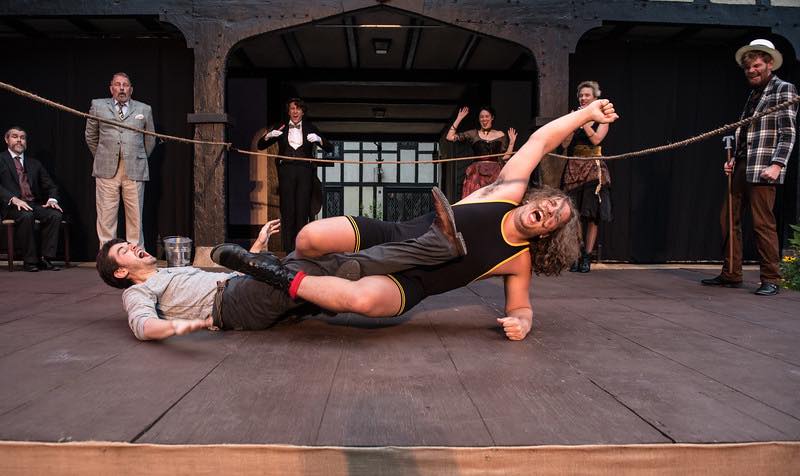
As You Like It is one of the bard’s zaniest comedies. Set initially in the French court of the evil Duke Frederick, formerly the domain of his banished brother Duke Senior, but mostly in the idealized Forest of Arden, As You Like It is filled with improbable disguises and misidentification, sibling rivalry and love at first sight. There’s also an awesome wrestling scene in the first act (fight choreography by James Ricks) and a rowdy dance at the end (choreography by Nicole Morris-Anastasi). There’s plenty of action, plenty of laughs, and – as they say – it’s complicated.

C.J. Bergin plays the love-struck Orlando, the youngest and sadly disinherited son of the late Sir Rowland de Boys. Bergin is both sympathetic and brave, first facing the ferocious wrestler, Charles, then posting odes to his beloved Rosalind on trees in the forest. Rebecca Turner is Rosalind, the object of his affections and daughter of the banished Duked Senior. Shortly into the play, Rosalind finds herself fallen head over heels for Orlando after he quite unexpectedly overpowers the professional wrestler Charles (Tommy Ryan). Accompanied by two ring girls dressed as Shakespearian wenches, Charles is a real moustache-twirling villain. His satin embroidered robe and vainglorious long locks, in stark contrast to the women’s more traditional costumes, typifies Cora Delbridge’s time-bending, era-mixing costumes. The fight was fixed by Oliver (Matt Bloch), Orlando’s older brother, but Orlando, facing defeat and having nothing to lose, knocked out Charles with a folding chair, WWE style, and as a result must flee for his life.

Rosalind’s mercurial uncle, Duke Frederick (John Cauthen – who also plays the brother, Duke Senior) not only has it in for his own brother, but also counted Orlando’s father among his enemies. After the wrestling match does not go according to plan, Duke Frederick turns his wrath on the fair Lady Rosalind, his niece and his daughter’s best friend. He gives her ten days to vacate the court, but his daughter, Celia (Jocelyn Honoré) decides to join her.

Rosalind, disguised as a young man with the fictitious name Ganymede, embarks on a hair-brained scheme to join her father and his band of merry men who have been subsisting in the forest, and here Turner get to shine as a woman impersonating a man who is in turn impersonating a woman. [In Shakespeare’s day, when all roles were played by men, Rosalind would have been a male (actor) impersonating a woman (Rosalind) impersonating a man (Ganymede) impersonating a woman (Rosalind).] Celia sticks by her cousin, but once in the forest, Honoré seems to fade into obscurity more than necessary. The character of Rosalind is, undoubtedly, the most developed female character of the play and perhaps of Shakespeare’s entire body of plays, and Turner embodies equally well the sometimes overlapping comedic, dramatic, and romantic aspects of her character.

John Mincks, as Touchstone, the court jester and Rosalind and Celia’s servant and protector, is a standout. His dandy wardrobe of plaid jacket and straw hat marries the look of the traditional court jester with the more modern look of a minstrel, his lines consist of humorous sometimes rhyming, sometimes philosophical speeches that are delivered with a speed and sassiness that could easily trip up any lesser actor. In the second act, a shepherd couple, Silvius (Cooper Sved) and the unresponsive Phoebe (Nicole Morris-Anastasi) provide a humorous diversion, with Morris-Anastasi’s character falling for Ganymede – not knowing the object of her affections is actually Rosalind in disguise. The quick-tongued Rosalind/Ganymede delivers one of the play’s most cutting lines – and perhaps one of literature’s first recorded instances of body-shaming – to Phoebe, telling the nerdy-looking and socially awkward young woman, “Sell when you can, you are not for all markets.”

Another favorite is the melancholy Jaques, played with laid-back élan by Luke Schares. A nomadic traveler who also frequents the forest, it eventually becomes clear that he is actually the middle son of Sir Rowland de Boys, younger brother of Oliver and older brother to Orlando. You may not be familiar with Jaques or the play, but you will remember his line, “All the world’s a stage. . .” If it seems difficult to keep all these characters straight, it is. It’s helpful to read the synopsis and list of cast members before the show – and again during intermission. It doesn’t help that several cast members play multiple roles.

My daughter and I went on Friday, opening night, but after a fifteen-minute rain delay and wearing a poncho as protection from the light rain that fell during the first act, the show had to be cancelled due to a storm cell and lightning. So, having a second chance to watch the first act was actually helpful in keeping all the characters and their relationships straight. The humor is unrelenting, but it’s even better when you can keep the players organized. The cast also included Derek Kannemeyer as Orlando’s faithful old “yet strong and lusty” servant, Adam; Taylor Lyn Dawson as both Amiens, Duke Senior’s musician and Audrey, the object of Touchstone’s affections; and Bill Blair as both Corin, an elderly shepherd, and Le Beau, a member of Duke Frederick’s court.

Rain pace or fair weather – and Saturday was perfect, with clear skies, cool temperatures, no humidity – As You Like It is hilarious, with well-timed direction by artistic director James Ricks, atmospheric music provided by Juan Harmon on accordion, and satisfying ensemble work by a cast of thirteen actors.

Julinda D. Lewis is a dancer, teacher, and writer who was born in Brooklyn, NY and now lives in Eastern Henrico County.

———-

Photo Credits: Photos by Aaron Sutten; Audience selfie by Noah Downs.

This slideshow requires JavaScript.

WEST SIDE STORY: Love and Musicals

WEST SIDE STORY: A Summer of Love and Musicals

A Theater Review by Julinda D. Lewis

At: The November Theatre Marjorie Arenstein Stage

Performances: June 22 – July 29, 2018

Ticket Prices: $36-62

Info: (804) 282-2620 or www.virginiarep.org


With a large cast featuring many new (to Richmond) faces, the familiar and beloved musical, West Side Story, soared on the November Theatre/Arenstein Stage on opening night. Having just seen Romeo and Juliet at the Richmond Shakespeare Festival last week, it was insanely fitting to see West Side Story just days later. One is set in the 16th century in Verona, Italy, and the other in New York City in the 1950’s, but not much has changed about human nature in the intervening centuries.

The rivalry between the Sharks, a group of Puerto Rican immigrants, and the Jets, a gang of white Americans who want to hold on to their turf, erupts in a rumble. When Maria, sister of the Shark’s leader Bernardo, and Tony, one of the founders of the Jets, meet at a dance and fall in love, the inevitable tragedy is set in motion. The intolerance of the Jets, most of whom are only first or second-generation Americans – Tony, for instance, is the son of Polish immigrants – towards the recently arrived Puerto Ricans eerily echo recent headlines and newsfeeds. At one point, Anita bemoans the fact that most Americans don’t even realize that Puerto Ricans are American citizens. It doesn’t help that both groups repeatedly refer to Puerto Rico as my/your country.

Brittany Santos, in the lead role of Maria, was a surprise. Her voice is outstanding, powerful, and has an angelic clarity that is perfect for the role – a role she has, in fact, performed previously, at Arizona Broadway Theatre and Cortland Repertory Theatre. Physically, she fits the role as well, bringing a petite, youthful innocence with a burgeoning sense of self-determination. In her first scene, she is a timid and obedient young girl; in her final strut across the stage, she is a young woman who has looked tragedy in the eye and overcome some of the trials of adulthood.

Justin Luciano, as Tony, is a young man in search of himself, and as such, is harder to pin down. His singing is strong and clear, but his speaking voice was, at times, muffled, and it was hard to tell if it was a technical difficulty or a speech impediment. His singing of the signature song, “Maria” was appropriately haunting. Maria does not have any real solos, but duets with Tony, “One Hand, One Heart,” and “Somewhere” are the songs people who have never seen the show on stage or film are familiar with. Both are songs that introduced many people to the music of Leonard Bernstein and the lyrics of Stephen Sondheim, and in the hands – and mouths – of Santos and Luciano, they came alive again.

I must confess that anything I have to say about the role of Anita, Bernardo’s girlfriend, will be colored by my fond memories of playing that role in community theater as a teenager.  Maria Cristina Slye brought a balance of sassiness and humanity to the role and did not disappoint in her big musical number with the rest of the Shark girls in Act 1, “America.”

Other lead roles included Eddie Maldonado as Bernardo and Corey Mosello as Riff, the leader of the Jets. Among my favorite characters is Anybodys, the tomboy who so badly wants to be accepted as a member of the Jets. Carly Natania Grossman played this role with spunk.

For the most part, the adults in West Side Story are peripheral characters, almost like the adults in Charlie Brown cartoons. But Jay O. Millman was a strong, conciliatory figure as Doc, the owner of the local drugstore and soda shop – similar to the Friar in Romeo and Juliet. Andrew C. Boothby as Lt. Schrank and Gregg Lloyd as Officer Krupke are portrayed as somewhat comic characters, often the butt of jokes, as in the Jets, “Gee, Officer Krupke” number, but also complicit in the discrimination. While they go through the motions of keeping the peace, their words and actions indicate that they, too, have issues with the new immigrants.

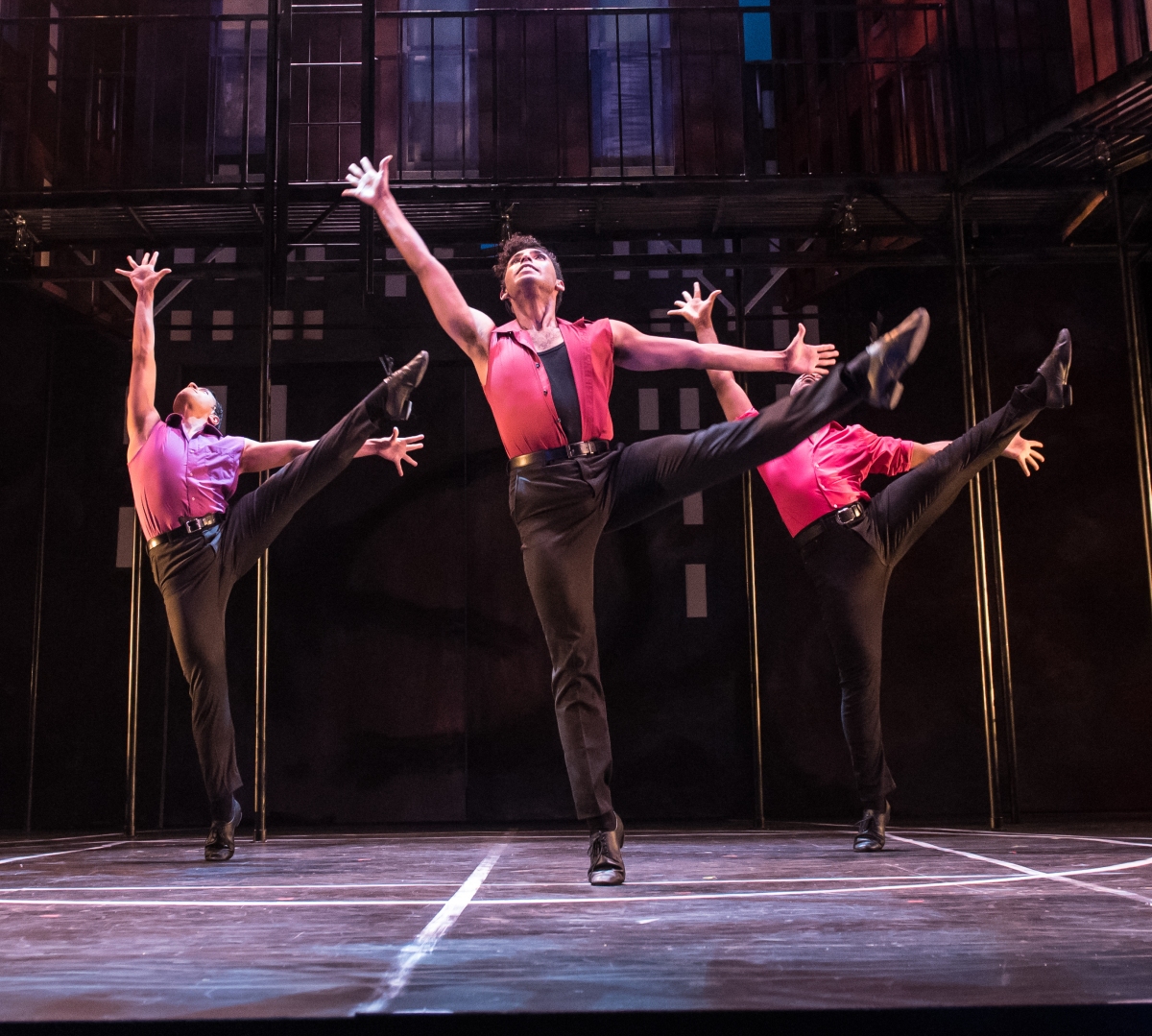
The original production was directed and choreographed by Jerome Robbins, and the Richmond production was directed by VirginiaRep artistic director Nathaniel Shaw with original choreography reproduced by Matthew Couvillon.  The choreography is bigger than life, bold, hard hitting, sometimes awkward, rather than pretty – like the surrounding tenements and chain-link fences. West Side Story has some of the best original choreography of any musical, and this production meets all expectations on that front. The women’s kicks and leaps seem to pull their legs right out of the socket and the men are ferocious – leaping over one another and attacking the fight choreography with relish.

Shaw’s direction is organic and seamless. Scott Bradley’s soaring two-story set design is suitably gritty, and imaginatively lit by BJ Wilkinson, who has roving lights that mimic the activity of the urban setting. Sarah Grady designed the costumes, which make it easy to distinguish between Jets and Sharks when they are onstage together, and Derek Dumais designed the sound.  A live band keeps things moving, under the able and energetic direction of Anthony Smith (Mary Poppins, Fun Home, The Color Purple).

There’s also new balcony seating, a Puerto Rican Rum Punch at the bar, and a Leonard Bernstein display will be exhibited at Virginia Rep outlining Bernstein’s contributions to the theatre, If you haven’t gotten your tickets yet, ¿que estas esperando?

Julinda D. Lewis is a dancer, teacher, and writer who was born in Brooklyn, NY and now lives in Eastern Henrico County.

———-

Photo Credits: Aaron Sutten


This slideshow requires JavaScript.

ROMEO AND JULIET: Romance Rebooted

ROMEO AND JULIET: Young Love and Old Problems Revisited

A Theater Review and Reflections by Julinda D. Lewis

By: Quill Theatre/20th Annual Richmond Shakespeare Festival

At: Agecroft Hall & Gardens, 4305 Sulgrave Road, RVA 23221

Performances: June 1-24, 2018, Thursdays – Sundays at 7:30pm

Ticket Prices: $30 Adults; $25 Seniors; $20 Students & RVATA Members (with ID)

Info: (804) 353-4241 or quilltheatre.org

Quill Theatre staged Romeo and Juliet at the Virginia Museum of Fine Arts just two months ago, in April. I thoroughly enjoyed it and did not plan to see the re-staging at Agecroft Hall. (Beautiful as it is, it’s outside, and there’s the question of weather and bugs, and all that goes with it, and besides, I’m recovering from back surgery and the seats might not be comfortable, etc., etc., etc.) But I heard several friends and colleagues speak so positively about the restaging, which is directed entirely by James Ricks, whereas the April version was conceived and started by Dr. Jan Powell, whose vision was completed by Ricks after Powell was called away due to a family emergency. So, on June 14, near the end of the run, I found myself seated comfortably on a cushion I brought with me, on a very pleasant, bug-free night – thoroughly enjoying Romeo and Juliet and appreciating the nuances Ricks brought to this remounting.

First of all, Agecroft Hall is thoroughly conducive to Shakespeare. The court and building backdrop, the garden, even the birds and bugs, provide a natural setting that requires little else to transport the audience to Verona and the world of Shakespeare. Then, given that the story and the script are the same, and most of the cast is the same, it was fascinating to watch a very different experience unfold before my eyes.

One of the most striking things was when, during the balcony scene that is probably familiar even to those who have never seen a performance of Romeo and Juliet, Juliet jumps down from the balcony to meet Romeo. I saw Liz Earnest in the role both times – Claire Wittman played Juliet opening weekend at Agecroft Hall – but I found her character to be both funnier and more empowered this time around.

Tyler Stevens, who first caught my attention and admiration as the younger son in the VirginiaRep Hanover Tavern production of Brighton Beach Memoirs in 2016, played the role of Romeo. Stevens brought a balance of passion and youthful impulsiveness that made his character endearing; we were able to see him through the eyes of Juliet.

Another major cast change was Todd Patterson in the role of Romeo’s friend Mercutio.  I absolutely loved Matt Shofner’s over-the-top performance at VMFA and was equally enamored of Patterson’s very different interpretation.  Patterson’s Mercutio seemed to be played less for comedy and more as a young man clinging to childish ways in a last-ditch effort to avoid adulthood – something we teachers and parents see all too often in real life!

Melissa Johnston Price’s Nurse and Bo Wilson’s Friar Lawrence remained stalwart figures with solid roles that anchored the action and their young mentees’ characters. Johnston Price’s scene with Juliet’s mother, Lady Capulet, seemed less drawn out while Wilson’s interactions with Romeo seemed more fatherly and his character’s actions overall seemed more like that of an elder or wiseman focused on establishing peace and reason between the families.

I was able to get a close-up look at the inspired construction of Cora Delbridge’s costumes. She seemed to be going for a blend of contemporary and traditional, often achieved by ripping open seams and patching them back together, leaving them partially open – sort of like the contemporary ripped-jeans look. After this show, I am angling to get my hands on Lady Capulet’s fitted black and silver mermaid dress. Aaron Orensky’s fight choreography is exciting and BJ Wilkinson’s lighting works with the natural lighting of dusk to create haunting scenes, especially those in the tomb and at the end.

This popular and well-known tragedy – interspersed with moments of humor – is well worth seeing, whether for the first time or again, if you saw the VMFA production. Interestingly, just as Romeo and Juliet comes to a close, on June 24, Virginia Rep will be opening the modern-day version of the young love story, West Side Story, beginning June 22 at the November Theatre.

The  20th Annual Richmond Shakespeare Festival will continue on the courtyard stage at Agecroft Hall’s sixteenth century English manor house with two more productions: The Compleat Wrks of Wllm Shkspr, Abridged June 30, 2018 at 7:30pm and As You Like It, July 5-July 29, Thursdays-Sundays at 7:30pm.


Julinda D. Lewis is a dancer, teacher, and writer who was born in Brooklyn, NY and now lives in Eastern Henrico County.

———-

Photo Credits: Aaron Sutten

This slideshow requires JavaScript.

GRUESOME PLAYGROUND INJURIES: Not for the Faint of Heart

GRUESOME PLAYGROUND INJURIES: An Unconventional Love Story

A Theater Review by Julinda D. Lewis

TheatreLAB’s The Cellar Series 2018: This Beautiful Mess

At: TheatreLab, The Basement, 300 E. Broad St, RVA 23219

Performances: June 11-23, 2018

Ticket Prices: $15

Info: (804) 506-3533 or theatrelabrva.org


Whenever anyone describes a particularly gruesome injury, I get an unpleasant, bone-chilling, tingly feeling that starts in my core and runs down my limbs. Rajiv Joseph’s 2009 play, Gruesome Playground Injuries, provided many such opportunities over the span of two hours (real time) and thirty years (scripted time),

Rachel Rose Gilmour and Jeffrey Cole both give compelling performances as the couple in this intense and intimate story that follows the lives of Kayleen and Doug, as they mark the significant moments in their lives by their injuries – both physical and emotional. Kayleen and Doug first meet in the nurse’s office of their elementary school, St. Margaret Mary’s.  Kayleen is nursing one of her chronic stomachaches, while Doug has ridden his bike off the roof of the school in an attempt to mimic daredevil Evel Knievel. How did he get his bike to the roof of the school, you might ask? He climbed a tree, with his bike. Yeah, he’s that kind of kid. The result, of course, is that he has extensive damage to his face.

Other young lovers exchange kisses or friendship bracelets, but not these two. Oh no…they decide to mix the most unlikely of bodily fluids in a bucket. Doug’s life is marked by a series of accidents, usually the result of, to use his word, being “brave.” Without giving away too much, I’ll just share the titles of some of the scenes: “Face Split Open,” “Eye Blown Out,” “Pink Eye.” Kayleen, who has a special gift when it comes to saving Doug, is, ironically, unable to save herself, and descends into a spiral of depression and mental illness, some of which results in physical harm. How timely, that this production should open just as we are reeling from the recent suicides of designer Kate Spade and celebrity chef and travel foodie Anthony Bourdain.

Author Rajiv Joseph has set this story in a series of eight scenes, occurring in five-year intervals, starting when the character are 8 years old and ending when they are 38 – but the scenes are not performed in strict chronological order. This requires the characters, who change clothes onstage at the start of each scene – to transform into different ages before our very eyes. They each have a folding chair, the type you’d find in a typical, basic dressing room, and a small mirror, and they often keep an eye on one another as they change their attire and scars. Oh yes, there are bandages and blood aplenty.

Each scene is also accompanied by a transition statement and song. For example, Scene 1 includes the transition “Can you save me?” accompanied by the song “Save Me” by Aimee Mann, and Scene 7, “Just because it hurts doesn’t mean it isn’t worth it,” is accompanied by Maria Mena’s “Growing Pains.”

In spite of its gruesome nature, there are many moments of lightness and laughter – Doug becomes an insurance claims adjustor and, of course, gets injured inspecting the roof of their former school. And, more than once, I was reminded of the mother in A Christmas Story¸ constantly warning Ralphie that he would shoot his eye out. But make no mistake, this is an intense and moving play about people with real problems: accidents, injuries, hospitalizations, family stress, death, cutting, and more. And it is a story about love: young love, healing love, forgiving love, unrequited love, blind love, enduring love. Melissa Rayford has directed this production with a sure hand; it is intimate and funny and handles difficult subjects with delicacy but without sugar-coating anything. The pacing is just right, without lags or awkward pauses, and the moments of silence or stillness are heavy with meaning.

This is not a play for the faint of heart, or for anyone who is looking for a fairy tale ending with all the loose ends neatly tied up. Kayleen says at one point, Doug has gotten “caught up in the spokes of my train wreck.” In response, Doug reminds her that trains do not have spokes.

Gruesome Playground Injuries uses the same set as Topdog/Underdog, which is still running in the same space on alternate nights. The basic scenic elements have been rearranged so that it is actually an entirely new setting. Kudos to the production team: scenic design by David Melton, lighting by Michael Jarett, sound and costume design by Melissa Rayford and the cast. This is a Cellar Series production, the theme of which is “This Beautiful Mess,” and in addition to a minimal budget and borrowed design elements, it has a very short run: June 12 & 13, June 21-23, so don’t mess around and miss it.

NOTE: During Monday night’s preview, outside construction created a bit of a sound distraction for half the show, but not enough to spoil the play and Rachel Rose Gilmour and Jeffrey Cole never let it show that they were competing with jackhammers and steam rollers and all the other big machines. Carry on!

Julinda D. Lewis is a dancer, teacher, and writer who was born in Brooklyn, NY and now lives in Eastern Henrico County.

———-

Photo Credits: Louise Ricks


1.1
Jeffrey Cole and Rachel Rose Gilmour
1.2
Jeffrey Cole and Rachel Rose Gilmour
1.3
Jeffrey Cole and Rachel Rose Gilmour

A CHORUS LINE: For the Dancer in Us All

A CHORUS LINE: What We Do for Love

A Theater Review by Julinda D. Lewis

Richmond Triangle Players

At: The Robert B Moss Theatre, 1300 Altamont Avenue, RVA 23230

Performances: June 6 – July 14, 2018

Ticket Prices: $10-40

Info: (804) 346-8113 or rtriangle.org


When you think A Chorus Line you think of Broadway, or a touring show to some large venue such as, perhaps, the Altria Theatre. Think again. A Chorus Line, the ground-breaking, iconic musical, the musical “that celebrates the dancer in us all,” originally conceived and choreographed by Michael Bennett, with book by James Kirkwood and Nicholas Dante , lyrics by Edward Kleban, and music by Marvin Hamlisch – yes, THAT A Chorus Line – opened at the Richmond Triangle Players. . .AND IT IS AWESOME!!!

Who would have thought you could fit a chorus line of 17 people across that stage? Well, now we know. This production, directed and choreographed by Justin Amellio, features Alexander Sapp as Zach, the intimidating Broadway director who is conducting an audition for an unnamed Broadway show, and Andrew Etheredge as his assistant, Larry. The entire show takes place on the bare stage of an unnamed Broadway theater, where the dancers who have come to audition for a show are unnerved when Zach not only puts them through the paces of jazz, ballet, and tap combinations, but asks each potential chorine to tell him something about his or her life.

There are about 21 dancers at the start of the show, but four are quickly eliminated. Of the remaining 17, Zach is looking for just four men and four women. To complicate matters, one of the women, Cassie, is Zach’s former girlfriend, who has recently returned from Los Angeles after an unsuccessful run at becoming an actress, something, it seems Zach wanted for her more than she wanted for herself.

This is a true ensemble piece, and when the dancers perform their routines – some deliberately missing a step or turning the wrong way – they transport the audience to another world. This is oh so much better than watching any dance program on television. While it’s all about the dance, A Chorus Line has some notable dramatic moments – and humor, too.

Sheila (Zuri Petteway) is sassy, obnoxious, older, and a plus-sized woman. The gargantuan chip on her shoulder might have gotten her eliminated from any other audition, but Zach apparently saw something in her. During her interview, she opens up and reveals that she had a difficult childhood mitigated only by a love for ballet. Bebe (Ijsah Byrd) and Maggie (Rachel Marrs) join her in her reverie, “At the Ballet.” Beautiful, svelte Kristine (Katherine S. Wright) reveals that while she can dance rings around others, and act as well, her one shortcoming is that she cannot sing. Wright (who I am assured really can sing well), hilariously brings down the house with her tone-deaf screeching. It’s even funnier when Al (Derrick Jaques), Kristine’s over-protective husband who is also auditioning, steps in and finishes her sentences for her, singing on key.

Another humorous highlight was Val’s (Mallory Keene) performance of “Dance: Ten, Looks: Three,” a song I remember as the “T & A” song. Perhaps the name was changed for the sake of political correctness. At any rate, it is a humorous take on an all too real situation: a dancer or performer whose superior talent is overlooked because she does not fit the idealized standards of beauty. Val’s career finally took off after a visit to a plastic surgeon, to acquire the more marketable curves.

Cassie’s (Daria DeGaetano) solo, “The Music and the Mirror” was satisfyingly dynamic, and “What I Did for Love,” led by Diana (Alexa Cepeda) was bigger than life – or at least bigger than the RTP stage. Other memorable moments included a touching scene in which Zach comforted Paul (Steven Rada) after Paul haltingly revealed how difficult it was to reveal his sexuality and occupation to his parents, and later when Paul falls and re-injures his leg – effectively ending his dancing career – and has to be taken to the emergency room.

My only two observations are that I wish the tap combination could have been performed in tap shoes, and the beautiful glittery, golden finale costumes, which fit the men perfectly, seemed to have a weird pucker at the back zipper on the women’s rear ends.

Kudos to the entire cast – too numerous to mention all by name – and the phenomenal creative team, which included musical direction by Kim Fox, lighting by Michael Jarett, and sound design by Joey Luck. Originally scheduled to run through July 7, as of opening night A Chorus Line, has already been extended through July 14, and many performances are already sold out. Get your tickets now; this is not to missed.


Julinda D. Lewis is a dancer, teacher, and writer who was born in Brooklyn, NY and now lives in Eastern Henrico County.

———-

Photo Credits: John MacLellan

A Chorus Line_1
A Chorus Line – Photos and Resumes, Please
A Chorus Line_3
Steven Rada as Paul
A Chorus Line_2
Alexa Cepeda as Diana
A Chorus Line_4
A Chorus Line – The Grand Finale