At: Dominion Energy Center, Libby S. Gottwald Playhouse, 600 E. Grace Street, RVA 23219
Performances: March 24 – April 16, 2022
Ticket Prices: $24 – $45
Info: (804) 340-0115 or quilltheatre.org
AN ILIAD (2010) is a masterful piece of storytelling. Director Lisa Peterson and actor Denis O’Hare adapted Homer’s epic poem, The Iliad, into a play for one actor. Many of the characters – and places – will be familiar to some: Achilles, Agamemnon, Hector, Paris, Helen, Troy. But even if you did not pay attention in your high school literature classes, you will be able to relate. This is more than a retelling of an ancient tale. Whereas Homer’s The Iliad tell the story of the final year of the Trojan War, An Iliad tells the story of the Trojan War from a contemporary perspective. What makes it relevant? Well, the Trojan War went on so long – some ten years – that people began to forget why they were fighting, what they were fighting for, what the end goal was, and that has a ring of familiarity for us today.
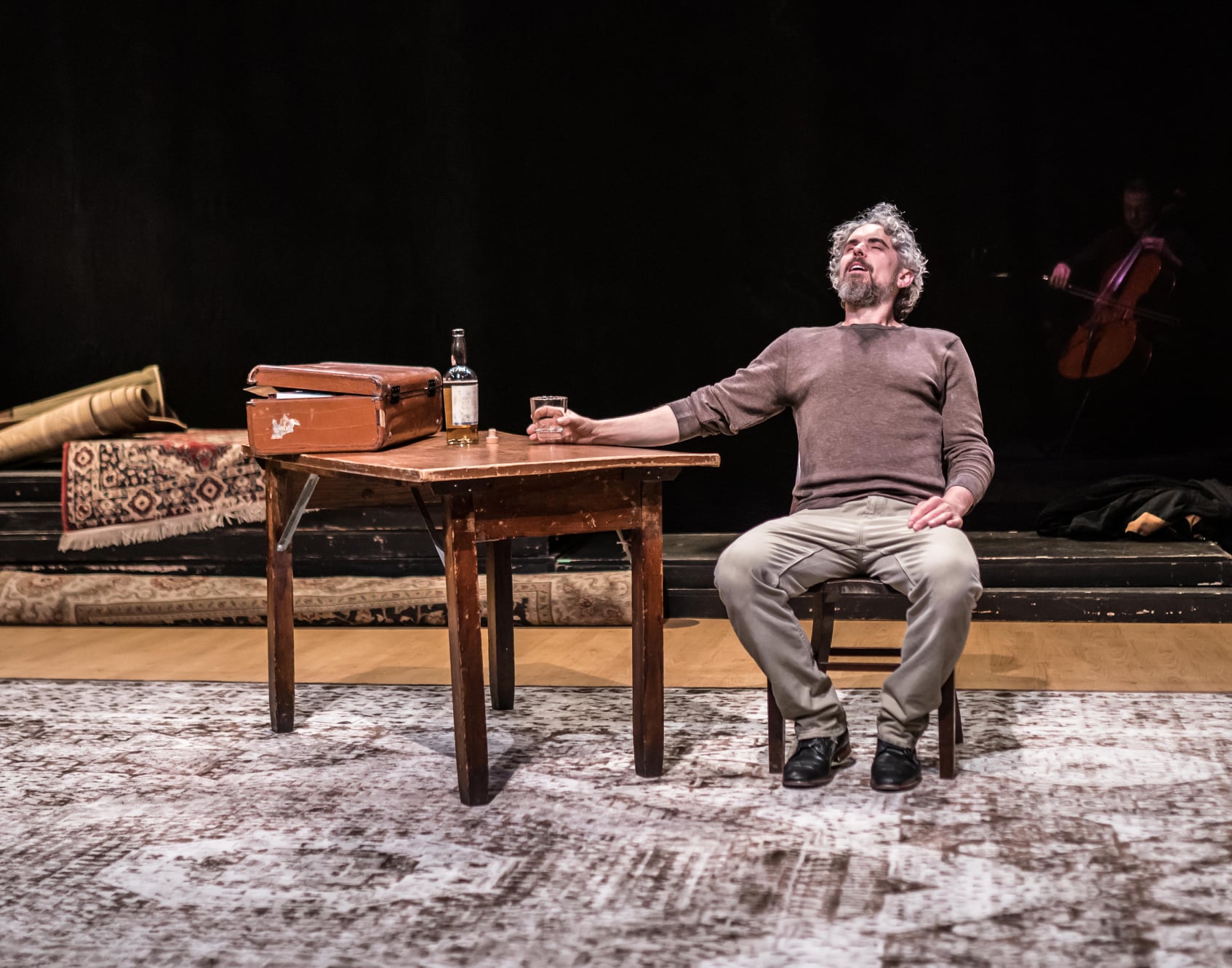
The Poet (Alec Beard) appears carrying a battered suitcase filled with a bottle of whiskey, a glass, and some papers containing, what – photos? memories? His overcoat, hat, and scarf signal that he is a time traveler. The stage is a war-torn battleground of scaffolds, an overturned chair, deserted props and tools. It is a place that appears to have been abandoned in a hurry, due to the ravages of neglect, disinterest, a war, a pandemic, or some unnamed man-made catastrophe. A ghost light on stage at the beginning and ending of the play seals the metaphoric atmosphere: security, superstition, repetition, tradition.
Beard holds our attention from start to finish, wielding a paint roller as a scepter, a random table leg as a spear, and words as weapons and keys. Beard is mesmerizing as The Poet. In the background, cellist Chris Chorney provides a timeless acoustic soundscape, and serves as a foil for Beard’s ruminations. When Beard tells a joke about Achilles, Chorney remains poker-faced; it’s as if he’s heard it all before, many, many times before. The Poet is like a vampire, immortal, timeless, no longer moved by the bizarre and inexplicable road rage that litters human history, even when animatedly re-enacting scenes from the past atrocities we seem determined to repeat. Director James Ricks has created an immersive experience that makes it impossible for the audience to distance themselves emotionally or intellectually. The Gottwald Playhouse becomes transformed, temporarily, an intimate cocoon that wraps around the performers and audience and only releases us when the lights come back up.
An Iliad includes a litany of wars, conflicts, and invasions, starting in ancient times and concluding – for now – with the current events in the Ukraine. Does An Iliad encourage the audience to understand the past by placing it into a modern context, or does it inspire us to understand the present by comparing it to the past? Like Achilles, are we, too, addicted to rage, or do we need to re-examine our definition of heroes? Returning the ghost light to center stage before exiting, The Poet asks, “You see?” But do we…
An Iliad
By Denis O’Hare & Lisa Peterson
Cast
Alec Beard as The Poet
Christopher Chorney as Muse
Direction & Design
Director: James Ricks
Composer: Niccolo Seligman
Dramaturg: Dean Simpson
Lighting Designer: Gretta Daughtrey
Scenic Designer: Missouri Flaxon
Production Manager: Oliver Samson
Box Office Manager: Margot Moser
Marketing Consultant: Emily Adler
Stage Manager: Corrie Barton
Assistant Stage Manager: Hope Jewell
Scenic Construction: Quinlan Boyle
Run Time: 90 minutes with no intermission
Julinda D. Lewis is a dancer, teacher, and writer who was born in Brooklyn, NY and now lives in Eastern Henrico County.
———-
Photo Credits: Dave ParrishPhotography
Chris Chorney and Alec BeardChris Chorney and Alec BeardChris Chorney and Alec BeardAlec BeardAlec Beard and Chris ChorneyAlec BeardAlex Beard
There are so many ways I could write about GREATER TUNA. So, I’ll just start and see where this goes.
The first in a series of four satirical plays about the fictional town of Tuna, TX, GREATER TUNA requires two actors to portray twenty citizens of this conservative Texas community. John Hagadorn and Bartley Mullin are so good at quickly transforming from one character to another that it’s almost possible to overlook the content they are sharing that is making us laugh out loud. Hagadorn thoroughly encapsulates the town’s KKK leader Elmer Watkins, with his baseball cap pulled low over his eyes and so convincingly inhabits the characters of town matriarchs Bertha Bumiller and Pearl Burrus that we almost forget he is a male actor portraying these stereotypical southern women. Hagadorn is familiar with the inhabitants of Greater Tuna, having appeared in SCM’s production of A Tuna Christmas (2016-2017 season). This is the Mill’s first production of Greater Tuna, the original play, since 1985, and director Mark Costello returned to steer this wild ride and keep it on track.
Then there’s Bartley Mullin. His interpretation of the chain-smoking used weapons shop owner, Didi Snavely (“if we can’t kill it, it’s immortal) and the whiny and angst-filled teenager Charlene Bumiller are all that and more. His endearing but jumpy Petey Fisk, who works for the Greater Tuna Humane Society (who knew there were enough people in this town to support such an organization!) and the pretentious Vera Carp (Vice President of the Smut Snatchers of the New Order) are wonderfully over the top. Hagadorn, his face hidden behind a newspaper, provides the voice of an annoying puppy Petey is trying to find a home for. It is all but impossible not to laugh and that reminds me of what Swift Creek Mill artistic director Tom Width said of A Tuna Christmas, that he produced and directed in November 2016, “It’s so wrong in the best kinds of ways.”
Right off the bat, we are introduced to Thurston Wheelis and Arles Struvie, the anchors of the town’s radio station, OKKK. The station’s call letters are repeated frequently, and yes, the “KKK” stands for just what you think it does. One of the first bits of news is the announcement of the winners of the town’s essay contest. First place goes to an essay entitled, “Human Rights, Why Bother,” while the second and third place winners are “Living With Radiation,” and “The Other Side of Bigotry.”
Of course there is a group tasked with banning books, to protect the town’s children from undesirable and divisive literature such as Roots, Bury My Heart at Wounded Knee (a book that even students in my NYC high school protested against until the teacher caved in and removed it from the syllabus), Huckleberry Finn (because it showed a child cavorting with a criminal, no mention of “Nigger” Jim), and even Romeo and Juliet (because it portrays young people disobeying their parents). Then there are The Smut Snatchers of the New Order, whose focus is cleaning up the dictionary. Just send them a word you want removed. . .
When a visiting reporter brings up the concept of intellect, Bertha Bumiller, the woman he is interviewing, responds with a deadpan, “I don’t believe we have that here in Tuna.” Act One ends with Pearl Burrus and Stanley Bumiller running over a dog to cover up the fact she poisoned it! In another of Greater Tuna’s few somber moments Stanley, at one point, reveals a dark secret surrounding the sudden death of the town’s judge.
The dilemma, of course, is that Greater Tuna is so authentically hilarious and Hagadorn and Mullin are so darned good that we find ourselves laughing at uncomfortably racist statements and stereotypical images of people that, frankly, most of us have encountered in real life – and some call family. So, how does one approach Greater Tuna? Do you just ignore the racism and bigotry and laugh at the humor? Do you acknowledge the political incorrectness and call it out? And if so, to what purpose? It is, after all, a satire – and it is intended to expose and comment on our stupidity and foibles. But. . .does that make it right, or relevant? I do not have answers to any of these questions. I just know that at least one attendee left at intermission and those who stayed for the final bows seemed happy and satisfied. And yes, I laughed. Without apology.
GREATER TUNA
By Jaston Williams, Joe Sears, and Ed Howard
Cast:
John Hagadorn plays Bartley Mullin plays
Thurston Wheelis Arles Struvie
Elmer Watkins Didi Snavely
Bertha Bumiller Harold Dean Lattimer
Yippy Petey Fisk
Leonard Childers Jody Bumiller
Pearl Burrus Stanley Bumiller
R. R. Snavely Charlene Bumiller
Reverend Spikes Chad Hartford
Sheriff Givens Phinas Blye
Hank Bumiller Vera Carp
Direction and Design Team:
Directed by Mark Costello
Lighting Design by Joe Doran
Costume Design by Maura Lynch Cravey
Scenic Design by Tom Width
Scenic Art by Liz Allmon
Original Music by Matthew Costello
Run Time:
2 hours, 1 fifteen-minute intermission
Tickets:
$49
$44 for seniors, students, military, and first responders.
Photos: from the SCM Facebook page
Greater Tuna at Swift Creek Mill TheatreBartley Mullin and John HagadornBartley Mullin as Petey Fisk
One-Time
Monthly
Yearly
Make a one-time donation
Make a monthly donation
Make a yearly donation
Choose an amount
¤5.00
¤15.00
¤100.00
¤5.00
¤15.00
¤100.00
¤5.00
¤15.00
¤100.00
Or enter a custom amount
¤
Your contribution in support of RVArt Review is appreciated.
NOTE: The Basement is a fully vaccinated venue. Proof of vaccination or a negative COVID test within 48 hours of the performance must be shown at the box office and masks must be worn while at the theater.
The title of Paula Vogel’s 1998 Pulitzer Prize-winning play, How I Learned to Drive, is a metaphor for a story so complex that it defies stereotypes. Vogel presents people not as good or bad, victim or victimizer, but as multi-layered and flawed humans. The play is more layered – and even stickier – than a baklava (Greek pastry), and Vogel chose to tell the story in non-chronological order, making it seem even more realistic as the scenes bombard the audience in much the same way as our own memories might arise from the murky depths of an unsuccessfully buried past.
The primary characters in this fractured and dysfunctional family tale are Li’l Bit and Uncle Peck, her maternal aunt’s husband. It says a lot about the nature of this family unit that nicknames are derived from genitalia. The grandfather is Big Papa. Her little cousin is BB for Blue Balls, and her mother is referred to as the Titless Wonder. Li’l Bit, who is never identified by her real name, presented with petite genitalia at birth, and the name stuck, although from her teen years onward she is mercilessly bullied and teased by family and classmates alike for her ample bosom. Uncle Peck is an uncle by marriage, so I don’t think his name is part of this twisted roll call – but he makes up for it in other ways.
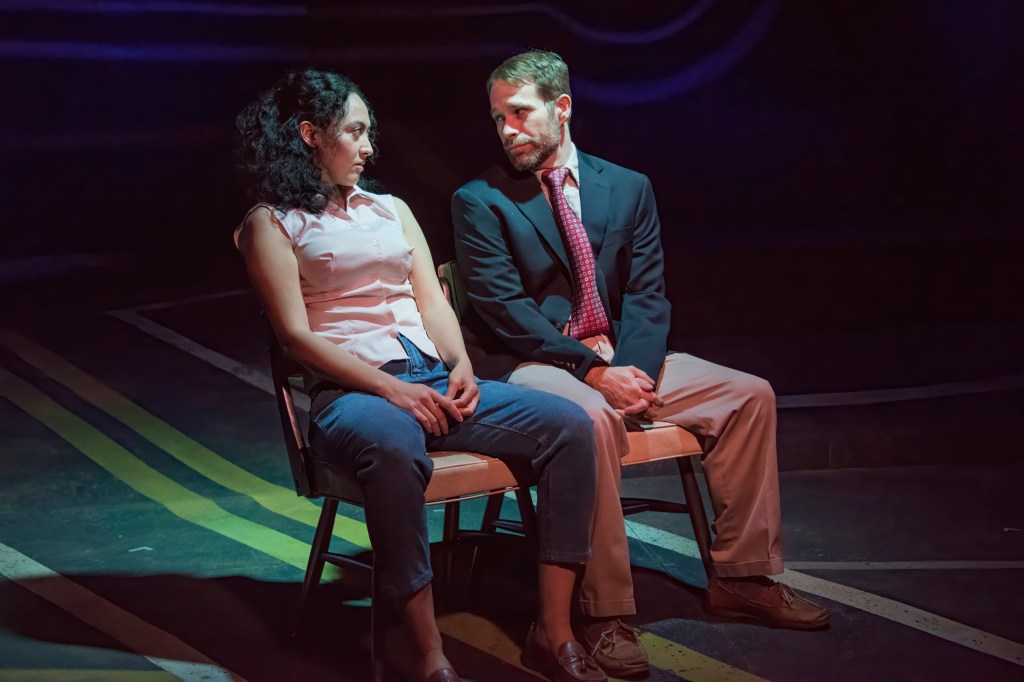
Both Li’l Bit and Uncle Peck are given stellar performances by Juliana Caycedo and Jeffrey Cole, respectively. These are the kinds of roles that make people look at you sideways when they encounter you in the produce section of the local supermarket. The rest of the cast – family members, classmates – is played by three actors: Bianca Bryan as the Female Greek Chorus, Mahlon Raoufi as the Male Greek Chorus, and Maggie Bavolack as the Teenage Greek Chorus.
The story, narrated mostly by Li’l Bit with the help of the Greek Choruses, is a surrealistically humorous recounting of sexual abuse and survival cloaked in the guise of driving lessons. It is not surprising that Uncle Peck is an alcoholic; he is not the only one either. Li’l Bit also recounts the all too familiar pattern of women in the family who not only turn a blind eye to the abuse, but also blame the child for being seductive. Aunt Mary, Uncle Peck’s wife, blames Li’l Bit for her husband’s pedophilia (and incest?), waiting for Li’l Bit to go away to college so she can rekindle her marriage. Li’l Bit’s own mother reluctantly allows her daughter to go on a long drive to the beach with Uncle Peck, warning her that she will hold Li’l Bit – a child – responsible if anything happens. There are so many outrageous scenes like this, many of which may trigger memories in audience members as well as cast and staff, that it seems each performance should be followed by a talk-back with a therapist on hand.
How I Learned to Drive is so well performed and so well directed by Chelsea Burke that is should be required viewing. Caycedo is vulnerable and resilient. It is undoubtedly exhausting to play the role of Li’l Bit – especially knowing that there are thousands of Li’l Bits out there still fighting to survive. Cole presents as a really creepy guy, even as the role sometimes calls for him to present as a caring adult. He comforts Li’l Bit when she flees a family dinner, broken by the teasing about her large breasts and the family’s refusal to acknowledge her dreams of going to college. Who needs a college degree to lay on their back? That’s Big Papa’s perspective. Uncle Peck celebrates with her when she passes her driving test on the first try; but he also inappropriately plies her with martinis and oysters. What the hell is the matter with this man? The conflict is brought to the forefront when, at one point, Li’l Bit wisely wonders if someone had groomed or molested him when he was a child.
We applaud Li’l Bit’s survival and her ability to leave Uncle Peck behind, a diminishing image in her rear view mirror. At the same time, we weep for those who are still learning how to drive.
When I attended the Sunday matinee was followed by a talk back with members of the current cast and crew and members of the cast and crew of the 1998 performance, including cast members Gordon Bass and J.B. Steinberg and lighting designer Steve Koehler. The sharing was accompanied by memories and a few tears. Both were needed.
At the time of publication, there are only two more opportunities to see this run of How I Learned to Drive. If you can find a way to get there, run!
HOW I LEARNED TO DRIVE by Paula Vogel
Directed by Chelsea Burke
THE CAST Lil Bit…………………………………Juliana Caycedo Peck……………………………………..……Jeffrey Cole Female Greek Chorus…………….Bianca Bryan Male Greek Chorus…………..…Mahlon Raoufi Teenage Greek Chorus……..Maggie Bavolack
THE TEAM Direction: Chelsea Burke Scenic Design: Alyssa Sutherland Projections Design: Dasia Gregg Lighting Design: Deryn Gabor Costume Design: Maggie McGrann Sound Design: Candace Hudert Properties Design: Kathy Kreutzer Set Construction: Chris Foote Scenic Painters: Faith Carlson, Alyssa Sutherland Assistant Stage Management: Leica Long Associate Direction: Nadia Harika Dramaturgy & Intimacy Direction: Stephanie “Tippi” Hart Production Stage Management: Crimson Piazza
THE SCHEDULE Friday, March 11 at 8pm – Preview Saturday, March 12 at 8pm – Opening Night Thursday, March 17 at 8pm – Student Night Friday, March 18 at 8pm Saturday, March 19 at 8pm Sunday, March 20 at 3pm – Matinee Tuesday, March 22 at 8pm – Community Partner Night Friday, March 25 at 8pm Saturday, March 26 at 8pm – Closing Night
Photos by Tom Topinka
Juliana Caycedo (Li’l Bit) and Jeffrey Cole (Uncle Peck). Photo by Tom Topinka.Mahlon Raoufi, Jeffrey Cole, Juliana Caycedo, Maggie Bavolack, and Bianca Bryan in “How I Leaned to Drive.” Photo by Tom Topinka
One-Time
Monthly
Yearly
Make a one-time donation
Make a monthly donation
Make a yearly donation
Choose an amount
¤5.00
¤15.00
¤100.00
¤5.00
¤15.00
¤100.00
¤5.00
¤15.00
¤100.00
Or enter a custom amount
¤
Your contribution to support RVArt Review is appreciated.
A Coming Out Story with Stonewall Jackson, Witch’s Spells, and a Bobolink
A Theater Review by Julinda D. Lewis
At: Richmond Triangle Players at the Robert B. Moss Theatre, 1300 Altamont Ave, RVA 23230
Performances: February 9-March 5, 2022.
Ticket Prices: $30-35; $10 for Students.
Info: (804) 346-8113 or rtriangle.org. Richmond Triangle Theater has returned to full-capacity seating and requires proof of vaccine or recent negative PCR test results for entry. See the theater’s website for their COVID-19 precautions, digital programs, and more.
The best comedy is relatable comedy. It often takes something from life – and it can be something bad – and pokes fun at it. By this standard, Kari Barclay’s new play – winner of Richmond Triangle Player’s So.Queer Playwriting Festival – is outrageously funny. It’s outrageous, period. The humor is a bonus.
STONEWALLIN’ features a “missing” statue of Thomas “Stonewall” Jackson (explaining the rabbit ears around “missing” would be a great big spoiler), a budding bi-sexual romance between a queer woman and a queer man, a friendship between a young Black man and an older white grandmother who spend some of their free time as Civil War re-enactors and some of their time together drinking whiskey and gossiping, and let’s not leave out a spell cast by a self-taught witch that has major unintended consequences. Surprisingly, it all fits together like a gigantic jigsaw puzzle.
STONEWALLIN’ is set in the author’s hometown of Lexington, VA, home of Washington and Lee University and Virginia Military Institute. Other points of interest include the gravesites of Robert E. Lee and Stonewall Jackson as well as the residence of Jackson, a Confederate general. More recent notoriety include the Red Hen Incident; in 2014 then White House Press Secretary Sarah Huckaby Sanders was asked to leave the Red Hen Restaurant because of her role in the Trump Administration. All of this – and more — finds a home in STONEWALLIN’.
What also makes its way into STONEWALLIN’ is a stellar cast, consisting of Levi Meerovich as Tommy Jackson (a direct descendant of Stonewall Jackson), Nora Ogunleye as Marsha Lyons (a transplant from Berkeley, CA who is staying temporarily with her brother while reconnecting with her family roots), Jacqueline Jones as Mamaw Jackson (grandmother of Tommy and a staunch proponent of “heritage, not hate”), Trevor Lawson as Elijah Lyons (brother of Marsha and apparently the proprietor of an unnamed small business), and Chandler Hubbard as General Stonewall Jackson.
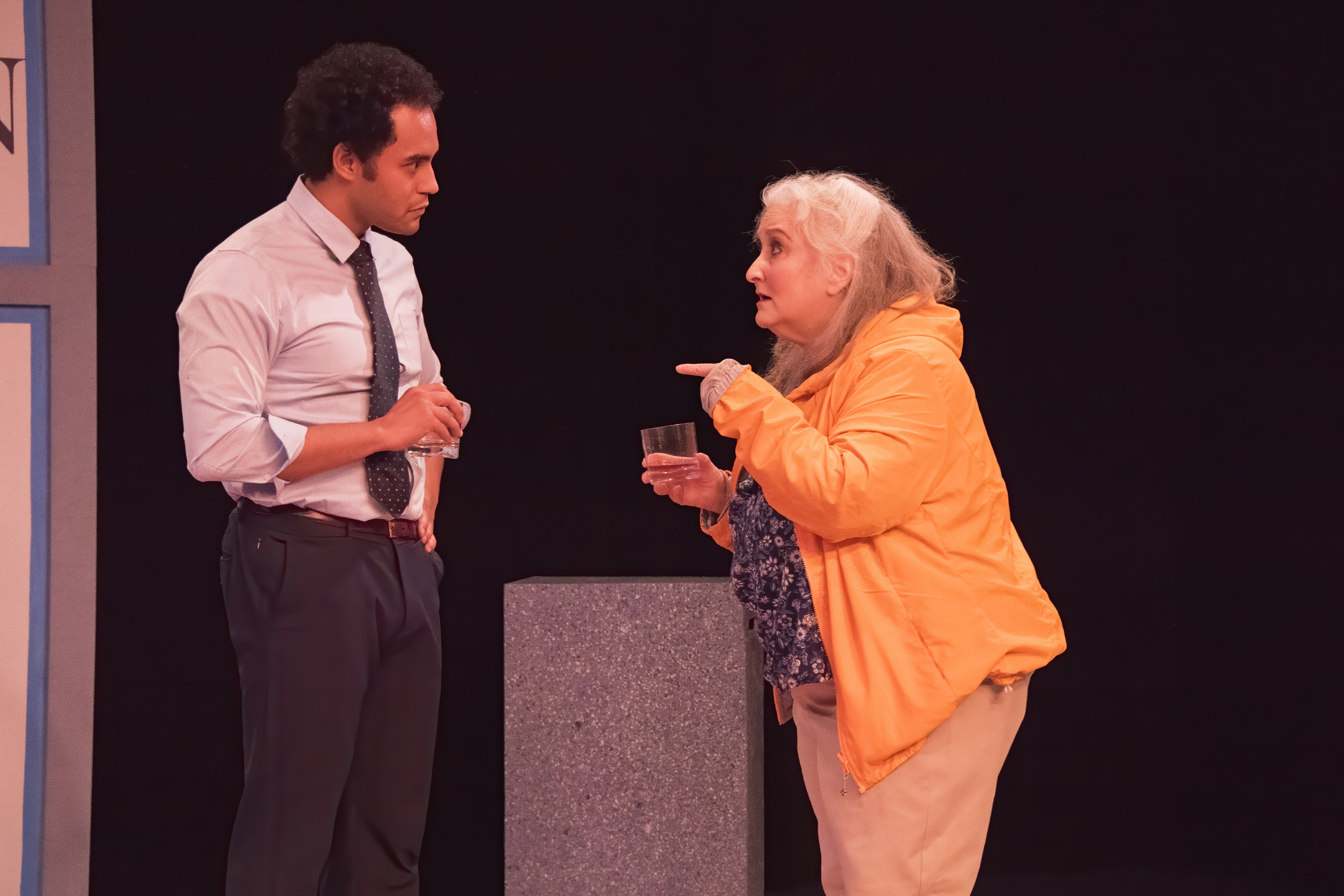
While Meerovich and Ogunleye rightfully take the leading roles as the unlikely young couple and share a relationship that is at once endearingly awkward and reluctantly intimate, it is Jacqueline Jones who steals my heart – and the show – as the sassy and sometimes deliberately daft Mamaw. She’s a rebel with or without a cause, just for the hell of it. She argues with her friend Elijah as they return from one of their Civil War re-enactment engagements, yet promises to rally her (Confederate) Flagger friends to support his housing project. She cannot fathom the emerging gender identity of her grandson – grandchild — Tommy, whose preferred attire is some variation of a black dress and earrings, and finds it more acceptable that he would have a relationship with a Black woman than that he could be gay. What a perfect example of the dilemmas posed by the state of affairs in which we currently exist.
Want further proof of how close to home this show hits? Barclay’s world premiere opened the same month that the bases of confederate statues right here in Richmond were being removed. (For those readers not familiar with what’s going on here in Richmond, the recently removed Confederate statues from Monument Avenue and other areas of the city are slated to be given to the local Black History Museum and Cultural Center of Virginia.) As for Elijah, he walks a delicate line between liberal political activist and moderate citizen of a small southern town. Lawson emanates the right demeanor – a balance of impassioned persuasion and moderate reason – to carry this off with authenticity. [Lawson recently appeared in VaRep’s Barefoot in the Park, December 2021https://jdldancesrva.com/2021/12/18/barefoot-in-the-park/and Pipeline,October 2021 https://jdldancesrva.com/2021/10/16/pipeline/]
Chandler Hubbard eases all too comfortably into the role of a southern gentleman who all too easily says things that would have been perfectly acceptable in his day but are seen as searingly offensive and racist in 2022. STONEWALLIN’ is a whole hoot and a holler of a show. Barclay has found the key to talking about difficult subjects, not only making them palatable, but mining] the humanity and liberally seasoning them with humor.
Raja Benz, who also directed Pink Unicorn at RTP [July- August 2021 https://jdldancesrva.com/2021/07/31/the-pink-unicorn/], directed this new work with insight and a big pinch of irreverence. Credit Frank Foster with the scenic design – a Stonewall Jackson pedestal that can be disassembled to create whatever minimal set pieces might be needed for any given scene – and Michael Jarett with the lighting design. Kudos to Candace Hudert for an appropriate and interesting sound design. All the elements – including rearranging the audience seating so that some were actually seated onstage – worked together to create an energized, intimate, and welcoming atmosphere. The ending is left somewhat inconclusive, leaving open the possibility for more to come.
STONEWALLIN’ runs through March 5, so there’s still time to go and find out about that “missing” statue.
Julinda D. Lewis is a dancer, teacher, and writer who was born in Brooklyn, NY and now lives in Eastern Henrico County, VA.
STONEWALLIN’ – A World Premiere
Written by Kari Barclay, winner of RTP’s Inaugural So.Queer Playwriting Festival
Directed by Raja Benz
CAST:
Tommy Jackson……………………… Levi Meerovich
Marsha Lyons ……………………….. Nora Ogunleye
Mamaw Jackson ……………………. Jacqueline Jones
Elijah Lyons ……………………….…. Trevor Lawson
Stonewall Jackson ………………….. Chandler Hubbard
CREATIVE TEAM:
Scenic Design by Frank Foster
Costume Design by Claire Bronchick
Lighting Design by Michael Jarett
Sound Design by Candace Hudert
Hair and Make Up Design by Carolan Corcoran
Properties Design by Tim Moehring
Dramaturg Katharine Given
Intimacy Choreographer Kirsten Baity
Dialect Coach Louise Casini Hollis
Assistant Director Kendall Walker
Assistant Intimacy Choreographer Kevin Kemler
Technical Director Rebecka Russo
Assistant Stage Manager Dwight Merritt
Production State Manager Kasey Britt
Photo Credits: Tom Topinka
L-R: Levi Meerovich, Chandler Hubbard, Nora OgunleyeTrevor Lawson and Jacqueline Jones
One-Time
Monthly
Yearly
Make a one-time donation
Make a monthly donation
Make a yearly donation
Choose an amount
¤5.00
¤15.00
¤100.00
¤5.00
¤15.00
¤100.00
¤5.00
¤15.00
¤100.00
Or enter a custom amount
¤
Your contribution is very much appreciated. Thank you!
Watching four other people play a game of monopoly could be about as exciting paint dry, After all, it is a long and sometimes slow-moving game, and not exactly the sort of thing that draws spectators. Yet this is exactly what playwright Nagle Jackson expects us to do.
Under the smart direction of Amber dePass, and with an amiable cast led by Crystal Oakley, A HOTEL ON MARVIN GARDENS is both an amusing evening of live theater and an opportunity to use a board game that celebrates capitalism as a metaphor for the use and mis-use of corporate power.
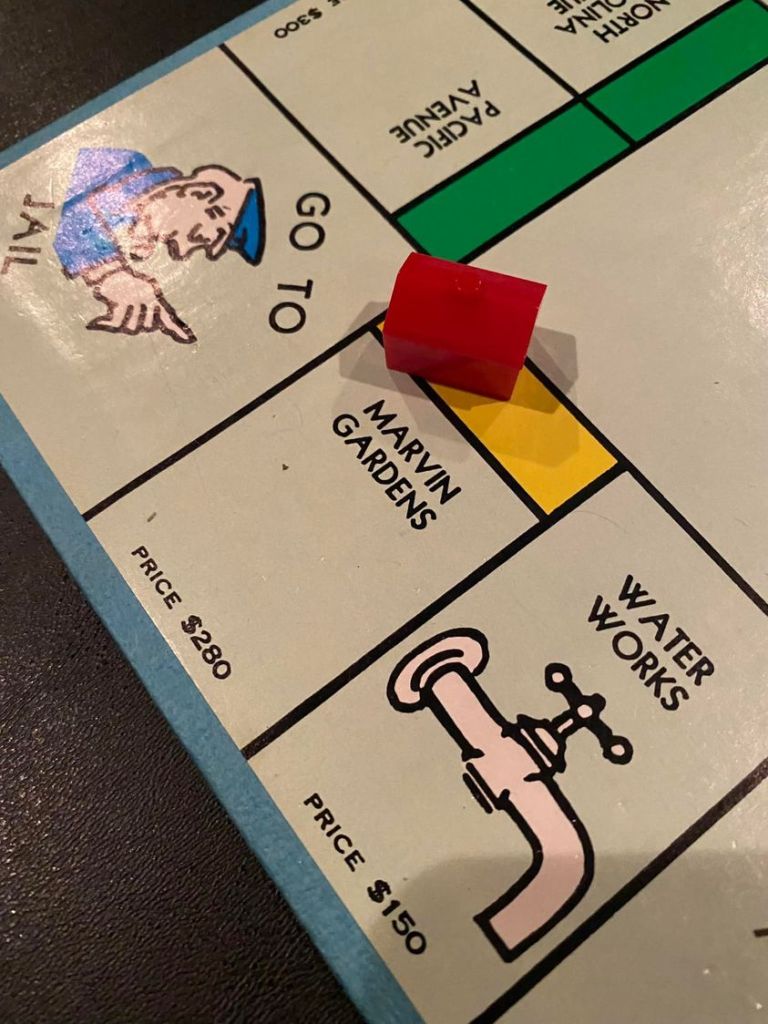
Set on a private island whose owner and sole resident, K.C. has named her magazine ME, A HOTEL ON MARVIN GARDENS ironically takes place on April Fool’s Day. It is a long-standing tradition for K.C. to host an annual gathering on April 1st, the centerpiece of which is a game of Monopoly that comes with a boatload of unwritten rules. K.C. always gets the top hat. K.C. always gets Marvin Gardens, the most expensive property on the board. And K.C. always wins.
On this occasion, K.C. (Oakley) is joined by her publisher and weekend lover Bo (Aaron Willoughby), her Managing Editor Henry (Joshua Mullins) whom she plans to fire after the party, and his plus one, Erna (Kyle Billeter) who is the magazine’s food editor. At the end of Act One, just as we’re beginning to think this is going to be a long and uneventful day, the author shakes things up by tossing in a surprise visitor. Rose (Liv Meredith) found herself stranded after turning down the advances of her date; angered, he gets in his little boat and leaves her stranded on the island in the middle of a storm. Rose surprises many in the audience when she reveals she is a teacher. Her language and demeanor could have belonged to a high school or college student, but Henry soon takes note of her.
Willoughby’s Bo is a low-key and suitable foil for Oakley’s over-bearing and narcissistic K.C.
I’m not sure what to think of Henry. At times he stands up for himself with confidence, at times he gives in to pretentious free-spirited outbursts, and then there are those other, uncharacterizable moments. I personally was outraged when, during a scheduled bread in K.C.’s precise schedule for game day, Henry went outside and urinated on the rocks – only to come back inside, pick up his drink, and return to the bar without washing his hands!
Billeter’s portrayal of the quirky food critic Erna is undoubtedly the most lovable character. And of course, she raises K.C.’s hackles. No one appears to notice when, on at least two separate occasions, Erna drops her indeterminate European accent when reminiscing about the joys of tuna melts and tuna casseroles, and even lets it slip that her mother was the Queen of Velveeta. Hmm.
A HOTEL ON MARVIN GARDENS seemed to be just what the welcoming audience needed. It was also a minor triumph for CATTheatre, which became a nomadic troupe in the midst of a pandemic. Their first show after emerging from behind masks was performed at Atlee High School. This one found a home at Dogtown Dance Theatre in Manchester, and the next performance will head west to HatTheatre. Undaunted, the show must go on! A HOTEL ON MARVIN GARDENS has one more weekend of performances, February 11 & 12, at Dogtown Dance Theatre. Just remember, K.C. always gets the top hat and K.C. always wins – even if it means she’s left all alone. Oh, and enter K.C.’s kitchen at your own peril. And you should probably avoid the Pump House…
Julinda D. Lewis is a dancer, teacher, and writer who was born in Brooklyn, NY and now lives in Eastern Henrico County.
A HOTEL ON MARVIN GARDENS
Written by Nagle Jackson
Directed by Amber dePass
Cast
K.C. Crystal Oakley
Bo Aaron Willoughby
Henry Joshua Mullins
Erna Kyle Billeter
Rose Liv Meredith
Design Team
Stage Manager Nancy McMahon
Assistant Stage Manager, Costume Design, Set Dresser Jenn Fisher
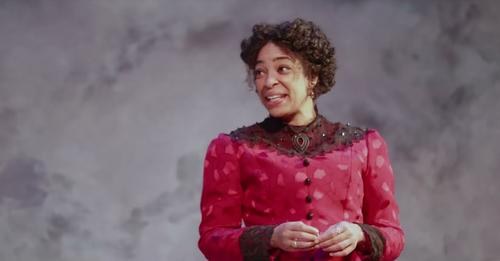
If Nora and Torvald were on social media, there is no doubt their relationship status would be, “It’s Complicated.” When Nora walked out of the home she shared with her husband Torvald at the end of Ibsen’s play, A Doll’s House (1879) it was described as “the slam heard ‘round the world.” Nora’s decision to leave her husband and children was so scandalous Ibsen was forced to write an alternate ending. For 138 years people were left to ponder what happened to Nora.
In 2017 American playwright Lucas Hnath provided us with some of the answers. A Doll’s House, Part 2 begins with a knock on the door – the same door Nora slammed in 1879. Opening the door to self-exploration was also an open invitation for scandalous speculation and unstoppable feminist progress. Hnath has Nora return after a fifteen year absence to settle some unfinished business.
It is both fascinating and satisfying to see Katrinah Carol Lewis, who played Nora in a 2018 production at what was then TheatreLab, The Basement. In December 2018 I described Lewis’ performance as Nora as one of her most highly charged among many challenging roles. “With her naturally large eyes accented by makeup, and in the intimate space of The Basement, it was easy to see every nail biting emotion, to hear every breath, to practically feel her trembling.” [Follow this link to read my entire review of Ibsen’s A Doll’s House: https://jdldancesrva.com/2018/12/08/a-dolls-house-well-shut-the-door/.]
Nora in 1894 is no trembling bride. Her first knock at the door is confident; the second is commanding. She wears the finest clothes, and sits with her legs spread apart and leaning forward, forearms resting on her thighs, in her straight-backed chair. In many ways, both financial and experiential, this older and wiser Nora has achieved success. But as the story unfolds, it becomes obvious that in more ways than she would like, the new Nora has retained much of the old Nora.
Ibsen’s A Doll’s House is not a prerequisite for Hnath’s A Doll’s House, Part 2. There are plenty of references to Ibsen’s work to fill in the essential background, but if you are familiar with the original, and even better, if you have seen Lewis in the original, it is a much more fulfilling journey.
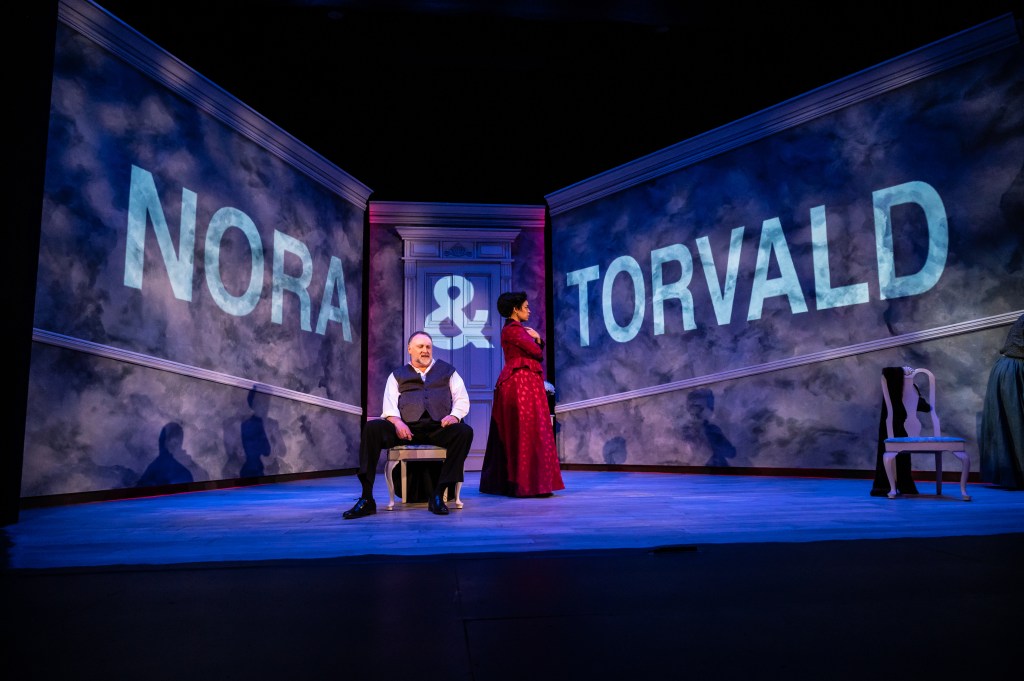
Lewis and David Bridgewater, who plays Torvald in this new production, circle around each other like wary cats, avoiding physical contact – or even eye contact – until their climactic scene in the final third of the play. Then their explosive interaction reveals to the audience that what Nora has endured in search of the elusive “true marriage,” a marriage of equals, was right under her nose the entire time. In one fleeting moment, the estranged couple drop their masks, we glimpse the manifestation of what she always wanted, and before we can fully absorb it, before we can get all sentimental about it, it is gone – and so is she. Again. While A Doll’s House, Part 2 answers many questions raised in the original, it leaves us with just as many, if not more, than we had before.
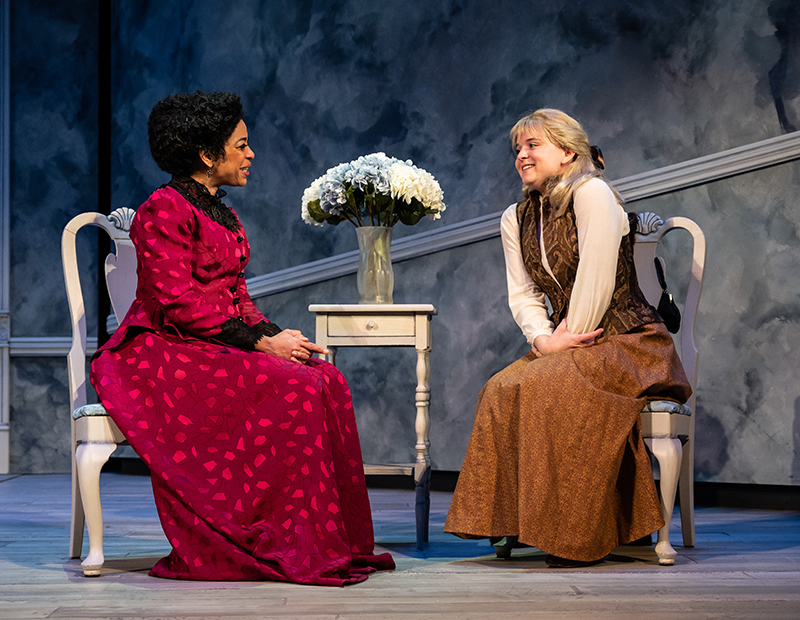
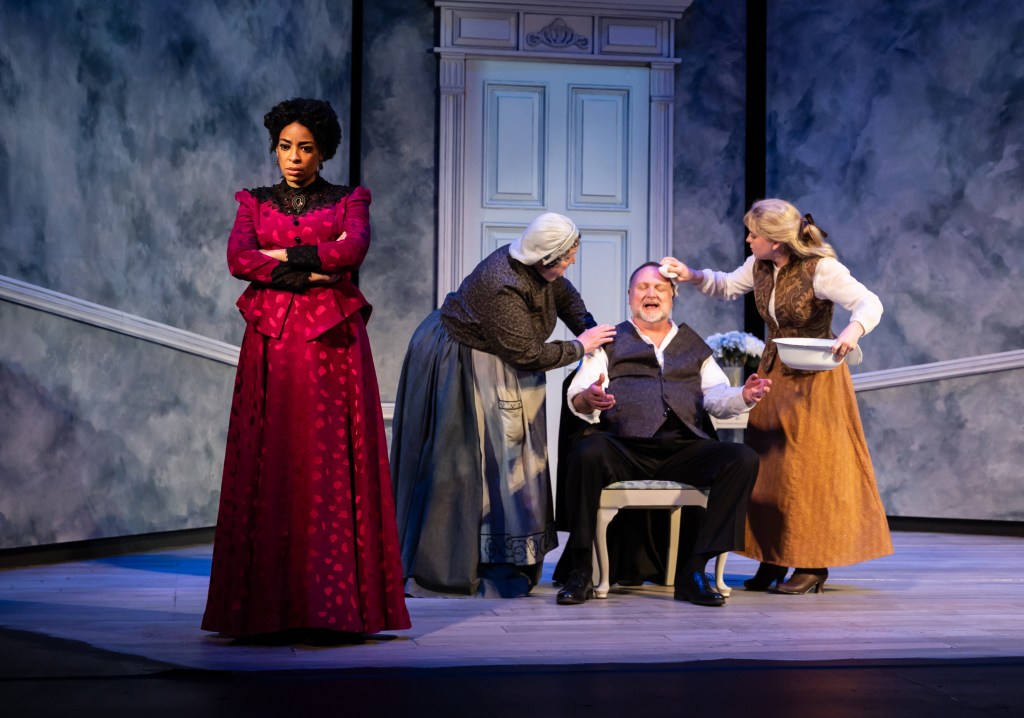
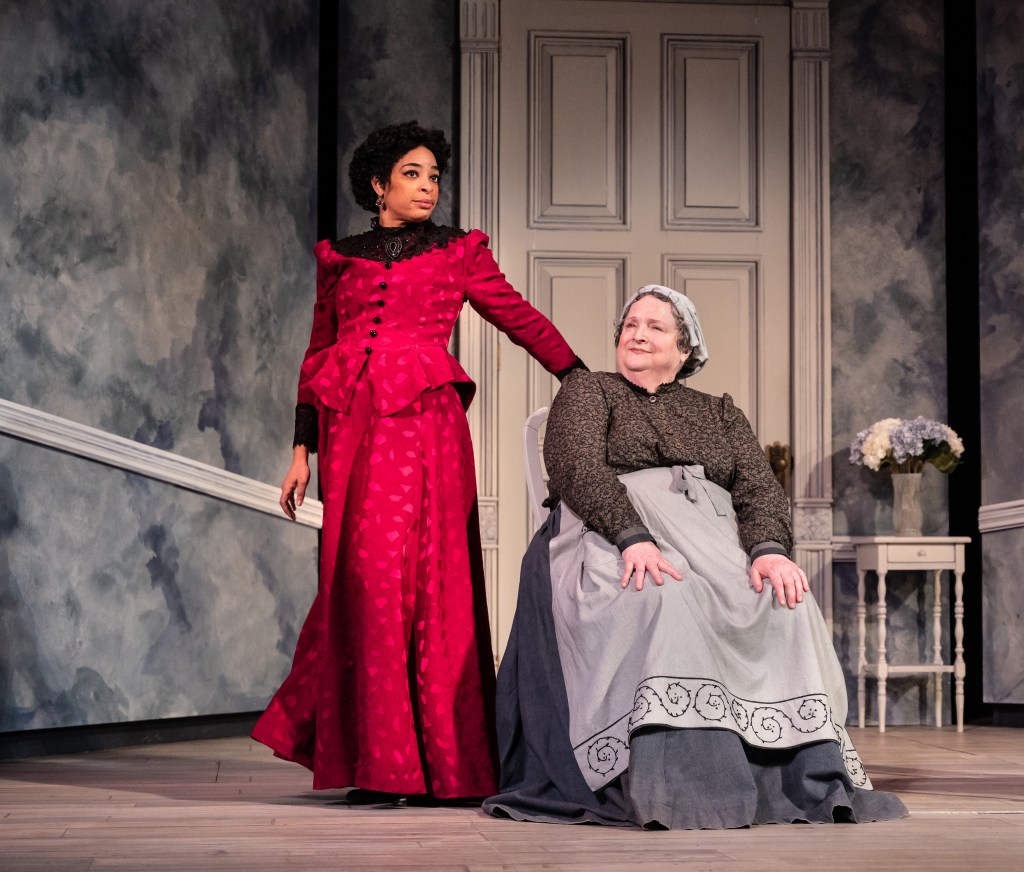
Everything in A Doll’s House, Part 2 has been pared down. The set consists of two elegantly painted or papered walls, a gigantic door, two formal straight-backed chairs, and a small table holding a vase of flowers. The little details that make the space a home have been omitted – or, as Anne Marie says, anything that belonged to Nora was thrown away when she left. The cast has been pared down to just two leading actors (Lewis and Bridgewater) and two supporting actors: Catherine Shaffner as the beleaguered nanny turned housekeeper, Anne Marie and Katy Feldhahn as the Helmer’s youngest child, Emmy. The play itself has been paired down, from Ibsen’s three acts and two intermissions to a 90-minute production performed without intermission.
What has not been pared down is the family dysfunction. Emmy, who has spent the better part of her life without a mother is so much like Nora it’s shocking. As a child, Emmy asked her two older brothers to tell her what they remembered about their missing parent. It may be a genetic or spiritual connection but neither of them seems to be aware of it – or, perhaps, it is just their habit to deny the obvious. Shaffner, in the role of Anne Marie who raised young Nora as well as her children, provides important connecting links between the past and the present, as well as a few welcome comedic outbursts of foul language.
Sharon Ott’s direction retains the main characters’ affectations and packs a lot of emotions and family drama into a much shorter production time. Although there did seem to be a bit of a lull bnear the end of the first half, Emmy’s appearance turned up the heat – and her Option 3 turned the tables on Nora.
Nora and Torvald are not likeable people, but they are familiar. We know people with some of their least likable characteristics. They are members of our own families and sometimes they are us. A Doll’s House, both the original and Part 2, was not intended to give the viewer a satisfying or happy ending. Both make us question gender, marriage, institutions, laws, and systems. They force us to look at the familiar from new perspectives and encourage us to question why we accept things the way they are – and consider what might happen if we walk out the door, or even knock it off its hinges.
Julinda D. Lewis is a dancer, teacher, and writer who was born in Brooklyn, NY and now lives in Eastern Henrico County.
Discounted Group Rates and Rush tickets are available.
Run Time
The play runs about one hour and 35 minutes with no intermission
Here’s a little video teaser:
Photo Credits: Aaron Sutten [production photos were not yet available at the time of publication] NOTE: Photos updated February 8, 2022.
Katrinah Carol Lewis as Nora
———-
Katrinah Carol Lewis and Katy Feldhahn. Photo by Aaron Sutten.David Bridgewater and Katrinah Carol Lewis. Photo by Aaron Sutten.Katrinah Carol Lewis, Catherine Shaffner, David Bridgewater and Katy Feldhahn. Photo by Aaron Sutten.Katrinah Carol Lewis and Catherine Shaffner. Photo by Aaron Sutten.
Virginia Rep COVID Guidelines
To provide the highest level of safety, all patrons are required to show proof of vaccination, or proof that they have received a negative COVID test by a professional technician within 48 hours of the performance date/time.
Patrons must show your vaccination card or a photo of the card on your phone, along with a valid photo ID, when you arrive for the performance. If you are unable to be vaccinated, you may provide proof of a Rapid COVID-19 antigen test taken within 48 hours of your performance. At home tests will not be accepted.
In accordance with current city, state, and CDC guidance, face masks are REQUIRED at all times while you are in the building, regardless of whether or not you have been vaccinated.
At this time, no food or drink is allowed in the theatre.
–
One-Time
Monthly
Yearly
Make a one-time donation
Make a monthly donation
Make a yearly donation
Choose an amount
¤5.00
¤15.00
¤100.00
¤5.00
¤15.00
¤100.00
¤5.00
¤15.00
¤100.00
Or enter a custom amount
¤
Click the button below to donate to RVArt Review. Your contribution of any size is appreciated.
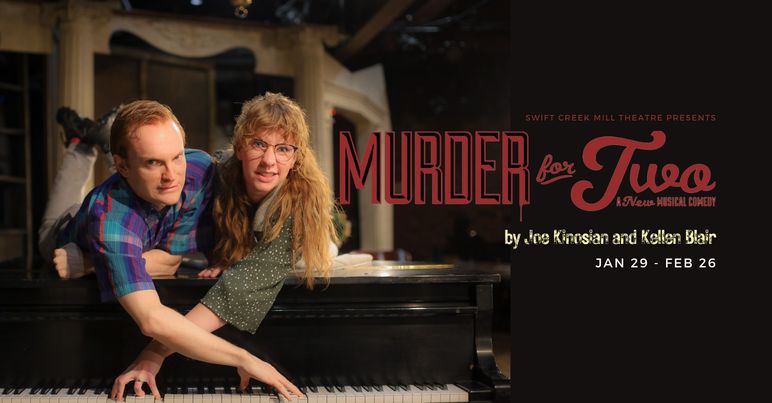
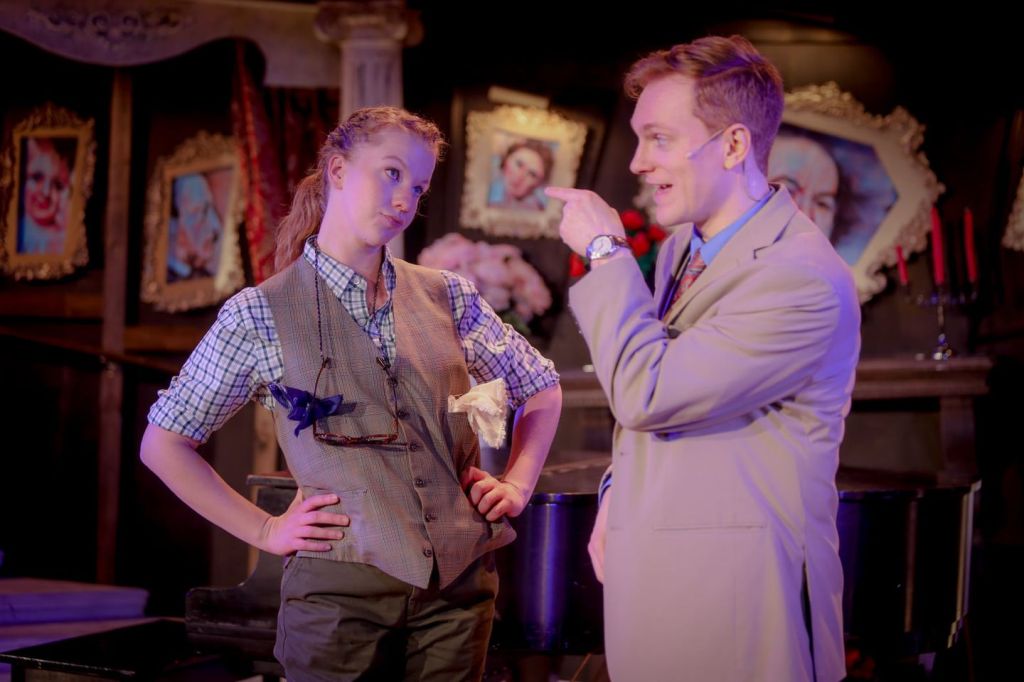
The two actors who play ALL the characters in MURDER FOR TWO come onstage wearing birthday party hats, and immediately begin a series of zany and wordless shenanigans. Their wacky introduction requires them to dress the stage with pedestals, vases filled with flowers, magician’s trick bouquets, and comic sound effects. The stage itself, designed by Tom Width, features stall Greek columns, crazily angled doors, and portraits over the fireplace that have as many as seven sides and angles. A baby grand dominates the center of the stage and could very well be given credit as a third character. As the play progresses it becomes clear that this musical comedy murder mystery, written by Joe Kinosian and Kellen Blair is, as Director Tom Width describes it in his program notes, “quirky in the best possible ways.”
Mark Schenfisch plays Marcus Moscowicz, an ambitious police officer with all-consuming dreams of becoming a detective. Marcus initially appears as to be insufferably arrogant and narcissistic, but Schenfisch gradually digs down and mines the underlying integrity that drives his character.
Most remarkable, however, is Emily Berg-Poff Dandridge who plays ALL the other characters – with one notable exception I will not reveal here because I don’t want to spoil it for those of you who have not yet seen MURDER FOR TWO.The mystery revolves around who killed the prolific author Arthur Whitney who was unceremoniously murdered as he arrived for his own surprise birthday party as the remote mansion where he lives – or lived – with his wife. It is worth noting that Whitney was not well liked. All who gathered to celebrate his birthday had appeared as a character in one of his books, making them all plausible suspects.
Dandridge play the roles of the newly widowed Dahlia Whitney, the Whitney’s feisty and constantly bickering neighbors, Murray and Barb Flandon, Whitney’s talkative and over-achieving niece Stef, a well-known ballerina names Barrett Lewis who has a vaguely Russian accent that does not match her name, Dr. Griff – a local psychiatrist who conveniently ignores the ethics of doctor-patient confidentiality – and, last but not least, Timmy, Yonkers, and Skid, the only remaining members of a twelve-member boys’ choir who were invited to provide entertainment for the birthday party.
As required by the script, Dandridge swiftly transitions between these nine characters using a pair of large round eyeglasses and a red baseball cap as the only notable props. The majority of the characterizations are accomplished through shifting the actor’s center of gravity, changing the posture, and adjusting the voice, accent, and phrasing – often in mid-sentence. The result is that Dandridge often interrupts herself and does it so well we almost forget that there is a single actor creating multiple characters. Thank you, Emily Dandridge, for an outstanding performance.
As far as mysteries go, the authors have written in enough details, anecdotes, and red herrings to keep things interesting. The biggest of these is Dahlia Whitney’s increasingly colorful, complex, and loud musical confessions.
And then there’s the piano. MURDER FOR TWO is a musical, but not the breaking-into-song or catchy-show-tunes type of musical. Instead of the usual offstage band, both actors play the piano, using it like anther character’s voice or as a substitute for their own. Sometimes they do sing, but most often the piano seems to be another voice rather than an instrument to accompany the human voices. Speaking of voices there is one character who is NOT voiced by Dandridge who is represented by a sound effect reminiscent of the muted trombone voice of the invisible adults on Peanuts animated shows.
MURDER FOR TWO is filled with a steady stream of surprises. The director makes sure the pace rarely lags. This show might even trigger sensory overload for some viewers. The story is complex enough to hold the audience’s attention for ninety minutes with no intermission and the lighting is as wacky as the plot. I especially liked the effect of the arriving automobiles, and there are plenty of other special effects that surprise, stun, and amaze. The physical set screams comedy, and the writers and actors have successfully met the challenge of this hybrid genre of theatre without detriment to either the comedy or the mystery elements. The rapid transitions and complexity sometimes make it a challenge for the audience as well, and there are occasional asides or moments when the audience is directly addressed – giving us a moment to catch up. MURDER FOR TWO is “extra” and that’s one of the best things about it.
MURDER FOR TWO
Book and Music by Joe Kinosian
Book and lyrics by Kellen Blair
Cast:
Mark Schenfisch as Marcus Moscowicz
Emily Berg-Poff Dandridge as The Suspects
Direction and Design Team:
Directed by Tom Width
Musical Direction by Mark Schenfisch
Costume Design by Maura Lynch Cravey
Lighting Design by Joe Doran
Scenic Design by Tom Width
Technical Direction by Liz Allmon
Run Time:
90 minutes, no intermission
Tickets:
$49
$44 for seniors, students, military, and first responders.
Photos: Robyn O’Neill
Mark Schenfisch and Emily Berg-Poff Dandridge in MURDER FOR TWO. Photos by Robyn O’Neill for Swift Creek Mill Theatre.
A New One-Person Show That Explores the Question: What Does Survival Mean to You?
A Theater Review by Julinda D. Lewis
At: Richmond Triangle Players at the Robert B. Moss Theatre, 1300 Ave. RVA 23230
Performances: January 13 – 23, 2022
Ticket Prices: $10 – $40
Info: (804) 346-8113 or rtriangle.org.
Have you ever been to a production where you clapped at the end, not because of the content of what you had just experienced, but because you could think of no other way to acknowledge the artist’s performance? That’s what the audience collectively experienced on Thursday night after Alan Palmer uttered the final words of Chanteuse: A SurvivalMusical.
Palmer wrote the script and lyrics and stars in this moving one-person musical, set in Berlin in 1933. The music is by David Legg and for this limited Richmond run the inimitable Kim Fox performed the roles of musical director and conductor.
Walking into the space, the audience was immediately drawn into the scene. Small tables with lamps lit by flickering tea candles that suggested the intimacy of a Berlin club were distributed throughout the house. The stage itself was darkly lit, suggesting something ominous was about to happen. There was a mannequin with a dark gown or robe topped by a dark wig, and there were several set pieces covered in black fabric. The darkness, however, was not just a physical effect of the lighting, and stage properties, but there was also a palpable emotional element that lingered heavily, a portent of things to come.
The back wall was mostly brick but accented with a center arch that served as a projection screen and two sections of rough-hewn wooden pallet on either end. The horizontal slats of the pallet sections suggested some sort of confinement, while allowing a glimpse of the band stage left. That’s how I was able to see that the instrument that was churning out soul-tearing melodies was actually a bass, although Jonathan Wheelock magically and skillfully made it sound like a cello.
Palmer entered into this space and immediately captivated the audience with the horrific story of one queer man’s tale of life and survival in Nazi Germany, where being queer, a cross-dresser, Jewish, or mentally or cognitively challenged were sufficient cause for being detained, brutalized, and ultimately killed.
But all was not doom and gloom. The first half of the one-hour solo musical, performed without intermission, had several moments that allowed Palmer, an actor, dancer, and real-life Power Ranger (he played Corcus on The Mighty Morphin Power Rangers TV series, 1993-1996) to dance, strut, change clothes, tease, titillate, and morph from a gay male performer to living life full-time as a female chanteuse in a supper club in Berlin.
A raid on Club Silhouette sends his life (do we ever really learn his name? he is telling his own story, so we never hear anyone call him by name) into a tailspin. Now, if you plan to see this show, you might want to skip the next paragraph, but since this is a limited run, by the time you read these words the show will likely have closed, therefore what follows is technically not a spoiler – I am alerting you out of courtesy so that you know that I am a civilized and cultured person. So…on that note…
The sudden death of his long-time landlord turns out to be a blessing in disguise. You see, they had become friends, and even looked somewhat alike, so it seemed like the best way to honor his friend’s memory (there are untold secrets involved) and simultaneously assure his own safety from the homophobic Nazi’s was to assume the identity of the late Frau Friederick. On the positive side, this transformation led him to find true love. Ironically, our protagonist transformed from a gay male into a woman in order to protect himself from the Nazi’s only to discover – too late – that Frau Friederick had been hiding the fact that she was Jewish.
Chanteuse begins in the decadence, freedom, and sometimes glamor of the Berlin club scene and ends, not with a bang but a whimper, in the soul-killing Sachsenhausen concentration camp – a labor camp for prisoners and training ground for SS officers that housed separate sections for political prisoners, Jehovah’s Witnesses, Soviet POWs, Poles, Jews, Homosexuals, and Freemasons. While there, he reunites, briefly with his partner, Yakob, to whom he was illegally yet lawfully married (using Frau Friederick’s ID). Is it any wonder this leads him to begin to pray in Hebrew? “Baruch ata Adonai, eloheinu melech ha’olam, sh’hecheyanu, v’kiyemanu, V’higianu, lazman, hazeh.” (Praised are You, the Eternal One our God, Ruler of the Cosmos, who has kept us alive, sustained us, and enabled us to reach this moment.)
And here we have the point of the plot. Survival. In this moment. And suddenly the past is united with the present and the future. A moment in time telescopes into another moment in time. Past becomes present, and we have to ask ourselves, what have we learned? Indeed, what have we done?
So you see, it was necessary to explain the applause. The applause was not for the experience we had all just shared. The applause was not for the message we were processing. The applause was for the messenger, and the brilliant and unpretentious way he delivered that harsh message.
Chanteuse: A SurvivalMusical is/was here in RVA for only eight performances, and Palmer has plans to open in London sometime later this year. I haven’t yet been to London, but I always keep my passport up-to-date. Now I know that flying off to London to see a show may not be realistic for most of us; my point is that this intelligently and beautifully produced musical needs to be seen.
Kudos to director Dorothy Danner for keeping Palmer’s pacing and blocking flowing organically and breathing a breath of life into these words that Palmer then exhaled over us all. David Legg’s music was dynamically connected to Palmer’s words, and Kim Fox’s musical direction guided us along the right paths of emotion.
Chanteuse: A Survival Musical
Created by and Starring Alan Palmer
Director – Dorothy Danner
Music – David Legg
Book and Lyrics – Alan Palmer
Lighting Design – Joe Doran
Audio Engineer – Brandon Duncan
Technical Direction – Vinnie Gonzalez
Production Stage Manager – Crimson Piazza
Musical Director and Conductor – Kim Fox
The Band – Kim Fox (Conductor and keyboards), Chris Sclafai (saxophone), Joe Lubman (percussion), Jonathan Wheelock (bass)
Richmond Triangle Players at the Robert B. Moss Theatre in association with Palmer Productions
Richmond Triangle Players at the Robert B. Moss Theatre has returned to full-capacity seating and requires proof of vaccines or recent PCR rest results for entry. See the theater’s website for their COVID-19 precautions, digital programs, and more.
First, let’s be clear: yes, it’s December, and SURPRISE! – Neil Simon’s BAREFOOT IN THE PARK is not a Christmas show. What it is, is a delightful romantic comedy that appears to be as much fun for the actors as it is for the audience.
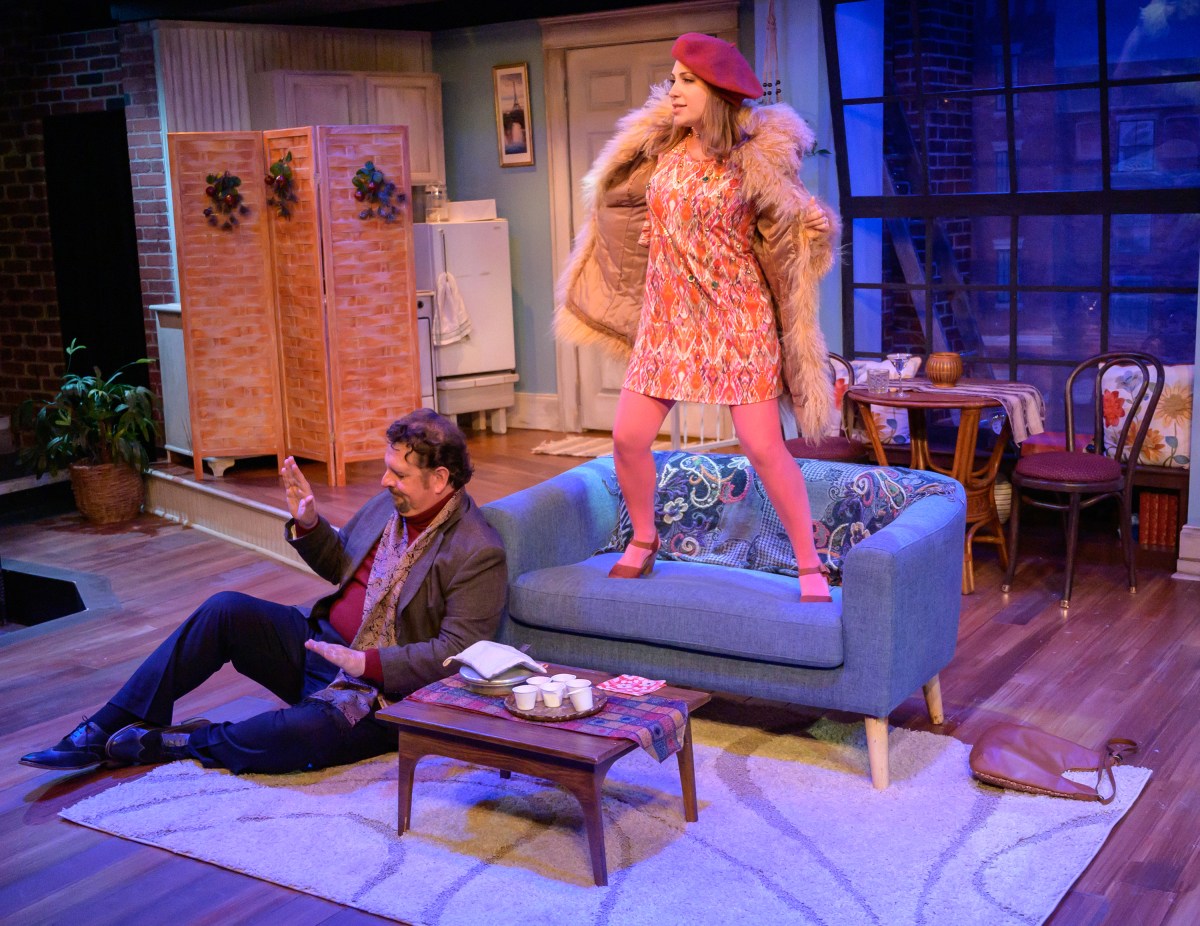
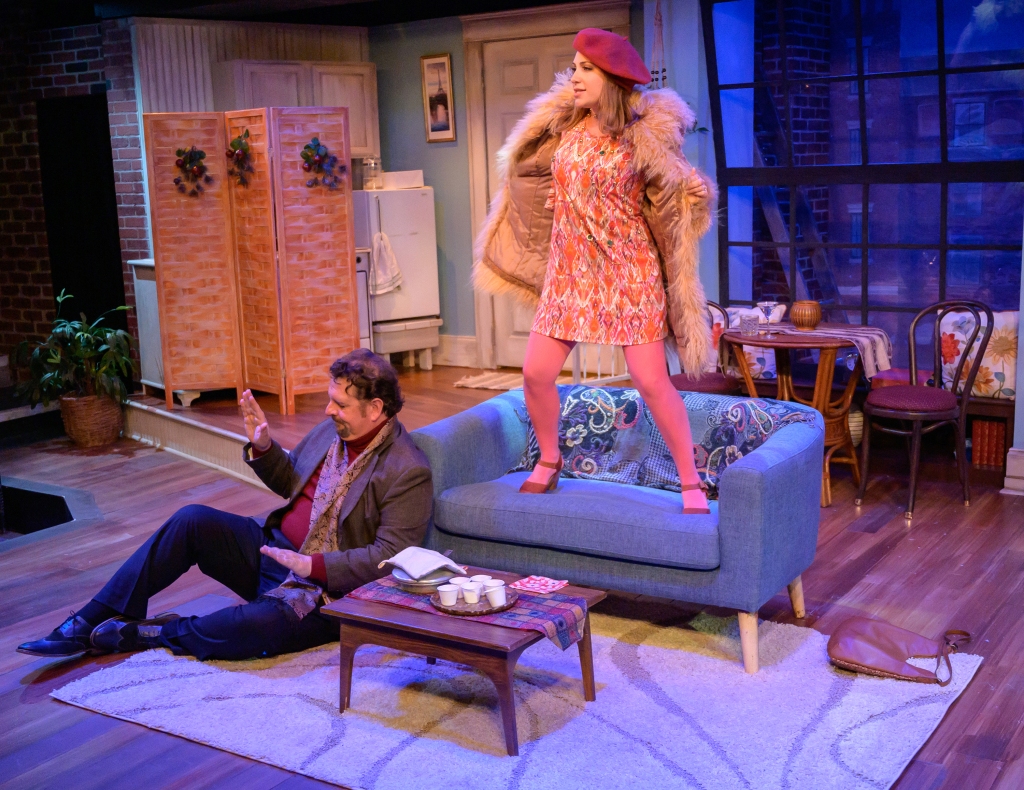
The plot is a simple one: two newlyweds move into their first apartment after spending their honeymoon is an upscale New York City hotel. Their new home is a fifth floor walk up in a Manhattan brownstone. Let’s just say it’s a fixer-upper. There’s a kitchenette, a bathroom with no bathtub (but at least the bathroom is inside the apartment – those familiar with old New York apartments know what I’m talking about), and a bedroom so small that when you open the door it hits the double bed, which you have to climb over to reach the closet, which is leaking. Speaking of leaks, there is a hole in the skylight – you know, the window in the roof – and it’s February. The apartment quickly drives home this young couple’s differences: she’s impulsive and free-spirited and he is a conservative lawyer who is more compatible with his mother-in-law than her own daughter has ever been.
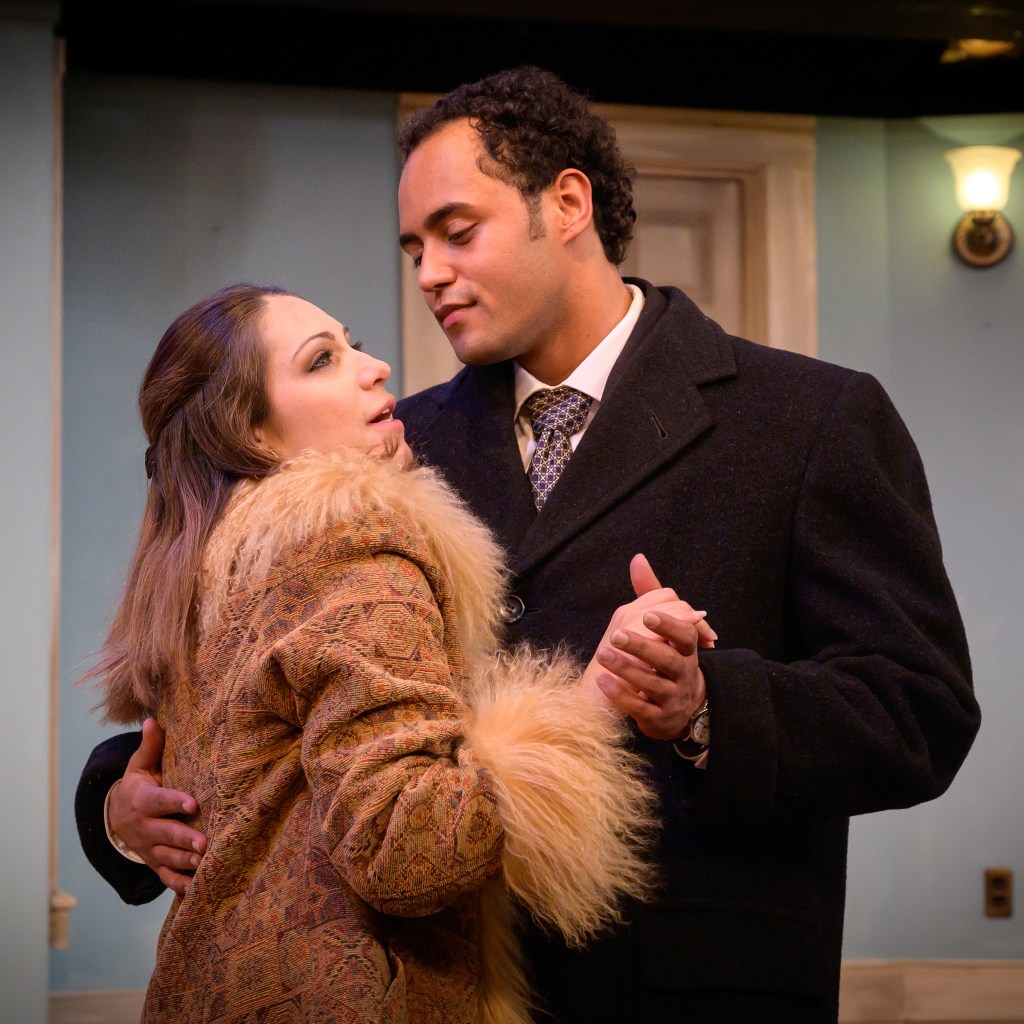
Rachel Rose Gilmour was perfectly cast as newlywed housewife Corie Bratter. (And yes, I’m using the terms that would have been used in 1968.) Her brightly colored wardrobe captures both the period and her character’s personality. Trevor Lawson demonstrates enviable restraint as the husband who is hit with one surprise after another: the rent is twice as much as Corie is willing to tell her mother they actually pay; Paul saw the third floor apartment prior to moving in, not realizing their apartment was on the fifth floor – not counting the outside stoop, and of course there is the matter of the tiny kitchen, the lack of a bathtub, and the miniscule size of the bedroom. To make matters worse, their furniture is delayed.
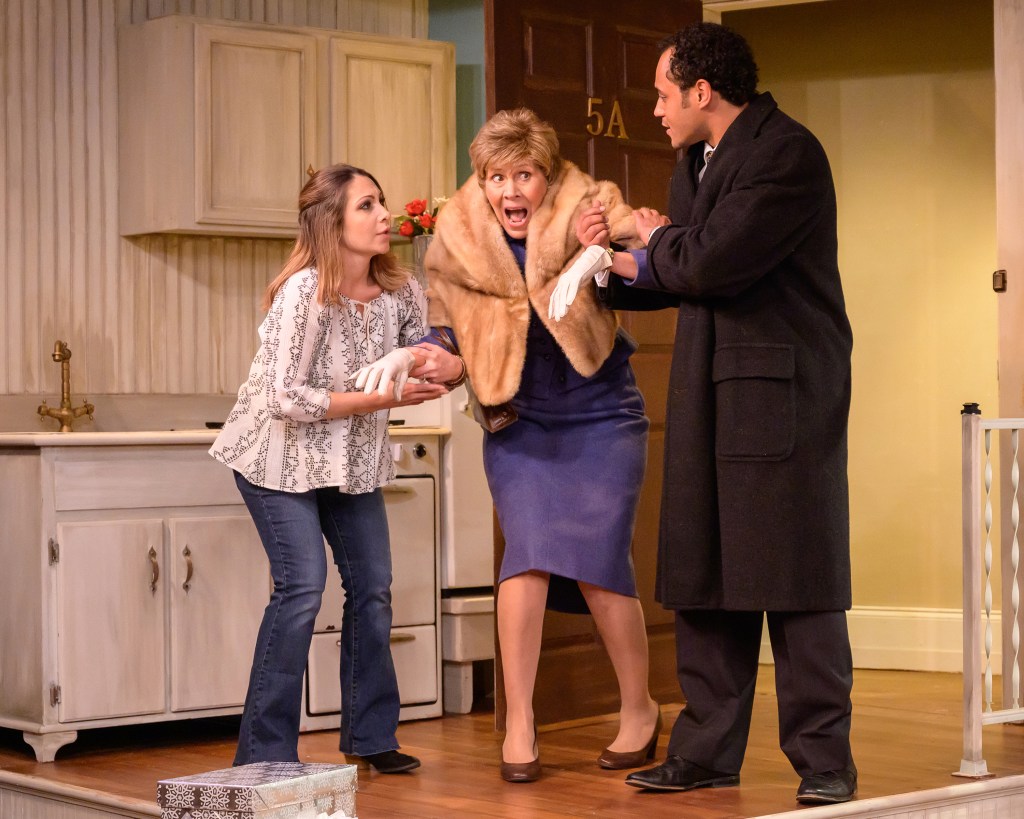
As compelling as Gilmour and Lawson are, it was Jill Williams, reprising her 2005 role as Corie’s mother, Ethel Banks, who stole the show. Williams reminds me – and I truly mean this as a compliment – of Carol Burnett. Her carriage, her facial expressions ( especially when commenting on her daughter’s apartment), her gestures, her delivery all work together to deliver pure, belly laughing comedy. I simply loved Jill Williams in this role. Opposite Williams was Joe Pabst, also reprising his role as the eccentric neighbor Victor (pronounced “Wicktor”) Velasco. How eccentric is he? I am glad you asked. Not only does he cavort about in a beret, a dressing gown, and slippers, he is a shameless flirt and moocher, and we first meet him when he knocks on the Bratters’ door so he can climb through their window to gain access to his attic apartment, But I won’t give it all away. Go see it to find out why, it’s well worth the trip.
Supporting roles include Quan Chau as the telephone repair man and Williams’ husband Eric Williams as a delivery man. Who’s old enough to remember when the telephone was connected to the wall and the phone number was alpha-numeric? The Bratter’s new phone number was El Dorado 5-8191.One further cast note – and I had to think about whether to mention this at all, but I think it is relevant. This cast of Barefoot in the Park is an example of color-blind casting. Yes, an Asian actor plays the telephone repair man, but even more significantly, the leading man is played by a person of color. It would have been quite unusual to see an interracial couple in New York in 1968, or a black male lawyer living in midtown Manhattan who was completely accepted by his white mother in law who lives in New Jersey. Yeah. All of that would have made this an entirely different type of play – and the word “comedy” would not have been part of it.
While much less elaborate than many period apartments that have been constructed on the Hanover Tavern stage, Terrie Powers’ set design quickly transformed from a hideous empty shell into a warm and inviting home with just a few pieces of furniture and some well-chosen decorations. Logistically, there were a couple of things that seemed a little off. The fourth wall apparently held a mirror, but sometimes the actors seemed to be looking through the wall. And the other was the existence of a wood-burning stove in the apartment which may not have been a housing code violation in 1968 but it would certainly have been unlikely for a landlord to allow a tenant to use it.
There is plenty of physical comedy in Barefoot in the Park, much of it stemming from the never-ending flights of stairs. Director Jan Guarino set a brisk pace, and the cast maintains the standard she set. There are falls (or near misses), an accident, a drunken scene, and missing clothes. There is the running joke of using the Bratter bedroom to access Victor’s apartment. Corie, Paul, and their visitors must navigate each time they enter or exit the building. After a wild night on the town – after Corie tricks her mother into going on a blind date with Victor – Paul ends up climbing the stairs with his MIL on his back. And since it’s February, we cannot really be surprised when a few snowflakes drift through the open skylight.
Barefoot in the Park addresses big themes like opposites attract, the importance of being yourself, and the power of love. But the comedy is what makes this spirit-lifting winner.
**********
FUN FACT: The average rent for a NYC apartment in 1970 was $102. The average rent for a 1-bedroom apartment in NYC in 2021 is $3,250 and is closer to $4,000 per month in the midtown neighborhood where Neil Simon’s play is set. Corrie and Paul are paying about $145 per month, but she insists on telling her mother they are paying only about $75.63.
FUN FACT: Corie and Paul spent their Honeymoon at the Plaza Hotel. In 1968 the Plaza cost $30 per night; current rates are about $850 per night.
FUN FACT: A Brownstone is a rowhouse, made of brick fronted with brownstone that was originally popular because of its natural look and low price, compared to other stone finishes. Found mostly in Brooklyn and Manhattan, brownstone homes were originally single-family homes. Many were subdivided into apartments. Most existing brownstone homes are about 100 years old, and as they are no longer constructed the prices have gone up. When I graduated from high school in 1973 my grandmother sold the small Brooklyn brownstone where I grew up for $30,000. Now, 48 years later, it is currently assessed at $1,149,500.
**********
Barefoot in the Park
by Neil Simon
Directed by Jan Guarino
Cast
Corie Bratter ……..………… Rachel Rose Gilmour
Paul Bratter ………;;;;;……. Trevor Lawson
Ethel Banks …………….….… Joy Williams
Victor Velasco ………………. Joe Pabst
Telephone Repairman …. Quan Chau
Delivery Man ………….…….. Eric Williams
Ethel Banks understudy .. Terrie Powers
Creative Team
Scenic Design: Terrie Powers
Costume Design: Sue Griffin & Marcia Miller Hailey
Lighting Design: Matt Landwehr
Sound Design: Jacob Mishler
Stage Management: Sam Shahinian
Run Time: 2 hours and 10 minutes including 2 intermissions
Note: At this time, no food or drink is allowed inside the theater
Julinda D. Lewis is a dancer, teacher, and writer who was born in Brooklyn, NY and now lives in Eastern Henrico County.
———-
Photo Credits: Aaron Sutten
Rachel Rose Gilmour and Trevor Lawson. Photo by Aaron Sutten.Rachel Rose Gilmour, Joy WIlliams and Trevor Lawson. Photo by Aaron Sutten.Rachel Rose Gilmour and Trevor Lawson. Photo by Aaron Sutten.Joe Pabst and Rachel Rose Gilmour. Photo by Aaron Sutten.Joy Williams and Joe Pabst. Photo by Aaron Sutten.Rachel Rose Gilmour, Joy Williams and Joe Pabst. Photo by Aaron Sutten.Scenes from Barefoot in the Park at Hanover Tavern. Photos by Aaron Sutten.
At: Carpenter Theatre at Dominion Energy Center, 600 East Grace Street, RVA 23219
Performances: December 11-23, 2021
Ticket Prices: In-Person Tickets $25-$125
Info: (804) 344-0906, etix.com, or richmondballet.com
The Nutcracker Choreography by Stoner Winslett
Music by Peter Ilyich Tchaikovsky
with The Richmond Symphony,
Erin Freeman, Conductor
Production Conceived by Stoner Winslett and Charles Caldwell
Artistic Direction & Choreography by Stoner Winslett
Scenery & Prop Design by Charles Caldwell
Christmas Tree Design by Alain Vaës
Costume Design by David Heuvel
Lighting Design by Richard Moore
Associate Lighting Design by Jim French
It’s December 2021 and in three months we will mark a most unlikely anniversary – two full years of living with a global pandemic. After months of learning the differences between social distancing, quarantine, and isolation, live theater has settled into a new routine of live performances. First, there were limited-seating performances with virtual streaming options. The new standard is to allow fully-vaccinated people to attend live performances with few seating restrictions. Patrons must show proof of vaccination and remain masked. Oh, and in the larger venues, you can forget about visiting the bar; it’s closed until further notice. All of this takes some adjusting, but it’s worth it to be able to experience the singular joy of attending a live show.
The Richmond Ballet’s holiday standard, The Nutcracker, was not performed live last year due to the pandemic, but it’s back this year and opened on Saturday, with a few modifications that did nothing to diminish the excitement of joining young Clara on her journey to Confitenberg, the Land of Sweets. Small children and adults sat mesmerized from the moment the Richmond Symphony began the familiar strains of Tchaikovsky’s score until the elaborate curtain dropped after Clara woke up from her adventure.
This year’s production of The Nutcracker is special for two reasons: it is the first live production since the world shut down in March 2020, and this is the last year to see the familiar Nutcracker costumes and sets before they get a make-over for 2022. You can expect three acts and two intermissions (although you cannot take drinks or food to your seats), but I noticed that when the clock struck twelve times only six little mice appeared instead of twelve, and the most obvious change was the absence of Mother Ginger and the dozen little dancers that hide under her voluminous hoop skirt. And of course, with nine new members in this company this season, there are lots of new casting choices to experience.
Adhya Yaratha dances the coveted role of Clara, the recipient of the magical nutcracker doll. Yaratha, a student at The Steward School, was recently featured as a “Standout Spartan” in her school’s newsletter. She revealed that she has been dancing for 13 years and “for much of that time” dreamed of being cast as Clara. She danced with grace and confidence and made a delightful Clara.
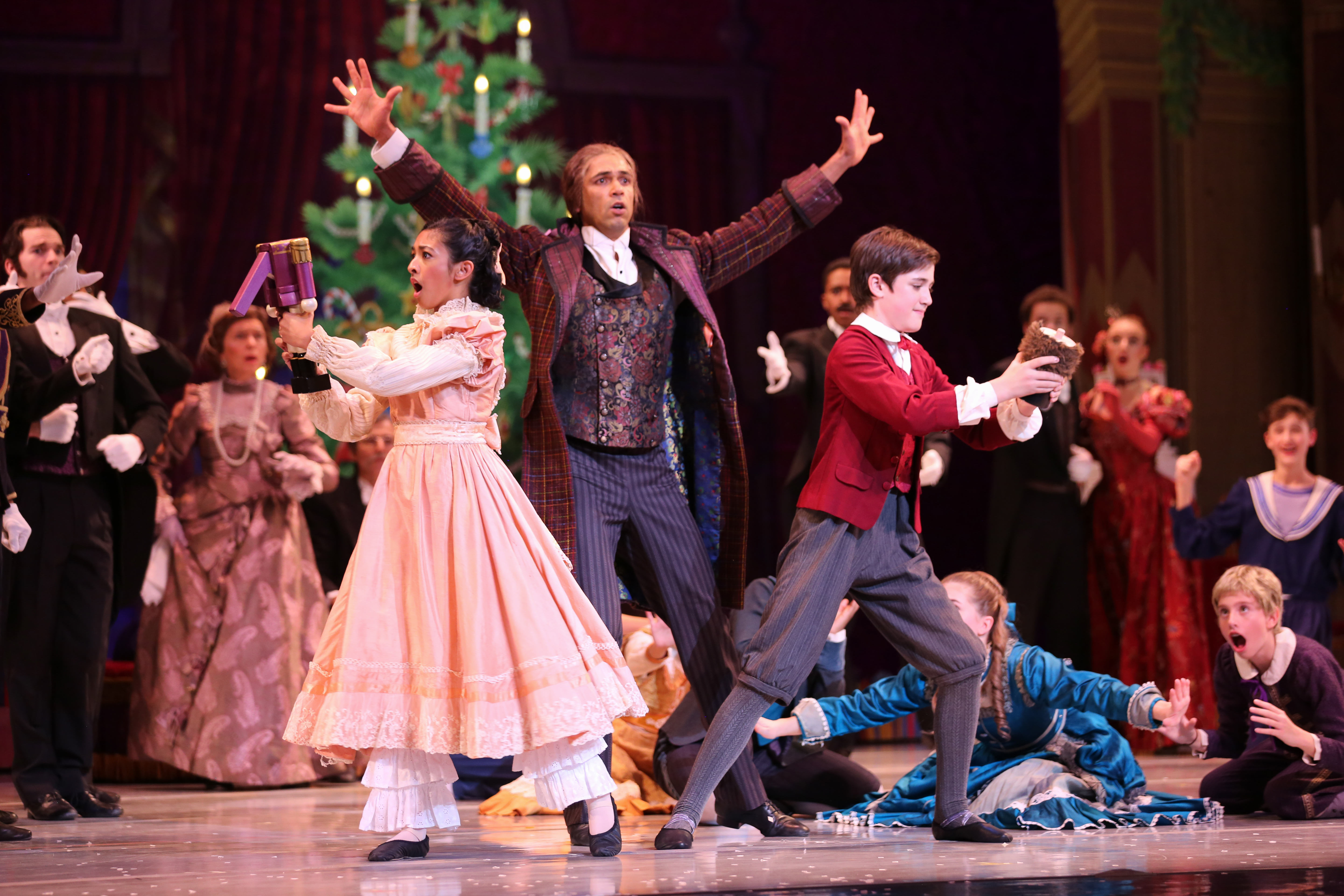
Bladen Kidd held his own as Clara’s recalcitrant little brother, a band of boys on a series of humorously disruptive raids against the girls at the Silberhaus’ annual Christmas party. Carter Bush (RB Trainee) proved to be an attentive apprentice to his uncle, the mysterious Dr. Drosselmeyer (the recently retired Fernando Sabino returning as a guest) and a courteous Nutcracker Prince accompanying Clara on her adventures in the Kingdom of Sweets.
The predictability and tradition of The Nutcracker are part of its charm, and seemed especially important this year: they were signs of stability and normalcy. Whoever thought a magical growing Christmas tree and a swan sled could represent stability?
Sabrina Holland and Khaiyom Khojaev danced the “other” leading roles – you know, the adult ones – the Sugar Plum Fairy and her Cavalier. They welcome Clara and her Prince to the Kingdom of Sweets and close Act Three with a grand pas de deux that epitomizes the lightness of the Romantic ballerina and the supportive role of the male dancer, with both attacking their technique with relish and flair.
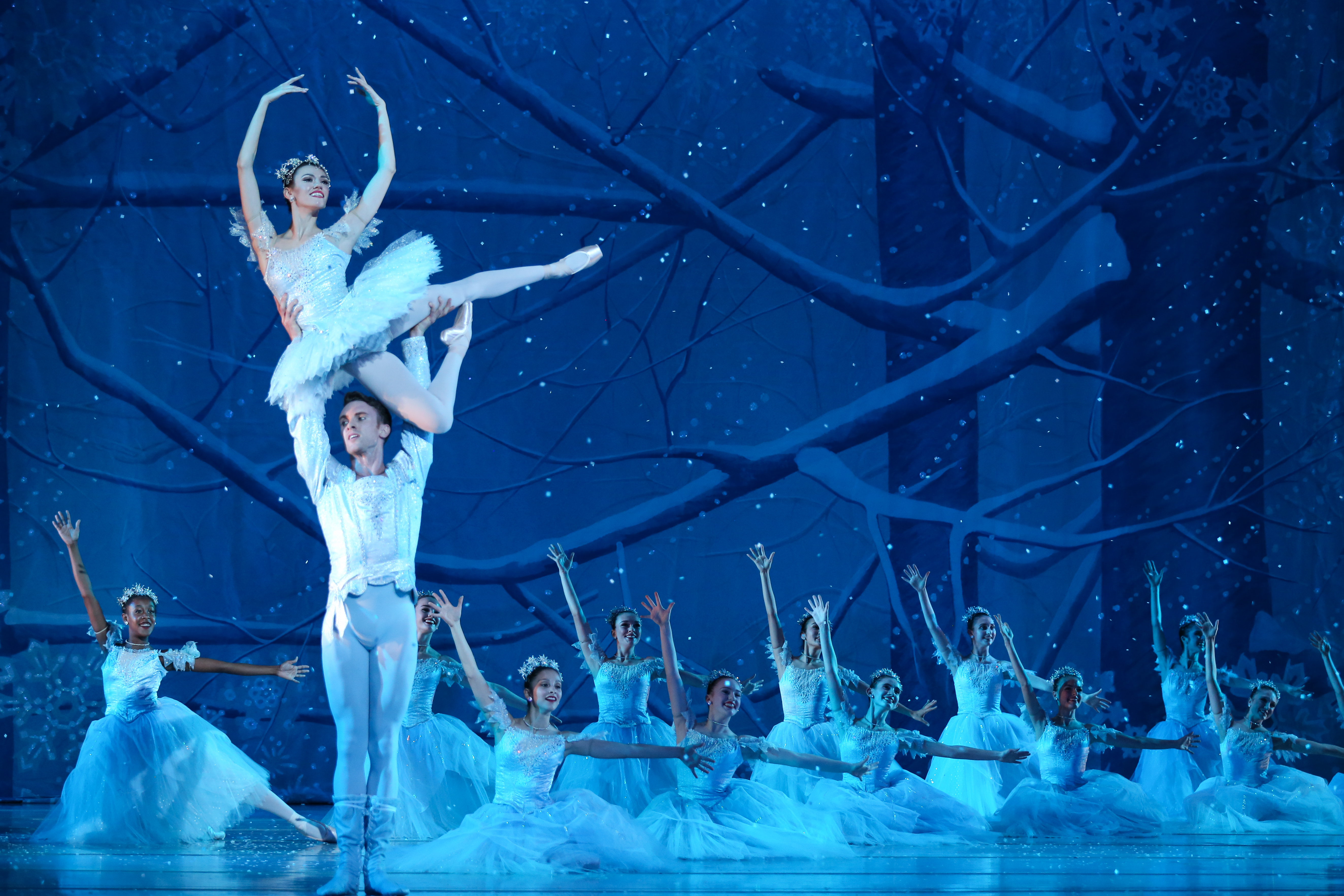
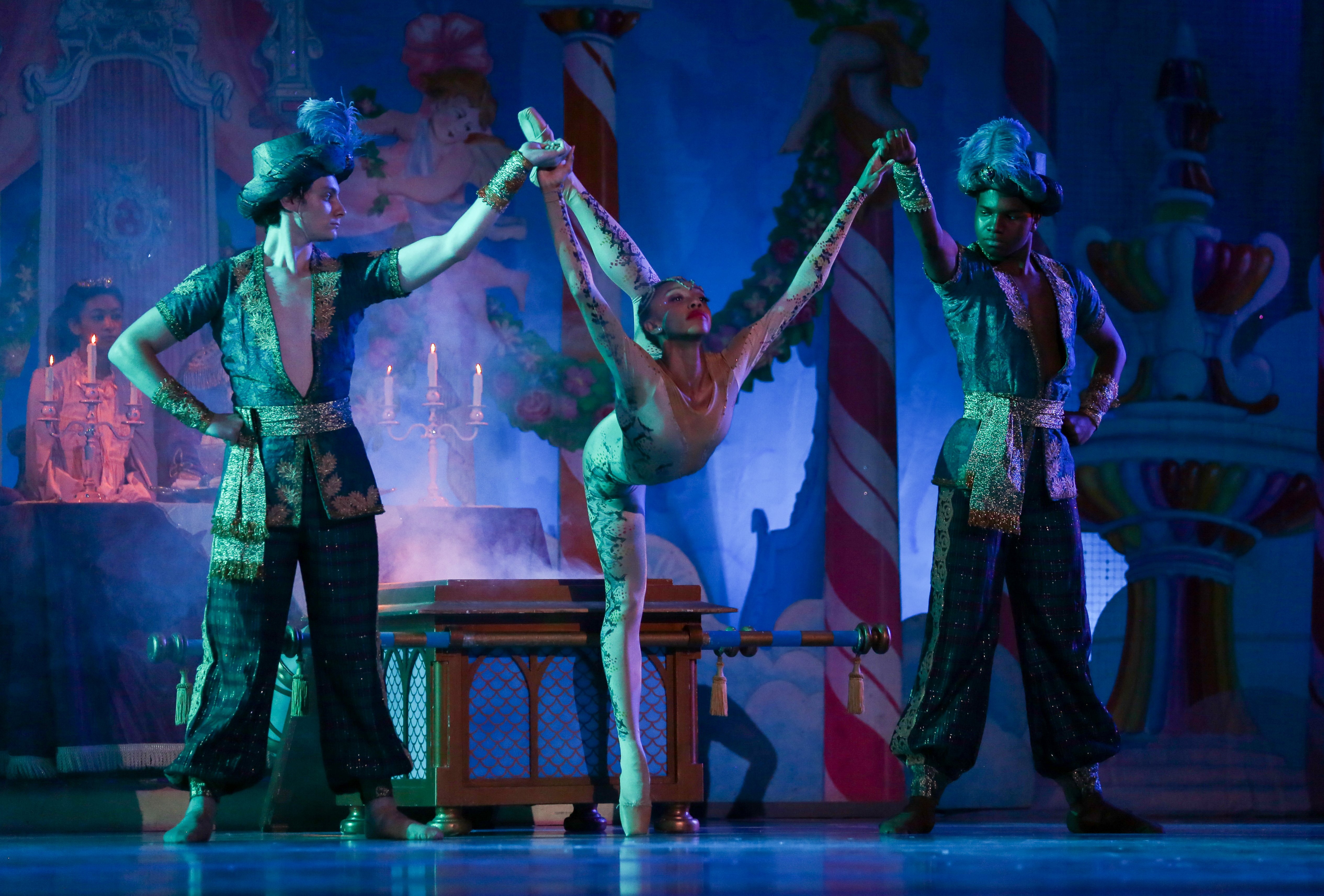
All the favorite characters are there and there are plenty of roles for Richmond Ballet II, the Trainees, and the students of the School of the Richmond Ballet. The battle between the Mouse Army and the Regiment Soldiers features Jackson Calhoun (RB II) in the comedic role of the Mouse King. Principals Izabella Tokev and Joe Seaton deliver a picture perfect ice blue pas de deux as the Snow Queen and Snow King, attended by a corps of a dozen Snowflakes. Celeste Gaiera and Patrick Lennon, Marjorie Sherman and Jack Miller dance a Spanish jota with flair. Naomi Robinson and Ira White revive the sensual Snake and her Charmer, and Naomi Wilson dances the acrobatic role of Tea, accompanied by a group of Chinese dragon dancers.
Sarah Joan Smith and Colin Jacob (both first year company members) are the Shepherdess and Shepherd who shelter a half dozen little lambs who steal the show. They have masks added to their costumes this year which fit perfectly with their costumes. Paul Piner, Roland Jones, and Zacchaeus Page, all members of RB II, are the ever-popular Russian dancers with their very hip dancing bear (Piner), and Eri Nishihara dances the role of the bedazzled butterfly, surrounded by a dozen Candied Flowers.
The diverse and multi-generational cast is an apt reflection of the audience and represents the best of what this season represents. It’ so good to have The Nutcracker back onstage at The Carpenter Theatre this year; there is nothing like live theater to offer a magical escape from the everyday and mundane.
The Nutcracker Performance Schedule
Saturday, December 11th, 2021 @2:00pm and 7:00pm
Sunday, December 12th, 2021 @1:00pm and 4:30pm
Saturday, December 18th, 2021 @2:00pm and 7:00pm
Sunday, December 19th, 2021 @1:00pm and 4:30pm
Wednesday, December 22nd, 2021 @7:00pm
Thursday, December 23rd, 2021 @2:00pm
COVID-19 Protocols: Upon entering the theatre, all audience members ages 12 and above are required to show printed or digital proof of full vaccination against COVID-19 or of a professionally-administered negative COVID-19 test taken within 72 hours of the performance. Patrons ages 18 and above will also need to show a photo ID. All patrons ages 2 and above will continue to be required to wear masks.Please note: Proof of a negative COVID test is not required for children under the age of 12.
Photos Credits: Sarah Ferguson
Fernando Sabino with Adhya Yaratha and Bladen KiddJackson CalhounIzabella Tokev and Joe Seaton with Adhya Yaratha and Carter BushIzabella Tokev and Joe SeatonCeleste Gaiera and Patrick LennonNaomi RobinsonNaomi WilsonEri NishiharaEri NishiharaAdhya Yaratha and Carter BushSabrina Hollard and Khaiyom Khojaev