At: The Robert B Moss Theatre, 1300 Altamont Avenue, RVA 23230
Performances: October 17-26, 2019.
Ticket Prices: $10-40 | This show sold out completely at the beginning of its limited 2-week run
Info: (804) 346-8113 or rtriangle.org
Full Disclosure: It’s hard for me to write about a show like Rocky Horror Show when I can clearly see the skill and craft, acknowledge the talent and heartfelt performances, appreciate the music and humor, but I know that this cult classic just isn’t for me.
So, first the good news: Michael Hawke, who has a long history with this show, and was, in fact The Narrator in the 2012 production at The Firehouse Theatre, has directed with unbound energy and an unerring sense of comedic timing. The plot, for Rocky Horror Show “virgins,” who have never seen the show (stage or movie version) is merely a vehicle to carry a variety of themes including gender fluidity, counterculture, and sexual liberation.
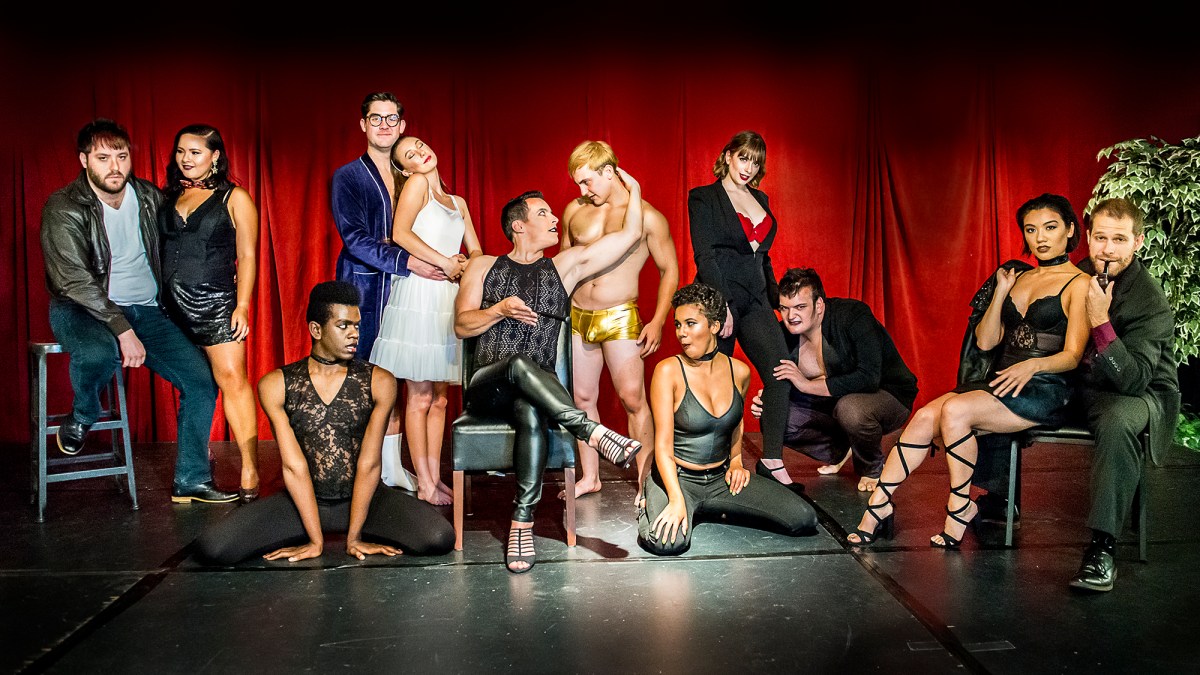
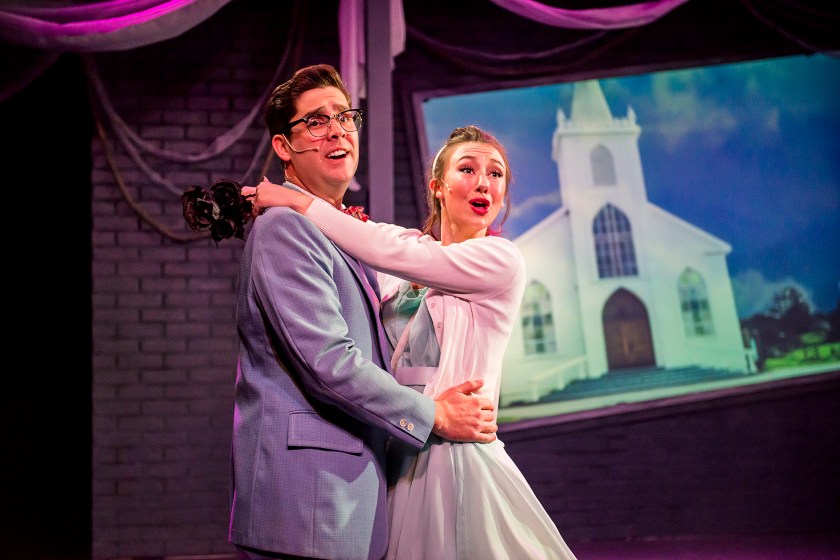
The plot revolves around a newly engaged young couple, Brad and Janet, played with touching innocence by Luke Newsome and Madeline Witmer, who get a flat tire while driving through a rainstorm to celebrate their engagement with Dr. Scott (Carlen Kernish), the science professor who introduced them. Seeking help, they find the castle of Frank ‘N’ Furter, a transvestite scientist from Transylvania, who is hosting a party to celebrate his newest invention, a Frankenstein-ish creation named Rocky – a blond, tanned muscleman with half a brain, played with an adorable balance of humor, naivete, and monstrous posing by a buff Adam Turck, dressed only in padded golden booty-shorts –later reduced to a golden G-string – and gold boots.
There are multiple story lines involving sexual exploration, gender, and aliens of the space variety. Hawke’s dynamic direction and the hilarious cast of characters keep the audience laughing. Oh, and because the movie version has become an interactive affair, bags of approved props were available for the audience to purchase, and there was a list of rules of engagement, aka etiquette. An RTP fun bag of props included such items as a newspaper, a rubber glove, a flashlight, a party hat, a playing card, and a small bag of confetti. The program included instructions on when to use, don, or throw each item. There was also an opportunity – which many took advantage of – to join in the show’s signature dance, “The Time Warp,” a sort of line dance with instructions for the steps included in the lyrics. Kate Belleman’s choreography was energetic and even included a spunky tap dance for Anne Michelle Forbes, who played the role of Frank ‘N’ Furter groupie Columbia.
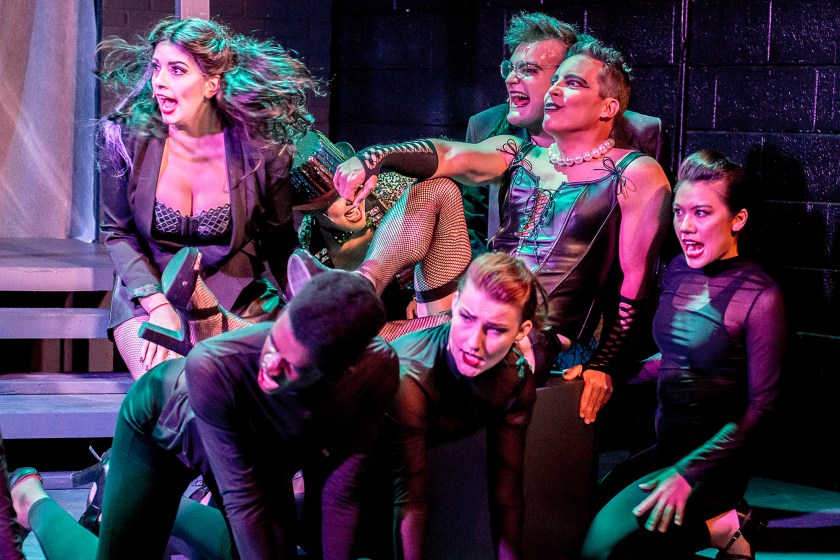
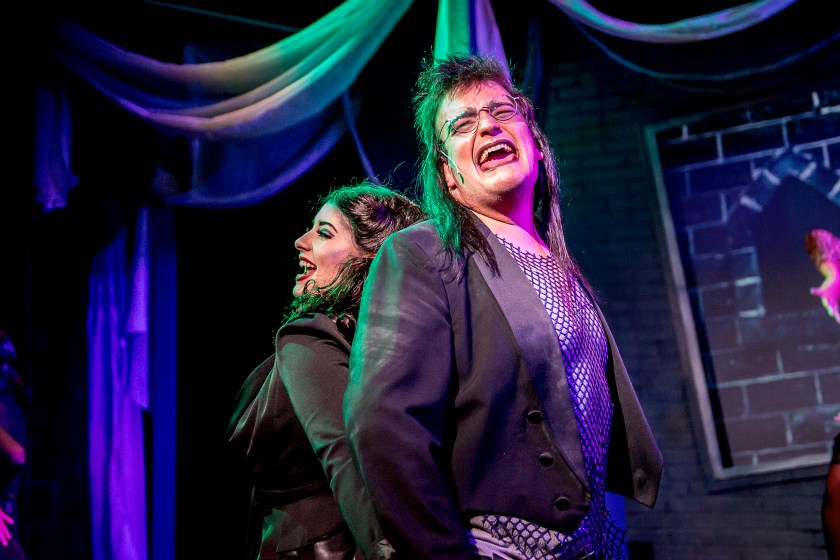
The role of Frank ‘N’ Furter was reprised by Jim Morgan, who played the same role at Barksdale Theatre, now part of Virginia Rep. Morgan was fabulous, with flawless makeup, a corset and heels. Levi Meerovich was deliciously menacing – a perfect blend of horror and comedy – as his loyal servant turned arch nemesis, Riff Raff. The Phantoms were played – mostly danced – by Jet Davidson, Michaela Nicole, Havy Nguyen, and Achille Wangam, and the ensemble was completed by Jeffrey Cole as The Narrator, Kaitlyn Tate as the Usherette who introduced the show and Riff Raff’s sister Magenta, and Carlen Kernish who played the unfortunate Eddie who met an early demise as well as the paraplegic Dr. Scott.
The musical originally opened in 1973 in London where it played successfully for over seven years, and the film version, The Rocky Horror Picture Show, premiered in 1975 and quickly became a midnight-show cult. The book, music, and lyrics are all by Richard O’Brien. The RTP production has musical direction by Kim Fox. The music was pumping, the voices were soaring, although sometimes I could not understand the lyrics because they were screaming or got lost in the music. But at least half the audience seemed to know all the words, so it didn’t matter and certainly didn’t seem to diminish anyone’s enjoyment. “Sweet Transvestite” and “I Can Make You a Man” were standouts led by Frank ‘N’ Furter, and “Touch-A Touch-A Touch Me,” led by Janet in the second act was outstanding, but “The Time Warp” seemed to be the audience’s hands-down favorite.
Sheila Russ’ costumes were campy and fun, and enhanced by Joel Furtick’s hair and make-up, while Frank Foster’s set was simple and utilitarian. Andrew Bonniwell did the lighting, and I received a message that while Joey Luck had originally been slated to do the sound design for ROCKY it was actually done by Artistic Director Lucian Restivo with Shane Barber as the live mixer for every performance.
So, what’s my problem with it? It’s a well-designed and well-executed musical – and I like musicals. It’s popular among fans and fun for “virgins,” but it just isn’t to my taste. I never saw the movie and do not have any plans to see it, but I did see the Firehouse production in 2012 and it still hasn’t grown on me. So, I hope I have been fair in describing what I consider an excellent production – except for those times when I found the lyrics muddled – and offer kudos to the performers for singing and dancing their hearts out, but I’ll never be a part of the fan club. I felt like something of an alien myself.
Julinda D. Lewis is a dancer, teacher, and writer who was born in Brooklyn, NY and now lives in Eastern Henrico County.
———-
Photo Credits: John MacLellan
Jim Morgan as Frank ‘N’ Furter (center) with Katlyn Tate and Levi Meerovich as Magenta and Riff Raff, along with Achille Wangam, Jet Davidson and Havy Nguyen in Richmond Triangle Players’ production of Richard O’Brien’s “The Rocky Horror Show”, running at RTP’s Robert B. Moss Theatre through Oct 26. All performances are sold out. Photo by John MacLellan.Kaitlyn Tate and Levi Meerovich as Magenta and Riff Raff in Richmond Triangle Players’ production of Richard O’Brien’s “The Rocky Horror Show”, running at RTP’s Robert B. Moss Theatre through Oct 26. All performances are sold out. Photo by John MacLellanLuke Newsome and Madeleine Witmer as Brad and Janet in Richmond Triangle Players’ production of Richard O’Brien’s “The Rocky Horror Show”, running at RTP’s Robert B. Moss Theatre through Oct 26. All performances are sold out. Photo by John MacLellan.
At: Virginia Rep’s Children’s Theatre at Willow Lawn; 1601 Willow Lawn Drive, RVA 23230
Performances: October 18-December 1, 2019
Ticket Prices: $21
Info: (804) 282-2620 or virginiarep.org
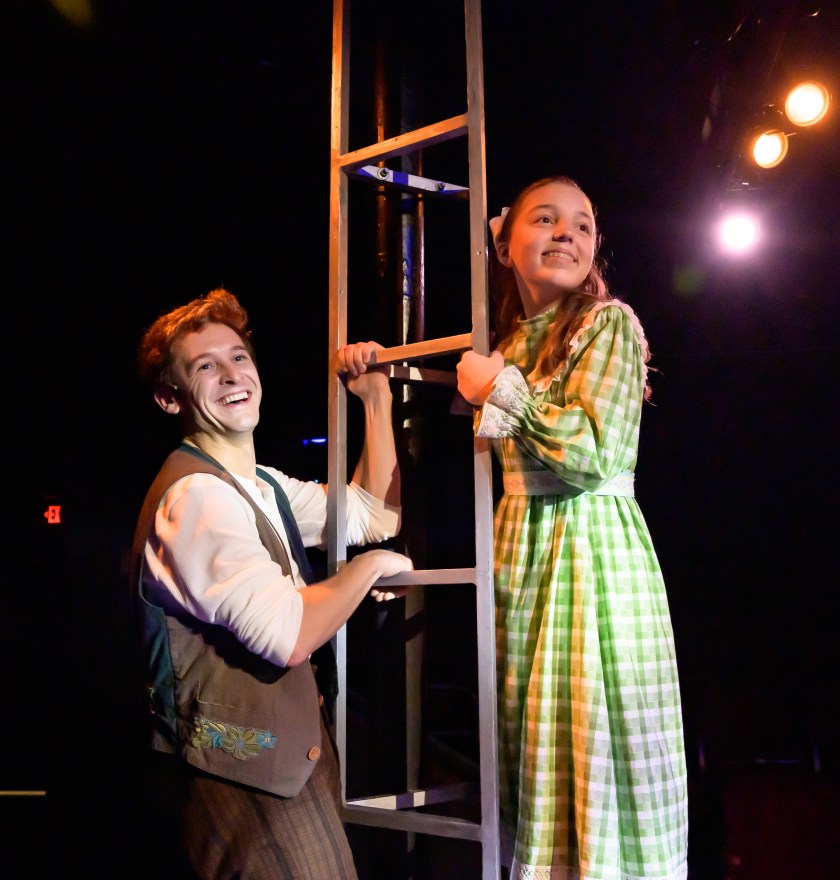
Virginia Rep opened is 2019-2020 Children’s Theatre season with a magical foray into the world of Tuck Everlasting. The musical, based on Natalie Babbitt’s children’s novel about a family that finds immortality in the waters of a remote spring in the New Hampshire countryside and the grieving young girl who befriends them, was performed on Broadway in 2016. Virginia Rep shared this co-world premiere of this Theater for Young Audiences (TYA) Edition with Nashville Children’s Theatre. (The Nashville premiere was actually in September 2018, so I don’t quite understand how that makes this a co-world premiere.) Pushing that question aside, Tuck Everlasting is a beautifully conceived play that thoughtfully poses serious questions about life choices while resonating with audiences of all ages. The story was new to me, as I had not read the book, had not seen previous productions of the play, and had not seen either the 1981 film by One Pass Media or the 2002 Disney film. Now, I cannot imagine how I missed out.
Unlike many Children’s Theater productions that seem geared towards the youngest audience members from around 4 to 10, Tuck Everlasting is a bit more sophisticated, and seems most appropriate for pre-teens through adults. This is also a production you can feel confident in attending without a child, although I recommend you bring along at least one. Part of the joy of Tuck Everlasting is watching the faces of the young audience members. My minor cohort on opening night was Nicole, just two days from turning 11, the same age as our story’s protagonist. For most of the show, which runs about 75 minutes, with no intermission, Nicole sat wide-eyed, on the edge of her seat. Just what held her attention – and mine? I’m glad you asked.
Lucy Caudle, a ninth-grader at Maggie Walker Governors School who was recently seen as Alexa in the Virginia Rep production of Atlantis, took full ownership of the lead role as 11-year-old Winnie Foster. Winnie’s father died less than a year ago, and her conventional mother demands that she wear mourning clothes for a full year. But Winnie has gotten wind of an itinerant fair coming to their small New Hampshire town of Treegap, and she wants to go. Caudle genuinely captures the longing and frustration of her character in musical numbers like “Live Like This” and “Good Girl Winnie Foster,” but also in her face and posture. She frequently looks upward and outward into the future or stands with her weight on the balls of her feet, ready to sprint off on the next long-awaited adventure.
It is her need for adventure that sends her off into the nearby woods – woods owned by her family – where she meets Jesse Tuck, younger son of the mysterious and reclusive Tuck family. Taylor Witt, a DC-based actor new to the Virginia Rep stage, makes a charming Jesse, the free-spirited younger brother who exasperates both his older brother Miles and his parents Mae and Angus. Witt emanates non-stop energy and even on opening night seemed to strike just the right chemistry with Caudle.
Todd Patterson is Miles, the older brother who is the voice of reason, but with a dark secret. In a touching scene, Miles finally reveals the source of his deep-seated anger to Winnie. Patterson does a marvelous job balancing the layers of his character’s personality and the reveal is skillfully timed.
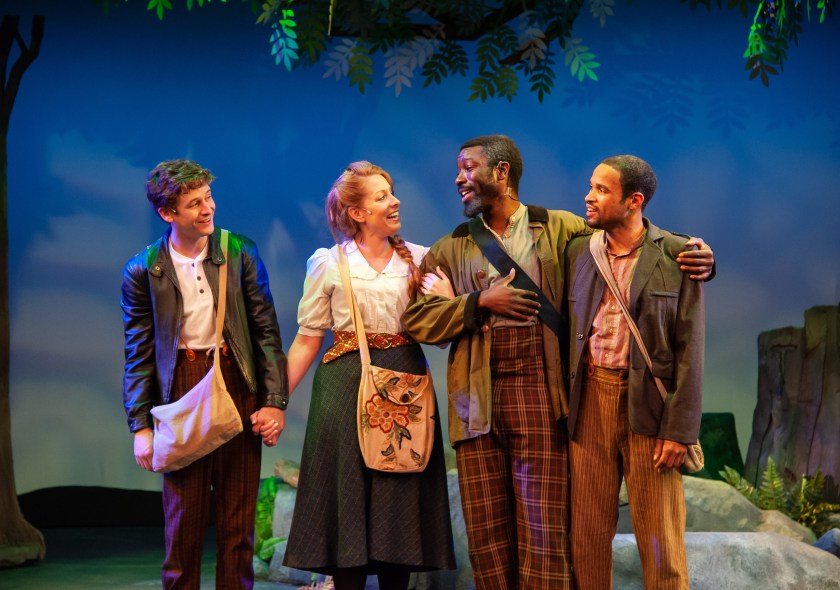
Casey Daniel Payne, also making her Virginia Rep debut, added a bit of humor as Mae Tuck. She had grown resigned to her fate and the years have taught her to take pleasure in the small things like not having to keep a clean house, because no one comes to visit. I took particular notice of Walter Riddle as Agnus, the head of the Tuck household. Having kept his family safely secluded for more than 80 years, Agnus appears unruffled by impending disaster and spends his free time fishing. Riddle appeared natural and easy in the role of the father figure, reluctantly dispensing words of wisdom to Winnie and treating Mae with respect and affection that seemed somewhat startling for the time period, the late nineteenth century. It seemed perfectly natural when, sitting back to back with their fishing rods in hand, Winnie leaned her head on Agnus’ shoulder. She was missing her father, and he was remembering what it was like to hold a real child.
Dan Cimo was both sinister and hilarious as the “Man in the Yellow Suit,” a carnival barker who had heard of the magical water that granted eternal life and hoped to become rich from bottling and selling it. One of the most memorable lines in the play was delivered by Winnie’s mother, who asked where one would find a suit in that color, and having found it, why would one buy it? Lisa Kotula played the role of Winnie’s mother with both firmness and compassion. Her role required her to wear Victorian widow’s weeds – a plain black dress – the entire play.
The cast was rounded out by Jon Cobb as the bumbling Constable and Harrison Gray as his deputy, Hugo. Hugo also has a surprise to reveal in the final scenes. All were ably directed by Matt Polson, who kept the ensemble moving at a swift but manageable pace. The cast was also in charge of scene changes, which consisted mostly of moving a bench, a trunk, a gate, and numerous trees in a heavily forested but uncluttered set designed by Tennessee Dixon, enhanced by BJ Wilkinson’s lighting. The floor was painted with leaves, and larger leaves were projected onto them. A portion of a cottage façade and doorway was the most stable structure – or suggestion of a structure – and there was a grotto of trees surrounding a pile of rocks or boulders that sheltered the magical spring waters. Early on, Winnie pulled a small toad – her only friend at that time – from her pocket; later we saw a somewhat larger, animated toad (a hologram, perhaps?) projected onto the rocks. This toad plays an important part in Winnie’s decision on whether to drink the magical waters.
Set in a small New Hampshire town (it did seem odd that the Tuck family moved east, rather than westward) beginning August 1, 1893, Tuck Everlasting is clothed in period costumes, right down to the shoes, yet the story, the language, and the ideas remain relevant. Ruth Hedberg’s period costumes are whimsical, but she gives full reign to her creativity with the colorful costumes of the carnival people, including a strong man, a physic, clowns, and more. Mallory Keene’s choreography is not so much dance as rhythmic movement sequences organically incorporated into the actors’ actions and characterizations. All of the movement was guided by Jason Marks’ musical direction.
Tuck Everlasting was written by Claudia Shear and Tim Federle, with music by Chris Miller and lyrics by Nathan Tysen. The musical orchestrations are by John Clancy, with vocal arrangements by Chris Miller and ballet music arranged by David Chase. The musical selections were catchy and clearly delivered, from the different perspectives of longing, loss, and hopefulness of the opening “Live Like This,” sung by Winnie, Mae, Miles, Jesse, and the Man in the Yellow Suit to Winnie singing about how some days she wanted to “raise a little more than heaven,” to Hugo and the Constable’s pun-filled, “You Can’t Trust a Man in a Yellow Suit.” (Hugo accused the Man in the Yellow Suit of “fabricating” and the Constable interprets it as “fabric hating.”)
While all of this is going on, the audience, both young and old, is challenged with some real-life challenges: Don’t be afraid of death; it’s part of life. One path can lead to two different conclusions. Sometimes loving someone means letting them go. What are the positives and negatives of living forever? The one point my young cohort found confusing was the final scene, where we find out what Winnie decided to do with the double edged sword of eternal life – the vial of magical water that Jesse presses into her hand as a parting gift. The scene, and the entire play, offers an entry into discussing difficult and challenging topics with your children. Tuck Everlasting is a play that should be seen by families and discussed later.
NOTE: The Tuck family includes one black parent and one white parent, one white son and one black son. This is truly color blind casting, as the issue of race is never once mentioned.
Sensory Friendly Performances
Virginia Rep offers sensory friendly performances for children with autism and other
sensory or social disabilities. During these select performances, changes will be made in
lighting, sound, seating arrangements, and length of performance to create a more welcoming environment for this audience. A Sensory Friendly performance will be offered at 10:30 a.m. on Saturday, November 16. Please see the website for more details: http://va-rep.org/sensory_friendly.html
Audio Described Performances
In collaboration with Virginia Voice, Virginia Rep offers Audio Described
performances, in which actions, expressions and gestures are described during gaps between dialogue throughout the performance for patrons with low vision or blindness. In addition to live audio description during performances, patrons are also invited to participate in a tactile tour before the performance. An Audio Described performance will be offered at 2:00 p.m. on Sunday, November 3. Please see the website for more details: https://va-rep.org/access_for_the_blind.html
Community Tickets Grant
Virginia Rep offers a free Community Tickets Grant for nonprofit organizations. Organizations who have a demonstrated need for complimentary tickets are encouraged to fill out the application found on the website: bit.ly/CommunityTix
Performance Schedule
Evening performances at 7:00 p.m. on select Fridays
Matinee performances at 2:00 p.m. every Saturday and Sunday
Matinee performances at 10:30 a.m. on select Saturdays
Julinda D. Lewis is a dancer, teacher, and writer who was born in Brooklyn, NY and now lives in Eastern Henrico County.
———-
Photo Credits: Aaron Sutten
Walter RIddle (left) and Lucy Caudle (right). Photo by Aaron Sutten.Taylor Witt (left) and Lucy Caudle (right). Photo by Aaron Sutten.Lisa Kotula, Todd Patterson, Lucy Caudle, Jon Cobb, Harrison Gray, Taylor Witt, Walter Riddle and Casey Daniel Payne. Photo by Aaron Sutten.Taylor Witt, Casey Daniel Payne, Walter Riddle and Todd Patterson. Photo by Aaron Sutten.Lisa Kotula, Lucy Caudle and Dan Cimo. Photo by Aaron Sutten.
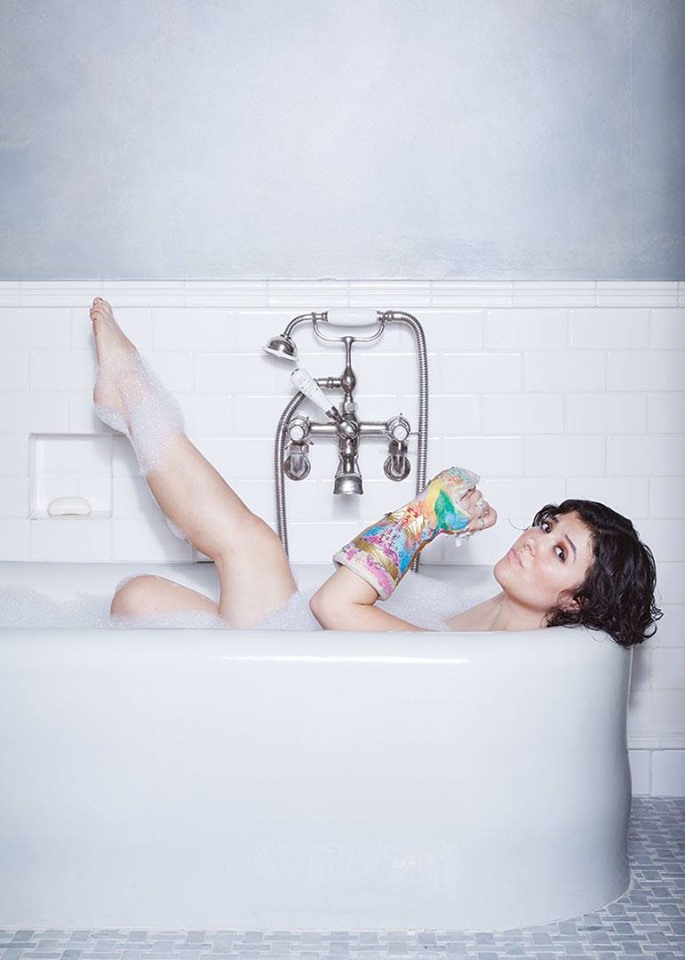
We often say or hear that a particular performance is totally unlike any other. Well, Broken Bone Bathtub is truly unlike any theater I have ever experienced. Based on Siobhan O’Loughlin’s real-life experience of a traumatic bike accident that left her with a broken left hand, Broken Bone Bathtub takes place in a bathtub in someone’s home. Each performance is hosted in a different home (dates and neighborhoods are listed below; addresses are emailed after you purchase a ticket, and attendees are required to sign a waiver).
Siobhan (and I am breaking with convention here and using her first name, because I spent a little more than an hour with her as she sat, covered only with bubbles, in a bathtub – so I think we are now on a first name basis), interacts with the audience, so each performance will be quite different; even the timing will vary, based on the participants’ responses. After helping Siobhan shampoo her hair, I don’t even feel it would be responsible to call these sentences a review.
Broken Bone Bathtub is the most intimate piece of theater I have ever experienced. One Sunday afternoon this past March I attended David London’s production – part history, part storytelling, part séance – Humbug, the Great P.T. Barnum Séance at the Branch Museum of Architecture and Design. The audience was limited to those who could fit around the custom-made séance table, with room for about 4 observers. In August, I attended Dante Piro’s one-man show, The Verge, in that same space. Piro’s play was limited to those who could fit around a conference table. Both of those shows – also produced by The Firehouse, under the artistic direction of Joel Bassin – were intimate, and performed before a limited audience. But both were performed in a public space – and both London and Piro kept their clothes on!
Make no mistake, Siobhan’s bathtub drama has form and structure, meaning and purpose. She recounts her bike accident in carefully segmented portions, interspersed with questions to the audience – the 6 or 7 people gathered in an average-sized bathroom, seated shoulder-to-shoulder, or knee-to-tub on stools of varying heights. Several helpers were enlisted to help her perform tasks one cannot do alone when one’s hand and wrist are encased in a plaster cast. Everyone participated in the dialog on Wednesday night, sharing personal experiences ranging from expressions of childhood jealousy to crying in public, from shared showers to the dimensions of personal space and the difficulty of asking for help when you really need it.
These are genuine topics, and participants offered authentic responses. One woman was brought to tears when a question – and her response – triggered a sensitive memory. There was lots of laughter and, from my vantage point, I could see Siobhan’s eyes welling up more than once. Broken Bone Bathtub is experimental theater, but it is also a healing experience, equal parts theater and therapy. First, the project was Siobhan’s personal journey to physical recovery. Second, it was a way for her to connect with others – who do you call on in time of need? And finally, it is a cathartic experience for the audience-participants who were surreptitiously encouraged to tap into their own feelings, fears, and personal experiences, in the guise of a theatrical performance. At the end, Siobhan concluded her story, weaving in bits and pieces of the shared experiences, including the names of the contributors. Make no mistake, Broken Bone Bathtub may be experimental theater, but it is not random; it is organized and smart. Broken Bone Bathtub is also warm, intimate, and ultimately it is a liberating experience that links the participants with an indelible bond of humanity.
*Note Performances and Locations for Broken Bone Bathtub:
Wed., Oct 16 @ 7pm, Richmond Fan District, NO PETS
Thurs., Oct 17 @ 7pm, Gum Spring/Goochland, YES PETS
Fri., Oct 18 @ 7pm + 9pm, Bonair, YES PETS
Sat., Oct 19 @ 7pm + 9pm, Glen Allen, NO PETS
Sun., Oct 20 @ 2pm + 4pm, Midlothian/River Downs, YES PETS
Some of the locations have pets on the premises. Please be aware if you have allergies. If you are dangerously allergic to animals, we do not recommend purchasing tickets for those locations.
Unfortunately, none of these venues are wheelchair accessible. If you live in Richmond and have any ideas about making the show happen in an accessible space, please reach out to hello@brokenbonebathtub.com.
By the Way: Siobhan is, indeed, naked in the bathtub, but keeps herself covered with a thick layer of bubbles. There were men and women present, and at no time was any part of the show sexual or suggestive. Broken Bone Bathtub is, in fact, quite suitable for audiences of all ages!
Julinda D. Lewis is a dancer, teacher, and writer who was born in Brooklyn, NY and now lives in Eastern Henrico County.
———-
Photo Credits: Firehouse Theatre and Broken Bone Bathtub website
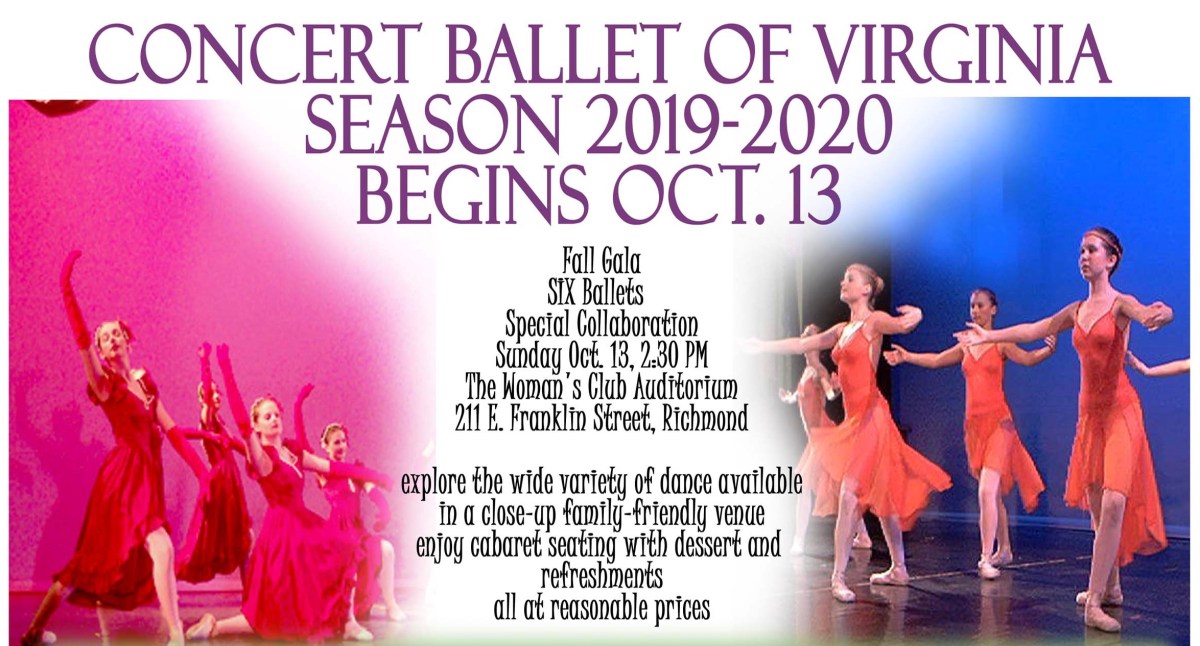
The Concert Ballet of Virginia marked the start of its 43rd year of dance performances with its annual Fall Repertory Gala at The Woman’s Club on Sunday, October 13. The company operates “within the framework of a full-scale professional dance company” but is run by a “marvelous collection of unsalaried Virginians – dancers, choreographers, technicians, craft and stage people and volunteers.” The mission of CBV is to accept and promote those who are interested in performing, providing a professional company experience regardless of skill level.
The 2019 Fall Repertory Gala differed from previous galas in that the program, consisting of a half dozen works ranging from classical to contemporary, incorporated the Diane Hale dancers, including a work choreographed by their instructor, Lindsay Rhyne Hudson, a CBV alumni.
One thing CBV does very well is scenery and set design. The French Scenic Reproduction of a glamorous manor house and lawn for “Biedermeier Waltzes” was donated by Wilton House, but the décor for “The Hunt,” and the trio of purple arches and blue panels for “Litany” were designed by deVeaux Riddick, a creative team member and long-time Technical Director for Ballet Impromptu, the Richmond Ballet, and then Concert Ballet of Virginia until his passing September 7, 2019.
The quintet of dancers in Biedermeier Waltzes” appeared to be the least experienced, as demonstrated by the simplicity of their choreography, soft shoes (no pointe work), and several stumbles. The lighting – or the dancers’ placement – often left their faces unlit, which was a bit of a distraction. But things picked up with “The Hunt,” a lively number featuring dancers dressed in clever red hunting jackets and black riding boots. The dancers prancing in a circle and forming a Rockettes-style kick line drew applause from the audience.
Ilie Davis, the soloist for the slightly dark, introspective and contemporary styled “Dysmorphic,” demonstrated clean lines and an enticing ease on stage. The four women in “Litany wore long-sleeved aubergine-colored dresses reminiscent of Martha Graham. Their movements were also reminiscent of classic modern dance: sustained; low dynamic; and repetitive, ending in a reverent tableau vivant. “Full Moon and Empty Arms” similarly ended in a tableau, although the latter was a classical ballet, with four ballerinas wearing black classic tutus, and a lead dancer in an ivory tutu to match Scott Boyer who partnered all of them. These were apparently the more experienced or advanced dancers, as this piece included pointe work.
The Concert Ballet of Virginia is as much – or more – about the experience than the dance technique. It is a family-friendly affair, with hand-crafted items for sale in the lobby boutique and cabaret style tables where desserts, coffee, tea, wine, and lemonade are served.
Julinda D. Lewis is a dancer, teacher, and writer who was born in Brooklyn, NY and now lives in Eastern Henrico County.
At: TheatreLAB The Basement, 300 E. Broad St. RVA 23219
Performances: October 11 – November 2, 2019
Ticket Prices: $32 General Admission; $20 RVATA Cardholders; $15 Students
Info: (804) 359-2003 or 5thwalltheatre.org
Internal conflict in Sudan spanning the period 1987-2005 resulted in an estimated 2 million deaths. Tens of thousands of children were left orphaned. Many of the boys, some as young as six years, traveled hundreds of miles east to refugee camps in the bordering nations of Ethiopia and Kenya. Many settled in the Kakuma camp in Kenya. In 2001, about 3,600 of these boys were offered refuge and resettlement in major US cities, as part of a program established by the US government and the United Nations High Commissioner for Refugees.
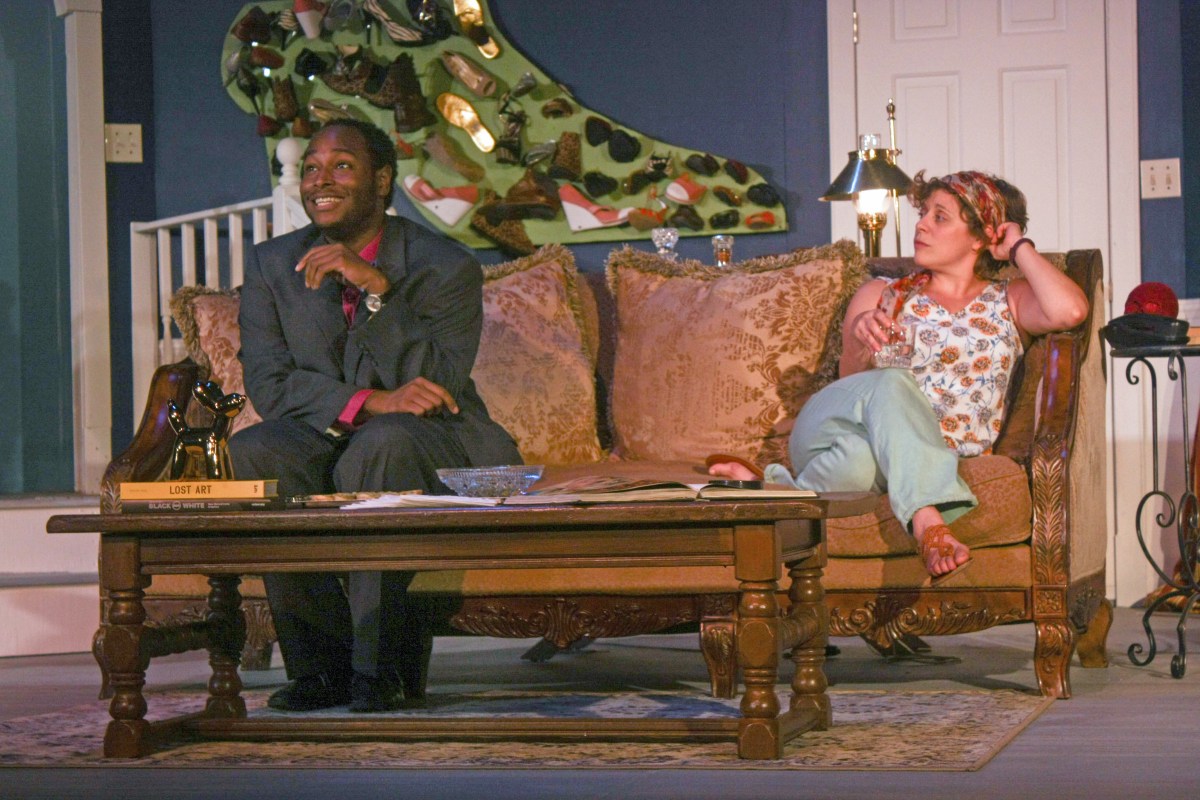
Tammy Ryan’s 2012 play, Lost Boy Found in Whole Foods, picks up in October 2004, where a former “Lost Boy” named Gabriel is working in the produce section of a Whole Foods store in Pittsburgh, Pennsylvania. There he encounters a customer named Christine; a middle-aged, middle class, recently divorced white woman. Christine ends up inviting Gabriel to live with her and her sixteen year old daughter, Alex. Ryan was awarded the Francesca Primus Prize by the American Theatre Critics Association in 2012 for this play which examines the impact of the intersection of these two lives.
Daniel Hurt, who majored in theater at John Tyler Community College, plays the lead role Gabriel in this ensemble cast. I’m not sure whether the script of the director, Keith Fitzgerald, calls for Gabriel’s transformation, but he starts out presenting as a upbeat, always smiling, hard-working young man, and shortly into the second act he has become a morose teenager – at least that’s the way Christine describes him to Segel Mohammed, the refugee aid worker enlisted to help locate Gabriel’s mother. Great pains are taken to point out that neither Christine nor Alex can truly understand Gabriel’s plight, but the transformation is, nevertheless, uneven, jagged, abrupt.
Lian-Marie Holmes, who brings New York and regional credits to her Richmond debut as Christine, plays the role with great earnestness and heart, but I always felt she was on the edge of a breakdown. Kristin Bauer, who plays the daughter, Alex, seemed to be the voice of reason and stability – despite being a bratty teenager with a chip on her shoulder because of her parents’ divorce and all the changes that had brought to her life. While Bauer’s character isn’t very likeable at the start, she is the one character that shows growth and development over the course of the two acts.
Tarneé Kendell Hudson brings strength and authority to her role as Segel Mohammed, but the contrast with the nervous Christine often results in unintended moments of humor. The cast also includes Joe Walton as a former Catholic Charities worker, Michael Dolan and Ashton Lee as Panther, the very large, very menacing Sudanese friend of Gabriel. We never do learn exactly how he earns his money, but his presence makes everyone uneasy.
Ryan tells a story that should be, could be touching, based on real-life events, but somehow it just doesn’t feel authentic. Panther’s monologue, that closes the first act, is unsettling, but doesn’t seem to have a point. Michael Dolan is presented as a helpful liaison with an annoyingly non-committal attitude. The characters seem raw and unfinished, their dialogue seems stilted or censored, and just doesn’t flow freely. I’m familiar with East African accents, but there were times when several of the actors – not just Hurt and Lee – could not be heard clearly, not even in the second row of the intimate space of TheatreLAB’s Basement, The play opens with Gabriel narrating and closes with a narration by Christine – an neither monologue seemed to fit with the genre.
And speaking of things that seem raw and unfinished, I was disappointed with TJ Spensieri’s set. The back wall was very flimsy, appearing to be made of butcher paper and duct tape. You could even see the red EXIT sign through the fabric panel. The furnishings of Christine and Alex’s home seemed to be too shabby and tired for a middle class home. And finally, the set was divided into four sections: a living room/kitchen (that oddly seemed to be where Christine stored her clothes, because she made several costume changes there); a park bench; an office; and a Whole Foods produce section, containing numerous boxes of bananas and papaya. There was a slight elevation for the park bench, but little or nothing was done to delineate the other areas, such as a change of color or texture.
Sadly, my first impression on seeing the set was that it looked like a high school drama class set. That said, I attended on the second night. Perhaps the ensemble will develop stronger chemistry or Fitzgerald will tweak the timing and interplay between the actors. Perhaps not. On Saturday evening, I just wasn’t moved – at least not in the right direction.
Julinda D. Lewis is a dancer, teacher, and writer who was born in Brooklyn, NY and now lives in Eastern Henrico County.
———-
Photo Credits: Tom Topinka & 5th Wall Theatre Facebook page
About halfway into his second line, I wanted Jack Brooks dead. The man, played by Aaron Willoughby, is so obnoxious, narcissistic, and misogynistic, I could never develop any sympathy for him. And it only gets worse after the opening scene, where he emerges from his isolation tank and proceeds to strut around in his swim trunks and an open robe. I don’t know Willoughby, a teacher at the Center for Communications and Media Relations at Varina High School who is performing in his first CAT production, but I attribute Brook’s rotten demeanor to Willoughby’s acting abilities – and the script – and not to any personal shortcomings.
Joe DiPietro’s Art of Murder, a 2000 Edgar Award winner for Best Mystery Play, is a comedy murder mystery full of plot twists and turns and laugh-out-loud moments. The problem is that with the exception of Kate, the Brook’s Irish maid, none of DiPietro’s characters is likeable. And even Kate, played by Charlotte Topp with a warm-as-fresh-baked-bread Irish accent, seems to have something up her sleeve, too.
Jack Brooks is despicable, and his treatment of Kate and his wife Annie, played by Emily Turner, make him a likely candidate for murder. Turner’s character is complex, in turn angry, beleaguered, soft, and sharp. The winding path of the plot keeps her deliberately enigmatic. We don’t like to see women abused, but Annie. . .well, you have to meet her and decide for yourself what her story really is.
There is nothing subtle or enigmatic about the Brooks’ art dealer and friend, Vincent Cummings. Cummings is played with over-the-top flamboyance by D.C. Hopkins (not to be confused with dl Hopkins). Without giving away too much of the mystery, Cummings walks unwittingly into a set up, but he brings his own baggage, so I couldn’t muster up much sympathy for him, either.
All-in-all, Art of Murder is 100 minutes of comedic dysfunction, kept moving along at a fairly swift pace by director Zachary Owens. It’s just a matter of who gets murdered, and when, and by whom – we don’t really care why.
Art of Murder, set in a large country house in Connecticut (a murder mystery standard), on an autumn evening about 10 years ago, opens with Jack and Annie, a wildly famous celebrity artist and his less-celebrated artist wife, awaiting the arrival of their art dealer, Vincent. Jack has a grudge against Vincent, and he and Annie have summoned Vincent for dinner, where they are plotting to execute Vincent’s murder. Or are they? At one point Annie says to Vincent (yes, Vincent, not Jack) “I’ve never killed anyone before.” His response is “It’s always good to try new things.”
There’s – possibly – murder and suicide, red herrings and mis-direction, a gun filled with blanks (or are they?) and props that turn up in the wrong place, an escape from a locked box, a disembodied voice, and all manner of deceptions. Elizabeth Allmon’s set is a standard murder mystery genre room but lacks the elegance of a large country estate owned by a wealthy artist, and Sheila Russ’ costumes for Annie and Jack look more like they came from a thrift store than from a couture boutique, as their lifestyle demands. One prominent prop, Jack’s isolation tank, is a roughhewn black box, more reminiscent of a coffin than a sleek example of spa-inspired technology. Alan Armstrong gets to have fun with lighting, and Hunter Mass gets creative with the sound design. Tchaikovsky’s “Swan Lake” plays before the show starts, and “Ave Maria” ushers in the intermission. Aaron Orensky’s fight choreography is graphic, but I found it visually dissonant and unconvincing that Jack could so easily manhandle Vincent, given that Hopkins is so much more solidly built than Willoughby.
Art of Murder raises many questions. Most of the plot questions are eventually answered, leaving questions like what was the playwright thinking, and are the over-the-top performances intentional, and are the outbursts of anger meant to move the plot along by layering levity with a shot of reality, or were they thinly disguised rants by the playwright? There are only four people in the cast, so the possibilities – who gets murdered and who does the murdering – are not endless, yet DiPietro still manages to throw in some head-scratching surprises.
D.C. Hopkins, a graduate of Christopher Newport University, has toured with Virginia Rep for their shows “I Have a Dream” and “The Jungle Book.”
dl Hopkins is an award winning actor, veteran poet, and former Artistic Director of the African American Repertory Theatre of Virginia who was aa founding member of Ernie McClintock’s Jazz Actors Theatre.
Julinda D. Lewis is a dancer, teacher, and writer who was born in Brooklyn, NY and now lives in Eastern Henrico County.
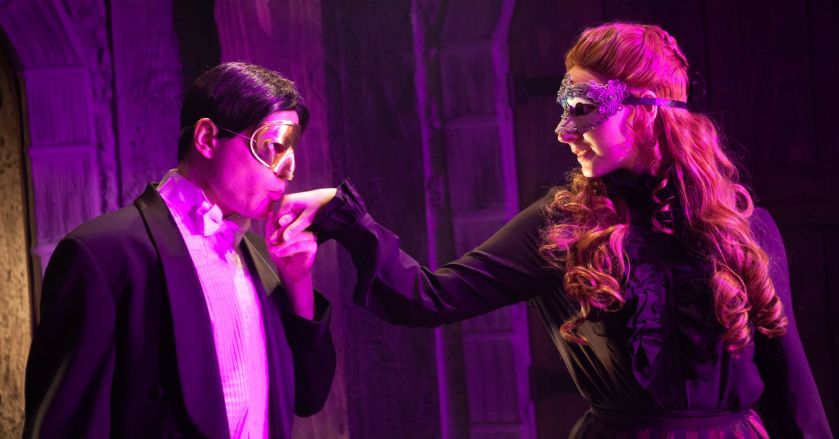
A Gentleman’s Guide to Love and Murder has a love triangle, dysfunctional family dynamics, people who marry for money over love, a leading man who is a serial killer, and Scott Wichmann playing 8 different characters.
Written by Robert L Freedman (book and lyrics) and Steven Lutvak (music and lyrics), based on a novel by Rod Horniman, and directed and choreographed by Kikau Alvaro, A Gentleman’s Guide to Love & Murder is a delightful musical comedy in the hands of a dynamic and talented cast.
After an opening prologue by the ensemble, dressed in elegant mourning attire – a premonition of what is to follow – the audience meets Monty Navarro, sitting at a small desk on the eve of his sentencing for murder, writing his memoirs, including a full confession of how eight members of his family mysteriously died in less that a year. Alexander Sapp plays Navarro, the son of a recently deceased washerwoman who, it turns out, is related to the D’Ysquiths, a wealthy family who made their fortune in banking and finances. In fact, Monty is eighth in line to becoming the Earl of Highhurst, and Sapp seems to have as much fun playing Monty as the audience does watching him plot and plan his way to success, with time out to for romance. Never mind that his love interest, Sibella Hallward, decides to marry someone else. Grey Garrett’s portrayal of the vain and materialistic Sibella is spot on – a perfect balance of comedy and musical theater diva.
Debra Wagoner, as the mysterious Marietta Shingle, has a couple of surprises that are integral to the plot. She is supported by an ensemble that includes Georgia Rogers Farmer, Maxwell Porterfield, Daniel Pippert, Adrienne Eller, Lauren Leinhaus-Cook, Theodore Sapp, and Derrick Jaques.
No, I did not forget to mention Scott Wichmann. This is one of those awkward situations in which the most memorable character is not the leading man, but a supporting character – in this case eight supporting characters, all played by Wichmann. It’s not even fair to call Wichmann a supporting character, as he portrayed all the D’Ysquith heirs in line for the title Earl of Highhurst – including an inebriated cleric, a body-building lord mayor, and a country squire who is married but seems to prefer the companionship of men.
There’s Lady Hyacinth, whose interest in helping the poor and disadvantaged provides a perfect opening to send her off to her death in poverty stricken Egypt or serving the lepers in India. Surviving these dangerous missions, Monty sends her off to deepest, darkest Africa to work with a tribe of cannibals. (It’s 1909, and no one had yet been warned to be politically correct or culturally sensitive.) Lady Salome D’Ysquith Pumphrey is such a bad actress that when Monty replaces the blanks in her prop gun with real bullets and she shoots herself on stage, the audience applauds her death, perhaps not realizing she has really died. Both Lady Hyacinth and Lady Salome are played by Wichmann. Each character has a different voice, posture, and gait. The Reverend Lord Ezekial D’Ysquith, for example, has a distinctive, stylized teetering walk.
Each also has a distinct style of dressing, thanks to costume designer Sue Griffin. Visually, the production is also enhanced by Chris Raintree’s expansive set, characterized by multiple movable set components (ranging from Monty’s modest home to Lord Adalbert D’Ysquith’s mansion – an expansive mansion so grand that it offers tours to tourists.
Sandy Dacus’ music direction, along with Alvaro’s direction kept things moving along at a fair clip, although there were a few moments when I thought something should have been tightened up. The first act lasts nearly 90 minutes, with a total run time of about 2 ½ hours. For the most part, the musical selections do not cater to foot-tapping show tunes, but rather to sung narrative that advances the story line – when all the words are clear; sometimes they were not at Wednesday’s matinee.
The surprise ending brings about an unlikely alliance and opens the door to a sequel. A Gentleman’s Guide to Love and Marriage is delightful musical comedy, satisfyingly delivered by a death-defying cast.
Julinda D. Lewis is a dancer teacher, and writer who was born in Brooklyn, NY and now lives in Eastern Henrico County.
———-
Photo Credits: Aaron Sutten
Lauren Leinhaas-Cook, Adrienne Eller, Alexander Sapp, Grey Garrett and Scott Wichmann. Photo by Aaron Sutten.Adrienne Eller and Alexander Sapp. Photo by Aaron Sutten.Grey Garrett and Alexander Sapp. Photo by Aaron Sutten.Scott Wichmann. Photo by Aaron Sutten.
At: Swift Creek Mill Theatre, 17401 Jefferson Davis Highway, Colonial Heights, VA 23834
Performances: September 14 – October 12, 2019
Ticket Prices: $40 Theater only; $58.95 Dinner & Theater; $10-$20 rush tickets available depending on availability
Info: (804) 748-5203 or swiftcreekmill.com
They got me. They got me good!
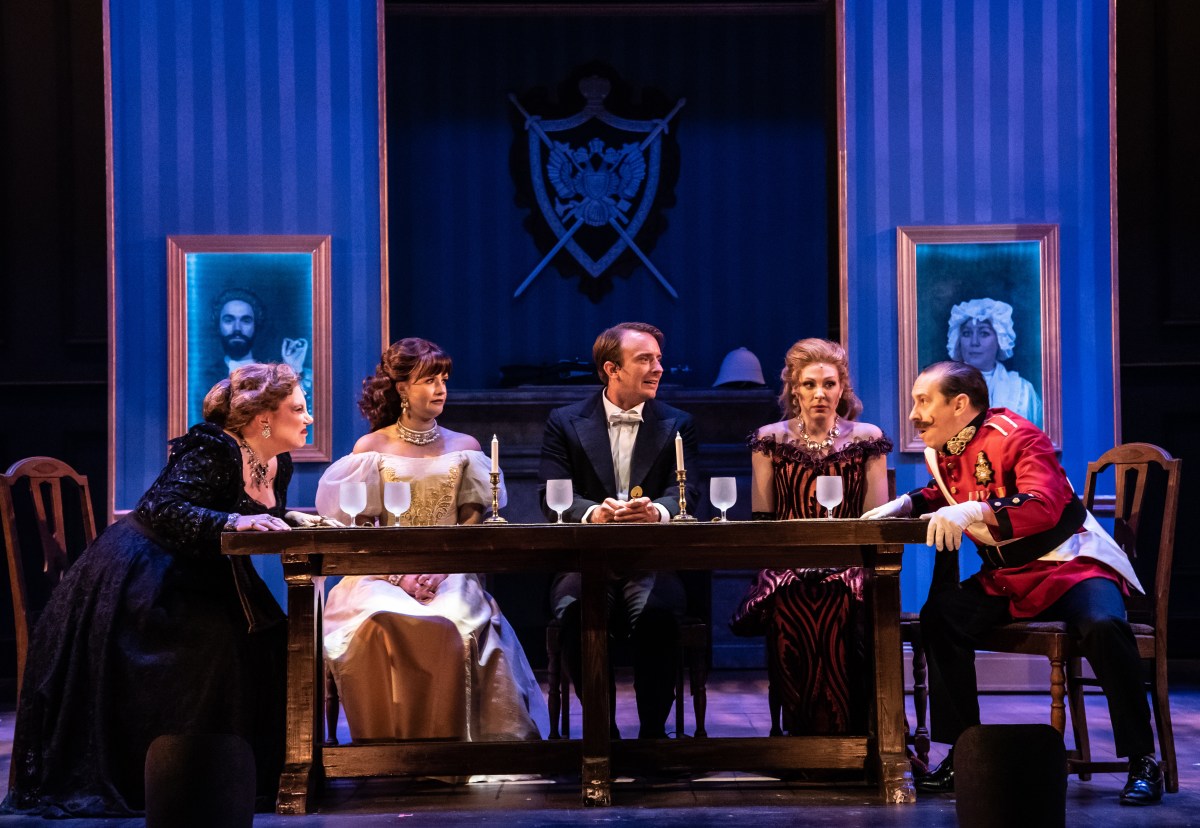
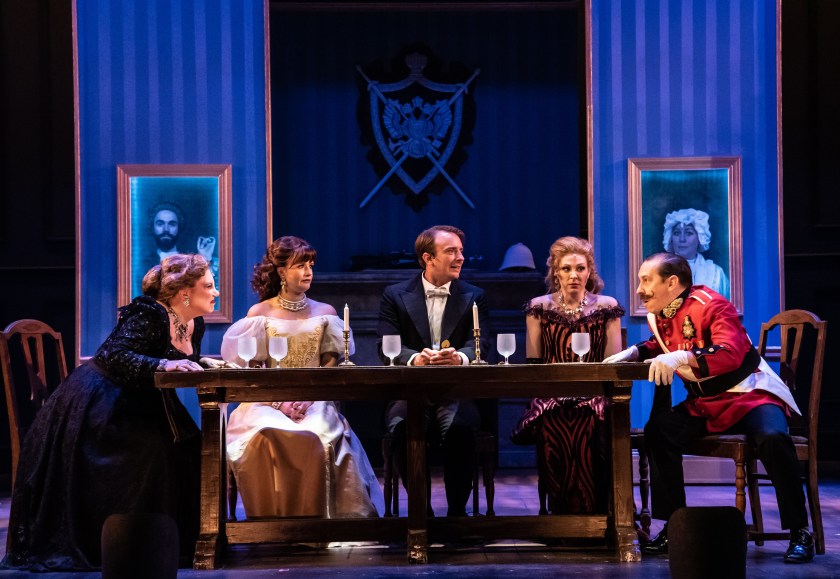
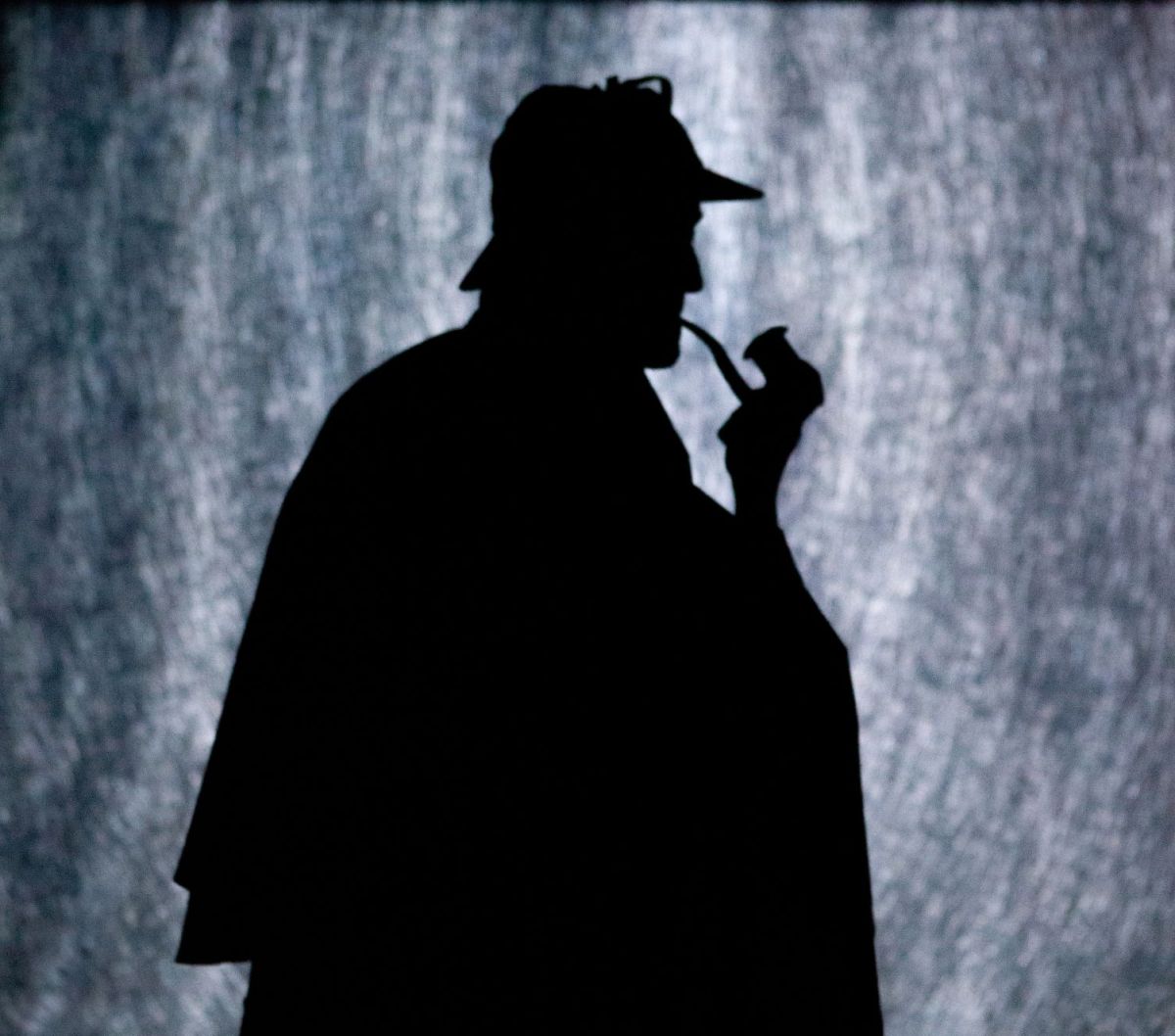
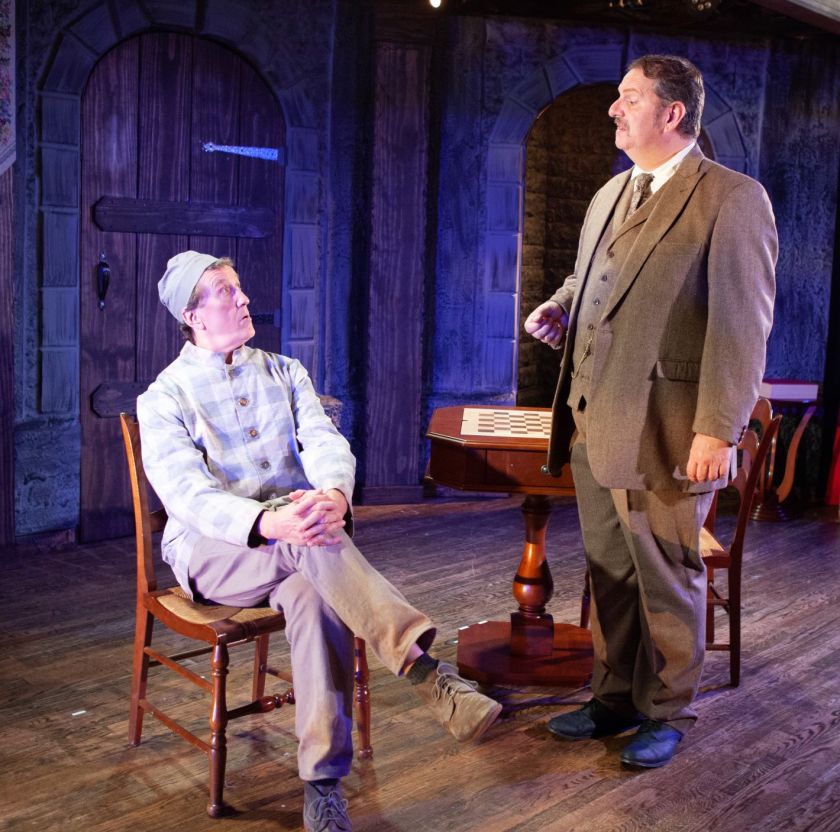
Jeffrey Hatcher’s Holmes and Watson is not your traditional Sir Arthur Conan Doyle Sherlock Holmes mystery. Published in 2018, this fast-paced one-act mystery takes place after the death of Sherlock Holmes at Reichenbach Falls. Mysteriously, the bodies of Holmes and his arch nemesis Moriarty were never found. So. . .
On a remote island off the coast of Scotland in 1894, Dr. Watson is summoned to identify which of three mysterious men all claiming to be Sherlock Holmes is the real sleuth. And that, my friends, is about all I can tell you without giving away the plot and spoiling the fun. This is, after all, a mystery, and it is chock full of clues and red herrings, misdirection and rabbit holes. Fakes, frauds, telegrams, and mad men, oh my!
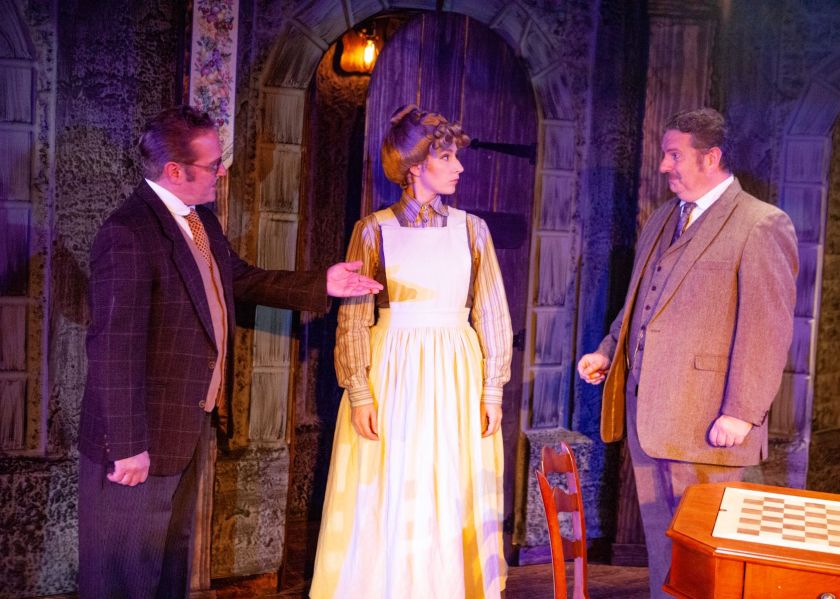
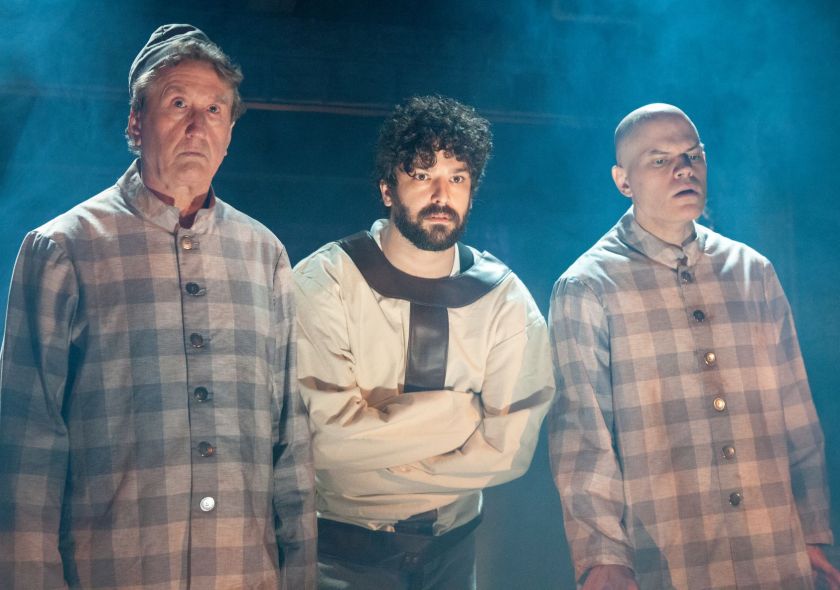
Running under 90 minutes, and performed without intermission, returning guest director John Moon keeps the pace fast with a tight-knit ensemble and there is nearly as much laughter as mystery. Joe Pabst is Watson, Richard Koch plays Dr. Evans, and there are three Holmes characters. Daniel Moore is Holmes #1, a somewhat menacing figure with a tendency to violent outbursts. Axel Burtness is Holmes #2, who wears a crazed look to match his straight jacket. And Jonathan Hardison is Holmes #3, who is deaf and mute. The cast is rounded out by Irene Kuykendall as the Matron and Travis Williams as the Orderly. But no one and nothing is what it appears to be.
There were some scenes where I questioned the behavior of an actor, but the final scene revealed all and explained what might otherwise appear to be lapses or omissions. Ahh, hindsight.
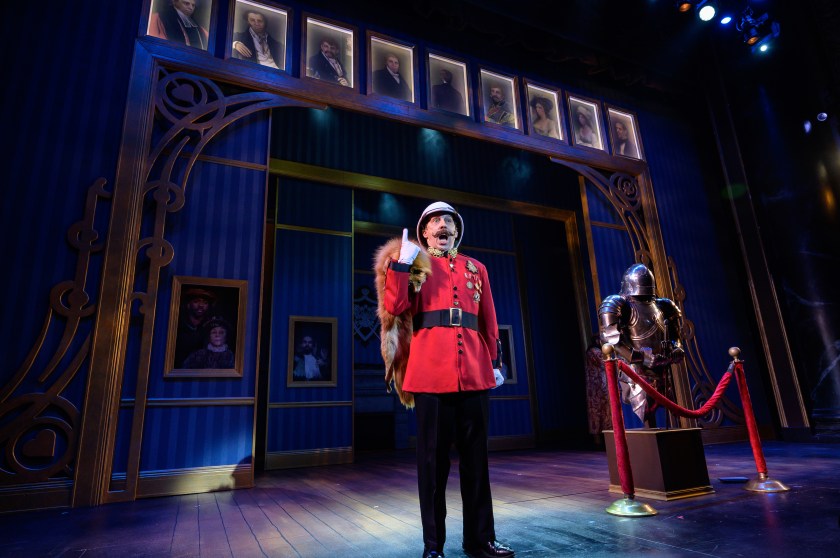
Joe Doran’s lighting adds depth and drama to Tom Width’s relatively simple and minimalist set – a former fortress turned lighthouse turned asylum, it is appropriately dark and shadowy. Maura Lynch Cravey’s costumes add a bit of color and visual appeal, and there are several gun shots and loud noises.
Holmes and Watson is quite an enjoyable evening and keeps the audience engaged. There is enough mystery to please a true Sherlock Holmes or mystery fan, but you don’t have to know a lot about Sherlock Holmes to appreciate the puzzle. I actually enjoyed having the wool pulled over my eyes because it was done so cleverly.
Julinda D. Lewis is a dancer, teacher, and writer who was born in Brooklyn, NY and now lives in Eastern Henrico County.
———-
Photo Credits: Robyn O’Neill
Richard Koch, Irene Kuykendall, and Joe PabstDaniel Moore, Axel Burtness, and Johnathan Hardison
Observations on a Performance Art Experience by Julinda D. Lewis
At: ICA (Institute for Contemporary Art), 601 W. Broad Street, RVA 23220
Performances: September 20 & 21, 2019 at 4:00pm
Ticket Prices: FREE
Info: (804) 828-2823 or ica@vcu.edu
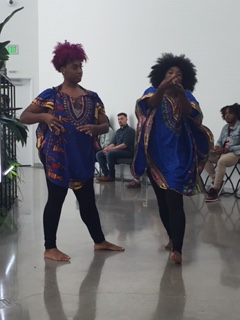
Stepping off the spacious and artistically designed elevator at the ICA into the soaring space of the third floor True Farr Luck Gallery on Friday afternoon was a transformative experience. The open airy space is filled with Rashid Johnson’s installation – a modern yet historically and culturally evocative structure ironically titled Monument. Constructed of steel, it is simultaneously modern architecture and ancient temple. It invites the viewer/participant to sit in quiet contemplation or to walk around and through its structure and absorb the rhythms of long-forgotten memories.
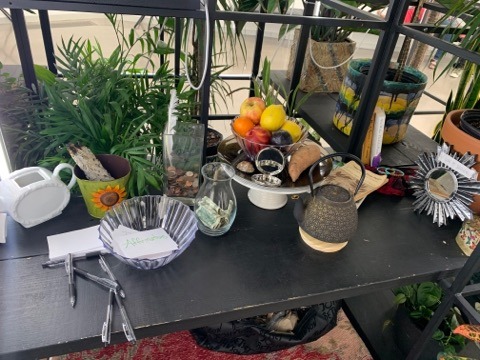
Both calming and energizing, it is provocative, and on this occasion, the space was being activated by an Africanist dance ensemble led by choreographer Christine Wyatt. A libation was poured, and ancestors acknowledged. Some of the participant/observers joined in, others were shy or unfamiliar with the custom. Six dancers and three musicians – although these are both artificial and arbitrary labels, as the musicians move through the space and the dancers sing and speak – then began to move around Johnson’s structure, first walking in silence, gradually adding gentle movements that hinted of ritual and blood memories.
One woman activated our heartstrings, pulling a bow across her violin. Soon, the space was activated with childhood stories of constructing and playing Chinese jump-rope, the soul-stirring strains of spirituals, and the wordless and universal communication of scat. At one point, the energy rose, the dancers moved faster, slicing through space and time. Some of us rose from our seats to follow their movement while others remained seated in quiet contemplation, as wave after wave of movement was birthed. Both responses were correct and necessary. At one point, the dancing women removed their royal blue dashiki-patterned caftans, stripped down to white tank tops and black leggings. They built a pyramid – that echoed the Johnson’s structure – only to collapse in laughter. The gathered in a circle on a rug – sharing a moment of unity, sharing this time of contemplation and collaboration. Their final act was to gather quietly in the center of the space and just. . .breathe.
Provocations offers a new/old way of experiencing art. It is not visual art or sculpture or music or dance. All the elements, sight, sound, movement – even smell, as I was taken back in time by the aroma of Florida water from the libation – united to create a life-affirming experience. “Affirmative Reactions” is a much-needed reminder to breathe, to take time to remember who and where we come from, to recognize and honor our ancestors and each other. It connects the past, the present, and the future.
It is a liberating experience and if you have the time and ability to get to the ICA on Saturday, please go. “Affirmative Reactions” starts promptly at 4:00pm and runs for about 30 minutes.
ADDENDUM: The cast of “Affirmative Reactions” includes Amena Durant, Lani Corey, MiKayla Young, Mary Manzari, Christina Collins, Jaylin Brown, Kenneka Cook, Reyna Pannell, and Christine Wyatt.
Julinda D. Lewis is a dancer, teacher, and writer who was born in Brooklyn, NY and now lives in Eastern Henrico County.
———-
Photo Credits: Julinda D. Lewis & additional photos courtesy Christine Wyatt
At: TheatreLab, The Basement, 300 E. Broad St, RVA 23219
Performances: September 12-28, 2019
Ticket Prices: $30 general admission; $20 seniors & industry/RVATA; $10 students and teachers with ID
Info: (804) 506-3533 or theatrelabrva.org
How ironic that Joshua Harmon’s award-winning play, Admissions, opened at TheatreLAB the Basement just two days after actress Felicity Huffman was sentenced to serve 14 days in prison, community service, and $30,000 in fines for her part in a huge college admissions scandal. Huffman and several other well-to-do parents bought inflated test scores and falsified their children’s athletic talents in order to secure admission into the “best” schools. The family in Admissions didn’t go quite that far to secure an Ivy League admission for their son, Charlie, but the extremes they did resort to were entirely out of alignment with their purported liberal-leaning philosophy and cast a shadow on the integrity of their way of life.
Donna Marie Miller plays Sherri Rosen-Mason, the admissions officer of a private prep school in New Hampshire where her husband Bill, played by David Clark, is headmaster and her son Charlie (Tyler Stevens) is a student. Sherri has made it her life’s mission to bring diversity to the campus – even when it stirs up tension with long-term administrators like Roberta (Jacqueline Jones). Her husband brings her flowers and wine to celebrate reaching 20% minority enrollment after years of efforts to diversify.
When Charlie, a senior, finds his plans to attend Yale are dashed, while his best friend, who is biracial and can “check the boxes” is accepted, he goes on a ferocious tirade, pitting white privilege against affirmative action. This is one of those monologues that is at once a remarkable, challenging accomplishment for a talented young actor, such as Stevens, while at the same time it is such an ugly, entitled, intolerant tirade that it keeps the audience glued to the edges of their seats. At the end, Charlie’s dad scornfully spews out, “Well! Looks like we successfully raised a Republican!”
Charlie’s deferred admission status raises the question, What is fair? And it seems the answer depends on who you are. Director Deejay Gray warned the audience at the start of the show to be prepared to be made uncomfortable and encouraged discussion with those seated nearby.
It wasn’t that long ago that Miller was playing the reluctant administrator of an animal shelter in Animal Control [https://jdldancesrva.com/2019/07/07/animal-control-the-second-world-premiere]¸ and this role invites comparison. In Animal Control Miller portrayed a uniformed bureaucrat who reluctantly assumed a position that was thrust upon her. In Admissions it is almost the opposite; when we first meet Sherri, she is self-assured and righteous. As the play goes on, she exposes the cracks in her chic, pant-suited demeanor. At one point Miller’s character resorts to a reversal of that bastion of inclusion and tolerance when she utters the defensive sentence, “Some of my bet friends are white men.”
As the father, Clark seems to be a voice of reason until it comes to the possibility of his own son attending a community college. (Sorry, but nothing nice is said in support of community college in this play.) Stevens gives a high-spirited performance as Charlie, and I especially enjoyed the counterpoint to his fiery monologue, when he presents his mother with an alternative plan for college. In this proposal, playwright Harmon has brilliantly allowed Charlie to be innovative, sensitive, and rebellious all at the same time.
Supporting characters enhance the story, providing social and historical context as well as several delightfully amusing moments. Sara Collazo plays Sherri’s friend and neighbor Ginnie Peters, mother of the biracial best friend, Perry, who is never seen, while Jacqueline Jones takes on the role of Roberta, the stalwart administrator who appears to have come along with the school as a package deal. Ginnie points out the hypocrisy of caring more about how it looks for the school to have an acceptable number of minority students than actually caring about the students; a “star” student that Sherri had expected to make a generous donation had confessed to Ginnie that he was miserable and neglected while attending Hillcrest.
Roberta is an undercover racist who couches her racism under the smoke screen of “I don’t see color.” Wearing stylish red eyeglass frames, Jones milks a scene in which she leaves Sherri’s office after a less than successful review of her work on the school’s admission book, taking her sweet time as she exaggeratedly puts on her scarf, buttons her coat, deliberately positions her hat and snaps on her gloves before flouncing out of the office.
Ruth Hedberg is the costumer and has selected appropriate contemporary outfits for the play, set in rural New Hampshire during the 2015-2016 academic year. Connor Scudders set is attractive and built to withstand quite a bit of door slamming. One thing I found innovative was the way he built two rooms parallel to one another, with Sherri’s office occupying the downstage third of the stage and her kitchen taking up the rear two thirds or so. The variation in colors and textures and Michael Jarett’s subtle lighting cleverly drew our eyes to the appropriate space without distraction. Kelsey Cordrey’s sound design included several dance-able and very urban sounding song selections, some of which I would have been quite surprised to hear in rural New Hampshire.
Deejay Gray’s direction so thoroughly engaged his cast and audience that when intermission came, roughly half-way through this two-hour journey, I was shocked that forty-five minutes had passed so quickly. The intermission, by the way, was Gray’s idea, as it was not written into the script. Roberta’s insolent attitude, however, was delightfully scripted by the author in great detail.
Admissions couldn’t be timelier. Deejay Gray could not have engineered the national news to be any more relevant than the latest headlines. The theater provides a safe space to talk about uncomfortable topics. Unfortunately, as at least one audience member commented after Saturday night’s show, the people who most need to talk about this, and with whom we’d most like to share this, probably don’t come to the theater.
Julinda D. Lewis is a dancer, teacher, and writer who was born in Brooklyn, NY and now lives in Eastern Henrico County.
———-
Photo Credits: Tom Topinka
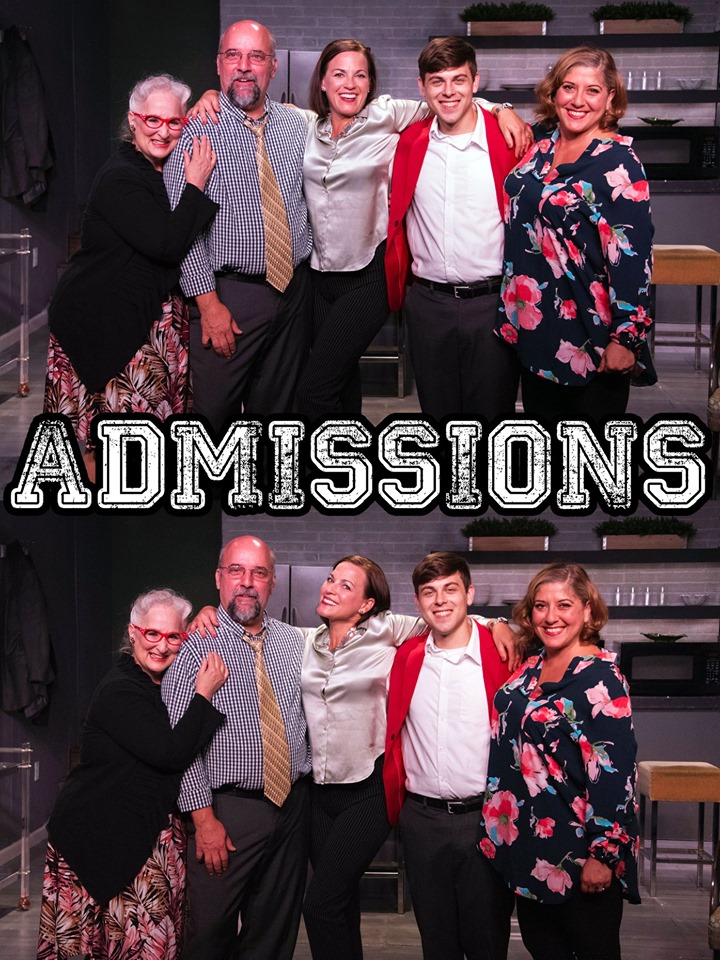
Jacqueline Jones, David Clark, Donna Marie Miller, Tyler Stevens, and Sara Collazo: The Cast of ADMISSIONS.