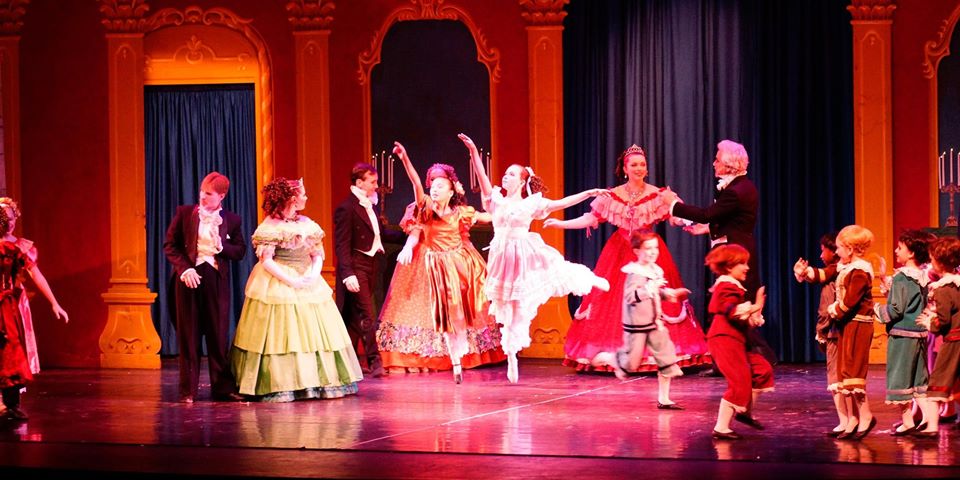
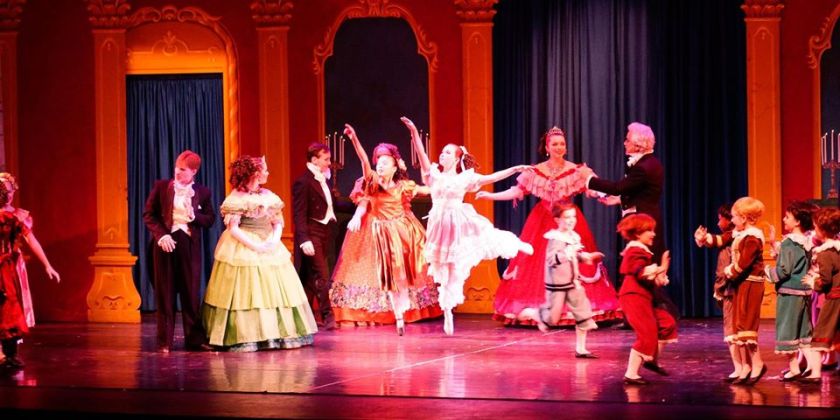
I’ve seen many of the Concert Ballet of Virginia galas, and even the pared-down excerpts of The Nutcracker, but this is the first time I’ve seen their full-length version of the holiday classic.
Synopsis: The Silberhaus’ host their annual Christmas party, attended by their children Clara and Fritz and an assortment of family and friends. Clara receives a pair of dancing slipper and her brother received a sword and a mechanical rat – which he and his friends promptly put to use terrorizing the girls. A family friend, the mysterious Drosselmeyer, arrived late and gives Clara a Nutcracker that has magical powers. When all the guests have gone home, Clara comes to retrieve her Nutcracker, but it comes to life and takes Clara on a Christmas adventure filled with soldiers and horses, battling mice, a Snow Queen, a Sugar Plum Fairy, a Cavalier, and other fantastic characters.
The familiar score by Tchaikovsky and traditional choreography after Marius Petipa and Lev Ivanov as conceived by the late deVeaux Riddick captured and held the attention of the audience made up predominantly of families with young children. The story of Clara and her mischievous little brother Fritz is filled with humorous scenes that a young audience can relate to, and the magic of the mildly menacing family friend, Drosselmeyer, keeps the story interesting.
The variety of the “Divertissements” in Act II (Spanish, Arabian, Chinese, Russian, and Mother Ginger – here called Mother GingGong – along with acrobatic clowns and waltzing flowers) allows for a display of diverse genres and the multiple abilities of this community dance company (all unsalaried), “operating within the framework of a professional dance company.”
The scenery, by artistic director Scott Boyer and costumes (by a full team consisting of Erline Eason, Cecil Carter, Jill Driskill, Patricia Morris, Kay Allen, Mary Beth Rhyne, Ann Reid, Corinne Abernathy, Kim Gangloff, and Tracey Latham) were a beautiful treat for the eyes. They even engineered snow falling gently on the Snowflakes corps de ballet scene.
The Nutcracker is often a young dancer’s – or audience member’s – first exposure to ballet, and this production, while lacking in virtuoso technique and clarity and definition of line, is a visual and musical treat that just might stimulate the interest of new young dancers and future balletomanes.
Julinda D. Lewis is a dancer, teacher, and writer who was born in Brooklyn, NY and now lives in Eastern Henrico County.
———-
Photo Credits: Concert Ballet of Virginia Facebook page
Ticket Prices: $25 Adults; $20 Seniors; $15 Youth/Students with ID/Groups, & RVA On Stage cardholders; Reservations Required – No tickets at the door
Info: (804) 343-6364 or hattheatre.org
In Love We Trust, conceptualized and musically directed by Anthony Williams, is HATTheatre’s response to the daily stresses of the season. “It’s not a play. It’s not a traditional musical. It’s a party!” That’s what the press release said.
“You came to my party!” Williams gushed as he entered the space, with the band on the floor, opposite the entrance door, and the audience seated cabaret style around the black box – including the raised platform usually used as the stage. [NOTE: Apparently “platform” is the wrong terminology to describe the main stage. Does everyone automatically know or assume that a stage is raised? Guess I won’t make that mistake again.]
The show consisted of about twenty pop songs, ranging from Earth, Wind & Fire’s “Fanatasy” to Diana Ross’ “Ain’t No Mountain High Enough” and Barbra Streisand’s “Stoney End.” There were familiar songs like Crystal Gayle’s “Don’t It Make My Brow Eyes Blue” and Carly Simon’s “You’re So Vain” and less familiar songs such as Brian Hyland’s “Sealed with a Kiss.”
There was no script, but the songs were arranged in a way that reflected Williams’ life and loves. Williams, seated at the keyboard, was backed up by Jeremiah Martin on guitar (Forrest Link played guitar the first weekend) and percussionist Steve Raybould. Raybould joined in the patter and easy banter, while Martin, who appeared decades younger than most of the others, kept his attention strictly on his guitar. Casey Dillon, Andrew Etheredge, and Robyn O’Neill joined Williams to sing the vocals. This trio interacted with the audience, rotating around the space, and occasionally providing a nugget of history or love, or sometimes a completely nonsensical statement, as if testing to see if the audience was really paying attention. [NOTE: Never mention anyone’s age. Or size. Or gender? Or looks? not even if I find it interesting. I must be getting too old to keep up with all the things that might be considered offensive.]
Two young men who sat near the door and directly in front of the band seemed to know all the words and appeared to be having more fun than everyone else. I said hello after the show and asked if the more vocal of the two might be a student of Vicki Scallion, and sure enough, he was! [NOTE: I thought this comment illustrated that the show was engaging, and I personally was hoping to see the enthusiastic actor perform in the near future. Unfortunately, I was later informed that my comment was highly offensive to some readers. I cannot predict how people will react to things I say, but be assured my intent was not to single out anyone with the intent to offend. I often comment on the reactions of others in the audience – never mentioning any names (except when my 5- & 10-year old grandsons attend the Children’s Theatre with me and I include their perspectives because they are the target audience ) – so that my readers can have an understanding of how a performance affected others who were at the same performance and may have had a response different or more intense than my own.]
Deb Clinton, who is usually noted for her direction, was listed as the program’s Creative Consultant and there were no costumes or set design or lighting design, although there were some flashing Christmas lights at the beginning, and a string of Christmas lights marked off a dance-floor sized space in the ceiling.
The songfest, which ran just over an hour without intermission and included complimentary hot drinks (coffee, tea, cocoa, and cider) and desserts (e.g., cream puffs, cookies, chocolates) wasn’t a play or a musical, but it fell short of being a real party, as the audience remained seated and didn’t really mingle. The songs were lively, and the performers were relaxed but it seemed that they never really get go and gave it their all. It was as if were having a party but being careful not to disturb the neighbors because they are known for calling the local precinct to lodge noise complaints against anyone who appears to be having fun.
Julinda D. Lewis is a dancer, teacher, and writer who was born in Brooklyn, NY and now lives in Eastern Henrico County.
———-
Photo Credits: there were no photos at the time of publication
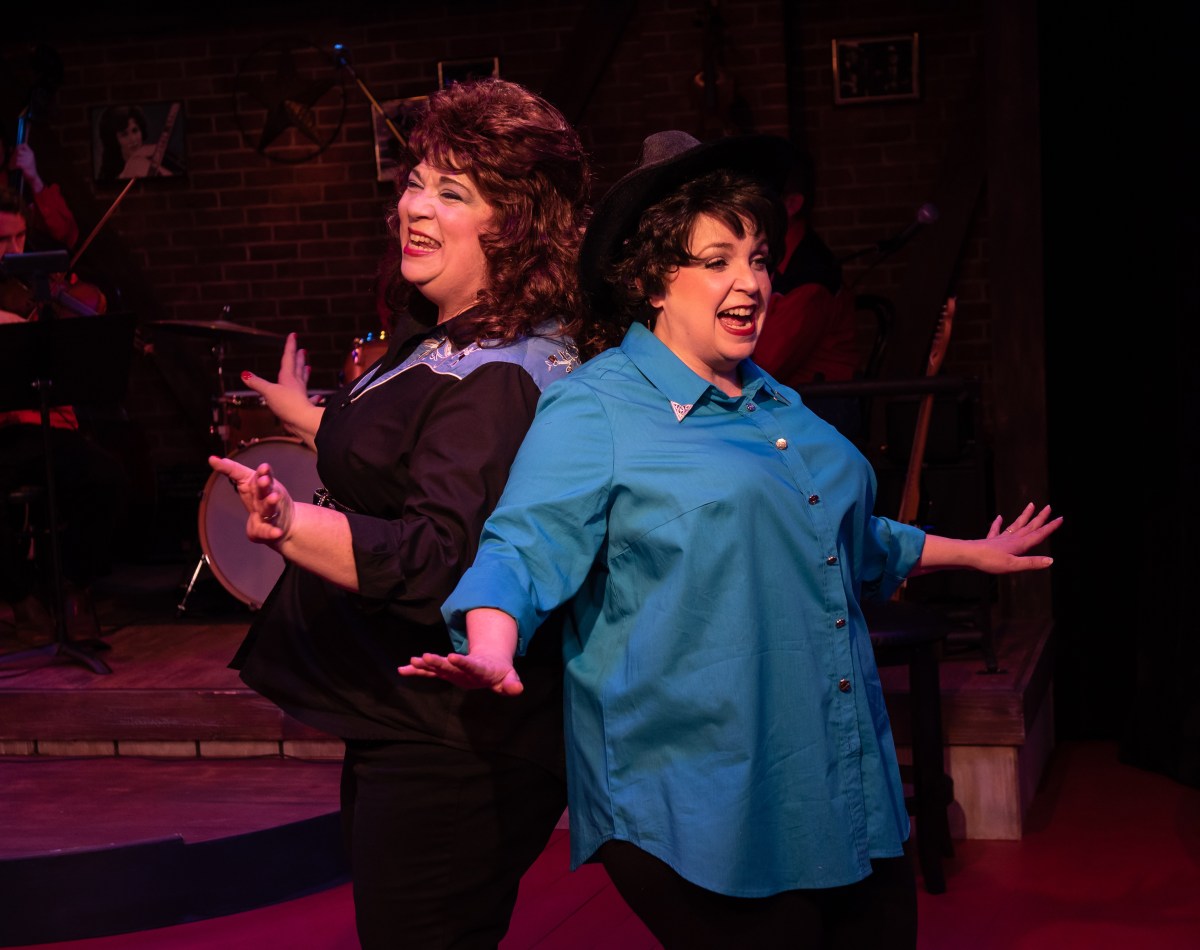
Always. . .Patsy Cline is a two-person show that pays homage to a legendary country music icon. Born in Winchester, VA, Cline died in a plane crash in 1963 while on the way home from performing a show in Missouri. She was only 30 years old at the time of her death, but she had been performing since the age of 14 and left a lasting impression as one of the first country music artists to cross over into the pop music world. Cline made other inroads in music history as a woman in country music, but that’s not the main point of Ted Swindley’s fact-based play, Always. . .Patsy Cline.
You don’t need to know anything about Cline or even be a fan of country music to enjoy this play filled with the music of Cline as sung by the more-than-capable Debra Wagoner. Wagoner’s excellent singing is perfectly balanced by the comedic narration of Terri More as Cline’s friend and number one fan, Louise Seger. This isn’t the first time either woman has played these roles, having performed the show at Hanover Tavern and Willow Lawn in 2012. Then as now, the seemingly effortless flow of the show – which is like a Cline concert interrupted by Louise’s flashbacks – was directed by Joe Pabst.
A five-piece band, consisting of piano, bass, fiddle, drums, and guitar, remains onstage. Near the end of the first act Wagoner, as Cline, takes a break to introduce the band – giving them the stereotypical countrified names Jim Bob, Joe Bob, Jay Bob, Billy Bob, and of course, Bob who collectively make up – what else? – the Bodacious Bobcats. Jeff Lindquist, who plays guitar in the band, is also the show’s musical director.
Wagoner has several comedic moments and spends a lot of time looking incredulously at Moore, who’s comic shenanigans are epic. The phrase, “bless her heart,” was uttered at least once. Moore has some memorable moves, including her enthusiastically receive bump-and-grind walk and her miming of driving her character’s pink and black Pontiac, lovingly named Sexy Dude. Moore has great timing and flawlessly delivers her over-the-top lines. Cline’s friend raised fan-dom to new heights, spontaneously introducing herself to Cline and then portraying herself as Cline’s manager to get her a better rate at a club. She feeds her, chauffeurs her, listens to her, and incredulously connects woman-to-woman creating a friendship that lasted until Cline’s untimely death.
This is the story that Swindley has captured in a two-hour, two-act play – Louise’s loving memory of her friend, not just the star, but the woman, the mother, the wife. Along the way, Moore gets to sing a measure or two as well, as her character joins Cline on stage, hypes up the audience, leads the audience in a sing-along, and cajoles an audience member into dancing with her. Moore’s storytelling is so natural that we hang on her every word. She even chides the audience for not finishing her sentence after using a particular phrase repeatedly.
Derek Dumais’ sound design is impeccable. We can understand every word Wagoner croons. Special effects are used sparingly. Terrie Powers’ scenic design is understated. One side of the space is a honky tonk stage, the other holds a revolving platform that houses Louise’s kitchen, the audience’s area of the honky tonk, and an outer room of a radio station. But what I really loved were Wagoner’s dresses; she wore at least three beautiful, elegant dresses, and my daughter and I both gushed when, at one point, she fumbled around a bit and then thrust her hands into the pockets of her full-skirted dress.
You don’t have to love country music or know the music of Patsy Cline to enjoy this show. Wagoner demonstrated a range, in vocal ability and in genre, worthy of the woman she portrayed. With nearly 30 songs, there’s more than enough to please everyone at least some of the time. I especially enjoyed familiar tunes like “Back in Baby’s Arms,” “Your Cheatin’ Heart,” “Shake, Rattle and Roll,” and “Bill Bailey.” She also sang traditional songs of faith like “Just a Closer Walk” and “How Great Thou Art,” and a lullaby for Louise’s young son. There were love songs, torch songs, ballads, and upbeat songs, including “Walkin’ After Midnight,” “Stupid Cupid,” and “Crazy.”
Despite its somewhat sad ending – it’s not a spoiler to write that Cline dies at the end, because all who are familiar with her know this going in – Always. . .Patsy Cline (a phrase taken from the tag line of Cline’s letters to her friend) is a feel-good play, filled with good humor and even better music.
Julinda D. Lewis is a dancer, teacher, and writer who was born in Brooklyn, NY and now lives in Eastern Henrico County.
At: TheatreLab, The Basement, 300 E. Broad St, RVA 23219
Performances: September 12-28, 2019
Ticket Prices: $35 General Admission; $25 Seniors & Industry/RVATA; $10 Students and Teachers with ID
Info: (804) 506-3533 or TheatreLABrva.org
Last season TheatreLAB blew us away with their stellar production of Sweeney Todd: The Demon Barber of Fleet Street. Now, with their latest production, Urinetown, the Musical it seems fair to say that TheatreLAB is establishing itself as a small theater that successfully produces big musicals.
Of course, I’ve heard of Urinetown. The musical, with music and lyrics by Mark Hollmann and book and lyrics by Greg Kotis, debuted in 2001 at the New York International Fringe Festival before moving to off-Broadway and then onto Broadway. But this is the first time I’ve seen it.
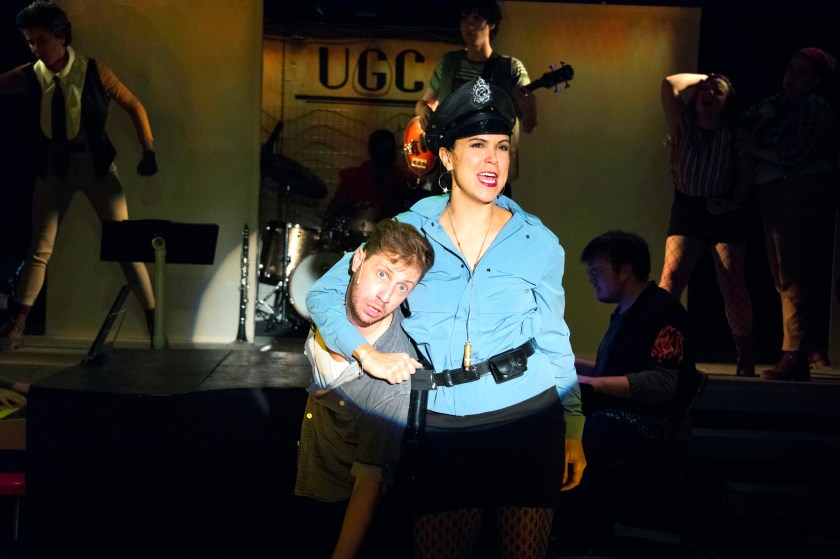
Gutsy and irreverent, Urinetown, the Musical parodies musicals while commenting on corrupt corporations, big government, social oppression, problems with our legal system, ecology, economics, and more. As the narrators – Officer Lockstock (Bianca Bryan) and Little Sally (Kelsey Cordrey) – are quick to point out, Urinetown, the Musical tackles these tough subjects against a background of upbeat music and songs. At one point Bryan’s character, the tough-as-nails Officer Lockstock who is never successful at reigning in Cordrey’s character – a precocious little girl who appears to be an emancipated minor – informs the unnervingly perceptive Little Sally that the truth about Urinetown will be revealed in Act 2, with nice music and “everybody singing and things like that.” There’s also fun choreography by Nicole Morris-Anastasi – the latest in a number of local shows she’s choreographed that are worthy of note; it’s exciting watching an artist hone their craft.
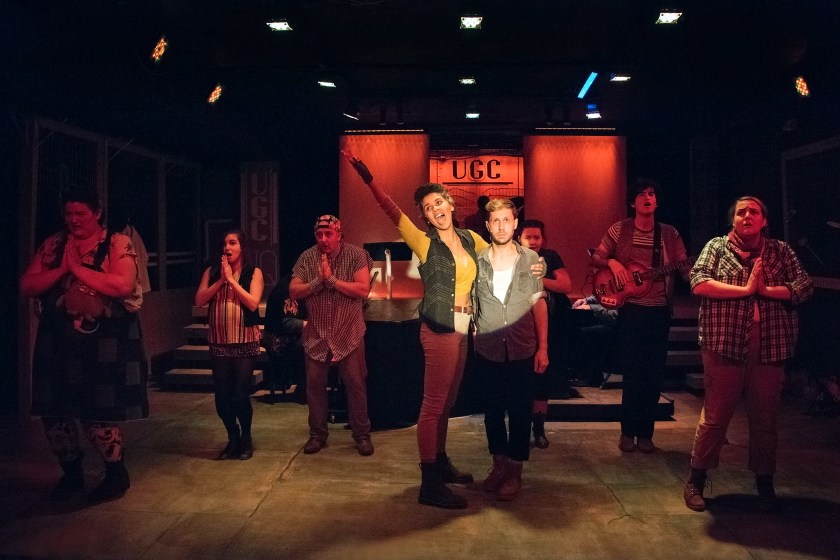
Urinetown, the Musical is set in an unspecific location in an unspecified time. What we do know is that there has been a drought for twenty years, water is scarce, and people are forced to use public bathrooms run by a private company that gouges its customers and exacts horrible penalties for those who cannot or will not pay. Our hero, Bobby Strong, played by Matt Shofner, finally snaps and decides enough is enough after his father is sent to Urinetown after refusing to pay to use the seedy Public Amenity #9 where Bobby is an assistant custodian. Bobby becomes the leader of a rebellion. Along the way he meets, falls in love with, and kidnaps the beautiful Hope Cladwell (Madison Hatfield), initially unaware that she is the daughter of the Caldwell B. Cladwell (Luke Schares), the CEO of the Urine Good Company that employs him and his frugal supervisor Penelope Pennywise (Michaela Nicole). Bobby, his father, and Little Sally find out what Urinetown really is, Penelope Pennywise reveals a startling secret, and much to Little Sally’s consternation, there is no happy ending.
But, there are laughs, and plenty of them, some good singing, and some excellent ensemble work from actors, some of whom do double duty as musicians. I truly enjoyed Matt Shofner as Bobby Strong; he was quirky and funny, knowing when to go over the top and when to focus on balancing compassion with rebellion. Bianca Bryan, in the role of Officer Lockstock (whose partner’s name is Officer Barrel) continues to build upon her repertoire of strong and often sinister characters. As a character who doubles as the play’s narrator, she gets to direct her penetrating gaze and frequent smirks directly at the audience. Kelsey Cordrey, Levi Meerovich, and other characters also get up close and familiar with the audience. One character even sits on the lap of an audience member during the opening scene.
Cordrey’s portrayal of Little Sally is one of my favorite parts of the show. She’s the smart little kid who knows more than most of the adults around her and won’t take no for an answer. Michaela Nicole was another favorite, and Maggie Bavolack, Anne Michelle Forbes, and Levi Meerovich gave strong supporting performances. Meerovich and Travis West (Officer Barrel) both played piano and Bavolack alternated playing the clarinet with playing the role of Bobby’s mother. Joe Lubman, the drummer, had no other character and remained in his orange prison jumpsuit, with a half mask reminiscent of Hannibal Lector.
Matt Polson directed. It’s his first time directing at TheatreLAB, but he directed Urinetown at Maggie Walker Governor’s School. Travis West, who played piano, was musical director, with musical supervision by Jason Marks. I’ve already credited the choreography to Nicole Morris-Anastasi; Kelsey Cordrey served as dance captain. Connor Potter’s scenic design is functional and basic – some steps up to an upper platform, some panels, a place to hang and store props on either side. Ruth Hedberg’s costumes (with the assistance of Autumn Foster) are appropriately tattered and scruffy while sound and lights by Joey Luck and Michael Jarrett respectively lived up to the level of excellence expected of these two – helping bring Polson’s vision to life while remaining unobtrusively in the background.
The device of having the narrators weave in and out of character and speak directly to the audience makes the audience co-conspirators in the shenanigans and prepares us to keep laughing even when we know there’s not going to be a happy ending. Urinetown, the Musical is a perfect choice for TheatreLAB’s seventh season, “Power and Privilege.” It’s funny and quirky and unapologetically honest.
Julinda D. Lewis is a dancer, teacher, and writer who was born in Brooklyn, NY and now lives in Eastern Henrico County.
———-
Photo Credits: Tom Topinka
Matt Shofner and Bianca BryanAllison Paige Gilman and cast of UrinetownMatt Shofner and cast of UrinetownMichaela Nicole and Matt Shofner and cast of UrinetownMatt Shofner and cast of Urinetown
Swift Creek Mill Theatre opened the 2019-2020 season with Jeffrey Hatcher’s unconventional Sherlock Holmes mystery, Holmes and Watson (https://jdldancesrva.com/2019/09/21/holmes-and-watson-its-not-what-you-think/) and now they’re presenting another non-traditional mystery, Rupert Holmes’ The Mystery of Edwin Drood.
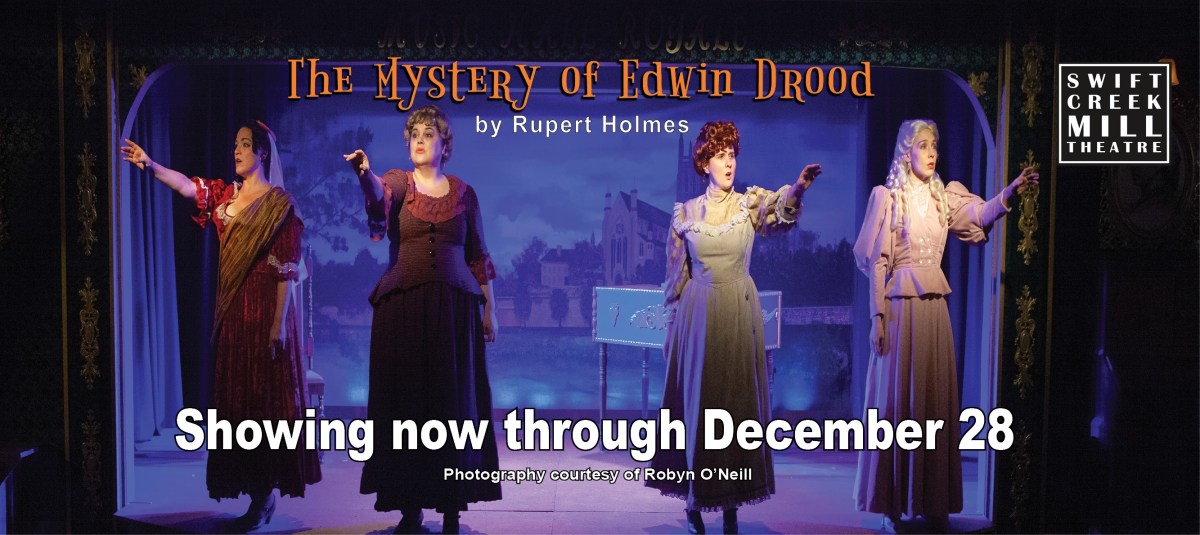
The Mystery of Edwin Drood is based on the unfinished last novel of Charles Dickens, who died of a stroke while working on the book. Hatcher, who wrote the book, music, and lyrics (now there’s an accomplishment you don’t see every day), infused Dickens’ story with humor by setting it as a play within a play, performed by the members of the Music Hall Royale, a Victorian music hall.
The cast – actual and fictitious – is rowdy and bawdy. They start out mingling in the audience, telling cheesy jokes, sitting next to audience members, and testing the waters with double entendre. The huge cast – nearly twenty – often spills over the edges of the relatively small stage, and director Tom Width, who clearly enjoys this unbridled parody, uses this to heighten the comic effect and interactive nature of the show.
There are some strong voices, particularly Michael Gray as the protagonist John Jasper, and Paige Reisenfeld as the romantic interest, Rosa Bud. Ian Page, an antagonist, uses a high-stepping walk and simmering facial expressions to great comic effect. The “Chairman” or Master of Ceremonies, Richard Travis, is appropriately blundering and bombastic by turn and keeps things rolling along with the help of his gavel-wielding stagehand, Alvan Bolling, II.
The title role of Edwin Drood is played by Alice Nutting – a character who is a male impersonator (yes, that was a thing in Victorian theater) – who is in turn portrayed by actor Rachel Marrs.
Donna Marie Miller, in her first Swift Creek show, is also quite funny; her character even makes fun of her unidentifiable accent, and Jacqueline O’Connor was fascinating as her character, a drug-dealing prostitute, ranged from bawdy to tender when she reminisced about being leading lady Rosa Bud’s former nanny, then ended up being paired with the very amusing drunken sexton Michael McMullen in an engineered happy ending. They were paired by audience applause!
As Act 2 winds down – it actually sort of stumbles to a false end due to the death of its author – the audience is called on to vote for the murderer of Edwin Drood, who disappeared one night never to be seen or heard from, for some six months! The audience vote determines who sings the final two songs (not including the finale) and how the final scene ends.
In addition to directing, Tom Width also did the scenic design, a replica of a Victorian music hall stage embellished with lighting by Joe Doran, lively choreography by Alissa Pagnotti, and some lovely period costumes by Maura Lynch Cravey. Musical director Gabrielle Maes kept things moving along, but all too frequently the music was too loud, overpowering the vocals, to the point where an occasional word and even entire phrases got swallowed up. At least two people who were sitting behind me on the right hand side moved to empty center seats during intermission, hoping to balance the uneven sound. I didn’t get a chance to ask later if it had made a difference.
Ultimately, The Mystery of Edwin Drood is lite entertainment (yes, I meant to spell it that way); it amuses without pushing a message or focusing on a moral or worries about being politically correct or any of that. There’s a low-key holiday factor, with a Christmas tree downstage right, a few wreaths and an un-stressed mention of Christmas by one or more of the characters.
Julinda D. Lewis is a dancer, teacher, and writer who was born in Brooklyn, NY and now lives in Eastern Henrico County.
INDIAN INK THEATRE COMPANY: You’re Invited to Mrs. Krishnan’s Party!
A Brief Preview of an Immersive Theatrical Experience by Julinda D. Lewis
At: Alice Jepson Theatre, Modlin Center for the Arts at University of Richmond, 453 Westhampton Way, Richmond, VA 23173
Performance: January 25, 2020 at 7:30pm & January 26, 2020 at 3:00pm
Ticket Prices: $40 General Admission; $32 Subscribers; $20 Students / SOLD OUT!
Info: (804) 289-8980 or modlin.richmond.edu
One of the problems, well, actually, the only problem, actually, with the Modlin Center for the Arts – which is a lovely space for dance, which is what I usually see when I go there – is that their productions are usually scheduled for just one or two performances or one or two evenings. So, as much as I want to tell you about Mrs. Krishnan’s Party, which is coming in January, I am sorry to have to start off by informing you that both shows are already sold out! (I asked if there is any possibility of additional shows being added, and I am awaiting a response.)
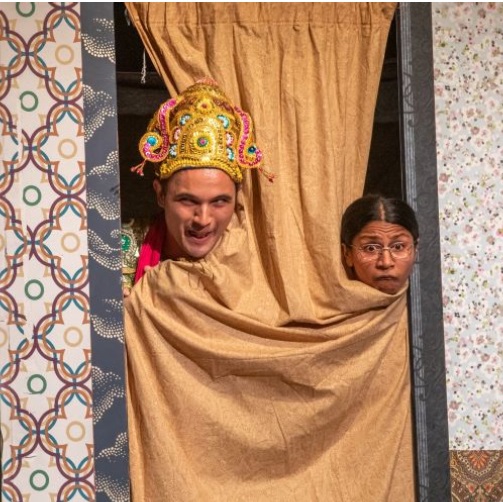
The Indian Ink Theatre Company, based in New Zealand, was touring in Seattle, WA when I spoke with Kalyani Nagarajan who plays the role of Mrs. Krishnan in this two-handed comedy. Mrs. Krishnan’s Party was “in the works” for seven years and now tours the world attempting to bring happiness – and Indian culture – to audiences of all ages, genders, and ethnicities.
Mrs. Krishnan’s Party is a story about a “Mom and Pop” type store whose owner is looking to sell it. The story takes place in real time, “everything happens live” is the way Nagarajan explained it. There are two actors, Nagarajan and Justin Rogers. Nagarajan was very enthusiastic in describing the colorful nature of the play, not just in the costumes and set, but also in the culture, and even in the intergenerational characters: one is in her mid-50s, the other in his early 20’s. The “third character” is the audience.
As the story unfolds, secrets are revealed, and the audience becomes immersed in the action. Nagarajan was very specific in rejecting the word “interactive,” believing it might push some people away, but seemed comfortable with the idea of a cultural and theatrical immersion. It’s about people going through familiar things. Set in the back room of Mrs. Krishnan’s store, the audience is invited to the party where they will “interact and talk with people you might never have talked with.” At the end of the show, Nagarajan wants the people dancing, singing, and laughing together. And eating! There is live cooking done onstage, and at the end the audience – excuse me, the invited guests – get to sample the meal.
Mrs. Krishnan’s Party builds community, and the audience is urged to come ready to be surprised. “Come with an open heart,” Nagarajan urges, “and don’t eat too much dinner before-hand.”
Mrs. Krishnan’s Party, written by Jacob Rajan and Justin Lewis, combines acting, dancing, singing, music, cooking, and laughter. No two performances are the same. Even the ticketing for the show is varied. The Indian Ink Theatre Company’s website described five levels of tickets: (1) the Top Table or VIP seat at the table in the center of the room with first class treatment; (2) the Inner Circle, which is still close; (3) the Wall Flower, up high with a perfect view; (4) the Cheeky Seat, close but not too close; and (5) the Party Animal, which is no seat at all, but spot that allows you to move and dance. I hope to be able to report back detail if it’s as awesome as it sounds!
Julinda D. Lewis is a dancer, teacher, and writer who was born in Brooklyn, NY and now lives in Eastern Henrico County.
———-
Photo Credits: Nimmy Santhosh & the Indian Ink Theatre Company website
LOMBARDI: Winning Isn’t Everything; It’s the Only Thing!
A Theater Review by Julinda D. Lewis
At: The Firehouse Theatre, 1609 W. Broad Street, RVA 23220
Performances: November 7 & 8 previews; opening November 9 – 23, 2019
Ticket Prices: $15-$35
Info: (804) 355-2001 or firehousetheatre.org
“Gentlemen, this is a football.”
– Vince Lombardi
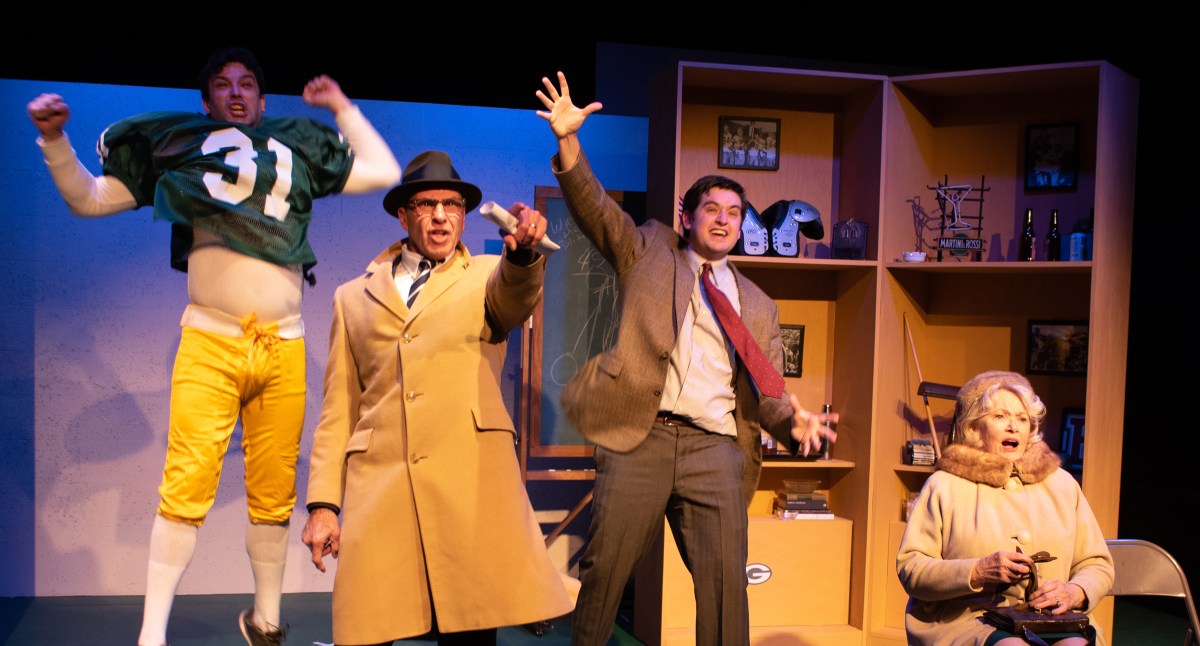
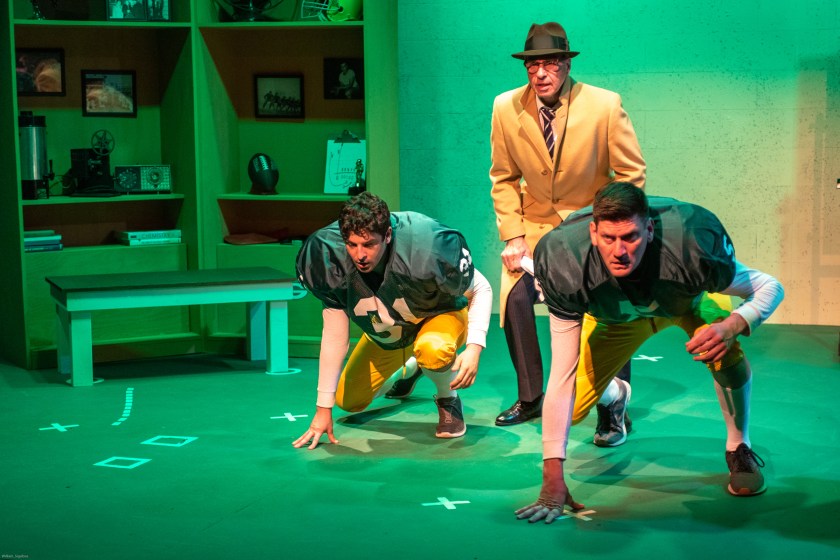
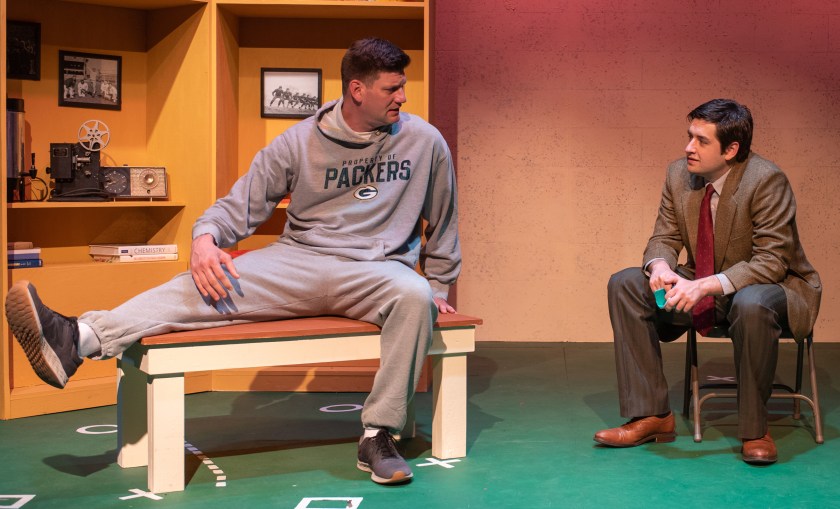
Based on the book When Pride Still Mattered – A Life of Vince Lombardi (by David Maraniss), Eric Simonson’s two-act play, Lombardi is a living, breathing documentary. Set in 1965, when journalist Michael McCormick from Look Magazine is sent to write a story about the man many consider the greatest coach in football history, the fast-paced, sometimes gritty dialogue gives us a peek into the life of the man remembered as much for his pithy sayings as for his lasting impact on football.
“Winning isn’t everything; it’s the only thing.”
— Vince Lombardi
(after UCLA Bruins football coach
Henry Russell “Red” Sanders, 1950, 1953)
McCormick, played by CJ Bergin, has a central role as the reporter who spends a week with Lombardi and his wife Marie in Green Bay, Wisconsin, not long after the Lombardi’s have moved to Wisconsin where Lombardi led the Green Bay Packers to five championships in seven years. (Do not be impressed – I know nothing about football – this is general knowledge, easily available to anyone.) Bergin’s character is dedicated and enthusiastic, even in the face of getting yelled at by Lombardi on the football field. He is also a multi-faceted character, as we see how his observations and interactions with the Lombardi’s help shape his own developing career. There is an easiness and familiarity about McCormick that make him a likeable character. In a slightly drunken scene in Act 2 he won my heart – and won over the players – by quoting stats from memory. He knew something – if not everything – about every player.
“Football is like life – it requires perseverance,
self-denial, hard work, sacrifice, dedication
and respect for authority.”
– Vince Lombardi
Marie Lombardi, played by Linda S. Beringer, is undoubtedly the most likeable member of the cast. She is a mother figure to the players, soothing and smoothing over the raw and open sore left by Lombardi’s abrasiveness. She guides McCormick, steering him to the players who can provide the most insight. Sometimes she is gentle with McCormick, and sometimes she practices tough love, fueled, perhaps, by her close friendship with the couple’s liquor cabinet. (In real life, it seems, a miscarriage led to her heavy drinking.) My favorite Marie scene is when she backs the domineering Lombardi up against a wall and make it clear she isn’t taking any crap from him. It certainly doesn’t change him, or have any lasting impact, but he listens. The two seem to have a strong, loving relationship, and Marie clearly understands her husband and knows how to communicate with him like no one else.
“The most imperfect perfect man I ever met.”
– Michael McCormick
Surprisingly, I did not focus first on the title role, perhaps because this is a true ensemble production, under the skillful direction of Scott Wichmann (billed as Head Coach rather than Director). Wichmann and his actors give us a brisk pace and some well-placed and much appreciated comedic timing that almost obscured a few places where I thought the action was dragging and the play wasn’t advancing quite fast enough for me.
“If you can accept losing, you can’t win.”
– Vince Lombardi
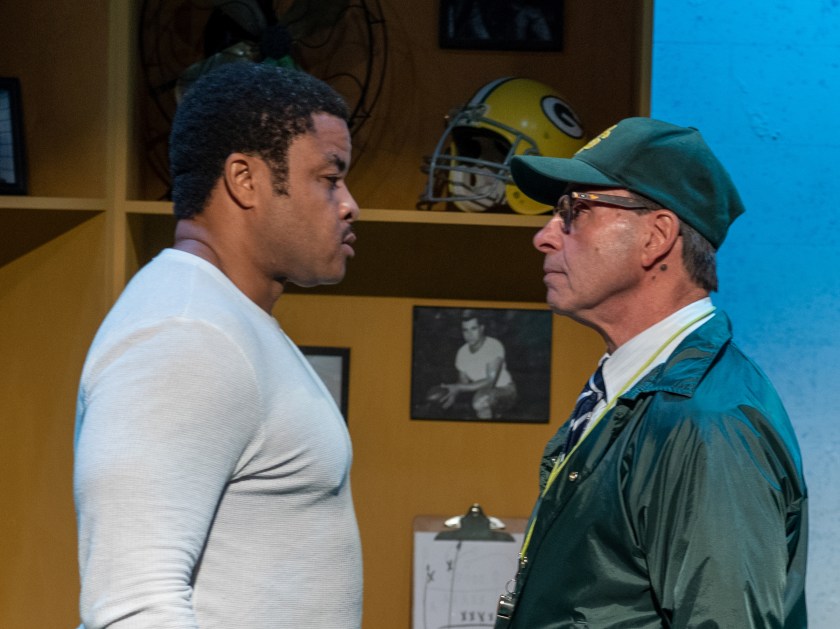
Vince Lombardi is played by Ken Moretti (Broadway Bound, Free Man of Color, and Bill W. and Dr. Bob) in what is perhaps the most challenging role I’ve see him in, to date. Stern-faced, he rarely smiles, he yells a lot and speaks in a bombastic manner. At the same time, he clearly loves his wife and his players. In one scene, player Dave Robinson (played by Raymond Goode) explains to McCormick – over beers and a game of pool – that yelling at them is how Lombardi shows he cares. So, yelling at McCormick and kicking him off the field probably means he really likes him.
“People who work together will win,
whether it be against complex football defenses,
or the problems of modern society.”
– Vince Lombardi
Moretti’s portrayal of Lombardi also makes the volatile Lombardi a sympathetic figure as we watch him succumb to the symptoms of colon cancer – a disease he ignored because he was too busy making football legends. The rest of the cast includes Arik Cullen as player Paul Hornnung and Axle J. Burtness as player Jim Taylor. Cullen’s character is the one McCormick is steered to for information approved by Lombardi. Burtness’ character seems to be always in some sort of unspecified trouble, and McCormick’s unrelenting pursuit of an interview with the character Taylor is part of the reason he gets to feel the full wrath of the mercurial Lombardi directed straight at him.
“Winning is habit. Unfortunately, so is losing.”
– Vince Lombardi
Goode’s character has two major scenes. One, described above, is when he provides insight into Lombardi’s yelling. The other is when he tells how Lombardi demanded that all the team members be allowed to stay in the same hotel even when traveling in the south or areas where segregation was the norm. Dave Robinson, a black football player who is now in his late seventies, played for the Green Bay Packers and the Washington Redskins. Lombardi was head coach of both teams.
“You don’t do things right once in a while.
You do things right all the time.”
– Vince Lombardi
Frank Foster designed the set – a clean and simple space dominated by two pairs of tall bookcases that do multiple duty as home, locker room, and other locales. Some tables and benches, moved by the cast members, define the scene changes. Bri Conley designed the lighting, Sheila Russ did the costume design, and Amanda Durst was vocal coach.
“Battles are won in the hearts of men.”
– Vince Lombardi
As I’ve already said, I’m not much of a football fan, but my partner, Albert is. Like many others in the audience – a full house for Saturday’s opening night – he came decked out in his football attire. In his case, it was a Redskins hoodie, and thanks to our front row seats, he got a momentary spotlight when McCormick pointed him out in the scene where he mentions Lombardi’s short tenure with the Redskins (1969, just prior to his death in 1970). Albert, who attends a lot of plays with me, was enamored of this production; it combined his newfound love of theater with his lifelong love of football (he played in high school and college). A mathematician, he likes facts and stats and that sort of thing. So, bottom line, Lombardi, which runs about 2 hours, with one intermission, is a play that appeals to people who like football, people who like biographies and documentaries, and to families. If you think you might want to attend, don’t hesitate; I heard that some shows are already selling out.
Julinda D. Lewis is a dancer, teacher, and writer who was born in Brooklyn, NY and now lives in Eastern Henrico County.
———-
Photo Credits: Bill Sigafoos
Axle Burtness, Ken Moretti, Arik CullenAle Burtnes, Ken Moretti, CJ Bergin, Linda S BeringerRaymond Goode and Ken MorettiArik Cullen and CJ Bergin
pictorial representation in terms of light and shade without regard to color
a: the arrangement or treatment of light and dark parts in a pictorial work of art
b: the interplay or contrast of dissimilar qualities (as of mood or character)
merriam-webster.com
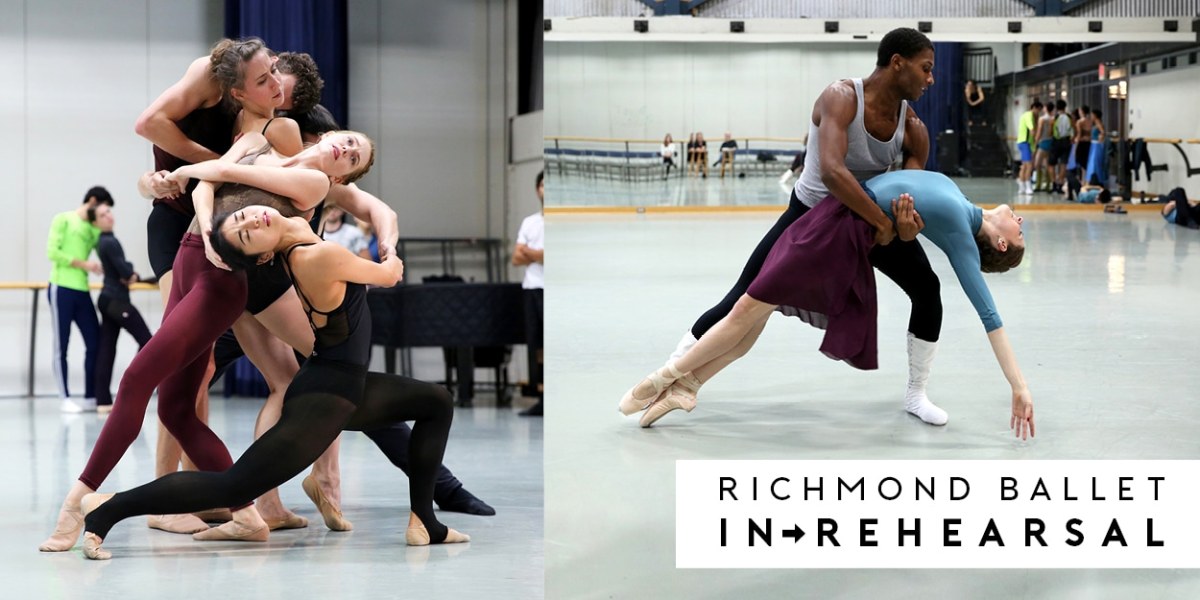
The Richmond Ballet opened its 2019-2020 season (19/20 for short) with the theme “Grace in the River City.” The Studio One program, held at the company’s Canal Street studio, included Artistic Director Stoner Winslett’s “Ancient Airs and Dances” and Ma Cong’s “Chiaroscuro.”
“Ancient Airs and Dances,” set to three suites of 17th and 18th century Italian and French lute songs by Ottorino Respighi, was revived in honor of Winslett’s 40th anniversary with the Richmond Ballet. The work for four couples was Winslett’s first work for the professional company. Dressed alike, but in different colors (navy, purple, aubergine, wine) the four couples begin with a formal promenade, tracing figures on the floor. At the end of the introductory movement, they toss away their masks and begin to reveal their separate personalities.
First is Ira White and Eri Nishihara (purple). They appear to be the playful couple, moving lightly, teasing and skipping offstage. Next up, Abi Goldstein and Anthony Oates (aubergine) who present themselves as the romantic duo. They are more dramatic, and Goldstein is very strong, demonstrating a freedom of physicality as when she rolls across Oates’ back. When Cody Beaton and Mate Szentes (navy) dance, the woman’s skirt and man’s vest have been shed and the movements seem more contemporary and exploratory, less formal, and finally Melissa Frain and Marty Davis’ (wine) dance seems to be about reconciliation and commitment or longevity as they seem to linger in one another’s presence and movements. In the final section, the four couples gather in a folk dance and each couple briefly reprises their duet before ending in a rotating figure like a carousel, with the women held aloft, parts of a whole.
During her tenure at Richmond Ballet, Winslett has commissioned more than 75 works, by more than 35 choreographers (facts she revealed during her Tuesday evening Choreographer’s Club curtain talk). For Studio One, she brought back Ma Cong for his fifth new work in ten years.
“Chiaroscuro” is a collaborative work, with choreography by Ma Cong, Music by Ezio Bosso, costumes and set by Emma Kingsbury, lighting by Trod Burns, and photography by Sara Ferguson. The nine dancers – 4 women and 5 men – move through Bosso’s music illuminated by Burns’ lighting with Ferguson’s larger-than-life black and white images of themselves projected onto Kingsbury’s set. It might be a rock, or a cliff, but wait – what is that long, thin thing sticking up out of middle of it? “Nothing’s perfect,” was Kingsbury’s enigmatic response when questioned about it.
Images change subtly; where there were hands there is now a face; where there was a face, there are now two, no three! The costumes, in shades of black and gray, echo the chiaroscuro effect – the contrast of light and dark, the constantly shifting light and the movement of human sculptures. Hmmm, a Chinese choreographer; an Italian composer; an Australian designer; an American ballet company – was this, too, part of Cong’s vision, or was it serendipity?
The cast – Cody Beaton, Elena Bello, Melissa Frain and Eri Nishihara, Marty Davis, Trevor Davis, Fernando Sabino, Mate Szentes, and Ira White – seemed to enjoy performing this piece as much as the audience enjoyed watching it.
“Chiaroscuro” begins with Fernando Sabino (who has announced his retirement at the end of this season) o the floor. As he rises, his movements are strong, emotive, not all lightness and grade. As the other dancers enter, the women are lifted in swirling arcs, tracing figure eights in the air. When the men arc backwards, they turn their knees inward. This ballet is not technique as usual. A diagonal line turns inward and wraps around like a spiral segment of DNA. Dancers unite and separate. Elena Belo is lifted about a cluster of men and held aloft in a running pose. Three men intertwine, heads popping out and leaping through hoops made of arms like a game of whack-a-mole.
On the screen, a large white rose emerges; but the end of the dance it has wilted. On the stage, a white parasol weaves its way across the stage. I somehow felt the rose and the parasol were connected. Partnering in “Chiaroscuro” is intriguing. In one section the women shed their skirts, becoming de-sexualized. Dancers morph into oddly intriguing positions, finding new ways to connect. One may be held by an ankle, a toe, or back of the knee. Dancers’ arms and legs become hooks from which to suspend bodies and legs and thighs become step stools leading to higher dimensions.
Like previous works by Cong, “Chiaroscuro” encourages the viewer to explore new perspectives of human emotion, as he did with “Lift the Fallen,” a 2014 work in which he deals with the loss of his mother. But “Chiaroscuro” is even more immersive, more compelling. It is a beautiful work that elevates both the dancers and those watching them.
Julinda D. Lewis is a dancer, teacher, and writer who was born in Brooklyn, NY and now lives in Eastern Henrico County.
An Addendum to Yesterday’s Theater Review by Julinda D. Lewis
By: Virginia Rep/Cadence Theatre Company
At: Theatre Gym, Virginia Repertory Center, 114 W. Broad St., RVA 23220
Performances: October 26 – November 17, 2019
Ticket Prices: Single tickets start at $42
Info: (804) 282-2620 or va-rep.org
Yesterday (October 25) I wrote about 13, The Musicalafter seeing the first cast. Today (October 26) I returned for the second opening night with a different cast – except for, I think, two actors.
When Cadence Theatre’s Artistic Director Anna Senechal Johnson announced that there would be two entire casts for 13, THE MUSICAL and that there would be two opening nights, I decided to attend both. The board with the actors’ headshots had to be changed, and there were two sets of programs printed. Preparation for this musical, more than 40 performers (actors and band members ranged in age from 12 to 17) required changing the headshot board and printing two sets of programs to accommodate the two casts – the Appleton and the Indiana (named for the town and state where our young leading man must move after his parents’ divorce). It must have felt like the theater company was preparing to give birth to twins.
For the first five minutes, I started to compare the performances of the two sets of main characters, but about 10 minutes into the show I realized that the characters had taken over. While the chemistry was different, and different actors brought their own nuances, I can honestly say that the experiences were equivalent to seeing the same show twice with the same cast.
Physically, Brandon McKinney and Evan Dymon are quite different (in stature, facial structure, and more) but both portrayed lead character Evan with naivete, bravado, and compassion. Bridget Sindelar may have had a slight edge over Violet Craighead-Way as far as vocal range or power, but both made me root for Patrice and cheer her independence and self-identity.
The differences between Donathan Arnold and Cohen Steele are even more striking than the differences between McKinney and Dymon. Arnold is tall, slender, and black while Dymon looks farm-strong and he’s white.
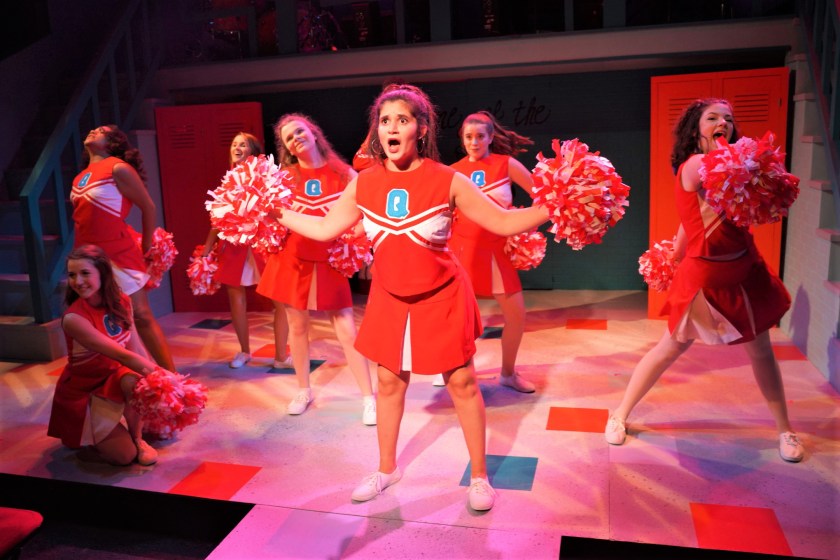
I think Caroline Johnson portrayed a somewhat more prissy and less conceited Kendra than did Audrey Kate Taylor, while Jolie Smith and Anjali Sharma were equally strong as the mean girl. Both were able to maintain a sneer throughout a rigorous cheerleading routine, but Sharm’s tripping of best-friend-and-arch-enemy Kendra was perhaps a tiny bit more subtle than was Jodi Smith’s action for the same scene.
Ethan Dunne Stewart and Marcus Dowd, as Brett’s friends and hangers-on were a bit more outrageous, if possible, in their role as back up singers than were Owen Buckenmaier and Jake Barger, but both pairs of hangers-on were among my favorite characters.
Since much of the story line is sung, it is important that the lyrics can be clearly heard, and from my position (second row, right on Friday night and second row, front on Saturday) there where a few times that the vocals got lost for a moment or two and I never did understand the much repeated line of the finale.
My first impression remains the same: 13, THE MUSICAL: is a fun and energetic piece of theatre that is this wholly engrossing. Both casts of teens exude energy and professionalism; they make you care about what happens to Evan, Patrice, and Kendra (the bar mitzvah boy, his new friend, and the popular girl) and their friends. As if anticipating the audience reaction, the authors have the cast sing about their growth, their decisions, their triumphs and failures over the course of the school year
Julinda D. Lewis is a dancer, teacher, and writer who was born in Brooklyn, NY and now lives in Eastern Henrico County.
At: Theatre Gym, Virginia Repertory Center, 114 W. Broad St., RVA 23220
Performances: October 26 – November 17, 2019
Ticket Prices: Single tickets start at $42
Info: (804) 282-2620 or va-rep.org
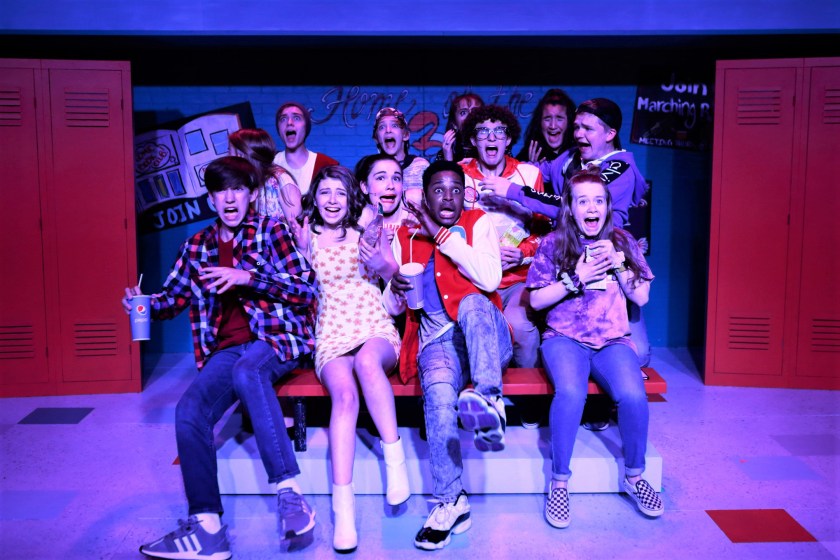
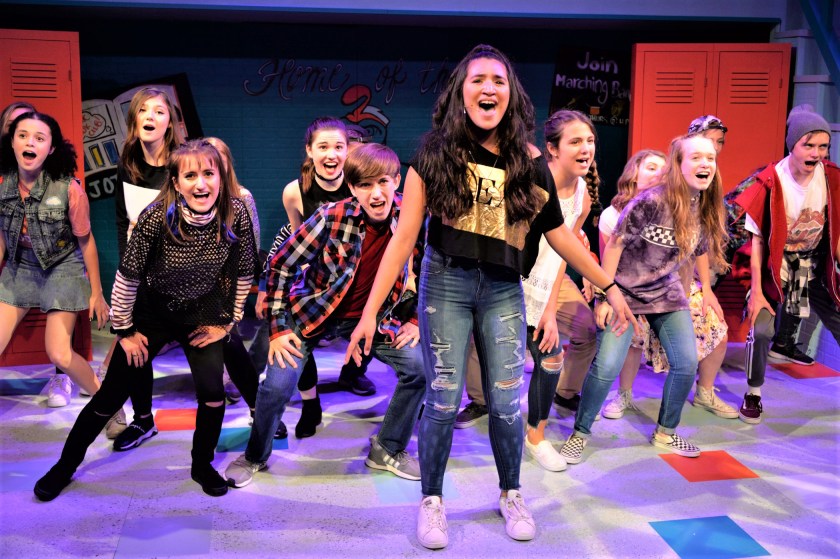
The musical 13 with its high-energy cast of teenagers starts off at a level 10 and pretty much stays there for the duration. The first – and so far only – Broadway musical to have a cast made up entirely of teenagers, the Richmond casts of 13 ranges in age from 12-17. Yes, casts. That was not a typo. Cadence Theatre’s Artistic Director, Anna Senechal Johnson, worked with two casts that will alternate throughout the run. I assumed this was because of the youthful ages of the cast, but in speaking with Johnson after Friday’s opening night program – a second opening night will be held on Saturday for the second cast – it seems that the dual casts are also a way to fulfill the company’s mission and “commitment to development and training for young actors all over Virginia.” Indeed, several of the young actors – and their parents or guardians – commute to Richmond for this show from as far as Northern Virginia and Maryland.
Written by Jason Robert Brown (music and lyrics) and Dan Elish and Robert Horn (book), 13 chronicles several months in the life of Evan, played on Friday by Brandon McKinney. Evan is looking forward to his bar mitzvah, when he gets hit with not one but two major blows: first his parents divorce, then his mother informs him they are moving from New York City – the only hone he has ever known – to a Smalltown, USA, or Appleton, Indiana, to be precise.
Evan befriends Patrice (Bridget Sindelar) before finding out she is a social outcast, and in a heart-wrenching scene, he un-invites her to his party so that the popular kids will attend. Patrice is played by Bridget Sindelar, whom my daughter Soleil immediately recognized as Pinocchio from the VirginiaRep children’s show last season. [https://jdldancesrva.com/2019/03/31/pinocchio-bright-and-shining-son ]. Sindelar nails the character of Patrice, but more importantly, her singing is strong and here range impressive.
Evan’s action catches the attention of Patrice’s best friend, Archie (Ethan Phelps) – a classmate with an unnamed debilitating condition (muscular dystrophy, according to a synopsis of the script) that requires that he use crutches to walk. This makes him an object of ridicule to the popular kids, but that doesn’t stop him from plotting and planning to manifest his deepest fantasy. Archie has a crush on Kendra (Audrey Kate Taylor) and quickly enlists Evan to help jock-boy Brett (Donathan Arnold) secure a date with the ever-popular Kendra, with the ulterior motive of inserting himself in the role of leading man. The boys hatch a plan that at first seems successful – but if that were the case, the play would have ended here instead of continuing to its conclusion.
The lively music under the direction of Anthony Smith is played by a live band, most of whom are onstage in front of us but some of them are placed behind the audience. There is energetic choreography – 13 even included a tap dance – by Jasmine Mckenzie that is created and performed with a sense of ordered chaos that perfectly captures the teen-aged characters. A simple cinderblock set by Emily Hake Massie hides a few surprises that are revealed when doors swing out to create new spaces. Sarah Grady’s costumes are contemporary, with most of the cast – especially the ensemble – dressed in neutral shades like gray, but Evan sports a red plaid shirt, and other leading characters break out of the gray mold with bits of color.
Patrice/Sindelar is full of wisdom, but also has some of the funniest lines in the show. When introducing Evan/McKinney to the town of Appleton, she points out the highlights, like the Walmart and Dairy Queen, but also drops lines like, “The inbreeding takes up a lot of our time.”
Brett/Arnold is the cool, handsome quarterback, and is stereotypically vain and not the sharpest knife in the drawer. His buddies Eddie (Owen Buckenmaier) and Malcolm (Jake Barger) are loyal, hilarious sidekicks. When trying to help Brett prepare to ask Kendra (Audrey Kate Taylor), the prettiest girl in Dan Quail Middle School, they metamorphose into R&B backup singers. Although why the star quarterback and most popular boy on campus needs help getting a date is beyond me. Taylor plays her role with wide-eyed innocence and it’s irritating when she doesn’t seem to catch on to her friend’s betrayal.
Teen-agers can be some of the meanest people on earth, so it is no surprise that there is a Mean Girl in 13. Lucy (Jolie Smith) is supposed to be Kendra’s best friend, but she wants Brett for herself, and does everything she can to get Kendra out of the way: bullying; tripping her during cheerleader practice; giving conflicting advice about how to behave around a boy; and starting a vicious rumor. I suppose why 13 year old students are dating is irrelevant, but one scene hinges around Evan asking his mother to buy movie tickets to an R-rated movie for Evan and his popular friends. The sneer Smith wears whenever Kendra is around is so convincing I began to actively dislike Lucy.
Mia Meadows and Hannah Riggs share the lead in the closing song in a breakout surprise, after performing in the ensemble and the cheerleading squad for most of the play. Brenna Duffy stood in for Zoë Brown on Friday, taking over Zoë’s duties as Rabbi. Because of the huge size of the cast – when doubled – I will let the words of the press release fill in the missing notes:
Returning to the Cadence stage in the Appleton Cast are Violet Craghead-Way (Fun Home), Caroline Johnson (Appropriate), Grace Connell (Appropriate), and Sophia Bunnell (Violet). Returning in the Indiana Cast are Brandon McKinney (Fun Home; Caroline, or Change), Donathan Arnold (Caroline, or Change), and Alex Csaky (Fun Home). Making their Cadence debuts in the Appleton Cast are Evan Dymon, Josh Chapman, Cohen Steele, Anjali Sharma, Ethan Dunne Stewart, Marcus Dowd, Emma McClain, Autumn Papczynski, Molly Nugent, Sam Hurst, Raif Winn, Brenna Duffy, Gracie Farrell, and Lauren Brabrand. Debuting in the Indiana Cast are Bridget Sindelar, Ethan Phelps, Audrey Kate Taylor, Jolie Smith, Owen Buckenmaier, Jake Barger, Molly Rose Meredith, Mia Meadows, Bekah Blackburn, Sawyer Williams, Jack Hensley, Mia Krivanec, Zoë Brown, Madelyn Diradour, and Sarah Kathryn Makl. Performing with both casts will be Hannah Riggs and Christopher Stone. Mason Timberline will be joining the cast as the pianist/Master Conductor.
So, it appears I was led along this theatrical musical journey by the very capable Appleton cast. On Saturday I will go back to see how the Indiana cast conducts themselves along this same path, and I’ll report back to you.
13 is a lively, upbeat show tackles real-life teen-aged problems: popularity; peer pressure; bullying, and more. And every single one of the teens onstage has a cellphone in their pocket; they frequently take them out for a selfie or to record some controversy or other. There is even a one-page Study Guide included in the program that asks some interesting questions, such as “How has technology changed social expectations for adolescents?” and “What does the musical, 13, teach us about friendship and prioritizing personal relationships.
Julinda D. Lewis is a dancer, teacher, and writer who was born in Brooklyn, NY and now lives in Eastern Henrico County.