WHO’S HOLIDAY: A Christmas Parody for Adults Only

Who’s Holiday!: The Story Dr. Seuss Didn’t Want You to See

A Theater Review by Julinda D. Lewis

Richmond Triangle Players

At: The Robert B Moss Theatre, 1300 Altamont Avenue, RVA 23230

Performances: November 14 – December 15, 2018

Ticket Prices: $10-35

Info: (804) 346-8113 or rtriangle.org


Who’s Holiday! is an irreverent, adult Christmas story. This one-woman show told by a grown-up Cindy Lou Who takes the audience on a rip-roaring sleigh ride that provides eye-opening details about Cindy Lou Who and her pal the Grinch.

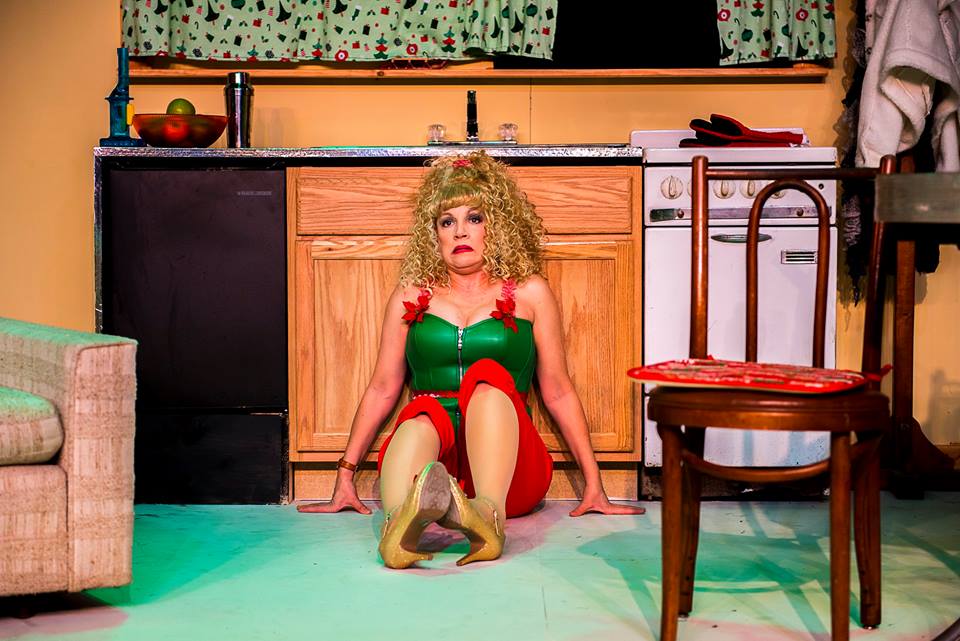
Cindy Lou has outgrown her cute pink pajamas in favor of a bright red shirtwaist dress with multicolored trim which is turn gives way to a green corset with a sparkly red skirt. Both are worn with glittery gold stilettos and a curly blond wig. Thank Ruth Hedberg for the festively tacky costume design.

Cindy Lou has only recently returned home after a rather long stint away. She now lives in a trailer left to her by her late uncle, and it’s parked on Mount Crumpit, apparently not far from the Grinch’s old lair. The sparsely furnished interior feature lots of green accents – and there’s a reason for the Wicked poster on the wall – but T. Ross Aitken’s design seemed surprisingly spacious for a trailer.

And where, exactly is the old green Grinch, and how has he fared over these past years? Well, to tell you that would give away most of the plot. It’s not for nothing that this play is subtitled “The Story Dr. Seuss Didn’t Want You to See!” Apparently, in 2016, Dr. Seuss Enterprises took playwright Matthew Lombardo to court for copyright violation, but Lombardo successfully countersued claiming parody is protected under “fair use” laws and the play opened off-Broadway in 2017.

Kids would not recognize this Cindy Lou Who, played by the talented and versatile Kimberly Jones Clark, most recently seen as Margery in Hand to God co-produced by TheatreLAB and 5th Wall Theatre. I’m not trying to say Clark is making a habit of playing dysfunctional middle-aged women, but lately she has done it extremely well. Middle-aged Cindy Lou starts off greeting the audience, including a shout-out to “the queer in the rear.” She tests the waters of offensiveness with gays and lesbians, as well as Jews, and at one point asks if the word “ghetto” is offensive, but quickly dismisses that suggestion with a flippant, “it gets worse.”

Cindy Lou scrounges a Tramadol from the floor and washes it down with liquor. She takes a hit from a bong and describes some parts of the Grinch that most of us never thought of – and hope never to see – in great detail. Who’s Christmas! is hilarious and also quite dark (and I’m not sure if this is the intent of author Matthew Lombardo, director Dexter Ramey, star Kimberly Jones Clark, or a combination of the three): it deals with drugs, alcohol, domestic violence, bestiality, animal cruelty, murder, and prison culture. Along the way, Jones grabs a handheld microphone and throws in a totally unexpected rap, a deadpan execution of “Merry Little Christmas,” which invited audience participation, and – my personal favorite – a rather skillful rendition of “Blue Christmas.”

There are laughs aplenty; the audience seemed well-pleased, and Clark did an excellent job holding down this zany one-woman show. It just wasn’t my cup of tea – I laughed, I enjoyed it, but it isn’t my favorite adult Christmas show. Maybe I was hoping it would be more like Christmas on the Rocks whose grown up Ralphie, Cindy Lou Who, Charlie Brown, and other characters simultaneously tore and warmed my heartstrings.

Who’s Holiday! runs just about an hour, with no intermission, and is followed by a holiday cabaret with Joshua Worsham on piano and Georgia Roger Farmer and/or Shannon Gibson Brown. I didn’t stay for the cabaret, but it seems like a great deal – an unexpected after party!

Julinda D. Lewis is a dancer, teacher, and writer who was born in Brooklyn, NY and now lives in Eastern Henrico County.

———-

Photo Credits: Photos from RTP Facebook page
This slideshow requires JavaScript.

LIVIN’ FAT: Living Large

LIVIN’ FAT: The Return of Good Times

A Theater Review by Julinda D. Lewis

At: Pine Camp Community Center, 4901 Old Brook Road, RVA 23227

Performances: November 8-17, 2018 with performances at 8:00 pm November 8, 9, 10, 15, 16 & 17; 10:00 am November 14 and 4:00 pm November 17.

Ticket Prices: $10 for Groups of 10 or more; $12 for Students and Seniors; $15 General Admission

Info: thetheatreubuntu@gmail.com or https://livinfat.brownpapertickets.com/

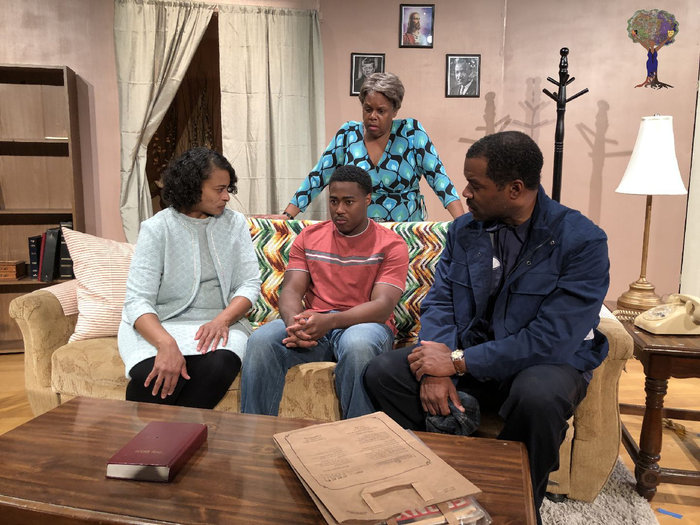
If Livin’ Fat, the current production by the Heritage Ensemble Theatre at the Pine Camp Cultural Arts and Community Center has the look and feel of a 1970s era sitcom, there is a good reason. It was written by Judi Ann Mason, whose work includes Good Times, Sanford and Son, and A Different World, as well as the film Sister Act 2: Back in the Habit. Director dl Hopkins remained true to the sitcom genre, using snappy pacing and staging that made the audience feel as if we were, at times, peering into the Carter family’s living room through an invisible screen. Characters even approached the edge of the stage to look out the window, and often crossed one another precariously close to the edge of the stage.

What’s even more remarkable about Livin’ Fat is that Mason (1955-2009) wrote it when she was a 19-year-old drama student at Grambling State University and it earned her the Norman Lear Award for comedy writing. Given that distinguished history – and the strong cast – I’m upset that I did not, could not love this production.

Livin’ Fat takes place in the “front room” of the Carter family home in the Black Quarter of an unnamed southern town. Yes, that’s what my grandmother called our living room, too. The room is spotless but shabby, and on the wall behind the sofa is the obligatory triptych: Jesus, Martin Luther King, Jr., and John F. Kennedy. Big Mama (Sharalyn Garrard) is a disillusioned widow, given to snappy comebacks. She also has a surprising affinity for the young people in her life and often sides with her grandchildren much to the chagrin of her daughter. Mama (Andrea Shantell Dunnaville) has a direct line to God and can quote scripture for any situation. She is equally yoked to husband Calvin (Arthur Muhammad), who works two jobs to support his family and is a stalwart deacon at their church. The parents’ faith and the family’s future are tested when their son, David, comes into an unexpected windfall.

David (Akiel Baldwin) is a college graduate who, upon returning home, could find no other work than as a janitor at a bank. A fate would have it, one day while working at the bank, the bank gets robbed and no one noticed that a bundle of money was dropped on the floor where it found its way into David’s dust rag. Later references to the “dust” in his pocket, therefore, have two meanings – the “dust” from his cleaning rag and an old slang term for being so poor there is “nothing but dust” in your pockets.

Garrard is consistently funny, tossing off sarcasm like breathing, waving her wig in the air, referring to her television set as if it were her lover, eating ex-lax chocolate laxatives like candy to soothe her unnamed “condition,” and being contrary just for sport. Dunnaville takes broad comedy to extremes, often to the point of making her character a caricature. On the positive side, her projection and diction are excellent, and we never have any trouble understanding her, even when her daughter Candy (Imani Banks) is blasting music from her bedroom. Muhammad’s portrayal of the father is the most moderate, contained, and realistic of any of the play’s six characters. He is, therefore, a positive role-model and a model black father. Candy is the least developed of the characters in the family, yet Banks takes advantage of every moment on stage. She is the cute but annoying little sister, given to exaggeration, and does not know the meaning of giving up. When sent to her room, she silently reappears in the background, listening to what the grown-ups don’t want her to hear.

As David, Baldwin must walk a delicate line. College educated – and probably the first in his family to attend college – he is expected to do better than his parents’ generation yet must show respect while living in their home. He does not complain about his menial job, but he talks of his dreams with his best friend. For the most part, Baldwin achieves this balance with aplomb, with the assistance of his side-kick Boo (Marsalis McKeever). Boo, who has not gone to college and seems to have no plan at all for his life, is David’s ride-or-die friend who stands out for two characteristics: when he comes into some money, he spends it all on loud clothes; and he speaks out of the side of his mouth, as if he has marbles in his mouth, making it difficult to clearly hear anything he says.

As appealing as these characters are, and as much as they made me laugh, I found the overall production uneven and underwhelming. The juxtaposition of Dunnaville’s broad sitcom comedy with Muhammad’s more conservative portrayal, Dunnaville’s over-enunciation in contrast to McKeever’s muffled utterances, the frequent (and utterly accurate) use of the word “nigger,” (I hate the euphemism, “n-word”), and author Mason and director Hopkins’ adherence to the sitcom genre just didn’t connect for me. After the show, my constant companion and theater date suggested that (a) I wasn’t really black and (b) Livin’ Large would really, really appeal to older black churchgoers (except, perhaps for that word I mentioned above) and potential black theatergoers who don’t go to the theater because they don’t see enough representations of themselves and their lives onstage.

There is, after all a moral dilemma – a foundational element of good storytelling: should David be allowed to keep the “found” money or should he return it? Has he, in fact, committed a crime? Calvin, the head of the household, takes the question to God, and after a period of prayer, the family abides by his decision. To find out what he decided, and how the play ends, I suggest you go see Livin’ Fat for yourself. (Dates and times are listed above.)

Livin’ Fat: written by Judi Ann Mason; directed by dl Hopkins; with lighting by Geno Brantley; sound by dl Hopkins (a nice 70s playlist); costumes (character and period appropriate) by LaWanda Raines; set by Margarette Joyner; carpentry by Vinnie Gonzalez; photography by Pamela Archer-Shaw; and videography by Dewey Collins.

Julinda D. Lewis is a dancer, teacher, and writer who was born in Brooklyn, NY and now lives in Eastern Henrico County.

———-

Link to WRIC interview with director dl Hopkins and Sharalyn Garrard (Big Mama): https://www.wric.com/community/-livin-fat-hits-the-stage-in-rva/1576260858

Photo Credits: Photos courtesy of Heritage Ensemble Theatre Company

This slideshow requires JavaScript.


This slideshow requires JavaScript.


MR. POPPER’S PENGUINS: A Holiday Heartwarmer

MR. POPPER’S PENGUINS: When Dreams Come True

A Theater Review by Julinda D. Lewis

At: Virginia Rep’s Children’s Theatre at Willow Lawn; 1601 Willow Lawn Drive, Richmond, Virginia 23230

Performances: October 27 – December 30, 2018

Ticket Prices: Start at $21

Info: (804) 282-2620 or virginiarep.org

Mr. Popper’s Penguins is a musical adaptation of a children’s book by Richard and Florence Atwater, and the book for the musical is by Robert Kauzlaric with music and lyrics by George Howe. It is a book unfamiliar to me, my daughter, and my two grandsons, but after spending Sunday afternoon at the Virginia Rep’s Children’s Theatre at Willow Lawn it will likely find it way onto our bookshelves this coming holiday season. It has comedy, adventure, and penguins.

Richard Popper is a house painter and decorator of modest means; he and his wife Florence live on a strict budget that does not allow for the travel and adventures Mr. Popper dreams of. He is especially fond of Antarctic exploration and penguins. Of course, there’s more to the story. Imagine their surprise when the Poppers hear on the radio that Mr. Popper’s favorite explorer, Admiral Drake, has received Mr. Popper’s fan letter and is responding with a surprise. Soon a large crate is delivered to the Popper’s Stillwater, Minnesota home and inside is a genuine Gentoo penguin from Antartica that quickly becomes a part of the Popper’s little family. (In the book, it seems the Poppers were British and have two children, but in the musical the live in the USA and their only children are the feathered kind.)

The Popper’s household soon expands, as their male penguin, Captain Cook, eventually grows lonely, and an aquarium that Mr. Popper contacts for help has a lonely female penguin, Greta, that they generously ship to the Popper’s residence. The next thing you know, there are ten penguin chicks and the poor Poppers have to figure out how to keep all these penguin bellies full of fresh fish and frozen shrimp. Their solution – Popper’s Performing Penguins – leads to more hilarity and the gradual realization that touring on the vaudeville circuit is no way for a family of birds to live.

Yes, I said vaudeville. Mr. Popper’s Penguins was written in 1938 and vaudeville as well as references to the WPA (the federal government’s New Deal Administration program called the Works Progress Administration from 1935-1939, when it was renamed the Work Projects Administration), along with Mrs. Popper’s job search and the family’s focus on finances will likely go over the heads of the young audience members as well as most of their parents. Let’s face it, I’m a grandmother, and this was before my time, too. I only know about these things because I teach dance history! My daughter did ask what WPA was, but neither grandson seemed to notice or care.

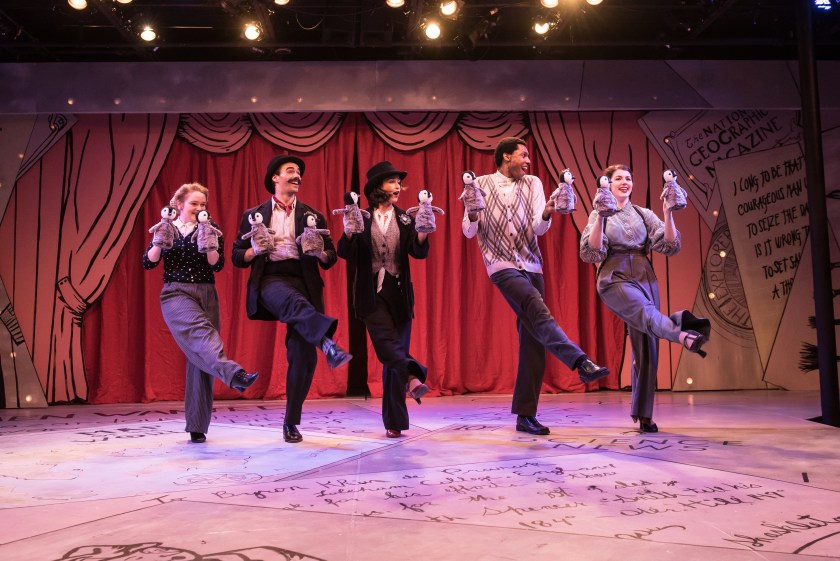
All the shenanigans are skillfully handled by director Josh Chenard, with musical direction by Jason Marks and choreography by Wes Seals. A cast of five talented actors play all the roles – some thirteen different characters, with Derrick Jacques as Mr. Popper and Renee McGowan as Mrs. Popper. Keaton Hillman Emma-Claire Polich, (both ensemble) and Eve Marie Tuck (swing) play all the other characters. Both Kingston (age 10) and his mom Soleil were impressed by Keaton Hillman who changed characters, costumes and accents with the dexterity of a magician, and manipulated the Captain Cook penguin puppet as well.

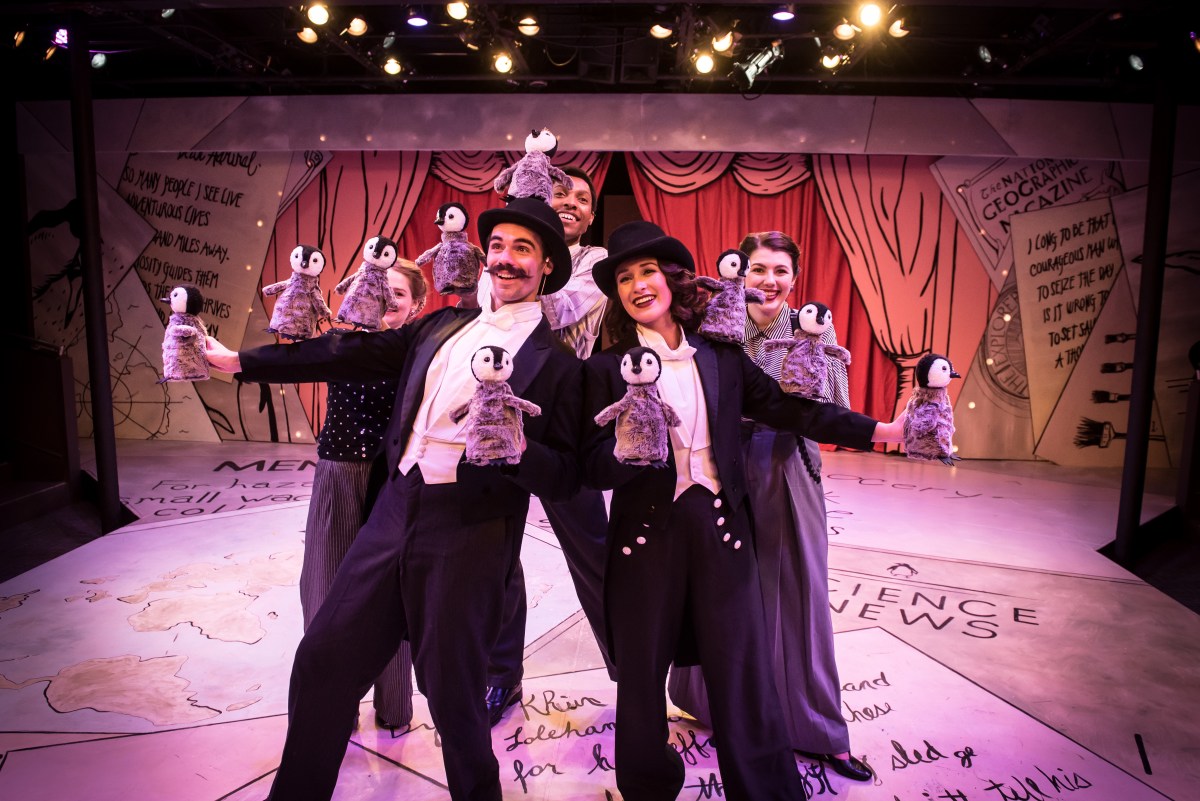
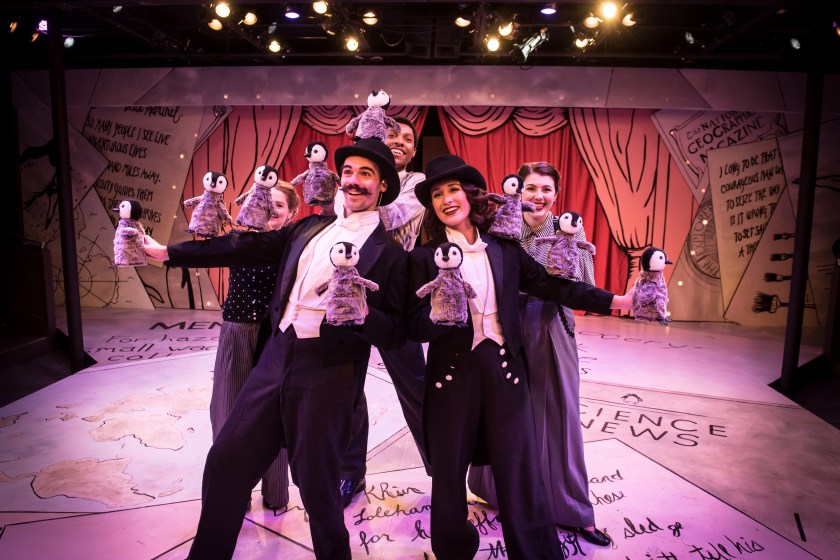
Yes, the two adult penguins were large puppets (credit Kylie Clark with the puppet design – something Virginia Rep Children’s Theatre does so well) while the 10 penguin chicks were smaller, stuffed versions. Emmitt (age 4) was enthralled by the penguins. He spent most of the hour (no intermission) perched on the edge of his seat, his eyes wide open so as not to miss anything. He did tear his eyes away from the stage to lean in and ask his mom, “Can I have a pet penguin?” He made a second earnest plea out in the parking lot, adding that the penguin could live in the refrigerator.

With about six musical numbers, Mr. Popper’s Penguins moved at a fairly rapid pace – but never felt rushed. Jaques and McGowan carried most of the story, and their voices are strong and clear, making it easy for attendees of all ages to understand the lyrics. Jeanne Nugent’s costumes are lovely – especially the women’s wide-legged pants that remind me of Ms. Celie’s pants from The Color Purple. Mrs. Popper’s apron, Mr. Popper’s bow tie, and painter’s coveralls, and the props used by the various characters (a wooden dog, a hat with the gray hair attached, Mr. Popper’s painter’s ladder and pipe) are all overly exaggerated, almost cartoonish.

Taking this theme about as far as it could go, Chris Raintree’s set includes larger than life library books that open up to reveal entire rooms. “Atkinson’s Kitchen Companion” houses the Popper’s kitchen while their living room is housed within a tome entitled “432 Proudfoot Avenue” and the admiral’s ship is docked inside a book on Antarctic exploration. The production is visually stimulating but not over stimulating.

There’s also lots of word play. Captain Cook and Greta’s brood are given the names of famous explorers, such as Ferdinand, Columbus, and Magellan. There’s also Isabella and Victoria, who wears a tiara. Finally, but not least, there is all the alliteration! Mr. Popper’s Penguins alliterates just about every “p” word you can think of, and when they run out of “p” words they alliterate other letters of the alphabet.

Recommended for ages 4 and up, Mr. Popper’s Penguins is a family-friendly production that is perfect for the younger members of the audience and is being offered as an alternative or addition to holiday staples, such as The Nutcracker. Unlike many productions of past seasons, there is none of the double entendre and innuendo that seemed to be intended for the adults. Here, the focus is all on the pleasure of the kids, and Kingston and Emmitt would give this production a combined two thumbs up.


Julinda D. Lewis is a dancer, teacher, and writer who was born in Brooklyn, NY and now lives in Eastern Henrico County.

———-

Photo Credits: Aaron Sutten

Mr Popper's Penguins
Renée McGowan and Derrick Jaques. Photo by Aaron Sutten.
Mr Popper's Penguins
Renée McGowan and Derrick Jaques. Photo by Aaron Sutten.
Mr Popper's Penguins
Eve Marie Tuck, Derrick Jaques, Renée McGowan, Keaton Hillman, Emma-Claire Polich. Photo by Aaron Sutten.

GUTENBERG! The Musical! (with two exclamation points!!)

GUTENBERG! The Musical! (Really)

A Theater Review by Julinda D. Lewis

By: Quill Theatre

At: Libby S. Gottwald Playhouse, Dominion Energy Center, 600 E. Grace Street, RVA 23219

Performances: October 12 – November 3, 2018, Thursdays-Saturdays @8:00pm & Sundays @2:00pm.

Ticket Prices: $32 Adults; $27 Seniors; $22 Students & RVATA Members (with ID)

Info: (804) 353-4241 or quilltheatre.org


Gutenberg! The Musical! is a play-within-a-play written by Anthony King and Scott Brown who present their comedic farce as a backer’s audition of an historical fiction about the German printer Johannes Gutenberg. Got that? Stay with me, because it doesn’t get any simpler.

Chris Hester and Paul S. Major play the authors Doug Simon and Bud Davenport, who are pitching their musical in hopes of finding someone to back them in a Broadway run. The show is hyped as big, splashy, and better than all others of its genre. But they have no actors, just a few props and a collection of baseball hats with the names of all the characters (e.g., Drunk #1, Drunk #2, Mother, Daughter, Gutenberg, Monk, Helvetica, Old Black Narrator). Doug and Bud switch hats as they rotate through the characters, sometimes stacking them for efficiency, or wearing one on their head and one on each hand to simulate crowd scenes. They string hats on a line, held up with the assistance of two audience members, and are even able to create a chorus line. Musical numbers from honkytonk to rock ‘n roll and romantic ballads are interspersed with puns, explanations of musical theater terminology, such as the definition of a metaphor, an example of a charm song, and a running gag recurring line involving dirty thatched roofing.

Early in the play the authors admit that their “research” consisted of a brief Google search, the result of which was that there is very little known about the life and times of Johann Gutenberg. So. . .they decided to just make up stuff, hence the historical fiction. Among the things they made up is the name of Gutenberg’s fictitious love interest, Helvetica and, apparently, the name of the town, Schlimer – a word that is suspiciously similar to schleimer, which loosely means “ass-kisser.” There is also a totally unrelated connection to the Holocaust, and several unkind and politically incorrect references to stupidity. Monk, the evil monk, calls Helvetica a “dumb German anti-Semite,” and Helvetica later sings that “history is paved with the hearts of the stupid.” Oh, and Gutenberg starts out as a winemaker, who handily turns his wine press into a printing press, quite forgetting to tell his lovely, love-truck assistant that she can stop tromping on her bucket of grapes.

Hester and Major, of necessity, remain on stage the entire time, and they are accompanied by Charlene (musical director Leilani Fenick). Both are enthusiastic, energetic, and affable, as Jan Guarino’s direction and choreography keep everything moving along at a fast clip. The eighteen or so people in the Sunday matinee audience seemed to have a great time. There was lots of laughter and applause, and a woman I chatted with during intermission made a point of telling me, completely unsolicited, that she was very happy that she could clearly hear and understand all the lyrics – something that is often a problem in musicals.

There’s just one major problem. Rather than humorous, or zany, I just found the whole thing silly. It tries too hard and, at least for me, there was no “aha” moment that made it all worthwhile. I don’t care that it isn’t big and splashy, that there are just two actors, no sets, and no laser lights, but, I’m sorry, Doug and Bud, Gutenberg! The Musical! isn’t better than Cats!!


Julinda D. Lewis is a dancer, teacher, and writer who was born in Brooklyn, NY and now lives in Eastern Henrico County.

———-

Photo Credits: Photos from Quill Theatre’s Facebook page

Gutenberg.1

Gutenberg.2
Paul S. Major and Chris Hester
Gutenberg.3
Chris Hester and Paul S. Davenport

DRACULA: Sink Your Teeth into This

COUNT DRACULA: A Comic Vampire Tale

A Theater Review by Julinda D. Lewis

At: Swift Creek Mill Theatre, 17401 Jefferson Davis Highway, Colonial Heights, VA 23834

Performances: September 14 – October 20, 2018

Ticket Prices: $40 Theater only; $57 Dinner & Theater

Info: (804) 748-5203 or swiftcreekmill.com


There is no shortage of flying bats, howling wolves, secret passages, or sudden and mysterious appearances and disappearances by Count Dracula himself.  There actually are smoke and mirrors involved in this production, along with a few other tricks of the trade. These are things Tom Width, producing artistic director of Swift Creek Mill Theatre does very well indeed. But in yet another sleight of hand, Width did not direct Count Dracula, the opening show of the 2018-2019 season. Instead, that honor went to guest director Mark Costello, a Mill alum who was a teenaged intern on the Mill’s very first opening night in 1965.

Costello keeps things moving during this two-act play, based on Bram Stoker’s novel, Dracula. The show runs for two hours and 45 minutes, and the well-chosen cast of nine has some standouts. Kerrigan Sullivan, in the role of Sybil Seward, sister of Dr. Seward, exemplified the comedy horror genre, both in delivery of her lines and with her physical presence, as when she slipped a bottle of sherry into the folds of her robe. For some reason, most of Sullivan’s dresses were sadly ill-fitting, in contrast to the more elegant garments that adorned Caity Brown, who portrayed Mina Murray (the object of the Count’s affections), or the formal suits favored by the male cast members. Credit Maura Lynch Cravey with the costuming.

Levi Meerovich was a solid and lumbering presence as Dr. Seward’s multi-talented servant, nursing assistant, and patient-wrangler, Hennessey, and Joey Gravins was close behind him as his second in command, Wesley. I enjoyed Chandler Hubbard as Mina’s doting fiancé, Jonathan Harker, and Jon Cobb gave a strong performance as vampire expert Heinrich Van Helsing.

Mike White seemed fully committed to his role as Dr. Arthur Seward, in whose Asylum for the Insane the play was set, but one thing I found confusing was what made Seward and Harker suddenly believe in the vampire lore that Van Helsing kept expounding upon.  Caity Brown was perfectly cast as Mina Murray, pale and waif-like, yet capable of projecting a powerful, gravelly alter-ego when voicing the soon-to-be-bride of Dracula. I loved Bartley Mullin as Renfield, the fly-eating mental patient and minion of Count Dracula who brings a chillingly weird energy to each scene in which he appears. I have a great admiration for actors who can convincingly and respectfully play the role of an insane, blind, or autistic character.

Last but not least there was Jeremy Gershman in the title role. Gershman appeared to take great delight in his role, swirling his voluminous cape, lurking, looming, and leering in that seductive yet chilling manner that characterizes the best Draculas. I knew where he appeared and disappeared from, but even from my front row seat, I was never once able to detect him getting into position or exiting the space!

The attractive wood paneled set was designed by Frank Foster, with lighting by Joe Doran, special effects by Tom Width, and technical direction by Jason “Blue” Herbert. There are lots of laughs, sufficient chills and thrills, and no blood or gore – the elements of horror that I find off-putting which is why I am not a fan of the horror genre.  The strong ensemble, beautiful set, and well-timed tricks and effects are all worth a trip to The Mill, but I did find that the 2:45 running time seemed to drag on a bit, and sometimes there was just too much talking! This talented and confident cast is perfectly capable of telling the story without spelling it all out.


Julinda D. Lewis is a dancer, teacher, and writer who was born in Brooklyn, NY and now lives in Eastern Henrico County.

———-

This slideshow requires JavaScript.


SIGNIFICANT OTHER: Plus None

SIGNIFICANT OTHER: Love And. . .

A Theater Review by Julinda D. Lewis

At: TheatreLab, The Basement, 300 E. Broad St, RVA 23219

Performances: September 19 (Preview)/September 20 (Opening) – September 29, 2018

Ticket Prices: $30 general; $20 seniors/industry (RVATA); $10 students/teachers (with ID)

Info: (804) 506-3533 or theatrelabrva.org

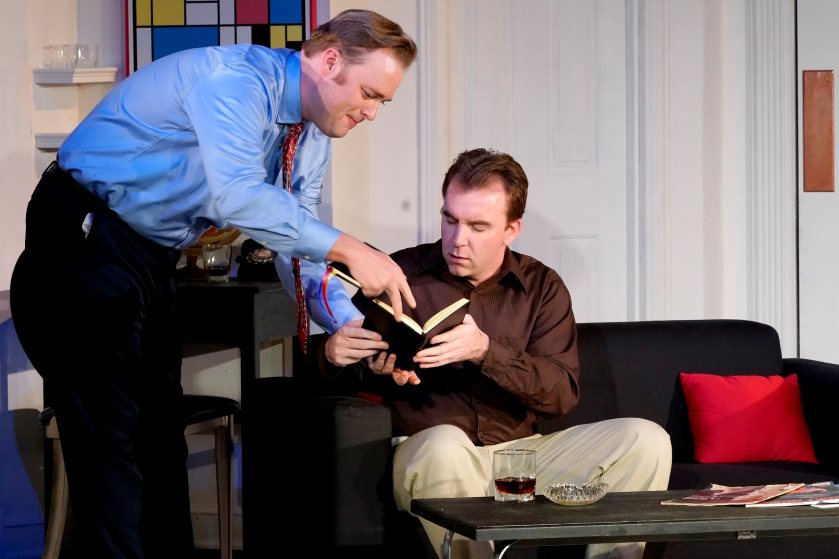
Significant Other (written by Joshua Harmon, who also wrote Bad Jews, which TheatreLAB produced in 2016) is a heartwarming comedy about a group of friends looking for love in 21st century New York – until somewhere in the second act when it takes a sudden heart-wrenching turn.

On opening night, the cast still seemed to be feeling its way, and when, during one scene, Deejay Gray held onto his shirt in hopeful anticipation that his upcoming date would turn out to be “the one,” the energy generated was electrical. This may have been a combination of opening night jitters and his characters’ palpable expectancy. It was good to see Gray, the artistic director of TheatreLAB, onstage after an absence of three years [this is a correction] while he has been managing the affairs of running a company.

It may have taken me a while to warm up to these characters, but they started delivering laughs as soon as the lights came up. Matt Shofner has directed this dynamic ensemble with a fast pace that still manages to provide depth and perspective to this group of long-time friends whose lives are being changed as they move into “adulting.”  The wide center aisle – seldom used in this flexible space – is used to physically and emotionally extend the space. At times there is unseen action off in the distance, cued by disco lights and music. Other times the space is used as an actual aisle for actors to move on and off the stage, and then there are the times when characters stare off into the space, pulling us deep into the mind of the author right along with them.

Jordan Berman (Deejay Gray) is in search of Mr. Right, even as his closest friends find true love, become engaged, and marry. The opening scene, in fact, is one of numerous bachelorette parties and weddings that populate this two-hour, two-act play. Gray is onstage for just about every scene, and his energy slowly, inexorably draws us into Jordan’s world and concerns. Jordan is the only character given a last name – perhaps to emphasize his Jewishness? The wonderful Jacqueline Jones has a supporting role as Jordan’s grandmother, Helene. She makes her entrances and exits along that wide aisle, using a pink walker whose seat holds a photo album that she and Jordan review reverently and lovingly each time they meet. There is something about the ritual of their interactions that brings groundedness to Jordan and to the play. But it is Jordan’s interactions with his tight-knit group of girlfriends that is the foundation of Significant Other.

Kiki, the party girl, is the first to find love and happiness. Mallory Keene navigates the play in formfitting dresses and stilettos – even when, in the final scene, Kiki is eight months pregnant! Vanessa is the more down to earth friend – and the black friend. The second to get “boo’d up,” she meets her mate at Kiki’s wedding. Jessi Johnson’s character is beautiful and cosmopolitan; she wears wedge heels and dresses professionally. Laura is a teacher, and because she and Jordan were once roommates, her relationship with Jordan is both the closest and the most volatile. When Laura finds love at work, it catapults their relationship into new and unforeseen directions. Laura wears flats and an eclectic Bohemian wardrobe. This role seems to have been written for Kelsey Cordrey. Some of the most poignant moments between these two are silent, as when Cordrey and Gray stand side by side, dancing or swaying, or when he tiptoes to rest his head on her shoulder. Their big scene, a second act argument, is – in contrast – explosive. As Jordan’s friends pair up and move on, he finds himself without a dance partner or a “plus one” for Laura’s wedding.

Matt Polson and Dan Cimo round out this wonderful ensemble, playing all the male characters in the lives of these four friends, from coworkers to lovers. Polson adapts different facial expressions and postures for each of his characters, from Kiki’s country-boy husband to Laura’s mild-mannered Tony. It was fascinating to watch Cimo transform seamlessly from the gloriously gay coworker to Vanessa’s passionate date. Seven actors play eleven characters, and somewhere in this group there is someone you know. It might even be you.

Adam Dorland’s simple set is monochromatic black: three benches, a coffee table, a shelf, some doorways and windows work with Michael Jarett’s sometimes subtle, sometimes flashy lighting to create the office where Jordan works, his apartment, and the various bars, clubs, and wedding venues where the scenes take place. Ruth Hedberg designed the costumes – which vary from office casual to matching bridesmaid dresses and wedding gowns and seems to have used shoe styles to symbolize the women’s characters. Joey Luck did the sound design, which includes some original music. The program lists three songs by Luck and Hannah M. Barnes and an original song by Ali Thibodeau.

Significant Other is very different type of play, and very appropriate to open TheatreLAB’s Season 6, themed “In Pursuit of Happiness.” Significant Other runs through September 29.

Julinda D. Lewis is a dancer, teacher, and writer who was born in Brooklyn, NY and now lives in Eastern Henrico County.

———-

Photo Credits: Tom Topinka


This slideshow requires JavaScript.

LIVING IN THE KEY OF “B” UNNATURAL: Where Friendship, Faith & Fantasy Collide

LIVING IN THE KEY OF “B” UNNATURAL: At the Intersection of Friendship, Faith & Fantasy

A Theater Review by Julinda D. Lewis

At: Hickory Hill Community Center, 3000 E. Belt Boulevard, Richmond, VA 23234

Performances: September 19 @ 12:30PM; September 21, 21, 22 @ 8:00PM & September 22 @ 4:00PM

Ticket Prices: $10 for Groups of 10 or more; $12 for Students and Seniors; $15 General Admission

Info: thetheatreubuntu@gmail.com; http://theheritageensemble.wixsite.com/thetc


I’m still trying to wrap my mind around how the poetically titled Living in the Key of “B” Unnatural managed to move me as deeply as it did. Written by Jerry Maple, Jr., who was also the author of last’s year’s The Dream Seller and the Forest Dwellers, a children’s play produced by Heritage Ensemble, Living in the Key of “B” Unnatural is described as “a light-hearted serio-comedy.” I would describe it more as an intersection or perhaps a collision of friendship, faith, and fantasy.


Running one hour and twenty minutes with no intermission (but with an inexplicably long pause that obviously did not involve a change of costume or scenery), the play takes place in the single room residence of Dr. Enola VanderHorn-Bernard (Crystal Wiley-Perry). The plot revolves around Enola, a Harvard educated M.D. who one day walked away from her medical practice, her husband, and two daughters. The words depression or mental illness are never mentioned, although Enola’s friends are not exempt from calling her “crazy,” but this is clearly a case of at least clinical depression, and possibly something more. And that is why it requires a tremendous suspension of belief to accept that Enola suddenly snaps out of it.


Enola is a brilliant woman with a heart for people, a dislike of privilege, and an unfulfilled desire to be a missionary. Describing her past life with her husband, also a prominent physician, she says that he was “lost in prominence.” Enola’s best friends are now Shummay St. Catherine, a Guyanese short-order cook at a downtown diner (played by Haliya Robert with a flawless accent that impressed even a Guyanese audience member), and her landlord Manfred Monroe (played by Isaiah Entzminger). Enola has “rented” a room in Manfred’s Harlem brownstone for twenty years, but Manfred, who describes himself as stingy, has allowed her to go months, if not years, without paying the rent, which becomes something of an ongoing joke. More concerning, Enola has not seen her family for twenty years, and has not looked in a mirror for nineteen of those years.


A fourth character, Dr. Latooza Wellington (Whitney Tymas), was Enola’s Harvard classmate, and suddenly reappears in her life after more than twenty years. Latooza plays a key role in Enola’s final scene breakthrough, and there is a distinct difference in the interactions between Enola and Latooza and those between Enola and all the other characters, but to tell more would spoil the surprise. Toney Q. Cobb has directed with a keen eye for detail, humor, and the storyteller’s pace that is a trademark of this company and its artistic director, Margarette Joyner.  That storyteller’s pace sometimes drags a bit, especially as there is no intermission. I’m not sure if it that was an artistic or directorial choice or a requirement of the author. If given an opportunity, I would ask Maple about that as well as about the characters’ names – unusual even for a group of African Americans.


The multi-talented Joyner designed the set (a cluttered, tiny room at the top floor of a brownstone), Pamela Archer-Shaw designed the sound (which included appropriate popular mood music, including “Beautiful,” which I believe is a popular Christina Aguilera song at a key moment in Enola’s evolution), and LaWanda Raines did the costumes (a task made somewhat easier by the lead character’s refusal to change clothes until the final scene).


There is much about this production that some might dismiss as unbelievable, unpolished, or just generally flawed. Why, for instance, is such a big deal made of Enola changing from shoes to house slippers each time she enters her room? Could Enola’s frequent long monologues with herself have been handled differently? But then, there is something magical that happens in that intersection between friendship, faith, and fantasy that I mentioned above, something that inexplicably tugs at the heart and perhaps even dampens the eyes. And that is enough for me to recommend that you see this touching and unusual play and its earnest ensemble during its short run of just four days (the original opening was postponed due to last week’s impending hurricane warnings), ending with two shows on Saturday, September 22, one at 4PM and another at 8PM.


Julinda D. Lewis is a dancer, teacher, and writer who was born in Brooklyn, NY and now lives in Eastern Henrico County.

———-

Photo Credits:

Photos Courtesy of Heritage Ensemble Theatre Company

Key of B Unnatural

Key of B
Crystal Wiley-Perry, Isaiah Entzminger, and Haliya Roberts

BOEING BOEING: CAT’s 55th Season Opens with a French Farce

BOEING BOEING: Who’s Behind Door Number 2?

A Theater Review by Julinda D. Lewis

At: CAT Theatre, 419 No. Wilkinson Rd., RVA 23227

Performances: September 7-22, 2018

Ticket Prices: $23 Adults; $18 RVATA Members; $13 Students

Info: (804) 804-262-9760 or cat@cattheatre.com


  • Desperate times call for laughter. This was my second night in a row attending a comedy (see my discussion of Invalid at The Firehouse Theatre, September 6, 2018).
  • In addition, after 54 years of producing theater in Richmond, CAT Theatre announced barely a month ago that they would be going dark after this show. They had not been being able to secure a lease for the space they’ve been renting long-term. Just hours before the opening night curtain of what would have been their final show, it was announced that the matter has been resolved. The company will be staying at the No. Wilkinson Road space they rent from the Northern Henrico Civic Association for the remainder of this season and possibly into the future. In a press release from the Virginia Repertory Theatre, CAT Board President Kelly St. Clair stated, in part, “We have every expectation that this will be a long term fix to our short term challenges,” and added, “Plans call for CAT’s productions to continue in place for many years to come.”

———————————-

Boeing Boeing is a 1960 French farce, written by Marc Camoletti and translated into English by Beverley Cross and Francis Evans. I first (and last) saw it at Hanover Tavern in 2011. A fast-paced romp that depends on physical comedy, slamming doors, and perfect timing, the three-act play drew barrels of laughter from the opening night audience, but dragged noticeably during the third act, which comes after the intermission.


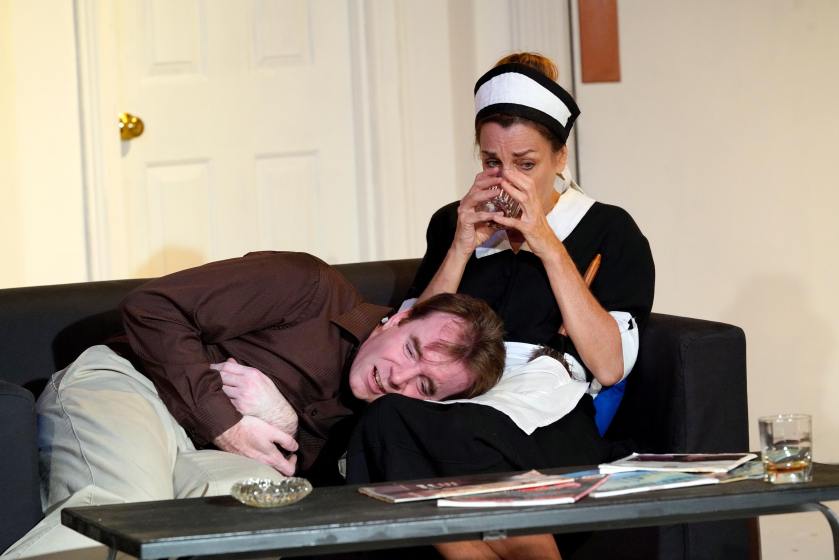
The plot revolves around Bernard (Brent Deekins), a Paris-based American architect who spends most of his time juggling his three fiancées. Yes, three. Each is an airline hostess with a different airline. Gloria (Rylee Daniels) is American, Gabriella (Marcia Cunning) is Italian, and Gretchen (Paige Reisenfeld) is German. Each is distinguished by the color of her airline uniform, red, blue, or yellow. Bernard has a French maid, Berthe (Sara Sommers) who spends more time bemoaning her fate as a servant and her role in helping Bernard keep his airline schedules straight than actually cooking and cleaning. Berthe changes the sofa cushions to match the uniform of each fiancée. The cast is rounded out by Bernard’s old school friend Robert (Travis Williams) who drops by for an unexpected visit just hours before the airlines change their schedules resulting in the obligatory comedy of errors.


Pat Walker’s bright and serviceable set included seven doors, most of which were thrust open and slammed with regularity during the two and one half hours or so running time, but there were few clues to indicate that this was set in Paris, or near Orly airport, or in the 1960s. It did seem odd that the front door opened into the hallway, as outer doors traditionally open into the house or apartment. Another oddity is that, at the end, Travis Williams took the stage last for the final bow, rather than Brent Deekins, suggesting that Robert was the star rather than Bernard. Hmm.


There’s a lot of shouting and loud cross talking, which makes it unlikely that anyone in one room would not have heard what was going on in the other rooms – but the nature of a farce often requires the audience to willingly relinquish any remaining remnant of reality. I thought Reisenfeld had the best handle on her character, striking a good balance between physical comedy, emotional swings, and comedic timing. Cunning’s character was, ironically a bit too trusting, but Daniels’ character was too cold and calculating, and while that artistic decision suited the final scene, it made her less likeable overall. I thoroughly enjoyed Sommer’s portrayal of the salty maid, but I found the men’s characters were painted broad and flat, making them appear to be flat and cartoonish. The result was that their loud outbursts of laughter and increasingly ineffectual attempts at subterfuge seemed more forced than farce. Glenn Abernathy, who directed, is a recent graduate of Christopher Newport University’s theater department, and this is his first time directing in the Richmond community.


There is much to enjoy about Boeing Boeing, and when I did laugh – which was frequently – I was laughing with the characters as well as at their antics, but things speed towards an inevitable conclusion that is not what one would expect. As in real life, people often don’t get what they deserve. Go, enjoy, be entertained. There really isn’t anything deep or serious hiding here.


Julinda D. Lewis is a dancer, teacher, and writer who was born in Brooklyn, NY and now lives in Eastern Henrico County.

———-

Photo Credits: Jeremy Bustin Photography

Boeing-4
Paige Reisenfeld and Travis Williams. Brent Deekins and Marcia Cunning.
Boeing-3
Sara ommer and Paige Reisenfeld
Boeing-2
Travis Williams and Sara Sommers
Boeing-1
Brent Deekins and Travis Williams

INVALID: When What Ails You Hits the Fan

INVALID: Modern Adaptation of a Classic Comedy

A Theater Review by Julinda D. Lewis

At: The Firehouse Theatre, 1609 W. Broad Street, RVA 23220

Performances: August 30 – September 29, 2018, Thu-Sat @ 7:30pm; Sun @ 4:00pm [check the website for specific dates as the days vary each week]

Ticket Prices: $15 – $35;

Info: (804) 355-2001 or info@firehousetheatre.org


If silliness and slapstick are your schtick, Josh Chenard and Jane Mattingly’s modern adaptation of Moliere’s The Imaginary Invalid (aka The Hypochondriac) is right up your alley. If not, the Firehouse production of Invalid is still worth seeing, for a number of reasons.

First, there is Chris Raintree’s set. Simple, yet elegant, the tiled floor and single wall remind you of those perspective rooms in the children’s museums – you know, the ones that make you look very tall or very short, depending on which side you stand. The set also includes a quartet of beautiful metal chairs – ornate barstools, really – for which Blair Rath is given a credit in the program as “chair fabricator.” They really don’t have anything to do with either the 19th century in which the play is set, the 17th century, in which the original version premiered, or today, but they are quite lovely, if a bit uncomfortable without the addition some plush cushions.

The pre-show curtain talk includes some discussion about the pronunciation of the title, whether it should be IN-va-led (i.e., unwell) or in-VAL-ed (i.e., null and void). It is, of course, open to interpretation. The main character, Argan (Andrew Firda), is, after all, a hypochondriac, but the modern references to universal healthcare and politics – there’s even a reference to the Artsies nominations – make the second definition just as, well, valid. And, to get the audience warmed up, everyone passes through a team of medical professionals on the way to their seats and gets treated to a taste of “laugh yoga” by Slash Coleman. Don’t forget to fill your prescription at the bar and get your bill on the way out! Yes, there is a lot going on here.

Moliere’s three-act farce has been adapted as a two-act comedy, with many modern references, but it retains most of the original characters and plot.  Argan, a wealthy hypochondriac, plots to marry his daughter Angelica (played with delightful gusto by Allison Paige Gilman) to Thomas Diaforus (Kenneth W. Putnam), the inept son of his physician, Dr. Diaforus (Christopher Dunn). But Angelica is in love with Cleante (Jamar Jones) and enlists the help of her father’s sassy maid, Toinette (Donna Marie Miller) to thwart her father’s plans as well as protect her inheritance from her scheming stepmother, Beline (played by Kirk Morton in elegant drag). And if no one else has mentioned it, I will: the hesitation over the unannounced appearance of Cleante took on a whole new dimension given that Jones is, shall we say, “not white.”

There ensues a comedy of error with much slamming of doors (even though there are only two actual doors) and people hiding in plain sight or behind silly masks that disguise nothing.

It’s all done in good fun, and rhyming couplets. The play retains a deliberately inserted unnecessary musical number, a hilariously bad operetta, countless fart jokes, a messy enema scene that requires the assistance of a stagehand and some plastic ponchos (I thought I could actually smell the. . .never mind), and the voice of Mel Brooks as God. And yes, Brooks gets a credit in the program, too. (This is a program that deserves to be read.)

Miller is delightfully over the top as Toinette. I enjoyed Firda as Argan and Gilman as his daughter, Angelica. Dunn brought a slightly sinister edge to Dr. Diaforus, and Putnam was hilarious as Thomas (with the accent on the second syllable), providing the best physical comedy of the evening. Morton’s portrayal of Beline was divine, and Jones’s constant correction of everyone’s mispronunciation of his name may or may not have been a sly reference to the difficulty many people have with some “black sounding” names. Hmm. Race. Gender. Politics. Class. Misogyny. Did anyone or any issue get overlooked?

There’s a lot going on, and the laughs flowed steadily throughout the evening – which runs just under two hours, including an intermission. Chenard’s well-paced direction reflects not just an eye and an ear, but a heart for comedy. But for all the effort and effects and interaction, at the end, I felt maybe they tried too hard, maybe there was a bit too much hype, maybe they raised our expectations too high. It was a delightful evening, but I somehow expected just a little more.


Julinda D. Lewis is a dancer, teacher, and writer who was born in Brooklyn, NY and now lives in Eastern Henrico County.

———-

Photo Credits: Bill Sigafoos


This slideshow requires JavaScript.


CRIMES OF THE HEART: A Southern Sister Reunion

CRIMES OF THE HEART: Tales of Southern Sisterhood

A Theater Review by Julinda D. Lewis

VirginiaRep

At: Hanover Tavern, 13181 Hanover Courthouse Road, Hanover, VA 23069

Performances: July 20 – August 26, 2018

Ticket Prices: $42

Info: (804) 282-2620 or va-rep.org

The final show of the 2017-2018 season,  Beth Henley’s Pulitzer Prize-winning three-act southern tragicomedy, boasts outstanding performances by three highly individual women and a beautifully designed and detailed set created by Terrie Powers. It also has near flawless direction by Steve Perigard (who also directed Da and Brighton Beach for this same stage – “near flawless” because, with three acts, it does seem to get lulled into a light sleepy southern languor about halfway through.

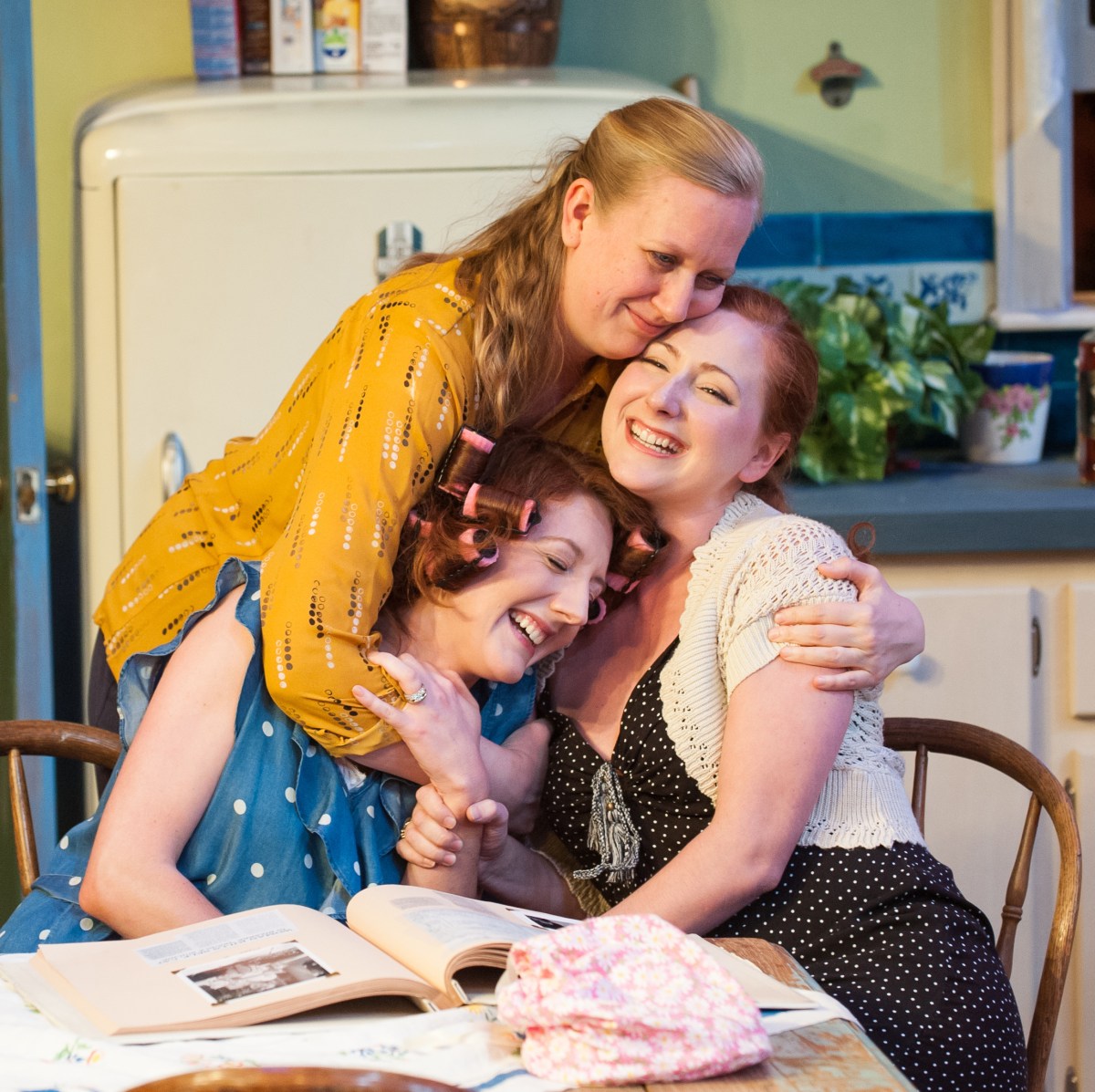
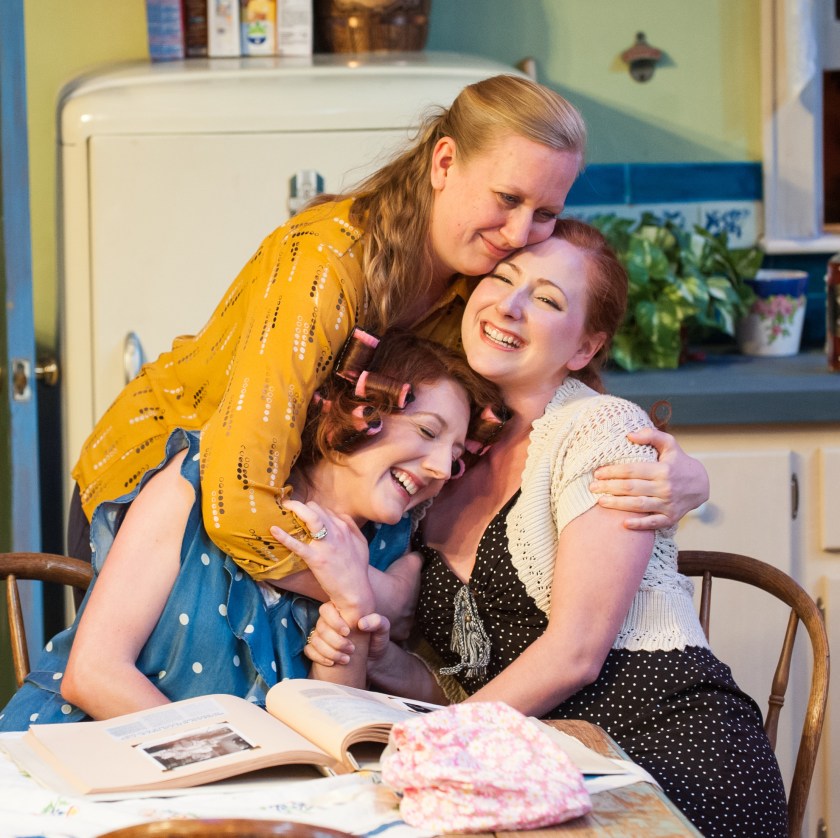
There was a time when I would, if given a chance, watch daytime talk shows because the dysfunctional guests made me feel so much better about my own life. To some extent, the quirky Magrath sisters make me feel the same way about my own family. Irene Kuykendall deftly navigates the surprising complexities of Meg, the black sheep of the family, gradually revealing that she is not a complete narcissist, but has hopes and dashed dreams, and holds a deep and abiding love with her two sisters. She’s also the middle child.

Lexi Langs, who last appeared in a VaRep performance ins 2007, is fascinating as the youngest sister, Babe or Rebecca. Physically enchanting with her wide eyes and sometimes vacant stare, we first meet Babe when she returns to Old Grandad’s home after being released from jail where she spent the night after shooting her husband in the stomach. Langs gives Babe a childlike quality that is unnerving; we are never quite sure if Babe has a true mental illness or just an advanced case of “the vapors.”

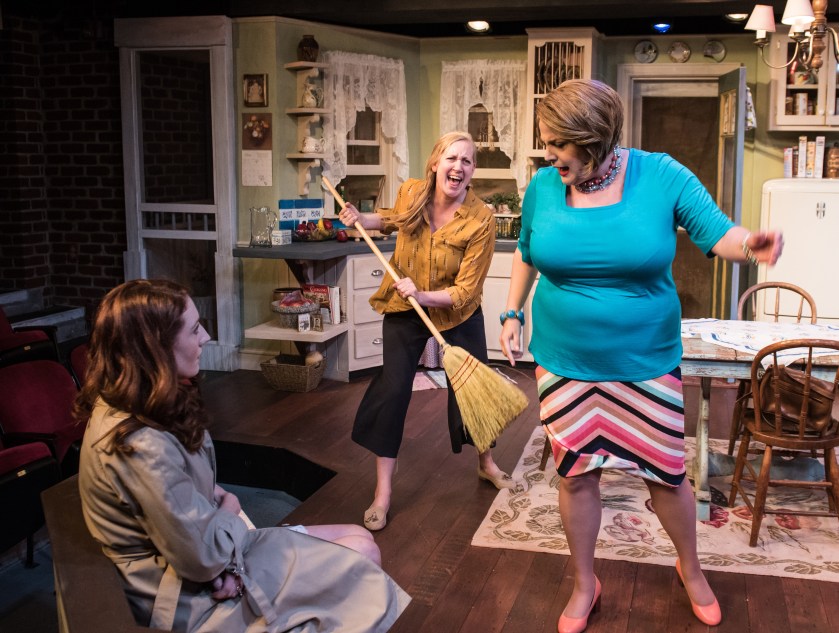
But the true star of this ensemble is Maggie Roop who shoulders the burdens of the family upon the sloping shoulders of Lenny, the eldest of the three sisters. There’s usually one in every family – the one who takes care of everyone and everything, but no one ever thinks she needs taking care of.  Roop spends much of the play trying to keep the peace; there are dark circles under her eyes, and she is obsessed with cleaning, which is, perhaps, the only thing over which she has any control. Roop brings unforced depth to the character of Lenny. For most of the three acts, I wanted to give Lenny a hug, so it was doubly rewarding when, in the third act, she took a broom to the butt of her obnoxious, social climbing first cousin, Chick (Maggie Bavolack). Whiny and annoying, Chick opens the first scene with a hilarious and unexpected reverse strip-tease, in which she elaborately squeezes into a pair of “petite” pantyhose.

Crimes of the Heart tackles real-life trauma: suicide; the illness of an aging grandparent; spousal abuse; dishonest politicians; social pressure; regret; vendetta; attempted murder; low self-esteem. Set in the small town of Hazlehurst, Mississippi (a real town about 30 miles south of the state capital of Jackson) five years after Hurricane Camille (which blew through in August of 1969), there are subtle references to the racial politics of the day, but more disturbingly, because of the racial politics of the times, a major issue of statutory rape is swept under the table, so to speak.

The overall outstanding ensemble is focused on the relationships between the women, but there are also credible performances by Arik Cullen as Meg’s former love interest, Doc Porter, and Tyler Stevens as the young lawyer, Barnette Lloyd.

There are thought-provoking lines, like, “She works out in the garden wearing the lime green gloves of a dead woman” physical humor, as when Babe prepares a glass of lemonade for Meg that makes Meg’s face – not just her lips, but her entire face – pucker, but adds so much sugar to her own glass that we can almost hear it crunch when she sips it. But despite – or maybe because of – our better judgment, Crimes of the Heart makes us laugh at such taboo topics as attempted murder and an old man falling into a coma. Babe may have shot her husband, but each sister has to face up to her own “crimes of the heart.”

Julinda D. Lewis is a dancer, teacher, and writer who was born in Brooklyn, NY and now lives in Eastern Henrico County.

———-

Photo Credits: Aaron Sutton

Crimes of the Heart
Lexi Langs, Maggie Roop, and Irene Kuykendall
Crimes of the Heart
Lexi Langs, Maggie Roop, Irene Kuykendall. Photo by Aaron Sutten.
Crimes of the Heart
Maggie Roop, Lexi Langs, and Irene Kuykendall
Crimes of the Heart
Lexi Langs, Maggie Roop, Maggie Bavolack. Photo by Aaron Sutten.
Crimes of the Heart
Maggie Roop, Maggie Bavolack, Irene Kuykendall. Photo by Aaron Sutten.