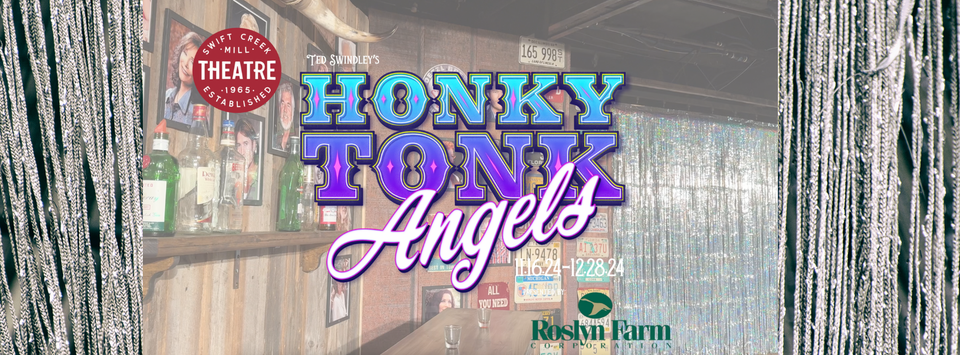
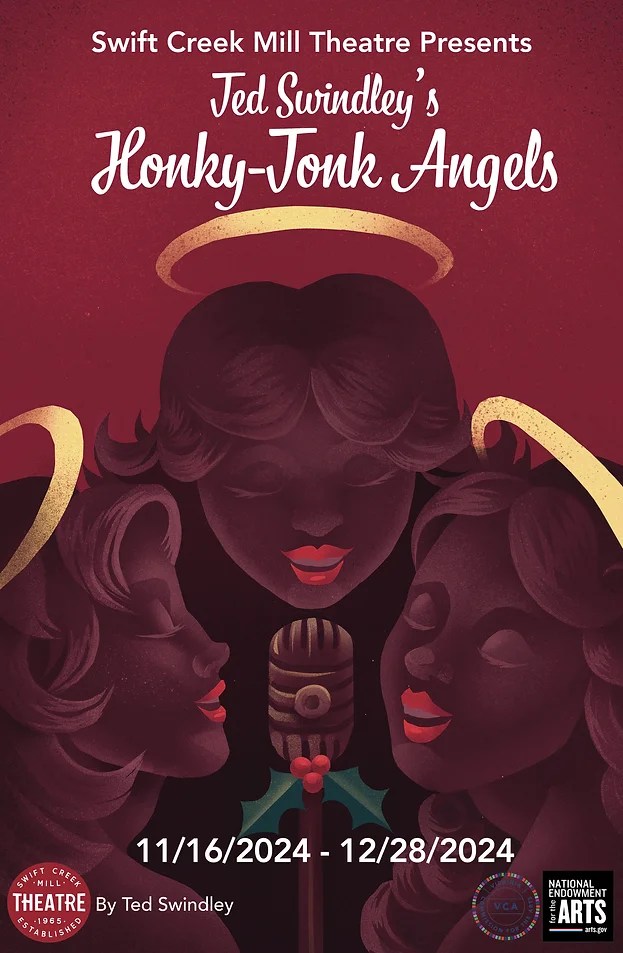
Written by Ted Swindley, who also gave us Always…Patsy Cline (1988), Honky Tonk Angels (2002) is a heart-warming and amusing musical about a trio of aspiring female country singers. Swift Creek Mill last produced this show 11 years ago, with Robyn O’Neill, Debra Wagoner, and Robin Arthur who are credited in the current program as Angels Emerita.
The current cast consists of three talented women who are all making their Swift Creek Mill Theatre debut. Kimberly Strother an afternoon host for a local NPR affiliate radio station, has the role of Angela Bodine, a Texas homemaker with six kids, a philandering husband, a love for comedian Roseanne Barr, a penchant for seeing the brighter side of things, and a need to claim her identity before it’s gone forever.
Chelsea Shaul, a recent graduate of Randolph Macon College with a degree in Theatre and Psychology, is making her professional debut as Darlene Purvis , a beautiful and innocent young woman who lives with her widowed father in a West Virginia coal mining town. She has a guitar and no prospects, since her boyfriend, Billy Joe McAllister, jumped off the Tallahatchie Bridge.
Savanah Ragland, a Chesterfield County Public Schools employee, fills out the cast as Sue Ellen Smith Barney Fife, a twice divorced, Texas-born, Los Angeles-based secretary to a “hands-on” boss. She has unfinished business and unfulfilled dreams.
The lives of the three women intersect on a Greyhound bus as the three independently start their journeys to Nashville and stardom. The fun begins on the bus as Sue Ellen feigns disinterest, Darlene oozes naiveté, and Sue Ellen plies everyone with a seemingly endless supply of baloney sandwiches. The scene concludes with Sue Ellen celebrating the newly united trio with a shower of pork rind confetti.
Act Two is pretty much a farewell concert as the newly christened Honky Tonk Angels conclude a successful six-week run at a Nashville venue, the appropriately named, Honky Tonk Heaven. The two-act musical is filled with approximately thirty songs, many of them familiar, such as “Stand By Your Man,” Loretta Lynn’s “Coal Miner’s Daughter,” Dolly Parton’s “9 to 5” and “I Will Always Love You,” Bobbie Gentry’s “Ode to Billie Joe,” and more.
A highlight, for me, was Kimberly Strother’s campy rendition of “Harper Valley PTA” in Act Two. Near the top of Act One, Savanah Ragland angrily sang her way through “Stand By Your Man” as her character, Sue Ellen, resolved to claim her independence, while Chelsea Shaul (Darlene) reveals what it was that she and Billie Joe threw off the Tallahatchie Bridge. All three of the Angels proved entertaining with song-related backstories and endearing qualities expressed through both familiar and novelty songs, for the most part beautifully rendered, both individually and together.
Audience engagement was apparent – and encouraged – with sporadic periods of handclapping and a few moments when the cast invited audience participation, but there weren’t many takers, at least not on opening night. This may be part of the reason why it seemed that, while the second act featured a more cohesive set and multiple costume changes, I thought the strongest performances occurred in the first act.
Act Two seemed to run out of steam before they ran out of songs to sing. This was even reflected in the script as the Angels attempted to change their song repertoire and their style to reflect a more conservative image. Darlene’s femme fatale number, “Help Me Make It Through the Night” didn’t quite seem to convey the required depth of feeling and the collaborative “Cleopatra: Queen of Denial” somehow fell short of humor or parody but instead took an unexpected turn and drifted towards the shore of the murky sea of offensiveness.
Honky Tonk Angels is mostly fluff. It makes us feel confident that we all know more country music than we ever thought we knew. It’s a feel-good musical, with a paper-thin plot that serves as a vehicle to deliver the songs. It doesn’t require us to focus on the twists and turns of a plot or the nuances of the acting or to remember significant details that might be necessary to understand the denouement later on. With this in mind, go, have a no-stress good time – and don’t forget to sing along when asked.
———-
Julinda D. Lewis, EdD is a dancer, teacher, and writer who was born in Brooklyn, NY and now lives in Eastern Henrico County. When not writing about theater and dance, she teaches dance history at VCU and low impact dance fitness classes to seasoned movers like herself, and occasionally performs. Her most recent (ad)venture was the premiere of a solo work, The Waters of Babylon or Psalm 137 Revisited: a Post-Exodus Reflection in Movement Choreographed From Collective Memories for the debut of the Critical Race Theatre Project.
———-
HONKY TONK ANGELS
By Ted Swindley
Directed by Tom Width
CAST
Kimberly Strother as Angela
Chelsea Shaul as Darlene
Savanah Ragland as Sue Ellen
ORCHESTRA
Piano/Conductor…Paul Deiss
Guitar………………Ed Drake
Fiddle………………Drew Perkins
Bass…………………Sheri Oyan
Drums………………Julie Fulcher-Davis
CREATIVE TEAM
Directed by Tom With
Musical Direction by Paul Deiss
Scenic Design by Tom Width
Lighting Design by Joe Doran
Costume Design by Maura Lynch Cravey
Technical Direction by James Nicholas
Setting:
Act One: Los Angeles, CA; Waxahatchie, TX; somewhere in the Mississippi Delta; and a Greyhound bus.
Act Two: Honky Tonk Heaven in Nashville, TN
Run Time:
About 2 hours with 1 intermission
Tickets:
Regular $44-49. Discounts for Seniors, Military & Veterans
Photographer: Darryl Morgan
One-Time
Monthly
Yearly
Make a one-time donation directly to RVArt REVIEW
Make a monthly donation
Make a yearly donation
Choose an amount
$5.00
$15.00
$100.00
$5.00
$15.00
$100.00
$5.00
$15.00
$100.00
Or enter a custom amount – no amount is too small…or too large.
Presented By: The Firehouse Theatre on the Carol Piersol Stage
At: 1609 W. Broad Street, RVA 23220
Performances: November 6-24, 2024
Ticket Prices: $5.00 – $35
Info: (804) 355-2001 or firehousetheatre.org
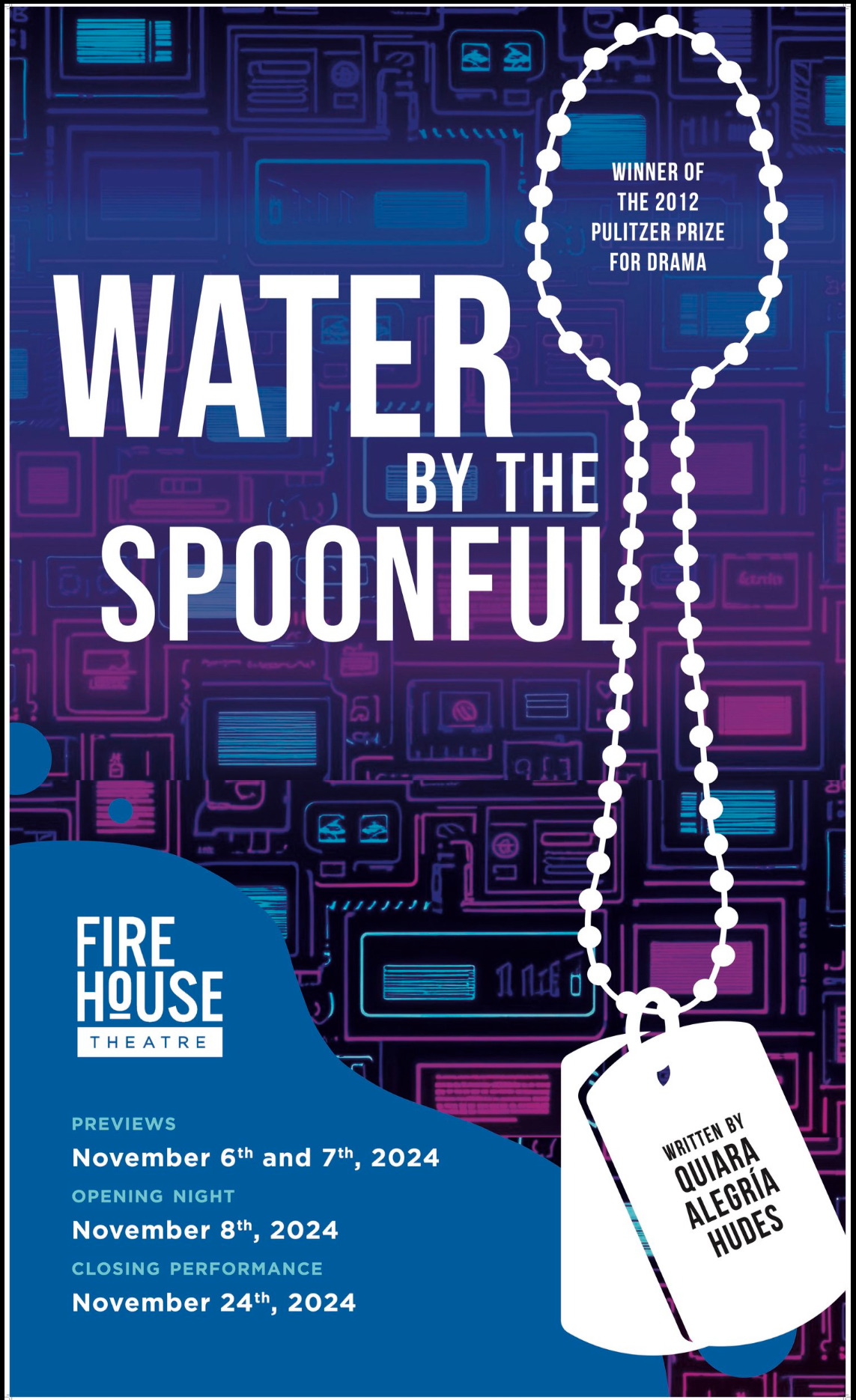
Water By the Spoonful by Quiara Alegría Hudes (who also authors the book for the musical In the Heights) is the second work in a trilogy centered around a young Puerto Rican veteran named Elliot Ortiz. Water By the Spoonful is set Elliot’s hometown of Philadelphia, as well as Japan, Dan Diego, and Puerto Rico, several years after Elliot has returned home, limping from a wounded leg, and haunted by a mysterious apparition.
But it is more than a PTSD play. It is a play about addiction, recovery, mental health, and perhaps most of all, it is about family – the kind we are born into and the kind we choose. There’s the close relationship between Elliot and his cousin Yazmin, an adjunct professor of music at Swarthmore. There’s his estranged relationship with his biological mother Odessa aka Haiku-Mom, the administrator of an online forum for recovering crack addicts, and his close relationship with his aunt, Mami Ginny/Eugenia, who raised him due to his mother’s addiction. There is his relationship to his past, which sometimes manifests as hallucinatory images. There are also the relationships between Odessa and her online community, and between the members of the forum, known at first only by their screennames: Chutes&Ladders, Orangutan, and Fountainhead.
Director Katrinah Carol Lewis, Associate Artistic Director of the Firehouse Theatre, together with Co-Scenic Designers Vinnie Gonzalez and Todd LaBelle and Projection Designer Tennessee Dixon give life and visual impact to the multi-layered relationships and sometimes overlapping action. And I hope it is safe to assume that Jeremy Morris, who is credited with “Sound Consultancy” is largely responsible for the aural saturation with the creative discordance of John Coltrane-infused free jazz
that underscores the production, most notably when Yazmin (played by Juliana Caycedo) is presiding in her professorial role.
Erich Appleby is gripping and authentic as Elliot, the protagonist. There are so many instances when he could have over-acted, but he approaches the brink and never takes that irretrievable leap. The interplay between the cousins, Elliot/Appleby and Yazmin/Caycedo is a thing of beauty; one often forgets they are acting.
When a crisis comes, in the form of the death of Mami Ginny, who never appears on stage, it simultaneously pulls the family together and tears them apart. Who’s going to pay for the funeral? Who’s going to deliver the eulogy? Will she be buried or cremated? Who gets her jewelry? What about the house? These are real questions that may, in fact, be quite triggering for some viewers.
Alana Dodds Sharp is often center stage in her role as Elliot’s biological mother, Odessa. (Why does that name sound so similar to “overdose” to me? Weird? Or premonition?) Her role as a nurturer and mentor is called into question on the death of her sister, and family secrets are revealed that shift perspectives and affect the outcome. Elliott spends most of his onstage time throughout the two powerful acts with his cousin Yazmin, but when it is time for the final bows, it is Appleby and Sharp who are featured as the leads.
Eric “Mr. Q.” Quander and Anne Michelle Forbes bring both levity and insight to their supporting roles as Chutes&Ladders and Orangutan, while John-Michael Jalonen as the late-comer, Fountainhead, plays a pivotal role in the dynamics of the relationships of the recovering crackheads. Finally, there is the versatile and mysterious Mahlon Raoufi who plays three roles, which require him to speak at least that many languages!
Water By the Spoonful takes its name from an incident in Odessa’s past, but it also represents the life-giving qualities of water. Sometimes even small sips – or a spoonful every five minutes – are enough to sustain life, while the lack of it guarantees death.
Not enough can be said about the modular set with its moving platforms and colorful strips of lighting, like directional signals on a runway or of the layered projections sometimes as subtle as an almost abstract map, sometimes as literal as moving images that support the onstage action, and sometimes as blatant as signage indicating the location of the actors.
It all comes down to an immersive theatrical experience that is intimate and familiar, instructive as a parable, and haunting in a way that you will not soon forget. You have until November 24th to see it.
—–
Julinda D. Lewis is a dancer, teacher, and writer who was born in Brooklyn, NY and now lives in Eastern Henrico County, VA. When not writing about theater and dance, she teaches dance history at VCU and low impact dance fitness classes to seasoned movers like herself, and occasionally performs. Her most recent (ad)venture was the premiere of a solo work, The Waters of Babylon or Psalm 137 Revisited: a Post-Exodus Reflection in Movement Choreographed From Collective Memories for the debut of the Critical Race Theatre Project, right here in Richmond at RTP in August 2024.
Run Crew ………. Mikayla MacVicar, Jacob Simmon, Marcely (Mar) Villatoto
Booth Operator ………. Chewie Lo Moore
Run Time: About 2 hours 20 minutes; there is 1 intermission
Tickets: $5 to $35
Info: (804) 355-2001 or FirehouseTheatre.org
Performance Schedule:
November 6 & 7: Previews 7:30PM
November 8: Opening Night 7:30PM
November 9: 7:30PM
November 10: Sunday at 2:00PM – Pay What You Will + Member Post-Show Mixer
November 15: 7:30PM
November 16: Saturday at 2:00PM & 7:30PM
November 17: Sunday at 2:00PM
November 21: 7:30PM
November 22: 7:30PM
November 23: Saturday at 2:00PM & 7:30PM
November 24: Closing performance Sunday at 2:00PM
Water by the Spoonful was originally commissioned by Hartford Stage, Michael Wilson, Artistic Director & Michael Scotts, Managing Director, through the AETNA New Voices Fellowship Program.
World Premiere by Hartford Stage, October 28, 2011
———-
Photo Credits: No photos available at the time of publication
One-Time
Monthly
Yearly
Make a one-time or monthly donation to support the publication of rvart review
Make a monthly donation
Make a yearly donation
Choose an amount
$5.00
$15.00
$100.00
$5.00
$15.00
$100.00
$5.00
$15.00
$100.00
Or enter a custom amount
$
Your contribution is appreciated. No amount is too small, no amount is too large…
At: Libby S. Gottwald Playhouse Dominion Energy Center, 600 East Grace Street, RVA 23219
Performances: October 17 – November 10, 2024
Ticket Prices: $15-$47 [Adults $47; Seniors 65+ with ID $42; Military with ID $27; College Students & Children $22; VTA $15 with Password] Seating is General Admission.
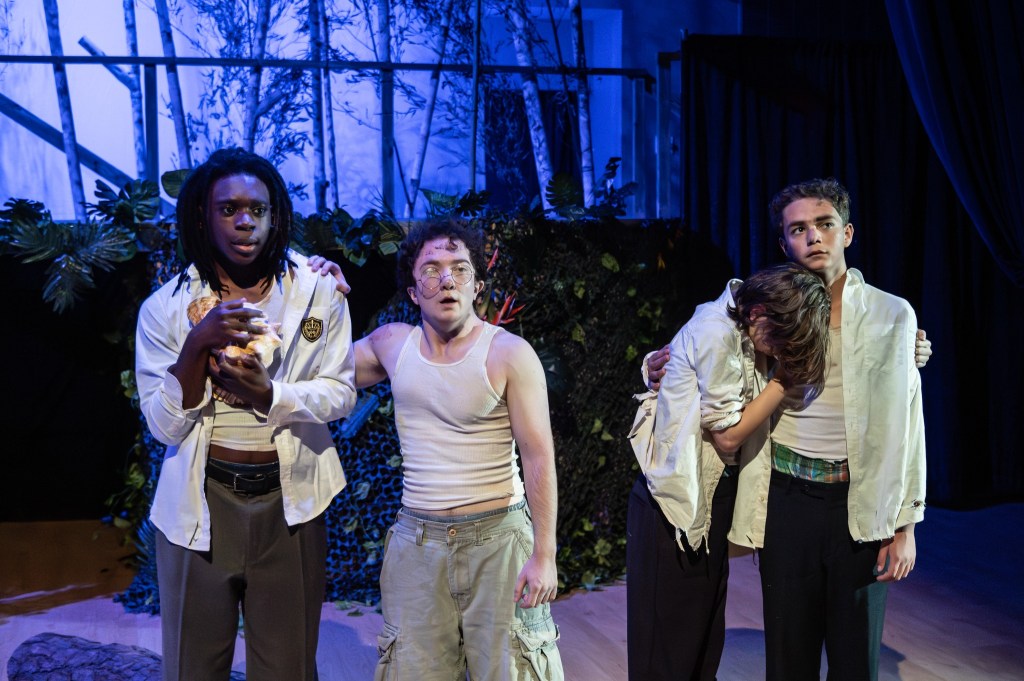
Lord of the Fliesis one of those productions that’s hard to write about because there’s good, bad, and ugly. The good things are all about the production. The bad and ugly things all have to do with the things the book and this production reveal about humankind. This is not a production you can say that you liked or enjoyed, but it is a production you need to see.
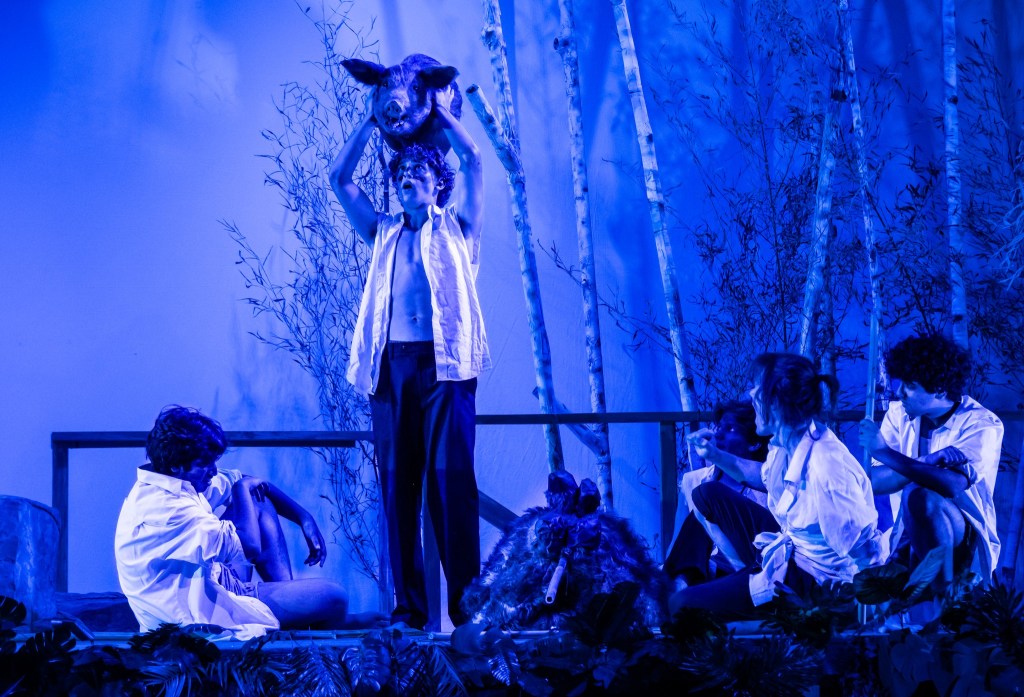
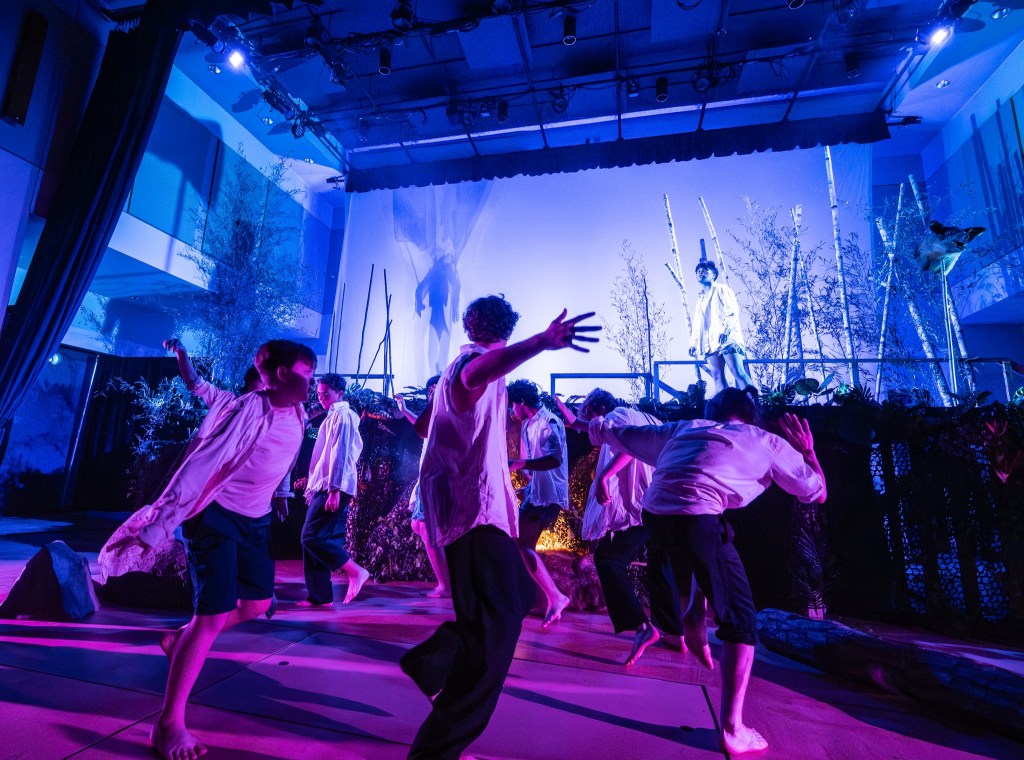
If it’s been a long time since you’ve read William Golding’s book, Lord of the Flies – or if you’ve never read it – the story is about a group of boys and young men who, while being evacuated from a nuclear attack, experience a plane crash and become marooned on a tropical island. With only eleven young survivors and no adults or other authority figures in sight, they are left to figure out how to survive and soon divide into two groups. Those who follow Ralph want some semblance of order and civilization, while those who follow Jack prefer a more chaotic life of hunting and tribal dancing. They hunt wild pigs and a malevolent force known as “the beast” that they believe jumps from body to body – meaning that no one is safe from being hunted.
The boys in the original story were upper class British boys from several different prep schools. That detail seems to have fallen by the wayside, as only one or two of the boys in this cast have adapted a British accent or mannerisms. They are a diverse bunch – in real life as well as onstage – thus giving the tale a more universal appeal.
Interestingly, author Harding’s 1954 publication was based on a children’s novel that promoted the civilizing influence of British colonialism. [Not my words, I’m just reporting here.] Golding apparently found that novel unrealistic and wanted to write a book about children marooned on an island who behaved as he believed children would really behave in such circumstances. As you might suspect – it isn’t a pretty sight.
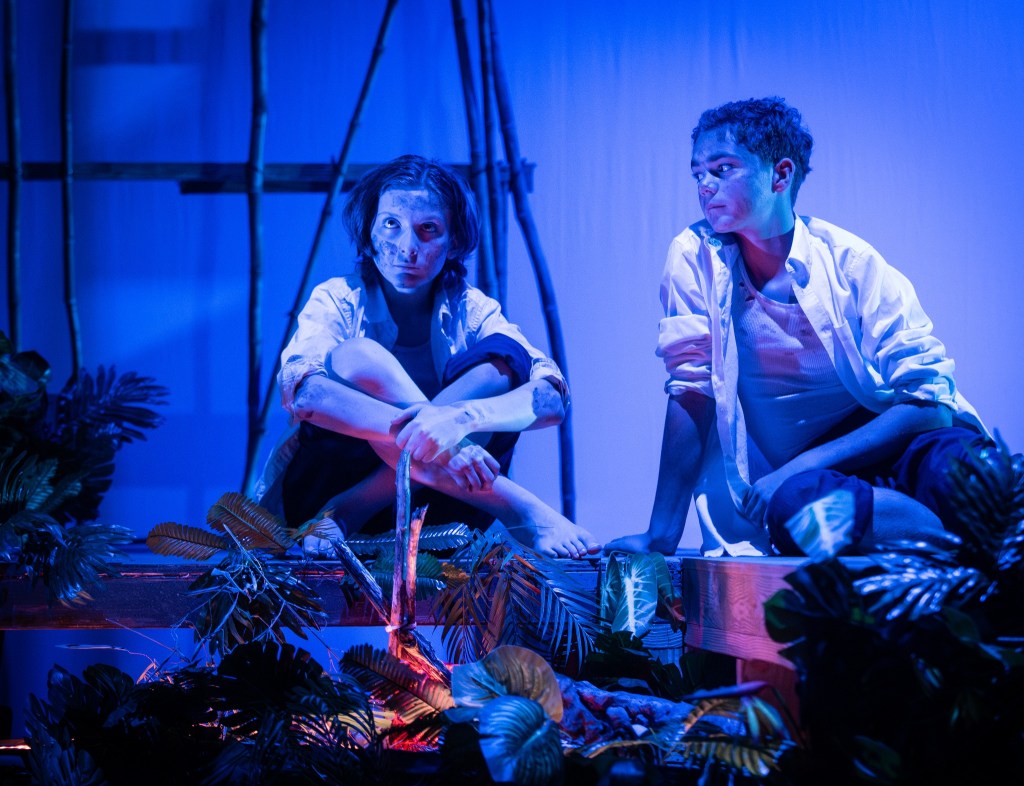
A cast of 11 young actors, ranging from a sixth grader (Hank Astoria, who already has an impressive bio with several productions under his belt – if young people still wear belts) to college students, recent graduates, and young professionals commandeers the unnamed island and captures the hearts of the audience at the Libby S. Gottwald Playhouse – the temporary location of this island. Lindsey Kelley has designed a simple, two-level set that transforms the theater space into a tropical paradise gone rogue. There’s a beach, a mountain, and a forest. Special effects include lighting, a soundscape, a realistic looking fire, smoke, and an eerie projection that the boys believe is the dreaded “beast.”
I attended on the second night of the run, and already it seemed that a high level of camaraderie and commitment to the ensemble had begun to emerge among the “boys.” This is something very necessary for a show that delves into depravity, chaos, and anarchy, a show that upends morals and tosses rules off a cliff into a swift-flowing current. If the audience is silent and contemplative while leaving (as many were), I can only imagine how much Lord of the Flies weighs on its young cast.
(BTW, I couldn’t help but think of how on the previous Sunday the RTCC or Richmond Theater Community Circle celebrated youthful energy in theater, and not one week later I viewed two plays about young people! I also saw H*tler’s Tasters on Thursday night. You can read my thoughts on that show here: https://jdldancesrva.com/2024/10/18/htlers-tasters/ But I digress.)
Tavares Taylor and Liam Storm quickly established an uneasy rapport as Ralph, the winner of the popular vote, and Piggy, his advisor and confidant. Sawyer Williams emerged even more quickly as the island’s resident bully, Jack, a section leader of his school choir who soon turned rogue leader of a band of hunters and marauders.
Anthony Hernandez owned the role of Simon, the misunderstood spiritual leader of the group whose natural discernment was both indispensable and disparaged. Abe Timm straddled the line as Jack’s seemingly reluctant sidekick, Roger. Perhaps, in Roger’s internal war between morality and immorality, survival won.
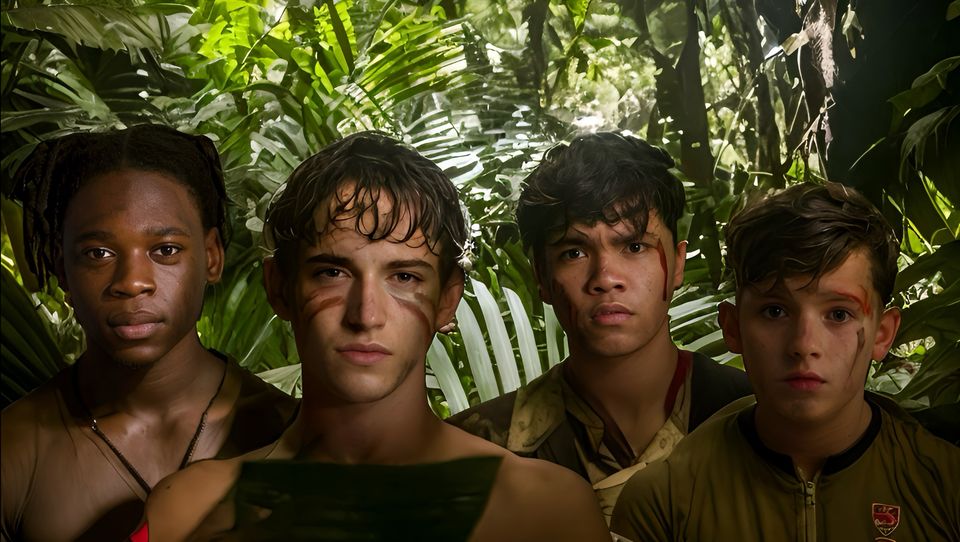
Hank Astoria won hearts, on and off the stage, as the youngest castaway, Perceval. Aiden Denton and Eli Davis mastered the roles of the twins, Sam and Eric, who often completed each other’s sentences in that simultaneously annoying and weird manner some twins exhibit. The cast was completed with Maahin Kumar as Bill, Talon Bleacher as Maurice, and Ishaan Kulkarni as Henry, all in supporting roles as a part of Jack’s band of bare-chested, face-painted, and far-from-merry men.
Jeffrey Cole directed. What en experience that must have been for both Cole and the cast. Here are his own words from his director’s notes: “Deep down, we all feel the need to belong to something that’s bigger than ourselves.” In this story, on this island, “it’s important for us in the audience to remember that, at all times, in all situations, these are children…. With no training, no preparation, and no guidance, these boys must follow their basest biological imperative: survive.” Could you have done any better? Would you have done anything different? Do you think you would have lived to tell the tale? And if you did survive, who would you be after that ordeal?
Lord of the Flies asks the hard questions. It explores the effectiveness of different leadership styles: intimidation versus compassion. It examines the consequences of war – nuclear war in particular; that’s how these boys ended up on this island, unsure if their families and friends had survived, or if they were the only ones left on earth. What would you be willing to do to survive? Do you have what it takes to keep the fire burning?
—–
Julinda D. Lewis is a dancer, teacher, and writer who was born in Brooklyn, NY and now lives in Eastern Henrico County. When not writing about theater, she teaches dance history at VCU and low impact dance fitness classes to seasoned movers like herself, and occasionally performs. Her most recent (ad)venture was the premiere of a solo work, The Waters of Babylon or Psalm 137 Revisited: a Post-Exodus Reflection in MovementChoreographed from Collective Memories for the debut of the Critical Race Theatre Project, right here at RTP in August 2024.
—–
Lord of the Flies
Written by William Golding
Adapted for the Stage by Nigel Williams
Directed by Jeffrey Cole
Cast
Ralph …………… Tavares Taylor
Jack …………… Sawyer Williams
Piggy …………… Liam Storm
Simon …………… Anthony Hernandez
Roger …………… Abe Timon
Sam …………… Aiden Denton
Eric …………… Eli Davis
Bill …………… Maahin Kumar
Maurice …………… Talon Bleacher
Henry …………… Ishaan Kulkarni
Percival …………… Hank Astoria
Production Team
Artistic Director …………… James Ricks
Managing Director …………… Jase Smith Sullivan
Director …………… Jeffrey Cole
Assistant Director …………… Sim Nakamura Rivers
Production Stage Manager …………… Nata Moriconi
Assistant Stage Manager/Props Design … Jordan Dively
Costume Design …………… Lindsey Ladnier
Lighting Design …………… Tristan Ketcham
Scenic Design …………… Lindsey Kelley
Sound Design …………… James Ricks
Scenic Builder …………… Brok Décor
Run Time: approximately 2 1/2 hours, including two 10-minute intermissions
———-
Photo Credits: Aaron Sutten
One-Time
Monthly
Yearly
Make a one-time, monthly or annual donation to support RVArt review
Make a monthly donation
Make a yearly donation
Choose an amount
$5.00
$15.00
$100.00
$5.00
$15.00
$100.00
$5.00
$15.00
$100.00
Or enter a custom amount – no amount is too small, no amount is too large
$
Your contribution is appreciated. – Julinda AKA Dr. Yaya AKA MommaJ
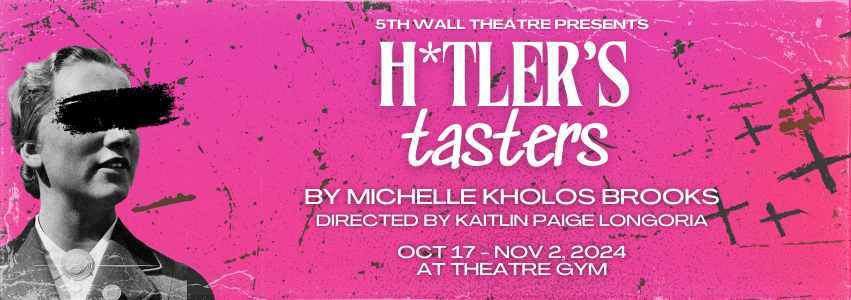
The 5th Wall Theatre’s 2024/2025 season is billed as a celebration of empowering stories that inspire change. The “theatre beyond boundaries’” first production of the season, H*tler’s Tasters fulfills this promise on several levels.
This highly triggering tale is based on the true story of the young women who were honored with the dubious patriotic duty of tasting Adolf Hitler’s food to make sure it wasn’t poisoned. Somewhere, I think I saw this play described as a comedy, but while there are precious moments of humor between the three young women on stage at any given moment, it is not comedic. Rather, it is the kind of humor that is born of a need to survive by any means necessary. I wouldn’t describe H*tler’s Tasters as a drama, either. No…it’s more of a case study, and a cautionary tale that reminds us that “complacency is a dangerous meal.”
Anachronistic touches make this bitter pill just a bit more palatable. Set in an unknown location in war-torn Germany during the height of the Third Reich, the young women have cell phones and are given to breaking out into bursts of abstract modern dancing. Their cell phones are for recording selfies during their long periods of boredom, and for timing the period after eating. They have one hour after each meal to be observed for symptoms of poisoning. The dancing serves as a stress reliever – for the audience. The actors perform a weird movement ritual three times a day, before each meal. The ritual, one of several movement segments choreographed by Kayla Xavier, is part interpretive dance, part visualization of their inner turmoil, and part religion – in the sense that it represents their only authentic representation of and communication with the truth of their reality.
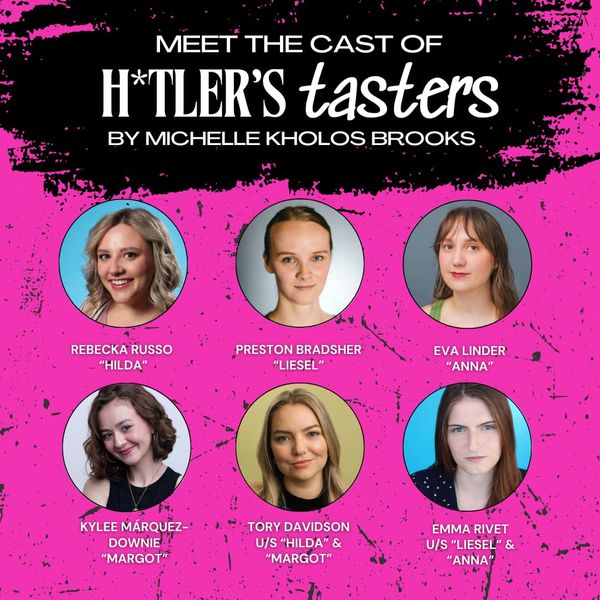
Each of the young women has a distinct personality. Hilda (Rebecka Russo) is the mean girl. Unable to face reality, she lashes out at the others. “I don’t want to know about truth,” she says, and who can blame her. Liesl (Preston Bradsher) is inquisitive – dangerously so. She wants to know what is going on even if it hurts to know. Anna (Eva Linder) is innocent and asks the wrong questions and speaks too freely. The interaction between Anna and Hilda ends predictably. And then there is Margot (Kylee Márquez-Downie). The closest thing to a breath of fresh air in this psychologically dark world, Margot brings innocence and laughter and dancing into the young women’s bleak world. But the ritual that first stunned us with raw energy gradually dulls until the final performance is decidedly lackluster and uncoordinated.
The ensemble is a tight knit organism that tells the story with a combination of acting, dancing, and non-verbal cues such as glances, body position, posture, and use of space. Longoria, who tells us in the Director’s Note that she has previously spent six years as an actor and producer for this show, directs with a sense of energy and inevitability that is urgent, and manages to somehow suggest that hope never dies.
H*tler’s Tasters encompasses many important issues that are as relevant today as they were in 1932: the treatment of women and girls; politics; economics; sexuality; sexual assault; the exploitation of women and the poor and immigrants and Jewish people and Black people and anyone who could possibly be seen as “other.” As if this doesn’t sound familiar enough, Hilda says, “Jews cannot replace us,“ and “our lives will be so much better when he makes Germany great again.” Margot innocently shares a vision of the Führer arriving on a beautiful horse, with his shirt off, that
sounds a lot like a photo of another world leader that made the rounds just a few years ago.
Brooks’ play premiered in New York in 2018. She could not possibly have conceived then that H*tler’s Tasters would grow in relevancy rather than fade into the obscurity of historical fiction and artistic archives. It is triggering – so much so that the author did not even spell out the name. It drives home the truth that if we turn our heads when anyone is being exploited, we will inevitably become targets ourselves – if we aren’t already…
This is not the type of play that deserves an answer when someone asks, “did you enjoy it?” It is not meant to be enjoyed. It is meant to be experienced. It is meant to be discussed. It is meant to be absorbed, and it is meant to make better, because when you know better, you must do better.
———-
Julinda D. Lewis is a dancer, teacher, and writer who was born in Brooklyn, NY and now lives in Eastern Henrico County. When not writing about theater, she teaches dance history at VCU and low impact dance fitness classes to seasoned movers like herself, and occasionally performs. Her most recent (ad)venture was the premiere of a solo work, The Waters of Babylon or Psalm 137 Revisited: a Post-Exodus Reflection in Movement Choreographed From Collective Memories for the debut of the Critical Race Theatre Project, right here at RTP in August 2024.
———-
Written by Michelle Kholos Brooks
Directed by Kaitlin Paige Longoria
CAST
Rebecka Russo ………. Hilda
Preston Bradsher ………. Liesel
Eva Linder ………. Anna
Kylee Marquez-Downie …. Margot
Tory Davidson ………. u/s Hilda & Margot
Emma Rivet ………. u/s Liesel & Anna
PRODUCTION TEAM
Directed by ………. Kaitlin Paige Longoria
Choreography by ………. Kayla Xavier
Lighting Design by ………. Gretta Daughtry
Sound Design by ………. Candace Hudert
Costume Design by ………. Maggie Ronck & Ashleigh Poteat
Fight Choreography by …… Marr Hovastak
Production Associate ….. Emily Adler
Stage Management by …. Tariq Karriem
Photos by ………. Tom Topinka
Performance Schedule:
Thursday, October 17, 2024, 7:30 PM | Opening Night
Friday, October 18, 7:30 PM
Saturday, October 19, 7:30 PM
Sunday, October 20, 2:30 PM
Thursday, October 24, 7:30 PM
Friday, October 25, 7:30 PM
Saturday, October 26, 2024, 7:30 PM
Sunday, October 27, 2024, 2:30 PM | Talkback
Tuesday, October 29, 2024, 7:30 PM | Industry Night | Pay What You Will
Friday, November 1, 2024, 7:30 PM
Saturday, November 2, 2024, 7:30PM | Closing Night
Tickets: $30/Adult; $15/Student
Run Time: 90 minutes, no intermission
Content Warning: This production contains mature themes and potentially sensitive or controversial content, including discussions of sexual assault, politics, war, and race. Viewer discretion is advised.
One-Time
Monthly
Yearly
Make a one-time or monthly donation in support of the publication of rvart review
Make a monthly donation
Make a yearly donation
Choose an amount – no amount is too small or too big…
Sublime! This new work by KDance – a collaboration between choreographer Kaye Weinstein Gary, composer John Winn, and the string ensemble Trio 826 is a perfect gem combining Gary’s deliciously peculiar brand of movement exploration with spoken word – in this case, quotes about aging – and live music that speaks all the unspoken words. Ahhhh.
The trio is placed downstage right (the audience’s left) so we can really see their interactions – the violinist glances at the viola player, the cellist smiles at the violinist. The only problem is that from some seats, the musicians partially obscure the dancers. (Maybe if they sat a bit farther back, or at an angle?)
The four dancers enter dressed in wigs and hats, sweaters and shawls that indicate advanced age, but quickly toss off all the restricting accoutrements to reveal their agile, flexible, energetic, enthusiastic mature selves. Yes, this is a dance about aging, and it is done with thoughtfulness, humor, elegance, inspiration, and hope.
They cavort in folk-type dances in lines and circles. They play ball, jump lightly off the edge of the (low) stage and bow towards the musicians before making an exit – leaving the musicians to play for a lusciously long interlude. The music is contemplative, meditative, playful, stately, elegant, harmonious, and discordant. It is all the things it needs to be to tell this story. You can hear the violin talking, bubbling over at a party. You can see and hear the playfulness of the pizzicato section.
Two dancers wrap themselves in a single shawl while the other two share a sweater, each putting an arm in a sleeve. They play musical chairs with only two chairs, striking poses when they freeze. And it all ends with a nostalgic sing-along with the audience. The lyrics to John Lennon and Yoko Ono’s “Imagine” are printed on the back of the program. Coming of Age is short and sweet – like just the right amount of a tasty, rich dessert.
———-
Julinda D. Lewis is a dancer, teacher, and writer who was born in Brooklyn, NY and now lives in Eastern Henrico County. When not writing about theater, she teaches dance history at VCU and low impact dance fitness classes to seasoned movers like herself, and occasionally performs. Her most recent (ad)venture was the premiere of a solo work, The Waters of Babylon or Psalm 137 Revisited: a Post-Exodus Reflection in Movement Choreographed From Collective Memories for the debut of the Critical Race Theatre Project, right here at RTP in August 2024.
———-
COMING OF AGE
A music and dance collaboration between K Dance, John Winn, and Trio 826
TRIO 826
Susanna Klein ……………………. Violin
Julia Bullard ……………………. Viola
Stephanie Barrett ……………………. Cello
DANCERS
Andrew Etheredge
Gina Maria McKenzie
Melanie Richards
Kaye Weinstein Gary
DIRECTOR/CHOREOGRAPHER ……. Kaye Weinstein Gary
Hat/Wig Consultant ………. Heidi Rugg
Lighting Designer ………. Gretta Daughtrey
Stage Manager ………. Jake Buccella
Production Assistants ………. Todd LaBelle, Grade LaBelle, Emily Vial
Photo Credits ………. Jason Collins Photography
RUN TIME
About 40 minutes; there is no intermission
PERFORMANCE SCHEDULE
Tuesday, October 8, 2024, 7:30PM
Wednesday, October 9, 2024, 7:30PM
TICKETS $10-$25
Photos by Tom Topinka
One-Time
Monthly
Yearly
Make a one-time or monthly donation to support this publication – rvart review | we publish more reviews than any other local publication and our only support comes from you, the reader.
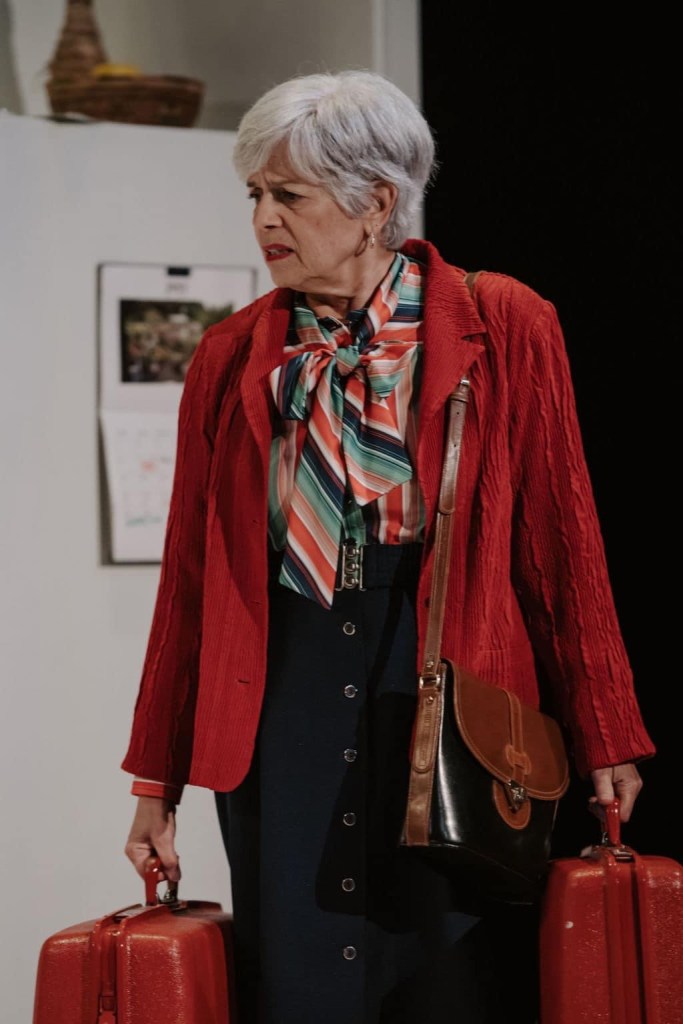
Fanny Church wears a wide-brimmed hat as she reminisces over each familiar object before she wraps it in bubble wrap and places it in a box. Fanny, the wife of a well-known poet, Gardner Church, is packing up to move out of their long-time Boston home. The Church’s are getting older, Gardner’s memory is not what it once was, and it is time to downsize.
In the first scene Fanny eagerly awaits the arrival of their daughter, Margaret or Mags, who is coming to help her parents pack and sort through the memorabilia of a life well lived. But the arrival of Mags, a successful artist who lives in New York, brings its own revelations and complications.
Author Tina Howe and director Kerrigan Sullivan skillfully guide us through this challenging rite of passage with an unpredictable itinerary of heart-wrenching loss, thirst-quenching humor, poignant insights on growing older, and shocking moments of cruelty.
At times, Painting Churches reminded me of Ronan Carr’s Th Barber of Moville in which the barber, Molly, realizing she has declining mental capacities, has made elaborate end-of-life plans that do not take into account her husband’s ability to carry them out. (See my review of that play when I saw it at the Firehouse in June 2022: https://jdldancesrva.com/2022/06/28/the-barber-of-moville/)
Here in Painting Churches, apparently named for Mags’ obsession with painting her parents’ portrait, the versatile Jacqueline Jones takes on the role of the mother, Fanny Sedgwick Church. It is a role that requires Jones to ride an emotional roller coaster, onemoment reminiscing about the family silver and the next joining her husband in recreating scenes from classic paintings, one moment stumbling in the darkness of forgotten memories, and the next waltzing gaily with her husband, one moment watching over her declining husband like a hawk, and the next cruelly demeaning him because of his memory and health issues. Fanny copes with laughter and copious amounts of alcohol.
Daniel Moore plays the role of Gardner Church, the poet and patriarch who appears to be blissfully unaware of his cognitive challenges as he ignores Fanny’s slights and jabs, happily reciting the poetry of William Butler Yeats and Robert Frost from memory. In a tender moment with his daughter Mags, we discover that even his pet bird can recite poetry. Gardner comes across as the “good cop” parent to Fanny’s “bad cop,” but even though he seems to be the kinder gentler parent, we eventually find that neither Gardner nor Fanny ever truly understand their daughter.
The first thing that struck me when Mags arrived, late and flushed, is that she and her parents never seem to communicate. They talk at each other, and about each other, but while speaking in the same room, it’s almost as if the audience is witnessing small snippets of several unrelate conversations. Constance Moreau, as Mags, has mastered this disconnect to the extent that it alerts us to the possibility that something is not quite right. When we finally hear the story of Mags’ childhood masterpiece, I felt – uncomfortably – that we had just been introduced to a whole new level of family dysfunction.
At its heart, Painting Churches is a well-crafted, poetically structured tale about the stresses of an evolving parent-child dynamic in which there are no winners and no losers – there is just life. Each of these characters is given the time and space to develop into full-fleshed beings, neither all good nor all bad. That makes us laugh even harder at their antics and hurt even more deeply for their failings. Oh, and on a lighter note, special mention for the number of times Jones and Moore have to get up and down from the floor! I hope supplies of Tiger Balm for the run of the show were written into their contracts.
And finally, I would be remiss to end without mentioning that this is the Chamberlayne Actor’s Theatre’ 60 year of producing, first as a community theater company and later joining the ranks of Richmond’s professional theater community, and it is their first year in their new home at Hanover Tavern after several years as Richmond nomads after losing their long-term space in the Chamberlayne Farms area on N. Wilkinson Rd.
Painting Churches, produced by Zack Owen, with lighting design by Alleigh Scantling, Costumes designed by Lindsey Ladnier, Scenic and Properties design by Hailey Bean and Sound design by Kerrigan Sullivan, who also directed, runs through October 19.
———-
Julinda D. Lewis is a dancer, teacher, and writer who was born in Brooklyn, NY and now lives in Eastern Henrico County, VA. When not writing about theater and dance, she teaches dance history at VCU and low impact dance fitness classes to seasoned movers like herself, and occasionally performs. Her most recent (ad)venture was the premiere of a solo work, The Waters of Babylon or Psalm 137 Revisited: a Post-Exodus Reflection in Movement Choreographed From Collective Memories for the debut of the Critical Race Theatre Project, right here in Richmond at RTP in August 2024.
Duality: duality refers to having two parts, often with opposite meanings, like the duality of good and evil. If there are two sides to a coin, metaphorically speaking, there’s a duality. War and peace. Love and hate. Up and down. Black and white
“Americans make movies; the French make films.”
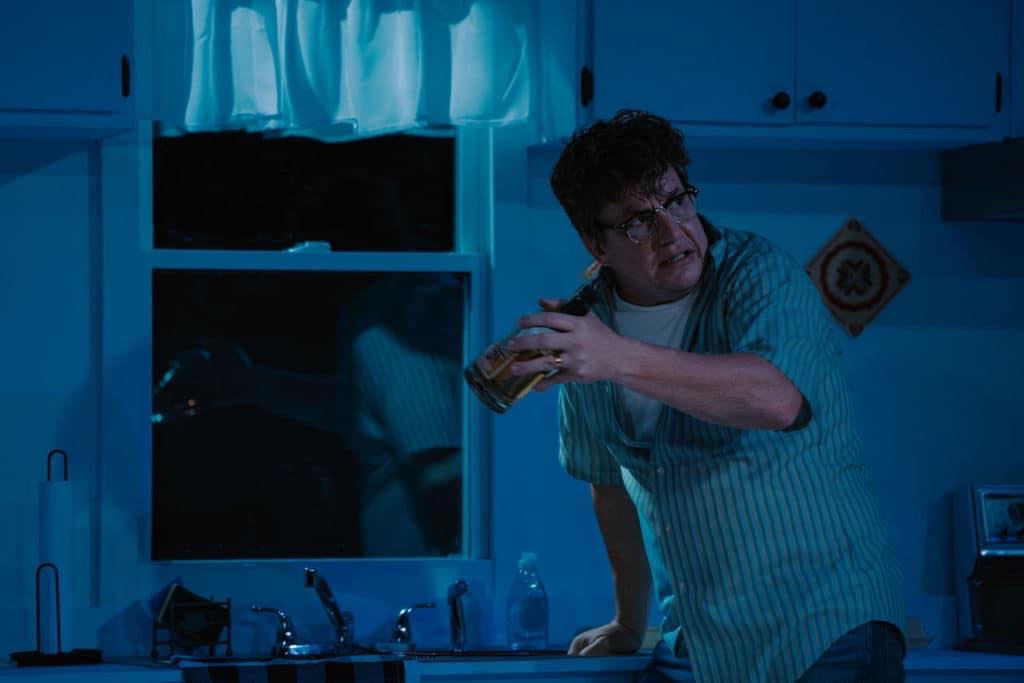
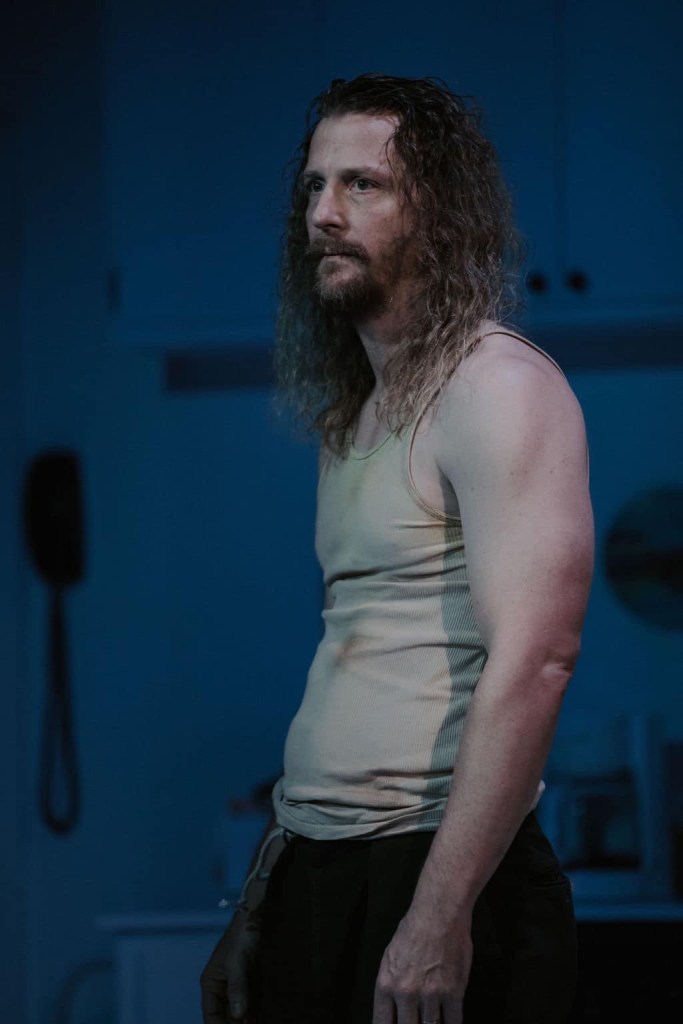
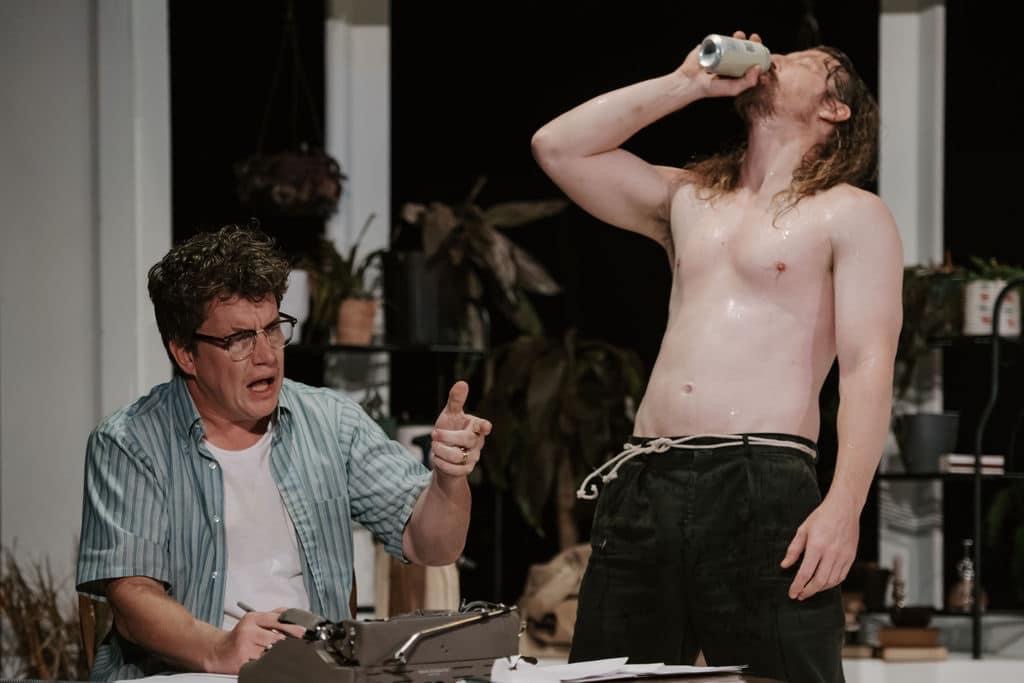
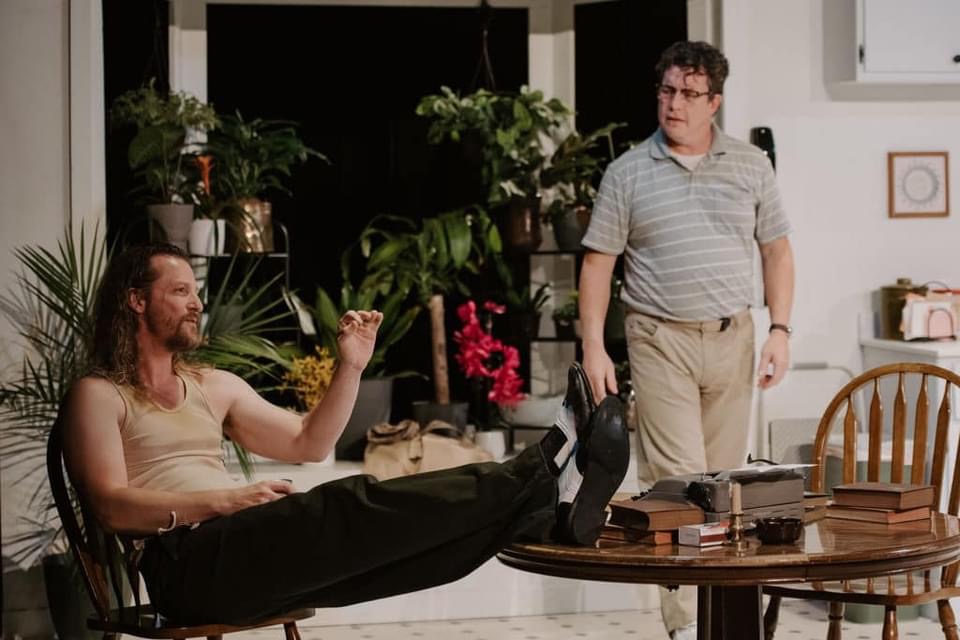
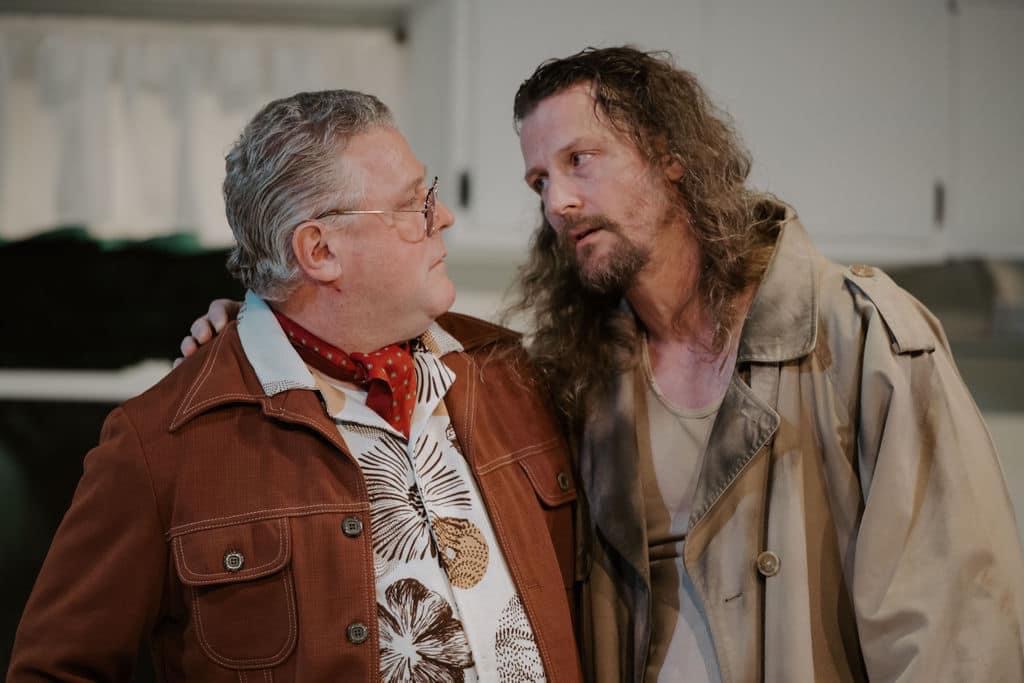
We first encounter Lee and Austin engaged in a contentious discussion in their mother’s kitchen in her California home. The brothers have not seen one another in five years. Austin is house-sitting for their mother who is on vacation in Alaska. Their father is, apparently, living somewhere in the Mojave desert in dire straits. Austin, a screenwriter, is trying to work on a script – by candlelight – while Lee, a drifter who makes a living by nefarious means, sits on the counter drinking beers one after the other and interrupting Lee’s work. Nothing unusual about that. At first. But oh, it quickly becomes apparent that this sibling relationship is deeply, disturbingly dysfunctional.
“I come in through the window; I go out through the door.”
Landon Nagel and Stevie Rice alternate in the roles of the brothers, and on this Saturday afternoon Nagel wore the button down khaki role of Austin while Rice stepped into Lee’s scruffy black and white wingtips and battered trench coat. Both actors seemed to be in the exact right roles, so I’d love to have an opportunity to see this show again with the two in the opposite roles.
“Toast is kind of like salvation.”
Nagel and Rice both gave riveting performances to the sparse but attentive Saturday matinee audience in this iteration, with Rice’s character double-crossing his brother by pitching a story to his brother’s agent, effectively usurping his brother’s deal – along with his fragile self-esteem. While Act One is contentious, Act Two is nothing short of a dumpster fire (not the writing the situation), with the two brothers switching roles (not the roles they were cast in but their hierarchical roles, their roles in the family, their relationship to one another). The psychological wreckage echoes the physical wreckage of their mother’s pristine kitchen. And wouldn’t you know it – just when you think things have hit rock bottom, Mom returns unexpectedly. But her response to the emotional and material upheaval that greets her gives new meaning to the word dysfunctional.
On his website, Shepard says of True West:
“I wanted to write a play about double nature, one that wouldn’t be symbolic or metaphorical or any of that stuff. I just wanted to give a taste of what it feels like to be two-sided. It’s a real thing, double nature. I think we’re split in a much more devastating way than psychology can ever reveal. It’s not so cute. Not some little thing we can get over. It’s something we’ve got to live with.”
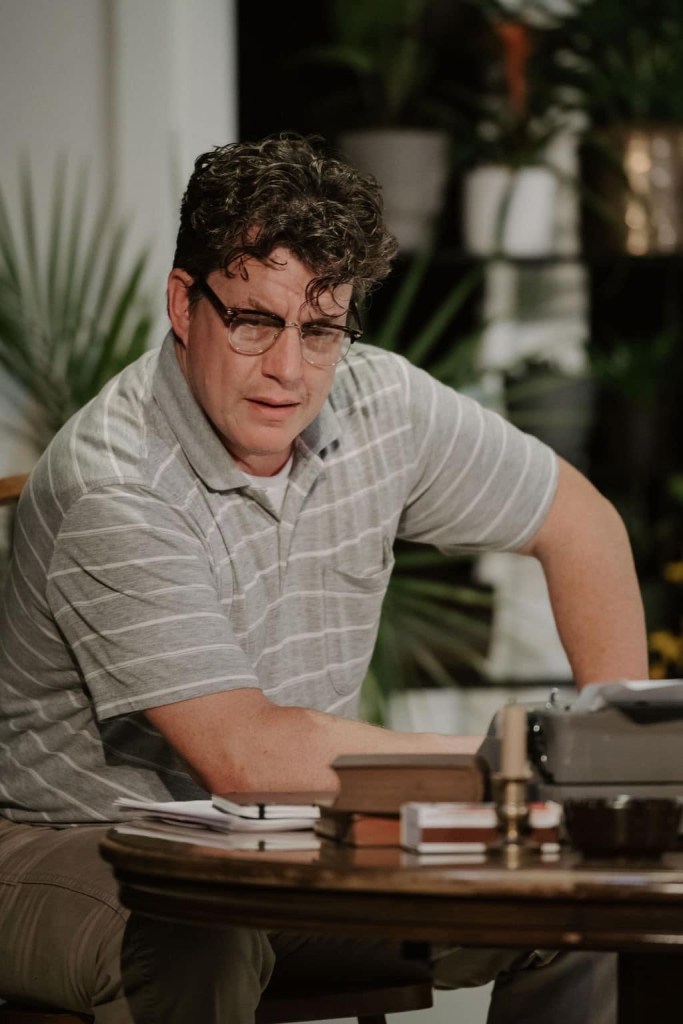
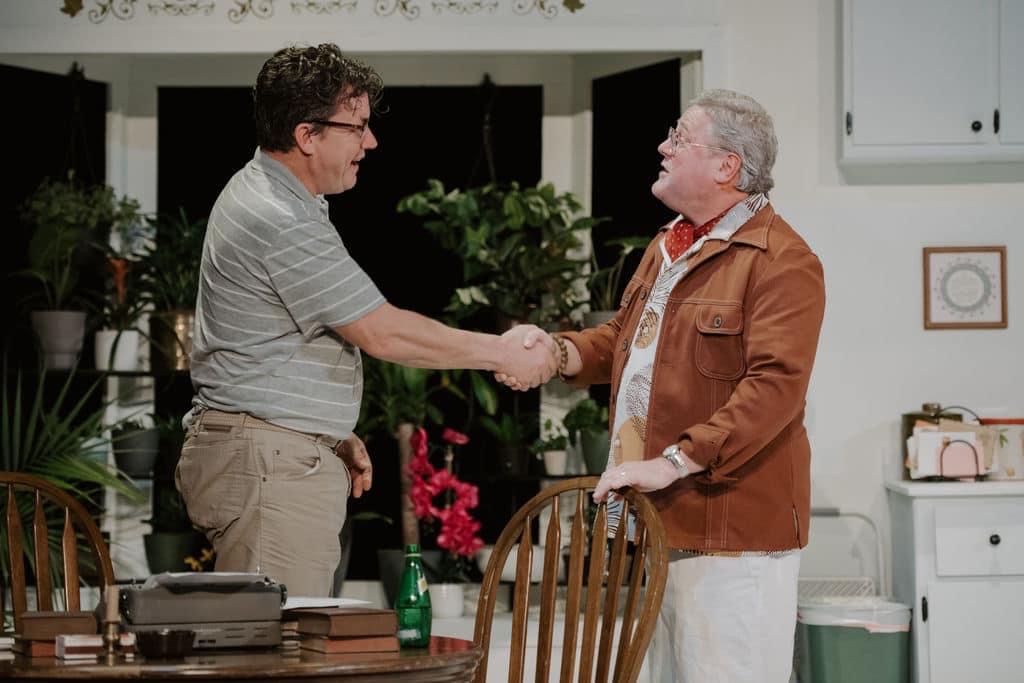
In the blink of an eye True West flips from the violent (e.g., Lee smashing a typewriter with a golf club or a vicious fight between the two brothers involving a garroting) to the humorous (e.g., a tale of lost teeth or an award-worthy drunken ramble involving toast – lots and lots of toast). The normalcy of the serene kitchen with its white cupboards and abundance of plants (keep your eye on the plants!) and the reassuringly normal ambient sounds of chirping crickets and barking dogs amplify the outrageousness of the brothers’ interactions, of their very relationship.
True West is a dark comedy, and so much more, The seemingly simple title is a commentary on the wild west, the American dream, and a reality check on what is real and what is mere illusion. Even though Austin and Lee are exaggerated, they are real people with real issues; they are authentic in their dysfunction.
Supporting roles were capably filled by Otto Konrad as the disingenuous agent, Saul and Jane Petkofsky as the elusive Mom – but this is basically a two-hander, and both Nagel and Rice shine in their respective roles. Rusty Wilson’s direction keeps things moving so that I was startled when intermission arrived and appropriately stunned at the ending. There’s truly no way to prepare, just hang onto the edge of your seats and go along for a truly wild ride.
Julinda D. Lewis is a dancer, teacher, and writer who was born in Brooklyn, NY and now lives in Eastern Henrico County. When not writing about theater, she teaches dance history at VCU and low impact dance fitness classes to seasoned movers like herself, and occasionally performs. Her most recent (ad)venture was the premiere of a solo work, The Waters of Babylon or Psalm 137 Revisited: a Post-Exodus Reflection in Movement Choreographed From Collective Memories for the debut of the Critical Race Theatre Project, right here at RTP in August 2024.
———-
TRUE WEST
by Sam Shepard
Directed by Rusty Wilson
This performance is dedicated in memory of Carol Piersol, the beloved Founding Artistic Director of Firehouse
CAST
Austin/Lee ……………………. Landon Nagel
Austin/Lee ……………………. Stevie Rice
Saul ……………………. Otto Konrad
Mom ……………………. Jane Petkofsky
PRODUCTION TEAM
Direction ………. Rusty Wilson
Scenic Design ………. Joseph Lavigne
Costume Design ………. Sarah Grady
Production State Manager ………. Sharon Gregory
Sound Design ………. Grace Brown LaBelle
Lighting Design ………. Andrew Bonniwell
Fight Choreography ………. Aaron Orensky
Composer ………. Drew Perkins
Properties Design ………. Emily Vial
Photo Credits ………. Jason Collins Photography
RUN TIME
1 hour 45 minutes; there is one intermission
PERFORMANCE SCHEDULE
Opening Night – Friday, September 20 at 7:30PM
Running Fridays and Saturdays, September 20, 21, 27, 28, October 4, 5, at 7:30PM;
Thursday, October 3, 7:30PM; Saturdays and Sundays, September 21, 22, 28, 29, & October 5 at 2:00PM.
At: The Richmond Ballet Studio Theatre, 407 E Canal St, RVA 23219
Performances: September 17-22, 2024
Ticket Prices: $25 – $51
Info: (804) 344-0906, etix.com, or richmondballet.com
THE PROGRAM
EN CHALANT
Choreography by Ma Cong
Music by Nils Frahm, Hauschka, and Jóhann Jóhannsson
Costume Design by Rebecca Turk
Lighting Design by Trad A Burns
World Premiere: September 17, 2024, Richmond Ballet, Richmond Ballet Studio Theatre, Richmond, VA
WHAT’S GOING ON
Choreography by Val Caniparoli
Music by Leonard Cohen, Bob Dylan, Marvin Gaye, Meanie, Buffy Sainte-Marie, Jimmie Rodgers, Pete Seeger
Assistant to the Choreographer: Maiqui Manosa
Staged by Jerri Kumery
Costume Design by Susan Roemer
Lighting and Projection Design by Trad A Burns
Music Research by Lauren Morrison
World Premiere: May 10, 2022, Richmond Ballet, Richmond Ballet Studio Theatre, Richmond, VA
Fifteen years ago Ma Cong presented his first work for the Richmond Ballet as a guest artist participating in the company’s annual New Works Festival. This week, he presented his first full length work as the newly installed Artistic Director of the Richmond Ballet.
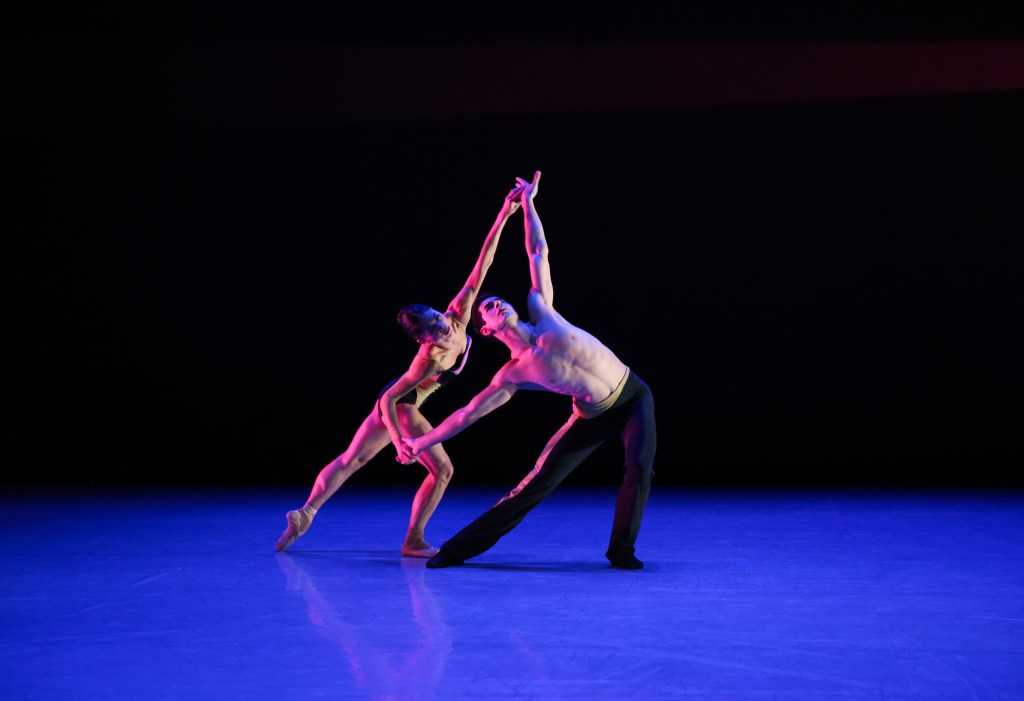
“En Chalant,” a work he described as “the complete opposite of nonchalant” is an abstract ballet that takes its inspiration from the music – in this case a selection of contemporary classic compositions by three composers, two German and one Icelandic, known for their contemporary classic work infused with elements of electronic music or, in one case, prepared piano.
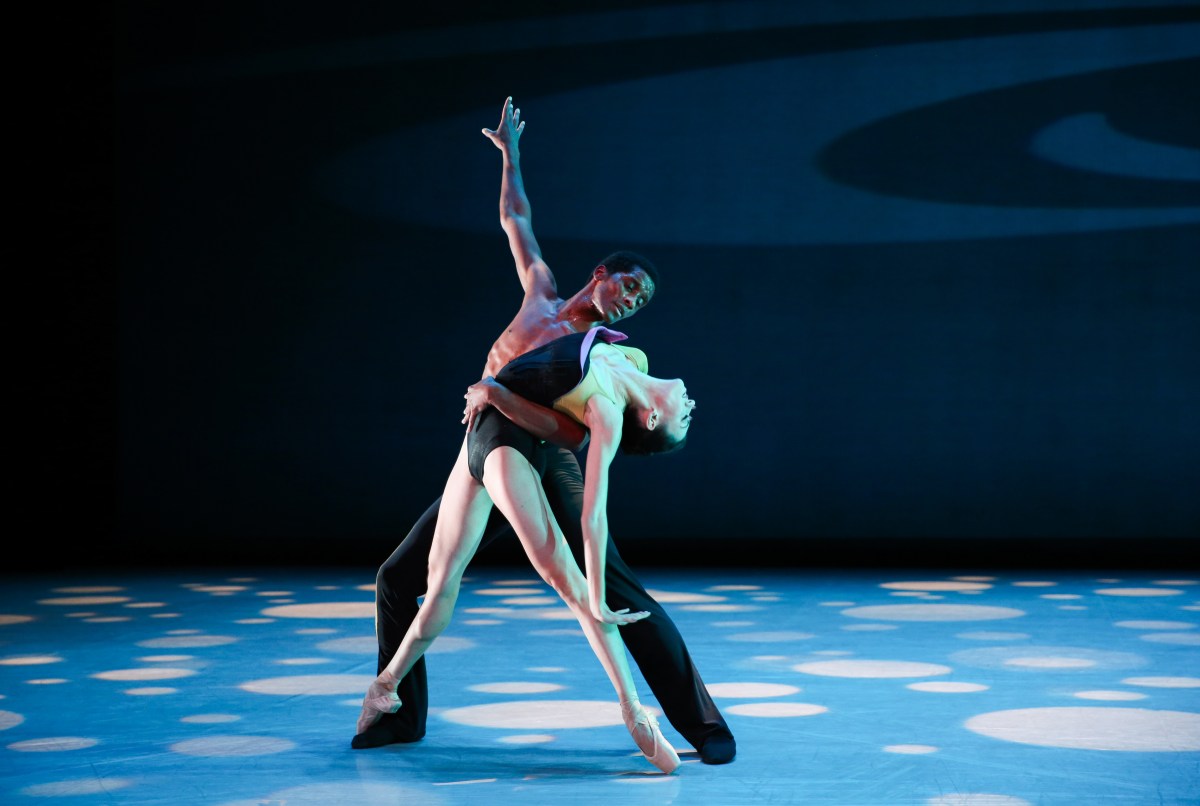
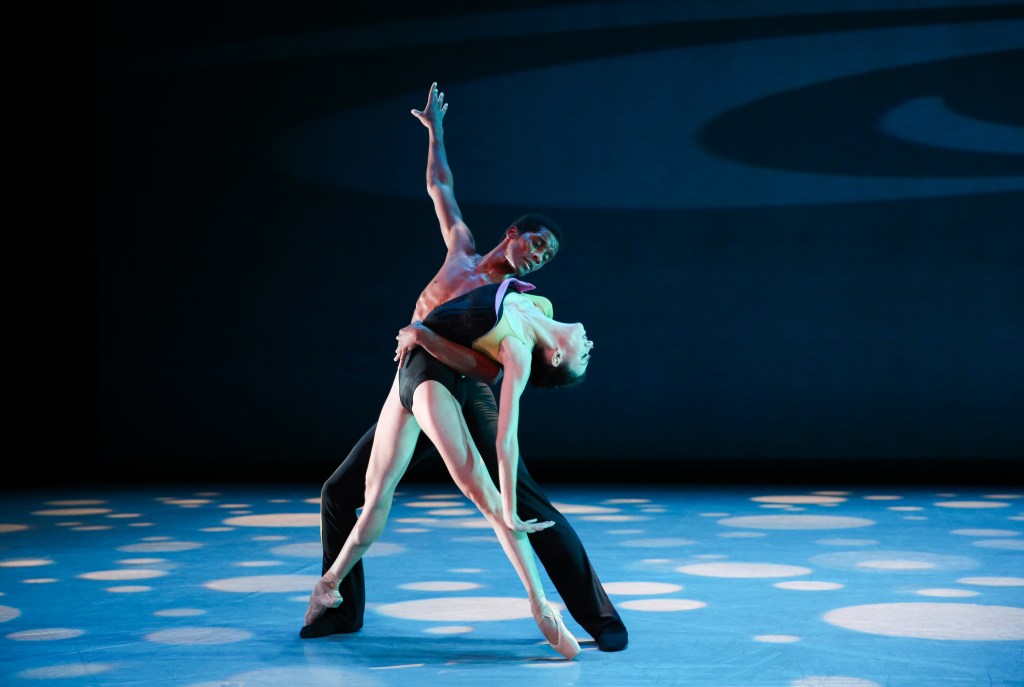
In Ma’s own words, “En Chalant” is an exploration into “the deeply human feeling of seeking connection through the shared experience of music.” To the viewer, it is a stunningly beautiful work with its simple black and nude costuming that praises the human form. Designer Rebecca Turk explained that the limb-lengthening design – featuring a soft sculpted neckline for the women and bare chest for the men – was inspired by the lines of the calla lily. Abstract, elegant, and edgy was the goal and the achievement. Trad A. Burns took his cue from the music and movement in designing the lighting that started off as a sort of wavy sun burst that evolved throughout the development of the dance, eventually returning to its original shape. “I hear music in color,” he said during the opening night post-performance discussion.
The first movement, “Radar,” by Volker Bertelmann who performs under the name Hauschka, floods the stage with motion – quick, winding, lively, purposeful, yet lighthearted. The second section, set to the music of Nils Frahm, “Some,” strives to achieve new shapes in partnering. Ma succeeds in bringing the music to human form, combining both classical and contemporary elements of the music and dance.
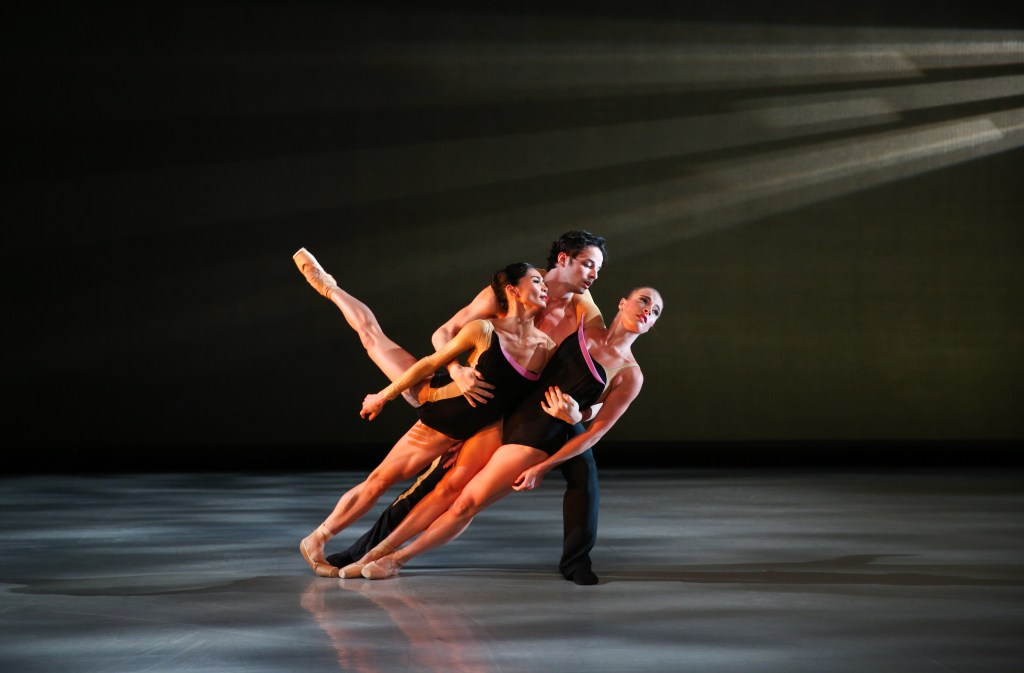
In the third section, performed to Jóhann Jóhannsson’s “Payphone,” further explores partnering, extending to a trio that somehow still manages to feel like a duet, as when Aleksey Babayev seemingly effortlessly supports Eri Nishihara and Celeste Gaiera in tandem. By the fourth movement, Burns’ projection has evolved from a sunburst to a single horizontal shaft to four radiating bars, to a galaxy – an animated swirl of not-quite concentric not-quite circles. The piece turns somewhat moody, somewhat futuristic, and I thought I heard a thunderclap in the distance near the end of Jóhannsson’s “The Rocket Builder (Lo Pan!).”
For the final section, Ma returns to Bertelmann/Hauschka and Burns resurrects the original sun ray and bathes the stage in a golden glow. Classical ballet lines both blend and contrast with quirky contemporary shapes and movements: big and open versus small and inward, sort of like if Balanchine met Fosse.
WE NEED LEADERS NOT IN LOVE WITH MONEY BUT IN LOVE WITH JUSTICE. – MLK, Jr.
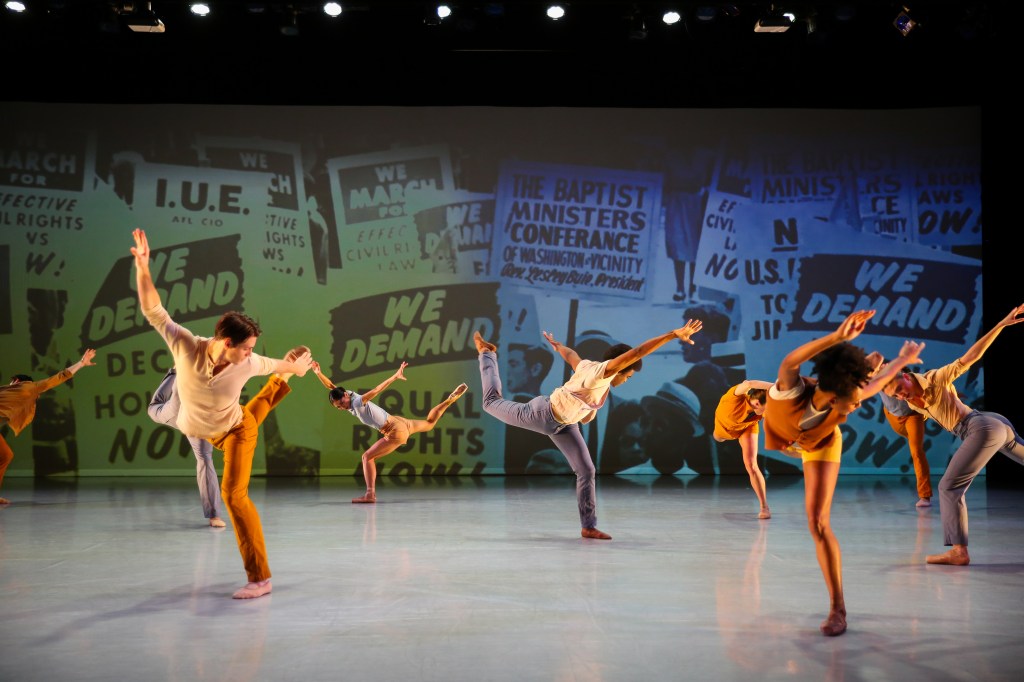
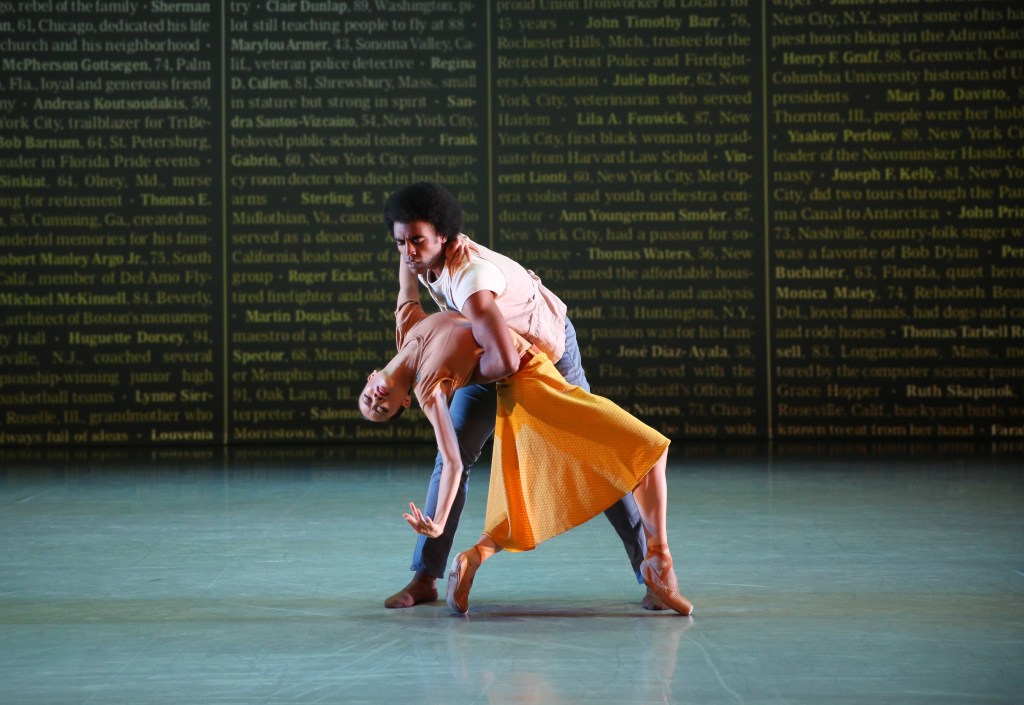
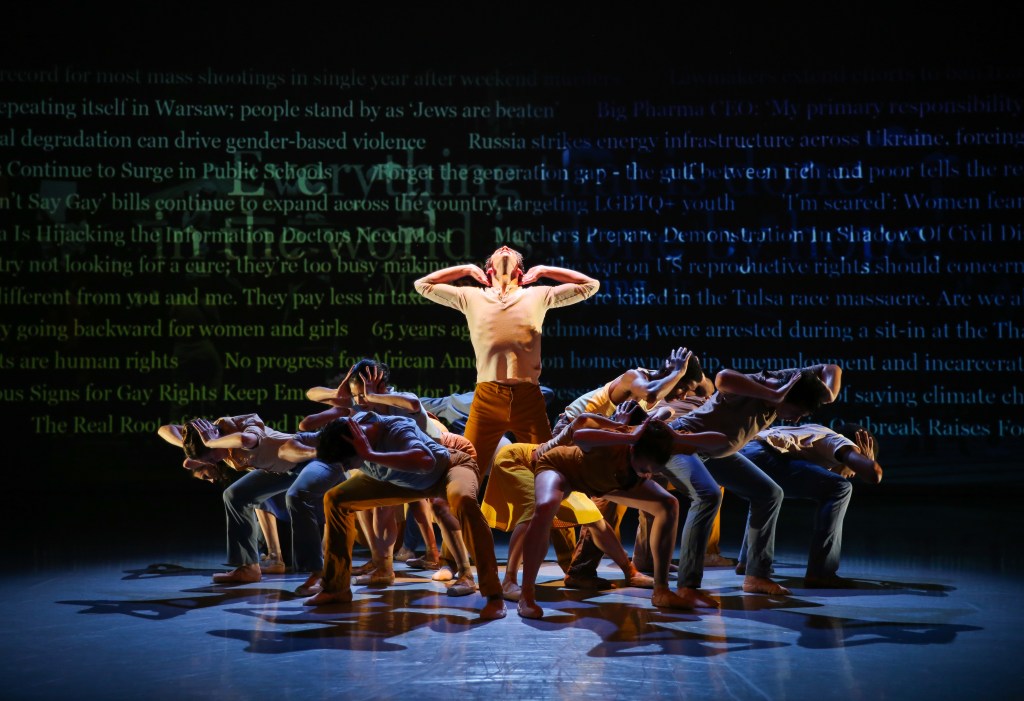
The second half of the program saw the return of Val Caniparoli’s “What’s Going On,” a contemporary work that begins and ends with quotes by the Rev. Dr. Martin Luther King, Jr. and features protest songs and music by artists familiar to those of us who were in high school during the final years of the Vietnam war: Marvin Gaye’s “What’s Going On,” Buffy Sainte-Marie’s “Little Wheel Spin and Spin,” Melanie’s gospel-folk protest song from Woodstock, 1969 “Lay Down (Candles in the Rain),” Bob Dylan’s “All Along the Watchtower,” which became Jimi Hendrix’s biggest hit, as well as his “Things Have Changed,” Pete Seeger’s “Where Have all the Flowers Gone?” and more.
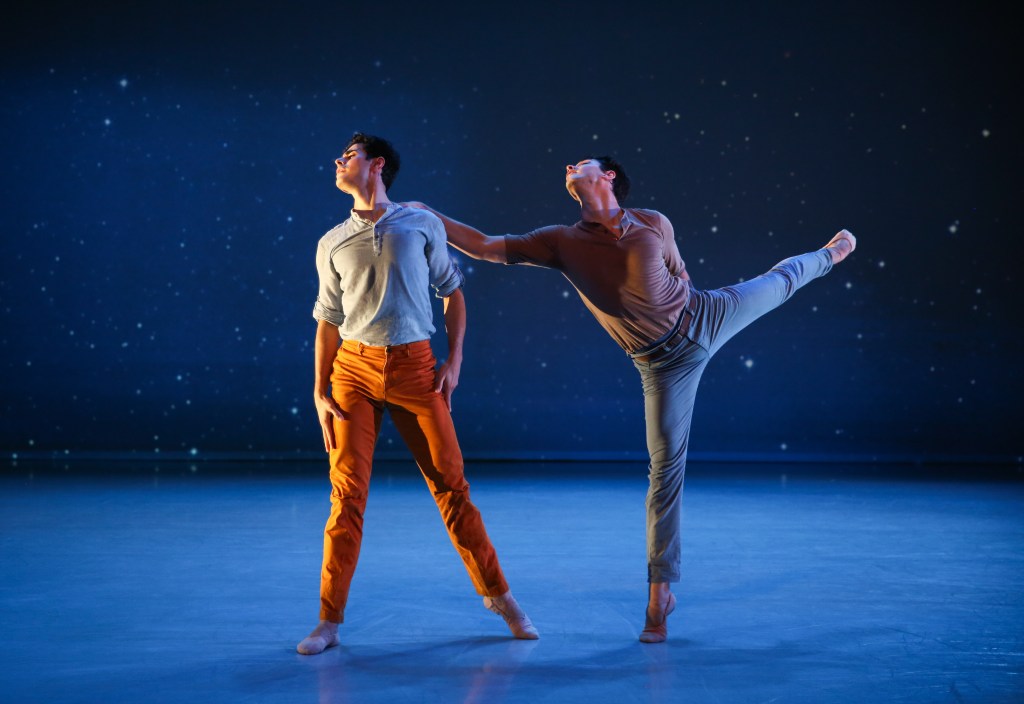
While the soundtrack is from the hey day of the Boomer generation, the subject matter spans decades and generations: the Civil Rights movement, AIDS, COVID-19, forest fires, climate change, equality, equity, decent housing, measles, childhood vaccines, the pandemic of 1918, Woodstock, big pharma, the Tulsa race massacre, the war on reproductive rights, the murder of trans people, the hanging of a man in Iran for being homosexual, the list goes on…And yes, there is a list – a projection of news articles, photos of anti-war protestors. This is the backdrop for Caniparoli’s “exploration of the modern human experience,” a work that uses music, visual images, and a blend of ballet, contemporary dance, and social dance to remind us of where we came from, and stirring up memories for some and planting the seeds of history in others. Dressed in everyday clothing, with lots of denim and a subdued brown – lighter than brown but deeper than tan – in various styles from skirts and dresses to shorts and jumpsuits, the dancers march, leap, stride.
In one striking scene, Izabella Tokev performs a tortured solo, to Pete Seeger’s “Where Have All the Flowers Gone?” as Alejandro Marino Hechavarria (how I love to say that name) and Ira White stride backwards in a low lunge across the back of the stage and as the song ends she slides into a prostrate position that mirrors the projection of a woman stretched forlornly across the grave a soldier who was returned home in a wooden box.
There is much to hear, see, and think about in “What’s Going On?” Caniparoli may have intended the final song, Bob Dylan’s “Things Have Changed” and the full group finale as an uplifting, hopeful conclusion, but are we really there yet? This work is dynamic and moving yet at the same time disturbing. In some ways, it reminds me of the group works created by Talley Beatty (e.g., “The Road of the Phoebe Snow”) and Donald McKayle (e.g., “Blues Suite”) and other creative expressions of embodied resistance in the 1950s and 1960s and beyond, but that would take us into a discussion of cultural identity and appropriation versus appreciation, and that’s a whole other article.
This is the kind of work that deserves a post-performance discussion – every single time it is performed.
EVERYTHING THAT IS DONE IN THE WORLD IS DONE BY HOPE. -MLK, Jr.
Finally, this program marks the end of the Richmond Ballet’s Studio series that started in 2002. During the past 22 years, 60 new works were premiered in the studio theatre as well as 33 New Works Festival sketches or works-in-progress. In March 2025, the Richmond Ballet will move the studio series to the Virginia Museum of Fine Arts, under the banner of Moving Art. Moving Art 1 begins March 20 with works by Ma Cong, Christopher Wheeldon, and Val Caniparoli. In Ma’s work, “Pentaptych,” a painter will be onstage with the dancers creating a one-of-a-kind painting for each performance. Moving Art 2 begins May 8, and will feature works by Joshua L. Peugh, Stoner Winslett, the company’s recently retired artistic director, and Yury Yanowsky, who will show the completed version of a work he began at the 2023 New Works Festival.
And of course, The Nutcracker returns to Dominion Energy Center beginning December 7 and Cinderella will be looking for her prince February 14-16. There is much to do, much to look forward to in the coming months.
———-
Julinda D. Lewis is a dancer, teacher, and writer who was born in Brooklyn, NY and now lives in Eastern Henrico County. When not writing about theater, she teaches dance history at VCU and low impact dance fitness classes to seasoned movers like herself, and occasionally performs. Her most recent (ad)venture was the premiere of a solo work, The Waters of Babylon or Psalm 137 Revisited: a Post-Exodus Reflection in Movement Choreographed From Collective Memories for the debut of the Critical Race Theatre Project, right here at RTP in August 2024.
———-
Photos by Sarah Ferguson (background images in “What’s Going On” photos licensed for remix)
En ChalantEn ChalantEn ChalantWhat’s Going OnWhat’s Going OnWhat’s Going OnWhat’s Going On
RICHMOND BALLET: STUDIO FINALEOne Door Closes, Another OpensA Dance Review By: The Richmond BalletAt: The Richmond Ballet Studio Theatre, 407 E Canal St, RVA 23219Performances: September 17-22, 2024Ticket Prices: $25 – $51Info: (804) 344-0906, etix.com, or richmondballet.comTHE PROGRAMEN CHALANTChoreography by Ma CongMusic by Nils Frahm, Hauschka, and Jóhann JóhannssonCostume Design by Rebecca TurkLighting Design by Trad A BurnsWorld Premiere: September 17, 2024, Richmond Ballet, Richmond Ballet Studio Theatre, Richmond, VAWHAT’S GOING ONChoreography by Val CaniparoliMusic by Leonard Cohen, Bob Dylan, Marvin Gaye, Meanie, Buffy Sainte-Marie, Jimmie Rodgers, Pete SeegerAssistant to the Choreographer: Maiqui ManosaStaged by Jerri KumeryCostume Design by Susan RoemerLighting and Projection Design by Trad A BurnsMusic Research by Lauren MorrisonWorld Premiere: May 10, 2022, Richmond Ballet, Richmond Ballet Studio Theatre, Richmond, VA Fifteen years ago Ma Cong presented his first work for the Richmond Ballet as a guest artist participating in the company’s annual New Works Festival. This week, he presented his first full length work as the newly installed Artistic Director of the Richmond Ballet. “En Chalant,” a work he described as “the complete opposite of nonchalant” is an abstract ballet that takes its inspiration from the music – in this case a selection of contemporary classic compositions by three composers, two German and one Icelandic, known for their contemporary classic work infused with elements of electronic music or, in one case, prepared piano. In Ma’s own words, “En Chalant” is an exploration into “the deeply human feeling of seeking connection through the shared experience of music.” To the viewer, it is a stunningly beautiful work with its simple black and nude costuming that praises the human form. Designer Rebecca Turk explained that the limb-lengthening design – featuring a soft sculpted neckline for the women and bare chest for the men – was inspired by the lines of the calla lily. Abstract, elegant, and edgy was the goal and the achievement. Trad A. Burns took his cue from the music and movement in designing the lighting that started off as a sort of wavy sun burst that evolved throughout the development of the dance, eventually returning to its original shape. “I hear music in color,” he said during the opening night post-performance discussion. The first movement, “Radar,” by Volker Bertelmann who performs under the name Hauschka, floods the stage with motion – quick, winding, lively, purposeful, yet lighthearted. The second section, set to the music of Nils Frahm, “Some,” strives to achieve new shapes in partnering. Ma succeeds in bringing the music to human form, combining both classical and contemporary elements of the music and dance. In the third section, performed to Jóhann Jóhannsson’s “Payphone,” further explores partnering, extending to a trio that somehow still manages to feel like a duet, as when Aleksey Babayev seemingly effortlessly supports Eri Nishihara and Celeste Gaiera in tandem. By the fourth movement, Burns’ projection has evolved from a sunburst to a single horizontal shaft to four radiating bars, to a galaxy – an animated swirl of not-quite concentric not-quite circles. The piece turns somewhat moody, somewhat futuristic, and I thought I heard a thunderclap in the distance near the end of Jóhannsson’s “The Rocket Builder (Lo Pan!).” For the final section, Ma returns to Bertelmann/Hauschka and Burns resurrects the original sun ray and bathes the stage in a golden glow. Classical ballet lines both blend and contrast with quirky contemporary shapes and movements: big and open versus small and inward, sort of like if Balanchine met Fosse. WE NEED LEADERS NOT IN LOVE WITH MONEYBUT IN LOVE WITH JUSTICE. – MLK, Jr.The second half of the program saw the return of Val Caniparoli’s “What’s Going On,” a contemporary work that begins and ends with quotes by the Rev. Dr. Martin Luther King, Jr. and features protest songs and music by artists familiar to those of us who were in high school during the final years of the Vietnam war: Marvin Gaye’s “What’s Going On,” Buffy Sainte-Marie’s “Little Wheel Spin and Spin,” Melanie’s gospel-folk protest song from Woodstock, 1969 “Lay Down (Candles in the Rain),” Bob Dylan’s “All Along the Watchtower,” which became Jimi Hendrix’s biggest hit, as well as his “Things Have Changed,” Pete Seeger’s “Where Have all the Flowers Gone?” and more. While the soundtrack is from the hey day of the Boomer generation, the subject matter spans decades and generations: the Civil Rights movement, AIDS, COVID-19, forest fires, climate change, equality, equity, decent housing, measles, childhood vaccines, the pandemic of 1918, Woodstock, big pharma, the Tulsa race massacre, the war on reproductive rights, the murder of trans people, the hanging of a man in Iran for being homosexual, the list goes on…And yes, there is a list – a projection of news articles, photos of anti-war protestors. This is the backdrop for Caniparoli’s “exploration of the modern human experience,” a work that uses music, visual images, and a blend of ballet, contemporary dance, and social dance to remind us of where we came from, and stirring up memories for some and planting the seeds of history in others. Dressed in everyday clothing, with lots of denim and a subdued brown – lighter than brown but deeper than tan – in various styles from skirts and dresses to shorts and jumpsuits, the dancers march, leap, stride. In one striking scene, Izabella Tokev performs a tortured solo, to Pete Seeger’s “Where Have All the Flowers Gone?” as Alejandro Marino Hechavarria (how I love to say that name) and Ira White stride backwards in a low lunge across the back of the stage and as the song ends she slides into a prostrate position that mirrors the projection of a woman stretched forlornly across the grave a soldier who was returned home in a wooden box. There is much to hear, see, and think about in “What’s Going On?” Caniparoli may have intended the final song, Bob Dylan’s “Things Have Changed” and the full group finale as an uplifting, hopeful conclusion, but are we really there yet? This work is dynamic and moving yet at the same time disturbing. In some ways, it reminds me of the group works created by Talley Beatty (e.g., “The Road of the Phoebe Snow”) and Donald McKayle (e.g., “Blues Suite”) and other creative expressions of embodied resistance in the 1950s and 1960s and beyond, but that would take us into a discussion of cultural identity and appropriation versus appreciation, and that’s a whole other article. This is the kind of work that deserves a post-performance discussion – every single time it is performed. EVERYTHING THAT IS DONE IN THE WORLDIS DONE BY HOPE. -MLK, Jr. Finally, this program marks the end of the Richmond Ballet’s Studio series that started in 2002. During the past 22 years, 60 new works were premiered in the studio theatre as well as 33 New Works Festival sketches or works-in-progress. In March 2025, the Richmond Ballet will move the studio series to the Virginia Museum of Fine Arts, under the banner of Moving Art. Moving Art 1 begins March 20 with works by Ma Cong, Christopher Wheeldon, and Val Caniparoli. In Ma’s work, “Pentaptych,” a painter will be onstage with the dancers creating a one-of-a-kind painting for each performance. Moving Art 2 begins May 8, and will feature works by Joshua L. Peugh, Stoner Winslett, the company’s recently retired artistic director, and Yury Yanowsky, who will show the completed version of a work he began at the 2023 New Works Festival. And of course, The Nutcracker returns to Dominion Energy Center beginning December 7 and Cinderella will be looking for her prince February 14-16. There is much to do, much to look forward to in the coming months. ———-Julinda D. Lewisis a dancer, teacher, and writer who was born in Brooklyn, NY and now lives in Eastern Henrico County. When not writing about theater, she teaches dance history at VCU and low impact dance fitness classes to seasoned movers like herself, and occasionally performs. Her most recent (ad)venture was the premiere of a solo work, The Waters of Babylon or Psalm 137 Revisited: a Post-Exodus Reflection in Movement Choreographed From Collective Memories for the debut of the Critical Race Theatre Project, right here at RTP in August 2024.
At: Richmond Triangle Players at the Robert B. Moss Theatre | Carpenter Foundation Stage, 1300 Altamont Ave, RVA 23230
Performances: September 11 – October 5, 2024
Ticket Prices: $50
Info: (804) 346-8113 or rtriangle.org
———-
NOTE:For the last review I wrote for this space, I confessed that I was unfamiliar with the play prior to seeing it, but someone kindly pointed out that I had actually reviewed the Richmond premiere several years prior. I wasn’t caught off guard this time. I remembered seeing this play before – in the same theater! – and my review of that earlier production was published in the Richmond Times Dispatch, February 20, 2015.
———-
September 13, 2024:
The leaders and members of the Susan B. Anthony Society for the Sisters of Gertrude Stein are gathered in the newly renovated community center for their annual Quiche Breakfast, but all is not as picture perfect as it appears on the surface. It’s 1956 and the country is uneasy about the prospect of impending nuclear attack and many – let’s be honest, all – of the widows (wink, wink) share a secret that no one dares speak aloud. When the security system signals a nuclear attack, everything changes.
The authors, Evan Linder and Andrew Hobgood – and the artistic team at Richmond Triangle Players – were eerily prescient. Change the year from 1956 to 2024 and the political climate, the threat of terrorism, and the challenges (dangers?) of being yourself are pretty much the same. I’m sure it was accident, no mere coincidence, that this production was planned for this pre-election period.
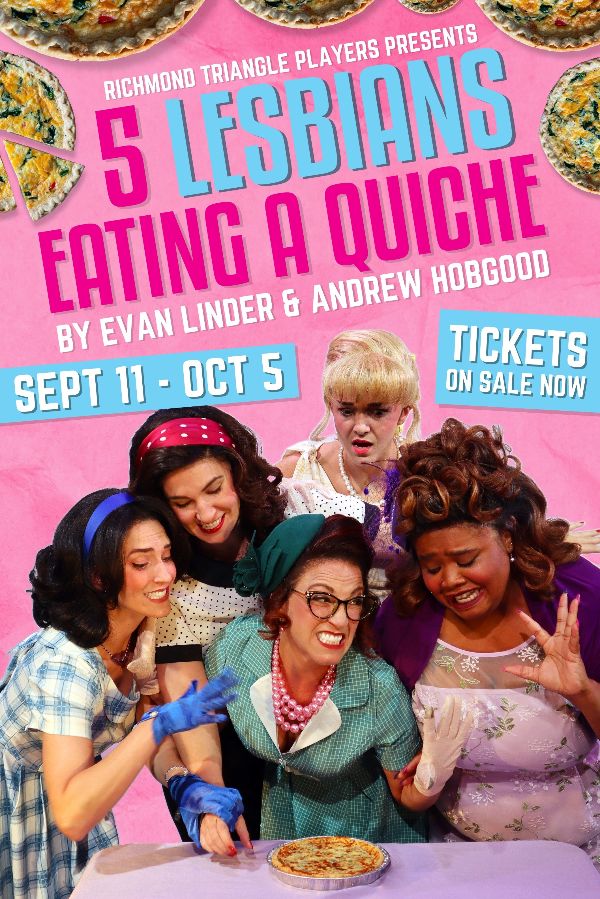
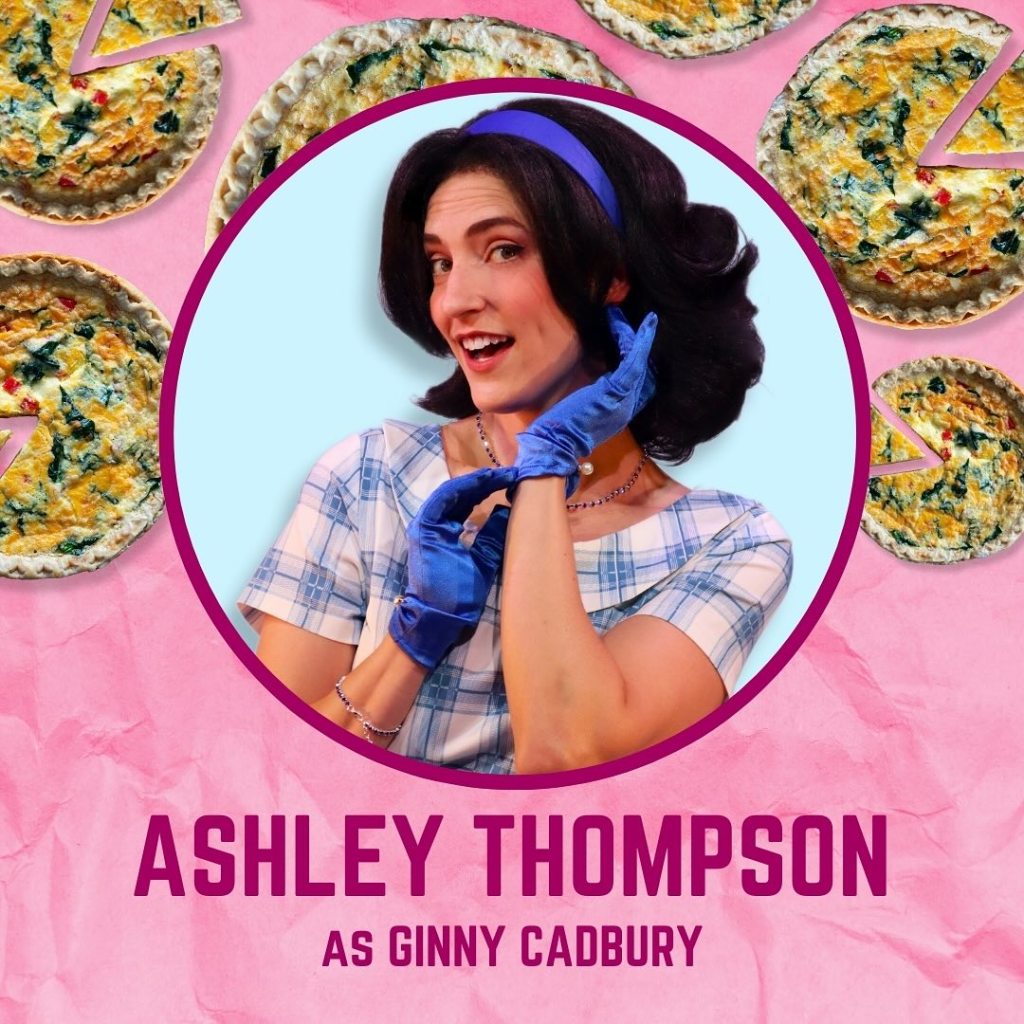
William Luther’s near cartoon-style set and gorgeous 1950s style dresses with their swinging skirts – some fluffed up by crinolines – stunning vintage shoes, hair bows, fascinators, and lace gloves are a feast for the eyes. The very demure outer appearance only makes the underlying sexual tension, innuendo, and banter that permeate each scene that much steamier. When Ashley Thompson’s character, Ginny Cadbury, the over-eager newest member of the group ends up atop a table with her face buried in a plate of quiche it’s as if a group of church ladies had suddenly put down their needle point to engage in an orgy. But I’m jumping ahead.
Theater-goers aka members receive name tags on arriving at their seats. Everyone gets a “female” name. I was Virginia this time. There is a lot of audience interaction, and one front-seat viewer in particular – “Margery” on opening night – gets to have an on-going supporting role. Nora Ogunleye as Wren Robin is the club’s event chair. Ogunleye, looking fabulous in a purple ensemble with matching hat and shoes brings over-the-top optimism and a mile-wide smile to the role. Kendall Walker plays Dale Prist, a wide-eyed innocent who looks like an animated Barbie doll and serves as the group’s historian with a classic Eastman-type film using camera around her neck.
Rachel Dilliplane brings barely repressed butch energy to Veronica “Vern” Schulz, the group’s buildings and grounds manager. Vern is the only one of the five women bold enough to wear pants, and in spite of her tight control over just about everything in her immediate world, Vern is the one who dropped the ball when it most mattered. Ashley Thompson slays as Ginny Cadbury, the newest member and recent British transplant who serves as the secretary. We never learn why – or if we did, it went over my head – Ginny is ostracized by the rest of the leadership team. Last but not least, Donna Marie Miller has the role of the group’s President, Lulie Stanwyck. A stickler for rules and protocol, who lives by the motto “no men, no meat,” it is Lulie who drops the biggest bombshell (I actually did not know that pun was coming) after the five find themselves confined to the shelter – with the possibility they may have to remain there for four long years.
Everything was moving along according to plan, you see, although there is a hint that things are not as they appear – when suddenly the lights flicker, the alarm sounds, and the safety door locks everyone inside against a nuclear attack. With seemingly nothing left to lose, it’s time to finally let go of long-held secrets. It turns out that “widow” is used here as a euphemism for lesbian. Once that is out in the open – and some are more reluctant to name their truth than others, and not even the audience is not exempt from participating in the apocalyptic confession – the floodgates open to reveal all sorts of secrets and Dale has an opportunity to earn a special place in the history of the sisterhood.
This cast is bright and snarky and generally hilarious. The costumes and set are visually delightful. The lighting and sound effects are appropriately over-the-top. The audience’s immersion pushes the edge of an unnamed boundary that gives heightened meaning to the word inclusion. What other play do you know of that encourages the audience to sing along to the theme song of an elite society and have everyone shout out, “I am a lesbian!” The issues are real: nuclear warfare, loyalty, discrimination, oppression, same-sex marriage. The timing of lines by the ensemble and the overall pacing set by director Kelsey Cordrey never attempts to belittle any of this, while at the same time guaranteeing there is never a dull moment. In short, 5 Lesbians Eating a Quicheis breathlessly entertaining.
———-
Julinda D. Lewis is a dancer, teacher, and writer who was born in Brooklyn, NY and now lives in Eastern Henrico County. When not writing about theater, she teaches dance history at VCU and low impact dance fitness classes to seasoned movers like herself, and occasionally performs. Her most recent (ad)venture was the premiere of a solo work, The Waters of Babylon or Psalm 137 Revisited: a Post-Exodus Reflection in Movement Choreographed From Collective Memories for the debut of the Critical Race Theatre Project, right here at RTP in August 2024.
———-
5 LESBIANS EATING A QUICHE
Written by Evan Linder & Andrew Hobgood
Directed by Kelsey Cordrey
Cast
Rachel Dilliplane as Veronica “Vern” Schultz [Note: the program spells her name Dillaplane but I used the spelling I’ve seen virtually everywhere else including her own social media]
Donna Marie Miller as Lulie Stanwyck
Nora Ogunleye as Wren Robin
Ashley Thompson as Ginny Cadbury
Understudies
Kendall Walker as Dale Prist
Emils Berry u/s for Wren Robin & Veronica “Vern” Schultz
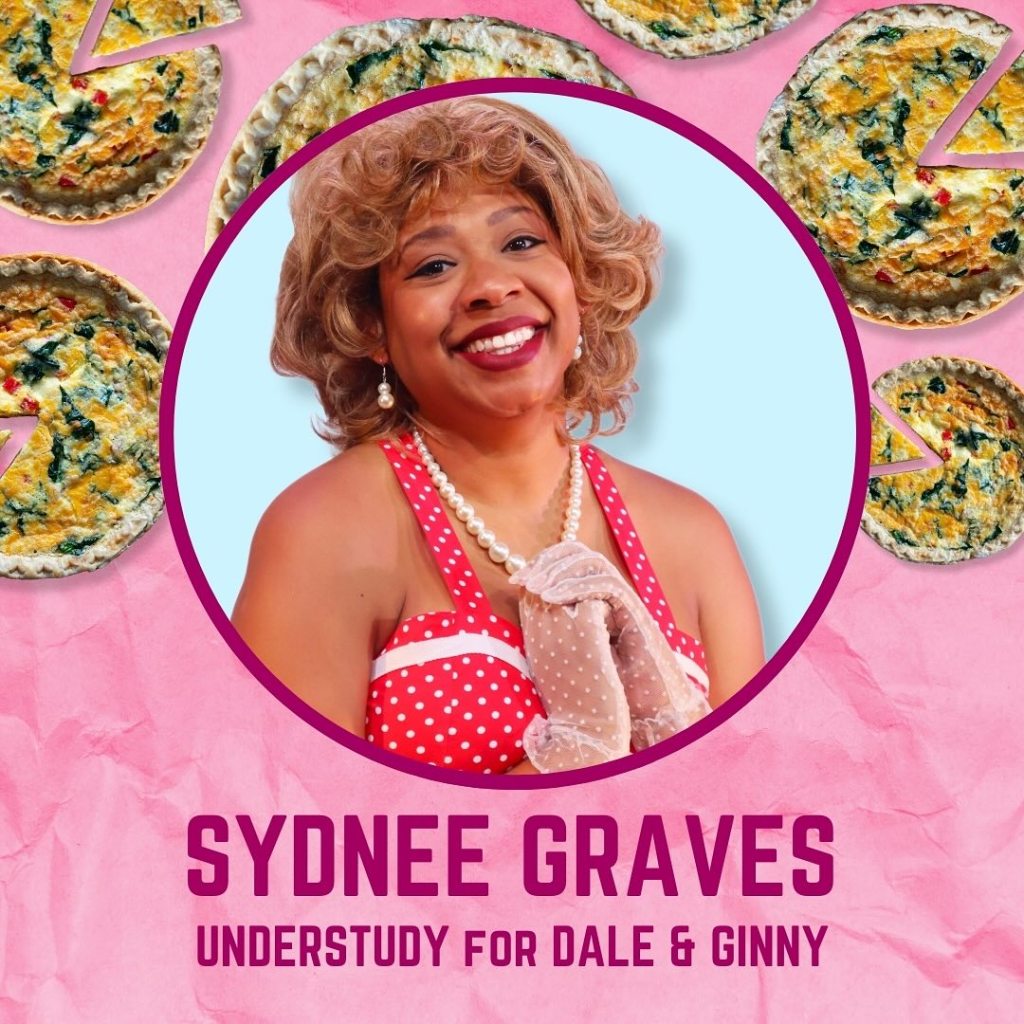
Sydnee Graces u/s for Dale Prist & Ginny Cadbury
Jen Hines u/s for Lulie Stanwyck
Production & Design
Playwright – Evan Linder & Andrew Hobgood
Director – Kelsey Cordrey
Scenic & Costume Design – William Luther
Lighting Design – Gretta Daughtry
Sound Design – Lucian Restivo
Props Design – Tim Moehring
Hair & Makeup Design – Luke Newsome
Production Stage Manager – Corrie Yarbrough
Assistant Stage Manager – Finn Thomason
Intimacy & Fight Director – Lucinda McDermott
Gender Consultant – August Hundley
Master Electrician – Griffin Hardy
Technical Director & Scenic Artist – William Luther
Scenic Construction – David Ballas, Josie Carter, Becka Russo, Kendall Walker
Setting
A community center in middle America where the annual Quiche Breakfast of the Susan B. Anthony Society for the Sisters of Gertrude Stein is being held. Today, 1956.
Run Time
Approximately 70 minutes without intermission
Ticket Information
$50, Info: (804) 346-8113 or rtriangle.org
Photo Credit: unattributed
One-Time
Monthly
Yearly
Make a one-time or recurring donation to show your support of RVART Review
Until a few weeks ago I had never heard of JOHN & JEN and I usually do not read about a show prior to seeing it in order to remain as unbiased as possible when I do see it. But now that I have seen this heart-warming sung-through musical, created for a cast of two actors playing three roles, it has earned a place as one of the most memorable musicals I’ve ever seen. [See the addendum at the end of this review!]
JOHN & JEN started out as a 10-minute musical – a labor of love created by two artists – a composer and a lyricist – who wanted to work together. Their 10-minute work became a full one-act musical, and eventually a second-act was added, with a twist that proved to be a natural outgrowth of the first act.
POSSIBLE SPOILER ALERT
It’s difficult to talk about JOHN & JEN without giving away the plot twist, so if you plan to see this show and want to be surprised, I suggest you stop reading now and come back to finish after you’ve seen the show. This little discussion starter will still be here.
POSSIBLE SPOILER ALERT
JOHN & JEN is a story of familial love and dysfunction. It is a multi-generational tale that spans nearly 4 decades, from 1952 to 1990, and is liberally sprinkled with social references that define each era. JOHN & JEN is also a story of family trauma and the resulting fallout. Most of all, JOHN & JEN is the story of a brother and sister and an inextricably linked story of a mother and son, a story of learning to let go in order to move on.
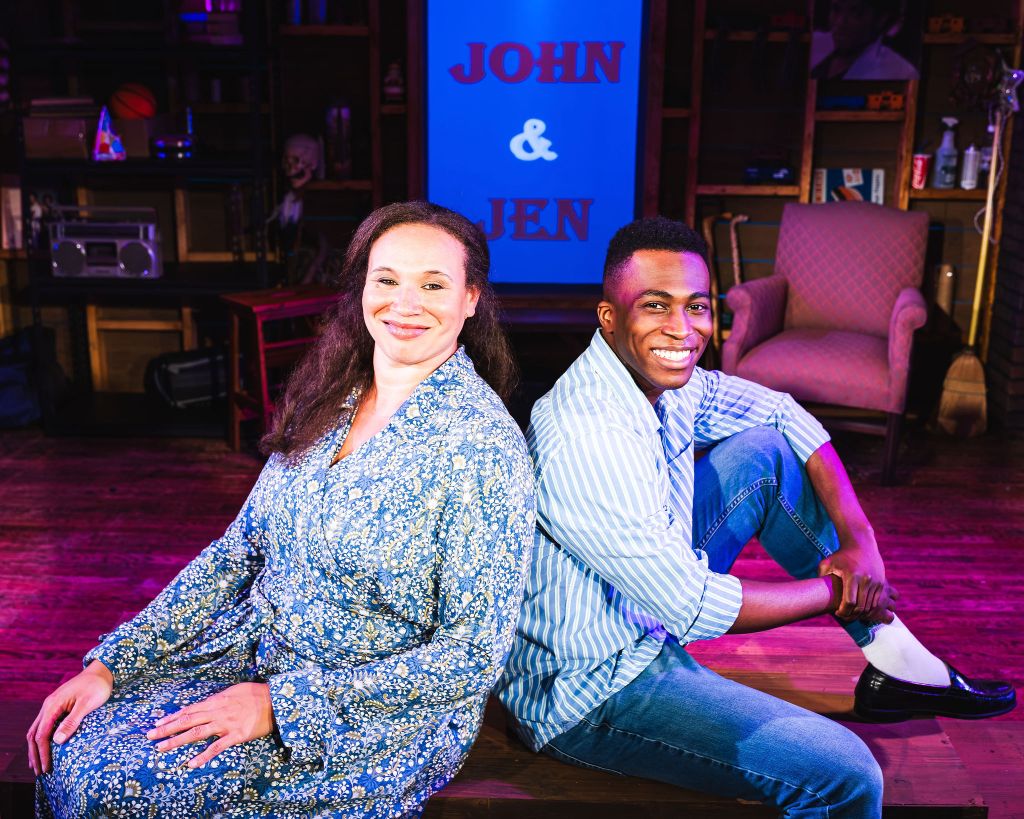
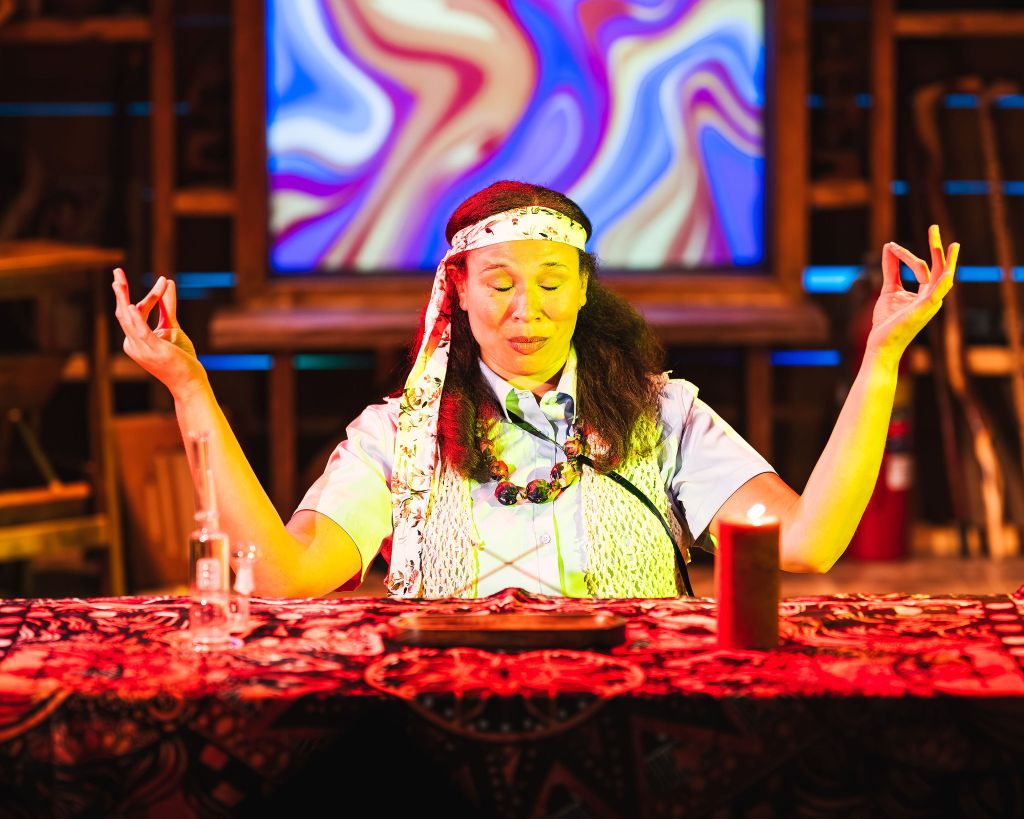
Nicole Pearson plays the role of Jen, and Malcolm Holmes plays the roles of John – and that’s not a typo, but it is the spoiler.
Act 1 opens with young Jen welcoming her baby brother “Welcome to the World” offers words of caution about the dangers he may face, and promises to always protect him. As we watch the two grow up, we learn that all is not well in this household – at least, not as seen through the eyes of Jen who seems to shoulder adult-level responsibilities at a very early age. It is Jen who explains why Santa can’t come one year. It is Jen who dominates a hilarious game of playing school, where we learn about George Washington and his dog Martha crossing the parted waters of the Potomac River. Yet, despite her best intentions to never leave her little brother, Jen seems to jump at the chance to leave home to attend college in New York where she quickly finds her tribe among the community of hippies and Viet Nam draft dodgers. It is this last that causes an irreparable rift.
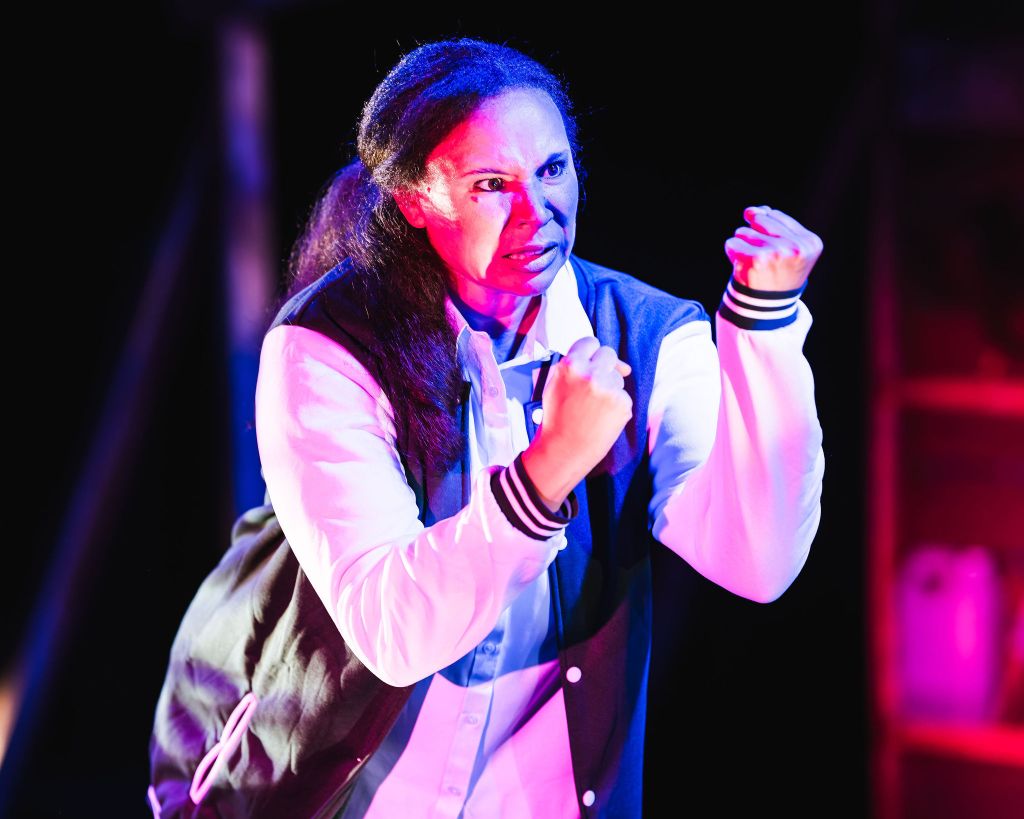
Malcolm Holmes plays the role of the young John with an uncanny mastery of the nuances of a young boy that manages not to appear mocking or dismissive. While both Pearson and Holmes bring a sort of “every-man” energy to their roles, by which I mean they lull us into feeling we know these people, there is one scene that really resonated with me. When 12 year old John begged 17 year old Jen to take him with her when she leaves for college, I was transported back to a time when my 5 year old son would suddenly burst into tears because he missed his 18 year old sister who was attending college in another state. This is the kind of energy Lippa and Greenwald wrote into JOHN & JEN. It is the kind of energy Tom Width brought to his direction, and it is the essence of the energy Pearson and Holmes manifested throughout the play.
While there are clear mile markers along the way, one thing JOHN & JEN never does is tell us where the family lives, leaving the door open for it to be wherever you live or lived at that time. The play takes us on a stroll through memory lane – or along the paths of history, depending on your age. 1964 is a Beatles collage. 1966 is an increased US presence in southeast Asia. 1967 is the “summer of love” and the Generation Gap. 1968 is Richard Nixon – and Jen has missed 2 years of John’s baseball games and Dad says you don’t love us anymore. 1969 is men walking on the moon and the NY Mets win the World Series.
John and Jen part on less than good terms, Jen to move to Canada with her draft dodging boyfriend and John to join the Navy. Act 1 ends with Jen unfolding a flag and draping it over a box as an uncharacteristically silent figure of John, wearing dress whites, observes from a distance. Pearson’s facial expressions and body language tell the subplot of the words that emerge from her throat. Holmes’ general exuberance make his moments of quiet watching and discernment all the more poignant.
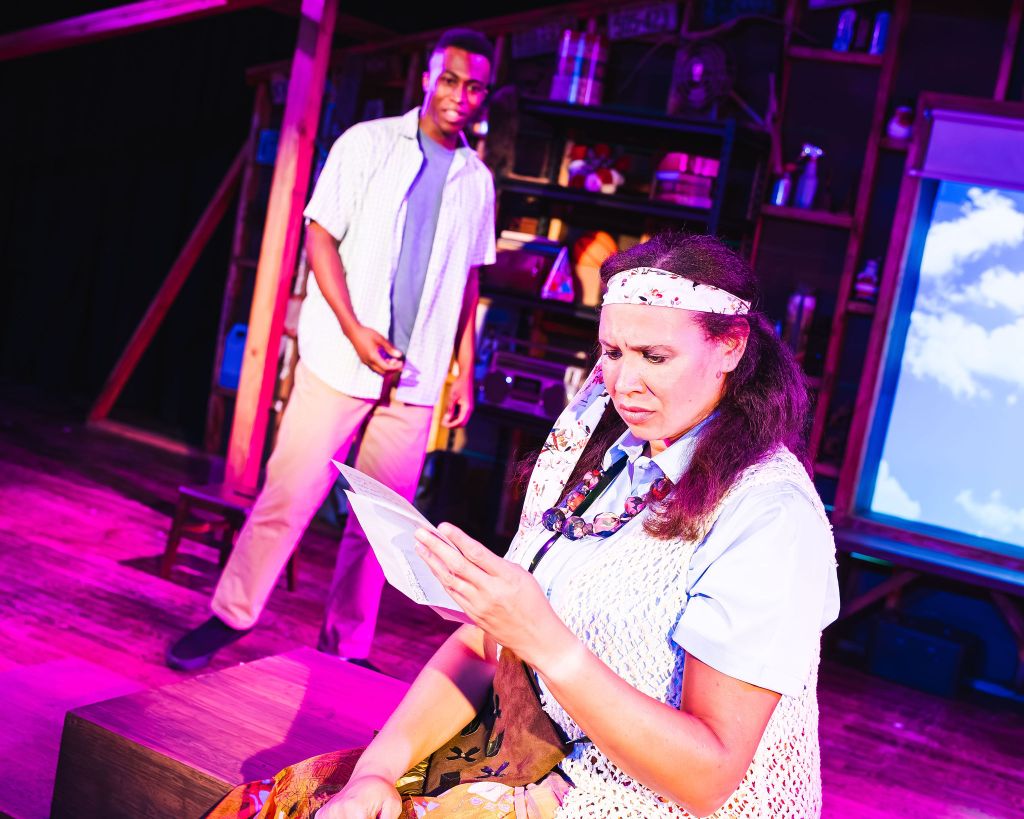
In Act 2 we see a reprise of Jen singing her “Welcome” song over a cradle, but this time the cradle holds her son, also named John. As Jen’s son grows, she makes the same promises to protect him she once made to her brother, even showering her son with her brother’s old clothes and toys, something this new generation John cannot relate to. As the years pass, Jen seem incapable of distinguishing between the two Johns, finally reaching the point of breakdown – or breakthrough – as she sits perusing a photo album. That, along with a visit to her brother’s grave on what would have been his 32nd birthday, jars Jen to accept a new reality and to finally move on. This come out as the final song, “Every Good-bye is Hello.”
For those who – inexplicably – do not like musicals, JOHN & JEN may not be for you. This is, after all, a sung-through musical in which most of the dialogue is sung rather than spoken, straddling that gray line you may never have known existed between musical and opera. Not only is it a musical, but it is also a two-person musical, so there are no distractions, no avoiding the fact that even simple statements are sung. But – and this is a big but – Pearson and Holmes are fantastic singers!
I’ll say it again, Pearson and Holmes are fantastic singers. They are really, really, really, really, really good! And while I don’t know the technical terms (I was a dance major, not a theater or music major), their voices are clear and they have the ability to lift you with them when they soar, to drag you down with them when they mourn, and to make you smile and feel hope when they harmonize. This is even more amazing in that Lippa and Greenwald did not write the kind of toe tapping sing-along songs that audiences find themselves humming for days or months after. This is music in the role of a character that moves us through the acts and scenes. This is music that entertains, but does so almost peripherally as it marches along doing the job of immersing the audience in the telling of the story.
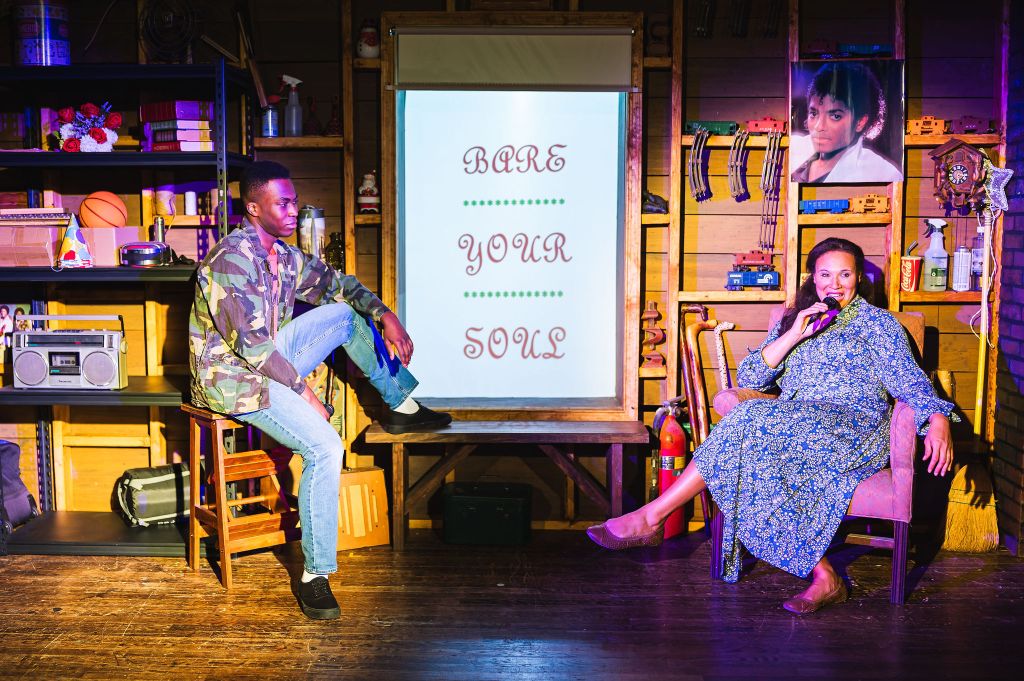
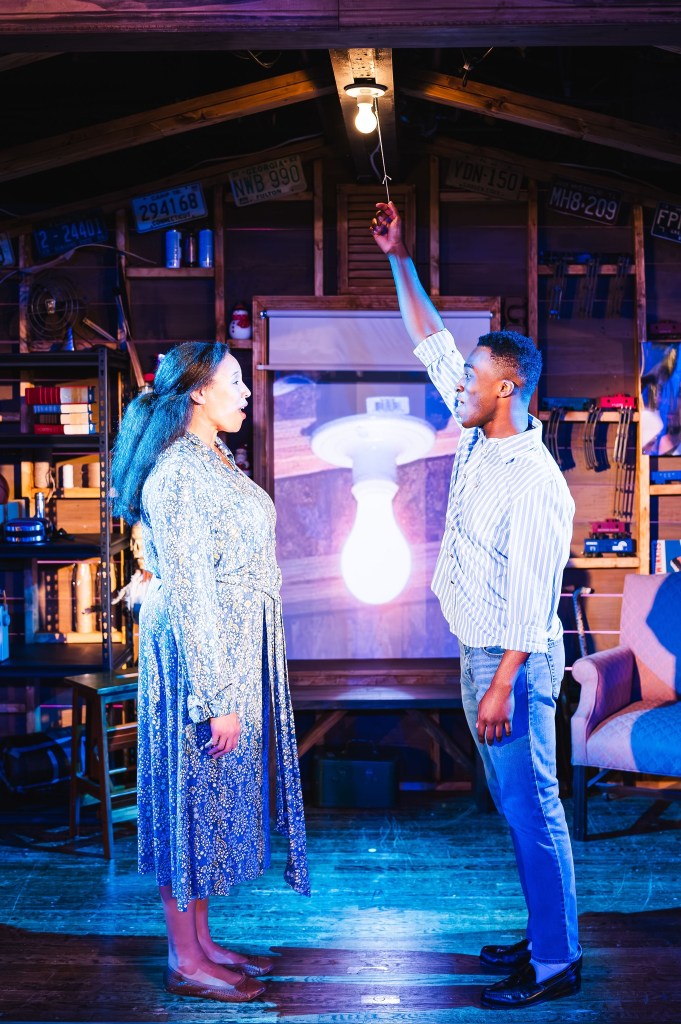
Width also, as he usually does, executed the scenic design. The set for JOHN & JEN is an attic with its steep walls and rough-hewn beams and shelving. Just as Holmes and Pearson infuse their characters with a sense of familiarity, so Width does with the set. There are boxes and bins, errant toys, a boom box, books, a clothing rack, camping equipment, a poster of Michael Jackson, along with most of the props the two actors will need. I felt like I was back in my great aunt’s attic where I used to play as a child, and found myself scanning the corners to see if I would find her old Singer sewing machine hiding there.
During his pre-show curtain talk, Width remarked that JOHN & JEN is a show that is much loved by theatre professionals, but little known to audiences. It is an unexpected treasure worth sharing.
FYI: Hate feels like
———-
Julinda D. Lewis, EdD is a dancer, teacher, and writer who was born in Brooklyn, NY and now lives in Eastern Henrico County. When not writing about theater and dance, she teaches dance history at VCU and low impact dance fitness classes to seasoned movers like herself, and occasionally performs. Her most recent (ad)venture was the premiere of a solo work, The Waters of Babylon or Psalm 137 Revisited: a Post-Exodus Reflection in Movement Choreographed From Collective Memories for the debut of the Critical Race Theatre Project.
Somewhere in the USA and Canada, between 1952 and 1990
Run Time:
About 90 minutes with 1 intermission
Tickets:
Regular $44-49. Discounts for Seniors, Military & Veterans
Photographer: Daryll Morgan Studios
Nicole Pearson and Malcolm Holmes
ADDENDUM: OMG. I was just reminded that I reviewed the Richmond premiere of this work in 2018 at HATTheatre! I had 4 surgeries and 20 radiation treatments in 2018 so my memory of that year may be more than a little bit clouded. Here is a link to that review, offering a totally different view of this show.

























 RVArt Review