RICHMOND BALLET: STUDIO FINALE

One Door Closes, Another Opens

A Dance Review

By: The Richmond Ballet

At: The Richmond Ballet Studio Theatre, 407 E Canal St, RVA 23219

Performances: September 17-22, 2024

Ticket Prices: $25 – $51

Info: (804) 344-0906, etix.com, or richmondballet.com

THE PROGRAM

EN CHALANT

Choreography by Ma Cong

Music by Nils Frahm, Hauschka, and Jóhann Jóhannsson

Costume Design by Rebecca Turk

Lighting Design by Trad A Burns

World Premiere: September 17, 2024,  Richmond Ballet, Richmond Ballet Studio Theatre, Richmond, VA

WHAT’S GOING ON

Choreography by Val Caniparoli

Music by Leonard Cohen, Bob Dylan, Marvin Gaye, Meanie, Buffy Sainte-Marie, Jimmie Rodgers, Pete Seeger

Assistant to the Choreographer: Maiqui Manosa

Staged by Jerri Kumery

Costume Design by Susan Roemer

Lighting and Projection Design by Trad A Burns

Music Research by Lauren Morrison

World Premiere: May 10, 2022, Richmond Ballet, Richmond Ballet Studio Theatre, Richmond, VA

Fifteen years ago Ma Cong presented his first work for the Richmond Ballet as a guest artist participating in the company’s annual New Works Festival. This week, he presented his first full length work as the newly installed Artistic Director of the Richmond Ballet.

“En Chalant,” a work he described as “the complete opposite of nonchalant” is an abstract ballet that takes its inspiration from the music – in this case a selection of contemporary classic compositions by three composers, two German and one Icelandic, known for their contemporary classic work infused with elements of electronic music or, in one case, prepared piano.

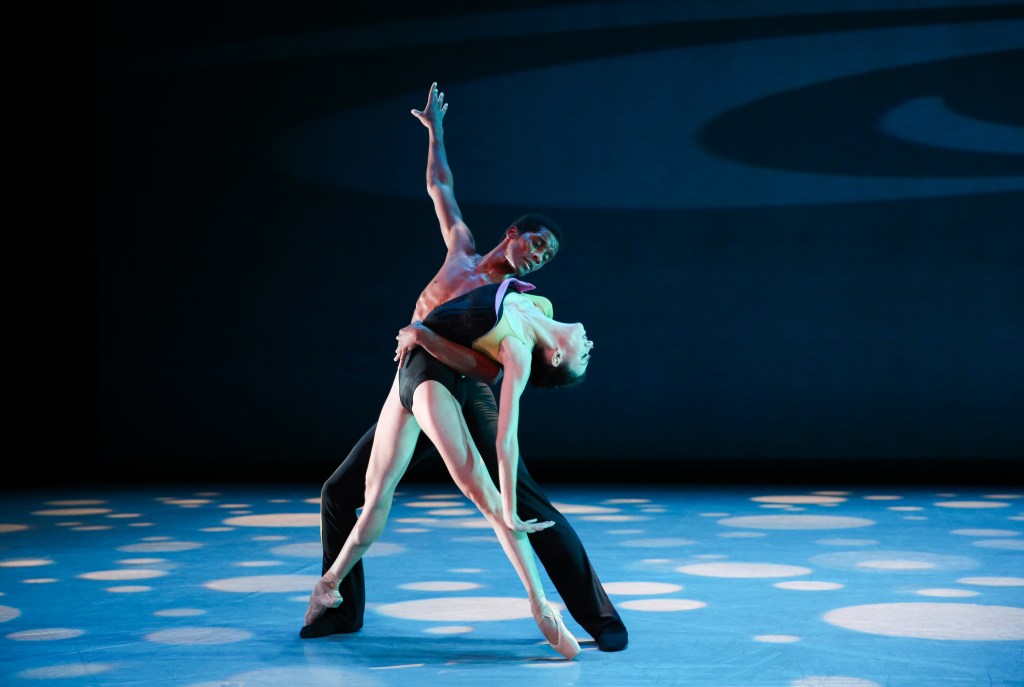
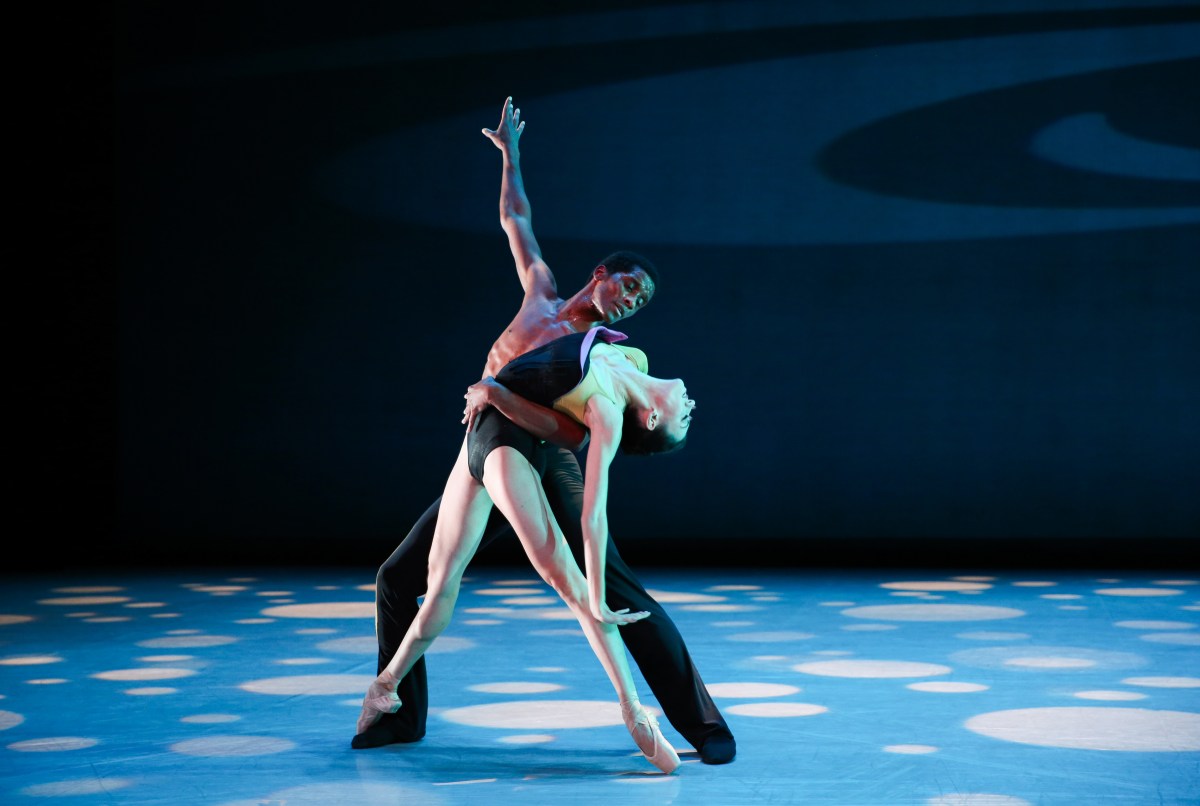
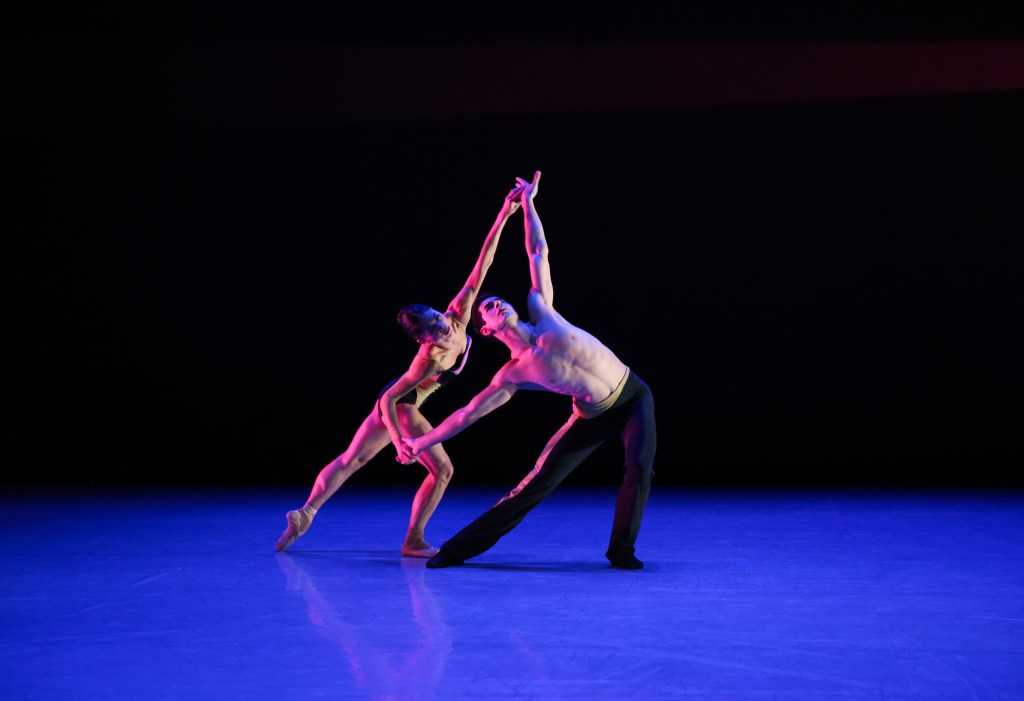
In Ma’s own words, “En Chalant” is an exploration into “the deeply human feeling of seeking connection through the shared experience of music.” To the viewer, it is a stunningly beautiful work with its simple black and nude costuming that praises the human form. Designer Rebecca Turk explained that the limb-lengthening design – featuring a soft sculpted neckline for the women and bare chest for the men – was inspired by the lines of the calla lily. Abstract, elegant, and edgy was the goal and the achievement. Trad A. Burns took his cue from the music and movement in designing the lighting that started off as a sort of wavy sun burst that evolved throughout the development of the dance, eventually returning to its original shape. “I hear music in color,” he said during the opening night post-performance discussion.

The first movement, “Radar,” by Volker Bertelmann who performs under the name Hauschka, floods the stage with motion – quick, winding, lively, purposeful, yet lighthearted. The second section, set to the music of Nils Frahm, “Some,” strives to achieve new shapes in partnering. Ma succeeds in bringing the music to human form, combining both classical and contemporary elements of the music and dance.

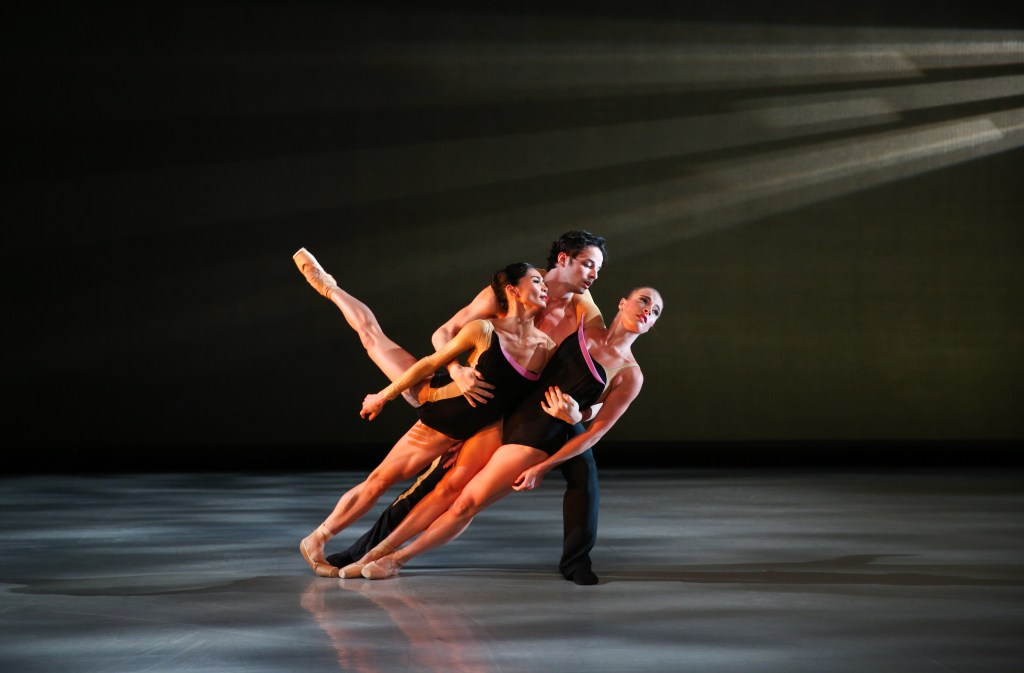
In the third section, performed to Jóhann Jóhannsson’s “Payphone,” further explores partnering, extending to a trio that somehow still manages to feel like a duet, as when Aleksey Babayev seemingly effortlessly supports Eri Nishihara and Celeste Gaiera in tandem. By the fourth movement, Burns’ projection has evolved from a sunburst to a single horizontal shaft to four radiating bars, to a galaxy – an animated swirl of not-quite concentric not-quite circles. The piece turns somewhat moody, somewhat futuristic, and I thought I heard a thunderclap in the distance near the end of Jóhannsson’s “The Rocket Builder (Lo Pan!).”

For the final section, Ma returns to Bertelmann/Hauschka and Burns resurrects the original sun ray and bathes the stage in a golden glow. Classical ballet lines both blend and contrast with quirky contemporary shapes and movements: big and open versus small and inward, sort of like if Balanchine met Fosse.

WE NEED LEADERS NOT IN LOVE WITH MONEY BUT IN LOVE WITH JUSTICE. – MLK, Jr.

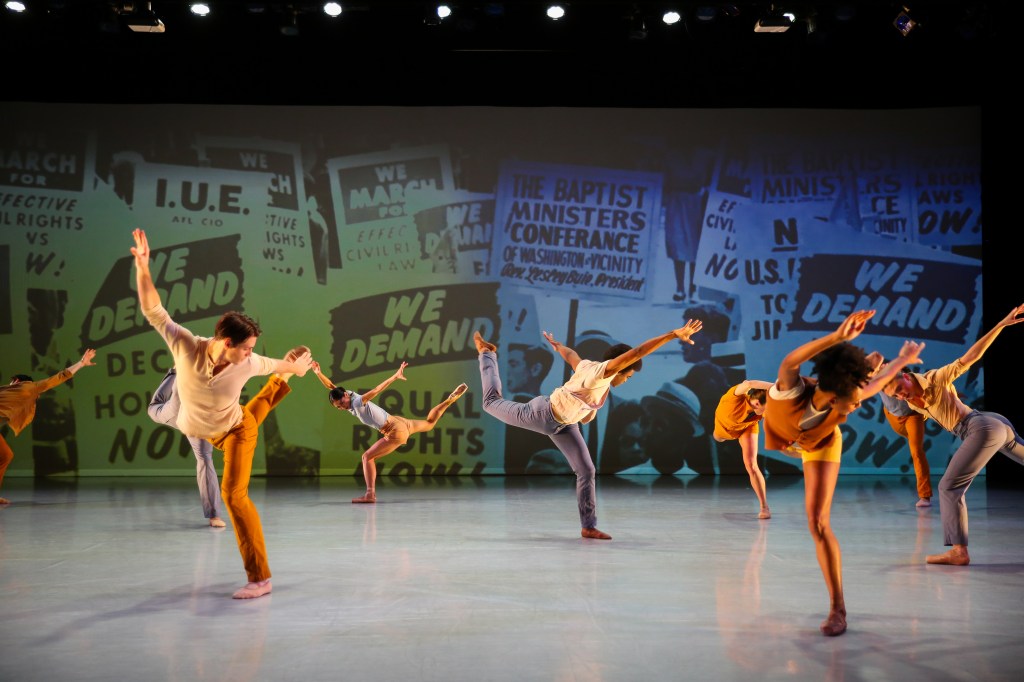
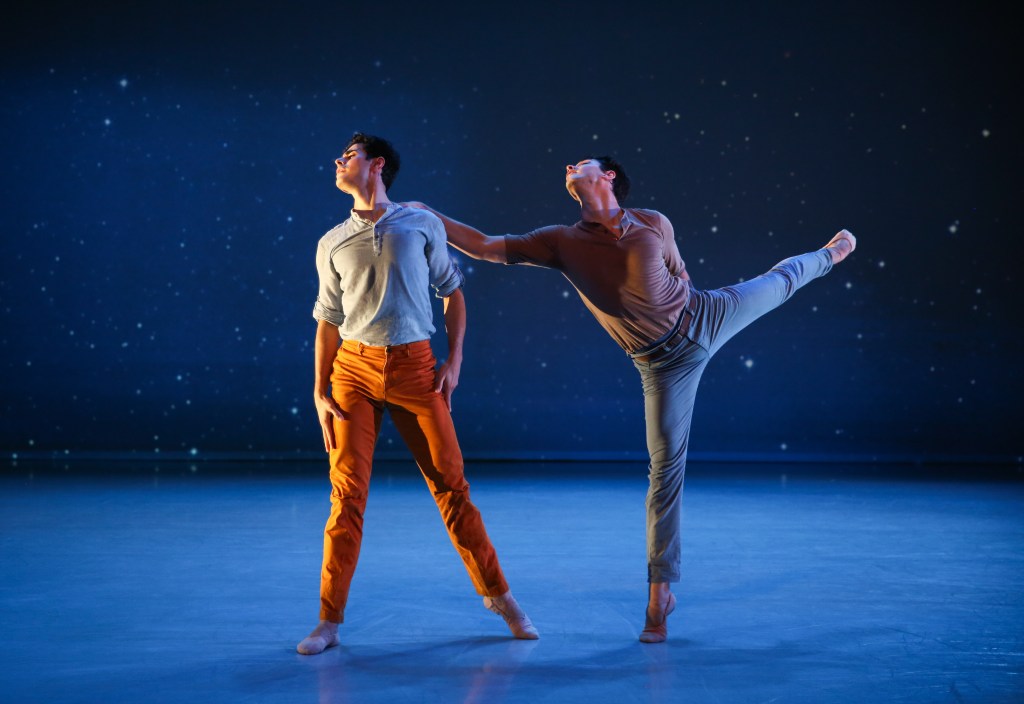
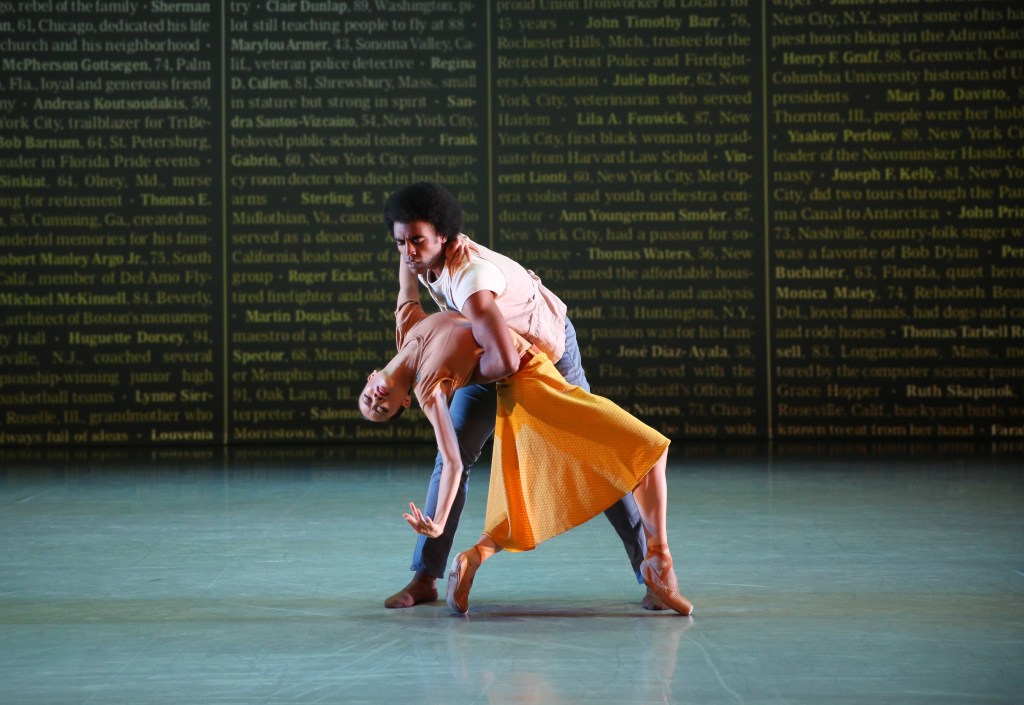
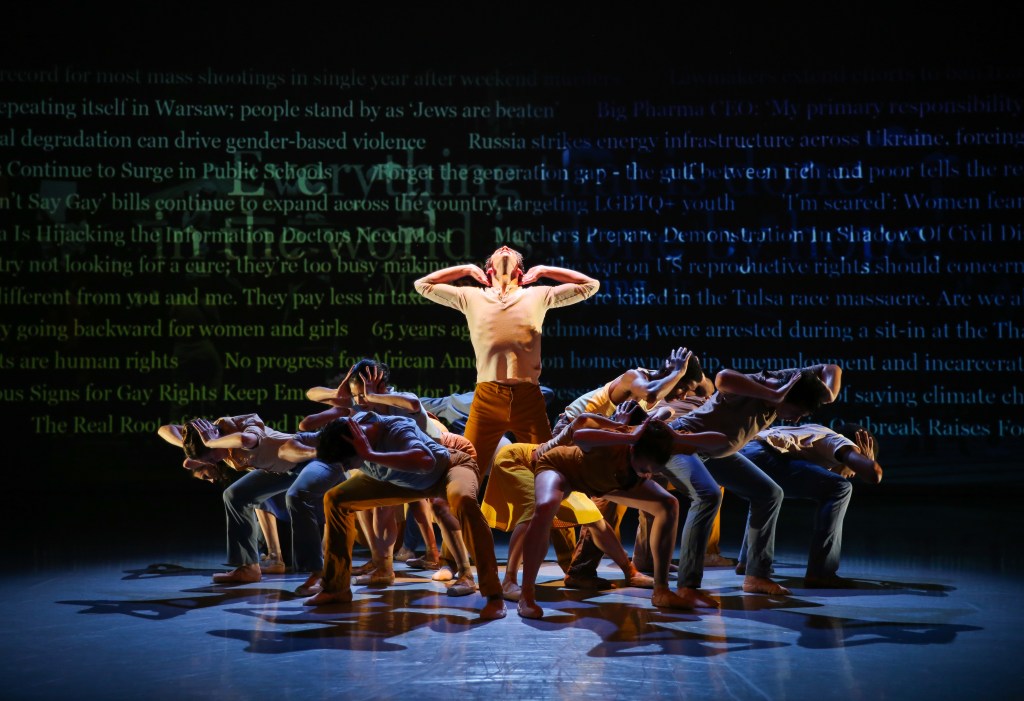
The second half of the program saw the return of Val Caniparoli’s “What’s Going On,” a contemporary work  that begins and ends with quotes by the Rev. Dr. Martin Luther King, Jr. and features protest songs and music by artists familiar to those of us who were in high school during the final years of the Vietnam war: Marvin Gaye’s “What’s Going On,” Buffy Sainte-Marie’s “Little Wheel Spin and Spin,” Melanie’s gospel-folk protest song from Woodstock, 1969 “Lay Down (Candles in the Rain),” Bob Dylan’s “All Along the Watchtower,” which became Jimi Hendrix’s biggest hit, as well as his “Things Have Changed,” Pete Seeger’s “Where Have all the Flowers Gone?” and more.

While the soundtrack is from the hey day of the Boomer generation, the subject matter spans decades and generations: the Civil Rights movement, AIDS, COVID-19, forest fires, climate change, equality, equity, decent housing, measles, childhood vaccines, the pandemic of 1918, Woodstock, big pharma, the Tulsa race massacre, the war on reproductive rights, the murder of trans people, the hanging of a man in Iran for being homosexual, the list goes on…And yes, there is a list – a projection of news articles, photos of anti-war protestors. This is the backdrop for Caniparoli’s “exploration of the modern human experience,” a work that uses music, visual images, and a blend of ballet, contemporary dance, and social dance to remind us of where we came from, and stirring up memories for some and planting the seeds of history in others. Dressed in everyday clothing, with lots of denim and a subdued brown – lighter than brown but deeper than tan – in various styles from skirts and dresses to shorts and jumpsuits, the dancers march, leap, stride.

In one striking scene, Izabella Tokev performs a tortured solo, to Pete Seeger’s “Where Have All the Flowers Gone?” as Alejandro Marino Hechavarria (how I love to say that name) and Ira White stride backwards in a low lunge across the back of the stage and as the song ends she slides into a prostrate position that mirrors the projection of a woman stretched forlornly across the grave a soldier who was returned home in a wooden box.

There is much to hear, see, and think about in “What’s Going On?” Caniparoli may have intended the final song, Bob Dylan’s “Things Have Changed” and the full group finale as an uplifting, hopeful conclusion, but are we really there yet? This work is dynamic and moving yet at the same time disturbing. In some ways, it reminds me of the group works created by Talley Beatty (e.g., “The Road of the Phoebe Snow”) and Donald McKayle (e.g., “Blues Suite”) and other creative expressions of embodied resistance in the 1950s and 1960s and beyond, but that would take us into a discussion of cultural identity and appropriation versus appreciation, and that’s a whole other article.

This is the kind of work that deserves a post-performance discussion – every single time it is performed.

EVERYTHING THAT IS DONE IN THE WORLD IS DONE BY HOPE. -MLK, Jr.

Finally, this program marks the end of the Richmond Ballet’s Studio series that started in 2002. During the past 22 years, 60 new works were premiered in the studio theatre as well as 33 New Works Festival sketches or works-in-progress. In March 2025, the Richmond Ballet will move the studio series to the Virginia Museum of Fine Arts, under the banner of Moving Art. Moving Art 1 begins March 20 with works by Ma Cong, Christopher Wheeldon, and Val Caniparoli. In Ma’s work, “Pentaptych,” a painter will be onstage with the dancers creating a one-of-a-kind painting for each performance. Moving Art 2 begins May 8, and will feature works by Joshua L. Peugh, Stoner Winslett, the company’s recently retired artistic director, and Yury Yanowsky, who will show the completed version of a work he began at the 2023 New Works Festival.

And of course, The Nutcracker returns to Dominion Energy Center beginning December 7 and Cinderella will be looking for her prince February 14-16. There is much to do, much to look forward to in the coming months.

———-

Julinda D. Lewis is a dancer, teacher, and writer who was born in Brooklyn, NY and now lives in Eastern Henrico County. When not writing about theater, she teaches dance history at VCU and low impact dance fitness classes to seasoned movers like herself, and occasionally performs. Her most recent (ad)venture was the premiere of a solo work, The Waters of Babylon or Psalm 137 Revisited: a Post-Exodus Reflection in Movement Choreographed From Collective Memories for the debut of the Critical Race Theatre Project, right here at RTP in August 2024.

———-

Photos by Sarah Ferguson (background images in “What’s Going On” photos licensed for remix)


RICHMOND BALLET:
STUDIO FINALE
One Door Closes, Another OpensA Dance Review By: The Richmond BalletAt:
The Richmond Ballet Studio Theatre, 407 E Canal St, RVA 23219
Performances: September 17-22, 2024Ticket Prices: $25 – $51Info: (804) 344-0906, etix.com, or
richmondballet.com
 THE PROGRAMEN CHALANTChoreography by Ma CongMusic by Nils Frahm, Hauschka, and Jóhann JóhannssonCostume Design by Rebecca TurkLighting Design by Trad A BurnsWorld Premiere: September 17, 2024,  Richmond Ballet, Richmond Ballet Studio
Theatre, Richmond, VA
WHAT’S GOING ONChoreography by Val CaniparoliMusic by Leonard Cohen, Bob Dylan, Marvin
Gaye, Meanie, Buffy Sainte-Marie, Jimmie Rodgers, Pete SeegerAssistant to the Choreographer: Maiqui ManosaStaged by Jerri KumeryCostume Design by Susan RoemerLighting and Projection Design by Trad A BurnsMusic Research by Lauren MorrisonWorld Premiere: May 10, 2022, Richmond Ballet,
Richmond Ballet Studio Theatre, Richmond, VA 
Fifteen years ago Ma Cong presented his first work for the
Richmond Ballet as a guest artist participating in the company’s annual New
Works Festival. This week, he presented his first full length work as the newly
installed Artistic Director of the Richmond Ballet. “En Chalant,” a work he described as “the complete opposite of
nonchalant” is an abstract ballet that takes its inspiration from the music – in
this case a selection of contemporary classic compositions by three composers,
two German and one Icelandic, known for their contemporary classic work infused
with elements of electronic music or, in one case, prepared piano.  In Ma’s own words, “En Chalant” is an exploration into “the deeply
human feeling of seeking connection through the shared experience of music.” To
the viewer, it is a stunningly beautiful work with its simple black and nude
costuming that praises the human form. Designer Rebecca Turk explained that the
limb-lengthening design – featuring a soft sculpted neckline for the women and bare
chest for the men – was inspired by the lines of the calla lily. Abstract,
elegant, and edgy was the goal and the achievement. Trad A. Burns took his cue
from the music and movement in designing the lighting that started off as a
sort of wavy sun burst that evolved throughout the development of the dance,
eventually returning to its original shape. “I hear music in color,” he said during
the opening night post-performance discussion. The first movement, “Radar,” by Volker Bertelmann who performs
under the name Hauschka, floods the stage with motion – quick, winding, lively,
purposeful, yet lighthearted. The second section, set to the music of Nils
Frahm, “Some,” strives to achieve new shapes in partnering. Ma succeeds in bringing
the music to human form, combining both classical and contemporary elements of
the music and dance. In the third section, performed to
Jóhann Jóhannsson’s “Payphone,” further explores
partnering, extending to a trio that somehow still manages to feel like a duet,
as when Aleksey Babayev seemingly effortlessly supports Eri Nishihara and Celeste
Gaiera in tandem. By the fourth movement, Burns’ projection has evolved from a
sunburst to a single horizontal shaft to four radiating bars, to a galaxy – an animated
swirl of not-quite concentric not-quite circles. The piece turns somewhat
moody, somewhat futuristic, and I thought I heard a thunderclap in the distance
near the end of Jóhannsson’s “The Rocket Builder (Lo Pan!).”  For the final section, Ma returns to Bertelmann/Hauschka
and Burns resurrects the original sun ray and bathes the stage in a golden
glow. Classical ballet lines both blend and contrast with quirky contemporary
shapes and movements: big and open versus small and inward, sort of like if
Balanchine met Fosse. 
WE NEED
LEADERS NOT IN LOVE WITH MONEYBUT IN
LOVE WITH JUSTICE. – MLK, Jr.
The second half of the program saw the return
of Val Caniparoli’s “What’s Going On,” a contemporary work  that begins and ends with quotes by the Rev.
Dr. Martin Luther King, Jr. and features protest songs and music by artists
familiar to those of us who were in high school during the final years of the Vietnam
war: Marvin Gaye’s “What’s Going On,” Buffy Sainte-Marie’s “Little Wheel Spin
and Spin,” Melanie’s gospel-folk protest song from Woodstock, 1969 “Lay Down
(Candles in the Rain),” Bob Dylan’s “All Along the Watchtower,” which became
Jimi Hendrix’s biggest hit, as well as his “Things Have Changed,” Pete Seeger’s
“Where Have all the Flowers Gone?” and more.  While the soundtrack is from the hey day of
the Boomer generation, the subject matter spans decades and generations: the
Civil Rights movement, AIDS, COVID-19, forest fires, climate change, equality,
equity, decent housing, measles, childhood vaccines, the pandemic of 1918,
Woodstock, big pharma, the Tulsa race massacre, the war on reproductive rights,
the murder of trans people, the hanging of a man in Iran for being homosexual,
the list goes on…And yes, there is a list – a projection of news articles, photos
of anti-war protestors. This is the backdrop for Caniparoli’s “exploration of
the modern human experience,” a work that uses music, visual images, and a
blend of ballet, contemporary dance, and social dance to remind us of where we
came from, and stirring up memories for some and planting the seeds of history
in others. Dressed in everyday clothing, with lots of denim and a subdued brown
– lighter than brown but deeper than tan – in various styles from skirts and
dresses to shorts and jumpsuits, the dancers march, leap, stride.  In one striking scene, Izabella Tokev performs
a tortured solo, to Pete Seeger’s “Where Have All the Flowers Gone?” as
Alejandro Marino Hechavarria (how I love to say that name) and Ira White stride
backwards in a low lunge across the back of the stage and as the song ends she slides
into a prostrate position that mirrors the projection of a woman stretched
forlornly across the grave a soldier who was returned home in a wooden box.  There is much to hear, see, and think about in
“What’s Going On?” Caniparoli may have intended the final song, Bob Dylan’s “Things
Have Changed” and the full group finale as an uplifting, hopeful conclusion,
but are we really there yet? This work is dynamic and moving yet at the same
time disturbing. In some ways, it reminds me of the group works created by
Talley Beatty (e.g., “The Road of the Phoebe Snow”) and Donald McKayle (e.g., “Blues
Suite”) and other creative expressions of embodied resistance in the 1950s and
1960s and beyond, but that would take us into a discussion of cultural identity
and appropriation versus appreciation, and that’s a whole other article.
 This is the kind of work that deserves a post-performance
discussion – every single time it is performed. 
EVERYTHING THAT IS DONE IN THE WORLDIS DONE BY HOPE. -MLK, Jr. Finally, this program marks the end of the Richmond Ballet’s
Studio series that started in 2002. During the past 22 years, 60 new works were
premiered in the studio theatre as well as 33 New Works Festival sketches or
works-in-progress. In March 2025, the Richmond Ballet will move the studio
series to the Virginia Museum of Fine Arts, under the banner of Moving Art.
Moving Art 1 begins March 20 with works by Ma Cong, Christopher Wheeldon, and
Val Caniparoli. In Ma’s work, “Pentaptych,” a painter will be onstage with the
dancers creating a one-of-a-kind painting for each performance. Moving Art 2
begins May 8, and will feature works by Joshua L. Peugh, Stoner Winslett, the
company’s recently retired artistic director, and Yury Yanowsky, who will show
the completed version of a work he began at the 2023 New Works Festival.  And of course, The Nutcracker returns to Dominion
Energy Center beginning December 7 and Cinderella will be looking for
her prince February 14-16. There is much to do, much to look forward to in the
coming months. 
———-Julinda D. Lewis is a dancer, teacher, and writer who was born in Brooklyn, NY
and now lives in Eastern Henrico County. When not writing about theater, she
teaches dance history at VCU and low impact dance fitness classes to seasoned
movers like herself, and occasionally performs. Her most recent (ad)venture was
the premiere of a solo work, The Waters of Babylon or Psalm 137 Revisited: a
Post-Exodus Reflection in Movement Choreographed From Collective Memories

for the debut of the Critical Race Theatre Project, right here at RTP in August
2024.


FIVE LESBIANS EATING A QUICHE

Respect the Egg

A Theater Review by Julinda D. Lewis

At: Richmond Triangle Players at the Robert B. Moss Theatre | Carpenter Foundation Stage, 1300 Altamont Ave, RVA 23230

Performances:  September 11 – October 5, 2024

Ticket Prices: $50

Info: (804) 346-8113 or rtriangle.org

———-

NOTE: For the last review I wrote for this space, I confessed that I was unfamiliar with the play prior to seeing it, but someone kindly pointed out that I had actually reviewed the Richmond premiere several years prior. I  wasn’t caught off guard this time. I remembered seeing this play before – in the same theater! – and my review of that earlier production was published in the Richmond Times  Dispatch, February 20, 2015.

———-

September 13, 2024:

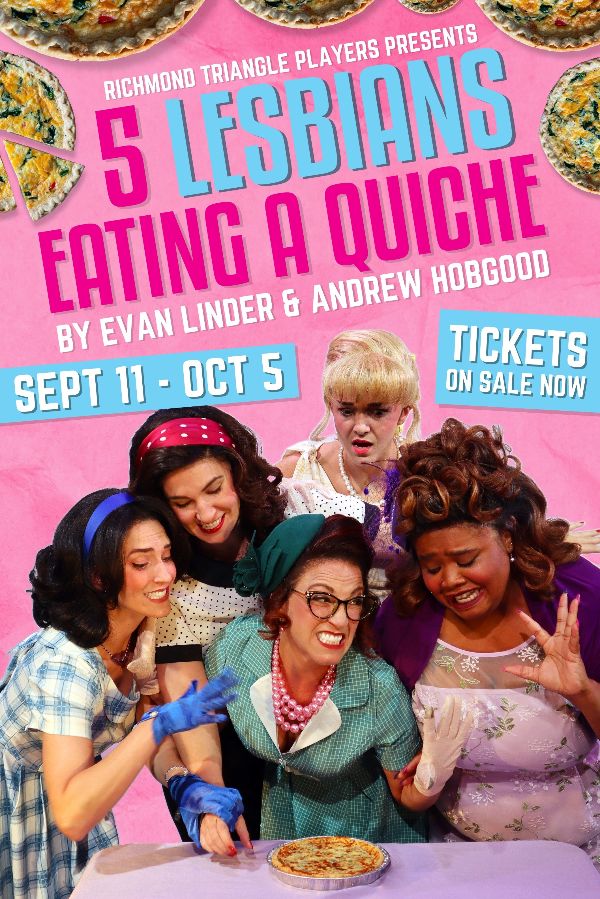
The leaders and members of the Susan B. Anthony Society for the Sisters of Gertrude Stein are gathered in the newly renovated community center for their annual Quiche Breakfast, but all is not as picture perfect as it appears on the surface. It’s 1956 and the country is uneasy about the prospect of impending nuclear attack and many – let’s be honest, all – of the widows (wink, wink) share a secret that no one dares speak aloud. When the security system signals a nuclear attack, everything changes.

The authors, Evan Linder and Andrew Hobgood – and the artistic team at Richmond Triangle Players – were eerily prescient. Change the year from 1956 to 2024 and the political climate, the threat of terrorism, and the challenges (dangers?) of being yourself are pretty much the same. I’m sure it was accident, no mere coincidence, that this production was planned for this pre-election period.

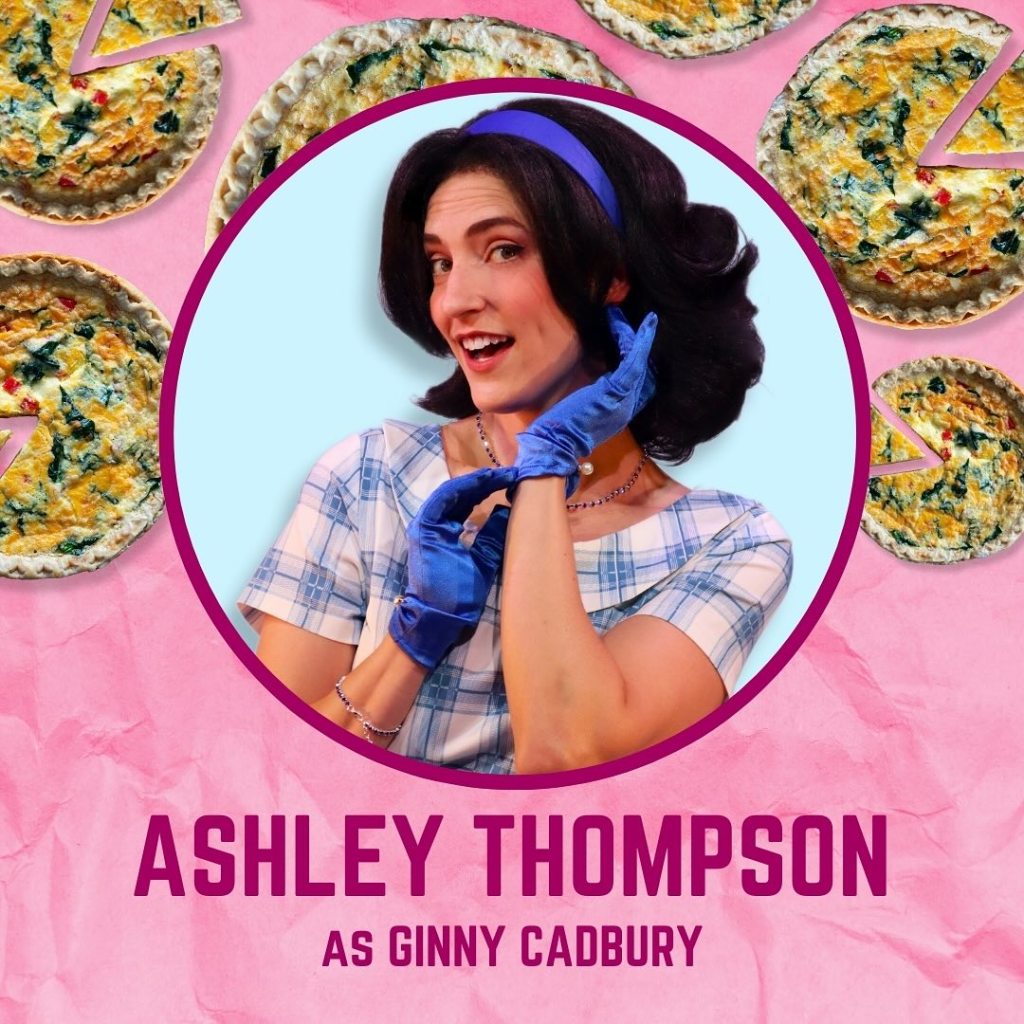
William Luther’s near cartoon-style set and gorgeous 1950s style dresses with their swinging skirts – some fluffed up by crinolines – stunning vintage shoes, hair bows, fascinators, and lace gloves are a feast for the eyes. The very demure outer appearance only makes the underlying sexual tension, innuendo, and banter that permeate each scene that much steamier. When Ashley Thompson’s character, Ginny Cadbury, the over-eager newest member of the group ends up atop a table with her face buried in a plate of quiche it’s as if a group of church ladies had suddenly put down their needle point to engage in an orgy. But I’m jumping ahead.

Theater-goers aka members receive name tags on arriving at their seats. Everyone gets a “female” name. I was Virginia this time. There is a lot of audience interaction, and one front-seat viewer in particular – “Margery” on opening night – gets to have an on-going supporting role. Nora Ogunleye as Wren Robin is the club’s event chair. Ogunleye, looking fabulous in a purple ensemble with matching hat and shoes brings over-the-top optimism and a mile-wide smile to the role. Kendall Walker plays Dale Prist, a wide-eyed innocent who looks like an animated Barbie doll and serves as the group’s historian with a classic Eastman-type film using camera around her neck.

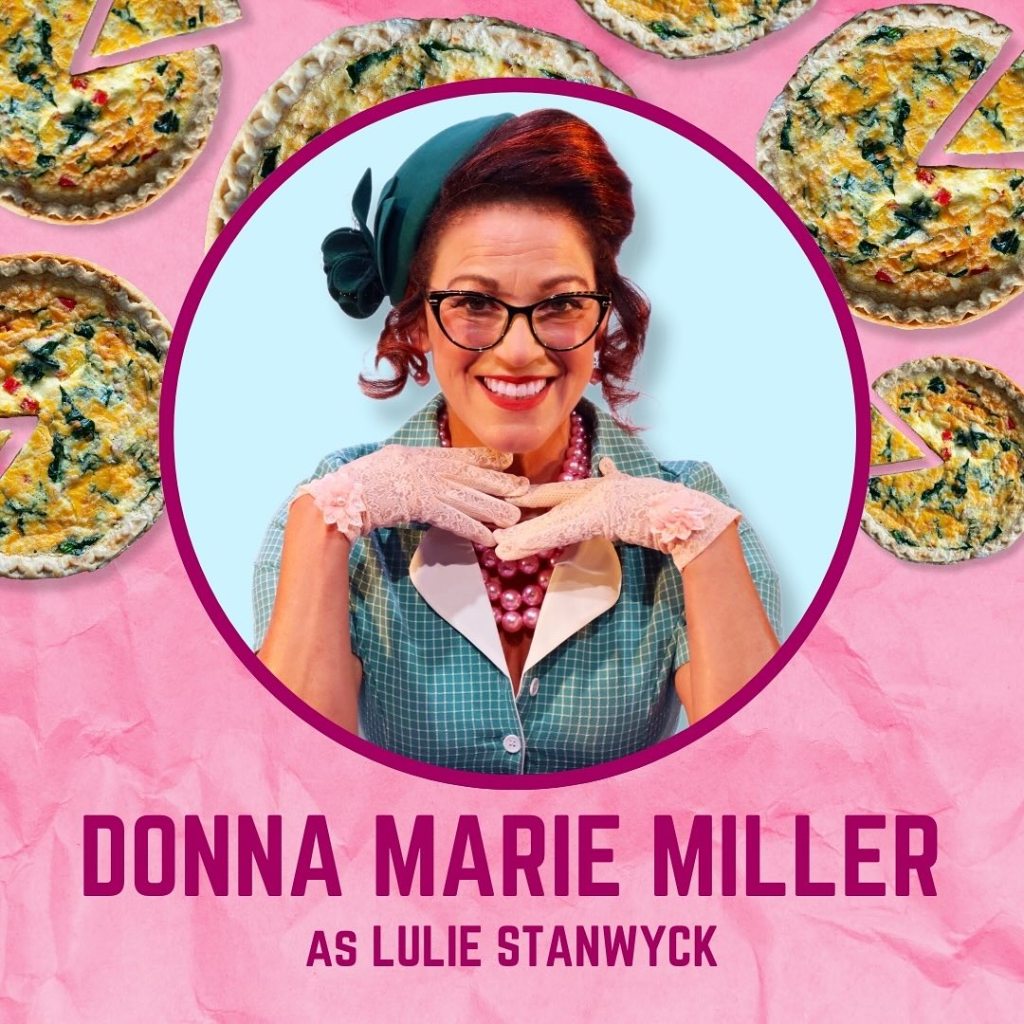
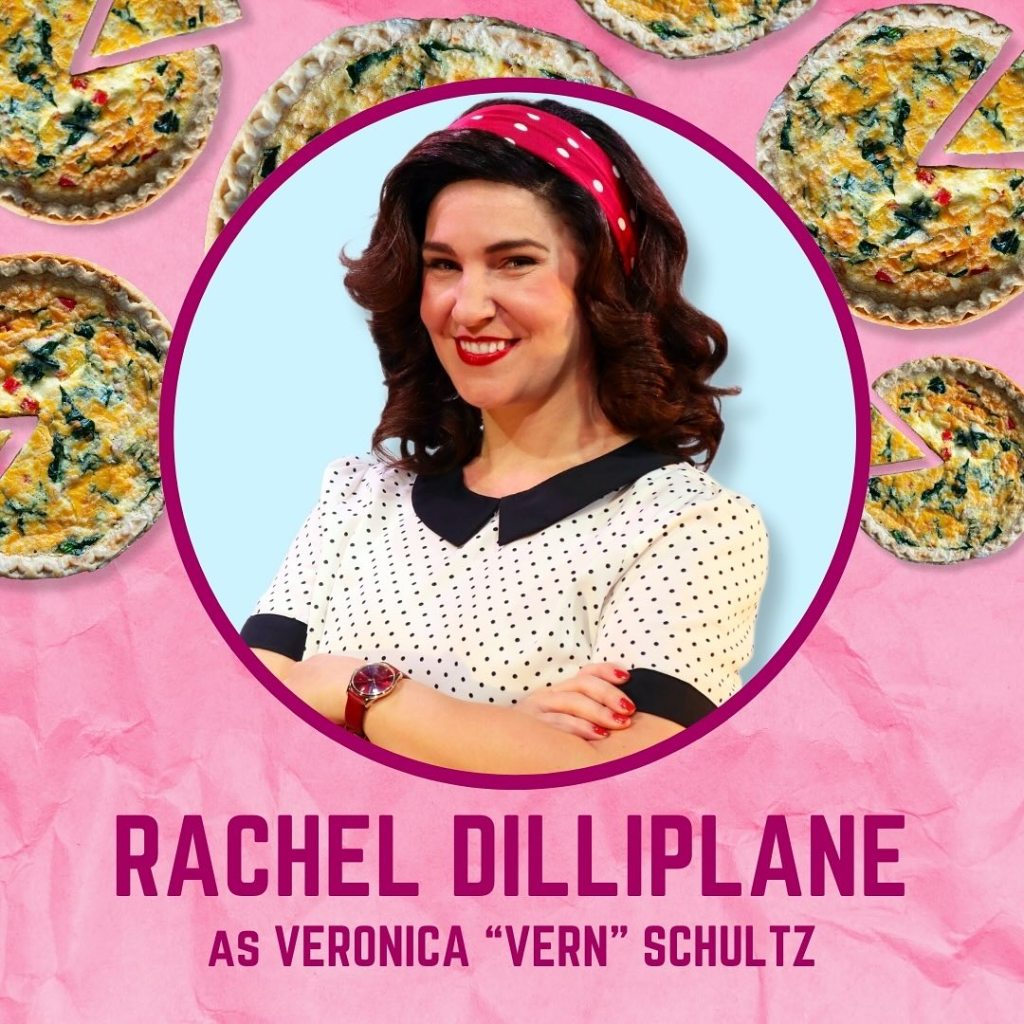
Rachel Dilliplane brings barely repressed butch energy to Veronica “Vern” Schulz, the group’s buildings and grounds manager. Vern is the only one of the five women bold enough to wear pants, and in spite of her tight control over just about everything in her immediate world, Vern is the one who dropped the ball when it most mattered. Ashley Thompson slays as Ginny Cadbury, the newest member and recent British transplant who serves as the secretary. We never learn why – or if we did, it went over my head – Ginny is ostracized by the rest of the leadership team. Last but not least, Donna Marie Miller has the role of the group’s President, Lulie Stanwyck. A stickler for rules and protocol, who lives by the motto “no men, no meat,” it is Lulie who drops the biggest bombshell (I actually did not know that pun was coming) after the five find themselves confined to the shelter – with the possibility they may have to remain there for four long years.

Everything was moving along according to plan, you see, although there is a hint that things are not as they appear – when suddenly the lights flicker, the alarm sounds, and the safety door locks everyone inside against a nuclear attack. With seemingly nothing left to lose, it’s time to finally let go of long-held secrets. It turns out that “widow” is used here as a euphemism for lesbian. Once that is out in the open – and some are more reluctant to name their truth than others, and not even the audience is not exempt from participating in the apocalyptic confession – the floodgates open to reveal all sorts of secrets and Dale has an opportunity to earn a special place in the history of the sisterhood.

This cast is bright and snarky and generally hilarious. The costumes and set are visually delightful. The lighting and sound effects are appropriately over-the-top. The audience’s immersion pushes the edge of an unnamed boundary that gives heightened meaning to the word inclusion. What other play do you know of that encourages the audience to sing along to the theme song of an elite society and have everyone shout out, “I am a lesbian!” The issues are real: nuclear warfare, loyalty, discrimination, oppression, same-sex marriage. The timing of lines by the ensemble and the overall pacing set by director Kelsey Cordrey never attempts to belittle any of this, while at the same time guaranteeing there is never a dull moment. In short, 5 Lesbians Eating a Quiche is breathlessly entertaining.

———-

Julinda D. Lewis is a dancer, teacher, and writer who was born in Brooklyn, NY and now lives in Eastern Henrico County. When not writing about theater, she teaches dance history at VCU and low impact dance fitness classes to seasoned movers like herself, and occasionally performs. Her most recent (ad)venture was the premiere of a solo work, The Waters of Babylon or Psalm 137 Revisited: a Post-Exodus Reflection in Movement Choreographed From Collective Memories for the debut of the Critical Race Theatre Project, right here at RTP in August 2024.
———-

5 LESBIANS EATING A QUICHE

Written by Evan Linder & Andrew Hobgood

Directed by Kelsey Cordrey

Cast

Rachel Dilliplane as Veronica “Vern” Schultz [Note: the program spells her name Dillaplane but I used the spelling I’ve seen virtually everywhere else including her own social media]

Donna Marie Miller as Lulie Stanwyck

Nora Ogunleye as Wren Robin

Ashley Thompson as Ginny Cadbury

Understudies

Kendall Walker as Dale Prist

Emils Berry u/s for Wren Robin & Veronica “Vern” Schultz

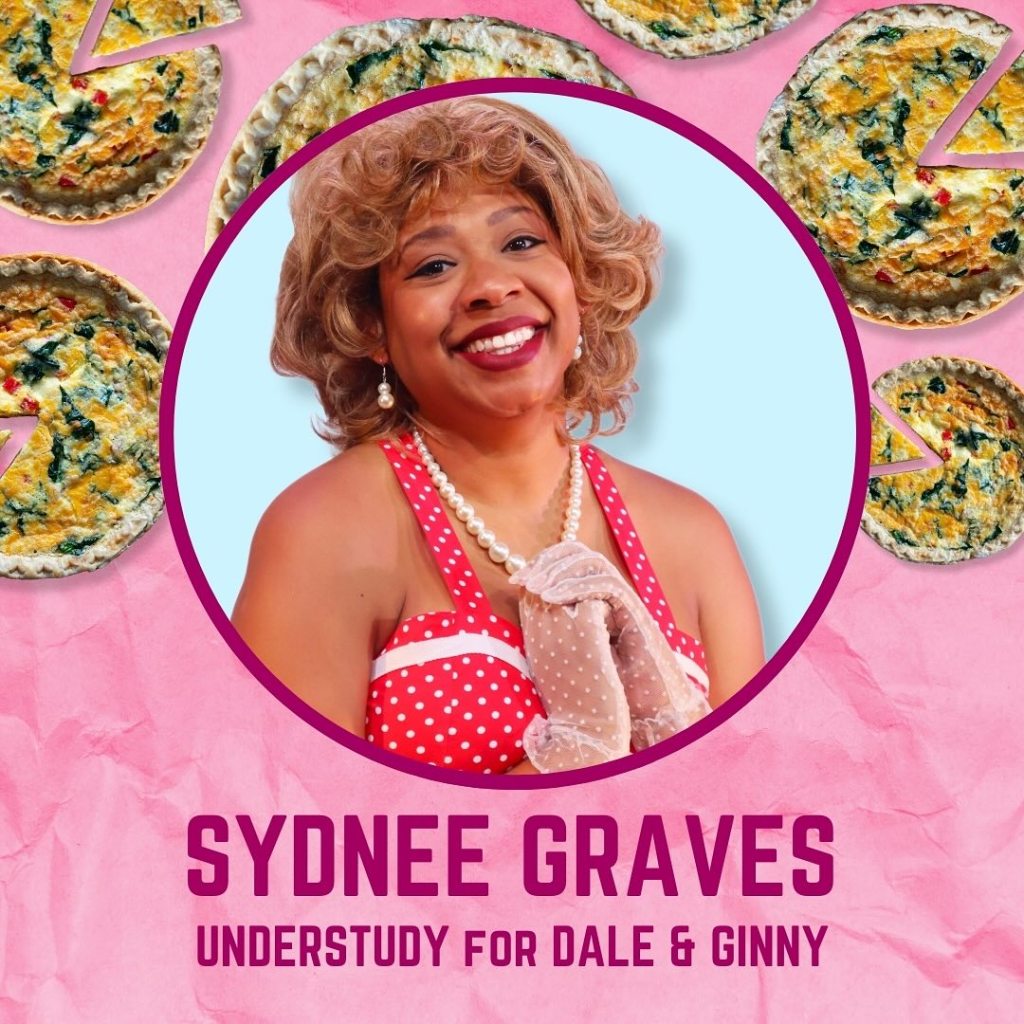
Sydnee Graces u/s for Dale Prist & Ginny Cadbury

Jen Hines u/s for Lulie Stanwyck

Production & Design

Playwright – Evan Linder & Andrew Hobgood

Director – Kelsey Cordrey

Scenic & Costume Design – William Luther

Lighting Design – Gretta Daughtry

Sound Design – Lucian Restivo

Props Design – Tim Moehring

Hair & Makeup Design – Luke Newsome

Production Stage Manager – Corrie Yarbrough

Assistant Stage Manager – Finn Thomason

Intimacy & Fight Director – Lucinda McDermott

Gender Consultant – August Hundley

Master Electrician – Griffin Hardy

Technical  Director & Scenic Artist – William Luther

Scenic Construction – David Ballas, Josie Carter, Becka Russo, Kendall Walker

Setting

A community center in middle America where the annual Quiche Breakfast of the Susan B. Anthony Society for the Sisters of Gertrude Stein is being held. Today, 1956.

Run Time

Approximately 70 minutes without intermission

Ticket Information

$50, Info: (804) 346-8113 or rtriangle.org

Photo Credit: unattributed

JOHN & JEN

When Love Hurts – or – Hate Feels Like the Taste of Tomatoes

At: The Swift Creek Mill Theatre, 17401 U.S. Route One, Chesterfield, VA 23834

Performances: September 7-28, 2024

Ticket Prices: $44-49. Ask about discounts for students, seniors, and veterans.

Info: (804) 748-5203 or https://www.swiftcreekmill.com

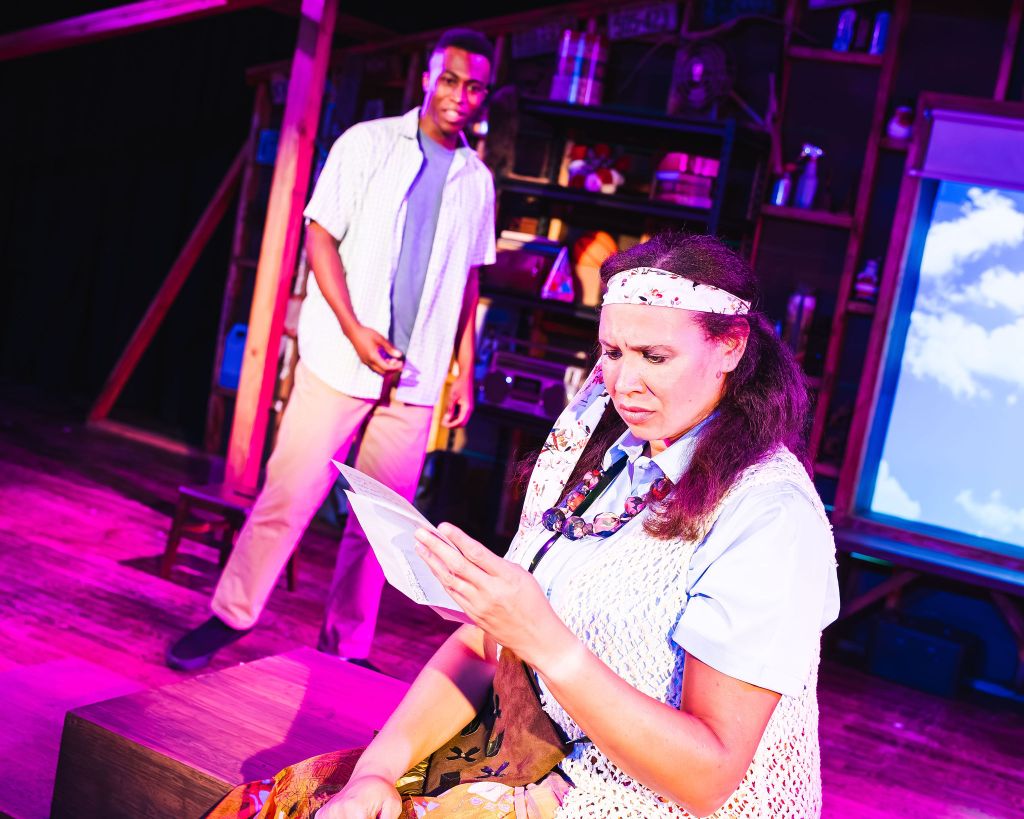
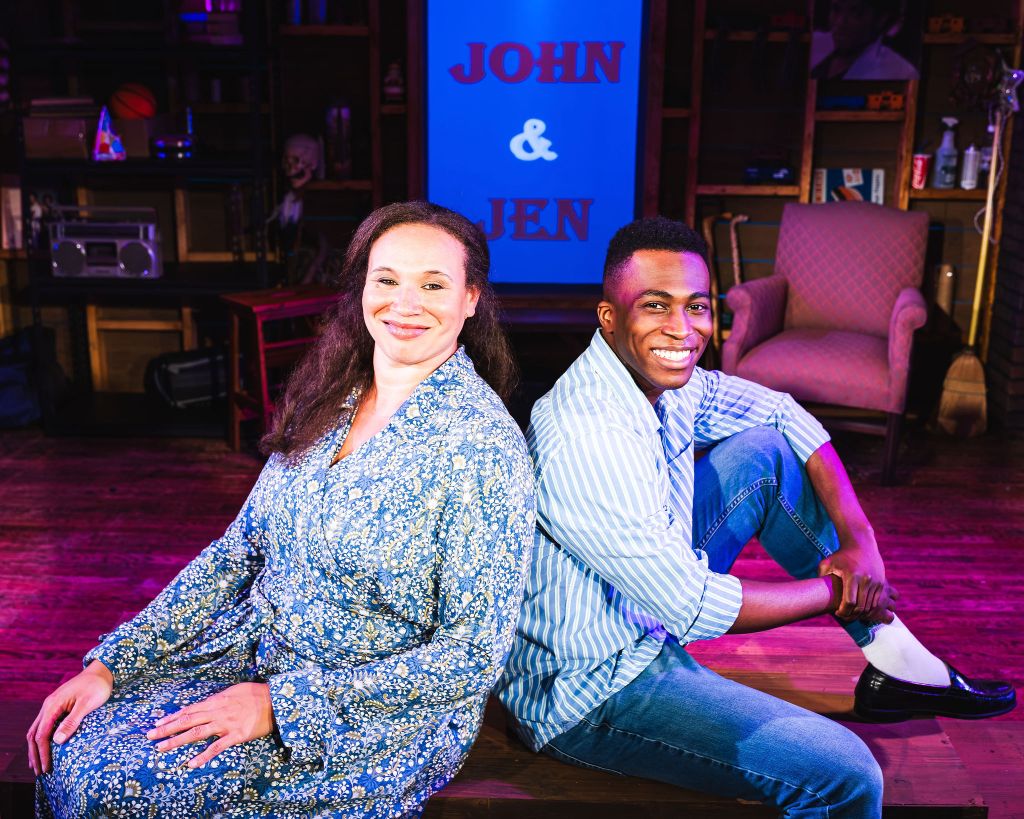
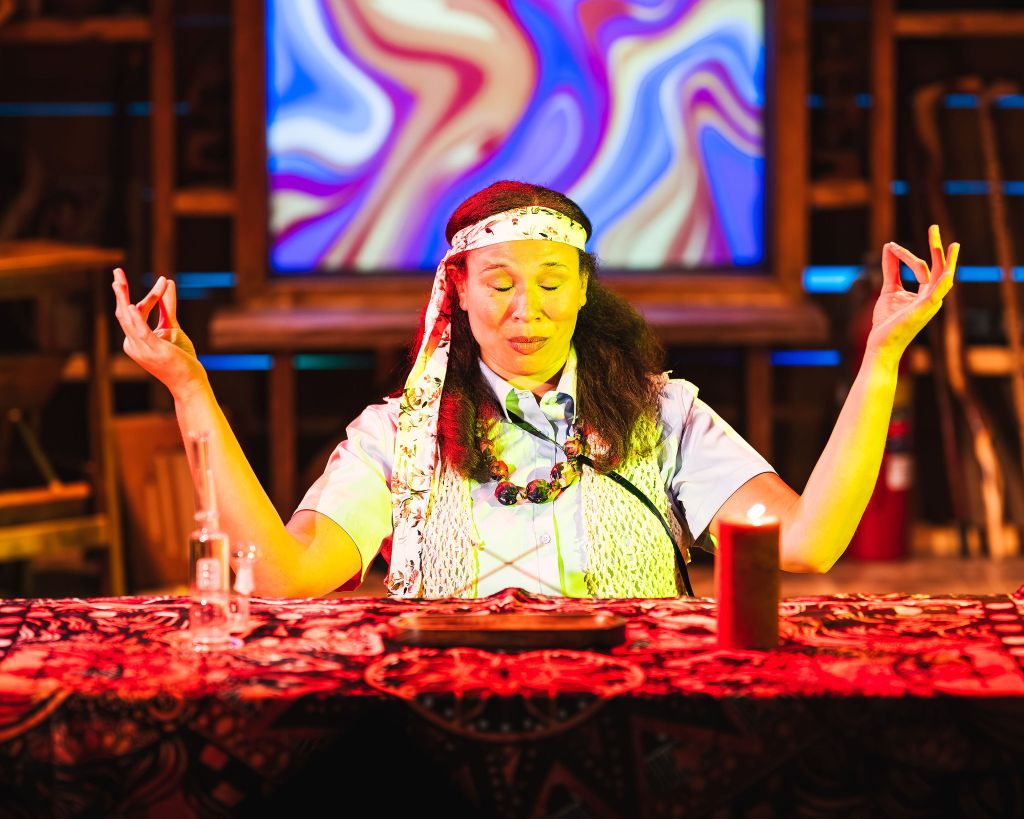
Until a few weeks ago I had never heard of JOHN & JEN and I usually do not read about a show prior to seeing it in order to remain as unbiased as possible when I do see it. But now that I have seen this heart-warming sung-through musical, created for a cast of two actors playing three roles, it has earned a place as one of the most memorable musicals I’ve ever seen. [See the addendum at the end of this review!]

JOHN & JEN started out as a 10-minute musical – a labor of love created by two artists – a composer and a lyricist – who wanted to work together. Their 10-minute work became a full one-act musical, and eventually a second-act was added, with a twist that proved to be a natural outgrowth of the first act.

POSSIBLE SPOILER ALERT

It’s difficult to talk about JOHN & JEN without giving away the plot twist, so if you plan to see this show and want to be surprised, I suggest you stop reading now and come back to finish after you’ve seen the show. This little discussion starter will still be here.

POSSIBLE SPOILER ALERT

JOHN & JEN is a story of familial love and dysfunction. It is a multi-generational tale that spans nearly 4 decades, from 1952 to 1990, and is liberally sprinkled with social references that define each era. JOHN & JEN is also a story of family trauma and the resulting fallout. Most of all, JOHN & JEN is the story of a brother and sister and an inextricably linked story of a mother and son, a story of learning to let go in order to move on.

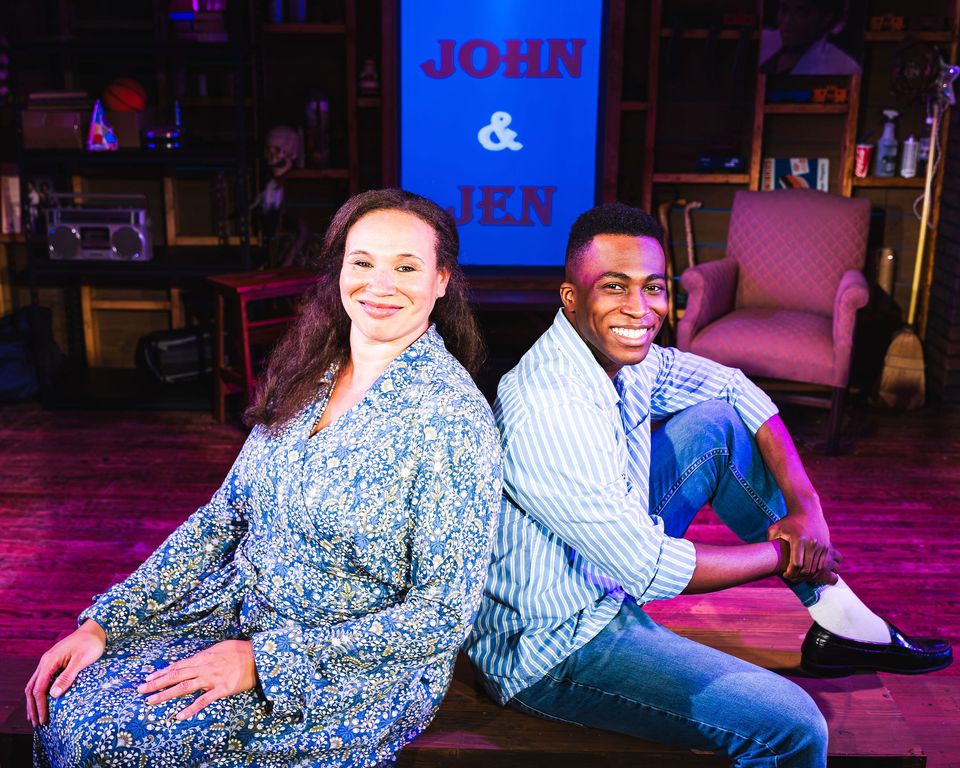
Nicole Pearson plays the role of Jen, and Malcolm Holmes plays the roles of John – and that’s not a typo, but it is the spoiler.

Act 1 opens with young Jen welcoming her baby brother “Welcome to the World” offers words of caution about the dangers he may face, and promises to always protect him. As we watch the two grow up, we learn that all is not well in this household – at least, not as seen through the eyes of Jen who seems to shoulder adult-level responsibilities at a very early age. It is Jen who explains why Santa can’t come one year. It is Jen who dominates a hilarious game of playing school, where we learn about George Washington and his dog Martha crossing the parted waters of the Potomac River. Yet, despite her best intentions to never leave her little brother, Jen seems to jump at the chance to leave home to attend college in New York where she quickly finds her tribe among the community of hippies and Viet Nam draft dodgers. It is this last that causes an irreparable rift.

Malcolm Holmes plays the role of the young John with an uncanny mastery of the nuances of a young boy that manages not to appear mocking or dismissive. While both  Pearson and Holmes bring a sort of “every-man” energy to their roles, by which I mean they lull us into feeling we know these people, there is one scene that really  resonated with me. When 12 year old John begged 17 year old Jen to take him with her when she leaves for college, I was transported back to a time when my 5 year old son would suddenly burst into tears because he missed his 18 year old sister who was attending college in another state. This is the kind of energy Lippa and Greenwald wrote into JOHN & JEN. It is the kind of energy Tom Width brought to his direction, and it is the essence of the energy Pearson and Holmes manifested throughout the play.

While there are clear mile markers along the way, one thing JOHN & JEN never does is tell us where the family lives, leaving the door open for it to be wherever you live or lived at that time. The play takes us on a stroll through memory lane – or along the paths of history, depending on your age. 1964 is a Beatles collage. 1966 is an increased US presence in southeast Asia.  1967 is the “summer of love” and the Generation Gap. 1968 is Richard Nixon – and Jen has missed 2 years of John’s baseball games and Dad says you don’t love us anymore. 1969 is men walking on the moon and the NY Mets win the World Series.

John and Jen part on less than good terms, Jen to move to Canada with her draft dodging boyfriend and John to join the Navy. Act 1 ends with Jen unfolding a flag and draping it over a box as an uncharacteristically silent figure of John, wearing dress whites, observes from a distance. Pearson’s facial expressions and body language tell the subplot of the words that emerge from her throat. Holmes’ general exuberance make his moments of quiet watching and discernment all the more poignant.

In Act 2 we see a reprise of Jen singing her “Welcome” song over a cradle, but this time the cradle holds her son, also named John. As Jen’s son grows, she makes the same promises to protect him she once made to her brother, even showering her son with her brother’s old clothes and toys, something this new generation John cannot relate to. As the years pass, Jen seem incapable of distinguishing between the two Johns, finally reaching the point of breakdown – or breakthrough – as she sits perusing a photo album. That, along with a visit to her brother’s grave on what would have been his 32nd birthday, jars Jen to accept a new reality and to finally move on. This come out as the final song, “Every Good-bye is Hello.”

For those who – inexplicably – do not like musicals, JOHN & JEN may not be for you. This is, after all, a sung-through musical in which most of the dialogue is sung rather than spoken, straddling that gray line you may never have known existed between musical and opera. Not only is it a musical, but it is also a two-person musical, so there are no distractions, no avoiding the fact that even simple statements are sung. But – and this is a big but – Pearson and Holmes are fantastic singers!

I’ll say it again, Pearson and Holmes are fantastic singers. They are really, really, really, really, really good! And while I don’t know the technical terms (I was a dance major, not a theater or music major), their voices are clear and they have the ability to lift you with them when they soar, to drag you down with them when they mourn, and to make you smile and feel hope when they harmonize. This is even more amazing in that Lippa and Greenwald did not write the kind of toe tapping sing-along songs that audiences find themselves humming for days or months after. This is music in the role of a character that moves us through the acts and scenes. This is music that entertains, but does so almost peripherally as it marches along doing the job of immersing the audience in the telling of the story.

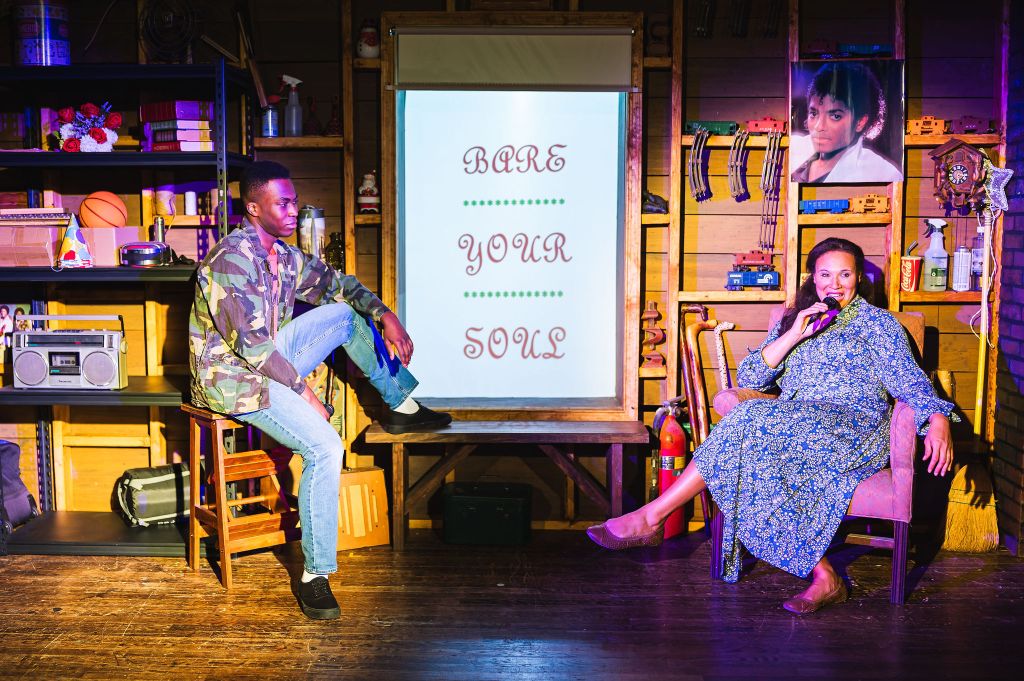
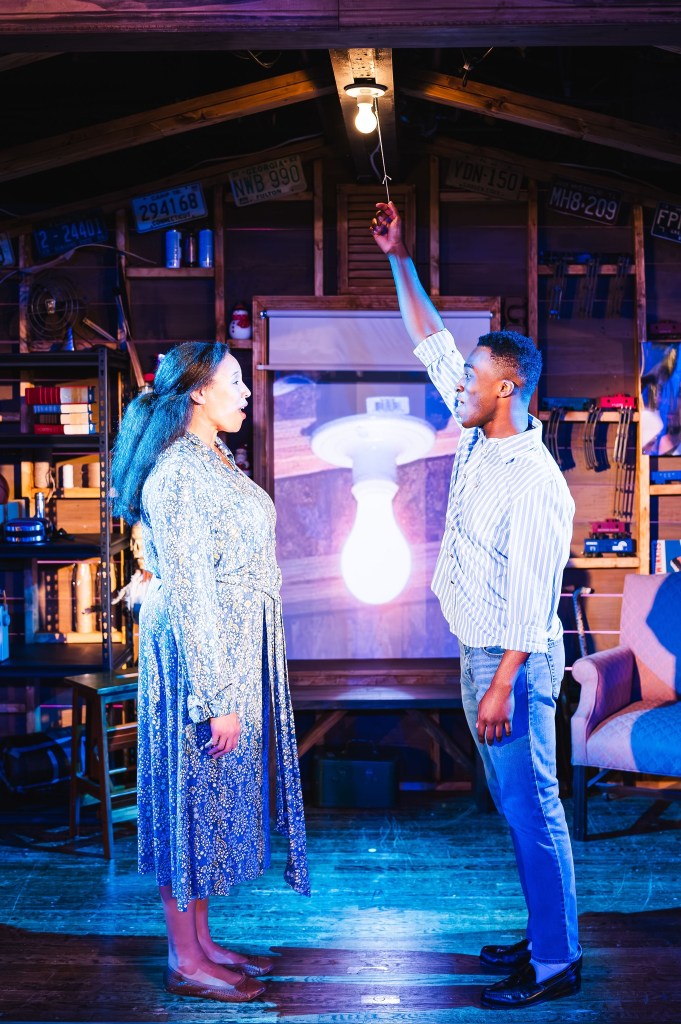
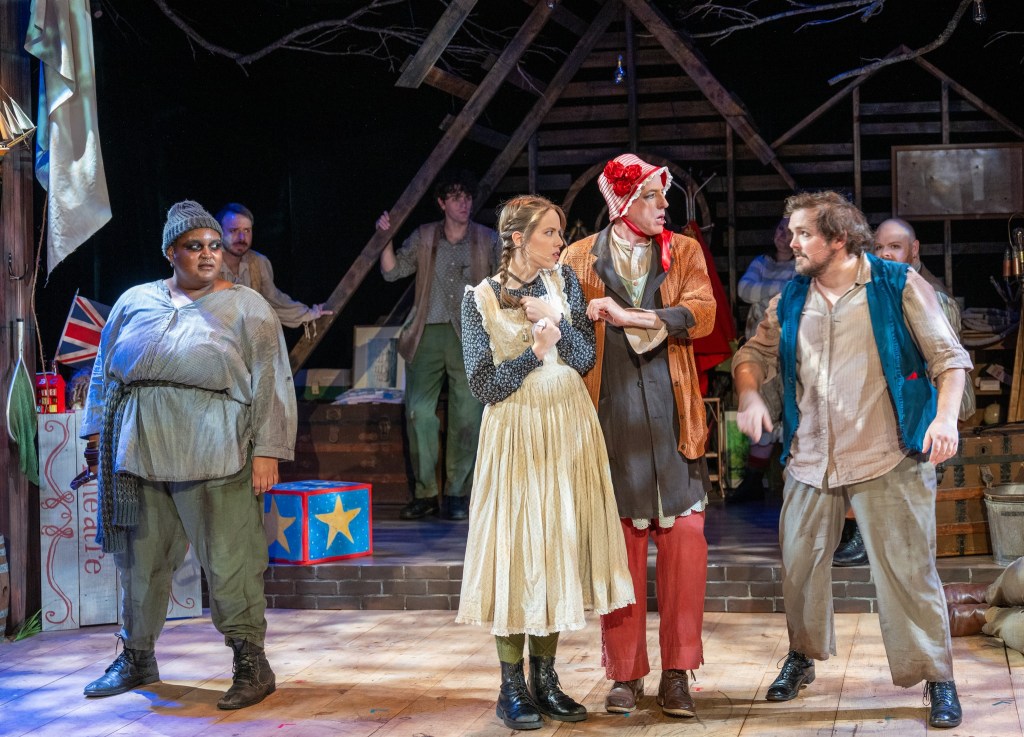
Width also, as he usually does, executed the scenic design. The set for JOHN & JEN is an attic with its steep walls and rough-hewn beams and shelving. Just as Holmes and Pearson infuse their characters with a sense of familiarity, so Width does with the set. There are boxes and bins, errant toys, a boom box, books, a clothing rack, camping equipment, a poster of Michael Jackson, along with most of the props the two actors will need. I felt like I was back in my great aunt’s attic where I used to play as a child, and found myself scanning the corners to see if I would find her old Singer sewing machine hiding there.

During his pre-show curtain talk, Width remarked that JOHN & JEN is a show that is much loved by theatre professionals, but little known to audiences. It is an unexpected treasure worth sharing.

FYI: Hate feels like

———-

Julinda D. Lewis, EdD is a dancer, teacher, and writer who was born in Brooklyn, NY and now lives in Eastern Henrico County. When not writing about theater and dance, she teaches dance history at VCU and low impact dance fitness classes to seasoned movers like herself, and occasionally performs. Her most recent (ad)venture was the premiere of a solo work, The Waters of Babylon or Psalm 137 Revisited: a Post-Exodus Reflection in Movement Choreographed From Collective Memories for the debut of the Critical Race Theatre Project.

———-

JOHN & JEN

Music by Andrew Lippa

Lyrics by Tom Greenwald

Book by Tom Greenwald and Andrew Lippa

John & Jen premiered at the Goodspeed Opera House,

East Haddam, Connecticut in 1993

Directed by Tom Width

CAST

Malcolm Holmes as John

Nicole Pearson as Jen

CREATIVE TEAM

Directed by Tom With

Musical Direction by Paul Deiss

Scenic Design by Tom Width

Lighting Design by Joe Doran

Costume Design by Maura Lynch Cravey

Technical Direction by Liz Allmon

Setting:

Somewhere in the USA and Canada, between 1952 and 1990

Run Time:

About 90 minutes with 1 intermission

Tickets:

Regular $44-49. Discounts for Seniors, Military & Veterans

Photographer: Daryll Morgan Studios

ADDENDUM: OMG. I was just reminded that I reviewed the Richmond premiere of this work in 2018 at HATTheatre! I had 4 surgeries and 20 radiation treatments in 2018 so my memory of that year may be more than a little bit clouded. Here is a link to that review, offering a totally different view of this show.

JOHN & JEN: A Musical of Second Chances

MISERY

The Number One Fan & The Dirty Birdy (IYKYK)

A Theater Review by Julinda D. Lewis

By: Virginia Repertory Theatre (Virginia Rep)

At: The Sara Belle and Neil November Theatre | Marjorie Arenstein Stage

When: August 31 – September 29, 2024

Ticket Prices: $39-$60.

Info: (804) 282-2620 or www.virginiarep.org

The 1990 film version of Stephen King’s, Misery was a memorable thriller – so much so that it earned Kathy Bates an Academy Award for Best Actress for her portrayal of Annie Wilkes. There are so many layers to Annie Wilkes, the antagonist of Misery, that in a 2022 interview King himself singled her out as his personal favorite among all the characters he has created. I generally go to see a show without any pre-conceived expectations – or at least, as few expectations as one can expect of one who sees as much theater as I do. I had read King’s book and I had seen the film directed by Rob Reiner, but I had never seen Misery on stage before, and I did have high-ish expectations for this production.

Misery, for all three of you who don’t know, tells the story of best-selling romance novelist Paul Sheldon who, after a horrible car crash, wakes to find himself in the home of former nurse Annie Wilkes who rescued him from a snowbank. The fact that she was available to do this because she – his self-described “number one fan” – had been stalking him for some time is eventually revealed. But soon becomes obvious that Annie is unhinged and her “care” takes a deadly turn when she discovers that, in his recently released novel, Sheldon has killed off her favorite character, Misery Chastain. Fueled by mental illness, Annie begins a campaign of mental and physical torture as only Stephen King could conceive.

I’ve read that numerous A-List actors turned down the roles of both Annie and Paul for the film version of Misery, and I don’t know if Rick Hammerly and Virginia Rep had similar troubles casting this play, but the casting of Susan Sanford as Annie Wilkes and Matt Meixler (in his Richmond debut) was inspired. I am not familiar with Meixler, but Sanford is a familiar face on Richmond stages. In Misery, I did not recognize Sanford on that stage – I saw Annie Wilkes.

Sanford’s portrayal of Wilkes – who, BTW, is supposedly based on a real-life nurse, Genene Anne Jones, a serial killer believed to have killed more than 50 patients, including infants and children – is chilling. She glides smoothly and unpredictably from modest and temperate to manic and then to depressed. She is simultaneously sympathetic in her illness and vile in her violent episodes.

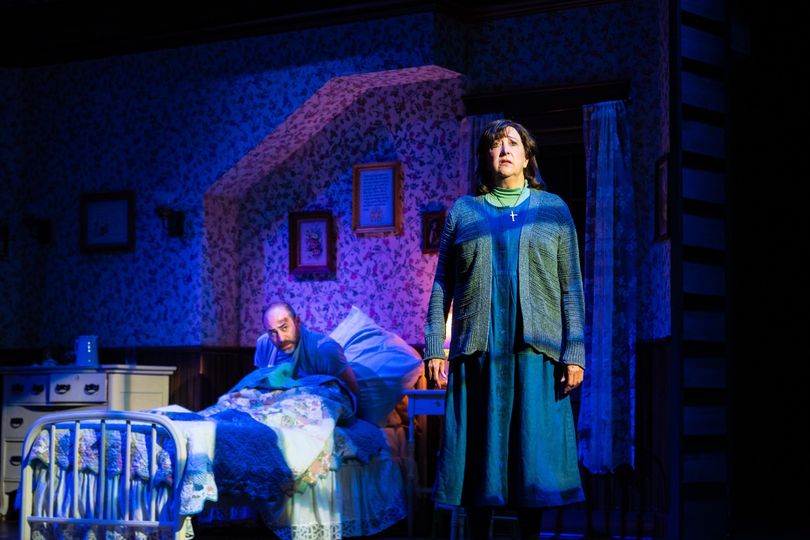
Meixler is forced to work with severe physical restraints. For most of the play, he portrays the bedridden Sheldon, recovering from two broken legs and a dislocated shoulder. His pain is palpable, and radiates through the space almost like another character of its own. At one point Wilkes remarks that Sheldon is sweaty, and Meixler was probably genuinely clammy after his restrained exertions.

The only other character is Buster, the local sheriff. Buster is suspicious, but clearly this abduction and torture case is above his pay grade and his intellectual capacity. Buster, at one point, even seems to be developing a fondness for Wilkes; I guess that’s what happens when you live in a small, remote town and don’t get a chance to speak to many people. Andrew Firda plays Buster, with all due earnestness and a sprinkle of ineptitude.

Performed without intermission, Misery is well-paced and avoids being predictable even when you already know the story. (Granted, the stage version is not the same as the film version or the book, in several significant ways that I will refrain from spoiling; go see it for yourself and then compare.)

Kudos to Chris Raintree for a beautifully detailed three-sided set built on a revolving turntable. Highest admiration to the stage management, under the direction of Donna Warfield, for the quick changes that occurred seamlessly, even on opening night. (There was one moment when I thought I saw Annie when I wasn’t supposed to, but overall, the blocking and timing were skillfully executed with all the moving parts). More generous praise is due for Joey Luck’s chiller-thriller sound design and BJ Wilkinson’s shadowy and evocative lighting. All these element worked together with the precision of a fine Swiss watch to create a delightfully fearful night of theater – a noteworthy, strong start to the new Fall season.

———-

Julinda D. Lewis is a dancer, teacher, and writer who was born in Brooklyn, NY and now lives in Eastern Henrico County. When not writing about theater and dance, she teaches dance history at VCU and low impact dance fitness classes to seasoned movers like herself, and occasionally performs. Her most recent (ad)venture was the premiere of a solo work, The Waters of Babylon or Psalm 137 Revisited: a Post-Exodus Reflection in Movement Choreographed From Collective Memories for the debut of the Critical Race Theatre Project.

———-

MISERY

Written by William Goldman

Based on the Novel by Stephen King

Directed by Rick Hammerly

Cast

Annie Wilkes             ………………..          Susan Sanford

Paul Sheldon            ………………..          Matt Meixler

Buster (u/s Paul)     ………………..         Andrew Firda

u/s Annie                   ………………..          McLean Fletcher

u/s Buster                  ………………..          Joe Pabst

Direction & Design

Direction                   ………………..          Rick Hammerly

Scenic Design           ………………..          Chris Raintree

Costume Design      ………………..          Marcia Millr Hailey

Lighting Design       ………………..          BJ Wilkinson

Sound Design          ………………..          Joey Luck

Projection Design    ………………..          Dasia Gregg

Stage Management ………………..          Donna Warfield

Fight Direction         ………………..          Casey Kaleba

Wig Design                ………………..          Jeanne Nugent

Ticket Information

Box Office: (804) 282-2620 or www.virginiarep.org

Tickets range from $39 – $60

Run Time

The play runs for approximately 1 hour, 40 minutes; there is no intermission.

Photo Credits: Aaron Sutten

Matt Meixler and Susan Sanford in Misery.

PETER AND THE STARCATCHER

“To Have Faith is to Have Wings”: The Backstory – or – A Prequel To the Tale of the Boy Who Would Not Grow Up

A Theater Review by Julinda D. Lewis

Presented By: Firehouse Theatre

At: 1609 W. Broad Street, RVA 23220

Performances: August 16 – September 1  2024

Ticket Prices: $1.00 – $35

Info: (804) 355-2001 or firehousetheatre.org

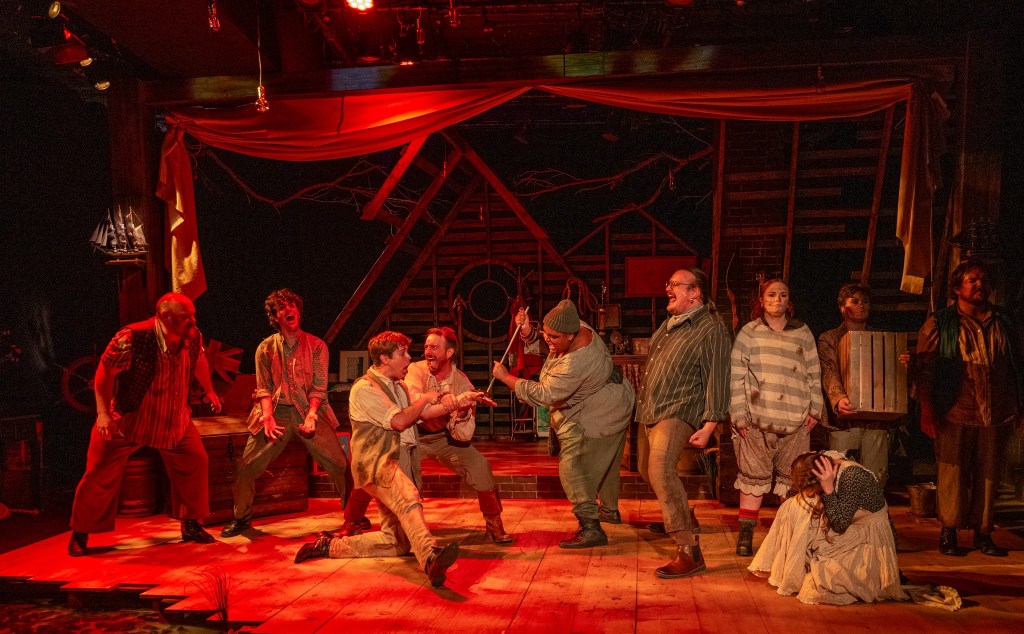
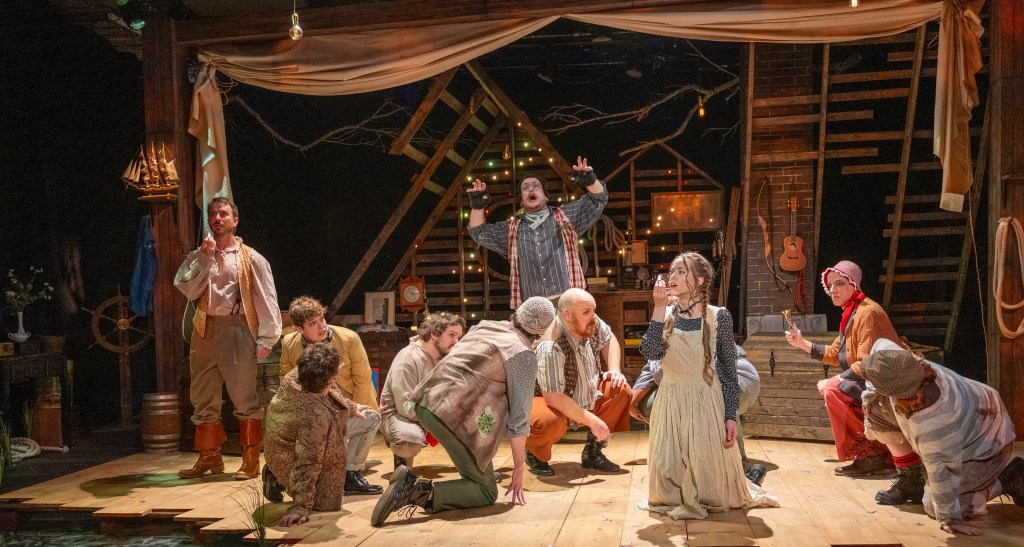
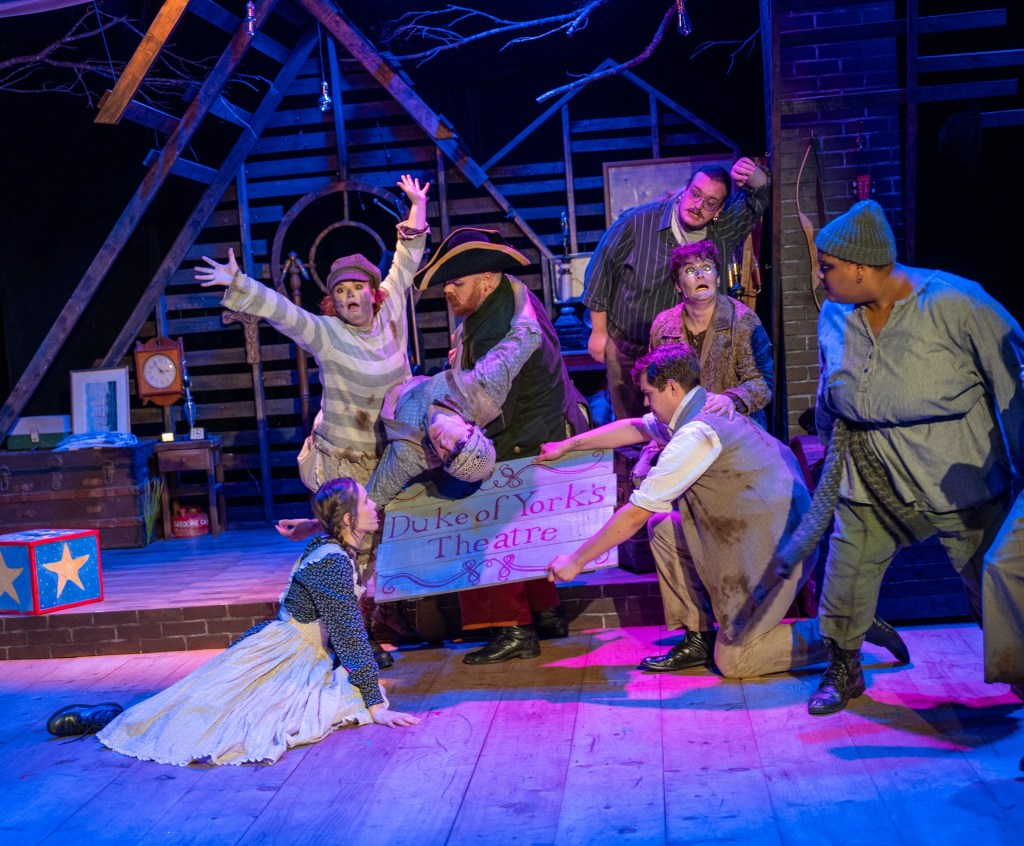
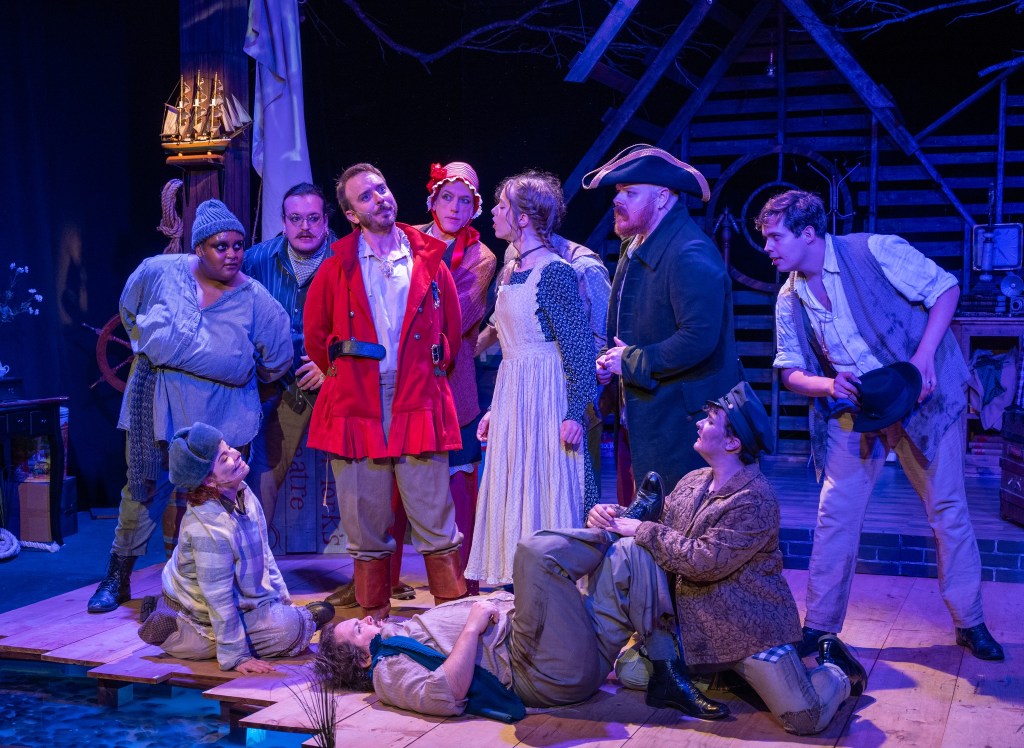
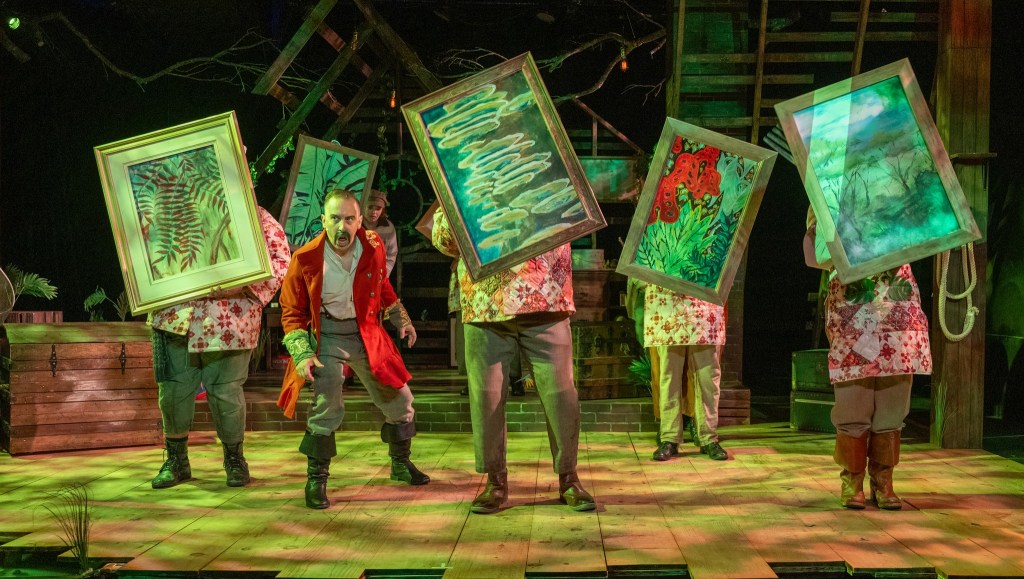
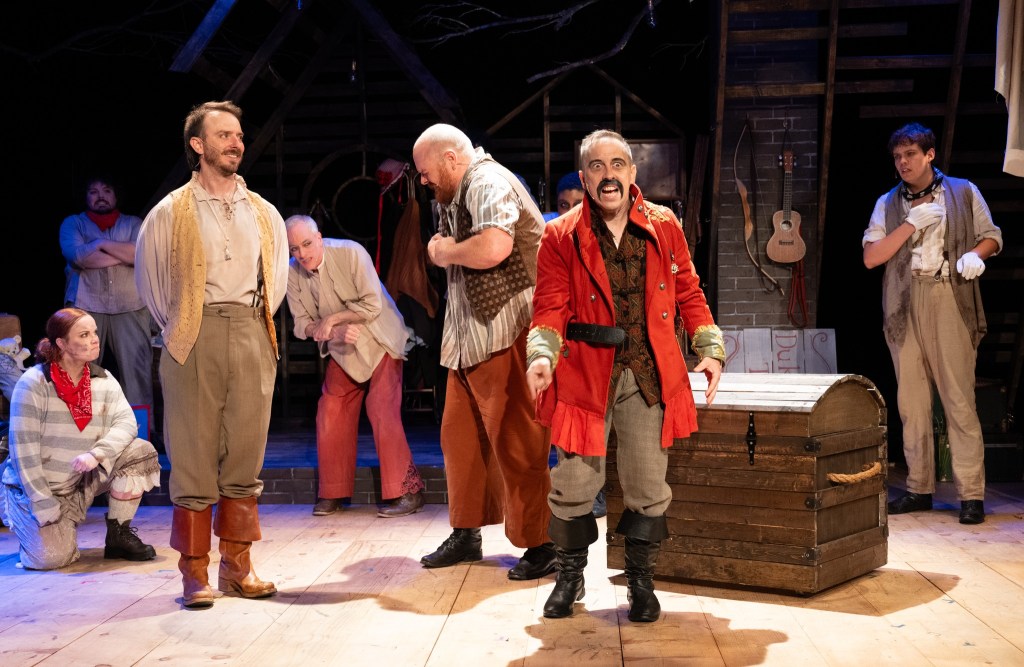
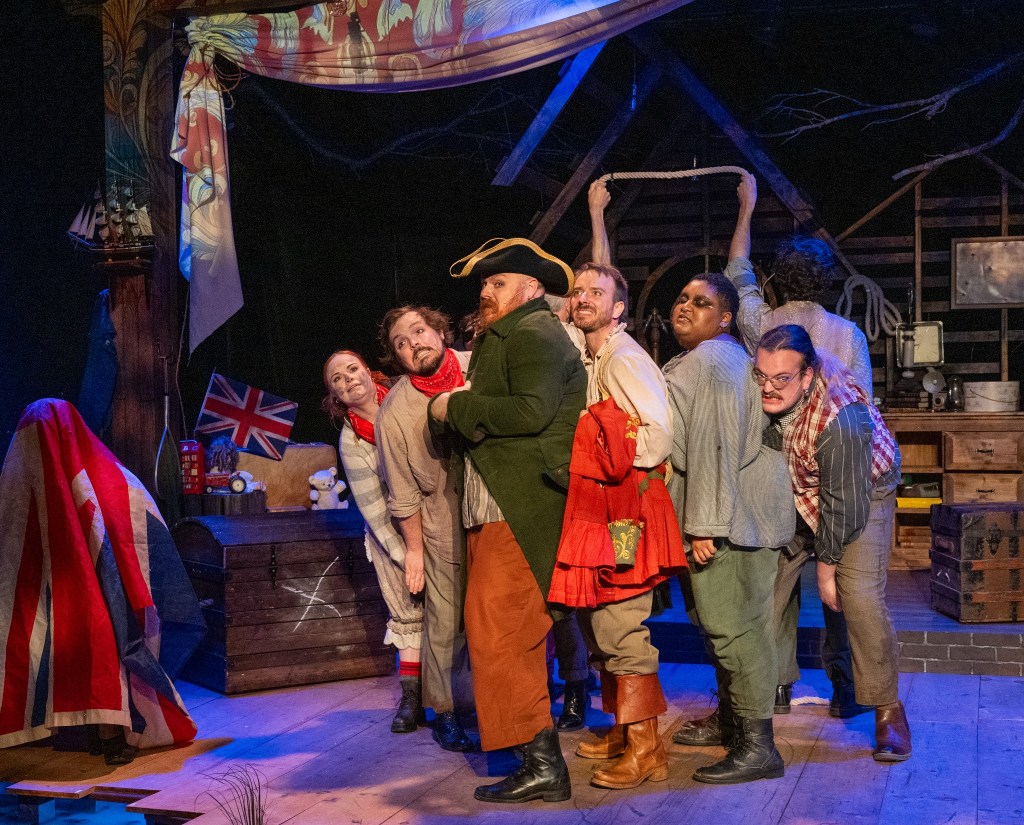
While it is based on a children’s book, Peter and the Starcatcher, a play with music (as opposed to a musical) is filled with innuendo and powered by linguistic and cultural references that are aimed at adults. So, yes, it is family friendly. It is also a fantastic fantasy adventure that delights the eye and ear and keeps the audience laughing. I don’t want to spoil it for you, but the Act 2 opening is one of the most memorable scenes ever; sit in the first row if you can.

Peter and the Starcatcher provides the backstory to Peter Pan as well as Captain Hook and Tinker Bell. Based on the 2004 novel of the same name, written by Dave Barry and Ridley Pearson, Rick Elice adapted the story for the stage. The play premiered in California, opened Off-Broadway in 2011 and on Broadway in 2012. Some may recall that the play was produced by Va Rep in 2015.

Chase Kniffen has designed an appropriately fantastical set that helps provide a big stage feel and Kasey Brown’s costumes are whimsical and extremely creative. Nathaniel Shaw’s direction is seamless, all the best lines are perfectly times and the pacing is swift enough to keep the audience on our toes but paced to keep us from getting lost. There is music, but not the kind where characters burst out into song for no reason, and at one point we are treated to a near-show stopping Rockettes-style high kick line. Kudos to the entire production team for making this production look and sound great.

This is one of those productions where, in addition to working their butts off, it also looks like the cast had as much fun as the audience. The casting was perfection. It’s hard to think where to begin, so I’ll just follow the program order. And yes, this is one of the few times I will make mention of each and every cast member – because they deserve it.

It was great to see Scott Wichmann back on stage and his role of the Black Stache, who is affected by chronic malapropism, is undeniably and devilishly over the top. Shannon Schilstra plays Molly, a young woman liberated ahead of her time, with youthful exuberance and a level of confidence most of us wish we had at that age (her character is 13 years old). Lukas D’Errico is the Boy (also 13) who eventually earns the name Peter and the right to wear the Hero’s hat. The scene in Act 2 where Boy first sees sunlight is heartwarming.

Peter’s companions, Ted and Prentiss, also orphans who are sold into slavery along with him, are played by Madison Hatfield and August Hundley. There is a running joke about Ted’s obsession with food that culminates in a hilarious scene in which, after struggling to figure out how to eat a pineapple, one of the pirates accidentally slices a pineapple in half providing Hatfield the opportunity to finally satiate her character’s fixation. Hundley finds and maintains a delicate balance as their character Prentiss seesaws between declaring himself the leader and just wanting to be a boy. Both are starved – for both food and love – and Ted occasionally slips and,  endearingly, calls Molly Mother.

Paul Major plays Black Stache’s bumbling first mate, Smee, who actually spends much of his time correcting Stache’s wildly humorous misuse of words, and occasionally – an accidentally –  coming up with some life-saving ideas. Elle Meerovich takes on several roles, including the flask-toting headmaster of the boys’ orphanage, a pirate, Fighting Prawn (king of the Mollusk tribe), and a sailor but their most memorable moment was holding an unwavering note in a song for a thrillingly long time. Whew! But wait, there’s more…

Chewie Lo Moore really digs in as Bill Slank, the cruel captain of The Neverland who switches the treasure chest with the decoy trunk at the start of the adventure, thus activating the action adventure aspect of the play. He also plays Hawking Clam, the son of the Mollusk king, Fighting Prawn. Joshua Mullins plays a supporting role as the good Captain Scott, the captain of the Wasp, based on a real-life British Royal Navy Officer of the same name, as well as – ironically – an incompetent sailor named Mack.

It seems too long since we’ve seen Alexander Sapp onstage, yet here he is as Lord Astor, Molly’s father, a Starcatcher on a secret mission that endangers everyone to some extent or another. Some of the funniest scenes occur when Lord Astor has to communicate with his daughter Molly. Because of the nature of his mission, they communicate in Dodo – yes, the language of the extinct bird – or Norse Code, apparently an ancient Viking precursor of Morse Code. After causing all this havoc, Sapp just strolls off at the end with utter nonchalance that makes you wonder, did that just happen?

One of my favorite roles was that of Molly’s nanny, Mrs. Bumbrake, played by Robert Throckmorton in the role of the “pantomime dame,” a woman’s role traditionally written for a male actor. Throckmorton also played Teacher, a wise mermaid who is instrumental in changing the direction of the Boy for the better. This was not Throckmorton’s first time in this dual role in Neverland or Mollusk Island, but the intimacy of the Firehouse Theatre certainly made it the memorable for me. The pairing of Throckmorton with William Vaughn, in the role of the smitten Alf, was a winning combination, but let’s not forget that Alf’s first claim to fame is a really potent case of flatulence.

Peter and the Starcatcher has adventure, magic/fantasy, whimsy, humor – and pirates. It also touches on serious topics like love and loyalty, friendship, greed, perseverance, and commitment. It truly has something for everyone, and reminds us why we love to go to see live theatre.

—–

PETER AND THE STARCATCHER

Written by Rick Elise

Music by Wayne Barker

Directed and Choreographed by Nathaniel Shaw

Cast

Black Stache   ……….           Scott Wichmann

Molly               ……….           Shannon Schilstra

Boy                 ……….           Lukas D’Errico

Ted                  ……….           Madison Hatfield (Molly u/s)

Prentiss            ……….           August Hundley (Boy u/s)

Smee               ……….           Paul Major

Grempkin/       ……….           Elle Meerovich

   Fighting Prawn/

      Sanchez

Bill Slank/       ……….           Chewie Lo Moore

    Hawking Clam

Capt. Scott/     ……….           Joshua Mullins (Stache u/s)

    Mack

Lord Aster       ……….           Alexander Sapp

Mrs. Bumbrake/  ……..          Robert Throckmorton

    Teacher

Alf                   ……….           William Vaughn

Grempkin/Mrs. Bumbrake u/s……….           Gracie Berneche

Capt. Scott/Lord Aster u/s      ……….           Thomas Kaupish

Ted/Prentiss u/s                       ……….           Jovan Long

Alf/Smee/Bill Slank u/s          ……….           David Rogozenski

Production Team

Direction/Choreography         ……….           Nathaniel Shaw

Music Direction                      ……….           Kim Fox

Assistant Direction                 ……….           Katie Logan

Scenic/Projection Design        ……….           Chase Kniffen

Costume Design                      ……….           Kasey Brown

Lighting Design                      ……….           BJ Wilkinson

Assistant Lighting Design      ……….           TJ Washington

Sound Design                          ……….           Grace Brown LaBelle

Props Design                           ……….           Tim Moehring

Dialect Coach                         ……….           Erica Hughes

Percussionist                           ……….           Steve Raybould

Directing Observation            ……….           Christian Trimmingham

Stage Management                 ……….           Emily Vial

Assistant State Management   ……….           Isabel Stone

Run Time: About 2 hours 10 minutes; there is 1 intermission

———-

Photo Credits: Firehouse Facebook page

2024 Artsies Nominations

FOR IMMEDIATE RELEASE


For more information, contact:

Amy Wightamyzzon@gmail.com


2024 ARTSIES NOMINATIONS ANNOUNCED

16th Awards Event and Nominations for the 2023-24 Season


Richmond, VA – August 6, 2024. The 16th Richmond Theatre Community Circle (formerly Richmond Theatre Critics Circle) Awards (“Artsies”), the community’s recognition of excellence in Richmond-area theater, will be held at the November Theatre on Sunday, October 13th, at 7:30 p.m.


The Richmond Theatre Community Circle announces the following nominees for this year’s Artsies. The 2023-24 nominees are:


Best Musical

9 to 5: The Musical, Virginia Repertory Theatre (Virginia Rep)

BKLYN: The Musical, Swift Creek Mill Theatre (Swift Creek Mill)

Into the Woods, Richmond Shakespeare

Scrooge in Rouge, Richmond Triangle Players (RTP)

tick…tick…Boom!, Swift Creek Mill


Best Direction (Musical)

Debra Clinton, 9 to 5: The Musical

Jan Powell, tick…tick…Boom!

Jase Sullivan, Into the Woods

Shanea Taylor, BKLYN: The Musical

Kendall Walker, Scrooge in Rouge


Best Lead Performance (Musical)

Emily Berg-Poff Dandridge, On Air (Virginia Rep)

Alia Bisharat Glidden, 9 to 5: The Musical

Dorothy Dee-D Miller, BKLYN: The Musical

Lindy Pokorny, BKLYN: The Musical

Susan Sanford, 9 to 5: The Musical

Susan Sanford, Into the Woods

Caleb Wade, tick…tick…Boom!


Best Supporting Performance (Musical)

Gracie Berneche, Into the Woods

Mason Blaine, Altar Boyz(Swift Creek Mill)

Desiree Dabney, BKLYN: The Musical

Rachel Rose Gilmour, tick…tick…Boom!

Maggie Marlin-Hess, Into the Woods

Canter Irene O’May, 9 to 5: The Musical

Durron Marquis Tyre-Gholson, 9 to 5: The Musical


Best Musical Direction

Sandy Dacus, tick…tick…Boom!

Leilani Fenick, 9 to 5: The Musical

Leilani Fenick, BKLYN: The Musical

Kim Fox, Into the Woods

Elle Meerovich, Scrooge in Rouge


Best Choreography

Mel Rayford, Airswimming (RTP)

Suzi Redling, BKLYN: The Musical

Pam Turner, 9 to 5: The Musical

Kayla Xavier and Kate Belleman, Altar Boyz

Kayla Xavier, tick…tick…Boom!


Outstanding Achievement in Costume Design (Musical)

Maura Lynch Cravey, BKLYN: The Musical

Sue Griffin, 9 to 5: The Musical

Sheila Russ, Scrooge in Rouge

Keith Walker, Into the Woods


Outstanding Achievement in Lighting Design (Musical)

Weston Corey, Scrooge in Rouge

Joe Doran, 9 to 5: The Musical

Joe Doran, Altar Boyz

Michael Jarett, The Best of Times (RTP)

Michael Jarett, tick…tick…Boom!


Outstanding Achievement in Set Design (Musical)

Frank Foster, Scrooge in Rouge

Dasia Gregg, BKLYN: The Musical

Chris Raintree, 9 to 5: The Musical

Mercedes Schaum, On Air

W. Reed West III, tick…tick…Boom!


Outstanding Achievement in Sound Design (Musical)

Joey Luck, Scrooge in Rouge

Joey Luck, The Best of Times

Jacob Mishler and Jonathan Pratt, 9 to 5: The Musical

Jonathan Pratt, On Air

Tom Width, BKLYN: The Musical


Best Play

Berta, Berta, Firehouse Theatre (Firehouse)

Doctor Faustus, Richmond Shakespeare

Hamlet, Richmond Shakespeare

Pass Over, Yes, And! Theatrical Company (Yes, And!)

Radiant Vermin, 5th Wall Theatre (5th Wall)


Best Direction (Play)

Andrew Gall, Born with Teeth (Richmond Shakespeare)

Katrinah Carol Lewis, Pass Over

Tawnya Pettiford-Wates, Berta, Berta

Morrie Piersol, Radiant Vermin

Mel Rayford, Airswimming

Paul Takács, Ken Ludwig’s Baskerville: A Sherlock Holmes Mystery (Virginia Rep)


Best Lead Performance (Play)

David Bridgewater, Buried Child (Firehouse)

Joshua Carter, Hamlet

Anthony Cosby, Pass Over

Trevor Lawson, Much Ado About Nothing (Richmond Shakespeare)

Katrinah Carol Lewis, Berta, Berta

Lucian Restivo, Torch Song (RTP)

Catherine Shaffner, The Roommate (HATTheatre)

Jerold Solomon, Satchmo at the Waldorf (Virginia Rep)


Best Supporting Performance (Play)

Emily Adler, Radiant Vermin

Elizabeth Byland, POTUS (Virginia Rep)

Dixon Cashwell, Doctor Faustus

Irene Kuykendall, Ken Ludwig’s Baskerville: A Sherlock Holmes Mystery

Lucretia Marie, Hamlet

Landon Nagel, Roman à Clef (Firehouse)

Boomie Pedersen, Buried Child


Outstanding Achievement in Costume Design (Play)

Anna Bialkowski, Born with Teeth

Cora Delbridge, Doctor Faustus

Cora Delbridge, Roman à Clef

Sue Griffin, Ken Ludwig’s Baskerville: A Sherlock Holmes Mystery

Keith Walker, Hamlet


Outstanding Achievement in Lighting Design (Play)

Andrew Bonniwell, Berta, Berta

Gretta Daughtrey, Doctor Faustus

Gretta Daughtrey, Hamlet

Joe Doran, Satchmo at the Waldorf

Nathan Wunderlich, Airswimming


Outstanding Achievement in Set Design (Play)

Daniel Allen, Lonely Planet (5th Wall)

Daniel Allen, Torch Song

Tennessee Dixon, Memories of Overdevelopment (Firehouse)

Chris Raintree, Berta, Berta

Mercedes Schaum, Satchmo at the Waldorf


Outstanding Achievement in Sound Design (Play)

Kyle Epps, Berta, Berta

Jonathan Pratt, Ken Ludwig’s Baskerville: A Sherlock Holmes Mystery

Jonathan Pratt, Satchmo at the Waldorf

Roger Price, Radiant Vermin

Kate Statelman, Hamlet


Ernie McClintock Best Ensemble Acting

Airswimming, Richmond Triangle Players

Ken Ludwig’s Baskerville: A Sherlock Holmes Mystery, Virginia Repertory Theatre

Hamlet, Richmond Shakespeare

Pass Over, Yes, And! Theatrical Company

Roman à Clef, Firehouse Theatre


Breakout Performance

Erich Appleby, Pass Over / Hawks Ridge (Brightpoint Community College)

Elizabeth Byland, POTUS

Elise Cumbia, From Up Here (HATTheatre)

Lindy Pokomy, BKLYN: The Musical

Rosemary Richards, Hamlet

Ashley Thompson, Dr. Ride’s American Beach House (Yes, And!) / Buried Child


Best Original Work

Hawks Ridge created by Foster Solomon and directed by Leslie Owens-Harrington, The Lynn Theatre at Brightpoint Community College

Roman à Clef created by Chandler Hubbard (a product of the TNT New Play Incubator) and directed by Sharon Ott, Firehouse Theatre

The Best of Times: A Musical Celebration of Richmond Triangle Players directed by Lucian Restivo and Kendall Walker, Richmond Triangle Players


The event will take place at 7:30 p.m. on Sunday, October 13, at Virginia Rep’s November Theatre. Formal attire is encouraged for the awards ceremony, which is open to the public. Tickets are $25 for orchestra seating and $30 for balcony seating. They will go on sale September 15and can be purchased by calling the Virginia Rep box office at 804-282-2620. Get your tickets early – ticket prices go up by $5 on September 29. All proceeds from Artsies ticket sales support the Theatre Artist Fund of Greater Richmond.       


RUN FOR YOUR WIFE

A Fast-Paced Farce, Just for the Fun of It

At: The Swift Creek Mill Theatre, 17401 U.S. Route One, Chesterfield, VA 23834

Performances: May 18 – June 15, 2024

Ticket Prices: $49. Discounts available for students, seniors, and veterans.

Info: (804) 748-5203 or https://www.swiftcreekmill.com

Run For Your Wife is a classic farce: fast-paced and filled with ridiculous situations and pratfalls. The play is set in the homes of John and Mary Smith and John and Barbara Smith, in the conveniently located London neighborhoods of Wimbledon and Streatham, in the Spring of 1982. Location is very important, as John Smith, a taxi driver, has a strict schedule to keep in order to balance his two households. John, you see, is a bigamist. He’s also a master scheduler who should be giving workshops in time management.

All goes well, until the day he gets mugged and ends up in the hospital where his two addresses cause confusion, leading to a police investigation. John’s injuries are not serious, but the fallout turns his life upside down, and provides fodder for a series of events that are so outrageous this play, by Ray Cooney, ran in London for nine years.

We don’t have to travel all the way across “the pond” to get in on the fun. Jeffrey Meisner plays the role of the hapless husband, with Emma Mason as his first wife, the steadfast and practical Mary, and Katherine S. Wright as his second wife, the alluring and somewhat ditzy Barbara. To help manage the comings and goings on stage, a single living room was designed to represent the two households. The décor is green on the left side (Barbara’s home) and red on the right (Mary’s home) with a sofa in the middle that blends both red and green. At times, characters onstage are in close proximity, or even pass one another, but they are in two different households in two different locations. And do you know what? It works! Tom Width’s design is simple yet functional.

The timing is fast-paced and masterful. While not a work that requires the audience to think deep thoughts, it does require the viewers to pay attention; it’s sort of the comedic version of a tennis match. As Tom Width states in his Director’s Notes, “if things slow down, the characters will realize just how crazy their behavior is and stop doing what they’re doing!”  

Jeffrey Meisner steered the ensemble towards inevitable doom with a solid performance (oh, and London cabbies must have been well paid in 1982 to be able to afford two households!), but my favorite character was the Smith’s neighbor (and tenant?) Stanley Gardner, played by Kenny Putnam. Putnam wrung every possible bit of comic effect from each of his lines and even gave us a well-timed roll over a sofa. There is also a running joke about Stanley being gay, not intended to be offensive, if you accept that sexism and idiocy are acceptable devices in a farce. Similarly, Sarbajeet Das plays Bobby, Barbara’s over-the-top flamboyant new neighbor. Matt Bloch and Matt Hackman bring balance, in the form of somewhat more subtle humor, as the two detectives investigating John.

Run for Your Wife may not be your cup of tea if you are easily offended or insist on political correctness, but if a flat-out farce is among your preferred forms of entertainment, then look no further, this is your show.

———-

Julinda D. Lewis is a dancer, teacher, and writer who was born in Brooklyn, NY and now lives in Eastern Henrico County. When not writing about theater, she teaches dance history at VCU and low impact dance fitness classes to seasoned movers like herself, and occasionally performs.

———-

RUN FOR YOUR WIFE

Written by Ray Cooney

Directed by Tom Width

CAST

Mary Smith     ……………….. Emma Mason

Barbara Smith ……………….. Katherine S. Wright

John Smith      ……………….. Jeffrey Meisner

Detective Sergeant Troughton  ……………….. Matt Bloch

Stanley Gardner……………… Kenny Putnam

Newspaper Reporter   ………. Tom Width

Detective Sergeant Porterhouse   ……………….. Matt Hackman

Bobby Franklyn  …………….. Sarbajeet Das

CREATIVE TEAM

Directed by Tom With

Costume Design by Maura Lynch Cravey

Lighting Design by Joe Doran

Scenic Design by Tom Width

Technical Direction by Liz Allmon

Run Time:

About 2 hours with 1 intermission

Tickets:

Regular $49. Discounts for Seniors, Military & Veterans

Photographer: Kieran Segaloff

ROMAN À CLEF

The New Theatre at Firehouse on the Carol Piersol Stage Presents

A WORLD PREMIERE by Chandler Hubbard

A Theater Review by Julinda D. Lewis

At: The Firehouse 1609 West Broad St., Richmond, RVA 23220

Performances: May 8-26, 2024

Ticket Prices: $0-$35

Info: (804) 355-2001 or firehousetheatre.org.

Chandler Hubbard, local actor (Corpus Christi, The Altruists, Mr. Burns, a Post-Electric Play, and Stupid F!%king Bird) and playwright (Animal Control reviewed here in April and July 2019)and Molly House) has done it again! And by “done it again” I mean that he has taken as subject matter “real-life subjects and their accompanying emotions – anger, blame, justice, and ultimately compassion. Sometimes it’s difficult to decide whether to laugh or cry” https://wordpress.com/post/jdldancesrva.com/1249). By “done it again” I mean that Chandler’s work delivers a surprising play that “presents many sides of a story, demonstrating how difficult it is to judge others. It makes subtle parallels between the behavior of people…[and] mostly it reminds us that even the most unlikely person may be deserving of compassion” (https://wordpress.com/post/jdldancesrva.com/15140). I am not saying that Roman À Clef is anything like Animal Control, but that Chandler has a unique vision, a wonderful way with words, and – together with his production team – an insightful and humorous eye for presenting his words and vision to an audience.

Roman À Clef is a family play, but not a family-friendly play. First, in English, the title means “novel with a key,” a French phrase for a literary device in which real people, places, and things are given fictitious names, blurring the line between reality and non-reality, fact and fantasy, fiction and non-fiction.  In Roman À Clef, a theater company rehearses a play that is about the fictitious playwright’s real family. But, one wonders, how much is based on reality?

Sharon Ott ably directed the three-acts of shenanigans, all of which were executed by a stellar cast. Andrew Bryce, in his Firehouse debut, leads the ensemble as Jack, the director of the fictional play, whose work blurs the line between fact and fiction and creates new perspectives and reveals new dimensions of family trauma. eventually – inevitably?—it is revealed that the reason Jack’s cast can never satisfy his unattainable demands is because he has not yet put to rest his own demons. Even the title of Jack’s play, Apple, Tree: Far From, Not is a pretentious portent of things to come.

Among the well-cast cast members of the play-within-a-play and Jack’s family are a mix of familiar and new faces: newcomer Reese Bucher, Lukas D’errico (Firehouse debut), Richmond newcomer Alex Harris, Tippi Hart (a VCU professor of theater movement in her first full Firehouse production), Keaton Hillman, Kelli Kennedy, Donna Marie Miller, Landon Nagel, and Tatjana Shields (Firehouse debut).

While this was a true ensemble, there were a few who stood out to me. Reese Bucher as Spawn, a newcomer in the character she played as well as on this stage, brought a genuine freshness and energy that that exploded off the stage and landed like glitter on her cast-mates. Likewise, Keaton Hillman in the role of McKnight, whom I’ve had the pleasure of watching develop as a theater artist on various Richmond stages over the years, gave a seamless performance in a role that seemed to have been written expressly with him in mind. Not to mention, seeing his lanky frame rocking bootie shorts and a propeller beanie was hilarious.

There were also some striking performances from the ranks of the more seasoned cast members. Kelly Kennedy strikes an interesting balance between frailty and perseverance, equal parts victim and victor as Jack’s mother Lois. Tippi Hart as the stage version of Jack’s mother, Queenie, is lovable but confused, looking kind of like a drag queen in the early stages of dementia. And Donna Marie Miller convincingly plays Jack’s sister Fiona as the family conciliator, the one who tries to smooth things over at all costs.

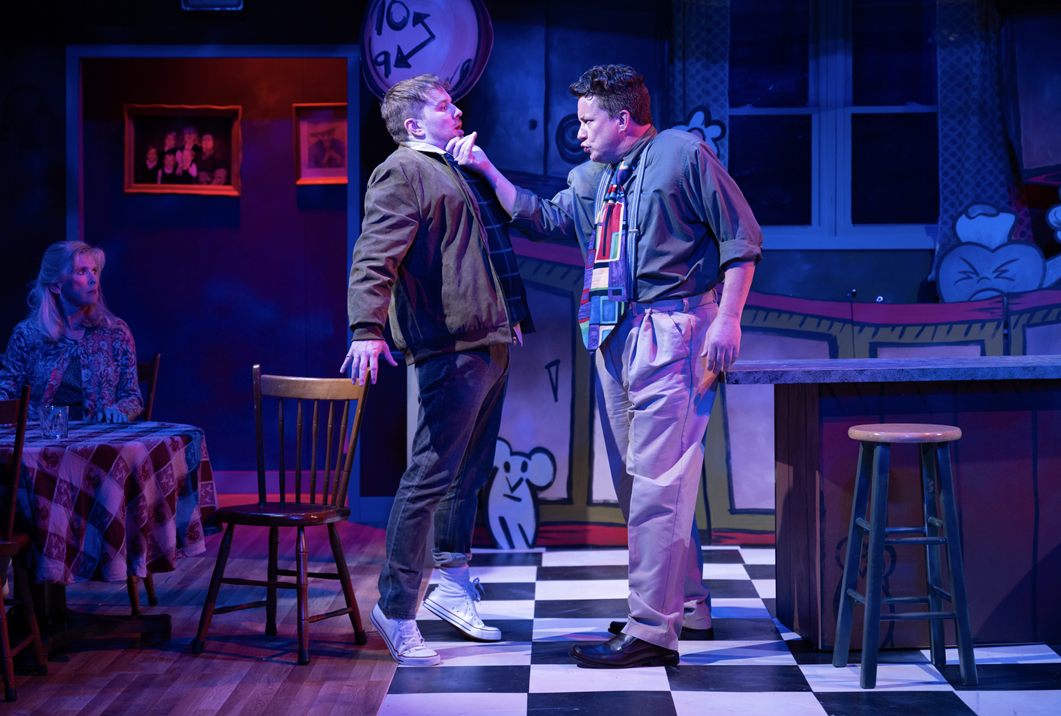
The problem is, there is no smoothing over the family trauma that fuels Jack’s family and bleeds into his present. The masks we wear are symbolically represented in Chris Raintree’s stunning set. It starts off as a cartoon caricature of a home, centered around the kitchen – the metaphorical heart of every home. In act two, the mask is removed to reveal the real kitchen of Jack’s childhood home, and begins to cover the source of his family’s dysfunction. Hubbard calls this act “A Family Home (without a family). For the third act, the mask is returned, but there are cracks in it, and bits of reality peak through. This is “A Performance, A Reckoning. All of it. All together. Now.”

And that title pretty much sums it up. There isn’t much more to say, other than: Hubbard has created a masterful piece of theater. His words tell hard stories with beauty, and humor, and truth. Roman À Clef  is immersive; details matter, from the script to the costumes to the set to the character’s names (e.g., McKnight, Bishop, Queenie, Kingston, Spawn, Rookie). Sharon Ott’s direction tapped into the trauma and helped dissipate the energy in a way that made it palatable for an audience, the ensemble appeared to be committed to the work, and Chris Raintree’s set design captivated us in ways that words alone could not convey. Chandler Hubbard’s Roman À Clef manages to tap into areas many shy away from, and makes us glad he went there – and invited us to join him.

———-

Julinda D. Lewis is a dancer, teacher, and writer who was born in Brooklyn, NY and now lives in Eastern Henrico County. When not writing about theater, she teaches dance history at VCU and low impact dance fitness classes to seasoned movers like herself, and occasionally performs.

———-

ROMAN À CLEF

A World Premiere by Chandler Hubbard

Directed by Sharon Ott

May 8-26, 2024

Time: Here and Now

Place: Firehouse Theatre

Act I – A Rehearsal.

Act II – A Family Home (without a family).

Act III – A Performance. A Reckoning. All of it. All together. Now.

Roman À Clef is a product of the TNT New Play Incubator.

CAST

Jack                …………………….               Andrew Bryce

Mike               …………………….               Alex Harris

Lois                 …………………….               Kelly Kennedy

Fiona              …………………….               Donna Marie Miller

McKnight       …………………….               Keaton Hillman

Bishop            …………………….               Tatjana Shields

Queenie        …………………….               Tippi Hart

Kingston        …………………….               Landon Nagel

Spawn            …………………….               Reese Bucher

Rookie           …………………….               Lukas D/Errico

Mike/Kingston u/s      …………..               Patrick Rooney

Lois u/s          …………………….               Gina Marie McKenzie

Fiona/Queenie u/s  …………….               Rachel Garmon

Bishop/Spawn u/s   …………….               Kylee Marquez-Downie

Rookie u/s     …………………….               Aidan Campbell

McKnight u/s            …………….               Evan Kagarise

Jack u/s         …………………….               Thomas Kaupish

PRODUCTION TEAM

Direction                               ……….           Sharon Ott

Assistant Direction              ……….           Molly Marsh

Scenic Design                       ……….           Chris Raintree

Assistant Scenic Design     ……….           Sarah Cook

Costume Design                  ……….           Cora Delbridge

Lighting Design                   ……….           BJ Wilkinson

Assistant Lighting Design  ……….           Reid Hardymon

Sound Design                      ……….           Kyle Epps

Intimacy/Fight Direction    ……….           Stephanie Hart

Movement Direction           ……….           Nathaniel Shaw

Developmental Dramaturgy     ….           Naysan Mojgani

Stage Management            ……….           Emily Vial

Asst. State Management    ……….           Juliet Grace Grochowski

RUN TIME

90 minutes with two intermissions

PERFORMANCE SCHEDULE

  • Previews Wednesday – Thursday, May 8-9 at 7:30pm
  • Opening Night – Friday, May 10 at 7:30pm
  • Running Thursday – Sunday through May 26, 2024

TICKETS

$35

$15 tickets available for college and high school students.

Pay-What-You-Will performances offered for both preview performances,

as well as all matinees (excluding closing, May 26th).

Photos by Bill Sigafoos

CURIOUS INTENTIONS

Starr Foster Dance Intentions are Clear

A Dance Review by Julinda D. Lewis

At: The Firehouse, 1609 West Broad St., Richmond, RVA 23220

Performances: April 11-14, 2024

Ticket Prices: $25 General Admission; $35 Arts Supporter; Datenight tickets 2 for $40

Info: (804) 304-1523 or starrfosterdance.org or firehousetheatre.org

Program & Casting:

All Choreography by Starrene Foster

All Lighting Design by Michael Jarett

Familiar Stranger (Premiere): Performed by Fran Beaumont, Shannon Comerford, Madison Ernstes. Original Music Composition by Daniel Deckelman. Costumes Designed and Constructed by Starrene Foster.

Last Call (2016): Costumes Designed and Constructed by Starrene Foster.

 “Un” Performed by Fran Beaumont. Music Composed by Charles Dumont with Lyrics Written by Michael Vaucaire, Performed by Edith Pian, Mon Dieu.

“Deux” Performed by Madison Ernstes, Mosca Mavrophilipos-Flit, Angela Palmisano. Music Composed by Ángel Cabral with Lyrics Written by Michel Rivgauche, Performed by Edith Piaf, Le Foule. “Trois”  Performed by Shannon Comerford, Molly Huey. Music Composed and Performed by Jacquees Brel, Au Suivant.

Sisterhood (2022): Inspired by a story, Sisterhood, written by Judith Bice. Performed by Madison Ernstes, Molly Huey. Music by Mike Lazarev, When You Are. Costumes Designed and Constructed by Starrene Foster.

Adjusting to the Dark (Premiere): Performed by Fran Beaumont, Shannon Comerford, Molly Huey, Mosca Mavrophilipos-Flint, Angela Palmisano with Guest Artists Roya Baker-Vahdani, Olivia Gotsch, Cassidy Kinney, Janelle Ragland, Julia Straka, Audrey Smothers. Music by Franz Schubert, Arr Prizeman, Ave Maria; Uno Helmersson, Timelapse; Jeff Russo, Zoe Keating, Savir Arrives in Oslo; Adrián Berenguer, Forzisimo, Continent; Jim Perkins, A Ritual for Saying Goodbye. Costumes Designed by Johann Stegmeir.

Deliberate yet unhurried movement. Intentional and diverse motivations. Splayed fingers, reaching, seeking, claiming, and declaring. These are words that describe my overall response to the latest performance of Starr Foster Dance – Curious Intentions.

Familiar Stranger, one of two new works, is a trio of sometimes fleeting, often exploratory movements. Remember that feeling you get when you pass someone on the street and they remind you of someone from your past, but you can’t quite remember their name? Or when someone touches you, perhaps just brushes against you in passing, and that brief contact stirs a long forgotten memory? Imagine, then, translating those feelings into movement, and you might just get Familiar Stranger. The work premiered with Fran Beaumont, Shannon Comerford, and Madison Ernstes, all performing with a sense of urgency – and sometimes a sinister touch – as they intertwine physically and emotionally. Two moments in time that that stand out are when first Ernstes and later Comerford (I think) are held and swung by the other two; it feels like a moment that could symbolize trust or danger, but – thanks to the dancers’ spiraling upper bodies and tiny hand gestures that are somehow enhanced by Daniel Deckelman’s dramatic thriller score – we’re never sure which way it might go.

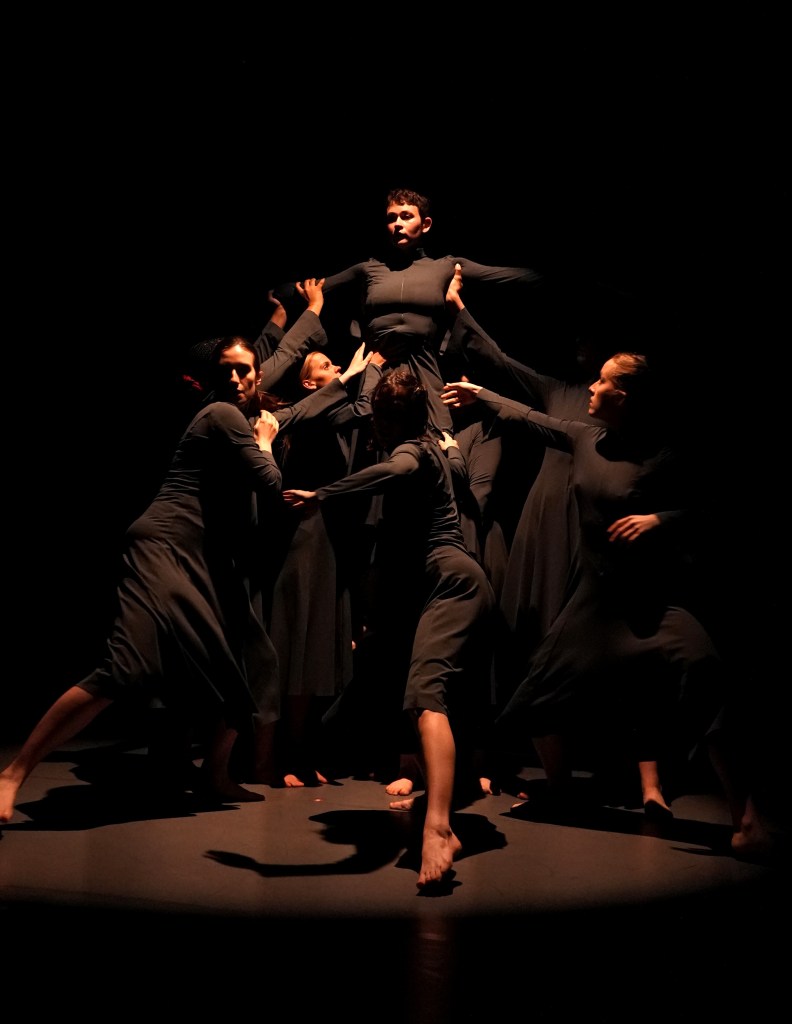
A second new work, Adjusting to the Dark, is performed by a large cast – five company members joined by six guest artists – all dressed in modest dark dresses with high necks and long bell sleeves, reminiscent of choir robes or liturgical vestments. The work actually begins with a prayer, a rendition of Ave Maria, and concludes with Jim Perkins’ A Ritual for Saying Goodbye, an appropriately moody medley of what sounds like violin and electronic yearning. A tug of war of pushing and pulling, caressing and enfolding, silent screams, and a focus on small, riveting hand gestures are all supported by a symbiotic collaboration of movement, music, and an interesting use of footlights. The audience is encouraged to look, listen, and think in new ways. What is your darkness, what are the challenges of your life, and how do you adjust?

The program also included the tri-part Last Call (2016), a three-part work (solo, trio, and a duet that re-introduced returning company member Angela Palmisano, who performed in the trio). In the solo section, Beaumont is elegant, while Ernstes, Mavrophilipos-Flint, and Palmisano take a witty turn in the trio, and Comerford and Huey close with reassuring weight-sharing. The songs accompanying these explorations (self-described by Foster as “whimsical” and as a juxtaposition of gracefulness and awkward gestures, lyrical grace and protective gestures in a review I wrote for The Richmond Times Dispatch, Sept. 30, 2016, https://richmond.com/entertainment/dance-review-starr-foster-dance-project-fifteen/article_7c259614-bb43-533d-9bd0-c6e0c4d85600.html) are “Mon Dieu” (My God) and “Le Foule” (The Crowd), sung by Eith Piaf, and “Au Suivant” (Next), performed by Jacques Brel.

The company also performed Sisterhood (2022), inspired by a story written by Judith Bice and first performed for Foster’s Page to Stage II show, part of a series Foster plans to continue in December. (The company is currently accepting flash/sudden poetry submissions for Page to Stage III.) Sisterhood a duo about a toxic, dependent, love/hate sibling relationship, was performed by Madison Ernstes and Molly Huey. The dancers’ identical brown dresses only emphasize the inequality of their relationship. Michael Jarett has added some stunning lighting, including tree patterns on the floor that lead us to where the Barbies are buried. Chilling and presumably authentic, Sisterhood makes me glad I’m an only child.

———-

Julinda D. Lewis is a dancer, teacher, and writer who was born in Brooklyn, NY and now lives in Eastern Henrico County. When not writing about theater, she teaches dance history at VCU and low impact dance fitness classes to seasoned movers like herself, and occasionally performs.

———-

Starr Foster Dance presents

CURIOUS INTENTIONS   

Artistic Director/Choreography by: Starrene Foster

Art Director: Doug Hayes

Lighting Designer: Michael Jarett

Music Director: Daniel Deckelman

Company Artists: Fran Beaumont, Shannon Comerford, Madison Ernstes, Molly Huey, Mosca Mavrophilipos-Flint, Angela Palmisano

Guest Performers: Roya Baker-Vahdani, Olivia Gotsch, Cassidy Kinney, Janelle Ragland (SFD Intern), Julia Straka, Audrey Smothers (SFD Mentee)

Art Director: Douglas Hayes

Costumes Designed and Constructed by: Starrene Foster

Lighting Designer: Michael Jarett

Music Director: Daniel Deckelman

Starr Foster Dance is a Resident Company of the Firehouse Theatre

Performance Schedule

Thursday, April 11th 7:30PM

Friday, April 12th 7:30PM

Saturday, April 13th 5:00PM & 7:30P<

Sunday, April 14th 5:00PM

Post-performance Q&A after the Thursday and Saturday evening performances

Champagne toast after the Friday evening performance

Run Time

1 hours 15 minutes

ZERO HOUR

VaRep-JCC Partnership

A Theater Review

Produced By: Virginia Rep in partnership with the Weinstein JCC Jewish Family Theatre

At: Theatre Gym, in the November Theatre complex, 114 W. Broad St., RVA 23220

Performances: March 15-April 7, 2024

Ticket Prices: $40

Info: (804) 390-3390; http://www.virginiarep.org

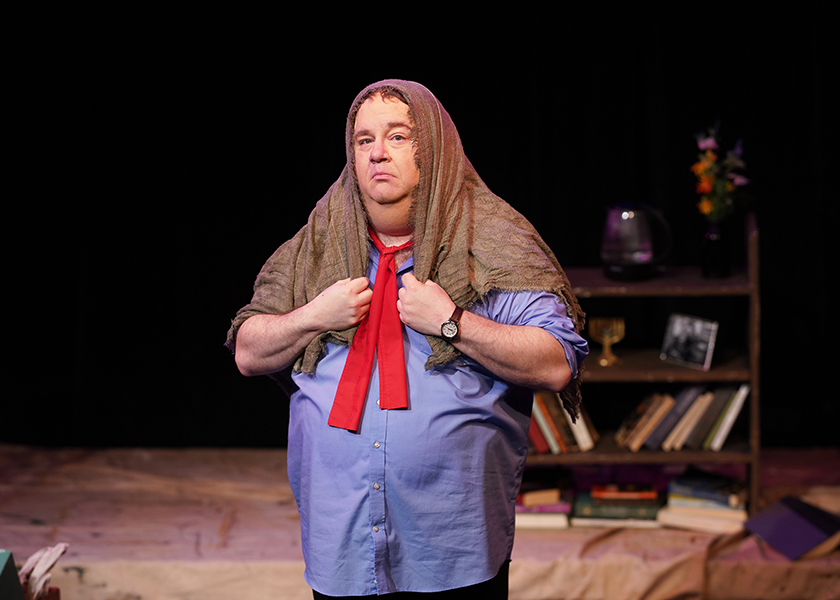
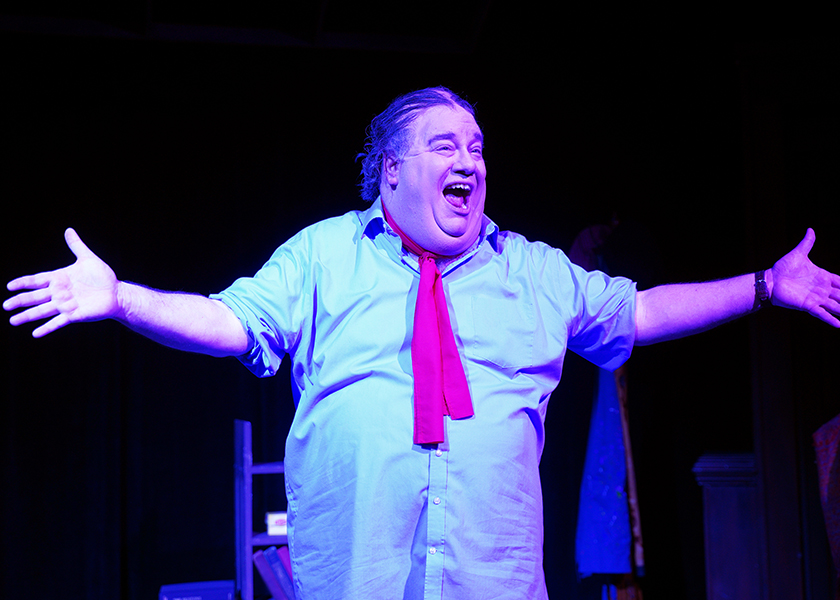
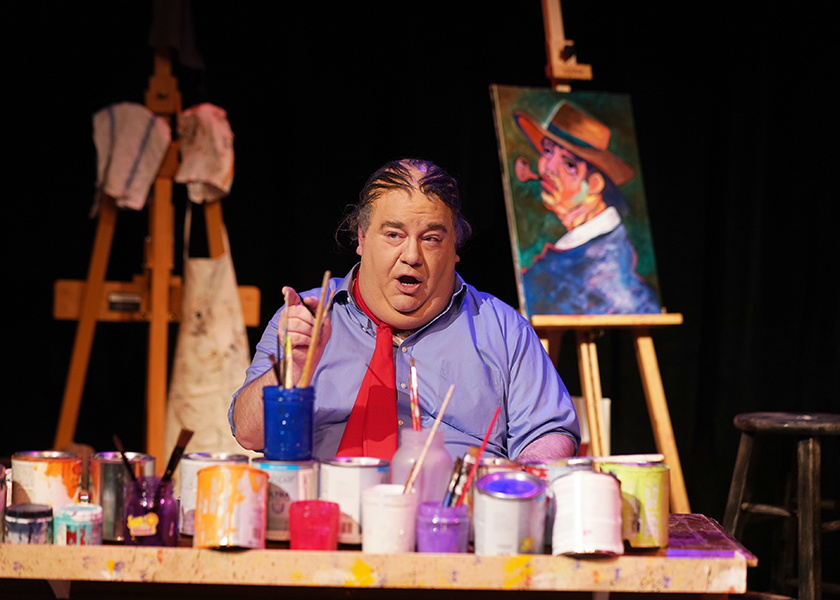
This is a rare (for me) re-review. I first saw this production of Zero Hour at the Weinstein Jewish Community Center nearly a year ago (“Jason Marks is Zero Mostel, RVArt Review, April 6, 2023, https://jdldancesrva.com/2023/04/06/jason-marks-is-zero-mostel/). But, humor me. Don’t read or re-read that review until after you read this one, and I’ll do the same. I won’t go back and re-read that first review until I finish writing this one.

With this VaRep partnership, while the location is different, Debra Clinton is still the director, and Jason Marks is still Zero Mostel. This time, the story and the script were familiar, but the production was just as fresh and vital as it had been the first time. This did not feel like a re-run; Mostel was such a complex and dynamic person that there was still much to learn that I had missed the first time, or that I saw with new eyes after the passage of time – and world events.

Jason Marks dives so deeply into the character that it is easy to forget he is an actor – we are spending an evening with Zero Mostel. Samuel Joel “Zero” Mostel was born February 28, 1915 (my birthday, but 4 decades before me) in Brooklyn, NY (as was I).

As a comedian, Mostel rose in stature to become a headliner at New York’s Café Society, a popular night spot and as an actor, Mostel specialized in comic roles: he was, perhaps, best known for his portrayal of Tevya in Fiddler on the Roof on Broadway.

Somewhere along the way, during the presidency of Harry S. Truman, the USA became embroiled in blacklisting activities. After World War II, the USA and Russia became involved in a “Cold War,” and  People – particularly actors and other creatives – who were suspected of being members of or sympathizing with the Communist Party –  were brought before the House Un-American Activities Committee (HUAC) where they were questioned and expected to name names. Many citizens were tried, and many actors were blacklisted or prevented from working in film, television, or on stage. Mostel (or maybe I should say the playwright, Jim Brochu) mentions a few well-known names who were caught up in this wide-ranging net, including the renowned choreographer Jerome Robbins and the comedian and actress Lucille Ball, TV star Phil Silvers, screen writer Ring Lardner, Jr., and screen writer Martin Berkeley who is described in Zero Hour as “the Babe Ruth of stool pigeons.”

Other victims of the Red Scare: Orson Wells, Burgess Meredith (credited, in the script, with the line, “hold onto your tits, it’s Zero Hour!”), Arthur Miller, Charlie Chaplin, Lena Horne, Langston Hughes, Pete Seeger, Gypsy Rose Lee, Artie Shaw, Dashiell Hammett, and the list goes on and on and on…

There are many memorable moments in Zero Hour, both dramatic and historic. The one-hander paints a vivid picture of Mostel’s journey “from blacklist to White House in 10 years.” We learn of Mostel’s tumultuous love affair with his second wife, Kate. A former Radio City Music Hall Rockette, Mostel’s Orthodox Jewish parents did not accept Kate because she wasn’t Jewish, and his parents never met Kate or their two grandchildren.

Then there’s the horrible bus accident in 1960 that nearly ended his life as well as his career, leaving him crippled and in pain. But he stubbornly avoided amputation, and went on to star in Waiting for Godot, Rhinoceros, and the Broadway musical, A Funny Thing Happened on the Way to the Forum. Marks shares all of this and more with a wild and vivid mixture of humor, sarcasm, and melodrama while his character is being interviewed by an invisible rookie reporter. “Why do I call you putz?” Mostel asks the report early in the interview, “because I don’t know your name!”

Mostel warms up to his interview as we warm up to him. The interview takes place in Mostel’s West 28th Street painter’s loft. In addition to being a prolific and popular performer, Mostel was also a visual artist whose abstract paintings have been sold at auction and displayed in galleries and museums. My notes from the show list 5,000 paintings, 15 Broadway shows, and 25 movies.

Zero Hour is an engaging tour de force that is equally entertaining and educational. And now, I feel, is the time to go back and read what I said about Zero Hour the first time I saw it:

Zero Hour is one of the funniest shows I’ve ever seen and it appears to have been a perfect vehicle for Jason Marks.” – Yes, I still hold this opinion!

Zero Hour is a skillful balance of biography and entertainment. For those unfamiliar with Zero Mostel, it is informative, and for those who were already fans, it might reveal a few unknown nuggets.” – Again, I second that first impression.

“All of this, and more, is lovingly and capably captured by Marks under the director of Debra Clinton. Clinton, in the Director’s notes, paid homage to Mostel’s individuality – his commitment to standing up for what he believed even to the detriment of his career – “his honesty, passion, and empathy.” – ditto

And finally, I often find it weird to read things I’ve written previously, but this holds true. That’s my story and I’m sticking to it: Sometimes it was hard to tell where Marks ended and Mostel began. I am sure playwright Jim Brochu who originally starred in his own play, would approve of Marks’ interpretation.” There are a FEW opportunities remaining to see this production of Zero Hour. I suggest you go see it. You won’t be sorry.

———-

Julinda D. Lewis is a dancer, teacher, and writer who was born in Brooklyn, NY and now lives in Eastern Henrico County. When not writing about theater, she teaches dance history at VCU and low impact dance fitness classes to seasoned movers like herself, and occasionally performs.

———-

ZERO MOSTEL

Written by Jim Brochu

Directed by Debra Clinton

Cast List

Zero Mostel – Jason Marks

Direction & Design

Direction – Debra Clinton

Set & Lighting Design = Todd Schall-Vess

Wig Design = Kevin S. Foster II

Stage Management – Hayley Tsutsumi

Zero Hour runs March 15 – April 7, 2024

at the Theatre Gym at the November Theatre, 114 W. Broad Street, Richmond, VA 23220

Run Time

The play is presented in two 45-minute acts with one 15 minute intermission

Tickets

Box Office: (804) 282-2620

Information: http://www.virginiarep.org

Full Price Tickets: $40.00

Discounted Group Rates available

Show Photography by Jay Paul