PASSING STRANGE: If It Were Any More REAL, It’d Be Fiction!

PASSING STRANGE: A Rock Musical

A Theater Review by Julinda D. Lewis

At: The Firehouse Theatre, 1609 W. Broad Street, RVA 23220

Performances: September 4 –6 previews; opening September 7 – October 18, 2019

Ticket Prices: $20/student; $25-30/military & RVATA; $30-45/general admission

Info: (804) 355-2001 or firehousetheatre.org

All musicals are not created equal. Passing Strange, billed as “a new rock musical” is a semi-autobiographical tale of a young man’s search for his identity – “the real.” Nothing out of the ordinary in that but Passing Strange is written by Stew and his partner Heidi Rodewald, musicians with the band The Negro Problem.

The upbeat and energetic score is made up of rock and roll infused with gospel, blues, jazz, and punk rock. A four-piece band led by musical director Leilani Fenick is placed prominently on a platform upstage center, and occasionally gets drawn into the onstage action. Jeremy V. Morris, the narrator, hypes up the audience, introduces the band, narrates the story, and occasionally merges into the story. It soon becomes clear that the Narrator is an older version of the lead character, an unnamed Youth played by Keaton Hillman in what I believe is his first leading role.

The Youth’s search for identify takes us from a middle class home in South Central Los Angeles in the 1970s to a communal family of young artists in free-spirited Amsterdam to a collective of revolutionary performance artists in Berlin. Ironically, it is the German anarchists who teach him the value of family – but not before it is too late.

The tightly knit ensemble – Patricia Alli, Keydron Dunn, Keaton Hillman, Dylan Jones, Jamar Jones, Katrinah Carol Lewis, and Jeremy V. Morris – has no weak links, with each of these performers giving their all throughout the two-act musical that runs about 110 minutes, with one intermission. They act, dance, sing, and set the stage, moving large black packing crates, sometimes discretely wiping their streaming faces with conveniently stashed towels as they pass one another.

Ahh, passing – now there’s a word packed with symbolism. The actors pass one another on stage. The Youth passes through the spaces and stages of his life. Time passes from Youth to Narrator. Blacks passed for white in order to get better jobs. The Youth passes as a poor young man from the ghetto to achieve artistic recognition. Black actors pass themselves off as white Europeans. And Stew, who played the role of Narrator in the original production, was inspired, in passing, by none other than Shakespeare whose Othello, the Moore of Venice uttered the phrase “passing strange” in Act 1, Scene 3.

Passing Strange is directed by Tawnya Pettiford-Wates (Dr. T.), and it seems that her projects (e.g., last season’s An Octoroon at TheatreLAB The Basement) often deserve at least a second viewing and a talk-back, if not an entire seminar. Dr. T.’s staging, along with dynamically interwoven choreography by Christine Wyatt, a recent graduate of the VCU Dance program, keeps everyone moving at a swift pace that frequently contains hints of the minstrel show. The show is largely comedic until the final two scenes, but even the humor is rich in historic, racial, ethnic, sexual, regional, and cultural references. Some may be familiar, some may pass over the heads of many, and others fly by so fast that even the knowledgeable might miss them while savoring a previous nugget.

While this is clearly an ensemble masterpiece, there were standout moments and roles. I’ve seen Keaton Hillman perform in supporting roles in VaRep’s 1776, and  The Wiz, and Richmond Triangle Players’ A Chorus Line, handle puppets in the Children’s Theatre’s Mr. Popper’s Penguins, and portray a snake in The Heritage Ensemble Theatre Company’s

The Dreamseller and the Forest Dweller and deliver a tear-jerking monologue in Oedipus: A Gospel Myth at The Firehouse, but this is his first leading role. He nailed it. He was silly and frustrating, frustrated and innocent. Sometimes you wanted to shake him, and other times you wanted to hug him.

Jeremy V. Morris was part hype man, part mentor as the Narrator, sometimes watching, sometimes guiding, sometimes participating. We, the audience, didn’t know what to expect, but what he gave was just what was needed. Jamar Jones, who often shares a stage with Morris, used his malleable expressions to create a host of characters, from an LA youth to bible thumping preacher, from a gender fluid artist to a macho ex-boyfriend. The versatile and highly skillful Katrinah Carol Lewis also played several characters, but the one that made the strongest impact on me was Desi, the revolutionary artist who believed that the only thing that really matters is love. Keydron Dunn’s repertoire of characters included Mr. Franklin, the closeted gay son of the Baptist preacher. He initiated his newest choir member with a weed-smoking session in his car and introduced his youthful proteges to more than just harmonies and hymns. That made The Youth’s rejection of him all the more painful and poignant. Patricia Alli portrayed the mother with empathy and realism, all while maintaining a high level of first humor and later drama. Last but not least was Dylan Jones, making her Richmond debut, delightfully portraying three characters that ranged from teen-aged seductress to pornographic performance artist.

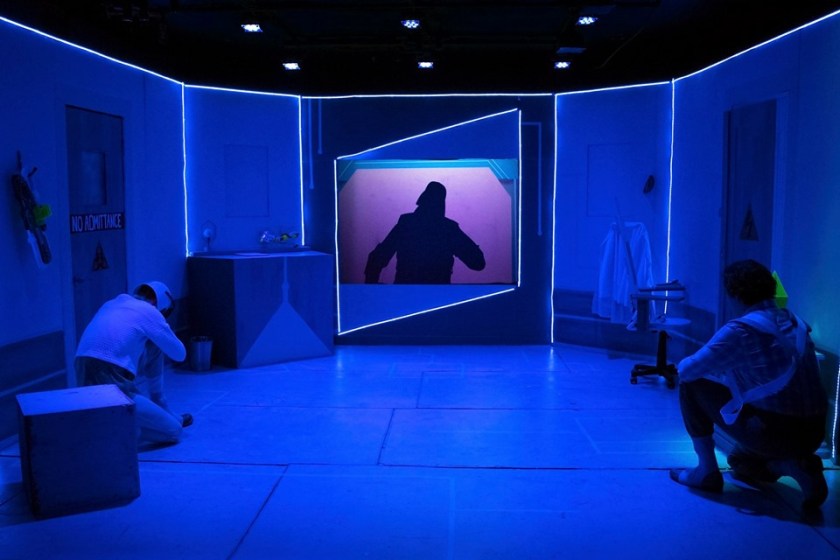
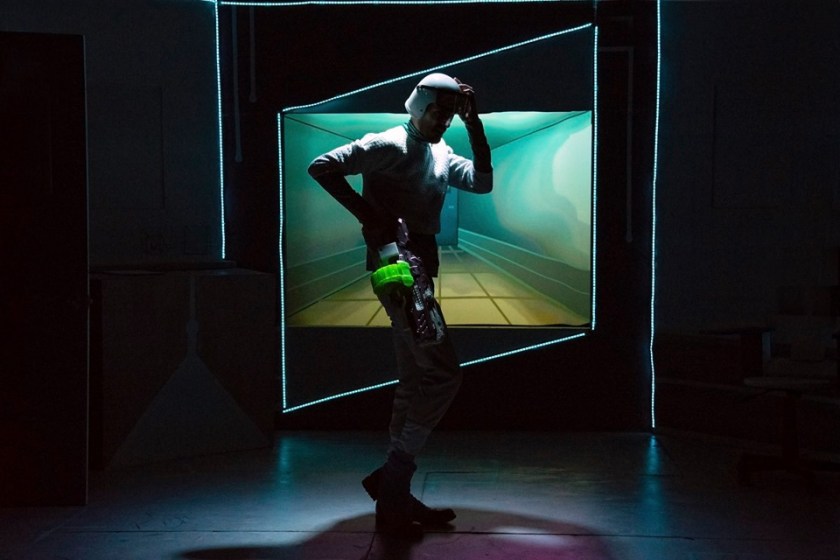
Chris Raintree’s simple set of a raised platform for the band and moveable boxes and chairs to create the environments through which the Youth passes was enhanced by lighting by Bill Miller, including some colorful LED lights on the walls. Alex Valentin’s costumes were appropriate but largely unremarkable – until the Mother’s final scene in which she appeared in the beautiful rose-colored gown she had dreamed of in Act One. September and October are busy months for theater and dance in Richmond, but I hope to squeeze in one more performance of Passing Strange before it closes October 18, and I highly suggest you get there as soon as you can. I wouldn’t be surprised if tickets become scarce after words get out about this one.

Julinda D. Lewis is a dancer, teacher, and writer who was born in Brooklyn, NY and now lives in Eastern Henrico County.

———-

Photo Credits: Bill Sigafoos

Passing Strange - Patricia Alli, photo by Bill Sigafoos
Patricia Alli
Passing Strange - Keydron Dunn, photo by Bill Sigafoos
Keydron Dunn
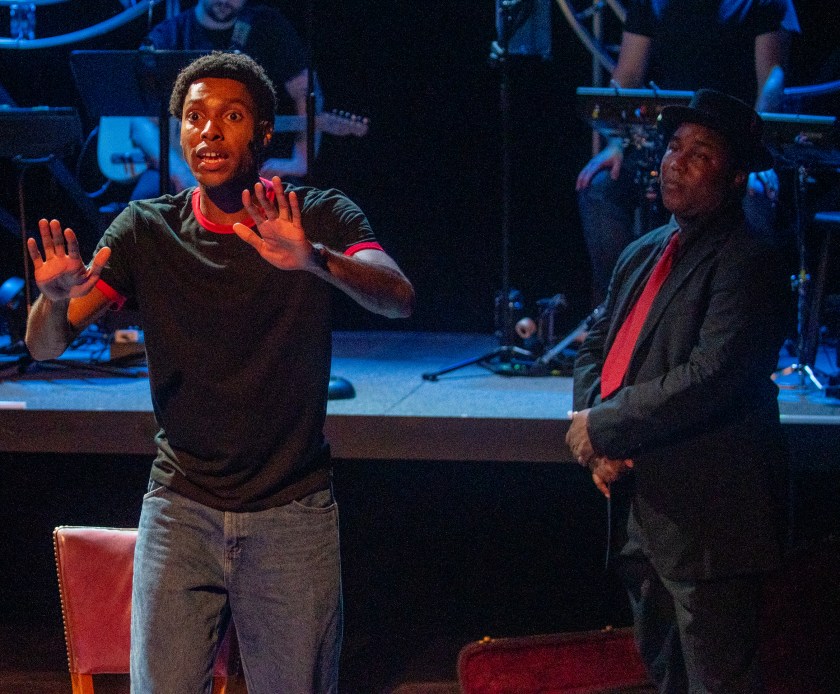
Passing Strange - Keaton Hillman, Jeremy V Morris, photo by Bill Sigafoos
Keaton Hillman and Jeremy V Morris
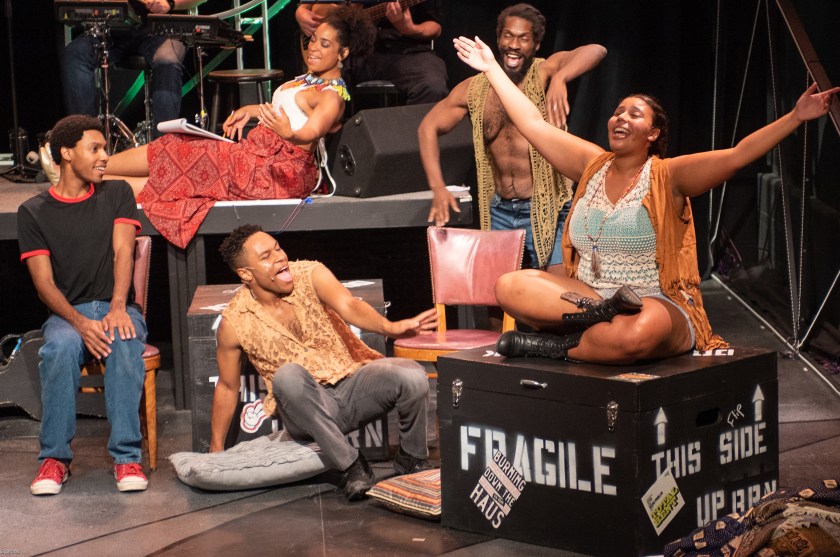
Passing Strange - Keaton Hillman, Jamar Jones, Katrinah Carol Lewis, Keydron Dunn, Dylan Jones, photo by Bill Sigafoos
Keaton Hillman, Jamar Jones, Katrinah Carol Lewis, Keydron Dunn, and Dylan Jones
Passing Strange - Jeremy V Morris, photo by Bill Sigafoos
Jeremy V Morris
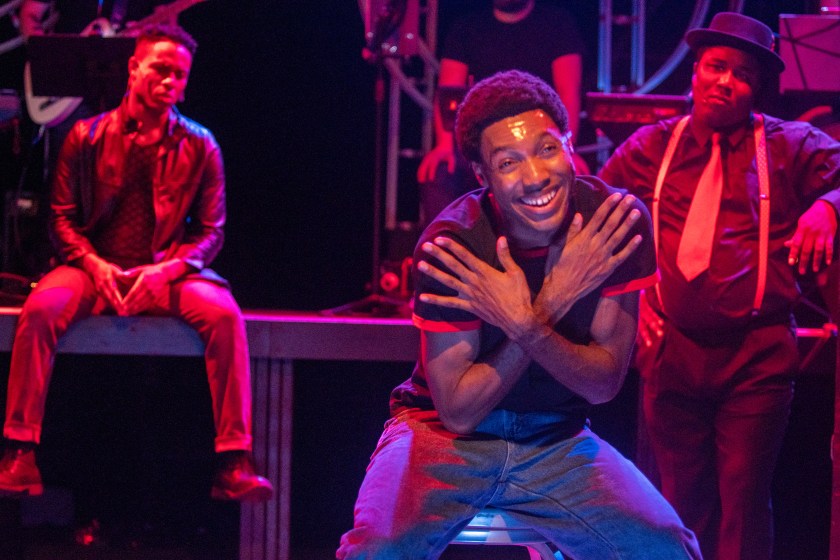
Passing Strange - Jamar Jones, Keaton Hillman, Jeremy V Morris, photo by Bill Sigafoos
Jamar Jones, Keaton Hillman, and Jeremy V Morris
Passing Strange - Dylan Jones, Keydron Dunn, Keaton Hillman, Jamar Jones, Katrinah Carol Lewis, photo by Bill Sigafoos
Dylan Jones, Keydron Dunn, Keaton Hillman, Jamar Jones, and Katrinah Carol Lewis


Alvin Ailey
https://www.amazon.com/gp/product/1093389303/ref=as_li_tl?ie=UTF8&tag=rvartreview-20&camp=1789&creative=9325&linkCode=as2&creativeASIN=1093389303&linkId=c39a9d5181692735b3b75883d732cd03


Whistlin Women
https://www.amazon.com/gp/product/1072107546/ref=as_li_tl?ie=UTF8&tag=rvartreview-20&camp=1789&creative=9325&linkCode=as2&creativeASIN=1072107546&linkId=78c578738db659724289dda2116d985c
41SR4yCI7aL._SL160_
https://www.amazon.com/gp/product/B0791TX5P5/ref=as_li_qf_asin_il_tl?ie=UTF8&tag=rvartreview-20&creative=9325&linkCode=as2&creativeASIN=B0791TX5P5&linkId=08cacc62054100f00d2a6fcfbf97f3e4


RENDEZVOUS: 1 Woman, 2 Men, 3 Choreographers, 4 Nights

RENDEZVOUS: A Meeting of 3 Choreographers

An Extended Dance Review by Julinda D. Lewis

At: The Grace Street Theater, 934 W. Grace St., RVA 23220

Performances: September 6 & 7 and 13 & 14 at 8:00pm

Ticket Prices: $10 general admission

Info: Grace Street Theater Box Office (804) 828-2020 or https://bit.ly/2Z1dtdk

RENDEZVOUS: A Meeting of 3 Choreographers is the first dance performance of the 2019 Fall season. It is also the first joint performance by this trio of young, contemporary performers. So, this is not going to be a traditional review, but more of an introduction and overview of some of the artists and the works that represent the future of contemporary dance in RVA and the region.

In a brief program, running exactly one hour, Callie Moore, Robert Rubama, and Jelani Taylor offered a sampling of their new and recent works.

Moore’s three selections stood out due to her use of videography.  In “Snap Soup” she has her dancers placed against a blindingly white background that delightfully challenges the viewer’s sense of space and perspective. Due to the lack of shadows six dancers, dressed in black tops and pants in shades of blue and purple, appear to float when they lay down. When one dancer passes behind another, it creates the illusion that she is rising to another level. Moore’s movements, accompanied by Julia Wolfe’s “Dark Full Ride,” a composition of light percussion (snare drums, cymbals) are playful and athletic, punctuated by unusually long pauses and empty white space. The performers: Hallie Chametzky, Courtney Darlington, Eslie Djemmal, Len Foyle, Katlyn Lawhorne, and Zoe Wampler.

“Melodramatic and Self-Indulgent” is almost the complete opposite of “Snap Soup.” In this solo, a woman (Callie Moore) in denim shorts and a white tank top performs small movements, subtly shifting her weight or wrapping her arms around her torso. She is backed into a dark corner and accompanied by a sound score of  “Brown Noise” (think super-amplified white noise and you get an idea of what it sounds like). The subtlety of the movement and occasional close-ups, focusing on the pulsing of the dancer’s breathing, her hand pinching the tight skin of her sternum, or her taped and battered toes, is a philosophically interesting exercise, but eventually becomes less and less interesting to watch.

In Moore’s third selection, “Rosy,” two women (Brittany Powers and Jada Willis) drive to the country, park their car, and dance outdoors in beds of leaves, on gravel, and on the pedestrian crosswalk of a bridge. Nature and traffic provide abundant scenery and I was enamored of the opening scene where the two women walked off into the distance and as they faded away in the background they simultaneously re-emerged in the foreground – a sort of reverse fade out leading to the main movement. Overall I truly enjoyed Moore’s experiments with videography. Her work is visually compelling and emotionally challenging.

Robert Rubama, interestingly, presented the opening and closing works. The program opened with his duet, “::flux,” which he performed with Robin Auerswald to the accompaniment of Steve Reich’s “Music for 18.” Rubama established a motif of organic movement fueled by loops and spirals that extend. His solo, “Down,” set to Bobby Vinton’s “Mr. Lonely” and “A fool persists” by Infinite Body (an instrumental piece that reminds me of the opening of an epic film) is a sensuous indulgence, long-limbed and languid. Even his sharp movements are smooth. His falls are soft, and he offered more of those lush spiraling movements that extend into infinite space as he articulates every possible muscle – back, neck, wrist.

Jelani Taylor – who, disappointingly did not dance in any of the works – presented two duets, “Solemn Wish” performed by Michelle Knight and Sydney Wiggins to the plaintive, prayerful song, “Father, Father” by Laura Mvula with Metropole Orkest and “Remembering Memory,” performed by Jenna Beardsley and Taylor Bonadies to the familiar Joni Mitchell song, “Both Sides Now.” Both duets are emotionally charged and full of yearning. “Solemn Wish” repeats variations of a slow walk with one arm raised, and the dancers execute long, slow looks that seem sadly unfulfilled. “Remembering Memory” begins with the dancers entwined, and at one point they roll, pressed together, as if clinging to life. Holding hands leads to a fall, which leads to a spin, which leads to a lunge. The movements are simple, what is compelling is the transitions, which are subtle and almost imperceptible, making the work fluid and organic.

It’s hard to produce new work. It’s hard to produce dance here in Richmond. People are familiar with the Richmond Ballet; the Latin Ballet of Virginia has a target audience and loyal following; Starr Foster has been around long enough to have developed a reputation, and Kaye Weinstein Gary has integrated dance and theater to find her niche, and both Foster and Gary annually produce festivals that bring a wide range of dance from the region and sometimes from abroad to enrich Richmond. The University of Richmond annually brings at least two internationally known dance performances to the Modlin Center, but the world of dance in Richmond does not attract the numbers that the Richmond theater community can expect – and many of them struggle to fill seats. If residents are surprised at the variety of theater companies we have, many know even less about our dance talent. That said, I have a few thoughts about Rendezvous.

The printed program was nicely executed and attractive, but I would have liked a bit of information about the participants and a few moments between dances when the house lights come up enough to allow the audience to glance at the program, so we know what’s coming up next. I overheard someone in the lobby remark that there were no posters advertising the show. I heard about it through social media, and posters can be posted there – saving both printing costs and trees. One thing the presenters were able to do that I have been advocating for is that the program is being presented over two weekends, not just one. So, while opening night had, sadly, fewer than a dozen audience members in attendance, there is still time to get out there and support our local artists. The show runs exactly one hour and it’s only $10!

Need some additional encouragement? Below is a link to Jelani Taylor’s work, “Remembering Memory” and some biographical information on each of the three choreographers. My work here is done.

Follow this link to Jelani Taylor’s work, “Remembering Memory.”

https://www.facebook.com/eradanceco/videos/421815151760206/

Choreographer, film-maker, and dancer Callie Moore graduated from VCU with a BFA in Dance and Choreography in May 2017 and founded her company Snap Soup Dance (yes, the same as the name of one of the works she presented) in 2018, with the goal of captivating everyone with her work, not just “dancers” and “artists.” Based in Richmond, VA, Snap Soup seeks to work with artists and creators across all disciplines to further their mission of making dance and art more accessible to all.

Robert Rubama is a native of Virginia Beach, Virginia and a graduate of George Mason University with a BFA in Dance. He has performed in works by Andrea Miller, Donald Byrd, Mark Morris, Soon Ho Park, Nick Pupillo, Ivan Perez, and Yin Yue as well as with Agora Dance and RawArts Dance at various venues in the Washington D.C area. He is the founder of Terre Dance Collective, a DC-based dance company that has presented works in New York City and Washington D.C.

Jelani Taylor is a dancer and choreographer from Virginia Beach, Virginia and a recent graduate of Virginia Commonwealth University with a BFA in Dance and Choreography. At VCU Jelani performed in works by Melanie Richards, Martha Curtis, Helen Simoneau (Guest Artist), Ching-I Chang Bigelow (Guest Artist), Scott Putman, and Dr. E. Gaynell Sherrod. He has also performed in works by Johnnie Cruise Mercer and Rady Nget. Jelani’s own choreography has been showcased at Inside/Out at Jacob’s Pillow Dance Festival, the International Association of Blacks in Dance Conference (IABD), American College Dance Association’s (ACDA) National College Dance Festival, National Dance Society Conference (NDS), Sans Limite Dance Festival, Small Plates Choreography Festival, Dogtown Dance Theater, Grace Street Theater, and ODU University Theater. Jelani is the artistic visionary of Richmond-based ERA Dance Company, a contemporary modern dance company with a mission to create a body of work that is reflective of cultural truths that are intended to engage and empower the larger community.


Julinda D. Lewis is a dancer, teacher, and writer who was born in Brooklyn, NY and now lives in Eastern Henrico County.

———-

Photo Credits: Photos and posters courtesy of Jelani Taylor.

Rendevous1

Rendezvous1
Callie Moore
Rendezvous3
Robert Rubama
Rendezvous2
Jelani Taylor


https://www.amazon.com/gp/product/1072107546/ref=as_li_qf_asin_il_tl?ie=UTF8&tag=rvartreview-20&creative=9325&linkCode=as2&creativeASIN=1072107546&linkId=2091bcd4a793de0cb3c8335ee66be472


LEVEL 4: Beating the Game

LEVEL 4: Game Over

A Theater Review by Julinda D. Lewis

At: TheatreLab, The Basement, 300 E. Broad St, RVA 23219

Performances: August 15-31, 2019

Ticket Prices: $30 general admission; $20 seniors & industry/RVATA; $10 students and teachers with ID

Info: (804) 506-3533 or theatrelabrva.org

Level 4, a smart and funny new play by Dante Piro that made its debut at TheatreLAB the basement is the second collaboration between Piro and director Chelsea Burke in as many months. (The Verge, was produced by The Firehouse and presented at The Branch Museum of Architecture and Design in July and August, https://jdldancesrva.com/2019/08/03/the-verge-good-things-come-in-small-packages). They make a great creative team.

That being said, I am entirely out of my element with Level 4, a clever and colorful play that takes us inside the world of a video game, Karma Quest, where we get to explore life, loss, loneliness, and very human characteristics and relationships as experienced by the Light Lord whose domain is a battle chamber. I am not a gamer. Since the ancient days of TRS-80, when we had to type in code line by line in order to play game, my gaming has been pretty much limited to Words with Friends, Simon’s Cats, Family Feud, and Wii Fit.. So yeah, the world of the Light Lord, Strobe, Mertens, Gauntlet, the Hero, the Heroine and Tammy is out of my league.

Nonetheless, thanks to Piro’s story – which struck a nice balance between drama and comedy – and Burke’s direction, that kept things moving along at a nice clip (the first act seemed to fly by, while the second act seemed a bit long to me), I was able to enjoy the action and laugh a lot.

The very strong and well-chosen cast consists of Chris Klinger as the likeable villain Light Lord, Adam Valentine as his loyal right hand man Strobe, Adam Turck as The Hero (a real-life human who apparently spends so much time playing the game that he eventually finds himself inside the game), Levi Meerovitch (who also seems to have been very busy working on numerous stages around RVA in the past few months) as the melancholy and introverted guardian of the armor and the giant Gauntlet hand, with Breezy Potter representing the under-represented female demographic as The Heroine and the unpopular gamer Tammy.

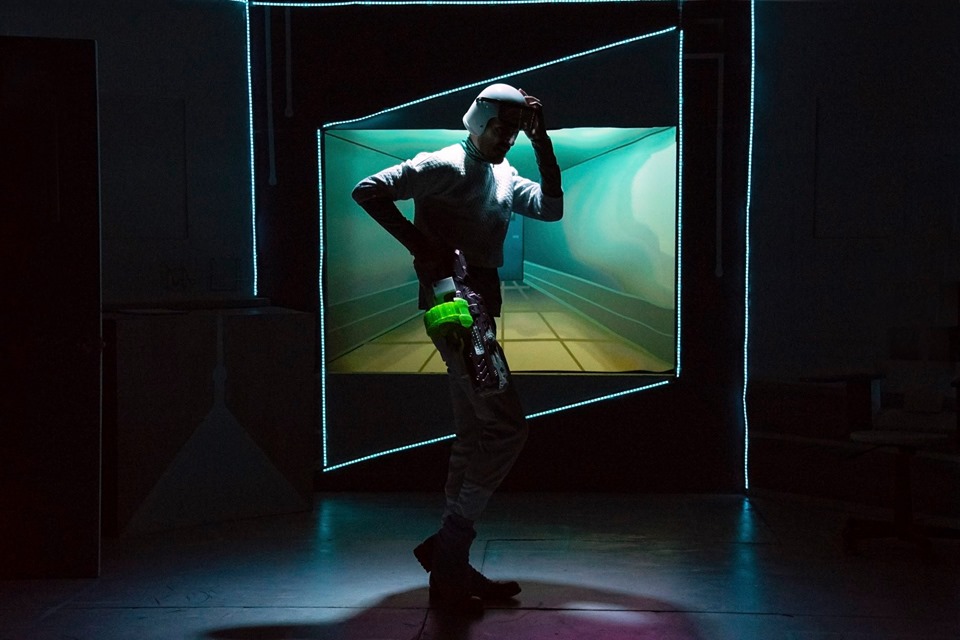
Interactions between Klinger and Valentine, Klinger and Turck, and Klinger and Meerovitch are especially interesting as the video game experiences glitches, the characters play the same scene over and over with various results, the game restarts, and, in the end, gets resurrected. Meerovitch and Potter sometimes appear as disembodied heads in windows on either side of Dasia Gregg’s video game set and the emotionally flat affect sometimes adopted by Valentine and Meerovitch was intriguing.

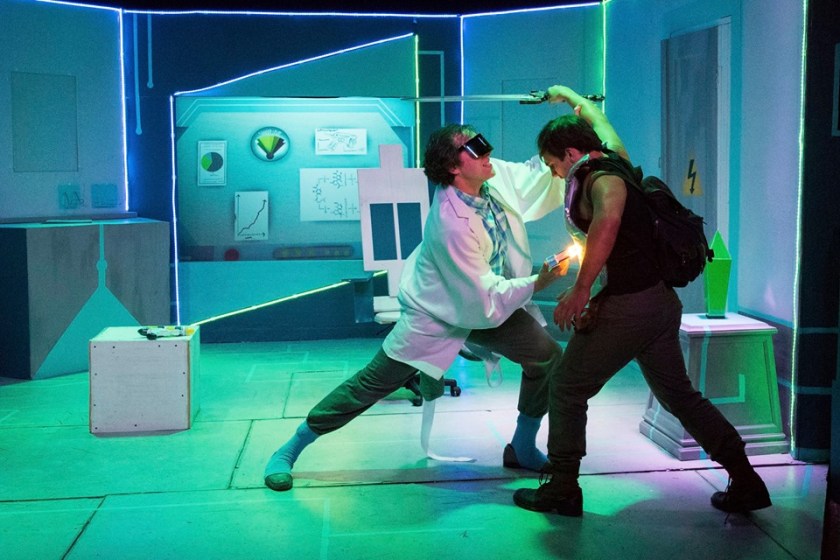
The simplicity of Gregg’s set and projections and the stylized movements of Klinger and Turck during the fight scenes suggests to this video game novice that this is a game from an earlier time period and is not one of the more modern programs. This is supported as the second act concludes with the revelation that time has passed. The Hero has married, his son is now an adult, but to tell any more would spoil the dramatic surprise of the ending.

Visually, Level 4 pulled the audience close into Gregg’s set. Lighting by Michael Jarrett included strobe effects and strands of LED lights, familiar Mario Brothers/Nintendo 64-era tunes infused the sound design by Joey Luck, and elaborate fight choreography by Emily Turner all enhanced the audience’s overall immersive experience. The one thing I thought didn’t quite fit – no pun intended – was Ruth Hedberg’s costumes. They looked somewhat like a child’s attempt to create a video game character’s garment. The Light Lord’s cape-like uniform was the most troublesome for me, closely followed by the shoe covers or spats that were simply socks with the heels and toes cut out. But the Light Lord mentioned that he had been planning to update the uniforms, so perhaps this look was intentional.

I enjoyed the intrinsic humor of the script and the pixelated quirkiness of the characters, but I am sure I missed major references and important nuances that would have been obvious to an experienced video game player. That anyone can enjoy Level 4, regardless of video experience of level, attests to the inclusiveness and universality of the subject as well as the strength of the  individual and ensemble performances.

Julinda D. Lewis is a dancer, teacher, and writer who was born in Brooklyn, NY and now lives in Eastern Henrico County.

———-

Photo Credits: Tom Topinka

Level 4.4
Chris Klinger and Adam Turck
Level 4.3
Adam Valentine, Levi Meerovitch (silhouetted), and Chris Kinger
Level 4.2
Adam Valentine
Level 4.1
Adam Turck and Chris Klinger


Alvin Ailey
https://www.amazon.com/gp/product/1093389303/ref=as_li_tl?ie=UTF8&tag=rvartreview-20&camp=1789&creative=9325&linkCode=as2&creativeASIN=1093389303&linkId=c39a9d5181692735b3b75883d732cd03
Whistlin Women
https://www.amazon.com/gp/product/1072107546/ref=as_li_tl?ie=UTF8&tag=rvartreview-20&camp=1789&creative=9325&linkCode=as2&creativeASIN=1072107546&linkId=78c578738db659724289dda2116d985c

Amazon Hangover Patch

41SR4yCI7aL._SL160_
https://www.amazon.com/gp/product/B0791TX5P5/ref=as_li_qf_asin_il_tl?ie=UTF8&tag=rvartreview-20&creative=9325&linkCode=as2&creativeASIN=B0791TX5P5&linkId=08cacc62054100f00d2a6fcfbf97f3e4

AILEY: https://www.amazon.com/gp/product/1093389303/ref=as_li_tl?ie=UTF8&tag=rvartreview-20&camp=1789&creative=9325&linkCode=as2&creativeASIN=1093389303&linkId=c39a9d5181692735b3b75883d732cd03

WHISTLIN WOMEN: https://www.amazon.com/gp/product/1072107546/ref=as_li_tl?ie=UTF8&tag=rvartreview-20&camp=1789&creative=9325&linkCode=as2&creativeASIN=1072107546&linkId=78c578738db659724289dda2116d985c

HANGOVER PATCH:

FIRE STICK: https://www.amazon.com/gp/product/B0791TX5P5/ref=as_li_qf_asin_il_tl?ie=UTF8&tag=rvartreview-20&creative=9325&linkCode=as2&creativeASIN=B0791TX5P5&linkId=08cacc62054100f00d2a6fcfbf97f3e4

Fellowship Cruise 2020

 2020 CRUISE INFORMATIONAL MEETING: Sunday, August 25, 2019, 4pm at Ruffin Insurance, 3813 Nine Mile Road, RVA 23223

THE VERGE: Good Things Come in Small Packages

THE VERGE: Small Theater

A Theater Review by Julinda D. Lewis

At: A Firehouse Theatre production at The Branch Museum of Architecture and Design, 2501 Monument Avenue, RVA 23220

Performances: July 25 – August 14, 2019

Ticket Prices: $20 in advance/$30 the day of/$10 for Firehouse members

Info: (804) 355-2001 or firehousetheatre.org

Sometimes when writing about a particular production we describe it as different or innovative. Well, all those times were just reviewers crying wolf. Dante Piro’s interactive play, The Verge, is truly different.

First of all, only 8 “guests” are allowed for each performance, and there is a dress code. Black tie is suggested. And the “guests” not only have assignments – along the lines of a mystery dinner theater, but without the food – but they also get to decide the ending, or at least to choose from one of two possible options.

Set in the elegant surroundings of the Branch Museum of Architecture and Design, the “guests” gather around a small conference table for the reading of the will of the recently deceased John Randolph Bessenger, CEO of Bessenger’s Bits, an ice cream toppings and condiments company.

There is a legal assistant Alanis (not sure of the spelling, because there is no program) who helps organize the gathering, and an unnamed woman who sits quietly off to one side observing after greeting us at the front door. We “guests” are gathered to hear the reading of the will – a series of letters and puzzles, jokes, and sometimes disjointed ramblings by a dying man.

Dante Piro who wrote The Verge also plays Virgil, Mr. Bessenger’s faithful personal assistant. Virgil, who was given the nickname “Verge” by his employer, is a lovable character but he has a lot of quirks in speech and mannerisms. It’s fascinating to watch Piro work from such a close vantage point. Also fascinating was watching the eight “guests” pull together and work as a team; the play probably has a very different look and feel every time, based on the rotating cast of strangers. The Verge has the dynamics of a pick-up company or improvisation group. At one point, Virgil leaves the room, leaving the eight “guests” alone (under the watchful but unobtrusive eye of the legal assistant and the almost invisible helper) to decide his fate.

Chelsea Burke directed, but it’s hard to determine just how much she had a hand in it. Everything runs smoothly and the eight witnesses are surreptitiously directed as well. Credit Connor Scudder for the scenic design (part of which is the location itself), as well as the props, of which there are plenty – locked drawers, secret compartments, maps and puzzles and more. In fact, it’s the props that get the “guests” involved and working together to solve the mystery. There are twists and turns, not just in the plot, but in Virgil’s reactions and the deceased’s motives, and most noticeably in Piro’s use of language.

Leaving The Verge feels a lot like leaving on the last day of summer camp – the “guests” were just starting to bond, and suddenly it’s time to go back to the real world. The Verge, which has already been extended for five additional performances (August 6, 7, 8, 13 & 14), runs just under 90 minutes with no intermission. If you want to try something other than traditional theater, like a bit of role play, and enjoy a mystery, this production fits the bill.

The Verge runs through August 14 and on August 15,TheatreLAB The Basement opens the world premiere of Piro’s LEVEL 4¸ an existential drama in which the characters are in a video game. LEVEL 4 is also directed by Chelsea Burke.


Julinda D. Lewis is a dancer, teacher, and writer who was born in Brooklyn, NY and now lives in Eastern Henrico County.

———-

Photo Credits: n/a

Firehouse - VERGE2


41SR4yCI7aL._SL160_

https://www.amazon.com/gp/product/B0791TX5P5/ref=as_li_qf_asin_il_tl?ie=UTF8&tag=rvartreview-20&creative=9325&linkCode=as2&creativeASIN=B0791TX5P5&linkId=3a47e7089857630dd03ce35832685b3a


Whistlin Women

https://www.amazon.com/gp/product/1072107546/ref=as_li_qf_asin_il_tl?ie=UTF8&tag=rvartreview-20&creative=9325&linkCode=as2&creativeASIN=1072107546&linkId=73b27978fbd69e7dd8d79a355eb19b1c


Alvin Ailey

https://www.amazon.com/gp/product/1072107546/ref=as_li_qf_asin_il_tl?ie=UTF8&tag=rvartreview-20&creative=9325&linkCode=as2&creativeASIN=1072107546&linkId=73b27978fbd69e7dd8d79a355eb19b1c

Fellowship Cruise 2020


FOREVER PLAID: Songs & Shenanigans

FOREVER PLAID: Heavenly Harmony

A Theater Review by Julinda D. Lewis

At: Virginia Repertory Theatre at Hanover Tavern, 13181 Hanover Courthouse Road, Hanover, VA 23069

Performances: July 19 – August 25, 2019

Ticket Prices: $44

Info: (804) 282-2620 or www.virginiarep.org

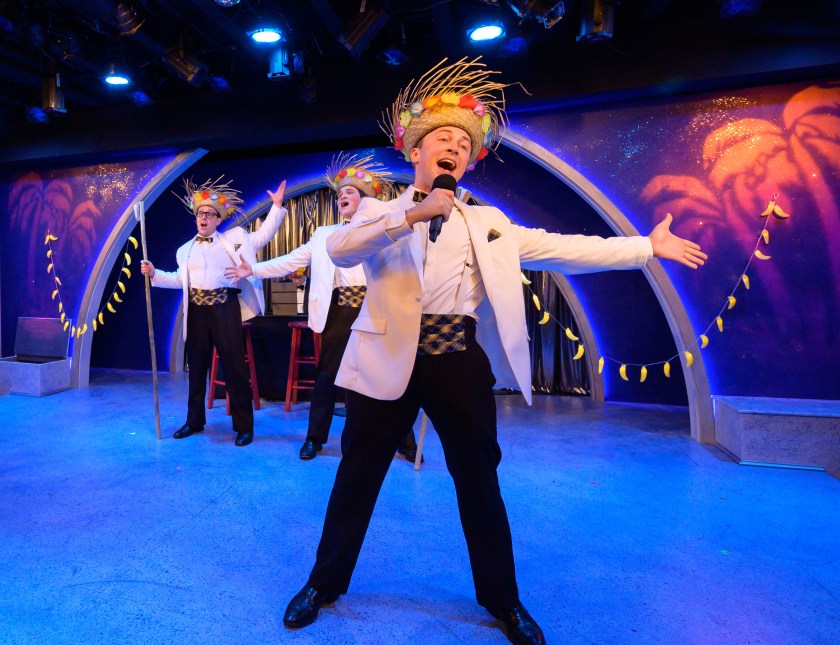
Forever Plaid, the final production of the Va-Rep Hanover 2018/2019 season is a humorous heavenly harmonic hash guaranteed to make you pat your feet and smile. In the barely-there plot, a quartet of young singers on the way to a big gig at the Airport Hilton gets killed by a school bus full of Catholic high school girls (why this is important I’m not sure), on their way to watch the Beetles debut on the Ed Sullivan Show (which does become important later.) The four find themselves returning from some sort of limbo where they have spent the last 55 years for one last chance to perform in front of a big audience. The accident happened in the 1964, and one member of the quartet asks the audience what year it is. On Thursday, the audience member, perhaps flustered, initially gave a false date, in the 1950s, before admitting it was 2019.

This is not the only instance of audience participation. In another scene a compliant woman named Nora was charmed onstage to play piano with Sparky (while Travis is on his union break), and the entire audience is corralled into a sing-along on the song “Matilda.” The quartet brings instruments into the audience for those who care to participate in a hands-on experience, and Nora, by the way, left the stage with a commemorative plaid dental floss and a certificate with her name on it.

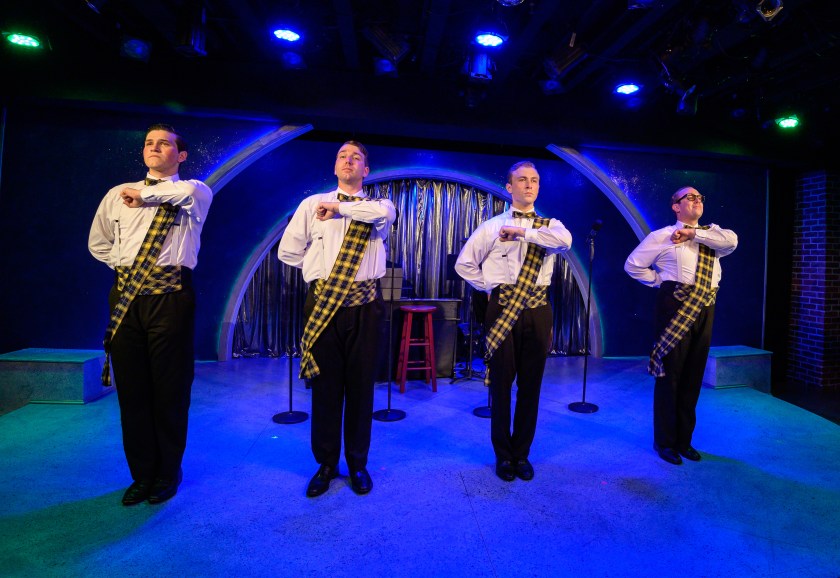
The shenanigans are carried on with amusing awkwardness – one member of the four is often out of step and depends on antacids to tame his nervous stomach, one hyperventilates, one has a mild speech impediment, and the fourth is prone to nosebleeds – by Mitchell Ashe (Sparky), PJ Llewellyn (Smudge), Ian Page (Jinx), and Caleb Wade (Frankie). Two, Jinx and Smudge, I think (it’s hard to keep up) are even step-brothers, and in one touching scene reminisce about a childhood tradition of family TV night. They watch, what else, “The Ed Sullivan Show.” The “band” consists of Travis West on piano and David Yohe on bass. They all sing well, even when making mistakes on purpose, while rotating through a veritable warehouse of wacky props, from six foot plumbers’ helpers (plungers) to straw hats and a traditional nun’s wimple.

Ashe, Llewellyn, Page, and Wade seem to have as much fun playing these characters as the audience does watching and listening to them. Wade, as the group’s leader, shows equal parts confidence and compassion, which seems even more amazing considering that the group leads off with, “We’re Forever Plaid, and we’re dead.”  My favorite part of the show, however, is when The Plaids perform the entire “Ed Sullivan Show” (that ran on CBS from 1948 – 1971) in three minutes and eleven seconds – including the animal acts, puppets, musical acts, comedians, and even Topo Gigio, the Italian mouse.

Forever Plaid, written by Stuart Ross and first performed off-Broadway in 1989, was directed by Wes Seals with musical direction by Travis West. Both keep the pace moving at just the right speed (45rpm). Terrie Powers’ set is simple – arches, silver curtains, stars, a rounded stage – and BJ Wilkinson’s lighting sets just the right tone. Marcia Miller Hailey’s white dinner jackets are simple and classy, and the long-awaited arrival of the group’s plaid tuxedo jackets doesn’t occur until near the end of the one-act show that runs just under 90 minutes. The sound design by Derek Dumais makes everything clear and easy to understand, and the choreography (no credit is given, so I assume they retained Ross’ original choreography) is charmingly corny.

There are more than a dozen songs, beginning with “Three Coins in a Fountain” and ending with “Love is a Many Splendored Thing,” the song they were rehearsing in their red Mercury convertible when they were killed. In between there is a wide variety of musical numbers, from the Caribbean medley to Sam Cooke’s “Chain Gang,” “Perfidia,” which was inspired by the quartet’s collective crush on their high school Spanish teacher, to one of my favorites, the energetic “Crazy ‘Bout Ya Baby.” There are plenty of period and time-related references that might fall flat on anyone under the age of 50, and “The Ed Sullivan Show” seems to be a unifying thread, but Forever Plaid is a joyous, feel-good musical revue that favors naivete over controversy.


Julinda D. Lewis is a dancer, teacher, and writer who was born in Brooklyn, NY and now lives in Eastern Henrico County.

———-

Photo Credits: Aaron Sutten

Forever Plaid
Ian Page, Mitchell Ashe, Caleb Wade, PJ Llewellyn. Photo by Aaron Sutten.
Forever Plaid
PJ Llewellyn, Mitchell Ashe, Caleb Wade, . Photo by Aaron Sutten.
Forever Plaid
Ian Page, Caleb Wade, Mitchell Ashe, PJ Llewellyn. Photo by Aaron Sutten.
Forever Plaid
Mitchell Ashe, Ian Page, Caleb Wade, PJ Llewellyn. Photo by Aaron Sutten.


https://www.amazon.com/gp/product/1072107546/ref=as_li_qf_asin_il_tl?ie=UTF8&tag=rvartreview-20&creative=9325&linkCode=as2&creativeASIN=1072107546&linkId=36434906f1d9f2287f804bb2d315389b

Whistlin Women


https://www.amazon.com/gp/product/1093389303/ref=as_li_qf_asin_il_tl?ie=UTF8&tag=rvartreview-20&creative=9325&linkCode=as2&creativeASIN=1093389303&linkId=7bc1e2a892aa33c750bd132e1988ff8a

Alvin Ailey

Fellowship Cruise 2020


THE TAMING OF THE SHREW: Girl Power!

THE TAMING OF THE SHREW: Girls Night Out

A Theater Review by Julinda D. Lewis

By: Quill Theatre

At: Agecroft Hall & Gardens, 4305 Sulgrave Rd., RVA 23221

Performances: July 11 – August 4, 2019

Ticket Prices: $30 Adults; $25 Seniors; $20 RVATA & Students (with ID)

Info: (804) 340-1405, quilltheatre.org or https://agecrofthall.tix.com/Schedule.aspx?OrgNum=1528

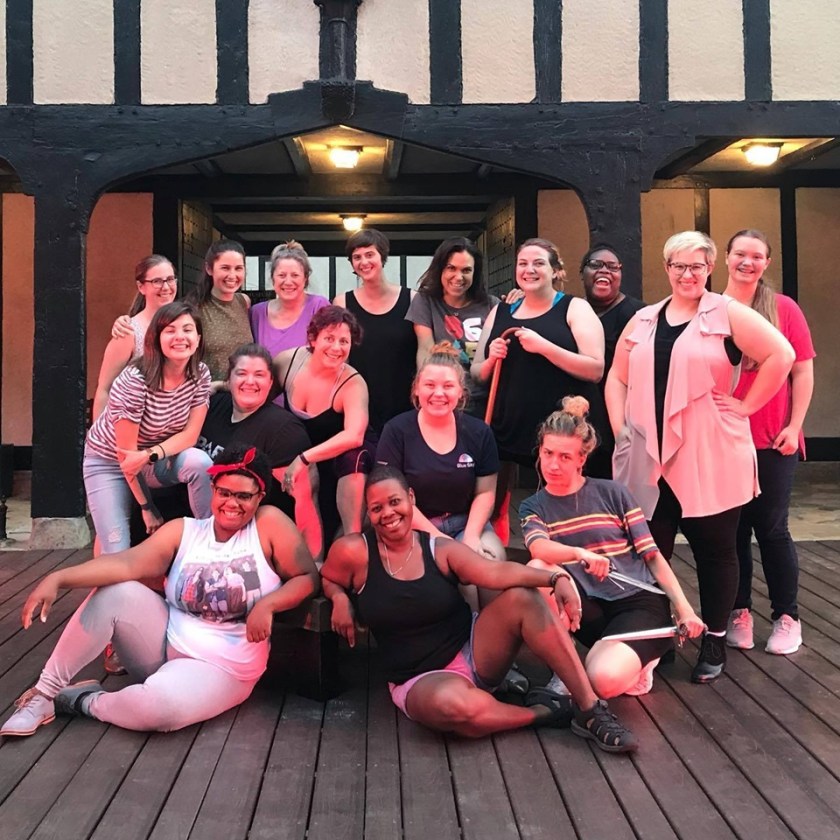
It is well known that in Shakespeare’s day all the roles, including the women, were played by male actors. Recently, we have seen role reversals in which key characters such as Hamlet have been played by women. The Richmond Shakespeare Festival has taken this twist to its ultimate conclusion with an all-female cast and mostly female crew. (On Sunday night, even Festival Manager Noah Downs kept a low profile – although I did miss his usual group selfie moment.)

This is not the first time The Taming of the Shrew, one of Shakespeare’s most misogynistic plays – perhaps one of the world’s most misogynistic plays – has been done with an all-female cast. It has been done by the Chicago Shakespeare company, where it was set in the twentieth century during the suffragette movement, it’s been presented in New York City’s Central Park, and has even been performed by Shakespeare’s Globe theater in Hong Kong. Among the many versions, there was also the musical, Kiss Me, Kate¸ which gets a humorous nod from our own Quill Theatre, at Agecroft Hall, with a cast that includes many familiar faces.

Among the many impressive performances by this outstanding ensemble, I must say that Bianca Bryan as Petruchio and Melissa Johnston Price as Baptista are standouts. Both seemed to have tapped into their inner male and it was awesome. I don’t mean that they were acting butch or doing a reverse drag, but Bryan’s swagger and Price’s doting but clueless father really captured the maleness of their characters in the best way, and they seemed to have so much fun doing it.

The Taming of the Shrew is an early Shakespearean comedy in which Petruchio, a bachelor from Verona who apparently has recently come into possession of his late father’s estate, arrives in the town of Padua, where he has friends, in search of a wealthy bride. His friend Hortensio (Desirée Dabney) suggest he marry Katarina/Kate (Michelle Greensmith), the beautiful but ill-tempered eldest daughter of Baptista. Hortensio, of course, has ulterior motives. He wants to marry Kate’s younger, more mild-mannered sister, Bianca (Christina Ramsey), but according to custom, the eldest sister must marry first.

There is no backstory, so we don’t know why Kate is such a spoiled brat, but she has few or no social graces. She is self-centered and verbally – even physically – abusive to everyone, even her father. There is no mother in sight, which may explain why Baptista allows her to behave so badly. Greensmith is so well cast for this role that at the beginning and the end, it’s almost possible to hate her. But looking at the perplexed expression of her face when Petruchio implements his devious plan, we get a glimpse of her character’s humanity. She’s someone’s daughter, someone’s wife, and like the difficult student in class, she has special needs.

There are subplots involving a trio of suitors for Bianca’s hand; Hortensio, Lucentio, and Gremio (not to be confused with another character, a servant named Grumio) and, of course, there are misunderstandings, disguises, and characters switching places with their servants. Desirèe Dabney plays Hortensio with broadly comic affability. Hortensio disguises himself as a music teacher in order to gain access to Baptista’s household and to his daughter, Bianca. Nora Ogunleye plays Lucentio, who, likewise, disguises himself as a tutor in order to woo Bianca.

In a memorable and hilarious supporting role Maggie Bavolack plays the elderly suitor Gremio. At one point Bavolack, whose character is bent over and a bit wobbly at the knees, passes her cane to a friend and performs a precarious but full somersault. It was a highlight of the evening!

Now, getting back to Kate, the use of a word like “shrew” to describe an unpleasant, nagging (another misogynistic word) woman is, itself sexist – but consider Kate’s personality. The woman has issues. Petruchio seems to be the only one who is not afraid of Kate, but the methods he uses to “tame” her terrible personality are questionable: he deprives her of food and sleep, offers her food and new clothes and withdraws them, and belittles his servants in front of her. He throws food and rips the sleeves off a dress. In short, he fights fire with fire. The bad behavior starts when he shows up late for their wedding and inappropriately dressed, but that’s the first clue that Petruchio isn’t crazy, but rather has a well-thought out plan of behavior modification to address Kate’s behavior.

And then there is Kate’s final monologue. At a wedding party for three couples – Petruchio and Kate, Hortensio and the Widow (Erica Hughes), Bianca and Lucentio – Petruchio makes a bet; each man is to send for his wife and the man whose wife most obediently responds will be declared the winner. Not only is Kate the only wife to respond, but she then makes a long speech in which she berates the other wives for not being obedient and submissive. She has been completely reformed – the shrew (which is also the name of a small mouse-like mammal) has been tamed. Just when you think it couldn’t get any more sexist or Stepford-wives-like (not a word, but I think you know what I mean), the cast breaks out into song, “Just a Girl,” which includes the lyrics, “I’ve had it up to here.”

Instead of the play’s original introduction or induction, there are songs, and between acts there are songs. Songs like The Police’s “Every Breath You Take,” (“Every move you make. . . .every breath you take, I’ll be watching you) that slyly and humorously remind us that this Taming of the Shrew is a smart, aware production led by a team of kick-ass women.

Chelsea Burke is the director of this awesome cast. There isn’t much in the way of a set, just a small platform centerstage and a couple of trunks. The most noticeable design element is the costumes, and I found Cora Delbridge’s costuming a hodgepodge of period, contemporary, and hybrid pieces that are often colorful and fun, but didn’t make any clear or cohesive statement. I did enjoy Kate’s first ensemble – a red hi-lo open front number – and Gremio’s suit was fully compatible with his character. Kate’s transformation was accompanied by changing her body skimming wedding dress for a formal pageant gown. I also liked Baptista’s power maxi-coat, but I found Bianca’s frilly dress unattractive and frankly confusing. It looked out of time and out of character.

Overlooking the bugs and the heat, it was a beautiful evening, and well worth it. The Taming of the Shrew is one of this season’s most intriguing productions, and the cast is a dream team of talent.

Julinda D. Lewis is a dancer, teacher, and writer who was born in Brooklyn, NY and now lives in Eastern Henrico County.

———-

Photo Credits: Production photos were not available at the time of publication.

Shrew
The Women of The Taming of the Shrew


B0791TX5P5

https://www.amazon.com/gp/product/B0791TX5P5/ref=as_li_qf_asin_il_tl?ie=UTF8&tag=rvartreview-20&creative=9325&linkCode=as2&creativeASIN=B0791TX5P5&linkId=35c6054d22acf204702667d891deb297

Whistlin Women

https://www.amazon.com/gp/product/1072107546/ref=as_li_qf_asin_il_tl?ie=UTF8&tag=rvartreview-20&creative=9325&linkCode=as2&creativeASIN=1072107546&linkId=831a0d47441e935fa2c6dc5d0008473b

Alvin Ailey

https://www.amazon.com/gp/product/1093389303/ref=as_li_qf_asin_il_tl?ie=UTF8&tag=rvartreview-20&creative=9325&linkCode=as2&creativeASIN=1093389303&linkId=b2fd6e48febbd805981c7d22b55e785d

Fellowship Cruise 2020


DANCE NATION: Five, Six, Seven, Eight

DANCE NATION: Teen Awakening, Gandhi, Power, & Competitive Dance

A Theater Review by Julinda D. Lewis

At: TheatreLab, The Basement, 300 E. Broad St, RVA 23219

Performances: July 11 – August 3, 2019

Ticket Prices: $35 general admission; $25 seniors & industry/RVATA; $15 students and teachers with ID

Info: (804) 506-3533 or theatrelabrva.org

Dance Nation makes you laugh and cringe. Clare Barron’s 2018 play captures a painful, awkward, and gloriously empowering moment in time in the lives of Dance Teacher Pat’s pre-teen and early teen competitive dance team. (Yeah, that is a little confusing but in the play the characters are referred to both as pre-teens and as thirteen-year-olds.)

I, gratefully, have very few clear memories of my teen years, but a post-performance discussion with a much younger acquaintance who grew up in a local dance studio owned by her mother painted a much different picture of Dance Nation.

For me, it was a sometimes amusing, sometimes horrific picture of adolescence with an unusual, even shocking focus on female empowerment. For some younger female viewers, it was a theatrical manifestation and perhaps even validation of their own sometimes tortuous awakening. Some male viewers were enthralled, others, I am sure, are still not sure what to make of teenaged girls talking about masturbation and virginity, and scenes involving blood (menstrual and otherwise) and dancers with vampire teeth hissing at the audience.

This is not the usual rehashing of adolescent angst and teenage trauma. Barron blends hormonal horrors with feral ferocity and Maggie Roop seems to understand and honor this with her mostly clear and unencumbered direction. Dasia Gregg’s locker room set brings the action right up in the face of the audience. There are only two rows, and the second row has the advantage of receiving the full effect of the audio transducers that generate sound you can feel through your seats – reminiscent of the effects in Disney’s “A Bug’s Life” show in the Animal Kingdom theme park.

There is also original music by Joey Luck, with vocals by a team that includes Breezy Lee Potter, Ali Thibodeau, and John Paul Hodge. Michael Jarett’s lighting and Joey Luck’s sound design (that includes lots of heavy breathing) are integral elements of this production and Nicole Morris-Anastasi provided the choreography, which was quite lively in the first act, with the members of the dance team dressed as sailors, their wide smiles painfully pinned in place, their eyes focused on the winner’s trophy.

In the first scene one dancer, Vanessa, played by Maggie McGurn who later plays the moms of many of the dance team members, is eliminated after a leg injury that sends her to the hospital and sidelines her from the team.

The strongest and at the same time most strained relationship is that between Amina (Lydia Hynes) and Zuzu (Trinitee Pearson). Amina is admittedly the strongest dancer on the team, and Zuzu has wanted to be a dancer more than anything since the age of two – but she isn’t quite as good as Amina and struggles to reconcile her friendship with her own self-doubt and Amina’s ambition. Both Hynes and Pearson give searing performances that attempt to cut to the heart of the matter.

But neither comes close to the explosive monologue given by teammate Ashlee, played by Amber Marie Martinez at, the end of Act One. Martinez’s gutsy and raw outpouring on sexuality and power includes words like “beautiful” and “smart” and “SAT,” as well as “bitch,” and the, as far as I know, original phrase, “mo****-fu*****, cun*-munching, piece of sh**” a phrase I don’t recall ever saying or even thinking, at 13 or even at 64.

During the first act, the team warms up at the ballet barre, injecting giggles and wiggles as each of the girls – and the one guy – take turns whispering “pussy,” which later develops into a “perfect pussy” mantra recited by the entire team during the second act – accompanied by an audience-teasing sampling of seat-vibrating audio transducers. (That was my favorite special effect and requires that you get seats in the second or back row to experience the full effect.)

I was never quite sure whether Chris Klinger’s portrayal of Dance Teacher Pat was authentic or creepy. I leaned toward the latter when he lightly tapped Amina on the butt after a private talk, but although she appeared startled and hesitated a moment as she walked away that angle was never pursued. The dance teacher kept his focus on the prize – the regionals, the nationals, whatever winning meant – and had little time for developing the self-esteem or character of his girls. To him, they seemed to be not individuals, but tools to achieve another trophy.

The girls include Amina (Hynes), Zuzu (Pearson), and Ashlee (Martinez), as well as Connie (Sanam Laila Hashemi), Maeve (Kylie M.J.  Clark), Sofia (Nicole Morris-Anastasi) and Luke (Marquis Hazelwood). Yes, Luke is the only boy on the team, but the team is always referred to as “the girls,” and there is no indication of Luke’s sexuality, other than a suggestion that he has a crush on Zuzu. Maeve shares a tender scene with Zuzu, where she talks about flying, and Luke also shares a scene with Zuzu, in which she proposes two possible scenarios of her future life as an adult. Luke seemed a little disappointed that neither scenario included him. Pearson handles a variety of delicate situations with great sensitivity, and Hazelwood, while not a central figure, seems sympathetic and sweet.

The characters of Zuzu and Amina are the most highly developed, and there are intriguing scenes involving Ashlee, Connie, and Maeve. The rest of the team, Sofia and Luke are more peripheral, and little is known of Dance Teacher Pat, who is always referred to as Dance Teacher Pat. The Moms add a spark of insight and even humor but are apparently not meant to be any more significant than the trombone-voiced adults in Peanuts cartoons.

Powerful and intense, Dance Nation  may stir up long forgotten memories or sound an alarm, depending on your age, gender, or how much you remember of being thirteen years old. The one thing it won’t do is leave you untouched.


Julinda D. Lewis is a dancer, teacher, and writer who was born in Brooklyn, NY and now lives in Eastern Henrico County.

———-

Photo Credits: Tom Topinka

Dance Nation.10
Clockwise from back, center: Chris Klinger, Marquis Hazelwood, Nicole Morris-Anasasi, Kylie M.J. Clark, Trinitee Pearson, AMbe Marie Martinez, Lydia Hynes, and Sanam Laila Hashemi
Dance Nation.9
Lydia Hynes
Dance Nation.8
Trinitee Pearson
Dance Nation.7
Sanam Laila Hashemi
Dance Nation.6
Marquis Hazelwood
Dance Nation.5
Kylie M.J. Clark
Dance Nation.4
Nicole Morris-Anastasi
Dance Nation.3
Amber Marie Martinez
Dance Nation.2
Maggie McGurn
Dance Nation.1
Chris Klinger


https://www.amazon.com/gp/product/1072107546/ref=as_li_qf_asin_il_tl?ie=UTF8&tag=rvartreview-20&creative=9325&linkCode=as2&creativeASIN=1072107546&linkId=7297b0f3a126f983ce798b1d13f44587

Whistlin Women

https://www.amazon.com/gp/product/1093389303/ref=as_li_qf_asin_il_tl?ie=UTF8&tag=rvartreview-20&creative=9325&linkCode=as2&creativeASIN=1093389303&linkId=df9f0a154012577ef219ec2eea590c83

Alvin Ailey


Fellowship Cruise 2020


POLKA DOTS: A Musical About Segregation

Polka Dots: The Cool Kids Musical

A Theater Review by Julinda D. Lewis

At: Virginia Rep’s Children’s Theatre at Willow Lawn; 1601 Willow Lawn Drive, RVA 23230

Performances: July 12 – August 11, 2019

Ticket Prices: $21

Info: (804) 282-2620 or virginiarep.org

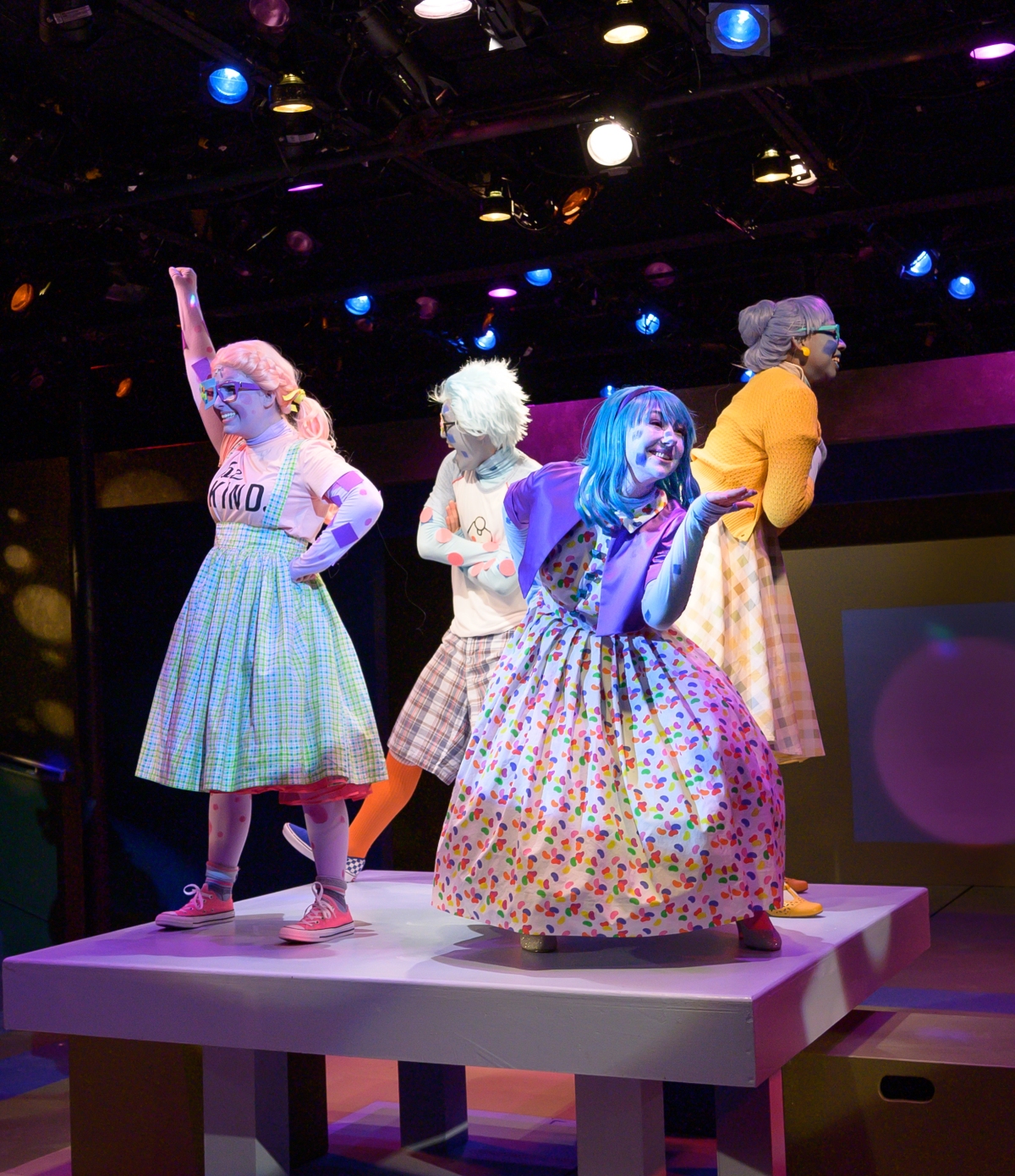
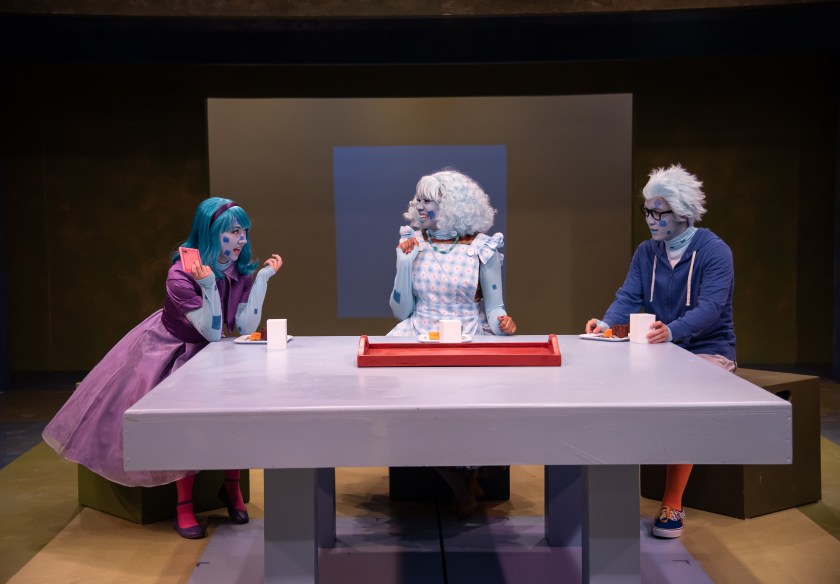
Polkadots: The Cool Kids Musical is based on the real-life events of the Little Rock Nine. In 1957 nine black students enrolled in the formerly all-white Little Rock Central High School, a test of the 1954 Brown v Board of Education Supreme Court ruling that declared segregation in public schools unconstitutional. For Polkadots, Melvin Tunstall, III (book) has set the  story in Rockaway elementary school, in an undetermined state. Instead of black and white, the tension takes place between the blue skinned squares and the pink skinned polkadots. The squares believe they are the superior group, and don’t want to share their school or their town with polkadots.

Eight-year-old Lily Polkadot, played by Caroline Lynch, is the first polkadot to integrate the school, and the plot revolves around Lily’s efforts to make a friend and assimilate into her new school. Serious and sensitive issues are handled with care under the gentle direction of Jan Guarino.

Lily puts up a brave front, standing up to the mean spirited Penelope Square, singing “Sticks and Stones” as an affirmation, but she still privately wishes her skin was covered with squares instead of polkadots. The children’s teacher, Ms. Square, played by Sydnee Graves, who also plays the role of Mama Square, is warm, friendly and accepting of Lily, but at the same time she doesn’t want to make waves.

On the first day of school, Lily must remain alone in the classroom during the bathroom and water break because the polkadots’ water pump has not yet been installed, and Lily must not drink from the squares’ water sprinkler. A separate water fountain is eventually rolled out for Lily, and this marks one of many times I wondered just how much the younger members of the audience really understood the historical significance of what was taking place.

This was one of the few times I did not have my grandsons Kingston (10) and Emmitt (who just turned 5) along to consult with. As a matter of fact, the volunteer ticket taker took one look at me and asked, “Where’s your grandson?” I almost felt like some sort of pervert attending the Children’s Theatre without a child or two in tow, and I really would like to know what they would have taken away from this show.

Interesting, the cast, including Quan Chau as Sky Square, Sydnee Graves as Ms. Square/Mama Square, Caroline Lynch as Lily Polkadot, and Madeleine Witmer as Penelope Square is quite diverse (white, black, Asian), and all are making their debuts at the Children’s Theatre at Willow Lawn. The quartet was uniformly energetic, and all boast strong singing voices. Douglas Lyons’ lyrics are surprisingly sophisticated for a children’s show – more throaty ballads than bouncy ditties and the music by Greg Borowsky and Lyons provides a firm foundation for Mallory Keene’s choreography. There is even one number, where Sky and Lily create a silly dance, the Squa-Dot, that invites audience participation, but on Friday night, although there was one enthusiastic row of youthful audience members bouncing in their seats, no one was brave enough to stand up and join in the dance.

Graves was almost annoyingly prim and proper in her role as the teacher and seemed like an authentic school counselor when she shared with Lily her own trials as the first “lady teacher” at their school. Witmer was almost satisfyingly snarky as the mean girl big sister, and was visibly disappointed when her big song, “Cool Kid,” which was meant as a put-down for Lily missed the mark, because Lily wasn’t in the audience to hear it. Chau was adorable as little brother, Sky, and Lynch was perfectly cast as the spunky yet vulnerable Lily.

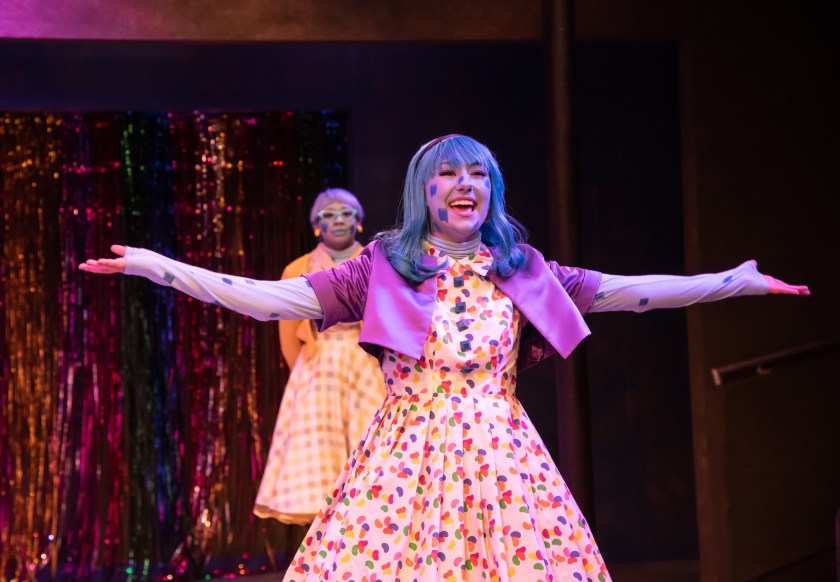
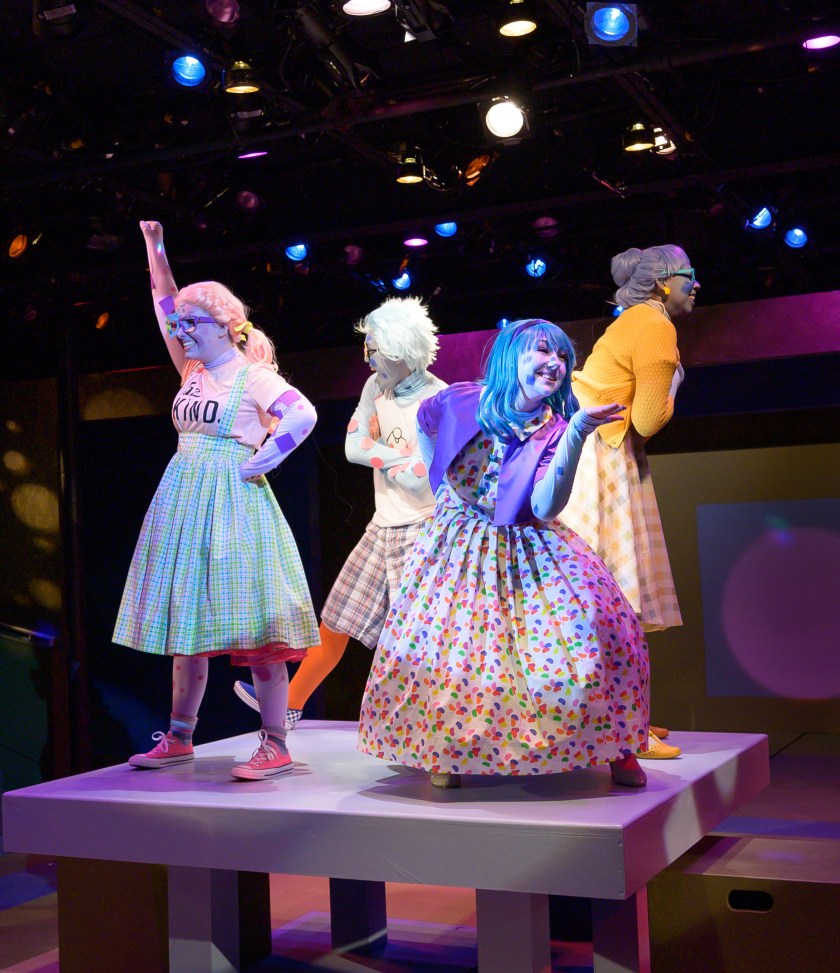
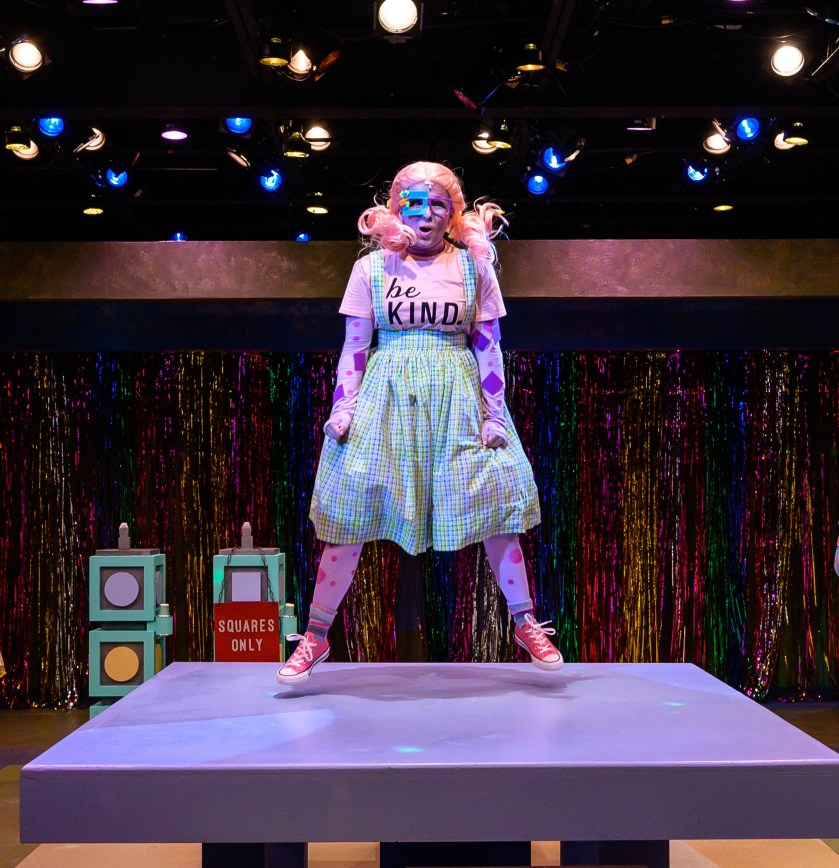
Kyle Artone’s costumes are colorful and cartoonish, and the square women’s full-skirted dresses, stretched over stiff and puffy crinolines, are especially pretty. Lily’s dress is simpler and less elaborate than the dresses of the squares. I found the pink and blue skin (part fabric and part makeup) and cotton candy colored hair a bit creepy, but it didn’t seem to bother the younger members of the audience.

Emily Hake Massie’s set was surprisingly simple. A huge square platform in the center of the stage served as Penelope’s bed, Ms. Square’s classroom, and Mama Square’s dining table. Cubes served as props and seating and doubled as steps to allow the performers access to sit and dance atop the square platform. Lynne Hartman’s lighting was also minimal, with a few special effects that highlighted the segregated fountains.

Unlike in real life, there is a happy ending, with everyone becoming friends – or at least, agreeing to live and work together – but as a lesson, it’s a start. Looking around at the faces of the children in the audience, mostly 6-10 years old, they appeared to be having a good time, but it would take a post-performance discussion to determine how much they actually learned.

Polkadots: The Cook Kids Musical runs just under an hour, with no intermission, and will be playing at The Children’s Theatre at Willow Lawn through August e.

Julinda D. Lewis is a dancer, teacher, and writer who was born in Brooklyn, NY and now lives in Eastern Henrico County.

———-

Photo Credits: Aaron Sutten

Polkadots: The Cool Kids Musical
Madeleine Witmer. Photo by Aaron Sutten.
Polkadots: The Cool Kids Musical
Quan Chau, Caroline Lynch. Photo by Aaron Sutten.
Polkadots: The Cool Kids Musical
Madeleine Witmer, Sydnee Graves, Quan Chau. Photo by Aaron Sutten.
Polkadots: The Cool Kids Musical
Caroline Lynch, Quan Chau, Madeleine Witmer, Sydnee Graves. Photo by Aaron Sutten.
Polkadots: The Cool Kids Musical
Caroline Lynch. Photo by Aaron Sutten.

https://www.amazon.com/gp/product/1072107546/ref=as_li_qf_asin_il_tl?ie=UTF8&tag=rvartreview-20&creative=9325&linkCode=as2&creativeASIN=1072107546&linkId=5e220df68289b91719424f983db71bce

https://www.amazon.com/gp/product/1093389303/ref=as_li_qf_asin_il_tl?ie=UTF8&tag=rvartreview-20&creative=9325&linkCode=as2&creativeASIN=1093389303&linkId=063b624792d27499db54c28e1f0964d1

Fellowship Cruise 2020

ANIMAL CONTROL: THE SECOND WORLD PREMIERE

ANIMAL CONTROL: THEY’RE BACK

A Theater Review by Julinda D. Lewis

At: The Firehouse Theatre, 1609 W. Broad Street, RVA 23220

Performances: July 3 – 27, 2019

Ticket Prices: $15/student; $25/military; $35/general admission

Info: (804) 355-2001 or firehousetheatre.org

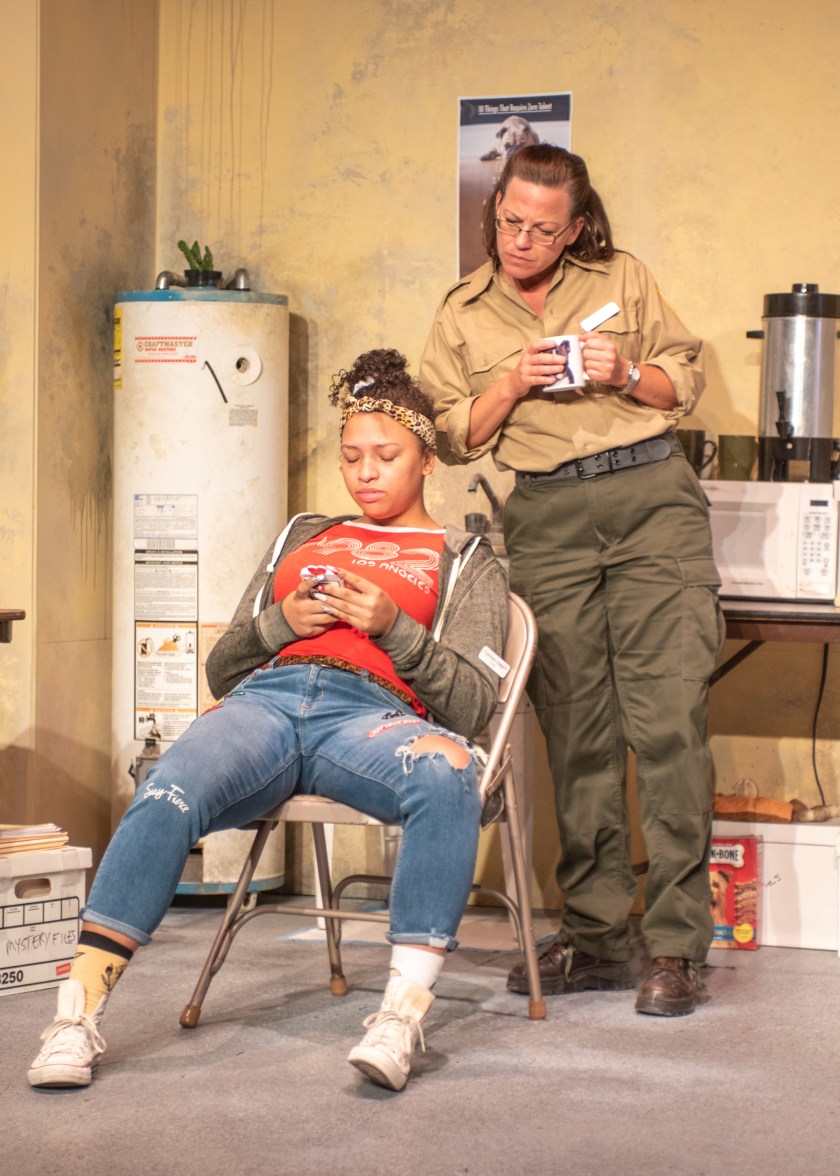
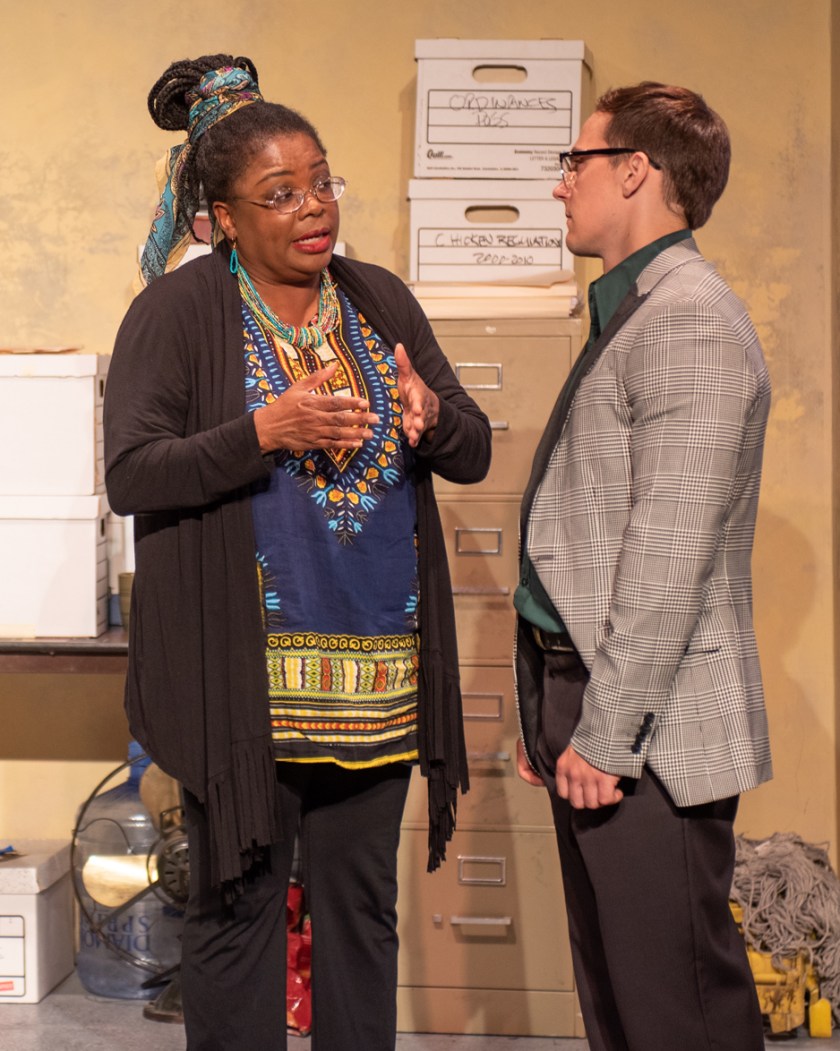
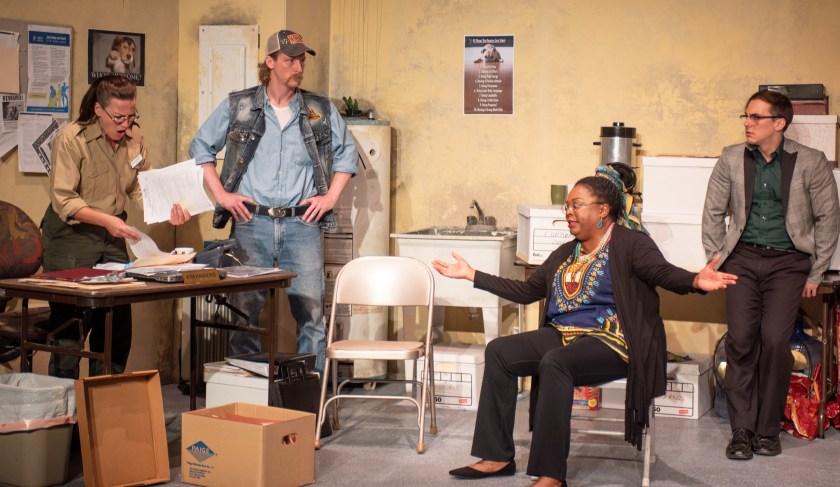
About three months ago I wrote about the world premiere of Chandler Hubbard’s new play, Animal Control. It may be unusual, but here we are again. The Firehouse Theatre’s summer offering is a re-working of Hubbard’s play, with two new cast members, and director Joel Bassin, Producing Artistic Director of the Firehouse Theatre, jokingly and lovingly referred to this production as a revised world premiere.

[For my April 21 review of the original world premiere, visit

https://wordpress.com/posts/jdldancesrva.com?s=animal+control]

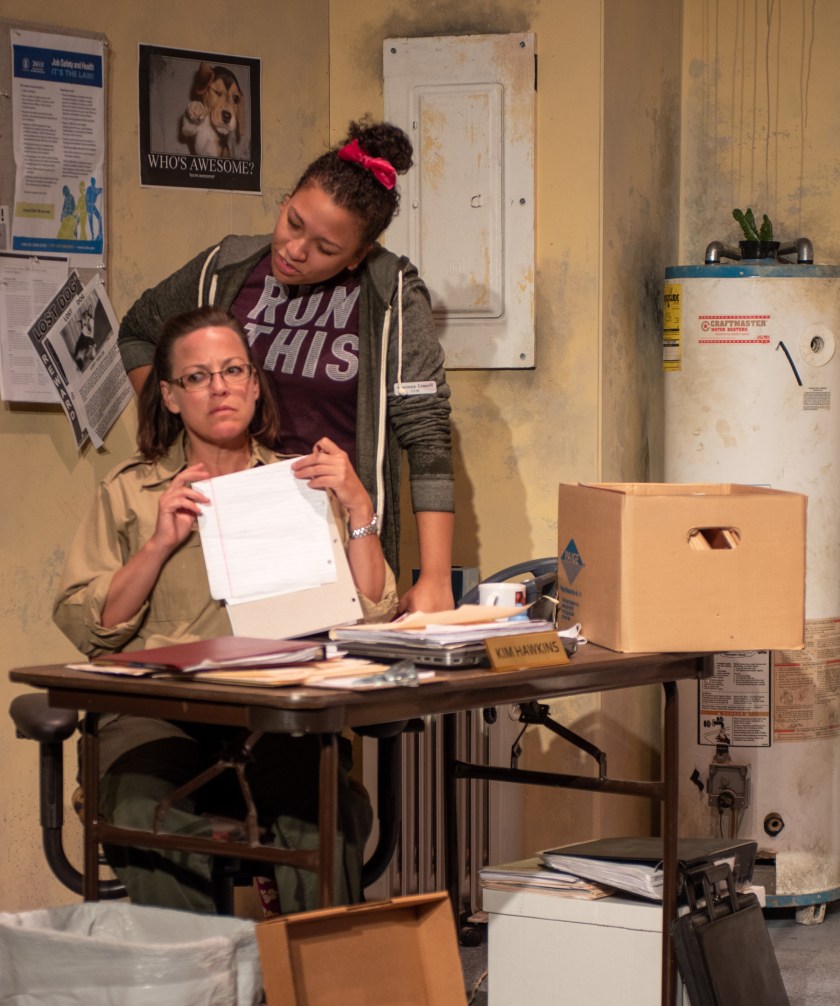
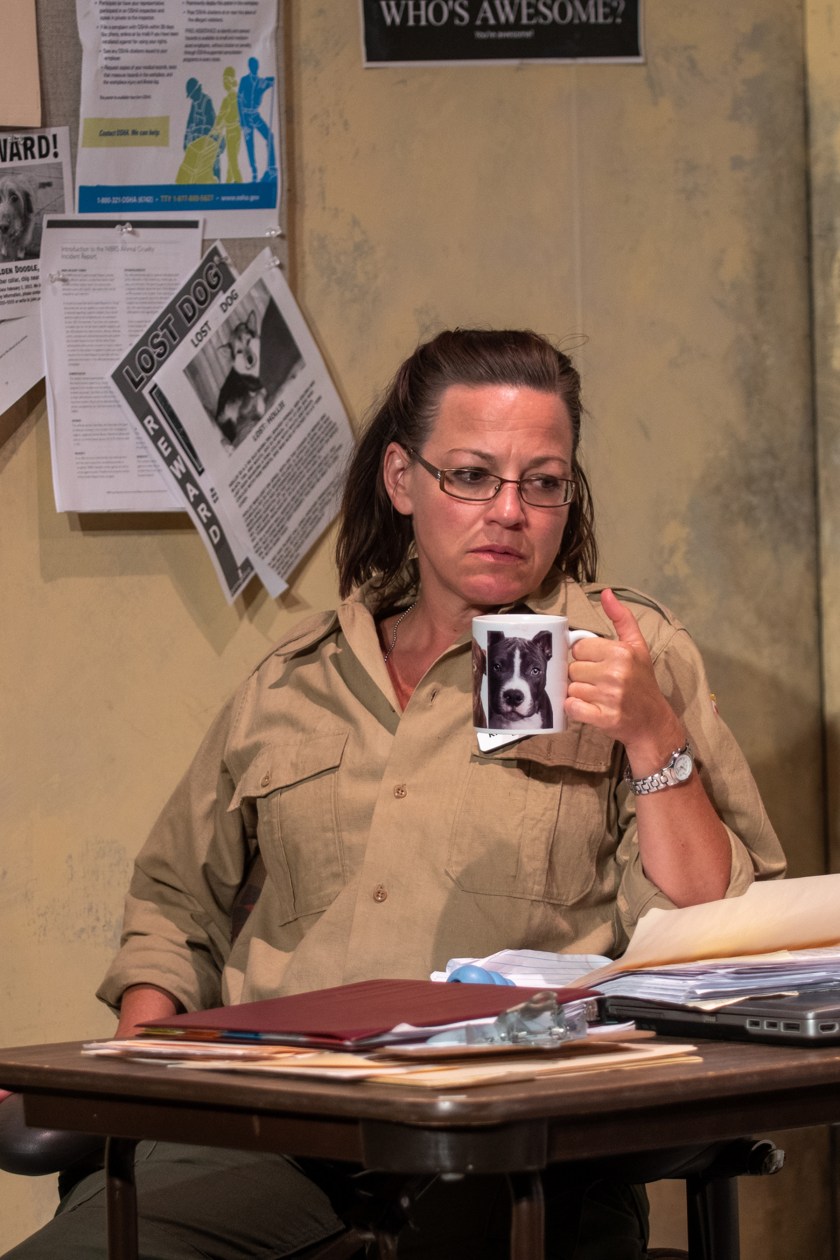
For this production, Chandler’s original three acts or scenes – The Prosecution, The Defense, and The Verdict – have been somewhat condensed. The combined effects of the script changes and the chemistry of the new cast has led to a leaner, tighter production, with greater dramatic intensity. It still evokes a strong sense of compassion, and it still brings tears to the eyes of pet owners and animal lovers, but it also seems to focus more on the development of character Kim Hawkins, the newly appointed manager of the Carson County Pound, so that she seems less incompetent and more a victim of a series of unfortunate circumstances leading to the tragic culmination.

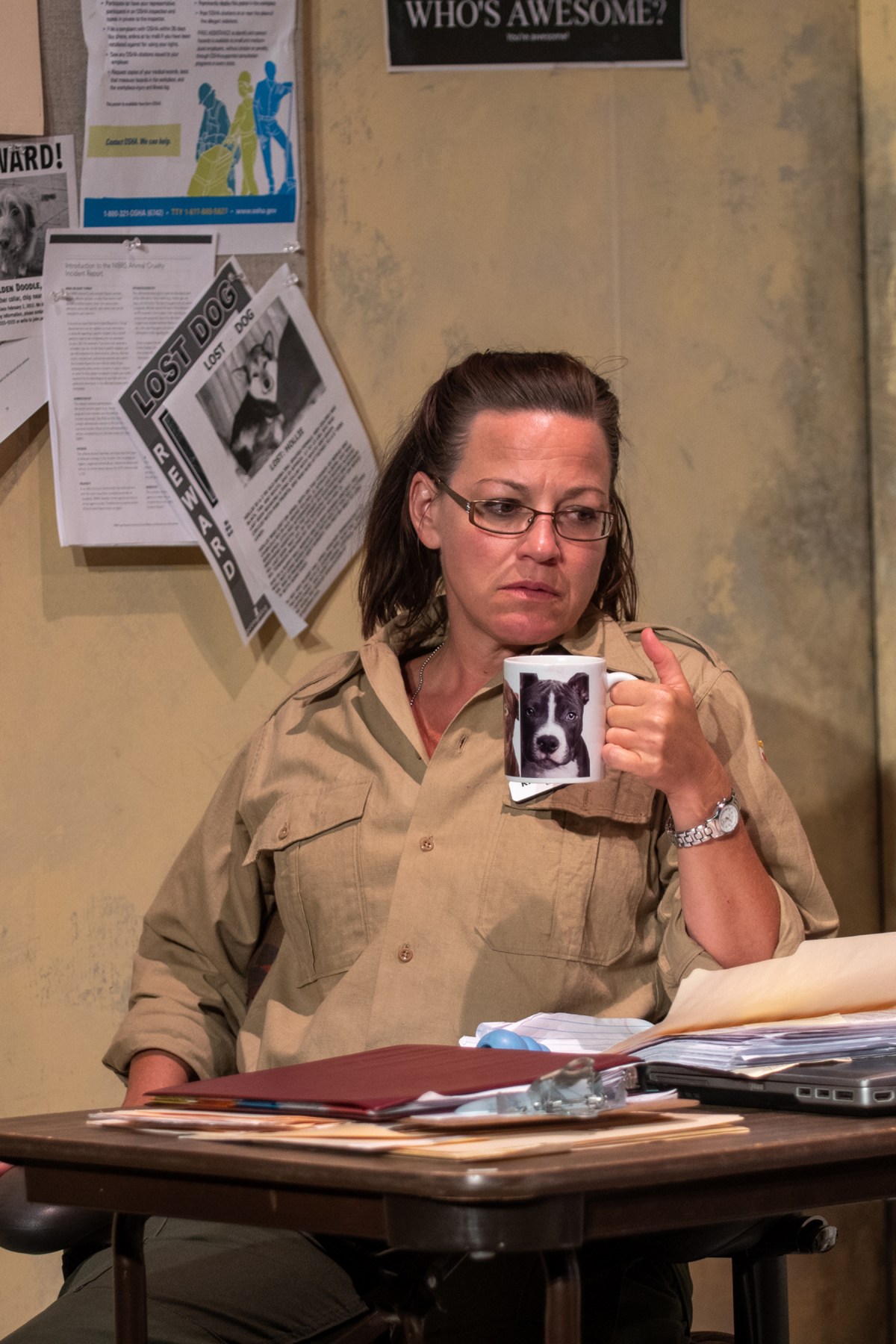
Donna Marie Miller still plays the role of Kim Hawkins and appears to have honed it to a masterful depiction of a caring woman who is tested by the unmitigating stresses and pressures of a dysfunctional bureaucracy. Similarly, Adam Turck has returned to play the role of the somewhat neurotic Marc Hanson, owner of Winnie (short for Winston, as in Churchill), the dog who was attacked by Bailey, the three-legged bully of the dog park. Turck has tweaked Marc’s characteristics, making him at once more focused and more distracted. As an example of the former, he sits with his body squarely facing the audience but his head is turned perpendicular to his body, zoned in on Hawkins; as for the latter, he seemed to take extra care to make sure we noticed his need to place a fork in the sink, cover a lunch container and put in into the mini-fridge, or examine the canine graphics on Hawkins’ coffee mug.

Young Journey Entzminger (a junior business management major at VCU) also returned as the intractable office assistant, Corrine Lowell. I would not have believed it possible but Entzminger was even sassier than before while somehow managing to steal hearts and nearly steal the show whenever she appears onstage – or even while making outrageous exits.

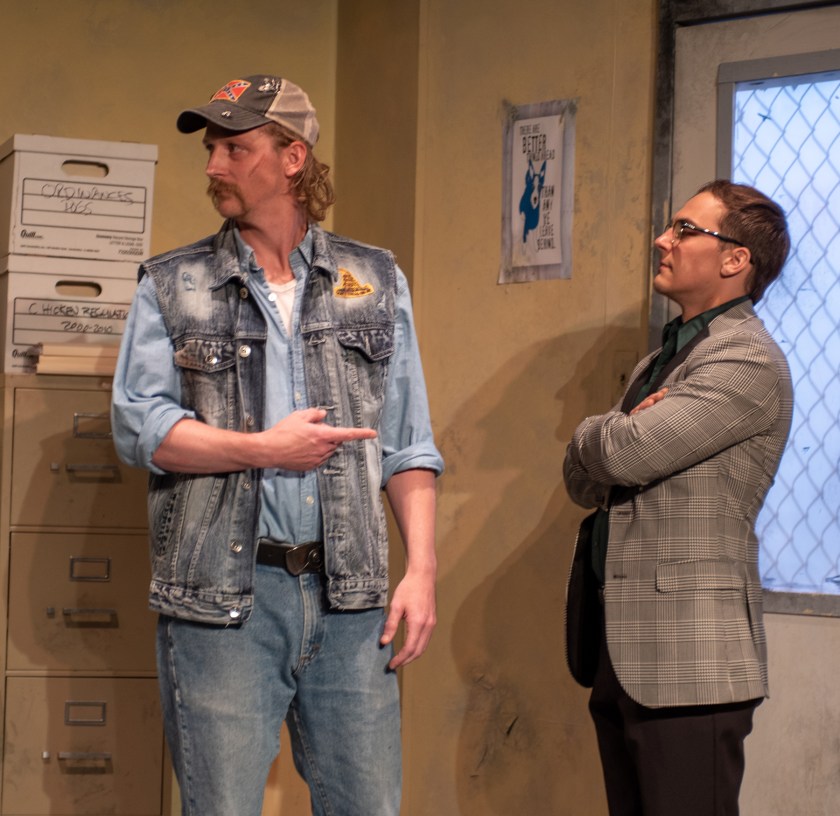
New to this cast are Stevie Rice as Dan Stanley, a role previously played by the 6’7” Arik Cullen, and Margarette Joyner as Patty Smith, a role previously portrayed by Lucretia Marie Anderson. When I first heard that Rice would be playing the role of Stanley I couldn’t image anyone other than Cullen whose mere presence was intimidating. But I quickly grew to admire the versatile Rice in the role. He was nearly unrecognizable as himself, hidden behind a baseball cap and a denim vest, both emblazoned with confederate flags. As much as you despise him at the beginning, you can’t help but feel compassion for him in the final scene, where even the irreverent Corrine feels compelled to gently brush back his hair while declaring the final words of the play, “he was a good dog.”

Last but not least, Joyner brought a more militant, more forceful interpretation to the role of Patty Smith, the beleaguered neighbor whose frequent complaints about Bailey were both cause and effect of the plot twists leading to the scene three denouement.

Much as I enjoyed the original production and cast, it is clear that Bassin, Chandler, and this cast have worked hard to solve problems and issues –both perceived and imperceptible – with the original. The result is, indeed, a better, more compact, more intense play.

BTW, when I walked into The Firehouse, Bassin was quick to explain his concept for the set, because in the original production, I wrote, I was distracted by the set with its chain link fences on either end. Bassin’s aesthetic leans towards the unrefined, minimalist look, while my OCD tendencies prefer things more refined and polished. But, point made and taken, it’s an aesthetic choice, and does not interfere with the average person’s ability to enjoy the production.

Animal Control is a surprising play in many ways. It presents many sides of a story, demonstrating how difficult it is to judge others. It makes subtle parallels between the behavior of people (Corrine, the student worker, who was been, in a way, rescued from juvenile detention) and animals (Bailey, a former bait dog abused by breeders of fighting dogs). And mostly it reminds us that even the most unlikely person may be deserving of compassion.


Julinda D. Lewis is a dancer, teacher, and writer who was born in Brooklyn, NY and now lives in Eastern Henrico County.

———-

Photo Credits: Bill Sigafoos

7_Journey Entzminger, Donna Marie Miller (photo by Bill Sigafoos)-1
Journey Entzminger and Donna Marie Miller
6_Margarette Joyner, Adam Turck (photo by Bill Sigafoos)
Margarette Joyner and Adam Turck
5_Donna Marie Miller, Stevie Rice, Margarette Joyner, Adam Turck (photo by Bill Sigafoos)
Donna Marie Miller, Stevie Rice, Margarette Joyner and Adam Turck
3_Stevie Rice, Adam Turck (photo by Bill Sigafoos)
Stevie Rice and Adam Turck
2_Donna Marie Miller, Journey Entzminger (photo by Bill Sigafoos)
Donna Marie Miller and Journey Entzminger
1_Donna Marie Miller (photo by Bill Sigafoos)
Donna Marie Miller


https://www.amazon.com/gp/product/1072107546/ref=as_li_qf_asin_il_tl?ie=UTF8&tag=rvartreview-20&creative=9325&linkCode=as2&creativeASIN=1072107546&linkId=b7470be179f4f08accd635db544f386f

Whistlin Women

https://www.amazon.com/gp/product/1093389303/ref=as_li_qf_asin_il_tl?ie=UTF8&tag=rvartreview-20&creative=9325&linkCode=as2&creativeASIN=1093389303&linkId=38ea3e9c57ccbf3ed376abedf1676918

Alvin Ailey


girlfriend: a tender tale of first love

GIRLFRIEND: A Summer Romance

A Theater Review by Julinda D. Lewis

Richmond Triangle Players

At: The Robert B Moss Theatre, 1300 Altamont Avenue, RVA 23230

Performances: June 24 – July 9, 2019.

Ticket Prices: $10-20

Info: (804) 346-8113 or rtriangle.org

Girlfriend, a two-person musical, is a summer romance about first love. Set in a small town in Nebraska in 1993, in the weeks following high school graduation, the story follows two young men as they explore their first love. The girlfriend of the title is an unseen but central character – much like the adults in Charlie Brown’s world – and one begins to wonder if she really exists at all. The budding love, so tenderly explored by Todd Almond’s book and carried along by Matthew Sweet’s punchy and energetic rock music and lyrics, is between Will, a sort of nerdy young man with a charming sense of humor and no plans for the future, and Mike, a popular jock who struggles with his attraction to Will as well as with his father’s plans for his future.

Cooper Sved, who was most recently seen in RTP’s Corpus Christi, plays Will, and infuses his character with energy, and endearing insightfulness. I am less familiar with Ray Wrightstone, who was recently in the cast of Seven Homeless Mammoths Wander New England (as an Early Man in a museum diorama). Wrightstone, who looked every inch the handsome jock, struck a tenuous balance that admirably captured Mike’s tension as he navigated the treacherous waters between his father’s expectations that he attend medical school, his teammates who hungrily chomped at the bit at any hint of homosexuality, his attraction to Will, and his desire to please everybody and not upset the boat. Of course, it is an impossible challenge.

Sved and Wrightstone are supported by a rocking four-piece band, under the musical direction of Levi Meerovich on keyboards. The band, especially the women, Hannah Goad and Roxanne Cook, provide background vocal support and even get a number of their own. My only complaint is that the music was sometimes too loud and overpowered the dialogue.

Chelsea Burke’s direction kept the one act play – running about an hour and fifteen minutes with no intermission – moving along at a great pace, assisted by some lively choreography by Aza Raine. Running in tandem with Grey Gardens, The Musical, girlfriend remarkably managed to transform the larger production’s set so that it was unrecognizable. Michael Jarett provided the moody lighting, and Dylan Eubanks provided the sound design – which included some very amusing movie sound effects. A running joke in the show is that Will and Mike keep attending the same movie all summer.

Something about the intensity and intimacy of this story reminded me of The Last Five Years, another powerful musical duet that was produced at TheatreLAB The Basement during their 2017/2018 season. After just a little digging around I found that Chelsea Burke also directed that show. So now, I’m not sure if the similarities I felt were due to the story lines or the genres or to the director’s special touch. It could be a combination of all of the above. At any rate, it makes me want to pay special attention to Burke’s future work. At this writing only two performances of girlfriend remain – on July 8 and 9, so don’t put it off if you plan to see this touching musical duet.

Julinda D. Lewis is a dancer, teacher, and writer who was born in Brooklyn, NY and now lives in Eastern Henrico County.

———-

Photo Credits: RTP website and Facebook page


https://www.amazon.com/b?node=17869251011&ref_=assoc_tag_ph_1524210812458&_encoding=UTF8&camp=1789&creative=9325&linkCode=pf4&tag=rvartreview-20&linkId=a88f41c3538b1b1bf85bad4ab2916435