At: The Firehouse Theatre, 1609 W. Broad St, Richmond, VA 23220
Performances: March 26 – Sun April 25, 2021
Ticket Prices: $33 live and streamed
Info: (804) 355-2001 or firehousetheatre.org
[NOTE: This production was made Covid conscious with a severely limited seating capacity of a maximum of 10 audience members at each performance, as well as other safety protocols that can be found on The Firehouse Theatre website.]
Fires in the Mirrorfelt like a 2-hour stroll through 90s New York and considering the premise of the show I’d call that a good thing. The one-person play by Anna Deavere Smith is a series of monologues collected from Smith’s interviews with real people and directed by Katrinah Carol Lewis who stared in another of Smith’s one-person plays (Twilight: Los Angeles, 1992 at TheatreLab in 2017.
Fires in the Mirror tells the story of the Crown Heights Race Riots of 1991, the murder of Yankel Rosenbaum, and the car crash that started it all. It consists of 29 performed monologues taken verbatim from interviews with 26 subjects, some of whom were near or directly involved with the accident. In the first half of the play, we’re given context to the racial tensions roiling between the black and Hasidic residents of the Crown Heights neighborhood of Brooklyn, New York. This, unfortunately, is the weakest part of the play. Actor Jamar Jones puts his best efforts towards spinning an engaging and emotional story, but he is significantly hindered by the first act’s lack of focus and direction.
Act One involves various Black and Jewish people discussing the matter of identity. As a separate component, Act One is a highly informative and intriguing take on culture, but in the context of a play sparked by a specific event, Act One feels like an hour-long non sequitur.
As the second act begins, we take a deep dive into the fatal collision that claimed Gavin Cato’s life and the retaliatory murder of Yankel Rosenbaum. Unlike its precursor, Act Two is much more engaging. As the story unfolds, we peer into the perspectives of the people closely involved with the incident. The final two monologues, those of Rosenbaum’s brother and Cato’s father, are the highlight of the evening.
Jamar Jones evokes a playful and committed approach to the characters that never feels too distasteful and is truly lived in. His embodiment of the interviewees is breathtaking and thrilling to watch. In terms of themes, Fires in the Mirroris very open-ended about what it wants you to take away. As the play progresses, it hammers home the idea of an incongruous truth or the sense that no one knows what really happened. At times one feels an underlying rhythm of monologues that alternately dip into each “side” of the story. There is the Black side, the Jewish side, and then there are the elements of the crash that are added, embellished, or omitted. While watching, I kept getting flashes of Akira Kurosawa’s Rashomon, in which four people take turns telling subjective or self-serving alternatives of the same story.
Anna Deavere Smith does a fantastic tightrope walk across the conflict and brings light to some of the more deep-seated racial issues in Crown Heights. The questions I kept asking myself was, “What is this play trying to say?” and “Who was right, who was wrong?” I agree with director Katrinah Carol Lewis; there is no winner or loser. This was a tragic accident and regardless of the fallout two lives were lost. That’s the “why” that needs examination.
Like just about everything else in life these past 13-14 months, K Dance company, under the direction of Kaye Weinstein Gary, pivoted into the new and produced the 22nd annual YES! Dance Festival as a virtual event. For those who wanted the experience of going to the theater, the program was available April 26-28 to live audiences of up to 10 people, followed by a post-performance conversation with Gary. Following the three large-screen showings, Gary and The Firehouse Theatre, her home base since becoming company-in-residence in 2019, also offered a remote stream of the program, available for two weeks.
For the past ten years the Yes! Dance Festival (formerly Yes, Virginia Dance) has hosted dancers and choreographers from Dance Magazine’s prestigious “25 to Watch” list, and this year was no different.
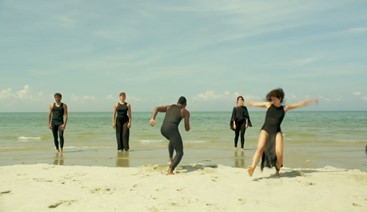
Boston Dance Theatre (BDT) (Boston, MA; Dance Magazine‘s “25 to Watch” January 2021) has been described as a company that has “appeal far beyond Boston’s city limits.” Their work, Surge Film Preview, was filmed on a sandy finger of land called Jeremy Point in Wellfleet in Cape Cod as part of the company’s Sea-Level Rise Project, a series of virtual events about the ocean, environmental activism, and a sustainable future. Accompanied by an urgent sound score, the five dancers shake, jerk, roll, and sometimes float or suspend just beneath the surface of the water. It is a beautiful and soul-stirring collaboration between choreographer Jessie Jeanne Stinnett, the dancers, oceanographer Larry J. Pratt, and the unidentified composer.
BDT also presented Shadows and Flame, a work originally commissioned for the Jewish Arts Collaborative for the Boston Museum of Fine Arts’ 2020 Hanukkah celebration. Envisioned as an exploration of light, shadow, and the dancing body, the opening scene, with five dancers lined up in a tight diagonal, and another section mid-way through where the dancers rise from the floor, remind me of those drawings that illustrate the evolution of mankind. Inspired by an 18th century Hanukkah oil lamp, the work has a grounded and ritualistic feel that is reminiscent of some of the works of Pilobolus – the unisex flash-toned tunics obscure the dancers’ individual identities and the dancers morph into and out of shapes, not emulating but rather embodying flames.
Paige Fraser (Chicago, IL, Dance Magazine‘s “25 to Watch” 2017 has performed in the YES! Dance Festival before. This time she offered a tiny solo, Silenced Cries, choreographed by Eric Bean, Jr., and set to “Le Jeune Fille et les Loups” (the maiden and the wolves) by Armand Amar. Set in a studio against a brick wall, the soft, spiraling lyrical phrases of Silenced Cries might well be one person’s response to the isolation and imposed loneliness of a year of pandemic restrictions. Fraser’s final gesture seems to be a plea for a time out. Fraser, a dancer with scoliosis (a sometimes disabling spinal curvature) is also founder of the Page Fraser Foundation, a safe space for dancers with (and without) disabilities.
slowdanger (Pittsburgh, PA, Dance Magazine’s “25 to Watch” 2018) described their work, for shadowing, as “created to embody the liminal space we are existing in, caught between two paralleling realities, a portal to the old world and a portal into shifted space.” Regretfully, the duo’s ethereal movement and original ambient soundscape was the one work of the evening that failed to move me or even leave much of an impression. I hope to have something more substantive to say after another visit by this group, consisting of Anna Thompson and Taylor Knight, who apparently constructed their name from a combination of road signs.
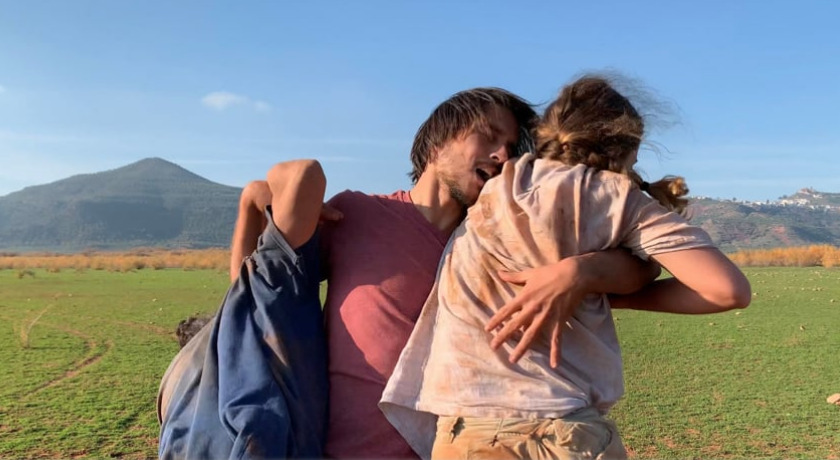
Marcat Dance (Jaén, Spain, Dance Magazine‘s “25 to Watch” 2017) was also a repeat visitor. The group’s work, Adama, choreographed by Mario Bermudez Gil, is a breath-taking trio performed in a patch of dirt in a large field backed by mountains. It is no coincidence that Adama is the Hebrew word for earth. As the dancers jump, turn, and interact with childlike simplicity, the work visually and viscerally connects with the earth and the natural landscape.
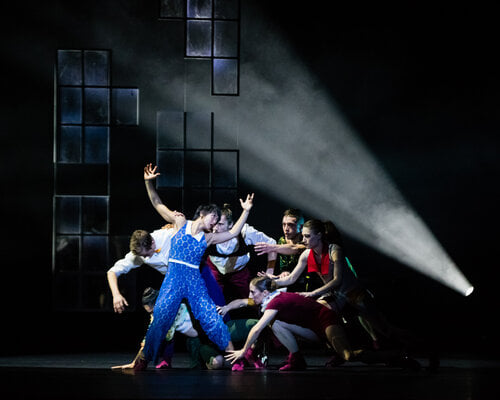
The program’s most provocative work was undoubtedly Jabberwock presented by LED (Boise, ID, Dance Magazine’s “25 to Watch” 2020). Lauren Edson’s color-filled and zany choreography partnered with nonsensical lexicon of Lewis Carroll’s poem, “Jabberwocky” to delightfully explore “themes of good versus evil, resilience, autonomy and truth.” The electric colors – like hot pink shoes and a brilliant blue jumpsuit – power a dynamic blend of flavors and genres. Imagine a world where break dance meets the blues, Kurt Jooss’ “Green Table” shakes hands with disco and the asylum is the penthouse of the dungeon.
Perhaps the intimate and intricate marriage of movement and musical genres is no surprise to those familiar with LED, but for us new to the group, they are described as much about music as they are about dance, with much of the company’s music begin created by Edson’s husband, composer Andrew Stensaas.
And what YES! Dance Festival would be complete without a work by K Dance’s artistic director, Kaye Weinstein Gary. Dressed in short coveralls, Gary danced the role of Kitty in a quirky and charming short written by Irene Ziegler. The little girl, sent to the corner for some unknown infraction, discovers that her imagination is her super power. She becomes so enmeshed in her meditation with her chair that when she is finally released she decides to stay.
Making the best of a challenging situation forced some dancers and artists to stretch beyond their comfort zone, embracing technology and finding new ways to create – because that is what artists do. None of these works seemed to have suffered for the effort and the intimate audience at the Tuesday evening performance seemed happy to be there. Given that many dance festivals often feature works created for film, we didn’t feel cheated, but perhaps the next step will be a hybrid program including a mix of live and video dance. Then all will be right with the world.
Yes! Dance Festival Poster
Boston Dance Theater’s SURGE DANCE FILM
ADAMA. Marcat Dance.
(Spain)
JABBERWOCK. LED (Boise, ID)
Photos images from various company websites and Facebook pages.
“American character lives not in one place or the other, but in the gaps between the places.” – Anna Deavere Smith
A COVID-conscious Pandemic-appropriate Theater Review – and some rambling thoughts – by Julinda D. Lewis
At: The Firehouse Theatre, 1609 West Broad Street, RVA 23220
Performances: March 26 – April 25, 2021, live and streamed
Ticket Prices: In-Person Tickets: $33 live & streamed
Info: (804) 355-2001 or firehousetheatre.org. See the theater’s website for their COVID-19 precautions, drink orders, and more.
August 19, 1991. Crown Heights, Brooklyn, New York. It had been a clear day, with temperatures in the 80s. The air resonated with the rhythms of Gil Scott Heron (BTW, he was wrong, the revolution WAS televised) and James Brown, occasionally punctuated by traditional Jewish melodies. LL Cool J’s mama advised him to knock somebody out and Public Enemy was fighting the powers that be. The aromas of Kosher kitchens and Caribbean cooking may have wafted in the air, reflecting the diverse heritage of the neighborhood. At about 8:30 PM, seven-year-old Gavin Cato and his cousin Angela, same age, same last name, were taking turns on Gavin’s bike, under the watchful eye of Gavin’s Guyanese-born father, when a car, part of a three-car motorcade escorting Rabbi Menachem M. Schneerson home from a visit to his late wife’s grave, struck the children, killing Gavin and injuring Angela. Within hours a visiting Hassidic scholar from Australia was attacked and killed by a group of young black men, and just like that, the community was embroiled in a series of race riots that rocked the city for three days. David Dinkins, the city’s first – and only – black mayor, had taken office in 1990. The Reverend Al Sharpton was prominent in calling for justice. There were allegations of racism and favoritism. There were allegations that outside agitators were coming into the already tense community to fan the flames of discord. The evening news reports and the daily news commentary would resonate with familiarity to the pandemic-stricken populace some thirty years later.
In the aftermath of the incident that came to be known as the Crown Heights Riots, playwright, actor, and professor Anna Deavere Smith interviewed more than 100 people. Some, like an anonymous Lubavitcher woman, a rabbi, activist Rev. Al Sharpton, Crown Heights resident Henry Rice, and Carmel Cato, father of Gavin, were directly involved in or impacted by the events. Others, like playwright and poet Ntozake Shange, activist and scholar Dr. Angela Davis, MIT physicist Aaron M. Bernstein, and New York Shakespeare Festival director George C. Wolfe offered social, political, and even poetic perspectives. From these 100 or so interviews, Smith culled 29 monologues by 26 people (the Rev. Al Sharpton, Ms. Magazine founding editor Letty Cottin Pogrebrin, and Norman Rosenbaum, brother of the young Australian scholar who was murdered that fateful night each speak twice).
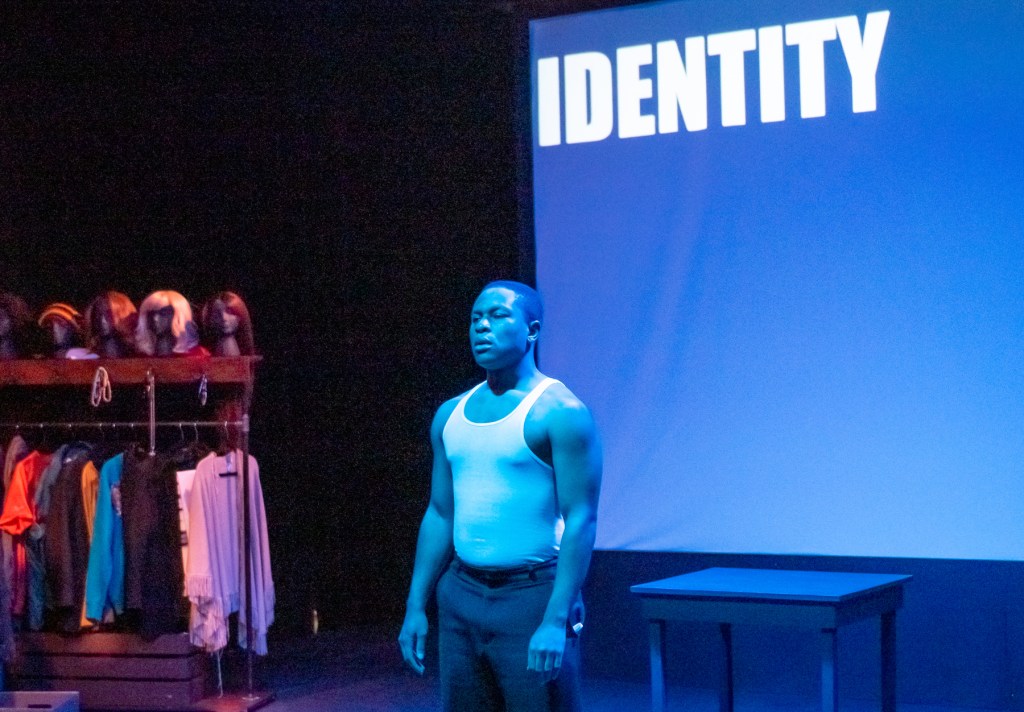
All the dialogue is in the words of those interviewed. The play – a totally inadequate word to describe this form of presentation – encompasses several themes. The first act includes the themes of Identity, Mirrors, Hair, Race, Rhythm, and Seven Verses (referring to seven biblical verses that seal the Old Covenant of the Chosen People). The second act focuses on the people and events of August 1991.
Smith conceived of this as a one-person play and performed all the roles herself in the workshop and original production. Onstage at Richmond’s Firehouse Theatre, Jamar Jones fills Smith’s metaphorical shoes – there aren’t many real ones, as most of the characters are portrayed in bare feet – under the more than capable direction of Katrinah Carol Lewis. Lewis, some may remember, starred in another of Smith’s one-person, verbatim plays, TheatreLAB’s 2017 production of Twilight Los Angeles, 1992, based on the Rodney King incident. For about two and a half hours, including the intermission, Jones held us spellbound to this all-too-familiar yet at the same time overlooked take on America’s troubled racial and religious history.
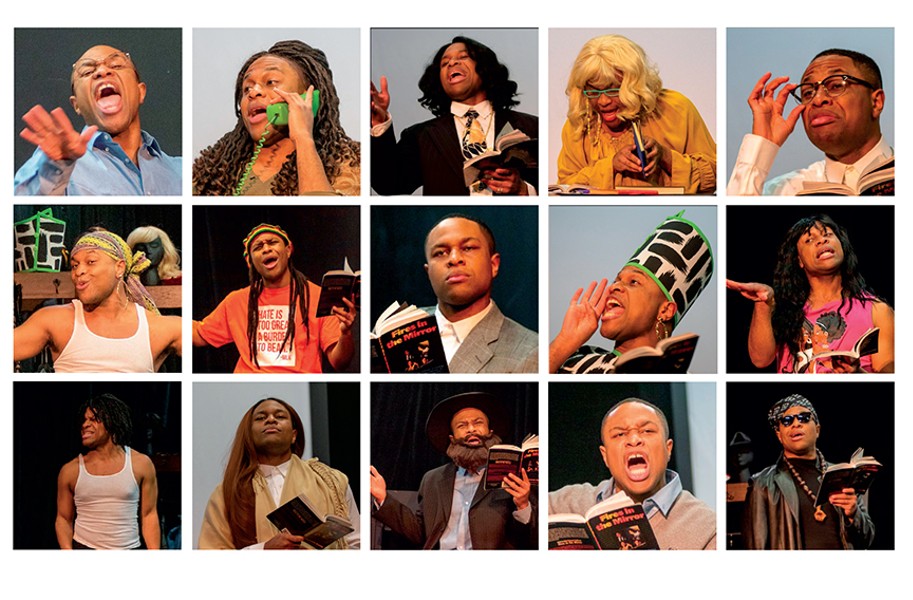
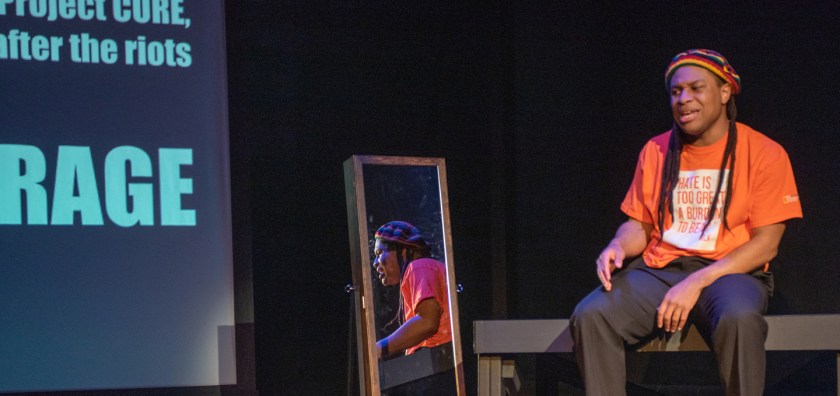
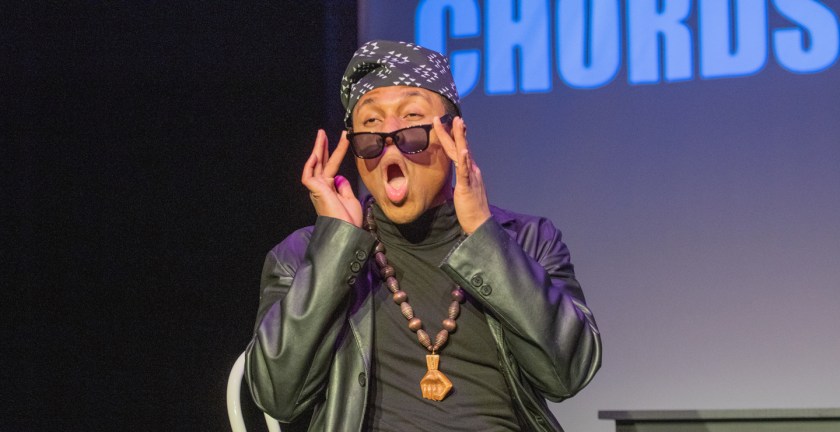
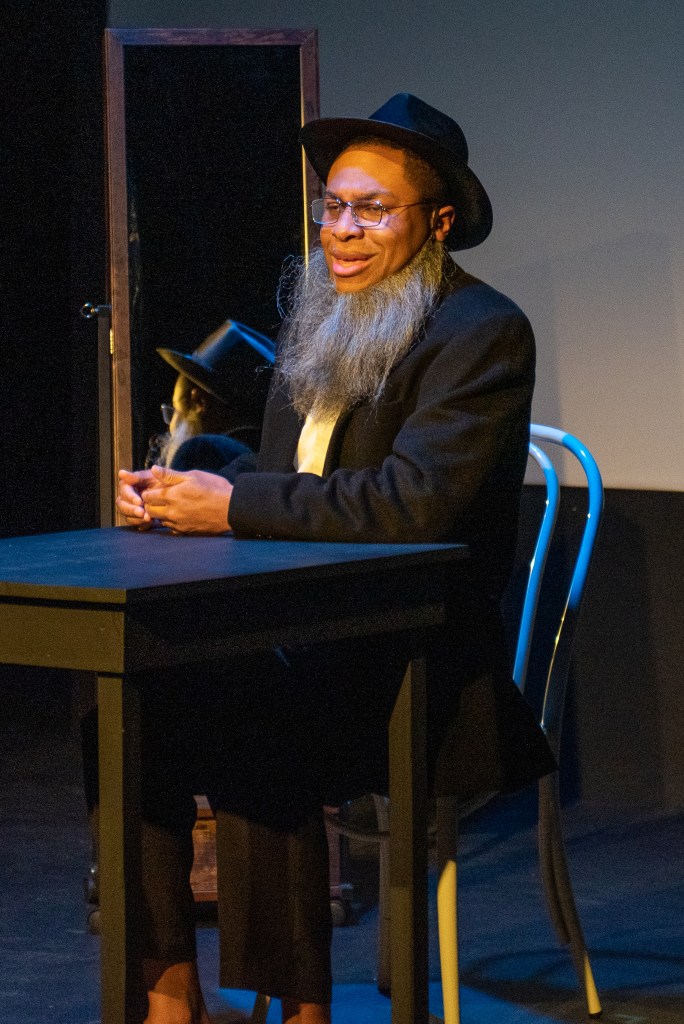
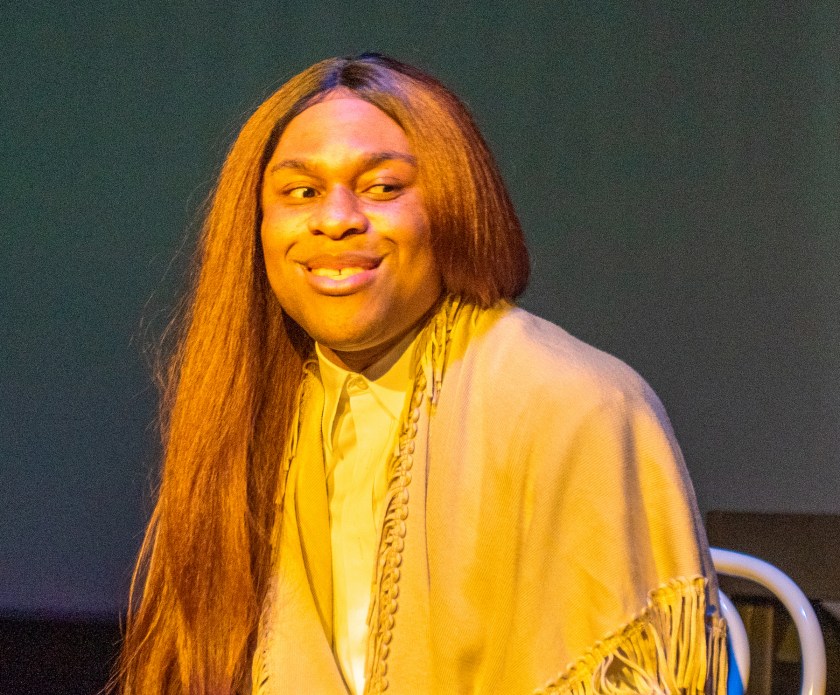
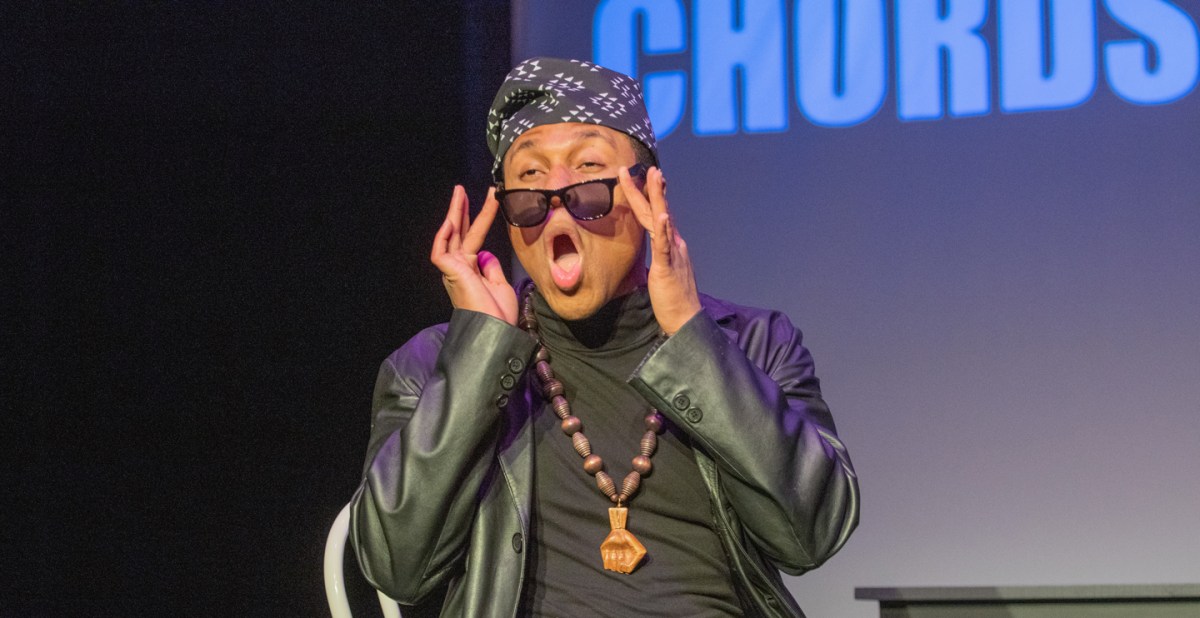
The space is sparsely furnished with a few black tables, a chair, a stool. Prominent in the space are two clothing racks topped with wig forms holding a variety of hairstyles and headwear. Kudos to Production Designer Todd Labelle and Costume Designer Margarette Joyner. This production even required a Wig Maintenance position, skillfully filled by Delaney Theisz. A quick change of wig, headgear, shirt, jacket, or accessories, and Jones was fully transformed into another character. Jones, who has proven his skill and agility again and again in diverse roles in many different productions including, but by no means limited to, Passing Strange (Firehouse), Fences (Virginia Rep), An Octoroon and Topdog/Underdog (both at the newly named Conciliation Lab) danced his way through numerous costume changes. A headwrap, oversized hoop earrings, and bangle bracelets for Ntozake Shange, a majestic black and white African print jacket with matching headwear to capture LA rapper Monique “Big Mo” Matthews, a kippah and prayer shawl for a Lubavitcher resident, a full beard and wide-brimmed hat for the rabbi, different wigs and styles to define a black teenager and a Hassidic mother. Each character had its own costume as well as mannerisms and sometimes props. Prof. Angela Davis’ tangled tango with a corded phone inspired a verbal metaphor as well as some welcome laughter.
More humor was provided by Rev. Al Sharpton, explaining how his signature hairstyle was inspired by his mentor, James Brown, the Godfather of Soul. This was before Rev. Al lost weight, so Jones paired the good reverend’s signature gold chain with a wide-legged stance, leaning back and walking with a waddle. Jones and Lewis nailed the familiar characters, Prof. Davis, Rev. Al, activist Sonny Carson, Ntozake Shange, with a few accessories and physical attributes. For the less familiar, a hair toss, a speech pattern, the length of a skirt, or an accent or turn of phrase centered the character in Crown Heights, Brooklyn – not far from where I was living in Fort Green-Clinton Hill at the time these incidents took place.
Jones also applied mannerisms to each character. A Lubavitcher woman folded her laundry as she spoke. A man – it might have been George C. Wolfe – had an annoying habit of loudly tapping his sugar packets and vigorously stirring his tea. Some voices were soft, hesitant, while others were angry, sharp, caustic. The most memorable voices were those of Norman Rosenbaum and Carmel Cato, the two men who lost their son and brother respectively as a result of an accident and a retaliatory reaction that forever changed their lives and left a dark skidmark on American history. Jones delectably and respectfully embodied each of these people. These were not just characters but real lives he was entrusted with, and the weight of this responsibility was not light. Like them or not, likable or not, each speaker was given a stage, unrushed and without judgment. Oh, we, the audience, may have judged or taken a position, but Smith, and by extension Jones and Lewis, presented this cast of characters as honestly as possible, leaving us to ponder at our leisure. There was and is no final resolution, no closure that satisfies any of the affected parties. Charges may have been pressed, accusations may have been made, cases may have been given due process, but none of that addresses the humanity of why. Why did this happen? Why do we react the way we do? Why is there still racism and oppression? Why can’t we all get along? How did we get here, and when will it end?
In the end, Jones sheds the final costume. The clothing rack stands empty, relieved of its colorful burden. He heaves a huge sigh, releasing the weight of the characters he has inhabited for the past two hours, then symbolically turns the mirror he used for his transformations slowly, reflecting the audience. There was soft weeping behind me. No one moved right away.
Fires in the Mirror is not light entertainment. It is the sort of theater that stays with you long after the final curtain, long after the players have gone home. See it. Live or streamed. You must see it.
“These are the things I never dream about.” – Carmel Cato
—–
ADDENDUM: I am not one to follow conspiracy theories but I have to share this bizarre incident that occurred while I was watching Fires in the Mirror. One of the characters in the first half was Prof. Leonard Jeffries, then a professor of Black Studies at City College of New York. I do not know Prof. Jeffries (not then or now) and was not familiar with him or his work. During the intermission, I decided to check my messages and happened to look at my Facebook page, only to find Prof. Jeffries as a friend suggestion. He was wearing a dashiki and matching kufi (cap) similar to those Jones had worn only minutes before. Hmmm. . .
A few of the many faces of Jamar Jones in FIRES IN THE MIRROR. Photos by Bill Sigafoos.
A COVID-conscious Pandemic-appropriate Theater Review by Julinda D. Lewis
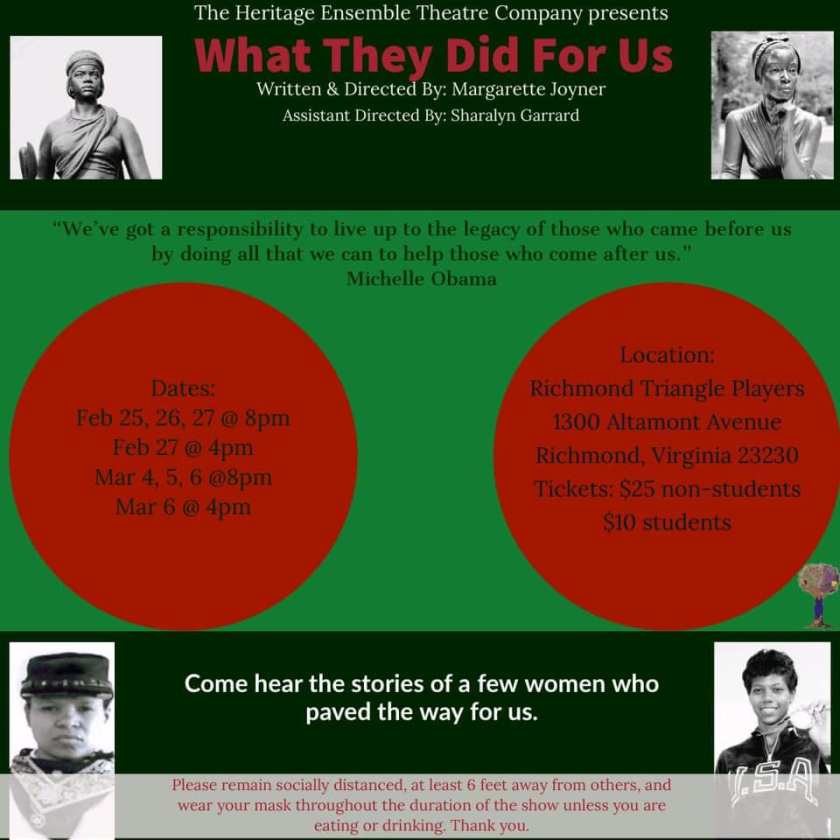
Who: Heritage Ensemble Theatre
At: Richmond Triangle Players at the Robert B. Moss Theatre, 1200 Altamont Ave, RVA 23230
Performances: February 25 – March 6, 2021; eight COVID-conscious in-person performances
Ticket Prices: In-Person Tickets: $25 General; $10 for Students. Contact the company to inquire about a streaming version of the production.
Info: (804) 937-7104 or theheritageensemble.org.
As much as I love to point out that February is not the only month in which we can celebrate African American accomplishments, it does seem strange not to have the usual selection of productions that at least give a nod to Black History Month. So, the last weekend of February found me sitting at a table for one at the Richmond Triangle Players theatre with a tear or two sliding into my mask as I chanted, along with the rest of the pandemic-restricted audience of twenty or so: My doctors said I would never walk. My mother said I would. I believed my mother.
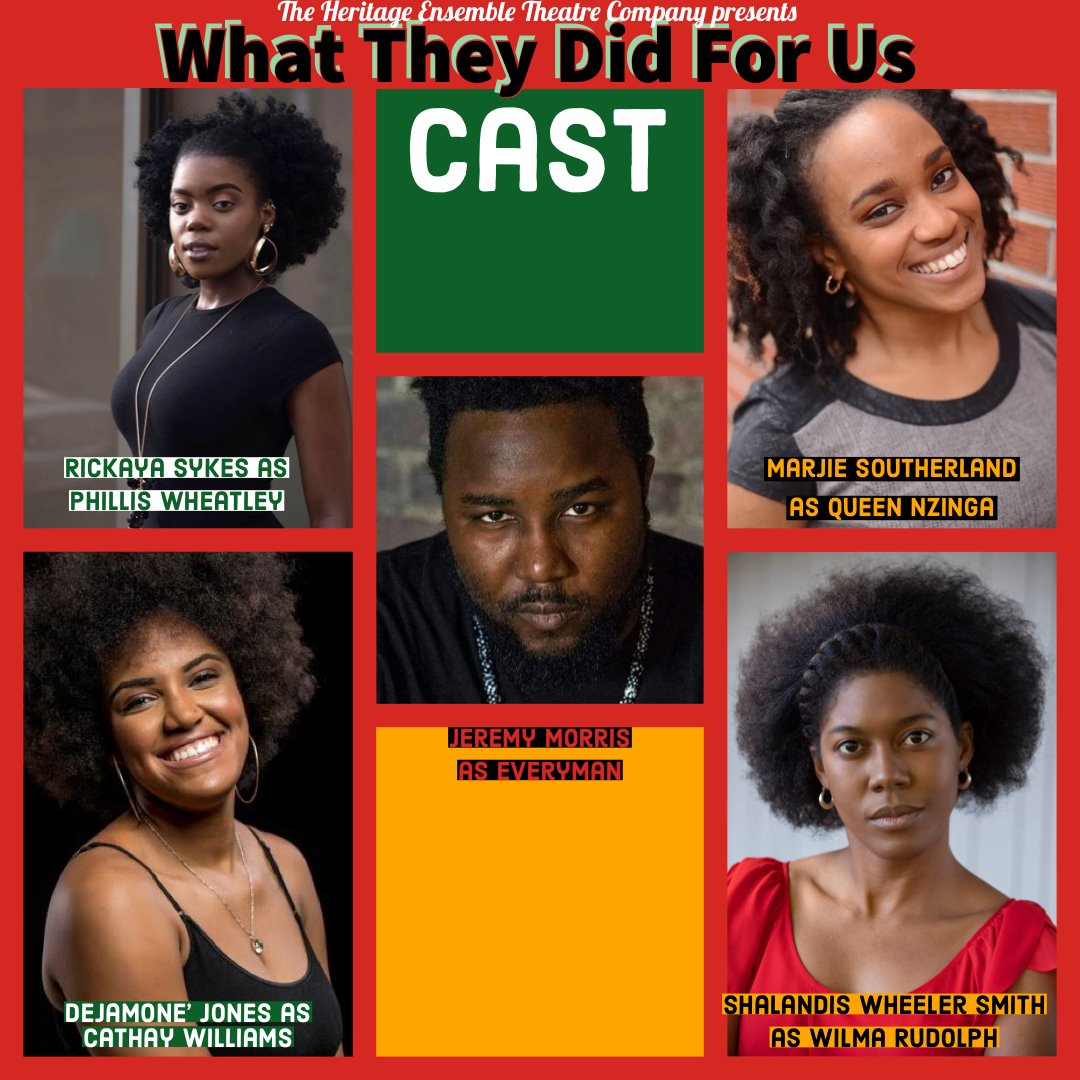
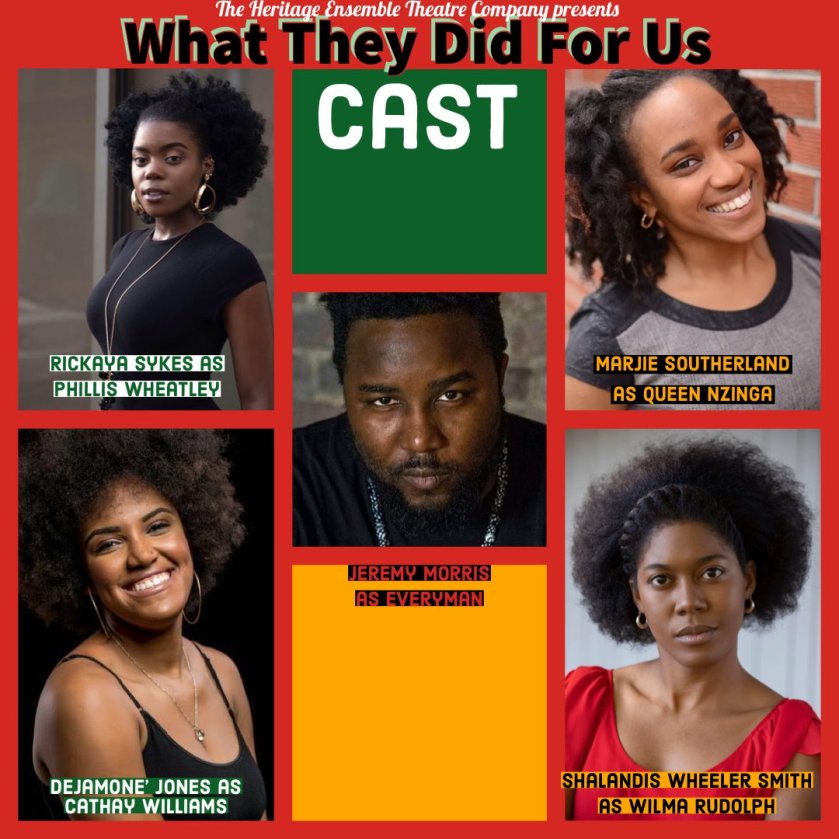
Written by Heritage Ensemble Theatre Company’s Founder and Executive Director Margarette Joyner and directed by Joyner and Sharalyn Garrard, WHAT THEY DID FOR US consists of a quartet of expanded monologues that pay homage to four exemplary Black women: Queen Nzingha, Phillis Wheatley, Cathay Williams, and Wilma Rudolph.
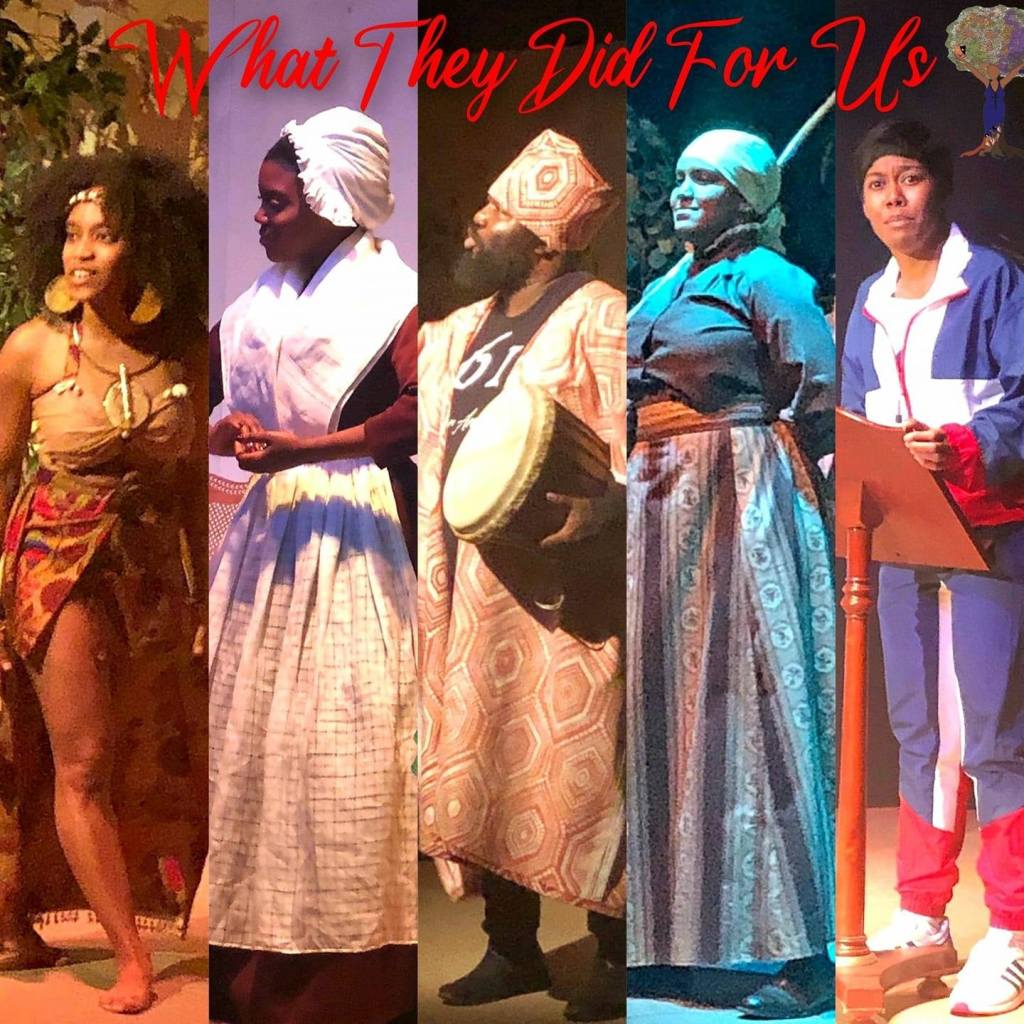
Dancing onto the stage with bejeweled ankles and wrists and wielding an ax, Marjie Southerland (Harriet Tubman and the Underground Railroad, Virginia Rep Children’s Theatre) embodies the politically savvy military strategist who successfully fought against the Portuguese colonization of parts of what is now Angola. While taking a stand against the slave trade, Queen Nzinga (1583-1663), also known as Ana de Sousa Nzingha Mbande, racked up accomplishments far beyond anything expected of any woman – or African – of her day (the 17th century).
Many of us have heard of the poet Phillis Wheatley (1753-1784), but like me, many may not have known much about her life. The first African American author to have a book of poetry published, Wheatley, played with gentle strength by Rickaya Sikes (VCU Theatre major). Wheatley was born in West Africa, sold at age 7 or 8 to a family named Wheatley, and given the name Phillis for the name of the ship that brought her to America. She published her first poem at age 13. By 20, she had acquired international acclaim, yet she died impoverished at the age of 31.
Cathay Williams (1844-1893) was the only female Buffalo Soldier. She served in the US Army by pretending to be a man, William Cathay. Apparently, physical exams were not very thorough in the 19th century because it was years before her secret was discovered. Dejamone’ Jones portrays Williams with dignity and humor as she recalls her years as a cook and laundress. Although Williams received an honorable discharge, she was denied a pension.
But it was Shalandis Wheeler Smith’s portrayal of Olympian Wilma Rudolph (1940-1994) that wrenched that tear from my eye. Smith (an actor who is also the company’s Production Manager) employed a call and response technique in her inspirational message that got the audience involved and made her segment stand out above the others. While her story was more familiar than the others – the childhood polio, the three gold medals, the designation as the fastest woman in the world – l never knew that Rudolph grew up with 21 brothers and sisters.
Tying these monologues together was Jeremy V. Morris (Oedipus, Passing Strange, An Octoroon) as Everyman. Morris changed costumes between each monologue, from African robes and a drum to waistcoat, wig and came, from straw hat (the least imaginative) to tracksuit as he provided narration, often in poetic verse. And I was impressed with his drumming in the first scene.
Set against a simple background that included a rocking chair, a low throne-like chair for the narrator, a podium, WHAT THEY DID FOR US has a linear quality. The actors do not interact with one another, and each monologue could stand alone in, perhaps, a school setting. In a different day and time, this production – more of a storytelling event than a traditional play – might find the theater packed with school-aged children for a matinee, or it might be presented in school auditoriums.
There were only a limited number of performances left at the time I wrote this review, but there’s always next year…
A COVID-conscious Pandemic-appropriate Theater Review by Julinda D. Lewis
At: The Firehouse Theatre, 1609 West Broad Street, RVA 23220
Performances: February 4-20, 2021, live and streamed.
Ticket Prices: In-Person Tickets: $30 in person; $25 live-streamed
Info: (804) 355-2001 or firehousetheatre.org. See the theater’s website for their COVID-19 precautions, drink orders, and more.
Two days, two plays. I would describe both as the type of play meant to make you think, more than just entertain you. (What a treat to even be able to see two live productions in a single week during a pandemic: THIS BITTER EARTH at Richmond Triangle Players and KRAPP’S LAST TAPE a little more than a mile away at The Firehouse.) And both were well done. But now, to get to the play at hand.
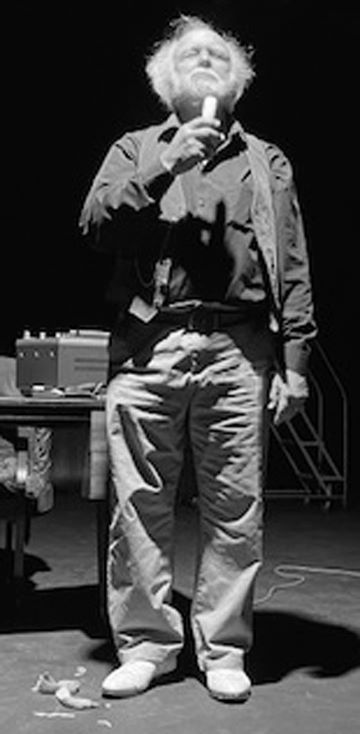
Alan Sader is Krapp. (I just had to say that!) But seriously, veteran actor Alan Sader steps into the role of Krapp, a 69-year-old man contemplating his life, as if he had been born for this role. I know Alan Sader, and watching this one-person one-act play, I didn’t see an actor I knew in a role; I saw Krapp.
Written by Samuel Beckett, known for his absurdist style, and directed by James Ricks, Artistic Director for Quill Theatre, KRAPP’S LAST TAPE is a perfect play for a pandemic. Solitary. Isolated. Defeated. The play takes place on Krapp’s 69th birthday. I don’t think he has a first name. To celebrate, for lack of a more appropriate word, Krapp rummages through the archives of tapes he’s made over the years, chronicling his life.
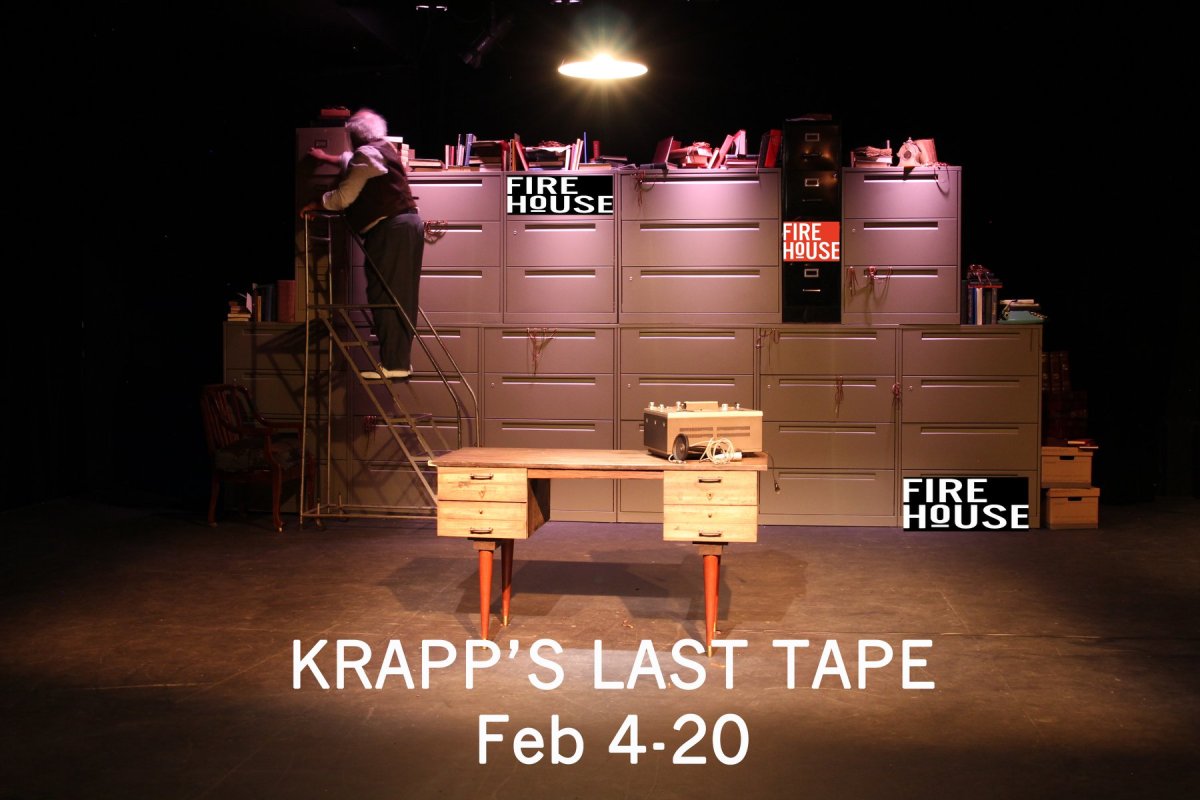
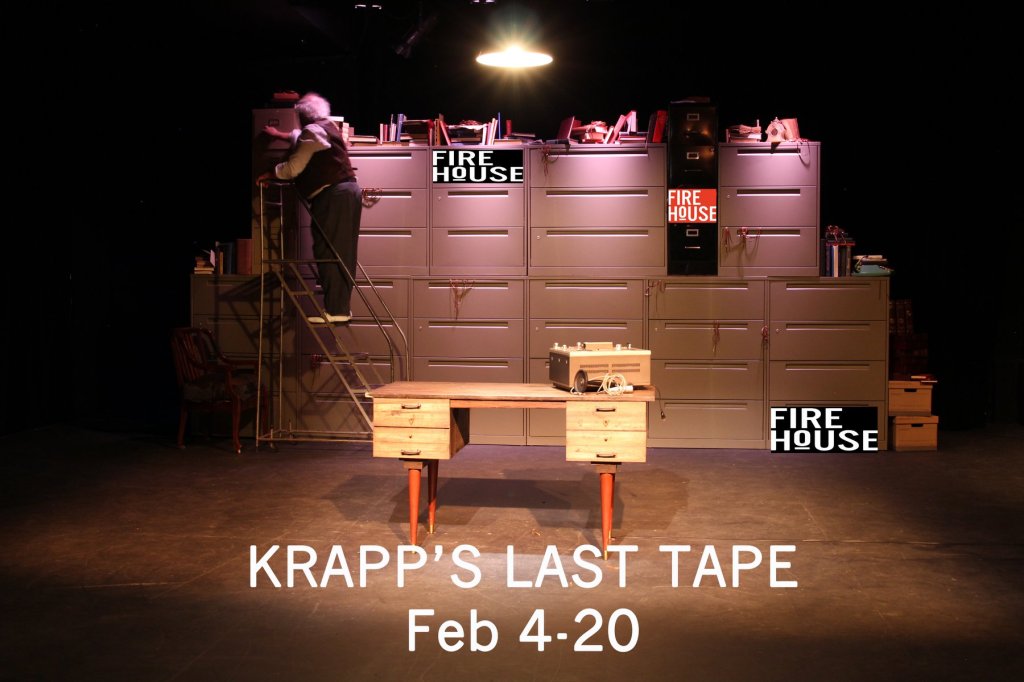
The setting is important – it takes on the aspect of another character. There is a wall of file cabinets, stacked one atop another and interspersed with odds and ends and brick-a-brack. A reel-to-reel tape machine and a portable staircase are supporting actors.
There is an introductory struggle with the ancient tape player – a heavy monstrosity of a machine that nearly gets the best of the old man before he places it precariously on an old rickety desk that seems barely able to support its weight. But that’s not the end of it. Oh, no. The tape machine’s electrical cord falls short of reaching the wall outlet, necessitating not one but two duets with the staircase. Old age and misery are not without their moments of humor.
To access the 30-year-old reel-to-reel tape he needs, Krapp consults a ledger for the carefully cataloged location of the specific tape he needs. He then has to interact in a comedic duet with a moveable staircase to get to the right file cabinet where the electrical cords are stored. Sader makes climbing the steps a full-on drama, complete with grimaces and groans. In fact, it is quite a few minutes into the play before Sader actually speaks a legible word. The opening is entirely physical – sort of a combination of comedic actor Charlie Chaplin and mime Marcel Marceau.
Speaking of old age, I had to remind myself that this play premiered in 1958 when age 69 might have been considered ancient. Today, 69 is rarely seen as the end of life – except perhaps to people younger than 25. But I digress.
Before finally settling in to reminisce about his younger self, Krapp has one more trick to execute: an orgasmic experience with a banana – which he temporarily stores in his pocket – and an obligatory slipping on the banana peel. Oh, and let’s not forget the delight he takes in saying the word “spool,” drawing it out and repeating it several times.
Once Krapp has settled in, we hear his younger voice on tape (kudos to director James Ricks for his superb sound design), and Sader spends long periods in palpable silence. He hears the optimism of his younger self, aged 39, and doesn’t seem to react much but saves his regret for lost love. The people who passed through his life are ephemeral, but these recorded memories are his reality now.
Like most Beckett plays I’ve seen, this work is not for everyone – certainly not for those who crave action and movement and verbal sparring – but it seems to be the perfect vehicle for this trio: Beckett, Sader, and Ricks. I don’t know how Beckett would have felt about this production, but Sader and Ricks must certainly feel immense satisfaction in their flawless execution of KRAPP’S LAST TAPE.
The live performance, limited to no more than 10 in the audience, was preceded by a live performance by Ryan Phillips on solo acoustic bass – a perfect introduction to KRAPP’S LAST TAPE. The live program runs through February 20 (if there are any tickets left).
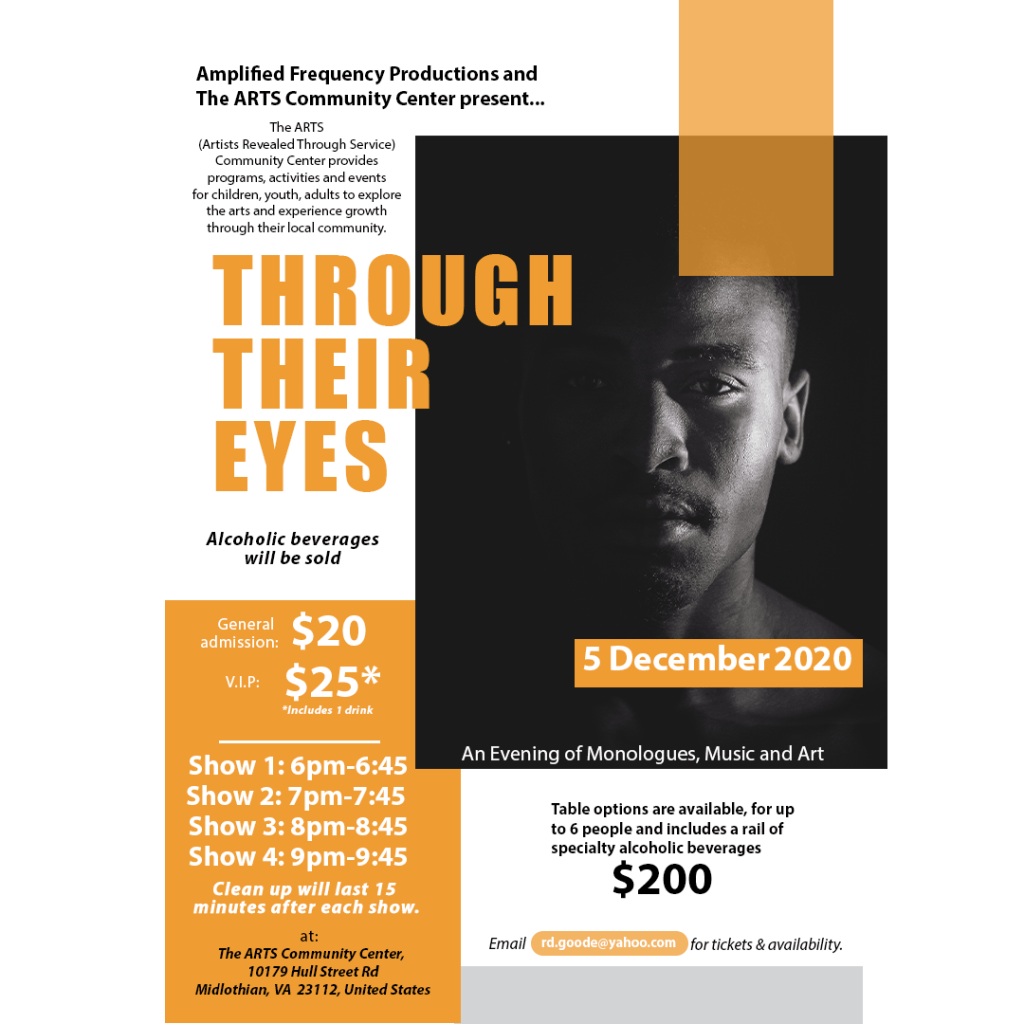
Ripped From the Headlines, From the Page to the Stage: An Evening of Monologues, Music, and Art
Some Observations on a COVID-Conscious Theater Experience by Julinda D. Lewis
At: The ARTS Community Center, 10179 Hull Street Rd., Midlothian, VA 23112
Performances: December 5, 2020, at 6PM, 7PM, 8PM & 9PM
Ticket Prices: $25
Info: rd.goode@yahoo.com
Some theater is meant to entertain, to make you laugh, or to be a diversion from your everyday life. And some theater is meant to move you, to educate you, to stir you to action or make you uncomfortable. Raymond Goode’s THROUGH THEIR EYESfalls squarely into the latter category. In his book of the same title (which I promise I will read as soon as I clear my schedule of over-due assignments), Goode crafts short stories from the real-life situations he has culled from the headlines or in some cases from history. In each story, Goode has placed himself in the shoes of the protagonist (I try to avoid using the word “victim”), and the result is a series of moving, sometimes raw monologues.
With minimal set (a podium, a veteran’s flag encased in the traditional triangular frame) and live musicians (David Thompson on saxophone, Eugene Harris on keyboards, and Orisegun Olimidun on drum), there were few distractions from the gravity of the words. Conceived as a series of monologues, the work is fluid, with each of the four performances having a different line-upof monologues and entre’actes. The program, in its current form, has more of the feel of a staged reading or an open mic night, as one viewer told me. Goode is both author and director, and future iterations might benefit from the vision of another pair of eyes in the directorial chair.
My introduction to the Goode experience began with Benny Blonkoe Perry’s retelling of “Step in the Name of Love.” It is the story of a man remembering how, as a little boy, his father took him on a rare trip to McDonald’s, only to be shot to death in front of his son, for the paltry contents of his wallet. “That night haunts me to this day,” the now adult son remembers. “I was the last person to see my father alive.” The R Kelly hit tune “Step in the Name of Love” was playing on the radio and forms the haunting background to this memory.
In the second set, Katrina Robinson, who also performed as vocalist, stepped into the painful shoes of a mother who learned to come to terms with her son’s coming out, only to have him die from AIDS shortly after graduating from Morehouse College. “He Was My Son” should come with a warning to bring tissues or a handkerchief – and I think Robinson’s tears were genuine as she stumbled off the stage.
Royal Coakley stirred hearts and rage as she told the story of an enslaved woman who was raped in front of her husband, who sat helplessly and watched the violation unfold. When Coakley stormed offstage to find Harriet Tubman and get a ticket on the underground railroad at the end of “Still He Was,” the audience was ready to follow her.
Other stories brought to life included “Trayvon Martin” performed by Tandylyn Cooke, “Treatment Facility,” with Ken Moretti in the role of the broken veteran, “Homicide,” and “Goodies” with Goode in the role of the desperate father and fallen addict, respectively. Other performers included vocalists Lakesha Walker and TC, Dana Terry with dance interpretation, and my personal favorite, “Krumpologist” Casey Kingversastylez Inneigh who mesmerized the audience with his mind-bending, shape-changing movement to “Black Mothers’ Rules” and Nina Simone’s “Strange Fruit.”
The few spaces that have stepped back into the world of live performances have done so under the guidance of strict pandemic regulations and guidelines that include temperature checks, scanned tickets, and digital programs. They require masks (a major ballet company even has the performers wear masks), and have greatly reduced the seating capacity. Given that ticket prices cover only a portion of the expenses involved in a production, reducing seating capacity from 250 to 75 or from 100 to 25 certainly doesn’t make economic sense, but instead speaks volumes to the dedication of performers to put on a live show. These are desperate times.
All that to say, with a socially-distanced capacity of 25 (in a space that could easily seat more than 100), it was heart-breaking to see only two other couples in attendance at the two shows I attended. One couple arrived late (for a 45-minute show) and one couple left early from each show. I would love to know if they left because the material was so intense they couldn’t bear to relive it, or because they were not satisfied with the quality, or if they just had other plans for the rest of their evening.
Even in it’s rough-edged state, in an open space without benefit of theatrical lighting or other accoutrements, with the restraints of social-distancing and all that entails, THROUGH THEIR EYES has the power to move. It’s dynamic. It isn’t perfect, but neither are we. And that makes it worth a look – or two or three.
The Santa Closet: Where Theatrical Journalism & Non-Binary Humor Meet
A COVID-conscious, Pandemic-appropriate Theater Review by Julinda D. Lewis
At: Richmond Triangle Players at the Robert B. Moss Theatre, 1300 Altamont Avenue, RVA 23230
Performances: November 18-December 19, 2020. Live & Streaming options.
Ticket Prices: In-Person Tickets: $30 & $35; $10 for Students. Streaming Edition: $25; $10 for Students. Choice of Eddie Webster or Levi Meerovich.
Info:(804) 346-8113 or rtriangle.org. See the theater’s website for their COVID-19 precautions, digital programs, online drink orders, and more
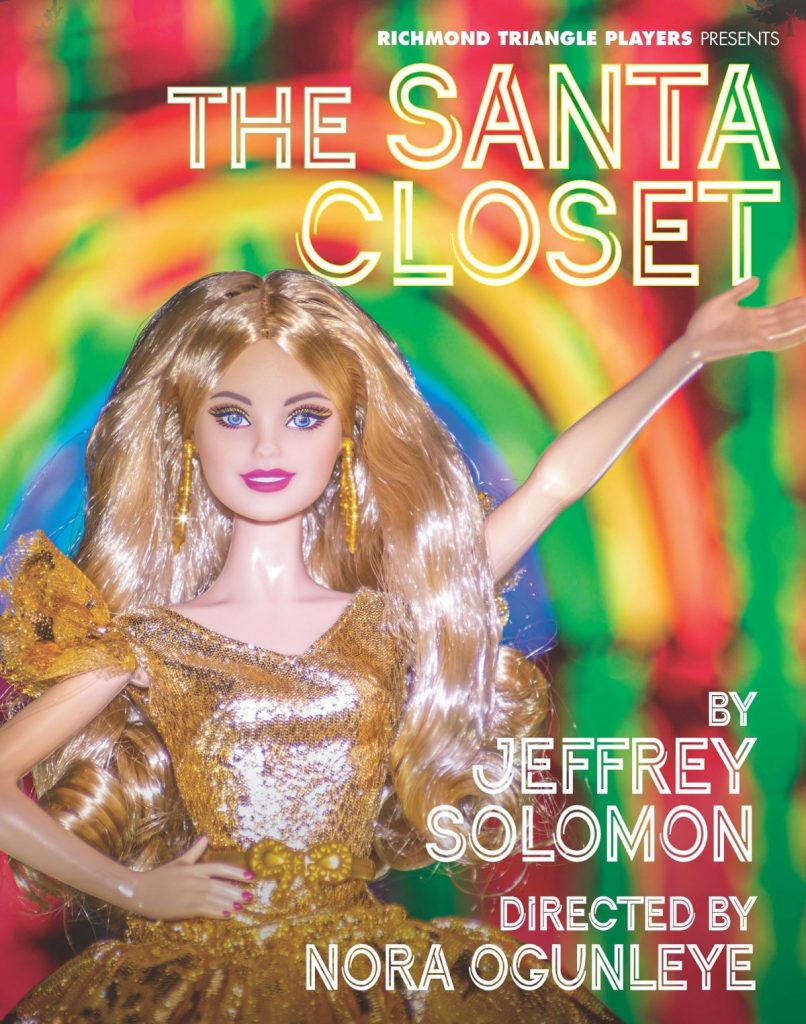
Even in the midst of a worldwide pandemic we can depend on the Richmond Triangle Players to give us a unique, memorable, and satisfyingly humorous holiday show. This year’s one-man production of Jeffrey Solomon’s The Santa Closet fulfills all those requirements and does not disappoint!
Originally titled Santa Claus is Coming Out when it premiered some ten years ago, starring the author, the title was changed to indicate the play is not just a silly, vapid little play about coming out. The Santa Closet, on the other hand, implies all the depth and layers and “stuff” that are in that closet – and that make this play such a delightful journey.
It all starts with a young child’s letter to Santa. We first meet little Gary when he writes a letter asking Santa for a “Sparkle Ann” doll – a Barbie look-alike. Gary’s best friend, a feisty little girl named Cheyenne, defends him every step of the way. She, after all, is the recipient of Gary’s creative skills in designing doll clothes and hair styles. But his mother, Trish, is floundering on the edge of tolerance while his father, Frank, is lovingly homophobic (yes, it’s possible to be both of those things).
But Santa disappoints little Gary, who receives a truck instead. The following year, Gary tries again, asking for a Dream Date Norm (if you’re with me, you’ve already figured out that’s similar to a Ken doll). Once again, Santa doesn’t deliver, and Gary’s faith begins to wane.
Cut to the big guy himself. We find a conflicted Santa first having drinks in a gay bar in Manhattan, and then being reluctantly drawn into participating in the Stonewall Rebellion of 1969. (For those not familiar with the history, this was a series of what the LGBT community of the time referred to as demonstrations and the police and city administration referred to as riots. The movement was sparked by a police raid of the Stonewall Inn in NYC’s Greenwich Village.)
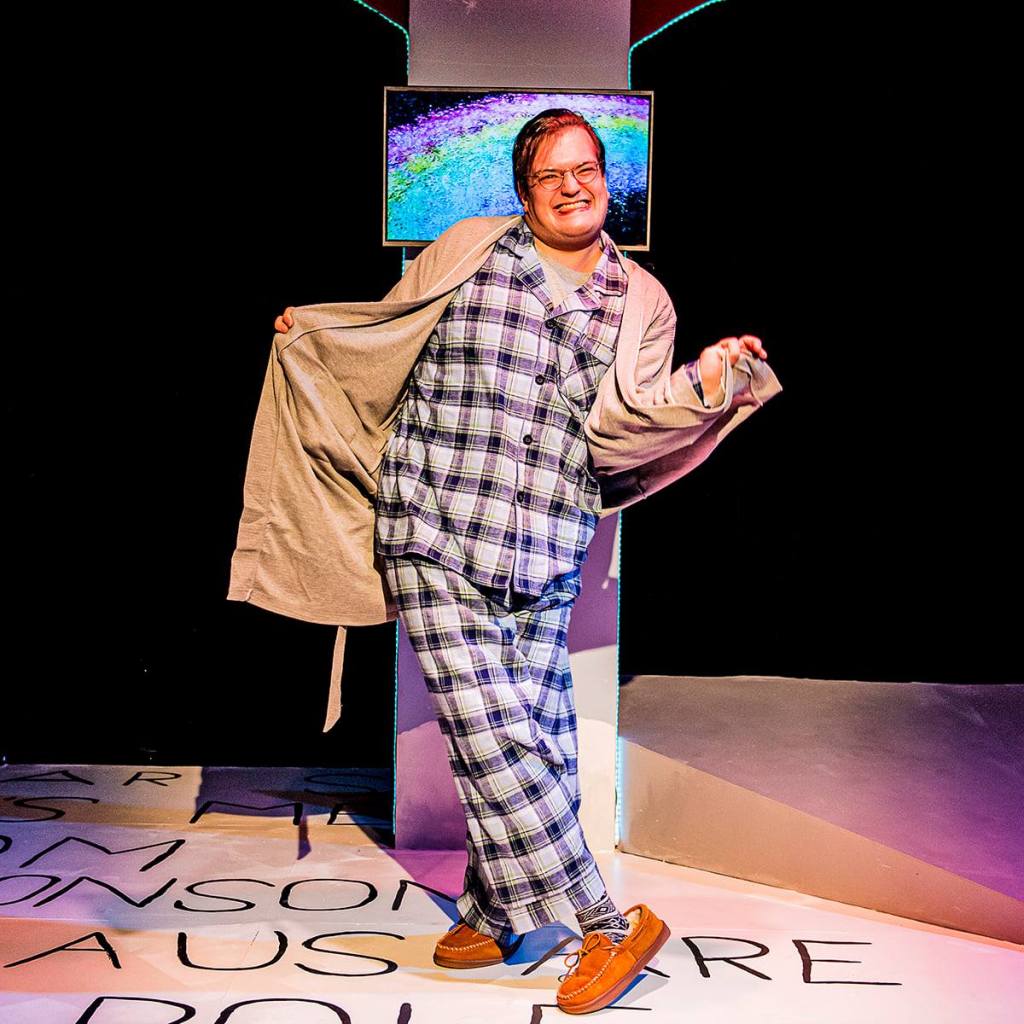
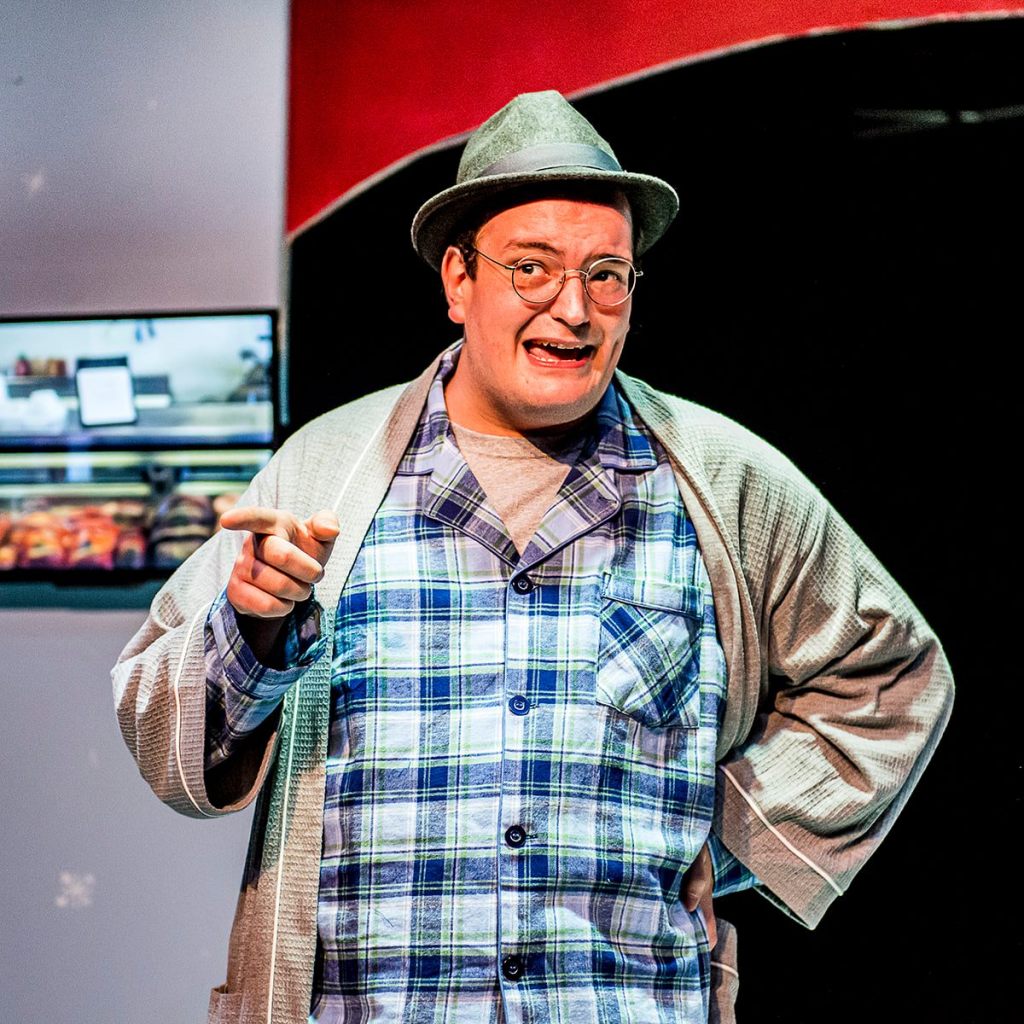
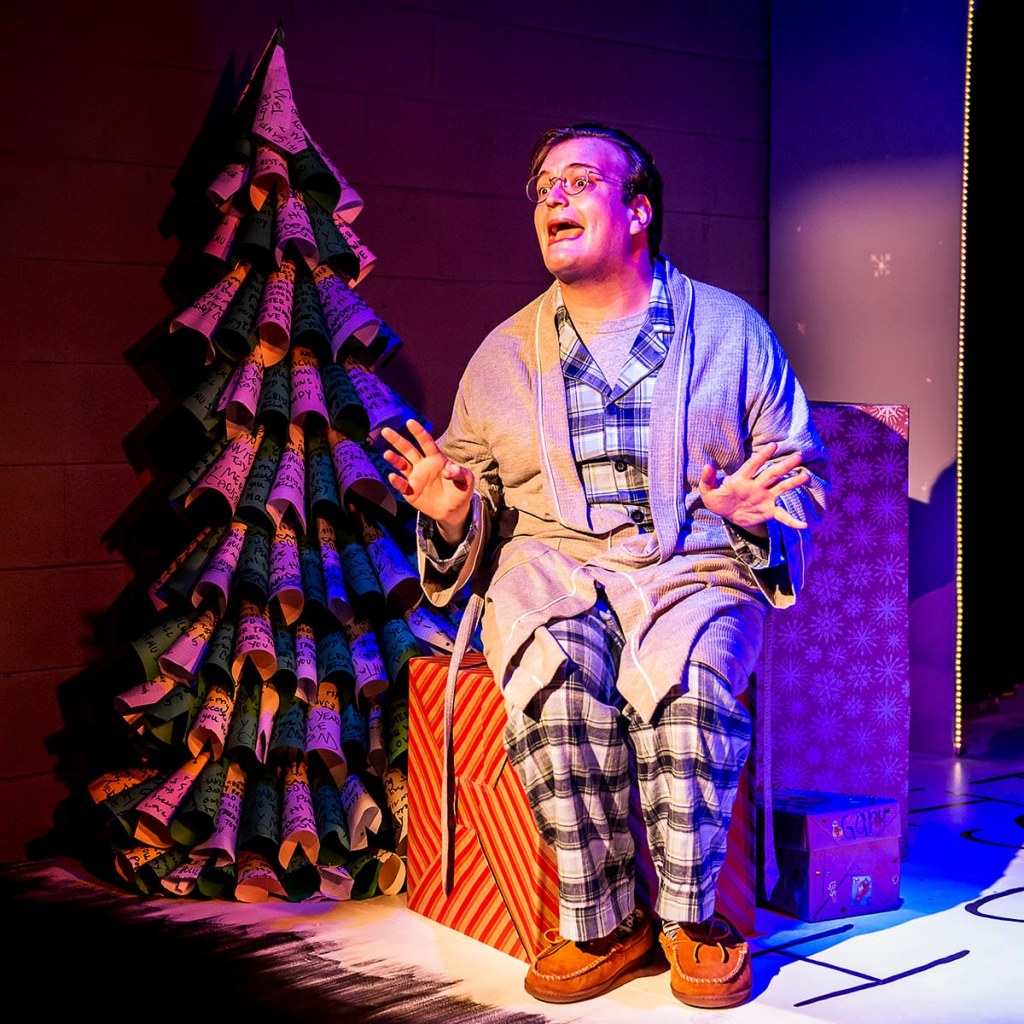
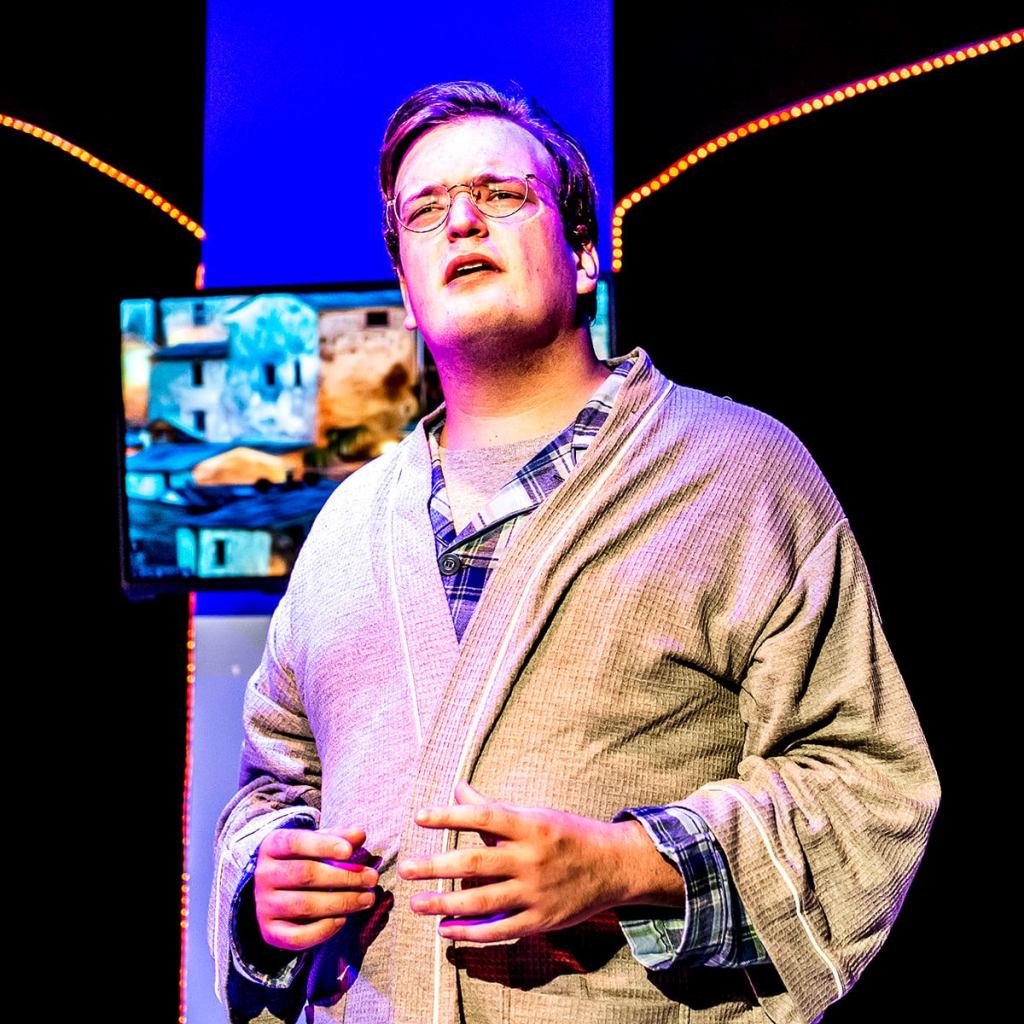
Eddie Webster stars in the Richmond production, with Levi Meerovich performing a limited number of performances. I had the pleasure of watching Meerovich performing on Saturday night. Wearing the familiar COVID uniform of pajamas and robe, Meerovich used a variety of accents and mannerisms – and the occasional hat or glowing red nose – to smoothly transform into about a dozen distinct characters.
Besides young Gary, his mother Trish, and his father Frank, the actor must portray Santa; Santa’s agent Sidney; Pete the head Elf; Rudolph the head reindeer (pronouns he, him, his); Gary’s BFF Cheyenne; Santa’s Italian lover Giovanni (a great-great-great-great-great grandson of Pinocchio), the family’s pastor, a waning actress, Beatrice Pond (known for her one-woman portrayal of The Cherry Orchard) who is hired to portray Mrs. Clause; Santa’s gay friend Jose; and Mary Ellen Banford who is the leader of the local branch of Families Against the Gay Agenda, or FAGA for short.
The Santa Closet establishes a delicate balance of humor and tenderness. Solomon wrote the play as if each of the characters is being interviewed and there are “Breaking News” interruptions several times as the drama unfolds. Damage control is required after the Stonewall incident, and reflecting the original title, Santa and Giovanni go missing, never to be seen again. Of necessity, most of the gay characters are over the top. With Meerovich portraying so many different characters in rapid succession, that helps the audience keep up. It also makes the moments all the more sensitive when Gary accepts being different, or when his parents join a support group to help them along their journey to accept their now-adolescent child.
Director Nora Ogunleye has directed with a gentle but steady hand that left Meerovich plenty of room to do what he does so well, while expressing the nuances Solomon wrote into the play. Richmond Triangle artistic director Lucien Restivo kept the costume and set simple (pajamas and slippers, three arched openings, an angled platform, a stool, some holiday lights, a couple of Christmas trees that appear to be fashioned from children’s letters to Santa). This provides a pleasant and seasonal backdrop but allows the audience to focus on the actor and the many characters he portrays. Anything else would have been far too busy and distracting.
Two small wall-mounted screens contain relevant projections, but perhaps I should have said “too-small wall-mounted screens. Even from my fairly close seat in the second or third row from the stage, it was difficult to see the detail on some of the projections. This size may have been a well-reasoned choice, but I am sure that many others with “mature eyes” may also feel they are missing some of the visuals.
Speaking of the audience, the already-intimate theater has been further limited to a maximum of 27 patrons for live performances. Seats are socially distanced in pods of 1, 2, or 4. Masks are required, there is no intermission, drinks may be ordered and paid for online, everyone’s temperature is taken on entry, and programs are fully digital (a pandemic adaptation that many theaters will likely continue when this is all over).
Other members of the creative team – yes, it takes as many people to produce a one-person show as it does to produce a show with a larger cast – include Joey Luck, sound; Deryn Gabor, lighting; Yara Birykova, projections; Sheamus Coleman, technical direction; and Erica Hughes for some really fun dialects.
There are live performances Thursdays through Sundays, with one Wednesday performance. Check the theater’s website for details and to order tickets or purchase the link to purchase one or both of the streaming editions (one features Eddie Webster and the other Levi Meerovich). [I haven’t yet seen Webster’s portrayal, which I expect may be quite different and I will add an addendum to this post after I’ve seen him in the streamed version.] In the meantime, if you’re looking for a little holiday cheer (with a bit of an edge, due to the history), this should fit the playbill. The Santa Closet is highly recommended (for those over age 15).
There is no getting around the fact that 2020 has been a most unusual year. It has brought unprecedented challenges to our arts. Yet, as history confirms, art always prevails. Theater and dance has found new ways to exist and mined new ways to create.
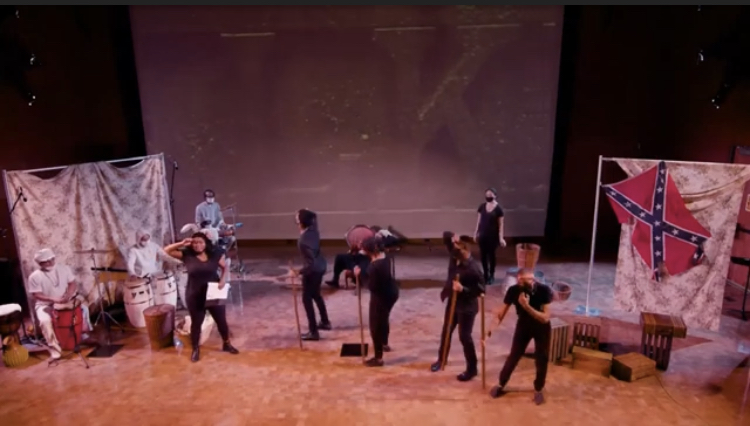
The Conciliation Project is a Richmond-based social justice theater company under the direction of Dr. Tawyna Pettiford-Wates (Professor of Graduate Pedagogy in Acting and Directing at Virginia Commonwealth University) and Dr. Ram Bhagat (educator, peace-builder, community healer, and co-founder of Drums No Guns). With heavyweights like these at the helm, it should come as no surprise that The Conciliation Project offers research-based programming that reveals, examines, and demands a response to racial stereotypes and racial injustice.
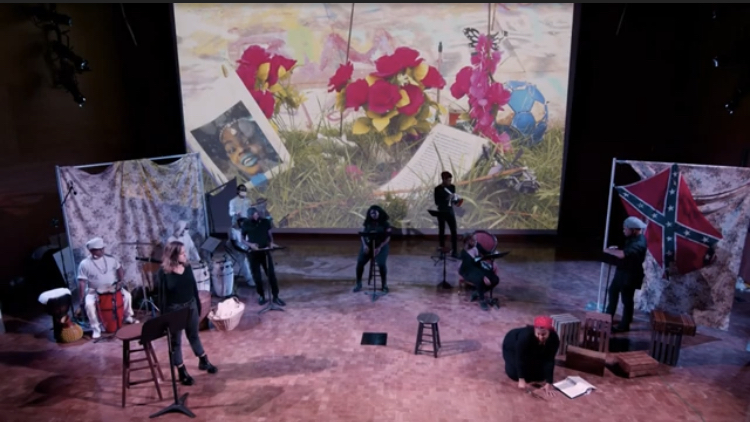
The script for “The COMMON wealth & The COMMON debt” was developed from conversations with Richmonders, with a focus on the history-defining events of 2020: the COVID-19 pandemic and the racial (in-)justice protests that resounded around the world in the weeks and months following the murder of George Floyd.
“The COMMON wealth & The COMMON debt” is not a play in the traditional sense. It is reminiscent of Ntzoke Shange’s self-described “choreo-poems” or the eye-opening work I saw as a teen-ager at what was then the mecca of Brooklyn’s Black culture, The East. (For a description of The East, look at https://en.wikipedia.org/wiki/The_East_(Brooklyn) and http://www.corenyc.org/omeka/items/show/320). In other words, this is work that exists to educate and enlighten as well as to entertain.
Conciliation: The process of winning over from a state of hostility or to gain the goodwill of. The building of bridges to connect two points that are distant, and/or disconnected from one another.
Among the topics presented by the voices in “The Common wealth & The Common debt” are the definition of the word “commonwealth,” diverse perspectives on the history of the Commonwealth of Virginia (the middle passage, slave markets, Jim Crow and other racial injustices), the value of Richmond monuments, the Civil War, racism, power, segregation, urban farming, and more. In one moving scene, Keaton Hillman has a conversation with an ancestor, Callie, a woman sold into slavery and later freed. “Help break the cage for someone else,” she says before returning to the ancestral plain. The next scene shows a group of protesters marching in cadence to “no justice, no peace.”
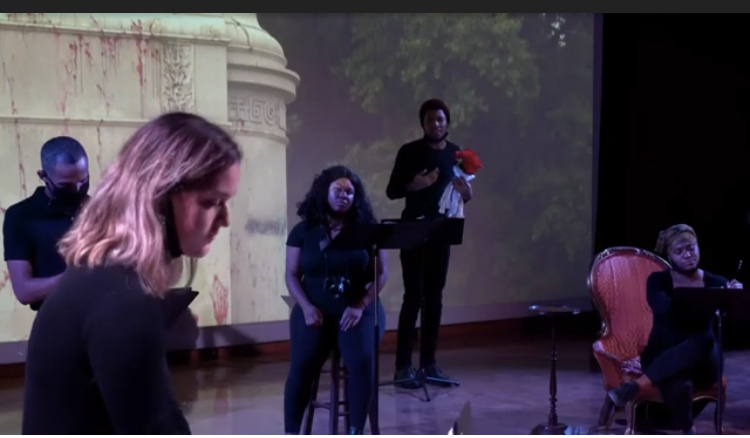
Against the backdrop of a chain link fence and passing traffic, masked performers sing, “We Wear the Mask.” Contemporary voices blend with traditional fables, history, and storytelling in a non-linear way that the modern western mind might struggle to comprehend. Experiencing “The COMMON wealth & The COMMON debt” is a bit like being inside the production while watching it; similar to the way one might dream and awaken to wonder where the dream state ends and reality begins.
“I think we could definitely do a better job at creating monuments that glorify actual heroes instead of being used as an intimidation tactic, which is what they were originally put there for.”
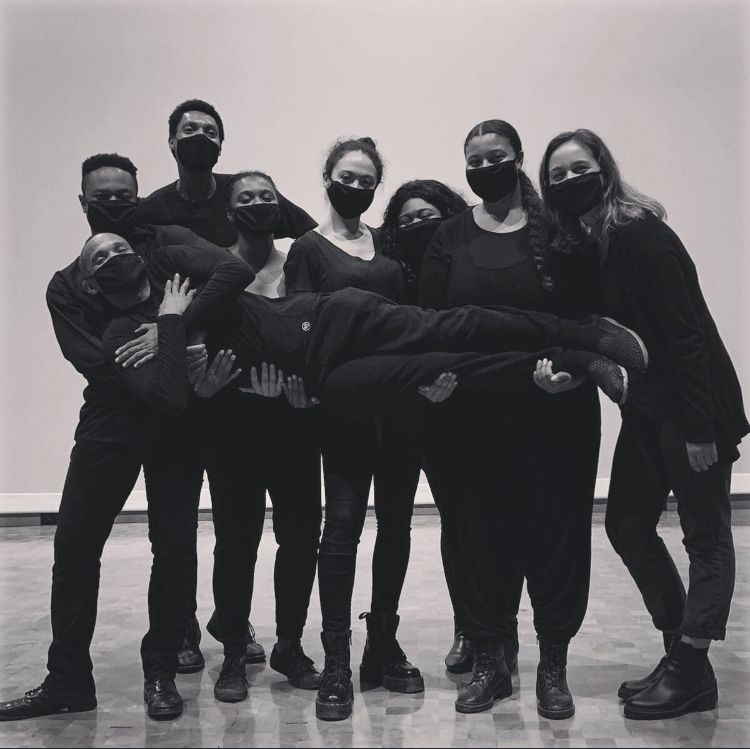
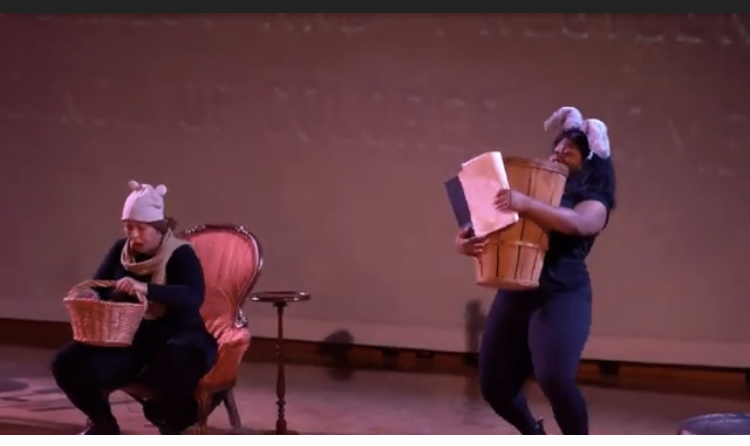
The creative team organized a solid ensemble consisting of Calie Bain, Juliana Caycedo, Keaton O’Neal Hillman, Zakiyyah Jackson, Dylan Jones, Jamar Jones, Todd Patterson, and Mariea Terrell. The acting ensemble is supported by Drummers lead by Ram Bhagat and dancer Alfumega Enock. In a live post-performance discussion, we learned that the stories and interviews were collected by the Graduate Applied Theatre Class at VCU as well as members of the Ensemble, with support from the ICA. “The COMMON wealth & The COMMON debt” should be accessible for the remainder of the week of November 15. Catch it, if you can.
PHOTO CREDITS: The Ensemble and Scenes from “The COMMON wealth & The COMMON debt” from The Conciliation Project social media pages.
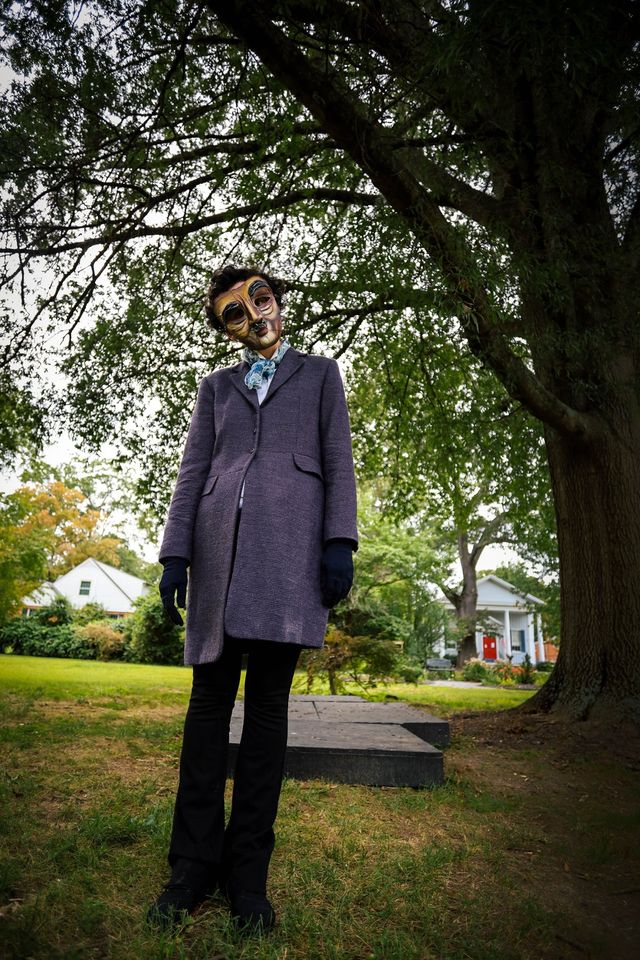
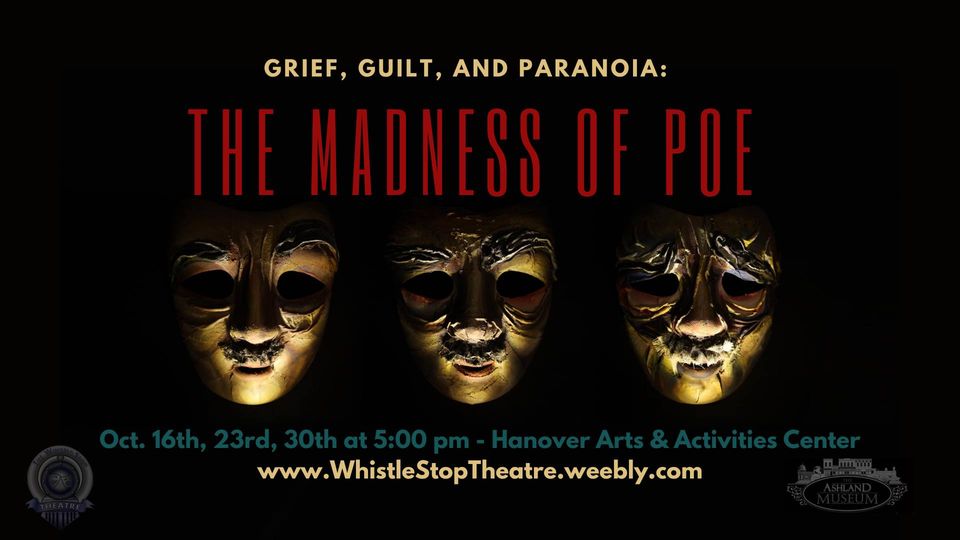
On Friday evening (October 16) the rain let up just in time for a live “pandemic appropriate” performance of Grief, Guilt, and Paranoia: The Madness of Poe, staged under a wide-spreading tree on the spacious lawn of the Hanover Arts and Activities Center. It was a cool 55 degrees and cloudy, but not uncomfortable. Attendees are required to bring and wear a mask as well as a lawn chair or blanket to sit on. (I would also advise a blanket for the cool weather.) About a dozen people claimed socially distanced in squares marked off in the grass as a pre-show playlist of Poe-inspired songs filled the air. (Three trains passed on the nearby tracks during the 45-minute show, but the program was so riveting the interruption was negligible.)
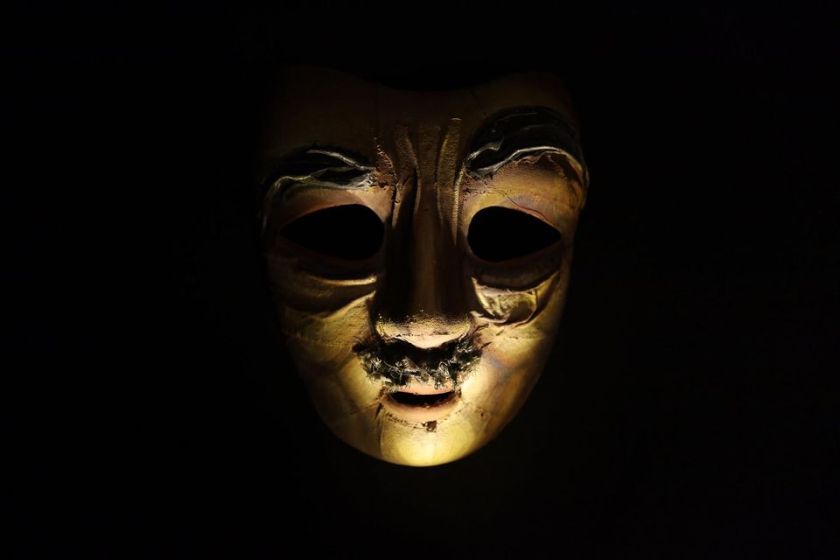
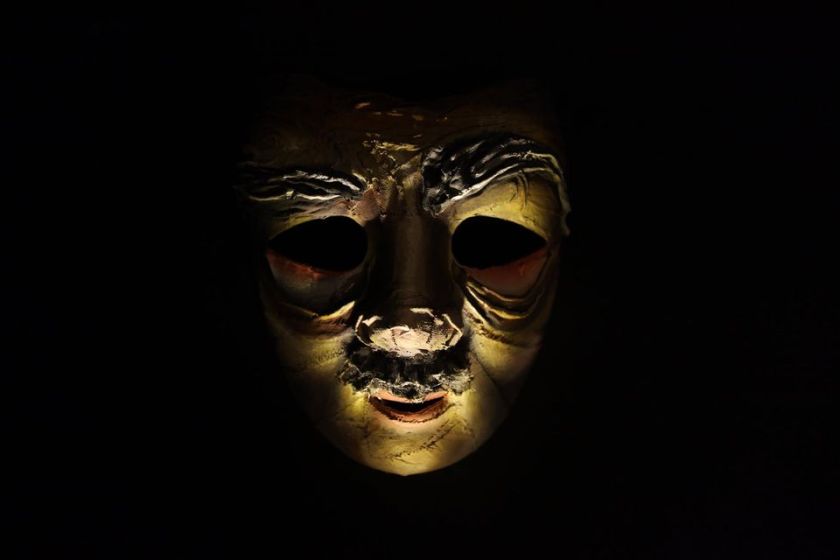
I don’t like to know too much about a show before I see it, so as not to be unduly prejudiced before I get there, so Grief, Guilt, and Paranoia: The Madness of Poe was a total surprise. Whistle Stop Theatre Company’s founding artistic director Louise Keeton conceived of Grief, Guilt, and Paranoia as a multi-faceted work that includes multiple historical and artistic influences. It takes place, for instance, not far from a home once occupied by Poe’s childhood sweetheart (and later fiancee) Sarah Elmira Royster Shelton. Created in partnership with the Ashland Museum, the work includes three voice artists representing the different “voices” of Poe (also represented by three different masks created by Keeton).
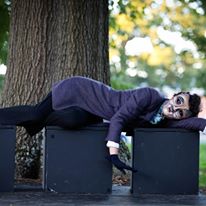
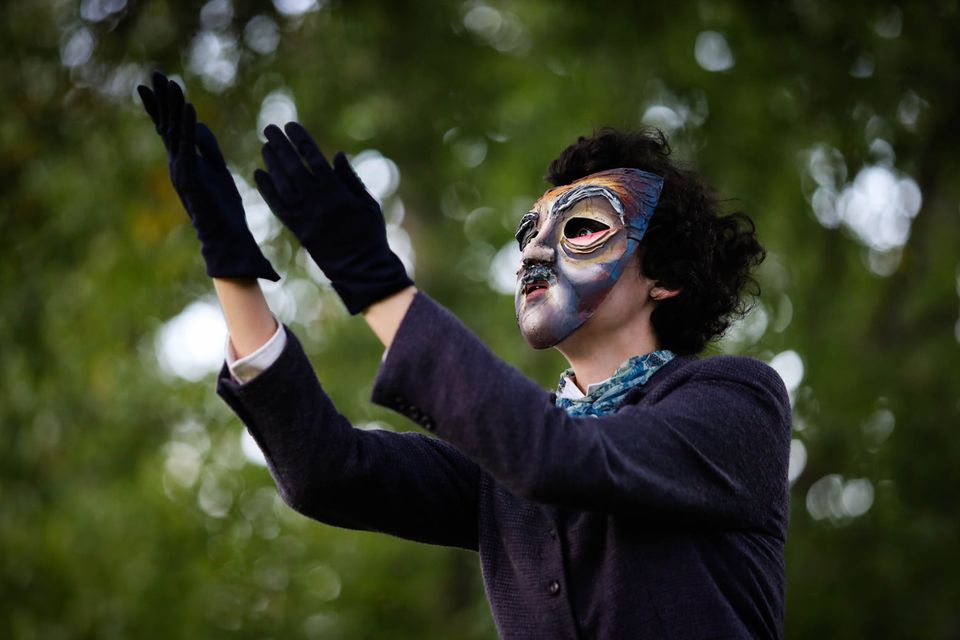
Those familiar with the life and work of Edgar Allan Poe and those who are not may relate differently to this work that uses Poe’s own poetry, original music by Paul Loman, and choreography by Katherine S. Wright. Wright, who eerily embodies Poe (wearing theatrical masks and a long-coated suit), doesn’t ever speak, but rather uses pantomime and dance in a riveting and passionate display of non-verbal communication while Poe’s words are voiced by Lucretia Marie, Barbara Keeton, and Craig Keeton. Sophia Manuguerra is the vocalist, and all the voices and music were created and recorded virtually.
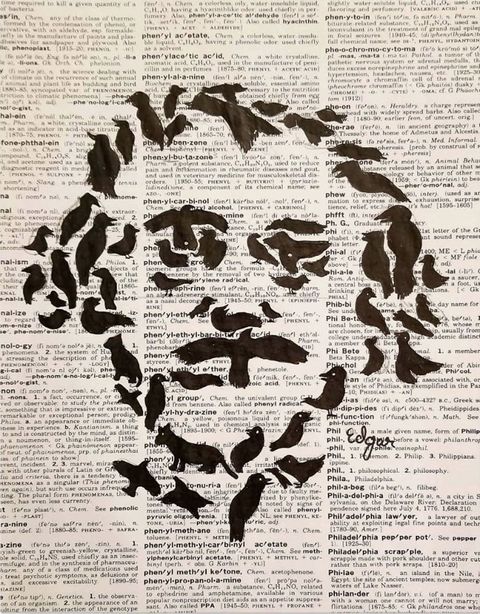
The artistic choices – including Keeton’s masks and artwork by local artists that is all being auctioned off – are diverse and unconventional, making them all the more appropriate for the subject at hand. In addition to honoring and appreciating the poetry of Poe, Grief, Guilt, and Paranoia is about missing the people we love and the ways in which that can drive us mad – an obvious reference to the current pandemic and our similar and diverse reactions to it.
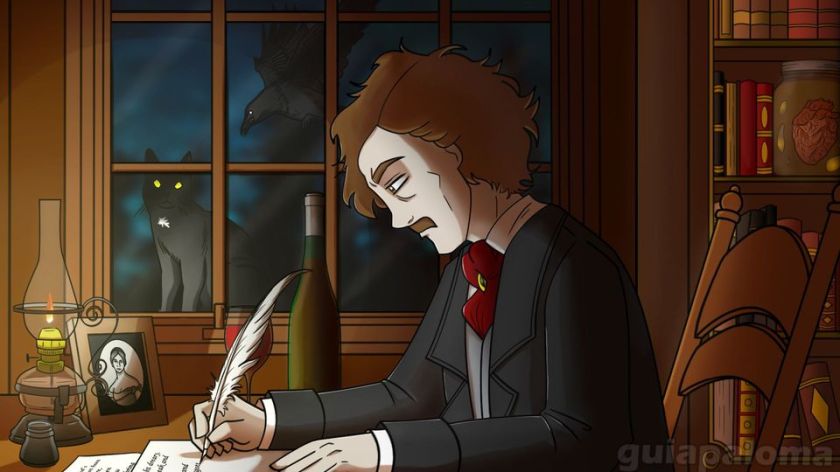
Grief, Guilt, and Paranoia digs into love and loss, life and death, verbally and visually mining the depths of “Annabell Lee,” “Elenora,” “The Premature Burial,””The Telltale Heart,” and of course, “The Raven.” The Hanover Arts and Activities Center had already constructed a small stage under a tree, and Keeton and company added three black cubes with hinged lids that provided all the set, the furniture, and the props needed for this production.
There are two remaining performances of Grief, Guilt, and Paranoia: The Madness of Poe on October 23 and 30. To view and bid on the art work visit the Whistle Stop Theatre Company’s website: whistlestoptheatre.weebly.com. Opening bids start at $10 for the masks and prints, and $5 for artwork delivered via high res digital files. All bids are due before October 29, 2020.
Edgar Allan Poe Trivia
The Baltimore Ravens NFL team is named for Poe’s poem, “The Raven” and the team mascot is named Poe.
Poe married his first cousin, Virginia Clemm when she was 13 and he was 27.
To this day, the cause of Poe’s death remains unknown. In 1849 he “went missing” for five days and was found, delirious, in Baltimore. He died in a Baltimore hospital and was buried two days later, without an autopsy.
Photos: From the Whistle Stop Theatre Company website. Katherine S. Wright as Poe.

















 RVArt Review