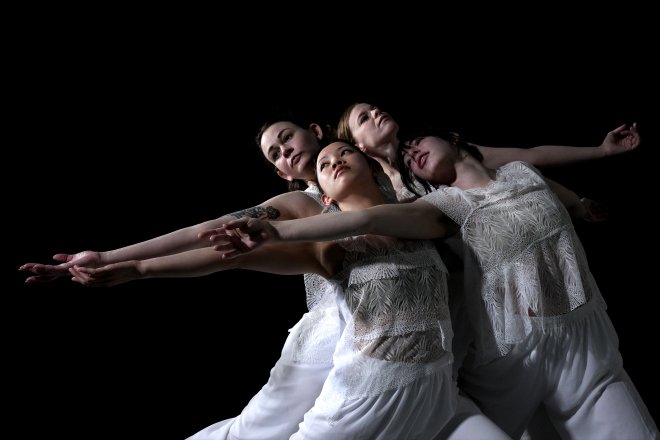
SPITTING IMAGE

A Collaboration of Dance & Photography

by Starr Foster Dance

A Reflection on a Dance Performance by Julinda D. Lewis

At: The Firehouse, 1609 West Broad St., Richmond, RVA 23220

Performances: April 3-6, 2025

Ticket Prices: $25 General Admission; $35 Arts Supporter; Datenight tickets 2 for $40

Info: (804) 304-1523 or starrfosterdance.org or firehousetheatre.org

Program & Casting:

All Choreography by Starrene Foster

Costumes designed and constructed by Starrene Foster, except as noted

Lighting designed by Gretta Daughtrey

Live Oak inspired by a photograph by Mike Harrell

Performed by Fran Beaumont, Shannon Comerford, Madison Ernsted, Angela Palmisano

Music by Tamar Halperin, Etienne Abelin, Tokek Kolczynski, Johann Sebastian Bach; Constellation 999:999 After BWV 99 & BWV 1018

_____

Saving Grace inspired by a photograph by Caroline Frye

Performed by Fran Beaumont and Madison Ernstes

Music by Adam Krieger, Andreas Scholl, Tamar Halperin; Nun sich der Tag Geendet hat and Carl Friedrich Abel, Paolo Pandolfo; Viola da Gamba Suite in D Minor: I. Arpeggiata

_____

Wisp inspired by a photograph by Becky Atkins

Performed by Adria Applebee (Thursday, Saturday), Alex Atkins, Roya Baker-Vahdani, Sarah Carrington, Lena Cohen, Ma-Siya Dycus, Sophie Smith 9friday, Sunday), Ella Holland, Molly Huey, Janelle Ragland

Music by Simon Goff; Elowen

Costumes designed and constructed by Johann Stegmeir

_____

Lies Lies Lies inspired by a photograph by PJ Sykes

Performed by Fran Beaumont, Shannon Comerford, Madison Ernstes, Molly Huey, Angela Palmisano

Original music composition by Daniel Deckelman

_____

Flight inspired by a photograph by Georgianne Stinnett

Performed by Molly Huey

Original music soundscape by Starrene Foster with Hour of the Witch composed by Scott Buckley

Costume constructed by Starrene Foster based off a design by Karl Green

_____

Run to You inspired by a photograph by Shannon Mills Guest

Performed by Shannon Comerford and Angela Palmisano

Music by Luca D’Alberto; Beautiful As a Memory

_____

Garnish inspired by a photograph by Allison Patel

Performed by Fran Beaumont, Shannon Comerford, Madison Ernstes, Molly Huey, Angela Palmisano, and guest artists Adia Applebee (Thursday, Saturday), Alex Atkins, Roya Baker-Vahdani, Sarah Carrington, Lena Cohen, Ma-Siya Dycus, Sophie Smith (Friday, Sunday), Ella Holland, Molly Huey, Janelle Ragland

Music by Adrián Berenguer; Reset

____________________________________

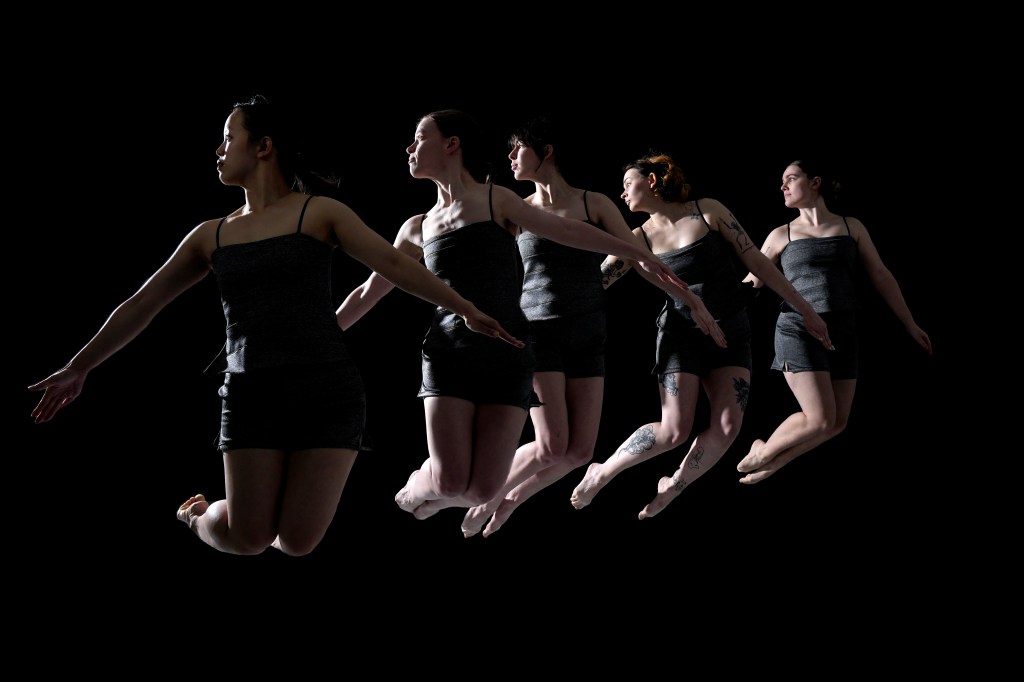
The Starr Foster Dance (SFD) website informs us that the company is “committed to their mission to collaborate with all genres of artists in their quest to make the world richer with art.” For Spitting Image 2025, Foster embarked on a collaborative journey with her core company of 5 dancers, 9 guest dancers, and 7 photographers.

Foster notes in the program (always a stunningly beautiful publication in its own right) that the SFD Art Director, Douglas Hayes, is at least in part responsible for her love of photography. In 2018 (in the “time before”) the company produced the first Spitting Imageprogram at TheatreLab, The Basement, inviting photographers from the Richmond area to contribute images to the project. Spitting Image 2025 is the third iteration of this collaborative creation. (The second was in 2023, also at the Firehouse.)

The phrase “spitting image” usually refers to something that looks remarkably similar to another, such as a mother and daughter or father and son. But in the execution of these collaborative offerings the seven brief works are not intended to bring to life carbon copies of the still images, but rather each captures a moment, an essence, a fleeting fragment from the photograph and then builds on it, takes flight, elevates it, or even takes a quirky turn. The photographs were on view in the theater lobby, and are available to view on the SFD website, https://www.starrfosterdance.org/spittingimage2025, but due to copyright may not be reproduced here.

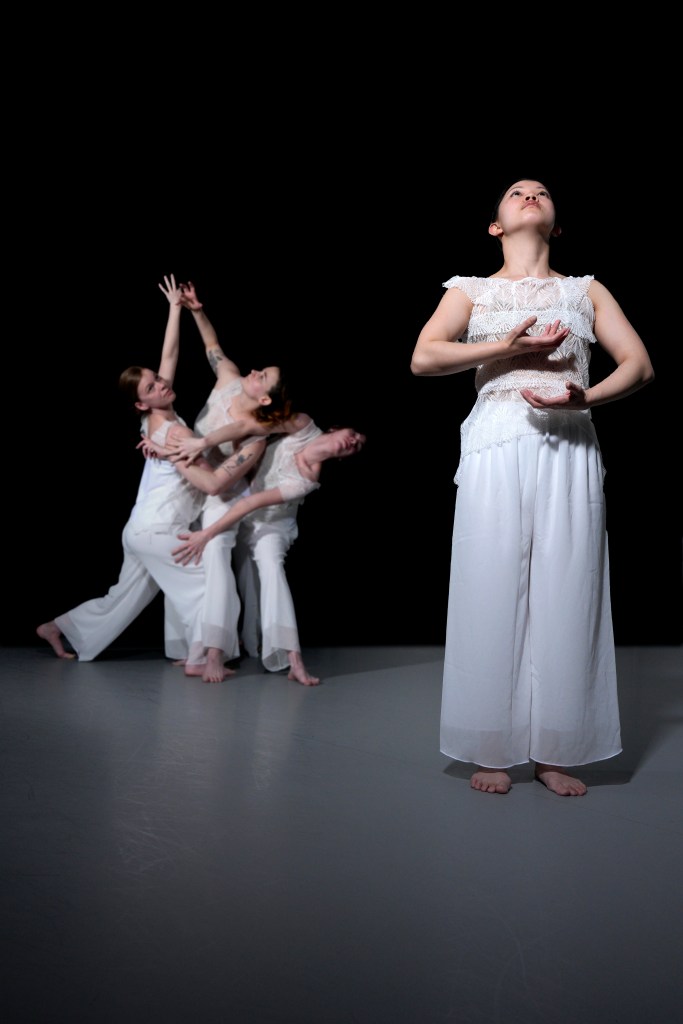
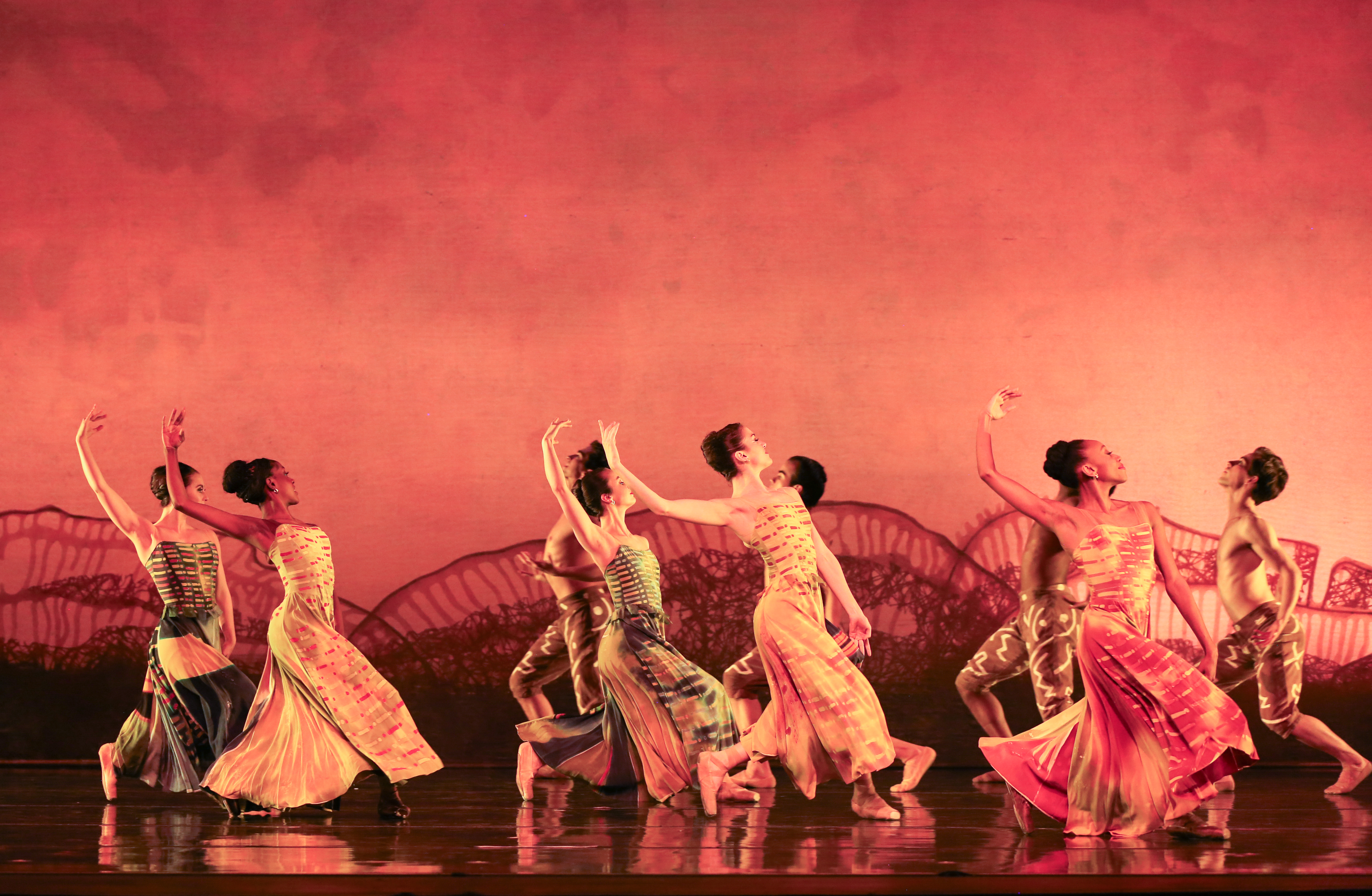
Mike Harrell’s black and white photograph depicts an aisle of tall trees whose tops meet and intertwine above the road. The Live Oak dancers’ white palazzo pants and lacy white tops mimic the lacy tree branches and at one point the lacy pattern is recreated on the floor in lights. Their movements are mysterious and weighted, a lift and drag suggests the strength, durability flexibility, and stability of trees, and the shapes fit together like puzzle pieces. Very mindful. Very demure.

Caroline Frye submitted a photo of a backyard clothesline with what appears to be a heavy rug hanging out to air or to dry. Fran Beaumont wears neatly tailored pants and a button-down shirt that reminded me of a schoolgirl’s uniform, while Madison Ernstes, lingering in the background, wore a dark shirtwaist dress. For me, Saving Grace created an image of a portal, a doorway, perhaps into the past. The atmosphere made me consider various meanings of the phrase, “saving grace.” It can mean a redeeming quality, but it could also, literally mean saving someone named Grace – or it could be a bit of both…

Becks Atkins photo of clouds inspired Wisp, one of my personal favorites. Dressed in short white or pale gray pants with asymmetrical tops, the dancers began in a single file line, facing the audience and ended in a cluster like delicate flower petals. The music and movement both seemed to have a delicate Asian flavor, simple, and beautiful.

The first half of the program closed with Lies Lies Lies, inspired by PJ Skyes’ angular, industrial offering – three views of a wall that holds the remains of a sign that once said “SUPPLIES.” Hmm, could this be a subtle statement about how things are not always what they seem to be – or an even more rare statement on the current political climate? Without reading more into it than intended, Foster’s choreography for this piece is urgent, driven, and percussive, and set to an original score that is equally urgent, driven, and percussive.  Altogether, Lies Lies Lies is quite a departure from other works on the program, aggressive, but not angry.

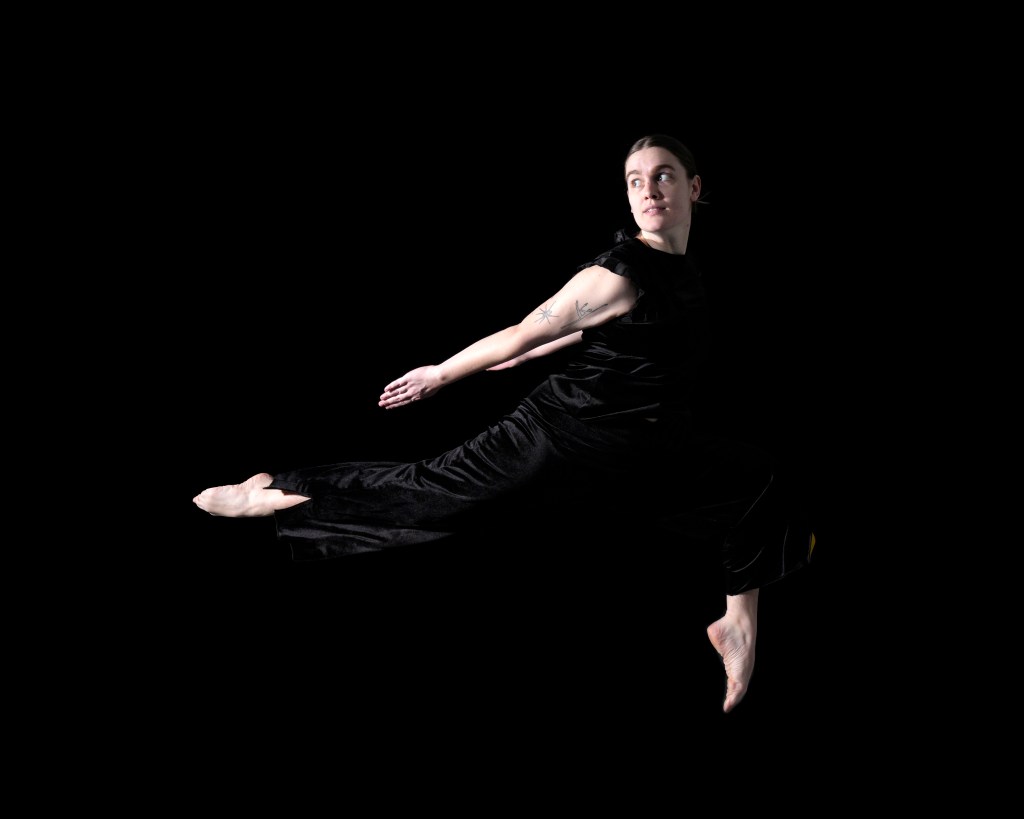
The second part of the program opened with a solo, Flight, performed by Molly Huey. Inspired by Georgianne Stinnett’s intimate close-up of a bee collecting pollen from the reproductive organs of a flower, Huey’s movement are big and remind me of the inner workings of a traditional timepiece. The original soundscape consists of a series of musical explosions with an underlying base of small ticks, like a fine watch – or a time bomb.

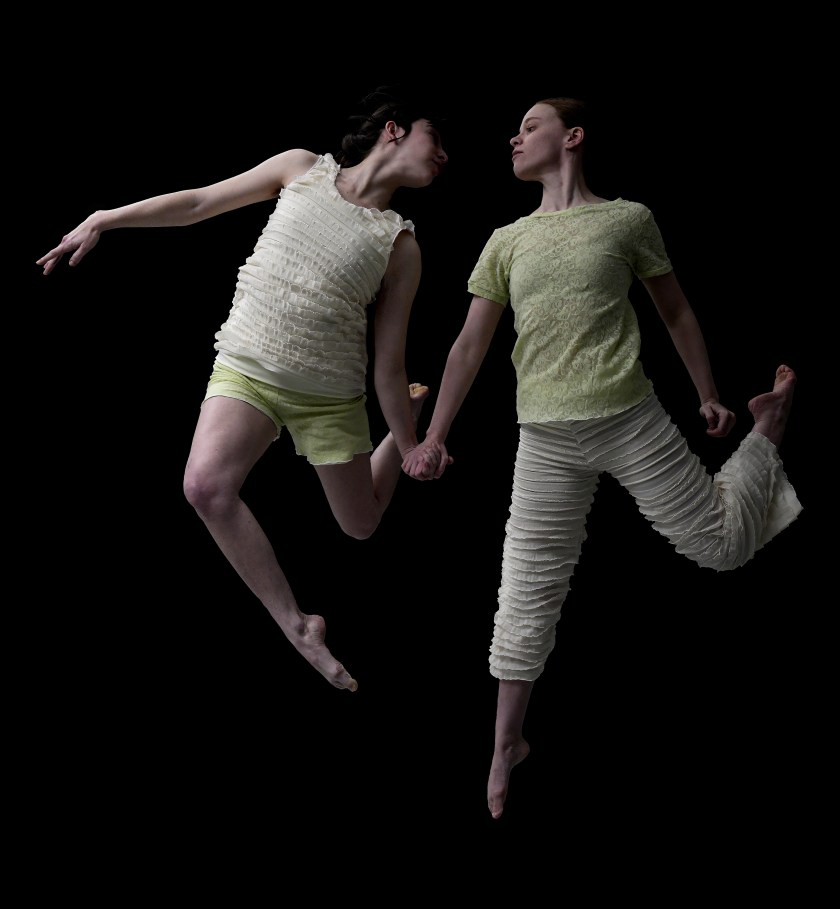
Run to You, another personal favorite is a tender duo, performed by Shannon Comerford and Angela Palmisano. Intriguing lighting creates shadow play that makes the two dancers appear to be four or six. Inspired by Shannon Mills Guest’s photograph of two women sitting side-by-side, one with long blond hair and one with long dark hair. Foster carries out the visual opposition with costuming: one dancer wears white ruffled fabric on top, the other on the bottom, while the shadows double and triple the relationships, building and extending the connection between the sisters, friends, or whatever you need the relationship to be.

The program closed on a humorous and quirky note with Garnish, a work for 13 dancers, each wearing a flower-patterned dress, each in a different pattern. Lined up across the stage, they grimace, give a side eye, and more in a cork that is casual, funny, and energetic. Garnish is inspired by Allison Patel’s photograph of a woman applying makeup. Eyes wide, lips pursed, the image fuels the dancers’ facial gymnastics and extends the movement through their entire bodies. Garnish is definitely the icing on the cake.

———-

Julinda D. Lewis is a dancer, teacher, and writer who was born in Brooklyn, NY and now lives in Eastern Henrico County. When not writing about theater, she teaches dance history at VCU and low impact dance fitness classes to seasoned movers like herself and occasionally performs.

———-

Starr Foster Dance presents

CURIOUS INTENTIONS   

Artistic Director/Choreography by: Starrene Foster

Art Director: Doug Hayes

Lighting Designer: Greta Daughtrey

Music Director: Daniel Deckelman

Company Artists: Fran Beaumont, Shannon Comerford, Madison Ernstes, Molly Huey, Angela Palmisano

Guest Performers: Adria Applebee, Alex Atkins, Roya Baker-Vahdani, Sarah Carrington, Lena Cohen, Ma-Siya Dycus, Sophie Smith, Ella Holland, Janelle Ragland

Costumes Designed and Constructed by: Starrene Foster, with the exception of the costumes for “Wisp,” designed and constructed by Johann Stegmeir

Starr Foster Dance is a Resident Company of the Firehouse Theatre

Performance Schedule

SPITTING IMAGE PERFORMANCE SCHEDULE
Thursday, April 3rd 7:30PM Opening Night/Post Show Q&A
Friday, April 4th 7:30PM Champagne Night with Cast & Artistic Team
Saturday, April 5th 2:00PM
Saturday, April 5th 5:00PM Post Show Q&A  
Sunday, April 6th 2:00PM Closing night

Run Time

1 hour 20 minutes  plus one15-minute intermission

Lies Lies Lies
Live Oak
Flight

Dial M for Murder

What’s So Important About the Fifth Step?

A Theater Review by Julinda D. Lewis

By: Virginia Repertory Theatre (Virginia Rep), The Barksdale Season

At: Hanover Tavern, 13181 Hanover Courthouse Road, Hanover, Virginia 23069

When: March 28 – April 27, 2025

Ticket Prices: $54  

Info: (804) 282-2620 or www.virginiarep.org

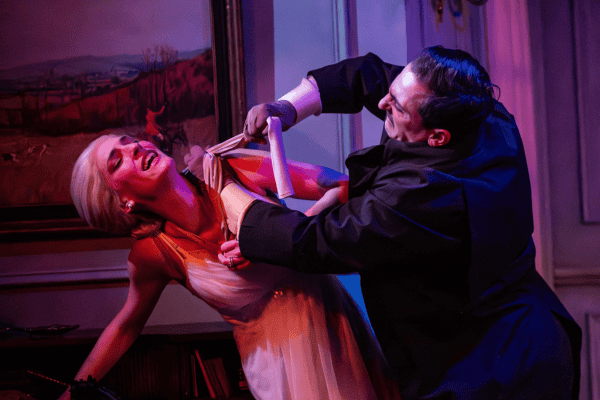
Dial M for Murder is a classic 1950s stage thriller, a murderous melo-drama filled with plot twists and scandal. Tony Wendice married his wife Margot for her money, and now he wants to get rid of her – but he also wants to keep her money. The logical solution, since this is a Hitchcockian style murder mystery, is to kill her. Thanks to their mutual friend, a successful American crime writer named Max, Tony has the background – and the motive – to plan the perfect murder. But will he be able to get away with it?

Jeffrey Hatcher’s adaptation kept the basic plot and Frederick Knott’s location: a 1950s London flat, but one major change is that  Hatcher changed the Wendice’s friend Max, with whom Margot had and broke off an affair, from Max to Maxine. This means Margot was engaged in a lesbian affair and gives even more of an edge to the scandal since same-sex partnerships were not exactly acceptable in the 1950s.

Tony’s carefully planned plot goes awry, but he quickly improvises a Plan B, resulting in Margot being charged with the murder of the man Tony had hired to kill her. Margot doesn’t know who to trust, and if not for the fortuitous partnership between Maxine and a keen-eyed detective, Hubbard, this play might well have ended with her hanging from the gallows. Fast-paced and seasoned with a dash of humor, Dial M for Murder is a deliciously entertaining divertissement. Unlike some of the serious – and seriously good – theater I’ve seen in the past few months, this play doesn’t require you to think about social issues, it doesn’t draw parallels with historical events, and it doesn’t attempt to teach us moral lessons. It’s pure fun – a class murder mystery with smart plot twists and stereotypical characters we recognize and welcome into our lives for a little over two hours.

5 Motives for Murder

Money

Fear

Jealousy

Revenge

To protect a loved one

This production has a stellar cast, many of whom will be familiar to those who frequent local theater. Margot is played by Ashley Thompson (5 Lesbians Eating a Quiche, Dr. Ride’s American Beach House, and Buried Child). Tony is played by Alexander Sapp (Peter and the Starcatcher, Sweeney Todd). Maxine is played by Rachel Dilliplane (5 Lesbian Eating a Quicke, The Laramie Project, and Moriarty u/s). The shoes of the would be hired killer, Legate, are filled by Adam Turck (Constellations, The Laramie Project, The Inheritance, Animal Control, Buried Child). The newest face was that of Jim Meisner, Jr. in the role of Inspector Hubbard. Dial M for Murder marks Meisner’s Virginia Rep debut and his first performance after a more than 25-year hiatus from the stage.

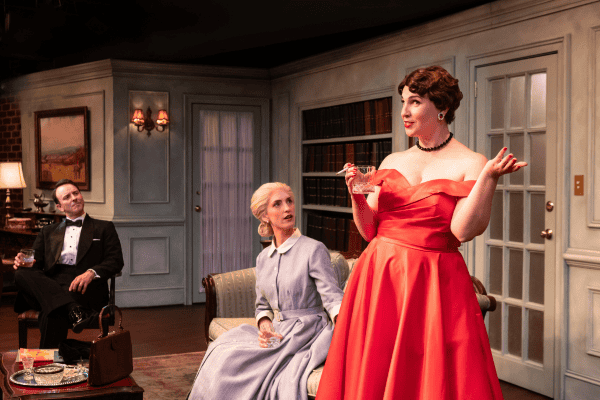
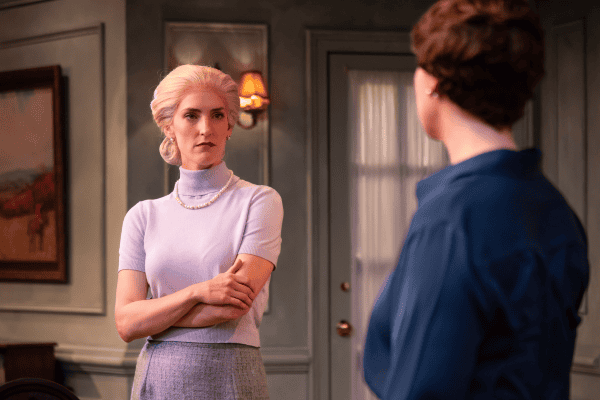
The sexual tension between Margot and Maxine is obvious from the opening scene, highlighted by Thompson’s conservative couture and wig and Dilliplane’s more bold fashion choices and short haircut. No separate credit was given for wigs, so I will assume that Sarah Grady gets the well-deserved credit for both hair and costumes. Even the tan trench coats play an important role later in the denouement when Inspector Hubbard sets a trap to expose Tony.

“Everything has its price.” – Tony Wendice

Sapp is smooth with his lies in front of the other cast members and a master of the villainous side eye when playing to the audience. Turck is suitably sleezy as Tony’s corrupt former classmate turned hitman. And last but not least, Meisner is heroic as the blustery bumbling Inspector. (Is anyone else old enough to remember the bumbling TV detective, Colombo?)

This impressive ensemble was under the capable direction of Mel Rayford, also making their VaRep debut. Rayford skillfully guided the cast and audience through all the twists and turns, through layers of subplots and intrigue, encouraging us to find amusement in murder, to willingly turn corners into fictional depravity, and then to vigorously applaud when we emerged, safe and sound and strangely exhilarated for having taken the journey.

A Word of Caution

Beware of anyone who puts mushrooms in their spaghetti.

(You’ll know why if you’ve seen the play.)

———-

Julinda D. Lewis is a dancer, teacher, and writer who recently had both knees replaced due to a manufacturer’s recall. Born in Brooklyn, NY, she now lives in Eastern Henrico County where she can be found kicking up  her heels as best she can any day of the week.

———-

DIAL M FOR MURDER     

Adapted by Jeffrey Hatcher (2022)

From the Original by Frederick Knott (1952)

Directed by Mel Rayford

Cast

Ashley Thompson ……………….             Margot Wendice

Rachel Dilliplane …………………             Maxine Hadley

Alexander Sapp ………………….             Tony Wendice

Adam Turck ………………………             Lesgate

Jim Meisner, Jr. ………………….             Inspector Hubbard

Kendall Walker …………………..             Margot U/S, Maxine U/S

Travis Williams  ..…………………             Lesgate U/S, Hubbard U/S

Chandler Hubbard ………………             Tony U/S

Direction & Design

Direction ………………………….             Mel Rayford

Scenic Design ……………………             Frank Foster

Costume Design …………………             Sarah Grady

Lighting Design …………..………            Steve Koehler

Sound Design …………………….            Jonathan Pratt

Fight Director …………………….             Casey Kaleba

Dialect Coach …………………….             Nicole Cowans

Stage Management ………….…..            Hannah Hoffert

Assistant Stage Manager ………..            Amber Hooper

Photographer ……………………..            Aaron Sutten

Videographer ……………………..            Austin Lewis

Ticket Information

Box Office: (804) 282-2620

www.virginiarep.org

Ticket Price: $54

Run Time

The play runs for approximately 2 hours 15 minutes; including one intermission.

Photo Credits Aaron Sutten

RICHMOND BALLET: MOVING ART ONE

Ballet Celebrates First Program on the New VMFA Stage

A Dance Review

Performance By: The Richmond Ballet

At: Virginia Museum of Fine Arts, Leslie Cheek Theater, Richmond Ballet Stage, 200 N. Arthur Ashe Boulevard, RVA 23220

Performance Dates: March 20-30, 2025

Ticket Prices: $25 – $85 ($85 – $125 on opening night)

Info: (804) 344-0906, etix.com, or richmondballet.com

THE PROGRAM

PENTAPTYCH

Choreography by Ma Cong

Music by Ryan Lott

Costume Design by Emma Kingsbury

Lighting Design by Les Dickert

Visual Artist: Eric Sall

World Premiere: September 14, 2018, Tulsa Ballet, Tulsa Ballet’s Studio K Theatre, Tulsa, OK. Richmond Ballet Premiere: March 20, 2025, Leslie Cheek Theater, Virginia Museum of Fine Arts, Richmond, VA

AFTER THE RAIN Pas de Deux

Choreography by Christopher Wheeldon, OBE

Music by Arvo Pärt

Staged by Jason Fowler and Craig Hall

Costume Design by Holly Hynes

Lighting Design by Les Dickert after Original Design by Mark Stanley

Pianist: Dr. Douglas-Jayd Burn

Violinist: Karen Johnson

World Premiere: January 22, 2005, New York City Ballet, New York State Theater, New York, NY. Richmond Ballet Premiere: March 20, 2025, Leslie Cheek Theater, Virginia Museum of Fine Arts, Richmond, VA

LAMBARENA

Choreography by Val Caniparoli

Music by Johann Sebastian Bach and traditional African (as arranged by Pierre Akendengué and Hughes de Courson)

African Dance Consultants: Dr. Zakarya Diouf, Naomi Johnson-Diouf, Ibrahima O. Diouf

Scenic and Costume Design by Lisa J. Pinkham, Recreated by Les Dickert

Staged by Maiqui Manosa

World Premiere: March 28, 1995, San Francisco Ballet, War Memorial Opera House, San Francisco, CA. Richmond Ballet Premiere: March 20, 2025, Leslie Cheek Theater, Virginia Museum of Fine Arts, Richmond, VA

—–

In celebration of the very first performance of the Richmond Ballet’s new Moving Art series – replacing the long-time, popular Studio Series – current Artistic Director Ma Cong, Founding Artistic Director Stoner Winslett, and VMFA Director and CEO Alex Nyerges shared the stage on Thursday evening, March 20, for an enthusiastic pre-show welcome. There was a full house for this gala event, and all performances of the March 20-30 program were already sold out.

Moving Art One marks the return of the Richmond Ballet to the VMFA  after last performing there in the 1990s and the first major renovation of the Leslie Cheek Theater stage since it was built some 70 years ago. The renovations include widening the stage to better accommodate ballet, new lighting for the house and the stage, and upgraded A-V equipment. A press release indicates that the performers’ dressing rooms and restrooms and the green room have also been upgraded. The theater seats 472 audience members, and the seating has reportedly been refurbished but in my opinion the seats are still a bit too tight and would probably not be comfortable for all audience members, and the raking does not allow for an unobstructed view if you are vertically challenged, or if a tall person sits in front of you. But that’s just my two cents.

As with the Studio Series performances, the Moving Art series consists of a program of three works and features both classical and contemporary ballets produced in an intimate setting (as compared to, say, the 1,800-seat Carpenter Theatre where large works such as The Nutcracker Ballet or Cinderella are performed).

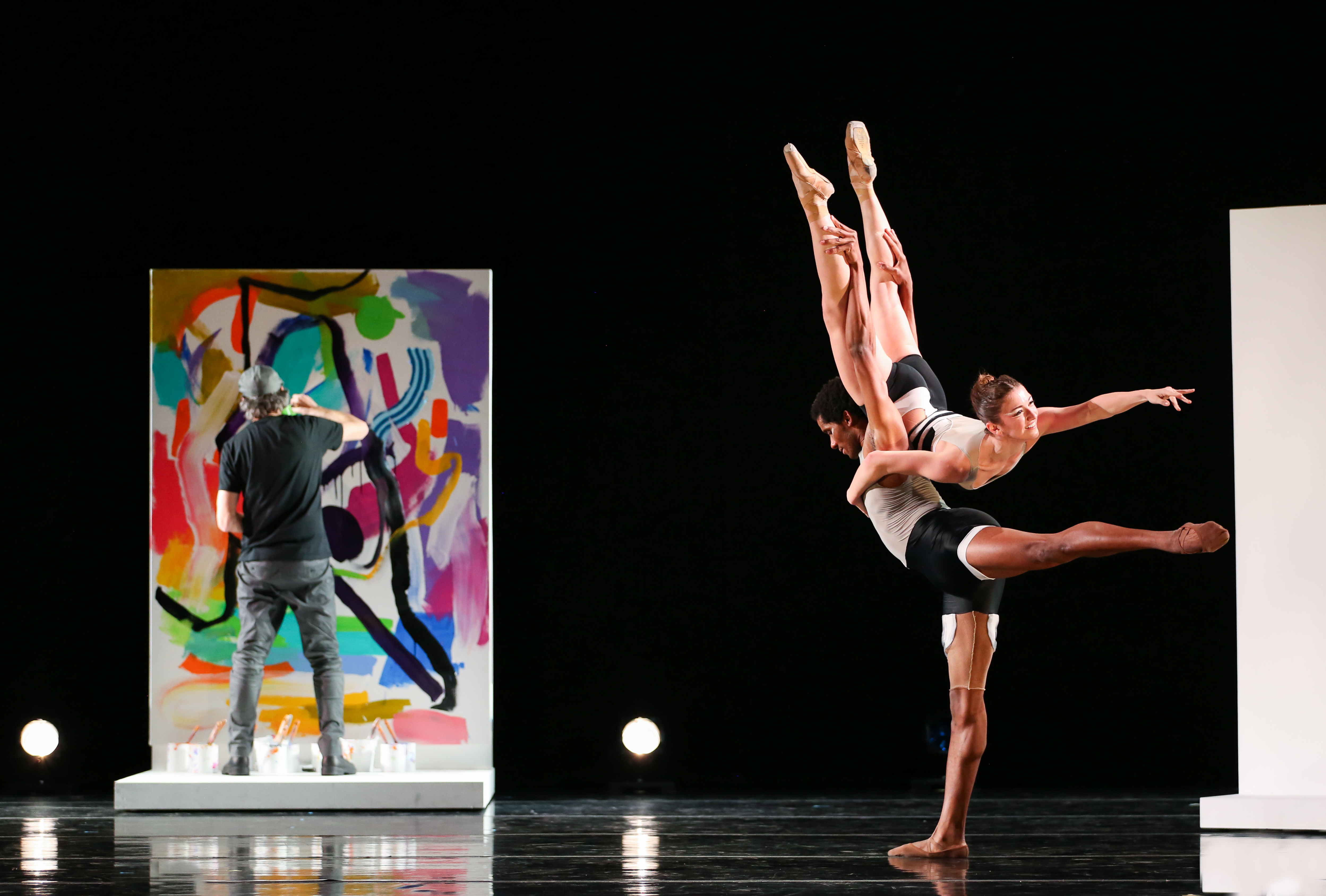
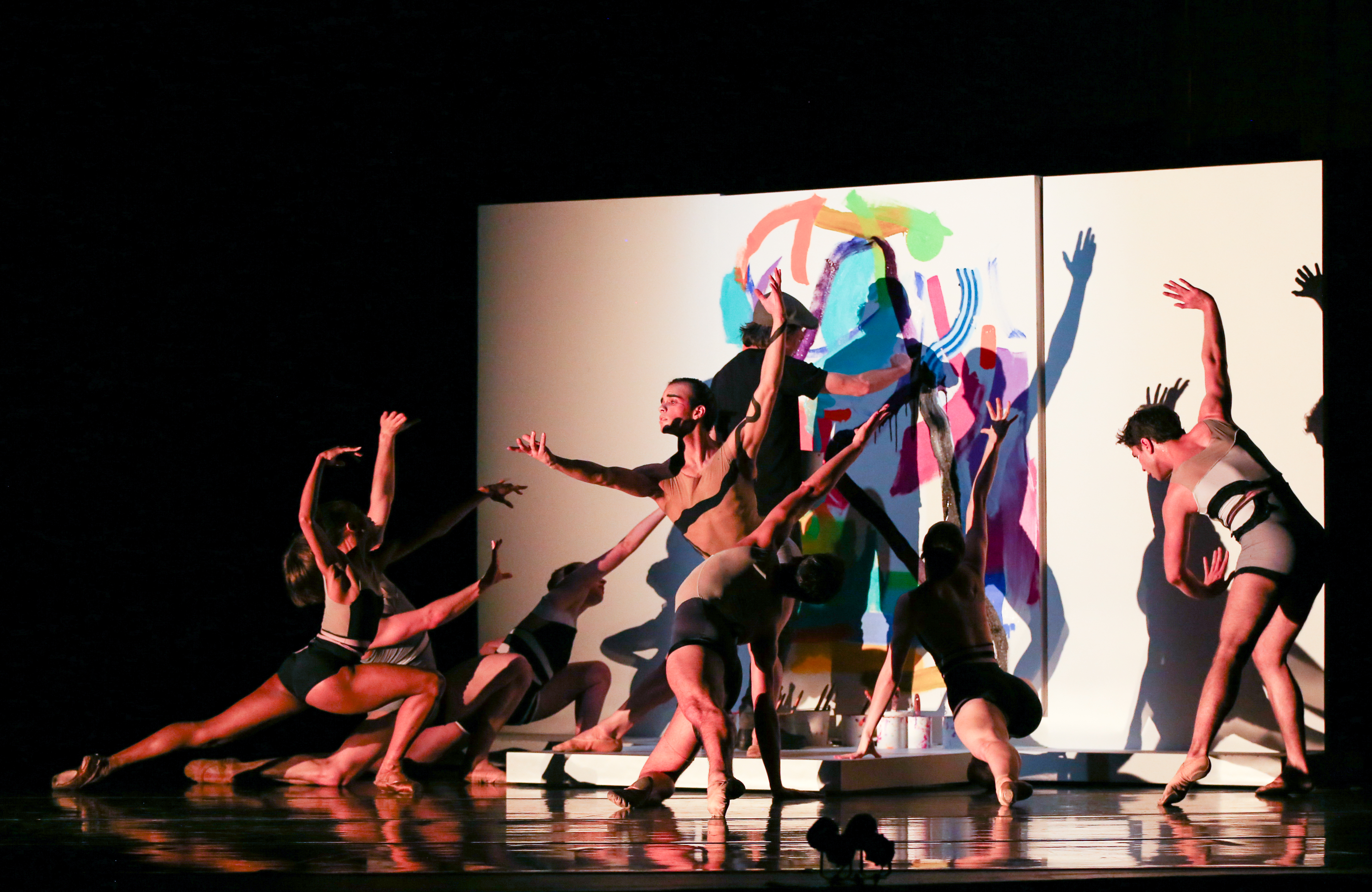
Moving Art One opened with the world premiere of Ma Cong’s Pentaptych (def., a work of art consisting of five panels or sections). There is a live artist onstage, Eric Sall, who interacts with the dancers and creates a large, colorful abstract painting. The bold brushstrokes are a stark contrast to the black, white, and gray costumes worn by the dancers – except for one dancer whose costume appears to be a part of or an inspiration for the painting. The ballet is of the contemporary genre, and the dancers’ monochrome costumes, paired with the abstract, ethereal, and sometimes athletic stretching motions and the original score by Ryan Lott, for a moment I had a flashback of sitting in Merce Cunningham’s Westbeth studio in Manhattan’s artists’ community, watching his company perform. (For those not familiar with Cunningham’s work – this is a positive comparison, and you should look him up!) The finished painting, by the way, is available for purchase via an online auction. The proceeds are to benefit the Richmond Ballet.

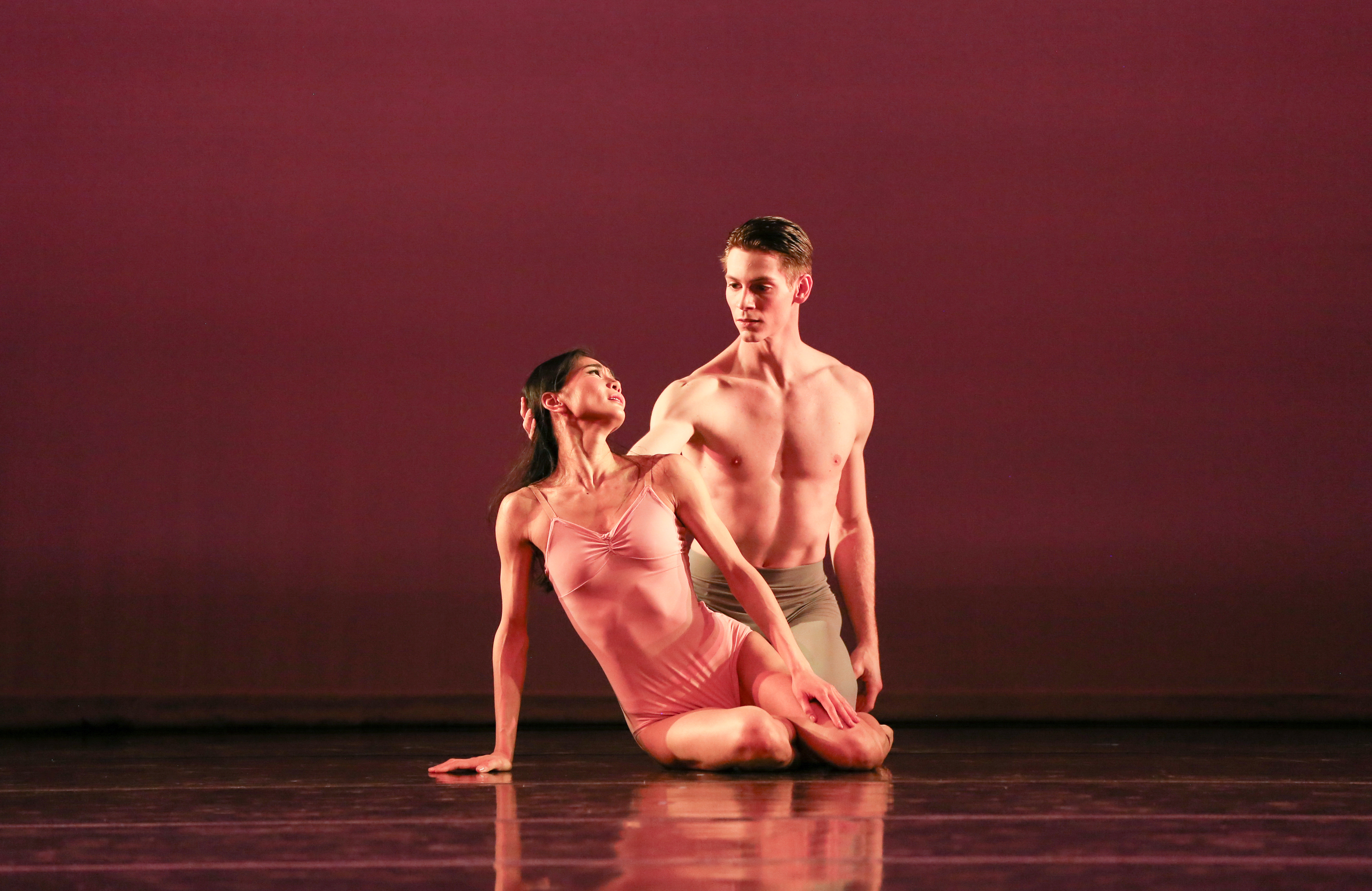
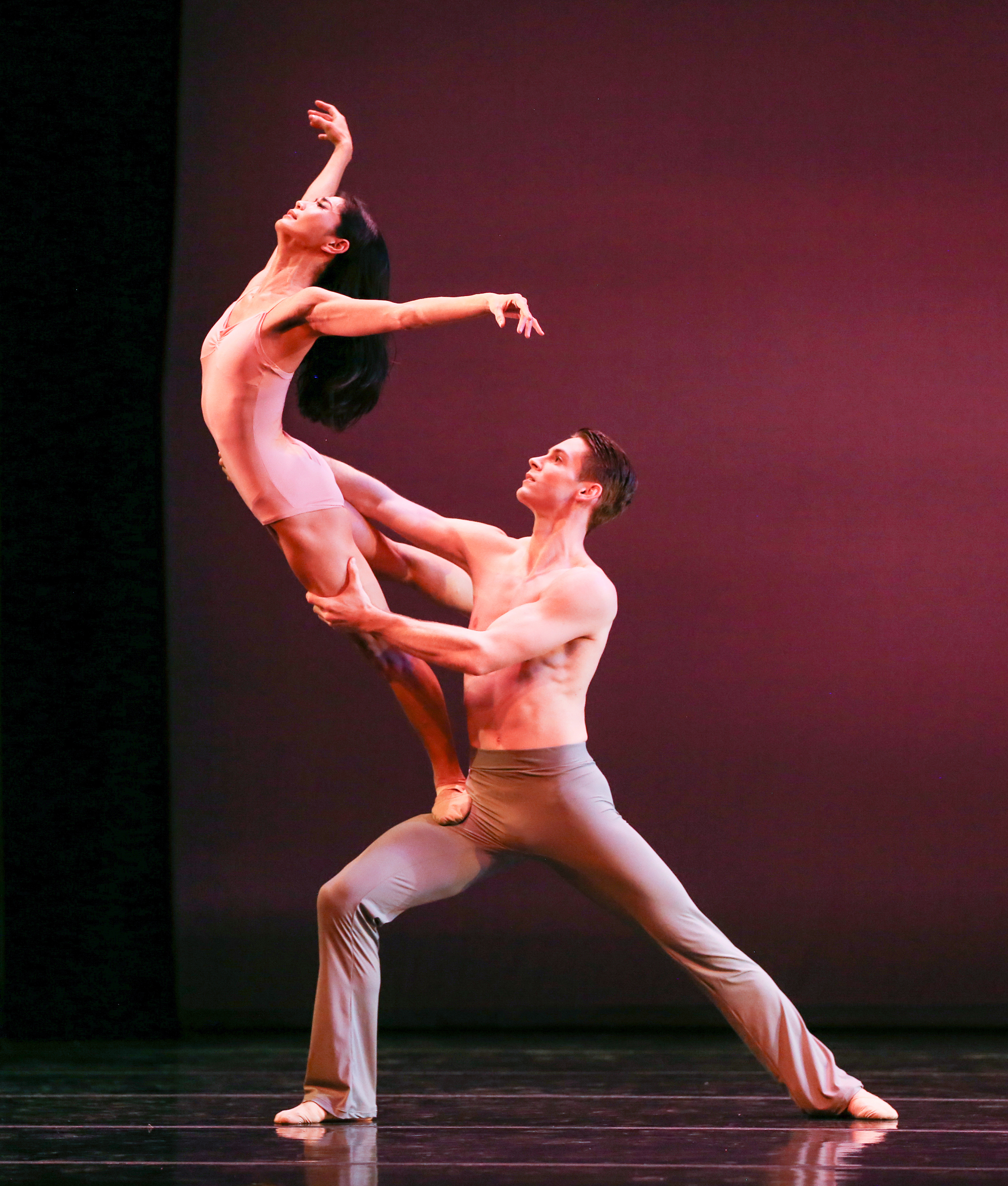
The classical portion of the program was provided by Eri Nishihara and Jack Miller, performing the pas de deux from Christopher Wheeldon’s After the Rain. Commissioned for a New York City Ballet program in honor of George Balanchine’s birthday, the ballet is in two parts. The first part is a dance for three couples, and the second part, the pas de deux, is often performed separately, as it was here on the new Richmond Ballet Stage. The dance is set to music by Arvo Pärt, played live by Dr. Douglas-Jayd Burn and Karen Johnson, and is notable for placing the ballerina in flat shoes instead of en pointe.

It is a stunningly beautiful and tender ballet in which the male dancer, Miller, sometimes lifts his partner is the most unexpected ways – for example, frozen into a position that I can only describe rather awkwardly as table-like. Another moment, Nishihara gently caresses her partner’s face while he stands strong and unmoving, or she perches delicately on his extended thigh. Burn’s piano and Johnson’s violin emit gentle, almost ambient sounds, like, yes, like raindrops. The piece ends with a silent embrace and the partners gently melt into one another.

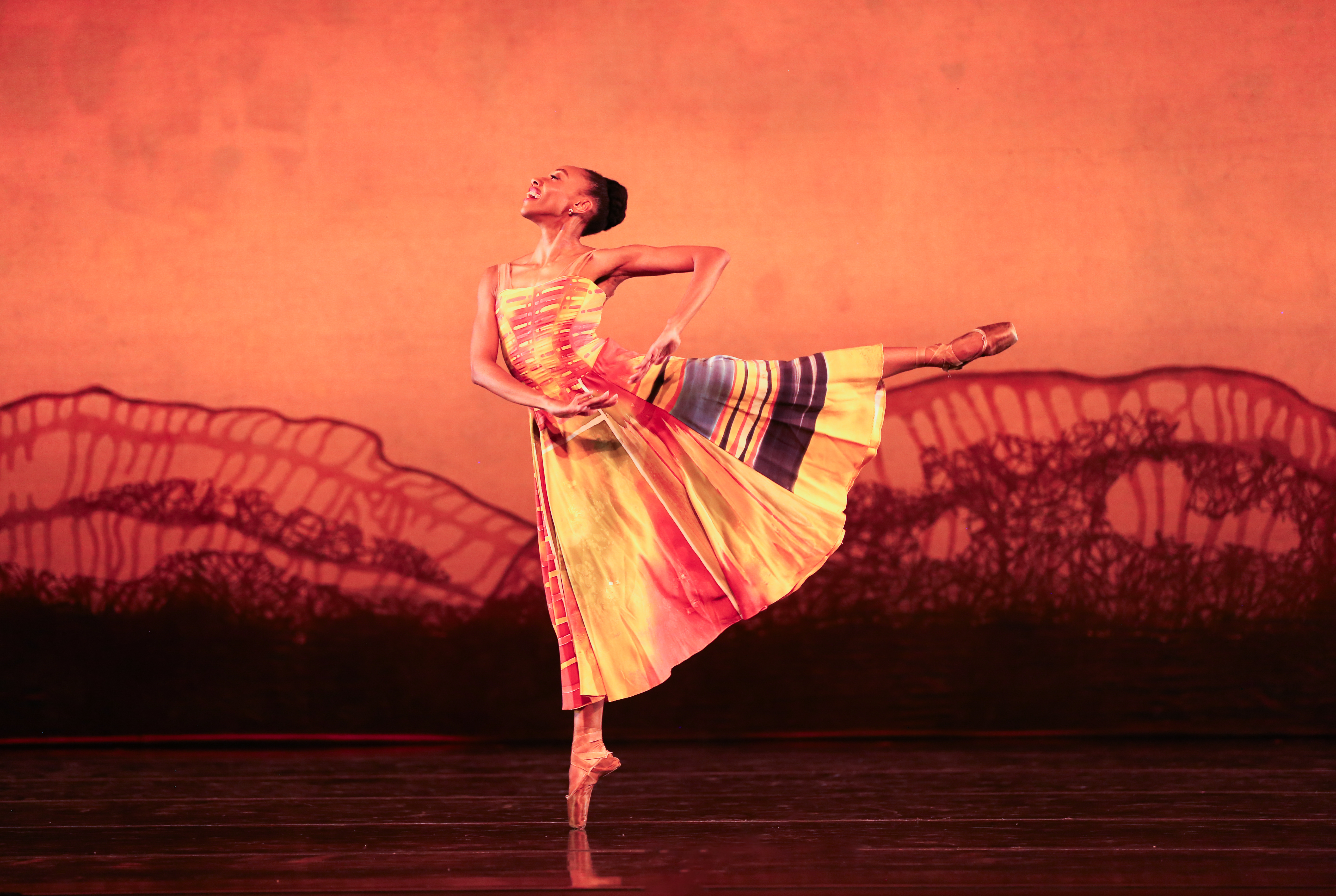
Val Caniparoli’s Lambarena is much more difficult to write about, not because it was not beautifully performed, but because I am not sure what to think of it. Colorful, energetic, and fun, the work is performed to a rather unique blend of music by Johann Sebastian Bach and traditional African (what part of Africa?) music arranged by Pierre Akendengué and Hughes de Courson.

Performed by the full company, the work serves as a showcase for dancer Naomi Robinson who leads the women in leaping lightly like gazelles over the savanna. (This brought back another memory, that of seeing a herd of gazelles dashing through the grasslands of Kenya.) In a later section, they held their arms back and arched, reminding me of ostriches – and the beautiful solo Awassa Astrige created by Asadata Dafora (1932). The men, at times, reminded me of giraffes – also common to Kenya and other parts of East Africa. There was lots of light footwork and hip action unlike anything one usually sees in a traditional ballet. Sometimes I heard strains of a stringed instrument that reminded me of a berimbau – a one-stringed instrument I’m familiar with from Brazilian dance and capoeira (a Brazilian martial art/dance). I believe the berimbau originated in Angola, in southwestern Africa. The music also incorporated choral sections and clapping.

Overall, the work is sassy and joyous, and performed with extraordinary energy. My dilemma, perhaps, comes from recent discussions I have been having with my dance history students at VCU, where we have been mulling over the differences between cultural appreciation and cultural appropriation. The program lists African Dance Consultants – Dr. Zakarya Diouf, Naomi Johnson-Diouf, and Ibrahima O. Diouf – and the company hosted a Community Dance Class with local dance organization Ezibu Muntu on March 16, shortly before the opening of the Moving Art One program.

Still, I felt a certain uneasiness as I watched – and enjoyed – Lambarena, and watched others enjoying it, too. I appreciated it, but there does seem to be more than a little cultural appropriation – context? accreditation? intent? Acknowledgement – beyond the generic designation of “African” – or at least an appearance thereof. I need to look more deeply into Caniparoli’s inspiration and motivation before making a final decision on this work.

In the meantime, while I’m rummaging around in the stack of dance history, if you can’t get to see Moving Art One, there will be a Moving Art Two, running from May 8 – 18. That program will include Joshua L. Peugh’s Slump, a ballet about modern courtship, Stoner Winslett’s Echoing Past (set to a score by Fanny Mendelssohn-Hensel), and Yury Yanowsky’s newly completed Fading Creatures, a work-in-progress he introduced at Richmond Ballet’s 2023 New Works Festival. It draws inspiration from the melting clocks of Salvador Dalí’s popular painting The Persistence of Memory.

—–

Julinda D. Lewis is a dancer, teacher, and writer who was born in Brooklyn, NY and now lives in Eastern Henrico County. When not writing about theater and dance, she teaches dance history at VCU and low impact dance fitness classes to seasoned movers like herself and occasionally performs.

THE COMPLETE WORKS OF WILLIAM SHAKESPEARE

(abridged)

A Theater Review by Julinda D. Lewis

Presented by: Richmond Shakespeare

At: Libby S. Gottwald Playhouse, 600 E. Grace St., RVA 23219

Performances:

Ticket Prices: $22-$47 [Adults $47; Seniors 65+ with ID $42; Military with ID $27; College Students with ID & Children $22] Seating is General Admission.

Info: (804) 340-0115 or http://www.richmondshakespeare.org

There’s not much that needs to be said about The Complete Works of William Shakespeare (abridged). The title tells (most of) it all. William Shakespeare is considered (one of) the most famous writers of all time. And in his time, he wrote 37 plays, 154 sonnets, 2 long narrative poems, and a number of other works. The task of The Complete Works of William Shakespeare (abridged) is to perform ALL 37 of Shakespeare’s play in 97 minutes.  Of course, this is impossible. What we get is a side-splitting comedic take on Shakespeare that includes scenes, passages, or catch phrases from every play, along with a more extensive treatment of Romeo and Juliet at the top of the show and Hamlet at the end.

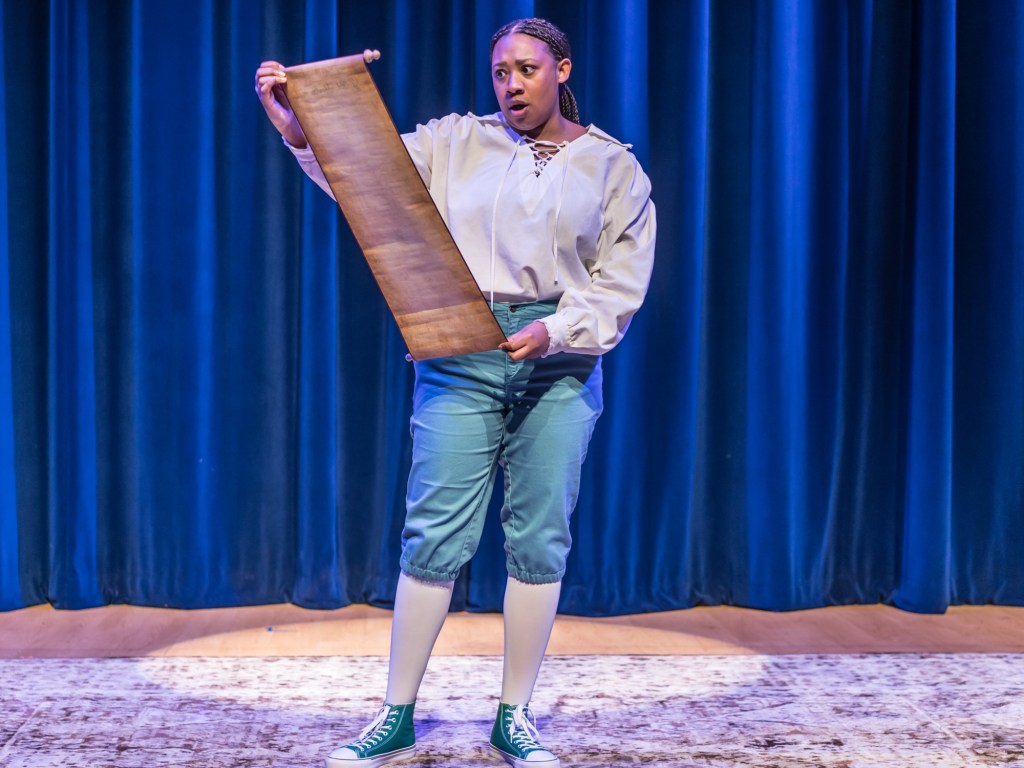
Sydnee S. Graves, one of the trio of thespians in this production, sets the pace with her well-timed introduction by unrolling a long scroll that contains the notes for her “brief” introduction. Graves invites us, in elaborate and flowery terms, to share space in the theater – the place where the magic happens.

Rachel Marrs is introduced by Graves as a pre-eminent Shakespearean scholar, and Marrs arrives in a black academic gown that does little to conceal her lack of scholarship – all in good fun, of course!

Joshua Mullins completes the pre-show banter with a ChatGPT – generated biography of Shakespeare that conflates the words and deeds of Shakespeare with America’s  16th president – Abraham Lincoln. (This is clearly propaganda designed to convince the audience that reading is fundamental.

Highlights of the show include the rendering of Shakespeare’s first tragedy, Titus Andronicus, as a cooking show, and Othello summarized as a performance by a rap trio. All 14 comedies are rolled into a single medley, Macbeth is performed by two of the actors in kilts, their swords replaced by golf clubs, while Two Noble Kinsman, a play authored jointly by Shakespeare and John Fletcher, (and here characterized as neither a comedy or a tragedy, but a “bad” play) offers Mullins an opportunity to shill T-Mobile Kinsman cell phone service.

Shakespeare’s histories are grouped together and played as a football game. All 154 sonnets have supposedly been printed on a single 3×5 index card that proves impossible for even a young audience member with strong eyes to read – even after Marrs offers her a series of magnifying glasses. But there are two scenes that stood out for me. The first is the abridged Othello performed as a lively rap performance and the second occurred when in the midst of an argument about not wanting to perform Hamlet, Mullins, who has been acting the fool all night, surprises audience and fellow cast members alike by delivering Hamlet’s soliloquy with heartfelt sincerity.

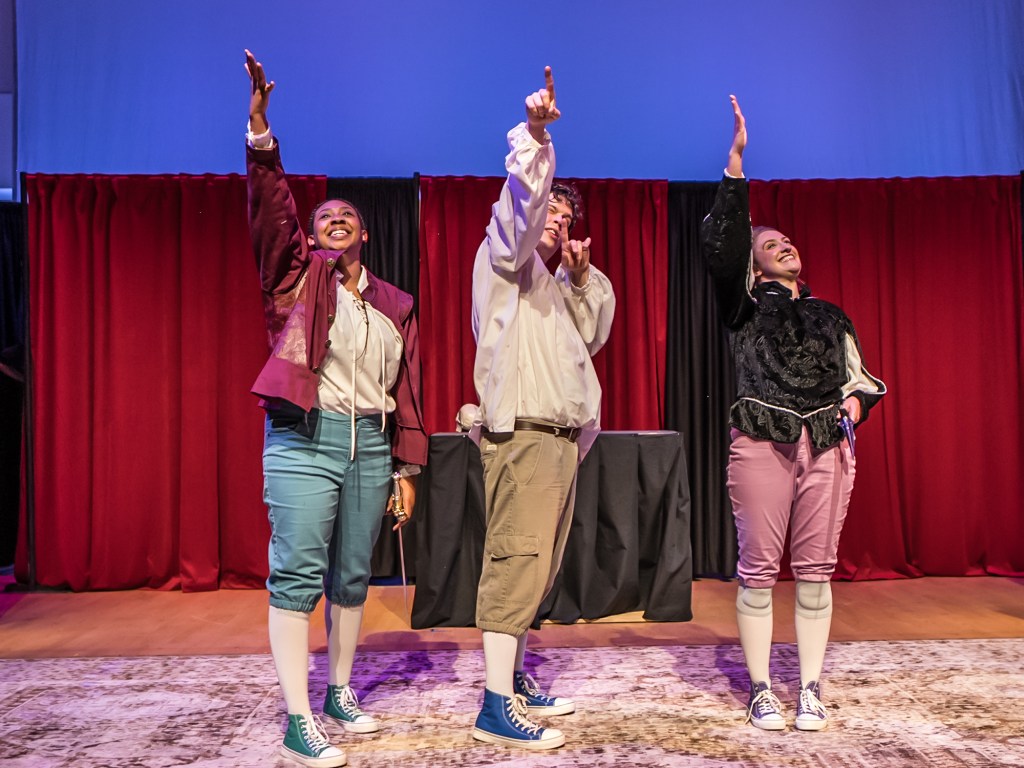
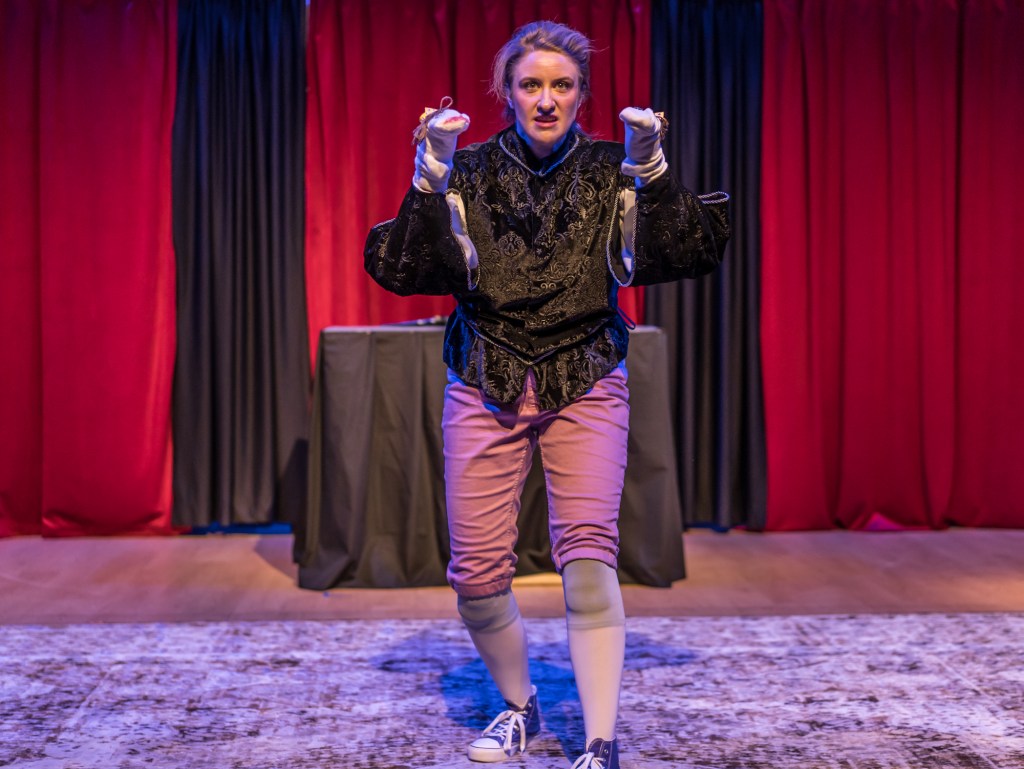
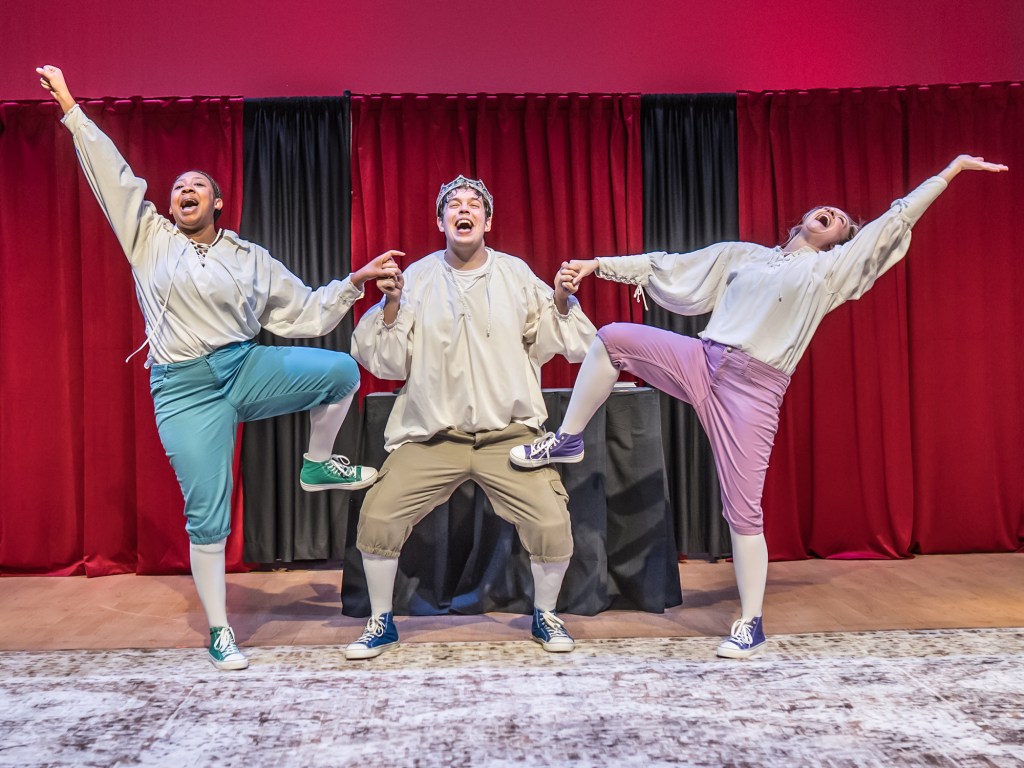
Dressed in a foundation of short pants, long-sleeved peasant-style shirts, and colorful high-top chucks, the tripartite ensemble moves at breakneck speed, adding and subtracting garments, wigs, and props for each play or scene. Shakespeare wrote plenty of racy dialogue and the salacious plot elements and double entendre are emphasized. There are many references to buns and sausages, and Horatio is misnomered as Fellatio, to name just two and, lest I forget, there is high level and intricate audience participation – with multiple parts! Mullins takes an unnatural level of juvenile-level glee in a long-running bit about vomiting, and he runs across the width of the audience, even up the stairs, to pretend to spew vomitus on audience members or in their drinks.

Graves, Marrs, and Mullins have quite different assignments, with Graves seeming to take on the bulk of the organizing and public interaction, such as announcements. Marrs is in charge of history and props. Mullins is, well, Mullins – a master of quick change and pratfalls. The three of them together form a solid ensemble knit together under a banner of riotous comedy, and often very physical humor. They must be exhausted at the end – after performing multiple versions of Hamlet. Speaking of the end, in his end notes for this production, Director Joe Pabst writes, “Comedy is one thing I know a lot about,” and “I love figuring out what makes people laugh.” To that end, I say to Pabst, “No lies detected,” and “You understood the assignment.”

—–

Julinda D. Lewis is a dancer, teacher, and writer who was born in Brooklyn, NY and now lives in Eastern Henrico County. When not writing about theater, she teaches dance history at VCU and low impact dance fitness classes to seasoned movers like herself and occasionally performs.

—–

The Complete Works of William Shakespeare (abridged)

Written by Adam Long, Daniel Singer, Jess Winfield

with new revisions by Daniel Singer and Jess Winfield

Directed by Joe Pabst

CAST

Sydnee S. Graves

Rachel Marrs

Joshua Mullins

PRODUCTION TEAM

Costume Design      ……………    Anna Bialkowski

Lighting Design       ……………    Trisan Ketcham

Scenic Design          ……………    James Ricks

Production State Manager ……   Jordan Dively

Run Time: 97 minutes; there is one intermission

———-

The Complete Works of William Shakespeare

– Comedies –

All’s Well That Ends Well

As You Like It

The Comedy of Errors

Love’s Labour’s Lost

Measure for Measure

The Merchant of Venice

The Merry Wives of Windsor

A Midsummer Night’s Dream

Much Ado About Nothing

The Taming of the Shrew

The Tempest

Twelfth Night

The Two Gentlemen of Verona

The Winter’s Tale

– Tragedies –

Antony and Cleopatra

Coriolanus

Cymbeline

Hamlet

Julius Caesar

King Lear

Macbeth

Othello

Romeo and Juliet

Timon of Athens

Titus Andronicus

Troilus and Cressida

– Histories –

Henry IV, Part I

Henry IV, Part II

Henry V

Henry VI, Part I

Henry VI, Part II

Henry VI, Part III

Henry VIII

King John

Pericles

Richard II

Richard III

The Complete Works of William Shakespeare (abridged) premiered at the Edinburgh Festival Fringe in 1987.

Photo Credits: Richmond Shakespeare Facebook page

DETROIT ‘67

Everybody Needs Love

A Reflection on a Theater Experience by Julinda D. Lewis

Presented By: The Firehouse Theatre on the Carol Piersol Stage

At: 1609 W. Broad Street, RVA 23220

Performances: March 12-30, 2025

Ticket Prices: $5.00 – $35

Info: (804) 355-2001 or firehousetheatre.org

The 12th Street Riot or Detroit Uprising in the summer of 1967 has been characterized as one of the bloodiest urban riots in the US. The police raid of an after-hours joint (i.e., an unlicensed bar) erupted into bloody confrontations between Detroit’s Black population and the Detroit Police Department. The 82nd Airborne Division, 101st Airborne Division, Michigan Army National Guard, and Michigan State Police were all called into action by Michigan’s Governor George W.  Romney and President Lyndon B. Johnson. By the time it was all over, there were 43 dead, 1,189 injured, 7,200 arrested, 400 buildings burnt or destroyed.

This incident was widely covered in the news, but even though I was alive at the time I don’t remember anything about it. I was 12 years old and living 600 miles away in Brooklyn, NY. But this show’s Director, Dr. Tawnya Pettiford-Wates, Professor of Acting and Directing Pedagogy at Virginia Commonwealth University, who was also a child at the time, was visiting with her family in Detroit when the rioting began. This gives Dr. T. a unique perspective on the history and background of the actions of this play.

NOTE: See Rich Griset’s preview in Style Weekly for interesting background information: https://www.styleweekly.com/we-almost-lost-detroit/

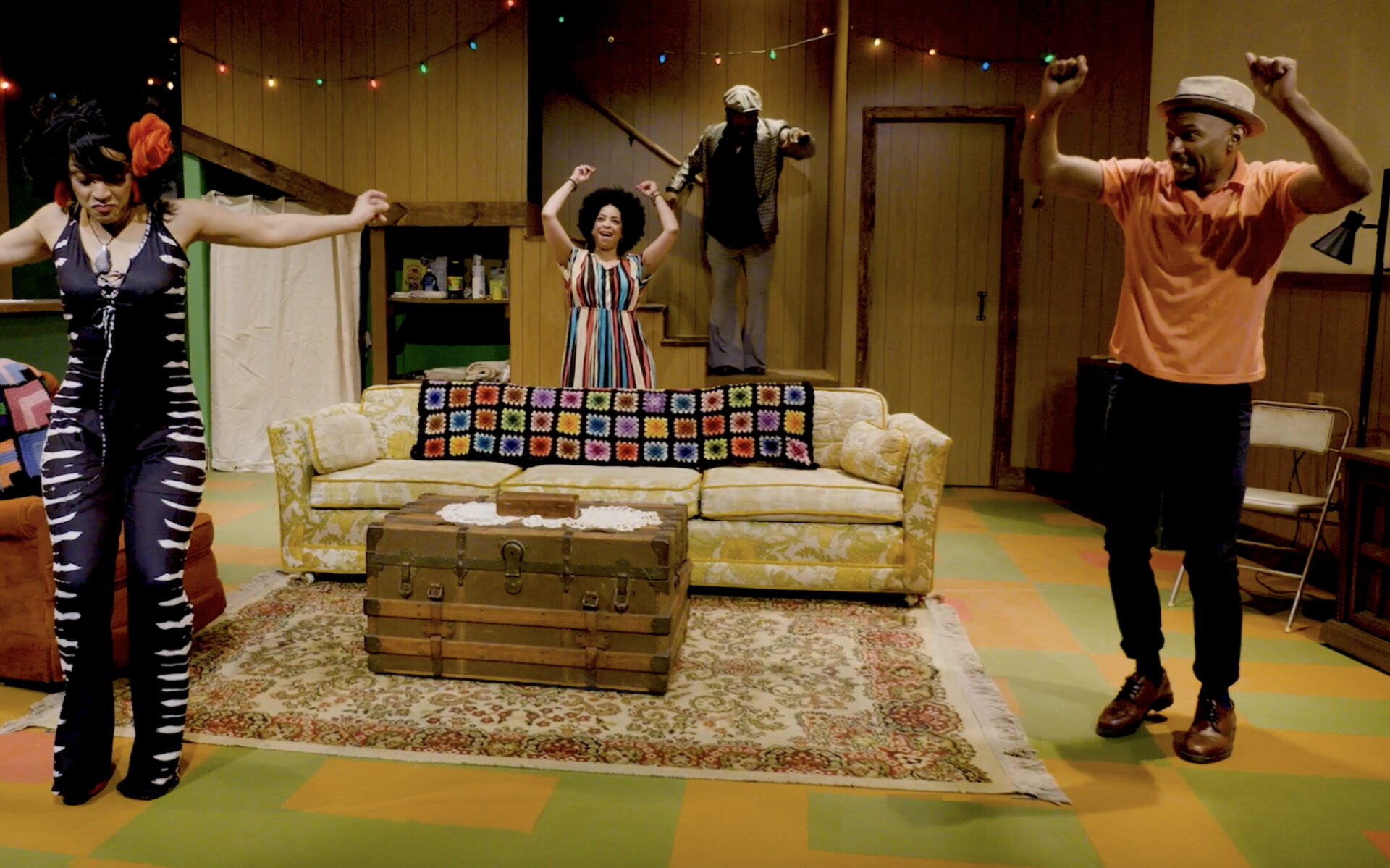
Many of us who were born in or grew up in urban Black communities in the 1950s and 1960s also felt a sense of familiarity with Detroit ’67 as soon as we walked into the Firehouse Theatre and saw the stage set – a basement recreation room meticulously designed down to the most minute detail by Mecedes Shaum. There was the familiar wood paneling, the tiled floor, the comfy sofa that had been given a second life from the upstairs living room, the bar, the beaded curtains, the family photos lining the stairs, the folding card table and chairs for playing spades or pinocle, the obligatory photos and posters of Malcolm X and other heroes. There was the washing machine – but no dryer because clothes were hung outside on sunny days or dried on a line stretched across the basement on rainy days. And anchoring all of this – the record player, which was replaced by the hi-fi, and then, as it was on this stage, by the latest technology – the 8-track player.

The first two things to catch your attention on entering the space are the set and the music. Which you notice first is probably determined by if you are predominantly an auditory or visual learner. I’m a visual-kinesthetic learner, so the set caught my eye, and the Motown soundscape caressed my ears and moved my body simultaneously. The Temptations, Smokey Robinson and the Miracles, Mary Wells, the Four Tops, Gladys Knight and the Pips and more provided the heartbeat of Detroit ’67 and took centerstage as the main characters, siblings Chelle (short for Michelle) and Lank (short for Langston) – played by Firehouse Associate Artistic Director Katrinah Carol Lewis and actor David Lyve Watkins – prepared to open their basement hideaway as an after-hours joint. I was familiar with rent parties growing up in New York, but apparently these after-hours party venues were how Black entrepreneurs or families in need of a little extra cash made their money.

As Detroit ’67 opens, Chelle and Lank are making plans, having inherited their parents’ house and some money as well. Chelle is looking forward to using her share to pay her son’s tuition. We never see the young man as he’s away at school attending Tuskegee University in Alabama – and yes, it’s summertime, but he’s staying to work, and apparently there is a young lady involved as well. The problem – or one of the problems – arises when Chelle’s plans and her brother’s plans conflict. Reminding me of a similar conflict in Lorraine Hansberry’s A Raisin in the Sun, Lank wants to use their inheritance to invest in a business. A local bar is up for sale, as a result of the phenomenon known as “white flight” and Lank’s best friend, Sly (played by Jeremy V. Morris) is a local entrepreneur (okay, he’s the local numbers runner, used car salesman, and general hustler) already has half the money needed to purchase the bar and the required license.

“Niggas deserve nice stuff, too!”

Did I say, “one of the problems?” Well, yes. The first was the riots, remember? The second was how to use the inheritance. And the third involves a mysterious stranger named Caroline. Lank and Sly find Caroline stumbling alongside the road late one night. Stopping to see if she needs help, they offer her a ride in their truck, but she passes out. So, they bring her home to Lank’s house. But, you see, Lank and Sly are two Black men, and Caroline is white. And it’s 1967 and a race riot has just broken out. This is bad, unbelievably bad. And it gets worse.

The mystery of who Caroline is and what happened to her remains unresolved at the end of Act 1. It’s only after Chelle has to bail Lank out of jail that Caroline buys a train ticket and finally reveals what happened the night Lank and Sly found her – and no, I’m not going to tell you here, you will find out when you go see the show.

Detroit ’67 is warm, funny, and terrifying. It has all the “feels” as playwright Dominique Morisseau (Pipeline, November Theatre, Oct-Nov, 2021 https://jdldancesrva.com/2021/10/16/pipeline/ and Sunset Baby by Blk Virginia Theatre Alliance coming to VaRep’s Theatre Gym in April 2025) explores themes of family dynamics, dreams of black folks, racial tension, racial profiling, police brutality, financial and social inequality, and even love and joy.

Chelle is a strong-willed woman who resists change, but she is loving and has a fierce loyalty to her younger brother and her son. Lank is ambitious but impulsive; some would call him a dreamer, others a visionary. Lank’s best friend Sylvester aka Sly has a business mind balanced by a compassionate spirit. Chelle’s friend Bunny is also an entrepreneur, but she hides her brains under an endless wardrobe of close-fitting jumpsuits and a huge flower in her hair. And the mysterious Caroline wears the shortest of mini-dresses accessorized with tall white go-go boots. (If you are not familiar with this style, now is a good time to search for an image.) Kudos to Costume Designer Margarette Joyner for the 1960s wardrobe. Each character’s wardrobe perfectly reflects their personality, from the flashiness of Bunny and Sly to the conservative maxi-dresses and Angela Davis-style afro favored by Chelle to the subdued casual attire that distinguishes Lank.

Dr. T’s direction lends itself to multi-dimensional portrayal of all five characters. I have long been familiar with the work of Lewis and Morris and Dr. T. I have seen all three of them perform in and/or direct powerful works that tell important stories.  This is a production that does not disappoint, This is a well-chosen ensemble that, even on the fourth performance (two nights of previews, and one night after opening night) seems to have achieved that place where they are moving as one. We see them laugh and dance and drink, but we also see them cry and fight for their beliefs, for their heritage, their freedom, their dignity, and for love. A favorite scene is when Sly woos Chelle, spilling his heart in song, and after much protest, Chelle finally gives Sly a sliver of hope that she might just care for him, too. They laugh, they argue, and in a little more than two hours we get to know these people, to recognize them as family, as friends, as people we have encountered, as people we care about.

Now if you feel that you can’t go on
Because all of your hope is gone
And your life is filled with much confusion
Until happiness is just an illusion
And your world around is crumblin’ down
Darling, reach out, come on girl, reach on out for me
Reach out, reach out for me
I’ll be there, with a love that will shelter you
I’ll be there, with a love that will see you through

(“Reach Out, I’ll Be There” by the Four Tops, 1966)

During the recent Super Bowl, Pulitzer Prize winning artist Kendrick Lamar borrowed the words of an earlier poet, Gil Scott Heron, to remind us that “the revolution will not be televised.” What Lamar and Morisseau both reveal to us is that the revolution will be accompanied by a sound. In a brief conversation after Saturday night’s program, Dr. T. mentioned the resistance in the music. There is resistance and resiliency in the rhythms of Motown, the rhythms of the African diaspora, in the context of history and the rhythms of the spoken word, and in the cadence of storytelling enveloped in the lyrics and its connection to family and community. Just before leaving the theater, my friend Tony asked me, how many synonyms are there for “excellent?” I don’t have an answer for that, but maybe you do. Let me know, comment here, after you see this show. I’ll be waiting.

—–

Julinda D. Lewis is a dancer, teacher, and writer who was born in Brooklyn, NY and now lives in Eastern Henrico County. When not writing about theater, she teaches dance history at VCU and low impact dance fitness classes to seasoned movers like herself and occasionally performs.

—–

DETROIT ‘67

Written by Dominique Morisseau

Directed by Dr. Tawnya Pettiford-Wates

Cast

Chelle             ……….           Katrinah Carol Lewis

Lank                ……….           David Lyve Watkins

Bunny             ……….           Nicole Cowans

Sly                   ……….           Jeremy V. Morris

Caroline        ……….           Marie Lucas

Chelle/Bunny U/S……….   Nia Simone

Lank/Sly U/S ……….           Isaac Watson

Caroline U/S ……….           Emily Wolfteich

Production Team

Direction                               ……….           Dr. Tawnya Pettiford-Wates

Directing Observation       ……….           Solomon Marley

Scenic Design                      ……….           Mercedes Schaum

Costume Design                  ……….           Margarette Joyner

Lighting Design                   ……….           Michael Crevoisier

Sound Design                      ……….           Kyle Epps

Stage Management             ……….           Emily Vial

Run Time: About 2 ½ hours; there is 1 intermission

Tickets: $5 to $35

Info: (804) 355-2001 or FirehouseTheatre.org

Performance Schedule:

Wednesday, March 12       7:30PM          Preview

Thursday, March 13             7:30PM          Preview

Friday, March 14                 7:30PM          Opening Night

Saturday, March 15             7:30PM         

Sunday, March 16               2:00PM          Pay What You Will /Member Post-Show Mixer

Friday, March 21                  7:30PM

Saturday, March 22             2:00PM          Pay What You Will

Saturday, March 22             7:30PM         

Sunday, March 23               2:00PM          Pay What You Will

Thursday, March 27            7:30PM

Friday, March 28                  7:30PM

Saturday, March 29             2:00PM

Saturday, March 29             7:30PM

Sunday, March 30               2:00PM          Closing Performance

World Premiere at the Public Theater,  March 12, 2023.

———-

Photo Credits: No photos available at the time of publication

SNAPSHOTS: A MUSICAL SCRAPBOOK

“Memories, like photographs, can fade, but they never really leave.”

A Theater Reflection by Julinda D. Lewis

Presented by HATTheatre

At: HATTheatre, 1124 Westbriar Dr., Richmond, VA 23238

Performances: March 14-23, 2025

Ticket Prices: $30 General Admission. $25 Seniors/Students/Military. $20 Youth up  to 17.

Info: 804-343-6364  or https://hattheatre.org

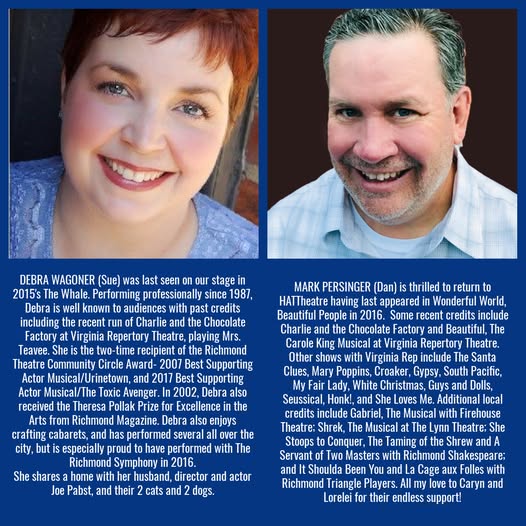
Empty nesters Sue (Debra Wagoner) and Dan (Mark Persinger) have come to a crossroads in their relationship. They have known each other since childhood, but Sue is fed up and has stolen away to the attic to reminisce, leave a note, and pack her bag. Dan uncharacteristically arrives home early from work and interrupts Sue’s plans. They end up spending the night looking through boxes of old photos, leading to a journey of discovery. This is a great relationship story for all of us. It is more than just a love story, but a story of how love starts, how it changes, how it endures, and how it affects people.

What makes this story special is that it is fueled by a playlist of songs from Stephen Schwartz’s vast repertoire of shows and steered by the dynamic artistry of Wagoner and Persinger and the four other actors who portray Sue and Dan – as well as other characters in their lives – at various stages of their lives, from elementary school to the present.

The supporting cast consists of Alanna Wilson and Joshua Smith as 11-17 year old Susan and Daniel and Shannon Schilstra and Gravins as the middle childhood Susie and Danny. They also portray a slew of other characters, including a hilarious scene where Wilson, Schilstra, and Gavins depict three of Dan’s wildly different yet uniformly vindictive ex-girlfriends.

Described as “part revue and part book musical” Snapshots is surprisingly personal and intimate. Other moments that stood out for me include Schilstra’s welcoming of the young Danny (Gravins) when he and his father move into the neighborhood; when the young Danny presents Susie with a book (A Time to Keep, Tasha Tudor’s book of holidays for ages 5-8), which she keeps throughout their years together; Sue’s dreams, expressed as a metaphor of becoming a lion tamer; Wagnor and Persinger’s “Code of Silence” duet; and the interactions the middle-aged Sue and Dan have with their younger selves, often accompanied by beautiful harmonizing.

Frank Foster’s direction infuses the production with levity and seamless pacing. The entire play takes place in the couple’s attic, suitably cluttered with an eclectic collection of memorabilia but not overdone, also designed by Foster. The Sue/Susan/Susie characters are usually identifiable by a red top in an age-appropriate style, worn over jeans. The younger versions of Dan usually wear variations of plaid shirts, also with jeans, while the mature Dan inexplicably prefers khakis.

I left this thoroughly enjoyable event with just two questions – not burning questions, but more of the “things that make you go “hmmmm” variety: a tender scene depicting the birth of Sue and Dan’s son, Matthew left me wondering why the blanket used to portray the infant was so impossibly tiny, and what we had the pleasure of seeing and hearing the music for this lovely and beautifully performed show played from up front. Musical Director Joe Revell did a magnificent job on keyboards hidden on the back where we couldn’t see him.

I’m not a singer, but I’ll close with this line from a duet by Sue and Dan, taken from Schwartz’s Reluctant Pilgrim CD: “You cannot close the acorn once the oak begins to grow.”

———-

Julinda D. Lewis is a dancer, teacher, and writer who was born in Brooklyn, NY and now lives in Eastern Henrico County. When not writing about theater, she teaches dance history at VCU and low impact dance fitness classes to seasoned movers like herself and occasionally performs.

———-

SNAPSHOTS: A Musical Scrapbook

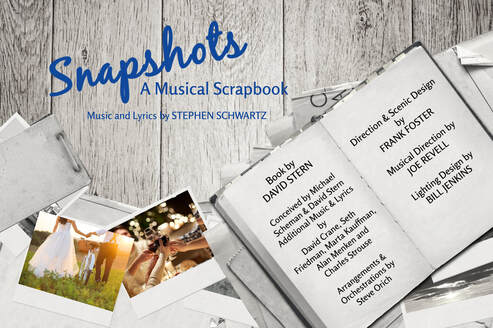
Music and Lyrics by Stephen Schwartz

Book by David Stern

Directed by Frank Foster

Musical Direction by Joe Revell

Cast

Sue     ………………..Debra Wagoner

Dan     ………………..Mark Persinger

Susan ………………..Alanna Wilson

Daniel ………………..Joshua Louis Smith

Susie  ………………..Shannon Schilstra

Danny ………………..Joey Gravins

Creative Design Team

Music & Lyrics by Stephen Schwartz

Book by David Stern

Conceived by Michael Scheman & David Stern

Additional Music & Lyrics by David Crane, Seth Friedman, Marta Kauffman, Alan Menken, and Charles Strouse

Arrangements & Orchestration by Steve Orch

Direction & Scenic Design by Frank Foster

Musical Direction by Joe Revell

Lighting Design by Bill Jenkins

Stage Management by Ashton Lee

Costumes by Suzanne Riker

Light Board Operation: Matthew Geniesse

Sound Board Operation: Ashton Lee

Box Office/House Manager: Vickie L. Scallion

Dates

March 14-23, 2025

Ticket Information

Ticket Prices: $30 General Admission. $25 Seniors/Students/Military. $20 Youth up to 17

Info: 804-343-6364  or https://hattheatre.org

Run Time

Approximately 2 hours, 10 minutes, including one 10-minute intermission

Photo Credits: N/A

Musical Numbers

“Snapshots,” “Code of Silence,” “So Far”: from the CD Reluctant Pilgrim (1997)

“New Kid in the Neighborhood”: from Captain Louie, Music & Lyrics by Stephen Schwartz (1986, 2009)

“No Time At All,” “Extraordinary,” “Corner of the Sky,” “With You,” “Morning Glow”: from Pippin, Music & Lyrics by Stephen Schwartz (1972, 2002)

“Popular,” “I’m Not That Girl,” “Making Good”: from Wicked, Music & Lyrics by Stephen Schwartz (2003)

“All For the Best,” “All Good Gifts”: from Godspell, Music & Lyrics by Stephen Schwartz (1971, 1889, 2012)

“If We Never Meet Again”: from Rags, Music by Charles Strouse, Lyrics by Stephen Schwartz

“Nothing to Do With Love,” “Moving in With Susan (aka Moving in with Linda)”: from Personals, Music by Stephen Schwartz, Lyrics by Marta Kauffman, Seth Friedman & David Crane (1985, 1986)

“Endless Delights,” “Meadowlark,” “Chanson,” from The Baker’s Wife, Music & Lyrics by Stephen Schwartz (1977, 1990)

“How Does She Know? (aka “That’s How You Know”) from Enchanted, Music by Alan Menken, Lyrics by Stephen Schwartz (2007)

“The Spark of Creation,” “Parents’ Day” (aka “Father’s Day”), “The Hardest Part of Love,” “In Whatever Time We Have”: from Children of Eden, Music & Lyrics by Stephen Schwartz (1989, 1998, 2000)

“Fathers and Sons”: from Working, Music & Lyrics by Stephe Schwartz (1978)

“Cacophony” ©2017 by Stephen Schwartz

SANCTUARY CITY

“Speak to the children of Israel, saying: ‘Appoint for yourselves cities of refuge.’” Joshua 20:2 (NKJV)

A Theater Review by Julinda D. Lewis

Presented by 5th Wall Theatre

At: Richmond Triangle Players, Robrt B. Moss Theatre, 1300 Altamont Ave, RVA 23230

Performances: March 6 – 22, 2025

Ticket Prices: $30/Adults, $15/Students

Tickets & Info: https://5thwalltheatre.ludus.com or https://www.5thwalltheatre.org/ or email info@5thwalltheatre.org

Looking back at my October 2024 review of H*tler’s Tasters”  I noted that the opening paragraph of that review is appropriate for this one, so I’m going to use it again: The 5th Wall Theatre’s 2024/2025 season is billed as a celebration of empowering stories that inspire change. The “theatre beyond boundaries’” production of Pulitzer Prize-winning author Martyna Majok’s SANCTUARY CITY fulfills this promise on several levels.

Set in Newark, NJ in 2001, shortly after the earth-shattering events of 9/11, just across the Hudson River, SANCTUARY CITY tells the story of two teen-age friends as they navigate not only the usual trials that impede a smooth transition from teen to young adult, these two, known simply as B and G, must also contend with the extra challenges of being the children of immigrants. Oh, and not just immigrants, but immigrants who have over-stayed their visas. Let’s add to that, immigrants who have over-stayed their visas right after a major terrorist attack that damaged the Pentagon and destroyed the World Trade Center.

And while we’re at it, why not toss in domestic abuse, parental abandonment, financial stress, and sexual identity. Majok cleverly did not use names for the characters or specify their national origin, leaving that open for wider interpretation and inclusiveness depending on the cast and the locale.

Like so much of local theater in recent months, this production is heartfelt and relevant. It brings recent history into perspective into perspective, making it tangible, giving a face to “woke” and forcing us to think about how policies and legislation affects the lives of real people.

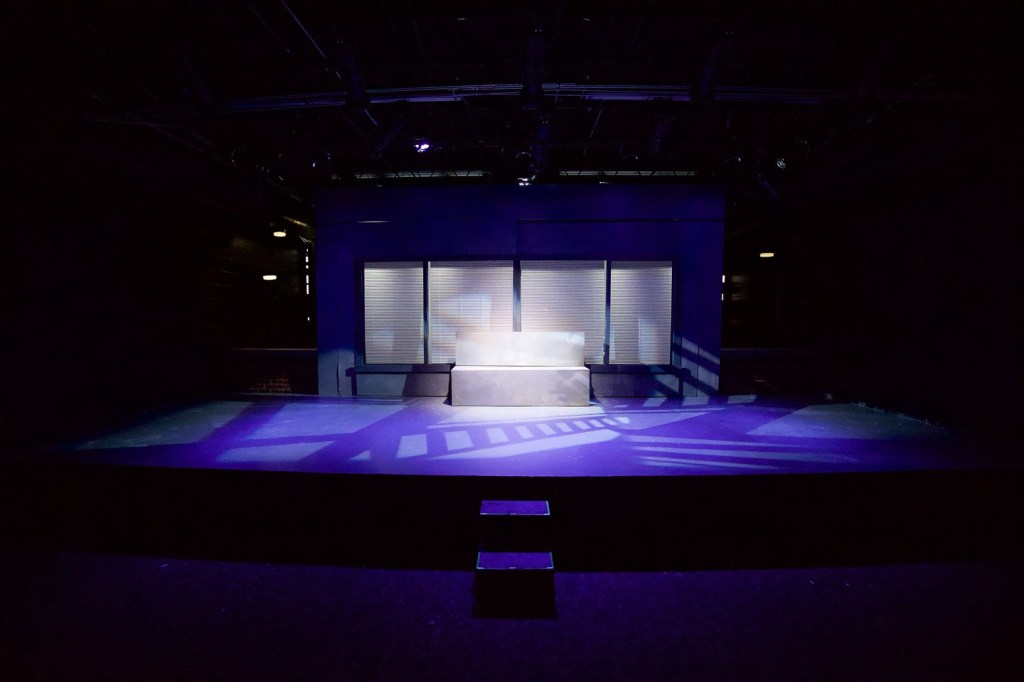
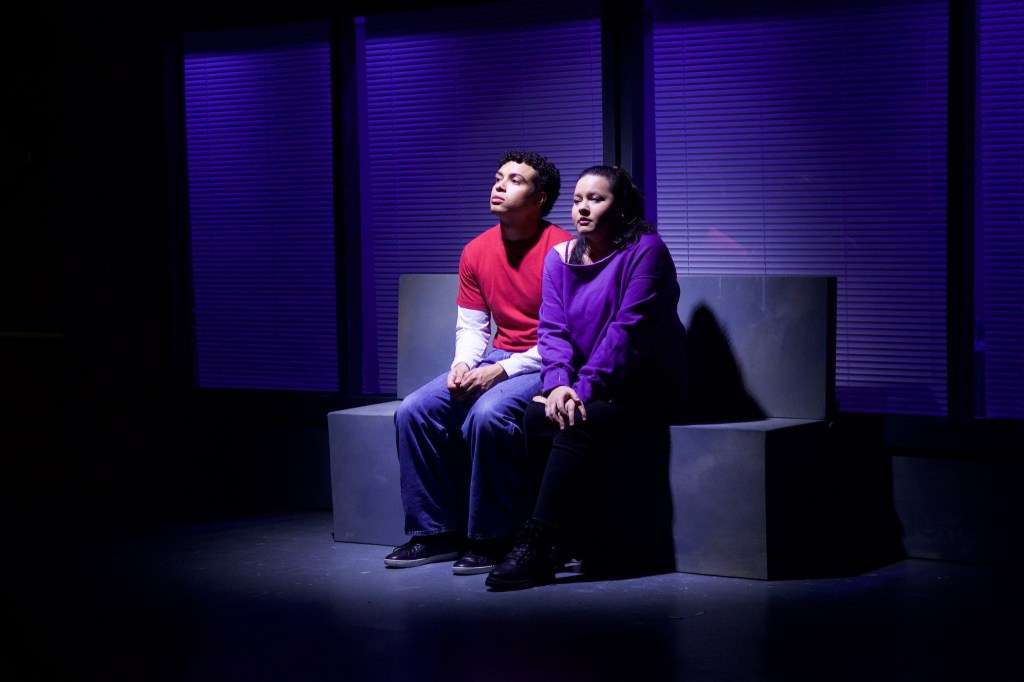
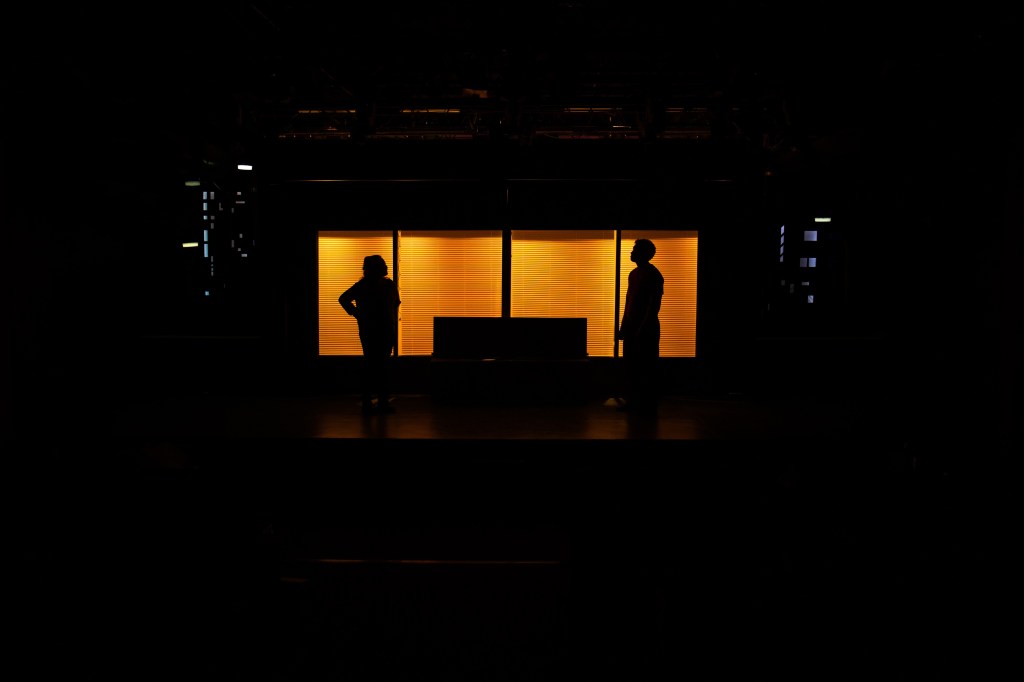
SANCTUARY CITY runs about 90 minutes with no intermission, but it does have two distinct parts. The first half or so takes place in a minimalist setting, with a simple bench set in front of a wall of windows. Dasia Gregg’s scenic design is gray and institutional, deliberately lacking in the details that suggest hominess and permanence. It looks like a bus station or a waiting room in a government building, but it serves as a variety of locations from B’s bedroom to the high school gym where B and G attend their senior prom.  For the second half, the bench is removed, and the wall of windows opens up to reveal B’s apartment – presumably, the same apartment he inherited when his mother, fearing deportation, returned to her home country, leaving B, a 17-year-old high school student, to fend for himself.

G’s mother, on the other hand, managed obtain citizenship for herself and her daughter, opening the door for G to attend college in Boston. The school, like the other details, is never named, but we know Boston is home to Harvard, MIT, and several other schools. 

G spends more time at B’s apartment than with her own mother, whose abusive boyfriends make G’s life unbearable to the point that the play opens with her banging on B’s bedroom window, coatless on a cold night, seeking refuge. For much of the first half, the two share B’s twin bed, with his mother’s permission.

The first half is a series of non-chronological scenes that create a sense of anxiety and uncertainty for the viewer. This seems to have been the playwright’s intention, but Juliana Caycedo, in her directorial debut, successfully balanced the edginess with flavorful dashes of humor.

I was excited to see that B would be played by Erich Appleby whose performance in the recent Water by the Spoonful (Firehouse Theatre) was most impressive. G is played by Anne Michelle Forbes (who was also in Water by the Spoonful) and the third character, Henry, who does not appear until well into the second half, is played by Keaton Hillman (whom I have seen mature into a seasoned actor on a variety or RVA stages).

It is fascinating to observe Appleby and Forbes navigate the delicate and difficult issues faced by two teens of immigrant parents: overstaying their visas, not having the proper documents or the financial means to become “legal,” accepting abuse at home and at work for fear that speaking up would lead to deportation. These young people, undocumented immigrants who arrived in the US as children, and whose only known home is the USA, are the people who would be labeled “Dreamers” (Development, Relief, and Education for Alien Minors Art) and for whom the Obama administration created DACA, the Deferred Action for Childhood Arrivals program in June 2012.

G and B forge a plan to help B stay and become legal. They play to get married. They practice what to say to pass their interview with the immigration authorities. And then G get accepted to a college in Boston. They live in Newark, more than 200 miles and a 5-6 hour bus ride away. But while away at school, G develops cold feet. If their plan fails, the penalty is a $250,000 fine and 5 years in prison. She doesn’t come home for holiday breaks as planned, and when she finally shows up, after 3 ½ years, their close bond has been broken, and G has become involved with Henry, a law student. Henry is first generation American-born, the son of immigrants, also from an unnamed nation.

SANCTUARY CITY is educational, informative, and addresses issues that we, as a nation, are wrestling with right now. There are no easy solutions. There are issues of border security and national security, drugs, crime, employment, social integration, social services, economic impact, language, and racism. The topic is one that either leaves you speechless and weeping or ready to take up arms and march into battle. The acting in SANCTUARY CITY is mesmerizing. It may take a bit of adjusting to get used to the disjointed, non-linear format of the first half, but the discomfort is necessary. One cannot expect to sit comfortably in one’s seat and sip one’s cocktail. This is the sort of production that goes beyond the superficial and delves deeply into characters and issues of society and social justice and economics and education and…things that matter to us. It is about something that happened between 2001 and 2006, but it is also about real people, right now. This is not light entertainment; it is art that serves a cause.

One scene that sticks with me is when B describes the time he secretly took a bus to Boston to visit G, to surprise her. He walked around the campus. He pretended to have lost his ID, and other students readily gave him access. He had lunch and sat in on classes and even participated. In one class he answered a question eloquently, because he had read the book (G shared her books with him). But then, he left without speaking to G. He saw her, but he left.
So, I leave you with this: Who is welcome at the table? Who will we allow to walk away without sharing their talents and gifts and who will we make room for? For whom are we willing to fight? Is there a B or G or Henry in your life, and if not, why not?

———-

Julinda D. Lewis is a dancer, teacher, and writer who was born in Brooklyn, NY and now lives in Eastern Henrico County. When not writing about theater, she teaches dance history at VCU and low impact dance fitness classes to seasoned movers like herself and occasionally performs.

———-

SANCTUARY CITY

Written by Martyna Majok

Directed by Juliana Caycedo

CAST

B                                  ……….           Erich Appleby

G                                 ……….           Anne Michele Forbes

Henry                         ……….           Keaton Hillman

Aidan Campbell      ……….           u/s for B

Katherine Nguyen   ……….           u/s for G

DJ Cummings-Herdoiza …..         u/s for Henry

PRODUCTION TEAM

Directed by               ……….             Juliana Caycedo

Production Stage Management        ……….            Tariq Karriem

Scenic Design by     ……….           Dasia Greff

Lighting Design by  ……….            Gretta Daughtry

Sound Design by       ……….            Kyle Epps

Costume Design by   ……….            Sassy Rychalski

Prop Master              ……….           Tariq Karriem

Technical Director   ……….           Rebecka Russo

Dialect Coach           ……….           Harrison Runion

Intimacy Coordinator         ……….           Dorothy Dee-D Miller

Photos by                  ……….           Destiny Martinez

Performance Schedule:

Thursday, March 6, 7:30PM | PREVIEW

Friday, March 7, 7:30PM | OPENING NIGHT

Saturday, March 8, 7:30PM

Sunday, March 9, 2:30PM | MATINEE with Talkback with the cast & Creative Team

Thursday, March 13, 7:30PM

Friday, March 14, 7:30PM

Saturday, March 15, 7:30PM

Sunday, March 16, 2:30PM | MATINEE

Tuesday, March 18, 7:30PM | INDUSTRY NIGHT, pay what you will

Thursday, March 20, 7:30PM | TALKBACK, Reestablish Richmond

Friday, March 21, 7:30PM

Saturday, March 22, 7:30PM | CLOSING NIGHT

Saturday, November 2, 2024, 7:30PM | Closing Night

Tickets: $30/Adult; $15/Student

Run Time: 90 minutes, no intermission

SANCTUARY CITY had its World Premiere at New York Theatre Workshop, Jim Nicola, Artistic Director, Jeremy Blocker, Managing Director, 2020. SANCTUARY CITY was developed, in part, at the 2018 Sundance Institute Theatre Lab.

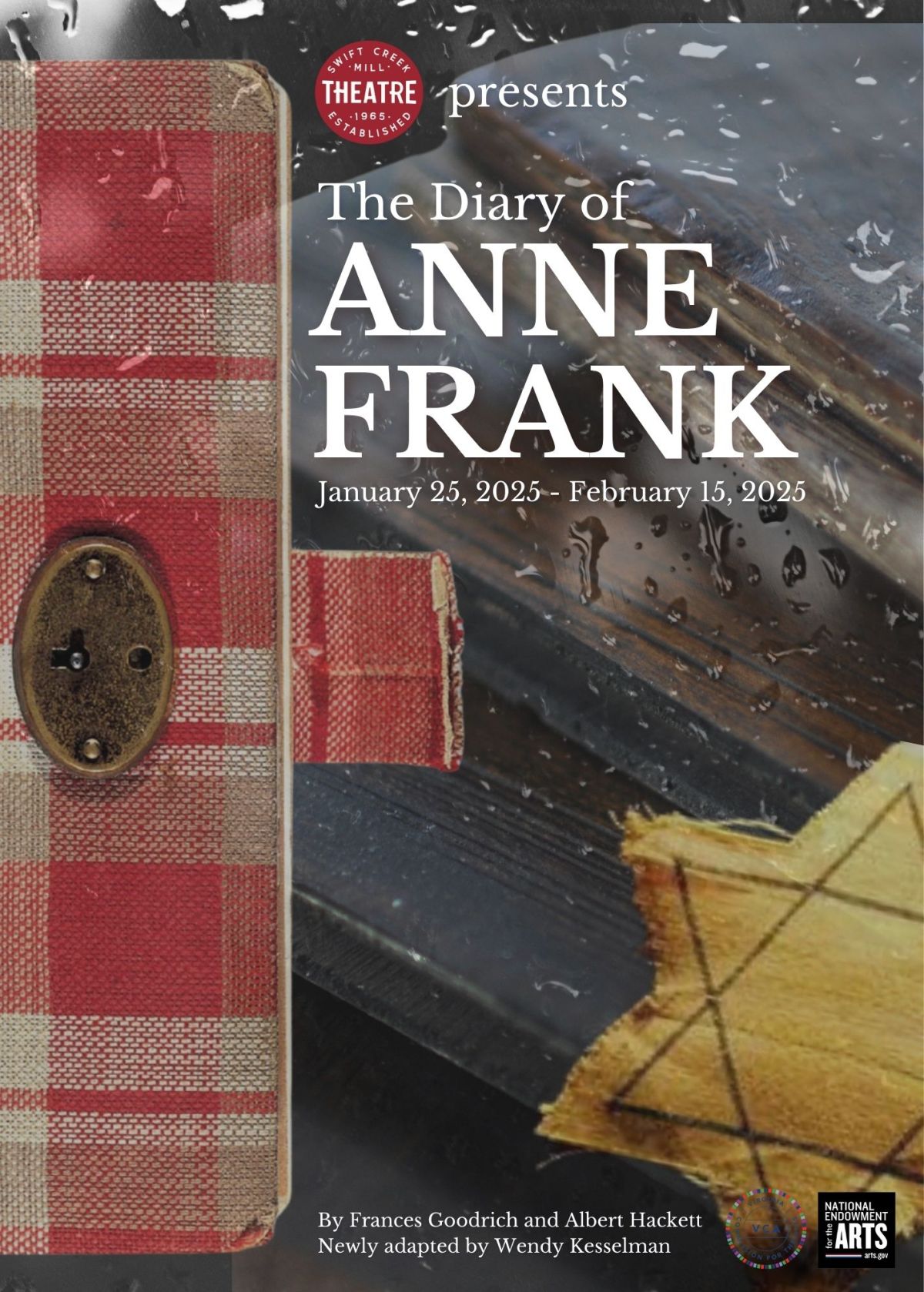
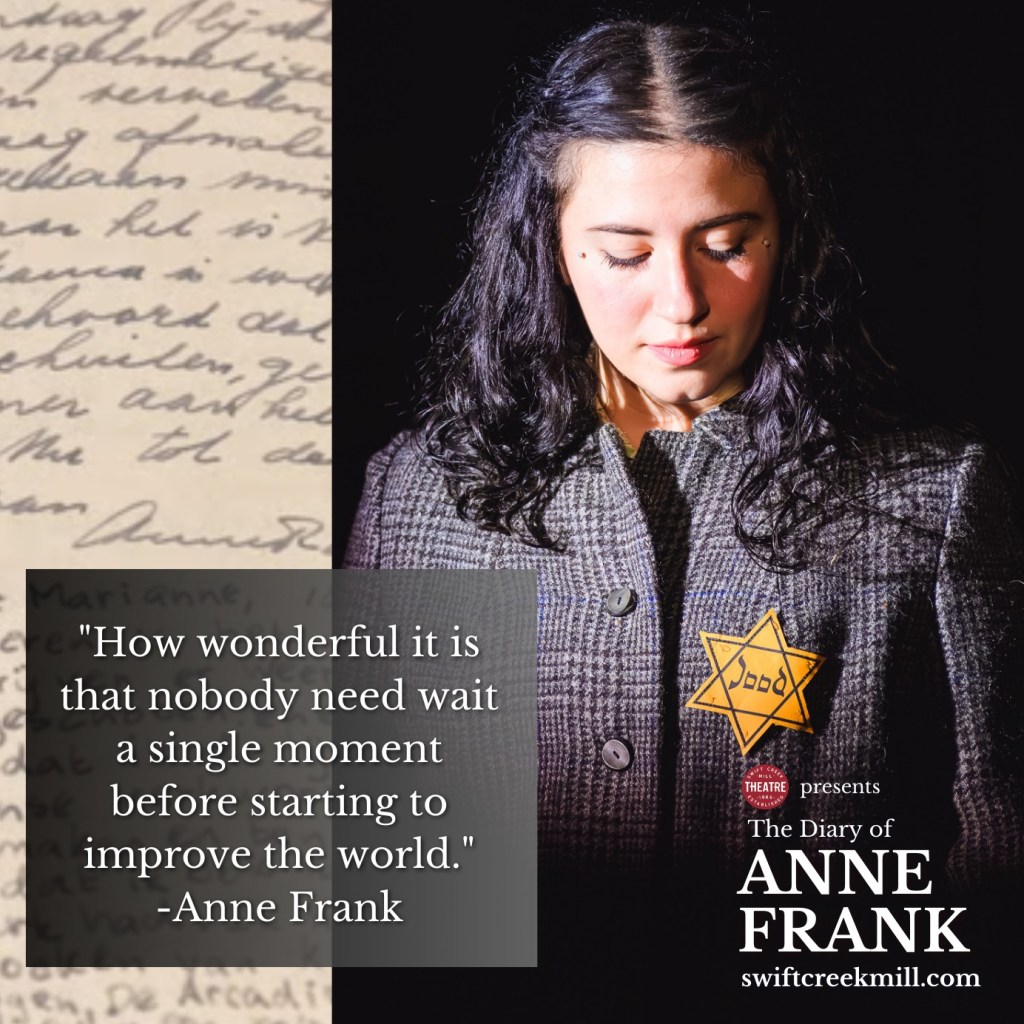
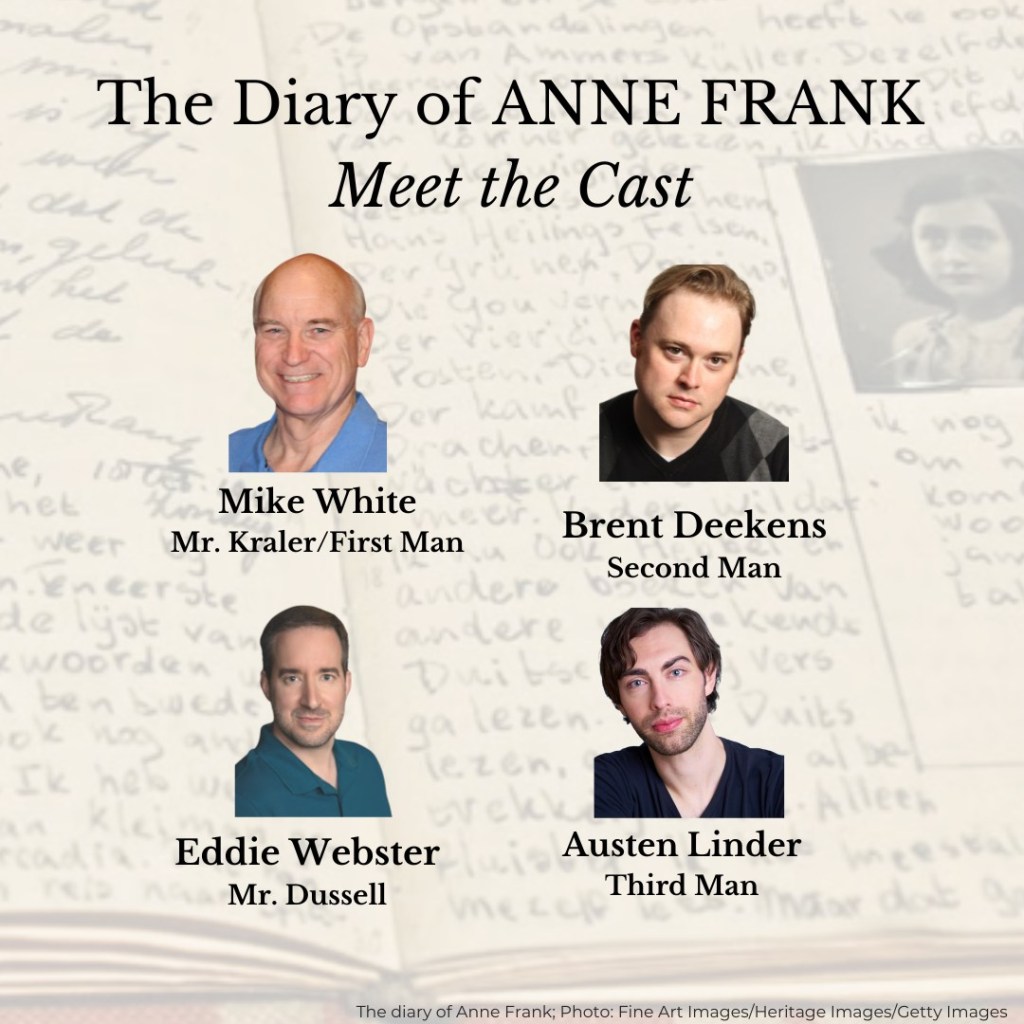
THE DIARY OF ANNE FRANK

All That Remains

At: The Swift Creek Mill Theatre, 17401 U.S. Route One, Chesterfield, VA 23834

Performances: January 25 – February 15, 2025

Ticket Prices: $44-49. Ask about discounts for students, seniors, and veterans.

Info: (804) 748-5203 or https://www.swiftcreekmill.com

A Theater Reflection by Julinda D. Lewis

Let’s be clear, this is not an easy production to see. I can only imagine how the cast manages to perform The Diary of Anne Frank day after day, night after night. It was so deeply moving that after a Wednesday matinee performance going out into the welcoming sunlight of an unseasonably warm winter day seemed surreal and a bit irreverent.

This is a script based on the diaries of Anne Frank, written when she was only 13-15 years old and she along with her family spent more than two years in hiding in Amsterdam while Hitler’s army occupied Amsterdam. Occupied seems too gentle a word. Todd A. Schall Vess has designed a simple but layered set that appropriately captures the era. While the quarters may be camped for seven people, the set appeared more spacious than the scene I imagined in my mind’s eye.

The need for quiet

The lack of privacy

The terror of footsteps

The updated script, Producing Artistic Director informed us during his pre-show curtain talk, contains material that was not available for the original production. This is Swift Creek Mill’s fifth production of The Diary of Anne Frank but my first experience with the play.

Kudos to Director Debra Clinton and this phenomenal cast for having the courage to take us on this journey at this point in time. The Mill chose this production more than a year ago, when they could not have known how relevant it would be in January 2025.

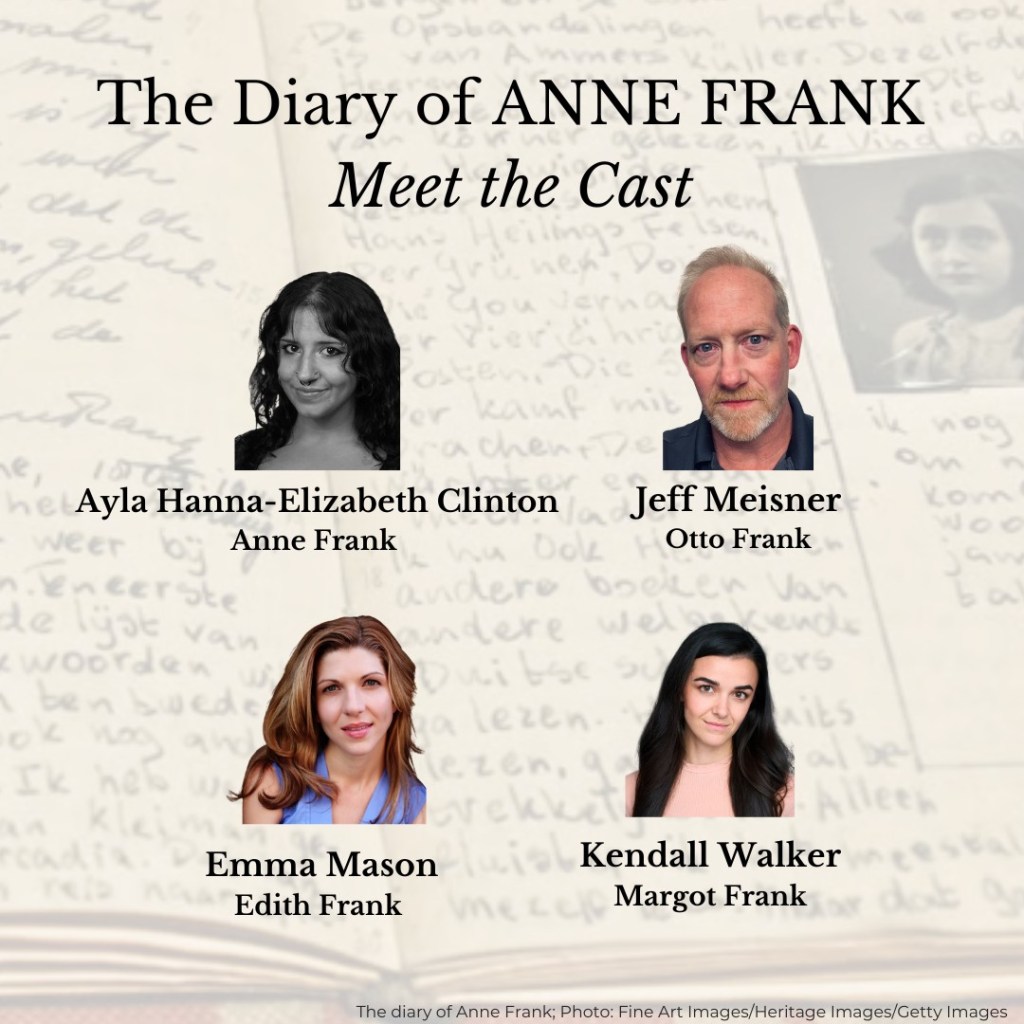
Ayla Clinton stepped into the shoes of the lead role, Anne Frank. Their youthful enthusiasm, so out of place, was a ray of sunshine in this battle against spiritual darkness. Kendall Walker played Anne’s sister, Margot – more subdued and therefore more socially acceptable – and Jeff Meisner and Emma Mason carried the roles of Anne’s parents, Otto and Edith with dignity beyond understanding. We see them as loving, educated people, someone you might like to have as neighbors in another life.

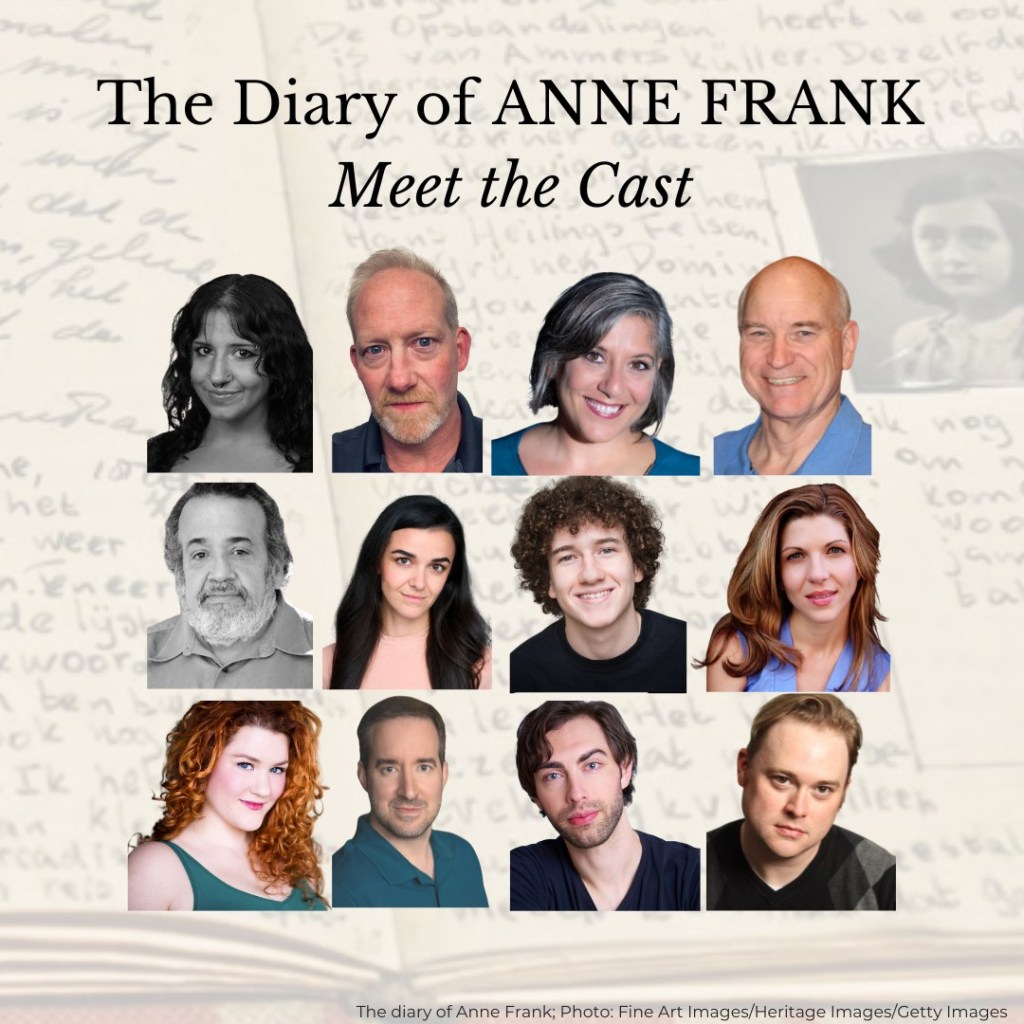
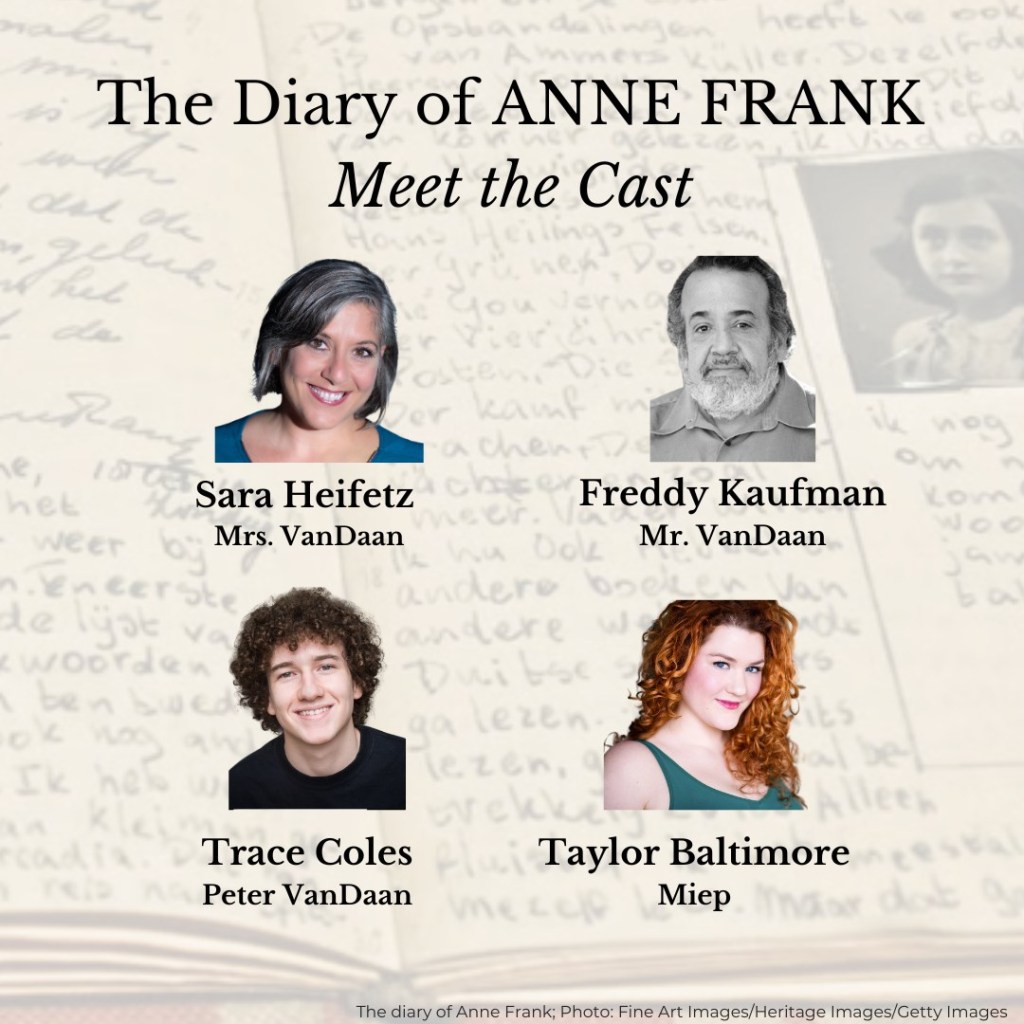
The Frank family shared their hiding place with the Van Daan family. Sara Heifetz and Fred Kaufman took on the roles of a bickering couple whose sometimes embarrassingly public revelations of one another’s shortcomings added a bit of much needed humor while a growing friendship between their shy son Peter, played by Trace Coles and the exuberant Anne provided a subplot of optimism and romance that fueled a false hope that things might turn out differently this time around.

The enmity between the Van Daan’s was also quite realistic, and I loved the authenticity of the complicated relationship Heifetz and Kaufman depicted in their roles. Mrs. Van Daan’s reluctance to give up her wholly impractical fur coat was not about materialism – it was about holding on to the only existing reminder of her father. The tears started to form when Heifetz uttered the deceptively simple line, “If you’re hungry, just hold on to me.”

Thinner.

Paler.

A lot hungrier.

Taylor Baltimore’s role as the engineer and manager of the makeshift refuge might be considered a supporting role, but it was so essential. When Miep came, she didn’t bring just food and books, she brought the breath of life. It was temporary and insufficient, but it was all they had. When Miep introduced Mr. Dussel, a dentist played by Eddie Webster, into the already tense and crowded community, the delicate balance temporarily tipped, and it took a while for the group to reestablish equilibrium. Thinking, again, of our world today, there are so many lessons to be learned from this story – and from the careful handling of it by Director Clinton and this phenomenal ensemble.

But for all their hard work, they could not change history. The final transport left on September 3, 1944. The destination – the extermination camps. And for all the hope, the prayers, the tears, the love, the sacrifice, the loss, the lack…

All that remains…

…the cast stood quietly

…some audience members stood and clapped, the most subdued applause ever

…some sat weeping

…never…again…

…dear G-d, never again…

———-

Julinda D. Lewis, EdD is a dancer, minister of dance,  teacher, and writer who was born in Brooklyn, NY and currently resides in Eastern Henrico County. When not writing about theater and dance, she teaches dance history at VCU and low impact dance fitness classes to seasoned movers like herself and occasionally performs.

———-

THE DIARY OF ANNE FRANK

By Frances Goodrich and Albert Hackett

Newly adapted by Wendy Kesselman

Directed by Debra Clinton

CAST

Anne Frank   …..      Ayla Clinton

Otto Frank    …..      Jeff Meisner

Edith Frank   …..      Emma Mason

Margot Frank…..     Kendall Walker

Miep Gies     …..      Taylor Baltimore

Peter Van Daan…..  Trace Coles

Mr. Kraler      …..      Mike White

Mrs. Van Daan…..    Sara Heifetz

Mr. Van Daan…..     Fred Kaufman

Mr. Dussel     …..      Eddie Webster

First Man       …..      Mike White

Second Man …..      Bent Deekens

Third Man     …..      Austen Linder

Voice Actors …..      Roger Price, Meg Price, Melissa Johnston Price

CREATIVE TEAM

Directed by Debra Clinton

Scenic Design by Todd A. Schall-Vess

Lighting Design by Joe Doran

Costume Design by Maura Lynch Cravey

Technical Direction by James Nicholas

Sound Design by James Nicholas

PRODUCTION STAFF

Producing Artistic Director …. Tom With

Technical Director ….. James Nicholas

Stage Manager ….. Sandy Lambert

Assistant Stage Manager/Props ….. Tom Width

Light/Sound Board Operator ….. Brent Deekens

Set Crew ….. R Jonathan Shelley, Peter Proust, Brent Deekens, Christopher Samoski

Scenic Painter ….. Amber Kilpatrick

Lighting Crew ….. Brent Deekens, Alleigh Scantling

Photographer …..Daryll Morgan

Setting:

The play takes place on the top floors of the annex to an office building in Amsterdam, Holland, during the years of World War II.

Run Time:

About 2 hours with 1 intermission

Tickets:

Regular $44-49. Discounts for Seniors, Military & Veterans

Photographer: Darryl Morgan

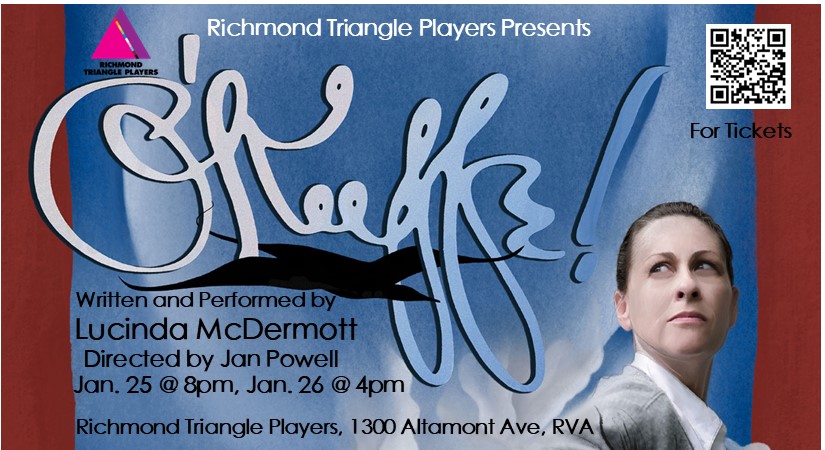
O’KEEFFE!

A One-Woman Show About Art, Life, and Love

Written and Performed By: Lucinda McDermott

At: Richmond Triangle Players at the Robert B. Moss Theatre, 1300 Altamont Avenue,  RVA 23220

Performances: January 25 & 26, 2025

Ticket Prices: $45

Info: (804) 346-8113 or rtriangle.org

A Theater Reflection by Julinda D. Lewis

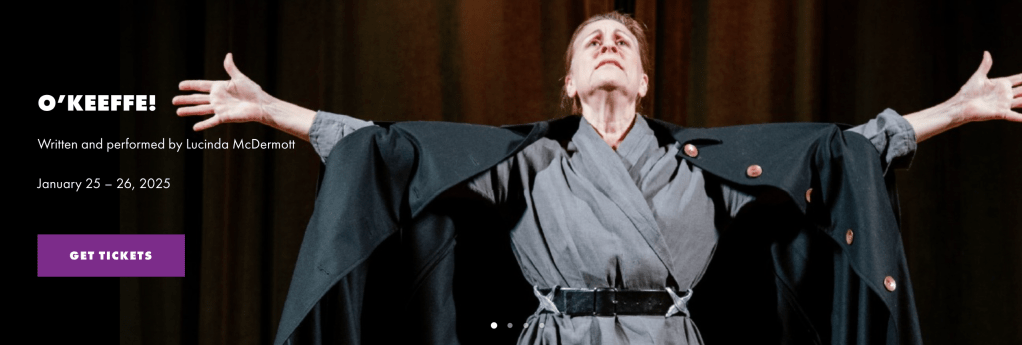
In this mesmerizing one-woman show about the American artist Georgie O’Keeffe, Lucinda McDermott, who both wrote and stars in the play, stated early on, “I will not be mediocre.” That simple statement was a battle cry that foreshadowed what we know of the life of the artist, O’Keeffe. It was a statement first of faith and in retrospect of fact, about the work of playwright and actor Lucinda McDermott.

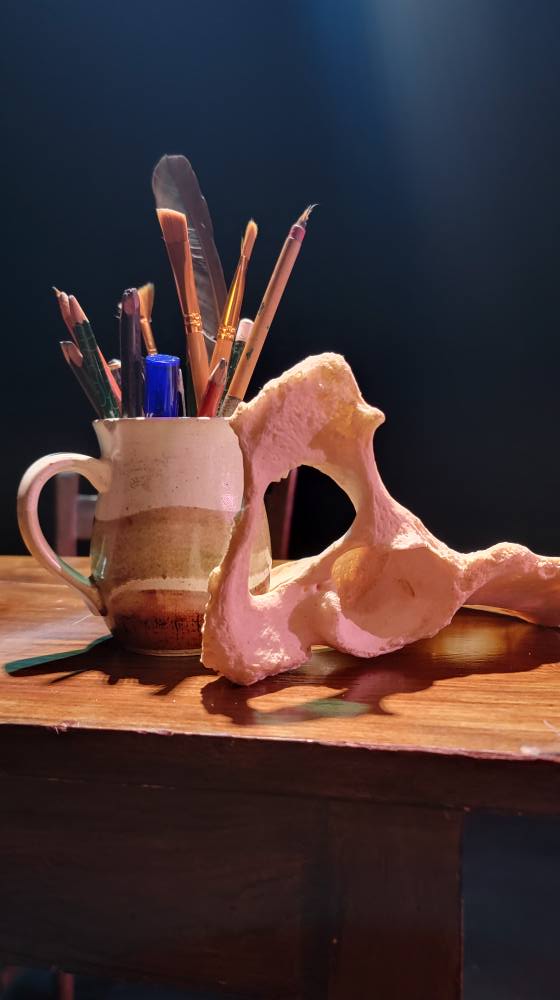
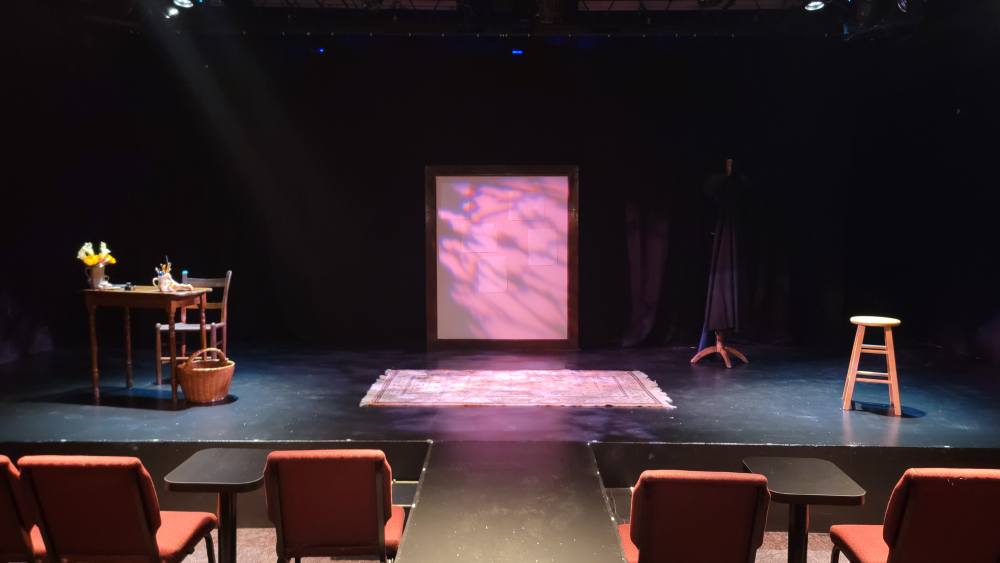
More than a biography, better than a documentary, O’Keeffe briefly immerses the audience into the world that created Georgia O’Keeffe. On a simply dressed stage – just a small desk, a chair, a basket on our left, a coat rack on our right, and a gigantic framed blank canvas upstage center – McDermott reveals her subject with reverence, humor, and love. To borrow a line from the script, McDermott “fills the space in a beautiful way.”

I imagine those who came as fans of the artist left affirmed and those who came as blank slates left with the satisfaction of having filled a void they didn’t know they had. O’Keeffe explores the things that inspired O’Keeffe as well as the challenges faced by a woman artist existing in a man’s world, more specifically as a woman artist living in the shadow of a well known and successful man – a renowned photographer more than 20 years her senior who also managed her career. The play dares explore the question, did Alfred Stieglitz exploit, manipulate, or otherwise (re-)direct the course of O’Keeffe’s life?

There is no doubt a popular, powerful, older male mentor can open doors closed to other women. And although McDermott did not dwell on it, there was mention of how he would not allow her to have children, her lengthy, life-affirming retreat to New Mexico, and even allusions to her affair with a mutual friend, the Harlem Renaissance writer, Jean Toomer and his long-term affair with arts patron Dorothy Norman. Yet this is a love story, and their marriage lasted in some form for 30 years.

“It’s an unpleasant sensation, squeezing the life out of someone; you won’t like what’s left.”

McDermott’s storytelling skills are immersive all on their own, yet in and as O’Keeffe, she takes it to another level. At one point, as an example, McDermott asked the audience to close our eyes to listen to music (the sound design was the work of her own real-life husband, Jonathan Piro) and then she asked three people to describe what they had seen in their mind’s eye.

McDermott commands the stage for about two hours, not so much playing the role O’Keeffe, as embodying the spirit of the artist, with time for one intermission, and not one minute of her stage time is dull or wasted. O’Keeffe resurrects the artist and allows her – not McDermott, but O’Keeffe – to lead us on an amazing journey of discovery: it is art process; it is love story; it is the heart of an artist, taken out, bared, and entrusted to a group of people who may have entered as strangers but who left as co-conspirators, a group unified by a common experience who cradled it, acknowledged its strengths and admired its cracks, and returned it to its owner so it could be shared again and again…and again.
NOTE: To answer a question raised – by McDermott? by O’Keeffe? – why do critics get paid for their opinions and the rest of us don’t? It’s combat pay, needed to buy bandages for the wounds from the darts and daggers others tossed at those who dared to defy social conventions and express an opinion, whether popular or not. And I make a distinction, in these days of social media, between the professional reviewer or academic critic and those who use and abuse social media for the sole purpose of inflicting harm on others for no other reason, apparently, than for sport. But that’s a whole other discussion.

———-

Julinda D. Lewis is a dancer, minister of dance, teacher, and writer who was born in Brooklyn, NY and currently resides in Eastern Henrico County. When not writing about theater, she teaches dance history at VCU and low impact dance fitness classes to seasoned movers like herself and occasionally performs.

———-

O’KEEFFE

Written & Performed by Lucinda McDermott

Directed by Dr. Jan Powell

Cast

Lucinda McDermott as Georgia O’Keeffe

Creative Team

  Playwright/Actor/Producer:Lucinda McDermott
                                      Director:Jan Powell
Sound Design/Co-Producer:Jonathan Piro
                     Costume Design:Elizabeth Weiss Hopper
                       Lighting Design:Andrea Stratton
Master Electrician:Gabriel Beard

Performance Schedule

Saturday, January 25, 2025           8:00PM

Sunday, January 26, 2025              4:00PM         

Tickets

Ticket Prices: $45

Run Time

Approximately 2 hours, including one intermission

Photos N/A [from Lucinda McDermott’s Facebook page]

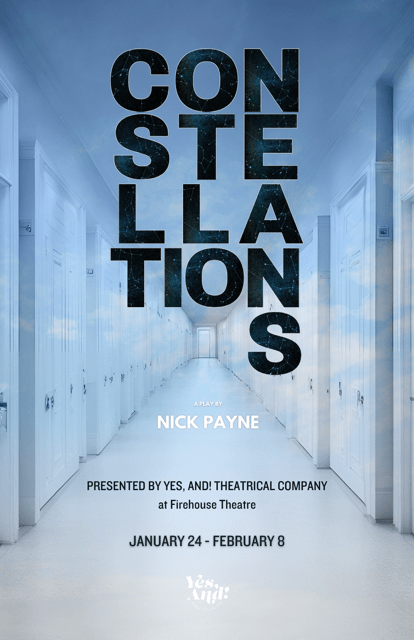
CONSTELLATIONS

Experience the Multiverse

Produced By: Yes, And! Theatrical Company in residency with New Theatre at Firehouse

At: The Firehouse Theatre, 1609 West Broad St., Richmond, RVA 23220

Performances: January 3 – February 8, 2025

Ticket Prices: $40 general admission; $15 for return visits; $100 for Season 3 Tickets [four shows]

Info: Email: yesandrva@gmail.com; Website: yesandrva.org; Facebook: http://www.facebook.com/yesandrva/

A Theater Review by Julinda D. Lewis

CONSTELLATIONS is, by design, a play of endless possibilities. Playwright Nick Payne has the two actors speak multiple versions of the same lines throughout the course of the play. Director Maggie Roop takes it a step further by having each actor learn both roles and rotating the pairings of partners throughout the run. (Do the math; that results in six possible pairs). Roop describes the resulting product as a Sci-Fi Rom-Com.

WARNING: It is impossible to talk about this play without touching on some spoilers, so if you want to retain your sense of awe and wonder, stop reading here, go see the play, and then come back to finish.

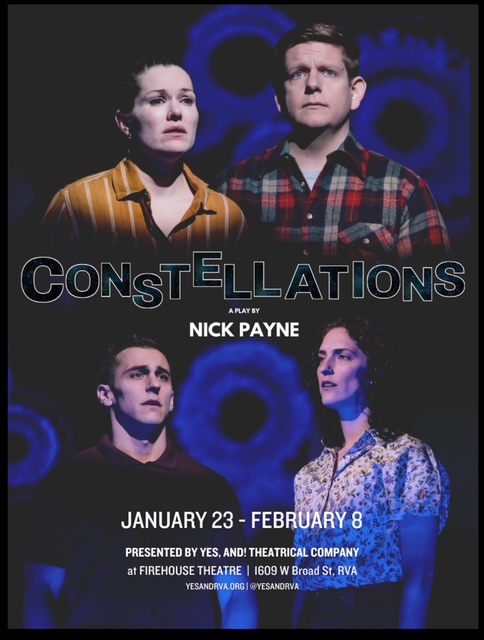
The gist of CONSTELLATIONS is the relationship between Marianne, a physicist who leaps enthusiastically into discourse on quantum mechanics and multiple universes, and Roland, a beekeeper. The two meet at a barbeque and begin a relationship that might be romantic or might not be. It might be rocky or smooth. It might be challenged by infidelity – or not, or it might be on her part, or may his. But after a time, they reconnect at a ballroom dance class – again, for assorted reasons, depending on which version of the story is told at any given time. Eventually they marry, and Marianne falls ill. For all her love of words, that is the first thing she begins to struggle with and, with Roland’s help, she embarks on a journey to seek assisted suicide (which reminded me of Ronan Carr’s The Barber of Moville, which I also saw here at the Firehouse Theatre, in June of 2022: https://jdldancesrva.com/2022/06/28/the-barber-of-moville/ Both plays came from “across the pond,” as Payne is British and Carr hails from Dublin).

I saw CONSTELLATIONS on opening night with John-Michael Jalonen in the role of Roland and Ashley Thompson playing Marianne. I am not familiar with either actor but based on their tightly woven performances in this delightfully quirky two-hander, I would enjoy seeing more of them. Jalonen initially portrays Roland as sort of an everyman but gradually adds more depth and texture to the character. Similarly, Thompson starts off playing Marianne as someone aloof and driven by some sort of mystical philosophical angst but gradually lets us in – as much as you can get close to someone who straddles the multiverse. Ultimately, it seems that the multiverse that most affected Marianne and Roland came from within, rather than from any external sources or forces.

The tragic circumstances are balanced with generous doses of wry humor – spoken in British accents. Director Maggie Roop has ensured that the timing is impeccable, especially when scenes are repeated or revised with alternate outcomes. At times, the two characters are transported into an alternate reality, signaled by changes in their voices, robotic stance, and otherworldly lighting.

Scenic Designer Alyssa Sutherland set CONSTELLATIONS on a multilevel series of wooden platforms with wire mesh sides; honeycombs adorn the walls, an alternative “universe” with two rows of audience seating was added to one side, near the bar, and Kelsey Cordrey filled the auditory space with a dull somewhat ominous rumble. Oh, and there was honey. A honey jalapeño moonshine cocktail at the bar, and straws of straight honey at the box office in the lobby. Sweet.

———-

Julinda D. Lewis is a dancer, minister of dance, teacher, and writer who was born in Brooklyn, NY and currently resides in Eastern Henrico County. When not writing about theater, she teaches dance history at VCU and low impact dance fitness classes to seasoned movers like herself and occasionally performs.

———-

CONSTELLATIONS

Written by Nick Payne

Directed by Maggie Roop

Cast

4 actors each portray both roles, Roland and Marianne, and the actor pairings change throughout the run:

John-Michael Jalonen

Marie Lucas

Ashley Thompson

Adam Turck

Production Team

Scenic Design – Alyssa Sutherland

Costume  Design – Emily Atkins

Lighting Design – Michael Jarett

Sound Design – Kelsey Cordrey

Dialect Coach – Erica Hughes

Intimacy Coordinator – Michelle Greensmith

Fight Choreography – Axle Burtness

ASL Coordinator – Allison Polson

Production Stage Manager – Grace Labelle

Assistant Stage Manager – Kennedy Shahan

Director of Production & Scenic Painter – Todd Labelle

Technical Director – Emily Vial

YES, AND! THEATRICAL COMPANY

in residency with NEW THEATRE at FIREHOUSE

Artistic Director – Maggie Roop

Executive Director – Matt Shofner

Performance Schedule

Thursday, January 23, 2025          7:30PM          Preview

Friday, January 24, 2025               7:30PM          Opening Night

Saturday, January 25, 2025           7:30PM

Tuesday, January 28, 2025            7:30PM          Pay What You Can*

Thursday, January 30, 2025          7:30PM

Friday, January 31, 2025                7:30PM

Saturday, February 1, 2025           7:30PM

Sunday, February 2, 2025              2:00PM          Pay What You Can*

Tuesday, February 4, 2025            7:30PM          Pay What You Can*

Thursday, February 6, 2025          7:30PM

Friday, February 7, 2025                7:30PM

Saturday, February 8, 2025           2:00PM

Saturday, February 8, 2025           7:30PM

Tickets

Ticket Prices: $40 general admission; $15 if you return to see a different actor pairing; $20 Rush Rickets at the Box Office one hour prior to all performances

*Pay What You Can: $5 suggested minimum at the door; $10 minimum in advance

Run Time

Approximately 70 minutes with no intermission

Photos N/A

CONSTELLATIONS was originally produced on Broadway by the Manhattan Theatre Club, Lynne Meadow, Artistic Director, Barry Grove Executive Producer, and The Royal Court Theatre by special arrangement with Ambassador Theatre Group and Dodges on December 16, 2014.