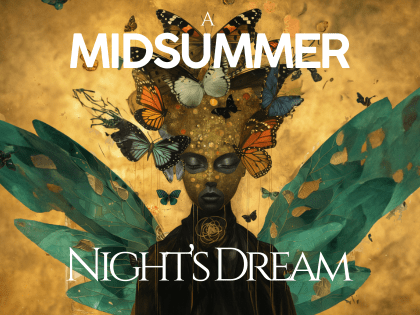
A MIDSUMMER NIGHT’S DREAM

Potions, Poetry & the Power of Dreams

A Theater Review by Julinda D. Lewis

Presented by: Richmond Shakespeare

Performances: June 19 – July 20, 2025 [Extended to July 27!]

At: Agecroft Hall, 4305 Sulgrave Rd., RVA 23221

Ticket Prices: $22-$47 [Adults $47; Seniors 65+ with ID $42; Military with ID $32; College Students with ID $27 & Children 18 and under $22] Seating is General Admission.

Info: (804) 340-0115 or http://www.richmondshakespeare.org

Shakespeare wrote A Midsummer Night’s Dream in around 1595 or 1596. Here we are in 2025, watching Shakespeare’s sixteenth century comedy about people in Ancient Greece (c. 12th century) being performed by a cast of characters in 1950’s attire. Now that, my friend, is the definition of timeless. [NOTE: A brief synopsis of the play is provided at the end of this reflection.]

As Director James Ricks notes in the Midsummer program, the play was most likely originally performed in an outdoor venue where, much like at Agecroft Hall, the close proximity of audience and actors created a uniquely intimate dynamic. “Here,” Ricks wrote, “we have assembled to ‘rehearse most obscenely and courageously,’ employing Shakespeare’s original practices with a touch of modern technology.”

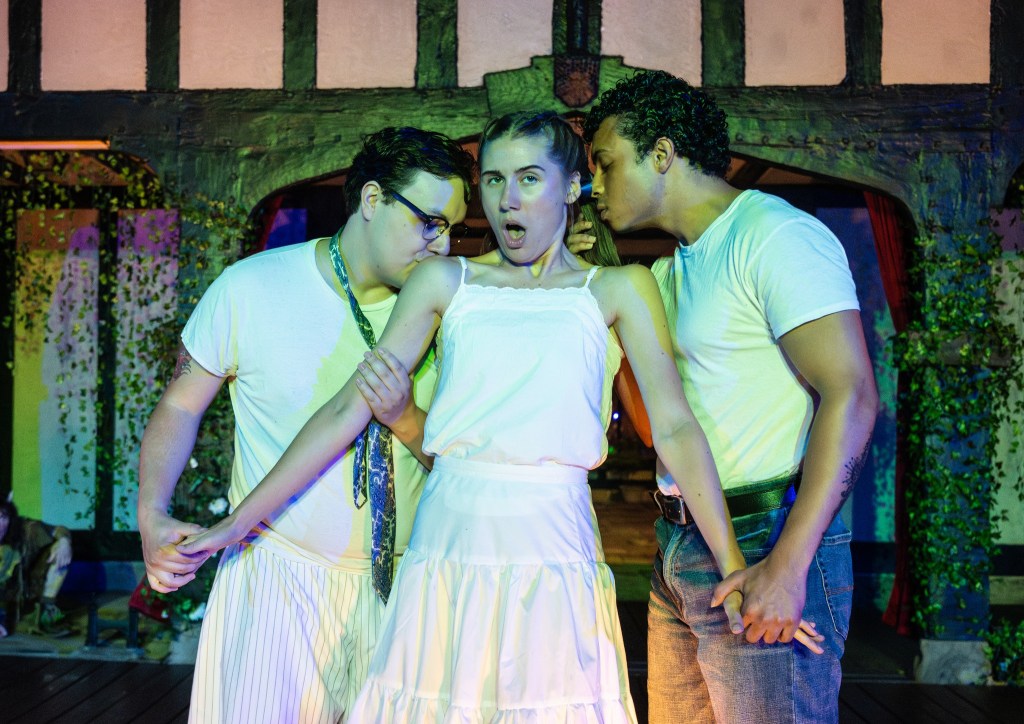
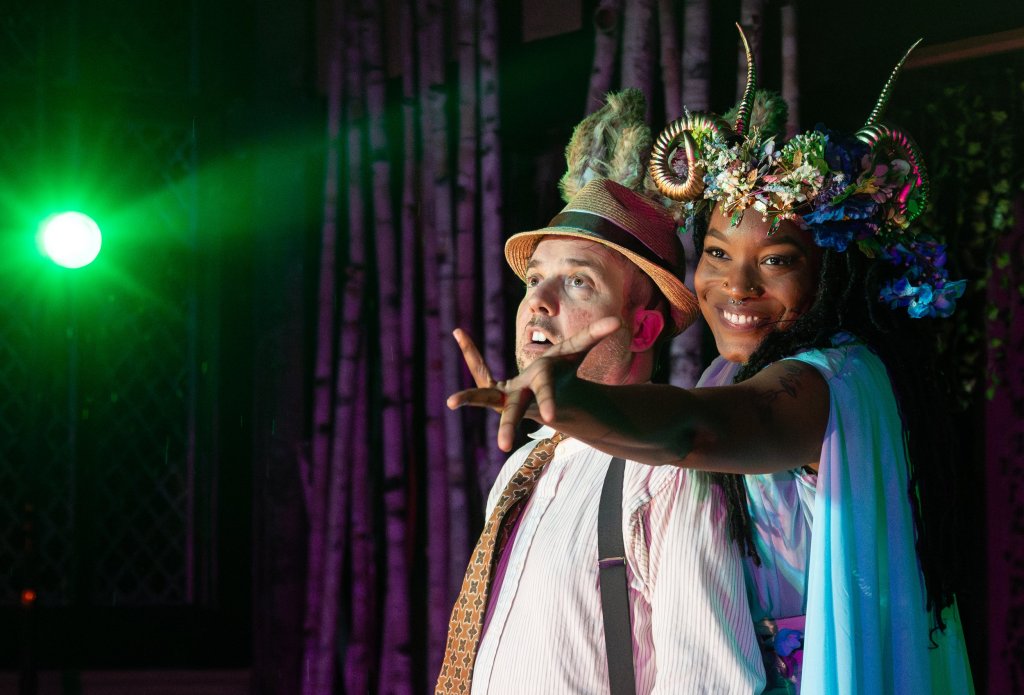
Lysander (Erich Appleby) slouches onstage looking like he’s auditioning for a role as “the Fonz” in Happy Days and Demetrius (Gordon Graham) shows up wearing his preppy letterman sweater. Hermia (Erin Chaves) wears pink pedal pushers, completing the 1950’s casual couture look, while Hermia’s father, Egeus (Erica Hughes) inexplicably sports the wide-brimmed hat and accent of a landed southern planter. Theseus, the Duke of Athens (Arik Cullen) cautions Hermia in his best Shakespearean intonation to “fit your fancies to your father’s will,” while Bottom (James Ricks), channels Marlon Brandon c.1954 spouting, “I could’a been a contender!”  

And did I mention the doo-wop songs? OMG there were doo wop songs sung by proper quartets with outstanding harmony offering such classics as “In the Still of the Night,” “At Last,” and “A Sunday Kind of Love.” A Midsummer Night’s Dream was filled with one surprise after another – all good – starting when I opened my program and saw that Richmond Shakespeare’s Artistic Director James Ricks had cast himself in the role of Bottom.

What bold choices. What unlikely pairings. What a brilliant production! This is a true ensemble, with nearly every actor getting a chance to shine. Let’s take a look:

Erick Appleby’s insouciance as Lysander, one of the two young male love interests, early on set a tone and laid a foundation for what to expect going forward. Erin Chaves, in the role of Lysander’s beloved Hermia, seems always on the verge of being the mean girl, but it’s obvious she’s got “home training” – as who wouldn’t with an over-bearing parent like Egeus (more about Erica Hughes in just a moment). Gordon Graham as Demetrius was the nerdy guy most likely to be approved by the parents, I almost felt sorry for him under the pressure of hot pursuit by the love-struck Helena, played with over-the-top angst by Paisley LoBue.

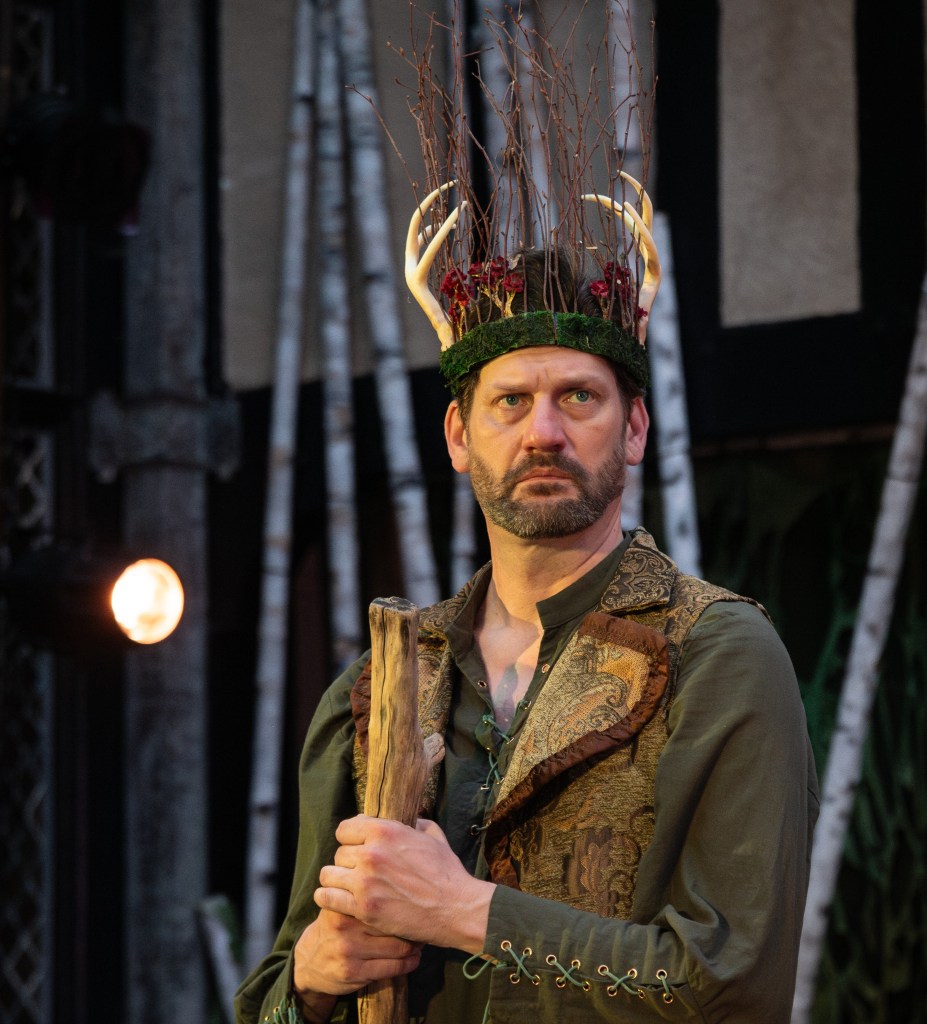
Arik Cullen was regal as Theseus, the Duke of Athens, and almost villainous as Oberon, the King of the Fairies and husband of the Fairy Queen Titania, with whom he is at odds. Jianna Hurt doesn’t have much to do as Theseus’ fiancée Hippolyta but makes up for it in her role as Titania where she gets to be beautiful, independent, and inadvertently funny (when she awakens to fall in love with a donkey) – and also gets to sing her heart out.

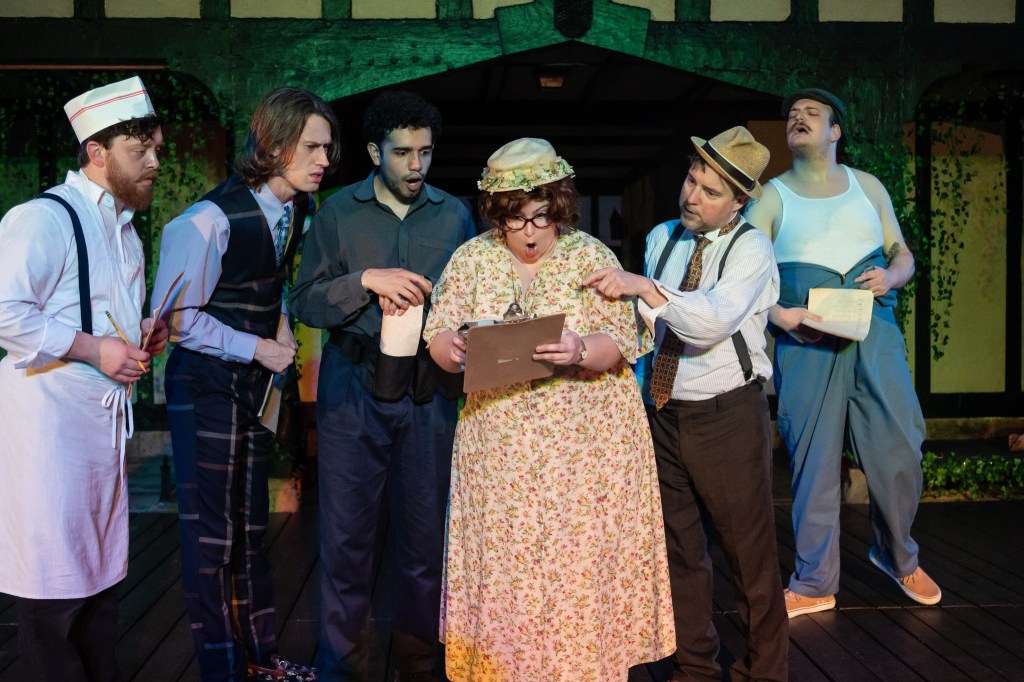
Erica Hughes, whose mastery of dialects I have long admired, played Egeus as a domineering parent with a southern accent, but it was as Quince, the leader of the mechanicals – a group of laborers (e.g., a baker, a weaver, a carpenter, etc.) who moonlight as incredibly inept actors whose goal is to perform the play-within-a-play Pyramus and Thisbe for the royal wedding program of Theseus and Hippolyta that she really shines. It is as part of this group that James Ricks has brilliantly inserted himself as Bottom, an overly confident weaver who enthusiastically volunteers to play every part in the play. Ricks turns what might otherwise have been a minor character into a highlight of every scene he tackled.

The ensemble-within-the-ensemble, who played the mechanicals as well as Titania’s fairy court included Alex Godschalk, Enrique Gonzalez, Elle Meerovich, Toby O’Brien, and Abe Timm. Meerovich also served as the play’s Music Director (the main play, that is, not the play-within-the-play) and got to lead at least one song – of course – but also made a lasting impression as The Wall in Pyramus and Thisbe – an intentionally bad parody of a Shakespeare play.

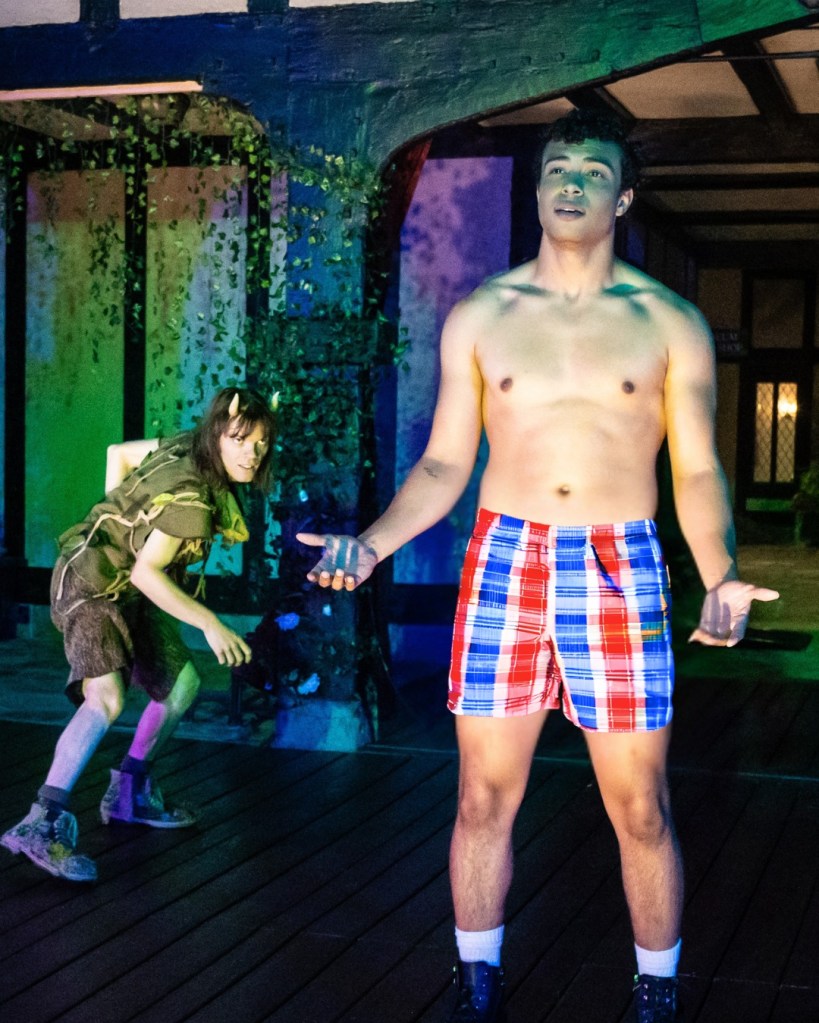
I did not forget about Puck – the mischievous assistant to Oberon whose hurried and impish nature leads to a mistake that sets in motion an epic series of misadventures. Abe Timm (he/she/them) is the most delightful, most energetic Puck I’ve ever seen, and I have seen a few – in both play and ballet form. (And I must confess, the last time I saw a Richmond Shakespeare production of A Midsummer Night’s Dream I was wholly partial because the role was played by Raven Lorraine, who was once a Brownie Girl Scout in the troop I led…)

But to get back to this production, this represents some of James Ricks’ finest work – both as director and as actor. The musical direction by Meerovich added delightfully unexpected and highly satisfying 1950’s harmony and the choreography by Starrene Foster wasn’t so much dance phrases as organic movement designed to keep everyone and everything flowing in one accord.

What more can be said about this production…other than this is what theater was meant to be.

—–

Julinda D. Lewis is a dancer, teacher, and writer who was born in Brooklyn, NY and now lives in Eastern Henrico County. When not writing about theater, she teaches dance history at VCU and low impact dance fitness classes to seasoned movers like herself and occasionally gets to perform.

—–

A MIDSUMMER NIGHT’S DREAM

Written by William Shakespeare

Directed by James Ricks

CAST

Lysander                               …..      Erich Appleby

Hermia                                   …..      Erin Chaves

Oberon/Theseus                 …..      Arik Cullen

Attendant/Fairy                   …..      Kara Finnegan

Starveling/Mustardseed    …..      Alex Godschalk

Flute/Peasblossom             …..      Enrique Gonzalez

Demetrius                             …..      Gordon Graham

Quince/Egeus          .           …..      Erica Hughes

Titania/Hippolyta                …..      Jianna Hurt

Helena                                   …..      Paisley LoBue

Snout/Moth                          …..      Elle Meerovich

Snug/Cobweb                     …..      Toby O’Brien

Bottom                                  …..      James Ricks

Puck/Philostrate                  …..      Abe Timm

PRODUCTION TEAM

Artistic Director/Bottom/

            Director/Production

            Management/

            Scenic Design/

            Sound Design          …..      James Ricks

Managing Director             …..      Jase Smith Sullivan

Production Manager/

Stage Manager        …..      Nata Moriconi

Assistant Stage Manager/

Props Design            …..      Jordan Dively

Assistant Stage Manager   …..      Kathleen Acree

Costume Design                  …..      Anna Bialkowski

Lighting Design                   …..      Griffin Hardy

Choreographer                   …..      Starrene Foster

Music Director/Arranger   …..      Elle Meerovich

Intimacy Director                 …..      Dorothy “Dee D.” Miller

Assistant Director                …..      Andrew Gall

Run Time: About 2 hours 30 minutes; there is one intermission

Setting: Ancient Athens and the nearby forest, approximately 12th Century B.C.

Photo Credits: Aaron Sutten; Richmond Shakespeare Website & Facebook page

A Brief Synopsis of William Shakespeare’s A Midsummer Night’s Dream:

A Midsummer Night’s Dream is a comedic play by William Shakespeare that intertwines the lives of four young Athenian lovers—Hermia, Lysander, Helena, and Demetrius—with a group of mischievous fairies and a troupe of amateur actors. The play is set in the mystical woods outside of Athens, where magic and whimsy reign.

The story begins with Hermia, who is in love with Lysander, but her father Egeus insists she marries Demetrius, who is in love with her. Disregarding her father’s wishes, Hermia flees with Lysander into the forest, followed by Helena, who harbors unrequited feelings for Demetrius. In the enchanted woods, the fairy king Oberon and his queen Titania are embroiled in their own domestic quarrel, leading Oberon to seek revenge using a magical flower that causes love at first sight.

As Oberon instructs his mischievous servant Puck to apply the potion to Titania and to Demetrius so he will fall in love with Helena, chaos ensues. Mistaken identities and unintentional enchantments result in a tangled web of romantic confusion among four young lovers. Meanwhile, a group of amateur actors, led by the bumbling Bottom, unknowingly becomes part of the fairy mischief, resulting in humorous transformations and antics.

Ultimately, love prevails as the magic wears off, misunderstandings are resolved, and the couples reunite correctly. The play concludes with the characters returning to Athens, ready to celebrate their marriages, and Puck delivers a final monologue inviting the audience to view the events as a dream. Shakespeare’s exploration of love, fantasy, and reality culminates in a lively and whimsical tapestry that highlights the folly and joy of human emotion.

[This synopsis was generated with the assistance of AI.]
A STRANGE LOOP

Or, How to be a Big, Black, Queer-Ass Broadway Musical

Presented by: Richmond Triangle Players in Partnership with Firehouse Theatre

At: Richmond Triangle Players at the Robert B. Moss Theatre, 1300 Altamont Avenue,  RVA 23220

Performances: June 20 – August 9, 2025

Ticket Prices: $55

Info: (804) 346-8113 or rtriangle.org

A Reflection on Theater and Things Relative by Julinda D. Lewis

———-

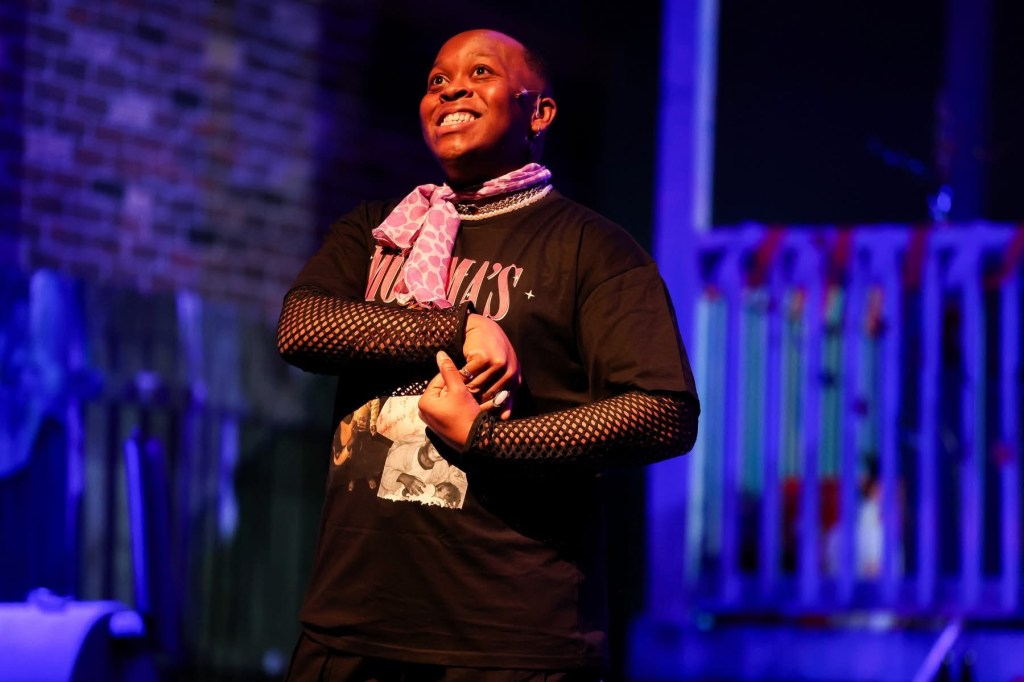
Michael R. Jackson’s Pulitzer Prize-winning musical, A Strange Loop (2019) follows the life of Usher – no, not that Usher – a Black, queer writer who works as an usher in theaters while writing his own musical about a Black queer usher who is writing a musical…about a Black queer usher who is writing a musical…

“Who knew slavery, police violence, and intersectionality could be so lucrative.”

A Strange Loop is at once as new as the latest dance craze and as old as the theater itself. The chorus of six nameless characters referred to in the program as “Thoughts” draws on the ancient Greek chorus. The Thoughts personify Usher’s inner struggles with identity and purpose. At times they represent social issues and personal demons, and at other times they represent people in Usher’s life. Come to think of it, Usher is not so much the lead character’s name as his occupation; he works as a Disney usher while struggling to overcome his writer’s block. Sometimes, the people are the issues, and sometimes the issues are the people. And since Usher is a young Black queer individual, these inner struggles encompass issues of racism, identity, homophobia, and self-doubt. Since Usher is a writer, A Strange Loop is also an exploration of the mind of creatives.

In science and technology, “a strange loop” is a concept proposed by Pulitzer prize-winning cognitive scientist and author Douglas Richard Hofstadter in his book I Am A Strange Loop (2007). In this book, Hofstadter (the son of Nobel Prize-winning physicist Richard Hofstadter) explores the sense of “I” or what is a “self” through the lens of self-referential systems. While these systems have different meanings in different fields, they most often are represented by a loop.

Playwright Jackson uses the term to refer to a self-referential thought structure or loop, in which an individual may find themselves trapped in a loop of thoughts – all too often negative thoughts – that keeps returning to the same point. For our protagonist, Usher, the loop circles around the themes of identify, self-doubt, and the writing process. Each theme in complete in itself, but in A Strange Loop the thoughts are compounded and complex, forming a never-ending loop that feeds on his insecurities which are, in turn, reinforced by social and familial pressures.

In a 2022 interview for Outreach: An LGBTQ Catholic Resource, Jackson said, “It’s very simple. The ideology is so intact that when you have that filter or that loop in yourself, nothing will break it until you break it or until your perception shifts.”  [https://outreach.faith/2022/06/interview-a-strange-loop-playwright-michael-r-jackson-talks-faith-compassion-and-sexuality/] A Strange Loop is a musical journey towards breakthrough and perception shift.

And yes, all this background may sound like technical, scientific mumbo jumbo to some, but it is key to understanding this play and this character. Who among us has not been affected by negative self-talk? And this play, this big, complex musical wonder, has been recognized many times over for its heartfelt message. A Strange Loop won the 2022 Tony Award for Best Musical and Best Book of a Musical. It also won the 2020 Pulitzer Prize for Drama even before its Broadway run.  The Pulitzer committee recognized Jackson’s work as “a metafictional musical that tracks the creative process of an artist transforming issues of identity, race, and sexuality that once pushed him to the margins of the cultural mainstream” while acknowledging the universality of human fears and insecurities. There were other awards, too – Drama Desk, New York Drama Critics’ Circle, and numerous nominations in multiple categories. You can be intellectual and artistic at the same time. A Strange Loop is a lot of things, all at once, and probably deserves more than one viewing.

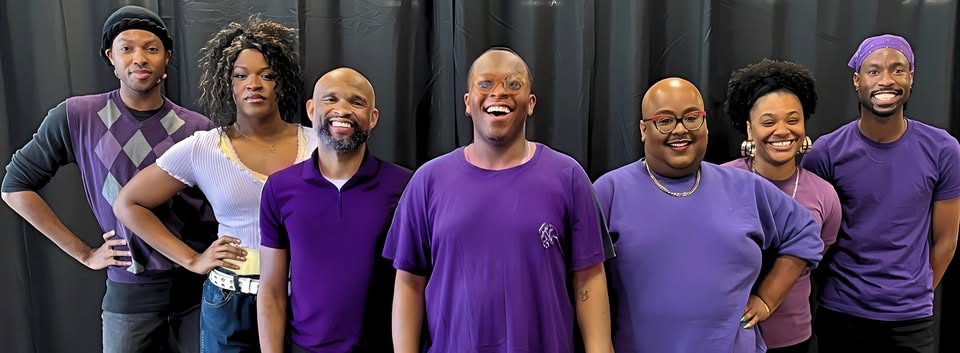
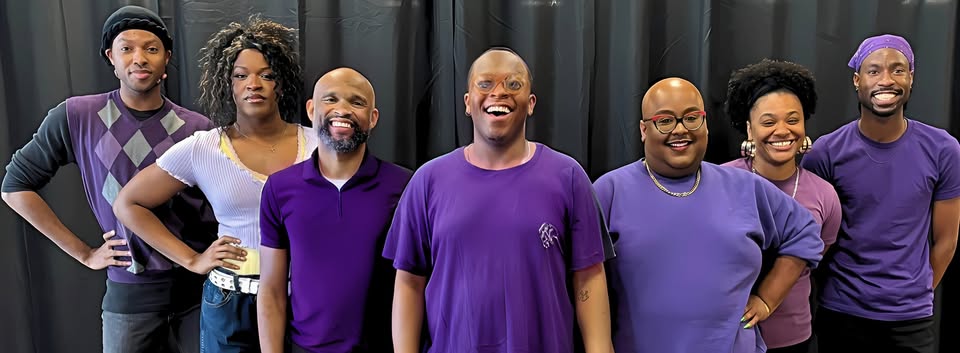
This Richmond production, under the masterful direction of the multi-talented Katrinah Carol Lewis, with musical direction by Ben Miller and choreography by Deandra Clarke boasts a stellar cast headed up by Marcus Antonio. Antonio was most recently seen at the Firehouse/TP production of Fat Ham [https://jdldancesrva.com/2025/04/17/fat-ham/] where he gave an alternately sly, philosophical, and just generally endearing performance as the main character Juicy, modeled after Hamlet. In A Stange Loop, you forget Antonio is acting. He embodies the character of Usher with authenticity, but also with grace – and I’m not just talking about the physical kind of grace, but the spiritual kind of grace as well. And did I mention he can sing his butt off? You need to see and hear it for yourself.

Each and every one of the “Thoughts,” deserves special mention, but I know I would omit something or someone important. At one point they form a parade of past heroes including Harriet Tubman, Marcus Garvey, James Baldwin, Whitney Houston, Zora Neal Hurston. When Zakiyyah Jackson/Thought #1 takes on the persona of an older Black woman who shares her wisdom and advice with Usher, she reminds me of the fabulous Phylicia Rashaad. Her last appearance on the RTP stage was, in fact, in a production of How Black Mothers Say I Love You [https://www.facebook.com/share/v/19WrqXMdBi/ ] TeDarryl Perry/Thought #4 and the understudy for Usher simply nails it as Usher’s mother. The red dress, the mannerisms, the attitude that flips without notice from, “The bible says homosexuality is worse than murder” or “Why do you hate me; you’re selfish” to love reminds me of people in my own extended family. I’m sure we all know at least one like her, or him.

I couldn’t believe that Anthony Cosby Jr., most recently seen in last season’s Yes, And! Production of Pass Overand known for his fabulous Prince tribute shows, was just now making his RTP debut as Thought #5. Likewise, it was awesome to watch Keaton Hillman/Thought #6 add to his growing repertoire of memorable characters. I haven’t seen Todd Patterson/Thought #3 sing and dance this much since BootyCandy (2022) [https://jdldancesrva.com/2022/06/17/bootycandy/]. I am not yet familiar with the beautiful Nesziah Dennis/Thought #2 but thoroughly enjoyed her performance and look forward to seeing more of them in the future.

With all the trauma in A Strange Loop, there is no deficit of humor. The parents’ names are Serabi and Mufasa, and the granddaughter is Nyla. Besides paying homage to The Lion King, it seems a bit of an inside joke that they are also the King and Queen of the Pridelands.

There are plenty of biblical references as well, from things people think are in the bible but actually aren’t (e.g., AIDS is God’s punishment for not living right) to actual bible quotes (e.g., But these, like natural brute beasts made to be caught and destroyed, speak evil of the things they do not understand, and will utterly perish in their own corruption – 2 Peter 2:12 NKJV).

Production-wise, A Strange Loop utilizes the space at RTP so well that the stage seemed wider and deeper than it actually is – in other words, bigger than life. Frank Foster’s scenic design consisted of strands of light, in curving bands like a roller coaster or strands of DNA, and 18 slim poles. Michael Jarett’s lighting was evocative, simple, and dramatic in turn.

This is a musical, so I would be derelict not to mention the music, which encompasses multiple genres including R&B and gospel – sometimes with full choir robes. The songs were fully integrated into the book, with lyrics that seamlessly expanded the storytelling aspects of the show. One of the most memorable, near the end, was “Memory Song,” a work that kind of summarizes the intent and direction of the entire work, touching on Usher’s childhood memories and relationships, his sexuality, and his faith. [See the lyrics to “Memory Song” below.] In his bio, TeDarryl Perry wrote that this performance is dedicated to “all those Black, gay boys who chose to go on back to the Lord.”

In the end, A Strange Loop, while frequently referred to by participants as “a big, black, and queer ass American Broadway show,” is not just a niche show. It is for Black, queer people. It is for people who are exploring their sexuality or identity. It is for people who care abut mental health and identity. It is for anyone who has ever experiences self-doubt or self-hate. It is for people who have been bullied and people who have bullied others. It is for people who love a good story. It is for people who care about other people. It is for people who care. A loop is never-ending. The only way out is to break through.

Here’s a link to a preview of A Strange Loop: https://www.facebook.com/share/v/19WrqXMdBi/

Here are the lyrics to “Memory Song”:

Five foot four, high school gym
Sneaking a cupcake
These are my memories

Shooting hoops off the rim
Slow on the uptake
These are my memories

After gym, the locker room
My eyes photographing
Naked me measures in at four and a half inches
These are my memories

Of one lone, Black, gay boy I knew
Who chose to turn his back on the Lord
One lone, Black, gay boy I knew
Who chose to turn his back on the Lord

Guild and shame
Jesus’ name
Church every Sunday
These are my memories

Eat his body
Drink his blood
Communion buffet
These are my memories
Sweet, sour memories

After church we’re driving home to radio crackle
Jazz music or Motown blues
And skin is a shackle
For one lone, Black, gay boy I knew
Who chose to turn his back on the Lord
One lone, Black, gay boy I knew
Who chose to turn his back on the Lord

These are my memories
Sweet, sour memories
This is my history
This is my mystery

Mom is napping on the couch
And dad cuts the grass
While I watch TV all day long
Young & the Restless
Like one lone, black, gay boy I knew
Who chose to turn his back on the Lord
One lone, black, gay boy I knew
Who chose to turn his back on the Lord

Dad is drunk and on the couch
While mom eats a porkchop
Daily bread mill
Daily treadmill won’t ever stop
One lone, Black, gay boy I knew
Who chose to turn his back on the Lord
One lone, Black, gay boy I knew
Who chose to turn his back on the Lord

I am lying on the couch
I dream that I’m flying
Flapping both my wings so hard
To keep me from dying
With a crown of godforsaken thorns on my head
Like all those black, gay boys I knew
Who chose to go on
Back to the Lord (like all those black, gay boys you knew who chose to go on back to the Lord)

All those Black, gay boys I knew
Who chose to go on
Back to the Lord (all those Black, gay boys you knew who chose to go on back to the Lord)
All those Black, gay boys I knew
Who chose to go on
Back to the Lord! (all those Black, gay boys you knew who chose to go on back to the Lord)
And one lone, Black, gay boy I knew
Who chose to turn his back-
On the Lord- (chose to turn his back on, chose to turn his back on the Lord)
Instead

Source: Musixmatch |Songwriters: Michael Jackson | Memory Song lyrics © Kobalt Music Services America Inc.

———-

Julinda D. Lewis is a dancer, minister of dance, teacher, and writer who was born in Brooklyn, NY and currently resides in Eastern Henrico County. When not writing about theater, she teaches dance history at VCU and low impact dance fitness classes to seasoned movers like herself and occasionally performs.

———-

A STRANGE LOOP

Book, Music, & Lyrics by Michael R. Jackson

Directed by Katrinah Carol Lewis

Cast

Marcus Antonio ….. Usher

Zakkiyah Jackson ….. Thought #1

Nesziah Dennis ….. Thought #2

Todd Patterson ….. Thought #3

TeDarryl Perry ….. Thought #4 & U/S Usher

Anthony Cosby Jr ….. Thought #5

Keaton Hillman ….. Thought #6

Understudies

Nia Frazier ….. Thoughts

Sydnee S. Graves ….. Thoughts

A Strange Loop Band

Conductor/Keyboard ….. Ben Miller

Guitar ….. Lake Stiles

Drums ….. Joe Lubman

Reeds ….. Jalen Wise

Creative Team

Scenic Design ….. Frank Foster

Lighting Design ….. Michael Jarett

Costume, Hair, & Makeup Design ….. Margarette Joyner

Sound Design …. Grace Brown LaBelle

Props Design ….. Tim Moehring

Production Stage Manager ….. Lauren Langston

Choreography ….. Deandra Clarke

Music Direction ….. Ben Miller

For This Production

Assistant Stage Managers ….. Christopher R. Smith, Finn Thomason

Intimacy Director ….. Nora Ogunleye

Gender Consultant ….. August Hundley

Technical Director ….. Emily Vial

Master Electrician ….. Griffin Hardy

Sound Assistant ….. Julie Vo

Set Construction ….. David Allan Ballas, Grace Brown Labelle, Todd Labelle, Emily Vial, Patrick Rooney

World Premiere by Playwrights Horizons, Inc. in association with Page 73 Productions in New York City in 2019.

Performance Schedule

June 20 – August 9, 2025

Sundays at 4:00PM

Wednesdays at 8:00PM

Thursdays at 8:00PM

Fridays at 8:00PM

Saturdays at 8:00PM, closing August 9

Tickets

Ticket Prices: $55

Run Time

About 2 hours with no intermission

Setting

A loop within a loop within a loop inside a perception of one man’s reality.

Photos from the RTP Facebook page

HONKY TONK HISSY FIT

Another Doublewide Texas Comedy

A Theater Review by Julinda D. Lewis

Presented by CAT – Chamberlayne Actor’s Theatre

At: The Bradley Theatre at Hanover Tavern, 13181 Hanover Courthouse Rd., Route 301, Hanover, VA 23069

Performances: June 6-22, 2025

Ticket Prices: $34.00 General Admission. $30.00 Seniors 60+

Info: (804) 362-2950 or www.cattheatre.com

Honky Tonk Hissy Fit is the third in the trilogy of Doublewide comedies written by Jessie Jones, Nicholas Hope, and Jamie Wooten. Published in 2021, HHSF as supposed to have its world premiere at CAT, but COVID happened. The play had its world premiere April 30, 2021 at the Lake Country Playhouse in Mineola, TX, but the published book carries the following dedication:

            HONKY TONK HISSY FIT was originally scheduled to receive

its world premiere at Chamberlayne Actors Theatre, Richmond,

Virginia, on September 18, 2020. Due to the Covid-19 Pandemic,

the premiere had to be cancelled. We dedicate this play to Kelly

St. Clair and all the members of CAT Theatre who tirelessly sought

to find a way to produce this comedy.

The earlier parts of the trilogy have been presented in Richmond and you can find my reviews of Doublewide, Texas performed by CAT Theatre in June 2018 (https://jdldancesrva.com/2018/06/05/doublewide-texas-a-hoot-n-a-hollar/) , followed by A Doublewide, Texas Christmas in November-December 2018 (https://jdldancesrva.com/2018/06/05/doublewide-texas-a-hoot-n-a-hollar/) both at CAT’s former Wilkinson Rd. location.

In the first part of the trilogy, the tiny town of Doublewide is threatened with annexation by the nearby town of Tugaloo. The Christmas show found the little town – population 10 – facing complications as they awaited their incorporation papers. Having survived all of that – plus COVID – Honky Tonk Hissy Fit now finds the town has grown from 4 trailers and a shed to 17 doublewide mobile homes and proudly hosts a weekend farmer’s market. Just when things are looking up, here comes another attack, this time from a corporation in Austin that wants to buy them out and turn the whole town into an immersive experience for tourists. Once it becomes known that the plan would force everyone to relocate, the fight is on, led, once again, by Mayor Joveeta Crumpler, played, for the third time, by Crystal Oakley.

Also returning are Laura McFarland-Bukalski as Big Ether Satterwhite, director of the local senior residence, Stairway to Heaven Retirement Center, Lisa Piper as Georgia Dean Rudd, and Wally Jones as Haywood Sloggett.

The southern-styled comedy is not short of laughs, from “Baby” Crumpler’s dance moves to Haywood Sloggett’s pursuit of the local celebrity and town matriarch Caprice Crumpler. Georgia Dean is still in charge of the local diner, Mayor Joveeta Crumpler maintains her position as the town’s solo voice of reason, and free-spirit Larken Barken trades in her fresh pressed juices for a caffeine kick.

Crystal Oakley owns her character of Joveeta with a deliciously southern genteel passion, while Rebekah Spence plays up the larger-than-life character of Joveeta’s mother, Caprice. Harper Channing, making her CAT debut as the villainous Stacy Parker, introduced a precarious balance between “bless-your-heart” and heartless   businesswoman clawing her way to a promotion.

While Honky Tonk Hissy Fit is a stand-alone play, knowing the background of the previous Doublewide shows provides helpful information and sets up ground level expectations. There were, indeed, laughs aplenty, but…

Overall, Honky Tonk Hissy Fit fell a bit flat. The set looked tired, worn-out, drab. The laughs were genuine, but the delivery seemed at times to be lackluster. The pacing wasn’t too slow, but the delivery sometimes felt…forced? I’m not saying I didn’t have a good time, but I don’t believe CAT pulled out the good company dishes for this one.

———-

Julinda D. Lewis is a dancer, teacher, and writer who was born in Brooklyn, NY and now lives in Eastern Henrico County. When not writing about theater, she teaches dance history at VCU and low impact dance fitness classes to seasoned movers like herself and occasionally gets to perform.

HONKY TONK HISSY FIT:

A Doublewide Texas Comedy

Written by Jones Hope Wooten

Directed by Mike Fletcher

Cast

Big Ethel Satterwhite          …..      Laura McFarland-Bukalski

Georgia Dean Rud              …..      Lisa Piper

Nash Sloggett                      …..      Michael Edward McClain

Larken Barken                      …..      Payton Vernier

Caprice Crumpler               …..      Rebekah Spence

Haywood Sloggett              …..      Wally Jones

Joveeta Inez Crumpler       …..      Crystal Oakley

Norwayne “Baby” Crumpler …..      Chris Yarbrough

Harper Channing                 …..      Stacy Parker

Creative Design Team & Crew

Producer –  Crystal Oakley

Hanover Tavern Executive Director – David Deal

Lighting Design – TJ Washington

Scenic Design – Scott Bergman

Costume Design – Alison Eichler

Sound Design – CC Corrieri

Properties Design – Sandi Bergman

Lights and Sound Operator – CC Corrieri

Publicity – Jason Lucas

Photography – Daryll Morgan Studios

Set Construction – Charles ax, Sandi Bergman Kerrigan Sullivan, Scott Bergman, Crystal Oakley, CC Corrieri

Setting

Doublewide, Texas. The present. The play takes place over 8 days in late spring.

Run Time

Approximately 2 hours, including one 15-minute intermission

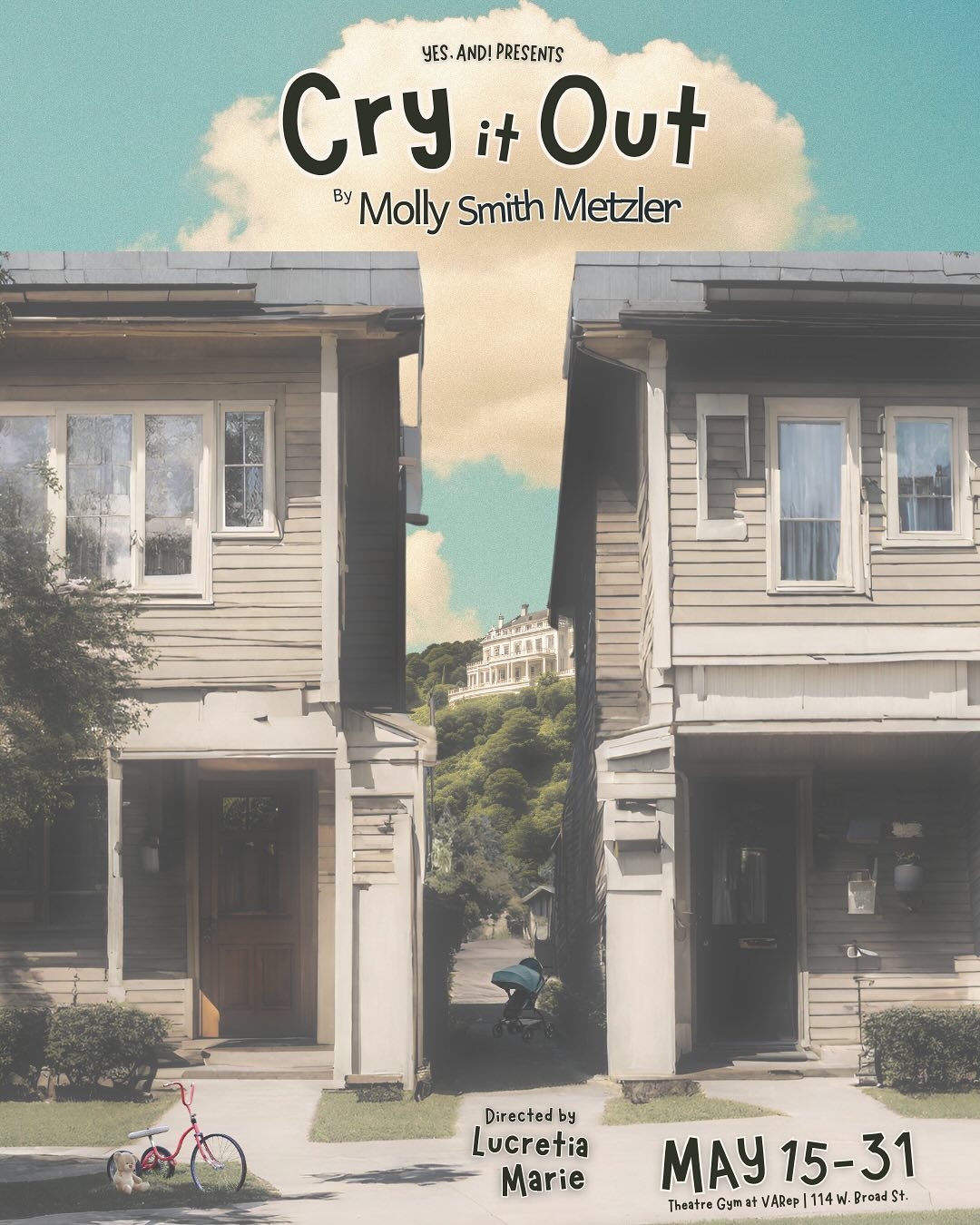
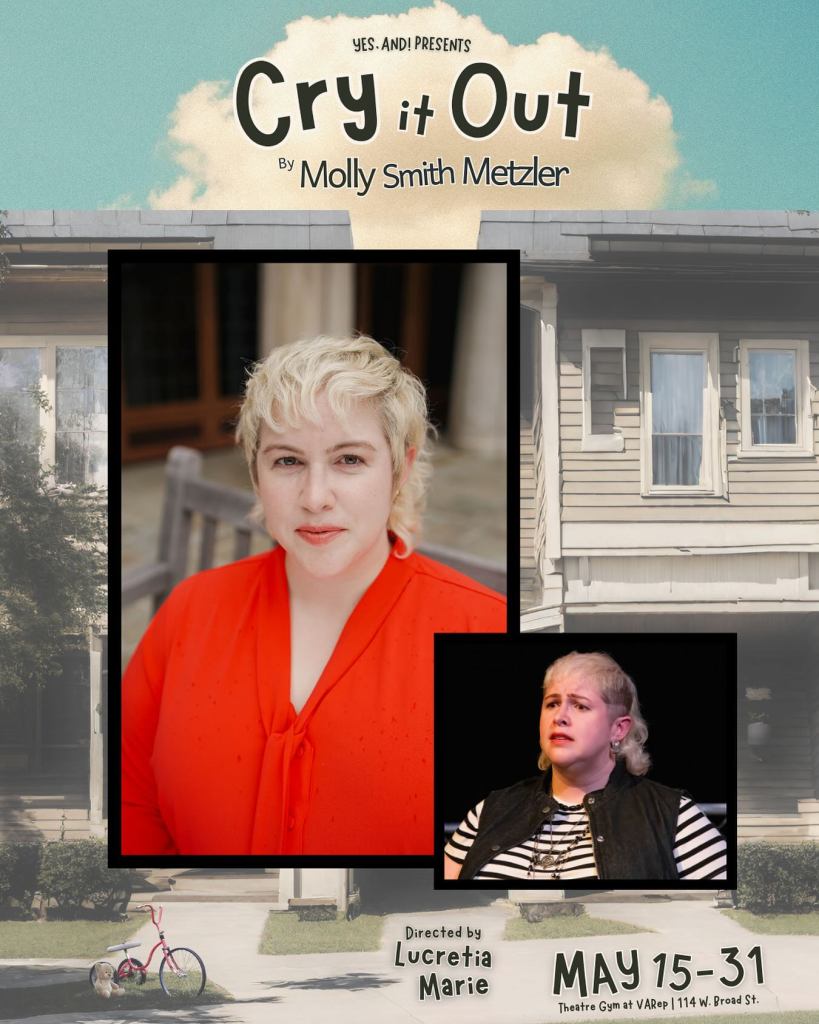
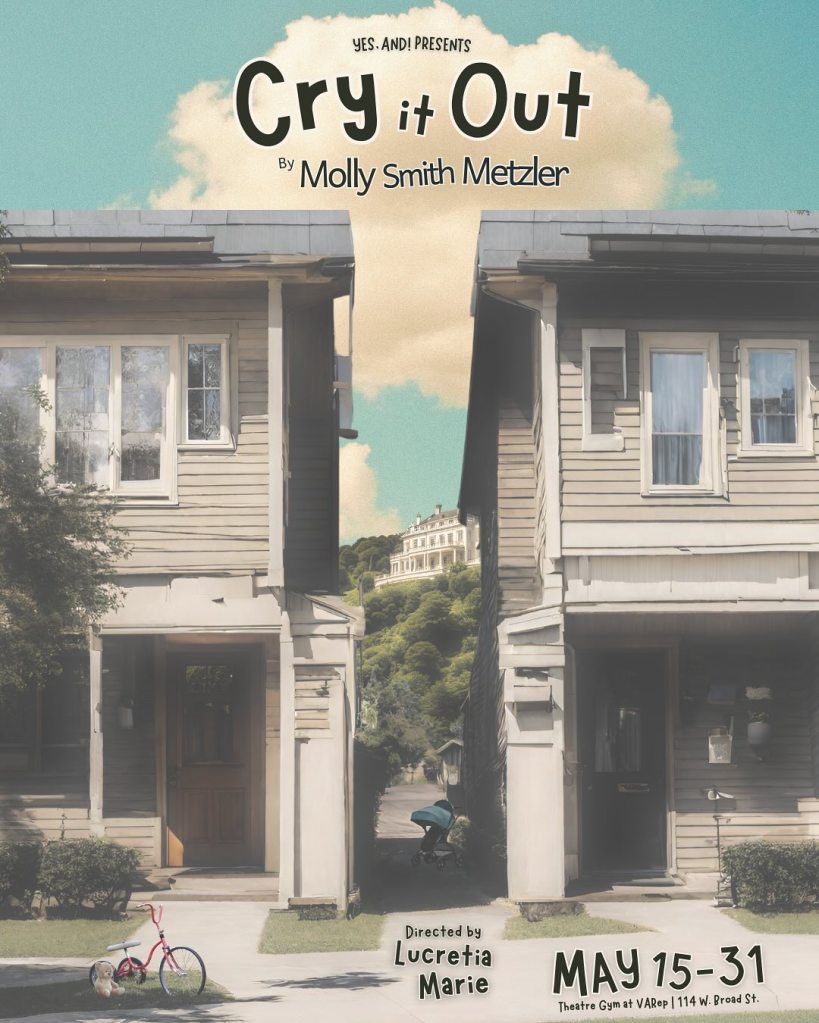
CRY IT OUT

…A Method for Training New Moms…

Produced By: Yes, And! Theatrical Company in partnership with Virginia Repertory Theatre

At: Theatre Gym at VaRep, 114 West Broad Street, RVA 23220

Performances: May 15-31, 2025

Ticket Prices: $40 general admission

Info: Email: yesandrva@gmail.com; Website: yesandrva.org; Facebook: http://www.facebook.com/yesandrva/

A Theater Review by Julinda D. Lewis

Some definitions you might need to know before seeing Cry It Out:

Cry It Out (CIO):  a sleep training technique that involves putting babies in their cribs and leaving them to cry or self-soothe and fall asleep without parental intervention

NoseFrida®: a nasal aspirator or “snot sucker” for babies who do not yet know how to blow their noses

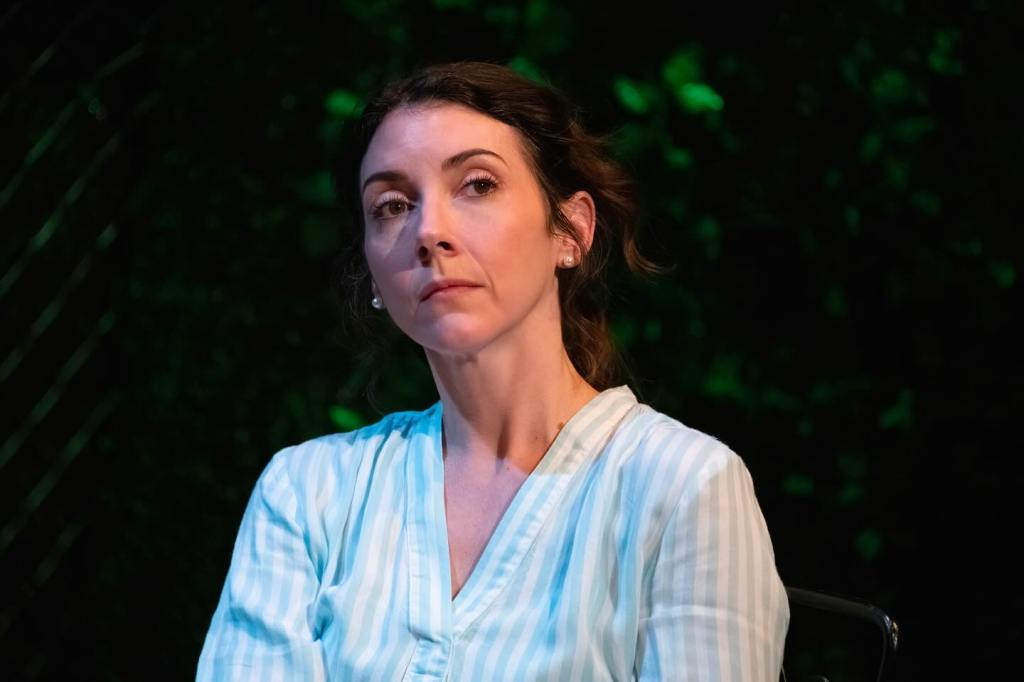
Some plays are just more relatable than others. I’m not sure how this play hits if you’re not a mother (feel free to comment!), but Molly Smith Metzler’s take on motherhood, Cry It Out (2017) is empathetic, relevant, authentic, and hilarious. Just as we warm up to the growing friendship between Jessie (Lindsey Zelli) and Lina (Emily Berry), the playwright throws in not one, not two, but three new plot-changing dynamics.

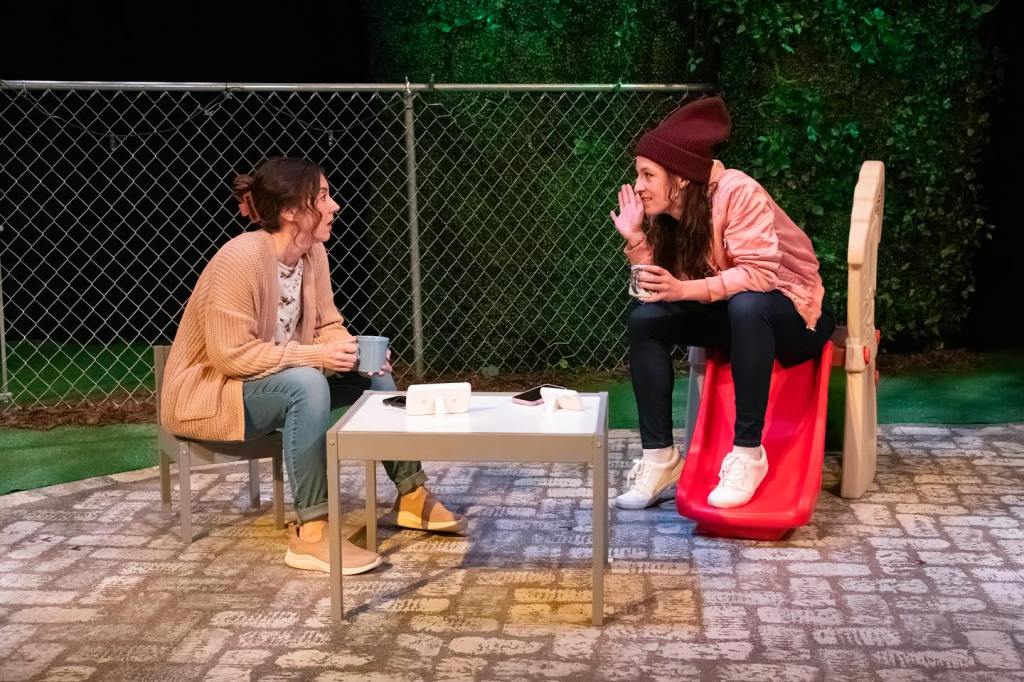
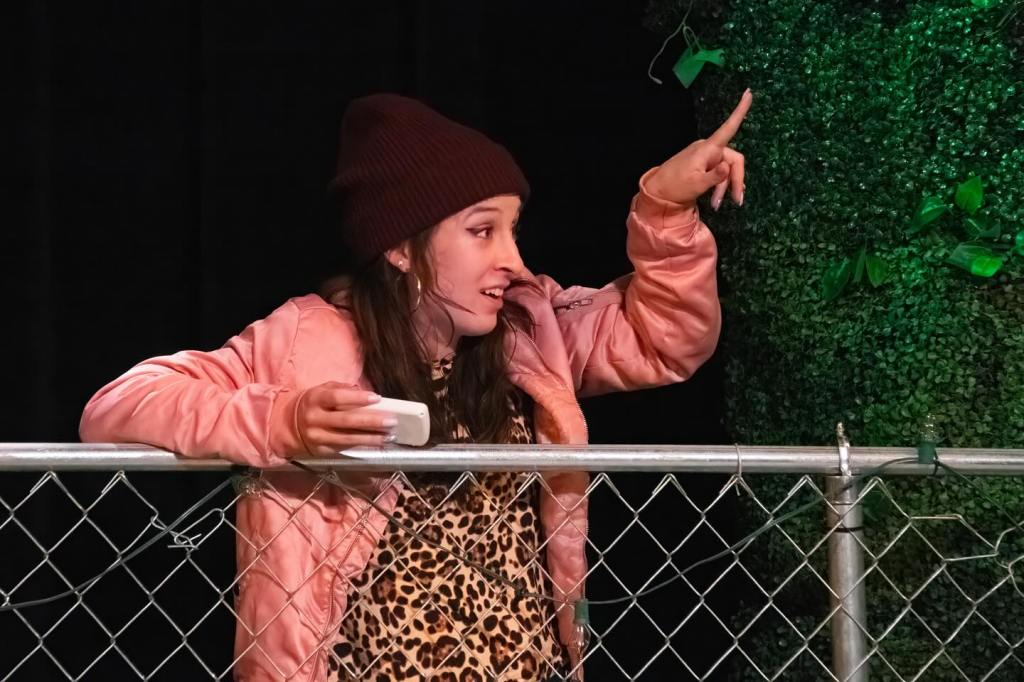
Both new moms, Jessie is a corporate lawyer married to an unseen spouse who still works in New York City and commutes to their Port Washington, Long Island home. Jessie’s in-laws are “old money” residents and have already pre-paid for their infant granddaughter’s first year at an exclusive daycare. Lina is a hospital receptionist from Long Beach on the South Shore (more urban, more “new money,” more Jersey Shore-ish, if you will) with a somewhat shady past. She, her son, and her partner are living with his mother who has a worrisome habit of disposing of her empty wine boxes in a public dumpster. Jessie is empathetic, a problem solver. Lina is brash, funny. Both are loving mothers and quickly bond, in spite of their differences, over daily coffee meetings while their babies nap.

But discussions of isolation, how to get their babies to sleep, and things like nasal aspirators move to the back seat as the weeks go by and the subject of returning to work becomes increasingly pressing. The economic necessity of mothers returning to work takes on a different, but no less significant, role depending on one’s socio-economic status: where to live; how to pay the bills; career choices and milestones; and childcare.

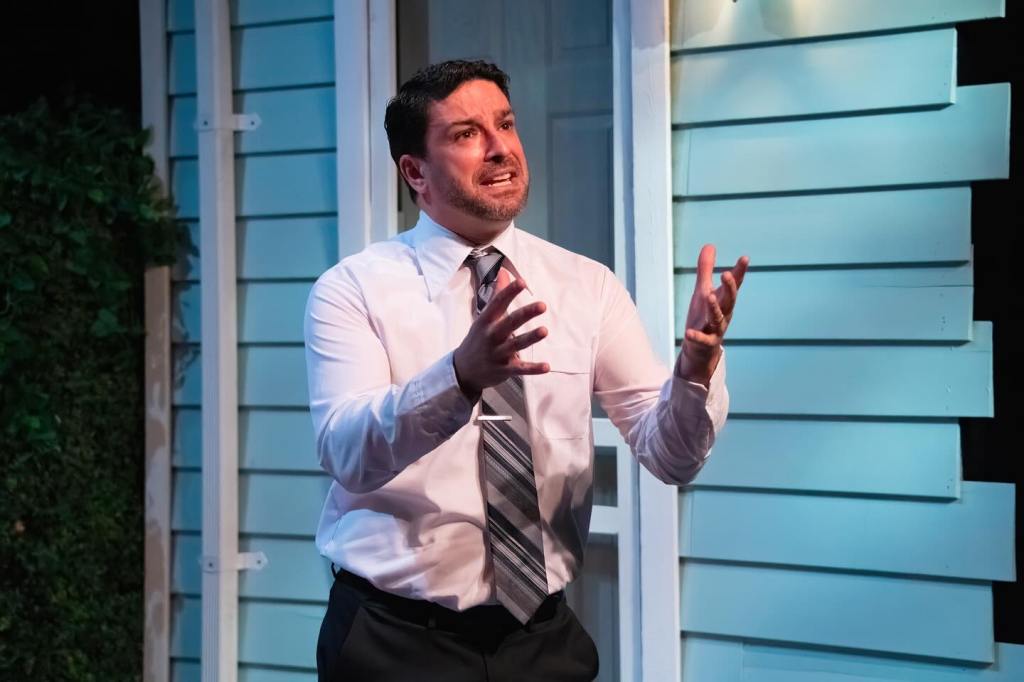
One day Mitchell (Axle Burtness), a neighbor, whose house overlooks Jessie’s backyard from up on a hilltop disrupts the delicate ecosystem Jessie and Lina have established. Mitchell has seen (spied upon?) the women’s cozy coffee klatches and, feeling concerned about his wife’s adjustment to motherhood, wants his wife Adrienne (played by understudy Erica Hughes on the night I attended) to join them.

The initial meeting is a disaster, and Adrienne subsequently presents an entirely different perspective on new motherhood, work, and society’s perceptions and expectations in general. The ending is quite surprising and reinforces the all-important lesson that motherhood, and families, do not conform to a one-size-fits-all archetype.

Lucretia Marie has directed Cry It Out with sensitivity and an unhurried pacing that assures each of these mothers is heard. Zelli imbues her character with warmth and wisdom even as Jessie herself struggles to navigate these unfamiliar waters. Berry perfectly balances Zelli, with Lina’s heavy eyeliner, thicker accent, and even more colorful language. Hughes brought the tension and surprise, and while Burtness’s character was a caring and loving father, Mitchell was the most emotional of the four parents present – sometimes to the point of being overwhelming.

Nothing much actually happens in Cry It Out. The whole play takes place in Jessie’s sparsely furnished backyard – there’s just a toddler’s playset and table and chair, and later a small patio table with three chairs. (Hm, three chairs, I thought – but there’s only two of them, so…) It’s a play that relies heavily on what’s said, and how it’s said, and who says it. Who but Lina could so convincingly tell a story about going to the door to meet the FedEx delivery man, forgetting to tuck in her breast because she was in the middle of breastfeeding. This reliance on simple, authentic dialogue, I think, places an even greater burden on the actors, who can’t hide behind a pratfall or a prop. Cry It Out makes us think about things that affect most of us, but that we may not often talk about in an open forum. Cry It Out is timely, real, and impactful.

———-

Julinda D. Lewis is a dancer, minister of dance, teacher, and writer who was born in Brooklyn, NY and currently resides in Eastern Henrico County. When not writing about theater, she teaches dance history at VCU and low impact dance fitness classes to seasoned movers like herself and occasionally gets to perform.

———-

CRY IT OUT

Written by Molly Smith Metzler

Directed by Lucretia Marie

Cast

Jessie ….. Lindsey Zelli

Lina     ….. Emily Berry

Mitchell ….. Axle Burtness

Adrienne ….. Sara Dabney Tisdale

Understudy Cast

Jessie ….. Tensley Nesbitt

Lina ….. Brittany Martz

Mitchell ….. Sarbajeet Das

Adrienne ….. Erica Hughes

Production Team

Scenic Design – Dasia Gregg

Costume  Design – Erik Mayes

Lighting Design – Kacey Yachuw

Sound Design – John Pratt

Properties Design – Cai Hayner

Dialect Coach – Erica Hughes

Fight Choreography – Axle Burtness

Production Stage Manager & PSM – Crimson Piazza

Assistant Stage Manager – Marcely Villatoro

Technical Director – Ben Burke

YES, AND! THEATRICAL COMPANY

Artistic Director – Maggie Roop

Executive Director – Matt Shofner

Performance Schedule

Thursday, May 15, 2025                 7:30PM          Opening Night

Friday, May 16, 2025                      7:30 PM

Saturday, May 17, 2025                 7:30PM

Friday, May 18, 2025                      7:30PM

Saturday, May 19, 2025                 7:30PM

Sunday, May 20, 2025                    2:00PM          Pay What You Can*

Tuesday, May 21, 2025                  7:30PM         

Thursday, May 22, 2025                 7:30PM

Friday, May 23, 2025                      7:30PM

Saturday, May 24, 2025                 2:00PM

Saturday, May 24, 2025                 7:30PM

Sunday, May 25, 2025                    2:00PM          Pay What You Can*

Tuesday, May 27, 2025                  7:30PM          Industry Night/Pay What You Can*

Thursday, May 29, 2025                 7:30PM          Understudy Night

Friday, May 30, 2025                      7:30PM

Saturday, May 31, 2025                 2:00PM

Saturday, May 31, 2024                 7:30PM          Closing Performance

World Premiere: 2017 Humana Festival of New American Plays at Actors Theatre of Louisville.

Tickets

Ticket Prices: $40 general admission; $20 Rush Rickets at the Box Office one hour prior to all performances

*Pay What You Can: $5 suggested minimum at the door; $10 minimum in advance

Run Time

Approximately 1 hour, 40 minutes with one 15-minute intermission

Photos from the Yes, And! Theatrical Co., Facebook page

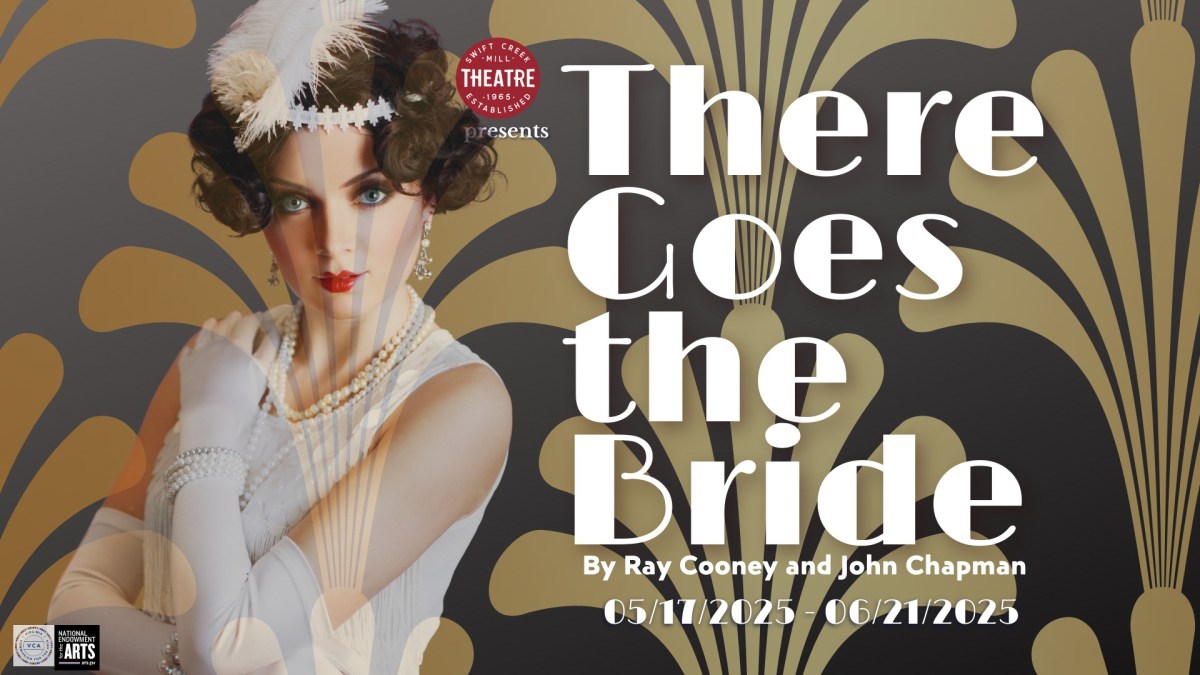
THERE GOES THE BRIDE

A Ray Cooney Farce!

At: The Swift Creek Mill Theatre, 17401 U.S. Route One, Chesterfield, VA 23834

Performances: May 17 – June 21, 2025

Ticket Prices: $44-49. Ask about discounts for students, seniors, and veterans.

Info: (804) 748-5203 or https://www.swiftcreekmill.com

A Theater Reflection by Julinda D. Lewis

In his pre-show curtain talk, director Tom Width told the Wednesday matinee audience that this show, There Goes the Bride, was the seventh Ray Cooney farce to grace the Swift Creek Mill stage*. Just last June we were treated to Run for Your Wife, https://jdldancesrva.com/2024/06/08/run-for-your-wife/ just for the fun of it. This spring, Width brought back There Goes the Bride after a 20-year hiatus, because “it’s just so stupid!”

The Plot

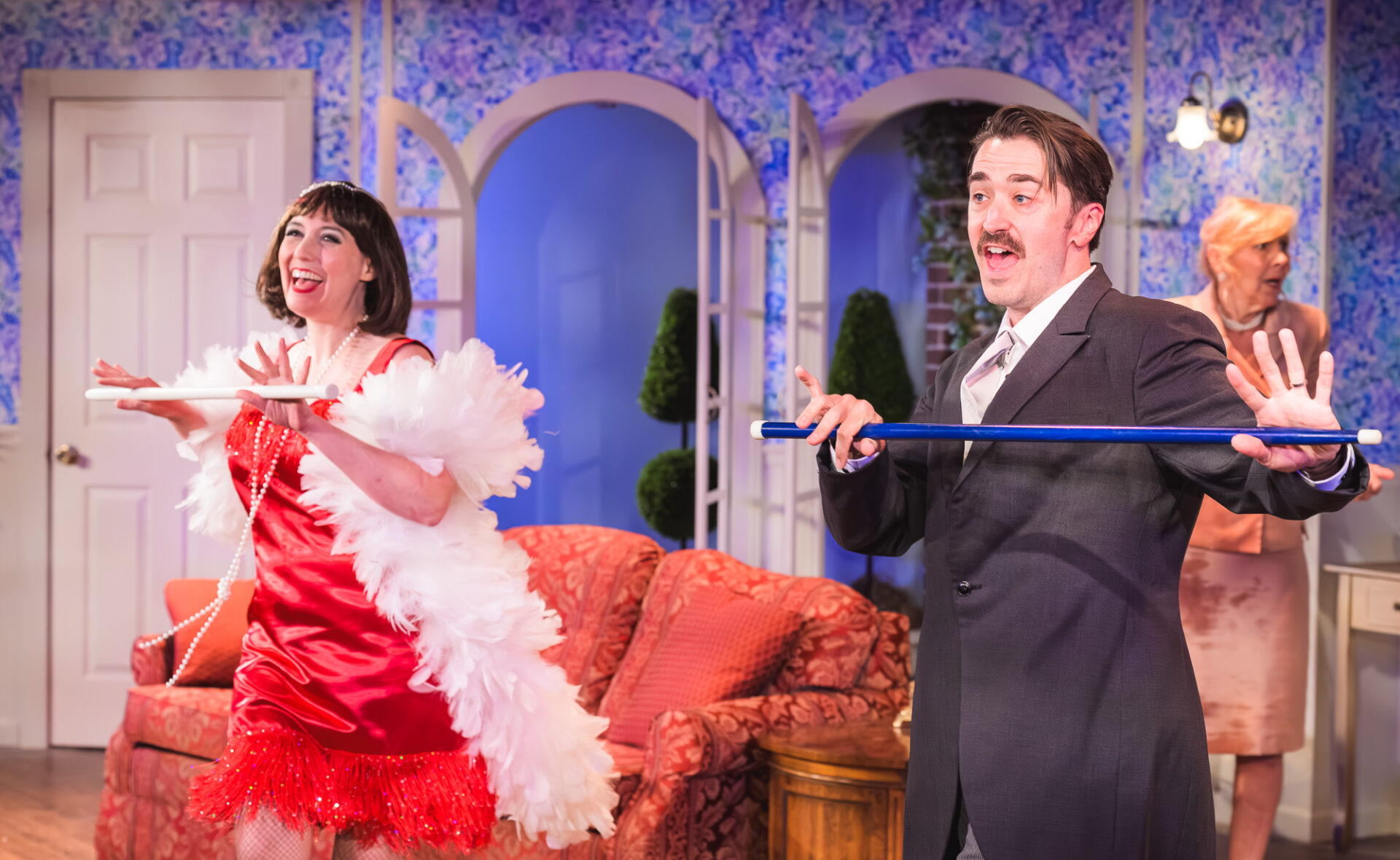
Timothy Westerby, an affable but overworked advertising executive, is trying to complete an ad campaign on the morning of his daughter’s wedding. He has to balance picking up the flowers, getting them to the church and to the prospective in-laws at their hotel, picking up some black socks for his own father-in-law, and along the way picking up the life-sized cut-out of the new ad campaign’s mascot – a 1920s flapper in a red dress and feather boa (and yes, those details are all important). Of course, he botches these assignments and ends up getting a bump in the head that results in him hallucinating that the flapper cut-out is a real woman, who has a crush on him, and who is dance partner in a show-business routine. Whew! Got all that? Because the fun is just getting started.
The Farce

In true farcical style (and I guess that is a real word, since spell check didn’t flag it…), things go downhill quickly. The bride locks herself in her room. Timothy’s wife, Ursula, pretends Timothy’s cousin, Bill, is her husband because Charlotte, the bride’s pretentious mother-in-law-to-be, who has travelled all the way from Australia only to find that Timothy, the bride’s father, had forgotten to confirm her hotel reservation, is appalled at Timothy’s behavior. Ursula’s mother, Daphne, spends much of the morning trying to get into her girdle, while her husband, Gerald, a retired doctor, meddles in everybody’s business and has a grand old time mimicking Timothy who suffers not just one but a series of head bumps, each leading to more outrageous behavior until, finally, he comes to himself. Ursula becomes increasingly distraught trying to compete with Polly who, by the way, no one but Timothy can see, because she is, after all, an hallucination.

My Take

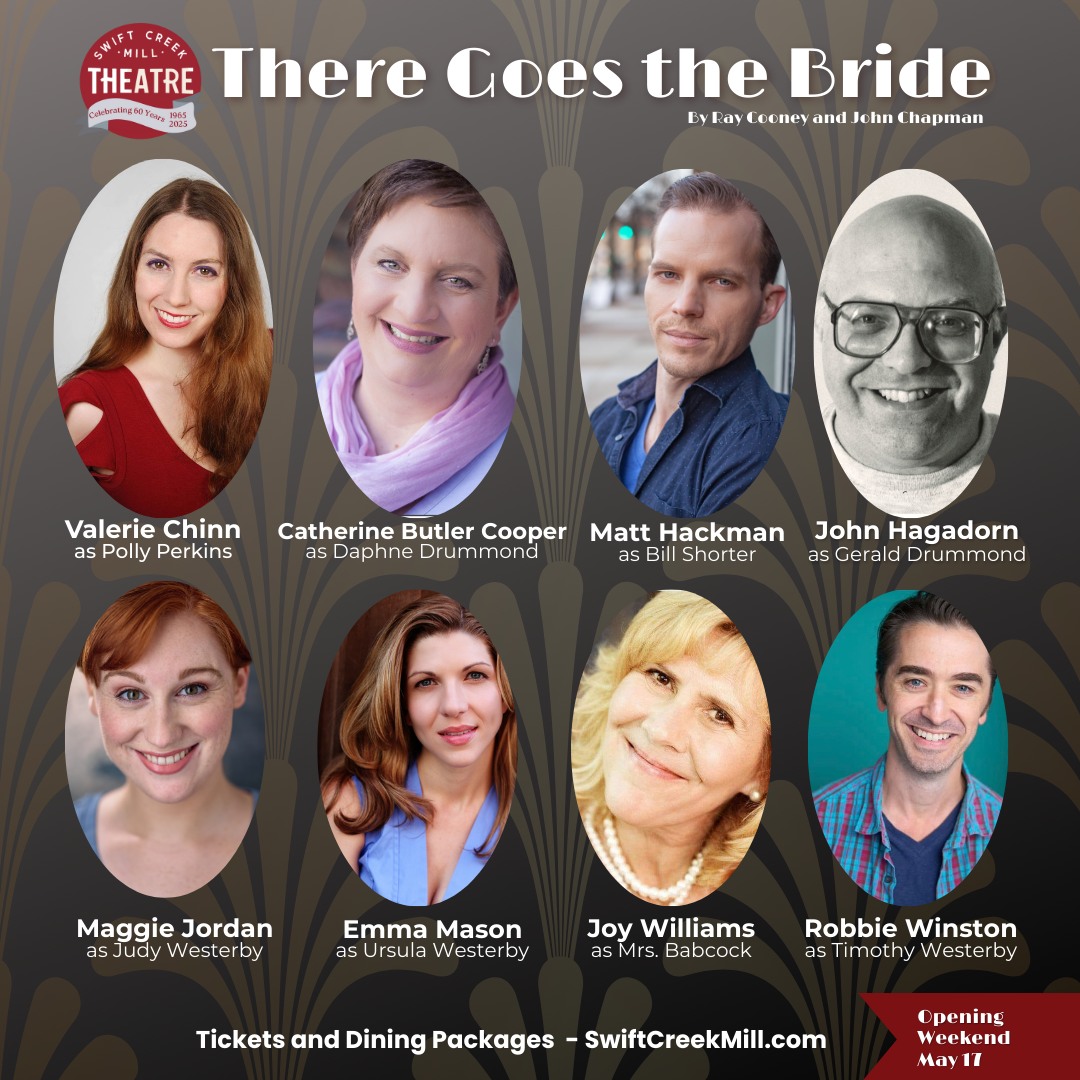
Each of these characters brings something unique to the ensemble. The bride herself is not the main character, spending much of the play locked away in her room, horrified by her father’s behavior as well as the overly elaborate wedding her parents have planned. It seems she and her betrothed – who is not even a character in the play – would just as soon go to the registry and have a civil wedding and avoid all the fuss of a church ceremony followed by a reception in her parent’s garden. But near the beginning of the play Judy, played by Maggie Jordan does manage to create somewhat of a stir by revealing to her parents that she and her fiancé – whose name I can’t even remember – have engaged in some pre-marital shenanigans. While her mother, Ursula, played by Emma Mason, takes this news in stride, it upsets her father Timothy (Robbie Winston) to the point where he is ready to call off the whole wedding. That seems to be just the opposite of the reaction I would have expected of the father, but this is a farce and it’s not my family, so…
Ursula (Emma Mason) and Bill (Matt Hackman) try to keep everything from falling apart, but as soon as they patch up one problem, another pops up; such is the nature of a farce. Both manage to generate humor while attempting to be the face of calm and reason in the midst of madness. Amazingly, I don’t think either of them ever broke character or struggled to hold back a snicker, a giggle, or a full guffaw. Very admirable.

Most of the physical, slapstick style humor was assigned to Robbie Winston’s character, Timothy. Winston navigated his fair share of pratfalls and head bumps, as well as the choreography of slamming doors as he moved Polly around like the bottle cap hidden under the cup in a sleight-of-hand shell game – all while everyone else on stage pretended not to see her.

But we all have personal favorites, and for this production mine were John Hagadorn as the fumbling and forgetful grandfather, Dr. Gerald Drimmond and Valerie Chinn as the invisible flapper, Polly Perkins. Drimmond was droll throughout, dropping one-liners and making pertinent observations that always seemed to hit with extra nuance. His mimicking of Winston’s steps – which he called the doo-dah – was the highlight of his performance. It was the kind of bit that would have made you spit out your drink, if you were drinking. And then there was Valerie Chin, bouncing and bopping, doing the Charleston and swinging her feather boa, always with a huge smile and that laugh – that indescribable, bright, bubbly, cartoonish laugh!

In his Director’s Notes, Tom Width wrote: “We do love our farces here at the Mill!” As silly as it may look, this production required masterful timing to pull off. As Width explained, “the clown has to be a gymnast before he can do his pratfall as a comedian; everything must be planned carefully by the numbers before we can throw the number away and make it look as if there never were any numbers; and whit is seemingly mayhem must be meticulously planned.” Well, There Goes the Bride is masterfully, meticulously planned and executed. It has no deep or hidden messages; it’s just pure fun.


Oh, and Timothy did come up with a jingle for his ad campaign for his important client, a bra company: Perkins can take the flop out of your flappers!

———-

Julinda D. Lewis, EdD is a dancer, minister of dance,  teacher, and writer who was born in Brooklyn, NY and currently resides in Eastern Henrico County. When not writing about theater and dance, she teaches dance history at VCU and low impact dance fitness classes to seasoned movers like herself and occasionally gets to perform.

———-

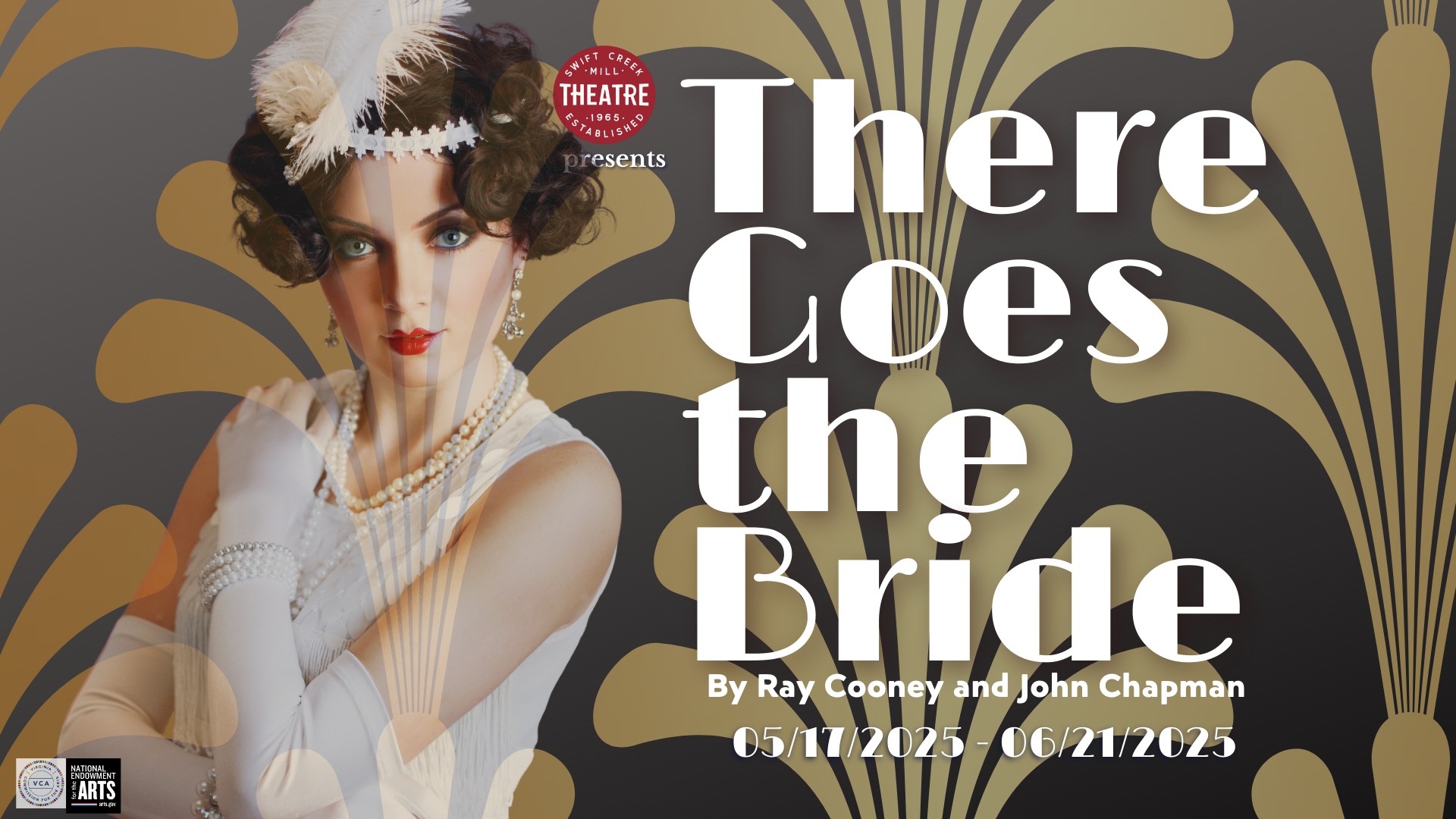
THERE GOES THE BRIDE

By Ray Cooney and John Chapman

Directed by Tom Width

CAST

Emma Mason           as Ursula Westerby

Maggie Jordan        as Judy Westerby

John Hagadorn        as Dr. Gerald Drimmond

Matt Hackman          as Bill Shorter

Robbie Winston       as Timothy Westerby

Valerie Chinn            as Polly Perkins

Catherine Butler Cooper   as Daphne Drimmond

Joy Williams             as Charlotte Babcock

CREATIVE TEAM

Directed by Tom Width

Scenic Design by Tom Width

Lighting Design by Joe Doran

Costume Design by Maura Lynch Cravey

Technical Direction by James Nicholas

PRODUCTION STAFF

Producing Artistic Director …. Tom With

Technical Director ….. James Nicholas

Stage Manager ….. Sandy Lambert

Assistant Stage Manager/Props ….. Tom Width

Scenic Carpenter … Peter Prout

Light/Sound Board Operator ….. Brent Deekens

Set Crew ….. Peter Prout, Brent Deekens, Caitlin Tolson, Vincent Prout, Dasia Gregg, Nathan Hamill

Lighting Crew ….. Liz Allmon, Brent Deekens, Caitlin Tolson, Peter Prout

Photographer ….. Daryll Morgan

Wig Design ….. Alia Radabaugh

Time and Place:

The London home of the Westerbys, Summer 1974

Run Time:

About 2 hours, with 1 intermission

Performances:

May 17 – June 21, 2025

Thursdays, Fridays, Saturdays at 8:00PM

Select Wednesdays at 2:30PM

Tickets:

Regular $44-49. Discounts for Seniors, Military & Veterans

*Other Ray Cooney farces produced at Swift Creek Mill over the decades:

Run For Your Wife; Caught in the Net; Out of Order; Move Over, Mrs. Markham; It Runs in the Family; and Funny Money

Photographer: Daryll Morgan

Richmond Ballet: Moving Art Two

A World Premiere, A Virginia Premiere, and A Revival

A Dance Review

Program By: The Richmond Ballet

At: Virginia Museum of Fine Arts, Leslie Cheek Theater, on the Armstrong Family Stage in Honor of Richmond, 200 N. Arthur Ashe Boulevard, RVA 23220

Performances: May 8-18, 2025

Ticket Prices: $25 – $85 ($85 – $125 on opening night)

Info: (804) 344-0906, etix.com, or richmondballet.com

THE PROGRAM

SLUMP

Choreography by Joshua L. Peugh

Music by Klezmer Juice, Yma Sumac, Ella Fitzgerald

Costumes Provided by Richmond Ballet

Lighting Design by Nathan W. Scheuer

World Premiere: June 21, 2012 by Bruce Wood Dance Project at Booker T. Washington’s <Montgomery Arts Theater, Dallas, TX; Richmond Ballet Premiere: May 8, 2025, Leslie Cheek Theater, Virginia Museum of Fine Arts, Richmond, VA

ECHOING PAST      

Choreography by Stoner Winslett

Music by Fanny Mendelssohn-Hensel

Costume Design by Susan Cologne

Lighting Design by Nathan W. Scheuer

Pianist: Joanne Kong

World Premiere: May 15, 1996 by Richmond Ballet at Leslie Cheek Theater, Virginia Museum of Fine Arts, Richmond, VA

FADING CREATURES

Choreography by Yury Yanowsky

Music by Senking and Henryk Gorecki

Costumes by Christi Owen after Original Costume Design by Emily Morgan

Lighting Design by Nathan W. Scheuer

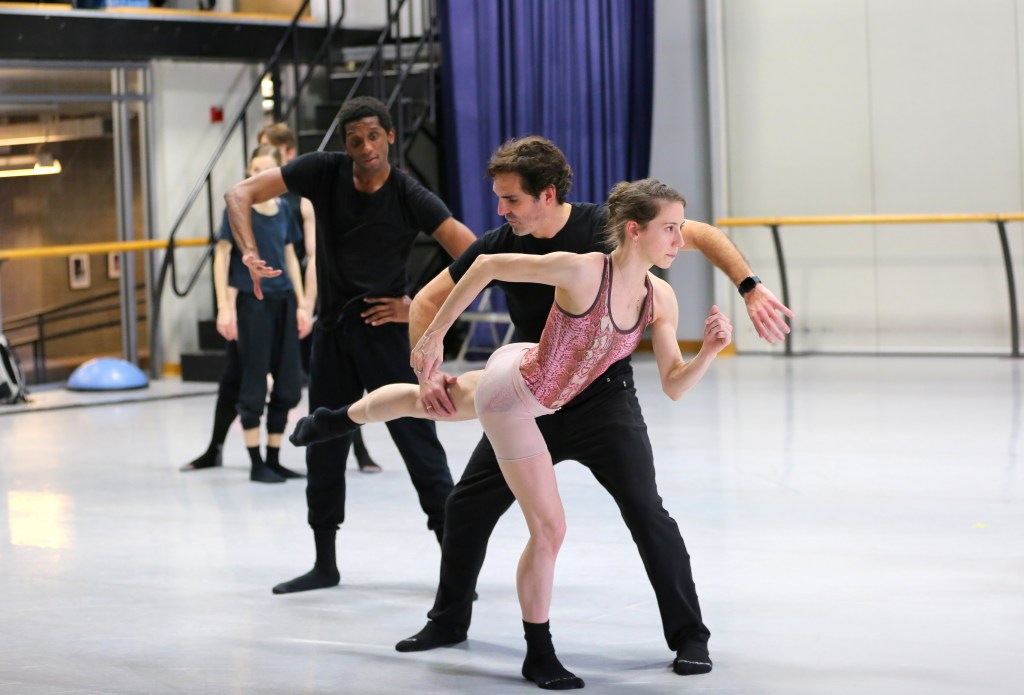
Following their March 2025 return to the VMFA’s Leslie Cheek Theater after an absence of 30 years, Richmond Ballet’s Moving Art Two program offered an audience pleasing trio of works. In order, the audience enjoyed a quirky modern Richmond premiere, a revival of a more classically themed ballet by founding artistic director Stoner Winslett, and a world premiere of a work that began as an entry in the Richmond Ballet’s 2023 New Works Festival. Interestingly, and to my surprise, most of the people I chatted with after the show were most drawn to the more contemporary works.

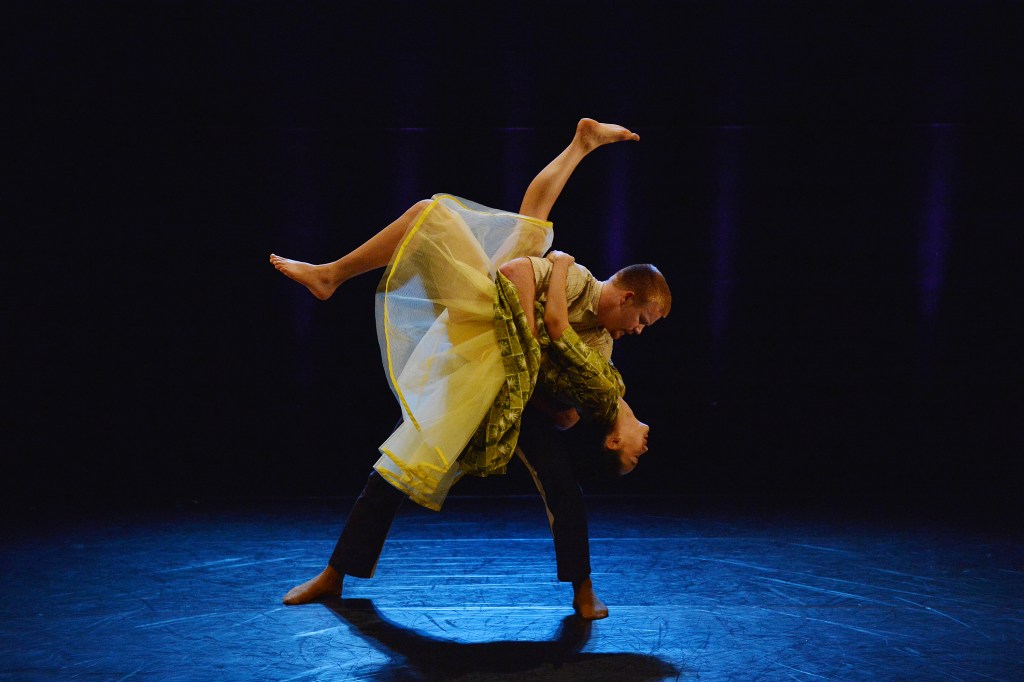
The program opened with a colorful, upbeat work by Joshua L. Peugh, the New Mexico-based founder and artistic director of Dark Circles Contemporary Dance. Slump defies categorization with its musical environment ranging from Klezmer Juice (described online as Jewish Soul musicians) to Peruvian singer Yma Sumac to jazz icon Ella Fitzgerald. The women are dressed in 1950s-style party dresses with crinoline underskirts that give a sassy nod to tulle tutus while emphasizing the pointedly un-classical and often upside-down lifts with one leg hooked around the partner’s neck.

At one point the men perform a rubbery, jelly-legged movement that used to be known as “eccentric” dancing, and later they walk with what my grandmother would have called a “switch,” as if mocking their female partners.  The partner dancing includes the kind of weight-bearing that remind me of when little girls dance with their feet planted atop their daddies’ feet like life-sized rag dolls. They slouch, they drop, they roll in joyous freedom. The women’s wide-legged stance, the men’s swirling hips, the flirtatious and irreverent partnering all seemed to be as much fun for the dancers as it was for the audience.

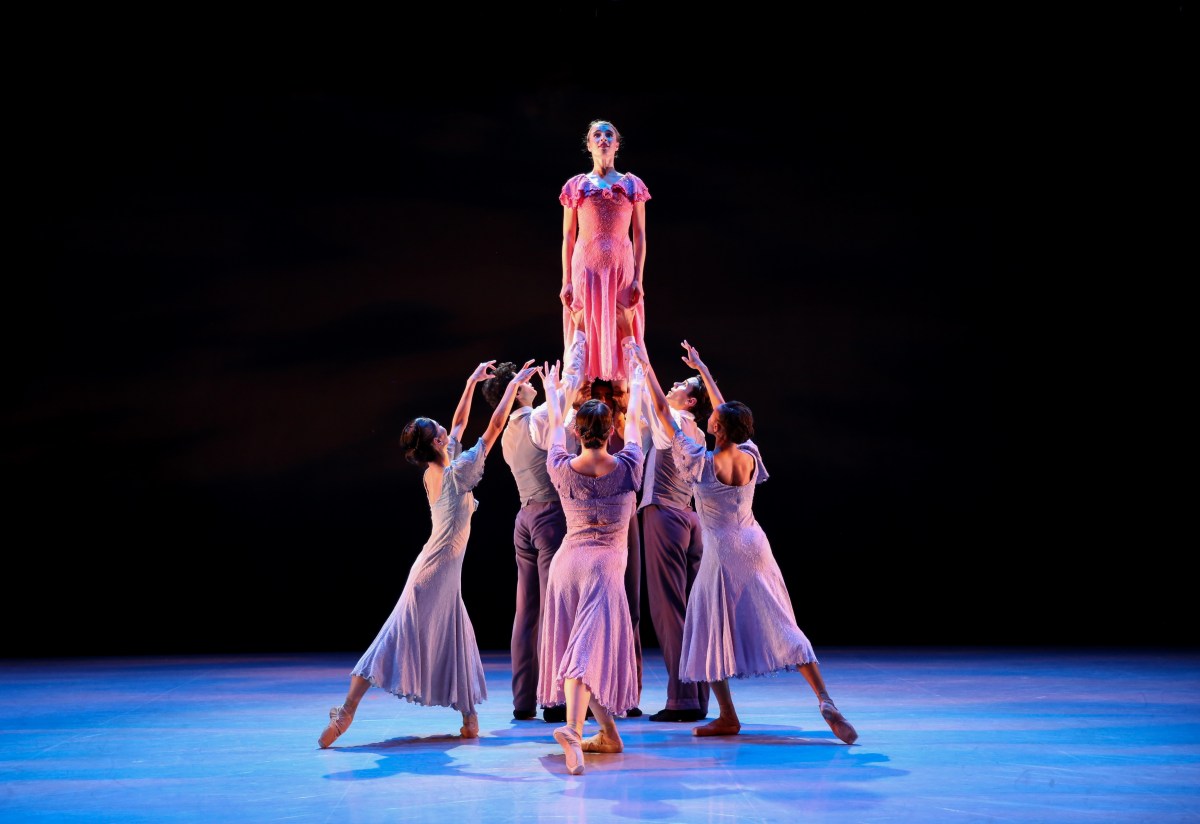
Stoner Winslett’s Echoing Past was in stark contrast to the shenanigans of Slump. Described as a ballet about one woman’s journey, looking back while moving forward, the work is set to music by Fanny Mendelssohn-Hensel and played live by pianist Joanne Kong. Originally titled “Das Alte Jahr” (“The Old Year”), the ballet was choreographed in honor of Leslie Peck, a former member of the New York City Ballet, a recognized authority on Balanchine ballets, and a former ballet mistress with Richmond Ballet.

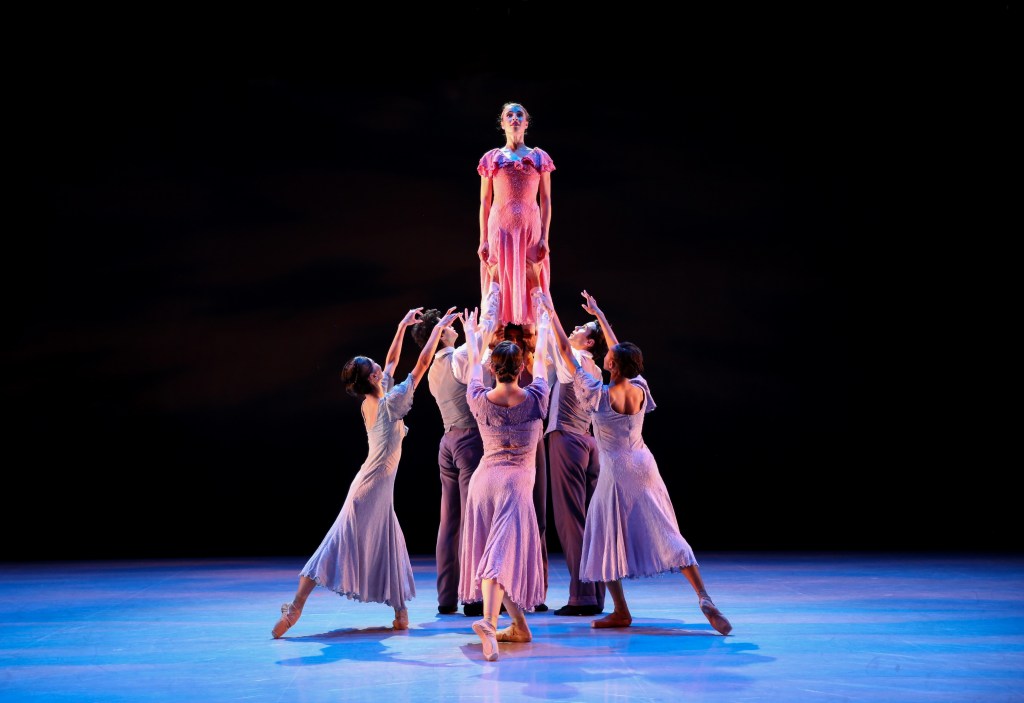
Eri Nishihara represents this woman, with Annika Kuo, Kaitlin Roemer, and Kennady Jackson dancing the roles of her past selves. Nishihara wears pink while the past selves are dressed in gray. Nishihara seamlessly trades places with her past selves, sometimes dancing back-to-back or mirroring the other women, as the peace evolves into a rich and satisfying conclusion. The ballet may be a metaphor for the company itself. Echoing Past was first performed at the VMFA in 1996, and Winslett formally stepped down as Artistic Director just under a year ago, in July 2024. So, the ballet somewhat mirrors Winslett’s own journey as artistic director, choreographer, and a woman in a position that is still dominated by men.

Yury Yanowsky, a former principal dancer with the Boston Ballet, first introduced Richmond audiences to his work Fading Creatures as a part of the Richmond Ballet’s New Works Festival in 2023. Inspired by Salvador Dali’s familiar melting clocks, the work begins with the feeling of a sci-fi ritual as the dancers lie on the floor with small lights hoovering over them. Once the lights have ascended and the dancers have risen from the floor, the dancers adopt an athletic style of movement – muscular, posed, poised, measured, abstract.

While inhabiting the lower level, the dancers flip, slide, reach, and lunge, but once the lights rise above them like a constellation, the dancers’ movements become bolder and more sinuous at the same time. Sometimes they appear to float or glide, only to suddenly run and freeze, or rewind and repeat, bending and stretching time, ending with a sudden stop!

What a satisfying conclusion to the company’s 2024-2025 season, the first under the artistic leadership of Ma Cong. Much like the woman in Echoing Past, perhaps intentionally so, this season has been marked by reflection and change and concluded on a rich and satisfying note.

The Richmond Ballet 2025-2026 season begins with Moving Art One, September 11-21 featuring Wild Seet Love by Trey McIntrye and a world premiere by Ma Cong.

Moving Art Two, October 16-26 is scheduled to present Slice to Sharp by Jorma Elo, a world premiere by Andrea Schermoly, and French Twist by Ma Cong. The Nutcracker will be performed at Dominion Energy Center December 6-23 and Giselle will be performed there February 13-15. The season will continue with Moving Art Three, the company’s New Works Festival with works by Natasha Adorlee, David Morse, Price Suddarth, and Serkan Usta from March 19-29, and conclude May 14-24 with Moving Art Four with George Balanchine’s Apollo, John Butler’s After Eden, and a world premiere by Val Caniparoli.

———-

Julinda D. Lewis is a dancer, teacher, and writer who was born in Brooklyn, NY and now lives in Eastern Henrico County. When not writing about theater and dance, she teaches dance history at VCU and low impact dance fitness classes to seasoned movers like herself and occasionally gets to perform.

WHICH WAY TO THE STAGE

The Roles We Play

At: Richmond Triangle Players at the Robert B. Moss Theatre, 1300 Altamont Avenue,  RVA 23220

Performances: April 23 – May 17, 2025

Ticket Prices: $50

Info: (804) 346-8113 or rtriangle.org

A Theater Reflection by Julinda D. Lewis

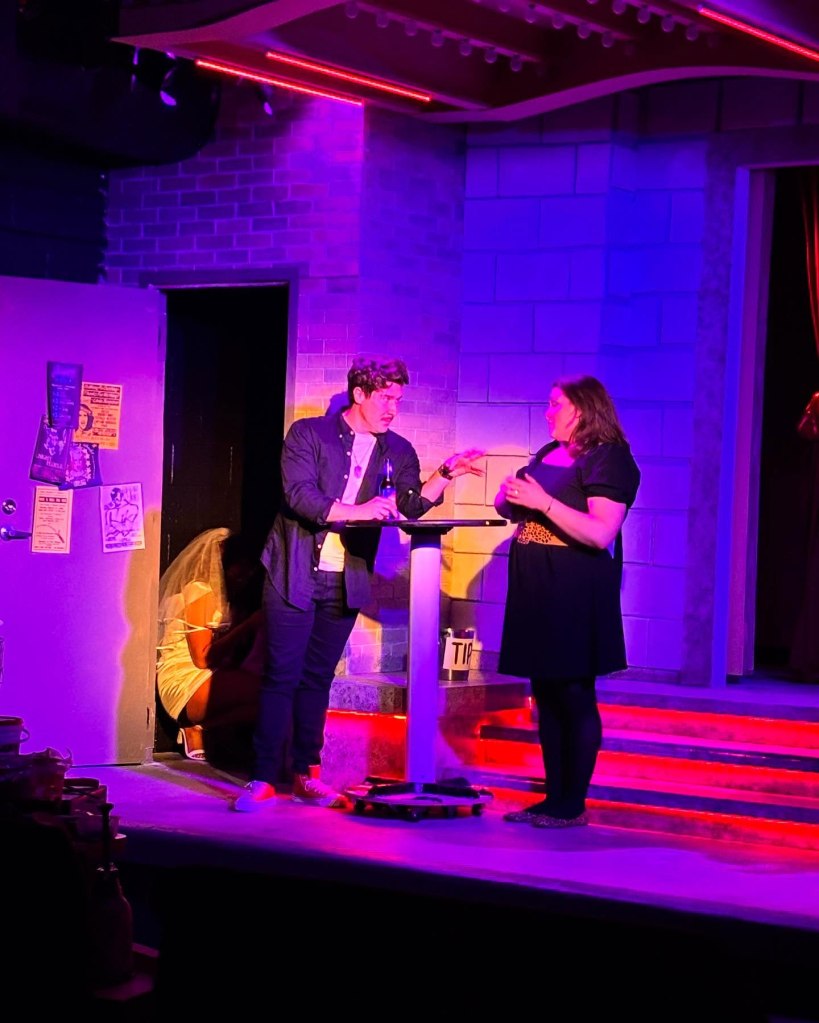
Ana Nogueira’s Which Way to the Stage is one of the funniest plays I’ve seen this season ever seen. It is also one of the most authentic plays I’ve ever seen about the theater, relationships either the theater or relationships. Which Way to the Stage is complex and layered. It’s filled with inside jokes – I’m sure that I probably only caught a quarter of them – that could be used as a test to weed out the true musical theater afficionados from the amateurs. I do know a few people – I won’t call them friends – who don’t like musical theater; this show is not for them.

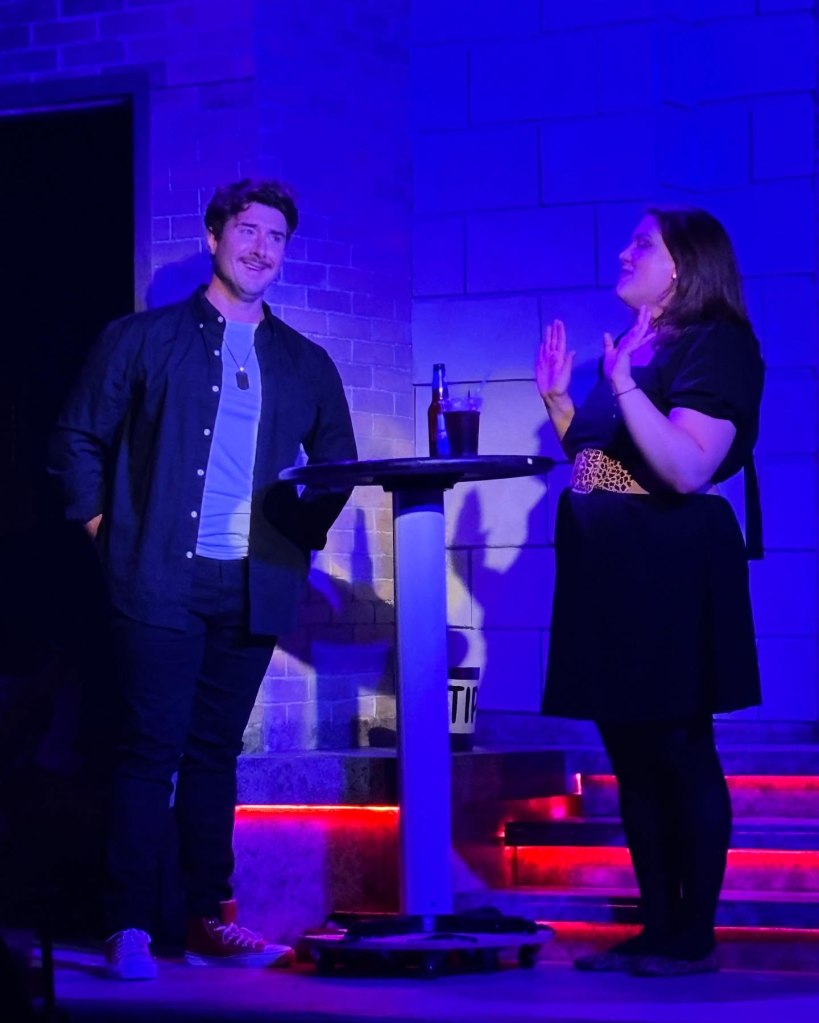
Judy (Amanda Spellman) and Jeff (Matt Shofner) are best friends and theater buddies. Judy carries around a binder filled with playbills – including one from the original cast production of Rent. She and Jeff enjoy discussing things like who was the best Mama Rose in Gypsy (Bernadette Peters? Patti LuPone?) as if their very lives depend on the correct response.

“Like a caricature of a caricature of a performance by my mother in the Temple Beth Israel talent show.” – Judy

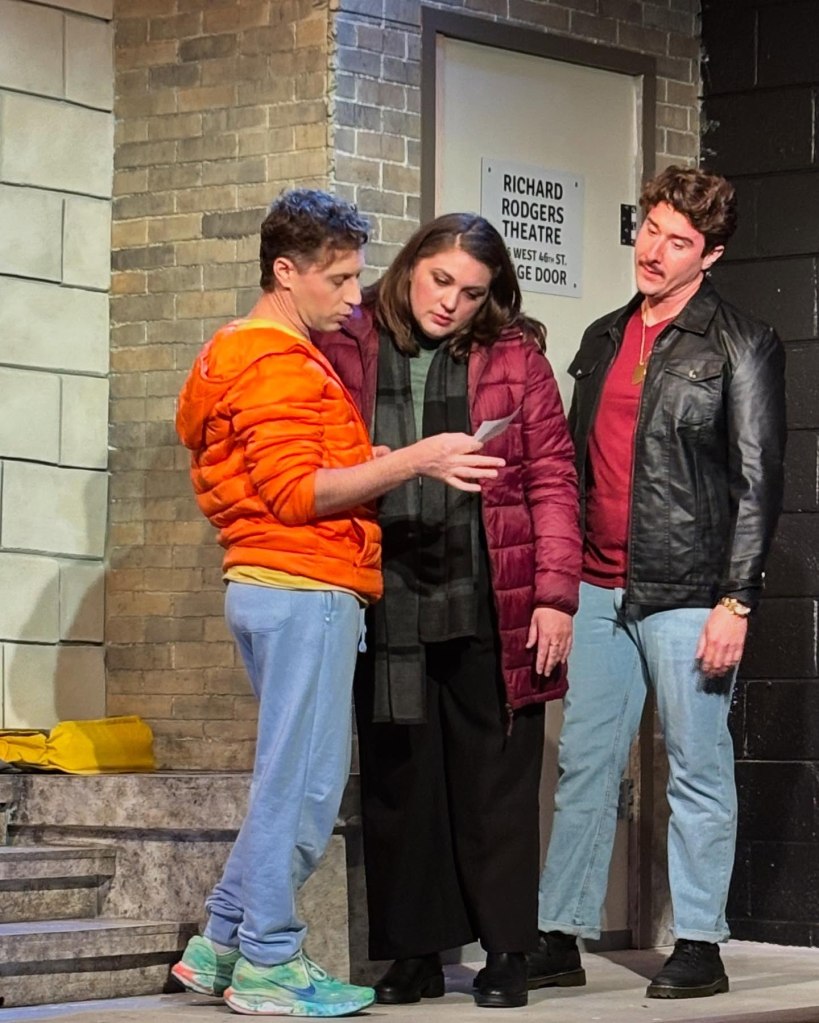
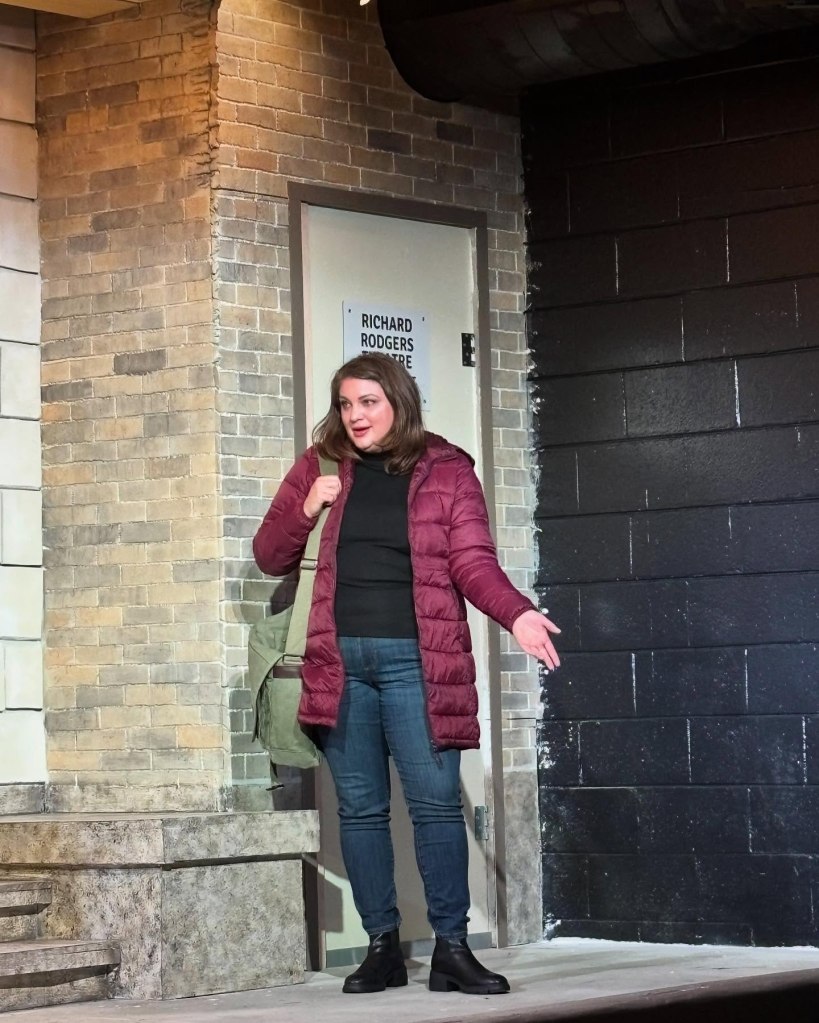
During the course of Which Way to the Stage, the two meet most nights outside the stage door of the Richard Rodgers Theatre, waiting for Idina Menzel* to appear, hoping to get her to sign their programs. She didn’t come out the night they saw the show she’s starring in, If/Then, and they are racing against time as the show is schedule to close soon.

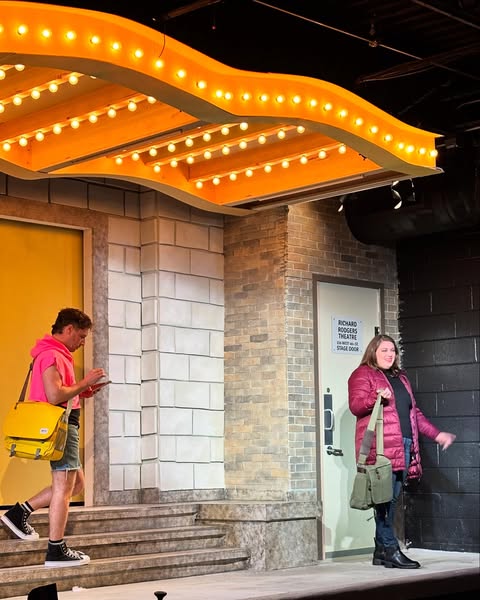
The main part of the set for Which Way to the Stage is outside the stage door of the Richard Rodgers Theatre, located at 226 West 46th Street in New York City’s theater district. The scene was immediately familiar to my daughter, who was my theater date on opening night. When we lived in NY, she attended New York’s High School of Graphic Communication Arts on West 49th Street, a short distance from the theater. Kudos to Daniel Allen, the scenic designer, for the authenticity. The theater marquee and the hallway where the actors wait for their auditions are perfection!

On stage at Richmond Triangle Players (RTP) Spellman and Shofner start off with high spirited theater-nerd banter that – incredibly – just keeps getting better and better as the show goes on. Personal chemistry? Great acting? Let’s say it’s a balanced blending of both. The two usually enter the stage from the audience, starting their loud banter as they walk to the theater – and nearly every time they have a near miss with the NYC traffic.

“I want to be Rent poor!” – Judy

Both Judy and Jeff are actors. Judy is returning to theater after taking time to develop a career in real estate – in New Jersey. She’s talented but lacks confidence. Jeff can’t get the roles he really wants because they’re for cis gender white men – or women. He works as a drag queen and specializes in portraying Streisand as Yentl (there’s some more musical theater history for you!).

Things start to get real when Judy crosses a line. You know how it’s taboo for the white friend to use the word “nigger” around their Black friends? Well, Judy, in an act of solidarity with Jeff, whose ex-boyfriend managed to get Menzel’s autograph on the one night Jeff and Judy could not be there, calls the ex a “faggot.” The atmosphere changes, the mood shifts, and Jeff, as gently as possible, explains that, even thought they have been friends since high school and even though Judy is what we might call an  “ally” these days, she can’t say that word.

At an audition, in which Judy does quite well, but doesn’t quite get the job, she meets and later starts a tenuous relationship with Mark (Calvin Malone). Mark seems to have a leg up on getting parts. He’s tall, white, handsome, and straight – or is he??? This throws a new cog in the wheel of Jeff and Judy’s relationship. There is now sexual tension, rivalry, jealousy, and an unnamed emotion that wells up in Judy when her femininity is not so much questioned as criticized. She is advised to take lessons in being more womanly – from a drag queen.

Spellman manages this brilliantly, starting subtly with a zipper that keeps sliding down, and building up to – well, If I told you, that would be too much of a spoiler. I’ll just say, it builds up, fueled in part by Judy’s own stagnation, Jeff’s insightful but cutting observations, and the Mark triangle.

Speaking of drag queens, Shofner completely slayed in his second act drag scene. First of all, let’s acknowledge the magic of Tariq Kariem (costume designer and wardrobe supervisor) and Like Newsome (who designed the hair and makeup). Shofner’s make-up and wig were applied in record time. At one point, I believe Shofner exited a door in one outfit and reappeared less than a minute later through another door in a completely different outfit! Onstage, after his over the top drag act, ending with a hearty lip-synced rendition of “Defying Gravity,” complete with a black cape, step-ladder and…mop, yes, a mop, not a broom (sigh)…as I was saying, after this number, Shofner, as Jeff, sits at his dressing room table and completes the process of removing every trace of the makeup – and act that is both professional and symbolically profound. As he strips off his character, he reveals more of himself.

There are a lot of symbolic and metaphoric words and actions in Which Way to the Stage. How do we define femininity? Who determines which roles are suitable for a gay actor? (I mean, after all, it’s…acting.) Is bisexuality a valid choice – or is refusing to accept labels just a lack of commitment? How does friendship survive or thrive when career, life, or perhaps being unevenly yoked all sink their hooks into every breath you take, and make it impossible to breathe?

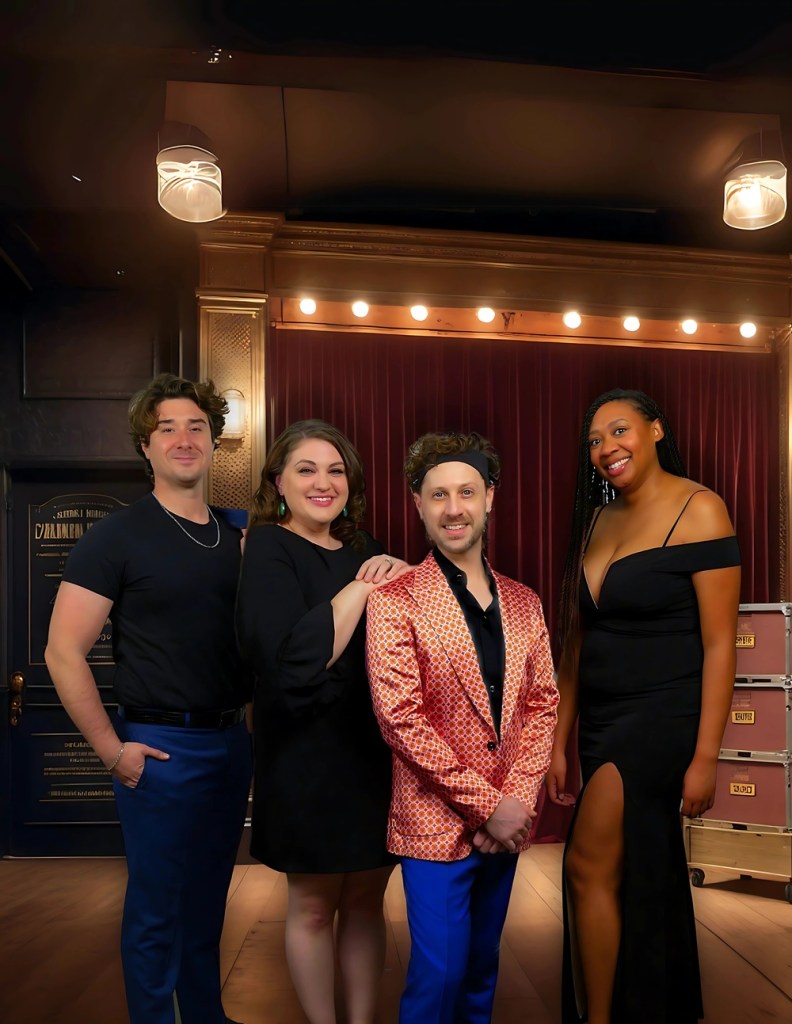
Like most good humor, in my experience, Which Way to the Stage is based on real life: people, situations, circumstances, including identity and belonging – and in this case, all of the above. Shofner and Spellman really shine as the two besties, and Malone is suitably over-confident in a way that makes it seem natural that both Jeff and Judy would be attracted to his character. There is a fourth character, a nameless and over the top entity played by Sydnee Graves.

Graves fills the shoes of an actress at the casting call, a bachelorette at the drag show, and the casting director. I didn’t much like Actress at first. She was bougie, aloof, confrontational. And then she explained to Judy how she had to learn to navigate the world, and she became less of a stereotype and more of a real person. Actress was not written as a fully rounded character, but the tags on her dress, so she can return it after the audition, and her story of sexual harassment are very much true-to-life and provide a much-needed anchor for Judy on her journey. Casting Director is a very minor character, but Bachelorette, a drunken member of a bridal party whooping it up at the drag club where Jeff performs, seems to be included strictly for laughs and seems to have no redeeming qualities other than to provide a vehicle to divert attention from the stresses of the main characters. The three roles serve hilarity to the audience and establish Graves as a versatile comedic actor.

Actress has come to terms with her life, striking an uneasy truce with theater. Jeff has adopted a realistic look at the world of make-believe, and grasps at any straws of hope and love that come his way. Mark, well, he’s the straw. And since he can pass as a straight white male, he has access to privilege. It’s Judy who is floundering, and her way of coming up for air results in one of the most brilliant scenes of the show. (Shofner’s drag show holds two of the top three places.)

Which Way to the Stage is challenging. It unwraps the carefully concealed, seamy side of theater. It’s sort of like a theatrical version of revealing the magician’s secrets. And it’s all brilliantly adorned in witty conversation, complicated friendships, and the “dainties” of life that we usually try so hard to conceal. All out there in the open. With dazzling lights, caterpillar lashes, and the sort of drama that follows you home when you leave the theater.

Directed by RTP’s Artistic Director, Lucian Restivo, who also designed the sound and projections, Which Way to the Stage isn’t a musical, but rather a play centered around a love of musical theater. There is so much familiar music in the pre-show and sound design, and so much talk of musicals, that you almost forget this isn’t actually a musical. Nogueira aptly captures the struggles that artists face in reconciling their personal aspirations with society’s expectations of and for them. Using sharp wit and unusually accurate emotional depth, Which Way to the Stage invites the audience into the inner sanctum, where we can reflect on our own journeys, and perhaps most importantly, it celebrates resilience and offers guidance on how to find and maintain connection in the midst of the chaos of the world. Yeah, you should go see it.

*Idina Menzel, the Queen of Broadway, known for her breakout performance in Rent, her award-winning performance as Elphaba in Wicked, and several award for If/Then. With a voice that spans three octaves, she has been compared to Barbra Streisand – and like her has developed a large gay following. She sand “The Star-Spangled Banner” at Super Bowl LXIX and is known for powerful and empowering songs like “Let It Go” (Disney’s Frozen) and “Defying Gravity” (Wicked).

———-

Julinda D. Lewis is a dancer, minister of dance, teacher, and writer who was born in Brooklyn, NY and currently resides in Eastern Henrico County. When not writing about theater, she teaches dance history at VCU and low impact dance fitness classes to seasoned movers like herself and occasionally performs.

———-

WHICH WAY TO THE STAGE

Written by Ana Nogueira

Directed by Lucian Restivo

Cast

Sydnee Graves        —–     Actress/Bachelorette/Casting Director

Calvin Malone          —–     Mark

Matt Shofner            —–     Jeff

Amanda Spellman  —–     Judy

Wayne Parker           —–     u/s for Mar & Jeff

Shannon Schilstra   —–     u/s for Judy & Actress/Bachelorette/Casting Director

Creative Team

Daniel Allen              —–     Scenic Design

Paul Vaillancourt     —–     Lighting Design

Tariq Karriem           —–     Costume Design & Wardrobe Supervisor

Lucian Restivo          —–     Sound & Projection Design

Tim Moehring          —–     Props Design

Luke Newsome        —–     Hair & Makeup Design

Lauren Langston      —–     Production Stage Manager

Performance Schedule

Wednesday, April 23          8:00PM, Preview

Thursday, April 24               8:00PM, Preview

Friday, April 25                    8:00PM, Opening Night

Saturday, April 26                8:00PM

Sunday, April 27                  4:00PM

Thursday, May 1                  8:00PM

Friday, May 2                        8:00PM

Saturday, May 3                   8:00PM

Sunday, May 4                      4:00PM

Thursday, May 8                  8:00PM

Friday, May 9                        8:00PM

Saturday, May 10                 8:00PM

Sunday, May 11                   4:00PM

Wednesday, May 14           8:00PM

Thursday, May 15                8:00PM

Friday, May 16                     8:00PM

Saturday, May 17                 8:00PM

Tickets

Ticket Prices: $50

Run Time

About 2 hours; one intermission

Setting

2015. The stage door of If/Then at the Richard Rodgers Theatre, an audition waiting room, and a drag club

Which Way to the Stage had its WorldPremiere at the MCC Theater in 2022.

Photos from the RTP Facebook page

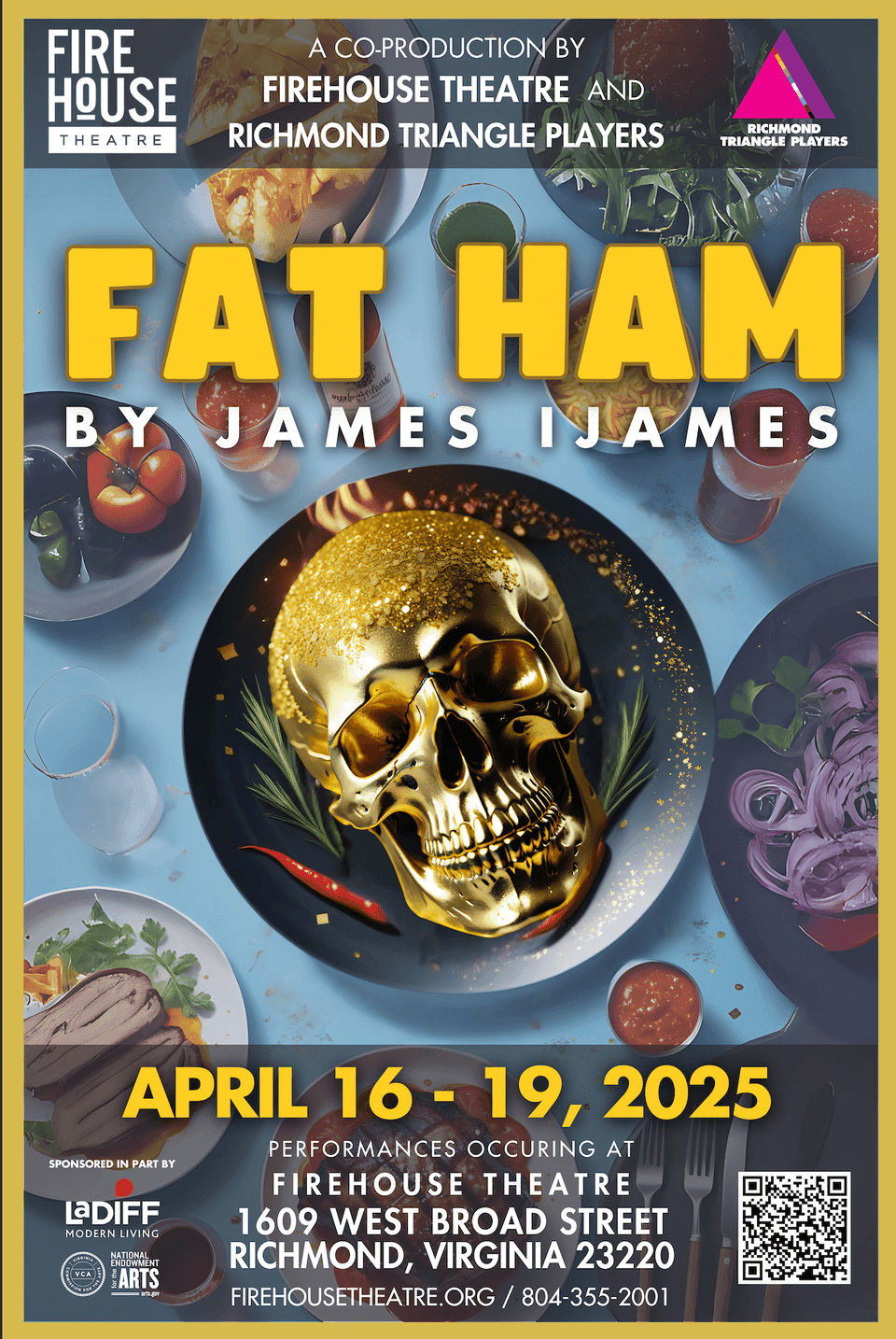
FAT HAM

A Co-Production of Firehouse Theatre and Richmond Triangle Players

A Reflection on a Unique Theater Experience by Julinda D Lewis

At: Firehouse Theatre, 1609 W Broad St., RVA 23220

Performances: April 16-19, 2025

Ticket Prices: $45 [all shows SOLD OUT]

Info: (804) 355-2001 or firehousetheatre.org

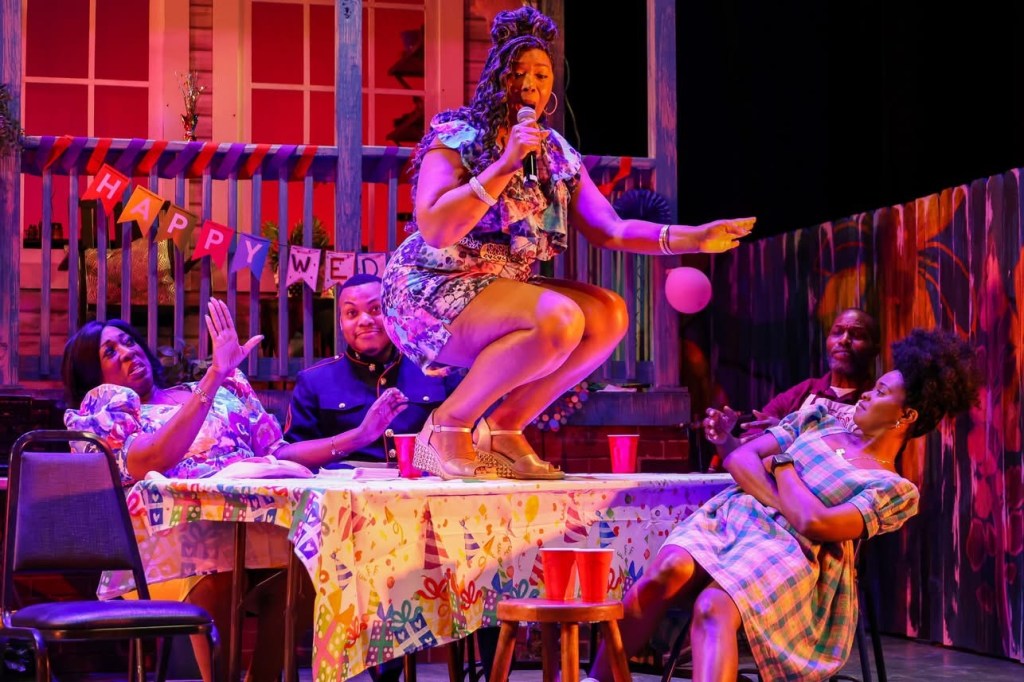
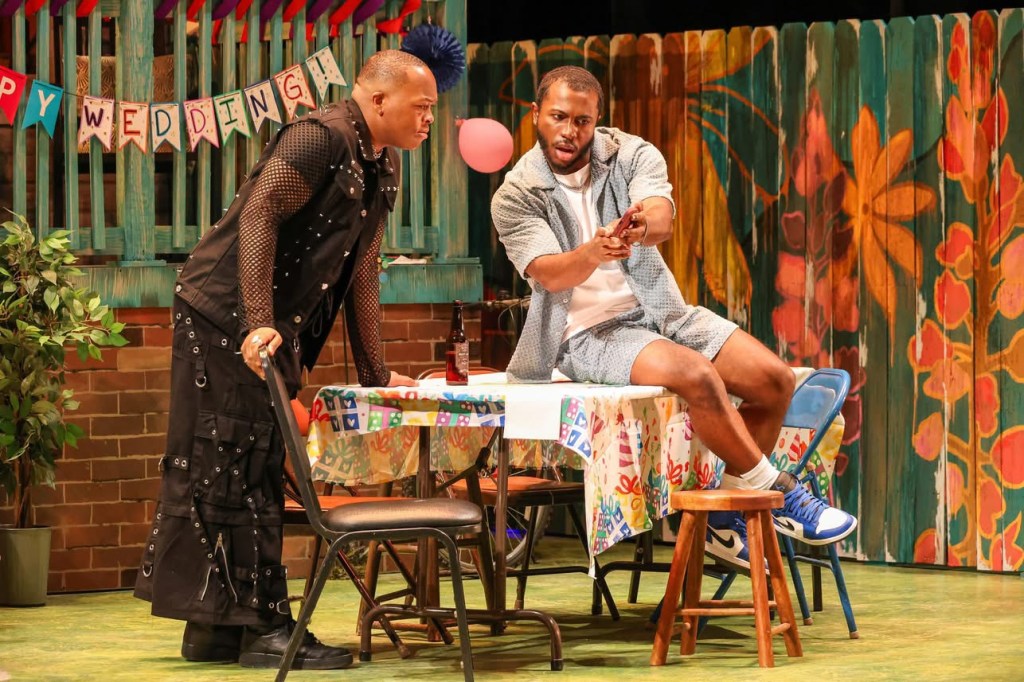
Fat Ham is what happens when Shakespeare gets invited to the BBQ and there’s brown liquor and the Electric Slide – the only thing missing is a game of Spades.

What is Fat Ham? James Ijames’ 2022 Pulitzer prize winning play is a modern-day take on Shakespeare’s Hamlet. Set in a small town in North Carolina (or Virginia, or Maryland, or Tennessee), Juicy’s father, Pap, has died and his mother, Tedra, immediately married her deceased husband’s brother, Rev. Mere moments into the contemporary tragedy (or tragi-comedy), Pap appears to Juicy and his friend Tio as a ghost. As if to make sure we get the “comedy” part of tragi-comedy, Pap has thrown a large white sheet, complete with pasted on black eyeballs, over his pristine white funeral suit and strolls into the backyard using the gate. I’m not the only one who wondered why he didn’t just walk through the fence, as his son, Juicy also asked why he wasn’t floating! Point made, he subsequently ditches the sheet and appears in his white suite with a wide-brimmed white hat and white shoes.

Named in honor of Shakespeare’s Hamlet and the BBQ restaurant owned by the play’s fictional family, Fat Ham is equal parts family tragedy and side-splitting comedy. Pap has roused himself from the grave to ask his son to seek revenge. Apparently, while in prison serving a sentence for stabbing a man, he himself became the target of a hitman when his own brother, Rev, has him killed. The plot thickens when Pap, Rev, and just about every other adult in his life           questions Juicy for being “soft,” calling him a sissy and other choice names.

As the drama unfolds, two of Juicy’s friends come – or get forced out – of the closet. Tedra’s conflict is also internal as she faces her own insecurities that make her think she can find her worth only in the arms of man. Criticism is met with a variety of explanations, all ending with, “it’s biblical” or  “it’s in the bible.”

There was plenty of drama off the stage as well. After a successful run in Norfolk earlier in the year, Virginia Rep was set to bring Fat Ham to the November Theatre but cancelled at the last minute due to their on-going financial problems that surfaced for the public in the fall of 2024. While it may be true that finances were the source of the cancellation, the optics were not good. Fat Ham is very much a Black and Queer play, and with all the controversy over Black History Month, DEI, and the like, well feelings were ruffled.

In what was a huge surprise to many if not most of us (the RVA theater community), the Firehouse Theatre, under the direction of Producing Artistic Director Nathaniel Shaw and Richmond Triangle Players, where Philip Crosby is Executive Director, joined together to co-produce Fat Ham with the same Norfolk cast that was originally expected to bring this production to the River City. The five performances were fully sold out before most of the general public even heard about the event. So, for many reasons, Fat Ham is not just any play, this was not just any production, and I felt blessed to secure a seat.

Bringing this show to life, complete with physical comedy, amazing soliloquys, some of which reference Shakespeare and some of which are taken verbatim from the bard’s Hamlet – such as  “what a piece of work is a man” – is a dynamic cast consisting of Marcus Antonio as Juicy/Hamlet, Kevin Craig West as Pap/the ghost of Hamlet’s father and Rev/Claudius, Cloteal L. Horne as Tedra/Hamlet’s mother, Gertrude, and Adam E. Moskowitz as Juicy’s/Hamlet’s sidekick Tio/Horatio. Notice the pattern that is beginning to emerge? Jordan Pearson plays Larry/Laertes, Janae Thompson is his sister Opal/Ophelia, and Candice Heidelberg is their mother Rabby/Polonius.

Antonio is alternately sly, soft, philosophical, and just generally endearing as Juicy (although I had a hard time swallowing that name, LOL). Horne is so over-the-top as his mother, Tedra, that the moments when she is serious are all the more powerful. She stands up for Juicy, refusing to allow Rev to spread his homophobic poison and at the same time, like most of the Black mothers I grew up in community with, was very protective of her son while maintaining a boundary that defined how people defined her and her life choices.

Jordan Pearson was a supporting character who came later on the scene but made a huge impact, transforming from a straight-edged marine to puffed sleeves, feathers, and a metallic gold head piece. Moskowitz – who reminded me more than once of a version of Spike Lee, perhaps from Do the Right Thingshared a bizarre sexual fantasy involving a gingerbread man, a snowball fight, and fellatio that had his character questioning the origins of his weed. It was the kind of story, a confession, that one has to blame on the weed, or on alcohol, in order to be able to hold one’s head up in public ever again!

Another memorable scene Moskowitz shared with Antonio involved Juicy asking his friend Tio about his shoes. This gives rise to another direct Shakespearean reference, “You remember Yurick?” It seems Yurick (who was not give a contemporary name) was Juicy and Tio dead friend, and Tio bought Yurick’s shoe at a yard sale being held to raise money for Yurick’s funeral.

Thompson’s Opal, unlike Ophelia, does not end in death by drowning – or any other means – but, rather, with affirmation and freedom. While her brother, Larry/Laertes, is not happy with the military life he is living to please his mother, Opal longs for it – it would provide her freedom she does not currently have as a woman, as a Black woman, as a Queer Black woman.

West, who played the unlikeable brothers Pap (God doesn’t want him and the devil won’t have him) and Rev (a blend of charming yet controlling as are most narcissists), redeemed himself – in the eyes of the audience and his fellow cast member – with a shocking and hilarious death scene.

Unlike a Shakespearean tragedy that ends with most of the main characters dead and strewn about the stage, Fat Ham  ends with the cast breaking out in dance. (I believe the script may have originally called for a disco ball to descend at this point.) With the suddenness of this production’s manifestation, and the fun-size stage at Firehouse, it was not possible to transport the stage used in Norfolk, so Firehouse staff constructed a new set in 48 hours!

There is tragedy. There is the angst of young people seeking purpose. There’s the dysfunction that results from the machinations of adults trying to make the best of a difficult situation, the burdens society expects them to carry, and the weight of tragedy. There is also humor and an earnest attempt to make the best of whatever life throws at you. As Tio says, “Why be miserable trying to make somebody else happy?”

—–

Julinda D. Lewis is a dancer, teacher, and writer who was born in Brooklyn, NY and now lives in Eastern Henrico County. When not writing about theater, she teaches dance history at VCU and low impact dance fitness classes to seasoned movers like herself and occasionally performs.

—–

FAT HAM

Written by James Ijames

Directed by Jerrell L. Henderson

CAST

Marcus Antonio           …..        Juicy

Candice Heidelberg  …..        Rabby

Cloteal L. Horne          …..        Tedra

Adam E. Moskowitz   …..        Tio

Jordan Pearson            …..        Larry

Janae Thompson         …..        Opal

Kevin Craig West         …..        Pop/Rev

CREATIVE TEAM

Jerrell L. Henderson  …..        Director

James Ijames               …..        Playwright

Nia Safarr Banks         …..        Costume Designer

Caitlin McLeod            …..        Scenic Designer

Jason Lynch                  …..        Lighting Designer

Sartje Pickett                …..        Sound Designer

Kim Fuller                       …..        Production State Manager

Performance Schedule:

Wednesday, April 16, 2025   7:30PM  Opening Night

Thursday, April 17, 2025        7:30PM

Friday, April 18, 2025               7:30PM

Saturday, April 19, 2025         2:00PM

Saturday, April 19, 2025         7:30PM   Closing Performance

Run Time: about 1 hour 45 minutes with no intermission

Photo Credit:  Photos on Firehouse & Richmond Triangle Players Facebook pages by Erica Johnson @majerlycreative

WAR IN PIECES

a Festival of One Act Plays Written by Veterans

A Reflection on a Theater Experience by Julinda D. Lewis

Presented By: The Firehouse Off-Site

At: Virginia War Memorial’s VMI Alumni Hall, 621 S. Belvidere St. Richmond VA 23220

Performances: April 4-13, 2025

Ticket Prices: $15 – $35

Info: (804) 355-2001 or firehousetheatre.org

This is not the first War in Pieces festival – I believe the first program of four one-act plays written by Virginia veterans who participate in the Virginia War Memorial’s  Mighty Pen Project took place in 2021. The Project is a 12-week long writing workshop taught by David L. Robbins, a best-selling author and professor of writing who founded the program in 2015.

The Mighty Pen authors create works that are (a) creative, (b) artistic documents of military service and history, and (c) form a living documentary of the individuals and conflicts of the US military. Now, it is customary for the pre-show curtain talk to end with an invitation to “enjoy the show,” and after the show, people often ask, “did you enjoy the show?” I am firms convinced that people say/ask this because – like those who ask how you’re feeling when you go to the doctor or hospital – they just don’t know what to say! I can appreciate the message of these plays; I can recognize the artistry of the actors; I can be deeply affected by the message and emotion of the production; but no, I would not use the word “enjoy” to describe what I experience when watching these plays.

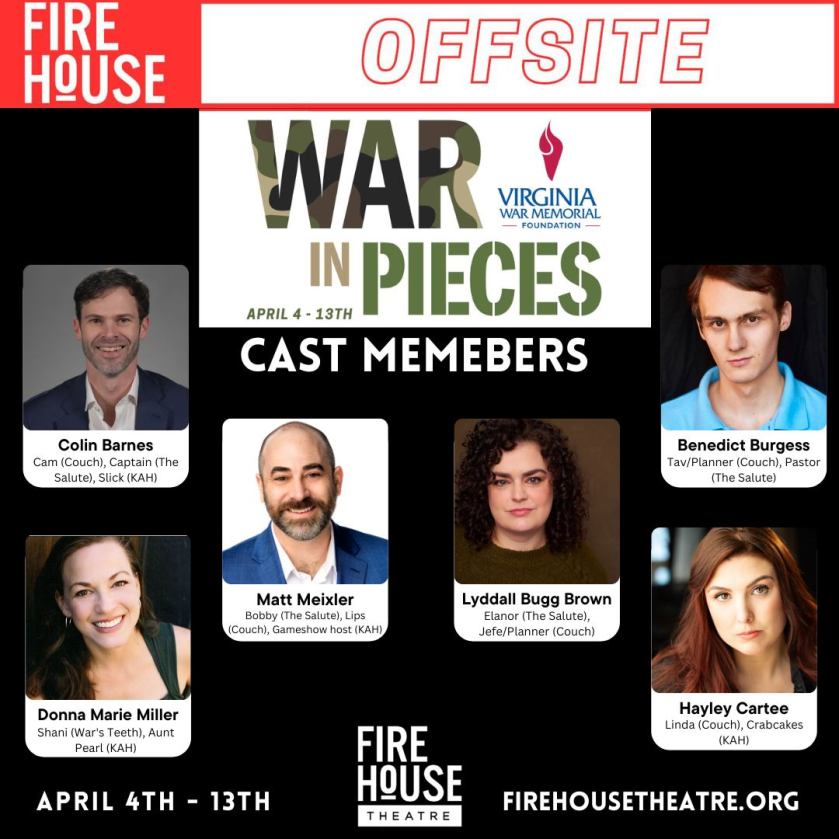
First up was Kaho’olawe, by Harry Mayer (United States Marine Corp & United States Navy). Kaho’olawe is an uninhabited island in the Pacific Ocean, and at 11 miles long by 6 miles wide it is the smallest of the eight main volcanic islands of the Hawaiian Islands. During World War II it was used as a US military training ground and bomb range. In Mayer’s play, Slick, a young bomb technician (played by Colin Barnes), comes upon a bomb on this island and finds that it is armed. He calls for help, but no help is available, and he is forced to use make-shift tools to disarm the bomb. But this is no ordinary bomb! It begins to talk to him, mocking him, doubting his ability, and questioning his skill, indeed his very confidence.

The bomb speaks first in its own voice, and then in the voices of Aunt Pearl and Miss  Crabcakes. I had assumed these voices in his head were recorded but no, after the show, director David L. Robbins informed me there were three live actors (Matt Meixler, Donna Marie Miller, and Hayley Cartee) speaking these lines with impeccable timing from their offstage locations. The tension is palpable, but in the end, Slick survives. Whew!

Next up is Shani Miller’s War’s Teeth, a heart-rending story in which Shani, played by Donna Marie Miller, reenacts an encounter with another, older vet, Ed Brown. Miller, the actor, not the author, strategically gives voice to both characters. Miller, the author, served as an Air Force Intelligence Officer, with multiple deployments to Iraq and Afghanistan. Her experience led to her memoir, currently a work in progress, in which she write about finding her lost sense of belonging after being deployed with the help of travel and the birth of her children (three under age six and a fourth on the way).

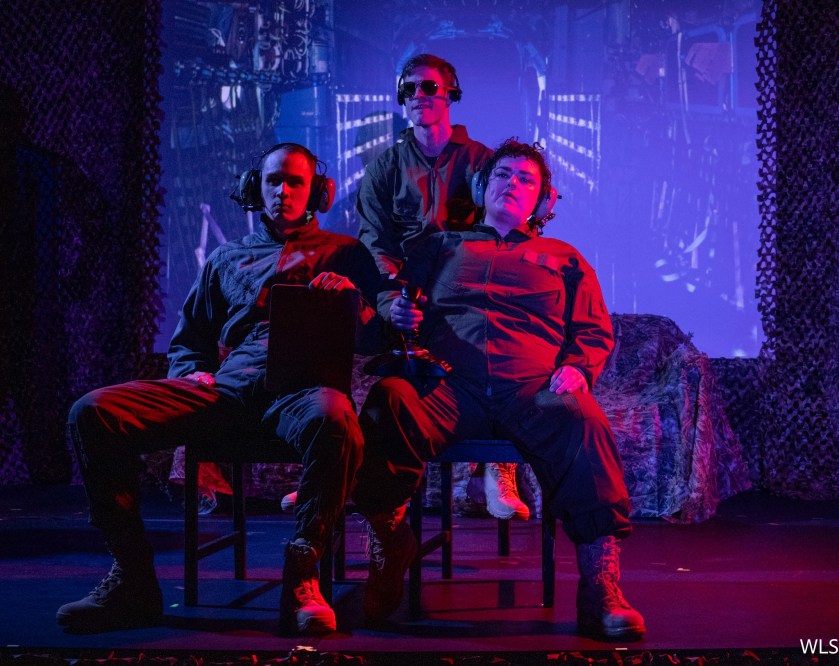
The second half of the program began with A Couch by Cam Torrens, an Air Force veteran with more than 30 years of service. In A Couch, Cam, an officer, chooses his command over his family, and gets sent to the couch by his wife – who, by the way, outranks him. “Don’t come home,” she says, illustrating the difficult choices that must be made, and how our military families are placed under stress when forced to choose between loyalty to family or loyalty to the mission and their country. Colin Barnes and Hayley Cartee skillfully walked this tightrope as the married couple.

The program closed with The Salute by Larry Meier (United States Army, and recipient of the Bronze Star with Palm for service in Vietnam). The cast of four, consisting of parents Eleanor and Bobby (Lyddall Bugg Brown and Matt Meixler), a support officer (Colin Barnes), and a Pastor (Benedict Burgess) takes the audience on a reluctant tour where we see the effects of war on an ordinary couple as they prepare to bury their son. What makes Meier’s story so powerful, for me, is that the focus is not just on the parents, but also on the young Captain who is sent to provide support for the family. The pastor notices, and offers him comfort, but the burden he carries may already be more than he can bear.

The thing that remains with me, however, is the mother’s reaction. At their son’s funeral, the tension builds until, upon receiving the folded flag from the young Captain, Eleanor springs up from her seat and speaks, in a voice that quickly escalates from a soft plea to a primal scream, “Ya’ll took my little boy, and you give me this – A FLAG!”Tossing the flag on the floor, she storms out of the chapel. There are no words of comfort. Nothing can fix this. It is haunting. This, all of this, is War in Pieces.

—–

Julinda D. Lewis is a dancer, teacher, and writer who was born in Brooklyn, NY and now lives in Eastern Henrico County. When not writing about theater, she teaches dance history at VCU and low impact dance fitness classes to seasoned movers like herself and occasionally performs.

—–

WAR IN PIECES

Four One-Act Plays by Virginia Veterans

Kaho’olawe written by Harry Mayer

Directed by David L. Robbins

CAST

Slick                ……….           Colin Barnes

Bomb             ……….           Matt Meixler

Aunt Pearl     ……….           Donna Marie Miller

Miss Crabcakes ……           Hayley Cartee

War’s Teeth written by Shani Miller

Directed by David L. Robbins

CAST

Shani              ………            Donna Marie Miller

A Couch written by Cam Torrens

Directed by Andrew Gall

CAST

Linda              ……….           Haylee Cartee

Cam                ……….           Colin Barnes

Jefe/Planner ……….           Lyddall Bugg Brown

Tav/Planner ……….           Benedict Burgess

Lips                 ……….           Matt Meixler

The Salute written by Larry Meier

Directed by Daniel Moore

Pastor            ……….           Benedict Burgess

Eleanor          ……….           Lyddall Bugg Brown

Captain          ……….           Colin Barnes

Bobby            ……….           Matt Meixler

Production Team

Executive Producer             ……….           David L. Robbins

Stage Management             ……….           Dennis Bowe, Grace Brown LaBelle

Sound/Projection Design  ……….           Grace Brown LaBelle

Costume Design/Coordination …           Tallie Pugh   

Run Time: About 2 hours; there is 1 intermission

Tickets: $15 to $35

Info: (804) 355-2001 or FirehouseTheatre.org

Performance Schedule:

Friday, April 4                       7:30PM         

Saturday, April 5                  7:30PM

Sunday, April 6                    2:00PM

Thursday, April 10               7:30PM

Friday, April 11                    7:30PM

Saturday, April 12                2:00PM

Saturday, April 12                7:30PM

Sunday, April 13                  2:00PM

———-

PHOTOS: from the Firehouse Facebook page

Benedict Burgess, Colin Barnes, Lyddall Bugg Brown
The Cast of War in Pieces 2025

SUNSET BABY

A Virginia Premiere & A Directorial Debut

by BLK Virginia Theatre Alliance

A Reflection on a Theater Performance by Julinda D. Lewis

At: VirginiaRep Theatre Gym. 114 W. Broad St, RVA 23220

Performances: April 4-13, 2025

Ticket Prices: $30/Adults; $15/Students

Info: (804) 282-2620/Box Office; (804) 309-6522, tariqkblkva@gmail.com or https://www.blkvatheatrealliance.org/

In case you didn’t know, there’s a new Black theater company in RVA. BLK Virginia Theatre Alliance (BVTA) was founded in January 2023, with a mission to present challenging works from underrepresented voices (www.blkvatheatrealliance.org). The company, under the leadership of Tariq Karriem, Artistic Director. A walking definition of Young, Gifted, and Black, Karriem became a professional stage manager at age 17 and now – still in his 20s – has recently worked on the production teams of 5th Wall Theatre’s productions of H*tler’s Tasters and Sanctuary City and VirginiaRep’s productions of Charlie and the Chocolate Factory and Misery.

Director Dee D Miller had this to say about Karriem, “You know most of the time people say they want to help the youth … this was the way for me to put my action behind my words. That kid is a force. He is a mogul in the making and always trying to better herself over and over again and with little support. I wanted to change that and I hope with this piece I did.”

The BVTA production of Dominique Morisseau’s Sunset Baby marks the Virginia Premiere of the play as well as the directorial debut of Dee D Miller (aka Dorothy “Dee-D” Miller – winner of Richmond Theatre Community Circle award for Best Supporting Actor, “How Black Mothers Say I Love You,” 2023 which also took home the Erie McClintock Ensemble Award for that year).

Sunset Baby is a powerful, confrontational drama that looks beneath the surface of the bold and brash Nina, daughter of two Black activists, and her reluctant reunion with Kenyatta, the father she barely remembers. Nina is played by Chayla Simpson and Kenyatta is played by Larry Akin Smith. Mu Cuzzo rounds out the cast as Nina’s boyfriend, Damon. And let me not forget to mention that Sunset Baby would not be the same without it’s powerful soundtrack of Nina Simone songs. Just as Motown provides the background for Morisseau’s Detroit ’67, Nina Simone provides the background – and is central to the context – for Sunset Baby.

Dominique Morisseau is the author of at least nine plays to date, several of which have been presented here in RVA: Pipeline in 2021 (https://jdldancesrva.com/2021/10/16/pipeline/) and Detroit 67 at the Firehouse Theatre as recently as March of this year (https://jdldancesrva.com/2025/03/16/detroit-67/)

In 2018 Morisseau received a MacArthur Fellowship, aka the “Genius Grant.” Morisseau’s works are known for their bold approach to issues relevant to the Black community and many of them revive or preserve important aspects of Black history.

“Ain’t nothing sentimental about a dead revolution.” – Nina

In Sunset Baby the dialogue is filled with F-bombs and N-words but the characters also debate the relevance of criminologist Steven Spritzer’s writings on social junk and social dynamite and the political activism of Kwame Ture (nee Stokely Carmichael). Protagonist Nina was, in fact, named for singer, pianist, and activist Nina Simone. The daughter of two political activists, Nina’s mother died, penniless and drug addicted, and her father is just now reconnecting after years spent in prison for armed robbery committed to fund “the revolution.” So much of this work is very personal to me.

Sunset Baby is set in a tenement apartment in East New York, Brookly, not far from Bedford-Stuyvesant where I grew up. Kwame Ture, a leader of the Black Power movement and “Honorary Prime Minister” of the Black Panther Party, attended my alma mater, the prestigious Bronx High School of Science. And my late, second husband was a political organizer for The Young Lords – the Puerto Rican version of the Black Panthers. I felt as if I knew these people; they were not just creations of Morriseau’s imagination and research, they were people from the pages of my old photo albums and yearbooks. For younger folk, this may be less personal but should be no less impactful.

“Some dreams get lost, never to be found again.” – Common ft. Nina Simone

Chayla Simpson gives a memorable performance. She is loud and brash and angry. She leaves no doubt that her character, Nina, is smart and independent, but also suffering from childhood trauma. The men are equally complex. Larry Akin Smith, as Kenyatta, alternates between impassioned scenes with Nina and her man, Damon, and carefully controlled monologues in which he records his history – his daughter’s inheritance. As brilliant and committed as he is, there is just one thing he cannot bring himself to say – the one thing Nina truly needs to hear. Mu Cuzzo provides perhaps the most well-rounded characterization of thug life to ever grace a stage. He sells drugs and shoots people, but he is also a well-read Black man with big dreams of traveling the world, a loving partner who steals from his woman one minute and rubs her feet the next. And Mu Cuzzo makes this believable.

“Oh Lord, please don’t let me be misunderstood.” – Nina Simone

As for Dee D Miller’s directorial debut – the characters sometimes veer on the edge of overacting, but except for one scene, in which Damon trashes Nina’s apartment, they don’t go completely over the edge. They are violent, and loud, and shocking, but we never dismiss them because there are always redeeming qualities or actions that remind us that these are real people – the kind of dysfunctional people many of us have in our own families and on the periphery of our own lives. Miller takes us on a ride in a jitney – an unlicensed taxi once popular in neighborhoods like the one Nina lives in, because legitimate taxi drivers were afraid to go there – and delivers us to our destination shaken but for the most part unharmed. And kudos to the design team for Nina’s hootchie-mama wardrobe, six-inch heeled boots, and wig collection.

Oh, and that title? I looked up the meaning of “sunset baby” and found that it refers to a twin that dies before birth. The surviving baby is a “sunrise baby.” Interesting as that may be, it is not at all relevant to Sunset Baby so maybe just save that in case it comes up in a game of trivia. The complete answer would be a spoiler, so I’ll just leave you with this…when Nina was a toddler, she asked,

“Where does the sun go when it disappears?”

For the answer to her question, and the relevant context, you need to go see the show.

———-

Julinda D. Lewis is a dancer, teacher, and writer who was born in Brooklyn, NY and now lives in Eastern Henrico County. When not writing about theater, she teaches dance history at VCU and low impact dance fitness classes to seasoned movers like herself and occasionally performs.

———-

SUNSET BABY

By Dominique Morisseau

Directed by Dee D Miller

CAST

Chayla Simpson       ……….           Nina

Mu Cuzzo                  ……….           Damon

Larry Akin Smith      ……….           Kenyatta

CREATIVE TEAM

Direction                   ……….           Dee D Miller

Scenic & Prop Design   .…..           Tariq Karriem

Lighting Design       ……….           Griffin Hardy

Sound Design ………. Jonathan Pratt

Asst Lighting Design/

     Master Electrician ……….          Zeke Brookes

Costume Design      ………..          Elijah Brown

Dramaturgy              ……….           Jasmine Bates

BLK VIRGINIA THEATRE ALLIANCE STAFF

Artistic Director/

     Production Manager      –           Tariq Karriem

Chief of Business Administration-Ayanna Shelton

Producer                               –           Malakai Lee

Creative Producer/

     Director of Costume      –           Elijah Brown

PERFORMANCE SCHEDULE
Friday, April 4           7:30PM          Opening Night

Saturday, April 5      2:30PM

Saturday, April 5      7:30PM          Black Theatre Night/Talk Back

Sunday, April 6        2:30PM

Sunday, April 6        7:30PM

Friday, April 11        7:30PM          Industry Night/Talk Back

Saturday, April 12    2:30PM

Saturday, April 12    7:30PM          Student Night

Sunday, April 13      2:30PM

Sunday, April 13      7:30PM          Closing night

Run Time

About 90 minutes with no intermission