DANCE NATION: Five, Six, Seven, Eight

DANCE NATION: Teen Awakening, Gandhi, Power, & Competitive Dance

A Theater Review by Julinda D. Lewis

At: TheatreLab, The Basement, 300 E. Broad St, RVA 23219

Performances: July 11 – August 3, 2019

Ticket Prices: $35 general admission; $25 seniors & industry/RVATA; $15 students and teachers with ID

Info: (804) 506-3533 or theatrelabrva.org

Dance Nation makes you laugh and cringe. Clare Barron’s 2018 play captures a painful, awkward, and gloriously empowering moment in time in the lives of Dance Teacher Pat’s pre-teen and early teen competitive dance team. (Yeah, that is a little confusing but in the play the characters are referred to both as pre-teens and as thirteen-year-olds.)

I, gratefully, have very few clear memories of my teen years, but a post-performance discussion with a much younger acquaintance who grew up in a local dance studio owned by her mother painted a much different picture of Dance Nation.

For me, it was a sometimes amusing, sometimes horrific picture of adolescence with an unusual, even shocking focus on female empowerment. For some younger female viewers, it was a theatrical manifestation and perhaps even validation of their own sometimes tortuous awakening. Some male viewers were enthralled, others, I am sure, are still not sure what to make of teenaged girls talking about masturbation and virginity, and scenes involving blood (menstrual and otherwise) and dancers with vampire teeth hissing at the audience.

This is not the usual rehashing of adolescent angst and teenage trauma. Barron blends hormonal horrors with feral ferocity and Maggie Roop seems to understand and honor this with her mostly clear and unencumbered direction. Dasia Gregg’s locker room set brings the action right up in the face of the audience. There are only two rows, and the second row has the advantage of receiving the full effect of the audio transducers that generate sound you can feel through your seats – reminiscent of the effects in Disney’s “A Bug’s Life” show in the Animal Kingdom theme park.

There is also original music by Joey Luck, with vocals by a team that includes Breezy Lee Potter, Ali Thibodeau, and John Paul Hodge. Michael Jarett’s lighting and Joey Luck’s sound design (that includes lots of heavy breathing) are integral elements of this production and Nicole Morris-Anastasi provided the choreography, which was quite lively in the first act, with the members of the dance team dressed as sailors, their wide smiles painfully pinned in place, their eyes focused on the winner’s trophy.

In the first scene one dancer, Vanessa, played by Maggie McGurn who later plays the moms of many of the dance team members, is eliminated after a leg injury that sends her to the hospital and sidelines her from the team.

The strongest and at the same time most strained relationship is that between Amina (Lydia Hynes) and Zuzu (Trinitee Pearson). Amina is admittedly the strongest dancer on the team, and Zuzu has wanted to be a dancer more than anything since the age of two – but she isn’t quite as good as Amina and struggles to reconcile her friendship with her own self-doubt and Amina’s ambition. Both Hynes and Pearson give searing performances that attempt to cut to the heart of the matter.

But neither comes close to the explosive monologue given by teammate Ashlee, played by Amber Marie Martinez at, the end of Act One. Martinez’s gutsy and raw outpouring on sexuality and power includes words like “beautiful” and “smart” and “SAT,” as well as “bitch,” and the, as far as I know, original phrase, “mo****-fu*****, cun*-munching, piece of sh**” a phrase I don’t recall ever saying or even thinking, at 13 or even at 64.

During the first act, the team warms up at the ballet barre, injecting giggles and wiggles as each of the girls – and the one guy – take turns whispering “pussy,” which later develops into a “perfect pussy” mantra recited by the entire team during the second act – accompanied by an audience-teasing sampling of seat-vibrating audio transducers. (That was my favorite special effect and requires that you get seats in the second or back row to experience the full effect.)

I was never quite sure whether Chris Klinger’s portrayal of Dance Teacher Pat was authentic or creepy. I leaned toward the latter when he lightly tapped Amina on the butt after a private talk, but although she appeared startled and hesitated a moment as she walked away that angle was never pursued. The dance teacher kept his focus on the prize – the regionals, the nationals, whatever winning meant – and had little time for developing the self-esteem or character of his girls. To him, they seemed to be not individuals, but tools to achieve another trophy.

The girls include Amina (Hynes), Zuzu (Pearson), and Ashlee (Martinez), as well as Connie (Sanam Laila Hashemi), Maeve (Kylie M.J.  Clark), Sofia (Nicole Morris-Anastasi) and Luke (Marquis Hazelwood). Yes, Luke is the only boy on the team, but the team is always referred to as “the girls,” and there is no indication of Luke’s sexuality, other than a suggestion that he has a crush on Zuzu. Maeve shares a tender scene with Zuzu, where she talks about flying, and Luke also shares a scene with Zuzu, in which she proposes two possible scenarios of her future life as an adult. Luke seemed a little disappointed that neither scenario included him. Pearson handles a variety of delicate situations with great sensitivity, and Hazelwood, while not a central figure, seems sympathetic and sweet.

The characters of Zuzu and Amina are the most highly developed, and there are intriguing scenes involving Ashlee, Connie, and Maeve. The rest of the team, Sofia and Luke are more peripheral, and little is known of Dance Teacher Pat, who is always referred to as Dance Teacher Pat. The Moms add a spark of insight and even humor but are apparently not meant to be any more significant than the trombone-voiced adults in Peanuts cartoons.

Powerful and intense, Dance Nation  may stir up long forgotten memories or sound an alarm, depending on your age, gender, or how much you remember of being thirteen years old. The one thing it won’t do is leave you untouched.


Julinda D. Lewis is a dancer, teacher, and writer who was born in Brooklyn, NY and now lives in Eastern Henrico County.

———-

Photo Credits: Tom Topinka

Dance Nation.10
Clockwise from back, center: Chris Klinger, Marquis Hazelwood, Nicole Morris-Anasasi, Kylie M.J. Clark, Trinitee Pearson, AMbe Marie Martinez, Lydia Hynes, and Sanam Laila Hashemi
Dance Nation.9
Lydia Hynes
Dance Nation.8
Trinitee Pearson
Dance Nation.7
Sanam Laila Hashemi
Dance Nation.6
Marquis Hazelwood
Dance Nation.5
Kylie M.J. Clark
Dance Nation.4
Nicole Morris-Anastasi
Dance Nation.3
Amber Marie Martinez
Dance Nation.2
Maggie McGurn
Dance Nation.1
Chris Klinger


https://www.amazon.com/gp/product/1072107546/ref=as_li_qf_asin_il_tl?ie=UTF8&tag=rvartreview-20&creative=9325&linkCode=as2&creativeASIN=1072107546&linkId=7297b0f3a126f983ce798b1d13f44587

Whistlin Women

https://www.amazon.com/gp/product/1093389303/ref=as_li_qf_asin_il_tl?ie=UTF8&tag=rvartreview-20&creative=9325&linkCode=as2&creativeASIN=1093389303&linkId=df9f0a154012577ef219ec2eea590c83

Alvin Ailey


Fellowship Cruise 2020


POLKA DOTS: A Musical About Segregation

Polka Dots: The Cool Kids Musical

A Theater Review by Julinda D. Lewis

At: Virginia Rep’s Children’s Theatre at Willow Lawn; 1601 Willow Lawn Drive, RVA 23230

Performances: July 12 – August 11, 2019

Ticket Prices: $21

Info: (804) 282-2620 or virginiarep.org

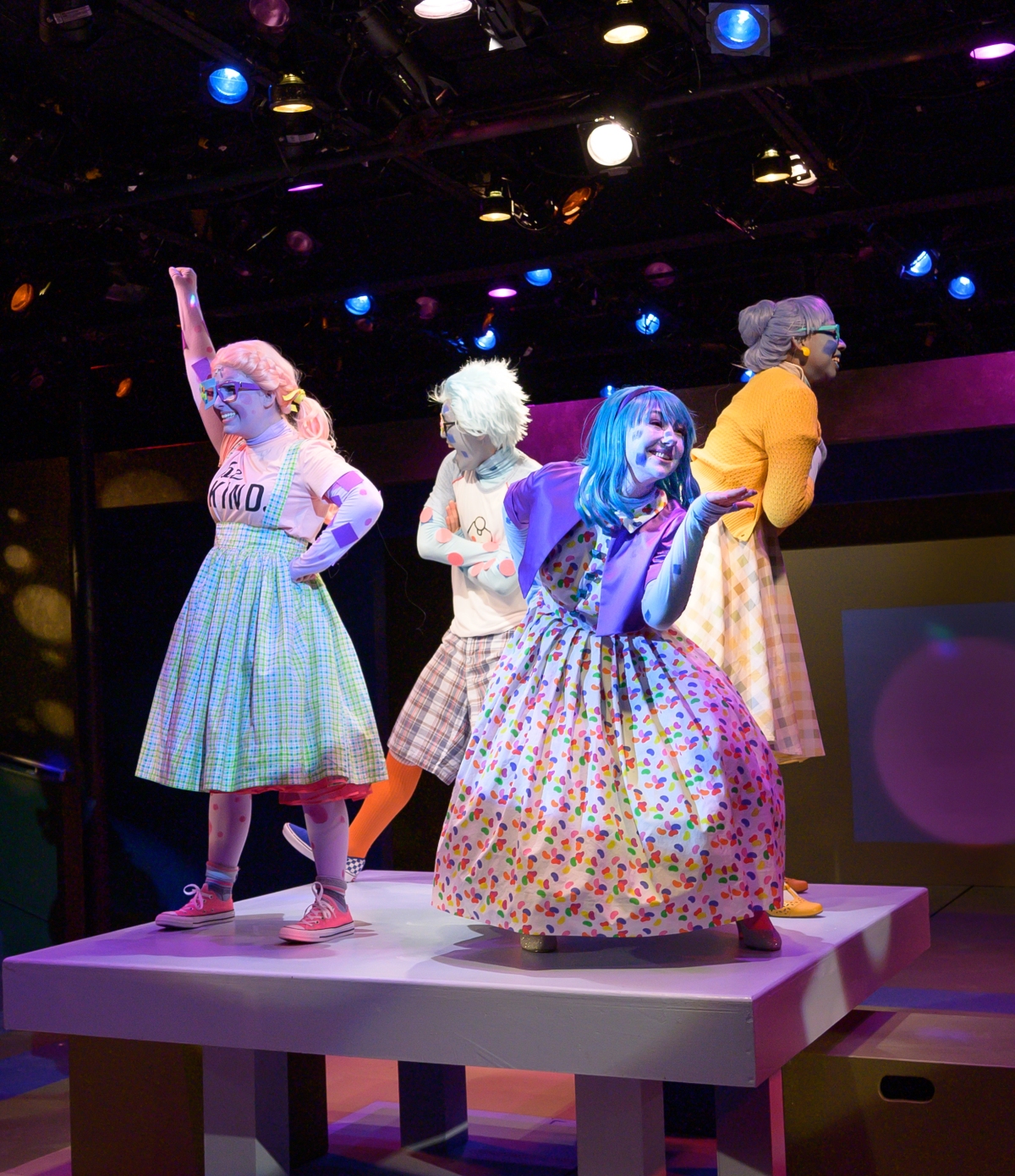
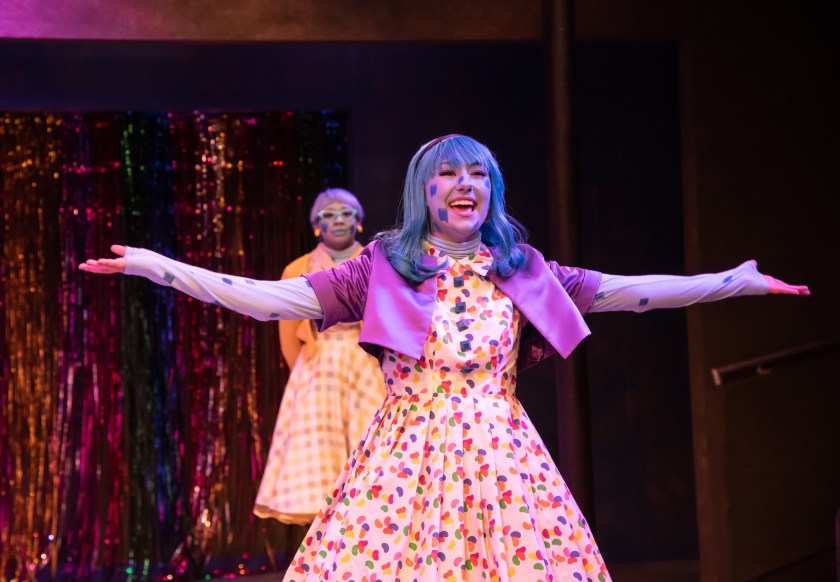
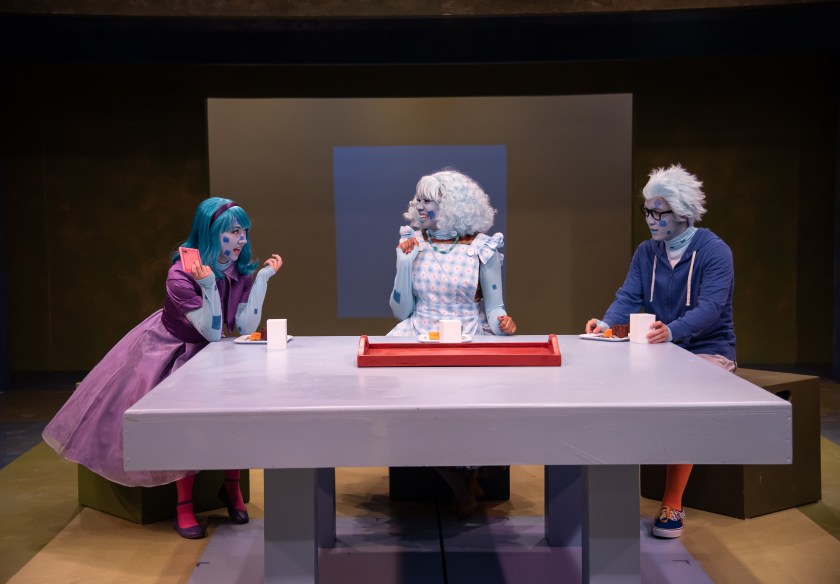
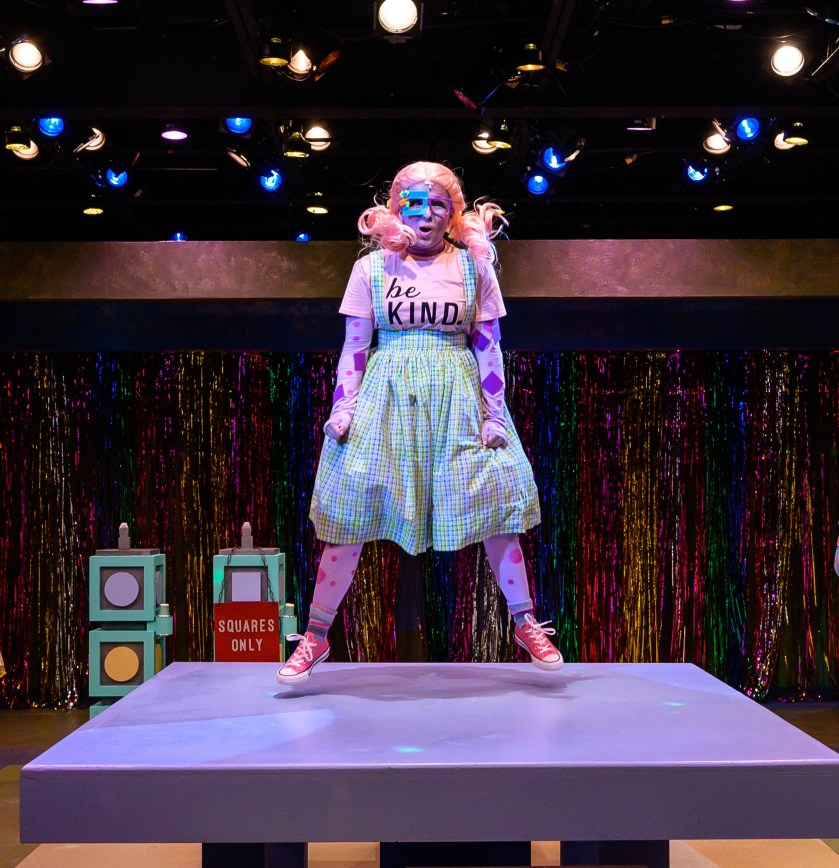
Polkadots: The Cool Kids Musical is based on the real-life events of the Little Rock Nine. In 1957 nine black students enrolled in the formerly all-white Little Rock Central High School, a test of the 1954 Brown v Board of Education Supreme Court ruling that declared segregation in public schools unconstitutional. For Polkadots, Melvin Tunstall, III (book) has set the  story in Rockaway elementary school, in an undetermined state. Instead of black and white, the tension takes place between the blue skinned squares and the pink skinned polkadots. The squares believe they are the superior group, and don’t want to share their school or their town with polkadots.

Eight-year-old Lily Polkadot, played by Caroline Lynch, is the first polkadot to integrate the school, and the plot revolves around Lily’s efforts to make a friend and assimilate into her new school. Serious and sensitive issues are handled with care under the gentle direction of Jan Guarino.

Lily puts up a brave front, standing up to the mean spirited Penelope Square, singing “Sticks and Stones” as an affirmation, but she still privately wishes her skin was covered with squares instead of polkadots. The children’s teacher, Ms. Square, played by Sydnee Graves, who also plays the role of Mama Square, is warm, friendly and accepting of Lily, but at the same time she doesn’t want to make waves.

On the first day of school, Lily must remain alone in the classroom during the bathroom and water break because the polkadots’ water pump has not yet been installed, and Lily must not drink from the squares’ water sprinkler. A separate water fountain is eventually rolled out for Lily, and this marks one of many times I wondered just how much the younger members of the audience really understood the historical significance of what was taking place.

This was one of the few times I did not have my grandsons Kingston (10) and Emmitt (who just turned 5) along to consult with. As a matter of fact, the volunteer ticket taker took one look at me and asked, “Where’s your grandson?” I almost felt like some sort of pervert attending the Children’s Theatre without a child or two in tow, and I really would like to know what they would have taken away from this show.

Interesting, the cast, including Quan Chau as Sky Square, Sydnee Graves as Ms. Square/Mama Square, Caroline Lynch as Lily Polkadot, and Madeleine Witmer as Penelope Square is quite diverse (white, black, Asian), and all are making their debuts at the Children’s Theatre at Willow Lawn. The quartet was uniformly energetic, and all boast strong singing voices. Douglas Lyons’ lyrics are surprisingly sophisticated for a children’s show – more throaty ballads than bouncy ditties and the music by Greg Borowsky and Lyons provides a firm foundation for Mallory Keene’s choreography. There is even one number, where Sky and Lily create a silly dance, the Squa-Dot, that invites audience participation, but on Friday night, although there was one enthusiastic row of youthful audience members bouncing in their seats, no one was brave enough to stand up and join in the dance.

Graves was almost annoyingly prim and proper in her role as the teacher and seemed like an authentic school counselor when she shared with Lily her own trials as the first “lady teacher” at their school. Witmer was almost satisfyingly snarky as the mean girl big sister, and was visibly disappointed when her big song, “Cool Kid,” which was meant as a put-down for Lily missed the mark, because Lily wasn’t in the audience to hear it. Chau was adorable as little brother, Sky, and Lynch was perfectly cast as the spunky yet vulnerable Lily.

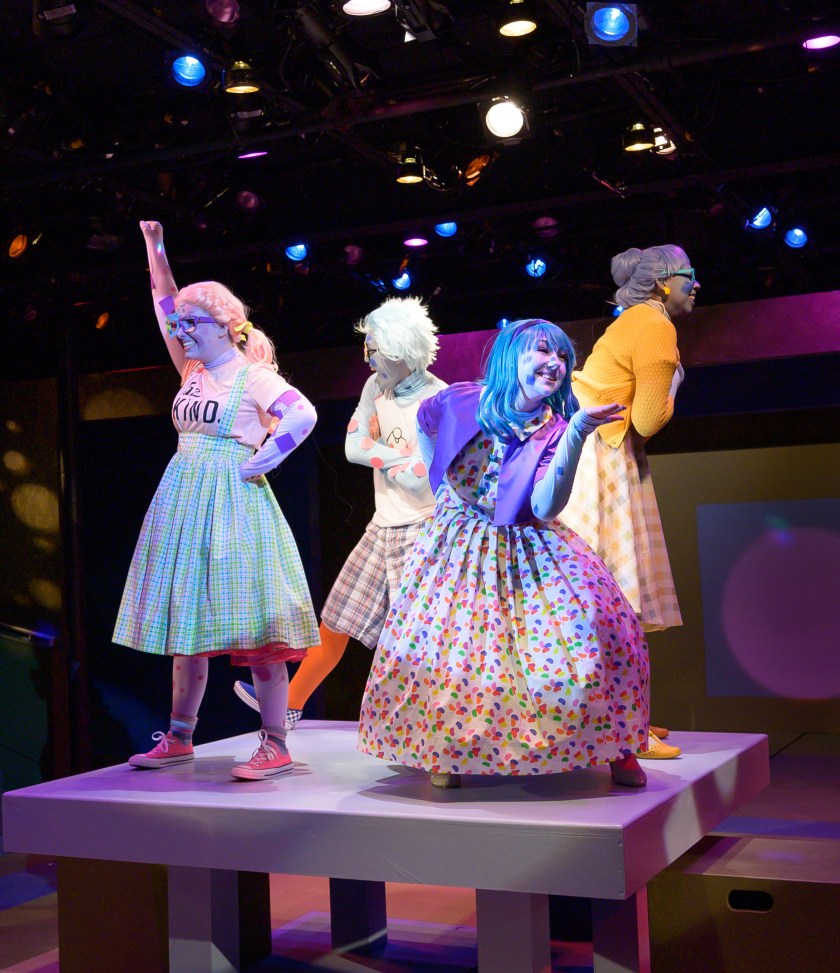
Kyle Artone’s costumes are colorful and cartoonish, and the square women’s full-skirted dresses, stretched over stiff and puffy crinolines, are especially pretty. Lily’s dress is simpler and less elaborate than the dresses of the squares. I found the pink and blue skin (part fabric and part makeup) and cotton candy colored hair a bit creepy, but it didn’t seem to bother the younger members of the audience.

Emily Hake Massie’s set was surprisingly simple. A huge square platform in the center of the stage served as Penelope’s bed, Ms. Square’s classroom, and Mama Square’s dining table. Cubes served as props and seating and doubled as steps to allow the performers access to sit and dance atop the square platform. Lynne Hartman’s lighting was also minimal, with a few special effects that highlighted the segregated fountains.

Unlike in real life, there is a happy ending, with everyone becoming friends – or at least, agreeing to live and work together – but as a lesson, it’s a start. Looking around at the faces of the children in the audience, mostly 6-10 years old, they appeared to be having a good time, but it would take a post-performance discussion to determine how much they actually learned.

Polkadots: The Cook Kids Musical runs just under an hour, with no intermission, and will be playing at The Children’s Theatre at Willow Lawn through August e.

Julinda D. Lewis is a dancer, teacher, and writer who was born in Brooklyn, NY and now lives in Eastern Henrico County.

———-

Photo Credits: Aaron Sutten

Polkadots: The Cool Kids Musical
Madeleine Witmer. Photo by Aaron Sutten.
Polkadots: The Cool Kids Musical
Quan Chau, Caroline Lynch. Photo by Aaron Sutten.
Polkadots: The Cool Kids Musical
Madeleine Witmer, Sydnee Graves, Quan Chau. Photo by Aaron Sutten.
Polkadots: The Cool Kids Musical
Caroline Lynch, Quan Chau, Madeleine Witmer, Sydnee Graves. Photo by Aaron Sutten.
Polkadots: The Cool Kids Musical
Caroline Lynch. Photo by Aaron Sutten.

https://www.amazon.com/gp/product/1072107546/ref=as_li_qf_asin_il_tl?ie=UTF8&tag=rvartreview-20&creative=9325&linkCode=as2&creativeASIN=1072107546&linkId=5e220df68289b91719424f983db71bce

https://www.amazon.com/gp/product/1093389303/ref=as_li_qf_asin_il_tl?ie=UTF8&tag=rvartreview-20&creative=9325&linkCode=as2&creativeASIN=1093389303&linkId=063b624792d27499db54c28e1f0964d1

Fellowship Cruise 2020

ANIMAL CONTROL: THE SECOND WORLD PREMIERE

ANIMAL CONTROL: THEY’RE BACK

A Theater Review by Julinda D. Lewis

At: The Firehouse Theatre, 1609 W. Broad Street, RVA 23220

Performances: July 3 – 27, 2019

Ticket Prices: $15/student; $25/military; $35/general admission

Info: (804) 355-2001 or firehousetheatre.org

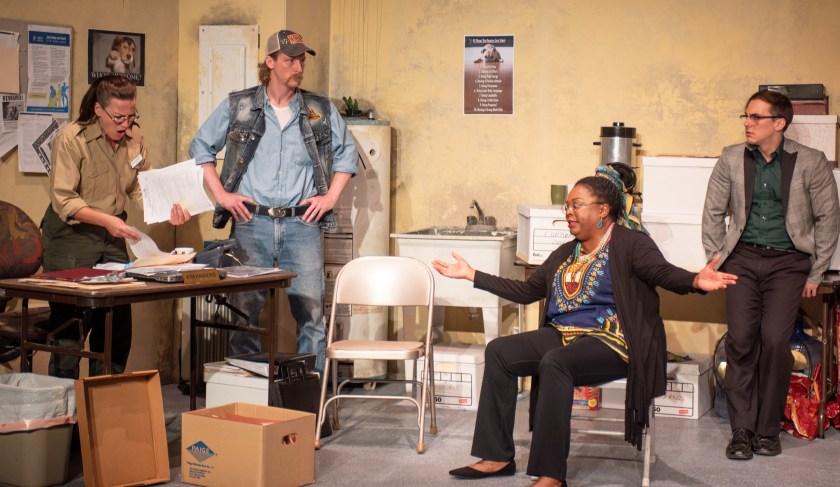
About three months ago I wrote about the world premiere of Chandler Hubbard’s new play, Animal Control. It may be unusual, but here we are again. The Firehouse Theatre’s summer offering is a re-working of Hubbard’s play, with two new cast members, and director Joel Bassin, Producing Artistic Director of the Firehouse Theatre, jokingly and lovingly referred to this production as a revised world premiere.

[For my April 21 review of the original world premiere, visit

https://wordpress.com/posts/jdldancesrva.com?s=animal+control]

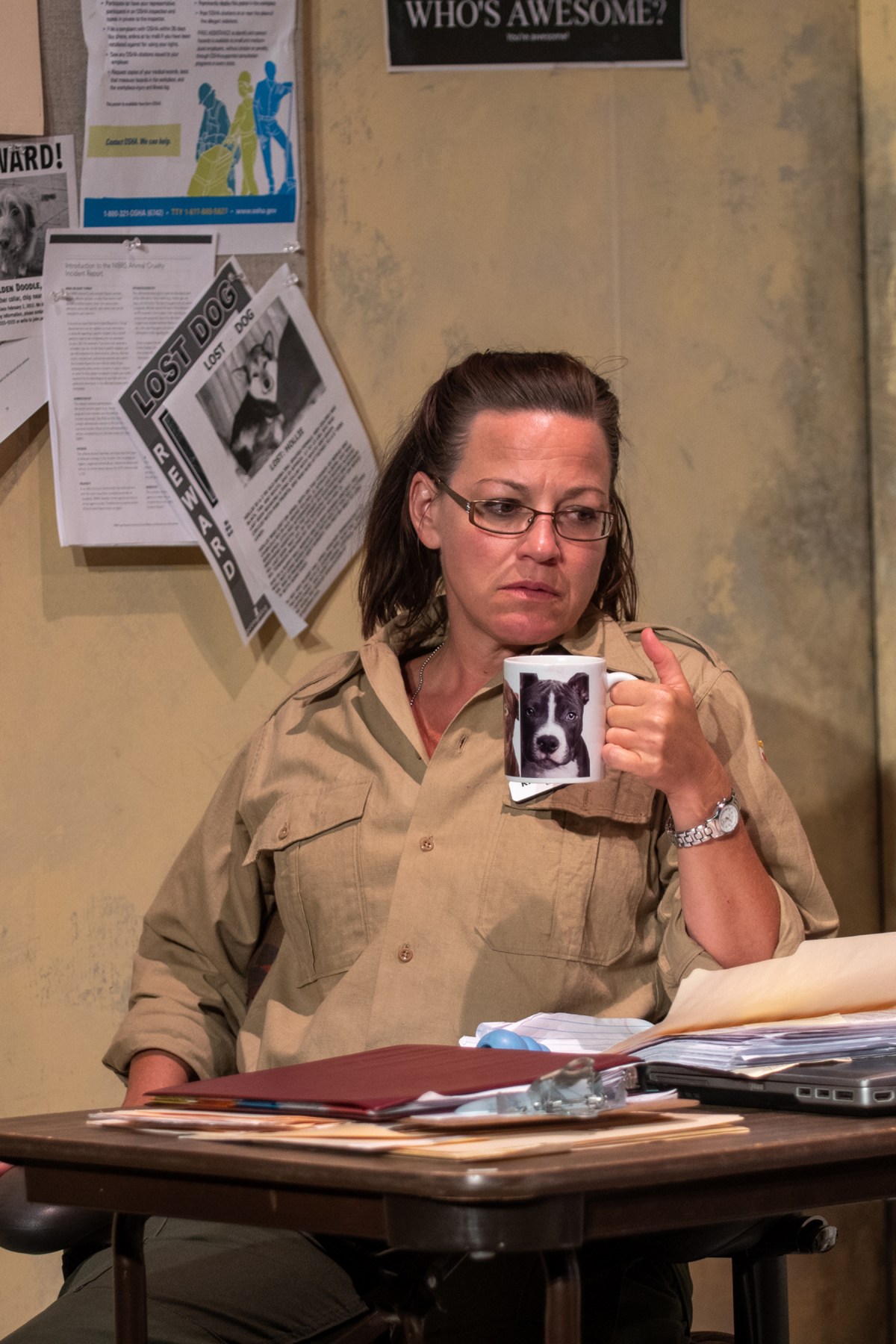
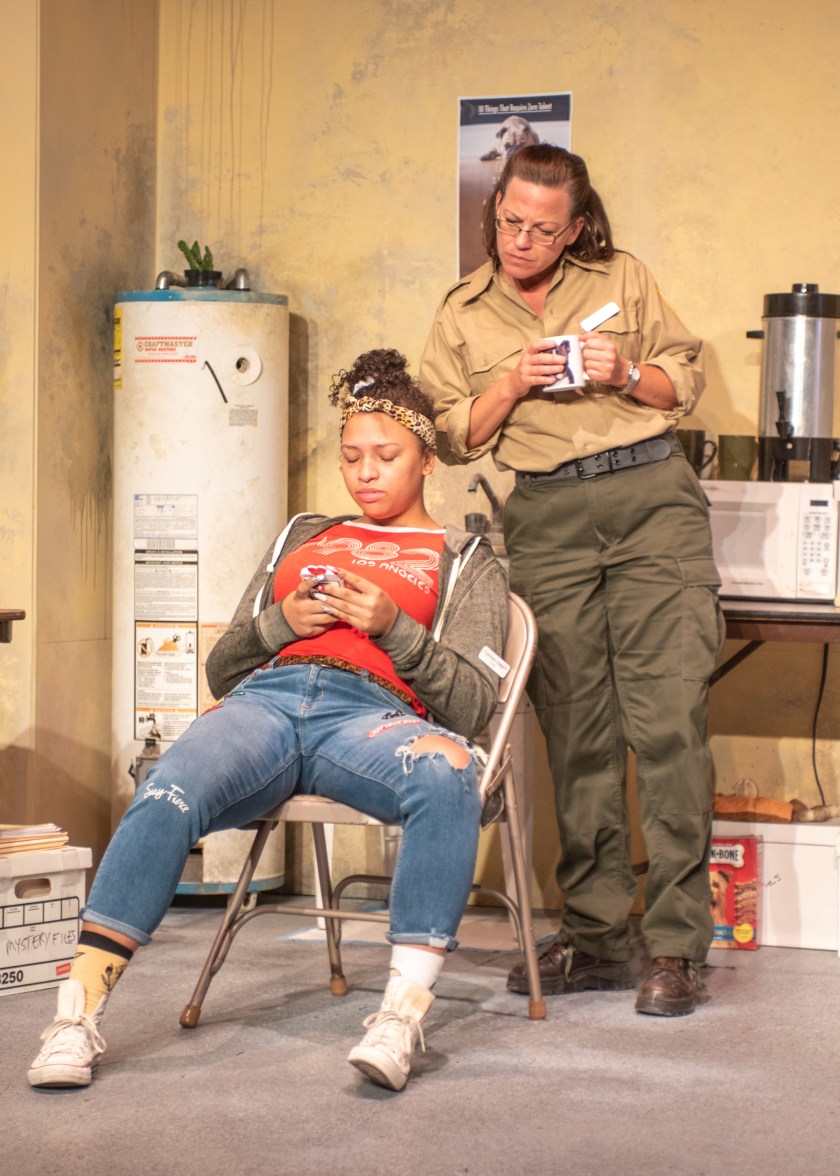
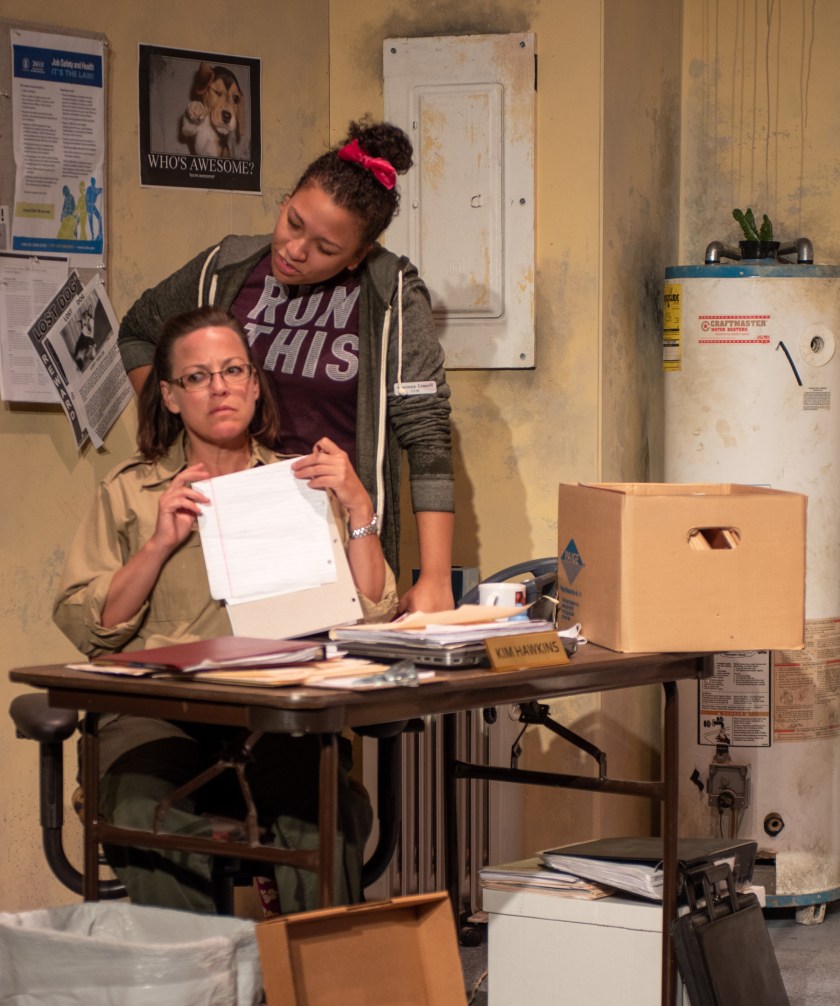
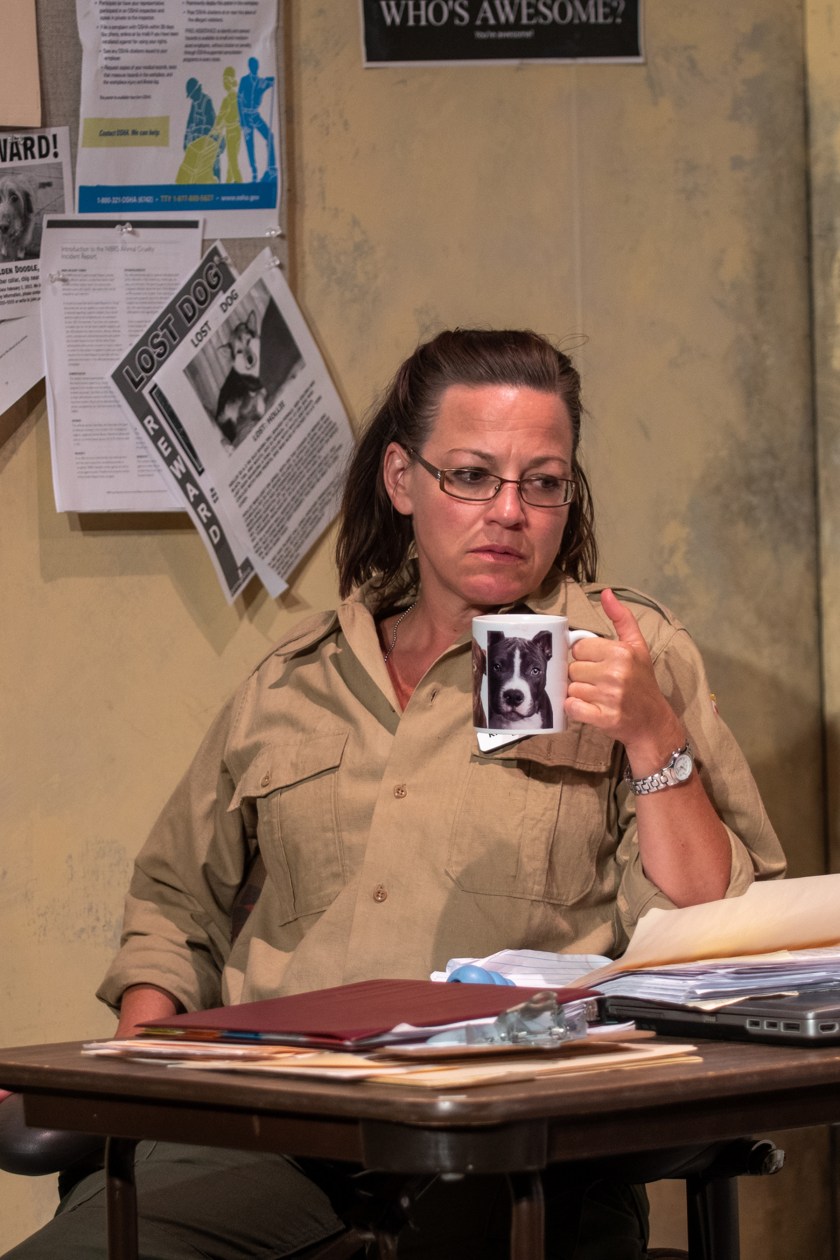
For this production, Chandler’s original three acts or scenes – The Prosecution, The Defense, and The Verdict – have been somewhat condensed. The combined effects of the script changes and the chemistry of the new cast has led to a leaner, tighter production, with greater dramatic intensity. It still evokes a strong sense of compassion, and it still brings tears to the eyes of pet owners and animal lovers, but it also seems to focus more on the development of character Kim Hawkins, the newly appointed manager of the Carson County Pound, so that she seems less incompetent and more a victim of a series of unfortunate circumstances leading to the tragic culmination.

Donna Marie Miller still plays the role of Kim Hawkins and appears to have honed it to a masterful depiction of a caring woman who is tested by the unmitigating stresses and pressures of a dysfunctional bureaucracy. Similarly, Adam Turck has returned to play the role of the somewhat neurotic Marc Hanson, owner of Winnie (short for Winston, as in Churchill), the dog who was attacked by Bailey, the three-legged bully of the dog park. Turck has tweaked Marc’s characteristics, making him at once more focused and more distracted. As an example of the former, he sits with his body squarely facing the audience but his head is turned perpendicular to his body, zoned in on Hawkins; as for the latter, he seemed to take extra care to make sure we noticed his need to place a fork in the sink, cover a lunch container and put in into the mini-fridge, or examine the canine graphics on Hawkins’ coffee mug.

Young Journey Entzminger (a junior business management major at VCU) also returned as the intractable office assistant, Corrine Lowell. I would not have believed it possible but Entzminger was even sassier than before while somehow managing to steal hearts and nearly steal the show whenever she appears onstage – or even while making outrageous exits.

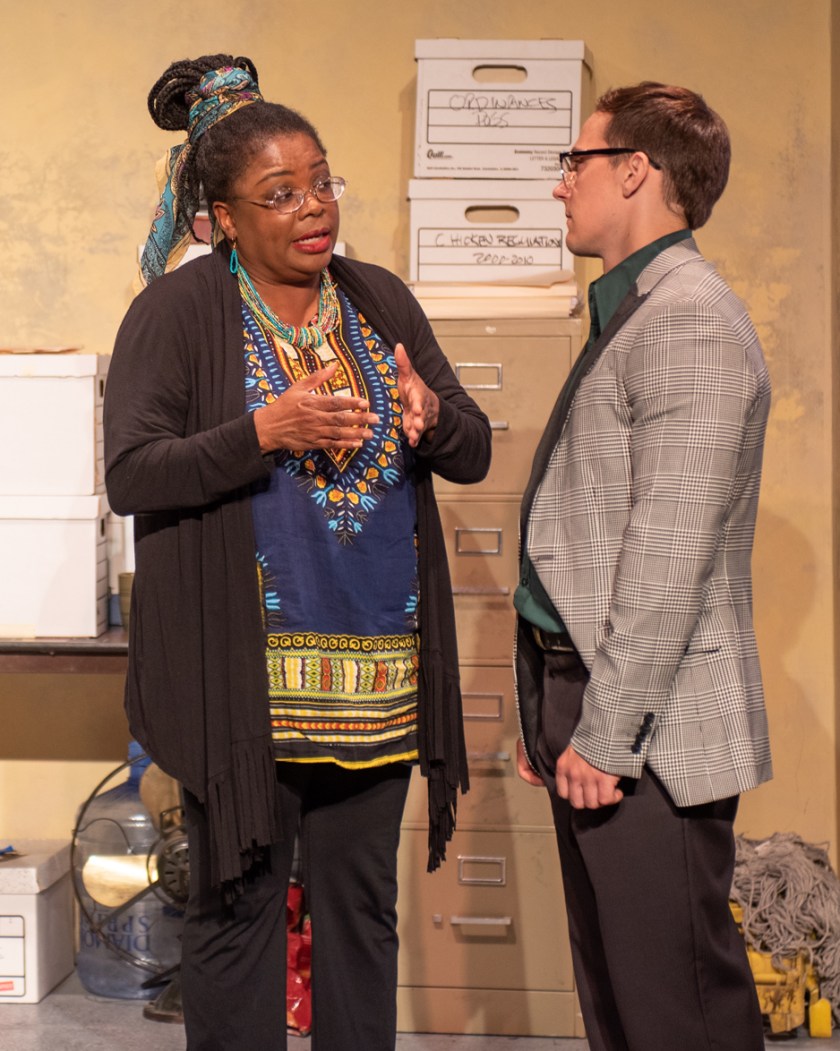
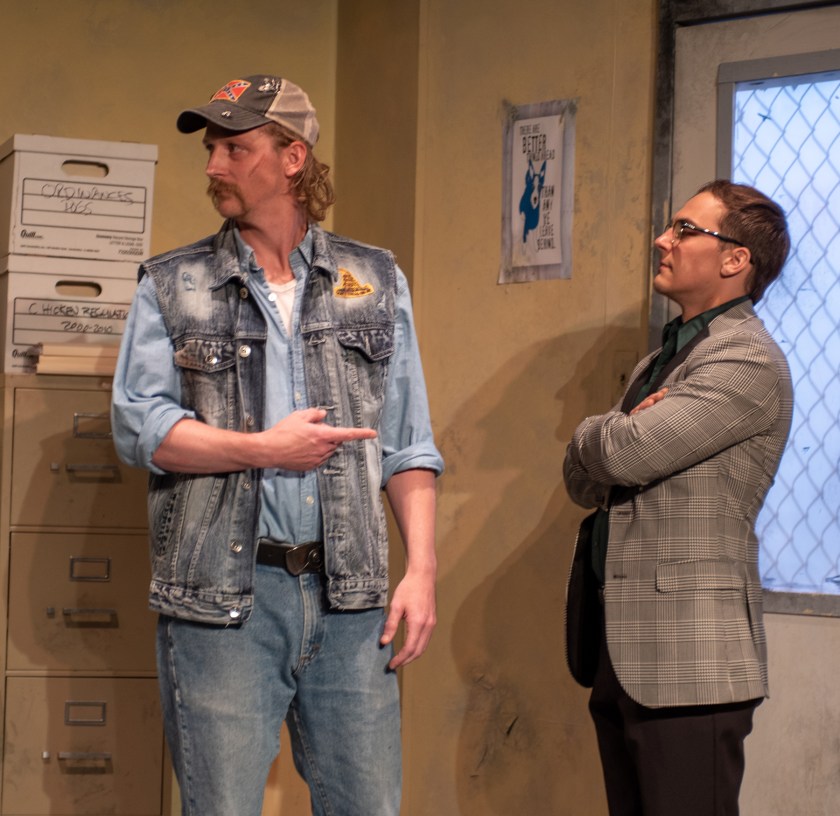
New to this cast are Stevie Rice as Dan Stanley, a role previously played by the 6’7” Arik Cullen, and Margarette Joyner as Patty Smith, a role previously portrayed by Lucretia Marie Anderson. When I first heard that Rice would be playing the role of Stanley I couldn’t image anyone other than Cullen whose mere presence was intimidating. But I quickly grew to admire the versatile Rice in the role. He was nearly unrecognizable as himself, hidden behind a baseball cap and a denim vest, both emblazoned with confederate flags. As much as you despise him at the beginning, you can’t help but feel compassion for him in the final scene, where even the irreverent Corrine feels compelled to gently brush back his hair while declaring the final words of the play, “he was a good dog.”

Last but not least, Joyner brought a more militant, more forceful interpretation to the role of Patty Smith, the beleaguered neighbor whose frequent complaints about Bailey were both cause and effect of the plot twists leading to the scene three denouement.

Much as I enjoyed the original production and cast, it is clear that Bassin, Chandler, and this cast have worked hard to solve problems and issues –both perceived and imperceptible – with the original. The result is, indeed, a better, more compact, more intense play.

BTW, when I walked into The Firehouse, Bassin was quick to explain his concept for the set, because in the original production, I wrote, I was distracted by the set with its chain link fences on either end. Bassin’s aesthetic leans towards the unrefined, minimalist look, while my OCD tendencies prefer things more refined and polished. But, point made and taken, it’s an aesthetic choice, and does not interfere with the average person’s ability to enjoy the production.

Animal Control is a surprising play in many ways. It presents many sides of a story, demonstrating how difficult it is to judge others. It makes subtle parallels between the behavior of people (Corrine, the student worker, who was been, in a way, rescued from juvenile detention) and animals (Bailey, a former bait dog abused by breeders of fighting dogs). And mostly it reminds us that even the most unlikely person may be deserving of compassion.


Julinda D. Lewis is a dancer, teacher, and writer who was born in Brooklyn, NY and now lives in Eastern Henrico County.

———-

Photo Credits: Bill Sigafoos

7_Journey Entzminger, Donna Marie Miller (photo by Bill Sigafoos)-1
Journey Entzminger and Donna Marie Miller
6_Margarette Joyner, Adam Turck (photo by Bill Sigafoos)
Margarette Joyner and Adam Turck
5_Donna Marie Miller, Stevie Rice, Margarette Joyner, Adam Turck (photo by Bill Sigafoos)
Donna Marie Miller, Stevie Rice, Margarette Joyner and Adam Turck
3_Stevie Rice, Adam Turck (photo by Bill Sigafoos)
Stevie Rice and Adam Turck
2_Donna Marie Miller, Journey Entzminger (photo by Bill Sigafoos)
Donna Marie Miller and Journey Entzminger
1_Donna Marie Miller (photo by Bill Sigafoos)
Donna Marie Miller


https://www.amazon.com/gp/product/1072107546/ref=as_li_qf_asin_il_tl?ie=UTF8&tag=rvartreview-20&creative=9325&linkCode=as2&creativeASIN=1072107546&linkId=b7470be179f4f08accd635db544f386f

Whistlin Women

https://www.amazon.com/gp/product/1093389303/ref=as_li_qf_asin_il_tl?ie=UTF8&tag=rvartreview-20&creative=9325&linkCode=as2&creativeASIN=1093389303&linkId=38ea3e9c57ccbf3ed376abedf1676918

Alvin Ailey


girlfriend: a tender tale of first love

GIRLFRIEND: A Summer Romance

A Theater Review by Julinda D. Lewis

Richmond Triangle Players

At: The Robert B Moss Theatre, 1300 Altamont Avenue, RVA 23230

Performances: June 24 – July 9, 2019.

Ticket Prices: $10-20

Info: (804) 346-8113 or rtriangle.org

Girlfriend, a two-person musical, is a summer romance about first love. Set in a small town in Nebraska in 1993, in the weeks following high school graduation, the story follows two young men as they explore their first love. The girlfriend of the title is an unseen but central character – much like the adults in Charlie Brown’s world – and one begins to wonder if she really exists at all. The budding love, so tenderly explored by Todd Almond’s book and carried along by Matthew Sweet’s punchy and energetic rock music and lyrics, is between Will, a sort of nerdy young man with a charming sense of humor and no plans for the future, and Mike, a popular jock who struggles with his attraction to Will as well as with his father’s plans for his future.

Cooper Sved, who was most recently seen in RTP’s Corpus Christi, plays Will, and infuses his character with energy, and endearing insightfulness. I am less familiar with Ray Wrightstone, who was recently in the cast of Seven Homeless Mammoths Wander New England (as an Early Man in a museum diorama). Wrightstone, who looked every inch the handsome jock, struck a tenuous balance that admirably captured Mike’s tension as he navigated the treacherous waters between his father’s expectations that he attend medical school, his teammates who hungrily chomped at the bit at any hint of homosexuality, his attraction to Will, and his desire to please everybody and not upset the boat. Of course, it is an impossible challenge.

Sved and Wrightstone are supported by a rocking four-piece band, under the musical direction of Levi Meerovich on keyboards. The band, especially the women, Hannah Goad and Roxanne Cook, provide background vocal support and even get a number of their own. My only complaint is that the music was sometimes too loud and overpowered the dialogue.

Chelsea Burke’s direction kept the one act play – running about an hour and fifteen minutes with no intermission – moving along at a great pace, assisted by some lively choreography by Aza Raine. Running in tandem with Grey Gardens, The Musical, girlfriend remarkably managed to transform the larger production’s set so that it was unrecognizable. Michael Jarett provided the moody lighting, and Dylan Eubanks provided the sound design – which included some very amusing movie sound effects. A running joke in the show is that Will and Mike keep attending the same movie all summer.

Something about the intensity and intimacy of this story reminded me of The Last Five Years, another powerful musical duet that was produced at TheatreLAB The Basement during their 2017/2018 season. After just a little digging around I found that Chelsea Burke also directed that show. So now, I’m not sure if the similarities I felt were due to the story lines or the genres or to the director’s special touch. It could be a combination of all of the above. At any rate, it makes me want to pay special attention to Burke’s future work. At this writing only two performances of girlfriend remain – on July 8 and 9, so don’t put it off if you plan to see this touching musical duet.

Julinda D. Lewis is a dancer, teacher, and writer who was born in Brooklyn, NY and now lives in Eastern Henrico County.

———-

Photo Credits: RTP website and Facebook page


https://www.amazon.com/b?node=17869251011&ref_=assoc_tag_ph_1524210812458&_encoding=UTF8&camp=1789&creative=9325&linkCode=pf4&tag=rvartreview-20&linkId=a88f41c3538b1b1bf85bad4ab2916435

THE WIZ: Ease on Down the Road

THE WIZ: Everybody Rejoice!

A Theater Review by Julinda D. Lewis

At: The November Theatre Marjorie Arenstein Stage

Performances: June 21 – August 4, 2019

Ticket Prices: $36-63

Info: (804) 282-2620 or www.virginiarep.org


OMG! I can’t think of a better time than the night I spent at Virginia Rep’s production of The Wiz!

The Wiz is a familiar story, based on L. Frank Baum’s The Wonderful Wizard of Oz. The all-black version is familiar to many, from the 1975 Broadway show, starring Stephanie Mills as Dorothy (with book by William F. Brown, lyrics by Charlie Smalls, and choreography by my former teacher, George Faison) or from the 1978 film version starring Diana Ross as Dorothy and Michael Jackson as the Scarecrow.
Virginia Rep, under the direction of Artistic Director Nathaniel Shaw and Director/Choreographer Kikau Alvaro uses the Brown/Smalls script, but with re-imagined staging, using scenery by Kimberly V. Powers and costumes by Jeanne Nugent that were inspired by Afrofuturism and visual artists of the African American diaspora (e.g., Romare Beardon and Lina Iris Viktor). In layman’s terms, think Wakanda, and you have a pretty good idea: African prints meet modern technology and run into urban swag. It may not have lived up to the verbal description, but the colors and styles really popped and worked well with Alvaro’s dynamic choreography.

The movement ranged from ballet to urban to tap. I sat up and took notice of the tornado, created by the dancing ensemble and the orchestra and my respect for the choreography and dancing remained at an all-time high throughout the first act. I recognized the dance expertise of Ira White – a member of the Richmond Ballet – before I could even see his face, and other ensemble dancers, including Michelle Mercedes and Rachel Seeholzer brought the ensemble up a notch or two from the usual ho-hum musical theater dancing. When D. Jerome Wells, the Tin Man, broke out into a smooth tap dance, my heart melted – for about the fourth time, and it was only the first act!

My heart started melting with the orchestra’s Overture, under the able musical direction of Anthony Smith. The entire score – which gave equal weight to the instrumental and the vocals throughout the production – was absolute perfection. The sound quality was very good, and vocals were clear, even when spoken off stage. My heart melted yet again when Toto ran across the stage at the beginning of Act One, and for the third time when Desirée Roots, as Aunt Em (one of THREE roles she plays) serenaded Dorothy with “The Feeling We Once Had.”

I know people were smitten with Brandon LaReau’s Lion, and rightfully so, as he owned that role and played it for every laugh and tender moment he could wring out of the very willing audience, but I quickly developed a soft spot for Dylan T. Jackson’s Scarecrow, whose insightful comments throughout belied his lack of a brain. When the Tin Man described how, as a flesh-and-blood woodcutter, he had cut of first one leg and then the other, Scarecrow asks why he didn’t think that, perhaps, he needed to get rid of the cursed ax. And speaking of the Tin Man, not only did Wells win me over with his tap dancing, but he closed out Act One with a soulful rendition of “What Would I Do If I Could Feel?” that was worthy of an R&B concert date night.

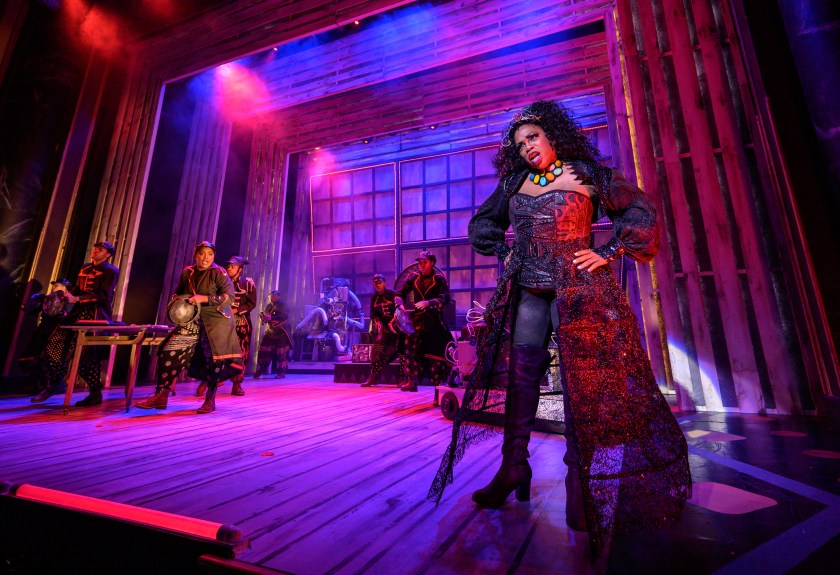
By the end of the first act, my face hurt from smiling and laughing, my eyes were leaking from laughing and an overload of joy, and my heart was a puddle on the floor at my feet. But this show wasn’t done with me yet. It wasn’t enough that Desirée Roots melted my heart with her ballad to Dorothy, she then killed it with an over-the-top performance as the good witch Addaperle. Her wand didn’t work, she couldn’t make herself disappear, and she carried her magic paraphernalia in a gigantic glittery handbag. She was like a magical, bedazzled version of everybody’s favorite, slightly inebriated aunt at the family cookout. Then in the second act she threw down as a punk-rock styled Evillene in black lace, a bustier, and thigh-high boots. “Don’t Nobody Bring Me No Bad News” was never sung better.

Jessi Johnson didn’t appear until midway through the second act, as Glinda, a good witch. Dressed regally, with a torch-carrying entourage, she graced us with her powerful and sensuous voice in “A Rested Body” and a reprise of “Believe in Yourself” before making a diva-worthy exit.

I didn’t forget Dorothy. Mariah Lyttle, a recent graduate of Ithaca College, has a voice to be reckoned with. While she was strong and clear in “Soon As I Get Home” and other songs with the ensemble and her motley entourage, she was really able to shine in the heartfelt Finale, “Home.”

Jerold E. Solomon also did double duty, as Uncle Henry in the first act and as The Wiz in the second. Solomon more than met the challenge of “Ya’ll Got It” after revving up, so to speak, from the mild-mannered misfit who became The Wiz to a hyped-up revivalist-style preacher who poured a heavy dose of self-empowerment on the citizens of Oz before disappearing in his magically restored hot air balloon.

There may be no such thing as perfect, but I couldn’t find a single thing I didn’t like – no, love – about this production of The Wiz. There are a few, shall we say, strong words or innuendos, but this is, overall, a family-friendly production. The couple sitting next to us was a grandmother on a date with her pre-teen grandson. There were lots of children in the audience, which was more diverse, overall, than one usually finds in the November Theatre. With all that’s going on – the scene changes, the sparkling lighting effects, the music, the songs, the dancing that moves off the stage and into the aisles – the entire production runs just slightly over two magical hours. I hope I have time to see this beautiful show again before it closes on August 4. It’s pure happiness on a stage.

Julinda D. Lewis is a dancer (who was once a poppy in a scene from The Wiz), teacher, and writer who was born in Brooklyn, NY and now lives in Eastern Henrico County.

———-

Photo Credits: Aaron Sutten

The Wiz
D. Jerome Wells (Tin Man) and Mariah Lyttle (Dorothy). Photo by Aaron Sutten.
The Wiz
Mariah Lyttle (Dorothy) and cast. Photo by Aaron Sutten.
The Wiz
Mariah Lyttle (Dorothy) and Jerold E. Solomon (The Wiz). Photo by Aaron Sutten.
The Wiz
Desirée Roots (Evillene). Photo by Aaron Sutten.
The Wiz
Mariah Lyttle (Dorothy) and cast. Photo by Aaron Sutten.
Wiz.1
Desirée Roots as Aunt Em, Addaperle, and Evillene.


https://www.amazon.com/dp/B07KZBMBDB?ref_=assoc_tag_ph_1524211071794&_encoding=UTF8&camp=1789&creative=9325&linkCode=pf4&tag=rvartreview-20&linkId=e226c9b35283e2213bf87e47888dcb37

https://www.amazon.com/dp/B00NB86OYE?ref_=assoc_tag_ph_1524211054003&_encoding=UTF8&camp=1789&creative=9325&linkCode=pf4&tag=rvartreview-20&linkId=b0d58acccec524a720d596d8ece4fe08

https://www.amazon.com/dp/B07FPP6TB5?ref_=assoc_tag_ph_1524211083830&_encoding=UTF8&camp=1789&creative=9325&linkCode=pf4&tag=rvartreview-20&linkId=9417a707347facb216f2ee032df3b976


GREY GARDENS, THE RECLUSIVE MUSICAL

GREY GARDENS: Poor Little Rich Girls

A Theater Review by Julinda D. Lewis

Richmond Triangle Players

At: The Robert B Moss Theatre, 1300 Altamont Avenue, RVA 23230

Performances: June 24 – July 27, 2019.

Ticket Prices: $10-40

Info: (804) 346-8113 or rtriangle.org

Grey Gardens, The Musical, with book by Doug Wright, music by Scott Frankel, and lyrics by Michael Korie is a two-act musical that is full of humor and drama and emotion. But the two things that make this musical stand out are the fact that it is about real people and that both of these people are brought to life by the enormously talented Susan Sanford.

On the advice of a friend and colleague, I watched Albert and David Maysles’ 1976 documentary Grey Gardens prior to attending the musical. The award-winning cinéma-vérité chronicles the tragedy and wonder of these two women, both named Edie, both of whom defied the laws of society and blazed a trail that few would want to follow. Like a road-side accident, I didn’t want to watch, but it was impossible not to look and as fascinating and heart-rending as the documentary was, it didn’t even come close to the emotional roller coaster that Wright, Frankel, and Korie created in this musical, brought to life on the RTP stage by director Debra Clinton and musical director Kim Fox. I may have laughed at Sanford’s antics, both as “Big” Edie in the first act and “Little” Edie in the second act, but I was in tears by the time the cast took their final bows.

Grey Gardens, for those, like me, who do not follow society, was the estate of Edith Bouvier Beale, an aunt of our former First Lady, Jacqueline Bouvier Kennedy Onassis, and her daughter, “Little” Edie Bouvier Beale. “Little” Edie was a debutante in the early 1940s, apparently with somewhat of a reputation, as she was nicknamed “Body Beautiful Beale.” Her young cousins Jacqueline “Jackie” Bouvier and her sister Lee Radziwill were apparently frequent visitors to the 28-room East Hampton Estate in its heyday. My favorite line, spoken by “Little” Edie in the second act: “It’s a mean, nasty Republican town.”

The first act of Grey Gardens, The Musical mixes fact and fiction, and it’s not clear where the line is drawn. But it seems that mother Edie’s love of singing went against her husband’s puritanical grain, and he took off to Mexico with his lover Linda and obtained a quickie divorce. After that, things quickly went downhill at Grey Gardens, and by the time we get to the second act – and by the time the Maysles show up with their cameras – the place has fallen into disrepair. Much of the dialogue in the second act is taken straight from the documentary – another reason to do the homework and watch it before seeing the show.

There are holes in the walls that allow free access to all the stray cats and racoons the two women have adopted, the mansion is full of fleas, and there is apparently little or no working plumbing. When “Little” Edie prepares a plate of pâté for her mother, the woman sitting next to me and I gasped, unsure if the surely expired can contained pâté or cat food. The Suffolk County Board of Health was on the verge of condemning the house and evicting the two Edies until their more solvent relatives stepped in and made the necessary repairs. It is unclear whether this made much of a difference in the Edies’ lifestyle – and I kept wondering how they were supporting themselves. Who was paying the taxes, and the grocery bill, and how is it that the lights were still on?

Practical considerations aside, Gray Gardens, The Musical is equally hilarious and heartbreaking. In addition to Susan Sanford, who acts and sings her heart out and is outrageously funny, first as the overbearing mother Edith Bouvier Beale in Act One and then as “Little” Edie in Act Two. Sanford does an impressive job balancing “Little” Edie’s desire to break away from her mother and become independent against her sense of responsibility to stay and take care of her mother. This dilemma is beautifully foreshadowed in Act One by Grey Garrett, who plays the Young “Little” Edie Beale. One minute Garrett is begging her mother, played by Sanford, not to sing, the next she is defending her right to do so when her grandfather, “Major” Bouvier, played by Kirk Morton, denigrates his daughter for her eccentricities and quiet consent to her absent husband’s affairs. Boomie Pedersen as “Big” Edie, the mother, in the Prologue and Act Two has mastered the role of the screaming, overbearing mother – possibly in the early to mid- stages of dementia, although with manipulating, narcissistic personalities it’s sometimes hard to tell – to the point where you almost forget she’s just acting. The dysfunctional chemistry between Pedersen and Sanford is a force to behold.

Also doing double duty were Durron Marquis Tyre, as the servant Brook, Sr., in Act One and his son, Brook, Jr., in Act Two and Elijah Williams as “Little” Edie’s fiancé Joseph Patrick Kennedy, Jr. in Act One and “Big” Edie’s friend Jerry in Act Two. It was interesting that Brook, Sr., seemed more refined that his son. Sr. wore a cutaway suit, while Jr. wore overalls – a reflection of the state of the house. I liked Williams in his role as Jerry more than as Kennedy, perhaps because the second character and his relationship to the family more closely reflected the oddities and conflicts of these fascinating women.

Caroline Berry and Anya Rothman were sweet and adorable as the young Jackie and Lee Bouvier, and Eddie Webster had an interesting supporting role as George Gould Strong, “Big” Edie’s accompanist and companion.

Frank Foster’s scenic design was serviceable, but unremarkable, although the production did a good job changing from relative grandeur in Act One to shabbiness in Act Two. Matthew Banes’ lighting and Joey Luck’s sound design both enhanced the overall effects, but Ruth Hedberg’s costumes and Joel Furtick’s hair and makeup really nailed it. “Little” Edie’s costumes for Act Two were spot on and would probably get a word of approval from the real “Little” Edie.

The broad and flat Boston-Long Island accents were often startling – even to this Brooklyn girl – but seemed pretty accurate. Director Clinton even choreographed some lively dance steps, and musical director Kim Fox and her musicians helped keep things moving along at a nice pace.

Grey Gardens, The Musical is one of the most heart-wrenching musicals you will ever see – and I hope you do see it. After the first week of performances, Richmond Triangle Players had to extend the run from July 13 to July 27, and tickets will likely be hard to come by for the remainder of the run.


Julinda D. Lewis is a dancer, teacher, and writer who was born in Brooklyn, NY and now lives in Eastern Henrico County.

———-

Photo Credits: John MacLellan

This slideshow requires JavaScript.


<a target=”_blank” href=”https://www.amazon.com/dp/B07HZLHPKP?ref_=assoc_tag_ph_1524211038043&_encoding=UTF8&camp=1789&creative=9325&linkCode=pf4&tag=rvartreview-20&linkId=30ccd2db08189b9a6a1720a3f8646541″>Introducing Echo Show 5</a><img src=”//ir-na.amazon-adsystem.com/e/ir?t=rvartreview-20&l=pf4&o=1″ width=”1″ height=”1″ border=”0″ alt=”” style=”border:none !important; margin:0px !important;” />

<a target=”_blank” href=”https://www.amazon.com/dp/B07HZLHPKP?ref_=assoc_tag_ph_1524211038043&_encoding=UTF8&camp=1789&creative=9325&linkCode=pf4&tag=rvartreview-20&linkId=b19f776a010b2914555347ce6bd13dd8″>Introducing Echo Show 5</a><img src=”//ir-na.amazon-adsystem.com/e/ir?t=rvartreview-20&l=pf4&o=1″ width=”1″ height=”1″ border=”0″ alt=”” style=”border:none !important; margin:0px !important;” />


<a target=”_blank” href=”https://www.amazon.com/b?ie=UTF8&node=17307360011&ref_=assoc_tag_ph_1524211017242&_encoding=UTF8&camp=1789&creative=9325&linkCode=pf4&tag=rvartreview-20&linkId=8716fbb9a1c3716aecf2d14801eb6bb7″>Amazon Devices – CR Ring devices starting $89.99</a><img src=”//ir-na.amazon-adsystem.com/e/ir?t=rvartreview-20&l=pf4&o=1″ width=”1″ height=”1″ border=”0″ alt=”” style=”border:none !important; margin:0px !important;” />

THE TEMPEST: Sublime or Subliminal?

THE TEMPEST: It’s Complicated

A Theater Review by Julinda D. Lewis

By: Quill Theatre

At: Agecroft Hall & Gardens, 4305 Sulgrave Rd., RVA 23221

Performances: June 6-30, 2019

Ticket Prices: $30 Adults; $25 Seniors; $20 RVATA & Students (with ID)

Info: (804) 340-1405, quilltheatre.org or https://agecrofthall.tix.com/Schedule.aspx?OrgNum=1528

The current Quill Theatre production of The Tempest is sublime – though not perhaps for the reasons you might expect. It was not just the play, but all the components that came together to make up the entire evening. Saturday’s weather was perfect – not too hot, not too cool, not humid, no rain, and the bugs remained mostly at bay during the first act. The atmosphere was festive, with pre-show picnickers scattered across the spacious lawn, and vendors selling fruity ice pops, ShakesBeer and wine. The sixteenth century manor house and its tiered gardens, where one might encounter The Festival Young Company wandering about reciting monologues or go for a stroll during intermission provided the perfect setting for a festival.

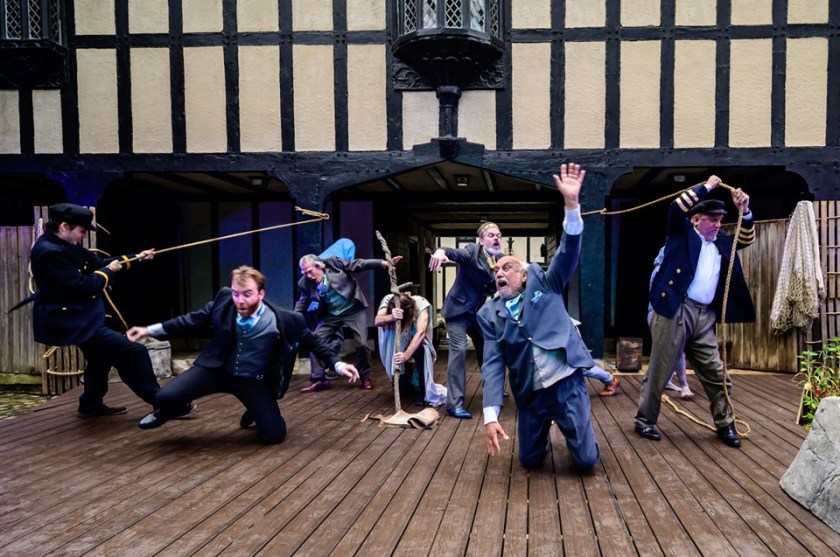
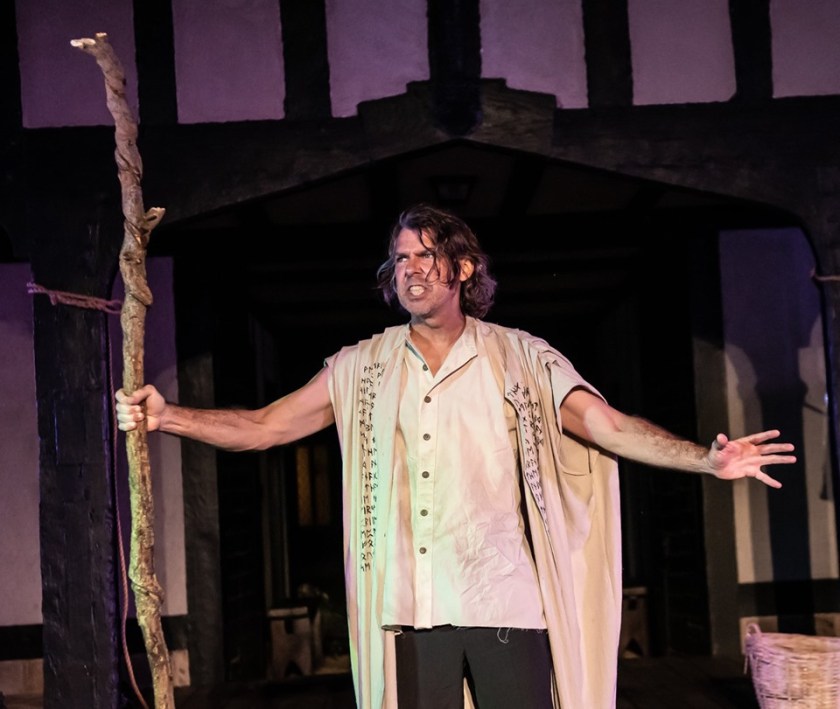
The Tempest is complicated. Prospero, the lead figure, is the usurped Duke of Milan but he is also a powerful sorcerer. I’m not clear on whether he was a sorcerer before he was deposed and set adrift and landed on this remote island, or if he became a sorcerer as a result of his betrayal by his own brother, Antonio. John Cauthen and director James Ricks together give us a Prospero who is multi-faceted, showing a softness for his young daughter, Miranda, played by newcomer Madison Munson. She and her love interest Ferdinand, played by another newcomer, Dean Hall, brought a sense of innocence and normalcy to this otherwise convoluted tale. But Prospero is a complicated hero. He treats his servants Ariel and Caliban callously, forgives those who wronged him, and in the final scene begs the audience to release him. And he is so magically convincing that we comply.

Jeff Clevenger in the role of Trinculo, the king’s jester, and Adam Valentine as Stephano, the king’s drunken butler team up to bring much needed humor and physical comedy to this sometimes dark comedy, liberally sprinkled with betrayal, romance, and tragedy. But the two most noteworthy characters for me were Ariel and Caliban.

I absolutely adored Adam Turck’s portrayal of Ariel, Prospero’s spirit servant. Painted in blue, and draped in nondescript layers of identically painted fabric, Turck has adopted quirky movements that add to his otherworldly persona. At one point he appears on top of the wall that separates the stage from the gardens, where he crouches to deliver his lines. Often lurking in the background, where he nearly blends in, it is almost possible to believe that he is invisible to all but Prospero – and the audience.

Now as for Caliban – I don’t know if anyone else has said this but. . . .Why is the black actor (a) a slave and (b) called a monster and a savage? Okay, I understand that this is the character that Shakespeare wrote, but Walter Riddle is the obviously a POC and he plays a savage monster. I’m not saying he didn’t do a good job, but I just couldn’t get past that casting choice. I am not the first to say this, but Prospero, you are a Colonizer! The subplot of Prospero’s treatment of Ariel and Caliban and the vastly different ways they respond to their oppressor is more intriguing than Prospero’s story.

James Ricks’ direction kept things moving along at a nice pace; there was lots of action, and Ricks’ sound design included a few subtle touches that enhanced the overall experience. BJ Wilkinson doesn’t have much to do in the way of lighting as it’s still daylight until the second act, and Anna Bialkowski’s costumes, which put the noblemen in modern day suits, was visually cohesive and aesthetically pleasing. There are also a few delightful musical moments, with original music by Jason Marks.

Julinda D. Lewis is a dancer, teacher, and writer who was born in Brooklyn, NY and now lives in Eastern Henrico County.

———-

Photo Credits: Production photos by Aaron Sutten; Group selfie by Noah Downs

Tempest.5
Adam Turck
Tempest.4
Cedar Curran, Travis Williams, Chris Dunn, John Cauthen, Jonathan Hardison, Derek Kannemeyer, Jeff Clevenger
Tempest.3
John Cauthen
Tempest.2
Jonathan hardison, Adam Turck, Chris Dunn, Derek Kannemeyer, Travis Williams
Tempest.1
Shakespeare Festival Audience Selfie, 06/15/2019


OFFICE HOURS: QUITTING TIME

OFFICE HOURS: Six Actors; Sixteen Characters; Six Stories in Search of a Laugh

A Theater Review by Julinda D. Lewis

At: CAT Theatre, 419 No. Wilkinson Rd., RVA 23227

Performances: June 7-22, 2019

Ticket Prices: $23 General admission; $18 RVATA Members; $13 Students

Info: (804) 804-262-9760 or cat@cattheatre.com

CAT Theatre’s 55th season has featured some interesting productions and some novel premises. The season opened with Boeing, Boeing, a French farce from the 1960s, followed by A Doublewide, Texas Christmas¸ written by the trio of Jessie Jones, Nicholas Hope, and Jamie Wooten who also wrote The Savannah Sipping Society that is currently playing at Swift Creek Mill Theatre. The new year brought a revival of Becky’s New Car, which I first saw some years ago at Hanover Tavern – both times I was one of those selected from the audience to assist “Becky” with her onstage wardrobe change. Earlier this spring they offered a musical comedy, BINGO! that included audience participation with real bingo cards, markers, and prizes. The final offering of this season is Office Hours, a comedy by Canadian playwright Norm Foster.

Office Hours is a series of six vignettes, each set in a different office in the same city on the same day, near quitting time. A cast of six versatile actors plays sixteen different characters with great energy and enthusiasm, but with varied levels of success. The first act, consisting of four scenes, seemed to drag at times, but I’m not sure whether it was due to Andrew Bryce’s direction or Norm Foster’s script. Maybe Canadian humor is different from ours. At any rate, the second act seemed to hit the laughs more accurately, and the play ended with a surprise twist I truly didn’t see coming.

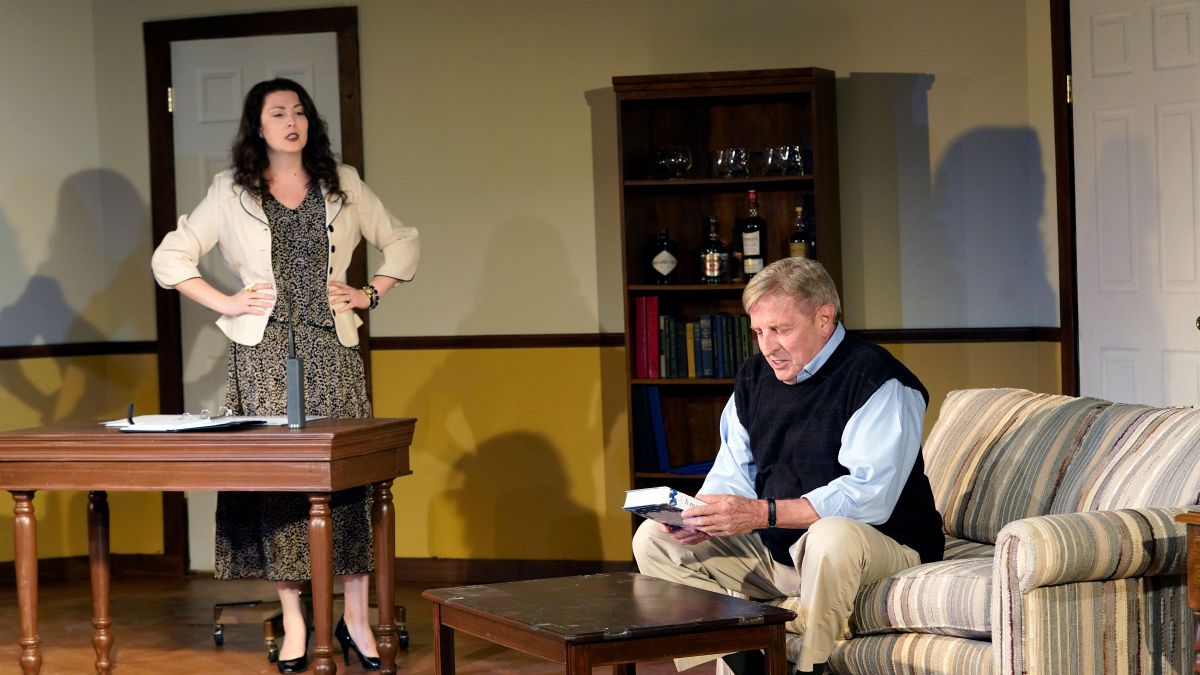
The six scenarios are separate but intertwined. Hints and clues are sprinkled throughout that help keep the viewer engaged and provide a sense of smug satisfaction when the plot twists are revealed. Throughout the various scenes characters refer to the beautiful office space and the nice furniture. This provides an unintentional running joke as Hunter Mass’s set looks like a collection of mismatched thrift store items: a desk; a sofa; 2 or 3 chairs in different styles and sizes; a bookcase that doubles as a bar; 3 small tables. The office desk and chair seem too small, and when one or two of the character remark on its large size and the general tidiness of the office I wondered how they could do so with a straight face. There are also two doors, two tall windows, one of which has a latch that allows for access to a ledge, and a picture on one wall that is changed at the beginning of each scene.

For some inexplicable reason, there are different styles and different eras of telephones in each office scene, but the furniture remains the same, and even though the set is carefully rearranged for each scene, there is too little to distinguish the various scene. Oddly, on the night I was there, there was a noticeable but inexplicable dip in the lighting near the top of the first few scenes. Chris Stepp did the lighting and sound design, and while there were interesting and tuneful musical selections between scenes, I think more could have been done with the lighting to make each office unique.

Running themes that tie the separate scenes and characters together include the office setting, the phones, the furniture, and most interestingly, ledge jumper, a leather bound Day-at-a-Glance planner and a thick book by an erotic novelist who uses the pseudonym Margaux Kenyon.

Bill Blair is one of the more imposing members of the cast, and makes a lasting impression as Warren Kimble, a on-air journalist who is demoted as the result of age-ism and Lloyd Penny, the seemingly hen-pecked husband of a domineering wife and father of two sons: one a gay lawyer and the other a straight figure skater.

PJ Freebourn’s characters include an unnamed One-Armed Man and a shallow cheater named Mark who concocts the most amazing excuses for his infidelities and tries to use them to manipulate his young wife, Ellie.

Madeleine Gish played three very different character. In the first scene she was Pam Gerard, the overly confident and self-promoting production manager who demoted Warren Kimble. She next appeared as Ellie Young, the savvy young wife who hired a private eye to document her husband’s infidelities, and finally Sharon Freeman, a love-starved psychiatrist  looking for to a long awaited weekend tryst, who put her own needs above those of her client who inconveniently decided to end their Friday afternoon session on the window ledge of her office. Gish did a great job making each of her characters distinct.

Hogan Holt also played a trio of characters, but my favorite was Artie Barnes, the overweight jockey. Foster, the playwright, seems to like tossing a monkey wrench of realism or tragedy into the midst of his most comic moments, and in the case of Artie he did not disappoint. It seems that during one race, Artie’s horse suffered a heart attack and died on the track. Yet Artie, who fluctuates in and out of denial at the drop of a hat – in his case a slightly bedazzled and bedraggles cowboy hat—insists he’s a svelte 112 pounds.

Paige Reisenfeld plays both Francine Majors, a frustrated production partner, and Rhonda Penny, the mother of the gay lawyer who insists that gay sons are the result of a domineering mother. In one of the funniest scenes of the night, she brings lunch to her son’s office, in an oversize picnic basket. The food choices inside warn us that something is not quite right with her: a large jar of giant gherkins (pickles), a cucumber, orange-aid, a polish sausage, and an uncooked eggplant. Her husband carries a bag with a McLobster sandwich. (I don’t know if that is a real thing and didn’t dare check!)

Joel White’s character included the gay son and a has-been movie director, Bobby Holland with an obvious drinking problem who tries to pitch a new project that sounds like a barely doctored revival of the Tarzan story.

There is a lot going on, and I enjoyed following the twisting threads of the various stories and discovering how they were connected. Yet, with all that – and a pretty good cast, to boot – Office Hours falls short of the comedic gem it wanted to be.

Julinda D. Lewis is a dancer, teacher, and writer who was born in Brooklyn, NY and now lives in Eastern Henrico County.

———-

Photo Credits: Jeremy Bustin Photography

This slideshow requires JavaScript.

THE SAVANNAH SIPPING SOCIETY: Life on Randa’s Veranda

THE SAVANNAH SIPPING SOCIETY: Hilarious Southern Women’s Comedy

A Theater Review by Julinda D. Lewis

At: Swift Creek Mill Theatre, 17401 Jefferson Davis Highway, Colonial Heights, VA 23834

Performances: June 1 – July 13, 2019

Ticket Prices: $40 Theater only; $57 Dinner & Theater

Info: (804) 748-5203 or swiftcreekmill.com

The Savannah Sipping Society is another celebration of southern women from the comedic writing of the trio of Jessie Jones, Nicholas Hope, and Jamie Wooten, who also brought us The Golden Girls, The Hallelujah Girls, and The Dixie Swim Club. Director – and Swift Creek Mill Theatre Artistic Director – Tom Width fondly referred to it in his pre-show curtain talk as a “comedy of recognition” as the characters are so familiar and the situations so relatable.

Set in Savannah, Georgia, in the present day, the story takes place over a period of a little more than six months, and mostly on the second story veranda of Randa Covington’s home. The authentically and lovingly detailed set designed by Width, fashioned from wicker and bright colors, hanging plants, features a little table that serves as a bar – an all important focal point for most of the shenanigans that take place. (Not being familiar with Savannah homes, I did wonder if the kitchen and living room were also on the second floor – and found this mildly distracting each time Randa or one of her friends ventured inside to get grab some glasses or check on something in the oven.)

The four women who fuel this feverish frolic initially meet at a yoga class – or more precisely in the lobby juice bar of a yoga studio where they all found the class more than they had bargained for. “Honestly, I’m at an age where all I usually exercise is caution,” Dot pants after collapsing into a chair, putting her feet up, and fanning herself vigorously. The juice bar and a few other locations where the women stand to give monologues are unadorned corners of the stage defined only by bright spots of Joe Doran’s otherwise subtle summery lighting.

Width has assembled a fabulous cast who exuded such warm and natural chemistry on opening night one can only imagine how tightly knit they will be halfway through the run, Joy Williams is the smart and quirky Randa Covington, owner of the veranda. She is a single and independent career woman, an architect who recently lost her job. Jacqueline Jones is Dot Haigler, recently widowed just as she and her late husband were about to start their life-long dream of a retirement near the water. Widowhood is nearly eclipsed by more pressing problems, but her friends pulls together to provide life-giving support.

Robin Arthur is Marlafaye Moseley, a gum-chewing divorcee who recently relocated from Texas. Marlafaye is the most physical comedian. At one point she proclaims, “My mama didn’t raise no fool,” as she places a jester’s hat on her head. Jennifer Frank plays Jinx Jenkins, a make-up artist and self-proclaimed life coach who came to Savannah to care for her sister, who is suffering from dementia. The four, ranging in age from 49 to 69 are united by their circumstances. All are stuck in a rut of some sort, and in need of adventure, romance, and most of all friendship and it is this bond of friendship mixed with unique southern twists that is the heart and soul of this play.

Marlafaye gave up a career in nursing to become a representative for a liquor company, so the four unlikely friends are never short of adult beverages – hence the title. The laugh-a-minute first act imperceptibly morphs into more serious situations as life encroaches on these lovely ladies, and just as it seems the second act is about to end on a sad and introspective note, the writers toss in a happy surprise ending. Rather than feeling cheated – as one would if this had been a drama – this is a vindication of both the genre and the geography.

The Savannah Sipping Society has the pacing and staging of a situation comedy. The audience even sounded like a sitcom laugh track, offering frequent and loud outbursts of sometimes raucous laughter. Having previously enjoyed several plays by this trio of writers, I came prepared to enjoy The Savannah Sipping Society. The Dixie Swim Club (in which Jennifer Frank, Jacqueline Jones, and Joy Williams have all appeared) has remained my favorite, but The Savannah Sipping Society may be a close second as far as characters and may be a tie for laughs.

Julinda D. Lewis is a dancer, teacher, and writer who was born in Brooklyn, NY and now lives in Eastern Henrico County.

———-

Photo Credits: Robyn O’Neill

This slideshow requires JavaScript.

https://www.amazon.com/gp/product/B01133UU4S/ref=as_li_tl?ie=UTF8&tag=rvartreview-20&camp=1789&creative=9325&linkCode=as2&creativeASIN=B01133UU4S&linkId=7b6a67648f3d1f7fc370954747b1a37d

https://www.amazon.com/gp/product/B00I3F4QSQ/ref=as_li_tl?ie=UTF8&tag=rvartreview-20&camp=1789&creative=9325&linkCode=as2&creativeASIN=B00I3F4QSQ&linkId=288de58b1b30ebafef77317749b47171

WRONG CHOPPED: Experimental Comedy

WRONG CHOPPED: Dumb Fun

A Theater Review by Julinda D. Lewis

At: The Firehouse Theatre, 1609 W. Broad Street, RVA 23220

Performances: May 17 – June 8, 2019

Ticket Prices: $22 General Admission; $12 Students

Info: (804) 355-2001 or firehousetheatre.org


Dumb & fun.

The world premiere of Wrong Chopped at the Firehouse Theatre is a new iteration of Levi Meerovich and Dixon Cashwell’s absurdist theater piece that was first workshopped at the Firehouse last fall. Lest you think I’m being critical, “fun and dumb” are words that co-writer Meerovich used to describe the work. Other words used by the production team include the phrase “stupid comedy,” a sort of disclaimer that the participant viewer should not expect “high intellectual property.”

Although it may appear to be improvised, the organized chaos on the stage is quite intentional. The entire play – and I use that word loosely – is scripted, down to the grunts and stutters. But what is it about? As the title suggests, Wrong Chopped is a parody of Food Network cooking shows. Four chefs compete for a $10,000 prize. They must create an appetizer, an entrée, and a dessert using the mystery items in a basket. The food items range from bones to eggs, but there are other items as well, things like a part of a sentence and a framed photo of actor Stanley Tucci who apparently has something of a cult following among this crowd.

The chefs are Jenny Brackish (Tyler Stevens), Bolton Kane (Chandler Matkins), Darude “Blaze” O’Ronald (Cheslea Matkins), and Goo Henry (Dante Piro). Brackish seems to be a stay at home mom, Kane is a New Age philosopher, Blaze is a street chef who operates a food truck, and Henry is, well, I’m not quite sure, but Henry apparently has a long-standing feud with the show’s host, Ted Allen, played with manic intensity by John Mincks.

The judges include a woman (Tara Malaka as Daniel Craig) who insists she is an actor who plays James Bond and “a rhyming holy woman,” who goes by the name Cardinal Bigsauce (Abbey Kincheloe). I never caught the occupation of the third judge, Marlas Jones (played by Doug Blackburn).

There’s also a camera person, Payton Slaughter, who captures odd angles of the actors and at one point gets usurped by Chef Kane who brings the camera into the audience and takes video selfies with audience members. And then there was Levi Meerovich, a co-writer who was also The Watcher. One of my favorite parts of the show was the opening scene or prologue when Meerovich, looking very handsome with a fresh haircut and a formal tuxedo jacket, approached the keyboard placed in a corner in front of the stage from where he accompanied the actors, occasionally made comments, and directed the projection of videos of old television shows and other, assorted images. When he first came out, Meerovich took off his jacket. And his shoes. And his vest. Then he put on his shoes and pulled his jacket on over his white dress shirt and red boxer briefs, and that’s how he very comfortably completed the show.

You may notice that in the first paragraph I used the phrase participant viewer – well, that’s because the audience isn’t merely observing. The cast sometimes invades the audience space, making the audience participants in the action. And then there are those, like the row of young people directly behind me, who laughed so loudly and so often that they virtually became part of the show.

There is really no point in giving a plot summary – there isn’t any. This is a messy play – physically and metaphorically. There is lots of rice and popcorn and catsup. There are references to James Bond, Hamlet, and numerous movies and television shows, as well as many more references I probably didn’t get because I’m of a different generation. But in answer to a friend’s question, did this show make me feel old? – not at all. It did not make me feel old, but it probably does have greater appear to people who are in their 20s and 30s. People in this age group laughed the longest and loudest. One woman closer to my generation said she laughed but sometimes didn’t know what she was laughing at. And do you know what? I think that Meerovich and Cashwell would find that perfectly acceptable.

Wrong Chopped may be classified as theater of the absurd. It’s also been referred to as avant garde and dada. By whatever label, it is non-traditional theater, and offers a viable alternative for those who want something different, funny, and irreverent. I would not place myself among that group. If you like a linear plot, a play with a clear beginning, middle, and ending, and a conclusion that neatly ties up everything – this isn’t it. If you’re looking for something totally different than what you usually find on Richmond theater stages, and you don’t even know what the term “comfort zone” means, then you might be the target audience for Wrong Chopped.

Julinda D. Lewis is a dancer, teacher, and writer who was born in Brooklyn, NY and now lives in Eastern Henrico County.

———-

Photo Credits: Bill Sigafoos

5_Tara Makala, Payton Slaughter, Tyler Stevens, Doug Blackburn, Chandler Matkins, Dante Piro, Chelsea Matkins, John Mincks, Abbey Kincheloe (photo by Bill Sigafoos)
Tara Malaka, Peyron Slaughter, Tyler Stevens, Doug Blackburr, Chandler Matkins, Dante Piro, Chelsea Matkins, John Mincks, and Abbey Kinchelow,
4_Abbey Kincheloe (photo by Bill Sigafoos)
Abbey Kinchelow
3_Tara Malaka, Abbey Kincheloe, Doug Blackburn, John Mincks (photo by Bill Sigafoos)
Tara Malaka, Abbey Kincheloe, Doug Blackburn, and John Mincks
2_Tyler Stevens (photo by Bill Sigafoos)
Tyler Stevens
1_John Mincks, Dante Piro (photo by Bill Sigafoos)
John Mincks and Dante Piro

https://www.amazon.com/promocode/A3V51XQ8Z587M2?ref_=assoc_tag_ph_1524211009884&_encoding=UTF8&camp=1789&creative=9325&linkCode=pf4&tag=rvartreview-20&linkId=9d1c78a4a325abdcc1ac9387c9201b93

https://www.amazon.com/promocode/ACSCG3XDUW28?ref_=assoc_tag_ph_1524211008136&_encoding=UTF8&camp=1789&creative=9325&linkCode=pf4&tag=rvartreview-20&linkId=8ca6599f2110d56b491a1e2a57fdd41c

https://www.amazon.com/promocode/A25P0A6KNX3INV?ref_=assoc_tag_ph_1524211008948&_encoding=UTF8&camp=1789&creative=9325&linkCode=pf4&tag=rvartreview-20&linkId=2c8fa79979cf9b7697d2065e19e82ac2