At: A Firehouse Theatre production at The Branch Museum of Architecture and Design, 2501 Monument Avenue, RVA 23220
Performances: July 25 – August 14, 2019
Ticket Prices: $20 in advance/$30 the day of/$10 for Firehouse members
Info: (804) 355-2001 or firehousetheatre.org
Sometimes when writing about a particular production we describe it as different or innovative. Well, all those times were just reviewers crying wolf. Dante Piro’s interactive play, The Verge, is truly different.
First of all, only 8 “guests” are allowed for each performance, and there is a dress code. Black tie is suggested. And the “guests” not only have assignments – along the lines of a mystery dinner theater, but without the food – but they also get to decide the ending, or at least to choose from one of two possible options.
Set in the elegant surroundings of the Branch Museum of Architecture and Design, the “guests” gather around a small conference table for the reading of the will of the recently deceased John Randolph Bessenger, CEO of Bessenger’s Bits, an ice cream toppings and condiments company.
There is a legal assistant Alanis (not sure of the spelling, because there is no program) who helps organize the gathering, and an unnamed woman who sits quietly off to one side observing after greeting us at the front door. We “guests” are gathered to hear the reading of the will – a series of letters and puzzles, jokes, and sometimes disjointed ramblings by a dying man.
Dante Piro who wrote The Vergealso plays Virgil, Mr. Bessenger’s faithful personal assistant. Virgil, who was given the nickname “Verge” by his employer, is a lovable character but he has a lot of quirks in speech and mannerisms. It’s fascinating to watch Piro work from such a close vantage point. Also fascinating was watching the eight “guests” pull together and work as a team; the play probably has a very different look and feel every time, based on the rotating cast of strangers. The Verge has the dynamics of a pick-up company or improvisation group. At one point, Virgil leaves the room, leaving the eight “guests” alone (under the watchful but unobtrusive eye of the legal assistant and the almost invisible helper) to decide his fate.
Chelsea Burke directed, but it’s hard to determine just how much she had a hand in it. Everything runs smoothly and the eight witnesses are surreptitiously directed as well. Credit Connor Scudder for the scenic design (part of which is the location itself), as well as the props, of which there are plenty – locked drawers, secret compartments, maps and puzzles and more. In fact, it’s the props that get the “guests” involved and working together to solve the mystery. There are twists and turns, not just in the plot, but in Virgil’s reactions and the deceased’s motives, and most noticeably in Piro’s use of language.
Leaving The Verge feels a lot like leaving on the last day of summer camp – the “guests” were just starting to bond, and suddenly it’s time to go back to the real world. The Verge, which has already been extended for five additional performances (August 6, 7, 8, 13 & 14), runs just under 90 minutes with no intermission. If you want to try something other than traditional theater, like a bit of role play, and enjoy a mystery, this production fits the bill.
The Verge runs through August 14 and on August 15,TheatreLAB The Basement opens the world premiere of Piro’s LEVEL 4¸ an existential drama in which the characters are in a video game. LEVEL 4 is also directed by Chelsea Burke.
Julinda D. Lewis is a dancer, teacher, and writer who was born in Brooklyn, NY and now lives in Eastern Henrico County.
At: Virginia Repertory Theatre at Hanover Tavern, 13181 Hanover Courthouse Road, Hanover, VA 23069
Performances: July 19 – August 25, 2019
Ticket Prices: $44
Info: (804) 282-2620 or www.virginiarep.org
Forever Plaid, the final production of the Va-Rep Hanover 2018/2019 season is a humorous heavenly harmonic hash guaranteed to make you pat your feet and smile. In the barely-there plot, a quartet of young singers on the way to a big gig at the Airport Hilton gets killed by a school bus full of Catholic high school girls (why this is important I’m not sure), on their way to watch the Beetles debut on the Ed Sullivan Show (which does become important later.) The four find themselves returning from some sort of limbo where they have spent the last 55 years for one last chance to perform in front of a big audience. The accident happened in the 1964, and one member of the quartet asks the audience what year it is. On Thursday, the audience member, perhaps flustered, initially gave a false date, in the 1950s, before admitting it was 2019.
This is not the only instance of audience participation. In another scene a compliant woman named Nora was charmed onstage to play piano with Sparky (while Travis is on his union break), and the entire audience is corralled into a sing-along on the song “Matilda.” The quartet brings instruments into the audience for those who care to participate in a hands-on experience, and Nora, by the way, left the stage with a commemorative plaid dental floss and a certificate with her name on it.
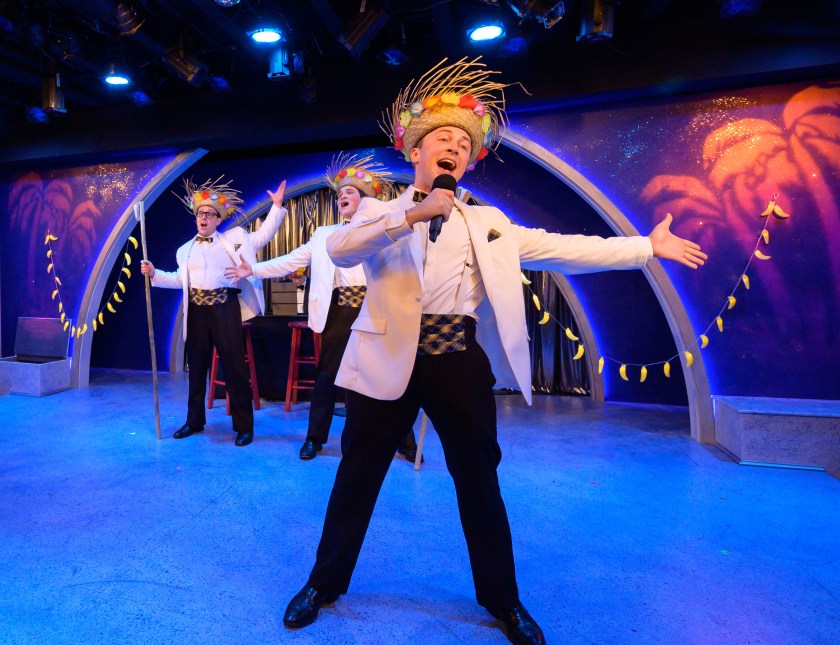
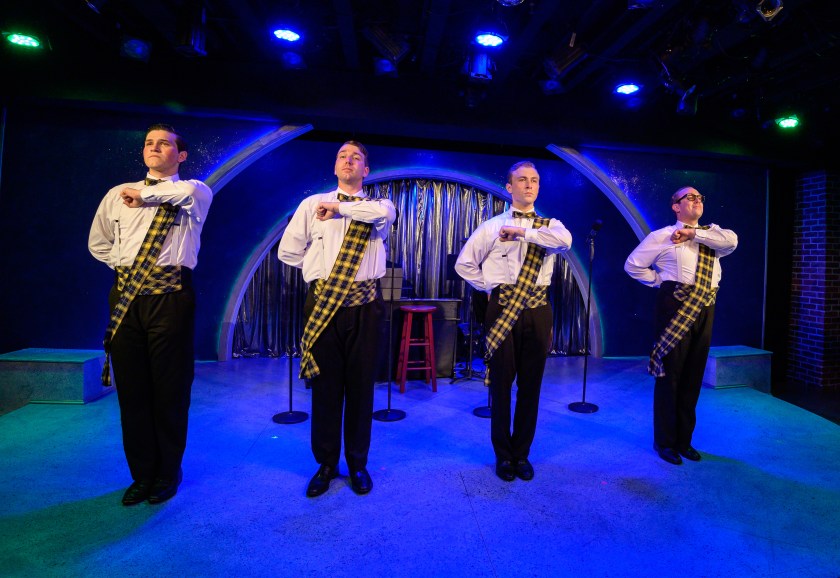
The shenanigans are carried on with amusing awkwardness – one member of the four is often out of step and depends on antacids to tame his nervous stomach, one hyperventilates, one has a mild speech impediment, and the fourth is prone to nosebleeds – by Mitchell Ashe (Sparky), PJ Llewellyn (Smudge), Ian Page (Jinx), and Caleb Wade (Frankie). Two, Jinx and Smudge, I think (it’s hard to keep up) are even step-brothers, and in one touching scene reminisce about a childhood tradition of family TV night. They watch, what else, “The Ed Sullivan Show.” The “band” consists of Travis West on piano and David Yohe on bass. They all sing well, even when making mistakes on purpose, while rotating through a veritable warehouse of wacky props, from six foot plumbers’ helpers (plungers) to straw hats and a traditional nun’s wimple.
Ashe, Llewellyn, Page, and Wade seem to have as much fun playing these characters as the audience does watching and listening to them. Wade, as the group’s leader, shows equal parts confidence and compassion, which seems even more amazing considering that the group leads off with, “We’re Forever Plaid, and we’re dead.” My favorite part of the show, however, is when The Plaids perform the entire “Ed Sullivan Show” (that ran on CBS from 1948 – 1971) in three minutes and eleven seconds – including the animal acts, puppets, musical acts, comedians, and even Topo Gigio, the Italian mouse.
Forever Plaid, written by Stuart Ross and first performed off-Broadway in 1989, was directed by Wes Seals with musical direction by Travis West. Both keep the pace moving at just the right speed (45rpm). Terrie Powers’ set is simple – arches, silver curtains, stars, a rounded stage – and BJ Wilkinson’s lighting sets just the right tone. Marcia Miller Hailey’s white dinner jackets are simple and classy, and the long-awaited arrival of the group’s plaid tuxedo jackets doesn’t occur until near the end of the one-act show that runs just under 90 minutes. The sound design by Derek Dumais makes everything clear and easy to understand, and the choreography (no credit is given, so I assume they retained Ross’ original choreography) is charmingly corny.
There are more than a dozen songs, beginning with “Three Coins in a Fountain” and ending with “Love is a Many Splendored Thing,” the song they were rehearsing in their red Mercury convertible when they were killed. In between there is a wide variety of musical numbers, from the Caribbean medley to Sam Cooke’s “Chain Gang,” “Perfidia,” which was inspired by the quartet’s collective crush on their high school Spanish teacher, to one of my favorites, the energetic “Crazy ‘Bout Ya Baby.” There are plenty of period and time-related references that might fall flat on anyone under the age of 50, and “The Ed Sullivan Show” seems to be a unifying thread, but Forever Plaid is a joyous, feel-good musical revue that favors naivete over controversy.
Julinda D. Lewis is a dancer, teacher, and writer who was born in Brooklyn, NY and now lives in Eastern Henrico County.
———-
Photo Credits: Aaron Sutten
Ian Page, Mitchell Ashe, Caleb Wade, PJ Llewellyn. Photo by Aaron Sutten.PJ Llewellyn, Mitchell Ashe, Caleb Wade, . Photo by Aaron Sutten.Ian Page, Caleb Wade, Mitchell Ashe, PJ Llewellyn. Photo by Aaron Sutten.Mitchell Ashe, Ian Page, Caleb Wade, PJ Llewellyn. Photo by Aaron Sutten.
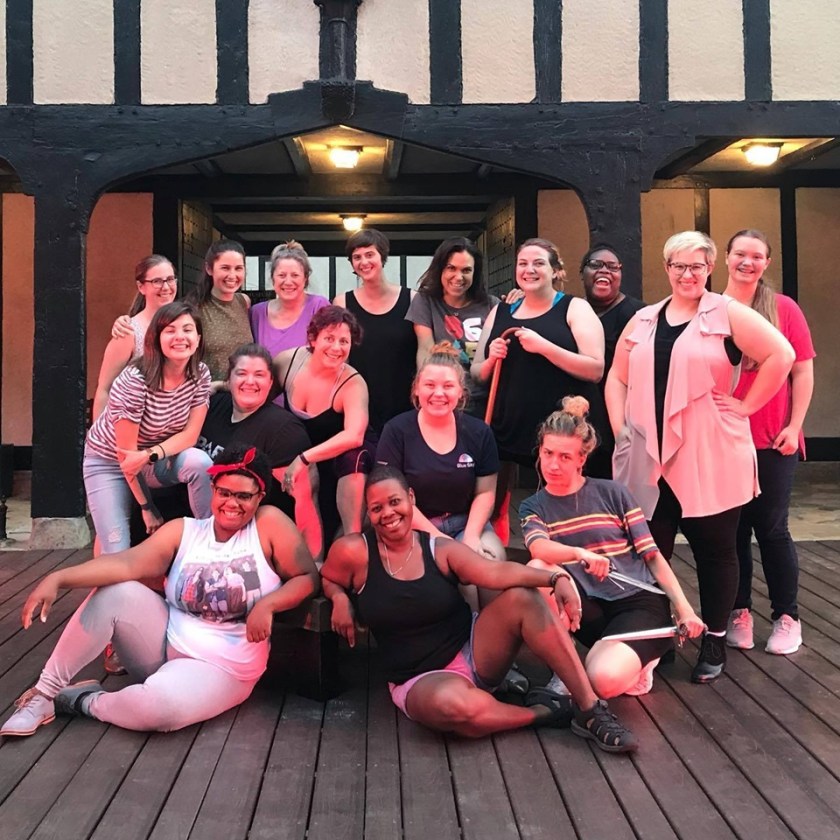
It is well known that in Shakespeare’s day all the roles, including the women, were played by male actors. Recently, we have seen role reversals in which key characters such as Hamlet have been played by women. The Richmond Shakespeare Festival has taken this twist to its ultimate conclusion with an all-female cast and mostly female crew. (On Sunday night, even Festival Manager Noah Downs kept a low profile – although I did miss his usual group selfie moment.)
This is not the first time The Taming of the Shrew, one of Shakespeare’s most misogynistic plays – perhaps one of the world’s most misogynistic plays – has been done with an all-female cast. It has been done by the Chicago Shakespeare company, where it was set in the twentieth century during the suffragette movement, it’s been presented in New York City’s Central Park, and has even been performed by Shakespeare’s Globe theater in Hong Kong. Among the many versions, there was also the musical, Kiss Me, Kate¸ which gets a humorous nod from our own Quill Theatre, at Agecroft Hall, with a cast that includes many familiar faces.
Among the many impressive performances by this outstanding ensemble, I must say that Bianca Bryan as Petruchio and Melissa Johnston Price as Baptista are standouts. Both seemed to have tapped into their inner male and it was awesome. I don’t mean that they were acting butch or doing a reverse drag, but Bryan’s swagger and Price’s doting but clueless father really captured the maleness of their characters in the best way, and they seemed to have so much fun doing it.
The Taming of the Shrew is an early Shakespearean comedy in which Petruchio, a bachelor from Verona who apparently has recently come into possession of his late father’s estate, arrives in the town of Padua, where he has friends, in search of a wealthy bride. His friend Hortensio (Desirée Dabney) suggest he marry Katarina/Kate (Michelle Greensmith), the beautiful but ill-tempered eldest daughter of Baptista. Hortensio, of course, has ulterior motives. He wants to marry Kate’s younger, more mild-mannered sister, Bianca (Christina Ramsey), but according to custom, the eldest sister must marry first.
There is no backstory, so we don’t know why Kate is such a spoiled brat, but she has few or no social graces. She is self-centered and verbally – even physically – abusive to everyone, even her father. There is no mother in sight, which may explain why Baptista allows her to behave so badly. Greensmith is so well cast for this role that at the beginning and the end, it’s almost possible to hate her. But looking at the perplexed expression of her face when Petruchio implements his devious plan, we get a glimpse of her character’s humanity. She’s someone’s daughter, someone’s wife, and like the difficult student in class, she has special needs.
There are subplots involving a trio of suitors for Bianca’s hand; Hortensio, Lucentio, and Gremio (not to be confused with another character, a servant named Grumio) and, of course, there are misunderstandings, disguises, and characters switching places with their servants. Desirèe Dabney plays Hortensio with broadly comic affability. Hortensio disguises himself as a music teacher in order to gain access to Baptista’s household and to his daughter, Bianca. Nora Ogunleye plays Lucentio, who, likewise, disguises himself as a tutor in order to woo Bianca.
In a memorable and hilarious supporting role Maggie Bavolack plays the elderly suitor Gremio. At one point Bavolack, whose character is bent over and a bit wobbly at the knees, passes her cane to a friend and performs a precarious but full somersault. It was a highlight of the evening!
Now, getting back to Kate, the use of a word like “shrew” to describe an unpleasant, nagging (another misogynistic word) woman is, itself sexist – but consider Kate’s personality. The woman has issues. Petruchio seems to be the only one who is not afraid of Kate, but the methods he uses to “tame” her terrible personality are questionable: he deprives her of food and sleep, offers her food and new clothes and withdraws them, and belittles his servants in front of her. He throws food and rips the sleeves off a dress. In short, he fights fire with fire. The bad behavior starts when he shows up late for their wedding and inappropriately dressed, but that’s the first clue that Petruchio isn’t crazy, but rather has a well-thought out plan of behavior modification to address Kate’s behavior.
And then there is Kate’s final monologue. At a wedding party for three couples – Petruchio and Kate, Hortensio and the Widow (Erica Hughes), Bianca and Lucentio – Petruchio makes a bet; each man is to send for his wife and the man whose wife most obediently responds will be declared the winner. Not only is Kate the only wife to respond, but she then makes a long speech in which she berates the other wives for not being obedient and submissive. She has been completely reformed – the shrew (which is also the name of a small mouse-like mammal) has been tamed. Just when you think it couldn’t get any more sexist or Stepford-wives-like (not a word, but I think you know what I mean), the cast breaks out into song, “Just a Girl,” which includes the lyrics, “I’ve had it up to here.”
Instead of the play’s original introduction or induction, there are songs, and between acts there are songs. Songs like The Police’s “Every Breath You Take,” (“Every move you make. . . .every breath you take, I’ll be watching you) that slyly and humorously remind us that this Taming of the Shrew is a smart, aware production led by a team of kick-ass women.
Chelsea Burke is the director of this awesome cast. There isn’t much in the way of a set, just a small platform centerstage and a couple of trunks. The most noticeable design element is the costumes, and I found Cora Delbridge’s costuming a hodgepodge of period, contemporary, and hybrid pieces that are often colorful and fun, but didn’t make any clear or cohesive statement. I did enjoy Kate’s first ensemble – a red hi-lo open front number – and Gremio’s suit was fully compatible with his character. Kate’s transformation was accompanied by changing her body skimming wedding dress for a formal pageant gown. I also liked Baptista’s power maxi-coat, but I found Bianca’s frilly dress unattractive and frankly confusing. It looked out of time and out of character.
Overlooking the bugs and the heat, it was a beautiful evening, and well worth it. The Taming of the Shrew is one of this season’s most intriguing productions, and the cast is a dream team of talent.
Julinda D. Lewis is a dancer, teacher, and writer who was born in Brooklyn, NY and now lives in Eastern Henrico County.
———-
Photo Credits: Production photos were not available at the time of publication.
At: Virginia Rep’s Children’s Theatre at Willow Lawn; 1601 Willow Lawn Drive, RVA 23230
Performances: July 12 – August 11, 2019
Ticket Prices: $21
Info: (804) 282-2620 or virginiarep.org
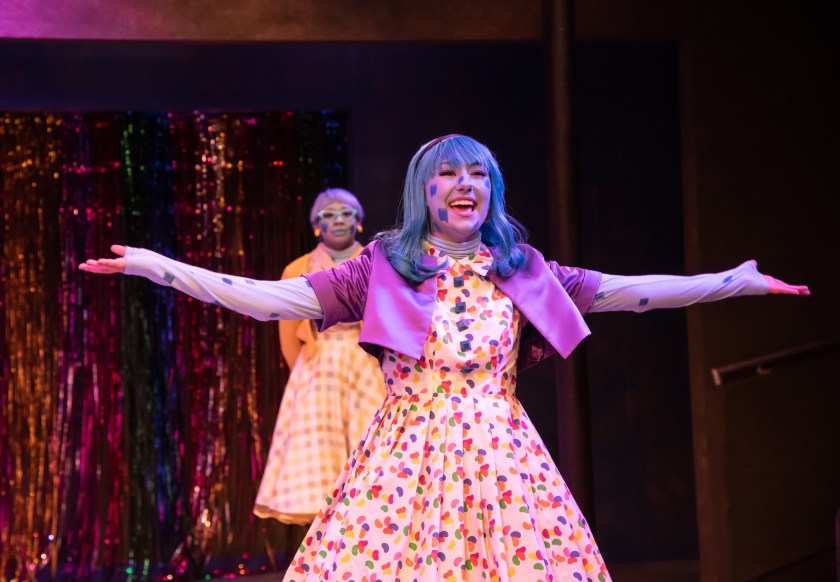
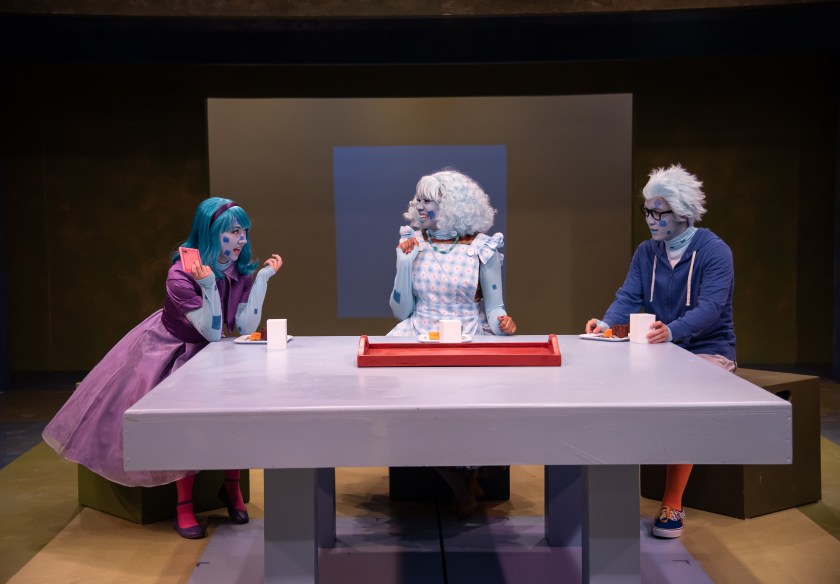
Polkadots: The Cool Kids Musical is based on the real-life events of the Little Rock Nine. In 1957 nine black students enrolled in the formerly all-white Little Rock Central High School, a test of the 1954 Brown v Board of Education Supreme Court ruling that declared segregation in public schools unconstitutional. For Polkadots, Melvin Tunstall, III (book) has set the story in Rockaway elementary school, in an undetermined state. Instead of black and white, the tension takes place between the blue skinned squares and the pink skinned polkadots. The squares believe they are the superior group, and don’t want to share their school or their town with polkadots.
Eight-year-old Lily Polkadot, played by Caroline Lynch, is the first polkadot to integrate the school, and the plot revolves around Lily’s efforts to make a friend and assimilate into her new school. Serious and sensitive issues are handled with care under the gentle direction of Jan Guarino.
Lily puts up a brave front, standing up to the mean spirited Penelope Square, singing “Sticks and Stones” as an affirmation, but she still privately wishes her skin was covered with squares instead of polkadots. The children’s teacher, Ms. Square, played by Sydnee Graves, who also plays the role of Mama Square, is warm, friendly and accepting of Lily, but at the same time she doesn’t want to make waves.
On the first day of school, Lily must remain alone in the classroom during the bathroom and water break because the polkadots’ water pump has not yet been installed, and Lily must not drink from the squares’ water sprinkler. A separate water fountain is eventually rolled out for Lily, and this marks one of many times I wondered just how much the younger members of the audience really understood the historical significance of what was taking place.
This was one of the few times I did not have my grandsons Kingston (10) and Emmitt (who just turned 5) along to consult with. As a matter of fact, the volunteer ticket taker took one look at me and asked, “Where’s your grandson?” I almost felt like some sort of pervert attending the Children’s Theatre without a child or two in tow, and I really would like to know what they would have taken away from this show.
Interesting, the cast, including Quan Chau as Sky Square, Sydnee Graves as Ms. Square/Mama Square, Caroline Lynch as Lily Polkadot, and Madeleine Witmer as Penelope Square is quite diverse (white, black, Asian), and all are making their debuts at the Children’s Theatre at Willow Lawn. The quartet was uniformly energetic, and all boast strong singing voices. Douglas Lyons’ lyrics are surprisingly sophisticated for a children’s show – more throaty ballads than bouncy ditties and the music by Greg Borowsky and Lyons provides a firm foundation for Mallory Keene’s choreography. There is even one number, where Sky and Lily create a silly dance, the Squa-Dot, that invites audience participation, but on Friday night, although there was one enthusiastic row of youthful audience members bouncing in their seats, no one was brave enough to stand up and join in the dance.
Graves was almost annoyingly prim and proper in her role as the teacher and seemed like an authentic school counselor when she shared with Lily her own trials as the first “lady teacher” at their school. Witmer was almost satisfyingly snarky as the mean girl big sister, and was visibly disappointed when her big song, “Cool Kid,” which was meant as a put-down for Lily missed the mark, because Lily wasn’t in the audience to hear it. Chau was adorable as little brother, Sky, and Lynch was perfectly cast as the spunky yet vulnerable Lily.
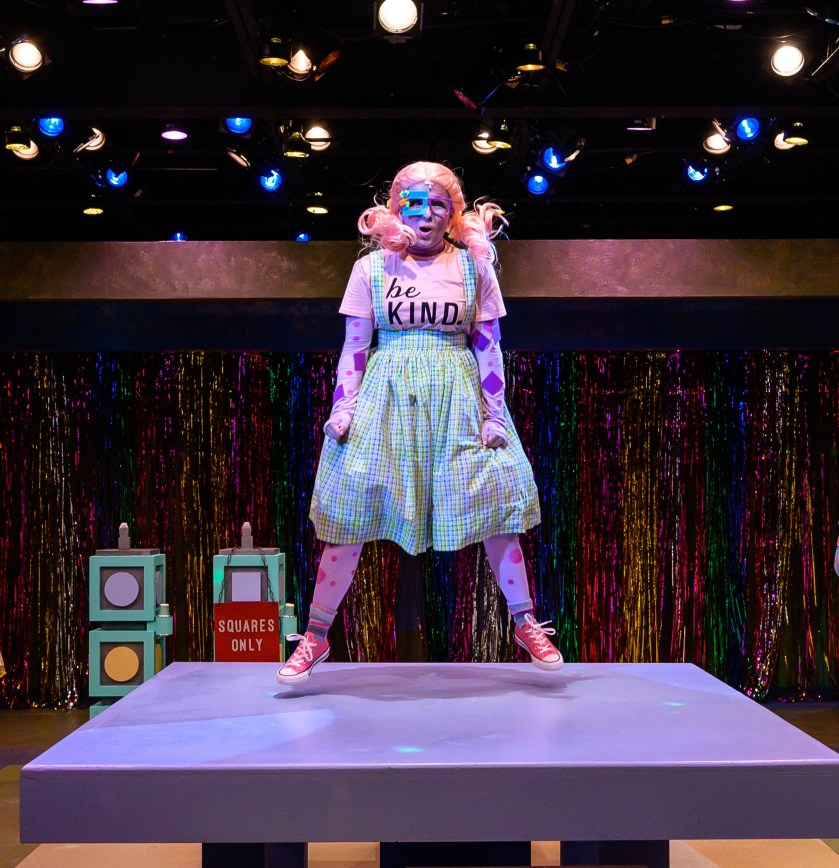
Kyle Artone’s costumes are colorful and cartoonish, and the square women’s full-skirted dresses, stretched over stiff and puffy crinolines, are especially pretty. Lily’s dress is simpler and less elaborate than the dresses of the squares. I found the pink and blue skin (part fabric and part makeup) and cotton candy colored hair a bit creepy, but it didn’t seem to bother the younger members of the audience.
Emily Hake Massie’s set was surprisingly simple. A huge square platform in the center of the stage served as Penelope’s bed, Ms. Square’s classroom, and Mama Square’s dining table. Cubes served as props and seating and doubled as steps to allow the performers access to sit and dance atop the square platform. Lynne Hartman’s lighting was also minimal, with a few special effects that highlighted the segregated fountains.
Unlike in real life, there is a happy ending, with everyone becoming friends – or at least, agreeing to live and work together – but as a lesson, it’s a start. Looking around at the faces of the children in the audience, mostly 6-10 years old, they appeared to be having a good time, but it would take a post-performance discussion to determine how much they actually learned.
Polkadots: The Cook Kids Musical runs just under an hour, with no intermission, and will be playing at The Children’s Theatre at Willow Lawn through August e.
Julinda D. Lewis is a dancer, teacher, and writer who was born in Brooklyn, NY and now lives in Eastern Henrico County.
———-
Photo Credits: Aaron Sutten
Madeleine Witmer. Photo by Aaron Sutten.Quan Chau, Caroline Lynch. Photo by Aaron Sutten.Madeleine Witmer, Sydnee Graves, Quan Chau. Photo by Aaron Sutten.Caroline Lynch, Quan Chau, Madeleine Witmer, Sydnee Graves. Photo by Aaron Sutten.Caroline Lynch. Photo by Aaron Sutten.
About three months ago I wrote about the world premiere of Chandler Hubbard’s new play, Animal Control. It may be unusual, but here we are again. The Firehouse Theatre’s summer offering is a re-working of Hubbard’s play, with two new cast members, and director Joel Bassin, Producing Artistic Director of the Firehouse Theatre, jokingly and lovingly referred to this production as a revised world premiere.
[For my April 21 review of the original world premiere, visit
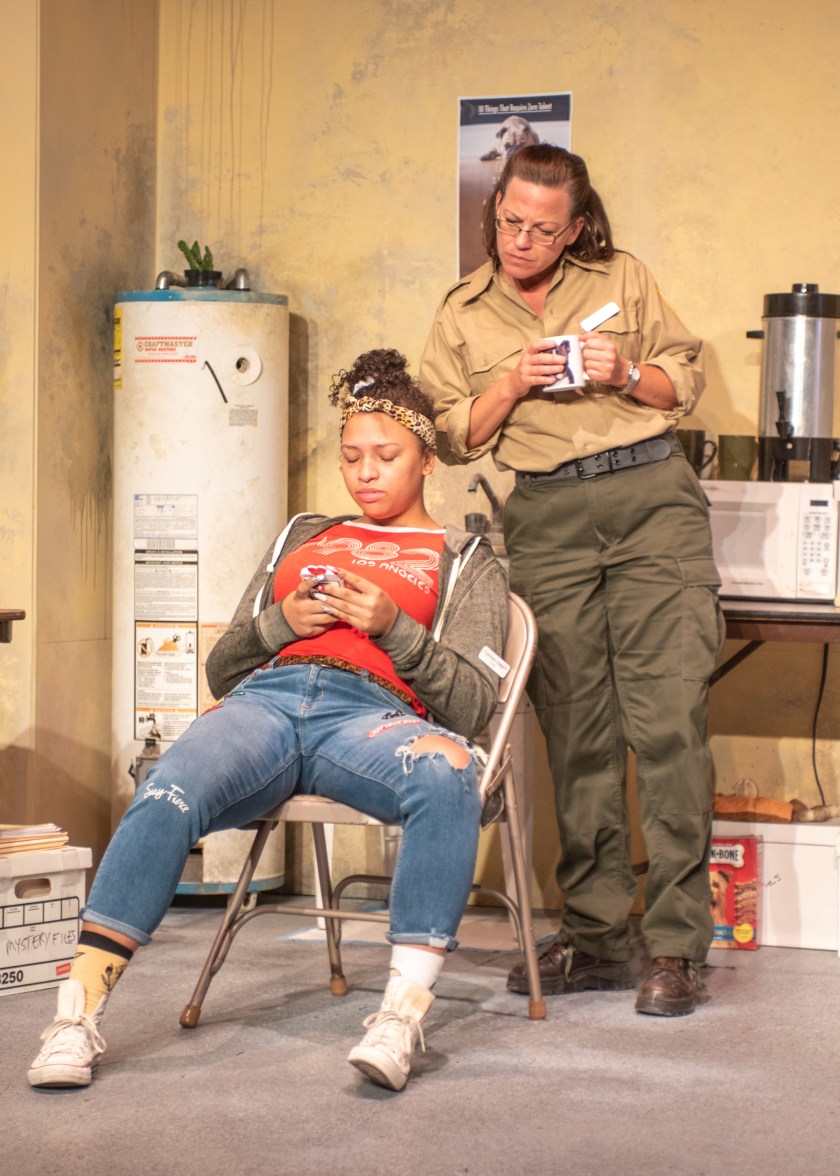
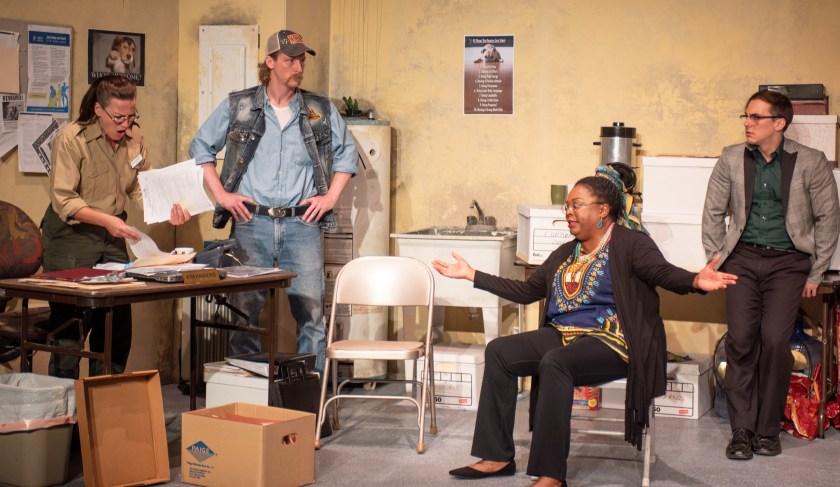
For this production, Chandler’s original three acts or scenes – The Prosecution, The Defense, and The Verdict – have been somewhat condensed. The combined effects of the script changes and the chemistry of the new cast has led to a leaner, tighter production, with greater dramatic intensity. It still evokes a strong sense of compassion, and it still brings tears to the eyes of pet owners and animal lovers, but it also seems to focus more on the development of character Kim Hawkins, the newly appointed manager of the Carson County Pound, so that she seems less incompetent and more a victim of a series of unfortunate circumstances leading to the tragic culmination.
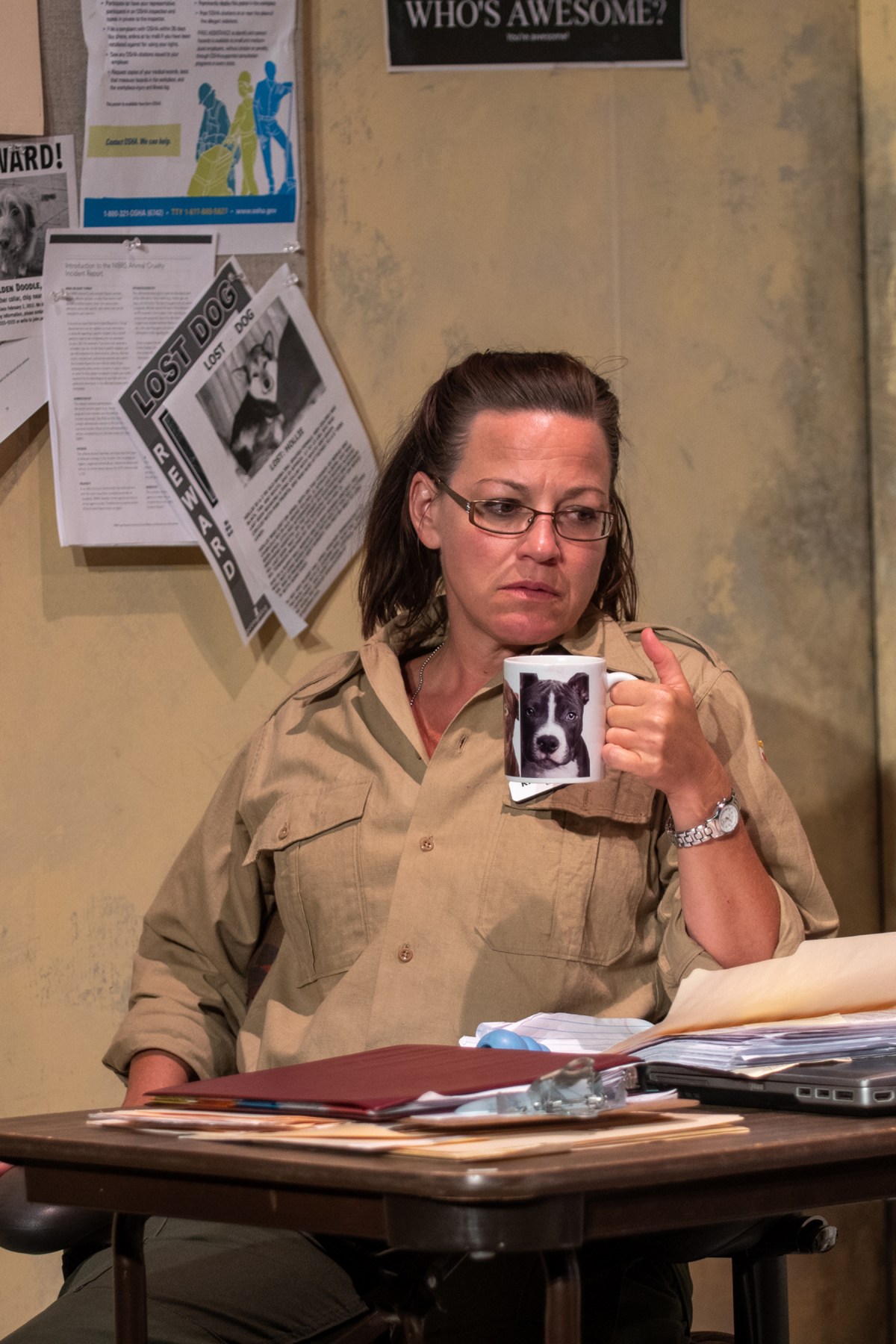
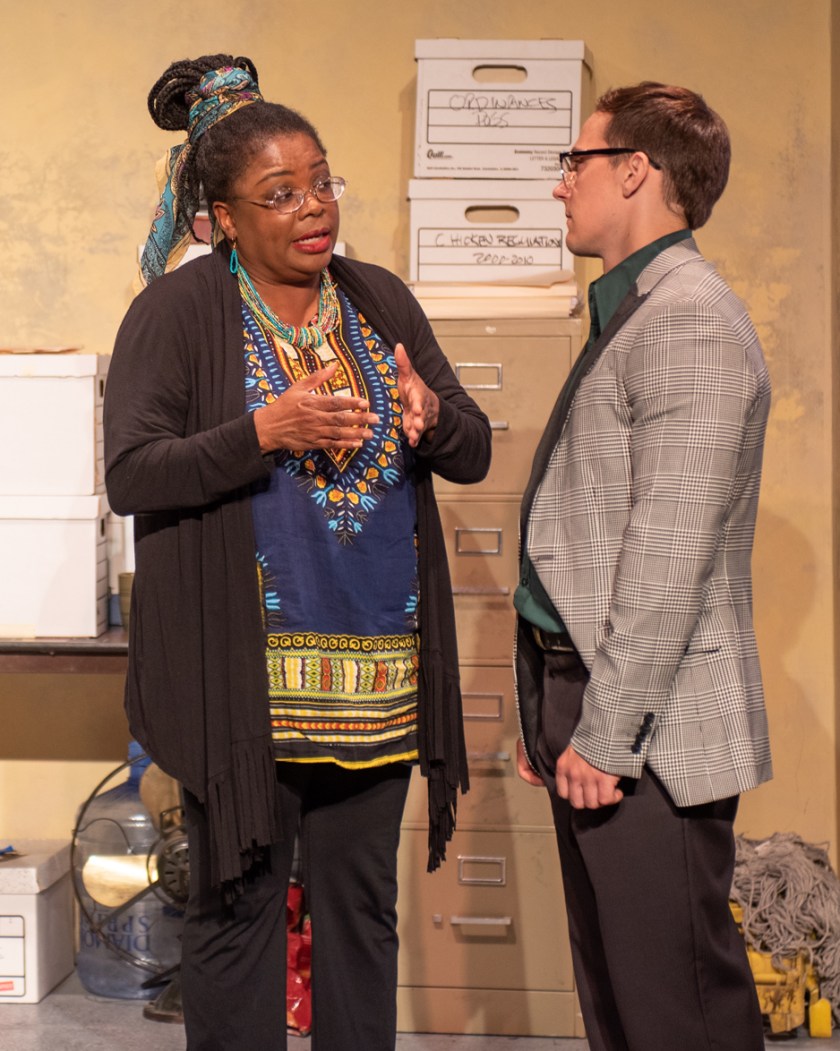
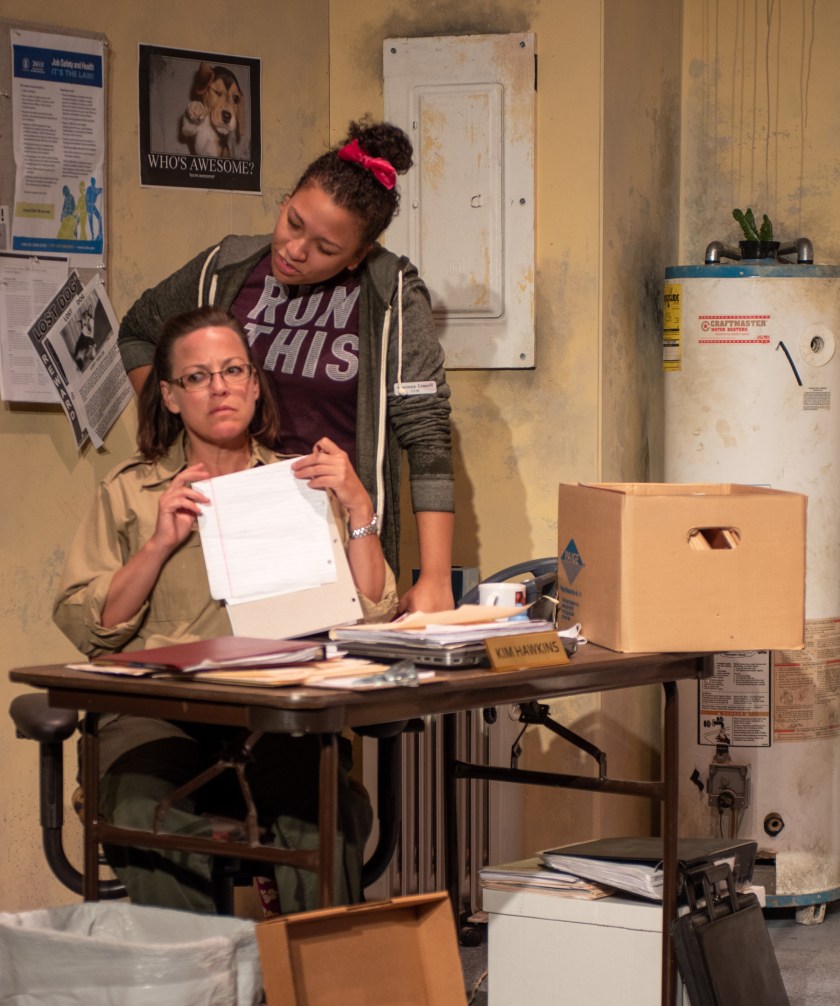
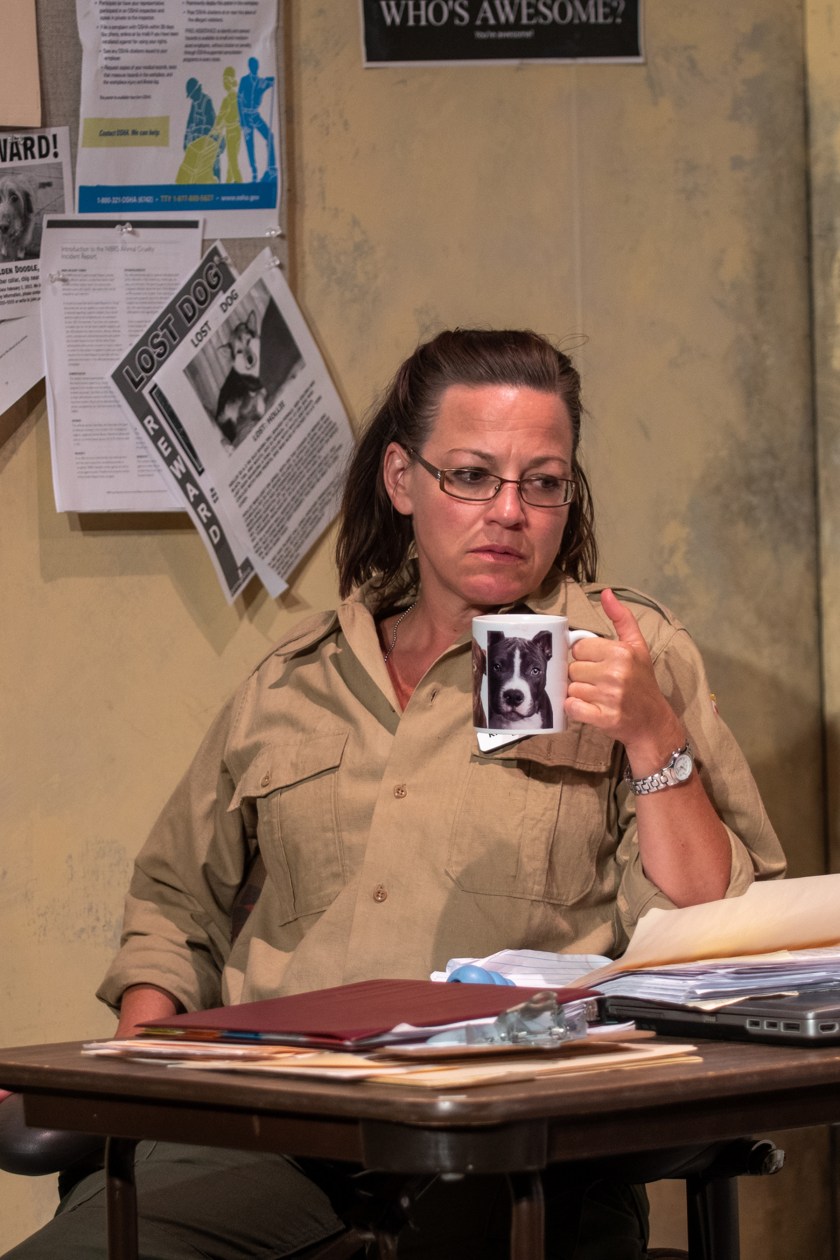
Donna Marie Miller still plays the role of Kim Hawkins and appears to have honed it to a masterful depiction of a caring woman who is tested by the unmitigating stresses and pressures of a dysfunctional bureaucracy. Similarly, Adam Turck has returned to play the role of the somewhat neurotic Marc Hanson, owner of Winnie (short for Winston, as in Churchill), the dog who was attacked by Bailey, the three-legged bully of the dog park. Turck has tweaked Marc’s characteristics, making him at once more focused and more distracted. As an example of the former, he sits with his body squarely facing the audience but his head is turned perpendicular to his body, zoned in on Hawkins; as for the latter, he seemed to take extra care to make sure we noticed his need to place a fork in the sink, cover a lunch container and put in into the mini-fridge, or examine the canine graphics on Hawkins’ coffee mug.
Young Journey Entzminger (a junior business management major at VCU) also returned as the intractable office assistant, Corrine Lowell. I would not have believed it possible but Entzminger was even sassier than before while somehow managing to steal hearts and nearly steal the show whenever she appears onstage – or even while making outrageous exits.
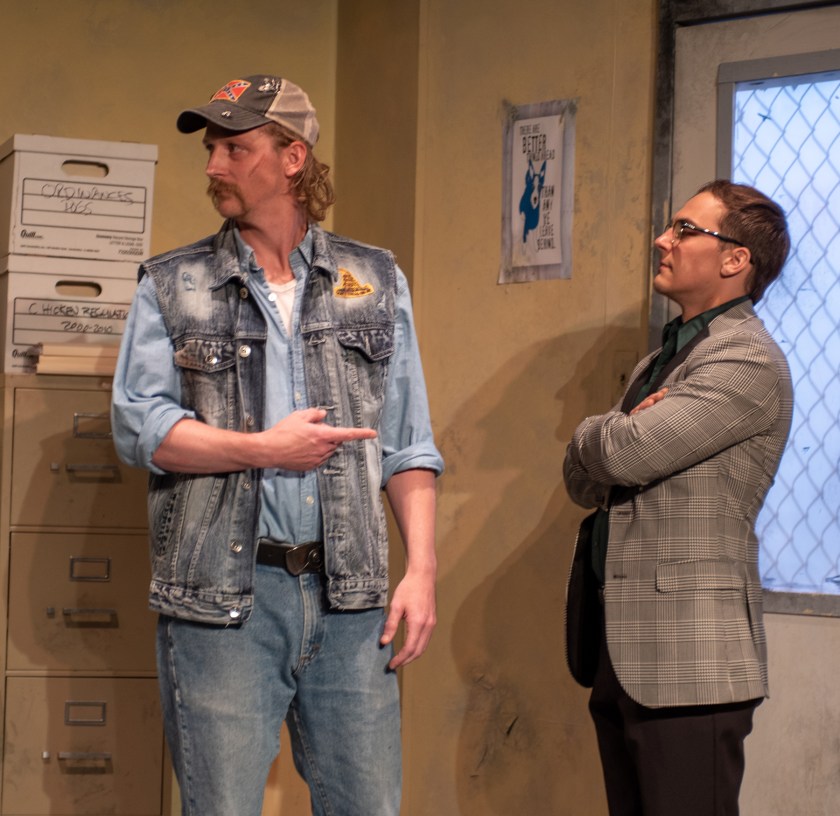
New to this cast are Stevie Rice as Dan Stanley, a role previously played by the 6’7” Arik Cullen, and Margarette Joyner as Patty Smith, a role previously portrayed by Lucretia Marie Anderson. When I first heard that Rice would be playing the role of Stanley I couldn’t image anyone other than Cullen whose mere presence was intimidating. But I quickly grew to admire the versatile Rice in the role. He was nearly unrecognizable as himself, hidden behind a baseball cap and a denim vest, both emblazoned with confederate flags. As much as you despise him at the beginning, you can’t help but feel compassion for him in the final scene, where even the irreverent Corrine feels compelled to gently brush back his hair while declaring the final words of the play, “he was a good dog.”
Last but not least, Joyner brought a more militant, more forceful interpretation to the role of Patty Smith, the beleaguered neighbor whose frequent complaints about Bailey were both cause and effect of the plot twists leading to the scene three denouement.
Much as I enjoyed the original production and cast, it is clear that Bassin, Chandler, and this cast have worked hard to solve problems and issues –both perceived and imperceptible – with the original. The result is, indeed, a better, more compact, more intense play.
BTW, when I walked into The Firehouse, Bassin was quick to explain his concept for the set, because in the original production, I wrote, I was distracted by the set with its chain link fences on either end. Bassin’s aesthetic leans towards the unrefined, minimalist look, while my OCD tendencies prefer things more refined and polished. But, point made and taken, it’s an aesthetic choice, and does not interfere with the average person’s ability to enjoy the production.
Animal Control is a surprising play in many ways. It presents many sides of a story, demonstrating how difficult it is to judge others. It makes subtle parallels between the behavior of people (Corrine, the student worker, who was been, in a way, rescued from juvenile detention) and animals (Bailey, a former bait dog abused by breeders of fighting dogs). And mostly it reminds us that even the most unlikely person may be deserving of compassion.
Julinda D. Lewis is a dancer, teacher, and writer who was born in Brooklyn, NY and now lives in Eastern Henrico County.
———-
Photo Credits: Bill Sigafoos
Journey Entzminger and Donna Marie MillerMargarette Joyner and Adam TurckDonna Marie Miller, Stevie Rice, Margarette Joyner and Adam TurckStevie Rice and Adam TurckDonna Marie Miller and Journey EntzmingerDonna Marie Miller
At: The Robert B Moss Theatre, 1300 Altamont Avenue, RVA 23230
Performances: June 24 – July 9, 2019.
Ticket Prices: $10-20
Info: (804) 346-8113 or rtriangle.org
Girlfriend, a two-person musical, is a summer romance about first love. Set in a small town in Nebraska in 1993, in the weeks following high school graduation, the story follows two young men as they explore their first love. The girlfriend of the title is an unseen but central character – much like the adults in Charlie Brown’s world – and one begins to wonder if she really exists at all. The budding love, so tenderly explored by Todd Almond’s book and carried along by Matthew Sweet’s punchy and energetic rock music and lyrics, is between Will, a sort of nerdy young man with a charming sense of humor and no plans for the future, and Mike, a popular jock who struggles with his attraction to Will as well as with his father’s plans for his future.
Cooper Sved, who was most recently seen in RTP’s Corpus Christi, plays Will, and infuses his character with energy, and endearing insightfulness. I am less familiar with Ray Wrightstone, who was recently in the cast of Seven Homeless Mammoths Wander New England (as an Early Man in a museum diorama). Wrightstone, who looked every inch the handsome jock, struck a tenuous balance that admirably captured Mike’s tension as he navigated the treacherous waters between his father’s expectations that he attend medical school, his teammates who hungrily chomped at the bit at any hint of homosexuality, his attraction to Will, and his desire to please everybody and not upset the boat. Of course, it is an impossible challenge.
Sved and Wrightstone are supported by a rocking four-piece band, under the musical direction of Levi Meerovich on keyboards. The band, especially the women, Hannah Goad and Roxanne Cook, provide background vocal support and even get a number of their own. My only complaint is that the music was sometimes too loud and overpowered the dialogue.
Chelsea Burke’s direction kept the one act play – running about an hour and fifteen minutes with no intermission – moving along at a great pace, assisted by some lively choreography by Aza Raine. Running in tandem with Grey Gardens, The Musical, girlfriend remarkably managed to transform the larger production’s set so that it was unrecognizable. Michael Jarett provided the moody lighting, and Dylan Eubanks provided the sound design – which included some very amusing movie sound effects. A running joke in the show is that Will and Mike keep attending the same movie all summer.
Something about the intensity and intimacy of this story reminded me of The Last Five Years, another powerful musical duet that was produced at TheatreLAB The Basement during their 2017/2018 season. After just a little digging around I found that Chelsea Burke also directed that show. So now, I’m not sure if the similarities I felt were due to the story lines or the genres or to the director’s special touch. It could be a combination of all of the above. At any rate, it makes me want to pay special attention to Burke’s future work. At this writing only two performances of girlfriend remain – on July 8 and 9, so don’t put it off if you plan to see this touching musical duet.
Julinda D. Lewis is a dancer, teacher, and writer who was born in Brooklyn, NY and now lives in Eastern Henrico County.
OMG! I can’t think of a better time than the night I spent at Virginia Rep’s production of The Wiz!
The Wiz is a familiar story, based on L. Frank Baum’s The Wonderful Wizard of Oz. The all-black version is familiar to many, from the 1975 Broadway show, starring Stephanie Mills as Dorothy (with book by William F. Brown, lyrics by Charlie Smalls, and choreography by my former teacher, George Faison) or from the 1978 film version starring Diana Ross as Dorothy and Michael Jackson as the Scarecrow.
Virginia Rep, under the direction of Artistic Director Nathaniel Shaw and Director/Choreographer Kikau Alvaro uses the Brown/Smalls script, but with re-imagined staging, using scenery by Kimberly V. Powers and costumes by Jeanne Nugent that were inspired by Afrofuturism and visual artists of the African American diaspora (e.g., Romare Beardon and Lina Iris Viktor). In layman’s terms, think Wakanda, and you have a pretty good idea: African prints meet modern technology and run into urban swag. It may not have lived up to the verbal description, but the colors and styles really popped and worked well with Alvaro’s dynamic choreography.
The movement ranged from ballet to urban to tap. I sat up and took notice of the tornado, created by the dancing ensemble and the orchestra and my respect for the choreography and dancing remained at an all-time high throughout the first act. I recognized the dance expertise of Ira White – a member of the Richmond Ballet – before I could even see his face, and other ensemble dancers, including Michelle Mercedes and Rachel Seeholzer brought the ensemble up a notch or two from the usual ho-hum musical theater dancing. When D. Jerome Wells, the Tin Man, broke out into a smooth tap dance, my heart melted – for about the fourth time, and it was only the first act!
My heart started melting with the orchestra’s Overture, under the able musical direction of Anthony Smith. The entire score – which gave equal weight to the instrumental and the vocals throughout the production – was absolute perfection. The sound quality was very good, and vocals were clear, even when spoken off stage. My heart melted yet again when Toto ran across the stage at the beginning of Act One, and for the third time when Desirée Roots, as Aunt Em (one of THREE roles she plays) serenaded Dorothy with “The Feeling We Once Had.”
I know people were smitten with Brandon LaReau’s Lion, and rightfully so, as he owned that role and played it for every laugh and tender moment he could wring out of the very willing audience, but I quickly developed a soft spot for Dylan T. Jackson’s Scarecrow, whose insightful comments throughout belied his lack of a brain. When the Tin Man described how, as a flesh-and-blood woodcutter, he had cut of first one leg and then the other, Scarecrow asks why he didn’t think that, perhaps, he needed to get rid of the cursed ax. And speaking of the Tin Man, not only did Wells win me over with his tap dancing, but he closed out Act One with a soulful rendition of “What Would I Do If I Could Feel?” that was worthy of an R&B concert date night.
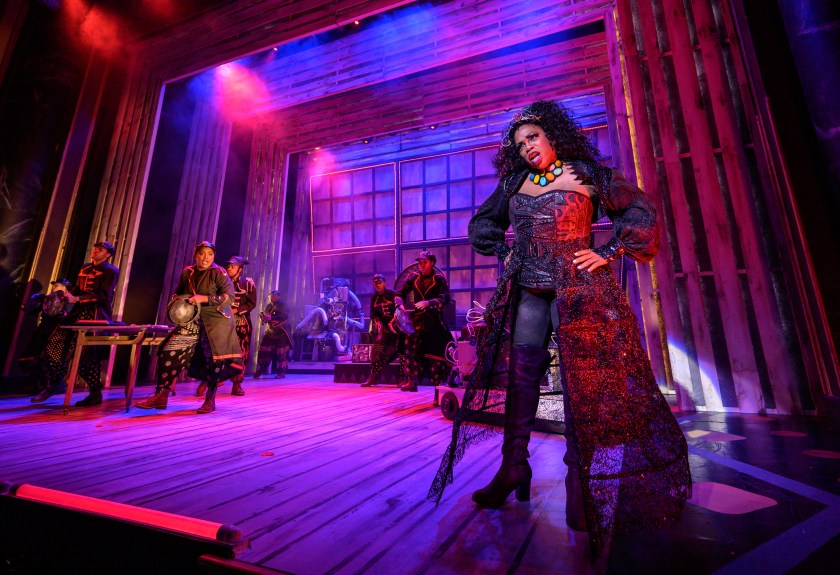
By the end of the first act, my face hurt from smiling and laughing, my eyes were leaking from laughing and an overload of joy, and my heart was a puddle on the floor at my feet. But this show wasn’t done with me yet. It wasn’t enough that Desirée Roots melted my heart with her ballad to Dorothy, she then killed it with an over-the-top performance as the good witch Addaperle. Her wand didn’t work, she couldn’t make herself disappear, and she carried her magic paraphernalia in a gigantic glittery handbag. She was like a magical, bedazzled version of everybody’s favorite, slightly inebriated aunt at the family cookout. Then in the second act she threw down as a punk-rock styled Evillene in black lace, a bustier, and thigh-high boots. “Don’t Nobody Bring Me No Bad News” was never sung better.
Jessi Johnson didn’t appear until midway through the second act, as Glinda, a good witch. Dressed regally, with a torch-carrying entourage, she graced us with her powerful and sensuous voice in “A Rested Body” and a reprise of “Believe in Yourself” before making a diva-worthy exit.
I didn’t forget Dorothy. Mariah Lyttle, a recent graduate of Ithaca College, has a voice to be reckoned with. While she was strong and clear in “Soon As I Get Home” and other songs with the ensemble and her motley entourage, she was really able to shine in the heartfelt Finale, “Home.”
Jerold E. Solomon also did double duty, as Uncle Henry in the first act and as The Wiz in the second. Solomon more than met the challenge of “Ya’ll Got It” after revving up, so to speak, from the mild-mannered misfit who became The Wiz to a hyped-up revivalist-style preacher who poured a heavy dose of self-empowerment on the citizens of Oz before disappearing in his magically restored hot air balloon.
There may be no such thing as perfect, but I couldn’t find a single thing I didn’t like – no, love – about this production of The Wiz. There are a few, shall we say, strong words or innuendos, but this is, overall, a family-friendly production. The couple sitting next to us was a grandmother on a date with her pre-teen grandson. There were lots of children in the audience, which was more diverse, overall, than one usually finds in the November Theatre. With all that’s going on – the scene changes, the sparkling lighting effects, the music, the songs, the dancing that moves off the stage and into the aisles – the entire production runs just slightly over two magical hours. I hope I have time to see this beautiful show again before it closes on August 4. It’s pure happiness on a stage.
Julinda D. Lewis is a dancer (who was once a poppy in a scene from The Wiz), teacher, and writer who was born in Brooklyn, NY and now lives in Eastern Henrico County.
———-
Photo Credits: Aaron Sutten
D. Jerome Wells (Tin Man) and Mariah Lyttle (Dorothy). Photo by Aaron Sutten.Mariah Lyttle (Dorothy) and cast. Photo by Aaron Sutten.Mariah Lyttle (Dorothy) and Jerold E. Solomon (The Wiz). Photo by Aaron Sutten.Desirée Roots (Evillene). Photo by Aaron Sutten.Mariah Lyttle (Dorothy) and cast. Photo by Aaron Sutten.Desirée Roots as Aunt Em, Addaperle, and Evillene.
At: The Robert B Moss Theatre, 1300 Altamont Avenue, RVA 23230
Performances: June 24 – July 27, 2019.
Ticket Prices: $10-40
Info: (804) 346-8113 or rtriangle.org
Grey Gardens, The Musical, with book by Doug Wright, music by Scott Frankel, and lyrics by Michael Korie is a two-act musical that is full of humor and drama and emotion. But the two things that make this musical stand out are the fact that it is about real people and that both of these people are brought to life by the enormously talented Susan Sanford.
On the advice of a friend and colleague, I watched Albert and David Maysles’ 1976 documentary Grey Gardens prior to attending the musical. The award-winning cinéma-vérité chronicles the tragedy and wonder of these two women, both named Edie, both of whom defied the laws of society and blazed a trail that few would want to follow. Like a road-side accident, I didn’t want to watch, but it was impossible not to look and as fascinating and heart-rending as the documentary was, it didn’t even come close to the emotional roller coaster that Wright, Frankel, and Korie created in this musical, brought to life on the RTP stage by director Debra Clinton and musical director Kim Fox. I may have laughed at Sanford’s antics, both as “Big” Edie in the first act and “Little” Edie in the second act, but I was in tears by the time the cast took their final bows.
Grey Gardens, for those, like me, who do not follow society, was the estate of Edith Bouvier Beale, an aunt of our former First Lady, Jacqueline Bouvier Kennedy Onassis, and her daughter, “Little” Edie Bouvier Beale. “Little” Edie was a debutante in the early 1940s, apparently with somewhat of a reputation, as she was nicknamed “Body Beautiful Beale.” Her young cousins Jacqueline “Jackie” Bouvier and her sister Lee Radziwill were apparently frequent visitors to the 28-room East Hampton Estate in its heyday. My favorite line, spoken by “Little” Edie in the second act: “It’s a mean, nasty Republican town.”
The first act of Grey Gardens, The Musical mixes fact and fiction, and it’s not clear where the line is drawn. But it seems that mother Edie’s love of singing went against her husband’s puritanical grain, and he took off to Mexico with his lover Linda and obtained a quickie divorce. After that, things quickly went downhill at Grey Gardens, and by the time we get to the second act – and by the time the Maysles show up with their cameras – the place has fallen into disrepair. Much of the dialogue in the second act is taken straight from the documentary – another reason to do the homework and watch it before seeing the show.
There are holes in the walls that allow free access to all the stray cats and racoons the two women have adopted, the mansion is full of fleas, and there is apparently little or no working plumbing. When “Little” Edie prepares a plate of pâté for her mother, the woman sitting next to me and I gasped, unsure if the surely expired can contained pâté or cat food. The Suffolk County Board of Health was on the verge of condemning the house and evicting the two Edies until their more solvent relatives stepped in and made the necessary repairs. It is unclear whether this made much of a difference in the Edies’ lifestyle – and I kept wondering how they were supporting themselves. Who was paying the taxes, and the grocery bill, and how is it that the lights were still on?
Practical considerations aside, Gray Gardens, The Musicalis equally hilarious and heartbreaking. In addition to Susan Sanford, who acts and sings her heart out and is outrageously funny, first as the overbearing mother Edith Bouvier Beale in Act One and then as “Little” Edie in Act Two. Sanford does an impressive job balancing “Little” Edie’s desire to break away from her mother and become independent against her sense of responsibility to stay and take care of her mother. This dilemma is beautifully foreshadowed in Act One by Grey Garrett, who plays the Young “Little” Edie Beale. One minute Garrett is begging her mother, played by Sanford, not to sing, the next she is defending her right to do so when her grandfather, “Major” Bouvier, played by Kirk Morton, denigrates his daughter for her eccentricities and quiet consent to her absent husband’s affairs. Boomie Pedersen as “Big” Edie, the mother, in the Prologue and Act Two has mastered the role of the screaming, overbearing mother – possibly in the early to mid- stages of dementia, although with manipulating, narcissistic personalities it’s sometimes hard to tell – to the point where you almost forget she’s just acting. The dysfunctional chemistry between Pedersen and Sanford is a force to behold.
Also doing double duty were Durron Marquis Tyre, as the servant Brook, Sr., in Act One and his son, Brook, Jr., in Act Two and Elijah Williams as “Little” Edie’s fiancé Joseph Patrick Kennedy, Jr. in Act One and “Big” Edie’s friend Jerry in Act Two. It was interesting that Brook, Sr., seemed more refined that his son. Sr. wore a cutaway suit, while Jr. wore overalls – a reflection of the state of the house. I liked Williams in his role as Jerry more than as Kennedy, perhaps because the second character and his relationship to the family more closely reflected the oddities and conflicts of these fascinating women.
Caroline Berry and Anya Rothman were sweet and adorable as the young Jackie and Lee Bouvier, and Eddie Webster had an interesting supporting role as George Gould Strong, “Big” Edie’s accompanist and companion.
Frank Foster’s scenic design was serviceable, but unremarkable, although the production did a good job changing from relative grandeur in Act One to shabbiness in Act Two. Matthew Banes’ lighting and Joey Luck’s sound design both enhanced the overall effects, but Ruth Hedberg’s costumes and Joel Furtick’s hair and makeup really nailed it. “Little” Edie’s costumes for Act Two were spot on and would probably get a word of approval from the real “Little” Edie.
The broad and flat Boston-Long Island accents were often startling – even to this Brooklyn girl – but seemed pretty accurate. Director Clinton even choreographed some lively dance steps, and musical director Kim Fox and her musicians helped keep things moving along at a nice pace.
Grey Gardens, The Musical is one of the most heart-wrenching musicals you will ever see – and I hope you do see it. After the first week of performances, Richmond Triangle Players had to extend the run from July 13 to July 27, and tickets will likely be hard to come by for the remainder of the run.
Julinda D. Lewis is a dancer, teacher, and writer who was born in Brooklyn, NY and now lives in Eastern Henrico County.
The current Quill Theatre production of The Tempest is sublime – though not perhaps for the reasons you might expect. It was not just the play, but all the components that came together to make up the entire evening. Saturday’s weather was perfect – not too hot, not too cool, not humid, no rain, and the bugs remained mostly at bay during the first act. The atmosphere was festive, with pre-show picnickers scattered across the spacious lawn, and vendors selling fruity ice pops, ShakesBeer and wine. The sixteenth century manor house and its tiered gardens, where one might encounter The Festival Young Company wandering about reciting monologues or go for a stroll during intermission provided the perfect setting for a festival.
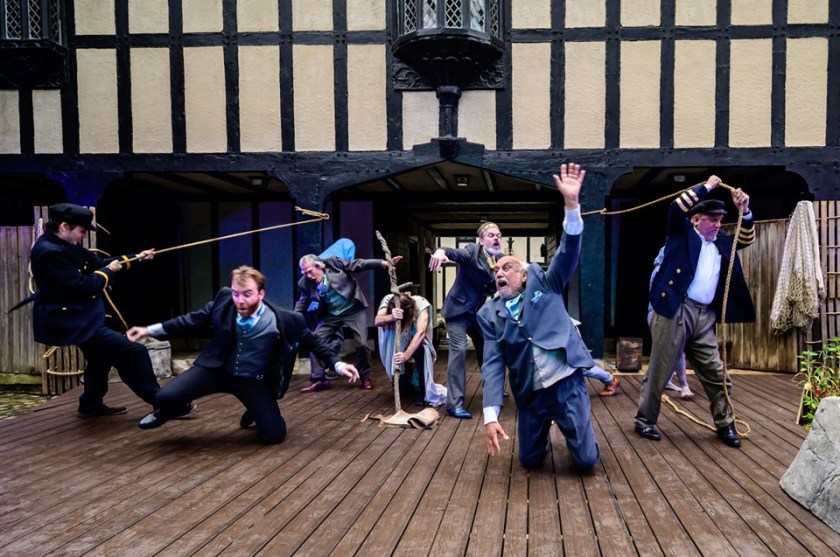
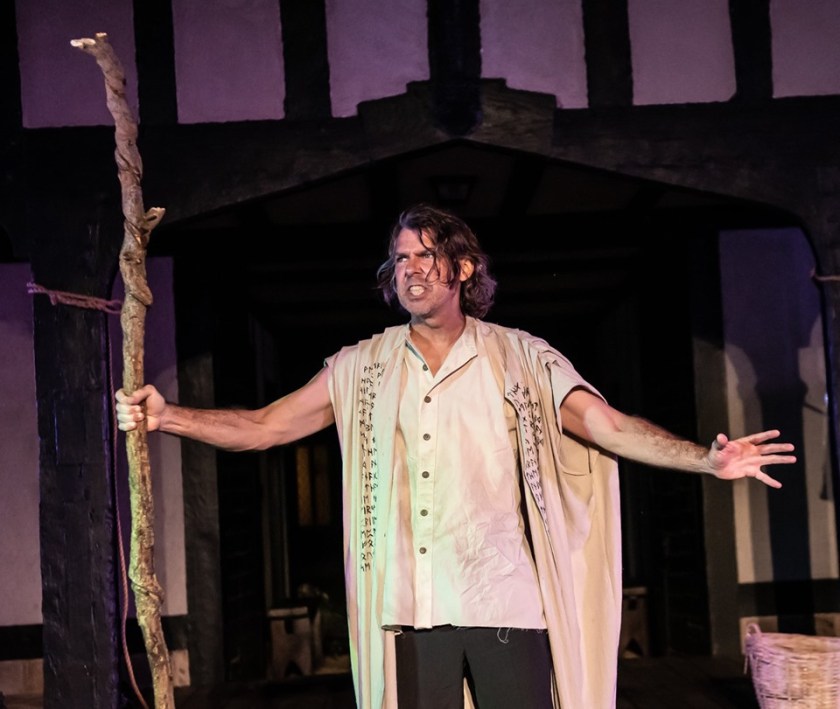
The Tempest is complicated. Prospero, the lead figure, is the usurped Duke of Milan but he is also a powerful sorcerer. I’m not clear on whether he was a sorcerer before he was deposed and set adrift and landed on this remote island, or if he became a sorcerer as a result of his betrayal by his own brother, Antonio. John Cauthen and director James Ricks together give us a Prospero who is multi-faceted, showing a softness for his young daughter, Miranda, played by newcomer Madison Munson. She and her love interest Ferdinand, played by another newcomer, Dean Hall, brought a sense of innocence and normalcy to this otherwise convoluted tale. But Prospero is a complicated hero. He treats his servants Ariel and Caliban callously, forgives those who wronged him, and in the final scene begs the audience to release him. And he is so magically convincing that we comply.
Jeff Clevenger in the role of Trinculo, the king’s jester, and Adam Valentine as Stephano, the king’s drunken butler team up to bring much needed humor and physical comedy to this sometimes dark comedy, liberally sprinkled with betrayal, romance, and tragedy. But the two most noteworthy characters for me were Ariel and Caliban.
I absolutely adored Adam Turck’s portrayal of Ariel, Prospero’s spirit servant. Painted in blue, and draped in nondescript layers of identically painted fabric, Turck has adopted quirky movements that add to his otherworldly persona. At one point he appears on top of the wall that separates the stage from the gardens, where he crouches to deliver his lines. Often lurking in the background, where he nearly blends in, it is almost possible to believe that he is invisible to all but Prospero – and the audience.
Now as for Caliban – I don’t know if anyone else has said this but. . . .Why is the black actor (a) a slave and (b) called a monster and a savage? Okay, I understand that this is the character that Shakespeare wrote, but Walter Riddle is the obviously a POC and he plays a savage monster. I’m not saying he didn’t do a good job, but I just couldn’t get past that casting choice. I am not the first to say this, but Prospero, you are a Colonizer! The subplot of Prospero’s treatment of Ariel and Caliban and the vastly different ways they respond to their oppressor is more intriguing than Prospero’s story.
James Ricks’ direction kept things moving along at a nice pace; there was lots of action, and Ricks’ sound design included a few subtle touches that enhanced the overall experience. BJ Wilkinson doesn’t have much to do in the way of lighting as it’s still daylight until the second act, and Anna Bialkowski’s costumes, which put the noblemen in modern day suits, was visually cohesive and aesthetically pleasing. There are also a few delightful musical moments, with original music by Jason Marks.
Julinda D. Lewis is a dancer, teacher, and writer who was born in Brooklyn, NY and now lives in Eastern Henrico County.
———-
Photo Credits: Production photos by Aaron Sutten; Group selfie by Noah Downs
Adam TurckCedar Curran, Travis Williams, Chris Dunn, John Cauthen, Jonathan Hardison, Derek Kannemeyer, Jeff ClevengerJohn CauthenJonathan hardison, Adam Turck, Chris Dunn, Derek Kannemeyer, Travis WilliamsShakespeare Festival Audience Selfie, 06/15/2019
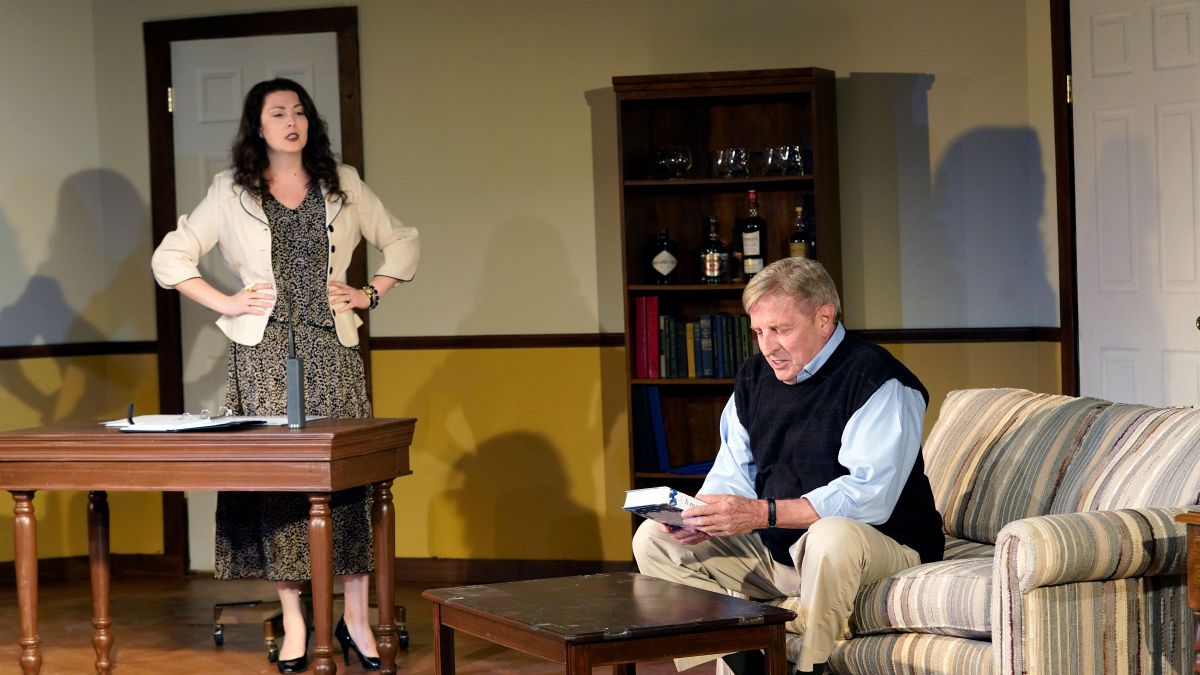
CAT Theatre’s 55th season has featured some interesting productions and some novel premises. The season opened with Boeing, Boeing, a French farce from the 1960s, followed by A Doublewide, Texas Christmas¸ written by the trio of Jessie Jones, Nicholas Hope, and Jamie Wooten who also wrote The Savannah Sipping Society that is currently playing at Swift Creek Mill Theatre. The new year brought a revival of Becky’s New Car, which I first saw some years ago at Hanover Tavern – both times I was one of those selected from the audience to assist “Becky” with her onstage wardrobe change. Earlier this spring they offered a musical comedy, BINGO! that included audience participation with real bingo cards, markers, and prizes. The final offering of this season is Office Hours, a comedy by Canadian playwright Norm Foster.
Office Hours is a series of six vignettes, each set in a different office in the same city on the same day, near quitting time. A cast of six versatile actors plays sixteen different characters with great energy and enthusiasm, but with varied levels of success. The first act, consisting of four scenes, seemed to drag at times, but I’m not sure whether it was due to Andrew Bryce’s direction or Norm Foster’s script. Maybe Canadian humor is different from ours. At any rate, the second act seemed to hit the laughs more accurately, and the play ended with a surprise twist I truly didn’t see coming.
The six scenarios are separate but intertwined. Hints and clues are sprinkled throughout that help keep the viewer engaged and provide a sense of smug satisfaction when the plot twists are revealed. Throughout the various scenes characters refer to the beautiful office space and the nice furniture. This provides an unintentional running joke as Hunter Mass’s set looks like a collection of mismatched thrift store items: a desk; a sofa; 2 or 3 chairs in different styles and sizes; a bookcase that doubles as a bar; 3 small tables. The office desk and chair seem too small, and when one or two of the character remark on its large size and the general tidiness of the office I wondered how they could do so with a straight face. There are also two doors, two tall windows, one of which has a latch that allows for access to a ledge, and a picture on one wall that is changed at the beginning of each scene.
For some inexplicable reason, there are different styles and different eras of telephones in each office scene, but the furniture remains the same, and even though the set is carefully rearranged for each scene, there is too little to distinguish the various scene. Oddly, on the night I was there, there was a noticeable but inexplicable dip in the lighting near the top of the first few scenes. Chris Stepp did the lighting and sound design, and while there were interesting and tuneful musical selections between scenes, I think more could have been done with the lighting to make each office unique.
Running themes that tie the separate scenes and characters together include the office setting, the phones, the furniture, and most interestingly, ledge jumper, a leather bound Day-at-a-Glance planner and a thick book by an erotic novelist who uses the pseudonym Margaux Kenyon.
Bill Blair is one of the more imposing members of the cast, and makes a lasting impression as Warren Kimble, a on-air journalist who is demoted as the result of age-ism and Lloyd Penny, the seemingly hen-pecked husband of a domineering wife and father of two sons: one a gay lawyer and the other a straight figure skater.
PJ Freebourn’s characters include an unnamed One-Armed Man and a shallow cheater named Mark who concocts the most amazing excuses for his infidelities and tries to use them to manipulate his young wife, Ellie.
Madeleine Gish played three very different character. In the first scene she was Pam Gerard, the overly confident and self-promoting production manager who demoted Warren Kimble. She next appeared as Ellie Young, the savvy young wife who hired a private eye to document her husband’s infidelities, and finally Sharon Freeman, a love-starved psychiatrist looking for to a long awaited weekend tryst, who put her own needs above those of her client who inconveniently decided to end their Friday afternoon session on the window ledge of her office. Gish did a great job making each of her characters distinct.
Hogan Holt also played a trio of characters, but my favorite was Artie Barnes, the overweight jockey. Foster, the playwright, seems to like tossing a monkey wrench of realism or tragedy into the midst of his most comic moments, and in the case of Artie he did not disappoint. It seems that during one race, Artie’s horse suffered a heart attack and died on the track. Yet Artie, who fluctuates in and out of denial at the drop of a hat – in his case a slightly bedazzled and bedraggles cowboy hat—insists he’s a svelte 112 pounds.
Paige Reisenfeld plays both Francine Majors, a frustrated production partner, and Rhonda Penny, the mother of the gay lawyer who insists that gay sons are the result of a domineering mother. In one of the funniest scenes of the night, she brings lunch to her son’s office, in an oversize picnic basket. The food choices inside warn us that something is not quite right with her: a large jar of giant gherkins (pickles), a cucumber, orange-aid, a polish sausage, and an uncooked eggplant. Her husband carries a bag with a McLobster sandwich. (I don’t know if that is a real thing and didn’t dare check!)
Joel White’s character included the gay son and a has-been movie director, Bobby Holland with an obvious drinking problem who tries to pitch a new project that sounds like a barely doctored revival of the Tarzan story.
There is a lot going on, and I enjoyed following the twisting threads of the various stories and discovering how they were connected. Yet, with all that – and a pretty good cast, to boot – Office Hours falls short of the comedic gem it wanted to be.
Julinda D. Lewis is a dancer, teacher, and writer who was born in Brooklyn, NY and now lives in Eastern Henrico County.



















 RVArt Review