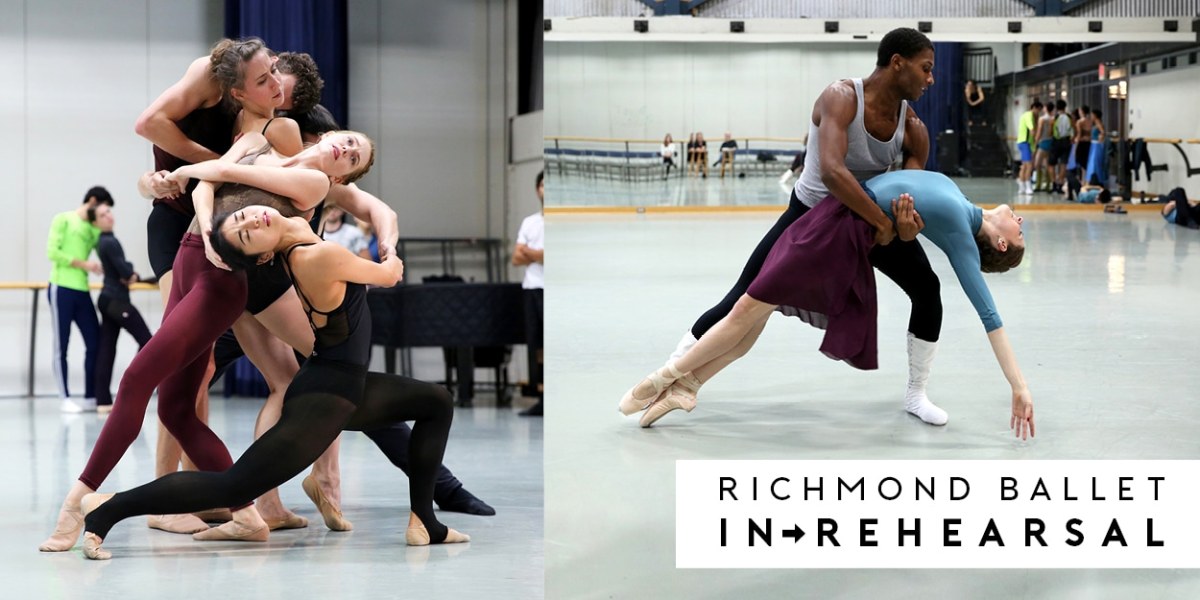
RICHMOND BALLET: GRACE IN THE RIVER CITY – A REVIVAL & A PREMIERE

RICHMOND BALLET STUDIO ONE: GRACE IN THE RIVER CITY

A Dance Review by Julinda D. Lewis

At: The Richmond Ballet Studio Theatre, 407 E. Canal St., RVA 23219

Performances: November 5-10, 2019

Ticket Prices: $26-$46

Info: (804) 344-0906 x224 or etix.com

chiaroscuro
noun
chiar·oscu·ro | \kē-ˌär-əˈskyu̇r-(ˌ)ō\

  1. pictorial representation in terms of light and shade without regard to color 
  2. a: the arrangement or treatment of light and dark parts in a pictorial work of art

    b: the interplay or contrast of dissimilar qualities (as of mood or character)

merriam-webster.com

The Richmond Ballet opened its 2019-2020 season (19/20 for short) with the theme “Grace in the River City.” The Studio One program, held at the company’s Canal Street studio, included Artistic Director Stoner Winslett’s “Ancient Airs and Dances” and Ma Cong’s “Chiaroscuro.”

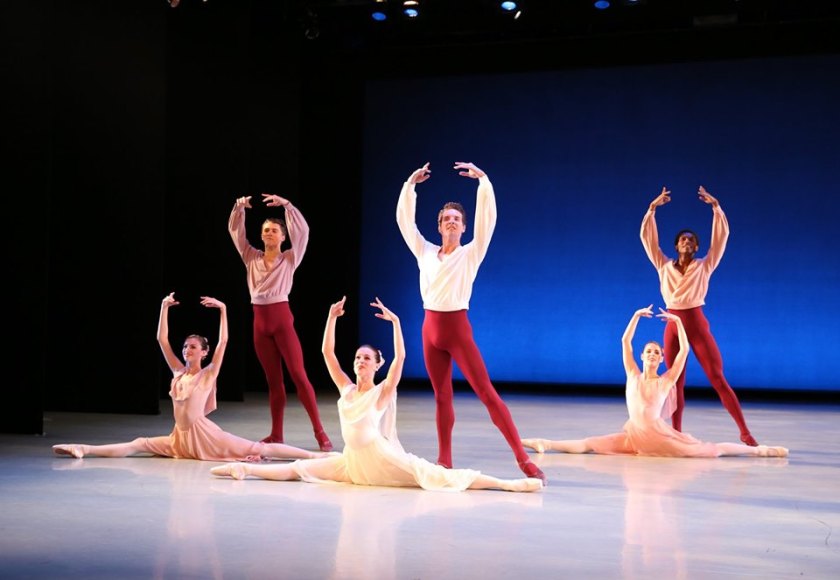
“Ancient Airs and Dances,” set to three suites of 17th and 18th century Italian and French lute songs by Ottorino Respighi, was revived in honor of Winslett’s 40th anniversary with the Richmond Ballet. The work for four couples was Winslett’s first work for the professional company. Dressed alike, but in different colors (navy, purple, aubergine, wine) the four couples begin with a formal promenade, tracing figures on the floor. At the end of the introductory movement, they toss away their masks and begin to reveal their separate personalities.

First is Ira White and Eri Nishihara (purple). They appear to be the playful couple, moving lightly, teasing and skipping offstage. Next up, Abi Goldstein and Anthony Oates (aubergine) who present themselves as the romantic duo. They are more dramatic, and Goldstein is very strong, demonstrating a freedom of physicality as when she rolls across Oates’ back. When Cody Beaton and Mate Szentes (navy) dance, the woman’s skirt and man’s vest have been shed and the movements seem more contemporary and exploratory, less formal, and finally Melissa Frain and Marty Davis’ (wine) dance seems to be about reconciliation and commitment or longevity as they seem to linger in one another’s presence and movements. In the final section, the four couples gather in a folk dance and each couple briefly reprises their duet before ending in a rotating figure like a carousel, with the women held aloft, parts of a whole.

During her tenure at Richmond Ballet, Winslett has commissioned more than 75 works, by more than 35 choreographers (facts she revealed during her Tuesday evening Choreographer’s Club curtain talk). For Studio One, she brought back Ma Cong for his fifth new work in ten years.

“Chiaroscuro” is a collaborative work, with choreography by Ma Cong, Music by Ezio Bosso, costumes and set by Emma Kingsbury, lighting by Trod Burns, and photography by Sara Ferguson. The nine dancers – 4 women and 5 men – move through Bosso’s music illuminated by Burns’ lighting with Ferguson’s larger-than-life black and white images of themselves projected onto Kingsbury’s set. It might be a rock, or a cliff, but wait – what is that long, thin thing sticking up out of middle of it? “Nothing’s perfect,” was Kingsbury’s enigmatic response when questioned about it.

Images change subtly; where there were hands there is now a face; where there was a face, there are now two, no three! The costumes, in shades of black and gray, echo the chiaroscuro effect  – the contrast of light and dark, the constantly shifting light and the movement of human sculptures.  Hmmm, a Chinese choreographer; an Italian composer; an Australian designer; an American ballet company – was this, too, part of Cong’s vision, or was it serendipity?

The cast – Cody Beaton, Elena Bello, Melissa Frain and Eri Nishihara, Marty Davis, Trevor Davis, Fernando Sabino, Mate Szentes, and Ira White – seemed to enjoy performing this piece as much as the audience enjoyed watching it.

“Chiaroscuro” begins with Fernando Sabino (who has announced his retirement at the end of this season) o the floor. As he rises, his movements are strong, emotive, not all lightness and grade. As the other dancers enter, the women are lifted in swirling arcs, tracing figure eights in the air. When the men arc backwards, they turn their knees inward. This ballet is not technique as usual. A diagonal line turns inward and wraps around like a spiral segment of DNA. Dancers unite and separate. Elena Belo is lifted about a cluster of men and held aloft in a running pose. Three men intertwine, heads popping out and leaping through hoops made of arms like a game of whack-a-mole.

On the screen, a large white rose emerges; but the end of the dance it has wilted. On the stage, a white parasol weaves its way across the stage. I somehow felt the rose and the parasol were connected. Partnering in “Chiaroscuro” is intriguing. In one section the women shed their skirts, becoming de-sexualized. Dancers morph into oddly intriguing positions, finding new ways to connect. One may be held by an ankle, a toe, or back of the knee. Dancers’ arms and legs become hooks from which to suspend bodies and legs and thighs become step stools leading to higher dimensions.

Like previous works by Cong, “Chiaroscuro” encourages the viewer to explore new perspectives of human emotion, as he did with “Lift the Fallen,” a 2014 work in which he deals with the loss of his mother. But “Chiaroscuro” is even more immersive, more compelling. It is a beautiful work that elevates both the dancers and those watching them.


Julinda D. Lewis is a dancer, teacher, and writer who was born in Brooklyn, NY and now lives in Eastern Henrico County.

———-

Photo Credits: Sarah Ferguson


Books available on Amazon.com; click on cover for link.


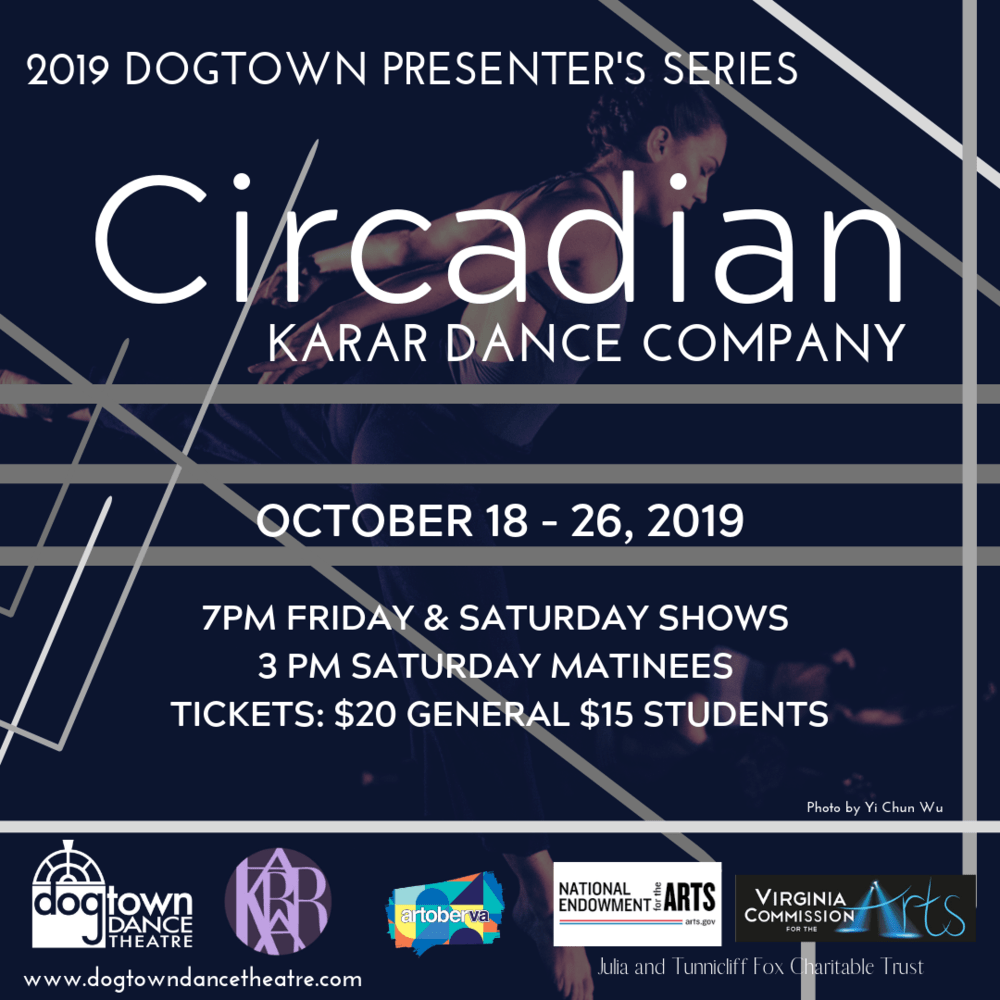
KARAR DANCE COMPANY PRESENTS: CIRCADIAN, an evening-length work

019 DOGTOWN PRESENTER’S SERIES: KARAR DANCE COMPANY

A Dance Review by Julinda D. Lewis

At: Dogtown Dance Theatre, 109 W. 15th Street, RVA 23224

Performances: October 18-26, 2019

Ticket Prices: $20 General Admission; $15 Students

Info: (804) 230-8780 or dogtowndancetheatre.com


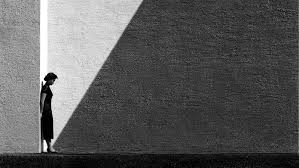
Circadian is a mesmerizing evening-length work for five dancers. The creative offspring of Kara Robertson, Artistic Director of Karar Dance Company, Circadian was inspired by a series of black and white photographs by Fan Ho (1931-2016), an award-winning Chinese photographer, film director, and actor who was known for his mastery of light and shadow. An image of his work entitled Approaching Shadow first caught Robertson’s attention some three years ago, and after much research, and some six months of intensive work with her company of dancers and collaborators, resulted in a 40-minute dance inspired by Fan Ho’s body of work captured in his book, Hong Kong Yesterday. [Hear the choreographer explain how her movement was inspired by the photographs: https://www.facebook.com/KARARDANCECOMPANY/videos/397277210947427/]

Fan Ho photo
Fan Ho image, Approaching Shadow

The first thing that strikes you about Circadian is the space; it is performed in the round, with two rows of seating on each side of the dance space. The second thing you might notice is the light; there are bright lights at each of the four corners of the dance space, and Weston Corey has designed numerous special effects, some quite subtle and some deliberately startling. This four-sided performance space with this moody, atmosphere-changing lighting, creates a world all its own that pulls and lulls the audience so that one loses track of time. A wooden lattice-work frame – the work of Crux Scenica – hangs above the dancers; I was so caught up in their motion and the mood of the lights that both surreptitiously and overtly direct our gaze, as well as by the sometimes hypnotic, sometimes dynamic original score by Ryan Davis that I didn’t notice it until near the end. It came as a total surprise that we had watched 40 minutes of uninterrupted dancing – and that the 5 dancers had been onstage moving for all that time.

Circadian begins with a simple walk. Dressed in simple but elegant two-piece black garments (kudos to designer Damion Bond) with wrap-around pants and cropped athletic tops that remind of yoga, meditation, and other healthy, healing practices, the five navigate the circumference of the space with measured and deliberate steps, articulating each action of the foot. Their arms are not yet engaged as they complete this counterclockwise procession with frequent interruptions of the precise cycle as one dancer then another breaks the formation by changing position, cutting across the space, widening or closing the gap between dancers, or moving into the center for a solo. These diversions only increase the mesmerizing power of the deliberate cycle.

Company dancers David Alexander Deegan, Caroline Echevarria, Amy Mulder, Amy Perkinson, and Haley Wall worked well as an ensemble, taking their cues from one another’s breathing or a fleeting glance, the briefest eye contact and seeming to move from a shared pool of energy. This synergy is most palpable and powerful when the music pauses, seeming to take a breath of its own so that the dancers and audience can experience the power and natural rhythm of silence.

 Gradually the patterns become more complex, the movements engage the arms and the entire body, often using a position from a Fan Ho photograph to initiate a movement phrase or transition from one section of the dance to another. The precision and focused intent of the walking is countered by softer shapes in the center, rounded spines and shoulders, a gentle firmness when they make contact that feels safe and secure yet daring at the same time.

There are spaces for the dancers and the music to breathe, only to continue as if the silence and stillness were natural parts of the cycle, of the circadian rhythm. They end on the floor, face down, as if taking a collective breath. I liked everything about Circadian and it is even more special to see such high caliber work from a small, young, local company. If time permits, I will see Circadian again, and choose a seat on a different side of the room to see if that substantially affects the viewer’s experience of the piece.

Karar Dance Company is a young organization; the company debuted in 2017 with a goal of becoming a collaborative conduit for artistic expression and a commitment to things homegrown. Kara Robertson as well of 4 of her 5 dancers – David Alexander Deegan, Amy Mulder, Amy Perkinson, and Haley Wall – are all graduates of the VCU Department of Dance and Choreography. Caroline Echevarria is also local – a native of Richmond and a graduate of Elon University’s department of Dance Performance & Choreography.

The presentation of Circadian was made possible by Dogtown Dance Theatre’s Presenter’s Series. Now in its fourth year, the Dogtown Presenter’s Series (DPS) annually places the spotlight on an independent artist or Richmond-based organization, producing a two-week series that provides the artist with all the major resources needed, including rehearsal space, technical production, marketing, public relations, and a stipend. The goal of the DPS is to introduce Richmond audiences to choreographers who reflect the rich cultural diversity of the city, and I hope more people in Richmond and the surrounding counties find or make the time to visit the Manchester neighborhood and support our local artists.

Julinda D. Lewis is a dancer, teacher, and writer who was born in Brooklyn, NY and now lives in Eastern Henrico County.

———-

Photo Credits: Michael Keeling – Karar rehearsal photos; Fan Ho – Approaching Shadow image


Amazon baby product

https://www.amazon.com/gp/product/B00D2JN87I/ref=as_li_qf_asin_il_tl?ie=UTF8&tag=rvartreview-20&creative=9325&linkCode=as2&creativeASIN=B00D2JN87I&linkId=1df336a01e4b01f4ee58b8b10f26916a


Available on Amazon.com. Use the link below each picture.

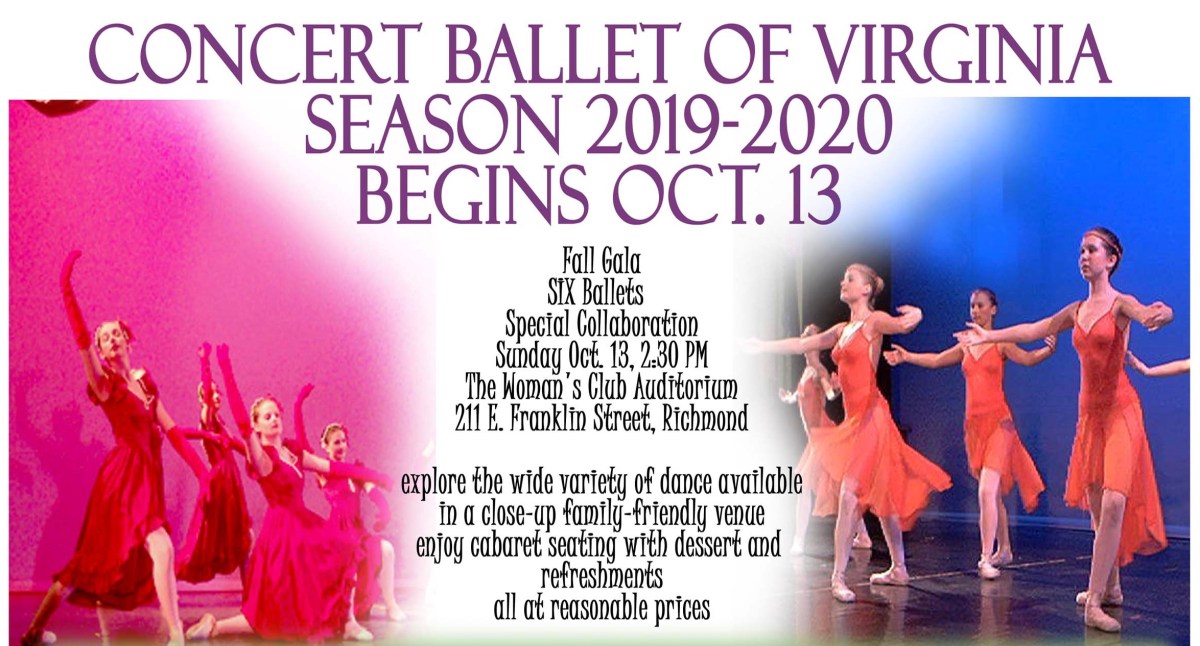
CONCERT BALLET OF VIRGINIA: A Family-Friendly Affair

THE CONCERT BALLET OF VIRGINIA: Fall Repertory Gala

Observations on the Fall Repertory Gala by Julinda D. Lewis

At: The Woman’s Club Auditorium, 211 East Franklin Street, RVA 23219

Performance: October 13, 2019

Ticket Prices: $4-$18

Info: (804) 798-0945 or http://concertballet.com/ or info@concertballet.org

The Concert Ballet of Virginia marked the start of its 43rd year of dance performances with its annual Fall Repertory Gala at The Woman’s Club on Sunday, October 13. The company operates “within the framework of a full-scale professional dance company” but is run by a “marvelous collection of unsalaried Virginians – dancers, choreographers, technicians, craft and stage people and volunteers.” The mission of CBV is to accept and promote those who are interested in performing, providing a professional company experience regardless of skill level.

The 2019 Fall Repertory Gala differed from previous galas in that the program, consisting of a half dozen works ranging from classical to contemporary, incorporated the Diane Hale dancers, including a work choreographed by their instructor, Lindsay Rhyne Hudson, a CBV alumni.

One thing CBV does very well is scenery and set design. The French Scenic Reproduction of a glamorous manor house and lawn for “Biedermeier Waltzes” was donated by Wilton House, but the décor for “The Hunt,” and the trio of purple arches and blue panels for “Litany” were designed by deVeaux Riddick, a creative team member and long-time Technical Director for Ballet Impromptu, the Richmond Ballet, and then Concert Ballet of Virginia until his passing September 7, 2019.

The quintet of dancers in Biedermeier Waltzes” appeared to be the least experienced, as demonstrated by the simplicity of their choreography, soft shoes (no pointe work), and several stumbles. The lighting – or the dancers’ placement – often left their faces unlit, which was a bit of a distraction. But things picked up with “The Hunt,” a lively number featuring dancers dressed in clever red hunting jackets and black riding boots. The dancers prancing in a circle and forming a Rockettes-style kick line drew applause from the audience.

Ilie Davis, the soloist for the slightly dark, introspective and contemporary styled “Dysmorphic,” demonstrated clean lines and an enticing ease on stage. The four women in “Litany wore long-sleeved aubergine-colored dresses reminiscent of Martha Graham. Their movements were also reminiscent of classic modern dance: sustained; low dynamic; and repetitive, ending in a reverent tableau vivant. “Full Moon and Empty Arms” similarly ended in a tableau, although the latter was a classical ballet, with four ballerinas wearing black classic tutus, and a lead dancer in an ivory tutu to match Scott Boyer who partnered all of them. These were apparently the more experienced or advanced dancers, as this piece included pointe work.

The Concert Ballet of Virginia is as much – or more – about the experience than the dance technique. It is a family-friendly affair, with hand-crafted items for sale in the lobby boutique and cabaret style tables where desserts, coffee, tea, wine, and lemonade are served.

Julinda D. Lewis is a dancer, teacher, and writer who was born in Brooklyn, NY and now lives in Eastern Henrico County.

———-

Photo Credits: Concert Ballet of Virginia webpage

Concert Ballet of VA


Whistlin Women
https://www.amazon.com/gp/product/1072107546/ref=as_li_tl?ie=UTF8&tag=rvartreview-20&camp=1789&creative=9325&linkCode=as2&creativeASIN=1072107546&linkId=78c578738db659724289dda2116d985c
Alvin Ailey
https://www.amazon.com/gp/product/1093389303/ref=as_li_tl?ie=UTF8&tag=rvartreview-20&camp=1789&creative=9325&linkCode=as2&creativeASIN=1093389303&linkId=c39a9d5181692735b3b75883d732cd03

RICHMOND BALLET: Contemporary Classics Ushers in New Season & Says Good-bye to Popular Ballerina

RICHMOND BALLET: Contemporary Classics

A Dance Review by Julinda D. Lewis

At: Dominion Energy Center for the Performing Arts | Carpenter Theatre | 600 E. Grace St., RVA 23219

Performances: September 27-29, 2019

Ticket Prices: $25-$125

Info: (804) 344-0906 x224 or etix.com

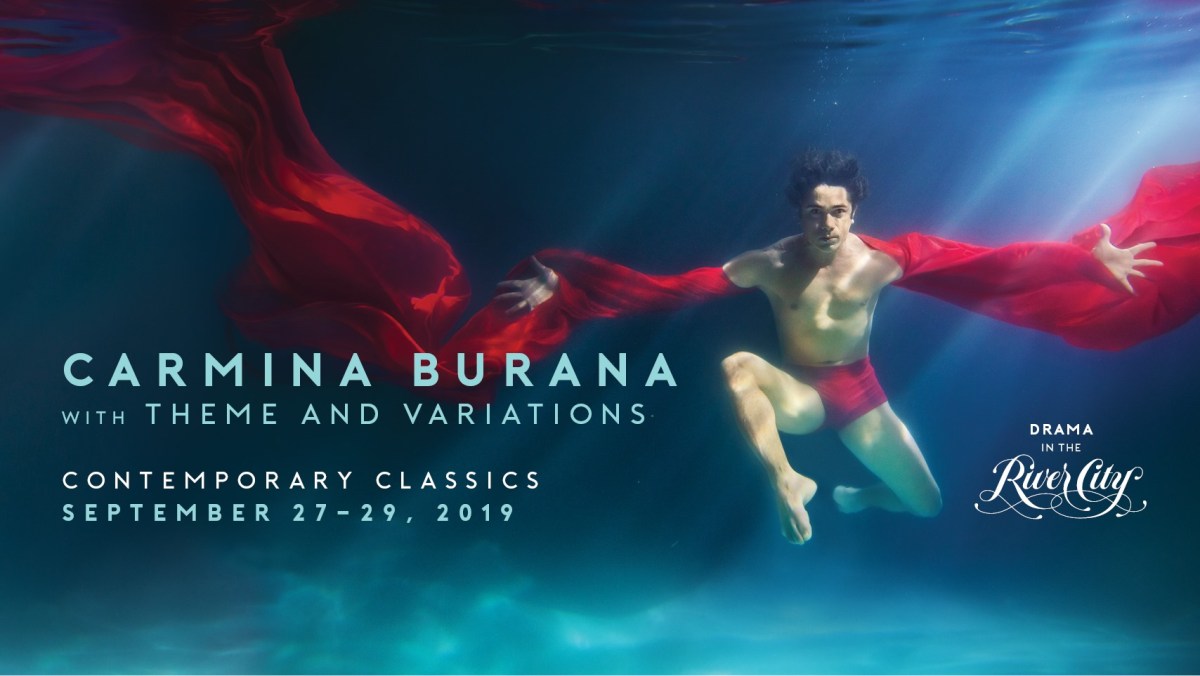
I had forgotten how beautiful the ballet “Carmina Burana” is. Choreographed for the New York City Opera in 1959 by John Butler, the ballet is based on a collection of thirteenth century songs and poems discovered in a monastery in Bavaria. The songs were composed and arranged by Carl Orff in three highly dramatic sections – Spring, In the Tavern, and The Court of Love – that are intended to be performed by a collaborating team of orchestra, chorus, and dancers.

The Richmond Symphony Orchestra, under the direction of Erin Freeman and a chorus of about 100 singers composed of members of the VCU Commonwealth Singers and the Richmond Symphony Chorus, divided into four groups on two levels of the theater provided what my daughter described as “surround sound.” Tenor Andrew Sauvageau, Baritone Jeffrey Grayson Gates, and Soprano Zarah Brock stood onstage and wore monastic black for their solos. At one point Brock held an impossibly long note.

The dancers moved through a range of human emotions using a stylized vocabulary of movement that seems to have been inspired by the figures on the Wheel of  Life or perhaps the characters illustrating a deck of tarot cards. The music is structured in three major sections, beginning and ending with the familiar “Fortune, Empress of the World,” for which the dancers don monastic black robes and rush about with determined steps and postures. But having seen all that occurred between the Prologue and the Finale, these same movements and garments have vastly different connotations at the end than at the beginning. [Link to “Fortune Empress of the World” – https://youtu.be/PG8U2vast6k]

In between we see two couples seemingly caught up in a web of sexual betrayal reminiscent of the story of Othello and first one man and then a group of women wearing costumes that bare – or use flesh-toned fabric to skillfully mimic baring – half their bodies and much more. Although the movement is not tied to any narrative it is easy to find familiar story lines.

While the four main dancers and corps of 6 couples were uniformly dynamic, this weekend’s performance hold special significance for 13-year company member Maggie Small who is retiring her pointe shoes after her final performance of “Carmina Burana.” Like the Wheel of Fortune that inspired this work, Small’s career has come full circle, as she closes her performing career with the ballet that marked the start of her professional career. [Here’s a link to a Richmond Times Dispatch article about Small’s career and retirement: https://www.richmond.com/entertainment/art/richmond-s-homegrown-ballerina-maggie-small-set-to-retire-with/article_e5c1067b-703f-5549-bb3a-c957fd177da3.html. And another from Style Magazine: https://rvamag.com/art/dancetheatre/with-contemporary-classics-richmond-ballet-says-goodbye-to-maggie-small.html.]

Small’s long-time partner, Fernando Sabino, will retire in the spring, and it looks as if Ira White, now in his fifth year with the company, is ready to step up and into Sabino’s shoes. White, who like Small, came up from the company’s Minds in Motion program (for fourth graders) and the trainee program before joining the company, has shown tremendous growth and maturity as a dancer over the past two years, and shows promise of contributing a high level of professionalism as well as charisma to the current season.

The Contemporary Classics program marks the start of the Richmond Ballet’s new season and opens with the stunningly beautiful Theme and Variations by George Balanchine. Set to the final movement of Tchaikovsky’s “Suite No. 3 for Orchestra in G major, Op. 55,” “Theme and Variations” is a grand ballet, traditionally styled with white tutus, a series of pas de deux by the lead couple, and a grand procession or polonaise for all the dancers to show off their technique and gorgeous lines. As I watched the dancers move through the intricate patterns, I thought this is one ballet I’d prefer to see from the balcony, which affords a bird’s eye view of the design. My daughter, who arrived a little late after hunting for parking, did get a chance to see “Theme and Variations” from the balcony and confirmed my suspicions. She said the experience of seeing the ballet from above was the silver lining to arriving late.

“Theme and Variations” was staged by Jerri Kumery with Sabrina Holland and Anthony Oates dancing the lead roles. “Carmina Burana” was staged by Malcolm Burn featuring partners Cody Beaton and Ira White and Maggie Small and Fernando Sabino. The Balanchine classic was first performed in 1947 while the Butler opus premiered in 1959, yet both remain fresh and engaging to today’s audiences. The final performance of this short run will take place Sunday afternoon, September 29, at 2:00pm. The season continues with Studio One performances November 5-10, featuring Artistic Director Stoner Winslett’s “Ancient Airs and Dances” and a World Premiere by popular choreographer Ma Cong.

Here’s an excerpt of Maggie Small’s bio, from the Contemporary Classics program: Maggie Small, a native of Richmond, Virginia, began dancing at the School of Richmond Ballet. She completed the trainee, apprentice, and Minds in Motion programs before joining the company. In 2012 she was featured on the cover of Dance Magazine as Richmond’s “Homegrown Ballerina.”

Julinda D. Lewis is a dancer, teacher, and writer who was born in Brooklyn, NY and now lives in Eastern Henrico County.

———-

Photo Credits: Sarah Ferguson


This slideshow requires JavaScript.


Available on Amazon.com


CAMILLE A. BROWN & DANCERS: More Than Art

CAMILLE A. BROWN & DANCERS: Celebrating Black Identity in the Arts

Reflections on a Performance Art Experience by Julinda D. Lewis

At: Alice Jepson Theatre, Modlin Center for the Arts at University of Richmond, 453 Westhampton Way, Richmond, VA 23173

Performance: September 27, 2019 at 7:30pm

Ticket Prices: $40 General Admission; $32 Subscribers; $20 Students

Info: (804) 289-8980 or modlin.richmond.edu

When Camille A. Brown & Dancers (CABD) comes to town (from NYC) it’s worth rearranging your schedule to make sure you see them. It’s been five years since Richmond was last graced by CABD and the dynamic company’s recent visit to the River City culminated in one-night of performances at the Modlin Center for the Arts. One night is not enough.

The program consisted of a trilogy of CABD’s work on black identity: Act I of the evening-length work “Mr. TOL E. RAncE” (2012); an excerpt of  “BLACK GIRL: Linguistic Play” (2105); and excerpts of  “ink” (2017). “Mr. TOL E RAncE” was performed in its entirety when the company performed at VCU’s Grace Street Theater in 2014, and if memory serves correctly, it has changed and evolved since then. (A link to my review of that 2014 performance is attached, below.)

“Mr. TOL E RAncE” is a complete theatrical event all on its own. In the beginning, CABD highjacks the usual pre-show housekeeping message, using the performers’ voices to remind people to turn off their cell phones and pointing out the locations of the exit doors. Animation by Isabela Dos Santos provides a humorous and historic homage to black entertainers and artists from the early days of minstrelsy to recent television shows featuring black actors – mostly sit coms. There a projection of a red theater curtain as animated figures with over-sized heads of the likenesses of Dave Chapelle, Moms Mabley, Flip Wilson, Amos and Andy, Whoopie Goldberg, Sherman Helmsley, Richard Pryor, and many more usher the audience into the world CABD has created for us.

And what a world it is, full of color, and rhythm, resonating with sound and movement and history. The piece moves in the vocabulary of minstrelsy, tap, soft shoe, jazz, even children’s games. We catch glimpses of JJ Walker and the Carlton Dance. On at least two occasions the dancers break out into song, jamming to the themes of “The Jeffersons” and “The Fresh Prince of Bel Air.” And in case you had forgotten – or never knew – there was also “Living Single,” “The Cosby Show” and more before “Black-ish” or “Insecure” ever hit the small screen. Mr. TOLE E RAnCE is both commentary on the stereotypes of minstrelsy and a celebration of the resilience of black artists.

“BLACK GIRL: Linguistic Play,” performed by Catherine Foster and Camille A. Brown, is a celebration of Black Girl Magic, filled with hand-clapping games, rhythmic sassiness, double dutch, stepping, and tap. And there are distinct, if fleeting, glimpses into the African roots of it all.

Finally, “Ink” began with a similar perspective of Black Boy Joy, as two of the men from the company performed a duet that carried us from the carefree days of childhood to the complexities of discovering you are a Black man in America. The rapid interplay of rhythm in collaboration with live musicians brings new life to old rituals and moves into the Afro-futurism of superheroes with superpowers. The exercising of superpowers, we realize with a jolt, is the normative operating mode for black people in America.

Brown and her dancers – most of whom are also choreographers and many of whom are conversant in visual and spoken arts as well – are not just dancers. They are actors. They are musicians. They are consummate artists whose work is not just a reflection of their lives, but whose work is a mirror that reveals our own lives. Artistically, Brown’s work most reminds me of the work of Dianne McIntyre and her former group, Sounds in Motion. (If you are not familiar with the work of this phenomenal artist, then look her up!) The music is such an integral part of the work, with Kwinton Gray remaining onstage the entire evening, playing the piano that sometimes provides a resting place – or a hiding place – for the dancers.  There is no separating the movement, the music, the word, the costumes, the lighting, the animation. This work is restorative. It is refreshing. It is healing. It is exhausting. It is art.

———-

Here’s a link to my review of Camille A. Brown & Dancers in Richmond in 2014:

https://www.richmond.com/entertainment/dance-review-dancers-more-than-entertaining/article_3f67e7bf-dc15-5b77-a408-110f7cde5f3c.html


Here’s a link to my preview and interview of Camille A. Brown for the company’s 2019 Richmond program:

https://richmondmagazine.com/arts-entertainment/stage-screen/camille-a-brown-and-dancers-modlin-center/


Julinda D. Lewis is a dancer, teacher, and writer who was born in Brooklyn, NY and now lives in Eastern Henrico County.

———-

Photo Credits: Christopher Duggan, Whitney Brown, Modlin Center for the Arts website


Amazon.com shopping recommendations:


STARR FOSTER DANCE: HERE and Now

STARR FOSTER DANCE: New Works

A Dance Review by Julinda D. Lewis

At: Grace Street Theater, 934 West Grace Street, RVA 23220

Performances: September 20-22, Friday and Saturday at 8:00pm, Saturday and Sunday at 3:00pm

Ticket Prices: $20; $15 for students

Info: (804) 304-1523, https://www.brownpapertickets.com/event/4331425

Starr Foster Dance presented six works, including two premieres and one Richmond premiere. A highlight of the program was a purposeful and compelling new work, HERE, part of the company’s domestic violence initiative.

Piercing lighting design by Michael Jarrett and dramatic music by Eighth Blackbird (“Doublespeak”) and Snowflake, Wolf Sebastian & Spinning Merkaba (“Orc March”) guides the movement and the narrative from the mundane to the explosive. In the beginning, dancers remove their button down shirts. In retrospect, what started off as innocently as Mr. Rogers removing his jacket and exchanging it for a sweater is much more ominous. In the context of domestic violence, it becomes the passing along of a generational curse, normalizing the abnormal. The almost hypnotic intersecting chains of movement phrases become the links that bind victims of domestic violence like vines that start off gently winding around a trellis and eventually chokes all other growth and pulls down the entire wall. The piece ends in a brilliant, explosive outburst.

HERE, the dance, and HERE, the project, were created by Foster and company under the mentorship of domestic violence survivor Lisette Johnson to share information and resources. As part of the project, Foster’s company has initiated a program to collect gas, grocery, and cell phone gift card to distribute through the YWCA. For more information on HERE, visit Starr Foster Dance https://www.starrfosterdance.org/heredetail and for information about domestic violence, visit Lisette Johnson’s website http://shamelesssurvivors.com/.

A second premiere, Land Shadows, is set to apprehensive music by Teho Teardo (“Wake Up the Bear” and “A Bit About Ghosts” ). Foster’s musical choices are original, intricate, and have deep psychological impact. Land Shadows, a work eight dancers, is an intriguing interplay of balance, weight, and dynamics in a three-dimensional setting made of shafts and cones of light, enhanced by a bit of smoke. The dancers’ lime green and teal tanks and matching briefs are unobtrusive yet attractive and add a surprising touch of color to this world of shadows.

I’ve often remarked how dark many of Foster’s works are – both in content and visually, but this show seemed brighter than many in the past. Ironically, this was true even of  At Your Darkest, a duet performed on Saturday by Caitlin Cunningham and Fran Beaumont (and by Cunningham and Erick Hooten on Friday and Sunday). The two dancers begin in separate shafts of line, move into a shared space in the middle of the work, and end up entwined and rolling downstage. Helping to lighten the darkness of this Richmond premiere was Elvis Presley’s “Can’t Stop Falling in Love with You” and Anne Muller’s “Walzer fur Robert.”

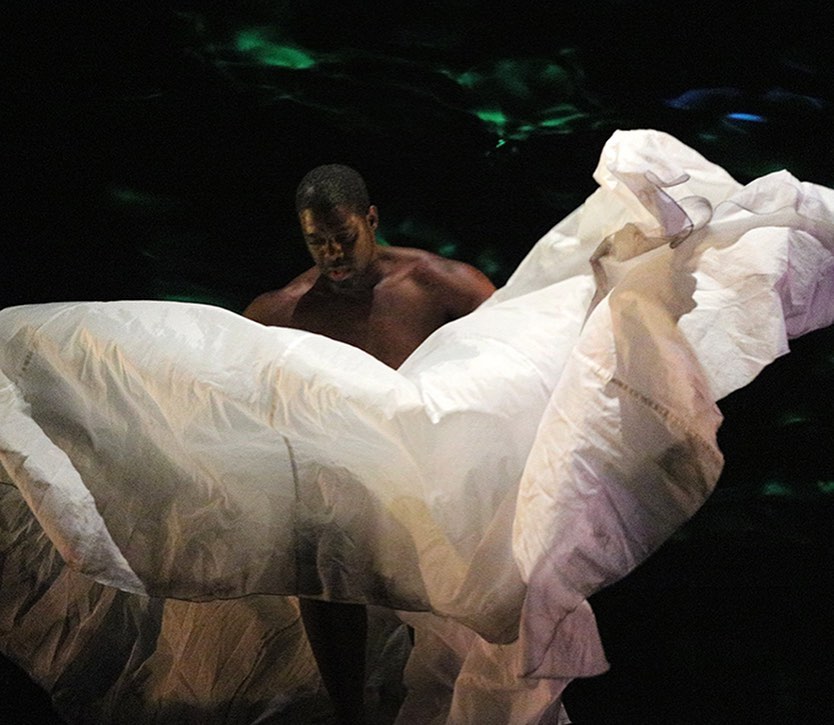
The program also included Saltwater Bones, a beautiful solo performed by Erick Hooten against a backdrop of ripping water (film by Douglas Hayes and original music score composed and performed by Joey Luck). Hooten, who is topless, manipulates yards and yards of white fabric in a diaphanous white skirt. The skirt is both costume and prop, and creates fascinating images: a cloud, a comforter, a wedding dress, an entrapment, and more.

Saltwater Bones was part of Foster’s January 2018 program at TheatreLAB The Basement, Spitting Image, a collaborative series of eight dances inspired by the works of eight photographers.  On that program, however, Saltwater Bones was performed by Heather Rhea O’Connor, and I wrote:

The second half of the program began with what turned out to be one of my personal favorites of the evening, a voluminous skirt solo, Saltwater Bones, inspired by the underwater photography of Cristina Peters. O’Connor’s white skirt, designed and constructed by Foster, performed doubly duty as costume and prop. Sometimes it billowed out gracefully, other times it appeared to entrap her. At the end, I found myself releasing the breath I did not realize I had been holding.

I think I found it even more beautiful and more powerful when performed by Hooten. (See my full review of that program here: https://jdldancesrva.com/2018/01/13/spitting-image-a-collaboration-of-dance-and-photography-featuring-choreography-by-starr-foster.)

The program was rounded out with the mysterious ripples of movement in Stray and the rituals of Falling to Earth. All choreography is by Starrene Foster, with lighting by Michael Jarett. This season the company of dancers consists of Fran Beaumont, Anna Branch, Caitlin Cunningham, Kylie Hester, Kierstin Kratzer, Shelby Gratz, Erick Hooten, Cristina Peters, and Mattie Rogers.

If you’re reading this Saturday night or Sunday morning, there is one more chance to see this fulfilling program, Sunday afternoon at 3:00pm.

Julinda D. Lewis is a dancer, teacher, and writer who was born in Brooklyn, NY and now lives in Eastern Henrico County.

———-

Photo Credits: Starr Foster Dance by Starr Foster and Douglas Hayes.

———-

Alvin Ailey
https://www.amazon.com/gp/product/1093389303/ref=as_li_tl?ie=UTF8&tag=rvartreview-20&camp=1789&creative=9325&linkCode=as2&creativeASIN=1093389303&linkId=c39a9d5181692735b3b75883d732cd03
Whistlin Women
https://www.amazon.com/gp/product/1072107546/ref=as_li_tl?ie=UTF8&tag=rvartreview-20&camp=1789&creative=9325&linkCode=as2&creativeASIN=1072107546&linkId=78c578738db659724289dda2116d985c
41SR4yCI7aL._SL160_
https://www.amazon.com/gp/product/B0791TX5P5/ref=as_li_qf_asin_il_tl?ie=UTF8&tag=rvartreview-20&creative=9325&linkCode=as2&creativeASIN=B0791TX5P5&linkId=08cacc62054100f00d2a6fcfbf97f3e4
Apple Watch
https://www.amazon.com/gp/product/B07K37HKT8/ref=as_li_qf_asin_il_tl?ie=UTF8&tag=rvartreview-20&creative=9325&linkCode=as2&creativeASIN=B07K37HKT8&linkId=c73d0d03604f60526a472839af36bdc0

CHRISTINE WYATT: Affirmative Reactions

PROVOCATIONS PERFORMANCE: Christine Wyatt | Affirmative Reactions

Observations on a Performance Art Experience by Julinda D. Lewis

At: ICA (Institute for Contemporary Art), 601 W. Broad Street, RVA 23220

Performances: September 20 & 21, 2019 at 4:00pm

Ticket Prices: FREE

Info: (804) 828-2823 or ica@vcu.edu

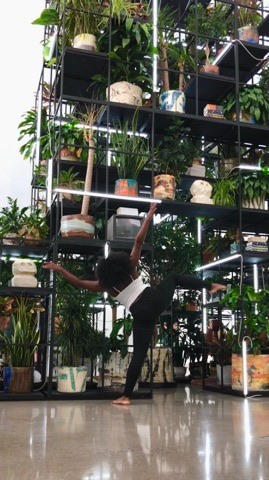
Stepping off the spacious and artistically designed elevator at the ICA into the soaring space of the third floor True Farr Luck Gallery on Friday afternoon was a transformative experience. The open airy space is filled with Rashid Johnson’s installation – a modern yet historically and culturally evocative structure ironically titled Monument. Constructed of steel, it is simultaneously modern architecture and ancient temple. It invites the viewer/participant to sit in quiet contemplation or to walk around and through its structure and absorb the rhythms of long-forgotten memories.

Both calming and energizing, it is provocative, and on this occasion, the space was being activated by an Africanist dance ensemble led by choreographer Christine Wyatt. A libation was poured, and  ancestors acknowledged. Some of the participant/observers joined in, others were shy or unfamiliar with the custom. Six dancers and three musicians – although these are both artificial and arbitrary labels, as the musicians move through the space and the dancers sing and speak – then began to move around Johnson’s structure, first walking in silence, gradually adding gentle movements that hinted of ritual and blood memories.

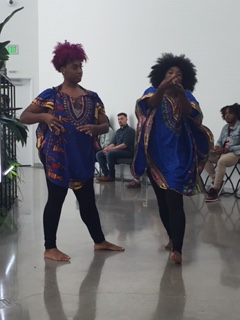
One woman activated our heartstrings, pulling a bow across her violin. Soon, the space was activated with childhood stories of constructing and playing Chinese jump-rope, the soul-stirring strains of spirituals, and the wordless and universal communication of scat. At one point, the energy rose, the dancers moved faster, slicing through space and time. Some of us rose from our seats to follow their movement while others remained seated in quiet contemplation, as wave after wave of movement was birthed. Both responses were correct and necessary. At one point, the dancing women removed their royal blue dashiki-patterned caftans, stripped down to white tank tops and black leggings. They built a pyramid – that echoed the Johnson’s structure – only to collapse in laughter. The gathered in a circle on a rug – sharing a moment of unity, sharing this time of contemplation and collaboration. Their final act was to gather quietly in the center of the space and just. . .breathe.

Provocations offers a new/old way of experiencing art. It is not visual art or sculpture or music or dance. All the elements, sight, sound, movement – even smell, as I was taken back in time by the aroma of Florida water from the libation – united to create a life-affirming experience. “Affirmative Reactions” is a much-needed reminder to breathe, to take time to remember who and where we come from, to recognize and honor our ancestors and each other. It connects the past, the present, and the future.

It is a liberating experience and if you have the time and ability to get to the ICA on Saturday, please go. “Affirmative Reactions” starts promptly at 4:00pm and runs for about 30 minutes.

ADDENDUM: The cast of “Affirmative Reactions” includes Amena Durant, Lani Corey, MiKayla Young, Mary Manzari, Christina Collins, Jaylin Brown, Kenneka Cook, Reyna Pannell, and Christine Wyatt.

Julinda D. Lewis is a dancer, teacher, and writer who was born in Brooklyn, NY and now lives in Eastern Henrico County.

———-

Photo Credits: Julinda D. Lewis & additional photos courtesy Christine Wyatt


ChristineBChristineA

Whistlin Women
https://www.amazon.com/gp/product/1072107546/ref=as_li_tl?ie=UTF8&tag=rvartreview-20&camp=1789&creative=9325&linkCode=as2&creativeASIN=1072107546&linkId=78c578738db659724289dda2116d985c
Alvin Ailey
https://www.amazon.com/gp/product/1093389303/ref=as_li_tl?ie=UTF8&tag=rvartreview-20&camp=1789&creative=9325&linkCode=as2&creativeASIN=1093389303&linkId=c39a9d5181692735b3b75883d732cd03
41SR4yCI7aL._SL160_
https://www.amazon.com/gp/product/B0791TX5P5/ref=as_li_qf_asin_il_tl?ie=UTF8&tag=rvartreview-20&creative=9325&linkCode=as2&creativeASIN=B0791TX5P5&linkId=08cacc62054100f00d2a6fcfbf97f3e4

RENDEZVOUS: 1 Woman, 2 Men, 3 Choreographers, 4 Nights

RENDEZVOUS: A Meeting of 3 Choreographers

An Extended Dance Review by Julinda D. Lewis

At: The Grace Street Theater, 934 W. Grace St., RVA 23220

Performances: September 6 & 7 and 13 & 14 at 8:00pm

Ticket Prices: $10 general admission

Info: Grace Street Theater Box Office (804) 828-2020 or https://bit.ly/2Z1dtdk

RENDEZVOUS: A Meeting of 3 Choreographers is the first dance performance of the 2019 Fall season. It is also the first joint performance by this trio of young, contemporary performers. So, this is not going to be a traditional review, but more of an introduction and overview of some of the artists and the works that represent the future of contemporary dance in RVA and the region.

In a brief program, running exactly one hour, Callie Moore, Robert Rubama, and Jelani Taylor offered a sampling of their new and recent works.

Moore’s three selections stood out due to her use of videography.  In “Snap Soup” she has her dancers placed against a blindingly white background that delightfully challenges the viewer’s sense of space and perspective. Due to the lack of shadows six dancers, dressed in black tops and pants in shades of blue and purple, appear to float when they lay down. When one dancer passes behind another, it creates the illusion that she is rising to another level. Moore’s movements, accompanied by Julia Wolfe’s “Dark Full Ride,” a composition of light percussion (snare drums, cymbals) are playful and athletic, punctuated by unusually long pauses and empty white space. The performers: Hallie Chametzky, Courtney Darlington, Eslie Djemmal, Len Foyle, Katlyn Lawhorne, and Zoe Wampler.

“Melodramatic and Self-Indulgent” is almost the complete opposite of “Snap Soup.” In this solo, a woman (Callie Moore) in denim shorts and a white tank top performs small movements, subtly shifting her weight or wrapping her arms around her torso. She is backed into a dark corner and accompanied by a sound score of  “Brown Noise” (think super-amplified white noise and you get an idea of what it sounds like). The subtlety of the movement and occasional close-ups, focusing on the pulsing of the dancer’s breathing, her hand pinching the tight skin of her sternum, or her taped and battered toes, is a philosophically interesting exercise, but eventually becomes less and less interesting to watch.

In Moore’s third selection, “Rosy,” two women (Brittany Powers and Jada Willis) drive to the country, park their car, and dance outdoors in beds of leaves, on gravel, and on the pedestrian crosswalk of a bridge. Nature and traffic provide abundant scenery and I was enamored of the opening scene where the two women walked off into the distance and as they faded away in the background they simultaneously re-emerged in the foreground – a sort of reverse fade out leading to the main movement. Overall I truly enjoyed Moore’s experiments with videography. Her work is visually compelling and emotionally challenging.

Robert Rubama, interestingly, presented the opening and closing works. The program opened with his duet, “::flux,” which he performed with Robin Auerswald to the accompaniment of Steve Reich’s “Music for 18.” Rubama established a motif of organic movement fueled by loops and spirals that extend. His solo, “Down,” set to Bobby Vinton’s “Mr. Lonely” and “A fool persists” by Infinite Body (an instrumental piece that reminds me of the opening of an epic film) is a sensuous indulgence, long-limbed and languid. Even his sharp movements are smooth. His falls are soft, and he offered more of those lush spiraling movements that extend into infinite space as he articulates every possible muscle – back, neck, wrist.

Jelani Taylor – who, disappointingly did not dance in any of the works – presented two duets, “Solemn Wish” performed by Michelle Knight and Sydney Wiggins to the plaintive, prayerful song, “Father, Father” by Laura Mvula with Metropole Orkest and “Remembering Memory,” performed by Jenna Beardsley and Taylor Bonadies to the familiar Joni Mitchell song, “Both Sides Now.” Both duets are emotionally charged and full of yearning. “Solemn Wish” repeats variations of a slow walk with one arm raised, and the dancers execute long, slow looks that seem sadly unfulfilled. “Remembering Memory” begins with the dancers entwined, and at one point they roll, pressed together, as if clinging to life. Holding hands leads to a fall, which leads to a spin, which leads to a lunge. The movements are simple, what is compelling is the transitions, which are subtle and almost imperceptible, making the work fluid and organic.

It’s hard to produce new work. It’s hard to produce dance here in Richmond. People are familiar with the Richmond Ballet; the Latin Ballet of Virginia has a target audience and loyal following; Starr Foster has been around long enough to have developed a reputation, and Kaye Weinstein Gary has integrated dance and theater to find her niche, and both Foster and Gary annually produce festivals that bring a wide range of dance from the region and sometimes from abroad to enrich Richmond. The University of Richmond annually brings at least two internationally known dance performances to the Modlin Center, but the world of dance in Richmond does not attract the numbers that the Richmond theater community can expect – and many of them struggle to fill seats. If residents are surprised at the variety of theater companies we have, many know even less about our dance talent. That said, I have a few thoughts about Rendezvous.

The printed program was nicely executed and attractive, but I would have liked a bit of information about the participants and a few moments between dances when the house lights come up enough to allow the audience to glance at the program, so we know what’s coming up next. I overheard someone in the lobby remark that there were no posters advertising the show. I heard about it through social media, and posters can be posted there – saving both printing costs and trees. One thing the presenters were able to do that I have been advocating for is that the program is being presented over two weekends, not just one. So, while opening night had, sadly, fewer than a dozen audience members in attendance, there is still time to get out there and support our local artists. The show runs exactly one hour and it’s only $10!

Need some additional encouragement? Below is a link to Jelani Taylor’s work, “Remembering Memory” and some biographical information on each of the three choreographers. My work here is done.

Follow this link to Jelani Taylor’s work, “Remembering Memory.”

https://www.facebook.com/eradanceco/videos/421815151760206/

Choreographer, film-maker, and dancer Callie Moore graduated from VCU with a BFA in Dance and Choreography in May 2017 and founded her company Snap Soup Dance (yes, the same as the name of one of the works she presented) in 2018, with the goal of captivating everyone with her work, not just “dancers” and “artists.” Based in Richmond, VA, Snap Soup seeks to work with artists and creators across all disciplines to further their mission of making dance and art more accessible to all.

Robert Rubama is a native of Virginia Beach, Virginia and a graduate of George Mason University with a BFA in Dance. He has performed in works by Andrea Miller, Donald Byrd, Mark Morris, Soon Ho Park, Nick Pupillo, Ivan Perez, and Yin Yue as well as with Agora Dance and RawArts Dance at various venues in the Washington D.C area. He is the founder of Terre Dance Collective, a DC-based dance company that has presented works in New York City and Washington D.C.

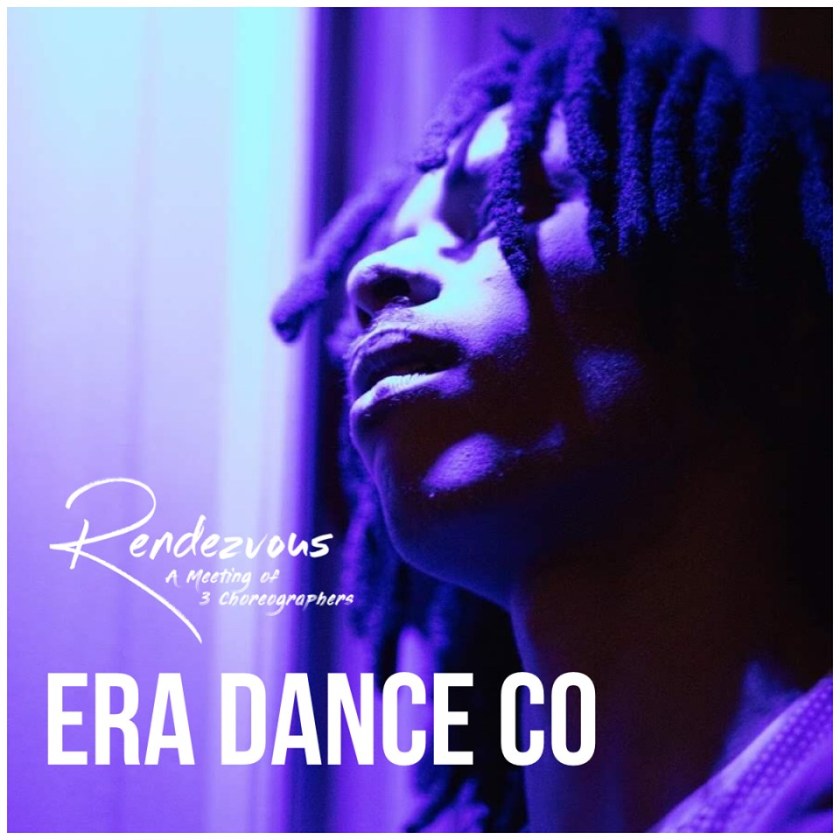
Jelani Taylor is a dancer and choreographer from Virginia Beach, Virginia and a recent graduate of Virginia Commonwealth University with a BFA in Dance and Choreography. At VCU Jelani performed in works by Melanie Richards, Martha Curtis, Helen Simoneau (Guest Artist), Ching-I Chang Bigelow (Guest Artist), Scott Putman, and Dr. E. Gaynell Sherrod. He has also performed in works by Johnnie Cruise Mercer and Rady Nget. Jelani’s own choreography has been showcased at Inside/Out at Jacob’s Pillow Dance Festival, the International Association of Blacks in Dance Conference (IABD), American College Dance Association’s (ACDA) National College Dance Festival, National Dance Society Conference (NDS), Sans Limite Dance Festival, Small Plates Choreography Festival, Dogtown Dance Theater, Grace Street Theater, and ODU University Theater. Jelani is the artistic visionary of Richmond-based ERA Dance Company, a contemporary modern dance company with a mission to create a body of work that is reflective of cultural truths that are intended to engage and empower the larger community.


Julinda D. Lewis is a dancer, teacher, and writer who was born in Brooklyn, NY and now lives in Eastern Henrico County.

———-

Photo Credits: Photos and posters courtesy of Jelani Taylor.

Rendevous1

Rendezvous1
Callie Moore
Rendezvous3
Robert Rubama
Rendezvous2
Jelani Taylor


https://www.amazon.com/gp/product/1072107546/ref=as_li_qf_asin_il_tl?ie=UTF8&tag=rvartreview-20&creative=9325&linkCode=as2&creativeASIN=1072107546&linkId=2091bcd4a793de0cb3c8335ee66be472


DANCE NATION: Five, Six, Seven, Eight

DANCE NATION: Teen Awakening, Gandhi, Power, & Competitive Dance

A Theater Review by Julinda D. Lewis

At: TheatreLab, The Basement, 300 E. Broad St, RVA 23219

Performances: July 11 – August 3, 2019

Ticket Prices: $35 general admission; $25 seniors & industry/RVATA; $15 students and teachers with ID

Info: (804) 506-3533 or theatrelabrva.org

Dance Nation makes you laugh and cringe. Clare Barron’s 2018 play captures a painful, awkward, and gloriously empowering moment in time in the lives of Dance Teacher Pat’s pre-teen and early teen competitive dance team. (Yeah, that is a little confusing but in the play the characters are referred to both as pre-teens and as thirteen-year-olds.)

I, gratefully, have very few clear memories of my teen years, but a post-performance discussion with a much younger acquaintance who grew up in a local dance studio owned by her mother painted a much different picture of Dance Nation.

For me, it was a sometimes amusing, sometimes horrific picture of adolescence with an unusual, even shocking focus on female empowerment. For some younger female viewers, it was a theatrical manifestation and perhaps even validation of their own sometimes tortuous awakening. Some male viewers were enthralled, others, I am sure, are still not sure what to make of teenaged girls talking about masturbation and virginity, and scenes involving blood (menstrual and otherwise) and dancers with vampire teeth hissing at the audience.

This is not the usual rehashing of adolescent angst and teenage trauma. Barron blends hormonal horrors with feral ferocity and Maggie Roop seems to understand and honor this with her mostly clear and unencumbered direction. Dasia Gregg’s locker room set brings the action right up in the face of the audience. There are only two rows, and the second row has the advantage of receiving the full effect of the audio transducers that generate sound you can feel through your seats – reminiscent of the effects in Disney’s “A Bug’s Life” show in the Animal Kingdom theme park.

There is also original music by Joey Luck, with vocals by a team that includes Breezy Lee Potter, Ali Thibodeau, and John Paul Hodge. Michael Jarett’s lighting and Joey Luck’s sound design (that includes lots of heavy breathing) are integral elements of this production and Nicole Morris-Anastasi provided the choreography, which was quite lively in the first act, with the members of the dance team dressed as sailors, their wide smiles painfully pinned in place, their eyes focused on the winner’s trophy.

In the first scene one dancer, Vanessa, played by Maggie McGurn who later plays the moms of many of the dance team members, is eliminated after a leg injury that sends her to the hospital and sidelines her from the team.

The strongest and at the same time most strained relationship is that between Amina (Lydia Hynes) and Zuzu (Trinitee Pearson). Amina is admittedly the strongest dancer on the team, and Zuzu has wanted to be a dancer more than anything since the age of two – but she isn’t quite as good as Amina and struggles to reconcile her friendship with her own self-doubt and Amina’s ambition. Both Hynes and Pearson give searing performances that attempt to cut to the heart of the matter.

But neither comes close to the explosive monologue given by teammate Ashlee, played by Amber Marie Martinez at, the end of Act One. Martinez’s gutsy and raw outpouring on sexuality and power includes words like “beautiful” and “smart” and “SAT,” as well as “bitch,” and the, as far as I know, original phrase, “mo****-fu*****, cun*-munching, piece of sh**” a phrase I don’t recall ever saying or even thinking, at 13 or even at 64.

During the first act, the team warms up at the ballet barre, injecting giggles and wiggles as each of the girls – and the one guy – take turns whispering “pussy,” which later develops into a “perfect pussy” mantra recited by the entire team during the second act – accompanied by an audience-teasing sampling of seat-vibrating audio transducers. (That was my favorite special effect and requires that you get seats in the second or back row to experience the full effect.)

I was never quite sure whether Chris Klinger’s portrayal of Dance Teacher Pat was authentic or creepy. I leaned toward the latter when he lightly tapped Amina on the butt after a private talk, but although she appeared startled and hesitated a moment as she walked away that angle was never pursued. The dance teacher kept his focus on the prize – the regionals, the nationals, whatever winning meant – and had little time for developing the self-esteem or character of his girls. To him, they seemed to be not individuals, but tools to achieve another trophy.

The girls include Amina (Hynes), Zuzu (Pearson), and Ashlee (Martinez), as well as Connie (Sanam Laila Hashemi), Maeve (Kylie M.J.  Clark), Sofia (Nicole Morris-Anastasi) and Luke (Marquis Hazelwood). Yes, Luke is the only boy on the team, but the team is always referred to as “the girls,” and there is no indication of Luke’s sexuality, other than a suggestion that he has a crush on Zuzu. Maeve shares a tender scene with Zuzu, where she talks about flying, and Luke also shares a scene with Zuzu, in which she proposes two possible scenarios of her future life as an adult. Luke seemed a little disappointed that neither scenario included him. Pearson handles a variety of delicate situations with great sensitivity, and Hazelwood, while not a central figure, seems sympathetic and sweet.

The characters of Zuzu and Amina are the most highly developed, and there are intriguing scenes involving Ashlee, Connie, and Maeve. The rest of the team, Sofia and Luke are more peripheral, and little is known of Dance Teacher Pat, who is always referred to as Dance Teacher Pat. The Moms add a spark of insight and even humor but are apparently not meant to be any more significant than the trombone-voiced adults in Peanuts cartoons.

Powerful and intense, Dance Nation  may stir up long forgotten memories or sound an alarm, depending on your age, gender, or how much you remember of being thirteen years old. The one thing it won’t do is leave you untouched.


Julinda D. Lewis is a dancer, teacher, and writer who was born in Brooklyn, NY and now lives in Eastern Henrico County.

———-

Photo Credits: Tom Topinka

Dance Nation.10
Clockwise from back, center: Chris Klinger, Marquis Hazelwood, Nicole Morris-Anasasi, Kylie M.J. Clark, Trinitee Pearson, AMbe Marie Martinez, Lydia Hynes, and Sanam Laila Hashemi
Dance Nation.9
Lydia Hynes
Dance Nation.8
Trinitee Pearson
Dance Nation.7
Sanam Laila Hashemi
Dance Nation.6
Marquis Hazelwood
Dance Nation.5
Kylie M.J. Clark
Dance Nation.4
Nicole Morris-Anastasi
Dance Nation.3
Amber Marie Martinez
Dance Nation.2
Maggie McGurn
Dance Nation.1
Chris Klinger


https://www.amazon.com/gp/product/1072107546/ref=as_li_qf_asin_il_tl?ie=UTF8&tag=rvartreview-20&creative=9325&linkCode=as2&creativeASIN=1072107546&linkId=7297b0f3a126f983ce798b1d13f44587

Whistlin Women

https://www.amazon.com/gp/product/1093389303/ref=as_li_qf_asin_il_tl?ie=UTF8&tag=rvartreview-20&creative=9325&linkCode=as2&creativeASIN=1093389303&linkId=df9f0a154012577ef219ec2eea590c83

Alvin Ailey


Fellowship Cruise 2020


RICHMOND BALLET: STUDIO THREE

Richmond Ballet Studio Three: Three Beautiful Dances

A Dance Review by Julinda D. Lewis

At: The Richmond Ballet Studio Theatre, 407 E. Canal St., RVA 23219

Performances: May 7-12, 2019

Ticket Prices: $26-$46

Info: (804) 344-0906 x224 or etix.com

The Richmond Ballet concludes its current Studio Series with a program of three beautiful ballets, each different in style, look, and feeling.

Ron Cunningham, who spent 30 years as director of the Sacramento Ballet (along with his wife, Carinne Binda) choreographed Summerset in 1981. (The couple transitioned to Emeritus status with the Sacramento Ballet in 2018.) Summerset was first performed by the Boston Ballet in 1981 and the Richmond Ballet introduced it on the stage of the Carpenter Center for the Performing Arts in 1988.

Performed by three couples, led by Sabrina Holland and Mate Szentes, with Lauren Archer and Thel Moore, III and Abi Goldstein and Anthony Oates, the ballet features contemporary choreography with classic lines and vocabulary. Said to have been inspired by the royal wedding – not, not that one, but the wedding of Prince Charles and Princess Diana – Summerset is mostly flirtatious and light, but there were some moments that seemed out of character, as when Archer was pulled across the floor while in a full split or when the three women all landed in a split and were pulled up by their partners. That particular movement and posture seemed overly gymnastic and less, well, royal, and took me out of the lyrical fantasy and romantic mood created by the otherwise winning combination of Cunningham’s choreography with Edward Elgar’s music. The most beautiful moment, for me, was an incredibly gentle and sustained phrase where Szentes slowly lowered Holland from his shoulder to the floor, as if she were the most precious woman on earth and he did not want to shatter her, and the very thought of her feet touching the floor was troublesome.

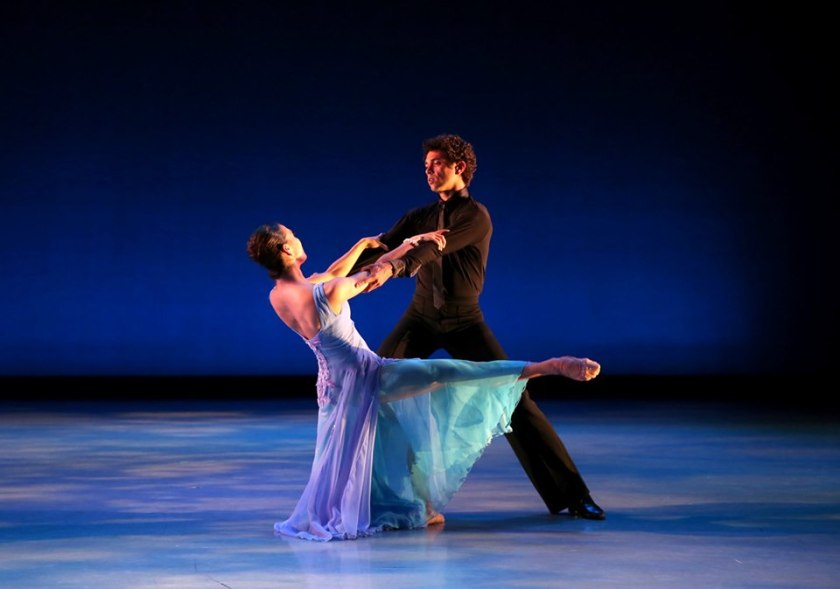
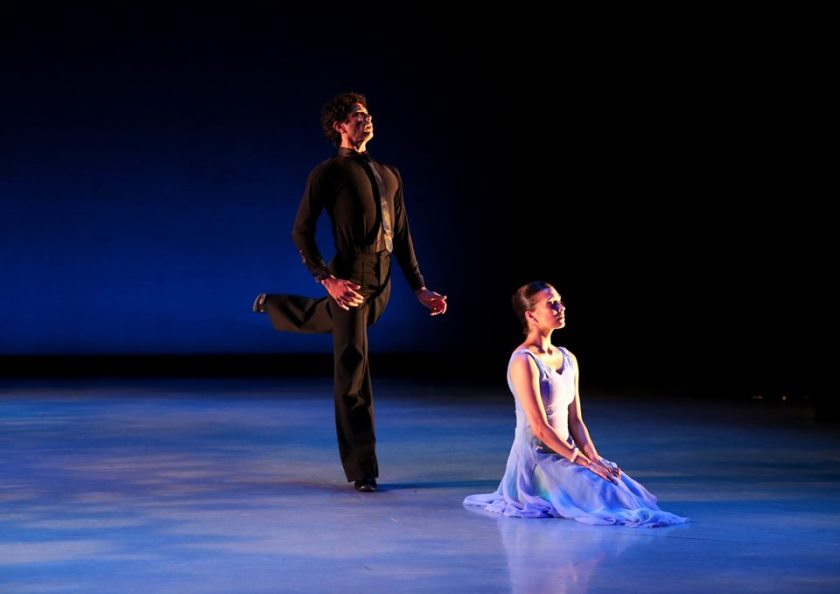
The lovely and ageless 2017 Kennedy Center Honor award winner Carmen de Lavallade returned to set Sweet Bitter Love on the company, having first worked with Richmond Ballet on Portrait of Billie in the fall of 2017. Initially created as a solo for herself, Sweet Bitter Love (2000) developed, over time, into a duet, set to two songs sung by Roberta Flack (“Until It’s Time For You To Go” and “Sweet Bitter Love”) and one sung by Donny Hathaway (“For All We Know”). It’s the kind of music you listen to when you are home alone, with the lights dimmed, and a glass of wine nearby.

Performed by my favorite dance couple, Maggie Small and Fernando Sabino, Sweet Bitter Love presents both the woman’s and the man’s perspective of a love affair that must end – seemingly before it has even had time to really begin. From Sabino’s hinged jazz turns to Small’s sustained movements and poignant moments of stillness, the work pulled on the acting skills of the two dancers as much as their dance technique. There are heartrending moments as when Sabino backs away from Small, who is kneeling with her back to him. While backing away, he shakes his hands in helpless frustration. Later, as she mourns the loss of love, arms stretched over head and then reaching empty arms in front, we see him briefly in an upstage corner, buttoning his jacket as he takes one last glance. The costumes for Sweet Bitter Love were designed by de Lavallade’s husband, the late Geoffrey Holder, and Chenault Spence lighting lovingly echoed the blues of Smalls’ gown and caught the delicate sparks of glitter in her hair, gown, and shoes. The overall effect – music, movement, costumes – is breathtaking.

The program closed with Symphonic Dances (world premiere, May 7, 2019), created by the London-born choreographer Rex Wheeler, who also created Lenten Rose for the Richmond Ballet in 2015. Bringing the program full circle, Wheeler also has a history of creating works for the Sacramento Ballet.

Symphonic Dances, performed by six couples, is a work in two parts set to the first and third sections of Sergei Rachmaninov’s music of the same name, which he composed in 1940. Interestingly, Rachmaninov is believed to have discussed the possibility of Russian choreographer Michel Fokine creating a ballet set to this work, but Fokine’s death in 1942 prevented any collaboration on this work between the two artists.

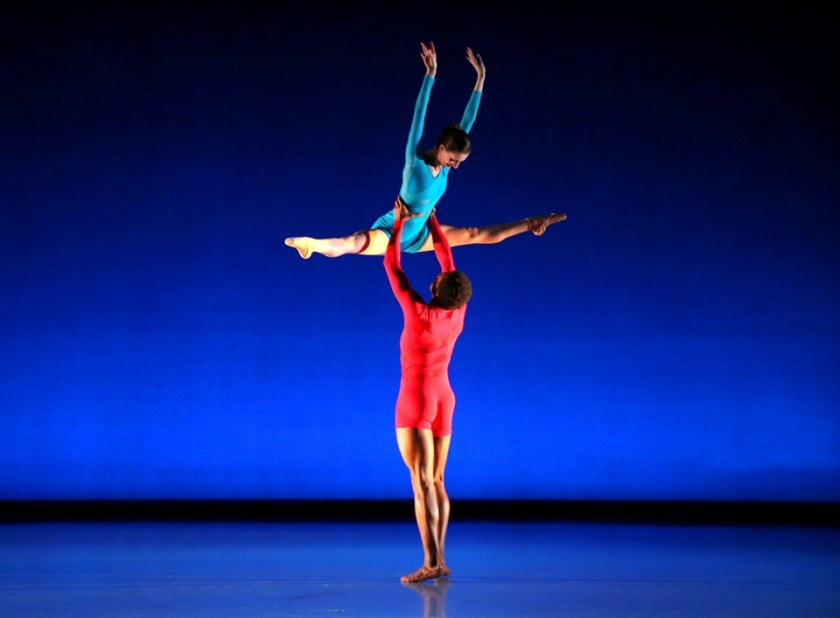
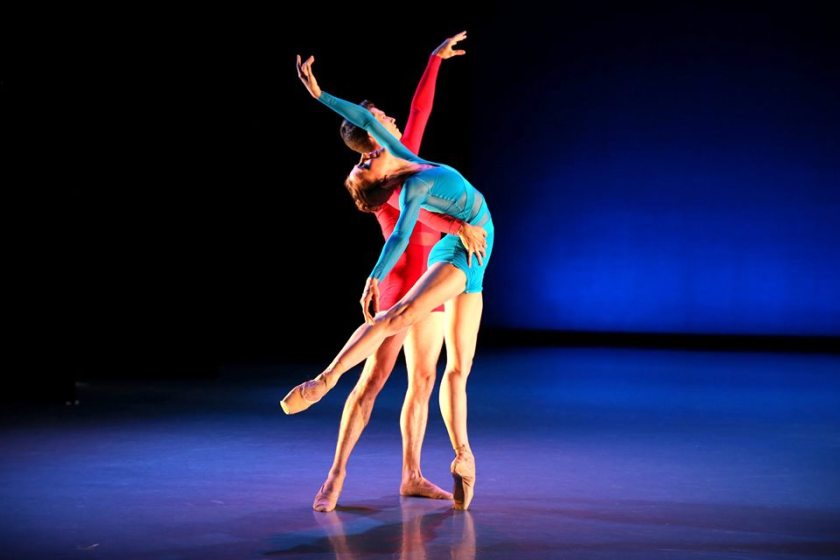
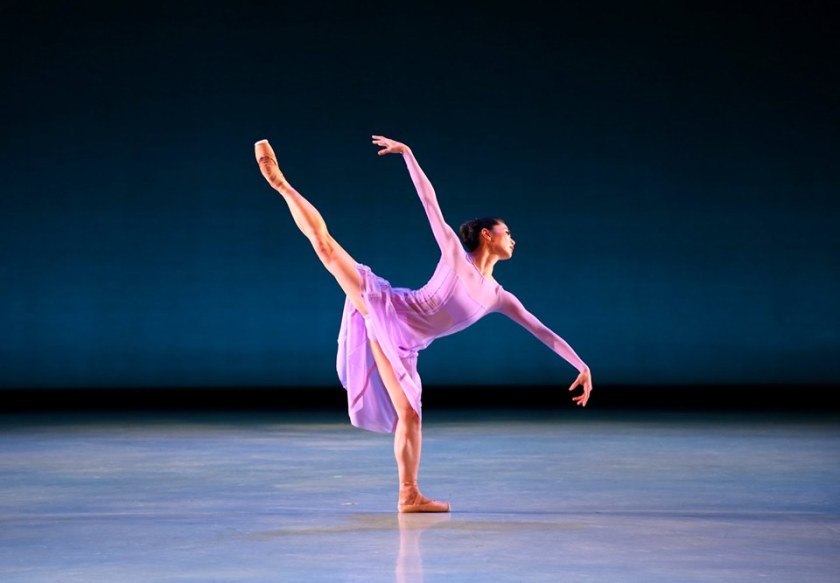
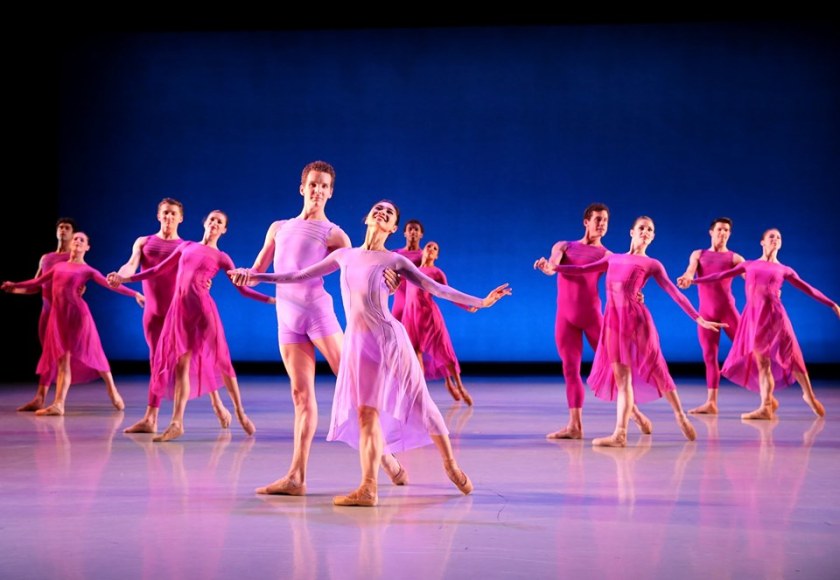
In the first part, the dancers wear lavender and fuchsia, the partnering is more traditional, and the lighting more muted. In the second part, the dancers wear bold red and blue (more of a turquoise blue, perhaps), and the lighting, likewise, shifts into bold washes of red, purple, and blue that seems to reflect the boldness of the music in this section, as well, which has rhythmic drums and clashing cymbals. The colors and movements are in harmony with the shifting tones of the music, creating a total environment of sound, color, and movement as the dancers move both gracefully and energetically through Wheeler’s three-dimensional shifting patterns.

It was a wise decision to place intermission between Sweet Bitter Love and Symphonic Dances. Pretty as Symphonic Dances appeared, and as good as it sounded, it was somewhat of a difficult transition to move from the drama of de Lavallade’s love ballad to the more contemporary interactions of Wheeler’s work.

The Studio Three performance run through Mother’s Day (hint, hint), with the remaining performances on Friday and Saturday at 6:30pm and 8:30pm, and Sunday at 2:00pm and 4:00pm.


Julinda D. Lewis is a dancer, teacher, and writer who was born in Brooklyn, NY and now lives in Eastern Henrico County.

———-

Photo Credits: Sarah Ferguso

RB Studio 3.1
Abi Goldstein and Anthony Oates, Sabrina Holland and Mate Szentes, Lauren Archer and Thel Moore, III in Summerset
RB Studio 3.5
Abi Goldstein and Anthony Oates, Sabrina Holland and Mate Szentes, Lauren Archer and Thel Moore, III
RB Studio 311
Maggie Small and Fernando Sabino in
RB Studio 310
Fernando Sabino and Maggie Small in Sweet Bitter Love
RB Studio 3.9
Abi Goldstein and Thel Moore, III
RB Studio 3.8
Cody Beaton and Trevor Davis
RB Studio 3.7
Cody Beaton and the men of Symphonic Dances
RB Studio 3.6
Abi Goldstein and Thel Moore, III
RB Studio 3.4
Eri Nishihara and Mate Szentes in
RB Studio 3.3
Eri Nishihara
RB Studio 3.0
Mate Szentes, Eri Nishihaqra and the company in Symphonic Dances

https://www.amazon.com/promocode/A2NUZ6DSZXT7KE?ref_=assoc_tag_ph_1524210985981&_encoding=UTF8&camp=1789&creative=9325&linkCode=pf4&tag=rvartreview-20&linkId=f7e7bec028ac17fba2aa19a32945a71e

https://www.amazon.com/dp/B0791TX5P5?ref_=assoc_tag_ph_1524210971463&_encoding=UTF8&camp=1789&creative=9325&linkCode=pf4&tag=rvartreview-20&linkId=2e2f5a01af271965320e35bccfcc74d5

https://www.amazon.com/dp/B01I499BNA/?ref_=assoc_tag_ph_1524210971413&_encoding=UTF8&camp=1789&creative=9325&linkCode=pf4&tag=rvartreview-20&linkId=fbc214e4c1d8136529d08566a380d2cf