PRIDE AND PREJUDICE: And Proposals of Marriage

PRIDE AND PREJUDICE: “People Who Do Not Complain Are Never Pitied”

A Theater Review by Julinda D. Lewis

By: Quill Theatre

At: Leslie Cheek Theater at the Virginia Museum of Fine Arts, 200 N. Boulevard, RVA 23220

Performances: March 8-24, 2019

Ticket Prices: $30 Adults; $25 VMFA Members & Seniors 65+; $20 Students (with ID)

Info: (804) 340-1405, quilltheatre.org or https://reservations.vmfa.museum/


The Quill production of Jane Austen’s Pride and Prejudice, adapted for the stage by Christina Calvit, is quite possibly the most fun I’ve ever had at a Quill production. Running just over two hours, the show is a delightful comedic romp that follows the trials and tribulations of Mr. and Mrs. Bennett as they – well, mostly Mrs. Bennett – try to find husbands for their five unmarried daughters.

Calvit has limited the novel’s multiple subplots and kept the story fairly simple and easy to follow, as is the language, and director Christopher Owens keeps the cast moving at a fair pace that is upbeat and maintains the classic character and deportment. Jeremy Gershman’s Regency era choreography adds an element of cultural authenticity while keeping the cast literally moving along at bubbly pace.

Irene Kuykendall and Axle Burtness have the lead roles of Elizabeth, the Bennett’s smart, beautiful, and stubbornly independent second daughter, and Mr. Darcy, the tall, handsome, and arrogant stranger who steals her heart. In one of the early ballroom scenes, the two admirably kept their conversation going while dancing, without missing a syllable or a step. If you’re looking for well-roundedness or depth of character, I don’t think you’ll find it here, but that’s not necessarily a shortcoming – just an observation of the adaptation’s purpose and the director’s vision. The comedic pacing was fine, while the characters’ chemistry was not developed in a way that made their ultimate passion convincing.

Kuykendall and Burtness may have had the lead roles, but Melissa Johnston Price commanded several scenes, first as the openly gold-digging mother, Mrs. Bennett, and then as the demanding matriarchal patron, Lady Catherine Debourgh – the aunt of Mr. Darcy. If Kuykendall and Burtness did some fancy stepping on the dance floor, Price did some fancy quick changes from Mrs. Bennett’s matronly dress, that resembled nothing so much as wallpaper, to Lady Debourgh’s elaborately layered widow’s weeds and cane. Price sums up Mrs. Bennett’s character with one line: “People who do not complain are never pitied.” (For Lady Debourgh, one might paraphrase that to, “People who do not bully others are never feared,” but that carries much less panache.)

Joe Pabst, in the quadruple roles of Mr. Bennett, Sir William, Colonel Forster, and Fitzwilliam was also no slouch in the quick change department. I’m sure kudos are due to unnamed backstage assistants. Pabst seemed to enjoy his roles as much as the audience, but I found his delivery of my favorite line a bit too subtle. When Elizabeth declines the proposal of Mr. Collins, her father asks if she understands that “your mother will never see you again if you don’t marry him. . .and I will never see you again if you do.” Here, it might be helpful to know that she is the daughter who spends the most time with her father, apparently helping him with the family’s business.

We learn more about Elizabeth and Jane, the second eldest and eldest, respectively, and the headstrong youngest daughter, Lydia, but very little about the other two – Kitty and Mary.

Tradition dictates that the eldest, Jane, played by Maggie Quick, must marry first, but Lydia, played with great energy and enthusiasm by Annie McElroy, has no regard for tradition, and places the family name in jeopardy with her impetuous actions. Mary, who is traditionally described as the plainest in looks, is played by the lovely Allison Gilman, and Kitty, gets so little attention that the considerable comedic skills of Nicole Morris-Anastasi are sadly underutilized.

I also enjoyed Joel White’s portrayal of the obsequious cousin and heir, Mr. Collins, whose annoying speech quirk of adding “mmmmm” in the spaces between words while gesturing as if holding a large, invisible hat with a large feather are strangely endearing. As Mrs. Bennett’s brother-in-law, Mr. Gardiner, he is the picture of manners and gentility. And I must include a brief mention of Audrey Sparrow and Ethan Cross, two high students who played the role of servants – welcome to the company of Quill Theatre.

Reed West designed the set, which contains many architectural elements that rotate to create the various environments, with the support of lighting by Gregg Hillmar. Patricia Wesp designed the costumes, which I thought were much more elaborate and well-constructed for the men than for the women. While the daughters generally had dresses appropriate for the unmarried young women of a gentleman of little means, Mrs. Bennett’s shapeless dress was dangerously close to resembling a flannel nightgown. Several members of the Regency Society of Virginia attended Saturday’s performance wearing period attire that rivaled that of the actors onstage.

Pride and Prejudice is a delightful production of a classic love story that reminds us that the more things change, the more they stay the same. It’s become a classic for a reason: we recognize these people; it appeals to a wide range of ages; it crosses class; and it addresses real problems with humor. Pride and Prejudice has a run of only ten shows, so don’t hesitate if you like to see it.


Julinda D. Lewis is a dancer, teacher, and writer who was born in Brooklyn, NY and now lives in Eastern Henrico County.

———-

Photo Credits: Photos not available at the time of publication.
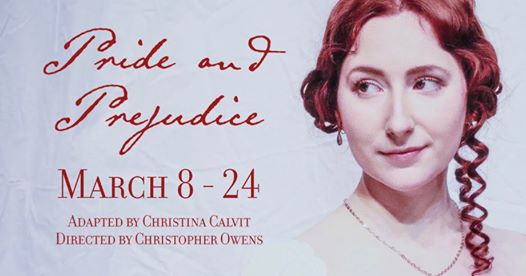
Pride.1


Shop Amazon Devices – Fire TV Trade-In Offer

EVERY BRILLIANT THING:#1 Ice Cream

EVERY BRILLIANT THING: What Hope Is

A Theater Review by Julinda D. Lewis

At: HATTheatre, 1124 Westbriar Dr., RVA (Tuckahoe) 23238

Performances: March 1-15, 2019

Ticket Prices: $25 Adults; $20 Seniors; $15 Youth, Groups, Students & $12 with RVATA card; Reservations Required – No tickets at the door

Info: (804) 343-6364 or hattheatre.org

It’s hard to imagine a warm and engaging comedy about mental illness and suicide but that is exactly what the team of Vicky L. Scallion/Artistic Director, Chris Hester/Actor, and Frank Foster/Director and Scenic Designer have pulled off with Duncan MacMillan and Jonny Donahoe’s Every Brilliant Thing, now running in the far West End’s HATTheatre.

In short, the one-man play is about a man looking back over his life and telling the story of how he survived as the child of a mother whose first attempt at suicide occurred when he was a 7-year-old school boy waiting for his mom to pick him up from school. While Hester is the only professional actor on stage, the script calls for him to enlist the help of numerous audience members. Some read lines from a card when their number is called. For example, #1 Ice Cream. Others have actual roles and characters with coached or adlibbed lines. There is the veterinarian who is called to euthanize the family’s elderly dog, Paws McCartney, and Mrs. Patterson, who is a school counselor with a Snoopy sock puppet. There is his dad and his girlfriend Sam. Interestingly, Hester’s character, the main character, remains unnamed.

Every Brilliant Thing is one boy’s attempt to fight depression. By the time his mother gets out of the hospital, he had begun a list of things worth living for. Ice cream. Yellow. People falling down. Peeing in the ocean. Many of these things are so simple, and others are quite funny. But even though he keeps adding to the list, his mother doesn’t get better. The boy grows into a man, and fears, too, will succumb to the demons of depression. His father, unable to help, copes by retreating into his home office with his records. In an early poignant moment – and there are many – the boy stands outside the door of his father’s study waiting to see what type of music he will play. That will let him know whether to enter or head downstairs and fend for himself.

Every Brilliant Thing reminds us that it is natural for the children of suicidal parents to blame themselves. There have been many studies completed, and it has been determined that suicide is contagious. After a high-profile or celebrity suicide, suicide rates spike sharply. There is even a name for the phenomenon of copycat suicides: the Werther effect, which takes it name from Goethe’s novel, The Sorrows of Young Werther.

The audience interaction creates a distraction or diversion that balances the serious nature of the subject with unexpected interjections of humor. Foster has also created balance with his design elements. He has transformed Scallion’s tiny black box theater into a comfortable living room with a variety of chairs and sofas set on both ends of the room, including the area that is usually reserved as the stage, and small tables that hold conversational lamps, trivia cards, a chessboard. There’s even complimentary coffee and hot chocolate and warm chocolate chip cookies for the audience. Erin Barclay designed the lighting, which incorporates all the little lamps. Hester has the area between the two banks of seats, with occasional forays into the audience. At one point he breathlessly attempts to high-five every member of the audience. His sweaty brow and panting are genuine and endearing, as is the rest of his performance.

One of the best parts about Every Brilliant Thing is the sound design, by Scallion, based on the authors’ instructions. Music cues the young boy on whether to interact with his father. Music marks the family’s happy times – when they gather around a piano in their kitchen, of all places, and sing soul songs. There’s a record player and an album in a yellowed jacket that Hester plays at the end. And there is a soundscape that includes Ray Charles and Cab Calloway and other music appropriate to the time (which in this case begins in 1982 and covers several decades as the boy becomes a man).

Every Brilliant Thing will be different each time it is performed, as the new audience members bring new inflections to their lines. At Sunday’s Acts of Faith talkback, Hester revealed that he looks forward to relating to new audience member at each performance. He himself is no stranger to depression and mental illness in the family. When the audience was informally polled to see how many had been affected either personally or with mental illness in their families, every single person present raised a hand. Maybe the list couldn’t save this boy’s mother, but it seems to have saved him, and making lists and keeping journals are components of many self-help programs and therapies.

I recommend Every Brilliant Thing because it is an intriguing production. It will make you laugh, it may make you cry, as it did the young woman who played the role of Sam on Sunday afternoon. But more importantly, it provides a non-threatening opening to discuss these very real and very timely issues: depression; mental illness – or better yet, mental health; suicide. Every Brilliant Thing puts the audience to work and reminds us that there is always hope.

Julinda D. Lewis is a dancer, teacher, and writer who was born in Brooklyn, NY and now lives in Eastern Henrico County.

———-

Photo Credits: photos uncredited at the time of publication

This slideshow requires JavaScript.

IN MY CHAIR: Sorry, Not Sorry!

IN MY CHAIR: A Journey of a Thousand Miles
A Theater Review by Julinda D. Lewis
By: Virginia Rep/Cadence Theatre Company
At: Theatre Gym, Virginia Repertory Center, 114 W. Broad St., RVA 23220
Performances: March 2-31, 2019 with talkbacks on March 10 & 17
Ticket Prices: Single tickets start at $35
Info: (804) 282-2620 or va-rep.org

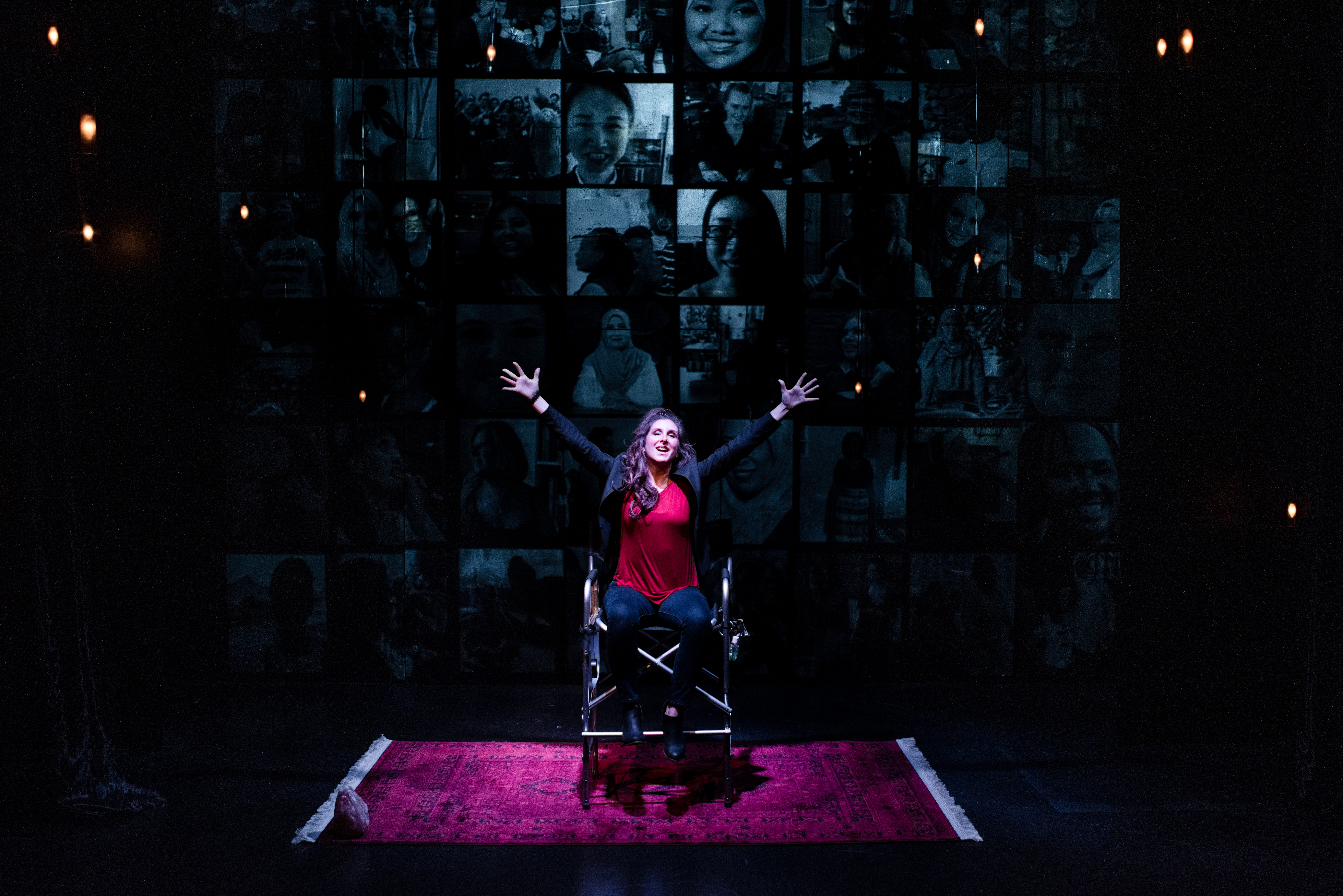
It is hard to think of In My Chair, a one-woman show written and performed by Eva DeVirgilis, as a play. Yes, it’s produced by the Cadence Theatre Company, under the artistic direction of Anna Senechal Johnson. Yes, it has a director – Lisa Roth, co-artistic director of The Actor’s Center in New York – and all the other accoutrements of a play: minimal scenic design and a variety of photographic and video projections by Tennessee Dixon; costume design by Sarah Grady; some evocative lighting design by Andrew Bonniwell; and some subtle and authentic sound design by Robbie Kinter. And it is performed in a theater, before an audience, but. . .

In My Chair is part Ted Talk, part therapy, part intervention, part standup comedy, part self-care. . .I could go on. Based on the true stories of women who have sat in DeVirgilis’ make-up chair – which is both the center of the set and a character on its own – In My Chair is told in the first person. After the success of her Tedx Talk on the same subject, actor and makeup artist DeVirgilis set out on a world tour to ask the question, “What is Beauty?” while comparing cross-cultural attitudes towards body image, body shaming, self-esteem, ever-changing beauty standards, and the peculiar phenomena of preventive defense and normative discontent that overwhelmingly affect women all over the world.

I’m sorry. My hair is a mess. I’m so fat. I hope I don’t break your chair. When I look in the mirror, I look old. OMG. That last statement could have been mine. For some time now, I have told myself – and occasionally said aloud to others – that when I look in the mirror, I see my grandmother looking back at me.

DeVirgilis uses the familiar landscape of the make-up chair to empower women. It can be as simple as learning not to dropkick the gift of a compliment. I remember telling a friend I liked her hair. Her response was to tell me it needed washing. That’s dropkicking the gift of a compliment. Stop apologizing. Say it louder for those in the back: STOP APOLOGIZING!

To create In My Chair DeVirgilis took her makeup chair to Nevis, Thailand, Malaysia, Ireland, and more. She spoke with women who wear hijabs, a cancer survivor, sex workers, a journalist. She gave a note of encouragement to a nun accompanying a deaf woman on a London subway car and brings each one of these women to life with a voice, an accent, and perhaps a scarf, a change of shoes, or a few gestures of their own. All the while, she is shadowed by Norma – the manifestation of her own insecurities and normative discontent. DeVirgilis is not new to multi-character solo shows, but this one blends her gift for comedy and her acting skills with her passion for activism and a real-life mission to help women.

She comes into the audience, coaching one woman through the affirmation, “I am a leader,” while the rest of the audience responds, “We support you!” The audience is also prompted to chant “Whoo” or “Boo” after a series of statements that link significant events in history to women’s beauty standards. Sometimes we laugh because the statements and DeVirgilis herself are hilarious, and sometimes we laugh because the only other thing to do would be to cry. Heartfelt, gripping, hilarious – sometimes all at the same time.

After the show, audience members are encouraged to write PositivePostPal messages and leave them in a bag – and to take a message from the bag. Some are as simple as, “You are beautiful.” I pulled one that said, “Ahlan wa Sahlan (welcome in Arabic).” In My Chair runs 90 minutes without intermission, and as part of the Acts of Faith Theatre Festival there will be talkbacks after the show on March 10 and March 17.

FYI: Here is a link to Eva’s TEDx talk: https://youtu.be/gto6w0a13B0

Julinda D. Lewis is a dancer, teacher, and writer who was born in Brooklyn, NY and now lives in Eastern Henrico County.

———-

Photo Credits: Jason Collins Photography

AN ACT OF GOD: The Beginning and the End

An Act of God: Thou Shalt Laugh

A Theater Review by Julinda D. Lewis

Richmond Triangle Players

At: The Robert B Moss Theatre, 1300 Altamont Avenue, RVA 23230

Performances: February 27 – March 23, 2019. (Opening Night – March 1)

Ticket Prices: $10-35

Info: (804) 346-8113 or rtriangle.org

An Act of God is an irreverent comedy in which the One and Only God settles casually into a talk-show set to chat and rant about what’s wrong with the universe. The Richmond Triangle Players production marks the Richmond debut of David Javerbaum’s play, first produced in New York in 2015.

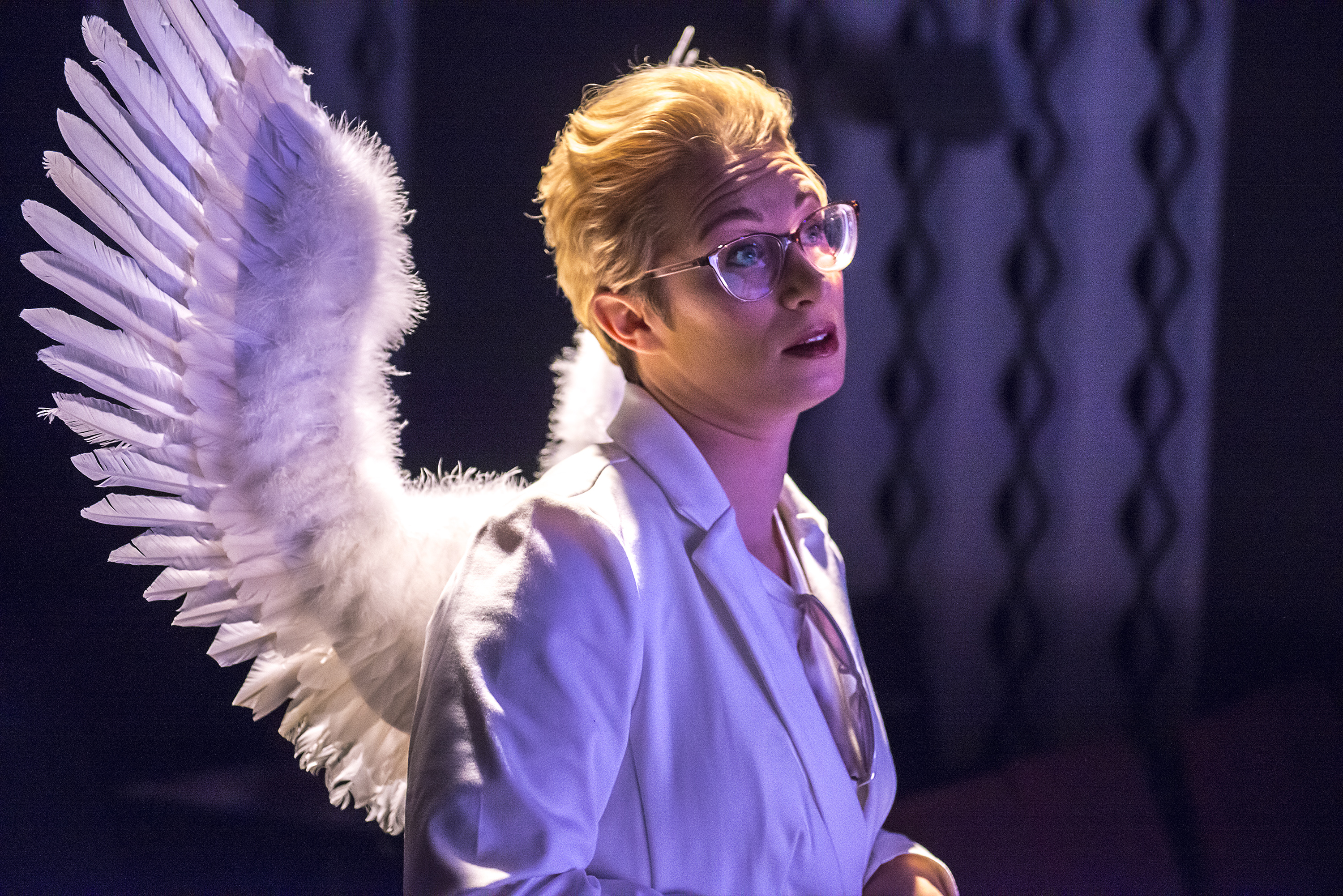
The all-female cast is headed up by Maggie Bavolack as God, supported by Kylie M.J. Clark as the Michael and Anne Michelle Forbes as Gabriel. Michael starts out helpfully fielding questions from the audience but becomes increasingly insolent, challenging God like a precocious child. This eventually brings on the wrath of God, causing Michael to lose a wing – which we later see bent and reattached with a generous application of duct tape. The more compliant and sweet-faced Gabriel is the keeper of the Guttenberg bible – which is housed in a guitar case – and dutifully reads verses as God updates The Ten Commandments. Both archangels are smartly dressed by Sheila Russ in white pant suits and glittery silver boots.

But this show mostly belongs to Bavolack who, despite a few opening night stumbles, smoothly navigated Javerbaum’s script, which started as a series of tweets and then became a book before manifesting as a play delivered in the form of a list. Director Jan Guarino must have given Bavolack free reign because her performance is an intriguing balance of warm and natural, sarcastic and funny, as she enumerates the new commandants. (A few old ones were kept because they were just that good.)

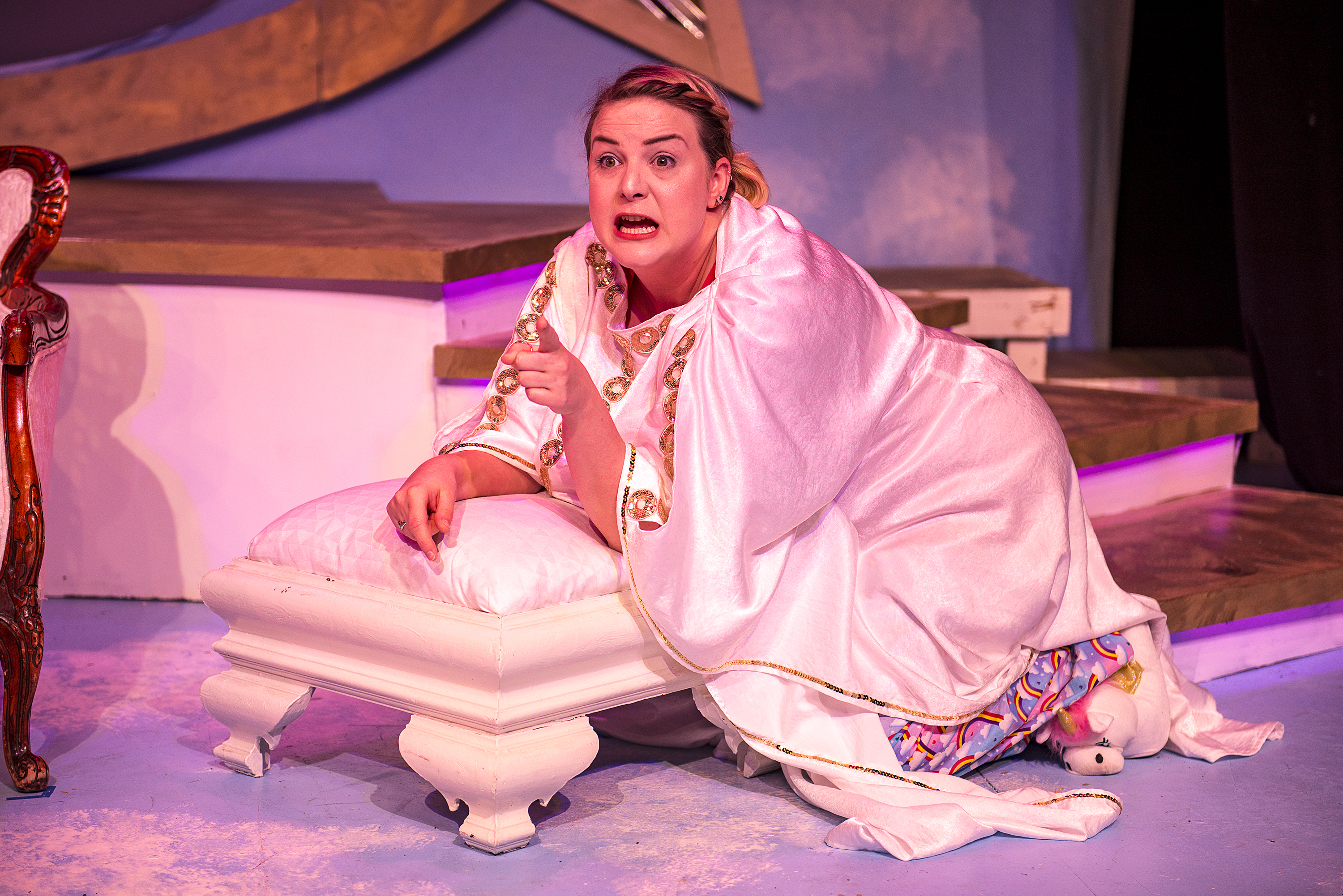
Bavolack wears a gold trimmed white caftan with fluffy white unicorn slippers – sort of the sartorial equivalent of the mullet (you know, business in the front, party in the back). Her hilarious delivery of the list is varied in style and tempo. God’s updates to The Ten Commandments range from the relatively mild (Thou shalt not tell me what to do) to the controversial (Thou shalt not tell others whom to fornicate). Some commands are delivered almost matter-of-factly while others require extensive anecdotes or take long detours.

Bavolack also interacts with the audience, calling out a pair of latecomers and directing other comments directly to those who occupied front row seats – make that the first two or three rows. Oh, and there is a runway that extends the stage into the aisle.

The script has adlibs built-in, allowing for a sprinkling of timely or local references. There’s a fleeting mention of our Commander in Chief and one particularly impressive local reference that Richmond has almost as many houses of worship as confederate monuments. (I wonder what an actor would insert here if performing in Brooklyn, or Philadelphia, or Miami…) There’s even a song at the end, “I Have Faith in You,” when quite suddenly things take a bit of a surprise turn, and the celestial trio takes pleasure in belting it out like rock stars.

Chris Raintree’s design, with its set of double steps (which did not succeed in suggesting a stairway to heaven, if that was the intention), a white sofa, a “poof” or ottoman, a coffee table, and a podium, looks like a celestial talk-show set. Bavolack’s eyes are projected onto the backdrop and emblazoned on the “merch” – a mug, tee-shirt, and magnet are among the show-themed items for sale at the bar. Michael Jarett’s lighting includes a few lightning strikes and there’s a bit of smoke as well.

I would not categorize An Act of God, which is, of course, a part of the Acts of Faith Theatre Festival, among my favorite scripts, but the performance delivered by Bavolack and company is a delightfully entertaining way to spend 75 minutes.

Julinda D. Lewis is a dancer, teacher, and writer who was born in Brooklyn, NY and now lives in Eastern Henrico County.

———-

Photo Credits: John MacLellan


(L to R) Anne Michelle Forbes (Gabriel), Maggie Bavolack (God), and Kylie Clark (Michael) clear up some misconceptions about the Holy Word in David Javerbaum’s comedy “An Act of God”


Maggie Bavolack delivers the new Word
Anne Michelle Forbes as God’s wingman Gabriel
Kylie M.J. Clark as the questioning archangel Michael

SWEENEY TODD: A Close Shave

SWEENEY TODD: The Demon Barber of Fleet Street

A Theater Review by Julinda D. Lewis

At: TheatreLab, The Basement, 300 E. Broad St, RVA 23219

Performances: February 14 – March 14, 2019

Ticket Prices: $35 general admission; discounts available for students, seniors, industry

Info: (804) 506-3533 or theatrelabrva.org

TheatreLAB’s Sweeney Todd: The Demon Barber of Fleet Street is a large-scale musical undertaking by a relatively small theater company. And they nailed it!

Director Deejay Gray has outdone himself. The cast, the tone, the pacing, the minimalist industrial set – also designed by Gray – and the intimate setting all work together to create a juicy, gory, bone-chilling evening of theater. I noticed that the program cover says, “TheatreLAB is proud to present Sweeney Todd: The Demon Barber of Fleet Street.

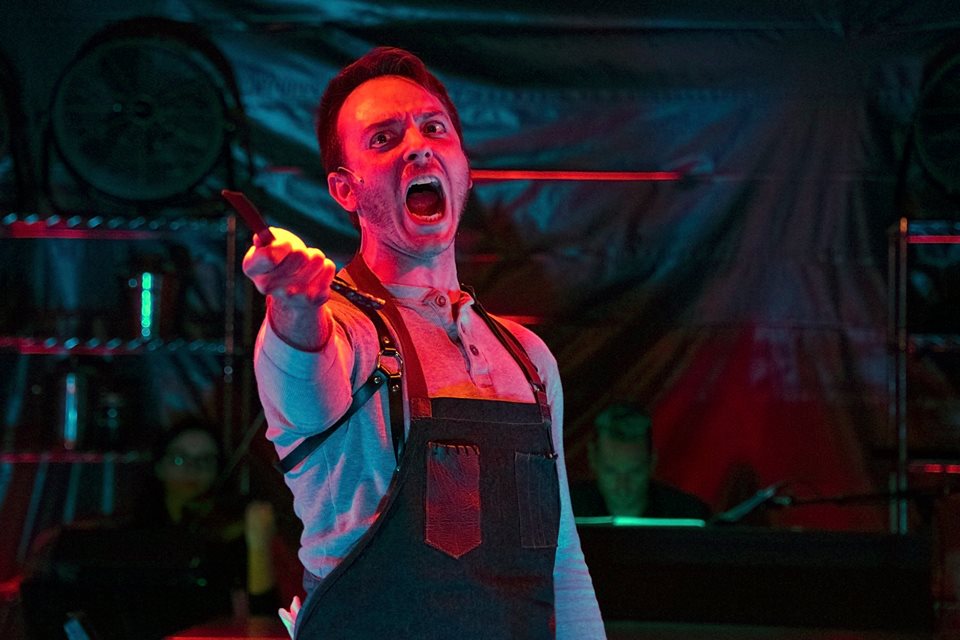
The ensemble is led by Alexander Sapp as the vengeful barber and Bianca Bryan as Mrs. Lovett, his landlord and owner of the pie shop that finds success only after adding a special secret ingredient to her meat pies. Both are deliciously intense and over the top. Sapp is unrelentingly manic in his quest for vengeance, after having been wrongfully deported to Australia so a corrupt local judge, Turpin, could take advantage of his beautiful young wife. Bryan is positively chilling in her remorseless determination to win the barber’s affections and advance her failing pie business – which she herself describes in song as, “The Worst Pies in Town.”

But the strength of this production does not rest solely on the shoulders of the two leads. William Anderson, as the corrupt Judge Turpin appears in his first scene with his eyes wildly bugged out, and the next time we see him he is ripping pages from his bible and flagellating himself as he tries to talk himself out of his lustful attraction to his beautiful young ward, Johanna – who is actually the daughter of Sweeney Todd, and sees in the pompous Turpin only a father figure. Mallory Keene plays Johanna with a sweet innocence – except when demanding kisses from her true love, Anthony Hope, or grabbing a pistol to shoot her jailer!

Kelsey Cordrey is an interesting sidekick as Beadle Bamford, the Judge’s lackey. Wordlessly, Cordrey conveys contempt for the Judge, and perhaps even envy and a desire to have Johanna for himself.  Then there’s Audra Honaker who does double duty as the mysterious beggar woman and Pirelli, a rival barber. Interestingly, neither of Honaker’s characters are who they first appear to be, but it is the role of Pirelli that infuses some much needed hilarity into this horror story of a musical.

Matt Shofner charms as the loyal young apprentice, Tobias (Toby) Ragg. Freed from bondage to the flamboyant and fake Pirelli after Pirelli has a visit with Todd, Toby becomes attached to Mrs. Lovett an performs a touching duet in which he promises that nothing can harm her as long as he’s around. Little does he know. . .

The cast also includes Matt Polson as Anthony Hope, the young sailor who saves the shipwrecked Sweeney Todd and befriends him – pretty much against his will, and two musicians who remain onstage and occasionally get swept up in the action. The violinist is Marissa Resmini, and John-Stuart Fauquet on piano is also the production’s musical director. Michael Jarett designed the lighting, and there are plenty of special effects to cover the bloody throat slitting, indicate the bakeshop ovens are working, or create projections on the rear wall. Gray has covered the rear and side walls in industrial strength plastic, making me wonder, on entering, if perhaps the audience might need bibs, like the ones you get in seafood restaurants, to keep from getting splattered with blood. The audience has to walk through the set to get to their seats – and everyone is encouraged to use the facilities before the first act or wait until intermission. With everyone glued to their seats – partially in fear – I don’t think anyone thought of going to the bathroom during the first act.

Needless to say, with its themes of sexual assault, insanity, murder, corruption, imprisonment, incest, and more, Sweeney Todd: The Demon Barber of Fleet Street is a part of the 2019 Acts of Faith Festival. And several performances are already sold out, so don’t wait, reserve your tickets now – and if you can, sit in the first row.

Oh, and did I mention that the singing is powerful (I could understand most of the lyrics) and the music sounds like a small orchestra, and not just two musicians? Well, it is (lack of clarity may have been due to musical phrasing, I’m not sure) and it does!

Julinda D. Lewis is a dancer, teacher, and writer who was born in Brooklyn, NY and now lives in Eastern Henrico County.

———-

Photo Credits: Tom Topinka

This slideshow requires JavaScript.


CYRANO DE BERGERAC: Everyone Nose

CYRANO DE BERGERAC: Unrequited Love

A Theater Review by Julinda D. Lewis

At: Swift Creek Mill Theatre, 17401 Jefferson Davis Highway, Colonial Heights, VA 23834

Performances: January 26 – March 2, 2019

Ticket Prices: $40 Theater only; $57 Dinner & Theater

Info: (804) 748-5203 or swiftcreekmill.com

Edmond Rostand wrote Cyrano de Bergerac in 1897 and many are familiar with this classic, either as a reading assignment in high school or from Steve Martin’s 1987 comedy named for Cyrano’s love interest, “Roxanne.” But it is another thing entirely to see Cyrano performed live onstage, and still be moved to laughter by the 17th century poet’s flowery words and braggadocio and touched by the hero’s uncharacteristically humble acceptance of unrequited love. And yes, this is fiction, but it is based on a real person.

The current production onstage at Swift Creek Mill Theatre, adapted by Emily Frankel and directed by John Moon, is a delightful period comedic romp. Like every production at Swift Creek, it is one of artistic director Tom Width’s favorites. This one earns a special place of honor because, he writes in the program notes, it “confirm[s] the ability of this story’s themes to transcend time and place.” Cyrano, a talented poet, playwright, musician, and soldier, is in love with his beautiful cousin Roxane, but due to his unusually large nose, he lacks the confidence to approach her. Instead, he writes love letters to her on behalf of Christian, a fellow cadet whom he befriends at Roxane’s request.

The production is dedicated to the beloved Andy Boothby, who transitioned suddenly on November 26, and had been cast in the title role, which is now being filled by Matt Bloch. Even with the flamboyantly large prosthetic nose in place, Bloch isn’t ugly; in fact, he is so far from ugly that this casting decision requires good acting in collaboration with a suspension of belief by the audience. Looks aside, Bloch does a commendable job as Cyrano, a role that is both verbally and physically demanding. The final scene, in which he visits Roxane who has retired to a convent after Christian dies on the battlefield, is more touching than I expected. Thankfully, director Moon keeps it simple and brief.

David Janosik plays Christian, whose love for Roxanne is also unrequited, because she doesn’t know that the words that are winning her over are not his own, but those of her cousin Cyrano. I wanted to feel sorry for Christian, but it was difficult to balance this desire with rooting for Cyrano to overcome his insecurities about his looks and find true love.

The lovely Rachel Rose Gilmour is well cast as the fair Roxane. It was helpful to see the scene in which she deftly deflects her lecherous uncle, DeGuiche – a scene performed for the Acts of Faith Preview – in context. In her scene with the tongue-tied Christian she is abrupt and amusing.

Other strong characters include Walter C. A. Riddle as Cyrano’s second in command, Capt. LeBret and Jon Cobb as the play’s antagonist, DeGuiche. Debra wagoner provided some wonderfully comedic moments as Roxane’s Duenna, and her perpetual giggle was simultaneously girlish and naughty.

Frank Foster’s simply elegant design, consisting mostly of a soaring archway with moveable benches and posts, transformed, with the help of Joe Doran’s lights, from a theater to a pastry shop, a court yard, a battlefield, and finally the garden of a convent. Maura Lynch Cravey’s elaborate period costumes, which included lace collars and cuffs, capes, plumed hats, and long hair for the men, and the women’s extended skirts, were as flamboyant as Foster’s design was unassuming.

As for those enduring themes, there is pride versus humility, physical beauty versus inner beauty, integrity and deception, bravery and revenge, chivalry and love, and of course, there is sword-fighting!


Julinda D. Lewis is a dancer, teacher, and writer who was born in Brooklyn, NY and now lives in Eastern Henrico County.

———-

Photo Credits:

Robyn O’Neill


This slideshow requires JavaScript.

BECKY’S NEW CAR: Placing a Marker in Life

BECKY’S NEW CAR: Cruising Through Midlife Crisis

A Theater Review by Julinda D. Lewis

At: CAT Theatre, 419 No. Wilkinson Rd., RVA 23227

Performances: February 8-23, 2019; Acts of Faith Talkback after Sunday matinees

Ticket Prices: $23 General admission; $18 RVATA Members; $13 Students

Info: (804) 804-262-9760 or cat@cattheatre.com

From the moment Becky Foster bustles onstage, still dressed for work, talking over the hum of her hand-held vacuum, tossing a roll of toilet tissue towards one audience member to place in the bathroom, asking another to place a waste basket under a leak, and sipping from a can of Sprite, it is obvious something in her life is out of balance. The she has a talk with her son Chris, a twenty-something graduate student who still lives at home, and the question of what he is going to do with his life turns into what she is doing with her life, and we’re off and running. Steven Dietz’s non-stop comedy, Becky’s New Car, has just enough of a tinge of reality to make us care about what happens to these characters, or at least make some moral or practical judgments about their actions.

Kerrigan Sullivan slides easily into the role of Becky (Rebecca) Foster, a middle-aged woman with a decent job as an office manager in a successful car dealership, married to a successful roofer, mother of a son who is a nice young man who, like many nice young men, seems in no hurry to rush into adulthood. Sullivan’s role requires lots of interaction with the audience, which also seems natural to Sullivan, who must segue smoothly between acting and narrating.

Scott Bergman makes Becky’s husband Joe seem like such a solid, likeable guy that it becomes difficult to relate to Becky’s dissatisfaction or to sympathize with her subsequent decisions. At one point Becky enlisted three women from the audience – including me – to help her decide if she should attend a party and pursue an extra-marital relationship. We unanimously said no, and of course she had to find three more willing sympathizers – or there would have been no reason for a second act.

Referring back to a September 2011 Va-Rep Hanover production of this show, Becky’s New Car by Steven Dietz, I confirmed that at that time I had been invited onstage to assist Melissa Johnston Price, who was playing the role of Becky, get dressed for the party. As I write this review, I recall that I helped that earlier Becky with her necklace. Interestingly, although I knew I had seen – and even reviewed – Becky’s New Car nearly 8 years ago, I did not remember details, so watching this production was like watching it for the first time.

Mark Atkinson was interesting as Becky’s paramour, the wealthy Walter Flood. Where all the other characters seemed realistic, Walter was more of a caricature of the wealthy businessman with the waterfront estate. I’m not sure if Walter’s affected speech and mannerisms were a decision of the actor or the director, Ann Davis, but he seemed to be using a different style of acting than everyone else.

The rest of the cast includes Jimmy Mello as Becky’s son, Chris; Maura Mazurowski as Walter’s daughter Kenni – who develops an interesting and convoluted relationship that could only happen in high comedy – Daryl Scruggs as Becky’s emotionally needy co-worker Steve, and Tricia Hawn as Walter’s family friend, Ginger.

Becky’s New Car is not short on laughs, but the first act seemed to drag a bit. I think we were all smart enough to get it if the pacing had been bumped up a bit. The second act seemed to find a more satisfactory stride and Becky soon crashed and burned into the entirely avoidable disaster that was clear to everyone except Becky. The look on Becky’s face when she sees Joe and Walter sharing beers in her living room is priceless. Her subsequent actions change everyone’s lives.

Lin Heath’s multi-purpose set works surprisingly well. The center and stage left comprise the Foster’s living room and doors to other rooms into and out of the house. Stage right has Becky’s office, separated from the home by a single step and lighting, rather than a physical wall.A wall at the rear of the living room served as a deck or patio on Walter’s estate, but the location or construction of the wall was oddly distracting. Even more so, Becky’s car – both the old one and the new one – are represented by office chairs. I had hoped for something more, given the title. Charlotte Scharff’s costumes are realistic, from Joe’s work shirt with his name on it to Becky’s work wardrobe and the party clothes, but what really stands out is the onstage costume change, assisted by three women selected from the audience.

There is a lot of audience involvement, which is surprisingly organic and a lot less intrusive than one might expect. One might wonder how a comedy might qualify as an Acts of Faith Theatre Festival entry, but it is the life-stage challenges and how they are handled that provides plenty of material for discussion – both among audience members, and for the Sunday matinee talkbacks.

Julinda D. Lewis is a dancer, teacher, and writer wh was born in Brooklyn, NY and now lives in Eastern Henrico County.

———-

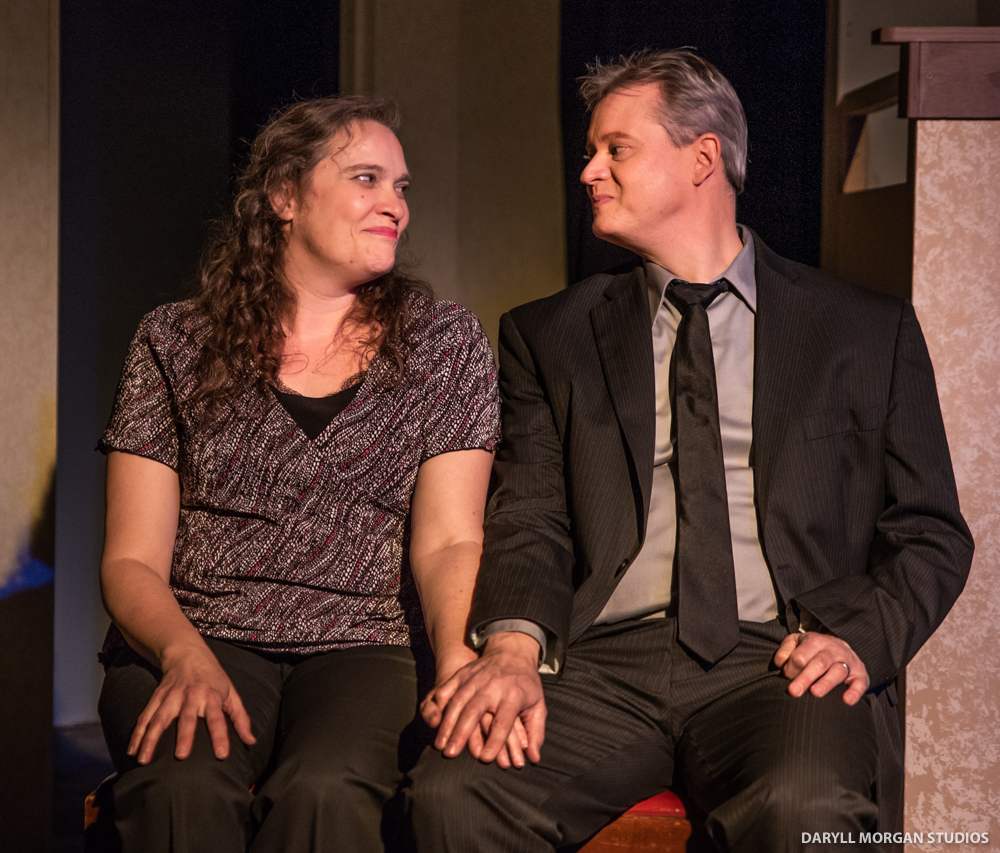
Photo Credits: Daryll Morgan Studios

Acts of Faith logo

CAT Theatre - Becky's New Car - Daryll Morgan Studios-7
Kerrigan Sullivan and Mark Atkinson

CAT Theatre - Becky's New Car - Daryll Morgan Studios-16
Kerrigan Sullivan as Becky

CAT Theatre - Becky's New Car - Daryll Morgan Studios-17
Scott Bergman, Jimmy Mello, Kerrigan Sullivan, Maura Mazurowski, Mark Atkinson, Daryl Scruggs and Tricia Hawn

CAT Theatre - Becky's New Car - Daryll Morgan Studios-19
Kerrigan Sullivan and Scott Bergman

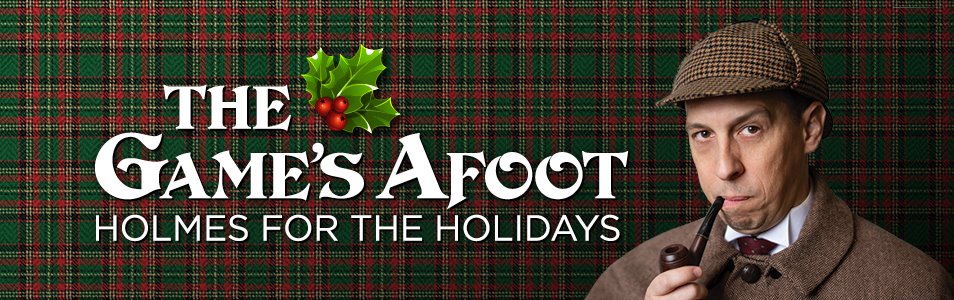
THE GAME’S AFOOT: Murder, Mystery, and Mayhem for the Holidays

THE GAME’S AFOOT: Holmes for the Holidays

A Theater Review by Julinda D. Lewis

VirginiaRep

At: Hanover Tavern, 13181 Hanover Courthouse Road, Hanover, VA 23069

Performances: November 30, 2018 – January 6, 2019

Ticket Prices: $44

Info: (804) 282-2620 or va-rep.org

Ken Ludwig’s hilarious whodunit, The Game’s Afoot, continues the comedic theme of this season’s holiday shows. (See my reviews of A Doublewide, Texas Christmas November 30, A 1940s Radio Christmas Carol November 25, and Who’s Holiday November 18). Debra Clinton directs this murderous farce that has more twists and turns than a roller coaster, a task that must have been made easier by her stellar cast of characters, most of whom are no strangers to the Hanover Tavern stage.

Scott Wichmann stars as Broadway actor William Gillette (a real life actor who made a name for himself playing Sherlock Holmes on Broadway). There’s a play within a play, and life imitates art as Gillette is shot by an unknown assailant while taking his bows at the end of his show. Recuperating at his palatial Connecticut mansion (also real, and now known as Gillette Castle State Park, in Lyme, CT), Gillette invites his friends and fellow cast members to spend the Christmas holidays with him and his mother, Martha (Catherine Shaffner).

Gillette, however, has an ulterior motive. Having blurred the line between his own life and that of the character he portrayed for two decades, he fancies himself a sleuth and sets out to uncover the identify of his mystery assailant – and solve a few other mysteries along the way. Mayhem and misdirection ensue, and Clinton keeps things moving at a fast pace. There is physical comedy and lines that depend on split second timing are delivered flawlessly. There are plenty of clues and possible motives, so it’s not a complete surprise when we find out “whodunit,” but the ride is so much fun that the end is not the focal point.

Wichmann makes Gillette, who tends to be pompous, a bit more endearing, but there’s no mistaking who is the star here. Shaffner is hilarious as his mother, who always has a flask close at hand. Joe Pabst plays the role of Gillette’s best friend, Felix and his bumbling attempts at subterfuge are a highlight of the show. Donna Marie Miller is the villain here – a vengeful theatre critic named Daria Chase who has dirt on everyone and knows how to use it.  However, I was taken aback when she had a meltdown and demanded to be left alone – in Gillette’s house. Umm, that’s now how things work. . .

Meg Carnahan and Caleb Wade play the newlywed couple Aggie Wheeler and Simon Bright and Lisa Kotula is Felix’s wife, Madge whose big scene involves a seance. All have secrets that come to light when a strange detective, Inspector Goring, arrives to investigate a murder that may or may not have happened. Audra Honaker makes the role of Goring most interesting, alternately staring off into space or spouting off lines from Shakespeare. Given that the characters are all actors, there is much grandstanding, with each trying to outdo the other with dramatic delivery of drama and poetry.

The play’s isolated location and limited pool of suspects give this all the major requirements of the locked-room mystery genre, and Terrie Powers’ set attempts to capture the spirit of the genre as well. Derek Dumais and B.J. Wilkinson apparently had great fun with the sound and light design, creating lightning (it must have been a thundersnow storm) and thumps, bumps, and mysterious knocks and Sue Griffin’s costumes are in keeping with the period and the holiday spirit.

If this sounds a bit vague, some of the best moments and funniest situations cannot be mentioned here without spoiling it for those who have yet to see it. What I can say is that there are multiple doors and a secret room, as well as a wall full of weapons, which may or may not be loaded.  There are plots and subplots, motives and alibis, and even false confessions. Everyone is a suspect except the butler, because he was given the night off, it being Christmas Eve and all.

Julinda D. Lewis is a dancer, teacher, and writer who was born in Brooklyn, NY and now lives in Eastern Henrico County.

———-

Photo Credits: Aaron Sutten.

This slideshow requires JavaScript.

A DOUBLEWIDE, TEXAS CHRISTMAS: A Trailer Park Carol

DOUBLEWIDE, TEXAS CHRISTMAS: The Tiny Town Tackles the Nativity

A Theater Review by Julinda D. Lewis

At: CAT Theatre, 419 No. Wilkinson Rd., RVA 23227

Performances: November 30 – December 15, 2018

Ticket Prices: $23 Adults; $18 RVATA Members; $13 Students

Info: (804) 804-262-9760 or cat@cattheatre.com

The citizens of the tiny town of Doublewide, Texas, population 10, are back and so is the fun. A Doublewide, Texas Christmas, written by the trio of Jessie Jones, Nicholas Hope, and Jamie Wooten, is written, directed, and played strictly for laughs. There is no hidden agenda, no deep message, just plain old stupid fun, filled with Texas stereotypes, exaggerated hair and costumes, and a set that looks like a cross section of a dilapidated doublewide trailer park home.

Picking up where Doublewide, Texas left off last June, the town, under the leadership of Mayor Joveeta Crumpler is eagerly awaiting their incorporation papers from the country board, but there are complications. The county is making one more attempt to annex Doublewide, and then there are the added twists of revenge and reunion.

Three actors have returned in their same roles: Crystal Oakley as the beleaguered and frumpy Joveeta, Jeanie Goodyear as Joveeta’s barfly mother, Caprice Crumpler, and Wally Jones as the once crotchety Haywood Sloggett.

Other roles were recast, with Laura McFarland-Bukalski as the hilariously droll Big Ethel Satterwhite and Lisa Way Piper as Georgia Dean Rudd, manager of the local Bronco Betty’s Buffeteria. Lorin Hope Turner now plays the millennial flower child Lark Barken, and Hunter Mass, who simultaneously serves as Assistant Stage Manager is Norwayne “Baby” Crumpler. New characters include Rebekah Spence as Haywood’s vengeful sister Patsy Sloggett Price and Michael Edward McClain as the long lost Harley Dobbs, who is Haywood’s estranged son and Lark’s unknown father. If this all sounds like a soap opera, I am sure that was the intention.

Highlights include Big Ethel’s scenes with the residents of the Stairway to Heaven Retirement Village at the beginning of each act, and Caprice’s overly inflated pretensions of celebrity as the spokesperson for the local funeral home. This time there is only one commercial recording scene, and Caprice is called upon to use her celebrity to entice new residents to move to Doublewide within the week – a condition of approving the town’s incorporation papers.  Big Ethel must lecture the retirees on their extra-curricular activities, having found yet another pair of boxer briefs and a peek-a-boo nightie hooked in the bushes on the retirement village grounds.

“Baby” was not required to wear a dress or heels this time, but he did don a pink frilly apron while preparing a sweet potato casserole and the town entered a Battle of the Mangers competition with the patriotic theme of “Nativity at the Alamo.” Plot twists and turns involve Patsy’s narcissistic need to get revenge on a competitor from her former town, which she was forced to leave in disgrace, a family of belligerent raccoons, a celebrity yam, a budding attraction between Caprice and Haywood, and a Christmas wish that Lark’s father, who is also Haywood’s son and Georgia Dean’s long lost true love, might be found and enticed to return home for the holidays.

It was interesting to see the evolution of Haywood from crotchety old man to loving family member, but I think there was more comedic value in the role of villain. Patsy partially filled this much-needed role, and Spence embraced ownership of this role; she even threw in an evil laugh or two for good measure.

Crystal Oakley had to be mic’d on opening night as she was just getting over a case of laryngitis. Her character, Joveeta, was plagued by back pain, so Oakley, a real trooper, was beleaguered on two fronts. Other cast members were also hit with illnesses and accidents, requiring last minute and behind the scenes adjustments. Considering all that CAT Theatre has had to go through this year, starting with the uncertainty of whether they would, in fact, be able to have a season due to the looming possibility of losing their long-time home, it is nothing less than amazing that opening night went as smoothly as it did and this cast and crew, including Mike Fletcher who directed both Doublewides on the CAT stage, deserve an extra round of applause for pulling this off without any obvious signs, other than Oakley’s microphone.

Mike Fletcher’s pacing kept the laughs coming, although I found the actor’s blocking was sometimes awkward, making me aware that they were directed to face the audience. Scott Bergman’s set included dilapidated, mismatched furniture in a cut-away of a doublewide trailer with the standard wood panel walls, insulation showing, a Santa on the roof, and a plethora a blinking Christmas lights framing the entire set. Sheila Russ’s costumes ranged from Joveeta’s frumpy sweaters and slacks to Caprice’s holiday print leggings and wildly curled wig. It’s Texas, so almost everyone wore cowboy boots. And since it was Christmas, Buddy Bishop and Mike Fletcher’s sound design included songs from the traditional to the silly, such as “White Trash Christmas.” People who enjoyed Doublewide, Texas or Always a Bridesmaid, by these same authors, or those who enjoy the 1970s style sitcom genre, will feel right at home with A Doublewide, Texas Christmas, as will anyone who just wants an excuse to laugh steadily over a two hour period.

Julinda D. Lewis is a dancer, teacher, and writer who was born in Brooklyn, NY and now lives in Eastern Henrico County.

———-

Photo Credits: Jeremy Bustin Photography (photos to come)

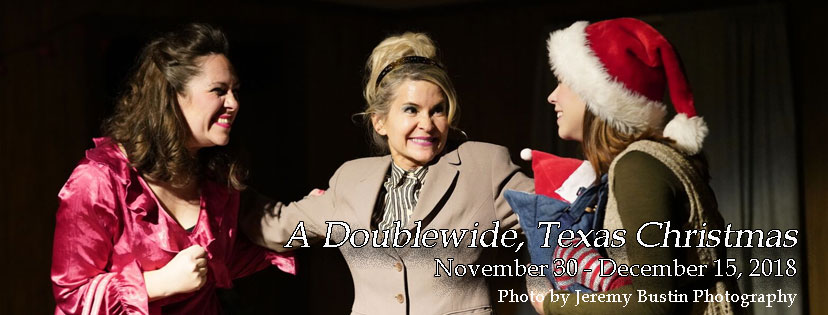
Doublewide TX Christmas

Doublewide TX Christmas.2
Lisa Way Piper, Crystal Oakley, and Lorin Hope Turner

A 1940s RADIO CHRISTMAS CAROL: Tradition With a Delightful Twist

A 1940s RADIO CHRISTMAS CAROL: An Un-classic Classic

A Theater Review by Julinda D. Lewis

At: Swift Creek Mill Theatre, 17401 Jefferson Davis Highway, Colonial Heights, VA 23834

Performances: November 17, 2018 – January 5, 2019

Ticket Prices: $40 Theater only; $57 Dinner & Theater

Info: (804) 748-5203 or swiftcreekmill.com

If you like both holiday traditions as well as comedy, then A 1940s Radio Christmas Carol is the holiday show for you. Author Walton Jones, composer David Wohl, and lyricist Faye Greenberg have taken the traditional Dickens tale and set it to music in a shabby radio station in Newark, NJ in the early 1940s. The audience has a role too – as the live studio audience that interacts with the cast who pass out souvenir programs and instruct us in how to respond to the APPLAUSE and LAUGH signs.

The fictional radio station WOV broadcasts from the Hotel Aberdeen. The live show is subject to interruptions from loud plumbing, a rowdy crowd of Shriners who are celebrating their annual Christmas parade with an after-party in the same hotel, and frequent phone calls from the mother of the youngest member of the cast. In addition, there is a special guest, a seasoned movie actor and Broadway veteran, William St. Claire (Bill Blair) who has been brought in to play the role of Scrooge. In addition to his increasingly worrisome quirks – such as bringing a huge trunk full of costumes for a radio broadcast and ignoring cues – St. Claire has some personal issues that lead to an on-air breakdown forcing the rest of the cast to improvise an ending. An odd assortment of characters from detectives to seductresses are tossed into the mix resulting in comedic mayhem.

Lucky for them and for us, the ensemble – both the scripted one and the one that was cast on the Swift Creek stage – is more than capable of handling this unexpected development. This is truly an ensemble piece that is no stronger than its weakest link – and there was no weak link. PJ Llewellyn as Fritz Canigliaro took every opportunity to draw attention to his shoes; apparently Fritz had been a Florsheim salesman in the recent past. Kenneth Putnam was endearingly annoying as Charles “Cholly” Butts, a baker with an intense love for his own product. John Mincks was convincing as the teen-aged Jackie Sparks, whose mother kept calling to check on him; he also has an adorable crush on Sally. Tara Callahan Carroll had the role of the company comedienne, Margie O’Brien, and Elisabeth Ashby played Judith Davenport, a serious actress who caught the attention of all the men, while declaring that she already had two kids and two exes and didn’t want more of either. Mike White held down the role of the struggling company’s director, Clifton Feddington.

Director Tom Width, who also designed the set, has also shared his love of the radio play and the studios in which they were performed. He has filled the stage with all sorts of mysterious and enticing objects that are used to create the many special effects that were necessary to create the magic of radio. There are bells and blocks, locks and boards, a sheet of aluminum, mallets and sticks, and gadgets and gizmos, and even a carafe of celery stalks (one of my favorites). These items are controlled by Isadore “Buzz” Crenshaw, the “sound effectician” who unexpectedly announces that he has recently enlisted, with the capable assistance of Sally Simpson, a young woman who spends her days working for an aviation company. These two roles are in the capable hands of Gordon Graham and Claire M. Gates. This is the 1940s, and the War play an important and ever-present role.

There were lots of 1940s references, such as cigarette commercials, statements from doctors recommending certain brands of cigarettes, and many references to the war. The show’s sponsors included brands such as BVD underwear, Ovaltine drink mix, and Lucky Strike cigarettes. (Nostalgia break: I still remember when cigarettes were advertised on the radio and television. Even little kids knew that LSMFT stood for the slogan “Lucks Strike means fine tobacco.” The last cigarette commercial aired in 1970, but prior to that time, I can remember going to the corner store to pick up a pack of cigarettes for my grandmother.) The script also incorporates a lot of double entendre and snappy word play, including lines such as “All the boys at school loved my little Fannie, too.” Fannie, of course was the name of the speaker’s little sister.

The 1940s radio show device makes this stand out from all other Christmas shows. The laughs come easily and frequently. The cast was well-chosen, and the direction is well-paced, although the second act did seem to drag just a little bit. The music is lively and occurs in short bursts. Unlike musicals where people suddenly break into song for no apparent reason, the songs are naturally woven into the radio show format.  Musical direction is by Shellie Johnson; lighting by Joe Doran; technical direction by Jason “Blue” Herbert;  and costumes by Maura Lynch Cravey.

While suitable for all ages, I think A 1940s Radio Christmas Carol will hold a special appeal to those old enough to still remember when cigarettes were advertised on television. But for many, the best part is getting to see how all those special effects were created.


Julinda D. Lewis is a dancer, teacher, and writer who was born in Brooklyn, NY and now lives in Eastern Henrico County.

———-

Photo Credits: Robyn O’Neill

This slideshow requires JavaScript.