RICHMOND BALLET STUDIO TWO: Looking Back, Looking Forward

Richmond Ballet Studio Two: The Moor’s Pavane & Figure in the Distance

A Dance Review by Julinda D. Lewis

At: The Richmond Ballet Studio Theatre, 407 E. Canal St., RVA 23219

Performances: March 26-31 @ 6:30pm Tuesday-Saturday; 8:30pm Friday & Saturday; 2:00pm & 4:00pm Sunday

Ticket Prices: Start at $25

Info: (804) 344-0906 x224 or etix.com

On Tuesday night Richmond Ballet’s artistic director, Stoner Winslett, reminisced on the theme “Looking Back, Looking Forward.” As an example of looking back, she gave us Ira White, once a “cute fourth grader” participating in the Minds in Motion outreach program at Mary Munford Elementary School. On Tuesday night, White danced the role of The Moor in José Limόn’s legendary ballet, “The Moor’s Pavane” choreographed in 1949. For looking forward, she brought us the Chicago-based choreographer Tom Mattingly and his new collaborative ballet, “Figure in the Distance,” based on a sketch he presented for the Richmond Ballet’s 2018 New Works Festival. Mattingly choreographed one of his early works for the Richmond Ballet trainees.

Mexican-born José Limόn (1908-1972) remains one of my favorite choreographers of all time, and “The Moor’s Pavane: Variations on the Theme of Othello” is probably his most well-known work. Set to music by Henry Purcell, the stately framework of the pavane – a courtly dance – contains and restrains the passion of the tragedy of Othello. On Tuesday The Moor was danced by Ira White, His Friend/Iago was Trevor Davis, Iago’s Wife was Lauren Archer, and The Moor’s Wife/Desdemona was danced by Sabrina Holland. On alternate programs, the roles are filled by Fernando Sabino, Matthew Frain, Maggie Small, and Cody Beaton. “Follow the hanky,” Winslett advised; that is the secret to uncovering the deception that results in Desdemona’s unfortunate death.

This is one ballet that does not set the women on pedestals. As the quartet moves through the figures of the pavane, they maintain a distant, courtly demeanor, but we see the women grasped tightly by an upper arm, pushed or pulled, and ultimately the Moor’s wife is killed. White and Davis were often at odds, sometimes even combative. Archer and Holland were treated like trophy wives, commodities more than true loves. The rich – and most likely heavy – costumes are constructed after the original design by Pauline Lawrence, with full, layered skirts for the women with puffy, detached sleeves (showing lots of bare shoulder), and princely robes or tunics for the men.

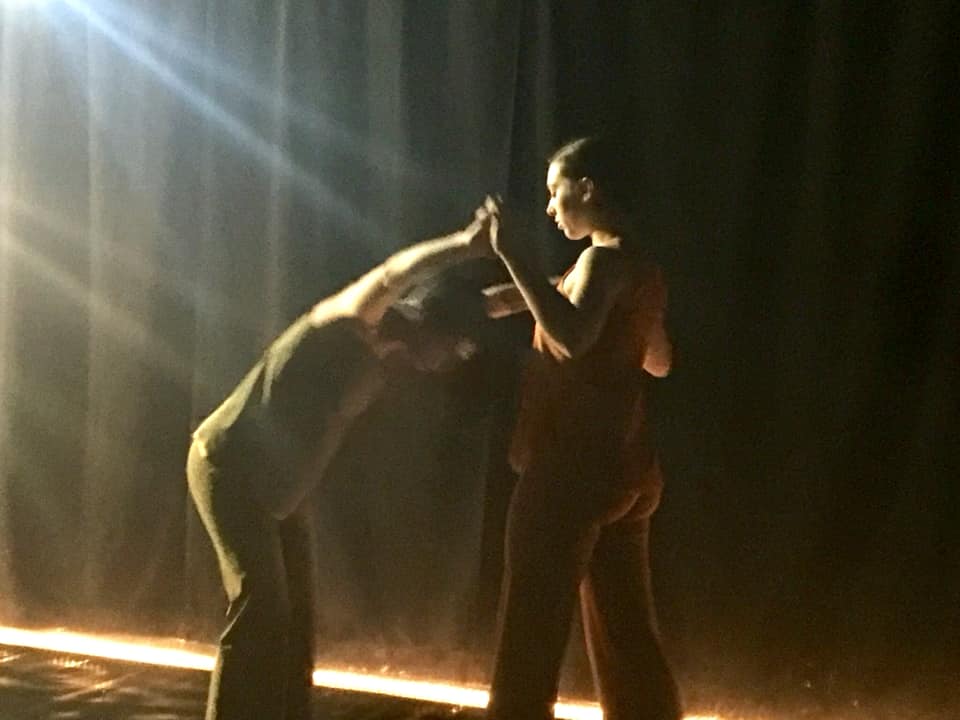
But even with all its historic status, “The Moor’s Pavane” was not the highlight of the evening. Rather, that honor goes to Tom Mattingly’s “Figure in the Distance,” a work inspired by the artwork of Taylor A. Moore – work Mattingly first encountered on Instagram. An even dozen dancers move through a succession of phrases and configurations. Some of the group phrases brought me to the edge of my seat, including a line of dancers that rippled from front to back, and a moment when the men lifted the women straight up in front of them, one by one. I was also intrigued by a couple walking offstage: the woman walking backwards while her partner mirrored her, walking forward. There was just something somewhat frightening or menacing about that, in contrast to another pair of dancers who shared a gentle caress. There was such a range of emotions, all backed by a series of paintings by Taylor A. Moore. First there was a blue painting of what appeared to be a lake with faint figures in the background. Most striking was a red painting with bold strokes that suggested both a forest and figures hidden in the trees. Another had the shape of a cat’s eye, but the slit of the eye could have been the opening to a cave, and a final had only faint brush strokes except on the far right where there was a large. . .limb? But all the bold, unidentifiable brush strokes could be interpreted as figures, hence, “Figure in the Distance.”

Emily Morgan designed the dark red body suits worn by both the men and the women. The fabric was richly yet subtly patterned, with sheer sleeves and back panels so that, at first glance, it seemed one dancer had a tattoo on her shoulder, and then I noticed more shapes and colors. It turns out that Morgan hand painted sections of the fabric to coordinate with the paintings. The work was set to the multi-layered music of Philip Glass: “Violin Concerto No. 1,” “Piano Etude No. 2” and “String Quartet No. 2” (also known as “Company”), and “Primacy of a Number.”

The lighting was designed by Catherine Girardi who has worked as assistant lighting designer for the Ballet’s “Nutcracker” performances. This was her first original design on her own for the Richmond Ballet.

What made this a collaboration more so than many other ballets is the communication that occurred between the artists (choreographer, painter, costumer designer and lighting designer) during the creative process. Mattingly was given three works to work with the company. Mattingly’s impetus was Moore’s paintings and Morgan had to dress the moving bodies in garments whose brush strokes would reflect the paintings at appropriate times, with Girardi’s lighting. All worked together to suggest what Mattingly conceived of as “an idealized version of yourself,” making the audience, in a sense, collaborators after the fact. “Figure in the Distance” is a beautiful work that is highly satisfying on many sensory levels.

Julinda D. Lewis is a dancer, teacher, and writer who was born in Brooklyn, NY and now lives in Eastern Henrico County.

———-

Photo Credits: Photos to follow.

studio-two-web-slider

This slideshow requires JavaScript.

//ws-na.amazon-adsystem.com/widgets/q?ServiceVersion=20070822&OneJS=1&Operation=GetAdHtml&MarketPlace=US&source=ac&ref=tf_til&ad_type=product_link&tracking_id=rvartreview-20&marketplace=amazon&region=US&placement=B00LH3DMUO&asins=B00LH3DMUO&linkId=cd73c62518534f775ac8b3c914e0de60&show_border=false&link_opens_in_new_window=false&price_color=333333&title_color=0066c0&bg_color=ffffff


//ws-na.amazon-adsystem.com/widgets/q?ServiceVersion=20070822&OneJS=1&Operation=GetAdHtml&MarketPlace=US&source=ac&ref=tf_til&ad_type=product_link&tracking_id=rvartreview-20&marketplace=amazon&region=US&placement=B01415QHYW&asins=B01415QHYW&linkId=a6d75822968263d794f0dc9b51d0fe5a&show_border=false&link_opens_in_new_window=false&price_color=333333&title_color=0066c0&bg_color=ffffff

STARR FOSTER DANCE: CRAVE…what if?

STARR FOSTER DANCE: Crave – a New Work

A Dance Review by Julinda D. Lewis

At: TheatreLAB The Basement, 300 East Broad Street, RVA 23219

Performances: February 1-3: Friday @8PM; Saturday @3:00, 5:00 & 8:00 PM; Sunday @1:00 PM & 3:00 PM

Ticket Prices: $12

Info: (804) 304-1523, https://www.brownpapertickets.com/event/4033169

Starrene Foster’s new work, Crave, poses the question, “What if, in one moment, you had changed your mind during your journey. And if so, how would that change affect the final outcome?” The ways in which she responds to this prompt are intriguing, thought-provoking, and sensual.

On entering The Basement performance space, there is a small exhibit by four participating artists. Douglas Hayes (the company’s art director) showed a pair of digital duotone prints showing the same model, in the same pose and lighting, but one was taken in 2003 and the other in 2019. Wolfgang Jasper’s charcoal drawing, “Frictionless Pivot” and digital print “Communal Madness” show the same elements, but one has been digitally reconfigured. Beth B. Jasper’s “Negotiation,” created with pen and ink on rice paper started as two separate drawings but ended as two panels, with the initial shape in one flipped over. And Fiona Ross’ “Staves #25C” and “Staves #28C” follow specific rules of placement that lead to different outcomes. A brief study of the artwork will prove helpful when watching Crave.

Our programs were marked with a letter “N” or “S,” indicating whether we were to start out seated on the North Stage or South Stage of the performance space.  There are about twenty seats on each side, and a wall – I mean a curtain – separates the two sides. During the 10-minute intermission, the audience members change sides.

We started on the North Stage, where Kierstin Kratzer and Mattie Rogers danced with a quiet intensity that sometimes pulled me to the edge of my seat. Billy Curry’s original score was a soundscape of trains, industrial noises, and rhythmic music. Foster, who frequently uses dark lighting, did not disappoint, but there were bright lights overhead that created a not unpleasant, somehow softened glare. We could see the dancer’s faces, but not their features. We knew they were looking at each other, but we couldn’t see their eyes. They were dressed in monochromatic slightly loose, softly flowing tunics and pants that became part of the choreography.

Kratzer and Rogers sometimes flowed together organically, sometimes challenged one another, lifting, pushing, pulling; one would occasionally head butt the other in the belly, and one stood vibrating as if receiving an electric shock from her partner’s fingers. The flow and variety of movement was mesmerizing, and before you knew it, it was intermission.

Changing to the South Stage, we saw Caitlin Cunningham and Kelsey Gagnon dancing, and like Wolfgang Jasper’s drawings, the elements were the same as those used by Kratzer and Rogers, but reconfigured. They were dressed identically to the other duo. They started from a similar position. There was that kick and high leg swing. That’s the same grab of the toe. There’s the vibratory movement – but different. It was all familiar, but all new. There was the sound of the train and yes, that upbeat rhythm. But there was a sense of déjà vu, a time shift or a manipulation of time and space.
One had a sense that the other duo was happening on the other side of the curtain, but try as I might, I never actually heard them. Having the audience move is rare, but it has been done before. It’s not always possible and the flexible and intimate space of The Basement was ideal for this elemental manipulation. It enhanced the sense that time and space had shifted. The cast members change, too. For some performances, Fran Beaumont and Cristina Peters will dance on the North Stage, while Shelby Gratz and Erick Hooten dance on the South Stage. With a running time of just about 45 minutes including intermission, Crave packs a lot of punch in a small space in a short time. There are only 6 performances over a 3-day period, so if you can this piece is worth seeing. Try really hard. I love the way Foster has manipulated all the elements – including her audience.

Julinda D. Lewis is a dancer, teacher, and writer who was born in Brooklyn, NY and now lives in Eastern Henrico County.

———-

Photo Credits: Starr Foster Dance by Douglas Hayes.

ROGER B. HEARD & THE TIGHT 45: A Man with a Deadline

ROGER B. HEARD & THE TIGHT 45: Voiceover Master with a Deadline

A Theater Review by Julinda D. Lewis

At: HATTheatre, 1124 Westbriar Dr., RVA (Tuckahoe) 23238

Performances: January 11-19, 2019

Ticket Prices: $25 Adults; $20 Seniors; $15 Youth, Groups, Students & RVATA; Reservations Required – No tickets at the door

Info: (804) 343-6364 or hattheatre.org

It was interesting that two of the first shows of the new year shared a theme. On Friday night I attended 5th Wall Theatre’s production of Talk Radio at TheatreLAB the basement, then on Saturday I attended Roger B. Heard & the Tight 45, which made its world premiere on Friday. A coproduction of Free Jambalaya and HATTheatre at HATTheatre’s west end black box theater, Roger B. Heard is a three-person production written by Alex Mayberry and directed by James Nygren.

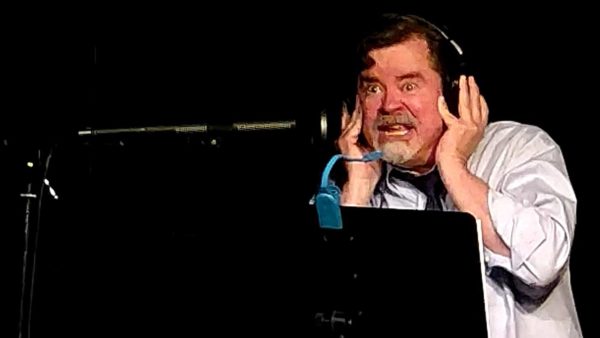
Dale Leopold plays Roger B. Heard, a veteran voiceover actor with a great talent but, unfortunately, a small bank account. The rent is due, and he has several projects to record, but his studio time has been limited. It seems a musician by the name of Dirty Metal Lefty has reserved all but 45 minutes of the available studio time. With the help of the studio operator Betty Robb, delightfully played by Emily Turner, Roger churns out one assignment after another. A perfectionist, he doesn’t have time for mistakes or retakes. Wouldn’t you know, a picky client calls in and wants him to redo a single line in a previously recorded ad – over and over and over. In a flash of brilliance, Betty Robb suggests playing back the original version. Problem solved! Betty Robb keeps things moving with her snappy comebacks and no-nonsense demeanor, adding moments of humor and balance to Roger’s feverish personality.

Roger and Betty Robb (she is always referred to by her full name) embark on an impossibly tight schedule, hoping to complete an ambitious roster of voice overs in 45 minutes: a morning motivation; Tales of Fantastica, in which Roger voices six characters and a narrator; a chair sales pitch; a multi-lingual bait shop phone menu, in which one of the languages was a pseudo hillbilly dialect; a congressional campaign ad that seemed guaranteed not to get the candidate elected; the reading of a chapter of a celebrity memoire; a monster bass fishing tournament; TV dubs for an action movie; the voices and sound effects for a game called Dojo Crusader; and a tribute to a religious leader performed in English and Swahili. Listening to Leopold transition from voice to voice, character to character is both amusing and anxiety inducing. We know he’s on a deadline, and Betty Robb keeps us aware of the time.

The only other character is Dirty Metal Lefty, aka Doc Thomas, a musician and songwriter who fills the pre-show space and a final scene with Roger B.  Dirty Metal Lefty is billed as a Richmond musician, so that leaves unanswered the question of her British accent. And I guess I was the only one who was a little slow and didn’t realize that Dirty Metal Lefty played a left-handed guitar until she asked that Roger be given a right-handed one to join her in a song.

There is even some audience participation. For instance, I found myself assigned as a last-minute “intern” assigned to play the tambourine for Dirty Metal Lefty, and a couple sitting behind me had been assigned to participate in a call and response. Due to the threat of severe weather, there were only about 10-12 people in Saturday’s audience, and the Sunday performance was cancelled, but there are two more opportunities to see this show on January 18 and 19 at 8:00 PM.

This is one of the quirkiest shows ever, it runs under an hour with no intermission and the only pretense at a plot is Roger’s deadline. And, if he’s so good, why is he so broke?


Julinda D. Lewis is a dancer, teacher, and writer who was born in Brooklyn, NY and now lives in Eastern Henrico County.

———-

Photo Credits: photos uncredited at the time of publication

hattheatre

hattheatre2
Dale Leopold
hattheatre3
Dirty Metal Lefty (Doc Thomas), Dale Leopold, and Emmy Turner

THE LARAMIE PROJECT: A Community of Caring

THE LARAMIE PROJECT: The Magnitude of Hate

A Theater Review by Julinda D. Lewis                                                                     

Richmond Triangle Players                                                                                              

At: The Robert B Moss Theatre, 1300 Altamont Avenue, RVA 23230

Performances: September 26 – October 19, 2018

Ticket Prices: $10-35

Info: (804) 346-8113 or rtriangle.org

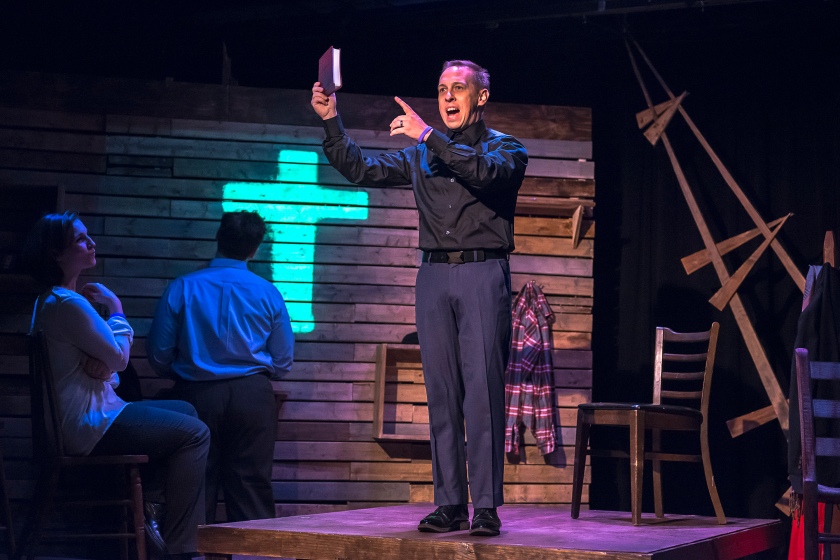
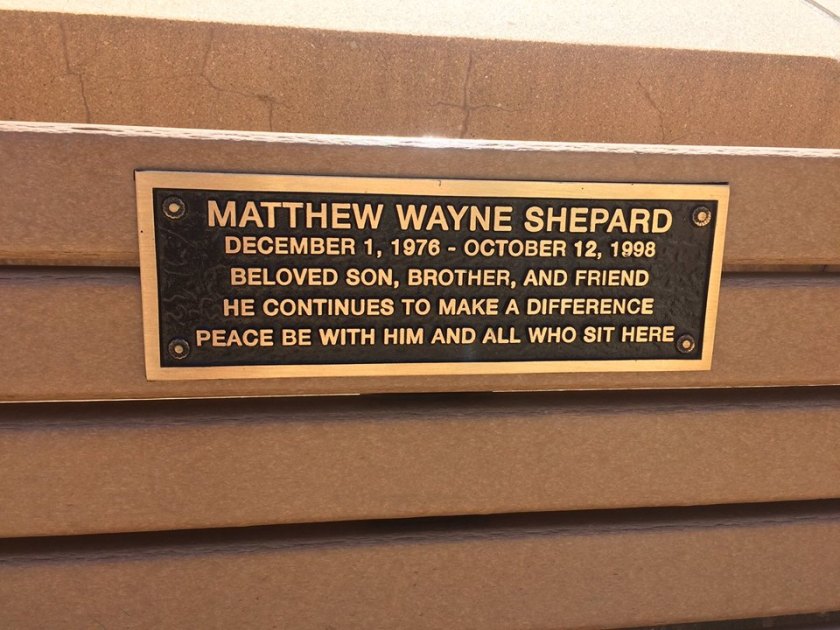
Created by Moisés Kaufman and members of the Tectonic Theater Project, The Laramie Project is based on the true events surrounding the 1998 beating and death of Matthew Shepard, a gay man, while he was a student at the University of Wyoming. The words of the play are the words of the people of Laramie, gathered by the authors over a series of interviews. Real people. Real issues. Real tears.

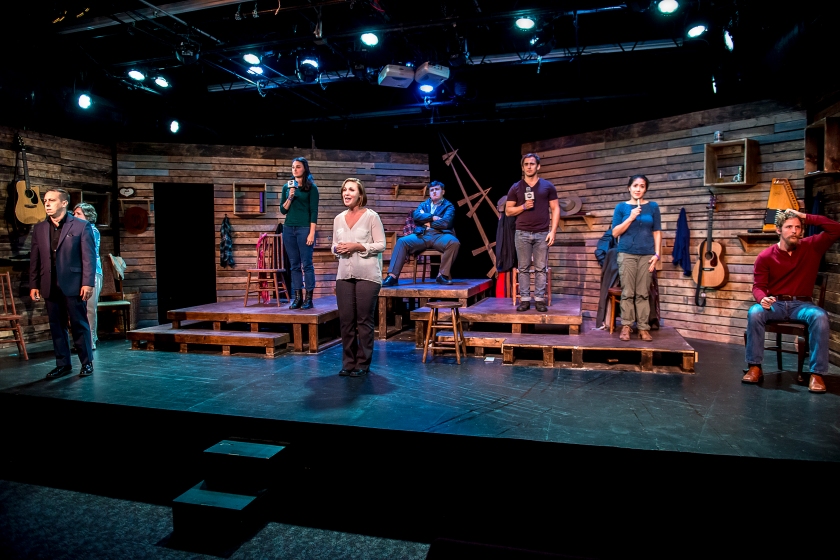
The beauty of the script lies in its unadorned simplicity. Eight actors portray about sixty different characters as they examine the story from the perspectives of the people of Laramie, students and faculty at the university, the media, and the personal experiences of the members of the Tectonic Theater Project.

Running nearly three hours with two intermissions, director Lucian Restivo has maintained a moderate pace that allows the characters to come across as authentic and feels almost like real time.  Multiple perspectives are presented, friend, foe, and undecided. From incident to trial, some points of view shift as people examine themselves and some are surprised at what they find inside.

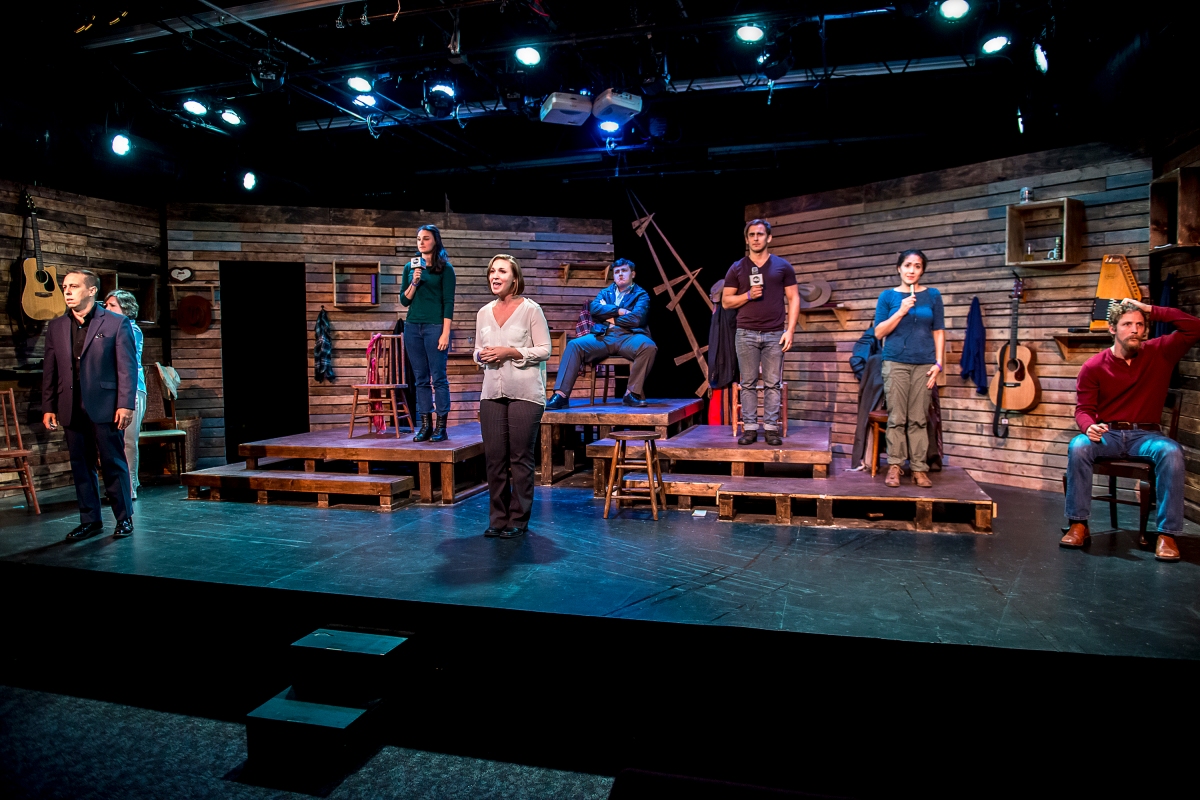
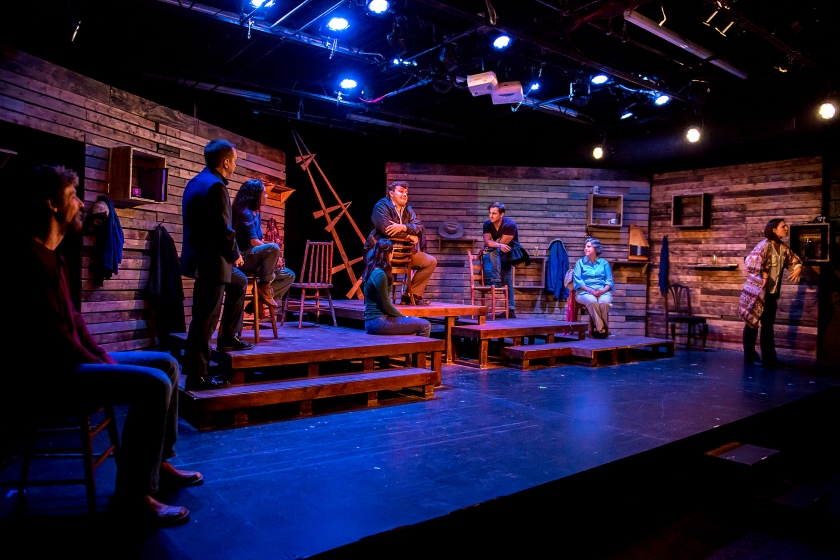
The Laramie Project is set in a rustic space of wooden walls and shelves with a few chairs on multiple levels designed by Restivo, who also designed the sound, and with lighting by Michael Jarett that sometimes resembles sepia-toned photographs. The physical tone almost makes this play feel as if it is dragging the viewer back in time into the wild, wild west, although the events took place only twenty years ago. The more striking and unfortunate thing is that this sort of hate crime could have been stripped directly from the latest breaking news.

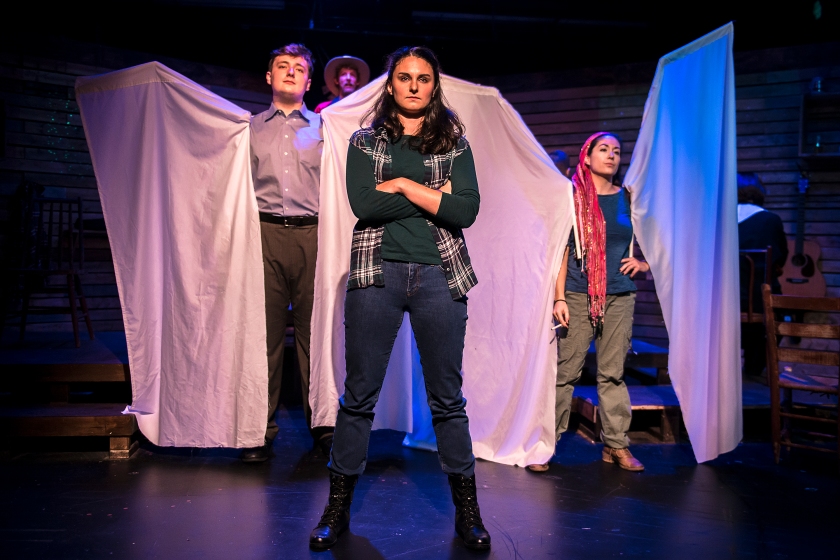
The excellent cast consists of Rachel Dilliplane, Annella Kaine, Amber Marie Martinez, Cole Metz, Jacqueline O’Connor, Stevie Rice, Adam Turck, and Scott Wichmann.  It would be difficult and unfair to speak of specific characters, as at any given time each of these versatile actors switches from one role to another, changing voice, accent, stance, and perhaps a shirt or hat. Scott Wichmann is often placed in the role of narrator, as project leader Kaufman, and some much needed humor is provided by O’Connor as a spunky citizen and Rice as an outrageous limousine driver.

The Laramie Project is difficult to watch because it is so real and because people involved in the incident are still alive. No details of the attack on Matthew Shepard are spared as the doctor and judge provide blow by blow details of the attack and its effects, leading to coma and eventually death. There is a section of documentary footage, and there are the incomprehensible protests by the Rev. Fred Phelps and his Westboro Baptist Church, whose members are known to show up to protest at the funerals of gay people. We get to hear the words of the two assailants, Aaron McKinney and Russel Henderson, as they are sentenced after their separate trials. Their images surround the audience in 43” x 43” oil pastel portraits by artist Michael Pierce.

The Laramie Project is an all-encompassing theatrical experience that requires a huge team effort. There are actors, a team of writers, a large creative team, community partnerships, and the Matthew Shepard Foundation, which is dedicated to human rights advocacy. It’s hard to tell where the play stops and real life begins. But the tears. . .the tears are all real.


Julinda D. Lewis is a dancer, teacher, and writer who was born in Brooklyn, NY and now lives in Eastern Henrico County.

———-

Photo Credits: John MacLellan

Laramie_009-1
Richmond Triangle Players’ production of “The Laramie Project” runs through October 19 at RTP’s Robert B. Moss Theatre, 1300 Altamont Ave, Richmond, VA
Laramie_156
Scott Wichmann in just one of the many characters he inhabits in Richmond Triangle Players’ production of “The Laramie Project”
Laramie_313
Richmond Triangle Players’ production of “The Laramie Project” runs through October 19 at RTP’s Robert B. Moss Theatre, 1300 Altamont Ave, Richmond, VA
Laramie_555
Annella Kaine (center in just one of the many characters she inhabits (along with Cole Metz, Stevie Rice and Amber Marie Martinez) in Richmond Triangle Players’ production of “The Laramie Project”

Laramie.3

THE WOLVES: Game On

THE WOLVES: Girls with Goals

A Theater Review by Julinda D. Lewis

By: Cadence Theatre Company in partnership with TheatreVCU

At: Raymond Hodges Theatre at the W.E. Singleton Performing Arts Center, 922 Park Avenue, RVA 23220

Performances: September 27 – October 7, 2018

Ticket Prices: $5.00 – $19.99

Info: (804) 828-6026 or VCUtheatre.showclix.com

An unexpected collaboration of Cadence Theatre Company and TheatreVCU + an unusual play about teen-aged girls by Sarah DeLappe = an intriguing production of sometimes intense situations that portray the multiple dimensions of young women on their way to adulthood.

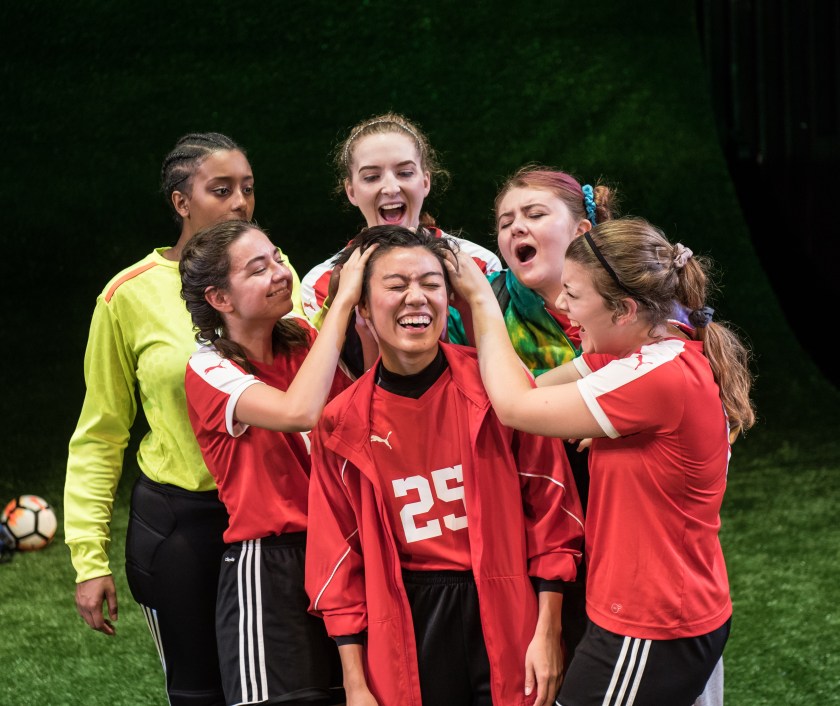
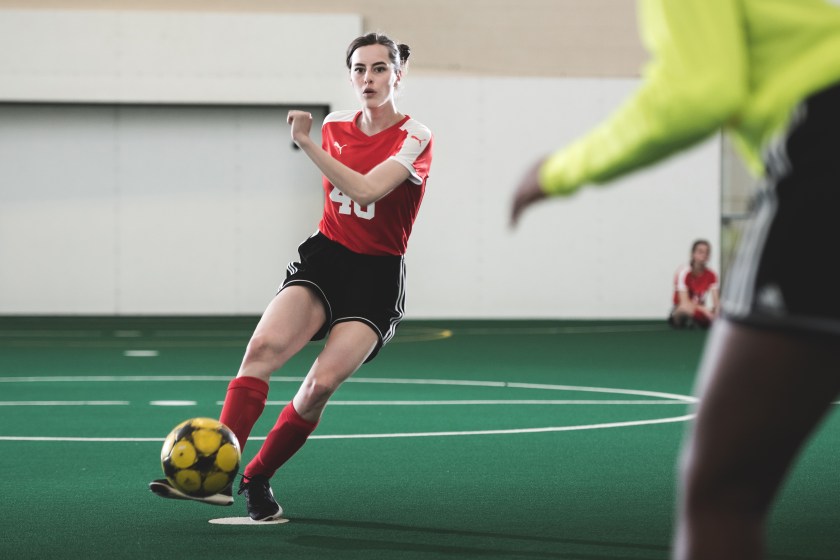
Running about 90 minutes without intermission, each scene in The Wolves shows the nine-member female high-school indoor soccer team preparing for their weekly game. The Wolves, by the way, is the name of the team. Initially they talk over one another, with multiple conversations occurring at once.  School work, boyfriends, the weekend, and menstruation are popular topics. US immigration policies are discussed in depth (the play premiered in 2016), as well as a lengthy dialogue on Cambodia and genocide. In addition to the usual teen-aged squabbles, there are accidents and injuries, hints of eating disorder and a possible same-sex relationship, and genuine, life-altering tragedy. We get to meet the girls as they warm up and prepare to meet their weekly opponents.

The author, interestingly, has chosen to identify the girls by their jersey numbers, rather than by name, although they do address one another by name. #25, Havy Nguyen, is the team captain but she might as well be the coach. #25 leads the warm-ups and they require genuine dedication to the running, jumping jacks, high knees, butt kicks, ball passing, and more. We learn, in bits and pieces, that the unseen coach apparently has a drinking problem, and at any rate, he is not nearly as popular as a previous coach who left to care for his ailing mother. I immediately wondered why Nguyen was wearing an ugly wig but the answer to that is revealed in the closing scenes.

#7, Jocelyn Honoré, is the team’s leading striker, but she has anger problems and a tendency to make poor decisions in life. #13, Anna Katogiritis, is the team clown, but has a bit of a mean streak and her humor always turns sarcastic.  #46, Emma Olson, is the new girl; home-schooled and well-traveled, she lives in a yurt with her mother, and struggles to fit in. The team goalkeeper, #00, Amari Cummings, is something of a prodigy: she plays the saxophone, chairs several academic teams, and has an astronomically high GPA. She also refuses to talk and has to throw up before every game.

Other team members include Katy Feldhahn (#14), Lydia Hynes (#8), Katelyn Shinn (#11), and Celeste Taica (#2). There are friendships and cliques and gossiping, but as the season passes, the girls become closer, and the audience begins to learn their personalities and quirks. Much like a Peanuts comic strip, the adults are largely unseen and unheard, with the exception of the Soccer Mom (Karen Kopryanski) who appears in the final scene, heart-rending scene. The girls are all TheatreVCU students, and Kopryanski is an assistant professor.

The Wolves is directed by Sharon Ott, Chair of the Department of Theatre at VCU with great energy and stimulating pacing that varies from frenzied action to well-placed silence. All the action takes place in an AstroTurf covered indoor arena; the floor curves upward into the ceiling. There are suggestions of actions taking place offstage, and one kick sends a soccer ball flying into the audience where it was bandied about for a bit before being returned to the playing field (as we were directed to do at the start of the show). Credit Dasia Gregg with the scenic design, Theo Dubois with the costumes, Christian DeAngelis with the lighting and Nicholas Seaver with the sound. In topic and tone, The Wolves strives to – and largely succeeds – in standing out from the pack.

NOTE1: I sat on the right side in the front row, and had no problem hearing everything, but a friend who sat in a middle row in the middle section said the sound quality was problematic.

NOTE2: A smile to #4 and #9; the stagehands who came out in uniform to set a scene!


Julinda D. Lewis is a dancer, teacher, and writer who was born in Brooklyn, NY and now lives in Eastern Henrico County.

———-

Photo Credits: Aaron Sutten

The Wolves-990Wolves.3The Wolves-849Wolves.2The Wolves-763Wolves.1

DARK SIDE OF THE MOON: 2018 Dogtown Presenter’s Series

DOGTOWN PRESENTER’S SERIES: Dark Side of the Moon

A Dance Review by Julinda D. Lewis

At: Dogtown Dance Theatre, 109 W. 15th Street, RVA 23224

Performances: September 21-29, Fridays & Saturdays at 7:00PM & Saturdays at 3:30PM

Ticket Prices: $20 General; $15 Students/Children

Info: (804) 230-8780, dogtowndancetheatre.com or https://darkside.brownpapertickets.com/


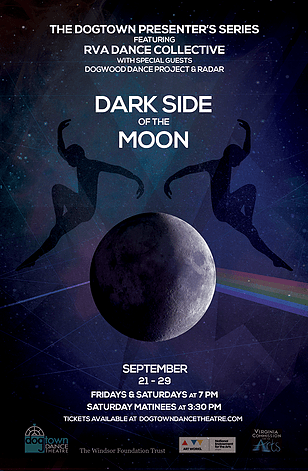
Dark Side of the Moon is Jess Burgess’ most ambitious project to date. Some eighteen years in the making, from inspiration to manifestation, this 40-minute long evening-length work is a celebration of movement in collaboration with Pink Floyd’s Dark Side of the Moon album, released in 1973 (the year I graduated from high school and started college). Dark Side of the Moon – the album – explores themes of conflict, greed, time, even mental illness. For choreographer Burgess, Dark Side of the Moon is about “philosophical and physical ideas that can lead to an unsatisfied life, and ultimately to a person’s insanity.” For me – a product of the inner city and modern dance classes, who had no experience with Pink Floyd – Dark Side of the Moon, the collaborative dance work, is a satisfying amalgamation of movement wed to music that appeals equally to lovers of music and contemporary dance.

The ten sections flow seamlessly and are named for tracks on the album, which was presented as a continuous piece of music with five tracks on each side. Performed by Burgess’ RVA Dance Collective in collaboration with Dogwood Dance Project, and RADAR, the 23 dancers move through a surrealistic environment with wooden boxes and columns on either side of the stage and two large constructions dominating the upstage corners. On one side is a large drum-shaped moon that is sometimes occupied by a dancer walking or running like a hamster in a wheel, and on the other is an impossibly tall slide that dancers use for entrances. The dancer-friendly décor was created according to Burgess’ mental image and executed by artist Mike Keeling.

The movements are often simple: a line of dancers move in unison or canon, occasionally interrupted by bodies unexpectedly popping up or dropping down like figures in a game of whack-a-mole; boxes are rolled out with dancers posed inside or perched on top. At other times an aimless walk turns into a scattered, wild run, with one or more dancers attempting to scale the giant slide or leaping into the arms of a partner. Even when at its most simple, the movement is layered – much like the music – as some dancers wait or watch while others interact, or a line of dancers moves in unison as a small group of five or so create more complex patterns in space by rolling, tumbling, twirling with arms uplifted like whirling dervishes or spinning with a partner like children pretending to be a pinwheel.

Sometimes one isn’t quite sure where to look as the movement lines draw the eye across the stage. Who’s in the box? Who’s coming down the slide? What are they going to do next? The music, the movement, and the visual set and ethereal lighting – often from the side – are complemented by costumes that start off mostly in soft, earthy tones and flowing fabrics but gradually morph into black and gray athletic wear.  From soulful to jazzed up instrumentals to cash registers ringing and synthesizers, the music suggests concepts that are reflected in the movement. The three dance companies were so well integrated that even though the program specified which company or companies were performing it was never obvious that this was not one unified group. I am sure my experience as someone new to Pink Floyd was very different from that of someone who knew the music, who grew up with the music, but this work was so well integrated that it could be experienced in multiple ways – and I am convinced that seeing it a second time will result in an entirely new and equally valid experience.

Dark Side of the Moon is a beautifully conceived and executed work of art that fulfills a need in the Richmond dance scene.


Julinda D. Lewis is a dancer, teacher, and writer who was born in Brooklyn, NY and now lives in Eastern Henrico County.

———-

Photo Credits: Dave Parrish Photography

VICTOR, THE TRUE SPIRIT OF LOVE: Love, Light, and Faith; the Healing Power of Dance

The Latin Ballet of Virginia: VICTOR, THE TRUE SPIRIT OF LOVE

A Dance Review by Julinda D. Lewis

At: The Grace Street Theater, 934 West Grace Street, RVA 23220

Performance: September 7-9, at 7:30 p.m. Friday, Sept. 7, 4 p.m. and 7:30 p.m. Saturday, Sept. 8, and 4 p.m. Sunday, Sept. 9.

Ticket Prices: $10-$20

Info: (804) 828-2020 or http://www.latinballet.com

I’ve seen many performances by the Latin Ballet of Virginia (LBV) over the years. Some have been fiction, some fantasy, and others, like, Victor: the True Spirit of Love, are based on fact. But this one was different. This one touched my heart and had me weeping unashamedly in my seat.

Unlike many LBV programs, this one did not have elaborate scenery, although there were larger-than-life projections of photographs from Victor Torres’ life, scenes from the documentary about his life, and background photos of buildings and cars and alleyways representing Brooklyn, NY in the 1960s. These projections were often so well integrated into the live performance that they became part of the choreography.

Rather than a range of choreography representing the Latino music and dance, heritage, and history, there were poignant selections ranging from R&B to Mambo to Christian songs and instrumental music. Some were upbeat, but all seemed carefully chosen to help carry the emotion and narrative of the story, using movement and music and very few words – so when words are used they have the utmost impact.

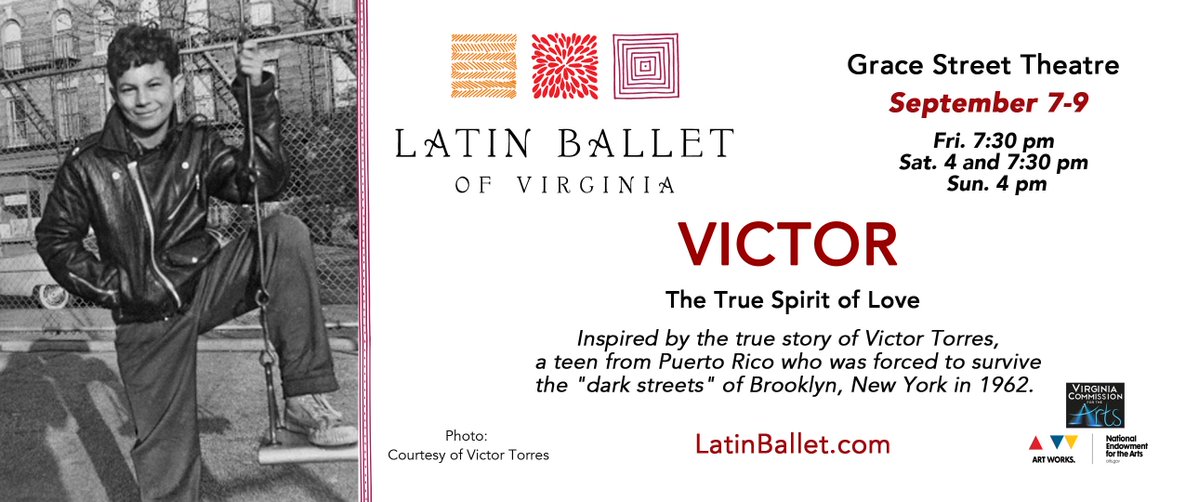
Victor tells the story of Victor Torres, a former gang member and drug addict and current pastor of the New Life for Youth Ministries and New Life Outreach Church, right here in Richmond, VA. But more than that, Victor is a story of redemption, of hope, of people helping people. It is a story of victory. It is about finding God, but it is not about religion. It is about faith, but it does not preach. It is about the power of a mother’s love.

It’s not so much the choreography, which is sometimes powerful but mostly quite simple. It is not so much the dancers’ technique, which is sometimes quite stunning, but sometimes uneven – involving, as it always does, both professional and pre-professional dancers and children. But the collaboration of all the elements, culminating in the surprising appearance of three graduates of Pastor Torres’ program as their recorded images and voices give testimony of their dark past and hopeful present – and shines light on their future. This is dance with a purpose that is more than just entertainment. It tells a story. It offers the possibility of healing.

Pastor Torres came onstage after Saturday evening’s performance to take questions, and to offer congratulations to the performers. Roberto Whitaker danced the role of the young Torres – bringing the man himself to tears, by his own admission. Whitaker, who I have watched grow from a promising young hip hop dancer to a versatile professional, led the company, appearing in nearly all of the twelve scenes, from a hip hop and capoeira infused fight (“The Roman Lords”) to a 1960s style jitterbug (“Rock & Roll with My Mama”) to acted and pantomimed scenes of overdosing and recovery and a lyrical dance duet of faith with his savior. Artistic director Ana Ines King danced the role of Victor’s mother, Layla, and with her usual enthusiasm moved from mambo (“It is Mambo Time!”) through ballet, modern, and lyrical (“The Power of Mother’s Love” and “La Esperanza/Our Only Hope”), with an extra dose of drama (going into her prayer closet, and running to the rooftop to save her beloved son from being tossed off by gang members).

Teri Buschman and Marisol Cristina Betancourt Sotolongo made beautiful angels, while DeShon Rollins wore white as the spirit of hope and the saving grace of love. The scenes featuring four of the company’s men were powerful and beautiful, whether they were fighting or creating a smoke-filled, surrealistic scene of drug-fueled gang activity. This production would be a valuable contribution to the programs of churches, community centers, and youth agencies. I’ll just close with the words of the final selection, “Si Dios ama a un rebelde como yo, todo es possible/if God can love a rebel like me, anything is possible.”

Julinda D. Lewis is a dancer, teacher, and writer who was born in Brooklyn, NY and now lives in Eastern Henrico County.

Photo Credit: Jay Paul

Video Link: Victor, motion picture, official trailer: https://youtu.be/m9ub4w-DJVg

Video Link: One More Life, the Victor Torres Story, full documentary: https://youtu.be/i2UlLWJQFZY

This slideshow requires JavaScript.


RICHMOND DANCE FESTIVAL 2018, Week Two: A Little Night Dancing

RICHMOND DANCE FESTIVAL 2018: Week Two, in Which Imagined Deities Shift the Permeating Presence of the Fantastic Plums of Paw Creek

A Dance Review by Julinda D. Lewis

At: Dogtown Dance Theatre, 109 W. 15th Street, RVA 23224

Performances: April 27-28, May 4-5 & May 11-12 @ 7PM + Next Generation May 5 @ 2:30PM

Ticket Prices: $15 General; $10 Students/Children

Info: (804) 230-8780, dogtowndancetheatre.com or https://rdf18.brownpapertickets.com/

Oh my – I was completely blown away by Week Two of Richmond Dance Festival 2018. Eight works: five live dance performances and three dance films and each and every one of them was engaging and compelling. Normally, I would not talk in detail about each work on a lengthy program, but each of these dances and films is deserving of its own mention.

The program opened with Permeating Presence, a quartet by Maryland-based LucidBeings Dance choreographed by Franki Graham and Jeanna Riscigno. The movement comes from the inside out, and is affected by gravitational pull, variable balances, and other outside forces. The words that come to mind in describing this dance are organic and organism. There is a fascinating juxtaposition of nature and science fiction, which provided a natural segue into British filmmaker Barney Cokeliss’ short film, Night Dancing. This mysterious and intriguing dance film has a narrative involving a man who is haunted by the bitter sweet memory of a dancer, a lost love who may or may not be real.

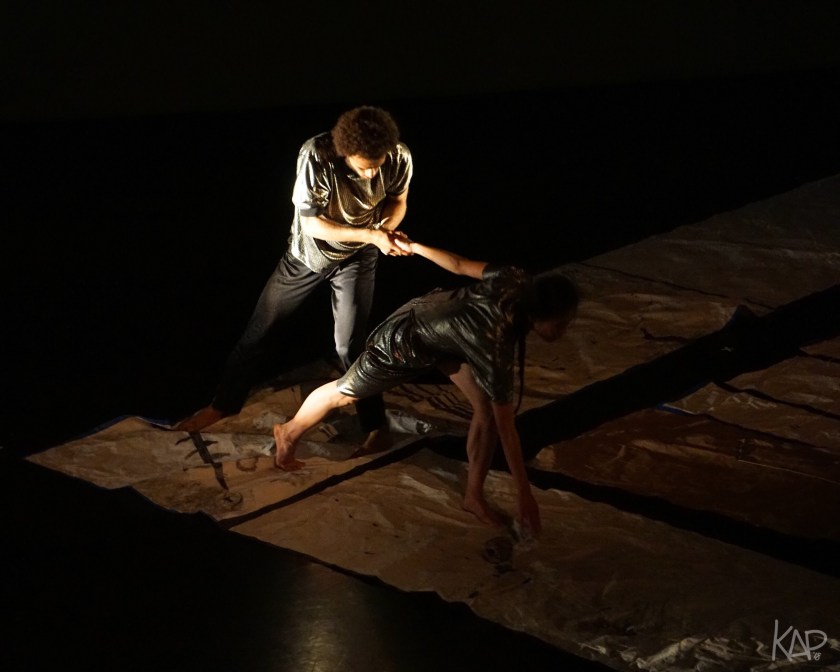
Adventure of Fantastic Plum, choreographed and performed by Ching-I Ching Bigelow and Marsell Chavarria of Nina Simone’ – an embryonic “dance practice project” that embraces improvisation and “people/environment watching.” The pair initially caught our attention with their elaborate preparation; they created a stage-covering pathway of crinkly tarp that wound around the edges of the floor, ending in the center with a colorful pile of clothes or fabric. Bigelow and Chavarria travelled this path, sometimes struggling, sometimes helping one another. Along the way, they danced a bit of salsa and some West African dance steps, and at one point simultaneously balanced on one leg with the other suspended in an impossible position for an insane amount of time. Their journey ended n the center with a rather violent tussle, ending in a sea of calmness. The original score included narrative about “patterns of love in people of the diaspora” and the “loss of home place.” It reminded me of earlier ancestor-conscious works by LaWanda Raines, Kevin LaMarr Jones/Claves Unidos, and Annielille Gavino-Kollman/Malayaworks and seemed to share DNA with the work of Alicia Diaz, seen in the second half of this program.

The first half of the program closed with Francesco Belligerante’s short film, Sifting, filmed in China at several beautifully diverse locations, including a mountain museum and a dam. Beginning with the dancers running through stone or cement corridors, up ramps and up long flights of stairs, the scene suddenly changes to mountains and water, and the dancers slow down, arms wide, heads back, reminding us to take the time to connect with nature and enjoy the moment.

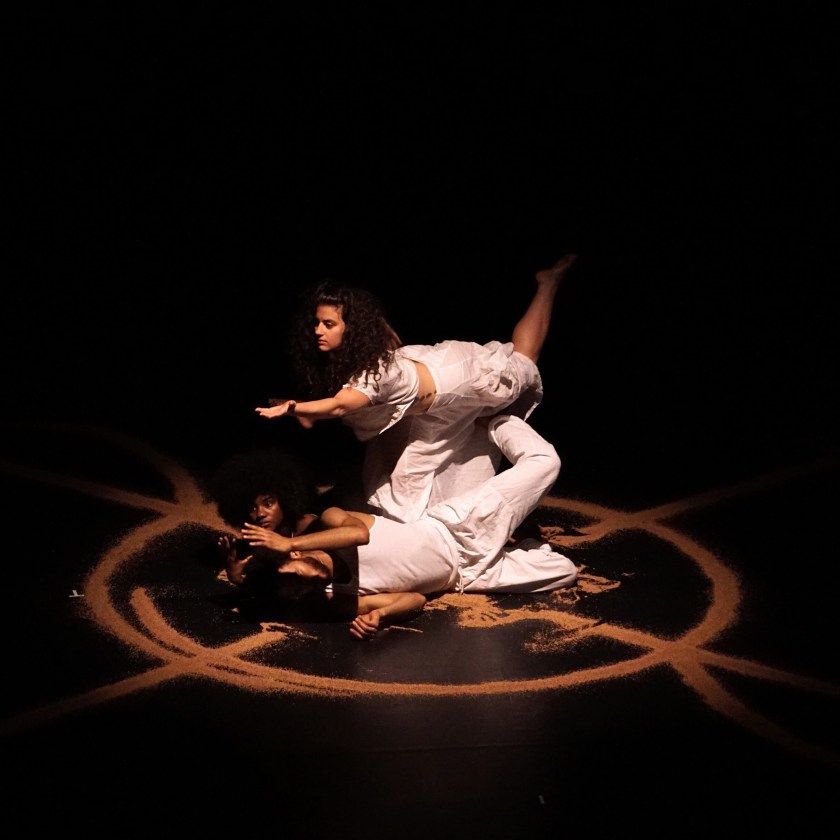
The second half of the program began with Richmond-based choreographer Alicia Diaz/Agua Dulce Dance Theatre’s Portrait of an Imagined Deity. The dancers and Diaz painted a large mandala on the floor with colored sand – a combination of male and female symbols, the peace symbol, and perhaps other images as well. Shoulders back, hips forward, buttocks up, the trio of dancers, all dressed in white, performed a series of vaguely tribal, universally familiar rituals to percussive music, ending with the sound of crashing waves. The deity may have been imagined, but the humanity was real.

North Carolina-based Eric Mullis initially reminded me of a dance minister I had met and worked with at a conference in Dallas, so it should have come as no surprise when his solo, Paw Creek, turned out to be a powerful display of sometimes fractured movement performed to an original score featuring an audio sampling of a charismatic Pentecostal minister.

Curing Albrecht, the third and final film, turned out to be an amusing turn by the English National Ballet. In this beautifully produced short, filmed in the Victoria Baths, a man checks himself into an institution, seeking a cure for his dancing addiction. [See the video here: https://youtu.be/pQYP96phKKE]

Finally, there was /Shift/, choreographed by Jeanne Mam-Luft and Susan Honer  of Mamluft&Co. Dance (in collaboration with the original performers, Rubio and Hannah Williamson). Tense and confrontational, dancers tentatively approach one another from opposite sides of the stage with extended, open hands – only to turn away, to jump as if singed by a hot wire, or to poke at one another with curiosity. At the end, as in life, nothing is resolved, and we are left with the hollow resounding words: “You are not machines; you are not cattle; you are men!”

I am not saying this program was perfect, just that I have nothing to complain about. This program will be performed again on Saturday night, May 5. On Saturday afternoon, the RDF Next Generation youth dancers will perform. The third and final weekend, May 11-12, will feature an all new program of choreographic works by RVA Dance Collective, Turning Key Dance, RADAR, Luisa Innisfree Martinez, KARAR Dance Company, and Megan Ross. There will also be films by Lulo Rivero (flamenco), Nick Zoulek, and Dylan Wilbur.

Julinda D. Lewis is a dancer, teacher, and writer who was born in Brooklyn, NY and now lives in Eastern Henrico County.

———-

Photo Credits: Richmond Dance Festival production photos by Kate Prunkl

Dogtown Dance Fest-1

Dogtown - RDF 2.5
Mamluft and Company
Dogtown - RDF 2.4
LucidBeings Dance
Dogtown - RDF 2.3
Eric Mullis
Dogtown - RDF 2.2
Marsell Chavarria and Ching-I Ching Bigelow of Nina Simone’
Dogtown - RDF 2.1
Christina Carlotti-Kolb, Christine Wyatt, and Marsell Chavarria with Agua Dulce Dance Theater

RICHMOND DANCE FESTIVAL 2018 @ DOGTOWN: Spring Has Sprung Diversity

RICHMOND DANCE FESTIVAL 2018: Bringing the World of Dance to Richmond – Week 1

A Dance Review by Julinda D. Lewis

At: Dogtown Dance Theatre, 109 W. 15th Street, RVA 23224

Performances: April 27-28, May 4-5 & May 11-12 @ 7PM + Next Generation May 5 @ 2:30PM

Ticket Prices: $15 General; $10 Students/Children

Info: (804) 230-8780, dogtowndancetheatre.com or https://rdf18.brownpapertickets.com/


The 5t Anniversary of the Richmond Dance Festival opened Friday, April 27 with a jam-packed program of diverse works. There was truly something for everyone (well, nearly everyone, if you’re that picky).

With ten works on the program – and three of those short films – it’s easy to get a sense of dance overload; shortly after leaving the theater, you can’t remember which dance was which! Phone numbers are seven digits because science has shown that the average human can accurately retain about seven chunks of information – and sometimes seven dances is pushing it! But, as usual, I digress.

Artistic and Executive Director Jess Burgess believes this years selection of eighteen choreographers and nine dance filmmakers is “an excellent representation of Dogtown’s vision to support all dance and movement artists spanning a vast variety of dance forms and backgrounds.” The first week’s program included local dancer and choreographers as well as artists who hail from as far away as Canada and even South Africa.

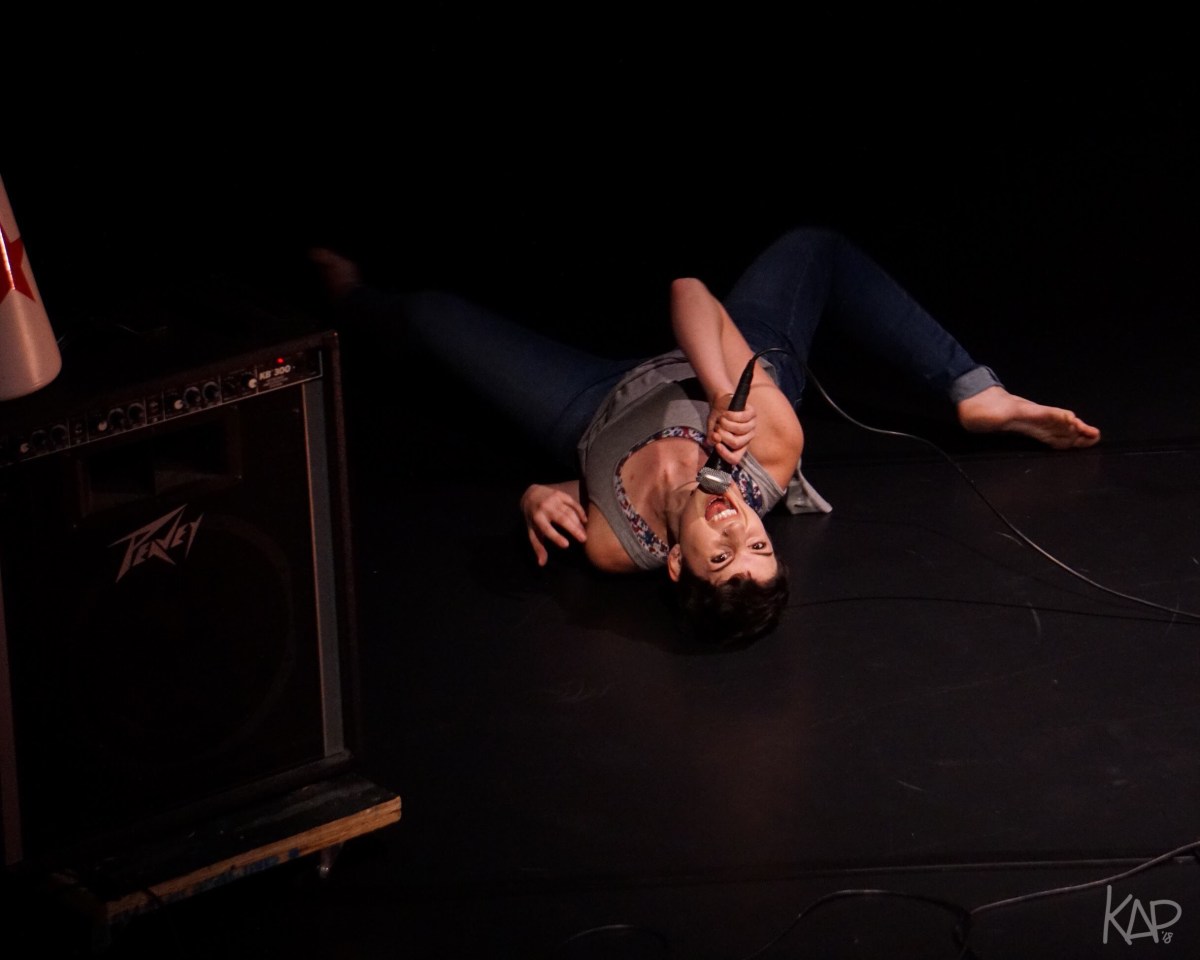
Four works particularly stood out for me. First, and possibly the most unusual of all, was Shane O’Hara’s True Confessions: My Boyfriend Mic. This is a fantastic ollaboration of stand up comedy, dance, music, spoken word, and experimental theatre – and it works! Dancer Sarah McCullough initially startles the audience by walking head first into a standing mic. As if to make sure we knew that was intentional, she did it again! McCullough proceeds to tell a somewhat fractured narrative from which we glean that her boyfriend is names “Mic” and he’s tall and skinny.  She dances with and without her “boyfriend,” sometimes using spoken word, sometimes dancing to music. She employs Broadway style jazz, acrobatics, and explosive movements of no predetermined genre.  At one point she dons a football helmet and later places black tape over her eyes and grabs a cheerleader-style megaphone or bullhorn.

True Confessions is bold and shocking and hilarious – a perfect way to end the first act. Choreographer Shane O’Hara, a Professor of Dance at James Madison University, is no stranger to the Richmond dance community and Dogtown Dance Theatre. Developed in collaboration with his daring soloist, O’Hara fashioned a dance theater work about “a lone female warrior. . .fighting passionately. . .to protect her heart.” Yep. That. And then some!

The second part of the program opened with Stewart Owen Dance’s duet, After Party, choreographed by founding partner Vanessa Owen, and performed by Owen and partner Gavin Stewart.  The Asheville, North Carolina-based company “aims to engage communities and maintain an environmentally conscious approach to art and performance,” but After Party is a sweet and amusing dance that contrasts elegant lines and poses and purely pedestrian transitions and humorous asides. My favorite? When Owen reaches into her lovely blue ball gown, removes the socks that have been padding her bosom and pull a pair onto her slim bare feet!

After Party is apparently a remake of a solo version, but I thoroughly enjoyed the inclusion of Owen’s bow-tied partner.  We don’t know whether the part of the title was a wedding, a ballroom dance, a banquet, or what, but it was apparently successful, and has left these two feeling tired, mellow, and in the mood to reminisce a bit for calling it a night.

I was also highly intrigued by S.J. Van Breda’s short film, Grey. Performed by Kioma Pyke and Kevin Navia who, between the two of them, attempt to singlehandedly cover multiple bases on the diversity front. Grey is about diversity, equality, race, and gender. The film depicts bold, strong images, mostly in shades of gray. Pyke, who appears to be, for lack of a better term, mixed-raced woman of color, begins with her skin and hair colored white, or pale gray. She dips hers hands into a bucket of chocolate-colored liquid and allows it to coat her skin. Her partner, Navia, who appears to be Asian and/or Latino and/or Native American, similarly explores the opposing end of the color spectrum.

Finally, I thoroughly enjoyed Subjective Dance Company’s OHMY! Adventures: Meet Queen Jeia. Performed by the SDAnimals crew, the five male dancers under the direction of Choreographer and Coach Greg Whitlock performed a high-energy, high-impact work that combined classis and contemporary hip hip with contemporary and jazz and other movement genres. The adventure is initiated or controlled, apparently, by a “battle box” and the competition-style movements include the sort of group unison and canon that we have grown familiar with from the televised dance competitions. Onstage, live, however, it is so much more fun! I was not quite clear on the mission to recover the missing dancer – where was he? How did the get him back? – but group Subjective Dance Company, also known as Subjective Dance Crew, is well on their way to fulfilling its mission to bridge the gap between stage and street dancing.

The July 27-28 program also included works by choreographers Taylor Black and Brianna Rivera; Jennifer Klotz of Stavna Ballet; films by Elian Djemil (The Flow), and Simone Wierød (Solus); a duet by Carolyn Hoehner and Emily Karasinski of DC-based Klynveldt&Peat; and a duet by Ilana Puglia of the Dogwood Dance Project. This program may be see once more, on Saturday, April 28, at 8PM.

Next weeks’ line-up: Lucid Beings Dance from Maryland/Northern Virginia; a short film by Barney Cokeliss; a dance by Nina Simone’, the love child of dance twins Ching-I Change Bigelow and Marsell Chavarria (a faculty member and student, respectively, from VCU Dance); a short film by Francesco Belligerante; Alicia Diaz’ Portrait of an Imagined Deity for her local group Agua Dulce Dance Theater; a solo by North Caroline-based artist Eric Mullis; a short film by Jessica Wright/The National English Ballet; and a collaborative work by Mamluft&Co Dance.


Julinda D. Lewis is a dancer, teacher, and writer who was born in Brooklyn, NY and now lives in Eastern Henrico County.

———-

Photo Credits: Richmond Dance Festival production photos by Kate Prunkl; images of Grey from the director’s website.


This slideshow requires JavaScript.

ONE IN FOUR: Nu Puppis’ Out of This World Comedy

ONE IN FOUR: An Out of This World Comedy

A Theater Review by Julinda D. Lewis

A Nu Puppis Production

At: The Firehouse Theatre, 1609 W. Broad Street, RVA 23220

Performances: April 20-28, 2018. Previewed on April 20; just two shows left at the time of this posting: April 27 & 28 @ 7:30!

Ticket Prices: $15 general/employed humans; $7 students & all others

Info: (804) 355-2001 or info@firehousetheatre.org


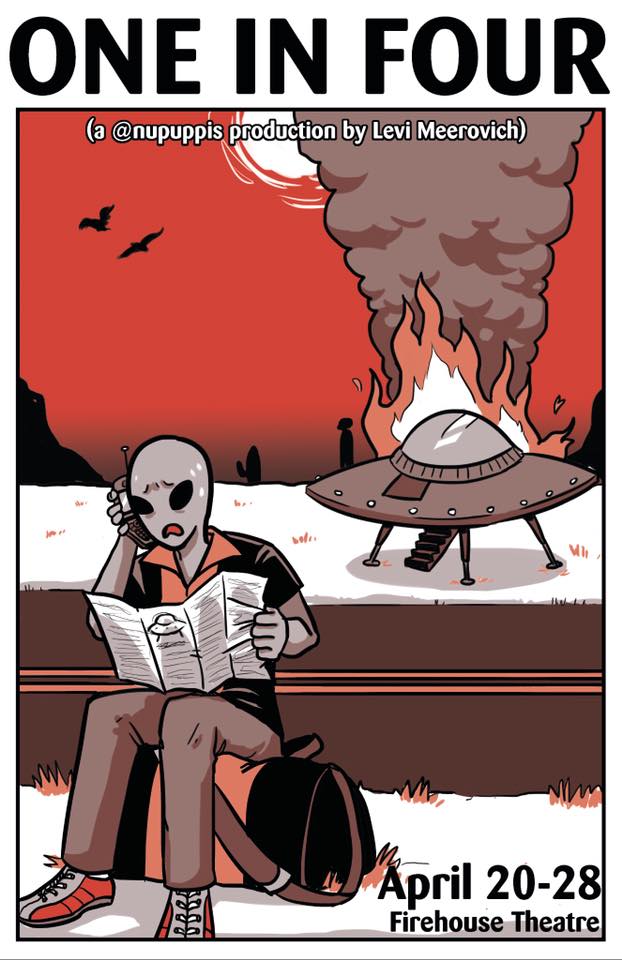
I left The Firehouse Theatre with a silly grin on my face and a question on my lips: what just happened here? Levi Meerovich’s madcap comedy, One in Four is ostensibly about four roommates who happen to all be aliens on assignment to Planet Earth. Unknown to each other, quite by chance they all end up living in the same apartment. (The experimental theater producing company, Nu Puppis, takes its name from a blue-hued star, although I have heard some pronounce the name as if it refers to infant canines.)

With its life-sized cutout of Robin Williams (in homage to Mork & Mindy, 1978-1982), a morphing portrait of Danny DeVito (Taxi, 1978-1983) on the rear wall, and numerous references to Seinfeld (1989-1998), the play, which runs just under an hour, with no intermission, is a wacky, unpretentious experiment that relies entirely on interesting writing and good acting skills. Remarkably, it seems that Meerovich was only 19 years old when he (recently) wrote One in Four; if so, he could only have seen these sitcoms and sit-com stars on reruns. The production is deftly directed by Connor Scully and Mahlon Raoufi.

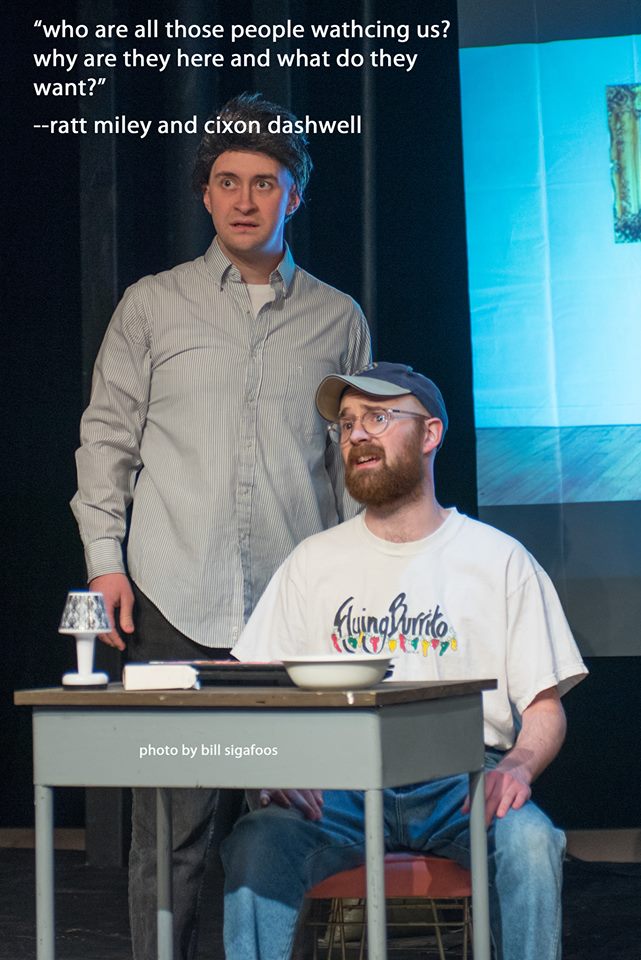
Dixon Caswell is the ostensible lead, Sid. It is, after all, Sid’s Portland, Oregon apartment that is the setting. Cashwell, a founding member of this theater group, has turned himself in a spastic, nerdy alien type who walks with a round shoulder, slack-armed gait and startles easily. Sid is given to spurts of f-bombs and follows his outbursts of temper with profuse apologies. He wears his Hawaiian shirt tucked in.

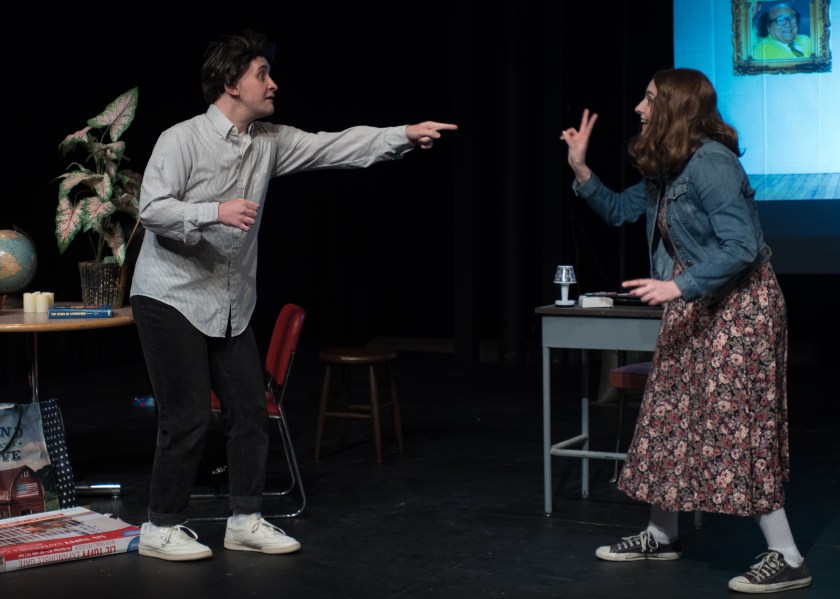
The first roommate to arrive is Lou, played by Matt Riley with a black wig that looks like a mullet turned backwards. Lou is very sensitive, and pretends to be from Louisiana, because it’s easy to remember. Next up is Carrie, a free spirit played by Jess Rawls. Last to arrive is Lucy, a tightly-wound character who carries a guitar she quite obviously cannot play, along with a shopping bag of raw steak that is not meant to be eaten. Lucy is played by Rachel Hindman. Each roommate must wait to be let in because the unlocked door keeps locking – one of several running jokes in a play that is all about the jokes.

Another is that each time one of the four inadvertently mentions the word “alien” the lights dim – one of the few lighting cues needed or noted. There’s not much in the way of a set either, just an odd collection of objects one might find in a thrift store or at the curb: a single school desk with a lady’s vanity chair, a round table with a globe, an uncomfortable-looking armchair, and a torso suspended from the ceiling that oddly enough has lights emanating from the leg openings.

There may or may not be anything important or deep or subversive about this play, and there doesn’t have to be. It’s funny. It’s hilarious. It makes you laugh. That’s all it needs to be. As Sid says, “If you give somebody a boat, they’re gonna row, even if they don’t know how.”


Julinda D. Lewis is a dancer, teacher, and writer who was born in Brooklyn, NY and now lives in Eastern Henrico County.

———-

Photo Credits: Bill Sigafoos


One in Four-3
Matt Riley and Rachel Hindman

One in Four-2

One in Four-4
Matt Riley and Dixon Cashwell