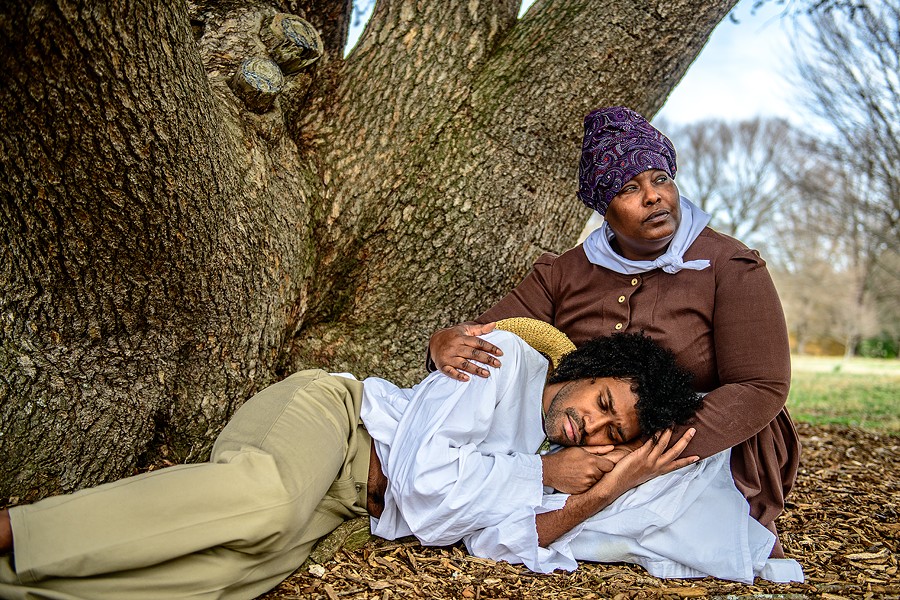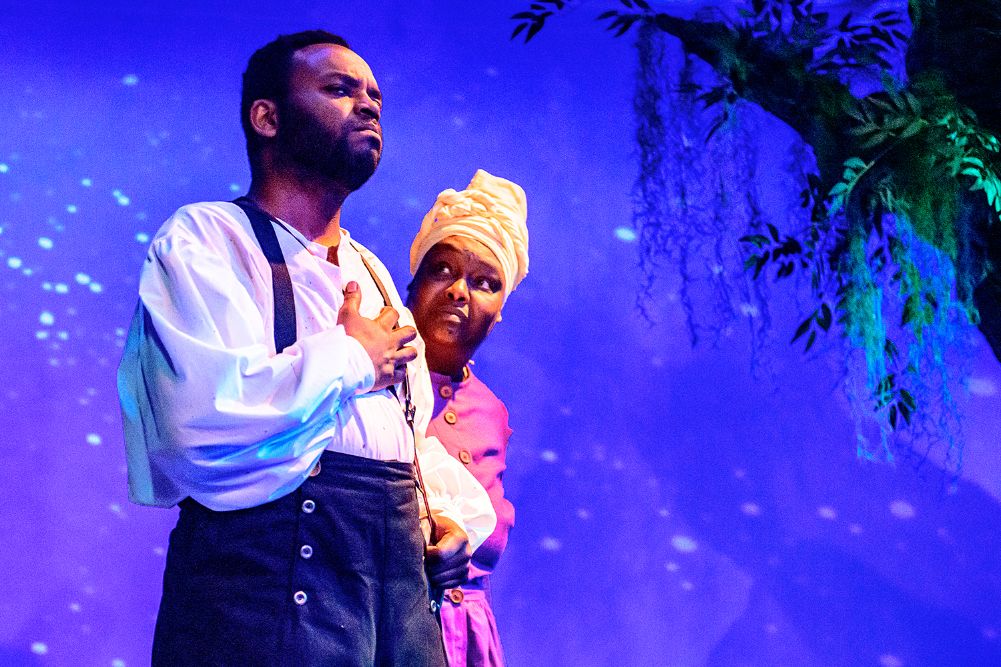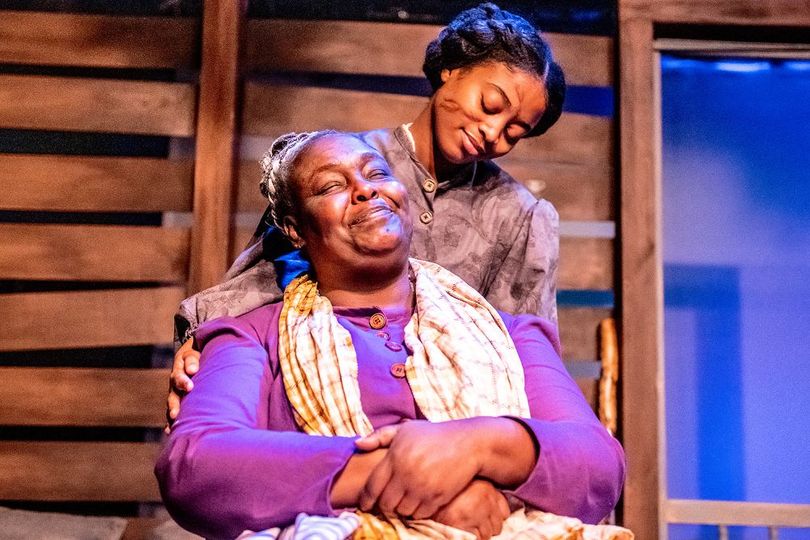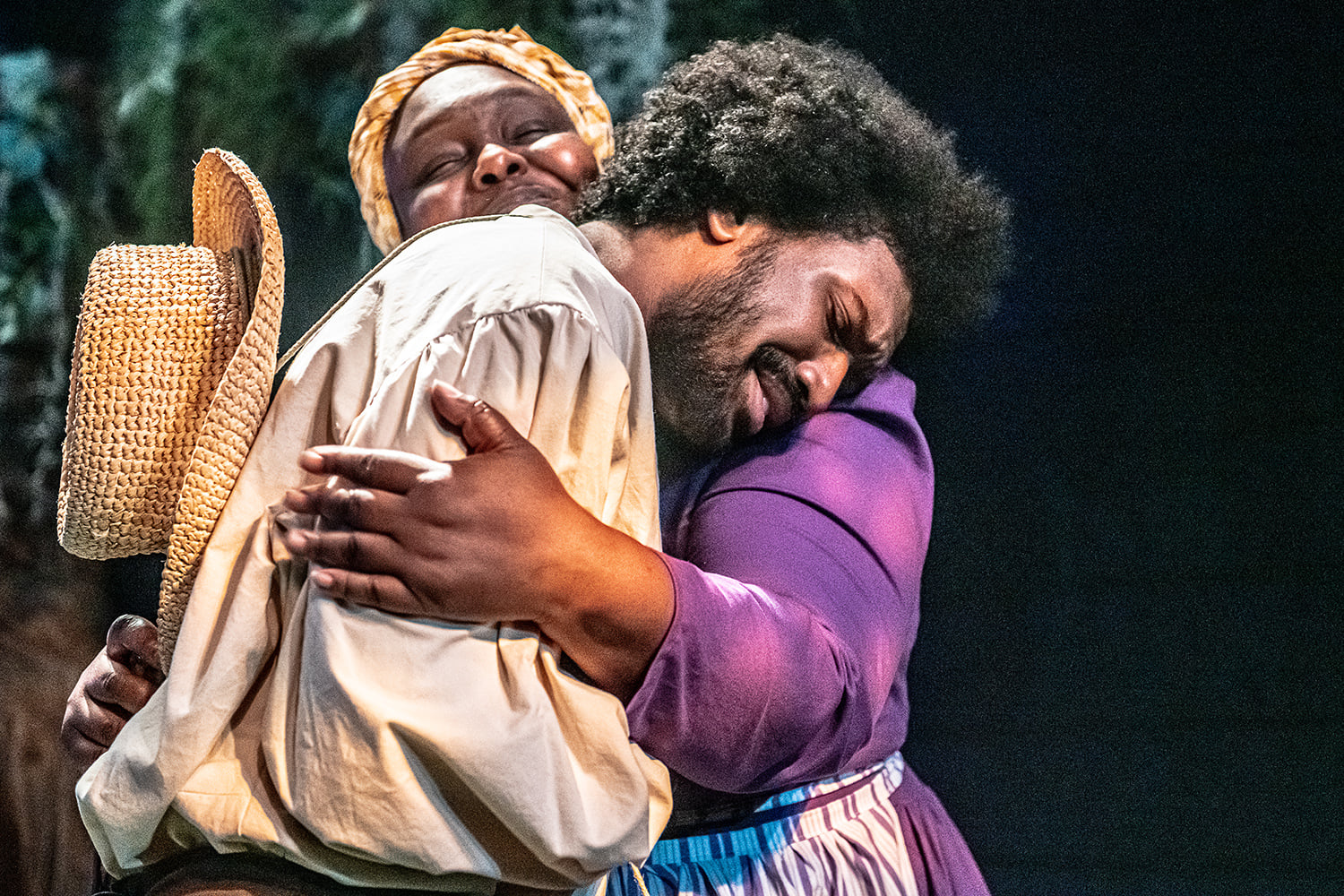
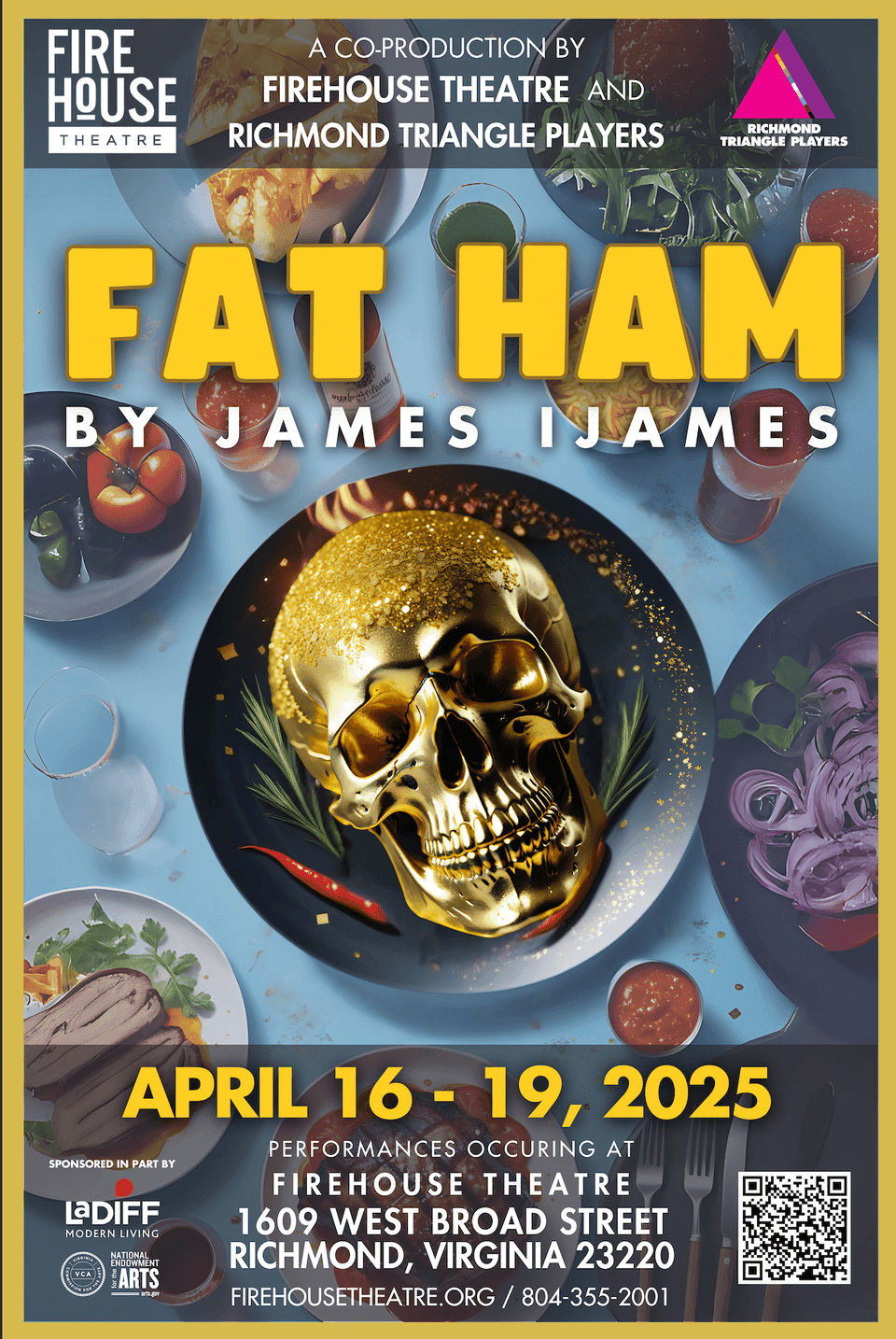
FAT HAM

A Co-Production of Firehouse Theatre and Richmond Triangle Players

A Reflection on a Unique Theater Experience by Julinda D Lewis

At: Firehouse Theatre, 1609 W Broad St., RVA 23220

Performances: April 16-19, 2025

Ticket Prices: $45 [all shows SOLD OUT]

Info: (804) 355-2001 or firehousetheatre.org

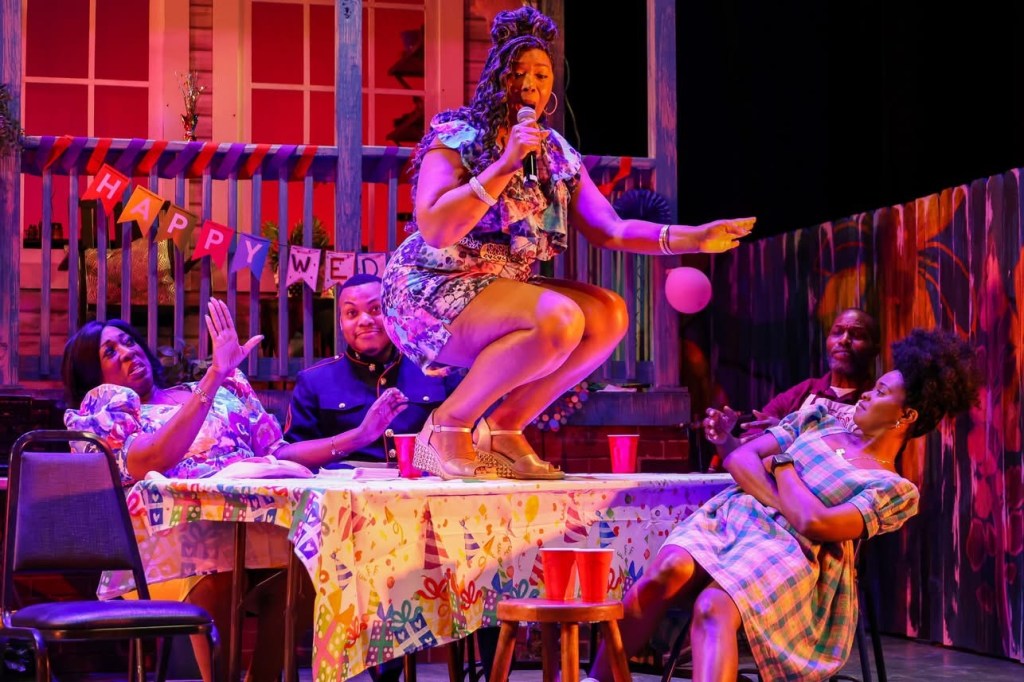
Fat Ham is what happens when Shakespeare gets invited to the BBQ and there’s brown liquor and the Electric Slide – the only thing missing is a game of Spades.

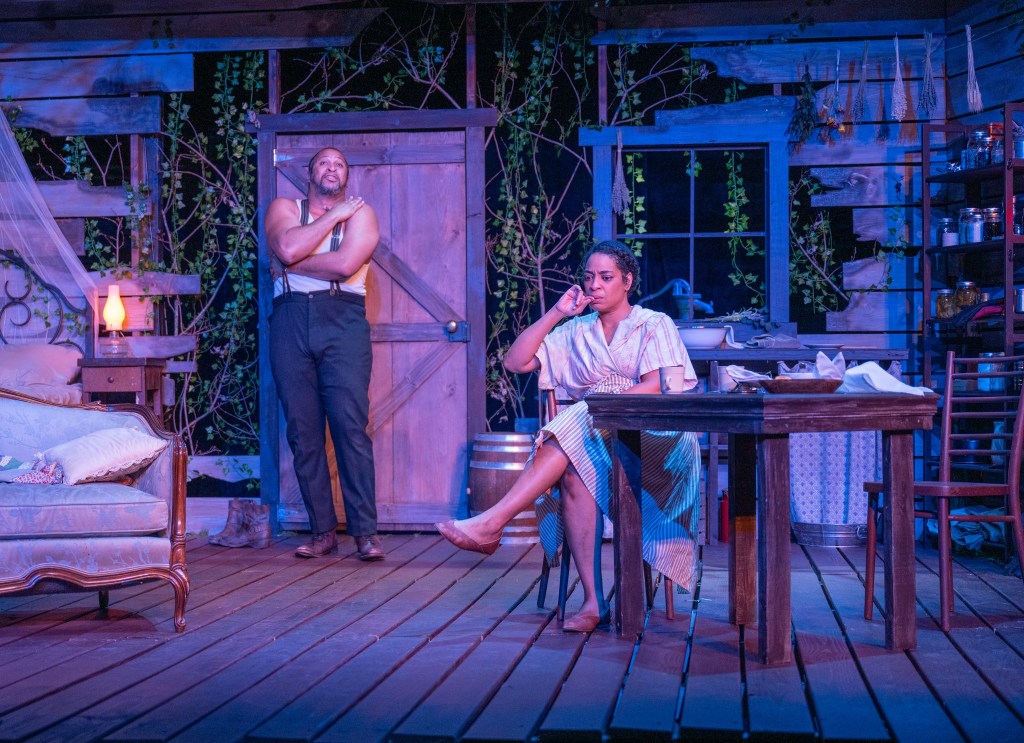
What is Fat Ham? James Ijames’ 2022 Pulitzer prize winning play is a modern-day take on Shakespeare’s Hamlet. Set in a small town in North Carolina (or Virginia, or Maryland, or Tennessee), Juicy’s father, Pap, has died and his mother, Tedra, immediately married her deceased husband’s brother, Rev. Mere moments into the contemporary tragedy (or tragi-comedy), Pap appears to Juicy and his friend Tio as a ghost. As if to make sure we get the “comedy” part of tragi-comedy, Pap has thrown a large white sheet, complete with pasted on black eyeballs, over his pristine white funeral suit and strolls into the backyard using the gate. I’m not the only one who wondered why he didn’t just walk through the fence, as his son, Juicy also asked why he wasn’t floating! Point made, he subsequently ditches the sheet and appears in his white suite with a wide-brimmed white hat and white shoes.

Named in honor of Shakespeare’s Hamlet and the BBQ restaurant owned by the play’s fictional family, Fat Ham is equal parts family tragedy and side-splitting comedy. Pap has roused himself from the grave to ask his son to seek revenge. Apparently, while in prison serving a sentence for stabbing a man, he himself became the target of a hitman when his own brother, Rev, has him killed. The plot thickens when Pap, Rev, and just about every other adult in his life           questions Juicy for being “soft,” calling him a sissy and other choice names.

As the drama unfolds, two of Juicy’s friends come – or get forced out – of the closet. Tedra’s conflict is also internal as she faces her own insecurities that make her think she can find her worth only in the arms of man. Criticism is met with a variety of explanations, all ending with, “it’s biblical” or  “it’s in the bible.”

There was plenty of drama off the stage as well. After a successful run in Norfolk earlier in the year, Virginia Rep was set to bring Fat Ham to the November Theatre but cancelled at the last minute due to their on-going financial problems that surfaced for the public in the fall of 2024. While it may be true that finances were the source of the cancellation, the optics were not good. Fat Ham is very much a Black and Queer play, and with all the controversy over Black History Month, DEI, and the like, well feelings were ruffled.

In what was a huge surprise to many if not most of us (the RVA theater community), the Firehouse Theatre, under the direction of Producing Artistic Director Nathaniel Shaw and Richmond Triangle Players, where Philip Crosby is Executive Director, joined together to co-produce Fat Ham with the same Norfolk cast that was originally expected to bring this production to the River City. The five performances were fully sold out before most of the general public even heard about the event. So, for many reasons, Fat Ham is not just any play, this was not just any production, and I felt blessed to secure a seat.

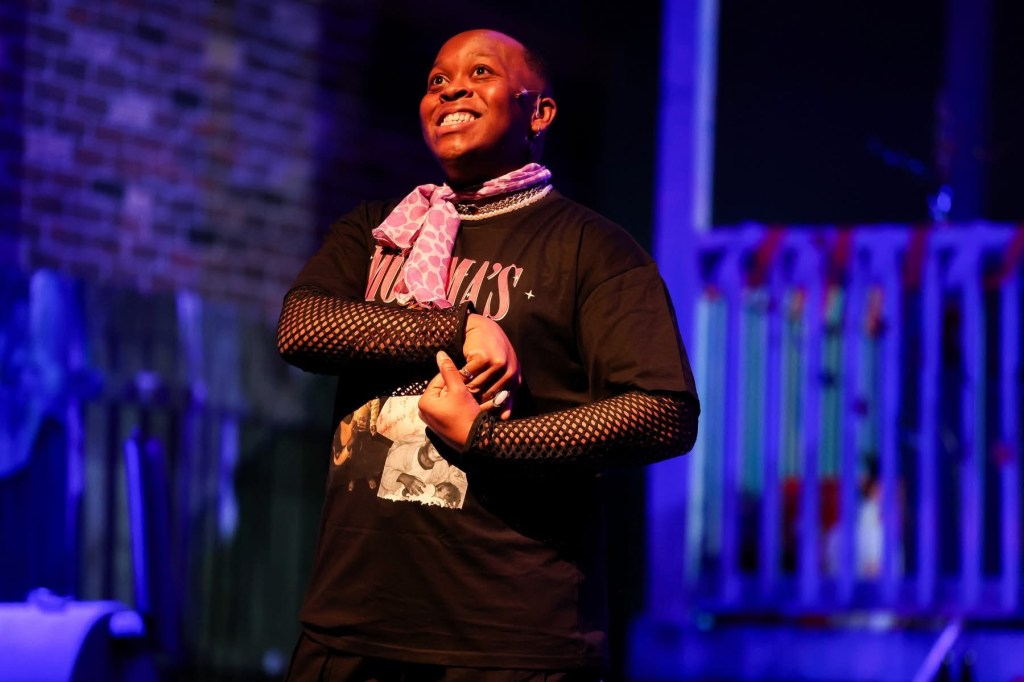
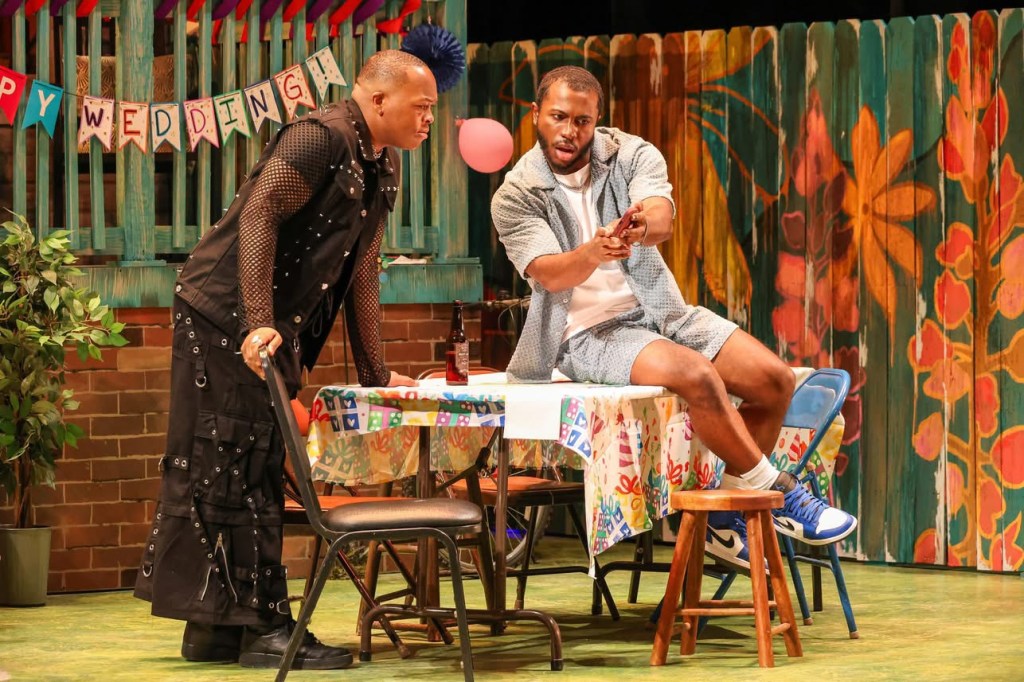
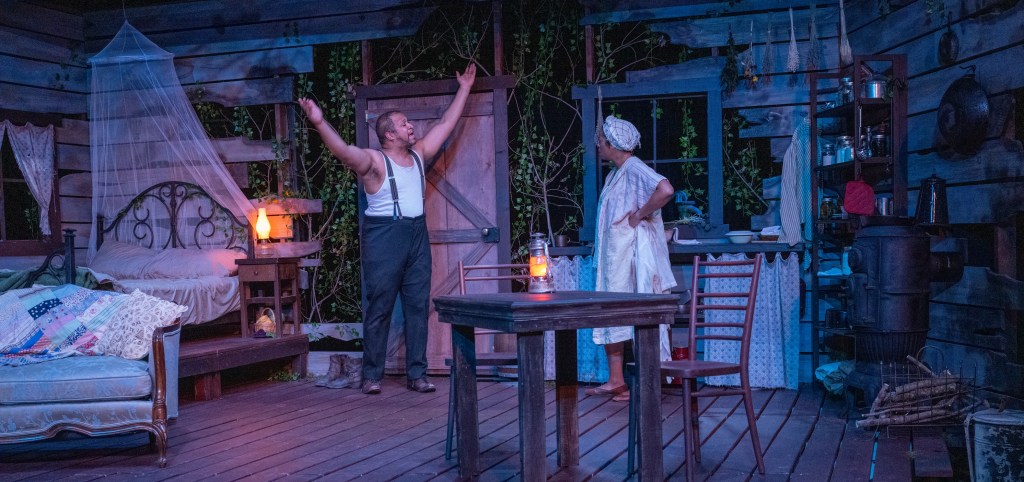
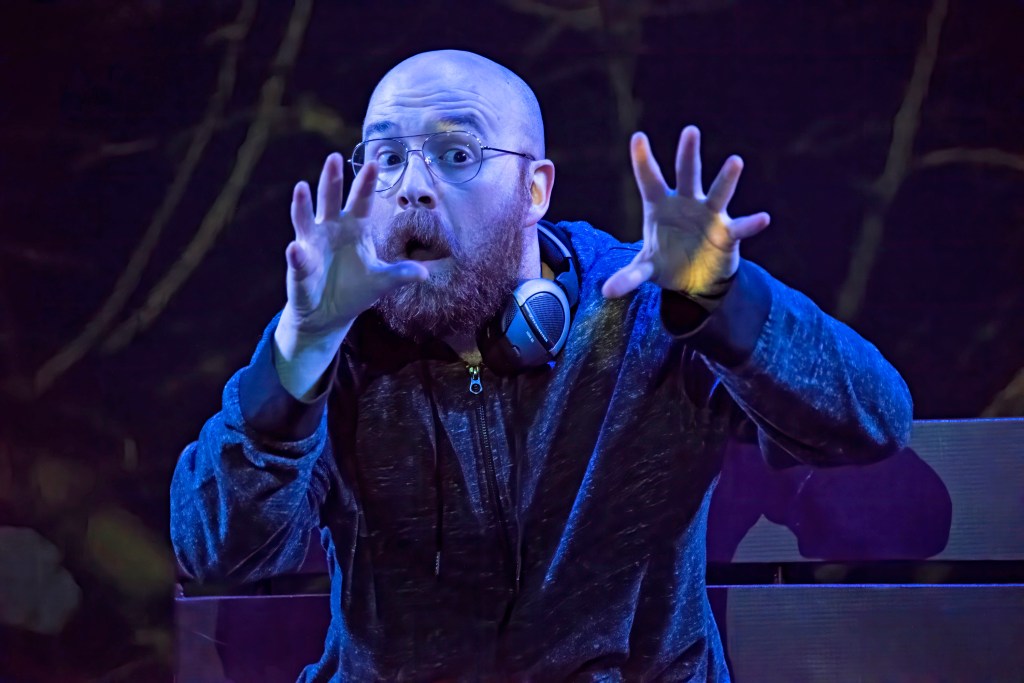
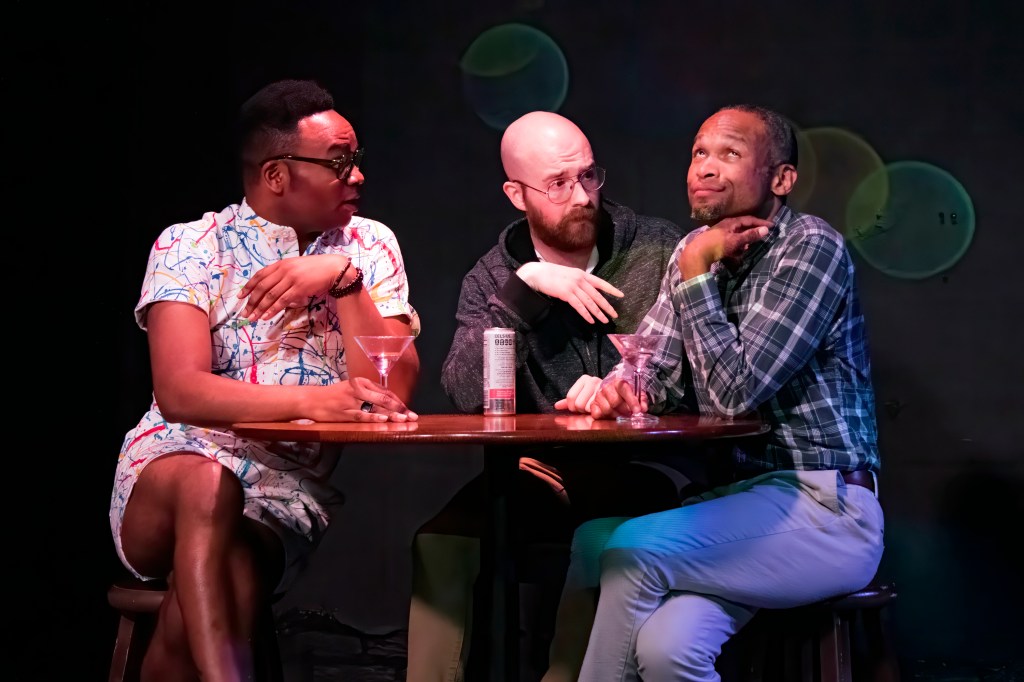
Bringing this show to life, complete with physical comedy, amazing soliloquys, some of which reference Shakespeare and some of which are taken verbatim from the bard’s Hamlet – such as  “what a piece of work is a man” – is a dynamic cast consisting of Marcus Antonio as Juicy/Hamlet, Kevin Craig West as Pap/the ghost of Hamlet’s father and Rev/Claudius, Cloteal L. Horne as Tedra/Hamlet’s mother, Gertrude, and Adam E. Moskowitz as Juicy’s/Hamlet’s sidekick Tio/Horatio. Notice the pattern that is beginning to emerge? Jordan Pearson plays Larry/Laertes, Janae Thompson is his sister Opal/Ophelia, and Candice Heidelberg is their mother Rabby/Polonius.

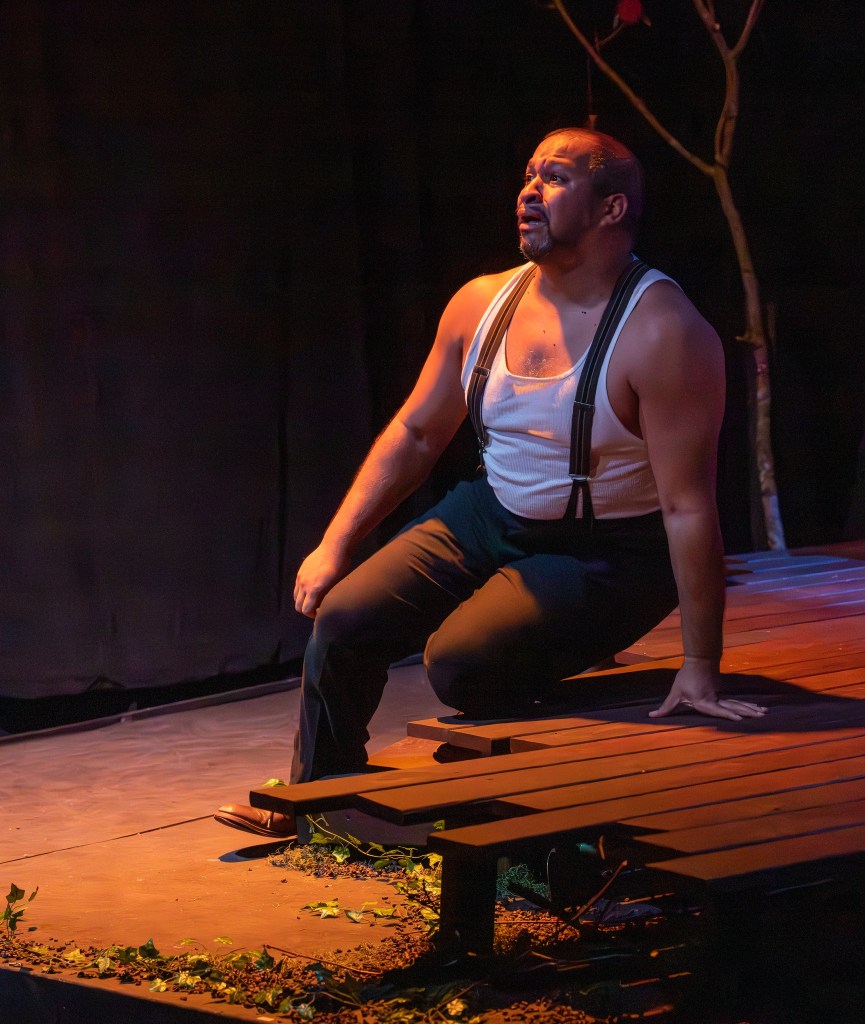
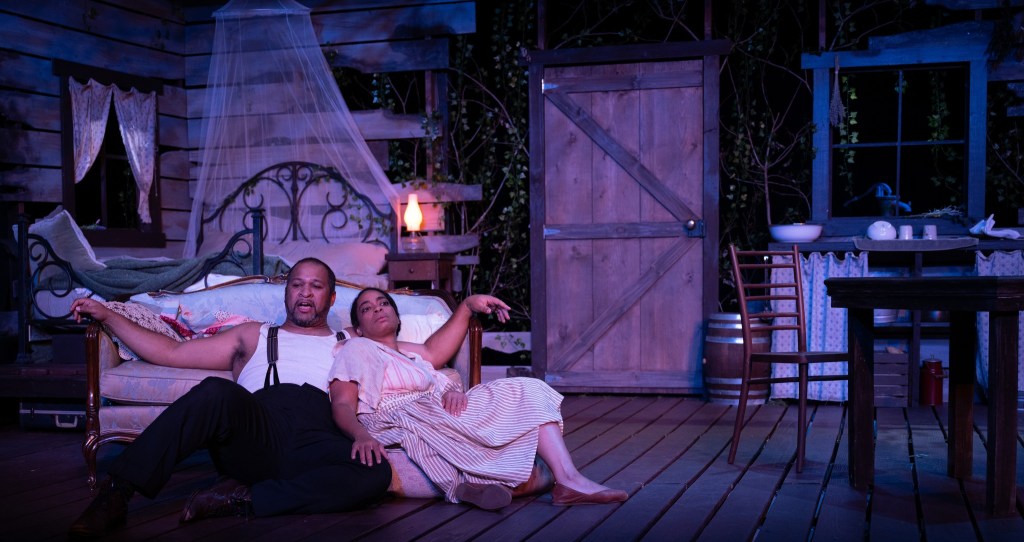
Antonio is alternately sly, soft, philosophical, and just generally endearing as Juicy (although I had a hard time swallowing that name, LOL). Horne is so over-the-top as his mother, Tedra, that the moments when she is serious are all the more powerful. She stands up for Juicy, refusing to allow Rev to spread his homophobic poison and at the same time, like most of the Black mothers I grew up in community with, was very protective of her son while maintaining a boundary that defined how people defined her and her life choices.

Jordan Pearson was a supporting character who came later on the scene but made a huge impact, transforming from a straight-edged marine to puffed sleeves, feathers, and a metallic gold head piece. Moskowitz – who reminded me more than once of a version of Spike Lee, perhaps from Do the Right Thingshared a bizarre sexual fantasy involving a gingerbread man, a snowball fight, and fellatio that had his character questioning the origins of his weed. It was the kind of story, a confession, that one has to blame on the weed, or on alcohol, in order to be able to hold one’s head up in public ever again!

Another memorable scene Moskowitz shared with Antonio involved Juicy asking his friend Tio about his shoes. This gives rise to another direct Shakespearean reference, “You remember Yurick?” It seems Yurick (who was not give a contemporary name) was Juicy and Tio dead friend, and Tio bought Yurick’s shoe at a yard sale being held to raise money for Yurick’s funeral.

Thompson’s Opal, unlike Ophelia, does not end in death by drowning – or any other means – but, rather, with affirmation and freedom. While her brother, Larry/Laertes, is not happy with the military life he is living to please his mother, Opal longs for it – it would provide her freedom she does not currently have as a woman, as a Black woman, as a Queer Black woman.

West, who played the unlikeable brothers Pap (God doesn’t want him and the devil won’t have him) and Rev (a blend of charming yet controlling as are most narcissists), redeemed himself – in the eyes of the audience and his fellow cast member – with a shocking and hilarious death scene.

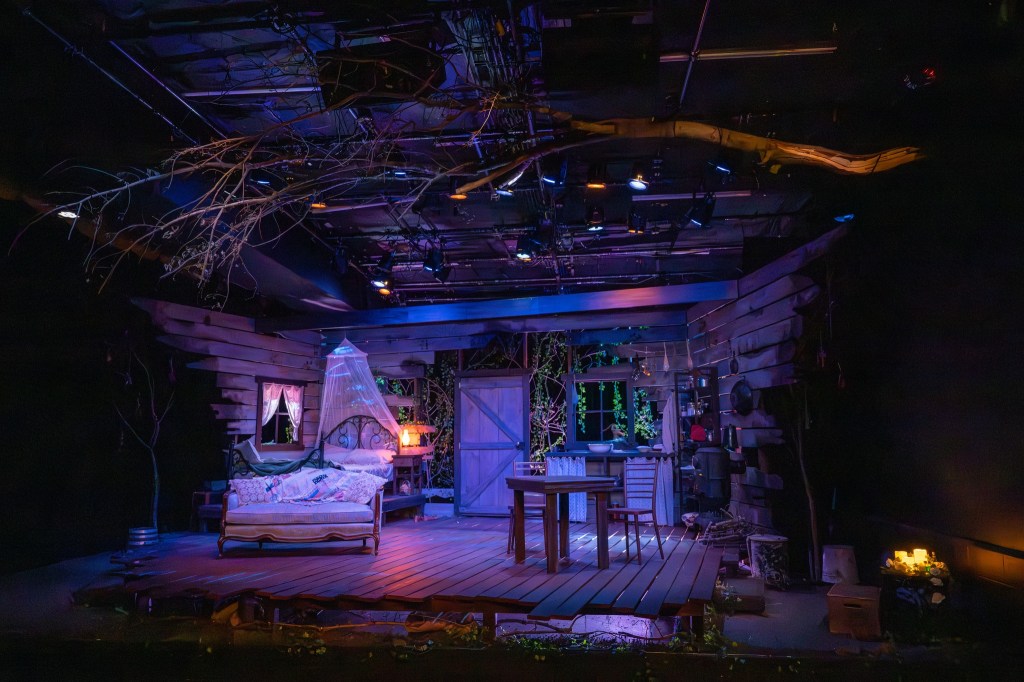
Unlike a Shakespearean tragedy that ends with most of the main characters dead and strewn about the stage, Fat Ham  ends with the cast breaking out in dance. (I believe the script may have originally called for a disco ball to descend at this point.) With the suddenness of this production’s manifestation, and the fun-size stage at Firehouse, it was not possible to transport the stage used in Norfolk, so Firehouse staff constructed a new set in 48 hours!

There is tragedy. There is the angst of young people seeking purpose. There’s the dysfunction that results from the machinations of adults trying to make the best of a difficult situation, the burdens society expects them to carry, and the weight of tragedy. There is also humor and an earnest attempt to make the best of whatever life throws at you. As Tio says, “Why be miserable trying to make somebody else happy?”

—–

Julinda D. Lewis is a dancer, teacher, and writer who was born in Brooklyn, NY and now lives in Eastern Henrico County. When not writing about theater, she teaches dance history at VCU and low impact dance fitness classes to seasoned movers like herself and occasionally performs.

—–

FAT HAM

Written by James Ijames

Directed by Jerrell L. Henderson

CAST

Marcus Antonio           …..        Juicy

Candice Heidelberg  …..        Rabby

Cloteal L. Horne          …..        Tedra

Adam E. Moskowitz   …..        Tio

Jordan Pearson            …..        Larry

Janae Thompson         …..        Opal

Kevin Craig West         …..        Pop/Rev

CREATIVE TEAM

Jerrell L. Henderson  …..        Director

James Ijames               …..        Playwright

Nia Safarr Banks         …..        Costume Designer

Caitlin McLeod            …..        Scenic Designer

Jason Lynch                  …..        Lighting Designer

Sartje Pickett                …..        Sound Designer

Kim Fuller                       …..        Production State Manager

Performance Schedule:

Wednesday, April 16, 2025   7:30PM  Opening Night

Thursday, April 17, 2025        7:30PM

Friday, April 18, 2025               7:30PM

Saturday, April 19, 2025         2:00PM

Saturday, April 19, 2025         7:30PM   Closing Performance

Run Time: about 1 hour 45 minutes with no intermission

Photo Credit:  Photos on Firehouse & Richmond Triangle Players Facebook pages by Erica Johnson @majerlycreative
One-Time
Monthly
Yearly

Make a one-time, monthly, or annual donation to support rvart review

Make a monthly donation

Make a yearly donation

Choose an amount

$5.00
$15.00
$100.00
$5.00
$15.00
$100.00
$5.00
$15.00
$100.00

Or enter a custom amount

$

Your contribution is appreciated.

Your contribution is appreciated.

Your contribution is appreciated.

DonateDonate monthlyDonate yearly

SUNSET BABY

A Virginia Premiere & A Directorial Debut

by BLK Virginia Theatre Alliance

A Reflection on a Theater Performance by Julinda D. Lewis

At: VirginiaRep Theatre Gym. 114 W. Broad St, RVA 23220

Performances: April 4-13, 2025

Ticket Prices: $30/Adults; $15/Students

Info: (804) 282-2620/Box Office; (804) 309-6522, tariqkblkva@gmail.com or https://www.blkvatheatrealliance.org/

In case you didn’t know, there’s a new Black theater company in RVA. BLK Virginia Theatre Alliance (BVTA) was founded in January 2023, with a mission to present challenging works from underrepresented voices (www.blkvatheatrealliance.org). The company, under the leadership of Tariq Karriem, Artistic Director. A walking definition of Young, Gifted, and Black, Karriem became a professional stage manager at age 17 and now – still in his 20s – has recently worked on the production teams of 5th Wall Theatre’s productions of H*tler’s Tasters and Sanctuary City and VirginiaRep’s productions of Charlie and the Chocolate Factory and Misery.

Director Dee D Miller had this to say about Karriem, “You know most of the time people say they want to help the youth … this was the way for me to put my action behind my words. That kid is a force. He is a mogul in the making and always trying to better herself over and over again and with little support. I wanted to change that and I hope with this piece I did.”

The BVTA production of Dominique Morisseau’s Sunset Baby marks the Virginia Premiere of the play as well as the directorial debut of Dee D Miller (aka Dorothy “Dee-D” Miller – winner of Richmond Theatre Community Circle award for Best Supporting Actor, “How Black Mothers Say I Love You,” 2023 which also took home the Erie McClintock Ensemble Award for that year).

Sunset Baby is a powerful, confrontational drama that looks beneath the surface of the bold and brash Nina, daughter of two Black activists, and her reluctant reunion with Kenyatta, the father she barely remembers. Nina is played by Chayla Simpson and Kenyatta is played by Larry Akin Smith. Mu Cuzzo rounds out the cast as Nina’s boyfriend, Damon. And let me not forget to mention that Sunset Baby would not be the same without it’s powerful soundtrack of Nina Simone songs. Just as Motown provides the background for Morisseau’s Detroit ’67, Nina Simone provides the background – and is central to the context – for Sunset Baby.

Dominique Morisseau is the author of at least nine plays to date, several of which have been presented here in RVA: Pipeline in 2021 (https://jdldancesrva.com/2021/10/16/pipeline/) and Detroit 67 at the Firehouse Theatre as recently as March of this year (https://jdldancesrva.com/2025/03/16/detroit-67/)

In 2018 Morisseau received a MacArthur Fellowship, aka the “Genius Grant.” Morisseau’s works are known for their bold approach to issues relevant to the Black community and many of them revive or preserve important aspects of Black history.

“Ain’t nothing sentimental about a dead revolution.” – Nina

In Sunset Baby the dialogue is filled with F-bombs and N-words but the characters also debate the relevance of criminologist Steven Spritzer’s writings on social junk and social dynamite and the political activism of Kwame Ture (nee Stokely Carmichael). Protagonist Nina was, in fact, named for singer, pianist, and activist Nina Simone. The daughter of two political activists, Nina’s mother died, penniless and drug addicted, and her father is just now reconnecting after years spent in prison for armed robbery committed to fund “the revolution.” So much of this work is very personal to me.

Sunset Baby is set in a tenement apartment in East New York, Brookly, not far from Bedford-Stuyvesant where I grew up. Kwame Ture, a leader of the Black Power movement and “Honorary Prime Minister” of the Black Panther Party, attended my alma mater, the prestigious Bronx High School of Science. And my late, second husband was a political organizer for The Young Lords – the Puerto Rican version of the Black Panthers. I felt as if I knew these people; they were not just creations of Morriseau’s imagination and research, they were people from the pages of my old photo albums and yearbooks. For younger folk, this may be less personal but should be no less impactful.

“Some dreams get lost, never to be found again.” – Common ft. Nina Simone

Chayla Simpson gives a memorable performance. She is loud and brash and angry. She leaves no doubt that her character, Nina, is smart and independent, but also suffering from childhood trauma. The men are equally complex. Larry Akin Smith, as Kenyatta, alternates between impassioned scenes with Nina and her man, Damon, and carefully controlled monologues in which he records his history – his daughter’s inheritance. As brilliant and committed as he is, there is just one thing he cannot bring himself to say – the one thing Nina truly needs to hear. Mu Cuzzo provides perhaps the most well-rounded characterization of thug life to ever grace a stage. He sells drugs and shoots people, but he is also a well-read Black man with big dreams of traveling the world, a loving partner who steals from his woman one minute and rubs her feet the next. And Mu Cuzzo makes this believable.

“Oh Lord, please don’t let me be misunderstood.” – Nina Simone

As for Dee D Miller’s directorial debut – the characters sometimes veer on the edge of overacting, but except for one scene, in which Damon trashes Nina’s apartment, they don’t go completely over the edge. They are violent, and loud, and shocking, but we never dismiss them because there are always redeeming qualities or actions that remind us that these are real people – the kind of dysfunctional people many of us have in our own families and on the periphery of our own lives. Miller takes us on a ride in a jitney – an unlicensed taxi once popular in neighborhoods like the one Nina lives in, because legitimate taxi drivers were afraid to go there – and delivers us to our destination shaken but for the most part unharmed. And kudos to the design team for Nina’s hootchie-mama wardrobe, six-inch heeled boots, and wig collection.

Oh, and that title? I looked up the meaning of “sunset baby” and found that it refers to a twin that dies before birth. The surviving baby is a “sunrise baby.” Interesting as that may be, it is not at all relevant to Sunset Baby so maybe just save that in case it comes up in a game of trivia. The complete answer would be a spoiler, so I’ll just leave you with this…when Nina was a toddler, she asked,

“Where does the sun go when it disappears?”

For the answer to her question, and the relevant context, you need to go see the show.

———-

Julinda D. Lewis is a dancer, teacher, and writer who was born in Brooklyn, NY and now lives in Eastern Henrico County. When not writing about theater, she teaches dance history at VCU and low impact dance fitness classes to seasoned movers like herself and occasionally performs.

———-

SUNSET BABY

By Dominique Morisseau

Directed by Dee D Miller

CAST

Chayla Simpson       ……….           Nina

Mu Cuzzo                  ……….           Damon

Larry Akin Smith      ……….           Kenyatta

CREATIVE TEAM

Direction                   ……….           Dee D Miller

Scenic & Prop Design   .…..           Tariq Karriem

Lighting Design       ……….           Griffin Hardy

Sound Design ………. Jonathan Pratt

Asst Lighting Design/

     Master Electrician ……….          Zeke Brookes

Costume Design      ………..          Elijah Brown

Dramaturgy              ……….           Jasmine Bates

BLK VIRGINIA THEATRE ALLIANCE STAFF

Artistic Director/

     Production Manager      –           Tariq Karriem

Chief of Business Administration-Ayanna Shelton

Producer                               –           Malakai Lee

Creative Producer/

     Director of Costume      –           Elijah Brown

PERFORMANCE SCHEDULE
Friday, April 4           7:30PM          Opening Night

Saturday, April 5      2:30PM

Saturday, April 5      7:30PM          Black Theatre Night/Talk Back

Sunday, April 6        2:30PM

Sunday, April 6        7:30PM

Friday, April 11        7:30PM          Industry Night/Talk Back

Saturday, April 12    2:30PM

Saturday, April 12    7:30PM          Student Night

Sunday, April 13      2:30PM

Sunday, April 13      7:30PM          Closing night

Run Time

About 90 minutes with no intermission

One-Time
Monthly
Yearly

Make a one-time, monthly, or annual donation to support rvart review. We do not charge a subscription and don’t put up a paywall, but we still gotta eat!

Make a monthly donation

Make a yearly donation

Choose an amount

$5.00
$15.00
$100.00
$5.00
$15.00
$100.00
$5.00
$15.00
$100.00

Or enter a custom amount

$

Your contribution is appreciated.

Your contribution is appreciated.

Your contribution is appreciated.

DonateDonate monthlyDonate yearly
DETROIT ‘67

Everybody Needs Love

A Reflection on a Theater Experience by Julinda D. Lewis

Presented By: The Firehouse Theatre on the Carol Piersol Stage

At: 1609 W. Broad Street, RVA 23220

Performances: March 12-30, 2025

Ticket Prices: $5.00 – $35

Info: (804) 355-2001 or firehousetheatre.org

The 12th Street Riot or Detroit Uprising in the summer of 1967 has been characterized as one of the bloodiest urban riots in the US. The police raid of an after-hours joint (i.e., an unlicensed bar) erupted into bloody confrontations between Detroit’s Black population and the Detroit Police Department. The 82nd Airborne Division, 101st Airborne Division, Michigan Army National Guard, and Michigan State Police were all called into action by Michigan’s Governor George W.  Romney and President Lyndon B. Johnson. By the time it was all over, there were 43 dead, 1,189 injured, 7,200 arrested, 400 buildings burnt or destroyed.

This incident was widely covered in the news, but even though I was alive at the time I don’t remember anything about it. I was 12 years old and living 600 miles away in Brooklyn, NY. But this show’s Director, Dr. Tawnya Pettiford-Wates, Professor of Acting and Directing Pedagogy at Virginia Commonwealth University, who was also a child at the time, was visiting with her family in Detroit when the rioting began. This gives Dr. T. a unique perspective on the history and background of the actions of this play.

NOTE: See Rich Griset’s preview in Style Weekly for interesting background information: https://www.styleweekly.com/we-almost-lost-detroit/

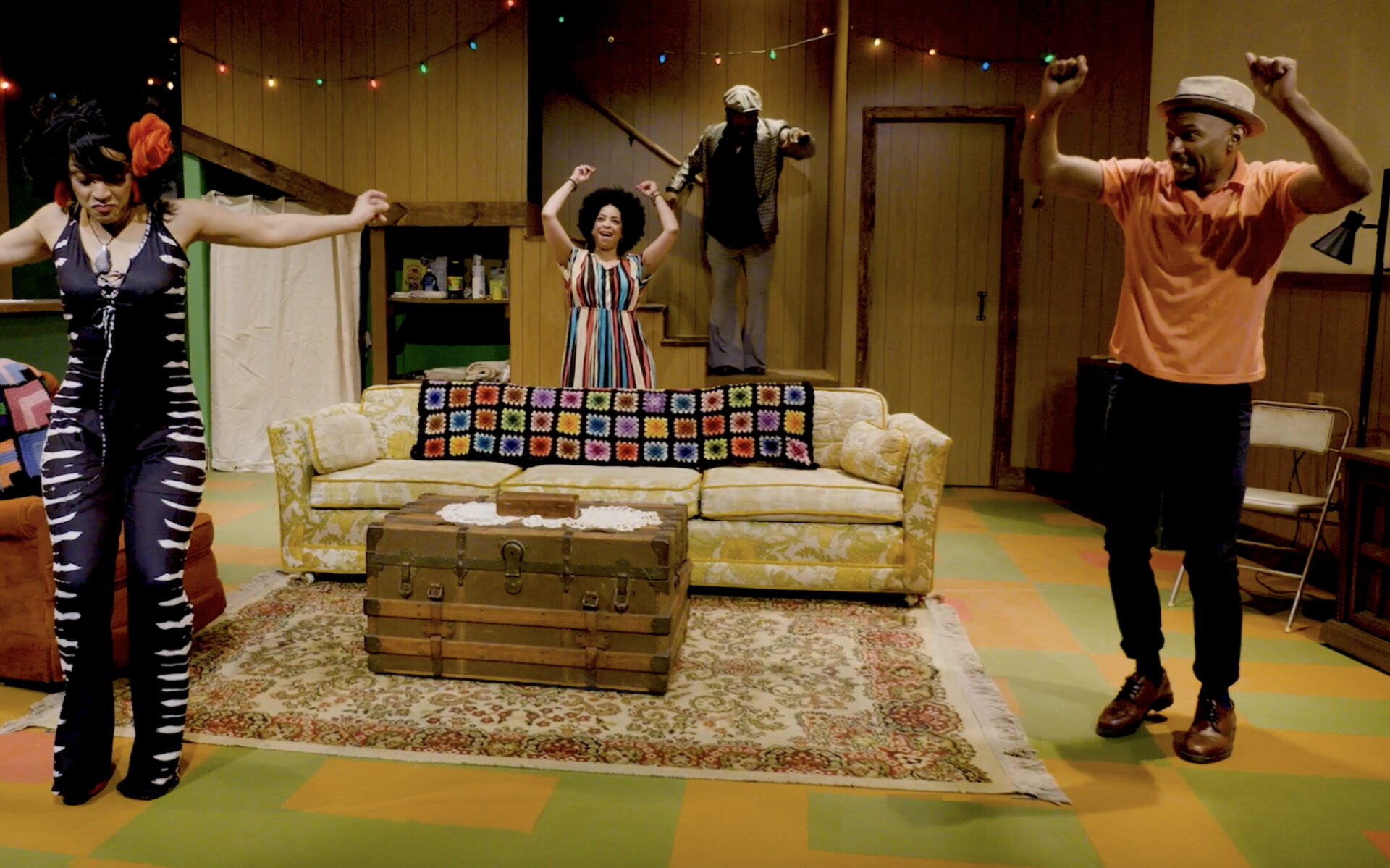
Many of us who were born in or grew up in urban Black communities in the 1950s and 1960s also felt a sense of familiarity with Detroit ’67 as soon as we walked into the Firehouse Theatre and saw the stage set – a basement recreation room meticulously designed down to the most minute detail by Mecedes Shaum. There was the familiar wood paneling, the tiled floor, the comfy sofa that had been given a second life from the upstairs living room, the bar, the beaded curtains, the family photos lining the stairs, the folding card table and chairs for playing spades or pinocle, the obligatory photos and posters of Malcolm X and other heroes. There was the washing machine – but no dryer because clothes were hung outside on sunny days or dried on a line stretched across the basement on rainy days. And anchoring all of this – the record player, which was replaced by the hi-fi, and then, as it was on this stage, by the latest technology – the 8-track player.

The first two things to catch your attention on entering the space are the set and the music. Which you notice first is probably determined by if you are predominantly an auditory or visual learner. I’m a visual-kinesthetic learner, so the set caught my eye, and the Motown soundscape caressed my ears and moved my body simultaneously. The Temptations, Smokey Robinson and the Miracles, Mary Wells, the Four Tops, Gladys Knight and the Pips and more provided the heartbeat of Detroit ’67 and took centerstage as the main characters, siblings Chelle (short for Michelle) and Lank (short for Langston) – played by Firehouse Associate Artistic Director Katrinah Carol Lewis and actor David Lyve Watkins – prepared to open their basement hideaway as an after-hours joint. I was familiar with rent parties growing up in New York, but apparently these after-hours party venues were how Black entrepreneurs or families in need of a little extra cash made their money.

As Detroit ’67 opens, Chelle and Lank are making plans, having inherited their parents’ house and some money as well. Chelle is looking forward to using her share to pay her son’s tuition. We never see the young man as he’s away at school attending Tuskegee University in Alabama – and yes, it’s summertime, but he’s staying to work, and apparently there is a young lady involved as well. The problem – or one of the problems – arises when Chelle’s plans and her brother’s plans conflict. Reminding me of a similar conflict in Lorraine Hansberry’s A Raisin in the Sun, Lank wants to use their inheritance to invest in a business. A local bar is up for sale, as a result of the phenomenon known as “white flight” and Lank’s best friend, Sly (played by Jeremy V. Morris) is a local entrepreneur (okay, he’s the local numbers runner, used car salesman, and general hustler) already has half the money needed to purchase the bar and the required license.

“Niggas deserve nice stuff, too!”

Did I say, “one of the problems?” Well, yes. The first was the riots, remember? The second was how to use the inheritance. And the third involves a mysterious stranger named Caroline. Lank and Sly find Caroline stumbling alongside the road late one night. Stopping to see if she needs help, they offer her a ride in their truck, but she passes out. So, they bring her home to Lank’s house. But, you see, Lank and Sly are two Black men, and Caroline is white. And it’s 1967 and a race riot has just broken out. This is bad, unbelievably bad. And it gets worse.

The mystery of who Caroline is and what happened to her remains unresolved at the end of Act 1. It’s only after Chelle has to bail Lank out of jail that Caroline buys a train ticket and finally reveals what happened the night Lank and Sly found her – and no, I’m not going to tell you here, you will find out when you go see the show.

Detroit ’67 is warm, funny, and terrifying. It has all the “feels” as playwright Dominique Morisseau (Pipeline, November Theatre, Oct-Nov, 2021 https://jdldancesrva.com/2021/10/16/pipeline/ and Sunset Baby by Blk Virginia Theatre Alliance coming to VaRep’s Theatre Gym in April 2025) explores themes of family dynamics, dreams of black folks, racial tension, racial profiling, police brutality, financial and social inequality, and even love and joy.

Chelle is a strong-willed woman who resists change, but she is loving and has a fierce loyalty to her younger brother and her son. Lank is ambitious but impulsive; some would call him a dreamer, others a visionary. Lank’s best friend Sylvester aka Sly has a business mind balanced by a compassionate spirit. Chelle’s friend Bunny is also an entrepreneur, but she hides her brains under an endless wardrobe of close-fitting jumpsuits and a huge flower in her hair. And the mysterious Caroline wears the shortest of mini-dresses accessorized with tall white go-go boots. (If you are not familiar with this style, now is a good time to search for an image.) Kudos to Costume Designer Margarette Joyner for the 1960s wardrobe. Each character’s wardrobe perfectly reflects their personality, from the flashiness of Bunny and Sly to the conservative maxi-dresses and Angela Davis-style afro favored by Chelle to the subdued casual attire that distinguishes Lank.

Dr. T’s direction lends itself to multi-dimensional portrayal of all five characters. I have long been familiar with the work of Lewis and Morris and Dr. T. I have seen all three of them perform in and/or direct powerful works that tell important stories.  This is a production that does not disappoint, This is a well-chosen ensemble that, even on the fourth performance (two nights of previews, and one night after opening night) seems to have achieved that place where they are moving as one. We see them laugh and dance and drink, but we also see them cry and fight for their beliefs, for their heritage, their freedom, their dignity, and for love. A favorite scene is when Sly woos Chelle, spilling his heart in song, and after much protest, Chelle finally gives Sly a sliver of hope that she might just care for him, too. They laugh, they argue, and in a little more than two hours we get to know these people, to recognize them as family, as friends, as people we have encountered, as people we care about.

Now if you feel that you can’t go on
Because all of your hope is gone
And your life is filled with much confusion
Until happiness is just an illusion
And your world around is crumblin’ down
Darling, reach out, come on girl, reach on out for me
Reach out, reach out for me
I’ll be there, with a love that will shelter you
I’ll be there, with a love that will see you through

(“Reach Out, I’ll Be There” by the Four Tops, 1966)

During the recent Super Bowl, Pulitzer Prize winning artist Kendrick Lamar borrowed the words of an earlier poet, Gil Scott Heron, to remind us that “the revolution will not be televised.” What Lamar and Morisseau both reveal to us is that the revolution will be accompanied by a sound. In a brief conversation after Saturday night’s program, Dr. T. mentioned the resistance in the music. There is resistance and resiliency in the rhythms of Motown, the rhythms of the African diaspora, in the context of history and the rhythms of the spoken word, and in the cadence of storytelling enveloped in the lyrics and its connection to family and community. Just before leaving the theater, my friend Tony asked me, how many synonyms are there for “excellent?” I don’t have an answer for that, but maybe you do. Let me know, comment here, after you see this show. I’ll be waiting.

—–

Julinda D. Lewis is a dancer, teacher, and writer who was born in Brooklyn, NY and now lives in Eastern Henrico County. When not writing about theater, she teaches dance history at VCU and low impact dance fitness classes to seasoned movers like herself and occasionally performs.

—–

DETROIT ‘67

Written by Dominique Morisseau

Directed by Dr. Tawnya Pettiford-Wates

Cast

Chelle             ……….           Katrinah Carol Lewis

Lank                ……….           David Lyve Watkins

Bunny             ……….           Nicole Cowans

Sly                   ……….           Jeremy V. Morris

Caroline        ……….           Marie Lucas

Chelle/Bunny U/S……….   Nia Simone

Lank/Sly U/S ……….           Isaac Watson

Caroline U/S ……….           Emily Wolfteich

Production Team

Direction                               ……….           Dr. Tawnya Pettiford-Wates

Directing Observation       ……….           Solomon Marley

Scenic Design                      ……….           Mercedes Schaum

Costume Design                  ……….           Margarette Joyner

Lighting Design                   ……….           Michael Crevoisier

Sound Design                      ……….           Kyle Epps

Stage Management             ……….           Emily Vial

Run Time: About 2 ½ hours; there is 1 intermission

Tickets: $5 to $35

Info: (804) 355-2001 or FirehouseTheatre.org

Performance Schedule:

Wednesday, March 12       7:30PM          Preview

Thursday, March 13             7:30PM          Preview

Friday, March 14                 7:30PM          Opening Night

Saturday, March 15             7:30PM         

Sunday, March 16               2:00PM          Pay What You Will /Member Post-Show Mixer

Friday, March 21                  7:30PM

Saturday, March 22             2:00PM          Pay What You Will

Saturday, March 22             7:30PM         

Sunday, March 23               2:00PM          Pay What You Will

Thursday, March 27            7:30PM

Friday, March 28                  7:30PM

Saturday, March 29             2:00PM

Saturday, March 29             7:30PM

Sunday, March 30               2:00PM          Closing Performance

World Premiere at the Public Theater,  March 12, 2023.

———-

Photo Credits: No photos available at the time of publication

One-Time
Monthly
Yearly

Make a one-time, monthly, or annual donation to show how much you love rvart review

Make a monthly donation

Make a yearly donation

Choose an amount

$5.00
$15.00
$100.00
$5.00
$15.00
$100.00
$5.00
$15.00
$100.00

Or enter a custom amount

$

Your contribution is appreciated.

Your contribution is appreciated.

Your contribution is appreciated.

DonateDonate monthlyDonate yearly
THE HOUSE THAT WILL NOT STAND

You May Be the Wealthiest Colored Woman in New Orleans, But You Built This House on Sand

A Theater Reflection by Julinda D. Lewis

Produced by: UR Free Theatre & Dance

At: Alice Jepson Theatre, Modlin Center for the Arts, 453 Westhampton Way, University of Richmond, VA 23173

Performances:  November 21-24, 2024

Ticket Prices: FREE

Info: (804) 289-8980 or modlinarts@richmond.edu

———-

            This play was not on my radar – my list of local 2024-25 productions to view for consideration for the Richmond Theatre Community Circle awards, but at the last minute I heard about it from people whose opinion I trust, and I realized I had time in my often complicated schedule to see the very last show. I am so glad I did.

            I learned a lot from this 19th century historic drama – a tale that is so very relevant today. This household of free Creole and enslaved Black women in New Orleans on the cusp of the transfer of the Louisiana territory from France to the USA redefines what it means to be free. A lengthy quote from director Lucretia Marie Anderson seems appropriate here:

           In my initial reading of this play, I was transported back to that sense of grief and longing that pervaded the household of Bernarda [Alba, by Federico Garcia Lorca] and the stark and witty differences in how Gardley infused his memories from his own upbringing by resilient, resourceful, catty, joyful, spiritual, and heartbroken Black women in New Orleans. Creating the world in which the women in this play exist has been an honor and a collaboration with all of the magic we could muster.

            This is a hauntingly beautiful play that captures the power, the magic, the tragedy, and the strength of the recently widowed Beartrice Albans and her three daughters: Maude Lynn [run the names together, without a breath], the pious one, Odette, the dark one, and Agnès, the one most desperate to break away.

            Even the supporting characters all hold major roles: Makeda is the Haitian slave of Beartrice, La Veuve is Beartrice’s catty arch enemy, and Marie Josephine is Beartrice’s “crazy” sister who is kept hidden away in the attic. A most unusual central figure – the leading man, one might say, is Lazare Albans, the deceased white man who was Beartrice’s lover and the father of her three daughters. Lazare, who died just hours ago as the play begins, holds a prominent position as a corpse resting in state on the family’s dining room table.

            To understand The House That Will Not Stand, one needs to know a bit about New Orleans cultural history. There was a practice, prevalent from the 1600s to the 1800s) known as plaçage. A way to circumvent the laws preventing interracial marriages, plaçage allowed free women of color (light-skinned Black, mixed race, Creole) to set up households with their white lovers. Unlike common-law marriages or strictly commercial exchanges, like prostitution plaçage provided the women with homes, acknowledged the children, and assigned some contractual rights to income, property, and even limited rights to inheritance.

            In The House That Will Not Stand, not only is Beartrice’s family under attack, but the entire system is about to fall. The transfer of the Louisiana Territory to US law will mean that free women of color, who owned property and even slaves of their own – would be subject to be sold into slavery. For Beartrice, the attack was more immediate Lazare’s white wife, whom he apparently never legally divorced, has the legal right to claim his house and property simply because she is white. His will, leaving his estate to Beartrice and his daughters, has little no bearing under US law – and this is one of the places where the past seems to overlap with the present.

            While Beartrice is fighting for her daughters – adamant that they should not be sold into the plaçage system, her daughter Agnès sees the arrangement as a way to meet a handsome lover and escape the tight discipline of her over-bearing mother While Beartrice is fighting for her own freedom, her house servant, Makeda is fighting for her own freedom. Beartrice has repeatedly reneged on her promise to sign Makeda’s manumission (freedom) papers. While Beartrice is fighting for her freedom, and that of her daughters, and Makeda is hellbent on walking away from slavery, Beartrice’s own sister is imprisoned in the attic – apparently for the “crime” of loving a Black man, a drummer.

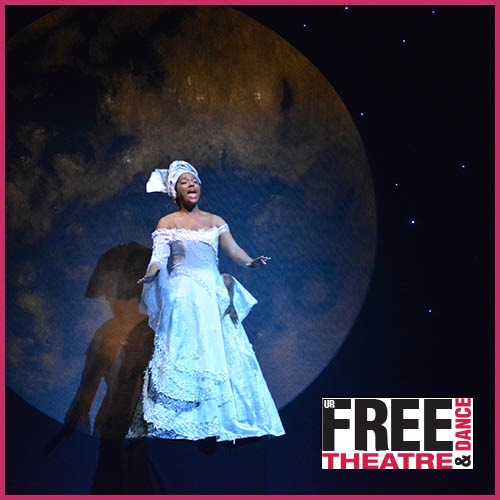
            An intricate, multi-leveled set and absolutely stunning costumes supported this cast of strong, beautiful women. Dr. Tiffany (Doc) Jana wore the role of Beartrice Albans as if it were a mantle bestowed upon her by the ancestors. Nia Simone was beautiful and cunning as the eldest sister, Agnès, who seemed to be cracking under the social pressure to be “placed” well.  Melanie Sanchez was adept at covering Maude Lynn in a façade of syrupy sweetness that, in the end, failed to completely sheath her claws. Mikaela Craft was heartbreakingly naïve as the beautiful younger sister who was burdened with the “curse” of having darker skin than her sisters and mother.

            I wouldn’t be mad with Zakiyyah Jackson if she tried to claim the title of lead for her role as what I would dare to describe as the twice-enslaved Makeda (twice, because she was held as chattel by another woman of color). Marjie Southerland, the attic dwelling sister, Marie, found freedom only by dancing off into the arms of her deceased lover, never to be seen again – and no one else in her house seemed to find that odd? Makeda had her black bag of tricks, but Marie’s magic may have been more powerful, as it was all in her mind and the swing of dancing hips. Shalandis Wheeler Smith brought the tea, the laughs, and stirred up the trouble as the catty La Veuve. But no matter how messy she tried to be, Beartrice was able to match her, word for word, without batting an eye. These women may have been dressed as genteel ladies, but underneath their bustle and layers of lace, they were tough as nails and twice as hard.

            I unknowingly selected the perfect seat, an aisle seat in the last row, where the actors made entrances and exits, where the masked drummer appeared, and where Marie flew off to find her final freedom.

            Lazare was also a constant presence. While his body lay cooling on the dining room table – a practice I have heard of, but never experienced – he did make an appearance as an apparition in the mirror when Makeda, at Marie’s request, allowed his spirit to possess her body to confirm the true cause of his death. Let’s just say that when a woman who doesn’t normally cook offers you a pie, don’t eat it.

            There was so much history and culture to process in these two hours: the whole social system of plaçage, the body in the dining room, the covered mirrors, the aunt in the attic, the colorism and caste system, the Creole balls, the white wife and the colored mistress, a woman seeking freedom in a relationship with a man who could never see her as an equal, the fear of the approaching Yankees, the fear of losing a familiar way of life, a preference for the devil you know rather than the uncertainty of the devil you only know of…What does freedom look like to you?

            What an amazing household, and how deftly they were managed for an  immersive viewing experience by Lucretia Marie Anderson. Gardley has written a masterful collaboration of drama, humor, family dynamics, tragedy, history, social (in)justice, liberation, and magic. This is a work that deserves to be seen by a larger audience. I can only imagine what a life-affirming and yet draining experience it must have been for the cast.

———-

Julinda D. Lewis is a dancer, teacher, and writer who was born in Brooklyn, NY and now lives in Eastern Henrico County. When not writing about theater, she teaches dance history at VCU and low impact dance fitness classes to seasoned movers like herself, and occasionally performs. Her most recent (ad)venture was the premiere of a solo work, The Waters of Babylon or Psalm 137 Revisited: a Post-Exodus Reflection in Movement Choreographed From Collective Memories for the debut of the Critical Race Theatre Project, right here at RTP in August 2024.

———-

THE HOUSE THAT WILL NOT STAND

By Marcus Gardley

Directed by Lucretia Marie Anderson

Cast

Dr. Tiffany (Doc) Jana …    as Beartrice Albans

Nia Simone               ……    as Agnès Albans

Melanie Sanches     ……    as Maude Lynn Albans

Mikaela Craft            ……    as Odette Albans

Zakiyyah Jackson    ……    as Makeda

Shalandis Wheeler Smith   as La Veuve

Majie Southerland  ……    as Marie Josephine

Bill Blair                     ……    as Lazare

Production & Design

Playwright                 ……    Marcus Gardley

Director                     ……    Lucretia Marie Anderson

Scenic Design          ……    Emmy Weldon

Costume Design      ……    Johann Stegmeir

Lighting & Sound Design  Maja E. white

Vocal Direction & Composition

……    Mara Smith

Choreography         ……    Deandra Clarke

Production Stage Management

……    Holly Trenbath

Assistant Stage Manager   Leland Solesby

Drummer                  ……    Austin Martin

Props Crew               ……    David Hensley, Leah Marchetti

Board Operators     ……    Jerry Chen, Charlotte Donelan,

Tina Li, Louisa Stringer, Gareth Woo

Run Crew                  ……    Gabrielle Lindsay, Leah Marchetti

Wardrobe Crew       ……    Chuhan Fang, Taylo Harris, Maddi Lewis

Director of Costume  ….    Heather Hogg

Technical Supervisor & Fight Choreographer

                                    ……    Phil Hayes

Technical Assistant ……    Tomya Pryor

Lighting & Sound Supervisor

                                    ……    Robby Williams

Guest Costume Artists       Tinia Crider, Robyn Gebhart, Karl Green,

                                                Susan Rich

Costume Shop Staff …..     Eliza Hummerstone, Jaize Francis, Alisha Tosto,

                                                Michael Florentin

Electrics Crew          ……    Alex Broening, Connor Smith, Bonny Bruzos

Scene Shop Staff     ……    Hope Amberger, Fitch Melson, Jake Litman,

                                                Megan Montoya

Scene Shop Assistants ..    Patrick Michael, Cameron Peterson, Felicia Chen

Scenic Artists            ……    Tyeon Ford, Leah Marchetti, Darcel Pham

Scenic Carpenters & Painters      

                                    ……    Jonathan Beagle, Jaleel Grinnage, Taylo Harris,

                                                Rachell Lee, Jason Liang, Ly Nguyen, Vanessa

                                                Romero, Louisa Stringer, Zachiah Zook

Production Manager & Dialect Coach

                                    ……    Erica Hughes

Poster Design           ……    Jeane Minnix

Setting & Time

The home of Beartrice, a free colored woman, New Orleans, Louisiana Territory,1830s

Run Time

Approximately two hours, with one intermission

Schedule of Performances

Thursday, November 21, 7:30PM

Friday, November 22, 7:30 PM

Saturday, November 23, 7:30PM

Sunday, November 24, 2:00PM

Ticket Information

FREE, Reservations Required.

Info: (804) 289-8980 or modlinarts@richmond.edu

Photo Credit

Unavailable

One-Time
Monthly
Yearly

Make a one-time donation
to support RVART Review (jdldances)
this publication is a labor of love
and exists only with your donations

Make a monthly donation

Make a yearly donation

Choose an amount

$5.00
$15.00
$100.00
$5.00
$15.00
$100.00
$5.00
$15.00
$100.00

Or enter a custom amount

$

Your contribution in any amount is greatly appreciated.

Your contribution is appreciated.

Your contribution is appreciated.

DonateDonate monthlyDonate yearly
BERTA, BERTA

The New Theatre at Firehouse in Collaboration with the Conciliation Project Presents the Virginia Premiere of a Play by Angelica Chéri

A Theater Review by Julinda D. Lewis

At: The Firehouse 1609 West Broad St., Richmond, RVA 23220

Performances: September 27 – October 15, 2023

Ticket Prices: $15-$35

Info: (804) 355-2001 or firehousetheatre.org.

O Lord Berta Berta O Lord gal oh-ah
O Lord Berta Berta O Lord gal well now
Go ‘head marry don’t you wait on me oh-ah
Go ‘head marry don’t you wait on me well now

Inspired by a prison chain-gang song that originated on the euphemistically named Parchman Farm – a Mississippi State Penitentiary –  BERTA, BERTA is a love story, an allegory, a tale of historical fiction, a memory, and an inheritance. Chéri found inspiration in August Wilson’s The Piano Lesson (1987) in which the song is featured. But that’s not all.

In many ways, the couple in Angelica Chéri’s play, which premiered in the 2018 Contemporary American Film Theatre Festival (CATF) reminded me of the 2019 American Film Institute (AFI Fest) debut of the film, Queen and Slim. I rooted for Berta and Leroy just as I rooted for Queen and Slim, against all the odds, against the inevitable, against the evidence – because we have to have hope, we have to have love.

Might not want you when I go free oh-ah
Might not want you when I go free well now
Don’t know the difference when the sun go down oh-ah
Don’t know the difference when the sun go down well now

Katrinah Carol Lewis and Jerold E. Solomon were cast as Chéri’s reunited and doomed lovers, Berta and Leroy. But there is more to each of these characters than just that bare-bones description. Both Berta and Leroy are burdened with the sins of post-slavery America, the unwanted weight of the segregated south, and the crimes of being born Black in America. Both are people that we might meet, once knew, know of, or are related to.

Berta in Meridian and she living at ease oh-ah
Berta in Meridian and she living at ease well now
O Lord Berta Berta O Lord gal oh-ah
O Lord Berta Berta O Lord gal well now
I’m on old Parchman, got to work or leave oh-ah
I’m on old Parchman, got to work or leave well now

Leroy has spent time at Parchman Farm, and on his way to reunite with his former lover after his release, he commits yet another crime that seals his fate. Berta, who tired of waiting three years for Leroy – her one true love and soulmate – married a well-meaning but boring farmer who loved her, but he died, leaving her a widow with a ramshackle farmhouse in a small country town. On top of all that, she lost her only child who was stillborn. Both Berta and Leroy are waiting on a miracle – the miracle of the cicadas – to fulfill their deferred dreams.

That’s a lot of weight for two characters, two actors to carry. Both Lewis and Solomon are more than capable of bearing the load. Lewis is well known for authentic, riveting portrayals, from real-life Billie Holiday to fictitious Nora in A Doll’s House or even an entire cast as she did in Anna Deavere Smith’s one-woman play, Twilight Los Angeles 1992. Berta must be added to Lewis’ list of unforgettable characters. It is the kind of role that leaves the audience speechless, so I can only imagine how much it requires of Lewis to step into Berta’s worn slippers night after night.

Solomon is also a larger-than-life figure, and it could be easy to overact this role, but Solomon presents a well-rounded, sympathetic picture of this well-meaning Black man whose dreams have been dashed before he could even verbalize them. The hand of director Dr. Tawnya Pettiford-Wates is clearly imprinted on this stunning work, yet there is a softness that seems to have been previously – perhaps intentionally – untapped.

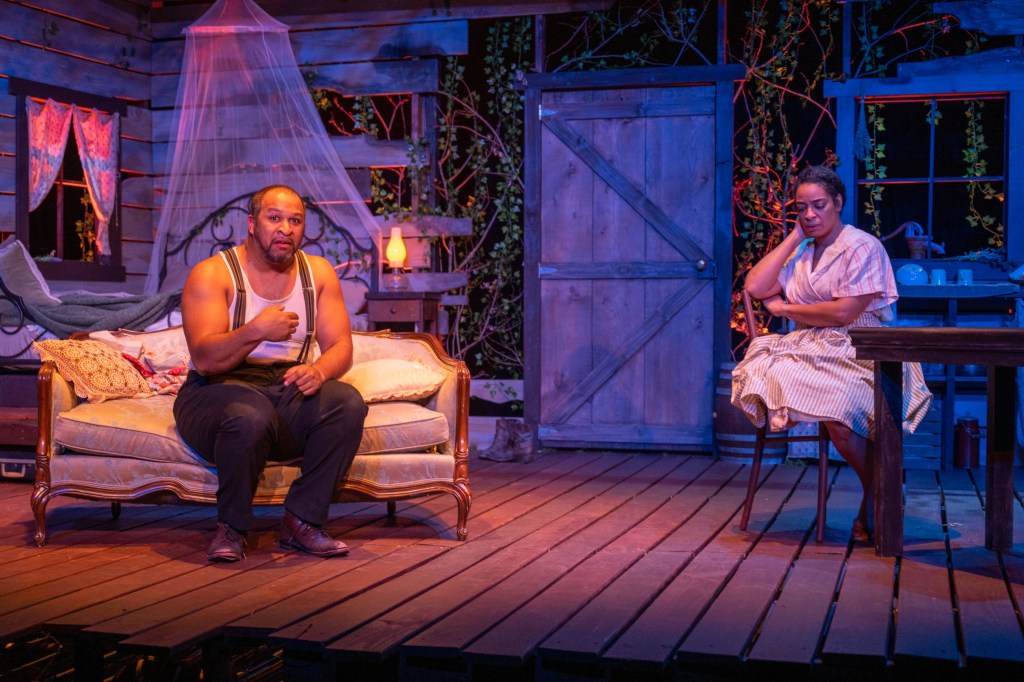
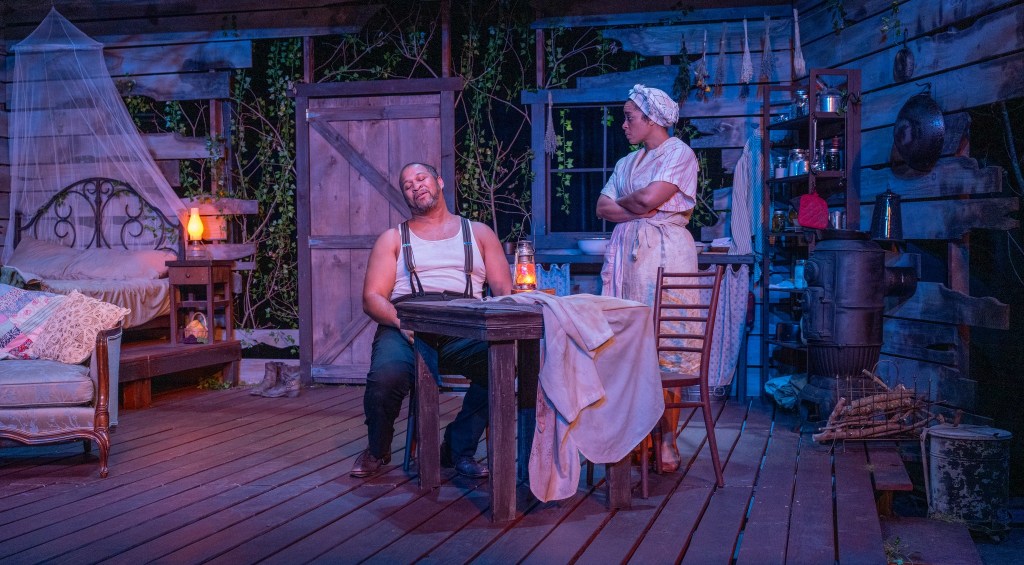
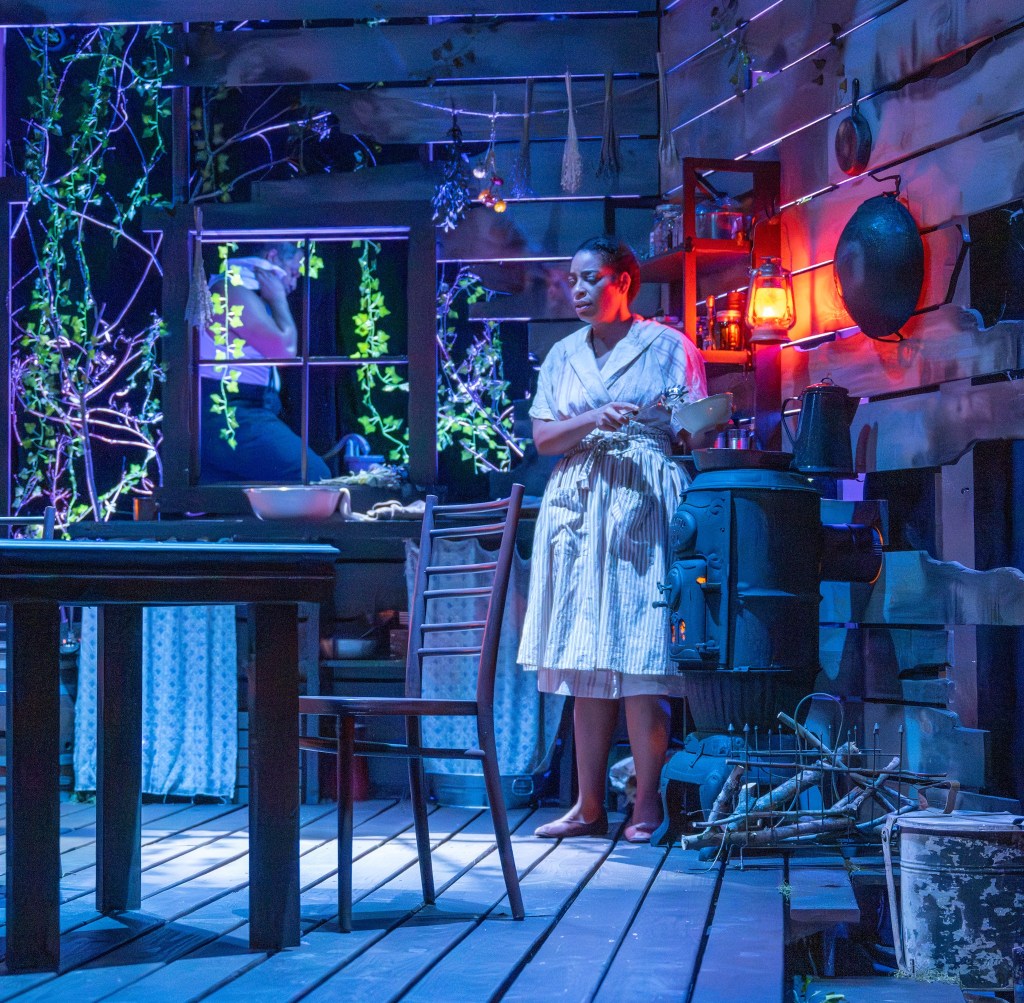
Berta, Berta is one of those magnificent works that reflects an immersive relationship between author, director, actors, lighting, scenic design, and sound. Chris Raintree’s roughshod wooden planks, wood stove, porch pump, and vines – so many vines – perfectly capture Berta’s rural home, the southern geography, the era, the mood. Kyle Epps feeds in the sounds of a harmonica, the cicadas and other ambient sounds in a way that is both natural magical. The same can be said of Andrew Bonniwell’s lighting that frames the stage from the top, the bottom, the back, and even from under the floorboards. The total effect is both heartwarming and heartrending; it reveals how tenuous are the lines between dreams and nightmares, the softness of a lover’s touch, and the kick of the moonshine Berta shares with Leroy.

This is, quite simply, a magnificent theatrical experience that cannot be described; it must be experienced.

O Lord Berta Berta O Lord gal oh-ah
O Lord Berta Berta O Lord gal well now

———-

Julinda D. Lewis is a dancer, teacher, and writer who was born in Brooklyn, NY and now lives in Eastern Henrico County.

———-

BERTA, BERTA

By Angelica Chéri

Directed by Dr. Tawnya Pettiford-Wates

September 27 – October 15, 2023

CAST

Berta             ……….           Katrinah Carol Lewis

Leroy              ……….           Jerold E. Solomon

U/S                  ……….           Shalandis Wheeler Smith & Delvin Young

PRODUCTION TEAM

Scenic Designer       ……….           Chris Raintree

Lighting Designer    ……….           Andrew Bonniwell

Sound Designer       ……….           Kyle Epps

Costume Designer ……….           Nia Safarr Banks

Intimacy Director     ……….           Stephanie Tippi Hart

Asst. Intimacy Dir.    ……….           Dorothy Dee D. Miller

Assistant Director    ……….           Jeremy Morris

Research Intern        ……….           Sarah Young

Stage Manager        ……….           Grace LaBelle

Lobby Display          ……….           The Conciliation Project

Original rendition of Berta, Berta chain-gang song by Andrew Alli

Performance Schedule:

● Opening Night – September 29 at 7:30pm

● Running Thursday – Sunday through Oct. 15, 2023

● Pay-What-You-Will previews on September 27th and 28th at 7:30pm

● Pay-What You-Will performance on October 8th at 2pm

Tickets: $15-$35

One-Time
Monthly
Yearly

Make a one-time OR MONTHLY donation TO SUPPORT RVART REVIEW

Make a monthly donation

Make a yearly donation

Choose an amount

$5.00
$15.00
$100.00
$5.00
$15.00
$100.00
$5.00
$15.00
$100.00

Or enter a custom amount

$

Your contribution is appreciated.

Your contribution is appreciated.

Your contribution is appreciated.

DonateDonate monthlyDonate yearly
A SOLDIER’S PLAY

They still hate you!: Racism Institutionalized, Internalized, Ignited

At: The Swift Creek Mill Theatre, 17401 U.S. Route 1, S. Chesterfield, VA 23834

Performances: January 28 – March 4, 2023

Ticket Prices: $15-$49

Info: (804) 748-5203 or https://www.swiftcreekmill.com

Charles Fuller’s A Soldier’s Play is set on a fictitious Army base, Fort Neal, Louisiana, in 1944 – at a time when the U.S. Army was still legally segregated. But the mystery and inflammatory speculation surrounding the murder of Tech/Sergeant Vernon C. Waters could have been taken directly from the latest news in 2023.

When I think of this Pulitzer Prize-winning play, the first thing that comes to mind is Adolph Caesar who played the role of Sergeant Waters in the original off-Broadway production by the Negro Ensemble Company, New York, 1981. In that production, Denzel Washington also appeared as Private First Class Melvin Peterson and Samuel L. Jackson played the role of Private Louis Henson.

I can’t help but wonder, how did the actors and audiences of 1981 feel about A Soldier’s Play and how do their thoughts and experiences compare to those of the actors and audiences of 2023? The more things change (?) the more they stay the same – and this trope especially rings true when it comes to matters of race in America.

Along those same lines, the ”trigger warnings” of  strong language, racial slurs, physical violence and gunshot effects may have been startling 40 years ago, but seem de rigueur by today’s standards where life imitates art imitates life. Director Shanea N. Taylor wrote in her notes, “Charles Fuller believed, ‘You can change the world with words.’ 40 some years later from winning the Pulitzer Prize for his words, we find ourselves in a position where we might question whether this rings true.”

In A Soldier’s Play we get to see – and internalize – the impact of 9 Black men sharing a stage and sharing words and thoughts normally reserved for the relative safety of Black spaces (e.g., home, the barber shop). Do Fuller’s words sufficiently explain the burden of how racism can make a Black man hate himself? Or are we so committed to the fallacy that racism is over that only those directly affected can truly understand? A Soldier’s Play opens the door to further understanding.

This deeply troubling story shines as an ensemble work. The comraderie and banter between the characters feels authentic (coming from one who has never been in a military environment). It comes as no surprise that the Black soldiers are given the most menial and dirtiest tasks: painting, cleaning, manual labor. In spite of their sub par treatment, they want to serve the only country they know. When orders come to ship out, they are excited. Ike wants to know if the colored boys can fight? There is only one response, “I’ve been fighting all my life.”

The soldiers’ relationships seem even more solidified by the passive aggressive racism of their white Captain, played by Chandler Hubbard. You see, Captain Taylor is aware of his own racism, and readily admits that he is disgusted by the very thought of Captain Davenport (Keydron Dunn), the Black lawyer sent to investigate the murder of Sergeant Waters. At the same time, he holds on to a sense of justice in wanting to solve the murder – but not so much so that he is willing to discipline the white officers under his command who are overtly racist (Hunter Keck and Gordon Little Eagle Graham). Waters is – or was – an ambitious Black officer who is himself offended by the presence of southern Black men who do not live up to his standards. This information gives added meaning to his final words before being shot, “They still hate you!” No matter how hard he tries to assimilate, no matter if he works hard and send his children to predominantly white schools, he is still Black, and still the recipient of institutional and personal racism.

There were some standouts in the ensemble: Joshua Maurice Carter as Private C.J. Memphis, the innocent young man who was driven to suicide by Sergeant Waters’ mental attacks; Kamau “Mu Cuzzo” Akinwole as Private James Wilkie, an unwilling pawn in Waters’ machinations; Erich Appleby as the earnest Corporal Bernard Cobb. Hubbard did an amazing job establishing a balance between doing the eight thing and embracing the comfort of his upbringing. But A Soldier’s Play works best within the framework of the ensemble. The one weak link, unfortunately, seemed to be Keydron Dunn in the import role of the key figure, Captain Richard Davenport. I found out later that Dunn was under the weather the night I saw the show, so that may account for the fumbled lines and uneven performance – so unlike his usual execution.

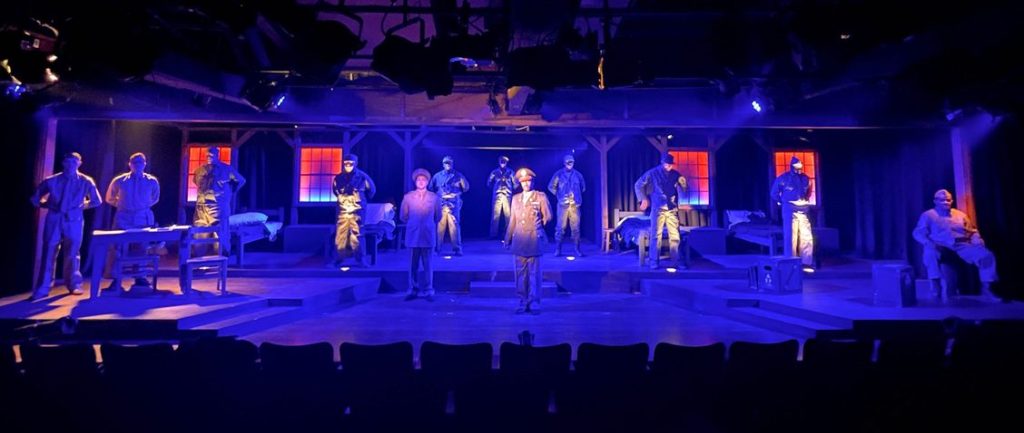
Mercedes Schaum has designed a stark barracks, consisting of just a few cots and footlockers, but Joe Doran’s lighting adds satisfying emotional depth and visual dimension. Taylor’s direction allows the story to unfold at a natural pace – perhaps less inflammatory than I was expecting, or less shocking that my memory allowed for – but nonetheless satisfying. If you have never seen A Soldier’s Play or, like me, have not revisited it in some 40 years, please see it. It’s the kind of theatre that stays with you for a lifetime.

———-

Julinda D. Lewis is a dancer, teacher, and writer who was born in Brooklyn, NY and now lives in Eastern Henrico County.

———-

A SOLDIER’S PLAY

By Charles Fuller

Directed by Shanea Taylor

Cast:

Tech/Sergeant Vernon C. Waters: Larry Akin Smith

Captain Charles Taylor: Chandler Hubbard

Corporal Bernard Cobb: Erich Appleby

Private First Class Melvin Peterson: K’Hari Zy’on

Corporal Ellis: Gary King

Private Louis Henson: Tre’ LaRon

Private James Wilkie: Kamau “Mu Cuzzo” Akinwole

Private Tony Smalls: Kieryn Burton

Captain Richard Davenport: Keydron Dunn

Private C.J. Memphis: Joshua Maurice Carter

Lieutenant Byrd: Hunter Keck

Captain Wilcox: Gordon Little Eagle Graham

Creative Team:

Directed by Shanea Taylor

Scenic Design by Mercedes Schaum

Lighting Design by Joe Doran

Costume Design by Maura Lynch Cravey

Technical Direction by Liz Allmon

Fighting/Intimacy Consulting by Stephanie “Tippi” Hart

Run Time:

About two hours with one intermission

Tickets:

Regular $49. Seniors, Military & First Responders $44. Students $15.

Photos: Kieran Rundle

One-Time
Monthly
Yearly

rvart review depends on your generous donations – thank you!

Make a monthly donation

Make a yearly donation

Choose an amount

¤5.00
¤15.00
¤100.00
¤5.00
¤15.00
¤100.00
¤5.00
¤15.00
¤100.00

Or enter a custom amount

¤

Your contribution is appreciated.

Your contribution is appreciated.

Your contribution is appreciated.

DonateDonate monthlyDonate yearly
HOW BLACK MOTHERS SAY I LOVE YOU

“Do not press me to leave you,
    to turn back from following you!
Where you go, I will go;
    where you lodge, I will lodge;
your people shall be my people
    and your God my God. – Ruth 1:16 (NRSV)

A Theater Review by Julinda D. Lewis

At: Richmond Triangle Players at the Robert B. Moss Theatre,

1300 Altamont Ave, RVA 23230

Performances: February 1-25, 2023

Ticket Prices: $10 – $40

Info: (804) 346-8113 or rtriangle.org

———-

Sometimes a production takes awhile to grow on you. Some shows are hard to connect with on a personal, emotional, social, literary, cultural or any other level. Just the opposite is true of Trey Anthony’s tender and amusing two-act family drama, HOW BLACK MOTHERS SAY I LOVE YOU. The author identifies as “a queer, black, Canadian, West Indian womyn” but their story is familiar to many Black women in Canada, the US, and the UK. I attended with my eldest daughter, and throughout the evening we looked at one another knowingly over our masks, reached for each other’s hands, cried out in instant recognition, or just cried.

The author may be a Canadian of Jamaican heritage, but the play is set in the Brooklyn, NY home of a Jamaican immigrant woman in 2014 (although I thought the furniture and kitchen appliances harkened back a decade or two – or three? – before then). Claudette (Zakiyyah Jackson), the prodigal queer daughter of Daphne (Dorothy “Dee-D” Miller) has returned home unannounced after several silent years in Montreal, Canada. Claudette finds her mother in poor health and her younger sister Valerie (Shalandis Wheeler Smith) doing her best to care for her, despite Daphne’s refusal to follow doctor’s orders – and the added complications of Valerie’s own personal struggles. Claudette has questions that her mother is not willing to answer. Daphne left Claudette and Valerie with their grandmother in Jamaica for six years while she got established in the US.

Family secrets are painfully and reluctantly revealed, along with social and cultural histories that could bringing health and healing to many families and enlightenment to many allies. The story is brought to life by a small but mighty cast, led by Miller, the matriarch. I’m not Jamaican but I married into a Jamaican family and I found Miller’s accent spot on. She dropped the “h” where you expected to hear it and added it where you did not expect it. She called children “pickney” and pronounced the word “little” as if it were spelled with two k’s instead of two t’s. She won me over completely when she spoke about the baby’s “ackee seed eyes.” That’s how my mother-in-law used to refer to my children! My daughter looked at each other and shrieked in unison as my heart melted into a puddle on the floor. (Don’t worry, RTP staff, melted hearts do not stain the carpet.) Of course I looked to see who the dialect coach was and just as I suspected, it’s Erica Hughes. Kudos to Hughes for another amazing job.

[If you are familiar with ackee, you can skip this next paragraph.]

BTW: the ackee fruit is a Jamaican dietary staple, an essential ingredient in the Jamaica national dish of ackee and saltfish (i.e., salted cod). When ripe, the ackee plant yields fleshy yellow lobes that somewhat resemble scrambled eggs when cooked with saltfish. The fruit has shiny black seeds that people – especially Jamaican grandmothers – liken to the shiny bright eyes of babies and young children. The kicker is that, in its un-ripened state, ackee is quite poisonous.

Jackson and Wheeler Smith achieved a remarkable balance between sibling rivalry and sisterly love. Their affection appeared genuine and as the story unfolded we found that it was grounded in a history of collective trauma – unique to them, but familiar to many families whose histories are defined by the African diaspora. Significantly, my daughter wondered how these themes spoke to white viewers. This would be an interesting dialogue to introduce in a talk-back…

Let me not forget to mention Cloe. The younger, American-born sister of Claudette and Valerie who died in childhood from an unnamed illness, Cloe appears as a silent ghost. Dressed in white from head to toe, Bailey Robinson, a Henrico County Public Schools student, made her professional debut as the sometimes meddlesome, but mostly caring specter of young Cloe whose presence is welcomed and visible to Daphne – and sometimes, it seems, to Valerie. Claudette knows she is there, but cannot see her. The presence of Cloe is another strong symbol of ancestors and spirituality.

The set is a Brooklyn home sturdily and lovingly crafted by William Luther and tenderly lit by Dakota Carter. I did wonder, however, why there were several long periods of darkness or dimmed lights. Perhaps these stretches were meant to serve a visual equivalent of the dramatic pause, or to contrast with the bright white heavenly light that illuminated the runway that Cloe used to transition between the present and the hereafter. Or maybe it was just to allow for a costume change.

Margarette Joyner (founder and artistic director of the Heritage Theater that formerly closed its doors in 2022) designed the costumes, with special attention to Daphne’s collection of church hats and Valerie’s collection of coordinating handbags and shoes. Desirée Dabney directed through the eyes of a storyteller. The work and words flow with a sense of real time and a feeling of intimacy and immediacy.

HOW BLACK MOTHERS SAY I LOVE YOU is a stunningly beautiful work of theatre, one I was not familiar with, one I will not forget. See it with your mother or daughter. And take tissues.

———-

Julinda D. Lewis is a dancer, teacher, and writer who was born in Brooklyn, NY and now lives in Eastern Henrico County.

———-

HOW BLACK MOTHERS SAY I LOVE YOU

By Trey Anthony

Directed by Desirée Dabney

CAST

Daphne            …………….Dorothy “Dee-D” Miller

Claudette        …………….Shalandis Wheeler-Smith

Valerie             ……………. Zakiyyah Jackson

Cloe                 ……………. Bailey Robinson

Daphne Understudy: Diana Carver

Claudette Understudy: Nora Ogunleye

Valerie Understudy: Chayla Simpson

Cloe Understudy: Sydnee Logan

THE CREATIVE TEAM

Director/Sound Design: Desirée Dabney

Assistant Director/Dramaturg: Chayla Simpson

Production Stage Manager: Jennipher Murphy-Whitcomb

Assistant Stage Manager: Nathan Ramos

Scenic Design: William Luther

Lighting Design: Dakota Carter

Props Design: Tim Moehring

Costume Design: Margarette Joyner

Hair & Make Up Design: Jahara Jennae

Intimacy Choreographer: Raja Benz

Dialect Coach: Erica Hughes

Technical Director/Scenic Painter: Becka Russo

Covid Safety Officer: William Luther

Marketing Videos: Aisthesis Productions

Photo Credits: Pre-production photos from RTP Facebook page

One-Time
Monthly
Yearly

Make a donation to support the continued publication of rvart review
thank you

Make a monthly donation

Make a yearly donation

Choose an amount

¤5.00
¤15.00
¤100.00
¤5.00
¤15.00
¤100.00
¤5.00
¤15.00
¤100.00

Or enter a custom amount

¤

Your contribution is appreciated.

Your contribution is appreciated.

Your contribution is appreciated.

DonateDonate monthlyDonate yearly
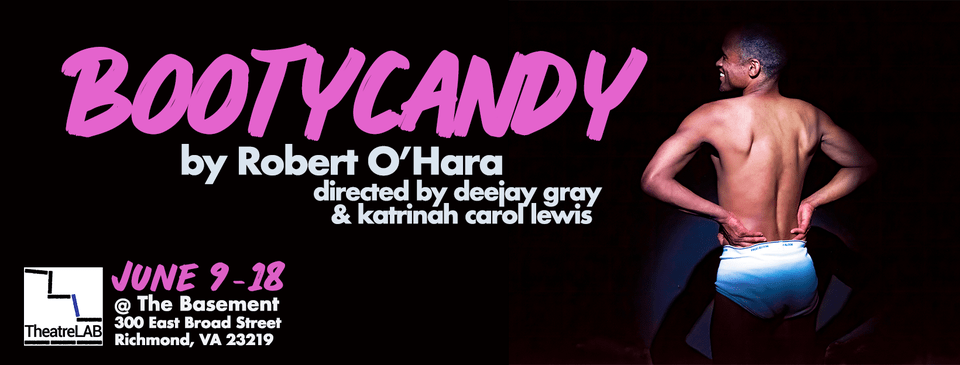
BOOTYCANDY:

It Probably Doesn’t Mean What You Think It Means

A Theater Review by Julinda D. Lewis

Produced by: TheatreLAB

At: The Basement, 300 E. Broad Street, RVA 23219

Performances: June 9-18, 2022

Ticket Prices: $20 General Admission; $10 Teachers & Students

Info: (804) 349-7616 or https://tlab-internet.choicecrm.net/templates/TLAB/#/events

Robert O’Hara’s BOOTYCANDY is a “semi-biographical subversive comedy” performed as a series of non-linear vignettes. The central character is Sutter and the central premise is Sutter’s journey growing up black and gay. It is hilarious, it is touching, it is relatable across genders, generations, and sexual orientations, and it is an exemplar of contemporary Africanist story-telling. It is, without a doubt, one of my favorite shows of the season – and I see my fair share of shows.

Todd Patterson shines in the lead role as Sutter. The five actors are identified only as Actor One, Actor Two, etc., and all but Patterson take on a number of different roles in Sutter’s life. Patterson dances between each scene – indeed, his “grandmother” and other relatives request that he “do that step Michael Jackson liked to do.” The playwright, O’Hara, has specified that Jackson’s music be used throughout, and the music of Michael Jackson, Prince, and perhaps a few others energizes the space from the moment you walk through The Basement doors.

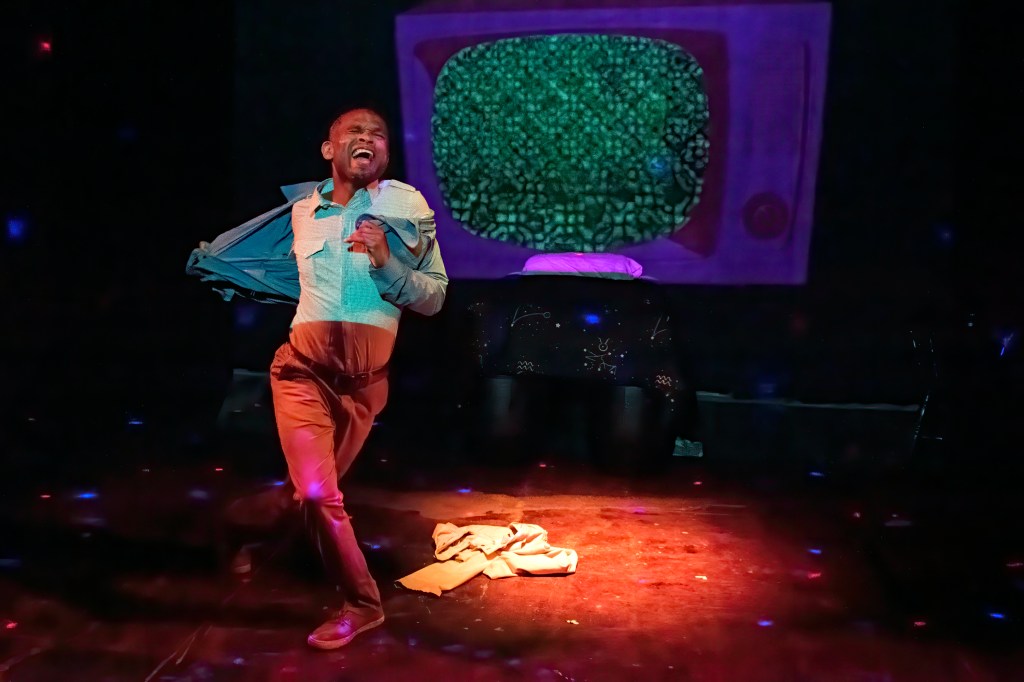
Patterson strips for us, and dances with a manic energy that reflects his character’s inner landscape. But as much as I was impressed by Patterson’s performance, this is truly an ensemble production – starting with the symbiotic directing team of Deejay Gray and Katrinah Carol Lewis. I’ve seen each of these actors in several productions, and this one cast them each in a new light and presented them with new challenges.

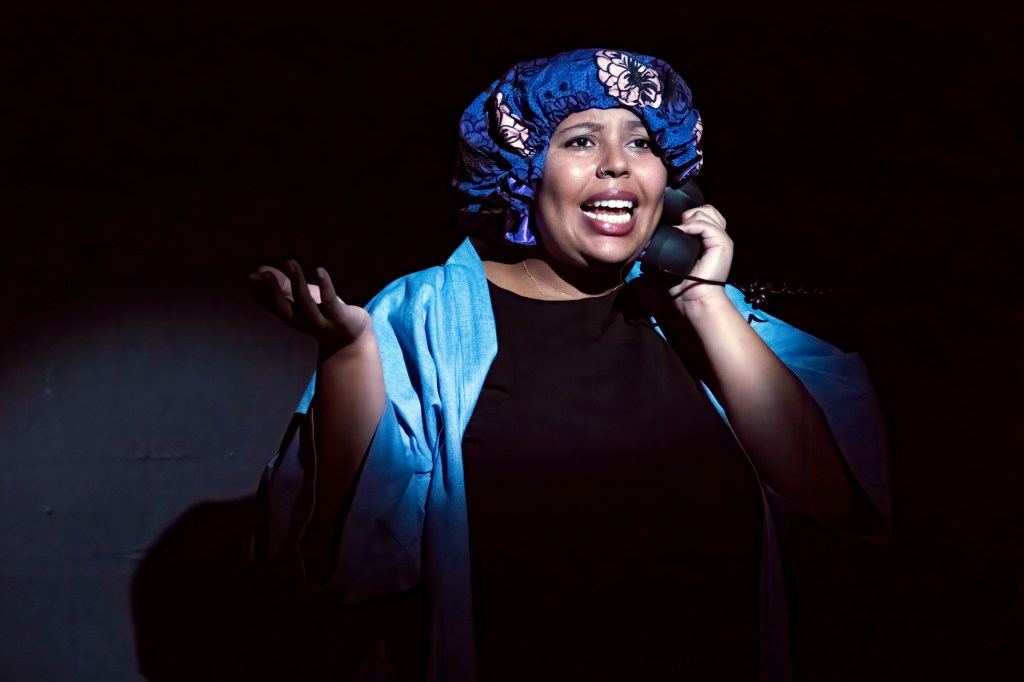
Dylan Jones and Zakiyyah Jackson hold down most of the female roles in Sutter’s life. Both play his mother, at different ages, as well as aunties, friends, a sister, and church ladies. In one scene they portray a quartet of women gossiping on the telephone, highlighted by rapid costume changes but my favorite is their second act “non-committal ceremony,” a nasty same-sex divorce officiated by a Zen-like Cashwell. This scene is the embodiment of the adage, “same sex, same problems!”

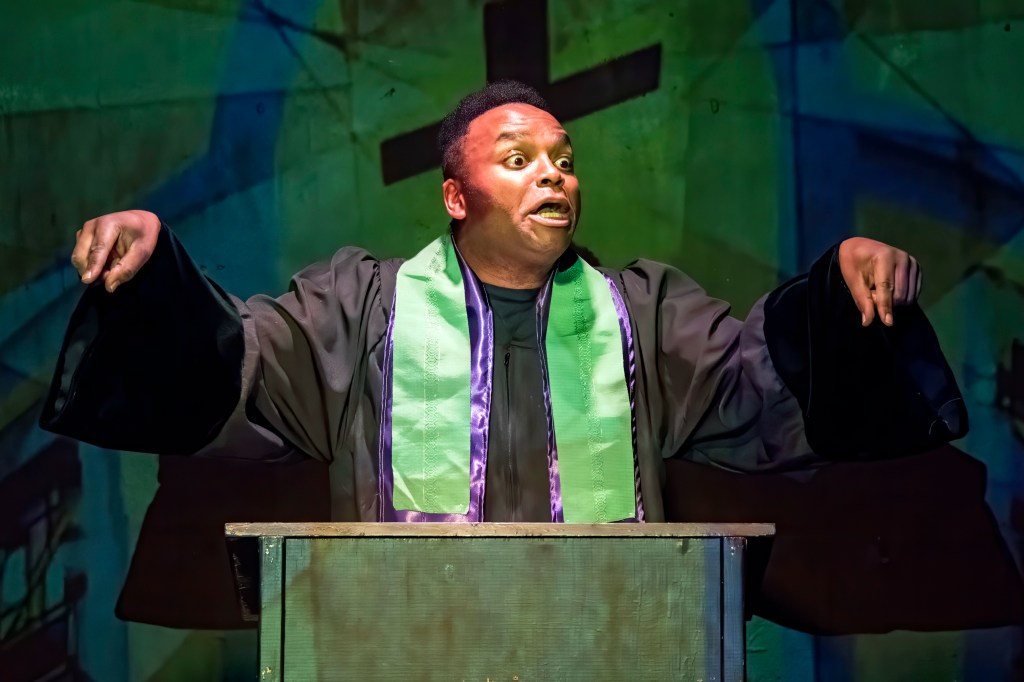
Durron Marquis Tyre transforms into several characters, but my favorites are the right reverend who comes out in a sermon delivered to his outraged congregation. Instead of coming out of the closet, he emerges from behind his pulpit to reveal fishnet stockings, blinged out silver slingback heels, a wig, and finally a clingy little red dress and matching lipstick. This is where Jones and Jackson begin their magic as they subtly change from gossip-mongers to staunch supporters.

In the second act, Tyre portrays Sutter’s grandmother who offers him comfort in a time of need as she slyly extracts some cash to tuck into her bosom and a delivery of forbidden soul food. For a moment, I thought Tyre had been speaking with my own late grandmother to develop this character because his mannerisms and speech brought back memories directly from my own past. And that is part of the beauty of this play: it is relatable. In a post-show talkback the day I saw it, everyone who spoke found some point of connection. The scene where Sutter realizes he is under stress is a turning point – he stops the show, has a verbal interaction with the Stage Manager, Crimson Piazza, and the tone and tenor of the play shifts. This is , undoubtedly, one of the author’s genuine auto-biographical moments. Its poignancy highlights the humorous aspects of the previous scenes, and reminds us that often laughter is the only things that helps us make it through the tough or uncertain times.

And of course I cannot forget Dixon Cashwell – the only white guy in the cast. He plays several characters, but my favorites are his portrayal of a clueless conference facilitator for the scene that closes the first act. Cashwell’s character strolls obliviously into a minefield of micro-aggressions that elicit yelps of incredulity from the cast as well as at least one audience member. In other scenes, Cashwell becomes a gay-curious male sharing an uncomfortable relationship with his brother-in-law, and has a spellbinding turn as an intoxicated man at a lonely bus stop at 3:00 AM who amazingly talks himself out of being mugged.

There are a number of little things that make BOOTYCANDY as close to perfect as it can possibly get. The subject of the women’s telephone scene is the name one young mother has chosen for her baby girl: Genitalia! It is a spoof of the unique names and exotic naming conventions of Black American families and a nod to the sort of urban legends many of us educators have passed down through the decades: the little boy named Shi-Thead, the little girls named Vagina, Clitoris, and Female (pronounced Fah-MA-ley), or the twins named Orangejello and Lemonjello (pronounced a-RON-zhello and le-MON-zhello).

By the time you read this, BOOTYCANDY may have ended its all-too-brief run, but just in case, consider this a SPOILER ALERT: BOOTYCANDY does not refer to a sexually attractive booty or a hot gay guy. Quite innocently – and oddly – it is the word the young Sutter’s mother uses to refer to his penis, and an excellent advertisement for teaching children the real words for their body parts.

I haven’t laughed so hard or so often I the theater in recent memory. In the words of one viewer, BOOTYCANDY is no entry-level theater, meaning it is not linear or predictable, and there is no happily-ever-after fairytale conclusion. In the mind of this reviewer, that is what makes it so special.

THE CAST

Actor One ………………………….        Dylan Jones

Actor Two ……………………….…        Todd Patterson

Actor Three …………..…………..       Zakiyyah Jackson

Actor Four ………………………….       Durron Marquis Tyre

Actor Five ………………………….       Dixon Cashwell

THE TEAM

Direction: Deejay Gray & Katrinah Carol Lewis

Scenic Design: Deejay Gray

Projection Design: Dasia Gregg

Lighting Design: Michael Jarett

Costume Design: Nia Safarr Banks

Sound Design: Kelsey Cordrey

Properties Design: Kathy O’Kane Kreutzer

Production Stage Management: Crimson Piazza

THE SCHEDULE

Thursday, June 9 at 7:30 [Preview Performance]

Friday, June 10 at 7:30 [Opening Night]

Saturday, June 11 at 7:30 [Post-Show Dialogue]

Sunday, June 12 at 7:30

Wednesday, June 15 at 7:30 [ADDED SHOW]

Thursday, June 16 at 7:30

Friday, June 17 at 7:30

Saturday, June 18 at 7:30 [Closing Night]

NOTE: All performances are at 7:30pm at The Basement:

300 East Broad Street, Richmond VA 23219

THE TICKETS

$20 – General Admission

$10 – Teachers & Students

LINK: https://tlab-internet.choicecrm.net/templates/TLAB/#/events

*PROOF OF VACCINATION / A NEGATIVE COVID TEST REQUIRED* The Basement is a fully vaccinated venue. Proof of vaccination or a negative COVID-19 test (within 48 hours of the performance) are required upon entry. For the safety of our artists and audiences, masks must be worn while at the theatre. Thank you for keeping our community safe!

Julinda D. Lewis is a dancer, teacher, and writer who was born in Brooklyn, NY and now lives in Eastern Henrico County.

———-

Photo Credits: Photos by Tom Topinka

One-Time
Monthly
Yearly

Make a one-time donation

Make a monthly donation

Make a yearly donation

Choose an amount

$5.00
$15.00
$100.00
$5.00
$15.00
$100.00
$5.00
$15.00
$100.00

Or enter a custom amount

$

Your contribution to support RVArt Review is appreciated.
-Julinda D. Lewis, EdD

Your contribution is appreciated.

Your contribution is appreciated.

DonateDonate monthlyDonate yearly

LEAH GLENN DANCE THEATRE

An Homage to the Little Rock Nine & Eight Other Dances

A Dance Review by Julinda D. Lewis

At: Dogtown Dance Theatre, 109 W. 15th Street, Richmond, VA 23224

Performances: June 4, 2022

Ticket Prices: $20

Info: (804) 230-8780 LGDTdance.com

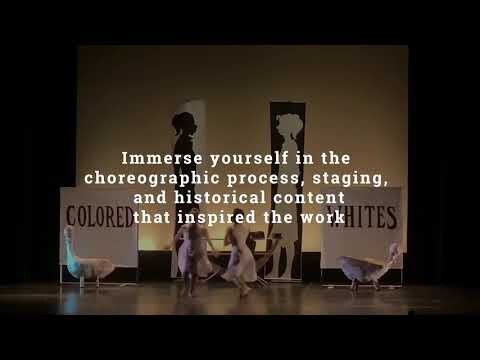
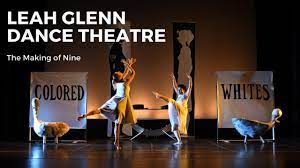
In June 2021 I attended “The Making of Nine” at Dogtown Dance Theatre. An artist’s talk with choreographer Leah Glenn, visual artist Steve Prince, poet Dr. Hermine Pinson, and historian Dr. Jamel Donner, “The Making of Nine” offered a fascinating insight into the creative process and historical background of a multi-media work-in-progress that celebrates the nine African-American students who integrated Little Rock Central High School in Arkansas in 1957.

Nine was co-commissioned by the Carver Community Cultural Center in San Antonio, TX, in partnership with Xavier University and the National Performance Network’s Creation and Development Fund and the show premiered Saturday, May 28 at the Carver. When I learned that the finished work – or at least the latest iteration of this dynamic and developing work – would be presented for only one performance at Dogtown on June 4 I rearranged my schedule to make sure I did not miss it. The previous year’s artists’ talk had impressed me that this was a work that needed to be seen.

The closing work on a program of nine works, Nine is a fusion of dance, poetry, music, visual arts (in set design, costumes, props, and associated prints), and history that reflects on the institutions of racism, education, and American society.

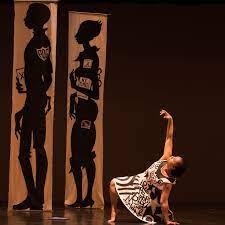
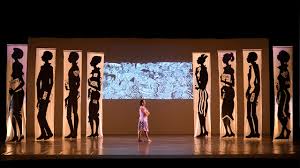
Nine begins with a humming, a moan, a procession of nine dancers and eight larger-than-life sized banners (the ninth banner appears after a significant solo) each featuring a stylized portrait of one of the nine. The dancers are clad in Prince’s beautiful black and white costumes (apparently hand-painted), each marked somewhere with the letters AOG on a small shield, and some are adorned with adinkra symbols. The AOG is a reference to Paul’s letter to the Ephesians, a reminder to put on the whole Armor of God – something that was necessary to protect the nine young scholars in their hostile educational and social environment. The adinkra symbols include the bird that faces forward while looking back – a reminder to “go back and get it” or learn from the past. The symbols are a visual representation of ancestral wisdom and traditional proverbs. In contrast, the costumes of the dancers representing the white students bear anti-black slogans (two, four, six, eight, we don’t want to integrate) and anti-Semitic symbols (swastikas).

The movement begins with the cadence of a work song, also an appropriate historical reference, as is the hand-clapping and thigh-slapping that serves as both accompaniment and choreography – a reference to the hambone or patting juba that developed during a time when drums were confiscated from African people in the Americans to prevent them from communicating with one another. Wow – all of this, and the dance has barely started. Nine is rich in historic references, and the integration of the multi-media elements is so multi-layered it cannot be comprehended in a single viewing. Nine is, in a way, a compact mini-series of the history of this specific group of young people at a specific point in time (1957) in a specific geographic location (Little Rock, AR).

Video footage from The History Makers archive provides some important historical background, but this is a work that I believe needs extensive program notes, or better yet, a pre-show introduction followed by a post-show discussion. It’s far too important to be treated as simply a dance, and far to complex to be denied the formality of community.

The program also included the urban Aloft, in which dancers run and balance to a background of traffic sounds and a rapid-fire Spanish-language speaker, sometimes assuming protective postures and other times appearing to teeter on a tightrope. There was the percussive and ritualistic Fault Lines, a jazz trio set to the music of Trombone Shorty called From the Corners of the Room, and Claiming Race, an encounter between two briefcase carrying men wearing suits and ties. Hush, which I believe was inspired by Glenn’s son, is a powerfully intense work that features a mourner’s bench and the soulful music of Sweet Honey in the Rock. Letter to the Editor, is based on an actual event in which Glenn’s father, head of one of the few Black families in the town where he resided, wrote a letter to the editor of the local newspaper in response to the locality’s resistance to integration. I am not sure what Glenn was thinking of when she created Furious Flowers but what I saw was a form of death that was in reality a planting, followed by a rebirth representing growth and hope, and I wish I had a bit of background for the duet Perceived Threat. The melancholy music, water sounds, and whispering, and the sudden and mysterious appearance of the male dancer’s partner from behind (or inside?) the box he was sitting on made me wonder exactly what – or who – the threat was.

The entire program offered plenty of food for thought. The closing image, of nine school desks lined up, the writing arms covered with portraits of the actual Little Rock students – was a stark reminder that we are still connected to the past, and hiding or re-writing history does not make it go away.

Julinda D. Lewis is a dancer, teacher, and writer who was born in Brooklyn, NY and now lives in Eastern Henrico County.

———-

Photo Credits: LGDT Website & Instagram page; Photos Courtesy of Skip Rowland .

One-Time
Monthly
Yearly

Make a one-time donation

Make a monthly donation

Make a yearly donation

Choose an amount

¤5.00
¤15.00
¤100.00
¤5.00
¤15.00
¤100.00
¤5.00
¤15.00
¤100.00

Or enter a custom amount

¤

Your contribution to support RVArt Review is appreciated.

Your contribution is appreciated.

Your contribution is appreciated.

DonateDonate monthlyDonate yearly

SUGAR IN OUR WOUNDS

A Tale of Queer Love and Ancestral Voices

A Theater Review by Julinda D. Lewis

At: Richmond Triangle Players at the Robert B. Moss Theatre, 1300 Altamont Ave, RVA 23230

Performances: April 20-May 14, 2022.

Ticket Prices: $30-35; $18 for Preview nights; $10 for Students.

Info: (804) 346-8113 or rtriangle.org. Richmond Triangle Theater has returned to full-capacity seating and requires proof of vaccine or recent negative PCR test results for entry. See the theater’s website for their COVID-19 precautions, digital programs, and more.

Just as every now and then someone says, does, or creates something so wonderful that I enviously wish I had done it. Similarly, every now and then someone creates a play, poem, or story that is so unique or so wonderful that I wonder why I never thought of or heard of the idea before. Sugar in Our Wounds by Philadelphia-based Afro-Queer playwright, poet, and filmmaker Donja R. Love is a prime example of this type of work. Rescheduled from 2020, you know, when that little thing called The Pandemic stopped by, Sugar in Our Wounds was well worth the wait. Set on a plantation in the summer of 1862, during the Civil War, “somewhere down South, by a tall, tall tree,” Sugar in Our Wounds examines the intersection of freedom and love.

“Ain’t no roamin’ the world, for a weak nigger. – Henry

STRANGE FRUIT

An elder, Aunt Mama, and her makeshift family, James and Mattie, occupy a cabin on a plantation that has a striking feature – a mystical whispering tree so tall no one can see the top. Generations of enslaved people have been hung from this tree, but James is determined this particular generational curse will stop with him. James is smart. He keeps his head down – both literally and figuratively – and follows the rules – except for one. The master’s daughter, Isabel, sneaks down to the cabin periodically to teach James how to read.  She’s bored, because her husband is away fighting the war, and predictably, at some point, like Potiphar’s wife in the Old Testament, she begins to take a dangerous interest in the only available men around, but that’s not the real story here.

The real story is about love, across time and generations, and involves a young stranger who arrives and is accepted by Aunt Mama and her little family. Mattie, who also happens to be the master’s daughter, is in a precarious position, trusted by no one. Although we never see or hear from other enslaved people on the plantation, we know there are others, but only Aunt Mama and James feel safe in the company of Mattie, who like many others in her situation, is not welcome in either of the worlds she straddles. So of course, Mattie is attracted to this able-bodied stranger, Henry, but we soon find out that Henry, while he does not entirely rebuff Mattie, is far more interested in James than he is in Mattie.

“The darker you is, the more questions you got.” – also Henry

HISTORY LESSONS

There are so many significant details in Sugar in Our Wounds that it would be nearly impossible to notice them all on just one viewing. The show opens with projections of legs and feet, photos on the rocks and trees, the “strange fruit” many of us were first introduced to by Billie Holiday’s recording of the mournful song of the same name. The tree hums and whispers, and James and Aunt Mama can hear it and communicate with it, with the ancestral spirits who reside in or around it and who use it to teach and warn their descendants. One notices a fancy chair that seems out of place in the little cabin, that is sparsely furnished with a tiny communal bed, shared by the three occupants, an all-purpose that serves as a seat or a table, and a bucket whose aroma Isabel finds offensive.  The chair, of course, belongs to Isabel. Aunt Mama refuses to keep the bucket (aka chamber pot) outside because it is a precious commodity and might be stolen by nearby residents – another way we know this little family is not alone on this plantation. At one point there is an authentic feeling ring shout for the upcoming freedom. But there were also a few moments that seemed out of time and place. Sometimes the men are barefoot, and sometimes they wear shoes – and socks. Would enslaved young men have owned socks? During one visit to teach James to read the bible Isabel says the slop bucket smells “funky” and moments later she to James, “you blow me away.” The Oxford dictionary says the word “funky” originated in the late 17th century, so maybe it would have been used, and idiomorigins.org says “blow me away” phrases date back to the 16th century.  Later, James says, “Don’t act new!” It seems people were saying something similar back in the day – as far back as the 1560s. Shakespeare even had a variation, “fire-new.” Both “brand new” and “fire-new” meant fresh from the fire. Who knew?

THE SPIRIT OF LOVE

The cast, the story, the execution of this production more than just a play, more than a love story. It felt like a work of love that was more than just acting, but more like a spiritual offering. Dorothy Dee D. Miller inhabited the persona of Aunt Mama like an act of faith, as if she did not just choose to act this role, but as if she HAD to share this role. Jónel Jones, whom I had recently seen as a scammer in a TheatreVCU production of Intimate Apparel took on a quite different role here as the hero, giving a strong yet gentle, nuanced performance that lingered some time after the final bows. Duron Marquis Tyre as Henry, the mysterious new-comer similarly maintained a balance of mystery, danger, and tenderness. Tyra Huckaby maintained a relatively low-key supporting role until the end, when the seed she was carrying elevated her to a place of prominence as the last remaining hope for the future, while Charlotte Grace Smith was a necessary but negligible presence – not because she wasn’t good enough but because Sugar in Our Wounds wasn’t about her.

Director Lucretia Marie did an excellent job, creating, maintaining, and drawing the audience into this mystical world in a way that educated, entertained, and enlightened all at once. The pacing, the acting, the setting, the atmosphere, all worked together to create that magic that every show aims for but few actually achieve. Sugar in Our Wounds is one of the most memorable and moving shows I’ve seen in recent memory, and I hope to have a chance to see it again in the future to see if it hits the same.

———-

Julinda D. Lewis is a dancer, teacher, and writer who was born in Brooklyn, NY and now lives in Eastern Henrico County.

———-

SUGAR IN OUR WOUNDS

Written by Donja R. Love

Directed by Lucretia Marie

CAST:

James …………………………………….          Jónel Jones

Aunt Mama ……………………………          Dorothy “Dee D.” Miller

Isabel …………………………………….          Charlotte Grace Smith

Mattie …………………………………..           Tyra Huckaby

Henry ……………………………………           Durron Marquis Tyre

Understudies

For Isabel – Juliette Aaslestad

For Aunt Mama – Sharalyn Bailey

For Mattie – Ayana Flowers

For Henry – Calvin Graves

For James – Makai Walker

CREATIVE TEAM:

Scenic Design by William Luther

Costume, Hair & Make-Up Design by Margarette Joyner

Lighting Design by Steven Koehler

Sound Design and Original Music by Kyle Epps

Projections Design by Dasia Gregg

Props Design by Tim Moehring

Intimacy Choreographer – Kirsten Baity

Violence/Asst Intimacy Choreographer – Stephanie Tippi Hart

Assistant to the Properties Designer – Nicole Pisaniello

Dialect Coach – Evamarii Johnson

Dramaturg – Shinji Elspeth Oh

Assistant Director – David Powell

Original Scenic Concept – Mercedes Schaum

Technical Director – Rebecka Russo

Assistant Stage Manager – Dwight Merritt

Production State Manager – Shawanna Hall

Photo Credits: John MacClellan

One-Time
Monthly
Yearly

Make a one-time donation

Make a monthly donation

Make a yearly donation
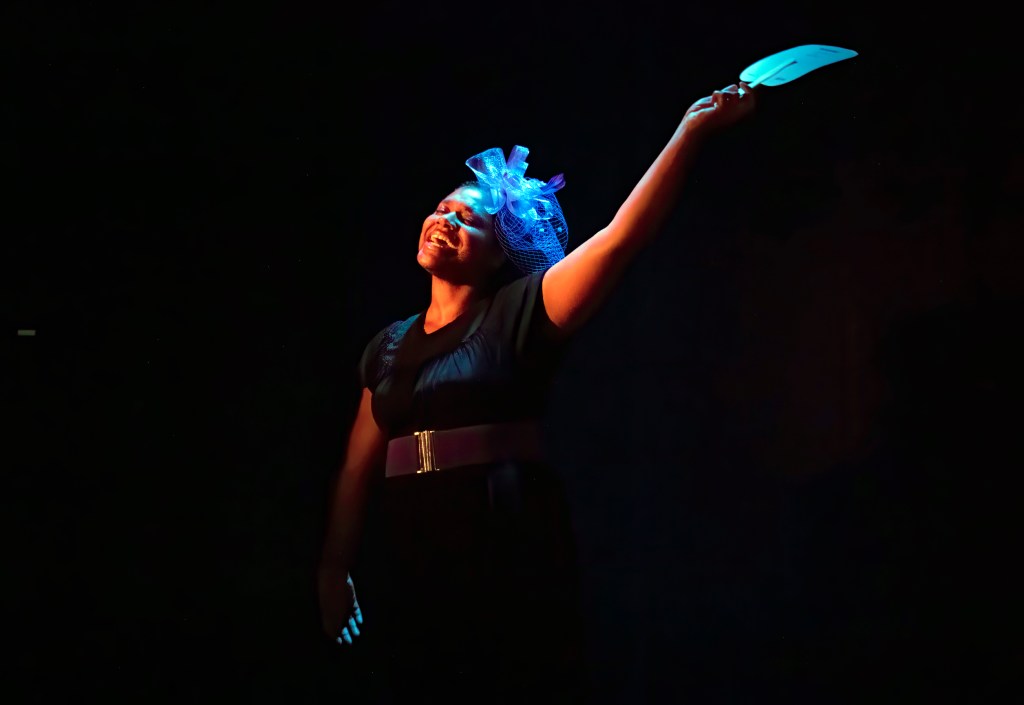
Choose an amount

¤5.00
¤15.00
¤100.00
¤5.00
¤15.00
¤100.00
¤5.00
¤15.00
¤100.00

Or enter a custom amount

¤

Your contribution is appreciated.

Your contribution is appreciated.

Your contribution is appreciated.

CLICK HERE TO Donate TO RVART REVIEWCLICK HERE TO Donate TO RVART REVIEWCLICK HERE TO Donate TO RVART REVIEW