DRACULA

Not Just a Ballet, But a Cultural Event

A Dance Review & Cultural Excursion

By: The Richmond Ballet with the Richmond Symphony

At: Dominion Energy Center’s Carpenter Theatre, 600 E. Grace St., RVA 23219

Performances: February 16-18, 2024

Ticket Prices: $25 – $130

Info: (804) 344-0906, etix.com, or richmondballet.com

THE PROGRAM

DRACULA

Choreography by Ben Stevenson, O.B.E.*

Music by Franz Liszt, arranged by John Lanchbery

Staging by Dominic Walsh

Scenery Design by Thoms Boyd

Costume Design by Judanna Lynn

Original Lighting Design by Timothy Hunter

Lighting Supervisor: Christina R . Gianelli

Guest Piano Soloist: Douglas-Jayd Burn

Flying by Foy

World Premiere: March 13, 1997, Houston Ballet, Worthan Center, Houston, TX

Richmond Ballet Premiere: February 16, 2024, Dominion Energy Center, Richmond, VA

Costumes and Scenery courtesy of Pittsburgh Ballet Theatre

*OBE = Officer of the Order of the British Empire: a British order of chivalry, rewarding contributions to the arts and sciences, among other fields

The Cultural Excursion

I’d been looking forward to seeing the Richmond Ballet’s premiere of DRACULA for months. (See my preview for Richmond Magazine: https://richmondmagazine.com/arts-entertainment/richmond-events/richmond-ballet-dracula/) But even though I had read the press release and had obtained a quote from Associate Artistic Director Ma Cong about the ballet’s high production values and dramatic choreography, I was not prepared for what I saw – both onstage and offstage – when I arrived at the Dominion Energy Center for the final performance of the three day run. I am so glad I got to witness this event with my own eyes and ears. Ben Stevenson’s choreography was every bit as dramatic as promised. The set resembled a towering gothic fairytale. The music lured you in, and there was even a red-colored, vampire themed drink available at the bar. But more on the actual ballet after this brief detour. [You may avoid the detour by skipping the next three paragraphs.]

First, the event started even before I got inside the theatre. While searching for parking, and then walking to the Dominion Energy Center, I noticed a number of people who were clearly headed to see Dracula. There was a veritable fashion show of goth gear, black lace, pale foundation and black eyeliner. The number of capes – in black and red – was astounding. A car parked across from mine in the parking deck even bore a license plate with some variation of the word “vampire.” All of this made me wonder, does  Richmond have a vampire community? I know about the theatre community, the dance community, the spoken word community, even the drag community and the burlesque community – but a vampire community?

That brings us to the second point. Much to my surprise, a cursory online search turned up several articles on an urban legend known as The Richmond Vampire, also known as The Hollywood Vampire. (Am I the last to know?) There is a story, dating back to the 1920s, of a vampire entombed in Hollywood Cemetery, near Oregon Hill. The legend is linked to the very real and verified collapse of a railway tunnel in Church Hill, where the train engine, flatcars, and bodies of laborers remain to this day.

Another part of the legend identifies the Richmond Vampire as one W. W. Pool, whose tomb is located in Hollywood Cemetery, as a vampire who was run out of England in the 1800s. And then, my husband reminded me of someone we know who, a few years ago, was said to have been “studying” to become a vampire. While none of this is directly related to the ballet, it does explain some of the things I saw, and some of the cultural aspects that were attached to the theatrical experience. One final note before going on to my third and final point – a discussion of the actual ballet – vampires, or vampire allies, seem to be quite friendly.

The Review

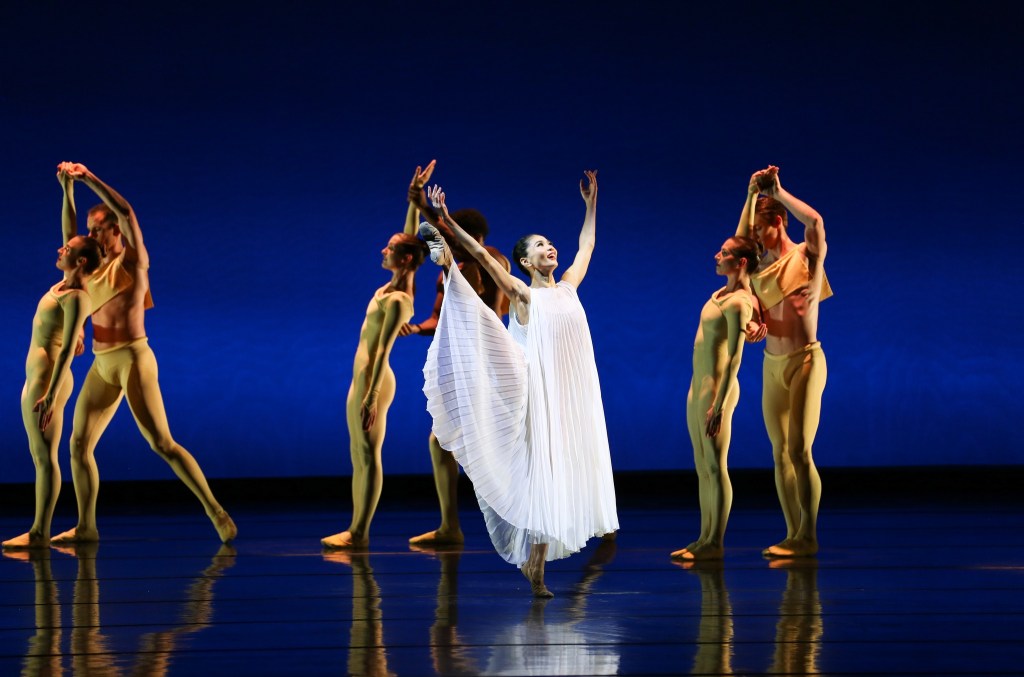
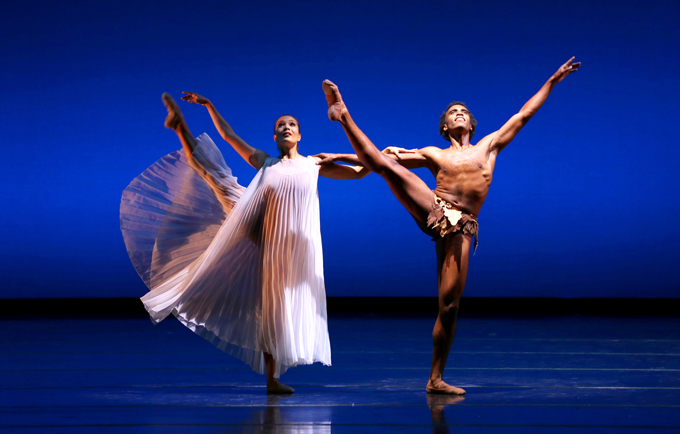
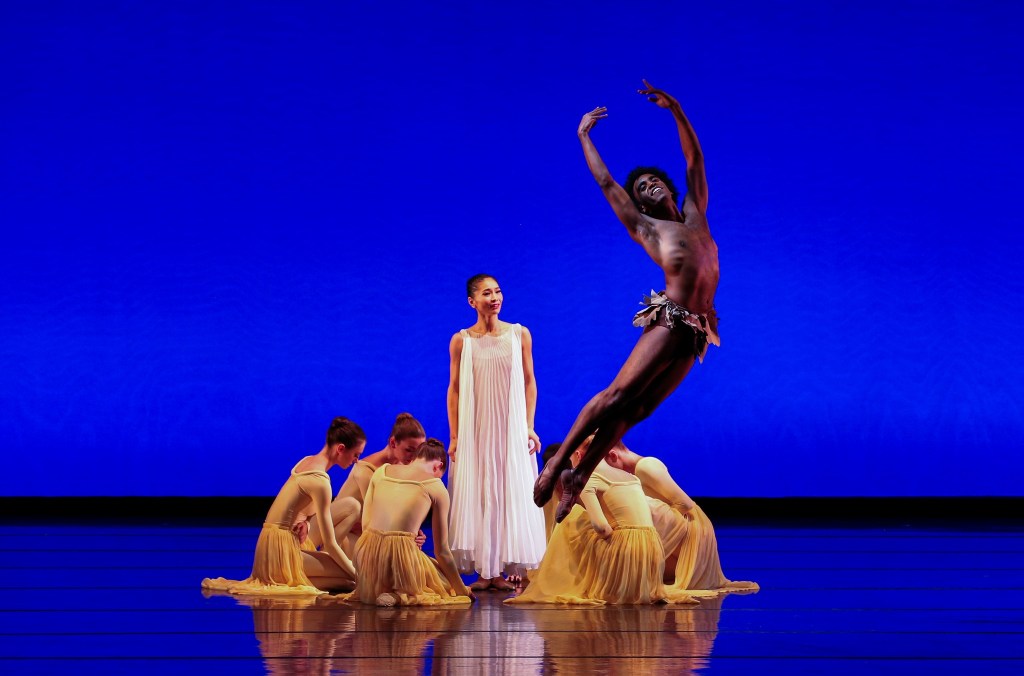
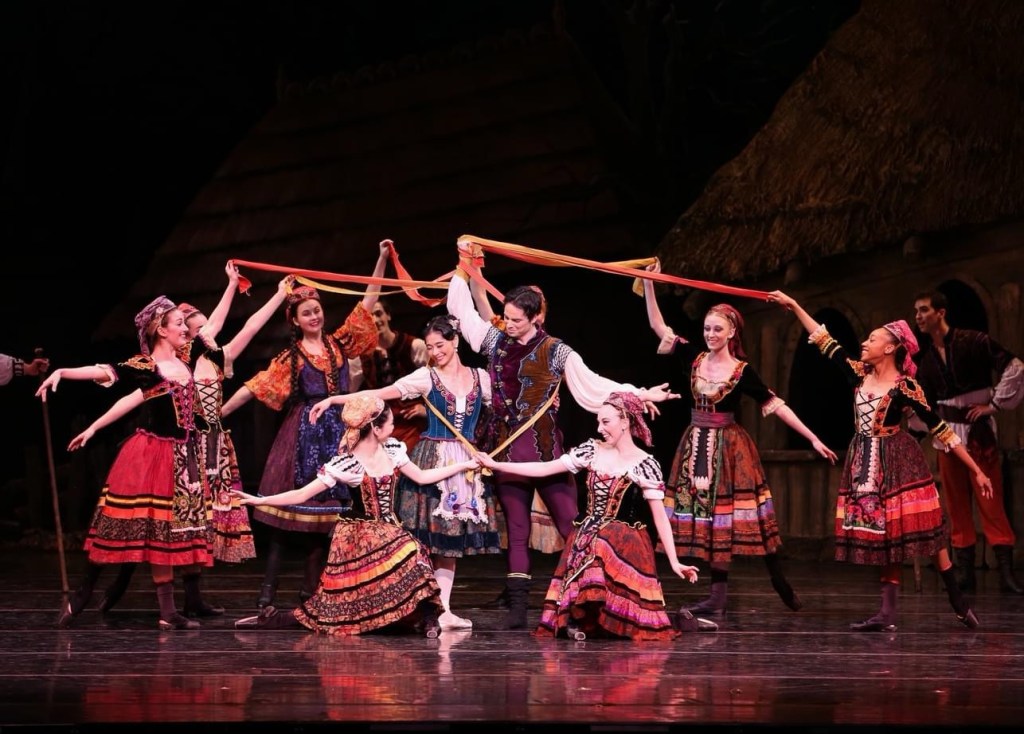
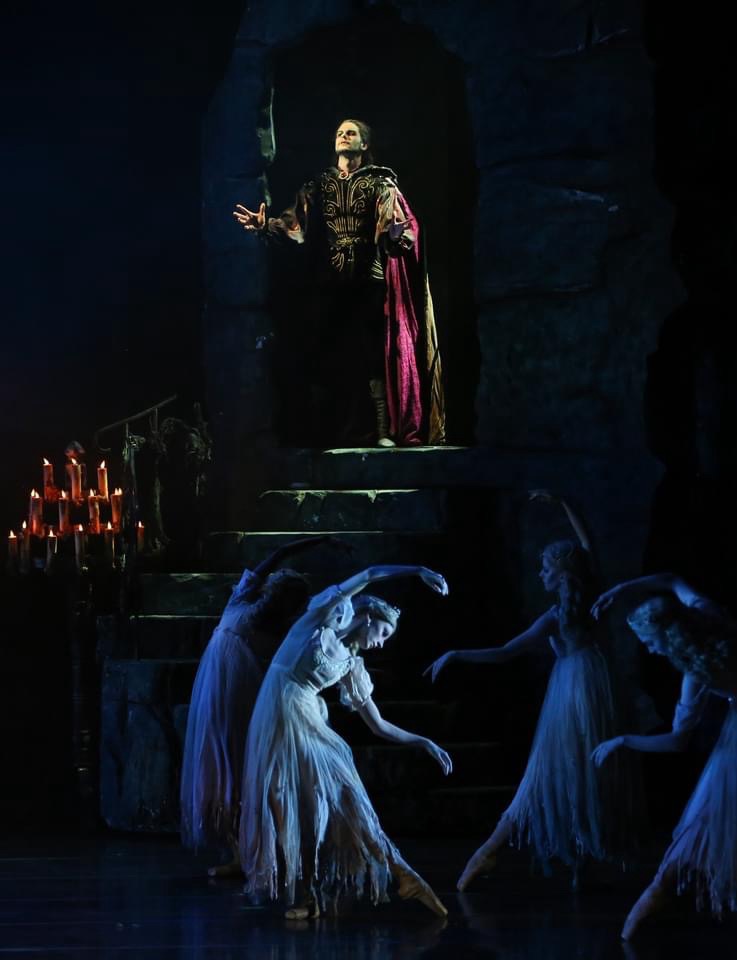
Finally, there was the ballet itself – a three act production (The Crypt, The Village, The Bedroom) running approximately two and a half hours, including two intermissions. Make no mistake, Dracula is, indeed, a ballet in the traditional sense. There is plenty of classical technique, including pointe work, and partnering. The second act, set in an Eastern European village, includes the familiar characters (an innkeeper, a matriarch, a pair of innocent young lovers) and peasant costumes and folk dances that populate many story ballets.

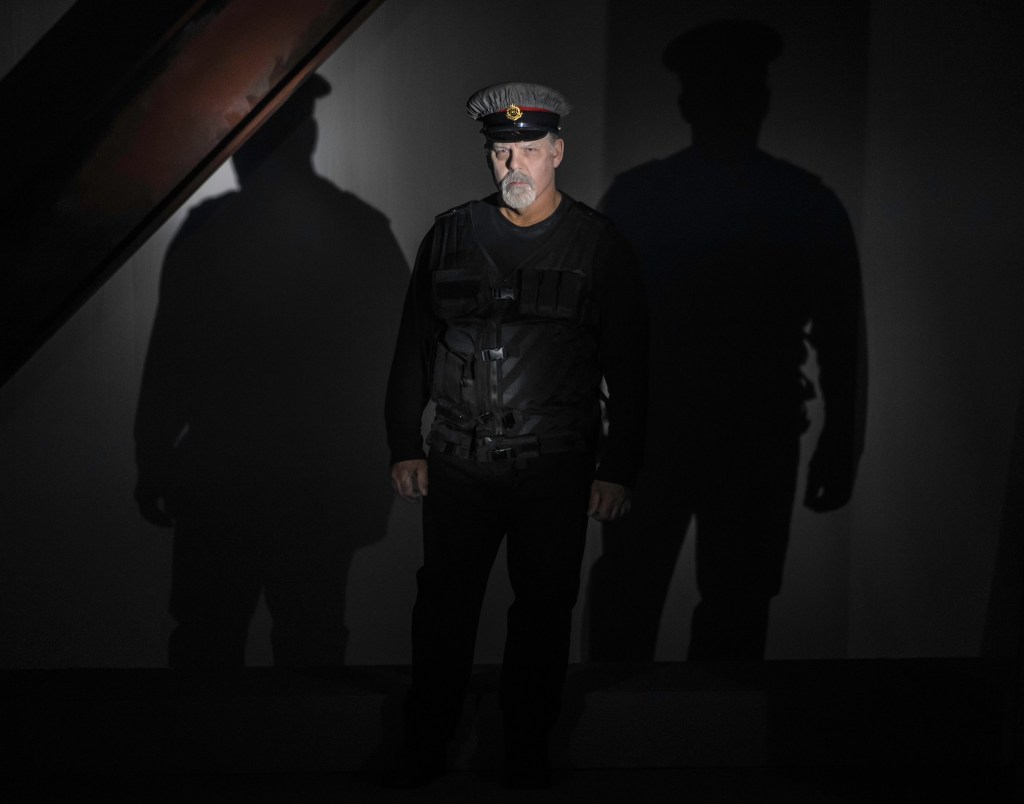
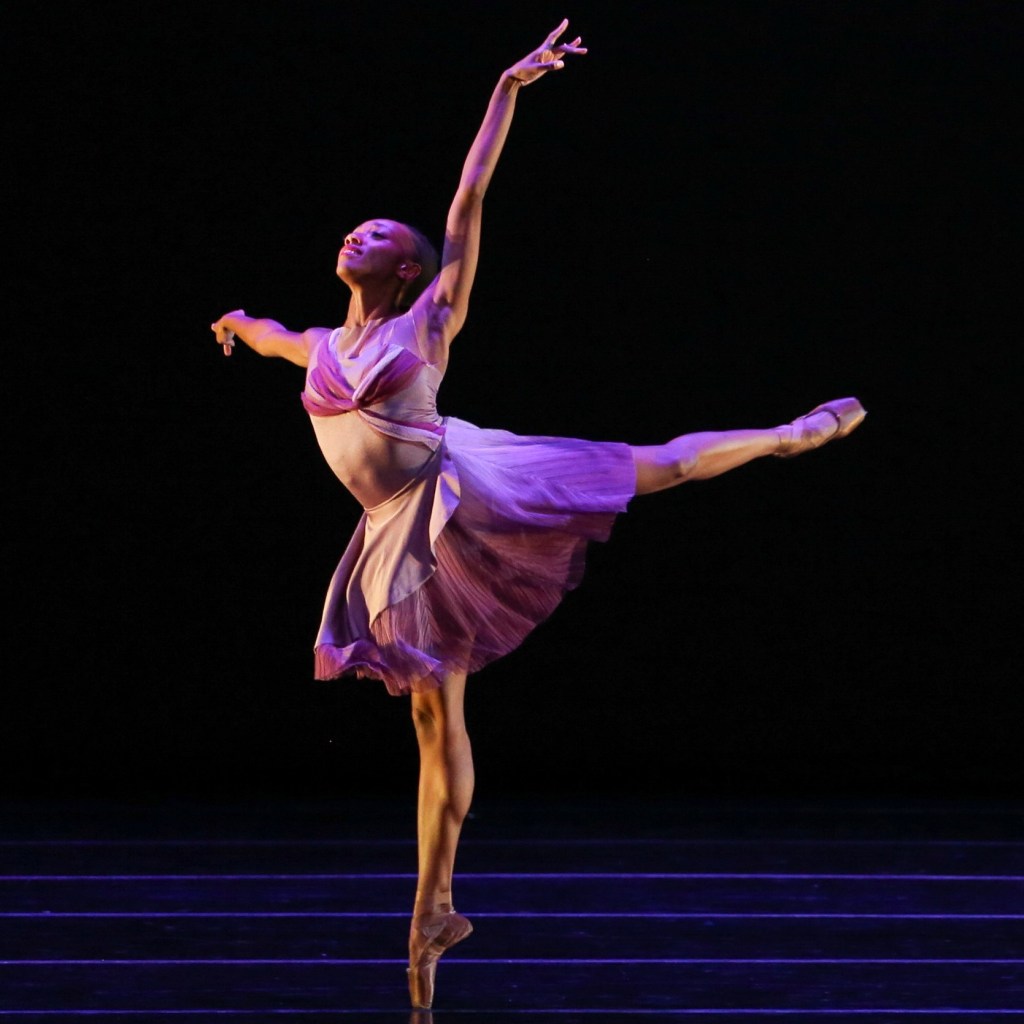
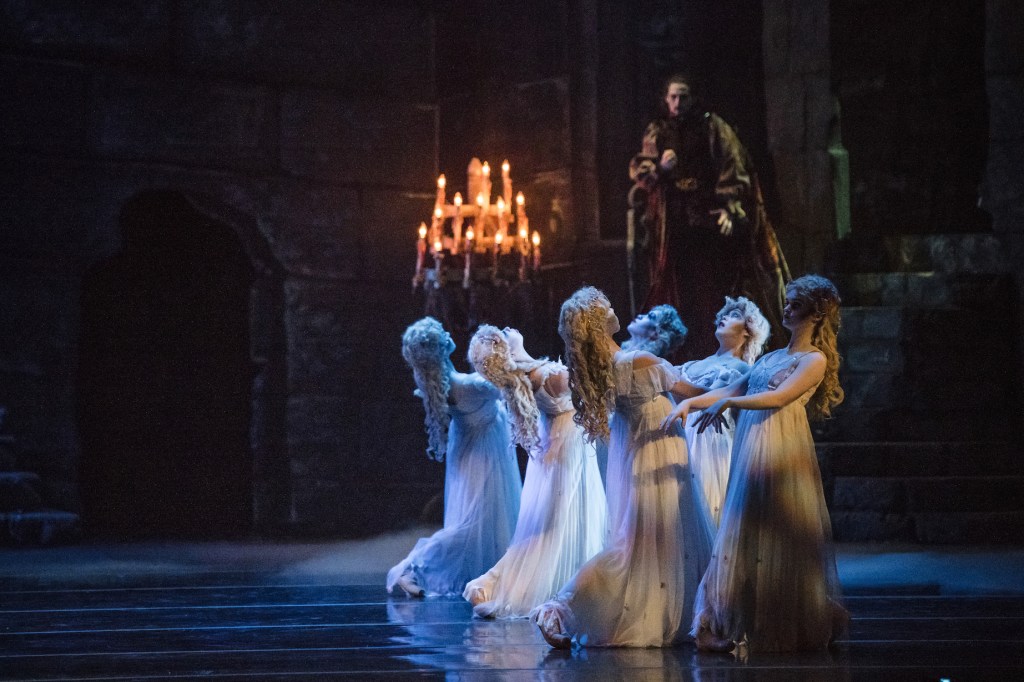
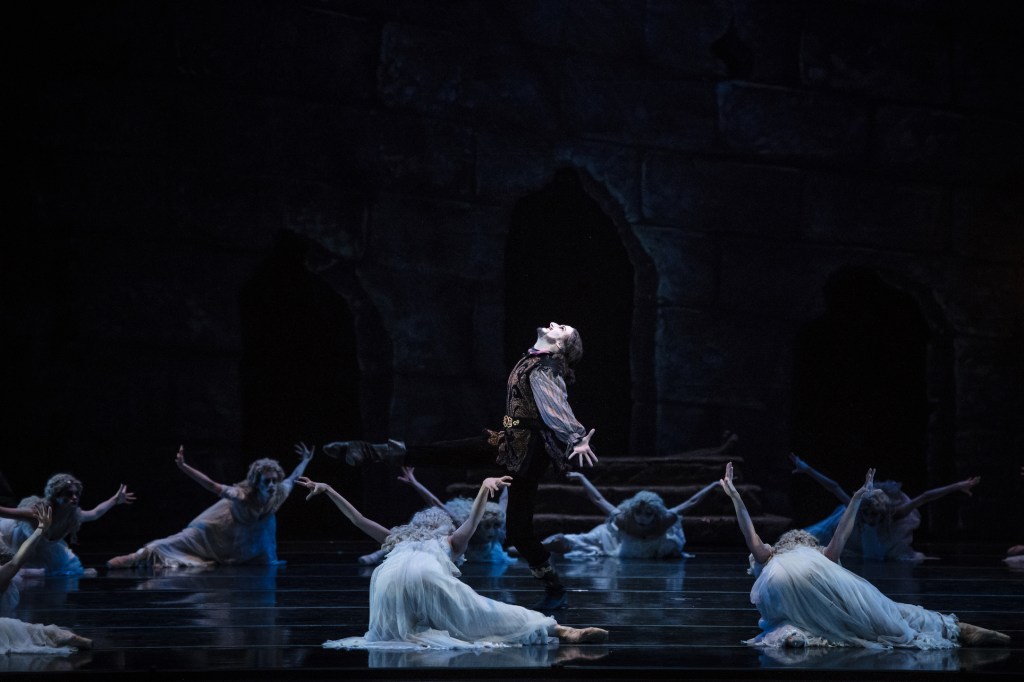
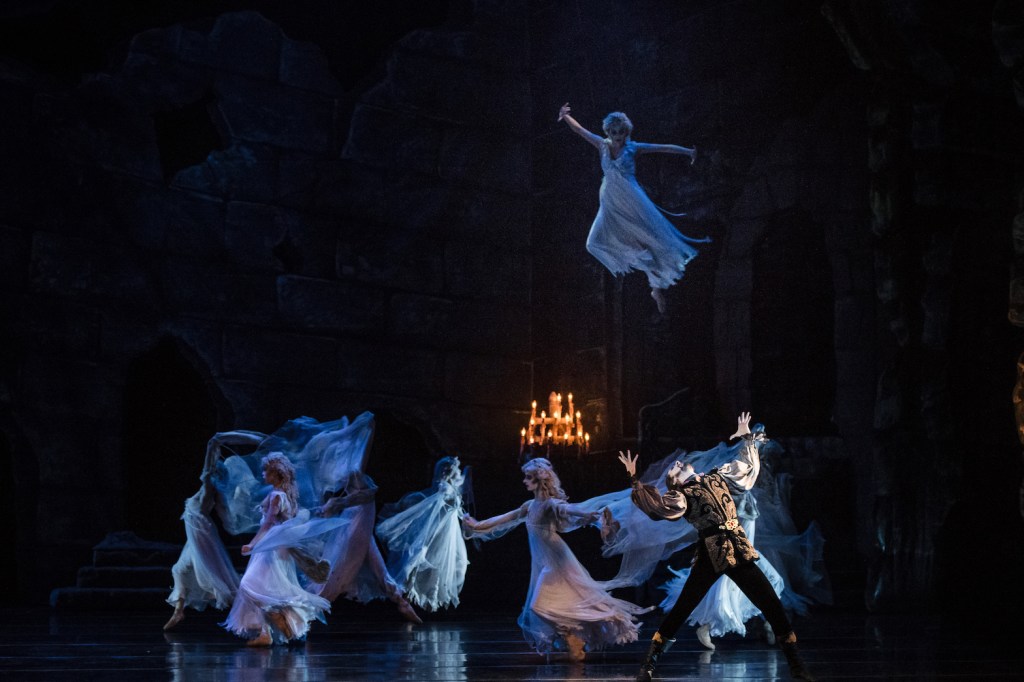
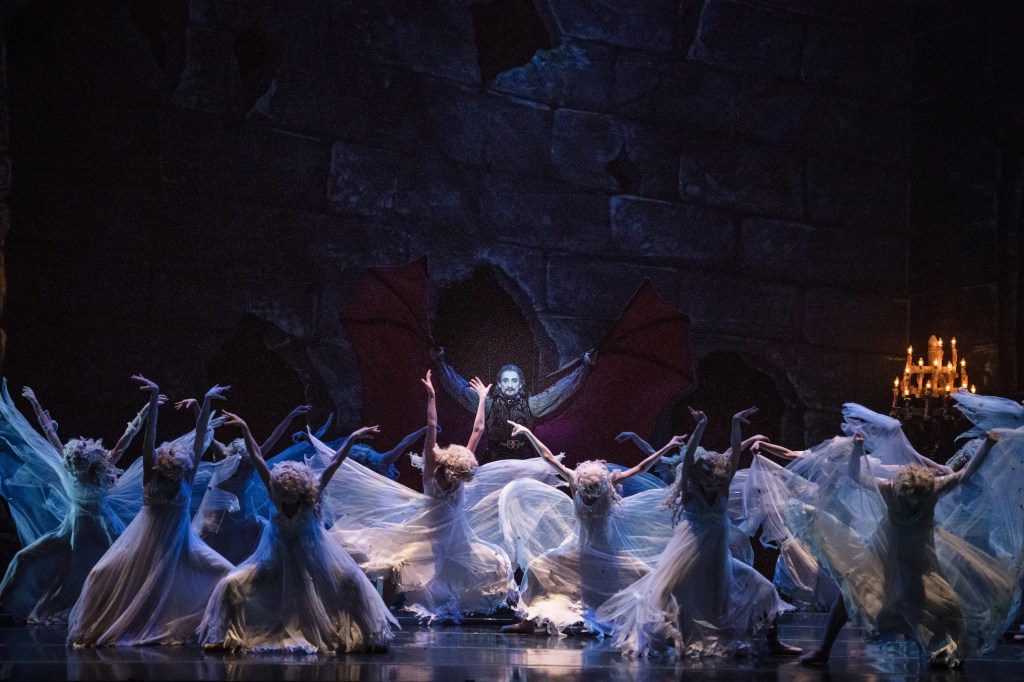
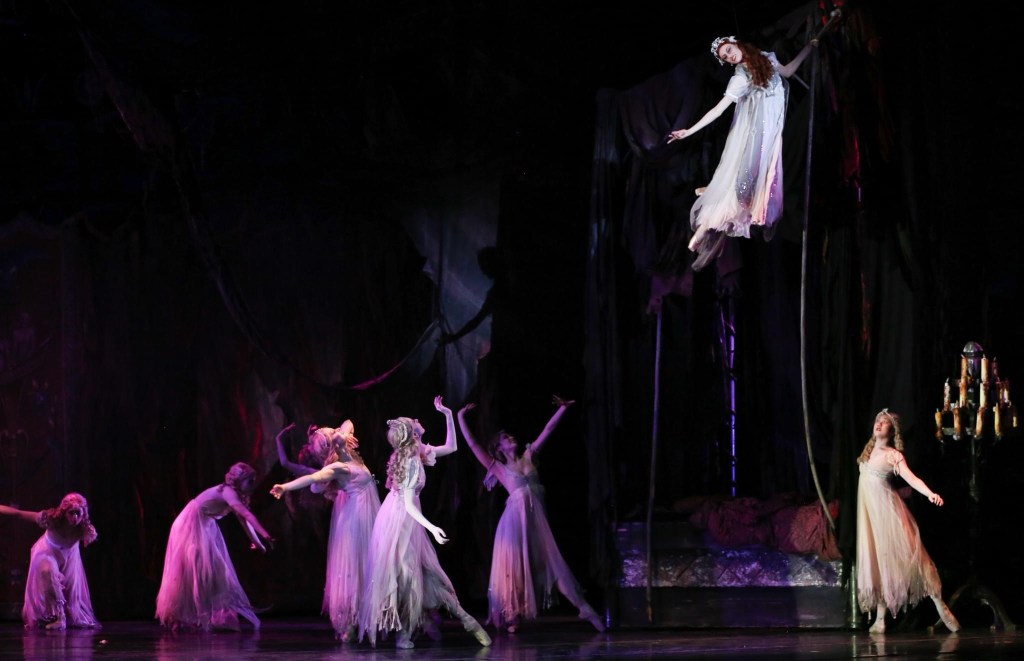
Dracula is also quite different from most classic ballets. The women of the corps who dance the roles of Dracula’s brides may initially remind you of the Willis in Giselle. They have been tasked with dancing gracefully and on pointe while carrying their arms stiffly in front of them, affecting the posture of the ”undead.” To do this while maintaining flexibility and gracefulness throughout the rest of the body must have been a challenge. There are flying dancers in several scenes (Anne Sydney Heatherington and Valerie Tellman-Henning were credited in the program, but I thought there was a third as well) and some impressive pyrotechnics near the end when Dracula is finally hunted down and destroyed by Frederick, Svetlana’s innkeeper father (Gabor Szigeti), and the village Priest (Jack Miller) – and while these effects proved to be delightful for adults and children alike, there were many themes that dealt  with morality and sexuality that were not recommended for children under the age of 8.

For instance, Dracula’s henchman, Renfield (danced by Zacchaeus Page for the final performance) procures young women for his master. Come to think of it, Renfield’s status is little more than that of an indentured servant or slave, so there’s that issue of oppression as well. Dracula’s dozen wives would constitute polygamy by today’s standards, but then there is also the issue of them aiding and abetting the procuring of “fresh blood” which can only be obtained by kidnapping more women. If this were a TV show, I’m sure Capt. Olivia Bensen would be called in because this sounds like a case for “Law & Order: SVU.”

Irish author Bram Stoker published the gothic horror novel Dracula in 1897. British-born choreographer Ben Stevenson (who spent 27 years as artistic director of the Houston Ballet) created the masterful Dracula,the ballet, to commemorate the 100th anniversary of Stoker’s masterpiece. (Stoker and Stevenson even share the same initials.) Given the differences in media, the two vampire tales are quite distinct, yet recognizably related.

Richmond Ballet rehearsed two complete casts for Dracula. Sunday evening, the lascivious vampire was danced by Christian Renforth, his newest bride Flora by Izabella Tokev, his henchman Renfield by Zacchaeus Page, and Svetlana, the innocent young villager on whom Dracula has cast his eye as his next prize, by Eri Nishihara. Aleksey Babayev danced the role of Svetlana’s beloved Frederick and the two of them had a wonderful chance to shine in a celebratory dance scene. After drinking too much, rather than losing his composure, Frederick demonstrated a stunning virtuosity, and Svetlana temporarily lost her shyness – turning not on her toes but on her heels.

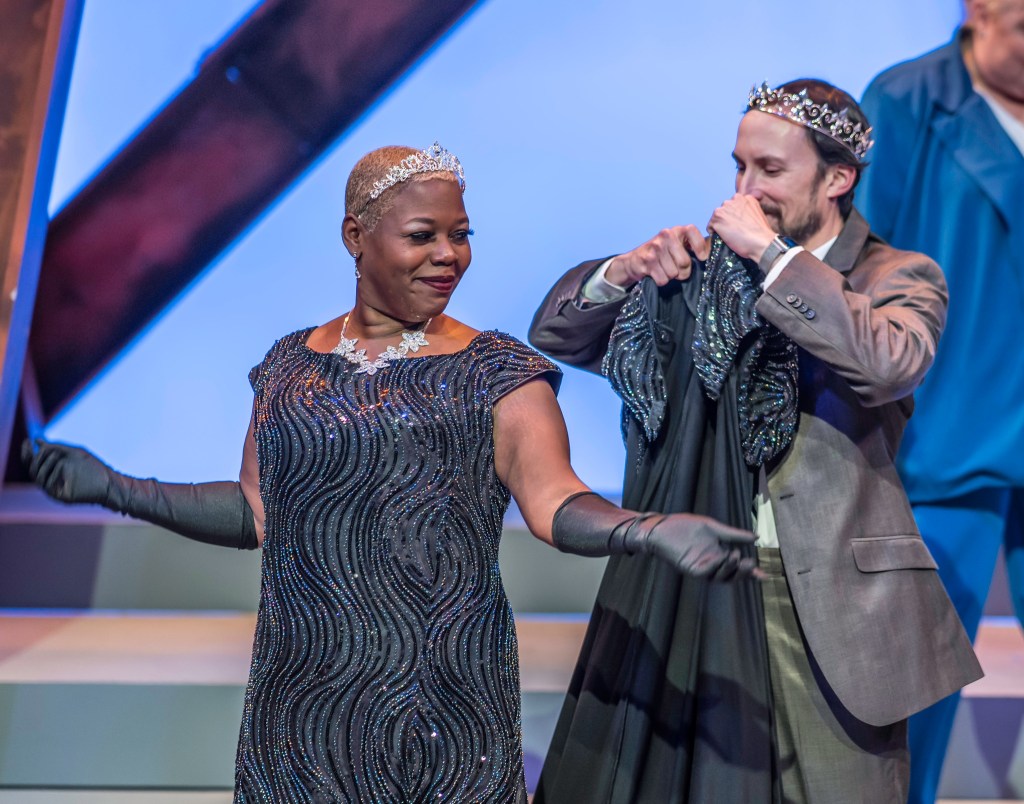
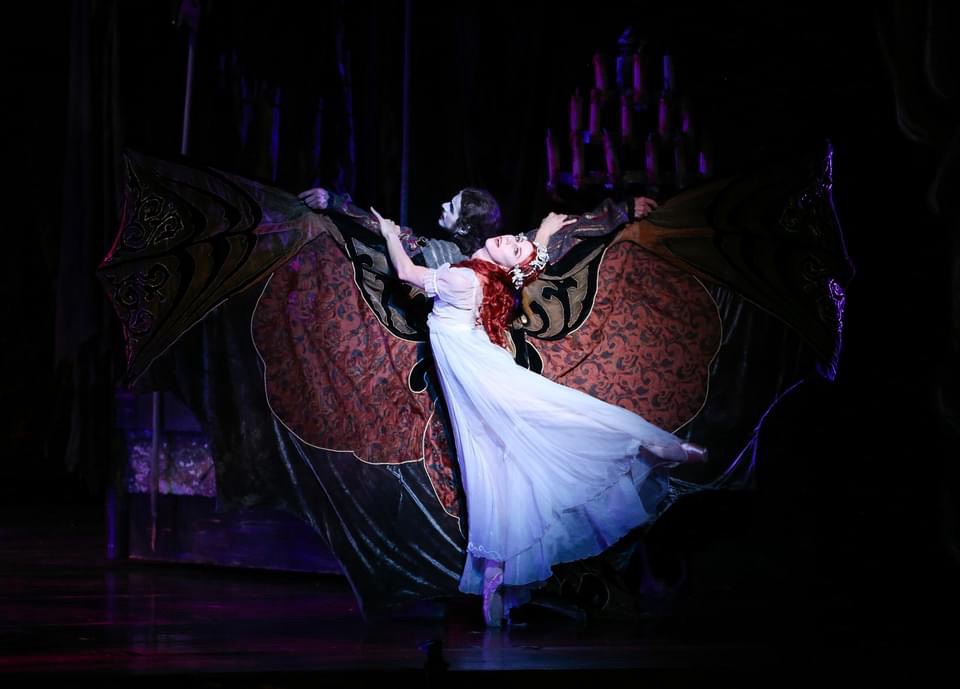
Dracula’s cape is both a fashion statement and a work of art in blood red and black with tapestry-like designs. The brides’ white dresses, pale makeup and pale locks set a new standard for “undead” beauty. The set for Acts I and III (The Crypt and The Bedroom) are majestic and spooky, in contrast to the once-upon-a-time innocence The Village set of Act II. Last but not least, I must mention the dreadful carriage that Renfield uses to procure Dracula’s new brides. Drawn by two horses (Tekhylon Armour and Darius Mealy), the dark and ragged carriage with a hint of smoke at the top shouts “stranger danger” but even Svetlana’s strongest kicks and screams are no match for the evil that lies within.

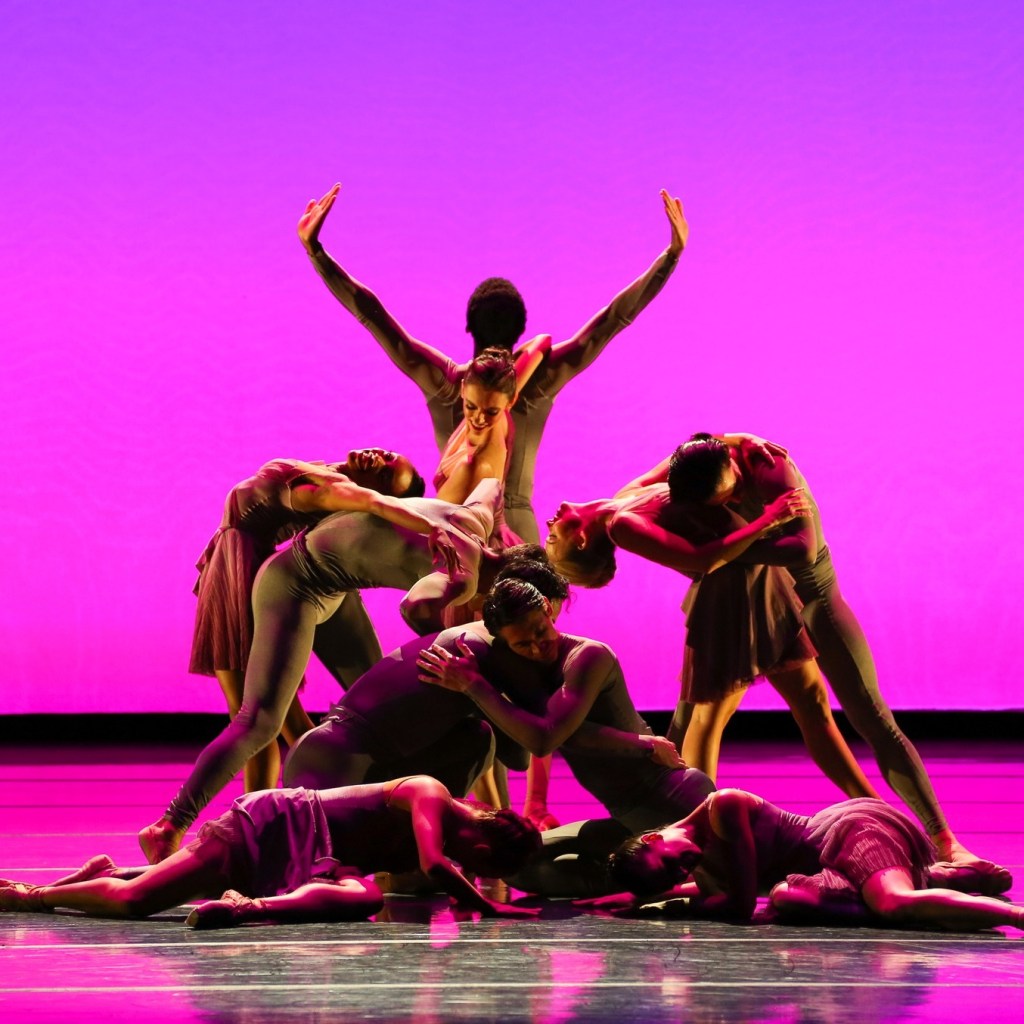
The Richmond Symphony, under the direction of Erin Freeman, with guest pianist Douglas-Jayd Burn played Franz Liszt’s haunting and dramatic score arranged by John Lanchbery specifically for Stevenson’s ballet. Dracula is truly a collaboration of elements: the choreography, the music, the story, the set, the costumes all work together to create theatre magic.

The Richmond Ballet offered this production of Dracula the weekend after Valentine’s Day. I have often complained that Romeo and Juliet was not my idea of a proper Valentine’s offering, since they both end up dead. Cinderella has been a happier alternative. Dracula has many of the elements – both pros and cons – of other romantic ballets, but the addition of a vampire somehow makes it sooooo much more satisfying…

Julinda D. Lewis is a dancer, teacher, and writer who was born in Brooklyn, NY and now lives in Eastern Henrico County. When not writing about theater, she teaches dance history at VCU and low impact dance fitness classes to seasoned movers like herself, and occasionally performs.
One-Time
Monthly
Yearly

Make a one-time donation

Make a monthly donation

Make a yearly donation

Choose an amount

$5.00
$15.00
$100.00
$5.00
$15.00
$100.00
$5.00
$15.00
$100.00

Or enter a custom amount

$

Your contribution is appreciated.

Your contribution is appreciated.

Your contribution is appreciated.

DonateDonate monthlyDonate yearly
Photo by Sarah Ferguson

MEMORIES OF OVERDEVELOPMENT

The New Theatre at Firehouse on the Carol Piersol Stage Presents

A WORLD PREMIERE

A Theater Review by Julinda D. Lewis

At: The Firehouse 1609 West Broad St., Richmond, RVA 23220

Performances: February 7 – 25, 2024

Ticket Prices: $0-$35

Info: (804) 355-2001 or firehousetheatre.org.

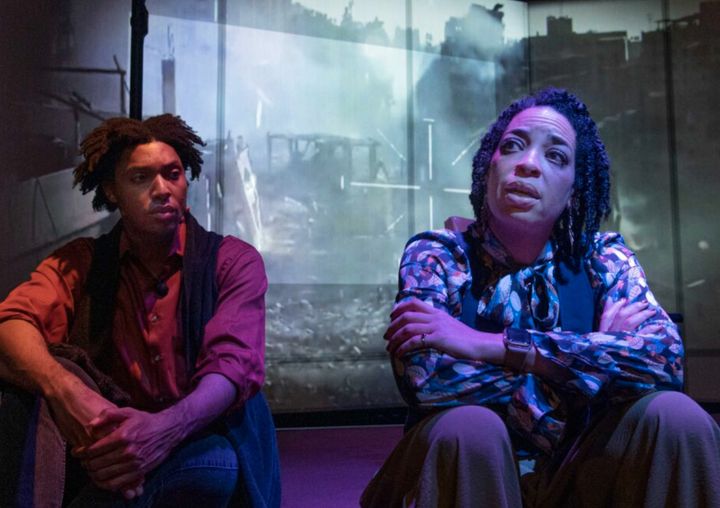
I know I’ve said this before, but every now and again a new play comes along that is quite unlike anything I’ve ever seen before. Caridad Svich’s new play, Memories of Overdevelopment is one such play. It’s a play about a filmmaker interviewing people for a documentary. Or maybe its documentary play about a filmmaker and the people they are interviewing for a documentary. Or maybe it’s a film that plays out on a stage.

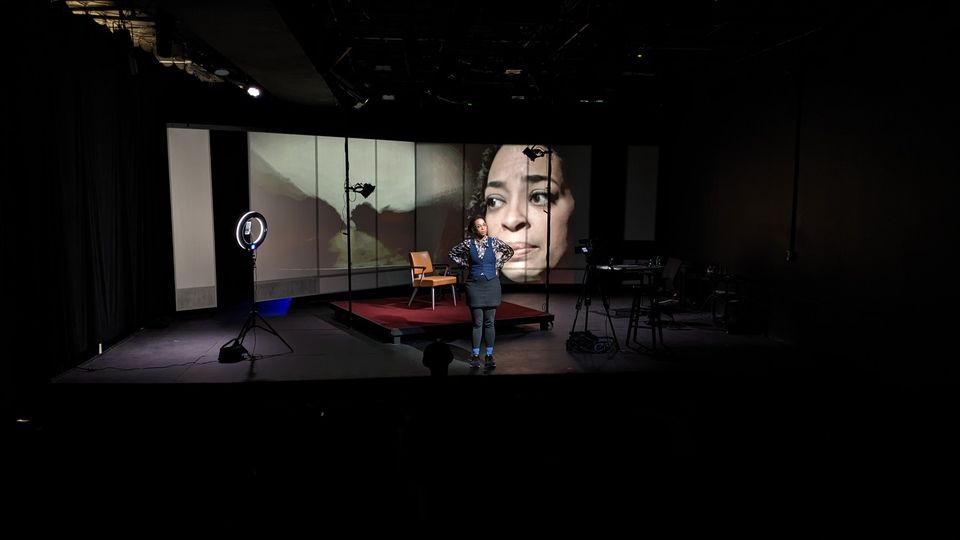
Let’s try this approach. Memories of Overdevelopment is a two-person play that can be performed by a cast of 2-8 people, and it runs from 60-90 minutes. It is also a stage play in which technology is virtually a character in its own right. Video and projections are so fully integrated into the production that the play would be unrecognizable without them.

Now, how do I tell you about the awesomeness of Memories of Overdevelopment without giving away too much? That might not be possible, so be forewarned.

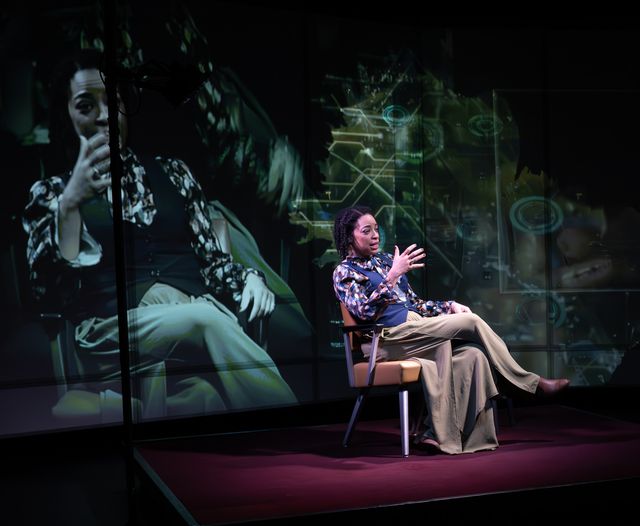
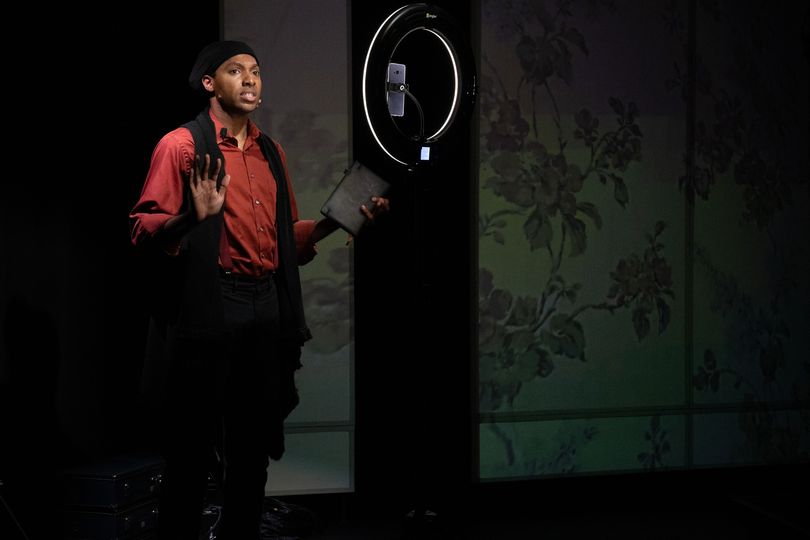
As directed by New Theatre at Firehouse’s Artistic Director Nathaniel Shaw, Memories of Overdevelopment is a two-person play that runs 90 minutes without intermission. Keaton Hillman (who started as the show’s understudy and stepped in at the eleventh hour for Juliana Caycedo, due to health reasons) plays Actor 1. Katrinah Carol Lewis (who was publicly announced as the New Theatre at Firehouse’s new Associate Artistic Director just days before opening) plays Actor 2. But sometimes Lewis and Hillman switch roles. And sometimes they are “acting” as the people being interviewed for a documentary that follows the stories of people who grew up in dictatorships (underdeveloped countries?), escaped, and lived to tell the tale of how they survived.

There’s a former shop owner, a university student, a professor, a dancer, an artist, a former friend, and a fascist. Interspersed with the sometimes intense and edgy interviews are a series of “memory reels” and while the work is not interactive the audience is inevitably drawn into the mist of the proceedings by sometimes larger than life, real-time video projections of the actors – and the characters they portray – on a backdrop of panels in a workspace intended to replicate a recording studio.

Memories of Overdevelopment has a unique worldview on politics, society, tyranny, resistance, art, immigration, assimilation, fascism, globalization, and all things rebellious. Inspired by true stories, the author reveals uncanny insight and wisdom and challenges us to rethink, well, everything. “Becoming everything you believe in” may be a blessing and a curse and both things can be true at the same time.

Hillman opens the play with a brief overview, seemingly forgetting to introduce his documentarian, Lewis, who calmly sets up cameras and tests light intensities and does all the other things a filmmaker does to prepare – and the next thing you know they have switched roles. Things rapidly progress to a Level 10 out of 10 of intensity, and stays there for most of the next 85 minutes.

Nonetheless, a couple of scenes stand out. When Lewis interviews Hillman and the subject of fascism comes up, Lewis ramps up the intensity even further. What started out as a documentary interview becomes an interrogation. Hillman matches Lewis word for word, phrase for phrase. At one point Hillman blurts out, “We’re just sheep,” and offers a strident, “baaa, baaa.” And at the end, Lewis, returning to the role of the shopkeeper, exclaims, “Everyone just want to buy things,” and concludes with an eerily unhinged giggle that, more than her words, more than her expression, more than her posture, expresses who and what we have become.

There are many such poignant moments, duly captured in this dynamic collaboration between playwright, director, actor, and scenic/projection designer Tennessee Dixon. Dixon has truly outdone herself with the integration of projections and real-time video.

My first encounter with The New Theatre was with a reading of The Red Bike, also by Caridad Svich, a prolific playwright, and one that seems to have captured the heart of Shaw. After seeing Memories of Overdevelopment Svich may capture your attention as well.

———-

Julinda D. Lewis is a dancer, teacher, and writer who was born in Brooklyn, NY and now lives in Eastern Henrico County. When not writing about theater, she teaches dance history at VCU and low impact dance fitness classes to seasoned movers like herself, and occasionally performs.
———-

MEMORIES OF OVERDEVELOPMENT

A World Premiere by Caridad Svich

Directed by Nathaniel Shaw

February 7 – 25, 2024

CAST

ACTOR 1       ……….           Keaton Hillman

ACTOR 2       ……….           Katrinah Carol Lewis

PRODUCTION TEAM

Production                           ……….           Nathaniel Shaw

Associate Direction             ……….           Sarbajeet Das

Scenic/Projection Design ……….           Tennessee Dixon

Costume Design                   ……….           Ruth Hedberg

Lighting Design                   ……….           Andrew Boniwell

Sound Design/Original Music …..        Kate Statelman

Videography                        ……….           Andrew Keeton

Stage Management             ……….           Grace LaBelle

Assistant Stage Management ..….       Isabel Stone

RUN TIME

90 minutes with no intermission

PERFORMANCE SCHEDULE

  • Previews Wednesday – Thursday, February 7 -8 at 7:30pm
  • Opening Night – Friday, February 9 at 7:30pm
  • Running Thursday – Sunday through February 25, 2024
  • Members Only Post-Show Mixer on Sunday, February 11 after 2:00pm show
  • Post-Show Talkback on Friday, February 16 after 7:30pm show
  • Pay-What-You-Will on Saturday, February 17 at 2:00pm
  • ASL Interpreted and Pay-What-You-Will Performance on Saturday, February 17 at 2:00pm
  • ASL Interpreted Show on Thursday, February 22 at 7:30pm
  • Post-Show Talkback on Friday, February 23 after 7:30pm show

TICKETS

$0-$35

$99 memberships for the remainder of the season

One-Time
Monthly
Yearly

Make a one-time donation
to support RVArt Review

Make a monthly donation

Make a yearly donation

Choose an amount

$5.00
$15.00
$100.00
$5.00
$15.00
$100.00
$5.00
$15.00
$100.00

Or enter a custom amount

$

Your contribution is appreciated.

Your contribution is appreciated.

Your contribution is appreciated.

DonateDonate monthlyDonate yearly

BKLYN THE MUSICAL

There’s a Little Fairy Tale in Every Reality

BKLYN THE MUSICAL

There’s a Bit of Truth in Every Fairy Tale…and Vice Versa

At: The Swift Creek Mill Theatre, 17401 U.S. Route One, Chesterfield, VA 23834

Performances: January 27 – February 17, 2024

Ticket Prices: $49. Discounts available for students, seniors, and veterans.

Info: (804) 748-5203 or https://www.swiftcreekmill.com

There’s been a lot of discussion recently about people who were outraged that a certain popular movie was a – gasp! – musical. I, personally, love a good musical. The first paycheck I ever earned was for working in a summer youth program that put on a production of West Side Story. (I played Anita.) I love a good musical, but one thing I love even more is a musical I never heard of that blows you away with phenomenal singing, and BKLYN THE MUSICAL almost brought me to tears with the first song, an ensemble piece called “Heart Behind These Hands” that comes even before the “Prologue.”

Thank you and kudos to Dorothy Dee-D Miller, Desirèe Dabney, Michael McMullen, Kamaron Carter, and Lindy Pokorny. This ensemble of five powerhouse vocalists remind us that the Richmond-area theatre community has no lack of talented professionals who are second to none. They played the leading roles of a magical Streetsinger, a local diva named Paradice, Taylor – a missing father, Faith – his long-lost love, and their daughter Brooklyn – the title character. These five are ably supported by the City Weeds, a band of homeless musicians, played by Garrett D. Reese, Larry “Akin” Smith, Nocole Pearson, and Anthony Hernandez. All the City Weeds except Hernandez, who is currently a Junior at Appomattox Regional Governor’s School, also serve as understudies for one of the leads.

Schonfeld and McPherson put together a nominal story-within-a-story or perhaps more accurately a play-within-a-play. Set in a homeless encampment under the Brooklyn Bridge, the actors are members of the City Weeds, who make music to support themselves. Never mind that the set doesn’t much resemble the Brooklyn Bridge I used to walk across most Saturday mornings for a large part of my young adulthood, or that you’re not likely to find a bodega (corner store) under the pillars of said bridge – the set designer and creative team exercised creative license to construct a world of chain link fences, discarded mattresses, and colorful graffiti that evokes the grittiness of the stereotypical inner city. The costume designer crafted a collection of shabby chic ensembles and a few masterful garbage-sack gowns for the divas who, the story would have us believe, engage in a singing dual at Madison Square Garden. The stakes are high: if Bklyn wins, she will use all the money to help the homeless, but if Paradice wins, she will keep all the money for herself.

On opening night there were a few times when the sound was uneven and sone parts of the dialogue got lost – especially when actors were on the opposite side of the stage from where I was sitting. I trust this will be ironed out shortly.

The important thing is that for 100 minutes, with no intermission, this 9-member ensemble blew away the audience with strong vocals, dynamic performances, enough of a story to keep us interested, enough humor to make us feel loved, and enough interaction to keep us on our toes – all under the masterful direction of Shanea N, Taylor and the musical direction of Leilani Fenick. You never knew what outrageous outfit Dabney would sport next – or what stereotypically offensive utterance she would pronounce in love. You never knew when to expect a homeless person to push a shopping cart down the aisle. You never knew when Pokorny, Miller, McMullen, or Dabney would open their mouth and emit an endlessly long, clear, and perfect note.

It’s not all roses and cliches. There is homelessness, suicide, war, the mystery of an unfinished lullaby, and the aftermath of drug-addicted veterans – and of course, the toll these events take on innocent children. Yet, as far as narratives go – as far as fairytales go – none of this can compare to the real-life backstory of the musical’s authors. Apparently Schoenfeld and McPherson worked together in the 1980s. McPherson sang in cabarets and Schoenfeld wrote music. When McPherson traded in the stage for suburban family life, she and  Schoenfeld lost contact. Then, according to the real-life fairytale, on a trip to New York one day McPherson heard a familiar voice and found a now homeless Schoenfeld performing as a streetsinger for $40 a day. She then invited her old friend and business partner to come live with her family while he got himself back on his feet – and the result was BKLYN THE MUSICAL. Ta da! As I said, I love a good musical. The musical based on the authors’ story might be an even better one than the one they produced.

BKLYN THE MUSICAL is fun. It’s dynamic. Much of the music is foot-tapping good, and the singing is often excellent. It’s corny and sassy. It’s as innocent as Brooklyn (the character, not the place) and as in-your-face and confident as Paradice – and you’ve got to be confident if you parents named you after a pair of gambling cubes. It’s a well put together show that offers hope and a happy ending in spite of, well, reality.

———-

Julinda D. Lewis is a dancer, teacher, and writer who was born in Brooklyn, NY and now lives in Eastern Henrico County. When not writing about theater, she teaches dance history at VCU and low impact dance fitness classes to seasoned movers like herself, and occasionally performs.
———-

BKLYN THE MUSICAL (Stage premiere April 30, 2003, Dener, CO))

Book, Music, and Lyrics by Mark Schoenfeld and Barri McPherson

Directed by Shanea N. Taylor

CAST

Brooklyn         ……………….. Lindy Pokorny

Streetsinger     ……………….. Dorothy Dee-D Miller

Taylor              ……………….. Michael McMullen

Faith                ……………….. Kamaron Carter

Paradice          ……………….. Desirèe Dabney

City Weed/Taylor U/S ………. Garrett D. Reese

City Weed/Streetsinger U/S …. Larry “Akin” Smith

City Weed/Paradice U/S …….. Nicole Pearson

City Weed       ……………….. Anthony Hernandez

ORCHESTRA

Musical Director/Keyboard One ….. Leilani Fenick

Keyboard Two  …………………….. Ian Krauss

Reeds ……………………………… Sheri Oyan

Guitar ……………………………… Ed Drake

Bass ……………………………….. Beatrice Kelly

Drums ……………………………… Bentley Cobb

CREATIVE TEAM

Directed by Shanea N. Taylor

Musical Direction by Leilani Fenick

Scenic Design by Dasia Gregg

Lighting Design by Joe Doran

Costume Design by Maura Lynch Cravey

Choreography by Suzi Redling

Technical Direction by Liz Allmon

Run Time:

About 100 minutes with no intermission

Tickets:

Regular $49. Discounts for Seniors, Military & Veterans

One-Time
Monthly
Yearly

Make a donation to support
rvart review

Make a monthly donation

Make a yearly donation

Choose an amount

$5.00
$15.00
$100.00
$5.00
$15.00
$100.00
$5.00
$15.00
$100.00

Or enter a custom amount

$

Your contribution is appreciated.

Your contribution is appreciated.

Your contribution is appreciated.

DonateDonate monthlyDonate yearly
BORN WITH TEETH

Words Matter

A Theater Review of an East Coast Premiere by Julinda D. Lewis

By: Richmond Shakespeare

At: Gottwald Playhouse at Dominion Energy Center, 600 E. Grace St., Richmond, VA 23219

Performances: January 25 – February 11, 2024

Ticket Prices: $20 – $45

Info: (804) 340-0115 or http://www.richmondshakespeare.org

Death and life are in the power of the tongue…  – Proverbs 18:21

The time is the late 1590s. The place is a private room in a London tavern. The political climate is volatile – an authoritarian regime is in charge, freedom of speech does not exist, heretics and atheists – and apparently Catholics – are tortured and killed. A plague was ravaging society – the Black Death – a pandemic that killed thousands, causing the collapse of what little social structure remained after the political purge, leaving fields unplowed, and little to eat.

There are more spies than crimes to spy out. – BWT

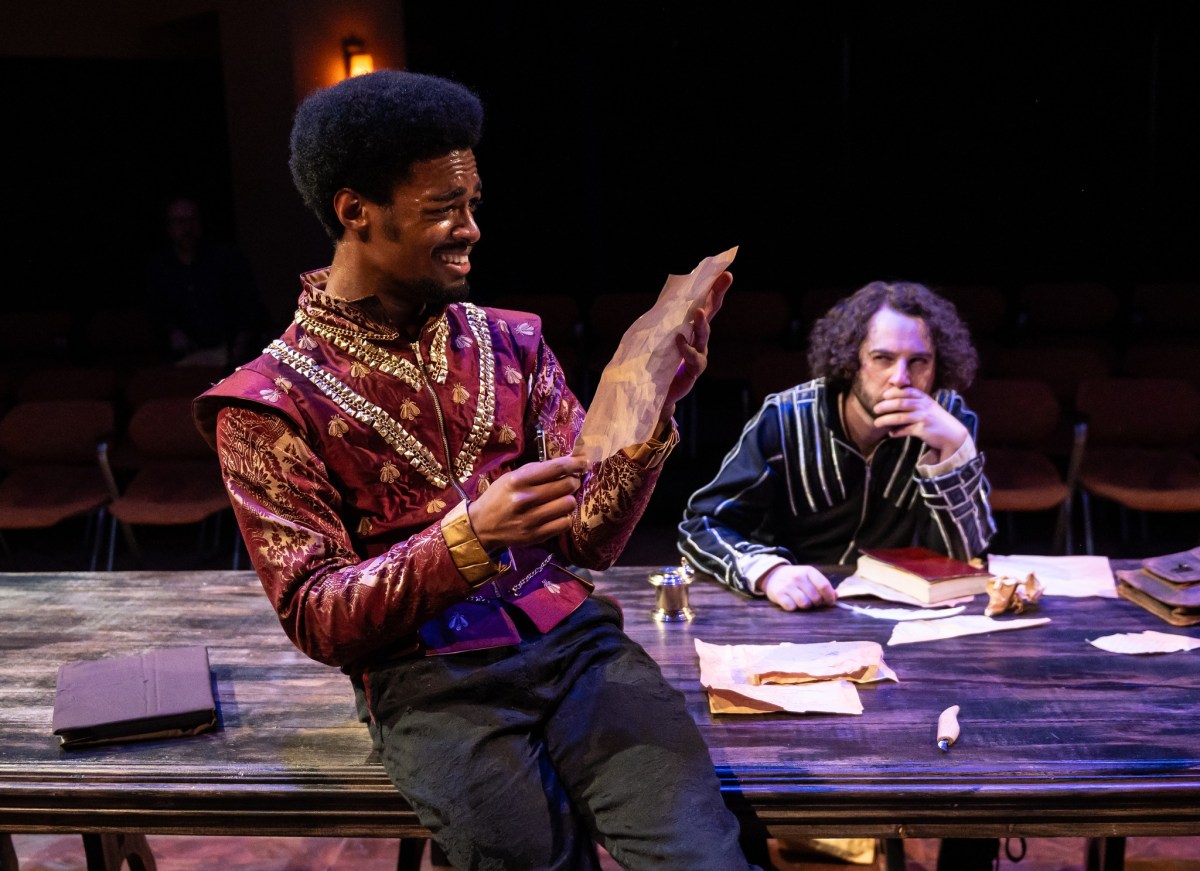
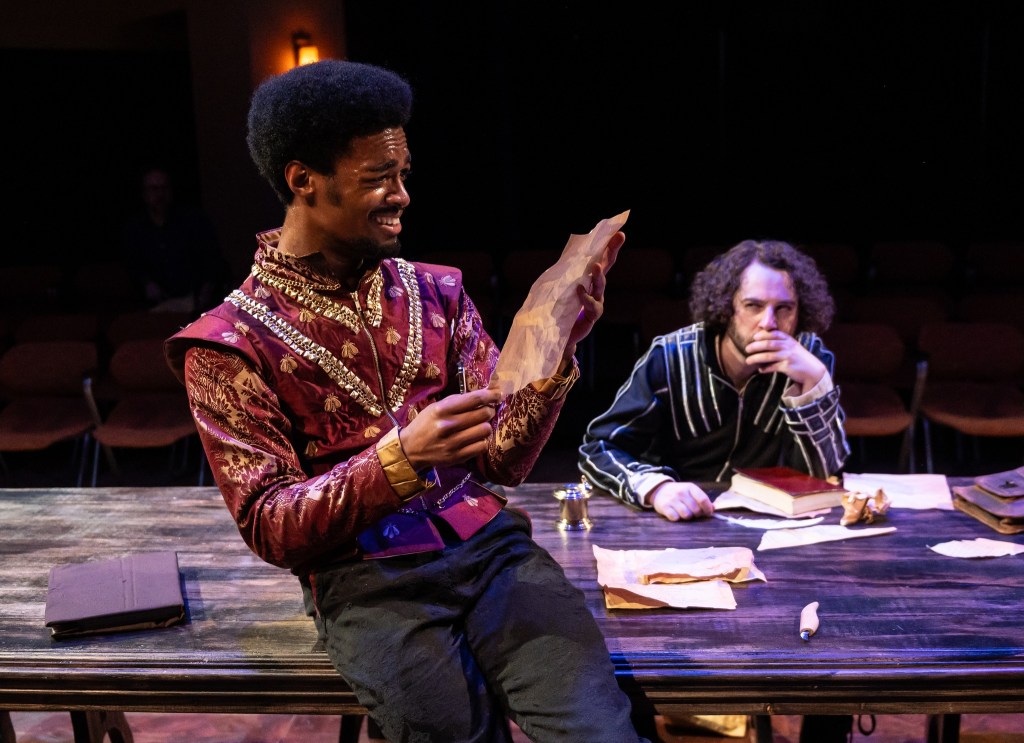
This is where playwright Liz Duffy Adams saw fit to open up a voyeuristic window into the world of two writers – the well-established Christopher “Kit” Marlowe (Avery Michael Johnson) and the upstart William Shakespeare (James Murphy) – as they meet in the private back room of a pub to collaborate on a series of historic plays. But this collaboration is a contentious literary partnership, rife with jealousy, political unrest, and rumors of espionage, religious persecution, and sexual tension. This collaboration is Born With Teeth.

We are subjects, not citizens. – BWT

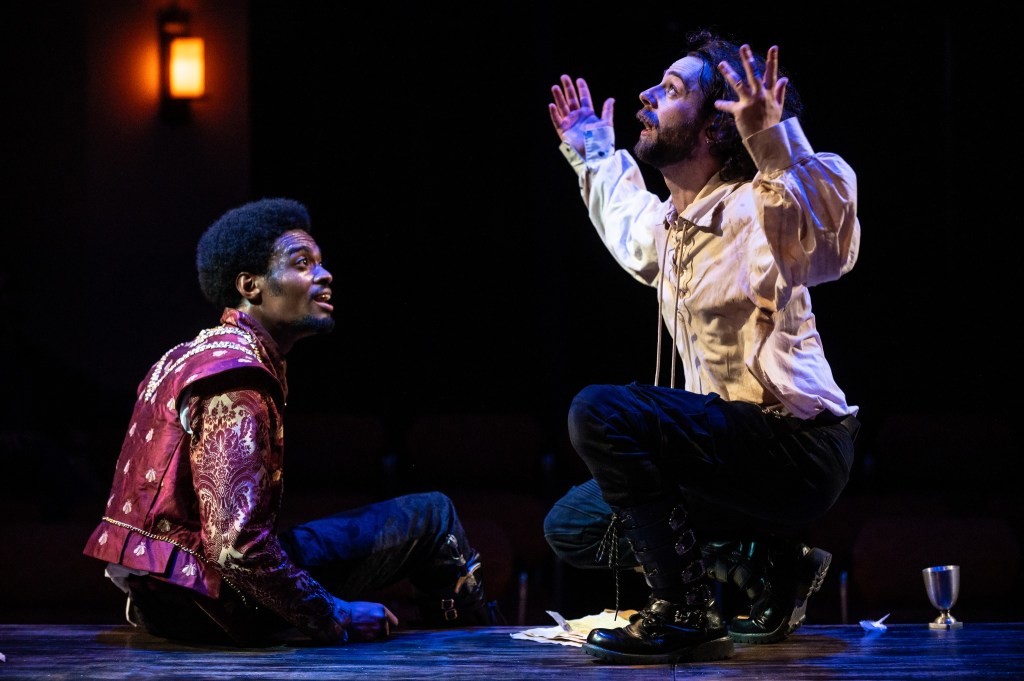
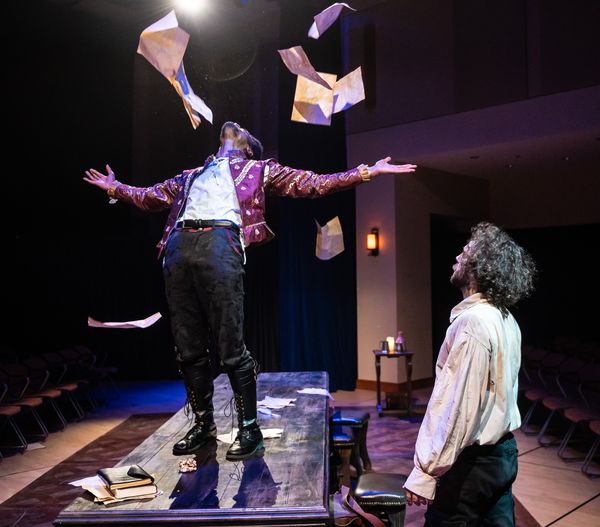
The flexible space of the Gottwald Theatre has been transformed for this occasion. A long (perhaps 12’?) table dominates the room, slashing diagonally through the space. It is placed on a sturdy parquet floor, and surrounded by 10 leather topped rectangular stools. The audience is seated on either side of the table, close enough for the first row to be showered by scattered sheets of paper during the two playwrights’ scuffles. This awesome set was designed and constructed by W. Reed West III.

You are so much stupider than you look; how is that possible? – BWT

William Shakespeare and Christopher Marlowe did indeed collaborate on the Henry VI trilogy, Parts I, II, and III, Marlow was stabbed to death in the summer of 1593. But much of the relationship between Shakespeare and Marlowe – both their authorship and personal  – is a matter of speculation and mystery. So that raises the question, how much of Born With Teeth is historical clarification, and how much is pure fantasy? And given the truths expressed and exposed of human interaction – oppression, suppression, persecution, ego, love – does the former question matter?

Worse than nowhere is somewhere you don’t want to be. – BWT

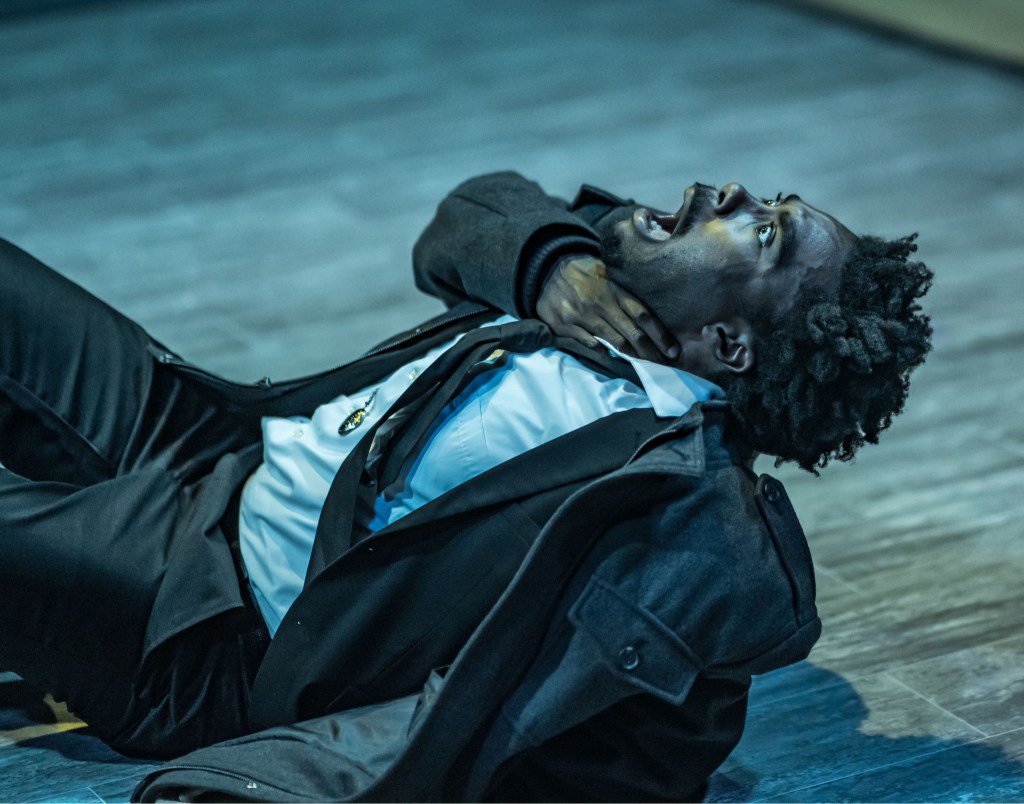
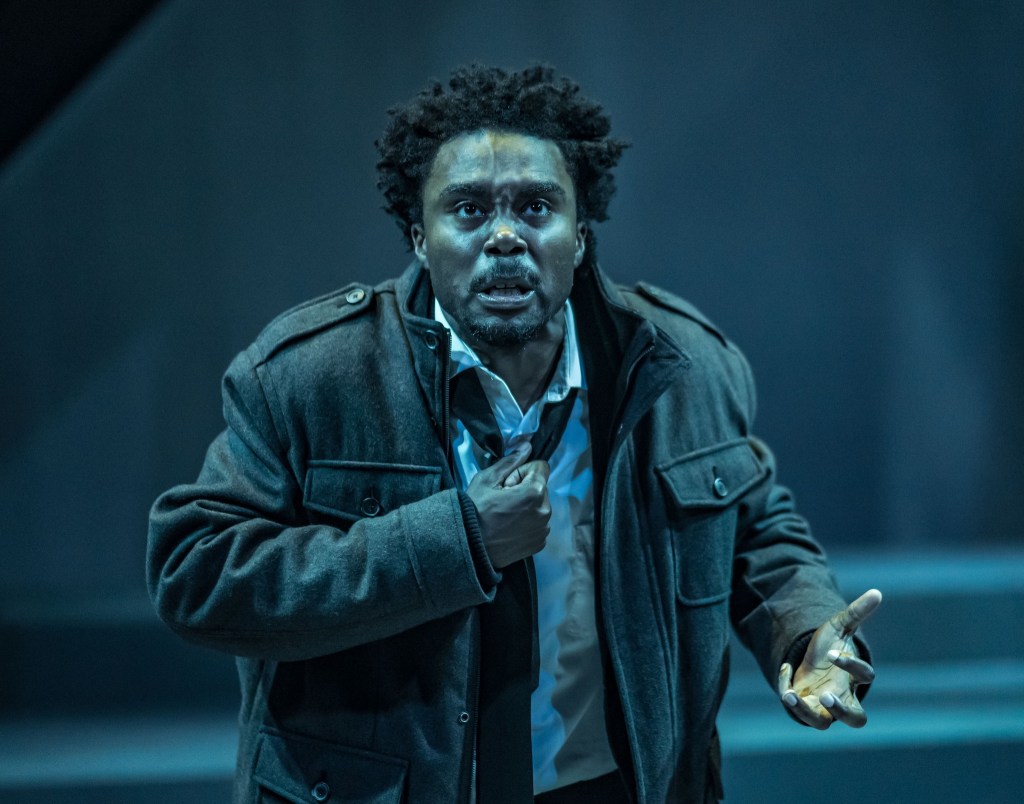
Avery Michael Johnson and James Murphy literally burst onstage, and give us a solid 90 minutes of drama, melodrama, angst, bravado, fear, backstabbing, lust, equivocation, love, revelation, caution, optimism, conciliation, espionage, and more. Born With Teeth is loud, frightening, and funny – sometimes all at once. Marlowe denigrates the upstart Shakespeare, until he reads a page or two of the play they’re working on and realizes that Shakespeare can, indeed, write. But at a time when there is not such thing as freedom of speech or religion, words can cut more sharply that a sword, and speech can be the currency of life or death.

I don’t deny God, I just don’t like him very much. – BWT

Murphy plays the role of Shakespeare with a bit of caution, much more reserved than his more outgoing and outrageous counterpart who may, in turn, be overly confident in the sovereignty of his benefactor. Johnson’s Marlowe never walks but strides. He stomps about in his tall boots – there’s a knife strapped into the right one – he leaps from the floor to the top of the table and lands on the tabletop, the floor, or Shakespeare like a cross between a  pouncing panther and a WWE wrestler. Sitting in the front row, I could see each bead of sweat on Johnson’s brow and distinctly hear the intake of breath when he rapaciously sniffed Murphy. Born With Teeth is a physically demanding play, fueled by quick dialogue that is alternately witty, cutting, and always demanding. It isn’t Shakespeare, but it is the essence of Shakespeare. It isn’t classical, but it is archetypal. It isn’t orthodox, but it does all the things you want live theatre to do.

—–

Julinda D. Lewis is a dancer, teacher, and writer who was born in Brooklyn, NY and now lives in Eastern Henrico County. When not writing about theater, she teaches dance history at VCU and low impact dance fitness classes to seasoned movers like herself, and occasionally performs.

—–

BORN WITH TEETH

by Liz Duffy Adams

Directed by Andrew Gall

Cast

Kit                   ……………    Avery Michael Johnson

Will                 ……………    James Murphy

Production & Design Team

Artistic Director          …….   James Ricks

Managing Director    …….   Jase Smith Sullivan

Playwright                   …….   Liz Duffy Adams

Director                       …….   Andrew Gall

Stage Manager            …….   MariaElisa Costa

Assistant Stage Manager …   Kiari Hicks

Costume Design          …….   Anna Bialkowski

Intimacy Choreographer  …   Lucinda McDermott

Lighting Design          …….   Tristan Ketcham

Set Design                   …….   W. Reed West III

Sound Design              …….   James Ricks

Run Time: About 90 minutes; no intermission

Content Disclosure: This production contains mature themes, strong language, & sexual/suggestive content.

———-

Photo Credits: Promotional Video by Eric Hackler & Photos from Richmond Shakespeare Facebook

https://www.facebook.com/watch/?v=1088997112419759

One-Time
Monthly
Yearly

Make a donation to support
rvart review

Make a monthly donation

Make a yearly donation

Choose an amount

$5.00
$15.00
$100.00
$5.00
$15.00
$100.00
$5.00
$15.00
$100.00

Or enter a custom amount

$

Your contribution is appreciated. Thank you!

Your contribution is appreciated.

Your contribution is appreciated.

DonateDonate monthlyDonate yearly
LONELY PLANET

LONELY PLANET

Sorry, We’re Closed

5th Wall Theatre in Collaboration with the Firehouse Theatre

A Theater Review by Julinda D. Lewis

At: The Firehouse, 1609 West Broad St., Richmond, RVA 23220

Performances: November 10-26, 2023

Ticket Prices: $1 – $35

Info: (804) 355-2001 or firehousetheatre.org or https://www.5thwalltheatre.org/

NOTE: It’s just about impossible to talk about this play without giving away some of the best parts. If you haven’t seen it yet and wasn’t to be surprised, you might want to wait until after you’ve seen it to read this. But yes – do see it – and then comment if you like. I’d love to hear what you think. -JDL

Steven Dietz’ two-person play, Lonely Planet (1993) borrows freely from (as in pays homage to) Eugène Ionesco’s absurdist play, The Chairs (1952), but while there are elements of the absurd and quite a bit of humor in Dietz’ play, it is at heart neither absurd nor a comedy – it is a play about manifested grief.

Set in an unnamed American city during the 1980s, Lonely Planet tells the story of two friends, Jody and Carl, who are each in his own way handicapped by the AIDS epidemic that is raging outside the doors of Jody’s quiet little map store.

Jody copes by withdrawing into the safety of his store, where the distortions of the Mercator map become a metaphor for the distortions of the world around him. At one point Carl quotes some frighteningly high number of deaths among people they know. Where Jody withdraws, Carl feels compelled to do something.

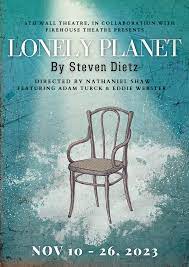
One day a single chair appears in Jody’s shop. Then another and another, until his safe haven is cluttered with chairs – each representing a dead friend. Carl’s place is too small to hold these monuments. He describes his apartment as so small that he has only one chair – a silver kitchen chair with a turquoise seat. In the final scene, Jody – who has finally found the strength to venture back outside – arrives at his shop to find Carl’s chair in the center of the space.

An impossibly balanced jumble of chairs greets the audience on entering the space, and Daniel Allen’s set filled with racks of rolled maps and map tables and all things cartographic is stunning and immersive. Todd LaBelle’s sound design likewise lulls us willingly and unsuspectingly into Jody and Carl’s world – before we realize that this world’s foundation is grief, loss, and tragedy.

Eddie Webster brings a gentleness and vulnerability to Jody that is both endearing and authentic. Adam Turck infuses Carl with an intensity that at times leaves us breathless. The two characters appear to be polar opposites, and yet they are long-time friends. More than that, they each understand things about the other that they cannot share with anyone else. Add to that Carl’s propensity to lie about his true profession and Turck’s character takes on mythic proportions.

Carl’s manufactured occupations are just as metaphorical as the chairs. He says he restores paintings, but appears to know nothing about art. His art restoration represents a way to commemorate the memories of his friends. He says he works for an auto glass repair shop, but what he is really trying to repair are the shattered pieces of broken lives. He says he writes for a tabloid newspaper, but what he really wants to do is preserve the stories of his friend’s lives.

Just as the Mercator projection was designed to help improve navigation, at the expense of distorted shapes and sizes of all but the local or most immediate locations, these two friends have found ways to navigate through the deadly waters of the AIDS epidemic by distorting the world around them. It’s amazing that Turck and Webster, director Nathaniel Shaw, and the author have been able to pull this off and still maintain a sense of humor and humanity.

Along the way to its crashing conclusion the play is grounded by the mundane details of daily life: the yellow pages, a standard black desk phone, self-adhesive stamps, a cell phone (?) In the final scene, Jody – who has finally found the strength to venture back outside – arrives at his shop to find a silver legged kitchen chair with a turquoise seat in the center of the space.

Lonely Planet is a play that will linger long after the two actors take their final bows.

———-

Julinda D. Lewis is a dancer, teacher, and writer who was born in Brooklyn, NY and now lives in Eastern Henrico County.

———-

LONELY PLANET

By Steven Dietz

Directed by Nathaniel Shaw

November 10 – 26, 2023

CAST

Carl                ……….           Adam Turck

Jody               ……….           Eddie Webster

u/s                   ……….           Alex Harris and William Vaughn

PRODUCTION TEAM

Director                     ……….           Nathaniel Shaw

Scenic Design           ……….           Daniel Allen

Costume Design      ……….           Colin Lowrey, II

Lighting & Sund Design ….           Todd LaBelle, Jr

Dramaturgy              ……….           Kendall Walker

Stage Management ……….           Emily Vial

Production Consultant  …..           Michael Hawke

Performance Schedule:

● Opening Night – November 10, 2023 at 7:30 PM

● Running Thursday – Friday – Saturday at 7:30 PM through November 25, 2023

● Running Sundays at 2:00 PM through November 26, 2023

● Pay-What-You-Will shows on November 12 at 2:00 PM and November 16 at 7:30 PM

● Post-Show Talkback on November 19 after the 2:00 PM performance

Tickets:

$1 – $35

Run time:

About 2 hours, with one intermission

One-Time
Monthly
Yearly

Make a donation to RVArt review

Make a monthly donation

Make a yearly donation

Choose an amount

$5.00
$15.00
$100.00
$5.00
$15.00
$100.00
$5.00
$15.00
$100.00

Or enter a custom amount

$

Your contribution is appreciated.

Your contribution is appreciated.

Your contribution is appreciated.

DonateDonate monthlyDonate yearly
HAMLET

A Theater Review [with post-credit cookies] by Julinda D. Lewis

By: Richmond Shakespeare

At: Gottwald Playhouse at Dominion Energy Center, 600 E. Grace St., Richmond, VA 23219

Performances: October 19 – November 12, 2023 | EXTENDED to November 17

Ticket Prices: $20 – $45

Info: (804) 340-0115 or quilltheatre.org

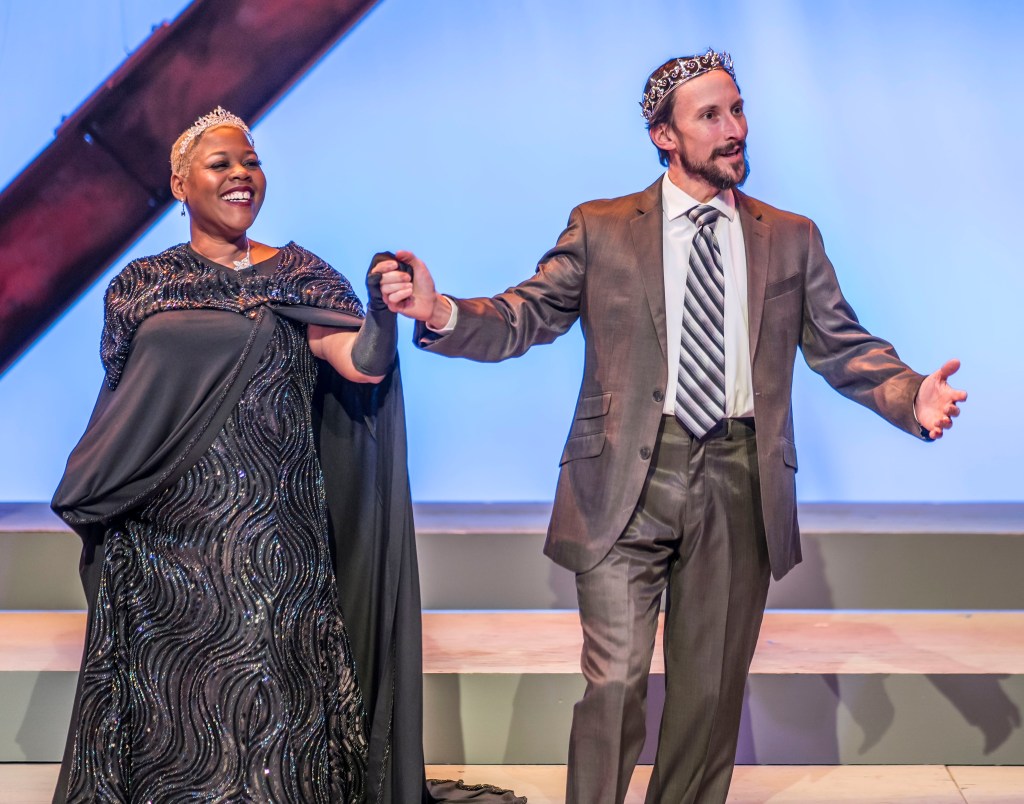
Everyone has heard of Hamlet. Some of us read it in high school. Some have seen productions on stage or film. Others have avoided it like the plague. Wherever you sit along this spectrum, Richmond Shakespeare’s Hamlet will bring out a new-found love and admiration for Shakespeare’s most well-known drama. Seriously. I personally know people who either knew little to nothing about Hamlet or had an aversion to Shakespeare in general, who raved about this production after seeing it.              

Hamlet is a play about loss, unbearable grief, betrayal, revenge. . .and a ghost. When Prince Hamlet’s father, the King of Denmark, dies suddenly – under suspicious circumstances – Hamlet’s mother marries his uncle Claudius. Hamlet and members of the king’s guard experience a visitation from a ghost who appears to be the spirit of Hamlet’s father, and set the stage for a revenge plot.

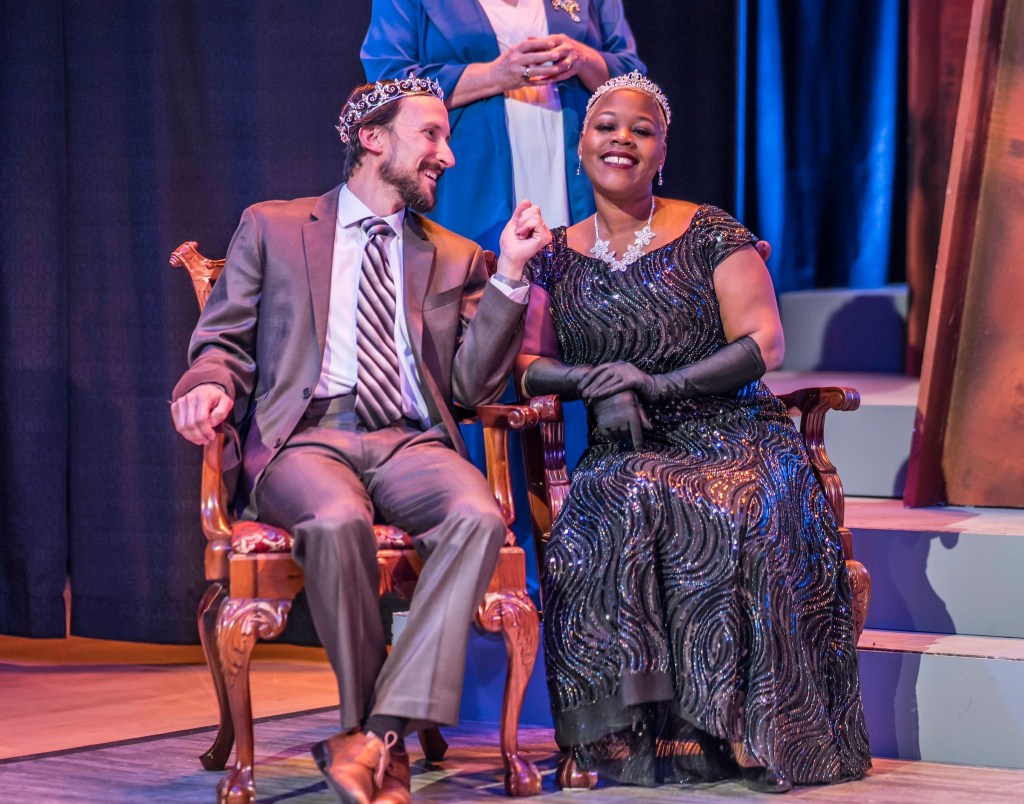
Joshua Carter is an engaging and intense Hamlet, who cunningly slips in and out of madness. His grief appears authentic and his unhinged rants convincing. Physically he is controlled and seems always on the verge of erupting like a human volcano. His voice is beautifully resonant, well-modulated, and his gestures are tight and just eccentric enough to place him outside of our time. This is significant because this Hamlet is clothed in contemporary garments.

At the celebration of the new King’s court, the attendees wear tuxedos and most of the women wear semi-formal or business attire. Interestingly, Ophelia, Hamlet’s sometime love interest, favors cowboy boots – glittery ones for special occasions.

Joseph Yeargain, as Claudius, is suave and slimy at the same time, and it’s never clear whether Hamlet’s mother, Gertrude (Lucretia Marie) is involved in the murder and power plots or if she just goes along with whatever the men in her life tell her to do. Neither scenario is enough to stir any real sympathy for her.

The same cannot be said for Ophelia. Rosemary Richards tugs on our heartstrings as she plays her heart out, from the heights of love to the depths of despair, from beautiful fair maiden to a wretched shell of herself.

All is not doom and gloom. Avery Michael Johnson gives new meaning to the word “loyalty” as Hamlet’s friend, Horatio, and someone made an absolutely brilliant and hilarious decision to cast Toby O’Brien and Rachel Garmon-Williams as Hamlet’s friends Rosencrantz and Guildenstern. Did I remember to say Hamlet’s stoner friends?

The entire ensemble, including Jody Ashworth as the Ghost of Hamlet’s father, MaryBeth Adams as the king’s counselor, Polonius, Robbie Winston as Laertes (son of Polonius and brother to Ophelia), John Moon as an unintentionally witty gravedigger are deserving of recognition, individually and as a collective. James Ricks’ direction is intuitive and when the play is over it comes as a shock to discover that nearly three hours have passed.

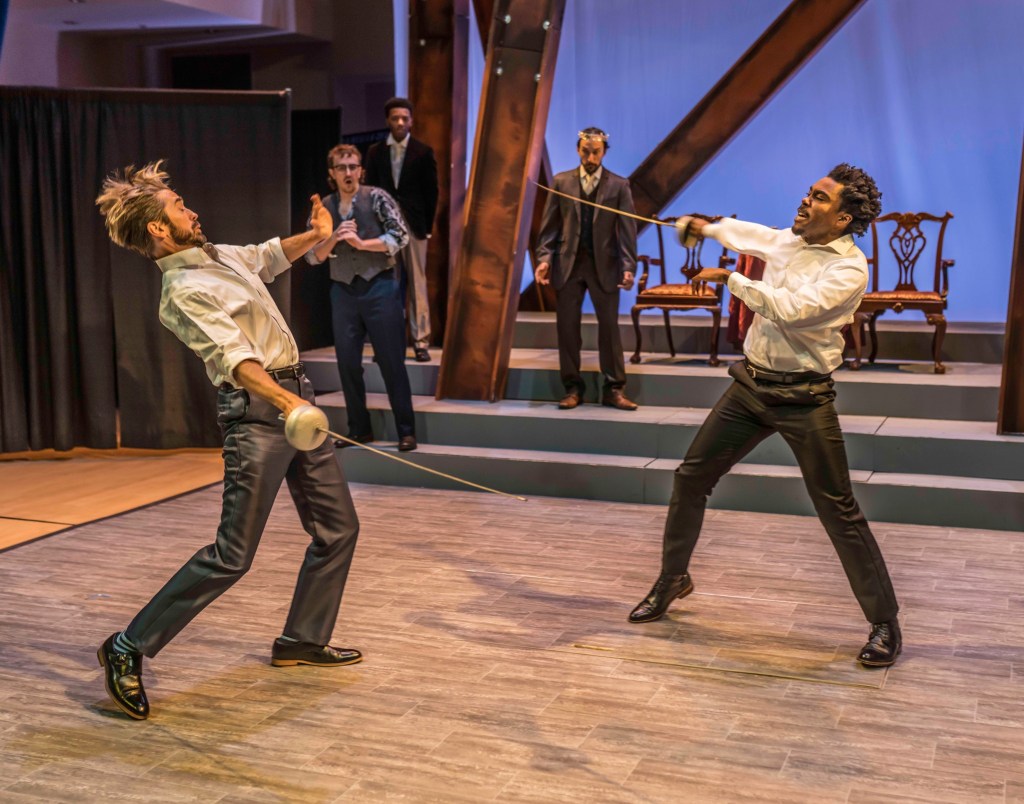
Don’t get thee to a nunnery, but do get thee to the Gottwald Theatre to see this marvelous production. Oh, and I sat with my husband and a friend in the front row of a bank of seats that is practically on the stage. My heart was in my mouth during the sword fight, and from my vantage point I also got to see the expressions of other audience members. Be daring – sit there! You can always change your seat after intermission if you chicken out. Your estimation of William Shakespeare, Hamlet, and Richmond Shakespeare will be forever elevated.

—–

Julinda D. Lewis is a dancer, teacher, and writer who was born in Brooklyn, NY and now lives in Eastern Henrico County. When not writing about theater, she teaches dance history at VCU and low impact dance fitness classes to seasoned movers.

—–

Hamlet

by William Shakespeare

Directed by James Ricks

Cast

Hamlet             ……………    Joshua Carter

Claudius          ……………    Joseph Yeargain

Gertrude          ……………    Lucretia Marie

Ghost/Player King  ………    Jody Ashworth

Horatio            ……………    Avery Michael Johnson

Polonius          ……………    MaryBeth Adams

Ophelia            ……………    Rosemary Richards

Laertes            .……………    Robbie Winston

Guildenstern/Francisco/Player

Queen/Priest ………   Rachel Garmon-Williams

Rosencrantz/Fortinbras/

Bernardo …………   Toby O’Brien

Gravedigger/Marcellus/

Player  ……………  John Moon

Voltimand/Osric/

            Player  …………….  Keegan Ferrell

Ensemble         ……………..  Kenjae Lundy, Milind Murthy

Production & Design Team

Artistic Director          …….   James Ricks

Managing Director    …….   Jase Smith Sullivan

Costume Design          …….   Keith Walker

Lighting Design          …….   Gretta Daughtrey

Set Design                   …….   Frank Foster

Sound Design              …….   Kate Statelman

Production Manager  …….   Melissa Johnston-Price

Stage Manager            …….   MariaElisa Costa

Fight Choreography   …….   Aaron Orensky

Assistant Stage Manager …   Diandra Chiaffino-Butts

Properties                    …….   Jordan Dively

Run Time: About 3 hours including one intermission

———-

Photo Credits: David Parrish Photography

HAMLET ON NBC “12 ABOUT TOWN”

https://www.nbc12.com/video/2023/11/03/hamlet-continues-through-nov-17/

AN OBSERVATION

In Act I Hamlet is seen reading – and eating the pages of – a book, Holy Blood, Holy Grail by Michael Baigent, Richard Leigh, and Henry Lincoln. The authors propose that Jesus married Mary Magdalene and had children with her whose descendants later emigrated to southern France where they became part of a secret society called the Priory of Sion. The authors further concluded that the Holy Grail of legend is both the womb of Mary Magdalene and the sacred royal bloodlines she birthed.

AN ANALOGY

Hamlet:Claudius as David:Saul

Just as the biblical David had a chance to kill the treasonous King Saul while hiding in a cave, but he chose not to, Prince Hamlet had a chance to kill his uncle, the treasonous King Claudius, as he prayed, but he chose not to.

YOU DO SPEAK SHAKESPEARE!: Phrases We Got From Hamlet

To thine own self be true.

Something is rotten in the state of Denmark.

Murder most foul.

Pernicious woman!

There are more things in heaven and earth, Horatio, that are dreamt of in your philosophy.

The time is out of joint.

Although this be madness, there’s method in it. [i.e., a method to one’s madness]

There is nothing good or bad but thinking makes it so.

What a piece of work is a man.

I know a hawk from a handsaw.

The play’s the thing!

To be or not to be…

Conscience makes cowards of us all.

Get thee to a nunnery!

Oh, woe is me!

Madness in great ones must not unwatched go.

Suit the action to the word.

The lady doth protest too much!

Act your age!

Sweets to the sweet.

The dog will have his day.

The grinding of the ax.

Good night, sweet prince.

One-Time
Monthly
Yearly

Make a donation to support
rvart review

if you like what you read here,
Make a monthly donation

Make an annual donation
no amount is too small –
but the bigger the better!

Choose an amount

$5.00
$15.00
$100.00
$5.00
$15.00
$100.00
$5.00
$15.00
$100.00

Or enter a custom amount

$

Thank you. Your contribution is appreciated.

Your contribution is appreciated.

Your contribution is appreciated.

Donate hereDonate hereDonate here

MARTHA MITCHELL CALLING

“If it hadn’t been for Martha Mitchell, there’d have been no Watergate.” – Richard Nixon

A Theater Review by Julinda D. Lewis

At: Hanover Tavern, 13181 Hanover  Courthouse Rd, Hanover, VA 2309

Performances: September 29 – October 29, 2023

Ticket Prices: $52

Info: (804) 282-2620 or www.virginiarep.org

Some plays are notable not because they are entertaining but because they are revelatory. Martha Mitchell Calling is that type of play. It is more than an historic docu-drama based on the real life story of the wife of former U.S. Attorney General John Mitchell, a key figure in the Watergate Scandal (1972-1974). Martha Mitchell Calling fills in some important parts of U.S. history that have been ignored or re-written – all because a key figure in the story was a woman.

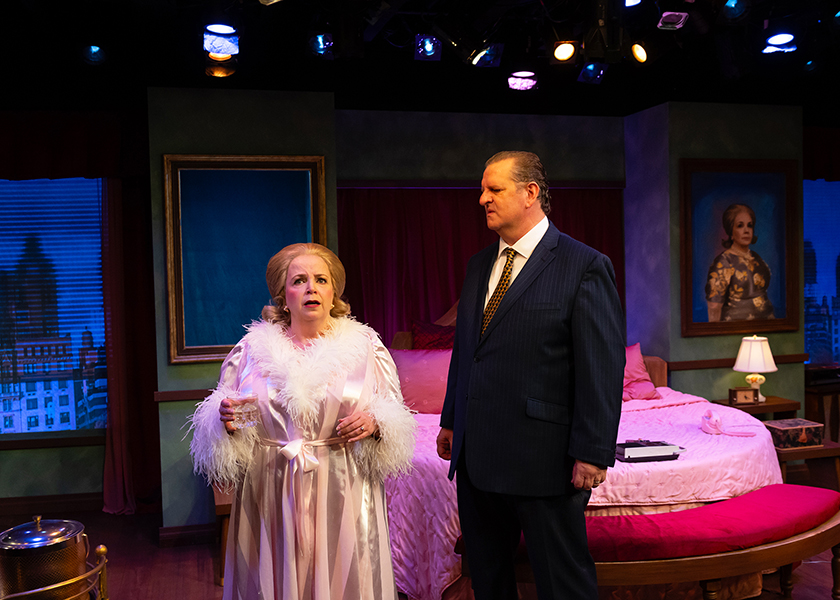
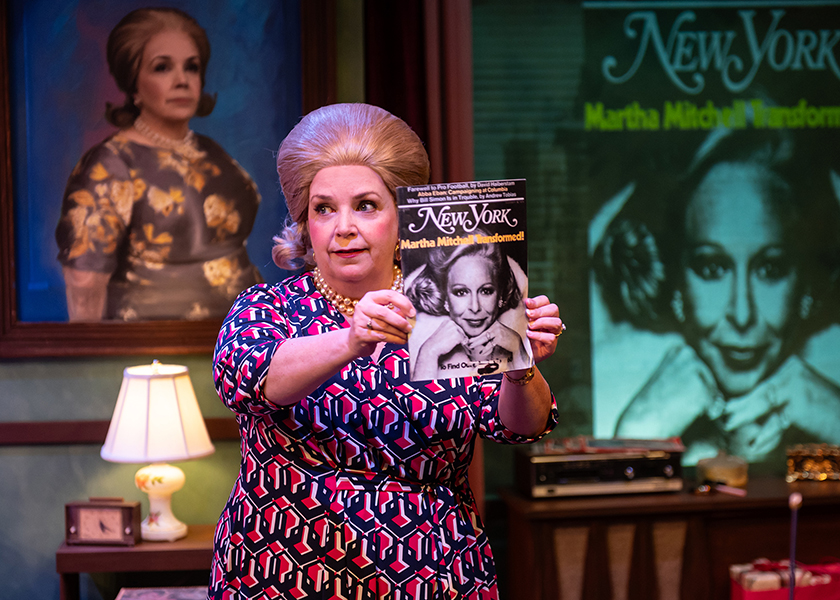
Debra Wagoner has stepped into Martha Mitchell’s designer shoes to spill all the tea, right the wrongs, fill in the blanks, and teach us all a thing or two – while simultaneously making us laugh and acknowledge her considerable skills as an actor. Wagoner embraces the title role while her real-life husband, Joe Pabst, steps into character as her John Mitchell. Pabst literally steps into the role, as he starts most scenes as a portrait on the wall and steps out of the frame to join his wife in increasingly contentious interactions.

I was finishing high school and beginning college during the Watergate Scandal, certainly old enough to be aware of what was happening. But I don’t recall anything about Martha Mitchell – and that’s the whole point of this play. It starts out as a love story, but before our very eyes Mrs. Mitchell transforms from a traditional, if somewhat flamboyant, stand-by-your-man southern belle to a political pariah. She converted her husband from Democrat to Republican and introduced him to Richard Nixon. But then there was Watergate – when the Nixon administration broke in to the Democratic National Committee headquarters in Washington, D.C., at the Watergate Office Building on June 17, 1972. Martha Mitchell Calling fills in some of the missing details, including an alleged kidnapping, a suspected drugging disguised as a mental breakdown, a missing weekend, and many other unanswered questions.

This is a two-person show, but Wagoner is undeniably the star of this show. She portrays Mrs. Mitchell as a mover and shaker, a bit unsteady on her feet from her close relationship with her ever-present gin bottle, princess phone close at hand and ready to be wielded like a cowboy’s pistol. We feel the toll taken by the series remarkable events that started with Mrs. Mitchell calling her favorite journalist with gossip in support of her husband and the Republican party to the heart-wrenching decision to stand up for truth and expose the corruption that had consumed her beloved GOP and her adored husband.

These events even gave rise to a condition known as Martha Mitchell Syndrome, which is what occurs when a medical professional labels a patient’s accurate perception of real events as delusional, resulting in an intentional misdiagnosis. Mrs. Mitchell’s commitment to the truth led to the loss of her husband, her daughter, and her health. She died alone and in disgrace.

This role is no small feat and Wagoner does a star turn as the ostracized socialite. Pabst is no slouch either. He admirably balances the seemingly contradictory role of loving husband and father with that of political villain, carrying loyalty to a fault and beyond.

Is it coincidence that Virginia Rep produced two female-led political productions at the start of their new season (POTUS at the November Theatre and Martha Mitchell Calling at Hanover)? Hmm. Whatever the explanation, both productions have contributed to an intriguing and provocative start to the local theater season.

Julinda D. Lewis is a dancer, teacher, and writer who was born in Brooklyn, NY and now lives in Eastern Henrico County.

MARTHA MITCHELL CALLING

by Jodi Rothe

Directed by Rick Hammerly

Cast

Martha Mitchell                      Debra Wagoner

John Mitchell                          Joe Pabst

Direction & Design

Direction                                Rick Hammerly

Scenic & Production Design    Dasia Gregg

Costume Design                      Sue Griffin

Lighting Design                        Matthew Landwehr

Sound Design                          Kelsey Cordrey

Stage Management                 Crimson Piazza

Ticket Information

Tickets: $52

Discounted Group Rates and Rush tickets available.

Box Office: 804-282-2620 or www.virginiarep.org

Run Time: 2 hours including a 15 minute intermission

Photo Credits: Aaron Sutten

One-Time
Monthly
Yearly

Make a donation to support
RVART REVIEW

Make a monthly donation

Make a yearly donation

Choose an amount

$5.00
$15.00
$100.00
$5.00
$15.00
$100.00
$5.00
$15.00
$100.00

Or enter a custom amount

$

Thank you!
Your contribution is appreciated.

Your contribution is appreciated.

Your contribution is appreciated.

DonateDonate monthlyDonate yearly
BERTA, BERTA

The New Theatre at Firehouse in Collaboration with the Conciliation Project Presents the Virginia Premiere of a Play by Angelica Chéri

A Theater Review by Julinda D. Lewis

At: The Firehouse 1609 West Broad St., Richmond, RVA 23220

Performances: September 27 – October 15, 2023

Ticket Prices: $15-$35

Info: (804) 355-2001 or firehousetheatre.org.

O Lord Berta Berta O Lord gal oh-ah
O Lord Berta Berta O Lord gal well now
Go ‘head marry don’t you wait on me oh-ah
Go ‘head marry don’t you wait on me well now

Inspired by a prison chain-gang song that originated on the euphemistically named Parchman Farm – a Mississippi State Penitentiary –  BERTA, BERTA is a love story, an allegory, a tale of historical fiction, a memory, and an inheritance. Chéri found inspiration in August Wilson’s The Piano Lesson (1987) in which the song is featured. But that’s not all.

In many ways, the couple in Angelica Chéri’s play, which premiered in the 2018 Contemporary American Film Theatre Festival (CATF) reminded me of the 2019 American Film Institute (AFI Fest) debut of the film, Queen and Slim. I rooted for Berta and Leroy just as I rooted for Queen and Slim, against all the odds, against the inevitable, against the evidence – because we have to have hope, we have to have love.

Might not want you when I go free oh-ah
Might not want you when I go free well now
Don’t know the difference when the sun go down oh-ah
Don’t know the difference when the sun go down well now

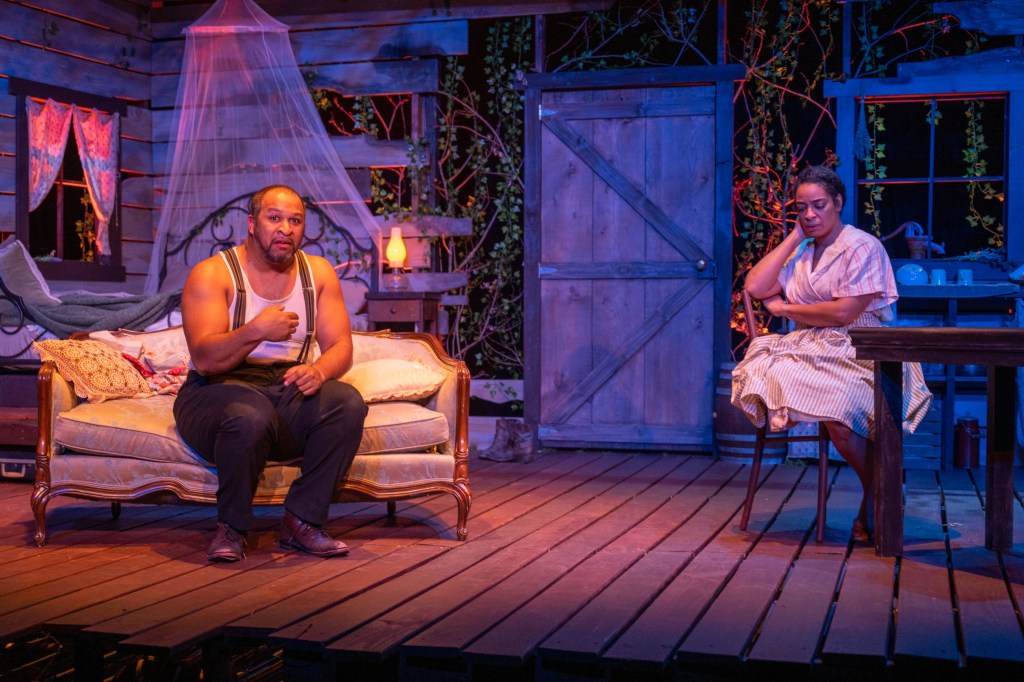
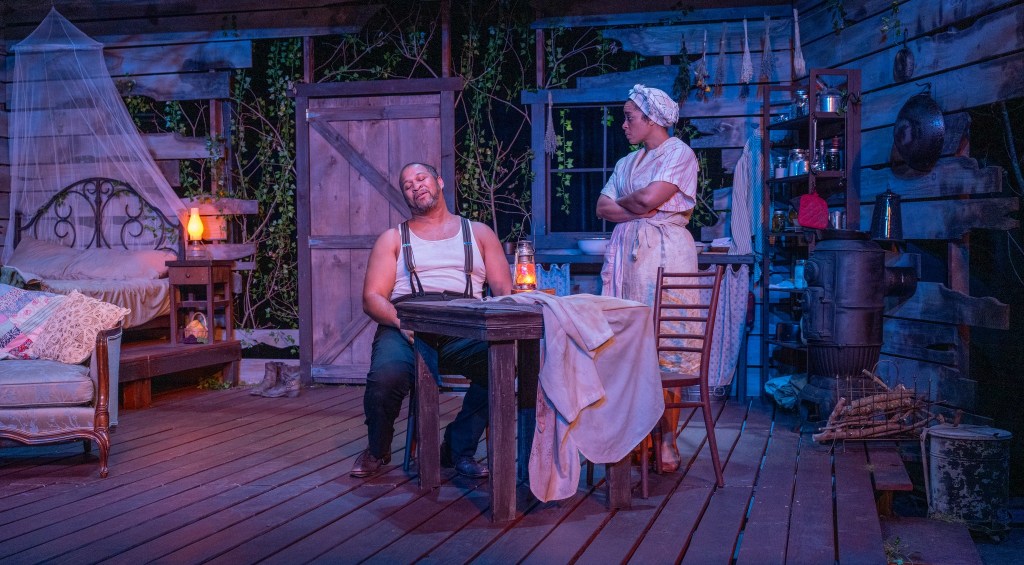
Katrinah Carol Lewis and Jerold E. Solomon were cast as Chéri’s reunited and doomed lovers, Berta and Leroy. But there is more to each of these characters than just that bare-bones description. Both Berta and Leroy are burdened with the sins of post-slavery America, the unwanted weight of the segregated south, and the crimes of being born Black in America. Both are people that we might meet, once knew, know of, or are related to.

Berta in Meridian and she living at ease oh-ah
Berta in Meridian and she living at ease well now
O Lord Berta Berta O Lord gal oh-ah
O Lord Berta Berta O Lord gal well now
I’m on old Parchman, got to work or leave oh-ah
I’m on old Parchman, got to work or leave well now

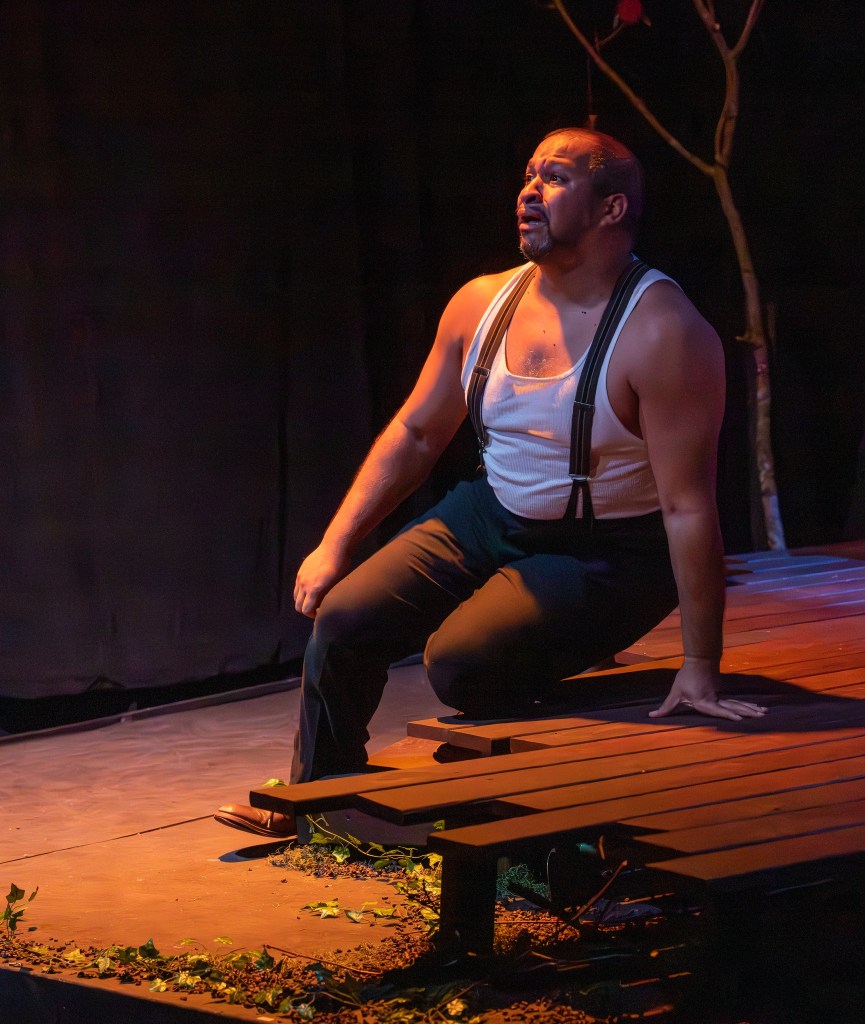
Leroy has spent time at Parchman Farm, and on his way to reunite with his former lover after his release, he commits yet another crime that seals his fate. Berta, who tired of waiting three years for Leroy – her one true love and soulmate – married a well-meaning but boring farmer who loved her, but he died, leaving her a widow with a ramshackle farmhouse in a small country town. On top of all that, she lost her only child who was stillborn. Both Berta and Leroy are waiting on a miracle – the miracle of the cicadas – to fulfill their deferred dreams.

That’s a lot of weight for two characters, two actors to carry. Both Lewis and Solomon are more than capable of bearing the load. Lewis is well known for authentic, riveting portrayals, from real-life Billie Holiday to fictitious Nora in A Doll’s House or even an entire cast as she did in Anna Deavere Smith’s one-woman play, Twilight Los Angeles 1992. Berta must be added to Lewis’ list of unforgettable characters. It is the kind of role that leaves the audience speechless, so I can only imagine how much it requires of Lewis to step into Berta’s worn slippers night after night.

Solomon is also a larger-than-life figure, and it could be easy to overact this role, but Solomon presents a well-rounded, sympathetic picture of this well-meaning Black man whose dreams have been dashed before he could even verbalize them. The hand of director Dr. Tawnya Pettiford-Wates is clearly imprinted on this stunning work, yet there is a softness that seems to have been previously – perhaps intentionally – untapped.

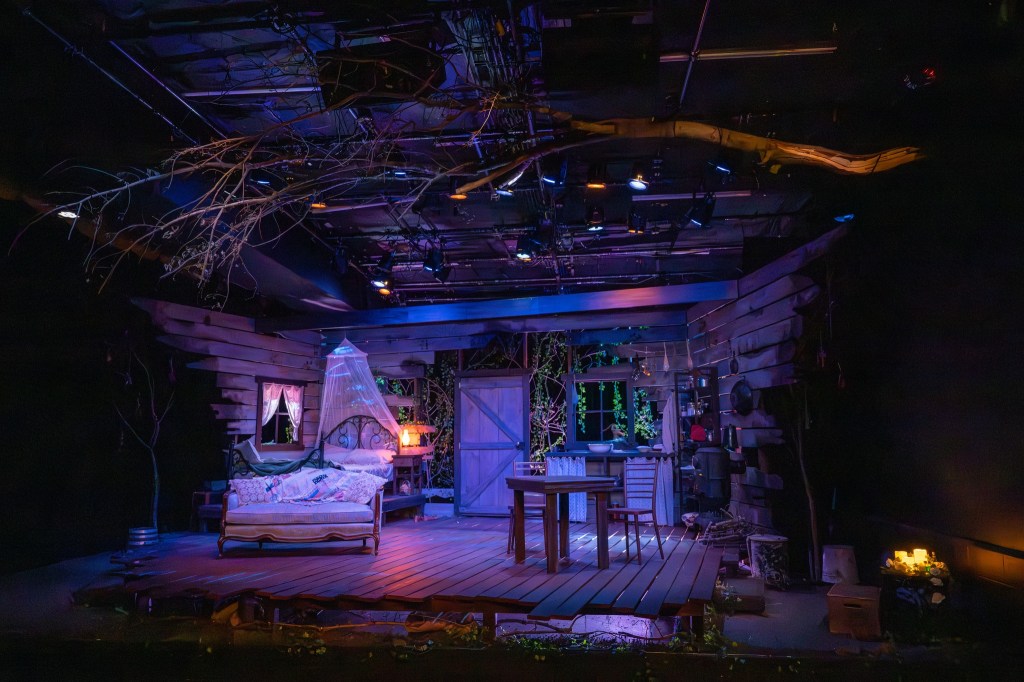
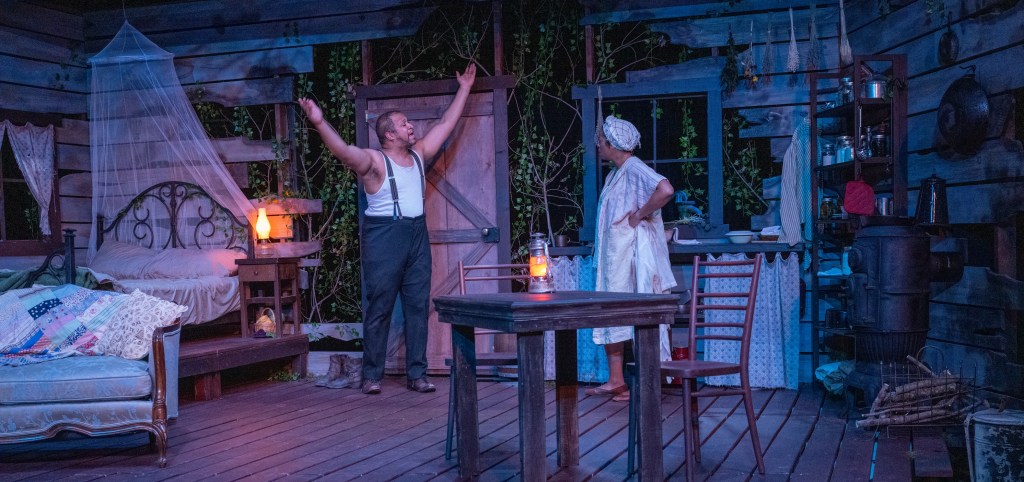
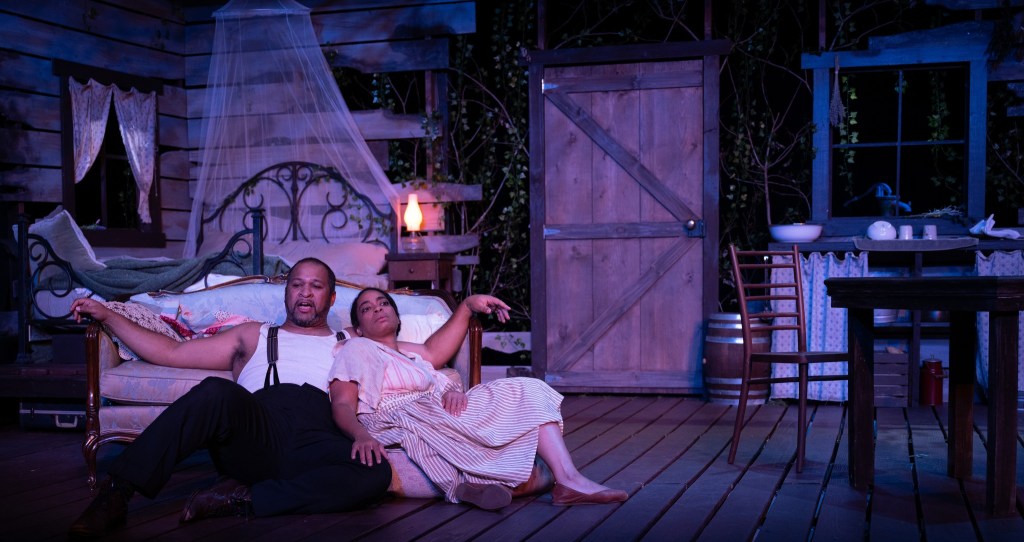
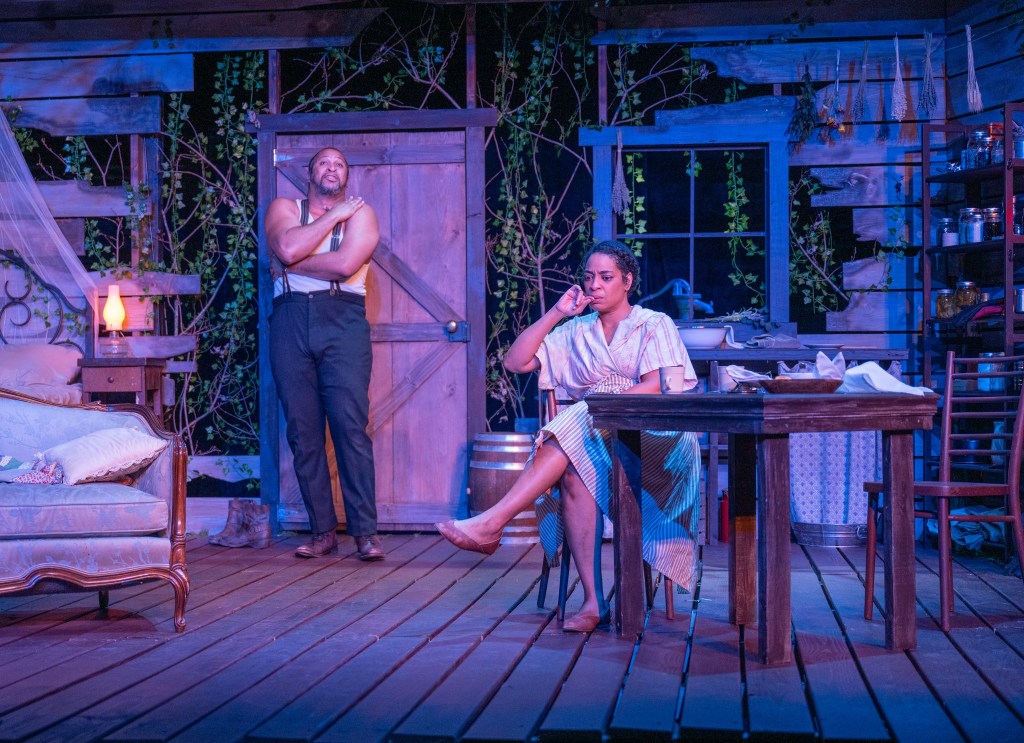
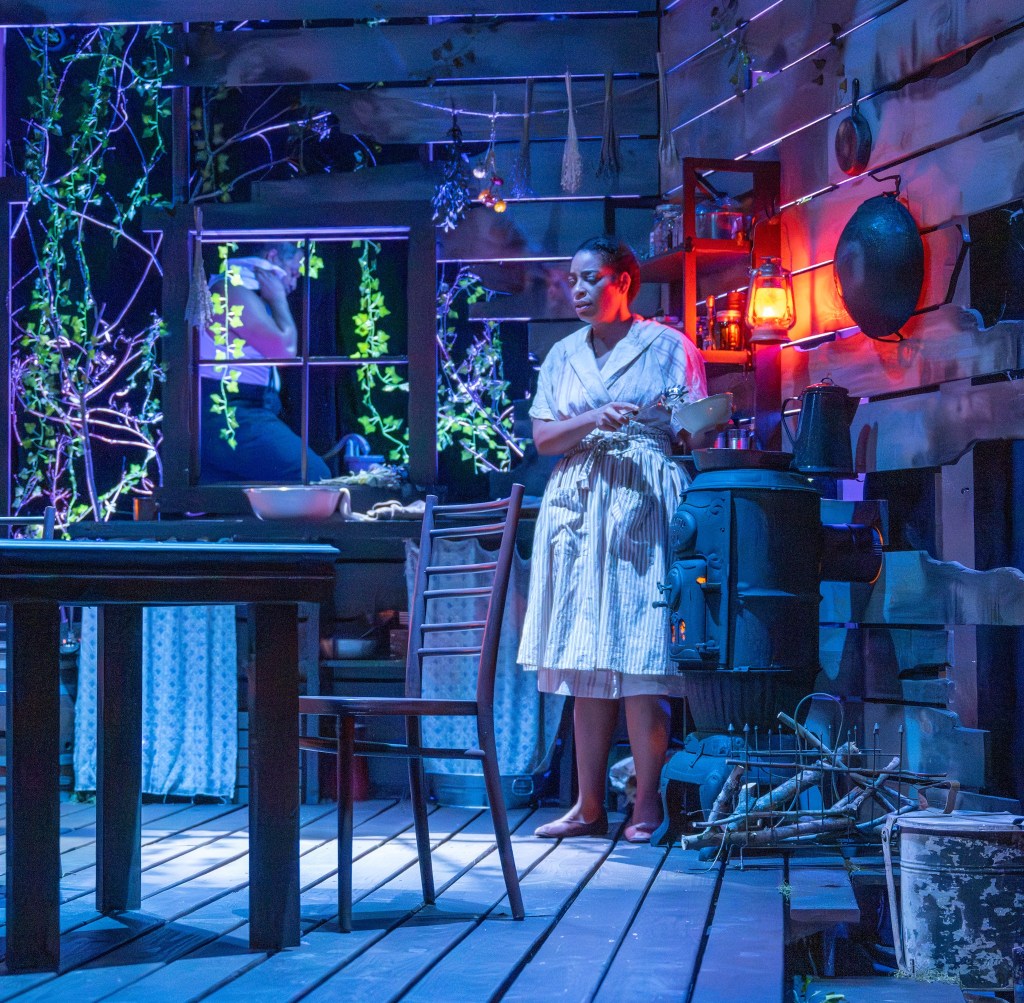
Berta, Berta is one of those magnificent works that reflects an immersive relationship between author, director, actors, lighting, scenic design, and sound. Chris Raintree’s roughshod wooden planks, wood stove, porch pump, and vines – so many vines – perfectly capture Berta’s rural home, the southern geography, the era, the mood. Kyle Epps feeds in the sounds of a harmonica, the cicadas and other ambient sounds in a way that is both natural magical. The same can be said of Andrew Bonniwell’s lighting that frames the stage from the top, the bottom, the back, and even from under the floorboards. The total effect is both heartwarming and heartrending; it reveals how tenuous are the lines between dreams and nightmares, the softness of a lover’s touch, and the kick of the moonshine Berta shares with Leroy.

This is, quite simply, a magnificent theatrical experience that cannot be described; it must be experienced.

O Lord Berta Berta O Lord gal oh-ah
O Lord Berta Berta O Lord gal well now

———-

Julinda D. Lewis is a dancer, teacher, and writer who was born in Brooklyn, NY and now lives in Eastern Henrico County.

———-

BERTA, BERTA

By Angelica Chéri

Directed by Dr. Tawnya Pettiford-Wates

September 27 – October 15, 2023

CAST

Berta             ……….           Katrinah Carol Lewis

Leroy              ……….           Jerold E. Solomon

U/S                  ……….           Shalandis Wheeler Smith & Delvin Young

PRODUCTION TEAM

Scenic Designer       ……….           Chris Raintree

Lighting Designer    ……….           Andrew Bonniwell

Sound Designer       ……….           Kyle Epps

Costume Designer ……….           Nia Safarr Banks

Intimacy Director     ……….           Stephanie Tippi Hart

Asst. Intimacy Dir.    ……….           Dorothy Dee D. Miller

Assistant Director    ……….           Jeremy Morris

Research Intern        ……….           Sarah Young

Stage Manager        ……….           Grace LaBelle

Lobby Display          ……….           The Conciliation Project

Original rendition of Berta, Berta chain-gang song by Andrew Alli

Performance Schedule:

● Opening Night – September 29 at 7:30pm

● Running Thursday – Sunday through Oct. 15, 2023

● Pay-What-You-Will previews on September 27th and 28th at 7:30pm

● Pay-What You-Will performance on October 8th at 2pm

Tickets: $15-$35

One-Time
Monthly
Yearly

Make a one-time OR MONTHLY donation TO SUPPORT RVART REVIEW

Make a monthly donation

Make a yearly donation

Choose an amount

$5.00
$15.00
$100.00
$5.00
$15.00
$100.00
$5.00
$15.00
$100.00

Or enter a custom amount

$

Your contribution is appreciated.

Your contribution is appreciated.

Your contribution is appreciated.

DonateDonate monthlyDonate yearly
CARMINA BURANA

Richmond Ballet Opens New Season With a John Butler Classic & a Work by Associate Artistic Director Ma Cong

A Dance Review

By: The Richmond Ballet with the Richmond Symphony/Richmond Symphony Chorus and The City Choir of Washington

At: Dominion Energy Center’s Carpenter Theatre, 600 E. Grace St., RVA 23219

Performances: September 22-24, 2023

Ticket Prices: $25 – $130

Info: (804) 344-0906, etix.com, or richmondballet.com

THE PROGRAM

Thrive

Choreography by Ma Cong

Music by Oliver Davis

Costume Design by Monica Guerra

Lighting Design by Trad A. Burns

Lighting Supervision by Joseph R. Wall

World Premiere: September 20, 2022, Richmond Ballet, Richmond Ballet Studio Theatre, Richmond, VA

CARMINA BURANA

Conceived and Choreographed by John Butler

Music and Latin Text by Carl Orff

Staging by Igor Antonov and Lauren Fagone

Costume Design by John Butler

Lighting Design by Catherine Girardi after

Original Lighting Design by Richard Moore

World Premiere: September 24, 1959, New York City Opera, City Center, New  York

Richmond Ballet Premiere: October 15, 1987, Carpenter Theatre, Richmond, VA

If there’s anything better than live dance, it’s live dance performed to live music. After a debut performance at Wolf Trap in August, the Richmond Ballet opened their new season with an exciting program of neoclassical ballet and ballet theatre. The program opened with Thrive, the most recent work of Associate Artistic Director Ma Cong, and concluded with John Butler’s highly immersive Carmina Burana. (Note: Founding Artistic Director Stoner Winslett will be stepping down at the end of the season and moving into an advisory role, and Ma Cong will step into the role of Artistic Director.)

First performed as the 2022 season opener of the Richmond Ballet’s Studio Series, Ma Cong’s Thrive, a classical ballet in 7 movements, and his ninth work for Richmond Ballet, had the full expanse of the Carpenter Theatre stage and the pleasure of hearing British composer Oliver Davis’s layered score performed live by a full orchestra.

An ambitious display of contemporary classical ballet that spans the gamut from the humorous or playful to the somber and romantic, the work was inspired partly by the choreographer’s interactions with Richmond’s LGBTQ+ and Asian-American communities.

Onstage, Thrive manifests as clean, neo-classical movement accompanied by classical strings, interspersed with riotous pairings accompanied by more humorous music – some instrumental and some choral. The lighting matched the music and movement, with shades of red for the lighter moments and blues and purples for the more somber sections.

Carmina Burana raises the drama to a whole new level. A full orchestra in the pit, choral groups spilling out on both sides of the stage, soloists downstage left and right, frame dancers in monks robes who process in, pausing occasionally to genuflect. The robes soon give way to the barest of body coverings, reminiscent of Adam and Eve, while Eri Nishihara later appears in flowing white. Light colored body suite for the women and tights with collars over bare chests for the men emphasize the stylized movement that sometimes appears to have been lifted from an ancient print or vase.

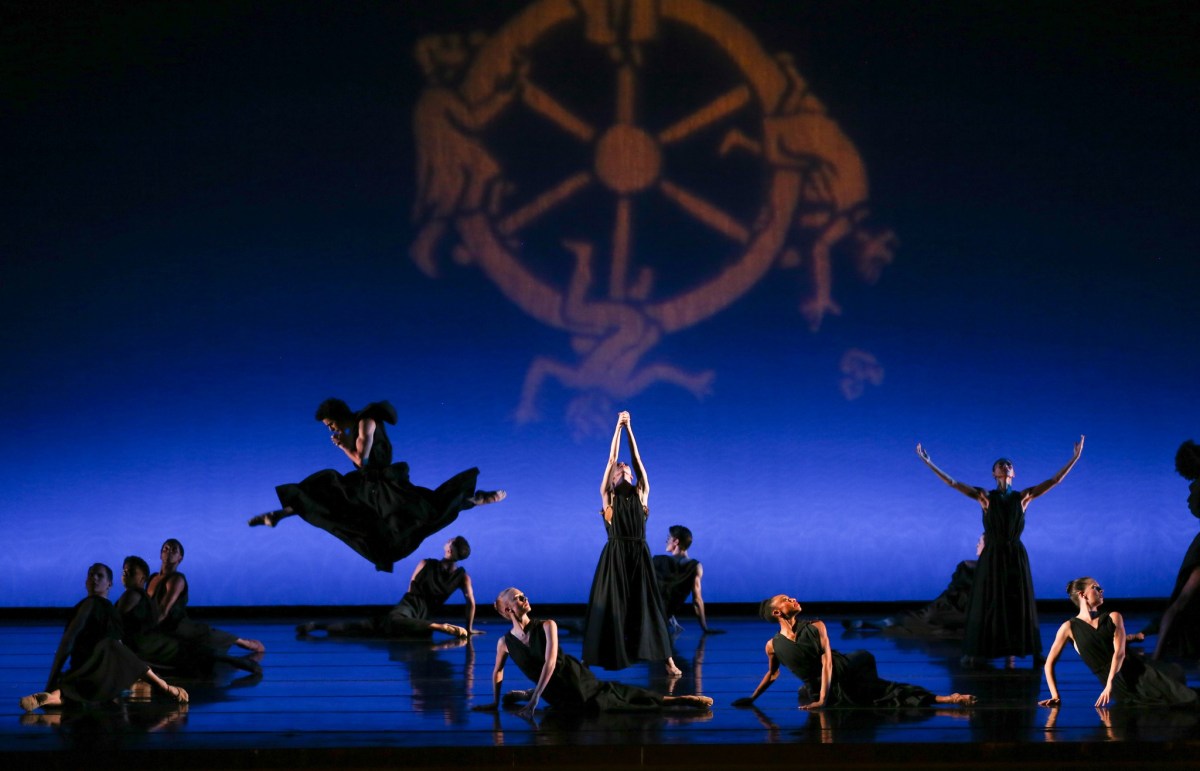
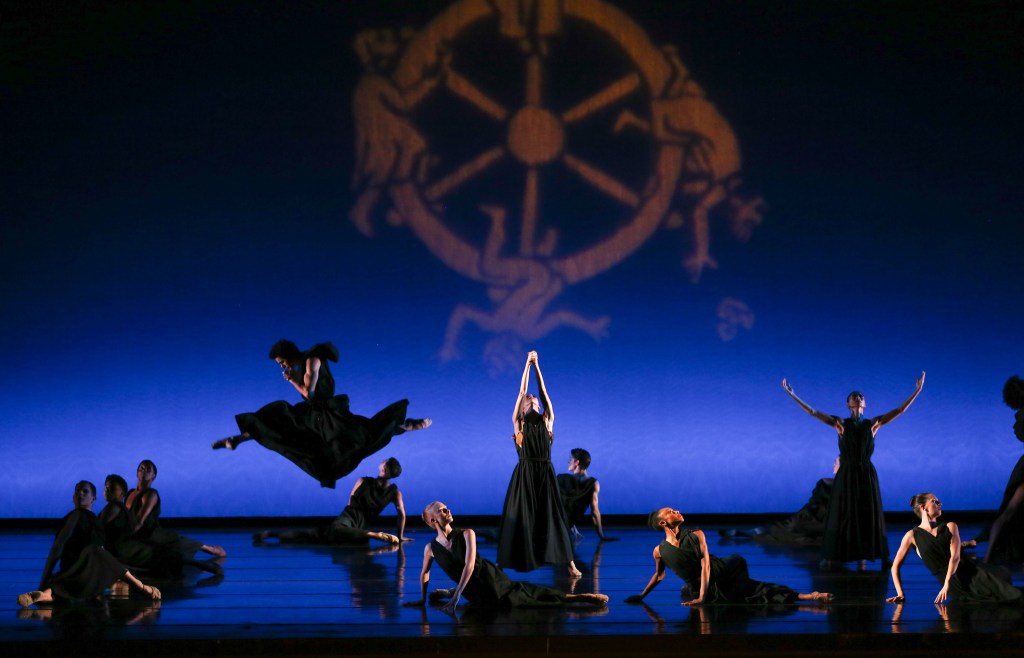
A wheel of fortune projected in the background reminds us that life is uncertain, that we are all subject to the ups and downs, the wins and losses. The mostly Latin lyrics and poetry just add to the drama – sometimes more like an opera than a ballet – bookending the entire experience with the “O Fortuna” Prologue and Epilogue.

There is discipline and structure, seductive moments, energetic and tortured movement – some of all that life has to offer.  The very characters that bow in prayer later appear literally half-dressed (hats off to costume designer Monica Guerra) and become part of romantic triangles or what some call “entanglements.” Cody Beaton and Ira White, and Eri Nishihara with Khaiyom Khojaev guide the ensemble through the changes of luck and fate, bringing a relatable sense of emotion and sensuality to what might otherwise appear to be an obscure spectacle.

All in all, this proved to be a full-blast, magnificent evening of dance theater and certainly raises the bar for high expectations for the rest of this season.

Julinda D. Lewis is a dancer, teacher, and writer who was born in Brooklyn, NY and now lives in Eastern Henrico County.

One-Time
Monthly
Yearly

Make a one-time or monthly donation to RVART REVIEW

Make a monthly donation

Make a yearly donation

Choose an amount

$5.00
$15.00
$100.00
$5.00
$15.00
$100.00
$5.00
$15.00
$100.00

Or enter a custom amount

$

Your contribution is appreciated.

Your contribution is appreciated.

Your contribution is appreciated.

DonateDonate monthlyDonate yearly
ONE IN TWO

This is the play that has no end. . .

A Theater Review by Julinda D. Lewis

At: Richmond Triangle Players at the Robert B. Moss Theatre | Carpenter Foundation Stage, 1300 Altamont Ave, RVA 23230

Performances: September 20 – October 14, 2023

Ticket Prices: $10 – $40

Info: (804) 346-8113 or rtriangle.org

———-

After seeing Donja R. Love’s phenomenal Sugar in Our Wounds, produced at Richmond Triangle Players (RTP) during April-May 2022, I was excited to see One in Two (2019) and I was not disappointed. One in Two is a three-person drama set in a waiting room, in the crossroads of “Now, until; Everywhere, nowhere.”

I was very intentional in my use of the word “crossroads.” While the literal meaning of a crossroads is an intersection, a place where two roads meet, it is commonly used figuratively and spiritually to refer to life-changing situations that require special attention, a decision, and are often marked by rituals of protection or transition.

One in Two is a masterful example of storytelling, but not the kind of story that is meant to entertain. This story is autobiographical – written by the playwright around the tenth anniversary of his own HIV positive diagnosis. It is not an entertainment, but rather a call to action, the urgency of which is suggested by the knowledge that Love began writing this play on the Notes app of his phone, from his bed. Presumably he, like the character Number One, was struggling with the need to define himself aside from a diagnosis that many considered a death sentence.

There is an experimental and inclusive nature to this work as well. Audience members are asked to take a number from a ticket machine as we enter. While the purpose is never explained, it eventually becomes clear that each ticket has been re-designated as either a “1,” a “2,” or a “3.” The three actors do not know, at the start of the show each night, which of them will be playing the role of “1,” “2,” or “3” until the audience chooses, by applause. [I applauded equally loudly for each because I know and admire Keaton Hillman and Tedarryl Perry as actors and was immediately drawn to Garrett D. Reese’s “extra-ness.”]

The actors begin to drift onto the stage one by one, about ten minutes before the show starts. They stand, stretch, linger. The action begins with a scream. On Friday, opening night, Perry was chosen to be Number One, and soon after a “safe word” was established. Overkill? No. It is, indeed, that intense.

One in Two is not lacking in humor. The three romp in a recreated memory of their youth. Perry progressed through the role of Dante from a carefree little boy to a young man exploring his sexuality until stumbling at the crossroads of an HIV positive diagnosis. Hillman played a number of roles, from bossy, king-of-the-hill kid to bartender to supportive [female] nurse, and even a member of an HIV support group – whose marriage was surrounded by secrecy and the unwillingness of his in-laws to accept their son’s marriage to another man. Reese also took on various roles, from the playground mediator to a streetwise booty call or, to put it more graphically,  trade, to Dante’s warm but worried mother.

Director Shanea N. Taylor pulls us into this world that unfolds in a non-linear, sometimes dream-like format that carries the audience from laughter to the point of tears in a matter of seconds. The stark white background, with a nurse’s station, a bathtub, and a bar hidden behind convenient cabinet doors, supports this fragile paradox – there’s nowhere to hide, while hidden in plain sight.

While it is impossible to know exactly how someone feels in this situation, One in Two takes us as close as humanly possible with a roller coaster of emotion including shock, shame, anger, depression and despair, compassion, fear, and more. The trauma is real. The acting, the play, is just an effective delivery vehicle.

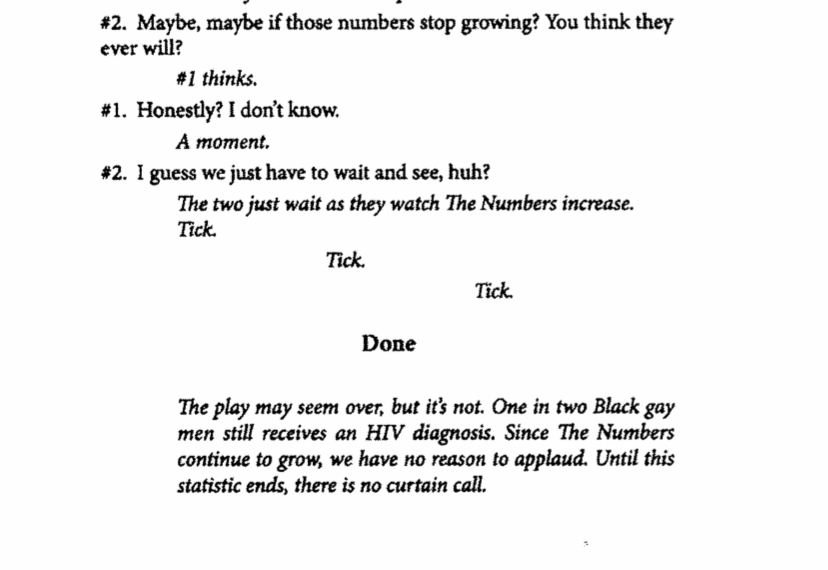
Oh. That title? At the time this play was written, according to the CDC statistics: One in fourteen gay white men will be diagnosed with HIV in their lifetime. One I four gay Hispanic men will be diagnosed HIV positive. And one in two gay Black men will be diagnosed with HIV. That is why, at the end of this play, there is no bow. There is no applause. There is no end. Yet.

FROM THE PLAYWRIGHT: “There is still trauma that’s hard to write, there are still remnants of fear that tremble the voice found in my writing. I’ve gotten to a point where there are no words, characters, dialogue, or subtext to hide behind anymore. Fear can no longer overshadow truth.”

Bravo to this cast and creative team and to Richmond Triangle Players for moving past fear and presenting us with the cold, harsh truth.

Julinda D. Lewis is a dancer, teacher, and writer who was born in Brooklyn, NY and now lives in Eastern Henrico County.

———-

ONE IN TWO

Written by Donja R. Love

Directed by Shanea N. Taylor

CAST:

Keaton Hillman – Person on the Left

Tedarryl Perry – Person in the Middle

Garrett D. Reese – Perso on the Right

Understudies: Da’Rek Early Bennett and Larry Lewis, Jr.

CREATIVE TEAM:

Scenic Design – Dasia Gregg

Lighting Design – Michael Jarett

Sound Design – Nicholas Seaver

Projection Design – Lucian Restivo

Costume, Hair & Makeup Design – Margarette Joyner

Props Design – Tim Moehring

Production State Management – Lauren Langston

Assistant Direction – Dwight Merritt

One-Time
Monthly
Yearly

Please Make a one-time donation to support the continued publication of rvart review

Make a monthly donation

Make a yearly donation

Choose an amount

$5.00
$15.00
$100.00
$5.00
$15.00
$100.00
$5.00
$15.00
$100.00

Or enter a custom amount

$

Your contribution is greatly appreciated.
Your contribution is appreciated.

Your contribution is appreciated.

DonateDonate monthlyDonate yearly