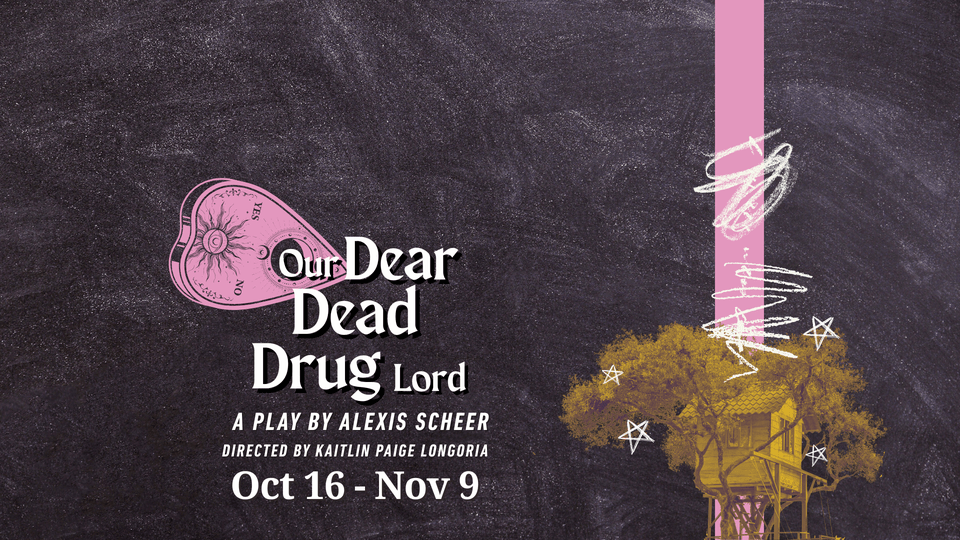
OUR DEAR DEAD DRUG LORD

*A Regional Premiere*

Growing Up is Messy…Especially When You’re Summoning the Dead

A Theater Review by Julinda D. Lewis

Presented by 5th Wall Theatre

At: The Basement, 300 E. Broad St., RVA 23219

Performances: October 16 – November 9, 2025

Ticket Prices: $30/Adults, $15/Students

Tickets & Info: https://www.5thwalltheatre.org/ or email info@5thwalltheatre.org

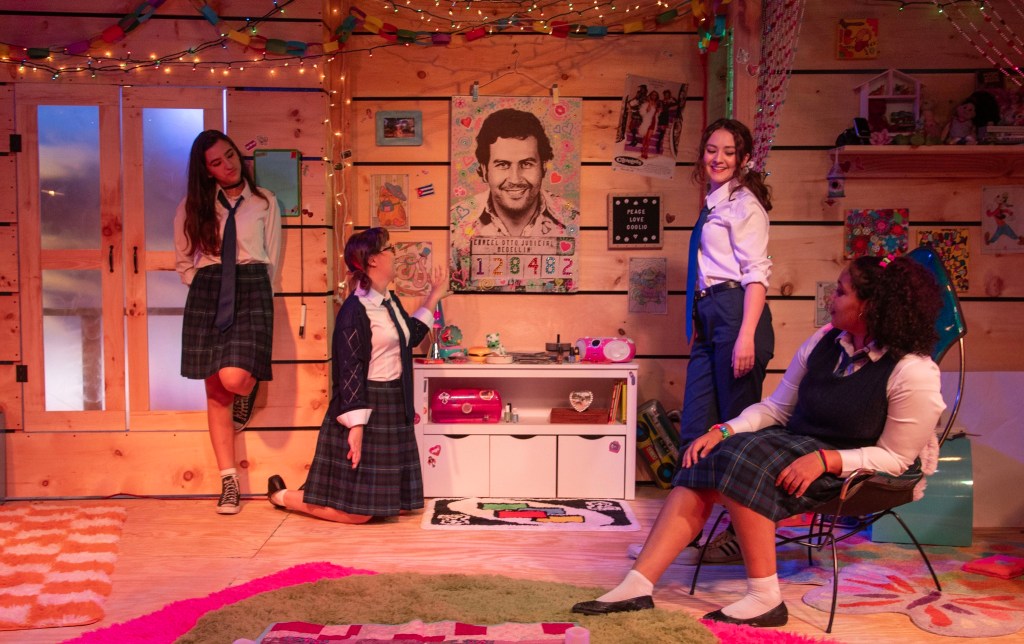
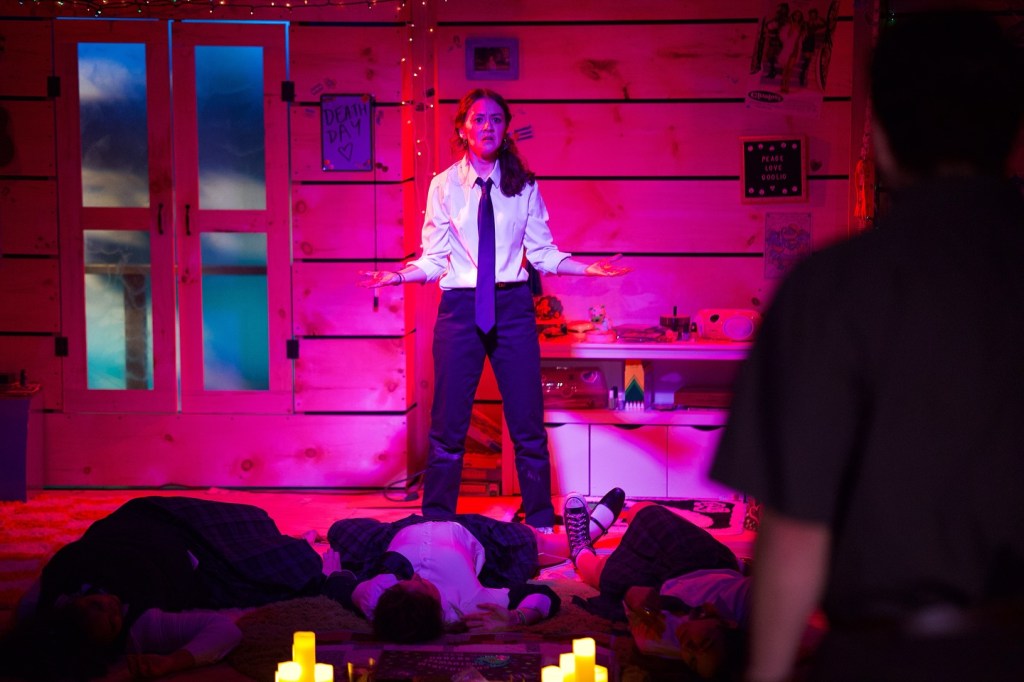
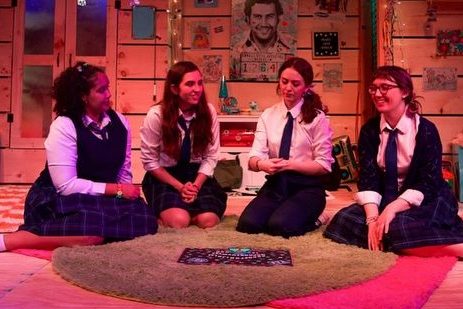
5th Wall Theatre opened its 2025/2026 season in its new, permanent home, the former Basement, now 5th Wall at The Basement or 5th Wall/Basement. In alignment with 5th Wall Theatre’s mission “to provide insights into the human condition through theatrical expression,” the season opener provided new dimensions to the theatrical experience. Alexis Scheer’s Our Dear Dead Drug Lord is a dark comedy about 4 Miami teenaged girls, members of the Dead Leaders Club, who meet in a tree house where they hope to summon the spirit of Pablo Escobar.

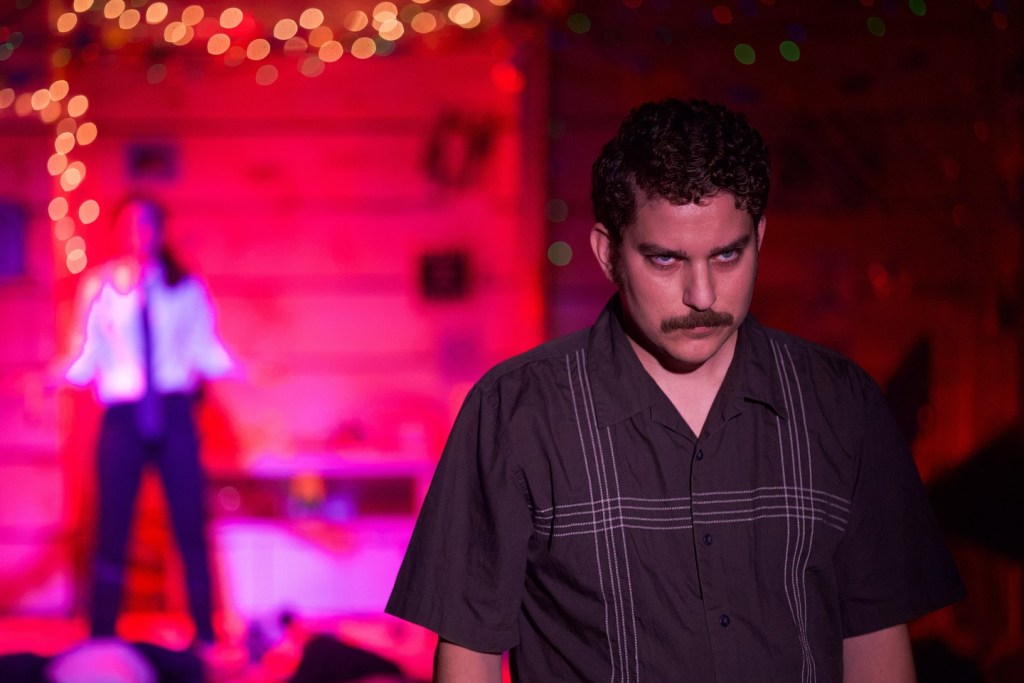
In case that name sounds familiar, yes, “that” Pablo Escobar, the Colombian drug trafficker and leader of the infamous Medellín Cartel. In addition to being one of the world’s most notorious narco-terrorists, Escobar was also known as a philanthropist who built housing complexes, parks, football stadiums, hospitals, schools, and churches in some of Colombia’s poorest neighborhoods. So, what about Escobar appeals to a club (or gang?) of teen girls in Miami?

It could be the allure of the illicit, the Robin Hood element of Escobar’s philanthropy, the need to replace the powerlessness of being young and female with the trappings of power, or a misplaced coping mechanism to deal with their own personal traumas. More than likely, it is some combination of these things, along with the normal teenaged tendency to rebel.

In an interview for TheaterMania.com (September 22, 2019), the author explains that Our Dear Dead Drug Lord was created as a way for her to connect with her own roots. The Miami-born, Columbian and Jewish writer’s mother emigrated from Medellín in the 1970s. “The Colombian cartels and Pablo Escobar is a weird part of my family mythology that I don’t understand, because I feel so distant from it. So that’s where that came from. I think it’s a very American play, and part of my experience as an American is trying to touch upon the generation or two before me that was outside of this country and what they fled to get here.” (https://www.theatermania.com/news/alexis-scheer-gives-us-the-dope-on-her-play-our-dear-dead-drug-lord_89801/)

Okay. So, there’s that. But there’s also witchcraft, a Ouija board, a séance, and a special dance choreographed in honor of . There’s a diverse cast, each with a heavy burden of her own. Pipe, the club’s president, is an upper-class Cuban-American and carries the burden of grief from her younger sister’s death. Pipe’s bestie, Squeeze, is Puerto Rican-Haitian who is allergic to cats. Her father committed suicide. Zoom, Pipe’s Jewish-American neighbor, is the baby of the group, and always trying to keep up. Perhaps in an effort to over-compensate for her youth and lower status, she is also coping with the possibility of a teen pregnancy – which factors in the play’s climax. And then there’s Kit, a Columbian-American newcomer with a mysterious past that makes the other girls speculate that she may be the actual daughter of their hero, Pablo Escobar.

The intersection of this combined chaos is where these girls meet to create a sacred space, a sense of community – perhaps much like the community some young people find in gang life. Director Kaitlin Paige Longoria describes is as “an incantation, a call to the ancestors.” In her notes, Longoria writes, “It lives in that delicate space between grief and rebirth, between the ache of what’s been lost and the hope of what might still be found.”

It is in this spirit that these girls, four young women on the cusp of adulthood, seek freedom, power, and self-worth. It is in this spirit that they chant the mantra, “I will not be good. I will be loud, loud, loud. I will make the world in my image and take what I mine!”

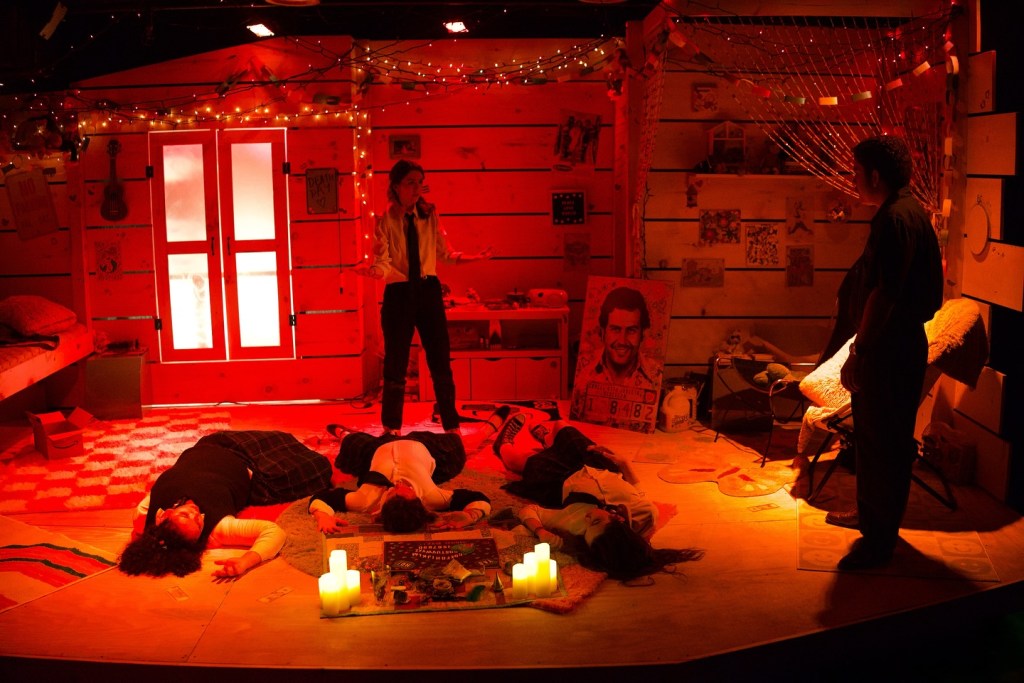
Kylee Márquez-Downie (Pipe), Marya Brice (Squeeze), Eva Linder (Zoom), and Mary Kalinowski (Kit) form a solid ensemble, intense and darkly humorous. The séance is unsettling and the sacrifice is positively horrific and scary. It’s the kind of cast where each member has a distinct role, but it’s almost impossible to single out anyone because each plays an integral part in the whole.

Joey Luck composed an original score using the cast’s own voices and William Luther created a uniquely isolated and compact tree house environment where all the action takes place.

Our Dear Dead Drug Lord is anything but predictable. It is weird, dark, disturbing, and it resonates with the truth that society is failing our young women and if we don’t do something to shape and direct them, they will find someone – or something – to fill that void.

———-

Julinda D. Lewis is a dancer, teacher, and writer who was born in Brooklyn, NY and now lives in Eastern Henrico County. When not writing about theater, she teaches dance history at VCU and low impact dance fitness classes to seasoned movers like herself and occasionally performs. Julinda was recently awarded the Dean’s Distinguished Adjunct Faculty Award 2023-24 Academic Year by VCU School of the Arts and the 2025 Pioneer Award in Dance Ministry by Transformation International Worship Ministries, Newport News, VA.

———-

OUR DEAR DEAD DRUG LORD

A Play by Alexis Scheer

Directed by Kaitlin Paige Longoria

CAST

Kylee Márquez-Downie      ……….           Pipe

Eva Linder                             ……….           Zoom

Marya Brice                           ……….           Squeeze

Mary Kalinowski                   ……….           Kit

UNDERSTUDIES

Natalie Tubia                        ……….           u/s for Pipe & Kit

Kylie Metheny                      ……….           u/s for Zoom

Jada Paul                              ……….           u/s for Squeeze

FEATURING

DJ Cummings Herdoiza     ……….           Pablo

Fio Lo Presti                          ……….           Pipe’s Little Sister

PRODUCTION TEAM

Directed                    ……….             Kaitlin Paige Longoria

Scenic Design          ……….           William Luther

Lighting Design       ……….            Corrine Manderino

Sound Design            ……….            Joey Luck

Costume Design        ……….            Emily Andrew Mateos

Choreography            ……….            Kayce Sullivan & Jamie Hollman

Intimacy Choreography   …..            Kerrigan Sullivan

Stage Management ………            Megan Wave

Technical Direction ……….           Chris Foote

Photography             ……….           @ivyandlacephoto

Performance Schedule:

Thursday, Friday, Saturday 7:30PM

Saturday, Sunday 2:30PM

Tickets: $30/Adult; $15/Student

Run Time: 95 minutes, no intermission

The World Premiere of Our Dear Dead Drug Lord was presented in September 2019 by WP Theater and Second Stage Theater, NYC, NY.

CONTENT WARNING: This play contains strong language, sexual content, depictions of drug use, and scenes of violence. The play also includes references to suicide, sexual assault, and other sensitive subject matter.
One-Time
Monthly
Yearly

PLEASE Make a one-time, MONTHLY, OR ANNUAL donation TO SHOW YOUR APPRECIATION FOR RVART REVIEW!

Make a monthly donation

Make a yearly donation

Choose an amount

$5.00
$15.00
$100.00
$5.00
$15.00
$100.00
$5.00
$15.00
$100.00

Or enter a custom amount

$

Your contribution is appreciated.

Your contribution is appreciated.

Your contribution is appreciated.

DonateDonate monthlyDonate yearly
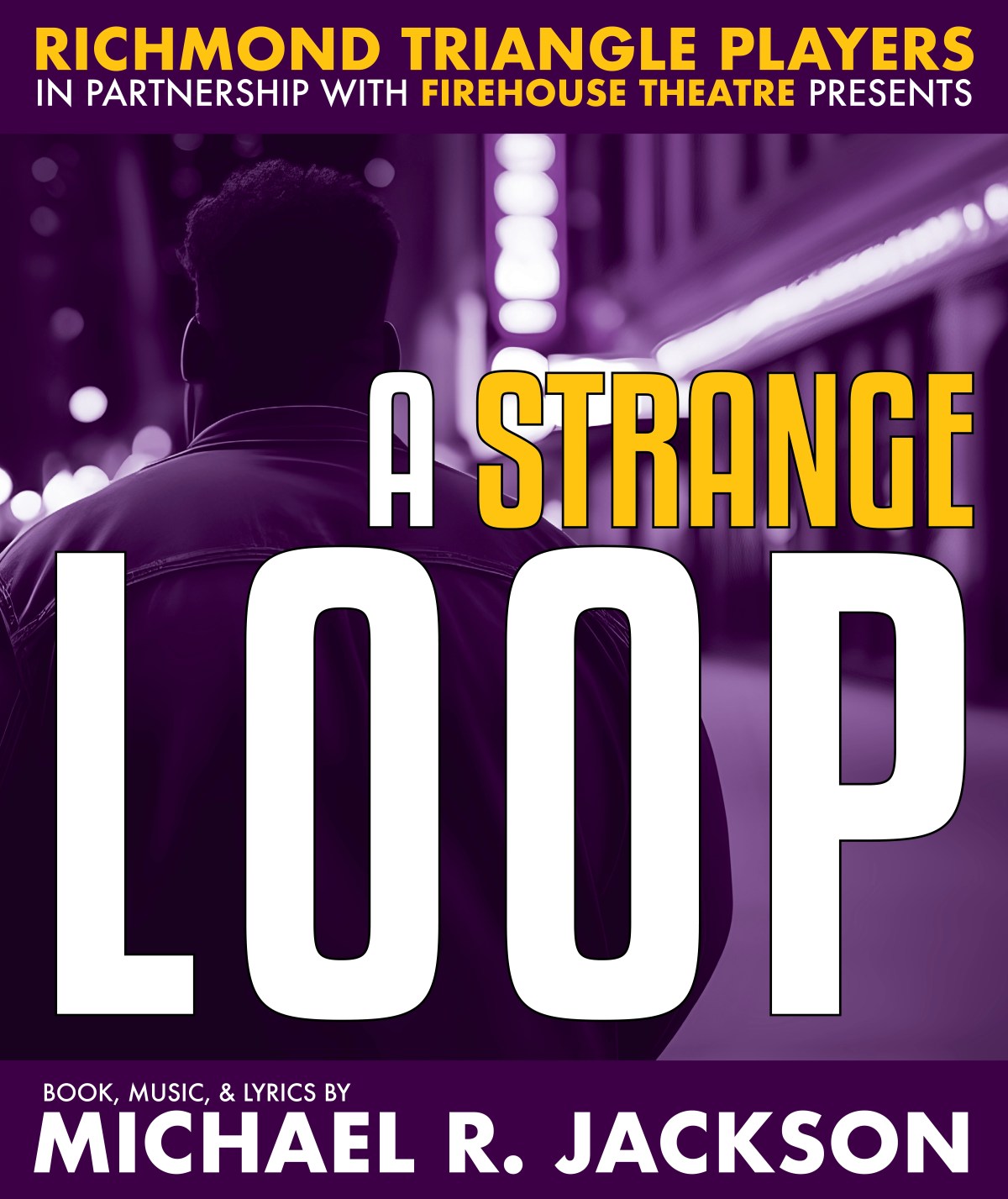
A STRANGE LOOP

Or, How to be a Big, Black, Queer-Ass Broadway Musical

Presented by: Richmond Triangle Players in Partnership with Firehouse Theatre

At: Richmond Triangle Players at the Robert B. Moss Theatre, 1300 Altamont Avenue,  RVA 23220

Performances: June 20 – August 9, 2025

Ticket Prices: $55

Info: (804) 346-8113 or rtriangle.org

A Reflection on Theater and Things Relative by Julinda D. Lewis

———-

Michael R. Jackson’s Pulitzer Prize-winning musical, A Strange Loop (2019) follows the life of Usher – no, not that Usher – a Black, queer writer who works as an usher in theaters while writing his own musical about a Black queer usher who is writing a musical…about a Black queer usher who is writing a musical…

“Who knew slavery, police violence, and intersectionality could be so lucrative.”

A Strange Loop is at once as new as the latest dance craze and as old as the theater itself. The chorus of six nameless characters referred to in the program as “Thoughts” draws on the ancient Greek chorus. The Thoughts personify Usher’s inner struggles with identity and purpose. At times they represent social issues and personal demons, and at other times they represent people in Usher’s life. Come to think of it, Usher is not so much the lead character’s name as his occupation; he works as a Disney usher while struggling to overcome his writer’s block. Sometimes, the people are the issues, and sometimes the issues are the people. And since Usher is a young Black queer individual, these inner struggles encompass issues of racism, identity, homophobia, and self-doubt. Since Usher is a writer, A Strange Loop is also an exploration of the mind of creatives.

In science and technology, “a strange loop” is a concept proposed by Pulitzer prize-winning cognitive scientist and author Douglas Richard Hofstadter in his book I Am A Strange Loop (2007). In this book, Hofstadter (the son of Nobel Prize-winning physicist Richard Hofstadter) explores the sense of “I” or what is a “self” through the lens of self-referential systems. While these systems have different meanings in different fields, they most often are represented by a loop.

Playwright Jackson uses the term to refer to a self-referential thought structure or loop, in which an individual may find themselves trapped in a loop of thoughts – all too often negative thoughts – that keeps returning to the same point. For our protagonist, Usher, the loop circles around the themes of identify, self-doubt, and the writing process. Each theme in complete in itself, but in A Strange Loop the thoughts are compounded and complex, forming a never-ending loop that feeds on his insecurities which are, in turn, reinforced by social and familial pressures.

In a 2022 interview for Outreach: An LGBTQ Catholic Resource, Jackson said, “It’s very simple. The ideology is so intact that when you have that filter or that loop in yourself, nothing will break it until you break it or until your perception shifts.”  [https://outreach.faith/2022/06/interview-a-strange-loop-playwright-michael-r-jackson-talks-faith-compassion-and-sexuality/] A Strange Loop is a musical journey towards breakthrough and perception shift.

And yes, all this background may sound like technical, scientific mumbo jumbo to some, but it is key to understanding this play and this character. Who among us has not been affected by negative self-talk? And this play, this big, complex musical wonder, has been recognized many times over for its heartfelt message. A Strange Loop won the 2022 Tony Award for Best Musical and Best Book of a Musical. It also won the 2020 Pulitzer Prize for Drama even before its Broadway run.  The Pulitzer committee recognized Jackson’s work as “a metafictional musical that tracks the creative process of an artist transforming issues of identity, race, and sexuality that once pushed him to the margins of the cultural mainstream” while acknowledging the universality of human fears and insecurities. There were other awards, too – Drama Desk, New York Drama Critics’ Circle, and numerous nominations in multiple categories. You can be intellectual and artistic at the same time. A Strange Loop is a lot of things, all at once, and probably deserves more than one viewing.

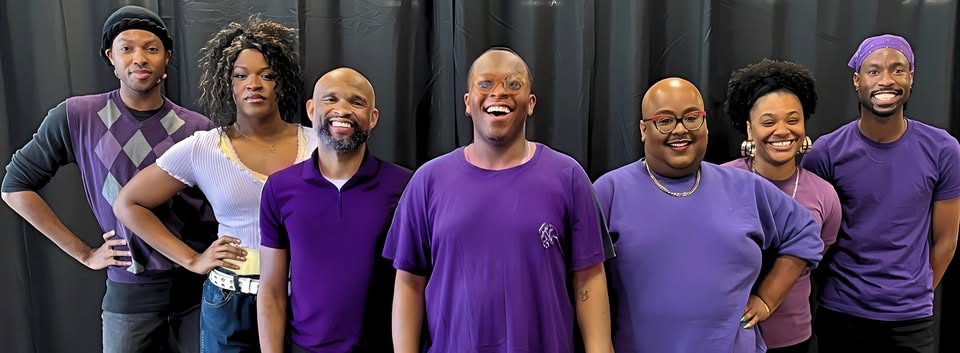
This Richmond production, under the masterful direction of the multi-talented Katrinah Carol Lewis, with musical direction by Ben Miller and choreography by Deandra Clarke boasts a stellar cast headed up by Marcus Antonio. Antonio was most recently seen at the Firehouse/TP production of Fat Ham [https://jdldancesrva.com/2025/04/17/fat-ham/] where he gave an alternately sly, philosophical, and just generally endearing performance as the main character Juicy, modeled after Hamlet. In A Stange Loop, you forget Antonio is acting. He embodies the character of Usher with authenticity, but also with grace – and I’m not just talking about the physical kind of grace, but the spiritual kind of grace as well. And did I mention he can sing his butt off? You need to see and hear it for yourself.

Each and every one of the “Thoughts,” deserves special mention, but I know I would omit something or someone important. At one point they form a parade of past heroes including Harriet Tubman, Marcus Garvey, James Baldwin, Whitney Houston, Zora Neal Hurston. When Zakiyyah Jackson/Thought #1 takes on the persona of an older Black woman who shares her wisdom and advice with Usher, she reminds me of the fabulous Phylicia Rashaad. Her last appearance on the RTP stage was, in fact, in a production of How Black Mothers Say I Love You [https://www.facebook.com/share/v/19WrqXMdBi/ ] TeDarryl Perry/Thought #4 and the understudy for Usher simply nails it as Usher’s mother. The red dress, the mannerisms, the attitude that flips without notice from, “The bible says homosexuality is worse than murder” or “Why do you hate me; you’re selfish” to love reminds me of people in my own extended family. I’m sure we all know at least one like her, or him.

I couldn’t believe that Anthony Cosby Jr., most recently seen in last season’s Yes, And! Production of Pass Overand known for his fabulous Prince tribute shows, was just now making his RTP debut as Thought #5. Likewise, it was awesome to watch Keaton Hillman/Thought #6 add to his growing repertoire of memorable characters. I haven’t seen Todd Patterson/Thought #3 sing and dance this much since BootyCandy (2022) [https://jdldancesrva.com/2022/06/17/bootycandy/]. I am not yet familiar with the beautiful Nesziah Dennis/Thought #2 but thoroughly enjoyed her performance and look forward to seeing more of them in the future.

With all the trauma in A Strange Loop, there is no deficit of humor. The parents’ names are Serabi and Mufasa, and the granddaughter is Nyla. Besides paying homage to The Lion King, it seems a bit of an inside joke that they are also the King and Queen of the Pridelands.

There are plenty of biblical references as well, from things people think are in the bible but actually aren’t (e.g., AIDS is God’s punishment for not living right) to actual bible quotes (e.g., But these, like natural brute beasts made to be caught and destroyed, speak evil of the things they do not understand, and will utterly perish in their own corruption – 2 Peter 2:12 NKJV).

Production-wise, A Strange Loop utilizes the space at RTP so well that the stage seemed wider and deeper than it actually is – in other words, bigger than life. Frank Foster’s scenic design consisted of strands of light, in curving bands like a roller coaster or strands of DNA, and 18 slim poles. Michael Jarett’s lighting was evocative, simple, and dramatic in turn.

This is a musical, so I would be derelict not to mention the music, which encompasses multiple genres including R&B and gospel – sometimes with full choir robes. The songs were fully integrated into the book, with lyrics that seamlessly expanded the storytelling aspects of the show. One of the most memorable, near the end, was “Memory Song,” a work that kind of summarizes the intent and direction of the entire work, touching on Usher’s childhood memories and relationships, his sexuality, and his faith. [See the lyrics to “Memory Song” below.] In his bio, TeDarryl Perry wrote that this performance is dedicated to “all those Black, gay boys who chose to go on back to the Lord.”

In the end, A Strange Loop, while frequently referred to by participants as “a big, black, and queer ass American Broadway show,” is not just a niche show. It is for Black, queer people. It is for people who are exploring their sexuality or identity. It is for people who care abut mental health and identity. It is for anyone who has ever experiences self-doubt or self-hate. It is for people who have been bullied and people who have bullied others. It is for people who love a good story. It is for people who care about other people. It is for people who care. A loop is never-ending. The only way out is to break through.

Here’s a link to a preview of A Strange Loop: https://www.facebook.com/share/v/19WrqXMdBi/

Here are the lyrics to “Memory Song”:

Five foot four, high school gym
Sneaking a cupcake
These are my memories

Shooting hoops off the rim
Slow on the uptake
These are my memories

After gym, the locker room
My eyes photographing
Naked me measures in at four and a half inches
These are my memories

Of one lone, Black, gay boy I knew
Who chose to turn his back on the Lord
One lone, Black, gay boy I knew
Who chose to turn his back on the Lord

Guild and shame
Jesus’ name
Church every Sunday
These are my memories

Eat his body
Drink his blood
Communion buffet
These are my memories
Sweet, sour memories

After church we’re driving home to radio crackle
Jazz music or Motown blues
And skin is a shackle
For one lone, Black, gay boy I knew
Who chose to turn his back on the Lord
One lone, Black, gay boy I knew
Who chose to turn his back on the Lord

These are my memories
Sweet, sour memories
This is my history
This is my mystery

Mom is napping on the couch
And dad cuts the grass
While I watch TV all day long
Young & the Restless
Like one lone, black, gay boy I knew
Who chose to turn his back on the Lord
One lone, black, gay boy I knew
Who chose to turn his back on the Lord

Dad is drunk and on the couch
While mom eats a porkchop
Daily bread mill
Daily treadmill won’t ever stop
One lone, Black, gay boy I knew
Who chose to turn his back on the Lord
One lone, Black, gay boy I knew
Who chose to turn his back on the Lord

I am lying on the couch
I dream that I’m flying
Flapping both my wings so hard
To keep me from dying
With a crown of godforsaken thorns on my head
Like all those black, gay boys I knew
Who chose to go on
Back to the Lord (like all those black, gay boys you knew who chose to go on back to the Lord)

All those Black, gay boys I knew
Who chose to go on
Back to the Lord (all those Black, gay boys you knew who chose to go on back to the Lord)
All those Black, gay boys I knew
Who chose to go on
Back to the Lord! (all those Black, gay boys you knew who chose to go on back to the Lord)
And one lone, Black, gay boy I knew
Who chose to turn his back-
On the Lord- (chose to turn his back on, chose to turn his back on the Lord)
Instead

Source: Musixmatch |Songwriters: Michael Jackson | Memory Song lyrics © Kobalt Music Services America Inc.

———-

Julinda D. Lewis is a dancer, minister of dance, teacher, and writer who was born in Brooklyn, NY and currently resides in Eastern Henrico County. When not writing about theater, she teaches dance history at VCU and low impact dance fitness classes to seasoned movers like herself and occasionally performs.

———-

A STRANGE LOOP

Book, Music, & Lyrics by Michael R. Jackson

Directed by Katrinah Carol Lewis

Cast

Marcus Antonio ….. Usher

Zakkiyah Jackson ….. Thought #1

Nesziah Dennis ….. Thought #2

Todd Patterson ….. Thought #3

TeDarryl Perry ….. Thought #4 & U/S Usher

Anthony Cosby Jr ….. Thought #5

Keaton Hillman ….. Thought #6

Understudies

Nia Frazier ….. Thoughts

Sydnee S. Graves ….. Thoughts

A Strange Loop Band

Conductor/Keyboard ….. Ben Miller

Guitar ….. Lake Stiles

Drums ….. Joe Lubman

Reeds ….. Jalen Wise

Creative Team

Scenic Design ….. Frank Foster

Lighting Design ….. Michael Jarett

Costume, Hair, & Makeup Design ….. Margarette Joyner

Sound Design …. Grace Brown LaBelle

Props Design ….. Tim Moehring

Production Stage Manager ….. Lauren Langston

Choreography ….. Deandra Clarke

Music Direction ….. Ben Miller

For This Production

Assistant Stage Managers ….. Christopher R. Smith, Finn Thomason

Intimacy Director ….. Nora Ogunleye

Gender Consultant ….. August Hundley

Technical Director ….. Emily Vial

Master Electrician ….. Griffin Hardy

Sound Assistant ….. Julie Vo

Set Construction ….. David Allan Ballas, Grace Brown Labelle, Todd Labelle, Emily Vial, Patrick Rooney

World Premiere by Playwrights Horizons, Inc. in association with Page 73 Productions in New York City in 2019.

Performance Schedule

June 20 – August 9, 2025

Sundays at 4:00PM

Wednesdays at 8:00PM

Thursdays at 8:00PM

Fridays at 8:00PM

Saturdays at 8:00PM, closing August 9

Tickets

Ticket Prices: $55

Run Time

About 2 hours with no intermission

Setting

A loop within a loop within a loop inside a perception of one man’s reality.

Photos from the RTP Facebook page

One-Time
Monthly
Yearly

Make a one-time, monthly, or annual donation to show your love for rvart review

Make a monthly donation

Make a yearly donation

Choose an amount

$5.00
$15.00
$100.00
$5.00
$15.00
$100.00
$5.00
$15.00
$100.00

Or enter a custom amount – no amount is too small ($1.00) or too large (the sky’s the limit)!

$

Your contribution is appreciated.

Your contribution is appreciated.

Your contribution is appreciated.

DonateDonate monthlyDonate yearly
FIVE LESBIANS EATING A QUICHE

Respect the Egg

A Theater Review by Julinda D. Lewis

At: Richmond Triangle Players at the Robert B. Moss Theatre | Carpenter Foundation Stage, 1300 Altamont Ave, RVA 23230

Performances:  September 11 – October 5, 2024

Ticket Prices: $50

Info: (804) 346-8113 or rtriangle.org

———-

NOTE: For the last review I wrote for this space, I confessed that I was unfamiliar with the play prior to seeing it, but someone kindly pointed out that I had actually reviewed the Richmond premiere several years prior. I  wasn’t caught off guard this time. I remembered seeing this play before – in the same theater! – and my review of that earlier production was published in the Richmond Times  Dispatch, February 20, 2015.

———-

September 13, 2024:

The leaders and members of the Susan B. Anthony Society for the Sisters of Gertrude Stein are gathered in the newly renovated community center for their annual Quiche Breakfast, but all is not as picture perfect as it appears on the surface. It’s 1956 and the country is uneasy about the prospect of impending nuclear attack and many – let’s be honest, all – of the widows (wink, wink) share a secret that no one dares speak aloud. When the security system signals a nuclear attack, everything changes.

The authors, Evan Linder and Andrew Hobgood – and the artistic team at Richmond Triangle Players – were eerily prescient. Change the year from 1956 to 2024 and the political climate, the threat of terrorism, and the challenges (dangers?) of being yourself are pretty much the same. I’m sure it was accident, no mere coincidence, that this production was planned for this pre-election period.

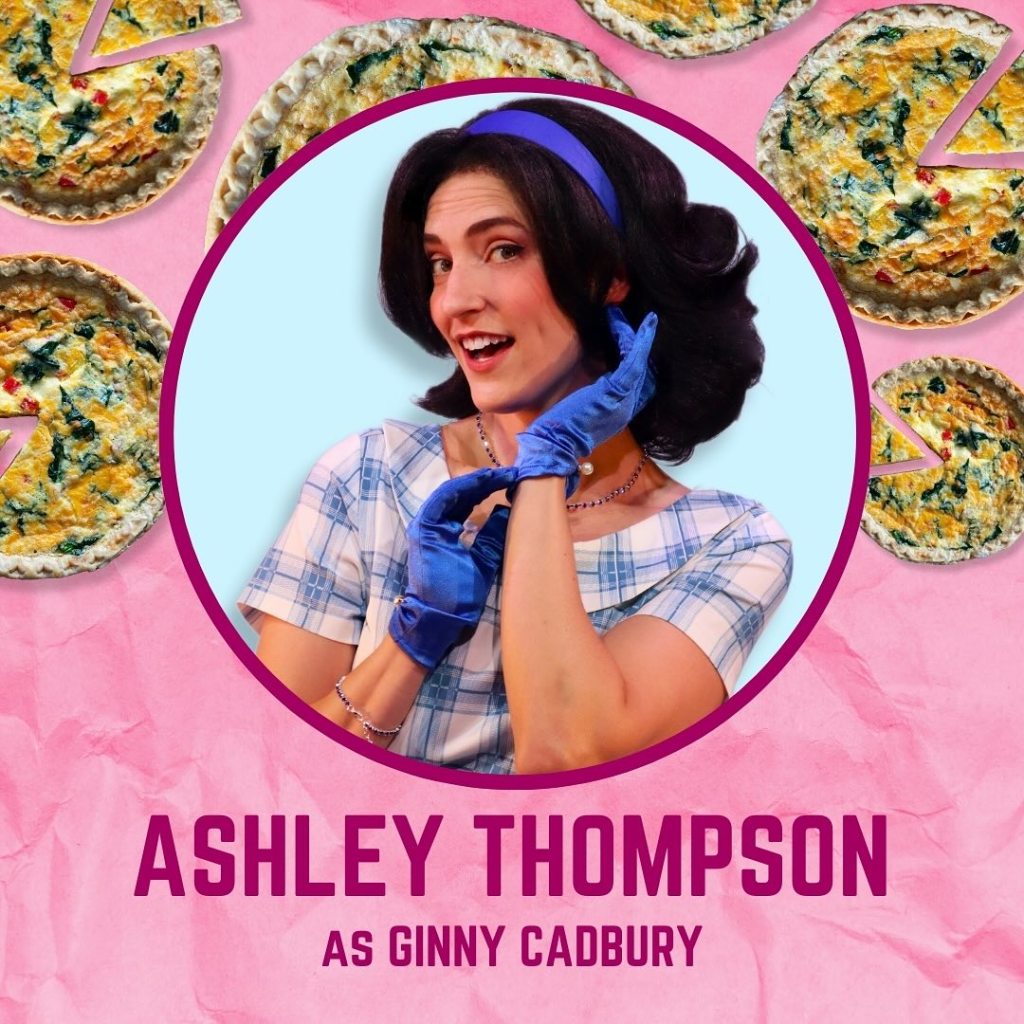
William Luther’s near cartoon-style set and gorgeous 1950s style dresses with their swinging skirts – some fluffed up by crinolines – stunning vintage shoes, hair bows, fascinators, and lace gloves are a feast for the eyes. The very demure outer appearance only makes the underlying sexual tension, innuendo, and banter that permeate each scene that much steamier. When Ashley Thompson’s character, Ginny Cadbury, the over-eager newest member of the group ends up atop a table with her face buried in a plate of quiche it’s as if a group of church ladies had suddenly put down their needle point to engage in an orgy. But I’m jumping ahead.

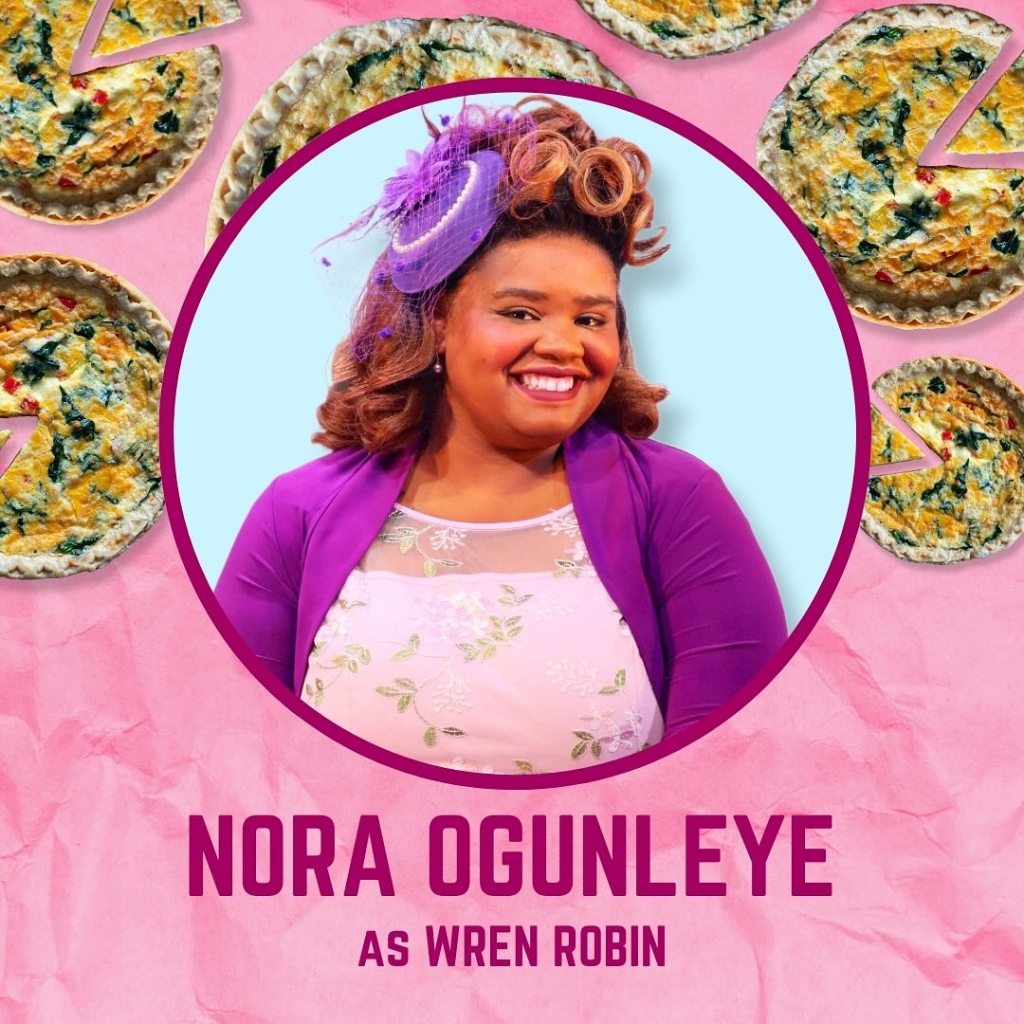
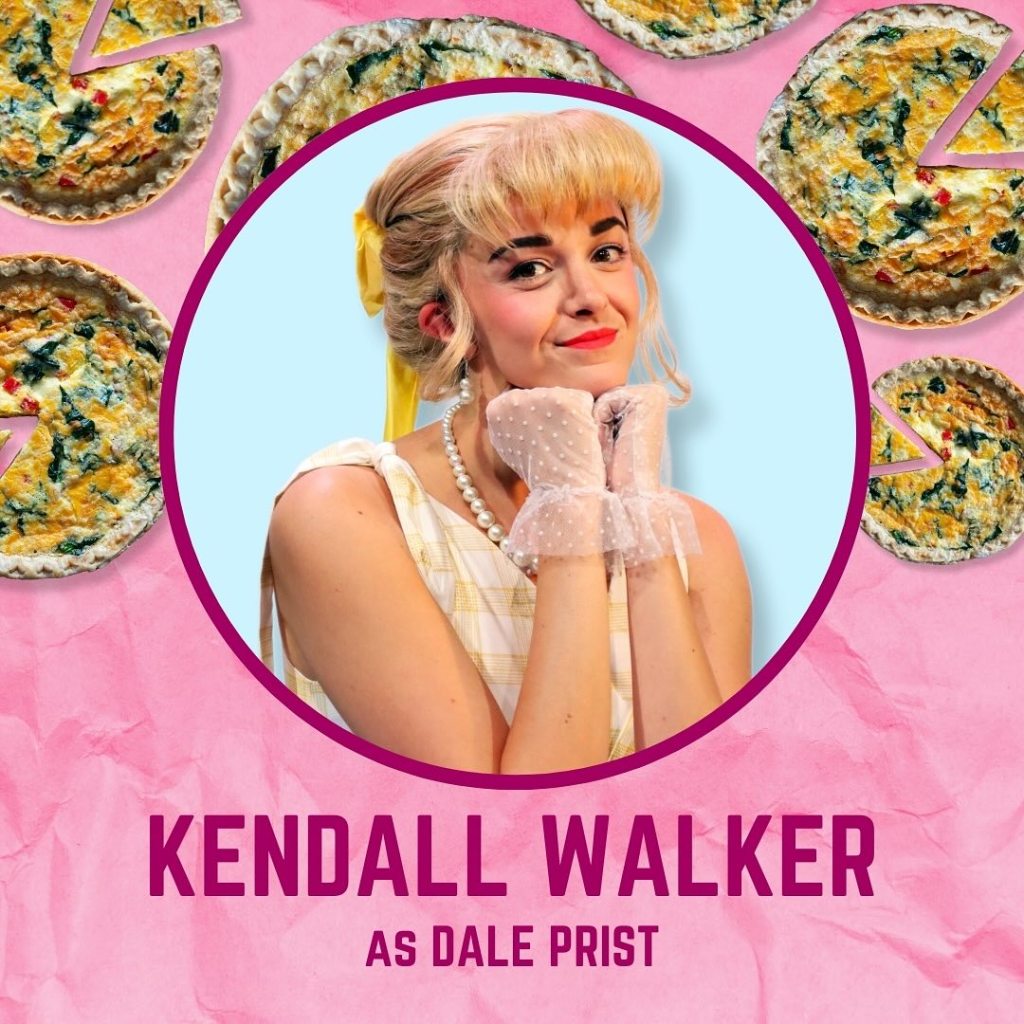
Theater-goers aka members receive name tags on arriving at their seats. Everyone gets a “female” name. I was Virginia this time. There is a lot of audience interaction, and one front-seat viewer in particular – “Margery” on opening night – gets to have an on-going supporting role. Nora Ogunleye as Wren Robin is the club’s event chair. Ogunleye, looking fabulous in a purple ensemble with matching hat and shoes brings over-the-top optimism and a mile-wide smile to the role. Kendall Walker plays Dale Prist, a wide-eyed innocent who looks like an animated Barbie doll and serves as the group’s historian with a classic Eastman-type film using camera around her neck.

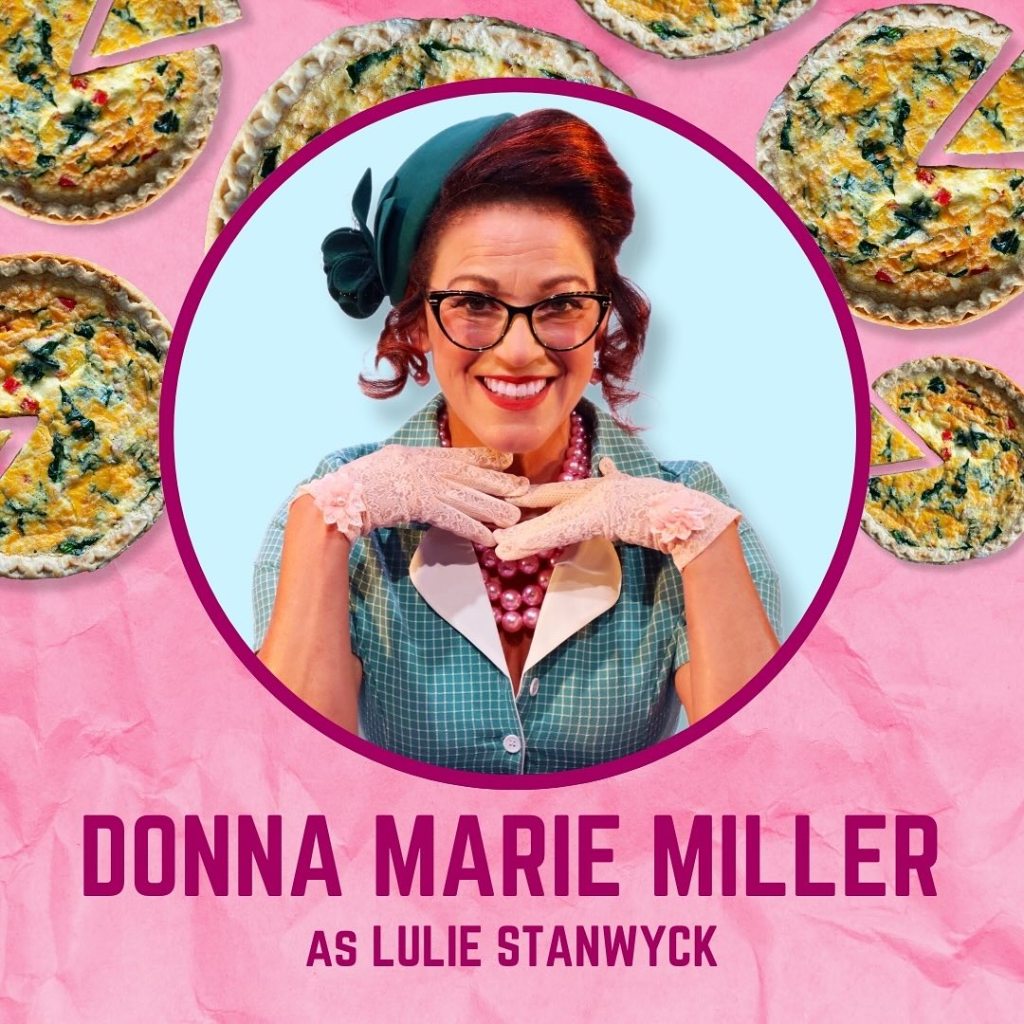
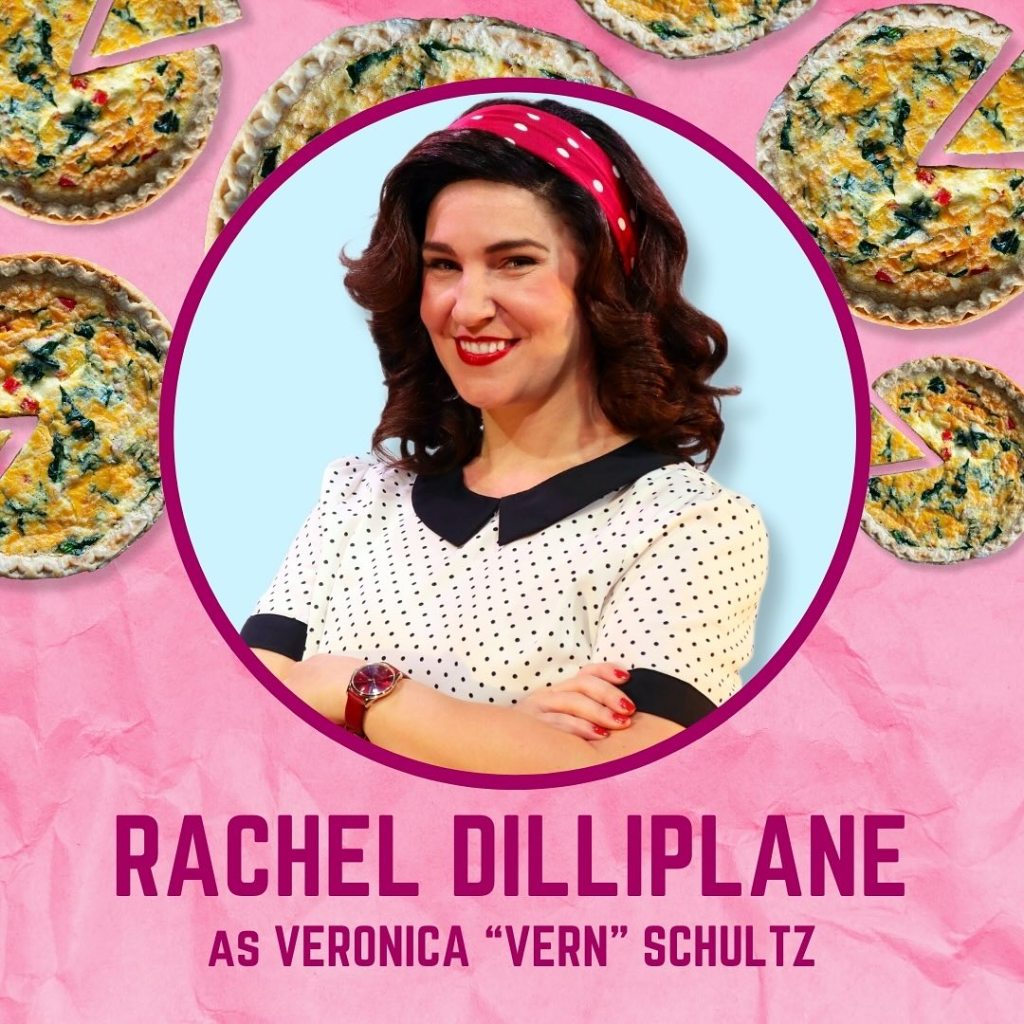
Rachel Dilliplane brings barely repressed butch energy to Veronica “Vern” Schulz, the group’s buildings and grounds manager. Vern is the only one of the five women bold enough to wear pants, and in spite of her tight control over just about everything in her immediate world, Vern is the one who dropped the ball when it most mattered. Ashley Thompson slays as Ginny Cadbury, the newest member and recent British transplant who serves as the secretary. We never learn why – or if we did, it went over my head – Ginny is ostracized by the rest of the leadership team. Last but not least, Donna Marie Miller has the role of the group’s President, Lulie Stanwyck. A stickler for rules and protocol, who lives by the motto “no men, no meat,” it is Lulie who drops the biggest bombshell (I actually did not know that pun was coming) after the five find themselves confined to the shelter – with the possibility they may have to remain there for four long years.

Everything was moving along according to plan, you see, although there is a hint that things are not as they appear – when suddenly the lights flicker, the alarm sounds, and the safety door locks everyone inside against a nuclear attack. With seemingly nothing left to lose, it’s time to finally let go of long-held secrets. It turns out that “widow” is used here as a euphemism for lesbian. Once that is out in the open – and some are more reluctant to name their truth than others, and not even the audience is not exempt from participating in the apocalyptic confession – the floodgates open to reveal all sorts of secrets and Dale has an opportunity to earn a special place in the history of the sisterhood.

This cast is bright and snarky and generally hilarious. The costumes and set are visually delightful. The lighting and sound effects are appropriately over-the-top. The audience’s immersion pushes the edge of an unnamed boundary that gives heightened meaning to the word inclusion. What other play do you know of that encourages the audience to sing along to the theme song of an elite society and have everyone shout out, “I am a lesbian!” The issues are real: nuclear warfare, loyalty, discrimination, oppression, same-sex marriage. The timing of lines by the ensemble and the overall pacing set by director Kelsey Cordrey never attempts to belittle any of this, while at the same time guaranteeing there is never a dull moment. In short, 5 Lesbians Eating a Quiche is breathlessly entertaining.

———-

Julinda D. Lewis is a dancer, teacher, and writer who was born in Brooklyn, NY and now lives in Eastern Henrico County. When not writing about theater, she teaches dance history at VCU and low impact dance fitness classes to seasoned movers like herself, and occasionally performs. Her most recent (ad)venture was the premiere of a solo work, The Waters of Babylon or Psalm 137 Revisited: a Post-Exodus Reflection in Movement Choreographed From Collective Memories for the debut of the Critical Race Theatre Project, right here at RTP in August 2024.

———-

5 LESBIANS EATING A QUICHE

Written by Evan Linder & Andrew Hobgood

Directed by Kelsey Cordrey

Cast

Rachel Dilliplane as Veronica “Vern” Schultz [Note: the program spells her name Dillaplane but I used the spelling I’ve seen virtually everywhere else including her own social media]

Donna Marie Miller as Lulie Stanwyck

Nora Ogunleye as Wren Robin

Ashley Thompson as Ginny Cadbury

Understudies

Kendall Walker as Dale Prist

Emils Berry u/s for Wren Robin & Veronica “Vern” Schultz

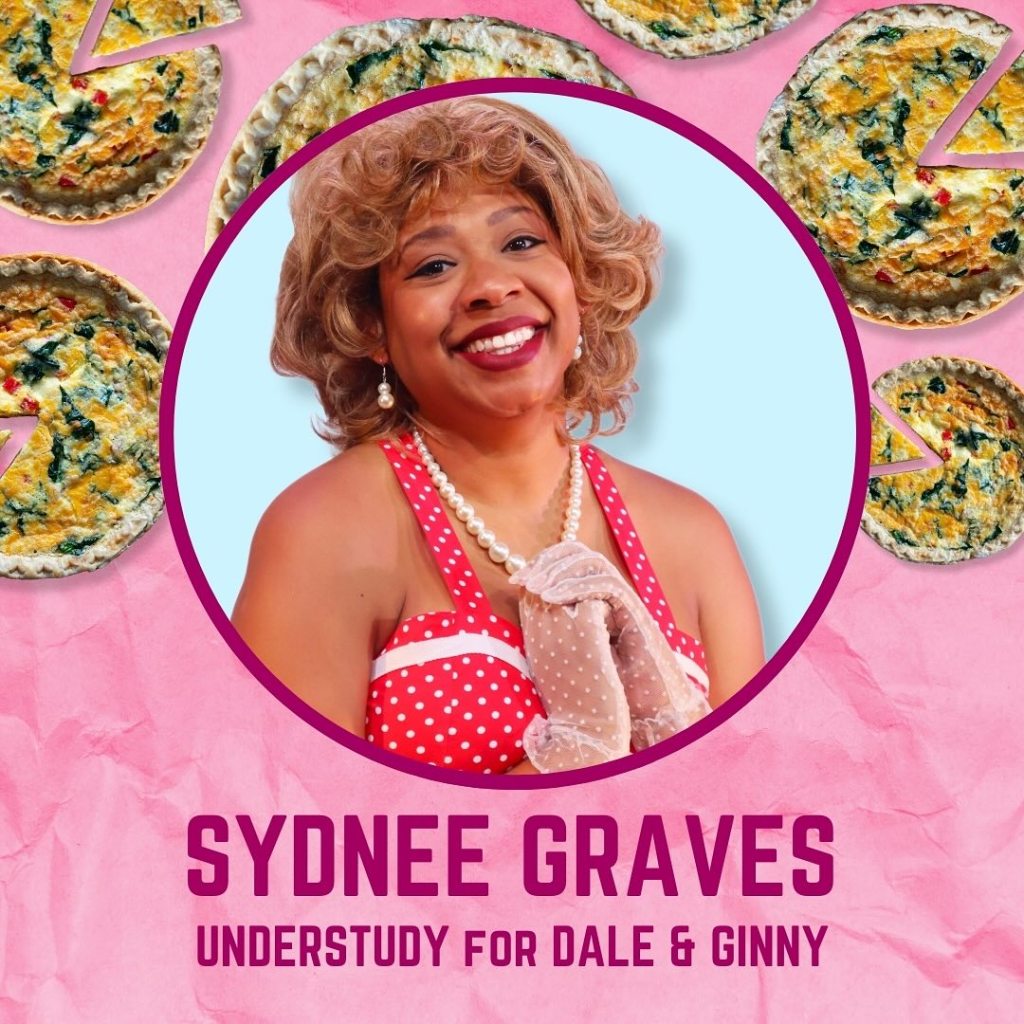
Sydnee Graces u/s for Dale Prist & Ginny Cadbury

Jen Hines u/s for Lulie Stanwyck

Production & Design

Playwright – Evan Linder & Andrew Hobgood

Director – Kelsey Cordrey

Scenic & Costume Design – William Luther

Lighting Design – Gretta Daughtry

Sound Design – Lucian Restivo

Props Design – Tim Moehring

Hair & Makeup Design – Luke Newsome

Production Stage Manager – Corrie Yarbrough

Assistant Stage Manager – Finn Thomason

Intimacy & Fight Director – Lucinda McDermott

Gender Consultant – August Hundley

Master Electrician – Griffin Hardy

Technical  Director & Scenic Artist – William Luther

Scenic Construction – David Ballas, Josie Carter, Becka Russo, Kendall Walker

Setting

A community center in middle America where the annual Quiche Breakfast of the Susan B. Anthony Society for the Sisters of Gertrude Stein is being held. Today, 1956.

Run Time

Approximately 70 minutes without intermission

Ticket Information

$50, Info: (804) 346-8113 or rtriangle.org

Photo Credit: unattributed

One-Time
Monthly
Yearly

Make a one-time or recurring donation
to show your support of RVART Review

Make a monthly donation

Make a yearly donation

Choose an amount

$5.00
$15.00
$100.00
$5.00
$15.00
$100.00
$5.00
$15.00
$100.00

Or enter a custom amount

$

THANK YOU!!!
Your contribution is appreciated.

Your contribution is appreciated.

Your contribution is appreciated.

DonateDonate monthlyDonate yearly

INTO THE WOODS

Once Upon a Time, Later – or – What Happens After “Happily Ever After?”

A Musical Theater Review by Julinda D. Lewis

Presented By: Richmond Shakespeare

At: Cramer Center for the Arts, The Steward School, 11600 Gayton Rd., RVA 23238

Performances: March 7-24, 2024

Ticket Prices: $22-$47 [Adults $47; Seniors 65+ with ID $42; Military with ID $22; Students $22]

Info: (804) 340-0115 or http://www.richmondshakespeare.org

What happens after “happily ever after?”

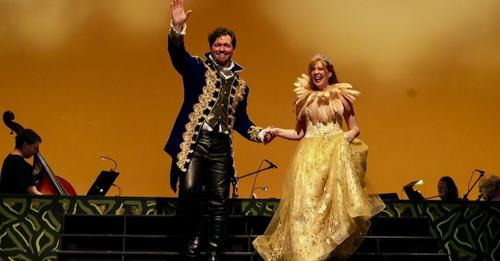
Sondheim and Lapine’s extravagant musical, Into the Woods (1987), has a lot going on. For one thing, there is a large cast of characters drawn from various Grimm’s fairy tales, from Little Red Riding Hood to Jack (of the magic beans and giant fame). There are princesses in towers (Rapunzel)  and elsewhere (Cinderella) and princes who do not live up to expectations for “happily ever after” – Cinderella’s prince and Rapunzel’s prince, who are brothers with lustful, wandering eyes for the purpose of this plot. There are peasants and royalty, a wicked witch, a wolf with pedophilic tendencies, and a little girl with an implied eating disorder. There is a narrator that the other characters, in a rare show of solidarity, throw under the bus – and that’s just for starters. And just in case you were wondering – as you should have been – despite the Disney inspired costumes and light-hearted, guffaw-inducing moments that pepper Act 1, this is not a family-friendly show. Half the lead characters meet untimely deaths in Act 2. The bloody demise of those who are smushed by the giant’s foot is indicated by a red wash on the background, and sometimes accompanying sound effects.

Be careful what you wish for.

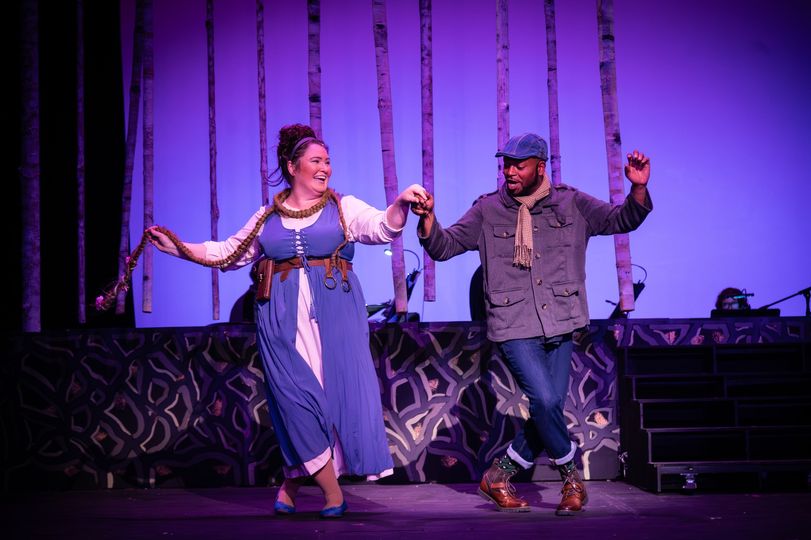
At the center of the main plot we find The Baker and The Baker’s Wife (Durron Marquis Tyre-Gholson and Maggie Marlin-Hess). The childless couple wish more than anything for a baby, but soon discover that their barrenness is the result of a witch’s curse that goes back a generation when The Baker’s father helped himself to the witch’s garden. Tyre-Gholson (who, much to my surprise, is making his Richmond Shakespeare debut) deftly establishes himself as a reluctant hero. He tries on the cloak of an alpha male, but it doesn’t fit him well, yet we find ourselves cheering for him and his persistence in the face of probable defeat as he sets off on a life changing scavenger hunt in the woods. Marlin-Hess, similarly, achieves a delicate balance. She is, at once, the supportive wife of the baker, a woman with an independent mind and a resolute disposition (think, by any whatever means necessary), who holds an emergent passion that finds unforeseen fulfillment in the woods.

The prettier the flower, the farther from the path.

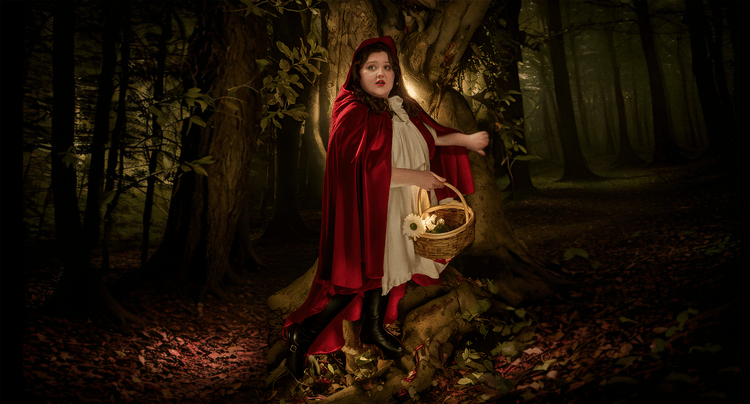
Into the Woods is very much an ensemble show, with strong leads and strong voices singing what I would characterize as challenging music, but some characters nevertheless stand out. My hands-down favorite is Little Red Riding Hood (Gracie Berneche) who wrings every last drop of humor and drama from each line she speaks. Now, normally, it is bad manners to mention an actor’s size, but in this case, Berneche’s stature is key to her role. Constantly referred to as a “little girl,” this Riding Hood makes a running joke of scarfing down the goodies she’s supposed to be taking to Grandma’s house. She deliberately talks with her mouth full, and creates one of the show’s funniest physical comedy moments as she and The Baker’s Wife juggle sweets and cakes as Riding Hood tries to fill her basket – a basket, by the way, that she commandeered from The Baker’s Wife. Berneche’s childlike allure makes it all more creepy when The Wolf (Terence Sullivan) peppers her with sexual innuendo, while diverting her from the path to her grandmother’s house in the woods. The dual role of The Wolf/Cinderella’s Prince emphasizes the lustful, narcissistic nature of both characters as they seduce, respectively, Little Red Riding Hood and The Baker’s Wife, in the woods. Sullivan’s dual roles are masterfully delicious and shiver-inducing – perhaps playing on the appeal of the bad boy. But also, the wolf’s ears, tail, and leather jacket are one of the best, most fun costumes, as well.

“You’re so nice. You’re not good, you’re not bad, You’re just nice. I’m not good, I’m not nice, I’m just right. I’m the witch.

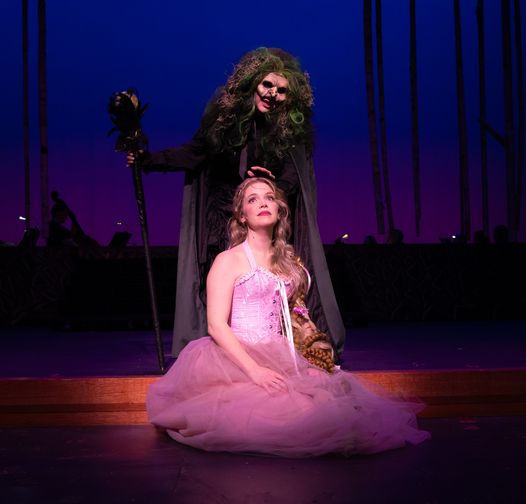
Going back to the idea that this is an ensemble, it seems both appropriate and anathema that The Witch (Susan Sanford) had the star’s turn during the closing bows. The Witch, after all, is the only character that has the ability to fill in any of the backstory. At the same time, she does not have the most lines or greatest stage time. But Sanford’s rich vocals and The Witch’s makeover from old hag to bewitching diva, are worthy of recognition. Speaking of which, The Witch’s Act 2 costume and the costumes and wigs of Cinderella’s Stepmother (Hannah Zold Story) and Stepsisters Florinda (Katherine S. Wright) and Lucinda (Kylee Márquez-Downie) reminded me of drag queens – but without the expected sassiness. The Witch loses her powers and Florinda and Lucinda have their eyes pecked out. These characters’ journey into the woods do not bring about the desired results.

Slotted spoons don’t hold much soup.

In my humble opinion, Jack’s Mother (Lauren Leinhaas-Cook) was decidedly more evil than The Witch. She certainly wouldn’t win any awards for mother of the year. She berates and belittles Jack, then defends him when it’s time for him to face the consequences of his actions. These are the actions of an enabler. This role gives Leinhaas-Cook an opportunity to enjoy being nasty, and we don’t feel any great loss at her accidental demise. Let’s face it, Jack (Lukas D’Errico) would never be able to grow up under her nagging eye. In the end, he’s left looking for someone to take care of him, because his mother never taught him how to be an adult. She just sent him off on fruitless and self-serving quests into the woods. The Witch, who had whisked away Rapunzel (Sara Dabney Tisdale) from her parents at birth was no model mother, either. Locked away in a tower in the woods, Rapunzel ended up the single mother of twins, lost her Prince, her mind, and eventually her life as well. Apparently, one does not develop good life coping skills living in isolation in the woods.

Careful the things you say…children will listen.

While Act 1 is a quest to find fulfillment of all the characters’ wishes, Act 2 shows us what happens after “happily ever after.” With Act 1 running approximately 90 minutes, it almost seems as if the show is over at the end of Act 1. But wait, there’s more. Act 2 shows us the consequences of getting what you wished for. There is a fantastic scene in which the surviving characters – after much of the slaughter and bloodshed – all point the finger of blame at each other: The Baker, The Baker’s Wife, The Witch, Jack, Jack’s Mother, Little Red Riding Hood (who is never at a loss for snarky comments, with accompanying facial expressions and body language). It’s a comedy. It’s a parody. It’s a satire. It’s a musical. It’s a morality play. It’s a metaphor for Life. Into the Woods is where life happens. Some emerge triumphant, some do not emerge at all. As 2010 Internet sensation Antoine Dodson once said, “Hide yo’ kids, hide yo’ hide yo’ husbands ‘cause they’re rapin’ everybody out here.” Go see Into the Woods, but leave your kids at home.

—–

Julinda D. Lewis is a dancer, teacher, and writer who was born in Brooklyn, NY and now lives in Eastern Henrico County. When not writing about theater, she teaches dance history at VCU and low impact dance fitness classes to seasoned movers like herself, and occasionally performs.

—–

INTO THE WOODS

Book by James Lapine

Music and Lyrics by Stephen Sondheim

Directed by Jase Smith Sullivan

Musical Direction by Kim Fox

Cast

Narrator/Mysterious Man       ……………    J.C. Bussard   

Cinderella                                ……………    Grey Garrett

Jack                                         ……………    Lukas D’Errico

Jack’s Mother                         ……………    Lauren Leinhaas-Cook

Milky White                            ……………    Katherine Malanoski

The Baker                               ……………    Durron Marquis Tyre-Gholson

The Baker’s Wife                   ……………    Maggie Marlin-Hess

Cinderella’s Stepmother         ……………    Hannah Zold Story

Florinda                                   ……………    Katherine S. Wright

Lucinda/US Cinderella           ……………    Kylee Márquez-Downie

Little Red Riding Hood          ……………    Gracie Berneche

The Witch                               ……………    Susan Sanford

Cinderella’s Father/The Steward ………..     Eddie Webster

Cinderella’s Mother/Granny/The Giant …    Heidi Johnson Taylor

The Wolf/Cinderella’s Prince ……………    Terence Sullivan

Rapunzel                                 ……………    Sara Dabney Tisdale

Rapunzel’s Prince                   ……………    Field Oldham

Ensemble/US The Wolf/Princes …………    Thomas Kaupish

Ensemble/US Jack                  ……………    Milo Jones

Ensemble/US Little Red Riding Hood …..    Belén Tarifa

Production Team

Artistic Director          ……………    James Ricks

Managing Director      ……………    Jase Smith Sullivan

Music Director            ……………    Kim Fox

Production Stage Manager ………    Shawanna Hall

Assistant State Manager/

     Properties Design   ……………    Jordan Dively

Assistant State Manager/

     Character Double   ……………    Diandra Chiaffino-Butts

Hair and Makeup Design  …….….    Amanda Blake

Costume Design          ……………    Keith Walker

Lighting Design          ……………    Michael Jarrett

Puppet Design             ……………    Heidi Rugg

Scenic Design                         ……………    Todd LaBelle

Scenic Design                         ……………    Katherine Malanoski

Sound Design              ……………    Grace Brown LaBelle

Production Manager/

     Sound Board Operator ………..    MariaElisa Costa

House Manager/

     Production Assistant  …………    Kiari Hicks

Costume Assistant      ……………    Susan Frye

Master Electrician       ……………    Emily Vial

Follow Spot Operator ……………    Parker Beard

Follow Spot Operator ……………    Wyatt Roberts

Box Office                  ……………    Nata Moriconi

Musicians

Conductor/Keyboard 1……………   Kim Fox

Bass                             ……………    Bea Kelly

Drums                         ……………    Steve Raybould

Cello                            ……………    Lauramarie Laskey

Clarinet                       ……………    Marc Krauss

Flute                            ……………    Stephanie Shumate

French Horn                ……………    Gretchen Georgas

Keyboard 2/Synthesizer …………     Ian Krauss

Trumpet                       ……………    Steve Fenick

Violin                          ……………    Marissa Resmini

Run Time: approximately 3 hours, with one 15-minute intermission

———-

Photo Credits: Photos from Richmond Shakespeare Facebook page

One-Time
Monthly
Yearly

Make a donation to support the publication of RVART Review

Make a monthly donation

Make a yearly donation

Choose an amount

$5.00
$15.00
$100.00
$5.00
$15.00
$100.00
$5.00
$15.00
$100.00

Or enter a custom amount

$

Your contribution is greatly appreciated. Thank you.
Julinda D. Lewis

Your contribution is appreciated.

Your contribution is appreciated.

DonateDonate monthlyDonate yearly

DR. RIDE’S AMERICAN BEACH HOUSE

DR. RIDE’S AMERICAN BEACH HOUSE*

“If one of us is brilliant, maybe it’s not you,” or

Four Queer Women Lift-off on the Eve of Sally Ride’s Historic First Space Flight

A Theater Review by Julinda D. Lewis

By: Yes, And! Theatrical Company

At: The Firehouse 1609 West Broad St., Richmond, RVA 23220

Performances: March 7-23, 2024

Ticket Prices: $37 general admission

Info: Email: yesandrva@gmail.com; Website: yesandrva.org; Facebook: http://www.facebook.com/yesandrva/

When I say that Liza Birkenmeier’s 4-character, one-act play, DR. RIDE’S AMERICAN BEACH HOUSE is weird, please understand that is an observation, not a judgment. There is a reason  why the Yes, And! Theatrical Company – now in its second year of production –- chose this play. I suspect it has something to do with exploration (inner, and self, more than space) and identity (woman as subject, not object, as well as gender and sexuality), and history (personal history as well as the history of Dr. Sally Ride and the American space program).

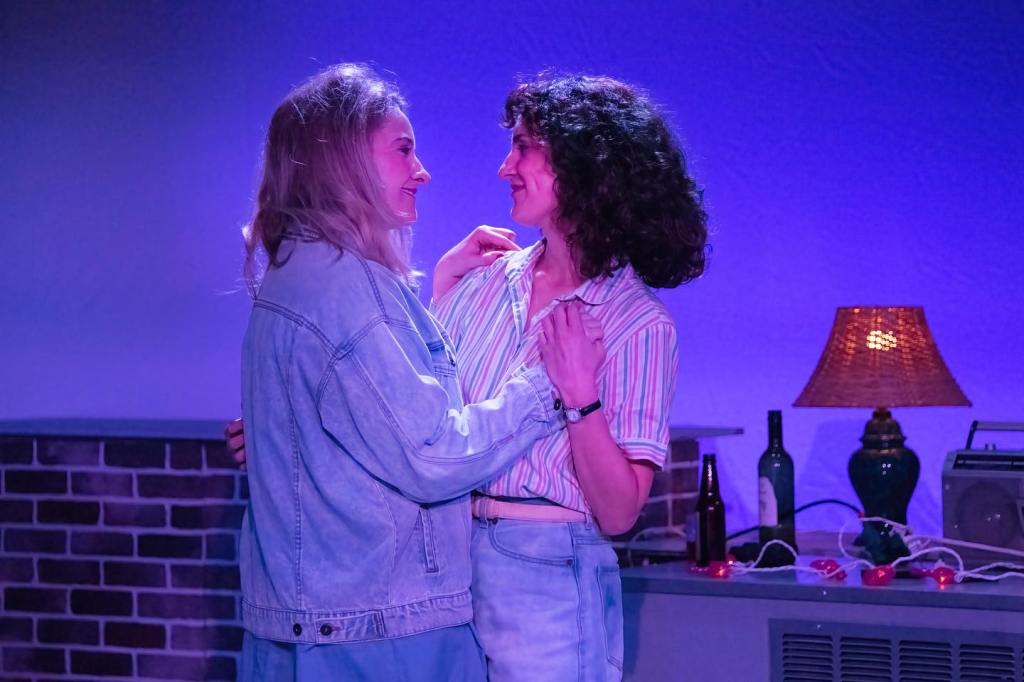
Set on a rooftop in St. Louis in June 1983, on the eve of the launch of the Challenger space shuttle that carried Dr. Sally Ride, the first American woman to go into space, DR. RIDE’S AMERICAN BEACH HOUSE is both non-linear and non-conforming. Two long-time friends, both poetry majors who have apparently simultaneously run into a writing block, come to the rooftop for the weekly meeting of The Two Serious Ladies Book Club. The club is named for a novel by Jane Bowles in which two women explore – depending in which review you read – “living outside themselves” or descend in debauchery. After forming the book club, however, our leading ladies, Harriet (Ashley Thompson) and Matilda (Rachel Marrs) realize they don’t really like to read, so they spend the time drinking beer and talking.

One day, their complacent little world is shaken up when (a) Harriet shares a harrowing tale of a sexual encounter with a stranger – a bearded biker, no less – and (b) Matilda invites a new friend, Meg (Kasey Britt) whose insight sheds new light on the friends’ sexual tension and life in general, and (c) their lives are all shifted by the imminent space launch that is the main topic on their rooftop radio.

Harriet is high strung and annoying, but about two thirds of the way through we find out she has good reason to be, and in spite of her irksome character, we cannot tear ourselves away from the story she weaves throughout. Perhaps Harriet’s calling was not for poetry, but for fiction or drama…Matilda, who has a husband and a sick child at home, would rather spend her time with Harriet, and is given to bursting out in song – revealing that Rachel Marrs has a stunningly beautiful singing voice and can even attempt a decent Irish step or two.

Most intriguing, however, is Meg. Back stories and character development are not a main point of DR. RIDE’S AMERICAN BEACH HOUSE, so we know that Meg works at a hospital across the street from where Harriet and Norma live, and may – or may not –- be a nurse. She does, however, provide some music therapy for Harriet in the midst of her breakdown, which leads to one of this play’s most delightful moments.

The fourth character is Norma (Jacqueline Jones) – who is either Harriet’s landlady or neighbor. At any rate, it seems that Norma is the caretaker of the Ivan Brock House, named for fictional poet and the house where Harriet lives. Norma is concerned with three things: safety, money, and Harriet’s leaky air conditioning unit. Jones’ two or three appearances are all too brief, as Norma, who seems to be on the far right of some spectrum or another, shares complaints and almost incidentally drops pearls of wisdom and insight on the younger women.

DR. RIDE’S AMERICAN BEACH HOUSE is directed by Kelsey Cordrey with a light touch, a good dose of wit, and a loving respect for words. Cordrey and the cast make us see or at least ponder connections between barbecue and beer, a beach house and a rooftop, an astronaut launching into space and an ordinary person (is there such a thing?) exploring the unexplored landscape of their life. It’s only about 90 minutes long, and the first few minutes are rather slow going, but about midway through – and even more so afterwards – it becomes clear that there is more to explore here than at first meets the eye.

Cordrey explains at least part of the “why” in her director’s note: “Pretty much every queer person I know has felt the urge to “go away” before. To escape to a place, whether literal or figurative, what would be more. More accepting, more fulfilling, more exciting, or more loving”.

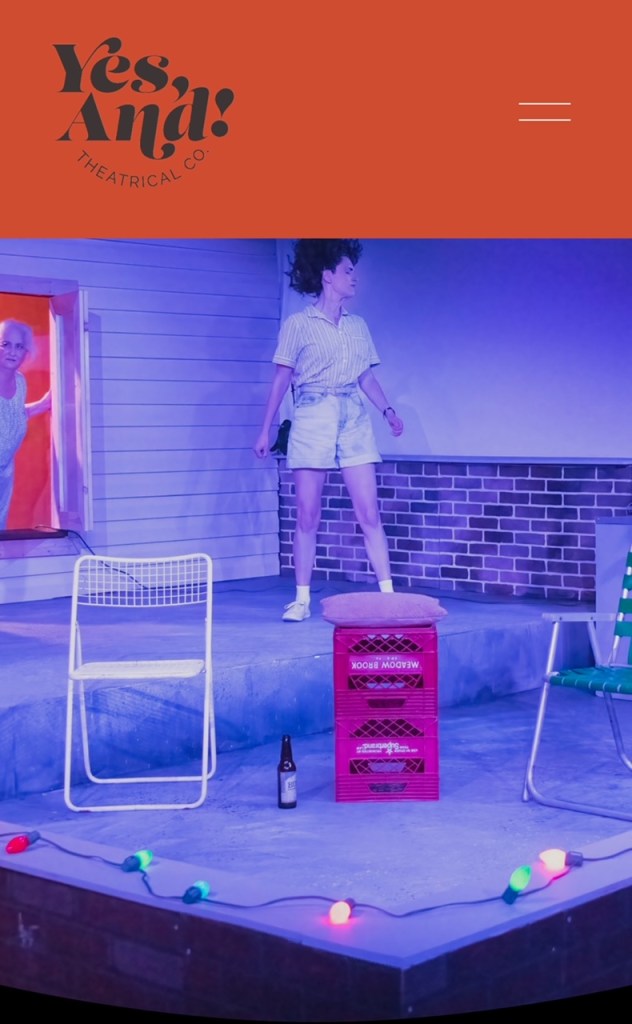
Adam Dorland has designed a simple but effective rooftop setting with a couple of chairs, some stacked crates that serve as a table, an HVAC unit, and lots of brick wall constructed at an angle that juts slightly off the edge of the stage. Candace Hudert’s sound design is mostly subtle, and makes use of the ubiquitous 1980s boom box and cassette tapes – remember those???

If you like your theater to have a clear beginning, middle and end, and to tie up all the loose ends with a happy ending, DR. RIDE’S AMERICAN BEACH HOUSE won’t fulfill those needs. If you like theater that asks questions and challenges you to think about why things are the way they are, then this is your kind of play. And if you’re undecided, or not sure, I would urge you to give it a try and discuss it after – maybe with three friends, over a bottle of wine or some beers.

FUN FACTS ABOUT DR. SALLY RIDE

  • Sally Kristen Ride (1951-2012) was a physicist and the first female American astronaut
  • Sally Ride was married to Steven Hawley (1982-1987) and had a long-term partner, Tam O’Shaughnessy (1985-2012)
  • Dr. Ride did not publicly reveal her sexuality until her death, in a carefully worded obituary she wrote before she died
  • In 1972, while an undergraduate at Stanford University, Sally Ride played tennis great Billy Jean King in a mixed doubles exhibition
  • One morning, at breakfast, in 1977, while she was a doctoral student at Stanford University, Sally Ride read an article in the student newspaper that NASA was opening up applications to women for the first time, so she applied
  • Dr. Ride’s younger sister, Bear, is a Presbyterian minister – she is also queer
  • Sally Ride was a Trekkie
  • Sally Ride and her partner Tam O’Shaughnessy co-authored several science books for children
  • In 2013 Sally Ride was posthumously awarded the nation’s highest honor, the Presidential Medal of Freedom; President Barack Obama presented the award to Tam O’Shaughnessy                  Source: https://today.ucsd.edu/story/20-things-you-might-not-know-about-sally-ride

*ONE FINAL FUN FACT

  • The Astronaut Beach House is a two-story building located in Cape Canaveral, FL use to house astronauts prior to their launch. The house is also used as a conference center, and hosts barbecues for astronauts and their families prior to a launch

———-

Julinda D. Lewis is a dancer, teacher, and writer who was born in Brooklyn, NY and now lives in Eastern Henrico County. When not writing about theater, she teaches dance history at VCU and low impact dance fitness classes to seasoned movers like herself, and occasionally performs.

———-

DR. RIDE’S AMERICAN BEACH HOUSE

Written by Liza Birkenmeier

Directed by Kelsey Cordrey

Principal Cast

Ashley Thompson as Harriet

Rachel Marrs as Matilda

Kasey Britt as Meg

Jacqueline Jones as Norma

Understudy Cast

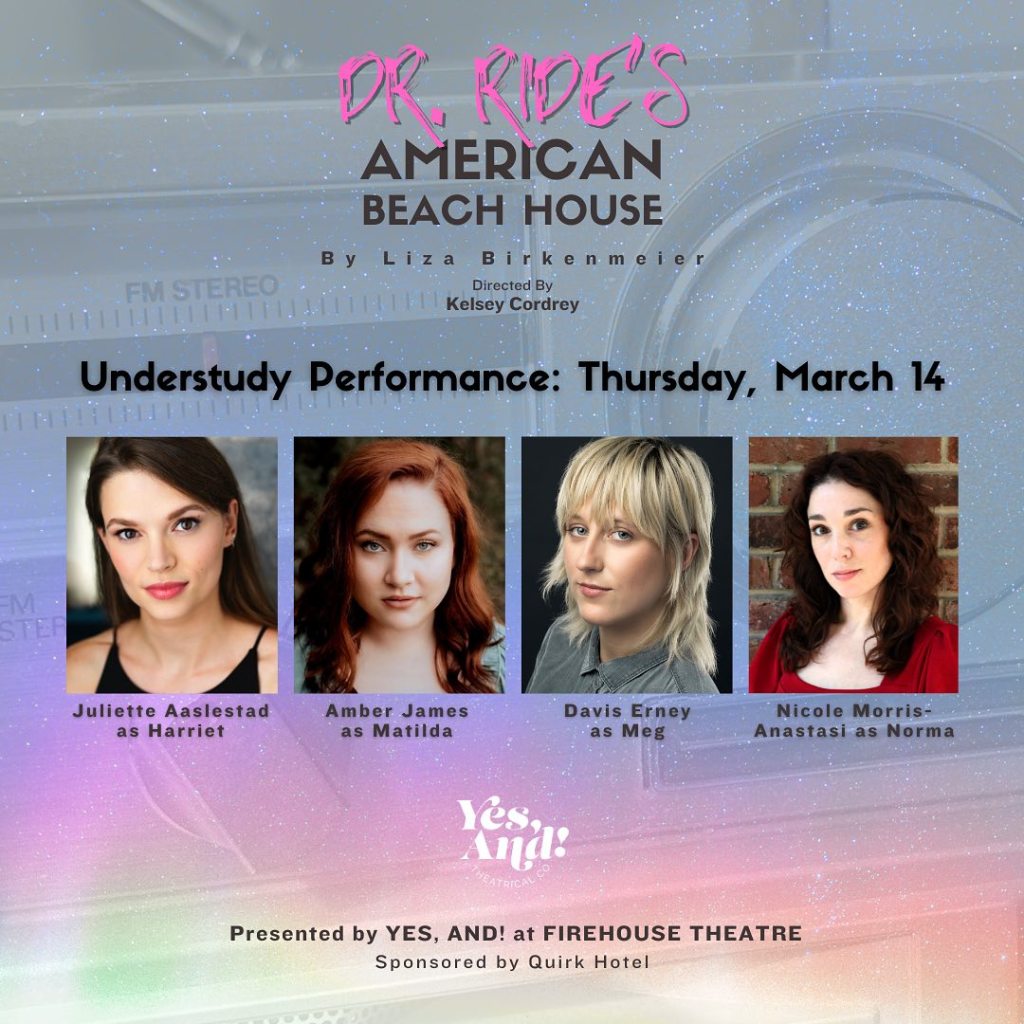
Juliette Aaslestad u/s for Harriet

Amber James u/s for Matilda

Davis Erney u/s for Meg

Nicole Morris-Anastasi us for Norma

Production Team

Scenic Design – Adam Dorland

Costume Design – Amber Martinez

Lighting Design – Steve Koehler

Sound Design – Candace Hudert

Properties Design – Margaret Dodson-Cordrey

Intimacy Direction – Tippi Hart

Production Manager – Todd LaBelle

Production Stage Manager – Crimson Piazza

Asst. State Manager – Marcely Villatoro

YES, AND! THEATRICAL COMPANY

in residence with NEW THEATRE at FIREHOUSE

Artistic Director – Maggie Roop

Managing Director – Nicole Morris-Anastasi

Executive Director – Matt Shofner

Dr. Ride’s American Beach House

Commissioned and Developed by Ars Nova

Jason Eagan, Founding Artistic Director | Renee Blinkwolt, Managing Director

World Premiere produced by Ars Nova, New York City, October 21, 2019

Performance Schedule

Thursday, March 7, 2024    7:30PM          Preview

Friday, March 8, 2024         7:30PM          Opening Night

Saturday, March 9, 2024    7:30PM

Tuesday, March 12,2024    7:30PM          Industry Night

Thursday, March 14, 2024 7:30PM          Understudy Performance

Friday, March 15, 2024       7:30PM

Saturday, March 16, 2024  7:30PM

Sunday, March 17, 2024    2:00PM

Tuesday, March 19, 2024   7:30PM          Industry Night

Friday, March 22, 2024       7:30PM         

Saturday, March 23, 2024  7:30PM          Closing Night

Tickets

Ticket Prices: $35 general admission

Run Time

1 hour 36 minutes with no intermission

Notes

Please be aware that an herbal cigarette will be smoked for a brief moment onstage

Photos by Tom Topinka

One-Time
Monthly
Yearly

Make a donation in support of
RVArt review

Make a monthly donation

Make a yearly donation

Choose an amount

$5.00
$15.00
$100.00
$5.00
$15.00
$100.00
$5.00
$15.00
$100.00

Or enter a custom amount

$

Your contribution is greatly appreciated. Thank you.

Your contribution is appreciated.

Your contribution is appreciated.

DonateDonate monthlyDonate yearly

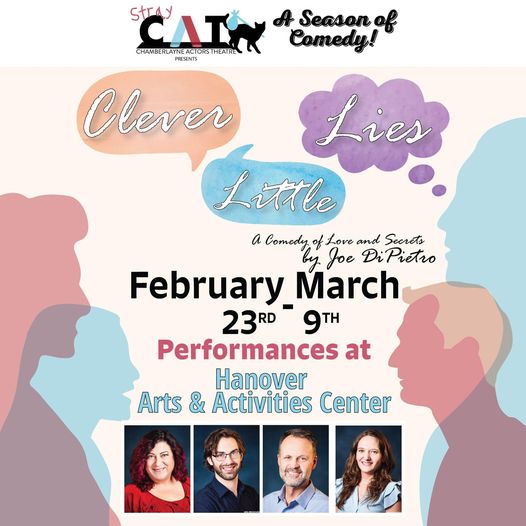
CLEVER LITTLE LIES

Find the Happy in That!

A Comedy by Joe DiPietro

A Theater Review by Julinda D. Lewis

Presented by CAT – Chamberlayne Actor’s Theatre

At: Hanover Arts and Activities Center, 500 S Center St, Ashland, VA 23005

Performances: February 23 – March 9. 2024

Ticket Prices: $24.00 General Admission. $22.00 Seniors

Info: http://www.cattheatre.com

Clever Little Lies is the second offering in Chamberlayne Actor’s Theatre’s season of comedy. (The first was Steve Martin’s Meteor Shower that ran at Bright Point Community College’s Lynn Theatre last September, and the final show will be Keep on Laughing in June at HATTheatre.) With Clever Little Lies, CAT has moved from Martin’s zany unpredictability to Joe DiPietro’s sitcom structured shenanigans.

Clever Little Lies seems to be the sort of play that is as much fun for the actors to perform as it is for the audience to enjoy. As with a traditional (i.e., televised) sitcom, the opportunity for audience members to anticipate and complete the actors’ lines is part of the fun. For example, Alice, a book seller, rants about the intrusion of technology into literature: “If you had told Jane Austen that someday her epic masterpiece would be read by people on their telephone, she would’ve said, well…”  That leaves an opening for an engaged audience to respond, “What’s a telephone?” The actual answer is the less crisp, “She wouldn’t have said anything, there were no telephones.”

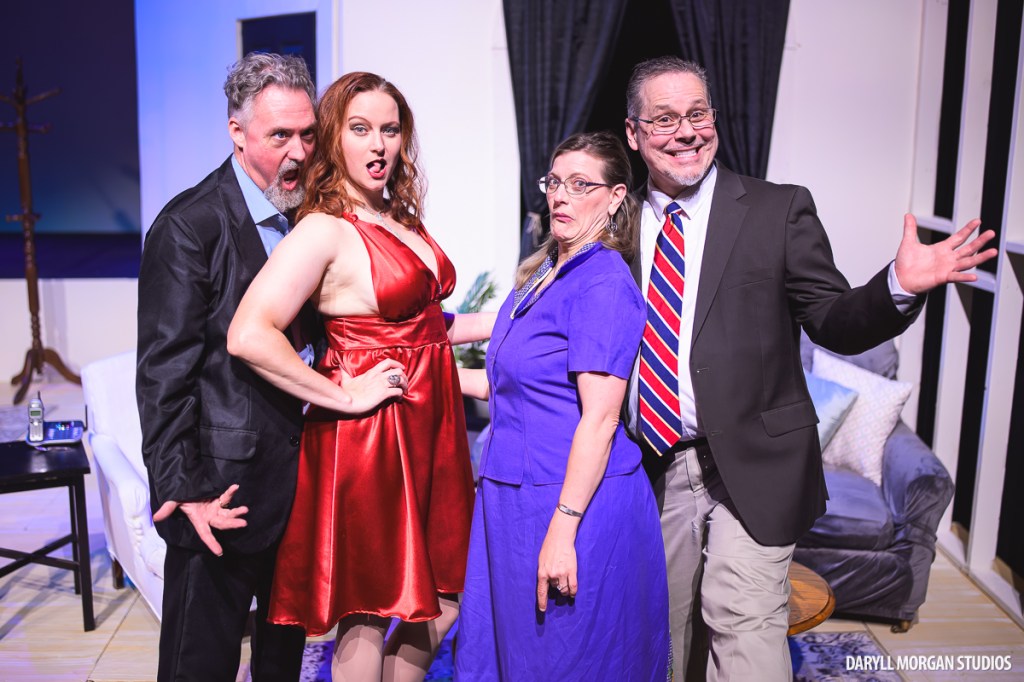
CAT’s production featured a well-chosen, tight-knit ensemble with Scott Garka (yes, the president of Richmond CultureWorks, that Scott Garka), as Bill Sr, Amy Berlin as his wife, Alice, Austen Linder as their philandering son, Billy, and Michelle Lachapelle as Billy’s wife, Jane. DiPietro lets the audience in on the first big secret in the first scene, where we meet Bill Sr and his son in the locker room of the local tennis club after the father has uncharacteristically trounced his son on the court. Noticing Billy’s distraction, Bill Sr begins to pry until Billy confesses he is having an affair with his beautiful young personal trainer. Billy’s wife, home on maternity leave with their three-month-old daughter, is unaware.

The comedy comes into play when Billy’s mother, Alice, who has the discernment of a bloodhound, a detective, and a psychic all rolled into one, figures out what’s going on and decides to organize an intervention under cover of a family get together. At one point, Alice tells Bill Sr to play along, but this is where things get complicated, and not so funny anymore.

Alice launches into a story that may be an allegory to set Billy straight, or a confession of a long-ago indiscretion of her own. What’s true? What’s a lie? How do we know the difference? The play ends with a happy resolution that leaves the audience wondering what really happened. And Bill Sr? I think he’s still sitting in his chair, a glass of scotch close at hand, wondering what just happened. In the words of one of my favorite comedians, who are you gonna believe, me or your lying eyes?

There are some things Clever Little Lies, under the direction of Zachary Owen, does exceptionally well. Early on Berlin and Garka establish a warm, loving relationship between a mature couple. Garka’s pauses and facial expressions are priceless – exhibiting a satisfying command of the comedic moment.

It’s difficult to know what to say about Linder because he plays such a despicable character – so let’s say he did that convincingly. I didn’t feel a bit of sympathy for him. Lachapelle maintained a balanced, even keel that made me think her character knew more than she let on. Her surprise announcement to Billy was both anticipated and devastating. Time and again, I almost cared about these people.

Scott Bergman’s modular set was equal parts effective and distracting. The furniture was sturdy, but the background was not and we could see too much of the structure. The off-stage babbling of the young couple’s baby was not at all realistic, and the plastic doll used for play wasn’t even one of those eerily realistic baby dolls – providing another easy laugh. Overall, Clever Little Lies was a delightful divertissement, liberally sprinkled with easily won laughter – plus a whole lot of f-bombs and TMI about Billy’s sex life – and seasoned with a touch of nostalgia.

———-

Julinda D. Lewis is a dancer, teacher, and writer who was born in Brooklyn, NY and now lives in Eastern Henrico County. When not writing about theater, she teaches dance history at VCU and low impact dance fitness classes to seasoned movers like herself, and occasionally performs.

CLEVER LITTLE LIES

Written by Joe DiPietro

Directed by Zachary Owen

Cast

Scott Gorka as Bill Sr

Austen Linder as Billy

Amy Berlin as Alice

Michelle Lachapelle as Jane

Creative Design Team

CAT Producer – Charles A Wax

Associate Producers – Kerrigan Sullivan and Jason Owens

HAAC Executive Director – Sara Wright-Holloway

Director – Zachary Owen

Rehearsal Stage Manager – Sue Howells

Production Stage Manager –  Becki Jones

Lighting Design – Alan Armstrong

Scenic  Design – Scott Bergman

Costume Design – Sheila Russ

Sound Design – Charles A Wax

Dates

February 23 – March 9, 2024

Ticket Information

www.cattheatre.com

Ticket prices: $24.00 General Admission, $22.00 Seniors.

Run Time

Approximately 90 minutes, with no intermission

Photo Credits: Daryll Morgan Studios

One-Time
Monthly
Yearly

Make a one-time donation
to show your support of
RVART REVIEW

Make a monthly donation

Make a yearly donation

Choose an amount

$5.00
$15.00
$100.00
$5.00
$15.00
$100.00
$5.00
$15.00
$100.00

Or enter a custom amount

$

Your contribution is appreciated.

Your contribution is appreciated.

Your contribution is appreciated.

DonateDonate monthlyDonate yearly

DRACULA

Not Just a Ballet, But a Cultural Event

A Dance Review & Cultural Excursion

By: The Richmond Ballet with the Richmond Symphony

At: Dominion Energy Center’s Carpenter Theatre, 600 E. Grace St., RVA 23219

Performances: February 16-18, 2024

Ticket Prices: $25 – $130

Info: (804) 344-0906, etix.com, or richmondballet.com

THE PROGRAM

DRACULA

Choreography by Ben Stevenson, O.B.E.*

Music by Franz Liszt, arranged by John Lanchbery

Staging by Dominic Walsh

Scenery Design by Thoms Boyd

Costume Design by Judanna Lynn

Original Lighting Design by Timothy Hunter

Lighting Supervisor: Christina R . Gianelli

Guest Piano Soloist: Douglas-Jayd Burn

Flying by Foy

World Premiere: March 13, 1997, Houston Ballet, Worthan Center, Houston, TX

Richmond Ballet Premiere: February 16, 2024, Dominion Energy Center, Richmond, VA

Costumes and Scenery courtesy of Pittsburgh Ballet Theatre

*OBE = Officer of the Order of the British Empire: a British order of chivalry, rewarding contributions to the arts and sciences, among other fields

The Cultural Excursion

I’d been looking forward to seeing the Richmond Ballet’s premiere of DRACULA for months. (See my preview for Richmond Magazine: https://richmondmagazine.com/arts-entertainment/richmond-events/richmond-ballet-dracula/) But even though I had read the press release and had obtained a quote from Associate Artistic Director Ma Cong about the ballet’s high production values and dramatic choreography, I was not prepared for what I saw – both onstage and offstage – when I arrived at the Dominion Energy Center for the final performance of the three day run. I am so glad I got to witness this event with my own eyes and ears. Ben Stevenson’s choreography was every bit as dramatic as promised. The set resembled a towering gothic fairytale. The music lured you in, and there was even a red-colored, vampire themed drink available at the bar. But more on the actual ballet after this brief detour. [You may avoid the detour by skipping the next three paragraphs.]

First, the event started even before I got inside the theatre. While searching for parking, and then walking to the Dominion Energy Center, I noticed a number of people who were clearly headed to see Dracula. There was a veritable fashion show of goth gear, black lace, pale foundation and black eyeliner. The number of capes – in black and red – was astounding. A car parked across from mine in the parking deck even bore a license plate with some variation of the word “vampire.” All of this made me wonder, does  Richmond have a vampire community? I know about the theatre community, the dance community, the spoken word community, even the drag community and the burlesque community – but a vampire community?

That brings us to the second point. Much to my surprise, a cursory online search turned up several articles on an urban legend known as The Richmond Vampire, also known as The Hollywood Vampire. (Am I the last to know?) There is a story, dating back to the 1920s, of a vampire entombed in Hollywood Cemetery, near Oregon Hill. The legend is linked to the very real and verified collapse of a railway tunnel in Church Hill, where the train engine, flatcars, and bodies of laborers remain to this day.

Another part of the legend identifies the Richmond Vampire as one W. W. Pool, whose tomb is located in Hollywood Cemetery, as a vampire who was run out of England in the 1800s. And then, my husband reminded me of someone we know who, a few years ago, was said to have been “studying” to become a vampire. While none of this is directly related to the ballet, it does explain some of the things I saw, and some of the cultural aspects that were attached to the theatrical experience. One final note before going on to my third and final point – a discussion of the actual ballet – vampires, or vampire allies, seem to be quite friendly.

The Review

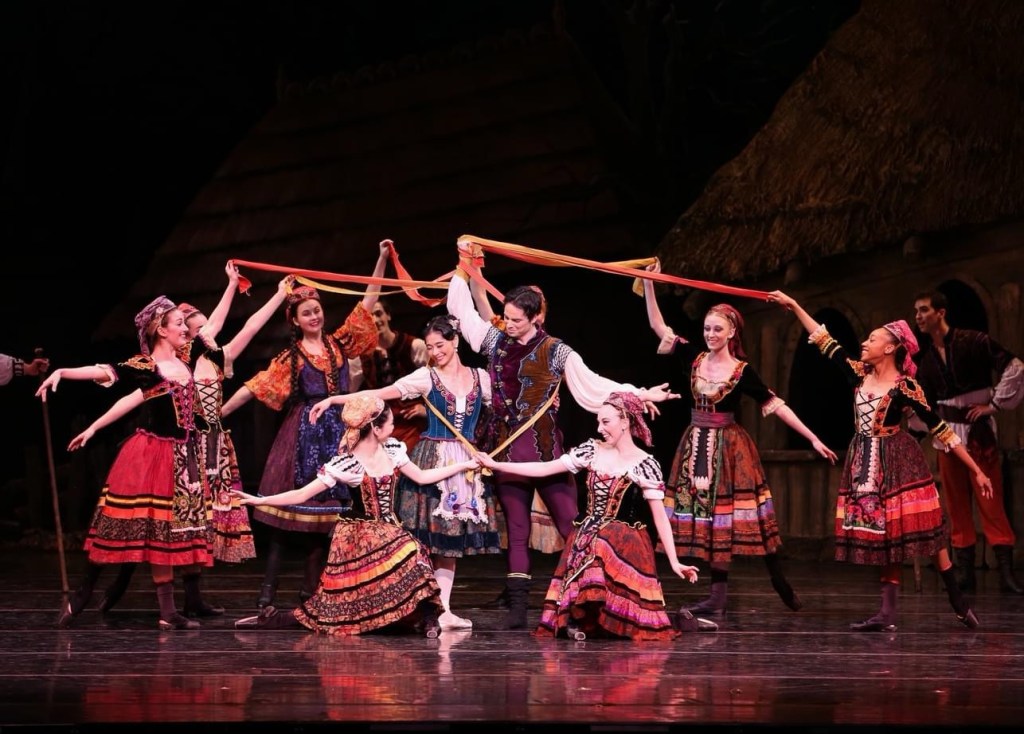
Finally, there was the ballet itself – a three act production (The Crypt, The Village, The Bedroom) running approximately two and a half hours, including two intermissions. Make no mistake, Dracula is, indeed, a ballet in the traditional sense. There is plenty of classical technique, including pointe work, and partnering. The second act, set in an Eastern European village, includes the familiar characters (an innkeeper, a matriarch, a pair of innocent young lovers) and peasant costumes and folk dances that populate many story ballets.

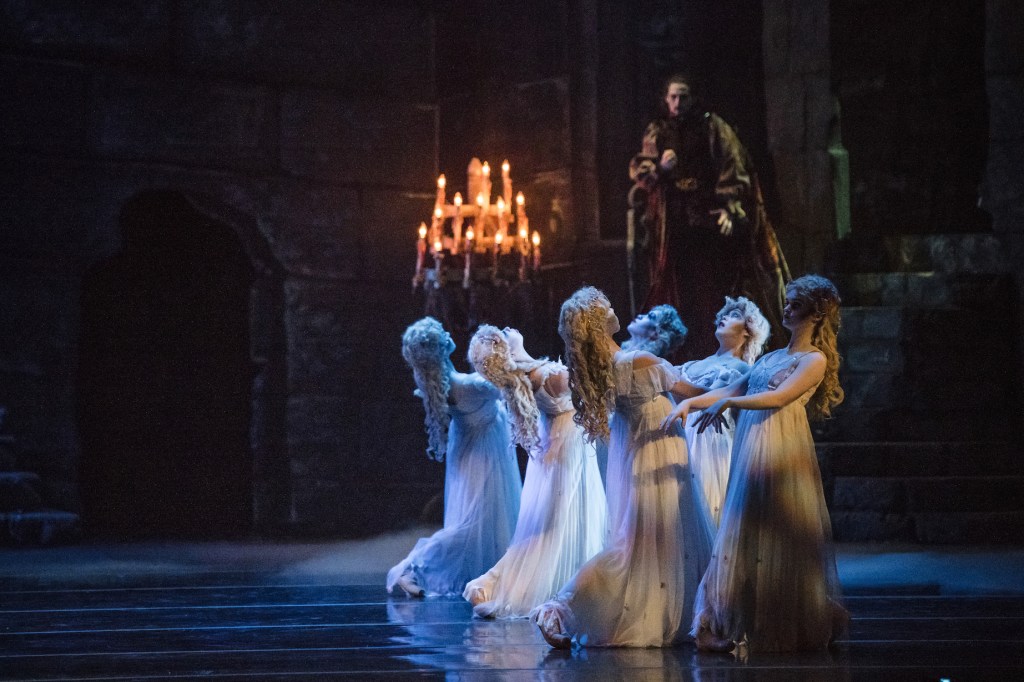
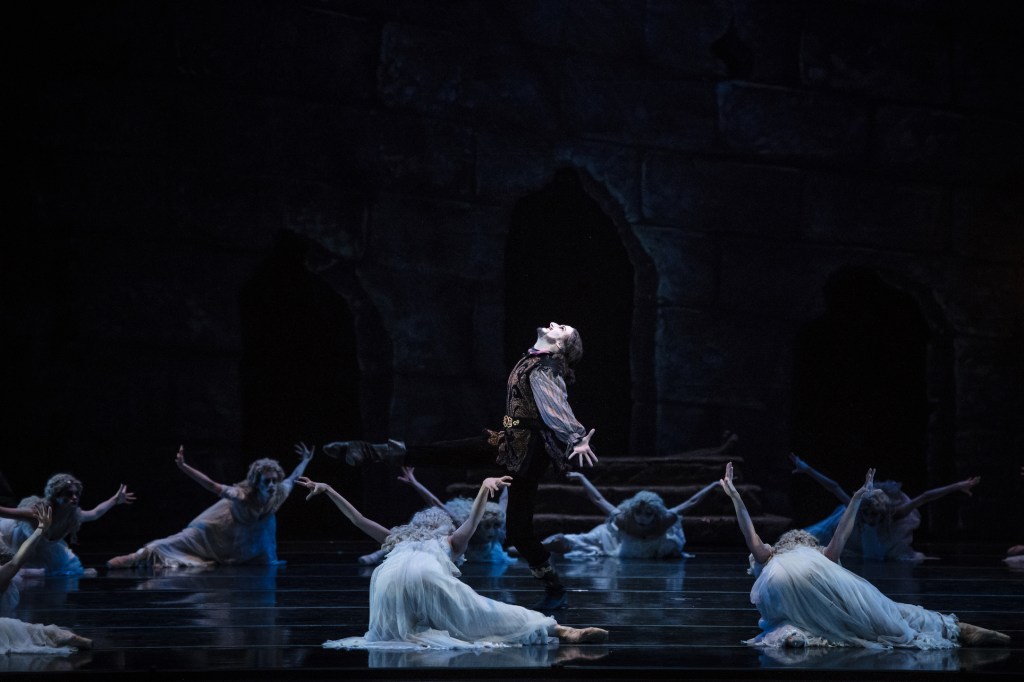
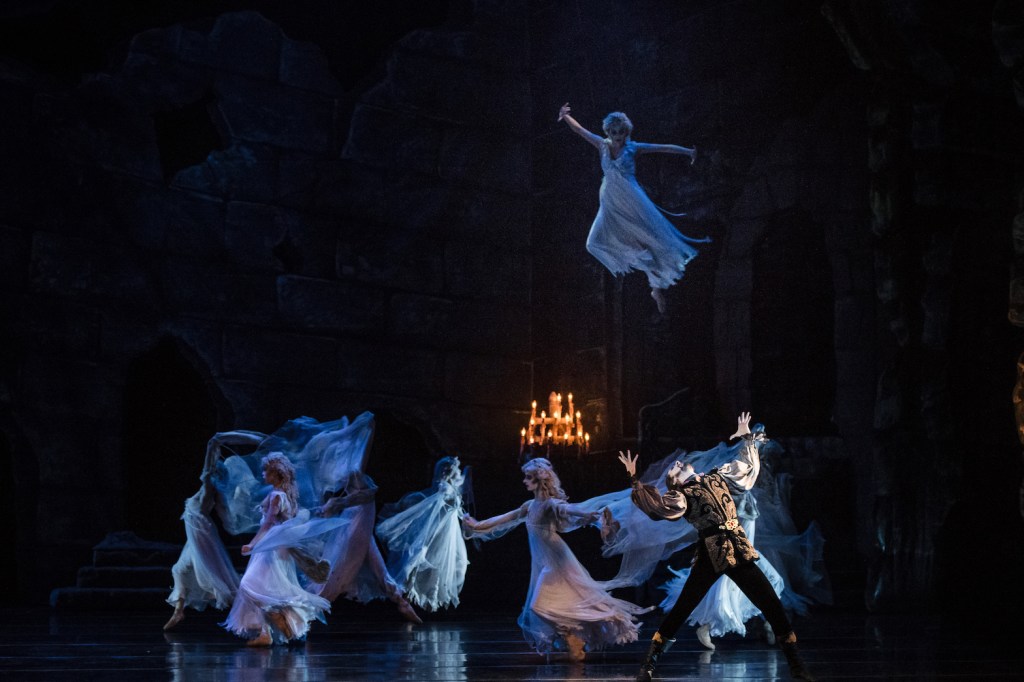
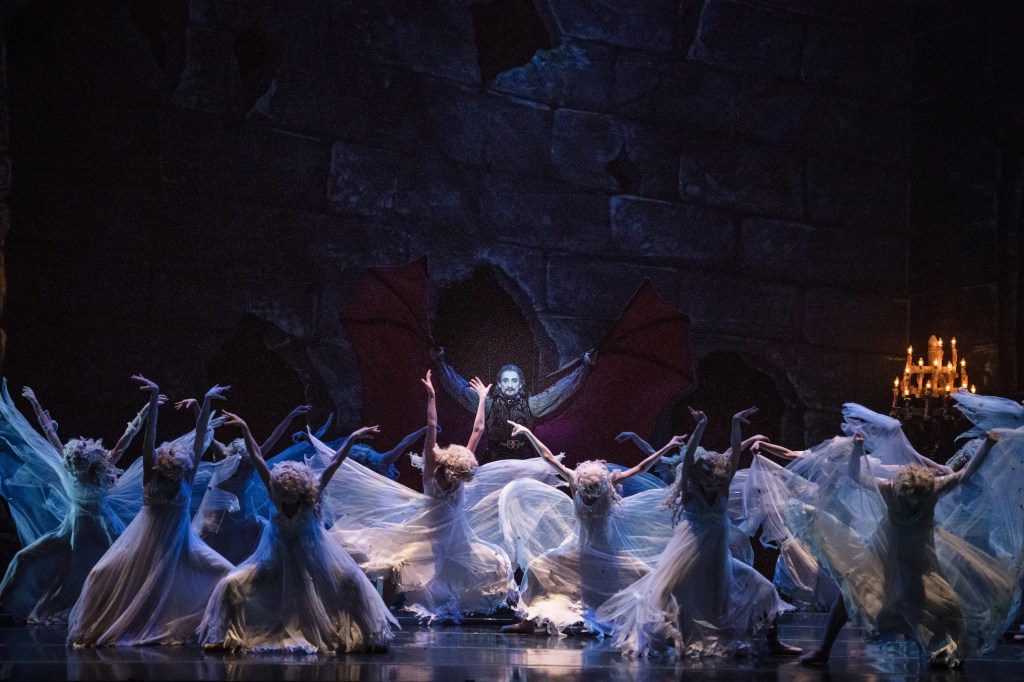
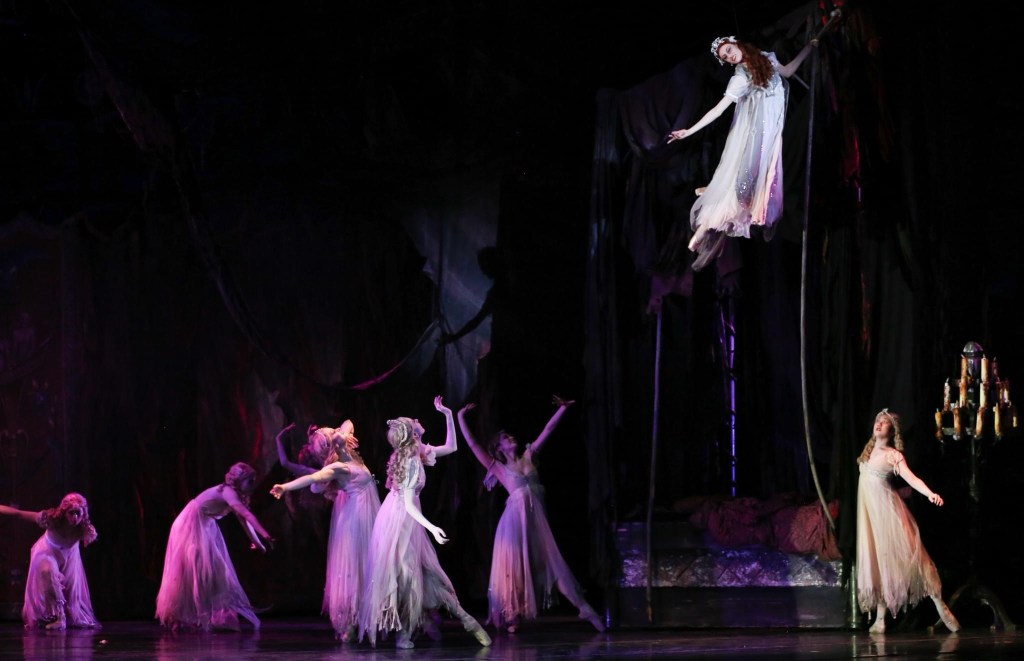
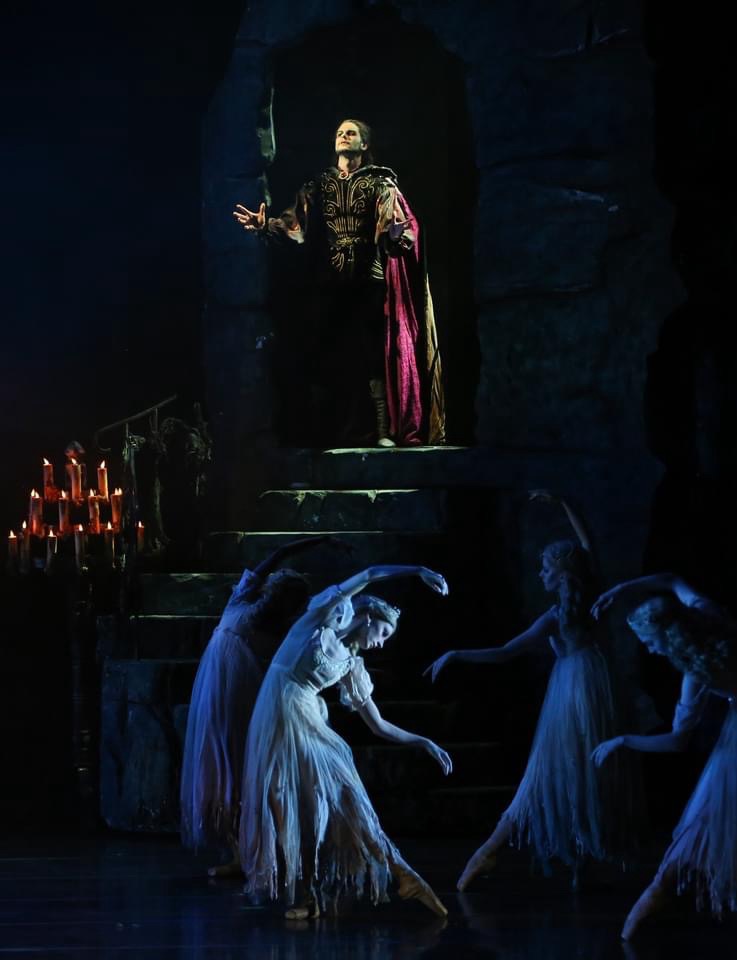
Dracula is also quite different from most classic ballets. The women of the corps who dance the roles of Dracula’s brides may initially remind you of the Willis in Giselle. They have been tasked with dancing gracefully and on pointe while carrying their arms stiffly in front of them, affecting the posture of the ”undead.” To do this while maintaining flexibility and gracefulness throughout the rest of the body must have been a challenge. There are flying dancers in several scenes (Anne Sydney Heatherington and Valerie Tellman-Henning were credited in the program, but I thought there was a third as well) and some impressive pyrotechnics near the end when Dracula is finally hunted down and destroyed by Frederick, Svetlana’s innkeeper father (Gabor Szigeti), and the village Priest (Jack Miller) – and while these effects proved to be delightful for adults and children alike, there were many themes that dealt  with morality and sexuality that were not recommended for children under the age of 8.

For instance, Dracula’s henchman, Renfield (danced by Zacchaeus Page for the final performance) procures young women for his master. Come to think of it, Renfield’s status is little more than that of an indentured servant or slave, so there’s that issue of oppression as well. Dracula’s dozen wives would constitute polygamy by today’s standards, but then there is also the issue of them aiding and abetting the procuring of “fresh blood” which can only be obtained by kidnapping more women. If this were a TV show, I’m sure Capt. Olivia Bensen would be called in because this sounds like a case for “Law & Order: SVU.”

Irish author Bram Stoker published the gothic horror novel Dracula in 1897. British-born choreographer Ben Stevenson (who spent 27 years as artistic director of the Houston Ballet) created the masterful Dracula,the ballet, to commemorate the 100th anniversary of Stoker’s masterpiece. (Stoker and Stevenson even share the same initials.) Given the differences in media, the two vampire tales are quite distinct, yet recognizably related.

Richmond Ballet rehearsed two complete casts for Dracula. Sunday evening, the lascivious vampire was danced by Christian Renforth, his newest bride Flora by Izabella Tokev, his henchman Renfield by Zacchaeus Page, and Svetlana, the innocent young villager on whom Dracula has cast his eye as his next prize, by Eri Nishihara. Aleksey Babayev danced the role of Svetlana’s beloved Frederick and the two of them had a wonderful chance to shine in a celebratory dance scene. After drinking too much, rather than losing his composure, Frederick demonstrated a stunning virtuosity, and Svetlana temporarily lost her shyness – turning not on her toes but on her heels.

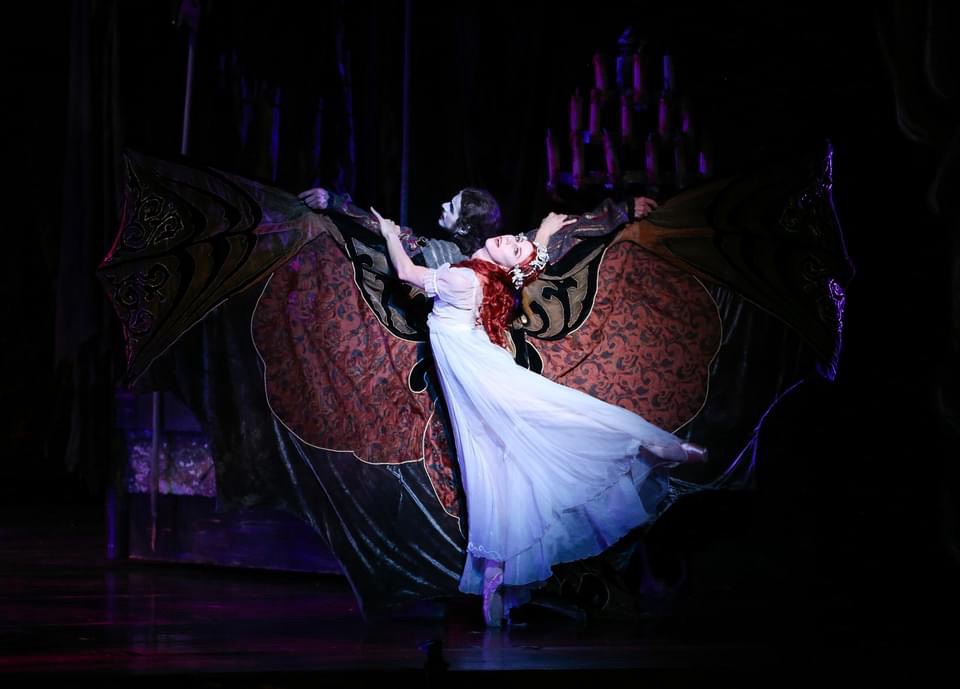
Dracula’s cape is both a fashion statement and a work of art in blood red and black with tapestry-like designs. The brides’ white dresses, pale makeup and pale locks set a new standard for “undead” beauty. The set for Acts I and III (The Crypt and The Bedroom) are majestic and spooky, in contrast to the once-upon-a-time innocence The Village set of Act II. Last but not least, I must mention the dreadful carriage that Renfield uses to procure Dracula’s new brides. Drawn by two horses (Tekhylon Armour and Darius Mealy), the dark and ragged carriage with a hint of smoke at the top shouts “stranger danger” but even Svetlana’s strongest kicks and screams are no match for the evil that lies within.

The Richmond Symphony, under the direction of Erin Freeman, with guest pianist Douglas-Jayd Burn played Franz Liszt’s haunting and dramatic score arranged by John Lanchbery specifically for Stevenson’s ballet. Dracula is truly a collaboration of elements: the choreography, the music, the story, the set, the costumes all work together to create theatre magic.

The Richmond Ballet offered this production of Dracula the weekend after Valentine’s Day. I have often complained that Romeo and Juliet was not my idea of a proper Valentine’s offering, since they both end up dead. Cinderella has been a happier alternative. Dracula has many of the elements – both pros and cons – of other romantic ballets, but the addition of a vampire somehow makes it sooooo much more satisfying…

Julinda D. Lewis is a dancer, teacher, and writer who was born in Brooklyn, NY and now lives in Eastern Henrico County. When not writing about theater, she teaches dance history at VCU and low impact dance fitness classes to seasoned movers like herself, and occasionally performs.

One-Time
Monthly
Yearly

Make a one-time donation

Make a monthly donation

Make a yearly donation

Choose an amount

$5.00
$15.00
$100.00
$5.00
$15.00
$100.00
$5.00
$15.00
$100.00

Or enter a custom amount

$

Your contribution is appreciated.

Your contribution is appreciated.

Your contribution is appreciated.

DonateDonate monthlyDonate yearly
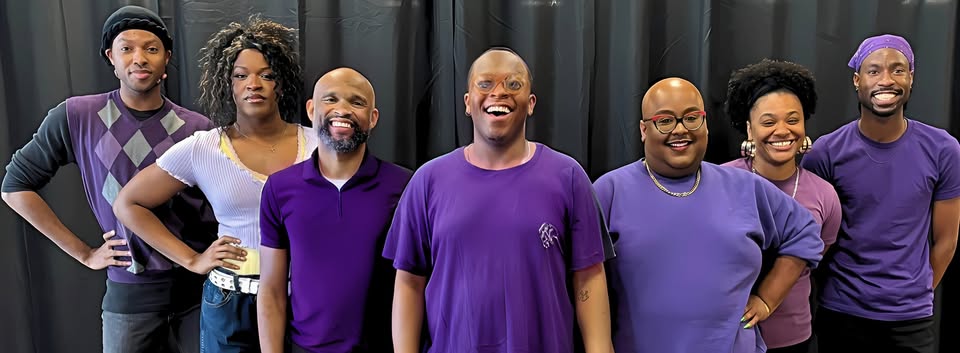
Photo by Sarah Ferguson

BORN WITH TEETH

Words Matter

A Theater Review of an East Coast Premiere by Julinda D. Lewis

By: Richmond Shakespeare

At: Gottwald Playhouse at Dominion Energy Center, 600 E. Grace St., Richmond, VA 23219

Performances: January 25 – February 11, 2024

Ticket Prices: $20 – $45

Info: (804) 340-0115 or http://www.richmondshakespeare.org

Death and life are in the power of the tongue…  – Proverbs 18:21

The time is the late 1590s. The place is a private room in a London tavern. The political climate is volatile – an authoritarian regime is in charge, freedom of speech does not exist, heretics and atheists – and apparently Catholics – are tortured and killed. A plague was ravaging society – the Black Death – a pandemic that killed thousands, causing the collapse of what little social structure remained after the political purge, leaving fields unplowed, and little to eat.

There are more spies than crimes to spy out. – BWT

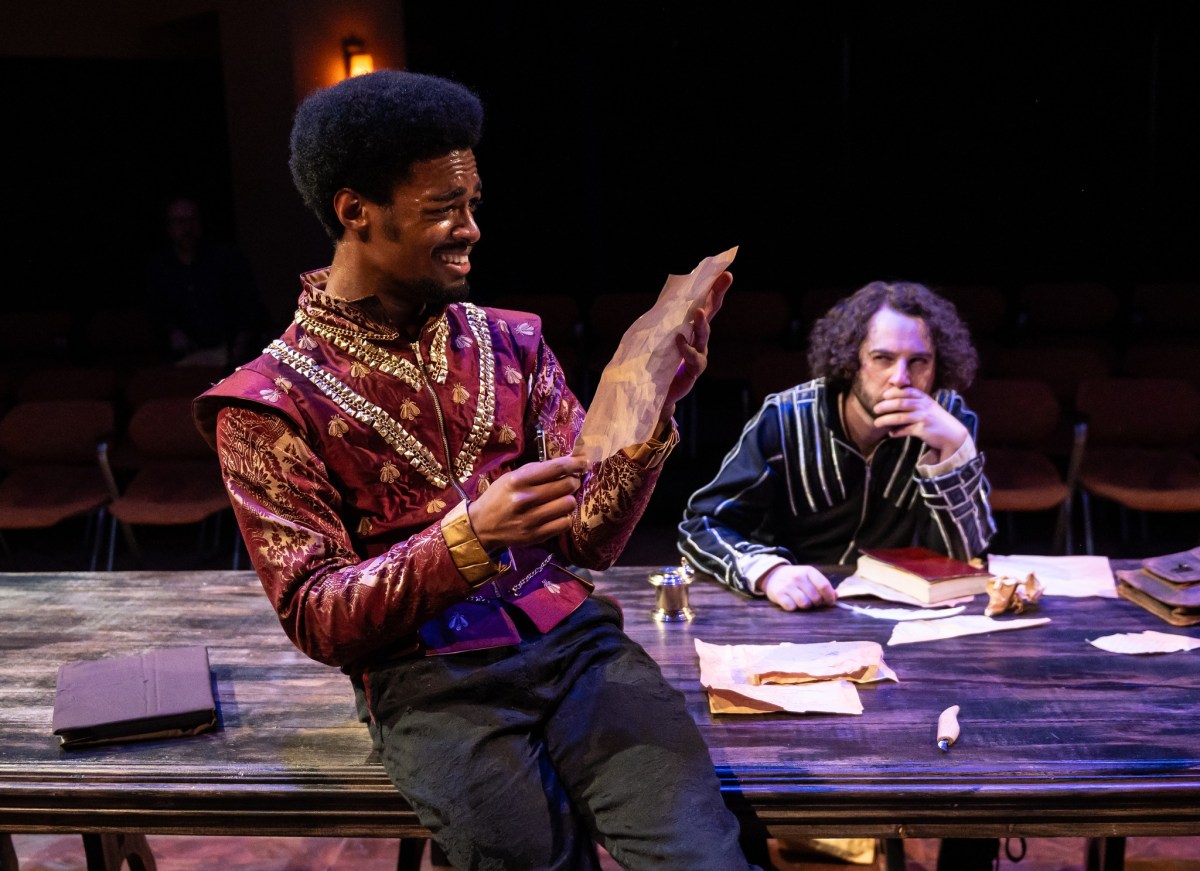
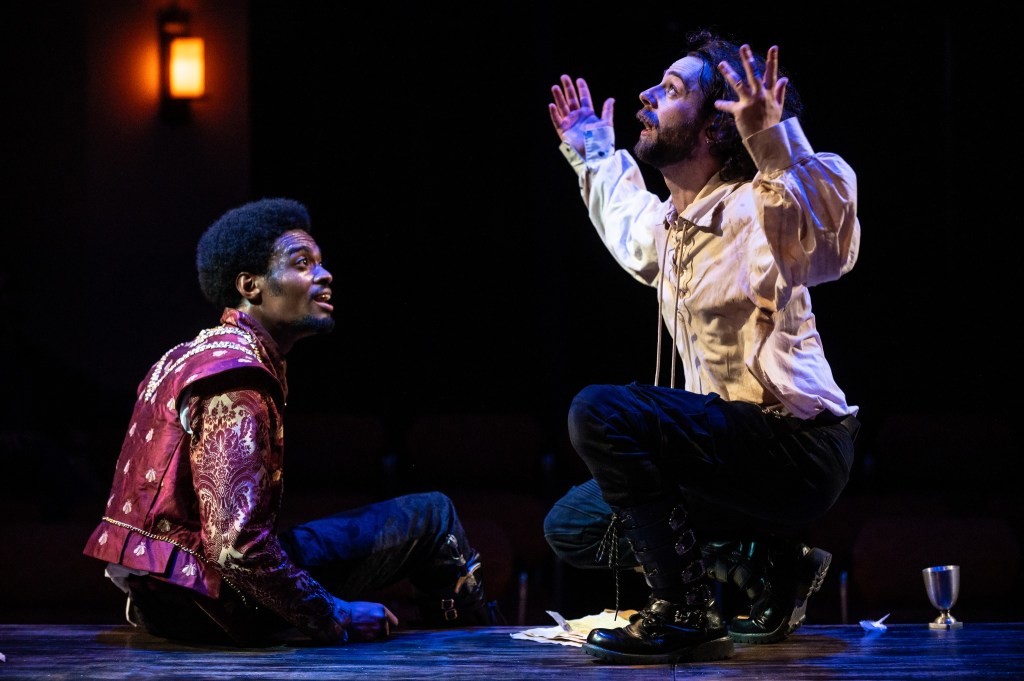
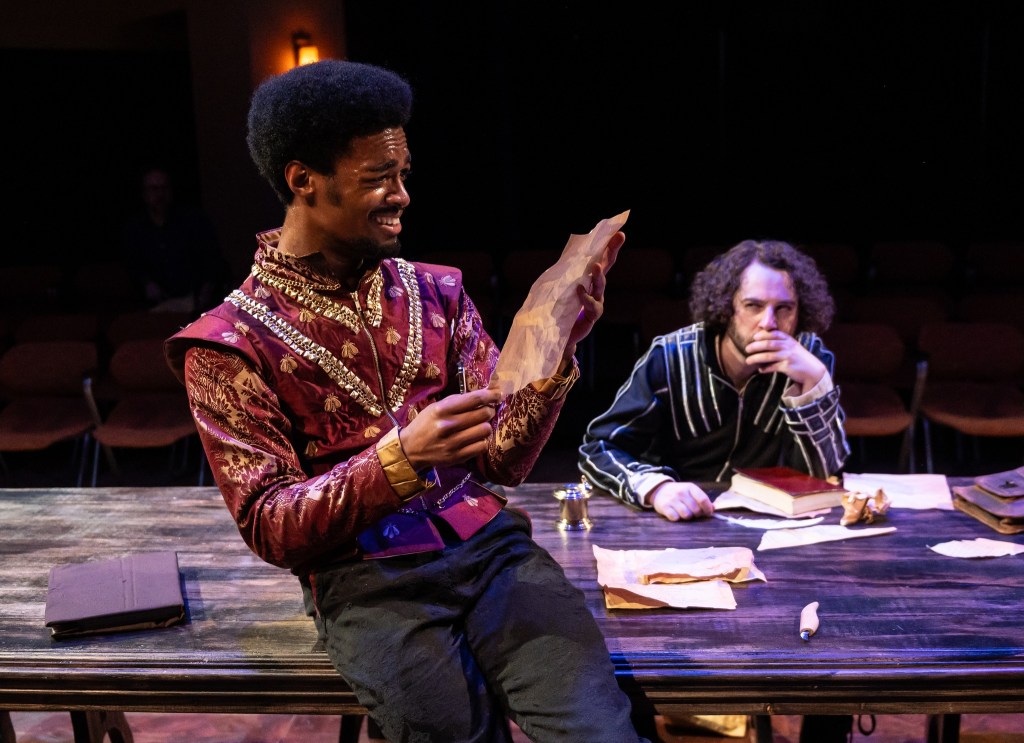
This is where playwright Liz Duffy Adams saw fit to open up a voyeuristic window into the world of two writers – the well-established Christopher “Kit” Marlowe (Avery Michael Johnson) and the upstart William Shakespeare (James Murphy) – as they meet in the private back room of a pub to collaborate on a series of historic plays. But this collaboration is a contentious literary partnership, rife with jealousy, political unrest, and rumors of espionage, religious persecution, and sexual tension. This collaboration is Born With Teeth.

We are subjects, not citizens. – BWT

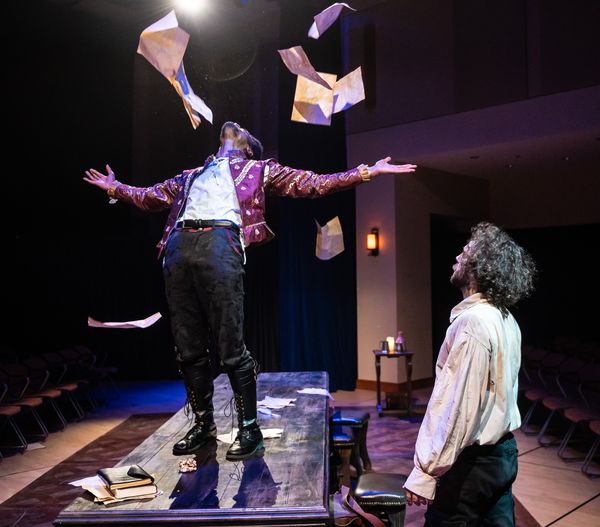
The flexible space of the Gottwald Theatre has been transformed for this occasion. A long (perhaps 12’?) table dominates the room, slashing diagonally through the space. It is placed on a sturdy parquet floor, and surrounded by 10 leather topped rectangular stools. The audience is seated on either side of the table, close enough for the first row to be showered by scattered sheets of paper during the two playwrights’ scuffles. This awesome set was designed and constructed by W. Reed West III.

You are so much stupider than you look; how is that possible? – BWT

William Shakespeare and Christopher Marlowe did indeed collaborate on the Henry VI trilogy, Parts I, II, and III, Marlow was stabbed to death in the summer of 1593. But much of the relationship between Shakespeare and Marlowe – both their authorship and personal  – is a matter of speculation and mystery. So that raises the question, how much of Born With Teeth is historical clarification, and how much is pure fantasy? And given the truths expressed and exposed of human interaction – oppression, suppression, persecution, ego, love – does the former question matter?

Worse than nowhere is somewhere you don’t want to be. – BWT

Avery Michael Johnson and James Murphy literally burst onstage, and give us a solid 90 minutes of drama, melodrama, angst, bravado, fear, backstabbing, lust, equivocation, love, revelation, caution, optimism, conciliation, espionage, and more. Born With Teeth is loud, frightening, and funny – sometimes all at once. Marlowe denigrates the upstart Shakespeare, until he reads a page or two of the play they’re working on and realizes that Shakespeare can, indeed, write. But at a time when there is not such thing as freedom of speech or religion, words can cut more sharply that a sword, and speech can be the currency of life or death.

I don’t deny God, I just don’t like him very much. – BWT

Murphy plays the role of Shakespeare with a bit of caution, much more reserved than his more outgoing and outrageous counterpart who may, in turn, be overly confident in the sovereignty of his benefactor. Johnson’s Marlowe never walks but strides. He stomps about in his tall boots – there’s a knife strapped into the right one – he leaps from the floor to the top of the table and lands on the tabletop, the floor, or Shakespeare like a cross between a  pouncing panther and a WWE wrestler. Sitting in the front row, I could see each bead of sweat on Johnson’s brow and distinctly hear the intake of breath when he rapaciously sniffed Murphy. Born With Teeth is a physically demanding play, fueled by quick dialogue that is alternately witty, cutting, and always demanding. It isn’t Shakespeare, but it is the essence of Shakespeare. It isn’t classical, but it is archetypal. It isn’t orthodox, but it does all the things you want live theatre to do.

—–

Julinda D. Lewis is a dancer, teacher, and writer who was born in Brooklyn, NY and now lives in Eastern Henrico County. When not writing about theater, she teaches dance history at VCU and low impact dance fitness classes to seasoned movers like herself, and occasionally performs.

—–

BORN WITH TEETH

by Liz Duffy Adams

Directed by Andrew Gall

Cast

Kit                   ……………    Avery Michael Johnson

Will                 ……………    James Murphy

Production & Design Team

Artistic Director          …….   James Ricks

Managing Director    …….   Jase Smith Sullivan

Playwright                   …….   Liz Duffy Adams

Director                       …….   Andrew Gall

Stage Manager            …….   MariaElisa Costa

Assistant Stage Manager …   Kiari Hicks

Costume Design          …….   Anna Bialkowski

Intimacy Choreographer  …   Lucinda McDermott

Lighting Design          …….   Tristan Ketcham

Set Design                   …….   W. Reed West III

Sound Design              …….   James Ricks

Run Time: About 90 minutes; no intermission

Content Disclosure: This production contains mature themes, strong language, & sexual/suggestive content.

———-

Photo Credits: Promotional Video by Eric Hackler & Photos from Richmond Shakespeare Facebook

https://www.facebook.com/watch/?v=1088997112419759

One-Time
Monthly
Yearly

Make a donation to support
rvart review

Make a monthly donation

Make a yearly donation

Choose an amount

$5.00
$15.00
$100.00
$5.00
$15.00
$100.00
$5.00
$15.00
$100.00

Or enter a custom amount

$

Your contribution is appreciated. Thank you!

Your contribution is appreciated.

Your contribution is appreciated.

DonateDonate monthlyDonate yearly

ONE IN TWO

This is the play that has no end. . .

A Theater Review by Julinda D. Lewis

At: Richmond Triangle Players at the Robert B. Moss Theatre | Carpenter Foundation Stage, 1300 Altamont Ave, RVA 23230

Performances: September 20 – October 14, 2023

Ticket Prices: $10 – $40

Info: (804) 346-8113 or rtriangle.org

———-

After seeing Donja R. Love’s phenomenal Sugar in Our Wounds, produced at Richmond Triangle Players (RTP) during April-May 2022, I was excited to see One in Two (2019) and I was not disappointed. One in Two is a three-person drama set in a waiting room, in the crossroads of “Now, until; Everywhere, nowhere.”

I was very intentional in my use of the word “crossroads.” While the literal meaning of a crossroads is an intersection, a place where two roads meet, it is commonly used figuratively and spiritually to refer to life-changing situations that require special attention, a decision, and are often marked by rituals of protection or transition.

One in Two is a masterful example of storytelling, but not the kind of story that is meant to entertain. This story is autobiographical – written by the playwright around the tenth anniversary of his own HIV positive diagnosis. It is not an entertainment, but rather a call to action, the urgency of which is suggested by the knowledge that Love began writing this play on the Notes app of his phone, from his bed. Presumably he, like the character Number One, was struggling with the need to define himself aside from a diagnosis that many considered a death sentence.

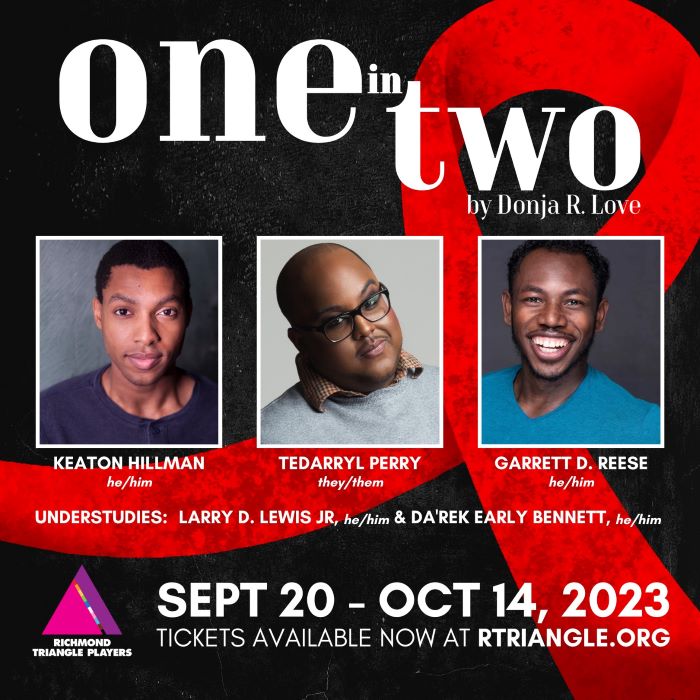
There is an experimental and inclusive nature to this work as well. Audience members are asked to take a number from a ticket machine as we enter. While the purpose is never explained, it eventually becomes clear that each ticket has been re-designated as either a “1,” a “2,” or a “3.” The three actors do not know, at the start of the show each night, which of them will be playing the role of “1,” “2,” or “3” until the audience chooses, by applause. [I applauded equally loudly for each because I know and admire Keaton Hillman and Tedarryl Perry as actors and was immediately drawn to Garrett D. Reese’s “extra-ness.”]

The actors begin to drift onto the stage one by one, about ten minutes before the show starts. They stand, stretch, linger. The action begins with a scream. On Friday, opening night, Perry was chosen to be Number One, and soon after a “safe word” was established. Overkill? No. It is, indeed, that intense.

One in Two is not lacking in humor. The three romp in a recreated memory of their youth. Perry progressed through the role of Dante from a carefree little boy to a young man exploring his sexuality until stumbling at the crossroads of an HIV positive diagnosis. Hillman played a number of roles, from bossy, king-of-the-hill kid to bartender to supportive [female] nurse, and even a member of an HIV support group – whose marriage was surrounded by secrecy and the unwillingness of his in-laws to accept their son’s marriage to another man. Reese also took on various roles, from the playground mediator to a streetwise booty call or, to put it more graphically,  trade, to Dante’s warm but worried mother.

Director Shanea N. Taylor pulls us into this world that unfolds in a non-linear, sometimes dream-like format that carries the audience from laughter to the point of tears in a matter of seconds. The stark white background, with a nurse’s station, a bathtub, and a bar hidden behind convenient cabinet doors, supports this fragile paradox – there’s nowhere to hide, while hidden in plain sight.

While it is impossible to know exactly how someone feels in this situation, One in Two takes us as close as humanly possible with a roller coaster of emotion including shock, shame, anger, depression and despair, compassion, fear, and more. The trauma is real. The acting, the play, is just an effective delivery vehicle.

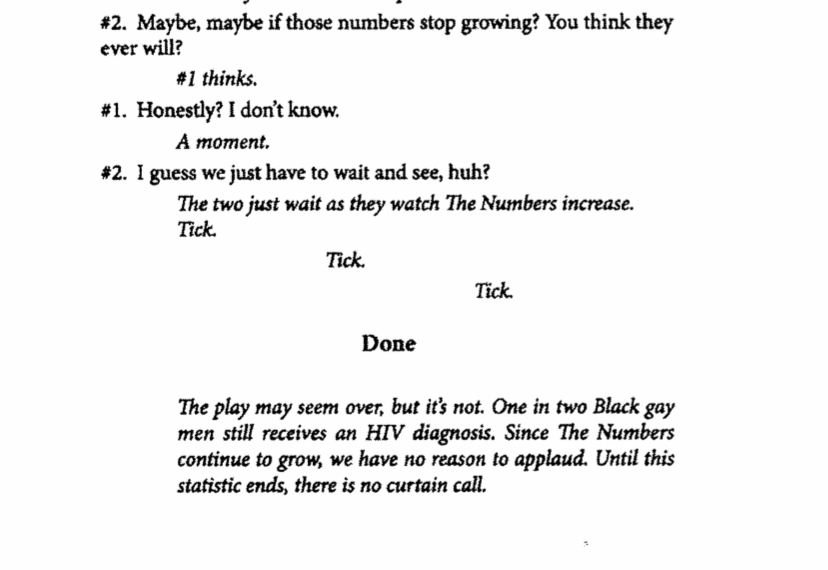
Oh. That title? At the time this play was written, according to the CDC statistics: One in fourteen gay white men will be diagnosed with HIV in their lifetime. One I four gay Hispanic men will be diagnosed HIV positive. And one in two gay Black men will be diagnosed with HIV. That is why, at the end of this play, there is no bow. There is no applause. There is no end. Yet.

FROM THE PLAYWRIGHT: “There is still trauma that’s hard to write, there are still remnants of fear that tremble the voice found in my writing. I’ve gotten to a point where there are no words, characters, dialogue, or subtext to hide behind anymore. Fear can no longer overshadow truth.”

Bravo to this cast and creative team and to Richmond Triangle Players for moving past fear and presenting us with the cold, harsh truth.

Julinda D. Lewis is a dancer, teacher, and writer who was born in Brooklyn, NY and now lives in Eastern Henrico County.

———-

ONE IN TWO

Written by Donja R. Love

Directed by Shanea N. Taylor

CAST:

Keaton Hillman – Person on the Left

Tedarryl Perry – Person in the Middle

Garrett D. Reese – Perso on the Right

Understudies: Da’Rek Early Bennett and Larry Lewis, Jr.

CREATIVE TEAM:

Scenic Design – Dasia Gregg

Lighting Design – Michael Jarett

Sound Design – Nicholas Seaver

Projection Design – Lucian Restivo

Costume, Hair & Makeup Design – Margarette Joyner

Props Design – Tim Moehring

Production State Management – Lauren Langston

Assistant Direction – Dwight Merritt

One-Time
Monthly
Yearly

Please Make a one-time donation to support the continued publication of rvart review

Make a monthly donation

Make a yearly donation

Choose an amount

$5.00
$15.00
$100.00
$5.00
$15.00
$100.00
$5.00
$15.00
$100.00

Or enter a custom amount

$

Your contribution is greatly appreciated.

Your contribution is appreciated.

Your contribution is appreciated.

DonateDonate monthlyDonate yearly
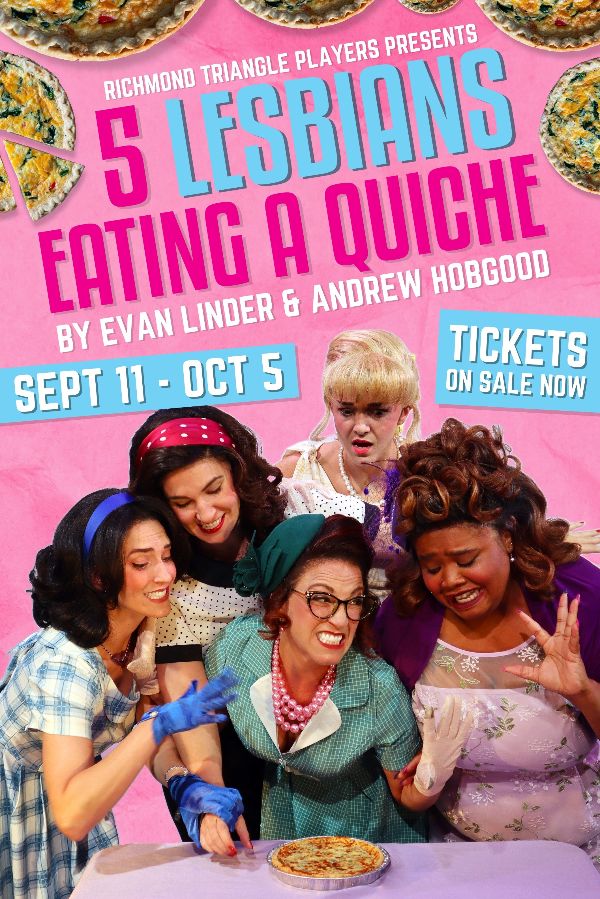
METEOR SHOWER

A Comedy by Steve Martin

A Theater Review by Julinda D. Lewis

Presented by CAT – Chamberlayne Actor’s Theatre

At: The Lynn Theatre at Brightpoint Community College, 800 Charter Colony Pkwy, T Building, Room T112, Midlothian, VA 23114

Performances: September 16-29, 2023

Ticket Prices: $24.00 General Admission. $22.00 Seniors

Info: http://www.cattheatre.com

Steve Martin’s comedic play METEOR SHOWER is probably one of those shows you will either love or hate. Either way, you will laugh. A lot.

For some, knowing that the author is THE Steve Martin may be all you need to know to decide whether to go or not, whether you will like it or not, and most importantly, whether or not you will ever again speak to the person who invited you.

The plot is simple (in more than one sense of the word): In 1993 a meteor shower occurs in Ojai, CA, where Corky lives with her husband Norm. The two are a solidly united loving couple who have obviously attended one too many couples’ therapy sessions. Corky and Norm decide to invite another couple over to have dinner and watch the meteor shower, only to find that Laura and Gerald are not who they appear to be or what Corky and Norm expected.

Over the course of the evening, the plot twists and turns, the story stops and restarts. Remember when you were a kid and things went wrong and you wanted a do-over? Well, METEOR SHOWER is the repository of all your childhood do-overs.

There is a minimalist set of  “a modern home in Ojai, California,” and a backyard dominated by two of the most uncomfortable looking lawn chaises I have ever seen. These chairs, however, play a key part in the evening’s events. A privacy fence cleverly disguises a walkway that leads to the house. And the audience is treated to a soothing, looping projection of a meteor shower. There is also a pre-show audio recording that is quite amusing – the first time we hear it…

Before the evening is over, you will experience a tale of cannibalism, learn about “bug flux” and exploding head syndrome, and find out what happens when one gets hit by a meteor.

The cast, all making their CAT debut, consists of Paul James and Jennipher Murphy as the host couple, Norm and Corky, and Skye Whitcomb and Constance Moreau and Skye Whitcomb as the guest couple, Gerald and Laura. Moreau and Whitcomb successfully juggled multiple plot twists fueled alternately by sexual innuendo, explosive outbursts, and intentionally dysfunctional exchanges. James maintained a mostly stable personality as a super sweet, super nice guy. As annoying as Norm could be, he actually started to grow on me – but then, the alternative was soooooo much worse. But it was Murphy who had the most complex, amusing, and devious character development and plot twists.

As a play, as a story, METEOR SHOWER has very little substance. It exposes the strengths and weaknesses of marriage and relationships, but doesn’t really have anything to say about any of it. It makes us laugh at things we would ordinarily be embarrassed to admit we watched, much less laughed at. If you need a night of senseless laughter, no strigs attached, this show might be meant for you. Go. Laugh. Enjoy. As for me – it was definitely not my cup of tea.

Julinda D. Lewis is a dancer, teacher, and writer who was born in Brooklyn, NY and now lives in Eastern Henrico County.

METEOR SHOWER

Written by Steve Martin

Directed by Kerrigan Sullivan

Cast

Jennipher Murphy as Corky

Paul James as Norm

Skye Whitcomb as Gerald

Constance Moreau as Laura

Creative Design Team

CAT Producer – Kerrigan Sullivan

Lynn Theatre Production Manager – Alleigh Scantling

Director – Kerrigan Sullivan

Stage Manager – Ari Silva

Lighting & Projection Design – Alleigh Scantling

Scenic & Properties Design – Hailey Bean

Costume Design – Lindsey Ladnier

Sound Design – Kerrigan Sullivan

Dates

September 16 – 29, 2023

Ticket Information

www.cattheatre.com

Ticket prices: $24.00 General Admission, $22.00 Seniors.

Run Time

80 minutes, with no intermission

Photo Credits: Daryll Morgan Studios

One-Time
Monthly
Yearly

Make a one-time donation OR SUBSCRIBE TO RVART REVIEW

Make a monthly donation

Make a yearly donation
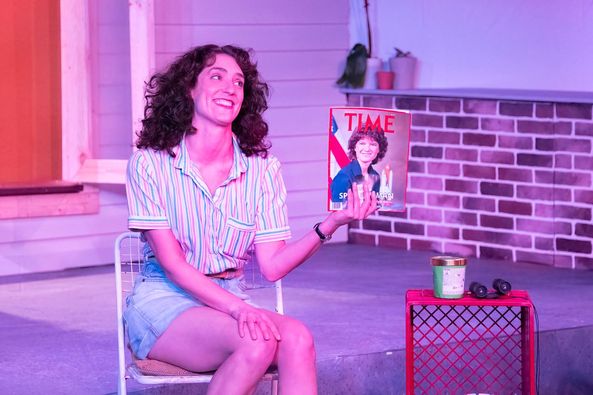
Choose an amount

$5.00
$15.00
$100.00
$5.00
$15.00
$100.00
$5.00
$15.00
$100.00

Or enter a custom amount

$

Your contribution is GREATLY appreciated.

Your contribution is appreciated.

Your contribution is appreciated.

DonateDonate monthlyDonate yearly