OUR DEAR DEAD DRUG LORD

*A Regional Premiere*

Growing Up is Messy…Especially When You’re Summoning the Dead

A Theater Review by Julinda D. Lewis

Presented by 5th Wall Theatre

At: The Basement, 300 E. Broad St., RVA 23219

Performances: October 16 – November 9, 2025

Ticket Prices: $30/Adults, $15/Students

Tickets & Info: https://www.5thwalltheatre.org/ or email info@5thwalltheatre.org

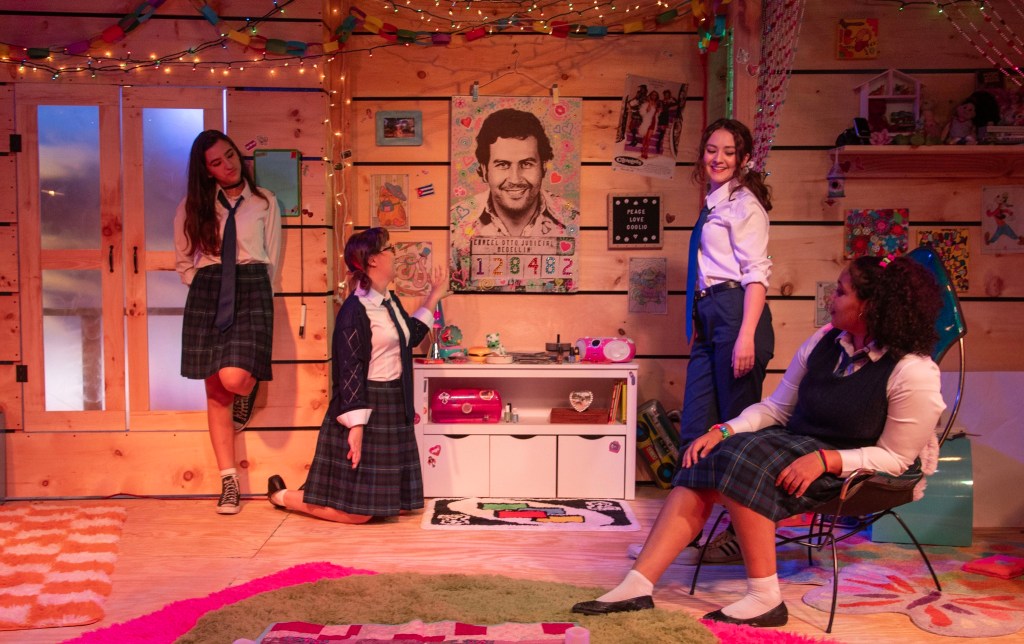
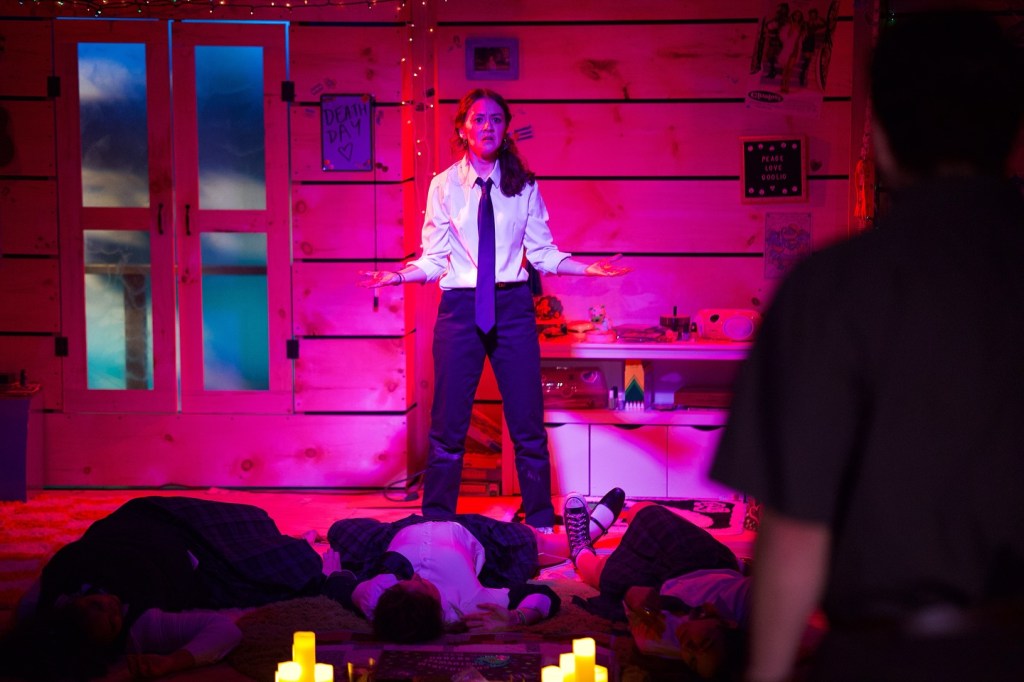
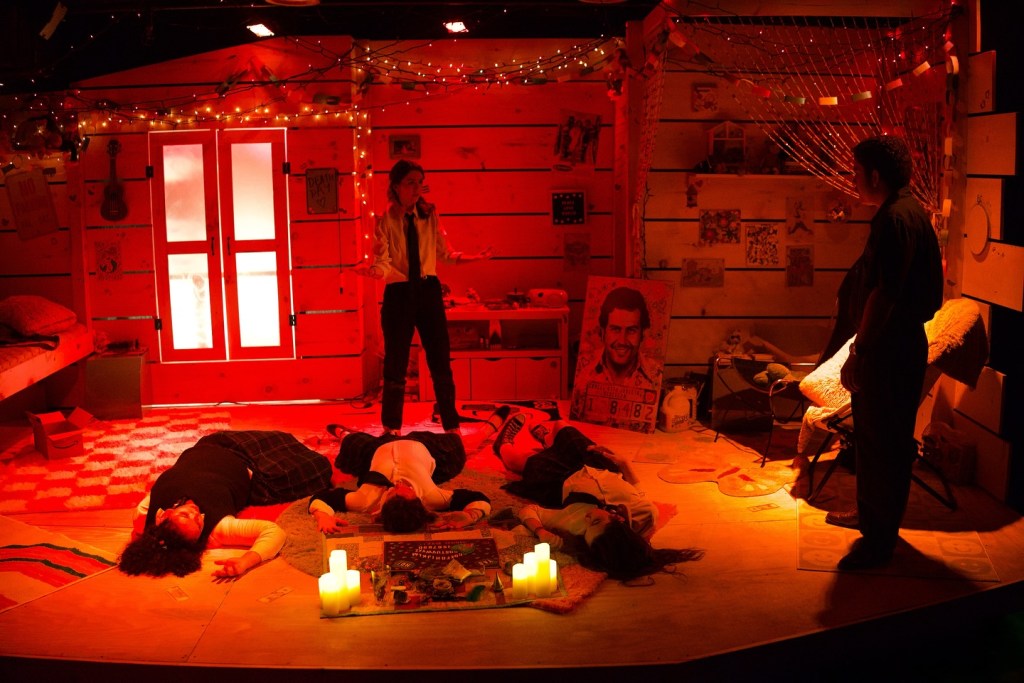
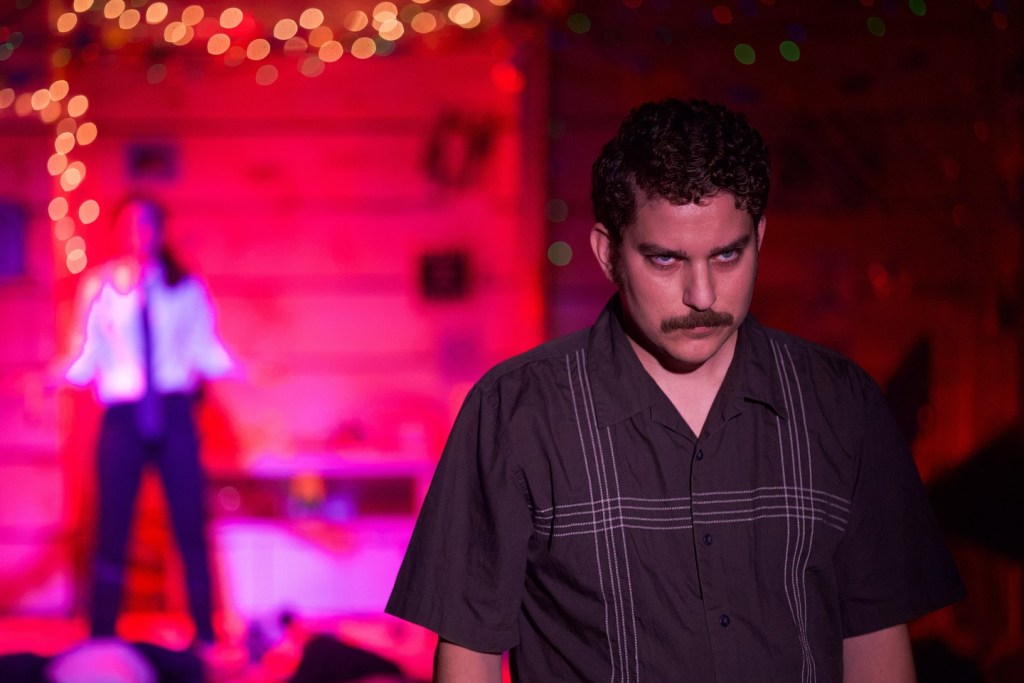
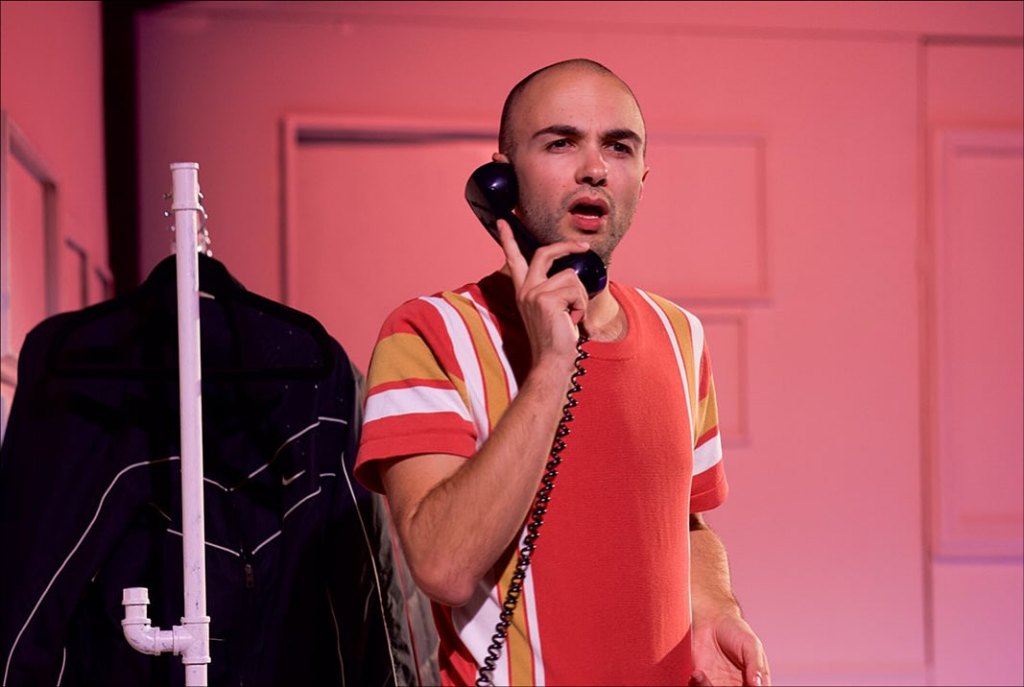
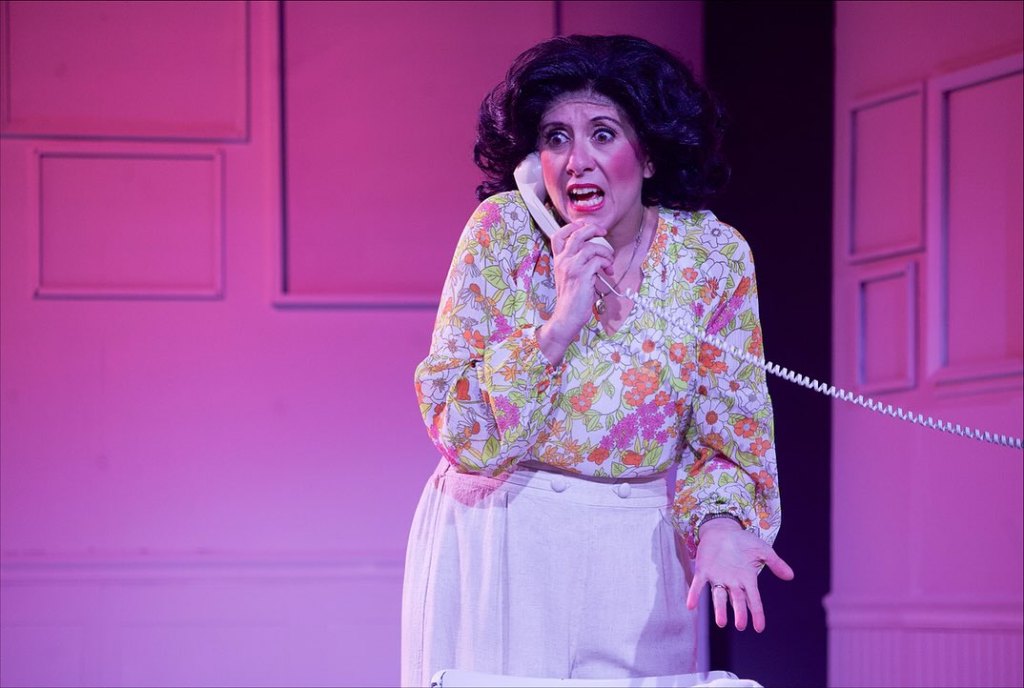
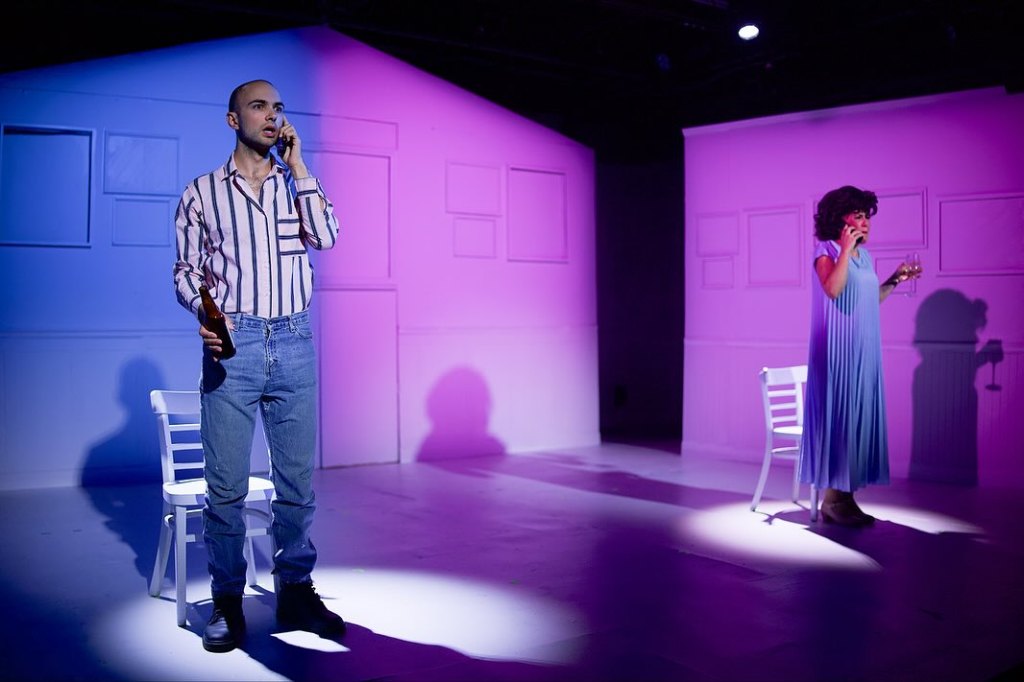
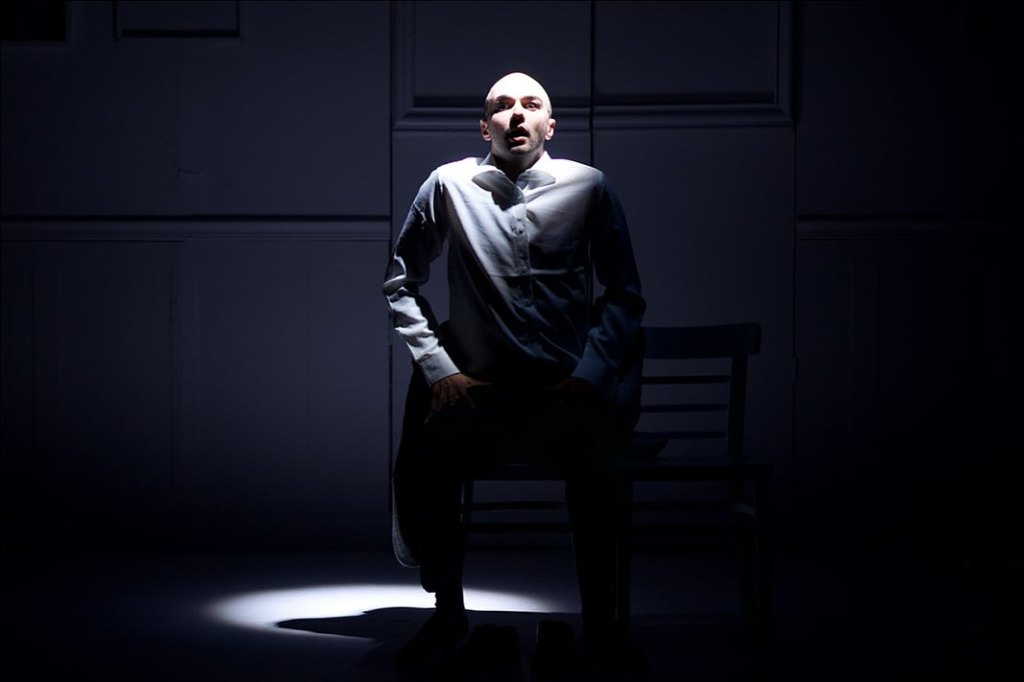
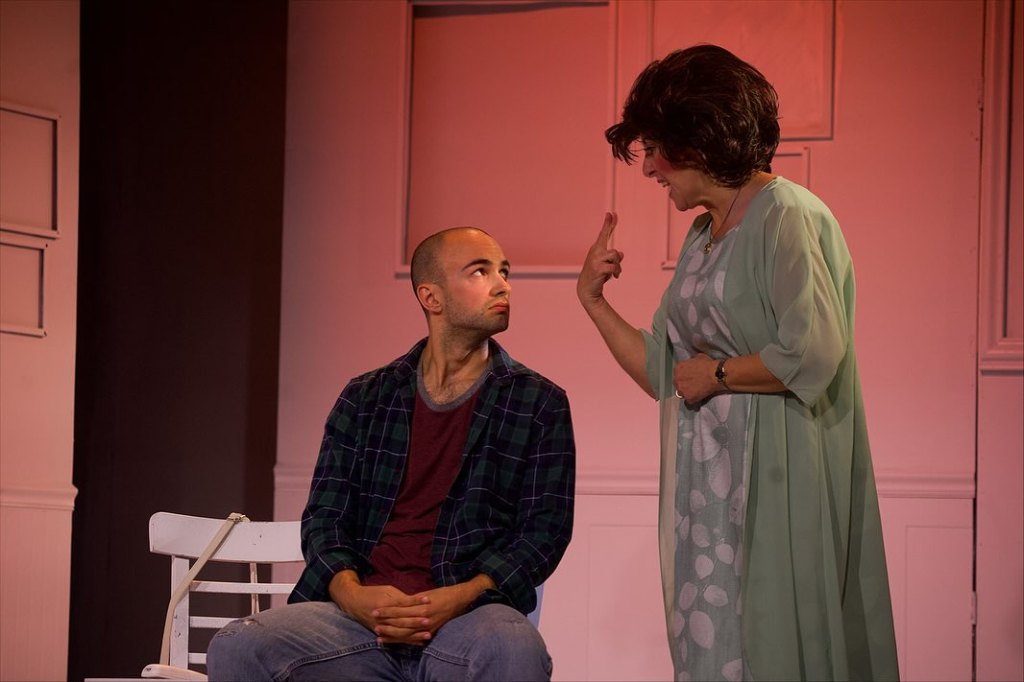
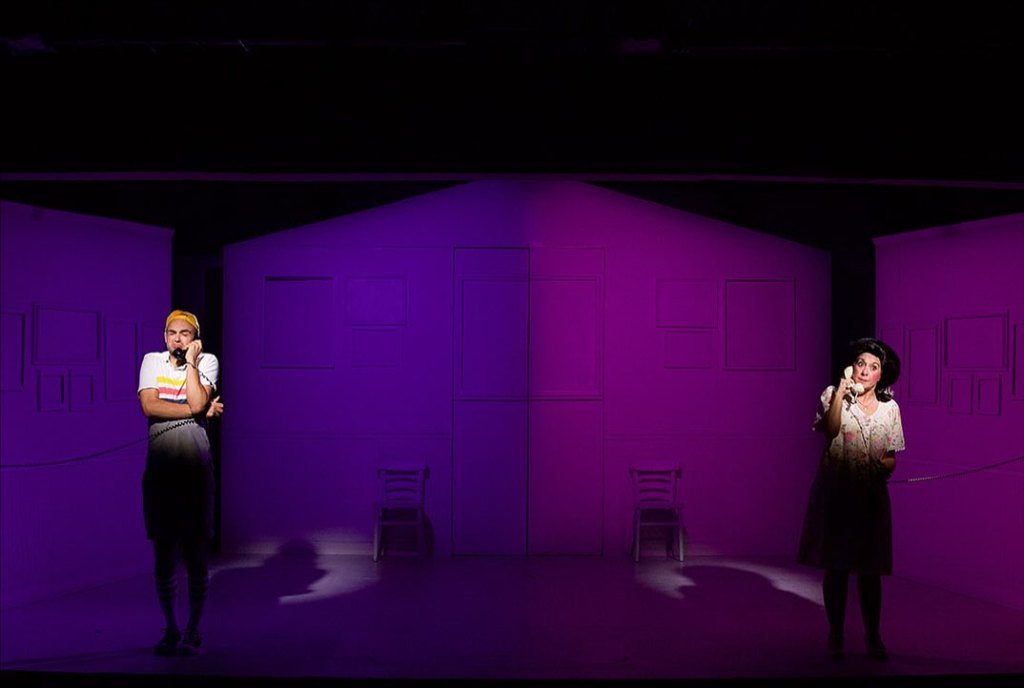
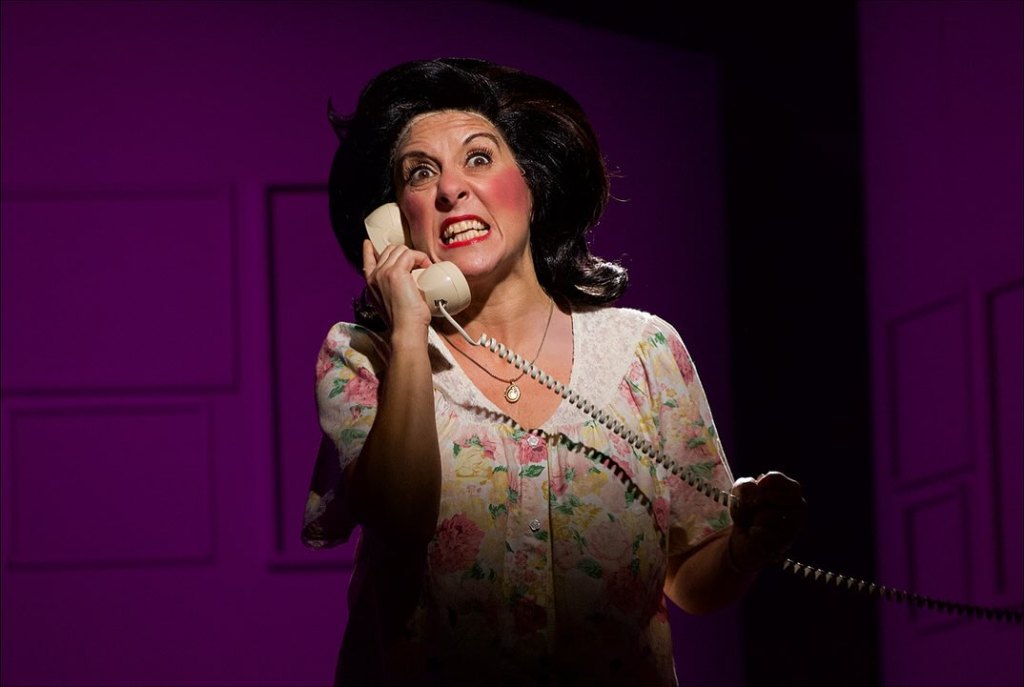
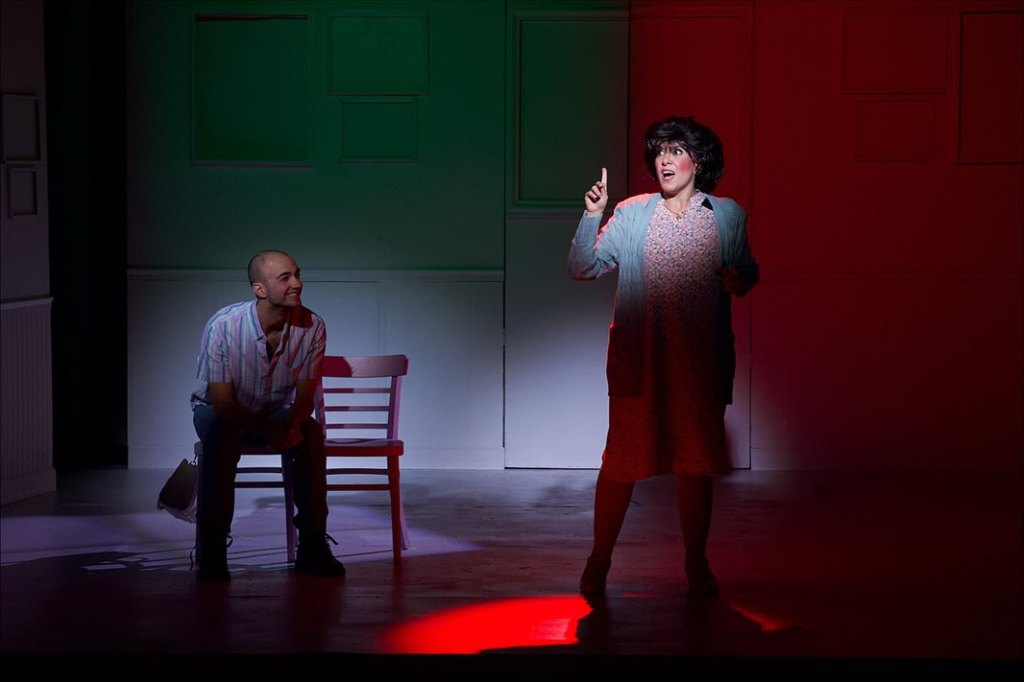
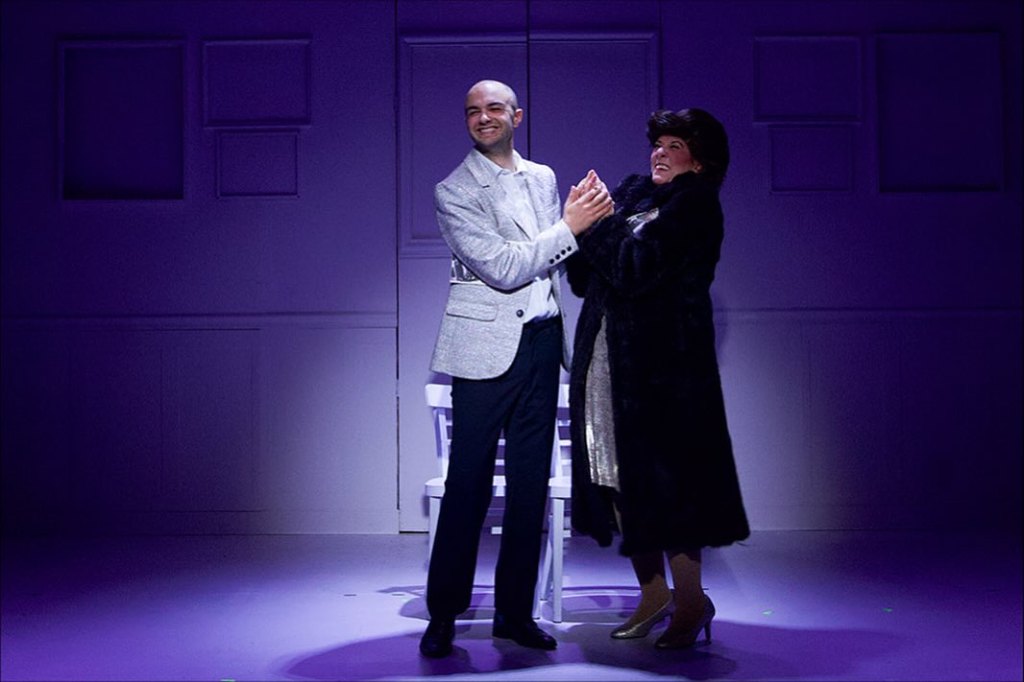
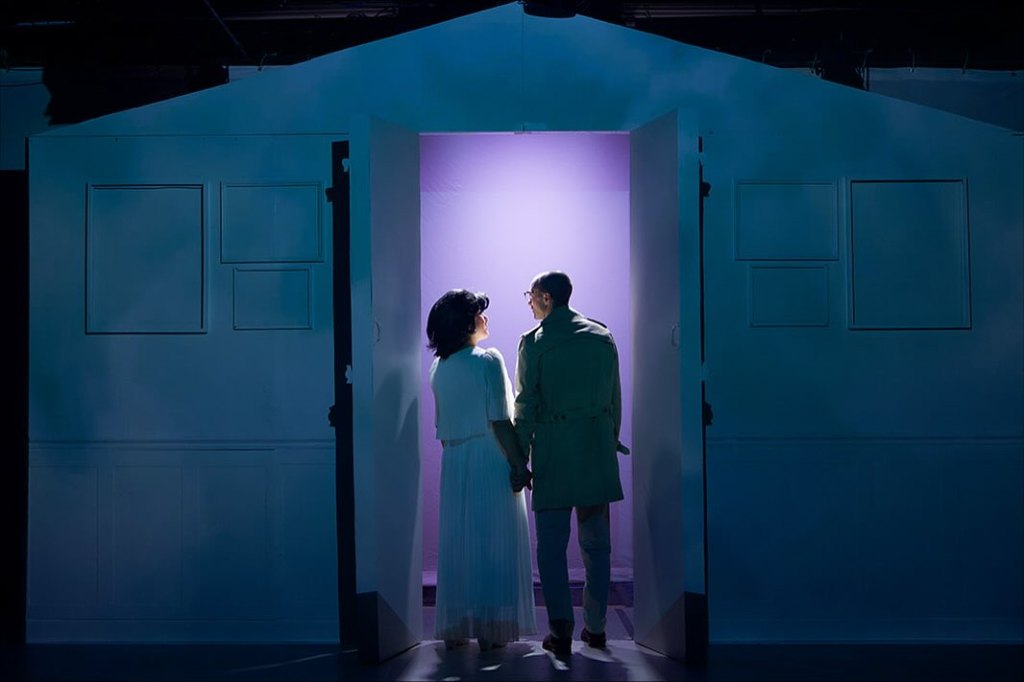
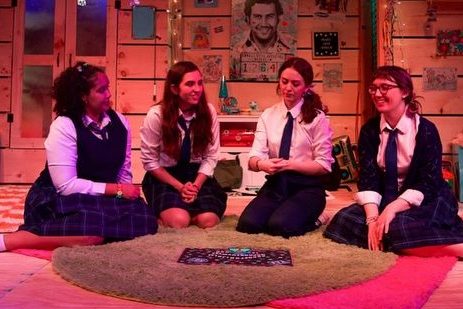
5th Wall Theatre opened its 2025/2026 season in its new, permanent home, the former Basement, now 5th Wall at The Basement or 5th Wall/Basement. In alignment with 5th Wall Theatre’s mission “to provide insights into the human condition through theatrical expression,” the season opener provided new dimensions to the theatrical experience. Alexis Scheer’s Our Dear Dead Drug Lord is a dark comedy about 4 Miami teenaged girls, members of the Dead Leaders Club, who meet in a tree house where they hope to summon the spirit of Pablo Escobar.

In case that name sounds familiar, yes, “that” Pablo Escobar, the Colombian drug trafficker and leader of the infamous Medellín Cartel. In addition to being one of the world’s most notorious narco-terrorists, Escobar was also known as a philanthropist who built housing complexes, parks, football stadiums, hospitals, schools, and churches in some of Colombia’s poorest neighborhoods. So, what about Escobar appeals to a club (or gang?) of teen girls in Miami?

It could be the allure of the illicit, the Robin Hood element of Escobar’s philanthropy, the need to replace the powerlessness of being young and female with the trappings of power, or a misplaced coping mechanism to deal with their own personal traumas. More than likely, it is some combination of these things, along with the normal teenaged tendency to rebel.

In an interview for TheaterMania.com (September 22, 2019), the author explains that Our Dear Dead Drug Lord was created as a way for her to connect with her own roots. The Miami-born, Columbian and Jewish writer’s mother emigrated from Medellín in the 1970s. “The Colombian cartels and Pablo Escobar is a weird part of my family mythology that I don’t understand, because I feel so distant from it. So that’s where that came from. I think it’s a very American play, and part of my experience as an American is trying to touch upon the generation or two before me that was outside of this country and what they fled to get here.” (https://www.theatermania.com/news/alexis-scheer-gives-us-the-dope-on-her-play-our-dear-dead-drug-lord_89801/)

Okay. So, there’s that. But there’s also witchcraft, a Ouija board, a séance, and a special dance choreographed in honor of . There’s a diverse cast, each with a heavy burden of her own. Pipe, the club’s president, is an upper-class Cuban-American and carries the burden of grief from her younger sister’s death. Pipe’s bestie, Squeeze, is Puerto Rican-Haitian who is allergic to cats. Her father committed suicide. Zoom, Pipe’s Jewish-American neighbor, is the baby of the group, and always trying to keep up. Perhaps in an effort to over-compensate for her youth and lower status, she is also coping with the possibility of a teen pregnancy – which factors in the play’s climax. And then there’s Kit, a Columbian-American newcomer with a mysterious past that makes the other girls speculate that she may be the actual daughter of their hero, Pablo Escobar.

The intersection of this combined chaos is where these girls meet to create a sacred space, a sense of community – perhaps much like the community some young people find in gang life. Director Kaitlin Paige Longoria describes is as “an incantation, a call to the ancestors.” In her notes, Longoria writes, “It lives in that delicate space between grief and rebirth, between the ache of what’s been lost and the hope of what might still be found.”

It is in this spirit that these girls, four young women on the cusp of adulthood, seek freedom, power, and self-worth. It is in this spirit that they chant the mantra, “I will not be good. I will be loud, loud, loud. I will make the world in my image and take what I mine!”

Kylee Márquez-Downie (Pipe), Marya Brice (Squeeze), Eva Linder (Zoom), and Mary Kalinowski (Kit) form a solid ensemble, intense and darkly humorous. The séance is unsettling and the sacrifice is positively horrific and scary. It’s the kind of cast where each member has a distinct role, but it’s almost impossible to single out anyone because each plays an integral part in the whole.

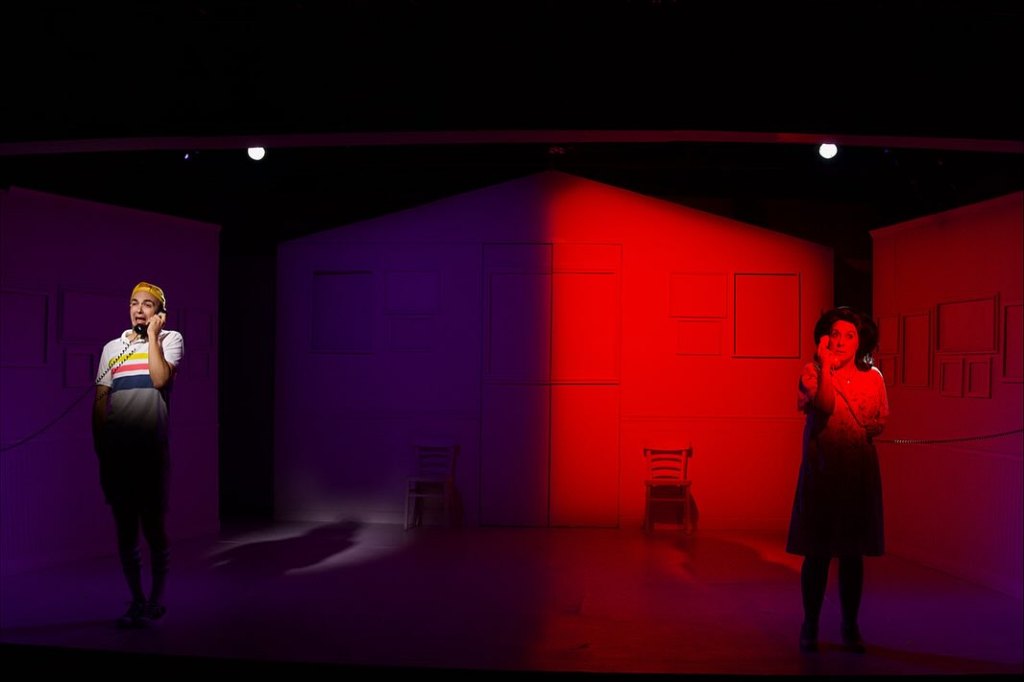
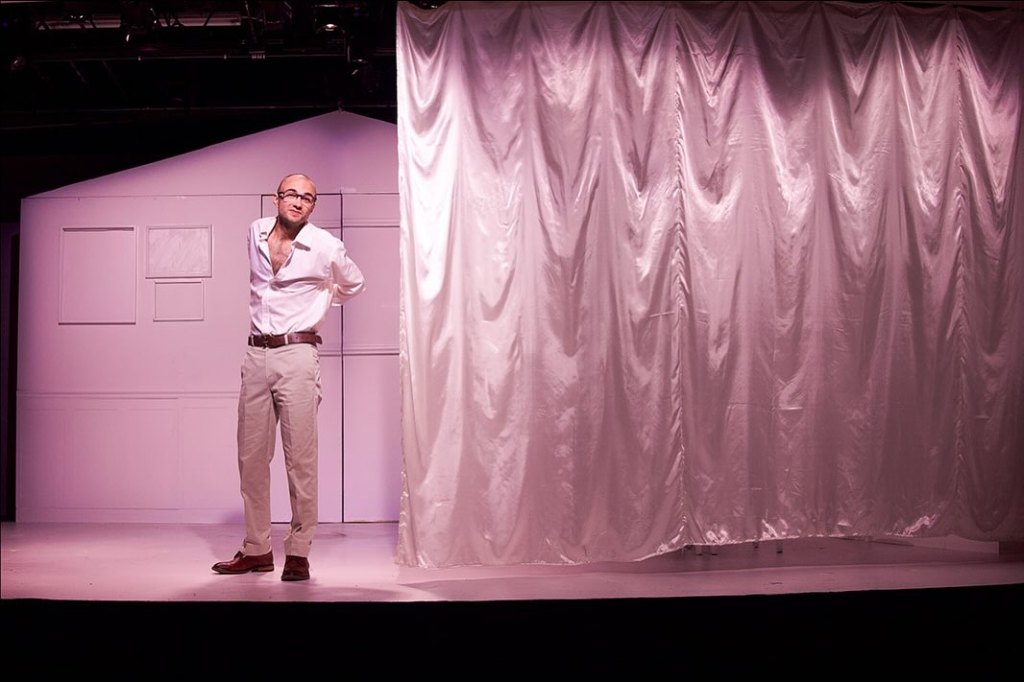
Joey Luck composed an original score using the cast’s own voices and William Luther created a uniquely isolated and compact tree house environment where all the action takes place.

Our Dear Dead Drug Lord is anything but predictable. It is weird, dark, disturbing, and it resonates with the truth that society is failing our young women and if we don’t do something to shape and direct them, they will find someone – or something – to fill that void.

———-

Julinda D. Lewis is a dancer, teacher, and writer who was born in Brooklyn, NY and now lives in Eastern Henrico County. When not writing about theater, she teaches dance history at VCU and low impact dance fitness classes to seasoned movers like herself and occasionally performs. Julinda was recently awarded the Dean’s Distinguished Adjunct Faculty Award 2023-24 Academic Year by VCU School of the Arts and the 2025 Pioneer Award in Dance Ministry by Transformation International Worship Ministries, Newport News, VA.

———-

OUR DEAR DEAD DRUG LORD

A Play by Alexis Scheer

Directed by Kaitlin Paige Longoria

CAST

Kylee Márquez-Downie      ……….           Pipe

Eva Linder                             ……….           Zoom

Marya Brice                           ……….           Squeeze

Mary Kalinowski                   ……….           Kit

UNDERSTUDIES

Natalie Tubia                        ……….           u/s for Pipe & Kit

Kylie Metheny                      ……….           u/s for Zoom

Jada Paul                              ……….           u/s for Squeeze

FEATURING

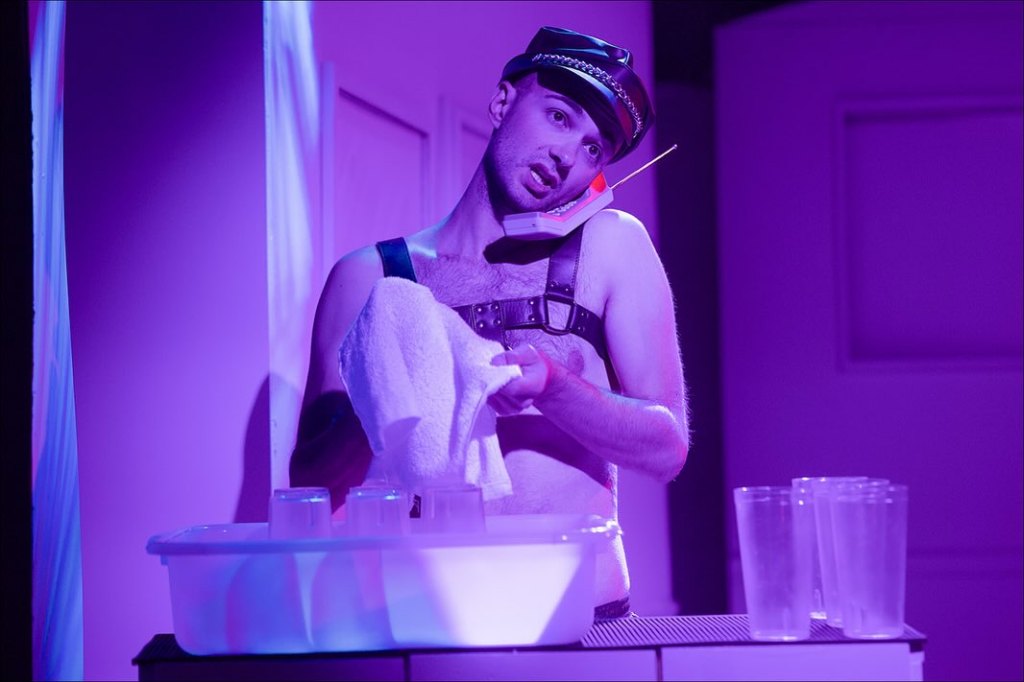
DJ Cummings Herdoiza     ……….           Pablo

Fio Lo Presti                          ……….           Pipe’s Little Sister

PRODUCTION TEAM

Directed                    ……….             Kaitlin Paige Longoria

Scenic Design          ……….           William Luther

Lighting Design       ……….            Corrine Manderino

Sound Design            ……….            Joey Luck

Costume Design        ……….            Emily Andrew Mateos

Choreography            ……….            Kayce Sullivan & Jamie Hollman

Intimacy Choreography   …..            Kerrigan Sullivan

Stage Management ………            Megan Wave

Technical Direction ……….           Chris Foote

Photography             ……….           @ivyandlacephoto

Performance Schedule:

Thursday, Friday, Saturday 7:30PM

Saturday, Sunday 2:30PM

Tickets: $30/Adult; $15/Student

Run Time: 95 minutes, no intermission

The World Premiere of Our Dear Dead Drug Lord was presented in September 2019 by WP Theater and Second Stage Theater, NYC, NY.

CONTENT WARNING: This play contains strong language, sexual content, depictions of drug use, and scenes of violence. The play also includes references to suicide, sexual assault, and other sensitive subject matter.

One-Time
Monthly
Yearly

PLEASE Make a one-time, MONTHLY, OR ANNUAL donation TO SHOW YOUR APPRECIATION FOR RVART REVIEW!

Make a monthly donation

Make a yearly donation

Choose an amount

$5.00
$15.00
$100.00
$5.00
$15.00
$100.00
$5.00
$15.00
$100.00

Or enter a custom amount

$

Your contribution is appreciated.

Your contribution is appreciated.

Your contribution is appreciated.

DonateDonate monthlyDonate yearly
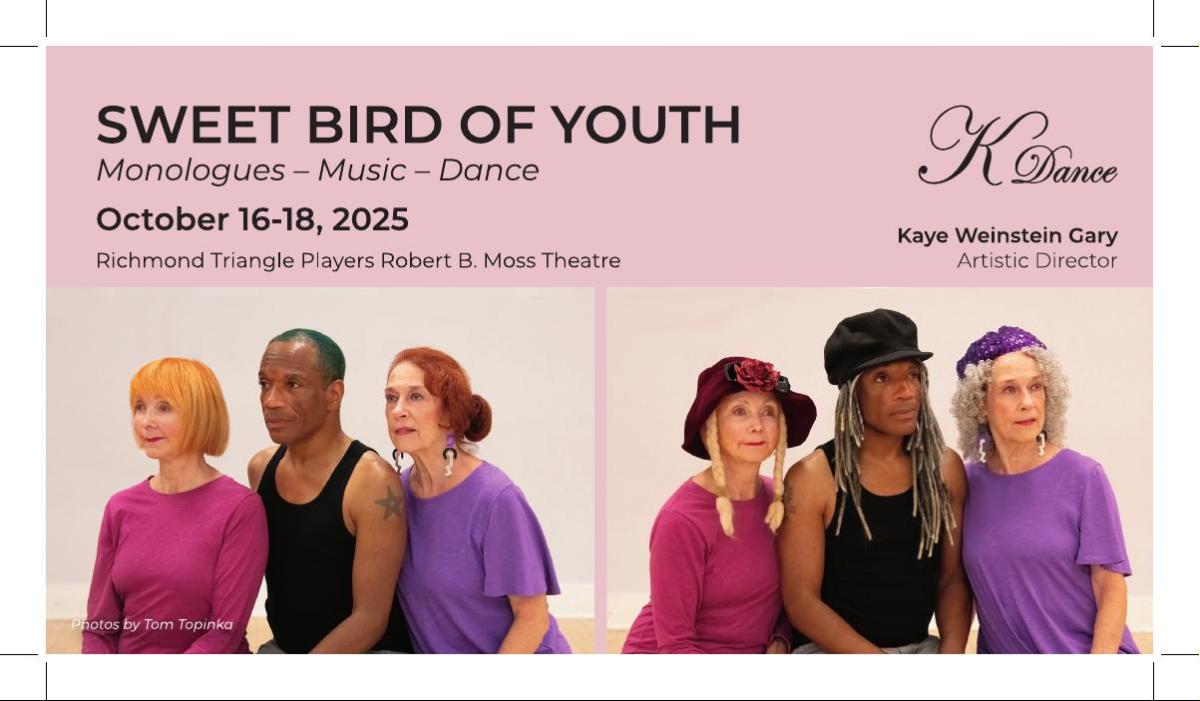

Sweet Bird of Youth

Shorts 2025: Kaye Weinstein Gary’s Sequel to Coming of Age

A Dance-Theater Review by Julinda D. Lewis of

A Limited-Run World Premiere of Monologues, Music, and Dance

Presented by KDance

At: Richmond Triangle Players, Robrt B. Moss Theatre, 1300 Altamont Ave, RVA 23230

Performances: October 16-18, 2025

Ticket Prices: $30

Tickets & Info: kdance.org or rtriangle.org or call (804) 346-8113 or (804) 270-4944

Sweet Bird of Youth picks up the theme Kaye Weinstein Gary laid down with 2024’s production of Shorts (i.e., short dance-theater works that blend text, movement, and music), entitled Coming of Age. Right off the bat, Gary confirms that Sweet Bird of Youth is at least partially autobiographical by sharing a humorous tale of going out with friends, all of whom were unashamed to claim their senior discounts – all, that is, except her. Gary confesses that she threw away her AARP mail, didn’t want to claim Social Security, and eschewed senior discounts. Garys’s denial was so extreme that eventually her husband pointed out that she was throwing away money by not embracing the senior savings.

Equal parts humorous and heartfelt, this exploration of aging and life transitions is supported by Jane Cafarella’s monologue, “Sweet Bird of Youth,” Andrew Bliss’ “Cuthbert’s Last Stand,” and Tracy Letts’ August Osage County as well as other monologues, poems and songs (e.g., Nat King Cole’s “Sweet Bird of Youth”). Cafarella’s “Sweet Bird of Youth” is spread over three ensemble sections and Gripp’s “Hap Hap Hap Birthday” song appears twice; these, along with Cafarella’s words provide a sort of loose structure to this seemingly free-form enterprise.

The “Sweet Bird of Youth” theme is echoed in Frank Foster’s set – his first for a dance company – a flock of translucent birds appearing to emerge from a picture frame that rests with a corner on the floor. There is also a red cushion or hassock, 2 of those clear acrylic Ghost Chair armchairs, and 2 barstools, allowing for quick and seamless scene changes.

Between the introduction and the closing bow, the audience gets to experience a range of significant life-stage events, including the death of a parent, a confession of not being homosexual, and milestone birthdays of  40 and 50 years. The program addresses the arc of sexuality as we age, symbolized by moving from a twin bed to a double bed, then a queen-sized or king-sized bed before moving back to separate beds and finally separate rooms.

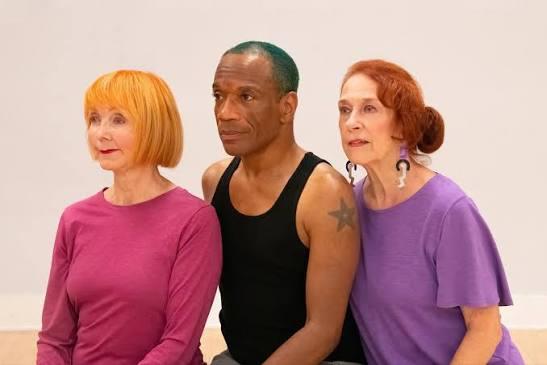
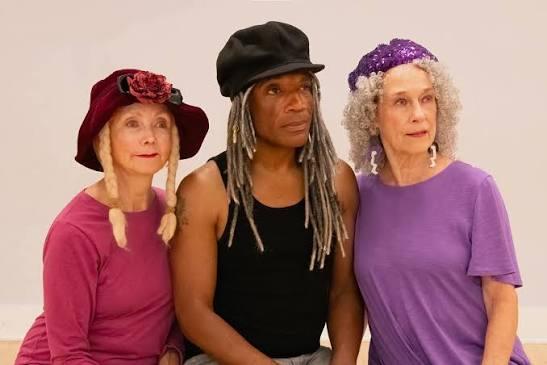
Just as Gary has staged an opposite-of-coming-out scene, she starts from the end, with the performers wearing wigs and shawls that they shed as they regress to earlier, younger versions of themselves or their characters. The audience loved every bit of it – after all, Gary has tapped into an area of need, the aging are too often socially neglected and invisible. During a talk-back with the audience, someone summed up this need and Gary’s collaborative response like this (or something pretty close): “Dance is kind of the ultimate triumph of the body…tension between words and movement.”

———-

Julinda D. Lewis is a dancer, teacher, and writer who was born in Brooklyn, NY and now lives in Eastern Henrico County. When not writing about theater, she teaches dance history at VCU and low impact dance fitness classes to seasoned movers like herself and occasionally performs. Julinda was recently awarded the Dean’s Distinguished Adjunct Faculty Award 2023-24 Academic Year by VCU School of the Arts and the 2025 Pioneer Award in Dance Ministry by Transformation International Worship Ministries, Newport News, VA.

———-

CAST of DANCERS/ACTORS

Andrew Etheredge

Kaye Weinstein Gary

Melanie Richards

PRODUCTION TEAM

Director/Choreographer   …..      Kaye Weinstein Gary

Lighting Designer               …..      Gretta Daughtrey

Set Designer                        …..      Frank Foster with Jessica Chivington

Hat/Wig Consultant            …..      Heidi Rugg

Stage Manager                    …..      Jake Buccella

Production Assistant          …..      Gina Maria McKenzie

Performance Schedule:

Thu Oct 16 @ 8pm, Fri Oct 17 @ 8pm, Sat Oct 18 @ 4pm & 8pm

Tickets: $30

Run Time: Approximately 40 minutes, no intermission

Photos by Tom Topinka

One-Time
Monthly
Yearly

PLEASE Make a one-time, MONTHLY, or ANNUAL donation donation to support rvart review

Make a monthly donation

Make a yearly donation

Choose an amount

$5.00
$15.00
$100.00
$5.00
$15.00
$100.00
$5.00
$15.00
$100.00

Or enter a custom amount

$

Your contribution is appreciated.

Your contribution is appreciated.

Your contribution is appreciated.

DonateDonate monthlyDonate yearly
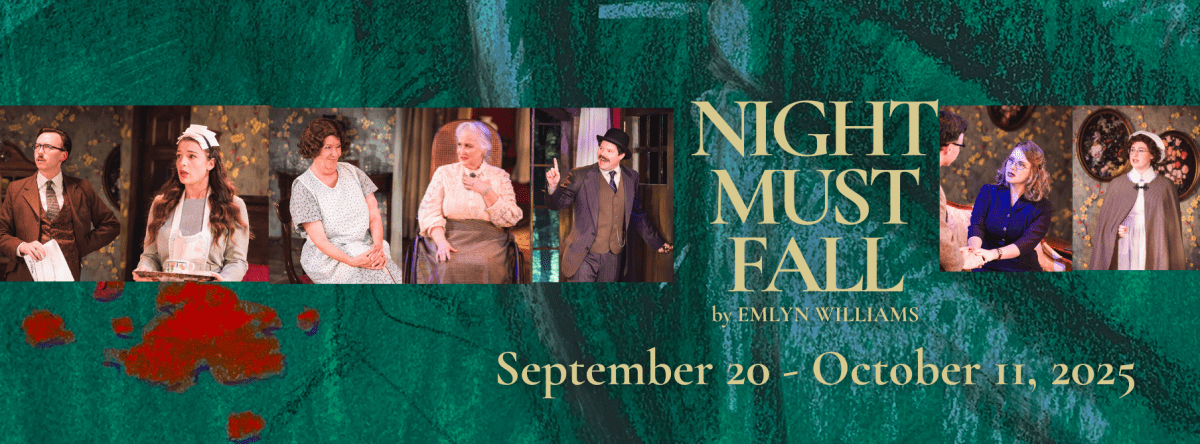
NIGHT MUST FALL

A Secluded British Cottage…A Dead Body…A Stranger at the Door

At: The Swift Creek Mill Theatre, 17401 U.S. Route One, Chesterfield, VA 23834

Performances: September 20 – October 11, 2025

Ticket Prices: $49-54. Ask about discounts for students, seniors, and veterans.

Info: (804) 748-5203 or https://www.swiftcreekmill.com

A Theater Review by Julinda D. Lewis

Emlyn Williams’ Night Must Fall is a 1935-era psychological thriller – considered by some to be one of the first to define this genre. What makes Night Must Fall stand out among other classics murder mysteries is its disturbing series of twists and turns that ultimately reveals the inner workings of truly a psychotic individual, the protagonist, Dan, as well as the people who fall under his spell. Things – and people – are not what they seem to be…

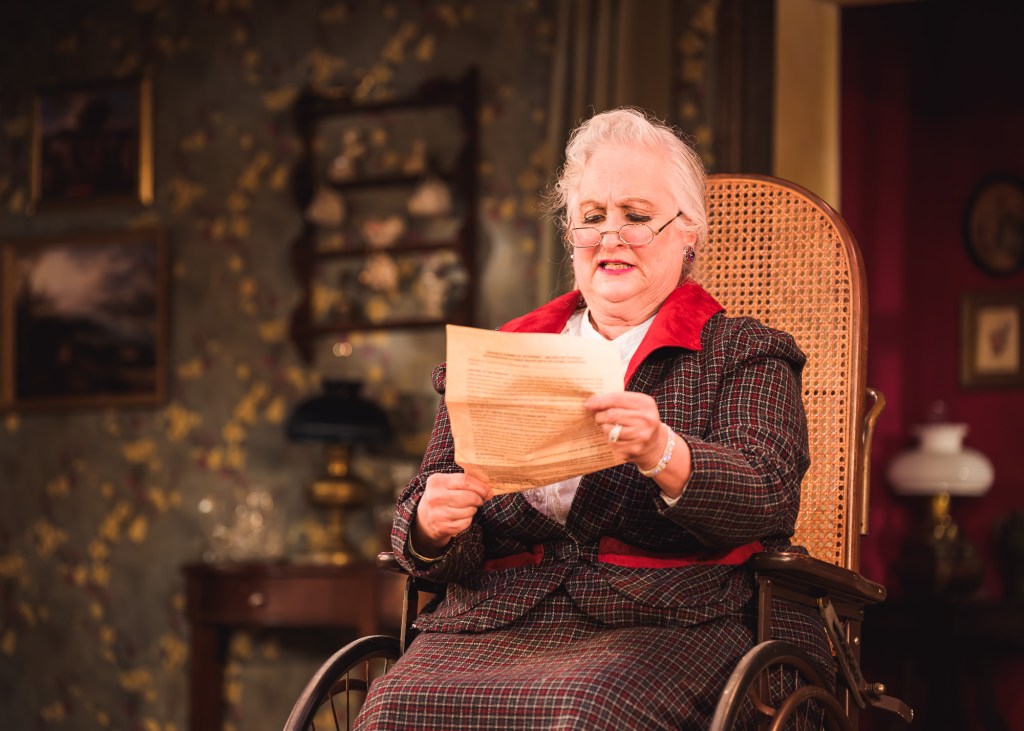
The story is set in the isolated country home of Mrs. Bramson (Jacqueline Jones). A woman of means, we are never told precisely where here supposed fortune came from, but we do know that she is spoiled and entitled, ruling over her small estate from the confines of her wheelchair. She keeps piles of cash in a safe in her home.

Mrs. Bramson is attended by her niece, the apparently oppressed Olivia Grayne (Sara Dabney Tisdale, a visiting nurse, Nurse Libby (Maggie Jordan), an outspoken, seasoned cook, Mrs. Terrence (Kathy Parker) who provides most of the play’s much needed humor, and a timid young maid, Dora Parkoe (Madison Cox) whose unplanned pregnancy sets the whole drama in motion.

Supporting characters also include Inspector Belsize (Adam Mincks) who provides the voice of reason in the midst of chaos, and Hubert Laurie (Michael Blackwood), Olivia’s safe but boring suitor whose proposals of marriage she repeatedly rejects.

And then there is Dan (Matt Hackman), an oddly charismatic but apparently undisciplined young man who charmed first Dora and then, in quick succession, wins over the grumpy and manipulative Mrs. Bramson and her wary niece Olivia. One thing I still find puzzling is how Dan wormed his way into the good graces of Mrs. Bramson. Is flattery all it takes to get a spoiled, entitled elderly hypochondriac to accept you into her home? Night Must Fall has been popular enough since 1935 to have been adapted into at least three filmed versions (1937, 1954, and 1964), but accepting Dan requires more of a suspension of belief than I am willing to give up. Nevertheless…here we are.

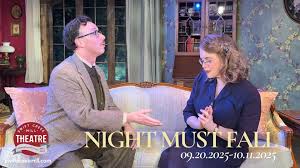
Dora is pregnant. She names Dan as the father. Mrs. Bramson summons Dan to her home with the intention of persuading him to immediately marry Dora. But then we learn of a woman who turned up missing from a nearby hotel – the same place where Dan was working. It isn’t long before “missing” becomes “murdered” and the headless body is soon found in a rubbish bin on the edges of Mrs. Bramson’s property. Suspecting Dan may be involved, Olivia, Hubert, and the servants search through Dan’s belongings, coming up empty handed – except for a hatbox that is sealed shut, and whose contents are never revealed.

What follows the search is a cat and mouse game of manipulation, mind control, and misdirection. The final scene, in which Dan comes completely unraveled, leaves the audience shaken and many questions unanswered. What did the main characters know and when did they know it? What was Olivia’s role in what happened to her aunt? How is it that everyone left Mrs. Bramson alone on that fateful night? What did Mrs. Terrence and Dora know? Why did they come back? What was the significance of that final embrace? And was Dan’s maniacal laugh for show or a genuine manifestation of madness?

There is a lot to unpack in this show, and one can sit back and enjoy the ride or get lost in the labyrinth – or both. Jacqueline Jones was the perfect choice to play Mrs. Bramson. I immediately thought of her when I first heard the title and learned a little bit about the play. She is one of the few people who can make us feel compassion for this otherwise unlikeable and worrisome character.

Sara Dabney Tisdale caught me off guard with her character’s turn, and Kathy Parker’s droll humor kept things from descending too deep into the pits of hell where morality and mental stability seemed to have lost all touch with reality.

Matt Hackman’s turn as Dan was the most profoundly disturbing of all. Granted, he was under suspicion from the beginning, but he exposed new levels of depravity. Hackman’s portrayal of Dan reminds me of one of my favorite lines of all time, when I heard the late comedian Richard Pryor say, “Who are you gonna believe, me or your lying eyes?” After seeing Night Must Fall, you may question everyone and everything for a few days or weeks…

Oh, just one more thought: the title. Night Must Fall implies a sense of the inevitable, a sense of impending doom. It foreshadows an ominous warning of evil and darkness and reveals the psychology of fear and the night. And rightfully so. For all you thrill-seekers: a secluded British cottage; a dead body in the woods; a strange visitor at the door…and night must soon fall.

———-

Julinda D. Lewis is a dancer, teacher, and writer who was born in Brooklyn, NY and now lives in Eastern Henrico County. When not writing about theater, she teaches dance history at VCU and gentle impact dance fitness classes to seasoned movers like herself and occasionally performs. Julinda was recently awarded the Dean’s Distinguished Adjunct Faculty Award 2023-24 Academic Year by VCU School of the Arts and the 2025 Pioneer Award in Dance Ministry by Transformation International Worship Ministries, Newport News, VA.

———-

NIGHT MUST FALL

By Emlyn Williams

Directed by John Moon

CAST

Mrs. Bramson – Jacqueline Jones

Olivia Grayne – Sara Dabney Tisdale

Nurse Libby – Maggie Jordan

Hubert Laurie – Michael Blackwood

Mrs. Terrence – Kathy Parker

Dora Parkoe – Madison Cox

Inspector Belsize – Adam Mincks

Dan – Matt Hackman

CREATIVE TEAM

Directed by John Moon

Scenic Design by Frank Foster

Lighting Design by Joe Doran

Costume Design by Maura Lynch Cravey

PRODUCTION STAFF

Producing Artistic Director – Tom With

Technical Director – Paul Howle

Scenic Carpenter – Peter Prout

Stage Manager – Sandy Lambert

Assistant Stage Manager/Props – Tom Width

Scenic Carpenter – Peter Prout

Light/Sound Board Operator – Brent Deekens

Set Crew – Peter Prout, Brent Deekens, Hunter Keck

Lighting Crew – Brent Deekens

Photographer – Photographer – Daryll Morgan

Costume Assistant – Alia Radabaugh

Time and Place:

The play takes place in the sitting room of Forest Corner, Mrs. Bramson’s bungalow in Essex, in 1935.

Run Time:

About 2.5 hours with 1 15-minute intermission

Tickets:

Regular $44-49. Discounts for Seniors, Military & Veterans

Photographer: Darryl Morgan

One-Time
Monthly
Yearly

Make a one-time, monthly, or annual donation to show your love and support of rvart review.

Make a monthly donation

Make a yearly donation

Choose an amount

$5.00
$15.00
$100.00
$5.00
$15.00
$100.00
$5.00
$15.00
$100.00

Or enter a custom amount

$

Your contribution is appreciated.

Your contribution is appreciated.

Your contribution is appreciated.

DonateDonate monthlyDonate yearly
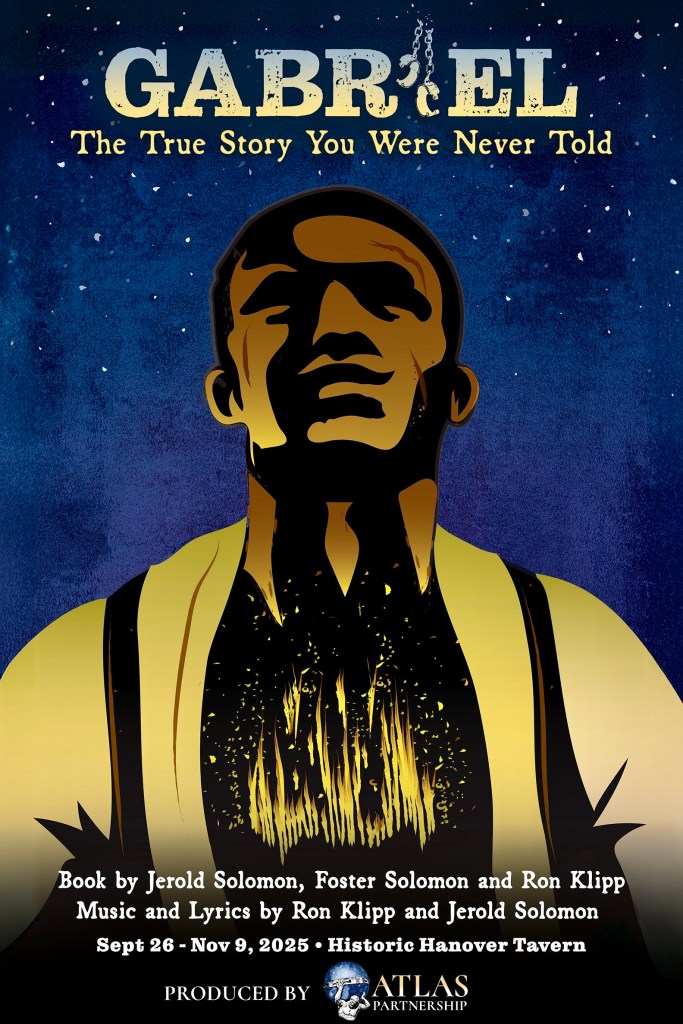
GABRIEL: The True Story You Were Never Told

“Death or Liberty”

A Reflection on a History-filled Theater Experience by Julinda D Lewis

Produced by: ATLAS Partnership

At: Hanover Tavern, 13181 Hanover Courthouse Rd, Hanover VA 23069

Performances: September 26 – November 9, 2025

Ticket Price: $49

Info: (804) 310-3493 or https://www.atlaspartnership.org/projects/gabriel or gabrielticket.com

No Justice, No Peace

I Can’t Breathe

Say Their Names

Black Lives Matter

Lost, Buried, Forgotten

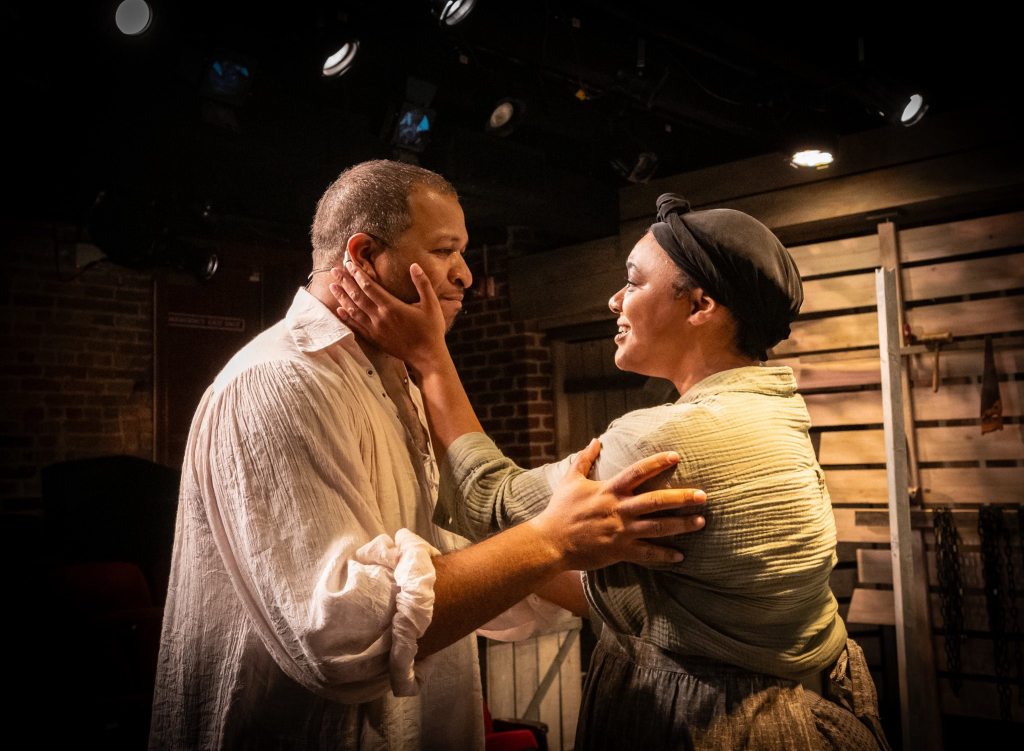
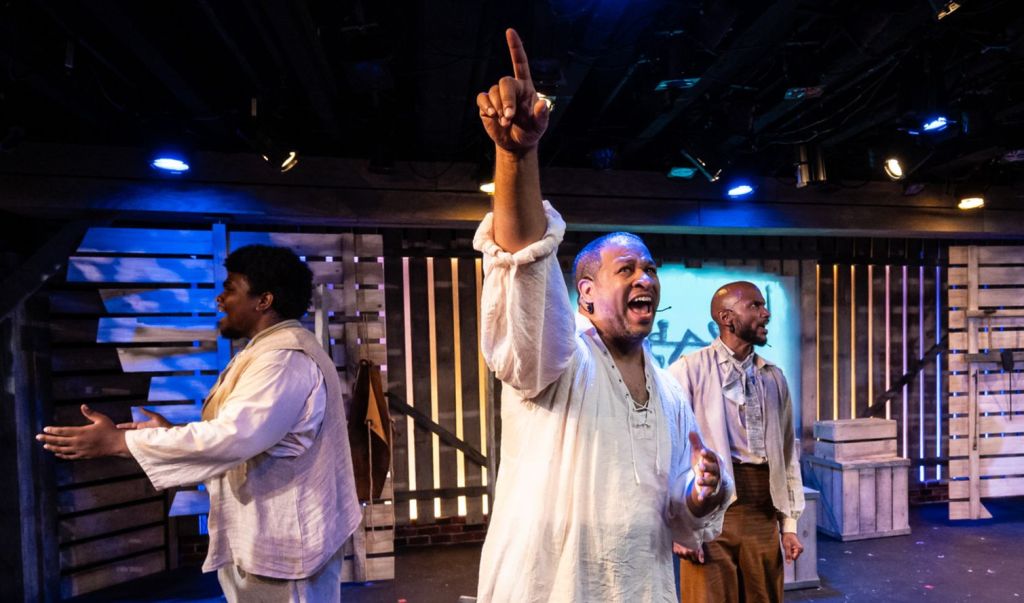
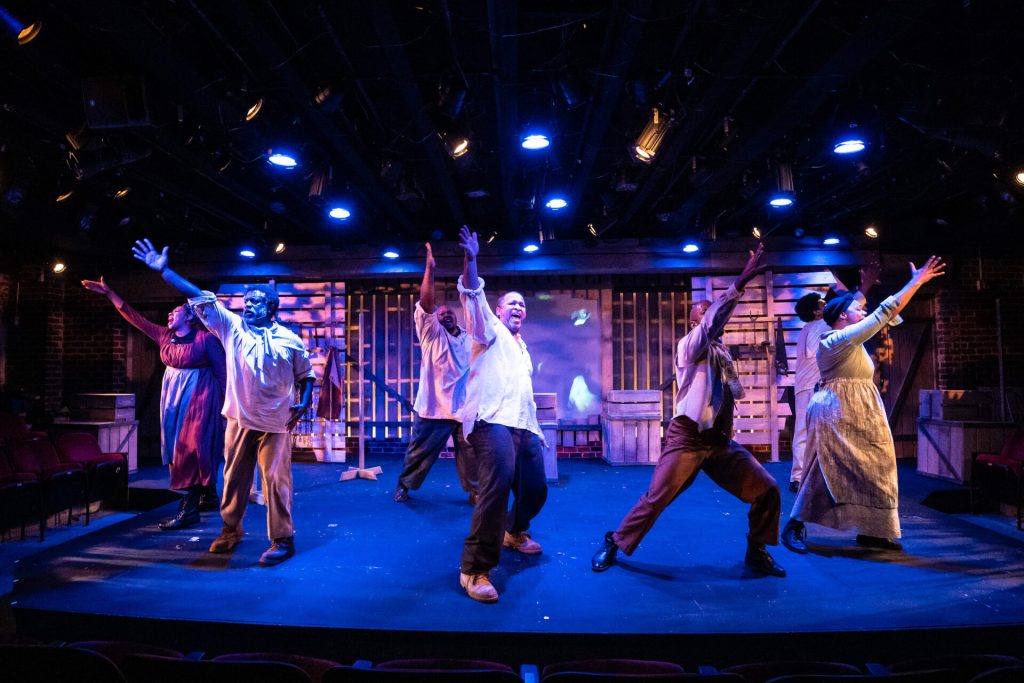
Gabriel: The True Story You Were Never Told, is a powerful deterrent to Lost, Buried, Forgotten. To borrow a tagline from another historically oppressed group of people, Never Forget! Gabriel’s Rebellion of 1800 was such a devastating event that, as co-author and director Foster Solomon says in his Director’s Note, “in its aftermath the government began an active campaign to wipe all knowledge of it from history.” And as we all know, history repeats itself…

Near the end of this fleshed-out and wonderfully revised musical, James Monroe, Governor of Virginia from 1799-1802, insists that Gabriel – pardon me, General Gabriel – needs to be silenced, not because he is dangerous, but because he is right. Just let that sink in a moment – and then reflect on current headlines…In a powerful scene that is as hilarious as it is tragic, a shackled General Gabriel recites Monroe’s own words, striking him with reason and the evidence of his own contradiction.

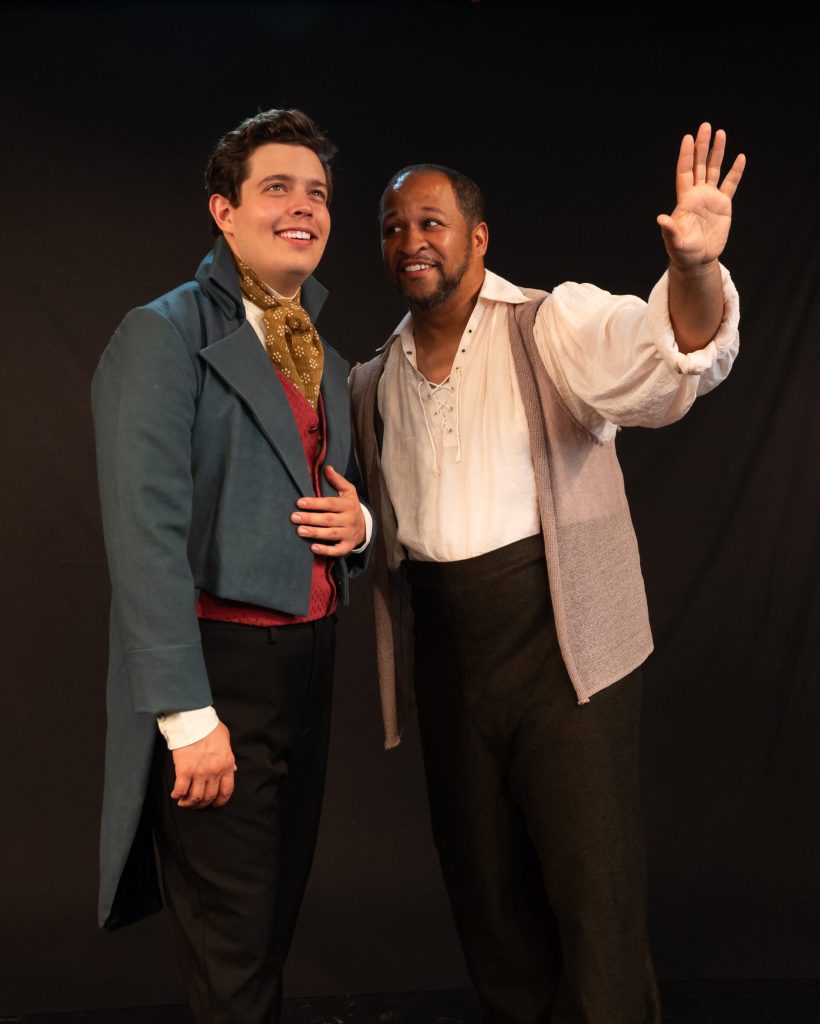
Monroe, you see, was a staunch advocate of liberty, independence, and a free and educated populace. He served under General George Washington and took a bullet in the shoulder during the Battle of Trenton in 1776. But he, like other founding fathers, believed these ideals applied only to white people. Enslaved people made it possible for him and his family to live in prosperity.

After Gabriel’s Rebellion in August 1800, Monroe encouraged the passage of harsh laws that severely restricted educational opportunities for Black people, the ability of Black people to assemble together, and the movement of free and enslaved Black people within the Commonwealth of Virginia. As a two-term US President (1817-1825) and with the help of the American Colonization Society, Monroe encouraged the “resettling” of free Black Americans to West Africa and used government funds to establish a settlement there which became the nation of Liberia. The capital, Monrovia, was named for him. There’s more, so much more, but let’s talk about Gabriel: The True Story You Were Never Told.

Bracketed by opening and closing scenes of people wearing Black Lives Matter tee-shirts and carrying protest signs, Gabriel resurrects and honors the story of General Gabriel, leader of the largest insurrection of enslaved people in the Commonwealth of Virginia. It was surpassed in size and effect, I believe, only by the Haitian Revolution in the Colony of Saint-Domingue on the island of Hispaniola (1791-1804) and the German Coast Uprising of January 1811 in Louisiana. The Haitian Revolution successful abolished slavery, but at great cost; the people of Haiti have yet to recover from the economic devastation visited upon them by the government of France. A militia and the US Army suppressed the Louisiana Rebellon, leaving the heads of some of the insurrectionists displayed on poles as a warning against future rebellion.

This is not a happy, care-free musical. This is the story of how an enslaved blacksmith – a literate Black man who had learned to read and write alongside the son of his master – became the leader of a movement to end slavery in Virginia. Gabriel’s plan extended over ten counties and the cities of Richmond, Norfolk, and Petersburg. His people had weapons – handmade scythes and muskets they planned to obtain from the prison armory in Richmond. If not for a torrential rainfall the night the plan was to executed and the betrayal of two enslaved men, hoping to obtain leniency and their own freedom, who knows how the history of slavery in Virginia and the US might have been changed on that fateful night.

One of the authors, Jerold E. Solomon, plays the role of General Gabriel, an initially reluctant leader whose story, once lost, buried, forgotten, is being retold and taking on even greater significance in light of the chaotic political climate of 2025. One thing of many that stands out is that Solomon does not strut about and puff out his chest as the leader. Instead, he is humble, reluctant, reflective, and admittedly imperfect. This stands in stark contrast to the role of Thomas Prosser, Jr., owner of the Henrico County plantation where Gabriel resides. Joshua Mullins plays the role of Prosser, Jr. with a permanent smirk on his face.

While, at first, we are led to believe that the young Prosser, unlike his father, has some sympathy for the enslaved people under his care, it gradually becomes clear that he was not only weak but complicit and a supercilious liar. Coupled with the portrayal of young Prosser’s fiancée, Lucy (Rebekah Nogueira) as more of a “man” in the patriarchal, arrogant meaning of the word than he will ever be, the white characters are portrayed almost as caricatures, while the enslaved people are more rounded, more nuanced.

Young Prosser is obligated to please first his father then his fiancée and future father-in-law, a judge who presides over the slave courts. Lucy is entitled and steeled for battle; she always gets her way, and her way, as a woman who had barely more legal standing than a Black man in 1800, was to bully her father and fiancé. Both Nogueira and Mullins give excellent performances, but neither character has any redeeming qualities and while separately they are despicable, together they are unbearably cruel. The irony of Mullins singing abut being free was not lost on me – or the rest of the audience for that matter. Great acting, because at the end of the show, I did not want to see either of them; I am sure I would have reacted with disgust!

Among the show’s standouts is David Watkins who played the role of Jack Ditcher, Gabriel’s second-in-command. Watkins is no stranger to Richmond stages, having appeared in Detroit 67 (Firehouse) and Satchmo at the Waldorf and War in Pieces (both Virginia Rep), but something about him seemed so familiar. His fire-stirring speeches to the initially reluctant Gabriel, whom he meets in prison, are essential to the movement of the plot – both literally and figuratively. His admonition to Gabriel to “stoke the fire, feed the flames” was soul-stirring.

But the performance that was really earth-shaking, for me, was given by Zakiyyah Jackson, who plays Gabriel’s love interest and helpmeet, Nanny. Jackson, who did herself proud in both the Artsies-award winning How Black Mothers Say I Love You (2023) and the more recent Strange Loop (2025), both at Richmond Triangle Players truly outdid herself. Her singing was clear, shattering, heartfelt. She did say, during the opening night reception, that she had been under the weather during A Strange Loop, but this is one of her strongest performances ever. Bravo!

The cast was rounded out by Dale R. Heiskill as Gabriel’s brother Martin, Sydney Graves as Nanny’s siter Delia, and Cameron Caple and Taesean Blanding as Ben and Billy, respectively – young Black men on the plantation. Robert Fix filled the aristocratic shoes of Gov. Monroe while Michael (Mac) McMullen filled the roles of Absalom Johnson (the white man Gabriel was tried for assaulting) and Captain Taylor (who carried Gabriel to a short-lived safety in Norfolk after the failed insurrection) while Rachel Rose Gilmour played the role of Lucy’s (only?) friend and Richmond theater veteran Bev Appleton covered the roles of Thomas Prosser Sr and Lucy’s father, the Judge.

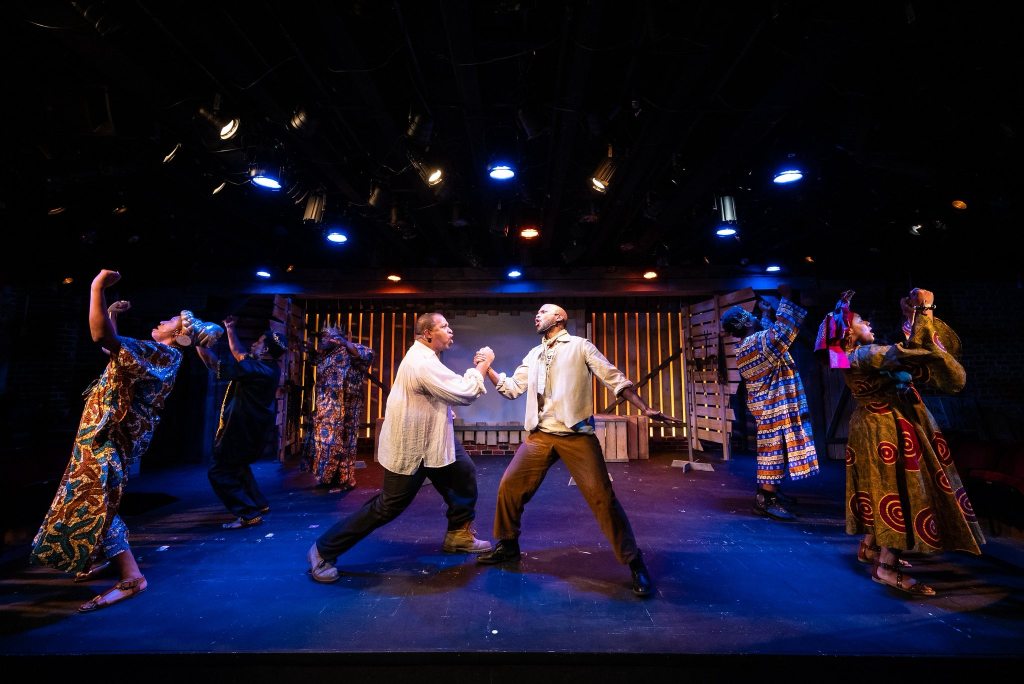
Chris Raintree created a simple, functional set of rough wooden slats that defined Gabriel’s blacksmithing shop and boxes that transformed into all the other furniture needed. This set was beautifully lit by Alleigh Scantling, enhanced Dasia Gregg’s projections, and ensconced in a soundscape designed, I presume, by audio advisor Ron Sinko. Leslie Owens-Harrington, whose choreography has been too-long absent from Richmond stages, contributed movement that was at times organic, at times warrior-like, and sometimes – as when the host of ancestors appeared, entering through all the aisles – reverent.

But this is a musical, and the music was a key component. As I have already stated, the vocals were often memorable, sometimes soaring into the operatic range, but the instrumentals were a constant support and, at times, I wish the band had been visible.

Keith Walker and Sue Griffin dressed the cast to emphasize the sense of opposition. The white people wore beautiful fabrics with neat stitching while the enslaved population wore plain, drab, rough-hewn fabrics. In scenes where the African ancestors appeared, however, the cast was adorned with Kente and brightly colored African prints accessorized with gold jewelry, elaborate head wraps, and even crowns.

The location of the production became an integral part of the show when it was revealed that Hanover Tavern had once housed seven of Gabriel’s followers. Historic signs in the lobby provide additional background, including details of Gabriel’s betrayal by another enslaved man on board the three-masted schooner, Mary, en route to Norfolk on the night of August 30, 1800, the subsequent trials, resulting in twenty-six of the conspirators being condemned to death by hanging – for which the enslavers required reimbursement! – and the steps taken to suppress any further attempts to end slavery. Before his death, one said: “I have nothing more to offer than what General Washington would have had to offer, had he been taken by the British and put to trial by them. I have adventured my life in endeavouring to obtain the liberty of my countrymen and am a willing sacrifice in their cause: and I beg, as a favour, that I may be immediately led to execution. I know that you have pre-determined to shed my blood, why then all this mockery of a trial?”

Death or Liberty.

They meant what they said, and they said what they meant.

—–

NOTE: Read my article, “Gabriel’s Song” for Richmond Magazine, September 9, 2022 https://richmondmagazine.com/arts-entertainment/stage-screen/gabriel-firehouse-theatre/

—–

Julinda D. Lewis is a dancer, teacher, and writer who was born in Brooklyn, NY and now lives in Eastern Henrico County. When not writing about theater, she teaches dance history at VCU and low impact dance fitness classes to seasoned movers like herself and occasionally performs. Julinda was recently awarded the Dean’s Distinguished Adjunct Faculty Award 2023-24 Academic Year by VCU School of the Arts and the 2025 Pioneer Award in Dance Ministry by Transformation International Worship Ministries, Newport News, VA.

—–

GABRIEL: The True Story You Were Never Told

Book by Jerold Solomon, Foster Solomon, and Ron Klipp

Music and Lyrics by Ron Klipp and Jerold Solomon

CAST

Gabriel – Jerold E. Solomon

Thomas Prosser, Jr. – Joshua Mullins

Nanny – Zakiyyah Jackson

Ditcher – David Watkins

Lucy – Rebekah Nogueira

Martin, u/s Gabriel – Dale R. Heiskill

Delia, u/s Nanny – Sydnee Graves

Gov. Monroe – Robert Fix

Ben, u/s Billy – Cameron Caple

Absalom Johnson/Captain Taylor, u/s Thomas Jr – Mac McMullen

Thomas Prosser Sr/Judge – Bev Appleton

Ensemble, u/s Lucy – Rachel Rose Gilmour

u/s Gov Monroe, Prosser Sr, Absalom, Captain Taylor – Matt Bloch

u/s Delia – Jianna Hurt

MUSIC

Music Director, Conductor, Keyboards – Ron Klipp

Assistant Music Director – Billy Dye

Drum/Percussion – Bentley Cobb

Guitar – Jeff Lindquist

PRODUCTION TEAM & CREW

Director – Foster Solomon

Resident Historian – Prof. Ana Edwards

Pastoral Advisor – Rev. Dr. Rodney D. Waller

Set Design – Chris Raintree

Co-Costume Design – Keith Walker & Sue Griffin

Lighting Design – Alleigh Scantling

Audio Advisor – Ron Sinko

Choreography – Leslie Owens-Harrington

Music Direction – Ron Klipp

Projection Design – Dasia Gregg

Technical Director/Production Management – Bill Jenkins

Stage Management – Shawanna Hall

Assistant Stage Management – Tariq Karriem

For This Production:

Light Board Operator: Shawanna Hall

Sound Board Operator: Steve Jones

Sound Board Operator Standby: Mike Jones

Wardrobe Assistant: Tariq Karriem

House Manager: Gina Maria McKenzie, Aubrey Mitten

Hanover Tavern Executive Director: David Deal

Hanover Tavern Associate Director: Brooke Adams

Performance Schedule:

September 26 – November 9, 2025. Previews Sept 26, 28 & Oct 2. Opening Night October 3. Performances Thursdays, Fridays, Saturdays @7:30PM and Sundays @3:00PM. Pay What You Will October 9. Wednesday Matinee October 22 @2:00PM

Tickets: $49. Group Discounts available.

Information: (804) 310-3493 or https://www.atlaspartnership.org/projects/gabriel or gabrielticket.com

Run Time: about 3 hours, with one 15-minute intermission

Setting: Thomas Prosser’s Plantation in Henrico County, VA and in and around Richmond, VA and Norfolk, VA, 1799-1800

Premiere: Gabriel the Musical was originally developed and produced at Firehouse Theatre, Richmond, VA, September 2022. https://richmondmagazine.com/arts-entertainment/stage-screen/gabriel-firehouse-theatre/

Photos: Aaron Sutton

One-Time
Monthly
Yearly

Make a one-time, monthly, or annual donation to support rvart review

Make a monthly donation

Make a yearly donation

Choose an amount

$5.00
$15.00
$100.00
$5.00
$15.00
$100.00
$5.00
$15.00
$100.00

Or enter a custom amount

$

Thank you! Your contribution is truly appreciated.

Your contribution is appreciated.

Your contribution is appreciated.

DonateDonate monthlyDonate yearly
LONG DAY’S JOURNEY INTO NIGHT

Family Dysfunction as Fine Art

A Theater Reflection by Julinda D Lewis

Presented by: Cadence Theatre

At: Firehouse Theatre on the Carol Piersol Stage, 1609 W Broad St., RVA 23220

Performances: September 26 – October 11, 2025

Ticket Prices: $5-$40

Info: (804) 233-4894 or (804) 355-2001 or firehousetheatre.org

Where to begin?

Eugene O’Neill’s Long Day’s Journey into Night stands out as a hauntingly authentic exploration of family bonds, dysfunction, addiction, and shadows from the past. From the very first moments, the play immerses the audience in a poignant portrayal of the Tyrone family, using the power of simplicity. Taking place over the course of a single summer day at the Tyrone family’s Connecticut summer home, O’Neill reveals the family’s struggles with personal demons and the inescapable grip of regret. He also reveals these things about his own family as the Tyrone family finds parallels in O’Neill’s own parents, himself and his older brother. Whereas most authors advise that the names do not reflect real people, O’Neill has borrowed freely from his own family tree – shifting and borrowing, but using real names, nonetheless.

Messiness aside, O’Neill’s masterful use of language and his rich character development invites viewers to immerse themselves into the complexities of love and despair, presenting a work that is simultaneously unsettling and profoundly relatable. Each character feels like a reflection of O’Neill’s own experiences – because they are. This personal history adds layers of authenticity to a narrative that is both a personal tragedy and a universal commentary on the human condition.

Long Day’s Journey into Night was written 1939-1941 but was published posthumously and first performed in February of 1956, more than two years after O’Neill’s death (October 16, 1888 – November 27, 1953). It is considered by many to be the author’s master work and earned a Tony award for Best Play and a Pulitzer Prize for Drama.

The title, though? Some believe it refers to the setting of play, taking place over the course of a single summer day. The play opens just after the Tyrone family has completed breakfast and concludes in the evening, after dinner. Others say the title refers to the literal passage of time, from morning to evening. Summer days are longer than others, as far as hours of daylight. Then, of course, there is the metaphorical meaning that says the title refers to the family’s descent into the darkness of despair. This explanation focuses on the symbolism of the family’s journey through addiction, regret, and blame, moving from a false sense of hope in the morning to a bleak, unresolved midnight. This explanation also suggests the characters’ individual and collective journeys back in time as they resurrect past hurts and relive their failures, making the day seem to stretch out in a cyclical fashion, like a vintage Groundhog Day. There is also the long day for the audience, as the play runs approximately four hours, including two ten-minute intermissions.

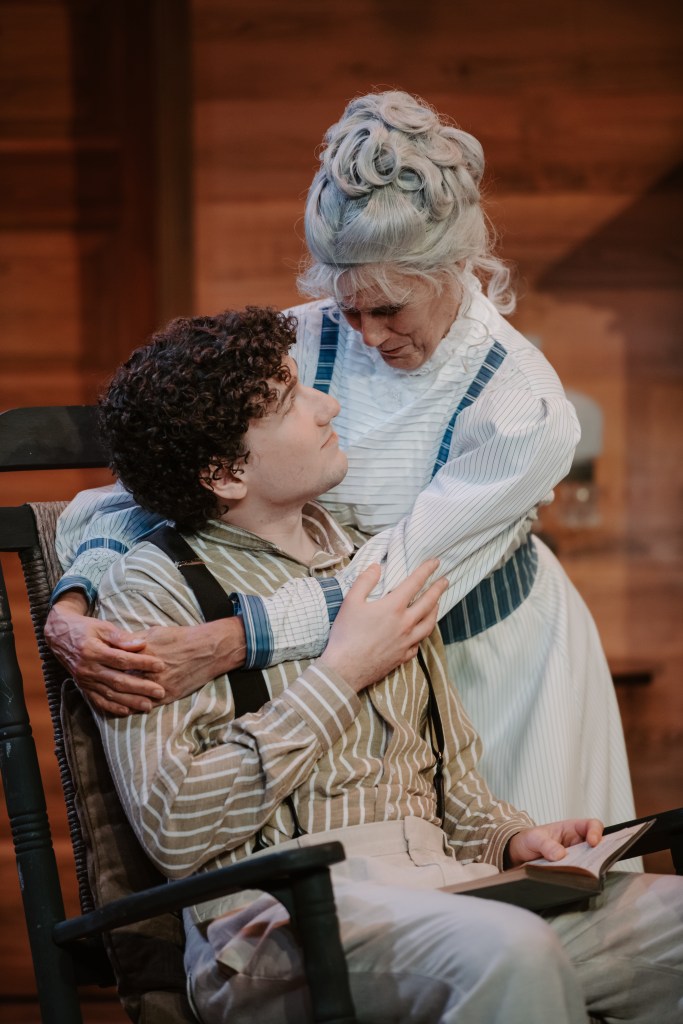
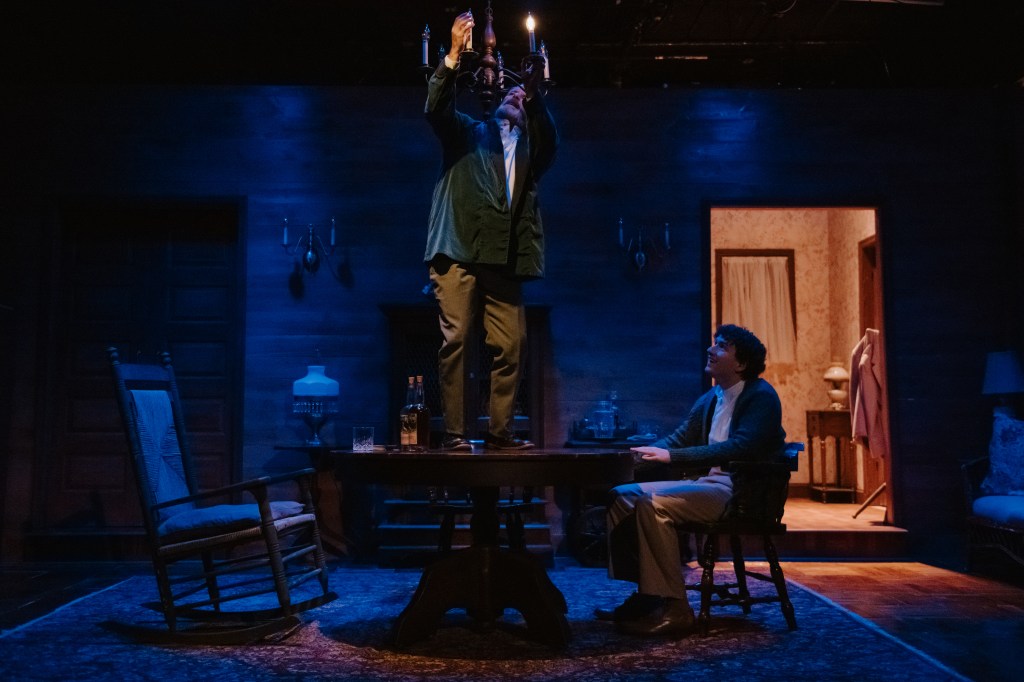
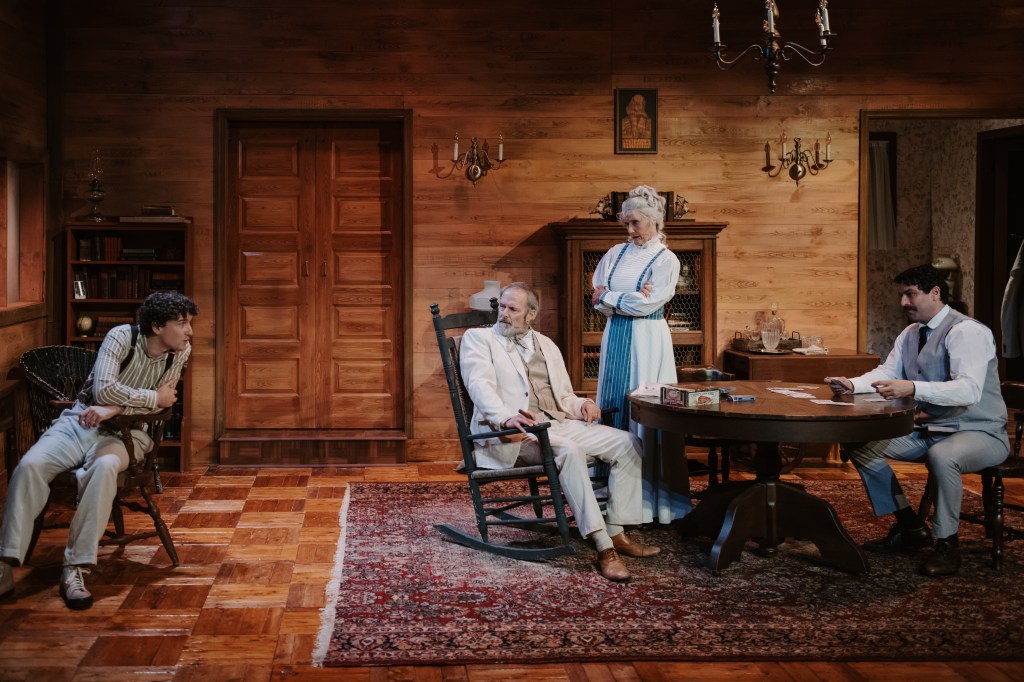
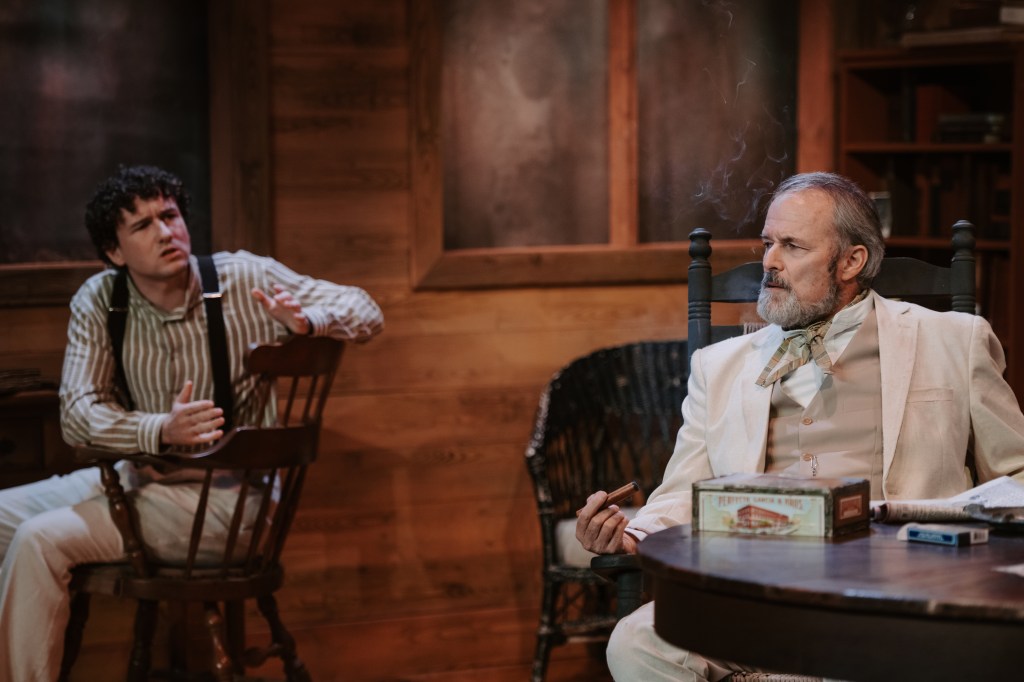
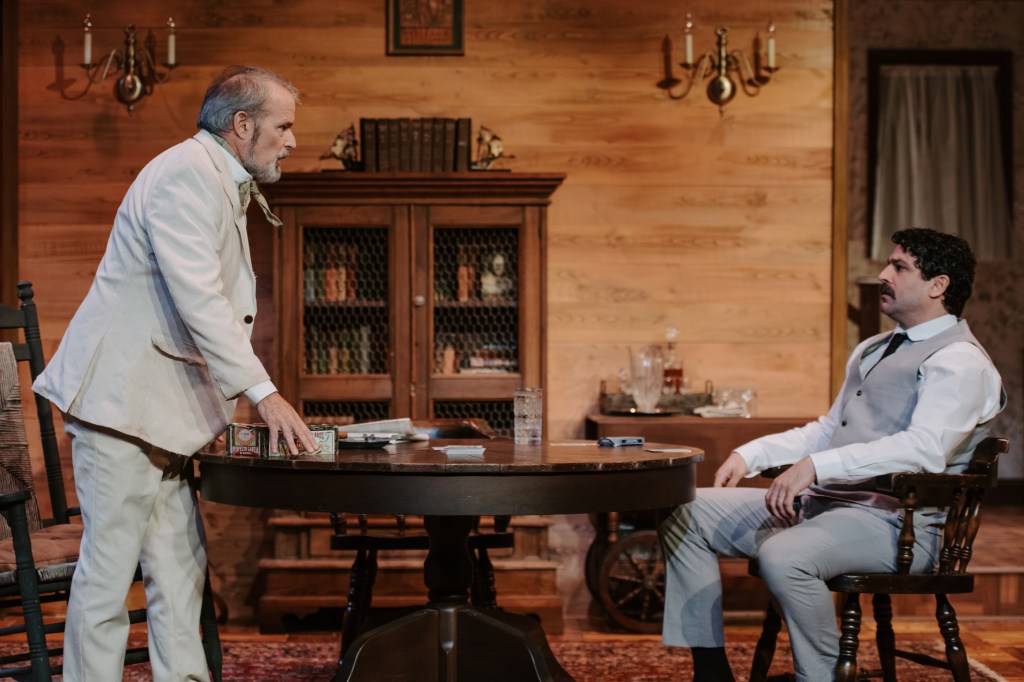
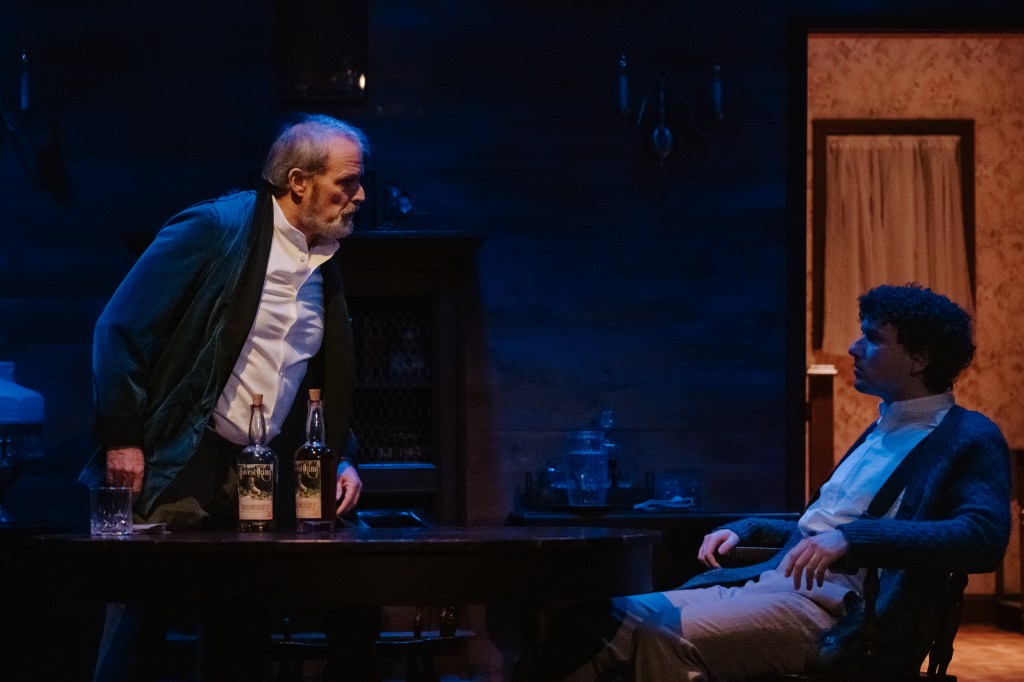
Long Day’s Journey into Night is difficult to watch – and not just because it’s long. There is the subject matter, which might be triggering for some. The father, James Tyrone, was a successful but now fading Irish-American actor who dabbles in real estate investment, drinks too much, and is somewhat of a miser. In one hilarious scene he climbs atop a table to twist on the bulbs of a chandelier because his son complained about his miserly ways. He had been sitting under the light of a single bulb to save money. (In retrospect, I wonder if he rotated the lit bulb, so they would burn out evenly…) Another humorous moment occurs when James suddenly becomes aware that his sons have been watering down his prized whiskey. Matt Radford Davies plays the domineering, frayed at the seams actor with apparent ease and reveals the positive and negative aspects of James’ personality is a way that paints him as neither all villain nor all hero. It feels as if Davies has walked in Tyrone’s/O’Neill’s’ shoes, or at least tried them on long enough to absorb their essence.

Mary, the mother, has a mysterious illness that is alluded to throughout the first act but never confirmed until about the midpoint of the play. This brings up another triggering idea – the medical negligence of women, especially pregnant women – as well as the prevalence of addiction to prescription pain killers. Yes, even in 1912, when this play was set. Robin Arthur’s erratic movements, her repetitious dialogue, her fixation with her hair, her obsessiveness in regard to her younger son, and her aggressively mysterious demeanor make sense as the source of her pain is revealed.

“I know you still love me in spite of everything.” – Mary

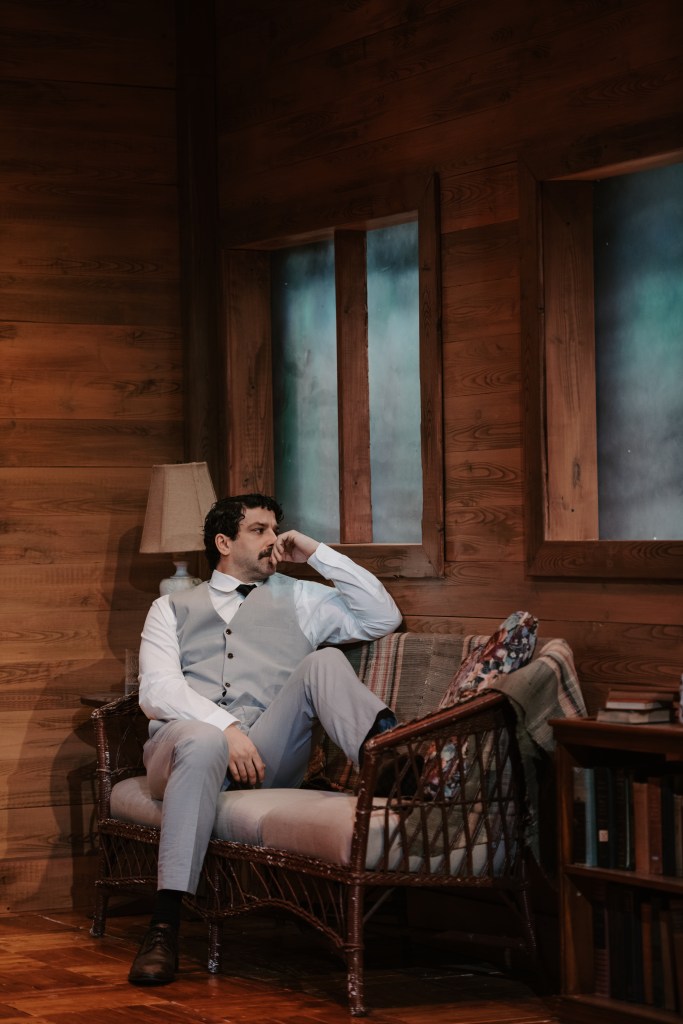
Jamie Tyrone, the elder son, is an actor, like his father. He drinks too much, like his father. But unlike his father, he lacks ambition and a sense of purpose. Axel Burtness is well cast in this role, and shines best in a scene where Jamie warns his younger brother that, as much as he loves him, he will try to sabotage him and wreck any success or happiness that may come his way.

Edmund, the younger son, has a double burden. Unknowingly, he was a replacement baby, conceived to replace a baby who died of measles that may have been intentionally passed on to him. It was this birth that triggered Mary’s constant pain and need for medication. To make matters worse, Edmund has contracted consumption – another name for tuberculosis. (It was called consumption because the illness sometimes seemed to consume the individual who had it.) This, of course, makes Mary even more depressed. Trace Coles brings just the right balance of innocence and defiance.

“Who wants to see life as it is if you can help it?” – Edmund

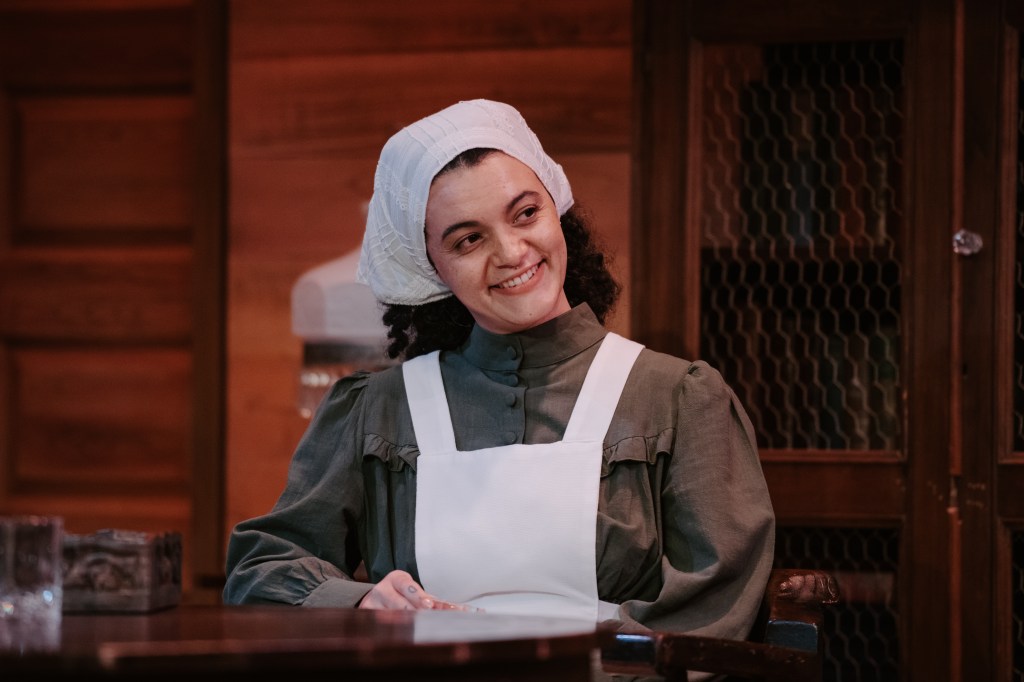
While several other characters are mentioned, no others make an appearance onstage other than Cathleen the maid. Ruby Joy Garcia’s role seemed headed in the direction of stereotypical household help, until the day Mary invites her to sit and keep her company – and have a drink. The elevates Garcia’s role (i.e., status) both literally and figuratively and brings more depth to her character. The moment when the whiskey emboldens her to talk back is a priceless gem.

Both sons, given enough to drink, are prone to spouting poetry and lines from Shakespeare – or Baudelaire, or Ernest Dowson, or Algernon Charles Swinberg.

“Be drunk with wine, with poetry, with virtue.” Charles Baudelaire

Long Day’s Journey into Night is a deeply impactful play, and like any work of art, it reveals both positive and negative aspects. On the plus side,  O’Neill has given us rich, complex, multi-dimensional characters that resonate with many audience members. The play masterfully explores themes of addiction, illness, and family dysfunction. Allowing his audiences to connect with the characters on a personal level. Then there is the frequent use of beautiful and poignant poetic language. This elevates the dialogue and the overall experience. The play’s universal themes of regret, love, and the search for redemption all speak to fundamental human experiences, making it a timeless work that continues to resonate with new generations. A long with that, the infusion of O’Neill’s personal experiences adds depth and authenticity, providing a unique perspective on the struggles of addiction and family dynamics.

On the other hand, the subject matter is extraordinarily heavy. The play’s themes can be quite dark and may make the play emotionally challenging for some viewers, particularly those who have experienced similar issues in their own lives. Then there is the matter of the four-hour runtime and a slower pace may not engage all audiences, potentially making the play feel lengthy, especially for those unfamiliar with dramatic theater. I would not bring someone to see this play as their introduction to live theater.

Finally, the overall atmosphere of the play is often somber, which may leave some viewers feeling overwhelmed or despondent rather than uplifted. The intricate exploration of relationships and personal struggles requires careful attention and may lead to reflection or revelations, which could be challenging for some audience members – and perhaps to the actors as well. While it’s a vital aspect of the narrative, the portrayal of addiction might be unsettling for some, as it reflects painful realities that all too many face in reality.

So, while Long Day’s Journey into Night is a masterful exploration of complex themes and relationships, that is beautifully acted and well directed by Rusty Wilson, it also presents its audience with challenges due to its heavy emotional weight and slow pacing – and it’s not that the pace is too slow, the pacing is an accurate depiction of real time, a time, perhaps, when people were not as rushed because they didn’t have or expect near instantaneous results to their queries and problems as we have come to expect due to technology.

Long play, long reflection. Bottom line, if you’ve never seen it, put it on your bucket list. I’m a theater nerd, a theater junkie, so I was excited to take in the author’s language, Daniel Allen’s shabby-genteel set, and Nancy Coles’ period costumes. But on the other hand, I did not tell my husband ahead of time exactly how long it was going to be…

—–

Julinda D. Lewis is a dancer, teacher, and writer who was born in Brooklyn, NY and now lives in Eastern Henrico County. When not writing about theater, she teaches dance history at VCU and low impact dance fitness classes to seasoned movers like herself and occasionally performs. Julinda was recently awarded the Dean’s Distinguished Adjunct Faculty Award 2023-24 Academic Year by VCU School of the Arts and the 2025 Pioneer Award in Dance Ministry by Transformation International Worship Ministries, Newport News, VA.

—–

LONG DAY’S JOURNEY INTO NIGHT

Written by Eugene O’Neill

Directed by Rusty Wilson

CAST

James Tyrone – Matt Radford Davies

Mary Cavan Tyrone – Robin Arthur

Jamie Tyrone – Axle Burtness

Edmund Tyrone – Trace Coles

Cathleen – Ruby Joy Garcia

PRODUCTION TEAM & CREW

Director – Rusty Wilson

Stage Manager – Joshua Kreis McTiernan

Assistant Stage Manager – Natalie Masaitis

Scenic Designer – Daniel Allen

Scenic Painter – Emily Hake Massie

Costume Designer – Nancy Coles

Lighting Designer – Steve Koehler

Sound Designer – Justice Craig

Sound Associate – Julie Vo

Fight Director – Aaron Orensky

Dialect Coach – Erica Hughes

Dramaturg – Alana Wiljanen

Set Decorator – Michael Maddix

Composer/Musician – Daniel Clarke

Director of Production – Todd LaBelle

Technical Director – Emily Vial

A/V Supervisor – Grace LaBelle

Running Crew – Terra Comer, Natalie Masaitis

Production Assistant – Terra Comer

Board Operator – Joshua Kreis McTiernan

Performance Schedule: Thursdays, Fridays, Saturdays @7:00PM and Sundays @2:00PM

Run Time: 4 hours with two10-minute intermissions

Setting: A summer day in August 1912 at the Tyrone family summer home in Connecticut.

Premiere: The play officially premiered at the Royal Dramatic Theatre in Stockholm, Sweden, February 10, 1956. O’Neill had wanted it to remain unpublished for 25 years after his death, but his widow overrode his wishes. The play opened on Broadway at the Helen Hayes Theatre on November 7, 1956.

Photos: Jason Collins Photography,Courtesy of Anna Senechal Johnson

One-Time
Monthly
Yearly

Make a one-time, Monthly, or annual donation to support Julinda & RVART Review

Make a monthly donation

Make a yearly donation

Choose an amount

$5.00
$15.00
$100.00
$5.00
$15.00
$100.00
$5.00
$15.00
$100.00

Or enter a custom amount

$

Your contribution no matter how small or how large is appreciated. Thank you.

Your contribution is appreciated.

Your contribution is appreciated.

DonateDonate monthlyDonate yearly
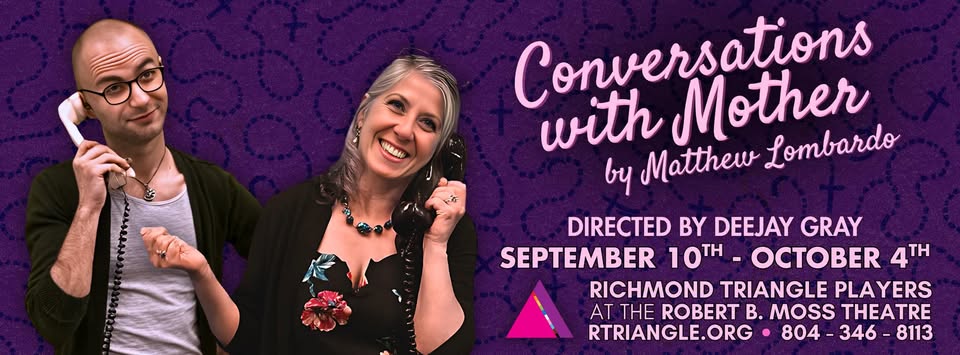
CONVERSATIONS WITH MOTHER 

“I gave you the things in me I didn’t even know I had.”

Presented by: Richmond Triangle Players  

At: Richmond Triangle Players at the Robert B. Moss Theatre, 1300 Altamont Avenue, RVA 23220 

Performances: September 10 – October 4, 2025 

Ticket Prices: $15-$50 

Info: (804) 346-8113 or rtriangle.org 

A Theater Review by Julinda D. Lewis 

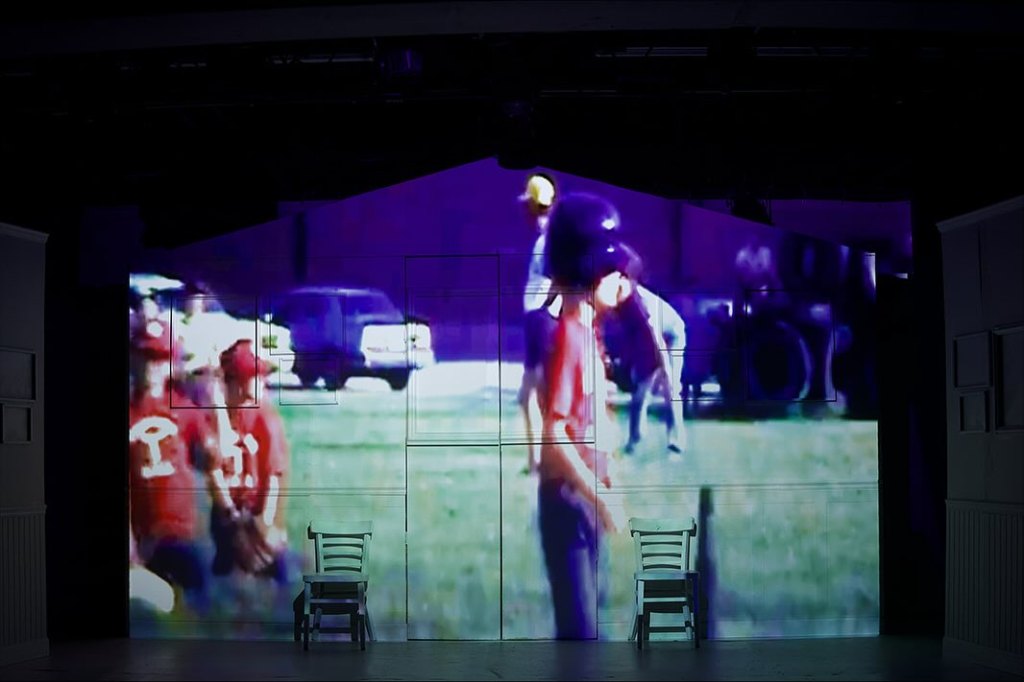
Conversations with Mother is a poignant semi-autobiographical play by Matthew Lombardo that explores the dynamics of a relationship between a fiercely loving and protective mother and her gay son. The story unfolds primarily through their conversations, with the aid of projected subtitles and grainy home movies. Conversations with Mother reveals and celebrates the complexities of love, generational differences, and the challenges of navigating the passing phases of five decades of a shared life. 

As in his play Who’s Holiday, his comedy about the adult Cindy Lou Who that has also graced the RTP stage, Lombardo masterfully balances comedy with real life – intense and unadorned, sometimes snot-nosed ugly. 

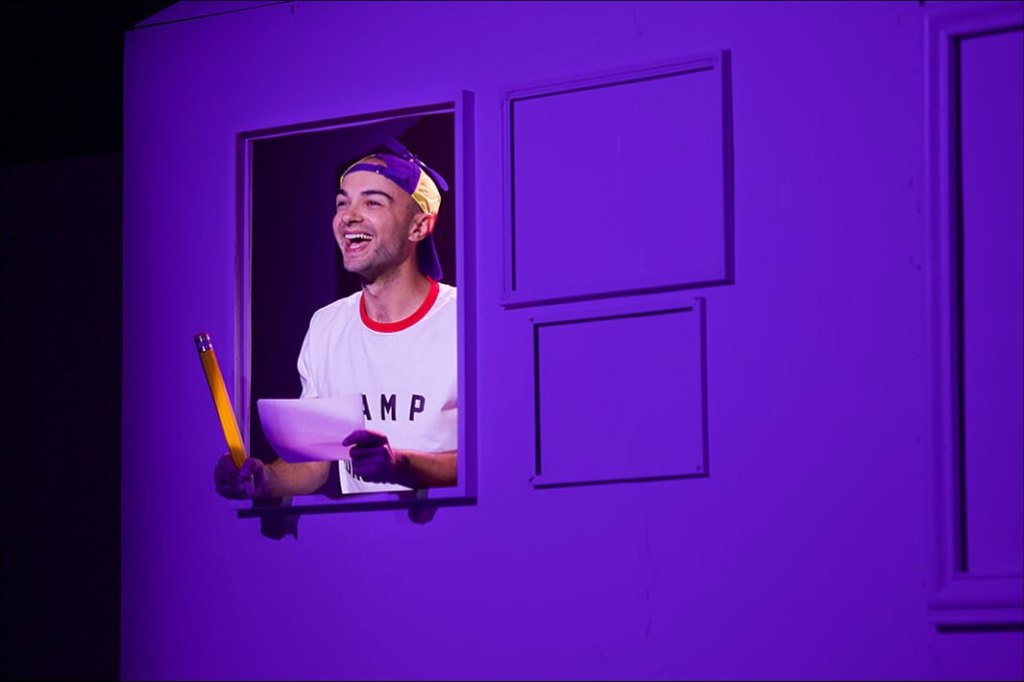
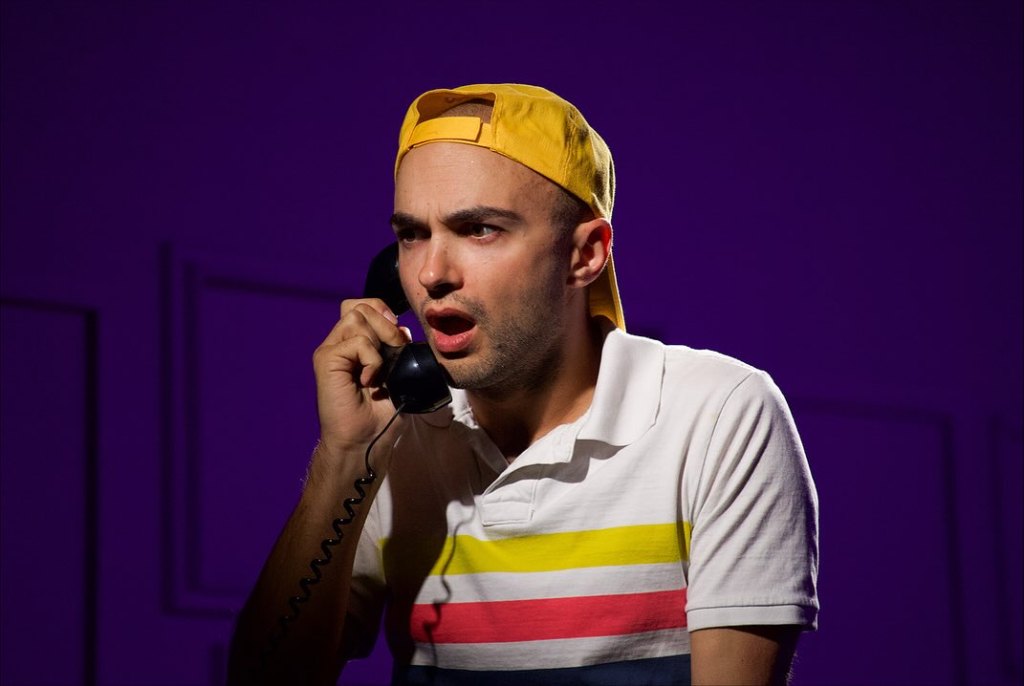
The son, Bobby Collavecchio played by Daniel Daigle, becomes a successful playwright, almost in spite of the roadblocks he erects in his own path. He grapples with bad relationships and writer’s block, drug addiction, and low self-esteem. The mother, Maria Collavecchio, played by Sarah Heifetz, is a strong-willed and traditional Italian matriarch (although I must confess that when she first began talking, I thought we were dealing with a Jewish mother – same character, different recipes…). A running line is, “tell me the truth and I won’t get mad.” Watching Heifetz’s face trying to master this enormous lie is one of the highlights of the play, which runs about 75 minutes with no intermission. 

Bobby and Maria’s dialogues oscillate between humor and deep emotion, reflecting their shared history, familial bonds, and sometimes conflicting perspectives. Maria is not above saying “No,” you can’t come home from camp early to her pre-adolescent son or showing up unannounced at her adult son’s New York apartment, ready to battle his abusive boyfriend. When he finally gets a play produced on Broadway, Maria sits quietly holding his hand, until she can’t contain herself and leaps from her seat screaming with mama bear pride. At one point when Bobby asks, “Do you still love me?” Maria answers truthfully, “Not at this moment.” But love is enduring. A mother’s love – this mother’s love – never fails. And there is hope and the essence of something just out of reach that we’re all seeking underlying every scene of Conversations with Mother

“Did you get a job yet?” 

Why can’t you ever meet a nice boy? 

“You know what the Germans are famous for? Baking people – like crescent rolls!” 

If everyone jumped off a bridge, would you? 

If your phone doesn’t ring, it’s me. 

“If Christ had chosen better friends, He wouldn’t have died so young!” 

“THAT’S MY KID UP THERE!!!” 

As the mother reflects on her life and values, the son confronts his own choices and the realities of adulthood until, one day, the roles are reversed. Then, it’s Maria saying she has something to tell him, and making him promise he won’t get mad. 

Throughout the play, Lombardo captures the essence of the mother-son dynamic, highlighting themes of memory, regret, and acceptance, but most of all, love. The interplay of comedy and drama serves to create a heartfelt narrative that resonates with anyone who has experienced similar familial ties – and perhaps even with those who have not. The play ultimately underscores the enduring nature of love and the bittersweet reality of growing older. I wasn’t ready for the depth of emotion, from laughing out loud to tears streaming down my face at the end. 

Daigle masterfully navigated the decades from the pre-adolescent Bobby to the mature adult facing the same shenanigans from his own son that he once showered upon his own mother. Heifetz captures the range of emotions of Bobby’s mother with amazing grace and agility – she’s outrageous without ever becoming a caricature. 

This is a work that does not need a lot of props or decor. The set is a simple background of window frames, a screen for projecting captions and video, and two chairs the actors move about as they pass from one decade to another, one geographical location to another (primarily New York and Connecticut).  

Kudos to the creative team, starting with director Deejay Gray (I could feel his hand in Daigle’s portrayal of Bobby). Luke Newsome’s hair and makeup were awesome, with a special nod to Mama Maria’s wigs and another hat tip to Amber Marie Martinez’ costumes (and the unseen hands that helped make all those lightning-fast changes). Maria’s outfits were so authentic…Lucien Restivo’s projections (assuming that includes the video work), Weston Corey’s lighting design, and Kelsey Cordrey’s subtle but effective sound design were all perfection.  

Conversations with Mother is a perfect example of a play that stands on the merit of its words and the actors and creative team who curate them into a production that creates beautiful, memorable theater. 

———- 

Julinda D. Lewis is a dancer, teacher, and writer who was born in Brooklyn, NY and now lives in Eastern Henrico County. When not writing about theater, she teaches dance history at VCU and low impact dance fitness classes to seasoned movers like herself and occasionally performs. Julinda was recently awarded the Dean’s Distinguished Adjunct Faculty Award 2023-24 Academic Year by VCU School of the Arts and the 2025 Pioneer Award in Dance Ministry by Transformation International Worship Ministries, Newport News, VA. 

One-Time
Monthly
Yearly

Make a one-time, monthly, or annual donation

Make a monthly donation

Make a yearly donation

Choose an amount

$5.00
$15.00
$100.00
$5.00
$15.00
$100.00
$5.00
$15.00
$100.00

Or enter a custom amount

$

Your contribution in any amount is appreciated. Thank you for your support.

Your contribution is appreciated.

Your contribution is appreciated.

DonateDonate monthlyDonate yearly
MURDER ON THE ORIENT EXPRESS 

A Theater Review by Julinda D. Lewis 

By: Virginia Repertory Theatre (Virginia Rep) 

At: the November Theatre Arenstein Stage, 114 West Broad St, Richmond VA 23220 

When: September 11 – October 12, 2025 

Ticket Prices: $35-$62   

Info: (804) 282-2620 or www.virginiarep.org 

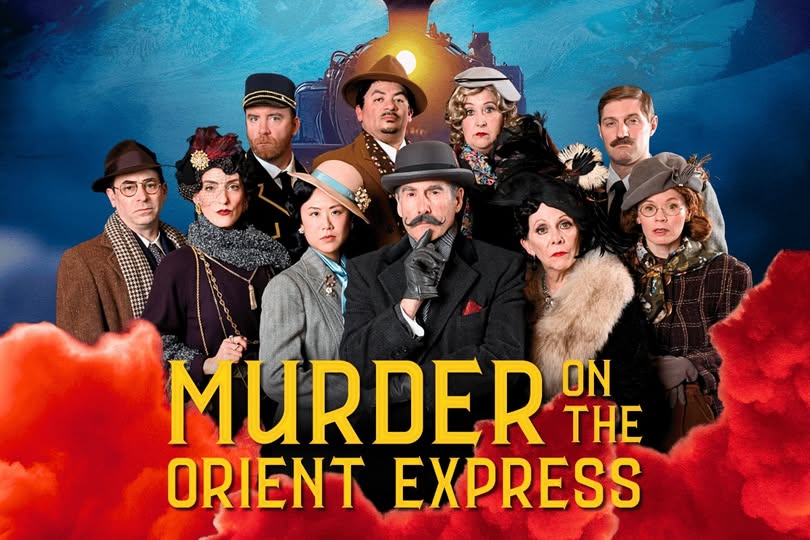
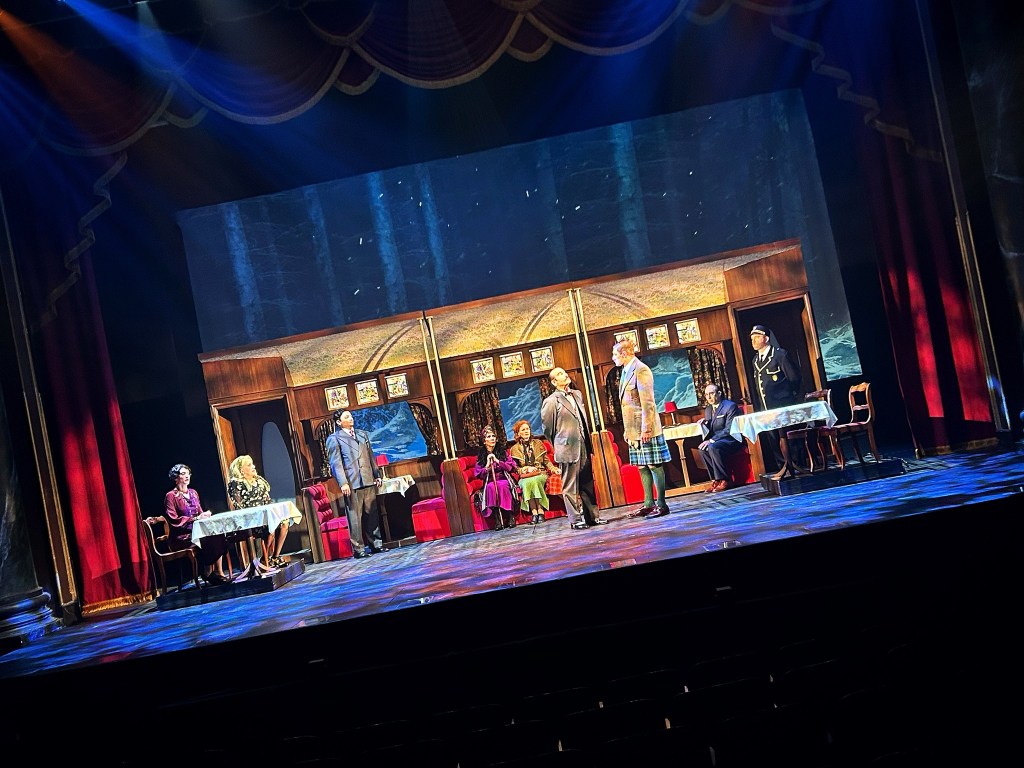
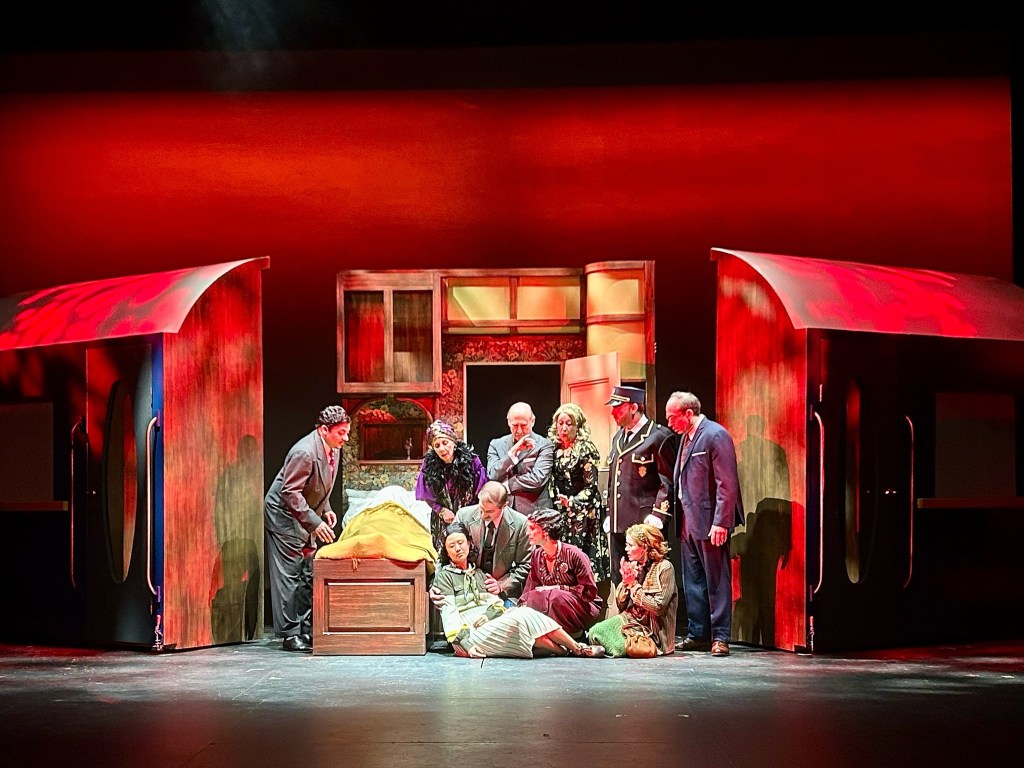
Train whistles and schedule announcements greet those who enter the November Theatre for the Virginia Rep 2025-26 season opener – Agatha Christie’s Murder on the Orient Express. An authentic literary and theater murder mystery classic, Murder on the Orient Express has murder, romance, conspiracy, locked doors, humor, nobility, a wide array of accents and dialects, and a dynamic set design worthy of its own program credit. All that was missing was the heady aroma of creosote, brake dust, diesel fuel, and the other components of railroad life. 

Director Rick Hammerly and his talented production team kept enough of the familiar touch stones and the stereotypically drawn murder mystery characters to make us feel right at home, yet balanced these with delightful surprises that never failed to impress.  

First, there was a bit of video, providing some background on the kidnapping of a little girl, Daisy. Then Hercule Poirot (Lawrence Redmond) gave a brief introductory curtain speech. In the brief time it took Redmond to speak, the crew transformed the previously bare space consisting of little more than a fat white screen into a passable representation of luxury hotel dining room. Three-dimensional set elements and two-dimensional projections and lighting effects blended in a collaboration that set new standards. Were those pedestrians moving outside the hotel windows? Or were they crew preparing for the next scene change? Either way, they added depth and nuance to the visual presentation. Kudos to scenic designer Chris Raintree, projection designer Tennessee Dixon, and lighting designer BJ Wilkinson. 

Then, there is the matter of a dynamic actors, all larger than life figures who inhabited the cast of characters with enthusiasm, grace, and humor. Redmond gave us Poirot’s sharp intellect, meticulous, observant. Frank Britton in the role of Poirot’s friend, Monsieur Bouc, the director of the railroad company, played the comedic foil – up to a point. It was his simple perspective that, in the end provided a resolution to the story’s weighty moral dilemma.  

McLean Fletcher portrays Greta Ohlsson as a modest and devout missionary who only wants to help children in Africa, but she is obviously hiding something. And why, exactly, is she posing as an aide to Princess Dragomiroff? Ah yes, Princess Dragomiroff, covered in layers of fine fabrics and jewels and better known to us as the talented Jan Guarino. The Princess’ embroidered handkerchief, is found (planted?) at the scene of the crime in an attempt to mislead the investigation. 

As the snooty but nameless Head Waiter in the first scene, John-Michael Jalonen sets the stage for the opulence and luxury of the other characters, those who are waiting at the hotel to board the luxurious Orient Express on its way from Istanbul, Turkey to London, England. Most of the passengers are traveling in first class compartments and the trip would have taken about four days if the train had not been stranded due to a heavy snowstorm in Yugoslavia. BTW, service on the original Orient Express began in 1883 and ended in 2009, although other companies have stepped in to provide Orient Express travel experiences. But I digress.  

Matt Meixler plays Hector MacQueen, personal assistant to Ratchett/Cassetti, the murder victim. MacQueen is a master of misdirection, but he is the one who reveals Ratchett’s true identity to Poirot. If there was a female lead in Murder on the Orient Express, it would surely be Susan Sanford in the role of the obnoxiously loud, hard drinking, “ugly American” Helen Hubbard. Sanford hits all the stereotypes and mixes them with steroids, making us feel simultaneously horrified and amused by Hubbard’s shenanigans. Hubbard, by the way, has the compartment next to Ratchett/Cassetti, and there is a connecting door… 

Continuing with our little game of Clue, there is Ashey Thompson as Countess Andrenyi, whose key role seemed to be beautiful – a role she portrayed with apparent ease — while her real identity was kept hidden from Hercule Poirot. Charlene Hong White takes on the role of the governess, Mary Debenham – another, like Greta Ohlsson, who seems to have a lot of secrets. Poirot noted Mary with suspicion while in the hotel, before ever boarding the train or becoming aware of a murder. Both White and Fletcher are masterful at playing innocent while letting us know they are hiding something just beneath the surface of their cool, beautiful exteriors. 

Nathan Whitmer is stalwart and blustering in the role of English military officer Colonel Arbuthnot. Arbuthnot isn’t too good at hiding his relationship with Mary Debenham, but Whitmer looks great in a kilt. Travis Williams plays the all-important role of Michel, the Conductor – the man who has access to all the train’s compartments, and perhaps access to an extra conductor’s uniform… 

So, there you have it, the backgrounds of the passengers and other cast members. A diagram of how they are connected would further help keep everybody straight, but would definitely be a spoiler, so you’re on your own for that.  

This high-powered, heavy weight ensemble took us on a most delightful journey that hit most of the elements of a great murder mystery. There was a compelling, locked-door murder. There was an intriguing setting – a train stuck on the tracks far from help, during a major snowstorm. Not only could the train not move, but communications were also lost with dispatchers. There was a victim, and a crime a murder method, and nearly a dozen suspects, with opportunity and hidden motives. A world class detective just happened to be on board, to investigate the clues and red herrings left to misdirect the audience. 

What makes this story even more intereting is the moral dilemma posed near the end. Is murder ever okay? Is there ever a time when, in the words of several fictional and real-life characters, “sometimes the som’bitch needed killin’?” Pack your bags, pick up a drink before boarding, and go find out for yourself. Let me know what you decide. 

———- 

Julinda D. Lewis is a dancer, teacher, and writer who was born in Brooklyn, NY and now lives in Eastern Henrico County. When not writing about theater, she teaches dance history at VCU and low impact dance fitness classes to seasoned movers like herself and occasionally performs. Julinda was recently awarded the Dean’s Distinguished Adjunct Faculty Award 2023-24 Academic Year by VCU School of the Arts and the 2025 Pioneer Award in Dance Ministry by Transformation International Worship Ministries, Newport News, VA. 

———- 

AGATHA CHRISTIE’S MURDER ON THE ORIENT EXPRESS 

Adapted for the stage by Ken Ludwig 

Directed by Rick Hammerly 

Cast 

Lawrence Redmond ….. Hercule Poirot 

Frank Britton ….. Monsieur Bouc / u/s Poirot 

McLean Fletcher ….. Greta Ohlsson /u/s Princess Dragomiroff 

Jan Guarino ….. Princess Dragomiroff 

John-Michael Jalonen ….. Head Waiter / u/s MacQueen, u/s Michel 

Matt Meixler ….. Hector MacQueen 

Susan Sanford ….. Helen Hubbard 

Ashley Thompson ….. Countess Andrenyi 

Charlene Hong White ….. Mary Debenham 

Nathan Whitmer ….. Colonel Arbuthnot / Samuel Ratchett 

Travis Williams ….. Michel the Conductor / u/s Arbuthnot, u/s Ratchett 

Rachel Dilliplane ….. u/s Mary, u/s Countess 

Lily Marcheschi ….. u/s Greta Ohlsson, u/s Helen Hubbard 

Mark Persinger ….. u/s Monsieur Bouc, u/s Head Waiter 

Recorded Voices ….. Frederic Blasco, Rachel Dilliplane, Emily Goodman, Lily Marcheschi, Mark Persinger, Guy Seigneuric, Travis Williams 

Direction & Design 

Directed by ….. Rick Hammerly 

Scenic Design ….. Chris Raintree 

Projection Design ….. Tennessee Dixon 

Costume Design ….. Kendra Rai 

Wig Design ….. Alia Radabaugh 

Lighting Design ….. BJ Wilkinson 

Dialects ….. Amanda Durst 

Sound Design ….. Joey Luck 

Fight & Intimacy Direction ….. Casey Kaleba 

Stage Management ….. Ginnie Willard 

For This Production 

Assistant Stage Manager ….. Hannah Hoffert 

Rehearsal Stage Manager ….. Justin Janke 

Assistant Lighting Designer ….. Griffin Hardy 

Carpenters …..Van Montes, Avery Rose 

Scenic Artists ….. Julie Gallager, Van Montes 

Electricians ….. Rylie Vann, Griffin Hardy 

Stitchers ….. Sarah Grady, Kate Koyiades, Maggie Ronck 

Fly Rail and Deck Crew ….. Daryus Gazder, Logan Graves, Bien Quiroz 

Light Board Operator ….. Rylie Vann 

Sound Board Operator ….. Amaya “AJ” Rose 

Wardrobe Supervisor ….. Emily Andrew Mateos 

Video Production ….. Tennessee Dixon, Rick Hammerly, Hannah Hoffert, Joey Luck, Hans Paul, Jonathan Pratt, Ginnie Willard, Kacey Yachuw 

Photographer ……………………… Aaron Sutten 

Ticket Information 

Box Office: (804) 282-2620 

www.virginiarep.org 

Ticket Prices: $35 – $62 

Performance Schedule 

September 11 – October 12, 2023, with performances 

Thursdays, Fridays, and Saturdays at 7:00 PM, select Saturdays at 2PM, Sundays at 3PM, and select Wednesday evenings and matinees. 

Run Time 

The play runs for approximately 2 hours with one 15-minute intermission 

World Premiere produced by the American Repertory Theatre at Harvard University, August 2, 2015 

Originally Staged by McCarter Theater Center, Princeton, NJ 

Photo Credits: Aaron Sutten  

One-Time
Monthly
Yearly

Make a one-time, monthly, or annual donation

Make a monthly donation

Make a yearly donation

Choose an amount

$5.00
$15.00
$100.00
$5.00
$15.00
$100.00
$5.00
$15.00
$100.00

Or enter a custom amount

$

Your contribution is appreciated.

Your contribution is appreciated.

Your contribution is appreciated.

DonateDonate monthlyDonate yearly
RICHMOND BALLET MOVING ART ONE:

Passion & Power

A Dance Review  

Program By: The Richmond Ballet 

At: Virginia Museum of Fine Arts, Leslie Cheek Theater, on the Armstrong Family Stage in Honor of Richmond, 200 N. Arthur Ashe Boulevard, RVA 23220 

Performances: September 11-21, 2025 

Ticket Prices: $29 – $89 (more on opening night) 

Info: (804) 344-0906, etix.com, or richmondballet.com 

THE PROGRAM 

WILD SWEET LOVE 

Choreography by Trey McIntyre 

Music by The Zombies, Felix Mendelssohn, The Partridge Family, Lou Reed, José Alfredo Jiménez, Roberta Flack, Queen 

Staged by Iliana Goldman 

Lighting Design by Nathan W. Scheuer after Original Design by Steve Odehnal 

World Premiere: March 27, 2007, Sacramento Ballet, Sacramento Community Center Theater, Sacramento, CA. Virginia Premiere: September 11, 2025, Richmond Ballet, Leslie Cheek Theater, Virginia Museum of Fine Arts Richmond, VA. 

PIENSA EN MI (THINK OF ME) 

A World Premiere inspired by the life and art of Frida 

Choreography by Ma Cong 

Music voy Lila Downs, Elliot Goldenthal, Chavela Vargas, Los Cojolites, Camilla Griehsel, Mariachi Juvenil de Tecalitán 

Costume Design by Emma Kingsbury 

Lighting Design by Nathan W. Scheuer 

Projection Design by Dave Watkins 

World Premiere: May 15, 1996, by Richmond Ballet at Leslie Cheek Theater, Virginia Museum of Fine Arts, Richmond, VA 

The Richmond Ballet aptly titled their season opening Moving Art One program at the VMFA’s Leslie Cheek Theater “Passion & Power.” 

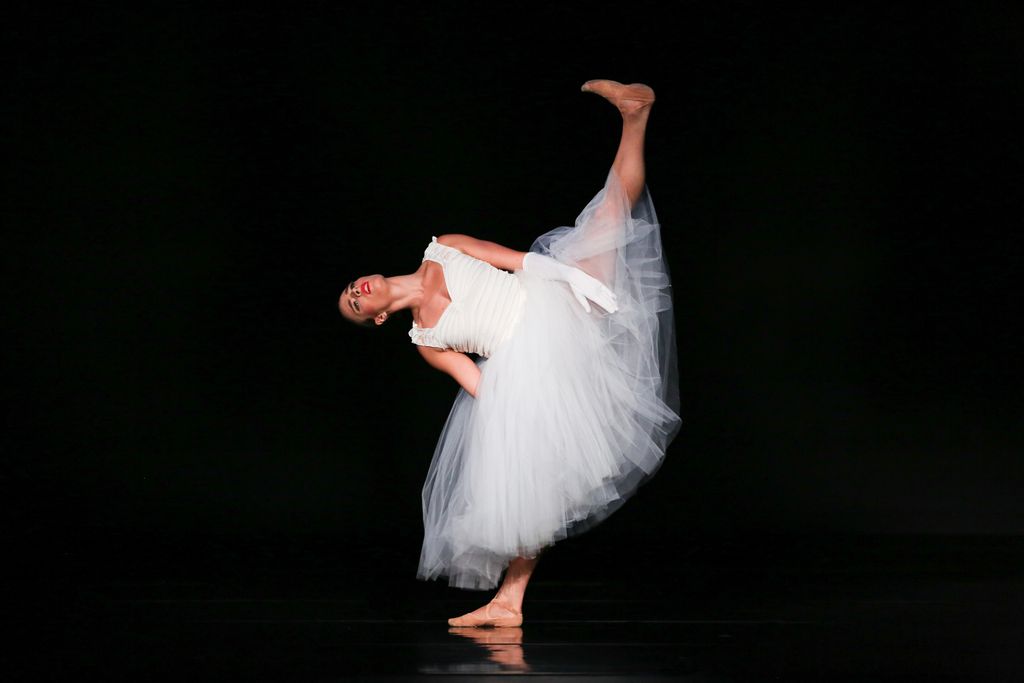
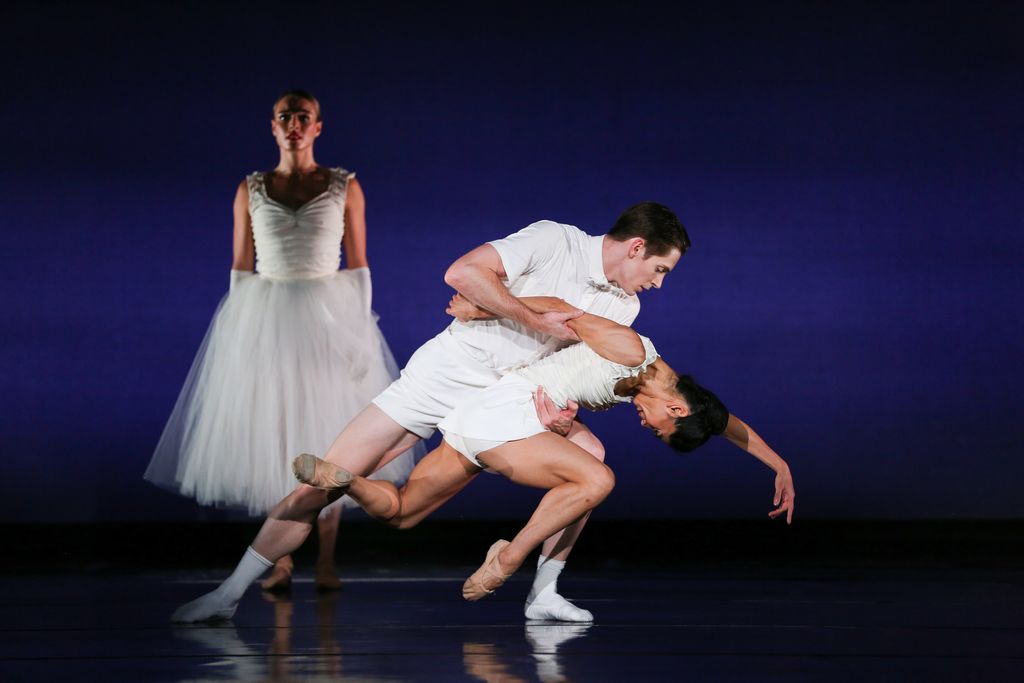
The evening opened with the Virginia premiere of Trey McIntyre’s 2007 Wild, Sweet Love – which also happens to be part of the lyrics to one of the songs, Roberta Flack’s “Do What You Gotta Do.” In addition to the soulful tunes of Ms. Flack, McIntyre has set the work to a veritable wedding playlist of pop tunes and love songs. Lead dancer Celeste Gaiera wears a white dress with a layered classic tutu for a skirt, and elbow length white gloves. The only thing missing is a veil, because sure enough, that was Mendelssohn’s “Wedding March” we heard. After her opening solo, set to The Zombies’ “The Way I Feel Inside” Gaiera walks off in a slouch with her head bowed, shoulders rounded. It’s interesting that the bride is the only character who has no partner. 

Four couples – Isabella Franco and Ira White, Eri Nishihara and Jack Miller, Annika Kuo and Aleksey Babayev, Josiah Lax and Kennady Jackson – accompany Gaiera on her journey to…find love? …recover from a lost love? We’re not sure. Wild, Sweet Love is a non-traditional, contemporary ballet. There’s not a pointe shoe in sight. My seatmate commented on how accessible the choreography was – noting that it appeals to a wide audience. 

Another remarkable element in Wild, Sweet Love is the cast of a dozen or so “shadow performers,” who act as a sort of Greek chorus. Main characters sometimes intermingle with the shadows – who are dressed in black and mostly shown in silhouette. Lead dancers emerge from the ranks of the shadows for a duet, a trio, or a full cast movement, then blend back in with the shadow performers. 

This, along with the often everyday movements of the dancers, adds to the relatability of the work. It suggests unity as well as the possibility or hope that at any moment any one of us may rise from obscurity into the spotlight. A duet by Isabella Franco and Ira White to The Partridge Family’s “I Think I Love You” is powerful and intriguing, followed by Eri Nishihara and Jack Miller is a quirky and carefree “Perfect Day.” 

All-in-all, Wild, Sweet Love was an excellent choice to open the 2025-26 season. 

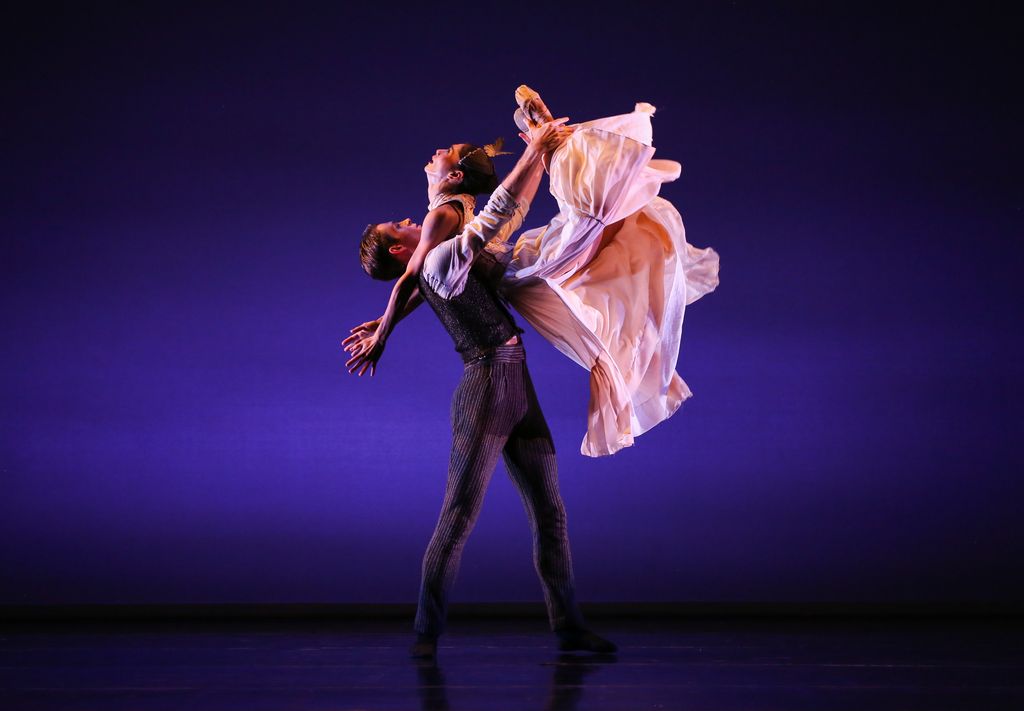
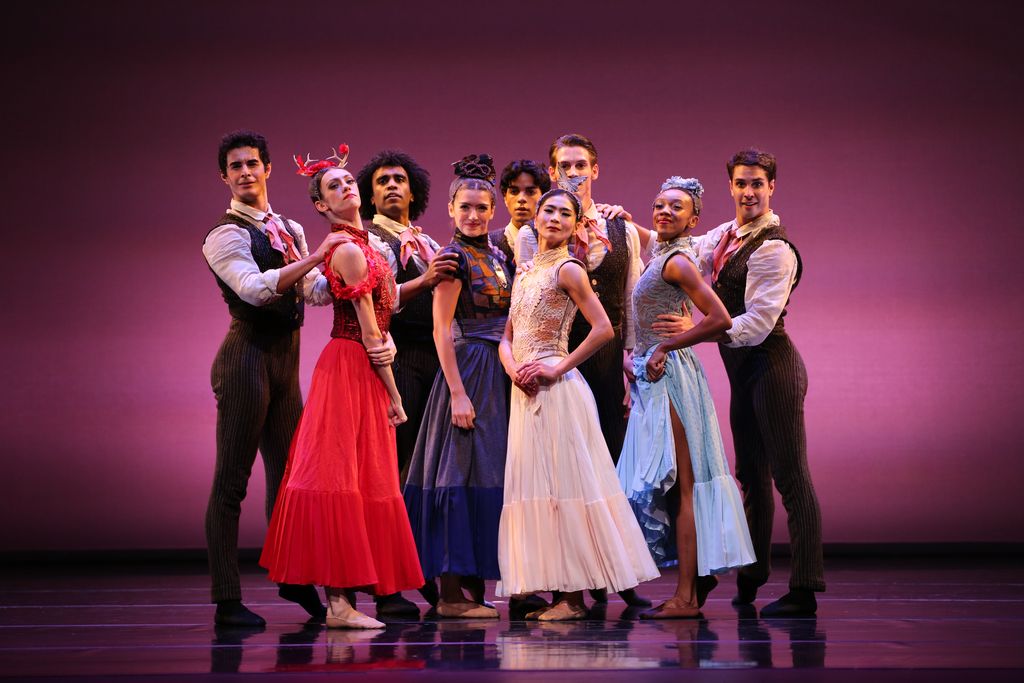
The second half of the program introduced the World Premiere of Ma Cong’s Piensa en Mi (Think of Me), a contemporary ballet inspired by the life and art of Frida Kahlo (whose VMFA exhibit runs through September 28).  

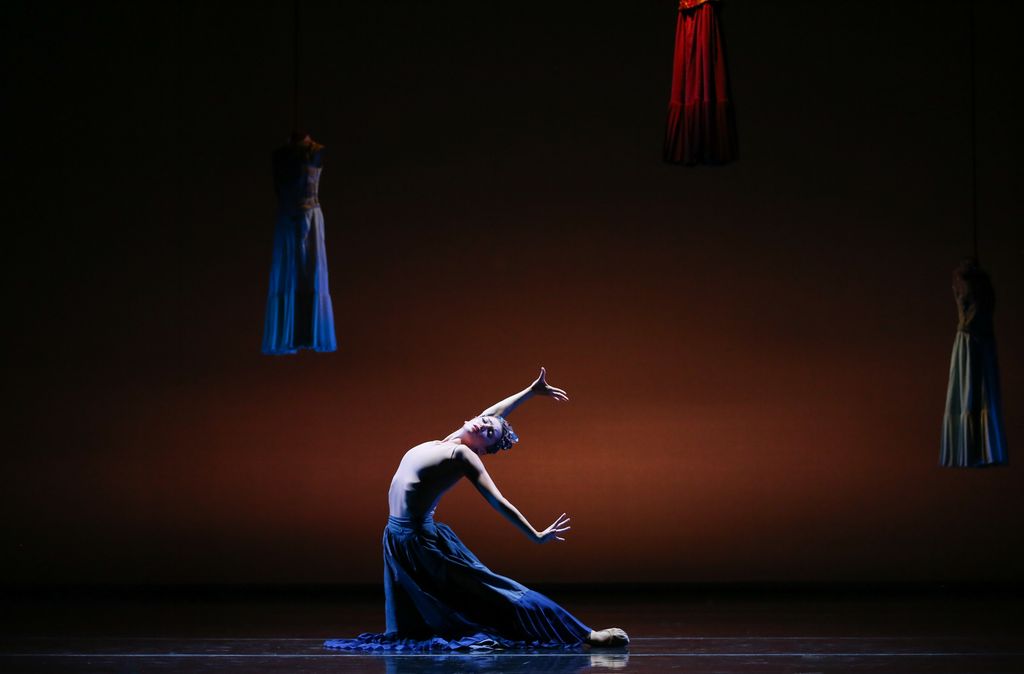
The opening is beautifully staged with one of the four Fridas dancing downstage while three costumes are suspended from the ceiling. Two more Fridas enter and are helped into their dresses by their partners, while the fourth dress – a red one – remains suspended for the remainder of this section. 

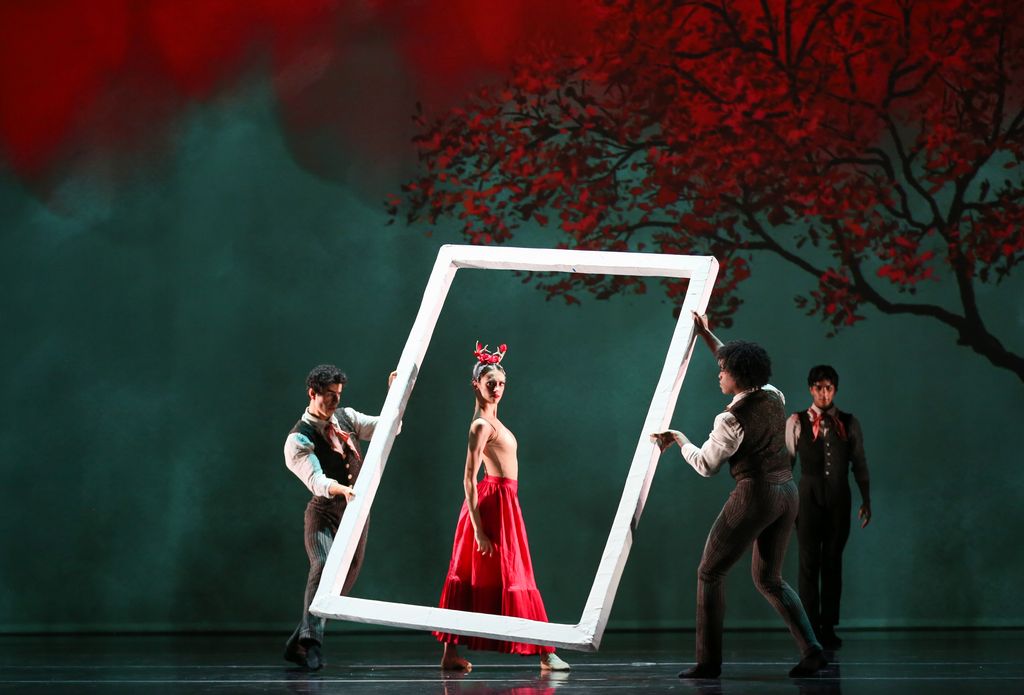
Dave Watkins has designed projections, like a pattern that suggests footprints that leads the Fridas along a “Journey,” complete with hand luggage.  Ma has done his research and created a work that honors the spirit of Frida Kahlo without mimicking her paintings or the photographs in the museum’s collection. We see this in little touches like the flowers in the four Fridas hair, and in the carefully stitched bodices of their dresses – each a different color – designed by Emma Kingsbury.  

The women, Naomi Robinson, Mikell Graf, Eri Nishihara, and Izabella Tokev represent Frida at different ages, different stages: youthful, after her devastating bus accident, in love. 

Ma describes his work as intended to inspire people to be honest, brave, and expressive. It is not as extroverted as McIntyre’s ballet. At times it is more introspective, as is befitting a work inspired by Frida Kahlo, but at the times it seems to lag behind. This could be the effect of placing such a high-powered work at the top of the program and the more intimate work at the end. Nevertheless, “Passion & Power” is a deeply satisfying program that seemed to be over all too soon. 

——— 

The Richmond Ballet’s 2025-2026 season began with Moving Art One, September 11-21 featuring Wild Seet Love by Trey McIntyre and Piensa en Mi (Think of Me) a world premiere by Ma Cong. 

Moving Art Two, October 16-26 is scheduled to present Slice to Sharp by Jorma Elo, a world premiere by Andrea Scher moly, and French Twist by Ma Cong. The Nutcracker will be performed at Dominion Energy Center December 6-23 and Giselle will be performed there February 13-15. The season will continue with Moving Art Three, the company’s New Works Festival with works by Natasha Adorlee, David Morse, Price Suddarth, and Serkan Usta from March 19-29, and conclude May 14-24 with Moving Art Four with George Balanchine’s Apollo, John Butler’s After Eden, and a world premiere by Val Caniparoli. 

—–

Julinda D. Lewis is a dancer, teacher, and writer who was born in Brooklyn, NY and now lives in Eastern Henrico County. When not writing about theater, she teaches dance history at VCU and low impact dance fitness classes to seasoned movers like herself and occasionally performs. Julinda was recently awarded the Dean’s Distinguished Adjunct Faculty Award 2023-24 Academic Year by VCU School of the Arts and the 2025 Pioneer Award in Dance Ministry by Transformation International Worship Ministries, Newport News, VA. 

One-Time
Monthly
Yearly

Make a one-time, mothly, or annual donation to show your love and support of rvart review.

Make a monthly donation

Make a yearly donation

Choose an amount

$5.00
$15.00
$100.00
$5.00
$15.00
$100.00
$5.00
$15.00
$100.00

Or enter a custom amount – no amount is too small or too large.

$

Thank you. Your contribution is appreciated.

Your contribution is appreciated.

Your contribution is appreciated.

DonateDonate monthlyDonate yearly

THE LIFESPAN OF A FACT

“There are facts, and there’s what’s true.”

It’s a Case of Facts vs Truth and There is No Clear Winner

A Theater Review by Julinda D. Lewis

Presented by CAT – Chamberlayne Actor’s Theatre

At: Hanover Tavern, 13181 Hanover Courthouse Rd., Route 301, Hanover, VA 23069

Performances: September 6, 2025

Ticket Prices: $34.00 General Admission. $30.00 Seniors 60+

Info: (804) 362-2950 or www.cattheatre.com

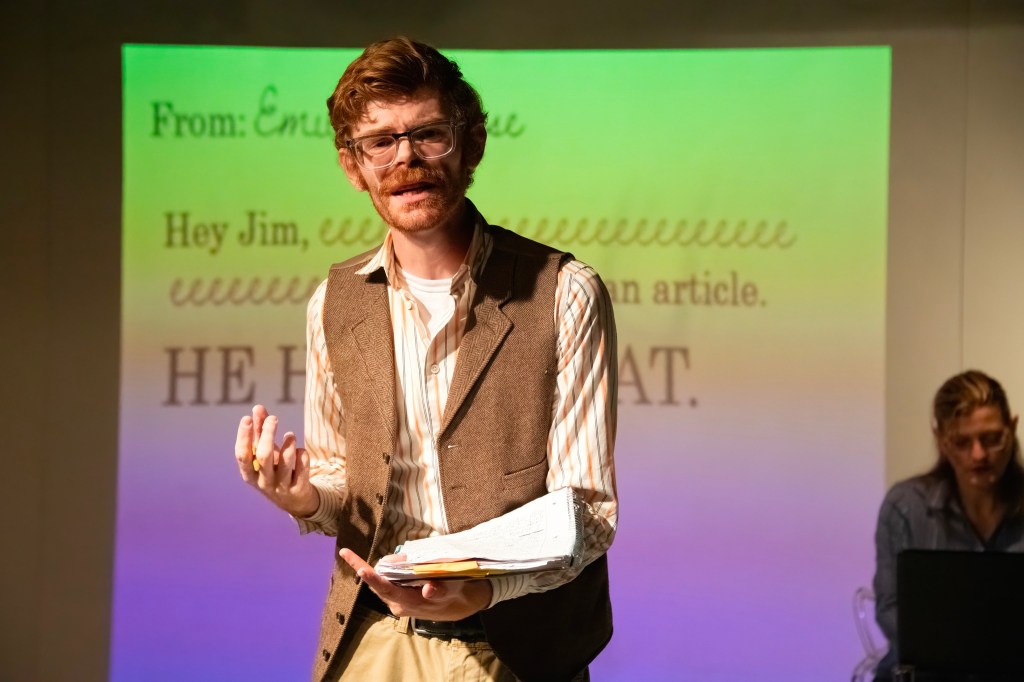
It’s always an adventure going to a show whose title is unfamiliar and whose plot is unknown to you. This was the case when I ventured out once again to the historic Hanover Tavern to see CAT’s 61st season opener, The Lifespan of a Fact, written by Jeremy Kareken & David Murrell and Gordon Farrell.

The Lifespan of a Fact is based on a true story, an essay published in 2012 by author John D’Agata and fact-checker Jim Fingal. The book is about the suicide of a teenager, Levi Presley, who jumped to his death from the Stratosphere Hotel. The play is just a snippet of the seven-year process of fact-checking that went into the work from the time D’Agata’s essay was first accepted for publication until it finally made it into print. The 90-minute play is intense. It starts off fairly innocuous, with Fingal, fresh out of school – a Harvard man – chomping at the bit for his first professional fact-checking job. The problem is, Fingal is a bit too thorough for his own good.

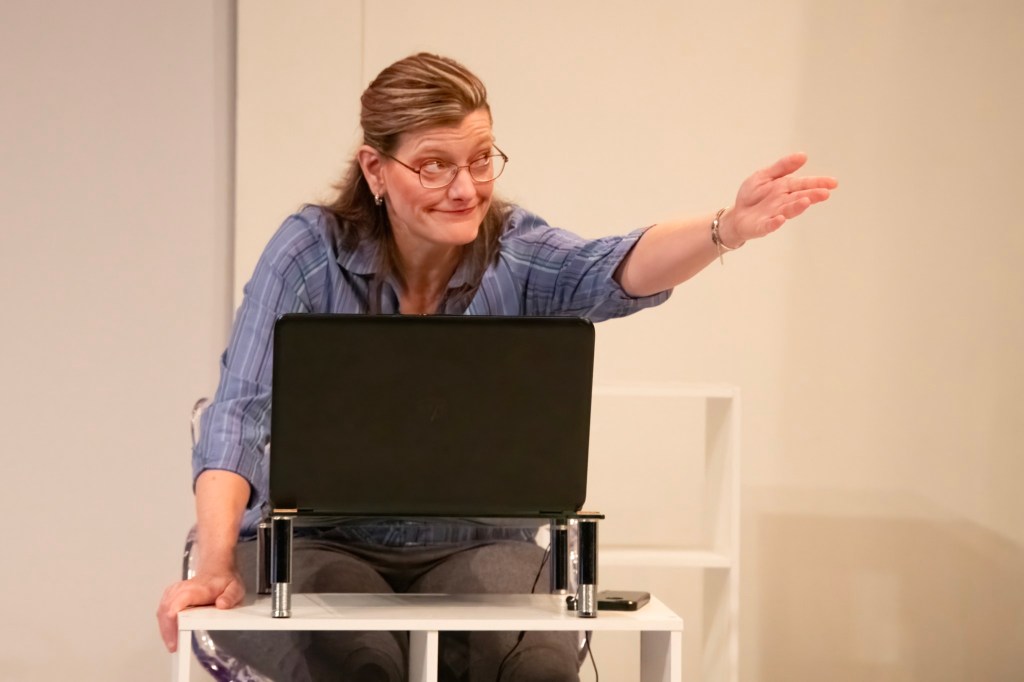
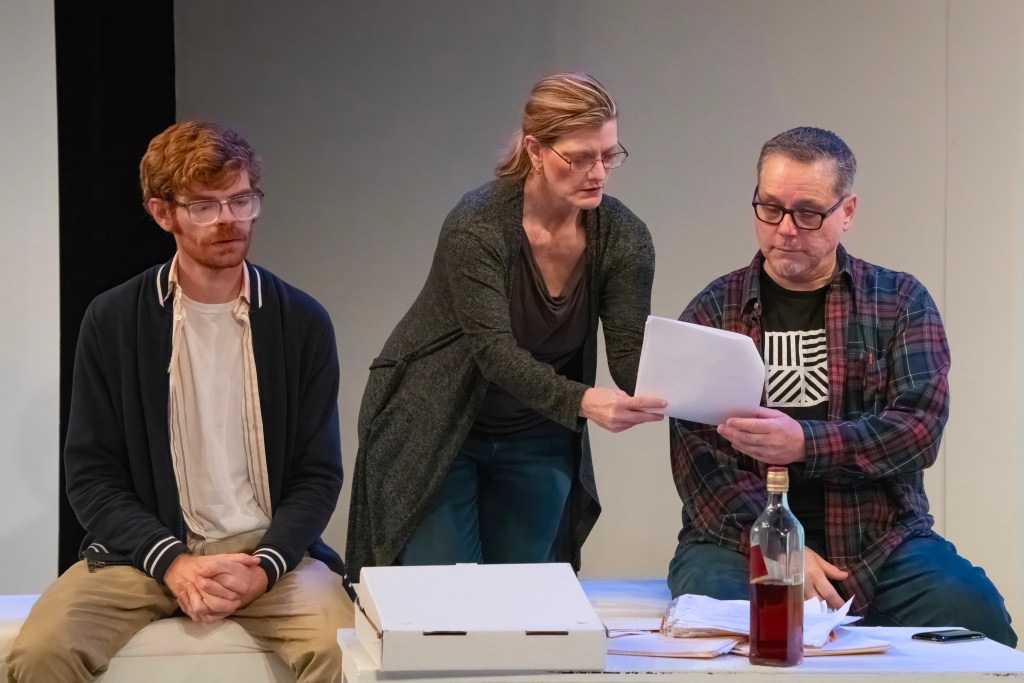
Fingal and D’Agata butt heads, with the author initially refusing all edits and Fingal refusing to let any discrepancy slide. Emily Penrose, D’Agata’s editor and Fingal’s boss, is caught in the middle, balancing the need for truth and accuracy with the need to publish a good story. The lines soon blurred around truth versus fact, with both sides making strong arguments.

This is a most unusual play. Director Andrew Gall writes, in his Director’s notes, “This play takes a question we think we already know the answer to – what is truth? – and refuses to let us off the hook.” It’s timely. It’s relevant. There are moments of pure hilarity balanced by moments of moral anguish. At some point, it becomes personal.

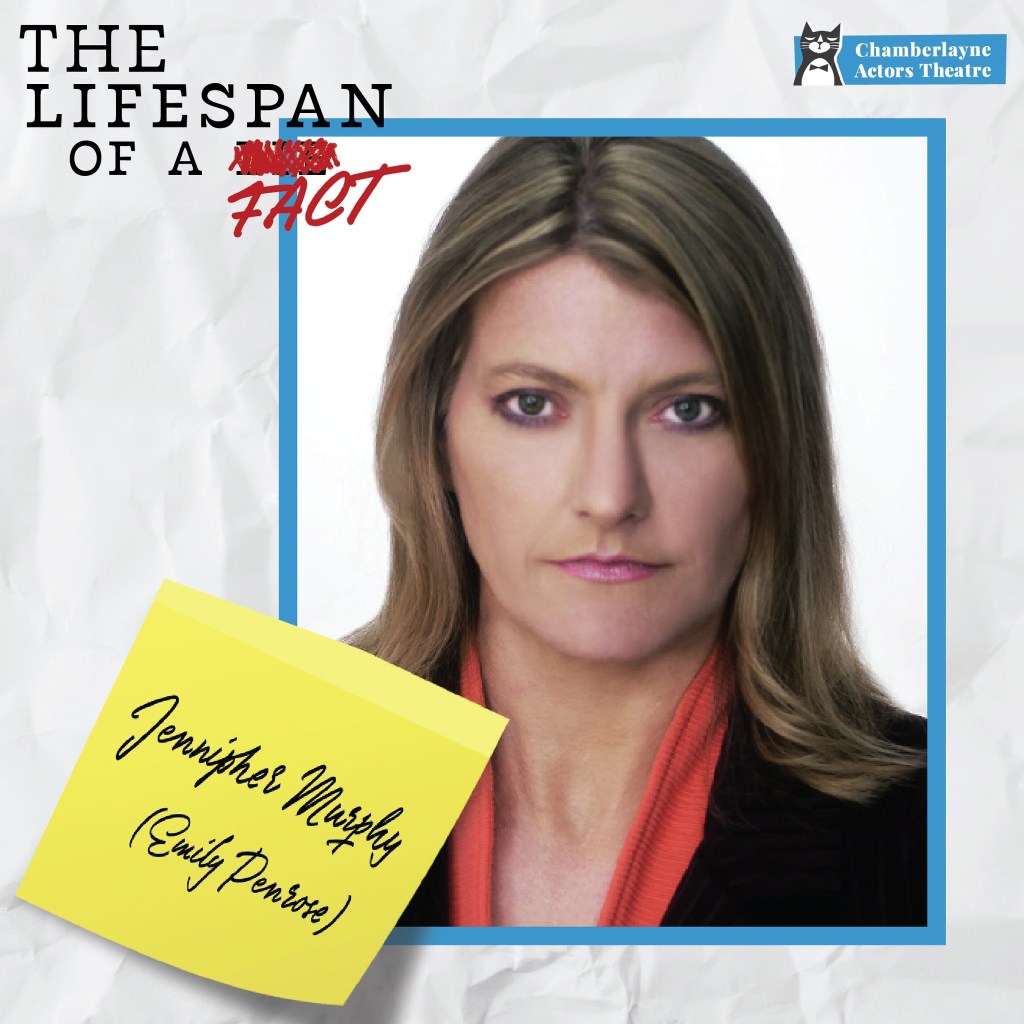
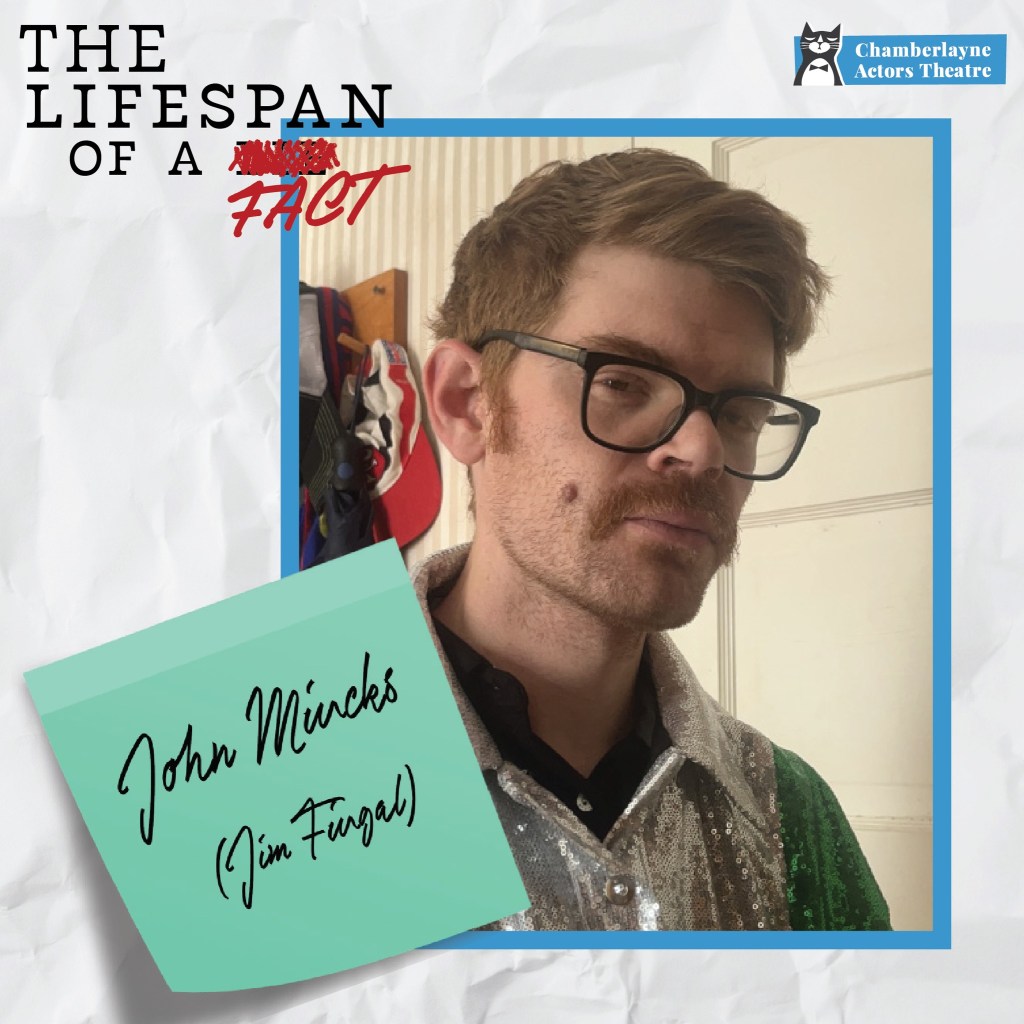
I thoroughly enjoyed this debate. James gradually settled into his character, who was initially arrogant and unbending, but eventually softened enough to lay out a debate worthy argument that explained why it was important to bend the facts to reveal the truth of the story. Mincks brought most of the humor, often delivering a very physical performance that, at one point, had him laid out on the floor in what might be described as an adult version of a temper tantrum. Mincks brought a delightful balance of passion and humor to his role as the overly enthusiastic young fact-checker. Jennipher Murphy was the most conservative as the over-worked editor, Emily Penrose. One could almost hear her mind shifting as the reality of the situation set in.

The right story at the right time can make people rethink the events of their own lives, but the wrong facts can get in the way of the story. Yikes! So, does it really matter how long young Levi sat on the ledge of the observation tower? Does it matter whether the other young person who took their own life the same day jumped off a building or hung themselves? Does it matter whether the oldest known Tabasco sauce bottle was found under the Boston Saloon or the more interestingly named Bucket of Blood Saloon? On what day did the lady play tic-tac-toe with a chicken, and exactly how many strip clubs were in Las Vegas on the day of the suicide? Fingal’s notes took up more pages than D’Agata’s essay. Oh, and make sure you call it an “essay” rather than an “article.”

Would this story be published on time? Would it be published at all? If published, what version of the truth would win out? At the end, the audience is left without any definitive answer – but a lot to ponder.

What an interesting choice to open CAT’s 61st season. I can say with assurance that the acting and direction were well-paced and highly engaging – enough so that I temporarily forgot about the struggle bus set of stark white walls and a bare minimum of seemingly random, cast-off furnishings. That was initially distracting – and again when the hard white bench Fingal stretched out on to sleep was identified as D’Agata’s couch. Ouch. But…the words and their delivery were enough.

———-

Julinda D. Lewis is a dancer, teacher, and writer who was born in Brooklyn, NY and now lives in Eastern Henrico County. When not writing about theater, she teaches dance history at VCU and low impact dance fitness classes to seasoned movers like herself and occasionally performs. Julinda was recently awarded the Dean’s Distinguished Adjunct Faculty Award 2023-24 Academic Year by VCU School of the Arts and the 2025 Pioneer Award in Dance Ministry by Transformation International Worship Ministries, Newport News, VA.

THE LIFESPAN OF A FACT

Written by Jeremy Kareken & David Murrell and Gordon Farrell

Directed by Andrew Gall

Cast

John D’Agata           …..      Paul S. James

Emily Penrose          …..      Jennipher Murphy

Jim Fingal                 …..      John Mincks

                        Understudies

John D’Agata           …..      Skye Whitcomb

Emily Penrose          …..      Constance Moreau

Jim Fingal                 …..      Joshua Shay

Producers, Creative Design Team & Crew

Producers –  Zachary Owen & Kerrigan Sullivan

Hanover Tavern Executive Director – David Deal

Lighting Design – Alleigh Scantling

Scenic Design & Properties Design – Hailey Bean

Costume Design – Sheila Russ

Sound Design – Nic Creery

Backstage Crew – Piper Stewart

Production Assistant – Russell Paulette

Lights, Sound, and Projections Operator – Kellan Garka

Publicity – Jason Lucas

Photography – Tom Topinka

Set Construction – Michael Sullivan, Rob Moose, Hunter Keck, Piper Stewart, Kellan Garka, Jenipher Murphy, Russell Paulette, Charles Wax

Settings

1.The home of John D’Agata, Las Vegas, Nevada.

2. Editorial offices of an upscale magazine, New York City, New York.

3. The home of Emily Penrose, New York City, New York

Run Time

90 minutes with no intermission

Performance Schedule

Fri. Aug 29th 2025, 7:30 pm

Sat. Aug 30th 2025, 2:30 pm

Sun. Aug 31st 2025, 2:30 pm

Fri. Sep 5th 2025, 7:30 pm

Sat. Sep 6th 2025, 7:30 pm

Sun. Sep 7th 2025, 2:30 pm

Fri. Sep 12th 2025, 7:30 pm

Sat. Sep 13th 2025, 2:30 pm

Sun. Sep 14th 2025, 2:30 pm

Tickets:

$34 General; $30 ages 60+

Information:

(804) 362-2950 or www.cattheatre.com

One-Time
Monthly
Yearly

Make a one-time, monthly, or annual donation (so Julinda can afford to continue publishing this blog!)

Make a monthly donation

Make a yearly donation

Choose an amount – no amount is too small and no amount is too large, so add some zeroes!

$5.00
$15.00
$100.00
$5.00
$15.00
$100.00
$5.00
$15.00
$100.00

Or enter a custom amount

$

Your contribution is appreciated.

Your contribution is appreciated.

Your contribution is appreciated.

DonateDonate monthlyDonate yearly

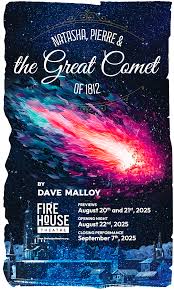
Natasha, Pierre & The Great Comet of 1812

Gender-bending Pop Opera Adaptation of Tolstoy’s War and Peace

A Theater Reflection by Julinda D Lewis

Presented by: Firehouse Theatre | A Firehouse Mainstage Production

At: Firehouse Theatre on the Carol Piersol Stage, 1609 W Broad St., RVA 23220

Performances: August 20 – September 7, 2025

Ticket Prices: $45

Info: (804) 355-2001 or firehousetheatre.org

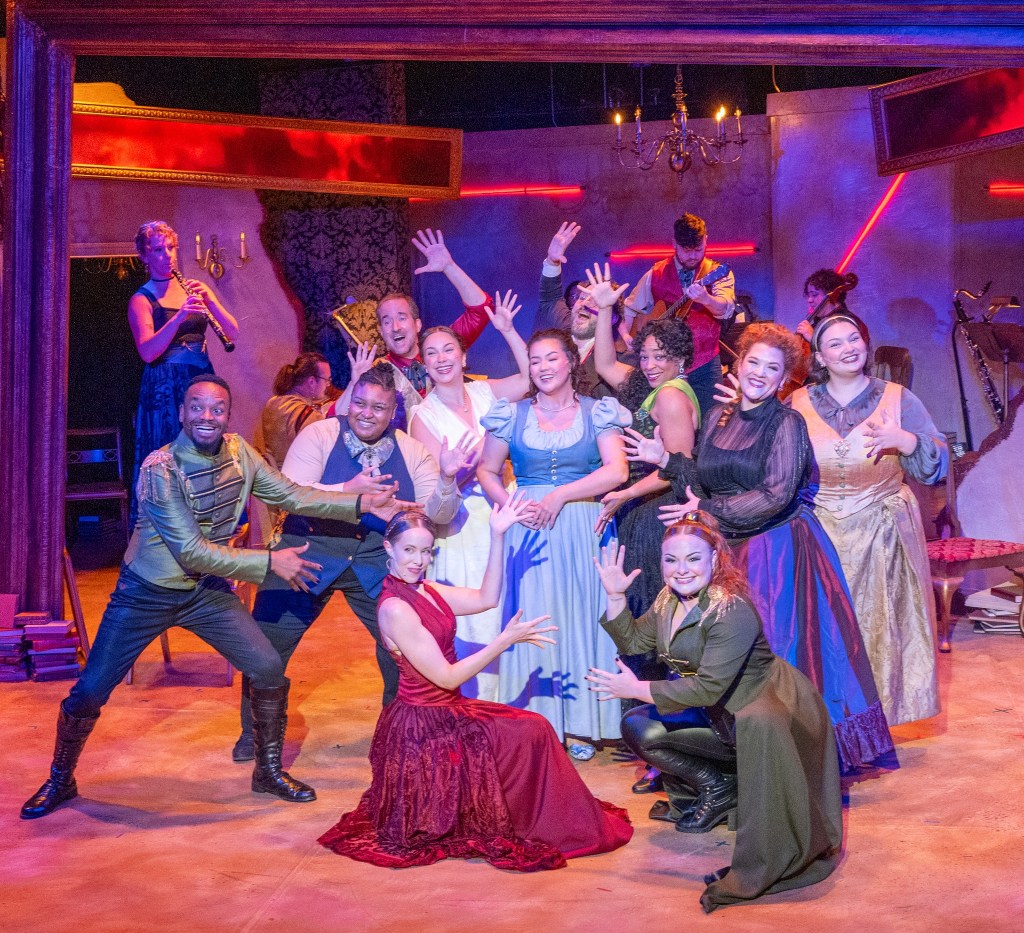
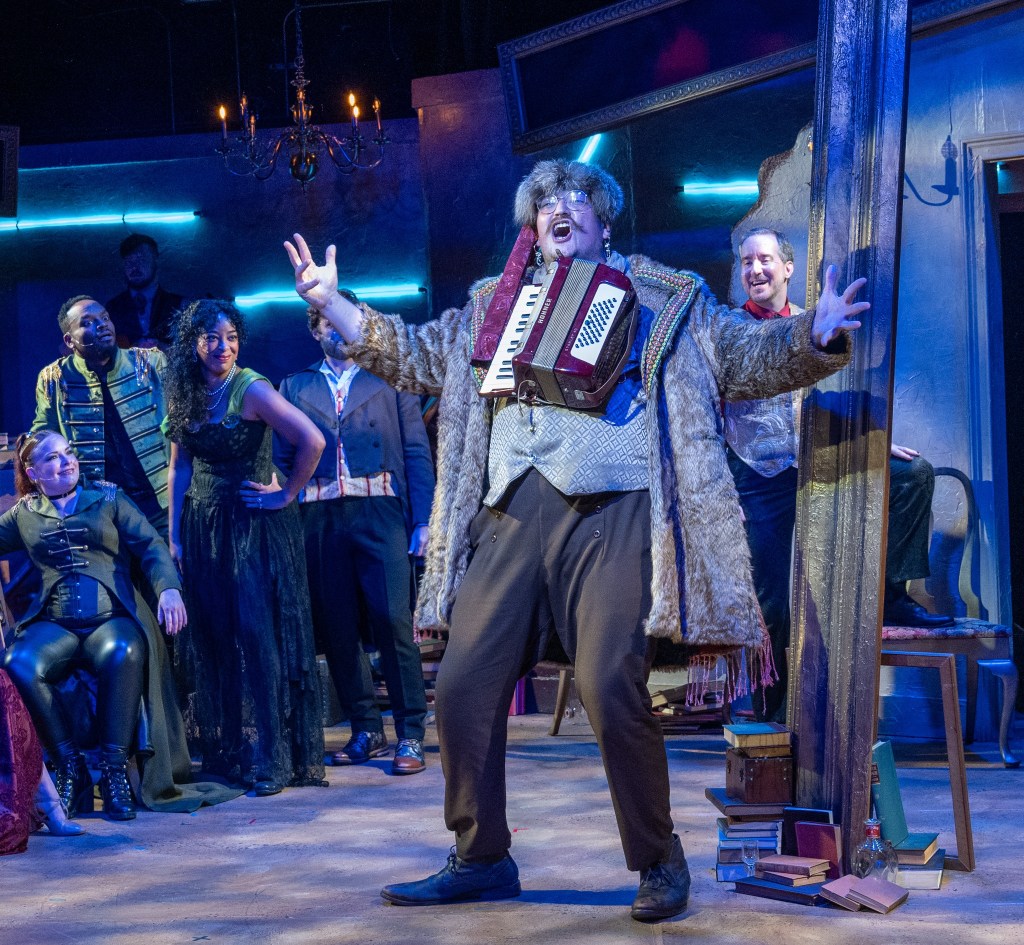
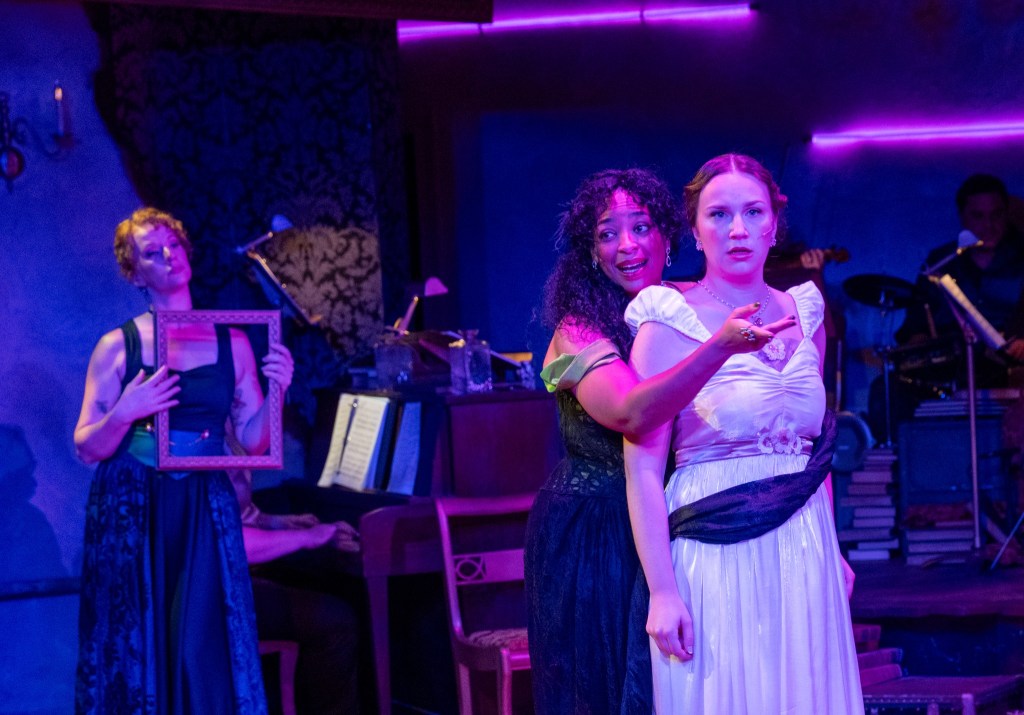
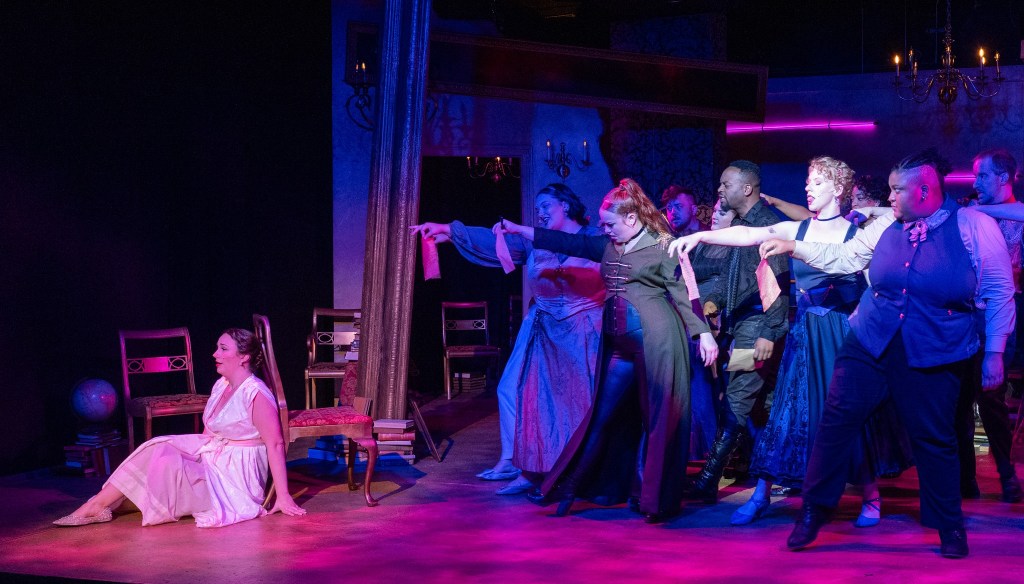
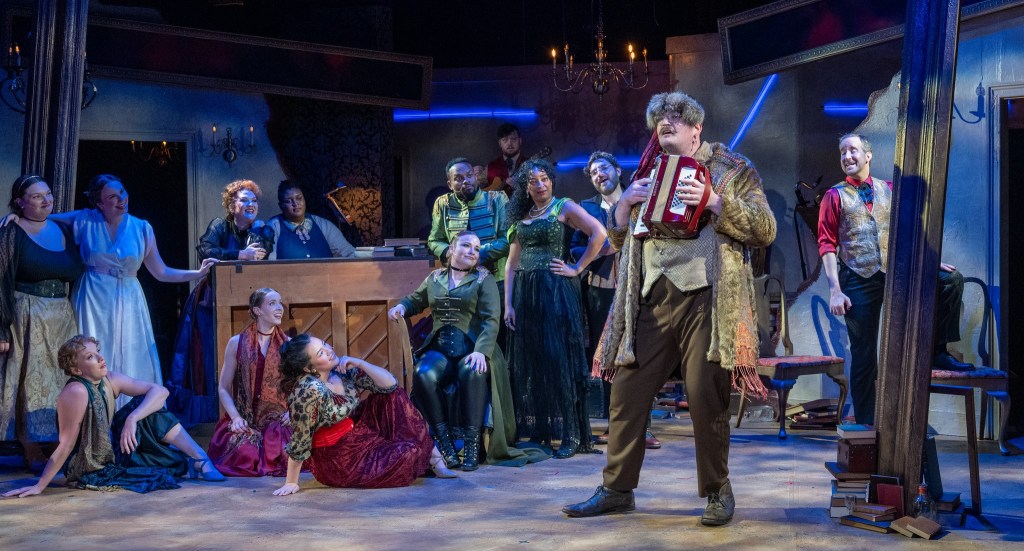
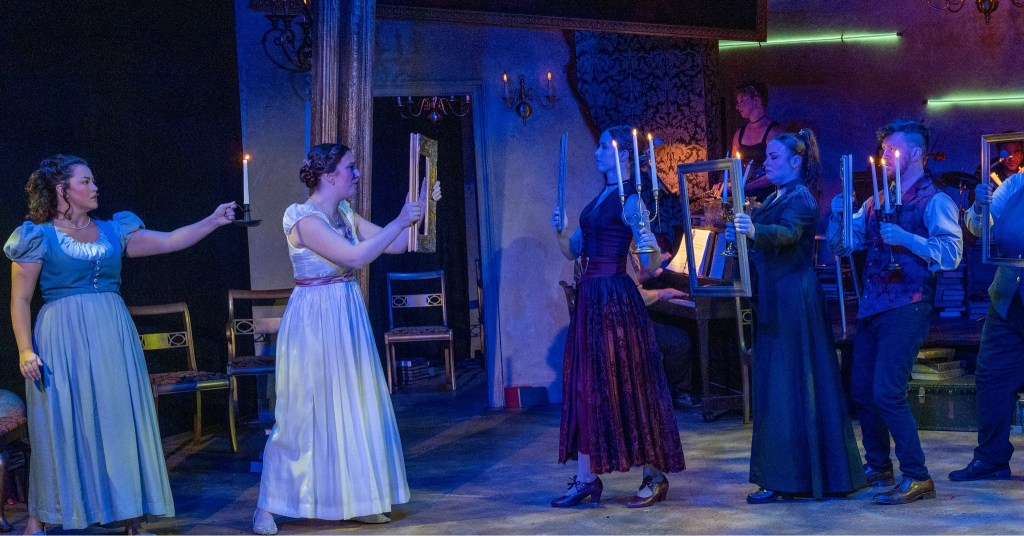
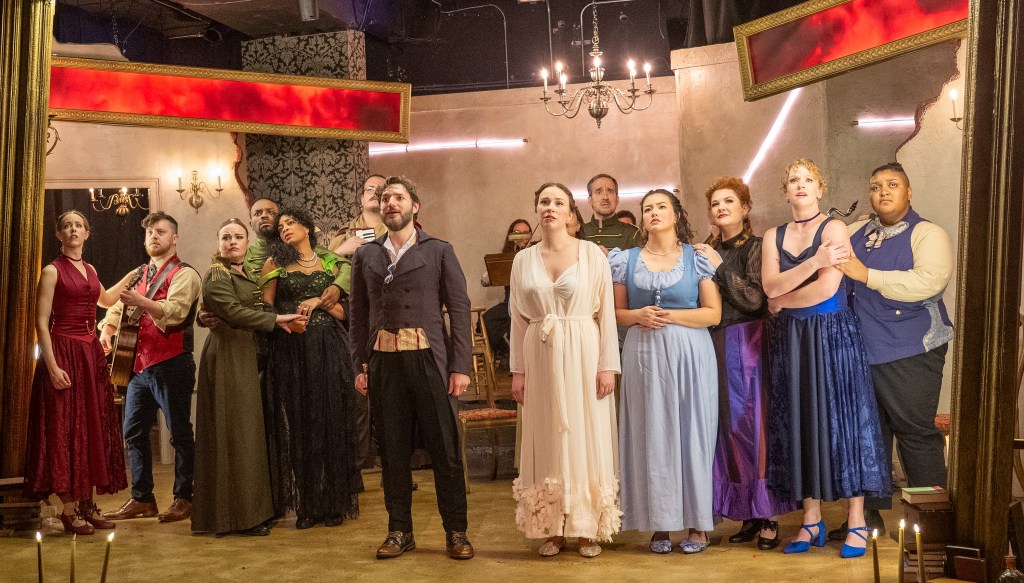
It’s not fair that the new theater season started with the Firehouse production of Dave Malloy’s sung-through musical (aka pop opera) Natasha, Pierre & the Great Comet of 1812. This production has set the bar so high that all other productions will have a lot to live up to.

Where to start…This is the second time in recent memory I’ve walked into the Firehouse Theatre space and had my flabbers gasted by a stunning stage set. Craig Napoliello’s interpretation of Tolstoy’s war-torn 19th century Moscow features a broken wall, a large asymmetrical frame that creates a sense of the audience looking in as voyeurs, and a general vintage patina that reinforces the weight of history and the passage of time.

Then there’s the opening number that starts at a level 10 and sets the tone and pace for the dynamic range of the rest of the evening. The opening also introduces us to each of the characters from this complicated Russian novel in which everyone has “nine names.” Well, nine names plus a nickname: Natasha is young, Anatole is hot, Hélène is a slut, and Andrey isn’t here, for starters.

One thing I don’t often talk about is choreography, which you might find curious given my obsession with the art of dance. One of the reasons for that is that the choreography for musicals – even good to excellent ones – too often underwhelms me. But not this time. Firehouse producing artistic director Nathaniel Shaw, assisted by Shauna Paddyfote, has created choreography that is dynamic and immersive. The cast doesn’t break out into a random dance to get our attention, take up time, or fill space. The choreography includes full-out dancing, such as an occasional Russian folk dance, and high-kicking show dancing by women wearing heels and full skirts (Shannon Schilstra and Emily Dandridge), as well as choreographed movement that unites the scenes and creates a sense of zeitgeist. And then there was the brilliant, energetic “Troika” dance that involved several cast members – some in the role of horses. Their costumes, a piano, and an accordion were all part of the choreography. One prop in particular, earned its one “bio” in the program. A doorframe created in the Firehouse shop that is used in several scenes has been given the grande title of Framecesca Doormitryevna.

The cast is powerful and multi-talented (singing, dancing, acting) – and some of them multi-task (playing instruments in the band). Each of the main characters gets a chance to shine with a solo (or aria if we’re being operatic), as part of a duet or trio. Kudos to Ally Dods, Drew Seigla, Shinji Elspeth Oh, Taylor Baltimore, Durron Marquis Tyre, Katrinah Carol Lewis, Madison Hatfield, Eddie Webster, Tessa DeGrace, Elle Meerovich, Shannon Schilstra, Chewie Lo Moore, Toby O’Brien, and Emily Dandridge. Ally Dods and Drew Seigla may have had the title roles of Natasha Rostova and Pierre Bezukhov, but siblings Anatole Kuragin and Helene Kuragina Bezukhova (Durron Marquis Tyre and Katrinah Carol Lewis), and Natasha’s loyal cousin Sonya (Shinji Elspeth Oh), and Anatole’s faithful friend Fedya Dolokhov (played by Madison Hatfield) were all shining stars and each and every one of them deserved a standing ovation. I didn’t mention every character, but that was not to short-change anyone – even those designated only as Ensemble were essential to the plot. A family tree diagram was included in the program to help keep the relationships straight.

Ah, the plot. Yes, there is one. But first, let me add here that somewhere near the end of Act One or shortly into Act Two, I recall thinking that it didn’t matter what the plot was – or even if there was one – because the performance was of such a high caliber that I didn’t care if there was a plot or if the plot made sense.

Many, like me, may not be familiar with this musical. Natasha, Pierre & The Great Comet of 1812 is a modern, immersive musical adaptation of a 70-page segment from Leo Tolstoy’s War and Peace – Volume 2, Part V. (The full book is 1,200-1,450 pages, or more than half a million words!) The plot revolves around the beautiful but naïve Natasha, a young woman in 19th-century Russia who falls in love with the charming Anatole while visiting her godmother in Moscow. However, Natasha is already engaged to Andrey, who is away fighting in the Napoleonic Wars (France invaded Russia in 1812), and Anatole is married to a woman he apparently left behind in Poland. Natasha finds herself torn between the two men and Pierre, a close friend of Andrey, attempts to help Natasha navigate her romantic struggles while grappling with his own existential crisis – which he does by reading and drinking, both to excess. Natasha, Pierre & The Great Comet of 1812  explores multiple themes, including love, betrayal, forgiveness, and the complexities of human relationships (e.g., the contentious relationship between Andrey’s sister Mary (Tessa DeGrace) and their father, the elderly and lecherous Prince Bolkonsky (Eddie Webster), for whom Mary is a loving but reluctant and frequently abused caretaker.

The program for Natasha, Pierre & The Great Comet of 1812  conveniently included a full page of History and Context in addition to the aforementioned family tree. Yes, there was an actual comet in 1811-1812. It lingered so long it became associated with all sorts of ominous things from earthquakes to the Napoleonic wars and earned a place in the writing of Sherlock Holmes, Victor Hugo (Les Misérables), and of course, Tolstoy. Comets were often seen as portents of impending disaster by the Russian aristocracy of the 19th century. Coupled with the Napoleonic Wars, the invasion of Russia in 1812 and the burning of Moscow, it is no wonder that comets became symbolic of monumental change and existential crises.

Natasha, Pierre & The Great Comet of 1812  has love, romance, infidelity, drinking, dancing, revelry, drama, humor, war, politics, music…all the makings of a great musical. It did not disappoint. Far from it – it has earned a place as one of my favorite musicals of all time.

———-

Julinda D. Lewis is a dancer, teacher, and writer who was born in Brooklyn, NY and now lives in Eastern Henrico County. When not writing about theater, she teaches dance history at VCU and low impact dance fitness classes to seasoned movers like herself and occasionally performs. Julinda was recently awarded the Dean’s Distinguished Adjunct Faculty Award 2023-24 Academic Year by VCU School of the Arts and the 2025 Pioneer Award in Dance Ministry by Transformation International Worship Ministries, Newport News, VA.

———-

NATASHA, PIERRE & THE GREAT COMET OF 1812

Written by Dave Malloy

Directed by Chelsea Burke

CAST

Natasha                         …..        Ally Dods

Pierre                               …..        Drew Seigla

Sonya                              …..        Shinji Elspeth Oh

Marya D. ….. Taylor Baltimore

Anatole                           …..        Durron Marquis Tyre

Hélène                            …..        Katrinah Carol Lewis

Dolokhov                        …..        Madison Hatfield

Bolkonsky/Andrey      …..        Eddie Webster [u/s for Pierre]

Mary/Opera Singer     …..        Tessa DeGrace

Balaga/Opera Singer …..        Elle Meerovich

Maidservant                 …..        Shannon Schilstra [u/s for Natasha]

Servant                           …..        Chewie Lo Moore [u/s for Dolokhov]

Ensemble                       …..        Toby O’Brien [u/s for Balaga & Bolkonsky]

Ensemble                       …..        Emily Dandridge

u/s for Sonya, Mary, Maidservant     …..        Korinne Brier

u/s for Anatole, Servant                       …..        Wayne Parker

u/s for Marya, Hélène                            …..        Rachel Sper

BAND

Cello                                …..        MJ Laskey

Violin                                …..        Marisa Resmini

Clarinet, Bass Clarinet           …..        Jale Wise

Piano, Accordion        …..        Elle Meerovich

Oboe, Piano                  …..        Emily Dandridge

Drums                             …..        Joe Lubman

Guitar                              …..        Toby O’Brien

PRODUCTION TEAM & CREW

Director                          …..        Chelsea Burke

Music Director             …..        Elle Meerovich

Choreographer/Asst Dir.        …..        Nathaniel Shaw

Assistant Choreographer      …..        Shauna Paddyfote

Dramaturg/Asst to the Dir     …..        Claire Wittman

Scenic Designer          …..        Craig Napoliello

Lighting Designer       …..        BJ Wilkinson

Costume Designer     …..        Ruth Hedberg

Sound Designer          …..        Grace Brown Labelle

Stage Manager             …..        Emily Vial

Asst Stage Manager   …..        Makaila Henderson

Asst Sound Designer/Scenic Charge            …..        Patrick Rooney

Dance Captain            …..        Shannon Schilstra

Shadow/Observer      …..        Merit Lavelle

Stage Crew                    …..        Marcely Villatoro

Tickets: $45. A 15% discount is available to active-duty military and veterans. $15 tickets available for college and high school students. Pay-What-You-Will performances will be offered for both preview performances, as well as all matinees (excluding closing, September 7th).

Ticket Info: (804) 355-2001 or firehousetheatre.org

Performance Schedule: August 20-September 7, 2025

Thursdays, Fridays, Saturdays @7:30PM

Saturdays & Sundays @2:00PM (Pay-What-You-Will, except for September 7)

Previews: August 20 and 21 (Pay-What-You-Will)

Opening Night: Friday, August 22

Closing: Sunday, September 7 @2:00PM

Run Time: about 2 hours 30 minutes with one 10-minute intermission

One-Time
Monthly
Yearly

Make a one-time, monthly, or annual donation to support RVArt review & show your love for julinda

Make a monthly donation

Make a yearly donation
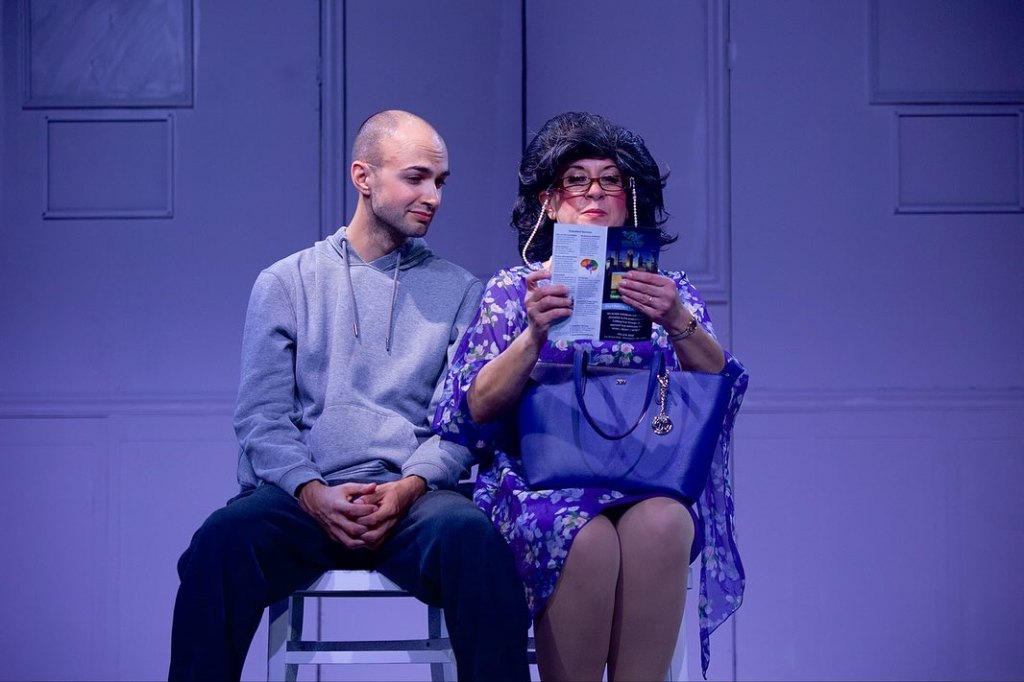
Choose an amount

$5.00
$15.00
$100.00
$5.00
$15.00
$100.00
$5.00
$15.00
$100.00

Or enter a custom amount

$

Your contribution is appreciated.

Your contribution is appreciated.

Your contribution is appreciated.

DonateDonate monthlyDonate yearly