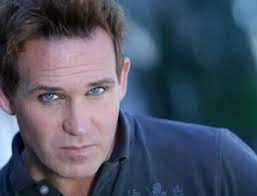
ONE IN TWO

This is the play that has no end. . .

A Theater Review by Julinda D. Lewis

At: Richmond Triangle Players at the Robert B. Moss Theatre | Carpenter Foundation Stage, 1300 Altamont Ave, RVA 23230

Performances: September 20 – October 14, 2023

Ticket Prices: $10 – $40

Info: (804) 346-8113 or rtriangle.org

———-

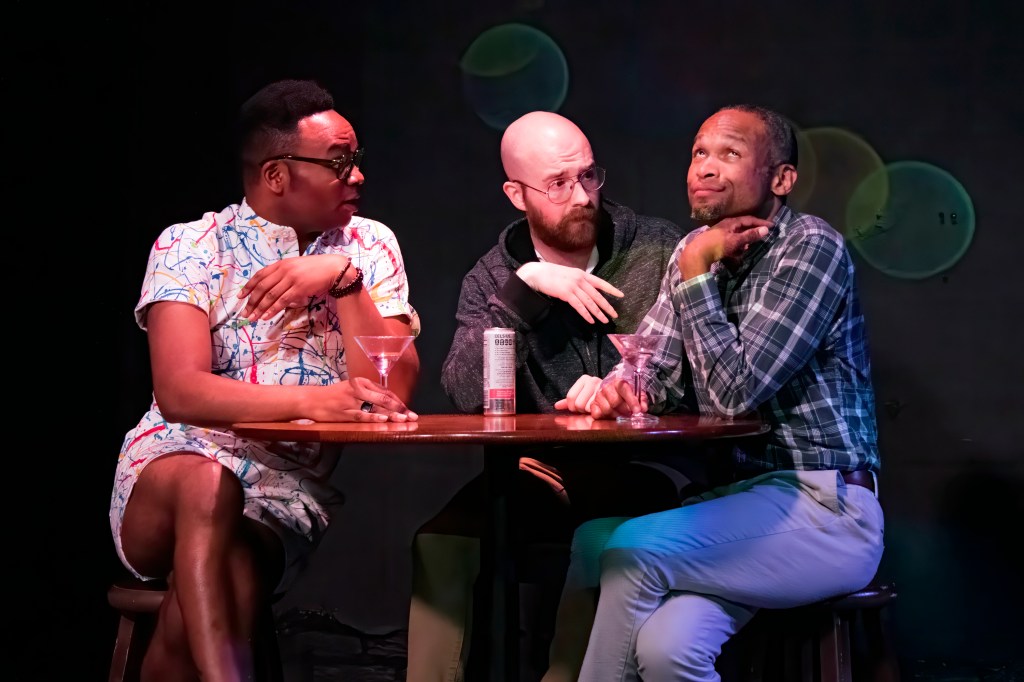
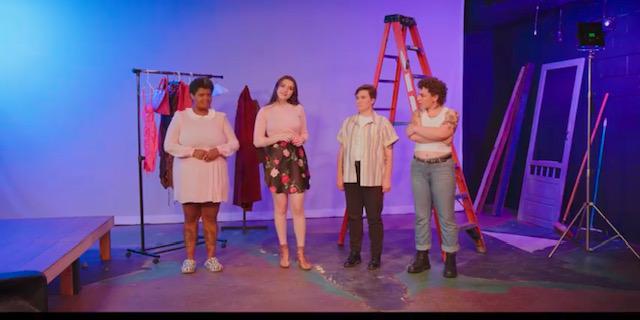
After seeing Donja R. Love’s phenomenal Sugar in Our Wounds, produced at Richmond Triangle Players (RTP) during April-May 2022, I was excited to see One in Two (2019) and I was not disappointed. One in Two is a three-person drama set in a waiting room, in the crossroads of “Now, until; Everywhere, nowhere.”

I was very intentional in my use of the word “crossroads.” While the literal meaning of a crossroads is an intersection, a place where two roads meet, it is commonly used figuratively and spiritually to refer to life-changing situations that require special attention, a decision, and are often marked by rituals of protection or transition.

One in Two is a masterful example of storytelling, but not the kind of story that is meant to entertain. This story is autobiographical – written by the playwright around the tenth anniversary of his own HIV positive diagnosis. It is not an entertainment, but rather a call to action, the urgency of which is suggested by the knowledge that Love began writing this play on the Notes app of his phone, from his bed. Presumably he, like the character Number One, was struggling with the need to define himself aside from a diagnosis that many considered a death sentence.

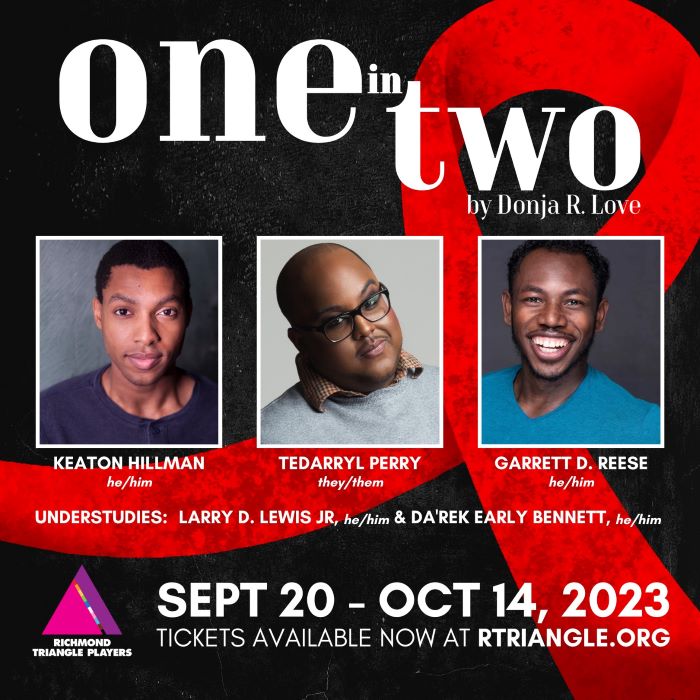
There is an experimental and inclusive nature to this work as well. Audience members are asked to take a number from a ticket machine as we enter. While the purpose is never explained, it eventually becomes clear that each ticket has been re-designated as either a “1,” a “2,” or a “3.” The three actors do not know, at the start of the show each night, which of them will be playing the role of “1,” “2,” or “3” until the audience chooses, by applause. [I applauded equally loudly for each because I know and admire Keaton Hillman and Tedarryl Perry as actors and was immediately drawn to Garrett D. Reese’s “extra-ness.”]

The actors begin to drift onto the stage one by one, about ten minutes before the show starts. They stand, stretch, linger. The action begins with a scream. On Friday, opening night, Perry was chosen to be Number One, and soon after a “safe word” was established. Overkill? No. It is, indeed, that intense.

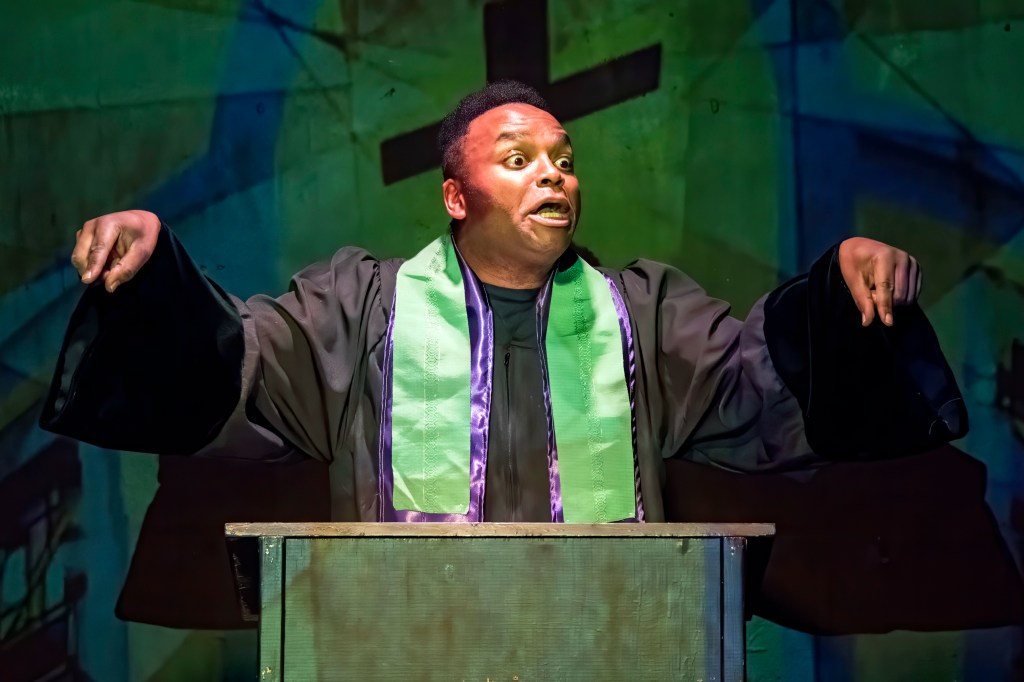
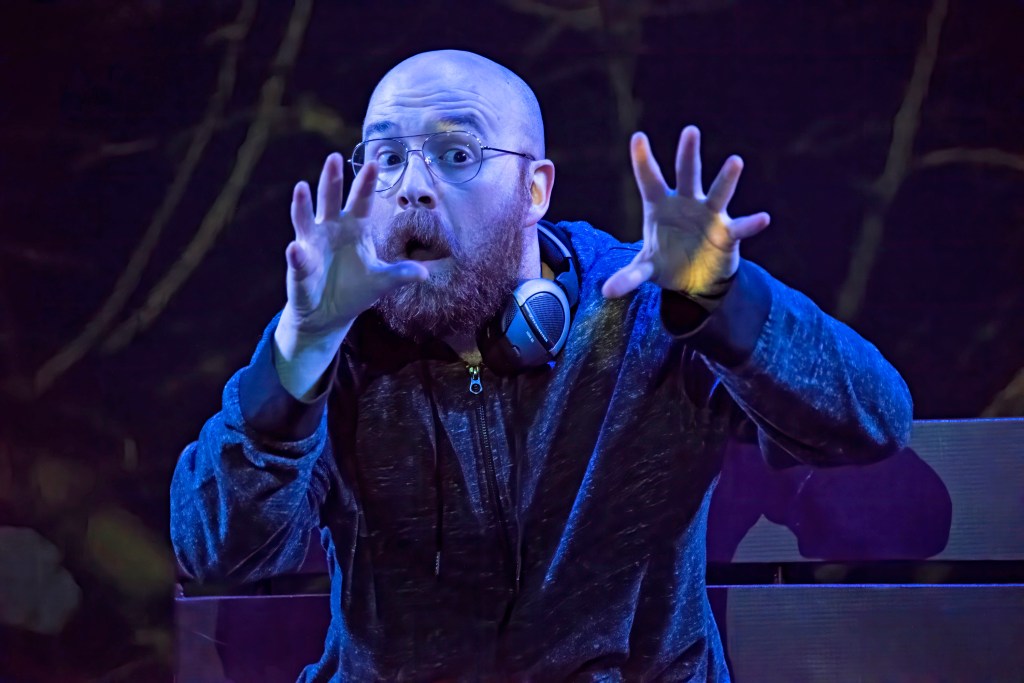
One in Two is not lacking in humor. The three romp in a recreated memory of their youth. Perry progressed through the role of Dante from a carefree little boy to a young man exploring his sexuality until stumbling at the crossroads of an HIV positive diagnosis. Hillman played a number of roles, from bossy, king-of-the-hill kid to bartender to supportive [female] nurse, and even a member of an HIV support group – whose marriage was surrounded by secrecy and the unwillingness of his in-laws to accept their son’s marriage to another man. Reese also took on various roles, from the playground mediator to a streetwise booty call or, to put it more graphically,  trade, to Dante’s warm but worried mother.

Director Shanea N. Taylor pulls us into this world that unfolds in a non-linear, sometimes dream-like format that carries the audience from laughter to the point of tears in a matter of seconds. The stark white background, with a nurse’s station, a bathtub, and a bar hidden behind convenient cabinet doors, supports this fragile paradox – there’s nowhere to hide, while hidden in plain sight.

While it is impossible to know exactly how someone feels in this situation, One in Two takes us as close as humanly possible with a roller coaster of emotion including shock, shame, anger, depression and despair, compassion, fear, and more. The trauma is real. The acting, the play, is just an effective delivery vehicle.

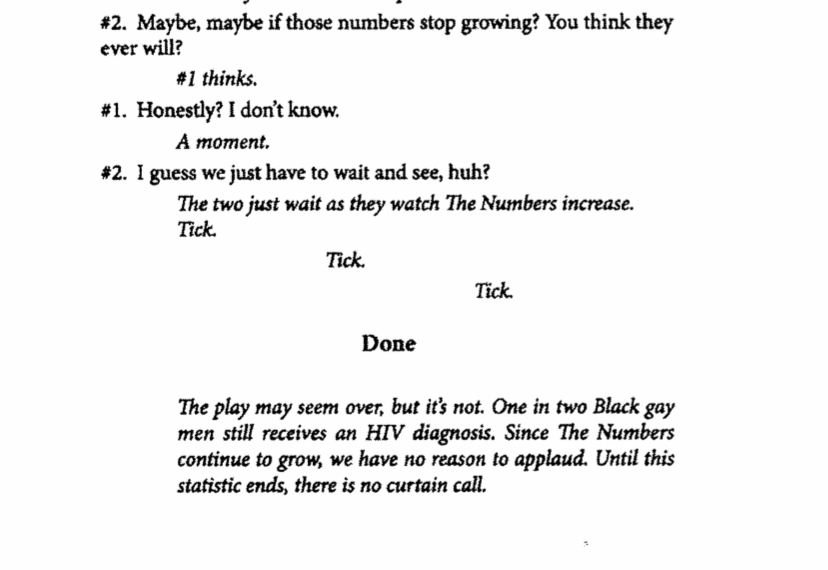
Oh. That title? At the time this play was written, according to the CDC statistics: One in fourteen gay white men will be diagnosed with HIV in their lifetime. One I four gay Hispanic men will be diagnosed HIV positive. And one in two gay Black men will be diagnosed with HIV. That is why, at the end of this play, there is no bow. There is no applause. There is no end. Yet.

FROM THE PLAYWRIGHT: “There is still trauma that’s hard to write, there are still remnants of fear that tremble the voice found in my writing. I’ve gotten to a point where there are no words, characters, dialogue, or subtext to hide behind anymore. Fear can no longer overshadow truth.”

Bravo to this cast and creative team and to Richmond Triangle Players for moving past fear and presenting us with the cold, harsh truth.

Julinda D. Lewis is a dancer, teacher, and writer who was born in Brooklyn, NY and now lives in Eastern Henrico County.

———-

ONE IN TWO

Written by Donja R. Love

Directed by Shanea N. Taylor

CAST:

Keaton Hillman – Person on the Left

Tedarryl Perry – Person in the Middle

Garrett D. Reese – Perso on the Right

Understudies: Da’Rek Early Bennett and Larry Lewis, Jr.

CREATIVE TEAM:

Scenic Design – Dasia Gregg

Lighting Design – Michael Jarett

Sound Design – Nicholas Seaver

Projection Design – Lucian Restivo

Costume, Hair & Makeup Design – Margarette Joyner

Props Design – Tim Moehring

Production State Management – Lauren Langston

Assistant Direction – Dwight Merritt
One-Time
Monthly
Yearly

Please Make a one-time donation to support the continued publication of rvart review

Make a monthly donation

Make a yearly donation

Choose an amount

$5.00
$15.00
$100.00
$5.00
$15.00
$100.00
$5.00
$15.00
$100.00

Or enter a custom amount

$

Your contribution is greatly appreciated.

Your contribution is appreciated.

Your contribution is appreciated.

DonateDonate monthlyDonate yearly

GHOST QUARTET

A Song Cycle About Love, Death, and Whiskey

An Immersive Theatrical Experience Review by Julinda D. Lewis

At: The Firehouse 1609 West Broad St., Richmond, RVA 23220

Performances: January 19 – February 18, 2023 [NOTE: This includes extended dates]

Ticket Prices: $35 general admission, $45 VIP two-top, $20 students

Info: (804) 355-2001 or firehousetheatre.org.

If you like the unique and different, if you are comfortable with ambiguity, if dramatic explorations of death and non-linear story-telling pique your interest, then GHOST QUARTET  was written for you. Not fully a play, not fully a musical, more akin to an opera, Dave Malloy’s creation was first produced in 2014 and was soon after nominated for awards for Best Music and Best Musical.

While I assert that the term “musical” is too confining to describe Ghost Quartet, there is no doubt that the music – much of which is played or engineered by Amy L Oblinger – is amazing. There are vocals and instrumental music involving a piano, a cello, a violin, and percussion. At one point small percussion instruments – a tambourine, a rattle, small rattles – are distributed to audience members.

Two of the Quartet members perform a delightfully unexpected tap and clog dance. And most of the cast members are quite comfortable breaking the fourth wall and addressing the audience – some of whom, the  VIPs, are seated at small table right on stage where they are served whiskey shots by the cast members who are gathered for a reunion of sorts at a bar that is apparently owned by one of the Quartet members.

Whew! That’s just by way of introduction, and doesn’t even begin to explain Ghost Quartet, Instead of Acts and Scenes, Ghost Quartet is divided into Sides and Tracks – which are announced at the top of each segment. While intentionally non-linear in structure, the sections are, in fact, related to one another. So, “The Camera Shop” in Side 1, Track 2 is related to “The Photograph” in Side 3, Track 2 and there is an “Usher” track – as in Poe’s “The Fall of the House of User” – in Sides 1, 2, and 3.

Family is another common theme woven throughout the production in which cast members play multiple characters, across generations, and encompassing – the program says – seven centuries. This makes it possible for Ghost Quartet to seamlessly discuss and conquer death, include sassy little girls and monks, have storytelling by Schéhérazade (yes, the one from Arabian nights), and sing an ode to whiskey (e.g., Jamieson, Maker’s Mark, Lagavulin), call a family meeting to deliver an ultimatum about an invisible friend, and conflate monks (the religious kind) with Thelonious Monk (the musician).

Bringing a wide range of talents, sass, and gifts to this production: Jaylin Brown, Valerie Chinn, Céilí Galante, Marjie Southerland, and Musical Director Amy L. Oblinger. They sing, they dance, they act, tell stories, play instruments, and drink whiskey for two hours (including one intermission).  Todd Labelle’s design, featuring a standard wooden bar as well as a vertical “floating” bar and walls of wide-spaced wooden slats, is simultaneously minimalist and luxurious. It provides a welcoming backdrop for an unfamiliar performance genre. Andrew Bonniwell’s lighting organically partners with the live music, electronic arrangements, and some surprisingly stunning vocal moments.

If, as Director PJ Freebourn wrote in their notes, the goal is to transport the audience and take us on a surreal journey that explores, among other things, love, family, hope, memory, and emotions, then Ghost Quartet is a smashing success. If you leave still wondering just what the hell happened and why it made you feel confused and amazed, if you leave talking about it, thinking about it, or asking questions about it — it was successful. February 4 was originally supposed to be the final performance, but four additional performances have been added over the next two weekends – Friday evenings, February 10 and 17, and Saturday matinees, February 11 and 18. If you haven’t seen it yet, recommend you try to reserve a ticket or two to one of these performances – then we can talk about it together.

———-

Julinda D. Lewis is a dancer, teacher, and writer who was born in Brooklyn, NY and now lives in Eastern Henrico County.

———-

GHOST QUARTET

By Dave Malloy

Directed by PJ Freebourn

Performers:

The Ghost Quartet

Jaylin Brown
Valerie Chinn
Céilí Galante
Marjie Southerland

Musician

Amy L. Oblinger

Production Team

PJ Freebourn – Director

Amy L. Oblinger – Music Director

​Niccolo Seligmann – Electronic Arrangements, Synth Programming, Foley Art

Céilí Galante – Additional Arrangements

Nicole Morris-Anastasi – Choreographer

Todd Labelle – Production Designer

Andrew Bonniwell – Lighting Designer

Katherine Brand – Costume Designer
Grace Labelle, Emily Vial, Talon Bleacher – Stage Managers

Performance Schedule:

Thu Jan 19 @ 8pm (preview)

Fri Jan 20 @ 8pm (preview)

Sat Jan 21 @ 4pm (preview)

Sat Jan 21 @ 8pm

Fri Jan 27 @ 8pm

Sat Jan 28 @ 4pm

Sat Jan 28 @ 8pm

Fri Feb 3 @ 8pm

Sat Feb 4 @ 4pm

Sat Feb 4 @ 8pm

EXTENDED: Additional Performances!

Fri Feb 10 @ 8pm

Sat Feb 11 @ 4pm

Fri Feb 17 @ 8pm

Sat Feb 18 @ 4pm

Ticket Prices

$35 general admission, $45 VIP two-top, $20 students

Run Time:  Approximately 2 hours with one intermission

Photo Credits: Bill Sigafoos

One-Time
Monthly
Yearly

rvaRT DEPENDS ON YOUR DONATIONS
THANK YOU

Make a monthly donation

Make a yearly donation

Choose an amount

¤5.00
¤15.00
¤100.00
¤5.00
¤15.00
¤100.00
¤5.00
¤15.00
¤100.00

Or enter a custom amount

¤

Your contribution is appreciated.

Your contribution is appreciated.

Your contribution is appreciated.

DonateDonate monthlyDonate yearly

HOW BLACK MOTHERS SAY I LOVE YOU

“Do not press me to leave you,
    to turn back from following you!
Where you go, I will go;
    where you lodge, I will lodge;
your people shall be my people
    and your God my God. – Ruth 1:16 (NRSV)

A Theater Review by Julinda D. Lewis

At: Richmond Triangle Players at the Robert B. Moss Theatre,

1300 Altamont Ave, RVA 23230

Performances: February 1-25, 2023

Ticket Prices: $10 – $40

Info: (804) 346-8113 or rtriangle.org

———-

Sometimes a production takes awhile to grow on you. Some shows are hard to connect with on a personal, emotional, social, literary, cultural or any other level. Just the opposite is true of Trey Anthony’s tender and amusing two-act family drama, HOW BLACK MOTHERS SAY I LOVE YOU. The author identifies as “a queer, black, Canadian, West Indian womyn” but their story is familiar to many Black women in Canada, the US, and the UK. I attended with my eldest daughter, and throughout the evening we looked at one another knowingly over our masks, reached for each other’s hands, cried out in instant recognition, or just cried.

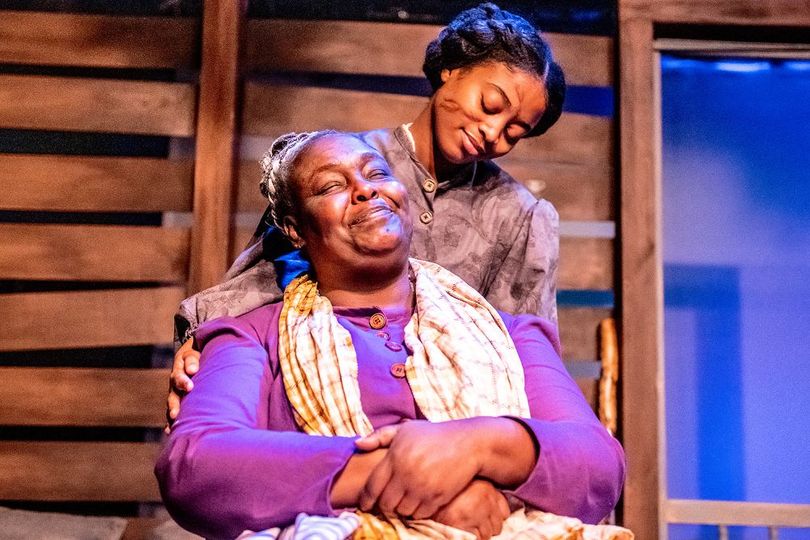
The author may be a Canadian of Jamaican heritage, but the play is set in the Brooklyn, NY home of a Jamaican immigrant woman in 2014 (although I thought the furniture and kitchen appliances harkened back a decade or two – or three? – before then). Claudette (Zakiyyah Jackson), the prodigal queer daughter of Daphne (Dorothy “Dee-D” Miller) has returned home unannounced after several silent years in Montreal, Canada. Claudette finds her mother in poor health and her younger sister Valerie (Shalandis Wheeler Smith) doing her best to care for her, despite Daphne’s refusal to follow doctor’s orders – and the added complications of Valerie’s own personal struggles. Claudette has questions that her mother is not willing to answer. Daphne left Claudette and Valerie with their grandmother in Jamaica for six years while she got established in the US.

Family secrets are painfully and reluctantly revealed, along with social and cultural histories that could bringing health and healing to many families and enlightenment to many allies. The story is brought to life by a small but mighty cast, led by Miller, the matriarch. I’m not Jamaican but I married into a Jamaican family and I found Miller’s accent spot on. She dropped the “h” where you expected to hear it and added it where you did not expect it. She called children “pickney” and pronounced the word “little” as if it were spelled with two k’s instead of two t’s. She won me over completely when she spoke about the baby’s “ackee seed eyes.” That’s how my mother-in-law used to refer to my children! My daughter looked at each other and shrieked in unison as my heart melted into a puddle on the floor. (Don’t worry, RTP staff, melted hearts do not stain the carpet.) Of course I looked to see who the dialect coach was and just as I suspected, it’s Erica Hughes. Kudos to Hughes for another amazing job.

[If you are familiar with ackee, you can skip this next paragraph.]

BTW: the ackee fruit is a Jamaican dietary staple, an essential ingredient in the Jamaica national dish of ackee and saltfish (i.e., salted cod). When ripe, the ackee plant yields fleshy yellow lobes that somewhat resemble scrambled eggs when cooked with saltfish. The fruit has shiny black seeds that people – especially Jamaican grandmothers – liken to the shiny bright eyes of babies and young children. The kicker is that, in its un-ripened state, ackee is quite poisonous.

Jackson and Wheeler Smith achieved a remarkable balance between sibling rivalry and sisterly love. Their affection appeared genuine and as the story unfolded we found that it was grounded in a history of collective trauma – unique to them, but familiar to many families whose histories are defined by the African diaspora. Significantly, my daughter wondered how these themes spoke to white viewers. This would be an interesting dialogue to introduce in a talk-back…

Let me not forget to mention Cloe. The younger, American-born sister of Claudette and Valerie who died in childhood from an unnamed illness, Cloe appears as a silent ghost. Dressed in white from head to toe, Bailey Robinson, a Henrico County Public Schools student, made her professional debut as the sometimes meddlesome, but mostly caring specter of young Cloe whose presence is welcomed and visible to Daphne – and sometimes, it seems, to Valerie. Claudette knows she is there, but cannot see her. The presence of Cloe is another strong symbol of ancestors and spirituality.

The set is a Brooklyn home sturdily and lovingly crafted by William Luther and tenderly lit by Dakota Carter. I did wonder, however, why there were several long periods of darkness or dimmed lights. Perhaps these stretches were meant to serve a visual equivalent of the dramatic pause, or to contrast with the bright white heavenly light that illuminated the runway that Cloe used to transition between the present and the hereafter. Or maybe it was just to allow for a costume change.

Margarette Joyner (founder and artistic director of the Heritage Theater that formerly closed its doors in 2022) designed the costumes, with special attention to Daphne’s collection of church hats and Valerie’s collection of coordinating handbags and shoes. Desirée Dabney directed through the eyes of a storyteller. The work and words flow with a sense of real time and a feeling of intimacy and immediacy.

HOW BLACK MOTHERS SAY I LOVE YOU is a stunningly beautiful work of theatre, one I was not familiar with, one I will not forget. See it with your mother or daughter. And take tissues.

———-

Julinda D. Lewis is a dancer, teacher, and writer who was born in Brooklyn, NY and now lives in Eastern Henrico County.

———-

HOW BLACK MOTHERS SAY I LOVE YOU

By Trey Anthony

Directed by Desirée Dabney

CAST

Daphne            …………….Dorothy “Dee-D” Miller

Claudette        …………….Shalandis Wheeler-Smith

Valerie             ……………. Zakiyyah Jackson

Cloe                 ……………. Bailey Robinson

Daphne Understudy: Diana Carver

Claudette Understudy: Nora Ogunleye

Valerie Understudy: Chayla Simpson

Cloe Understudy: Sydnee Logan

THE CREATIVE TEAM

Director/Sound Design: Desirée Dabney

Assistant Director/Dramaturg: Chayla Simpson

Production Stage Manager: Jennipher Murphy-Whitcomb

Assistant Stage Manager: Nathan Ramos

Scenic Design: William Luther

Lighting Design: Dakota Carter

Props Design: Tim Moehring

Costume Design: Margarette Joyner

Hair & Make Up Design: Jahara Jennae

Intimacy Choreographer: Raja Benz

Dialect Coach: Erica Hughes

Technical Director/Scenic Painter: Becka Russo

Covid Safety Officer: William Luther

Marketing Videos: Aisthesis Productions

Photo Credits: Pre-production photos from RTP Facebook page

One-Time
Monthly
Yearly

Make a donation to support the continued publication of rvart review
thank you

Make a monthly donation

Make a yearly donation

Choose an amount

¤5.00
¤15.00
¤100.00
¤5.00
¤15.00
¤100.00
¤5.00
¤15.00
¤100.00

Or enter a custom amount

¤

Your contribution is appreciated.

Your contribution is appreciated.

Your contribution is appreciated.

DonateDonate monthlyDonate yearly

CHRISTMAS ON THE ROCKS

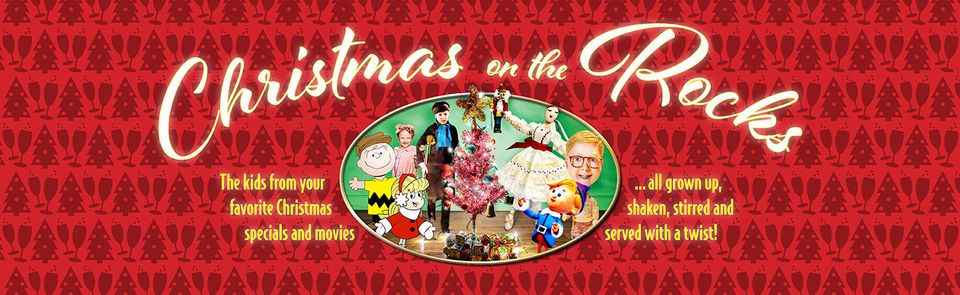
The Kids From Your Favorite Christmas Shows, All Grown Up

A Theater Review by Julinda D. Lewis

At: Richmond Triangle Players at the Robert B. Moss Theatre, 1300 Altamont Ave, RVA 23230

Performances: November 16 – December 18, 2022

Ticket Prices: $10 – $45

Info: (804) 346-8113 or rtriangle.org

———-

We can always depend on Richmond Triangle Players to give us an edgy, snarky, comedic, or dark Christmas offering. Christmas on the Rocks, a collection of short plays or scenes by various authors, does not disappoint – it gives us all of the above.

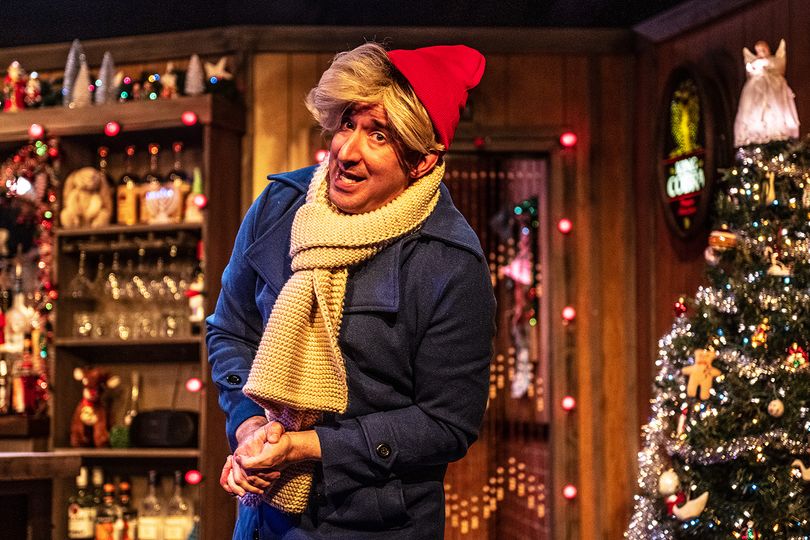
This year, the authors are John Cariani, Jenn Harris & Matthew Wilkas, Jeffrey Hatcher, Jacques Lamarre, Theresa Rebeck, and Edwin Sanchez. The “kids,” a slightly  different cast of characters than RTP’s 2015 production, include Ralphie from A Christmas Story, Zuzu Bailey from It’s A Wonderful Life,  Hermey, the Elf from Rudolph the Red-Nosed Reindeer and Rudolph and the Island of Misfit Toys, Karen, an internet influencer, Tiny Tim from A Christmas Carol, Clara from The Nutcracker ballet, and the hapless Charlie Brown. Zuzu and Karen replaced Susan (Miracle on 34th Street) and Cindy Lou Who (The Grinch Who Stole Christmas). Regional productions may feature different characters.

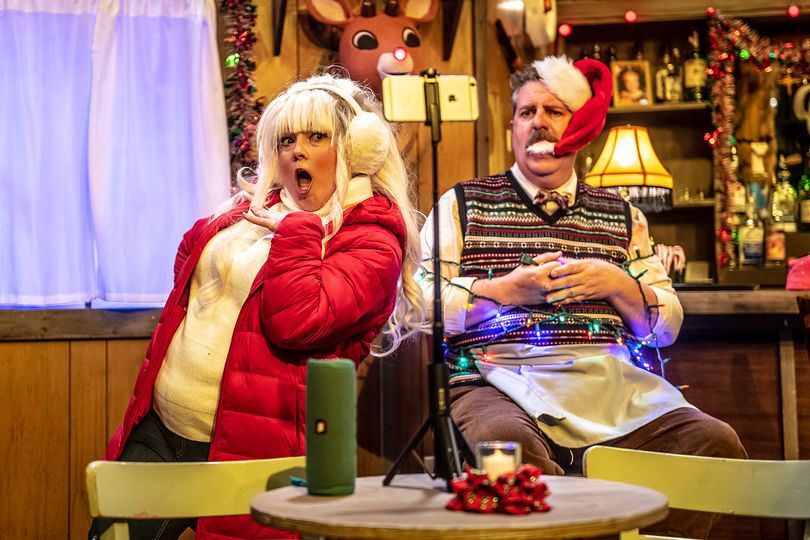
All these characters are portrayed by two highly talented and versatile actors. Theresa Mantiply plays all the women and Eddie Webster plays all the men. The motley cast of characters wander, one by one, into a local bar, where the friendly bartender, played by Joe Pabst, is at first surprised and ultimately perplexed at the increasingly colorful parade of characters who enter, seeking solace from the loneliness of Christmas Eve.

In the first scene, we see Ralphie, wearing an eye patch, peek through the window of the unimposing little bar – beautifully designed by William Luther with important inclusive details that provide something each of the characters can relate to on a personal level.

To answer the obvious question, yes, Ralphie finally did get his eye shot out, but it was not self-inflicted. A firearms safety instructor for the NRA, he was shot by a student and is now unemployed. On top of that, he has intimacy issues due to that infamous pink bunny suit his Aunt Clara sent, but not for the reasons one might expect.  You see, he actually liked it.

Little Zuzu Bailey who, as a child, declared that every time a bell rings, an angel gets its wings, has been harassed by angels for decades – and responds in nonsensical rhyming platitudes, while Hermey, the Elf who had dreams of becoming a dentist, has become a gossipy hater who holds a long-time grudge against Rudolf – not realizing that his own misfit status makes him more like Rudolph than not.

Karen, an entitled but untalented influencer, holds the Bartender hostage, posting increasingly unhinged videos for her unfortunate followers. Tiny Tim drops by, displaying Scrooge-like qualities and Clara’s cheating Prince has left her alone for the holiday. The last customer is none other than Charlie Brown, complete with a yellow sweater with a black zigzag line. Wonder of wonders – it’s a Christmas miracle – he finally gets to talk to The Little Red Haired Girl in the only scene shared by Mantiply and Webster. Through it all, Pabst calmy mixes drinks and offers gentle advice.

Christmas on the Rocks is a non-traditional Christmas story – or collection of sequels – billed as “an offbeat collection of twisted holiday tales” for the grown up kids in all of us who love a good laugh – especially when it’s at our own expense. There are limited performances left, so ditch the kids and go see it.

Julinda D. Lewis is a dancer, teacher, and writer who was born in Brooklyn, NY and now lives in Eastern Henrico County.

———-

CHRISTMAS ON THE ROCKS:

An Epic Offbeat Collection of Twisted Holiday Tales

Written by John Cariani, Jenn Harris & Matthew Wilkas, Jeffrey hatcher, Jacques Lamarre, Theresa Rebeck, and Edwin Sanchez

Conceived by Rob Ruggiero

Sponsored by David Peake

Directed by Axle Burtness

CAST:

Theresa Mantiply – Woman

Eddie Webster – Man

Joe Pabst – the Bartender

Understudies: Rachel Garmon-Williams and Travis Williams

CREATIVE TEAM:

Scenic & Costume Design       – William Luther

Lighting Design                       – Nathan Wunderlich

Sound & Projections Design   – Lucian Restivo

Hair & Make Up Design          – Luke Newsome

Props Design                           – Tim Moehring

Dialect Coach                          – Donna E. Cogbill

Technical Direction                 – William Luther

Assistant Scenic & Costume Design – Kendall Walker

Production Stage Manager – Saskia Price

Photo Credits: John MacLellan

One-Time
Monthly
Yearly

Make a donation TO SUPPORT
RVART REVIEW

Make a monthly donation

Make a yearly donation

Choose an amount

¤5.00
¤25.00
¤100.00
¤5.00
¤25.00
¤100.00
¤5.00
¤25.00
¤100.00

Or enter a custom amount

¤

Your contribution is appreciated.

Your contribution is appreciated.

Your contribution is appreciated.

DonateDonate monthlyDonate yearly

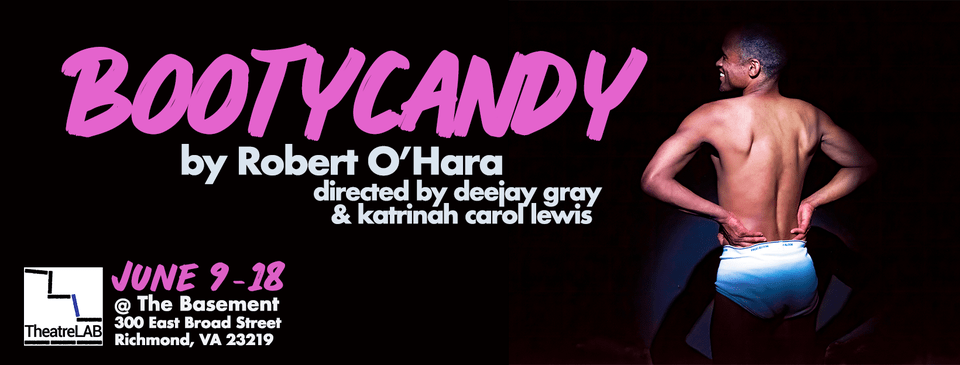
BOOTYCANDY:

It Probably Doesn’t Mean What You Think It Means

A Theater Review by Julinda D. Lewis

Produced by: TheatreLAB

At: The Basement, 300 E. Broad Street, RVA 23219

Performances: June 9-18, 2022

Ticket Prices: $20 General Admission; $10 Teachers & Students

Info: (804) 349-7616 or https://tlab-internet.choicecrm.net/templates/TLAB/#/events

Robert O’Hara’s BOOTYCANDY is a “semi-biographical subversive comedy” performed as a series of non-linear vignettes. The central character is Sutter and the central premise is Sutter’s journey growing up black and gay. It is hilarious, it is touching, it is relatable across genders, generations, and sexual orientations, and it is an exemplar of contemporary Africanist story-telling. It is, without a doubt, one of my favorite shows of the season – and I see my fair share of shows.

Todd Patterson shines in the lead role as Sutter. The five actors are identified only as Actor One, Actor Two, etc., and all but Patterson take on a number of different roles in Sutter’s life. Patterson dances between each scene – indeed, his “grandmother” and other relatives request that he “do that step Michael Jackson liked to do.” The playwright, O’Hara, has specified that Jackson’s music be used throughout, and the music of Michael Jackson, Prince, and perhaps a few others energizes the space from the moment you walk through The Basement doors.

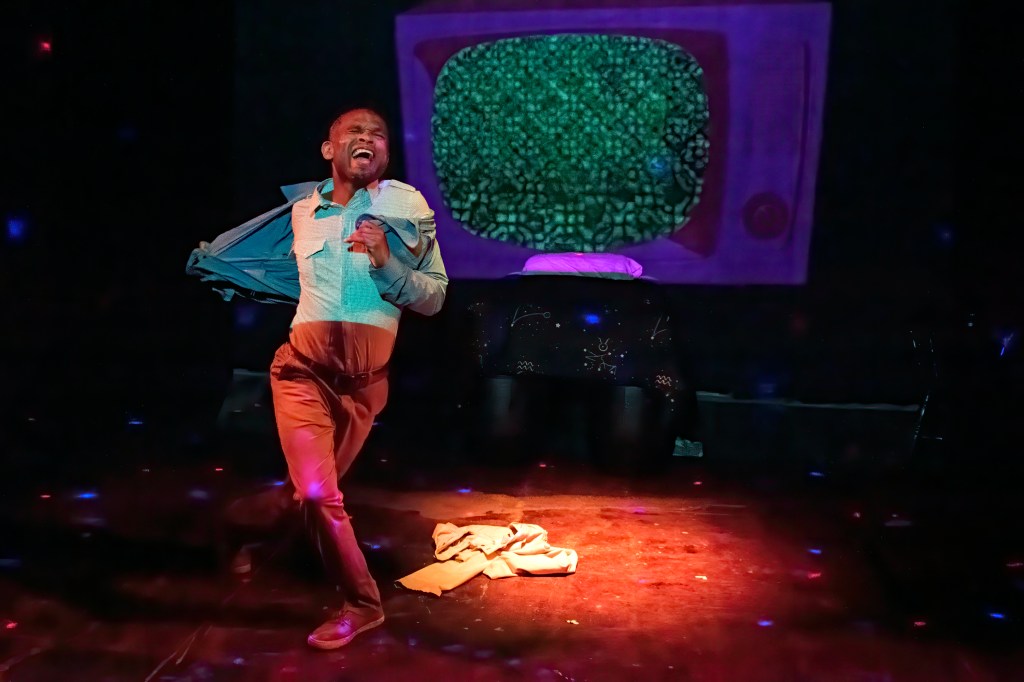
Patterson strips for us, and dances with a manic energy that reflects his character’s inner landscape. But as much as I was impressed by Patterson’s performance, this is truly an ensemble production – starting with the symbiotic directing team of Deejay Gray and Katrinah Carol Lewis. I’ve seen each of these actors in several productions, and this one cast them each in a new light and presented them with new challenges.

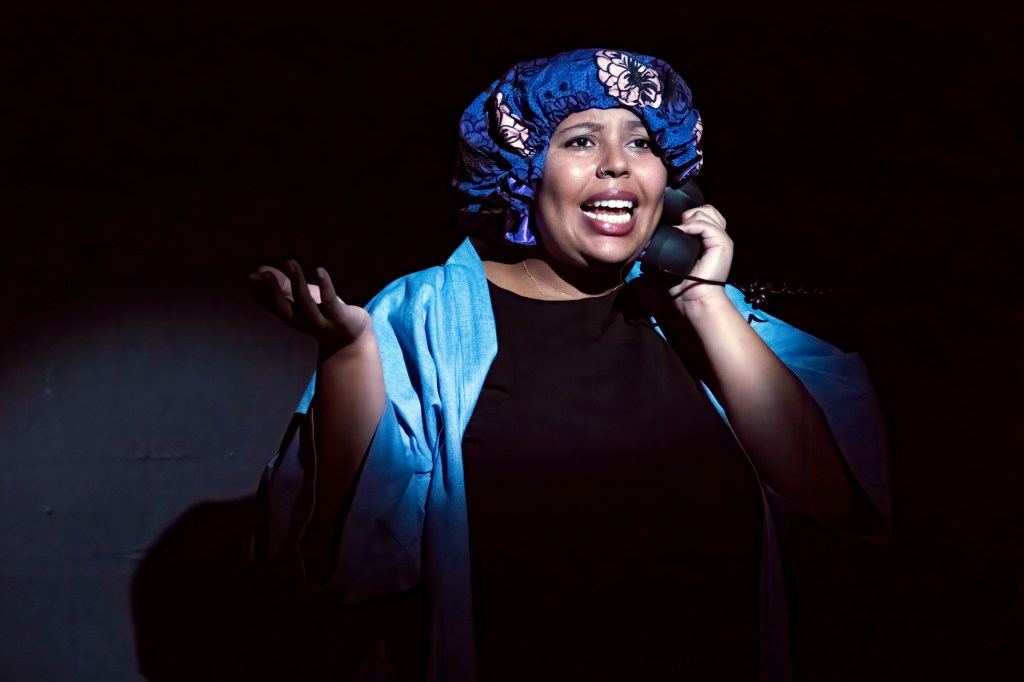
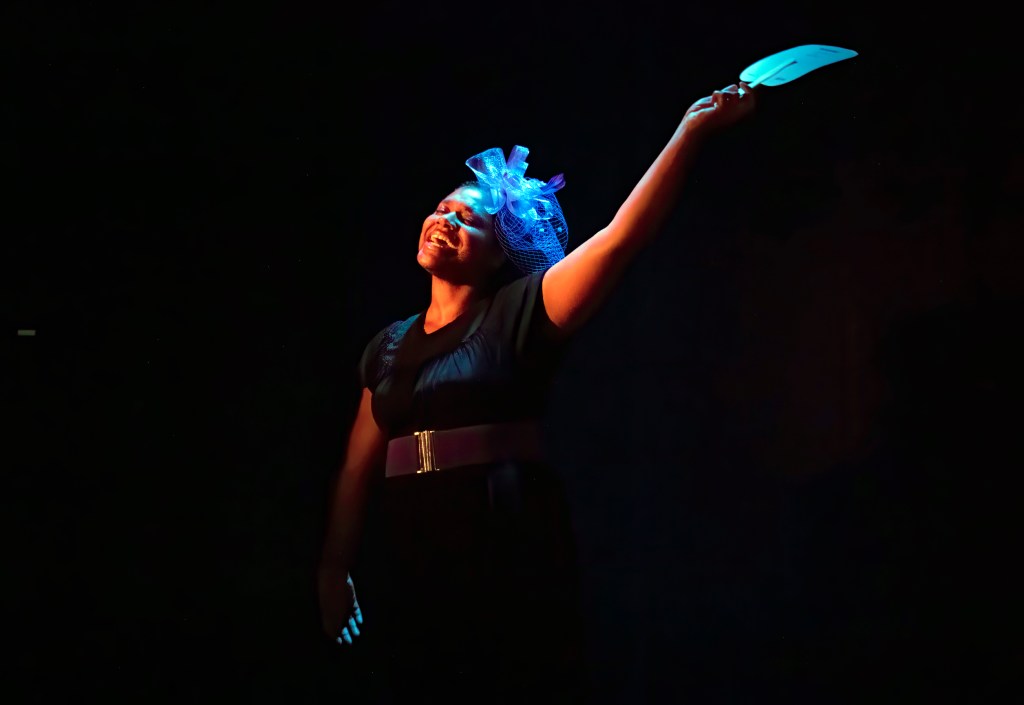
Dylan Jones and Zakiyyah Jackson hold down most of the female roles in Sutter’s life. Both play his mother, at different ages, as well as aunties, friends, a sister, and church ladies. In one scene they portray a quartet of women gossiping on the telephone, highlighted by rapid costume changes but my favorite is their second act “non-committal ceremony,” a nasty same-sex divorce officiated by a Zen-like Cashwell. This scene is the embodiment of the adage, “same sex, same problems!”

Durron Marquis Tyre transforms into several characters, but my favorites are the right reverend who comes out in a sermon delivered to his outraged congregation. Instead of coming out of the closet, he emerges from behind his pulpit to reveal fishnet stockings, blinged out silver slingback heels, a wig, and finally a clingy little red dress and matching lipstick. This is where Jones and Jackson begin their magic as they subtly change from gossip-mongers to staunch supporters.

In the second act, Tyre portrays Sutter’s grandmother who offers him comfort in a time of need as she slyly extracts some cash to tuck into her bosom and a delivery of forbidden soul food. For a moment, I thought Tyre had been speaking with my own late grandmother to develop this character because his mannerisms and speech brought back memories directly from my own past. And that is part of the beauty of this play: it is relatable. In a post-show talkback the day I saw it, everyone who spoke found some point of connection. The scene where Sutter realizes he is under stress is a turning point – he stops the show, has a verbal interaction with the Stage Manager, Crimson Piazza, and the tone and tenor of the play shifts. This is , undoubtedly, one of the author’s genuine auto-biographical moments. Its poignancy highlights the humorous aspects of the previous scenes, and reminds us that often laughter is the only things that helps us make it through the tough or uncertain times.

And of course I cannot forget Dixon Cashwell – the only white guy in the cast. He plays several characters, but my favorites are his portrayal of a clueless conference facilitator for the scene that closes the first act. Cashwell’s character strolls obliviously into a minefield of micro-aggressions that elicit yelps of incredulity from the cast as well as at least one audience member. In other scenes, Cashwell becomes a gay-curious male sharing an uncomfortable relationship with his brother-in-law, and has a spellbinding turn as an intoxicated man at a lonely bus stop at 3:00 AM who amazingly talks himself out of being mugged.

There are a number of little things that make BOOTYCANDY as close to perfect as it can possibly get. The subject of the women’s telephone scene is the name one young mother has chosen for her baby girl: Genitalia! It is a spoof of the unique names and exotic naming conventions of Black American families and a nod to the sort of urban legends many of us educators have passed down through the decades: the little boy named Shi-Thead, the little girls named Vagina, Clitoris, and Female (pronounced Fah-MA-ley), or the twins named Orangejello and Lemonjello (pronounced a-RON-zhello and le-MON-zhello).

By the time you read this, BOOTYCANDY may have ended its all-too-brief run, but just in case, consider this a SPOILER ALERT: BOOTYCANDY does not refer to a sexually attractive booty or a hot gay guy. Quite innocently – and oddly – it is the word the young Sutter’s mother uses to refer to his penis, and an excellent advertisement for teaching children the real words for their body parts.

I haven’t laughed so hard or so often I the theater in recent memory. In the words of one viewer, BOOTYCANDY is no entry-level theater, meaning it is not linear or predictable, and there is no happily-ever-after fairytale conclusion. In the mind of this reviewer, that is what makes it so special.

THE CAST

Actor One ………………………….        Dylan Jones

Actor Two ……………………….…        Todd Patterson

Actor Three …………..…………..       Zakiyyah Jackson

Actor Four ………………………….       Durron Marquis Tyre

Actor Five ………………………….       Dixon Cashwell

THE TEAM

Direction: Deejay Gray & Katrinah Carol Lewis

Scenic Design: Deejay Gray

Projection Design: Dasia Gregg

Lighting Design: Michael Jarett

Costume Design: Nia Safarr Banks

Sound Design: Kelsey Cordrey

Properties Design: Kathy O’Kane Kreutzer

Production Stage Management: Crimson Piazza

THE SCHEDULE

Thursday, June 9 at 7:30 [Preview Performance]

Friday, June 10 at 7:30 [Opening Night]

Saturday, June 11 at 7:30 [Post-Show Dialogue]

Sunday, June 12 at 7:30

Wednesday, June 15 at 7:30 [ADDED SHOW]

Thursday, June 16 at 7:30

Friday, June 17 at 7:30

Saturday, June 18 at 7:30 [Closing Night]

NOTE: All performances are at 7:30pm at The Basement:

300 East Broad Street, Richmond VA 23219

THE TICKETS

$20 – General Admission

$10 – Teachers & Students

LINK: https://tlab-internet.choicecrm.net/templates/TLAB/#/events

*PROOF OF VACCINATION / A NEGATIVE COVID TEST REQUIRED* The Basement is a fully vaccinated venue. Proof of vaccination or a negative COVID-19 test (within 48 hours of the performance) are required upon entry. For the safety of our artists and audiences, masks must be worn while at the theatre. Thank you for keeping our community safe!

Julinda D. Lewis is a dancer, teacher, and writer who was born in Brooklyn, NY and now lives in Eastern Henrico County.

———-

Photo Credits: Photos by Tom Topinka

One-Time
Monthly
Yearly

Make a one-time donation

Make a monthly donation

Make a yearly donation

Choose an amount

$5.00
$15.00
$100.00
$5.00
$15.00
$100.00
$5.00
$15.00
$100.00

Or enter a custom amount

$

Your contribution to support RVArt Review is appreciated.
-Julinda D. Lewis, EdD

Your contribution is appreciated.

Your contribution is appreciated.

DonateDonate monthlyDonate yearly

COLLECTIVE RAGE: A Play in 5 Betties

. . .Imagine the Arctic as a Pussy; It’s Sort of Like That

A Theater Review by Julinda D. Lewis

At: Richmond Triangle Players at the Robert B. Moss Theatre, 1300 Altamont Ave, RVA 23230

Performances: June 8 – July 2, 2022

Ticket Prices: $30-35; $10 for Students.

Info: (804) 346-8113 or rtriangle.org

In Essence, A Queer and Occasionally Hazardous Exploration; Do You Remember When You Were In Middle School And You Read About Shackleton And How He Explored The Antarctic?:

Imagine The Antarctic As a Pussy And It’s Sort Of Like That

There are 5 characters in COLLECTIVE RAGE and they are all named Betty. Betty #1, Lenaya Van Driesen) is married to a man of wealth who has no time for her; Betty #2, Nora Ogunleye, is in a sexless marriage; Betty #3, Zoe Cotzias, is a celebrity lesbian who works at Sephora; Betty #4, August Hundley, is a sensitive queer woman with a truck and a crush on Betty #3; and Betty #5, with Rachel Garmon-Williams subbing for Kasey Brett is a non-binary male presenting female who runs a boxing gym – and owns a truck.

After Betties #2 and #3 attend a boring dinner party given by Betty #1, Betty #3 throws her own dinner party, where she gives the shy and friendless Betty #2 a hand mirror and invites her to use it to look at her pussy. This act opens up a whole new world for Betty #2 who spends the rest of the play on a journey of self-exploration and empowerment.

Betty #3 attends a play with a friend, becomes enamored of the “thea-tah” and decides to devise a play of her own. Betty’s play involves a prologue, a wall, a lion, and moonshine; it borrows blindly and liberally from the mechanicals’ play-within-a-play in Shakespeare’s Midsummer Night’s Dream – whose title Betty repeatedly butchers.

When they all get together to rehearse for “the thea-tah,” the ensuing chaos both defines and defies their collective rage. Set in New York in the present  and first performed in 2016, COLLECTIVE RAGE is described as a “lesbian/bi-curious/genderqueer/Shakespearean comedy for everyone.” COLLECTIVE RAGE feels like a fusion of satire, cabaret, and improv. It’s hilarious and touching at the same time. There’s a cheating husband, a contrast between femme and butch, stereotypes of lesbians with trucks, and all the elements are used to explore growth, individual and collective, in multiples areas of life.

Directed seamlessly by Chelsea Burke, COLLECTIVE RAGE is more than just a niche production; it’s relatable across economic, ethnic, and gender boundaries. Van Driesen is sharp and dangerously edgy, both in her verbal delivery and her physical presentation. Ogunleye is endearing in her eurotophobia (yes, there is a word that means fear of one’s vagina or female genitalia). Cotzias aptly and appealingly encapsulates every video of a vacuous influencer I’ve ever seen. Hundley nailed their portrayal of a caring but insecure character, while Garmon-Williams uses body language and physicality on equal footing with words. COLLECTIVE RAGE offers the viewer options: you can enjoy it as a comedy, as social commentary, or both.

———-

Julinda D. Lewis is a dancer, teacher, and writer who was born in Brooklyn, NY and now lives in Eastern Henrico County.

———-

COLLECTICE RAGE: A Play in 5 Betties

Written by Jen Silverman

Directed by Chelsea Burke

CAST:

Betty #1 …………………………………….  Lanaya Van Driesen

Betty #2 …………………………………….  Nora Ogunleye

Betty #3 …………………………………….  Zoe Cotzias

Betty #4 …………………………………….  August Hundley

Betty #5 …………………………………….  Kasey Britt

Understudies

For Betty #1 ……………………………………. Amanda Spellman

For Betties #2 & #3………………………….. Leanna Hicks

For Betties #4 & #5 …………………………. Rachel-Garmon-Williams

CREATIVE TEAM:

Costume, Hair & Make-Up Design      – Dasia Gregg

Costume, Hair and Make-up Design   – Carolann Corcoran

Lighting Design                                   – Deryn Gabor

Sound Design                                      – Candace Hudert

Intimacy Choreographer                    – Stephanie Tippi Hart

Properties Design                               – Tim Moehring

Assistant Director                               – Katie Fitzgerald

Technical Director                              – Tom Holt

Production Stage Manager                – Lauren Langston

Sound Design                                      – Candace Hudert

Intimacy Choreographer                    – Stephanie Tippi Hart

Properties Design                               – Tim Moehring

Photo Credits: No production photos available at the time of publication

One-Time
Monthly
Yearly

Make a one-time donation

Make a monthly donation

Make a yearly donation
Choose an amount

¤5.00
¤15.00
¤100.00
¤5.00
¤15.00
¤100.00
¤5.00
¤15.00
¤100.00

Or enter a custom amount

¤

Your contribution to support RVArt Review is appreciated.
RVArt Review is an independent publication that relies on your donations. Thank you.

Your contribution is appreciated.

Your contribution is appreciated.

Donate HEREDonate HEREDonate HERE

STARR FOSTER DANCE PRESENTS:

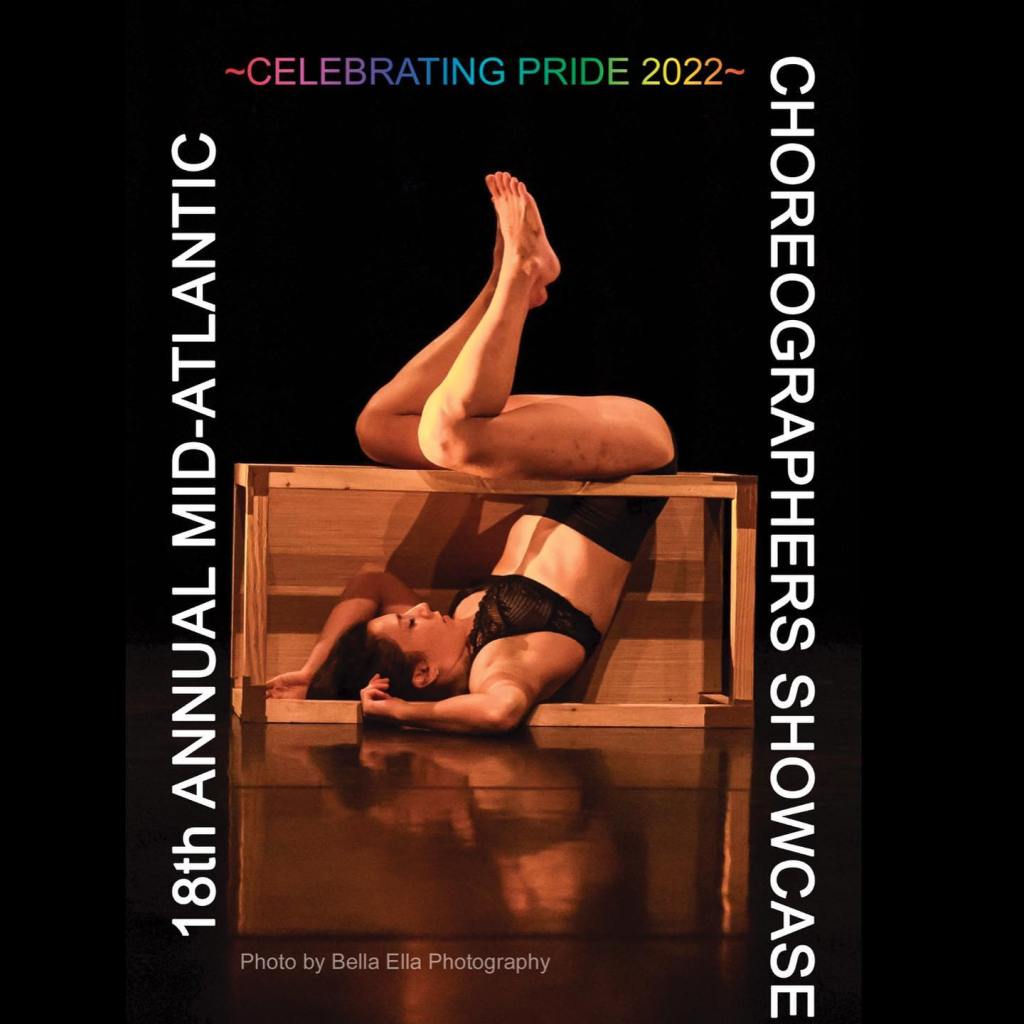
18th Annual Mid-Atlantic Choreographers Showcase: Celebrating Pride

A Dance Review by Julinda D. Lewis

At: The Basement, 300 East Broad Street, RVA 23219

Performances: June 4 & 5, 2022

Ticket Prices: $15

Info: www.starrfosterdance.org, www.facebook.com/starrfosterdance, Instagram/starrfosterdance

2022 CHOREOGRAPHERS

AB Contemporary Dance / Alyah Baker; Raleigh, NC

Ankita; Brooklyn, NY

Luisa Innisfree Martinez; Richmond, VA

Megan Mazarick; Philadelphia, PA

Next Reflex Dance Collective / Roxann Morgan Rowley; Fairfax, VA

Starr Foster Dance/Starrene Foster; Richmond, VA

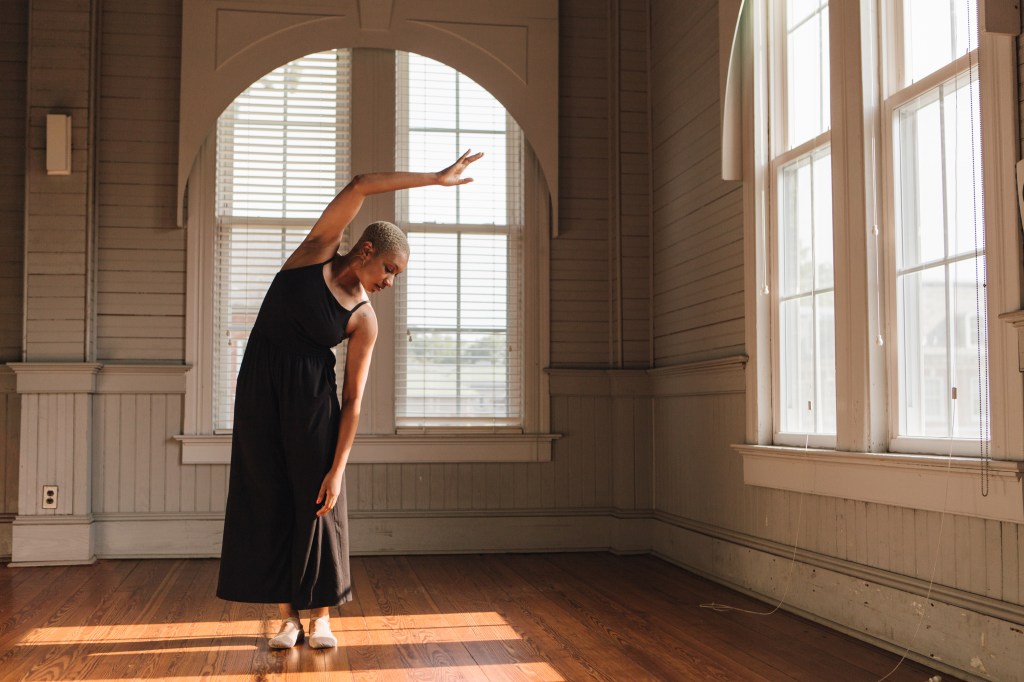
Wow. From first to last, the 2022 Mid-Atlantic Choreographers was riveting. The six works by six choreographers from Brooklyn, NY to Raleigh, NC each embraced LGTBQIA+ themes or concepts related to gender or sexuality. Each was performed in the round – actually, in a defined square, with the audience intimately situated on all sides. For those old enough to know what I’m talking about, it reminded me of my undergraduate days watching dance at NYC’s Judson Church. (If you’re not of a certain age, I don’t know, maybe a cypher or a rave might describe the vibe.)

One of the most striking pieces was Fools+Kings, a premiere choreographed and performed by Alyah Baker in collaboration with Lee Edwards and Kahlila Brown. Accompanied by smooth jazz performed by Nat King Cole and Orchestra and CeeLo Green, the trio graced us with liquid combinations of movement and incredibly soft landings. Sometimes the arresting choreography consisted of just a gaze, a burning stare. Dressed in black vests and pants, with three low stools as mobile props, the dancers kept the movement simple, yet their virtuosity was undeniable.

Inspired by the life and legacy of composer Billy Strayhorn, Fools+Kings was escribed in the program as an exploration of “themes of connection and heartbreak through the lens of Black Queer aesthetics and embodiment.” I was particularly struck by Lee Edwards who – I swear – reminded me of a compact, femme version of Bill T. Jones. Anyone who knows me knows that Bill T. Jones is one of my favorite dancers of all time, so I do not say this lightly. Fools+Kings built up a complex structure balanced on hot and cool jazz and Afro beats and then, BAM! – without warning or preparation, it ended with a full stop. Wow. I cannot wait to see more from this group.

Backtracking to the opening, the program began with a solo, old swan, by Megan Mazarick. Dressed in a tailored suit, Mazarick delivered portions of a deconstructed lecture while executing a fusion of post-modern, classic break-dance type moves, the robot, and even a bit of disco in a humor-infused cycle of melting and resurrecting. This is the work that took me back to Judson Church. I take notes in the dark, and for this piece my page was inscribed with a large heart. While old swan may be a reference to ballet classics like Swan Lake and all the fairy tale magic that goes along with the romantic era, it may also be a sly play on the symbolism of swans representing grace, love, trust, beauty, and loyalty. The final scene of the swan “coming home to roost” reminded me of that old saying about chickens coming home to roost – meaning that the evil things you do will come back to bite you in the butt (i.e., karma). Of course, Mazarick may not have intended any of these concepts, but I felt free – even invited – to explore all of them in this wonderful solo.

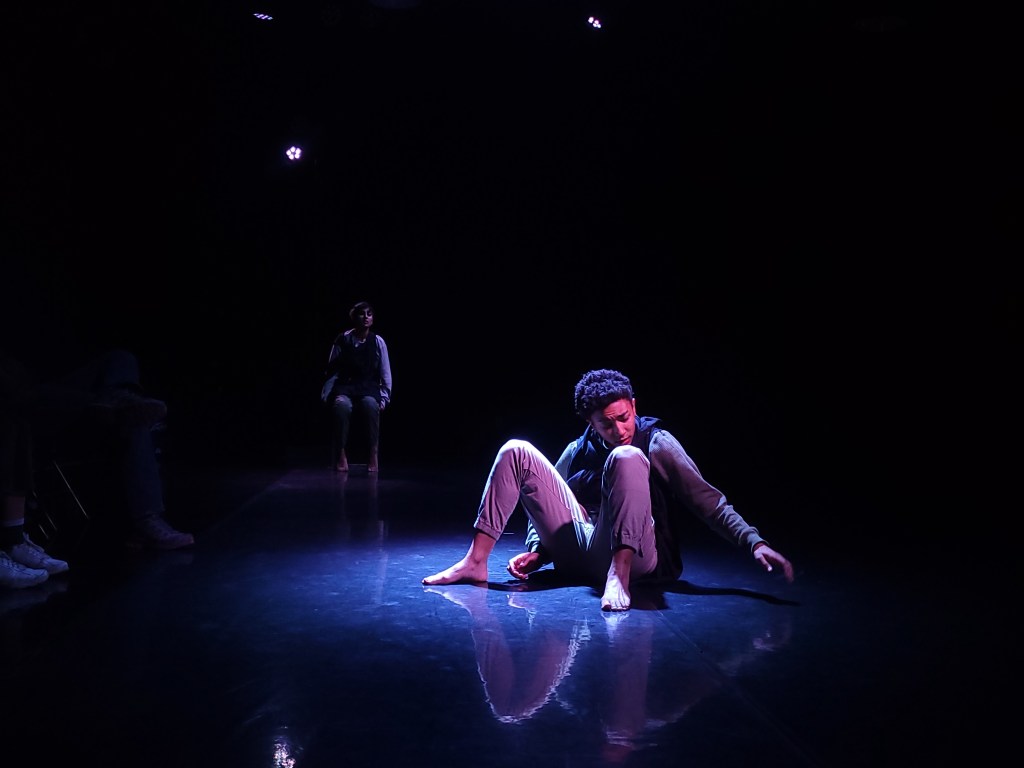
Another work that resonated was an excerpt from a dance called Penumbra, choreographed by Ankita Sharma and performed by Sharma and Darryl Filmore. Penumbra is dark, very dark. I have sometimes teased Starr Foster, saying that her works are so dark, but I was referring to the lighting. Penumbra  is psychologically dark, and that’s an even more terrifying kind of dark. By definition, a penumbra is a region of shadow or partial illumination, resulting from an obstruction or partial obstruction.

This section of the artist’s evening-length work is called “Aftercare,” and the work explores the question, “What does it feel like to say the dark things that remain inside out loud?” Based on the dancers’ shared experiences with trauma, the two begin on opposite sides of a small table, somehow, remarkably, performing similar movements with strikingly different dynamics. The force and counterforce reminds me of the life and death encounters being negotiated by the old men convened around Kurt Jooss’ The Green Table but her it takes only two, not a dozen, to create this howling, apocalyptic effect!

When they arise from the floor, the gentler of the two seems to transform into the dominate, or abusive partner, and the sharper mover becomes fearful and guarded. A shift to demonic red lighting carries them away. Notably, this was the only group that did not take a bow – to do so would have broken the spell and diminished the power of this work.

I was glad I tarried long enough to see Sharma and Filmore emerge from backstage to greet their friends and audience members with smiles. It was relief to see they were able to drop the heavy personas they had adopted and leave them on the stage.

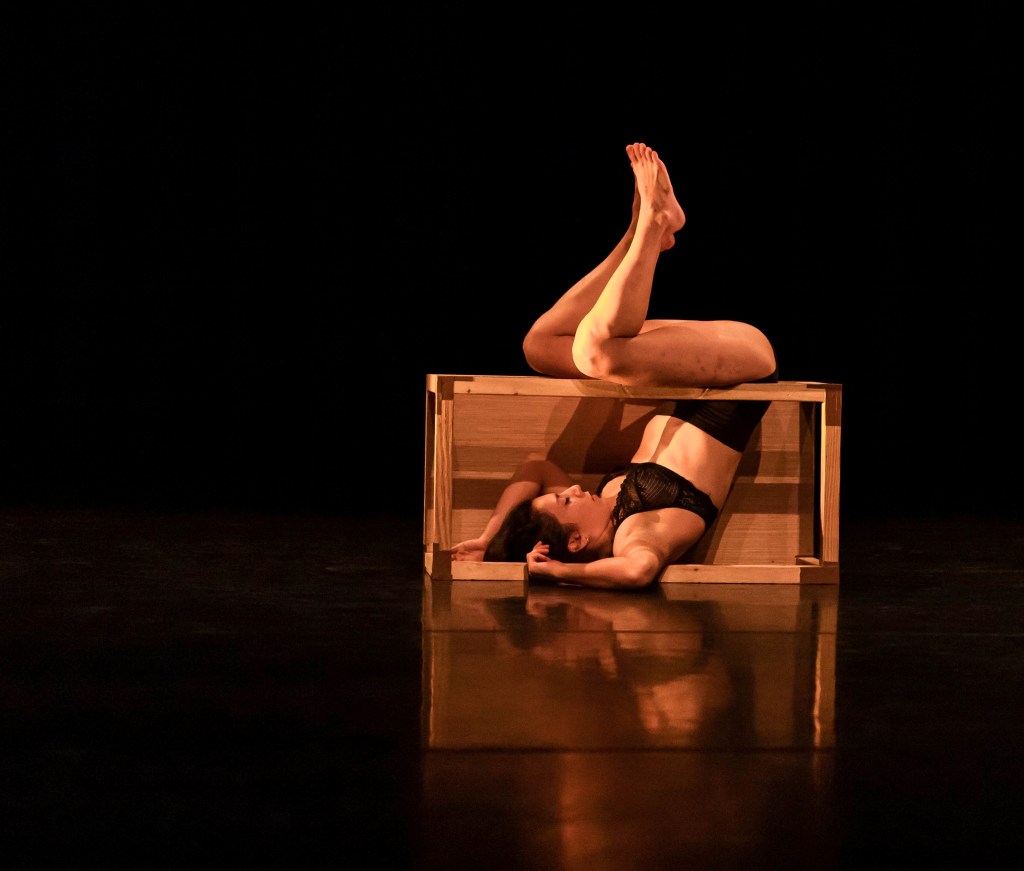
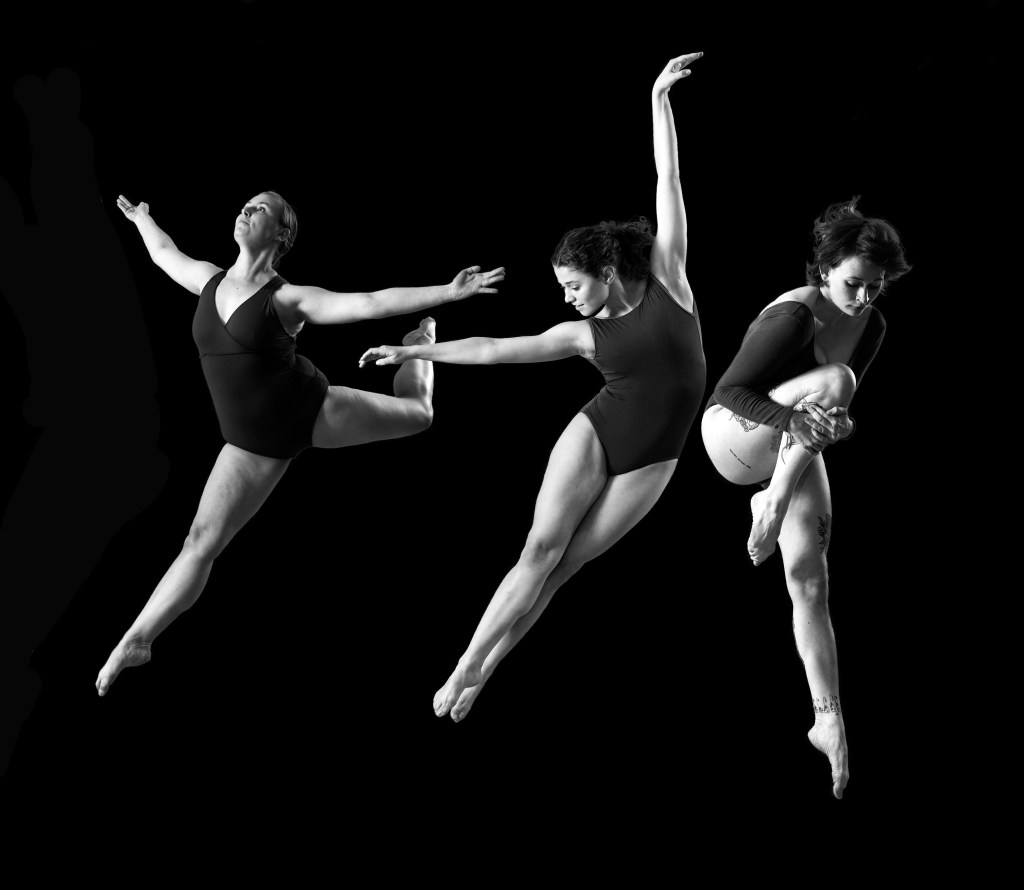
The program also included Circular, a duet by Roxanne Morgan Rowley, performed by Rowley and Sara Goldman, that explores the circularity of relationships between two women; and Luisa Innisfree Martinez’s hilarious Trope in a Box. Performed in, on, and under an open sided crate, Martinez’ solo uses comedy and strong, acrobatic movement phrases to examine and deconstruct themes and tropes of femininity. The program concluded with Starr Foster’s new work, Stripped, a trio that explores identity. The three women become entangled, connect, collapse, support one another, and finally seem to reach a place of calm, peace, and acceptance.

Foster has produced the Mid-Atlantic Choreographers Showcase for 18 years, and hasn’t run out of ideas yet. This was, by far, the best Showcase yet: powerful new work, a diverse collection of choreographers and dancers, a relevant theme, and a variety of perspectives. Thank you, all of you, for a wonderful experience.

Julinda D. Lewis is a dancer, teacher, and writer who was born in Brooklyn, NY and now lives in Eastern Henrico County.

———-

Photo Credits: See individual photo captions

One-Time
Monthly
Yearly

Make a one-time donation

Make a monthly donation

Make a yearly donation
Choose an amount

$5.00
$15.00
$100.00
$5.00
$15.00
$100.00
$5.00
$15.00
$100.00

Or enter a custom amount

$

Your contribution is appreciated.

Your contribution is appreciated.

Your contribution is appreciated.

CLICK HERE TO Donate
TO RVART REVIEW
CLICK HERE TO Donate
TO RVART REVIEW
CLICK HERE TO Donate
TO RVART REVIEW

SUGAR IN OUR WOUNDS

A Tale of Queer Love and Ancestral Voices

A Theater Review by Julinda D. Lewis

At: Richmond Triangle Players at the Robert B. Moss Theatre, 1300 Altamont Ave, RVA 23230

Performances: April 20-May 14, 2022.

Ticket Prices: $30-35; $18 for Preview nights; $10 for Students.

Info: (804) 346-8113 or rtriangle.org. Richmond Triangle Theater has returned to full-capacity seating and requires proof of vaccine or recent negative PCR test results for entry. See the theater’s website for their COVID-19 precautions, digital programs, and more.

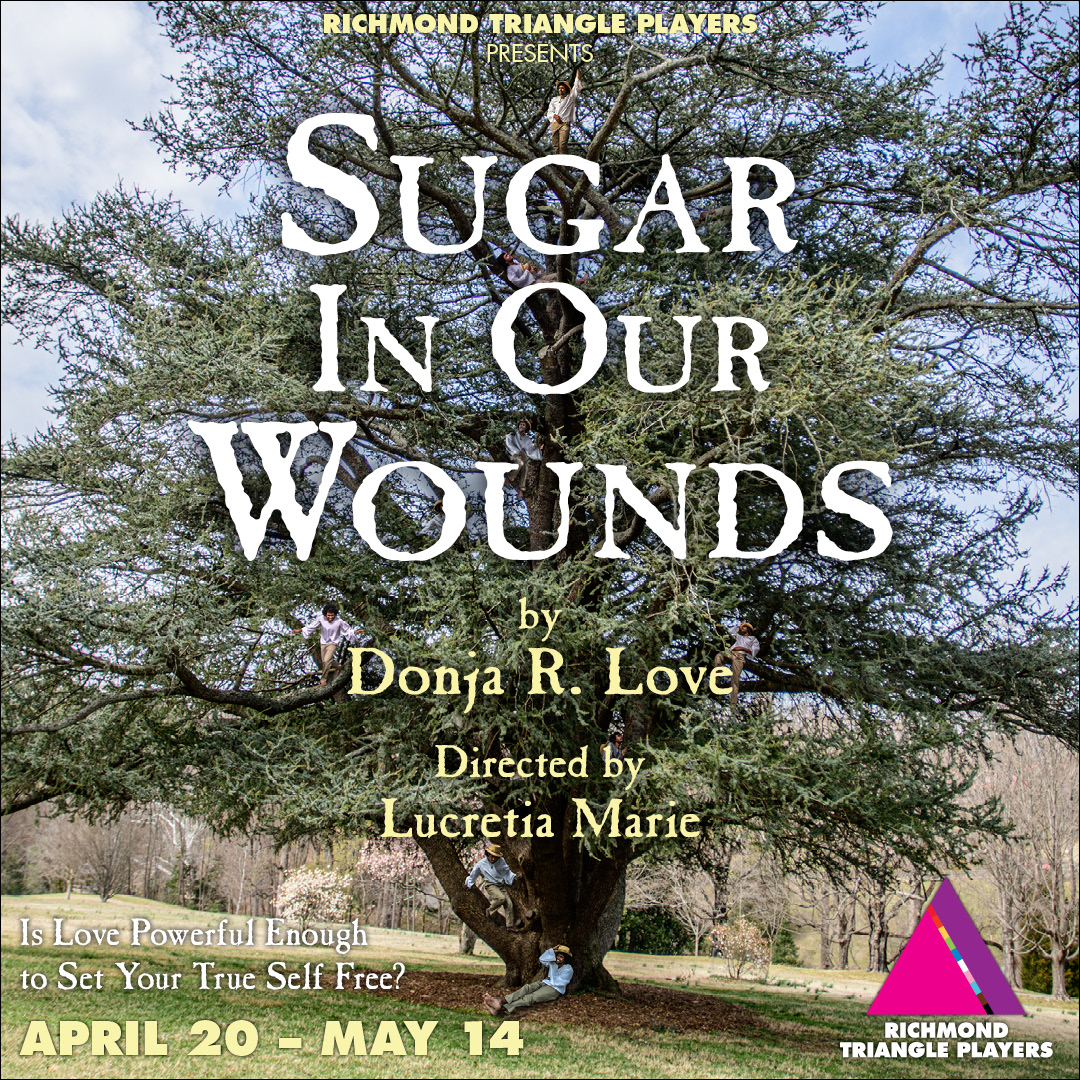
Just as every now and then someone says, does, or creates something so wonderful that I enviously wish I had done it. Similarly, every now and then someone creates a play, poem, or story that is so unique or so wonderful that I wonder why I never thought of or heard of the idea before. Sugar in Our Wounds by Philadelphia-based Afro-Queer playwright, poet, and filmmaker Donja R. Love is a prime example of this type of work. Rescheduled from 2020, you know, when that little thing called The Pandemic stopped by, Sugar in Our Wounds was well worth the wait. Set on a plantation in the summer of 1862, during the Civil War, “somewhere down South, by a tall, tall tree,” Sugar in Our Wounds examines the intersection of freedom and love.

“Ain’t no roamin’ the world, for a weak nigger. – Henry

STRANGE FRUIT

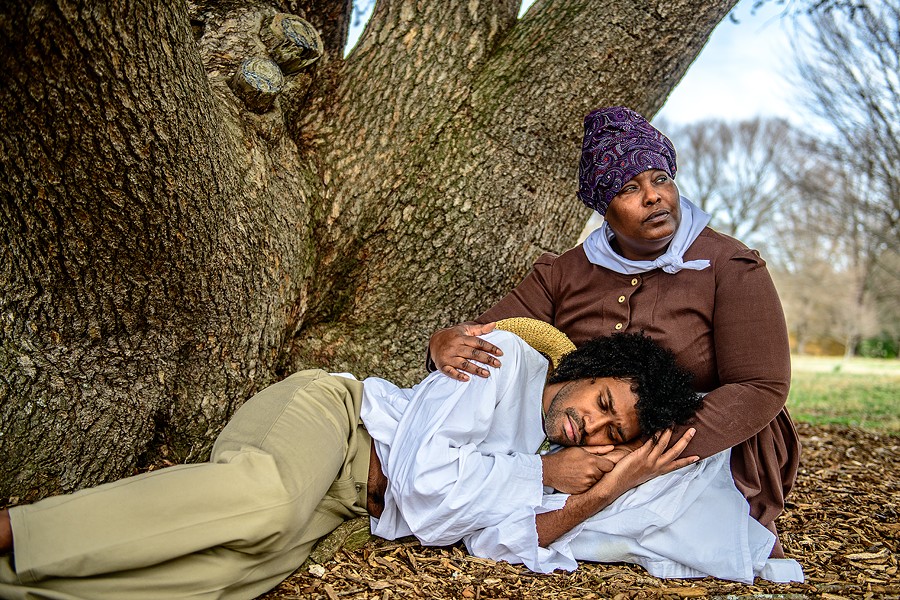
An elder, Aunt Mama, and her makeshift family, James and Mattie, occupy a cabin on a plantation that has a striking feature – a mystical whispering tree so tall no one can see the top. Generations of enslaved people have been hung from this tree, but James is determined this particular generational curse will stop with him. James is smart. He keeps his head down – both literally and figuratively – and follows the rules – except for one. The master’s daughter, Isabel, sneaks down to the cabin periodically to teach James how to read.  She’s bored, because her husband is away fighting the war, and predictably, at some point, like Potiphar’s wife in the Old Testament, she begins to take a dangerous interest in the only available men around, but that’s not the real story here.

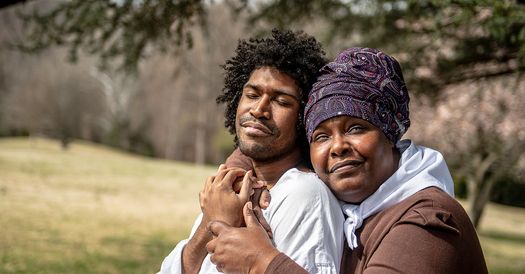
The real story is about love, across time and generations, and involves a young stranger who arrives and is accepted by Aunt Mama and her little family. Mattie, who also happens to be the master’s daughter, is in a precarious position, trusted by no one. Although we never see or hear from other enslaved people on the plantation, we know there are others, but only Aunt Mama and James feel safe in the company of Mattie, who like many others in her situation, is not welcome in either of the worlds she straddles. So of course, Mattie is attracted to this able-bodied stranger, Henry, but we soon find out that Henry, while he does not entirely rebuff Mattie, is far more interested in James than he is in Mattie.

“The darker you is, the more questions you got.” – also Henry

HISTORY LESSONS

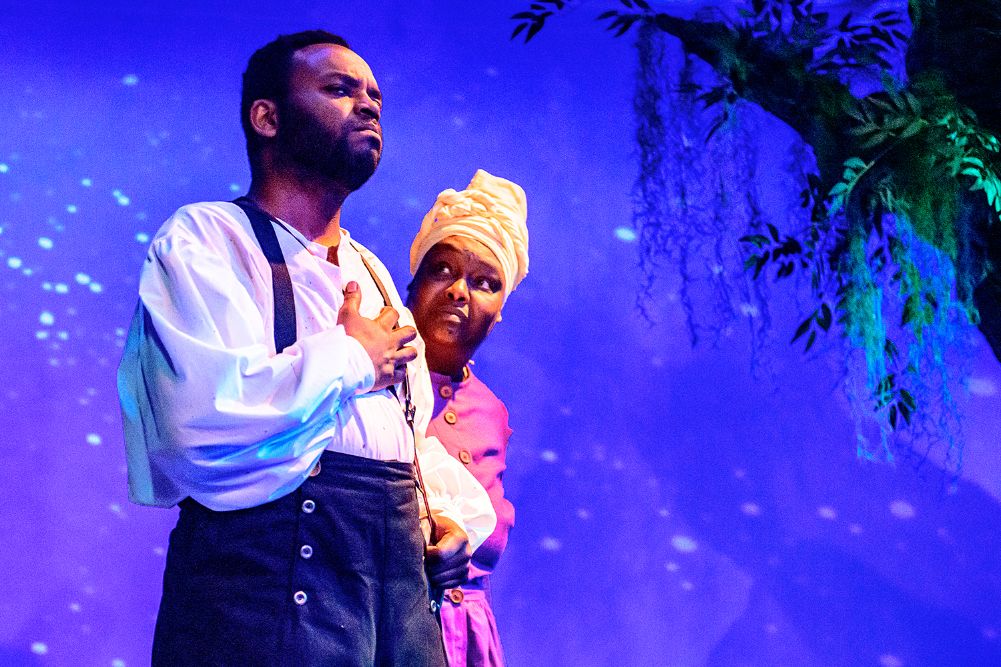
There are so many significant details in Sugar in Our Wounds that it would be nearly impossible to notice them all on just one viewing. The show opens with projections of legs and feet, photos on the rocks and trees, the “strange fruit” many of us were first introduced to by Billie Holiday’s recording of the mournful song of the same name. The tree hums and whispers, and James and Aunt Mama can hear it and communicate with it, with the ancestral spirits who reside in or around it and who use it to teach and warn their descendants. One notices a fancy chair that seems out of place in the little cabin, that is sparsely furnished with a tiny communal bed, shared by the three occupants, an all-purpose that serves as a seat or a table, and a bucket whose aroma Isabel finds offensive.  The chair, of course, belongs to Isabel. Aunt Mama refuses to keep the bucket (aka chamber pot) outside because it is a precious commodity and might be stolen by nearby residents – another way we know this little family is not alone on this plantation. At one point there is an authentic feeling ring shout for the upcoming freedom. But there were also a few moments that seemed out of time and place. Sometimes the men are barefoot, and sometimes they wear shoes – and socks. Would enslaved young men have owned socks? During one visit to teach James to read the bible Isabel says the slop bucket smells “funky” and moments later she to James, “you blow me away.” The Oxford dictionary says the word “funky” originated in the late 17th century, so maybe it would have been used, and idiomorigins.org says “blow me away” phrases date back to the 16th century.  Later, James says, “Don’t act new!” It seems people were saying something similar back in the day – as far back as the 1560s. Shakespeare even had a variation, “fire-new.” Both “brand new” and “fire-new” meant fresh from the fire. Who knew?
THE SPIRIT OF LOVE

The cast, the story, the execution of this production more than just a play, more than a love story. It felt like a work of love that was more than just acting, but more like a spiritual offering. Dorothy Dee D. Miller inhabited the persona of Aunt Mama like an act of faith, as if she did not just choose to act this role, but as if she HAD to share this role. Jónel Jones, whom I had recently seen as a scammer in a TheatreVCU production of Intimate Apparel took on a quite different role here as the hero, giving a strong yet gentle, nuanced performance that lingered some time after the final bows. Duron Marquis Tyre as Henry, the mysterious new-comer similarly maintained a balance of mystery, danger, and tenderness. Tyra Huckaby maintained a relatively low-key supporting role until the end, when the seed she was carrying elevated her to a place of prominence as the last remaining hope for the future, while Charlotte Grace Smith was a necessary but negligible presence – not because she wasn’t good enough but because Sugar in Our Wounds wasn’t about her.
Director Lucretia Marie did an excellent job, creating, maintaining, and drawing the audience into this mystical world in a way that educated, entertained, and enlightened all at once. The pacing, the acting, the setting, the atmosphere, all worked together to create that magic that every show aims for but few actually achieve. Sugar in Our Wounds is one of the most memorable and moving shows I’ve seen in recent memory, and I hope to have a chance to see it again in the future to see if it hits the same.

———-

Julinda D. Lewis is a dancer, teacher, and writer who was born in Brooklyn, NY and now lives in Eastern Henrico County.

———-

SUGAR IN OUR WOUNDS

Written by Donja R. Love

Directed by Lucretia Marie

CAST:

James …………………………………….          Jónel Jones

Aunt Mama ……………………………          Dorothy “Dee D.” Miller

Isabel …………………………………….          Charlotte Grace Smith

Mattie …………………………………..           Tyra Huckaby

Henry ……………………………………           Durron Marquis Tyre

Understudies

For Isabel – Juliette Aaslestad

For Aunt Mama – Sharalyn Bailey

For Mattie – Ayana Flowers

For Henry – Calvin Graves

For James – Makai Walker

CREATIVE TEAM:

Scenic Design by William Luther

Costume, Hair & Make-Up Design by Margarette Joyner

Lighting Design by Steven Koehler

Sound Design and Original Music by Kyle Epps

Projections Design by Dasia Gregg

Props Design by Tim Moehring

Intimacy Choreographer – Kirsten Baity

Violence/Asst Intimacy Choreographer – Stephanie Tippi Hart

Assistant to the Properties Designer – Nicole Pisaniello

Dialect Coach – Evamarii Johnson

Dramaturg – Shinji Elspeth Oh

Assistant Director – David Powell

Original Scenic Concept – Mercedes Schaum

Technical Director – Rebecka Russo

Assistant Stage Manager – Dwight Merritt

Production State Manager – Shawanna Hall

Photo Credits: John MacClellan

One-Time
Monthly
Yearly
Make a one-time donation

Make a monthly donation
Make a yearly donation
Choose an amount

¤5.00
¤15.00
¤100.00
¤5.00
¤15.00
¤100.00
¤5.00
¤15.00
¤100.00

Or enter a custom amount

¤

Your contribution is appreciated.

Your contribution is appreciated.

Your contribution is appreciated.

CLICK HERE TO Donate TO RVART REVIEWCLICK HERE TO Donate TO RVART REVIEWCLICK HERE TO Donate TO RVART REVIEW

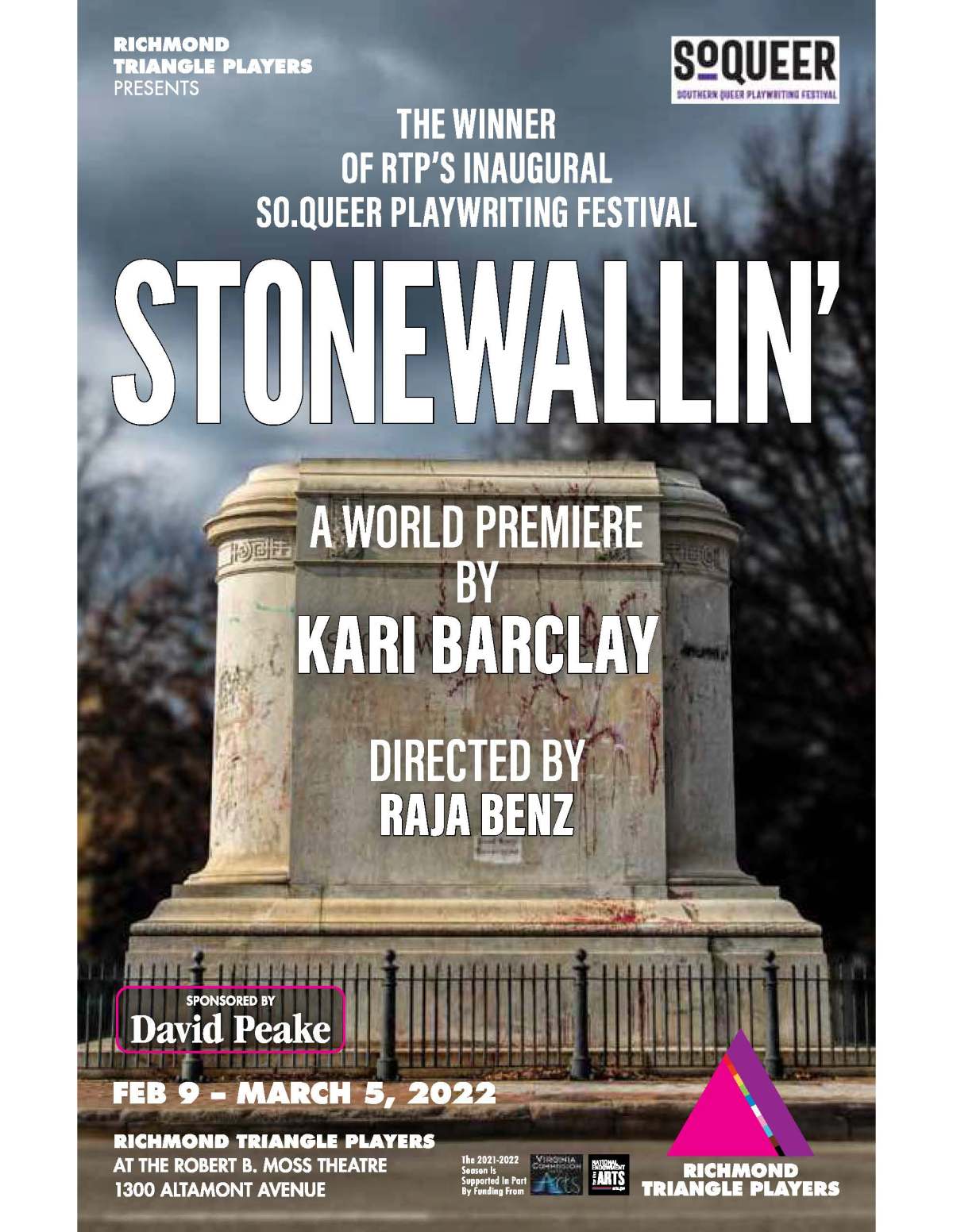
STONEWALLIN’

STONEWALLIN’

A Coming Out Story with Stonewall Jackson, Witch’s Spells, and a Bobolink

A Theater Review by Julinda D. Lewis

At: Richmond Triangle Players at the Robert B. Moss Theatre, 1300 Altamont Ave, RVA 23230

Performances: February 9-March 5, 2022.

Ticket Prices: $30-35; $10 for Students.

Info: (804) 346-8113 or rtriangle.org. Richmond Triangle Theater has returned to full-capacity seating and requires proof of vaccine or recent negative PCR test results for entry. See the theater’s website for their COVID-19 precautions, digital programs, and more.

The best comedy is relatable comedy. It often takes something from life – and it can be something bad – and pokes fun at it. By this standard, Kari Barclay’s new play – winner of Richmond Triangle Player’s So.Queer Playwriting Festival – is outrageously funny. It’s outrageous, period. The humor is a bonus.

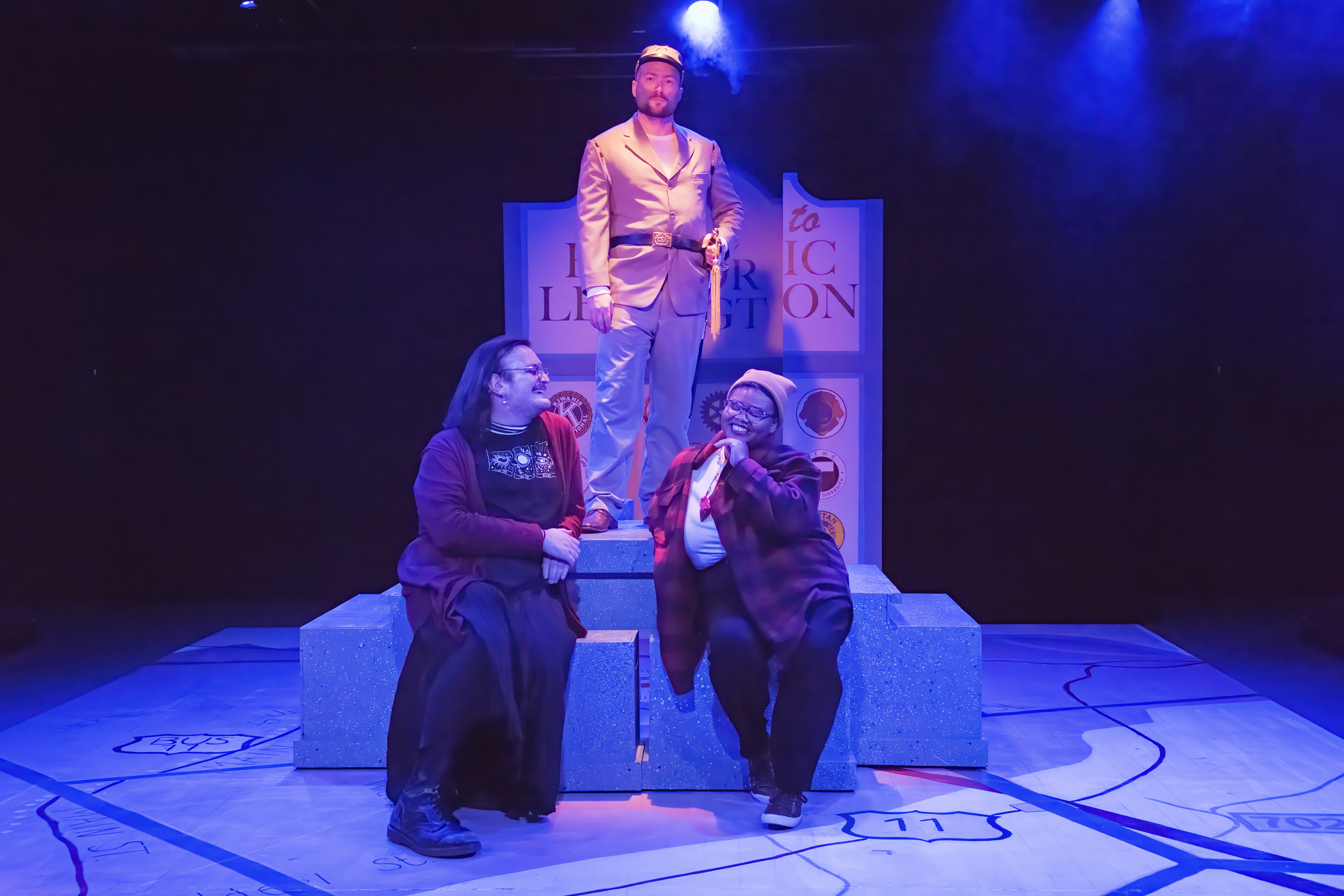
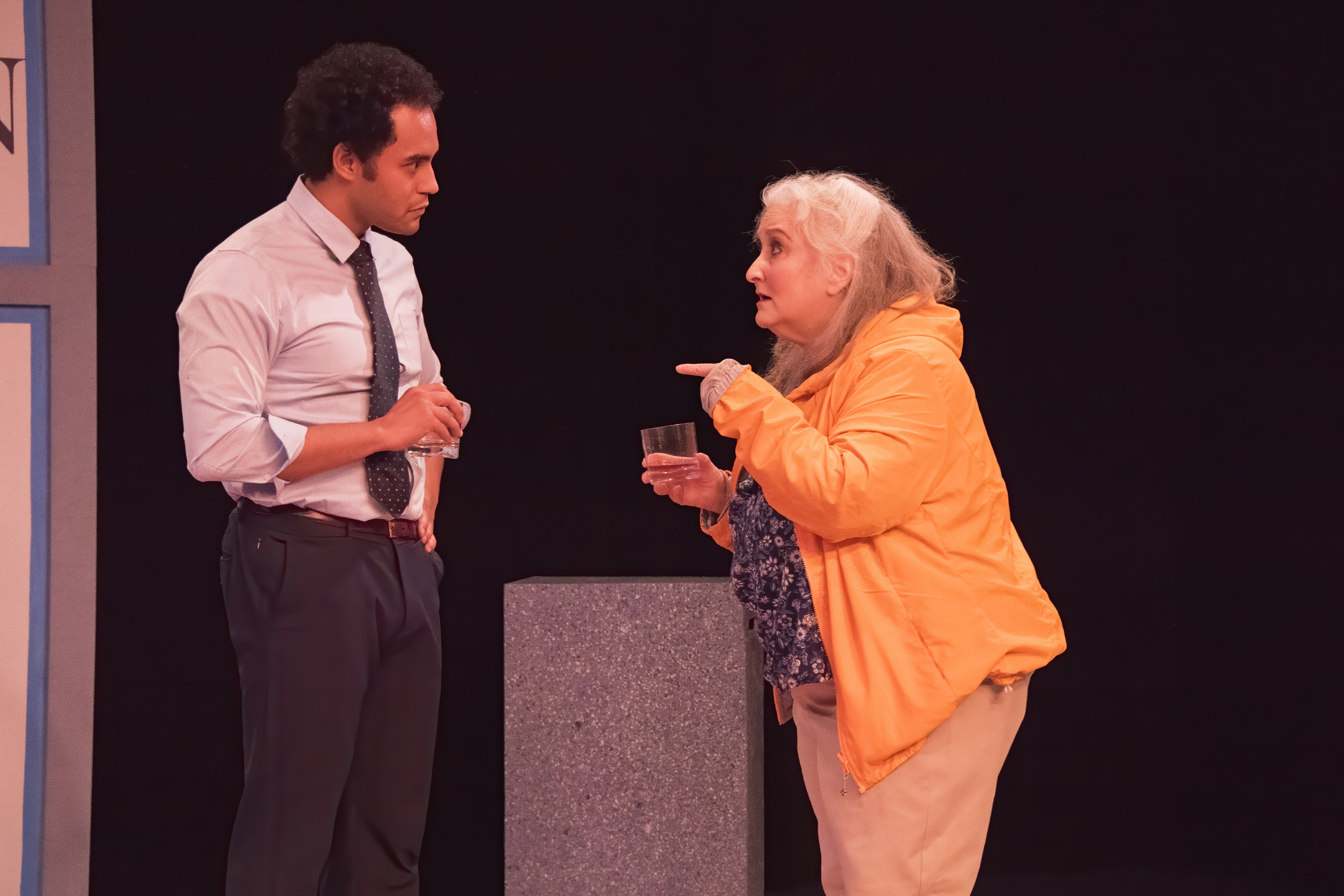
STONEWALLIN’ features a “missing” statue of Thomas “Stonewall” Jackson (explaining the rabbit ears around “missing” would be a great big spoiler), a budding bi-sexual romance between a queer woman and a queer man, a friendship between a young Black man and an older white grandmother who spend some of their free time as Civil War re-enactors and some of their time together drinking whiskey and gossiping, and let’s not leave out a spell cast by a self-taught witch that has major unintended consequences. Surprisingly, it all fits together like a gigantic jigsaw puzzle.

STONEWALLIN’ is set in the author’s hometown of Lexington, VA, home of Washington and Lee University and Virginia Military Institute. Other points of interest include the gravesites of Robert E. Lee and Stonewall Jackson as well as the residence of Jackson, a Confederate general. More recent notoriety include the Red Hen Incident; in 2014 then White House Press Secretary Sarah Huckaby Sanders was asked to leave the Red Hen Restaurant because of her role in the Trump Administration. All of this – and more — finds a home in STONEWALLIN’.

What also makes its way into STONEWALLIN’ is a stellar cast, consisting of Levi Meerovich as Tommy Jackson (a direct descendant of Stonewall Jackson), Nora Ogunleye as Marsha Lyons (a transplant from Berkeley, CA who is staying temporarily with her brother while reconnecting with her family roots), Jacqueline Jones as Mamaw Jackson (grandmother of Tommy and a staunch proponent of “heritage, not hate”), Trevor Lawson as Elijah Lyons (brother of Marsha and apparently the proprietor of an unnamed small business), and Chandler Hubbard as General Stonewall Jackson.

While Meerovich and Ogunleye rightfully take the leading roles as the unlikely young couple and share a relationship that is at once endearingly awkward and reluctantly intimate, it is Jacqueline Jones who steals my heart – and the show – as the sassy and sometimes deliberately daft Mamaw. She’s a rebel with or without a cause, just for the hell of it. She argues with her friend Elijah as they return from one of their Civil War re-enactment engagements, yet promises to rally her (Confederate) Flagger friends to support his housing project. She cannot fathom the emerging gender identity of her grandson – grandchild — Tommy, whose preferred attire is some variation of a black dress and earrings, and finds it more acceptable that he would have a relationship with a Black woman than that he could be gay. What a perfect example of the dilemmas posed by the state of affairs in which we currently exist.

Want further proof of how close to home this show hits? Barclay’s world premiere opened the same month that the bases of confederate statues right here in Richmond were being removed. (For those readers not familiar with what’s going on here in Richmond, the recently removed Confederate statues from Monument Avenue and other areas of the city are slated to be given to the local Black History Museum and Cultural Center of Virginia.) As for Elijah, he walks a delicate line between liberal political activist and moderate citizen of a small southern town. Lawson emanates the right demeanor – a balance of impassioned persuasion and moderate reason – to carry this off with authenticity. [Lawson recently appeared in VaRep’s Barefoot in the Park, December 2021https://jdldancesrva.com/2021/12/18/barefoot-in-the-park/and Pipeline,October 2021 https://jdldancesrva.com/2021/10/16/pipeline/]

Chandler Hubbard eases all too comfortably into the role of a southern gentleman who all too easily says things that would have been perfectly acceptable in his day but are seen as searingly offensive and racist in 2022. STONEWALLIN’ is a whole hoot and a holler of a show. Barclay has found the key to talking about difficult subjects, not only making them palatable, but mining] the humanity and liberally seasoning them with humor.

Raja Benz, who also directed Pink Unicorn at RTP [July- August 2021 https://jdldancesrva.com/2021/07/31/the-pink-unicorn/], directed this new work with insight and a big pinch of irreverence. Credit Frank Foster with the scenic design – a Stonewall Jackson pedestal that can be disassembled to create whatever minimal set pieces might be needed for any given scene – and Michael Jarett with the lighting design. Kudos to Candace Hudert for an appropriate and interesting sound design. All the elements – including rearranging the audience seating so that some were actually seated onstage – worked together to create an energized, intimate, and welcoming atmosphere. The ending is left somewhat inconclusive, leaving open the possibility for more to come.

STONEWALLIN’ runs through March 5, so there’s still time to go and find out about that “missing” statue.


Julinda D. Lewis is a dancer, teacher, and writer who was born in Brooklyn, NY and now lives in Eastern Henrico County, VA.


STONEWALLIN’ – A World Premiere

Written by Kari Barclay, winner of RTP’s Inaugural So.Queer Playwriting Festival

Directed by Raja Benz

CAST:

Tommy Jackson………………………  Levi Meerovich

Marsha Lyons ………………………..   Nora Ogunleye

Mamaw Jackson …………………….  Jacqueline Jones

Elijah Lyons ……………………….….  Trevor Lawson

Stonewall Jackson ………………….. Chandler Hubbard

CREATIVE TEAM:

Scenic Design by Frank Foster

Costume Design by Claire Bronchick

Lighting Design by Michael Jarett

Sound Design by Candace Hudert

Hair and Make Up Design by Carolan Corcoran

Properties Design by Tim Moehring

Dramaturg Katharine Given

Intimacy Choreographer Kirsten Baity

Dialect Coach Louise Casini Hollis

Assistant Director Kendall Walker

Assistant Intimacy Choreographer Kevin Kemler

Technical Director Rebecka Russo

Assistant Stage Manager Dwight Merritt

Production State Manager Kasey Britt

Photo Credits: Tom Topinka

One-Time
Monthly
Yearly

Make a one-time donation

Make a monthly donation

Make a yearly donation

Choose an amount

¤5.00
¤15.00
¤100.00
¤5.00
¤15.00
¤100.00
¤5.00
¤15.00
¤100.00

Or enter a custom amount

¤

Your contribution is very much appreciated.
Thank you!

Your contribution is appreciated.

Your contribution is appreciated.

CLICK HERE TO SUPPORT
RVART REVIEW
CLICK HERE TO SUPPORT
RVART REVIEW
CLICK HERE TO SUPPORT
RVART REVIEW

CHANTEUSE: A Survival Musical

A New One-Person Show That Explores the Question: What Does Survival Mean to You?

A Theater Review by Julinda D. Lewis

At: Richmond Triangle Players at the Robert B. Moss Theatre, 1300 Ave. RVA 23230

Performances: January 13 – 23, 2022

Ticket Prices: $10 – $40

Info: (804) 346-8113 or rtriangle.org.

Have you ever been to a production where you clapped at the end, not because of the content of what you had just experienced, but because you could think of no other way to acknowledge the artist’s performance? That’s what the audience collectively experienced on Thursday night after Alan Palmer uttered the final words of Chanteuse: A Survival Musical.

Palmer wrote the script and lyrics and stars in this moving one-person musical, set in Berlin in 1933. The music is by David Legg and for this limited Richmond run the inimitable Kim Fox performed the roles of musical director and conductor.

Walking into the space, the audience was immediately drawn into the scene. Small tables with lamps lit by flickering tea candles that suggested the intimacy of a Berlin club were distributed throughout the house. The stage itself was darkly lit, suggesting something ominous was about to happen. There was a mannequin with a dark gown or robe topped by a dark wig, and there were several set pieces covered in black fabric. The darkness, however, was not just a physical effect of the lighting, and stage properties, but there was also a palpable emotional element that lingered heavily, a portent of things to come.

The back wall was mostly brick but accented with a center arch that served as a projection screen and two sections of rough-hewn wooden pallet on either end. The horizontal slats of the pallet sections suggested some sort of confinement, while allowing a glimpse of the band stage left. That’s how I was able to see that the instrument that was churning out soul-tearing melodies was actually a bass, although Jonathan Wheelock magically and skillfully made it sound like a cello.

Palmer entered into this space and immediately captivated the audience with the horrific story of one queer man’s tale of life and survival in Nazi Germany, where being queer, a cross-dresser, Jewish, or mentally or cognitively challenged were sufficient cause for being detained, brutalized, and ultimately killed.

But all was not doom and gloom. The first half of the one-hour solo musical, performed without intermission, had several moments that allowed Palmer, an actor, dancer, and real-life Power Ranger (he played Corcus on The Mighty Morphin Power Rangers TV series, 1993-1996) to dance, strut, change clothes, tease, titillate, and morph from a gay male performer to living life full-time as a female chanteuse in a supper club in Berlin.

A raid on Club Silhouette sends his life (do we ever really learn his name? he is telling his own story, so we never hear anyone call him by name) into a tailspin. Now, if you plan to see this show, you might want to skip the next paragraph, but since this is a limited run, by the time you read these words the show will likely have closed, therefore what follows is technically not a spoiler – I am alerting you out of courtesy so that you know that I am a civilized and cultured person. So…on that note…

The sudden death of his long-time landlord turns out to be a blessing in disguise. You see, they had become friends, and even looked somewhat alike, so it seemed like the best way to honor his friend’s memory (there are untold secrets involved) and simultaneously assure his own safety from the homophobic Nazi’s was to assume the identity of the late Frau Friederick. On the positive side, this transformation led him to find true love. Ironically, our protagonist transformed from a gay male into a woman in order to protect himself from the Nazi’s only to discover – too late – that Frau Friederick had been hiding the fact that she was Jewish.

Chanteuse begins in the decadence, freedom, and sometimes glamor of the Berlin club scene and ends, not with a bang but a whimper, in the soul-killing Sachsenhausen concentration camp – a labor camp for prisoners and training ground for SS officers that housed separate sections for political prisoners, Jehovah’s Witnesses, Soviet POWs, Poles, Jews, Homosexuals, and Freemasons. While there, he reunites, briefly with his partner, Yakob, to whom he was illegally yet lawfully married (using Frau Friederick’s ID). Is it any wonder this leads him to begin to pray in Hebrew? “Baruch ata Adonai, eloheinu melech ha’olam, sh’hecheyanu, v’kiyemanu, V’higianu, lazman, hazeh.” (Praised are You, the Eternal One our God, Ruler of the Cosmos, who has kept us alive, sustained us, and enabled us to reach this moment.)

And here we have the point of the plot. Survival. In this moment. And suddenly the past is united with the present and the future. A moment in time telescopes into another moment in time. Past becomes present, and we have to ask ourselves, what have we learned? Indeed, what have we done?

So you see, it was necessary to explain the applause. The applause was not for the experience we had all just shared. The applause was not for the message we were processing. The applause was for the messenger, and the brilliant and unpretentious way he delivered that harsh message.

Chanteuse: A Survival Musical is/was here in RVA for only eight performances, and Palmer has plans to open in London sometime later this year. I haven’t yet been to London, but I always keep my passport up-to-date. Now I know that flying off to London to see a show may not be realistic for most of us; my point is that this intelligently and beautifully produced musical needs to be seen.

Kudos to director Dorothy Danner for keeping Palmer’s pacing and blocking flowing organically and breathing a breath of life into these words that Palmer then exhaled over us all. David Legg’s music was dynamically connected to Palmer’s words, and Kim Fox’s musical direction guided us along the right paths of emotion.

Chanteuse: A Survival Musical

Created by and Starring Alan Palmer

Director – Dorothy Danner

Music – David Legg

Book and Lyrics – Alan Palmer

Lighting Design – Joe Doran

Audio Engineer – Brandon Duncan

Technical Direction – Vinnie Gonzalez

Production Stage Manager – Crimson Piazza

Musical Director and Conductor – Kim Fox

The Band – Kim Fox (Conductor and keyboards), Chris Sclafai (saxophone), Joe Lubman (percussion), Jonathan Wheelock (bass)

Richmond Triangle Players at the Robert B. Moss Theatre in association with Palmer Productions

Richmond Triangle Players at the Robert B. Moss Theatre has returned to full-capacity seating and requires proof of vaccines or recent PCR rest results for entry. See the theater’s website for their COVID-19 precautions, digital programs, and more.

Photos: from Alan Palmer’s website and Google.com

One-Time
Monthly
Yearly

Make a one-time donation

Make a monthly donation

Make a yearly donation

Choose an amount

¤5.00
¤15.00
¤100.00
¤5.00
¤15.00
¤100.00
¤5.00
¤15.00
¤100.00

Or enter a custom amount

¤

Your contribution is appreciated.

Your contribution is appreciated.

Your contribution is appreciated.

Donations in any amount are welcome. Thank you.Donations in any amount are welcome. Thank you.Donations in any amount are welcome. Thank you.