“I gave you the things in me I didn’t even know I had.”
Presented by: Richmond Triangle Players
At: Richmond Triangle Players at the Robert B. Moss Theatre, 1300 Altamont Avenue, RVA 23220
Performances: September 10 – October 4, 2025
Ticket Prices: $15-$50
Info: (804) 346-8113 or rtriangle.org
A Theater Review by Julinda D. Lewis
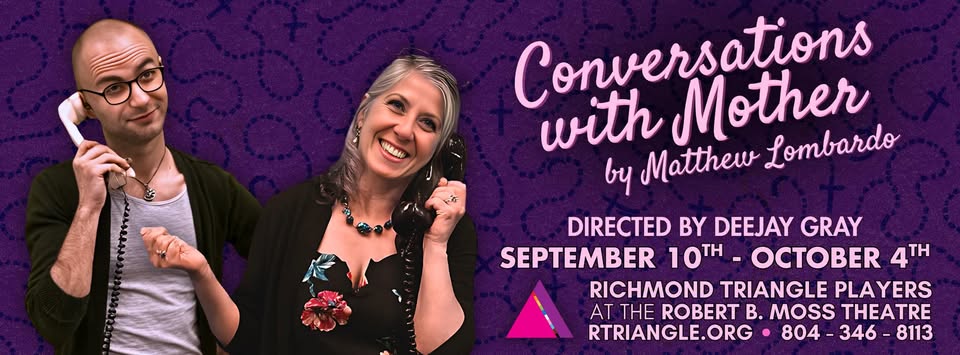
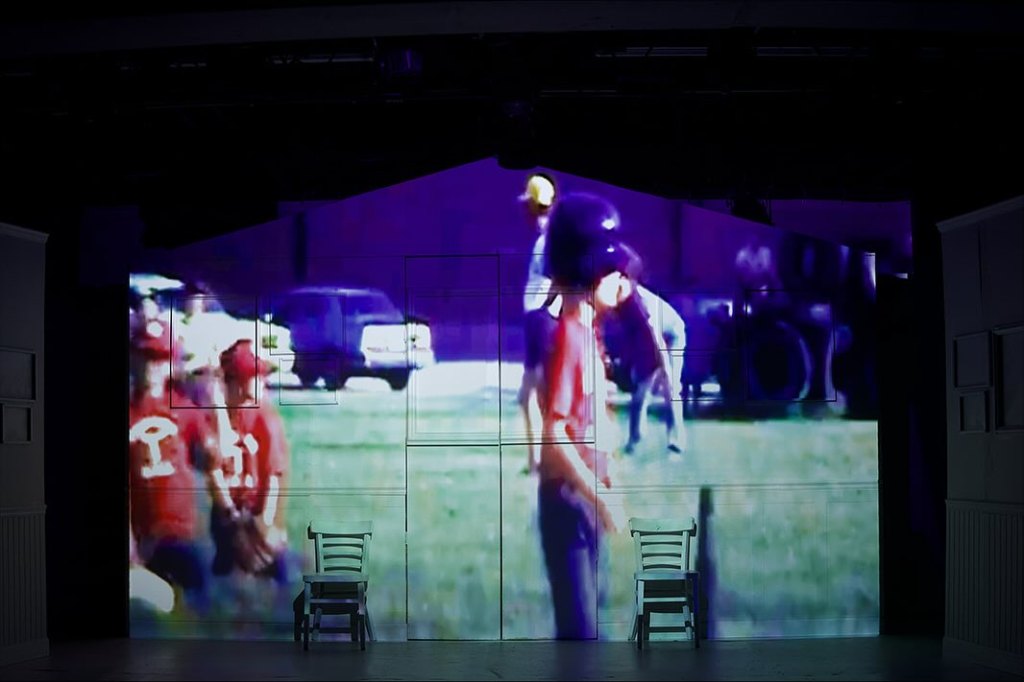
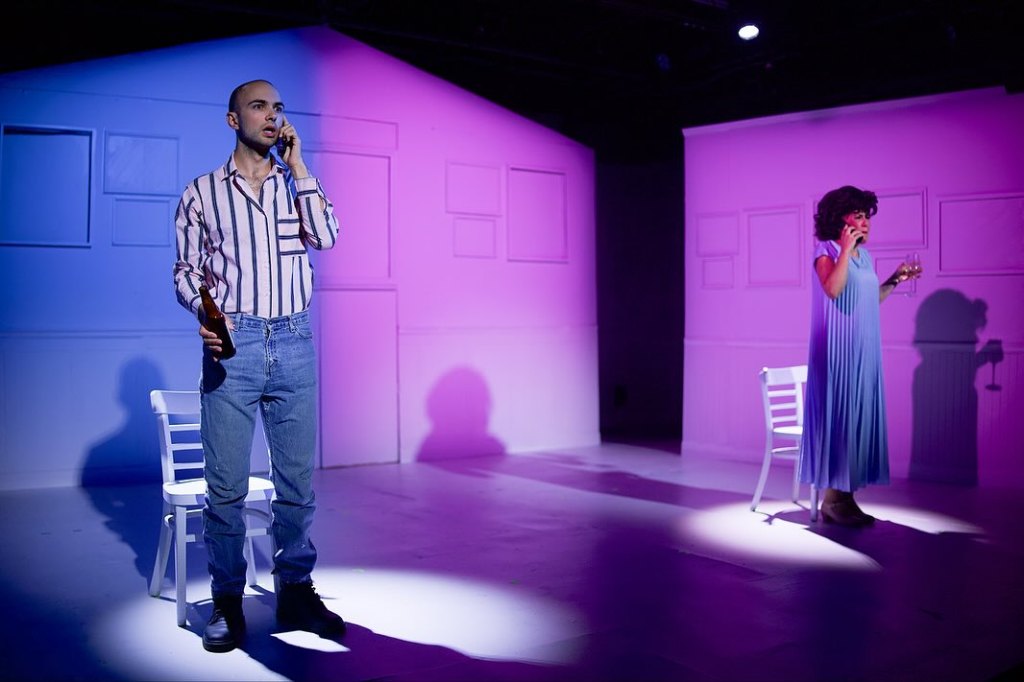
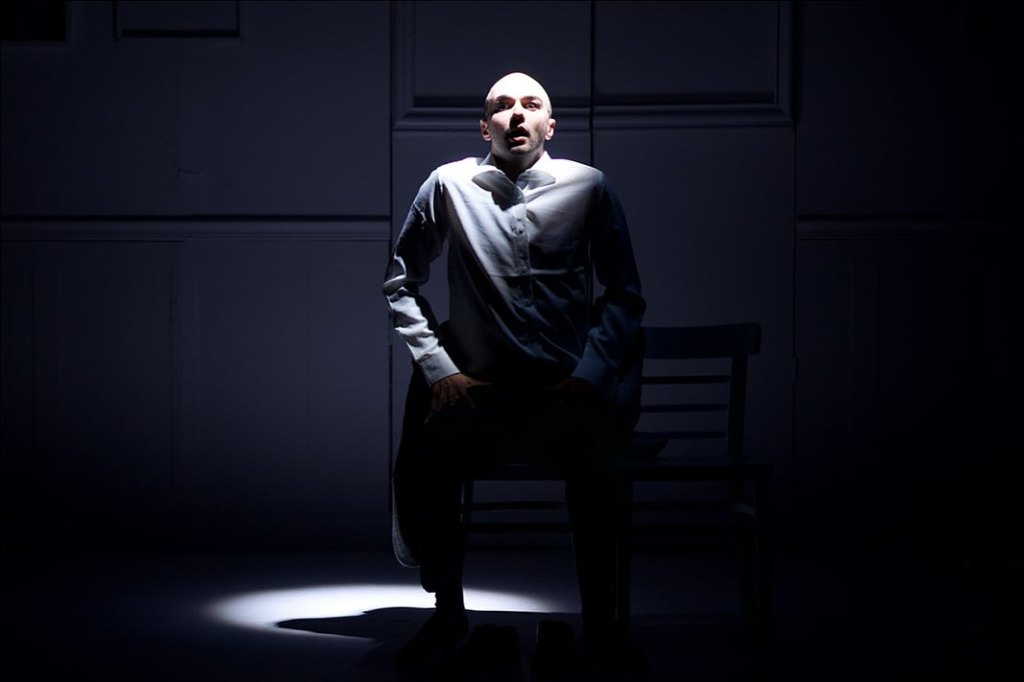
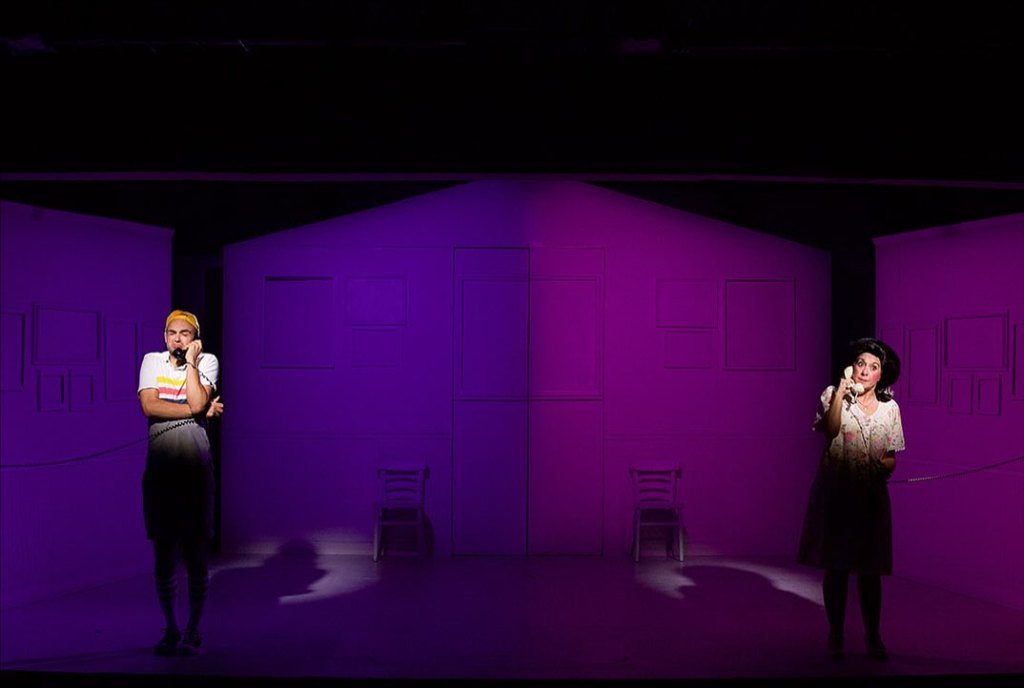
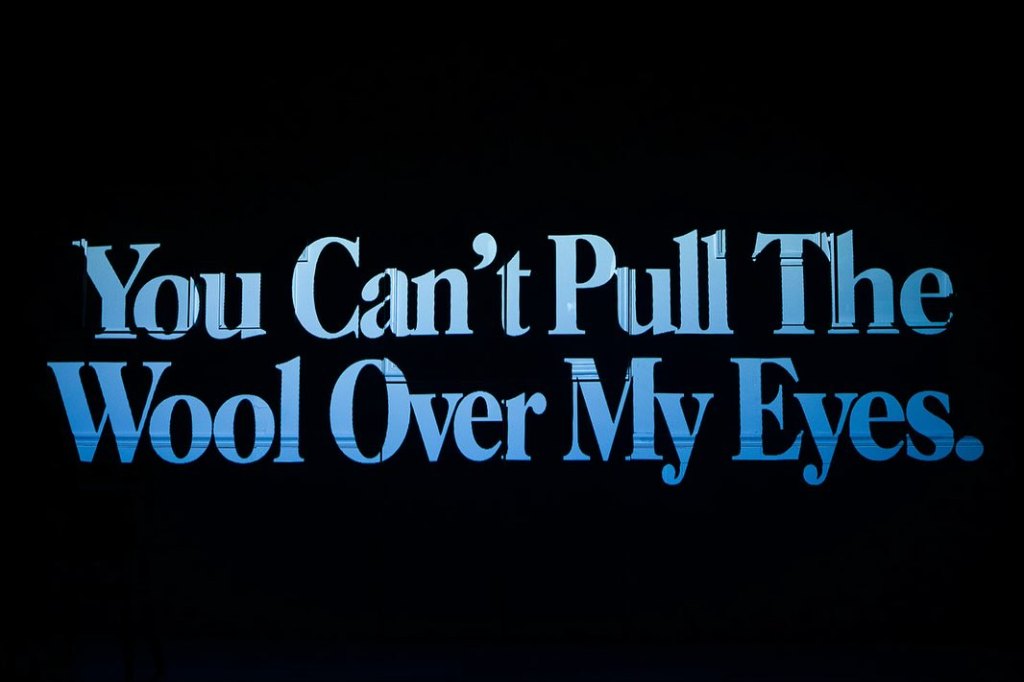
Conversations with Mother is a poignant semi-autobiographical play by Matthew Lombardo that explores the dynamics of a relationship between a fiercely loving and protective mother and her gay son. The story unfolds primarily through their conversations, with the aid of projected subtitles and grainy home movies. Conversations with Mother reveals and celebrates the complexities of love, generational differences, and the challenges of navigating the passing phases of five decades of a shared life.
As in his play Who’s Holiday, his comedy about the adult Cindy Lou Who that has also graced the RTP stage, Lombardo masterfully balances comedy with real life – intense and unadorned, sometimes snot-nosed ugly.
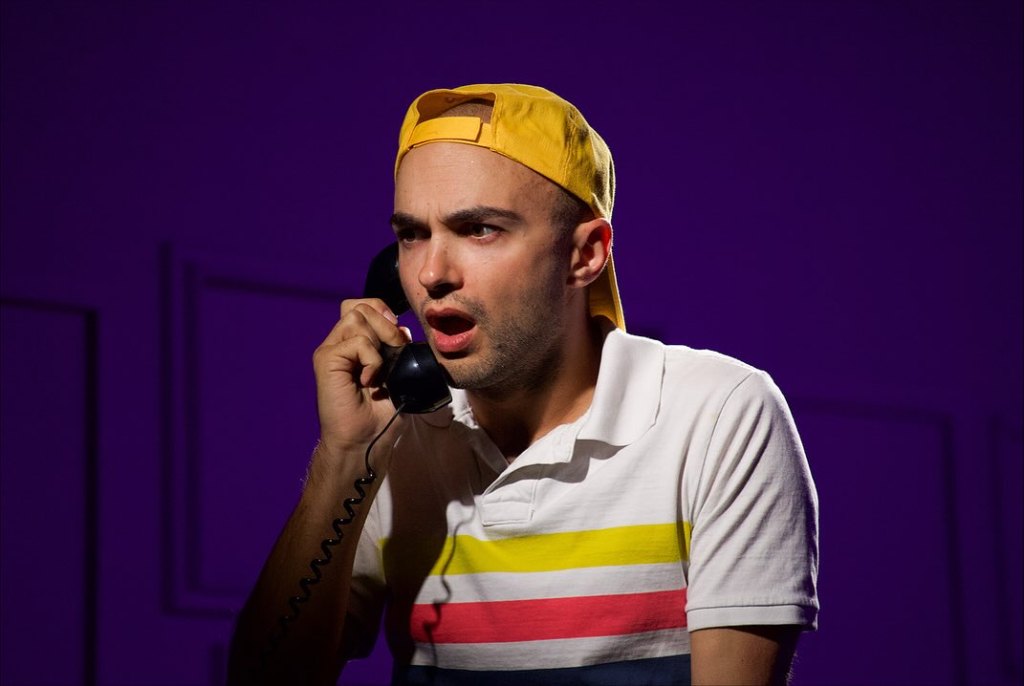
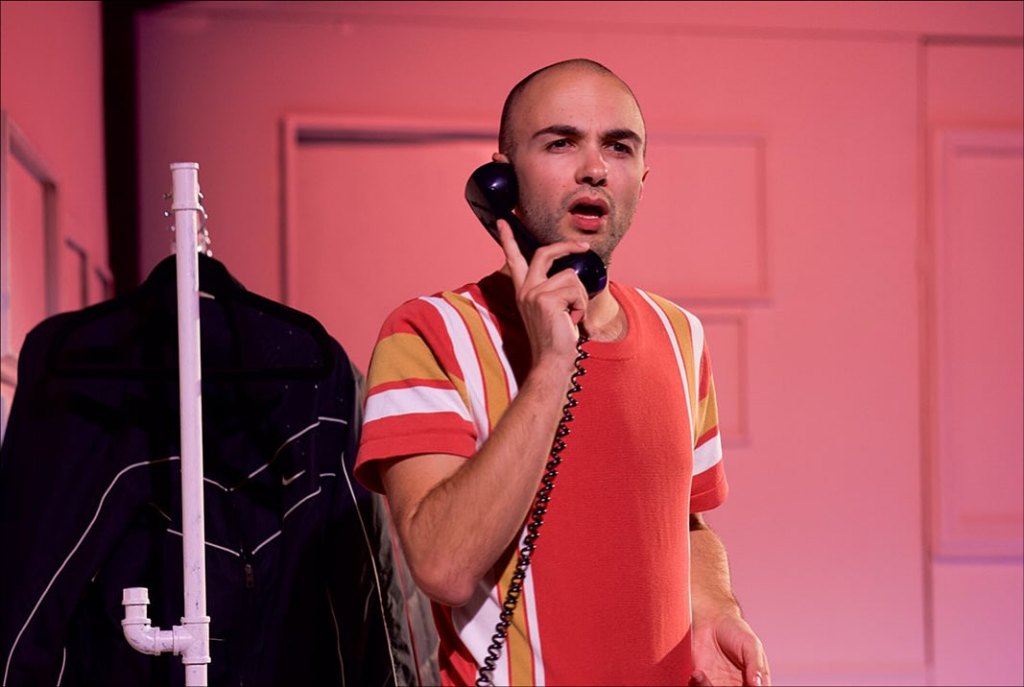
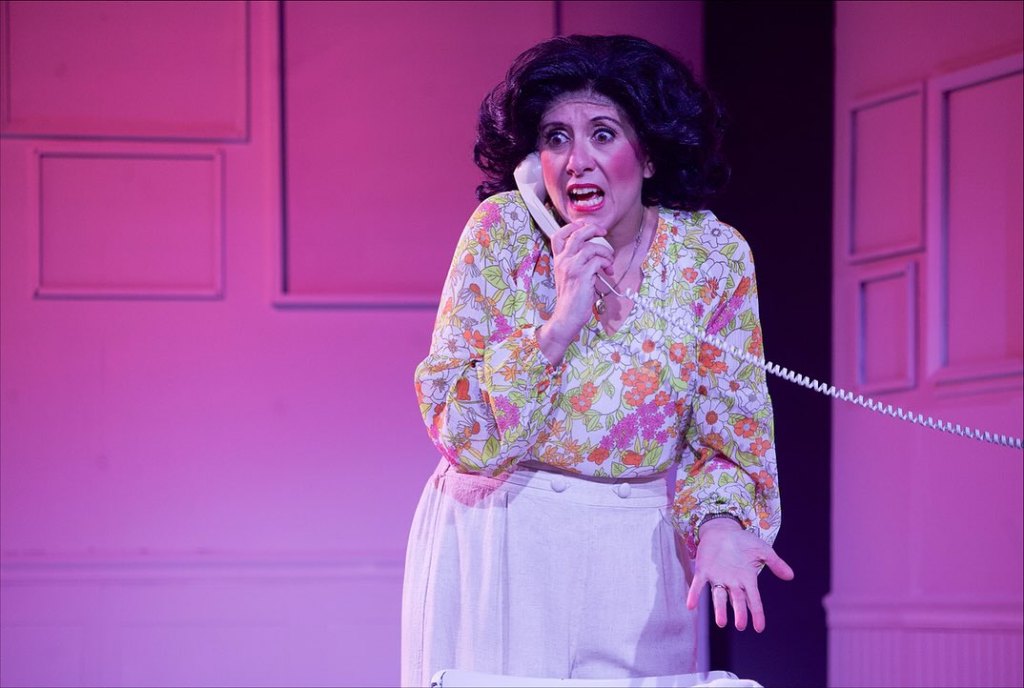
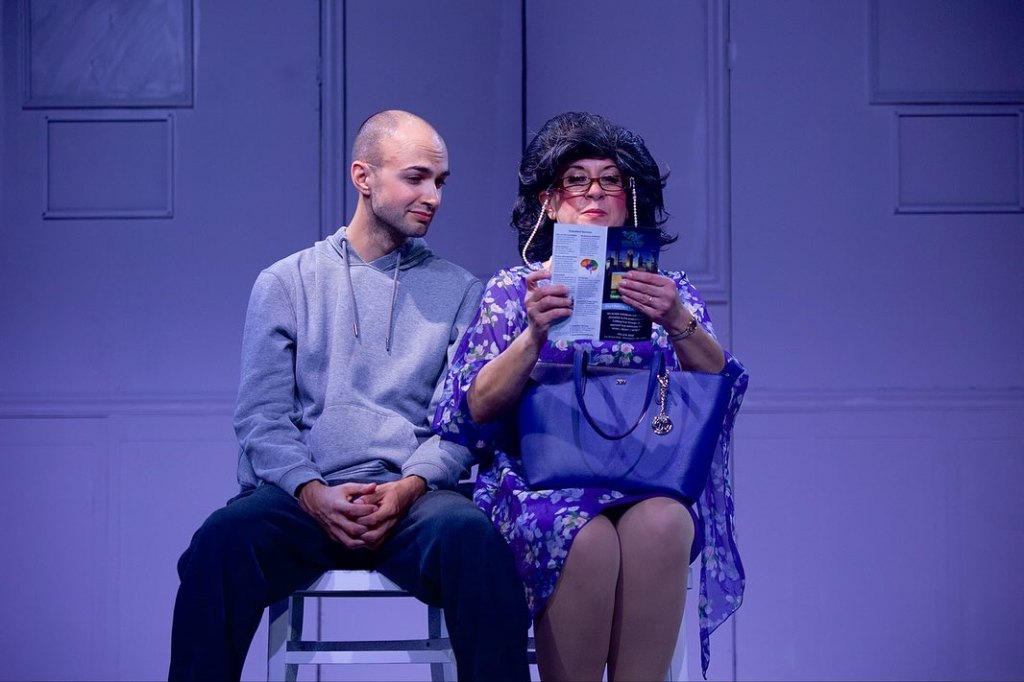
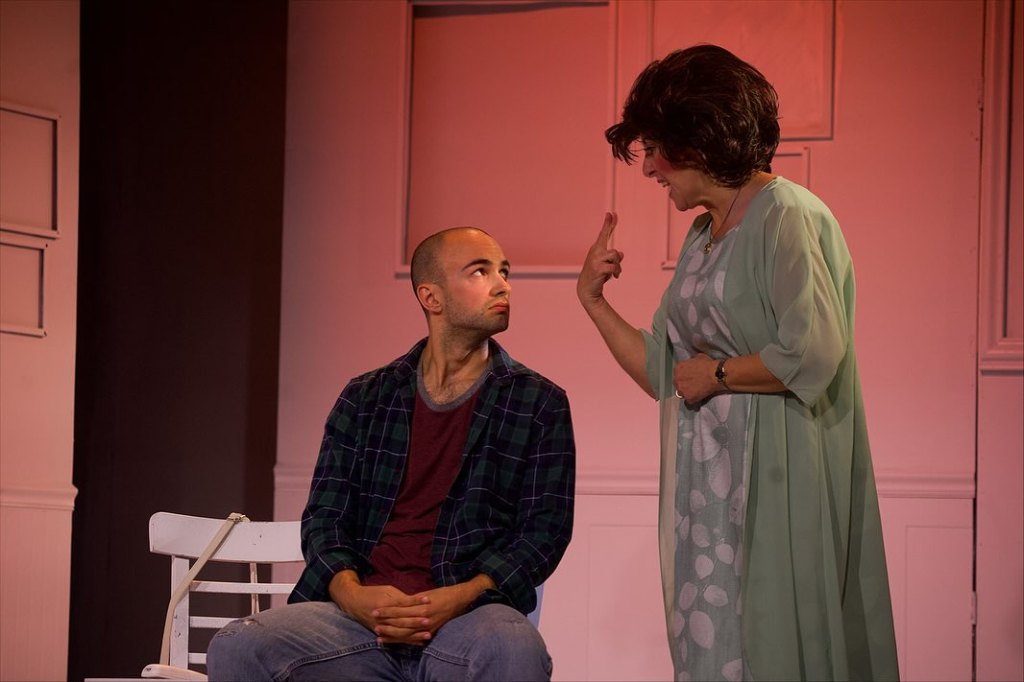
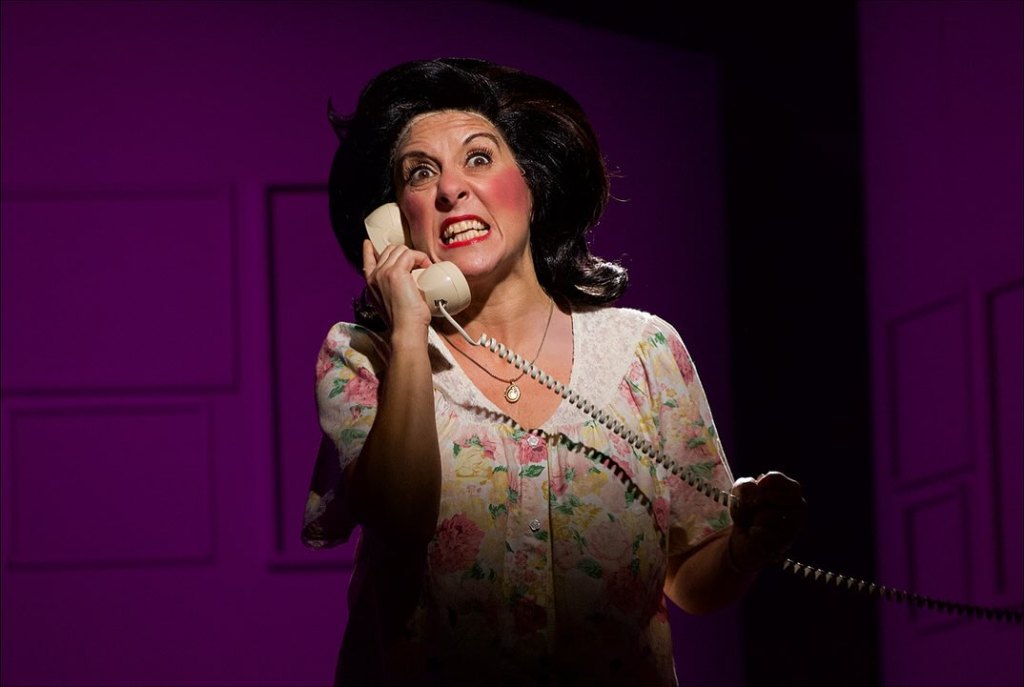
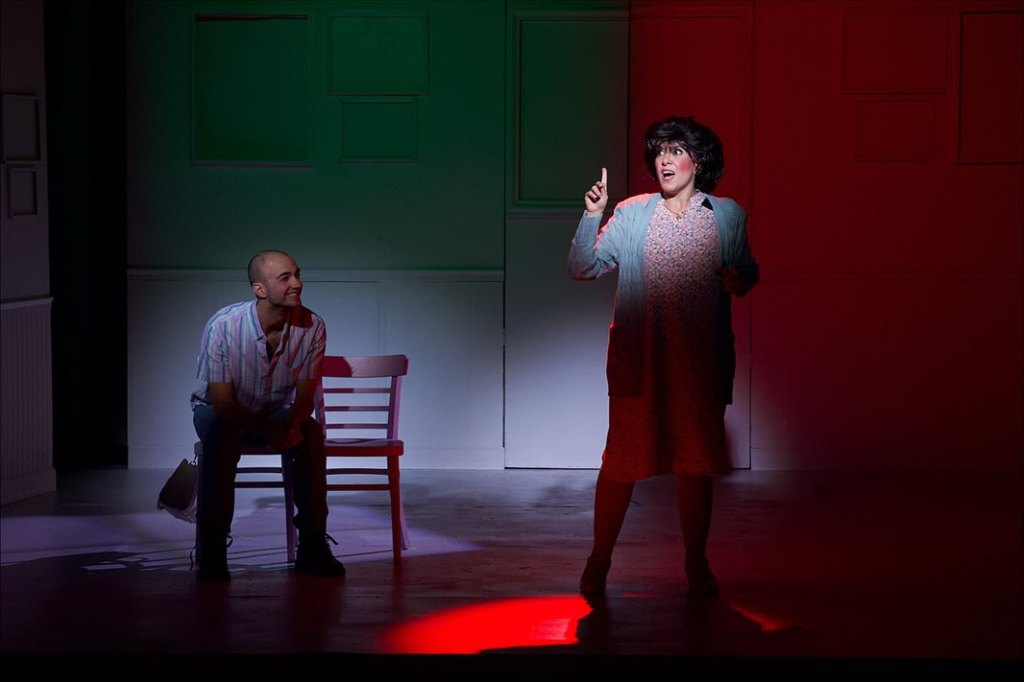
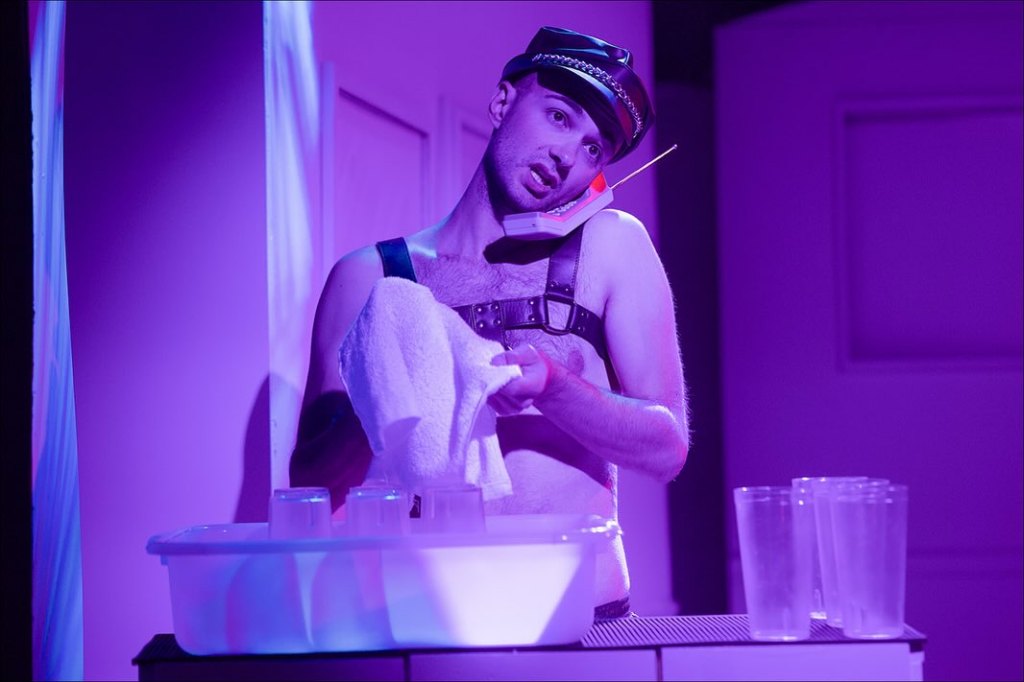
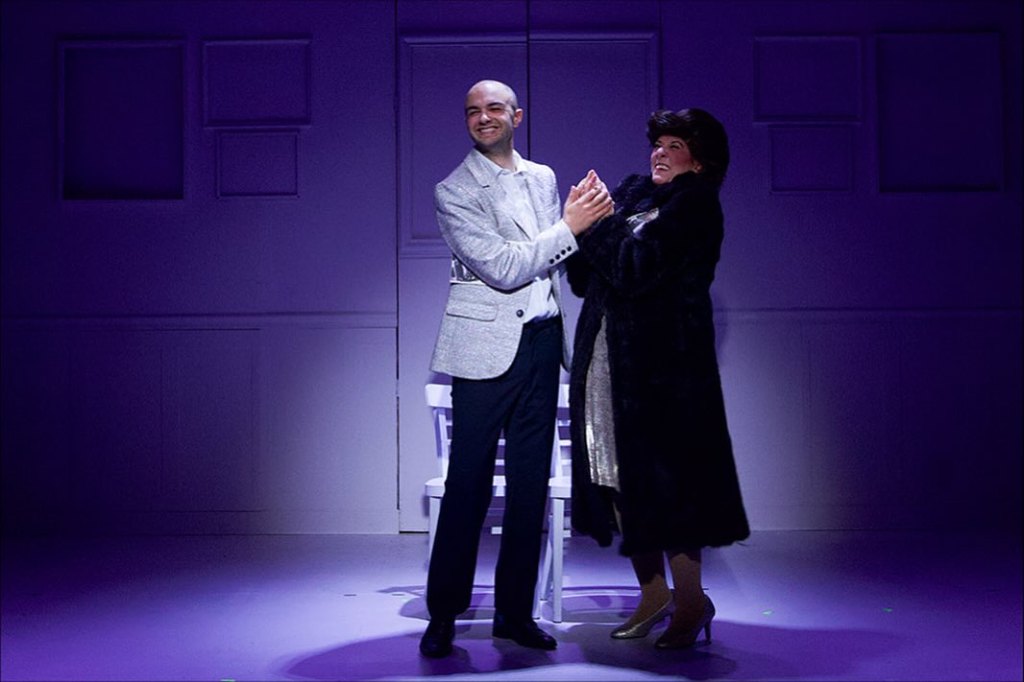
The son, Bobby Collavecchio played by Daniel Daigle, becomes a successful playwright, almost in spite of the roadblocks he erects in his own path. He grapples with bad relationships and writer’s block, drug addiction, and low self-esteem. The mother, Maria Collavecchio, played by Sarah Heifetz, is a strong-willed and traditional Italian matriarch (although I must confess that when she first began talking, I thought we were dealing with a Jewish mother – same character, different recipes…). A running line is, “tell me the truth and I won’t get mad.” Watching Heifetz’s face trying to master this enormous lie is one of the highlights of the play, which runs about 75 minutes with no intermission.
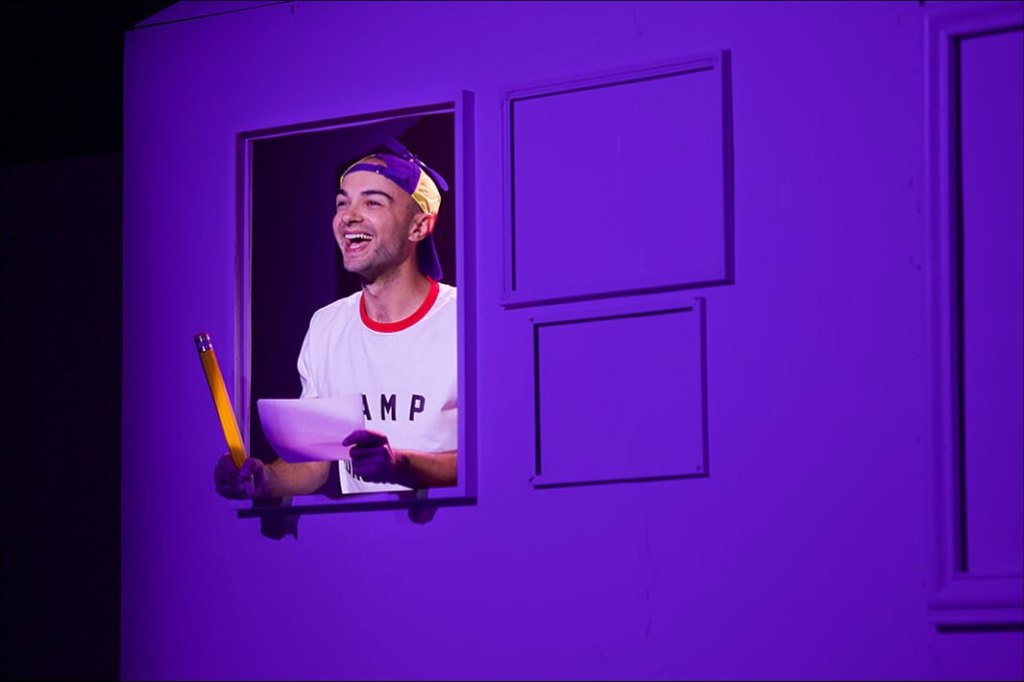
Bobby and Maria’s dialogues oscillate between humor and deep emotion, reflecting their shared history, familial bonds, and sometimes conflicting perspectives. Maria is not above saying “No,” you can’t come home from camp early to her pre-adolescent son or showing up unannounced at her adult son’s New York apartment, ready to battle his abusive boyfriend. When he finally gets a play produced on Broadway, Maria sits quietly holding his hand, until she can’t contain herself and leaps from her seat screaming with mama bear pride. At one point when Bobby asks, “Do you still love me?” Maria answers truthfully, “Not at this moment.” But love is enduring. A mother’s love – this mother’s love – never fails. And there is hope and the essence of something just out of reach that we’re all seeking underlying every scene of Conversations with Mother.
“Did you get a job yet?”
Why can’t you ever meet a nice boy?
“You know what the Germans are famous for? Baking people – like crescent rolls!”
If everyone jumped off a bridge, would you?
If your phone doesn’t ring, it’s me.
“If Christ had chosen better friends, He wouldn’t have died so young!”
“THAT’S MY KID UP THERE!!!”
As the mother reflects on her life and values, the son confronts his own choices and the realities of adulthood until, one day, the roles are reversed. Then, it’s Maria saying she has something to tell him, and making him promise he won’t get mad.
Throughout the play, Lombardo captures the essence of the mother-son dynamic, highlighting themes of memory, regret, and acceptance, but most of all, love. The interplay of comedy and drama serves to create a heartfelt narrative that resonates with anyone who has experienced similar familial ties – and perhaps even with those who have not. The play ultimately underscores the enduring nature of love and the bittersweet reality of growing older. I wasn’t ready for the depth of emotion, from laughing out loud to tears streaming down my face at the end.
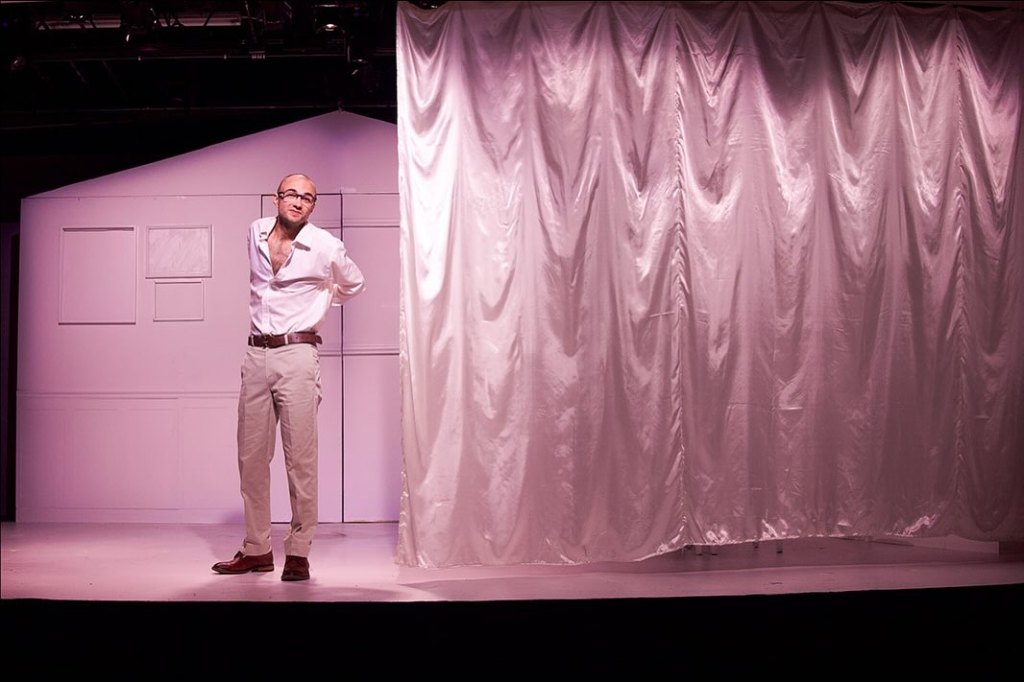
Daigle masterfully navigated the decades from the pre-adolescent Bobby to the mature adult facing the same shenanigans from his own son that he once showered upon his own mother. Heifetz captures the range of emotions of Bobby’s mother with amazing grace and agility – she’s outrageous without ever becoming a caricature.
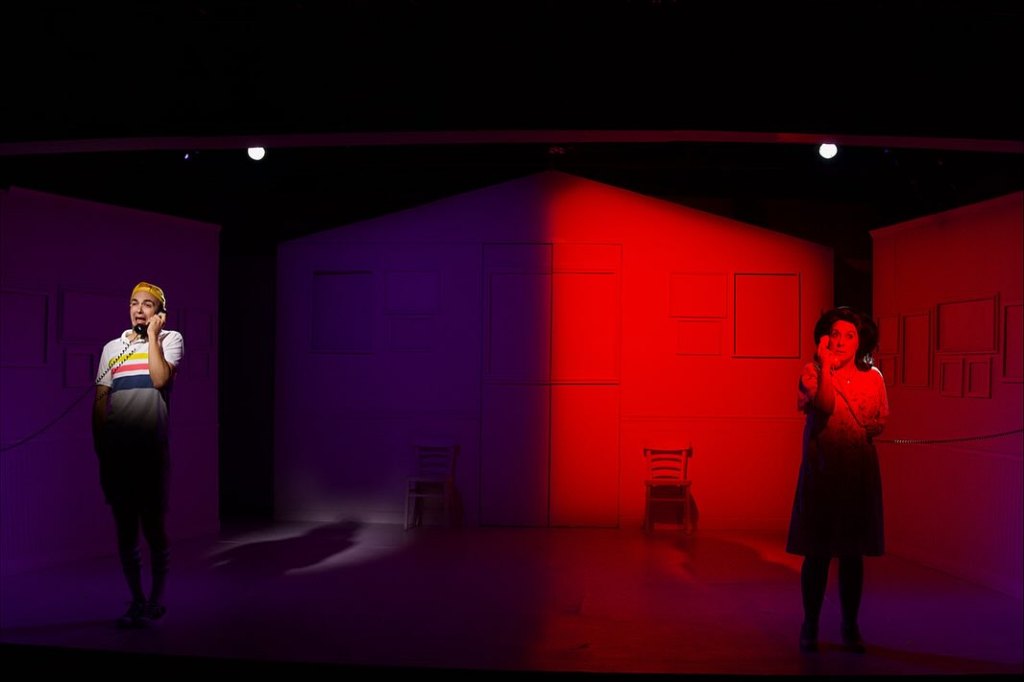
This is a work that does not need a lot of props or decor. The set is a simple background of window frames, a screen for projecting captions and video, and two chairs the actors move about as they pass from one decade to another, one geographical location to another (primarily New York and Connecticut).
Kudos to the creative team, starting with director Deejay Gray (I could feel his hand in Daigle’s portrayal of Bobby). Luke Newsome’s hair and makeup were awesome, with a special nod to Mama Maria’s wigs and another hat tip to Amber Marie Martinez’ costumes (and the unseen hands that helped make all those lightning-fast changes). Maria’s outfits were so authentic…Lucien Restivo’s projections (assuming that includes the video work), Weston Corey’s lighting design, and Kelsey Cordrey’s subtle but effective sound design were all perfection.
Conversations with Mother is a perfect example of a play that stands on the merit of its words and the actors and creative team who curate them into a production that creates beautiful, memorable theater.
———-
Julinda D. Lewis is a dancer, teacher, and writer who was born in Brooklyn, NY and now lives in Eastern Henrico County. When not writing about theater, she teaches dance history at VCU and low impact dance fitness classes to seasoned movers like herself and occasionally performs. Julinda was recently awarded the Dean’s Distinguished Adjunct Faculty Award 2023-24 Academic Year by VCU School of the Arts and the 2025 Pioneer Award in Dance Ministry by Transformation International Worship Ministries, Newport News, VA.
One-Time
Monthly
Yearly
Make a one-time, monthly, or annual donation
Make a monthly donation
Make a yearly donation
Choose an amount
$5.00
$15.00
$100.00
$5.00
$15.00
$100.00
$5.00
$15.00
$100.00
Or enter a custom amount
$
Your contribution in any amount is appreciated. Thank you for your support.
Or, How to be a Big, Black, Queer-Ass Broadway Musical
Presented by: Richmond Triangle Players in Partnership with Firehouse Theatre
At: Richmond Triangle Players at the Robert B. Moss Theatre, 1300 Altamont Avenue, RVA 23220
Performances: June 20 – August 9, 2025
Ticket Prices: $55
Info: (804) 346-8113 or rtriangle.org
A Reflection on Theater and Things Relative by Julinda D. Lewis
———-
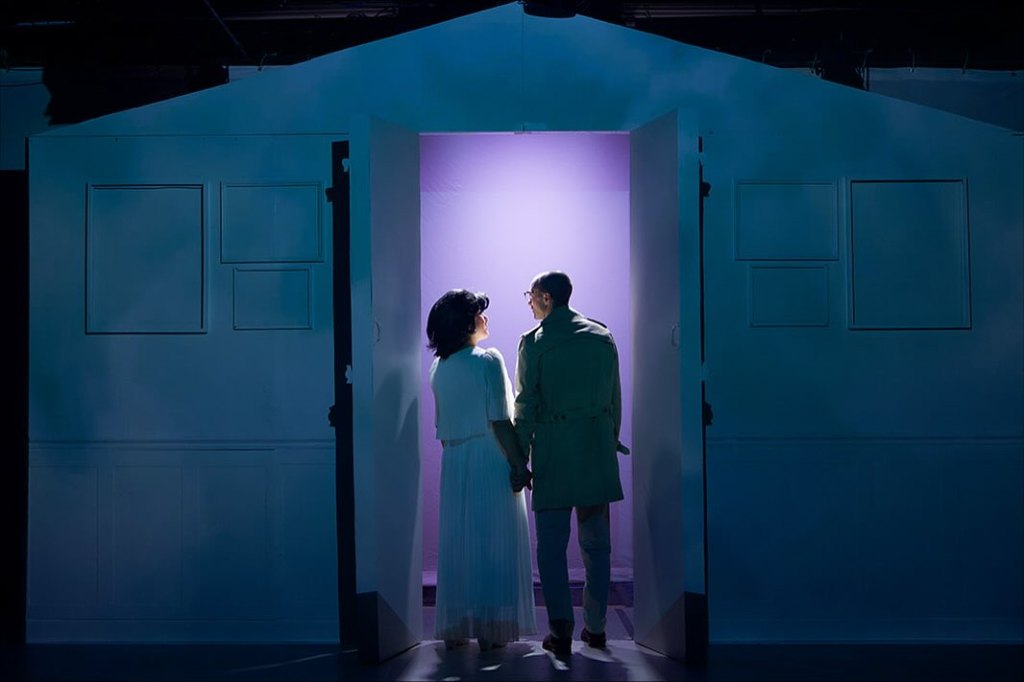
Michael R. Jackson’s Pulitzer Prize-winning musical, A Strange Loop (2019) follows the life of Usher – no, not that Usher – a Black, queer writer who works as an usher in theaters while writing his own musical about a Black queer usher who is writing a musical…about a Black queer usher who is writing a musical…
“Who knew slavery, police violence, and intersectionality could be so lucrative.”
A Strange Loop is at once as new as the latest dance craze and as old as the theater itself. The chorus of six nameless characters referred to in the program as “Thoughts” draws on the ancient Greek chorus. The Thoughts personify Usher’s inner struggles with identity and purpose. At times they represent social issues and personal demons, and at other times they represent people in Usher’s life. Come to think of it, Usher is not so much the lead character’s name as his occupation; he works as a Disney usher while struggling to overcome his writer’s block. Sometimes, the people are the issues, and sometimes the issues are the people. And since Usher is a young Black queer individual, these inner struggles encompass issues of racism, identity, homophobia, and self-doubt. Since Usher is a writer, A Strange Loop is also an exploration of the mind of creatives.
In science and technology, “a strange loop” is a concept proposed by Pulitzer prize-winning cognitive scientist and author Douglas Richard Hofstadter in his book I Am A Strange Loop (2007). In this book, Hofstadter (the son of Nobel Prize-winning physicist Richard Hofstadter) explores the sense of “I” or what is a “self” through the lens of self-referential systems. While these systems have different meanings in different fields, they most often are represented by a loop.
Playwright Jackson uses the term to refer to a self-referential thought structure or loop, in which an individual may find themselves trapped in a loop of thoughts – all too often negative thoughts – that keeps returning to the same point. For our protagonist, Usher, the loop circles around the themes of identify, self-doubt, and the writing process. Each theme in complete in itself, but in A Strange Loop the thoughts are compounded and complex, forming a never-ending loop that feeds on his insecurities which are, in turn, reinforced by social and familial pressures.
And yes, all this background may sound like technical, scientific mumbo jumbo to some, but it is key to understanding this play and this character. Who among us has not been affected by negative self-talk? And this play, this big, complex musical wonder, has been recognized many times over for its heartfelt message. A Strange Loop won the 2022 Tony Award for Best Musical and Best Book of a Musical. It also won the 2020 Pulitzer Prize for Drama even before its Broadway run. The Pulitzer committee recognized Jackson’s work as “a metafictional musical that tracks the creative process of an artist transforming issues of identity, race, and sexuality that once pushed him to the margins of the cultural mainstream” while acknowledging the universality of human fears and insecurities. There were other awards, too – Drama Desk, New York Drama Critics’ Circle, and numerous nominations in multiple categories. You can be intellectual and artistic at the same time. A Strange Loop is a lot of things, all at once, and probably deserves more than one viewing.
This Richmond production, under the masterful direction of the multi-talented Katrinah Carol Lewis, with musical direction by Ben Miller and choreography by Deandra Clarke boasts a stellar cast headed up by Marcus Antonio. Antonio was most recently seen at the Firehouse/TP production of Fat Ham [https://jdldancesrva.com/2025/04/17/fat-ham/] where he gave an alternately sly, philosophical, and just generally endearing performance as the main character Juicy, modeled after Hamlet. In A Stange Loop, you forget Antonio is acting. He embodies the character of Usher with authenticity, but also with grace – and I’m not just talking about the physical kind of grace, but the spiritual kind of grace as well. And did I mention he can sing his butt off? You need to see and hear it for yourself.
Each and every one of the “Thoughts,” deserves special mention, but I know I would omit something or someone important. At one point they form a parade of past heroes including Harriet Tubman, Marcus Garvey, James Baldwin, Whitney Houston, Zora Neal Hurston. When Zakiyyah Jackson/Thought #1 takes on the persona of an older Black woman who shares her wisdom and advice with Usher, she reminds me of the fabulous Phylicia Rashaad. Her last appearance on the RTP stage was, in fact, in a production of How Black Mothers Say I Love You [https://www.facebook.com/share/v/19WrqXMdBi/ ] TeDarryl Perry/Thought #4 and the understudy for Usher simply nails it as Usher’s mother. The red dress, the mannerisms, the attitude that flips without notice from, “The bible says homosexuality is worse than murder” or “Why do you hate me; you’re selfish” to love reminds me of people in my own extended family. I’m sure we all know at least one like her, or him.
I couldn’t believe that Anthony Cosby Jr., most recently seen in last season’s Yes, And! Production of Pass Overand known for his fabulous Prince tribute shows, was just now making his RTP debut as Thought #5. Likewise, it was awesome to watch Keaton Hillman/Thought #6 add to his growing repertoire of memorable characters. I haven’t seen Todd Patterson/Thought #3 sing and dance this much since BootyCandy (2022) [https://jdldancesrva.com/2022/06/17/bootycandy/]. I am not yet familiar with the beautiful Nesziah Dennis/Thought #2 but thoroughly enjoyed her performance and look forward to seeing more of them in the future.
With all the trauma in A Strange Loop, there is no deficit of humor. The parents’ names are Serabi and Mufasa, and the granddaughter is Nyla. Besides paying homage to The Lion King, it seems a bit of an inside joke that they are also the King and Queen of the Pridelands.
There are plenty of biblical references as well, from things people think are in the bible but actually aren’t (e.g., AIDS is God’s punishment for not living right) to actual bible quotes (e.g., But these, like natural brute beasts made to be caught and destroyed, speak evil of the things they do not understand, and will utterly perish in their own corruption – 2 Peter 2:12 NKJV).
Production-wise, A Strange Loop utilizes the space at RTP so well that the stage seemed wider and deeper than it actually is – in other words, bigger than life. Frank Foster’s scenic design consisted of strands of light, in curving bands like a roller coaster or strands of DNA, and 18 slim poles. Michael Jarett’s lighting was evocative, simple, and dramatic in turn.
This is a musical, so I would be derelict not to mention the music, which encompasses multiple genres including R&B and gospel – sometimes with full choir robes. The songs were fully integrated into the book, with lyrics that seamlessly expanded the storytelling aspects of the show. One of the most memorable, near the end, was “Memory Song,” a work that kind of summarizes the intent and direction of the entire work, touching on Usher’s childhood memories and relationships, his sexuality, and his faith. [See the lyrics to “Memory Song” below.] In his bio, TeDarryl Perry wrote that this performance is dedicated to “all those Black, gay boys who chose to go on back to the Lord.”
In the end, A Strange Loop, while frequently referred to by participants as “a big, black, and queer ass American Broadway show,” is not just a niche show. It is for Black, queer people. It is for people who are exploring their sexuality or identity. It is for people who care abut mental health and identity. It is for anyone who has ever experiences self-doubt or self-hate. It is for people who have been bullied and people who have bullied others. It is for people who love a good story. It is for people who care about other people. It is for people who care. A loop is never-ending. The only way out is to break through.
Five foot four, high school gym Sneaking a cupcake These are my memories These are my memories
Shooting hoops off the rim Slow on the uptake These are my memories These are my memories
After gym, the locker room My eyes photographing Naked me measures in at four and a half inches These are my memories These are my memories
Of one lone, Black, gay boy I knew Who chose to turn his back on the Lord One lone, Black, gay boy I knew Who chose to turn his back on the Lord
Guild and shame Jesus’ name Church every Sunday These are my memories These are my memories
Eat his body Drink his blood Communion buffet These are my memories Sweet, sour memories
After church we’re driving home to radio crackle Jazz music or Motown blues And skin is a shackle For one lone, Black, gay boy I knew Who chose to turn his back on the Lord One lone, Black, gay boy I knew Who chose to turn his back on the Lord
These are my memories Sweet, sour memories This is my history This is my mystery
Mom is napping on the couch And dad cuts the grass While I watch TV all day long Young & the Restless Like one lone, black, gay boy I knew Who chose to turn his back on the Lord One lone, black, gay boy I knew Who chose to turn his back on the Lord
Dad is drunk and on the couch While mom eats a porkchop Daily bread mill Daily treadmill won’t ever stop One lone, Black, gay boy I knew Who chose to turn his back on the Lord One lone, Black, gay boy I knew Who chose to turn his back on the Lord
I am lying on the couch I dream that I’m flying Flapping both my wings so hard To keep me from dying With a crown of godforsaken thorns on my head Like all those black, gay boys I knew Who chose to go on Back to the Lord (like all those black, gay boys you knew who chose to go on back to the Lord)
All those Black, gay boys I knew Who chose to go on Back to the Lord (all those Black, gay boys you knew who chose to go on back to the Lord) All those Black, gay boys I knew Who chose to go on Back to the Lord! (all those Black, gay boys you knew who chose to go on back to the Lord) And one lone, Black, gay boy I knew Who chose to turn his back- On the Lord- (chose to turn his back on, chose to turn his back on the Lord) Instead
Julinda D. Lewis is a dancer, minister of dance, teacher, and writer who was born in Brooklyn, NY and currently resides in Eastern Henrico County. When not writing about theater, she teaches dance history at VCU and low impact dance fitness classes to seasoned movers like herself and occasionally performs.
Looking back at my October 2024 review of H*tler’s Tasters” I noted that the opening paragraph of that review is appropriate for this one, so I’m going to use it again: The 5th Wall Theatre’s 2024/2025 season is billed as a celebration of empowering stories that inspire change. The “theatre beyond boundaries’” production of Pulitzer Prize-winning author Martyna Majok’s SANCTUARY CITY fulfills this promise on several levels.
Set in Newark, NJ in 2001, shortly after the earth-shattering events of 9/11, just across the Hudson River, SANCTUARY CITYtells the story of two teen-age friends as they navigate not only the usual trials that impede a smooth transition from teen to young adult, these two, known simply as B and G, must also contend with the extra challenges of being the children of immigrants. Oh, and not just immigrants, but immigrants who have over-stayed their visas. Let’s add to that, immigrants who have over-stayed their visas right after a major terrorist attack that damaged the Pentagon and destroyed the World Trade Center.
And while we’re at it, why not toss in domestic abuse, parental abandonment, financial stress, and sexual identity. Majok cleverly did not use names for the characters or specify their national origin, leaving that open for wider interpretation and inclusiveness depending on the cast and the locale.
Like so much of local theater in recent months, this production is heartfelt and relevant. It brings recent history into perspective into perspective, making it tangible, giving a face to “woke” and forcing us to think about how policies and legislation affects the lives of real people.
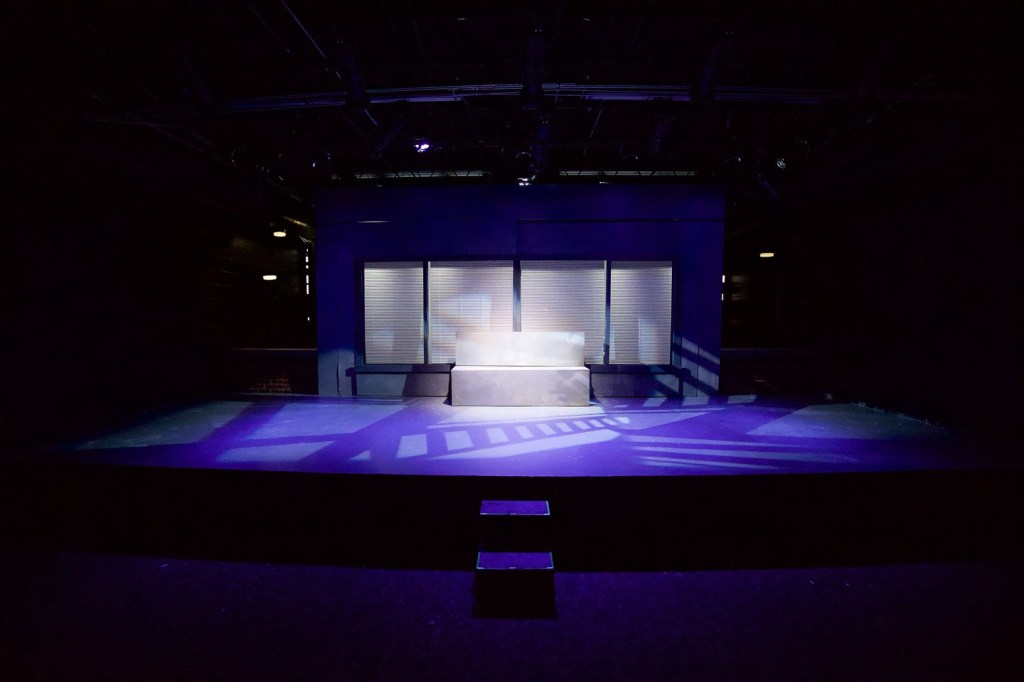
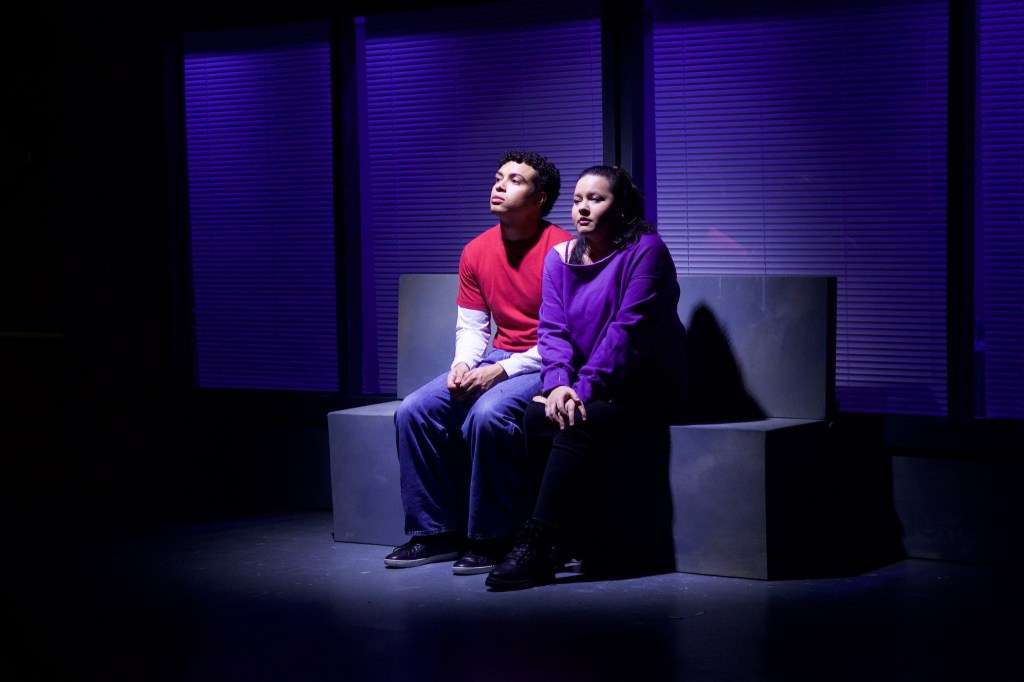
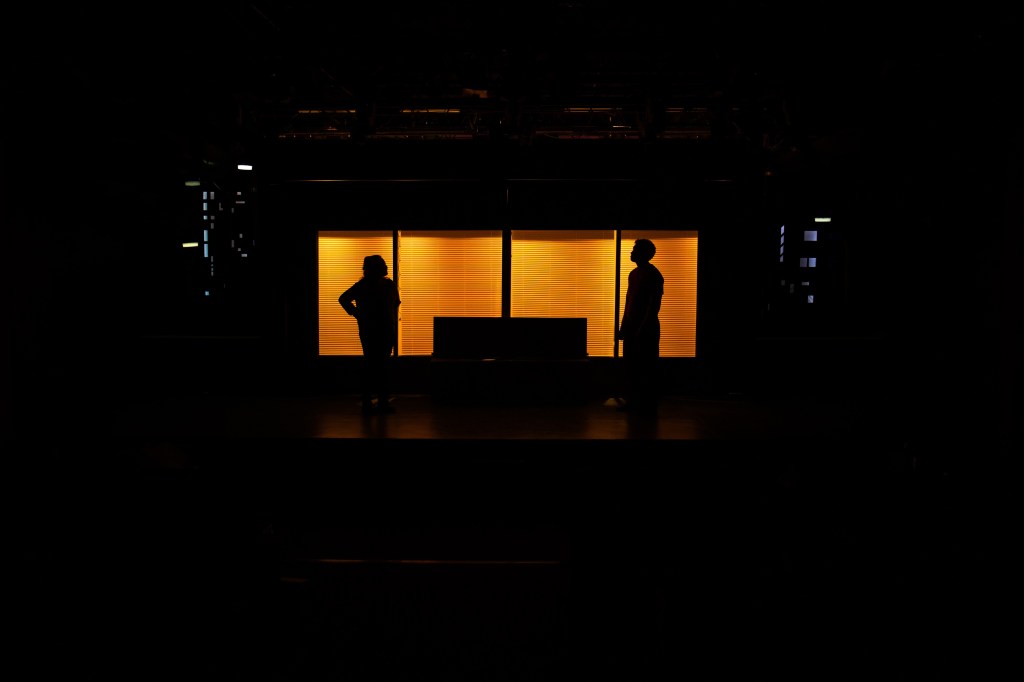
SANCTUARY CITY runs about 90 minutes with no intermission, but it does have two distinct parts. The first half or so takes place in a minimalist setting, with a simple bench set in front of a wall of windows. Dasia Gregg’s scenic design is gray and institutional, deliberately lacking in the details that suggest hominess and permanence. It looks like a bus station or a waiting room in a government building, but it serves as a variety of locations from B’s bedroom to the high school gym where B and G attend their senior prom. For the second half, the bench is removed, and the wall of windows opens up to reveal B’s apartment – presumably, the same apartment he inherited when his mother, fearing deportation, returned to her home country, leaving B, a 17-year-old high school student, to fend for himself.
G’s mother, on the other hand, managed obtain citizenship for herself and her daughter, opening the door for G to attend college in Boston. The school, like the other details, is never named, but we know Boston is home to Harvard, MIT, and several other schools.
G spends more time at B’s apartment than with her own mother, whose abusive boyfriends make G’s life unbearable to the point that the play opens with her banging on B’s bedroom window, coatless on a cold night, seeking refuge. For much of the first half, the two share B’s twin bed, with his mother’s permission.
The first half is a series of non-chronological scenes that create a sense of anxiety and uncertainty for the viewer. This seems to have been the playwright’s intention, but Juliana Caycedo, in her directorial debut, successfully balanced the edginess with flavorful dashes of humor.
I was excited to see that B would be played by Erich Appleby whose performance in the recent Water by the Spoonful (Firehouse Theatre) was most impressive. G is played by Anne Michelle Forbes (who was also in Water by the Spoonful) and the third character, Henry, who does not appear until well into the second half, is played by Keaton Hillman (whom I have seen mature into a seasoned actor on a variety or RVA stages).
It is fascinating to observe Appleby and Forbes navigate the delicate and difficult issues faced by two teens of immigrant parents: overstaying their visas, not having the proper documents or the financial means to become “legal,” accepting abuse at home and at work for fear that speaking up would lead to deportation. These young people, undocumented immigrants who arrived in the US as children, and whose only known home is the USA, are the people who would be labeled “Dreamers” (Development, Relief, and Education for Alien Minors Art) and for whom the Obama administration created DACA, the Deferred Action for Childhood Arrivals program in June 2012.
G and B forge a plan to help B stay and become legal. They play to get married. They practice what to say to pass their interview with the immigration authorities. And then G get accepted to a college in Boston. They live in Newark, more than 200 miles and a 5-6 hour bus ride away. But while away at school, G develops cold feet. If their plan fails, the penalty is a $250,000 fine and 5 years in prison. She doesn’t come home for holiday breaks as planned, and when she finally shows up, after 3 ½ years, their close bond has been broken, and G has become involved with Henry, a law student. Henry is first generation American-born, the son of immigrants, also from an unnamed nation.
SANCTUARY CITY is educational, informative, and addresses issues that we, as a nation, are wrestling with right now. There are no easy solutions. There are issues of border security and national security, drugs, crime, employment, social integration, social services, economic impact, language, and racism. The topic is one that either leaves you speechless and weeping or ready to take up arms and march into battle. The acting in SANCTUARY CITY is mesmerizing. It may take a bit of adjusting to get used to the disjointed, non-linear format of the first half, but the discomfort is necessary. One cannot expect to sit comfortably in one’s seat and sip one’s cocktail. This is the sort of production that goes beyond the superficial and delves deeply into characters and issues of society and social justice and economics and education and…things that matter to us. It is about something that happened between 2001 and 2006, but it is also about real people, right now. This is not light entertainment; it is art that serves a cause.
One scene that sticks with me is when B describes the time he secretly took a bus to Boston to visit G, to surprise her. He walked around the campus. He pretended to have lost his ID, and other students readily gave him access. He had lunch and sat in on classes and even participated. In one class he answered a question eloquently, because he had read the book (G shared her books with him). But then, he left without speaking to G. He saw her, but he left.
So, I leave you with this: Who is welcome at the table? Who will we allow to walk away without sharing their talents and gifts and who will we make room for? For whom are we willing to fight? Is there a B or G or Henry in your life, and if not, why not?
———-
Julinda D. Lewis is a dancer, teacher, and writer who was born in Brooklyn, NY and now lives in Eastern Henrico County. When not writing about theater, she teaches dance history at VCU and low impact dance fitness classes to seasoned movers like herself and occasionally performs.
———-
SANCTUARY CITY
Written by Martyna Majok
Directed by Juliana Caycedo
CAST
B ………. Erich Appleby
G ………. Anne Michele Forbes
Henry ………. Keaton Hillman
Aidan Campbell ………. u/s for B
Katherine Nguyen ………. u/s for G
DJ Cummings-Herdoiza ….. u/s for Henry
PRODUCTION TEAM
Directed by ………. Juliana Caycedo
Production Stage Management ………. Tariq Karriem
Scenic Design by ………. Dasia Greff
Lighting Design by ………. Gretta Daughtry
Sound Design by ………. Kyle Epps
Costume Design by ………. Sassy Rychalski
Prop Master ………. Tariq Karriem
Technical Director ………. Rebecka Russo
Dialect Coach ………. Harrison Runion
Intimacy Coordinator ………. Dorothy Dee-D Miller
Photos by ………. Destiny Martinez
Performance Schedule:
Thursday, March 6, 7:30PM | PREVIEW
Friday, March 7, 7:30PM | OPENING NIGHT
Saturday, March 8, 7:30PM
Sunday, March 9, 2:30PM | MATINEE with Talkback with the cast & Creative Team
Thursday, March 13, 7:30PM
Friday, March 14, 7:30PM
Saturday, March 15, 7:30PM
Sunday, March 16, 2:30PM | MATINEE
Tuesday, March 18, 7:30PM | INDUSTRY NIGHT, pay what you will
Thursday, March 20, 7:30PM | TALKBACK, Reestablish Richmond
Friday, March 21, 7:30PM
Saturday, March 22, 7:30PM | CLOSING NIGHT
Saturday, November 2, 2024, 7:30PM | Closing Night
Tickets: $30/Adult; $15/Student
Run Time: 90 minutes, no intermission
SANCTUARY CITY had its World Premiere at New York Theatre Workshop, Jim Nicola, Artistic Director, Jeremy Blocker, Managing Director, 2020. SANCTUARY CITY was developed, in part, at the 2018 Sundance Institute Theatre Lab.
Erich Appleby and Anne Michelle Forbes
One-Time
Monthly
Yearly
Make a one-time donation to support rvart review we are non-funded and appreciate donations
At: Richmond Triangle Players at the Robert B. Moss Theatre | Carpenter Foundation Stage, 1300 Altamont Ave, RVA 23230
Performances: September 11 – October 5, 2024
Ticket Prices: $50
Info: (804) 346-8113 or rtriangle.org
———-
NOTE:For the last review I wrote for this space, I confessed that I was unfamiliar with the play prior to seeing it, but someone kindly pointed out that I had actually reviewed the Richmond premiere several years prior. I wasn’t caught off guard this time. I remembered seeing this play before – in the same theater! – and my review of that earlier production was published in the Richmond Times Dispatch, February 20, 2015.
———-
September 13, 2024:
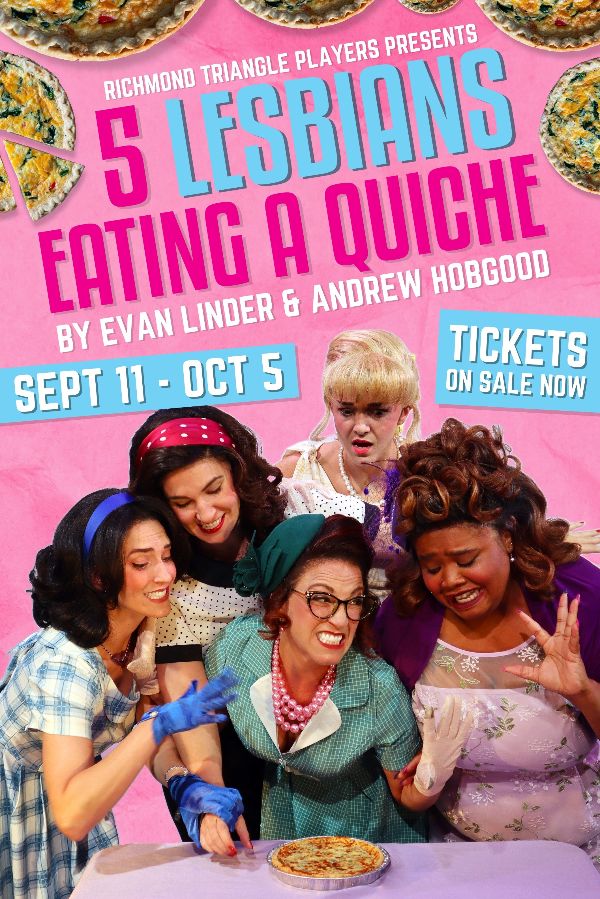
The leaders and members of the Susan B. Anthony Society for the Sisters of Gertrude Stein are gathered in the newly renovated community center for their annual Quiche Breakfast, but all is not as picture perfect as it appears on the surface. It’s 1956 and the country is uneasy about the prospect of impending nuclear attack and many – let’s be honest, all – of the widows (wink, wink) share a secret that no one dares speak aloud. When the security system signals a nuclear attack, everything changes.
The authors, Evan Linder and Andrew Hobgood – and the artistic team at Richmond Triangle Players – were eerily prescient. Change the year from 1956 to 2024 and the political climate, the threat of terrorism, and the challenges (dangers?) of being yourself are pretty much the same. I’m sure it was accident, no mere coincidence, that this production was planned for this pre-election period.
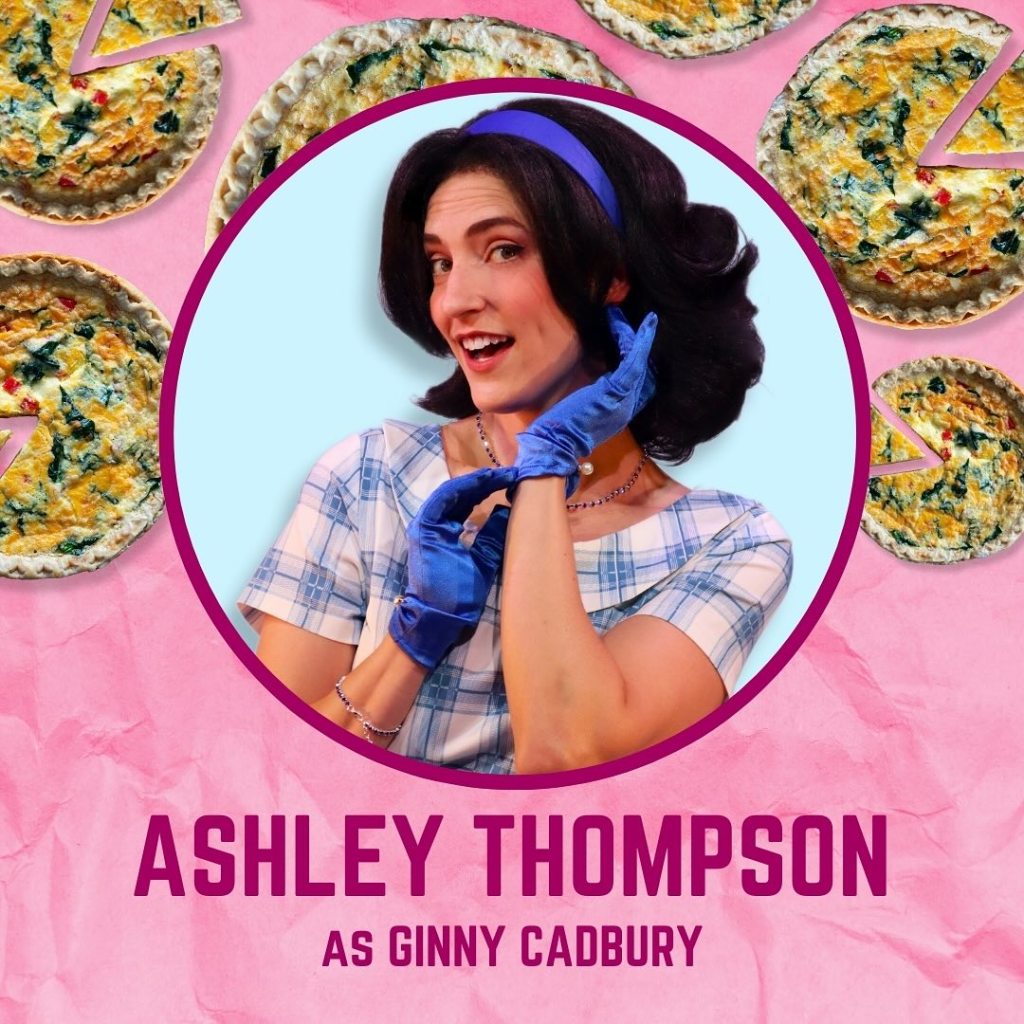
William Luther’s near cartoon-style set and gorgeous 1950s style dresses with their swinging skirts – some fluffed up by crinolines – stunning vintage shoes, hair bows, fascinators, and lace gloves are a feast for the eyes. The very demure outer appearance only makes the underlying sexual tension, innuendo, and banter that permeate each scene that much steamier. When Ashley Thompson’s character, Ginny Cadbury, the over-eager newest member of the group ends up atop a table with her face buried in a plate of quiche it’s as if a group of church ladies had suddenly put down their needle point to engage in an orgy. But I’m jumping ahead.
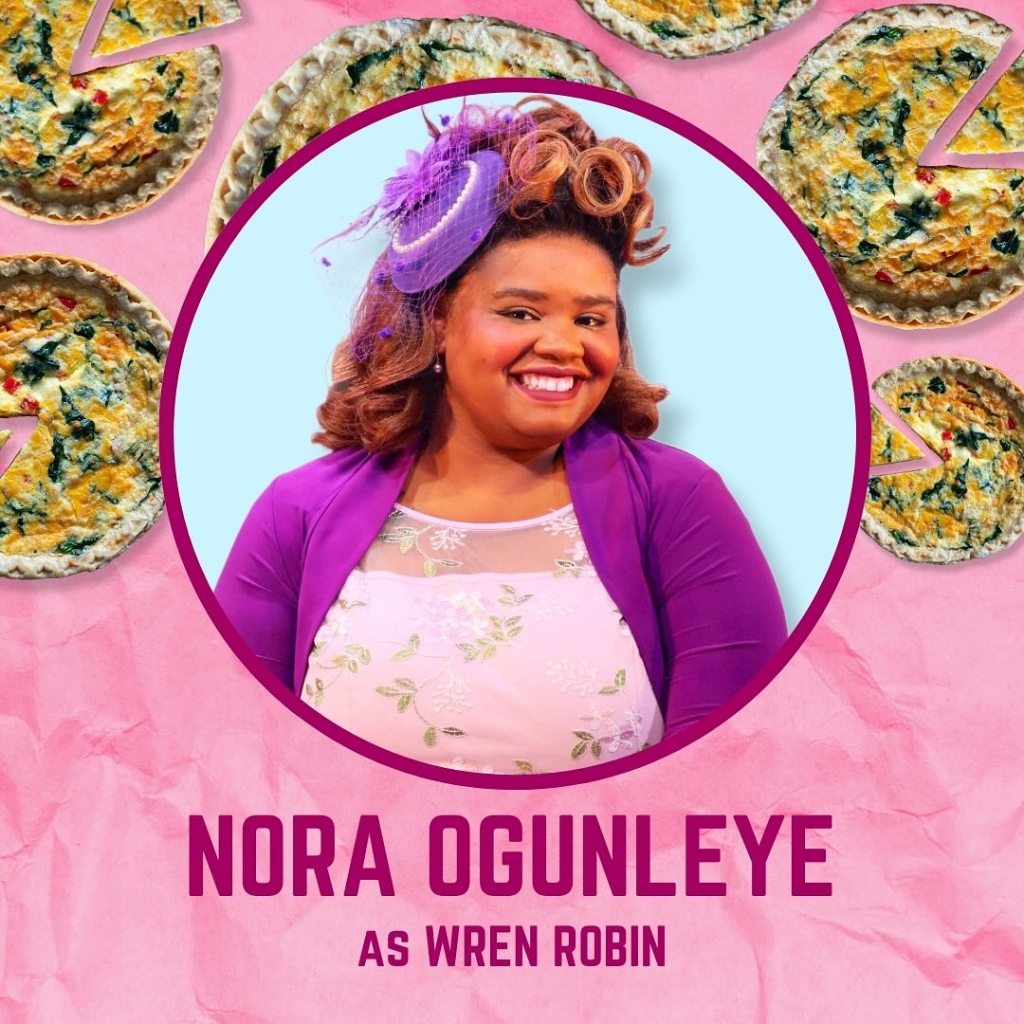
Theater-goers aka members receive name tags on arriving at their seats. Everyone gets a “female” name. I was Virginia this time. There is a lot of audience interaction, and one front-seat viewer in particular – “Margery” on opening night – gets to have an on-going supporting role. Nora Ogunleye as Wren Robin is the club’s event chair. Ogunleye, looking fabulous in a purple ensemble with matching hat and shoes brings over-the-top optimism and a mile-wide smile to the role. Kendall Walker plays Dale Prist, a wide-eyed innocent who looks like an animated Barbie doll and serves as the group’s historian with a classic Eastman-type film using camera around her neck.
Rachel Dilliplane brings barely repressed butch energy to Veronica “Vern” Schulz, the group’s buildings and grounds manager. Vern is the only one of the five women bold enough to wear pants, and in spite of her tight control over just about everything in her immediate world, Vern is the one who dropped the ball when it most mattered. Ashley Thompson slays as Ginny Cadbury, the newest member and recent British transplant who serves as the secretary. We never learn why – or if we did, it went over my head – Ginny is ostracized by the rest of the leadership team. Last but not least, Donna Marie Miller has the role of the group’s President, Lulie Stanwyck. A stickler for rules and protocol, who lives by the motto “no men, no meat,” it is Lulie who drops the biggest bombshell (I actually did not know that pun was coming) after the five find themselves confined to the shelter – with the possibility they may have to remain there for four long years.
Everything was moving along according to plan, you see, although there is a hint that things are not as they appear – when suddenly the lights flicker, the alarm sounds, and the safety door locks everyone inside against a nuclear attack. With seemingly nothing left to lose, it’s time to finally let go of long-held secrets. It turns out that “widow” is used here as a euphemism for lesbian. Once that is out in the open – and some are more reluctant to name their truth than others, and not even the audience is not exempt from participating in the apocalyptic confession – the floodgates open to reveal all sorts of secrets and Dale has an opportunity to earn a special place in the history of the sisterhood.
This cast is bright and snarky and generally hilarious. The costumes and set are visually delightful. The lighting and sound effects are appropriately over-the-top. The audience’s immersion pushes the edge of an unnamed boundary that gives heightened meaning to the word inclusion. What other play do you know of that encourages the audience to sing along to the theme song of an elite society and have everyone shout out, “I am a lesbian!” The issues are real: nuclear warfare, loyalty, discrimination, oppression, same-sex marriage. The timing of lines by the ensemble and the overall pacing set by director Kelsey Cordrey never attempts to belittle any of this, while at the same time guaranteeing there is never a dull moment. In short, 5 Lesbians Eating a Quicheis breathlessly entertaining.
———-
Julinda D. Lewis is a dancer, teacher, and writer who was born in Brooklyn, NY and now lives in Eastern Henrico County. When not writing about theater, she teaches dance history at VCU and low impact dance fitness classes to seasoned movers like herself, and occasionally performs. Her most recent (ad)venture was the premiere of a solo work, The Waters of Babylon or Psalm 137 Revisited: a Post-Exodus Reflection in Movement Choreographed From Collective Memories for the debut of the Critical Race Theatre Project, right here at RTP in August 2024.
———-
5 LESBIANS EATING A QUICHE
Written by Evan Linder & Andrew Hobgood
Directed by Kelsey Cordrey
Cast
Rachel Dilliplane as Veronica “Vern” Schultz [Note: the program spells her name Dillaplane but I used the spelling I’ve seen virtually everywhere else including her own social media]
Donna Marie Miller as Lulie Stanwyck
Nora Ogunleye as Wren Robin
Ashley Thompson as Ginny Cadbury
Understudies
Kendall Walker as Dale Prist
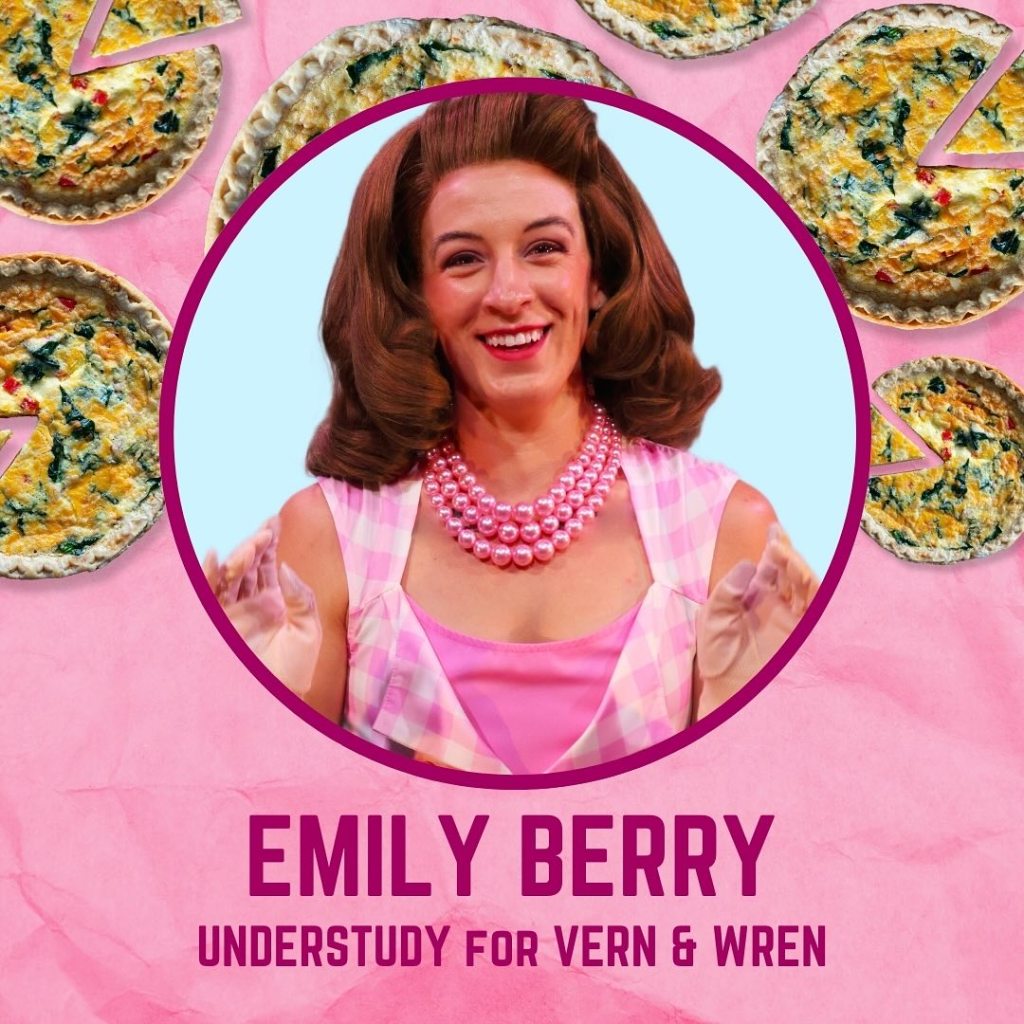
Emils Berry u/s for Wren Robin & Veronica “Vern” Schultz
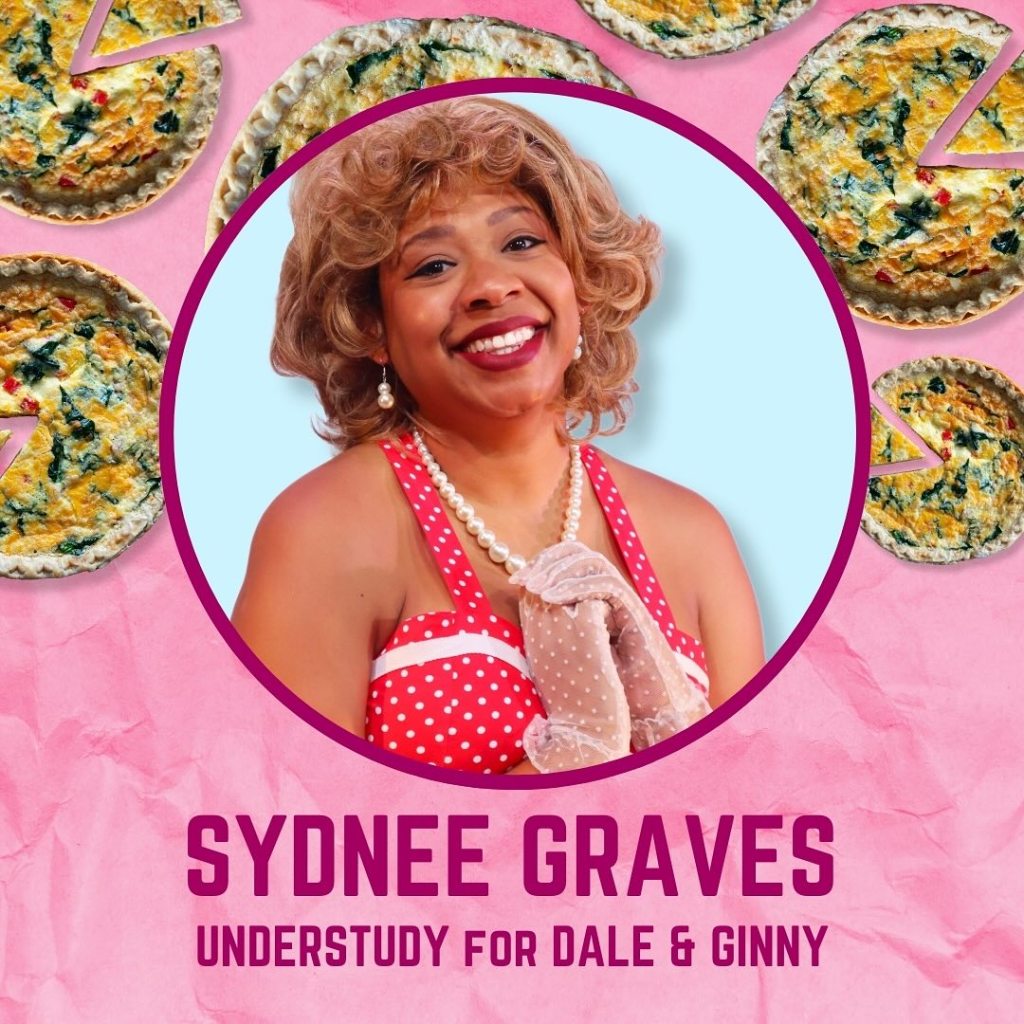
Sydnee Graces u/s for Dale Prist & Ginny Cadbury
Jen Hines u/s for Lulie Stanwyck
Production & Design
Playwright – Evan Linder & Andrew Hobgood
Director – Kelsey Cordrey
Scenic & Costume Design – William Luther
Lighting Design – Gretta Daughtry
Sound Design – Lucian Restivo
Props Design – Tim Moehring
Hair & Makeup Design – Luke Newsome
Production Stage Manager – Corrie Yarbrough
Assistant Stage Manager – Finn Thomason
Intimacy & Fight Director – Lucinda McDermott
Gender Consultant – August Hundley
Master Electrician – Griffin Hardy
Technical Director & Scenic Artist – William Luther
Scenic Construction – David Ballas, Josie Carter, Becka Russo, Kendall Walker
Setting
A community center in middle America where the annual Quiche Breakfast of the Susan B. Anthony Society for the Sisters of Gertrude Stein is being held. Today, 1956.
Run Time
Approximately 70 minutes without intermission
Ticket Information
$50, Info: (804) 346-8113 or rtriangle.org
Photo Credit: unattributed
One-Time
Monthly
Yearly
Make a one-time or recurring donation to show your support of RVART Review
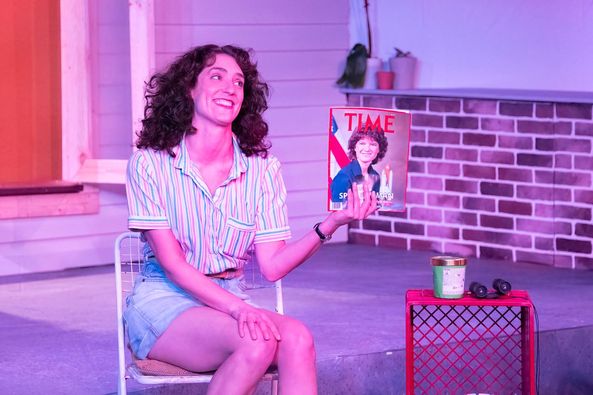
When I say that Liza Birkenmeier’s 4-character, one-act play, DR. RIDE’S AMERICAN BEACH HOUSEis weird, please understand that is an observation, not a judgment. There is a reason why the Yes, And! Theatrical Company – now in its second year of production –- chose this play. I suspect it has something to do with exploration (inner, and self, more than space) and identity (woman as subject, not object, as well as gender and sexuality), and history (personal history as well as the history of Dr. Sally Ride and the American space program).
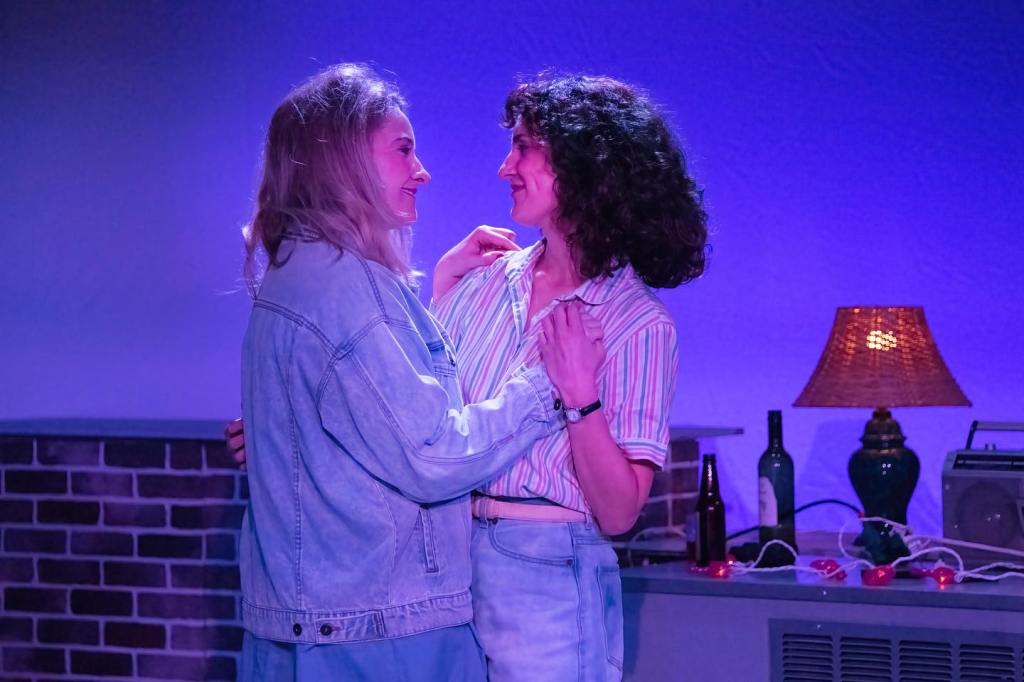
Set on a rooftop in St. Louis in June 1983, on the eve of the launch of the Challenger space shuttle that carried Dr. Sally Ride, the first American woman to go into space, DR. RIDE’S AMERICAN BEACH HOUSE is both non-linear and non-conforming. Two long-time friends, both poetry majors who have apparently simultaneously run into a writing block, come to the rooftop for the weekly meeting of The Two Serious Ladies Book Club. The club is named for a novel by Jane Bowles in which two women explore – depending in which review you read – “living outside themselves” or descend in debauchery. After forming the book club, however, our leading ladies, Harriet (Ashley Thompson) and Matilda (Rachel Marrs) realize they don’t really like to read, so they spend the time drinking beer and talking.
One day, their complacent little world is shaken up when (a) Harriet shares a harrowing tale of a sexual encounter with a stranger – a bearded biker, no less – and (b) Matilda invites a new friend, Meg (Kasey Britt) whose insight sheds new light on the friends’ sexual tension and life in general, and (c) their lives are all shifted by the imminent space launch that is the main topic on their rooftop radio.
Harriet is high strung and annoying, but about two thirds of the way through we find out she has good reason to be, and in spite of her irksome character, we cannot tear ourselves away from the story she weaves throughout. Perhaps Harriet’s calling was not for poetry, but for fiction or drama…Matilda, who has a husband and a sick child at home, would rather spend her time with Harriet, and is given to bursting out in song – revealing that Rachel Marrs has a stunningly beautiful singing voice and can even attempt a decent Irish step or two.
Most intriguing, however, is Meg. Back stories and character development are not a main point of DR. RIDE’S AMERICAN BEACH HOUSE, so we know that Meg works at a hospital across the street from where Harriet and Norma live, and may – or may not –- be a nurse. She does, however, provide some music therapy for Harriet in the midst of her breakdown, which leads to one of this play’s most delightful moments.
The fourth character is Norma (Jacqueline Jones) – who is either Harriet’s landlady or neighbor. At any rate, it seems that Norma is the caretaker of the Ivan Brock House, named for fictional poet and the house where Harriet lives. Norma is concerned with three things: safety, money, and Harriet’s leaky air conditioning unit. Jones’ two or three appearances are all too brief, as Norma, who seems to be on the far right of some spectrum or another, shares complaints and almost incidentally drops pearls of wisdom and insight on the younger women.
DR. RIDE’S AMERICAN BEACH HOUSE is directed by Kelsey Cordrey with a light touch, a good dose of wit, and a loving respect for words. Cordrey and the cast make us see or at least ponder connections between barbecue and beer, a beach house and a rooftop, an astronaut launching into space and an ordinary person (is there such a thing?) exploring the unexplored landscape of their life. It’s only about 90 minutes long, and the first few minutes are rather slow going, but about midway through – and even more so afterwards – it becomes clear that there is more to explore here than at first meets the eye.
Cordrey explains at least part of the “why” in her director’s note: “Pretty much every queer person I know has felt the urge to “go away” before. To escape to a place, whether literal or figurative, what would be more. More accepting, more fulfilling, more exciting, or more loving”.
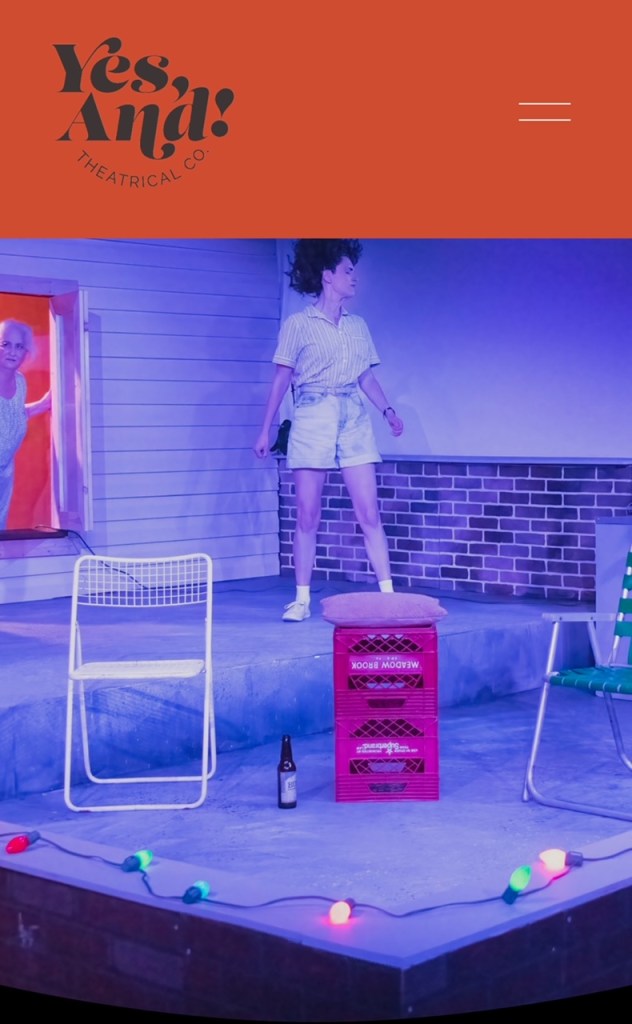
Adam Dorland has designed a simple but effective rooftop setting with a couple of chairs, some stacked crates that serve as a table, an HVAC unit, and lots of brick wall constructed at an angle that juts slightly off the edge of the stage. Candace Hudert’s sound design is mostly subtle, and makes use of the ubiquitous 1980s boom box and cassette tapes – remember those???
If you like your theater to have a clear beginning, middle and end, and to tie up all the loose ends with a happy ending, DR. RIDE’S AMERICAN BEACH HOUSE won’t fulfill those needs. If you like theater that asks questions and challenges you to think about why things are the way they are, then this is your kind of play. And if you’re undecided, or not sure, I would urge you to give it a try and discuss it after – maybe with three friends, over a bottle of wine or some beers.
FUN FACTS ABOUT DR. SALLY RIDE
Sally Kristen Ride (1951-2012) was a physicist and the first female American astronaut
Sally Ride was married to Steven Hawley (1982-1987) and had a long-term partner, Tam O’Shaughnessy (1985-2012)
Dr. Ride did not publicly reveal her sexuality until her death, in a carefully worded obituary she wrote before she died
In 1972, while an undergraduate at Stanford University, Sally Ride played tennis great Billy Jean King in a mixed doubles exhibition
One morning, at breakfast, in 1977, while she was a doctoral student at Stanford University, Sally Ride read an article in the student newspaper that NASA was opening up applications to women for the first time, so she applied
Dr. Ride’s younger sister, Bear, is a Presbyterian minister – she is also queer
Sally Ride was a Trekkie
Sally Ride and her partner Tam O’Shaughnessy co-authored several science books for children
The Astronaut Beach House is a two-story building located in Cape Canaveral, FL use to house astronauts prior to their launch. The house is also used as a conference center, and hosts barbecues for astronauts and their families prior to a launch
———-
Julinda D. Lewis is a dancer, teacher, and writer who was born in Brooklyn, NY and now lives in Eastern Henrico County. When not writing about theater, she teaches dance history at VCU and low impact dance fitness classes to seasoned movers like herself, and occasionally performs.
———-
DR. RIDE’S AMERICAN BEACH HOUSE
Written by Liza Birkenmeier
Directed by Kelsey Cordrey
Principal Cast
Ashley Thompson as Harriet
Rachel Marrs as Matilda
Kasey Britt as Meg
Jacqueline Jones as Norma
Understudy Cast
Juliette Aaslestad u/s for Harriet
Amber James u/s for Matilda
Davis Erney u/s for Meg
Nicole Morris-Anastasi us for Norma
Production Team
Scenic Design – Adam Dorland
Costume Design – Amber Martinez
Lighting Design – Steve Koehler
Sound Design – Candace Hudert
Properties Design – Margaret Dodson-Cordrey
Intimacy Direction – Tippi Hart
Production Manager – Todd LaBelle
Production Stage Manager – Crimson Piazza
Asst. State Manager – Marcely Villatoro
YES, AND! THEATRICAL COMPANY
in residence with NEW THEATRE at FIREHOUSE
Artistic Director – Maggie Roop
Managing Director – Nicole Morris-Anastasi
Executive Director – Matt Shofner
Dr. Ride’s American Beach House
Commissioned and Developed by Ars Nova
Jason Eagan, Founding Artistic Director | Renee Blinkwolt, Managing Director
World Premiere produced by Ars Nova, New York City, October 21, 2019
Performance Schedule
Thursday, March 7, 2024 7:30PM Preview
Friday, March 8, 2024 7:30PM Opening Night
Saturday, March 9, 2024 7:30PM
Tuesday, March 12,2024 7:30PM Industry Night
Thursday, March 14, 2024 7:30PM Understudy Performance
Friday, March 15, 2024 7:30PM
Saturday, March 16, 2024 7:30PM
Sunday, March 17, 2024 2:00PM
Tuesday, March 19, 2024 7:30PM Industry Night
Friday, March 22, 2024 7:30PM
Saturday, March 23, 2024 7:30PM Closing Night
Tickets
Ticket Prices: $35 general admission
Run Time
1 hour 36 minutes with no intermission
Notes
Please be aware that an herbal cigarette will be smoked for a brief moment onstage
Photos by Tom Topinka
The real-life NASA Beach House
One-Time
Monthly
Yearly
Make a donation in support of RVArt review
Make a monthly donation
Make a yearly donation
Choose an amount
$5.00
$15.00
$100.00
$5.00
$15.00
$100.00
$5.00
$15.00
$100.00
Or enter a custom amount
$
Your contribution is greatly appreciated. Thank you.
I see trees of green Red roses too I see them bloom For me and you And I think to myself What a wonderful world
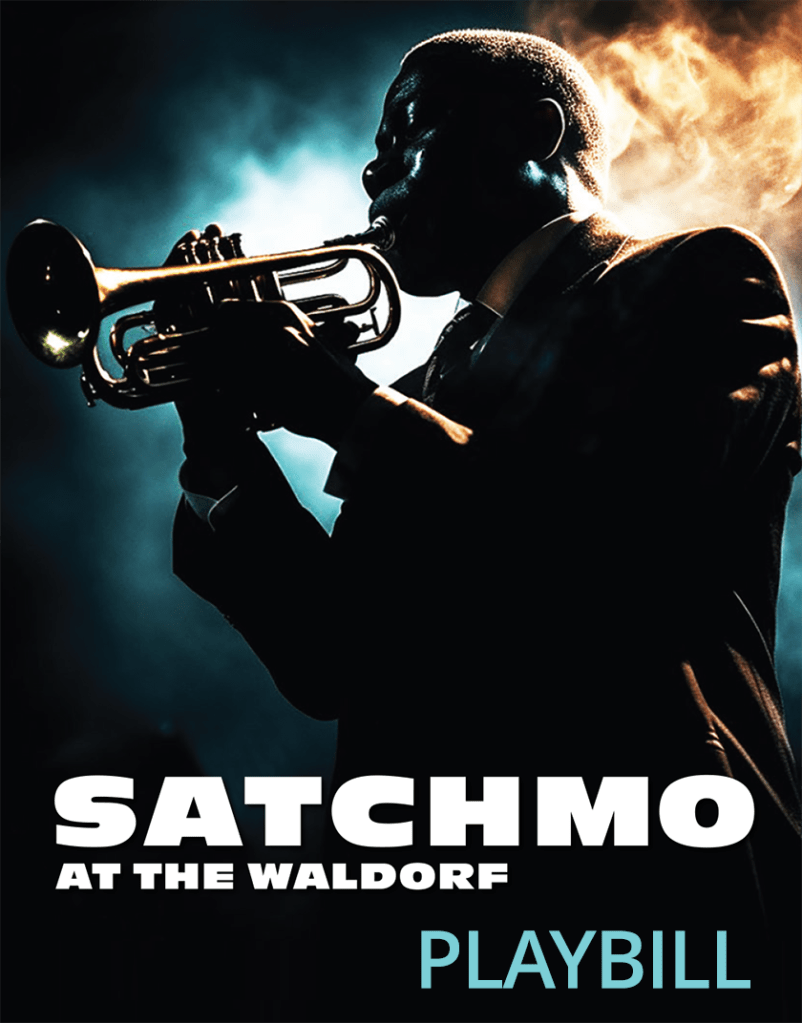
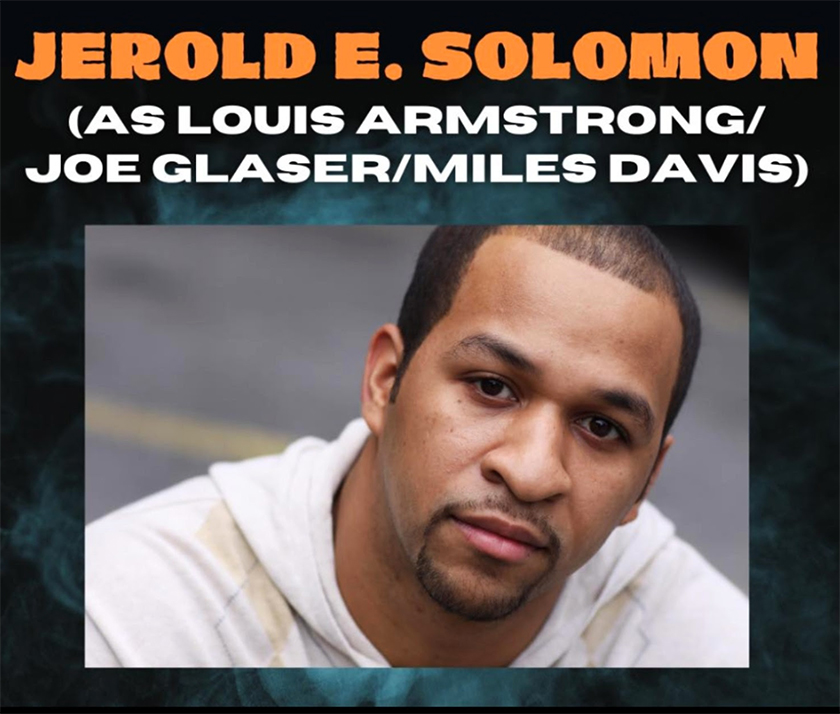
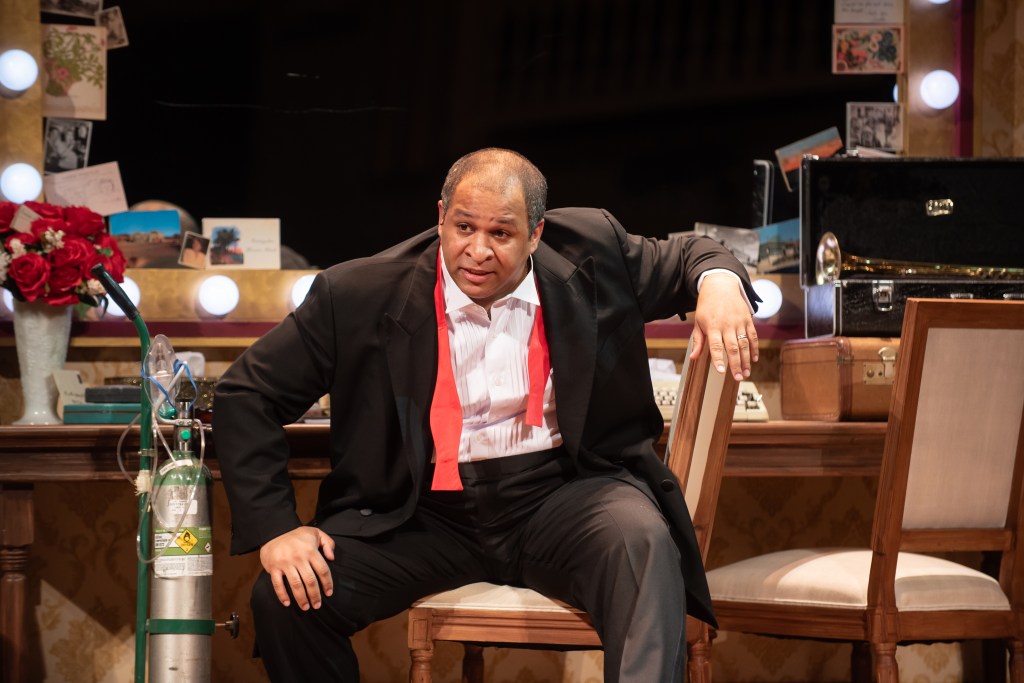
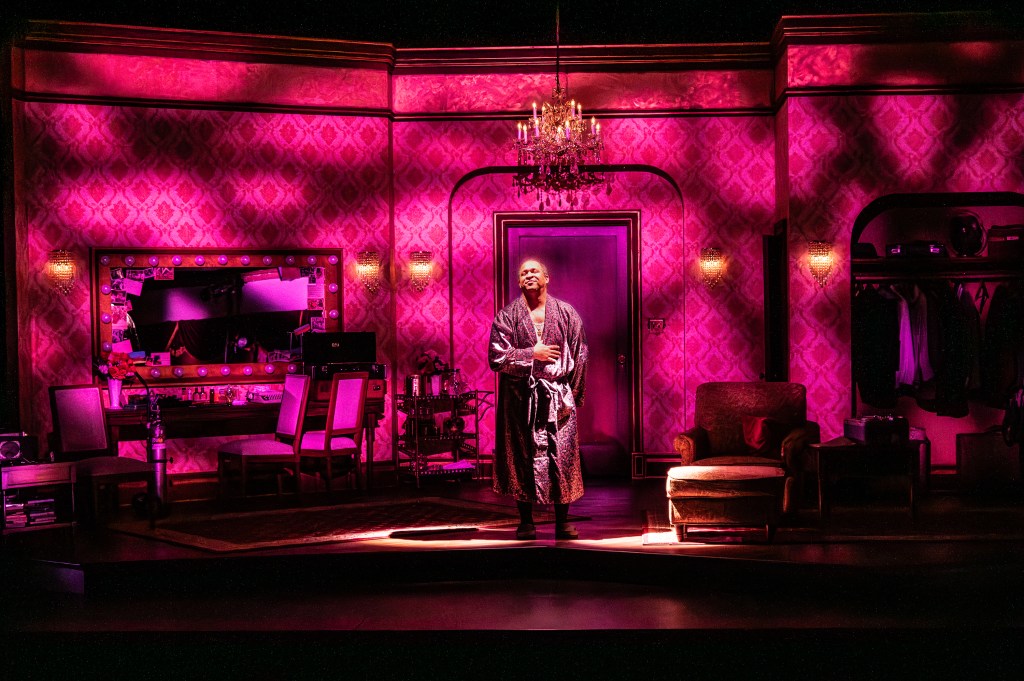
American trumpeter, vocalist, and jazz innovator Louis Armstrong died in New York City, July 6, 1971 at age 69 of a heart attack. Terry Teachout’s one-man play, SATCHMO AT THE WALDORF (2012),is a work of historical fiction set in a comfortably appointed dressing room at the Waldorf Astoria’s Empire Room a few months before Armstrong’s death. The VaRep production features Jerold E. Solomon, who catches us off-guard in the first 30 seconds of the play by (a) stumbling into the dressing room and heading straight for an oxygen tank, (b) speaking in an amazingly accurate approximation of Armstrong’s gravelly voice, and (c) immediately announcing, “I shit my pants.”
Although it is a work of fiction, SATCHMO AT THE WALDORF has so much historical truth that it is an educational experience. We learn of Armstrong’s four wives and how he finally got it right with his fourth wife, Lucille – the first dark-skinned Black woman hired by Harlem’s Cotton Club. We share the outrage when he talks about traveling in the south during the era of Jim Crow segregation when even internationally known starts like Armstrong could not stay in a hotel or eat in a restaurant. We hear about Armstrong’s long-tern symbiotic relationship with his manager, Joe Glaser, and the heartache the followed when all Glaser left him on his death – his best friend and client/business partner – was a “tip.” There was a time spent working for the notorious crime boss Al Capone. He had beef with jazz trumpeter and bandleader Dizzie Gillespie and unpleasant rivalry with the influential jazz trumpeter and bandleader Miles Davis, who called him an Uncle Tom. We learn of Armstrong’s wide-ranging and eclectic interest in multiple music genres, including classical, opera, and country.
I see skies of blue And clouds of white The bright blessed day The dark sacred night And I think to myself What a wonderful world
Solomon arrives onstage carrying a trumpet, which he immediately places in its case. He does not attempt to play or portray trumpet playing, nor does he sing, although he does toss off a little scatting. Solomon’s depiction of Armstrong’s voice is unwavering and I kept wondering if it was painful. But wait, that’s not all. When portraying Glaser, Solomon seamlessly shifts to a stereotypical New York Jewish accent without missing a beat. The portrayals of the outspoken Davis are less outstanding – although I think the reason lies less with Solomon than with the script. For someone known to be so outspoken and independent, Davis is written as a flat, uni-dimensional.
The colors of the rainbow So pretty in the sky Are also on the faces Of people going by I see friends shaking hands Saying, “How do you do?” They’re really saying I love you
Mercedes Schaum’s set is sturdy and well appointed with a makeup area, a lounge area, two carpets, a wardrobe, an offstage bathroom and all the amenities one would expect from an exclusive venue located in a five-star hotel. Joe Doran’s lighting is mostly non-descript, but occasionally reaches for some noteworthy effects. I was surprised by the short audience on a Saturday night, the second night of the run. I’m not sure if this was due to a lack of interest in the subject matter or to the political activity occurring in the nearby downtown area, or to the 7PM curtain, or the fact that this play is a one-hander (rare for a VaRep mainstage production), or a combination of factors. Granted, Louis Armstrong may not be everyone’s cup of tea, and – as I found out shortly after the show – not everyone knows that Satchmo, a contraction of Satchel Mouth, was one Armstrong’s nicknames.
I hear babies cry I watch them grow They’ll learn much more Than I’ll ever know And I think to myself What a wonderful world Yes, I think to myself What a wonderful world Ooh, yes
I, for one, thoroughly enjoyed Solomon’s performance and the impromptu history lesson of Satchmo at the Waldorf – it appealed to my artsy side and my nerdy side. What a wonderful combination.
———-
Julinda D. Lewis is a dancer, teacher, and writer who recently had both knees replaced due to a manufacturer’s recall. Born in Brooklyn, NY, she now lives in Eastern Henrico County where she can be found kicking up her heels as best she can any day of the week.
———-
SATCHMO AT THE WALDORF
Written by Terry Teachout
Directed by Rick Hammerly
Cast
Louis Armstrong/Joe Glaser/Miles Davis ………. Jerold E. Solomon
u/s Louis Armstrong/Joe Glaser/Miles Davis ………. David Watkins
Do Four Wrongs Make a Right? – OR – Is She Still Gonna Make Us Dinner?
A Theater Review by Julinda D. Lewis
At: Richmond Triangle Players at the Robert B. Moss Theatre | Carpenter Foundation Stage, 1300 Altamont Ave, RVA 23230
Performances: February 14 – March 2, 2024
Ticket Prices: $10 – $40
Info: (804) 346-8113 or rtriangle.org
———-
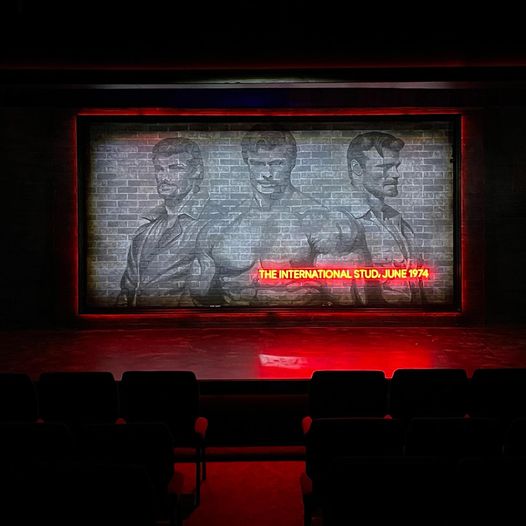
I came late to the TORCH SONG party because of other obligations, but I am SO glad I made it! TORCH SONG (2018) is apparently a shortened and revised version of Harvey Fierstein’s original 1982 (pre-AIDS pandemic) production, Torch Song Trilogy – the production that earned Fierstein his first two Tony awards (Best Play and Best Actor). This version consists of three scenes in two acts (“The International Stud, June 1974,” “Fugue in a Nursery, Summer 1975,” and ”Widows and Children First, June 1980”) and runs about 75 minutes with one intermission. Whatever the version or length of the TORCH SONG, the work remains one of the prolific* writer’s most enduring works.
Torch Song:
to carry a torch for someone
to keep aflame the light of an unrequited love
TORCH SONG was groundbreaking in presenting the intersectionality of Jewish and queer identities with authenticity, avoiding both stereotypes and dumbing down the difficult conversations. The former – avoiding stereotypes – was no small feat, considering that main character Arnold Beckoff (played by Richmond Triangle Players own Artistic Director Lucian Restivo) is a habitual complainer who does not hesitate to use guilt as a weapon of choice. (I would describe him as a kvetch, but don’t want to appear to be engaging in cultural appropriation, although I did grow up in Brooklyn and there were mezuzahs on the doorposts of my grandmother’s house.) In the first scene, we see Restivo as a smart-mouthed, fast-talking, somewhat jaded drag queen who despite all her words to the contrary is really looking for love – the same type of enduring love their mother experienced during thirty-five years of marriage.
The problem is that Arnold’s love interest, Ed (played by Axle Burtness) is bi-sexual and is torn between the safety of his girlfriend/fiancée/wife Laurel (Emily Berry) and Arnold. The tension is palpable, and comes to a head in a most amazing scene in which Laurel invites Arnold and his new young beau Alan (Zach Barnard) to spend a weekend with her and Ed in their country home. Wow. Each member of this queer quartet gets to spend one-on-one time with the other three, leading to any number of revelations, confessions, scandals, and ordinary little moments that both Arnold and Laurel refer to as, “this is so civilized.”
As amazing as that first act quartet may be, the real highlight of TORCH SONG occurs in Act 2 when Arnold’s mother pays a visit. Alan has died, and Arnold had adopted a teen son, David (Liam Storm) – but Arnold has not explained any of this to Mrs. Beckoff. Things really come to a head when the mother and son face off in a shouting match, to determine whose grief is more valid. It’s heart-wrenching to hear Mrs. Beckoff, who had appeared to accept her son’s homosexuality when he first came out to her at age 13, speak disparagingly of his life and tell him she’s too old to change.
On Thursday night, understudy Sara Heifetz stood in for Debra Clinton, and Heifetz wore the shoes – and the wig – well. It was a delicate balancing act not to cross over that line into the stereotypical Jewish mother – she was there, hoovering, waiting in the wings. To some extent, the humor of the stereotype was a necessary antidote to the harsh reality of the hopelessness of their relationship. Kudos to Restivo and Heifetz for establishing that balance.
For me, the highlight of Act 2 was Arnold’s newly adopted/about to be adopted son, David (played by Liam Storm in his RTP debut). Storm’s compact stature, unruly curls, and unrestrained demeanor were refreshing and brought humor and energy to the storyline and to the physical space.
Speaking of the space, there was a most amazing set change during the intermission. The minimalist backstage area, dominated by a brick wall, was transformed into a homey two-bedroom Manhattan apartment. The credit for this goes to scenic designer Daniel Allen – and the team who made this happen in fifteen minutes each night. I’m not one who always pays attention to the lighting and sound design, but the work of Michaeal Jarett and Nicholas Seaver, respectively, were subtle but effective collaborations that contributed to the overall magic of RTP’s TORCH SONG, under the able direction of Gary C. Hopper. My one complaint would be that – at least from my otherwise ideal seat in Row E, the second row from the back at RTP’s Robert B. Moss Theatre – there were far too many times when some of the actors’ words got swallowed up or were just unintelligible.
Even given that, the semi-autobiographical story of Harvey Fierstein’s TORCH SONG has you laughing, crying, and laughing to keep from crying. If it doesn’t reflect your own experience, it surely reflects the experiences of someone you know. It’s emotional, revelatory, cathartic, and honest.
*Fierstein is also author of Kinky Boots, La Cage aux Folles, and Newsies. He performed onstage in Torch Song Trilogy, Hairspray, and Fiddler on the Roof, and on film in Mrs. Doubtfire, and Independence Day, and on television in The Good Wife and Cheers to mention just a few of his accomplishments.
———-
Julinda D. Lewis is a dancer, teacher, and writer who was born in Brooklyn, NY and now lives in Eastern Henrico County. When not writing about theater, she teaches dance history at VCU and low impact dance fitness classes to seasoned movers like herself, and occasionally performs.
———-
TORCH SONG
Written by Harvey Fierstein
Director by Gary C. Hopper
CAST
Arnold ….. Lucien Restivo
Mrs. Beckoff ….. Debra Clinton**
Ed ….. Axle Burtness
David ….. Liam Storm
Laurel ….. Emily Berry
Alan ….. Zach Bernard
**Sara Heifetz played the roll of Mrs. Beckoff the night I attended
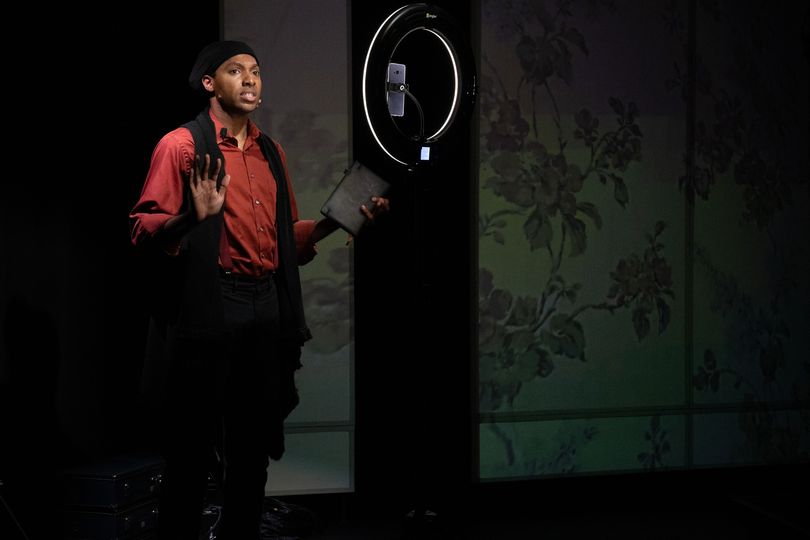
I know I’ve said this before, but every now and again a new play comes along that is quite unlike anything I’ve ever seen before. Caridad Svich’s new play, Memories of Overdevelopment is one such play. It’s a play about a filmmaker interviewing people for a documentary. Or maybe its documentary play about a filmmaker and the people they are interviewing for a documentary. Or maybe it’s a film that plays out on a stage.
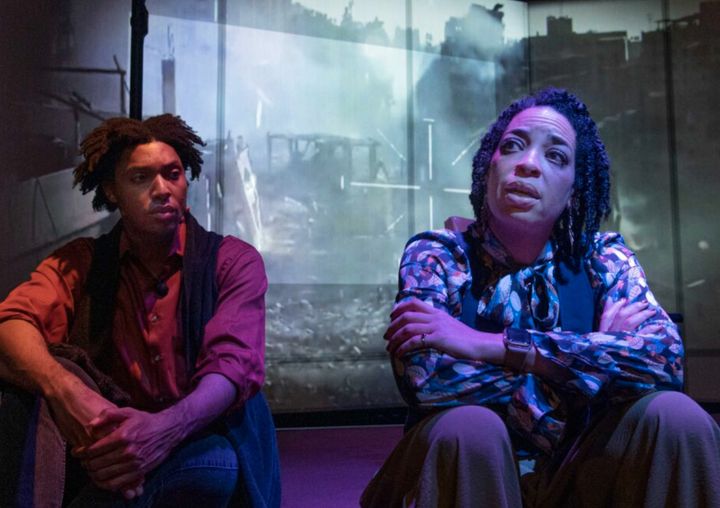
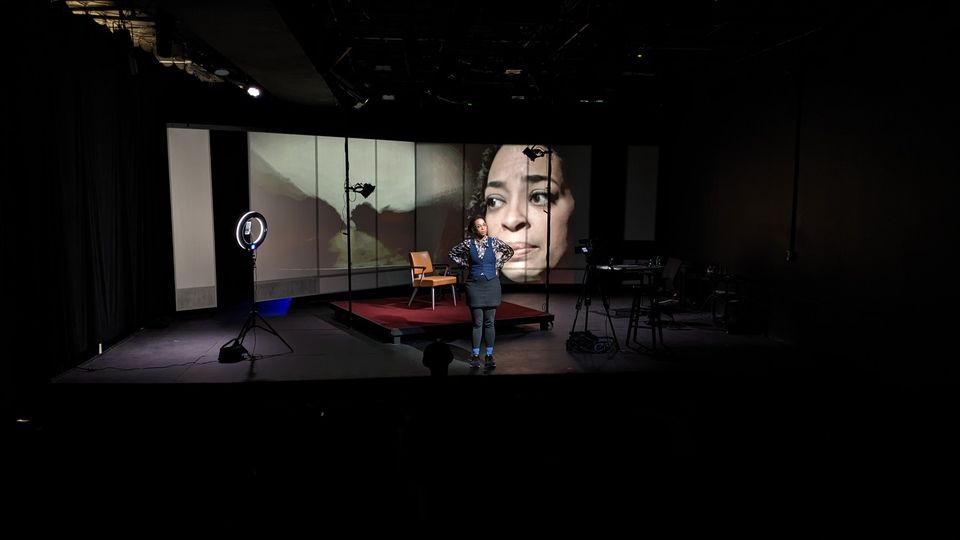
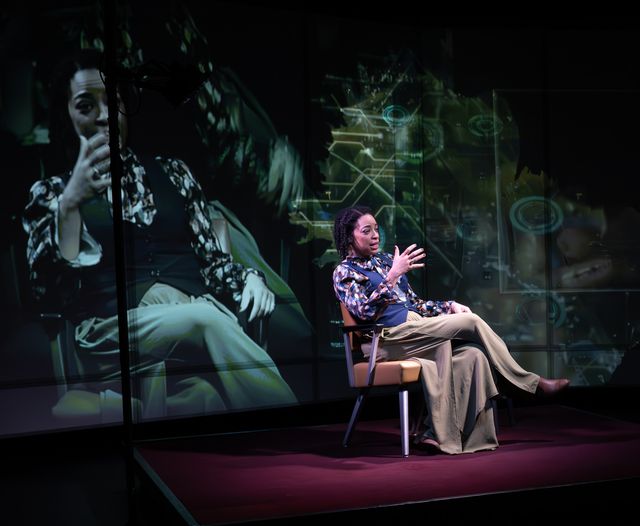
Let’s try this approach. Memories of Overdevelopment is a two-person play that can be performed by a cast of 2-8 people, and it runs from 60-90 minutes. It is also a stage play in which technology is virtually a character in its own right. Video and projections are so fully integrated into the production that the play would be unrecognizable without them.
Now, how do I tell you about the awesomeness of Memories of Overdevelopment without giving away too much? That might not be possible, so be forewarned.
As directed by New Theatre at Firehouse’s Artistic Director Nathaniel Shaw, Memories of Overdevelopment is a two-person play that runs 90 minutes without intermission. Keaton Hillman (who started as the show’s understudy and stepped in at the eleventh hour for Juliana Caycedo, due to health reasons) plays Actor 1. Katrinah Carol Lewis (who was publicly announced as the New Theatre at Firehouse’s new Associate Artistic Director just days before opening) plays Actor 2. But sometimes Lewis and Hillman switch roles. And sometimes they are “acting” as the people being interviewed for a documentary that follows the stories of people who grew up in dictatorships (underdeveloped countries?), escaped, and lived to tell the tale of how they survived.
There’s a former shop owner, a university student, a professor, a dancer, an artist, a former friend, and a fascist. Interspersed with the sometimes intense and edgy interviews are a series of “memory reels” and while the work is not interactive the audience is inevitably drawn into the mist of the proceedings by sometimes larger than life, real-time video projections of the actors – and the characters they portray – on a backdrop of panels in a workspace intended to replicate a recording studio.
Memories of Overdevelopment has a unique worldview on politics, society, tyranny, resistance, art, immigration, assimilation, fascism, globalization, and all things rebellious. Inspired by true stories, the author reveals uncanny insight and wisdom and challenges us to rethink, well, everything. “Becoming everything you believe in” may be a blessing and a curse and both things can be true at the same time.
Hillman opens the play with a brief overview, seemingly forgetting to introduce his documentarian, Lewis, who calmly sets up cameras and tests light intensities and does all the other things a filmmaker does to prepare – and the next thing you know they have switched roles. Things rapidly progress to a Level 10 out of 10 of intensity, and stays there for most of the next 85 minutes.
Nonetheless, a couple of scenes stand out. When Lewis interviews Hillman and the subject of fascism comes up, Lewis ramps up the intensity even further. What started out as a documentary interview becomes an interrogation. Hillman matches Lewis word for word, phrase for phrase. At one point Hillman blurts out, “We’re just sheep,” and offers a strident, “baaa, baaa.” And at the end, Lewis, returning to the role of the shopkeeper, exclaims, “Everyone just want to buy things,” and concludes with an eerily unhinged giggle that, more than her words, more than her expression, more than her posture, expresses who and what we have become.
There are many such poignant moments, duly captured in this dynamic collaboration between playwright, director, actor, and scenic/projection designer Tennessee Dixon. Dixon has truly outdone herself with the integration of projections and real-time video.
My first encounter with The New Theatre was with a reading of The Red Bike, also by Caridad Svich, a prolific playwright, and one that seems to have captured the heart of Shaw. After seeing Memories of OverdevelopmentSvich may capture your attention as well.
———-
Julinda D. Lewis is a dancer, teacher, and writer who was born in Brooklyn, NY and now lives in Eastern Henrico County. When not writing about theater, she teaches dance history at VCU and low impact dance fitness classes to seasoned movers like herself, and occasionally performs.
———-
MEMORIES OF OVERDEVELOPMENT
A World Premiere by Caridad Svich
Directed by Nathaniel Shaw
February 7 – 25, 2024
CAST
ACTOR 1 ………. Keaton Hillman
ACTOR 2 ………. Katrinah Carol Lewis
PRODUCTION TEAM
Production ………. Nathaniel Shaw
Associate Direction ………. Sarbajeet Das
Scenic/Projection Design ………. Tennessee Dixon
Costume Design ………. Ruth Hedberg
Lighting Design ………. Andrew Boniwell
Sound Design/Original Music ….. Kate Statelman
Videography ………. Andrew Keeton
Stage Management ………. Grace LaBelle
Assistant Stage Management ..…. Isabel Stone
RUN TIME
90 minutes with no intermission
PERFORMANCE SCHEDULE
Previews Wednesday – Thursday, February 7 -8 at 7:30pm
Opening Night – Friday, February 9 at 7:30pm
Running Thursday – Sunday through February 25, 2024
Members Only Post-Show Mixer on Sunday, February 11 after 2:00pm show
Post-Show Talkback on Friday, February 16 after 7:30pm show
Pay-What-You-Will on Saturday, February 17 at 2:00pm
ASL Interpreted and Pay-What-You-Will Performance on Saturday, February 17 at 2:00pm
ASL Interpreted Show on Thursday, February 22 at 7:30pm
Post-Show Talkback on Friday, February 23 after 7:30pm show
Death and life are in the power of the tongue… – Proverbs 18:21
The time is the late 1590s. The place is a private room in a London tavern. The political climate is volatile – an authoritarian regime is in charge, freedom of speech does not exist, heretics and atheists – and apparently Catholics – are tortured and killed. A plague was ravaging society – the Black Death – a pandemic that killed thousands, causing the collapse of what little social structure remained after the political purge, leaving fields unplowed, and little to eat.
There are more spies than crimes to spy out. – BWT
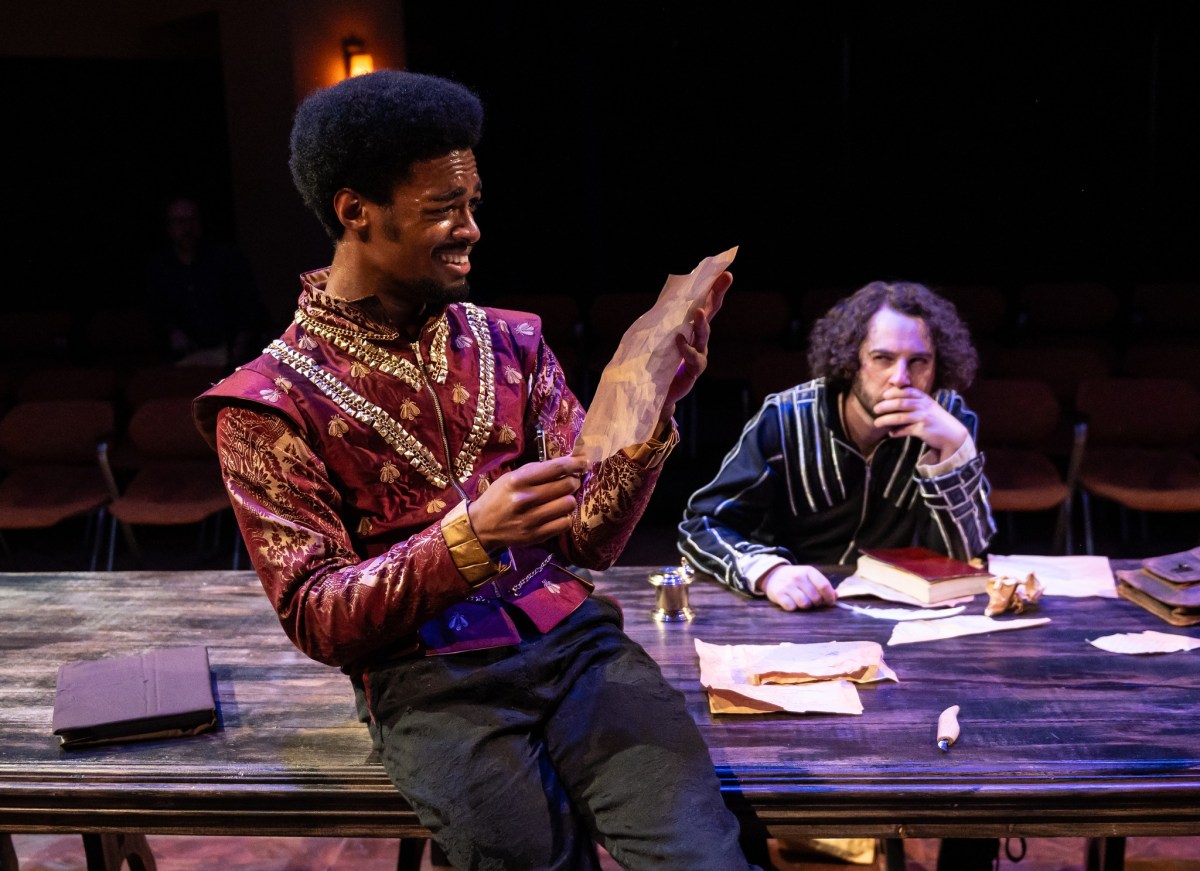
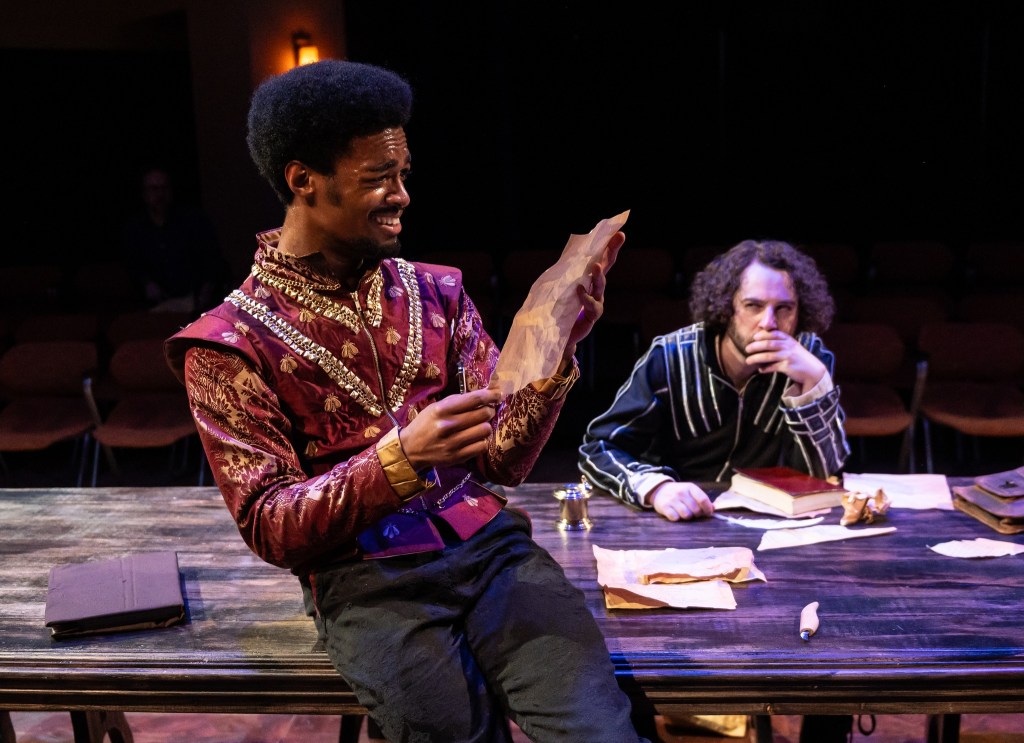
This is where playwright Liz Duffy Adams saw fit to open up a voyeuristic window into the world of two writers – the well-established Christopher “Kit” Marlowe (Avery Michael Johnson) and the upstart William Shakespeare (James Murphy) – as they meet in the private back room of a pub to collaborate on a series of historic plays. But this collaboration is a contentious literary partnership, rife with jealousy, political unrest, and rumors of espionage, religious persecution, and sexual tension. This collaboration is Born With Teeth.
We are subjects, not citizens. – BWT
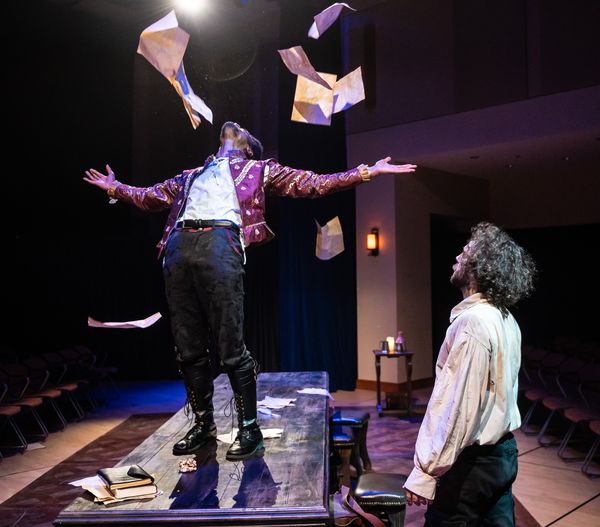
The flexible space of the Gottwald Theatre has been transformed for this occasion. A long (perhaps 12’?) table dominates the room, slashing diagonally through the space. It is placed on a sturdy parquet floor, and surrounded by 10 leather topped rectangular stools. The audience is seated on either side of the table, close enough for the first row to be showered by scattered sheets of paper during the two playwrights’ scuffles. This awesome set was designed and constructed by W. Reed West III.
You are so much stupider than you look; how is that possible? – BWT
William Shakespeare and Christopher Marlowe did indeed collaborate on the Henry VI trilogy, Parts I, II, and III, Marlow was stabbed to death in the summer of 1593. But much of the relationship between Shakespeare and Marlowe – both their authorship and personal – is a matter of speculation and mystery. So that raises the question, how much of Born With Teeth is historical clarification, and how much is pure fantasy? And given the truths expressed and exposed of human interaction – oppression, suppression, persecution, ego, love – does the former question matter?
Worse than nowhere is somewhere you don’t want to be. – BWT
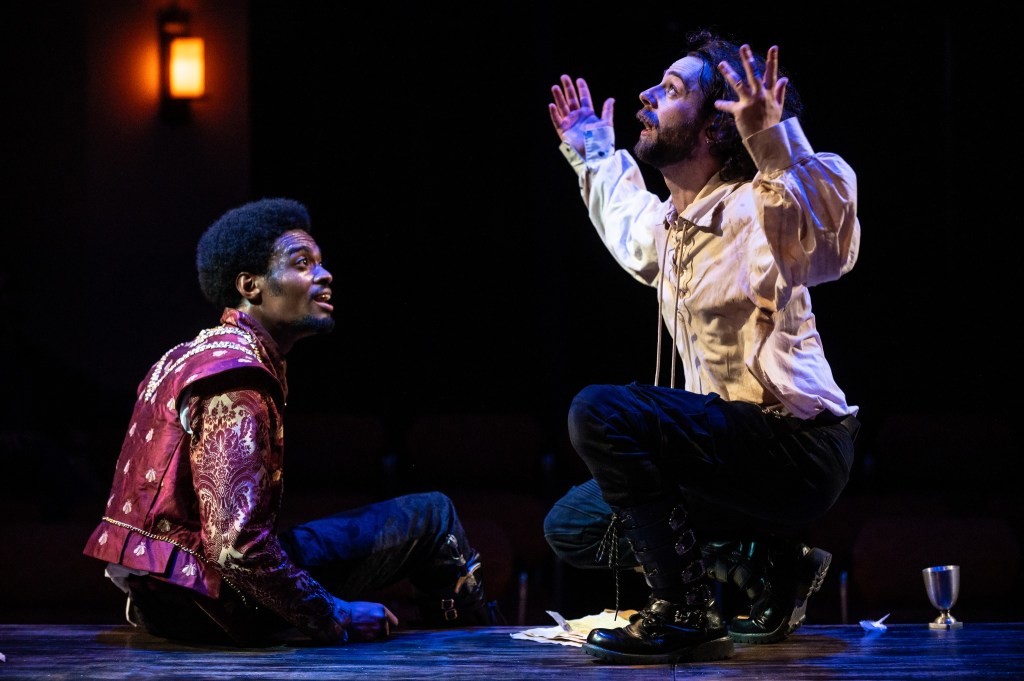
Avery Michael Johnson and James Murphy literally burst onstage, and give us a solid 90 minutes of drama, melodrama, angst, bravado, fear, backstabbing, lust, equivocation, love, revelation, caution, optimism, conciliation, espionage, and more. Born With Teeth is loud, frightening, and funny – sometimes all at once. Marlowe denigrates the upstart Shakespeare, until he reads a page or two of the play they’re working on and realizes that Shakespeare can, indeed, write. But at a time when there is not such thing as freedom of speech or religion, words can cut more sharply that a sword, and speech can be the currency of life or death.
I don’t deny God, I just don’t like him very much. – BWT
Murphy plays the role of Shakespeare with a bit of caution, much more reserved than his more outgoing and outrageous counterpart who may, in turn, be overly confident in the sovereignty of his benefactor. Johnson’s Marlowe never walks but strides. He stomps about in his tall boots – there’s a knife strapped into the right one – he leaps from the floor to the top of the table and lands on the tabletop, the floor, or Shakespeare like a cross between a pouncing panther and a WWE wrestler. Sitting in the front row, I could see each bead of sweat on Johnson’s brow and distinctly hear the intake of breath when he rapaciously sniffed Murphy. Born With Teeth is a physically demanding play, fueled by quick dialogue that is alternately witty, cutting, and always demanding. It isn’t Shakespeare, but it is the essence of Shakespeare. It isn’t classical, but it is archetypal. It isn’t orthodox, but it does all the things you want live theatre to do.
—–
Julinda D. Lewis is a dancer, teacher, and writer who was born in Brooklyn, NY and now lives in Eastern Henrico County. When not writing about theater, she teaches dance history at VCU and low impact dance fitness classes to seasoned movers like herself, and occasionally performs.
—–
BORN WITH TEETH
by Liz Duffy Adams
Directed by Andrew Gall
Cast
Kit …………… Avery Michael Johnson
Will …………… James Murphy
Production & Design Team
Artistic Director ……. James Ricks
Managing Director ……. Jase Smith Sullivan
Playwright ……. Liz Duffy Adams
Director ……. Andrew Gall
Stage Manager ……. MariaElisa Costa
Assistant Stage Manager … Kiari Hicks
Costume Design ……. Anna Bialkowski
Intimacy Choreographer … Lucinda McDermott
Lighting Design ……. Tristan Ketcham
Set Design ……. W. Reed West III
Sound Design ……. James Ricks
Run Time: About 90 minutes; no intermission
Content Disclosure: This production contains mature themes, strong language, & sexual/suggestive content.
———-
Photo Credits: Promotional Video by Eric Hackler & Photos from Richmond Shakespeare Facebook
NOTE: It’s just about impossible to talk about this play without giving away some of the best parts. If you haven’t seen it yet and wasn’t to be surprised, you might want to wait until after you’ve seen it to read this. But yes – do see it – and then comment if you like. I’d love to hear what you think. -JDL
Steven Dietz’ two-person play, Lonely Planet (1993) borrows freely from (as in pays homage to) Eugène Ionesco’s absurdist play, The Chairs (1952), but while there are elements of the absurd and quite a bit of humor in Dietz’ play, it is at heart neither absurd nor a comedy – it is a play about manifested grief.
Set in an unnamed American city during the 1980s, Lonely Planet tells the story of two friends, Jody and Carl, who are each in his own way handicapped by the AIDS epidemic that is raging outside the doors of Jody’s quiet little map store.
Jody copes by withdrawing into the safety of his store, where the distortions of the Mercator map become a metaphor for the distortions of the world around him. At one point Carl quotes some frighteningly high number of deaths among people they know. Where Jody withdraws, Carl feels compelled to do something.
One day a single chair appears in Jody’s shop. Then another and another, until his safe haven is cluttered with chairs – each representing a dead friend. Carl’s place is too small to hold these monuments. He describes his apartment as so small that he has only one chair – a silver kitchen chair with a turquoise seat. In the final scene, Jody – who has finally found the strength to venture back outside – arrives at his shop to find Carl’s chair in the center of the space.
An impossibly balanced jumble of chairs greets the audience on entering the space, and Daniel Allen’s set filled with racks of rolled maps and map tables and all things cartographic is stunning and immersive. Todd LaBelle’s sound design likewise lulls us willingly and unsuspectingly into Jody and Carl’s world – before we realize that this world’s foundation is grief, loss, and tragedy.
Eddie Webster brings a gentleness and vulnerability to Jody that is both endearing and authentic. Adam Turck infuses Carl with an intensity that at times leaves us breathless. The two characters appear to be polar opposites, and yet they are long-time friends. More than that, they each understand things about the other that they cannot share with anyone else. Add to that Carl’s propensity to lie about his true profession and Turck’s character takes on mythic proportions.
Carl’s manufactured occupations are just as metaphorical as the chairs. He says he restores paintings, but appears to know nothing about art. His art restoration represents a way to commemorate the memories of his friends. He says he works for an auto glass repair shop, but what he is really trying to repair are the shattered pieces of broken lives. He says he writes for a tabloid newspaper, but what he really wants to do is preserve the stories of his friend’s lives.
Just as the Mercator projection was designed to help improve navigation, at the expense of distorted shapes and sizes of all but the local or most immediate locations, these two friends have found ways to navigate through the deadly waters of the AIDS epidemic by distorting the world around them. It’s amazing that Turck and Webster, director Nathaniel Shaw, and the author have been able to pull this off and still maintain a sense of humor and humanity.
Along the way to its crashing conclusion the play is grounded by the mundane details of daily life: the yellow pages, a standard black desk phone, self-adhesive stamps, a cell phone (?) In the final scene, Jody – who has finally found the strength to venture back outside – arrives at his shop to find a silver legged kitchen chair with a turquoise seat in the center of the space.
Lonely Planet is a play that will linger long after the two actors take their final bows.
———-
Julinda D. Lewis is a dancer, teacher, and writer who was born in Brooklyn, NY and now lives in Eastern Henrico County.
———-
LONELY PLANET
By Steven Dietz
Directed by Nathaniel Shaw
November 10 – 26, 2023
CAST
Carl ………. Adam Turck
Jody ………. Eddie Webster
u/s ………. Alex Harris and William Vaughn
PRODUCTION TEAM
Director ………. Nathaniel Shaw
Scenic Design ………. Daniel Allen
Costume Design ………. Colin Lowrey, II
Lighting & Sund Design …. Todd LaBelle, Jr
Dramaturgy ………. Kendall Walker
Stage Management ………. Emily Vial
Production Consultant ….. Michael Hawke
Performance Schedule:
● Opening Night – November 10, 2023 at 7:30 PM
● Running Thursday – Friday – Saturday at 7:30 PM through November 25, 2023
● Running Sundays at 2:00 PM through November 26, 2023
● Pay-What-You-Will shows on November 12 at 2:00 PM and November 16 at 7:30 PM
● Post-Show Talkback on November 19 after the 2:00 PM performance




















 RVArt Review