BORN WITH TEETH

Words Matter

A Theater Review of an East Coast Premiere by Julinda D. Lewis

By: Richmond Shakespeare

At: Gottwald Playhouse at Dominion Energy Center, 600 E. Grace St., Richmond, VA 23219

Performances: January 25 – February 11, 2024

Ticket Prices: $20 – $45

Info: (804) 340-0115 or http://www.richmondshakespeare.org

Death and life are in the power of the tongue…  – Proverbs 18:21

The time is the late 1590s. The place is a private room in a London tavern. The political climate is volatile – an authoritarian regime is in charge, freedom of speech does not exist, heretics and atheists – and apparently Catholics – are tortured and killed. A plague was ravaging society – the Black Death – a pandemic that killed thousands, causing the collapse of what little social structure remained after the political purge, leaving fields unplowed, and little to eat.

There are more spies than crimes to spy out. – BWT

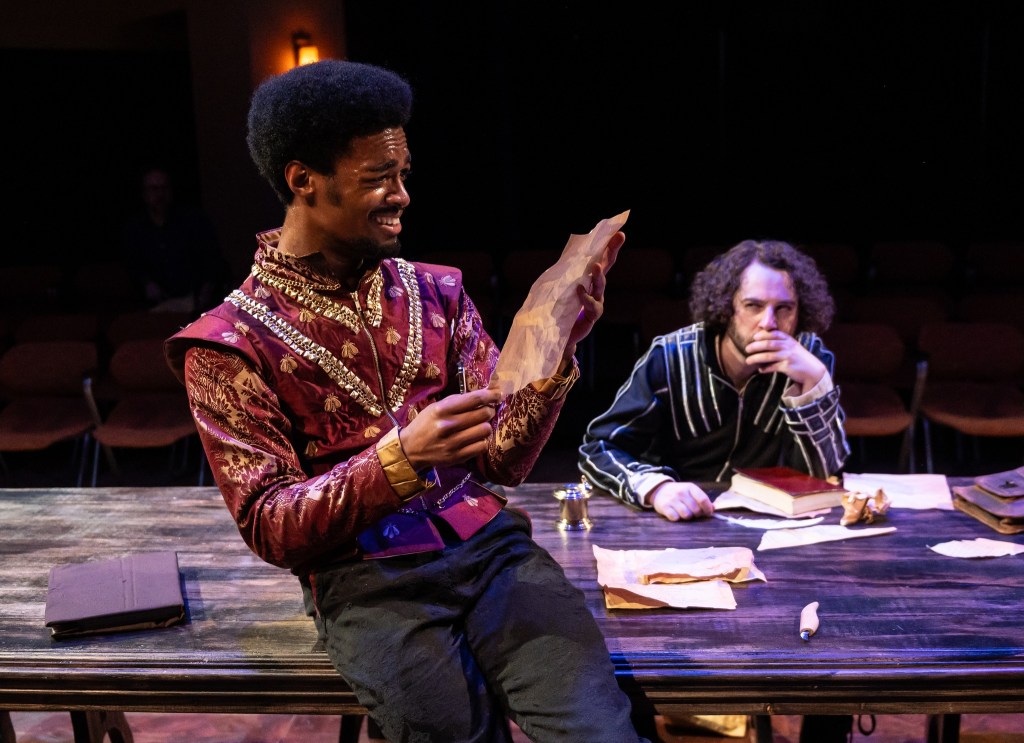
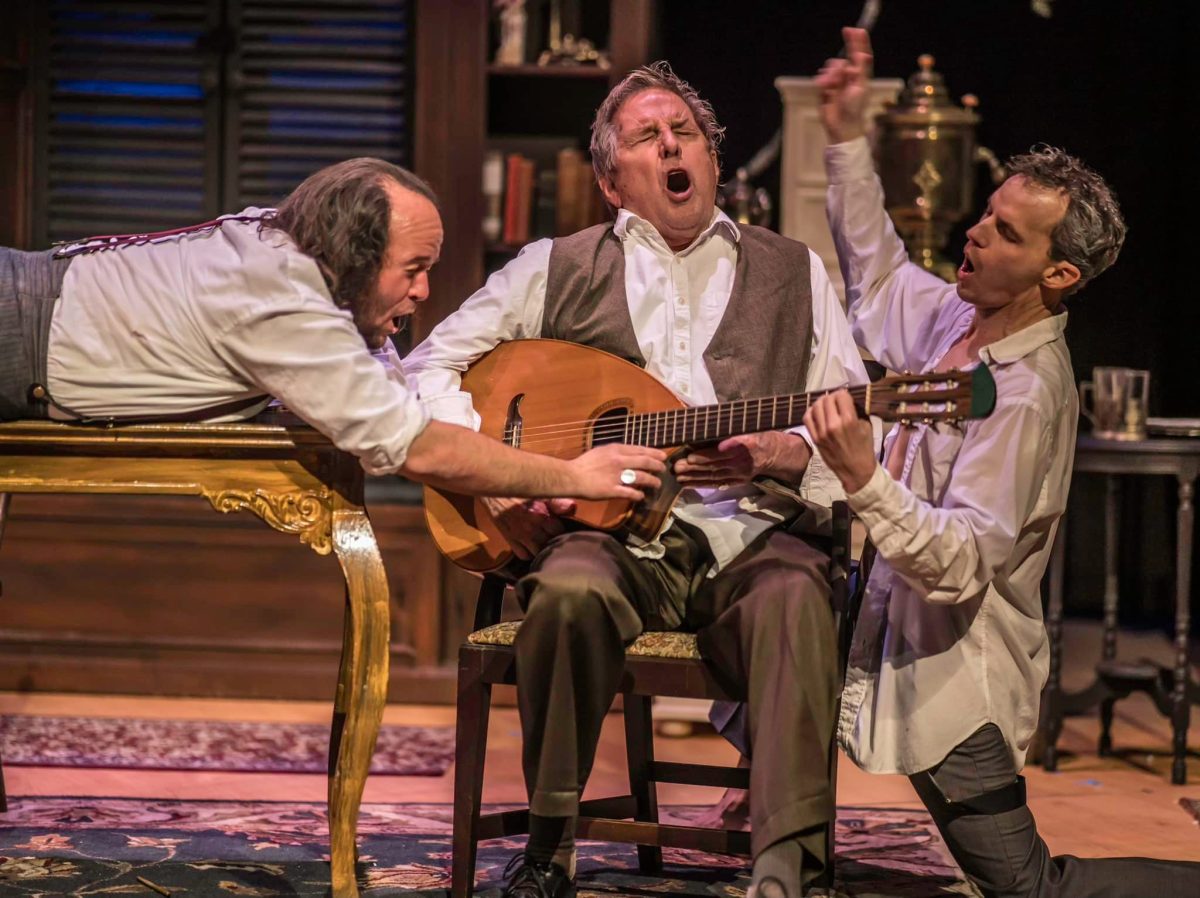
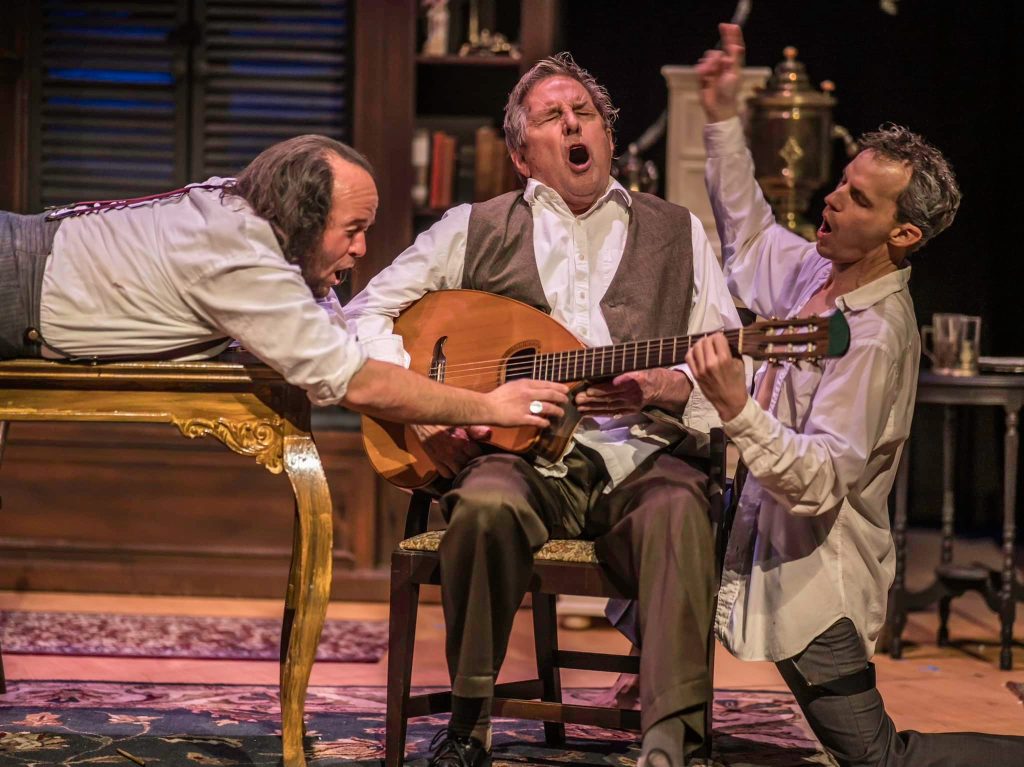
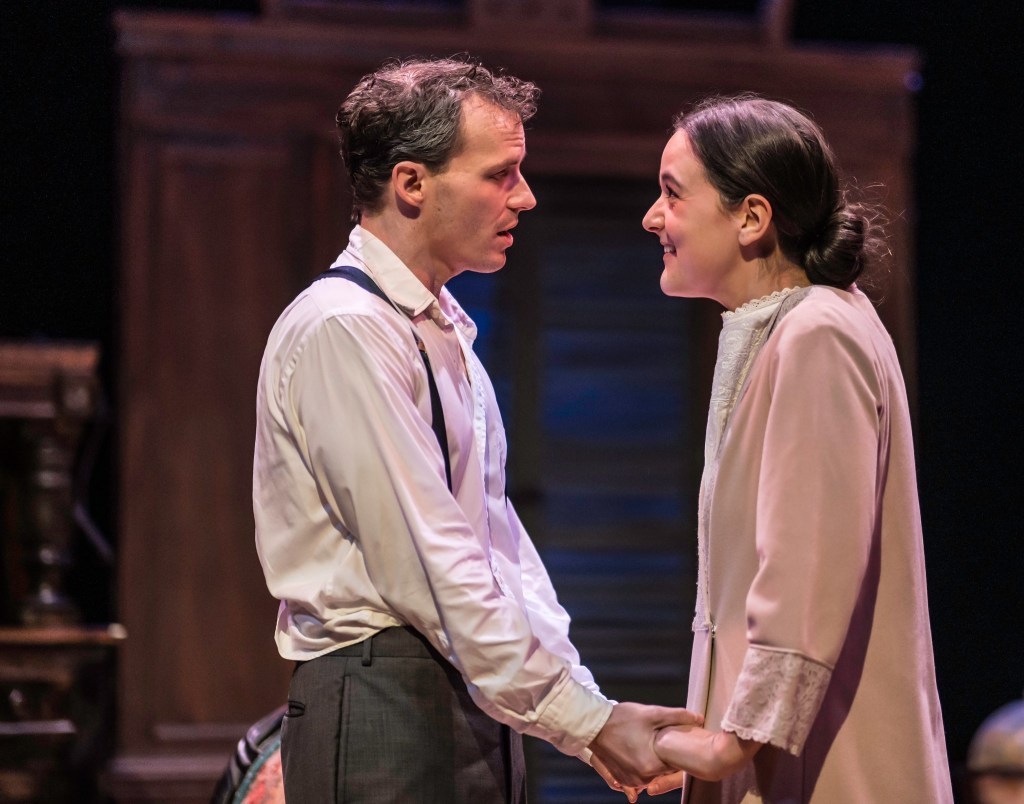
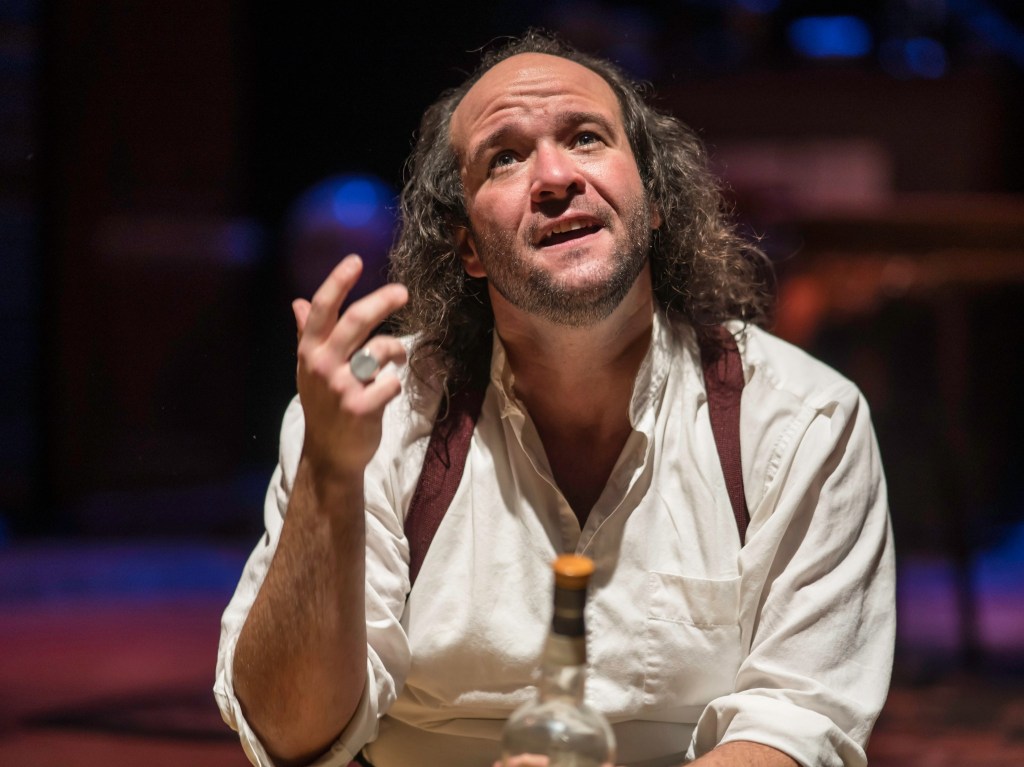
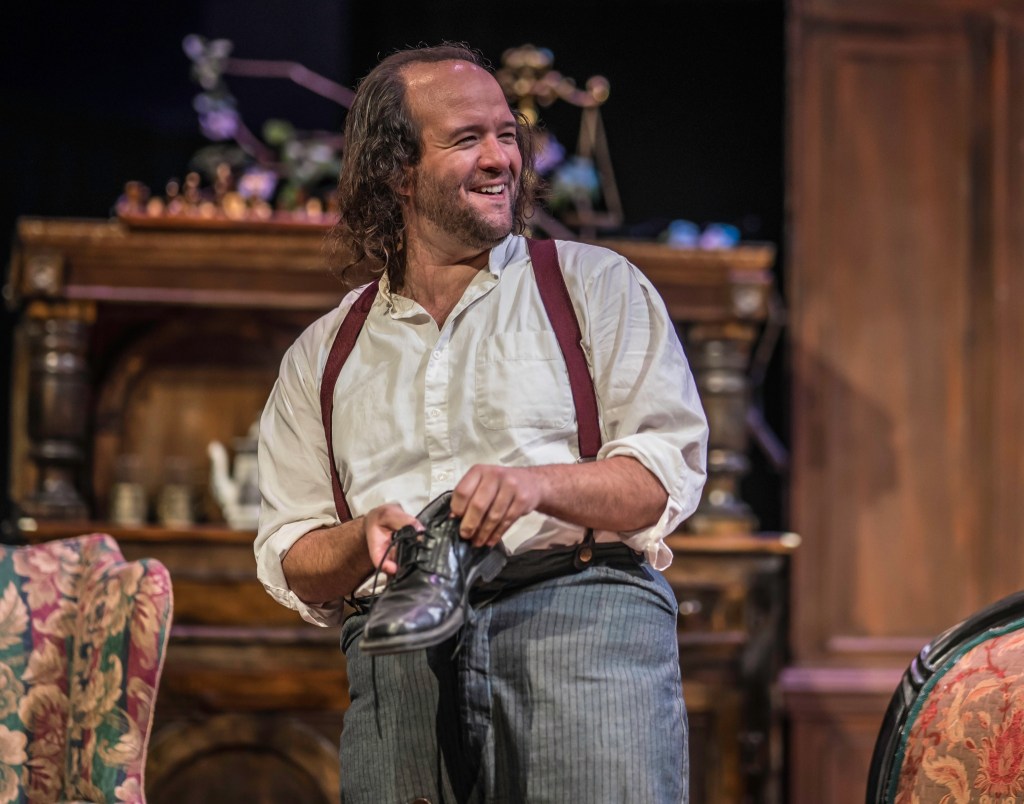
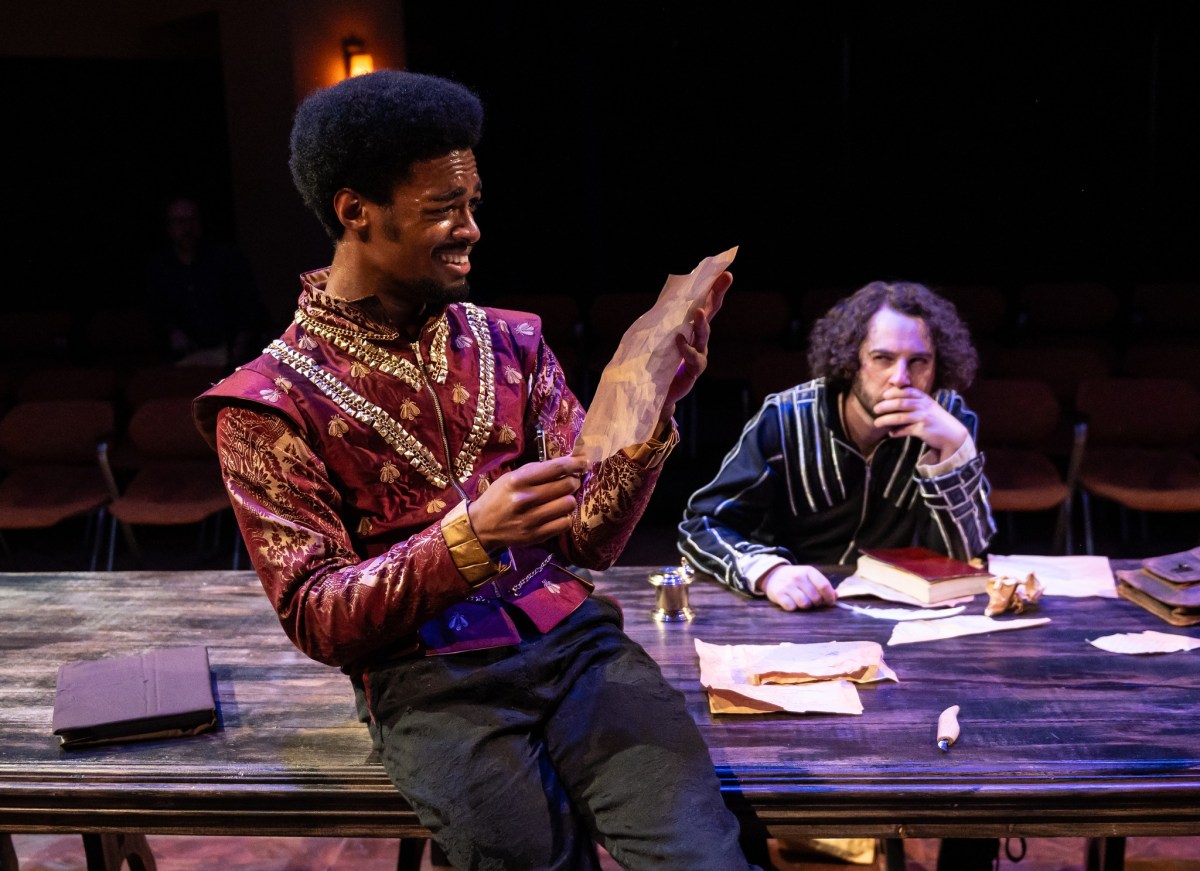
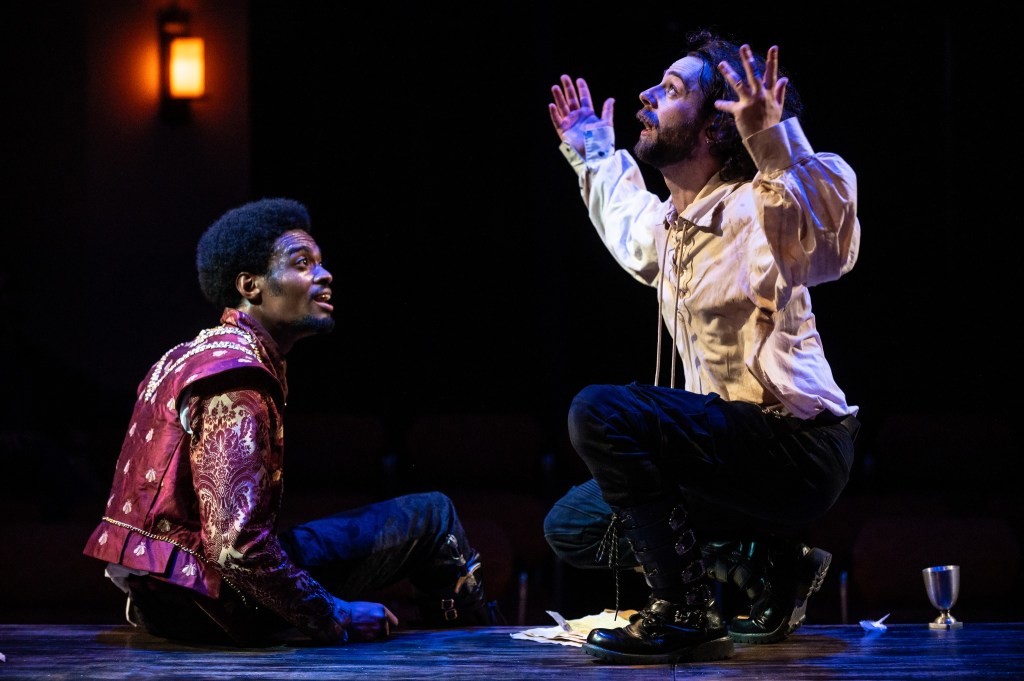
This is where playwright Liz Duffy Adams saw fit to open up a voyeuristic window into the world of two writers – the well-established Christopher “Kit” Marlowe (Avery Michael Johnson) and the upstart William Shakespeare (James Murphy) – as they meet in the private back room of a pub to collaborate on a series of historic plays. But this collaboration is a contentious literary partnership, rife with jealousy, political unrest, and rumors of espionage, religious persecution, and sexual tension. This collaboration is Born With Teeth.

We are subjects, not citizens. – BWT

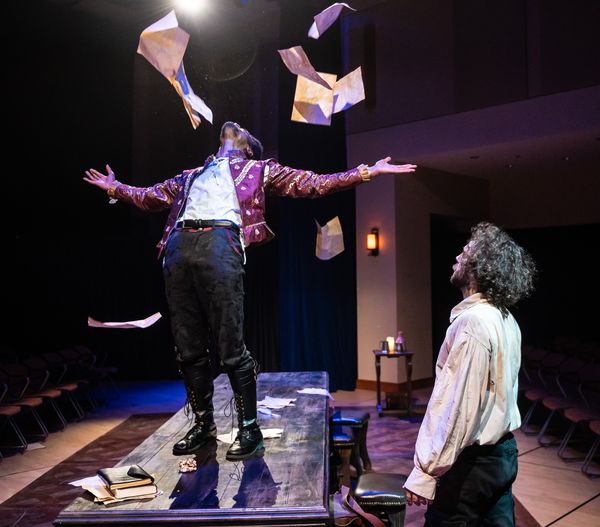
The flexible space of the Gottwald Theatre has been transformed for this occasion. A long (perhaps 12’?) table dominates the room, slashing diagonally through the space. It is placed on a sturdy parquet floor, and surrounded by 10 leather topped rectangular stools. The audience is seated on either side of the table, close enough for the first row to be showered by scattered sheets of paper during the two playwrights’ scuffles. This awesome set was designed and constructed by W. Reed West III.

You are so much stupider than you look; how is that possible? – BWT

William Shakespeare and Christopher Marlowe did indeed collaborate on the Henry VI trilogy, Parts I, II, and III, Marlow was stabbed to death in the summer of 1593. But much of the relationship between Shakespeare and Marlowe – both their authorship and personal  – is a matter of speculation and mystery. So that raises the question, how much of Born With Teeth is historical clarification, and how much is pure fantasy? And given the truths expressed and exposed of human interaction – oppression, suppression, persecution, ego, love – does the former question matter?

Worse than nowhere is somewhere you don’t want to be. – BWT

Avery Michael Johnson and James Murphy literally burst onstage, and give us a solid 90 minutes of drama, melodrama, angst, bravado, fear, backstabbing, lust, equivocation, love, revelation, caution, optimism, conciliation, espionage, and more. Born With Teeth is loud, frightening, and funny – sometimes all at once. Marlowe denigrates the upstart Shakespeare, until he reads a page or two of the play they’re working on and realizes that Shakespeare can, indeed, write. But at a time when there is not such thing as freedom of speech or religion, words can cut more sharply that a sword, and speech can be the currency of life or death.

I don’t deny God, I just don’t like him very much. – BWT

Murphy plays the role of Shakespeare with a bit of caution, much more reserved than his more outgoing and outrageous counterpart who may, in turn, be overly confident in the sovereignty of his benefactor. Johnson’s Marlowe never walks but strides. He stomps about in his tall boots – there’s a knife strapped into the right one – he leaps from the floor to the top of the table and lands on the tabletop, the floor, or Shakespeare like a cross between a  pouncing panther and a WWE wrestler. Sitting in the front row, I could see each bead of sweat on Johnson’s brow and distinctly hear the intake of breath when he rapaciously sniffed Murphy. Born With Teeth is a physically demanding play, fueled by quick dialogue that is alternately witty, cutting, and always demanding. It isn’t Shakespeare, but it is the essence of Shakespeare. It isn’t classical, but it is archetypal. It isn’t orthodox, but it does all the things you want live theatre to do.

—–

Julinda D. Lewis is a dancer, teacher, and writer who was born in Brooklyn, NY and now lives in Eastern Henrico County. When not writing about theater, she teaches dance history at VCU and low impact dance fitness classes to seasoned movers like herself, and occasionally performs.

—–

BORN WITH TEETH

by Liz Duffy Adams

Directed by Andrew Gall

Cast

Kit                   ……………    Avery Michael Johnson

Will                 ……………    James Murphy

Production & Design Team

Artistic Director          …….   James Ricks

Managing Director    …….   Jase Smith Sullivan

Playwright                   …….   Liz Duffy Adams

Director                       …….   Andrew Gall

Stage Manager            …….   MariaElisa Costa

Assistant Stage Manager …   Kiari Hicks

Costume Design          …….   Anna Bialkowski

Intimacy Choreographer  …   Lucinda McDermott

Lighting Design          …….   Tristan Ketcham

Set Design                   …….   W. Reed West III

Sound Design              …….   James Ricks

Run Time: About 90 minutes; no intermission

Content Disclosure: This production contains mature themes, strong language, & sexual/suggestive content.

———-

Photo Credits: Promotional Video by Eric Hackler & Photos from Richmond Shakespeare Facebook

https://www.facebook.com/watch/?v=1088997112419759
One-Time
Monthly
Yearly

Make a donation to support
rvart review

Make a monthly donation

Make a yearly donation

Choose an amount

$5.00
$15.00
$100.00
$5.00
$15.00
$100.00
$5.00
$15.00
$100.00

Or enter a custom amount

$

Your contribution is appreciated. Thank you!

Your contribution is appreciated.

Your contribution is appreciated.

DonateDonate monthlyDonate yearly
LONELY PLANET

LONELY PLANET

Sorry, We’re Closed

5th Wall Theatre in Collaboration with the Firehouse Theatre

A Theater Review by Julinda D. Lewis

At: The Firehouse, 1609 West Broad St., Richmond, RVA 23220

Performances: November 10-26, 2023

Ticket Prices: $1 – $35

Info: (804) 355-2001 or firehousetheatre.org or https://www.5thwalltheatre.org/

NOTE: It’s just about impossible to talk about this play without giving away some of the best parts. If you haven’t seen it yet and wasn’t to be surprised, you might want to wait until after you’ve seen it to read this. But yes – do see it – and then comment if you like. I’d love to hear what you think. -JDL

Steven Dietz’ two-person play, Lonely Planet (1993) borrows freely from (as in pays homage to) Eugène Ionesco’s absurdist play, The Chairs (1952), but while there are elements of the absurd and quite a bit of humor in Dietz’ play, it is at heart neither absurd nor a comedy – it is a play about manifested grief.

Set in an unnamed American city during the 1980s, Lonely Planet tells the story of two friends, Jody and Carl, who are each in his own way handicapped by the AIDS epidemic that is raging outside the doors of Jody’s quiet little map store.

Jody copes by withdrawing into the safety of his store, where the distortions of the Mercator map become a metaphor for the distortions of the world around him. At one point Carl quotes some frighteningly high number of deaths among people they know. Where Jody withdraws, Carl feels compelled to do something.

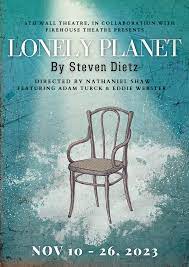
One day a single chair appears in Jody’s shop. Then another and another, until his safe haven is cluttered with chairs – each representing a dead friend. Carl’s place is too small to hold these monuments. He describes his apartment as so small that he has only one chair – a silver kitchen chair with a turquoise seat. In the final scene, Jody – who has finally found the strength to venture back outside – arrives at his shop to find Carl’s chair in the center of the space.

An impossibly balanced jumble of chairs greets the audience on entering the space, and Daniel Allen’s set filled with racks of rolled maps and map tables and all things cartographic is stunning and immersive. Todd LaBelle’s sound design likewise lulls us willingly and unsuspectingly into Jody and Carl’s world – before we realize that this world’s foundation is grief, loss, and tragedy.

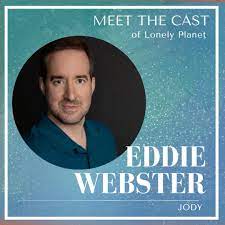
Eddie Webster brings a gentleness and vulnerability to Jody that is both endearing and authentic. Adam Turck infuses Carl with an intensity that at times leaves us breathless. The two characters appear to be polar opposites, and yet they are long-time friends. More than that, they each understand things about the other that they cannot share with anyone else. Add to that Carl’s propensity to lie about his true profession and Turck’s character takes on mythic proportions.

Carl’s manufactured occupations are just as metaphorical as the chairs. He says he restores paintings, but appears to know nothing about art. His art restoration represents a way to commemorate the memories of his friends. He says he works for an auto glass repair shop, but what he is really trying to repair are the shattered pieces of broken lives. He says he writes for a tabloid newspaper, but what he really wants to do is preserve the stories of his friend’s lives.

Just as the Mercator projection was designed to help improve navigation, at the expense of distorted shapes and sizes of all but the local or most immediate locations, these two friends have found ways to navigate through the deadly waters of the AIDS epidemic by distorting the world around them. It’s amazing that Turck and Webster, director Nathaniel Shaw, and the author have been able to pull this off and still maintain a sense of humor and humanity.

Along the way to its crashing conclusion the play is grounded by the mundane details of daily life: the yellow pages, a standard black desk phone, self-adhesive stamps, a cell phone (?) In the final scene, Jody – who has finally found the strength to venture back outside – arrives at his shop to find a silver legged kitchen chair with a turquoise seat in the center of the space.

Lonely Planet is a play that will linger long after the two actors take their final bows.

———-

Julinda D. Lewis is a dancer, teacher, and writer who was born in Brooklyn, NY and now lives in Eastern Henrico County.

———-

LONELY PLANET

By Steven Dietz

Directed by Nathaniel Shaw

November 10 – 26, 2023

CAST

Carl                ……….           Adam Turck

Jody               ……….           Eddie Webster

u/s                   ……….           Alex Harris and William Vaughn

PRODUCTION TEAM

Director                     ……….           Nathaniel Shaw

Scenic Design           ……….           Daniel Allen

Costume Design      ……….           Colin Lowrey, II

Lighting & Sund Design ….           Todd LaBelle, Jr

Dramaturgy              ……….           Kendall Walker

Stage Management ……….           Emily Vial

Production Consultant  …..           Michael Hawke

Performance Schedule:

● Opening Night – November 10, 2023 at 7:30 PM

● Running Thursday – Friday – Saturday at 7:30 PM through November 25, 2023

● Running Sundays at 2:00 PM through November 26, 2023

● Pay-What-You-Will shows on November 12 at 2:00 PM and November 16 at 7:30 PM

● Post-Show Talkback on November 19 after the 2:00 PM performance

Tickets:

$1 – $35

Run time:

About 2 hours, with one intermission

One-Time
Monthly
Yearly

Make a donation to RVArt review

Make a monthly donation

Make a yearly donation

Choose an amount

$5.00
$15.00
$100.00
$5.00
$15.00
$100.00
$5.00
$15.00
$100.00

Or enter a custom amount

$

Your contribution is appreciated.

Your contribution is appreciated.

Your contribution is appreciated.

DonateDonate monthlyDonate yearly

MARTHA MITCHELL CALLING

“If it hadn’t been for Martha Mitchell, there’d have been no Watergate.” – Richard Nixon

A Theater Review by Julinda D. Lewis

At: Hanover Tavern, 13181 Hanover  Courthouse Rd, Hanover, VA 2309

Performances: September 29 – October 29, 2023

Ticket Prices: $52

Info: (804) 282-2620 or www.virginiarep.org

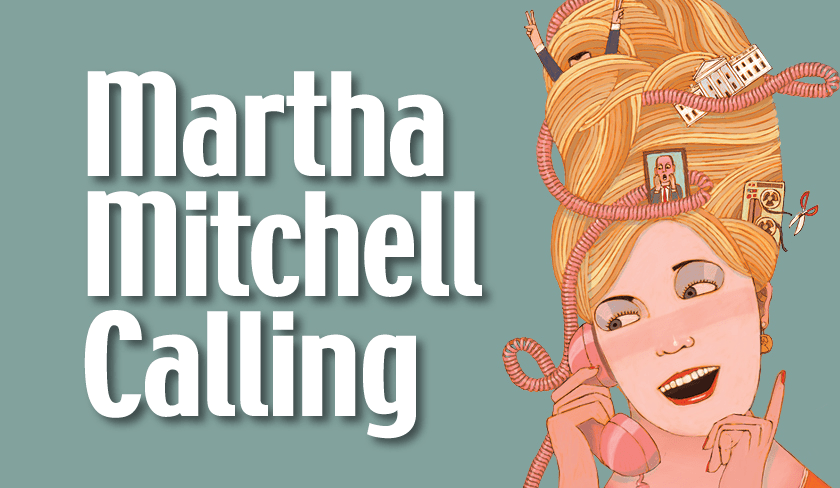
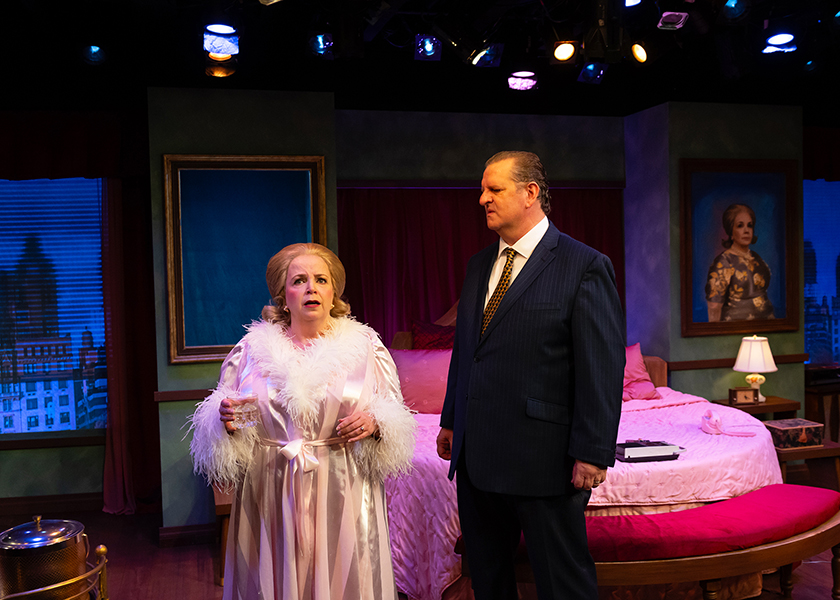
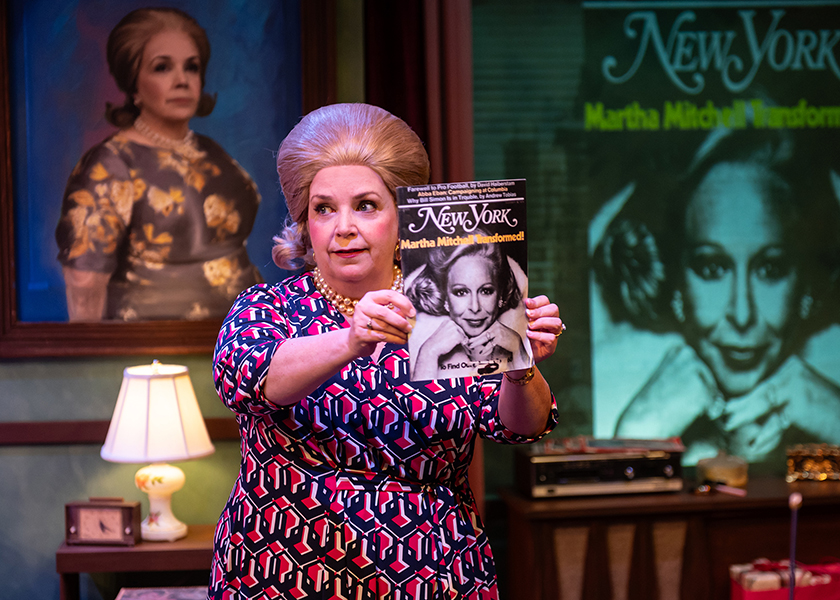
Some plays are notable not because they are entertaining but because they are revelatory. Martha Mitchell Calling is that type of play. It is more than an historic docu-drama based on the real life story of the wife of former U.S. Attorney General John Mitchell, a key figure in the Watergate Scandal (1972-1974). Martha Mitchell Calling fills in some important parts of U.S. history that have been ignored or re-written – all because a key figure in the story was a woman.

Debra Wagoner has stepped into Martha Mitchell’s designer shoes to spill all the tea, right the wrongs, fill in the blanks, and teach us all a thing or two – while simultaneously making us laugh and acknowledge her considerable skills as an actor. Wagoner embraces the title role while her real-life husband, Joe Pabst, steps into character as her John Mitchell. Pabst literally steps into the role, as he starts most scenes as a portrait on the wall and steps out of the frame to join his wife in increasingly contentious interactions.

I was finishing high school and beginning college during the Watergate Scandal, certainly old enough to be aware of what was happening. But I don’t recall anything about Martha Mitchell – and that’s the whole point of this play. It starts out as a love story, but before our very eyes Mrs. Mitchell transforms from a traditional, if somewhat flamboyant, stand-by-your-man southern belle to a political pariah. She converted her husband from Democrat to Republican and introduced him to Richard Nixon. But then there was Watergate – when the Nixon administration broke in to the Democratic National Committee headquarters in Washington, D.C., at the Watergate Office Building on June 17, 1972. Martha Mitchell Calling fills in some of the missing details, including an alleged kidnapping, a suspected drugging disguised as a mental breakdown, a missing weekend, and many other unanswered questions.

This is a two-person show, but Wagoner is undeniably the star of this show. She portrays Mrs. Mitchell as a mover and shaker, a bit unsteady on her feet from her close relationship with her ever-present gin bottle, princess phone close at hand and ready to be wielded like a cowboy’s pistol. We feel the toll taken by the series remarkable events that started with Mrs. Mitchell calling her favorite journalist with gossip in support of her husband and the Republican party to the heart-wrenching decision to stand up for truth and expose the corruption that had consumed her beloved GOP and her adored husband.

These events even gave rise to a condition known as Martha Mitchell Syndrome, which is what occurs when a medical professional labels a patient’s accurate perception of real events as delusional, resulting in an intentional misdiagnosis. Mrs. Mitchell’s commitment to the truth led to the loss of her husband, her daughter, and her health. She died alone and in disgrace.

This role is no small feat and Wagoner does a star turn as the ostracized socialite. Pabst is no slouch either. He admirably balances the seemingly contradictory role of loving husband and father with that of political villain, carrying loyalty to a fault and beyond.

Is it coincidence that Virginia Rep produced two female-led political productions at the start of their new season (POTUS at the November Theatre and Martha Mitchell Calling at Hanover)? Hmm. Whatever the explanation, both productions have contributed to an intriguing and provocative start to the local theater season.

Julinda D. Lewis is a dancer, teacher, and writer who was born in Brooklyn, NY and now lives in Eastern Henrico County.

MARTHA MITCHELL CALLING

by Jodi Rothe

Directed by Rick Hammerly

Cast

Martha Mitchell                      Debra Wagoner

John Mitchell                          Joe Pabst

Direction & Design

Direction                                Rick Hammerly

Scenic & Production Design    Dasia Gregg

Costume Design                      Sue Griffin

Lighting Design                        Matthew Landwehr

Sound Design                          Kelsey Cordrey

Stage Management                 Crimson Piazza

Ticket Information

Tickets: $52

Discounted Group Rates and Rush tickets available.

Box Office: 804-282-2620 or www.virginiarep.org

Run Time: 2 hours including a 15 minute intermission

Photo Credits: Aaron Sutten

One-Time
Monthly
Yearly

Make a donation to support
RVART REVIEW

Make a monthly donation

Make a yearly donation

Choose an amount

$5.00
$15.00
$100.00
$5.00
$15.00
$100.00
$5.00
$15.00
$100.00

Or enter a custom amount

$

Thank you!
Your contribution is appreciated.

Your contribution is appreciated.

Your contribution is appreciated.

DonateDonate monthlyDonate yearly
METEOR SHOWER

A Comedy by Steve Martin

A Theater Review by Julinda D. Lewis

Presented by CAT – Chamberlayne Actor’s Theatre

At: The Lynn Theatre at Brightpoint Community College, 800 Charter Colony Pkwy, T Building, Room T112, Midlothian, VA 23114

Performances: September 16-29, 2023

Ticket Prices: $24.00 General Admission. $22.00 Seniors

Info: http://www.cattheatre.com

Steve Martin’s comedic play METEOR SHOWER is probably one of those shows you will either love or hate. Either way, you will laugh. A lot.

For some, knowing that the author is THE Steve Martin may be all you need to know to decide whether to go or not, whether you will like it or not, and most importantly, whether or not you will ever again speak to the person who invited you.

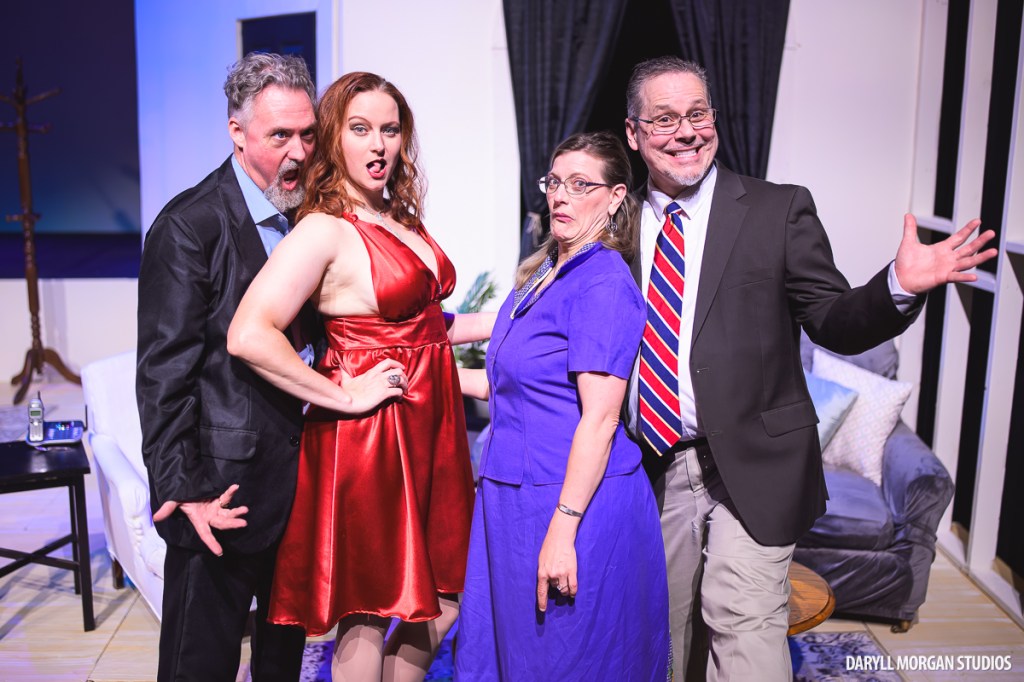
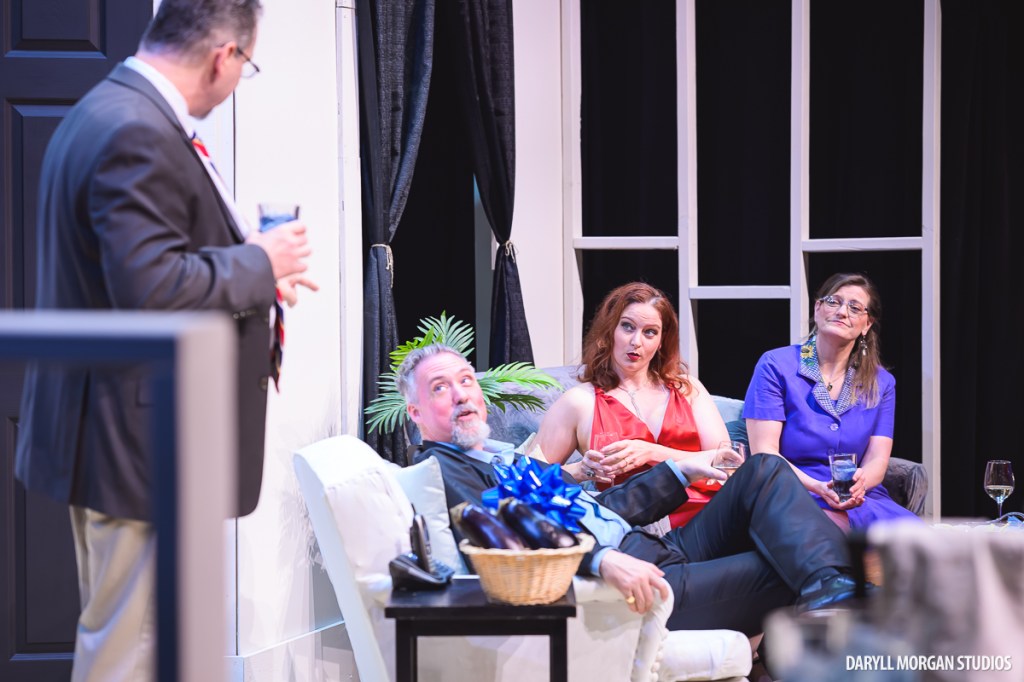
The plot is simple (in more than one sense of the word): In 1993 a meteor shower occurs in Ojai, CA, where Corky lives with her husband Norm. The two are a solidly united loving couple who have obviously attended one too many couples’ therapy sessions. Corky and Norm decide to invite another couple over to have dinner and watch the meteor shower, only to find that Laura and Gerald are not who they appear to be or what Corky and Norm expected.

Over the course of the evening, the plot twists and turns, the story stops and restarts. Remember when you were a kid and things went wrong and you wanted a do-over? Well, METEOR SHOWER is the repository of all your childhood do-overs.

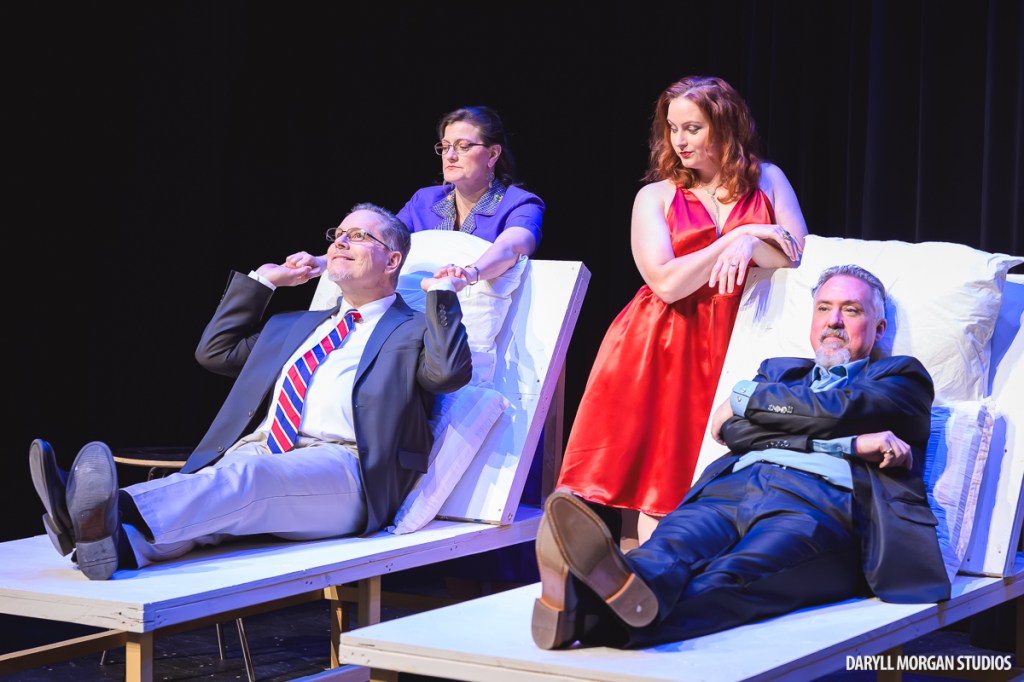
There is a minimalist set of  “a modern home in Ojai, California,” and a backyard dominated by two of the most uncomfortable looking lawn chaises I have ever seen. These chairs, however, play a key part in the evening’s events. A privacy fence cleverly disguises a walkway that leads to the house. And the audience is treated to a soothing, looping projection of a meteor shower. There is also a pre-show audio recording that is quite amusing – the first time we hear it…

Before the evening is over, you will experience a tale of cannibalism, learn about “bug flux” and exploding head syndrome, and find out what happens when one gets hit by a meteor.

The cast, all making their CAT debut, consists of Paul James and Jennipher Murphy as the host couple, Norm and Corky, and Skye Whitcomb and Constance Moreau and Skye Whitcomb as the guest couple, Gerald and Laura. Moreau and Whitcomb successfully juggled multiple plot twists fueled alternately by sexual innuendo, explosive outbursts, and intentionally dysfunctional exchanges. James maintained a mostly stable personality as a super sweet, super nice guy. As annoying as Norm could be, he actually started to grow on me – but then, the alternative was soooooo much worse. But it was Murphy who had the most complex, amusing, and devious character development and plot twists.

As a play, as a story, METEOR SHOWER has very little substance. It exposes the strengths and weaknesses of marriage and relationships, but doesn’t really have anything to say about any of it. It makes us laugh at things we would ordinarily be embarrassed to admit we watched, much less laughed at. If you need a night of senseless laughter, no strigs attached, this show might be meant for you. Go. Laugh. Enjoy. As for me – it was definitely not my cup of tea.

Julinda D. Lewis is a dancer, teacher, and writer who was born in Brooklyn, NY and now lives in Eastern Henrico County.

METEOR SHOWER

Written by Steve Martin

Directed by Kerrigan Sullivan

Cast

Jennipher Murphy as Corky

Paul James as Norm

Skye Whitcomb as Gerald

Constance Moreau as Laura

Creative Design Team

CAT Producer – Kerrigan Sullivan

Lynn Theatre Production Manager – Alleigh Scantling

Director – Kerrigan Sullivan

Stage Manager – Ari Silva

Lighting & Projection Design – Alleigh Scantling

Scenic & Properties Design – Hailey Bean

Costume Design – Lindsey Ladnier

Sound Design – Kerrigan Sullivan

Dates

September 16 – 29, 2023

Ticket Information

www.cattheatre.com

Ticket prices: $24.00 General Admission, $22.00 Seniors.

Run Time

80 minutes, with no intermission

Photo Credits: Daryll Morgan Studios

One-Time
Monthly
Yearly

Make a one-time donation OR SUBSCRIBE TO RVART REVIEW

Make a monthly donation

Make a yearly donation

Choose an amount

$5.00
$15.00
$100.00
$5.00
$15.00
$100.00
$5.00
$15.00
$100.00

Or enter a custom amount

$

Your contribution is GREATLY appreciated.

Your contribution is appreciated.

Your contribution is appreciated.

DonateDonate monthlyDonate yearly
POTUS

Or, Behind Every Great Dumbass are Seven Women Trying to Keep Him Alive

A Regional Premiere

By: Virginia Repertory Theatre (Virginia Rep)

At: The Sara Belle and Neil November Theatre | Marjorie Arenstein Stage

When: September 1 – October 1, 2023

Ticket Prices: $39-$59. (Discounted group rates and rush tickets available)

Info: (804) 282-2620 or www.virginiarep.org

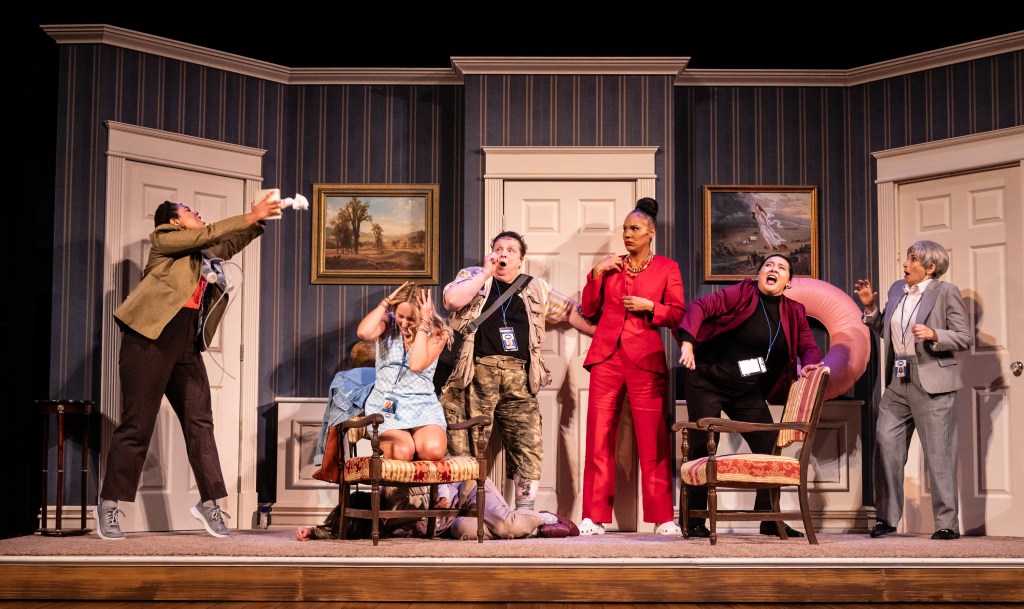
It’s been a long time since I’ve laughed this much, this long, this loud. Selina Fillinger’s POTUS is the best kind of comedy: physical, political, slapstick, irreverent, giddy, bawdy, inclusive. I could go on but I think using more than seven adjectives in one sentence is breaking some kind of law.

If the subtitle didn’t clue you in, it only gets worse from there (and by worse I mean better). If you’re the type to clutch your pearls, you’d better leave them at home because by the end of POTUS they’ll be rolling down the aisles.

Oh, and one more thing about that subtitle. Yes, there are seven women working together – despite their diverse agendas – but that part about whether they are trying to keep the POTUS alive does come into question. That’s all I can say about that without giving away too much.

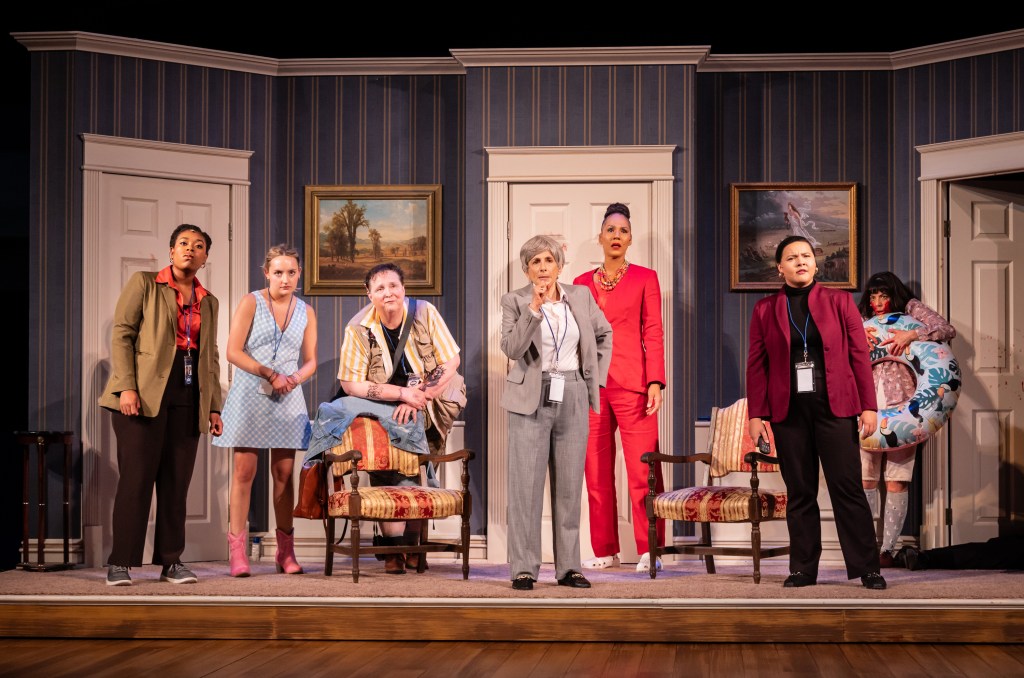
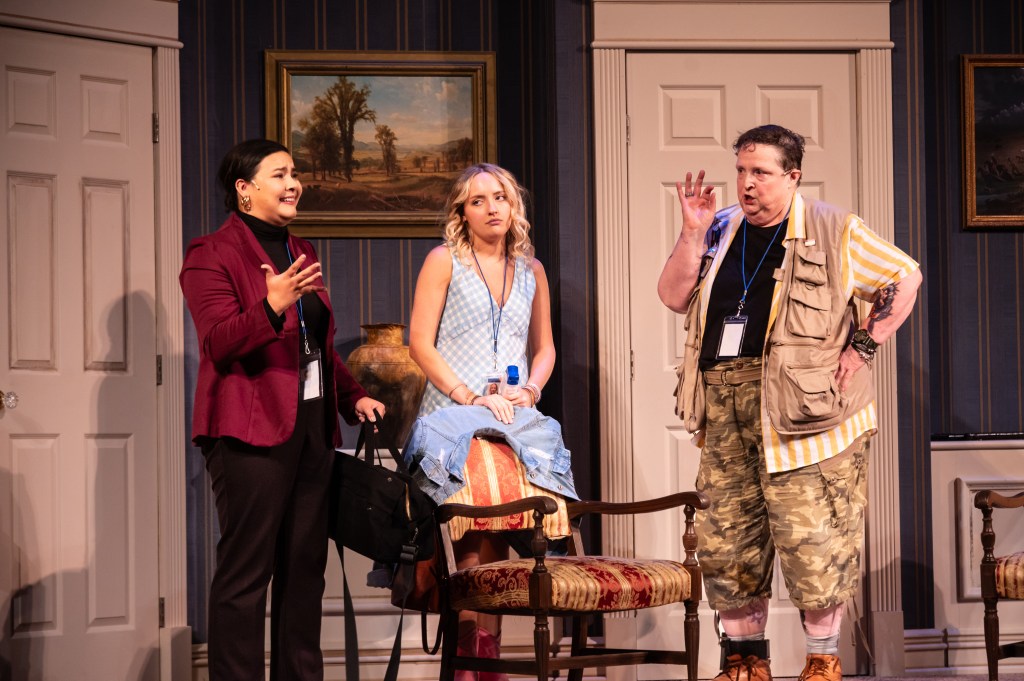
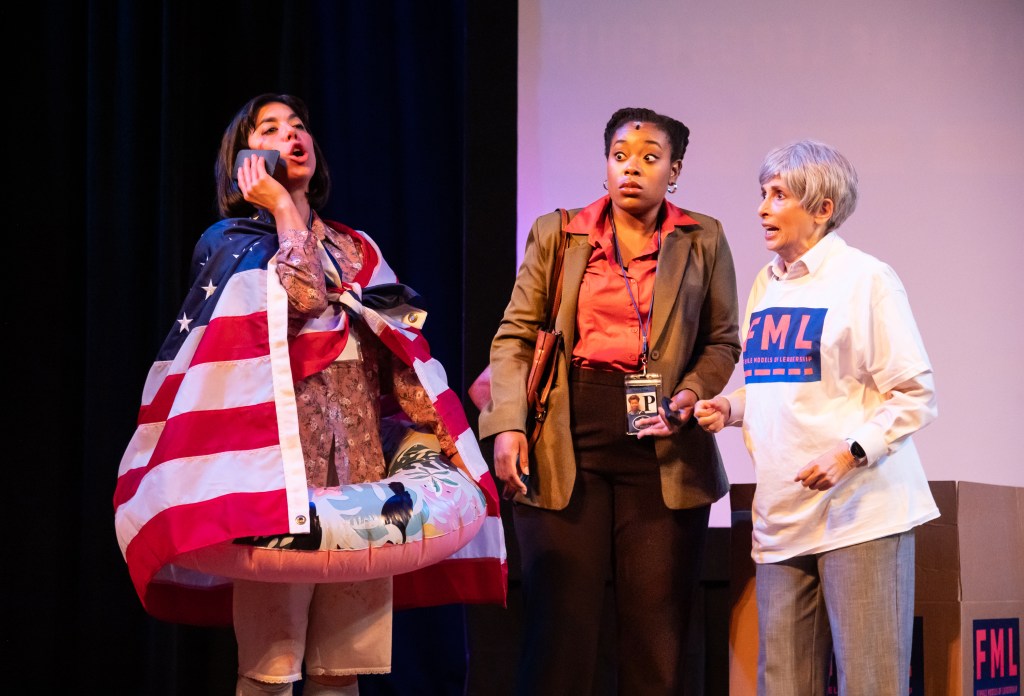
What I can say is that Fillinger has written a witty and timely play and it was performed by a superb and diverse ensemble – some familiar and some not – consisting of Elizabeth Byland, Liv Clayton, Sonja Durant, Anne Michelle Forbes, Bree Ogaldez, Catherine Shaffner, and Denise Simone. Looking at the understudies (see below) I would love to see the show again with the understudies in the key roles – there are some powerful, familiar names in that list, as well.

Loosely, the plot of POTUS involves the women of the President’s inner circle coming together to patch up his most recent political gaffe. Crudely referring to his wife during a press conference as having a “c**ty day,” the POTUS sets in motion an international disaster with potentially deadly consequences.

There truly are no leading roles in POTUS, but for me, Elizabeth Byland, in the role of Stephanie, the President’s Secretary, stood out for her physical comedy and her comedic timing. The role of the meek secretary who is obviously in over her head could be a recipe for disaster, but in Byland’s expert hands it is pure comedic genius. Loved her. According to her bio, she is the Head Professor of Improv at VCU. What a treat her classes must be! Loved her – yes, I said it twice and I meant it!

I also adored Catherine Shaffner as Bernadette, the President’s sister. Big, loud, and brash, Bernadette appears fresh out of prison on a felony charge, still wearing her ankle monitor, and carrying a duffle bag filled with “pharmaceuticals” and other tools that will come in handy during the course of the day. Shaffner guides her character through a perfect combination of unfettered chaos and much needed life skills that usually are not acquired in a liberal arts undergraduate program.

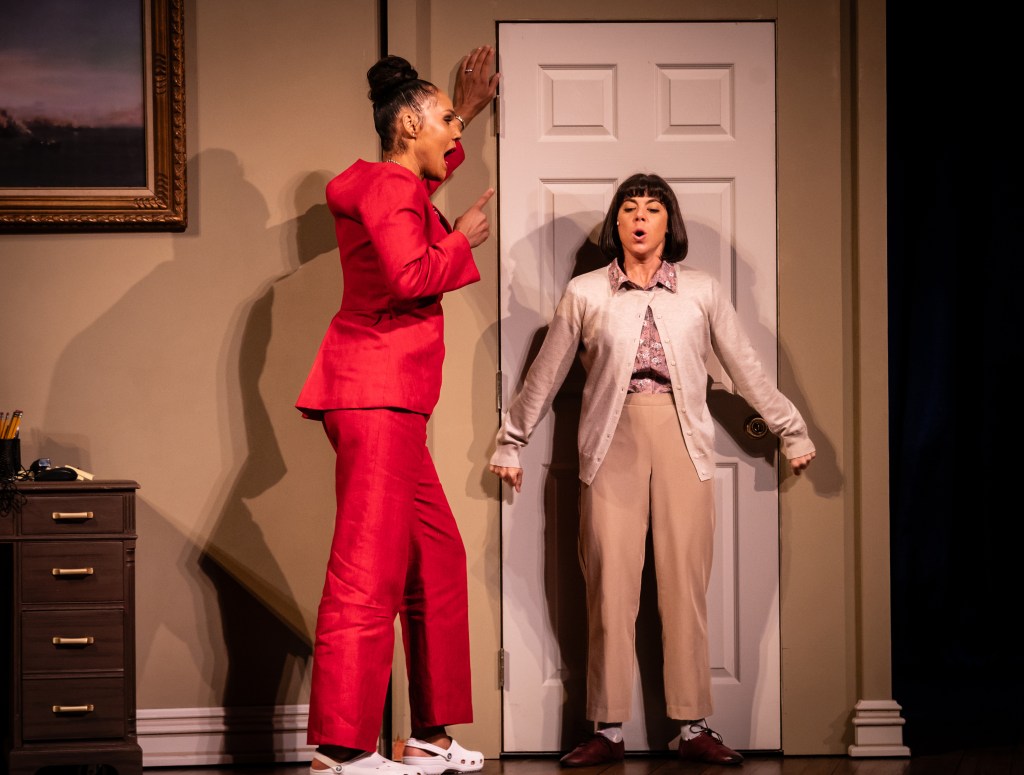
Sonja Durant was something of a beautiful enigma as Margaret, the First Lady. Durant’s tall slender frame was always draped in red – first a classy business pant suit, and later a fancy dress – but throughout she wore white Crocs on her feet to make herself appear “earthy.” Smart, composed, and apparently in command of the ability to icily detach herself from her emotions at will, Durant’s First Lady seemed very much authentic.

As the President’s press secretary, Jean, Anne Michelle Forbes skillfully navigated the insanity of the White House shenanigans, juggling professional interactions and personal relationships with the President’s sister (I didn’t see that coming!) and a beleaguered female White House reporter, Chris (played by Bree Ogaldez, seen recently in The Carole King Musical), a new mother who was constantly seeking opportunities to pump her overflowing breasts. A familiar face on local stages, this was Forbes’ November Theatre debut.

As Harriet, the President’s Chief of Staff, Denise Simone’s role seemed a bit more subdued than the others. At times she appeared to be the “straight man” who enhances the comedic projections of those around her. Simone returns to Virginia Rep after a turn contributing to the  theatre community in Idaho. And last but not least, newcomer Liv Clayton made her professional debut in the role of Dusty, the President’s young girlfriend who has been invited to the White House to apply for a “position.” I am sure Clayton is really good at her role, but I just found Dusty so annoying with her cheerleader moves that I almost overlooked the character’s innate kindness and corn-fed street smarts.

Set in the White House, a series of functional and somewhat minimalist sliding sets (credit Chris Raintree for the scenic design and Steve Koehler for the lighting) keeps the focus on the actors. The only time the set seemed to intrude into my consciousness was during a madcap chase scene when the set seemed too small to allow the actors full range. Kudos to director Dorothy Holland and the dynamic ensemble for keeping it moving. There was not a dull moment in either act.

Julinda D. Lewis is a dancer, teacher, and writer who recently had both knees replaced due to a manufacturer’s recall. Born in Brooklyn, NY, she now lives in Eastern Henrico County where she can be found kicking up her heels as best she can any day of the week.

POTUS

Or, Behind Every Great Dumbass are Seven Women Trying to Keep Him Alive

By Selina Fillinger

Directed by Dorothy Holland

Cast

Stephanie ……………………………      Elizabeth Byland*

Dusty ………………………………….       Liv Clayton

Margaret …………………………….      Sonja Durant

Jean ……………………………………       Anne Michelle Forbes

Chris …………………………………..       Bree Ogaldez

Bernadette …………………………       Catherine Shaffner*

Harriet ……………………………….       Denise Simone*

Stephanie u/s …………………….       Juliette Aaslestad

Jean u/s ……………………………..       Juliana Caycedo

Bernadette u/s ………………..…       Kelsey Cordrey

Dusty u/s ……………………………       Emily Dandridge

Margaret u/s ………………………      Jianna Hurt

Chris u/s ………………………………     MacKenzie Sheppard

*Member of Actors’ Equity Association

+Member of USA, United Scenic Artists

^Member of the Stage Directors and Choreographers Society

Direction & Design

Direction ………………………………  Dorothy Holland

Scenic Design ……………………… Chris Raintree

Costume Design …………………   Elizabeth Weiss Hopper

Lighting Design …………..………   Steve Koehler

Sound Design ……………………..   Tosin Olufolabi

Stage Management …………..   Donna Warfield*

Ticket Information

Box Office: (804) 282-2620

www.virginiarep.org

Tickets range from $39 – $59

Discounted Group Rates and Rush tickets are available.

Run Time

The play runs for 1 hour 30 minutes, plus one 15-minute intermission.

Photo Credits: Aaron Sutten

VA-REP Covid Safety Statement

Virginia Rep encourages wearing masks for our patrons’ safety, but we do not require that you wear a mask in our lobbies or within the theatres. They are now optional. We continue to follow CDC guidelines and local risk levels. All Virginia Rep staff will continue to wear masks while serving you.

One-Time
Monthly
Yearly

do you enjoy rvart review?
Make a one-time donation to show your love

or – Make a monthly donation

or – Make a yearly donation

Choose an amount

$5.00
$15.00
$100.00
$5.00
$15.00
$100.00
$5.00
$15.00
$100.00

Or enter a custom amount

$

Your contribution is appreciated.

Your contribution is appreciated.

Your contribution is appreciated.

DonateDonate monthlyDonate yearly
JASON MARKS IS ZERO MOSTEL

The Third Choice: Comedy Fueled by Real Life

A Theater Review by Julinda D. Lewis

A Jewish Family Theatre Presentation

At: The Sarah Bell November Theatre at the Weinstein JCC, 5403 Monument Ave., RVA 23226

Performances: March 29 – April 2, 2023

Ticket Prices: $20 for JCC Members; $25 for non-members

Info: (804) 285-6500 or https://weinsteinjcc.org/programs/arts-and-ideas/zero-hour/

First, some housekeeping. Well…acknowledgements. And…maybe a confession. I have been viewing and writing about dance and theater in RVA for more than 25 years, but this is the first time I have seen a show at the Weinstein JCC. It’s not that I haven’t know about shows there, or been invited, I just never seemed to have found the time to fit it into my schedule. Jason Marks sent me a DM about this show, which opened while I was out of town for a performing residency, and I somehow found myself driving straight from a DC dance space directly to the Firehouse Theatre on a Friday night, then to the JCC on Saturday after spending the morning in rehearsal and the afternoon at the Nature Center celebrating my youngest grandchild’s first birthday, and ending the weekend at Atlee High School for the final performance of a CAT show. That’s how “retired” people roll.

Second – and last – I appreciate growing up in Brooklyn and attending the Bronx High School of Science. That background made many of the Zero Hour’s references familiar and the humor genuine – unforced and abundant. So I could sum up right here and just say that Zero Hour is one of the funniest shows I’ve ever seen and it appears to have been a perfect vehicle for Jason Marks. But I won’t – sum up just now – because that wouldn’t be fair or fun.

Zero Hour is a skillful balance of biography and entertainment. For those unfamiliar with Zero Mostel, it is informative, and for those who were already fans, it might reveal a few unknown nuggets. Mostel (who, like me, was born in Brooklyn and also shares my birthday, February 28) was active at a time when the US was obsessed with the Red Plague or Red Scare, when McCarthyism (which took its name from US Senator Joseph McCarthy) insinuated that the government and Hollywood, among other industries, were being infiltrated by the dreaded specter of Communism. Numerous investigations were directed at the film industry leading to the blacklisting of industry professionals – including Zero Mostel.

The freedom of any society varies proportionately with the volume of its laughter. – Zero Mostel

The heart is, truly, the source of love. The proof is that if you remove it from someone, they will almost certainly never love again. – Zero Mostel

An unfortunate encounter with a NYC bus in 1960 nearly cost him a leg. The leg was saved, but he lived the rest of his life in pain. But on the bright side, the accident saved him from having to perform in a reportedly bad play, The Good Soup. But there were plenty of memorable roles on his resume, from Tevya in the original Broadway production of Fiddler on the Roof to Pseudolos in A Funny Thing Happened on the Way to the Forum, from classics like Ionesco’s Rhinoceros to special appearances on The Electric Show, Sesame Street, and The Muppet Show.

There are several explanations for how Samuel Joel Mostel came to be known as Zero. One is that his mother coined the nickname because of his poor grades in school – but one bio notes that he was a “A” student. Another explanation is that a press agent once said of him, “Here’s a guy starting from nothing.”

Known widely as an actor and singer as well as a comedian, Mostel developed a talent for painting and drawing from childhood. He took art classes provided by a community program that served Jewish immigrants and their children, and later attended City College of New York and then enrolled in a master’s program in art at New York University (which also happens to be my alma mater). Zero Hour is set in Mostel’s NYC art studio, just two months before the end of his life, on a day when he is being interviewed by a New York Times journalist – whom Mostel contentiously greets by calling him a putz (idiot; jerk) because “I don’t know your name.” BTW, Mostel didn’t care to learn the reporter’s name until near the end of the play, because “I don’t want to know your name; this is an interview, not a relationship.

“That’s it, baby, when you’ve got it, flaunt it! Flaunt it!” – Max Bialystock, played by Zero Mostel in the 1967 movie, “The Producers”

From House Un-American Activities Committee (HUAC) hearings to his mother’s displeasure at his Catholic shiksa (gentile) wife, from his dislike of choreographer/director Jerome Robbins to often being not the first or even second but the third choice for roles he made legendary, from being blacklisted to being invited to the LBJ White House where “the thought of having to eat with Texans was too much!”), all of this, and more, is lovingly and capably captured by Marks under the director of Debra Clinton. Clinton, in the Director’s notes, paid homage to Mostel’s individuality – his commitment to standing up for what he believed even to the detriment of his career – “his honesty, passion, and empathy.” Given the larger-than-life persona of Mostel, perhaps it should come as no surprise that the reporter is a disembodied and oddly reticent character, given his profession; we never actually see him or hear him. The HUAC investigator, however, is voiced by Roger Price. It probably would not have mattered how much or how little the reporter talked, there wasn’t a dull moment with Mostel’s explosive personality. Sometimes it was hard to tell where Marks ended and Mostel began. I am sure playwright Jim Brochu who originally starred in his own play, would approve of Marks’ interpretation.

“It’s not about absurdity, it’s about conformity.” – Zero Mostel

———-

Julinda D. Lewis is a dancer, teacher, and writer who was born in Brooklyn, NY and now lives in Eastern Henrico County.

———-

ZERO HOUR

By Jim Brochu

Starring Jason Marks as Zero Mostel

Directed by Debra Clinton

Production Team:

Set and Lighting Design + Photos: Todd Schall-Vess

Production Stage Management: Hayley Tsutsumi

Performance Schedule:

March 29: 7:30PM

March 30: 7:30PM

April 1: 8:30PM

April 2: 2:00 PM

Run time: approximately 2 hours, with one intermission

Photos by Todd Schall-Vess

One-Time
Monthly
Yearly

Your donation of any size
makes a difference!

Make a monthly donation

Make a yearly donation

Choose an amount

¤5.00
¤15.00
¤100.00
¤5.00
¤15.00
¤100.00
¤5.00
¤15.00
¤100.00

Or enter a custom amount

¤

Your contribution is appreciated.

Your contribution is appreciated.

Your contribution is appreciated.

DonateDonate monthlyDonate yearly

GHOST QUARTET

A Song Cycle About Love, Death, and Whiskey

An Immersive Theatrical Experience Review by Julinda D. Lewis

At: The Firehouse 1609 West Broad St., Richmond, RVA 23220

Performances: January 19 – February 18, 2023 [NOTE: This includes extended dates]

Ticket Prices: $35 general admission, $45 VIP two-top, $20 students

Info: (804) 355-2001 or firehousetheatre.org.

If you like the unique and different, if you are comfortable with ambiguity, if dramatic explorations of death and non-linear story-telling pique your interest, then GHOST QUARTET  was written for you. Not fully a play, not fully a musical, more akin to an opera, Dave Malloy’s creation was first produced in 2014 and was soon after nominated for awards for Best Music and Best Musical.

While I assert that the term “musical” is too confining to describe Ghost Quartet, there is no doubt that the music – much of which is played or engineered by Amy L Oblinger – is amazing. There are vocals and instrumental music involving a piano, a cello, a violin, and percussion. At one point small percussion instruments – a tambourine, a rattle, small rattles – are distributed to audience members.

Two of the Quartet members perform a delightfully unexpected tap and clog dance. And most of the cast members are quite comfortable breaking the fourth wall and addressing the audience – some of whom, the  VIPs, are seated at small table right on stage where they are served whiskey shots by the cast members who are gathered for a reunion of sorts at a bar that is apparently owned by one of the Quartet members.

Whew! That’s just by way of introduction, and doesn’t even begin to explain Ghost Quartet, Instead of Acts and Scenes, Ghost Quartet is divided into Sides and Tracks – which are announced at the top of each segment. While intentionally non-linear in structure, the sections are, in fact, related to one another. So, “The Camera Shop” in Side 1, Track 2 is related to “The Photograph” in Side 3, Track 2 and there is an “Usher” track – as in Poe’s “The Fall of the House of User” – in Sides 1, 2, and 3.

Family is another common theme woven throughout the production in which cast members play multiple characters, across generations, and encompassing – the program says – seven centuries. This makes it possible for Ghost Quartet to seamlessly discuss and conquer death, include sassy little girls and monks, have storytelling by Schéhérazade (yes, the one from Arabian nights), and sing an ode to whiskey (e.g., Jamieson, Maker’s Mark, Lagavulin), call a family meeting to deliver an ultimatum about an invisible friend, and conflate monks (the religious kind) with Thelonious Monk (the musician).

Bringing a wide range of talents, sass, and gifts to this production: Jaylin Brown, Valerie Chinn, Céilí Galante, Marjie Southerland, and Musical Director Amy L. Oblinger. They sing, they dance, they act, tell stories, play instruments, and drink whiskey for two hours (including one intermission).  Todd Labelle’s design, featuring a standard wooden bar as well as a vertical “floating” bar and walls of wide-spaced wooden slats, is simultaneously minimalist and luxurious. It provides a welcoming backdrop for an unfamiliar performance genre. Andrew Bonniwell’s lighting organically partners with the live music, electronic arrangements, and some surprisingly stunning vocal moments.

If, as Director PJ Freebourn wrote in their notes, the goal is to transport the audience and take us on a surreal journey that explores, among other things, love, family, hope, memory, and emotions, then Ghost Quartet is a smashing success. If you leave still wondering just what the hell happened and why it made you feel confused and amazed, if you leave talking about it, thinking about it, or asking questions about it — it was successful. February 4 was originally supposed to be the final performance, but four additional performances have been added over the next two weekends – Friday evenings, February 10 and 17, and Saturday matinees, February 11 and 18. If you haven’t seen it yet, recommend you try to reserve a ticket or two to one of these performances – then we can talk about it together.

———-

Julinda D. Lewis is a dancer, teacher, and writer who was born in Brooklyn, NY and now lives in Eastern Henrico County.

———-

GHOST QUARTET

By Dave Malloy

Directed by PJ Freebourn

Performers:

The Ghost Quartet

Jaylin Brown
Valerie Chinn
Céilí Galante
Marjie Southerland

Musician

Amy L. Oblinger

Production Team

PJ Freebourn – Director

Amy L. Oblinger – Music Director

​Niccolo Seligmann – Electronic Arrangements, Synth Programming, Foley Art

Céilí Galante – Additional Arrangements

Nicole Morris-Anastasi – Choreographer

Todd Labelle – Production Designer

Andrew Bonniwell – Lighting Designer

Katherine Brand – Costume Designer
Grace Labelle, Emily Vial, Talon Bleacher – Stage Managers

Performance Schedule:

Thu Jan 19 @ 8pm (preview)

Fri Jan 20 @ 8pm (preview)

Sat Jan 21 @ 4pm (preview)

Sat Jan 21 @ 8pm

Fri Jan 27 @ 8pm

Sat Jan 28 @ 4pm

Sat Jan 28 @ 8pm

Fri Feb 3 @ 8pm

Sat Feb 4 @ 4pm

Sat Feb 4 @ 8pm

EXTENDED: Additional Performances!

Fri Feb 10 @ 8pm

Sat Feb 11 @ 4pm

Fri Feb 17 @ 8pm

Sat Feb 18 @ 4pm

Ticket Prices

$35 general admission, $45 VIP two-top, $20 students

Run Time:  Approximately 2 hours with one intermission

Photo Credits: Bill Sigafoos

One-Time
Monthly
Yearly

rvaRT DEPENDS ON YOUR DONATIONS
THANK YOU

Make a monthly donation

Make a yearly donation

Choose an amount

¤5.00
¤15.00
¤100.00
¤5.00
¤15.00
¤100.00
¤5.00
¤15.00
¤100.00

Or enter a custom amount

¤

Your contribution is appreciated.

Your contribution is appreciated.

Your contribution is appreciated.

DonateDonate monthlyDonate yearly
HOW BLACK MOTHERS SAY I LOVE YOU

“Do not press me to leave you,
    to turn back from following you!
Where you go, I will go;
    where you lodge, I will lodge;
your people shall be my people
    and your God my God. – Ruth 1:16 (NRSV)

A Theater Review by Julinda D. Lewis

At: Richmond Triangle Players at the Robert B. Moss Theatre,

1300 Altamont Ave, RVA 23230

Performances: February 1-25, 2023

Ticket Prices: $10 – $40

Info: (804) 346-8113 or rtriangle.org

———-

Sometimes a production takes awhile to grow on you. Some shows are hard to connect with on a personal, emotional, social, literary, cultural or any other level. Just the opposite is true of Trey Anthony’s tender and amusing two-act family drama, HOW BLACK MOTHERS SAY I LOVE YOU. The author identifies as “a queer, black, Canadian, West Indian womyn” but their story is familiar to many Black women in Canada, the US, and the UK. I attended with my eldest daughter, and throughout the evening we looked at one another knowingly over our masks, reached for each other’s hands, cried out in instant recognition, or just cried.

The author may be a Canadian of Jamaican heritage, but the play is set in the Brooklyn, NY home of a Jamaican immigrant woman in 2014 (although I thought the furniture and kitchen appliances harkened back a decade or two – or three? – before then). Claudette (Zakiyyah Jackson), the prodigal queer daughter of Daphne (Dorothy “Dee-D” Miller) has returned home unannounced after several silent years in Montreal, Canada. Claudette finds her mother in poor health and her younger sister Valerie (Shalandis Wheeler Smith) doing her best to care for her, despite Daphne’s refusal to follow doctor’s orders – and the added complications of Valerie’s own personal struggles. Claudette has questions that her mother is not willing to answer. Daphne left Claudette and Valerie with their grandmother in Jamaica for six years while she got established in the US.

Family secrets are painfully and reluctantly revealed, along with social and cultural histories that could bringing health and healing to many families and enlightenment to many allies. The story is brought to life by a small but mighty cast, led by Miller, the matriarch. I’m not Jamaican but I married into a Jamaican family and I found Miller’s accent spot on. She dropped the “h” where you expected to hear it and added it where you did not expect it. She called children “pickney” and pronounced the word “little” as if it were spelled with two k’s instead of two t’s. She won me over completely when she spoke about the baby’s “ackee seed eyes.” That’s how my mother-in-law used to refer to my children! My daughter looked at each other and shrieked in unison as my heart melted into a puddle on the floor. (Don’t worry, RTP staff, melted hearts do not stain the carpet.) Of course I looked to see who the dialect coach was and just as I suspected, it’s Erica Hughes. Kudos to Hughes for another amazing job.

[If you are familiar with ackee, you can skip this next paragraph.]

BTW: the ackee fruit is a Jamaican dietary staple, an essential ingredient in the Jamaica national dish of ackee and saltfish (i.e., salted cod). When ripe, the ackee plant yields fleshy yellow lobes that somewhat resemble scrambled eggs when cooked with saltfish. The fruit has shiny black seeds that people – especially Jamaican grandmothers – liken to the shiny bright eyes of babies and young children. The kicker is that, in its un-ripened state, ackee is quite poisonous.

Jackson and Wheeler Smith achieved a remarkable balance between sibling rivalry and sisterly love. Their affection appeared genuine and as the story unfolded we found that it was grounded in a history of collective trauma – unique to them, but familiar to many families whose histories are defined by the African diaspora. Significantly, my daughter wondered how these themes spoke to white viewers. This would be an interesting dialogue to introduce in a talk-back…

Let me not forget to mention Cloe. The younger, American-born sister of Claudette and Valerie who died in childhood from an unnamed illness, Cloe appears as a silent ghost. Dressed in white from head to toe, Bailey Robinson, a Henrico County Public Schools student, made her professional debut as the sometimes meddlesome, but mostly caring specter of young Cloe whose presence is welcomed and visible to Daphne – and sometimes, it seems, to Valerie. Claudette knows she is there, but cannot see her. The presence of Cloe is another strong symbol of ancestors and spirituality.

The set is a Brooklyn home sturdily and lovingly crafted by William Luther and tenderly lit by Dakota Carter. I did wonder, however, why there were several long periods of darkness or dimmed lights. Perhaps these stretches were meant to serve a visual equivalent of the dramatic pause, or to contrast with the bright white heavenly light that illuminated the runway that Cloe used to transition between the present and the hereafter. Or maybe it was just to allow for a costume change.

Margarette Joyner (founder and artistic director of the Heritage Theater that formerly closed its doors in 2022) designed the costumes, with special attention to Daphne’s collection of church hats and Valerie’s collection of coordinating handbags and shoes. Desirée Dabney directed through the eyes of a storyteller. The work and words flow with a sense of real time and a feeling of intimacy and immediacy.

HOW BLACK MOTHERS SAY I LOVE YOU is a stunningly beautiful work of theatre, one I was not familiar with, one I will not forget. See it with your mother or daughter. And take tissues.

———-

Julinda D. Lewis is a dancer, teacher, and writer who was born in Brooklyn, NY and now lives in Eastern Henrico County.

———-

HOW BLACK MOTHERS SAY I LOVE YOU

By Trey Anthony

Directed by Desirée Dabney

CAST

Daphne            …………….Dorothy “Dee-D” Miller

Claudette        …………….Shalandis Wheeler-Smith

Valerie             ……………. Zakiyyah Jackson

Cloe                 ……………. Bailey Robinson

Daphne Understudy: Diana Carver

Claudette Understudy: Nora Ogunleye

Valerie Understudy: Chayla Simpson

Cloe Understudy: Sydnee Logan

THE CREATIVE TEAM

Director/Sound Design: Desirée Dabney

Assistant Director/Dramaturg: Chayla Simpson

Production Stage Manager: Jennipher Murphy-Whitcomb

Assistant Stage Manager: Nathan Ramos

Scenic Design: William Luther

Lighting Design: Dakota Carter

Props Design: Tim Moehring

Costume Design: Margarette Joyner

Hair & Make Up Design: Jahara Jennae

Intimacy Choreographer: Raja Benz

Dialect Coach: Erica Hughes

Technical Director/Scenic Painter: Becka Russo

Covid Safety Officer: William Luther

Marketing Videos: Aisthesis Productions

Photo Credits: Pre-production photos from RTP Facebook page

One-Time
Monthly
Yearly

Make a donation to support the continued publication of rvart review
thank you

Make a monthly donation

Make a yearly donation

Choose an amount

¤5.00
¤15.00
¤100.00
¤5.00
¤15.00
¤100.00
¤5.00
¤15.00
¤100.00

Or enter a custom amount

¤

Your contribution is appreciated.

Your contribution is appreciated.

Your contribution is appreciated.

DonateDonate monthlyDonate yearly
UNCLE VANYA

Every Family Has a Drunk Uncle…

A Theater Review by Julinda D. Lewis

By: Richmond Shakes (formerly Quill Theatre)

At: Dominion Energy Center’s Libby S. Gottwald Playhouse, 600 E. Grace St., RVA 23219

Performances: January 26 – February 12, 2023

Ticket Prices: $22-$42

Info: (804) 340-0115 or https://richmondshakespeare.org/

Rarely – if ever – have I described a production as a sad comedy, but that would be an accurate description of UNCLE VANYA, written by Anton Chekhov and  adapted by Conor McPherson. First performed at the turn of the twentieth century, UNCLE VANYA remains relevant and contemporary as adapted by McPherson and under the expert direction of Dr. Jan Powell.

One thing – well, eight really– that made this production successful was the uniformly outstanding cast. Bryan Austin was relentlessly amusing yet authentic and endearing in the title role and it was his authenticity that kept his moments of wallowing in self-pity and regret from becoming shallow and vainglorious tropes. Calie Bain was a breakout star as Vanya’s niece, Sonya. In spite of the early death of her mother, her father’s re-marriage to a woman seemingly closer in age to Sonya than her father, and her unrequited love – made even more soul-crushing by the geographical isolation of their country estate – Sonja remained a bright light of hopefulness. She was the connection that made it possible for this stunningly dysfunctional family to attempt reconciliation and settle on renovation.

Lindsey Zelli as the beautiful young second wife, Yelena, displayed unexpected and sometimes uncomfortable depth. In spite of past estrangements and current rivalrous entanglements, Yelena demonstrated genuine fondness and care for Sonya. Matt Hackman’s Dr. Astrov was also multi-faceted. Totally unaware of Sonja’s love for him (really???), he was equally infatuated with her step mother, and focused on ecological issues with a passion that I am sure was way ahead of his time.

Kelly Kennedy made the most of her nearly innocuous supporting role as Nana – not, as one might think, the grandmother, but an elderly nurse who has become the family caretaker. Sitting in her chair, quietly observing or serving up hot tea, her knitting needles seemed to be a metaphor for her role in the family drama.

Alan Sader and Debra Clinton’s characters infuriated me. Sader played the pompous and manipulative Professor Alexandr Serebryakov (father of Sonya, husband of Yelena, son of Mariya, and brother-in-law of Vanya) and of course he is really good at it. It’s the kind of role where you don’t want to meet the actor soon after because you want to curl your lip and turn up your nose at his character. Clinton’s character was infuriating for a different reason. Mariya’s favoritism for her more successful son, Alexandr and disdain for the hard-working Vanya seemed passive-aggressive and possibly the result of oppression or lack of fulfillment in her own life.

For those, like me, unfamiliar with the characters, it took awhile to get a handle on the role of Telegin (Bill Blair). Affectionately called Waffles (apparently because of the condition of his skin), Telegin is a family friend, neighbor, and hanger-on who tries to fit in where he can – often with awkward results.

What makes Uncle Vanya resonate with me is these lovingly developed and multi-dimensional characters. They are familiar and seem to fit right in with contemporary issues: family dysfunction, changing inter-generational roles, the troublesome hierarchy of inheritance, and even the forced soul-searching of pandemic isolation.

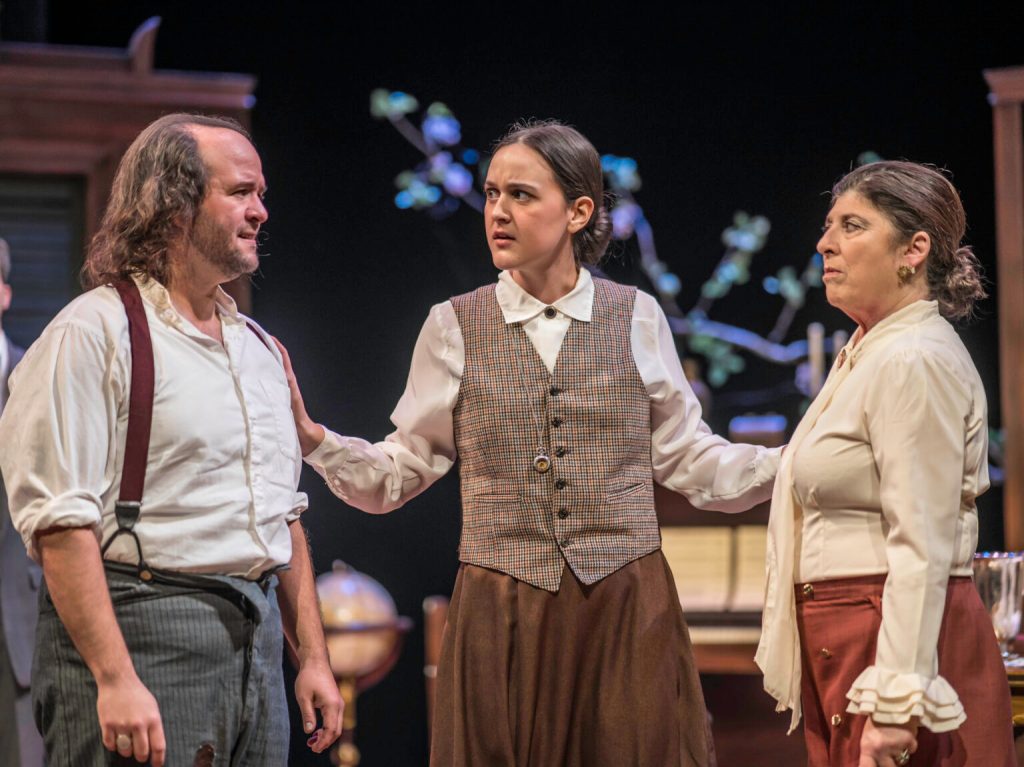
Reed West’s set design – much more elaborate than Richmond Shakes’ usually sparse environments – is solidly built of sturdy, dark wood. Little details, like a chess set atop a cabinet, Nana’s knitting basket, and the clean but worn rugs support the narrative of crumbling gentility. And what can I say about the individual application of autumn leaves on the tree branches during intermission? Gretta Daughtrey’s lighting is effective and unintrusive; the storm, for example, is subtle but unmistakable. So, too, are James Ricks’ sound design, that included gentle ambient sounds, and Anna Bialkowski’s earth-toned costumes – with a jewel-toned garment or two for Yelena, and a caped-overcoat for the Professor. 

Uncle Vanya is a satisfying evening of theater performed by a stellar cast – and I say this even though I am not in the least a fan of Chekhov. There isn’t much action. Plot is virtually non-existent. But the characters are immersed in the words and that fully engages the audience in a way that creates the best kind of theater magic. Try to see it before it closes.

Uncle Vanya

By Anton Chekhov

Adapted by Conor McPherson

Cast

Nana    ………. Kelly Kennedy

Astrov ………. Matt Hackman

Vanya  ………. Bryan Austin

Telegin………. Bill Blair

Serebryakov………. Alan Sader

Sonya  ………. Calie Bain

Yelena ………. Lindsey Zelli

Mariya ……….Debra Clinton

Production Team

Artistic Director: James Ricks

Managing Director: Jase Sullivan

Director: Dr. Jan Powell

Assistant Director: Sarbajeet Das

Stage Manager: Lauren Langston

Assistant Stage Manager: Carrisa Lanstra

Costume Design: Anna Bialkowski

Light Designer: Gretta Daughtrey

Scenic Design: W. Reed West III

Sound Design: James Ricks

Properties Design: Emily Hicks

Map Art Work: Katherine Wright

Promotional Photography: Peyton Lyons

Run Time: About 2 ½ hours including one intermission

Julinda D. Lewis is a dancer, teacher, and writer who was born in Brooklyn, NY and now lives in Eastern Henrico County.

———-

Photo Credits: Peyton Lyons and David Parrish Photography

 TOP LEFT: Bryan Austin, Bill Blair, Matt Hackman. TOP CENTER: Matt Hackman and Calie Bain. TOP RIGHT: Bryan Austin. BOTTOM LEFT: Bryan Austin. BOTTOM RIGHT: Bryan Austin, Calie Bain and Debra Clinton
One-Time
Monthly
Yearly

RVART Review depends on the generosity of readers to continue to exist. thank you.

Make a monthly donation

Make a yearly donation

Choose an amount

¤5.00
¤15.00
¤100.00
¤5.00
¤15.00
¤100.00
¤5.00
¤15.00
¤100.00

Or enter a custom amount

¤

Your contribution is appreciated.

Your contribution is appreciated.

Your contribution is appreciated.

DonateDonate monthlyDonate yearly
MIRACLE ON SOUTH DIVISION STREET

Pride, Prejudice & Identity: A Comedy Fueled by Family Secrets, Polish Pastries, & Gefilte Fish

At: The Swift Creek Mill Theatre, 17401 U.S. Route 1, S. Chesterfield, VA 23834

Performances: January 29 – February November 19 – December 31, 2022

Ticket Prices: $15-$49

Info: (804) 748-5203 or https://www.swiftcreekmill.com

We all know that we’re special, but some of us are more special than others. Take the Nowak family of Buffalo, NY, for instance. In 1942 the Blessed Virgin Mary “appeared” – emphasis required! – to an ordinary barber, and his family would never be the same. This miracle led to people being healed, spawned the birth of a soup kitchen, and became the anchoring event that made an otherwise average family special.

But all is not what it seems in MIRACLE ON SOUTH DIVISION STREET. A deathbed confession turns everything upside down, making the Nowak family question everything they have known and based their lives on for two generations.

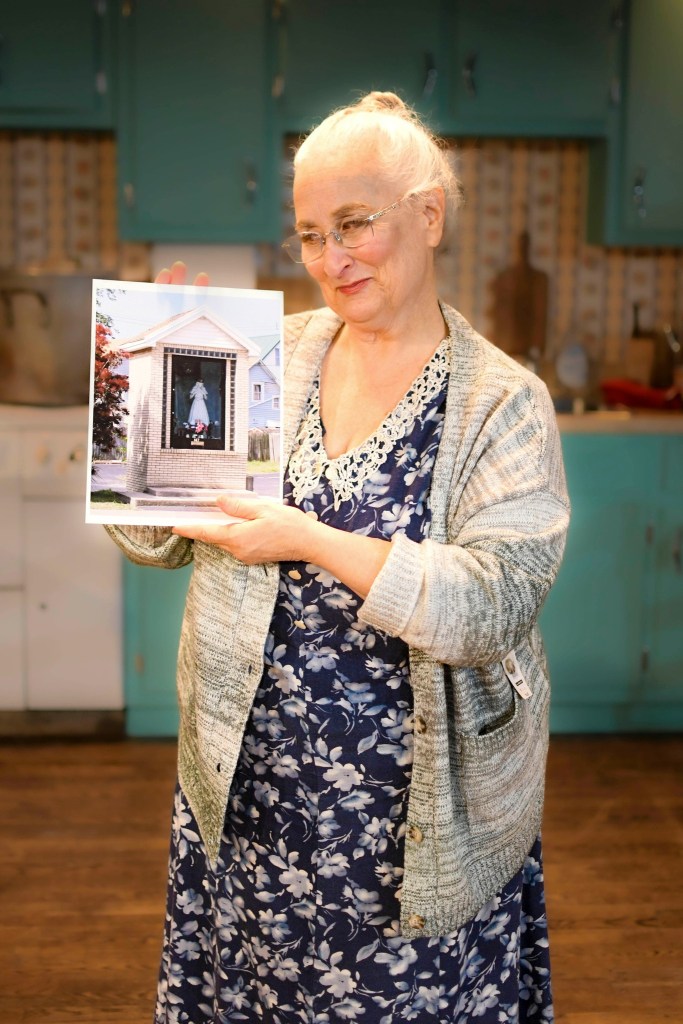
While the play and its characters are fictitious, the premise of the story is based on fact. There is an actual Our Lady of Seneca Street Shrine in Buffalo, NY – which just happens to be the author’s hometown. In the 1950s a barber named Joe Battaglia lived at 849 Seneca Street in the apartment above his shop. Apparently, one night Battaglia was awakened from his sleep by a shining light outside his window that beckoned to him. When he went outside to investigate, it is reported that he encountered nothing less than an image of the Virgin Mary. The image spoke to him, telling him not to be afraid and instructed him to help spread a message of world peace.

Battaglia commemorated the occasion by building a 20-foot tall brick and glass structure that houses a life-sized statue of the Holy Mother. After the barber’s death, the shrine fell into disrepair and was slated to be torn down but local residents fought to preserve it. To this day the  Lady of Seneca Street Shrine is still maintained by a dedicated local caretaker committed to preserving the history and continuing the legend. The shrine has its own address – 847 Seneca Street – and a mail slot to receive donations and the prayers that come from all around the world.

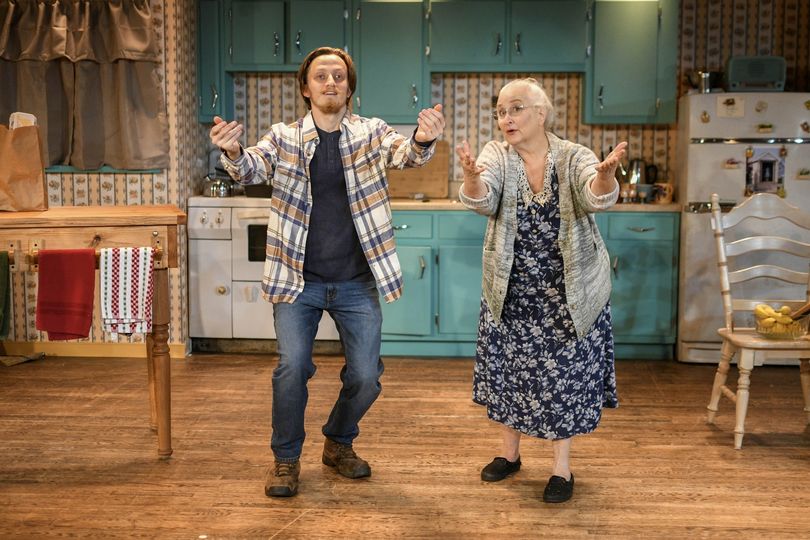
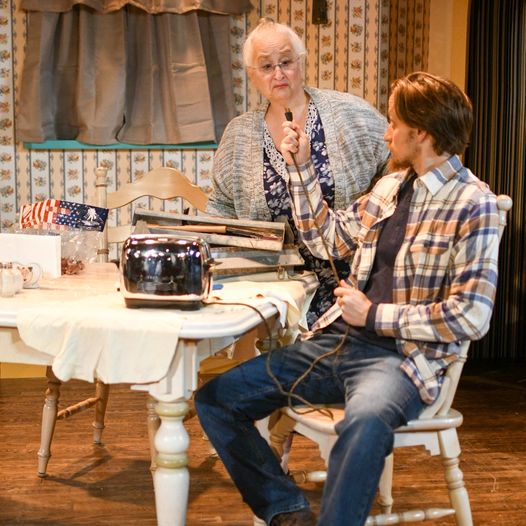
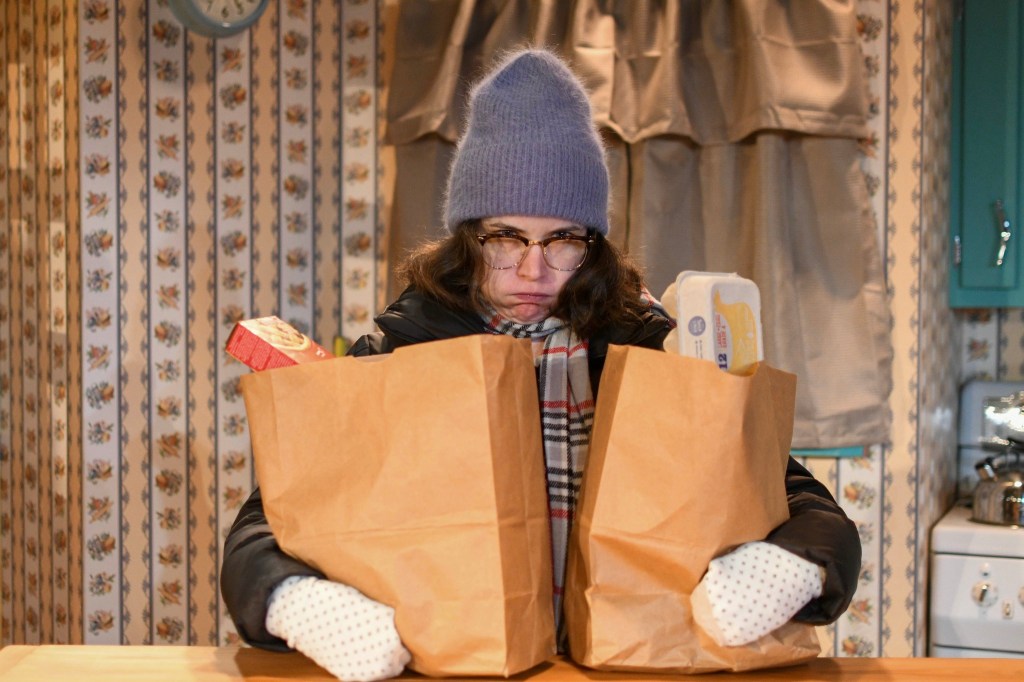
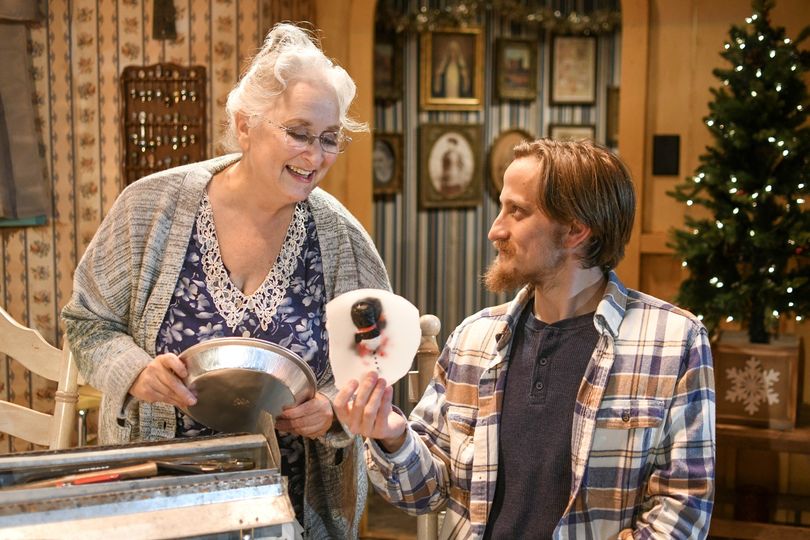
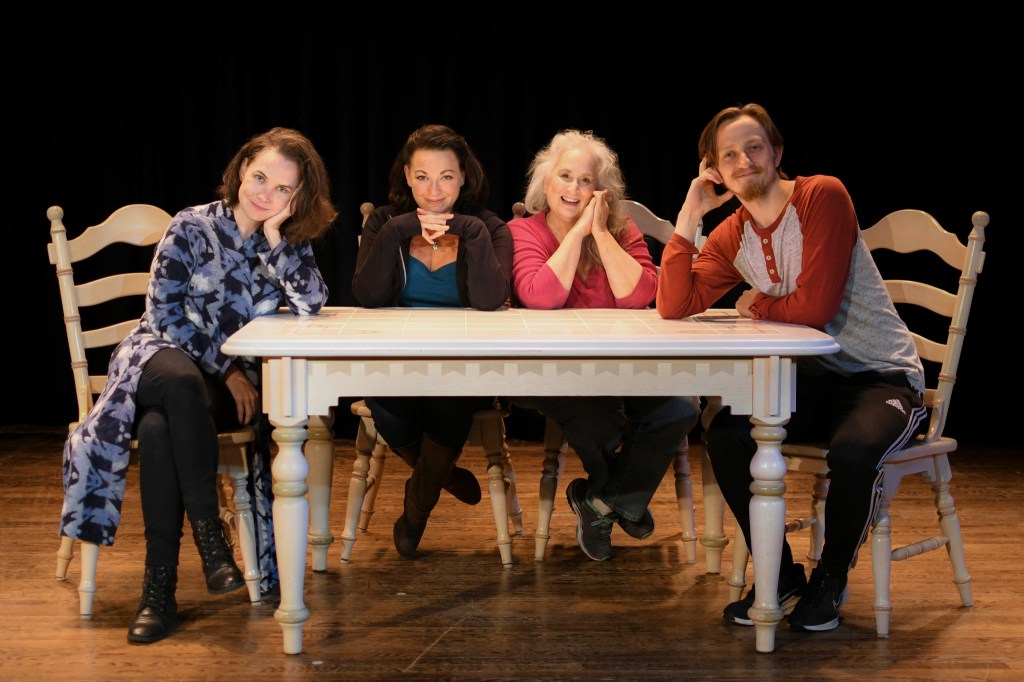
With this background, Dudzick re-imagined the story of the barber’s vision and the resulting shrine. Instead of the Battaglia family, we meet the Nowaks who are about to have a family meeting in which daughter Ruth (Audra Honaker) is about to reveal startling news that will shake the family to its core. After preparing a lunch of fruit salad (why didn’t she rinse the blueberries and strawberries…) her efforts are thwarted by her older sister, Beverly (Donna Marie Miller) who is more than a little self-centered and has her sights centered on (a) a bowling tournament and (b) a new boyfriend – an ex-priest candidate. There’s also a brother, Jimmy (Neal Gallini-Burdick) whose impending engagement is also the cause of a controversial subtext. The Nowaks, you see, are devote Catholics – at least according to their mother Clara (Jacqueline Jones) – and this is a key component of the script.

The plot twists and unending life-changing revelations create both tension and comedy – often and most successfully when they occur simultaneously. Honaker and Miller are recreating the roles I saw them portray when this play was performed at Virginia Rep’s Hanover Tavern in 2017. But with Jones as Clara and Gallini-Burdick as Jimmy the energy in the Swift Creek production is quite different and the cast’s timing, under the steady-handed direction of Tom Width, hits different notes as well. (In case you’re wondering, in the 2017 production mentioned above the mother was played by Catherine Shaffner and the son by John Mincks, both of whom filled these roles with distinction.)

MIRACLE ON SOUTH DIVISION STREET is a delightful feel-good play, but it touches on some very real, very serious, and still relevant topics: identity, faith, family, love, loyalty, ritual, and more. By making this a comedy and placing it in a different time period, we are encouraged to examine some important and controversial topics from a distance – it’s not me, it’s the Nowaks. But every family has secrets, prejudices, and inside jokes. But how much of it – if any – should be shared outside the family, and to what purpose. Ruth struggles with these questions through the lens of a one-woman show; many today look at – or ignore – the same questions through the multiple lenses of social media. Makes you wonder if the miracle is what resulted from the vision – or what occurred in the Nowak kitchen.

Honaker delivers the tough lines with ease and patience that defies human understanding. Miller behaves like a bratty younger sibling rather than the eldest, but manages to remain likeable, while Gallini-Burdick manages to remain a voice of reason throughout it all. Jones vacillates between wide-eyed innocence and wisdom. She is also at the center of my favorite scene – where Clara, the Catholic mother first discovers that Jesus was Jewish, and later delivers one of my favorite lines – the final line of the play.

ADDENDUM: This review has been edited. I was roundly chastised by the playwright for giving away the final line. But, dear readers,in over forty years of writing about dance and theater, this is the first time I EVER received a comment directly from the playwright. I am humbled – and humbly edited this text. jdl

Just in case I didn’t make it clear in my ponderings, above, I highly recommend MIRACLE ON SOUTH DIVISION STREET. It’s a Christmas story with a purpose; it’s entertaining and thought-provoking, predictable, and surprising at the same time. The cast is outstanding, the story intriguing, and Width’s direction reflects his genuine love and affection for each show he directs, and his scenic design is homey and welcoming. Cue Christmas (or Chanukah) music and enjoy.

Julinda D. Lewis is a dancer, teacher, and writer who was born in Brooklyn, NY and now lives in Eastern Henrico County.

MIRACLE ON SOUTH DIVISION STREET

By Tom Dudzick

Directed by Tom Width

Cast:

Jimmy Nowak – Neal Gallini-Burdock

Ruth Nowak – Audra Honaker

Clara Nowak – Jacqueline Jones

Beverly Nowak – Donna Marie Miller

Creative Team:

Directed by Tom Width

Costume Design by Maura Lynch Cravey

Lighting Design by Joe Doran

Scenic Design by Tom Width

Technical Direction by Liz Allmon

Run Time:

90 minutes, no intermission

Tickets:

$15-$49

Photos: Kieran Rundle

One-Time
Monthly
Yearly

Make a one-time donation
to support rvart review

Make a monthly donation

Make a yearly donation

Choose an amount

¤5.00
¤25.00
¤100.00
¤5.00
¤25.00
¤100.00
¤5.00
¤50.00
¤100.00

Or enter a custom amount

¤

Your contribution is appreciated.

Your contribution is appreciated.

Your contribution is appreciated.

DonateDonate monthlyDonate yearly