Tickets & Info: kdance.org or rtriangle.org or call (804) 346-8113 or (804) 270-4944
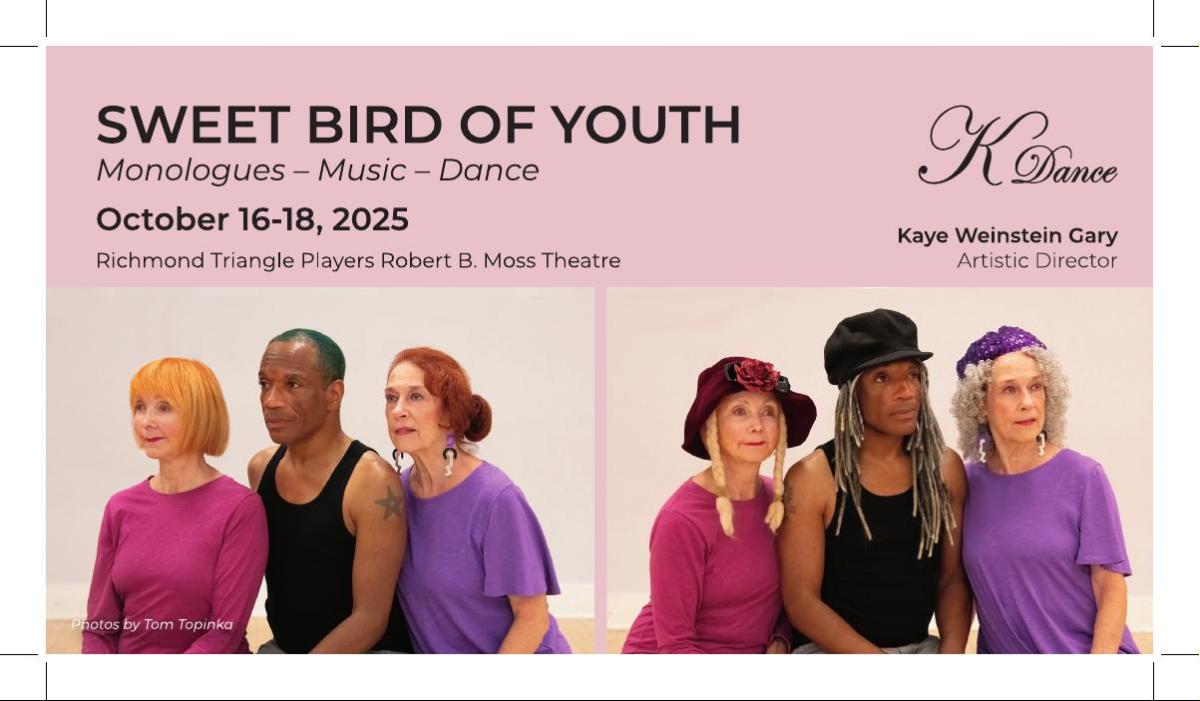
Sweet Bird of Youth picks up the theme Kaye Weinstein Gary laid down with 2024’s production of Shorts (i.e., short dance-theater works that blend text, movement, and music), entitled Coming of Age. Right off the bat, Gary confirms that Sweet Bird of Youth is at least partially autobiographical by sharing a humorous tale of going out with friends, all of whom were unashamed to claim their senior discounts – all, that is, except her. Gary confesses that she threw away her AARP mail, didn’t want to claim Social Security, and eschewed senior discounts. Garys’s denial was so extreme that eventually her husband pointed out that she was throwing away money by not embracing the senior savings.
Equal parts humorous and heartfelt, this exploration of aging and life transitions is supported by Jane Cafarella’s monologue, “Sweet Bird of Youth,” Andrew Bliss’ “Cuthbert’s Last Stand,” and Tracy Letts’ August Osage County as well as other monologues, poems and songs (e.g., Nat King Cole’s “Sweet Bird of Youth”). Cafarella’s “Sweet Bird of Youth” is spread over three ensemble sections and Gripp’s “Hap Hap Hap Birthday” song appears twice; these, along with Cafarella’s words provide a sort of loose structure to this seemingly free-form enterprise.
The “Sweet Bird of Youth” theme is echoed in Frank Foster’s set – his first for a dance company – a flock of translucent birds appearing to emerge from a picture frame that rests with a corner on the floor. There is also a red cushion or hassock, 2 of those clear acrylic Ghost Chair armchairs, and 2 barstools, allowing for quick and seamless scene changes.
Between the introduction and the closing bow, the audience gets to experience a range of significant life-stage events, including the death of a parent, a confession of not being homosexual, and milestone birthdays of 40 and 50 years. The program addresses the arc of sexuality as we age, symbolized by moving from a twin bed to a double bed, then a queen-sized or king-sized bed before moving back to separate beds and finally separate rooms.
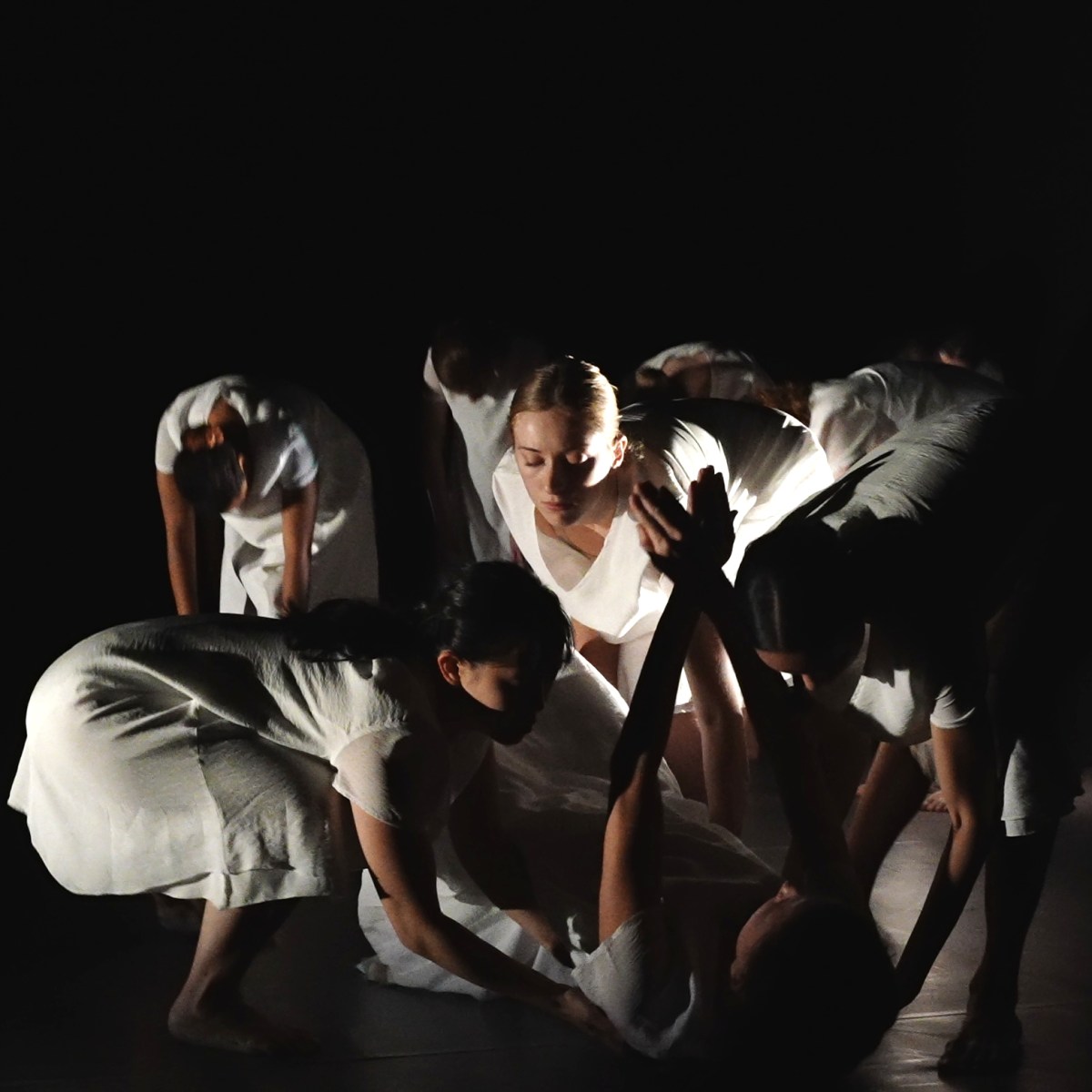
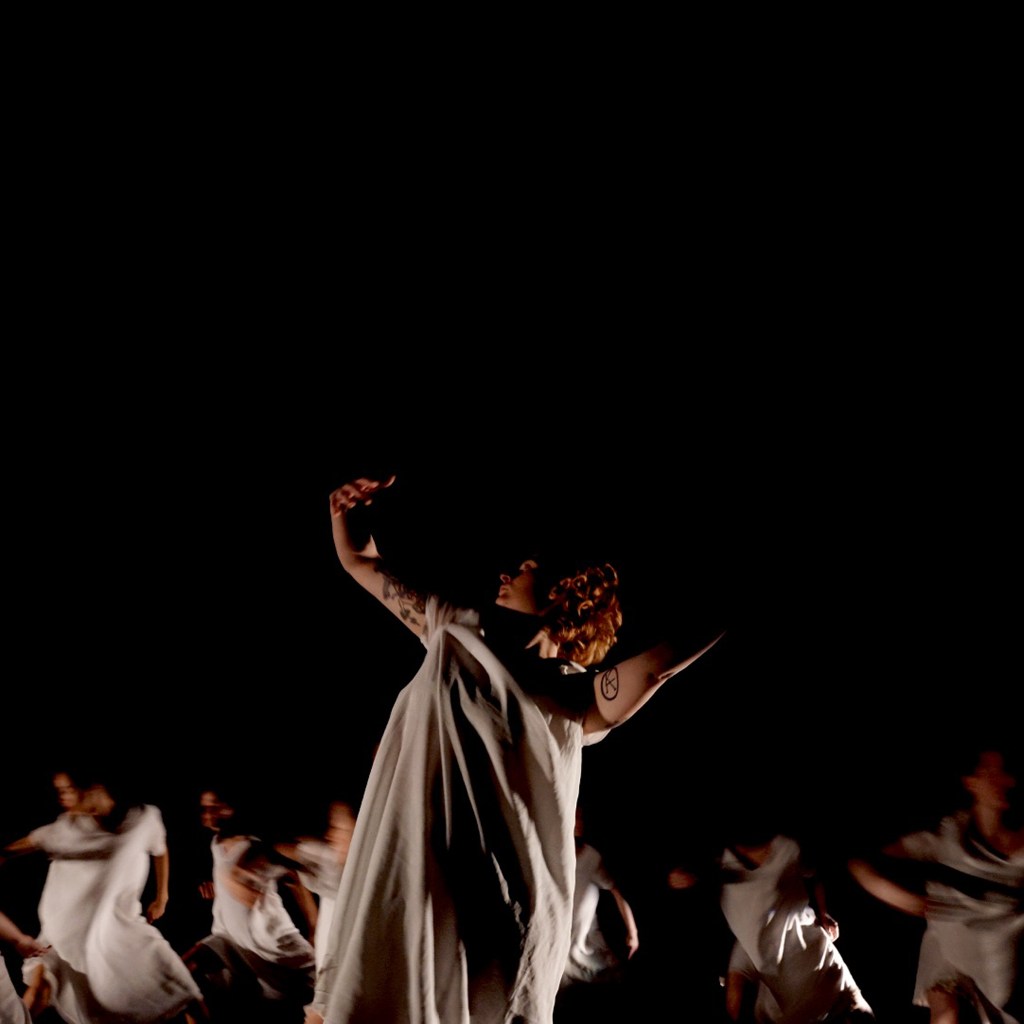
Just as Gary has staged an opposite-of-coming-out scene, she starts from the end, with the performers wearing wigs and shawls that they shed as they regress to earlier, younger versions of themselves or their characters. The audience loved every bit of it – after all, Gary has tapped into an area of need, the aging are too often socially neglected and invisible. During a talk-back with the audience, someone summed up this need and Gary’s collaborative response like this (or something pretty close): “Dance is kind of the ultimate triumph of the body…tension between words and movement.”
———-
Julinda D. Lewis is a dancer, teacher, and writer who was born in Brooklyn, NY and now lives in Eastern Henrico County. When not writing about theater, she teaches dance history at VCU and low impact dance fitness classes to seasoned movers like herself and occasionally performs. Julinda was recently awarded the Dean’s Distinguished Adjunct Faculty Award 2023-24 Academic Year by VCU School of the Arts and the 2025 Pioneer Award in Dance Ministry by Transformation International Worship Ministries, Newport News, VA.
———-
CAST of DANCERS/ACTORS
Andrew Etheredge
Kaye Weinstein Gary
Melanie Richards
PRODUCTION TEAM
Director/Choreographer ….. Kaye Weinstein Gary
Lighting Designer ….. Gretta Daughtrey
Set Designer ….. Frank Foster with Jessica Chivington
Hat/Wig Consultant ….. Heidi Rugg
Stage Manager ….. Jake Buccella
Production Assistant ….. Gina Maria McKenzie
Performance Schedule:
Thu Oct 16 @ 8pm, Fri Oct 17 @ 8pm, Sat Oct 18 @ 4pm & 8pm
Tickets: $30
Run Time: Approximately 40 minutes, no intermission
Melanie Richards, Kaye Weinstein Gart, Andrew EtheredgeMelanie Richards, Andrew Etheredge, Kaye Weinstein GaryMelanie Richards, Andrew Etheredge, Kaye Weinstein Gary
Photos by Tom Topinka
One-Time
Monthly
Yearly
PLEASE Make a one-time, MONTHLY, or ANNUAL donation donation to support rvart review
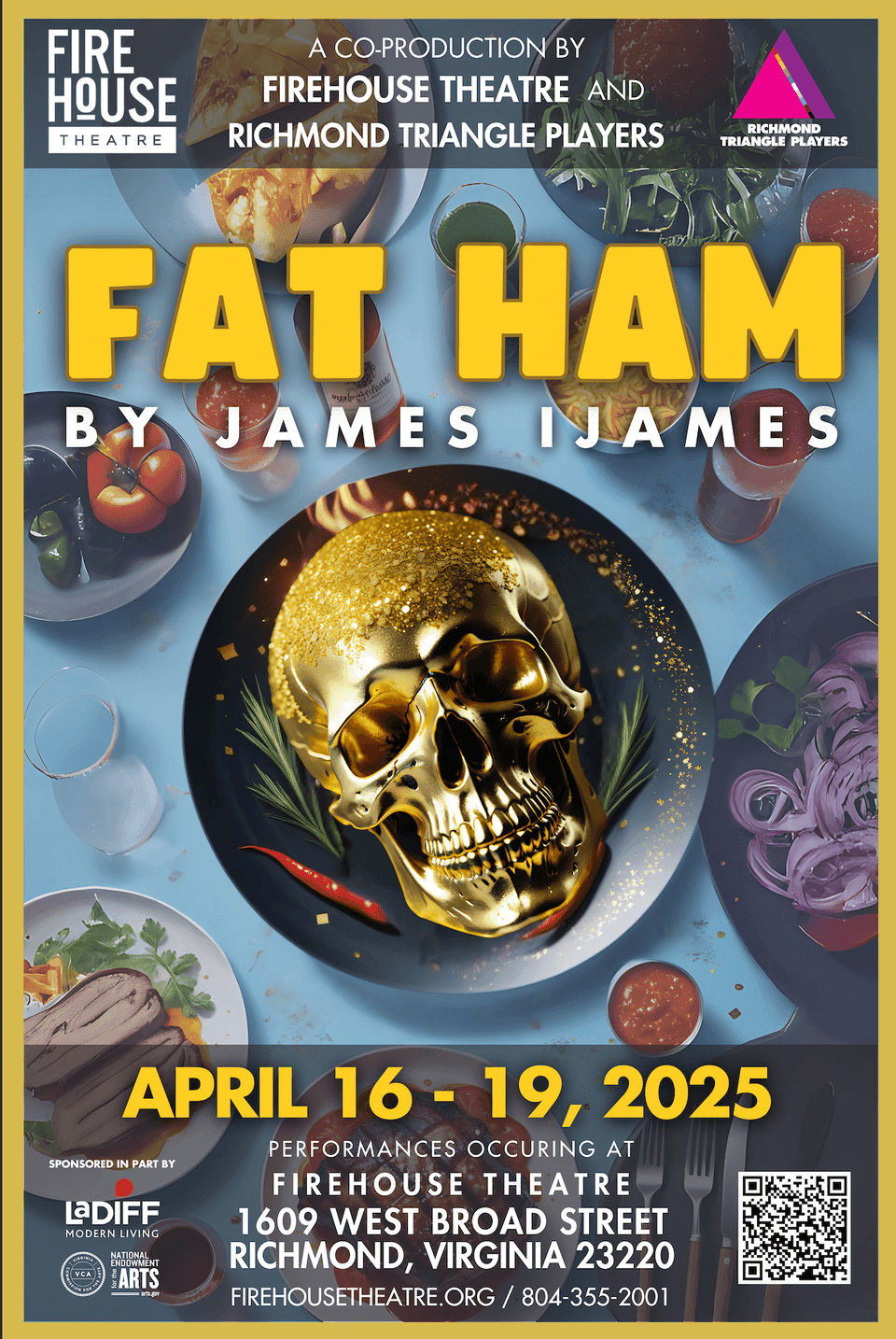
A Co-Production of Firehouse Theatre and Richmond Triangle Players
A Reflection on a Unique Theater Experience by Julinda D Lewis
At: Firehouse Theatre, 1609 W Broad St., RVA 23220
Performances: April 16-19, 2025
Ticket Prices: $45 [all shows SOLD OUT]
Info: (804) 355-2001 or firehousetheatre.org
Fat Ham is what happens when Shakespeare gets invited to the BBQ and there’s brown liquor and the Electric Slide – the only thing missing is a game of Spades.
What is Fat Ham? James Ijames’ 2022 Pulitzer prize winning play is a modern-day take on Shakespeare’s Hamlet. Set in a small town in North Carolina (or Virginia, or Maryland, or Tennessee), Juicy’s father, Pap, has died and his mother, Tedra, immediately married her deceased husband’s brother, Rev. Mere moments into the contemporary tragedy (or tragi-comedy), Pap appears to Juicy and his friend Tio as a ghost. As if to make sure we get the “comedy” part of tragi-comedy, Pap has thrown a large white sheet, complete with pasted on black eyeballs, over his pristine white funeral suit and strolls into the backyard using the gate. I’m not the only one who wondered why he didn’t just walk through the fence, as his son, Juicy also asked why he wasn’t floating! Point made, he subsequently ditches the sheet and appears in his white suite with a wide-brimmed white hat and white shoes.
Named in honor of Shakespeare’s Hamlet and the BBQ restaurant owned by the play’s fictional family, Fat Ham is equal parts family tragedy and side-splitting comedy. Pap has roused himself from the grave to ask his son to seek revenge. Apparently, while in prison serving a sentence for stabbing a man, he himself became the target of a hitman when his own brother, Rev, has him killed. The plot thickens when Pap, Rev, and just about every other adult in his life questions Juicy for being “soft,” calling him a sissy and other choice names.
As the drama unfolds, two of Juicy’s friends come – or get forced out – of the closet. Tedra’s conflict is also internal as she faces her own insecurities that make her think she can find her worth only in the arms of man. Criticism is met with a variety of explanations, all ending with, “it’s biblical” or “it’s in the bible.”
There was plenty of drama off the stage as well. After a successful run in Norfolk earlier in the year, Virginia Rep was set to bring Fat Ham to the November Theatre but cancelled at the last minute due to their on-going financial problems that surfaced for the public in the fall of 2024. While it may be true that finances were the source of the cancellation, the optics were not good. Fat Ham is very much a Black and Queer play, and with all the controversy over Black History Month, DEI, and the like, well feelings were ruffled.
In what was a huge surprise to many if not most of us (the RVA theater community), the Firehouse Theatre, under the direction of Producing Artistic Director Nathaniel Shaw and Richmond Triangle Players, where Philip Crosby is Executive Director, joined together to co-produce Fat Ham with the same Norfolk cast that was originally expected to bring this production to the River City. The five performances were fully sold out before most of the general public even heard about the event. So, for many reasons, Fat Ham is not just any play, this was not just any production, and I felt blessed to secure a seat.
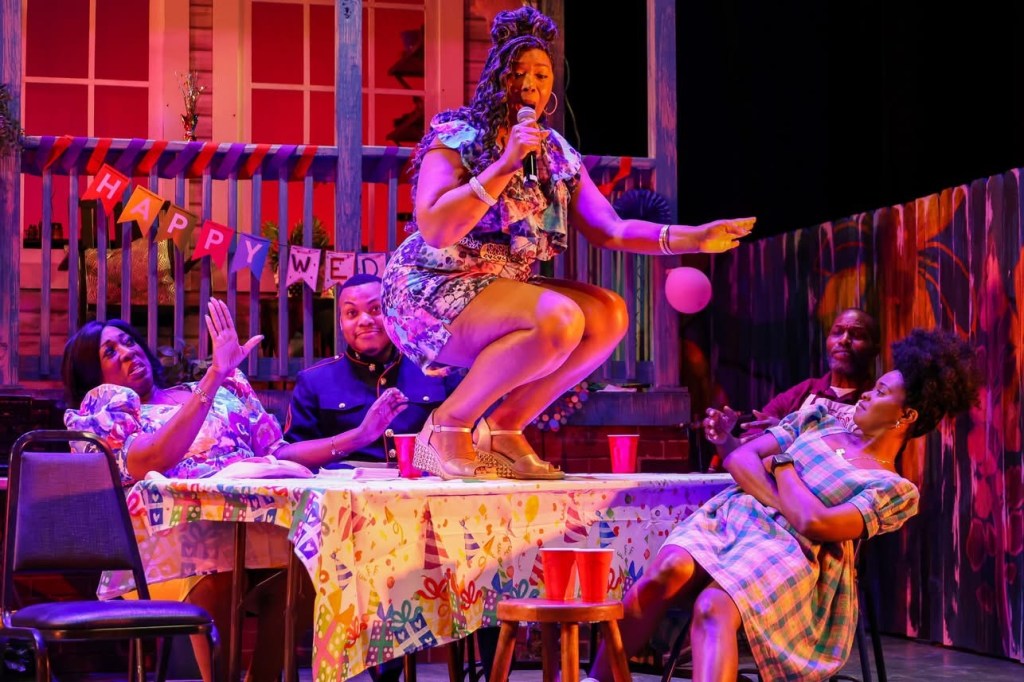
Bringing this show to life, complete with physical comedy, amazing soliloquys, some of which reference Shakespeare and some of which are taken verbatim from the bard’s Hamlet – such as “what a piece of work is a man” – is a dynamic cast consisting of Marcus Antonio as Juicy/Hamlet, Kevin Craig West as Pap/the ghost of Hamlet’s father and Rev/Claudius, Cloteal L. Horne as Tedra/Hamlet’s mother, Gertrude, and Adam E. Moskowitz as Juicy’s/Hamlet’s sidekick Tio/Horatio. Notice the pattern that is beginning to emerge? Jordan Pearson plays Larry/Laertes, Janae Thompson is his sister Opal/Ophelia, and Candice Heidelberg is their mother Rabby/Polonius.
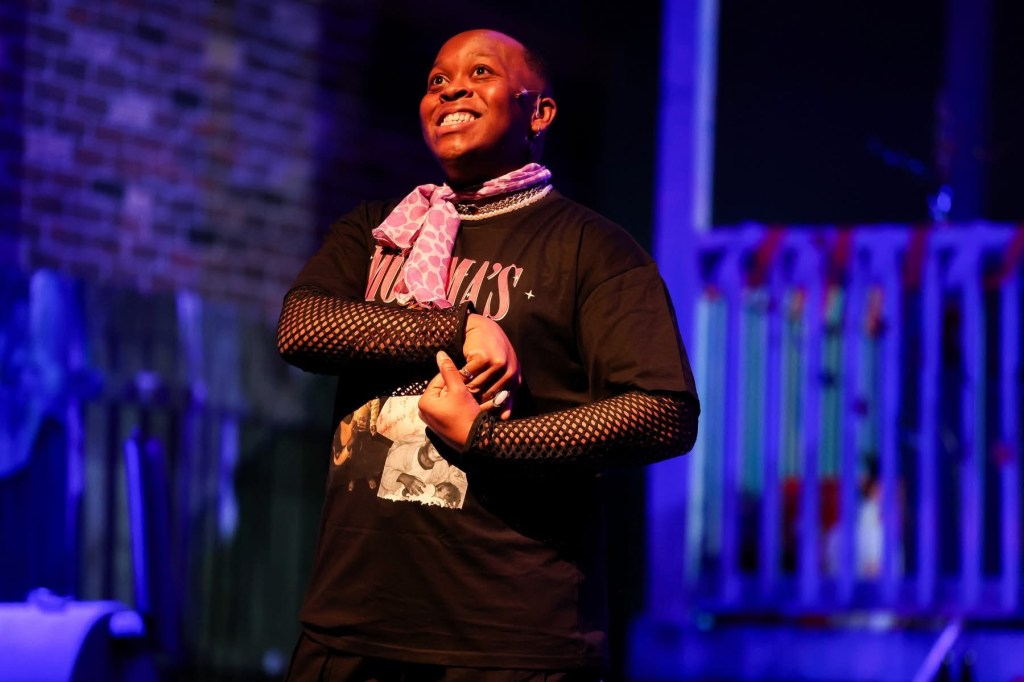
Antonio is alternately sly, soft, philosophical, and just generally endearing as Juicy (although I had a hard time swallowing that name, LOL). Horne is so over-the-top as his mother, Tedra, that the moments when she is serious are all the more powerful. She stands up for Juicy, refusing to allow Rev to spread his homophobic poison and at the same time, like most of the Black mothers I grew up in community with, was very protective of her son while maintaining a boundary that defined how people defined her and her life choices.
Jordan Pearson was a supporting character who came later on the scene but made a huge impact, transforming from a straight-edged marine to puffed sleeves, feathers, and a metallic gold head piece. Moskowitz – who reminded me more than once of a version of Spike Lee, perhaps from Do the Right Thing – shared a bizarre sexual fantasy involving a gingerbread man, a snowball fight, and fellatio that had his character questioning the origins of his weed. It was the kind of story, a confession, that one has to blame on the weed, or on alcohol, in order to be able to hold one’s head up in public ever again!
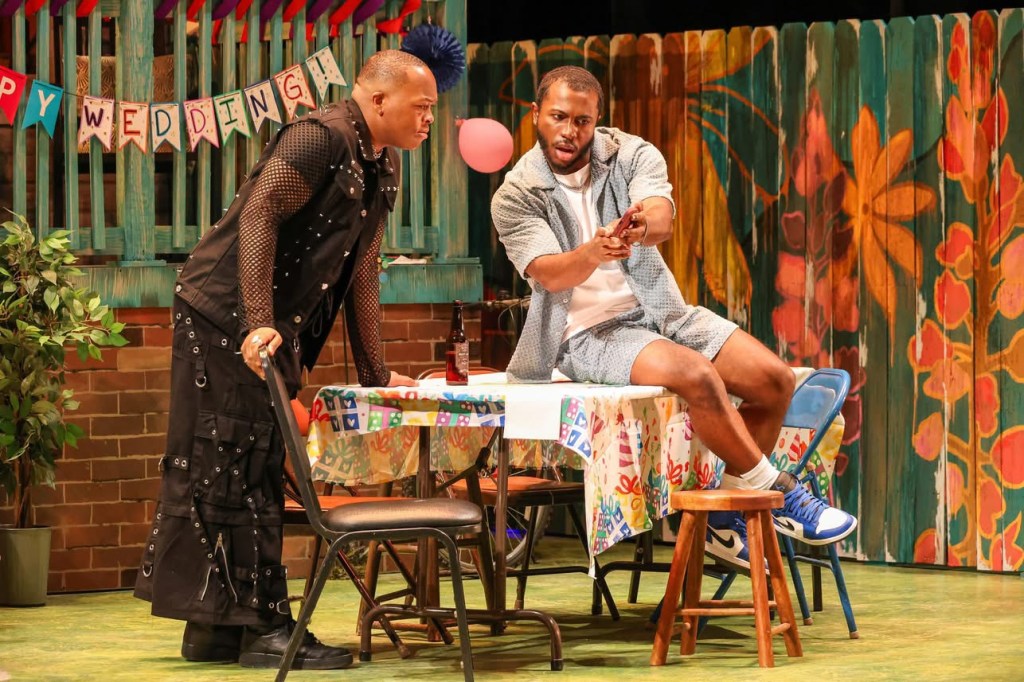
Another memorable scene Moskowitz shared with Antonio involved Juicy asking his friend Tio about his shoes. This gives rise to another direct Shakespearean reference, “You remember Yurick?” It seems Yurick (who was not give a contemporary name) was Juicy and Tio dead friend, and Tio bought Yurick’s shoe at a yard sale being held to raise money for Yurick’s funeral.
Thompson’s Opal, unlike Ophelia, does not end in death by drowning – or any other means – but, rather, with affirmation and freedom. While her brother, Larry/Laertes, is not happy with the military life he is living to please his mother, Opal longs for it – it would provide her freedom she does not currently have as a woman, as a Black woman, as a Queer Black woman.
West, who played the unlikeable brothers Pap (God doesn’t want him and the devil won’t have him) and Rev (a blend of charming yet controlling as are most narcissists), redeemed himself – in the eyes of the audience and his fellow cast member – with a shocking and hilarious death scene.
Unlike a Shakespearean tragedy that ends with most of the main characters dead and strewn about the stage, Fat Ham ends with the cast breaking out in dance. (I believe the script may have originally called for a disco ball to descend at this point.) With the suddenness of this production’s manifestation, and the fun-size stage at Firehouse, it was not possible to transport the stage used in Norfolk, so Firehouse staff constructed a new set in 48 hours!
There is tragedy. There is the angst of young people seeking purpose. There’s the dysfunction that results from the machinations of adults trying to make the best of a difficult situation, the burdens society expects them to carry, and the weight of tragedy. There is also humor and an earnest attempt to make the best of whatever life throws at you. As Tio says, “Why be miserable trying to make somebody else happy?”
—–
Julinda D. Lewis is a dancer, teacher, and writer who was born in Brooklyn, NY and now lives in Eastern Henrico County. When not writing about theater, she teaches dance history at VCU and low impact dance fitness classes to seasoned movers like herself and occasionally performs.
—–
FAT HAM
Written by James Ijames
Directed by Jerrell L. Henderson
CAST
Marcus Antonio ….. Juicy
Candice Heidelberg ….. Rabby
Cloteal L. Horne ….. Tedra
Adam E. Moskowitz ….. Tio
Jordan Pearson ….. Larry
Janae Thompson ….. Opal
Kevin Craig West ….. Pop/Rev
CREATIVE TEAM
Jerrell L. Henderson ….. Director
James Ijames ….. Playwright
Nia Safarr Banks ….. Costume Designer
Caitlin McLeod …..Scenic Designer
Jason Lynch ….. Lighting Designer
Sartje Pickett ….. Sound Designer
Kim Fuller ….. Production State Manager
Performance Schedule:
Wednesday, April 16, 2025 7:30PM Opening Night
Thursday, April 17, 2025 7:30PM
Friday, April 18, 2025 7:30PM
Saturday, April 19, 2025 2:00PM
Saturday, April 19, 2025 7:30PM Closing Performance
Run Time: about 1 hour 45 minutes with no intermission
Photo Credit: Photos on Firehouse & Richmond Triangle Players Facebook pages by Erica Johnson @majerlycreative
Heidelberg, Pearson, and Thompson around the table and Horne atop the tableMarcus AntonioMarcus Antonio and Adam E Moskowitz
One-Time
Monthly
Yearly
Make a one-time, monthly, or annual donation to support rvart review
A Reflection on a Theater Experience by Julinda D. Lewis
Presented By: The Firehouse Off-Site
At: Virginia War Memorial’s VMI Alumni Hall, 621 S. Belvidere St. Richmond VA 23220
Performances: April 4-13, 2025
Ticket Prices: $15 – $35
Info: (804) 355-2001 or firehousetheatre.org
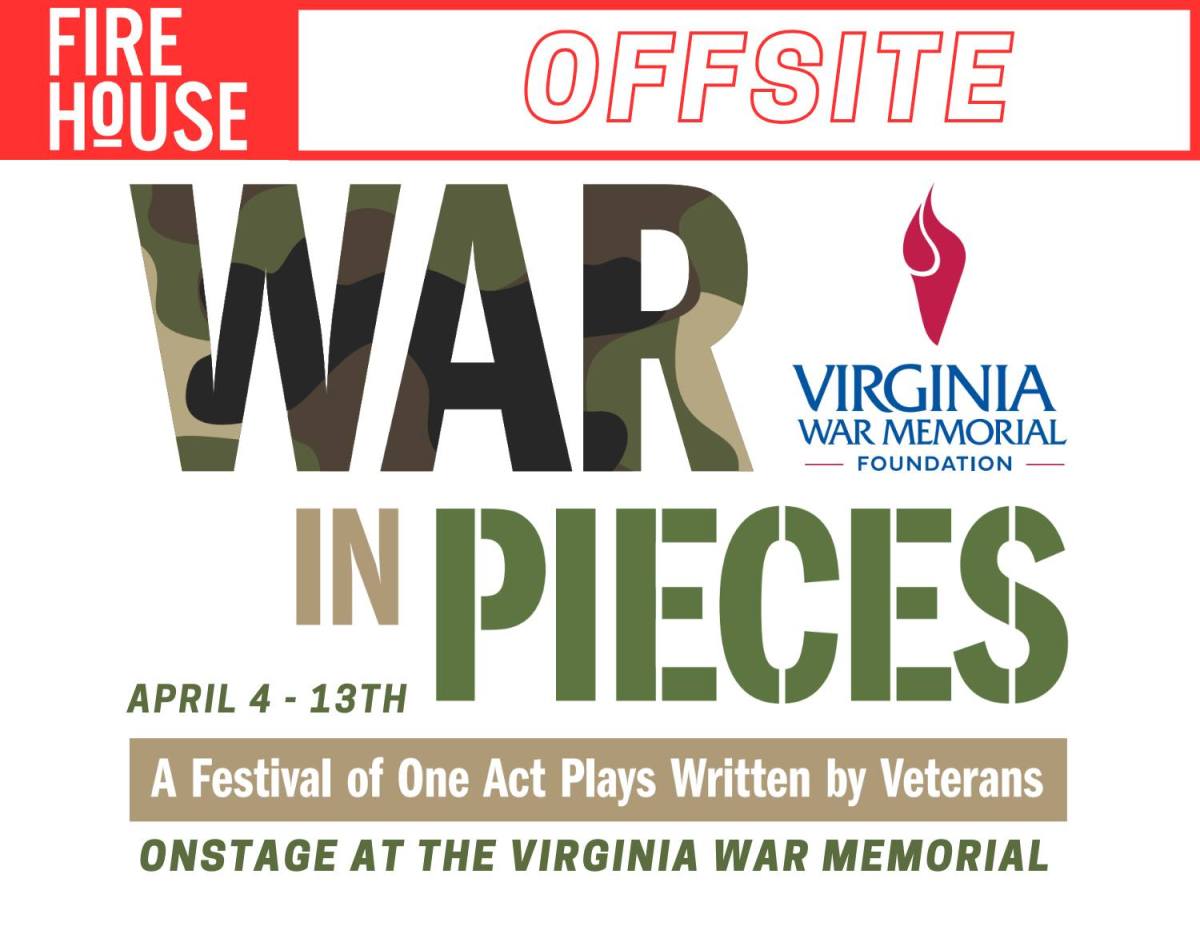
This is not the first War in Pieces festival – I believe the first program of four one-act plays written by Virginia veterans who participate in the Virginia War Memorial’s Mighty Pen Project took place in 2021. The Project is a 12-week long writing workshop taught by David L. Robbins, a best-selling author and professor of writing who founded the program in 2015.
The Mighty Pen authors create works that are (a) creative, (b) artistic documents of military service and history, and (c) form a living documentary of the individuals and conflicts of the US military. Now, it is customary for the pre-show curtain talk to end with an invitation to “enjoy the show,” and after the show, people often ask, “did you enjoy the show?” I am firms convinced that people say/ask this because – like those who ask how you’re feeling when you go to the doctor or hospital – they just don’t know what to say! I can appreciate the message of these plays; I can recognize the artistry of the actors; I can be deeply affected by the message and emotion of the production; but no, I would not use the word “enjoy” to describe what I experience when watching these plays.
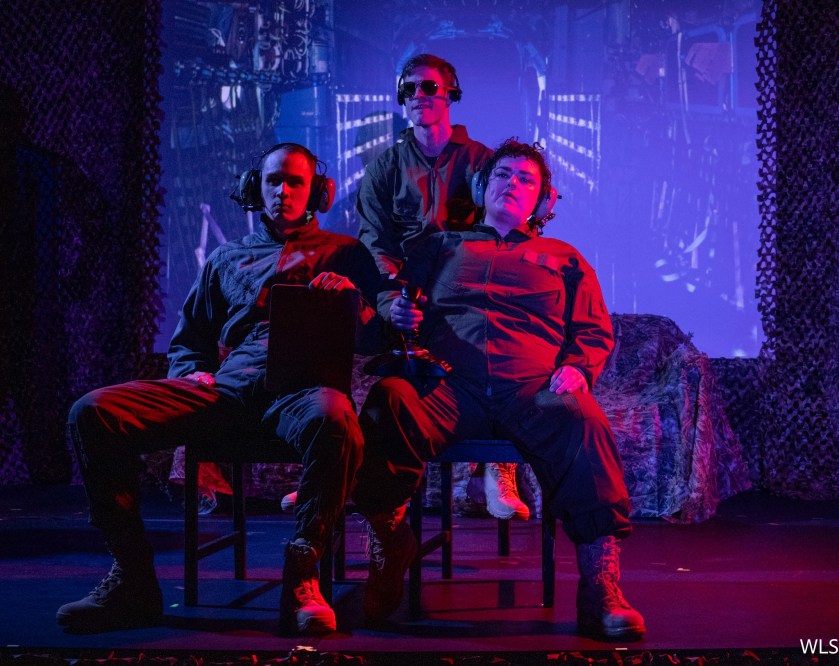
First up was Kaho’olawe, by Harry Mayer (United States Marine Corp & United States Navy). Kaho’olawe is an uninhabited island in the Pacific Ocean, and at 11 miles long by 6 miles wide it is the smallest of the eight main volcanic islands of the Hawaiian Islands. During World War II it was used as a US military training ground and bomb range. In Mayer’s play, Slick, a young bomb technician (played by Colin Barnes), comes upon a bomb on this island and finds that it is armed. He calls for help, but no help is available, and he is forced to use make-shift tools to disarm the bomb. But this is no ordinary bomb! It begins to talk to him, mocking him, doubting his ability, and questioning his skill, indeed his very confidence.
The bomb speaks first in its own voice, and then in the voices of Aunt Pearl and Miss Crabcakes. I had assumed these voices in his head were recorded but no, after the show, director David L. Robbins informed me there were three live actors (Matt Meixler, Donna Marie Miller, and Hayley Cartee) speaking these lines with impeccable timing from their offstage locations. The tension is palpable, but in the end, Slick survives. Whew!
Next up is Shani Miller’s War’s Teeth, a heart-rending story in which Shani, played by Donna Marie Miller, reenacts an encounter with another, older vet, Ed Brown. Miller, the actor, not the author, strategically gives voice to both characters. Miller, the author, served as an Air Force Intelligence Officer, with multiple deployments to Iraq and Afghanistan. Her experience led to her memoir, currently a work in progress, in which she write about finding her lost sense of belonging after being deployed with the help of travel and the birth of her children (three under age six and a fourth on the way).
The second half of the program began with A Couch by Cam Torrens, an Air Force veteran with more than 30 years of service. In A Couch, Cam, an officer, chooses his command over his family, and gets sent to the couch by his wife – who, by the way, outranks him. “Don’t come home,” she says, illustrating the difficult choices that must be made, and how our military families are placed under stress when forced to choose between loyalty to family or loyalty to the mission and their country. Colin Barnes and Hayley Cartee skillfully walked this tightrope as the married couple.
The program closed with The Salute by Larry Meier (United States Army, and recipient of the Bronze Star with Palm for service in Vietnam). The cast of four, consisting of parents Eleanor and Bobby (Lyddall Bugg Brown and Matt Meixler), a support officer (Colin Barnes), and a Pastor (Benedict Burgess) takes the audience on a reluctant tour where we see the effects of war on an ordinary couple as they prepare to bury their son. What makes Meier’s story so powerful, for me, is that the focus is not just on the parents, but also on the young Captain who is sent to provide support for the family. The pastor notices, and offers him comfort, but the burden he carries may already be more than he can bear.
The thing that remains with me, however, is the mother’s reaction. At their son’s funeral, the tension builds until, upon receiving the folded flag from the young Captain, Eleanor springs up from her seat and speaks, in a voice that quickly escalates from a soft plea to a primal scream, “Ya’ll took my little boy, and you give me this – A FLAG!”Tossing the flag on the floor, she storms out of the chapel. There are no words of comfort. Nothing can fix this. It is haunting. This, all of this, is War in Pieces.
—–
Julinda D. Lewis is a dancer, teacher, and writer who was born in Brooklyn, NY and now lives in Eastern Henrico County. When not writing about theater, she teaches dance history at VCU and low impact dance fitness classes to seasoned movers like herself and occasionally performs.
—–
WAR IN PIECES
Four One-Act Plays by Virginia Veterans
Kaho’olawe written by Harry Mayer
Directed by David L. Robbins
CAST
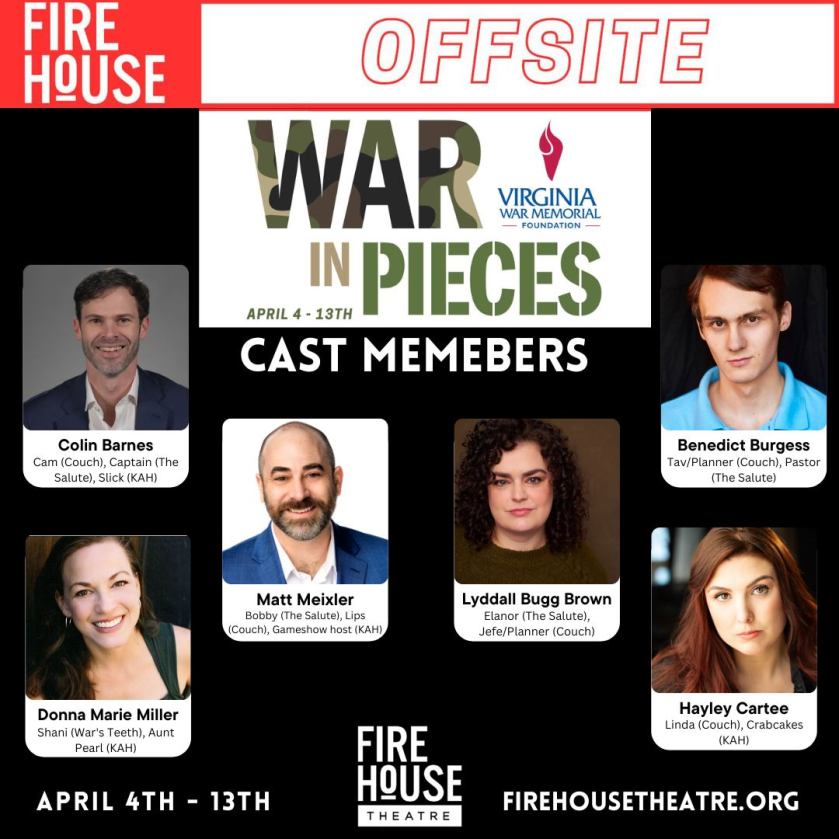
Slick ………. Colin Barnes
Bomb ………. Matt Meixler
Aunt Pearl ………. Donna Marie Miller
Miss Crabcakes …… Hayley Cartee
War’s Teeth written by Shani Miller
Directed by David L. Robbins
CAST
Shani ……… Donna Marie Miller
A Couch written by Cam Torrens
Directed by Andrew Gall
CAST
Linda ………. Haylee Cartee
Cam ………. Colin Barnes
Jefe/Planner ………. Lyddall Bugg Brown
Tav/Planner ………. Benedict Burgess
Lips ………. Matt Meixler
The Salute written by Larry Meier
Directed by Daniel Moore
Pastor ………. Benedict Burgess
Eleanor ………. Lyddall Bugg Brown
Captain ………. Colin Barnes
Bobby ………. Matt Meixler
Production Team
Executive Producer ………. David L. Robbins
Stage Management ………. Dennis Bowe, Grace Brown LaBelle
Sound/Projection Design ………. Grace Brown LaBelle
Costume Design/Coordination … Tallie Pugh
Run Time: About 2 hours; there is 1 intermission
Tickets: $15 to $35
Info: (804) 355-2001 or FirehouseTheatre.org
Performance Schedule:
Friday, April 4 7:30PM
Saturday, April 5 7:30PM
Sunday, April 6 2:00PM
Thursday, April 10 7:30PM
Friday, April 11 7:30PM
Saturday, April 12 2:00PM
Saturday, April 12 7:30PM
Sunday, April 13 2:00PM
———-
PHOTOS: from the Firehouse Facebook page
Benedict Burgess, Colin Barnes, Lyddall Bugg Brown
The Cast of War in Pieces 2025
One-Time
Monthly
Yearly
Make a one-time, monthly, or annual donation to support rvart review!
Costumes designed and constructed by Starrene Foster, except as noted
Lighting designed by Gretta Daughtrey
Live Oak inspired by a photograph by Mike Harrell
Performed by Fran Beaumont, Shannon Comerford, Madison Ernsted, Angela Palmisano
Music by Tamar Halperin, Etienne Abelin, Tokek Kolczynski, Johann Sebastian Bach; Constellation 999:999 After BWV 99 & BWV 1018
_____
Saving Grace inspired by a photograph by Caroline Frye
Performed by Fran Beaumont and Madison Ernstes
Music by Adam Krieger, Andreas Scholl, Tamar Halperin; Nun sich der Tag Geendet hat and Carl Friedrich Abel, Paolo Pandolfo; Viola da Gamba Suite in D Minor: I. Arpeggiata
_____
Wisp inspired by a photograph by Becky Atkins
Performed by Adria Applebee (Thursday, Saturday), Alex Atkins, Roya Baker-Vahdani, Sarah Carrington, Lena Cohen, Ma-Siya Dycus, Sophie Smith 9friday, Sunday), Ella Holland, Molly Huey, Janelle Ragland
Music by Simon Goff; Elowen
Costumes designed and constructed by Johann Stegmeir
_____
Lies Lies Lies inspired by a photograph by PJ Sykes
Performed by Fran Beaumont, Shannon Comerford, Madison Ernstes, Molly Huey, Angela Palmisano
Original music composition by Daniel Deckelman
_____
Flight inspired by a photograph by Georgianne Stinnett
Performed by Molly Huey
Original music soundscape by Starrene Foster with Hour of the Witch composed by Scott Buckley
Costume constructed by Starrene Foster based off a design by Karl Green
_____
Run to You inspired by a photograph by Shannon Mills Guest
Performed by Shannon Comerford and Angela Palmisano
Music by Luca D’Alberto; Beautiful As a Memory
_____
Garnish inspired by a photograph by Allison Patel
Performed by Fran Beaumont, Shannon Comerford, Madison Ernstes, Molly Huey, Angela Palmisano, and guest artists Adia Applebee (Thursday, Saturday), Alex Atkins, Roya Baker-Vahdani, Sarah Carrington, Lena Cohen, Ma-Siya Dycus, Sophie Smith (Friday, Sunday), Ella Holland, Molly Huey, Janelle Ragland
Music by Adrián Berenguer; Reset
____________________________________
The Starr Foster Dance (SFD) website informs us that the company is “committed to their mission to collaborate with all genres of artists in their quest to make the world richer with art.” For Spitting Image 2025, Foster embarked on a collaborative journey with her core company of 5 dancers, 9 guest dancers, and 7 photographers.
Foster notes in the program (always a stunningly beautiful publication in its own right) that the SFD Art Director, Douglas Hayes, is at least in part responsible for her love of photography. In 2018 (in the “time before”) the company produced the first Spitting Imageprogram at TheatreLab, The Basement, inviting photographers from the Richmond area to contribute images to the project. Spitting Image 2025 is the third iteration of this collaborative creation. (The second was in 2023, also at the Firehouse.)
The phrase “spitting image” usually refers to something that looks remarkably similar to another, such as a mother and daughter or father and son. But in the execution of these collaborative offerings the seven brief works are not intended to bring to life carbon copies of the still images, but rather each captures a moment, an essence, a fleeting fragment from the photograph and then builds on it, takes flight, elevates it, or even takes a quirky turn. The photographs were on view in the theater lobby, and are available to view on the SFD website, https://www.starrfosterdance.org/spittingimage2025, but due to copyright may not be reproduced here.
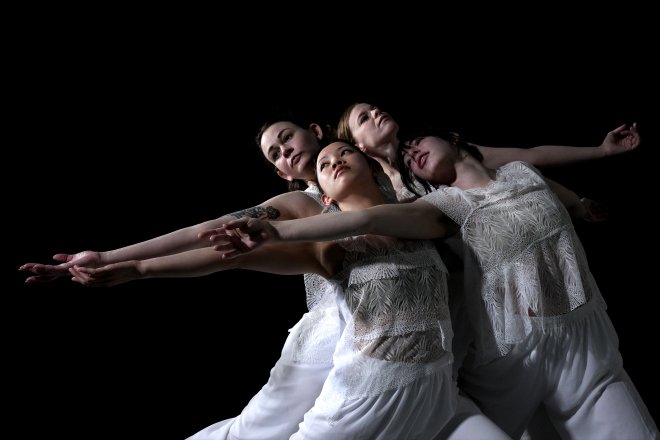
Mike Harrell’s black and white photograph depicts an aisle of tall trees whose tops meet and intertwine above the road. The Live Oak dancers’ white palazzo pants and lacy white tops mimic the lacy tree branches and at one point the lacy pattern is recreated on the floor in lights. Their movements are mysterious and weighted, a lift and drag suggests the strength, durability flexibility, and stability of trees, and the shapes fit together like puzzle pieces. Very mindful. Very demure.
Caroline Frye submitted a photo of a backyard clothesline with what appears to be a heavy rug hanging out to air or to dry. Fran Beaumont wears neatly tailored pants and a button-down shirt that reminded me of a schoolgirl’s uniform, while Madison Ernstes, lingering in the background, wore a dark shirtwaist dress. For me, Saving Grace created an image of a portal, a doorway, perhaps into the past. The atmosphere made me consider various meanings of the phrase, “saving grace.” It can mean a redeeming quality, but it could also, literally mean saving someone named Grace – or it could be a bit of both…
Becks Atkins photo of clouds inspired Wisp, one of my personal favorites. Dressed in short white or pale gray pants with asymmetrical tops, the dancers began in a single file line, facing the audience and ended in a cluster like delicate flower petals. The music and movement both seemed to have a delicate Asian flavor, simple, and beautiful.
The first half of the program closed with Lies Lies Lies, inspired by PJ Skyes’ angular, industrial offering – three views of a wall that holds the remains of a sign that once said “SUPPLIES.” Hmm, could this be a subtle statement about how things are not always what they seem to be – or an even more rare statement on the current political climate? Without reading more into it than intended, Foster’s choreography for this piece is urgent, driven, and percussive, and set to an original score that is equally urgent, driven, and percussive. Altogether, Lies Lies Lies is quite a departure from other works on the program, aggressive, but not angry.
The second part of the program opened with a solo, Flight, performed by Molly Huey. Inspired by Georgianne Stinnett’s intimate close-up of a bee collecting pollen from the reproductive organs of a flower, Huey’s movement are big and remind me of the inner workings of a traditional timepiece. The original soundscape consists of a series of musical explosions with an underlying base of small ticks, like a fine watch – or a time bomb.
Run to You, another personal favorite is a tender duo, performed by Shannon Comerford and Angela Palmisano. Intriguing lighting creates shadow play that makes the two dancers appear to be four or six. Inspired by Shannon Mills Guest’s photograph of two women sitting side-by-side, one with long blond hair and one with long dark hair. Foster carries out the visual opposition with costuming: one dancer wears white ruffled fabric on top, the other on the bottom, while the shadows double and triple the relationships, building and extending the connection between the sisters, friends, or whatever you need the relationship to be.
The program closed on a humorous and quirky note with Garnish, a work for 13 dancers, each wearing a flower-patterned dress, each in a different pattern. Lined up across the stage, they grimace, give a side eye, and more in a cork that is casual, funny, and energetic. Garnish is inspired by Allison Patel’s photograph of a woman applying makeup. Eyes wide, lips pursed, the image fuels the dancers’ facial gymnastics and extends the movement through their entire bodies. Garnish is definitely the icing on the cake.
———-
Julinda D. Lewis is a dancer, teacher, and writer who was born in Brooklyn, NY and now lives in Eastern Henrico County. When not writing about theater, she teaches dance history at VCU and low impact dance fitness classes to seasoned movers like herself and occasionally performs.
Company Artists: Fran Beaumont, Shannon Comerford, Madison Ernstes, Molly Huey, Angela Palmisano
Guest Performers: Adria Applebee, Alex Atkins, Roya Baker-Vahdani, Sarah Carrington, Lena Cohen, Ma-Siya Dycus, Sophie Smith, Ella Holland, Janelle Ragland
Costumes Designed and Constructed by: Starrene Foster, with the exception of the costumes for “Wisp,” designed and constructed by Johann Stegmeir
Starr Foster Dance is a Resident Company of the Firehouse Theatre
Performance Schedule
SPITTING IMAGE PERFORMANCE SCHEDULE Thursday, April 3rd 7:30PM Opening Night/Post Show Q&A Friday, April 4th 7:30PM Champagne Night with Cast & Artistic Team Saturday, April 5th 2:00PM Saturday, April 5th 5:00PM Post Show Q&A Sunday, April 6th 2:00PM Closing night
Run Time
1 hour 20 minutes plus one15-minute intermission
One-Time
Monthly
Yearly
Make a one-time, monthly, or annual donation to support the publication of rvart review. we receive no funding and do not charge you for a subscription or require you to navigate a paywall…
Inspired by an excerpt from a memoir written by Sheena Jeffers
Performed by Fran Beaumont, Shannon Commerford, Madison Ernstes, Molly Huey, Angela Palmisano
Music by Scott Buckley, Balefire
Costumes designed and constructed by Starrene Foster
Ned, Steven
Inspired by a story written by Dr. Tim Wenzell
Performed by Molly Huey & Angela Palmisano
Original Music Composition by Daniel Deckelman
Costume Design by Starrene Foster
A Soft Neglect
Inspired by a poem by Tara Shea Burke
Performed by Sara Burtner, Danielle Cecile, Hailey Clevenger, Ma-Siya Dycus, Madison Ernstes, Olivia Gotsch, Janelle Ragland, Roya Baker-Vahdani
Music by Pieter de Graaf, OCD
Costumes Designed and Constructed by Starrene Foster
Elegy to Childhood
Inspired by a story written by Judith Rice
Performed by Fran Beaumont, Shannon Comerford, Molly Huey, Angela Palmisano
Music by Morryc, Saint-Saens
Costume Designed and Constructed by Tamara Cobus
Good Mourning
Inspired by a poem written by Geraldine Beaumont
Performed by Shannon Comerford & Fran Beaumont
Original Music Composition by Daniel Deckelman
Costume Designed and Constructed by Johann Stegmeir
Not a Dream
Inspired by an excerpt from a memoir written by Caitlin McGill
Performed by Madison Ernstes
Music by Valgeir Sigurõsson, The Crumbling
Costume Designed and Constructed by Starrene Foster
Middle Passage
Inspired by a poem written by Y.B. Taylor
Performed by Fran Beaumont, Shannon Comerford, Madison Ernstes, Molly Huey, Angela Palmisano, and guest artists Sara Burtner, Danielle Cecile, Hailey Clevenger, Ma-Siya Dycus, Olivia Gotsch, Janelle Ragland, Roya Baker-Vahdani
Music by Ran Bagno, Sticks (Vertigo 20)
Costume Designed and Constructed by Starrene Foster
**********
A few days before the opening of Starr Foster’s latest iteration of her Page to Stage project, I sat with Starr watching her company rehearse. It was the night of the Richmond Dance Awards, and during the rehearsal Starr received word that her company had been recognized as the Best Professional Dance Company in Richmond for the 2024 season. She was honored but humble. I was not surprised that she was honored. I was also not surprised that she was humble. She deserved it. But she had work to do, and celebrating would come later.
Page to Stage III, like its predecessors, is an artistic marriage of dance with poetry or short stories. Building on the programs that came before (in 2015 and 2022), the concept has matured, it has reached a place of balance and – dare I say – perfection. There was drama, humor, and even controversy. It’s dance for people who like movement, and movement for people who like words – a visualization of the words on paper, but without mimicking or condescending.
The program began with Living Tidal, a work for five dancers inspired by Sheena Jeffers’ story of the end of a relationship – that point when you feel you no longer belong, that you’re in the wrong place, when, quite simply, “our time has come.” For the stage Foster crafted a tight drama that veers away from the idea of a couple. It becomes personal, not just for Foster or Jeffers, but for each of us in our own way.
Ned, Steven is a comedic duet performed by two dancers in workman-like jumpsuits with name tags. Here, Foster has taken a tiny snippet of a story and turned it into a whole scenario – one can’t help but wonder what goes on Foster’s mind to produce these flashes of brilliance. The one word that best describes A Soft Neglect is “relational.” The work, performed by the talented troupe of guest performers, ended with a haunting image of the soloist’s chattering hands that, for me, seemed to perfectly capture the poet’s words: “Maybe families kill. Not with their hands, but a soft neglect – they let the needy bird stay stuck chirping in the mud, one foot too deep to be free.”
The first half of this program closed with Elegy to Childhood. The dancers began in individual squares of light, moving with simplicity and repetition that contrasted interestingly with the edgy, anxious complexity of Good Mourning that opened the second half. Even more noteworthy, the poem, Good Mourning by Geraldine Beaumont, was written by a company member who also performed in the duet. Not a Dream, inspired by a story by Caitlin McGill, is filled with subtle details and articulations of the smallest joint, in stark contrast to big, bold movements. Overall, the work – the only solo on the program, performed by the talented and versatile Madison Ernstes, reminded me of a visualization of good touch/bad touch.
The program concluded with what could have been the most controversial work on the program. The title, Middle Passage refers, of course, to the transporting of enslaved Africans from West Africa to the Americas. This is a topic most White choreographers would – rightfully – steer clear off, for obvious reasons [you know…appropriation]. Author Y.B. Taylor, who, according to Style Weekly, was Huguenot High School’s first African American homecoming queen in 1971 and one of six African American students to integrate Albert H. Hill Junior High School in 1966 has an interesting personal history and was apparently more than willing to entrust her story to Starr Foster. [https://www.styleweekly.com/third-times-a-charm/]https://www.styleweekly.com/third-times-a-charm/https://www.styleweekly.com/third-times-a-charm/
Rather than a retelling of the horrors of the cross-Atlantic slave trade, Taylor’s poem, written on a flight home from Europe, contrasts her own experience with that of those earlier, reluctant passengers. Given this perspective, Middle Passage becomes a story that belongs to anyone in a period of major transition. Given that Foster’s company is an all-female ensemble, it becomes a story of women.
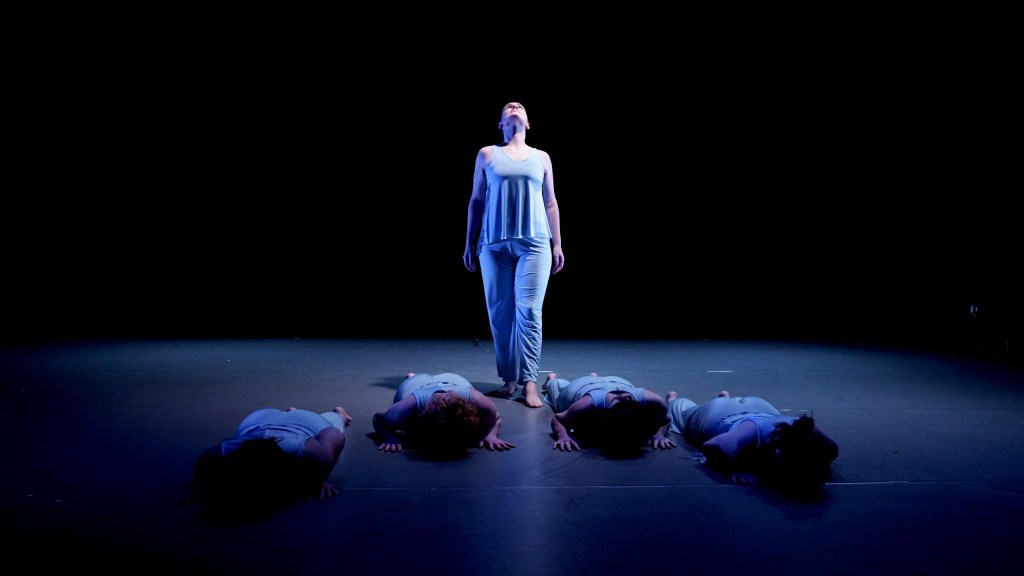
Mechanical sounds, distant whirrs and thunderings and the echoes of time ticking away support the movement. A group of women leans side-to-side, moving as a unit, their palms barely supporting their heads. Little tags on their dresses, barely visible to the naked eye, subliminally suggest a label, a brand, a way, perhaps, of reminding someone they are a commodity – but maybe I’m going deeper than necessary. At the end, the women are kneeling, but not bowed – resilient, resistant, released…
Some say the third time is the charm. This is Foster’s third iteration of Page to Stage, and the shows just keep getting better. This program developed a unique collaboration of words and movement, not a visualization of the word, but a whole new creation with a life of its own, and an underlying theme of various kinds of relationships. Taken together, the separate works seem meant to be together – and they are also worthy of discussion. A casual post-performance discussion with a friend predictably revealed questions – even a bit of confusion – about Middle Passage. I hope there are future opportunities to pursue much needed discussions about difficult topics to their logical conclusion: a deeper understanding and greater inclusiveness.
———-
Julinda D. Lewis is a dancer, teacher, and writer who was born in Brooklyn, NY and now lives in Eastern Henrico County. When not writing about theater, she teaches dance history at VCU and low impact dance fitness classes to seasoned movers like herself, and occasionally performs.
IMPORTANT PROGRAM NOTE: The poetry and stories appearing in the playbill and on the Starr Foster Dance website were published with the permission of the authors and publishers. All material is protected by copyright under U.S. Copyright laws and may not be copied or reproduced without permission of the copyright holder.
Starr Foster Dance is a Resident Company of the Firehouse Theatre
Performance Schedule
Thursday, December 5th, 7:30PM
Friday, December 6th, 7:30PM
Saturday, December 7th, 2:00PM & 5:00PM
Sunday, December 8th, 2:00PM
Post-performance Q&A after the Thursday and Saturday evening performances
Champagne toast after the Friday evening performance
Run Time
About 2 hours
Living TidalA Soft NeglectElegy to ChildhoodGood MourningGood MourningNot a DreamNot a DreamMiddle PassageMiddle Passage
One-Time
Monthly
Yearly
Won’t you Please Make a one-time donation to support rvart review?
At: Richmond Triangle Players at the Robert B. Moss Theatre | Carpenter Foundation Stage, 1300 Altamont Ave, RVA 23230
Performances: September 11 – October 5, 2024
Ticket Prices: $50
Info: (804) 346-8113 or rtriangle.org
———-
NOTE:For the last review I wrote for this space, I confessed that I was unfamiliar with the play prior to seeing it, but someone kindly pointed out that I had actually reviewed the Richmond premiere several years prior. I wasn’t caught off guard this time. I remembered seeing this play before – in the same theater! – and my review of that earlier production was published in the Richmond Times Dispatch, February 20, 2015.
———-
September 13, 2024:
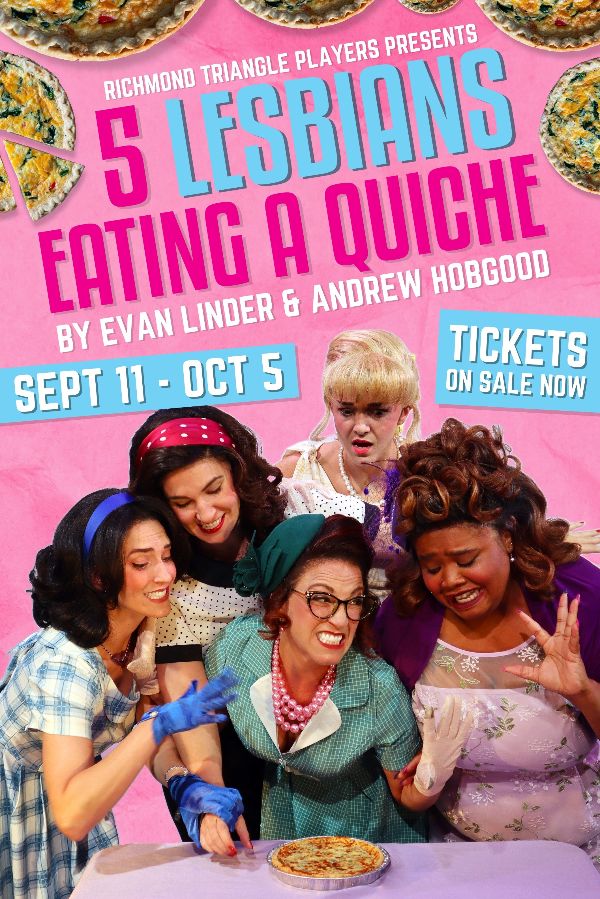
The leaders and members of the Susan B. Anthony Society for the Sisters of Gertrude Stein are gathered in the newly renovated community center for their annual Quiche Breakfast, but all is not as picture perfect as it appears on the surface. It’s 1956 and the country is uneasy about the prospect of impending nuclear attack and many – let’s be honest, all – of the widows (wink, wink) share a secret that no one dares speak aloud. When the security system signals a nuclear attack, everything changes.
The authors, Evan Linder and Andrew Hobgood – and the artistic team at Richmond Triangle Players – were eerily prescient. Change the year from 1956 to 2024 and the political climate, the threat of terrorism, and the challenges (dangers?) of being yourself are pretty much the same. I’m sure it was accident, no mere coincidence, that this production was planned for this pre-election period.
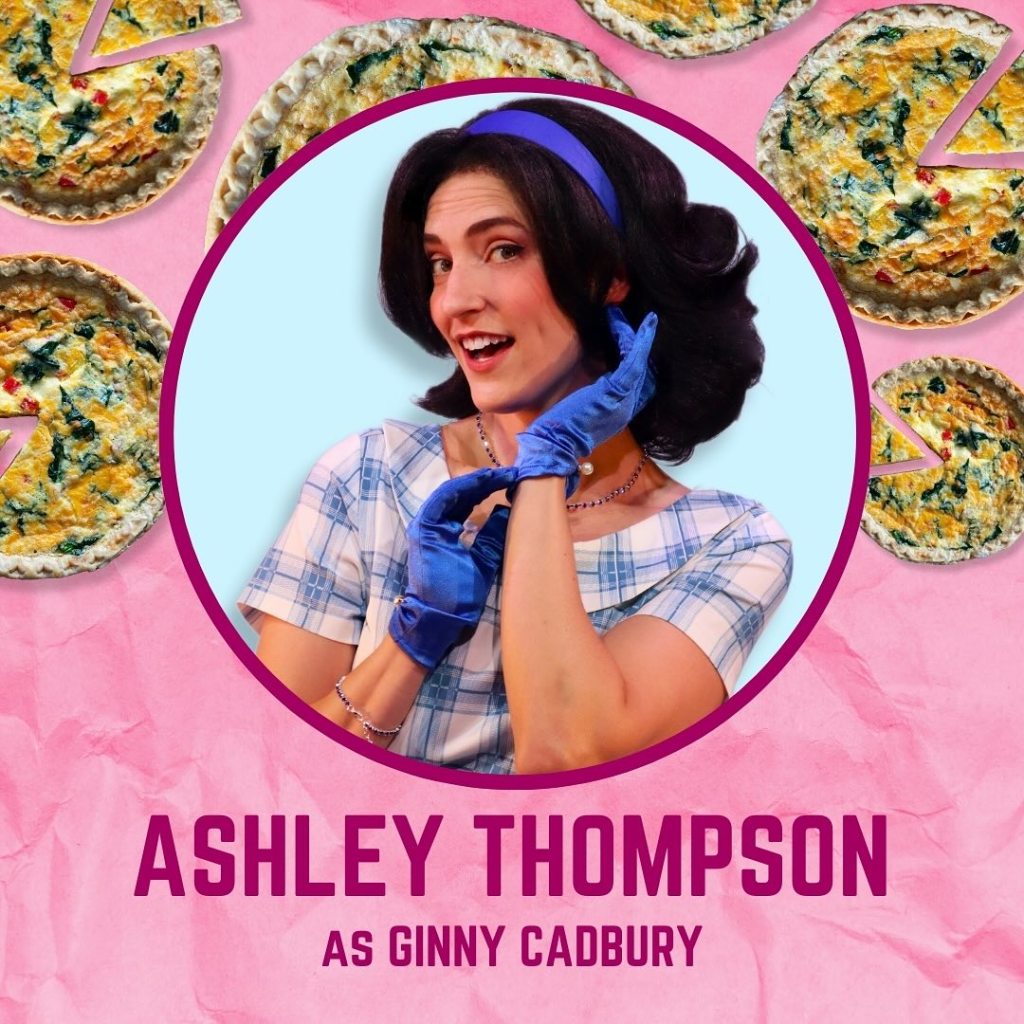
William Luther’s near cartoon-style set and gorgeous 1950s style dresses with their swinging skirts – some fluffed up by crinolines – stunning vintage shoes, hair bows, fascinators, and lace gloves are a feast for the eyes. The very demure outer appearance only makes the underlying sexual tension, innuendo, and banter that permeate each scene that much steamier. When Ashley Thompson’s character, Ginny Cadbury, the over-eager newest member of the group ends up atop a table with her face buried in a plate of quiche it’s as if a group of church ladies had suddenly put down their needle point to engage in an orgy. But I’m jumping ahead.
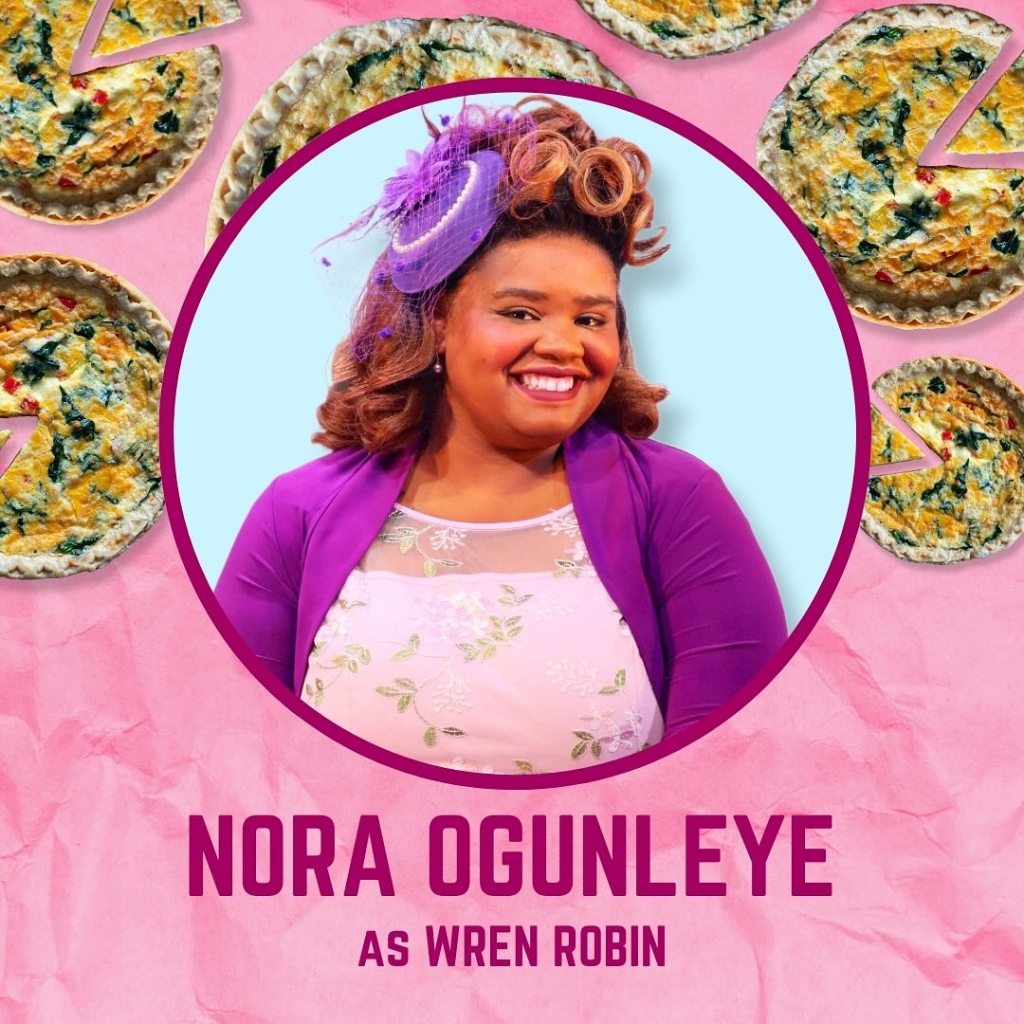
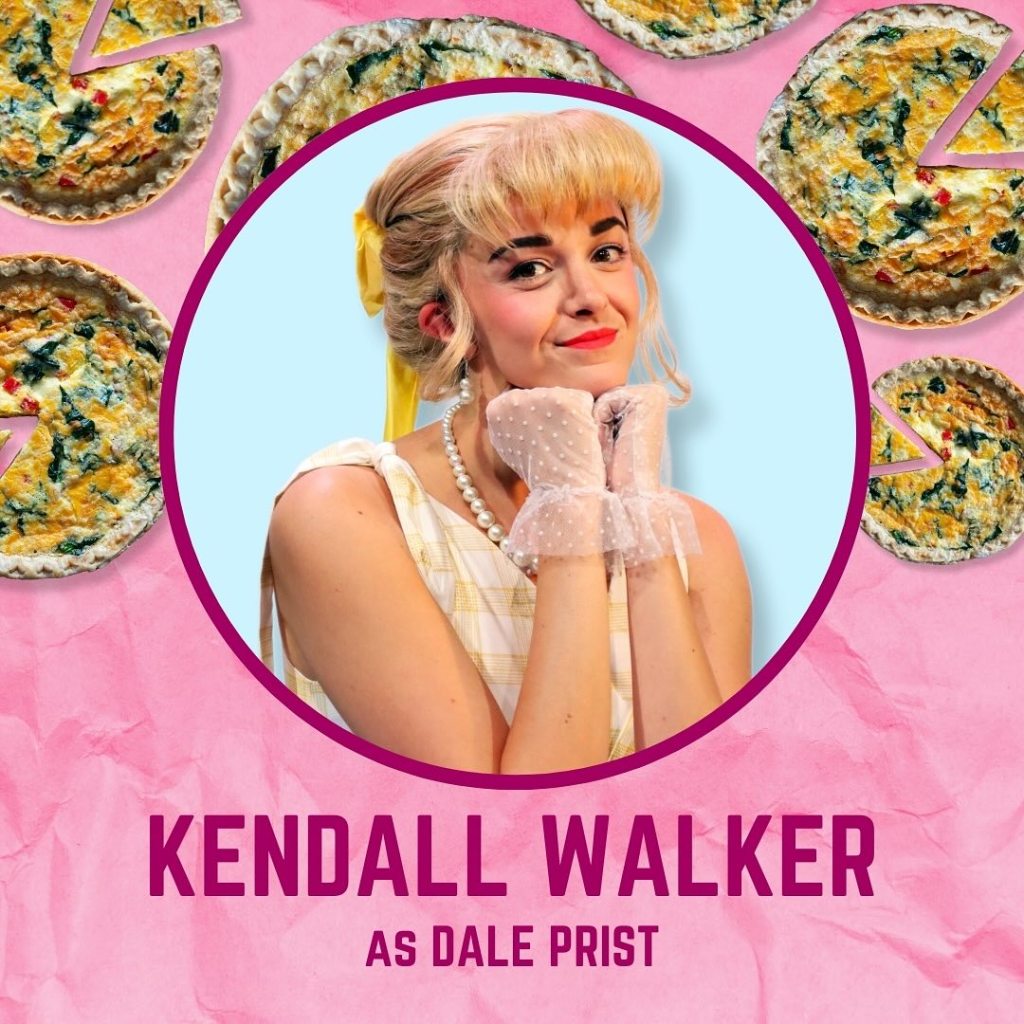
Theater-goers aka members receive name tags on arriving at their seats. Everyone gets a “female” name. I was Virginia this time. There is a lot of audience interaction, and one front-seat viewer in particular – “Margery” on opening night – gets to have an on-going supporting role. Nora Ogunleye as Wren Robin is the club’s event chair. Ogunleye, looking fabulous in a purple ensemble with matching hat and shoes brings over-the-top optimism and a mile-wide smile to the role. Kendall Walker plays Dale Prist, a wide-eyed innocent who looks like an animated Barbie doll and serves as the group’s historian with a classic Eastman-type film using camera around her neck.
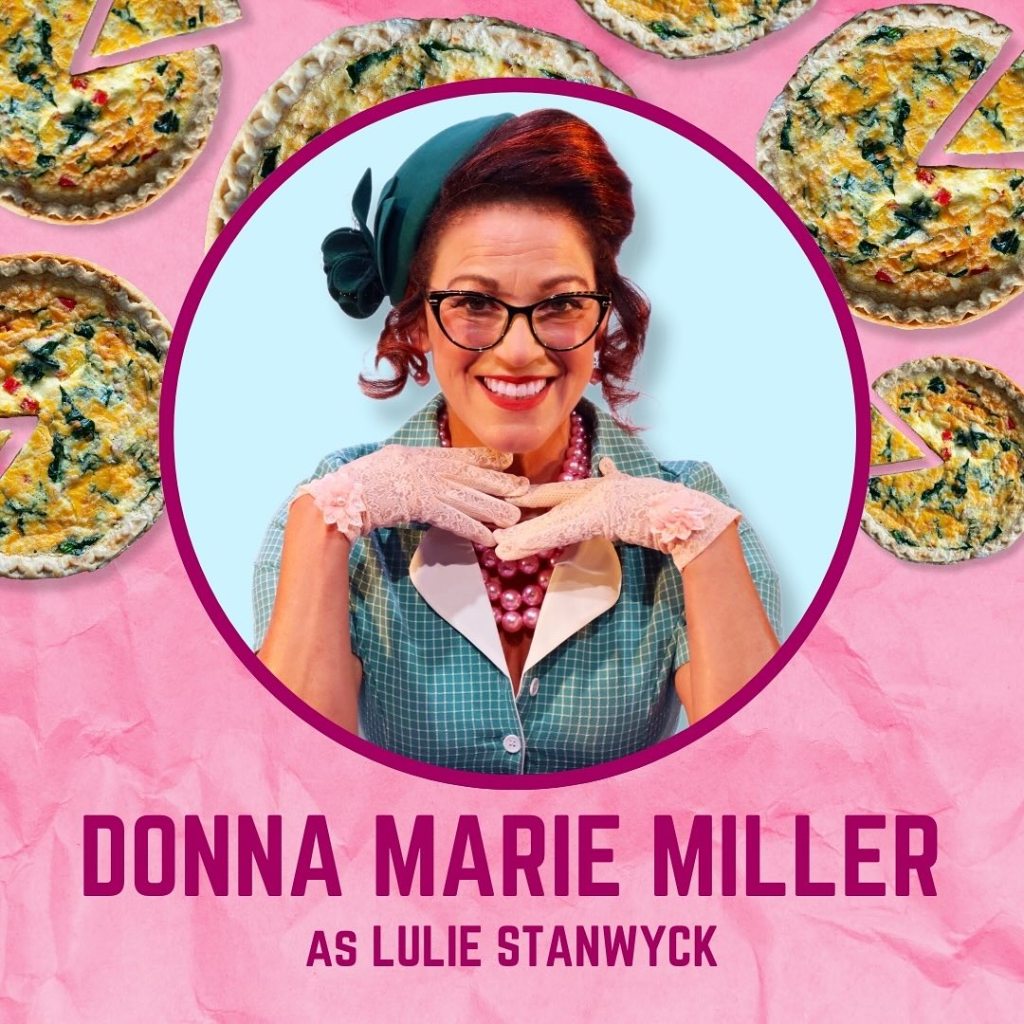
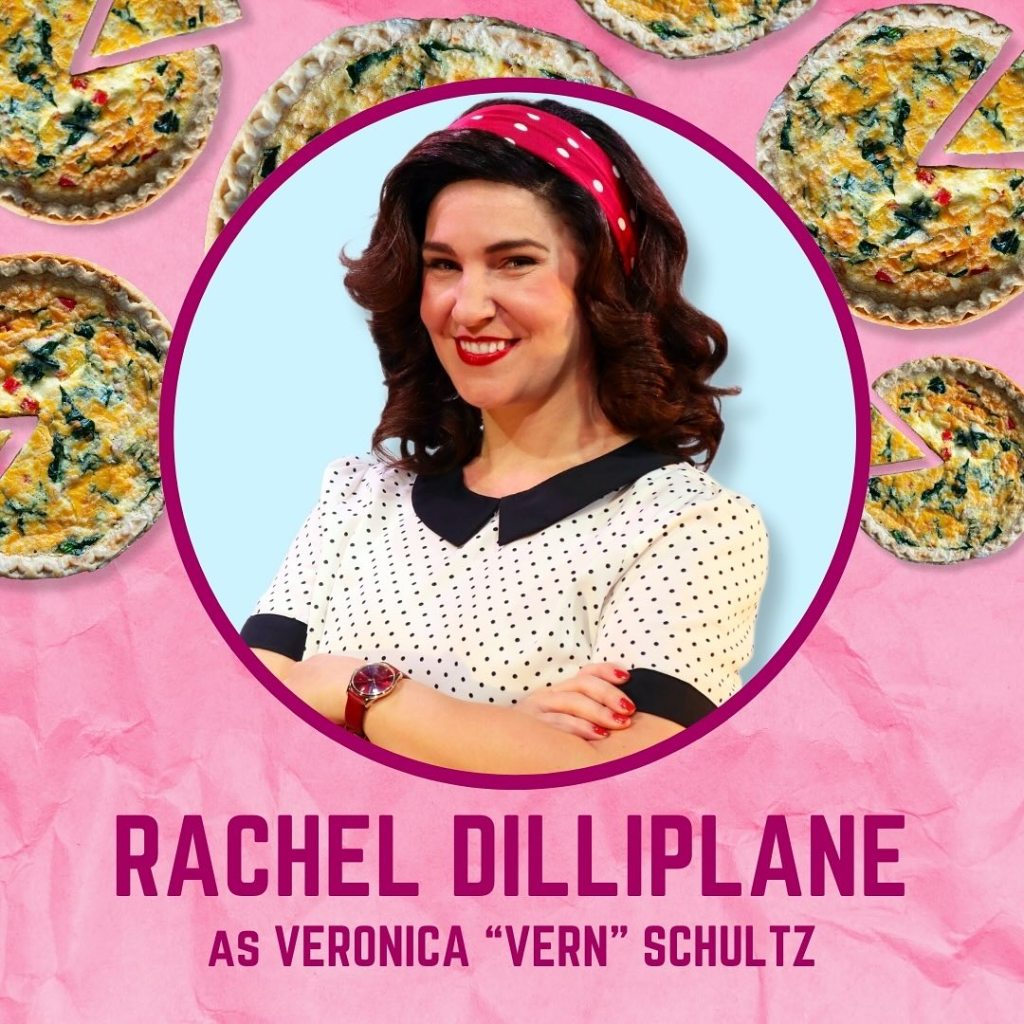
Rachel Dilliplane brings barely repressed butch energy to Veronica “Vern” Schulz, the group’s buildings and grounds manager. Vern is the only one of the five women bold enough to wear pants, and in spite of her tight control over just about everything in her immediate world, Vern is the one who dropped the ball when it most mattered. Ashley Thompson slays as Ginny Cadbury, the newest member and recent British transplant who serves as the secretary. We never learn why – or if we did, it went over my head – Ginny is ostracized by the rest of the leadership team. Last but not least, Donna Marie Miller has the role of the group’s President, Lulie Stanwyck. A stickler for rules and protocol, who lives by the motto “no men, no meat,” it is Lulie who drops the biggest bombshell (I actually did not know that pun was coming) after the five find themselves confined to the shelter – with the possibility they may have to remain there for four long years.
Everything was moving along according to plan, you see, although there is a hint that things are not as they appear – when suddenly the lights flicker, the alarm sounds, and the safety door locks everyone inside against a nuclear attack. With seemingly nothing left to lose, it’s time to finally let go of long-held secrets. It turns out that “widow” is used here as a euphemism for lesbian. Once that is out in the open – and some are more reluctant to name their truth than others, and not even the audience is not exempt from participating in the apocalyptic confession – the floodgates open to reveal all sorts of secrets and Dale has an opportunity to earn a special place in the history of the sisterhood.
This cast is bright and snarky and generally hilarious. The costumes and set are visually delightful. The lighting and sound effects are appropriately over-the-top. The audience’s immersion pushes the edge of an unnamed boundary that gives heightened meaning to the word inclusion. What other play do you know of that encourages the audience to sing along to the theme song of an elite society and have everyone shout out, “I am a lesbian!” The issues are real: nuclear warfare, loyalty, discrimination, oppression, same-sex marriage. The timing of lines by the ensemble and the overall pacing set by director Kelsey Cordrey never attempts to belittle any of this, while at the same time guaranteeing there is never a dull moment. In short, 5 Lesbians Eating a Quicheis breathlessly entertaining.
———-
Julinda D. Lewis is a dancer, teacher, and writer who was born in Brooklyn, NY and now lives in Eastern Henrico County. When not writing about theater, she teaches dance history at VCU and low impact dance fitness classes to seasoned movers like herself, and occasionally performs. Her most recent (ad)venture was the premiere of a solo work, The Waters of Babylon or Psalm 137 Revisited: a Post-Exodus Reflection in Movement Choreographed From Collective Memories for the debut of the Critical Race Theatre Project, right here at RTP in August 2024.
———-
5 LESBIANS EATING A QUICHE
Written by Evan Linder & Andrew Hobgood
Directed by Kelsey Cordrey
Cast
Rachel Dilliplane as Veronica “Vern” Schultz [Note: the program spells her name Dillaplane but I used the spelling I’ve seen virtually everywhere else including her own social media]
Donna Marie Miller as Lulie Stanwyck
Nora Ogunleye as Wren Robin
Ashley Thompson as Ginny Cadbury
Understudies
Kendall Walker as Dale Prist
Emils Berry u/s for Wren Robin & Veronica “Vern” Schultz
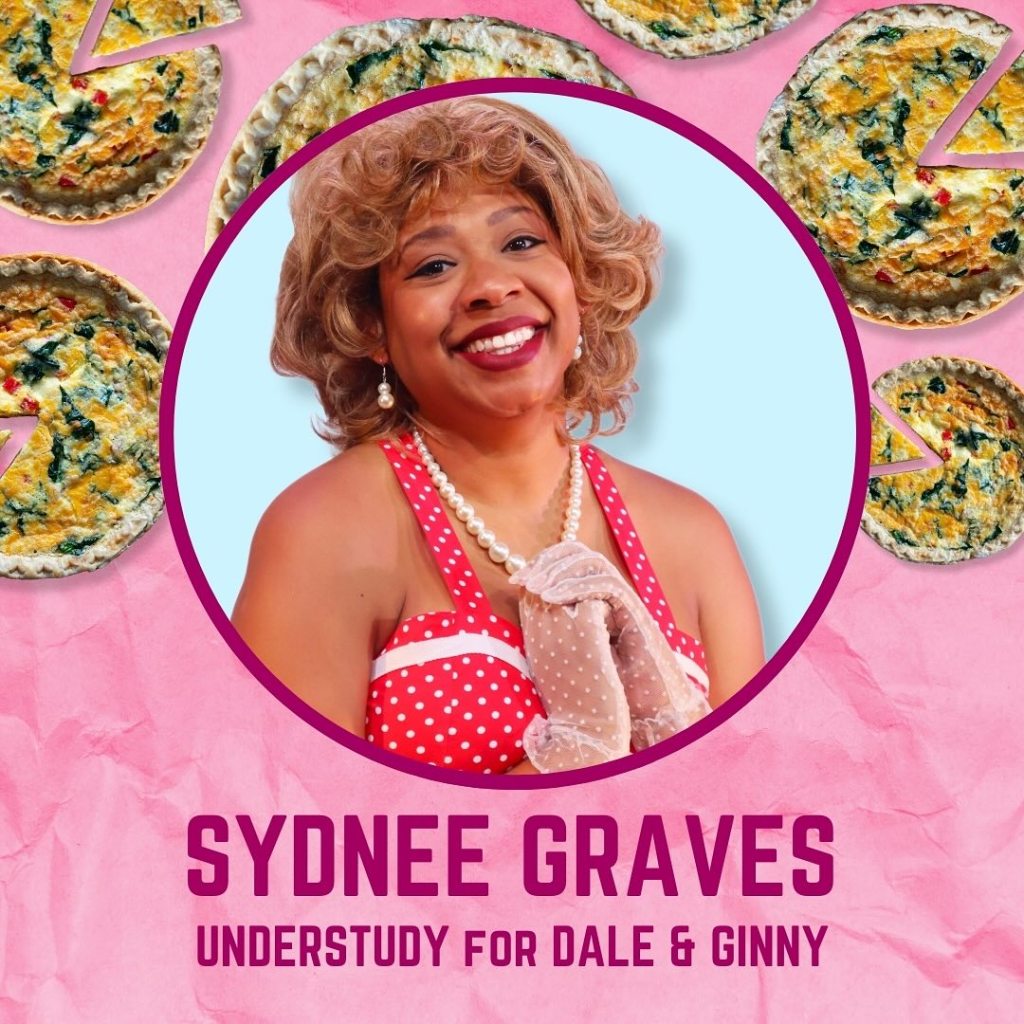
Sydnee Graces u/s for Dale Prist & Ginny Cadbury
Jen Hines u/s for Lulie Stanwyck
Production & Design
Playwright – Evan Linder & Andrew Hobgood
Director – Kelsey Cordrey
Scenic & Costume Design – William Luther
Lighting Design – Gretta Daughtry
Sound Design – Lucian Restivo
Props Design – Tim Moehring
Hair & Makeup Design – Luke Newsome
Production Stage Manager – Corrie Yarbrough
Assistant Stage Manager – Finn Thomason
Intimacy & Fight Director – Lucinda McDermott
Gender Consultant – August Hundley
Master Electrician – Griffin Hardy
Technical Director & Scenic Artist – William Luther
Scenic Construction – David Ballas, Josie Carter, Becka Russo, Kendall Walker
Setting
A community center in middle America where the annual Quiche Breakfast of the Susan B. Anthony Society for the Sisters of Gertrude Stein is being held. Today, 1956.
Run Time
Approximately 70 minutes without intermission
Ticket Information
$50, Info: (804) 346-8113 or rtriangle.org
Photo Credit: unattributed
One-Time
Monthly
Yearly
Make a one-time or recurring donation to show your support of RVART Review
NOTE: It’s just about impossible to talk about this play without giving away some of the best parts. If you haven’t seen it yet and wasn’t to be surprised, you might want to wait until after you’ve seen it to read this. But yes – do see it – and then comment if you like. I’d love to hear what you think. -JDL
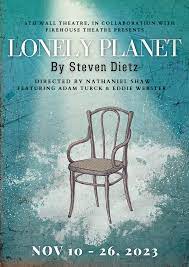
Steven Dietz’ two-person play, Lonely Planet (1993) borrows freely from (as in pays homage to) Eugène Ionesco’s absurdist play, The Chairs (1952), but while there are elements of the absurd and quite a bit of humor in Dietz’ play, it is at heart neither absurd nor a comedy – it is a play about manifested grief.
Set in an unnamed American city during the 1980s, Lonely Planet tells the story of two friends, Jody and Carl, who are each in his own way handicapped by the AIDS epidemic that is raging outside the doors of Jody’s quiet little map store.
Jody copes by withdrawing into the safety of his store, where the distortions of the Mercator map become a metaphor for the distortions of the world around him. At one point Carl quotes some frighteningly high number of deaths among people they know. Where Jody withdraws, Carl feels compelled to do something.
One day a single chair appears in Jody’s shop. Then another and another, until his safe haven is cluttered with chairs – each representing a dead friend. Carl’s place is too small to hold these monuments. He describes his apartment as so small that he has only one chair – a silver kitchen chair with a turquoise seat. In the final scene, Jody – who has finally found the strength to venture back outside – arrives at his shop to find Carl’s chair in the center of the space.
An impossibly balanced jumble of chairs greets the audience on entering the space, and Daniel Allen’s set filled with racks of rolled maps and map tables and all things cartographic is stunning and immersive. Todd LaBelle’s sound design likewise lulls us willingly and unsuspectingly into Jody and Carl’s world – before we realize that this world’s foundation is grief, loss, and tragedy.
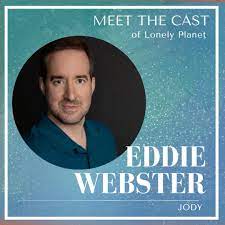
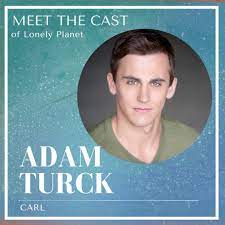
Eddie Webster brings a gentleness and vulnerability to Jody that is both endearing and authentic. Adam Turck infuses Carl with an intensity that at times leaves us breathless. The two characters appear to be polar opposites, and yet they are long-time friends. More than that, they each understand things about the other that they cannot share with anyone else. Add to that Carl’s propensity to lie about his true profession and Turck’s character takes on mythic proportions.
Carl’s manufactured occupations are just as metaphorical as the chairs. He says he restores paintings, but appears to know nothing about art. His art restoration represents a way to commemorate the memories of his friends. He says he works for an auto glass repair shop, but what he is really trying to repair are the shattered pieces of broken lives. He says he writes for a tabloid newspaper, but what he really wants to do is preserve the stories of his friend’s lives.
Just as the Mercator projection was designed to help improve navigation, at the expense of distorted shapes and sizes of all but the local or most immediate locations, these two friends have found ways to navigate through the deadly waters of the AIDS epidemic by distorting the world around them. It’s amazing that Turck and Webster, director Nathaniel Shaw, and the author have been able to pull this off and still maintain a sense of humor and humanity.
Along the way to its crashing conclusion the play is grounded by the mundane details of daily life: the yellow pages, a standard black desk phone, self-adhesive stamps, a cell phone (?) In the final scene, Jody – who has finally found the strength to venture back outside – arrives at his shop to find a silver legged kitchen chair with a turquoise seat in the center of the space.
Lonely Planet is a play that will linger long after the two actors take their final bows.
———-
Julinda D. Lewis is a dancer, teacher, and writer who was born in Brooklyn, NY and now lives in Eastern Henrico County.
———-
LONELY PLANET
By Steven Dietz
Directed by Nathaniel Shaw
November 10 – 26, 2023
CAST
Carl ………. Adam Turck
Jody ………. Eddie Webster
u/s ………. Alex Harris and William Vaughn
PRODUCTION TEAM
Director ………. Nathaniel Shaw
Scenic Design ………. Daniel Allen
Costume Design ………. Colin Lowrey, II
Lighting & Sund Design …. Todd LaBelle, Jr
Dramaturgy ………. Kendall Walker
Stage Management ………. Emily Vial
Production Consultant ….. Michael Hawke
Performance Schedule:
● Opening Night – November 10, 2023 at 7:30 PM
● Running Thursday – Friday – Saturday at 7:30 PM through November 25, 2023
● Running Sundays at 2:00 PM through November 26, 2023
● Pay-What-You-Will shows on November 12 at 2:00 PM and November 16 at 7:30 PM
● Post-Show Talkback on November 19 after the 2:00 PM performance
I usually don’t do much preparation prior to seeing a new show so as not to arrive with preconceived expectations. It didn’t take long before Rachel Landsee’s new musical, Jump Baby, began to feel familiar. This feeling solidified right around the time lead character Amelia West (played by Rachel Rose Gilmour) remarked that the plane banked just before she jumped out. It turns out it wasn’t the plane, hence the title, Jump Baby.
In September of 2021 I attended a wonderfully unique performance of four one-act plays at the Firehouse Theatre. Each had been written in workshop by a veteran, with one, SOAR, being penned by a female veteran. It made an impression:
The first half of the program closed with SOAR, the only one of the four one-act plays written by a woman veteran, Rachel Landsee. Irene Kuykendall was outstanding as the military lawyer and wife, Rachel. Her husband, Adam (Dean Knight) was also an officer, and the focus of SOAR included the strains military life puts on relationships, the demands made on women, especially if they become pregnant while in service, as well as philosophical discussions of the validity of sending US troops to Iraq and Afghanistan. For me, this was the most complex and layered of the four pieces, and its appeal is enhanced by the presence of a sort of Greek chorus meets four-part harmony a cappella group composed of four of the male ensemble members. SOAR turned out to be a mini-musical, powered by foot-stomping, finger-snapping military cadence, soulful rhythms, and the bluesy strains of Nina Simone’s “Feeling Good.”
Nearly 18 months later, SOAR has grown into – or provided a foundation for – a full-fledged two-act musical with an original score by Mark Messing. The a cappella quartet has doubled in size and this iteration features a full ensemble of cast members who play multiple roles, sing, and dance. The military cadences are still there, but now there is a list of a dozen songs and a trio of live musicians, under the direction of Cassie Cipolla. The story of Amelia and Jack has been placed in context, providing more of a backstory and fleshed out relationships.
There’s Jack and Amelia’s marriage, their struggle to understand the role of war and justice, the place of women in the military, and more. At one point, all the women are pregnant, opening the door to but leaving unanswered questions about sexuality, sexual harassment, and sexual assault in the military. Kerrigan Sullivan’s deft direction – and Kayla Xaiver’s choreography – keeps everything and everyone moving at a nice clip that echoes the military cadences.
The inaugural production of the Lynn Theatre’s new Studio Series, Jump Baby is a collaboration involving the development of new work by underrepresented voices (Rachel Landsee, a female veteran and military attorney), professional actors (Rachel Rose Gilmour and Adam Turck), and students (onstage and behind the scenes). It has catchy tunes, cadences, a logical story line, and humor. The minimalist set of boxes and graded planes studded with rivets provides an appropriate and versatile background, especially when creatively lit in a kaleidoscope of colors – or in red, white, and blue. Little touches, such as having the ringing of a cell phone voiced by an actor instead of a recording of an actual cell phone demonstrate a commitment to the process.
I fully expect to see and hear more of this project. “You can do so much with music that you can’t do with words,” Landsee said during the closing show talkback. “Musicals are a fantastic way to express an American way of life.” I don’t think Landsee is finished yet, and it’s been a pleasure to see the growth and development to date. The production closed February 5, but I think I heard from a friend that you may be able to see a streaming version if you contact The Lynn Theatre.
Julinda D. Lewis is a dancer, teacher, and writer who was born in Brooklyn, NY and now lives in Eastern Henrico County.
———-
JUMP BABY
Written by Rachel Landsee
Music by Mark Messing
Directed by Kerrigan Sullivan
Cast:
Amelia West: Rachel Rose Gilmour
Jack West: Adam Turck
Staff Sergeant Michaels/Soldier: Jay Bynum
Deputy Big Boss/Jumpmaster/Soldier: Conner McGowan
Branch Chief/Soldier: Mac Owens
Acting Deputy Big Boss/Jumpmaster/Soldier/Assistant Director: Russell Paulette
Marketing Manager/Graphic Designer/Photographer/Videographer/Website Designer: Ian Glass
Assistant State Manager: Michelle Rubinstein
Sound Engineer: Lillian Foster
Crew:
Sam Richardson, Casey Allen, Sadie Tucker, Kenya Saunders
Performance Schedule:
Friday, January 27, at 7:00 p.m.
Saturday, January 28, at 7:00 p.m.
Sunday, January 29, at 2:00 p.m. (Talkback with the playwright follows the show)
Thursday, February 2, at 7:00 p.m.
Friday, February 3, at 7:00 p.m.
Saturday, February 4, at 7:00 p.m.
Sunday, February 5, at 2:00 p.m. (Talkback with the playwright follows the show)
Run Time:
About two hours with one intermission
Tickets:
General admission tickets are $10. Military and veteran tickets are $5. Current Brightpoint students may get their tickets for free with a Brightpoint Student ID. To purchase tickets, go to https://www.brownpapertickets.com/event/5692705
Photos: Ian Glass
thank you for supporting the continued publication of rvart review with a donation in any amount
Original Music Composition by Daniel Deckelman with narration by Brent\
Costume Concept Design by Johann Stegmeir, Constructed by Starrene Foster
About Us
Inspired by a story by Mary Lou Hall
Original Music Composition by Daniel Deckelman
Sky Burial
Inspired by a poem by M. C. Boyes
Music by Roger Goula; Looking Back to Self Awareness
Things That Fit Tight Around the Ribs
Inspired by a poem by Molly Todd
Original Music Composition by Daniel Deckelman
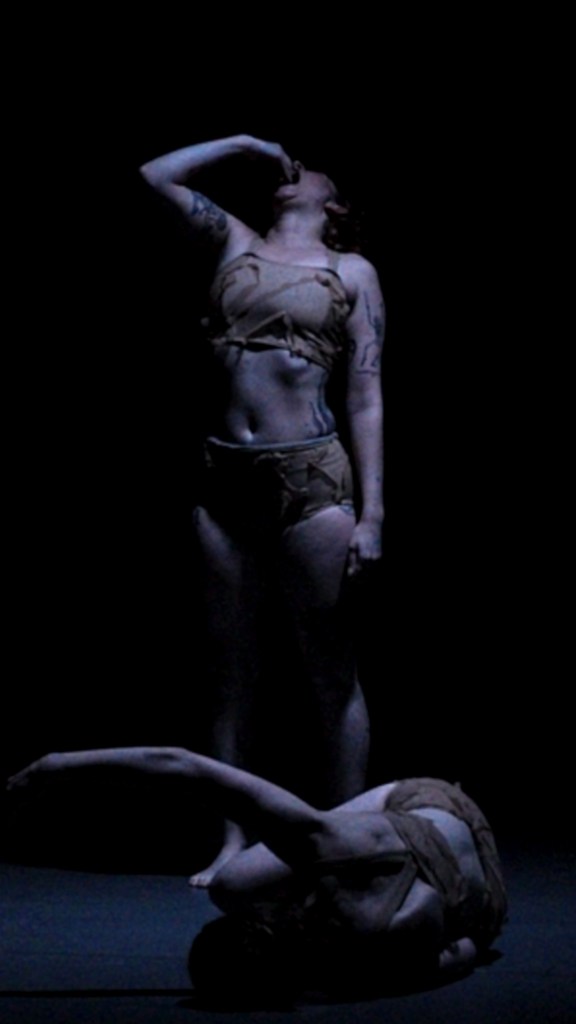
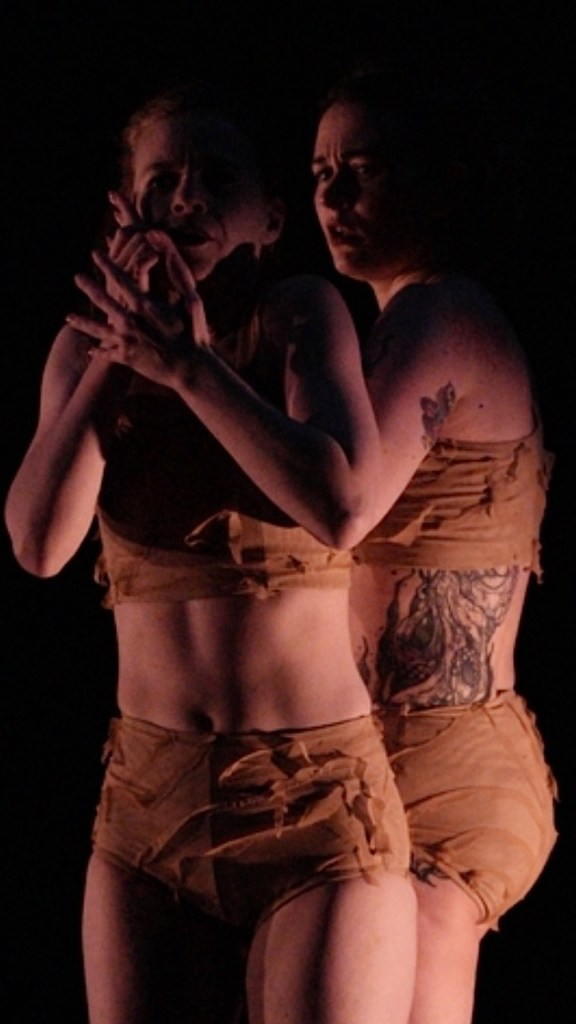
I think I have seen most of Starr Foster Dance’s Richmond performances since the company was born in 2001. I have been stunned, enthralled, mesmerized, puzzled, amused, and I have even teased Foster about her seeming preference for lighting on the darker side of the lumens scale or lux meter (or however you measure brightness). The point is, Foster has a unique style, one that most often presents women in a powerful light (no pun intended), and dares to stretch outside any semblance of a comfort zone – whether her own, the dancers, or the audience,
Foster’s latest project, two years in the making – or waiting – due to the restrictions of the pandemic, Page to Stage II, is a collection of seven short dances inspired by seven short stories, excerpts, and poems by local writers. Not only do the dances span a wide range of emotions, but the program is an actual book that contains all of the written works – the pages that found their way onto the stage – that the audience can take away to keep.
In addition to the seven writers, Foster invited six guest performers to dance with her core company of four women: Taylor-Leigh Adams, Fran Beaumont, Anna Branch, and Molly Huey. The six guest performers, Sophia Berger, Charlotte Bray, Shannon Comerford, Elena Dimitri, Keeley Hernandez, and Mosca Mavrophilipos-Flint were a perfect fit, blending easily with Foster’s core dancers and providing the needed enhancement for the stories. To my surprise and delight, I discovered that one of them had been a student of mine when I taught elementary school.
Previous performances of Starr Foster Dance took place in the intimate space of TheatreLab’s black box space, The Basement, but Page to Stage II (the sequel to a 2015 production) was performed at The Firehouse Theatre. The Firehouse seats about 4 times the number of people who fit into The Basement (sadly, TheatreLab shuttered operations at the end of the 2022 season) – and every performance was sold out! This is great for Foster and company, but it also speaks to a growing hunger for contemporary dance in RVA.
Several works on the program stood out above the others for various reasons. The opening work, Spirits, inspired by Patricia Smith’s story of the same name, explores the intentions of spirits, ancestors, and the associations we make with them. Accompanied by strings and the sounds of flowing water, the dancers, dressed in soft pats and matching tops with hems died to look muddied, move like water sprites. They seem to rise and return to a watery grave, evoking images of fictional willies (e.g., the Willis in the ballet Giselle represent the spirits of women left at the alter) as well as the spirits of all whose dreams were cut short before they were fulfilled. The nine dancers seem to float, rise up, and at the end return to their watery grave, still reaching for life – theirs? Or ours?
My absolute favorite was Dear Me. A solo, the work was performed on Friday night by Fran Beaumont. I loved Beaumont’s energy, the lackadaisical way she kicked her leg up to the side and over her head, the motif of running backwards, and even her simple, dark jumpsuit. Funny, assertive, and sassy, the solo, set to a dynamic funk rock score by DJ Williams and Shots Fired, reminded me of the jazzy and dramatic solos of the late American modern dancer, Daniel Nagrin. (If you are not familiar with him, dig back into dance history and find a video of him performing Strange Hero or Man of Action (1948).
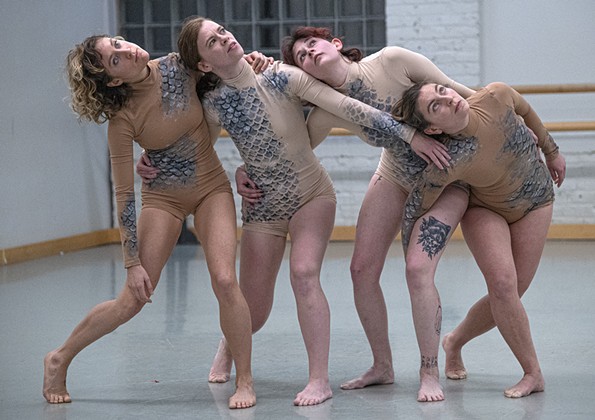
FeeJee Mermaid is funny and creepy and deliciously weird. Set to an original score that is reminiscent of circus music and a narration of Clay McLeod Chapman’s fictitious lecture on how to make a FeeJee Mermaid. Some people are terrified of the circus, clowns, and sideshows. FeeJee Mermaid does nothing to allay these fears. Based on a real-life hoax perpetrated by P.T. Barnum and others, Chapman’s work – and Foster’s kinesthetic interpretation – is an instruction manual on how to construct a horrible taxidermist’s nightmare: a fake mermaid created by attaching the torso of an ape to the bottom half of a large fish. Foster’s quartet of dancers, clad in flesh-toned leotards dyed in a fish-scale pattern do not actually construct a FeeJee Mermaid, but their circus antics, and Daniel Deckelman’s music are sufficiently creepy to leave a lasting impression. Oh, and one of the remaining examples of a “real” FeeJee Mermaid has been in residence at Harvard’s Peabody Museum since 1897. Look it up – if you dare.
About Us is a story by Mary Lou Hall that tells of a mother who left her family (physically and/or mentally) in order to save herself. In Foster’s dance, Molly Huey (on Friday night) was supported and surrounded by a quartet of dancers who seemed to represent the various versions of her inner self. Huey danced, often with her eyes closed, moving her hands in a repetitive gesture that seemed designed to clear away the cobwebs that both clouded her vision and restricted her movements. It is a very intimate dance, one that breaks the usual rules by focusing inward rather than outward. The supporting dancers move in a very unexpected way, deliberately not drawing attention to themselves, trying not to stand out, but instead focusing on the main character – and the main character is. . .you/us.
I could find something special about each of the dances in this series. The dark dresses of Sisterhood echo the darkness of the theme that seems to be a prelude to a true-crime story about two sisters whose lives are unhealthily entwined. The women in Sky Burial interact with one another like two people feeding each other with long-handled spoons. Then there is the poignancy and steely sharpness of the pointing finger in Things That Fit Tight Around the Ribs. Like many good books, and all poems, Stage to Page II should be seen again and should definitely be discussed. What did YOU see? What did YOU feel? What did YOU take away? This is Starr Foster Dance at its finest.
Julinda D. Lewis is a dancer, teacher, and writer who was born in Brooklyn, NY and now lives in Eastern Henrico County.
———-
Photo Credits: Douglas Hayes.
One-Time
Monthly
Yearly
Make a donation to support the continued publication of rvaRT review
Community Member Dancers in Act II: Lexie Hays, David Monger, Lea Monger, Maria Carmina Parong, Honey Lyn Savage, Dhol Tuason, Belle Villanueva
Original Projection Art and Design: Nitsan Scharf
Celestial Headpiece Design: Margie Jervis
Lighting Design: Kaylin Corbin
Scenic Design: Ken Hays
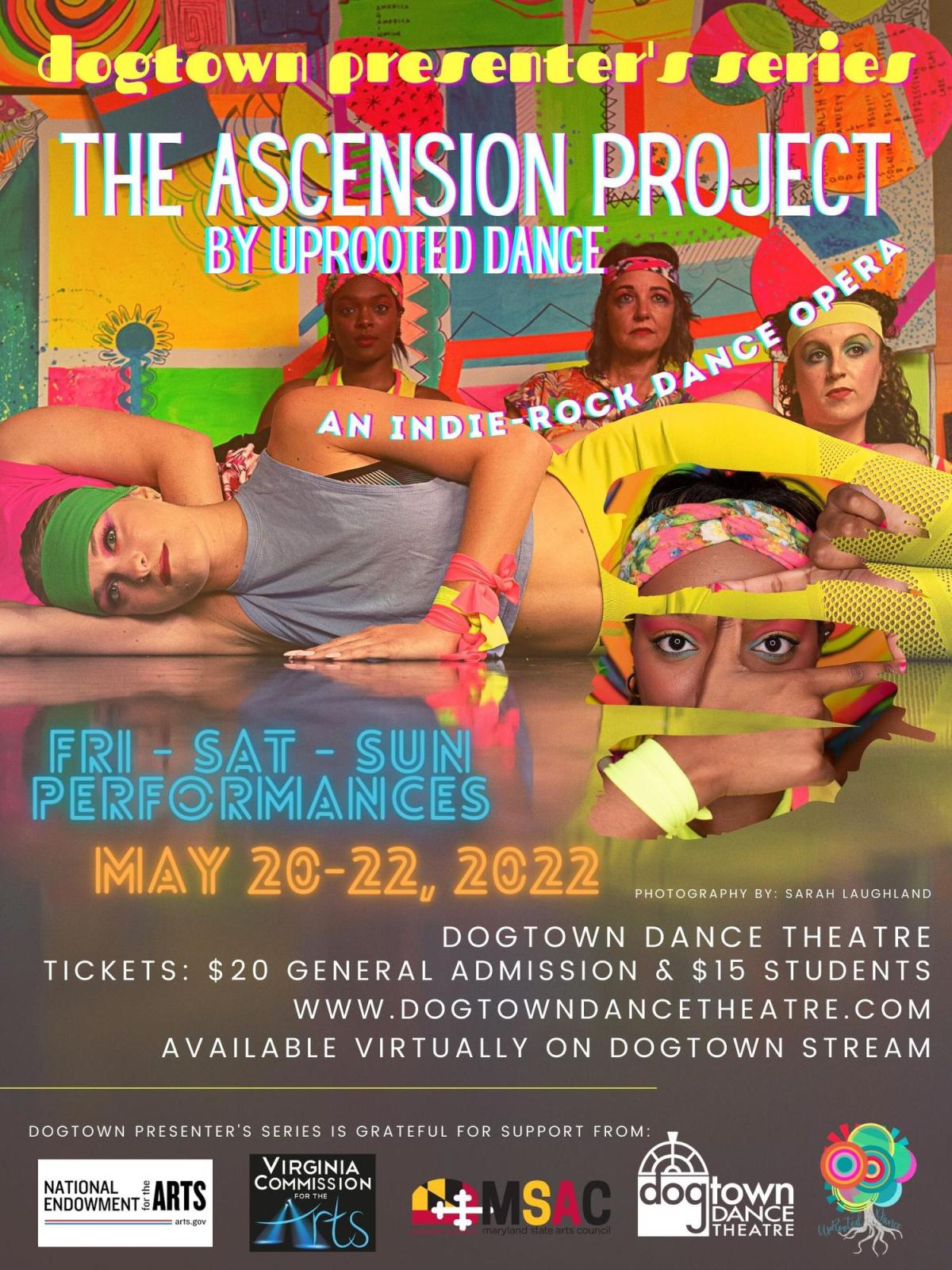
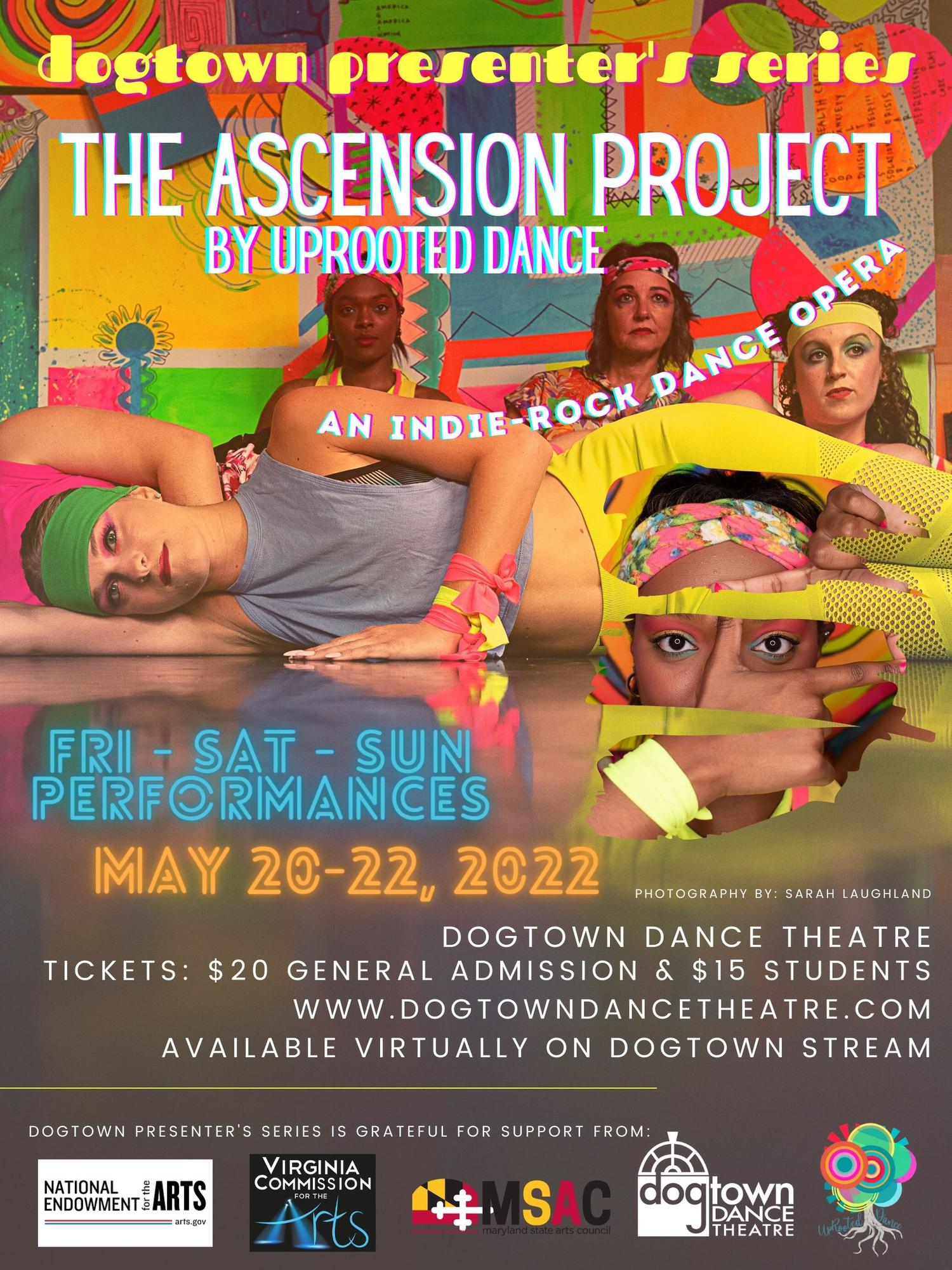
This may seem like a strange start, but stick with me. I promise it will make sense. I have memories of people skipping church when they knew the senior pastor was away. They apparently attended church for a personality, rather than to worship God. Some people just don’t like the unknown and unless the guest speaker was a well-known personality, many showed no interest. This is the thought that ran through my mind when I attended The Ascension Project by Uprooted Dance at the Dogtown Presenter’s Series on Friday, April 20. My partner and I seemed to be the only attendees in the approximately 150-seat theater who were not staff members or family or friends of the performers. There were fewer than 20 people in the seats.
Now, I was not familiar with Uprooted Dance, a Metro D.C. – area based company that is committed to presenting interdisciplinary collaborative work that tells thought-provoking stories and community engagement. That is exactly why I wanted to see them. What a great opportunity to see a new-to-me company without having to travel several hours and spend money on gas. Well, that’s my take on the situation, but I know that’s not going to fill empty seats, so without further ado – or diversion – here’s my take on The Ascension Project.
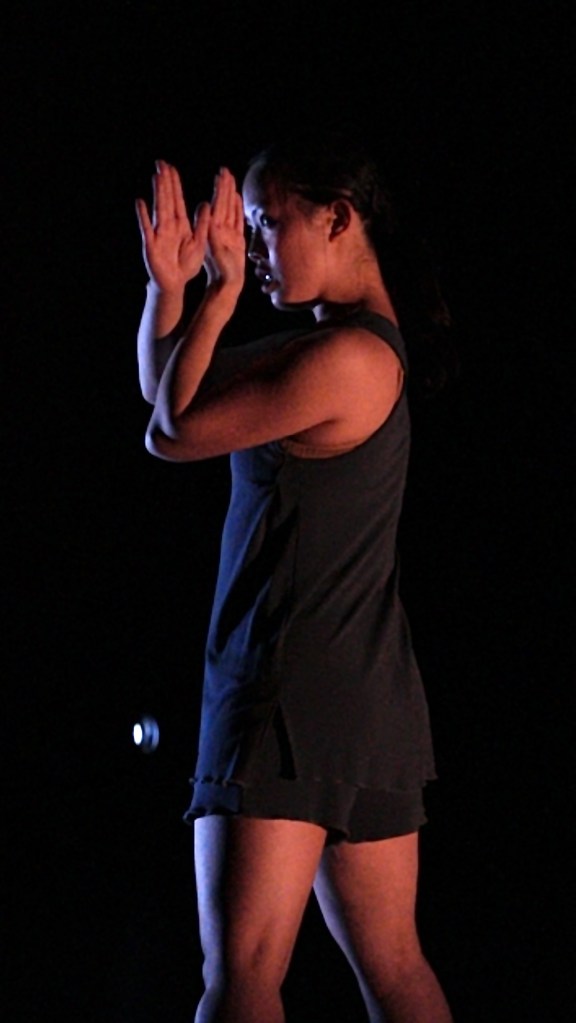
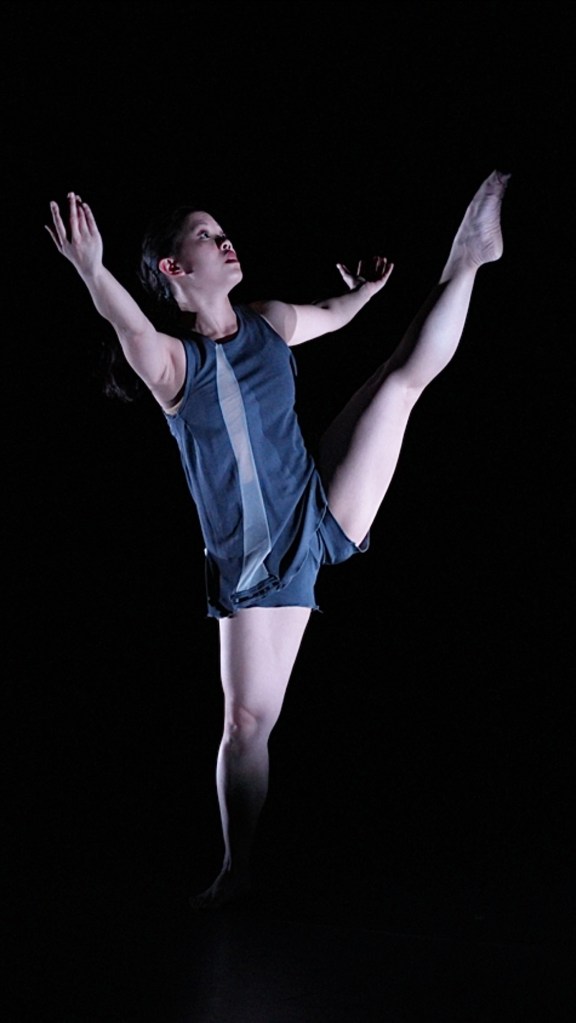
The Ascension Project was inspired by the events of the past two years: the COVID-19 pandemic, civil unrest, social justice, the flattening of personal space as represented on a Zoom screen. Arranged – remember, this is a dance opera – into a prelude and three short acts, The Ascension Project is a journey through time and space that begins with isolation in small spaces, explores identity, trauma, and loss, and concludes with a transcendent journey. So, what does this look like?
The “Prelude,” described in the Director’s notes as “a bright, bold, big dance number” has the company of six dancers performing warm up movements in brightly colored casual clothes against a wall of brightly colored projections that include videos of the dancers performing the “Prelude.” For all the clever moments, including the dancers passing and sharing up close with the audience signs bearing messages such as “I missed you,” “Can you see me,” “Sit back and relax,” and “Enjoy the show,” and an attempt to create a satirical replica of a Zoom dance class experience, the sum total of all the components of the “Prelude” was remarkably subdued.
The dancers spend most of Act 1, the “Dream Sequence” on the floor in uncomfortable positions, rolling and restless as the background of colorful mandalas spins and regenerates at a sometimes dizzying pace. In one mesmerizing section the dancers log roll upstage, walk back downstage, and repeat the sequence, each time at a faster pace until finally they are running. Black and white projections and earth-toned costumes segue into colorful blooming flowers for the ”Circle of Life” section where the dancers move in a clockwise rotation, briefly holding hands and wrapping their arms around one another, ending the nightmare of illness, death, war, and famine.
The focus – and tone – shifts again in Act 2, “America,” when the company members are joined by members of the Sayaw! Philippine cultural dance group and community dancers, including a lone man and two little girls. The focus of “America” is culture and identity and features a power fist pump, a cultural dance, taking a knee, and saluting the flag (background) with a hand over the heart.
Finally, Act 3, “Blast Off,” contemplates what the future holds. The dancers start off as astronauts, in silver suits and a cleverly designed spaceship – a blend of physical and video components – that takes them to future new worlds where race and politics and nationality no longer exist, no longer separate and segregate. After experiencing weightlessness – and planting their flag – the dancers become transformed into celestial beings with lighted constellations headdresses. The lighting and dark costumes obscure their individuality, such as race, hair, skin color, creating a minimalist effect that harkens ack to the beginning.
Make no mistake, like most operas, this one needs a synopsis to help an unfamiliar audience navigate the strange new terrain. Extensive program notes were provided in the printed program but before each new section, Artistic Director Kiera Hart-Mendoza provided a verbal map to guide the uninitiated.
Honestly, The Ascension Project has the look and feel of a work-in-progress. Sometimes, it’s good to get in on an emerging work and follow its development. I suspect this is very much the case with The Ascension Project,” as its name implies. The Ascension Project is an interesting and evolving work that did not quite reach its full potential, but hopefully will continue to evolve and reach an appropriate and appreciative audience.
Julinda D. Lewis is a dancer, teacher, and writer who was born in Brooklyn, NY and now lives in Eastern Henrico County.










 RVArt Review