Steve Martin’s comedic play METEOR SHOWER is probably one of those shows you will either love or hate. Either way, you will laugh. A lot.
For some, knowing that the author is THE Steve Martin may be all you need to know to decide whether to go or not, whether you will like it or not, and most importantly, whether or not you will ever again speak to the person who invited you.
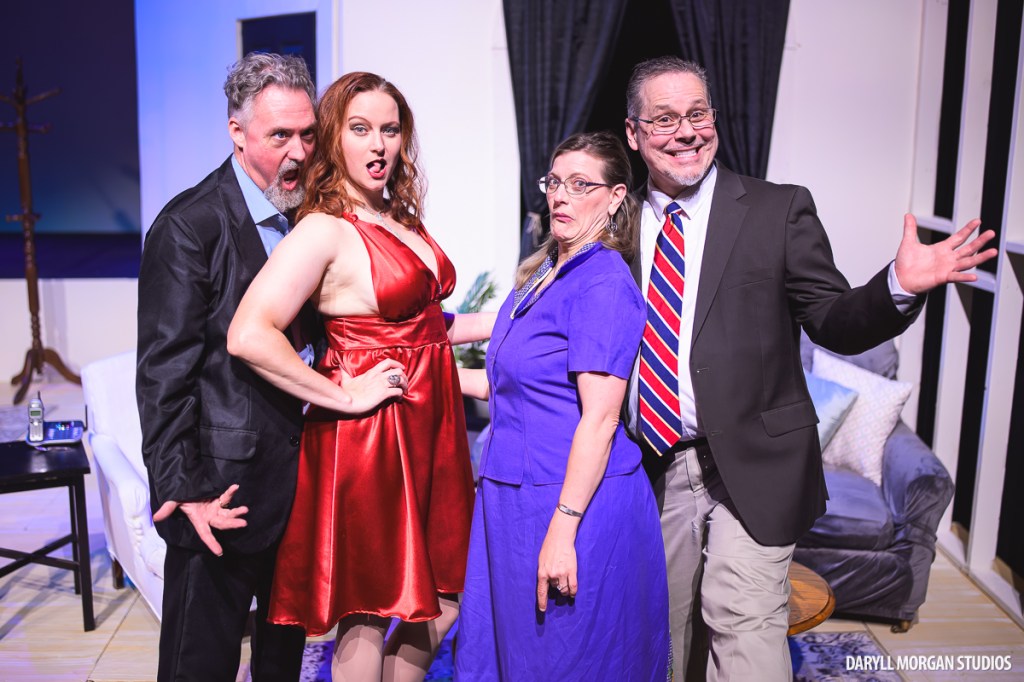
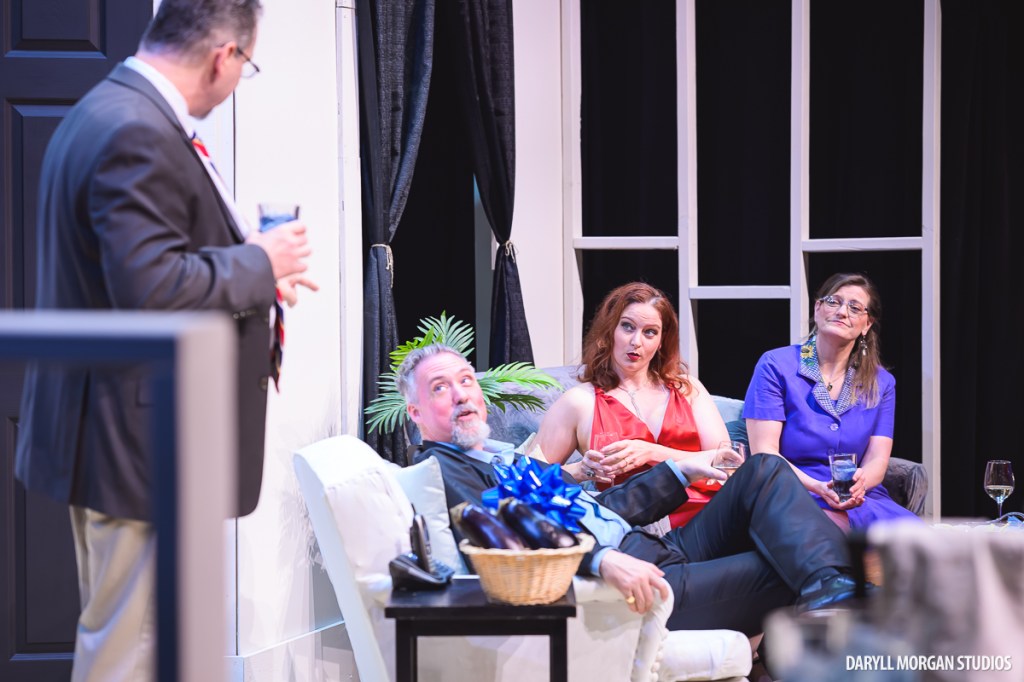
The plot is simple (in more than one sense of the word): In 1993 a meteor shower occurs in Ojai, CA, where Corky lives with her husband Norm. The two are a solidly united loving couple who have obviously attended one too many couples’ therapy sessions. Corky and Norm decide to invite another couple over to have dinner and watch the meteor shower, only to find that Laura and Gerald are not who they appear to be or what Corky and Norm expected.
Over the course of the evening, the plot twists and turns, the story stops and restarts. Remember when you were a kid and things went wrong and you wanted a do-over? Well, METEOR SHOWER is the repository of all your childhood do-overs.
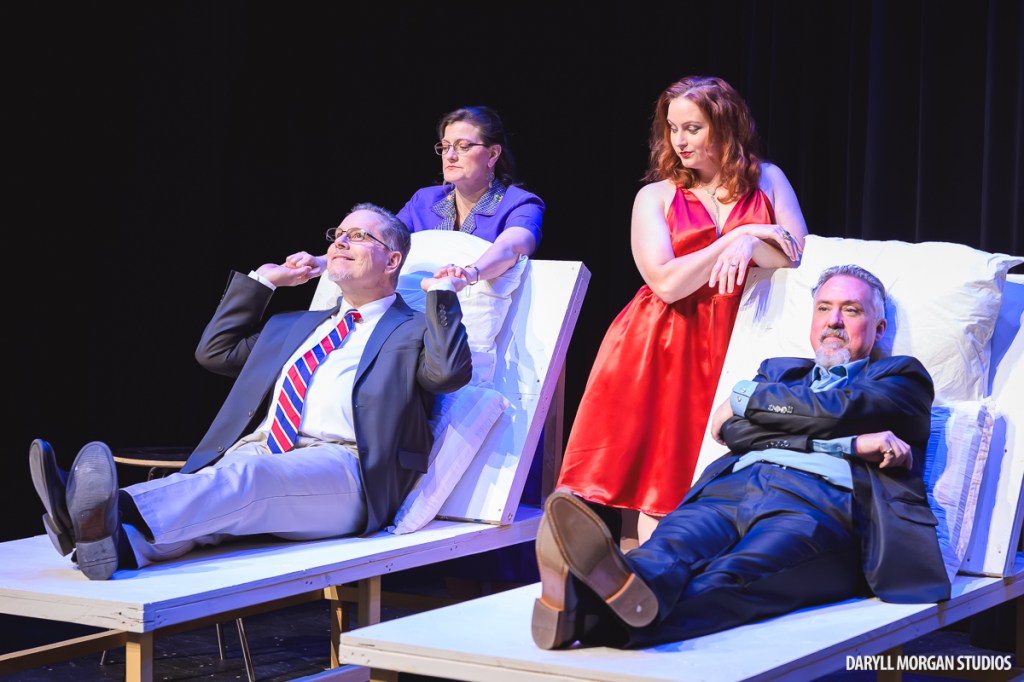
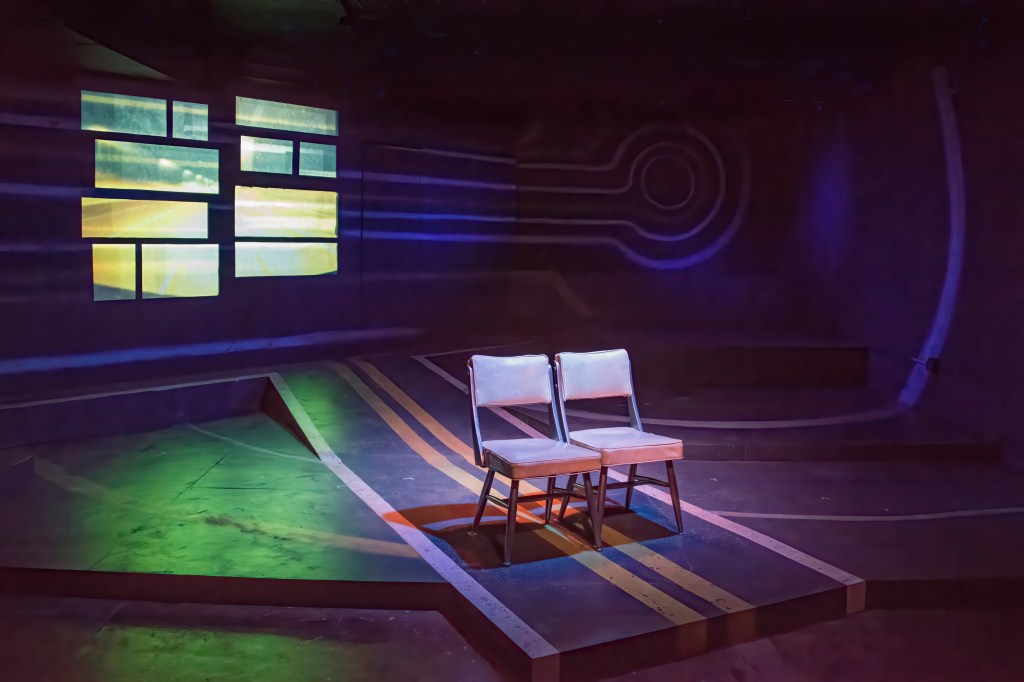
There is a minimalist set of “a modern home in Ojai, California,” and a backyard dominated by two of the most uncomfortable looking lawn chaises I have ever seen. These chairs, however, play a key part in the evening’s events. A privacy fence cleverly disguises a walkway that leads to the house. And the audience is treated to a soothing, looping projection of a meteor shower. There is also a pre-show audio recording that is quite amusing – the first time we hear it…
Before the evening is over, you will experience a tale of cannibalism, learn about “bug flux” and exploding head syndrome, and find out what happens when one gets hit by a meteor.
The cast, all making their CAT debut, consists of Paul James and Jennipher Murphy as the host couple, Norm and Corky, and Skye Whitcomb and Constance Moreau and Skye Whitcomb as the guest couple, Gerald and Laura. Moreau and Whitcomb successfully juggled multiple plot twists fueled alternately by sexual innuendo, explosive outbursts, and intentionally dysfunctional exchanges. James maintained a mostly stable personality as a super sweet, super nice guy. As annoying as Norm could be, he actually started to grow on me – but then, the alternative was soooooo much worse. But it was Murphy who had the most complex, amusing, and devious character development and plot twists.
As a play, as a story, METEOR SHOWER has very little substance. It exposes the strengths and weaknesses of marriage and relationships, but doesn’t really have anything to say about any of it. It makes us laugh at things we would ordinarily be embarrassed to admit we watched, much less laughed at. If you need a night of senseless laughter, no strigs attached, this show might be meant for you. Go. Laugh. Enjoy. As for me – it was definitely not my cup of tea.
Julinda D. Lewis is a dancer, teacher, and writer who was born in Brooklyn, NY and now lives in Eastern Henrico County.
METEOR SHOWER
Written by Steve Martin
Directed by Kerrigan Sullivan
Cast
Jennipher Murphy as Corky
Paul James as Norm
Skye Whitcomb as Gerald
Constance Moreau as Laura
Creative Design Team
CAT Producer – Kerrigan Sullivan
Lynn Theatre Production Manager – Alleigh Scantling
It’s been a long time since I’ve laughed this much, this long, this loud. Selina Fillinger’s POTUS is the best kind of comedy: physical, political, slapstick, irreverent, giddy, bawdy, inclusive. I could go on but I think using more than seven adjectives in one sentence is breaking some kind of law.
If the subtitle didn’t clue you in, it only gets worse from there (and by worse I mean better). If you’re the type to clutch your pearls, you’d better leave them at home because by the end of POTUS they’ll be rolling down the aisles.
Oh, and one more thing about that subtitle. Yes, there are seven women working together – despite their diverse agendas – but that part about whether they are trying to keep the POTUS alive does come into question. That’s all I can say about that without giving away too much.
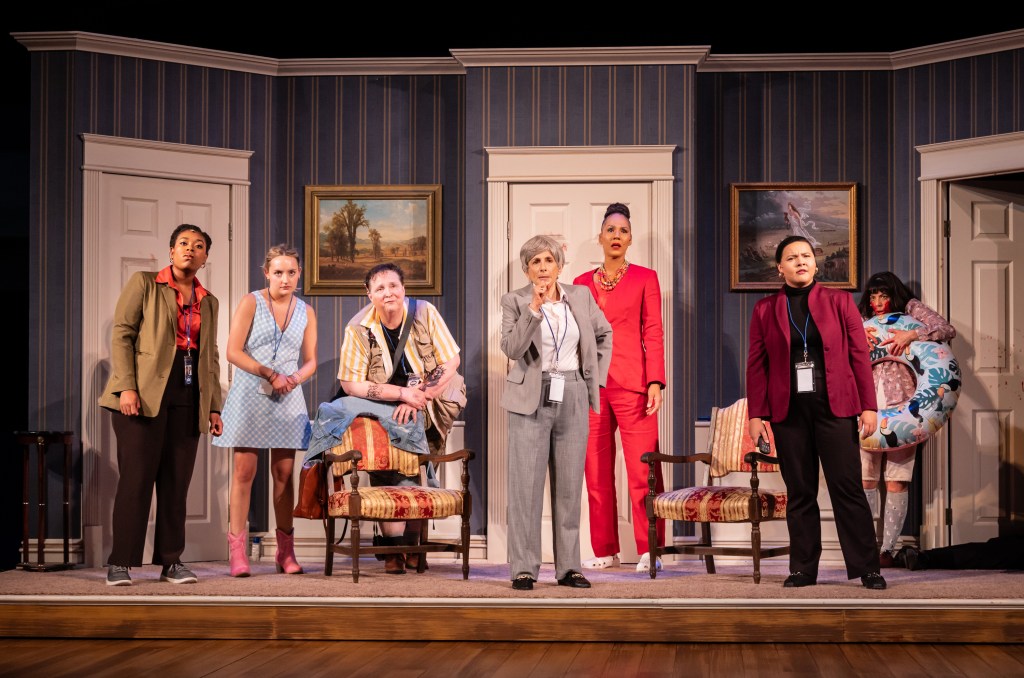
What I can say is that Fillinger has written a witty and timely play and it was performed by a superb and diverse ensemble – some familiar and some not – consisting of Elizabeth Byland, Liv Clayton, Sonja Durant, Anne Michelle Forbes, Bree Ogaldez, Catherine Shaffner, and Denise Simone. Looking at the understudies (see below) I would love to see the show again with the understudies in the key roles – there are some powerful, familiar names in that list, as well.
Loosely, the plot of POTUS involves the women of the President’s inner circle coming together to patch up his most recent political gaffe. Crudely referring to his wife during a press conference as having a “c**ty day,” the POTUS sets in motion an international disaster with potentially deadly consequences.
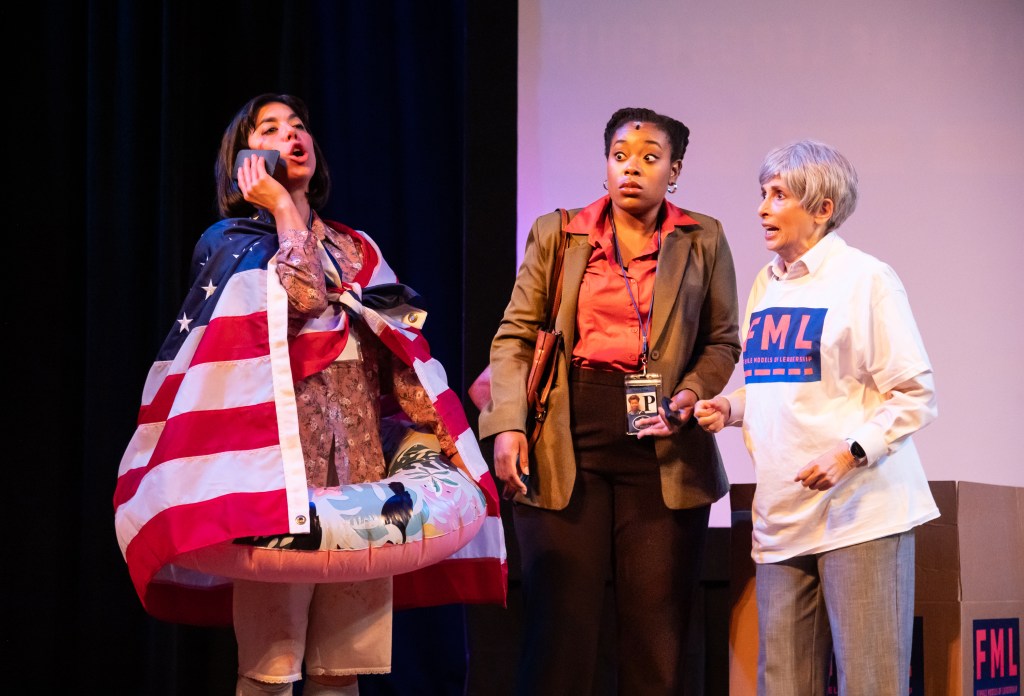
There truly are no leading roles in POTUS, but for me, Elizabeth Byland, in the role of Stephanie, the President’s Secretary, stood out for her physical comedy and her comedic timing. The role of the meek secretary who is obviously in over her head could be a recipe for disaster, but in Byland’s expert hands it is pure comedic genius. Loved her. According to her bio, she is the Head Professor of Improv at VCU. What a treat her classes must be! Loved her – yes, I said it twice and I meant it!
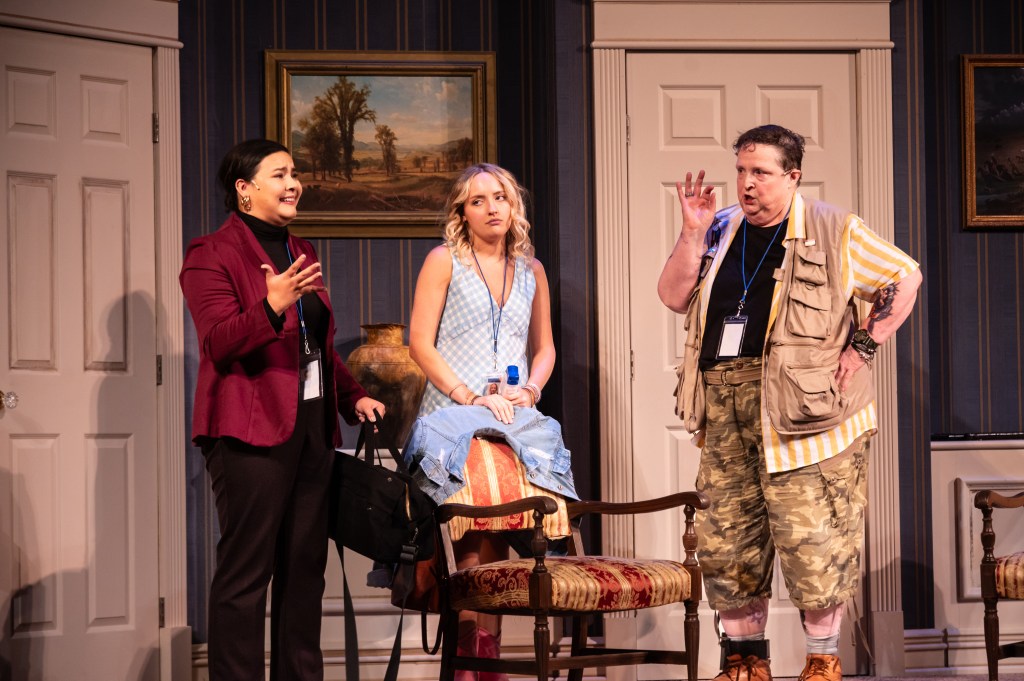
I also adored Catherine Shaffner as Bernadette, the President’s sister. Big, loud, and brash, Bernadette appears fresh out of prison on a felony charge, still wearing her ankle monitor, and carrying a duffle bag filled with “pharmaceuticals” and other tools that will come in handy during the course of the day. Shaffner guides her character through a perfect combination of unfettered chaos and much needed life skills that usually are not acquired in a liberal arts undergraduate program.
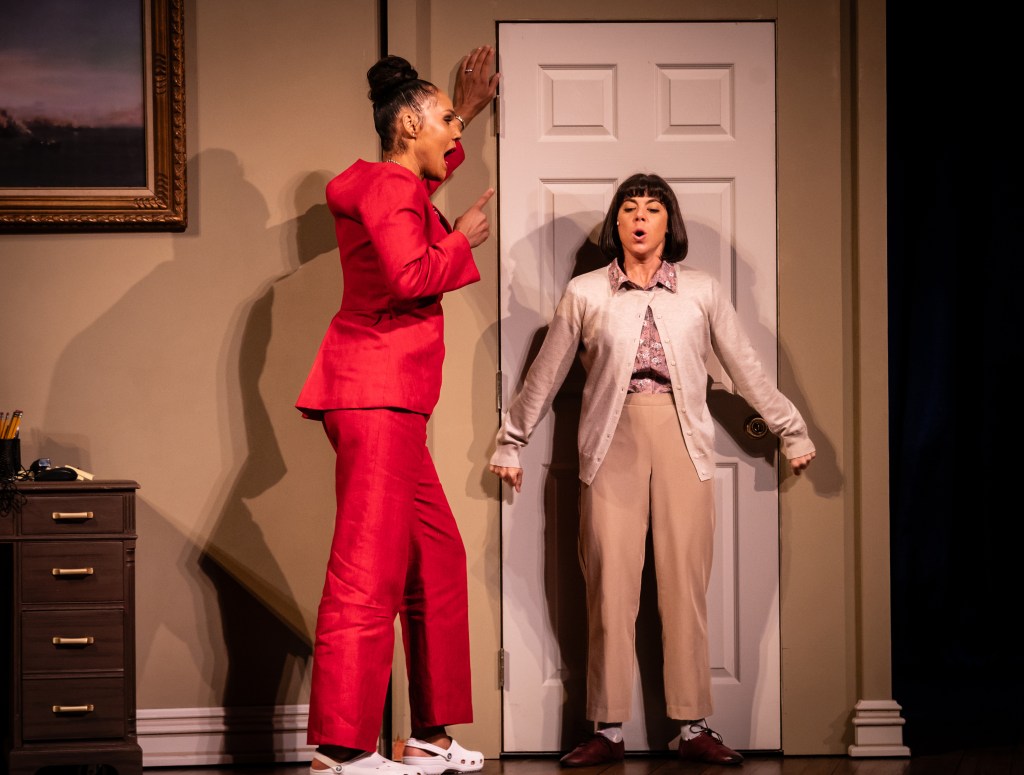
Sonja Durant was something of a beautiful enigma as Margaret, the First Lady. Durant’s tall slender frame was always draped in red – first a classy business pant suit, and later a fancy dress – but throughout she wore white Crocs on her feet to make herself appear “earthy.” Smart, composed, and apparently in command of the ability to icily detach herself from her emotions at will, Durant’s First Lady seemed very much authentic.
As the President’s press secretary, Jean, Anne Michelle Forbes skillfully navigated the insanity of the White House shenanigans, juggling professional interactions and personal relationships with the President’s sister (I didn’t see that coming!) and a beleaguered female White House reporter, Chris (played by Bree Ogaldez, seen recently in The Carole King Musical), a new mother who was constantly seeking opportunities to pump her overflowing breasts. A familiar face on local stages, this was Forbes’ November Theatre debut.
As Harriet, the President’s Chief of Staff, Denise Simone’s role seemed a bit more subdued than the others. At times she appeared to be the “straight man” who enhances the comedic projections of those around her. Simone returns to Virginia Rep after a turn contributing to the theatre community in Idaho. And last but not least, newcomer Liv Clayton made her professional debut in the role of Dusty, the President’s young girlfriend who has been invited to the White House to apply for a “position.” I am sure Clayton is really good at her role, but I just found Dusty so annoying with her cheerleader moves that I almost overlooked the character’s innate kindness and corn-fed street smarts.
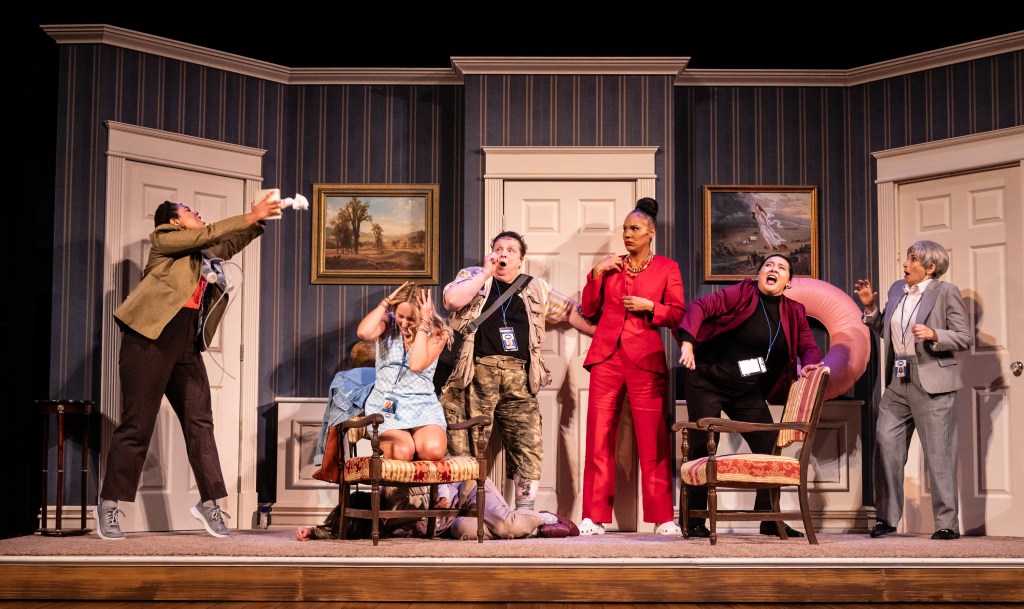
Set in the White House, a series of functional and somewhat minimalist sliding sets (credit Chris Raintree for the scenic design and Steve Koehler for the lighting) keeps the focus on the actors. The only time the set seemed to intrude into my consciousness was during a madcap chase scene when the set seemed too small to allow the actors full range. Kudos to director Dorothy Holland and the dynamic ensemble for keeping it moving. There was not a dull moment in either act.
Julinda D. Lewis is a dancer, teacher, and writer who recently had both knees replaced due to a manufacturer’s recall. Born in Brooklyn, NY, she now lives in Eastern Henrico County where she can be found kicking up her heels as best she can any day of the week.
POTUS
Or, Behind Every Great Dumbass are Seven Women Trying to Keep Him Alive
By Selina Fillinger
Directed by Dorothy Holland
Cast
Stephanie …………………………… Elizabeth Byland*
Dusty …………………………………. Liv Clayton
Margaret ……………………………. Sonja Durant
Jean …………………………………… Anne Michelle Forbes
Chris ………………………………….. Bree Ogaldez
Bernadette ………………………… Catherine Shaffner*
Harriet ………………………………. Denise Simone*
Stephanie u/s ……………………. Juliette Aaslestad
Jean u/s …………………………….. Juliana Caycedo
Bernadette u/s ………………..… Kelsey Cordrey
Dusty u/s …………………………… Emily Dandridge
Margaret u/s ……………………… Jianna Hurt
Chris u/s ……………………………… MacKenzie Sheppard
*Member of Actors’ Equity Association
+Member of USA, United Scenic Artists
^Member of the Stage Directors and Choreographers Society
Discounted Group Rates and Rush tickets are available.
Run Time
The play runs for 1 hour 30 minutes, plus one 15-minute intermission.
Photo Credits: AaronSutten
VA-REP Covid Safety Statement
Virginia Rep encourages wearing masks for our patrons’ safety, but we do not require that you wear a mask in our lobbies or within the theatres. They are now optional. We continue to follow CDC guidelines and local risk levels. All Virginia Rep staff will continue to wear masks while serving you.
Sonja Durant and Elizabeth Byland. Photo by Aaron Sutten.Bree Ogaldez, Liv Clayton, Catherine Shaffner, Denise Simone, Sonja Durant, Anne Michelle Forbes, Elizabeth Byland. Photo by Aaron Sutten.Anne Michelle Forbes, Liv Clayton, Catherine Shaffner. Photo by Aaron Sutten.Elizabeth Byland, Bree Ogaldez, Denise Simone. Photo by Aaron Sutten.Bree Ogaldez, Liv Clayton, Catherine Shaffner, Sonja Durant, Anne Michelle Forbes, Denise Simone, . Photo by Aaron Sutten.
One-Time
Monthly
Yearly
do you enjoy rvart review? Make a one-time donation to show your love
First, some housekeeping. Well…acknowledgements. And…maybe a confession. I have been viewing and writing about dance and theater in RVA for more than 25 years, but this is the first time I have seen a show at the Weinstein JCC. It’s not that I haven’t know about shows there, or been invited, I just never seemed to have found the time to fit it into my schedule. Jason Marks sent me a DM about this show, which opened while I was out of town for a performing residency, and I somehow found myself driving straight from a DC dance space directly to the Firehouse Theatre on a Friday night, then to the JCC on Saturday after spending the morning in rehearsal and the afternoon at the Nature Center celebrating my youngest grandchild’s first birthday, and ending the weekend at Atlee High School for the final performance of a CAT show. That’s how “retired” people roll.
Second – and last – I appreciate growing up in Brooklyn and attending the Bronx High School of Science. That background made many of the Zero Hour’s references familiar and the humor genuine – unforced and abundant. So I could sum up right here and just say that Zero Hour is one of the funniest shows I’ve ever seen and it appears to have been a perfect vehicle for Jason Marks. But I won’t – sum up just now – because that wouldn’t be fair or fun.
Zero Hour is a skillful balance of biography and entertainment. For those unfamiliar with Zero Mostel, it is informative, and for those who were already fans, it might reveal a few unknown nuggets. Mostel (who, like me, was born in Brooklyn and also shares my birthday, February 28) was active at a time when the US was obsessed with the Red Plague or Red Scare, when McCarthyism (which took its name from US Senator Joseph McCarthy) insinuated that the government and Hollywood, among other industries, were being infiltrated by the dreaded specter of Communism. Numerous investigations were directed at the film industry leading to the blacklisting of industry professionals – including Zero Mostel.
The freedom of any society varies proportionately with the volume of its laughter. – Zero Mostel
The heart is, truly, the source of love. The proof is that if you remove it from someone, they will almost certainly never love again. – Zero Mostel
An unfortunate encounter with a NYC bus in 1960 nearly cost him a leg. The leg was saved, but he lived the rest of his life in pain. But on the bright side, the accident saved him from having to perform in a reportedly bad play, The Good Soup. But there were plenty of memorable roles on his resume, from Tevya in the original Broadway production of Fiddler on the Roof to Pseudolos in A Funny Thing Happened on the Way to the Forum, from classics like Ionesco’s Rhinoceros to special appearances on The Electric Show, Sesame Street, and The Muppet Show.
There are several explanations for how Samuel Joel Mostel came to be known as Zero. One is that his mother coined the nickname because of his poor grades in school – but one bio notes that he was a “A” student. Another explanation is that a press agent once said of him, “Here’s a guy starting from nothing.”
Known widely as an actor and singer as well as a comedian, Mostel developed a talent for painting and drawing from childhood. He took art classes provided by a community program that served Jewish immigrants and their children, and later attended City College of New York and then enrolled in a master’s program in art at New York University (which also happens to be my alma mater). Zero Hour is set in Mostel’s NYC art studio, just two months before the end of his life, on a day when he is being interviewed by a New York Times journalist – whom Mostel contentiously greets by calling him a putz (idiot; jerk) because “I don’t know your name.” BTW, Mostel didn’t care to learn the reporter’s name until near the end of the play, because “I don’t want to know your name; this is an interview, not a relationship.
“That’s it, baby, when you’ve got it, flaunt it! Flaunt it!” – Max Bialystock, played by Zero Mostel in the 1967 movie, “The Producers”
From House Un-American Activities Committee (HUAC) hearings to his mother’s displeasure at his Catholic shiksa (gentile) wife, from his dislike of choreographer/director Jerome Robbins to often being not the first or even second but the third choice for roles he made legendary, from being blacklisted to being invited to the LBJ White House where “the thought of having to eat with Texans was too much!”), all of this, and more, is lovingly and capably captured by Marks under the director of Debra Clinton. Clinton, in the Director’s notes, paid homage to Mostel’s individuality – his commitment to standing up for what he believed even to the detriment of his career – “his honesty, passion, and empathy.” Given the larger-than-life persona of Mostel, perhaps it should come as no surprise that the reporter is a disembodied and oddly reticent character, given his profession; we never actually see him or hear him. The HUAC investigator, however, is voiced by Roger Price. It probably would not have mattered how much or how little the reporter talked, there wasn’t a dull moment with Mostel’s explosive personality. Sometimes it was hard to tell where Marks ended and Mostel began. I am sure playwright Jim Brochu who originally starred in his own play, would approve of Marks’ interpretation.
“It’s not about absurdity, it’s about conformity.” – Zero Mostel
———-
Julinda D. Lewis is a dancer, teacher, and writer who was born in Brooklyn, NY and now lives in Eastern Henrico County.
———-
ZERO HOUR
By Jim Brochu
Starring Jason Marks as Zero Mostel
Directed by Debra Clinton
Production Team:
Set and Lighting Design + Photos: Todd Schall-Vess
Production Stage Management: Hayley Tsutsumi
Performance Schedule:
March 29: 7:30PM
March 30: 7:30PM
April 1: 8:30PM
April 2: 2:00 PM
Run time: approximately 2 hours, with one intermission
The Kids From Your Favorite Christmas Shows, All Grown Up
A Theater Review by Julinda D. Lewis
At: Richmond Triangle Players at the Robert B. Moss Theatre, 1300 Altamont Ave, RVA 23230
Performances: November 16 – December 18, 2022
Ticket Prices: $10 – $45
Info: (804) 346-8113 or rtriangle.org
———-
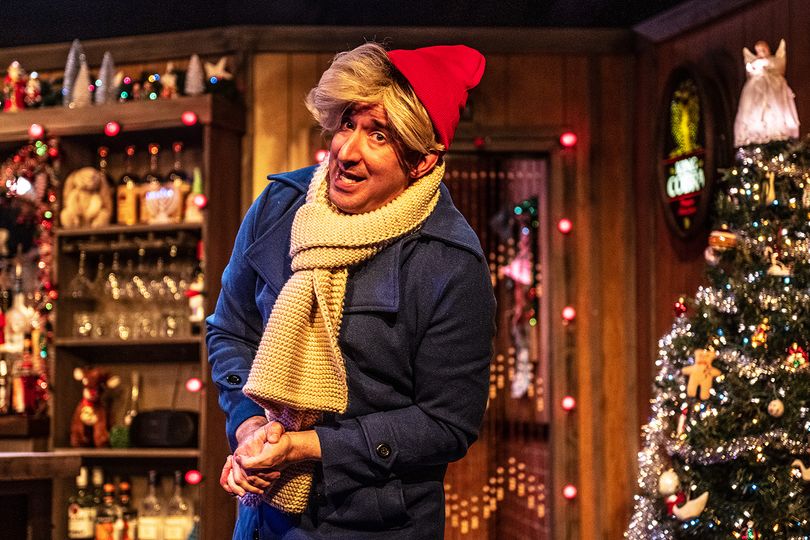
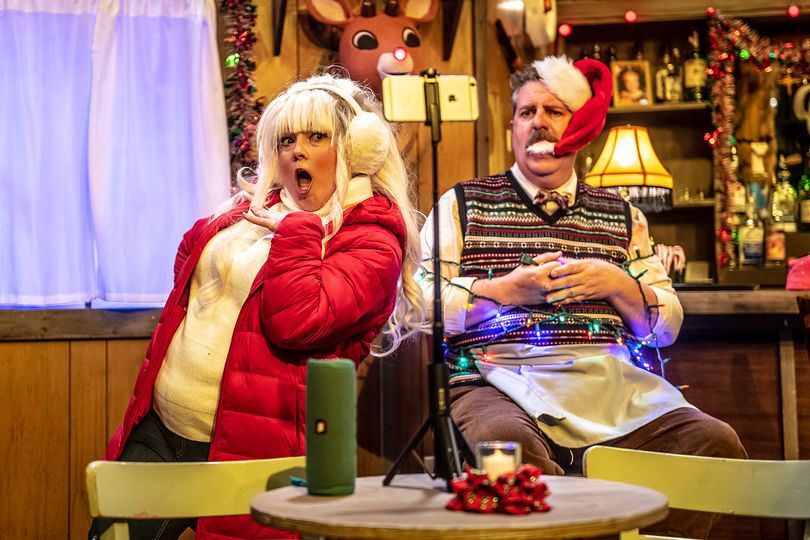
We can always depend on Richmond Triangle Players to give us an edgy, snarky, comedic, or dark Christmas offering. Christmas on the Rocks, a collection of short plays or scenes by various authors, does not disappoint – it gives us all of the above.
This year, the authors are John Cariani, Jenn Harris & Matthew Wilkas, Jeffrey Hatcher, Jacques Lamarre, Theresa Rebeck, and Edwin Sanchez. The “kids,” a slightly different cast of characters than RTP’s 2015 production, include Ralphie from A Christmas Story, Zuzu Bailey from It’s A Wonderful Life, Hermey, the Elf from Rudolph the Red-Nosed Reindeer and Rudolph and the Island of Misfit Toys, Karen, an internet influencer, Tiny Tim from A Christmas Carol, Clara from The Nutcracker ballet, and the hapless Charlie Brown. Zuzu and Karen replaced Susan (Miracle on 34th Street) and Cindy Lou Who (The Grinch Who Stole Christmas). Regional productions may feature different characters.
All these characters are portrayed by two highly talented and versatile actors. Theresa Mantiply plays all the women and Eddie Webster plays all the men. The motley cast of characters wander, one by one, into a local bar, where the friendly bartender, played by Joe Pabst, is at first surprised and ultimately perplexed at the increasingly colorful parade of characters who enter, seeking solace from the loneliness of Christmas Eve.
In the first scene, we see Ralphie, wearing an eye patch, peek through the window of the unimposing little bar – beautifully designed by William Luther with important inclusive details that provide something each of the characters can relate to on a personal level.
To answer the obvious question, yes, Ralphie finally did get his eye shot out, but it was not self-inflicted. A firearms safety instructor for the NRA, he was shot by a student and is now unemployed. On top of that, he has intimacy issues due to that infamous pink bunny suit his Aunt Clara sent, but not for the reasons one might expect. You see, he actually liked it.
Little Zuzu Bailey who, as a child, declared that every time a bell rings, an angel gets its wings, has been harassed by angels for decades – and responds in nonsensical rhyming platitudes, while Hermey, the Elf who had dreams of becoming a dentist, has become a gossipy hater who holds a long-time grudge against Rudolf – not realizing that his own misfit status makes him more like Rudolph than not.
Karen, an entitled but untalented influencer, holds the Bartender hostage, posting increasingly unhinged videos for her unfortunate followers. Tiny Tim drops by, displaying Scrooge-like qualities and Clara’s cheating Prince has left her alone for the holiday. The last customer is none other than Charlie Brown, complete with a yellow sweater with a black zigzag line. Wonder of wonders – it’s a Christmas miracle – he finally gets to talk to The Little Red Haired Girl in the only scene shared by Mantiply and Webster. Through it all, Pabst calmy mixes drinks and offers gentle advice.
Christmas on the Rocks is a non-traditional Christmas story – or collection of sequels – billed as “an offbeat collection of twisted holiday tales” for the grown up kids in all of us who love a good laugh – especially when it’s at our own expense. There are limited performances left, so ditch the kids and go see it.
Julinda D. Lewis is a dancer, teacher, and writer who was born in Brooklyn, NY and now lives in Eastern Henrico County.
———-
CHRISTMAS ON THE ROCKS:
An Epic Offbeat Collection of Twisted Holiday Tales
Written by John Cariani, Jenn Harris & Matthew Wilkas, Jeffrey hatcher, Jacques Lamarre, Theresa Rebeck, and Edwin Sanchez
Conceived by Rob Ruggiero
Sponsored by David Peake
Directed by Axle Burtness
CAST:
Theresa Mantiply – Woman
Eddie Webster – Man
Joe Pabst – the Bartender
Understudies: Rachel Garmon-Williams and Travis Williams
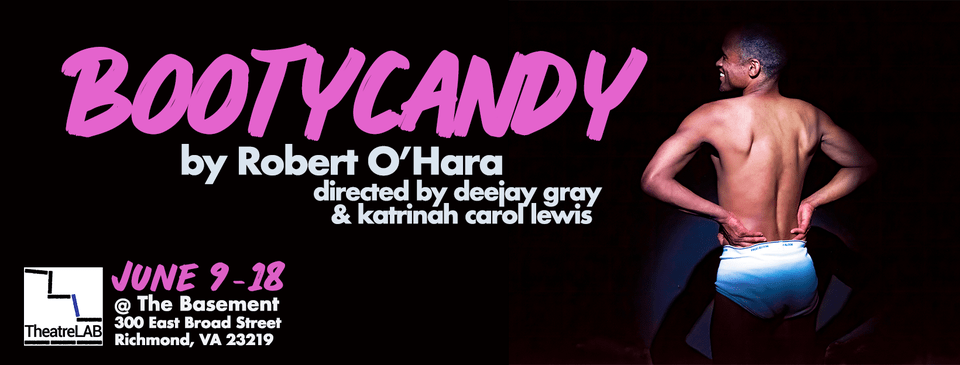
Robert O’Hara’s BOOTYCANDY is a “semi-biographical subversive comedy” performed as a series of non-linear vignettes. The central character is Sutter and the central premise is Sutter’s journey growing up black and gay. It is hilarious, it is touching, it is relatable across genders, generations, and sexual orientations, and it is an exemplar of contemporary Africanist story-telling. It is, without a doubt, one of my favorite shows of the season – and I see my fair share of shows.
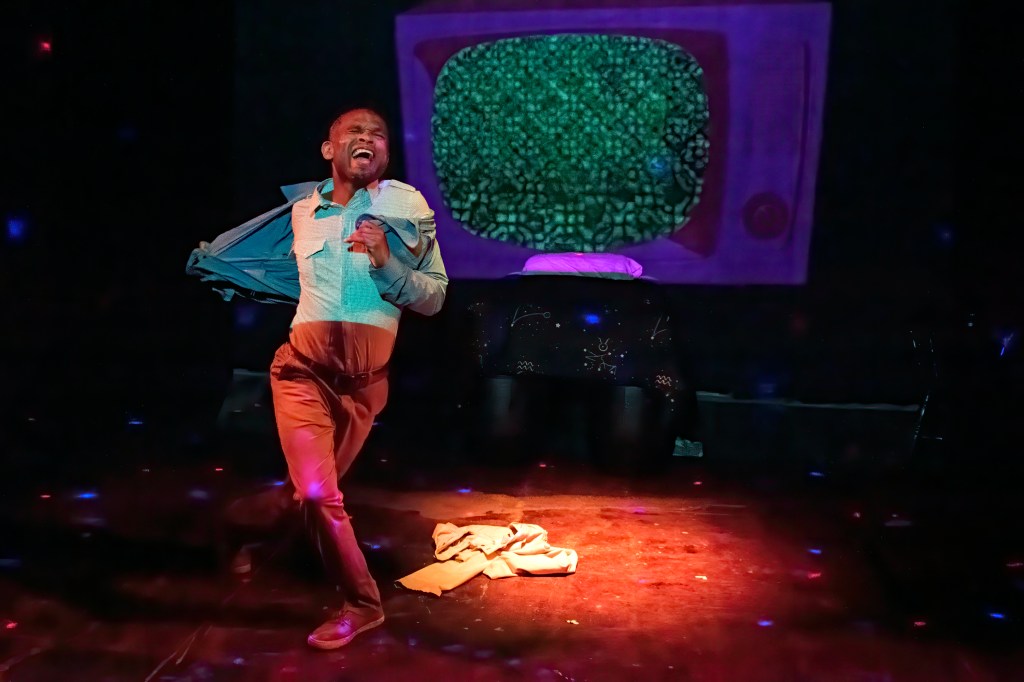
Todd Patterson shines in the lead role as Sutter. The five actors are identified only as Actor One, Actor Two, etc., and all but Patterson take on a number of different roles in Sutter’s life. Patterson dances between each scene – indeed, his “grandmother” and other relatives request that he “do that step Michael Jackson liked to do.” The playwright, O’Hara, has specified that Jackson’s music be used throughout, and the music of Michael Jackson, Prince, and perhaps a few others energizes the space from the moment you walk through The Basement doors.
Patterson strips for us, and dances with a manic energy that reflects his character’s inner landscape. But as much as I was impressed by Patterson’s performance, this is truly an ensemble production – starting with the symbiotic directing team of Deejay Gray and Katrinah Carol Lewis. I’ve seen each of these actors in several productions, and this one cast them each in a new light and presented them with new challenges.
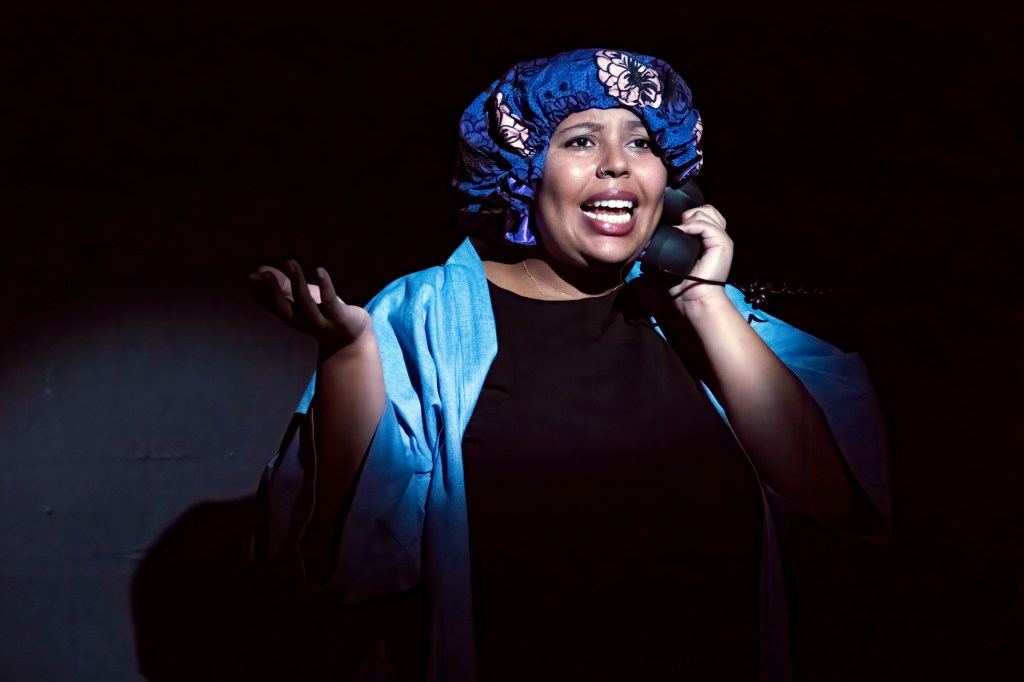
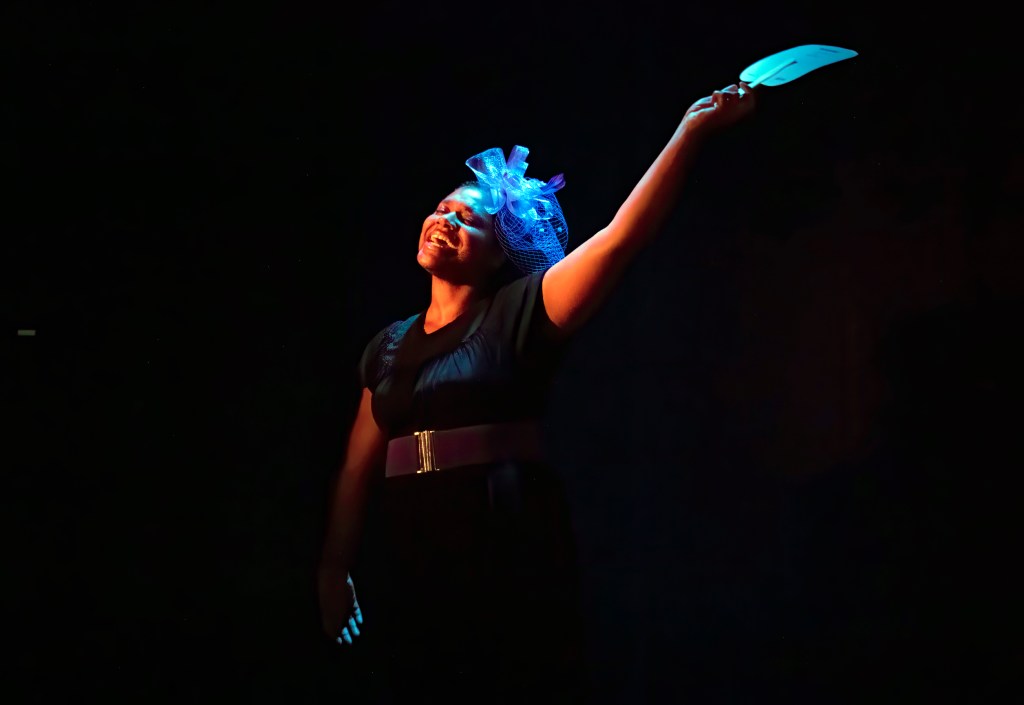
Dylan Jones and Zakiyyah Jackson hold down most of the female roles in Sutter’s life. Both play his mother, at different ages, as well as aunties, friends, a sister, and church ladies. In one scene they portray a quartet of women gossiping on the telephone, highlighted by rapid costume changes but my favorite is their second act “non-committal ceremony,” a nasty same-sex divorce officiated by a Zen-like Cashwell. This scene is the embodiment of the adage, “same sex, same problems!”
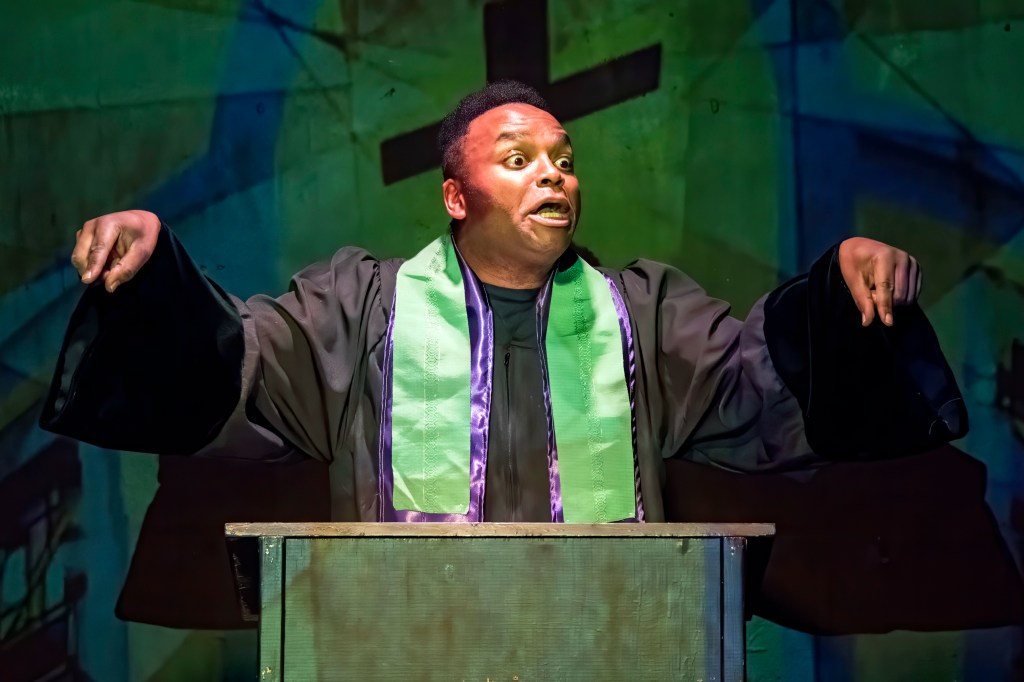
Durron Marquis Tyre transforms into several characters, but my favorites are the right reverend who comes out in a sermon delivered to his outraged congregation. Instead of coming out of the closet, he emerges from behind his pulpit to reveal fishnet stockings, blinged out silver slingback heels, a wig, and finally a clingy little red dress and matching lipstick. This is where Jones and Jackson begin their magic as they subtly change from gossip-mongers to staunch supporters.
In the second act, Tyre portrays Sutter’s grandmother who offers him comfort in a time of need as she slyly extracts some cash to tuck into her bosom and a delivery of forbidden soul food. For a moment, I thought Tyre had been speaking with my own late grandmother to develop this character because his mannerisms and speech brought back memories directly from my own past. And that is part of the beauty of this play: it is relatable. In a post-show talkback the day I saw it, everyone who spoke found some point of connection. The scene where Sutter realizes he is under stress is a turning point – he stops the show, has a verbal interaction with the Stage Manager, Crimson Piazza, and the tone and tenor of the play shifts. This is , undoubtedly, one of the author’s genuine auto-biographical moments. Its poignancy highlights the humorous aspects of the previous scenes, and reminds us that often laughter is the only things that helps us make it through the tough or uncertain times.
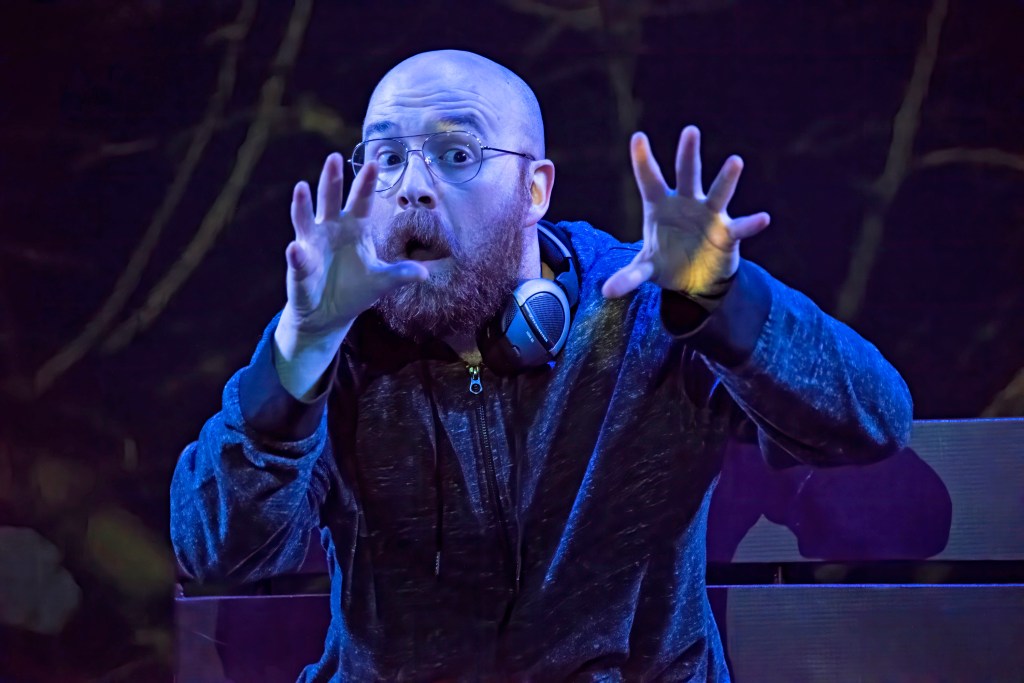
And of course I cannot forget Dixon Cashwell – the only white guy in the cast. He plays several characters, but my favorites are his portrayal of a clueless conference facilitator for the scene that closes the first act. Cashwell’s character strolls obliviously into a minefield of micro-aggressions that elicit yelps of incredulity from the cast as well as at least one audience member. In other scenes, Cashwell becomes a gay-curious male sharing an uncomfortable relationship with his brother-in-law, and has a spellbinding turn as an intoxicated man at a lonely bus stop at 3:00 AM who amazingly talks himself out of being mugged.
There are a number of little things that make BOOTYCANDY as close to perfect as it can possibly get. The subject of the women’s telephone scene is the name one young mother has chosen for her baby girl: Genitalia! It is a spoof of the unique names and exotic naming conventions of Black American families and a nod to the sort of urban legends many of us educators have passed down through the decades: the little boy named Shi-Thead, the little girls named Vagina, Clitoris, and Female (pronounced Fah-MA-ley), or the twins named Orangejello and Lemonjello (pronounced a-RON-zhello and le-MON-zhello).
By the time you read this, BOOTYCANDY may have ended its all-too-brief run, but just in case, consider this a SPOILER ALERT: BOOTYCANDY does not refer to a sexually attractive booty or a hot gay guy. Quite innocently – and oddly – it is the word the young Sutter’s mother uses to refer to his penis, and an excellent advertisement for teaching children the real words for their body parts.
I haven’t laughed so hard or so often I the theater in recent memory. In the words of one viewer, BOOTYCANDY is no entry-level theater, meaning it is not linear or predictable, and there is no happily-ever-after fairytale conclusion. In the mind of this reviewer, that is what makes it so special.
THE CAST
Actor One …………………………. Dylan Jones
Actor Two ……………………….… Todd Patterson
Actor Three …………..………….. Zakiyyah Jackson
Actor Four …………………………. Durron Marquis Tyre
Actor Five …………………………. Dixon Cashwell
THE TEAM
Direction: Deejay Gray & Katrinah Carol Lewis
Scenic Design: Deejay Gray
Projection Design: Dasia Gregg
Lighting Design: Michael Jarett
Costume Design: Nia Safarr Banks
Sound Design: Kelsey Cordrey
Properties Design: Kathy O’Kane Kreutzer
Production Stage Management: Crimson Piazza
THE SCHEDULE
Thursday, June 9 at 7:30 [Preview Performance]
Friday, June 10 at 7:30 [Opening Night]
Saturday, June 11 at 7:30 [Post-Show Dialogue]
Sunday, June 12 at 7:30
Wednesday, June 15 at 7:30 [ADDED SHOW]
Thursday, June 16 at 7:30
Friday, June 17 at 7:30
Saturday, June 18 at 7:30 [Closing Night]
NOTE: All performances are at 7:30pm at The Basement:
*PROOF OF VACCINATION / A NEGATIVE COVID TEST REQUIRED* The Basement is a fully vaccinated venue. Proof of vaccination or a negative COVID-19 test (within 48 hours of the performance) are required upon entry. For the safety of our artists and audiences, masks must be worn while at the theatre. Thank you for keeping our community safe!
Julinda D. Lewis is a dancer, teacher, and writer who was born in Brooklyn, NY and now lives in Eastern Henrico County.
. . .Imagine the Arctic as a Pussy; It’s Sort of Like That
A Theater Review by Julinda D. Lewis
At: Richmond Triangle Players at the Robert B. Moss Theatre, 1300 Altamont Ave, RVA 23230
Performances: June 8 – July 2, 2022
Ticket Prices: $30-35; $10 for Students.
Info: (804) 346-8113 or rtriangle.org
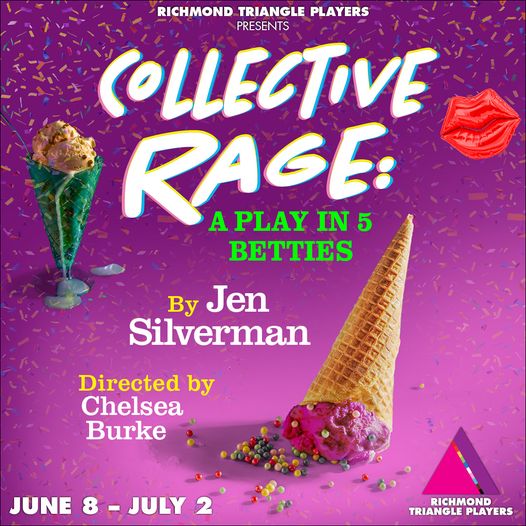
In Essence, A Queer and Occasionally Hazardous Exploration; Do You Remember When You Were In Middle School And You Read About Shackleton And How He Explored The Antarctic?:
Imagine The Antarctic As a Pussy And It’s Sort Of Like That
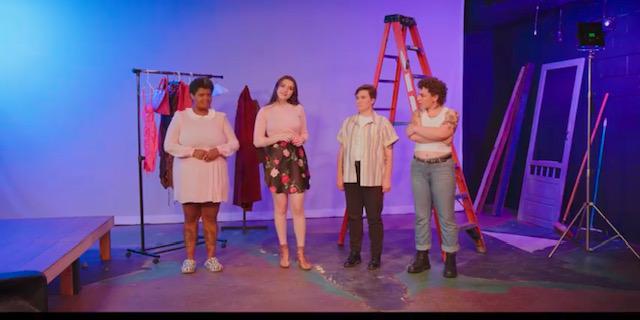
There are 5 characters in COLLECTIVE RAGE and they are all named Betty. Betty #1, Lenaya Van Driesen) is married to a man of wealth who has no time for her; Betty #2, Nora Ogunleye, is in a sexless marriage; Betty #3, Zoe Cotzias, is a celebrity lesbian who works at Sephora; Betty #4, August Hundley, is a sensitive queer woman with a truck and a crush on Betty #3; and Betty #5, with Rachel Garmon-Williams subbing for Kasey Brett is a non-binary male presenting female who runs a boxing gym – and owns a truck.
After Betties #2 and #3 attend a boring dinner party given by Betty #1, Betty #3 throws her own dinner party, where she gives the shy and friendless Betty #2 a hand mirror and invites her to use it to look at her pussy. This act opens up a whole new world for Betty #2 who spends the rest of the play on a journey of self-exploration and empowerment.
Betty #3 attends a play with a friend, becomes enamored of the “thea-tah” and decides to devise a play of her own. Betty’s play involves a prologue, a wall, a lion, and moonshine; it borrows blindly and liberally from the mechanicals’ play-within-a-play in Shakespeare’s Midsummer Night’s Dream – whose title Betty repeatedly butchers.
When they all get together to rehearse for “the thea-tah,” the ensuing chaos both defines and defies their collective rage. Set in New York in the present and first performed in 2016, COLLECTIVE RAGE is described as a “lesbian/bi-curious/genderqueer/Shakespearean comedy for everyone.” COLLECTIVE RAGE feels like a fusion of satire, cabaret, and improv. It’s hilarious and touching at the same time. There’s a cheating husband, a contrast between femme and butch, stereotypes of lesbians with trucks, and all the elements are used to explore growth, individual and collective, in multiples areas of life.
Directed seamlessly by Chelsea Burke, COLLECTIVE RAGE is more than just a niche production; it’s relatable across economic, ethnic, and gender boundaries. Van Driesen is sharp and dangerously edgy, both in her verbal delivery and her physical presentation. Ogunleye is endearing in her eurotophobia (yes, there is a word that means fear of one’s vagina or female genitalia). Cotzias aptly and appealingly encapsulates every video of a vacuous influencer I’ve ever seen. Hundley nailed their portrayal of a caring but insecure character, while Garmon-Williams uses body language and physicality on equal footing with words. COLLECTIVE RAGE offers the viewer options: you can enjoy it as a comedy, as social commentary, or both.
———-
Julinda D. Lewis is a dancer, teacher, and writer who was born in Brooklyn, NY and now lives in Eastern Henrico County.
———-
COLLECTICE RAGE: A Play in 5 Betties
Written by Jen Silverman
Directed by Chelsea Burke
CAST:
Betty #1 ……………………………………. Lanaya Van Driesen
Betty #2 ……………………………………. Nora Ogunleye
Betty #3 ……………………………………. Zoe Cotzias
Betty #4 ……………………………………. August Hundley
Betty #5 ……………………………………. Kasey Britt
Understudies
For Betty #1 ……………………………………. Amanda Spellman
For Betties #2 & #3………………………….. Leanna Hicks
For Betties #4 & #5 …………………………. Rachel-Garmon-Williams
CREATIVE TEAM:
Costume, Hair & Make-Up Design – Dasia Gregg
Costume, Hair and Make-up Design – Carolann Corcoran
Lighting Design – Deryn Gabor
Sound Design – Candace Hudert
Intimacy Choreographer – Stephanie Tippi Hart
Properties Design – Tim Moehring
Assistant Director – Katie Fitzgerald
Technical Director – Tom Holt
Production Stage Manager – Lauren Langston
Sound Design – Candace Hudert
Intimacy Choreographer – Stephanie Tippi Hart
Properties Design – Tim Moehring
Photo Credits: No production photos available at the time of publication
One-Time
Monthly
Yearly
Make a one-time donation
Make a monthly donation
Make a yearly donation
Choose an amount
¤5.00
¤15.00
¤100.00
¤5.00
¤15.00
¤100.00
¤5.00
¤15.00
¤100.00
Or enter a custom amount
¤
Your contribution to support RVArt Review is appreciated. RVArt Review is an independent publication that relies on your donations. Thank you.
NOTE: The Basement is a fully vaccinated venue. Proof of vaccination or a negative COVID test within 48 hours of the performance must be shown at the box office and masks must be worn while at the theater.
The title of Paula Vogel’s 1998 Pulitzer Prize-winning play, How I Learned to Drive, is a metaphor for a story so complex that it defies stereotypes. Vogel presents people not as good or bad, victim or victimizer, but as multi-layered and flawed humans. The play is more layered – and even stickier – than a baklava (Greek pastry), and Vogel chose to tell the story in non-chronological order, making it seem even more realistic as the scenes bombard the audience in much the same way as our own memories might arise from the murky depths of an unsuccessfully buried past.
The primary characters in this fractured and dysfunctional family tale are Li’l Bit and Uncle Peck, her maternal aunt’s husband. It says a lot about the nature of this family unit that nicknames are derived from genitalia. The grandfather is Big Papa. Her little cousin is BB for Blue Balls, and her mother is referred to as the Titless Wonder. Li’l Bit, who is never identified by her real name, presented with petite genitalia at birth, and the name stuck, although from her teen years onward she is mercilessly bullied and teased by family and classmates alike for her ample bosom. Uncle Peck is an uncle by marriage, so I don’t think his name is part of this twisted roll call – but he makes up for it in other ways.
Both Li’l Bit and Uncle Peck are given stellar performances by Juliana Caycedo and Jeffrey Cole, respectively. These are the kinds of roles that make people look at you sideways when they encounter you in the produce section of the local supermarket. The rest of the cast – family members, classmates – is played by three actors: Bianca Bryan as the Female Greek Chorus, Mahlon Raoufi as the Male Greek Chorus, and Maggie Bavolack as the Teenage Greek Chorus.
The story, narrated mostly by Li’l Bit with the help of the Greek Choruses, is a surrealistically humorous recounting of sexual abuse and survival cloaked in the guise of driving lessons. It is not surprising that Uncle Peck is an alcoholic; he is not the only one either. Li’l Bit also recounts the all too familiar pattern of women in the family who not only turn a blind eye to the abuse, but also blame the child for being seductive. Aunt Mary, Uncle Peck’s wife, blames Li’l Bit for her husband’s pedophilia (and incest?), waiting for Li’l Bit to go away to college so she can rekindle her marriage. Li’l Bit’s own mother reluctantly allows her daughter to go on a long drive to the beach with Uncle Peck, warning her that she will hold Li’l Bit – a child – responsible if anything happens. There are so many outrageous scenes like this, many of which may trigger memories in audience members as well as cast and staff, that it seems each performance should be followed by a talk-back with a therapist on hand.
How I Learned to Drive is so well performed and so well directed by Chelsea Burke that is should be required viewing. Caycedo is vulnerable and resilient. It is undoubtedly exhausting to play the role of Li’l Bit – especially knowing that there are thousands of Li’l Bits out there still fighting to survive. Cole presents as a really creepy guy, even as the role sometimes calls for him to present as a caring adult. He comforts Li’l Bit when she flees a family dinner, broken by the teasing about her large breasts and the family’s refusal to acknowledge her dreams of going to college. Who needs a college degree to lay on their back? That’s Big Papa’s perspective. Uncle Peck celebrates with her when she passes her driving test on the first try; but he also inappropriately plies her with martinis and oysters. What the hell is the matter with this man? The conflict is brought to the forefront when, at one point, Li’l Bit wisely wonders if someone had groomed or molested him when he was a child.
We applaud Li’l Bit’s survival and her ability to leave Uncle Peck behind, a diminishing image in her rear view mirror. At the same time, we weep for those who are still learning how to drive.
When I attended the Sunday matinee was followed by a talk back with members of the current cast and crew and members of the cast and crew of the 1998 performance, including cast members Gordon Bass and J.B. Steinberg and lighting designer Steve Koehler. The sharing was accompanied by memories and a few tears. Both were needed.
At the time of publication, there are only two more opportunities to see this run of How I Learned to Drive. If you can find a way to get there, run!
HOW I LEARNED TO DRIVE by Paula Vogel
Directed by Chelsea Burke
THE CAST Lil Bit…………………………………Juliana Caycedo Peck……………………………………..……Jeffrey Cole Female Greek Chorus…………….Bianca Bryan Male Greek Chorus…………..…Mahlon Raoufi Teenage Greek Chorus……..Maggie Bavolack
THE TEAM Direction: Chelsea Burke Scenic Design: Alyssa Sutherland Projections Design: Dasia Gregg Lighting Design: Deryn Gabor Costume Design: Maggie McGrann Sound Design: Candace Hudert Properties Design: Kathy Kreutzer Set Construction: Chris Foote Scenic Painters: Faith Carlson, Alyssa Sutherland Assistant Stage Management: Leica Long Associate Direction: Nadia Harika Dramaturgy & Intimacy Direction: Stephanie “Tippi” Hart Production Stage Management: Crimson Piazza
THE SCHEDULE Friday, March 11 at 8pm – Preview Saturday, March 12 at 8pm – Opening Night Thursday, March 17 at 8pm – Student Night Friday, March 18 at 8pm Saturday, March 19 at 8pm Sunday, March 20 at 3pm – Matinee Tuesday, March 22 at 8pm – Community Partner Night Friday, March 25 at 8pm Saturday, March 26 at 8pm – Closing Night
Photos by Tom Topinka
Juliana Caycedo (Li’l Bit) and Jeffrey Cole (Uncle Peck). Photo by Tom Topinka.Mahlon Raoufi, Jeffrey Cole, Juliana Caycedo, Maggie Bavolack, and Bianca Bryan in “How I Leaned to Drive.” Photo by Tom Topinka
One-Time
Monthly
Yearly
Make a one-time donation
Make a monthly donation
Make a yearly donation
Choose an amount
¤5.00
¤15.00
¤100.00
¤5.00
¤15.00
¤100.00
¤5.00
¤15.00
¤100.00
Or enter a custom amount
¤
Your contribution to support RVArt Review is appreciated.
NOTE: Proof of vaccination or a negative COVID test within 48 hours of the performance must be shown at the box office.
The title of Eleanor Burgess’ two-person play is deceptive, to say the least.
THE NICETIES.
n.pl.ni·ce·ties
1. The quality of showing or requiring careful, precise treatment: the nicety of a diplomatic exchange.
2. Delicacy of character or feeling; fastidiousness; scrupulousness.
3. A fine point, small detail, or subtle distinction: the niceties of etiquette.
4. An elegant or refined feature; an amenity: the niceties of civilized life.
(freedictionary.com)
Under the precise, insightful, and nuanced eye of director Dr. Tawnya Pettiford-Wates, an encounter between Zoe, a black student at a liberal arts college in a prestigious university and her white history professor, Janine, a 1960s style feminist, turns into an explosive debate that leaves fallout on a nuclear scale.
The two disagree on a key tenet of Zoe’s paper, the impact of slavery on the outcome of the American Revolution. At first I was unclear who initiated this meeting. A synopsis of the play in the program indicates that Zoe is called into her professor’s office to discuss her paper, while Dr. T. and Zoe (Mikayla LaShae Bartholomew) hold the view that Zoe initiated the meeting to make sure she’s on the right track before submitting the final paper. It’s a small detail, but knowing how the actors see it provides some insight into the development of the play.
“It is easier to be pro-equality
when there is a subjugated minority in your midst.” – Zoe
Burgess apparently does not subscribe to the minimalist school. THE NICETIES is complex and wordy – and you will want to hold on to every word in this dense and razor sharp script. This is a version of the historical realism genre; it is intense and relevant, with mentions of President Obama, the election of Trump, and the possibility of a woman president. It is a play that made the audience talk back, bringing to mind the experience of attending a predominantly Black church or attending a movie in a Black neighborhood – until the final scene of Act One sent the entire theater into an uproar. No need for a spoiler alert, ’cause I’m not telling – I want you to see this for yourself.
“Evidence drives back ignorance.” – Janine
What started out as a seemingly simple discussion about the proper placement of commas, subject-verb agreement, and grammatical parallelism subtly escalates into a debate about history, politics, and racism. Debra Clinton plays the role of Professor Janine Bosco. I know Debra Clinton as an actress and director, but I did not see Clinton on stage at The Basement. Clinton inhabited the role of Janine and all I saw on stage was Janine. Thanks to Janine’s inability to listen, we learned a lot more about her that we – or Zoe – needed to know. Thanks to Janine’s inability to listen, we learned of Janine’s struggles to become a tenured woman professor in a previously all-male academic environment. This made it all the more difficult to see her as a monster, as indeed she is.
“Everyone is tired of hearing about racism.” – Janine
Zoe initially appears, in turn, distracted by her constantly buzzing cell phone and on the verge of exploding. She is smart, opinionated, and a deeply committed social activist (and I quickly identified Bartholomew as an academic and spiritual protégé of Dr. T). If she were white, especially a white male, she would be called confident, but she is Black and a woman, so she is most likely to be labelled as aggressive, angry, threatening. But Burgess and Dr. T. make sure we also see her as vulnerable and hurting. “What do you want?” Janine asks her at one point. To which Zoe responds, “I want this to be your problem!”
“Greatness does not come from a supportive environment.” – Janine
This is my first time seeing Bartholomew on stage, and I hope it won’t be the last. She gave a nuanced and intense performance as Zoe, making us empathize with her but without sugar-coating her flaws. Zoe wants, needs, and demands to be heard. She wants to be respected. She is tired of waiting and being “nice” so others will feel comfortable. The character of Zoe embodies if not personifies the mission of The Conciliation Lab: a social justice theater organization dedicated to the process of CONciliation, not REconciliation, because you cannot re-do something that has not been done before.
“In all my classes, I write down what I shouldn’t have to hear.” – Zoe
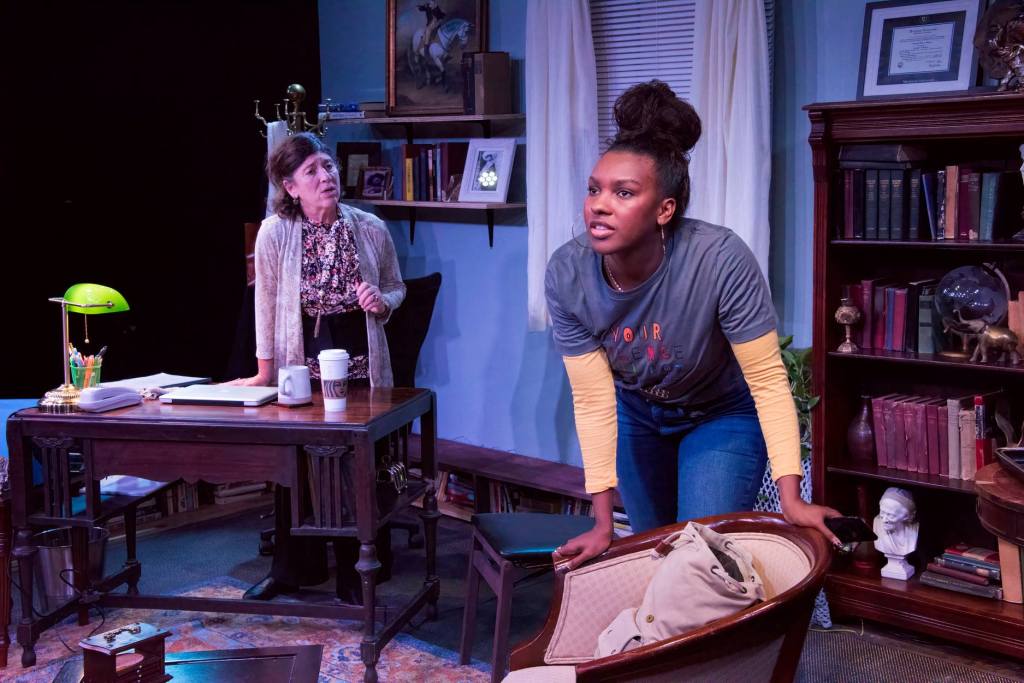
Act Two is one of the rawest and most revealing scenes I have ever witnessed in theater. A large portrait of George Washington on a horse has been removed from Janine’s office wall, but a copy of Kathleen Stockett’s 2009 novel, The Help is prominently displayed on a table and Janine proudly pulls out a copy of a book by journalist Ta-Nehisi Paul Coates, widely known for his work on African Americans and white supremacy. It’s the academic equivalent of saying, “but, I have Black friends!” Micro-aggressions in academia take many forms. But there’s more. Much more. The fallout from Act One also leads to some not-so-subtle consequences, from articles and blogs to marches and death threats. So how does it end? How is it all resolved? Well, that depends on which worldview you most relate to, and which experiences you bring to the table.
THE NICETIES is the kind of play that should have a discussion after each performance – especially when the audience is as diverse as it was for Saturday’s opening night performance. There was so much said, so much packed into Burgess’ many words, and so much that still needs to be unpacked. The beauty of the arts is that art can open the door to the hard conversations, and we need to take advantage of these opportunities when they are made available – especially in safe spaces. Note the dates, below, when post-show conversations will be available, when planning to buy your tickets.
Faith Carlson has created a professor’s office that is stereotypical and filled it with familiar props: books, pictures, a laptop. I especially liked her “fourth wall,” a super low bookcase that framed the space, with the audience (about 50 seats for this production) seated on three sides. Austin Harber’s lighting was subtle and washed the actors in a warm light that was often gentler than their words demanded, and Kelsey Cordrey’s sound design heavily favored hyped hip hop beats that fuel the train that Janine called a quest for freedom and Zoe described as an engine for racial oppression.
THE NICETIES
Written by Eleanor Burgess
Directed by Dr. Tawnya Pettiford-Wates
CAST:
Mikayla LaSahae Bartholomew as Zoe
Debra Clinton as Janine
CREATIVE TEAM:
Scenic Design: Faith Carlson
Lighting Design: Austin Harber
Sound Design: Kelsey Cordrey
Costume Design: Amber Martinez
Props Design: Faith Carlson
Production Stage Management: Crimson Piazza
Assistant State Management: Emily Ellen
Associate Direction: Heather Falks
Photo Credits: Production photos by Tom Topinka.
Performance Schedule:
Friday, October 1 at 8pm – Preview
Saturday, October 2 at 8pm – Opening Night
Thursday, October 7 at 8pm – College Night with post-show discussion
Friday, October 8 at 8pm
Saturday, October 9 at 8pm
Sunday, October 10 at 3pm – Matinee with post-show discussion
Tuesday, October 12 at 8pm – Industry Night
Thursday, October 14 at 8pm
Friday, October 15 at 8pm
Saturday, October 16 at 8pm – Closing Night
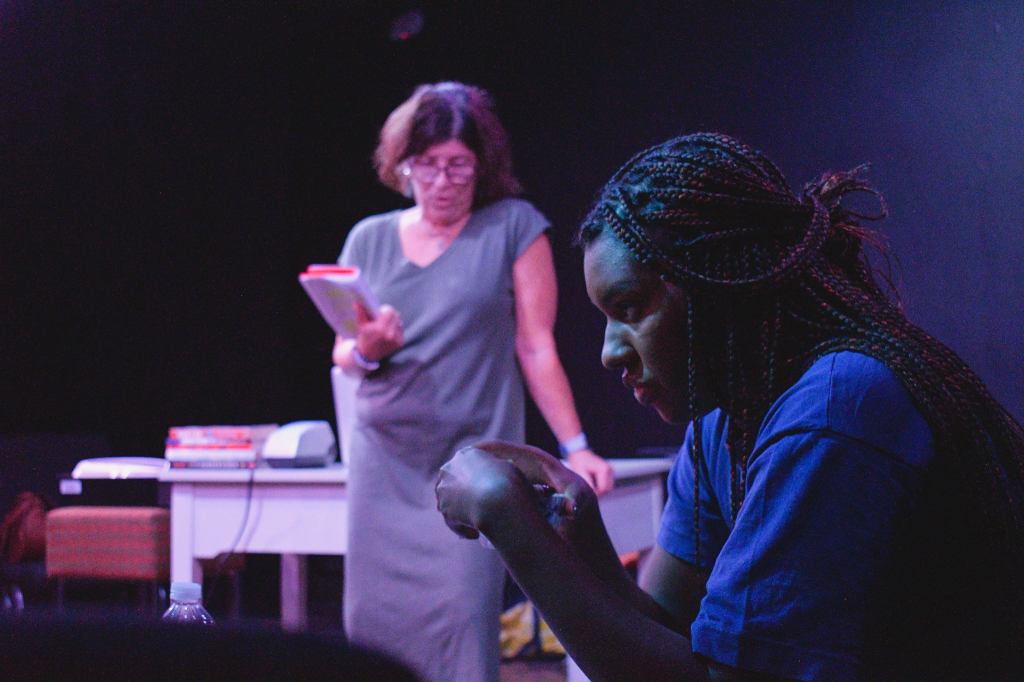
Debra Clinton and Mikayla LaShae Bartholomew in rehearsal for THE NICETIES
Debra Clinton and Mikayla LaShae Bartholomew in rehearsal for THE NICETIES
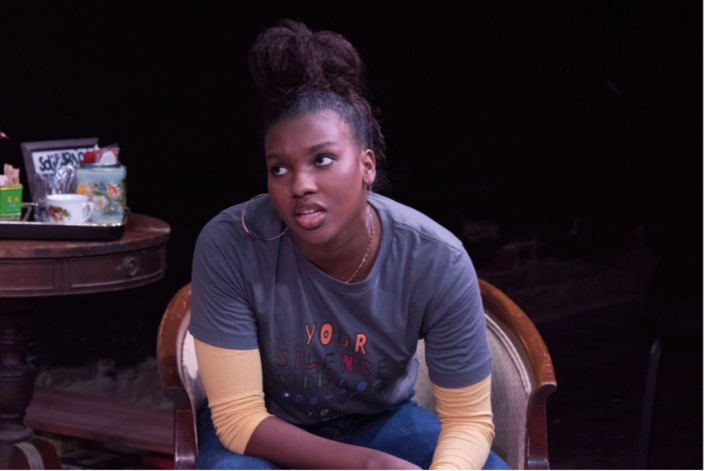
Mikayla LaShae Bartholomew
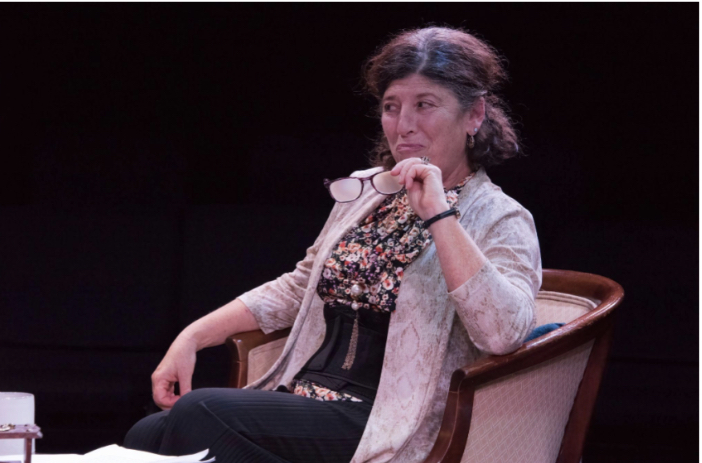
Debra Clinton
Mikayla LaShae Bartholomew and Debra Clinton in THE NICETIES at The Conciliation LAB, The Basement
NOTE1: This show contains brief nudity, adult content, and the burning of incense and herbal cigarettes. Recommended for patrons 18+ (ID required). Patrons under the age of 18 must be accompanied by an adult.
NOTE2: Due to the staging requirements of this production, we will not be offering late seating.
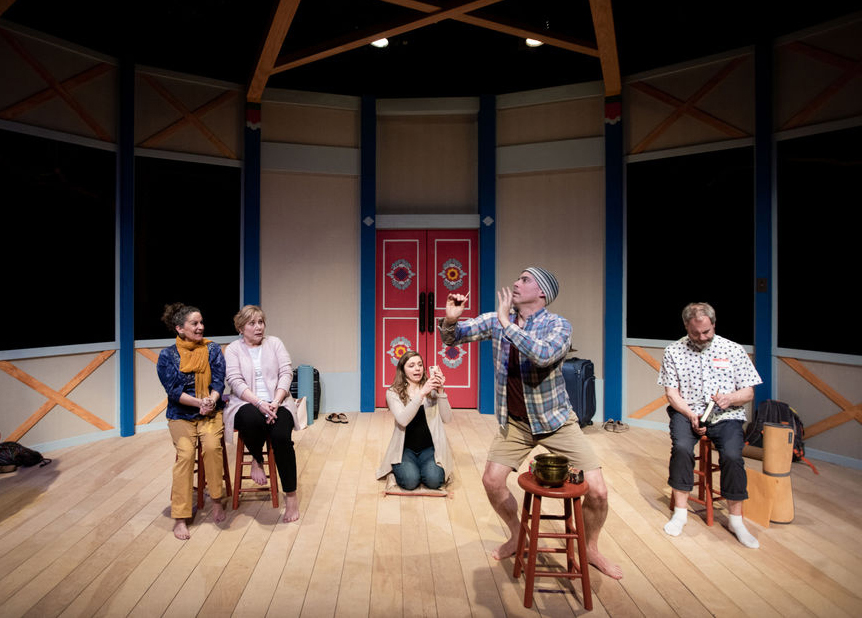
SMALL MOUTH SOUNDS originally opened in March 2020 and was cut off mid-run by “The Great Pandemic.” I reviewed it here under the title SMALL MOUTH SOUNDS: A Play Without Words, and was more than happy to return for the reboot that opened in the same space September 23. (Hmmm, I wonder if Emily Hake Massie’s lovely new-age yurt set remained in place during the long intermission?) At any rate, it didn’t seem to be necessary to write a whole new review, since what I wrote the first time seemed to withstand the test of time. (I even enjoyed reading it myself!) What I will do is note the differences, changes, updates, and tricks of my own mind, and then re-post the original review below to save you the time of having to search for it. (You’re welcome!)
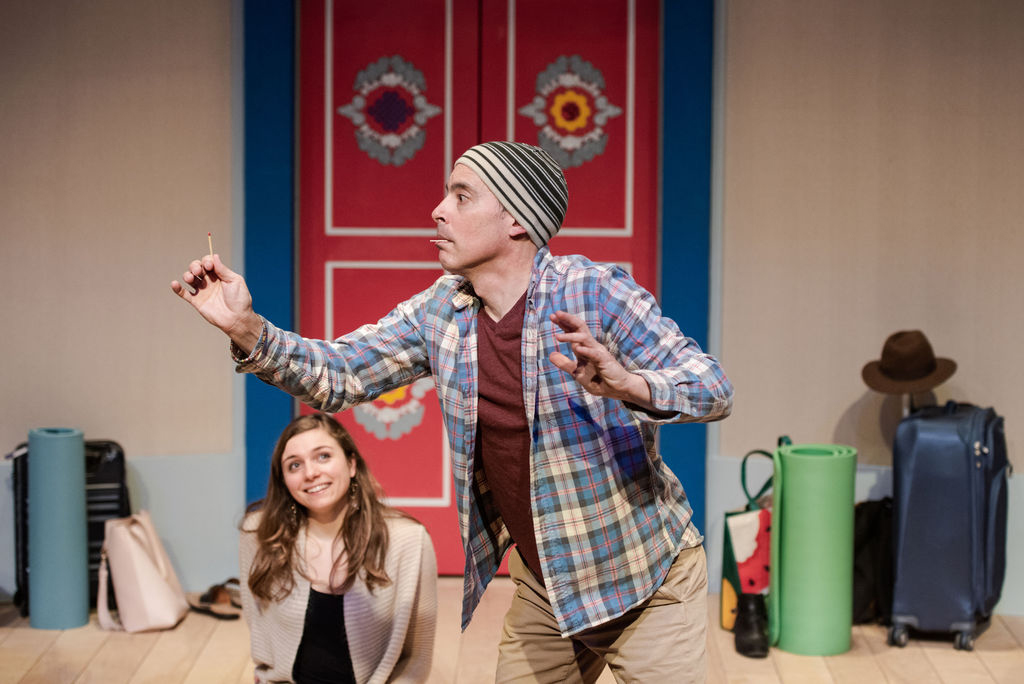
There have been a few changes since the time BC*. The actors enter wearing masks, which they remove on entering the yurt, and they pass around a bottle of hand sanitizer when the unseen Teacher has an uncontrollable coughing fit. There is also an amusing little bit of choreographed movement involving the choice of whether to shake hands or substitute a fist bump or elbow bump. And perhaps most significantly, Evan Nastaff has replaced Adam Valentine as Rodney, the passive-aggressive instructor.
I don’t know whether it was an effect of memory or time or actual changes, but it seems that the first time around I learned more about some of these characters. Memory does deceive, but I thought Ned, the only character who has a sizeable speaking role, had two meetings with The Teacher, and my memory insisted that not only had Alicia managed to receive a strong enough signal in the mountains of upstate New York to leave a message for her estranged boyfriend, Fred, but that we had learned more detail about the strained relationship between Joan (Jenny Hundley) and Judy (Lauren Leinhaas-Cook). Well, after reading my original review I concede that memory is not a reliable witness. But this much is true: Jenny Hundley appears to have developed her character, Joan, even further; her facial expressions are hilarious.
Still, I am SURE Adam Valentine gave us a full frontal, whereas Evan Nastaff teased the audience and flashed his fellow cast members. Nastaff filled this role nicely and fit in with the original cast as if had been born for the role.
*NOTE: Yes. You guessed correctly. “BC” means Before COVID-19.
MY ORIGINAL REVIEW OF MARCH 8, 2020:
It isn’t often that someone writes a play that requires the actors to take a vow of silence. But that is exactly what happens in Beth Wohl’s play, Small Mouth Sounds (premiered in 2015), when six people in search of themselves – or something or someone other than their themselves – arrive at an upstate New York center for a silent retreat. Small Mouth Sounds was inspired by the author’s own retreat experience.
Naturally, things do not unfold smoothly as each character reveals their special brand of quirkiness or unveils their personal demons. Judy and Joan are a couple – two middle-aged women who are struggling to shoulder the burden of Judy’s cancer diagnosis. Alicia is a young woman who apparently just broke up with someone named Fred; she keeps dialing his number and is constantly distracted by her forbidden cell phone. She is perturbed to discover that she has been assigned a male roommate.
Ned and Rodney are two of the most interesting members of this unlikely collection of people. Ned has had an unimaginable string of bad luck: he fell off a mountain and broke his skull; his wife started sleeping with his younger brother; he started drinking and joined AA only to have his sponsor commit suicide, and his dog got run over by a car. That’s just a small sampling of all that he’s been through. Rodney is a passive aggressive yoga instructor who smugly and silently snubs everyone else, shows off his yoga skills, removes his wedding ring as soon as he arrives, and is the first to strip down for the clothing optional lakeside activities.
Oh yes, there is a bit of nudity – full frontal – and some “herbal tobacco” and Palo Santo wood gets burned onstage. This play is recommended for viewers 18 years and older. But, to get back to the cast, one of the greatest surprises comes in the final scene from the mild-mannered Jan.
This group of seekers comes under the care and watchful eye of a gruff-voiced guru, an unseen and nameless Teacher who coughs and sneezes into her microphone and appears to be on the verge of a breakdown. The audience never sees the Teacher, Marisa Guida, until she comes out to take her bow at the end. Guida is the only character allowed to speak throughout the play. [Note: Guida did not come out for a bow in the reboot.]
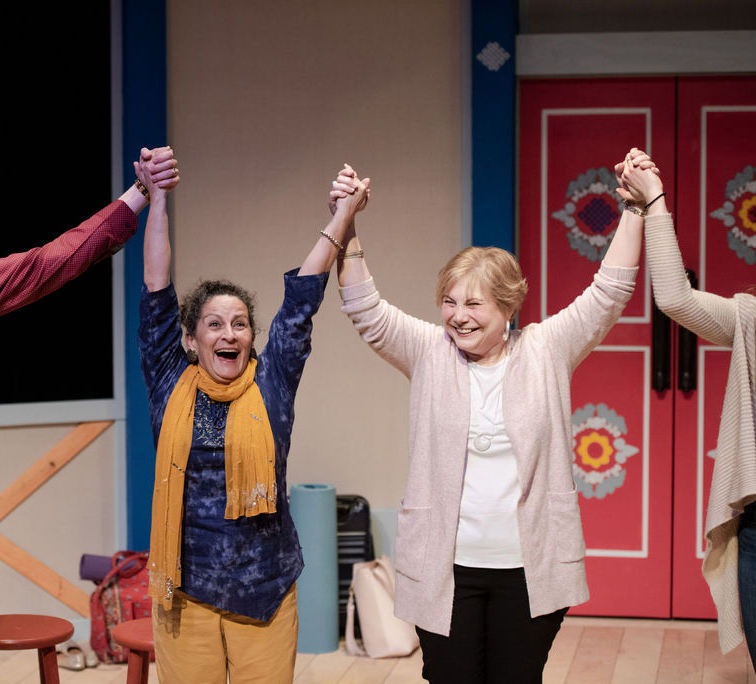
The marvelous cast consists of Lauren Leinhaas-Cook as Judy (the one with cancer); Jenny Hundley as her partner Joan (the bubbly one who always seems to have a small wrapped candy); Maura Mazurowski as Alicia (the young one with all the bags and baggage – and snacks); Jim Morgan as Ned (the one who has all the bad luck); Adam Valentine as Rodney (the passive-aggressive yoga instructor); and Larry Cook as Jan (the one whose secret I will not reveal here, but about whom I will post a nagging question at the end of this review). What makes them all so marvelous is that, except for a rather long monologue by Ned, and a brief but sharp exchange between Joan and Judy, we learn all we know about these characters through facial expressions, gestures, and a few grunts. In order to successfully carry off a play in which the main characters are all required to take a vow of silence, these actors had to act their butts off!
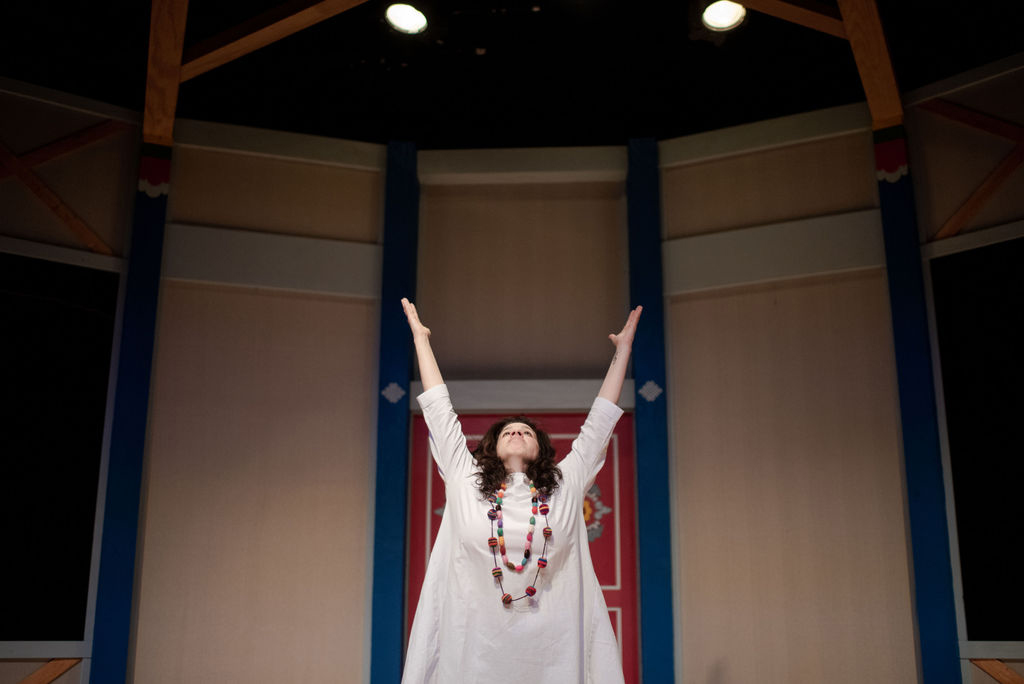
Running 70 minutes with no intermission, Small Mouth Sounds is set in a yurt-shaped structure with large open windows and chakra symbols painted on the walls. The only furniture is a few backless wooden stools (which Judy emphatically complains about) and some floor pillows. At night, the campers make do with their yoga mats as they fight mosquitos and shiver at the sounds of growling bears and other unknown animals. Actors enter down the center aisle, sometimes rather noisily, and the top of the set extends over the audience making us feel that we are inside the experience – or experiment, which I believe is the word used in the opening seconds – perhaps even in the position of the Teacher.
Joey Luck designed the sound – a variety of ambient sounds including insects and birds and a bear or two, assorted snorts and grunts, and a torrential rainstorm. Rusty Wilson, Irene Ziegler, and the cast members contributed voice-overs and other vocals sounds. Sarah Grady’s costumes helped define the characters. This entire delightful production was directed by Laine Satterfield with a balance of structure and freedom that allowed humor to emerge quite naturally. The pacing was unhurried, yet never lagged, and the scenes perfectly captured the juxtaposition of the meditative environment with the characters’ personalities and problems. In her Director’s Note, Satterfield describes how, during their first week of rehearsal, the cast members lived key moments of their characters’ lives and even worked out timelines and bios.
[NOTE: The final paragraph of the original review was omitted as it contained the March 2020 production dates, which might have proven confusing to readers.]
**********
SPOILER ALERT
Now, for that question regarding Jan and his secret. . .Do not read this paragraph if you don’t want to know before you go. . .
So, in the final scene, it is revealed that Jan does not speak English. My question is, how was he able to read his information packet and follow the instructions of the Teacher? Hmm???
**********
To provide the highest level of safety, all patrons attending a show at the theatre are required to show proof of vaccination, or proof that they have received a negative COVID test by a professional technician within 48 hours of the performance date/time.
Patrons may show the vaccination card or a photo of the card on their phones when they arrive for the performance. If you are unable to be vaccinated, you may provide proof of a Rapid COVID-19 antigen test taken within 48 hours of your performance. At home tests will not be accepted.
In accordance with current city, state, and CDC guidance, face masks are REQUIRED at all times while you are in the building, regardless of whether or not you have been vaccinated.
Voice-Over Credits: Rusty Wilson as “Fred,” Irene Ziegler as “Voicemail Guidance,” & other recorded vocal sounds including “The Bear,” performed by The Cast
At: Richmond Triangle Players at the Robert B. Moss Theatre, 1300 Altamont Ave, RVA 23230
Performances: September 23 – October 10, 2021.
Ticket Prices: $30-35; $10 for Students.
Info: (804) 346-8113 or rtriangle.org. Richmond Triangle Theater has returned to full-capacity seating and requires proof of vaccine or recent negative PCR test results for entry. See the theater’s website for their COVID-19 precautions, digital programs, and more.
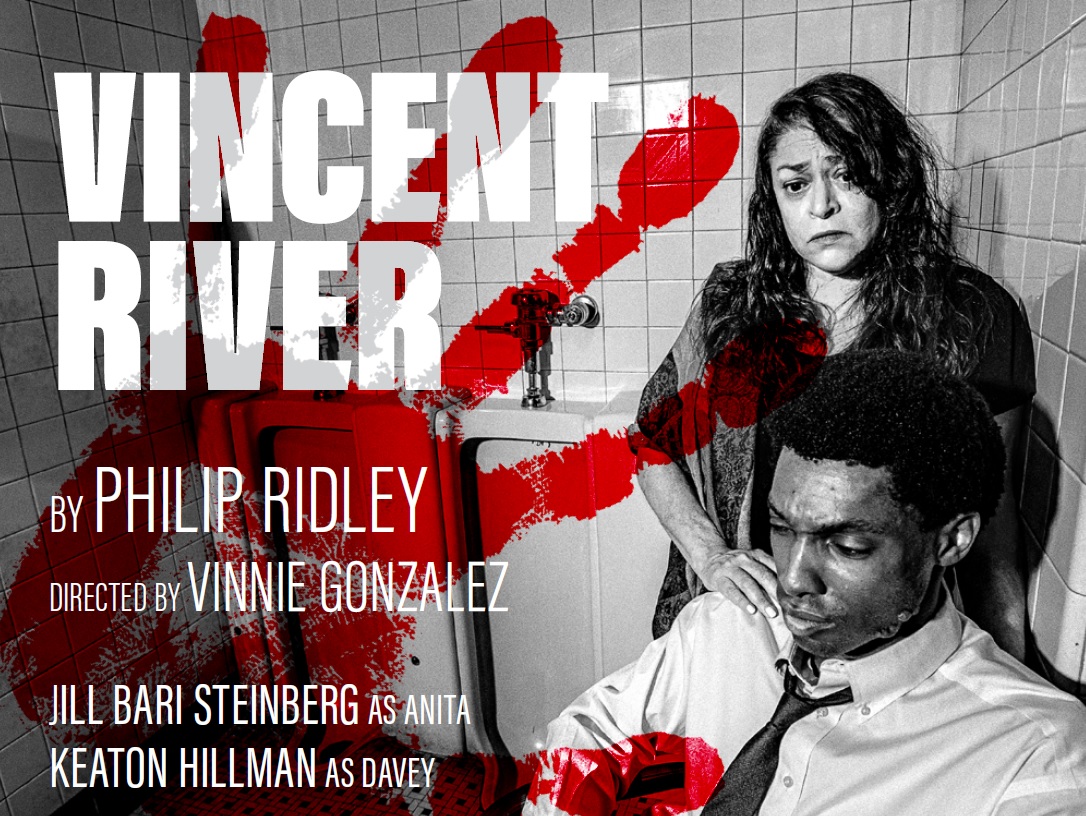
VINCENT RIVER, a two-character play by Philip Ridley, is both stunningly simple and amazingly convoluted. Jill Bari Steinberg and Keaton Hillman keep the audience enthralled for an hour and 45 minutes – with no intermission – as the story unfolds. It’s almost a theatrical form of clickbait. You couldn’t turn away even if you wanted to because you have to find out how the story ends and once you do you almost wish you had never stumbled across the announcement or whatever it was that drew you into this dark and sticky web of events. Yes, it’s that intense. For some, this story will bring back memories – or flashbacks – of The Laramie Project, produced by RTP in September 2018.
For starters, it’s prerequisite to read the advertisement or teasers for VINCENT RIVER or you might start out at a disadvantage. By intent, not much is revealed in the first scenes. The entire play takes place in the shabby apartment (well, they call it a flat, since the story takes place in East London) of Anita, a woman of apparently modest means with a long and troubled past. Her only child, Vincent River, was recently found murdered in an abandoned rail station and the newspapers had a field day composing sensational and scandalous headlines like, “Vincent River, Homosexual Victim.” Things got so bad Anita had to move from the flat she had shared with her son.
One rainy day there is a knock at Anita’s door and in stumbles Davey, a young man (I thought he initially said he was 17, but later announced he was 16) with an astonishing and painful story to tell – if only he could bring himself to speak. We know something is up because Davey has been stalking Anita for some time, and when he finally gets up the nerve to approach her, he appears reluctant to talk. It seems that Davey was the one who found Vincent’s body. But, of course, there’s more.
After much fiery deliberation the two strangers, Vincent’s mother Anita and young Davey, make a pact to tell each other all they know about Davey, in an attempt to fill in the gaps surrounding his mysterious murder. Given the seedy location and the gory details, it’s pretty obvious this was a homophobic hate crime, but why, exactly is Davey here, and what does Vincent’s death matter to him – those are the burning questions. The answers elicit shock, anger, grief, anger, disbelief, and anger. But you’ll have to go see the play to find out all the details.
At one point in his retelling, Davey tells a story about riding on a roller coaster with his mother as a youth. The roller coaster is an apt metaphor for the way this this dramatic narrative unfolds, just as the lost innocence of youth implants suggestions that make it possible to feel empathy for Davey even as we condemn his actions. Initially, I found Davey’s demeanor and reluctance to talk annoying and I thought some of facial expressions were overly exaggerated, but as the story unfolds he settled into a rhythm that seduced his audience and carried us along with him to the dark and tangled end.
Gradually, the balance of power shifts from Anita to Davey. It’s fascinating to follow this transfer, that is aided and abetted by a variety of addictive agents, including booze, pills, marijuana, sex, and even reflexology, but mainly by Davey’s words. Much of the story is told as a lengthy and emotional monologue by Davey (something Hillman has proven himself adept at in more than one show) as Anita sits quietly, allowing every imaginable emotion to pass over her face and through her posture. The two actors must be physically and emotionally exhausted after each performance of VINCENT RIVER.
All of this – the story, the emotions – is supported by Candace Hudert’s sound design which includes subtle undertones of music so soft they are mere suggestions, and a soundscape of rain that is every bit as affective in guiding the audience’s emotions as the musical cues in classic horror films,
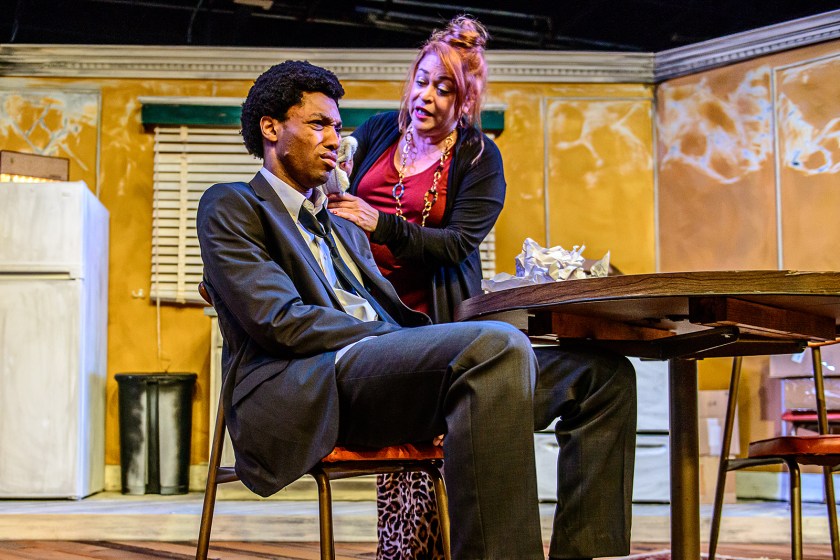
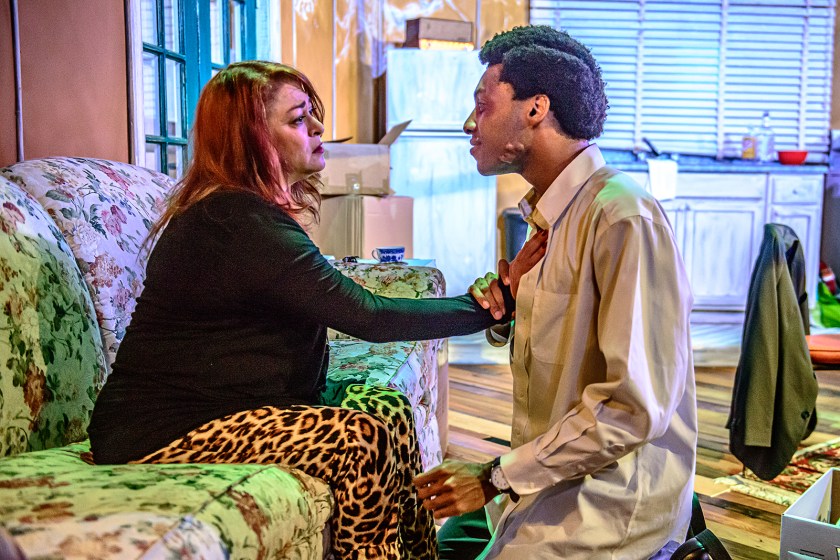
Director Vinnie Gonzalez has done his job with transparency and gentleness even though much of the language is explosive, the actions harsh, and the consequences disastrous. Moments of humor – as when Anita raises the wide blinds to expose a tiny window – take the edge off and give the audience a chance to breathe. Gonzalez’s set, built with angled walls and recessed a bit deeper than most sets at RTP, is filled with shabby furniture, peeling paint, unintentionally exposed brick, and dangling crown molding. A floor made of salvaged wooden boards provides a surprisingly sturdy foundation for the chaos that inhabits the room. Cigarette and marijuana smoke (theatrical, of course) waft through the air and there’s also plenty of booze and pills – even though the flat’s water has been shut off.
Costume designer Margarette Joyner has arrayed Steinberg in a jumble of bright colors, including disparately patterned socks and shoes and animal print bell bottoms while Hillman wears a conservative suit, dress shoes, a white button down shirt and tie. Both characters are given colorful language as well. Speaking of language, kudos to dialect designer Erica Hughes for coaching Steinberg and Hillman in what sounded to my ear like authentic British accents. VINCENT RIVER reminds us to be careful what we ask for.
VINCENT RIVER
Written by Philip Ridley
Directed by Vinnie Gonzalez
CAST:
Jill Bari Steinberg as Anita
Keaton Hillman as Davey
CREATIVE TEAM:
Scenic Design by Vinnie Gonzalez
Costume Design by Margarette Joyner
Lighting Design by Austin Harber
Sound Design by Candace Hudert
Intimacy Direction by Raja Benz
Dialect Design by Erica Hughes
Hair and Make Up Design by Luke Newsome
Properties Design by Tom Moehring
Projection Design by Aisthesis Productions and Undefined Media LLC
Production Stage Manager: Lauren Langston
Photo Credits: John MacLellan
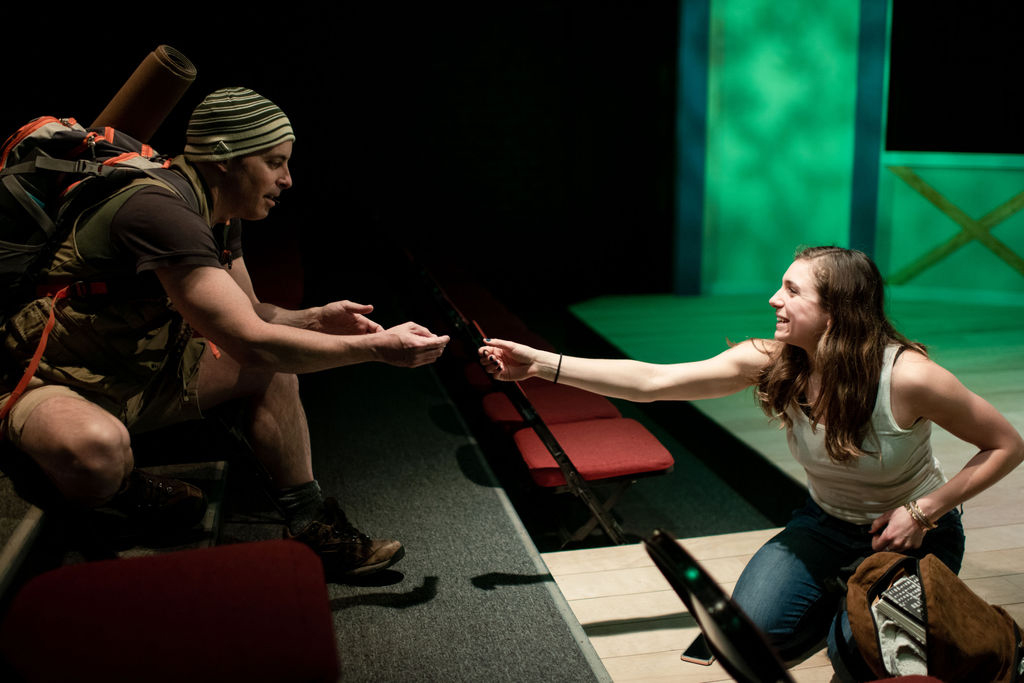
Keaton Hillman and Jill Bari Steinberg in Philip Ridley’s two-person play, VINCENT RIVER. Photos by John MacLellan.











 RVArt Review