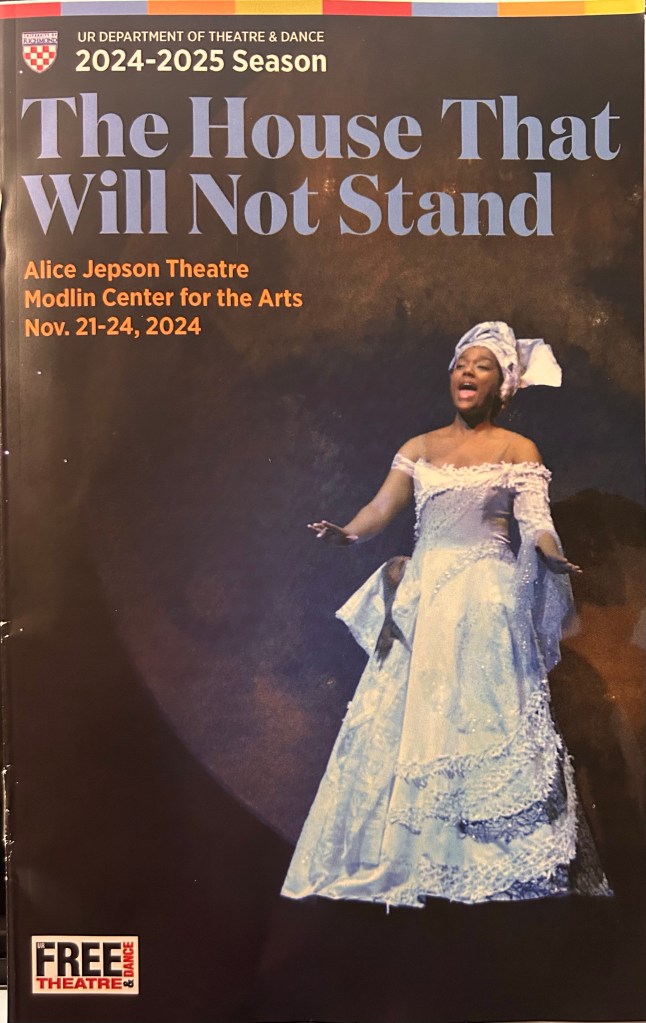
THE HOUSE THAT WILL NOT STAND

You May Be the Wealthiest Colored Woman in New Orleans, But You Built This House on Sand

A Theater Reflection by Julinda D. Lewis

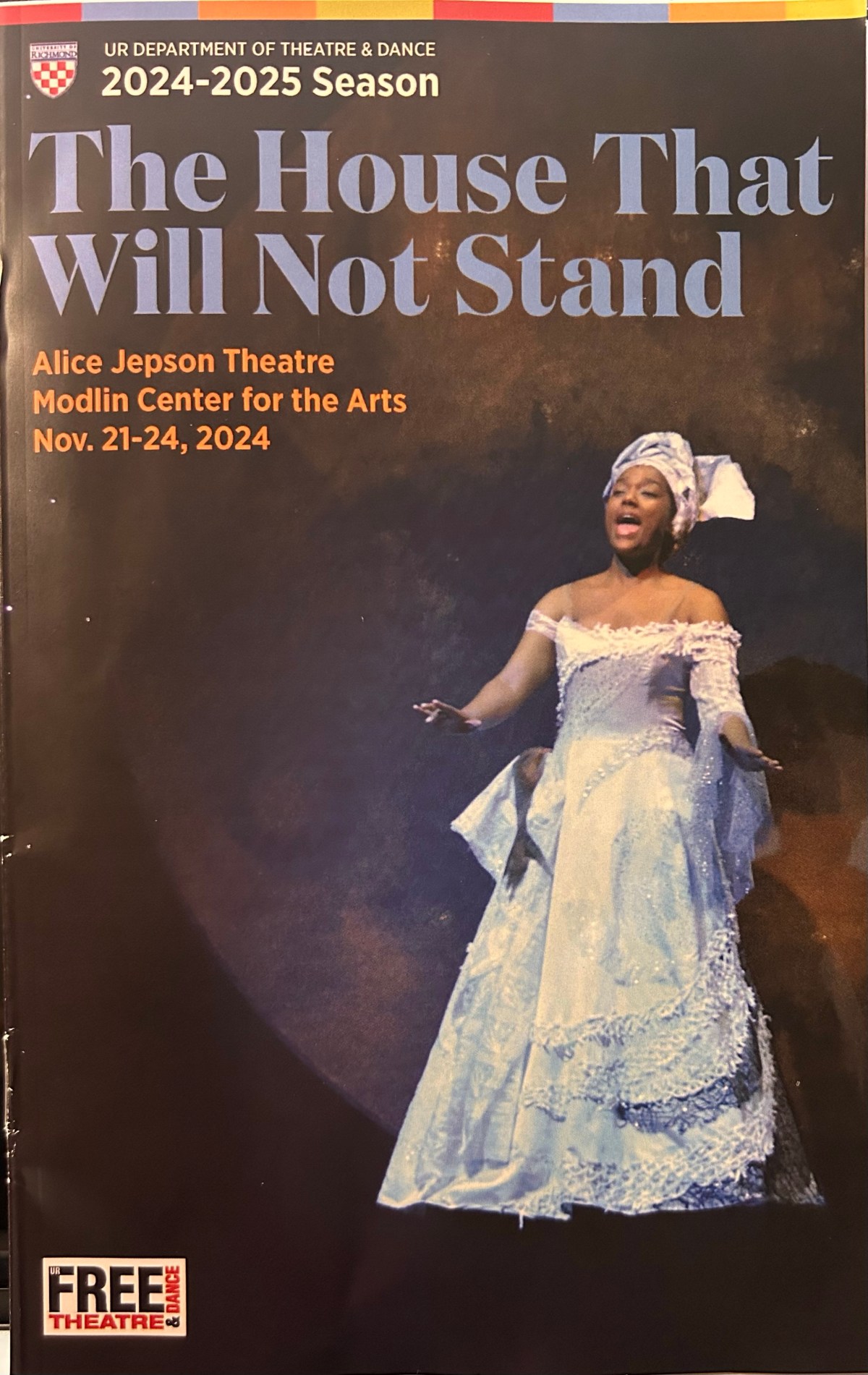
Produced by: UR Free Theatre & Dance

At: Alice Jepson Theatre, Modlin Center for the Arts, 453 Westhampton Way, University of Richmond, VA 23173

Performances:  November 21-24, 2024

Ticket Prices: FREE

Info: (804) 289-8980 or modlinarts@richmond.edu

———-

            This play was not on my radar – my list of local 2024-25 productions to view for consideration for the Richmond Theatre Community Circle awards, but at the last minute I heard about it from people whose opinion I trust, and I realized I had time in my often complicated schedule to see the very last show. I am so glad I did.

            I learned a lot from this 19th century historic drama – a tale that is so very relevant today. This household of free Creole and enslaved Black women in New Orleans on the cusp of the transfer of the Louisiana territory from France to the USA redefines what it means to be free. A lengthy quote from director Lucretia Marie Anderson seems appropriate here:

           In my initial reading of this play, I was transported back to that sense of grief and longing that pervaded the household of Bernarda [Alba, by Federico Garcia Lorca] and the stark and witty differences in how Gardley infused his memories from his own upbringing by resilient, resourceful, catty, joyful, spiritual, and heartbroken Black women in New Orleans. Creating the world in which the women in this play exist has been an honor and a collaboration with all of the magic we could muster.

            This is a hauntingly beautiful play that captures the power, the magic, the tragedy, and the strength of the recently widowed Beartrice Albans and her three daughters: Maude Lynn [run the names together, without a breath], the pious one, Odette, the dark one, and Agnès, the one most desperate to break away.

            Even the supporting characters all hold major roles: Makeda is the Haitian slave of Beartrice, La Veuve is Beartrice’s catty arch enemy, and Marie Josephine is Beartrice’s “crazy” sister who is kept hidden away in the attic. A most unusual central figure – the leading man, one might say, is Lazare Albans, the deceased white man who was Beartrice’s lover and the father of her three daughters. Lazare, who died just hours ago as the play begins, holds a prominent position as a corpse resting in state on the family’s dining room table.

            To understand The House That Will Not Stand, one needs to know a bit about New Orleans cultural history. There was a practice, prevalent from the 1600s to the 1800s) known as plaçage. A way to circumvent the laws preventing interracial marriages, plaçage allowed free women of color (light-skinned Black, mixed race, Creole) to set up households with their white lovers. Unlike common-law marriages or strictly commercial exchanges, like prostitution plaçage provided the women with homes, acknowledged the children, and assigned some contractual rights to income, property, and even limited rights to inheritance.

            In The House That Will Not Stand, not only is Beartrice’s family under attack, but the entire system is about to fall. The transfer of the Louisiana Territory to US law will mean that free women of color, who owned property and even slaves of their own – would be subject to be sold into slavery. For Beartrice, the attack was more immediate Lazare’s white wife, whom he apparently never legally divorced, has the legal right to claim his house and property simply because she is white. His will, leaving his estate to Beartrice and his daughters, has little no bearing under US law – and this is one of the places where the past seems to overlap with the present.

            While Beartrice is fighting for her daughters – adamant that they should not be sold into the plaçage system, her daughter Agnès sees the arrangement as a way to meet a handsome lover and escape the tight discipline of her over-bearing mother While Beartrice is fighting for her own freedom, her house servant, Makeda is fighting for her own freedom. Beartrice has repeatedly reneged on her promise to sign Makeda’s manumission (freedom) papers. While Beartrice is fighting for her freedom, and that of her daughters, and Makeda is hellbent on walking away from slavery, Beartrice’s own sister is imprisoned in the attic – apparently for the “crime” of loving a Black man, a drummer.

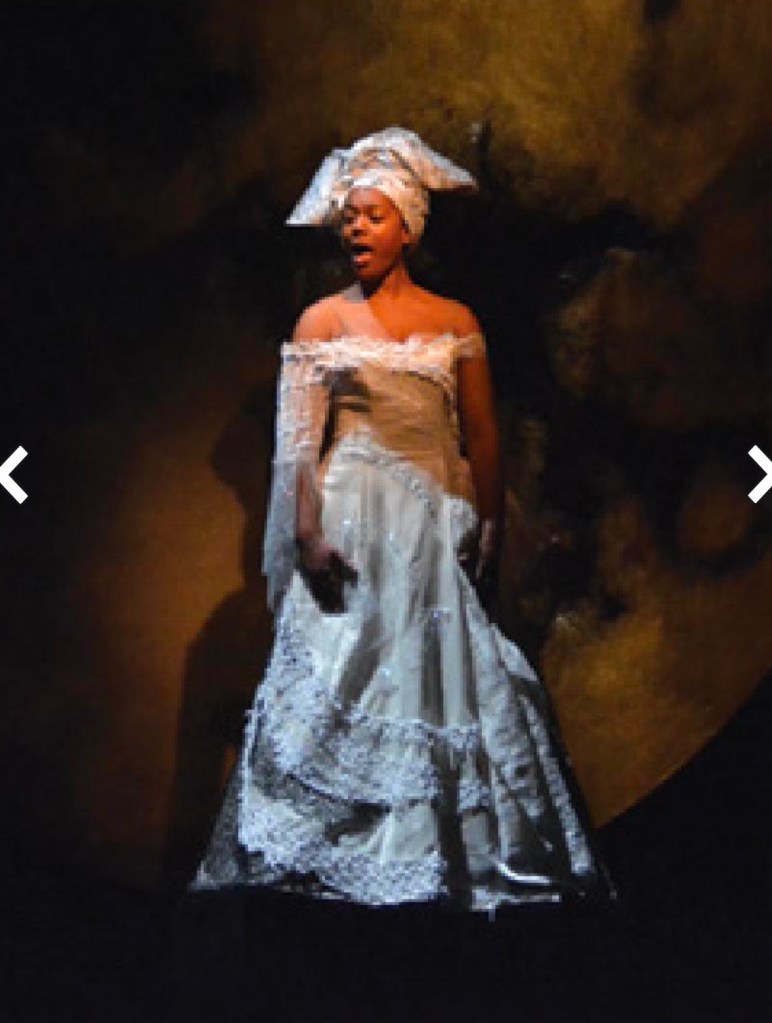
            An intricate, multi-leveled set and absolutely stunning costumes supported this cast of strong, beautiful women. Dr. Tiffany (Doc) Jana wore the role of Beartrice Albans as if it were a mantle bestowed upon her by the ancestors. Nia Simone was beautiful and cunning as the eldest sister, Agnès, who seemed to be cracking under the social pressure to be “placed” well.  Melanie Sanchez was adept at covering Maude Lynn in a façade of syrupy sweetness that, in the end, failed to completely sheath her claws. Mikaela Craft was heartbreakingly naïve as the beautiful younger sister who was burdened with the “curse” of having darker skin than her sisters and mother.

            I wouldn’t be mad with Zakiyyah Jackson if she tried to claim the title of lead for her role as what I would dare to describe as the twice-enslaved Makeda (twice, because she was held as chattel by another woman of color). Marjie Southerland, the attic dwelling sister, Marie, found freedom only by dancing off into the arms of her deceased lover, never to be seen again – and no one else in her house seemed to find that odd? Makeda had her black bag of tricks, but Marie’s magic may have been more powerful, as it was all in her mind and the swing of dancing hips. Shalandis Wheeler Smith brought the tea, the laughs, and stirred up the trouble as the catty La Veuve. But no matter how messy she tried to be, Beartrice was able to match her, word for word, without batting an eye. These women may have been dressed as genteel ladies, but underneath their bustle and layers of lace, they were tough as nails and twice as hard.

            I unknowingly selected the perfect seat, an aisle seat in the last row, where the actors made entrances and exits, where the masked drummer appeared, and where Marie flew off to find her final freedom.

            Lazare was also a constant presence. While his body lay cooling on the dining room table – a practice I have heard of, but never experienced – he did make an appearance as an apparition in the mirror when Makeda, at Marie’s request, allowed his spirit to possess her body to confirm the true cause of his death. Let’s just say that when a woman who doesn’t normally cook offers you a pie, don’t eat it.

            There was so much history and culture to process in these two hours: the whole social system of plaçage, the body in the dining room, the covered mirrors, the aunt in the attic, the colorism and caste system, the Creole balls, the white wife and the colored mistress, a woman seeking freedom in a relationship with a man who could never see her as an equal, the fear of the approaching Yankees, the fear of losing a familiar way of life, a preference for the devil you know rather than the uncertainty of the devil you only know of…What does freedom look like to you?

            What an amazing household, and how deftly they were managed for an  immersive viewing experience by Lucretia Marie Anderson. Gardley has written a masterful collaboration of drama, humor, family dynamics, tragedy, history, social (in)justice, liberation, and magic. This is a work that deserves to be seen by a larger audience. I can only imagine what a life-affirming and yet draining experience it must have been for the cast.

———-

Julinda D. Lewis is a dancer, teacher, and writer who was born in Brooklyn, NY and now lives in Eastern Henrico County. When not writing about theater, she teaches dance history at VCU and low impact dance fitness classes to seasoned movers like herself, and occasionally performs. Her most recent (ad)venture was the premiere of a solo work, The Waters of Babylon or Psalm 137 Revisited: a Post-Exodus Reflection in Movement Choreographed From Collective Memories for the debut of the Critical Race Theatre Project, right here at RTP in August 2024.

———-

THE HOUSE THAT WILL NOT STAND

By Marcus Gardley

Directed by Lucretia Marie Anderson

Cast

Dr. Tiffany (Doc) Jana …    as Beartrice Albans

Nia Simone               ……    as Agnès Albans

Melanie Sanches     ……    as Maude Lynn Albans

Mikaela Craft            ……    as Odette Albans

Zakiyyah Jackson    ……    as Makeda

Shalandis Wheeler Smith   as La Veuve

Majie Southerland  ……    as Marie Josephine

Bill Blair                     ……    as Lazare

Production & Design

Playwright                 ……    Marcus Gardley

Director                     ……    Lucretia Marie Anderson

Scenic Design          ……    Emmy Weldon

Costume Design      ……    Johann Stegmeir

Lighting & Sound Design  Maja E. white

Vocal Direction & Composition

……    Mara Smith

Choreography         ……    Deandra Clarke

Production Stage Management

……    Holly Trenbath

Assistant Stage Manager   Leland Solesby

Drummer                  ……    Austin Martin

Props Crew               ……    David Hensley, Leah Marchetti

Board Operators     ……    Jerry Chen, Charlotte Donelan,

Tina Li, Louisa Stringer, Gareth Woo

Run Crew                  ……    Gabrielle Lindsay, Leah Marchetti

Wardrobe Crew       ……    Chuhan Fang, Taylo Harris, Maddi Lewis

Director of Costume  ….    Heather Hogg

Technical Supervisor & Fight Choreographer

                                    ……    Phil Hayes

Technical Assistant ……    Tomya Pryor

Lighting & Sound Supervisor

                                    ……    Robby Williams

Guest Costume Artists       Tinia Crider, Robyn Gebhart, Karl Green,

                                                Susan Rich

Costume Shop Staff …..     Eliza Hummerstone, Jaize Francis, Alisha Tosto,

                                                Michael Florentin

Electrics Crew          ……    Alex Broening, Connor Smith, Bonny Bruzos

Scene Shop Staff     ……    Hope Amberger, Fitch Melson, Jake Litman,

                                                Megan Montoya

Scene Shop Assistants ..    Patrick Michael, Cameron Peterson, Felicia Chen

Scenic Artists            ……    Tyeon Ford, Leah Marchetti, Darcel Pham

Scenic Carpenters & Painters      

                                    ……    Jonathan Beagle, Jaleel Grinnage, Taylo Harris,

                                                Rachell Lee, Jason Liang, Ly Nguyen, Vanessa

                                                Romero, Louisa Stringer, Zachiah Zook

Production Manager & Dialect Coach

                                    ……    Erica Hughes

Poster Design           ……    Jeane Minnix

Setting & Time

The home of Beartrice, a free colored woman, New Orleans, Louisiana Territory,1830s

Run Time

Approximately two hours, with one intermission

Schedule of Performances

Thursday, November 21, 7:30PM

Friday, November 22, 7:30 PM

Saturday, November 23, 7:30PM

Sunday, November 24, 2:00PM

Ticket Information

FREE, Reservations Required.

Info: (804) 289-8980 or modlinarts@richmond.edu

Photo Credit

Unavailable
One-Time
Monthly
Yearly

Make a one-time donation
to support RVART Review (jdldances)
this publication is a labor of love
and exists only with your donations

Make a monthly donation

Make a yearly donation

Choose an amount

$5.00
$15.00
$100.00
$5.00
$15.00
$100.00
$5.00
$15.00
$100.00

Or enter a custom amount

$

Your contribution in any amount is greatly appreciated.

Your contribution is appreciated.

Your contribution is appreciated.

DonateDonate monthlyDonate yearly

JUMP BABY

An Original Musical About War and Love

A Studio Series Production at The Lynn Theatre at Brightpoint Community College, 800  Charter Colony Pkwy, T Building, Room T112, Midlothian, VA 23114

Reviewed by Julinda D. Lewis

Performances: January 27 – February 5, 2023

Ticket Prices: $10

Info: (804) 796-4000 or email theatreinfo@brightpoint.edu 


I usually don’t do much preparation prior to seeing a new show so as not to arrive with preconceived expectations. It didn’t take long before Rachel Landsee’s new musical, Jump Baby, began to feel familiar. This feeling solidified right around the time lead character Amelia West (played by Rachel Rose Gilmour) remarked that the plane banked just before she jumped out. It turns out it wasn’t the plane, hence the title, Jump Baby.


In September of 2021 I attended a wonderfully unique performance of four one-act plays at the Firehouse Theatre. Each had been written in workshop by a veteran, with one, SOAR, being penned by a female veteran. It made an impression:


The first half of the program closed with SOAR,
the only one of the four one-act plays written by a woman veteran, Rachel Landsee. Irene Kuykendall was outstanding as the military lawyer and wife, Rachel. Her husband, Adam (Dean Knight) was also an officer, and the focus of SOAR included the strains military life puts on relationships, the demands made on women, especially if they become pregnant while in service, as well as philosophical discussions of the validity of sending US troops to Iraq and
Afghanistan. For me, this was the most complex and layered of the four pieces, and its appeal is enhanced by the presence of a sort of Greek chorus meets four-part harmony a cappella group composed of four of the male ensemble members. SOAR turned out to be a mini-musical, powered by foot-stomping, finger-snapping military cadence, soulful rhythms, and the bluesy strains of Nina Simone’s “Feeling Good.”

Birds flying
high, you know how I feel

Sun in the
sky, you know how I feel

Breeze
driftin’ on by, you know how I feel

It’s a new
dawn

It’s a new
day

It’s a new
life for me…

https://wordpress.com/post/jdldancesrva.com/2727


Nearly 18 months later, SOAR has grown into – or provided a foundation for – a full-fledged two-act musical with an original score by Mark Messing. The a cappella quartet has doubled in size and this iteration features a full ensemble of cast members who play multiple roles, sing, and dance. The military cadences are still there, but now there is a list of a dozen songs and a trio of live musicians, under the direction of Cassie Cipolla. The story of Amelia and Jack has been placed in context, providing more of a backstory and fleshed out relationships.

There’s Jack and Amelia’s marriage, their struggle to understand the role of war and justice, the place of women in the military, and more. At one point, all the women are pregnant, opening the door to but leaving unanswered questions about sexuality, sexual harassment, and sexual assault in the military. Kerrigan Sullivan’s deft direction – and Kayla Xaiver’s choreography – keeps everything and everyone moving at a nice clip that echoes the military cadences.

The inaugural production of the Lynn Theatre’s new Studio Series, Jump Baby is a collaboration involving the development of new work by underrepresented voices (Rachel Landsee, a female veteran and military attorney), professional actors (Rachel Rose Gilmour and Adam Turck), and students (onstage and behind the scenes). It has catchy tunes, cadences, a logical story line, and humor. The minimalist set of boxes and graded planes studded with rivets provides an appropriate and versatile background, especially when creatively lit in a kaleidoscope of colors – or in red, white, and blue. Little touches, such as having the ringing of a cell phone voiced by an actor instead of a recording of an actual cell phone demonstrate a commitment to the process.

I fully expect to see and hear more of this project. “You can do so much with music that you can’t do with words,” Landsee said during the closing show talkback. “Musicals are a fantastic way to express an American way of life.”  I don’t think Landsee is finished yet, and it’s been a pleasure to see the growth and development to date. The production closed February 5, but I think I heard from a friend that you may be able to see a streaming version if you contact The Lynn Theatre.

Julinda D. Lewis is a dancer, teacher, and writer who was born in Brooklyn, NY and now lives in Eastern Henrico County.

———-


JUMP BABY

Written by Rachel Landsee

Music by Mark Messing

Directed by Kerrigan Sullivan

Cast:

Amelia West: Rachel Rose Gilmour

Jack West: Adam Turck

Staff Sergeant Michaels/Soldier: Jay Bynum

Deputy Big Boss/Jumpmaster/Soldier: Conner McGowan

Branch Chief/Soldier: Mac Owens

Acting Deputy Big Boss/Jumpmaster/Soldier/Assistant
Director: Russell Paulette

Big Boss/Soldier: Harrison Phillips

Soldier: Mahala Redden

Missy/Soldier: Ariana Silva

Military Doctor/Soldier: Julianna Velasquez

Band:

Pianist: Justin Lee

Trumpeter/Auxiliary Percussionist: August Redden

Percussionist: Elliot Loucks

Song List:

War Game

Homicide Rhymes with Lullaby

Jumping Hollywood

Death from Above

Undone

Called Away

59 Days and a Wakeup

Christmas Bells

On the Daily

Run, Gun, and Done

Mail Call

Green Light Go

Production Team:

Producing Artistic Director/Director: Kerrigan Sullivan

Playwright/Lyricist: Rachel Landsee

Composer: Mark Messing

Musical Director: Cassie Cipolla

Choreographer: Kayla Xaiver

Creative Team & Designers:

Production State Manager/Lighting Designer/Master Electrician: Alleigh Scantling

Scenic Designer/Technical Director/Properties Master: Hailey Bean

Sound Designer: Grace LaBelle

Costume Designer: Lindsey Ladnier

Assistant Stage Manager/Spot Operator/Costume Shop Supervisor: Claire Bronchick

Marketing Manager/Graphic Designer/Photographer/Videographer/Website Designer: Ian Glass

Assistant State Manager: Michelle Rubinstein

Sound Engineer: Lillian Foster

Crew:

Sam Richardson, Casey Allen, Sadie Tucker, Kenya Saunders

Performance Schedule:

Friday, January 27, at 7:00 p.m.

Saturday, January 28, at 7:00 p.m.

Sunday, January 29, at 2:00 p.m. (Talkback with the playwright follows the show)

Thursday, February 2, at 7:00 p.m.

Friday, February 3, at 7:00 p.m.

Saturday, February 4, at 7:00 p.m.

Sunday, February 5, at 2:00 p.m. (Talkback with the playwright follows the show)

Run Time:

About two hours with one intermission

Tickets:

General admission tickets are $10. Military and veteran tickets are $5. Current Brightpoint students may get their tickets for free with a Brightpoint Student ID. To purchase tickets, go to https://www.brownpapertickets.com/event/5692705

Photos: Ian Glass

thank you for supporting the continued publication of rvart review with a donation in any amount

Your contribution is appreciated.

Donate here

Make a monthly donation

Your contribution is appreciated.

Donate here

Make a yearly donation

Your contribution is appreciated.

Donate here

Moments with MommaJ: #1

Moments With MommaJ – Thoughts But No Reviews: February 24, 2022

Since January 18, 2018, I have published 240 reviews in this blog space. (I wrote 238 and 2 of them were written by a young mentee.) That averages about 60 reviews each year, or 5 per month. And BTW, I welcome the comments and reviews of others. (There’s no pay, right now, but you get the satisfaction of seeing your words in print – or disagreeing with me.)

I started this venture – a safe space I call RVArt Review, a home for dance and theater – when the newspaper for which I had been writing dance and theater reviews for more than a decade suddenly and without explanation, decided they no longer had the space or funds to publish reviews. (There had been three of us writing about local theater productions and I was the first to be ghosted. And yes, I did ask for an explanation, some closure, something, but never got it.)

I have been writing about dance and theater since shortly after I started grad school in 1978. (I earned a BS in Dance and Dance Education from New York University in 1977 and returned in 1978 to begin work on my MA I the same department.) I took a course on writing dance criticism with Ernestine Stodelle. Ms. Stodelle had been a member of the pioneering modern Humphrey-Weidman Dance Company and later became a writer. She encouraged me to continue writing, and I have been writing ever since, first for a local publication in Brooklyn, then for The Black American weekly, occasionally for The Village Voice¸ nearly twenty years for Dance Magazine, and many free-lance assignments for newspapers, periodicals, academic journals, followed. After moving to Richmond in 1996, I wrote for The Richmond Free Press and The Richmond Times Dispatch. Just as I had to continue dancing after having two total knee replacements and a spinal fusion (in the same year), I had to continue writing, even as “professional” outlets began to disappear, because that is what I do. Since about age three I knew that I was called to dance, teach, and write.

Times change. The landscape of reviewing the arts must change, too. You may have noticed that I prefer the term “reviewing” over “criticism.” The former is a better fit for the conversational tone and sometimes rambling writing practice that suits me, while the latter sounds to me as if the writer sets out to find fault. I know, these are not the standard definitions, but hey, this is my space, so I get to make the rules. When you read what I have written, my hope is that you feel as if we are sitting down having a conversation. So yes, responses are appreciated.

I write about dance and theater because I love dance and theater. My first paid job was in a summer youth program in NYC where we did community service (cleaning parks, painting the yellow lines in front of fire hydrants) and put on full-scale theatrical productions. During my three wonderful summers in that program (approximately ages 13-15), I played the roles of Maria in West Side Story, Yenta in Fiddler on the Roof,  and a character whose name I cannot remember in a western, a “pioneer drama” called The Chips Are Down.

———-

You may be surprised to learn that even though I average 50+ reviews per year, I do not write reviews about everything I see. The standard for arts organizations  and publications I have been associated with has been to review only “professional” productions or those that meet a certain standard for number of performances, paid staff, and the like. But this is a new space, my space, and so I’m going to make some new rules, my rules. Sometimes, I want to talk a bit about people, places, and theater-making that might not meet the traditional standards for reviewing, whether it is a student or community theater production or a reading or just some interesting bit of history or a noteworthy nugget. So, here we are. Several paragraphs into this rambling rabbit hole of a journey, welcome to the first Moment With MommaJ – a space where I will occasionally share some thoughts on whatever I feel like, just because.

Here we are at the final weekend of February, and I’ve posted four reviews this month: A Doll’s House, Part 2, A Hotel on Marvin Gardens, Stonewallin’, and the ballet Romeo & Juliet. This month I also saw a few things I did not review, and I’m just gonna take a moment (a Moment with MommaJ) to write a few words about them before I sign off for the month.

On February 17 I attended a Pre-Assessment Concert for middle school and high school bands hosted by the Clover Hill Band Program in Chesterfield County. I was there to support my eldest grandchild, Kingston Marley Holmes, who plays percussion for the Manchester Middle School Advanced Band under the direction of Mrs. Elizabeth McHatton. Of course I was impressed to see Kingston confidently moving from tambourine to timpani as the percussionists are multi-instrumentalists (if that’s a word). My heart swells with pride and my eyes get a bit leaky whenever I see young people doing positive things and doing them well.

The Manchester Middle School Advanced Band, the Swift Creek Middle School Combined Band (directed by Mr. Jim Neiner) and Clover Hill High School’s Symphonic Band and Wind Ensemble (both directed by Mrs. Brianna Gatch) each offered three selections and it was a most satisfying evening. I am in no way qualified to evaluate or assess band music, but I can tell you that the level of skill, talent, dedication, commitment, and confidence I observed in these young people will take them far, whether they continue to study and play music or not. Bravo, young people. Bravo.

Then on February 19, I attended a performance of Intimate Apparel at VCU’s W.E. Singleton Center for the Performing Arts. A production of  the VCUarts Theatre Department, Intimate Apparel is directed by none other than Dr. Tawnya Pettiford-Wates (Dr. T). Written by Lynn Nottage, the play premiered at Center Stage in Baltimore, MD in February 2003 and opened Off-Broadway the following year. Set in New York City in 1905, the plot revolves around Esther, an African-American seamstress in her mid-thirties who lives in a boarding house and earns a decent living sewing intimate apparel. Her clients include a wealthy white woman, Mrs. Van Buren, and Mayme, a lady of the night with a heart of gold who happens to be a classically trained musician, who appears to be the conservative Esther’s best friend.

Esther longingly observes the other women who live in the boarding house, owned and managed by a dignified widow, Mrs. Dickson, get married and move away. She becomes impatient with biding her time, slowly saving to buy her own beauty parlor and hoping to meet a nice man to marry. Things start to look up when she begins to correspond with George. Introduced by  a mutual connection, they seem to have a lot in common. Like Esther, George has moved far from his home in Barbados to work on building  the Panama Canal. Like Ether, George, too, is lonely, and looking for a wife and a chance to own his own business. But things are not what they appear to be, and Esther ends up loosing both her man and her money – but not her mind. Bowed but unbroken, she returns to the boarding house and starts over. There is more, much more, but this is not a review and I don’t want to give away all the nuanced and multi-layered details, because I want you to see – or at least read – this one for yourself.

You know how some of us – many of us? – are just learning about some ignoble events in American history? You know…things like the bombing and burning of Black Wall Street or the flooding of African-American communities to build parks? Well, this is kinda the literary and theatrical version of that on an individual, social, economic scale.

Under the direction of Dr. T, Amaiya Howard (Esther), and Jonel Jones (George) bring this story to life, revealing bits of history while exploring human nature and traversing largely hidden, forgotten, or otherwise unfamiliar territory by way of a poetic and sensual Africanist storytelling aesthetic.

They are ably supported by Tatjana Shields (whose Mrs. Dickson reminds me of Claire Huxtable), Caroline Mae Woodson as the ingenuously innocent “white lady” is all too familiar, and Nia Simone as Mayme, a humorously bawdy prostitute. Hands-down, my favorite supporting role was that of Mr. Marks, the Hasidic owner of the tiny fabric store where Esther found her special fabric deals. Elijah Williams was so genuine in this role, he brought back memories of shop owners I encountered in Williamsburg, Brooklyn and the Lower East Side of Manhattan.

My only issue with Intimate Apparel is that, even with two intermissions, these old bones have a hard time sitting through an approximately three-hour production!

Finally, as I sit and write this Moment with MommaJ, I have just arrived home from a staged reading – the second in a series of four – presented by the new kid on the block, The New Theatre (TNT), with Nathaniel Shaw as Artistic Director and Vida Williams as Executive Director. Red Bike by Caridad Svich is a poetic duet of a play, simultaneously humorous and solemn. Amber Marie Martinez and Raven Lorraine Wilkes read the roles of two pre-teens growing up in small town America and claiming – not seeking, but claiming – their place in the world. It’s sometimes loud and unpredictable, and the viewer sometimes feels as if they are riding the handlebars as the actors’ virtual bikes speed downhill towards certain disaster. The author and text of Red Bike appear to be aligned with the mission of vision of The New Theatre, which has not yet begun turning out full productions.

TNT’s Mission is “to challenge and expand art and industry through innovation in project development, presentation, and community participation,” and their Vision is to become “an innovative American Theatre where we are all seen, where we are all welcome, where we are all inspired.” Visit their website to learn more about the new kid in town: thenewtheatreva.org.

Julinda D. Lewis, EdD is a dancer, teacher, and writer who was born and raised in Brooklyn, NY and now resides in Eastern Henrico County, RVA.

One-Time
Monthly
Yearly

Make a one-time donation

Make a monthly donation

Make a yearly donation

Choose an amount

¤5.00
¤15.00
¤100.00
¤5.00
¤15.00
¤100.00
¤5.00
¤15.00
¤100.00

Or enter a custom amount

¤

Your contribution is appreciated.

Your contribution is appreciated.

Your contribution is appreciated.

CLICK HERE TO Donate
TO rvart rEVIEW
CLICK HERE TO Donate
TO rvart rEVIEW
CLICK HERE TO Donate
TO rvart rEVIEW

INDIAN INK THEATRE COMPANY: Mrs. Krishnan is Throwing a Party!

INDIAN INK THEATRE COMPANY: You’re Invited to Mrs. Krishnan’s Party!

A Brief Preview of an Immersive Theatrical Experience by Julinda D. Lewis

At: Alice Jepson Theatre, Modlin Center for the Arts at University of Richmond, 453 Westhampton Way, Richmond, VA 23173

Performance: January 25, 2020 at 7:30pm & January 26, 2020 at 3:00pm

Ticket Prices: $40 General Admission; $32 Subscribers; $20 Students / SOLD OUT!

Info: (804) 289-8980 or modlin.richmond.edu

One of the problems, well, actually, the only problem, actually, with the Modlin Center for the Arts – which is a lovely space for dance, which is what I usually see when I go there – is that their productions are usually scheduled for just one or two performances or one or two evenings. So, as much as I want to tell you about Mrs. Krishnan’s Party, which is coming in January, I am sorry to have to start off by informing you that both shows are already sold out! (I asked if there is any possibility of additional shows being added, and I am awaiting a response.)

The Indian Ink Theatre Company, based in New Zealand, was touring in Seattle, WA when I spoke with Kalyani Nagarajan who plays the role of Mrs. Krishnan in this two-handed comedy. Mrs. Krishnan’s Party was “in the works” for seven years and now tours the world attempting to bring happiness –  and Indian culture – to audiences of all ages, genders, and ethnicities.

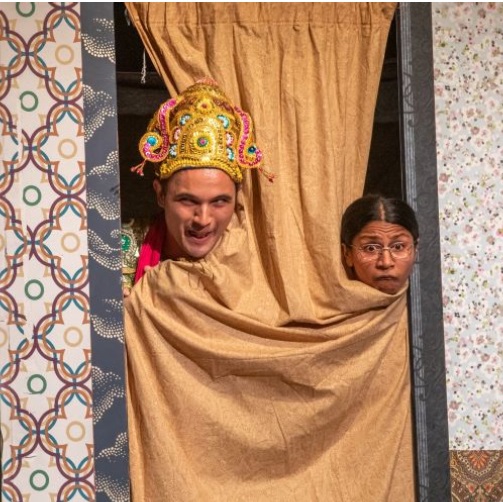
Mrs. Krishnan’s Party is a story about a “Mom and Pop” type store whose owner is looking to sell it. The story takes place in real time, “everything happens live” is the way Nagarajan explained it. There are two actors, Nagarajan and Justin Rogers. Nagarajan was very enthusiastic in describing the colorful nature of the play, not just in the costumes and set, but also in the culture, and even in the intergenerational characters: one is in her mid-50s, the other in his early 20’s. The “third character” is the audience.

As the story unfolds, secrets are revealed, and the audience becomes immersed in the action. Nagarajan was very specific in rejecting the word “interactive,” believing it might push some people away, but seemed comfortable with the idea of a cultural and theatrical immersion.  It’s about people going through familiar things. Set in the back room of Mrs. Krishnan’s store, the audience is invited to the party where they will “interact and talk with people you might never have talked with.” At the end of the show, Nagarajan wants the people dancing, singing, and laughing together. And eating! There is live cooking done onstage, and at the end the audience – excuse me, the invited guests – get to sample the meal. 

Mrs. Krishnan’s Party builds community, and the audience is urged to come ready to be surprised. “Come with an open heart,” Nagarajan urges, “and don’t eat too much dinner before-hand.”

Mrs. Krishnan’s Party, written by Jacob Rajan and Justin Lewis, combines acting, dancing, singing, music, cooking, and laughter. No two performances are the same. Even the ticketing for the show is varied. The Indian Ink Theatre Company’s website described five levels of tickets: (1) the Top Table or VIP seat at the table in the center of the room with first class treatment; (2) the Inner Circle, which is still close; (3) the Wall Flower, up high with a perfect view; (4) the Cheeky Seat, close but not too close; and (5) the Party Animal, which is no seat at all, but spot that allows you to move and dance. I hope to be able to report back detail if it’s as awesome as it sounds!

Julinda D. Lewis is a dancer, teacher, and writer who was born in Brooklyn, NY and now lives in Eastern Henrico County.

———-

Photo Credits: Nimmy Santhosh & the Indian Ink Theatre Company website


This slideshow requires JavaScript.


ANANYA DANCE THEATRE: People Powered Dances of Transformation

ANANYA DANCE THEATRE: How Do We Show Up For Each Other?

A Dance Review by Julinda D. Lewis

At: Virginia Commonwealth University School Grace Street Theater, 934 West Grace Street, RVA 23220

Performances: October 26 & 27, 2018

Ticket Prices: $20 Adults; $15 Students

Info: (804) 828-2020 or http://arts.vcu.edu/dance/


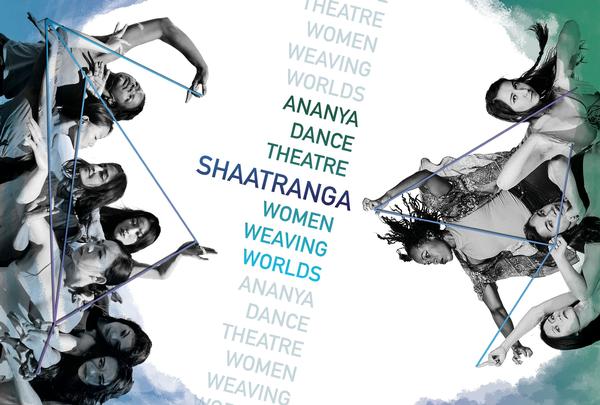
Ananya Dance Theatre, under the artistic direction of Ananya Chatterjea, presents dance within a social, feminist/womanist, human context. Entertaining is only a part of what they do. There were no spectators in the Grace Street Theater on Saturday night when I attended Shaatranga: Women Weaving Worlds. Oh, there were plenty of people in the audience, but Chatterjea and her troupe of seven powerful women did not allow us to sit and be entertained.

Several times the house lights came up and those who may have been under the impression they had come to see a show were asked to take a stand, to raise a fist, to clap and stomp our feet. We participated in an invocation of breath and watching a dance performance may never be the same. Stand up (one woman did). Raise your first (most did). Clap your hands. Stomp your feet. Chant: Public fury; public joy; public love; public dance!

Shaatranga, which means “seven colors” in Bānglā, is the culmination of a quintet of works exploring work women do. The dance was created in four movements and runs 95 minutes with no intermission and is based on research, history, and cultural connections. The two main themes are ancient Indian Ocean trade routes that connected Asia, Africa, and South America, and the shared practices of indigo-dyeing. Visually, an abstract navigation star represents the compass that “enables us to remain on the path of a complexly woven notion of justice.” At the beginning of the work, the navigation star is broken but by the end it has been healed. The sections of the dance bear names like “Voyage,” “Shipwreck,” and “Desolation.” There are “Rituals of Mourning” and “Dancing to Heal.”

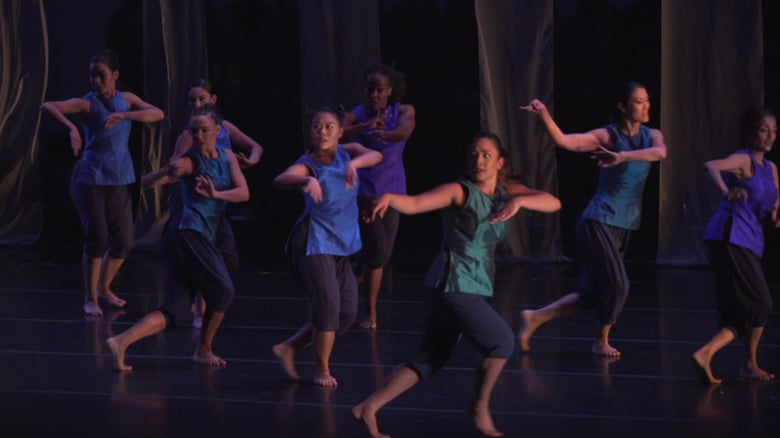
Chatterjea’s movement vocabulary uses classical Indian dance as a foundation and there are layers contemporary dance woven throughout. There is yoga, martial arts, rage and joy. The movement that stood out most to me is a spiral that starts from deep inside the core then winds its way up and out. There is also spoken word, ritual, and sound: grunts, screams, the sound of helicopter rotors as the women’s hands reach up, the sound of feet slapping and stomping, the sound of drums, and even, I think, the faint sound of birds and monkeys chattering.

At the beginning, there was a curtain hung asymmetrically so that it reminded me simultaneously of a simple curtain or covering, a woman’s veil, and a ship’s sail. Later, the black curtains opened just a bit to reveal a portion of white wall bathed in red light with Chatterjea splattered on the wall, feet up, arms splayed out on the floor. There is beauty, hunger, pain, distortion, and there is power.

Projections and simple design elements created an all-encompassing world that kept me on the edge of my seat for most of the evening. There were rolling waves and animated billows of indigo that morphed into hands, and there were ceiling-to-floor ribbons of indigo, interwoven like the lives of the women represented, remembered, and honored. Throughout, the women wore loose-fitting dark blue pants (a knee-length Indian salwar, similar to Victorian knickers or bloomers) but changed their tops for each movement (peplum tunics, athletic leotards, high necked tops) in shades of blue, sometimes with splashed of color, but always indigo. Musical composition, vocals, sound design, poetry, costume, lighting, scenic design, animations and projections all united in a seamless manifestation of Chatterjea’s concept.

Often, a program is unnecessary, except to identify the names of the dances. In this case, the program was an essential guide to the work, filled with background, history, poetry, definitions, and questions: How do we show up for each other? This company, this work must be seen. Writing about it does not do it justice.

Julinda D. Lewis is a dancer, teacher, and writer who was born in Brooklyn, NY and now lives in Eastern Henrico County.

———-

Photo Credits:

Company photos and photos from the company website.

Ananya.1Ananya.2Ananya.3

THE WOLVES: Game On

THE WOLVES: Girls with Goals

A Theater Review by Julinda D. Lewis

By: Cadence Theatre Company in partnership with TheatreVCU

At: Raymond Hodges Theatre at the W.E. Singleton Performing Arts Center, 922 Park Avenue, RVA 23220

Performances: September 27 – October 7, 2018

Ticket Prices: $5.00 – $19.99

Info: (804) 828-6026 or VCUtheatre.showclix.com

An unexpected collaboration of Cadence Theatre Company and TheatreVCU + an unusual play about teen-aged girls by Sarah DeLappe = an intriguing production of sometimes intense situations that portray the multiple dimensions of young women on their way to adulthood.

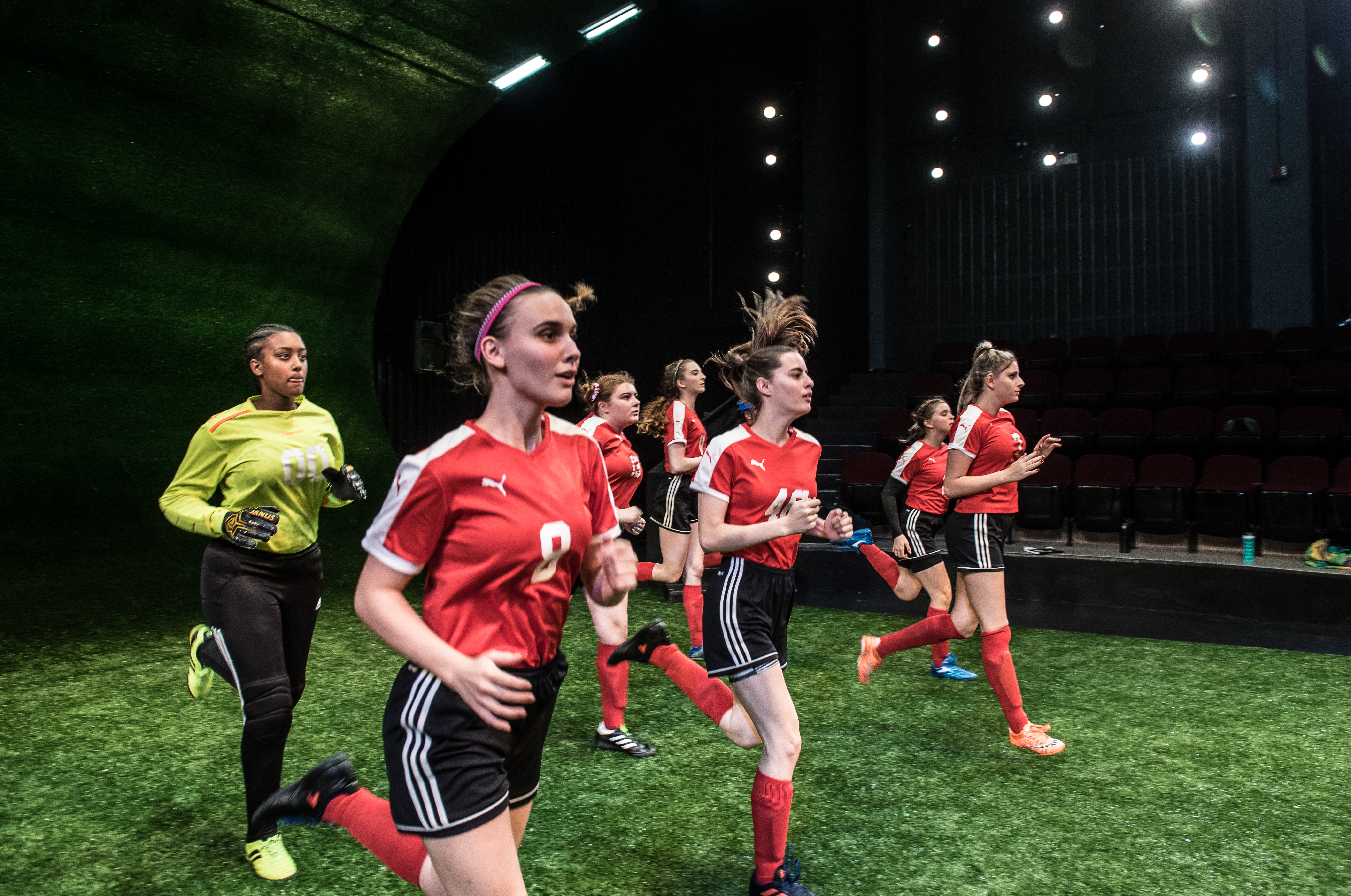
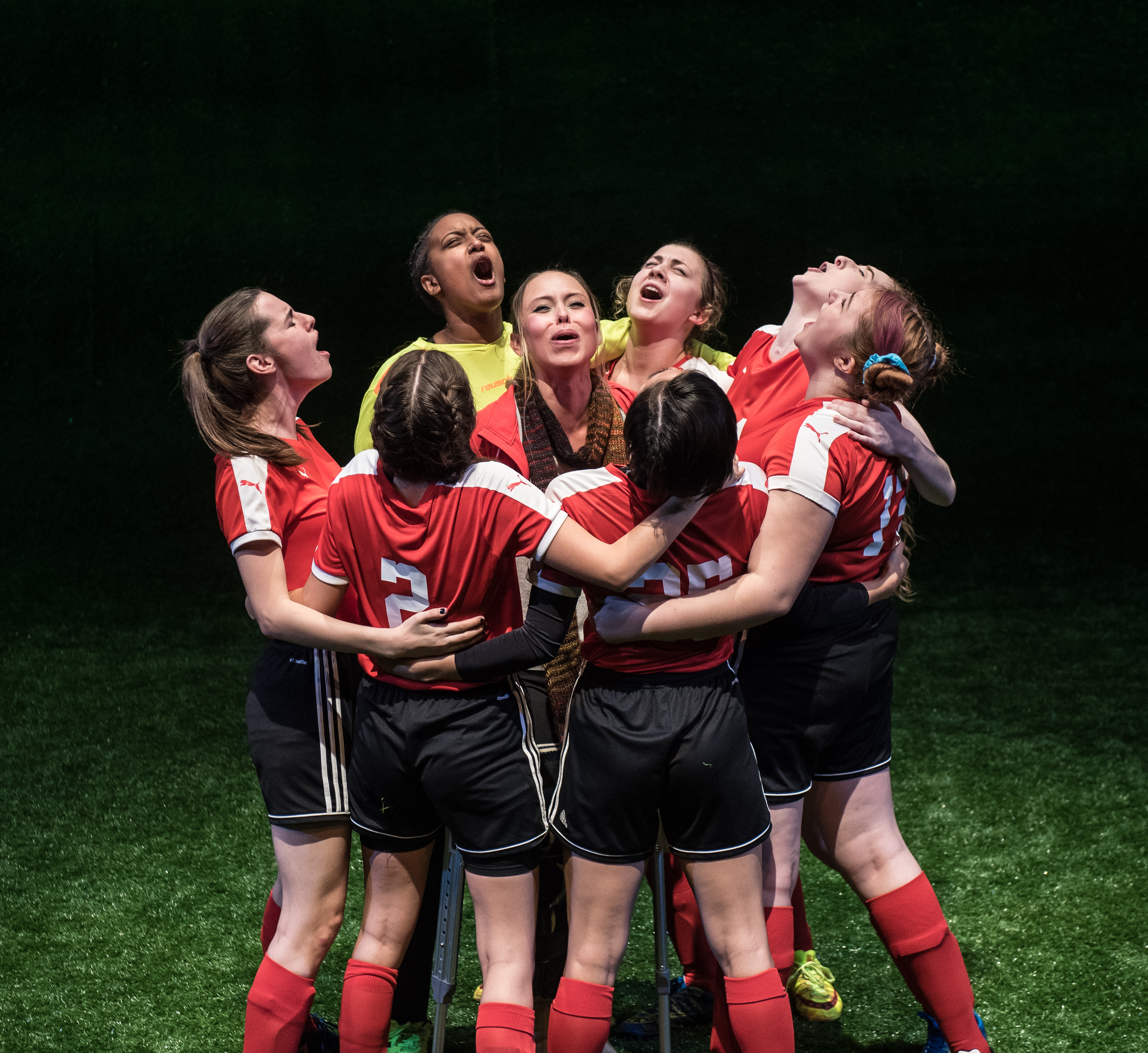
Running about 90 minutes without intermission, each scene in The Wolves shows the nine-member female high-school indoor soccer team preparing for their weekly game. The Wolves, by the way, is the name of the team. Initially they talk over one another, with multiple conversations occurring at once.  School work, boyfriends, the weekend, and menstruation are popular topics. US immigration policies are discussed in depth (the play premiered in 2016), as well as a lengthy dialogue on Cambodia and genocide. In addition to the usual teen-aged squabbles, there are accidents and injuries, hints of eating disorder and a possible same-sex relationship, and genuine, life-altering tragedy. We get to meet the girls as they warm up and prepare to meet their weekly opponents.

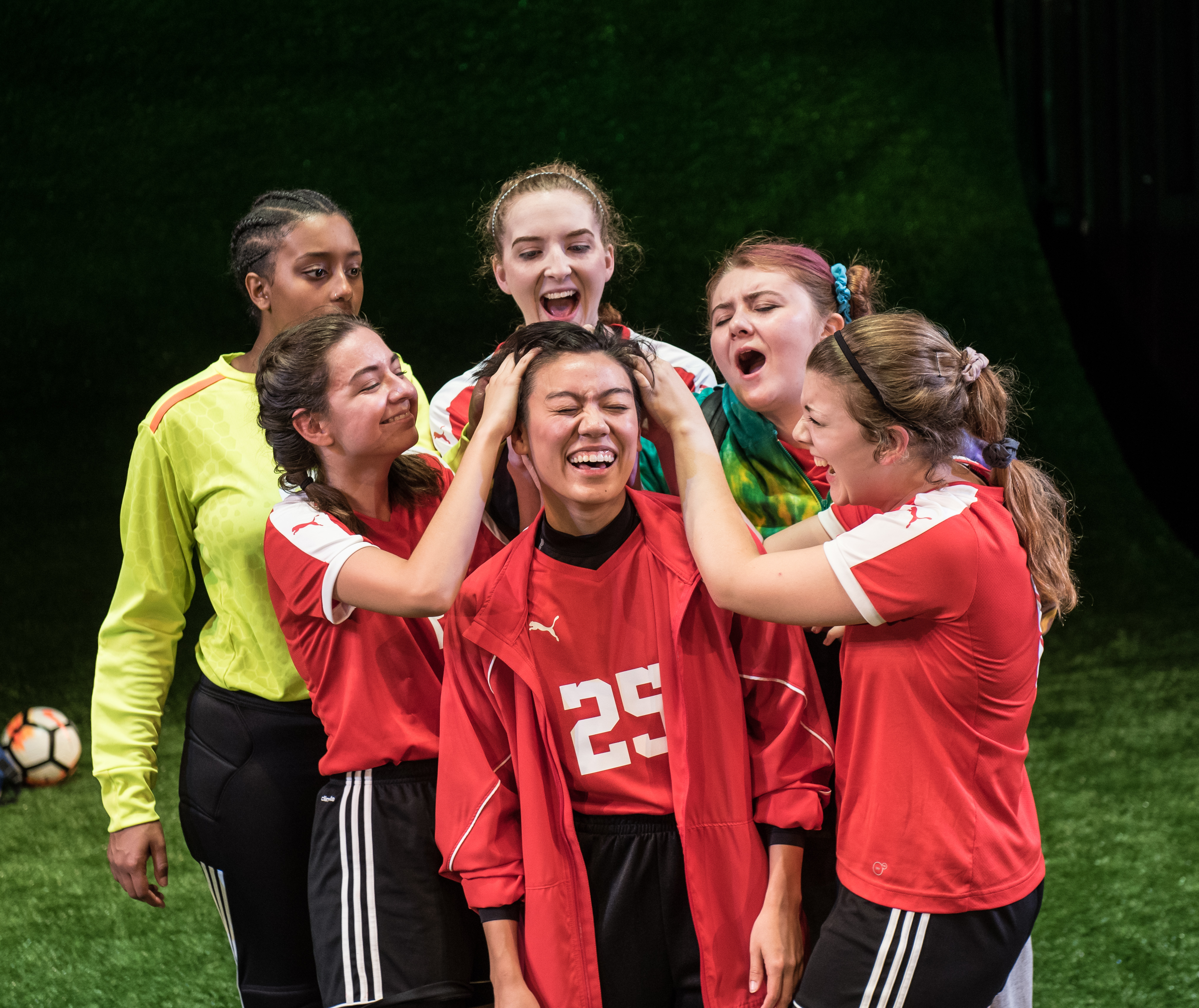
The author, interestingly, has chosen to identify the girls by their jersey numbers, rather than by name, although they do address one another by name. #25, Havy Nguyen, is the team captain but she might as well be the coach. #25 leads the warm-ups and they require genuine dedication to the running, jumping jacks, high knees, butt kicks, ball passing, and more. We learn, in bits and pieces, that the unseen coach apparently has a drinking problem, and at any rate, he is not nearly as popular as a previous coach who left to care for his ailing mother. I immediately wondered why Nguyen was wearing an ugly wig but the answer to that is revealed in the closing scenes.

#7, Jocelyn Honoré, is the team’s leading striker, but she has anger problems and a tendency to make poor decisions in life. #13, Anna Katogiritis, is the team clown, but has a bit of a mean streak and her humor always turns sarcastic.  #46, Emma Olson, is the new girl; home-schooled and well-traveled, she lives in a yurt with her mother, and struggles to fit in. The team goalkeeper, #00, Amari Cummings, is something of a prodigy: she plays the saxophone, chairs several academic teams, and has an astronomically high GPA. She also refuses to talk and has to throw up before every game.

Other team members include Katy Feldhahn (#14), Lydia Hynes (#8), Katelyn Shinn (#11), and Celeste Taica (#2). There are friendships and cliques and gossiping, but as the season passes, the girls become closer, and the audience begins to learn their personalities and quirks. Much like a Peanuts comic strip, the adults are largely unseen and unheard, with the exception of the Soccer Mom (Karen Kopryanski) who appears in the final scene, heart-rending scene. The girls are all TheatreVCU students, and Kopryanski is an assistant professor.

The Wolves is directed by Sharon Ott, Chair of the Department of Theatre at VCU with great energy and stimulating pacing that varies from frenzied action to well-placed silence. All the action takes place in an AstroTurf covered indoor arena; the floor curves upward into the ceiling. There are suggestions of actions taking place offstage, and one kick sends a soccer ball flying into the audience where it was bandied about for a bit before being returned to the playing field (as we were directed to do at the start of the show). Credit Dasia Gregg with the scenic design, Theo Dubois with the costumes, Christian DeAngelis with the lighting and Nicholas Seaver with the sound. In topic and tone, The Wolves strives to – and largely succeeds – in standing out from the pack.

NOTE1: I sat on the right side in the front row, and had no problem hearing everything, but a friend who sat in a middle row in the middle section said the sound quality was problematic.

NOTE2: A smile to #4 and #9; the stagehands who came out in uniform to set a scene!


Julinda D. Lewis is a dancer, teacher, and writer who was born in Brooklyn, NY and now lives in Eastern Henrico County.

———-

Photo Credits: Aaron Sutten

The Wolves-990Wolves.3The Wolves-849Wolves.2The Wolves-763Wolves.1