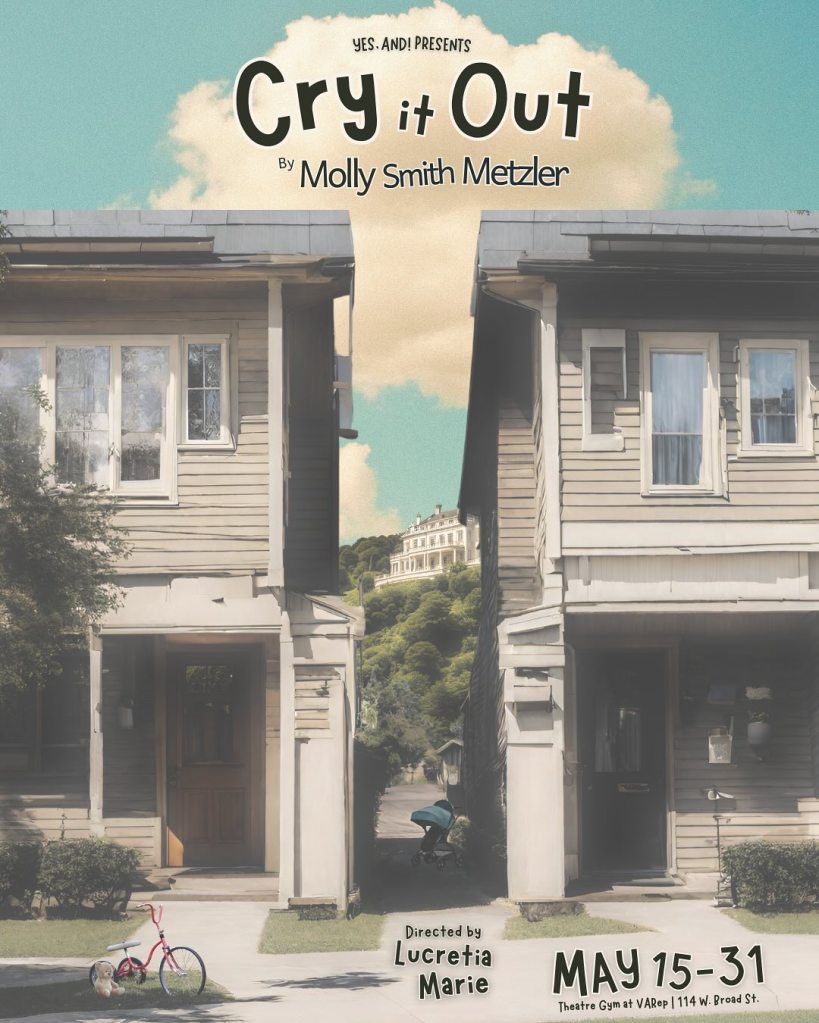
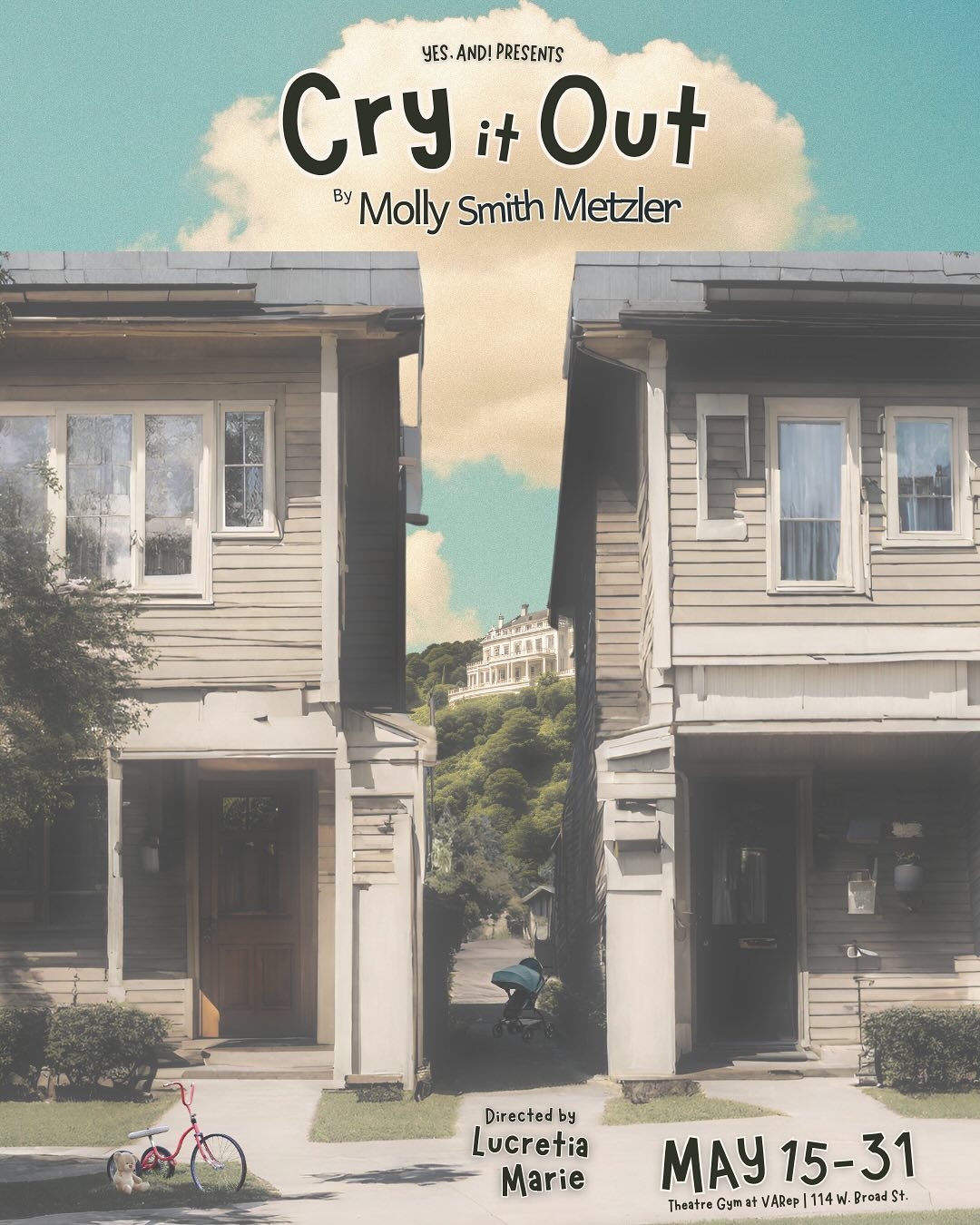
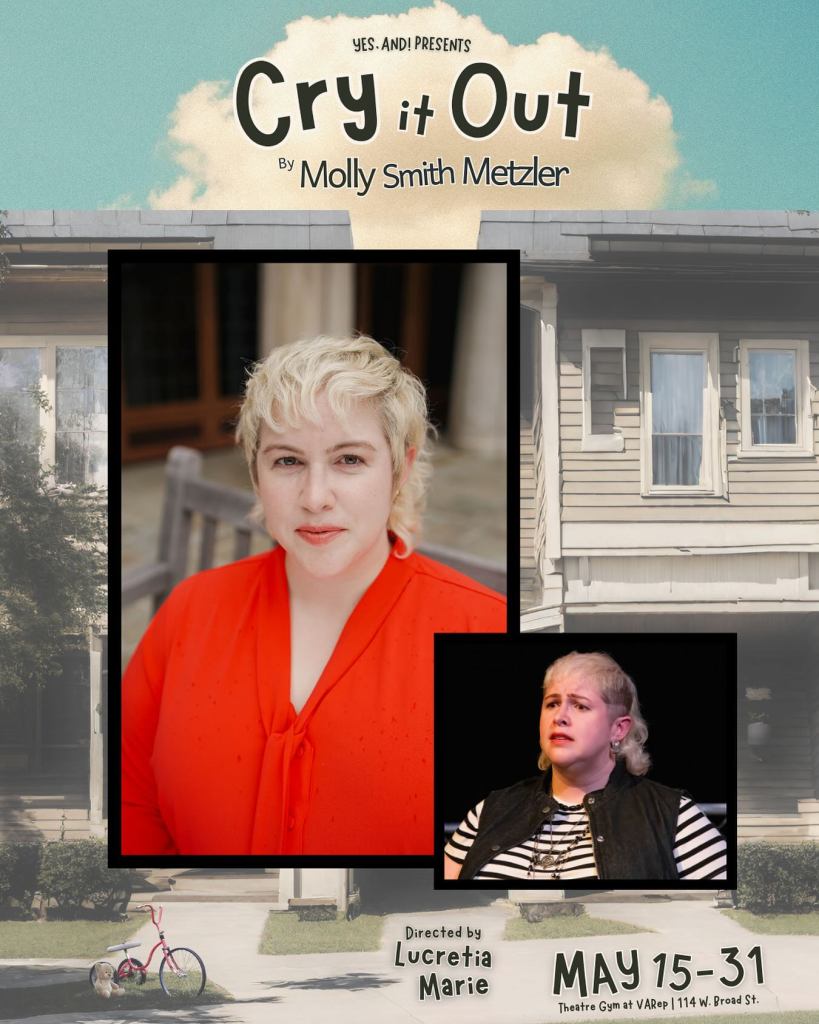
CRY IT OUT

…A Method for Training New Moms…

Produced By: Yes, And! Theatrical Company in partnership with Virginia Repertory Theatre

At: Theatre Gym at VaRep, 114 West Broad Street, RVA 23220

Performances: May 15-31, 2025

Ticket Prices: $40 general admission

Info: Email: yesandrva@gmail.com; Website: yesandrva.org; Facebook: http://www.facebook.com/yesandrva/

A Theater Review by Julinda D. Lewis

Some definitions you might need to know before seeing Cry It Out:

Cry It Out (CIO):  a sleep training technique that involves putting babies in their cribs and leaving them to cry or self-soothe and fall asleep without parental intervention

NoseFrida®: a nasal aspirator or “snot sucker” for babies who do not yet know how to blow their noses

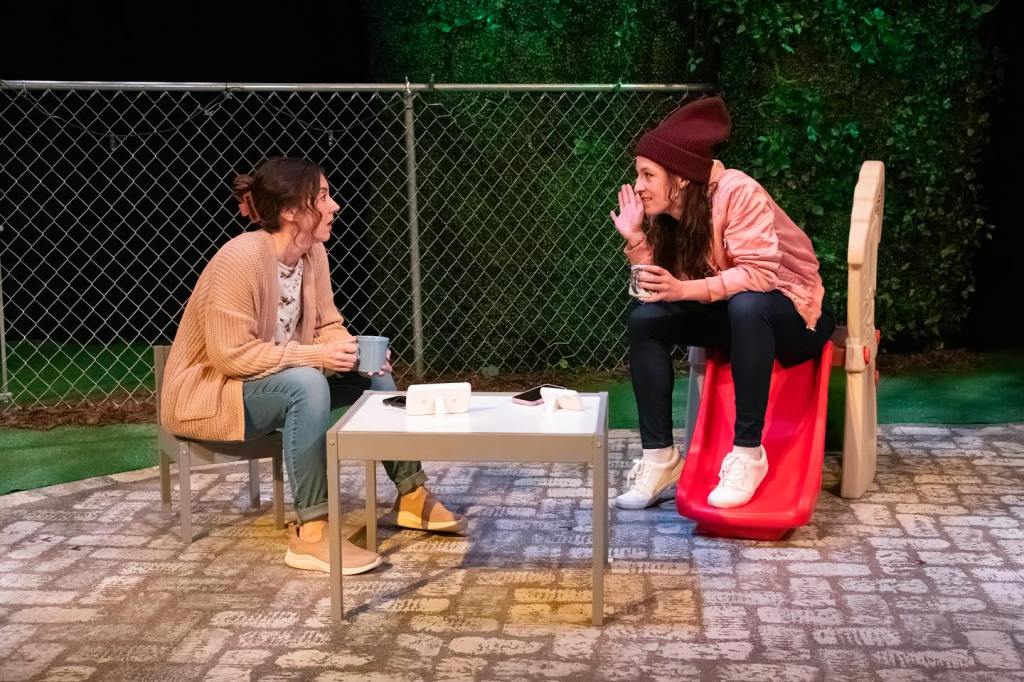
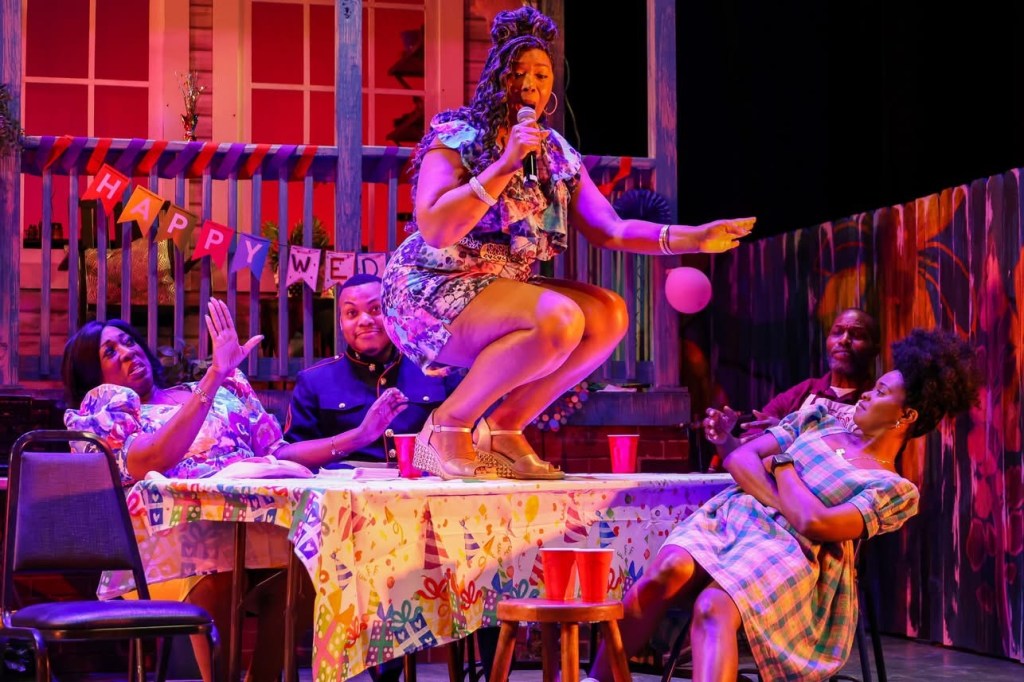
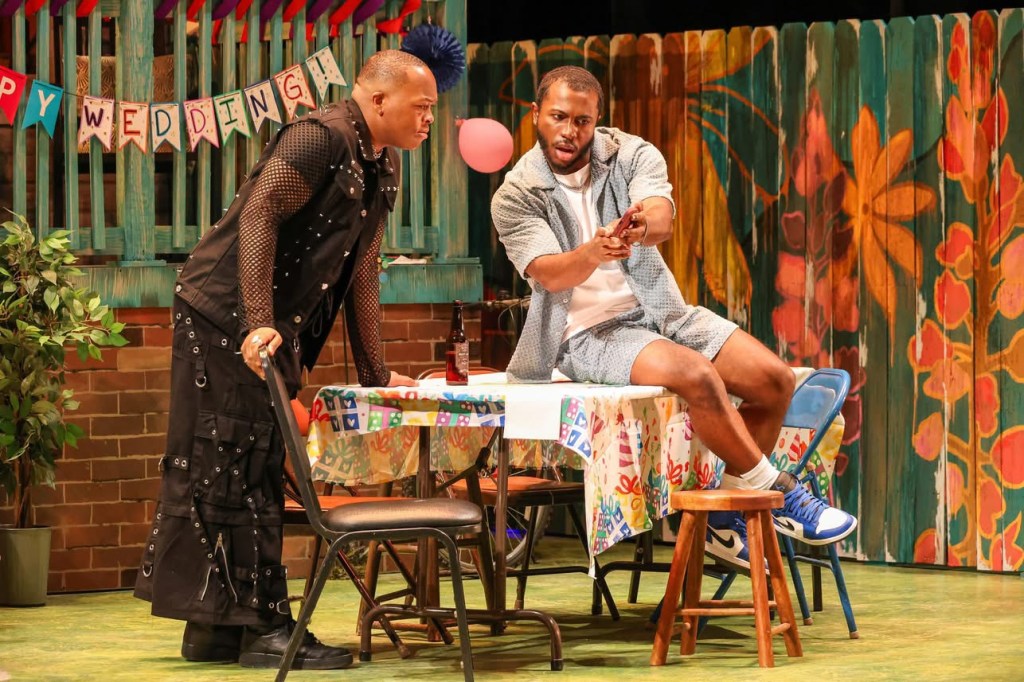
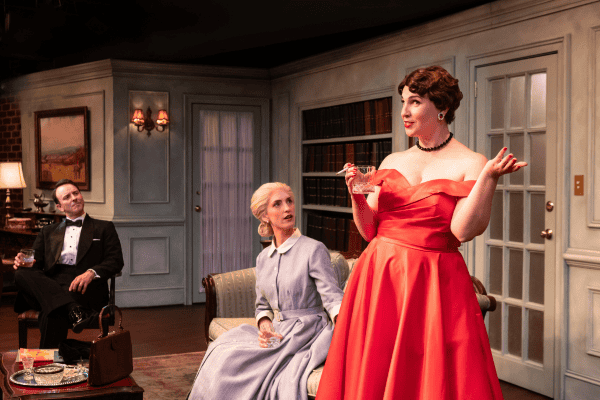
Some plays are just more relatable than others. I’m not sure how this play hits if you’re not a mother (feel free to comment!), but Molly Smith Metzler’s take on motherhood, Cry It Out (2017) is empathetic, relevant, authentic, and hilarious. Just as we warm up to the growing friendship between Jessie (Lindsey Zelli) and Lina (Emily Berry), the playwright throws in not one, not two, but three new plot-changing dynamics.

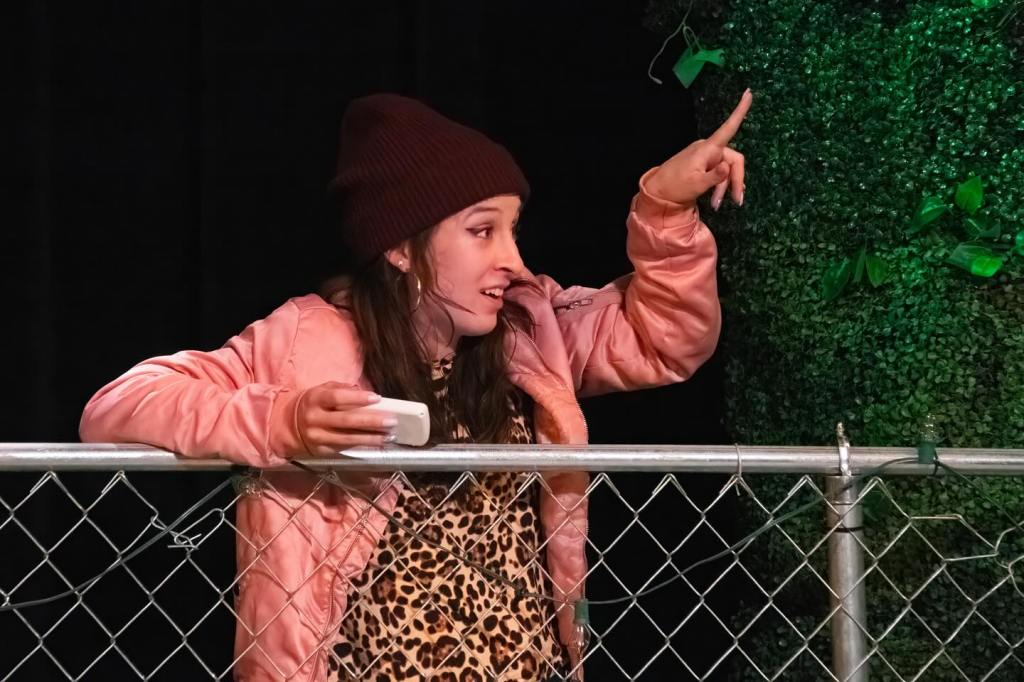
Both new moms, Jessie is a corporate lawyer married to an unseen spouse who still works in New York City and commutes to their Port Washington, Long Island home. Jessie’s in-laws are “old money” residents and have already pre-paid for their infant granddaughter’s first year at an exclusive daycare. Lina is a hospital receptionist from Long Beach on the South Shore (more urban, more “new money,” more Jersey Shore-ish, if you will) with a somewhat shady past. She, her son, and her partner are living with his mother who has a worrisome habit of disposing of her empty wine boxes in a public dumpster. Jessie is empathetic, a problem solver. Lina is brash, funny. Both are loving mothers and quickly bond, in spite of their differences, over daily coffee meetings while their babies nap.

But discussions of isolation, how to get their babies to sleep, and things like nasal aspirators move to the back seat as the weeks go by and the subject of returning to work becomes increasingly pressing. The economic necessity of mothers returning to work takes on a different, but no less significant, role depending on one’s socio-economic status: where to live; how to pay the bills; career choices and milestones; and childcare.

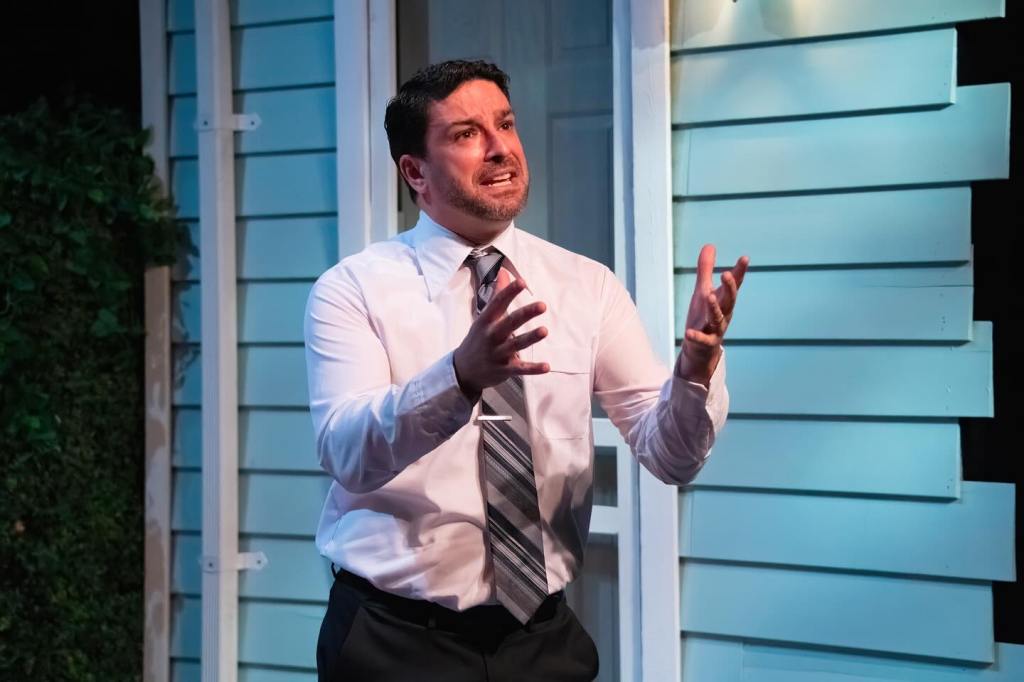
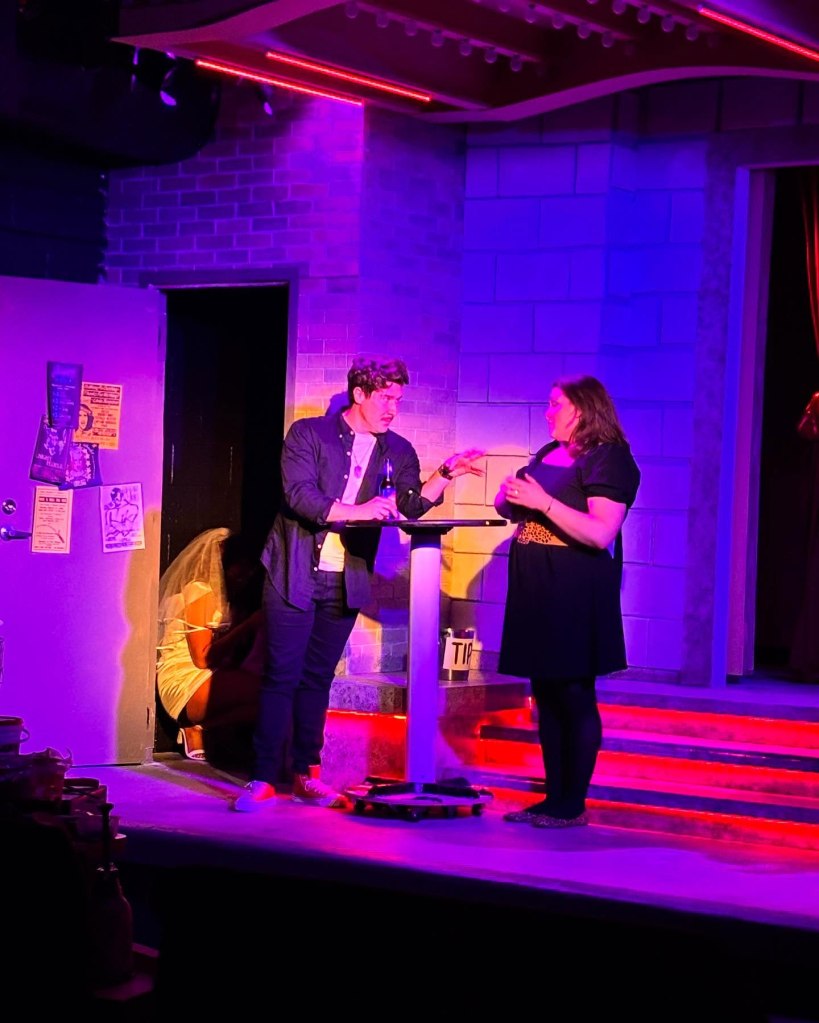
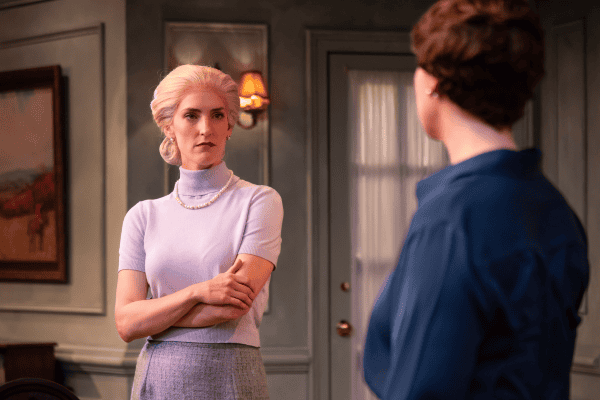
One day Mitchell (Axle Burtness), a neighbor, whose house overlooks Jessie’s backyard from up on a hilltop disrupts the delicate ecosystem Jessie and Lina have established. Mitchell has seen (spied upon?) the women’s cozy coffee klatches and, feeling concerned about his wife’s adjustment to motherhood, wants his wife Adrienne (played by understudy Erica Hughes on the night I attended) to join them.

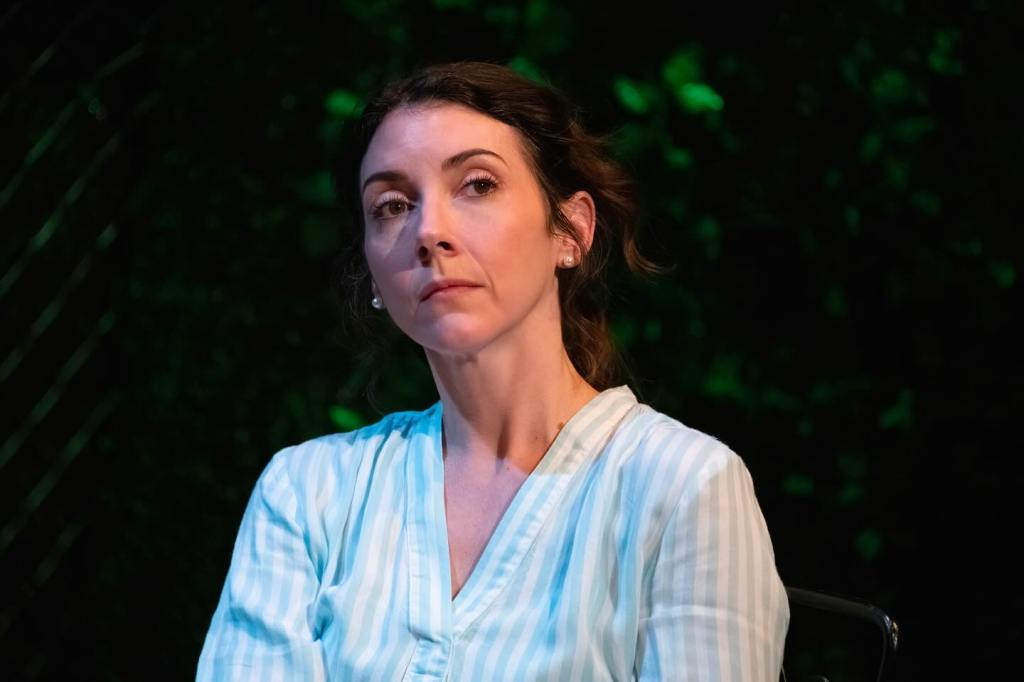
The initial meeting is a disaster, and Adrienne subsequently presents an entirely different perspective on new motherhood, work, and society’s perceptions and expectations in general. The ending is quite surprising and reinforces the all-important lesson that motherhood, and families, do not conform to a one-size-fits-all archetype.

Lucretia Marie has directed Cry It Out with sensitivity and an unhurried pacing that assures each of these mothers is heard. Zelli imbues her character with warmth and wisdom even as Jessie herself struggles to navigate these unfamiliar waters. Berry perfectly balances Zelli, with Lina’s heavy eyeliner, thicker accent, and even more colorful language. Hughes brought the tension and surprise, and while Burtness’s character was a caring and loving father, Mitchell was the most emotional of the four parents present – sometimes to the point of being overwhelming.

Nothing much actually happens in Cry It Out. The whole play takes place in Jessie’s sparsely furnished backyard – there’s just a toddler’s playset and table and chair, and later a small patio table with three chairs. (Hm, three chairs, I thought – but there’s only two of them, so…) It’s a play that relies heavily on what’s said, and how it’s said, and who says it. Who but Lina could so convincingly tell a story about going to the door to meet the FedEx delivery man, forgetting to tuck in her breast because she was in the middle of breastfeeding. This reliance on simple, authentic dialogue, I think, places an even greater burden on the actors, who can’t hide behind a pratfall or a prop. Cry It Out makes us think about things that affect most of us, but that we may not often talk about in an open forum. Cry It Out is timely, real, and impactful.

———-

Julinda D. Lewis is a dancer, minister of dance, teacher, and writer who was born in Brooklyn, NY and currently resides in Eastern Henrico County. When not writing about theater, she teaches dance history at VCU and low impact dance fitness classes to seasoned movers like herself and occasionally gets to perform.

———-

CRY IT OUT

Written by Molly Smith Metzler

Directed by Lucretia Marie

Cast

Jessie ….. Lindsey Zelli

Lina     ….. Emily Berry

Mitchell ….. Axle Burtness

Adrienne ….. Sara Dabney Tisdale

Understudy Cast

Jessie ….. Tensley Nesbitt

Lina ….. Brittany Martz

Mitchell ….. Sarbajeet Das

Adrienne ….. Erica Hughes

Production Team

Scenic Design – Dasia Gregg

Costume  Design – Erik Mayes

Lighting Design – Kacey Yachuw

Sound Design – John Pratt

Properties Design – Cai Hayner

Dialect Coach – Erica Hughes

Fight Choreography – Axle Burtness

Production Stage Manager & PSM – Crimson Piazza

Assistant Stage Manager – Marcely Villatoro

Technical Director – Ben Burke

YES, AND! THEATRICAL COMPANY

Artistic Director – Maggie Roop

Executive Director – Matt Shofner

Performance Schedule

Thursday, May 15, 2025                 7:30PM          Opening Night

Friday, May 16, 2025                      7:30 PM

Saturday, May 17, 2025                 7:30PM

Friday, May 18, 2025                      7:30PM

Saturday, May 19, 2025                 7:30PM

Sunday, May 20, 2025                    2:00PM          Pay What You Can*

Tuesday, May 21, 2025                  7:30PM         

Thursday, May 22, 2025                 7:30PM

Friday, May 23, 2025                      7:30PM

Saturday, May 24, 2025                 2:00PM

Saturday, May 24, 2025                 7:30PM

Sunday, May 25, 2025                    2:00PM          Pay What You Can*

Tuesday, May 27, 2025                  7:30PM          Industry Night/Pay What You Can*

Thursday, May 29, 2025                 7:30PM          Understudy Night

Friday, May 30, 2025                      7:30PM

Saturday, May 31, 2025                 2:00PM

Saturday, May 31, 2024                 7:30PM          Closing Performance

World Premiere: 2017 Humana Festival of New American Plays at Actors Theatre of Louisville.

Tickets

Ticket Prices: $40 general admission; $20 Rush Rickets at the Box Office one hour prior to all performances

*Pay What You Can: $5 suggested minimum at the door; $10 minimum in advance

Run Time

Approximately 1 hour, 40 minutes with one 15-minute intermission

Photos from the Yes, And! Theatrical Co., Facebook page
One-Time
Monthly
Yearly

Make a one-time, monthly or annual donation

Make a monthly donation

Make a yearly donation

Choose an amount

$5.00
$15.00
$100.00
$5.00
$15.00
$100.00
$5.00
$15.00
$100.00

Or enter a custom amount; no amount is too small, OR TOO LARGE!

$

Your contribution is appreciated.

Your contribution is appreciated.

Your contribution is appreciated.

DonateDonate monthlyDonate yearly
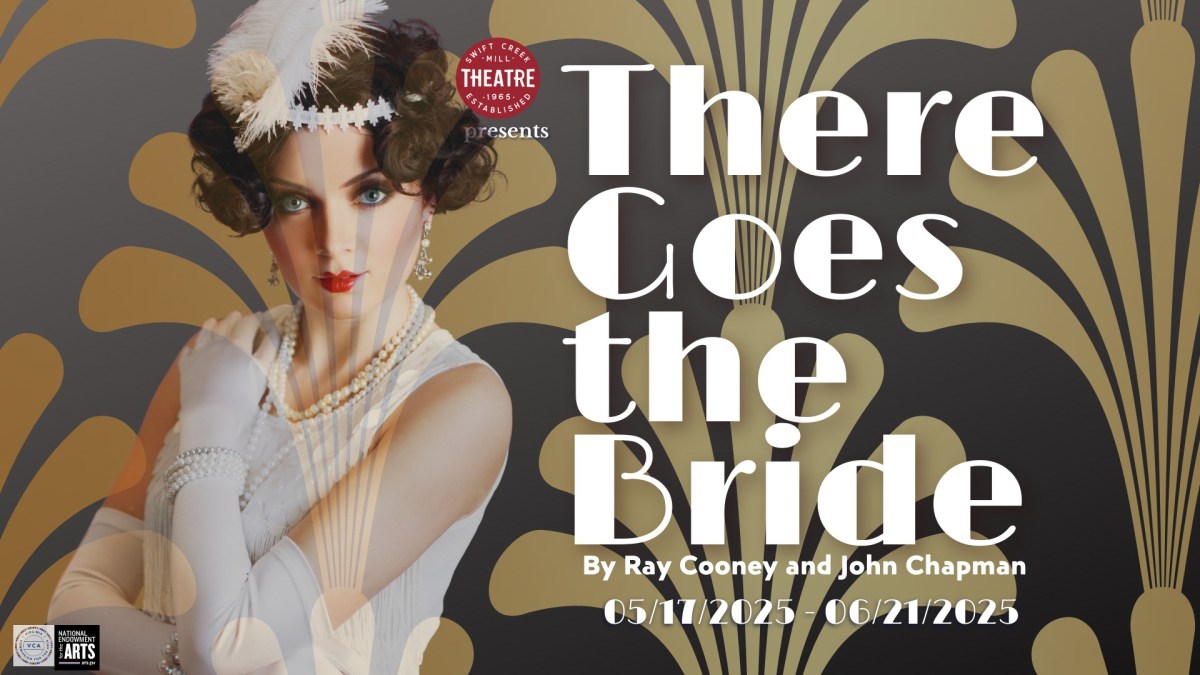
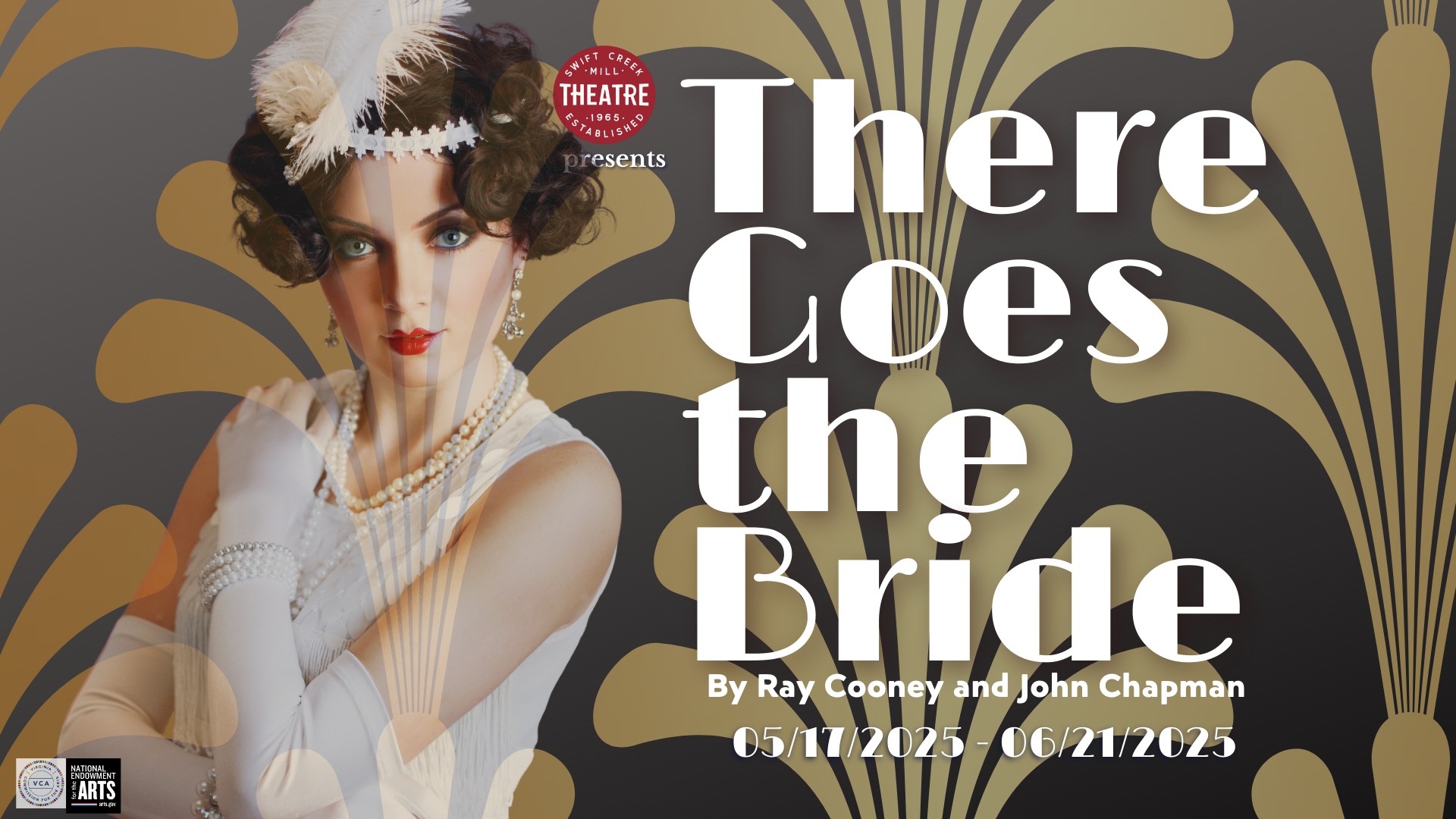
THERE GOES THE BRIDE

A Ray Cooney Farce!

At: The Swift Creek Mill Theatre, 17401 U.S. Route One, Chesterfield, VA 23834

Performances: May 17 – June 21, 2025

Ticket Prices: $44-49. Ask about discounts for students, seniors, and veterans.

Info: (804) 748-5203 or https://www.swiftcreekmill.com

A Theater Reflection by Julinda D. Lewis

In his pre-show curtain talk, director Tom Width told the Wednesday matinee audience that this show, There Goes the Bride, was the seventh Ray Cooney farce to grace the Swift Creek Mill stage*. Just last June we were treated to Run for Your Wife, https://jdldancesrva.com/2024/06/08/run-for-your-wife/ just for the fun of it. This spring, Width brought back There Goes the Bride after a 20-year hiatus, because “it’s just so stupid!”

The Plot

Timothy Westerby, an affable but overworked advertising executive, is trying to complete an ad campaign on the morning of his daughter’s wedding. He has to balance picking up the flowers, getting them to the church and to the prospective in-laws at their hotel, picking up some black socks for his own father-in-law, and along the way picking up the life-sized cut-out of the new ad campaign’s mascot – a 1920s flapper in a red dress and feather boa (and yes, those details are all important). Of course, he botches these assignments and ends up getting a bump in the head that results in him hallucinating that the flapper cut-out is a real woman, who has a crush on him, and who is dance partner in a show-business routine. Whew! Got all that? Because the fun is just getting started.

The Farce

In true farcical style (and I guess that is a real word, since spell check didn’t flag it…), things go downhill quickly. The bride locks herself in her room. Timothy’s wife, Ursula, pretends Timothy’s cousin, Bill, is her husband because Charlotte, the bride’s pretentious mother-in-law-to-be, who has travelled all the way from Australia only to find that Timothy, the bride’s father, had forgotten to confirm her hotel reservation, is appalled at Timothy’s behavior. Ursula’s mother, Daphne, spends much of the morning trying to get into her girdle, while her husband, Gerald, a retired doctor, meddles in everybody’s business and has a grand old time mimicking Timothy who suffers not just one but a series of head bumps, each leading to more outrageous behavior until, finally, he comes to himself. Ursula becomes increasingly distraught trying to compete with Polly who, by the way, no one but Timothy can see, because she is, after all, an hallucination.

My Take

Each of these characters brings something unique to the ensemble. The bride herself is not the main character, spending much of the play locked away in her room, horrified by her father’s behavior as well as the overly elaborate wedding her parents have planned. It seems she and her betrothed – who is not even a character in the play – would just as soon go to the registry and have a civil wedding and avoid all the fuss of a church ceremony followed by a reception in her parent’s garden. But near the beginning of the play Judy, played by Maggie Jordan does manage to create somewhat of a stir by revealing to her parents that she and her fiancé – whose name I can’t even remember – have engaged in some pre-marital shenanigans. While her mother, Ursula, played by Emma Mason, takes this news in stride, it upsets her father Timothy (Robbie Winston) to the point where he is ready to call off the whole wedding. That seems to be just the opposite of the reaction I would have expected of the father, but this is a farce and it’s not my family, so…

Ursula (Emma Mason) and Bill (Matt Hackman) try to keep everything from falling apart, but as soon as they patch up one problem, another pops up; such is the nature of a farce. Both manage to generate humor while attempting to be the face of calm and reason in the midst of madness. Amazingly, I don’t think either of them ever broke character or struggled to hold back a snicker, a giggle, or a full guffaw. Very admirable.

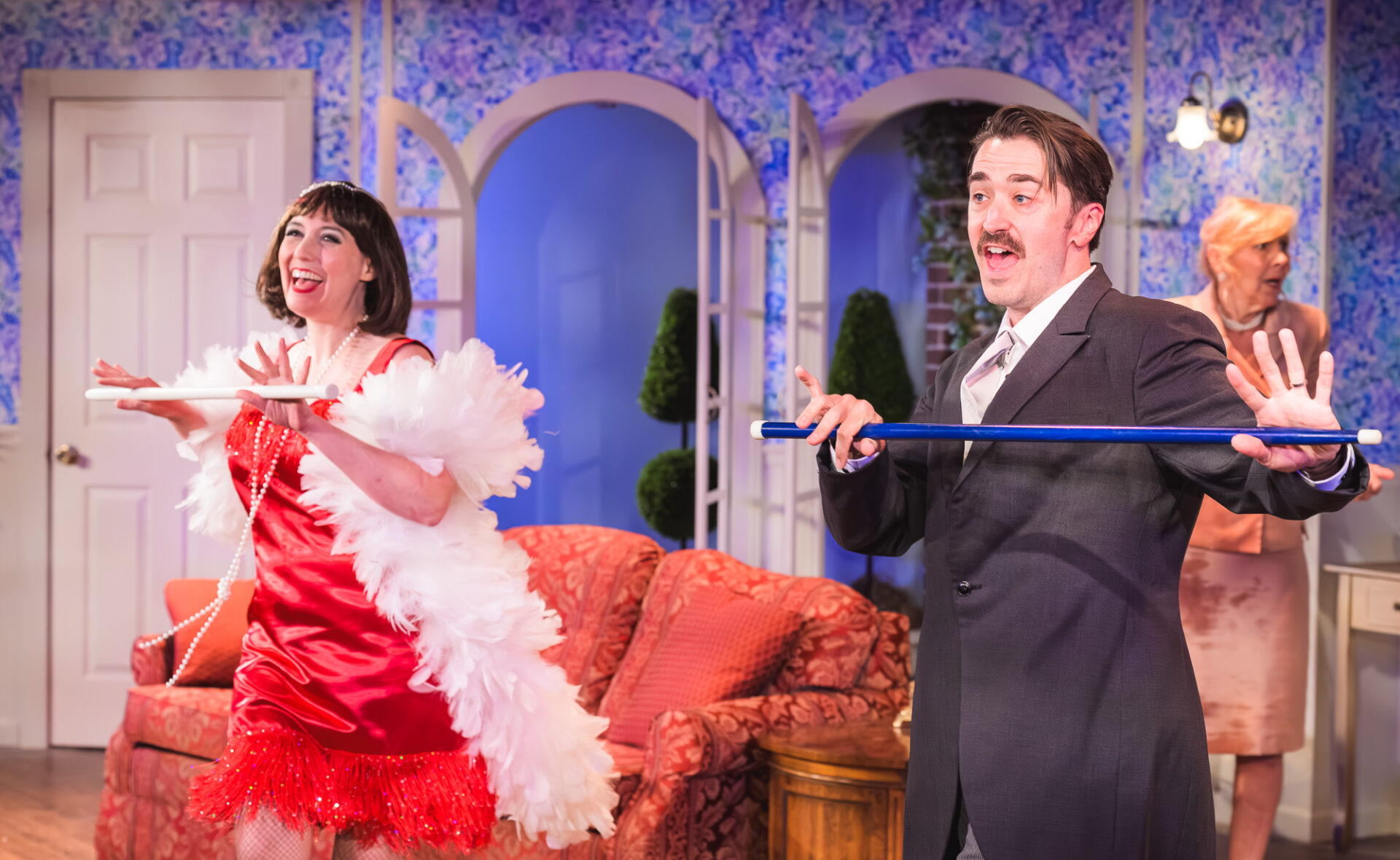
Most of the physical, slapstick style humor was assigned to Robbie Winston’s character, Timothy. Winston navigated his fair share of pratfalls and head bumps, as well as the choreography of slamming doors as he moved Polly around like the bottle cap hidden under the cup in a sleight-of-hand shell game – all while everyone else on stage pretended not to see her.

But we all have personal favorites, and for this production mine were John Hagadorn as the fumbling and forgetful grandfather, Dr. Gerald Drimmond and Valerie Chinn as the invisible flapper, Polly Perkins. Drimmond was droll throughout, dropping one-liners and making pertinent observations that always seemed to hit with extra nuance. His mimicking of Winston’s steps – which he called the doo-dah – was the highlight of his performance. It was the kind of bit that would have made you spit out your drink, if you were drinking. And then there was Valerie Chin, bouncing and bopping, doing the Charleston and swinging her feather boa, always with a huge smile and that laugh – that indescribable, bright, bubbly, cartoonish laugh!

In his Director’s Notes, Tom Width wrote: “We do love our farces here at the Mill!” As silly as it may look, this production required masterful timing to pull off. As Width explained, “the clown has to be a gymnast before he can do his pratfall as a comedian; everything must be planned carefully by the numbers before we can throw the number away and make it look as if there never were any numbers; and whit is seemingly mayhem must be meticulously planned.” Well, There Goes the Bride is masterfully, meticulously planned and executed. It has no deep or hidden messages; it’s just pure fun.

Oh, and Timothy did come up with a jingle for his ad campaign for his important client, a bra company: Perkins can take the flop out of your flappers!

———-

Julinda D. Lewis, EdD is a dancer, minister of dance,  teacher, and writer who was born in Brooklyn, NY and currently resides in Eastern Henrico County. When not writing about theater and dance, she teaches dance history at VCU and low impact dance fitness classes to seasoned movers like herself and occasionally gets to perform.

———-

THERE GOES THE BRIDE

By Ray Cooney and John Chapman

Directed by Tom Width

CAST

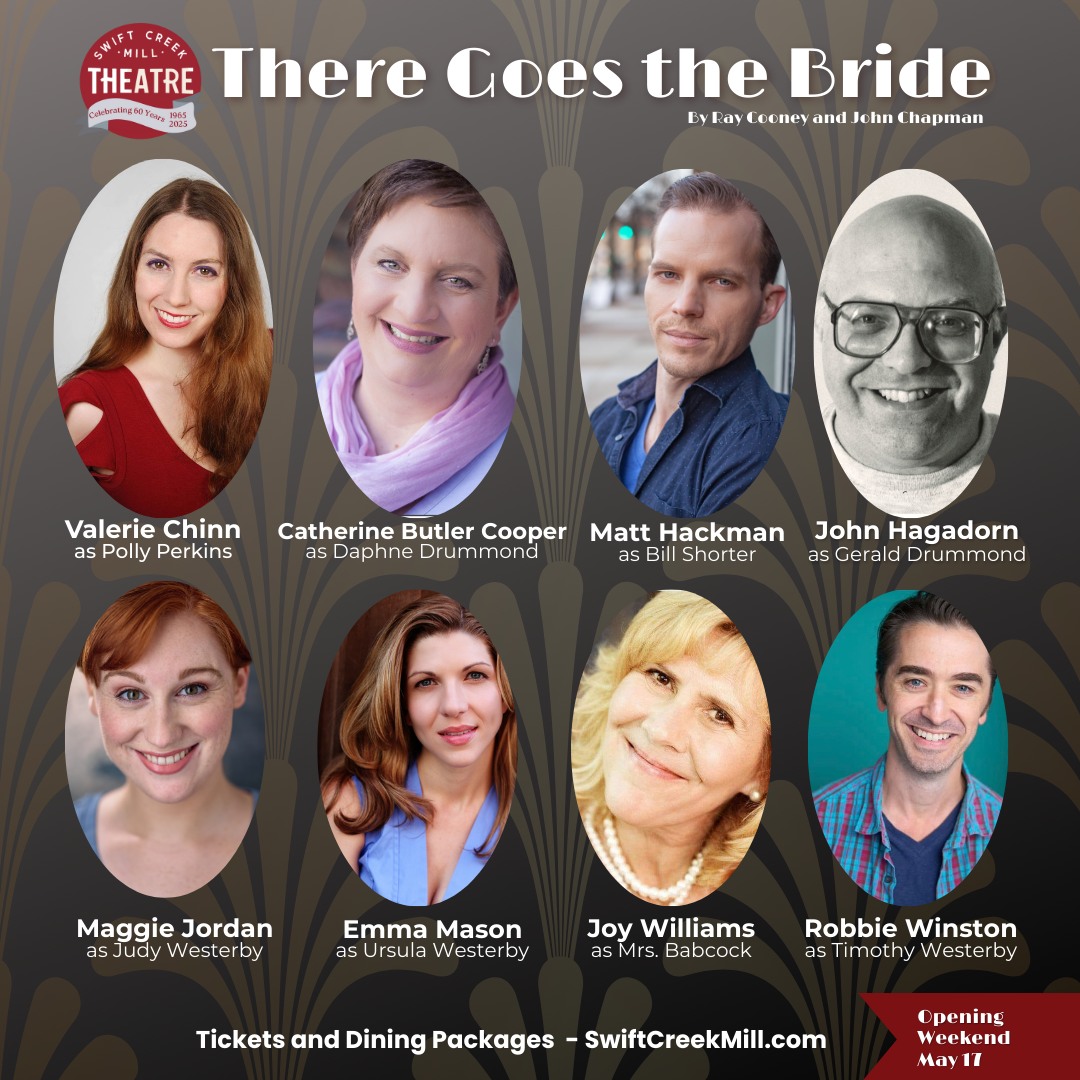
Emma Mason           as Ursula Westerby

Maggie Jordan        as Judy Westerby

John Hagadorn        as Dr. Gerald Drimmond

Matt Hackman          as Bill Shorter

Robbie Winston       as Timothy Westerby

Valerie Chinn            as Polly Perkins

Catherine Butler Cooper   as Daphne Drimmond

Joy Williams             as Charlotte Babcock

CREATIVE TEAM

Directed by Tom Width

Scenic Design by Tom Width

Lighting Design by Joe Doran

Costume Design by Maura Lynch Cravey

Technical Direction by James Nicholas

PRODUCTION STAFF

Producing Artistic Director …. Tom With

Technical Director ….. James Nicholas

Stage Manager ….. Sandy Lambert

Assistant Stage Manager/Props ….. Tom Width

Scenic Carpenter … Peter Prout

Light/Sound Board Operator ….. Brent Deekens

Set Crew ….. Peter Prout, Brent Deekens, Caitlin Tolson, Vincent Prout, Dasia Gregg, Nathan Hamill

Lighting Crew ….. Liz Allmon, Brent Deekens, Caitlin Tolson, Peter Prout

Photographer ….. Daryll Morgan

Wig Design ….. Alia Radabaugh

Time and Place:

The London home of the Westerbys, Summer 1974

Run Time:

About 2 hours, with 1 intermission

Performances:

May 17 – June 21, 2025

Thursdays, Fridays, Saturdays at 8:00PM

Select Wednesdays at 2:30PM

Tickets:

Regular $44-49. Discounts for Seniors, Military & Veterans

*Other Ray Cooney farces produced at Swift Creek Mill over the decades:

Run For Your Wife; Caught in the Net; Out of Order; Move Over, Mrs. Markham; It Runs in the Family; and Funny Money

Photographer: Daryll Morgan

One-Time
Monthly
Yearly

Make a one-time, monthy, or annnual donation to support rvart review

Make a monthly donation

Make a yearly donation

Choose an amount

$5.00
$15.00
$100.00
$5.00
$15.00
$100.00
$5.00
$15.00
$100.00

Or enter a custom amount

$

Your contribution is appreciated.

Your contribution is appreciated.

Your contribution is appreciated.

DonateDonate monthlyDonate yearly
WHICH WAY TO THE STAGE

The Roles We Play

At: Richmond Triangle Players at the Robert B. Moss Theatre, 1300 Altamont Avenue,  RVA 23220

Performances: April 23 – May 17, 2025

Ticket Prices: $50

Info: (804) 346-8113 or rtriangle.org

A Theater Reflection by Julinda D. Lewis

Ana Nogueira’s Which Way to the Stage is one of the funniest plays I’ve seen this season ever seen. It is also one of the most authentic plays I’ve ever seen about the theater, relationships either the theater or relationships. Which Way to the Stage is complex and layered. It’s filled with inside jokes – I’m sure that I probably only caught a quarter of them – that could be used as a test to weed out the true musical theater afficionados from the amateurs. I do know a few people – I won’t call them friends – who don’t like musical theater; this show is not for them.

Judy (Amanda Spellman) and Jeff (Matt Shofner) are best friends and theater buddies. Judy carries around a binder filled with playbills – including one from the original cast production of Rent. She and Jeff enjoy discussing things like who was the best Mama Rose in Gypsy (Bernadette Peters? Patti LuPone?) as if their very lives depend on the correct response.

“Like a caricature of a caricature of a performance by my mother in the Temple Beth Israel talent show.” – Judy

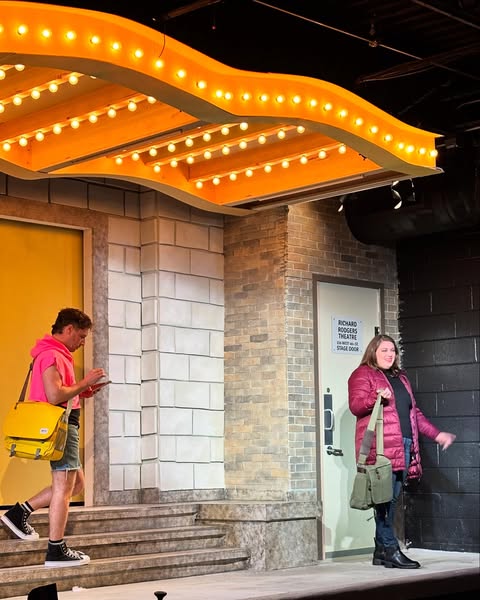
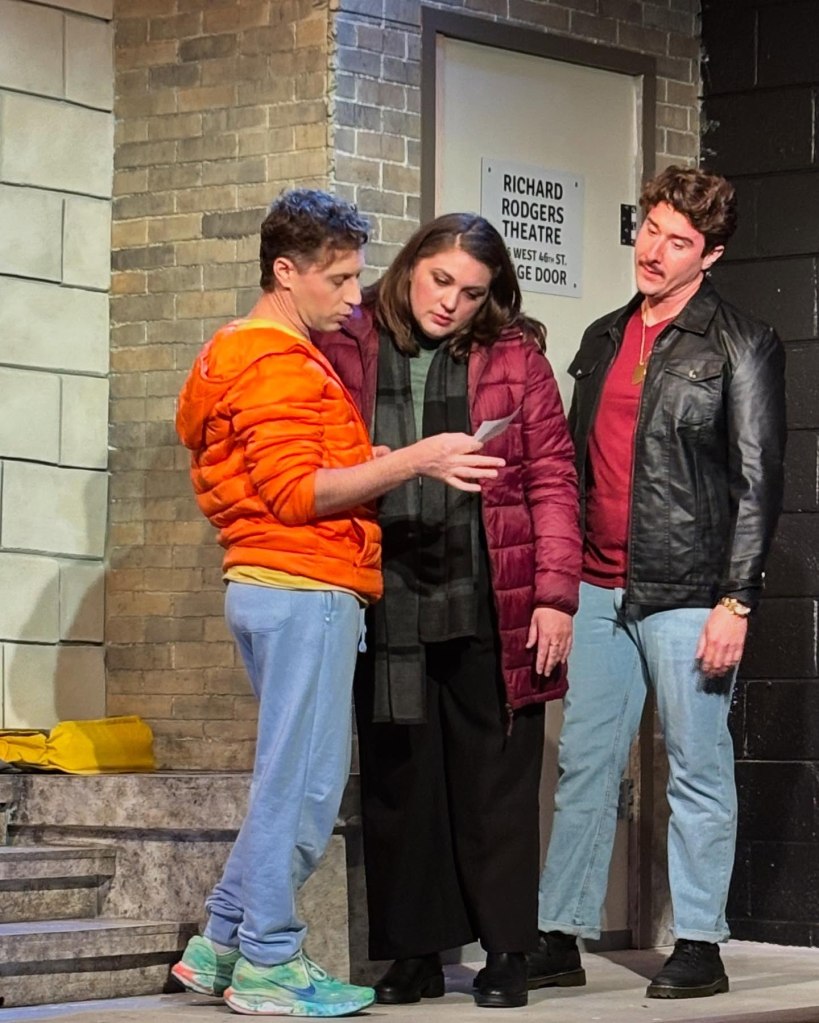
During the course of Which Way to the Stage, the two meet most nights outside the stage door of the Richard Rodgers Theatre, waiting for Idina Menzel* to appear, hoping to get her to sign their programs. She didn’t come out the night they saw the show she’s starring in, If/Then, and they are racing against time as the show is schedule to close soon.

The main part of the set for Which Way to the Stage is outside the stage door of the Richard Rodgers Theatre, located at 226 West 46th Street in New York City’s theater district. The scene was immediately familiar to my daughter, who was my theater date on opening night. When we lived in NY, she attended New York’s High School of Graphic Communication Arts on West 49th Street, a short distance from the theater. Kudos to Daniel Allen, the scenic designer, for the authenticity. The theater marquee and the hallway where the actors wait for their auditions are perfection!

On stage at Richmond Triangle Players (RTP) Spellman and Shofner start off with high spirited theater-nerd banter that – incredibly – just keeps getting better and better as the show goes on. Personal chemistry? Great acting? Let’s say it’s a balanced blending of both. The two usually enter the stage from the audience, starting their loud banter as they walk to the theater – and nearly every time they have a near miss with the NYC traffic.

“I want to be Rent poor!” – Judy

Both Judy and Jeff are actors. Judy is returning to theater after taking time to develop a career in real estate – in New Jersey. She’s talented but lacks confidence. Jeff can’t get the roles he really wants because they’re for cis gender white men – or women. He works as a drag queen and specializes in portraying Streisand as Yentl (there’s some more musical theater history for you!).

Things start to get real when Judy crosses a line. You know how it’s taboo for the white friend to use the word “nigger” around their Black friends? Well, Judy, in an act of solidarity with Jeff, whose ex-boyfriend managed to get Menzel’s autograph on the one night Jeff and Judy could not be there, calls the ex a “faggot.” The atmosphere changes, the mood shifts, and Jeff, as gently as possible, explains that, even thought they have been friends since high school and even though Judy is what we might call an  “ally” these days, she can’t say that word.

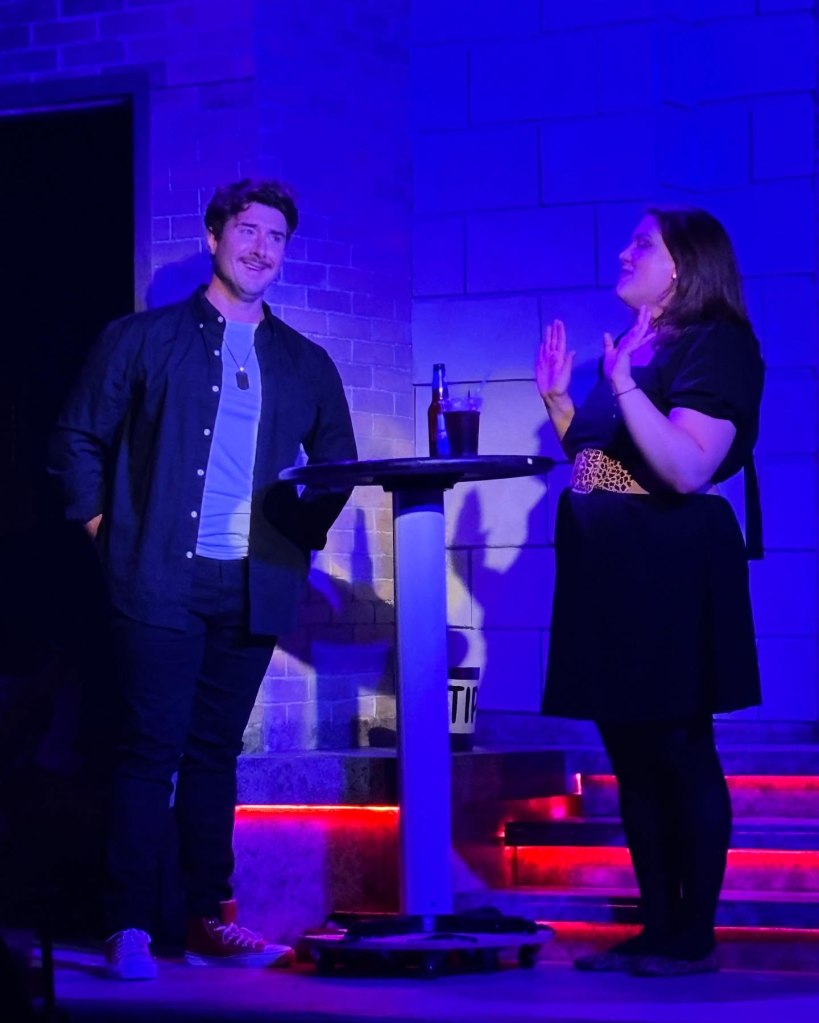
At an audition, in which Judy does quite well, but doesn’t quite get the job, she meets and later starts a tenuous relationship with Mark (Calvin Malone). Mark seems to have a leg up on getting parts. He’s tall, white, handsome, and straight – or is he??? This throws a new cog in the wheel of Jeff and Judy’s relationship. There is now sexual tension, rivalry, jealousy, and an unnamed emotion that wells up in Judy when her femininity is not so much questioned as criticized. She is advised to take lessons in being more womanly – from a drag queen.

Spellman manages this brilliantly, starting subtly with a zipper that keeps sliding down, and building up to – well, If I told you, that would be too much of a spoiler. I’ll just say, it builds up, fueled in part by Judy’s own stagnation, Jeff’s insightful but cutting observations, and the Mark triangle.

Speaking of drag queens, Shofner completely slayed in his second act drag scene. First of all, let’s acknowledge the magic of Tariq Kariem (costume designer and wardrobe supervisor) and Like Newsome (who designed the hair and makeup). Shofner’s make-up and wig were applied in record time. At one point, I believe Shofner exited a door in one outfit and reappeared less than a minute later through another door in a completely different outfit! Onstage, after his over the top drag act, ending with a hearty lip-synced rendition of “Defying Gravity,” complete with a black cape, step-ladder and…mop, yes, a mop, not a broom (sigh)…as I was saying, after this number, Shofner, as Jeff, sits at his dressing room table and completes the process of removing every trace of the makeup – and act that is both professional and symbolically profound. As he strips off his character, he reveals more of himself.

There are a lot of symbolic and metaphoric words and actions in Which Way to the Stage. How do we define femininity? Who determines which roles are suitable for a gay actor? (I mean, after all, it’s…acting.) Is bisexuality a valid choice – or is refusing to accept labels just a lack of commitment? How does friendship survive or thrive when career, life, or perhaps being unevenly yoked all sink their hooks into every breath you take, and make it impossible to breathe?

Like most good humor, in my experience, Which Way to the Stage is based on real life: people, situations, circumstances, including identity and belonging – and in this case, all of the above. Shofner and Spellman really shine as the two besties, and Malone is suitably over-confident in a way that makes it seem natural that both Jeff and Judy would be attracted to his character. There is a fourth character, a nameless and over the top entity played by Sydnee Graves.

Graves fills the shoes of an actress at the casting call, a bachelorette at the drag show, and the casting director. I didn’t much like Actress at first. She was bougie, aloof, confrontational. And then she explained to Judy how she had to learn to navigate the world, and she became less of a stereotype and more of a real person. Actress was not written as a fully rounded character, but the tags on her dress, so she can return it after the audition, and her story of sexual harassment are very much true-to-life and provide a much-needed anchor for Judy on her journey. Casting Director is a very minor character, but Bachelorette, a drunken member of a bridal party whooping it up at the drag club where Jeff performs, seems to be included strictly for laughs and seems to have no redeeming qualities other than to provide a vehicle to divert attention from the stresses of the main characters. The three roles serve hilarity to the audience and establish Graves as a versatile comedic actor.

Actress has come to terms with her life, striking an uneasy truce with theater. Jeff has adopted a realistic look at the world of make-believe, and grasps at any straws of hope and love that come his way. Mark, well, he’s the straw. And since he can pass as a straight white male, he has access to privilege. It’s Judy who is floundering, and her way of coming up for air results in one of the most brilliant scenes of the show. (Shofner’s drag show holds two of the top three places.)

Which Way to the Stage is challenging. It unwraps the carefully concealed, seamy side of theater. It’s sort of like a theatrical version of revealing the magician’s secrets. And it’s all brilliantly adorned in witty conversation, complicated friendships, and the “dainties” of life that we usually try so hard to conceal. All out there in the open. With dazzling lights, caterpillar lashes, and the sort of drama that follows you home when you leave the theater.

Directed by RTP’s Artistic Director, Lucian Restivo, who also designed the sound and projections, Which Way to the Stage isn’t a musical, but rather a play centered around a love of musical theater. There is so much familiar music in the pre-show and sound design, and so much talk of musicals, that you almost forget this isn’t actually a musical. Nogueira aptly captures the struggles that artists face in reconciling their personal aspirations with society’s expectations of and for them. Using sharp wit and unusually accurate emotional depth, Which Way to the Stage invites the audience into the inner sanctum, where we can reflect on our own journeys, and perhaps most importantly, it celebrates resilience and offers guidance on how to find and maintain connection in the midst of the chaos of the world. Yeah, you should go see it.

*Idina Menzel, the Queen of Broadway, known for her breakout performance in Rent, her award-winning performance as Elphaba in Wicked, and several award for If/Then. With a voice that spans three octaves, she has been compared to Barbra Streisand – and like her has developed a large gay following. She sand “The Star-Spangled Banner” at Super Bowl LXIX and is known for powerful and empowering songs like “Let It Go” (Disney’s Frozen) and “Defying Gravity” (Wicked).

———-

Julinda D. Lewis is a dancer, minister of dance, teacher, and writer who was born in Brooklyn, NY and currently resides in Eastern Henrico County. When not writing about theater, she teaches dance history at VCU and low impact dance fitness classes to seasoned movers like herself and occasionally performs.

———-

WHICH WAY TO THE STAGE

Written by Ana Nogueira

Directed by Lucian Restivo

Cast

Sydnee Graves        —–     Actress/Bachelorette/Casting Director

Calvin Malone          —–     Mark

Matt Shofner            —–     Jeff

Amanda Spellman  —–     Judy

Wayne Parker           —–     u/s for Mar & Jeff

Shannon Schilstra   —–     u/s for Judy & Actress/Bachelorette/Casting Director

Creative Team

Daniel Allen              —–     Scenic Design

Paul Vaillancourt     —–     Lighting Design

Tariq Karriem           —–     Costume Design & Wardrobe Supervisor

Lucian Restivo          —–     Sound & Projection Design

Tim Moehring          —–     Props Design

Luke Newsome        —–     Hair & Makeup Design

Lauren Langston      —–     Production Stage Manager

Performance Schedule

Wednesday, April 23          8:00PM, Preview

Thursday, April 24               8:00PM, Preview

Friday, April 25                    8:00PM, Opening Night

Saturday, April 26                8:00PM

Sunday, April 27                  4:00PM

Thursday, May 1                  8:00PM

Friday, May 2                        8:00PM

Saturday, May 3                   8:00PM

Sunday, May 4                      4:00PM

Thursday, May 8                  8:00PM

Friday, May 9                        8:00PM

Saturday, May 10                 8:00PM

Sunday, May 11                   4:00PM

Wednesday, May 14           8:00PM

Thursday, May 15                8:00PM

Friday, May 16                     8:00PM

Saturday, May 17                 8:00PM

Tickets

Ticket Prices: $50

Run Time

About 2 hours; one intermission

Setting

2015. The stage door of If/Then at the Richard Rodgers Theatre, an audition waiting room, and a drag club

Which Way to the Stage had its WorldPremiere at the MCC Theater in 2022.

Photos from the RTP Facebook page

One-Time
Monthly
Yearly

Make a one-time, monthly, or annual donation in support of rvart review.
we do not charge a fee, but we aren’t free…

Make a monthly donation

Make a yearly donation

Choose an amount

$5.00
$15.00
$100.00
$5.00
$15.00
$100.00
$5.00
$15.00
$100.00

Or enter a custom amount – no amount is too small (or too large).

$

Your contribution is appreciated.

Your contribution is appreciated.

Your contribution is appreciated.

DonateDonate monthlyDonate yearly
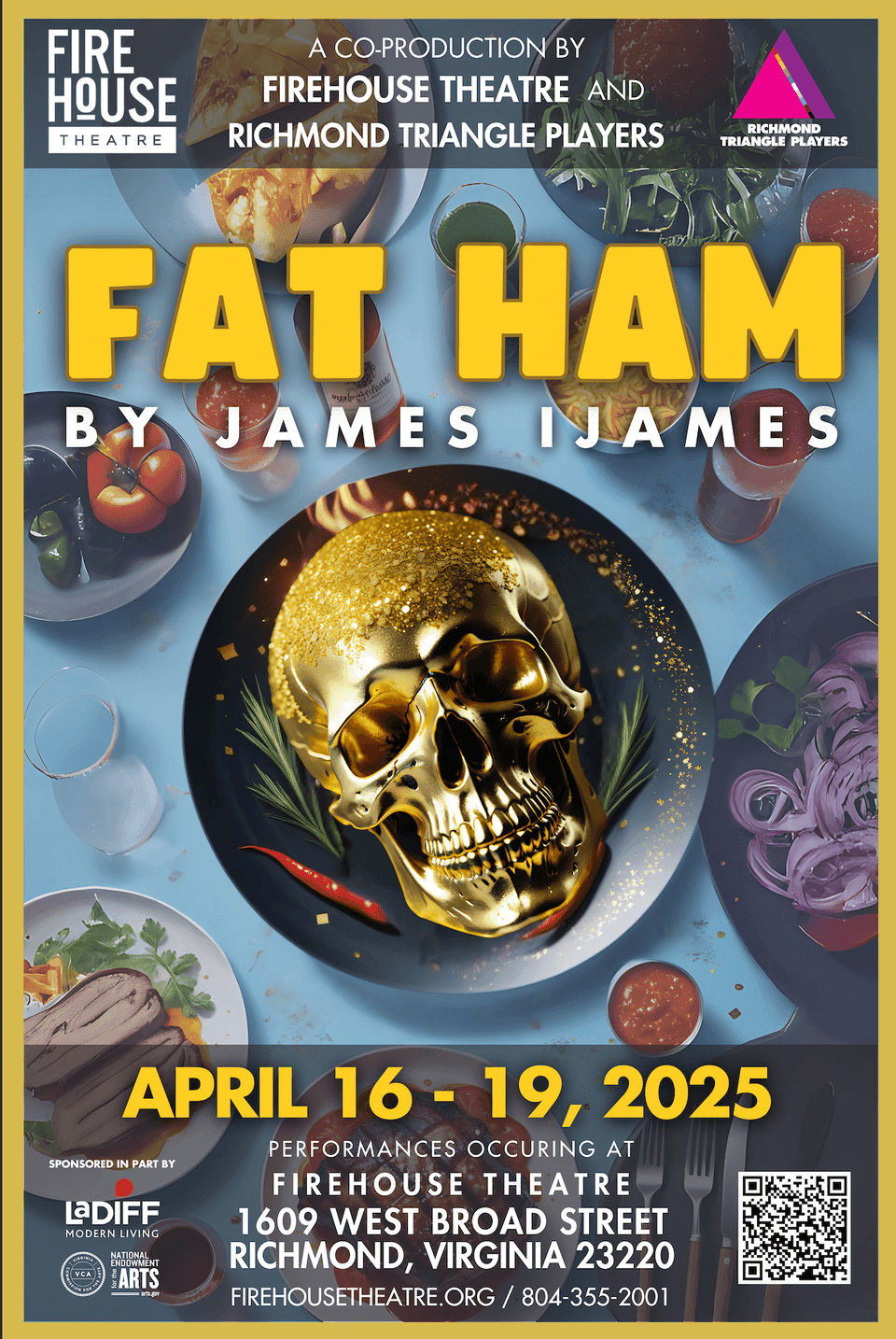
FAT HAM

A Co-Production of Firehouse Theatre and Richmond Triangle Players

A Reflection on a Unique Theater Experience by Julinda D Lewis

At: Firehouse Theatre, 1609 W Broad St., RVA 23220

Performances: April 16-19, 2025

Ticket Prices: $45 [all shows SOLD OUT]

Info: (804) 355-2001 or firehousetheatre.org

Fat Ham is what happens when Shakespeare gets invited to the BBQ and there’s brown liquor and the Electric Slide – the only thing missing is a game of Spades.

What is Fat Ham? James Ijames’ 2022 Pulitzer prize winning play is a modern-day take on Shakespeare’s Hamlet. Set in a small town in North Carolina (or Virginia, or Maryland, or Tennessee), Juicy’s father, Pap, has died and his mother, Tedra, immediately married her deceased husband’s brother, Rev. Mere moments into the contemporary tragedy (or tragi-comedy), Pap appears to Juicy and his friend Tio as a ghost. As if to make sure we get the “comedy” part of tragi-comedy, Pap has thrown a large white sheet, complete with pasted on black eyeballs, over his pristine white funeral suit and strolls into the backyard using the gate. I’m not the only one who wondered why he didn’t just walk through the fence, as his son, Juicy also asked why he wasn’t floating! Point made, he subsequently ditches the sheet and appears in his white suite with a wide-brimmed white hat and white shoes.

Named in honor of Shakespeare’s Hamlet and the BBQ restaurant owned by the play’s fictional family, Fat Ham is equal parts family tragedy and side-splitting comedy. Pap has roused himself from the grave to ask his son to seek revenge. Apparently, while in prison serving a sentence for stabbing a man, he himself became the target of a hitman when his own brother, Rev, has him killed. The plot thickens when Pap, Rev, and just about every other adult in his life           questions Juicy for being “soft,” calling him a sissy and other choice names.

As the drama unfolds, two of Juicy’s friends come – or get forced out – of the closet. Tedra’s conflict is also internal as she faces her own insecurities that make her think she can find her worth only in the arms of man. Criticism is met with a variety of explanations, all ending with, “it’s biblical” or  “it’s in the bible.”

There was plenty of drama off the stage as well. After a successful run in Norfolk earlier in the year, Virginia Rep was set to bring Fat Ham to the November Theatre but cancelled at the last minute due to their on-going financial problems that surfaced for the public in the fall of 2024. While it may be true that finances were the source of the cancellation, the optics were not good. Fat Ham is very much a Black and Queer play, and with all the controversy over Black History Month, DEI, and the like, well feelings were ruffled.

In what was a huge surprise to many if not most of us (the RVA theater community), the Firehouse Theatre, under the direction of Producing Artistic Director Nathaniel Shaw and Richmond Triangle Players, where Philip Crosby is Executive Director, joined together to co-produce Fat Ham with the same Norfolk cast that was originally expected to bring this production to the River City. The five performances were fully sold out before most of the general public even heard about the event. So, for many reasons, Fat Ham is not just any play, this was not just any production, and I felt blessed to secure a seat.

Bringing this show to life, complete with physical comedy, amazing soliloquys, some of which reference Shakespeare and some of which are taken verbatim from the bard’s Hamlet – such as  “what a piece of work is a man” – is a dynamic cast consisting of Marcus Antonio as Juicy/Hamlet, Kevin Craig West as Pap/the ghost of Hamlet’s father and Rev/Claudius, Cloteal L. Horne as Tedra/Hamlet’s mother, Gertrude, and Adam E. Moskowitz as Juicy’s/Hamlet’s sidekick Tio/Horatio. Notice the pattern that is beginning to emerge? Jordan Pearson plays Larry/Laertes, Janae Thompson is his sister Opal/Ophelia, and Candice Heidelberg is their mother Rabby/Polonius.

Antonio is alternately sly, soft, philosophical, and just generally endearing as Juicy (although I had a hard time swallowing that name, LOL). Horne is so over-the-top as his mother, Tedra, that the moments when she is serious are all the more powerful. She stands up for Juicy, refusing to allow Rev to spread his homophobic poison and at the same time, like most of the Black mothers I grew up in community with, was very protective of her son while maintaining a boundary that defined how people defined her and her life choices.

Jordan Pearson was a supporting character who came later on the scene but made a huge impact, transforming from a straight-edged marine to puffed sleeves, feathers, and a metallic gold head piece. Moskowitz – who reminded me more than once of a version of Spike Lee, perhaps from Do the Right Thingshared a bizarre sexual fantasy involving a gingerbread man, a snowball fight, and fellatio that had his character questioning the origins of his weed. It was the kind of story, a confession, that one has to blame on the weed, or on alcohol, in order to be able to hold one’s head up in public ever again!

Another memorable scene Moskowitz shared with Antonio involved Juicy asking his friend Tio about his shoes. This gives rise to another direct Shakespearean reference, “You remember Yurick?” It seems Yurick (who was not give a contemporary name) was Juicy and Tio dead friend, and Tio bought Yurick’s shoe at a yard sale being held to raise money for Yurick’s funeral.

Thompson’s Opal, unlike Ophelia, does not end in death by drowning – or any other means – but, rather, with affirmation and freedom. While her brother, Larry/Laertes, is not happy with the military life he is living to please his mother, Opal longs for it – it would provide her freedom she does not currently have as a woman, as a Black woman, as a Queer Black woman.

West, who played the unlikeable brothers Pap (God doesn’t want him and the devil won’t have him) and Rev (a blend of charming yet controlling as are most narcissists), redeemed himself – in the eyes of the audience and his fellow cast member – with a shocking and hilarious death scene.

Unlike a Shakespearean tragedy that ends with most of the main characters dead and strewn about the stage, Fat Ham  ends with the cast breaking out in dance. (I believe the script may have originally called for a disco ball to descend at this point.) With the suddenness of this production’s manifestation, and the fun-size stage at Firehouse, it was not possible to transport the stage used in Norfolk, so Firehouse staff constructed a new set in 48 hours!

There is tragedy. There is the angst of young people seeking purpose. There’s the dysfunction that results from the machinations of adults trying to make the best of a difficult situation, the burdens society expects them to carry, and the weight of tragedy. There is also humor and an earnest attempt to make the best of whatever life throws at you. As Tio says, “Why be miserable trying to make somebody else happy?”

—–

Julinda D. Lewis is a dancer, teacher, and writer who was born in Brooklyn, NY and now lives in Eastern Henrico County. When not writing about theater, she teaches dance history at VCU and low impact dance fitness classes to seasoned movers like herself and occasionally performs.

—–

FAT HAM

Written by James Ijames

Directed by Jerrell L. Henderson

CAST

Marcus Antonio           …..        Juicy

Candice Heidelberg  …..        Rabby

Cloteal L. Horne          …..        Tedra

Adam E. Moskowitz   …..        Tio

Jordan Pearson            …..        Larry

Janae Thompson         …..        Opal

Kevin Craig West         …..        Pop/Rev

CREATIVE TEAM

Jerrell L. Henderson  …..        Director

James Ijames               …..        Playwright

Nia Safarr Banks         …..        Costume Designer

Caitlin McLeod            …..        Scenic Designer

Jason Lynch                  …..        Lighting Designer

Sartje Pickett                …..        Sound Designer

Kim Fuller                       …..        Production State Manager

Performance Schedule:

Wednesday, April 16, 2025   7:30PM  Opening Night

Thursday, April 17, 2025        7:30PM

Friday, April 18, 2025               7:30PM

Saturday, April 19, 2025         2:00PM

Saturday, April 19, 2025         7:30PM   Closing Performance

Run Time: about 1 hour 45 minutes with no intermission

Photo Credit:  Photos on Firehouse & Richmond Triangle Players Facebook pages by Erica Johnson @majerlycreative

One-Time
Monthly
Yearly

Make a one-time, monthly, or annual donation to support rvart review

Make a monthly donation

Make a yearly donation

Choose an amount

$5.00
$15.00
$100.00
$5.00
$15.00
$100.00
$5.00
$15.00
$100.00

Or enter a custom amount

$

Your contribution is appreciated.

Your contribution is appreciated.

Your contribution is appreciated.

DonateDonate monthlyDonate yearly

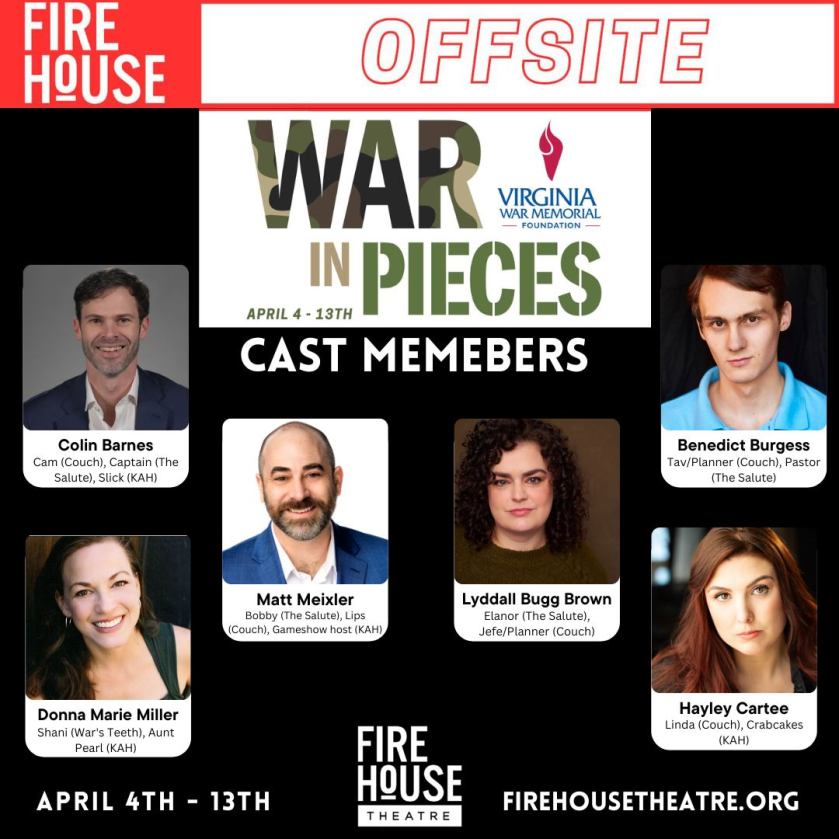
WAR IN PIECES

a Festival of One Act Plays Written by Veterans

A Reflection on a Theater Experience by Julinda D. Lewis

Presented By: The Firehouse Off-Site

At: Virginia War Memorial’s VMI Alumni Hall, 621 S. Belvidere St. Richmond VA 23220

Performances: April 4-13, 2025

Ticket Prices: $15 – $35

Info: (804) 355-2001 or firehousetheatre.org

This is not the first War in Pieces festival – I believe the first program of four one-act plays written by Virginia veterans who participate in the Virginia War Memorial’s  Mighty Pen Project took place in 2021. The Project is a 12-week long writing workshop taught by David L. Robbins, a best-selling author and professor of writing who founded the program in 2015.

The Mighty Pen authors create works that are (a) creative, (b) artistic documents of military service and history, and (c) form a living documentary of the individuals and conflicts of the US military. Now, it is customary for the pre-show curtain talk to end with an invitation to “enjoy the show,” and after the show, people often ask, “did you enjoy the show?” I am firms convinced that people say/ask this because – like those who ask how you’re feeling when you go to the doctor or hospital – they just don’t know what to say! I can appreciate the message of these plays; I can recognize the artistry of the actors; I can be deeply affected by the message and emotion of the production; but no, I would not use the word “enjoy” to describe what I experience when watching these plays.

First up was Kaho’olawe, by Harry Mayer (United States Marine Corp & United States Navy). Kaho’olawe is an uninhabited island in the Pacific Ocean, and at 11 miles long by 6 miles wide it is the smallest of the eight main volcanic islands of the Hawaiian Islands. During World War II it was used as a US military training ground and bomb range. In Mayer’s play, Slick, a young bomb technician (played by Colin Barnes), comes upon a bomb on this island and finds that it is armed. He calls for help, but no help is available, and he is forced to use make-shift tools to disarm the bomb. But this is no ordinary bomb! It begins to talk to him, mocking him, doubting his ability, and questioning his skill, indeed his very confidence.

The bomb speaks first in its own voice, and then in the voices of Aunt Pearl and Miss  Crabcakes. I had assumed these voices in his head were recorded but no, after the show, director David L. Robbins informed me there were three live actors (Matt Meixler, Donna Marie Miller, and Hayley Cartee) speaking these lines with impeccable timing from their offstage locations. The tension is palpable, but in the end, Slick survives. Whew!

Next up is Shani Miller’s War’s Teeth, a heart-rending story in which Shani, played by Donna Marie Miller, reenacts an encounter with another, older vet, Ed Brown. Miller, the actor, not the author, strategically gives voice to both characters. Miller, the author, served as an Air Force Intelligence Officer, with multiple deployments to Iraq and Afghanistan. Her experience led to her memoir, currently a work in progress, in which she write about finding her lost sense of belonging after being deployed with the help of travel and the birth of her children (three under age six and a fourth on the way).

The second half of the program began with A Couch by Cam Torrens, an Air Force veteran with more than 30 years of service. In A Couch, Cam, an officer, chooses his command over his family, and gets sent to the couch by his wife – who, by the way, outranks him. “Don’t come home,” she says, illustrating the difficult choices that must be made, and how our military families are placed under stress when forced to choose between loyalty to family or loyalty to the mission and their country. Colin Barnes and Hayley Cartee skillfully walked this tightrope as the married couple.

The program closed with The Salute by Larry Meier (United States Army, and recipient of the Bronze Star with Palm for service in Vietnam). The cast of four, consisting of parents Eleanor and Bobby (Lyddall Bugg Brown and Matt Meixler), a support officer (Colin Barnes), and a Pastor (Benedict Burgess) takes the audience on a reluctant tour where we see the effects of war on an ordinary couple as they prepare to bury their son. What makes Meier’s story so powerful, for me, is that the focus is not just on the parents, but also on the young Captain who is sent to provide support for the family. The pastor notices, and offers him comfort, but the burden he carries may already be more than he can bear.

The thing that remains with me, however, is the mother’s reaction. At their son’s funeral, the tension builds until, upon receiving the folded flag from the young Captain, Eleanor springs up from her seat and speaks, in a voice that quickly escalates from a soft plea to a primal scream, “Ya’ll took my little boy, and you give me this – A FLAG!”Tossing the flag on the floor, she storms out of the chapel. There are no words of comfort. Nothing can fix this. It is haunting. This, all of this, is War in Pieces.

—–

Julinda D. Lewis is a dancer, teacher, and writer who was born in Brooklyn, NY and now lives in Eastern Henrico County. When not writing about theater, she teaches dance history at VCU and low impact dance fitness classes to seasoned movers like herself and occasionally performs.

—–

WAR IN PIECES

Four One-Act Plays by Virginia Veterans

Kaho’olawe written by Harry Mayer

Directed by David L. Robbins

CAST

Slick                ……….           Colin Barnes

Bomb             ……….           Matt Meixler

Aunt Pearl     ……….           Donna Marie Miller

Miss Crabcakes ……           Hayley Cartee

War’s Teeth written by Shani Miller

Directed by David L. Robbins

CAST

Shani              ………            Donna Marie Miller

A Couch written by Cam Torrens

Directed by Andrew Gall

CAST

Linda              ……….           Haylee Cartee

Cam                ……….           Colin Barnes

Jefe/Planner ……….           Lyddall Bugg Brown

Tav/Planner ……….           Benedict Burgess

Lips                 ……….           Matt Meixler

The Salute written by Larry Meier

Directed by Daniel Moore

Pastor            ……….           Benedict Burgess

Eleanor          ……….           Lyddall Bugg Brown

Captain          ……….           Colin Barnes

Bobby            ……….           Matt Meixler

Production Team

Executive Producer             ……….           David L. Robbins

Stage Management             ……….           Dennis Bowe, Grace Brown LaBelle

Sound/Projection Design  ……….           Grace Brown LaBelle

Costume Design/Coordination …           Tallie Pugh   

Run Time: About 2 hours; there is 1 intermission

Tickets: $15 to $35

Info: (804) 355-2001 or FirehouseTheatre.org

Performance Schedule:

Friday, April 4                       7:30PM         

Saturday, April 5                  7:30PM

Sunday, April 6                    2:00PM

Thursday, April 10               7:30PM

Friday, April 11                    7:30PM

Saturday, April 12                2:00PM

Saturday, April 12                7:30PM

Sunday, April 13                  2:00PM

———-

PHOTOS: from the Firehouse Facebook page

Benedict Burgess, Colin Barnes, Lyddall Bugg Brown
The Cast of War in Pieces 2025
One-Time
Monthly
Yearly

Make a one-time, monthly, or annual donation to support rvart review!

Make a monthly donation

Make a yearly donation

Choose an amount

$5.00
$15.00
$100.00
$5.00
$15.00
$100.00
$5.00
$15.00
$100.00

Or enter a custom amount

$

Your contribution is appreciated.

Your contribution is appreciated.

Your contribution is appreciated.

DonateDonate monthlyDonate yearly
SUNSET BABY

A Virginia Premiere & A Directorial Debut

by BLK Virginia Theatre Alliance

A Reflection on a Theater Performance by Julinda D. Lewis

At: VirginiaRep Theatre Gym. 114 W. Broad St, RVA 23220

Performances: April 4-13, 2025

Ticket Prices: $30/Adults; $15/Students

Info: (804) 282-2620/Box Office; (804) 309-6522, tariqkblkva@gmail.com or https://www.blkvatheatrealliance.org/

In case you didn’t know, there’s a new Black theater company in RVA. BLK Virginia Theatre Alliance (BVTA) was founded in January 2023, with a mission to present challenging works from underrepresented voices (www.blkvatheatrealliance.org). The company, under the leadership of Tariq Karriem, Artistic Director. A walking definition of Young, Gifted, and Black, Karriem became a professional stage manager at age 17 and now – still in his 20s – has recently worked on the production teams of 5th Wall Theatre’s productions of H*tler’s Tasters and Sanctuary City and VirginiaRep’s productions of Charlie and the Chocolate Factory and Misery.

Director Dee D Miller had this to say about Karriem, “You know most of the time people say they want to help the youth … this was the way for me to put my action behind my words. That kid is a force. He is a mogul in the making and always trying to better herself over and over again and with little support. I wanted to change that and I hope with this piece I did.”

The BVTA production of Dominique Morisseau’s Sunset Baby marks the Virginia Premiere of the play as well as the directorial debut of Dee D Miller (aka Dorothy “Dee-D” Miller – winner of Richmond Theatre Community Circle award for Best Supporting Actor, “How Black Mothers Say I Love You,” 2023 which also took home the Erie McClintock Ensemble Award for that year).

Sunset Baby is a powerful, confrontational drama that looks beneath the surface of the bold and brash Nina, daughter of two Black activists, and her reluctant reunion with Kenyatta, the father she barely remembers. Nina is played by Chayla Simpson and Kenyatta is played by Larry Akin Smith. Mu Cuzzo rounds out the cast as Nina’s boyfriend, Damon. And let me not forget to mention that Sunset Baby would not be the same without it’s powerful soundtrack of Nina Simone songs. Just as Motown provides the background for Morisseau’s Detroit ’67, Nina Simone provides the background – and is central to the context – for Sunset Baby.

Dominique Morisseau is the author of at least nine plays to date, several of which have been presented here in RVA: Pipeline in 2021 (https://jdldancesrva.com/2021/10/16/pipeline/) and Detroit 67 at the Firehouse Theatre as recently as March of this year (https://jdldancesrva.com/2025/03/16/detroit-67/)

In 2018 Morisseau received a MacArthur Fellowship, aka the “Genius Grant.” Morisseau’s works are known for their bold approach to issues relevant to the Black community and many of them revive or preserve important aspects of Black history.

“Ain’t nothing sentimental about a dead revolution.” – Nina

In Sunset Baby the dialogue is filled with F-bombs and N-words but the characters also debate the relevance of criminologist Steven Spritzer’s writings on social junk and social dynamite and the political activism of Kwame Ture (nee Stokely Carmichael). Protagonist Nina was, in fact, named for singer, pianist, and activist Nina Simone. The daughter of two political activists, Nina’s mother died, penniless and drug addicted, and her father is just now reconnecting after years spent in prison for armed robbery committed to fund “the revolution.” So much of this work is very personal to me.

Sunset Baby is set in a tenement apartment in East New York, Brookly, not far from Bedford-Stuyvesant where I grew up. Kwame Ture, a leader of the Black Power movement and “Honorary Prime Minister” of the Black Panther Party, attended my alma mater, the prestigious Bronx High School of Science. And my late, second husband was a political organizer for The Young Lords – the Puerto Rican version of the Black Panthers. I felt as if I knew these people; they were not just creations of Morriseau’s imagination and research, they were people from the pages of my old photo albums and yearbooks. For younger folk, this may be less personal but should be no less impactful.

“Some dreams get lost, never to be found again.” – Common ft. Nina Simone

Chayla Simpson gives a memorable performance. She is loud and brash and angry. She leaves no doubt that her character, Nina, is smart and independent, but also suffering from childhood trauma. The men are equally complex. Larry Akin Smith, as Kenyatta, alternates between impassioned scenes with Nina and her man, Damon, and carefully controlled monologues in which he records his history – his daughter’s inheritance. As brilliant and committed as he is, there is just one thing he cannot bring himself to say – the one thing Nina truly needs to hear. Mu Cuzzo provides perhaps the most well-rounded characterization of thug life to ever grace a stage. He sells drugs and shoots people, but he is also a well-read Black man with big dreams of traveling the world, a loving partner who steals from his woman one minute and rubs her feet the next. And Mu Cuzzo makes this believable.

“Oh Lord, please don’t let me be misunderstood.” – Nina Simone

As for Dee D Miller’s directorial debut – the characters sometimes veer on the edge of overacting, but except for one scene, in which Damon trashes Nina’s apartment, they don’t go completely over the edge. They are violent, and loud, and shocking, but we never dismiss them because there are always redeeming qualities or actions that remind us that these are real people – the kind of dysfunctional people many of us have in our own families and on the periphery of our own lives. Miller takes us on a ride in a jitney – an unlicensed taxi once popular in neighborhoods like the one Nina lives in, because legitimate taxi drivers were afraid to go there – and delivers us to our destination shaken but for the most part unharmed. And kudos to the design team for Nina’s hootchie-mama wardrobe, six-inch heeled boots, and wig collection.

Oh, and that title? I looked up the meaning of “sunset baby” and found that it refers to a twin that dies before birth. The surviving baby is a “sunrise baby.” Interesting as that may be, it is not at all relevant to Sunset Baby so maybe just save that in case it comes up in a game of trivia. The complete answer would be a spoiler, so I’ll just leave you with this…when Nina was a toddler, she asked,

“Where does the sun go when it disappears?”

For the answer to her question, and the relevant context, you need to go see the show.

———-

Julinda D. Lewis is a dancer, teacher, and writer who was born in Brooklyn, NY and now lives in Eastern Henrico County. When not writing about theater, she teaches dance history at VCU and low impact dance fitness classes to seasoned movers like herself and occasionally performs.

———-

SUNSET BABY

By Dominique Morisseau

Directed by Dee D Miller

CAST

Chayla Simpson       ……….           Nina

Mu Cuzzo                  ……….           Damon

Larry Akin Smith      ……….           Kenyatta

CREATIVE TEAM

Direction                   ……….           Dee D Miller

Scenic & Prop Design   .…..           Tariq Karriem

Lighting Design       ……….           Griffin Hardy

Sound Design ………. Jonathan Pratt

Asst Lighting Design/

     Master Electrician ……….          Zeke Brookes

Costume Design      ………..          Elijah Brown

Dramaturgy              ……….           Jasmine Bates

BLK VIRGINIA THEATRE ALLIANCE STAFF

Artistic Director/

     Production Manager      –           Tariq Karriem

Chief of Business Administration-Ayanna Shelton

Producer                               –           Malakai Lee

Creative Producer/

     Director of Costume      –           Elijah Brown

PERFORMANCE SCHEDULE
Friday, April 4           7:30PM          Opening Night

Saturday, April 5      2:30PM

Saturday, April 5      7:30PM          Black Theatre Night/Talk Back

Sunday, April 6        2:30PM

Sunday, April 6        7:30PM

Friday, April 11        7:30PM          Industry Night/Talk Back

Saturday, April 12    2:30PM

Saturday, April 12    7:30PM          Student Night

Sunday, April 13      2:30PM

Sunday, April 13      7:30PM          Closing night

Run Time

About 90 minutes with no intermission

One-Time
Monthly
Yearly

Make a one-time, monthly, or annual donation to support rvart review. We do not charge a subscription and don’t put up a paywall, but we still gotta eat!

Make a monthly donation

Make a yearly donation

Choose an amount

$5.00
$15.00
$100.00
$5.00
$15.00
$100.00
$5.00
$15.00
$100.00

Or enter a custom amount

$

Your contribution is appreciated.

Your contribution is appreciated.

Your contribution is appreciated.

DonateDonate monthlyDonate yearly
SPITTING IMAGE

A Collaboration of Dance & Photography

by Starr Foster Dance

A Reflection on a Dance Performance by Julinda D. Lewis

At: The Firehouse, 1609 West Broad St., Richmond, RVA 23220

Performances: April 3-6, 2025

Ticket Prices: $25 General Admission; $35 Arts Supporter; Datenight tickets 2 for $40

Info: (804) 304-1523 or starrfosterdance.org or firehousetheatre.org

Program & Casting:

All Choreography by Starrene Foster

Costumes designed and constructed by Starrene Foster, except as noted

Lighting designed by Gretta Daughtrey

Live Oak inspired by a photograph by Mike Harrell

Performed by Fran Beaumont, Shannon Comerford, Madison Ernsted, Angela Palmisano

Music by Tamar Halperin, Etienne Abelin, Tokek Kolczynski, Johann Sebastian Bach; Constellation 999:999 After BWV 99 & BWV 1018

_____

Saving Grace inspired by a photograph by Caroline Frye

Performed by Fran Beaumont and Madison Ernstes

Music by Adam Krieger, Andreas Scholl, Tamar Halperin; Nun sich der Tag Geendet hat and Carl Friedrich Abel, Paolo Pandolfo; Viola da Gamba Suite in D Minor: I. Arpeggiata

_____

Wisp inspired by a photograph by Becky Atkins

Performed by Adria Applebee (Thursday, Saturday), Alex Atkins, Roya Baker-Vahdani, Sarah Carrington, Lena Cohen, Ma-Siya Dycus, Sophie Smith 9friday, Sunday), Ella Holland, Molly Huey, Janelle Ragland

Music by Simon Goff; Elowen

Costumes designed and constructed by Johann Stegmeir

_____

Lies Lies Lies inspired by a photograph by PJ Sykes

Performed by Fran Beaumont, Shannon Comerford, Madison Ernstes, Molly Huey, Angela Palmisano

Original music composition by Daniel Deckelman

_____

Flight inspired by a photograph by Georgianne Stinnett

Performed by Molly Huey

Original music soundscape by Starrene Foster with Hour of the Witch composed by Scott Buckley

Costume constructed by Starrene Foster based off a design by Karl Green

_____

Run to You inspired by a photograph by Shannon Mills Guest

Performed by Shannon Comerford and Angela Palmisano

Music by Luca D’Alberto; Beautiful As a Memory

_____

Garnish inspired by a photograph by Allison Patel

Performed by Fran Beaumont, Shannon Comerford, Madison Ernstes, Molly Huey, Angela Palmisano, and guest artists Adia Applebee (Thursday, Saturday), Alex Atkins, Roya Baker-Vahdani, Sarah Carrington, Lena Cohen, Ma-Siya Dycus, Sophie Smith (Friday, Sunday), Ella Holland, Molly Huey, Janelle Ragland

Music by Adrián Berenguer; Reset

____________________________________

The Starr Foster Dance (SFD) website informs us that the company is “committed to their mission to collaborate with all genres of artists in their quest to make the world richer with art.” For Spitting Image 2025, Foster embarked on a collaborative journey with her core company of 5 dancers, 9 guest dancers, and 7 photographers.

Foster notes in the program (always a stunningly beautiful publication in its own right) that the SFD Art Director, Douglas Hayes, is at least in part responsible for her love of photography. In 2018 (in the “time before”) the company produced the first Spitting Imageprogram at TheatreLab, The Basement, inviting photographers from the Richmond area to contribute images to the project. Spitting Image 2025 is the third iteration of this collaborative creation. (The second was in 2023, also at the Firehouse.)

The phrase “spitting image” usually refers to something that looks remarkably similar to another, such as a mother and daughter or father and son. But in the execution of these collaborative offerings the seven brief works are not intended to bring to life carbon copies of the still images, but rather each captures a moment, an essence, a fleeting fragment from the photograph and then builds on it, takes flight, elevates it, or even takes a quirky turn. The photographs were on view in the theater lobby, and are available to view on the SFD website, https://www.starrfosterdance.org/spittingimage2025, but due to copyright may not be reproduced here.

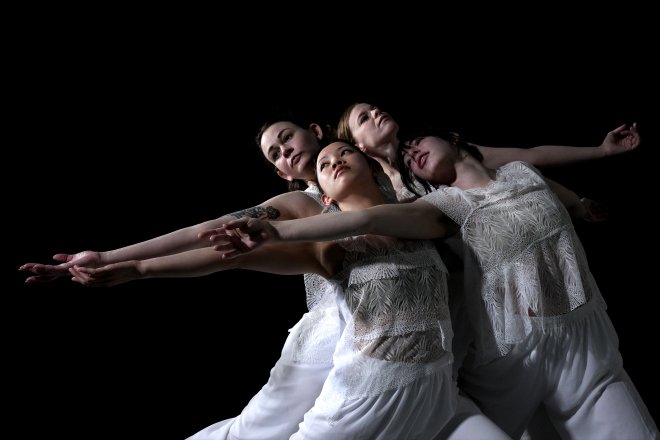
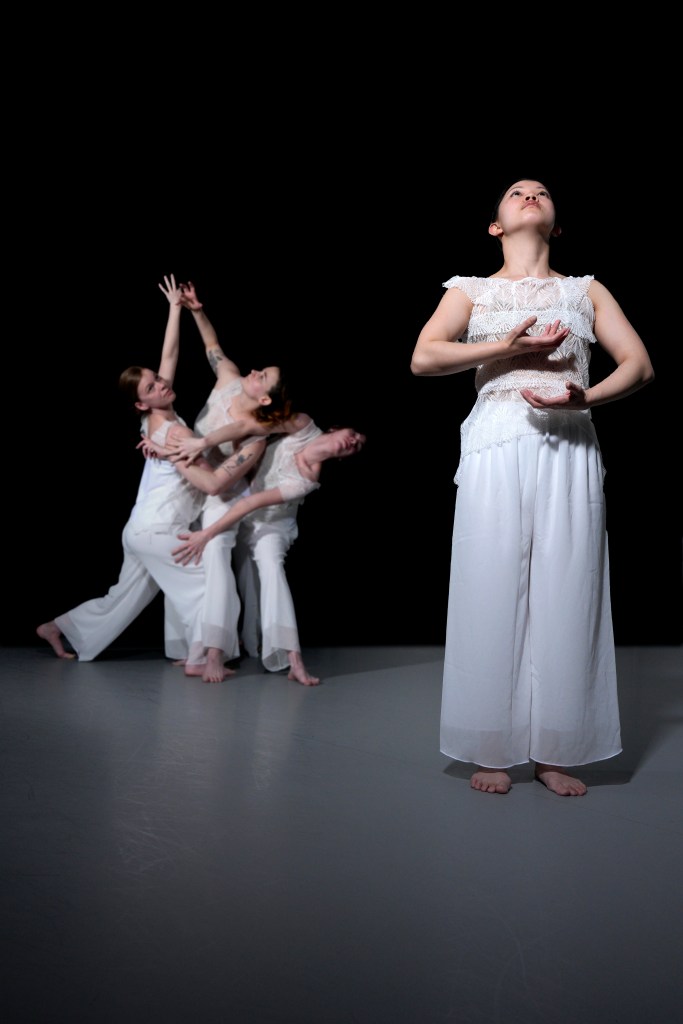
Mike Harrell’s black and white photograph depicts an aisle of tall trees whose tops meet and intertwine above the road. The Live Oak dancers’ white palazzo pants and lacy white tops mimic the lacy tree branches and at one point the lacy pattern is recreated on the floor in lights. Their movements are mysterious and weighted, a lift and drag suggests the strength, durability flexibility, and stability of trees, and the shapes fit together like puzzle pieces. Very mindful. Very demure.

Caroline Frye submitted a photo of a backyard clothesline with what appears to be a heavy rug hanging out to air or to dry. Fran Beaumont wears neatly tailored pants and a button-down shirt that reminded me of a schoolgirl’s uniform, while Madison Ernstes, lingering in the background, wore a dark shirtwaist dress. For me, Saving Grace created an image of a portal, a doorway, perhaps into the past. The atmosphere made me consider various meanings of the phrase, “saving grace.” It can mean a redeeming quality, but it could also, literally mean saving someone named Grace – or it could be a bit of both…

Becks Atkins photo of clouds inspired Wisp, one of my personal favorites. Dressed in short white or pale gray pants with asymmetrical tops, the dancers began in a single file line, facing the audience and ended in a cluster like delicate flower petals. The music and movement both seemed to have a delicate Asian flavor, simple, and beautiful.

The first half of the program closed with Lies Lies Lies, inspired by PJ Skyes’ angular, industrial offering – three views of a wall that holds the remains of a sign that once said “SUPPLIES.” Hmm, could this be a subtle statement about how things are not always what they seem to be – or an even more rare statement on the current political climate? Without reading more into it than intended, Foster’s choreography for this piece is urgent, driven, and percussive, and set to an original score that is equally urgent, driven, and percussive.  Altogether, Lies Lies Lies is quite a departure from other works on the program, aggressive, but not angry.

The second part of the program opened with a solo, Flight, performed by Molly Huey. Inspired by Georgianne Stinnett’s intimate close-up of a bee collecting pollen from the reproductive organs of a flower, Huey’s movement are big and remind me of the inner workings of a traditional timepiece. The original soundscape consists of a series of musical explosions with an underlying base of small ticks, like a fine watch – or a time bomb.

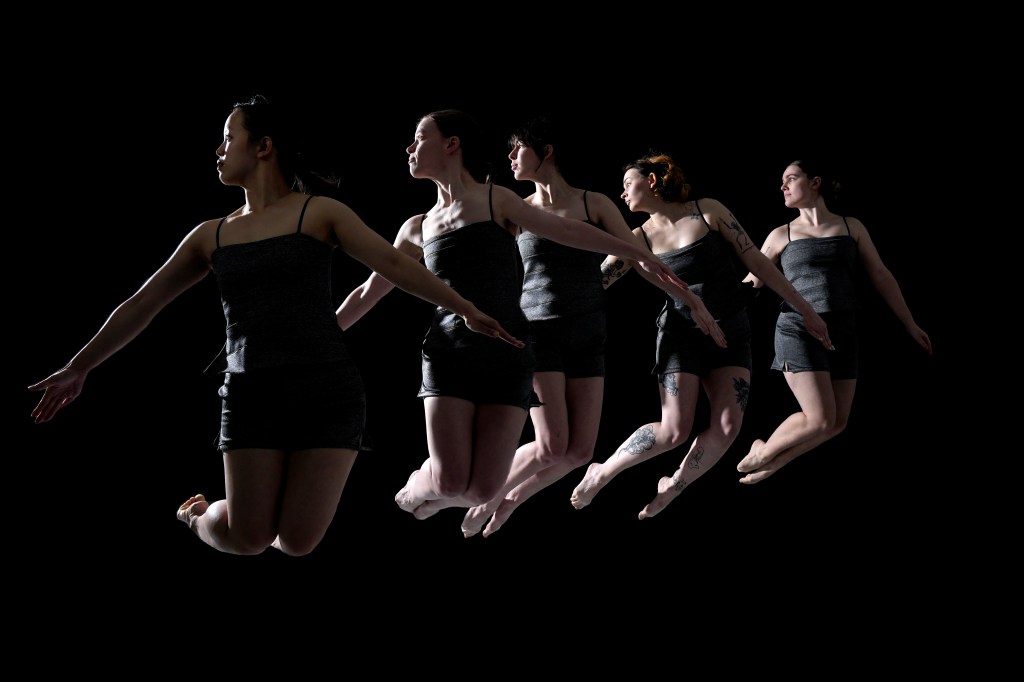
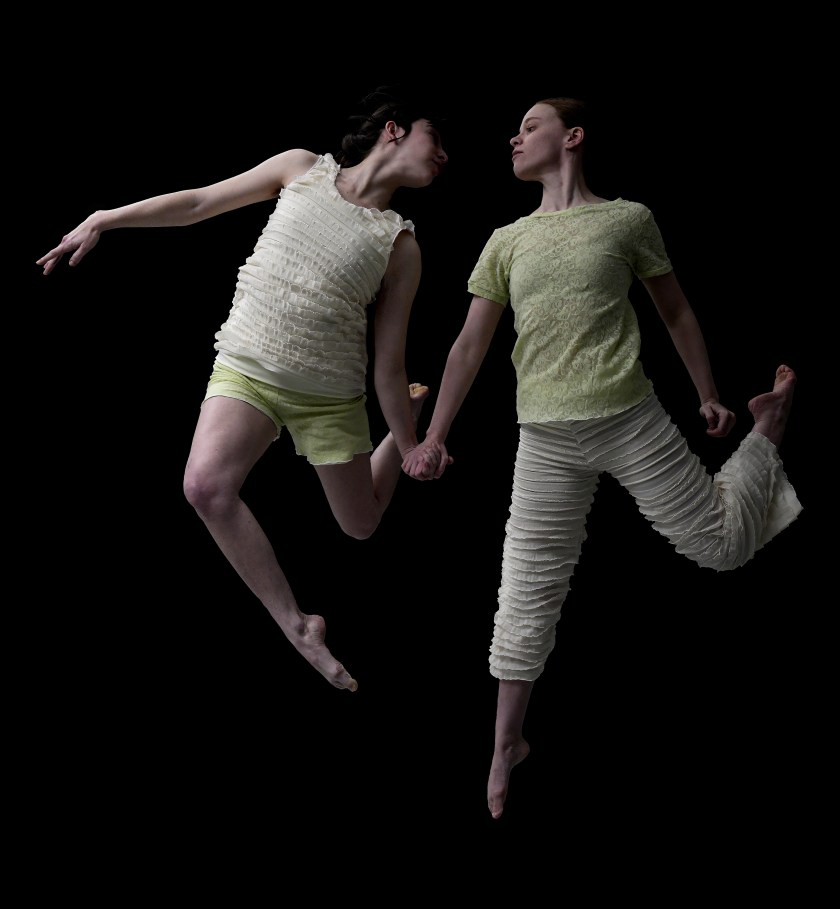
Run to You, another personal favorite is a tender duo, performed by Shannon Comerford and Angela Palmisano. Intriguing lighting creates shadow play that makes the two dancers appear to be four or six. Inspired by Shannon Mills Guest’s photograph of two women sitting side-by-side, one with long blond hair and one with long dark hair. Foster carries out the visual opposition with costuming: one dancer wears white ruffled fabric on top, the other on the bottom, while the shadows double and triple the relationships, building and extending the connection between the sisters, friends, or whatever you need the relationship to be.

The program closed on a humorous and quirky note with Garnish, a work for 13 dancers, each wearing a flower-patterned dress, each in a different pattern. Lined up across the stage, they grimace, give a side eye, and more in a cork that is casual, funny, and energetic. Garnish is inspired by Allison Patel’s photograph of a woman applying makeup. Eyes wide, lips pursed, the image fuels the dancers’ facial gymnastics and extends the movement through their entire bodies. Garnish is definitely the icing on the cake.

———-

Julinda D. Lewis is a dancer, teacher, and writer who was born in Brooklyn, NY and now lives in Eastern Henrico County. When not writing about theater, she teaches dance history at VCU and low impact dance fitness classes to seasoned movers like herself and occasionally performs.

———-

Starr Foster Dance presents

CURIOUS INTENTIONS   

Artistic Director/Choreography by: Starrene Foster

Art Director: Doug Hayes

Lighting Designer: Greta Daughtrey

Music Director: Daniel Deckelman

Company Artists: Fran Beaumont, Shannon Comerford, Madison Ernstes, Molly Huey, Angela Palmisano

Guest Performers: Adria Applebee, Alex Atkins, Roya Baker-Vahdani, Sarah Carrington, Lena Cohen, Ma-Siya Dycus, Sophie Smith, Ella Holland, Janelle Ragland

Costumes Designed and Constructed by: Starrene Foster, with the exception of the costumes for “Wisp,” designed and constructed by Johann Stegmeir

Starr Foster Dance is a Resident Company of the Firehouse Theatre

Performance Schedule

SPITTING IMAGE PERFORMANCE SCHEDULE
Thursday, April 3rd 7:30PM Opening Night/Post Show Q&A
Friday, April 4th 7:30PM Champagne Night with Cast & Artistic Team
Saturday, April 5th 2:00PM
Saturday, April 5th 5:00PM Post Show Q&A  
Sunday, April 6th 2:00PM Closing night

Run Time

1 hour 20 minutes  plus one15-minute intermission

One-Time
Monthly
Yearly

Make a one-time, monthly, or annual donation to support the publication of rvart review. we receive no funding and do not charge you for a subscription or require you to navigate a paywall…

Make a monthly donation

Make a yearly donation

Choose an amount

$5.00
$15.00
$100.00
$5.00
$15.00
$100.00
$5.00
$15.00
$100.00

Or enter a custom amount

$

Your contribution is appreciated.

Your contribution is appreciated.

Your contribution is appreciated.

DonateDonate monthlyDonate yearly
Lies Lies Lies
Live Oak
Flight

Dial M for Murder

What’s So Important About the Fifth Step?

A Theater Review by Julinda D. Lewis

By: Virginia Repertory Theatre (Virginia Rep), The Barksdale Season

At: Hanover Tavern, 13181 Hanover Courthouse Road, Hanover, Virginia 23069

When: March 28 – April 27, 2025

Ticket Prices: $54  

Info: (804) 282-2620 or www.virginiarep.org

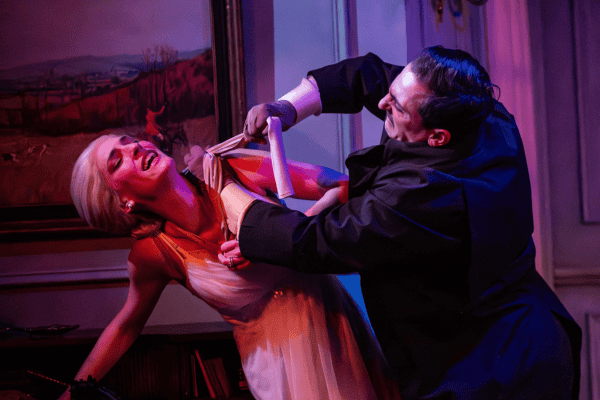
Dial M for Murder is a classic 1950s stage thriller, a murderous melo-drama filled with plot twists and scandal. Tony Wendice married his wife Margot for her money, and now he wants to get rid of her – but he also wants to keep her money. The logical solution, since this is a Hitchcockian style murder mystery, is to kill her. Thanks to their mutual friend, a successful American crime writer named Max, Tony has the background – and the motive – to plan the perfect murder. But will he be able to get away with it?

Jeffrey Hatcher’s adaptation kept the basic plot and Frederick Knott’s location: a 1950s London flat, but one major change is that  Hatcher changed the Wendice’s friend Max, with whom Margot had and broke off an affair, from Max to Maxine. This means Margot was engaged in a lesbian affair and gives even more of an edge to the scandal since same-sex partnerships were not exactly acceptable in the 1950s.

Tony’s carefully planned plot goes awry, but he quickly improvises a Plan B, resulting in Margot being charged with the murder of the man Tony had hired to kill her. Margot doesn’t know who to trust, and if not for the fortuitous partnership between Maxine and a keen-eyed detective, Hubbard, this play might well have ended with her hanging from the gallows. Fast-paced and seasoned with a dash of humor, Dial M for Murder is a deliciously entertaining divertissement. Unlike some of the serious – and seriously good – theater I’ve seen in the past few months, this play doesn’t require you to think about social issues, it doesn’t draw parallels with historical events, and it doesn’t attempt to teach us moral lessons. It’s pure fun – a class murder mystery with smart plot twists and stereotypical characters we recognize and welcome into our lives for a little over two hours.

5 Motives for Murder

Money

Fear

Jealousy

Revenge

To protect a loved one

This production has a stellar cast, many of whom will be familiar to those who frequent local theater. Margot is played by Ashley Thompson (5 Lesbians Eating a Quiche, Dr. Ride’s American Beach House, and Buried Child). Tony is played by Alexander Sapp (Peter and the Starcatcher, Sweeney Todd). Maxine is played by Rachel Dilliplane (5 Lesbian Eating a Quicke, The Laramie Project, and Moriarty u/s). The shoes of the would be hired killer, Legate, are filled by Adam Turck (Constellations, The Laramie Project, The Inheritance, Animal Control, Buried Child). The newest face was that of Jim Meisner, Jr. in the role of Inspector Hubbard. Dial M for Murder marks Meisner’s Virginia Rep debut and his first performance after a more than 25-year hiatus from the stage.

The sexual tension between Margot and Maxine is obvious from the opening scene, highlighted by Thompson’s conservative couture and wig and Dilliplane’s more bold fashion choices and short haircut. No separate credit was given for wigs, so I will assume that Sarah Grady gets the well-deserved credit for both hair and costumes. Even the tan trench coats play an important role later in the denouement when Inspector Hubbard sets a trap to expose Tony.

“Everything has its price.” – Tony Wendice

Sapp is smooth with his lies in front of the other cast members and a master of the villainous side eye when playing to the audience. Turck is suitably sleezy as Tony’s corrupt former classmate turned hitman. And last but not least, Meisner is heroic as the blustery bumbling Inspector. (Is anyone else old enough to remember the bumbling TV detective, Colombo?)

This impressive ensemble was under the capable direction of Mel Rayford, also making their VaRep debut. Rayford skillfully guided the cast and audience through all the twists and turns, through layers of subplots and intrigue, encouraging us to find amusement in murder, to willingly turn corners into fictional depravity, and then to vigorously applaud when we emerged, safe and sound and strangely exhilarated for having taken the journey.

A Word of Caution

Beware of anyone who puts mushrooms in their spaghetti.

(You’ll know why if you’ve seen the play.)

———-

Julinda D. Lewis is a dancer, teacher, and writer who recently had both knees replaced due to a manufacturer’s recall. Born in Brooklyn, NY, she now lives in Eastern Henrico County where she can be found kicking up  her heels as best she can any day of the week.

———-

DIAL M FOR MURDER     

Adapted by Jeffrey Hatcher (2022)

From the Original by Frederick Knott (1952)

Directed by Mel Rayford

Cast

Ashley Thompson ……………….             Margot Wendice

Rachel Dilliplane …………………             Maxine Hadley

Alexander Sapp ………………….             Tony Wendice

Adam Turck ………………………             Lesgate

Jim Meisner, Jr. ………………….             Inspector Hubbard

Kendall Walker …………………..             Margot U/S, Maxine U/S

Travis Williams  ..…………………             Lesgate U/S, Hubbard U/S

Chandler Hubbard ………………             Tony U/S

Direction & Design

Direction ………………………….             Mel Rayford

Scenic Design ……………………             Frank Foster

Costume Design …………………             Sarah Grady

Lighting Design …………..………            Steve Koehler

Sound Design …………………….            Jonathan Pratt

Fight Director …………………….             Casey Kaleba

Dialect Coach …………………….             Nicole Cowans

Stage Management ………….…..            Hannah Hoffert

Assistant Stage Manager ………..            Amber Hooper

Photographer ……………………..            Aaron Sutten

Videographer ……………………..            Austin Lewis

Ticket Information

Box Office: (804) 282-2620

www.virginiarep.org

Ticket Price: $54

Run Time

The play runs for approximately 2 hours 15 minutes; including one intermission.

Photo Credits Aaron Sutten

One-Time
Monthly
Yearly

Make a one-time, monthly, or annual donation to support RVArt review

Make a monthly donation

Make a yearly donation

Choose an amount

$5.00
$15.00
$100.00
$5.00
$15.00
$100.00
$5.00
$15.00
$100.00

Or enter a custom amount

$

Your contribution is appreciated.

Your contribution is appreciated.

Your contribution is appreciated.

DonateDonate monthlyDonate yearly
RICHMOND BALLET: MOVING ART ONE

Ballet Celebrates First Program on the New VMFA Stage

A Dance Review

Performance By: The Richmond Ballet

At: Virginia Museum of Fine Arts, Leslie Cheek Theater, Richmond Ballet Stage, 200 N. Arthur Ashe Boulevard, RVA 23220

Performance Dates: March 20-30, 2025

Ticket Prices: $25 – $85 ($85 – $125 on opening night)

Info: (804) 344-0906, etix.com, or richmondballet.com

THE PROGRAM

PENTAPTYCH

Choreography by Ma Cong

Music by Ryan Lott

Costume Design by Emma Kingsbury

Lighting Design by Les Dickert

Visual Artist: Eric Sall

World Premiere: September 14, 2018, Tulsa Ballet, Tulsa Ballet’s Studio K Theatre, Tulsa, OK. Richmond Ballet Premiere: March 20, 2025, Leslie Cheek Theater, Virginia Museum of Fine Arts, Richmond, VA

AFTER THE RAIN Pas de Deux

Choreography by Christopher Wheeldon, OBE

Music by Arvo Pärt

Staged by Jason Fowler and Craig Hall

Costume Design by Holly Hynes

Lighting Design by Les Dickert after Original Design by Mark Stanley

Pianist: Dr. Douglas-Jayd Burn

Violinist: Karen Johnson

World Premiere: January 22, 2005, New York City Ballet, New York State Theater, New York, NY. Richmond Ballet Premiere: March 20, 2025, Leslie Cheek Theater, Virginia Museum of Fine Arts, Richmond, VA

LAMBARENA

Choreography by Val Caniparoli

Music by Johann Sebastian Bach and traditional African (as arranged by Pierre Akendengué and Hughes de Courson)

African Dance Consultants: Dr. Zakarya Diouf, Naomi Johnson-Diouf, Ibrahima O. Diouf

Scenic and Costume Design by Lisa J. Pinkham, Recreated by Les Dickert

Staged by Maiqui Manosa

World Premiere: March 28, 1995, San Francisco Ballet, War Memorial Opera House, San Francisco, CA. Richmond Ballet Premiere: March 20, 2025, Leslie Cheek Theater, Virginia Museum of Fine Arts, Richmond, VA

—–

In celebration of the very first performance of the Richmond Ballet’s new Moving Art series – replacing the long-time, popular Studio Series – current Artistic Director Ma Cong, Founding Artistic Director Stoner Winslett, and VMFA Director and CEO Alex Nyerges shared the stage on Thursday evening, March 20, for an enthusiastic pre-show welcome. There was a full house for this gala event, and all performances of the March 20-30 program were already sold out.

Moving Art One marks the return of the Richmond Ballet to the VMFA  after last performing there in the 1990s and the first major renovation of the Leslie Cheek Theater stage since it was built some 70 years ago. The renovations include widening the stage to better accommodate ballet, new lighting for the house and the stage, and upgraded A-V equipment. A press release indicates that the performers’ dressing rooms and restrooms and the green room have also been upgraded. The theater seats 472 audience members, and the seating has reportedly been refurbished but in my opinion the seats are still a bit too tight and would probably not be comfortable for all audience members, and the raking does not allow for an unobstructed view if you are vertically challenged, or if a tall person sits in front of you. But that’s just my two cents.

As with the Studio Series performances, the Moving Art series consists of a program of three works and features both classical and contemporary ballets produced in an intimate setting (as compared to, say, the 1,800-seat Carpenter Theatre where large works such as The Nutcracker Ballet or Cinderella are performed).

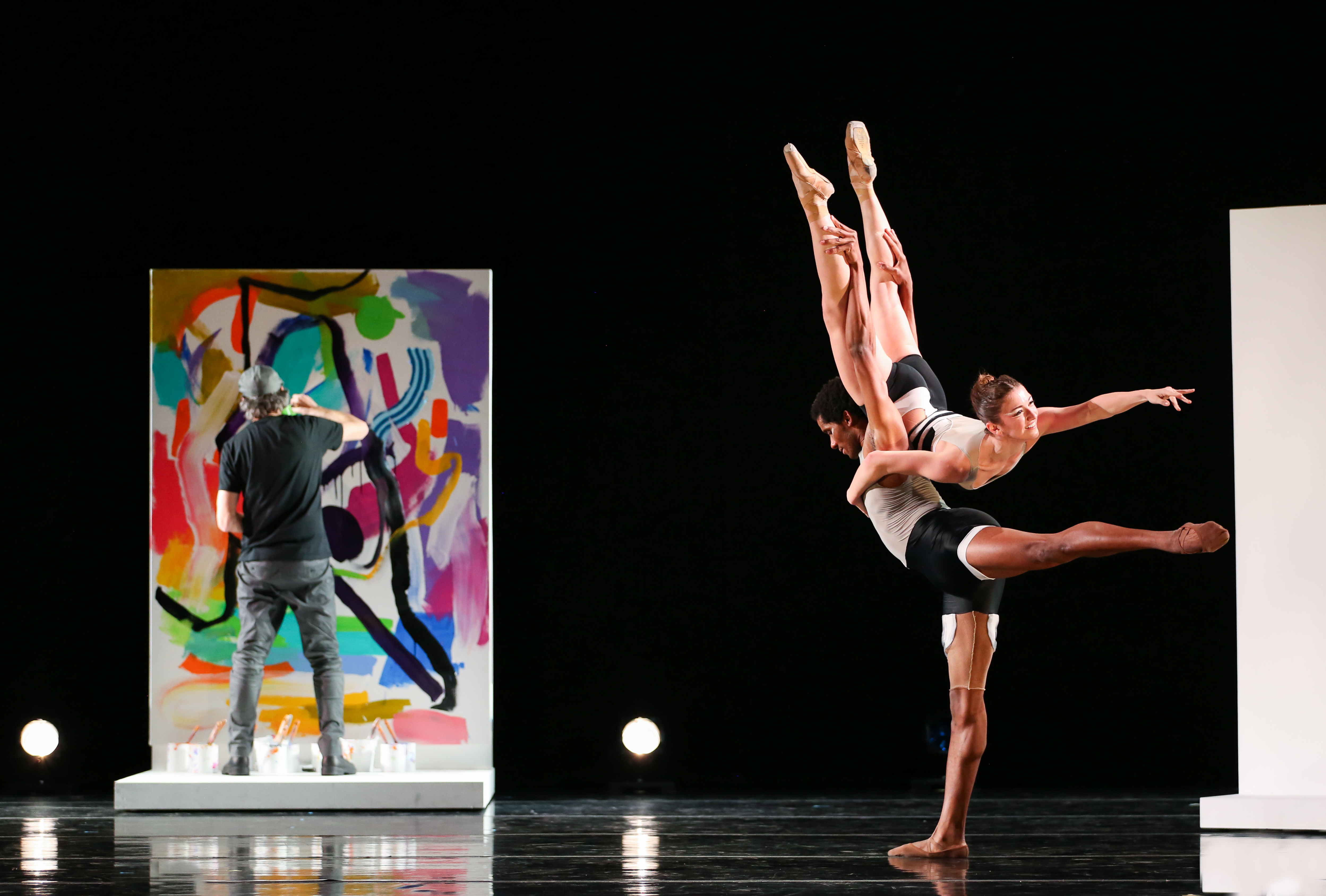
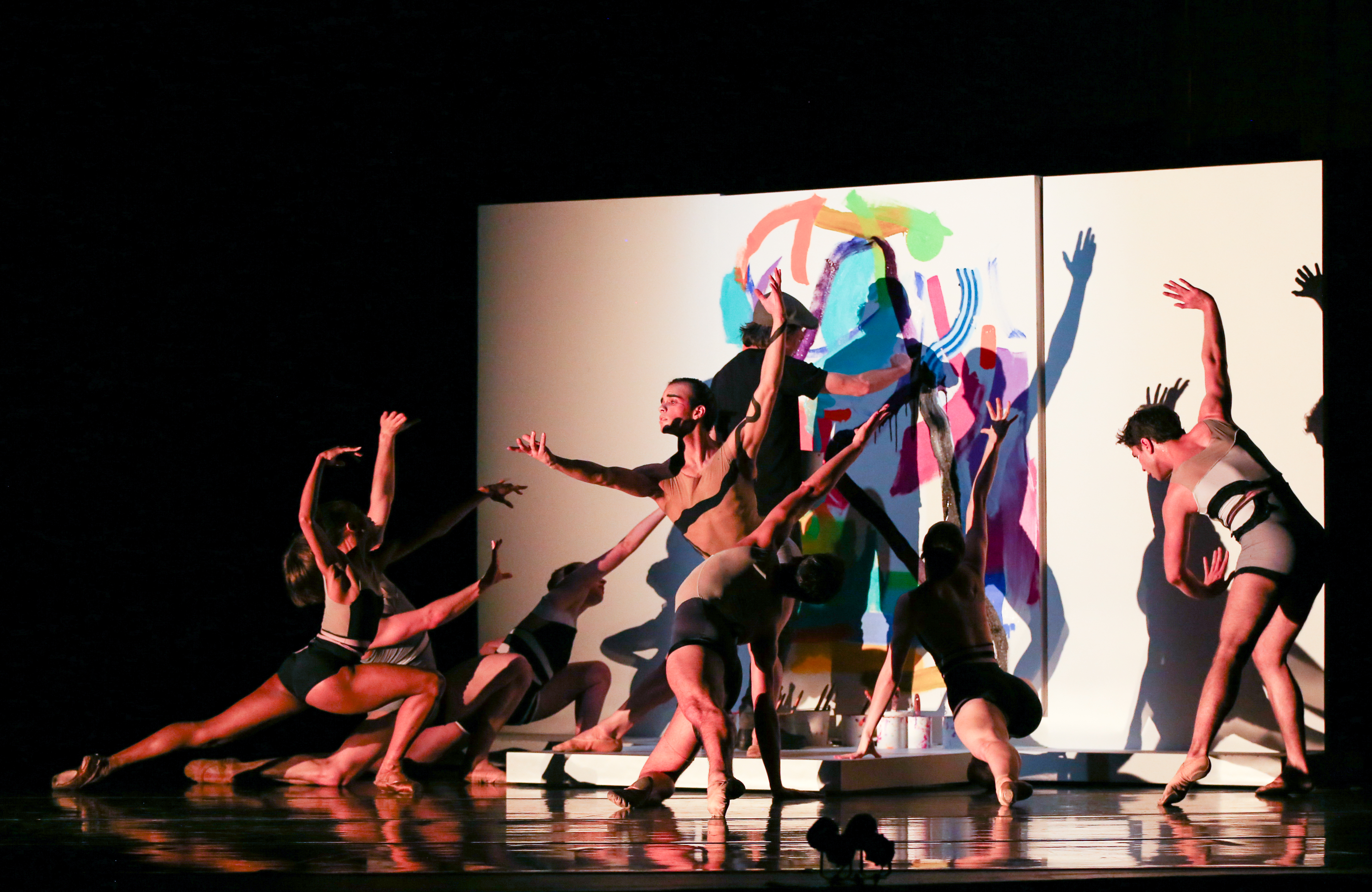
Moving Art One opened with the world premiere of Ma Cong’s Pentaptych (def., a work of art consisting of five panels or sections). There is a live artist onstage, Eric Sall, who interacts with the dancers and creates a large, colorful abstract painting. The bold brushstrokes are a stark contrast to the black, white, and gray costumes worn by the dancers – except for one dancer whose costume appears to be a part of or an inspiration for the painting. The ballet is of the contemporary genre, and the dancers’ monochrome costumes, paired with the abstract, ethereal, and sometimes athletic stretching motions and the original score by Ryan Lott, for a moment I had a flashback of sitting in Merce Cunningham’s Westbeth studio in Manhattan’s artists’ community, watching his company perform. (For those not familiar with Cunningham’s work – this is a positive comparison, and you should look him up!) The finished painting, by the way, is available for purchase via an online auction. The proceeds are to benefit the Richmond Ballet.

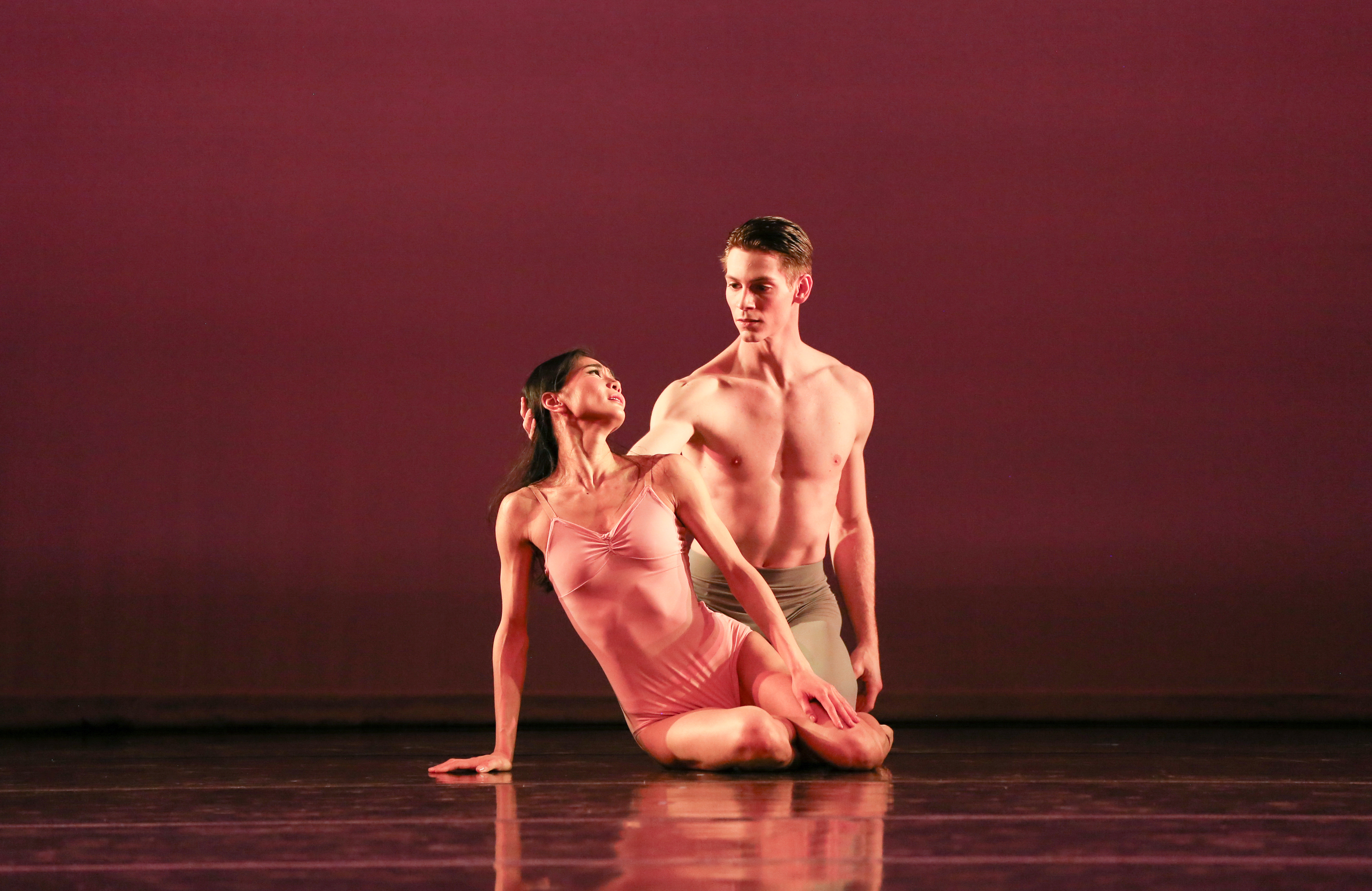
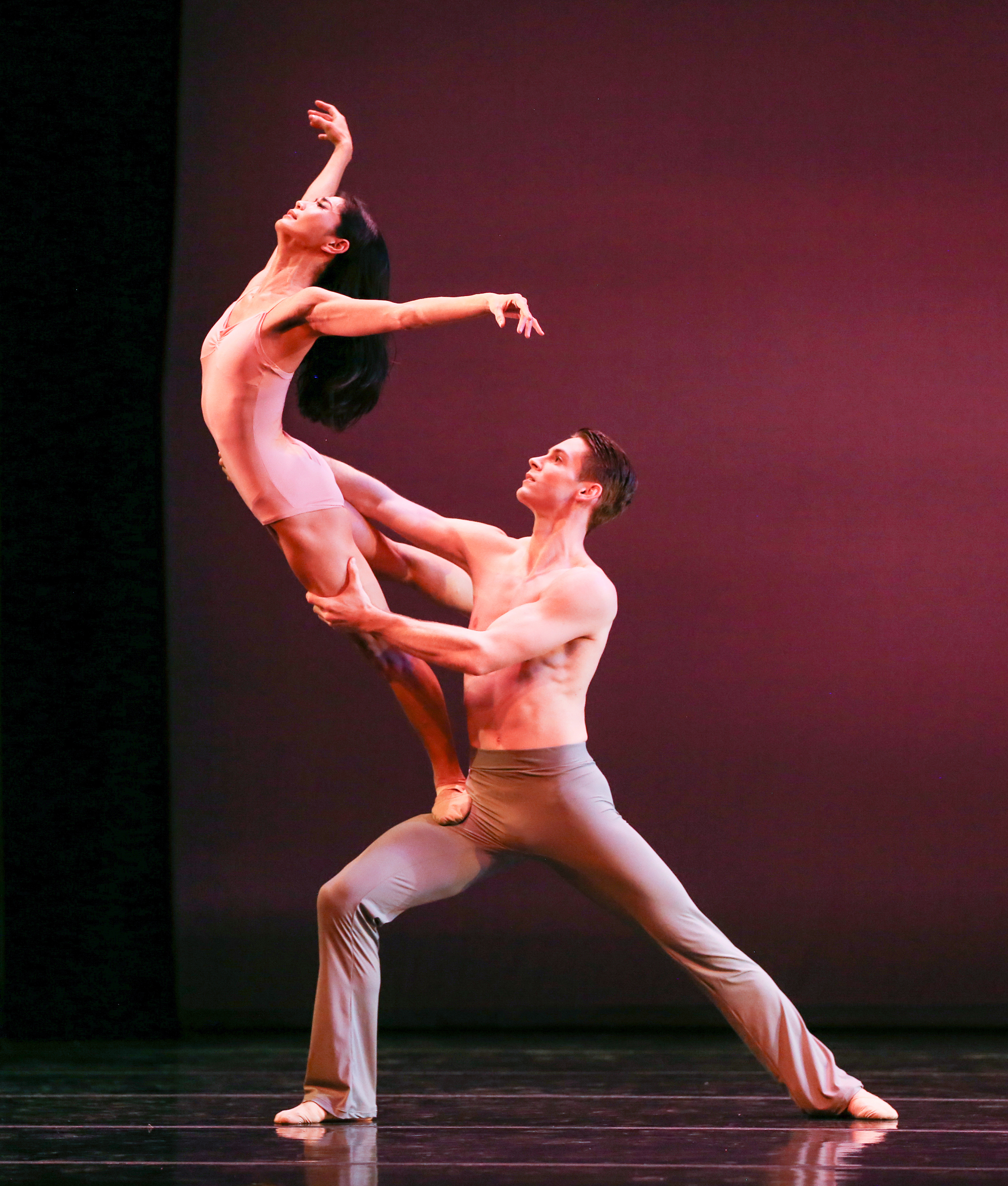
The classical portion of the program was provided by Eri Nishihara and Jack Miller, performing the pas de deux from Christopher Wheeldon’s After the Rain. Commissioned for a New York City Ballet program in honor of George Balanchine’s birthday, the ballet is in two parts. The first part is a dance for three couples, and the second part, the pas de deux, is often performed separately, as it was here on the new Richmond Ballet Stage. The dance is set to music by Arvo Pärt, played live by Dr. Douglas-Jayd Burn and Karen Johnson, and is notable for placing the ballerina in flat shoes instead of en pointe.

It is a stunningly beautiful and tender ballet in which the male dancer, Miller, sometimes lifts his partner is the most unexpected ways – for example, frozen into a position that I can only describe rather awkwardly as table-like. Another moment, Nishihara gently caresses her partner’s face while he stands strong and unmoving, or she perches delicately on his extended thigh. Burn’s piano and Johnson’s violin emit gentle, almost ambient sounds, like, yes, like raindrops. The piece ends with a silent embrace and the partners gently melt into one another.

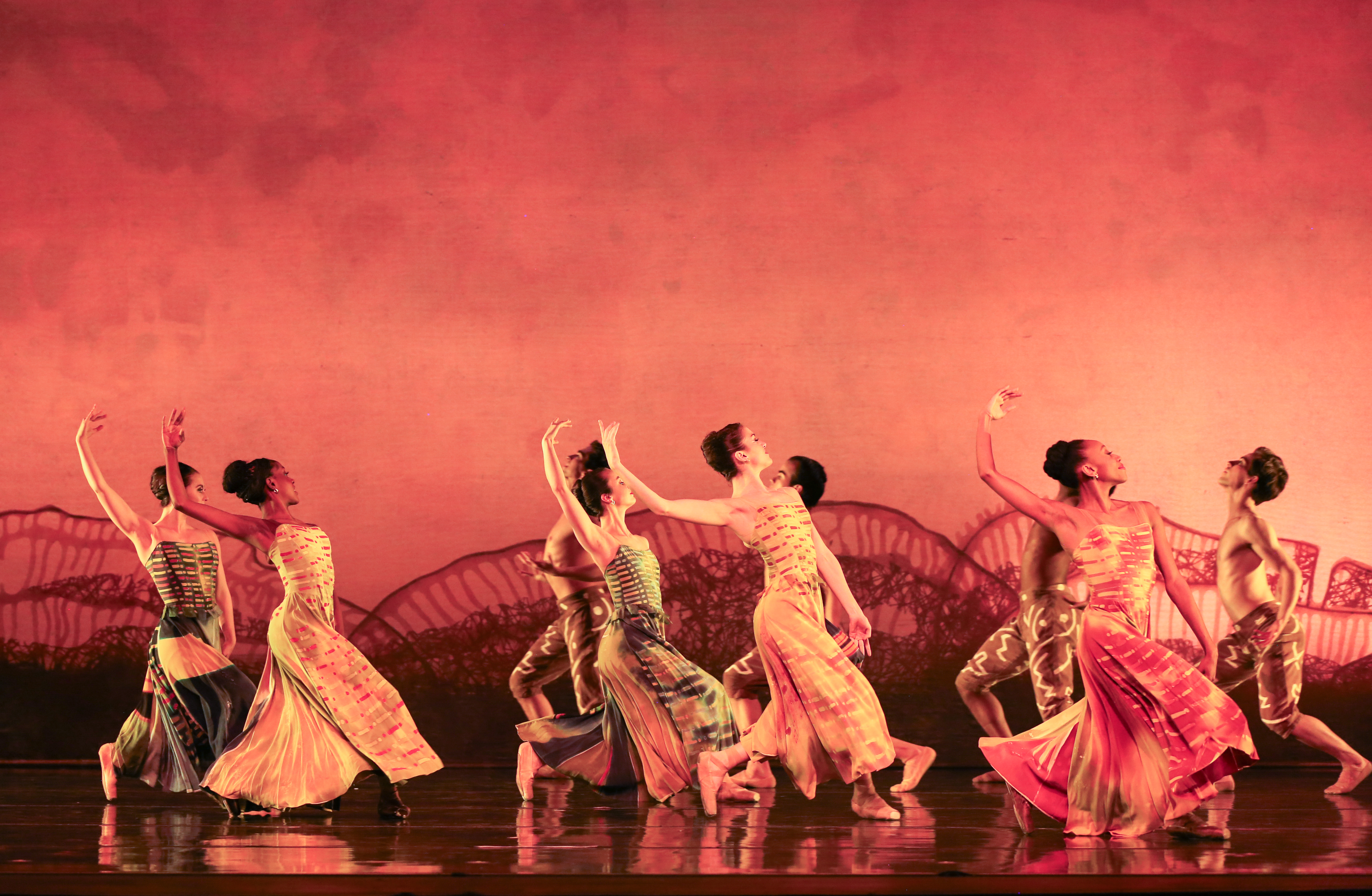
Val Caniparoli’s Lambarena is much more difficult to write about, not because it was not beautifully performed, but because I am not sure what to think of it. Colorful, energetic, and fun, the work is performed to a rather unique blend of music by Johann Sebastian Bach and traditional African (what part of Africa?) music arranged by Pierre Akendengué and Hughes de Courson.

Performed by the full company, the work serves as a showcase for dancer Naomi Robinson who leads the women in leaping lightly like gazelles over the savanna. (This brought back another memory, that of seeing a herd of gazelles dashing through the grasslands of Kenya.) In a later section, they held their arms back and arched, reminding me of ostriches – and the beautiful solo Awassa Astrige created by Asadata Dafora (1932). The men, at times, reminded me of giraffes – also common to Kenya and other parts of East Africa. There was lots of light footwork and hip action unlike anything one usually sees in a traditional ballet. Sometimes I heard strains of a stringed instrument that reminded me of a berimbau – a one-stringed instrument I’m familiar with from Brazilian dance and capoeira (a Brazilian martial art/dance). I believe the berimbau originated in Angola, in southwestern Africa. The music also incorporated choral sections and clapping.

Overall, the work is sassy and joyous, and performed with extraordinary energy. My dilemma, perhaps, comes from recent discussions I have been having with my dance history students at VCU, where we have been mulling over the differences between cultural appreciation and cultural appropriation. The program lists African Dance Consultants – Dr. Zakarya Diouf, Naomi Johnson-Diouf, and Ibrahima O. Diouf – and the company hosted a Community Dance Class with local dance organization Ezibu Muntu on March 16, shortly before the opening of the Moving Art One program.

Still, I felt a certain uneasiness as I watched – and enjoyed – Lambarena, and watched others enjoying it, too. I appreciated it, but there does seem to be more than a little cultural appropriation – context? accreditation? intent? Acknowledgement – beyond the generic designation of “African” – or at least an appearance thereof. I need to look more deeply into Caniparoli’s inspiration and motivation before making a final decision on this work.

In the meantime, while I’m rummaging around in the stack of dance history, if you can’t get to see Moving Art One, there will be a Moving Art Two, running from May 8 – 18. That program will include Joshua L. Peugh’s Slump, a ballet about modern courtship, Stoner Winslett’s Echoing Past (set to a score by Fanny Mendelssohn-Hensel), and Yury Yanowsky’s newly completed Fading Creatures, a work-in-progress he introduced at Richmond Ballet’s 2023 New Works Festival. It draws inspiration from the melting clocks of Salvador Dalí’s popular painting The Persistence of Memory.

—–

Julinda D. Lewis is a dancer, teacher, and writer who was born in Brooklyn, NY and now lives in Eastern Henrico County. When not writing about theater and dance, she teaches dance history at VCU and low impact dance fitness classes to seasoned movers like herself and occasionally performs.

One-Time
Monthly
Yearly

Make a one-time, monthly or annual donation to show how much you love rvart review

Make a monthly donation

Make a yearly donation

Choose an amount

$5.00
$15.00
$100.00
$5.00
$15.00
$100.00
$5.00
$15.00
$100.00

Or enter a custom amount

$

Your contribution is appreciated.

Your contribution is appreciated.

Your contribution is appreciated.

DonateDonate monthlyDonate yearly
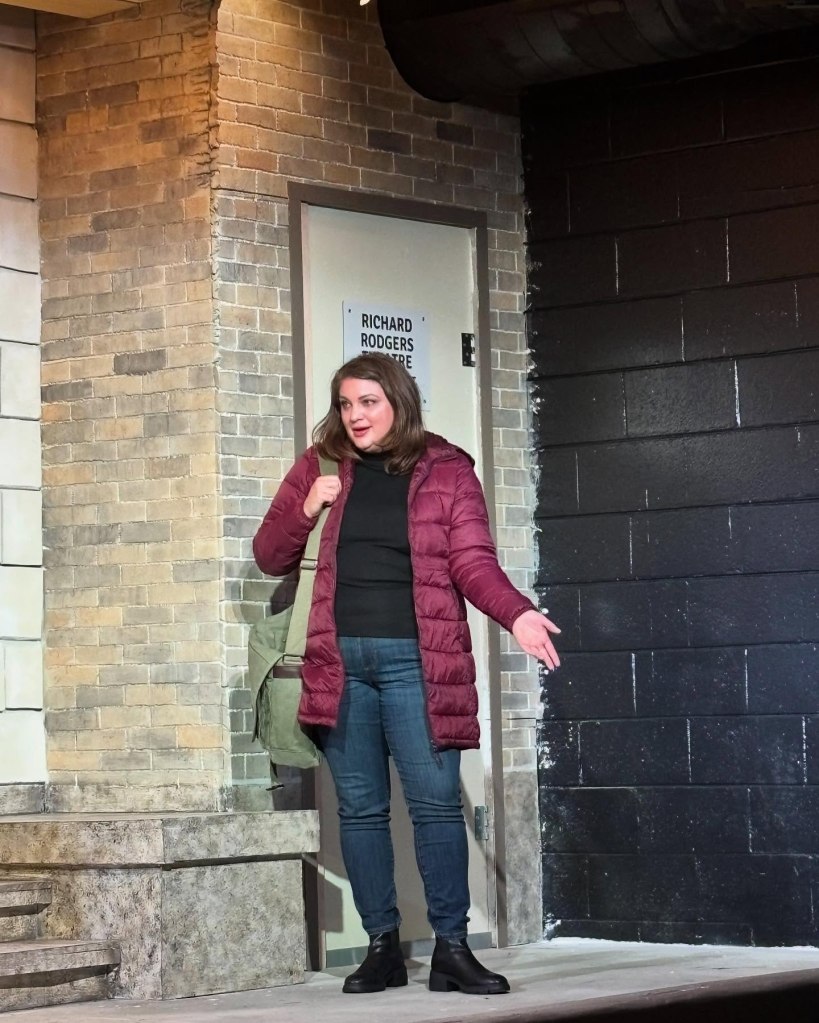
THE COMPLETE WORKS OF WILLIAM SHAKESPEARE

(abridged)

A Theater Review by Julinda D. Lewis

Presented by: Richmond Shakespeare

At: Libby S. Gottwald Playhouse, 600 E. Grace St., RVA 23219

Performances:

Ticket Prices: $22-$47 [Adults $47; Seniors 65+ with ID $42; Military with ID $27; College Students with ID & Children $22] Seating is General Admission.

Info: (804) 340-0115 or http://www.richmondshakespeare.org

There’s not much that needs to be said about The Complete Works of William Shakespeare (abridged). The title tells (most of) it all. William Shakespeare is considered (one of) the most famous writers of all time. And in his time, he wrote 37 plays, 154 sonnets, 2 long narrative poems, and a number of other works. The task of The Complete Works of William Shakespeare (abridged) is to perform ALL 37 of Shakespeare’s play in 97 minutes.  Of course, this is impossible. What we get is a side-splitting comedic take on Shakespeare that includes scenes, passages, or catch phrases from every play, along with a more extensive treatment of Romeo and Juliet at the top of the show and Hamlet at the end.

Sydnee S. Graves, one of the trio of thespians in this production, sets the pace with her well-timed introduction by unrolling a long scroll that contains the notes for her “brief” introduction. Graves invites us, in elaborate and flowery terms, to share space in the theater – the place where the magic happens.

Rachel Marrs is introduced by Graves as a pre-eminent Shakespearean scholar, and Marrs arrives in a black academic gown that does little to conceal her lack of scholarship – all in good fun, of course!

Joshua Mullins completes the pre-show banter with a ChatGPT – generated biography of Shakespeare that conflates the words and deeds of Shakespeare with America’s  16th president – Abraham Lincoln. (This is clearly propaganda designed to convince the audience that reading is fundamental.

Highlights of the show include the rendering of Shakespeare’s first tragedy, Titus Andronicus, as a cooking show, and Othello summarized as a performance by a rap trio. All 14 comedies are rolled into a single medley, Macbeth is performed by two of the actors in kilts, their swords replaced by golf clubs, while Two Noble Kinsman, a play authored jointly by Shakespeare and John Fletcher, (and here characterized as neither a comedy or a tragedy, but a “bad” play) offers Mullins an opportunity to shill T-Mobile Kinsman cell phone service.

Shakespeare’s histories are grouped together and played as a football game. All 154 sonnets have supposedly been printed on a single 3×5 index card that proves impossible for even a young audience member with strong eyes to read – even after Marrs offers her a series of magnifying glasses. But there are two scenes that stood out for me. The first is the abridged Othello performed as a lively rap performance and the second occurred when in the midst of an argument about not wanting to perform Hamlet, Mullins, who has been acting the fool all night, surprises audience and fellow cast members alike by delivering Hamlet’s soliloquy with heartfelt sincerity.

Dressed in a foundation of short pants, long-sleeved peasant-style shirts, and colorful high-top chucks, the tripartite ensemble moves at breakneck speed, adding and subtracting garments, wigs, and props for each play or scene. Shakespeare wrote plenty of racy dialogue and the salacious plot elements and double entendre are emphasized. There are many references to buns and sausages, and Horatio is misnomered as Fellatio, to name just two and, lest I forget, there is high level and intricate audience participation – with multiple parts! Mullins takes an unnatural level of juvenile-level glee in a long-running bit about vomiting, and he runs across the width of the audience, even up the stairs, to pretend to spew vomitus on audience members or in their drinks.

Graves, Marrs, and Mullins have quite different assignments, with Graves seeming to take on the bulk of the organizing and public interaction, such as announcements. Marrs is in charge of history and props. Mullins is, well, Mullins – a master of quick change and pratfalls. The three of them together form a solid ensemble knit together under a banner of riotous comedy, and often very physical humor. They must be exhausted at the end – after performing multiple versions of Hamlet. Speaking of the end, in his end notes for this production, Director Joe Pabst writes, “Comedy is one thing I know a lot about,” and “I love figuring out what makes people laugh.” To that end, I say to Pabst, “No lies detected,” and “You understood the assignment.”

—–

Julinda D. Lewis is a dancer, teacher, and writer who was born in Brooklyn, NY and now lives in Eastern Henrico County. When not writing about theater, she teaches dance history at VCU and low impact dance fitness classes to seasoned movers like herself and occasionally performs.

—–

The Complete Works of William Shakespeare (abridged)

Written by Adam Long, Daniel Singer, Jess Winfield

with new revisions by Daniel Singer and Jess Winfield

Directed by Joe Pabst

CAST

Sydnee S. Graves

Rachel Marrs

Joshua Mullins

PRODUCTION TEAM

Costume Design      ……………    Anna Bialkowski

Lighting Design       ……………    Trisan Ketcham

Scenic Design          ……………    James Ricks

Production State Manager ……   Jordan Dively

Run Time: 97 minutes; there is one intermission

———-

The Complete Works of William Shakespeare

– Comedies –

All’s Well That Ends Well

As You Like It

The Comedy of Errors

Love’s Labour’s Lost

Measure for Measure

The Merchant of Venice

The Merry Wives of Windsor

A Midsummer Night’s Dream

Much Ado About Nothing

The Taming of the Shrew

The Tempest

Twelfth Night

The Two Gentlemen of Verona

The Winter’s Tale

– Tragedies –

Antony and Cleopatra

Coriolanus

Cymbeline

Hamlet

Julius Caesar

King Lear

Macbeth

Othello

Romeo and Juliet

Timon of Athens

Titus Andronicus

Troilus and Cressida

– Histories –

Henry IV, Part I

Henry IV, Part II

Henry V

Henry VI, Part I

Henry VI, Part II

Henry VI, Part III

Henry VIII

King John

Pericles

Richard II

Richard III

The Complete Works of William Shakespeare (abridged) premiered at the Edinburgh Festival Fringe in 1987.

Photo Credits: Richmond Shakespeare Facebook page

One-Time
Monthly
Yearly

Make a one-time, monthly, or annual donation to show how much you love rvart review.

Make a monthly donation

Make a yearly donation
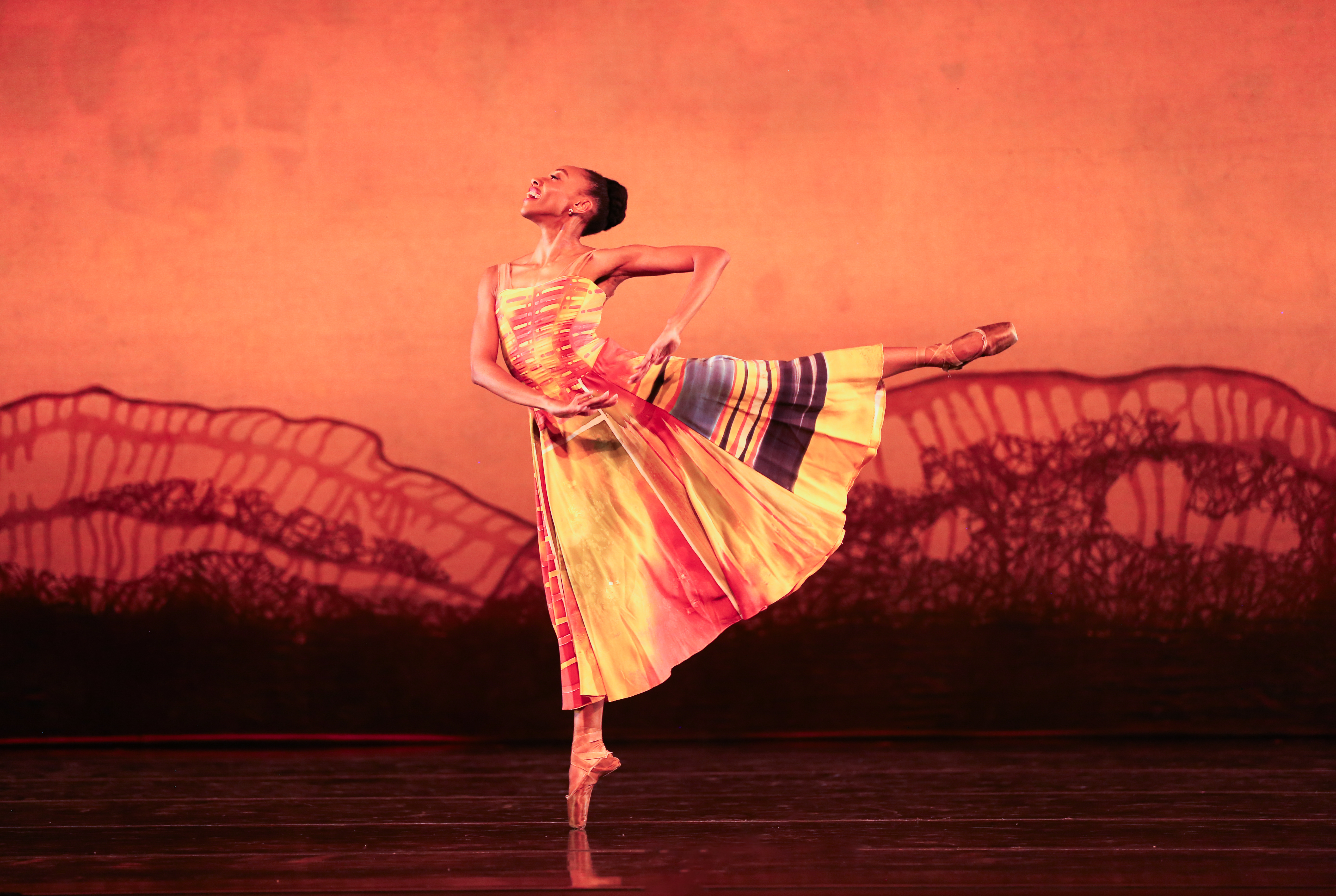
Choose an amount

$5.00
$15.00
$100.00
$5.00
$15.00
$100.00
$5.00
$15.00
$100.00

Or enter a custom amount

$

Your contribution is appreciated.

Your contribution is appreciated.

Your contribution is appreciated.

DonateDonate monthlyDonate yearly