At: Richmond Ballet Studio Theatre, 407 E. Canal St. RVA 23219
Performances: November 6-11, 2018
Ticket Prices: $26-46
Info: (804) 344-0906 or richmondballet.com
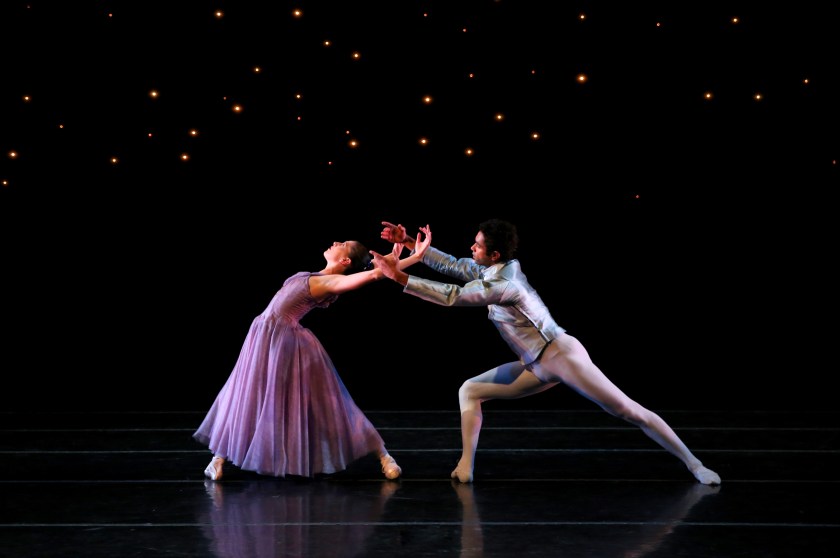
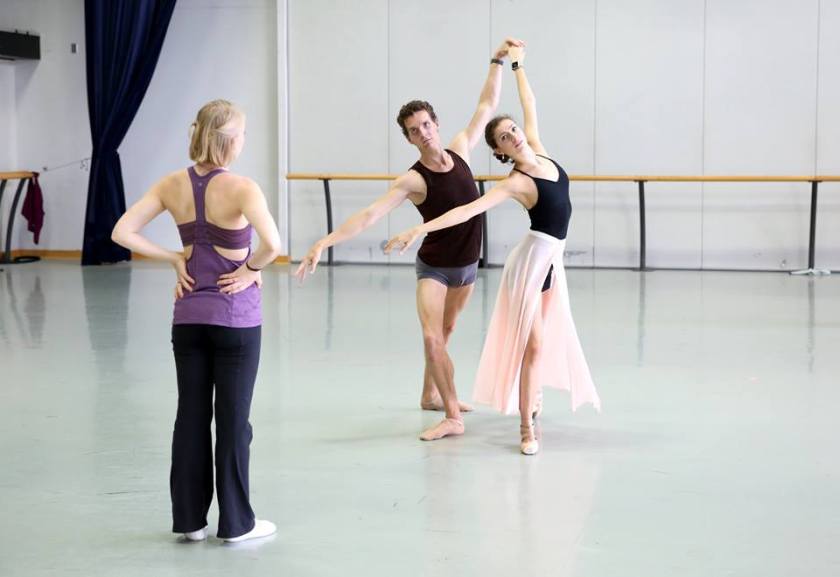
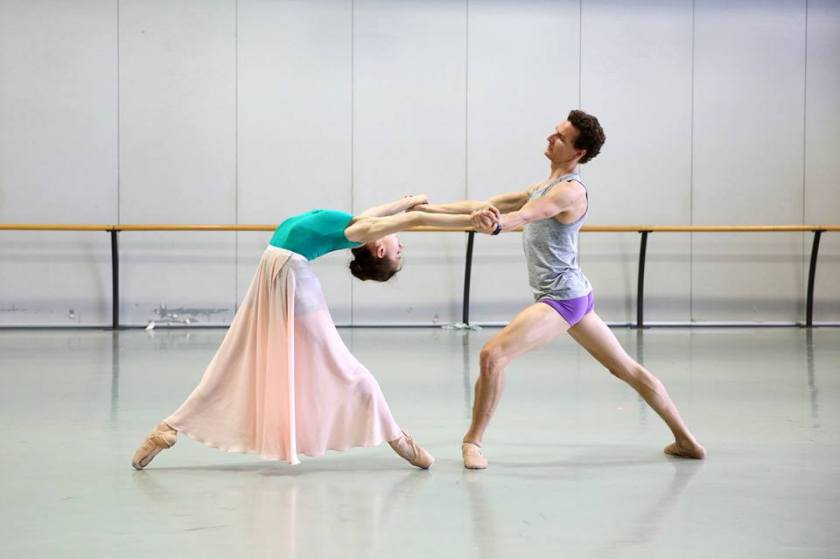
The Richmond Ballet Studio Series is unique and alluring for the intimacy of the space and the presentation of two or three works in an atmosphere that encourages reflection. The current Studio One production continues this tradition. On Tuesday, the Richmond Ballet presented Jerome Robbins’ In the Night, a company premiere of Robbins’ 1970 work for the New York City Ballet, and the world premiere of Nicole Haskins’ Requiem, inspired by the music of Gabriel Fauré.
In the Night is composed of three pas de deux featuring three couples of different temperaments, possibly different ages, at different stages of their relationships. On Wednesday night, the couples were Melissa Robinson and Marty Davis, Eri Nishihara and Khalyom Khojaev, and Maggie Small and Fernando Sabino. Robinson and Davis embodied youthful elegance, she in a softly flowing purple dress, he is a blue-gray waistcoat and ascot. Their movements were sustained, romantic, controlled, yet effortless. Nishihara and Khojaev had a more mature posture, and the earth tones of their costumes added weight. At the same time, their movements were more fanciful, with bigger, bolder jumps and lifts. Finally, Small and Sabino presented a more passionate duo. Her black dress with red underskirt suggested a smoldering temperament, and his darker gray jacket was smoky, matching the teasing sensuality verging on conflict – sort of like classical ballet with a tango temperament. The final section of the beautiful Chopin nocturnes, played live onstage by pianist Joanne Kong, brought all three couple together. In one beautiful moment they briefly acknowledged one another before dancing off.
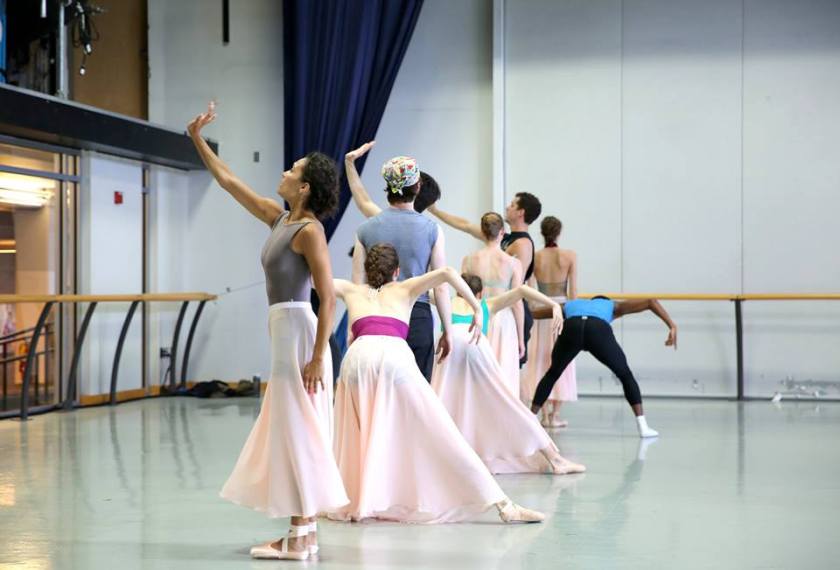
In her video reflections, Haskins described Fauré’s Requiem as “a lullaby for death, not dark or sad.” The women’s flowing skirts, designed by Emily Morgan, were designed to make the movement linger, like the memories of loved ones. The work opens with lights like memorial candles and the women, seated with their skirts pooled around them, also look like candles. The stage is kept dim, and groups of dancers are bathed in the amber glow of the lights. The dancers’ formations are fascinating and delightfully unpredictable: clusters, solos, duos, small groups, diagonal facings, patterns that flow and change organically. While Haskins assured us the work was not dark or sad, it did seem to go on just a little too long.
Julinda D. Lewis is a dancer, teacher, and writer who was born in Brooklyn, NY and now lives in Eastern Henrico County.
———-
Photo Credits:
Rehearsal Photos from Richmond Ballet Facebook posts & Photos by Sarah Ferguson
Sabrina Holland and Fernando Sabino in In The Night by Jerome Robbins. Richmond Ballet 2018. All Rights Reserved. Photo by Sarah Ferguson.Abi Goldstein and Thel Moore III in In The Night by Jerome Robbins. Richmond Ballet 2018. All Rights Reserved. Photo by Sarah Ferguson.Dancers of Richmond Ballet in Requiem by Nicole Haskins. Richmond Ballet 2018. Photo by Sarah Ferguson.Dancers of Richmond Ballet in Requiem by Nicole Haskins. Richmond Ballet 2018. Photo by Sarah Ferguson.Richmond Ballet dancers rehearsing “Requiem”Choreographer Nicole Haskins with Richmond Ballet dancers Abi Goldstein and Mate SzentesCody Beaton and Mate Szentes rehearsing “Requiem”Richmond Ballet dancers rehearsing “Requiem”
At: Virginia Rep’s Children’s Theatre at Willow Lawn; 1601 Willow Lawn Drive, Richmond, Virginia 23230
Performances: October 27 – December 30, 2018
Ticket Prices: Start at $21
Info: (804) 282-2620 or virginiarep.org
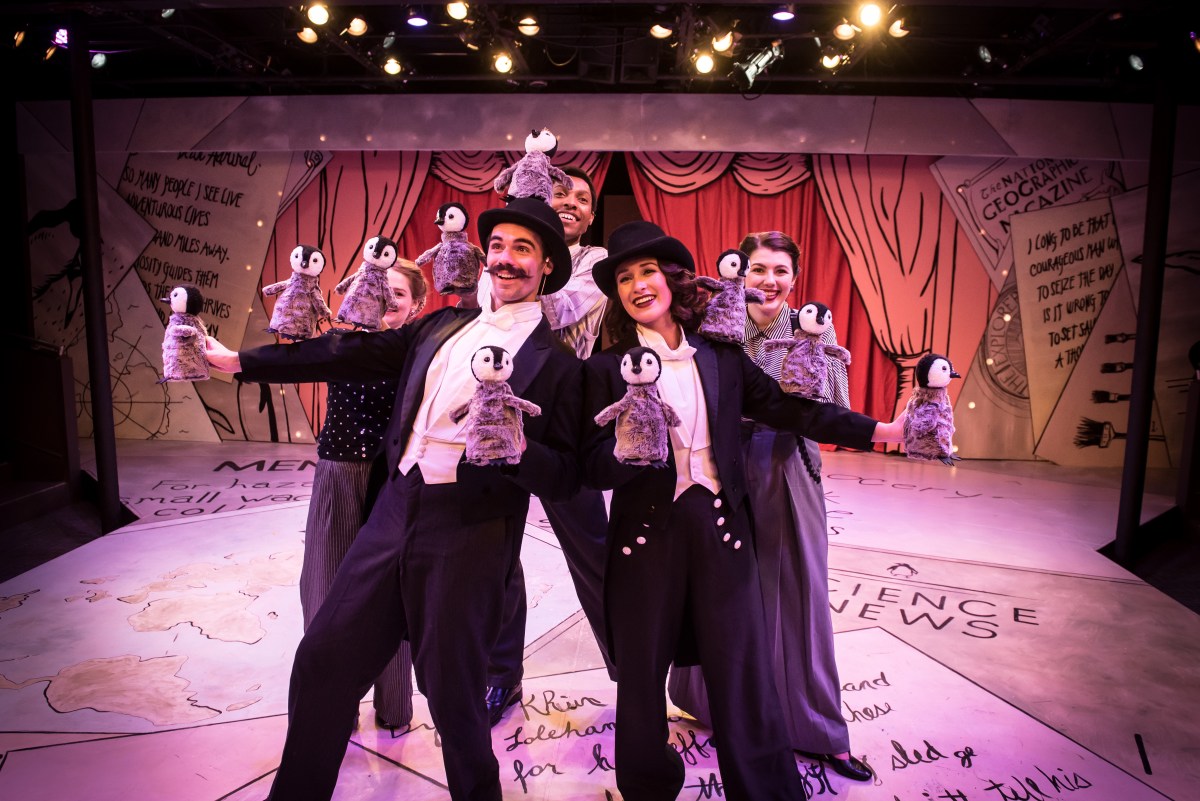
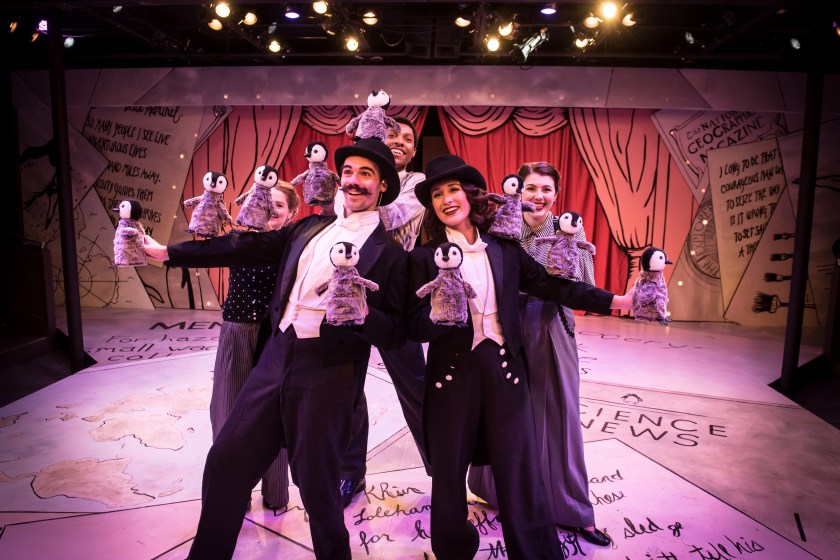
Mr. Popper’s Penguins is a musical adaptation of a children’s book by Richard and Florence Atwater, and the book for the musical is by Robert Kauzlaric with music and lyrics by George Howe. It is a book unfamiliar to me, my daughter, and my two grandsons, but after spending Sunday afternoon at the Virginia Rep’s Children’s Theatre at Willow Lawn it will likely find it way onto our bookshelves this coming holiday season. It has comedy, adventure, and penguins.
Richard Popper is a house painter and decorator of modest means; he and his wife Florence live on a strict budget that does not allow for the travel and adventures Mr. Popper dreams of. He is especially fond of Antarctic exploration and penguins. Of course, there’s more to the story. Imagine their surprise when the Poppers hear on the radio that Mr. Popper’s favorite explorer, Admiral Drake, has received Mr. Popper’s fan letter and is responding with a surprise. Soon a large crate is delivered to the Popper’s Stillwater, Minnesota home and inside is a genuine Gentoo penguin from Antartica that quickly becomes a part of the Popper’s little family. (In the book, it seems the Poppers were British and have two children, but in the musical the live in the USA and their only children are the feathered kind.)
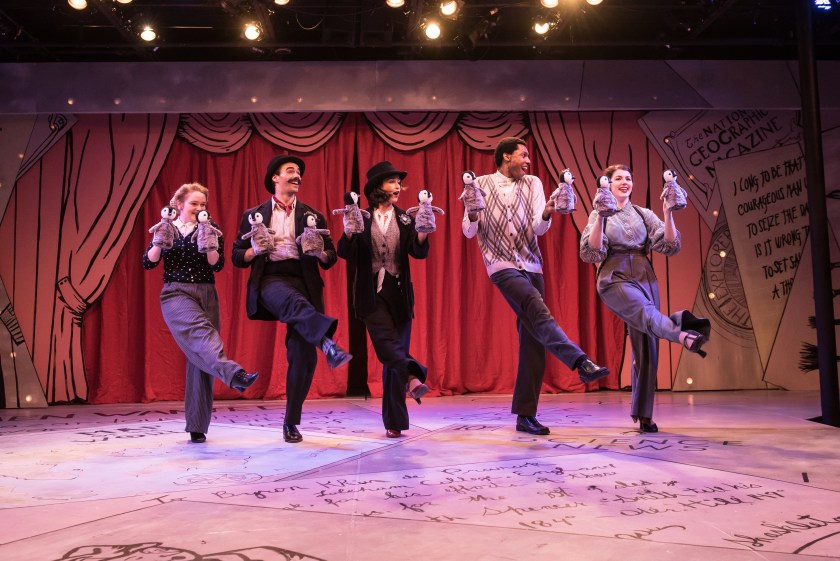
The Popper’s household soon expands, as their male penguin, Captain Cook, eventually grows lonely, and an aquarium that Mr. Popper contacts for help has a lonely female penguin, Greta, that they generously ship to the Popper’s residence. The next thing you know, there are ten penguin chicks and the poor Poppers have to figure out how to keep all these penguin bellies full of fresh fish and frozen shrimp. Their solution – Popper’s Performing Penguins – leads to more hilarity and the gradual realization that touring on the vaudeville circuit is no way for a family of birds to live.
Yes, I said vaudeville. Mr. Popper’s Penguins was written in 1938 and vaudeville as well as references to the WPA (the federal government’s New Deal Administration program called the Works Progress Administration from 1935-1939, when it was renamed the Work Projects Administration), along with Mrs. Popper’s job search and the family’s focus on finances will likely go over the heads of the young audience members as well as most of their parents. Let’s face it, I’m a grandmother, and this was before my time, too. I only know about these things because I teach dance history! My daughter did ask what WPA was, but neither grandson seemed to notice or care.
All the shenanigans are skillfully handled by director Josh Chenard, with musical direction by Jason Marks and choreography by Wes Seals. A cast of five talented actors play all the roles – some thirteen different characters, with Derrick Jacques as Mr. Popper and Renee McGowan as Mrs. Popper. Keaton Hillman Emma-Claire Polich, (both ensemble) and Eve Marie Tuck (swing) play all the other characters. Both Kingston (age 10) and his mom Soleil were impressed by Keaton Hillman who changed characters, costumes and accents with the dexterity of a magician, and manipulated the Captain Cook penguin puppet as well.
Yes, the two adult penguins were large puppets (credit Kylie Clark with the puppet design – something Virginia Rep Children’s Theatre does so well) while the 10 penguin chicks were smaller, stuffed versions. Emmitt (age 4) was enthralled by the penguins. He spent most of the hour (no intermission) perched on the edge of his seat, his eyes wide open so as not to miss anything. He did tear his eyes away from the stage to lean in and ask his mom, “Can I have a pet penguin?” He made a second earnest plea out in the parking lot, adding that the penguin could live in the refrigerator.
With about six musical numbers, Mr. Popper’s Penguins moved at a fairly rapid pace – but never felt rushed. Jaques and McGowan carried most of the story, and their voices are strong and clear, making it easy for attendees of all ages to understand the lyrics. Jeanne Nugent’s costumes are lovely – especially the women’s wide-legged pants that remind me of Ms. Celie’s pants from The Color Purple. Mrs. Popper’s apron, Mr. Popper’s bow tie, and painter’s coveralls, and the props used by the various characters (a wooden dog, a hat with the gray hair attached, Mr. Popper’s painter’s ladder and pipe) are all overly exaggerated, almost cartoonish.
Taking this theme about as far as it could go, Chris Raintree’s set includes larger than life library books that open up to reveal entire rooms. “Atkinson’s Kitchen Companion” houses the Popper’s kitchen while their living room is housed within a tome entitled “432 Proudfoot Avenue” and the admiral’s ship is docked inside a book on Antarctic exploration. The production is visually stimulating but not over stimulating.
There’s also lots of word play. Captain Cook and Greta’s brood are given the names of famous explorers, such as Ferdinand, Columbus, and Magellan. There’s also Isabella and Victoria, who wears a tiara. Finally, but not least, there is all the alliteration! Mr. Popper’s Penguins alliterates just about every “p” word you can think of, and when they run out of “p” words they alliterate other letters of the alphabet.
Recommended for ages 4 and up, Mr. Popper’s Penguins is a family-friendly production that is perfect for the younger members of the audience and is being offered as an alternative or addition to holiday staples, such as The Nutcracker. Unlike many productions of past seasons, there is none of the double entendre and innuendo that seemed to be intended for the adults. Here, the focus is all on the pleasure of the kids, and Kingston and Emmitt would give this production a combined two thumbs up.
Julinda D. Lewis is a dancer, teacher, and writer who was born in Brooklyn, NY and now lives in Eastern Henrico County.
———-
Photo Credits: Aaron Sutten
Renée McGowan and Derrick Jaques. Photo by Aaron Sutten.Renée McGowan and Derrick Jaques. Photo by Aaron Sutten.Eve Marie Tuck, Derrick Jaques, Renée McGowan, Keaton Hillman, Emma-Claire Polich. Photo by Aaron Sutten.
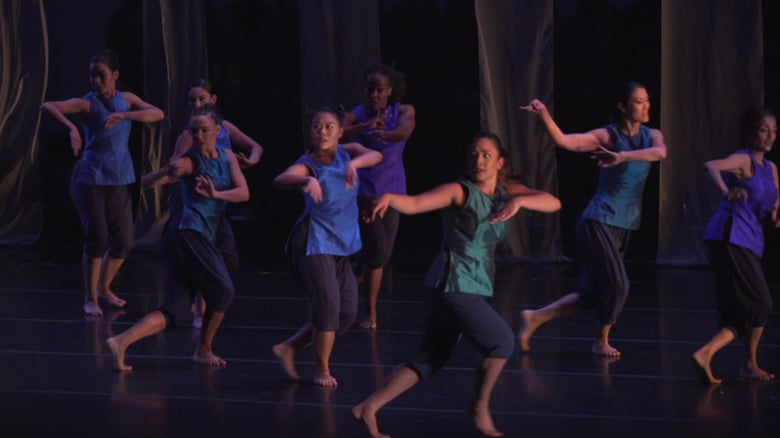
Ananya Dance Theatre, under the artistic direction of Ananya Chatterjea, presents dance within a social, feminist/womanist, human context. Entertaining is only a part of what they do. There were no spectators in the Grace Street Theater on Saturday night when I attended Shaatranga: Women Weaving Worlds. Oh, there were plenty of people in the audience, but Chatterjea and her troupe of seven powerful women did not allow us to sit and be entertained.
Several times the house lights came up and those who may have been under the impression they had come to see a show were asked to take a stand, to raise a fist, to clap and stomp our feet. We participated in an invocation of breath and watching a dance performance may never be the same. Stand up (one woman did). Raise your first (most did). Clap your hands. Stomp your feet. Chant: Public fury; public joy; public love; public dance!
Shaatranga, which means “seven colors” in Bānglā, is the culmination of a quintet of works exploring work women do. The dance was created in four movements and runs 95 minutes with no intermission and is based on research, history, and cultural connections. The two main themes are ancient Indian Ocean trade routes that connected Asia, Africa, and South America, and the shared practices of indigo-dyeing. Visually, an abstract navigation star represents the compass that “enables us to remain on the path of a complexly woven notion of justice.” At the beginning of the work, the navigation star is broken but by the end it has been healed. The sections of the dance bear names like “Voyage,” “Shipwreck,” and “Desolation.” There are “Rituals of Mourning” and “Dancing to Heal.”
Chatterjea’s movement vocabulary uses classical Indian dance as a foundation and there are layers contemporary dance woven throughout. There is yoga, martial arts, rage and joy. The movement that stood out most to me is a spiral that starts from deep inside the core then winds its way up and out. There is also spoken word, ritual, and sound: grunts, screams, the sound of helicopter rotors as the women’s hands reach up, the sound of feet slapping and stomping, the sound of drums, and even, I think, the faint sound of birds and monkeys chattering.
At the beginning, there was a curtain hung asymmetrically so that it reminded me simultaneously of a simple curtain or covering, a woman’s veil, and a ship’s sail. Later, the black curtains opened just a bit to reveal a portion of white wall bathed in red light with Chatterjea splattered on the wall, feet up, arms splayed out on the floor. There is beauty, hunger, pain, distortion, and there is power.
Projections and simple design elements created an all-encompassing world that kept me on the edge of my seat for most of the evening. There were rolling waves and animated billows of indigo that morphed into hands, and there were ceiling-to-floor ribbons of indigo, interwoven like the lives of the women represented, remembered, and honored. Throughout, the women wore loose-fitting dark blue pants (a knee-length Indian salwar, similar to Victorian knickers or bloomers) but changed their tops for each movement (peplum tunics, athletic leotards, high necked tops) in shades of blue, sometimes with splashed of color, but always indigo. Musical composition, vocals, sound design, poetry, costume, lighting, scenic design, animations and projections all united in a seamless manifestation of Chatterjea’s concept.
Often, a program is unnecessary, except to identify the names of the dances. In this case, the program was an essential guide to the work, filled with background, history, poetry, definitions, and questions: How do we show up for each other? This company, this work must be seen. Writing about it does not do it justice.
Julinda D. Lewis is a dancer, teacher, and writer who was born in Brooklyn, NY and now lives in Eastern Henrico County.
———-
Photo Credits:
Company photos and photos from the company website.
At: The Firehouse Theatre, 1609 W. Broad Street, RVA 23220
Performances: October 18 – November 4, 2018; Daily Planet Health Services benefit w/ post show talkback on October 28 and Friends 4 Recovery benefit w/ post show talkback on November 4
Ticket Prices: $15 – $30
Info: (804) 355-2001 or firehousetheatre.org
Songs From Bedlam is a new production of Richmond playwright Douglas Jones’ play that gives voice to the insane, the homeless, the alcoholic, and the overlooked. First produced by Barksdale Theatre (now VirginiaRep) in 2003, the script has been revised, the direction has been placed in the hands of Todd LaBelle, Jr. who allows the characters to unfold naturally and unadorned, and the actors are placed on display in a three-dimensional, interactive box designed by Chris Raintree.
And I use the phrase “placed on display” quite deliberately. The characters are placed on display like fish in an aquarium, like animals in a zoo, like freaks in a sideshow, like the conjoined twins and women from Africa who were considered curiosities during the World’s Fair. In a way, it appeals to our baser instincts, yet it is hard to look away. At times, I felt that by sitting in the audience, we had stolen the final shreds of dignity and privacy that these poor people had. Songs From Bedlam is compelling and brutal, and meant more for discussion and introspection than entertainment.
LaBelle has a strong ensemble to work with: Axle Burtness, Claire M. Gates, Irene J. Kuykendall, Jonathan Hardison, Granville Scott, and Linda Snyder fill the generic roles of nameless characters identified only as Young Man, Young Woman, Woman, Man, Old Man, and Old Woman.
Burtness, for instance, portrays an affable but obsessed man who is driven to visit the aquarium every day and stare at the same exhibit, while Kuykendall tells the compelling story of a prostitute who killed a client who violated her one rule, “don’t kiss me.” Later she tells the heartrending story of a woman who could not let go of her dead baby and Gates uses sign language for her monologue because her character has cut out her own tongue. Snyder’s character speaks of childhood abuse and Scott’s alcoholic character is, perhaps, the most familiar – sort of like the philosophical alcoholic uncle at the family reunion.
The set has a top, and the back wall has panels that slide out to provide walls and benches, but the front and sides are open, and a handful of audience members were invited to sit onstage, in observer seats provided for that purpose – a reminder that Elizabethans in the 16th century would pay a fee to visit Bethlehem Hospital, from which Bedlam got its name, and watch the “lunatickes.” There are also some interesting lighting effects by Andrew Bonniwell, especially at the beginning when Burtness is inside the aquarium. This is, indeed, an innovative format, and an all-encompassing environment, but the historical precedent and subject matter are somewhat distasteful, and this is theater that deliberately and bravely sets out to discomfort rather than entertain its audience.
The characters are costumed in plain, off-white scrubs, like prison uniforms, which Nic Charlie Perez has decorated with words and pictures that are significant to each character. Burtness, for instance, wears eyes and Snyder has the image of the Virgin Mary and the words “you are my angel” and “smack.” Hardison’s top bears the words “silly fellow” while Kuykendall sports the warning “do not kiss me.”
For all its harshness, Songs From Bedlam is filled with beautiful, poetic language. Jones has a way with words, and in addition to the sign language (which I thought went on too long without interpretation or at least captioning), there are liberal sprinklings of French, Spanish, and Latin, all enhanced by Ryan Dygert’s subtle sound design that includes echoes and whispers as well as music, including some original music composed by Kelly Kennedy.
For this production, the Firehouse Theatre is partnering with community organizations, the Daily Planet Health Services and Friends 4 Recovery Whole Health Center, with talkbacks and receptions for the October 28 and November 4 productions. There is also a related PhotoVoice exhibit in the lobby. The post show talkbacks should prove to be interesting, as the serious, real life, depressing nature of this subject matter is not the usual subject matter of an evening of theater. Do not go to Songs of Bedlam expecting a musical.
Julinda D. Lewis is a dancer, teacher, and writer who was born in Brooklyn, NY and now lives in Eastern Henrico County.
At: Libby S. Gottwald Playhouse, Dominion Energy Center, 600 E. Grace Street, RVA 23219
Performances: October 12 – November 3, 2018, Thursdays-Saturdays @8:00pm & Sundays @2:00pm.
Ticket Prices: $32 Adults; $27 Seniors; $22 Students & RVATA Members (with ID)
Info: (804) 353-4241 or quilltheatre.org
Gutenberg! The Musical! is a play-within-a-play written by Anthony King and Scott Brown who present their comedic farce as a backer’s audition of an historical fiction about the German printer Johannes Gutenberg. Got that? Stay with me, because it doesn’t get any simpler.
Chris Hester and Paul S. Major play the authors Doug Simon and Bud Davenport, who are pitching their musical in hopes of finding someone to back them in a Broadway run. The show is hyped as big, splashy, and better than all others of its genre. But they have no actors, just a few props and a collection of baseball hats with the names of all the characters (e.g., Drunk #1, Drunk #2, Mother, Daughter, Gutenberg, Monk, Helvetica, Old Black Narrator). Doug and Bud switch hats as they rotate through the characters, sometimes stacking them for efficiency, or wearing one on their head and one on each hand to simulate crowd scenes. They string hats on a line, held up with the assistance of two audience members, and are even able to create a chorus line. Musical numbers from honkytonk to rock ‘n roll and romantic ballads are interspersed with puns, explanations of musical theater terminology, such as the definition of a metaphor, an example of a charm song, and a running gag recurring line involving dirty thatched roofing.
Early in the play the authors admit that their “research” consisted of a brief Google search, the result of which was that there is very little known about the life and times of Johann Gutenberg. So. . .they decided to just make up stuff, hence the historical fiction. Among the things they made up is the name of Gutenberg’s fictitious love interest, Helvetica and, apparently, the name of the town, Schlimer – a word that is suspiciously similar to schleimer, which loosely means “ass-kisser.” There is also a totally unrelated connection to the Holocaust, and several unkind and politically incorrect references to stupidity. Monk, the evil monk, calls Helvetica a “dumb German anti-Semite,” and Helvetica later sings that “history is paved with the hearts of the stupid.” Oh, and Gutenberg starts out as a winemaker, who handily turns his wine press into a printing press, quite forgetting to tell his lovely, love-truck assistant that she can stop tromping on her bucket of grapes.
Hester and Major, of necessity, remain on stage the entire time, and they are accompanied by Charlene (musical director Leilani Fenick). Both are enthusiastic, energetic, and affable, as Jan Guarino’s direction and choreography keep everything moving along at a fast clip. The eighteen or so people in the Sunday matinee audience seemed to have a great time. There was lots of laughter and applause, and a woman I chatted with during intermission made a point of telling me, completely unsolicited, that she was very happy that she could clearly hear and understand all the lyrics – something that is often a problem in musicals.
There’s just one major problem. Rather than humorous, or zany, I just found the whole thing silly. It tries too hard and, at least for me, there was no “aha” moment that made it all worthwhile. I don’t care that it isn’t big and splashy, that there are just two actors, no sets, and no laser lights, but, I’m sorry, Doug and Bud, Gutenberg! The Musical! isn’t better than Cats!!
Julinda D. Lewis is a dancer, teacher, and writer who was born in Brooklyn, NY and now lives in Eastern Henrico County.
———-
Photo Credits: Photos from Quill Theatre’s Facebook page
Paul S. Major and Chris HesterChris Hester and Paul S. Davenport
BETWEEN RIVERSIDE AND CRAZY: The Family We Choose Sometimes Chooses Us
A Theater Review by Julinda D. Lewis
By: Virginia Rep/Cadence Theatre Company
At: Theatre Gym, Virginia Repertory Center, 114 W. Broad St., RVA 23220
Performances: October 13 – November 4, with previews on October 11 & 12 and talkbacks October 21 & 28
Ticket Prices: $10-35
Info: (804) 282-2620 or va-rep.org
Written in 2014, Stephen Adly Guirgis’s multiple-award winning play, Between Riverside and Crazy, could have been ripped directly from current headlines about police shootings of black men in America, but it was actually inspired by the shooting of a black undercover officer by an off-duty white officer on a New York City subway train in 1994.
Add to a controversial shooting the additional components of illegal activities, drug and alcohol addiction, strained relationships, faltering faith, and unresolved grief, and you have the makings of a compelling drama. Walter “Pops” Washington, the cantankerous patriarch, is played by David Emerson Toney, an experienced actor who is an Assistant professor of Acting and Directing at VCU, but new to the Richmond stage.
Toney’s portrayal of Pops is a delicate balancing act of rage, hurt feelings, loss, love, and longing. At any given time, the audience is not sure which emotion is going to come bubbling up and erupt over Rich Mason’s set – the kitchen and living room (later bedroom) of what is described as a “pre-war apartment on Riverside Drive in New York City.” It’s important to know that this is an unusually spacious apartment, in a highly desirable neighborhood, that it is protected by long-standing rent control laws that prevent the landlord from pricing the coveted units out of the reach of (mostly elderly) residents. Pops starts drinking early in the morning and is so fond of the word m—–f—– that it appears that it’s even the preferred name for his dog.
After the death of his wife, Pops opened his home to his son Junior (Jerold E. Solomon) who shares more than a name with his father. It was interesting to see Solomon, who is often cast in the role of the father figure, placed in the position of prodigal son. The chemistry and conversations between father and son provided some of the most fascinating and revelatory moments in the entire play.
In addition to father and son, the household includes Junior’s girlfriend Lulu (Juliana Caycedo) and Junior’s friend Oswaldo (Thony Mena). Lulu is a somewhat mysterious figure, simultaneously portrayed as a good girl and a “working girl.” She is genuinely caring, but there is something off about her, which is never really explained. Oswaldo is presented as a strong, sympathetic figure – a set-up for one of two completely shocking events in this two-act play. Individually both Lulu and Oswaldo share a special relationship with their host, and both call Pops “Dad.” I loved everything about both Mena and Caycedo, right down to her skin tight clothing and his Nuyorican accent.
Supporting characters included Bianca Bryan as Pop’s former partner, Detective Audrey O’Connor and Larry Cook as her fiancé, Lieutenant Caro. They take turns playing good cop/bad cop and frequently confuse the difference between caring and coercion. I found the dynamic between Bryan and Cook interesting, but I couldn’t bring myself to believe Bryan’s tears when her character tried to play the victim; she just seemed too strong for that. Last but not least there was Maria Hendricks as the Church Lady, an almost mythic creature who appearance, long after we had been told to expect her, was a startling contrast to what I had been led – or lulled – to expect. Hendricks provided the second big shock of the evening, in a most delightful and humorous way, blending sex and spirituality with an unexpected cultural twist.
Between Riverside and Crazy reminds me of those commercials that point out that families are what we make them. There is nothing standard about this family, but there is something unsettlingly familiar about each member and the family unit they have created. The final scene raises more questions than it answers. “Does it have a happy ending?” asked the woman I met and chatted with pleasantly throughout the evening. “That depends,” I responded. It depends on what constitutes happiness for you. It depends on which questions are important to you, what you need answers for, and how much ambiguity you can live with. What is important to you, and what can you live without?
Rich Mason’s set manages to achieve an elaborate sense of spaciousness, but the aged and drab furnishings contrasted oddly, to my eye, with the tall elegant windows, and the kitchen appeared outdated, even though the exact time-frame was never clear. And maybe it was just me, but the family’s entrances and exits from both an upstage door and a downstage corner and their sudden appearances on the rooftop sometimes seemed to defy the laws of physics. Jesse Senechal included some subtle and appropriate effects in the sound design while Sarah Grady’s costuming was appropriate and consistent for each character – although I did wonder, if is it common for police officers to come to dinner in uniform.
Tawnya Pettiford-Wates has directed Between Riverside and Crazy with sensitivity and perception. The cast has responded with authenticity that defies perfection. The resulting experience makes for unforgettable, must-see theatre.
NOTE: Between Riverside and Crazy contains adult language and is recommended for viewers ages 16+.
Julinda D. Lewis is a dancer, teacher, and writer who was born in Brooklyn, NY and now lives in Eastern Henrico County.
———-
Photo Credits: Jason Collins Photography
Jerold E. Solomon, Juliana Caycedo, Bianca Bryan, and David Emerson ToneyBianca Bryan, Larry Cook, and David Emerson BryanDavid Emerson Toney. Photo by Jason Collins Photography.Jerold E. Solomon and Juliana Caycedo
David Emerson Toney and Maria Hendricks. Photo by Jason Collins Photography.Thony Mena and David Emerson Toney
At: The Robert B Moss Theatre, 1300 Altamont Avenue, RVA 23230
Performances: September 26 – October 19, 2018
Ticket Prices: $10-35
Info: (804) 346-8113 or rtriangle.org
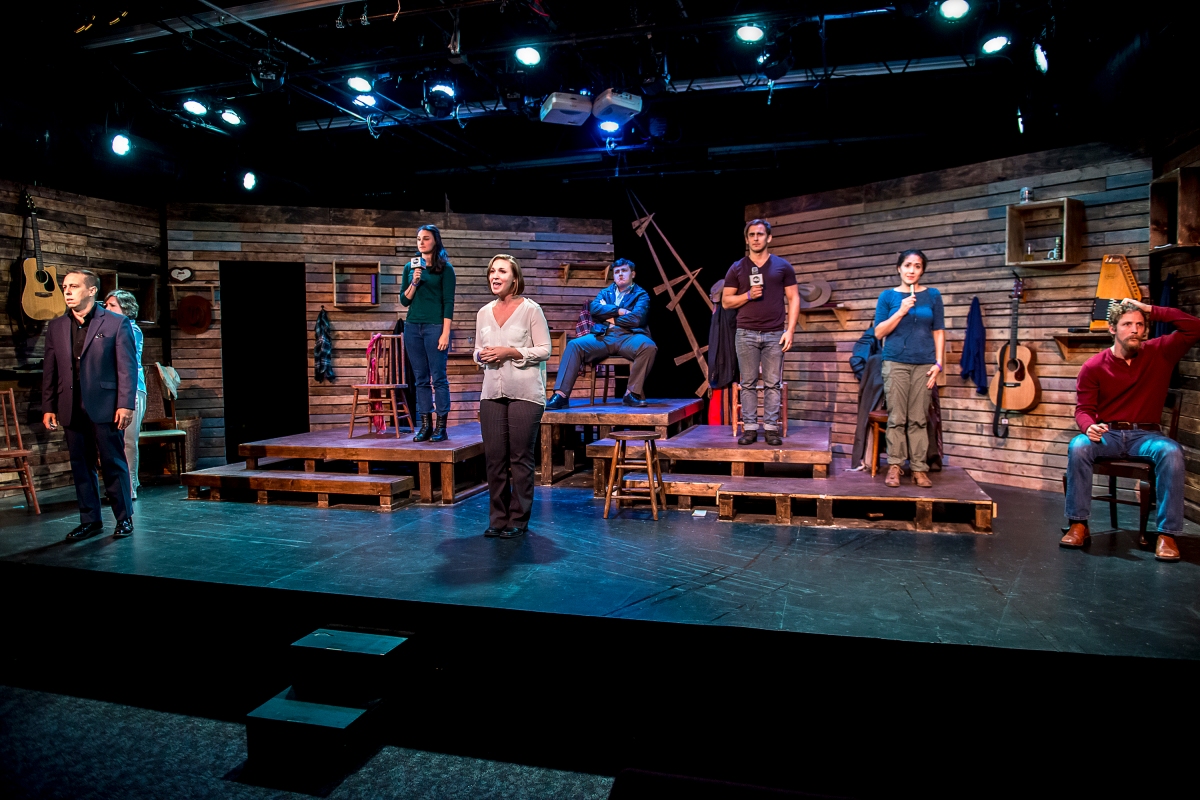
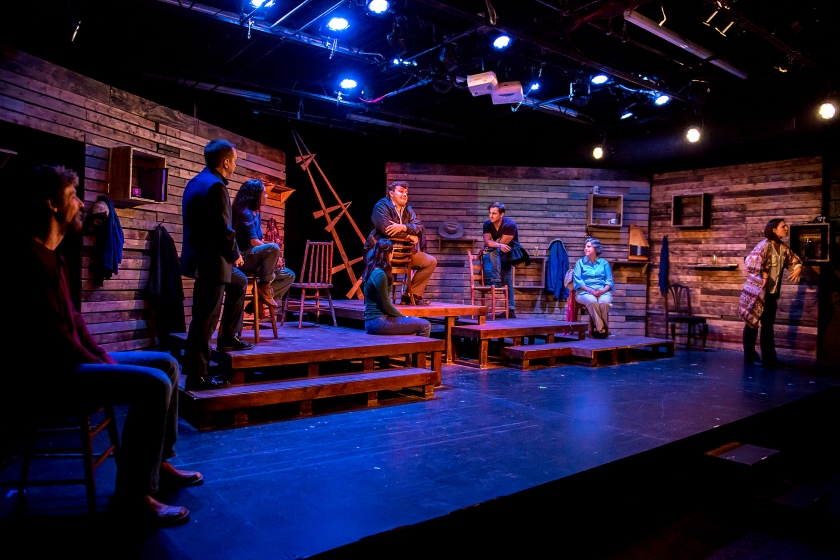
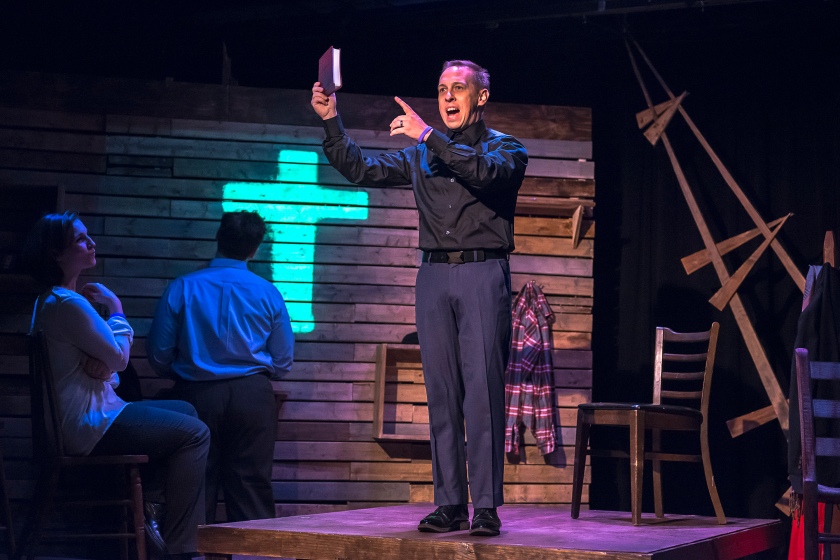
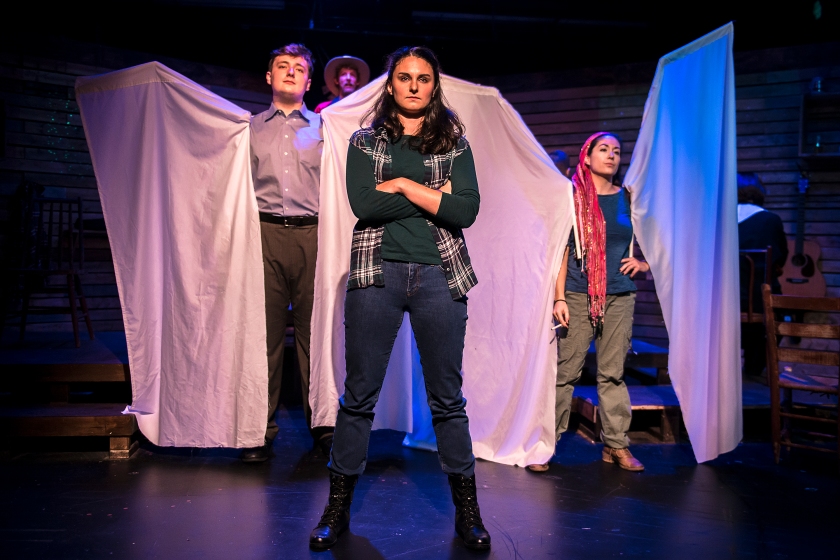
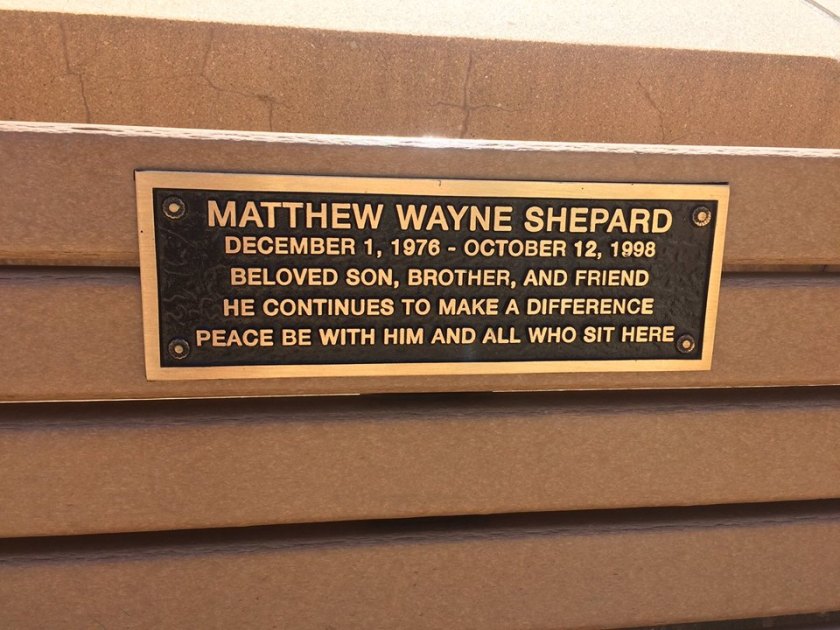
Created by Moisés Kaufman and members of the Tectonic Theater Project, The Laramie Project is based on the true events surrounding the 1998 beating and death of Matthew Shepard, a gay man, while he was a student at the University of Wyoming. The words of the play are the words of the people of Laramie, gathered by the authors over a series of interviews. Real people. Real issues. Real tears.
The beauty of the script lies in its unadorned simplicity. Eight actors portray about sixty different characters as they examine the story from the perspectives of the people of Laramie, students and faculty at the university, the media, and the personal experiences of the members of the Tectonic Theater Project.
Running nearly three hours with two intermissions, director Lucian Restivo has maintained a moderate pace that allows the characters to come across as authentic and feels almost like real time. Multiple perspectives are presented, friend, foe, and undecided. From incident to trial, some points of view shift as people examine themselves and some are surprised at what they find inside.
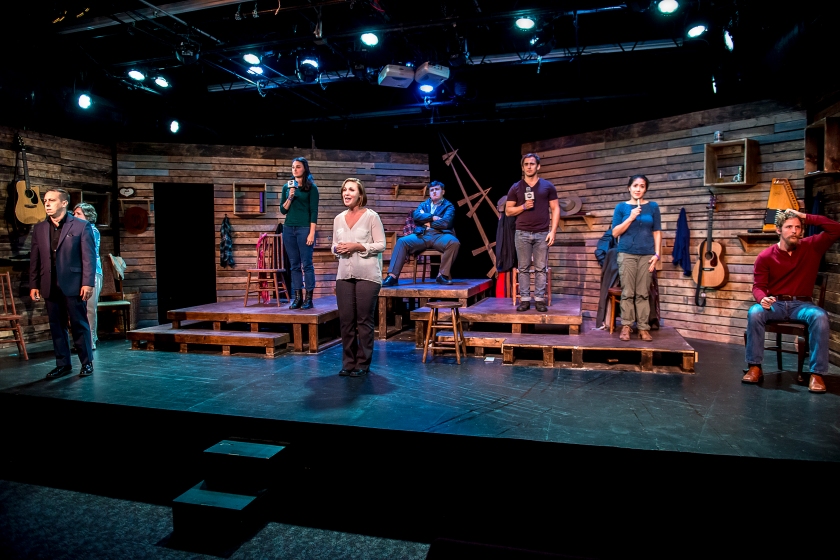
The Laramie Project is set in a rustic space of wooden walls and shelves with a few chairs on multiple levels designed by Restivo, who also designed the sound, and with lighting by Michael Jarett that sometimes resembles sepia-toned photographs. The physical tone almost makes this play feel as if it is dragging the viewer back in time into the wild, wild west, although the events took place only twenty years ago. The more striking and unfortunate thing is that this sort of hate crime could have been stripped directly from the latest breaking news.
The excellent cast consists of Rachel Dilliplane, Annella Kaine, Amber Marie Martinez, Cole Metz, Jacqueline O’Connor, Stevie Rice, Adam Turck, and Scott Wichmann. It would be difficult and unfair to speak of specific characters, as at any given time each of these versatile actors switches from one role to another, changing voice, accent, stance, and perhaps a shirt or hat. Scott Wichmann is often placed in the role of narrator, as project leader Kaufman, and some much needed humor is provided by O’Connor as a spunky citizen and Rice as an outrageous limousine driver.
The Laramie Project is difficult to watch because it is so real and because people involved in the incident are still alive. No details of the attack on Matthew Shepard are spared as the doctor and judge provide blow by blow details of the attack and its effects, leading to coma and eventually death. There is a section of documentary footage, and there are the incomprehensible protests by the Rev. Fred Phelps and his Westboro Baptist Church, whose members are known to show up to protest at the funerals of gay people. We get to hear the words of the two assailants, Aaron McKinney and Russel Henderson, as they are sentenced after their separate trials. Their images surround the audience in 43” x 43” oil pastel portraits by artist Michael Pierce.
The Laramie Project is an all-encompassing theatrical experience that requires a huge team effort. There are actors, a team of writers, a large creative team, community partnerships, and the Matthew Shepard Foundation, which is dedicated to human rights advocacy. It’s hard to tell where the play stops and real life begins. But the tears. . .the tears are all real.
Julinda D. Lewis is a dancer, teacher, and writer who was born in Brooklyn, NY and now lives in Eastern Henrico County.
———-
Photo Credits: John MacLellan
Richmond Triangle Players’ production of “The Laramie Project” runs through October 19 at RTP’s Robert B. Moss Theatre, 1300 Altamont Ave, Richmond, VAScott Wichmann in just one of the many characters he inhabits in Richmond Triangle Players’ production of “The Laramie Project”Richmond Triangle Players’ production of “The Laramie Project” runs through October 19 at RTP’s Robert B. Moss Theatre, 1300 Altamont Ave, Richmond, VAAnnella Kaine (center in just one of the many characters she inhabits (along with Cole Metz, Stevie Rice and Amber Marie Martinez) in Richmond Triangle Players’ production of “The Laramie Project”
By: Cadence Theatre Company in partnership with TheatreVCU
At: Raymond Hodges Theatre at the W.E. Singleton Performing Arts Center, 922 Park Avenue, RVA 23220
Performances: September 27 – October 7, 2018
Ticket Prices: $5.00 – $19.99
Info: (804) 828-6026 or VCUtheatre.showclix.com
An unexpected collaboration of Cadence Theatre Company and TheatreVCU + an unusual play about teen-aged girls by Sarah DeLappe = an intriguing production of sometimes intense situations that portray the multiple dimensions of young women on their way to adulthood.
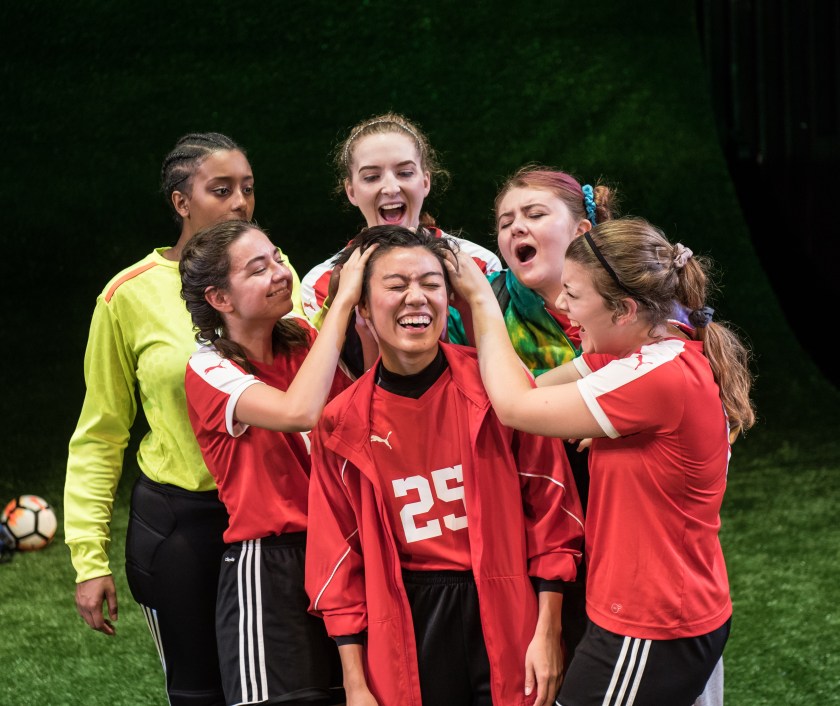
Running about 90 minutes without intermission, each scene in The Wolves shows the nine-member female high-school indoor soccer team preparing for their weekly game. The Wolves, by the way, is the name of the team. Initially they talk over one another, with multiple conversations occurring at once. School work, boyfriends, the weekend, and menstruation are popular topics. US immigration policies are discussed in depth (the play premiered in 2016), as well as a lengthy dialogue on Cambodia and genocide. In addition to the usual teen-aged squabbles, there are accidents and injuries, hints of eating disorder and a possible same-sex relationship, and genuine, life-altering tragedy. We get to meet the girls as they warm up and prepare to meet their weekly opponents.
The author, interestingly, has chosen to identify the girls by their jersey numbers, rather than by name, although they do address one another by name. #25, Havy Nguyen, is the team captain but she might as well be the coach. #25 leads the warm-ups and they require genuine dedication to the running, jumping jacks, high knees, butt kicks, ball passing, and more. We learn, in bits and pieces, that the unseen coach apparently has a drinking problem, and at any rate, he is not nearly as popular as a previous coach who left to care for his ailing mother. I immediately wondered why Nguyen was wearing an ugly wig but the answer to that is revealed in the closing scenes.
#7, Jocelyn Honoré, is the team’s leading striker, but she has anger problems and a tendency to make poor decisions in life. #13, Anna Katogiritis, is the team clown, but has a bit of a mean streak and her humor always turns sarcastic. #46, Emma Olson, is the new girl; home-schooled and well-traveled, she lives in a yurt with her mother, and struggles to fit in. The team goalkeeper, #00, Amari Cummings, is something of a prodigy: she plays the saxophone, chairs several academic teams, and has an astronomically high GPA. She also refuses to talk and has to throw up before every game.
Other team members include Katy Feldhahn (#14), Lydia Hynes (#8), Katelyn Shinn (#11), and Celeste Taica (#2). There are friendships and cliques and gossiping, but as the season passes, the girls become closer, and the audience begins to learn their personalities and quirks. Much like a Peanuts comic strip, the adults are largely unseen and unheard, with the exception of the Soccer Mom (Karen Kopryanski) who appears in the final scene, heart-rending scene. The girls are all TheatreVCU students, and Kopryanski is an assistant professor.
The Wolves is directed by Sharon Ott, Chair of the Department of Theatre at VCU with great energy and stimulating pacing that varies from frenzied action to well-placed silence. All the action takes place in an AstroTurf covered indoor arena; the floor curves upward into the ceiling. There are suggestions of actions taking place offstage, and one kick sends a soccer ball flying into the audience where it was bandied about for a bit before being returned to the playing field (as we were directed to do at the start of the show). Credit Dasia Gregg with the scenic design, Theo Dubois with the costumes, Christian DeAngelis with the lighting and Nicholas Seaver with the sound. In topic and tone, The Wolves strives to – and largely succeeds – in standing out from the pack.
NOTE1: I sat on the right side in the front row, and had no problem hearing everything, but a friend who sat in a middle row in the middle section said the sound quality was problematic.
NOTE2: A smile to #4 and #9; the stagehands who came out in uniform to set a scene!
Julinda D. Lewis is a dancer, teacher, and writer who was born in Brooklyn, NY and now lives in Eastern Henrico County.
THE CURIOUS INCIDENT OF THE DOG IN THE NIGHT-TIME: Touching But Don’t Touch
A Theater Review by Julinda D. Lewis
At: The November Theatre Marjorie Arenstein Stage
Performances: September 21 – October 14, 2018
Ticket Prices: $30-52
Info: (804) 282-2620 or www.virginiarep.org
Every now and again a play comes along that stands alone, defies description, breaks away from the normal genres. The Curious Incident of the Dog in the Night-Time seems to be one of those plays. Written by Simon Stephens and based on the novel by Mark Haddon, the play concerns an exceptional teen, his adventure, and his relationships with others. What makes it different is that the young man, Christopher, appears to have some form of autism, and he is a savant, a mathematical genius, as well as the author’s device of staging the story as a play within a play, and the designers’ decisions to include lots and lots of technology, mostly in the form of multiple projections.
The title refers to the death of a neighbor’s dog, for which Christopher, played by Michael Manocchio, is initially blamed. In the course of his detecting, Christopher upsets neighbors, infuriates his dad, and uncovers disturbing news about his mother. He also learns some astonishing and life-affirming things about himself. Manocchio, who is new to the Richmond theater community, is believable in this role. His reactions to being touched and his sharpness of mind, along with his apparent deficit of social skills that make him sound alternately arrogant and childlike remind me of students I have encountered over the years.
Some years ago, I came across a book written by Temple Grandin, PhD, a professor and autistic savant known for her work in the field of animal behavior. What struck me about Dr. Grandin’s book as well as about this play is the authors’ ability to present the point of view of the autistic person in a way that draws others into an entirely new and unfamiliar world. It is sometimes uncomfortable, and many of us do not have the tools to navigate this world. The use of technology, including sound, lights, and screens, helps create this world for us, the audience. It may as close as many of us will ever come to understanding the point of view of someone on the autistic spectrum.
A device and a strength of The Incident of the Dog in the Night-Time is that it tells a story, tapping into a history and culture of storytelling, sometimes using a narrator. Emelie Faith Thompson flawlessly fills this role as Siobhan, Christopher’s teacher or paraprofessional aide – it’s never quite clear exactly what her job description is. In her role as narrator and caretaker, Thompson is omnipresent and caring, carrying the story line, explaining, sometimes digging for clarity, but her own character is never given depth or definition. Both Joe Pabst as Christopher’s dad, Ed and Laine Satterfield as the mom, Judy are presented as loving, caring people who are also deeply, humanly flawed. The rest of the cast, including Sara Collazo, Matthew Radford Davies, Adam Valentine, Andrew C. Boothby, Raven Lorraine Wilkes, Irene Ziegler, Axle Burtness, and Sanam Laila Hashemi play multiple roles as school staff, neighbors, passengers on a train and more; they even portray inanimate objects such as an ATM.
Set in Swindon, a town in South West England, and in London, The Curious Incident of the Dog in the Night-Time requires the cast to maintain British accents. I think they do most of the time, but I became so consumed in the play that I really didn’t pay much attention to that detail. The dialect coach was Erica Hughes. The design team responsible for this simultaneously bright and dim set, filled with little surprises, like the model train that takes a symbolic journey across the stage, includes scenic design by Tennessee Dixon, costumes by Sue Griffin, lighting by BJ Wilkinson, and sound design by Julian Evans.
Virginia Rep artistic director Nathaniel Shaw’s direction includes lots of organic movement, which the program lists as choreography – something seldom seen in a non-musical production. Shaw’s direction and storytelling techniques here reminded me of last season’s River Ditty, a play I found difficult to embrace, but here his distinct style of directing seemed to work much better or at least I was able to connect with it on a more organic level. He established an environment that drew his excellent cast and his audience into an alternate reality for some two and a half hours, creating a cohesive theatrical experience that simultaneously entertains, makes you think, and touches the heart. There’s also an amazing little scene after the final curtain in which Christopher very entertainingly gets to explain his favorite mathematics problem from his Level A exams. The Curious Incident of the Dog in the Night-Time is a curiously satisfying production.
Julinda D. Lewis is a dancer, teacher, and writer who was born in Brooklyn, NY and now lives in Eastern Henrico County.
There is no shortage of flying bats, howling wolves, secret passages, or sudden and mysterious appearances and disappearances by Count Dracula himself. There actually are smoke and mirrors involved in this production, along with a few other tricks of the trade. These are things Tom Width, producing artistic director of Swift Creek Mill Theatre does very well indeed. But in yet another sleight of hand, Width did not direct Count Dracula, the opening show of the 2018-2019 season. Instead, that honor went to guest director Mark Costello, a Mill alum who was a teenaged intern on the Mill’s very first opening night in 1965.
Costello keeps things moving during this two-act play, based on Bram Stoker’s novel, Dracula. The show runs for two hours and 45 minutes, and the well-chosen cast of nine has some standouts. Kerrigan Sullivan, in the role of Sybil Seward, sister of Dr. Seward, exemplified the comedy horror genre, both in delivery of her lines and with her physical presence, as when she slipped a bottle of sherry into the folds of her robe. For some reason, most of Sullivan’s dresses were sadly ill-fitting, in contrast to the more elegant garments that adorned Caity Brown, who portrayed Mina Murray (the object of the Count’s affections), or the formal suits favored by the male cast members. Credit Maura Lynch Cravey with the costuming.
Levi Meerovich was a solid and lumbering presence as Dr. Seward’s multi-talented servant, nursing assistant, and patient-wrangler, Hennessey, and Joey Gravins was close behind him as his second in command, Wesley. I enjoyed Chandler Hubbard as Mina’s doting fiancé, Jonathan Harker, and Jon Cobb gave a strong performance as vampire expert Heinrich Van Helsing.
Mike White seemed fully committed to his role as Dr. Arthur Seward, in whose Asylum for the Insane the play was set, but one thing I found confusing was what made Seward and Harker suddenly believe in the vampire lore that Van Helsing kept expounding upon. Caity Brown was perfectly cast as Mina Murray, pale and waif-like, yet capable of projecting a powerful, gravelly alter-ego when voicing the soon-to-be-bride of Dracula. I loved Bartley Mullin as Renfield, the fly-eating mental patient and minion of Count Dracula who brings a chillingly weird energy to each scene in which he appears. I have a great admiration for actors who can convincingly and respectfully play the role of an insane, blind, or autistic character.
Last but not least there was Jeremy Gershman in the title role. Gershman appeared to take great delight in his role, swirling his voluminous cape, lurking, looming, and leering in that seductive yet chilling manner that characterizes the best Draculas. I knew where he appeared and disappeared from, but even from my front row seat, I was never once able to detect him getting into position or exiting the space!
The attractive wood paneled set was designed by Frank Foster, with lighting by Joe Doran, special effects by Tom Width, and technical direction by Jason “Blue” Herbert. There are lots of laughs, sufficient chills and thrills, and no blood or gore – the elements of horror that I find off-putting which is why I am not a fan of the horror genre. The strong ensemble, beautiful set, and well-timed tricks and effects are all worth a trip to The Mill, but I did find that the 2:45 running time seemed to drag on a bit, and sometimes there was just too much talking! This talented and confident cast is perfectly capable of telling the story without spelling it all out.
Julinda D. Lewis is a dancer, teacher, and writer who was born in Brooklyn, NY and now lives in Eastern Henrico County.