CONVERSATIONS WITH MOTHER 

“I gave you the things in me I didn’t even know I had.”

Presented by: Richmond Triangle Players  

At: Richmond Triangle Players at the Robert B. Moss Theatre, 1300 Altamont Avenue, RVA 23220 

Performances: September 10 – October 4, 2025 

Ticket Prices: $15-$50 

Info: (804) 346-8113 or rtriangle.org 

A Theater Review by Julinda D. Lewis 

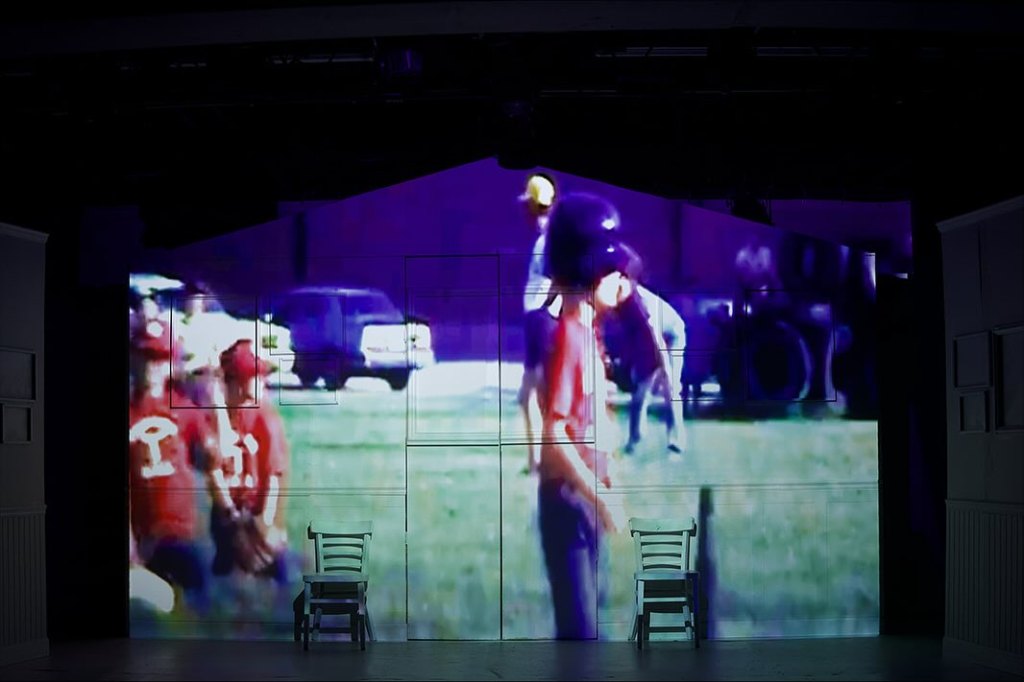
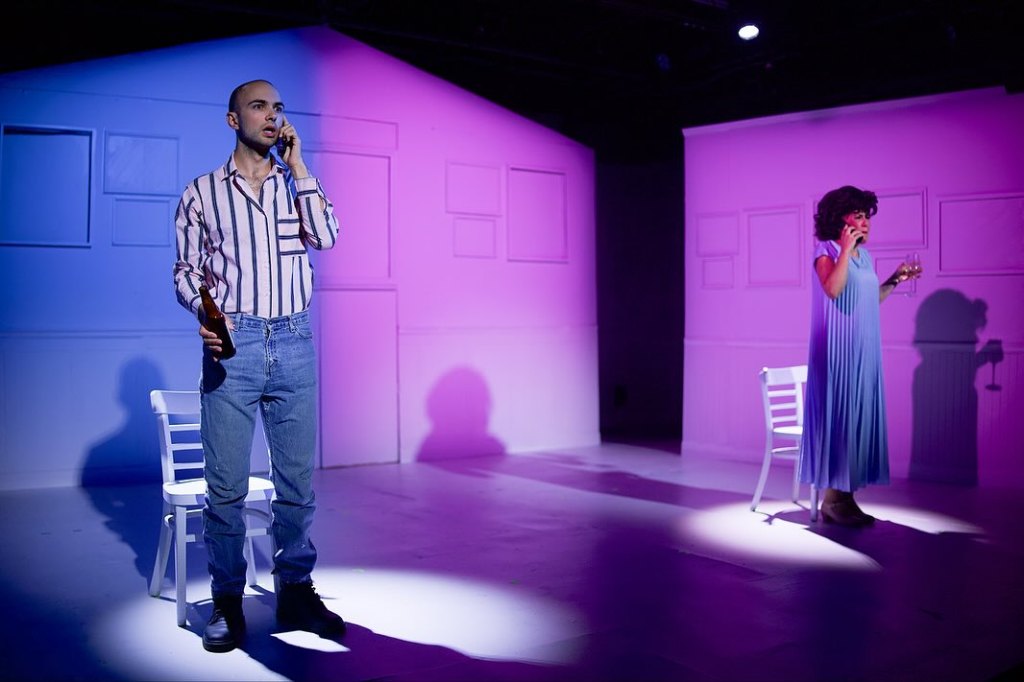
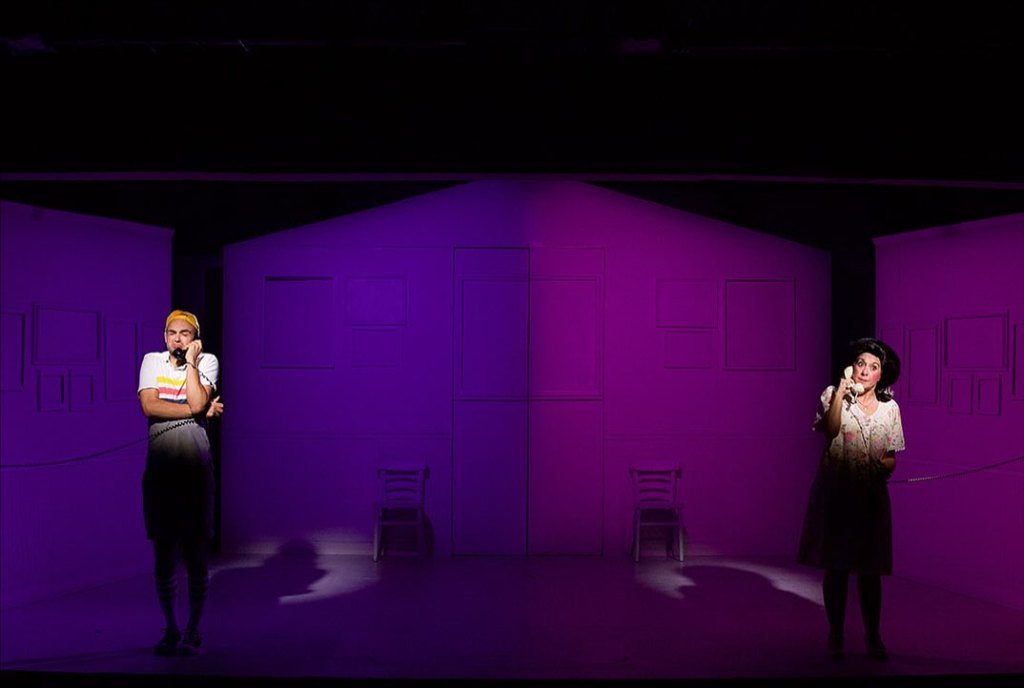
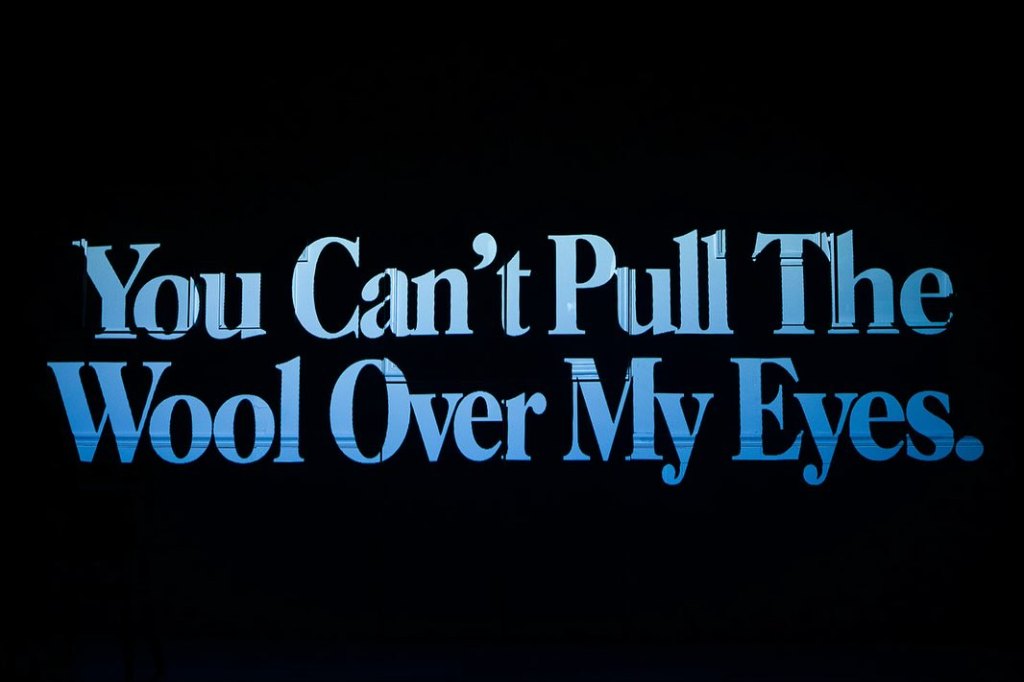
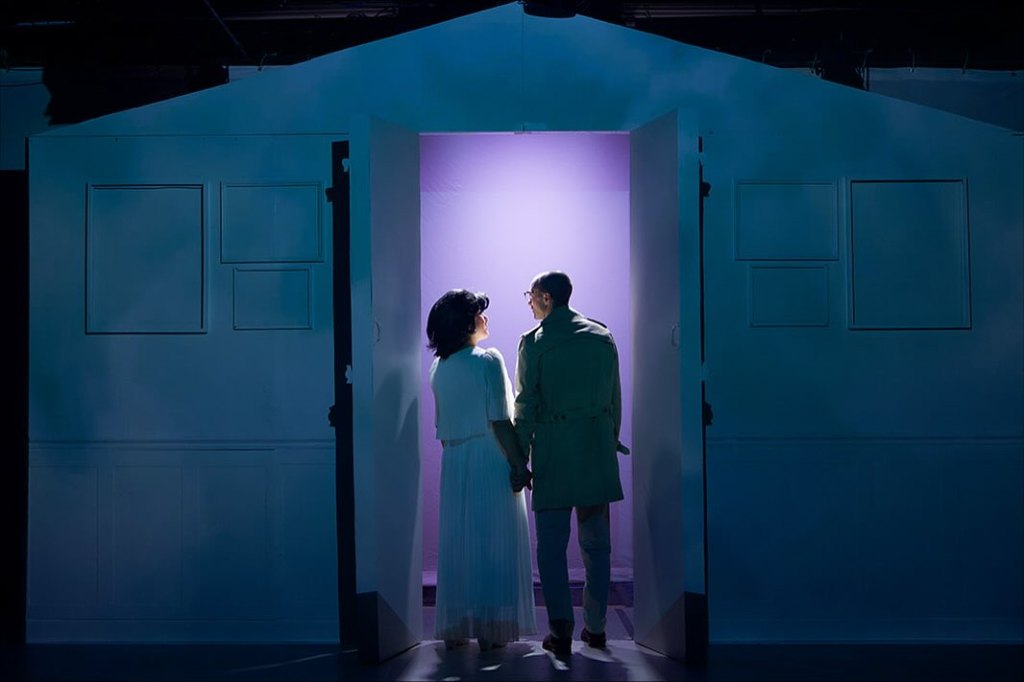
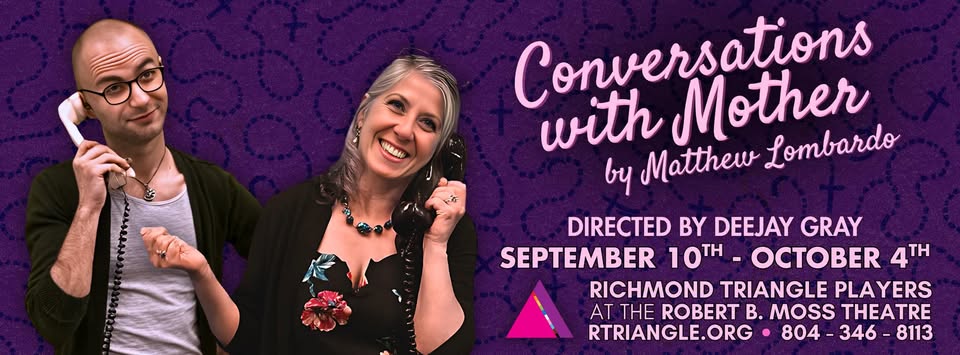
Conversations with Mother is a poignant semi-autobiographical play by Matthew Lombardo that explores the dynamics of a relationship between a fiercely loving and protective mother and her gay son. The story unfolds primarily through their conversations, with the aid of projected subtitles and grainy home movies. Conversations with Mother reveals and celebrates the complexities of love, generational differences, and the challenges of navigating the passing phases of five decades of a shared life. 

As in his play Who’s Holiday, his comedy about the adult Cindy Lou Who that has also graced the RTP stage, Lombardo masterfully balances comedy with real life – intense and unadorned, sometimes snot-nosed ugly. 

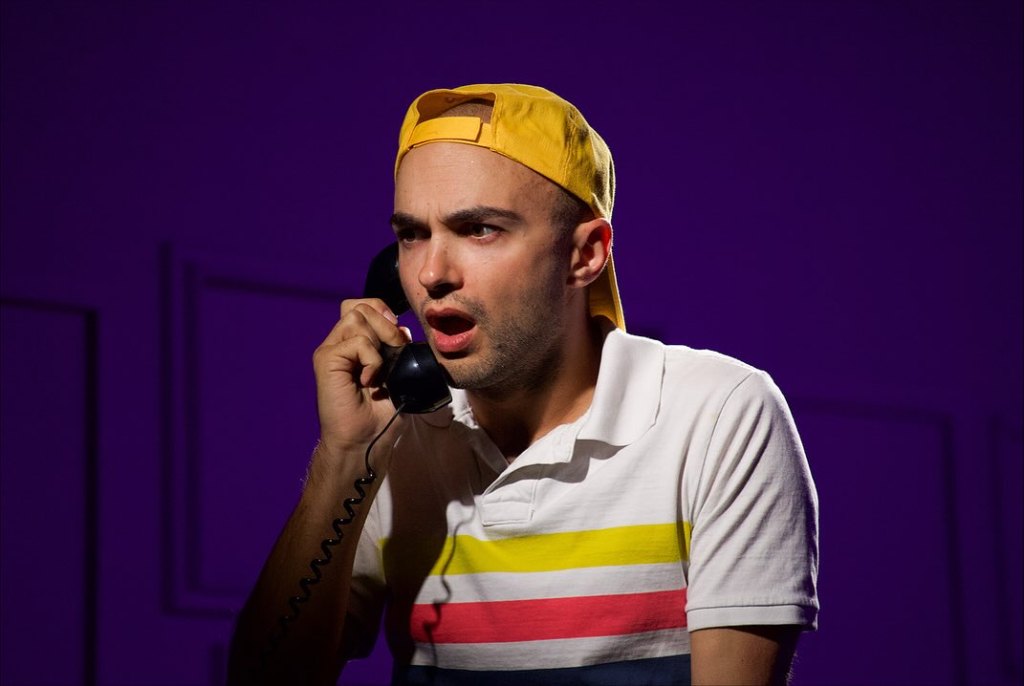
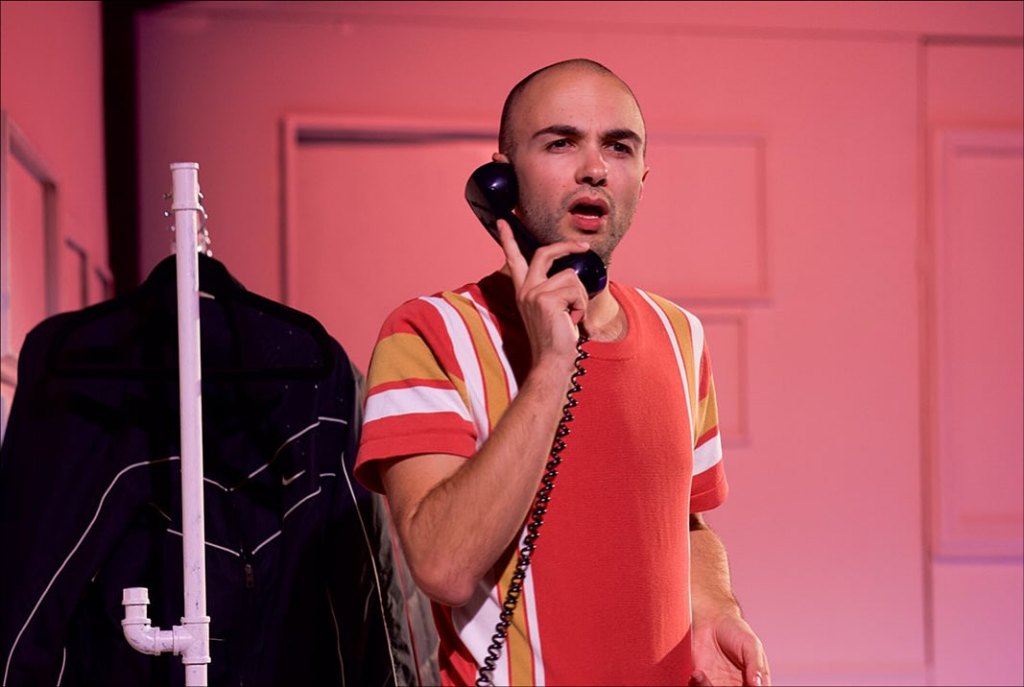
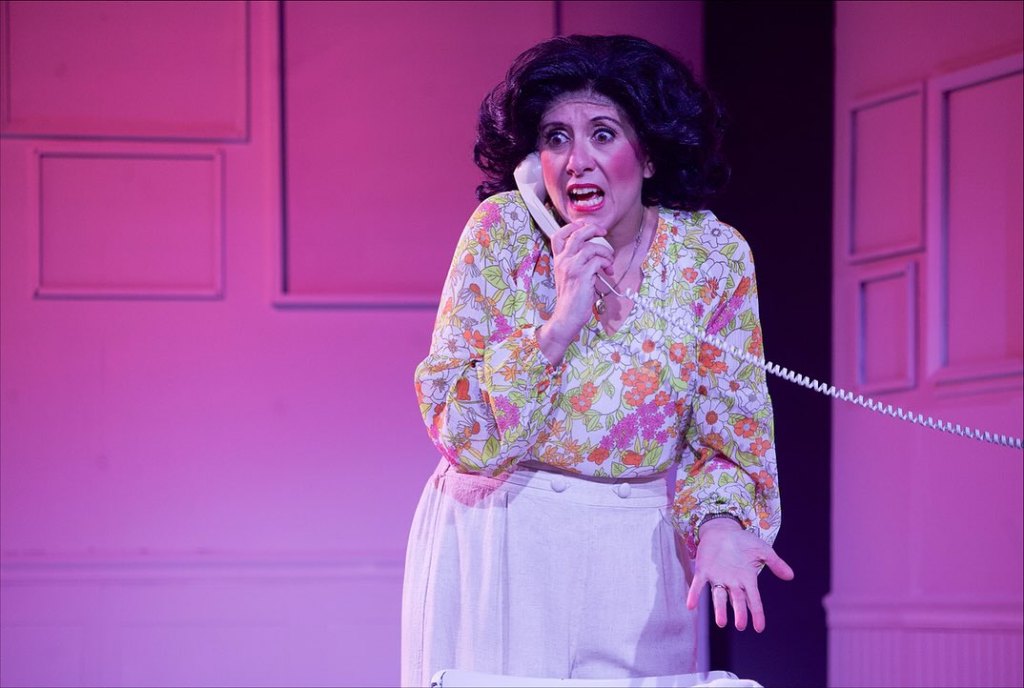
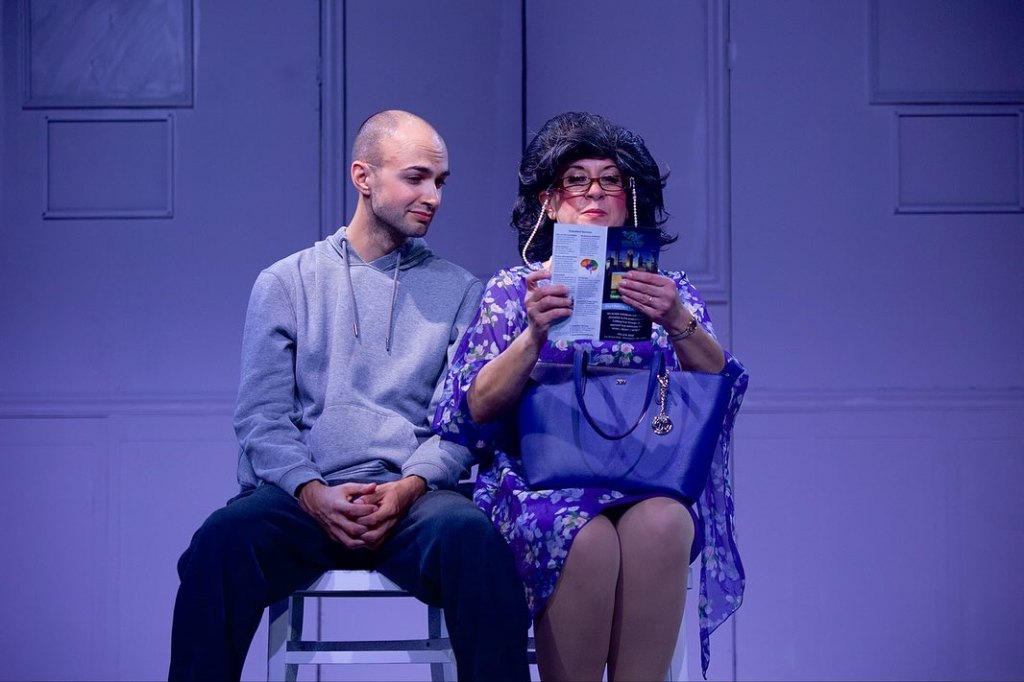
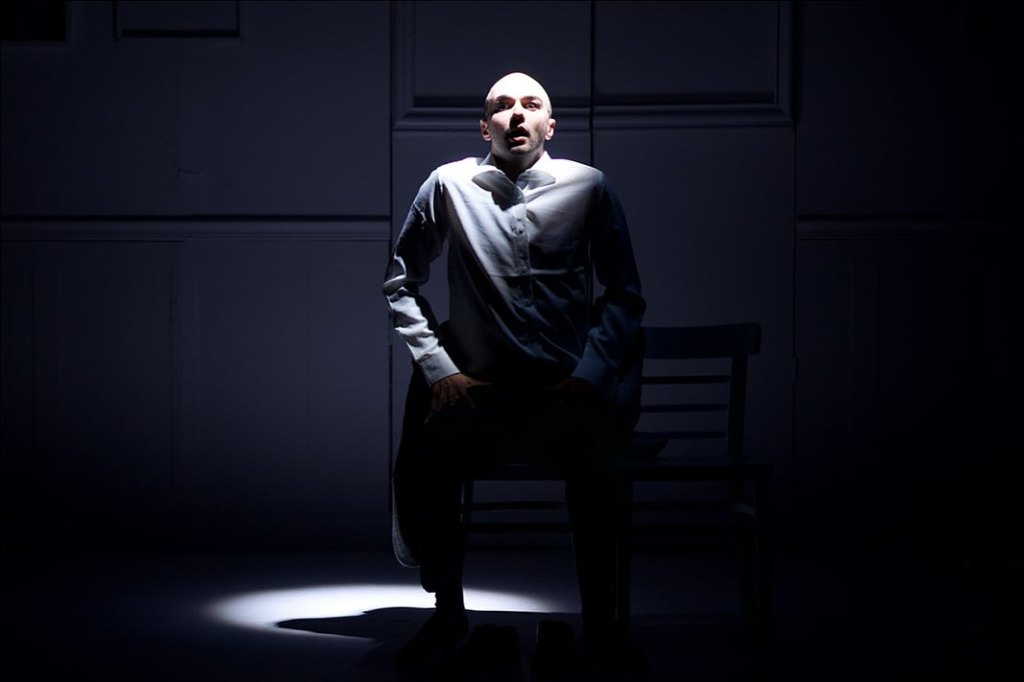
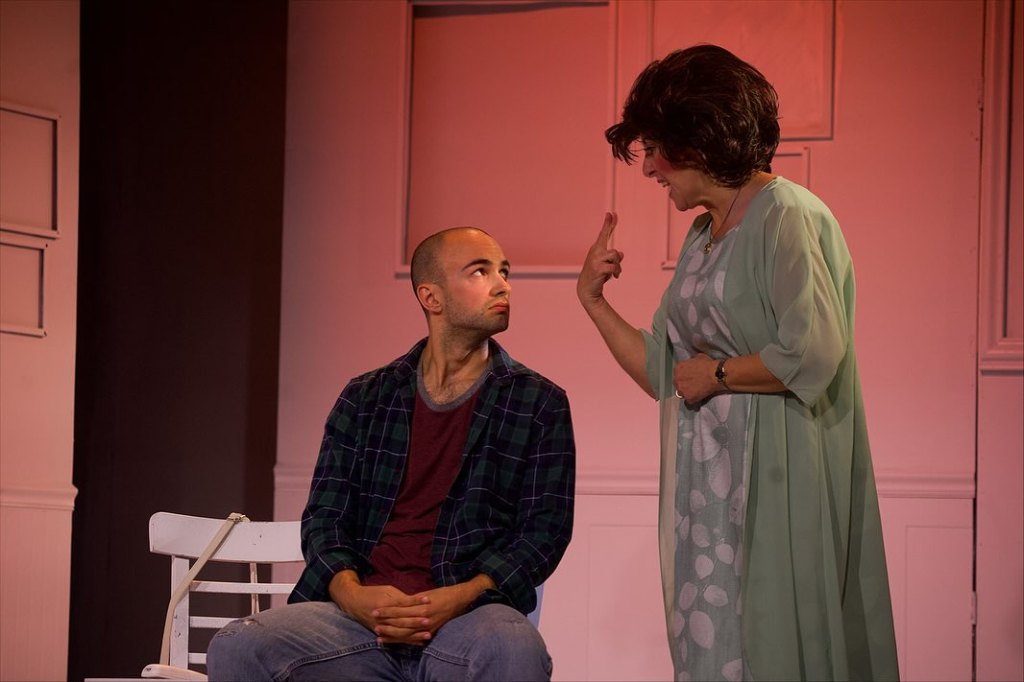
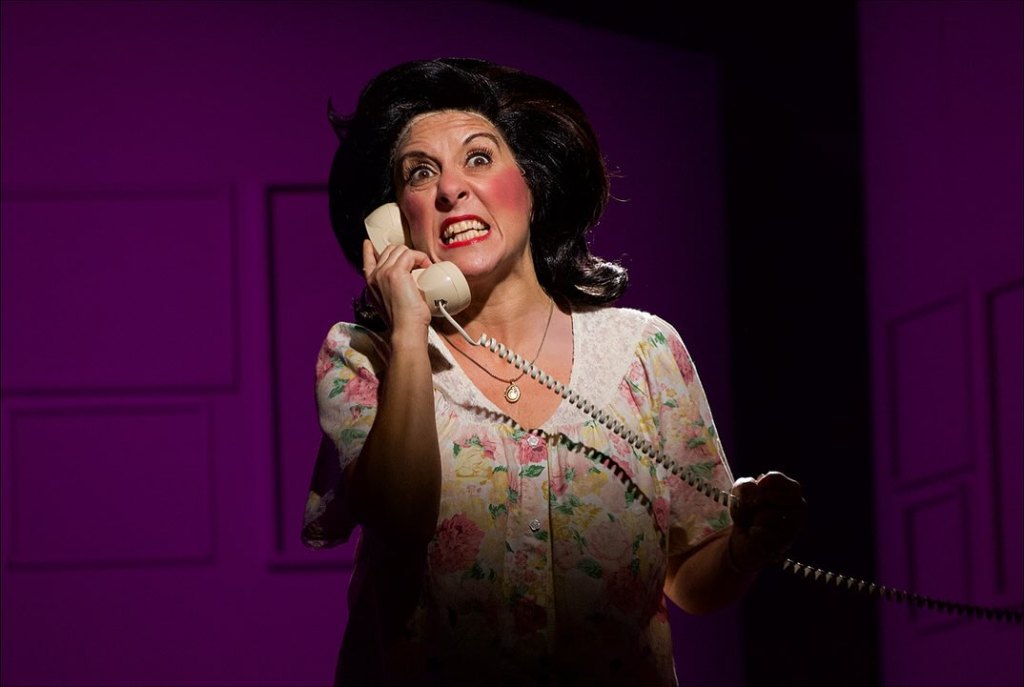
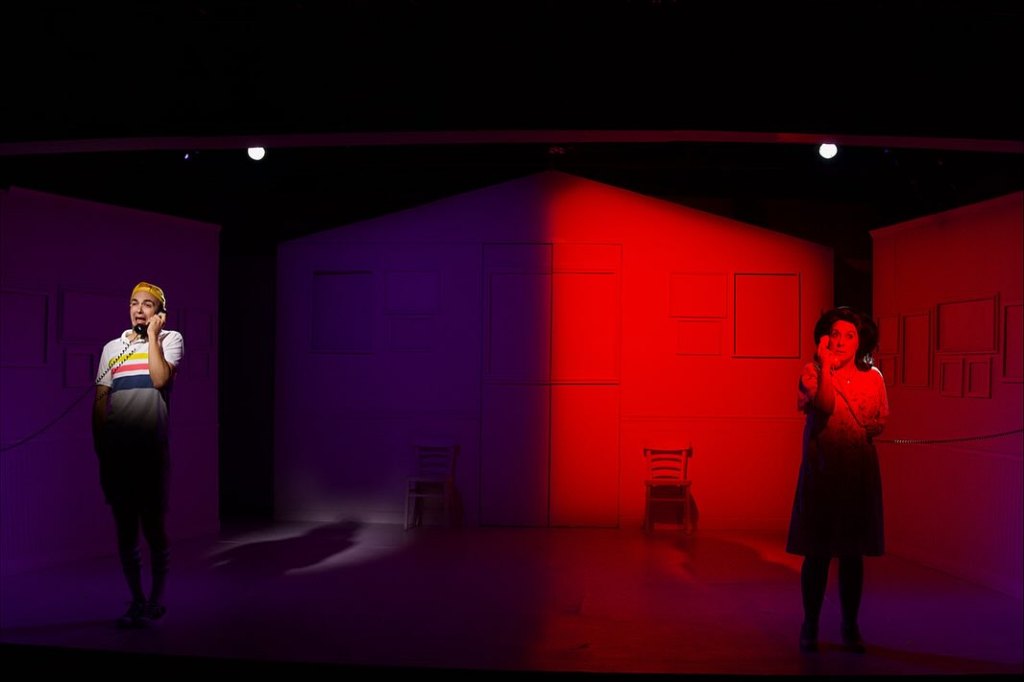
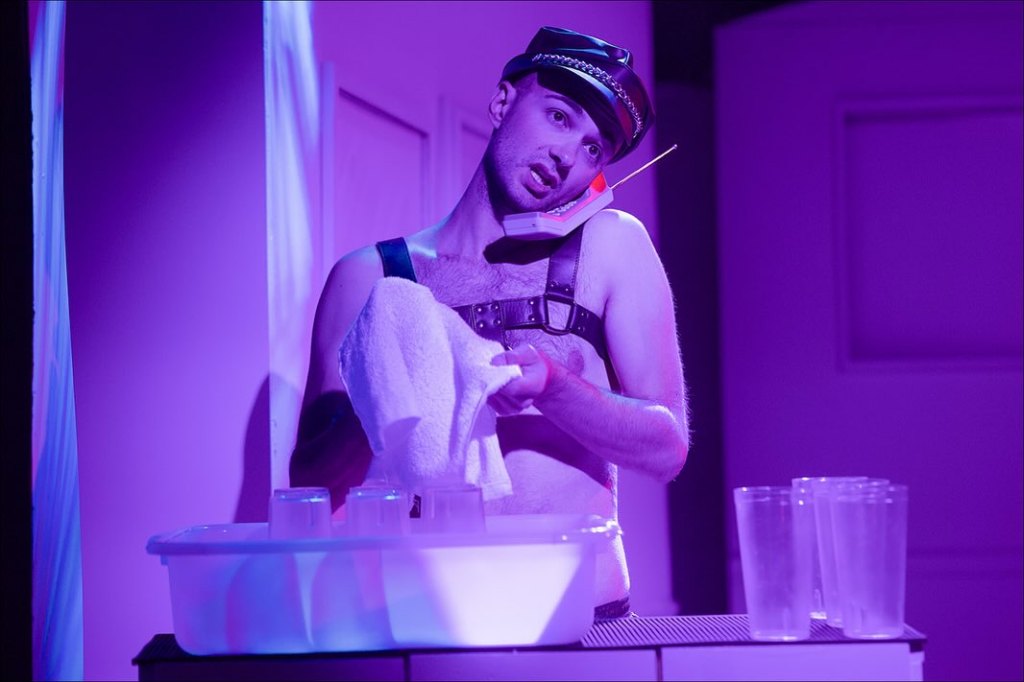
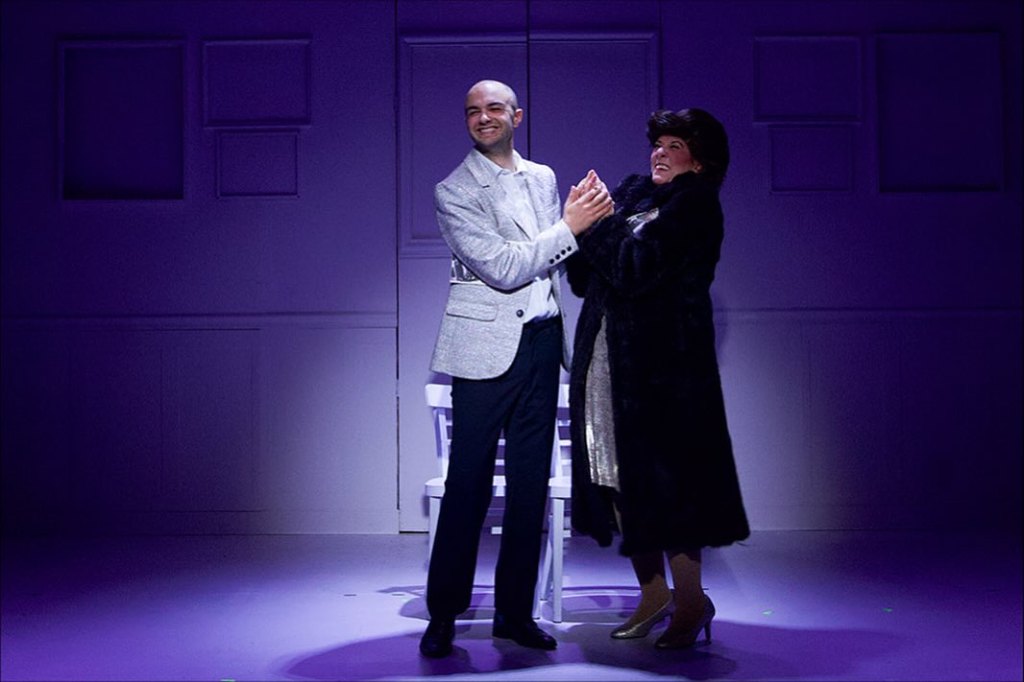
The son, Bobby Collavecchio played by Daniel Daigle, becomes a successful playwright, almost in spite of the roadblocks he erects in his own path. He grapples with bad relationships and writer’s block, drug addiction, and low self-esteem. The mother, Maria Collavecchio, played by Sarah Heifetz, is a strong-willed and traditional Italian matriarch (although I must confess that when she first began talking, I thought we were dealing with a Jewish mother – same character, different recipes…). A running line is, “tell me the truth and I won’t get mad.” Watching Heifetz’s face trying to master this enormous lie is one of the highlights of the play, which runs about 75 minutes with no intermission. 

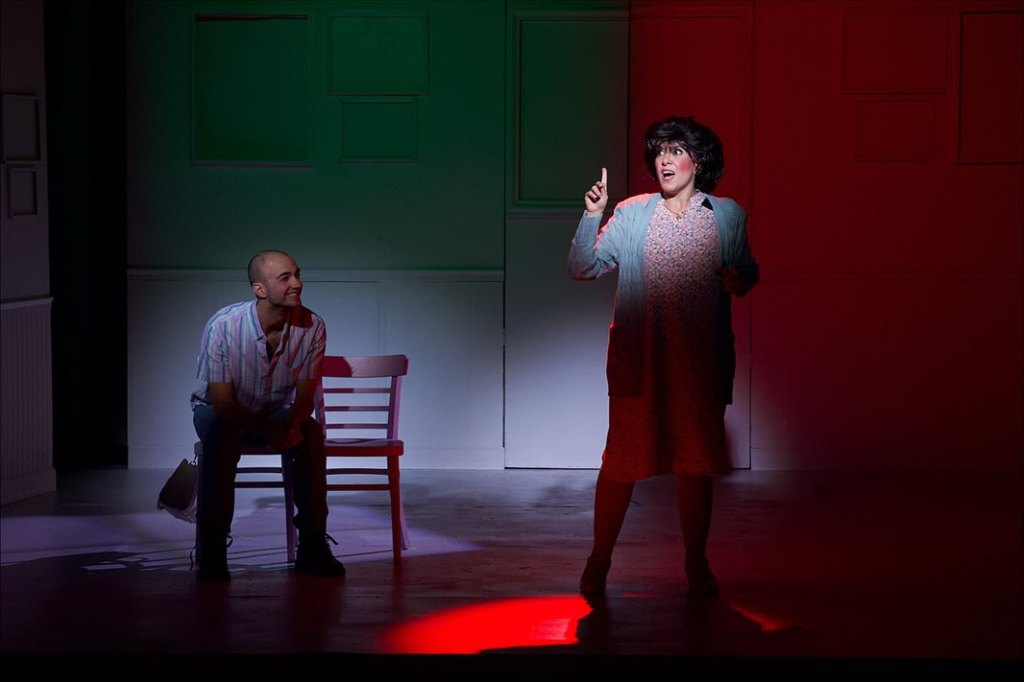
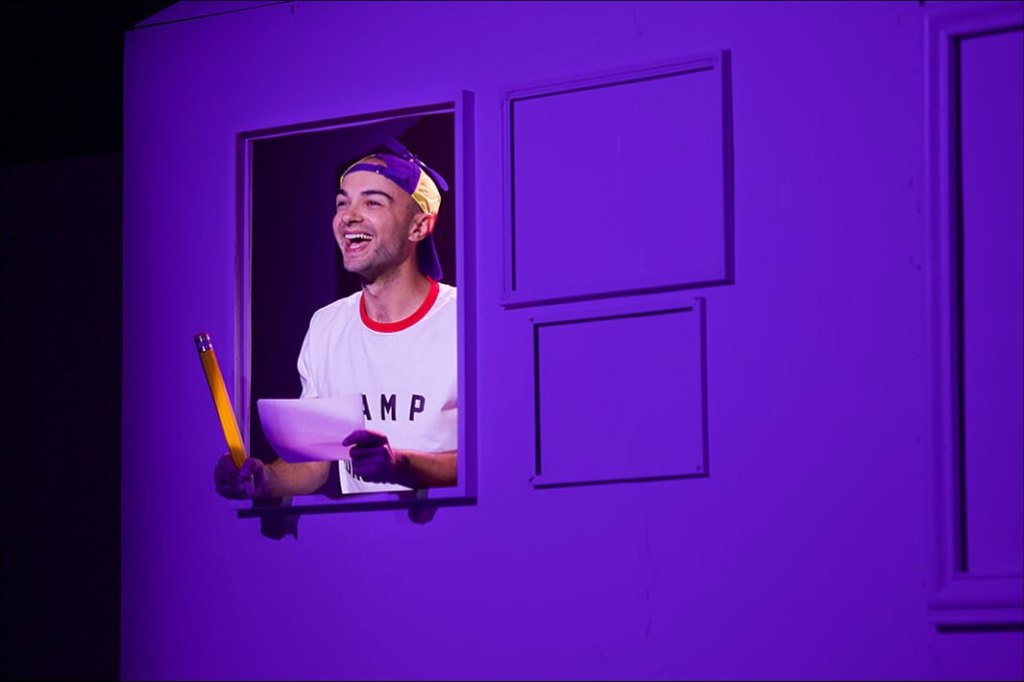
Bobby and Maria’s dialogues oscillate between humor and deep emotion, reflecting their shared history, familial bonds, and sometimes conflicting perspectives. Maria is not above saying “No,” you can’t come home from camp early to her pre-adolescent son or showing up unannounced at her adult son’s New York apartment, ready to battle his abusive boyfriend. When he finally gets a play produced on Broadway, Maria sits quietly holding his hand, until she can’t contain herself and leaps from her seat screaming with mama bear pride. At one point when Bobby asks, “Do you still love me?” Maria answers truthfully, “Not at this moment.” But love is enduring. A mother’s love – this mother’s love – never fails. And there is hope and the essence of something just out of reach that we’re all seeking underlying every scene of Conversations with Mother

“Did you get a job yet?” 

Why can’t you ever meet a nice boy? 

“You know what the Germans are famous for? Baking people – like crescent rolls!” 

If everyone jumped off a bridge, would you? 

If your phone doesn’t ring, it’s me. 

“If Christ had chosen better friends, He wouldn’t have died so young!” 

“THAT’S MY KID UP THERE!!!” 

As the mother reflects on her life and values, the son confronts his own choices and the realities of adulthood until, one day, the roles are reversed. Then, it’s Maria saying she has something to tell him, and making him promise he won’t get mad. 

Throughout the play, Lombardo captures the essence of the mother-son dynamic, highlighting themes of memory, regret, and acceptance, but most of all, love. The interplay of comedy and drama serves to create a heartfelt narrative that resonates with anyone who has experienced similar familial ties – and perhaps even with those who have not. The play ultimately underscores the enduring nature of love and the bittersweet reality of growing older. I wasn’t ready for the depth of emotion, from laughing out loud to tears streaming down my face at the end. 

Daigle masterfully navigated the decades from the pre-adolescent Bobby to the mature adult facing the same shenanigans from his own son that he once showered upon his own mother. Heifetz captures the range of emotions of Bobby’s mother with amazing grace and agility – she’s outrageous without ever becoming a caricature. 

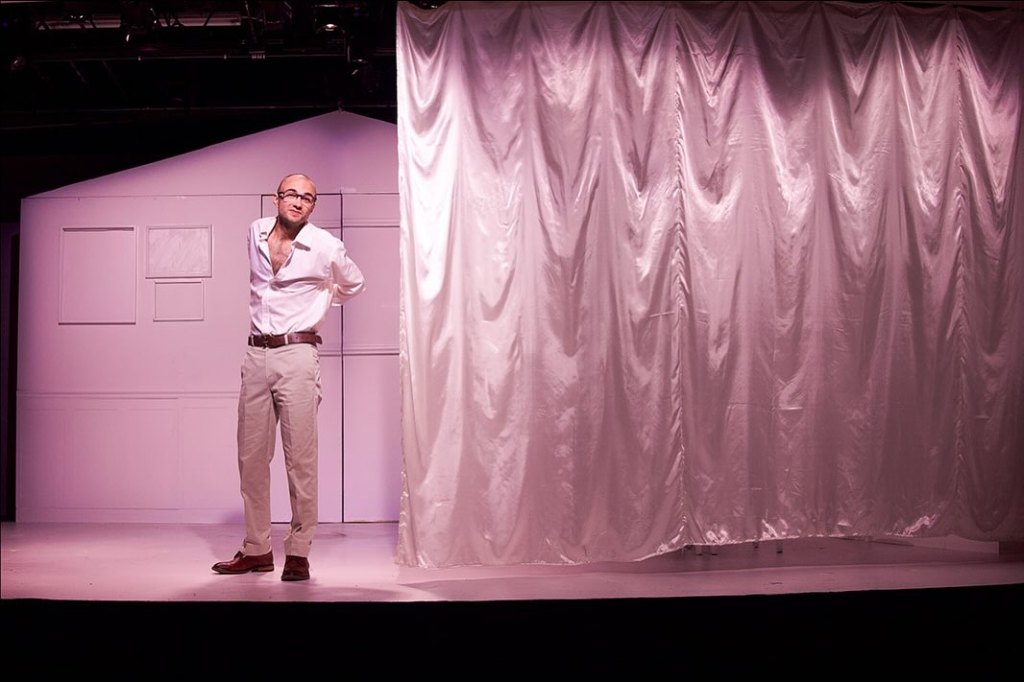
This is a work that does not need a lot of props or decor. The set is a simple background of window frames, a screen for projecting captions and video, and two chairs the actors move about as they pass from one decade to another, one geographical location to another (primarily New York and Connecticut).  

Kudos to the creative team, starting with director Deejay Gray (I could feel his hand in Daigle’s portrayal of Bobby). Luke Newsome’s hair and makeup were awesome, with a special nod to Mama Maria’s wigs and another hat tip to Amber Marie Martinez’ costumes (and the unseen hands that helped make all those lightning-fast changes). Maria’s outfits were so authentic…Lucien Restivo’s projections (assuming that includes the video work), Weston Corey’s lighting design, and Kelsey Cordrey’s subtle but effective sound design were all perfection.  

Conversations with Mother is a perfect example of a play that stands on the merit of its words and the actors and creative team who curate them into a production that creates beautiful, memorable theater. 

———- 

Julinda D. Lewis is a dancer, teacher, and writer who was born in Brooklyn, NY and now lives in Eastern Henrico County. When not writing about theater, she teaches dance history at VCU and low impact dance fitness classes to seasoned movers like herself and occasionally performs. Julinda was recently awarded the Dean’s Distinguished Adjunct Faculty Award 2023-24 Academic Year by VCU School of the Arts and the 2025 Pioneer Award in Dance Ministry by Transformation International Worship Ministries, Newport News, VA. 
One-Time
Monthly
Yearly

Make a one-time, monthly, or annual donation

Make a monthly donation

Make a yearly donation

Choose an amount

$5.00
$15.00
$100.00
$5.00
$15.00
$100.00
$5.00
$15.00
$100.00

Or enter a custom amount

$

Your contribution in any amount is appreciated. Thank you for your support.

Your contribution is appreciated.

Your contribution is appreciated.

DonateDonate monthlyDonate yearly
BURIAL TAX

A World Premiere

A Theater Review by Julinda D Lewis

Presented by: Firehouse Theatre | A Firehouse Mainstage Production

At: Firehouse Theatre on the Carol Piersol Stage, 1609 W Broad St., RVA 23220

Performances: July 9 – 27, 2025

Ticket Prices: $5-$35

Info: (804) 355-2001 or firehousetheatre.org

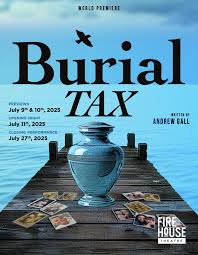
If there is any chance that you think your family might be dysfunctional, you might feel better about your own situation after seeing Andrew Gall’s new play, a dark comedy called Burial Tax.

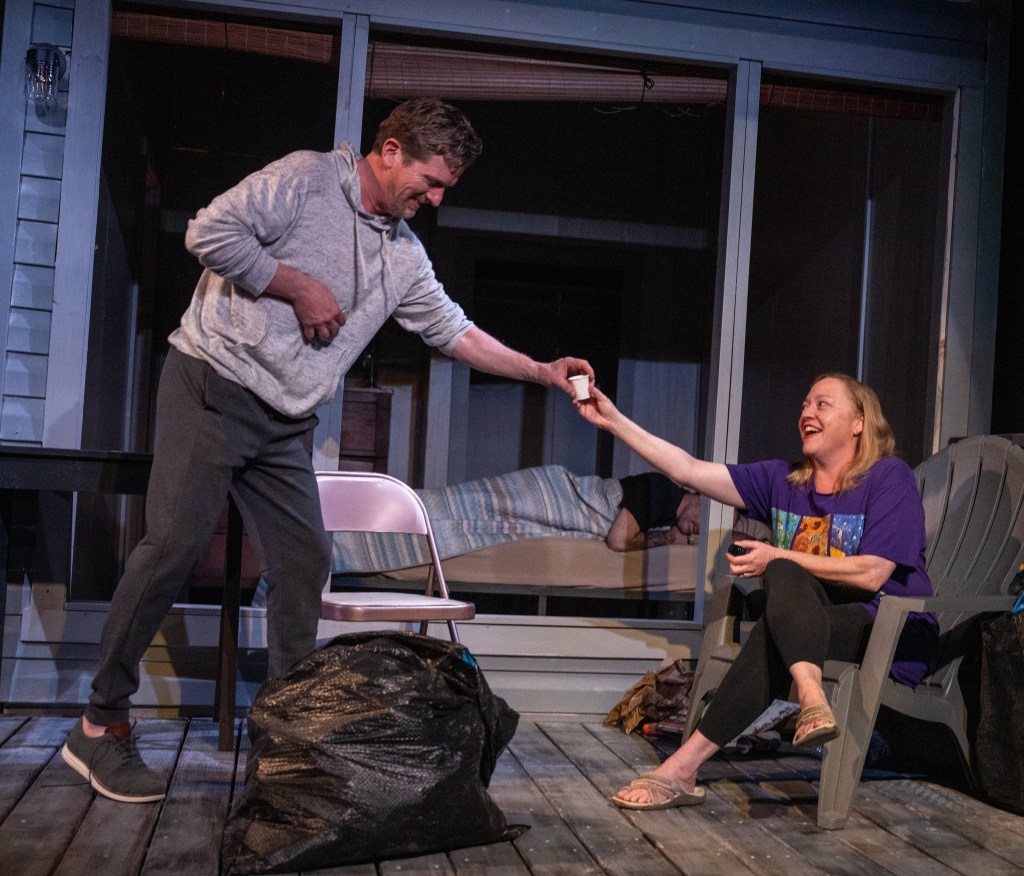
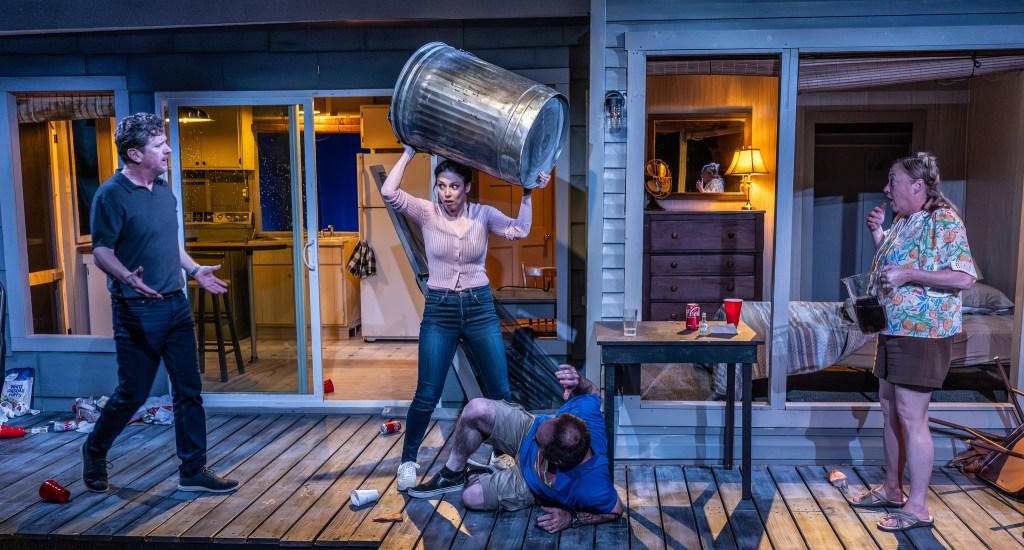
When two estranged siblings bring their respective partners to their family’s lake house to scatter the askes of their recently deceased father, things quickly get out of hand. Sparks fly – and so does scattered debris, a metal trash can, cold pizza, and even their father’s remains.

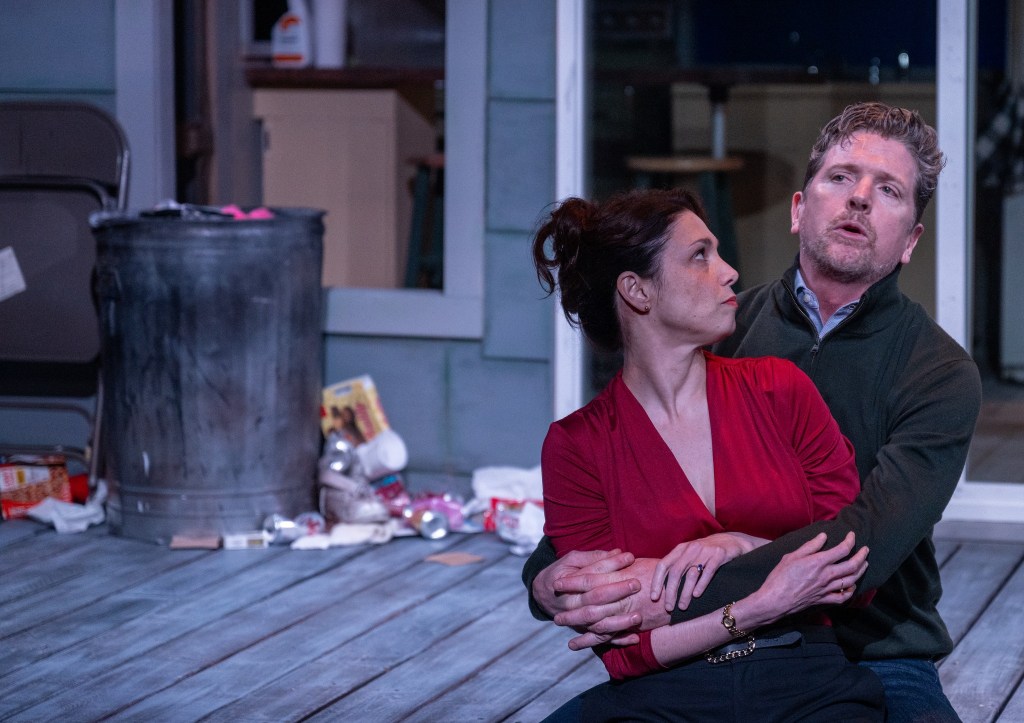
Most of us have probably experienced many of these family dynamics in our own lives: sibling rivalry, parental favoritism, failed educational goals, stagnant marriages. It’s the accumulation of all of these things in one place at the same time that makes this family’s drama exceptional. The shouting, the language, the twisted faces, the presence of alcohol, drugs, a weapon all elevate the tension to an unprecedented level of violence. (Sitting in the front row, we narrowly escaped the carnage when red plastic cups began flying across the stage and through the fourth wall.)

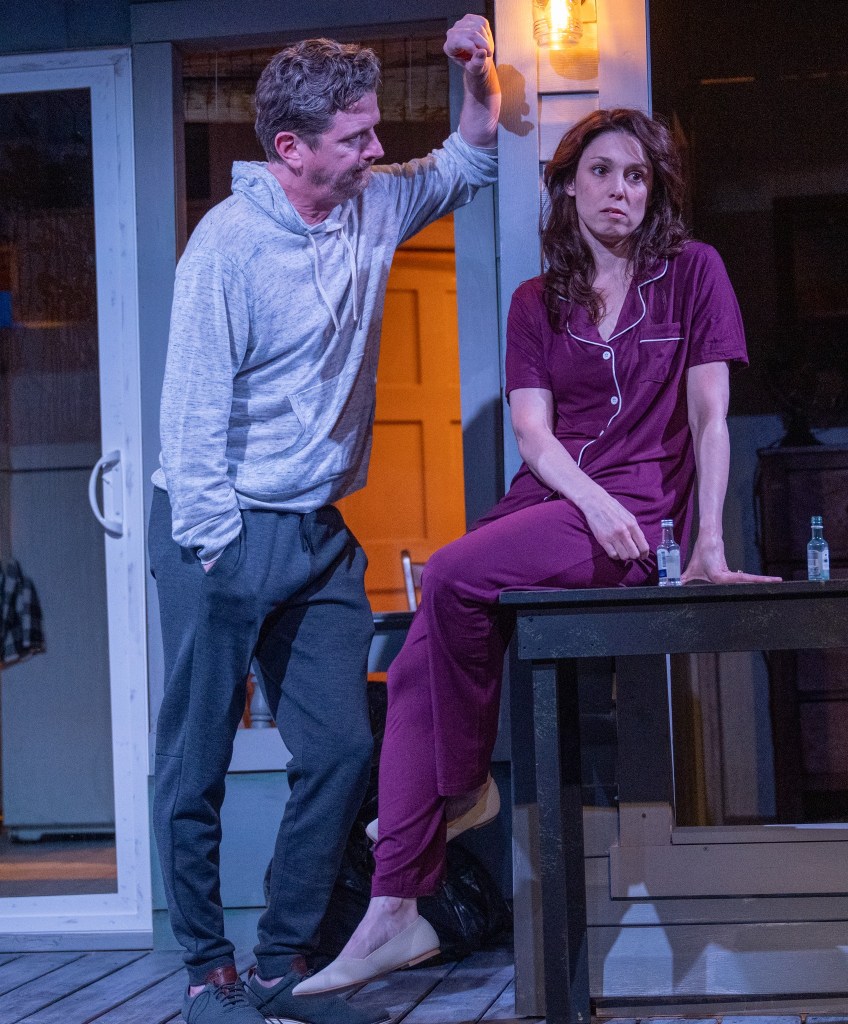
At the center of the controversy we find Steve (Matt Meixler) who once wanted to become a doctor and his younger sister Samantha (Nicole Morris-Anastasi) who is a doctor. The tables have turned since childhood when Steve was the favored child and Sam struggled to be seen. Childhood trauma runs deep, and Sam, despite her accomplishments, still seeks affirmation and appears to suffer from anxiety. Steve, on the other hand, has fallen from grace into an abyss he doesn’t  know how to climb out of.

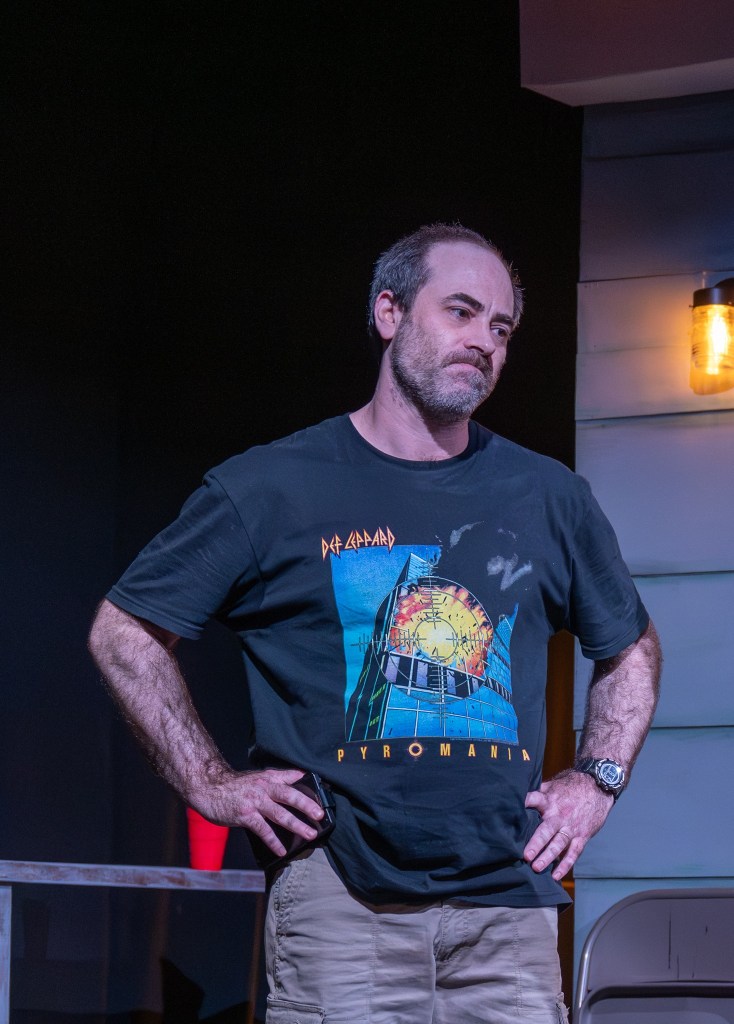
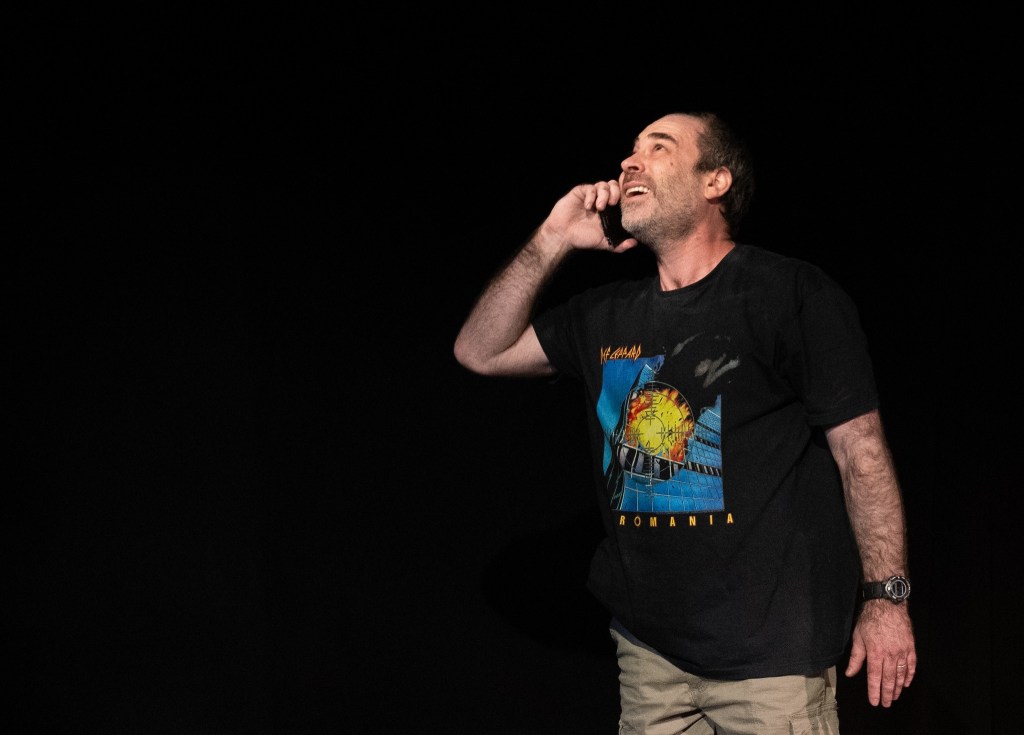
It is here that Steve’s wife Cora (Laine Satterfield) issues an ultimatum while Sam’s partner Dar (short for Darwin) approaches the whole family drama from a more philosophical point of view – fueled by alcohol in tiny airline-sized bottles and week that he somehow managed to sneak through airport security. Sam and Dar are not at each other’s throats like Steve and Cora, but their relationship is no less toxic.

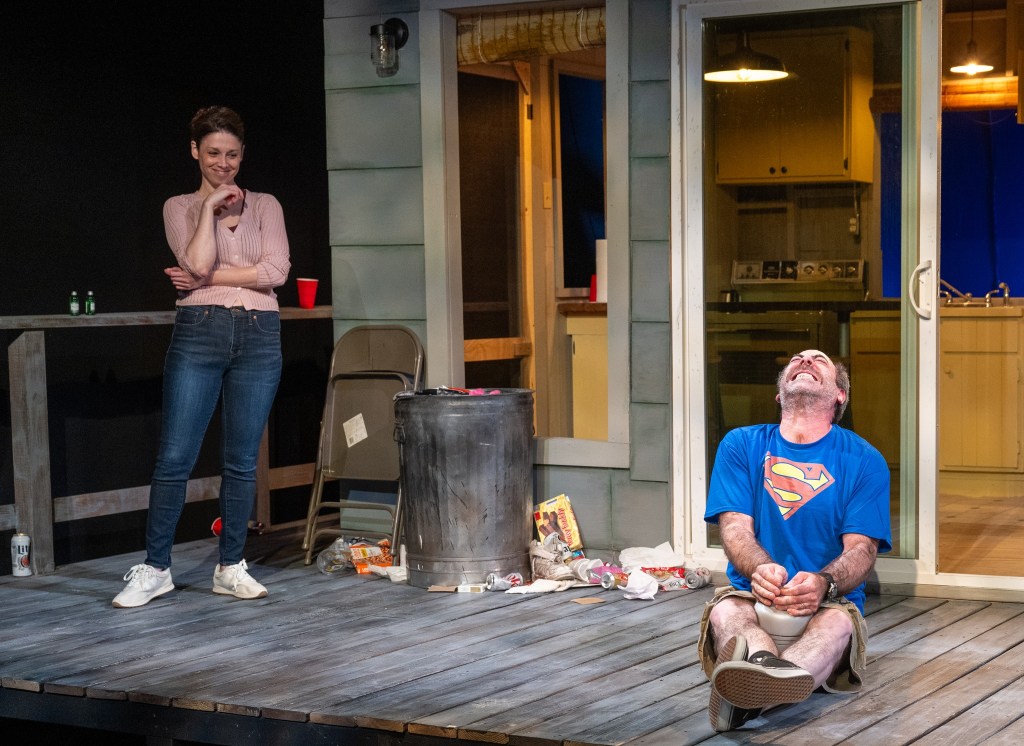
It’s interesting that while Sam and Steve are the main characters, their partners Dar and Cora often have the most interesting things to say, make the most sense, and leave the greatest impression. I’m not sure if this was the intent of Gall’s script or the power of the actors themselves. Laine Satterfield appeared on this same stage just a few weeks prior in another dark comedy about a family drama in Cadence Theatre’s Smoke. [ See my review of Smoke here: https://jdldancesrva.com/2025/07/06/smoke/ ] Satterfield presents Cora as loud and angry, but she also shows a surprisingly unexpected empathy towards Sam. Cora is a more fully developed, three-dimensional character than Steve. Matt Meixler seems to spend much of his stage time on the floor. Sometimes he’s down there painting baseboards in preparation for his mother’s arrival. Sometimes he’s down there wallowing in the detritus of his life and his own bad choices and missed opportunities, all of which are encapsulated in Chris Raintree’s trash strewn set. Raintree’s scenic design, I must add, is phenomenal. The battle weary and generally dilapidated beach cottage, along with Grace Brown LaBelle’s sound design of waves washing the shore of the nearby lake and some appropriately evocative original music by Daniel Clarke are masterfully designed.

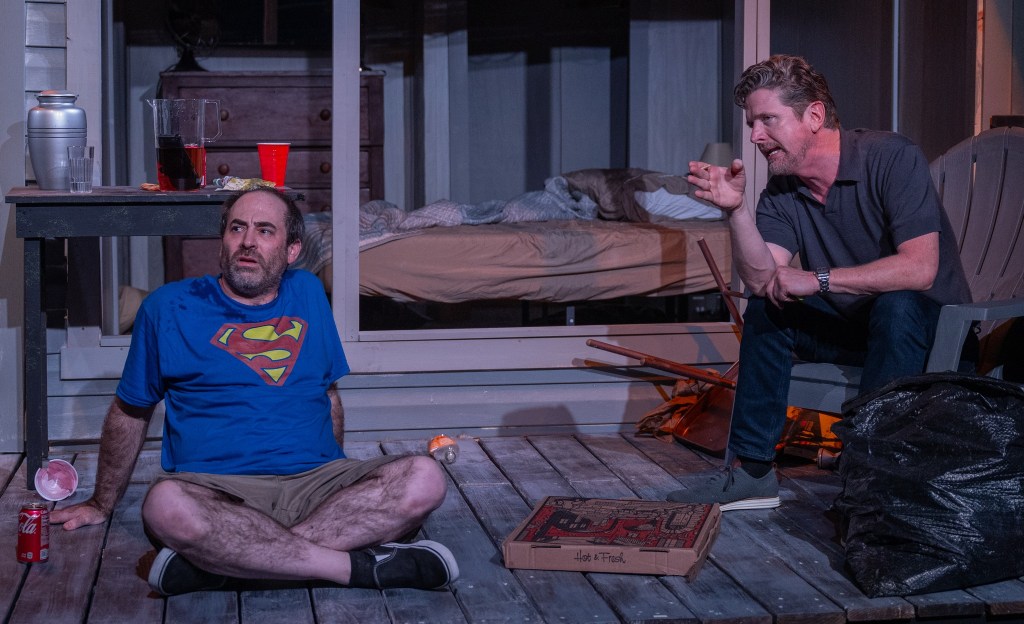
Steve’s preference for superhero tee shirts are a stark contrast to his station in life, and this is also masterfully highlighted in a late-night discussion with Dar. The seriousness of this conversation is offset by the humor that arises from Steve’s experience of trying weed for the first time. Meixler plays Steve with such a burden of defeat that there seems little hope of redemption.  Nicole Morris-Anastasi carries the burden of Sam’s childhood neglect to the point that it almost seems unlikely that she could have withstood the pressures of medical school. We never learn why young Steve was so cruel to his sister, and I don’t think Morris-Anastasi ever found out, either. Her character seems never to fully come into focus.

Duke Lafoon, on the other hand – and much like his counterpart in Laine Satterfield – gives his character more depth than the main character he supports. Dar seems to have more of a backstory than Sam, and Lafoon teases by quietly observing and then releasing philosophical tidbits the way Jesus used parables to teach the masses.

Overall, this is a successful world premiere with a strong cast and high production values. Gall’s script and Paul Takács’ direction keep things moving, often using shocking words and outrageous actions. It’s not just, as I believe one character says early in Act 1, “meaningless routine punctuated by Amazon deliveries. Act 1 is full of secrets and anger. “By the end of Act 2, the siblings have made some confessions, realized some truths, and come to a new understanding. But nothing is really resolved. There is no redemption, and whatever victory has been achieved feels less than satisfactory, more of a concession than a real win. “What we have learned from history, is that no one learns from history.” Maybe that’s why we have theater.

———-

Here’s a link to a promo video of Burial Tax: https://www.facebook.com/share/v/1AktDm7pjz/

———-

Here’s my preview from the July 2025 issue of Richmond Magazine:

Firehouse Theatre Producing Artistic Director Nathaniel Shaw says an essential component of the theater “is to amplify local talent.”

Burial Tax, written by Andrew Gall and directed by Paul Takács, will have its world premiere at Firehouse, July 11-27. After two years in development under the working title “Lake Effect,” the work promises to be a hauntingly dark comedy about the reunion of two estranged siblings who gather with their spouses at their family’s lake house to spread the ashes of their recently deceased father. It’s a release of beauty and pain, a comedic experience of family dynamics, and a unique take on the pressures of adulthood.

Gall says, “It makes us think about a shared experience in a new way.”

———-

Julinda D. Lewis is a dancer, teacher, and writer who was born in Brooklyn, NY and now lives in Eastern Henrico County. When not writing about theater, she teaches dance history at VCU and low impact dance fitness classes to seasoned movers like herself and occasionally performs.

———-

BURIAL TAX

Written by Andrew Gall

Directed by Paul Takács

CAST

Cora                   …..        Laine Satterfield

Samantha       …..        Nicole Morris-Anastasi

Steve                 …..        Matt Meixler

Dar                     …..        Duke Lafoon

Cora U/S          …..        Donna Marie Miller

Samantha U/S ….       Rachel Dilliplane

Steve/Dar U/S  ….       Andy Braden

PRODUCTION TEAM & CREW

Direction                        …..        Paul Takács

Scenic Design              …..        Chris Raintree

Lighting Design            …..        Gretta Daughtrey

Costume Design         …..        Sassy Rychalsk

Sound Design               …..        Grace Brown LaBelle

Original Music Composer     Daniel Clarke

Playwright                      …..        Andrew Gall

Assistant Director      …..        Rachel Dilliplane

Stage Management   …..        Emily Sanford Hicks

Asst Stage Management        Isabel Stone

Tickets: $5-$35

Ticket Info: (804) 355-2001 or firehousetheatre.org

Performance Schedule: July 9-27, 2025

Thursdays, Fridays, Saturdays @7:30PM

Saturdays & Sundays @2:00PM

Previews: July 9 & 10 (Pay-What-You-Will)

Opening Night: Friday, July 11

Closing: Sunday, July 27 @2:00PM

Run Time: about 2 hours with one 15-minute intermission

One-Time
Monthly
Yearly

Make a one-time, monthly, or annual donation to support the continued publication of rvart review. writers need $, too!

Make a monthly donation

Make a yearly donation

Choose an amount

$5.00
$15.00
$100.00
$5.00
$15.00
$100.00
$5.00
$15.00
$100.00

Or enter a custom amount

$

Your contribution is appreciated.

Your contribution is appreciated.

Your contribution is appreciated.

DonateDonate monthlyDonate yearly
WAR IN PIECES

a Festival of One Act Plays Written by Veterans

A Reflection on a Theater Experience by Julinda D. Lewis

Presented By: The Firehouse Off-Site

At: Virginia War Memorial’s VMI Alumni Hall, 621 S. Belvidere St. Richmond VA 23220

Performances: April 4-13, 2025

Ticket Prices: $15 – $35

Info: (804) 355-2001 or firehousetheatre.org

This is not the first War in Pieces festival – I believe the first program of four one-act plays written by Virginia veterans who participate in the Virginia War Memorial’s  Mighty Pen Project took place in 2021. The Project is a 12-week long writing workshop taught by David L. Robbins, a best-selling author and professor of writing who founded the program in 2015.

The Mighty Pen authors create works that are (a) creative, (b) artistic documents of military service and history, and (c) form a living documentary of the individuals and conflicts of the US military. Now, it is customary for the pre-show curtain talk to end with an invitation to “enjoy the show,” and after the show, people often ask, “did you enjoy the show?” I am firms convinced that people say/ask this because – like those who ask how you’re feeling when you go to the doctor or hospital – they just don’t know what to say! I can appreciate the message of these plays; I can recognize the artistry of the actors; I can be deeply affected by the message and emotion of the production; but no, I would not use the word “enjoy” to describe what I experience when watching these plays.

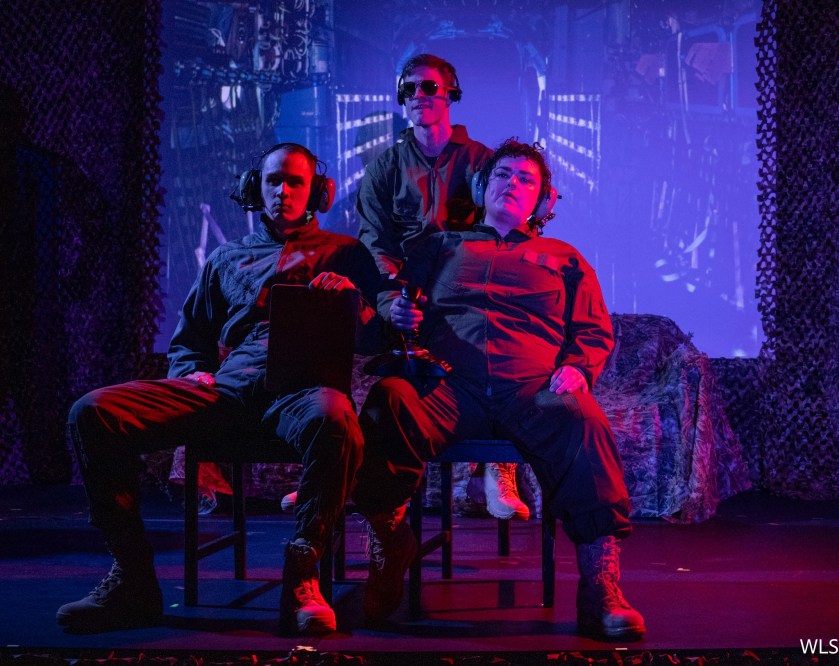
First up was Kaho’olawe, by Harry Mayer (United States Marine Corp & United States Navy). Kaho’olawe is an uninhabited island in the Pacific Ocean, and at 11 miles long by 6 miles wide it is the smallest of the eight main volcanic islands of the Hawaiian Islands. During World War II it was used as a US military training ground and bomb range. In Mayer’s play, Slick, a young bomb technician (played by Colin Barnes), comes upon a bomb on this island and finds that it is armed. He calls for help, but no help is available, and he is forced to use make-shift tools to disarm the bomb. But this is no ordinary bomb! It begins to talk to him, mocking him, doubting his ability, and questioning his skill, indeed his very confidence.

The bomb speaks first in its own voice, and then in the voices of Aunt Pearl and Miss  Crabcakes. I had assumed these voices in his head were recorded but no, after the show, director David L. Robbins informed me there were three live actors (Matt Meixler, Donna Marie Miller, and Hayley Cartee) speaking these lines with impeccable timing from their offstage locations. The tension is palpable, but in the end, Slick survives. Whew!

Next up is Shani Miller’s War’s Teeth, a heart-rending story in which Shani, played by Donna Marie Miller, reenacts an encounter with another, older vet, Ed Brown. Miller, the actor, not the author, strategically gives voice to both characters. Miller, the author, served as an Air Force Intelligence Officer, with multiple deployments to Iraq and Afghanistan. Her experience led to her memoir, currently a work in progress, in which she write about finding her lost sense of belonging after being deployed with the help of travel and the birth of her children (three under age six and a fourth on the way).

The second half of the program began with A Couch by Cam Torrens, an Air Force veteran with more than 30 years of service. In A Couch, Cam, an officer, chooses his command over his family, and gets sent to the couch by his wife – who, by the way, outranks him. “Don’t come home,” she says, illustrating the difficult choices that must be made, and how our military families are placed under stress when forced to choose between loyalty to family or loyalty to the mission and their country. Colin Barnes and Hayley Cartee skillfully walked this tightrope as the married couple.

The program closed with The Salute by Larry Meier (United States Army, and recipient of the Bronze Star with Palm for service in Vietnam). The cast of four, consisting of parents Eleanor and Bobby (Lyddall Bugg Brown and Matt Meixler), a support officer (Colin Barnes), and a Pastor (Benedict Burgess) takes the audience on a reluctant tour where we see the effects of war on an ordinary couple as they prepare to bury their son. What makes Meier’s story so powerful, for me, is that the focus is not just on the parents, but also on the young Captain who is sent to provide support for the family. The pastor notices, and offers him comfort, but the burden he carries may already be more than he can bear.

The thing that remains with me, however, is the mother’s reaction. At their son’s funeral, the tension builds until, upon receiving the folded flag from the young Captain, Eleanor springs up from her seat and speaks, in a voice that quickly escalates from a soft plea to a primal scream, “Ya’ll took my little boy, and you give me this – A FLAG!”Tossing the flag on the floor, she storms out of the chapel. There are no words of comfort. Nothing can fix this. It is haunting. This, all of this, is War in Pieces.

—–

Julinda D. Lewis is a dancer, teacher, and writer who was born in Brooklyn, NY and now lives in Eastern Henrico County. When not writing about theater, she teaches dance history at VCU and low impact dance fitness classes to seasoned movers like herself and occasionally performs.

—–

WAR IN PIECES

Four One-Act Plays by Virginia Veterans

Kaho’olawe written by Harry Mayer

Directed by David L. Robbins

CAST

Slick                ……….           Colin Barnes

Bomb             ……….           Matt Meixler

Aunt Pearl     ……….           Donna Marie Miller

Miss Crabcakes ……           Hayley Cartee

War’s Teeth written by Shani Miller

Directed by David L. Robbins

CAST

Shani              ………            Donna Marie Miller

A Couch written by Cam Torrens

Directed by Andrew Gall

CAST

Linda              ……….           Haylee Cartee

Cam                ……….           Colin Barnes

Jefe/Planner ……….           Lyddall Bugg Brown

Tav/Planner ……….           Benedict Burgess

Lips                 ……….           Matt Meixler

The Salute written by Larry Meier

Directed by Daniel Moore

Pastor            ……….           Benedict Burgess

Eleanor          ……….           Lyddall Bugg Brown

Captain          ……….           Colin Barnes

Bobby            ……….           Matt Meixler

Production Team

Executive Producer             ……….           David L. Robbins

Stage Management             ……….           Dennis Bowe, Grace Brown LaBelle

Sound/Projection Design  ……….           Grace Brown LaBelle

Costume Design/Coordination …           Tallie Pugh   

Run Time: About 2 hours; there is 1 intermission

Tickets: $15 to $35

Info: (804) 355-2001 or FirehouseTheatre.org

Performance Schedule:

Friday, April 4                       7:30PM         

Saturday, April 5                  7:30PM

Sunday, April 6                    2:00PM

Thursday, April 10               7:30PM

Friday, April 11                    7:30PM

Saturday, April 12                2:00PM

Saturday, April 12                7:30PM

Sunday, April 13                  2:00PM

———-

PHOTOS: from the Firehouse Facebook page

Benedict Burgess, Colin Barnes, Lyddall Bugg Brown
The Cast of War in Pieces 2025
One-Time
Monthly
Yearly

Make a one-time, monthly, or annual donation to support rvart review!

Make a monthly donation

Make a yearly donation

Choose an amount

$5.00
$15.00
$100.00
$5.00
$15.00
$100.00
$5.00
$15.00
$100.00

Or enter a custom amount

$

Your contribution is appreciated.

Your contribution is appreciated.

Your contribution is appreciated.

DonateDonate monthlyDonate yearly
RICHMOND BALLET: MOVING ART ONE

Ballet Celebrates First Program on the New VMFA Stage

A Dance Review

Performance By: The Richmond Ballet

At: Virginia Museum of Fine Arts, Leslie Cheek Theater, Richmond Ballet Stage, 200 N. Arthur Ashe Boulevard, RVA 23220

Performance Dates: March 20-30, 2025

Ticket Prices: $25 – $85 ($85 – $125 on opening night)

Info: (804) 344-0906, etix.com, or richmondballet.com

THE PROGRAM

PENTAPTYCH

Choreography by Ma Cong

Music by Ryan Lott

Costume Design by Emma Kingsbury

Lighting Design by Les Dickert

Visual Artist: Eric Sall

World Premiere: September 14, 2018, Tulsa Ballet, Tulsa Ballet’s Studio K Theatre, Tulsa, OK. Richmond Ballet Premiere: March 20, 2025, Leslie Cheek Theater, Virginia Museum of Fine Arts, Richmond, VA

AFTER THE RAIN Pas de Deux

Choreography by Christopher Wheeldon, OBE

Music by Arvo Pärt

Staged by Jason Fowler and Craig Hall

Costume Design by Holly Hynes

Lighting Design by Les Dickert after Original Design by Mark Stanley

Pianist: Dr. Douglas-Jayd Burn

Violinist: Karen Johnson

World Premiere: January 22, 2005, New York City Ballet, New York State Theater, New York, NY. Richmond Ballet Premiere: March 20, 2025, Leslie Cheek Theater, Virginia Museum of Fine Arts, Richmond, VA

LAMBARENA

Choreography by Val Caniparoli

Music by Johann Sebastian Bach and traditional African (as arranged by Pierre Akendengué and Hughes de Courson)

African Dance Consultants: Dr. Zakarya Diouf, Naomi Johnson-Diouf, Ibrahima O. Diouf

Scenic and Costume Design by Lisa J. Pinkham, Recreated by Les Dickert

Staged by Maiqui Manosa

World Premiere: March 28, 1995, San Francisco Ballet, War Memorial Opera House, San Francisco, CA. Richmond Ballet Premiere: March 20, 2025, Leslie Cheek Theater, Virginia Museum of Fine Arts, Richmond, VA

—–

In celebration of the very first performance of the Richmond Ballet’s new Moving Art series – replacing the long-time, popular Studio Series – current Artistic Director Ma Cong, Founding Artistic Director Stoner Winslett, and VMFA Director and CEO Alex Nyerges shared the stage on Thursday evening, March 20, for an enthusiastic pre-show welcome. There was a full house for this gala event, and all performances of the March 20-30 program were already sold out.

Moving Art One marks the return of the Richmond Ballet to the VMFA  after last performing there in the 1990s and the first major renovation of the Leslie Cheek Theater stage since it was built some 70 years ago. The renovations include widening the stage to better accommodate ballet, new lighting for the house and the stage, and upgraded A-V equipment. A press release indicates that the performers’ dressing rooms and restrooms and the green room have also been upgraded. The theater seats 472 audience members, and the seating has reportedly been refurbished but in my opinion the seats are still a bit too tight and would probably not be comfortable for all audience members, and the raking does not allow for an unobstructed view if you are vertically challenged, or if a tall person sits in front of you. But that’s just my two cents.

As with the Studio Series performances, the Moving Art series consists of a program of three works and features both classical and contemporary ballets produced in an intimate setting (as compared to, say, the 1,800-seat Carpenter Theatre where large works such as The Nutcracker Ballet or Cinderella are performed).

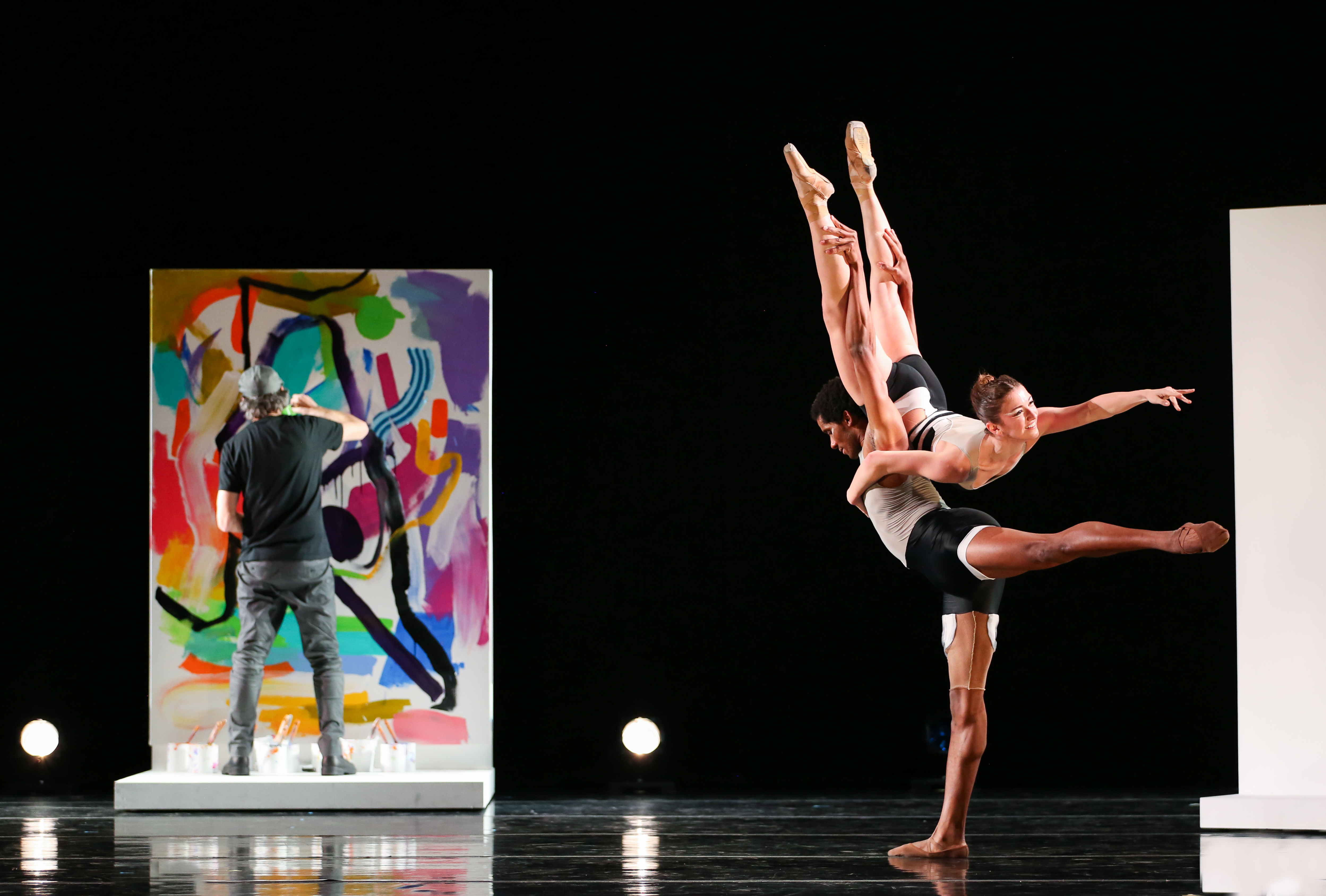
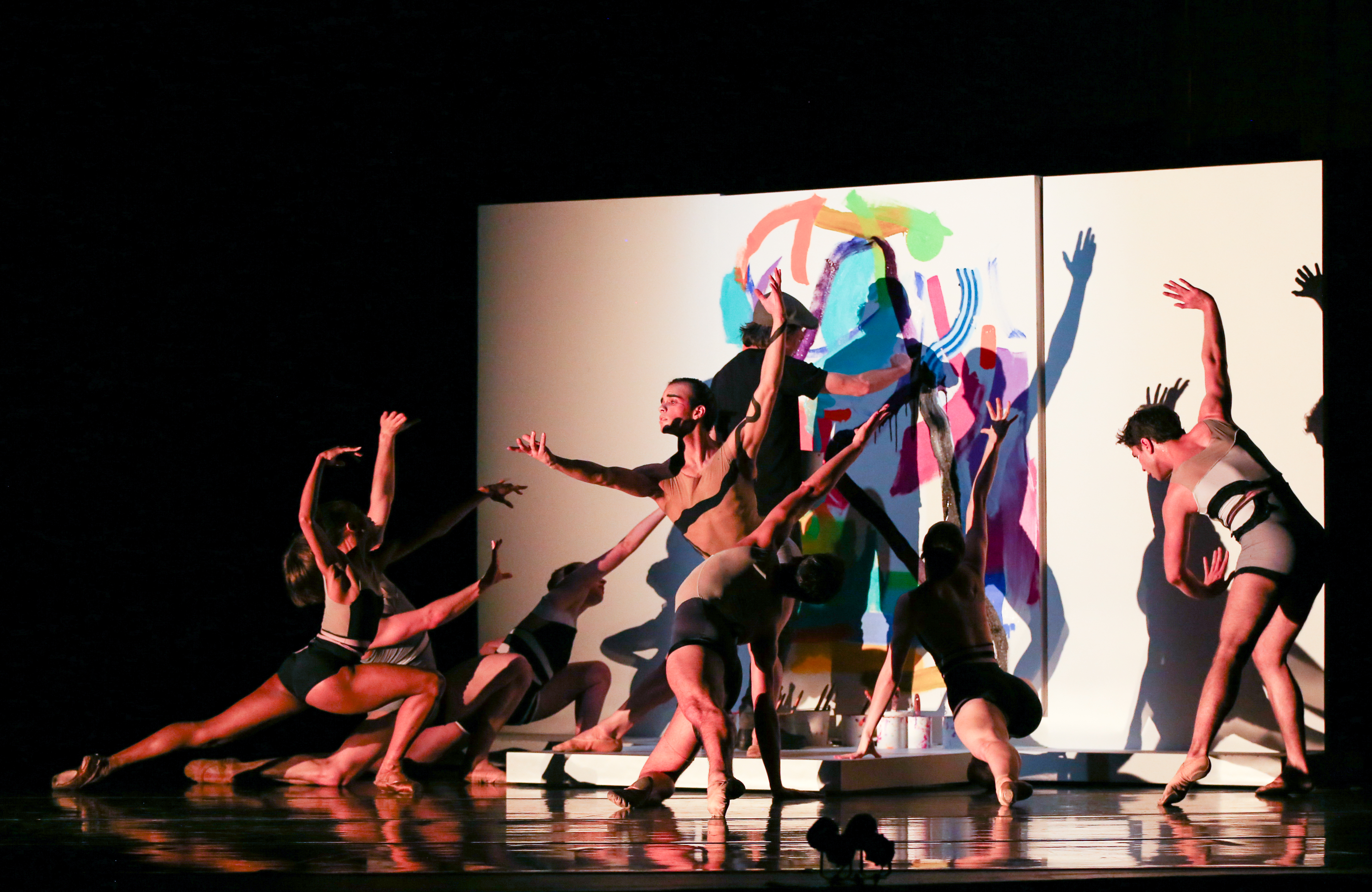
Moving Art One opened with the world premiere of Ma Cong’s Pentaptych (def., a work of art consisting of five panels or sections). There is a live artist onstage, Eric Sall, who interacts with the dancers and creates a large, colorful abstract painting. The bold brushstrokes are a stark contrast to the black, white, and gray costumes worn by the dancers – except for one dancer whose costume appears to be a part of or an inspiration for the painting. The ballet is of the contemporary genre, and the dancers’ monochrome costumes, paired with the abstract, ethereal, and sometimes athletic stretching motions and the original score by Ryan Lott, for a moment I had a flashback of sitting in Merce Cunningham’s Westbeth studio in Manhattan’s artists’ community, watching his company perform. (For those not familiar with Cunningham’s work – this is a positive comparison, and you should look him up!) The finished painting, by the way, is available for purchase via an online auction. The proceeds are to benefit the Richmond Ballet.

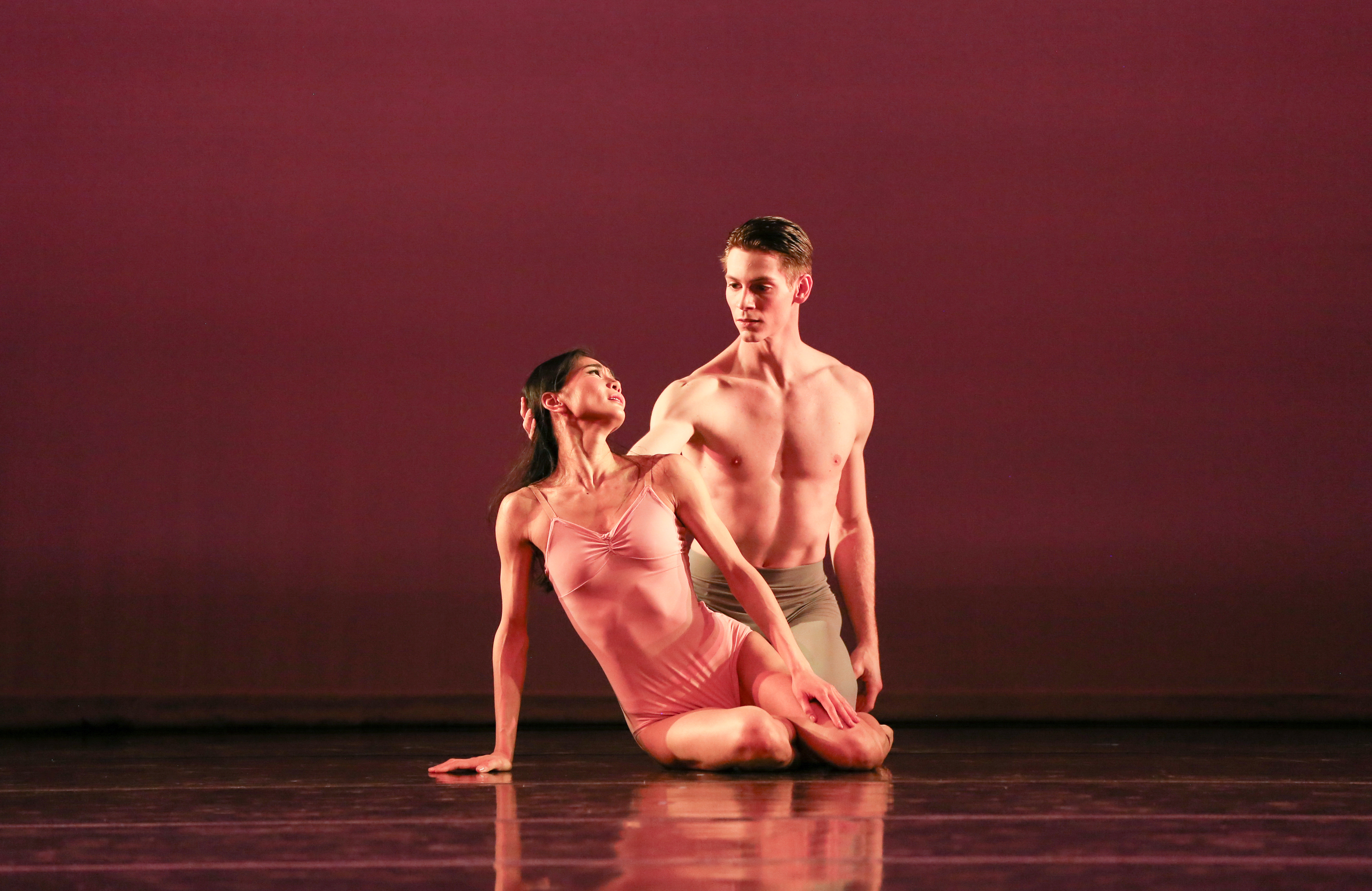
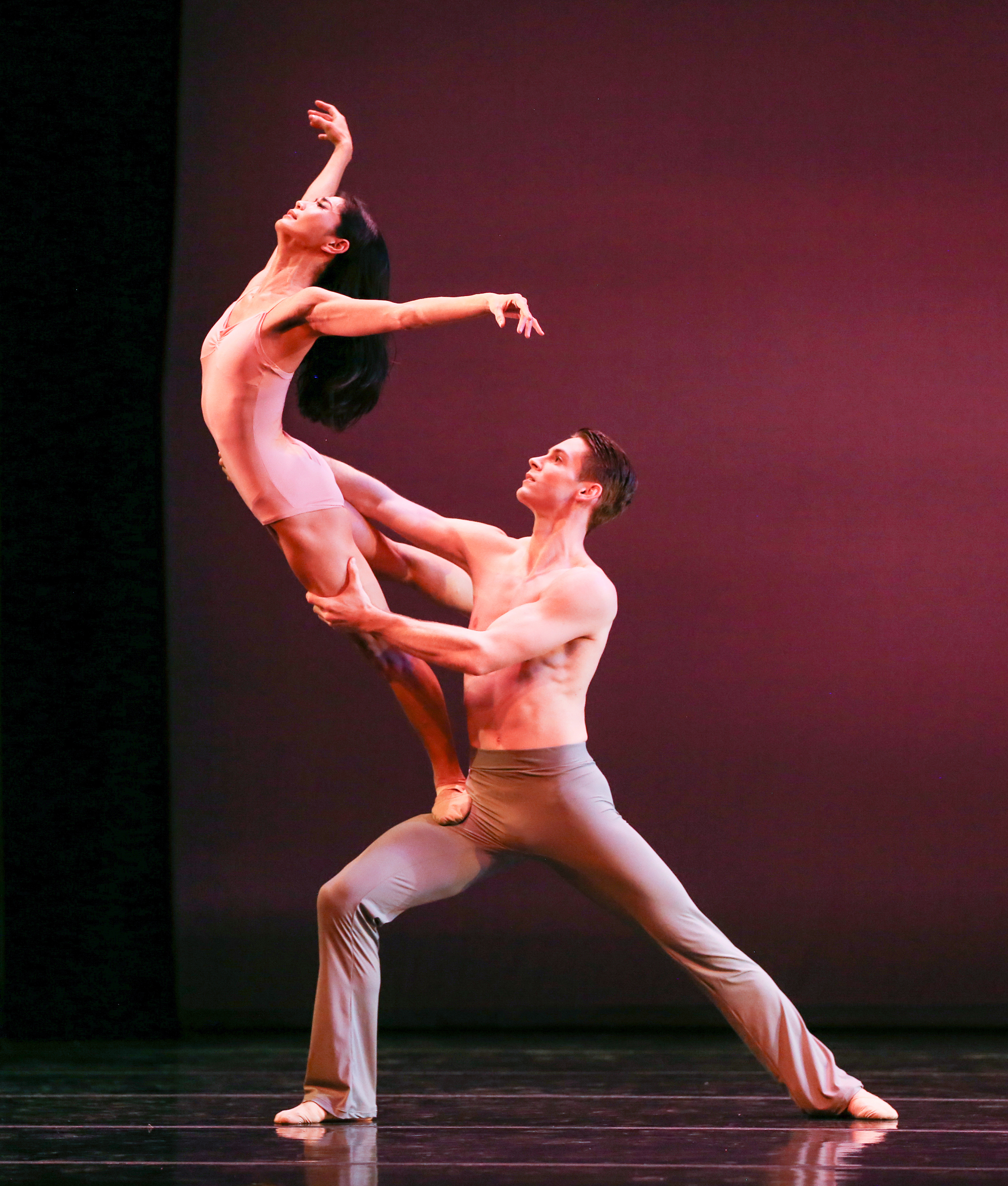
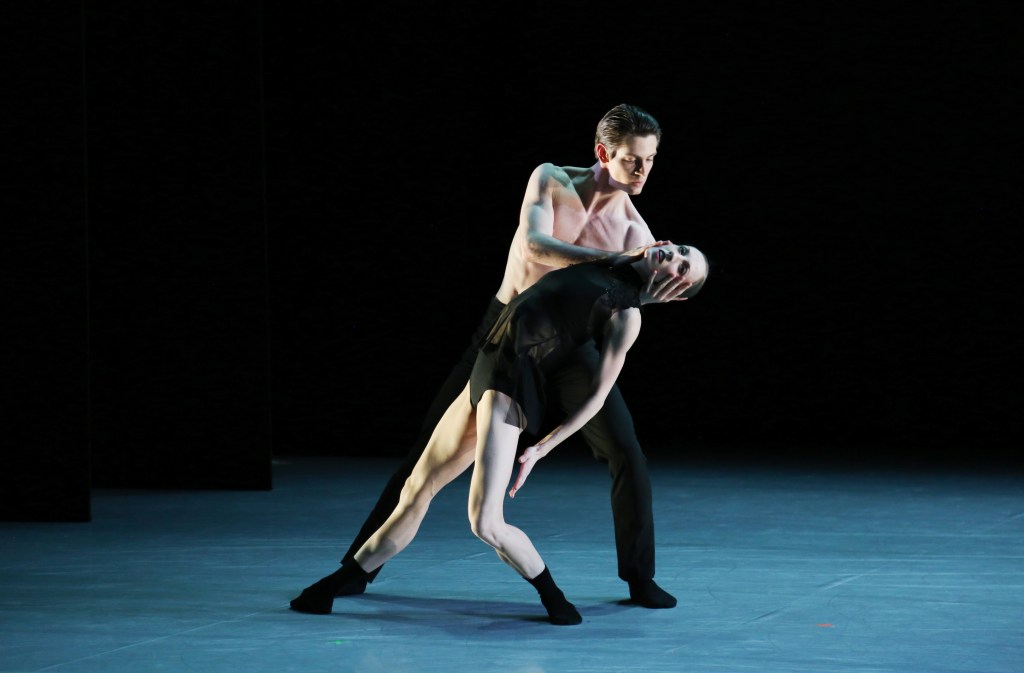
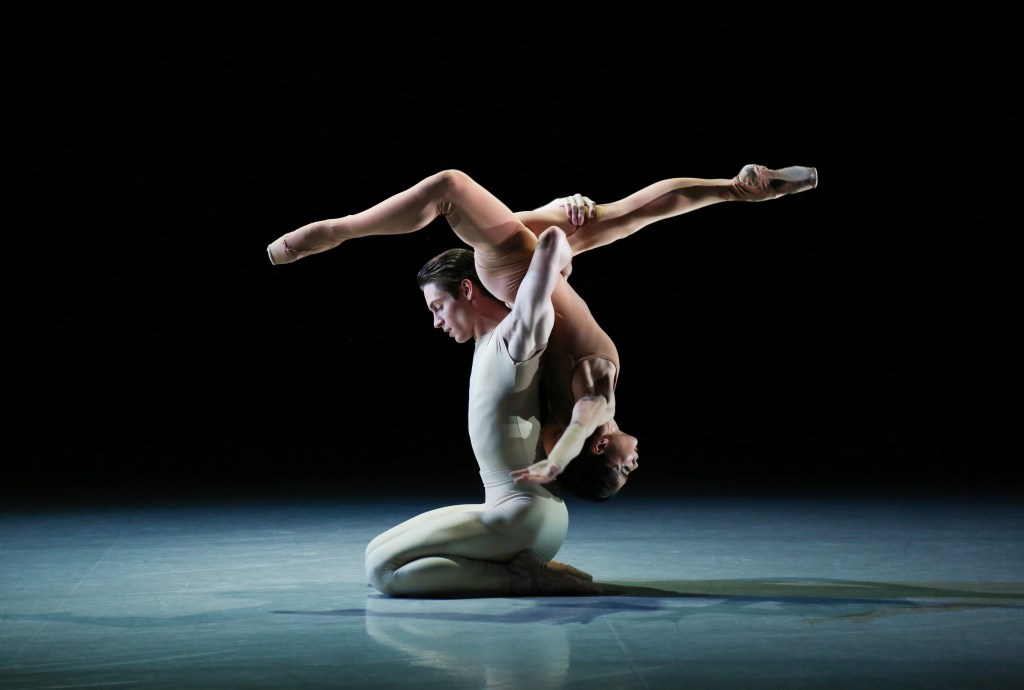
The classical portion of the program was provided by Eri Nishihara and Jack Miller, performing the pas de deux from Christopher Wheeldon’s After the Rain. Commissioned for a New York City Ballet program in honor of George Balanchine’s birthday, the ballet is in two parts. The first part is a dance for three couples, and the second part, the pas de deux, is often performed separately, as it was here on the new Richmond Ballet Stage. The dance is set to music by Arvo Pärt, played live by Dr. Douglas-Jayd Burn and Karen Johnson, and is notable for placing the ballerina in flat shoes instead of en pointe.

It is a stunningly beautiful and tender ballet in which the male dancer, Miller, sometimes lifts his partner is the most unexpected ways – for example, frozen into a position that I can only describe rather awkwardly as table-like. Another moment, Nishihara gently caresses her partner’s face while he stands strong and unmoving, or she perches delicately on his extended thigh. Burn’s piano and Johnson’s violin emit gentle, almost ambient sounds, like, yes, like raindrops. The piece ends with a silent embrace and the partners gently melt into one another.

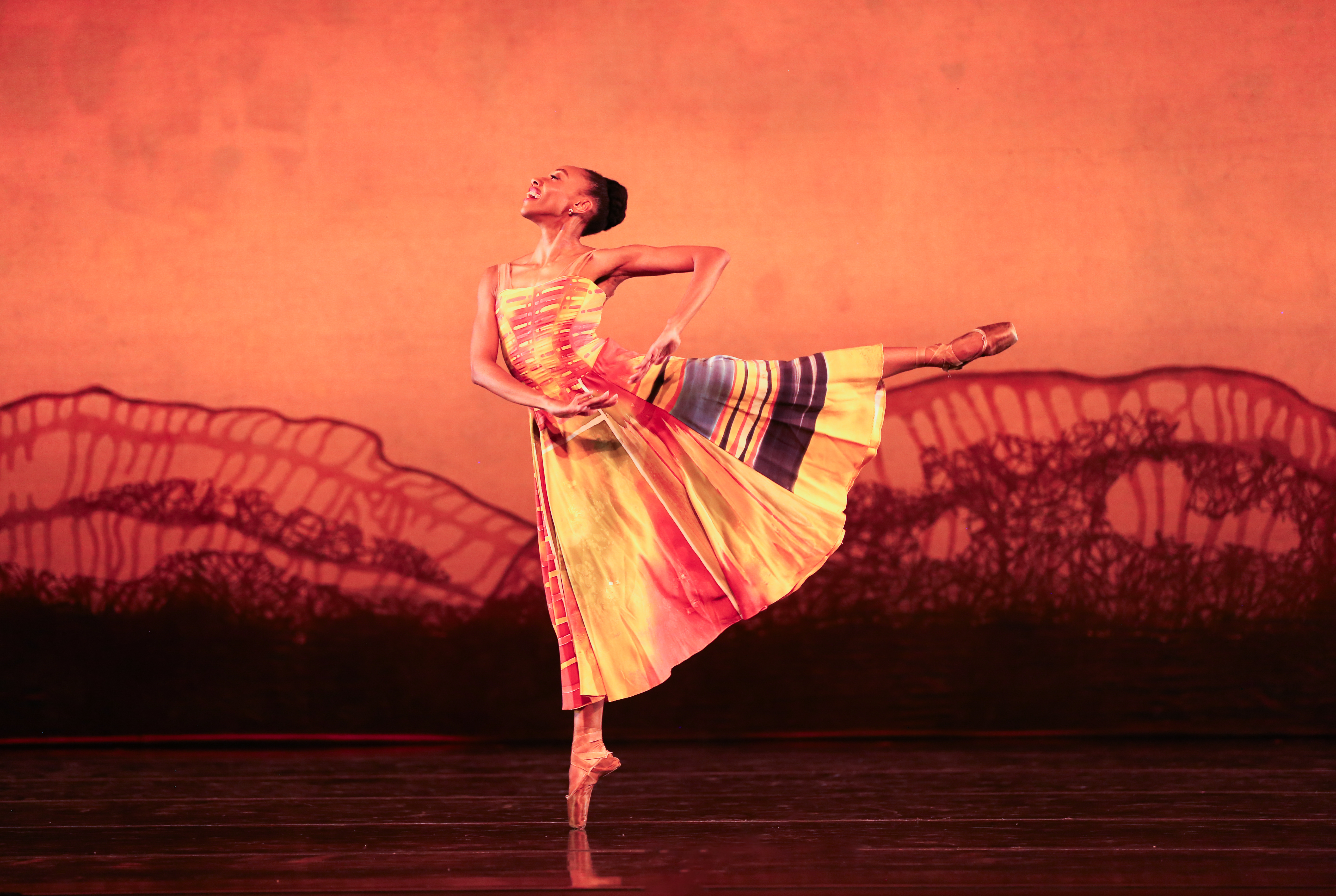
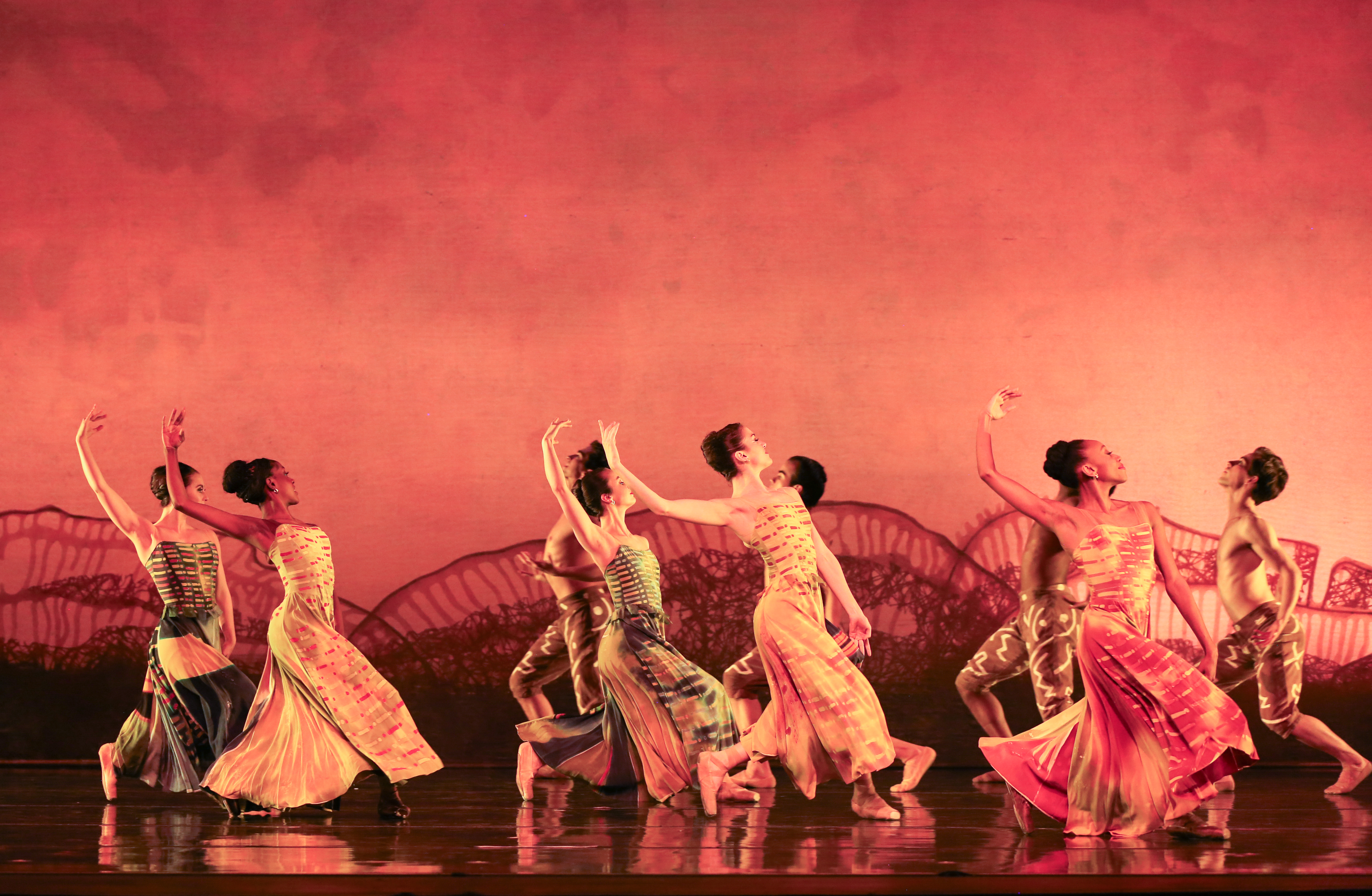
Val Caniparoli’s Lambarena is much more difficult to write about, not because it was not beautifully performed, but because I am not sure what to think of it. Colorful, energetic, and fun, the work is performed to a rather unique blend of music by Johann Sebastian Bach and traditional African (what part of Africa?) music arranged by Pierre Akendengué and Hughes de Courson.

Performed by the full company, the work serves as a showcase for dancer Naomi Robinson who leads the women in leaping lightly like gazelles over the savanna. (This brought back another memory, that of seeing a herd of gazelles dashing through the grasslands of Kenya.) In a later section, they held their arms back and arched, reminding me of ostriches – and the beautiful solo Awassa Astrige created by Asadata Dafora (1932). The men, at times, reminded me of giraffes – also common to Kenya and other parts of East Africa. There was lots of light footwork and hip action unlike anything one usually sees in a traditional ballet. Sometimes I heard strains of a stringed instrument that reminded me of a berimbau – a one-stringed instrument I’m familiar with from Brazilian dance and capoeira (a Brazilian martial art/dance). I believe the berimbau originated in Angola, in southwestern Africa. The music also incorporated choral sections and clapping.

Overall, the work is sassy and joyous, and performed with extraordinary energy. My dilemma, perhaps, comes from recent discussions I have been having with my dance history students at VCU, where we have been mulling over the differences between cultural appreciation and cultural appropriation. The program lists African Dance Consultants – Dr. Zakarya Diouf, Naomi Johnson-Diouf, and Ibrahima O. Diouf – and the company hosted a Community Dance Class with local dance organization Ezibu Muntu on March 16, shortly before the opening of the Moving Art One program.

Still, I felt a certain uneasiness as I watched – and enjoyed – Lambarena, and watched others enjoying it, too. I appreciated it, but there does seem to be more than a little cultural appropriation – context? accreditation? intent? Acknowledgement – beyond the generic designation of “African” – or at least an appearance thereof. I need to look more deeply into Caniparoli’s inspiration and motivation before making a final decision on this work.

In the meantime, while I’m rummaging around in the stack of dance history, if you can’t get to see Moving Art One, there will be a Moving Art Two, running from May 8 – 18. That program will include Joshua L. Peugh’s Slump, a ballet about modern courtship, Stoner Winslett’s Echoing Past (set to a score by Fanny Mendelssohn-Hensel), and Yury Yanowsky’s newly completed Fading Creatures, a work-in-progress he introduced at Richmond Ballet’s 2023 New Works Festival. It draws inspiration from the melting clocks of Salvador Dalí’s popular painting The Persistence of Memory.

—–

Julinda D. Lewis is a dancer, teacher, and writer who was born in Brooklyn, NY and now lives in Eastern Henrico County. When not writing about theater and dance, she teaches dance history at VCU and low impact dance fitness classes to seasoned movers like herself and occasionally performs.

One-Time
Monthly
Yearly

Make a one-time, monthly or annual donation to show how much you love rvart review

Make a monthly donation

Make a yearly donation

Choose an amount

$5.00
$15.00
$100.00
$5.00
$15.00
$100.00
$5.00
$15.00
$100.00

Or enter a custom amount

$

Your contribution is appreciated.

Your contribution is appreciated.

Your contribution is appreciated.

DonateDonate monthlyDonate yearly
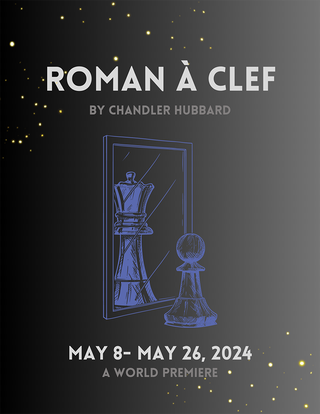
ROMAN À CLEF

The New Theatre at Firehouse on the Carol Piersol Stage Presents

A WORLD PREMIERE by Chandler Hubbard

A Theater Review by Julinda D. Lewis

At: The Firehouse 1609 West Broad St., Richmond, RVA 23220

Performances: May 8-26, 2024

Ticket Prices: $0-$35

Info: (804) 355-2001 or firehousetheatre.org.

Chandler Hubbard, local actor (Corpus Christi, The Altruists, Mr. Burns, a Post-Electric Play, and Stupid F!%king Bird) and playwright (Animal Control reviewed here in April and July 2019)and Molly House) has done it again! And by “done it again” I mean that he has taken as subject matter “real-life subjects and their accompanying emotions – anger, blame, justice, and ultimately compassion. Sometimes it’s difficult to decide whether to laugh or cry” https://wordpress.com/post/jdldancesrva.com/1249). By “done it again” I mean that Chandler’s work delivers a surprising play that “presents many sides of a story, demonstrating how difficult it is to judge others. It makes subtle parallels between the behavior of people…[and] mostly it reminds us that even the most unlikely person may be deserving of compassion” (https://wordpress.com/post/jdldancesrva.com/15140). I am not saying that Roman À Clef is anything like Animal Control, but that Chandler has a unique vision, a wonderful way with words, and – together with his production team – an insightful and humorous eye for presenting his words and vision to an audience.

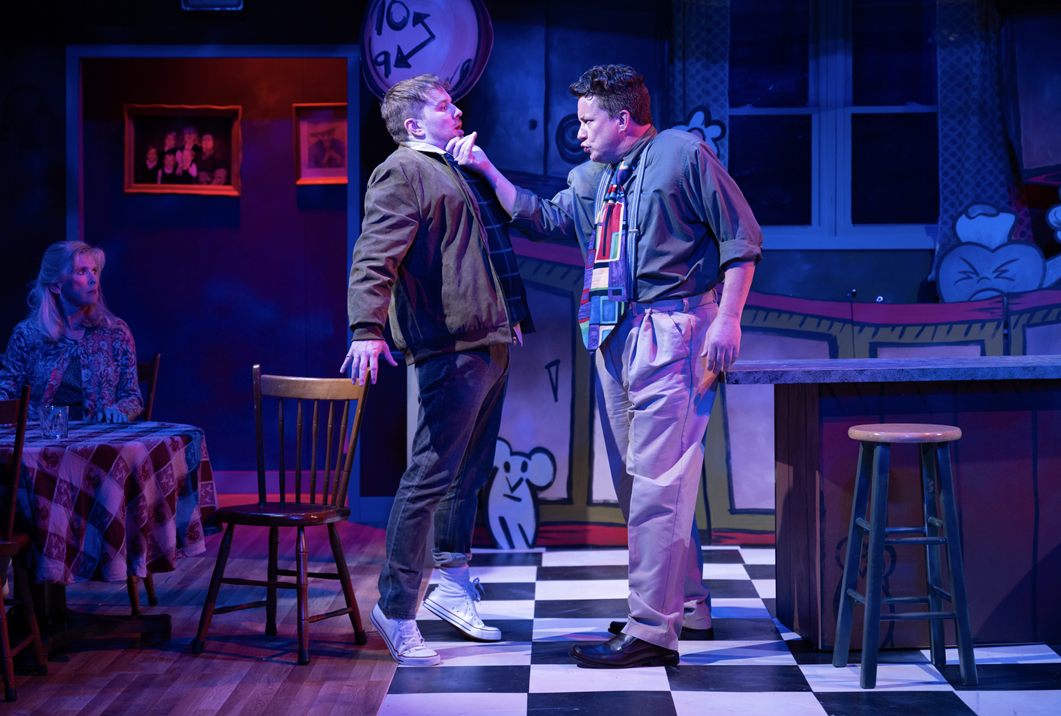
Roman À Clef is a family play, but not a family-friendly play. First, in English, the title means “novel with a key,” a French phrase for a literary device in which real people, places, and things are given fictitious names, blurring the line between reality and non-reality, fact and fantasy, fiction and non-fiction.  In Roman À Clef, a theater company rehearses a play that is about the fictitious playwright’s real family. But, one wonders, how much is based on reality?

Sharon Ott ably directed the three-acts of shenanigans, all of which were executed by a stellar cast. Andrew Bryce, in his Firehouse debut, leads the ensemble as Jack, the director of the fictional play, whose work blurs the line between fact and fiction and creates new perspectives and reveals new dimensions of family trauma. eventually – inevitably?—it is revealed that the reason Jack’s cast can never satisfy his unattainable demands is because he has not yet put to rest his own demons. Even the title of Jack’s play, Apple, Tree: Far From, Not is a pretentious portent of things to come.

Among the well-cast cast members of the play-within-a-play and Jack’s family are a mix of familiar and new faces: newcomer Reese Bucher, Lukas D’errico (Firehouse debut), Richmond newcomer Alex Harris, Tippi Hart (a VCU professor of theater movement in her first full Firehouse production), Keaton Hillman, Kelli Kennedy, Donna Marie Miller, Landon Nagel, and Tatjana Shields (Firehouse debut).

While this was a true ensemble, there were a few who stood out to me. Reese Bucher as Spawn, a newcomer in the character she played as well as on this stage, brought a genuine freshness and energy that that exploded off the stage and landed like glitter on her cast-mates. Likewise, Keaton Hillman in the role of McKnight, whom I’ve had the pleasure of watching develop as a theater artist on various Richmond stages over the years, gave a seamless performance in a role that seemed to have been written expressly with him in mind. Not to mention, seeing his lanky frame rocking bootie shorts and a propeller beanie was hilarious.

There were also some striking performances from the ranks of the more seasoned cast members. Kelly Kennedy strikes an interesting balance between frailty and perseverance, equal parts victim and victor as Jack’s mother Lois. Tippi Hart as the stage version of Jack’s mother, Queenie, is lovable but confused, looking kind of like a drag queen in the early stages of dementia. And Donna Marie Miller convincingly plays Jack’s sister Fiona as the family conciliator, the one who tries to smooth things over at all costs.

The problem is, there is no smoothing over the family trauma that fuels Jack’s family and bleeds into his present. The masks we wear are symbolically represented in Chris Raintree’s stunning set. It starts off as a cartoon caricature of a home, centered around the kitchen – the metaphorical heart of every home. In act two, the mask is removed to reveal the real kitchen of Jack’s childhood home, and begins to cover the source of his family’s dysfunction. Hubbard calls this act “A Family Home (without a family). For the third act, the mask is returned, but there are cracks in it, and bits of reality peak through. This is “A Performance, A Reckoning. All of it. All together. Now.”

And that title pretty much sums it up. There isn’t much more to say, other than: Hubbard has created a masterful piece of theater. His words tell hard stories with beauty, and humor, and truth. Roman À Clef  is immersive; details matter, from the script to the costumes to the set to the character’s names (e.g., McKnight, Bishop, Queenie, Kingston, Spawn, Rookie). Sharon Ott’s direction tapped into the trauma and helped dissipate the energy in a way that made it palatable for an audience, the ensemble appeared to be committed to the work, and Chris Raintree’s set design captivated us in ways that words alone could not convey. Chandler Hubbard’s Roman À Clef manages to tap into areas many shy away from, and makes us glad he went there – and invited us to join him.

———-

Julinda D. Lewis is a dancer, teacher, and writer who was born in Brooklyn, NY and now lives in Eastern Henrico County. When not writing about theater, she teaches dance history at VCU and low impact dance fitness classes to seasoned movers like herself, and occasionally performs.

———-

ROMAN À CLEF

A World Premiere by Chandler Hubbard

Directed by Sharon Ott

May 8-26, 2024

Time: Here and Now

Place: Firehouse Theatre

Act I – A Rehearsal.

Act II – A Family Home (without a family).

Act III – A Performance. A Reckoning. All of it. All together. Now.

Roman À Clef is a product of the TNT New Play Incubator.

CAST

Jack                …………………….               Andrew Bryce

Mike               …………………….               Alex Harris

Lois                 …………………….               Kelly Kennedy

Fiona              …………………….               Donna Marie Miller

McKnight       …………………….               Keaton Hillman

Bishop            …………………….               Tatjana Shields

Queenie        …………………….               Tippi Hart

Kingston        …………………….               Landon Nagel

Spawn            …………………….               Reese Bucher

Rookie           …………………….               Lukas D/Errico

Mike/Kingston u/s      …………..               Patrick Rooney

Lois u/s          …………………….               Gina Marie McKenzie

Fiona/Queenie u/s  …………….               Rachel Garmon

Bishop/Spawn u/s   …………….               Kylee Marquez-Downie

Rookie u/s     …………………….               Aidan Campbell

McKnight u/s            …………….               Evan Kagarise

Jack u/s         …………………….               Thomas Kaupish

PRODUCTION TEAM

Direction                               ……….           Sharon Ott

Assistant Direction              ……….           Molly Marsh

Scenic Design                       ……….           Chris Raintree

Assistant Scenic Design     ……….           Sarah Cook

Costume Design                  ……….           Cora Delbridge

Lighting Design                   ……….           BJ Wilkinson

Assistant Lighting Design  ……….           Reid Hardymon

Sound Design                      ……….           Kyle Epps

Intimacy/Fight Direction    ……….           Stephanie Hart

Movement Direction           ……….           Nathaniel Shaw

Developmental Dramaturgy     ….           Naysan Mojgani

Stage Management            ……….           Emily Vial

Asst. State Management    ……….           Juliet Grace Grochowski

RUN TIME

90 minutes with two intermissions

PERFORMANCE SCHEDULE

  • Previews Wednesday – Thursday, May 8-9 at 7:30pm
  • Opening Night – Friday, May 10 at 7:30pm
  • Running Thursday – Sunday through May 26, 2024

TICKETS

$35

$15 tickets available for college and high school students.

Pay-What-You-Will performances offered for both preview performances,

as well as all matinees (excluding closing, May 26th).

Photos by Bill Sigafoos

One-Time
Monthly
Yearly

Make a one-time donation
to help keep RVART REVIEW ALIVE

Make a monthly donation

Make a yearly donation

Choose an amount

$5.00
$15.00
$100.00
$5.00
$15.00
$100.00
$5.00
$15.00
$100.00

Or enter a custom amount

$

Your contribution is appreciated.

Your contribution is appreciated.

Your contribution is appreciated.

DonateDonate monthlyDonate yearly
BORN WITH TEETH

Words Matter

A Theater Review of an East Coast Premiere by Julinda D. Lewis

By: Richmond Shakespeare

At: Gottwald Playhouse at Dominion Energy Center, 600 E. Grace St., Richmond, VA 23219

Performances: January 25 – February 11, 2024

Ticket Prices: $20 – $45

Info: (804) 340-0115 or http://www.richmondshakespeare.org

Death and life are in the power of the tongue…  – Proverbs 18:21

The time is the late 1590s. The place is a private room in a London tavern. The political climate is volatile – an authoritarian regime is in charge, freedom of speech does not exist, heretics and atheists – and apparently Catholics – are tortured and killed. A plague was ravaging society – the Black Death – a pandemic that killed thousands, causing the collapse of what little social structure remained after the political purge, leaving fields unplowed, and little to eat.

There are more spies than crimes to spy out. – BWT

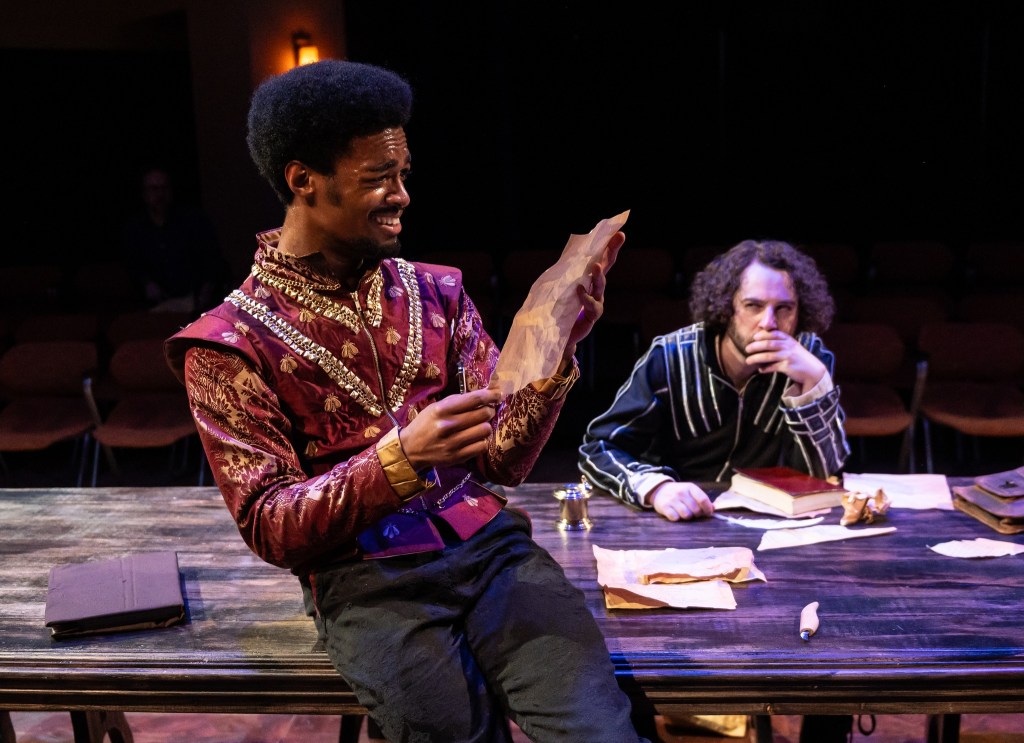
This is where playwright Liz Duffy Adams saw fit to open up a voyeuristic window into the world of two writers – the well-established Christopher “Kit” Marlowe (Avery Michael Johnson) and the upstart William Shakespeare (James Murphy) – as they meet in the private back room of a pub to collaborate on a series of historic plays. But this collaboration is a contentious literary partnership, rife with jealousy, political unrest, and rumors of espionage, religious persecution, and sexual tension. This collaboration is Born With Teeth.

We are subjects, not citizens. – BWT

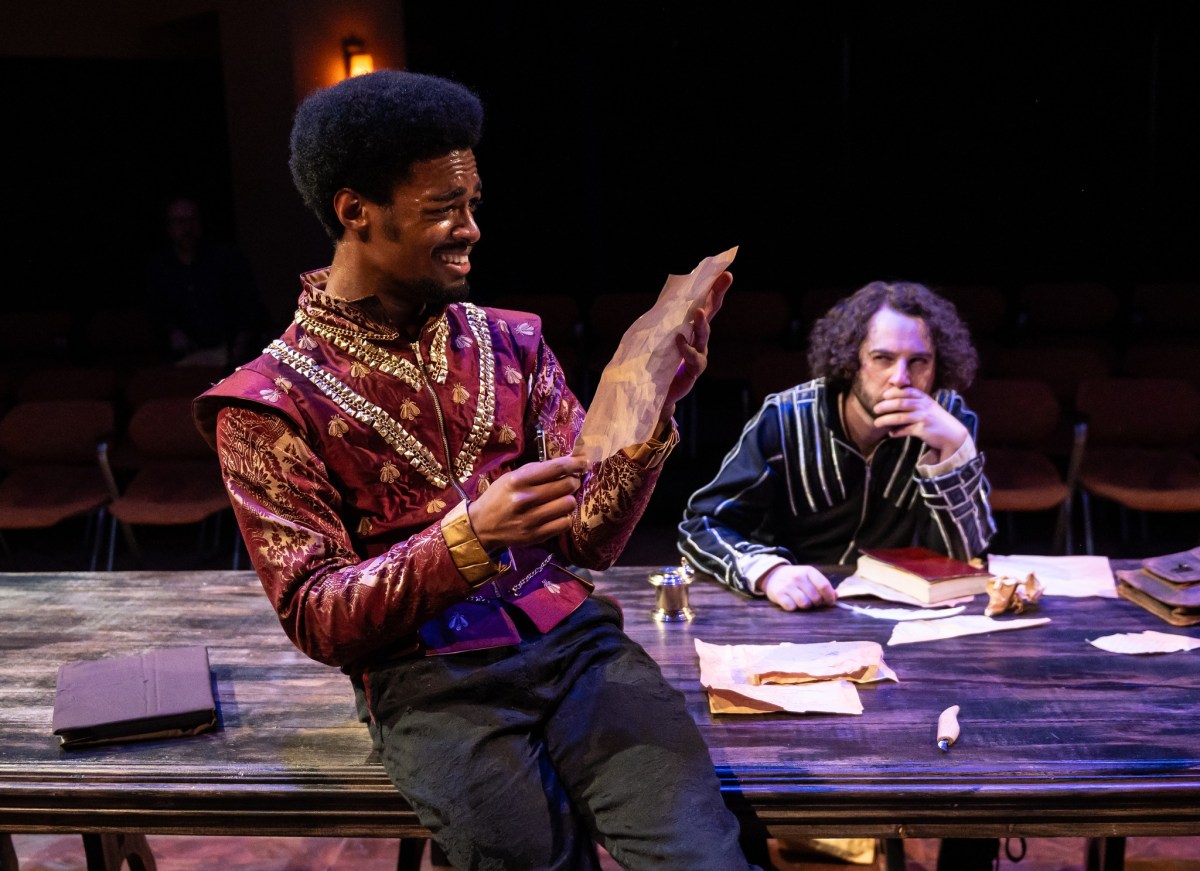
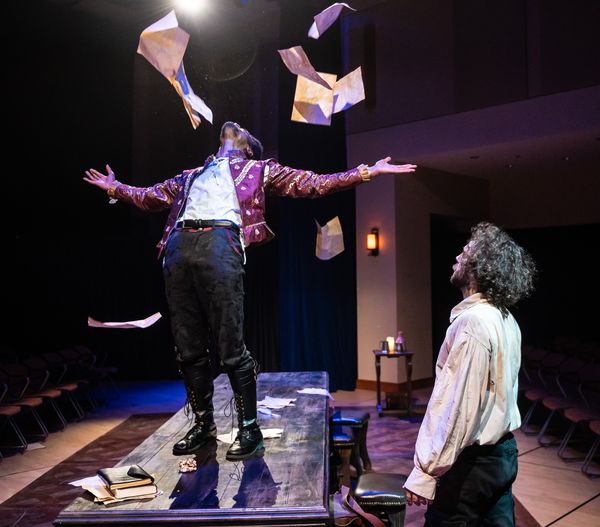
The flexible space of the Gottwald Theatre has been transformed for this occasion. A long (perhaps 12’?) table dominates the room, slashing diagonally through the space. It is placed on a sturdy parquet floor, and surrounded by 10 leather topped rectangular stools. The audience is seated on either side of the table, close enough for the first row to be showered by scattered sheets of paper during the two playwrights’ scuffles. This awesome set was designed and constructed by W. Reed West III.

You are so much stupider than you look; how is that possible? – BWT

William Shakespeare and Christopher Marlowe did indeed collaborate on the Henry VI trilogy, Parts I, II, and III, Marlow was stabbed to death in the summer of 1593. But much of the relationship between Shakespeare and Marlowe – both their authorship and personal  – is a matter of speculation and mystery. So that raises the question, how much of Born With Teeth is historical clarification, and how much is pure fantasy? And given the truths expressed and exposed of human interaction – oppression, suppression, persecution, ego, love – does the former question matter?

Worse than nowhere is somewhere you don’t want to be. – BWT

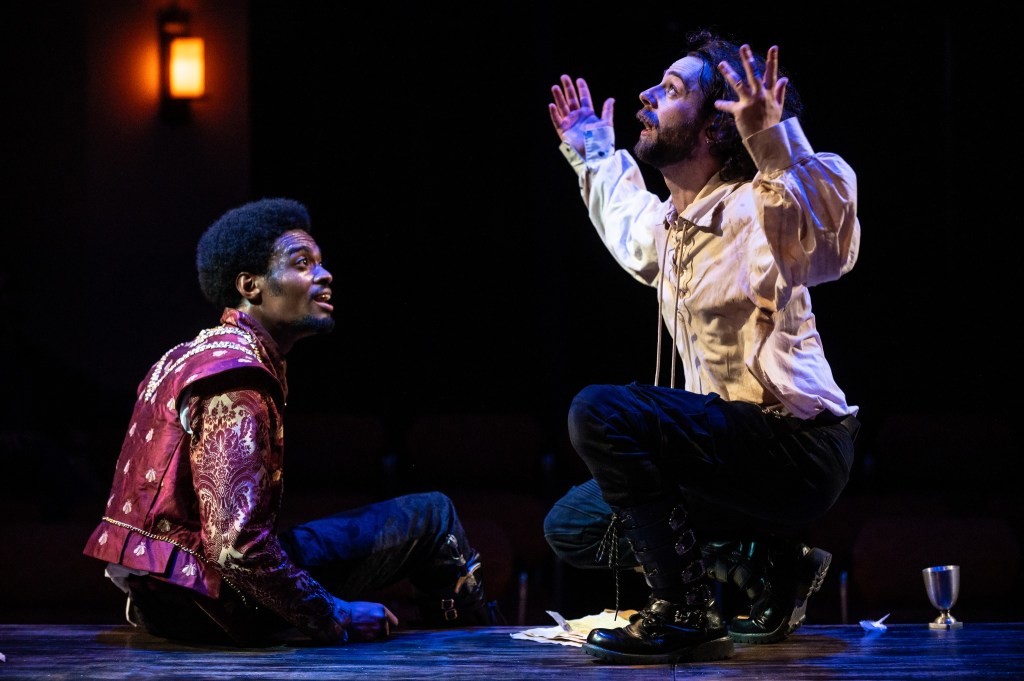
Avery Michael Johnson and James Murphy literally burst onstage, and give us a solid 90 minutes of drama, melodrama, angst, bravado, fear, backstabbing, lust, equivocation, love, revelation, caution, optimism, conciliation, espionage, and more. Born With Teeth is loud, frightening, and funny – sometimes all at once. Marlowe denigrates the upstart Shakespeare, until he reads a page or two of the play they’re working on and realizes that Shakespeare can, indeed, write. But at a time when there is not such thing as freedom of speech or religion, words can cut more sharply that a sword, and speech can be the currency of life or death.

I don’t deny God, I just don’t like him very much. – BWT

Murphy plays the role of Shakespeare with a bit of caution, much more reserved than his more outgoing and outrageous counterpart who may, in turn, be overly confident in the sovereignty of his benefactor. Johnson’s Marlowe never walks but strides. He stomps about in his tall boots – there’s a knife strapped into the right one – he leaps from the floor to the top of the table and lands on the tabletop, the floor, or Shakespeare like a cross between a  pouncing panther and a WWE wrestler. Sitting in the front row, I could see each bead of sweat on Johnson’s brow and distinctly hear the intake of breath when he rapaciously sniffed Murphy. Born With Teeth is a physically demanding play, fueled by quick dialogue that is alternately witty, cutting, and always demanding. It isn’t Shakespeare, but it is the essence of Shakespeare. It isn’t classical, but it is archetypal. It isn’t orthodox, but it does all the things you want live theatre to do.

—–

Julinda D. Lewis is a dancer, teacher, and writer who was born in Brooklyn, NY and now lives in Eastern Henrico County. When not writing about theater, she teaches dance history at VCU and low impact dance fitness classes to seasoned movers like herself, and occasionally performs.

—–

BORN WITH TEETH

by Liz Duffy Adams

Directed by Andrew Gall

Cast

Kit                   ……………    Avery Michael Johnson

Will                 ……………    James Murphy

Production & Design Team

Artistic Director          …….   James Ricks

Managing Director    …….   Jase Smith Sullivan

Playwright                   …….   Liz Duffy Adams

Director                       …….   Andrew Gall

Stage Manager            …….   MariaElisa Costa

Assistant Stage Manager …   Kiari Hicks

Costume Design          …….   Anna Bialkowski

Intimacy Choreographer  …   Lucinda McDermott

Lighting Design          …….   Tristan Ketcham

Set Design                   …….   W. Reed West III

Sound Design              …….   James Ricks

Run Time: About 90 minutes; no intermission

Content Disclosure: This production contains mature themes, strong language, & sexual/suggestive content.

———-

Photo Credits: Promotional Video by Eric Hackler & Photos from Richmond Shakespeare Facebook

https://www.facebook.com/watch/?v=1088997112419759

One-Time
Monthly
Yearly

Make a donation to support
rvart review

Make a monthly donation

Make a yearly donation

Choose an amount

$5.00
$15.00
$100.00
$5.00
$15.00
$100.00
$5.00
$15.00
$100.00

Or enter a custom amount

$

Your contribution is appreciated. Thank you!

Your contribution is appreciated.

Your contribution is appreciated.

DonateDonate monthlyDonate yearly
FIRST RESPONSES

A Festival of World Premiers Written by First Responders

FIRST RESPONSES

A Festival of One-Act World Premieres by First Responders

A Theater Review by Julinda D. Lewis

At: The Firehouse 1609 West Broad St., Richmond, RVA 23220

Performances: March 23 – April 15, 2023

Ticket Prices: $35 general admission, $20 students

Info: (804) 355-2001 or firehousetheatre.org.

Following the model set by War in Pieces, the 2021 festival of one-act plays written by military veterans, the focus of FIRST RESPONSES is the real-life front line experiences of four first responders. Kathryn Kahlson is a retired Captain from Chesterfield Fire & Emergency Services; Captain Anthony Jackson is Commander of the Richmond Police Department’s First Precinct; Benjamin Toderico served 18 years with the Richmond Police Department in uniform, as a Detective, and on the SWAT team; and Betty Migliaccio has been a firefighter for the past 10 years. Migliaccio and Jackson are founding members of the Frontline Writers group, a non-profit organization founded in 2020 “to provide those who serve our community — firefighters, police officers, and emergency medical technicians —  intensive instruction in the art and craft of the narrative so that their experiences may be known, shared, and archived.” Classes are taught by founding board member and New York Times best-selling author David L. Robbins. The stories that are developed into plays are edited and reworked and brought to life onstage with minimal production elements – a few simple cubes, costumes, and lighting.

Mother at Work, written by Kathryn Kahlson and directed by Amy Berlin, is a tale of two mothers – a first responder and the young mother she encounters on an emergency call. How do you tell someone their baby is dead – and how do you deny them the opportunity to hold their baby one last time? Kahlson shared that first responders talk it out with their coworkers, sometimes for a week or longer, but this particular call hit so close to home it took her 10 years to process the encounter. To help actor Lindsey June get into the role of Kahlson, the author allowed June to wear her work boots.

Something So Small, by Anthony Jackson, pulls the audience along into an eerie portal of time travel where a crime scene investigation at a drug house allows the victims to be witnesses to their own demise. I only fully understood this cool plot twist by staying for the post-show talk-back. I’m not sure if it was my own lack of imagination or if the play could have made this less ambiguous – or perhaps a bit of both.  

In Pillar Benjamin Toderico takes up to the top of a bridge where a young man contemplates suicide. For this, the actors took a field trip to the site, where they experienced the climb, the swaying, the wind, and the cold.

Finally, in Eight Buttons, Betty Migliaccio paid homage to her colleague, Richmond firefighter Lt. Ashley Berry who was killed on Thanksgiving Day 2019 while shielding one of her children from gunfire – the result of a drive-by shooting. For me, this was the most touching story, not just because it was a familiar news story, but because of the tenderness embodied in the simple act of Amanda Spellman (as Betty) sitting and sewing the gold buttons signifying her newly earned rank that Lt. Berry had not yet had time to sew on before her untimely death. That, and the respectful salute that ended the scene and the show encapsulated the unspoken and unspeakable that these writers have been able to express through their stories.

A diverse ensemble of familiar and new faces portrayed all the roles in these four one-act plays, directed by four different directors. The actors – Briana Creque, Dwayne Daniels II, Keydron Dunn,  Enrique J.. Gonzales, Lindsey June, Jimmy Mello, Lorin Mello, David Rogozenski, and Amanda Spellman – seemed to step into the shoes of some of their characters more easily than others. One female officer, played by Creque, for example, seemed to move with an unnatural stiffness (but take note that she only recently completed her first role at VCU where she is a student in the drama department) while Jimmy Mello’s portrayal of the bridge jumper was uncannily authentic. Lorin Mello, with key roles in Mother at Work, Something So Small, and Pillar appeared to have mastered some of the most stressful of roles and high-strung characters with precision. I look forward to seeing more of June and Spellman, both of whom made their RVA debuts in First Responses. Anthony Jackson personally commended Dwayne Daniels II, commenting that Daniels played the role of Jackson in Something So Small better than he plays himself.

Producing four one-act plays by four novice playwrights – even with minimal production elements – is no mean feat. I believe in his pre-show curtain speech Producing Artistic Director Joel Bassin said there were no less than 27 artists involved in the making of this show, running approximately two hours, with one intermission. So, kudos to the four directors – Amy Berlin (Mother at Work), Mark J. Lerman (Something So Small), Andrew Gall (Pillar), and Lian-Marie Holmes Munro (Eight Buttons), as well as Anna Bialkowski (Costumes), Andrew Bonniwell (Lighting), Kate Statelman (Composer), Todd Labelle (Production Design), and the rest of the creative team for another interesting and insightful production of new and (mostly) compelling theater.

———-

Julinda D. Lewis is a dancer, teacher, and writer who was born in Brooklyn, NY and now lives in Eastern Henrico County.

———-

FIRST RESPONSES Festival

new plays by Anthony Jackson, Kathryn Kahlson, Betty Migliaccio, and Ben Toderico

March 23-April 15, 2023

Performer Ensemble:

Briana Creque

Dwayne Daniels II

Keydron Dunn

Enrique J. Gonzalez

Lindsey June

Jimmy Mello

Lorin Mello

David Rogozenski

Amanda Spellman

Production Team:

Amy Berlin, Andrew Gall, Mark Lerman, Lian-Marie Holmes Munro – Directors

David Robbins – Dramaturg/Co-Producer

Emily Vial – Festival Coordinator

Todd LaBelle – Production Designer

Kate Statelman – Composer

Andrew Bonniwell – Lighting Designer

Anna Bialkowski – Costume Designer

Colin Lowrey II – Costume Assistant

Jake Buccella – Dramaturg/Assistant Director

Jae Austin, Dennis Bowe, Aleta Findlay, Emily Vial – Stage Managers

Performance Schedule:

ALL 4 PLAYS ARE PERFORMED EVERY PERFORMANCE

THERE WILL BE A TALKBACK AFTER EVERY PERFORMANCE

Wed March 22 @ 7:30pm (preview)

Thu March 23 @ 7:30pm (preview)

Fri March 24 @ 7:30pm (preview)

Sat March 25 @ 7:30pm (opening)

Thu March 30 @ 7:30pm

Fri March 31 @ 7:30pm

Sat April 1 @ 7:30pm

Sun April 2 @ 3pm

Thu April 6 @ 7:30pm

Fri April 7 @ 7:30pm

Sat April 8 @ 7:30pm

Thu April 13 @ 7:30pm

Fri April 14 @ 7:30pm

Sat April 15 @ 7:30pm

Sun April 16 @ 7:30pm

Tickets: $35 general admission

Photos by Bill Sigafoos

One-Time
Monthly
Yearly

your donations support the continued publication of rvart review

Make a monthly donation

Make a yearly donation

Choose an amount

¤5.00
¤15.00
¤100.00
¤5.00
¤15.00
¤100.00
¤5.00
¤15.00
¤100.00

Or enter a custom amount

¤

Your contribution is appreciated. Thank you!

Your contribution is appreciated.

Your contribution is appreciated.

DonateDonate monthlyDonate yearly
RICHMOND BALLET STUDIO THREE

Richmond Ballet Presents the 15th New Works Festival

A Dance Review

By: The Richmond Ballet

At: Studio Theatre at Richmond Ballet, 407 East Canal Street, RVA 23219

Performances: March 21 – 26, 2023

Ticket Prices: $26 – $51  ($71 – $106 for Choreographer’s Club on Opening Night, March 21)

Info: (804) 344-0906 x224, etix.com, or richmondballet.com

THE PROGRAM

FLIGHT

Choreography by Nancy Paradis

Music by Peter Kater

Costume Design by Emily Morgan

Lighting Design by Nathan W. Scheuer

World Premiere: March 21, 2023, Richmond Ballet Studio, Richmond, VA

LOST KEYS

Choreography by Claudia Schreier

Music by Christopher Cerrone

Costume Design by Emily Morgan

Lighting Design by Nathan W. Scheuer

Courtney Collier Zacchaeus Page

World Premiere: March 21, 2023, Richmond Ballet Studio Richmond, VA

BIRD’S-EYE VIEW

Choreography by Norbert De La Cruz III

Music by Lara Somogyi, Riopy, and Ashram

Costume Design by Emily Morgan

Lighting Design by Nathan W. Scheuer

World Premiere: March 21, 2023, Richmond Ballet Studio, Richmond, VA

FADING CREATURES

Choreography by Yury Yanowsky

Music by Senking

Costume Design by Emily Morgan

Lighting Design by Nathan W. Scheuer

World Premiere: March 21, 2023, Richmond Ballet Studio, Richmond, VA

The Richmond Ballet started the New Works Festival 15 years ago, in 2008.  The company’s Associate Artistic Director, Ma Cong, introduced Ershter Vals, his first work for Richmond Ballet during the 2009 New Works Festival.

This year, four choreographers, new to the Richmond Ballet, were each given 25 hours of creative time with the company. At the end of  25 hours, they give birth to a new work, a 10-15 minute  sketch or work-in-progress. This  year, the honor went to Norbert  De La Cruz III, Nancy Paradis (who  was an original member of the Richmond Ballet), Claude Schreier, and Yury Yanowsky.

Paradis’s process includes writing, listening to music at different times of the day – and night – and creating mind maps. Her structure translates into beautifully layered movement. FLIGHT manages to place five couples into three movements  (“Wings,” “Wounded,” and “Flight”) in under 12 minutes – 12 luxurious, unhurried minutes.  The  men’s arms spread across the stage like wings. The blues and grays of the costumes are reminiscent of different stages and levels of the sky, while the subtle pink and purple of the back wall suggests the sunrise or sunset. The middle section could be interpreted as introducing aggression or conflict, making one wonder the nature  and origin of the wounds. But then comes the final “Flight” section with hints of jazz – hitch kicks, sassy walks, swinging hips all make you want more.

Claudie Schreier’s LOST  KEYS is set to a score by Christopher Cerrone, “Hoyt-Schermerhorn,” named for a Brooklyn subway station where I spent many hours of my youth waiting for the train. Dressed in unadorned body suits – nude or tan for the woman and putty for the man – the dancers performed a mesmerizing duet of contemporary movement  against a background of piano and electronic jingles and jangles.  LOST KEYS breaks with tradition and the usual expectations of ballet. The woman, instead of rising lightly into a  lift, giving the appearance of weightlessness, instead adopts a dead weight and stares her partner down from above. The man swings his partner by her arms like a little child, and sometimes holds her in a broken pose. Schreier seeks to create architecture on stage and to pursue emotion through architecture. I find this intriguing, and it raises many questions. Are the “lost keys” the keys to someone’s heart? The piano keys? Are they symbolic of letting go and starting over? Are they metaphors for love, health, and wealth or a shifting of power and authority?

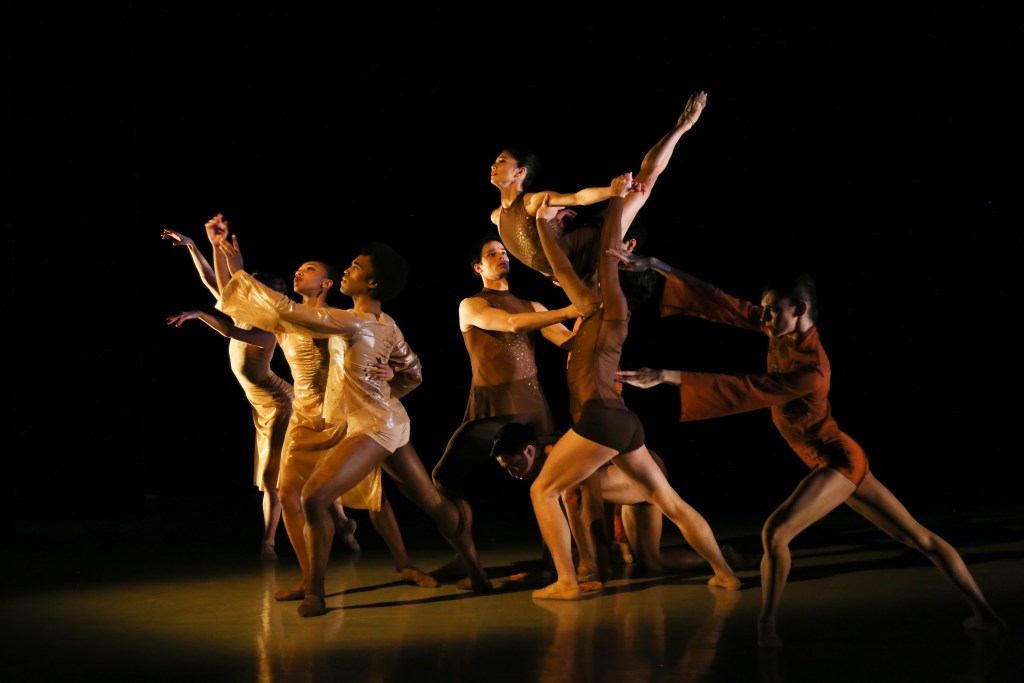
Philippine born, Los Angeles raised, and Juilliard educated Norbert De La Cruz III considers BIRD’S EYE VIEW  a choreographic response to where he is in life right now. The opening view is of the dancers stacked and arranged  in the  shape of a tree, with dancers perched among the branches. The 9 dancers are layered in some way throughout the dance as when there are two in front with a line moving across the back like a Greek chorus crossing upstage. The dancers are attired in shades of rust, brown, and gold. Each two-piece outfit is in a different style, some with bell sleeves, others sleeveless. The movement is shaped with an almost mathematical precision, emitting strong sensations of algebraic formulae and geometric configurations. The interweaving of bodies, arms, legs set against the meditative flow of the music supports a journey, the passage of time. The movement soars and spirals, a juxtaposition of pattern and form, structure versus free flow – or what De La Cruz refers to as “volume” and “texture.” At the end the dancers are faced away from the audience, uplifted, ready. The work is absolutely beautiful.

The final new work, Yury Yanowsky’s FADING CREATURES, was inspired by Salvador Dali’s melting clocks. It is a work of time and space. The music is a collection of mechanical pulsations, while the dancers’ movements  are off center, filled with slides – not slick or graceful dancer’s slides, but slide-across-the-floor-in-your-socks slides. Yanowsky likes to paint, and sees his dancers as a canvas. He uses them to paint stunning pictures in time and space.

What a successful New Works Festival. Each work was different in content and style. Each was stunning in its own way. Each challenged the dancers and the audience. Bravo! Let’s hope we see more of these choreographers in the future.

———-

Julinda D. Lewis is a dancer, teacher, and writer who was born in Brooklyn, NY and now lives in Eastern Henrico County.

———-

Tickets start at $25. Visit etix.com or call the Richmond Ballet Box Office at 804.344.0906 x224.

Photos by Sarah Ferguson.

———-

One-Time
Monthly
Yearly

Your donation helps
RVArt Review survive.

Make a monthly donation

Make a yearly donation

Choose an amount

¤5.00
¤15.00
¤100.00
¤5.00
¤15.00
¤100.00
¤5.00
¤15.00
¤100.00

Or enter a custom amount

¤

Your contribution is appreciated.

Your contribution is appreciated.

Your contribution is appreciated.

DonateDonate monthlyDonate yearly
AFTER DECEMBER

You Don’t Know Because You Don’t Know

A Theater Review by Julinda D. Lewis

At: The November Theatre, 114 West Broad Street, RVA 23220

Performances: March 3 – 26, 2023

Ticket Prices: $39-$59. (Discounted group rates and rush tickets available)

Info: (804) 282-2620 or www.virginiarep.org

If you’re looking for something traditional and familiar, this ain’t it! If, on the other hand, you’re in the mood for something daringly different and astonishingly beautiful, then you’ve found your play. In Bo Wilson’s new sci-fi thriller fantasy, AFTER DECEMBER, particle collider meets poet. It’s big bang theory meets magic mushrooms. It’s fabulously refreshing. And, if you must relate it to something familiar, it makes allegorical statements about such topics as government and discrimination and the relative value of art versus science.

AFTER DECEMBER is an immersive theatrical experience. Set in a secret government facility that conducts experiments with particle reactors, the cave-like underground atmosphere created by Tennessee Dixon (Scenic and Projection Designer) extends from the stage to the audience.  BJ Wilkinson’s phenomenal lighting includes tubes of lighting around the balcony and even above the very last rows of seats, and Dixon’s multi-screen projections accompanied by Joey Luck’s sound design virtually surround the audience. Dixon has really outdone herself yet all of this technology does not diminish Wilson’s story or the words, rather it enhances the play. (I’m almost certain that if Dixon had figured out a way to make us feel the earthquake tremors it would have been done.)

The function of this facility is so secretive that even the staff can’t explain what they do. So, a malfunction in the particle collider machinery precipitates a major crisis, resulting in a temporary shutdown, but even more concerning is the sudden appearance of a mysterious woman. She doesn’t remember anything other than her name, December, and that she is a poet. How she ended up, naked, in a secret government facility two miles underground is a bit of a problem for her and the manager of the facility, Evan Garth (Jeffrey Cole) and his Machiavellian superior, Maria Staslaw (Susan Sanford).

Bianca Bryan, as the mysterious December, speaks in an oddly cadenced almost robotic voice, The imperious voice, stiff posture, and sometimes flaccid stance with both arms hanging loosely at the sides, interrupted occasionally by a lotus petal hand gesture all support the proposition that December may be something less than – or more than – human. She does, after all, appear to have superpowers, not the least of which is that when she speaks her poems aloud, they “happen” – changes occur in the physical environment and in the people around her. As disturbing as her presence may be, it also seems to be an impetus for the physicists to explore their hidden creative sides.

The facility’s Physician’s Assistant, Christine Keeler (Patricia Austin) is the first to soften, seeming to find inspiration in December’s differentness. Next to develop a relationship with December is Garth; December seems to bring out repressed feelings and memories that bring balance to his scientific mind. Nat Carroll (Andrew Firda) wasn’t as hard a nut to crack; he was already starting to write a novel when we first meet him. His partner, Marten Root (Andrew Etheridge) is all about the business of math until he hears the poem December has created specifically for him. He then reveals unmined depths of emotion. The only one who seems unchanged by December is Staslaw (Sanford). Could it be that she knows more about this than she lets on?

One can only imagine the creative and collaborative process that occurred between director Rick Hammerly, designers Tennessee Dixon, BJ Wilkinson, and Joey Luck, and the cast members. Precise timing was needed to successfully execute the wrinkles in time and other effects. The result was one of the most amazing and delightfully surprising evenings I’ve spent in the theater – ever.

Kudos to the cast and design team – including Sue Griffin for her neutral tunics that straddled the line between primitive and futuristic and provided a blank palate for the colorful lighting effects.  Etheridge and Firda provided most of the comedy, with Etheridge acting as straight man to Firda’s more lighthearted role. Bryan was a powerful presence who nonetheless elicited empathy which was freely offered by the characters played by Austin and Coles. Susan Sanford remained unmoved – unless you count a downward spiral with a singularly cruel act towards Etheridge’s gentle nerd.

Is the important stuff that matters what happens after December arrives, or after December leaves? Or is the important stuff that matters in the power of December’s (i.e., Wilson’s) words? See it and decide for yourself – I’d love to hear what you think about AFTER DECEMBER.

Julinda D. Lewis is a dancer, teacher, and writer who was born in Brooklyn, NY and now lives in Eastern Henrico County.

AFTER DECEMBER

A New Play By Bo Wilson

Directed by Rick Hammerly

Cast

Christine Keeler ………………..   Patricia Austin

December …………………………   Bianca Bryan

Evan Garth  ………………………    Jeffrey Cole

Marten Root …………………….   Andrew Etheredge

Nat Carroll (Evan Garth u/s)   Andrew Firda

Nat Carroll u/s ………………….   Joshua Mullins

Maria Staslaw ………………….    Susan Sanford

Direction & Design

Direction  ………………………….   Rick Hammerly

Scenic & Projection Design..   Tennessee Dixon

Costume Design ……………….   Sue Griffin

Lighting Design …………………   BJ Wilkinson

Sound Design …………………..   Joey Luck

Stage Management….………..  Justin Janke

Assistant Stage Managers …   MariaElisa Costa, Leica Long

Ticket Information

Box Office: (804) 282-2620

http://www.virginiarep.org

Tickets range from $39 – $59

Discounted Group Rates and Rush tickets are available.

Run Time

The play runs 1 hour 45 minutes, including one 15-minute intermission.

Discounted Group Rates and Rush tickets available.

Photo Credits: Aaron Sutten

VA-REP Covid Safety Statement

Virginia Rep encourages wearing masks for our patrons’ safety, but we do not require that you wear a mask in our lobbies or within the theatres. They are now optional.

We continue to follow CDC guidelines and local risk levels. All Virginia Rep staff will continue to wear masks while serving you.

One-Time
Monthly
Yearly

Make a donation to support the
publication of rvart review

Make a monthly donation

Make a yearly donation

Choose an amount

¤5.00
¤15.00
¤100.00
¤5.00
¤15.00
¤100.00
¤5.00
¤15.00
¤100.00

Or enter a custom amount

¤

Your contribution is appreciated.

Your contribution is appreciated.

Your contribution is appreciated.

Donate hereDonate hereDonate here

FIREBIRD with SERENADE

Richmond Ballet Presents a Balanchine Classic & an East Coast Premiere

In the Battle of Classic vs Contemporary, Everyone Wins

A Dance Review by Julinda D. Lewis

By: The Richmond Ballet with the Richmond Symphony

At: Dominion Energy Center’s Carpenter Theatre, 600 E. Grace St., RVA 23219

Performances: February 17-19, 2022 at 7:00 PM

Ticket Prices: $25 – $130

Info: (804) 344-0906, etix.com, or richmondballet.com

THE PROGRAM

Serenade

Choreography by George Balanchine

Music by Peter Ilyick Tchaikovsky

Staging by Jerri Kumery

Costume Design by Karinska

Lighting Design by Ronald Bates

Lighting Supervision by Joseph R. Walls

World Premiere: March 1, 1935, Adelphi Theatre, NYC

Richmond Ballet Premiere: February 10, 1990, Norfolk Center Theater, Norfolk, VA

Firebird

Choreography by Ma Cong

Music by Igor Stravinsky

Scenic and Costume Design by Emma Kingsbury

Lighting Design by David Finn

Lighting Supervision by Joseph R. Walls

World Premiere: February 14, 2020, Bass Performance Hall, Fort Worth, TX

Richmond Ballet Premiere: February 17, 2023, Dominion Energy Center, RVA

Preview: https://www.facebook.com/100063444205389/videos/480459615956932/

FIREBIRD, created by the Richmond Ballet’s Associate Artistic Director Ma Cong, is a magical blend of fairy tale, fantasy, drama, and dream. The ballet is set to Stravinsky’s beautiful score and set in a gorgeous environment that weds the classical with the contemporary. What at first appeared to be a museum – but I later found out was a garden – contained a swing suspended from the above, six life-sized “statues” that turned out to be six enchanted Princes, and a ginormous Faberge egg. Cong has taken the traditional Firebird story ballet – choreographed in 1910 by Michel Fokine for the Ballet Russes – and placed it in a more contemporary setting. 

There is still a hero (Prince Ivan, danced by Khaiyom Khojaev) – and, of course, an evil sorcerer (Koschei the Immortal, danced by Ira White). Cong has kept Fokine’s thirteen princesses, including Prince Ivan’s love interest (Tsarevna, danced by Eri Nishihara), and, of course, the magical Firebird (Cody Beaton). What is new is the context. Nishihara begins as a young woman in a swing, visiting the sculpture garden with her mother (Celeste Gaiera). While reading her favorite book, The Firebird fairy tale, she dozes off, and much like little Clara in The Nutcracker Ballet, finds herself the central figure in a dreamscape filled with magical creatures. Her Prince doubles as a Photographer in the sculpture garden, and instead of party guests, there are museum visitors. A dropped scarf is the talisman that links the two worlds.

Khojaev, the dashing young prince – handsome, lost, and sporting a quiver of bows – encounters the magical, mystical Firebird in an enchanted garden plucking golden apples from a magical tree. In exchange for her life, the Firebird plucks one of her red feathers and presents it to Ivan, to be used in case of an emergency that can only be resolved using magic. The encounter is one of the ballet’s few traditional features – a pas de deux of soaring leaps and spiralling runs marked by Beaton’s fabulously quirky arm movements. They part, and of course it is only a matter of time before Prince Ivan runs into the evil sorcerer Koschei who has enchanted thirteen beautiful princesses and turned to stone the six young princes who have attempted to rescue them.

White, as Koschei, reminds me of an ancient Japanese war lord (but wait, considering that Cong studied Chinese classical dance, let me revise that to an ancient Chinese warrior), and his minions are clad in black body suits with vaguely skeletal imprints on the spines – thoroughly embracing the role of malevolent sycophants as they scamper about the space. The choreography is a refreshing brew of ballet and contemporary movement, a contrast of soaring heights and scampering lows, classic lines and grounded enfolding. A friend likened the results to the subterfuge of The Wizard of Oz.

A battle ensues, requiring Prince Ivan to call upon the Firebird for assistance, and Koschei and the forces of evil are eventually overcome. The climax of the battle, however, involves one of the most explosive special effects I have ever seen in a ballet. Remember that Faberge egg I described earlier – and Ivan’s quiver of arrows? Well, this is where it all comes together. The egg – okay, so maybe not a Faberge egg, but you get the idea – is where Koschei had hidden his evil soul for safekeeping and the climax of the battle involves the destruction of the egg and all the evil it contains. What a stunning concept and even more spectacular execution!

In the final scene, the daughter (Nishihara) awakens, back in the safety and peace of the sculpture garden, where the exchange of the dropped scarf and a pointed glance are all that remain of the events that have just transpired.

The evening started and ended on a high note – with two ballets completely different in style and execution. The program started with a performance of George Balanchine’s Serenade (1934). Historically significant as the first Balanchine ballet created in America and one of the New York City Ballet’s signature works, the ballet began as a lesson in stage technique for student dancers and the choreography even incorporates ordinary rehearsal events, such as a dancer’s fall. But Serenade opens with one of the singularly more stunning moments of stillness ever choreographed.

The curtains parts on a sea of 17 women standing in complete stillness. Each has one arm lifted. When they all move their feet from parallel to an open first position. So simple. So basic. So beautiful. In spite of its simplicity, Serenade is not an easy ballet, and set against Tchaikovsky’s score on a bare stage, save for romantic lighting, it remains a favorite for balletomanes and novices alike.

No disappointments, no complaints. Just a satisfying evening of beautiful ballet and memorable music, played live by the Richmond Symphony, conducted by Erin Freeman. Bravo.

One-Time
Monthly
Yearly

Make a one-time, monthly, or annual donation in support of
rvart review

Make a monthly donation

Make a yearly donation

Choose an amount

$5.00
$15.00
$100.00
$5.00
$15.00
$100.00
$5.00
$15.00
$100.00

Or enter a custom amount

$

Your contribution is appreciated.

Your contribution is appreciated.

Your contribution is appreciated.

Donate hereDonate hereDonate here