THE NORMAL HEART: The Provocative Chronicle of America’s Deadliest Plague

THE NORMAL HEART: The Provocative Chronicle of America’s Deadliest Plague

A Theater Review by Julinda D. Lewis

Richmond Triangle Players

At: The Robert B Moss Theatre, 1300 Altamont Avenue, RVA 23230

Performances: April 18-May 12, 2018

Ticket Prices: $10-30

Info: (804) 346-8113or rtriangle.org


I usually go to the theater without reading too much – if at all – about the show I am about to see. I don’t want to be influenced by others’ opinions. In the case of The Normal Heart, which opened Thursday night at Richmond Triangle Players’ Robert B. Moss Theatre after a Wednesday night preview, I was totally unprepared for the impact – direct and personal – Larry Kramer’s play would have on me.

Playwright Larry Kramer founded the Gay Men’s Health Crisis in New York in 1981 in response to the growing and alarming AIDS epidemic. That crisis, the “plague” of the title, is the foundation of this autobiographical recounting of one of the most terrifying episodes in American health history.

This is not a play that you go to for entertainment; it made me cry and it made me recall the names of people – friends and coworkers and teachers – I had not thought of in twenty or thirty years.

Jim Morgan plays the role of Ned Weeks, the confrontational founder of a gay men’s health organization, with passion and sincerity. Weeks is, unquestionably, an annoying character – even by his own reckoning – but he is fighting for people’s lives, including the life of his own lover. Chris Hester plays the role of Bruce Niles, Ned’s polar opposite who is elected president of the fledgling organization because of his more conservative stance. There is a great deal of dramatic tension between Morgan and Hester’s characters, but as Tommy Boatwright (played by Dan Cimo) points out – both are leaders, and both are needed. Cimo’s sassy character, who has a not-so-secret crush on Ned, provides some much-needed humor, but also comes through in a pinch when a level head and a shoulder to cry on are what’s needed.

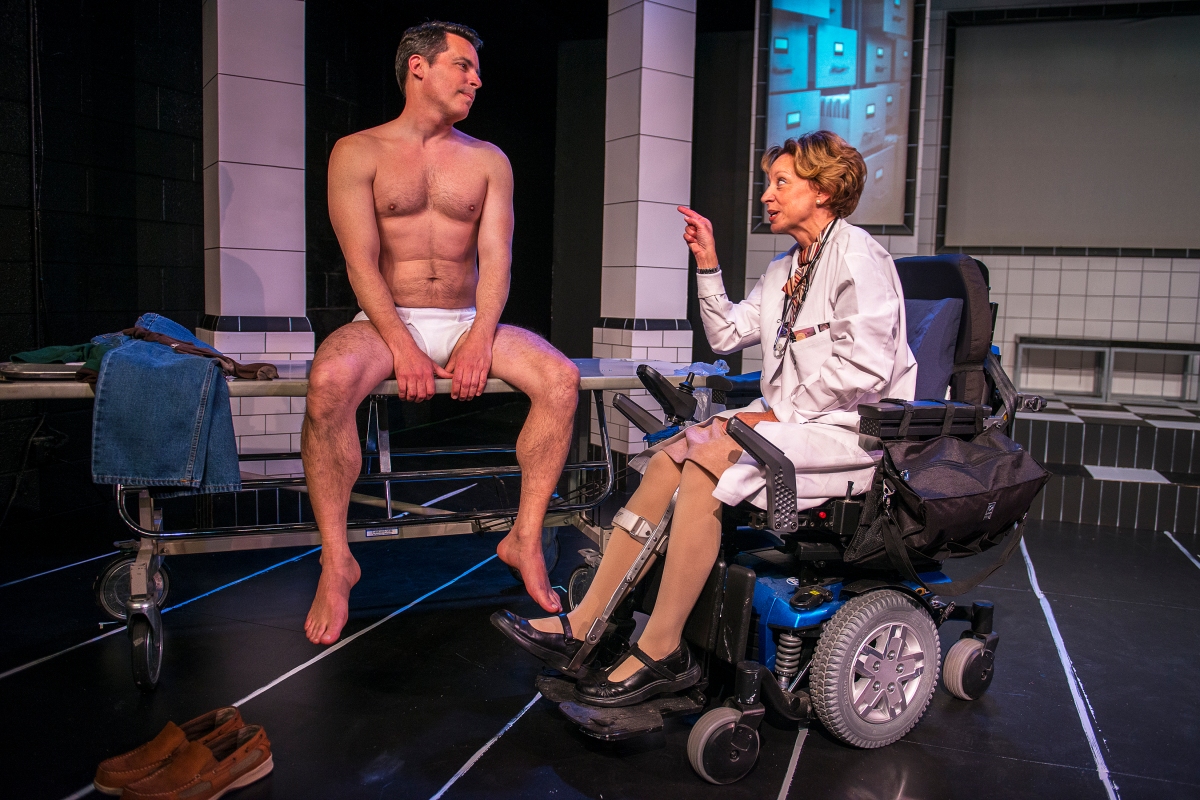
The intricacies of these interactions are a model of how all these characters interact, and the ensemble, which includes Lucian Restivo (who also did the sound and props), Dan Stackhouse, Joseph Bromfield, Stevie Rice, and Andrew Boothby – some alternating in several roles – is a tight and well-oiled machine under the direction of George Boyd. Dawn A. Westbrook, shares the stage with this thoroughly satisfying cast as Dr. Emma Brookner, the first medical professional dedicated to HIV/AIDS research. Westbrook performs most of her scenes in an electric wheelchair as the doctor, a polio survivor, was figuratively and literally hell on wheels in her hunger to get to the bottom of this new virus.

Set in New York City between 1981-1984, The Normal Heart, chronicles the early history of the HIV/AIDS crisis with near clinical meticulousness, but it also deals clearly and authentically with the toll it takes on family relationships and friendships, the economics and politics of sex and health, fear and the screeching halt it brought to the freedom of the sexual revolution. We were only a few minutes into the first act when I realized that this was the real deal.

I remembered sitting with members of the Gay Men’s Health Crisis in a board room at the Joyce theater planning a fund raiser. I suddenly thought of Nick, the music teacher in the public school where I taught. When he began to grow weak and tired, the students would rub his back and shoulders to make him feel better. I thought of the countless dancers I knew, some friends, some teachers. There was Al, whose friends knitted him scarves because he was always cold. There was my good friend Larry, an ardent arts supporter with whom I shared many trips to the theater, who refused to name the sickness that took him away from us so soon.

When I wrote a young adult book on the legendary choreography Alvin Ailey, my publisher required that I say he died of a “blood disorder.”  My mother, a nurse’s aide at Bellevue Hospital for more than three decades, took special training to work with HIV/AIDS patients. When she went into the break room, other aides and nurses would get up and leave because they were afraid to be near her.

Everyone was afraid then. That comes across in The Normal Heart in palpable ways. Friends turn against one another.  Dan Stackhouse, as Mickey, has an epic melt-down I the second act. Ned is pushed out of the organization he started.

The Normal Heart is not theater as usual; it should be seen, but not alone. The opening night audience cried real tears. This is moving theater. This is real life. As the audience left, ushers handed us copies of a letter from Larry Kramer, dated July 2011, that reminded us that these things really happened to real people, and much as it hurts, and as ugly as it gets, we need to remember so we will remember to act.

As for the technical elements: On opening night there were a few mysterious bumps and bangs from backstage and I was occasionally blinded by the glare of the light bulb behind the screen on which the timeline of the epidemic was projected.  Frank Foster’s scenic design, with its black and white tiles and red chairs, was something of a mashup of a New York City subway, a hospital, a gym, and what I imagine the infamous gay bathhouses must have looked like. Michael Jarett designed the lights and projections. Sheila Russ and Joel Furtick did well with the costumes and hair and make-up, respectively.

Julinda D. Lewis is a dancer, teacher, and writer who was born in Brooklyn, NY and now lives in Eastern Henrico County.

———-

Photo Credits: John MacLellan
This slideshow requires JavaScript.

I AM MY OWN WIFE: One man, 30+ characters

I AM MY OWN WIFE: One man, 30+ characters

A Theater Review by Julinda D. Lewis

Richmond Triangle Players in Collaboration with 5th Wall Theatre

At: The Robert B. Moss Theatre at Richmond Triangle Players, 1300 Altamont Avenue, RVA 23230

Performances: March 8-17, 2018

Ticket Prices: $10-30

Info: (804) 346-8113 or rtriangle.org

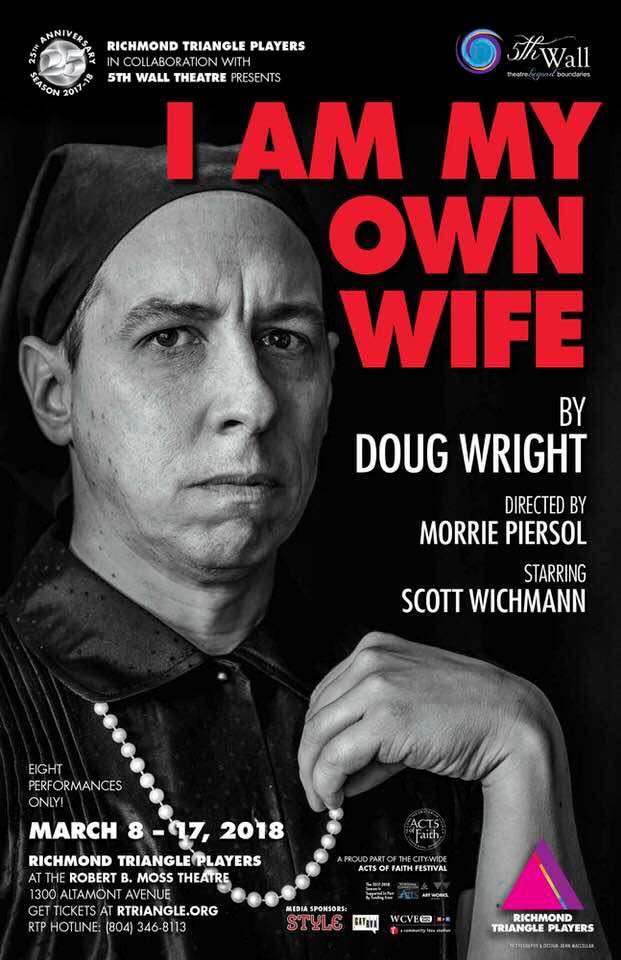
I Am My Own Wife is undoubtedly one of the more unusual plays of the season. Written by Doug Wright, the Pulitzer Prize and Tony Award winning production is a one-man show about a man living as a woman in East Berlin up to and beyond the dismantling of the Berlin Wall. And it is so much more than that. Scott Wichmann plays all of the more than 30 characters, but the focal point is Charlotte von Mahlsdorf, perhaps one of the most well-known transvestites in history.

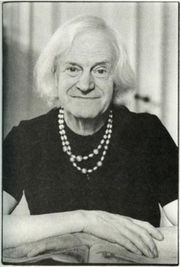
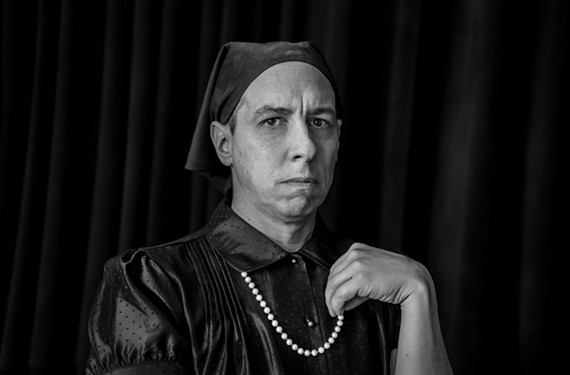
Charlotte earned a living as curator of the Gründerzeit Museum – a mansion filled with an eclectic collection of everyday objects, mostly salvaged from war-torn Germany during the time of the Nazi regime. Needless to say, antique bureaus, gramophones, original Edison phonographs, and cuckoo clocks were not nearly as rare as a man wearing a dress in Nazi Germany. The fact that Wichmann does not make an attractive woman is all the more realistic, as by all accounts, Charlotte was not your usual glamorous drag queen, but rather preferred to wear a plain black dress, her own hair – quite white in later years – and a simple string of pearls. As if this isn’t intriguing enough, Charlotte von Mahlsdorf, nee Lothar Berfelde, was a real person (1928-2002).

Wright based his play on a series of interviews he conducted with Charlotte between August 1992 and January 1993. Much of what he discovered was unverifiable or contradicted by written accounts – many of which, themselves, were suspect. The plot thickens with accusations and evidence of Charlottes spying for the Stasi, or German secret police, which stood in stark contrast to her being honored in 1992 with the Bundesverdienstkreuz or  Order of Merit of the Federal Republic of Germany for her work in preserving German artifacts. Wright, who wrote himself into the play as one of the dozens of characters, raises questions and leaves his audience to draw our own conclusions.

Wichmann, who has mastered the one-man show with several productions, including the 40+ characters in the wild and witty Totally Committed and a spot-on portrayal of comedian George Burns, has experience with Charlotte von Mahlsdorf, having played this role before, in 2006, with the same director, Morrie Piersol. I did not see that production, but can only assume that both brought new insight, depth, and maturity to the current production.

I Am My Own Wife, a statement Charlotte made dismissively when her mother suggested it was time to marry, is a riveting production, anchored by Wichmann’s razor sharp and eerily effective character transformations. Each character has his or her own distinct voice, accent, facial expressions, posture, and mannerisms. To my wholly inexpert ears, Wichmann’s Texan accent and German phrases sounded quite authentic and I was actually quite pleased with myself at being able to pick out many of the German words and phrases. How so many different people can inhabit one fairly compact body without any physical or visible damage is amazing.

One may choose to agree or disagree with von Mahlsdorf’s lifestyle, one may choose to sympathize with or loathe her decision to become a spy, one may even question Wright’s choices about what to include in the play and what to exclude. Wright states in a program note that he used “somewhat selective remembrances” of his encounters with von Mahlsdorf and took the “customary liberties of the dramatist” in editing the work, but there is no denying that this is a fascinating piece of theater, well cast, and brilliantly executed. The subject is no laughing matter, but there are a few well-placed moments of humor – something the opening night audience seemed not too sure of at first. It could have been due to Charlotte’s enigmatic nature; in describing the reconstructed gay bar in the basement of the manor house, for example, Charlotte/Wichmann says the original owner catered to homosexuals because they didn’t get drunk, didn’t fight, and always had money to pay the bill.

Kudos to Piersol for his unobtrusive direction, to Frank Foster for a simple yet elegant, sharp edged set, Andrew Bonniwell’s subtle lighting, and Lisa Lippman’s plain yet effective costume design. I Am My Own Wife has a very short run – just eight performances – so don’t hesitate it if you think you might want to see it. You won’t be sorry.


Julinda D. Lewis is a dancer, teacher, and writer who was born in Brooklyn, NY and now lives in Eastern Henrico County.

———-

Photo Credits:

John MacLellan, WomeninEuropeanHistory.org, and RTP website


I Am My Own Wife_John MacLellan
Scott Wichmann as Charlotte von Mahlsdorf
My Own Wife Charlotte
the real Charlotte von Mahlsdorf

I Am My Own Wife

BRIGHT HALF LIFE: A Beautiful Mess

BRIGHT HALF LIFE: a part of The Cellar Series: This Beautiful Mess

A Theater Review by Julinda D. Lewis

At: TheatreLAB The Basement, 300 E. Broad St., RVA 23219

Performances: February 17-24, 2018

Ticket Prices: Tickets $20

Info: (804) 505-0558 or theatrelabrva.org

I would try to explain what this Cellar Series is about, but TheatreLAB Associate Artistic Director Katrinah Carol Lewis has already stated it so well: “This series takes the traditional love story – we meet, we fall, we fight, we figure it out, or we flee – and turns it inside out and upside down. These explorations of romantic relationship ask us to abandon our notions of time, space and reality to expose the true essence of our connections to each other. It’s beautiful and it’s messy and it’s ours: this beautiful mess.”

Bright Half Life, written by Tanya Barfield and directed by Melissa Rayford, is the first of three works in this series. A two-woman play performed without benefit of set or props (it uses the stripped bare apartment set of the space’s previous show, I’m Gonna Pray for You So Hard) adorned simply with 9 black boxes that I’m sure I’ve seen on other stages in other productions.

Kylie M.J. Clark plays Erica and Amber Marie Martinez plays Vicky, two women involved in a decades-long relationship. It’s helpful to know this before the play starts, because once it begins, the actors and audience abandon all sense of linear time. This relationship unfolds emotionally, not chronologically. Lines and scenes are repeated, from different places and perspectives, and in the repetition, layers are peeled back, and lives revealed based on what has occurred since the last time we heard those words and phrases. In a way it is radical and messy, but on the other hand, it is a strangely accurate reflection of how many of us think.

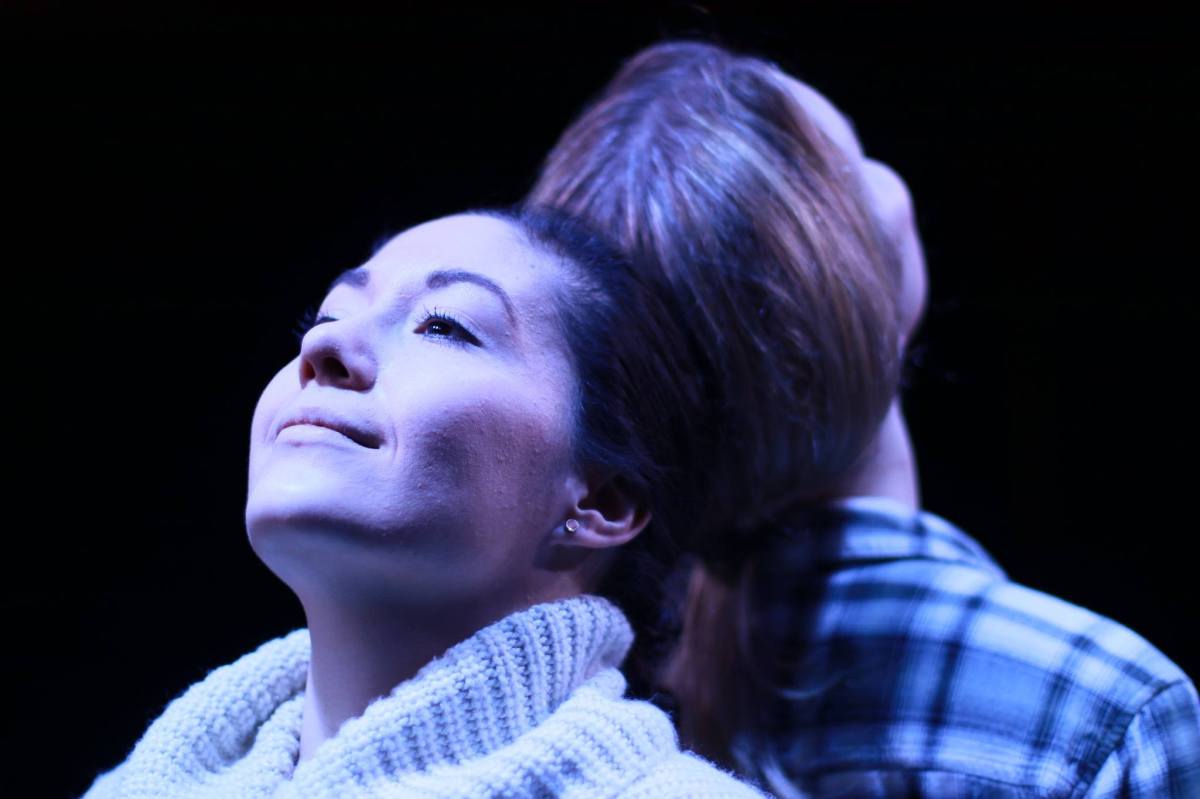
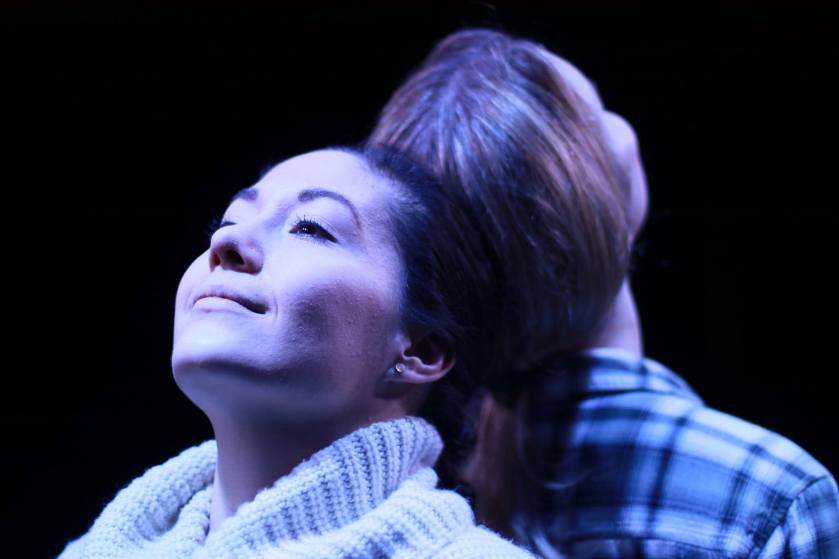
The audience is seated on both sides of the set and limited seating brings the audience up close and right in the faces of the two characters. This allows us to see the fear on the face of Erica as she sits, white-knuckled, in the gondola of a ferris wheel or attempts sky-diving, all to please the more adventurous Vicky. Clark’s face is open and while sometimes we can read her like a book, it is a book with secret and untranslatable passages. Martinez brings authenticity to her role: while Vicky is obviously more adventurous than her partner, she is also more uptight. Years go by before she actually comes out to her Latino family; they refer to Erica as her “special friend” and helpfully pretend that she is a roommate helping Vicky care for their daughters.

There are several running themes, the most memorable being the sky diving scenes and the alphabet game the two women have developed. Sometimes it’s funny and other times it turns inward and cruel, as games sometimes do. A bell or other sound signals the rapid changes of time and scene and it is indeed fascinating to witness the clarity and speed with which both Clark and Martinez switch back and forth in time.

Dressed simply in contemporary casual clothing – although Erica’s shirt is a little more “butch” – there is nothing other than the dialogue to indicate time, place, or age, so we must rely on the skill of the actors. Both are successful because by the time we have followed their journey from first date to first and second marriage proposal to childbirth and divorce, the marriage of their daughter, and reconnection as an older, more traditional Vicky comes to terms with failing health, they have completely captured their audience, and their final leap was met with joy, relief, and perhaps not entirely dry eyes.

Rayford’s direction is seamless and natural with the able assistance of Michael Jarett’s lighting and Lucian Restivo’s sound design. What is less than satisfying is the probably intentional vagueness about exactly what kind of company the women work for, what Erica’s vocation is prior to starting her teaching career, and – to a much lesser extent – the nature of Vicky’s illness. Vicky’s Latino heritage is significant for her character, but I noticed that off-Broadway in New York the two women were black and white, rather than Latino and white, and I wonder if the script adjusts for these differences. Could one character be Asian and the other white – or some other ethnic combination – and how would that change the dynamics?

Bright Half Life – named for the scientific concept of the time it takes for a property, in this case love, to decrease by half – is part of the 2018 Acts of Faith Fringe Festival. The Fringe Festival is a category for productions that do not meet all the criteria for the Acts of Faith Festival, perhaps because of a short run or a community rather than professional production company. At the time of this writing, only two performances remain (Friday and Saturday) and this is one heart-warming production you will not regret seeing.

Julinda D. Lewis is a dancer, teacher, and writer who was born in Brooklyn, NY and now lives in Eastern Henrico County.

———-

Photo Credit:

Louise Ricks

Bright Half Life
Amber Marie Martinez, facing front & Kylie M.J. Clark facing away
Bright Half Life2
Amber Marie Martinez

Acts of Faith