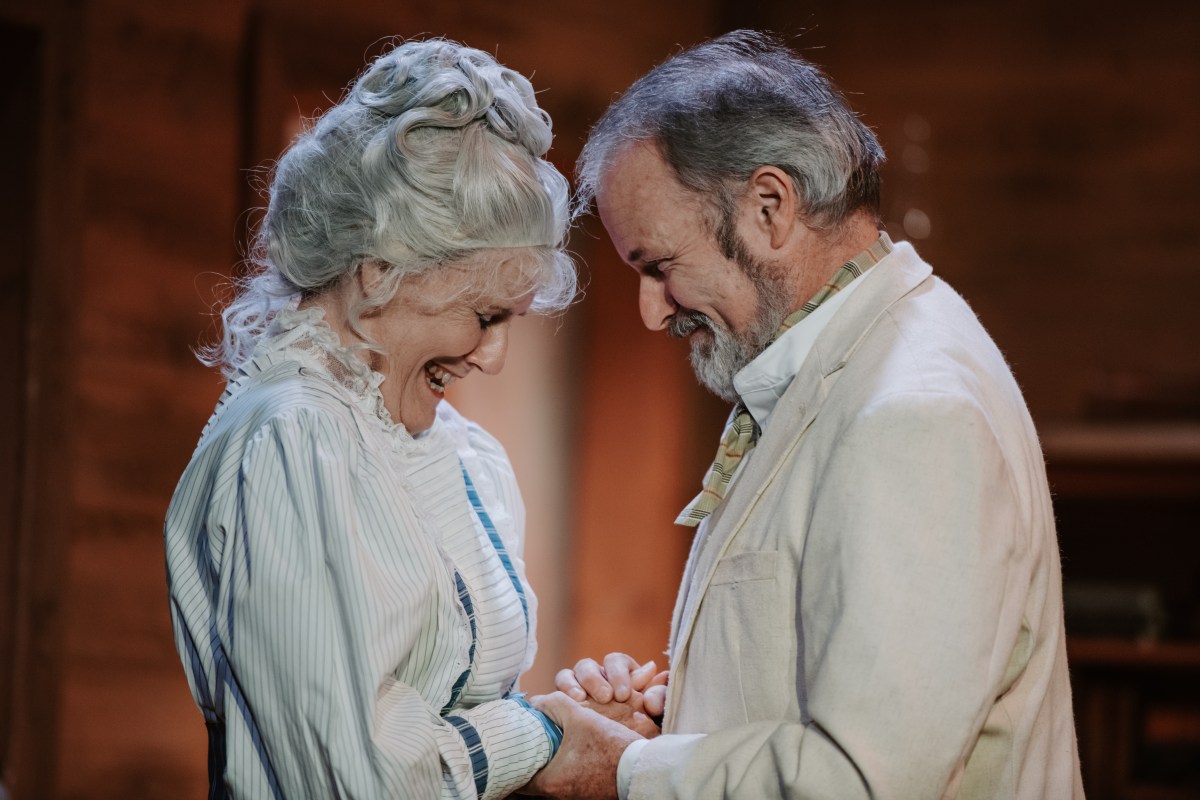
LONG DAY’S JOURNEY INTO NIGHT

Family Dysfunction as Fine Art

A Theater Reflection by Julinda D Lewis

Presented by: Cadence Theatre

At: Firehouse Theatre on the Carol Piersol Stage, 1609 W Broad St., RVA 23220

Performances: September 26 – October 11, 2025

Ticket Prices: $5-$40

Info: (804) 233-4894 or (804) 355-2001 or firehousetheatre.org

Where to begin?

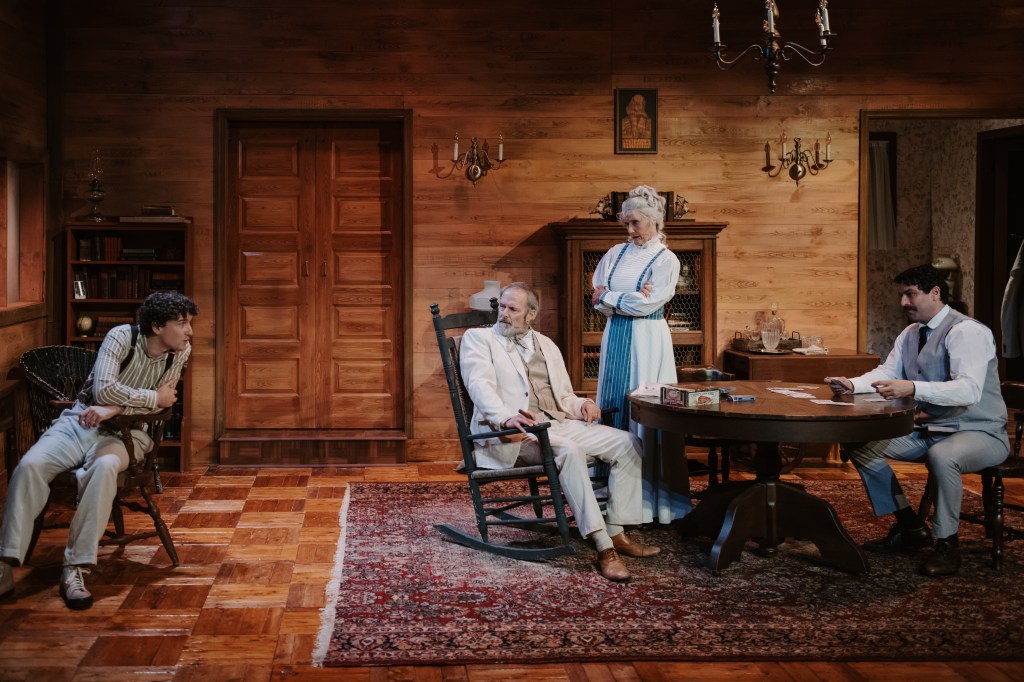
Eugene O’Neill’s Long Day’s Journey into Night stands out as a hauntingly authentic exploration of family bonds, dysfunction, addiction, and shadows from the past. From the very first moments, the play immerses the audience in a poignant portrayal of the Tyrone family, using the power of simplicity. Taking place over the course of a single summer day at the Tyrone family’s Connecticut summer home, O’Neill reveals the family’s struggles with personal demons and the inescapable grip of regret. He also reveals these things about his own family as the Tyrone family finds parallels in O’Neill’s own parents, himself and his older brother. Whereas most authors advise that the names do not reflect real people, O’Neill has borrowed freely from his own family tree – shifting and borrowing, but using real names, nonetheless.

Messiness aside, O’Neill’s masterful use of language and his rich character development invites viewers to immerse themselves into the complexities of love and despair, presenting a work that is simultaneously unsettling and profoundly relatable. Each character feels like a reflection of O’Neill’s own experiences – because they are. This personal history adds layers of authenticity to a narrative that is both a personal tragedy and a universal commentary on the human condition.

Long Day’s Journey into Night was written 1939-1941 but was published posthumously and first performed in February of 1956, more than two years after O’Neill’s death (October 16, 1888 – November 27, 1953). It is considered by many to be the author’s master work and earned a Tony award for Best Play and a Pulitzer Prize for Drama.

The title, though? Some believe it refers to the setting of play, taking place over the course of a single summer day. The play opens just after the Tyrone family has completed breakfast and concludes in the evening, after dinner. Others say the title refers to the literal passage of time, from morning to evening. Summer days are longer than others, as far as hours of daylight. Then, of course, there is the metaphorical meaning that says the title refers to the family’s descent into the darkness of despair. This explanation focuses on the symbolism of the family’s journey through addiction, regret, and blame, moving from a false sense of hope in the morning to a bleak, unresolved midnight. This explanation also suggests the characters’ individual and collective journeys back in time as they resurrect past hurts and relive their failures, making the day seem to stretch out in a cyclical fashion, like a vintage Groundhog Day. There is also the long day for the audience, as the play runs approximately four hours, including two ten-minute intermissions.

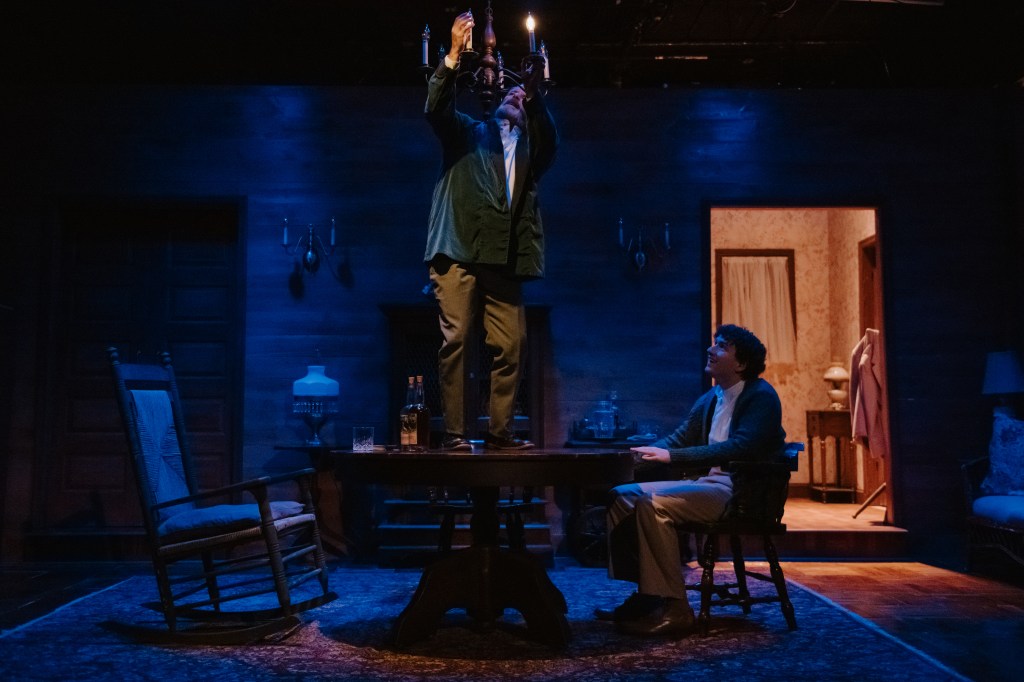
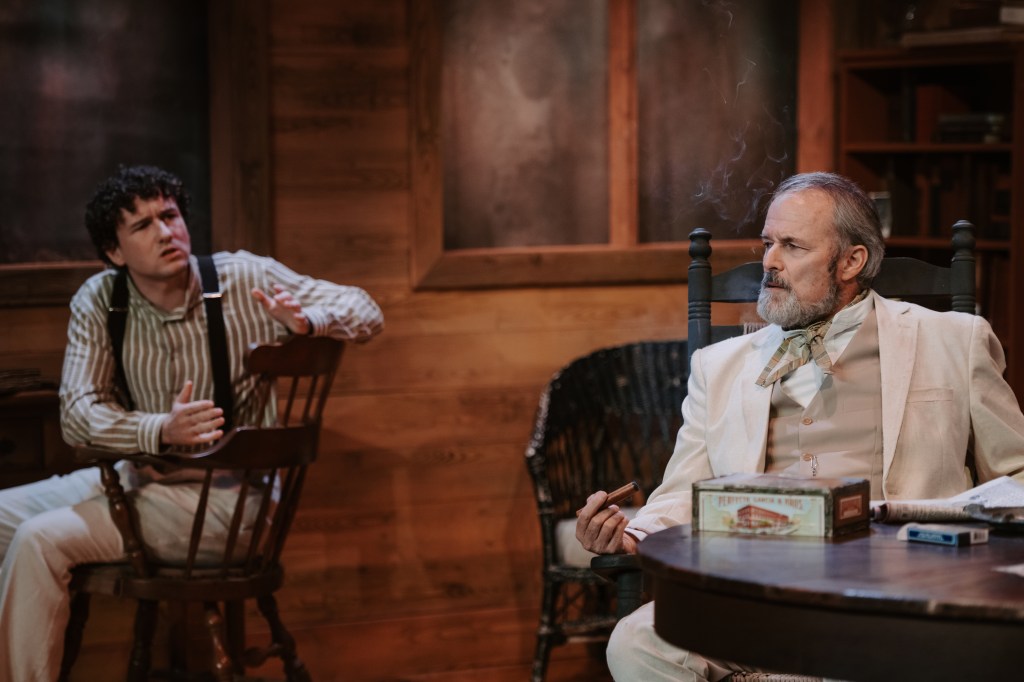
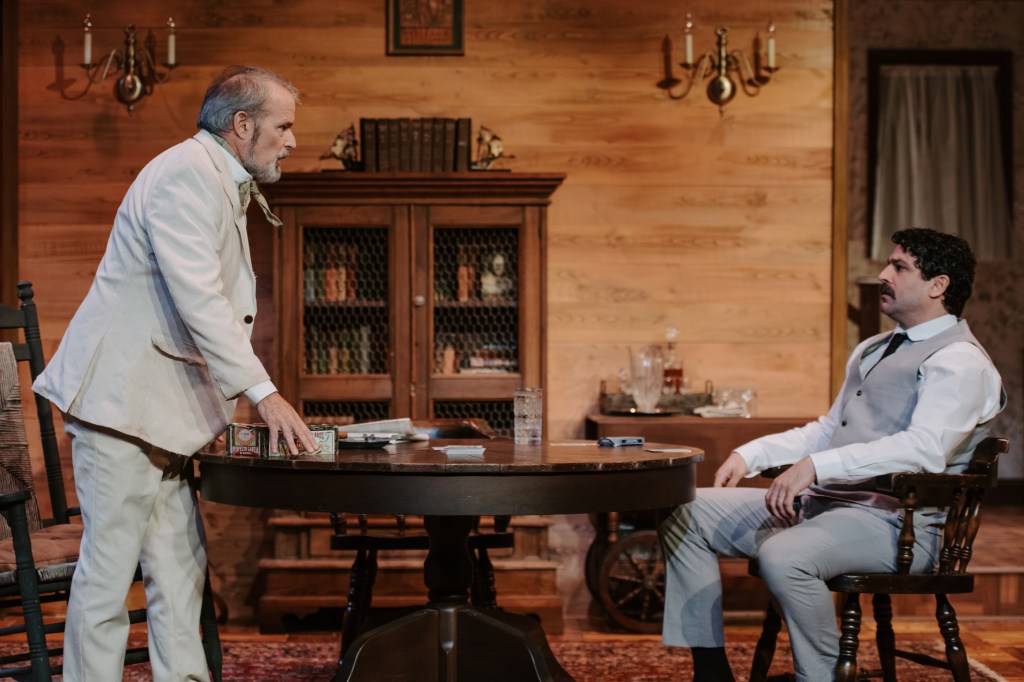
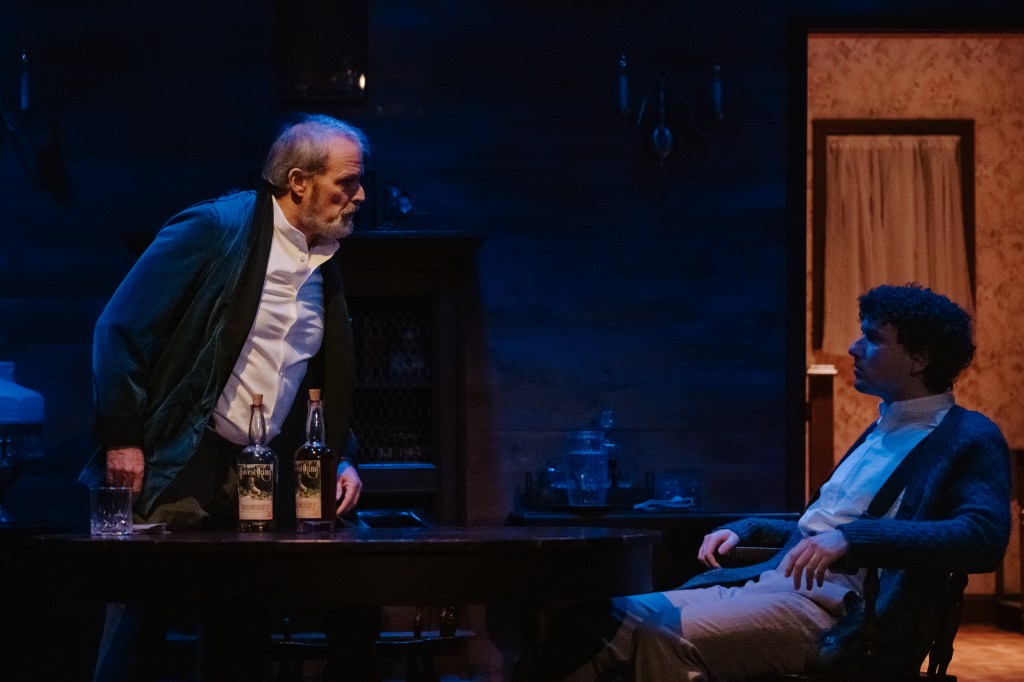
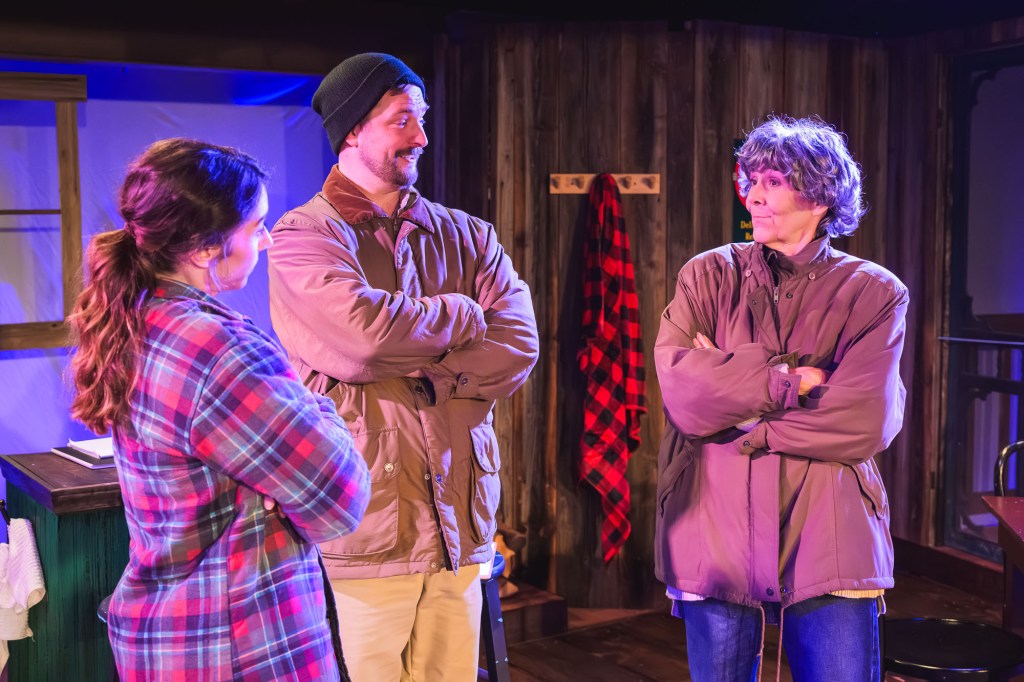
Long Day’s Journey into Night is difficult to watch – and not just because it’s long. There is the subject matter, which might be triggering for some. The father, James Tyrone, was a successful but now fading Irish-American actor who dabbles in real estate investment, drinks too much, and is somewhat of a miser. In one hilarious scene he climbs atop a table to twist on the bulbs of a chandelier because his son complained about his miserly ways. He had been sitting under the light of a single bulb to save money. (In retrospect, I wonder if he rotated the lit bulb, so they would burn out evenly…) Another humorous moment occurs when James suddenly becomes aware that his sons have been watering down his prized whiskey. Matt Radford Davies plays the domineering, frayed at the seams actor with apparent ease and reveals the positive and negative aspects of James’ personality is a way that paints him as neither all villain nor all hero. It feels as if Davies has walked in Tyrone’s/O’Neill’s’ shoes, or at least tried them on long enough to absorb their essence.

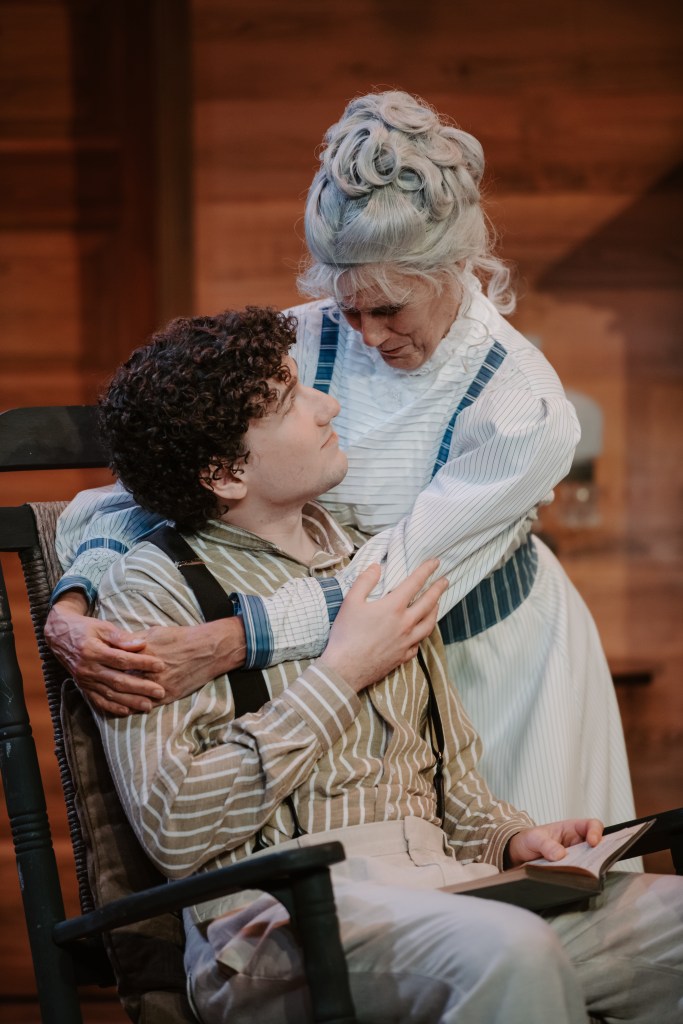
Mary, the mother, has a mysterious illness that is alluded to throughout the first act but never confirmed until about the midpoint of the play. This brings up another triggering idea – the medical negligence of women, especially pregnant women – as well as the prevalence of addiction to prescription pain killers. Yes, even in 1912, when this play was set. Robin Arthur’s erratic movements, her repetitious dialogue, her fixation with her hair, her obsessiveness in regard to her younger son, and her aggressively mysterious demeanor make sense as the source of her pain is revealed.

“I know you still love me in spite of everything.” – Mary

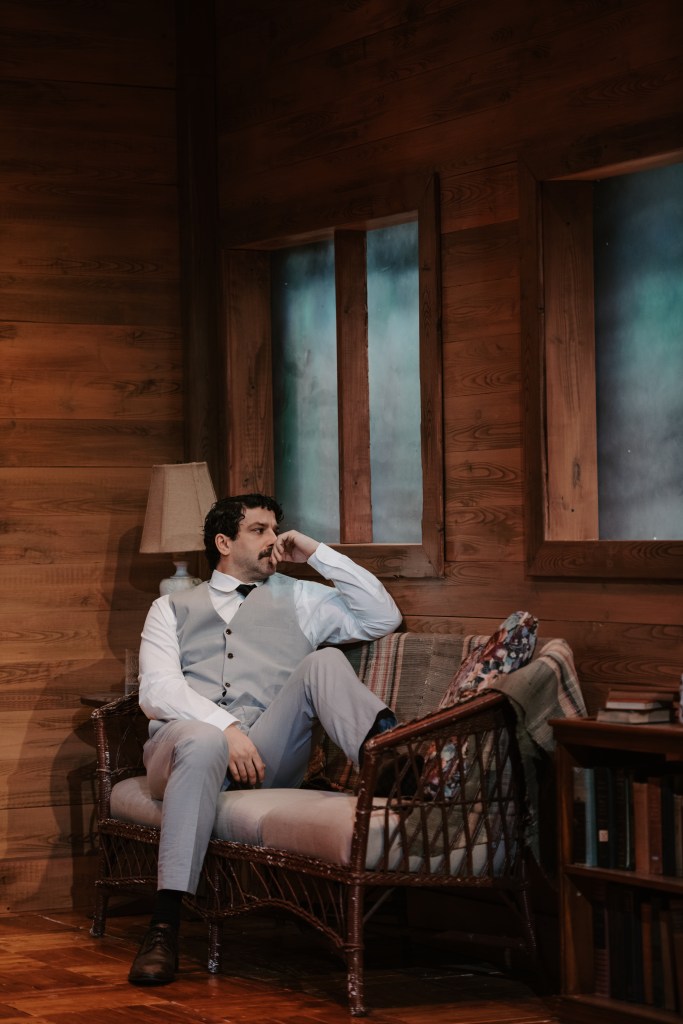
Jamie Tyrone, the elder son, is an actor, like his father. He drinks too much, like his father. But unlike his father, he lacks ambition and a sense of purpose. Axel Burtness is well cast in this role, and shines best in a scene where Jamie warns his younger brother that, as much as he loves him, he will try to sabotage him and wreck any success or happiness that may come his way.

Edmund, the younger son, has a double burden. Unknowingly, he was a replacement baby, conceived to replace a baby who died of measles that may have been intentionally passed on to him. It was this birth that triggered Mary’s constant pain and need for medication. To make matters worse, Edmund has contracted consumption – another name for tuberculosis. (It was called consumption because the illness sometimes seemed to consume the individual who had it.) This, of course, makes Mary even more depressed. Trace Coles brings just the right balance of innocence and defiance.

“Who wants to see life as it is if you can help it?” – Edmund

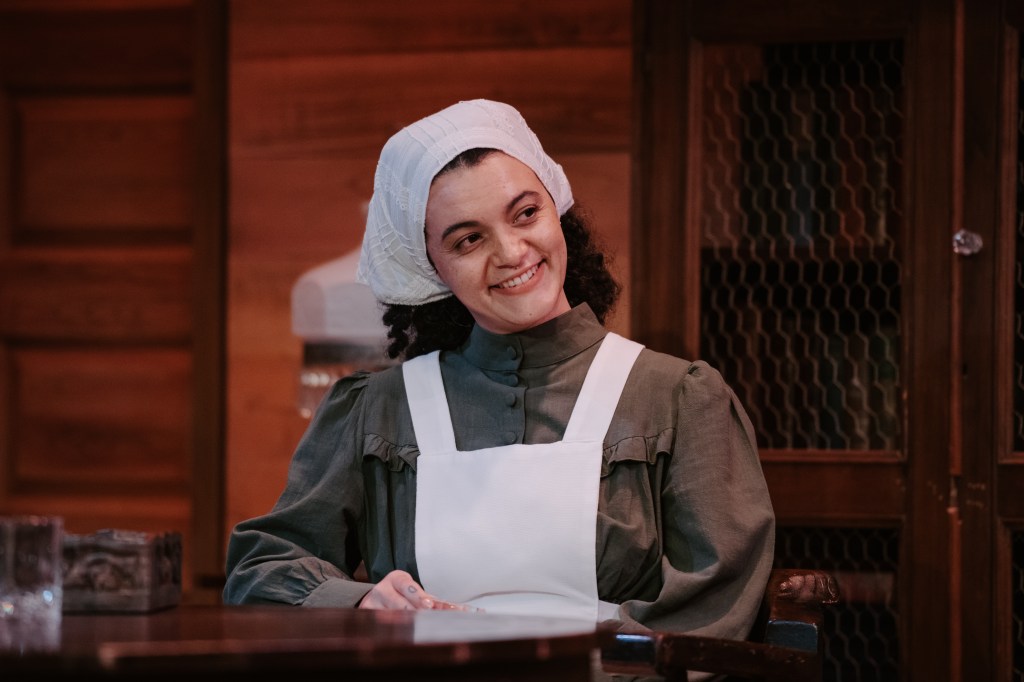
While several other characters are mentioned, no others make an appearance onstage other than Cathleen the maid. Ruby Joy Garcia’s role seemed headed in the direction of stereotypical household help, until the day Mary invites her to sit and keep her company – and have a drink. The elevates Garcia’s role (i.e., status) both literally and figuratively and brings more depth to her character. The moment when the whiskey emboldens her to talk back is a priceless gem.

Both sons, given enough to drink, are prone to spouting poetry and lines from Shakespeare – or Baudelaire, or Ernest Dowson, or Algernon Charles Swinberg.

“Be drunk with wine, with poetry, with virtue.” Charles Baudelaire

Long Day’s Journey into Night is a deeply impactful play, and like any work of art, it reveals both positive and negative aspects. On the plus side,  O’Neill has given us rich, complex, multi-dimensional characters that resonate with many audience members. The play masterfully explores themes of addiction, illness, and family dysfunction. Allowing his audiences to connect with the characters on a personal level. Then there is the frequent use of beautiful and poignant poetic language. This elevates the dialogue and the overall experience. The play’s universal themes of regret, love, and the search for redemption all speak to fundamental human experiences, making it a timeless work that continues to resonate with new generations. A long with that, the infusion of O’Neill’s personal experiences adds depth and authenticity, providing a unique perspective on the struggles of addiction and family dynamics.

On the other hand, the subject matter is extraordinarily heavy. The play’s themes can be quite dark and may make the play emotionally challenging for some viewers, particularly those who have experienced similar issues in their own lives. Then there is the matter of the four-hour runtime and a slower pace may not engage all audiences, potentially making the play feel lengthy, especially for those unfamiliar with dramatic theater. I would not bring someone to see this play as their introduction to live theater.

Finally, the overall atmosphere of the play is often somber, which may leave some viewers feeling overwhelmed or despondent rather than uplifted. The intricate exploration of relationships and personal struggles requires careful attention and may lead to reflection or revelations, which could be challenging for some audience members – and perhaps to the actors as well. While it’s a vital aspect of the narrative, the portrayal of addiction might be unsettling for some, as it reflects painful realities that all too many face in reality.

So, while Long Day’s Journey into Night is a masterful exploration of complex themes and relationships, that is beautifully acted and well directed by Rusty Wilson, it also presents its audience with challenges due to its heavy emotional weight and slow pacing – and it’s not that the pace is too slow, the pacing is an accurate depiction of real time, a time, perhaps, when people were not as rushed because they didn’t have or expect near instantaneous results to their queries and problems as we have come to expect due to technology.

Long play, long reflection. Bottom line, if you’ve never seen it, put it on your bucket list. I’m a theater nerd, a theater junkie, so I was excited to take in the author’s language, Daniel Allen’s shabby-genteel set, and Nancy Coles’ period costumes. But on the other hand, I did not tell my husband ahead of time exactly how long it was going to be…

—–

Julinda D. Lewis is a dancer, teacher, and writer who was born in Brooklyn, NY and now lives in Eastern Henrico County. When not writing about theater, she teaches dance history at VCU and low impact dance fitness classes to seasoned movers like herself and occasionally performs. Julinda was recently awarded the Dean’s Distinguished Adjunct Faculty Award 2023-24 Academic Year by VCU School of the Arts and the 2025 Pioneer Award in Dance Ministry by Transformation International Worship Ministries, Newport News, VA.

—–

LONG DAY’S JOURNEY INTO NIGHT

Written by Eugene O’Neill

Directed by Rusty Wilson

CAST

James Tyrone – Matt Radford Davies

Mary Cavan Tyrone – Robin Arthur

Jamie Tyrone – Axle Burtness

Edmund Tyrone – Trace Coles

Cathleen – Ruby Joy Garcia

PRODUCTION TEAM & CREW

Director – Rusty Wilson

Stage Manager – Joshua Kreis McTiernan

Assistant Stage Manager – Natalie Masaitis

Scenic Designer – Daniel Allen

Scenic Painter – Emily Hake Massie

Costume Designer – Nancy Coles

Lighting Designer – Steve Koehler

Sound Designer – Justice Craig

Sound Associate – Julie Vo

Fight Director – Aaron Orensky

Dialect Coach – Erica Hughes

Dramaturg – Alana Wiljanen

Set Decorator – Michael Maddix

Composer/Musician – Daniel Clarke

Director of Production – Todd LaBelle

Technical Director – Emily Vial

A/V Supervisor – Grace LaBelle

Running Crew – Terra Comer, Natalie Masaitis

Production Assistant – Terra Comer

Board Operator – Joshua Kreis McTiernan

Performance Schedule: Thursdays, Fridays, Saturdays @7:00PM and Sundays @2:00PM

Run Time: 4 hours with two10-minute intermissions

Setting: A summer day in August 1912 at the Tyrone family summer home in Connecticut.

Premiere: The play officially premiered at the Royal Dramatic Theatre in Stockholm, Sweden, February 10, 1956. O’Neill had wanted it to remain unpublished for 25 years after his death, but his widow overrode his wishes. The play opened on Broadway at the Helen Hayes Theatre on November 7, 1956.

Photos: Jason Collins Photography,Courtesy of Anna Senechal Johnson
One-Time
Monthly
Yearly

Make a one-time, Monthly, or annual donation to support Julinda & RVART Review

Make a monthly donation

Make a yearly donation

Choose an amount

$5.00
$15.00
$100.00
$5.00
$15.00
$100.00
$5.00
$15.00
$100.00

Or enter a custom amount

$

Your contribution no matter how small or how large is appreciated. Thank you.

Your contribution is appreciated.

Your contribution is appreciated.

DonateDonate monthlyDonate yearly
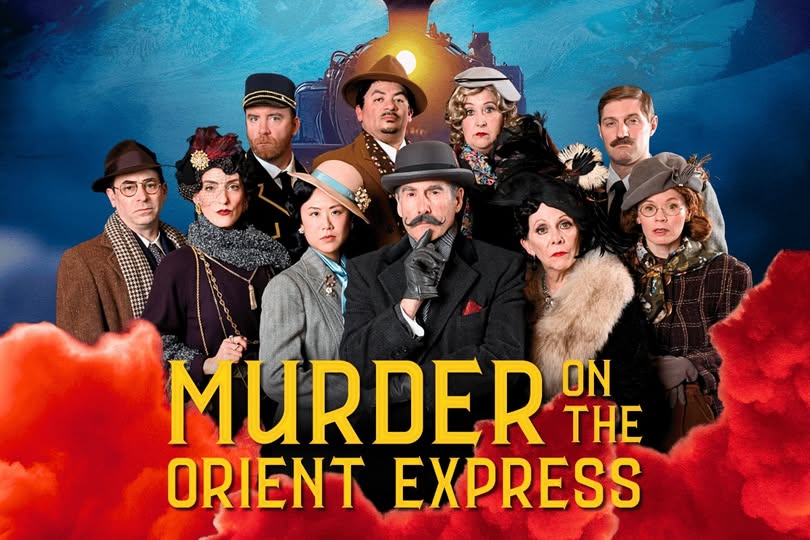
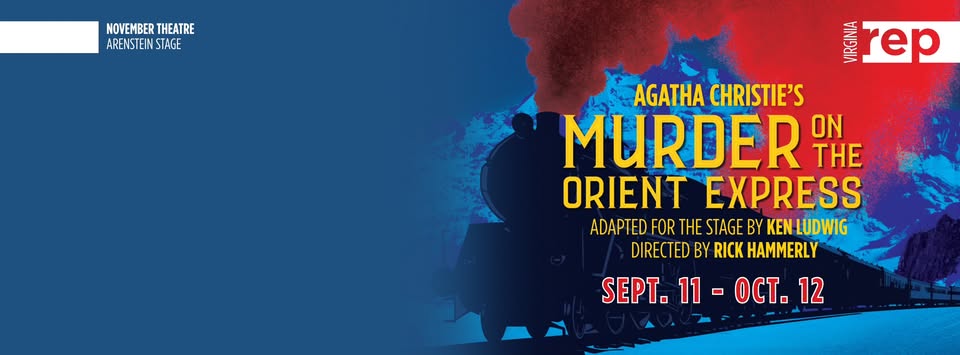
MURDER ON THE ORIENT EXPRESS 

A Theater Review by Julinda D. Lewis 

By: Virginia Repertory Theatre (Virginia Rep) 

At: the November Theatre Arenstein Stage, 114 West Broad St, Richmond VA 23220 

When: September 11 – October 12, 2025 

Ticket Prices: $35-$62   

Info: (804) 282-2620 or www.virginiarep.org 

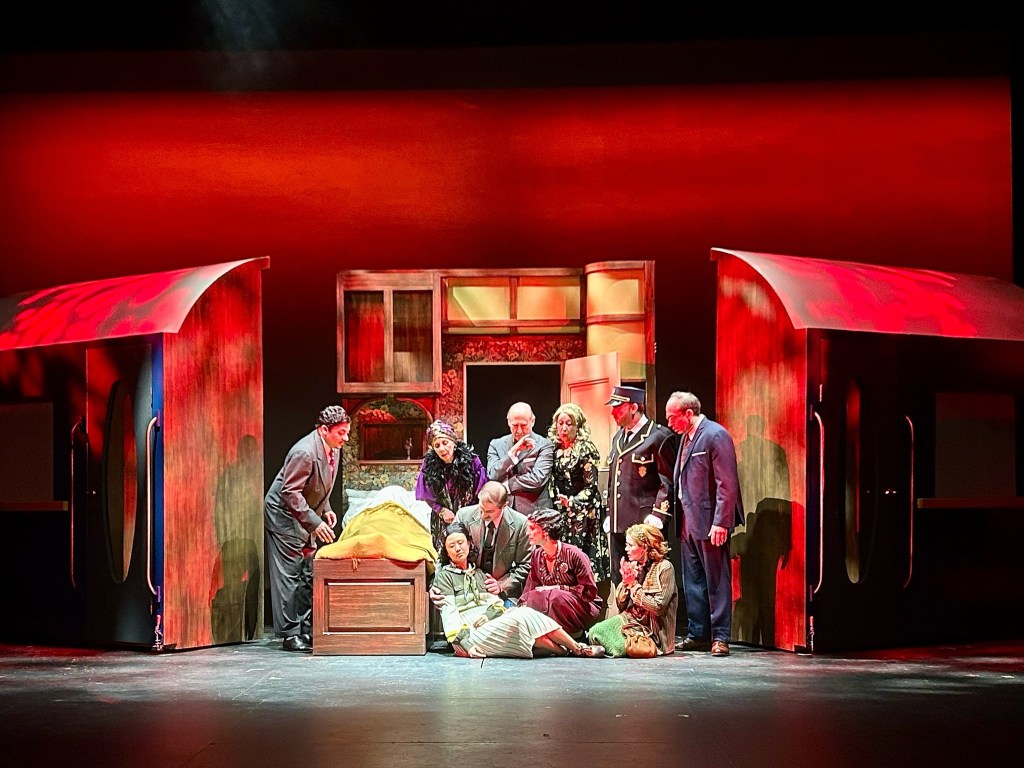
Train whistles and schedule announcements greet those who enter the November Theatre for the Virginia Rep 2025-26 season opener – Agatha Christie’s Murder on the Orient Express. An authentic literary and theater murder mystery classic, Murder on the Orient Express has murder, romance, conspiracy, locked doors, humor, nobility, a wide array of accents and dialects, and a dynamic set design worthy of its own program credit. All that was missing was the heady aroma of creosote, brake dust, diesel fuel, and the other components of railroad life. 

Director Rick Hammerly and his talented production team kept enough of the familiar touch stones and the stereotypically drawn murder mystery characters to make us feel right at home, yet balanced these with delightful surprises that never failed to impress.  

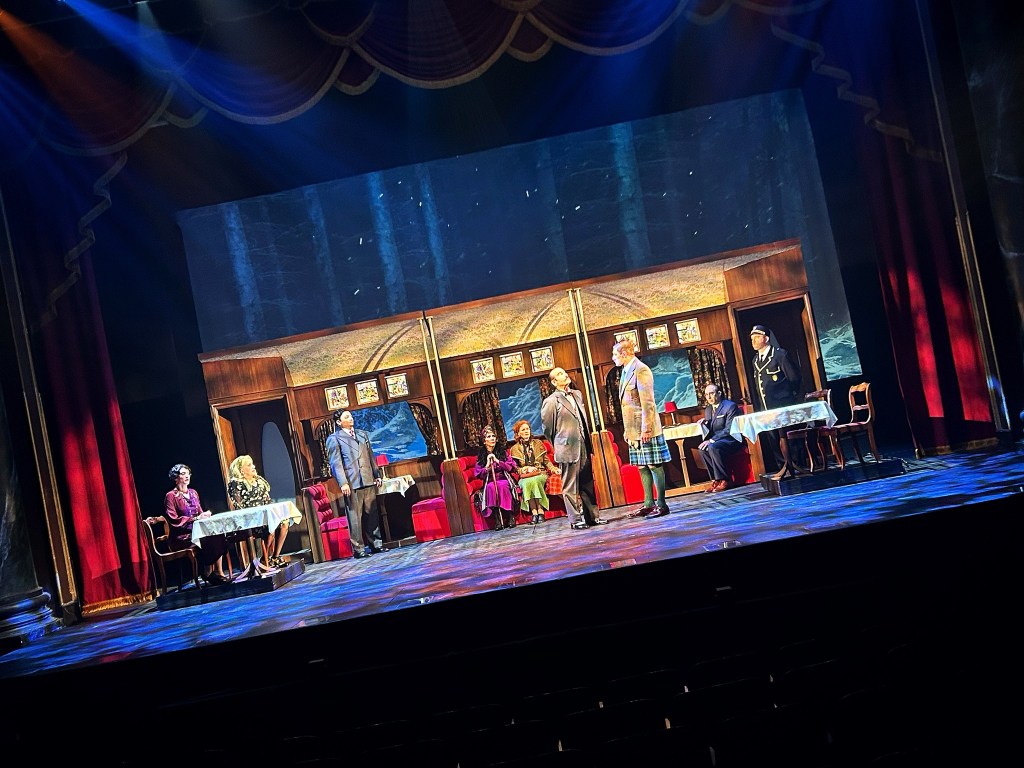
First, there was a bit of video, providing some background on the kidnapping of a little girl, Daisy. Then Hercule Poirot (Lawrence Redmond) gave a brief introductory curtain speech. In the brief time it took Redmond to speak, the crew transformed the previously bare space consisting of little more than a fat white screen into a passable representation of luxury hotel dining room. Three-dimensional set elements and two-dimensional projections and lighting effects blended in a collaboration that set new standards. Were those pedestrians moving outside the hotel windows? Or were they crew preparing for the next scene change? Either way, they added depth and nuance to the visual presentation. Kudos to scenic designer Chris Raintree, projection designer Tennessee Dixon, and lighting designer BJ Wilkinson. 

Then, there is the matter of a dynamic actors, all larger than life figures who inhabited the cast of characters with enthusiasm, grace, and humor. Redmond gave us Poirot’s sharp intellect, meticulous, observant. Frank Britton in the role of Poirot’s friend, Monsieur Bouc, the director of the railroad company, played the comedic foil – up to a point. It was his simple perspective that, in the end provided a resolution to the story’s weighty moral dilemma.  

McLean Fletcher portrays Greta Ohlsson as a modest and devout missionary who only wants to help children in Africa, but she is obviously hiding something. And why, exactly, is she posing as an aide to Princess Dragomiroff? Ah yes, Princess Dragomiroff, covered in layers of fine fabrics and jewels and better known to us as the talented Jan Guarino. The Princess’ embroidered handkerchief, is found (planted?) at the scene of the crime in an attempt to mislead the investigation. 

As the snooty but nameless Head Waiter in the first scene, John-Michael Jalonen sets the stage for the opulence and luxury of the other characters, those who are waiting at the hotel to board the luxurious Orient Express on its way from Istanbul, Turkey to London, England. Most of the passengers are traveling in first class compartments and the trip would have taken about four days if the train had not been stranded due to a heavy snowstorm in Yugoslavia. BTW, service on the original Orient Express began in 1883 and ended in 2009, although other companies have stepped in to provide Orient Express travel experiences. But I digress.  

Matt Meixler plays Hector MacQueen, personal assistant to Ratchett/Cassetti, the murder victim. MacQueen is a master of misdirection, but he is the one who reveals Ratchett’s true identity to Poirot. If there was a female lead in Murder on the Orient Express, it would surely be Susan Sanford in the role of the obnoxiously loud, hard drinking, “ugly American” Helen Hubbard. Sanford hits all the stereotypes and mixes them with steroids, making us feel simultaneously horrified and amused by Hubbard’s shenanigans. Hubbard, by the way, has the compartment next to Ratchett/Cassetti, and there is a connecting door… 

Continuing with our little game of Clue, there is Ashey Thompson as Countess Andrenyi, whose key role seemed to be beautiful – a role she portrayed with apparent ease — while her real identity was kept hidden from Hercule Poirot. Charlene Hong White takes on the role of the governess, Mary Debenham – another, like Greta Ohlsson, who seems to have a lot of secrets. Poirot noted Mary with suspicion while in the hotel, before ever boarding the train or becoming aware of a murder. Both White and Fletcher are masterful at playing innocent while letting us know they are hiding something just beneath the surface of their cool, beautiful exteriors. 

Nathan Whitmer is stalwart and blustering in the role of English military officer Colonel Arbuthnot. Arbuthnot isn’t too good at hiding his relationship with Mary Debenham, but Whitmer looks great in a kilt. Travis Williams plays the all-important role of Michel, the Conductor – the man who has access to all the train’s compartments, and perhaps access to an extra conductor’s uniform… 

So, there you have it, the backgrounds of the passengers and other cast members. A diagram of how they are connected would further help keep everybody straight, but would definitely be a spoiler, so you’re on your own for that.  

This high-powered, heavy weight ensemble took us on a most delightful journey that hit most of the elements of a great murder mystery. There was a compelling, locked-door murder. There was an intriguing setting – a train stuck on the tracks far from help, during a major snowstorm. Not only could the train not move, but communications were also lost with dispatchers. There was a victim, and a crime a murder method, and nearly a dozen suspects, with opportunity and hidden motives. A world class detective just happened to be on board, to investigate the clues and red herrings left to misdirect the audience. 

What makes this story even more intereting is the moral dilemma posed near the end. Is murder ever okay? Is there ever a time when, in the words of several fictional and real-life characters, “sometimes the som’bitch needed killin’?” Pack your bags, pick up a drink before boarding, and go find out for yourself. Let me know what you decide. 

———- 

Julinda D. Lewis is a dancer, teacher, and writer who was born in Brooklyn, NY and now lives in Eastern Henrico County. When not writing about theater, she teaches dance history at VCU and low impact dance fitness classes to seasoned movers like herself and occasionally performs. Julinda was recently awarded the Dean’s Distinguished Adjunct Faculty Award 2023-24 Academic Year by VCU School of the Arts and the 2025 Pioneer Award in Dance Ministry by Transformation International Worship Ministries, Newport News, VA. 

———- 

AGATHA CHRISTIE’S MURDER ON THE ORIENT EXPRESS 

Adapted for the stage by Ken Ludwig 

Directed by Rick Hammerly 

Cast 

Lawrence Redmond ….. Hercule Poirot 

Frank Britton ….. Monsieur Bouc / u/s Poirot 

McLean Fletcher ….. Greta Ohlsson /u/s Princess Dragomiroff 

Jan Guarino ….. Princess Dragomiroff 

John-Michael Jalonen ….. Head Waiter / u/s MacQueen, u/s Michel 

Matt Meixler ….. Hector MacQueen 

Susan Sanford ….. Helen Hubbard 

Ashley Thompson ….. Countess Andrenyi 

Charlene Hong White ….. Mary Debenham 

Nathan Whitmer ….. Colonel Arbuthnot / Samuel Ratchett 

Travis Williams ….. Michel the Conductor / u/s Arbuthnot, u/s Ratchett 

Rachel Dilliplane ….. u/s Mary, u/s Countess 

Lily Marcheschi ….. u/s Greta Ohlsson, u/s Helen Hubbard 

Mark Persinger ….. u/s Monsieur Bouc, u/s Head Waiter 

Recorded Voices ….. Frederic Blasco, Rachel Dilliplane, Emily Goodman, Lily Marcheschi, Mark Persinger, Guy Seigneuric, Travis Williams 

Direction & Design 

Directed by ….. Rick Hammerly 

Scenic Design ….. Chris Raintree 

Projection Design ….. Tennessee Dixon 

Costume Design ….. Kendra Rai 

Wig Design ….. Alia Radabaugh 

Lighting Design ….. BJ Wilkinson 

Dialects ….. Amanda Durst 

Sound Design ….. Joey Luck 

Fight & Intimacy Direction ….. Casey Kaleba 

Stage Management ….. Ginnie Willard 

For This Production 

Assistant Stage Manager ….. Hannah Hoffert 

Rehearsal Stage Manager ….. Justin Janke 

Assistant Lighting Designer ….. Griffin Hardy 

Carpenters …..Van Montes, Avery Rose 

Scenic Artists ….. Julie Gallager, Van Montes 

Electricians ….. Rylie Vann, Griffin Hardy 

Stitchers ….. Sarah Grady, Kate Koyiades, Maggie Ronck 

Fly Rail and Deck Crew ….. Daryus Gazder, Logan Graves, Bien Quiroz 

Light Board Operator ….. Rylie Vann 

Sound Board Operator ….. Amaya “AJ” Rose 

Wardrobe Supervisor ….. Emily Andrew Mateos 

Video Production ….. Tennessee Dixon, Rick Hammerly, Hannah Hoffert, Joey Luck, Hans Paul, Jonathan Pratt, Ginnie Willard, Kacey Yachuw 

Photographer ……………………… Aaron Sutten 

Ticket Information 

Box Office: (804) 282-2620 

www.virginiarep.org 

Ticket Prices: $35 – $62 

Performance Schedule 

September 11 – October 12, 2023, with performances 

Thursdays, Fridays, and Saturdays at 7:00 PM, select Saturdays at 2PM, Sundays at 3PM, and select Wednesday evenings and matinees. 

Run Time 

The play runs for approximately 2 hours with one 15-minute intermission 

World Premiere produced by the American Repertory Theatre at Harvard University, August 2, 2015 

Originally Staged by McCarter Theater Center, Princeton, NJ 

Photo Credits: Aaron Sutten  

One-Time
Monthly
Yearly

Make a one-time, monthly, or annual donation

Make a monthly donation

Make a yearly donation

Choose an amount

$5.00
$15.00
$100.00
$5.00
$15.00
$100.00
$5.00
$15.00
$100.00

Or enter a custom amount

$

Your contribution is appreciated.

Your contribution is appreciated.

Your contribution is appreciated.

DonateDonate monthlyDonate yearly
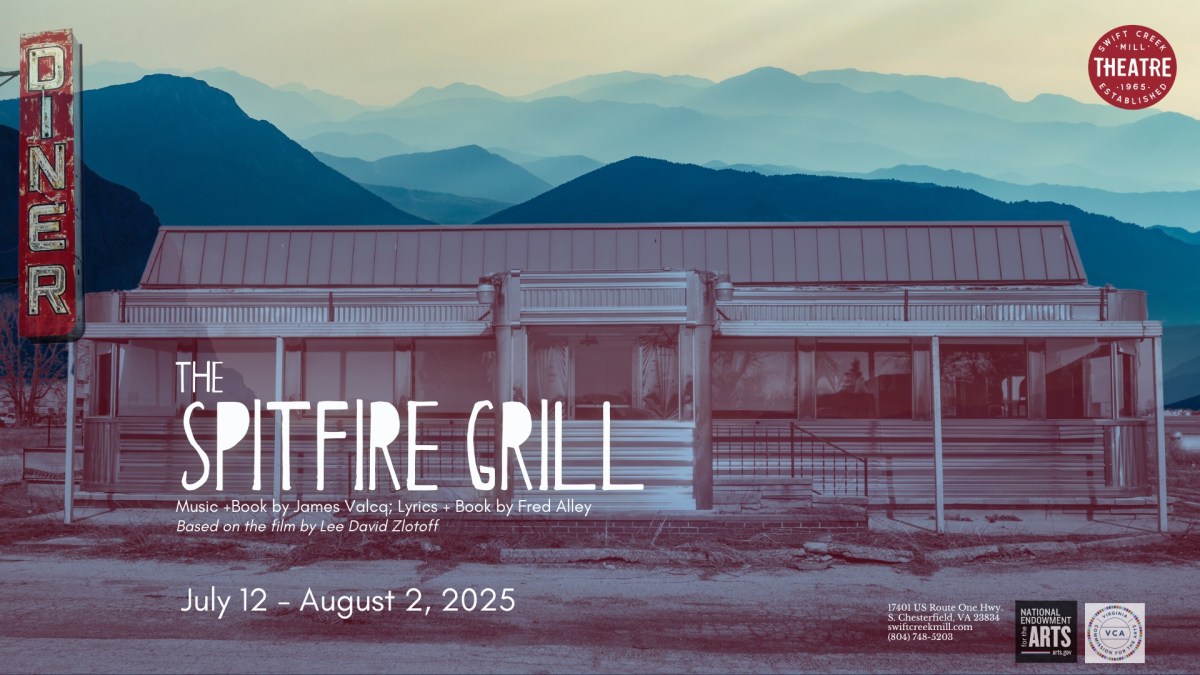
THE SPITFIRE GRILL

Order Up!

At: The Swift Creek Mill Theatre, 17401 U.S. Route One, Chesterfield, VA 23834

Performances: July 12 – August 2, 2025

Ticket Prices: $44-49. Ask about discounts for students, seniors, and veterans.

Info: (804) 748-5203 or https://www.swiftcreekmill.com

A Theater Reflection by Julinda D. Lewis

I’ve said it before and I’ll say it again, there’s something about summer that demands a musical. I also have a soft spot for diners and shows that take place in diners. (See my review of Waitress, another summer musical set in a diner: https://jdldancesrva.com/2025/07/12/waitress/ ) The Spitfire Grill, by James Valcq (music and book) and Fred Alley (lyrics and book) is particularly heartwarming.

In his director’s notes, Tom Width sums it up: “I find the show to be ‘hometown gold’ with its themes of family, heartbreak, resilience, and redemption along with a healthy dose of downhome charm and humor – all wrapped up in a musical score that rings true to the nature of its setting.” Nothing more needs to be said, but I’ll say a few more things anyway.

A stereotypical musical often feature a predictable plot, idealized characters, romantic storylines, upbeat tunes, elaborate choreography, and a happy ending. The Spitfire Grill has many of these characteristics but neatly sidesteps familiar tropes and simplistic portrayals of characters in favor of more complex individuals involved in less familiar situations and more unpredictable relationships.

Our first glimpse of our heroine, Percy, is from behind bars, just before she is released from prison where she has spent the past five years. By the end of Act 1, the plot still has not revealed why Percy was in prison – although I had my suspicions (based on her age and the length of her sentence), which were confirmed later in Act 2 with a conversation between Percy and her new friend Shelby.

Percy is not the only character with a secret. Her new – and reluctant – employer and ultimately friend, Hannah, also carries a heavy burden she needs help to let go. Perhaps Hannah’s hip problem and subsequently fall are overly active metaphors for her crippling burden. There is, after all, a longstanding literary history of spiritual meaning attached to dislocated or injured hips associated with struggle, growth, a turning point, or transformation.

I loved the raw and genuine relationship that develops between the two women portrayed by Lindsey Zelli as the broken but remarkably resilient young woman who is Percy Talbott and Joy Williams as the no-nonsense but tenderhearted matriarch Hannah Ferguson. Offering a counter to these two is Grey Garrett as Shelby Thorpe. A bit older than Percy, Shelby lacks Percy’s grit and independence but has the advantage of discernment and comes into her own under the tempering tension created by navigating Percy’s grittiness and Hannah’s steeliness. (Hmm. This made me think of the trio of women in Waitress, as well, and how each contributed something the other lacked, but I digress.) At one point Percy says, “Do you think if a wound goes deep enough the healing can hurt just as bad as what caused it?”

Offering a welcome comedic element is Effy Krayneck, the little town of Gilead, Wisconsin’s postmistress and self-appointed gossipmonger. When there isn’t any gossip to monger, Effy just makes up some juicy tidbit to smear around the diner like jelly on toast. Since Percy is the newest resident in town, the lion’s share of gossip is about her. Tara Callahan Carroll plays this role with great timing and just the right amount of exaggeration. But even Effy’s penchant for histrionics and hyperbole has a basis in community care. From what I could tell, the people who daily gather in Hannah’s Spitfire Grill are her chosen family, the people who really matter to her.

Jeff Ashworth treads carefully and with confidence in the roll of Sheriff Joe, the town’s law enforcement as well as Percy’s parole officer, friend, and potential love interest. Percy’s rebuff of Joe’s premature marriage proposal may or may not signal an end to any romantic relationship between the two of them, but it definitely causes a ripple in the usual happily ever after ending one expects in a musical.

Likewise, “it’s complicated” could be applied to the relationship between the soft-spoken Shelby and her husband Caleb, who is played with palpable tension by Scott Melton. Caleb, who is also Hannah’s nephew and gratuitous caretaker, appears to be at least a decade older than Shelby. He clings to an outdated sense of patriarchy and is highly resistant to change. There is a lot of love in Gilead, Wisconsin, but it doesn’t necessarily seem to be the romantic kind.

And then the authors introduce a mythical, mystical supernatural element. It’s subtle yet powerful. A nameless character identified in the program only as The Visitor brings a surprise revelation. Like the concept of a dislocated hip, the concept of a “visitor” comes attached to the idea of a catalyst for change, a disruption that forces needed transformation.

The Visitor in The Spitfire Grill makes several significant appearances but never speaks. Adding to this sense of mystery, The Visitor is played by Brian Vaughan or Austen Linder. Vaughan filled the role during the Wednesday matinee I viewed and joined Zelli to beautifully recreate a scene that had special meaning for Percy, a scene that gave Percy hope as she prepared to re-enter the world after prison. I’m not aware of the authors’ intent – it could simply be a result of the character’s earlier trauma (explained in the development of the story) but setting this scene in silence was more effective than it could ever have been if The Visitor spoke.

The Spitfire Grill is folksy or country, depending on your perspective. Lines like Effy’s enigmatic “if you’ve got the thread, you’ll find the needle” make perfect sense in this atmosphere. The accents are broad, and the singing is soulful and haunting. At one point, as Percy sings about jumping out of the frying pan into the fire, Lindsey Zelli quite casually holds a note for an impressively long time while swatting flies with a spatula. Drawn together by the unlikely device of a raffle, the cast moved together like a well-oiled ensemble through director Tom Width’s simple but genuine set. There seemed to be a concerted effort to portray real people that stirred the edges of our collective memory, rather than characters acting for our entertainment, and that’s what made The Spitfire Grill so satisfying. Order up!

Here’s a link to a video preview of The Spitfire Grill: https://www.facebook.com/swiftcreekmilltheatre/videos/1486417315855918 or www.swiftcreekmill.com

———-

Julinda D. Lewis, EdD is a dancer, minister of dance,  teacher, and writer who was born in Brooklyn, NY and currently resides in Eastern Henrico County. When not writing about theater and dance, she teaches dance history at VCU and low impact dance fitness classes to seasoned movers like herself and occasionally gets to perform.

———-

THE SPITFIRE GRILL

Music & Book by James Valcq

Lyrics & Book by Fred Alley

Based on the filmy Lee David Zlotoff

Directed by Tom Width

CAST

Lindsey Zelli              as Percy Talbott

Jeff Ashworth           as Sheriff Joe

Joy Williams             as Hannah Ferguson

Grey Garrett             as Shelby Thorpe

Tara Callahan Carroll          as Effy Krayneck

Scott Melton             as Caleb Thorpe

Brian Vaughan or Austen Linder as The Visitor

Catherine McMullan           U/S for Percy Talbott

ORCHESTRA

Shellie Johnson       Keyboard Conductor

Finn Koehler             Synthesizer

Chris Johnston        Violin

Ed Drake                   Guitar/Mandolin

CREATIVE TEAM

Directed by Tom Width

Musical Direction by Shellie Johnson

Scenic Design by Tom Width

Lighting Design by Steve Koehler

Costume Design by Maura Lynch Cravey

Technical Direction by James Nicholas

PRODUCTION STAFF

Producing Artistic Director …. Tom With

Lead Carpenter ….. Peter Prout

Stage Manager ….. Sandy Lambert

Assistant Stage Manager/Props ….. Tom Width

Light Board Operator ….. Brent Deekens

Set Crew ….. Peter Prout, Brent Deekens, Hailey Bean, PJ Llewellyn, Thomas Doersch, Paul Deiss

Lighting Crew ….. Brent Deekens

Photographer ….. Daryll Morgan

Wig Design ….. Alia Radabaugh

Time and Place:

A Small Town, not long ago

Run Time:

About 2 hours, with 1 fifteen-minute intermission

Performances:

July 12 – August 2, 2025

Thursdays, Fridays, Saturdays at 8:00PM

Select Wednesdays at 2:30PM

Tickets:

Regular $44-49. Discounts for Seniors, Military & Veterans

Photographer: Daryll Morgan

The Spitfire Grill premiered off-Broadway at the Duke Theatre on 42nd Street on September 7, 2001.

MUSICAL NUMBERS

Act One

A Ring Around the Moon ….. Percy

Hannah’s Harangue ….. Hannah

Somethin’s Cookin’ at the Spitfire Grill ….. Company

Hannah Fell Down ….. Effy

Hannah Had a Son ….. Shelby

When Hope Goes ….. Shelby

Ice and Snow ….. Caleb, Joe and Effy

Shelby’s Ad ….. Shelby

The Colors of Paradise ….. Percy and Shelby

Diggin’ Stone ….. Caleb

This Wide Woods ….. Joe and Percy

Forgotten Lullaby ….. Hannah

Shoot the Moon ….. Hannah and Company

Act Two

Opening, Act II ….. Shelby, Percy and Hannah

Come Alive Again ….. Hannah and Company

Foret for the Trees ….. Joe

Wild Bird ….. Shelby

Sunrise ….. Percy

Shine ….. Percy

Way Back Home ….. Hannah

Dear Mrs. Ferguson ….. Effy and Joe

The Last Letters ….. Shelby and Percy

Finale ….. Company

One-Time
Monthly
Yearly

Make a one-time, monthly or annual donation to support rvart review

Make a monthly donation

Make a yearly donation

Choose an amount

$5.00
$15.00
$100.00
$5.00
$15.00
$100.00
$5.00
$15.00
$100.00

Or enter a custom amount – no amount is too small or too large

$

Your contribution is appreciated.

Your contribution is appreciated.

Your contribution is appreciated.

DonateDonate monthlyDonate yearly
BURIAL TAX

A World Premiere

A Theater Review by Julinda D Lewis

Presented by: Firehouse Theatre | A Firehouse Mainstage Production

At: Firehouse Theatre on the Carol Piersol Stage, 1609 W Broad St., RVA 23220

Performances: July 9 – 27, 2025

Ticket Prices: $5-$35

Info: (804) 355-2001 or firehousetheatre.org

If there is any chance that you think your family might be dysfunctional, you might feel better about your own situation after seeing Andrew Gall’s new play, a dark comedy called Burial Tax.

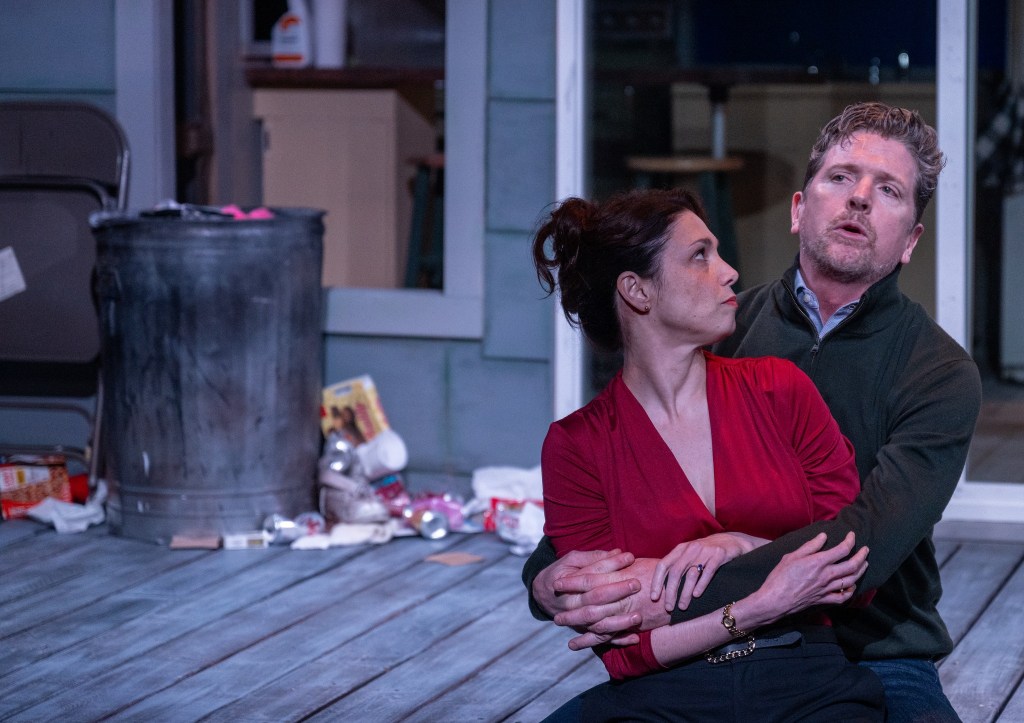
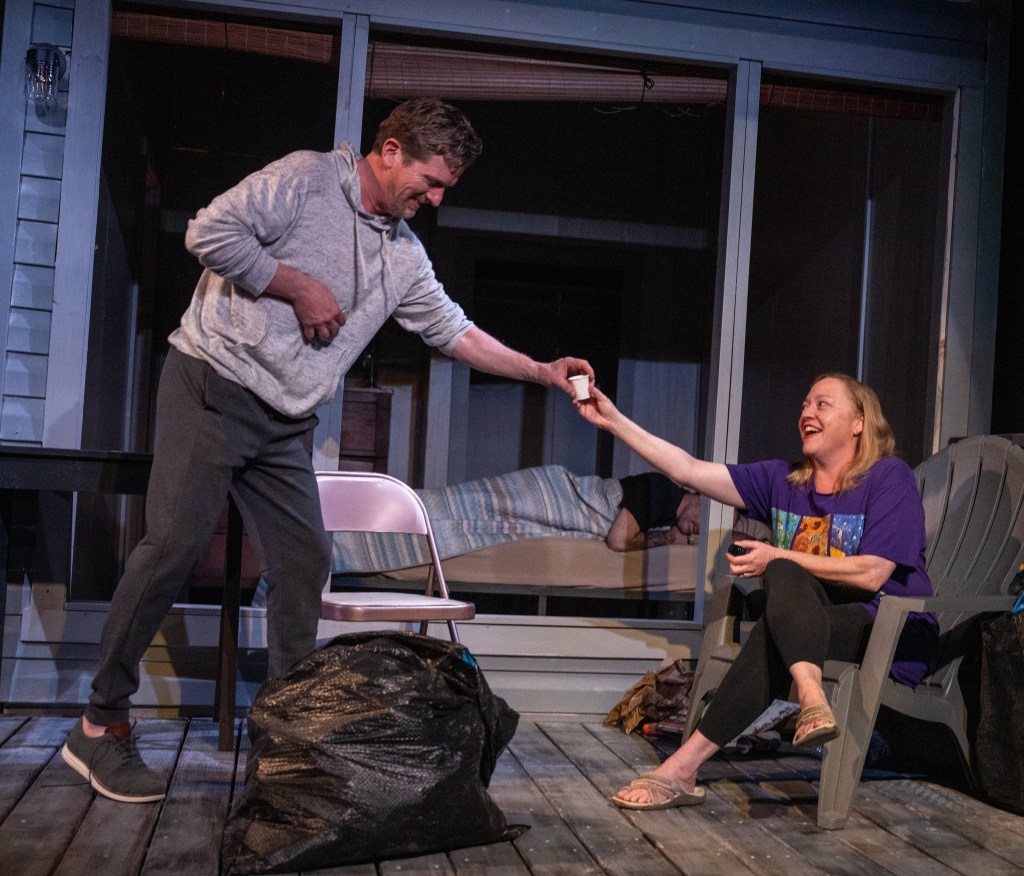
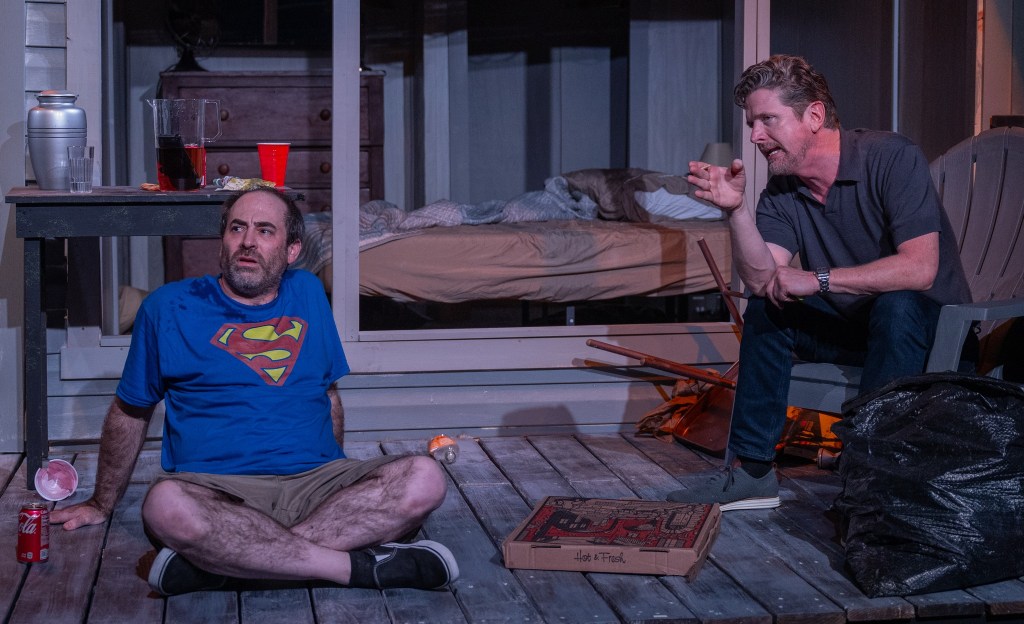
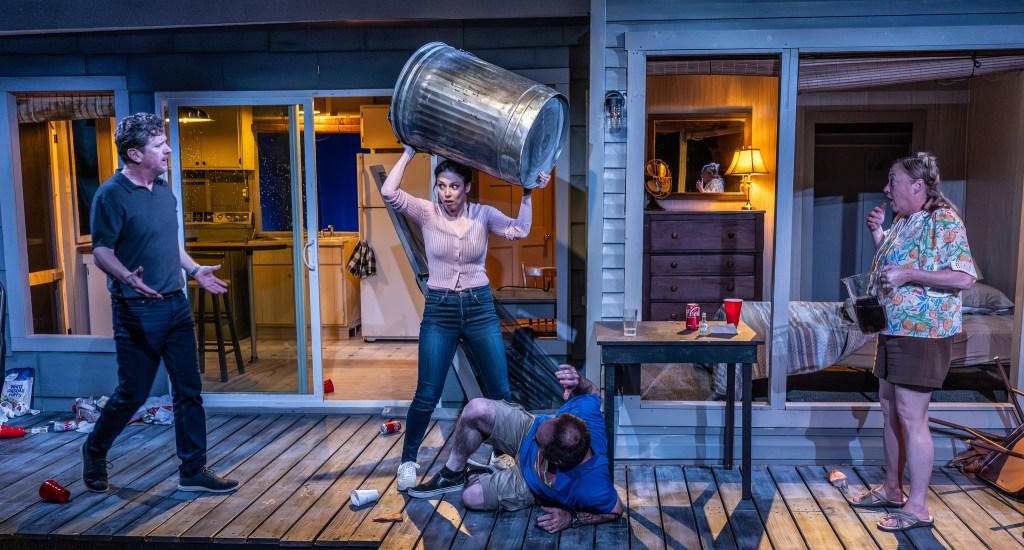
When two estranged siblings bring their respective partners to their family’s lake house to scatter the askes of their recently deceased father, things quickly get out of hand. Sparks fly – and so does scattered debris, a metal trash can, cold pizza, and even their father’s remains.

Most of us have probably experienced many of these family dynamics in our own lives: sibling rivalry, parental favoritism, failed educational goals, stagnant marriages. It’s the accumulation of all of these things in one place at the same time that makes this family’s drama exceptional. The shouting, the language, the twisted faces, the presence of alcohol, drugs, a weapon all elevate the tension to an unprecedented level of violence. (Sitting in the front row, we narrowly escaped the carnage when red plastic cups began flying across the stage and through the fourth wall.)

At the center of the controversy we find Steve (Matt Meixler) who once wanted to become a doctor and his younger sister Samantha (Nicole Morris-Anastasi) who is a doctor. The tables have turned since childhood when Steve was the favored child and Sam struggled to be seen. Childhood trauma runs deep, and Sam, despite her accomplishments, still seeks affirmation and appears to suffer from anxiety. Steve, on the other hand, has fallen from grace into an abyss he doesn’t  know how to climb out of.

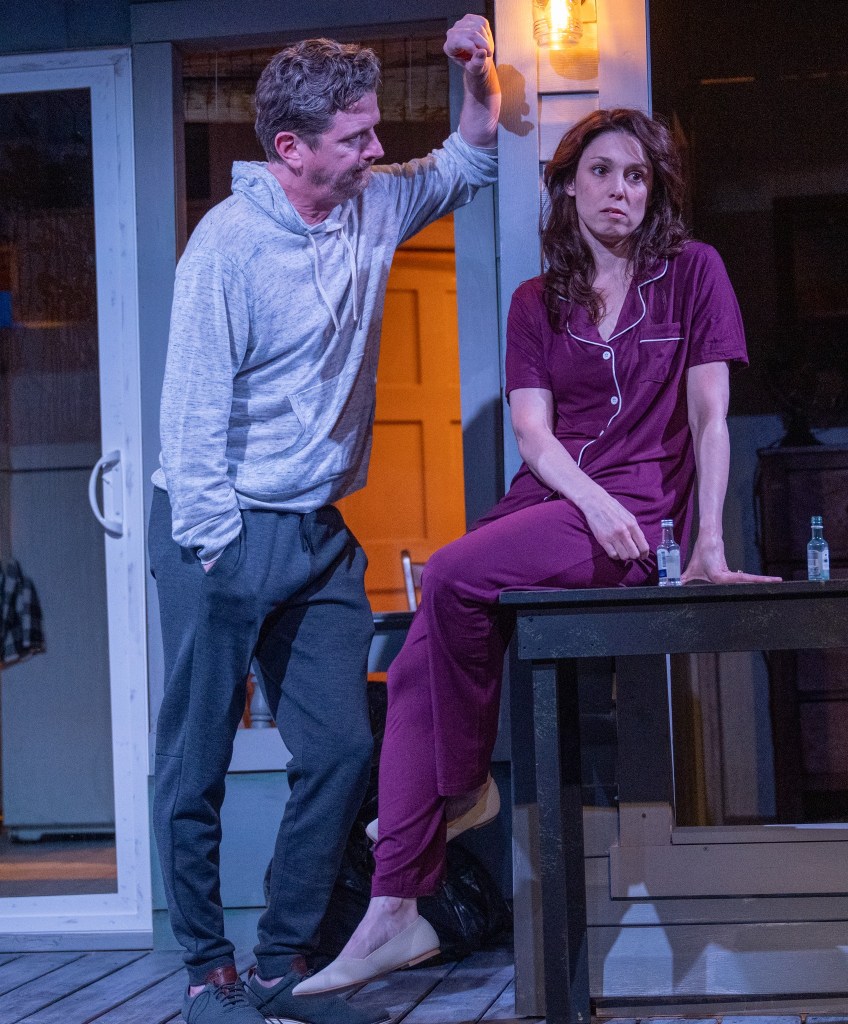
It is here that Steve’s wife Cora (Laine Satterfield) issues an ultimatum while Sam’s partner Dar (short for Darwin) approaches the whole family drama from a more philosophical point of view – fueled by alcohol in tiny airline-sized bottles and week that he somehow managed to sneak through airport security. Sam and Dar are not at each other’s throats like Steve and Cora, but their relationship is no less toxic.

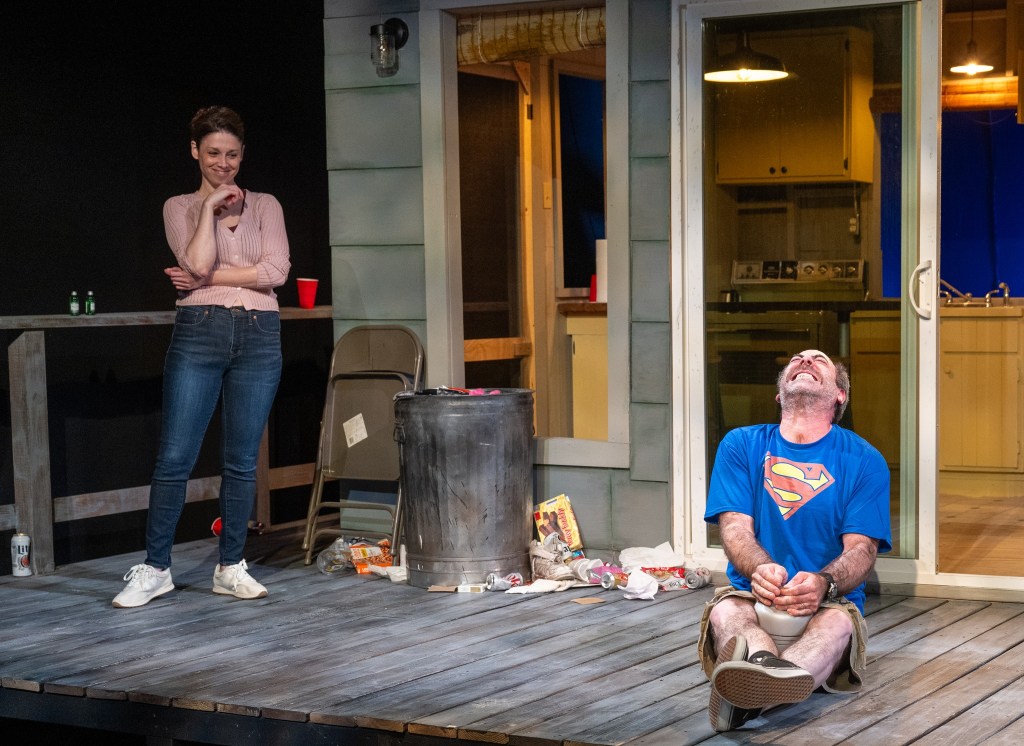
It’s interesting that while Sam and Steve are the main characters, their partners Dar and Cora often have the most interesting things to say, make the most sense, and leave the greatest impression. I’m not sure if this was the intent of Gall’s script or the power of the actors themselves. Laine Satterfield appeared on this same stage just a few weeks prior in another dark comedy about a family drama in Cadence Theatre’s Smoke. [ See my review of Smoke here: https://jdldancesrva.com/2025/07/06/smoke/ ] Satterfield presents Cora as loud and angry, but she also shows a surprisingly unexpected empathy towards Sam. Cora is a more fully developed, three-dimensional character than Steve. Matt Meixler seems to spend much of his stage time on the floor. Sometimes he’s down there painting baseboards in preparation for his mother’s arrival. Sometimes he’s down there wallowing in the detritus of his life and his own bad choices and missed opportunities, all of which are encapsulated in Chris Raintree’s trash strewn set. Raintree’s scenic design, I must add, is phenomenal. The battle weary and generally dilapidated beach cottage, along with Grace Brown LaBelle’s sound design of waves washing the shore of the nearby lake and some appropriately evocative original music by Daniel Clarke are masterfully designed.

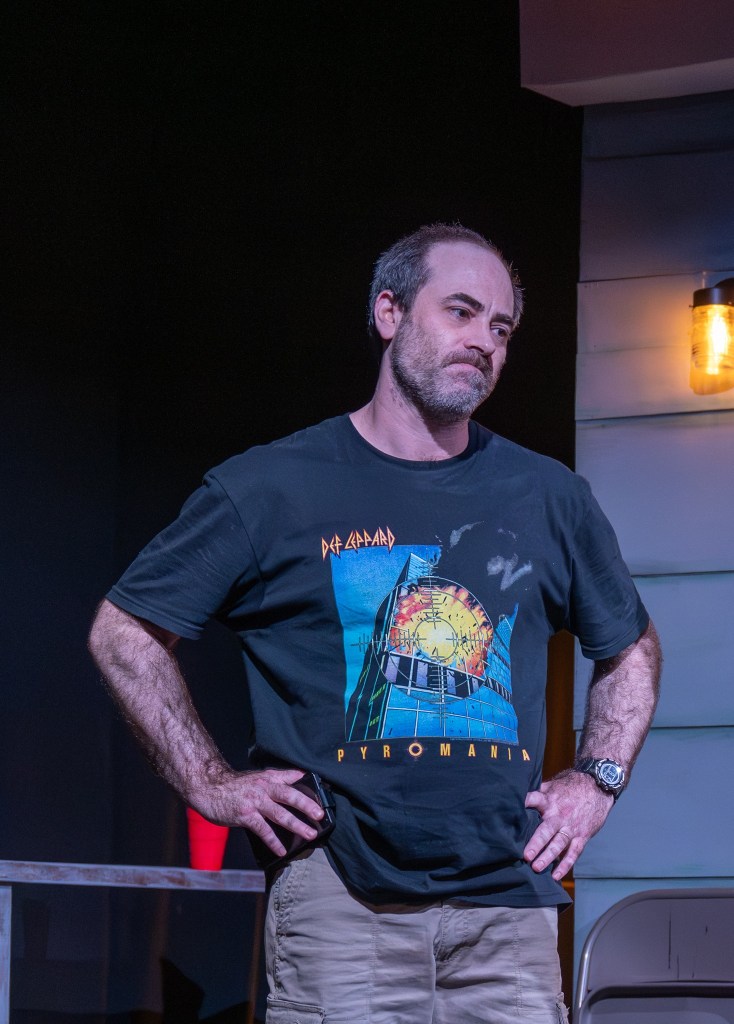
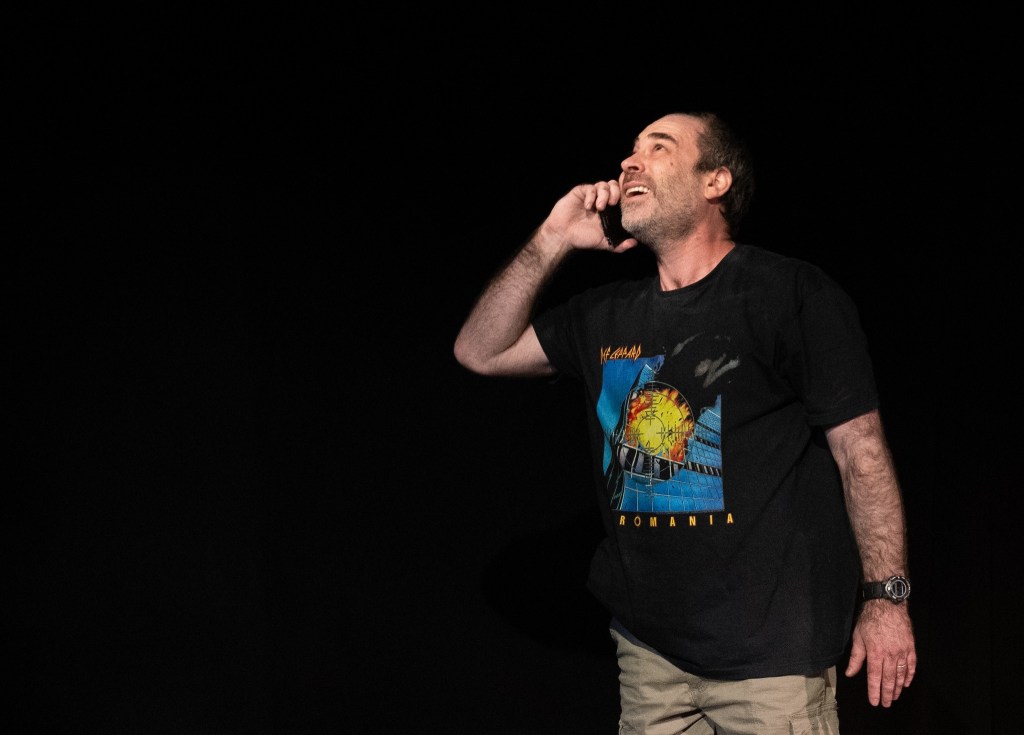
Steve’s preference for superhero tee shirts are a stark contrast to his station in life, and this is also masterfully highlighted in a late-night discussion with Dar. The seriousness of this conversation is offset by the humor that arises from Steve’s experience of trying weed for the first time. Meixler plays Steve with such a burden of defeat that there seems little hope of redemption.  Nicole Morris-Anastasi carries the burden of Sam’s childhood neglect to the point that it almost seems unlikely that she could have withstood the pressures of medical school. We never learn why young Steve was so cruel to his sister, and I don’t think Morris-Anastasi ever found out, either. Her character seems never to fully come into focus.

Duke Lafoon, on the other hand – and much like his counterpart in Laine Satterfield – gives his character more depth than the main character he supports. Dar seems to have more of a backstory than Sam, and Lafoon teases by quietly observing and then releasing philosophical tidbits the way Jesus used parables to teach the masses.

Overall, this is a successful world premiere with a strong cast and high production values. Gall’s script and Paul Takács’ direction keep things moving, often using shocking words and outrageous actions. It’s not just, as I believe one character says early in Act 1, “meaningless routine punctuated by Amazon deliveries. Act 1 is full of secrets and anger. “By the end of Act 2, the siblings have made some confessions, realized some truths, and come to a new understanding. But nothing is really resolved. There is no redemption, and whatever victory has been achieved feels less than satisfactory, more of a concession than a real win. “What we have learned from history, is that no one learns from history.” Maybe that’s why we have theater.

———-

Here’s a link to a promo video of Burial Tax: https://www.facebook.com/share/v/1AktDm7pjz/

———-

Here’s my preview from the July 2025 issue of Richmond Magazine:

Firehouse Theatre Producing Artistic Director Nathaniel Shaw says an essential component of the theater “is to amplify local talent.”

Burial Tax, written by Andrew Gall and directed by Paul Takács, will have its world premiere at Firehouse, July 11-27. After two years in development under the working title “Lake Effect,” the work promises to be a hauntingly dark comedy about the reunion of two estranged siblings who gather with their spouses at their family’s lake house to spread the ashes of their recently deceased father. It’s a release of beauty and pain, a comedic experience of family dynamics, and a unique take on the pressures of adulthood.

Gall says, “It makes us think about a shared experience in a new way.”

———-

Julinda D. Lewis is a dancer, teacher, and writer who was born in Brooklyn, NY and now lives in Eastern Henrico County. When not writing about theater, she teaches dance history at VCU and low impact dance fitness classes to seasoned movers like herself and occasionally performs.

———-

BURIAL TAX

Written by Andrew Gall

Directed by Paul Takács

CAST

Cora                   …..        Laine Satterfield

Samantha       …..        Nicole Morris-Anastasi

Steve                 …..        Matt Meixler

Dar                     …..        Duke Lafoon

Cora U/S          …..        Donna Marie Miller

Samantha U/S ….       Rachel Dilliplane

Steve/Dar U/S  ….       Andy Braden

PRODUCTION TEAM & CREW

Direction                        …..        Paul Takács

Scenic Design              …..        Chris Raintree

Lighting Design            …..        Gretta Daughtrey

Costume Design         …..        Sassy Rychalsk

Sound Design               …..        Grace Brown LaBelle

Original Music Composer     Daniel Clarke

Playwright                      …..        Andrew Gall

Assistant Director      …..        Rachel Dilliplane

Stage Management   …..        Emily Sanford Hicks

Asst Stage Management        Isabel Stone

Tickets: $5-$35

Ticket Info: (804) 355-2001 or firehousetheatre.org

Performance Schedule: July 9-27, 2025

Thursdays, Fridays, Saturdays @7:30PM

Saturdays & Sundays @2:00PM

Previews: July 9 & 10 (Pay-What-You-Will)

Opening Night: Friday, July 11

Closing: Sunday, July 27 @2:00PM

Run Time: about 2 hours with one 15-minute intermission

One-Time
Monthly
Yearly

Make a one-time, monthly, or annual donation to support the continued publication of rvart review. writers need $, too!

Make a monthly donation

Make a yearly donation

Choose an amount

$5.00
$15.00
$100.00
$5.00
$15.00
$100.00
$5.00
$15.00
$100.00

Or enter a custom amount

$

Your contribution is appreciated.

Your contribution is appreciated.

Your contribution is appreciated.

DonateDonate monthlyDonate yearly
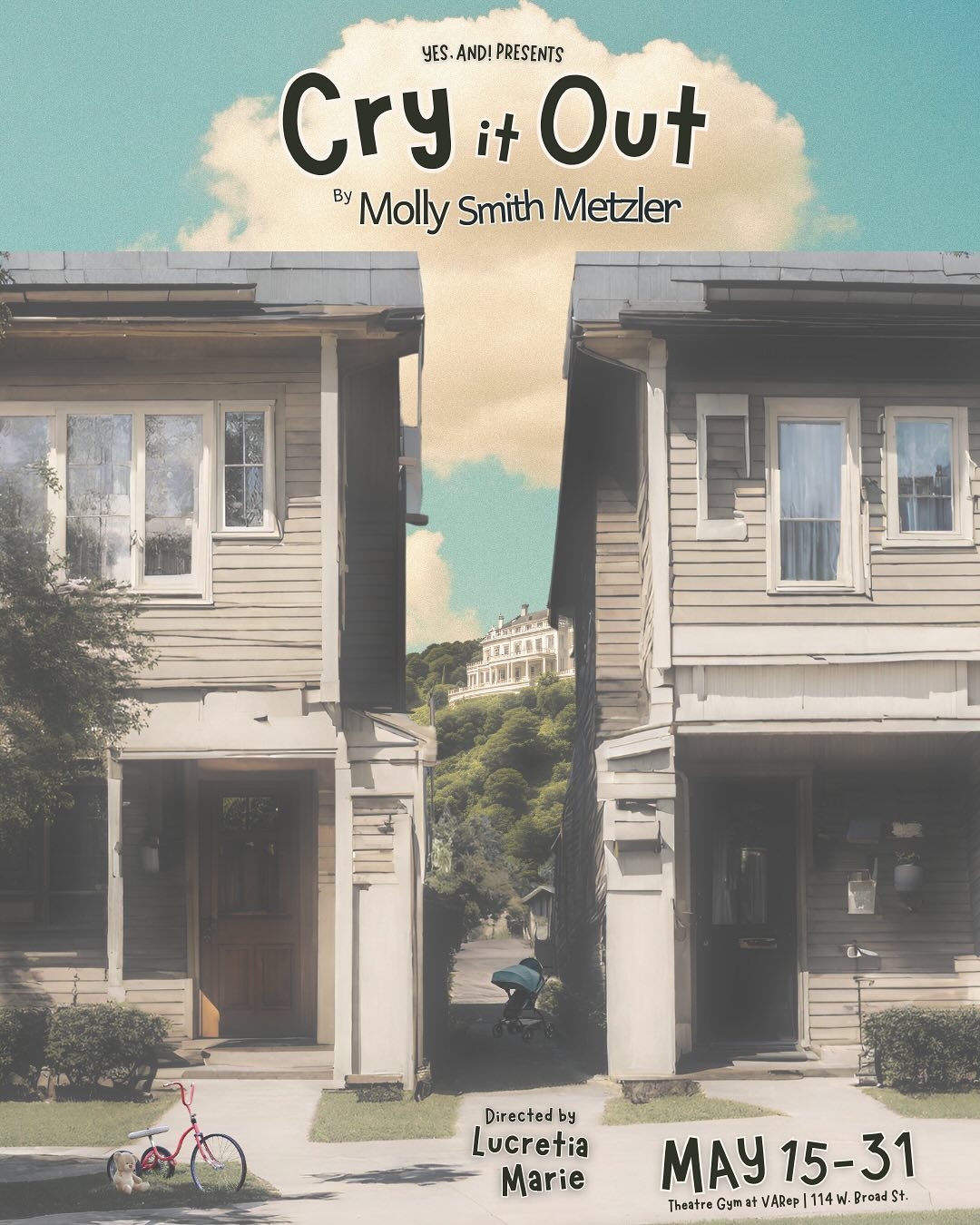
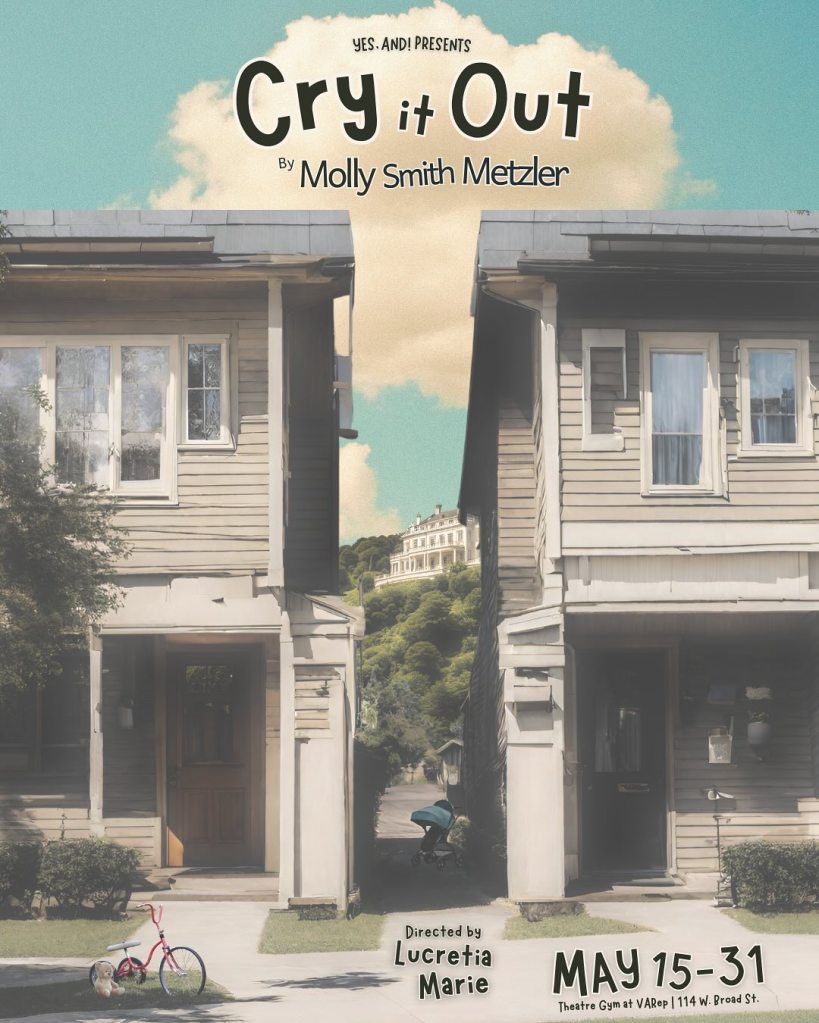
CRY IT OUT

…A Method for Training New Moms…

Produced By: Yes, And! Theatrical Company in partnership with Virginia Repertory Theatre

At: Theatre Gym at VaRep, 114 West Broad Street, RVA 23220

Performances: May 15-31, 2025

Ticket Prices: $40 general admission

Info: Email: yesandrva@gmail.com; Website: yesandrva.org; Facebook: http://www.facebook.com/yesandrva/

A Theater Review by Julinda D. Lewis

Some definitions you might need to know before seeing Cry It Out:

Cry It Out (CIO):  a sleep training technique that involves putting babies in their cribs and leaving them to cry or self-soothe and fall asleep without parental intervention

NoseFrida®: a nasal aspirator or “snot sucker” for babies who do not yet know how to blow their noses

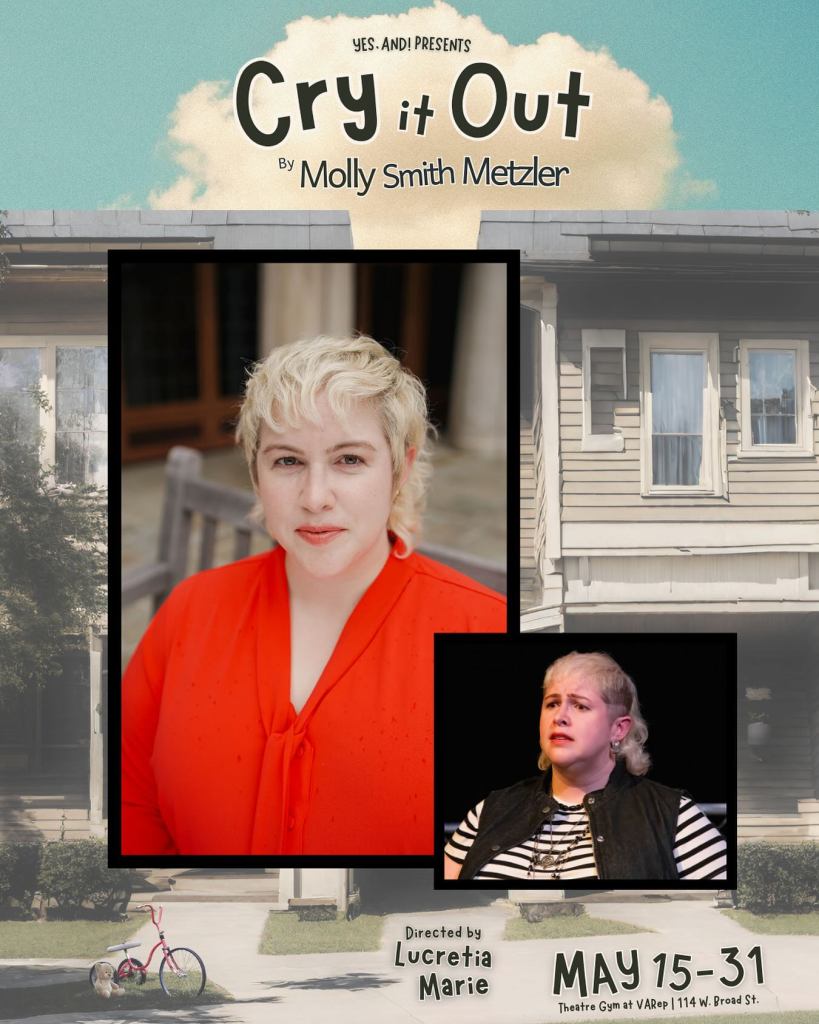
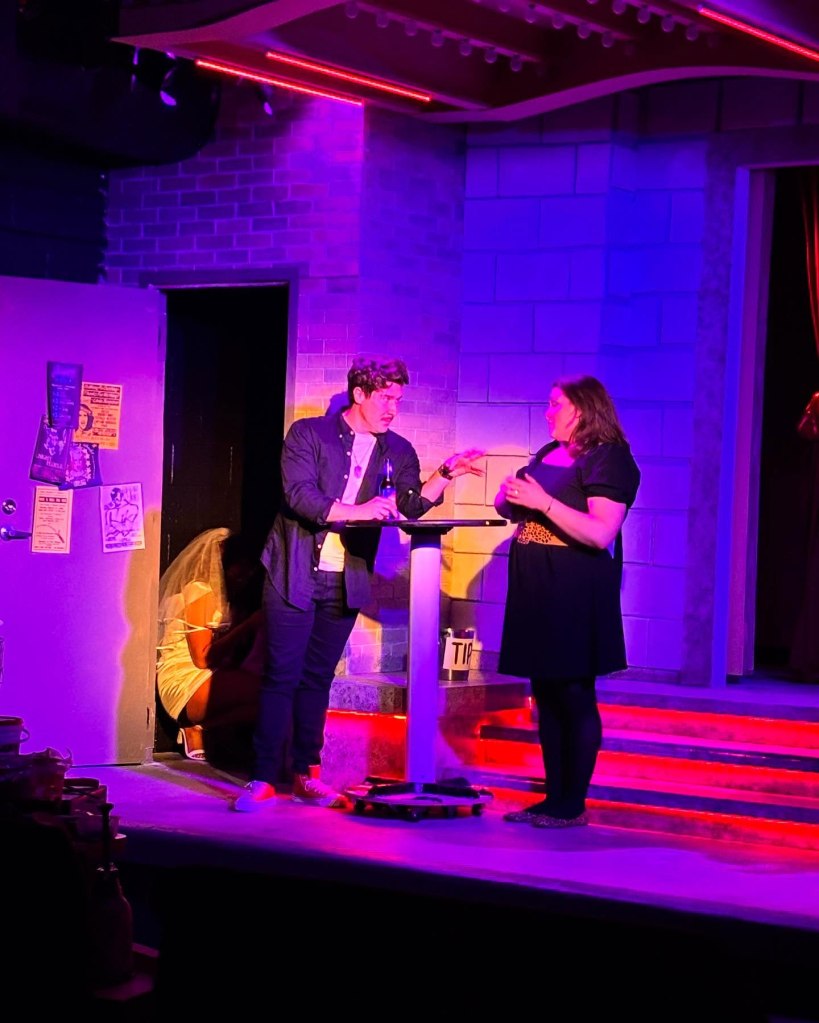
Some plays are just more relatable than others. I’m not sure how this play hits if you’re not a mother (feel free to comment!), but Molly Smith Metzler’s take on motherhood, Cry It Out (2017) is empathetic, relevant, authentic, and hilarious. Just as we warm up to the growing friendship between Jessie (Lindsey Zelli) and Lina (Emily Berry), the playwright throws in not one, not two, but three new plot-changing dynamics.

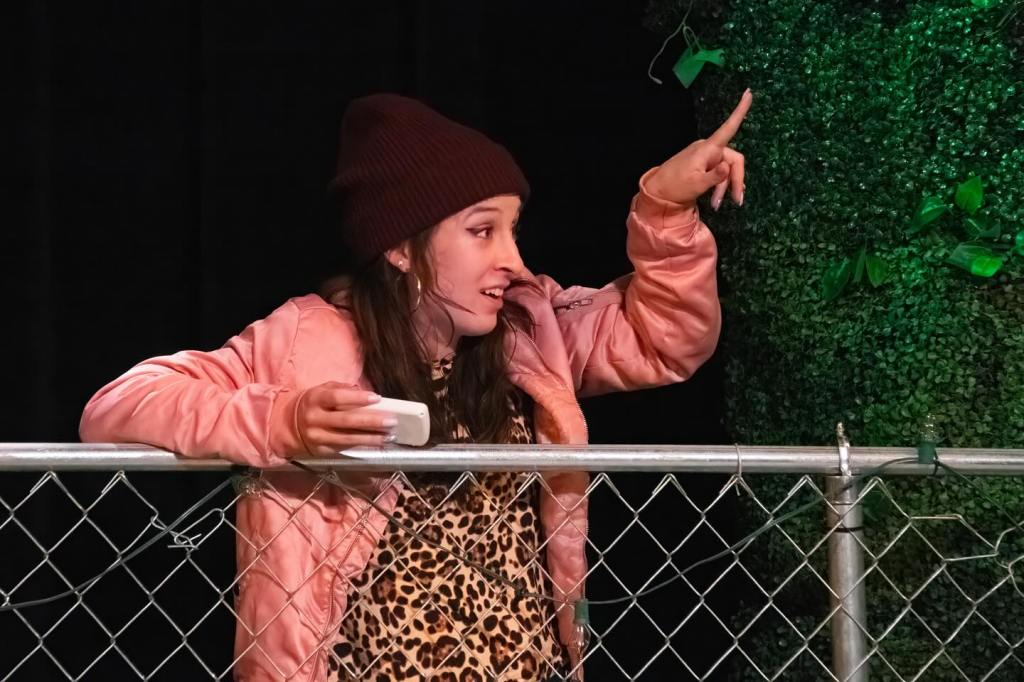
Both new moms, Jessie is a corporate lawyer married to an unseen spouse who still works in New York City and commutes to their Port Washington, Long Island home. Jessie’s in-laws are “old money” residents and have already pre-paid for their infant granddaughter’s first year at an exclusive daycare. Lina is a hospital receptionist from Long Beach on the South Shore (more urban, more “new money,” more Jersey Shore-ish, if you will) with a somewhat shady past. She, her son, and her partner are living with his mother who has a worrisome habit of disposing of her empty wine boxes in a public dumpster. Jessie is empathetic, a problem solver. Lina is brash, funny. Both are loving mothers and quickly bond, in spite of their differences, over daily coffee meetings while their babies nap.

But discussions of isolation, how to get their babies to sleep, and things like nasal aspirators move to the back seat as the weeks go by and the subject of returning to work becomes increasingly pressing. The economic necessity of mothers returning to work takes on a different, but no less significant, role depending on one’s socio-economic status: where to live; how to pay the bills; career choices and milestones; and childcare.

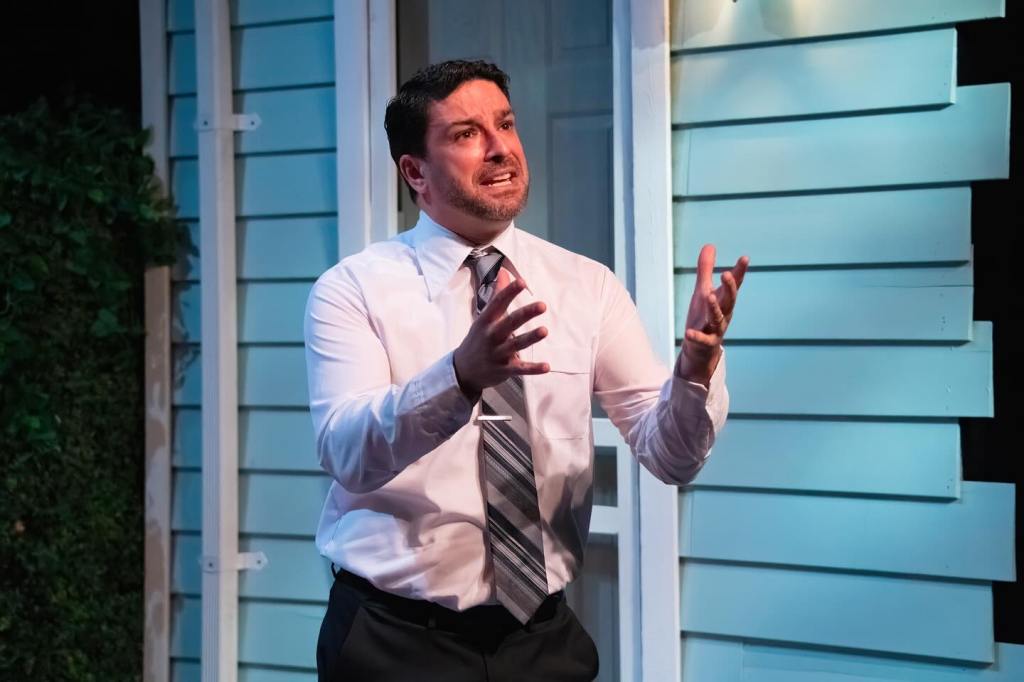
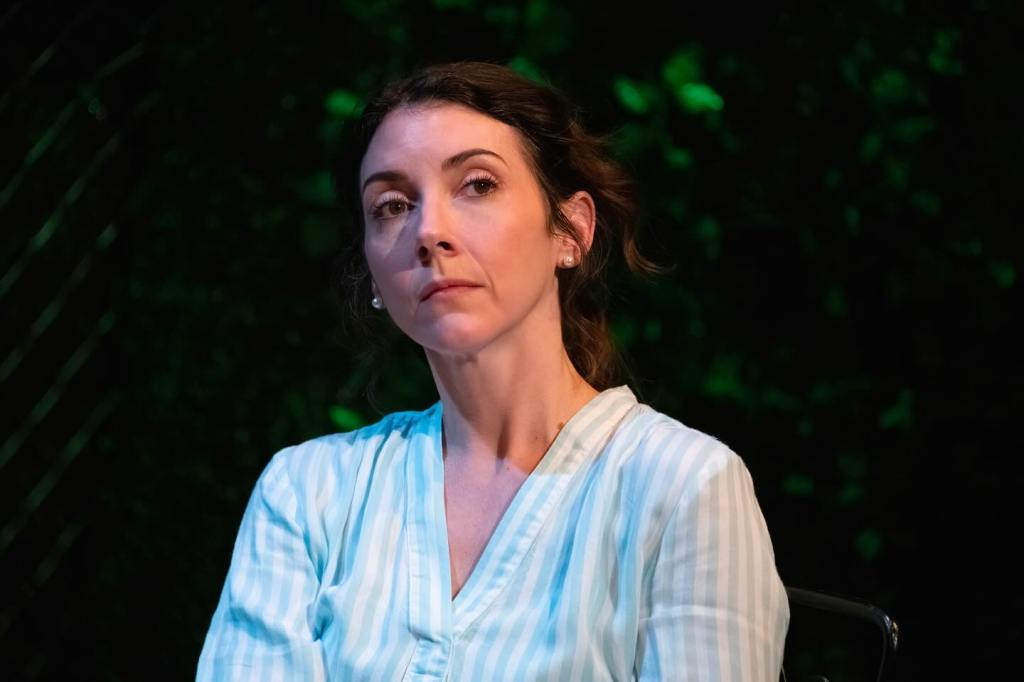
One day Mitchell (Axle Burtness), a neighbor, whose house overlooks Jessie’s backyard from up on a hilltop disrupts the delicate ecosystem Jessie and Lina have established. Mitchell has seen (spied upon?) the women’s cozy coffee klatches and, feeling concerned about his wife’s adjustment to motherhood, wants his wife Adrienne (played by understudy Erica Hughes on the night I attended) to join them.

The initial meeting is a disaster, and Adrienne subsequently presents an entirely different perspective on new motherhood, work, and society’s perceptions and expectations in general. The ending is quite surprising and reinforces the all-important lesson that motherhood, and families, do not conform to a one-size-fits-all archetype.

Lucretia Marie has directed Cry It Out with sensitivity and an unhurried pacing that assures each of these mothers is heard. Zelli imbues her character with warmth and wisdom even as Jessie herself struggles to navigate these unfamiliar waters. Berry perfectly balances Zelli, with Lina’s heavy eyeliner, thicker accent, and even more colorful language. Hughes brought the tension and surprise, and while Burtness’s character was a caring and loving father, Mitchell was the most emotional of the four parents present – sometimes to the point of being overwhelming.

Nothing much actually happens in Cry It Out. The whole play takes place in Jessie’s sparsely furnished backyard – there’s just a toddler’s playset and table and chair, and later a small patio table with three chairs. (Hm, three chairs, I thought – but there’s only two of them, so…) It’s a play that relies heavily on what’s said, and how it’s said, and who says it. Who but Lina could so convincingly tell a story about going to the door to meet the FedEx delivery man, forgetting to tuck in her breast because she was in the middle of breastfeeding. This reliance on simple, authentic dialogue, I think, places an even greater burden on the actors, who can’t hide behind a pratfall or a prop. Cry It Out makes us think about things that affect most of us, but that we may not often talk about in an open forum. Cry It Out is timely, real, and impactful.

———-

Julinda D. Lewis is a dancer, minister of dance, teacher, and writer who was born in Brooklyn, NY and currently resides in Eastern Henrico County. When not writing about theater, she teaches dance history at VCU and low impact dance fitness classes to seasoned movers like herself and occasionally gets to perform.

———-

CRY IT OUT

Written by Molly Smith Metzler

Directed by Lucretia Marie

Cast

Jessie ….. Lindsey Zelli

Lina     ….. Emily Berry

Mitchell ….. Axle Burtness

Adrienne ….. Sara Dabney Tisdale

Understudy Cast

Jessie ….. Tensley Nesbitt

Lina ….. Brittany Martz

Mitchell ….. Sarbajeet Das

Adrienne ….. Erica Hughes

Production Team

Scenic Design – Dasia Gregg

Costume  Design – Erik Mayes

Lighting Design – Kacey Yachuw

Sound Design – John Pratt

Properties Design – Cai Hayner

Dialect Coach – Erica Hughes

Fight Choreography – Axle Burtness

Production Stage Manager & PSM – Crimson Piazza

Assistant Stage Manager – Marcely Villatoro

Technical Director – Ben Burke

YES, AND! THEATRICAL COMPANY

Artistic Director – Maggie Roop

Executive Director – Matt Shofner

Performance Schedule

Thursday, May 15, 2025                 7:30PM          Opening Night

Friday, May 16, 2025                      7:30 PM

Saturday, May 17, 2025                 7:30PM

Friday, May 18, 2025                      7:30PM

Saturday, May 19, 2025                 7:30PM

Sunday, May 20, 2025                    2:00PM          Pay What You Can*

Tuesday, May 21, 2025                  7:30PM         

Thursday, May 22, 2025                 7:30PM

Friday, May 23, 2025                      7:30PM

Saturday, May 24, 2025                 2:00PM

Saturday, May 24, 2025                 7:30PM

Sunday, May 25, 2025                    2:00PM          Pay What You Can*

Tuesday, May 27, 2025                  7:30PM          Industry Night/Pay What You Can*

Thursday, May 29, 2025                 7:30PM          Understudy Night

Friday, May 30, 2025                      7:30PM

Saturday, May 31, 2025                 2:00PM

Saturday, May 31, 2024                 7:30PM          Closing Performance

World Premiere: 2017 Humana Festival of New American Plays at Actors Theatre of Louisville.

Tickets

Ticket Prices: $40 general admission; $20 Rush Rickets at the Box Office one hour prior to all performances

*Pay What You Can: $5 suggested minimum at the door; $10 minimum in advance

Run Time

Approximately 1 hour, 40 minutes with one 15-minute intermission

Photos from the Yes, And! Theatrical Co., Facebook page

One-Time
Monthly
Yearly

Make a one-time, monthly or annual donation

Make a monthly donation

Make a yearly donation

Choose an amount

$5.00
$15.00
$100.00
$5.00
$15.00
$100.00
$5.00
$15.00
$100.00

Or enter a custom amount; no amount is too small, OR TOO LARGE!

$

Your contribution is appreciated.

Your contribution is appreciated.

Your contribution is appreciated.

DonateDonate monthlyDonate yearly
WHICH WAY TO THE STAGE

The Roles We Play

At: Richmond Triangle Players at the Robert B. Moss Theatre, 1300 Altamont Avenue,  RVA 23220

Performances: April 23 – May 17, 2025

Ticket Prices: $50

Info: (804) 346-8113 or rtriangle.org

A Theater Reflection by Julinda D. Lewis

Ana Nogueira’s Which Way to the Stage is one of the funniest plays I’ve seen this season ever seen. It is also one of the most authentic plays I’ve ever seen about the theater, relationships either the theater or relationships. Which Way to the Stage is complex and layered. It’s filled with inside jokes – I’m sure that I probably only caught a quarter of them – that could be used as a test to weed out the true musical theater afficionados from the amateurs. I do know a few people – I won’t call them friends – who don’t like musical theater; this show is not for them.

Judy (Amanda Spellman) and Jeff (Matt Shofner) are best friends and theater buddies. Judy carries around a binder filled with playbills – including one from the original cast production of Rent. She and Jeff enjoy discussing things like who was the best Mama Rose in Gypsy (Bernadette Peters? Patti LuPone?) as if their very lives depend on the correct response.

“Like a caricature of a caricature of a performance by my mother in the Temple Beth Israel talent show.” – Judy

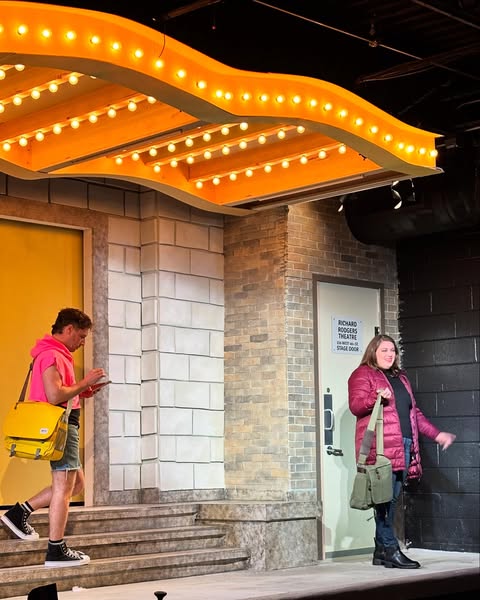
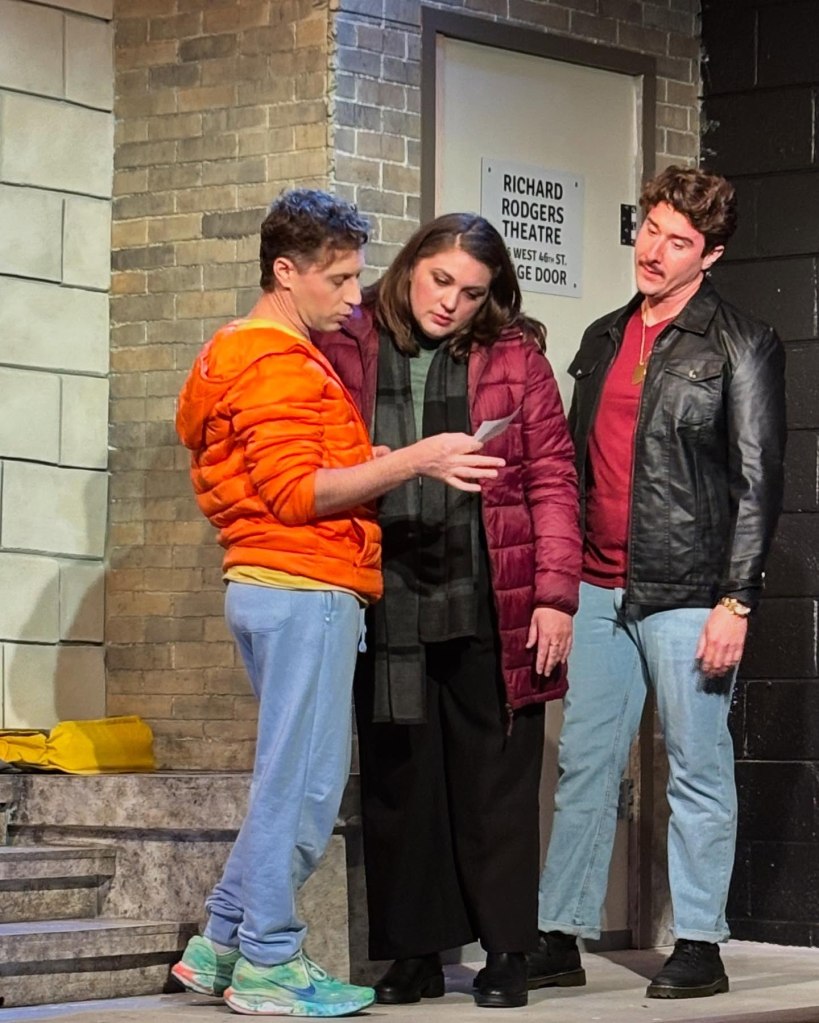
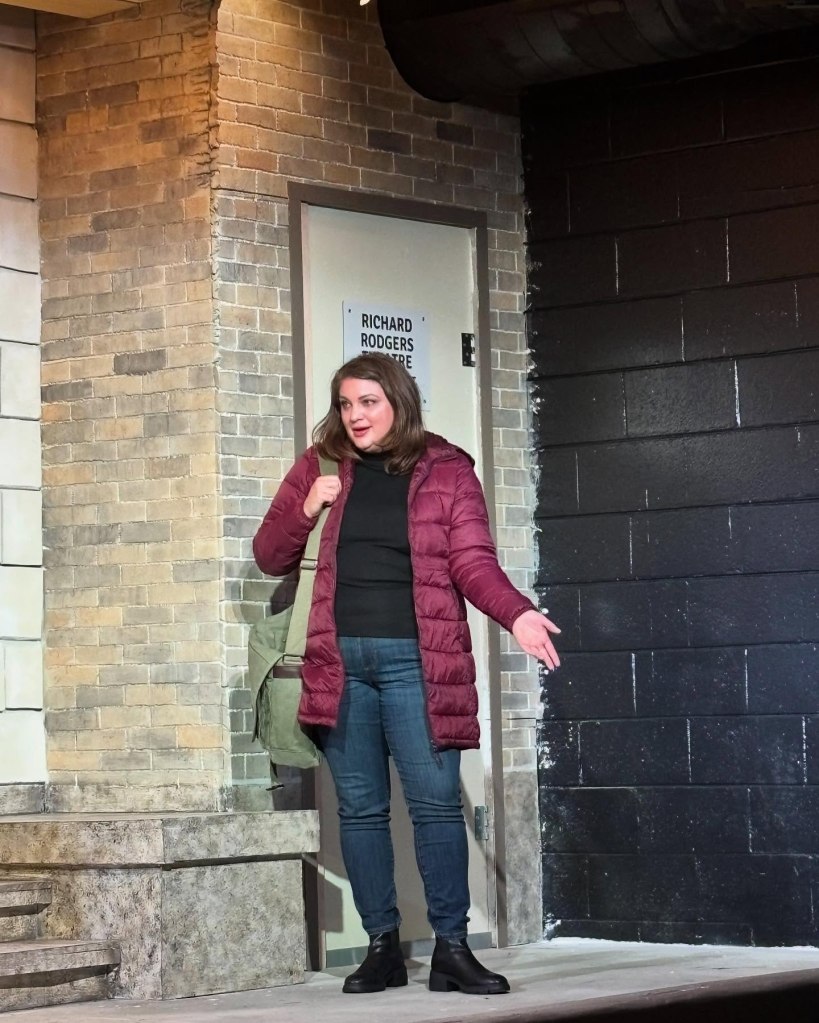
During the course of Which Way to the Stage, the two meet most nights outside the stage door of the Richard Rodgers Theatre, waiting for Idina Menzel* to appear, hoping to get her to sign their programs. She didn’t come out the night they saw the show she’s starring in, If/Then, and they are racing against time as the show is schedule to close soon.

The main part of the set for Which Way to the Stage is outside the stage door of the Richard Rodgers Theatre, located at 226 West 46th Street in New York City’s theater district. The scene was immediately familiar to my daughter, who was my theater date on opening night. When we lived in NY, she attended New York’s High School of Graphic Communication Arts on West 49th Street, a short distance from the theater. Kudos to Daniel Allen, the scenic designer, for the authenticity. The theater marquee and the hallway where the actors wait for their auditions are perfection!

On stage at Richmond Triangle Players (RTP) Spellman and Shofner start off with high spirited theater-nerd banter that – incredibly – just keeps getting better and better as the show goes on. Personal chemistry? Great acting? Let’s say it’s a balanced blending of both. The two usually enter the stage from the audience, starting their loud banter as they walk to the theater – and nearly every time they have a near miss with the NYC traffic.

“I want to be Rent poor!” – Judy

Both Judy and Jeff are actors. Judy is returning to theater after taking time to develop a career in real estate – in New Jersey. She’s talented but lacks confidence. Jeff can’t get the roles he really wants because they’re for cis gender white men – or women. He works as a drag queen and specializes in portraying Streisand as Yentl (there’s some more musical theater history for you!).

Things start to get real when Judy crosses a line. You know how it’s taboo for the white friend to use the word “nigger” around their Black friends? Well, Judy, in an act of solidarity with Jeff, whose ex-boyfriend managed to get Menzel’s autograph on the one night Jeff and Judy could not be there, calls the ex a “faggot.” The atmosphere changes, the mood shifts, and Jeff, as gently as possible, explains that, even thought they have been friends since high school and even though Judy is what we might call an  “ally” these days, she can’t say that word.

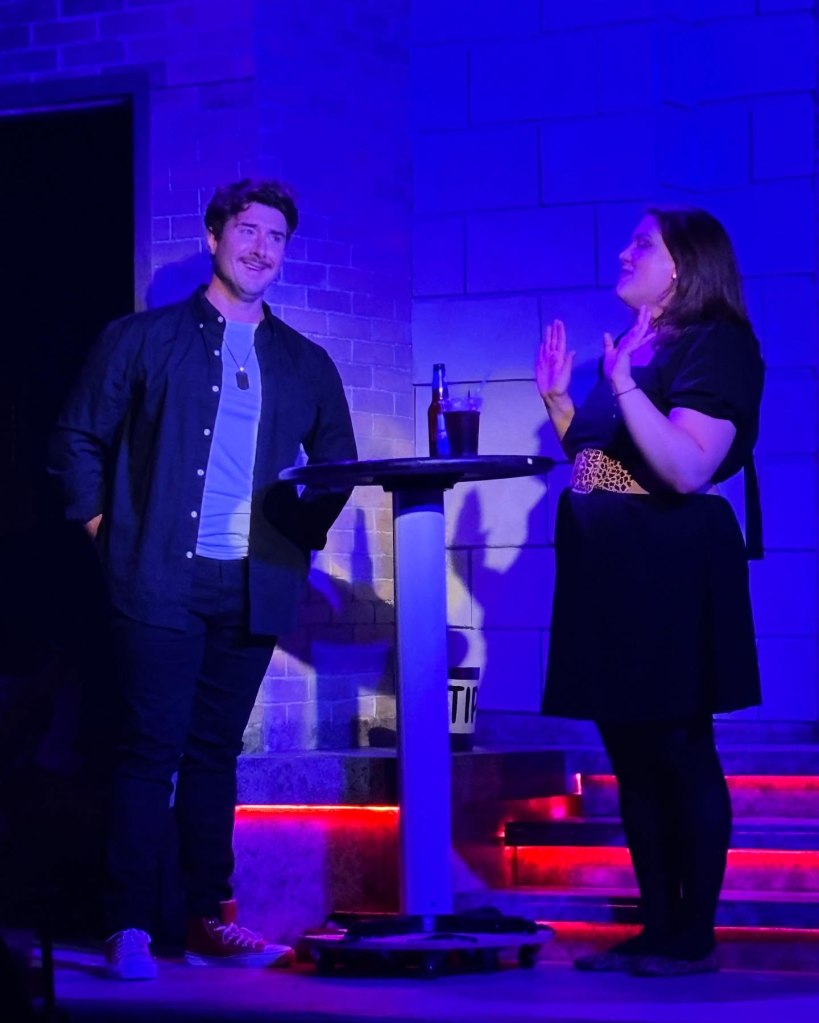
At an audition, in which Judy does quite well, but doesn’t quite get the job, she meets and later starts a tenuous relationship with Mark (Calvin Malone). Mark seems to have a leg up on getting parts. He’s tall, white, handsome, and straight – or is he??? This throws a new cog in the wheel of Jeff and Judy’s relationship. There is now sexual tension, rivalry, jealousy, and an unnamed emotion that wells up in Judy when her femininity is not so much questioned as criticized. She is advised to take lessons in being more womanly – from a drag queen.

Spellman manages this brilliantly, starting subtly with a zipper that keeps sliding down, and building up to – well, If I told you, that would be too much of a spoiler. I’ll just say, it builds up, fueled in part by Judy’s own stagnation, Jeff’s insightful but cutting observations, and the Mark triangle.

Speaking of drag queens, Shofner completely slayed in his second act drag scene. First of all, let’s acknowledge the magic of Tariq Kariem (costume designer and wardrobe supervisor) and Like Newsome (who designed the hair and makeup). Shofner’s make-up and wig were applied in record time. At one point, I believe Shofner exited a door in one outfit and reappeared less than a minute later through another door in a completely different outfit! Onstage, after his over the top drag act, ending with a hearty lip-synced rendition of “Defying Gravity,” complete with a black cape, step-ladder and…mop, yes, a mop, not a broom (sigh)…as I was saying, after this number, Shofner, as Jeff, sits at his dressing room table and completes the process of removing every trace of the makeup – and act that is both professional and symbolically profound. As he strips off his character, he reveals more of himself.

There are a lot of symbolic and metaphoric words and actions in Which Way to the Stage. How do we define femininity? Who determines which roles are suitable for a gay actor? (I mean, after all, it’s…acting.) Is bisexuality a valid choice – or is refusing to accept labels just a lack of commitment? How does friendship survive or thrive when career, life, or perhaps being unevenly yoked all sink their hooks into every breath you take, and make it impossible to breathe?

Like most good humor, in my experience, Which Way to the Stage is based on real life: people, situations, circumstances, including identity and belonging – and in this case, all of the above. Shofner and Spellman really shine as the two besties, and Malone is suitably over-confident in a way that makes it seem natural that both Jeff and Judy would be attracted to his character. There is a fourth character, a nameless and over the top entity played by Sydnee Graves.

Graves fills the shoes of an actress at the casting call, a bachelorette at the drag show, and the casting director. I didn’t much like Actress at first. She was bougie, aloof, confrontational. And then she explained to Judy how she had to learn to navigate the world, and she became less of a stereotype and more of a real person. Actress was not written as a fully rounded character, but the tags on her dress, so she can return it after the audition, and her story of sexual harassment are very much true-to-life and provide a much-needed anchor for Judy on her journey. Casting Director is a very minor character, but Bachelorette, a drunken member of a bridal party whooping it up at the drag club where Jeff performs, seems to be included strictly for laughs and seems to have no redeeming qualities other than to provide a vehicle to divert attention from the stresses of the main characters. The three roles serve hilarity to the audience and establish Graves as a versatile comedic actor.

Actress has come to terms with her life, striking an uneasy truce with theater. Jeff has adopted a realistic look at the world of make-believe, and grasps at any straws of hope and love that come his way. Mark, well, he’s the straw. And since he can pass as a straight white male, he has access to privilege. It’s Judy who is floundering, and her way of coming up for air results in one of the most brilliant scenes of the show. (Shofner’s drag show holds two of the top three places.)

Which Way to the Stage is challenging. It unwraps the carefully concealed, seamy side of theater. It’s sort of like a theatrical version of revealing the magician’s secrets. And it’s all brilliantly adorned in witty conversation, complicated friendships, and the “dainties” of life that we usually try so hard to conceal. All out there in the open. With dazzling lights, caterpillar lashes, and the sort of drama that follows you home when you leave the theater.

Directed by RTP’s Artistic Director, Lucian Restivo, who also designed the sound and projections, Which Way to the Stage isn’t a musical, but rather a play centered around a love of musical theater. There is so much familiar music in the pre-show and sound design, and so much talk of musicals, that you almost forget this isn’t actually a musical. Nogueira aptly captures the struggles that artists face in reconciling their personal aspirations with society’s expectations of and for them. Using sharp wit and unusually accurate emotional depth, Which Way to the Stage invites the audience into the inner sanctum, where we can reflect on our own journeys, and perhaps most importantly, it celebrates resilience and offers guidance on how to find and maintain connection in the midst of the chaos of the world. Yeah, you should go see it.

*Idina Menzel, the Queen of Broadway, known for her breakout performance in Rent, her award-winning performance as Elphaba in Wicked, and several award for If/Then. With a voice that spans three octaves, she has been compared to Barbra Streisand – and like her has developed a large gay following. She sand “The Star-Spangled Banner” at Super Bowl LXIX and is known for powerful and empowering songs like “Let It Go” (Disney’s Frozen) and “Defying Gravity” (Wicked).

———-

Julinda D. Lewis is a dancer, minister of dance, teacher, and writer who was born in Brooklyn, NY and currently resides in Eastern Henrico County. When not writing about theater, she teaches dance history at VCU and low impact dance fitness classes to seasoned movers like herself and occasionally performs.

———-

WHICH WAY TO THE STAGE

Written by Ana Nogueira

Directed by Lucian Restivo

Cast

Sydnee Graves        —–     Actress/Bachelorette/Casting Director

Calvin Malone          —–     Mark

Matt Shofner            —–     Jeff

Amanda Spellman  —–     Judy

Wayne Parker           —–     u/s for Mar & Jeff

Shannon Schilstra   —–     u/s for Judy & Actress/Bachelorette/Casting Director

Creative Team

Daniel Allen              —–     Scenic Design

Paul Vaillancourt     —–     Lighting Design

Tariq Karriem           —–     Costume Design & Wardrobe Supervisor

Lucian Restivo          —–     Sound & Projection Design

Tim Moehring          —–     Props Design

Luke Newsome        —–     Hair & Makeup Design

Lauren Langston      —–     Production Stage Manager

Performance Schedule

Wednesday, April 23          8:00PM, Preview

Thursday, April 24               8:00PM, Preview

Friday, April 25                    8:00PM, Opening Night

Saturday, April 26                8:00PM

Sunday, April 27                  4:00PM

Thursday, May 1                  8:00PM

Friday, May 2                        8:00PM

Saturday, May 3                   8:00PM

Sunday, May 4                      4:00PM

Thursday, May 8                  8:00PM

Friday, May 9                        8:00PM

Saturday, May 10                 8:00PM

Sunday, May 11                   4:00PM

Wednesday, May 14           8:00PM

Thursday, May 15                8:00PM

Friday, May 16                     8:00PM

Saturday, May 17                 8:00PM

Tickets

Ticket Prices: $50

Run Time

About 2 hours; one intermission

Setting

2015. The stage door of If/Then at the Richard Rodgers Theatre, an audition waiting room, and a drag club

Which Way to the Stage had its WorldPremiere at the MCC Theater in 2022.

Photos from the RTP Facebook page

One-Time
Monthly
Yearly

Make a one-time, monthly, or annual donation in support of rvart review.
we do not charge a fee, but we aren’t free…

Make a monthly donation

Make a yearly donation

Choose an amount

$5.00
$15.00
$100.00
$5.00
$15.00
$100.00
$5.00
$15.00
$100.00

Or enter a custom amount – no amount is too small (or too large).

$

Your contribution is appreciated.

Your contribution is appreciated.

Your contribution is appreciated.

DonateDonate monthlyDonate yearly
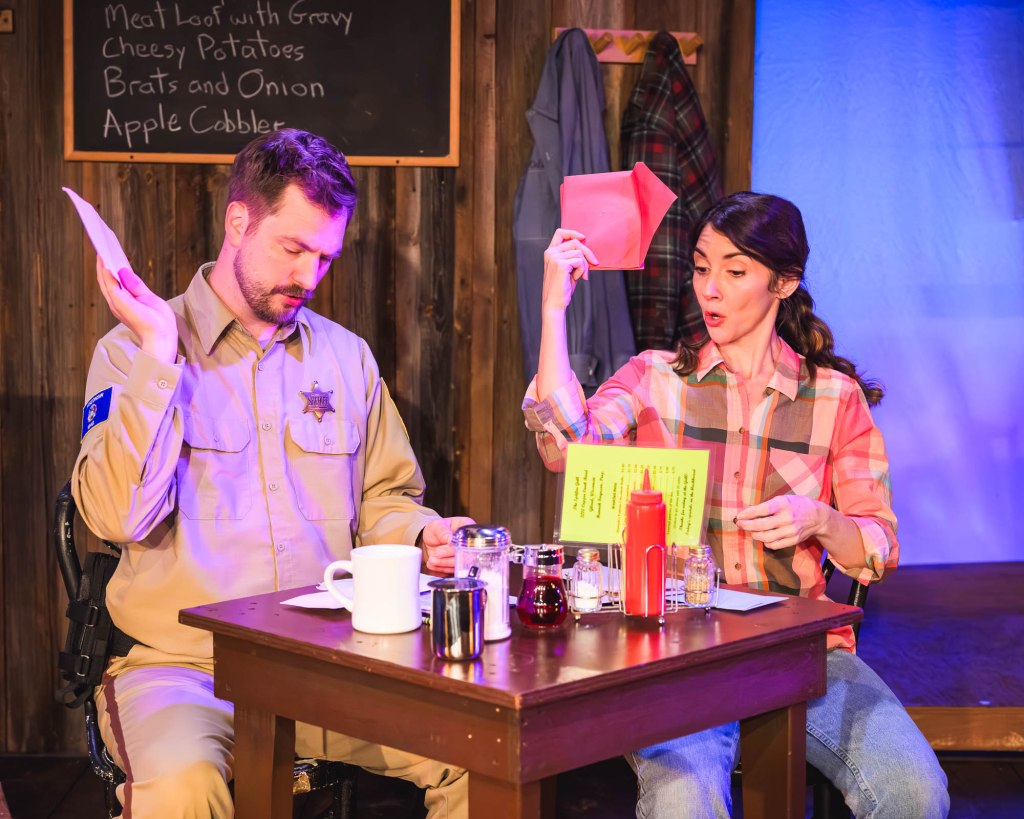
Dial M for Murder

What’s So Important About the Fifth Step?

A Theater Review by Julinda D. Lewis

By: Virginia Repertory Theatre (Virginia Rep), The Barksdale Season

At: Hanover Tavern, 13181 Hanover Courthouse Road, Hanover, Virginia 23069

When: March 28 – April 27, 2025

Ticket Prices: $54  

Info: (804) 282-2620 or www.virginiarep.org

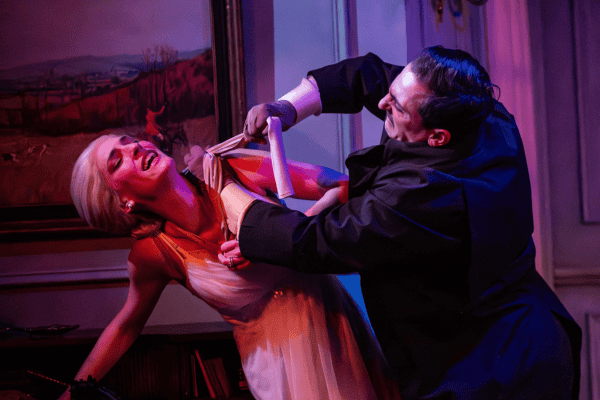
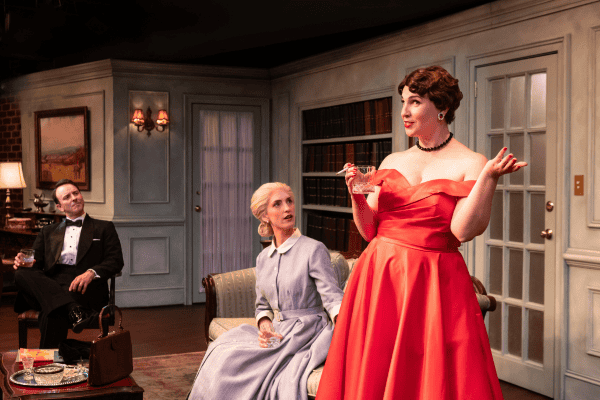
Dial M for Murder is a classic 1950s stage thriller, a murderous melo-drama filled with plot twists and scandal. Tony Wendice married his wife Margot for her money, and now he wants to get rid of her – but he also wants to keep her money. The logical solution, since this is a Hitchcockian style murder mystery, is to kill her. Thanks to their mutual friend, a successful American crime writer named Max, Tony has the background – and the motive – to plan the perfect murder. But will he be able to get away with it?

Jeffrey Hatcher’s adaptation kept the basic plot and Frederick Knott’s location: a 1950s London flat, but one major change is that  Hatcher changed the Wendice’s friend Max, with whom Margot had and broke off an affair, from Max to Maxine. This means Margot was engaged in a lesbian affair and gives even more of an edge to the scandal since same-sex partnerships were not exactly acceptable in the 1950s.

Tony’s carefully planned plot goes awry, but he quickly improvises a Plan B, resulting in Margot being charged with the murder of the man Tony had hired to kill her. Margot doesn’t know who to trust, and if not for the fortuitous partnership between Maxine and a keen-eyed detective, Hubbard, this play might well have ended with her hanging from the gallows. Fast-paced and seasoned with a dash of humor, Dial M for Murder is a deliciously entertaining divertissement. Unlike some of the serious – and seriously good – theater I’ve seen in the past few months, this play doesn’t require you to think about social issues, it doesn’t draw parallels with historical events, and it doesn’t attempt to teach us moral lessons. It’s pure fun – a class murder mystery with smart plot twists and stereotypical characters we recognize and welcome into our lives for a little over two hours.

5 Motives for Murder

Money

Fear

Jealousy

Revenge

To protect a loved one

This production has a stellar cast, many of whom will be familiar to those who frequent local theater. Margot is played by Ashley Thompson (5 Lesbians Eating a Quiche, Dr. Ride’s American Beach House, and Buried Child). Tony is played by Alexander Sapp (Peter and the Starcatcher, Sweeney Todd). Maxine is played by Rachel Dilliplane (5 Lesbian Eating a Quicke, The Laramie Project, and Moriarty u/s). The shoes of the would be hired killer, Legate, are filled by Adam Turck (Constellations, The Laramie Project, The Inheritance, Animal Control, Buried Child). The newest face was that of Jim Meisner, Jr. in the role of Inspector Hubbard. Dial M for Murder marks Meisner’s Virginia Rep debut and his first performance after a more than 25-year hiatus from the stage.

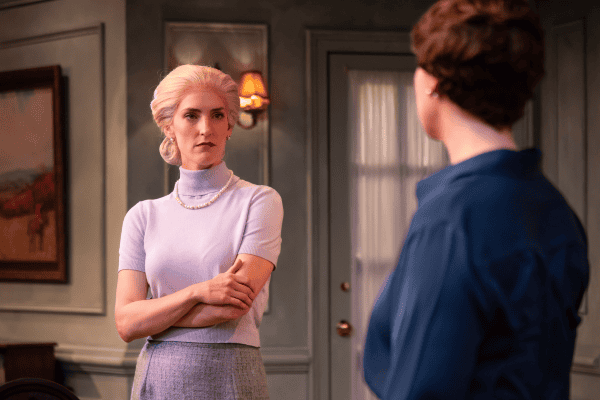
The sexual tension between Margot and Maxine is obvious from the opening scene, highlighted by Thompson’s conservative couture and wig and Dilliplane’s more bold fashion choices and short haircut. No separate credit was given for wigs, so I will assume that Sarah Grady gets the well-deserved credit for both hair and costumes. Even the tan trench coats play an important role later in the denouement when Inspector Hubbard sets a trap to expose Tony.

“Everything has its price.” – Tony Wendice

Sapp is smooth with his lies in front of the other cast members and a master of the villainous side eye when playing to the audience. Turck is suitably sleezy as Tony’s corrupt former classmate turned hitman. And last but not least, Meisner is heroic as the blustery bumbling Inspector. (Is anyone else old enough to remember the bumbling TV detective, Colombo?)

This impressive ensemble was under the capable direction of Mel Rayford, also making their VaRep debut. Rayford skillfully guided the cast and audience through all the twists and turns, through layers of subplots and intrigue, encouraging us to find amusement in murder, to willingly turn corners into fictional depravity, and then to vigorously applaud when we emerged, safe and sound and strangely exhilarated for having taken the journey.

A Word of Caution

Beware of anyone who puts mushrooms in their spaghetti.

(You’ll know why if you’ve seen the play.)

———-

Julinda D. Lewis is a dancer, teacher, and writer who recently had both knees replaced due to a manufacturer’s recall. Born in Brooklyn, NY, she now lives in Eastern Henrico County where she can be found kicking up  her heels as best she can any day of the week.

———-

DIAL M FOR MURDER     

Adapted by Jeffrey Hatcher (2022)

From the Original by Frederick Knott (1952)

Directed by Mel Rayford

Cast

Ashley Thompson ……………….             Margot Wendice

Rachel Dilliplane …………………             Maxine Hadley

Alexander Sapp ………………….             Tony Wendice

Adam Turck ………………………             Lesgate

Jim Meisner, Jr. ………………….             Inspector Hubbard

Kendall Walker …………………..             Margot U/S, Maxine U/S

Travis Williams  ..…………………             Lesgate U/S, Hubbard U/S

Chandler Hubbard ………………             Tony U/S

Direction & Design

Direction ………………………….             Mel Rayford

Scenic Design ……………………             Frank Foster

Costume Design …………………             Sarah Grady

Lighting Design …………..………            Steve Koehler

Sound Design …………………….            Jonathan Pratt

Fight Director …………………….             Casey Kaleba

Dialect Coach …………………….             Nicole Cowans

Stage Management ………….…..            Hannah Hoffert

Assistant Stage Manager ………..            Amber Hooper

Photographer ……………………..            Aaron Sutten

Videographer ……………………..            Austin Lewis

Ticket Information

Box Office: (804) 282-2620

www.virginiarep.org

Ticket Price: $54

Run Time

The play runs for approximately 2 hours 15 minutes; including one intermission.

Photo Credits Aaron Sutten

One-Time
Monthly
Yearly

Make a one-time, monthly, or annual donation to support RVArt review

Make a monthly donation

Make a yearly donation
Choose an amount

$5.00
$15.00
$100.00
$5.00
$15.00
$100.00
$5.00
$15.00
$100.00

Or enter a custom amount

$

Your contribution is appreciated.

Your contribution is appreciated.

Your contribution is appreciated.

DonateDonate monthlyDonate yearly