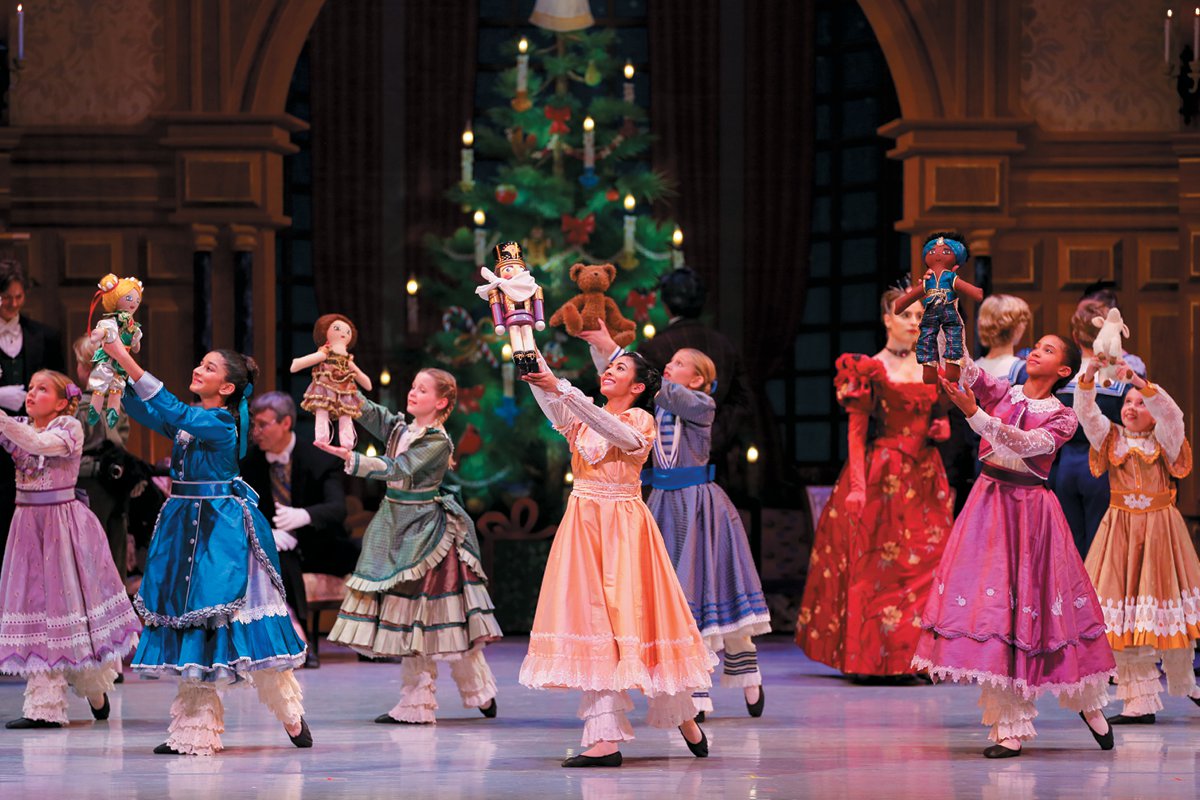
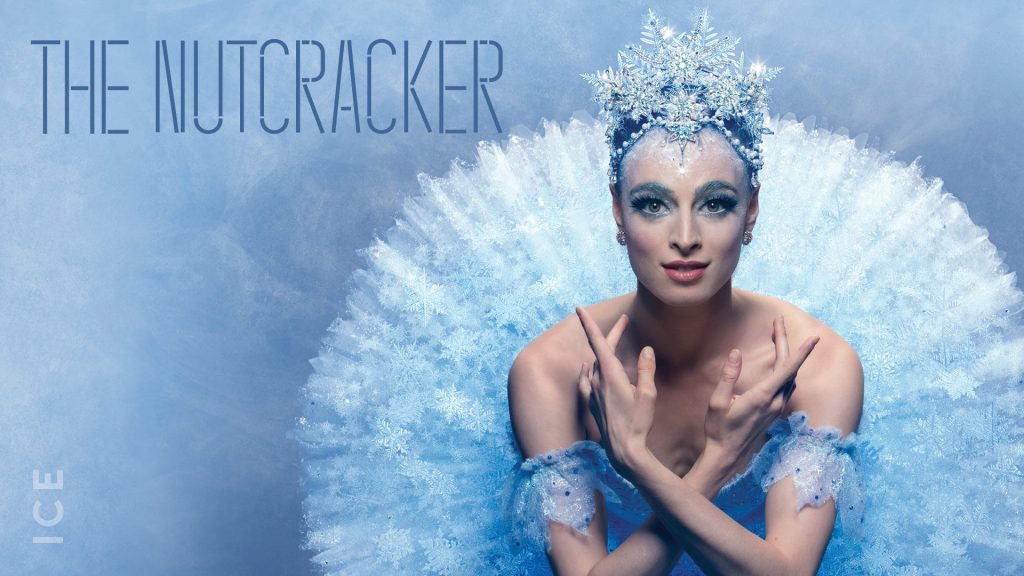
“The Nutcracker” ballet, a magical blend of classical music, dance, arts, fantasy and athleticism, has become a Christmastime staple in cultures around the globe. Originally commissioned by the Imperial Russian Ballet in 1891 and first performed in the U.S. in 1944, the ballet is widely considered the most popular in the world.
It’s based on a children’s fairy tale by E.T.A. Hoffmann that was adapted by Alexandre Dumas. The familiar story of a little girl named Clara who receives a nutcracker for Christmas and goes on a fantastical journey to the Land of Sweets has introduced many generations to the world of classical ballet. The original choreography by Marius Petipa and Lev Ivanov and recognizable musical score by Pyotr Ilyich Tchaikovsky have both been adapted countless times to suit diverse performers and audiences.
Locally, several professional ballet companies and dance schools offer multiple opportunities to join in the holiday spirit and celebrate along with Clara. All feature beautiful costumes and spirited dancing.
Central Virginia Dance Academy presents a full production of the two-act ballet performed by CVDA students and three guest artists (Ronald Wagstaff, Joe Seaton and Misha Nikitine) at The Cultural Arts Center at Glen Allen, Dec. 14-17. Tickets are $21.
Dance instructor Marianne Kelley performed in “The Nutcracker” from age 9 through adulthood, when she took on the coveted role of the Sugar Plum Fairy. Today, she remains involved from behind the curtain as Marianne Kelley’s School of Dance presents the ballet Dec. 15-17 at Collegiate School’s Oates Theater. Tickets are $25 to $40.
Stavna Ballet, a professional company located in Midlothian, will be joined by members of the Stavna Youth Ballet for their holiday performances at the Perkinson Center for the Arts & Education, Dec. 15-17. Stavna Development Coordinator Lizzie Woodington says, “We are very proud of all the hard work our students, company and staff are doing this year, and we can’t wait to share it with [audiences].” Tickets are $35.
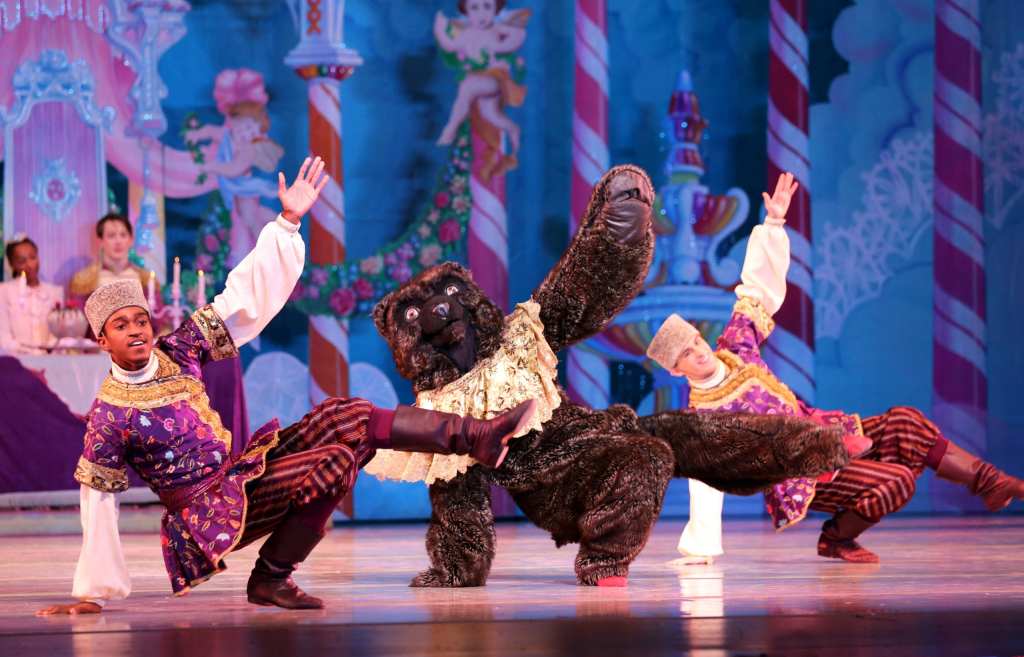
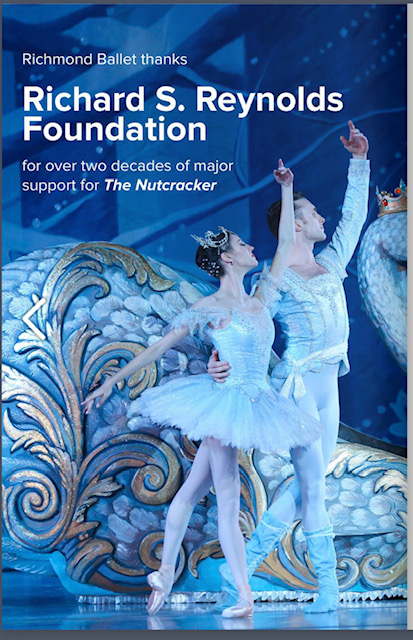
Last but not least, the city’s own Richmond Ballet offers performances of “The Nutcracker” featuring the professional company along with pre-professional trainees and more than 150 students from the School of Richmond Ballet and its Minds in Motion program. Artistic Director Stoner Winslett’s choreography features a leaping Russian bear, a dueling Mouse King, a floating butterfly and a magical Christmas tree that grows before the audience’s eyes. Richmond Ballet spokesperson Audrey Fain says, “Audiences will be dazzled once again by the colorful scenery and striking lighting design, both of which premiered last December.” The company performs live with the Richmond Symphony at the Dominion Energy Center’s Carpenter Theatre, Dec. 8-24. Tickets are $25 to $140.
Richmond Ballet Opens New Season With a John Butler Classic & a Work by Associate Artistic Director Ma Cong
A Dance Review
By: The Richmond Ballet with the Richmond Symphony/Richmond Symphony Chorus and The City Choir of Washington
At: Dominion Energy Center’s Carpenter Theatre, 600 E. Grace St., RVA 23219
Performances: September 22-24, 2023
Ticket Prices: $25 – $130
Info: (804) 344-0906, etix.com, or richmondballet.com
THE PROGRAM
Thrive
Choreography by Ma Cong
Music by Oliver Davis
Costume Design by Monica Guerra
Lighting Design by Trad A. Burns
Lighting Supervision by Joseph R. Wall
World Premiere: September 20, 2022, Richmond Ballet, Richmond Ballet Studio Theatre, Richmond, VA
CARMINA BURANA
Conceived and Choreographed by John Butler
Music and Latin Text by Carl Orff
Staging by Igor Antonov and Lauren Fagone
Costume Design by John Butler
Lighting Design by Catherine Girardi after
Original Lighting Design by Richard Moore
World Premiere: September 24, 1959, New York City Opera, City Center, New York
Richmond Ballet Premiere: October 15, 1987, Carpenter Theatre, Richmond, VA
If there’s anything better than live dance, it’s live dance performed to live music. After a debut performance at Wolf Trap in August, the Richmond Ballet opened their new season with an exciting program of neoclassical ballet and ballet theatre. The program opened with Thrive, the most recent work of Associate Artistic Director Ma Cong, and concluded with John Butler’s highly immersive Carmina Burana. (Note: Founding Artistic Director Stoner Winslett will be stepping down at the end of the season and moving into an advisory role, and Ma Cong will step into the role of Artistic Director.)
First performed as the 2022 season opener of the Richmond Ballet’s Studio Series, Ma Cong’s Thrive, a classical ballet in 7 movements, and his ninth work for Richmond Ballet, had the full expanse of the Carpenter Theatre stage and the pleasure of hearing British composer Oliver Davis’s layered score performed live by a full orchestra.
An ambitious display of contemporary classical ballet that spans the gamut from the humorous or playful to the somber and romantic, the work was inspired partly by the choreographer’s interactions with Richmond’s LGBTQ+ and Asian-American communities.
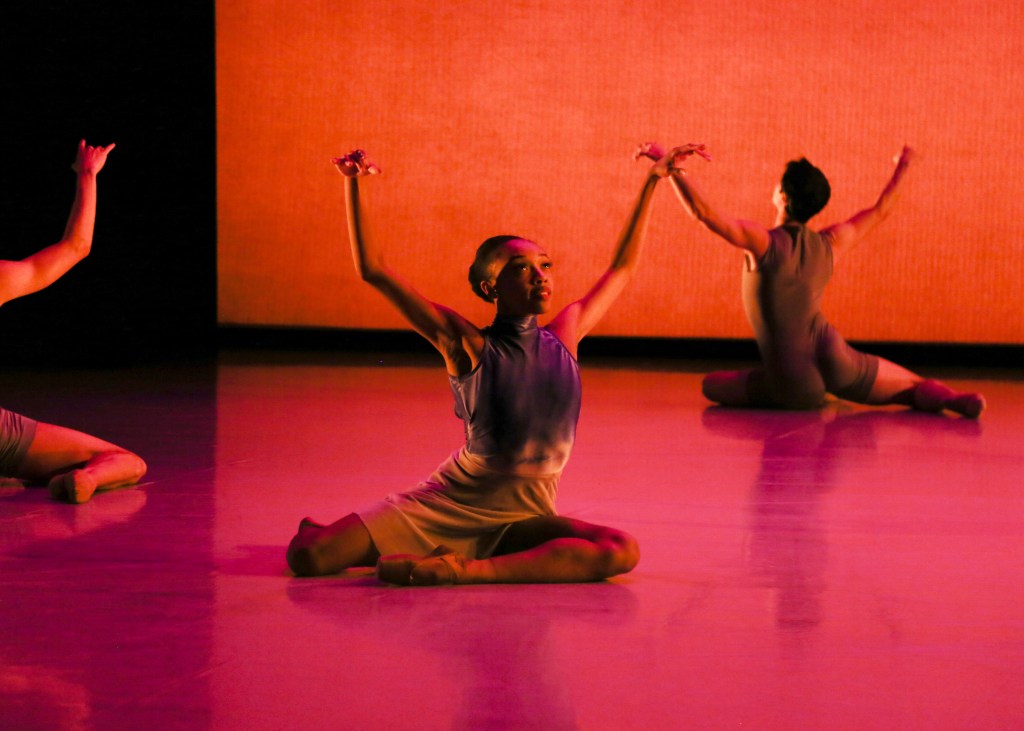
Onstage, Thrive manifests as clean, neo-classical movement accompanied by classical strings, interspersed with riotous pairings accompanied by more humorous music – some instrumental and some choral. The lighting matched the music and movement, with shades of red for the lighter moments and blues and purples for the more somber sections.
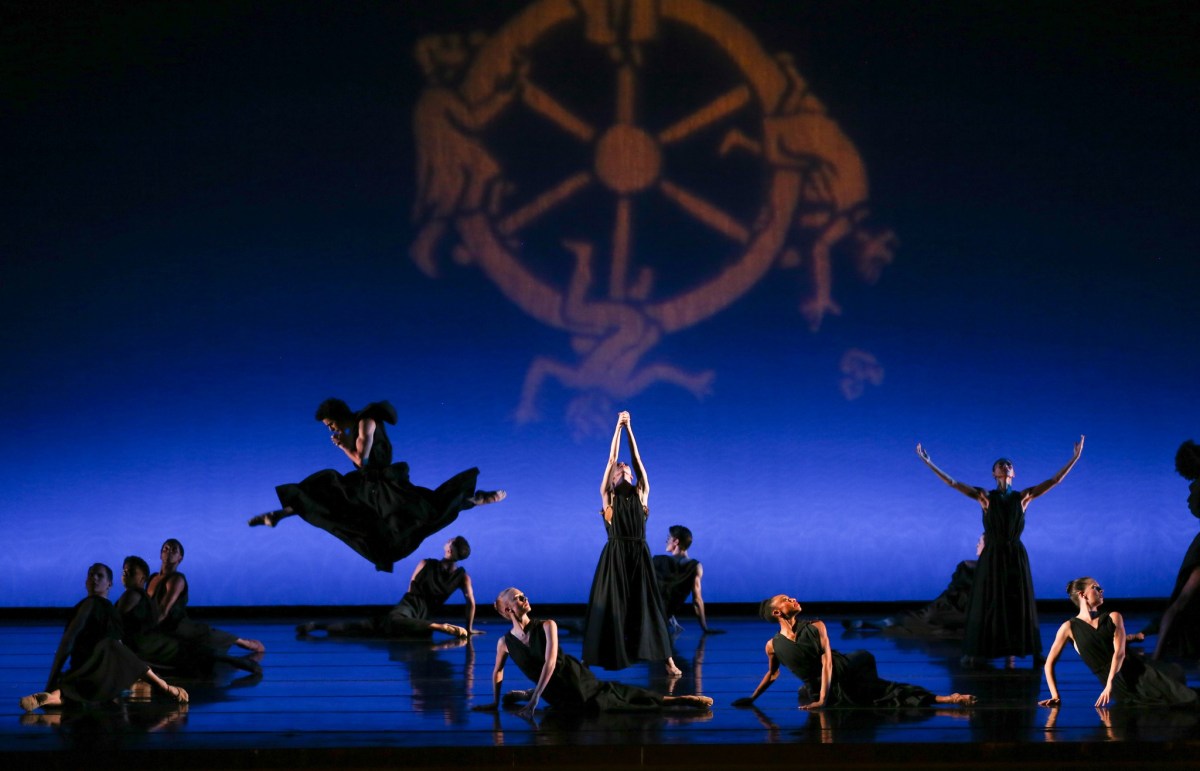
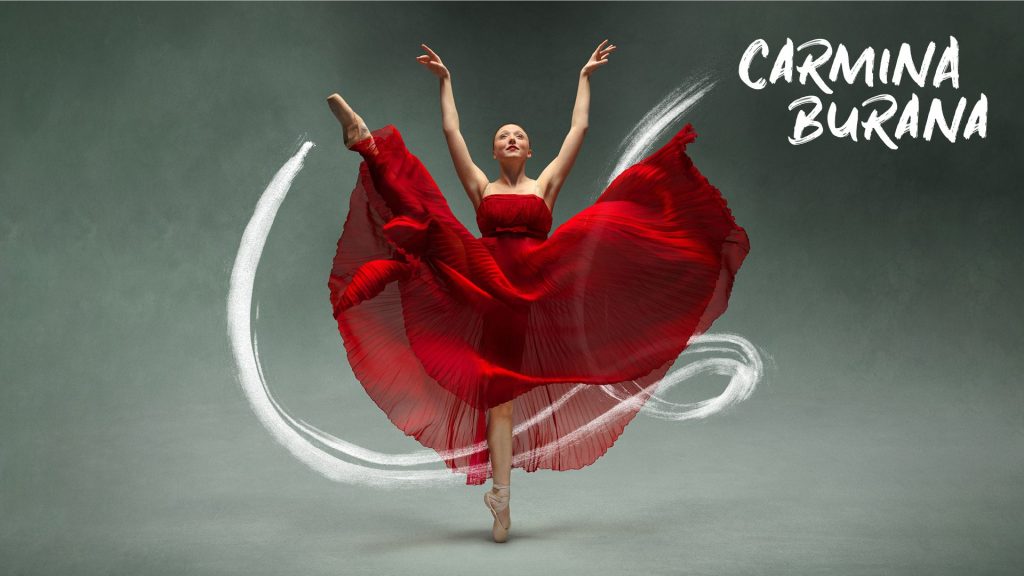
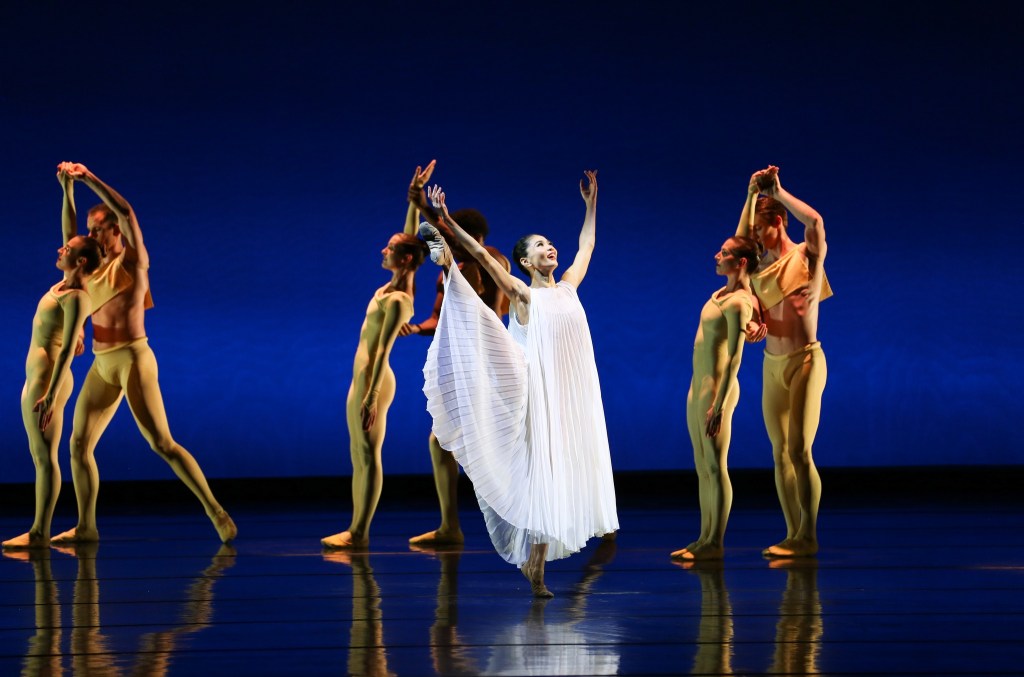
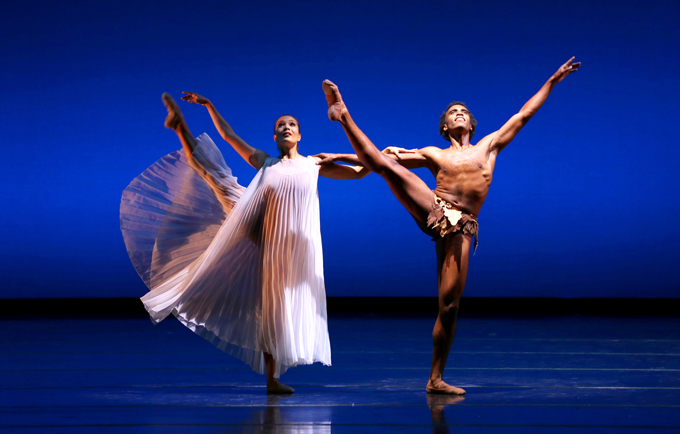
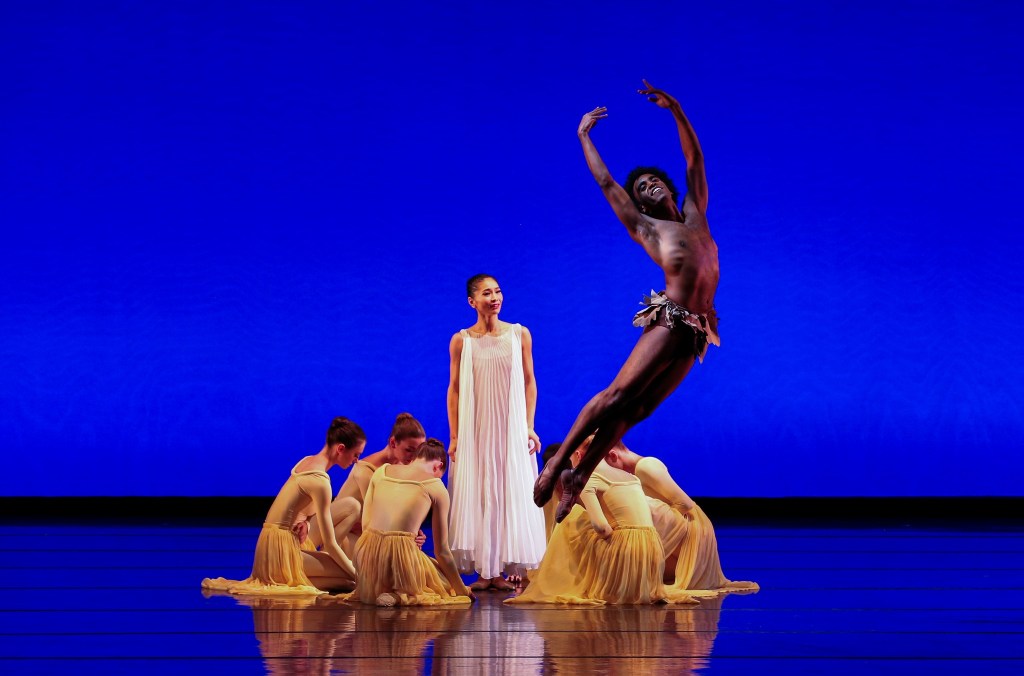
Carmina Burana raises the drama to a whole new level. A full orchestra in the pit, choral groups spilling out on both sides of the stage, soloists downstage left and right, frame dancers in monks robes who process in, pausing occasionally to genuflect. The robes soon give way to the barest of body coverings, reminiscent of Adam and Eve, while Eri Nishihara later appears in flowing white. Light colored body suite for the women and tights with collars over bare chests for the men emphasize the stylized movement that sometimes appears to have been lifted from an ancient print or vase.
A wheel of fortune projected in the background reminds us that life is uncertain, that we are all subject to the ups and downs, the wins and losses. The mostly Latin lyrics and poetry just add to the drama – sometimes more like an opera than a ballet – bookending the entire experience with the “O Fortuna” Prologue and Epilogue.
There is discipline and structure, seductive moments, energetic and tortured movement – some of all that life has to offer. The very characters that bow in prayer later appear literally half-dressed (hats off to costume designer Monica Guerra) and become part of romantic triangles or what some call “entanglements.” Cody Beaton and Ira White, and Eri Nishihara with Khaiyom Khojaev guide the ensemble through the changes of luck and fate, bringing a relatable sense of emotion and sensuality to what might otherwise appear to be an obscure spectacle.
All in all, this proved to be a full-blast, magnificent evening of dance theater and certainly raises the bar for high expectations for the rest of this season.
Julinda D. Lewis is a dancer, teacher, and writer who was born in Brooklyn, NY and now lives in Eastern Henrico County.
One-Time
Monthly
Yearly
Make a one-time or monthly donation to RVART REVIEW
Richmond Ballet Presents the 15th New Works Festival
A Dance Review
By: The Richmond Ballet
At: Studio Theatre at Richmond Ballet, 407 East Canal Street, RVA 23219
Performances: March 21 – 26, 2023
Ticket Prices: $26 – $51 ($71 – $106 for Choreographer’s Club on Opening Night, March 21)
Info: (804) 344-0906 x224, etix.com, or richmondballet.com
THE PROGRAM
FLIGHT
Choreography by Nancy Paradis
Music by Peter Kater
Costume Design by Emily Morgan
Lighting Design by Nathan W. Scheuer
World Premiere: March 21, 2023, Richmond Ballet Studio, Richmond, VA
LOST KEYS
Choreography by Claudia Schreier
Music by Christopher Cerrone
Costume Design by Emily Morgan
Lighting Design by Nathan W. Scheuer
Courtney Collier Zacchaeus Page
World Premiere: March 21, 2023, Richmond Ballet Studio Richmond, VA
BIRD’S-EYE VIEW
Choreography by Norbert De La Cruz III
Music by Lara Somogyi, Riopy, and Ashram
Costume Design by Emily Morgan
Lighting Design by Nathan W. Scheuer
World Premiere: March 21, 2023, Richmond Ballet Studio, Richmond, VA
FADING CREATURES
Choreography by Yury Yanowsky
Music by Senking
Costume Design by Emily Morgan
Lighting Design by Nathan W. Scheuer
World Premiere: March 21, 2023, Richmond Ballet Studio, Richmond, VA
The Richmond Ballet started the New Works Festival 15 years ago, in 2008. The company’s Associate Artistic Director, Ma Cong, introduced Ershter Vals, his first work for Richmond Ballet during the 2009 New Works Festival.
This year, four choreographers, new to the Richmond Ballet, were each given 25 hours of creative time with the company. At the end of 25 hours, they give birth to a new work, a 10-15 minute sketch or work-in-progress. This year, the honor went to Norbert De La Cruz III, Nancy Paradis (who was an original member of the Richmond Ballet), Claude Schreier, and Yury Yanowsky.
Paradis’s process includes writing, listening to music at different times of the day – and night – and creating mind maps. Her structure translates into beautifully layered movement. FLIGHT manages to place five couples into three movements (“Wings,” “Wounded,” and “Flight”) in under 12 minutes – 12 luxurious, unhurried minutes. The men’s arms spread across the stage like wings. The blues and grays of the costumes are reminiscent of different stages and levels of the sky, while the subtle pink and purple of the back wall suggests the sunrise or sunset. The middle section could be interpreted as introducing aggression or conflict, making one wonder the nature and origin of the wounds. But then comes the final “Flight” section with hints of jazz – hitch kicks, sassy walks, swinging hips all make you want more.
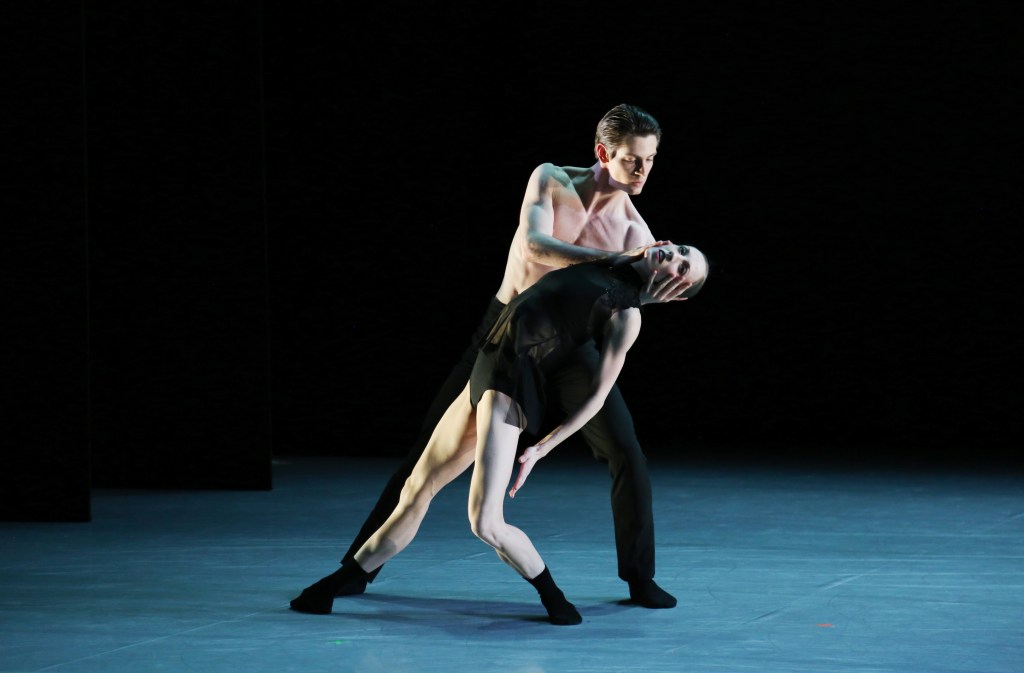
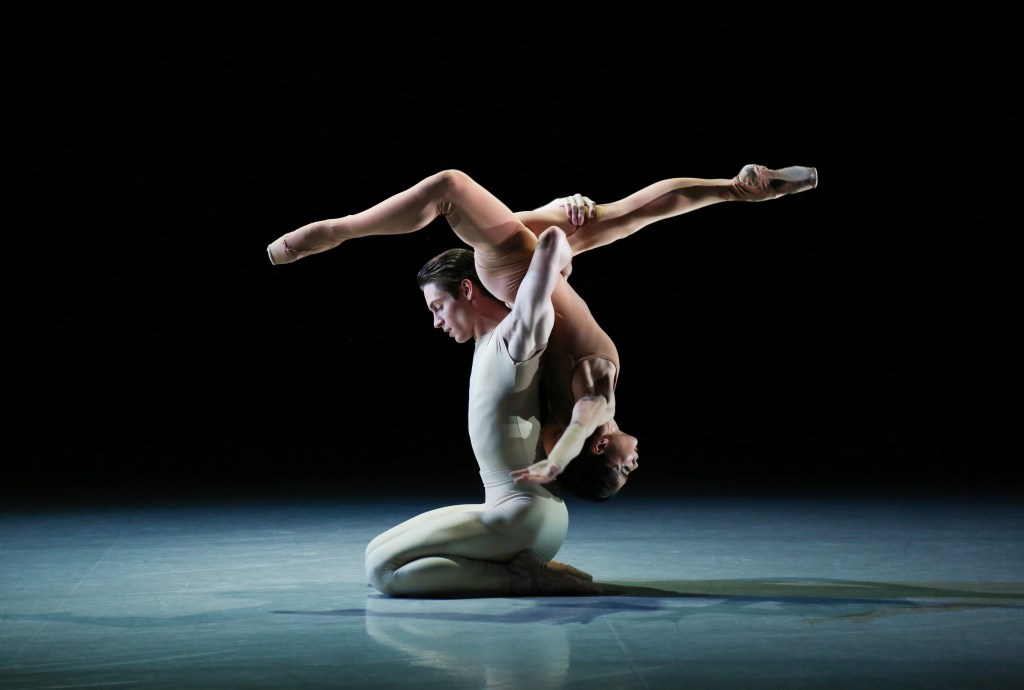
Claudie Schreier’s LOST KEYS is set to a score by Christopher Cerrone, “Hoyt-Schermerhorn,” named for a Brooklyn subway station where I spent many hours of my youth waiting for the train. Dressed in unadorned body suits – nude or tan for the woman and putty for the man – the dancers performed a mesmerizing duet of contemporary movement against a background of piano and electronic jingles and jangles. LOST KEYS breaks with tradition and the usual expectations of ballet. The woman, instead of rising lightly into a lift, giving the appearance of weightlessness, instead adopts a dead weight and stares her partner down from above. The man swings his partner by her arms like a little child, and sometimes holds her in a broken pose. Schreier seeks to create architecture on stage and to pursue emotion through architecture. I find this intriguing, and it raises many questions. Are the “lost keys” the keys to someone’s heart? The piano keys? Are they symbolic of letting go and starting over? Are they metaphors for love, health, and wealth or a shifting of power and authority?
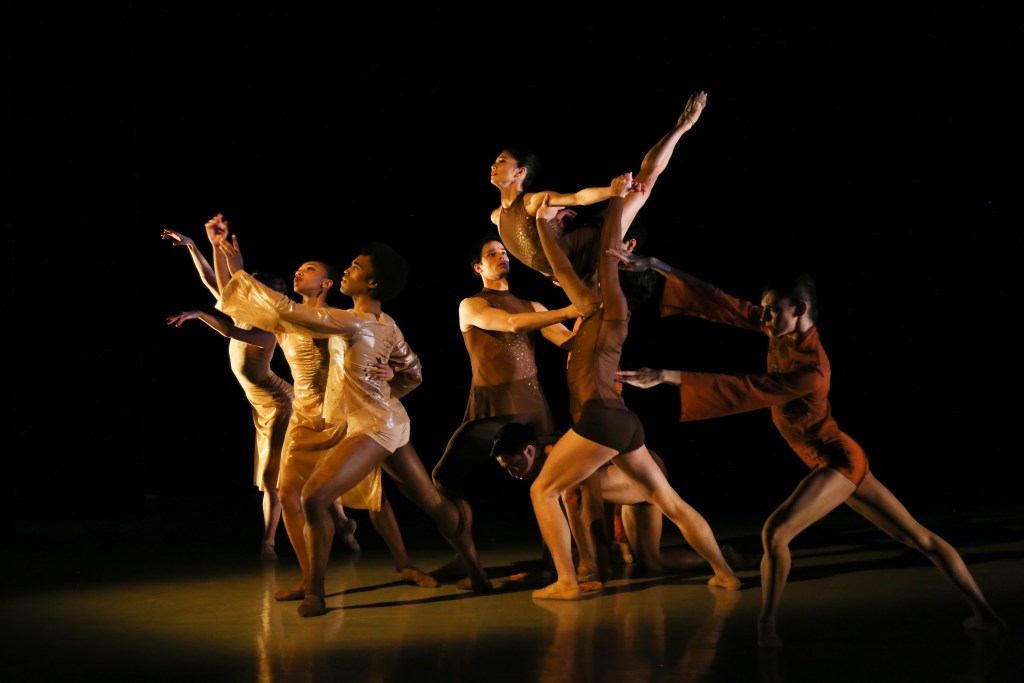
Philippine born, Los Angeles raised, and Juilliard educated Norbert De La Cruz III considers BIRD’S EYE VIEW a choreographic response to where he is in life right now. The opening view is of the dancers stacked and arranged in the shape of a tree, with dancers perched among the branches. The 9 dancers are layered in some way throughout the dance as when there are two in front with a line moving across the back like a Greek chorus crossing upstage. The dancers are attired in shades of rust, brown, and gold. Each two-piece outfit is in a different style, some with bell sleeves, others sleeveless. The movement is shaped with an almost mathematical precision, emitting strong sensations of algebraic formulae and geometric configurations. The interweaving of bodies, arms, legs set against the meditative flow of the music supports a journey, the passage of time. The movement soars and spirals, a juxtaposition of pattern and form, structure versus free flow – or what De La Cruz refers to as “volume” and “texture.” At the end the dancers are faced away from the audience, uplifted, ready. The work is absolutely beautiful.
The final new work, Yury Yanowsky’s FADING CREATURES, was inspired by Salvador Dali’s melting clocks. It is a work of time and space. The music is a collection of mechanical pulsations, while the dancers’ movements are off center, filled with slides – not slick or graceful dancer’s slides, but slide-across-the-floor-in-your-socks slides. Yanowsky likes to paint, and sees his dancers as a canvas. He uses them to paint stunning pictures in time and space.
What a successful New Works Festival. Each work was different in content and style. Each was stunning in its own way. Each challenged the dancers and the audience. Bravo! Let’s hope we see more of these choreographers in the future.
———-
Julinda D. Lewis is a dancer, teacher, and writer who was born in Brooklyn, NY and now lives in Eastern Henrico County.
———-
Tickets start at $25. Visit etix.com or call the Richmond Ballet Box Office at 804.344.0906 x224.
Photos by Sarah Ferguson.
———-
Norbert De La Cruz IIINancy ParadisClaudia SchreierYury YanowskyJack Miller and Sarah Joan Smith in Fading Creatures by Yury Yanowsky. Photo by Sarah Ferguson.Richmond Ballet dancers in Bird’s-Eye View by Norbert De La Cruz III Photo by Sarah Ferguson.Jack Miller and Eri Nishihara in Lost Keys by Claudia Schreier. Photo by Sarah Ferguson.Naomi Robinson and Richmond Ballet dancers in Flight by Nancy Paradis. Photo by Sarah Ferguson
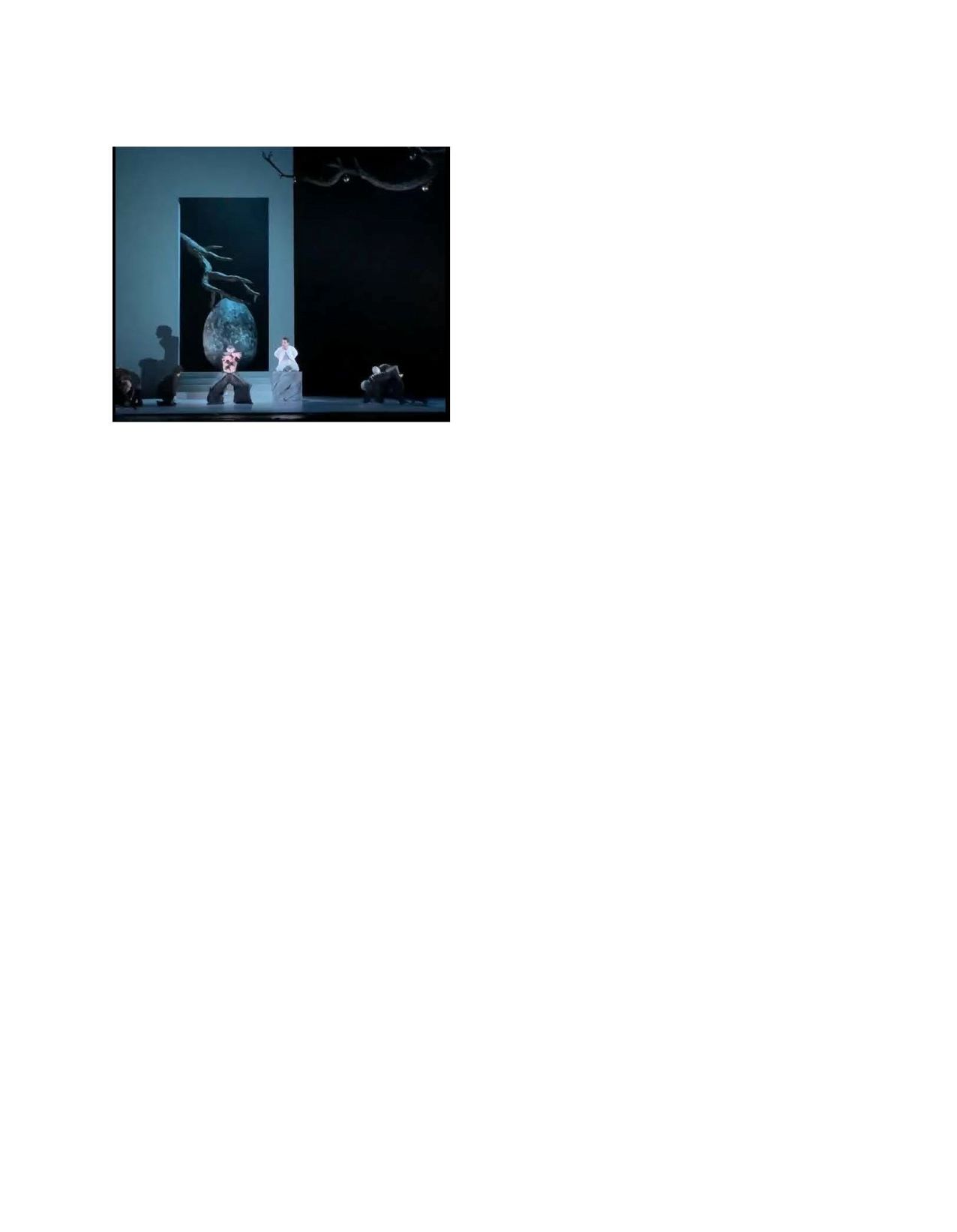
FIREBIRD, created by the Richmond Ballet’s Associate Artistic Director Ma Cong, is a magical blend of fairy tale, fantasy, drama, and dream. The ballet is set to Stravinsky’s beautiful score and set in a gorgeous environment that weds the classical with the contemporary. What at first appeared to be a museum – but I later found out was a garden – contained a swing suspended from the above, six life-sized “statues” that turned out to be six enchanted Princes, and a ginormous Faberge egg. Cong has taken the traditional Firebird story ballet – choreographed in 1910 by Michel Fokine for the Ballet Russes – and placed it in a more contemporary setting.
There is still a hero (Prince Ivan, danced by Khaiyom Khojaev) – and, of course, an evil sorcerer (Koschei the Immortal, danced by Ira White). Cong has kept Fokine’s thirteen princesses, including Prince Ivan’s love interest (Tsarevna, danced by Eri Nishihara), and, of course, the magical Firebird (Cody Beaton). What is new is the context. Nishihara begins as a young woman in a swing, visiting the sculpture garden with her mother (Celeste Gaiera). While reading her favorite book, The Firebird fairy tale, she dozes off, and much like little Clara in The Nutcracker Ballet, finds herself the central figure in a dreamscape filled with magical creatures. Her Prince doubles as a Photographer in the sculpture garden, and instead of party guests, there are museum visitors. A dropped scarf is the talisman that links the two worlds.
Khojaev, the dashing young prince – handsome, lost, and sporting a quiver of bows – encounters the magical, mystical Firebird in an enchanted garden plucking golden apples from a magical tree. In exchange for her life, the Firebird plucks one of her red feathers and presents it to Ivan, to be used in case of an emergency that can only be resolved using magic. The encounter is one of the ballet’s few traditional features – a pas de deux of soaring leaps and spiralling runs marked by Beaton’s fabulously quirky arm movements. They part, and of course it is only a matter of time before Prince Ivan runs into the evil sorcerer Koschei who has enchanted thirteen beautiful princesses and turned to stone the six young princes who have attempted to rescue them.
White, as Koschei, reminds me of an ancient Japanese war lord (but wait, considering that Cong studied Chinese classical dance, let me revise that to an ancient Chinese warrior), and his minions are clad in black body suits with vaguely skeletal imprints on the spines – thoroughly embracing the role of malevolent sycophants as they scamper about the space. The choreography is a refreshing brew of ballet and contemporary movement, a contrast of soaring heights and scampering lows, classic lines and grounded enfolding. A friend likened the results to the subterfuge of The Wizard of Oz.
A battle ensues, requiring Prince Ivan to call upon the Firebird for assistance, and Koschei and the forces of evil are eventually overcome. The climax of the battle, however, involves one of the most explosive special effects I have ever seen in a ballet. Remember that Faberge egg I described earlier – and Ivan’s quiver of arrows? Well, this is where it all comes together. The egg – okay, so maybe not a Faberge egg, but you get the idea – is where Koschei had hidden his evil soul for safekeeping and the climax of the battle involves the destruction of the egg and all the evil it contains. What a stunning concept and even more spectacular execution!
In the final scene, the daughter (Nishihara) awakens, back in the safety and peace of the sculpture garden, where the exchange of the dropped scarf and a pointed glance are all that remain of the events that have just transpired.
The evening started and ended on a high note – with two ballets completely different in style and execution. The program started with a performance of George Balanchine’s Serenade (1934). Historically significant as the first Balanchine ballet created in America and one of the New York City Ballet’s signature works, the ballet began as a lesson in stage technique for student dancers and the choreography even incorporates ordinary rehearsal events, such as a dancer’s fall. But Serenade opens with one of the singularly more stunning moments of stillness ever choreographed.
The curtains parts on a sea of 17 women standing in complete stillness. Each has one arm lifted. When they all move their feet from parallel to an open first position. So simple. So basic. So beautiful. In spite of its simplicity, Serenade is not an easy ballet, and set against Tchaikovsky’s score on a bare stage, save for romantic lighting, it remains a favorite for balletomanes and novices alike.
No disappointments, no complaints. Just a satisfying evening of beautiful ballet and memorable music, played live by the Richmond Symphony, conducted by Erin Freeman. Bravo.
One-Time
Monthly
Yearly
Make a one-time, monthly, or annual donation in support of rvart review
An Unconventional Dance Review by Julinda D. Lewis & Guest Reviewers Kingston and Emmitt
By: The Richmond Ballet
At: Dominion Energy Center’s Carpenter Theatre, 600 E. Grace Street, RVA 23219
Performances: December 9-23, 2022
Ticket Prices: $25 – $130
Info: (804) 344-0906, etix.com, or richmondballet.com
Updated COVID-19 Protocols, see below.
THE PROGRAM
The Nutcracker
Artistic Direction and Choreography by Stoner Winslett
Production conceived by Stoner Winslett and Charles Caldwell
Music by Peter Ilyich Tchaikovsky
Music performed by the Richmond Symphony
Conducted by Erin Freeman
Scenery designed by Alain Vaës
Costumes designed by David Heuvel
Lighting designed by Richard Moore and Associate, Catherine Girardi
When I was a Girl Scout Leader (which I was, for 27 years), one of my favorite things to do was to take young girls camping for the first time. Likewise, one of my favorite things to do as a writer, teacher, and grandmother is to take my young people to the theater for the first time. Three of my grandsons live in RVA, ages 14, 8, and 8 months. The oldest has seen The Nutcracker before, and with the return of live performances, it was time for the middle one to have his first Nutcracker experience. So on Sunday evening I got a chance to re-experience the classic holiday ballet through new eyes.
The magic begins the moment you enter the theater – well, as soon as you pass through security and have your tickets scanned. [Security approved of my clear plastic tote and the small “sippy cups” I’d brought so we wouldn’t spill the drinks we bought at the concession stand.] While waiting for the program to begin, I enjoyed watching the families with children of all ages, most dressed in their holiday finery. Kingston (a high school student and the family percussionist) and Emmitt (age 8) saw that it was okay to go take a peek at the orchestra pit and returned to their seats discussing the probability of someone falling into the pit.
Other preparatory and property elements worthy of note included explaining why the audience applauded the arrival of the Symphony conductor and the many layers of show drops and curtains that open throughout the lavish production to reveal scenes from the streets of Nuremburg to the entry and drawing room of the Silberhaus home to the Enchanted Snow Forest and Confitenberg, the Kingdom of Sweets. Also, the diversity of the cast is important, because representation matters, especially when young audience members can see people onstage who look like themselves. An example follows a few paragraphs down.
The Nutcracker is a family show for The Richmond Ballet as well as for the audience. Students from the School of Richmond Ballet, apprentices, members of RBII, new and experienced company members, and even faculty and staff share the stage for this multi-generational extravaganza. In addition to refreshed costumes and scenery, the Silberhaus party features newly constructed doll houses for Dr. Drosselmeyer’s magic show, Mother Ginger is back from her pandemic hiatus – with eight kiddy-winks under her voluminous skirts — and Associate Artistic Director, Ma Cong (who dances the role of Dr. Drosselmeyer) has choreographed a new Chinese dance that incorporates elements of Chinese folkdance, which he studied extensively early in his career, with Beijing Dance Academy and The National Ballet of China.
Yes, there is a magic show within the magical show. Dr. Drosselmeyer, godfather to Clara (Adhya Yaratha at Sunday’s 5:30 PM performance) and her mischievous brother Fritz (Sunnelin Seay), and creator of the famous Nutcracker for which the ballet is named, has a penchant for turning toys into humans. Winslett and Cong’s interpretation of Dr. Drosselmeyer, however, is substantially less creepy than the character was originally written. There is also the magic of dreams as Clara falls asleep with her mended Nutcracker – after her little brother Fritz, in a fit of jealously, pulls off its head – and in her slumber journeys with her Young Prince (Benjamin Piner) to the Kingdom of Sweets – where all the dancing happens.
I am on board with the youth in my adoration for the battle between the Mouse King’s army and the Toy Soldiers. But of course, Kingston and Emmitt who are bonafide martial artists, had a lot to say about the fight technique. One graciously commented that, “it was good.” The other assessed that the sword fights were not realistic, specifically that the swords should have come closer. “We practice near misses,” he critiqued.
Emmitt, the eight-year-old, kept up a running commentary: the Bear (Paul Piner) in the Russian dance is breakdancing, and why is one of the Lambs black? My apologies to any nearby patrons who may have been disturbed. Most noteworthy, he was mesmerized by Mother Ginger to the point that he expressed a desire to participate in an upcoming production. He was undeterred when I told him he’d need to take ballet classes, but near the end of the scene abruptly changed his mind. “I couldn’t do that,” he said. “I can’t stand still that long; I have too much energy.”
I learned later that both novice critics retold the story and re-enacted several scenes for their mother. Both also noted that in a pas de deux the woman gets all the good dance phrases. And finally, “There’s no Nutcracker in the second half – it doesn’t make sense. Otherwise, that was a good one!” That’s Emmitt’s summary and he’s sticking to it.
If I may conclude with my own two cents worth…
Adhya Yaratha and Benjamin Piner were absolutely charming as Clara/The Little Princess and Dr. Drosselmeyer’s Nephew/The Little Prince. The Snow Choir sounded heavenly. I would love to learn that magical gliding step that takes the Angels across the stage, guiding or welcoming Clara and her Prince to The Kingdom of Sweets. It reminds me of a gliding step used by Russian dancers that my dance history students showed me this past fall. The new choreography for the Chinese Dance – the title of which is actually Tea – does, indeed have an authentic look and feel. Dancer Eri Nishihara’s highly touted green pointe shoes are, in fact, all that – and, wait, was the dragon newly outfitted as well?
Naomi Wilson was a lovely Butterfly in the Waltz of the Flowers, and finally, it was a pleasure to finally get to see guest dancer Kristina Kadashevych dancing the role of the Sugar Plum Fairy as well as the ballet’s Grand Pas de Deux with Aleksey Babayev as her Cavalier. The petite dancer’s steps appear effortless and feathery – a stark contrast to the conditions surrounding her current residency. Ms. Kadashevych, you see, fled the Ukraine last spring as her homeland was being invaded by Russian soldiers, so perhaps those ethereal steps actually reflect what it feels like to be free. The Nutcracker is not new to her, and she will also be performing with the Richmond Ballet in February when the company returns to Dominion Energy Center with the East Coast premiere of Ma Cong’s Firebird and Balanchine’s signature Serenade (limited run, February 17-19).
Julinda D. Lewis is a dancer, teacher, and writer who was born in Brooklyn, NY and now lives in Eastern Henrico County.
THE NUTCRACKER PERFORMANCE SCHEDULE December 9-23, 2022 | Dominion Energy Center 600 E Grace St, Richmond, VA 23219 Friday, December 9 at 7:00 PM Saturday, December 10 at 2:00 PM and 7:00 PM Sunday, December 11 at 1:00 PM and 5:30 PM Friday, December 16 at 7:00 PM Saturday, December 17 at 2:00 PM and 7:00 PM Sunday, December 18 at 1:00 PM and 5:30 PM Tuesday, December 20 at 7:00 PM Wednesday, December 21 at 7:00 PM Thursday, December 22 at 2:00 PM and 7:00 PM Friday, December 23 at 2:00 PM
UPDATED COVID-19 Protocols (As of March 2022): Please note that we are seating at 100% capacity this season. Beginning with Studio Three in March, we will no longer require patrons to wear masks or to show proof of vaccination/negative COVID test in order to attend a performance.
MASKS: In light of the latest CDC guidelines and Central Virginia’s current “Low/Medium Community Level” status, masks are optional at these performances.
BALLET BARRE: The Ballet Barre (cashless) will be open for our spring Studio performances. Beer, wine, and soft drinks will be available for purchase pre-show as well as during intermission.
CHOREOGRAPHER’S CLUB: In addition to the exclusive Q&A session with the artists, designers, and dancers, we will host a modified post-show reception. More details will be found in your House Notes email.
WELLNESS CHECK: Patrons who do not feel well leading up to a performance are asked to stay home. If you have tested positive or have symptoms of COVID-19, please call our Box Office at 804.344.0906 x224 so that we may discuss ticket options.
Photo Credits: Production photos to follow
One-Time
Monthly
Yearly
Make a one-time donation in support of rvart review
Original Music Composition by Daniel Deckelman with narration by Brent\
Costume Concept Design by Johann Stegmeir, Constructed by Starrene Foster
About Us
Inspired by a story by Mary Lou Hall
Original Music Composition by Daniel Deckelman
Sky Burial
Inspired by a poem by M. C. Boyes
Music by Roger Goula; Looking Back to Self Awareness
Things That Fit Tight Around the Ribs
Inspired by a poem by Molly Todd
Original Music Composition by Daniel Deckelman
I think I have seen most of Starr Foster Dance’s Richmond performances since the company was born in 2001. I have been stunned, enthralled, mesmerized, puzzled, amused, and I have even teased Foster about her seeming preference for lighting on the darker side of the lumens scale or lux meter (or however you measure brightness). The point is, Foster has a unique style, one that most often presents women in a powerful light (no pun intended), and dares to stretch outside any semblance of a comfort zone – whether her own, the dancers, or the audience,
Foster’s latest project, two years in the making – or waiting – due to the restrictions of the pandemic, Page to Stage II, is a collection of seven short dances inspired by seven short stories, excerpts, and poems by local writers. Not only do the dances span a wide range of emotions, but the program is an actual book that contains all of the written works – the pages that found their way onto the stage – that the audience can take away to keep.
In addition to the seven writers, Foster invited six guest performers to dance with her core company of four women: Taylor-Leigh Adams, Fran Beaumont, Anna Branch, and Molly Huey. The six guest performers, Sophia Berger, Charlotte Bray, Shannon Comerford, Elena Dimitri, Keeley Hernandez, and Mosca Mavrophilipos-Flint were a perfect fit, blending easily with Foster’s core dancers and providing the needed enhancement for the stories. To my surprise and delight, I discovered that one of them had been a student of mine when I taught elementary school.
Previous performances of Starr Foster Dance took place in the intimate space of TheatreLab’s black box space, The Basement, but Page to Stage II (the sequel to a 2015 production) was performed at The Firehouse Theatre. The Firehouse seats about 4 times the number of people who fit into The Basement (sadly, TheatreLab shuttered operations at the end of the 2022 season) – and every performance was sold out! This is great for Foster and company, but it also speaks to a growing hunger for contemporary dance in RVA.
Several works on the program stood out above the others for various reasons. The opening work, Spirits, inspired by Patricia Smith’s story of the same name, explores the intentions of spirits, ancestors, and the associations we make with them. Accompanied by strings and the sounds of flowing water, the dancers, dressed in soft pats and matching tops with hems died to look muddied, move like water sprites. They seem to rise and return to a watery grave, evoking images of fictional willies (e.g., the Willis in the ballet Giselle represent the spirits of women left at the alter) as well as the spirits of all whose dreams were cut short before they were fulfilled. The nine dancers seem to float, rise up, and at the end return to their watery grave, still reaching for life – theirs? Or ours?
My absolute favorite was Dear Me. A solo, the work was performed on Friday night by Fran Beaumont. I loved Beaumont’s energy, the lackadaisical way she kicked her leg up to the side and over her head, the motif of running backwards, and even her simple, dark jumpsuit. Funny, assertive, and sassy, the solo, set to a dynamic funk rock score by DJ Williams and Shots Fired, reminded me of the jazzy and dramatic solos of the late American modern dancer, Daniel Nagrin. (If you are not familiar with him, dig back into dance history and find a video of him performing Strange Hero or Man of Action (1948).
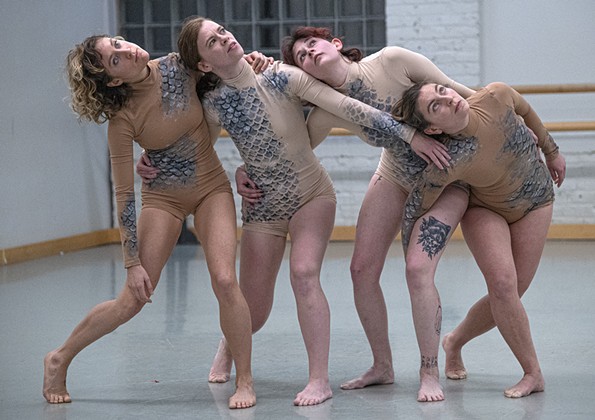
FeeJee Mermaid is funny and creepy and deliciously weird. Set to an original score that is reminiscent of circus music and a narration of Clay McLeod Chapman’s fictitious lecture on how to make a FeeJee Mermaid. Some people are terrified of the circus, clowns, and sideshows. FeeJee Mermaid does nothing to allay these fears. Based on a real-life hoax perpetrated by P.T. Barnum and others, Chapman’s work – and Foster’s kinesthetic interpretation – is an instruction manual on how to construct a horrible taxidermist’s nightmare: a fake mermaid created by attaching the torso of an ape to the bottom half of a large fish. Foster’s quartet of dancers, clad in flesh-toned leotards dyed in a fish-scale pattern do not actually construct a FeeJee Mermaid, but their circus antics, and Daniel Deckelman’s music are sufficiently creepy to leave a lasting impression. Oh, and one of the remaining examples of a “real” FeeJee Mermaid has been in residence at Harvard’s Peabody Museum since 1897. Look it up – if you dare.
About Us is a story by Mary Lou Hall that tells of a mother who left her family (physically and/or mentally) in order to save herself. In Foster’s dance, Molly Huey (on Friday night) was supported and surrounded by a quartet of dancers who seemed to represent the various versions of her inner self. Huey danced, often with her eyes closed, moving her hands in a repetitive gesture that seemed designed to clear away the cobwebs that both clouded her vision and restricted her movements. It is a very intimate dance, one that breaks the usual rules by focusing inward rather than outward. The supporting dancers move in a very unexpected way, deliberately not drawing attention to themselves, trying not to stand out, but instead focusing on the main character – and the main character is. . .you/us.
I could find something special about each of the dances in this series. The dark dresses of Sisterhood echo the darkness of the theme that seems to be a prelude to a true-crime story about two sisters whose lives are unhealthily entwined. The women in Sky Burial interact with one another like two people feeding each other with long-handled spoons. Then there is the poignancy and steely sharpness of the pointing finger in Things That Fit Tight Around the Ribs. Like many good books, and all poems, Stage to Page II should be seen again and should definitely be discussed. What did YOU see? What did YOU feel? What did YOU take away? This is Starr Foster Dance at its finest.
Julinda D. Lewis is a dancer, teacher, and writer who was born in Brooklyn, NY and now lives in Eastern Henrico County.
———-
Photo Credits: Douglas Hayes.
One-Time
Monthly
Yearly
Make a donation to support the continued publication of rvaRT review
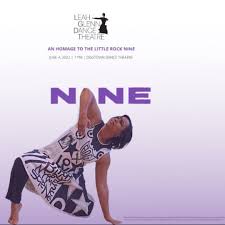
An Homage to the Little Rock Nine& Eight Other Dances
A Dance Review by Julinda D. Lewis
At: Dogtown Dance Theatre, 109 W. 15th Street, Richmond, VA 23224
Performances: June 4, 2022
Ticket Prices: $20
Info: (804) 230-8780 LGDTdance.com
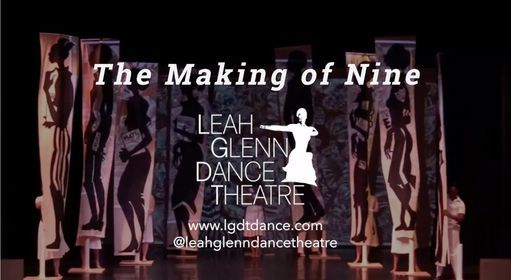
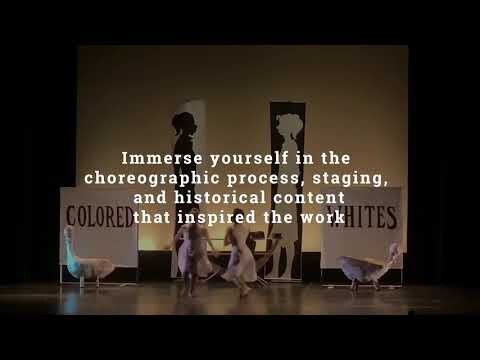
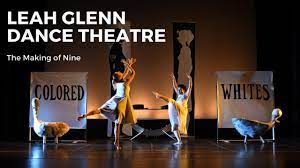
In June 2021 I attended “The Making of Nine” at Dogtown Dance Theatre. An artist’s talk with choreographer Leah Glenn, visual artist Steve Prince, poet Dr. Hermine Pinson, and historian Dr. Jamel Donner, “The Making of Nine” offered a fascinating insight into the creative process and historical background of a multi-media work-in-progress that celebrates the nine African-American students who integrated Little Rock Central High School in Arkansas in 1957.
Nine was co-commissioned by the Carver Community Cultural Center in San Antonio, TX, in partnership with Xavier University and the National Performance Network’s Creation and Development Fund and the show premiered Saturday, May 28 at the Carver. When I learned that the finished work – or at least the latest iteration of this dynamic and developing work – would be presented for only one performance at Dogtown on June 4 I rearranged my schedule to make sure I did not miss it. The previous year’s artists’ talk had impressed me that this was a work that needed to be seen.
The closing work on a program of nine works, Nine is a fusion of dance, poetry, music, visual arts (in set design, costumes, props, and associated prints), and history that reflects on the institutions of racism, education, and American society.
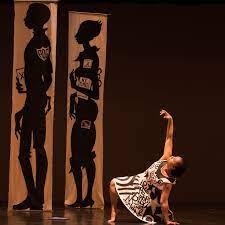
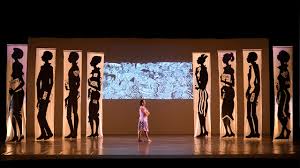
Nine begins with a humming, a moan, a procession of nine dancers and eight larger-than-life sized banners (the ninth banner appears after a significant solo) each featuring a stylized portrait of one of the nine. The dancers are clad in Prince’s beautiful black and white costumes (apparently hand-painted), each marked somewhere with the letters AOG on a small shield, and some are adorned with adinkra symbols. The AOG is a reference to Paul’s letter to the Ephesians, a reminder to put on the whole Armor of God – something that was necessary to protect the nine young scholars in their hostile educational and social environment. The adinkra symbols include the bird that faces forward while looking back – a reminder to “go back and get it” or learn from the past. The symbols are a visual representation of ancestral wisdom and traditional proverbs. In contrast, the costumes of the dancers representing the white students bear anti-black slogans (two, four, six, eight, we don’t want to integrate) and anti-Semitic symbols (swastikas).
The movement begins with the cadence of a work song, also an appropriate historical reference, as is the hand-clapping and thigh-slapping that serves as both accompaniment and choreography – a reference to the hambone or patting juba that developed during a time when drums were confiscated from African people in the Americans to prevent them from communicating with one another. Wow – all of this, and the dance has barely started. Nine is rich in historic references, and the integration of the multi-media elements is so multi-layered it cannot be comprehended in a single viewing. Nine is, in a way, a compact mini-series of the history of this specific group of young people at a specific point in time (1957) in a specific geographic location (Little Rock, AR).
Video footage from The History Makers archive provides some important historical background, but this is a work that I believe needs extensive program notes, or better yet, a pre-show introduction followed by a post-show discussion. It’s far too important to be treated as simply a dance, and far to complex to be denied the formality of community.
The program also included the urban Aloft, in which dancers run and balance to a background of traffic sounds and a rapid-fire Spanish-language speaker, sometimes assuming protective postures and other times appearing to teeter on a tightrope. There was the percussive and ritualistic Fault Lines, a jazz trio set to the music of Trombone Shorty called From the Corners of the Room, and Claiming Race, an encounter between two briefcase carrying men wearing suits and ties. Hush, which I believe was inspired by Glenn’s son, is a powerfully intense work that features a mourner’s bench and the soulful music of Sweet Honey in the Rock. Letter to the Editor, is based on an actual event in which Glenn’s father, head of one of the few Black families in the town where he resided, wrote a letter to the editor of the local newspaper in response to the locality’s resistance to integration. I am not sure what Glenn was thinking of when she created Furious Flowers but what I saw was a form of death that was in reality a planting, followed by a rebirth representing growth and hope, and I wish I had a bit of background for the duet Perceived Threat. The melancholy music, water sounds, and whispering, and the sudden and mysterious appearance of the male dancer’s partner from behind (or inside?) the box he was sitting on made me wonder exactly what – or who – the threat was.
The entire program offered plenty of food for thought. The closing image, of nine school desks lined up, the writing arms covered with portraits of the actual Little Rock students – was a stark reminder that we are still connected to the past, and hiding or re-writing history does not make it go away.
Julinda D. Lewis is a dancer, teacher, and writer who was born in Brooklyn, NY and now lives in Eastern Henrico County.
Next Reflex Dance Collective / Roxann Morgan Rowley; Fairfax, VA
Starr Foster Dance/Starrene Foster; Richmond, VA
Wow. From first to last, the 2022 Mid-Atlantic Choreographers was riveting. The six works by six choreographers from Brooklyn, NY to Raleigh, NC each embraced LGTBQIA+ themes or concepts related to gender or sexuality. Each was performed in the round – actually, in a defined square, with the audience intimately situated on all sides. For those old enough to know what I’m talking about, it reminded me of my undergraduate days watching dance at NYC’s Judson Church. (If you’re not of a certain age, I don’t know, maybe a cypher or a rave might describe the vibe.)
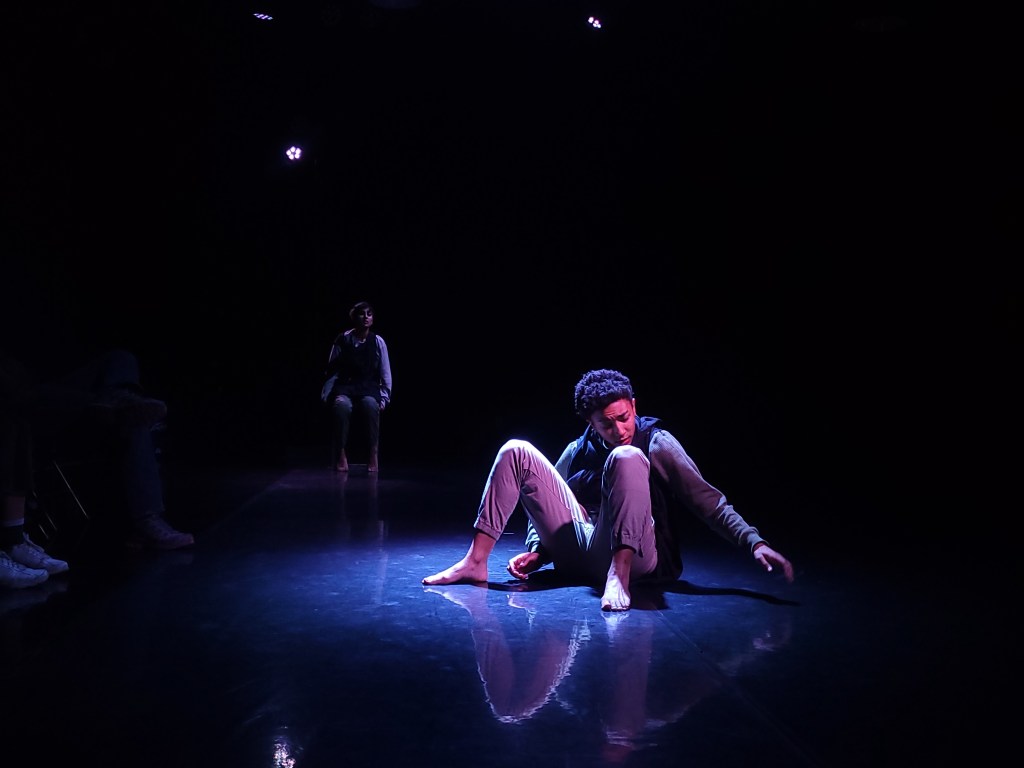
One of the most striking pieces was Fools+Kings, a premiere choreographed and performed by Alyah Baker in collaboration with Lee Edwards and Kahlila Brown. Accompanied by smooth jazz performed by Nat King Cole and Orchestra and CeeLo Green, the trio graced us with liquid combinations of movement and incredibly soft landings. Sometimes the arresting choreography consisted of just a gaze, a burning stare. Dressed in black vests and pants, with three low stools as mobile props, the dancers kept the movement simple, yet their virtuosity was undeniable.
Inspired by the life and legacy of composer Billy Strayhorn, Fools+Kings was escribed in the program as an exploration of “themes of connection and heartbreak through the lens of Black Queer aesthetics and embodiment.” I was particularly struck by Lee Edwards who – I swear – reminded me of a compact, femme version of Bill T. Jones. Anyone who knows me knows that Bill T. Jones is one of my favorite dancers of all time, so I do not say this lightly. Fools+Kings built up a complex structure balanced on hot and cool jazz and Afro beats and then, BAM! – without warning or preparation, it ended with a full stop. Wow. I cannot wait to see more from this group.
Backtracking to the opening, the program began with a solo, old swan, by Megan Mazarick. Dressed in a tailored suit, Mazarick delivered portions of a deconstructed lecture while executing a fusion of post-modern, classic break-dance type moves, the robot, and even a bit of disco in a humor-infused cycle of melting and resurrecting. This is the work that took me back to Judson Church. I take notes in the dark, and for this piece my page was inscribed with a large heart. While old swan may be a reference to ballet classics like Swan Lake and all the fairy tale magic that goes along with the romantic era, it may also be a sly play on the symbolism of swans representing grace, love, trust, beauty, and loyalty. The final scene of the swan “coming home to roost” reminded me of that old saying about chickens coming home to roost – meaning that the evil things you do will come back to bite you in the butt (i.e., karma). Of course, Mazarick may not have intended any of these concepts, but I felt free – even invited – to explore all of them in this wonderful solo.
Another work that resonated was an excerpt from a dance called Penumbra, choreographed by Ankita Sharma and performed by Sharma and Darryl Filmore. Penumbra is dark, very dark. I have sometimes teased Starr Foster, saying that her works are so dark, but I was referring to the lighting. Penumbra is psychologically dark, and that’s an even more terrifying kind of dark. By definition, a penumbra is a region of shadow or partial illumination, resulting from an obstruction or partial obstruction.
This section of the artist’s evening-length work is called “Aftercare,” and the work explores the question, “What does it feel like to say the dark things that remain inside out loud?” Based on the dancers’ shared experiences with trauma, the two begin on opposite sides of a small table, somehow, remarkably, performing similar movements with strikingly different dynamics. The force and counterforce reminds me of the life and death encounters being negotiated by the old men convened around Kurt Jooss’ The Green Table but her it takes only two, not a dozen, to create this howling, apocalyptic effect!
When they arise from the floor, the gentler of the two seems to transform into the dominate, or abusive partner, and the sharper mover becomes fearful and guarded. A shift to demonic red lighting carries them away. Notably, this was the only group that did not take a bow – to do so would have broken the spell and diminished the power of this work.
I was glad I tarried long enough to see Sharma and Filmore emerge from backstage to greet their friends and audience members with smiles. It was relief to see they were able to drop the heavy personas they had adopted and leave them on the stage.
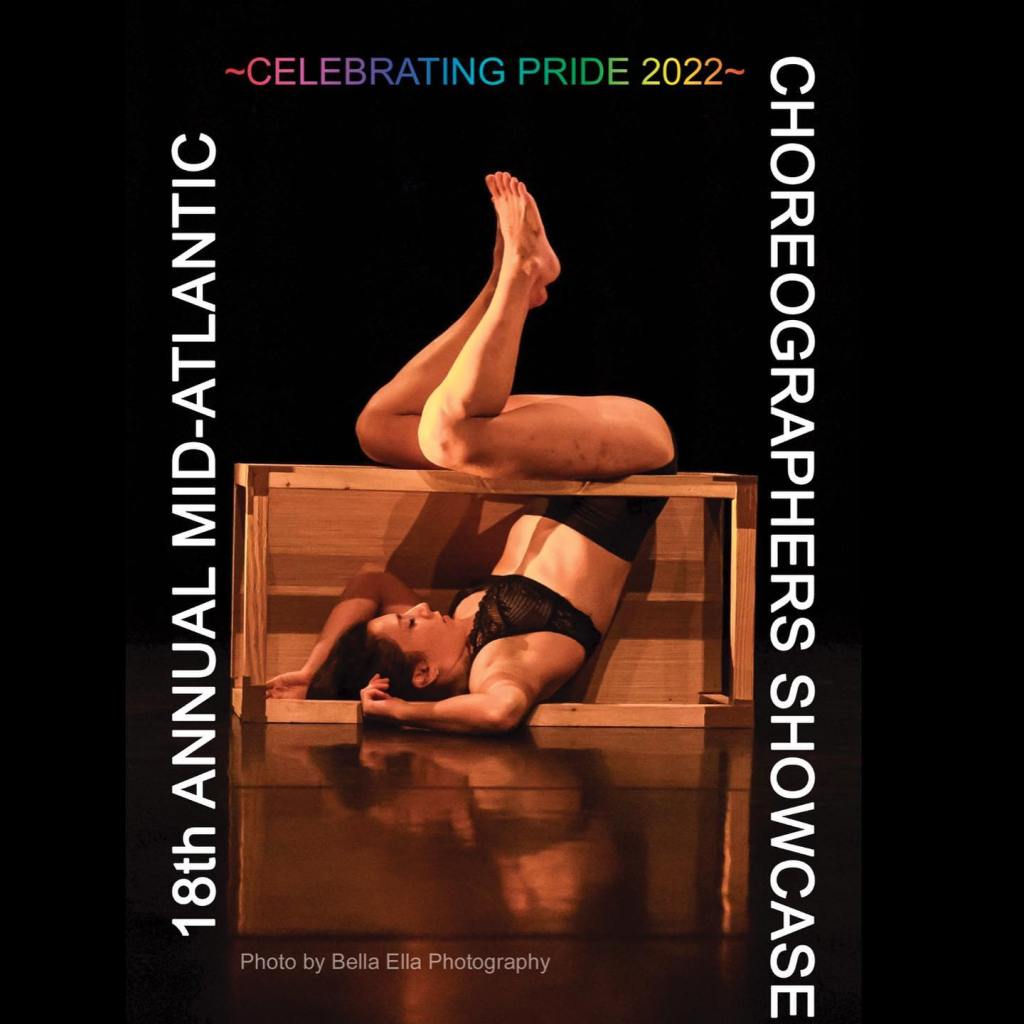
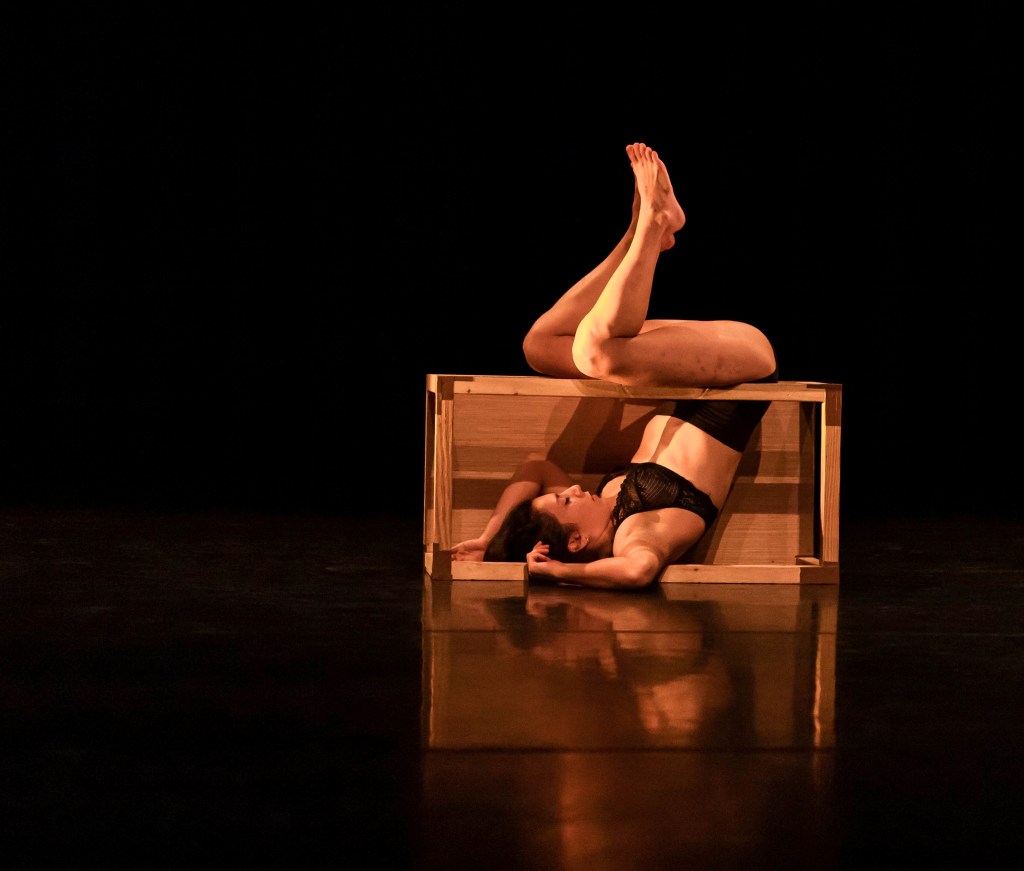
The program also included Circular, a duet by Roxanne Morgan Rowley, performed by Rowley and Sara Goldman, that explores the circularity of relationships between two women; and Luisa Innisfree Martinez’s hilarious Trope in a Box. Performed in, on, and under an open sided crate, Martinez’ solo uses comedy and strong, acrobatic movement phrases to examine and deconstruct themes and tropes of femininity. The program concluded with Starr Foster’s new work, Stripped, a trio that explores identity. The three women become entangled, connect, collapse, support one another, and finally seem to reach a place of calm, peace, and acceptance.
Foster has produced the Mid-Atlantic Choreographers Showcase for 18 years, and hasn’t run out of ideas yet. This was, by far, the best Showcase yet: powerful new work, a diverse collection of choreographers and dancers, a relevant theme, and a variety of perspectives. Thank you, all of you, for a wonderful experience.
Julinda D. Lewis is a dancer, teacher, and writer who was born in Brooklyn, NY and now lives in Eastern Henrico County.
———-
Photo Credits: See individual photo captions
Dancers Darryl Filmore and Ankita Sharma. Photo by Lily Price.Dancer: Alyah Baker. Photo by Alcee Byrd.Luisa Innisfree Martinez. Bella Ella Photography.Megan Mazarick. Photo by Jano Cohan.Net Reflex. Dancers Roxann Morgan Rowley and Tina Fratello.Starr Foster Dance. Dancers Anna Branch, Ana Pavon, Fran Beaumont. Photo by Doug Hayes.
Dancers: Taylor Black, Hailey Clevenger, Caitlin Espinueva
Music: “Fibre de Verre” by Paris Combo
Standstill (2016)
Choreography: Kara Robertson
Dancers: Taylor Black and Caitlin Espinueva
Music: “Sukkara ehizatu” by Robo
Choreographic Demonstration
Part 2
Wave and Flight (Premiere)
Choreography by Kara Robertson
Dancers: Taylor Black, Hailey Clevenger, Caitlin Espinueva, and Lexi Firestone
Music: “Hanging D (Cello Octet Amsterdam Version)” by Joep Beving and Cello Octet Amsterdam and “A New Satiesfaction” by Stephen Koncz
For their first in-person production in two and a half years, KARAR Dance Company chose to go INFORMAL. That was both the title and philosophy of the program of new and recent works: no costumes, no lights, no intermission, and a chance for audience participation before and after the performance. This made for a delightful Saturday afternoon that provided insight onto Kara Robertson’s creative process.
PASS, a work-in-progress, is built on a vision of people on a busy urban street being passed by an indifferent crowd. PASS could also be a metaphor for people letting life pass them by, passing up opportunities. The two dancers begin with a lot of floor work, incorporating a sort of racer’s starting position. Sometimes moving in unison, sometimes moving in opposition, mirrored images, and punctuating their movement with powerful statements of stillness, one could imagine the for now invisible crowd passing by, the dancers focused or zoned out.
Robertson accepted questions and suggestions from the audience immediately after.
Dead Weight, a quartet, is a template for late elaboration. It starts in silence and – when lights are added – will end in a fade-out. Two dancers begin on the floor while a third enters with the fourth on her back – a dead weight. The music adds a familiar-sounding melody but the vocals are in French and translate to something about fiberglass, lightning, and love. All of which, adds an air of romance and mystery to the little conflicts, the shoves, like the inevitable banter of sisters, perhaps, and again, those wonderful moments of silence or stillness that I am beginning to think are a signature of Robertson’s work,
Standstill, originally performed as a male-female duet, and later as a solo, was presented as a duo for two women. The music, a blend of cello, vocals that sound like Spanish and Arabic, and a cacophony of percussion and horns is a fusion of contemporary and classical – another Robertson signature.
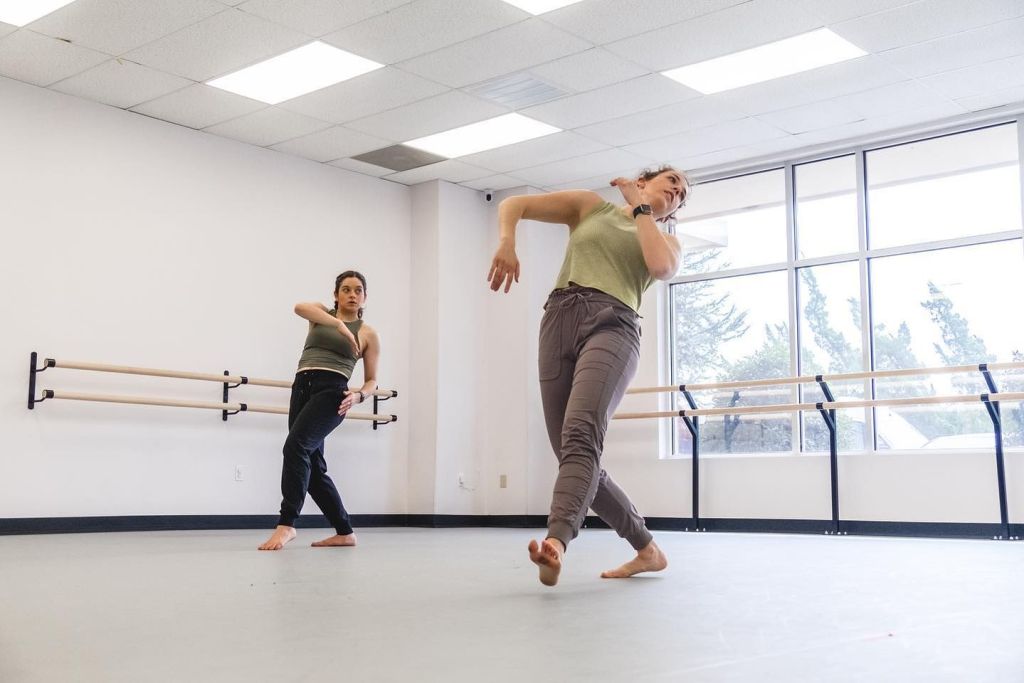
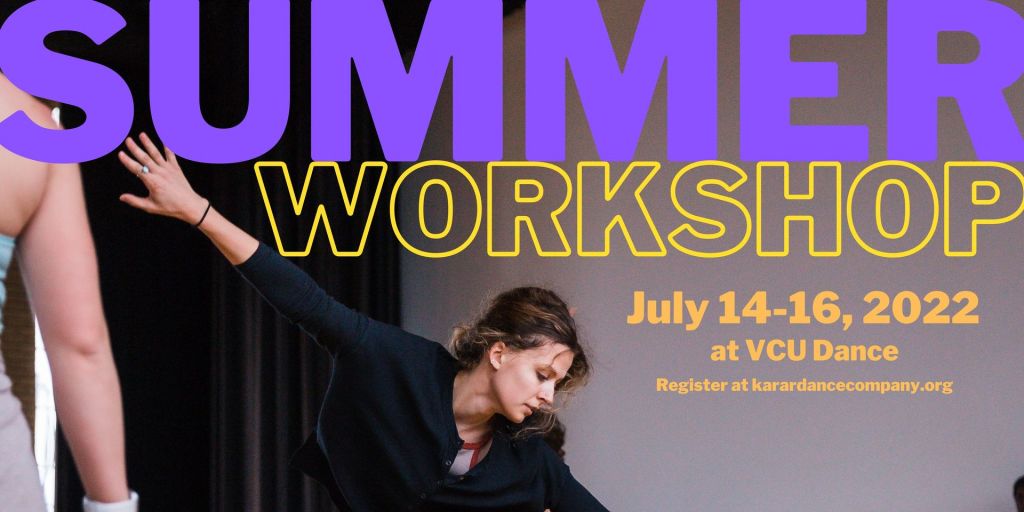
The INFORMAL program conclude with Wave and Flight – a work Robertson plans to teach to those enrolled in her upcoming summer workshop (see the KARAR website for more information) begins with a run and semi-fall, forming what Robertson refers to as “hills.” Jumps in the air, legs tucked, low sweeping turns and rolls on the floor prepare the dancers for their eventual “flight.” The music accompanying this work consists of strings, solemn yet soaring and a bit agitated. The music supports Robertson’s vision as she plays with variations in tempo and kinetic polyrhythms. Wave and Flight has a bit of a storybook feel; the dancers interact more directly than in the previous works, there are lifts and carries and airy leaps and turns that are complemented by the sunshine and butterflies in the music.
The Choreographic Demonstrations revealed Robertson’s creative process using a basket of words generated by the audience and a Mad-Libs format the dancers created movement in the first demonstration, and Robertson began to place them on stage. In the second part of the demonstration, Robertson deconstructed the movements, made minute adjustments in position, direction, and the like, and the dancers and audience began to see the formation of a new work-in-progress.
The stress-free and interactive format of INFORMAL was just what the Richmond dance community needed at this time.
Julinda D. Lewis is a dancer, teacher, and writer who was born in Brooklyn, NY and now lives in Eastern Henrico County.
Community Member Dancers in Act II: Lexie Hays, David Monger, Lea Monger, Maria Carmina Parong, Honey Lyn Savage, Dhol Tuason, Belle Villanueva
Original Projection Art and Design: Nitsan Scharf
Celestial Headpiece Design: Margie Jervis
Lighting Design: Kaylin Corbin
Scenic Design: Ken Hays
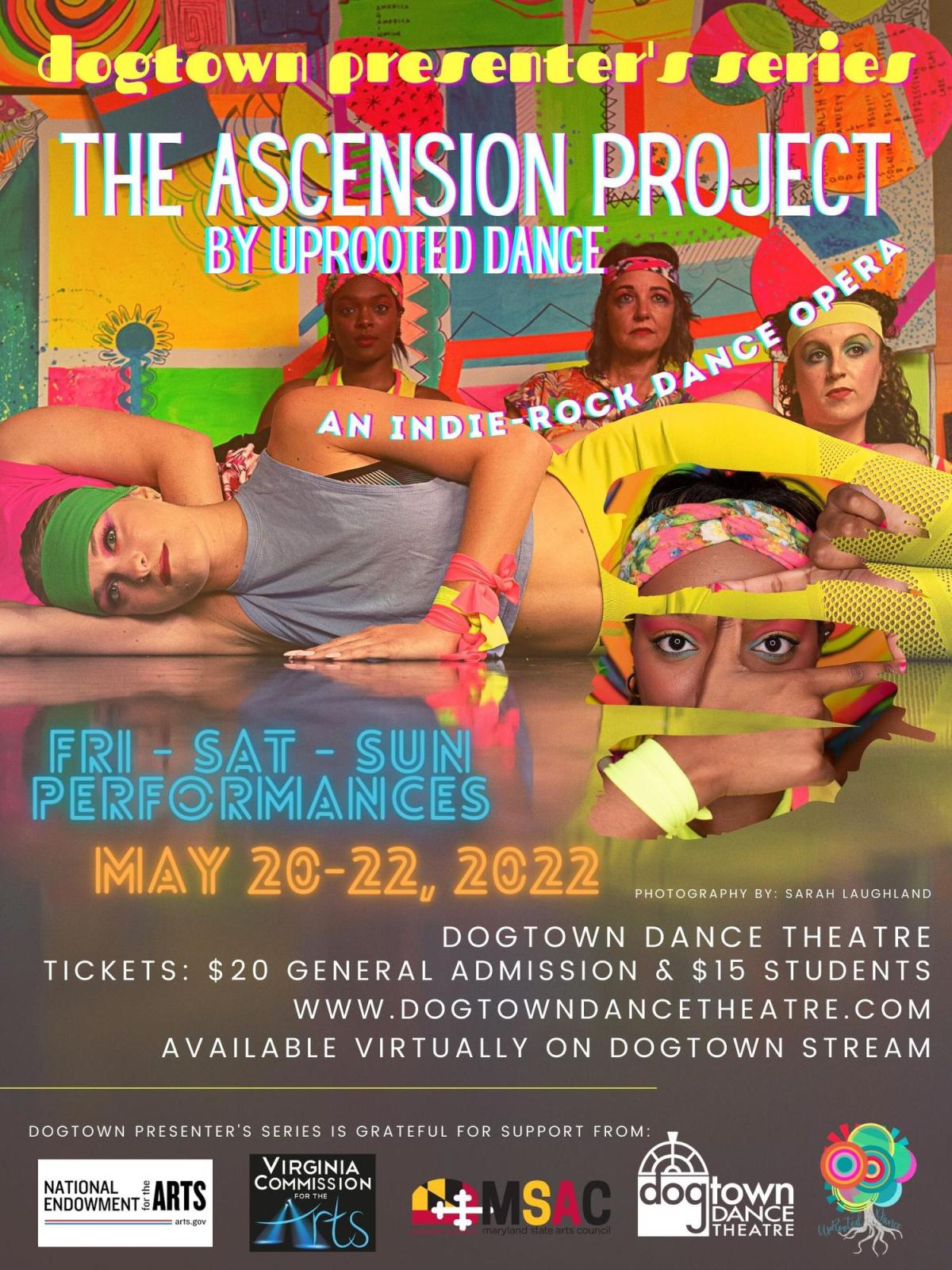
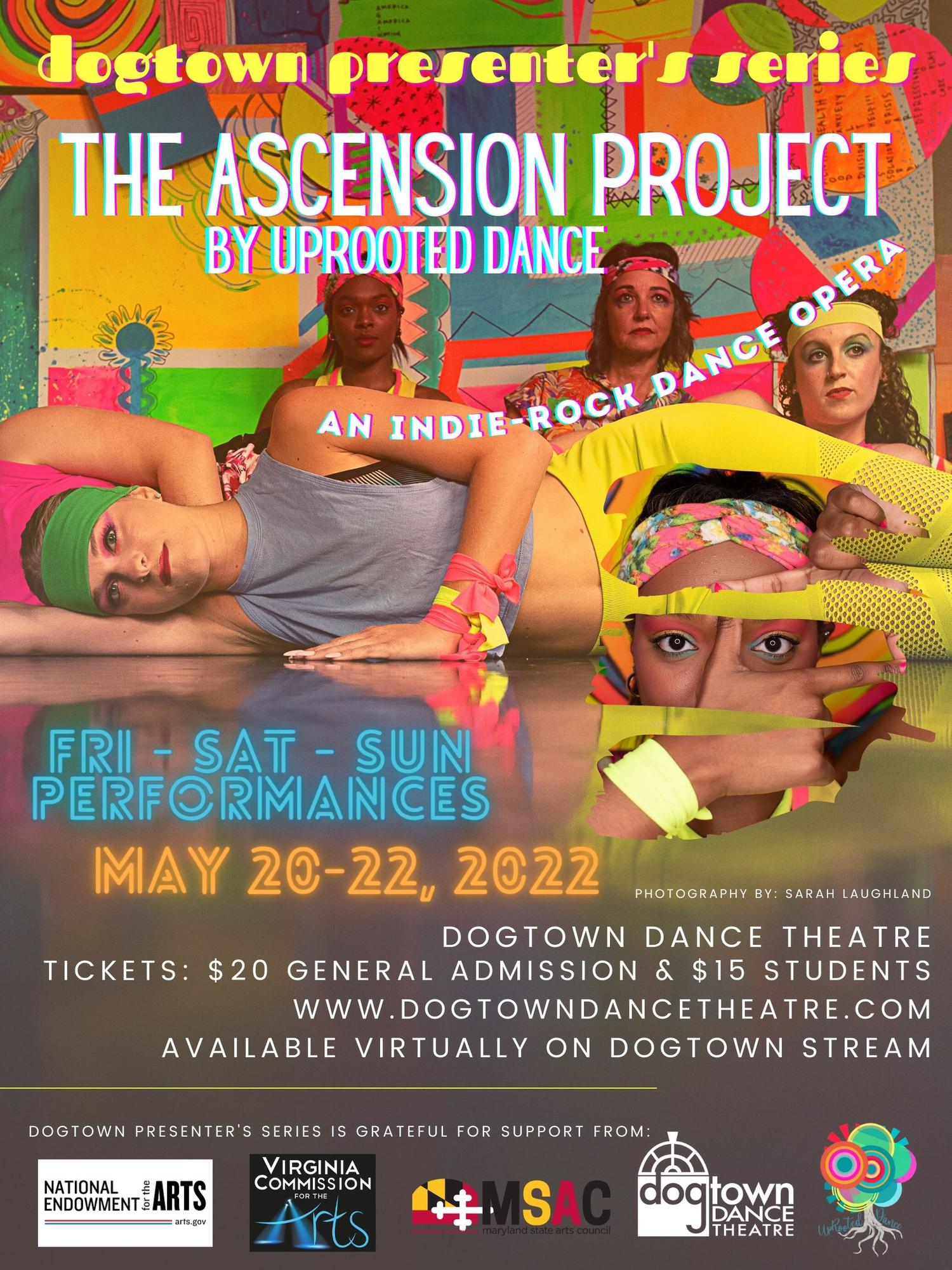
This may seem like a strange start, but stick with me. I promise it will make sense. I have memories of people skipping church when they knew the senior pastor was away. They apparently attended church for a personality, rather than to worship God. Some people just don’t like the unknown and unless the guest speaker was a well-known personality, many showed no interest. This is the thought that ran through my mind when I attended The Ascension Project by Uprooted Dance at the Dogtown Presenter’s Series on Friday, April 20. My partner and I seemed to be the only attendees in the approximately 150-seat theater who were not staff members or family or friends of the performers. There were fewer than 20 people in the seats.
Now, I was not familiar with Uprooted Dance, a Metro D.C. – area based company that is committed to presenting interdisciplinary collaborative work that tells thought-provoking stories and community engagement. That is exactly why I wanted to see them. What a great opportunity to see a new-to-me company without having to travel several hours and spend money on gas. Well, that’s my take on the situation, but I know that’s not going to fill empty seats, so without further ado – or diversion – here’s my take on The Ascension Project.
The Ascension Project was inspired by the events of the past two years: the COVID-19 pandemic, civil unrest, social justice, the flattening of personal space as represented on a Zoom screen. Arranged – remember, this is a dance opera – into a prelude and three short acts, The Ascension Project is a journey through time and space that begins with isolation in small spaces, explores identity, trauma, and loss, and concludes with a transcendent journey. So, what does this look like?
The “Prelude,” described in the Director’s notes as “a bright, bold, big dance number” has the company of six dancers performing warm up movements in brightly colored casual clothes against a wall of brightly colored projections that include videos of the dancers performing the “Prelude.” For all the clever moments, including the dancers passing and sharing up close with the audience signs bearing messages such as “I missed you,” “Can you see me,” “Sit back and relax,” and “Enjoy the show,” and an attempt to create a satirical replica of a Zoom dance class experience, the sum total of all the components of the “Prelude” was remarkably subdued.
The dancers spend most of Act 1, the “Dream Sequence” on the floor in uncomfortable positions, rolling and restless as the background of colorful mandalas spins and regenerates at a sometimes dizzying pace. In one mesmerizing section the dancers log roll upstage, walk back downstage, and repeat the sequence, each time at a faster pace until finally they are running. Black and white projections and earth-toned costumes segue into colorful blooming flowers for the ”Circle of Life” section where the dancers move in a clockwise rotation, briefly holding hands and wrapping their arms around one another, ending the nightmare of illness, death, war, and famine.
The focus – and tone – shifts again in Act 2, “America,” when the company members are joined by members of the Sayaw! Philippine cultural dance group and community dancers, including a lone man and two little girls. The focus of “America” is culture and identity and features a power fist pump, a cultural dance, taking a knee, and saluting the flag (background) with a hand over the heart.
Finally, Act 3, “Blast Off,” contemplates what the future holds. The dancers start off as astronauts, in silver suits and a cleverly designed spaceship – a blend of physical and video components – that takes them to future new worlds where race and politics and nationality no longer exist, no longer separate and segregate. After experiencing weightlessness – and planting their flag – the dancers become transformed into celestial beings with lighted constellations headdresses. The lighting and dark costumes obscure their individuality, such as race, hair, skin color, creating a minimalist effect that harkens ack to the beginning.
Make no mistake, like most operas, this one needs a synopsis to help an unfamiliar audience navigate the strange new terrain. Extensive program notes were provided in the printed program but before each new section, Artistic Director Kiera Hart-Mendoza provided a verbal map to guide the uninitiated.
Honestly, The Ascension Project has the look and feel of a work-in-progress. Sometimes, it’s good to get in on an emerging work and follow its development. I suspect this is very much the case with The Ascension Project,” as its name implies. The Ascension Project is an interesting and evolving work that did not quite reach its full potential, but hopefully will continue to evolve and reach an appropriate and appreciative audience.
Julinda D. Lewis is a dancer, teacher, and writer who was born in Brooklyn, NY and now lives in Eastern Henrico County.








 RVArt Review