AN ACT OF GOD: The Beginning and the End

An Act of God: Thou Shalt Laugh

A Theater Review by Julinda D. Lewis

Richmond Triangle Players

At: The Robert B Moss Theatre, 1300 Altamont Avenue, RVA 23230

Performances: February 27 – March 23, 2019. (Opening Night – March 1)

Ticket Prices: $10-35

Info: (804) 346-8113 or rtriangle.org

An Act of God is an irreverent comedy in which the One and Only God settles casually into a talk-show set to chat and rant about what’s wrong with the universe. The Richmond Triangle Players production marks the Richmond debut of David Javerbaum’s play, first produced in New York in 2015.

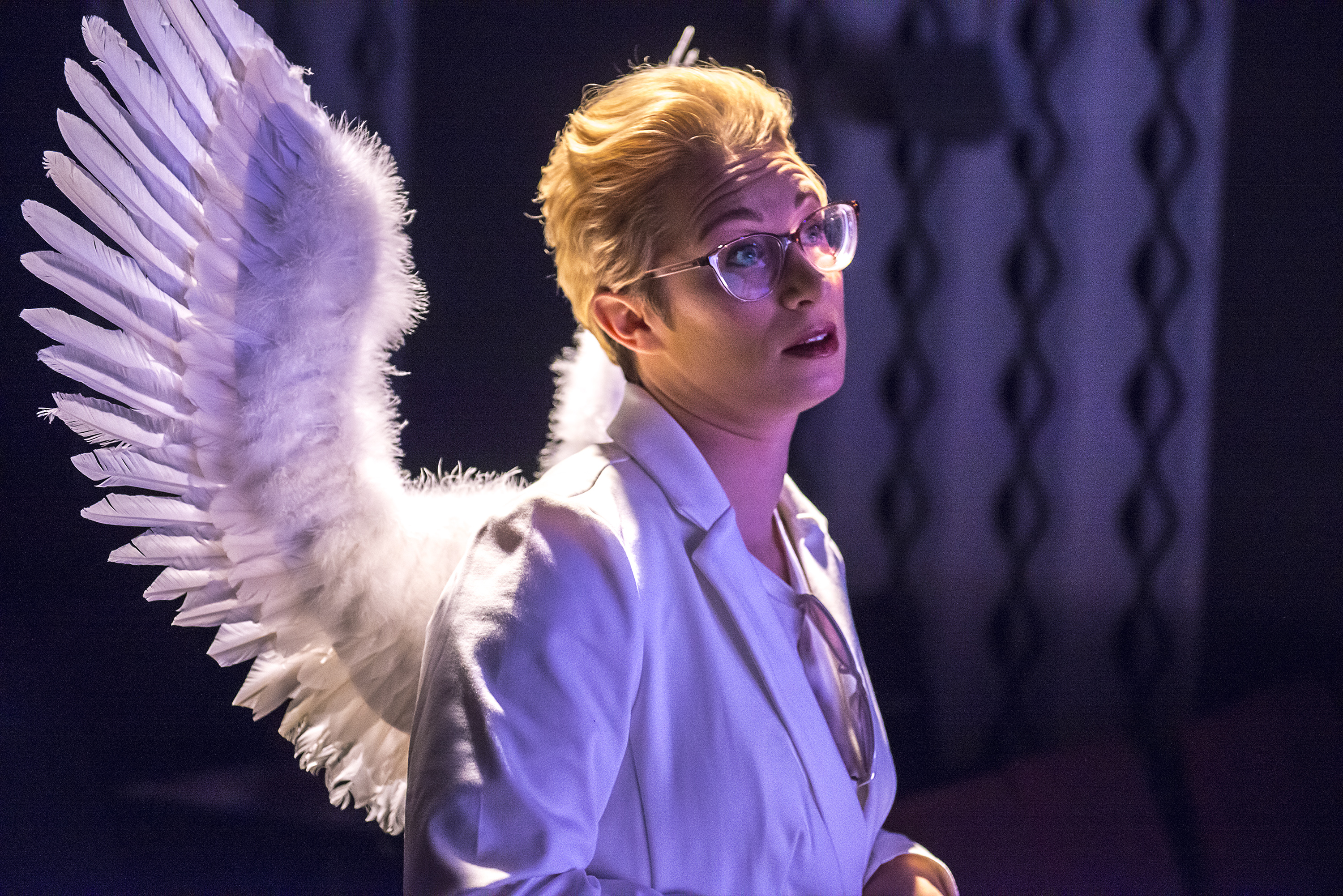
The all-female cast is headed up by Maggie Bavolack as God, supported by Kylie M.J. Clark as the Michael and Anne Michelle Forbes as Gabriel. Michael starts out helpfully fielding questions from the audience but becomes increasingly insolent, challenging God like a precocious child. This eventually brings on the wrath of God, causing Michael to lose a wing – which we later see bent and reattached with a generous application of duct tape. The more compliant and sweet-faced Gabriel is the keeper of the Guttenberg bible – which is housed in a guitar case – and dutifully reads verses as God updates The Ten Commandments. Both archangels are smartly dressed by Sheila Russ in white pant suits and glittery silver boots.

But this show mostly belongs to Bavolack who, despite a few opening night stumbles, smoothly navigated Javerbaum’s script, which started as a series of tweets and then became a book before manifesting as a play delivered in the form of a list. Director Jan Guarino must have given Bavolack free reign because her performance is an intriguing balance of warm and natural, sarcastic and funny, as she enumerates the new commandants. (A few old ones were kept because they were just that good.)

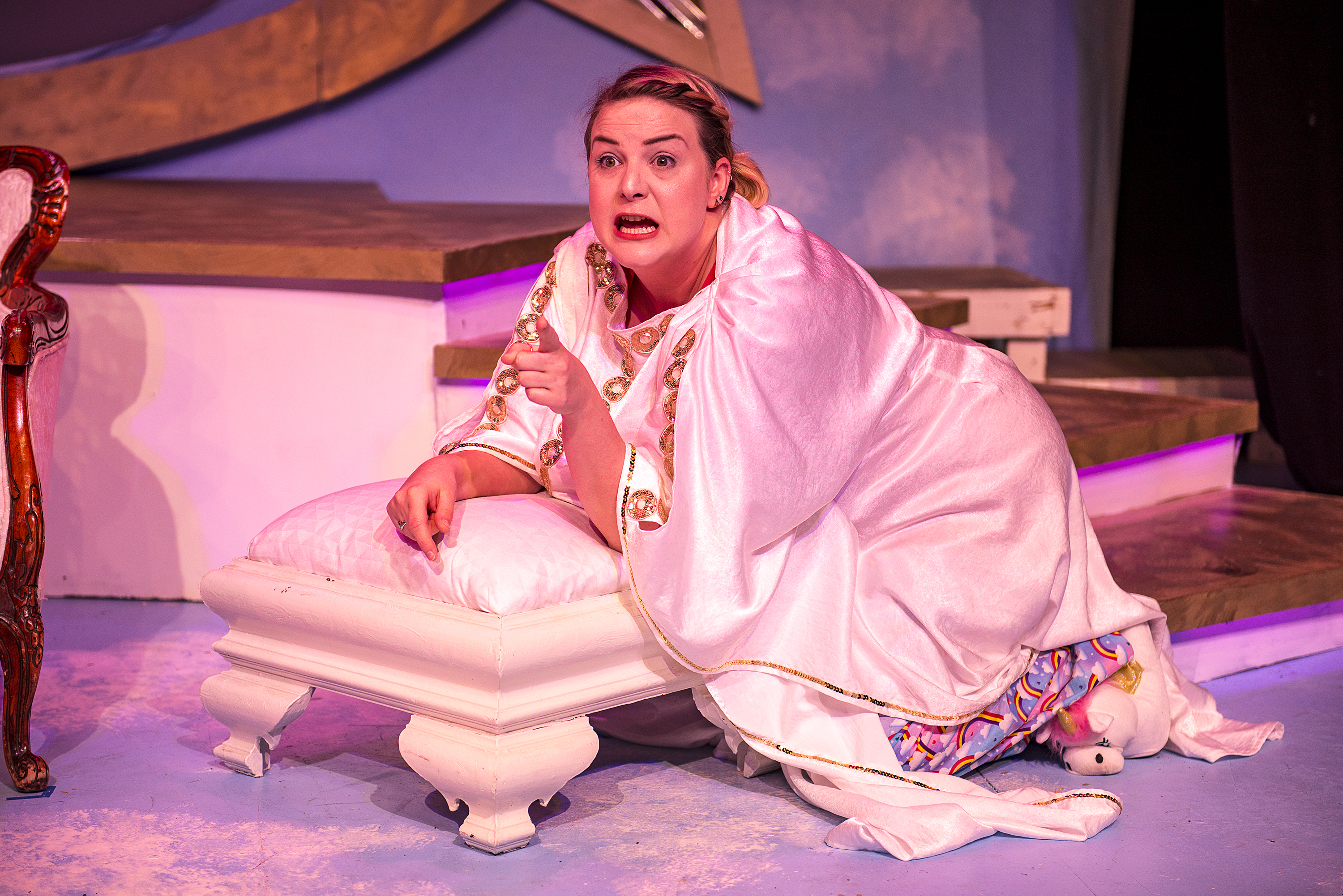
Bavolack wears a gold trimmed white caftan with fluffy white unicorn slippers – sort of the sartorial equivalent of the mullet (you know, business in the front, party in the back). Her hilarious delivery of the list is varied in style and tempo. God’s updates to The Ten Commandments range from the relatively mild (Thou shalt not tell me what to do) to the controversial (Thou shalt not tell others whom to fornicate). Some commands are delivered almost matter-of-factly while others require extensive anecdotes or take long detours.

Bavolack also interacts with the audience, calling out a pair of latecomers and directing other comments directly to those who occupied front row seats – make that the first two or three rows. Oh, and there is a runway that extends the stage into the aisle.

The script has adlibs built-in, allowing for a sprinkling of timely or local references. There’s a fleeting mention of our Commander in Chief and one particularly impressive local reference that Richmond has almost as many houses of worship as confederate monuments. (I wonder what an actor would insert here if performing in Brooklyn, or Philadelphia, or Miami…) There’s even a song at the end, “I Have Faith in You,” when quite suddenly things take a bit of a surprise turn, and the celestial trio takes pleasure in belting it out like rock stars.

Chris Raintree’s design, with its set of double steps (which did not succeed in suggesting a stairway to heaven, if that was the intention), a white sofa, a “poof” or ottoman, a coffee table, and a podium, looks like a celestial talk-show set. Bavolack’s eyes are projected onto the backdrop and emblazoned on the “merch” – a mug, tee-shirt, and magnet are among the show-themed items for sale at the bar. Michael Jarett’s lighting includes a few lightning strikes and there’s a bit of smoke as well.

I would not categorize An Act of God, which is, of course, a part of the Acts of Faith Theatre Festival, among my favorite scripts, but the performance delivered by Bavolack and company is a delightfully entertaining way to spend 75 minutes.

Julinda D. Lewis is a dancer, teacher, and writer who was born in Brooklyn, NY and now lives in Eastern Henrico County.

———-

Photo Credits: John MacLellan


(L to R) Anne Michelle Forbes (Gabriel), Maggie Bavolack (God), and Kylie Clark (Michael) clear up some misconceptions about the Holy Word in David Javerbaum’s comedy “An Act of God”


Maggie Bavolack delivers the new Word
Anne Michelle Forbes as God’s wingman Gabriel
Kylie M.J. Clark as the questioning archangel Michael

CONCERT BALLET OF VIRGINIA: It’s a Circus Out There

CONCERT BALLET OF VIRGINIA:  43rd Annual Winter Repertory Gala

A Dance Review & Some Random Thoughts by Julinda D. Lewis

At: The Woman’s Club Auditorium, 211 East Franklin St., RVA 23219

Performances: February 8 – March 3, 2019

Ticket Prices: $18 for adults; $15 for seniors and students (with valid ID); and $12 for children

Info: (804) 798-0945 or www.concertballet.com

It has been awhile – at least two years, maybe three – since I’ve seen a performance by the Concert Ballet of Virginia. This company, which describes itself a “collection of unsalaried Virginians. . .operating within the framework of a full-scale professional dance company” occupies a unique position. Based on a mission to reach large, diverse audiences, the performing company itself is a form of outreach, offering performing opportunities to many who want to experience ballet without the commitment of a full-time professional career. Many performances take place in schools, bringing storybook ballets and dance exploration to students of all levels.

The company also offers two annual gala programs at The Woman’s Club Auditorium on East Franklin St. The recent 43rd Annual Winter Gala, held February 24, included live music by The Concert Ballet Orchestra and two new works, The Banks of Green Willow, choreographed by Concert Ballet dancers Allie Davis and Will Taylor and Circus, a collaborative story ballet created by three Concert Ballet dancers – Toni Lathan, Allie Davis, and Valerie Shcherbakova –to Norman Dello Joio’s “Satiric Dances.”

The Banks of Green Willow, set to music arranged by Richard Schwartz (Symphonic Winds and The Concert Ballet Orchestra), tells the story of an elegant couple in evening dress returning home through a park after enjoying an evening at the ballet. The rich black and green costumes work well with what appears to be a Victorian-era set, featuring gas lamps and a park bench. Concert Ballet dancers Allie Davis and Will Taylor choreographed the piece, keeping the choreography sweet, uncomplicated, and effective for the scene they created.

Circus is a colorful finale piece that includes dancers of all ages and abilities. There are acrobats and tumblers, a snake charmer, tigers, monkeys, a strong man, and more, all under the big top. Company director Scott Boyer takes on the role of an evil Magician, who appears to be vying with the troupe’s Snake Charmer for the affections of the circus’ Tightrope Walker – who looks like the ballerina atop a classic music box.

The program also included works from the Concert Ballet repertory, including an East Indian inspired Sleeping Beauty ballet, Naila, for the junior dancers with stylized movements, a very red-themed and festive Fledermaus, choreographed by Scott Boyer to music by Johann Strauss, and a revival of the company’s “Emperor Waltz.” If I am economical with details, it is because the programs were mis-printed, and The Concert Ballet Orchestra conductor, Iris Schwartz, announced the music and dance selections – without benefit of a microphone.

One thing this company does very well is backdrops and sets. The Fledermaus set included three gigantic chandeliers against the all-red backdrop; The Emperor Waltz featured Greek goddess dresses with Grecian pillars and candelabra – some with real lights – and Naila had some very pretty Alladin-esque costumes.

Another thing they do well is provide live music. Between dances, the orchestra offered a variety of selections from patriotic marches to Gilbert and Sullivan to Big Band.

At the Woman’s Club, there are a couple dozen tables where audience members can sit cabaret-style and order desserts and coffee prior to the start of the program, and during intermission. Most of the audience members appeared to be family and friends of the performers. The program is family friendly, and there were many toddlers in attendance – most of whom were surprisingly attentive! At least one dad ignored the pre-show announcement not to take photographs or make video recordings, and no one seemed to mind.

I chatted with a young woman seated near me – we weren’t seated at a table but sat on chairs in two rows at the rear of the room.  (There were also seats in the balcony – the program was well attended. It was, in fact, a full house.) She didn’t have family or friends in the cast but had seen the program listed on Facebook and decided to come as she’s trying to sample more of the culture that Richmond has to offer. While I enjoyed the music and admired the sets and costumes, I had some major private thoughts about the caliber of the dancing: flexed feet; uneven lines; unsteady balances; dancers looking at other dancers for cues, and more. But my companion for the day had no such reservations and indicated that she plans to come to the next performance as well. I think that is just the sort of outreach education The Concert Ballet of Virginia aims for. Some of the characteristics I consider signs of professionalism might be deterrents to someone who is new to dance, or who wants to be entertained, but not. . .challenged. Perhaps she will come again. Perhaps she will also want to sample some of the contemporary dance and other local offerings. Did I witness the birth of a new audience member – a potential patron of the arts? I hope I see her again.

Julinda D. Lewis is a dancer, teacher, and writer who was born in Brooklyn, NY and now lives in Eastern Henrico County.

———-

Photo Credits: There were no photographs available at the time of publication.

Concert Ballet

SWEENEY TODD: A Close Shave

SWEENEY TODD: The Demon Barber of Fleet Street

A Theater Review by Julinda D. Lewis

At: TheatreLab, The Basement, 300 E. Broad St, RVA 23219

Performances: February 14 – March 14, 2019

Ticket Prices: $35 general admission; discounts available for students, seniors, industry

Info: (804) 506-3533 or theatrelabrva.org

TheatreLAB’s Sweeney Todd: The Demon Barber of Fleet Street is a large-scale musical undertaking by a relatively small theater company. And they nailed it!

Director Deejay Gray has outdone himself. The cast, the tone, the pacing, the minimalist industrial set – also designed by Gray – and the intimate setting all work together to create a juicy, gory, bone-chilling evening of theater. I noticed that the program cover says, “TheatreLAB is proud to present Sweeney Todd: The Demon Barber of Fleet Street.

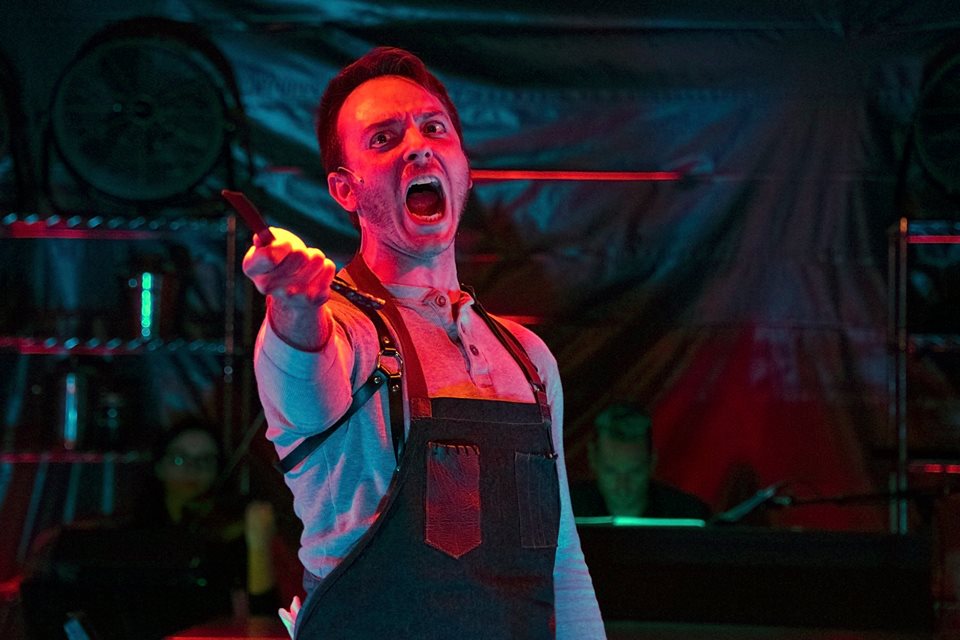
The ensemble is led by Alexander Sapp as the vengeful barber and Bianca Bryan as Mrs. Lovett, his landlord and owner of the pie shop that finds success only after adding a special secret ingredient to her meat pies. Both are deliciously intense and over the top. Sapp is unrelentingly manic in his quest for vengeance, after having been wrongfully deported to Australia so a corrupt local judge, Turpin, could take advantage of his beautiful young wife. Bryan is positively chilling in her remorseless determination to win the barber’s affections and advance her failing pie business – which she herself describes in song as, “The Worst Pies in Town.”

But the strength of this production does not rest solely on the shoulders of the two leads. William Anderson, as the corrupt Judge Turpin appears in his first scene with his eyes wildly bugged out, and the next time we see him he is ripping pages from his bible and flagellating himself as he tries to talk himself out of his lustful attraction to his beautiful young ward, Johanna – who is actually the daughter of Sweeney Todd, and sees in the pompous Turpin only a father figure. Mallory Keene plays Johanna with a sweet innocence – except when demanding kisses from her true love, Anthony Hope, or grabbing a pistol to shoot her jailer!

Kelsey Cordrey is an interesting sidekick as Beadle Bamford, the Judge’s lackey. Wordlessly, Cordrey conveys contempt for the Judge, and perhaps even envy and a desire to have Johanna for himself.  Then there’s Audra Honaker who does double duty as the mysterious beggar woman and Pirelli, a rival barber. Interestingly, neither of Honaker’s characters are who they first appear to be, but it is the role of Pirelli that infuses some much needed hilarity into this horror story of a musical.

Matt Shofner charms as the loyal young apprentice, Tobias (Toby) Ragg. Freed from bondage to the flamboyant and fake Pirelli after Pirelli has a visit with Todd, Toby becomes attached to Mrs. Lovett an performs a touching duet in which he promises that nothing can harm her as long as he’s around. Little does he know. . .

The cast also includes Matt Polson as Anthony Hope, the young sailor who saves the shipwrecked Sweeney Todd and befriends him – pretty much against his will, and two musicians who remain onstage and occasionally get swept up in the action. The violinist is Marissa Resmini, and John-Stuart Fauquet on piano is also the production’s musical director. Michael Jarett designed the lighting, and there are plenty of special effects to cover the bloody throat slitting, indicate the bakeshop ovens are working, or create projections on the rear wall. Gray has covered the rear and side walls in industrial strength plastic, making me wonder, on entering, if perhaps the audience might need bibs, like the ones you get in seafood restaurants, to keep from getting splattered with blood. The audience has to walk through the set to get to their seats – and everyone is encouraged to use the facilities before the first act or wait until intermission. With everyone glued to their seats – partially in fear – I don’t think anyone thought of going to the bathroom during the first act.

Needless to say, with its themes of sexual assault, insanity, murder, corruption, imprisonment, incest, and more, Sweeney Todd: The Demon Barber of Fleet Street is a part of the 2019 Acts of Faith Festival. And several performances are already sold out, so don’t wait, reserve your tickets now – and if you can, sit in the first row.

Oh, and did I mention that the singing is powerful (I could understand most of the lyrics) and the music sounds like a small orchestra, and not just two musicians? Well, it is (lack of clarity may have been due to musical phrasing, I’m not sure) and it does!

Julinda D. Lewis is a dancer, teacher, and writer who was born in Brooklyn, NY and now lives in Eastern Henrico County.

———-

Photo Credits: Tom Topinka

This slideshow requires JavaScript.


ONCE: Not Your Usual Love Story

ONCE: It’s Complicated

A Theater Review by Julinda D. Lewis

At: The November Theatre Marjorie Arenstein Stage

Performances: February 8 – March 3, 2019

Ticket Prices: $36-63

Info: (804) 282-2620 or www.virginiarep.org

I may be among the minority of those who never saw – or even heard of – the 2007 movie, Once, on which this musical is based. But that didn’t stop me from becoming totally immersed in Once on VaRep’s November Theatre stage. As a matter of fact, musical seems too narrow a term to encompass this production.

Get to the theater by 7:30 for an 8:00pm show. There are two vendors in the lobby – who later stroll the aisles of the theater for the first 5-10 minutes of the show – selling beer. A jam session starts in the lobby and makes its way down the aisles and onto the stage, sharing the aisles with the incoming audience. It’s all very loud and festive and inclusive – an all-encompassing theatrical experience quite unlike any other. The Irish accents and folk dance enhance the sense of adventure. (I assume the Irish and Czech accents were pretty authentic; after awhile I became some engrossed in the play that it didn’t matter.)

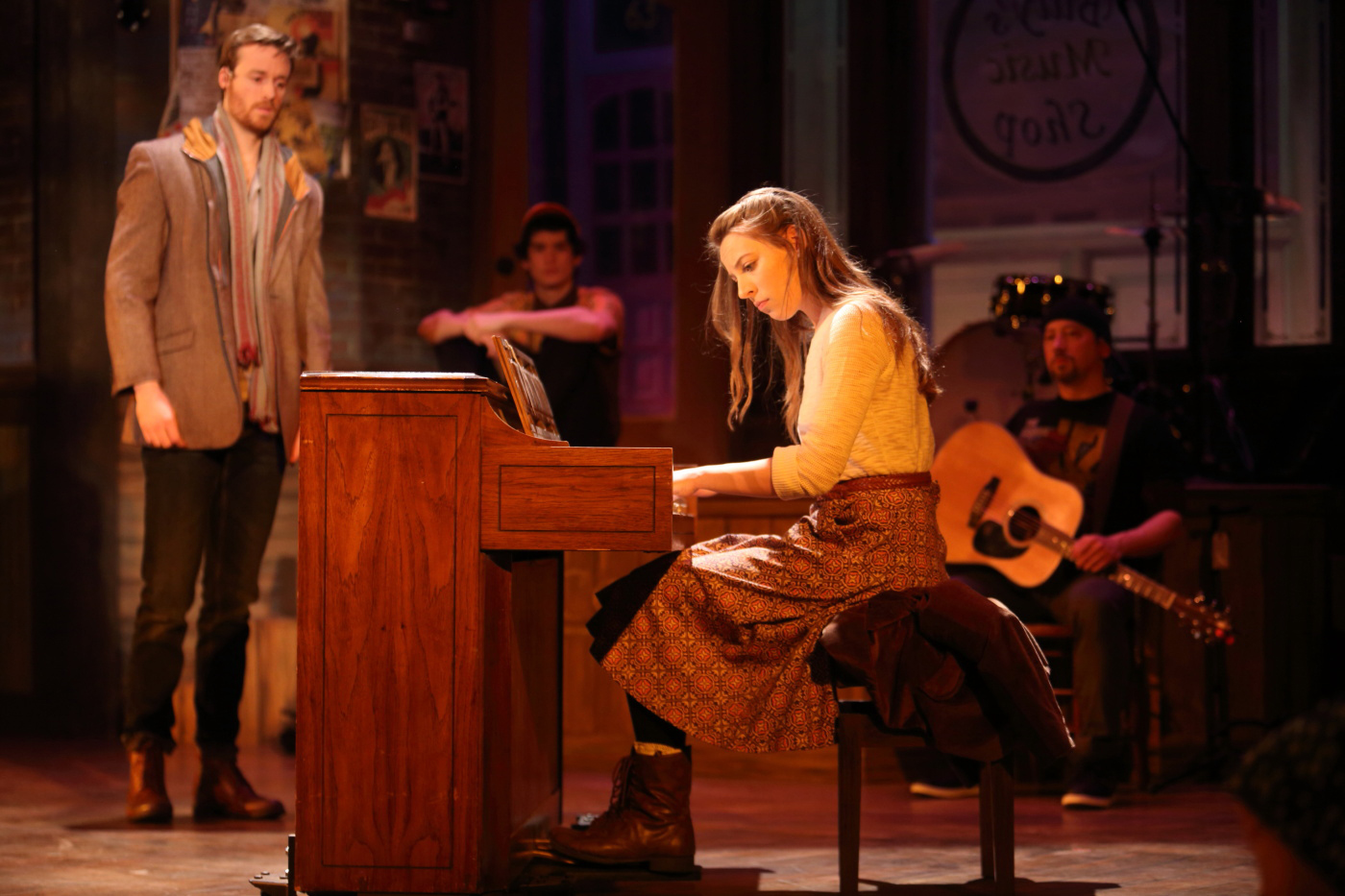
Once is based on the motion picture of the same name, written and directed by John Carney. The music and lyrics for the musical are by Glen Hansard and Markéta Irglová, with book by Enda Walsh. For this production, William James Mohney has designed a moody, multi-purpose set that serves as a music shop, a recording studio, a vacuum repair shop as well as the apartment above, and more. A raised stage, a few chairs, a slew of instruments – it’s all very minimal, but the lighting (by Joe Doran), the props, and the movement create the necessary spaces. Indeed, in the final scene, Girl and Guy are physically only a few feet apart, but she is in her apartment in Dublin while he is in New York – and they are singing the same song.

For those who, like me, are not familiar with the story, the two lead characters, who are nameless, are Guy, a talented Irish singer and songwriter whose life has come to a standstill since his girlfriend moved to New York and Girl, an energetic and insightful Czech woman who bursts unexpectedly into his life and encourages him to make music and go after his lost love in New York. But this friendship seems always to be on the verge of romance, and at one point, catching some air and studying the night sky, Girl tells Guy – in Czech – that she loves him. He asks for a translation, but she mutters something about the rain and runs off.

There is magic between the two – Ken Allen Neely and Katherine Fried – both of whom I believe are new to VaRep and the Richmond stage. Their singing flows naturally and is often intimate and romantic, in contrast to the ensemble numbers which are often rousing and more than once set the audience to clapping along. We root for their love, but it is not to be – at least not in the physical sense.

I also tremendously enjoyed Jon Patrick Penick, the owner of the music shop who freely lent Girl the use of a piano and became a part of Guy’s demo band. Penick added a comic touch with his pretense of gruffness and his heart of gold. His unexpected friendship with the capitalist bank manager, Andrew Nielson, added a bit of extra flavor to the second act. Lauren Wright is a powerhouse as Reza, singing, dancing, and seducing Billy with equal enthusiasm.

All of the ensemble actors are also part of the orchestra and some are part of Guy’s demo band as well, acting, singing, and playing all the instruments. And they dance. VaRep artistic director Nathaniel Shaw has directed with an easy pace that varies between the frenetic and the reflective, and Shaw’s choreography – which moves the cast even when they aren’t dancing – is organic and fluid. Once is unexpected, unconventional, and thoroughly enjoyable.

Julinda D. Lewis is a dancer, teacher, and writer who was born in Brooklyn, NY and now lives in Eastern Henrico County.

———-

Photo Credits: Jay Paul

Once
Trevor Lindley Craft, Lauren Wright, Will Hart. Photo by Jay Paul.

Once
Trevor Lindley Craft, J. Michael Zygo, Jon Patrick Penick, Lauren Wright. Photo by Jay Paul.

Once
Ken Allen Neely and Katherine Fried. Photo by Jay Paul.

Once
Ken Allen Neely. Photo by Jay Paul.

Once
Hilary Alexa Caldwell and Christopher Seiler. Photo by Jay Paul.

RICHMOND BALLET’S “CINDERELLA”: Happily Ever After

Richmond Ballet’s CINDERELLA: Humor & Romance Unite

A Dance Review by Julinda D. Lewis

At: The Carpenter Theatre at Dominion Energy Center, 600 E. Grace St., RVA 23219

Performances: February 14-16 @ 7:00pm; February 16 @2:00pm; and February 17 @1:00pm

Ticket Prices: Start at $25

Info: (804) 344-0906 x224 or etix.com

Magic. Magic with a generous dose of humor. The Richmond Ballet’s 2019 production of Malcolm Burn’s Cinderella is the sort of magical ballet that makes little girls want to become ballerinas. (Not trying to be sexist here, just speaking from personal experience or memory.)

Set on the grand Dominion Energy Center’s Carpenter Theatre stage, with storybook scenery, elaborate costumes, and props by Peter Farmer, lighting by MK Stewart, and additional costume design by Tamara Cobus, Burn’s choreography soars into fairyland and carries the audience willingly along for the journey. Sergei Prokofiev’s romantic score is played beautifully by the Richmond Symphony, conducted by Erin Freeman.

Cinderella, her bullying stepsisters and unsympathetic stepmother, her kind but defeated father, the fairy godmother and the fairies of the seasons, the magical mice and the charming Prince are all here in this traditional fairy tale. But it’s been awhile, and I didn’t remember just how amusing this ballet is! (On opening night there was one woman in the audience who had an infectious laugh – for the first act. By acts two and three, she had progressed to laughing uncontrollably, often at the most inappropriate times.)

The physical comedy of Elena Bella (a stepsister) and Trevor Davis (The Jester) are personal highlights of the ballet. Bello is a petite powerhouse with stunning technique and a penchant for comedy, which she also demonstrated as Puck in Midsummer Night’s Dream. Davis also managed to perfect a blend of technique and comedy.

And, of course, the delicious comicality (yes, that’s a real word) of having the second stepsister played by a man, Matthew Frain, goes without saying. I was excited when I saw him appear in toe shoes, and yes, he did manage to get in a few steps on pointe. And while his role requires him to perform in an over-the-top klutzy style, he worked diligently with company members to prepare. [See a video clip of him preparing for his role with his “sister” Elena Bello: https://www.richmond.com/studio/entertainment/dancer-matthew-frain-as-cinderella-s-step-sister/video_9f728237-58fc-5a45-a063-ff64851d227a.html].

Among the more traditional roles, Cody Beaton is Cinderella and Fernando Sabino is her Prince. Their pas de deux is lush, unhurried, and beautiful. Their unlikely love story – the stuff of fairy tales – is helped along by the Fairy Godmother (Lauren Archer) and the fairies of the Seasons. Melissa Robinson is the Spring Fairy; Izabella Tokev is Summer; Abi Goldstein is Winter; and Eri Nishihara is Autumn. Nishihara took my breath away with her effortless flexibility; it seemed that each time she lifted her leg it floated to the back of her head.

Burn gives attention to the smallest detail. Even minor characters are given memorable representations, such as Mate Szentes as the pretentious Dancing Master and Khaiyom Khojaev as The Violinist with super-exaggerated gestures. I adore the Chimes: the twelve hooded figures who signal Cinderella’s curfew turn their heads on signal revealing glowing red “eyes.” Each season fairy is accompanied by a trio of student apprentices, and the guests at the Prince’s ball are all given authentic gestures and organic movement patterns that make the entire scene flow like a dream.

Humor, romance, fairy tale enchantment. What a beautiful offering for the Valentine weekend. I so much prefer Cinderella to Romeo and Juliet for the Valentine week, as I personally find that classic tale too depressing for a romantic date. Cinderella is a story ballet that allows you to fully escape into fantasy for approximately two and a half hours (three acts, two intermissions) – maybe even longer if you plan your evening right. . .

Julinda D. Lewis is a dancer, teacher, and writer who was born in Brooklyn, NY and now lives in Eastern Henrico County.

———-

Photo Credits:

Richmond Ballet in Cinderella by Malcolm Burn. Richmond Ballet 2019. All Rights Reserved. Photos by Sarah Ferguson.

This slideshow requires JavaScript.

CYRANO DE BERGERAC: Everyone Nose

CYRANO DE BERGERAC: Unrequited Love

A Theater Review by Julinda D. Lewis

At: Swift Creek Mill Theatre, 17401 Jefferson Davis Highway, Colonial Heights, VA 23834

Performances: January 26 – March 2, 2019

Ticket Prices: $40 Theater only; $57 Dinner & Theater

Info: (804) 748-5203 or swiftcreekmill.com

Edmond Rostand wrote Cyrano de Bergerac in 1897 and many are familiar with this classic, either as a reading assignment in high school or from Steve Martin’s 1987 comedy named for Cyrano’s love interest, “Roxanne.” But it is another thing entirely to see Cyrano performed live onstage, and still be moved to laughter by the 17th century poet’s flowery words and braggadocio and touched by the hero’s uncharacteristically humble acceptance of unrequited love. And yes, this is fiction, but it is based on a real person.

The current production onstage at Swift Creek Mill Theatre, adapted by Emily Frankel and directed by John Moon, is a delightful period comedic romp. Like every production at Swift Creek, it is one of artistic director Tom Width’s favorites. This one earns a special place of honor because, he writes in the program notes, it “confirm[s] the ability of this story’s themes to transcend time and place.” Cyrano, a talented poet, playwright, musician, and soldier, is in love with his beautiful cousin Roxane, but due to his unusually large nose, he lacks the confidence to approach her. Instead, he writes love letters to her on behalf of Christian, a fellow cadet whom he befriends at Roxane’s request.

The production is dedicated to the beloved Andy Boothby, who transitioned suddenly on November 26, and had been cast in the title role, which is now being filled by Matt Bloch. Even with the flamboyantly large prosthetic nose in place, Bloch isn’t ugly; in fact, he is so far from ugly that this casting decision requires good acting in collaboration with a suspension of belief by the audience. Looks aside, Bloch does a commendable job as Cyrano, a role that is both verbally and physically demanding. The final scene, in which he visits Roxane who has retired to a convent after Christian dies on the battlefield, is more touching than I expected. Thankfully, director Moon keeps it simple and brief.

David Janosik plays Christian, whose love for Roxanne is also unrequited, because she doesn’t know that the words that are winning her over are not his own, but those of her cousin Cyrano. I wanted to feel sorry for Christian, but it was difficult to balance this desire with rooting for Cyrano to overcome his insecurities about his looks and find true love.

The lovely Rachel Rose Gilmour is well cast as the fair Roxane. It was helpful to see the scene in which she deftly deflects her lecherous uncle, DeGuiche – a scene performed for the Acts of Faith Preview – in context. In her scene with the tongue-tied Christian she is abrupt and amusing.

Other strong characters include Walter C. A. Riddle as Cyrano’s second in command, Capt. LeBret and Jon Cobb as the play’s antagonist, DeGuiche. Debra wagoner provided some wonderfully comedic moments as Roxane’s Duenna, and her perpetual giggle was simultaneously girlish and naughty.

Frank Foster’s simply elegant design, consisting mostly of a soaring archway with moveable benches and posts, transformed, with the help of Joe Doran’s lights, from a theater to a pastry shop, a court yard, a battlefield, and finally the garden of a convent. Maura Lynch Cravey’s elaborate period costumes, which included lace collars and cuffs, capes, plumed hats, and long hair for the men, and the women’s extended skirts, were as flamboyant as Foster’s design was unassuming.

As for those enduring themes, there is pride versus humility, physical beauty versus inner beauty, integrity and deception, bravery and revenge, chivalry and love, and of course, there is sword-fighting!


Julinda D. Lewis is a dancer, teacher, and writer who was born in Brooklyn, NY and now lives in Eastern Henrico County.

———-

Photo Credits:

Robyn O’Neill


This slideshow requires JavaScript.

BECKY’S NEW CAR: Placing a Marker in Life

BECKY’S NEW CAR: Cruising Through Midlife Crisis

A Theater Review by Julinda D. Lewis

At: CAT Theatre, 419 No. Wilkinson Rd., RVA 23227

Performances: February 8-23, 2019; Acts of Faith Talkback after Sunday matinees

Ticket Prices: $23 General admission; $18 RVATA Members; $13 Students

Info: (804) 804-262-9760 or cat@cattheatre.com

From the moment Becky Foster bustles onstage, still dressed for work, talking over the hum of her hand-held vacuum, tossing a roll of toilet tissue towards one audience member to place in the bathroom, asking another to place a waste basket under a leak, and sipping from a can of Sprite, it is obvious something in her life is out of balance. The she has a talk with her son Chris, a twenty-something graduate student who still lives at home, and the question of what he is going to do with his life turns into what she is doing with her life, and we’re off and running. Steven Dietz’s non-stop comedy, Becky’s New Car, has just enough of a tinge of reality to make us care about what happens to these characters, or at least make some moral or practical judgments about their actions.

Kerrigan Sullivan slides easily into the role of Becky (Rebecca) Foster, a middle-aged woman with a decent job as an office manager in a successful car dealership, married to a successful roofer, mother of a son who is a nice young man who, like many nice young men, seems in no hurry to rush into adulthood. Sullivan’s role requires lots of interaction with the audience, which also seems natural to Sullivan, who must segue smoothly between acting and narrating.

Scott Bergman makes Becky’s husband Joe seem like such a solid, likeable guy that it becomes difficult to relate to Becky’s dissatisfaction or to sympathize with her subsequent decisions. At one point Becky enlisted three women from the audience – including me – to help her decide if she should attend a party and pursue an extra-marital relationship. We unanimously said no, and of course she had to find three more willing sympathizers – or there would have been no reason for a second act.

Referring back to a September 2011 Va-Rep Hanover production of this show, Becky’s New Car by Steven Dietz, I confirmed that at that time I had been invited onstage to assist Melissa Johnston Price, who was playing the role of Becky, get dressed for the party. As I write this review, I recall that I helped that earlier Becky with her necklace. Interestingly, although I knew I had seen – and even reviewed – Becky’s New Car nearly 8 years ago, I did not remember details, so watching this production was like watching it for the first time.

Mark Atkinson was interesting as Becky’s paramour, the wealthy Walter Flood. Where all the other characters seemed realistic, Walter was more of a caricature of the wealthy businessman with the waterfront estate. I’m not sure if Walter’s affected speech and mannerisms were a decision of the actor or the director, Ann Davis, but he seemed to be using a different style of acting than everyone else.

The rest of the cast includes Jimmy Mello as Becky’s son, Chris; Maura Mazurowski as Walter’s daughter Kenni – who develops an interesting and convoluted relationship that could only happen in high comedy – Daryl Scruggs as Becky’s emotionally needy co-worker Steve, and Tricia Hawn as Walter’s family friend, Ginger.

Becky’s New Car is not short on laughs, but the first act seemed to drag a bit. I think we were all smart enough to get it if the pacing had been bumped up a bit. The second act seemed to find a more satisfactory stride and Becky soon crashed and burned into the entirely avoidable disaster that was clear to everyone except Becky. The look on Becky’s face when she sees Joe and Walter sharing beers in her living room is priceless. Her subsequent actions change everyone’s lives.

Lin Heath’s multi-purpose set works surprisingly well. The center and stage left comprise the Foster’s living room and doors to other rooms into and out of the house. Stage right has Becky’s office, separated from the home by a single step and lighting, rather than a physical wall.A wall at the rear of the living room served as a deck or patio on Walter’s estate, but the location or construction of the wall was oddly distracting. Even more so, Becky’s car – both the old one and the new one – are represented by office chairs. I had hoped for something more, given the title. Charlotte Scharff’s costumes are realistic, from Joe’s work shirt with his name on it to Becky’s work wardrobe and the party clothes, but what really stands out is the onstage costume change, assisted by three women selected from the audience.

There is a lot of audience involvement, which is surprisingly organic and a lot less intrusive than one might expect. One might wonder how a comedy might qualify as an Acts of Faith Theatre Festival entry, but it is the life-stage challenges and how they are handled that provides plenty of material for discussion – both among audience members, and for the Sunday matinee talkbacks.

Julinda D. Lewis is a dancer, teacher, and writer wh was born in Brooklyn, NY and now lives in Eastern Henrico County.

———-

Photo Credits: Daryll Morgan Studios

Acts of Faith logo

CAT Theatre - Becky's New Car - Daryll Morgan Studios-7
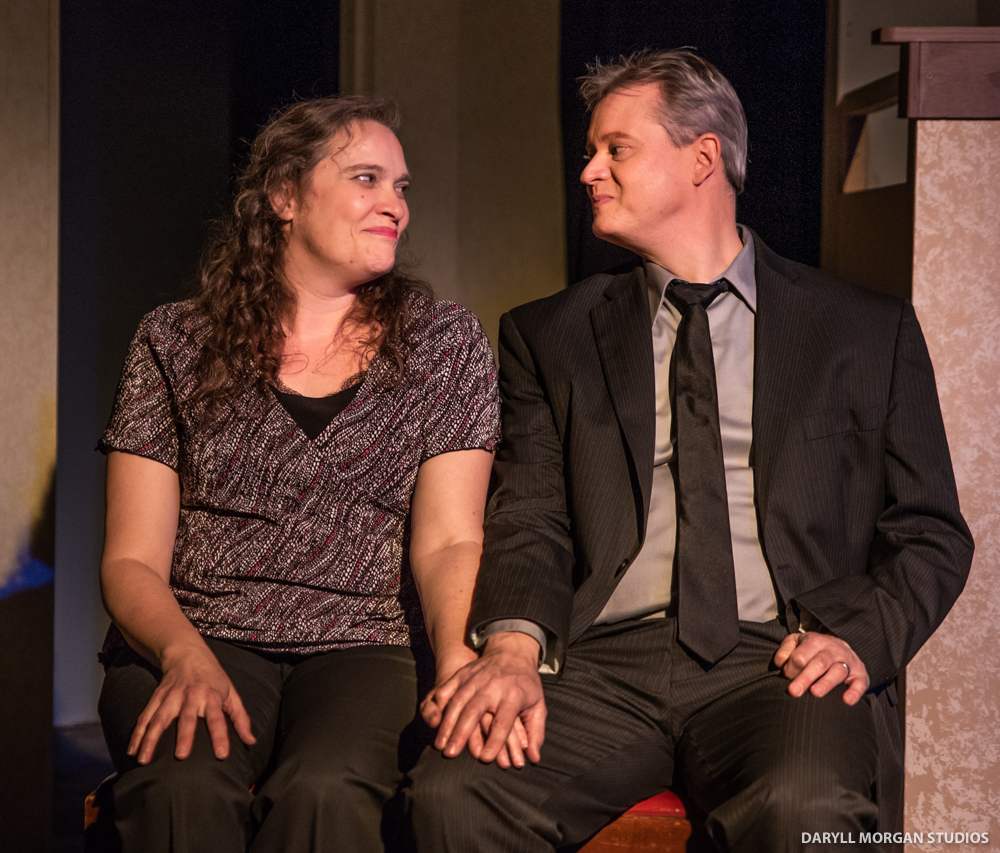
Kerrigan Sullivan and Mark Atkinson

CAT Theatre - Becky's New Car - Daryll Morgan Studios-16
Kerrigan Sullivan as Becky

CAT Theatre - Becky's New Car - Daryll Morgan Studios-17
Scott Bergman, Jimmy Mello, Kerrigan Sullivan, Maura Mazurowski, Mark Atkinson, Daryl Scruggs and Tricia Hawn

CAT Theatre - Becky's New Car - Daryll Morgan Studios-19
Kerrigan Sullivan and Scott Bergman

HUCK & TOM: Rolling on the River

Huck & Tom: And the Mighty Mississippi

A Theater Review (& some other thoughts) by Julinda D. Lewis

At: Virginia Rep’s Children’s Theatre at Willow Lawn; 1601 Willow Lawn Drive, RVA 23230

Performances: January 25 – March 3, 2019

Ticket Prices: Start at $21

Info: (804) 282-2620 or virginiarep.org

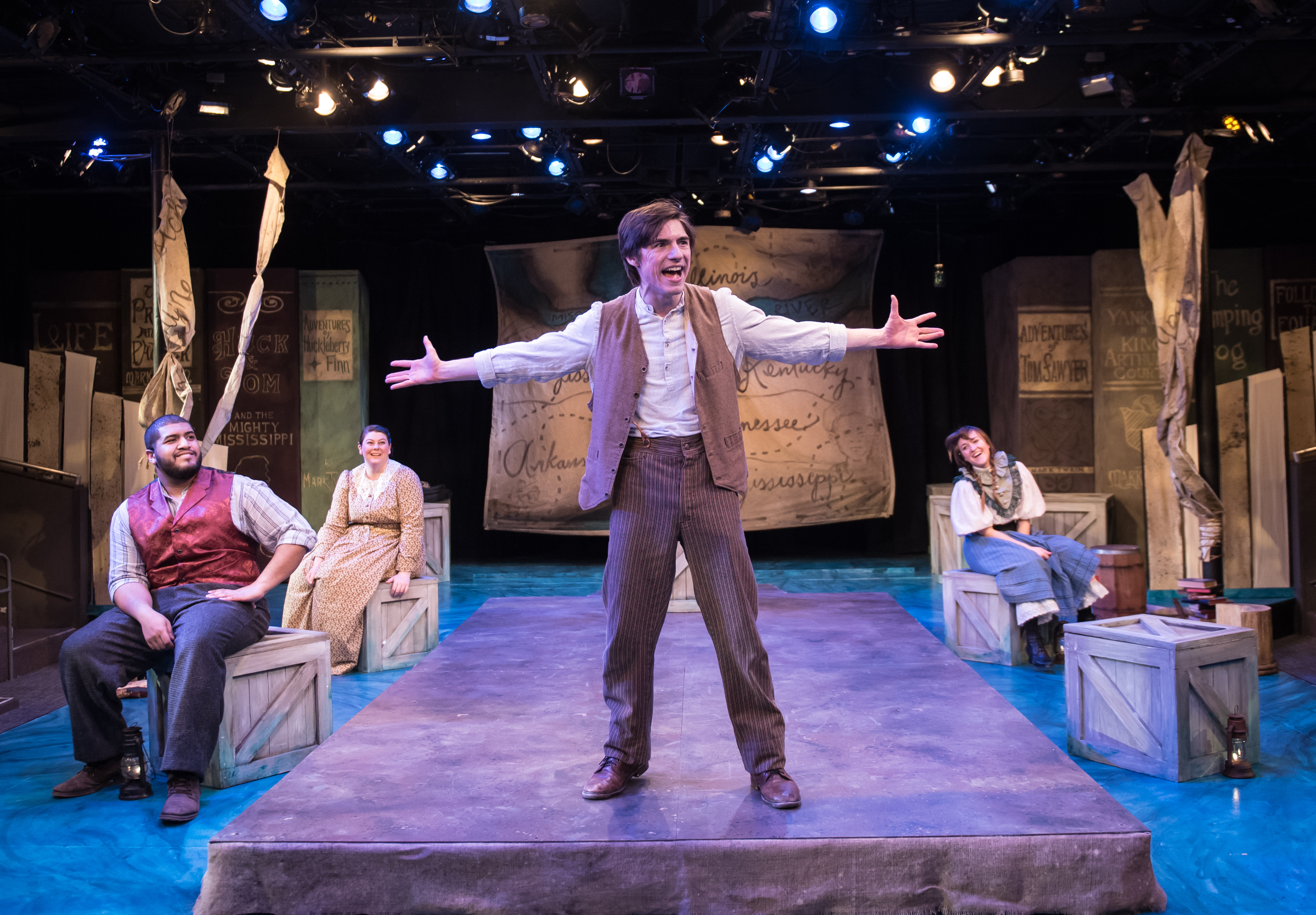
The latest production of the Virginia Rep Children’s Theatre at Willow Lawn is Huck & Tom and the Mighty Mississippi, a collection of short adventures from Mark Twain’s books about Huckleberry Finn and Tom Sawyer. The production is adapted from the works of Mark Twain, with book and lyrics by Peter Howard, and music and lyrics by Ron Barnett. Colorful and lively, with a few pleasant songs, some period costumes (Becky’s is especially pretty), and creative use of crates to change scenes (the cemetery was quite inspired), this production is recommended for ages 6-12 but is probably best suited for the higher end of this age range, through middle school.

James Hendley and Joel White share good chemistry as Tom and Huck, respectively, with Caitlin Sneed bringing balance as Aunt Polly and Rachel Jones as an adorable Becky. Alvan Bolling II rounds out the cast as Jim.

Throughout the show, which runs just under an hour, with no intermission, characters remind one another and the audience that there isn’t enough time to tell the entire story and encourage audience members to check out the books from their libraries to find out the rest of the story. David Tousley’s set, which includes movable fences, a raft, and the aforementioned crates, includes a background of fencing and gigantic books.

I always like the program for the children’s productions. One side is a frameable poster keepsake, and the other contains all the usual program information. This one includes “Five Fun Facts” about the author and his books, such as Mark Twain’s real name, a nautical term named for Twain, Twain’s early jobs, and some facts about the Mississippi River. In keeping with this theme, I will offer five observations about this production.

One. First, let me defer to my panel of experts: Kingston and Nicole, both age 10, and Emmitt, age 4. Emmitt said he liked “everything” but was not able to offer any details. Kingston and Nicole also said they liked everything, but given that they are in double digits, I couldn’t let them get away with that. Nicole then offered that she found it confusing with one actor just fell down on the floor when the narrator said he’d been shot in the leg. An audible “bang,” she and Kingston agreed, would have made it better. When I asked them how they felt about Huck trying to decide whether to turn in Jim for the runaway slave reward and save himself or to help Jim escape to freedom, neither of them was mature enough to have fully grasped the gravity of the situation. Most of the audience was probably in the 4-10 year age range, so I’m not sure many of them grasped the significance of this dilemma.

Two. Throughout the production, young audience members were urged to read the books for themselves. Most if not all raised their hands when they were asked if they liked to read. I wonder how many of the parents present are aware that these beloved classics are among the most frequently banned books in the USA? Mostly because in the original texts there is liberal use of the word “nigger,” as Jim is referred to as Nigger Jim. Is this something you want to discuss with your elementary school child?

Three. Kingston was able to relate to some of the historical references, remembering that they had been covered in his fourth grade SOLs.  So, kudos for making theater both educational and entertaining, and finding connections with what the kids are learning in school.

Four. Emmitt, age 4, is usually completely enthralled by theater, especially if there is music involved. But this time he was ready to leave about halfway through.

Five. Huck & Tom is a colorful, lively production, with lots of visual interest, movement, and energetic performances by its cast of five, and is well-directed by Kikau Alvaro. Based on my experience, it is best suited for children ten or older, and should be accompanied by sort of discussion. This production is a part of the Acts of Faith Theatre Festival, and the suggested faith connection is “growing up,” which is linked to the scripture Proverbs 22:6 – “Train up a child in the way he should go: and when he is old, he will not depart from it.” Depending on the age and maturity of the child, and the personal beliefs of the family, there are so many directions this discussion could take.


Sensory Friendly Performances

A Sensory Friendly family performance will be offered on Saturday, February 16 at 10:30 a.m. Please see the website for more details: http://va-rep.org/sensory_friendly.html

Performance Schedule

Evening performances at 7:00 p.m. on select Fridays

Matinee performances at 2:00 p.m. every Saturday and Sunday

Matinee performances at 10:30 a.m. on select Saturdays

Julinda D. Lewis is a dancer, teacher, and writer who was born in Brooklyn, NY and now lives in Eastern Henrico County.

———-

Photo Credits: Aaron Sutten

Acts of Faith logo

Huck and Tom and the Mighty Mississippi
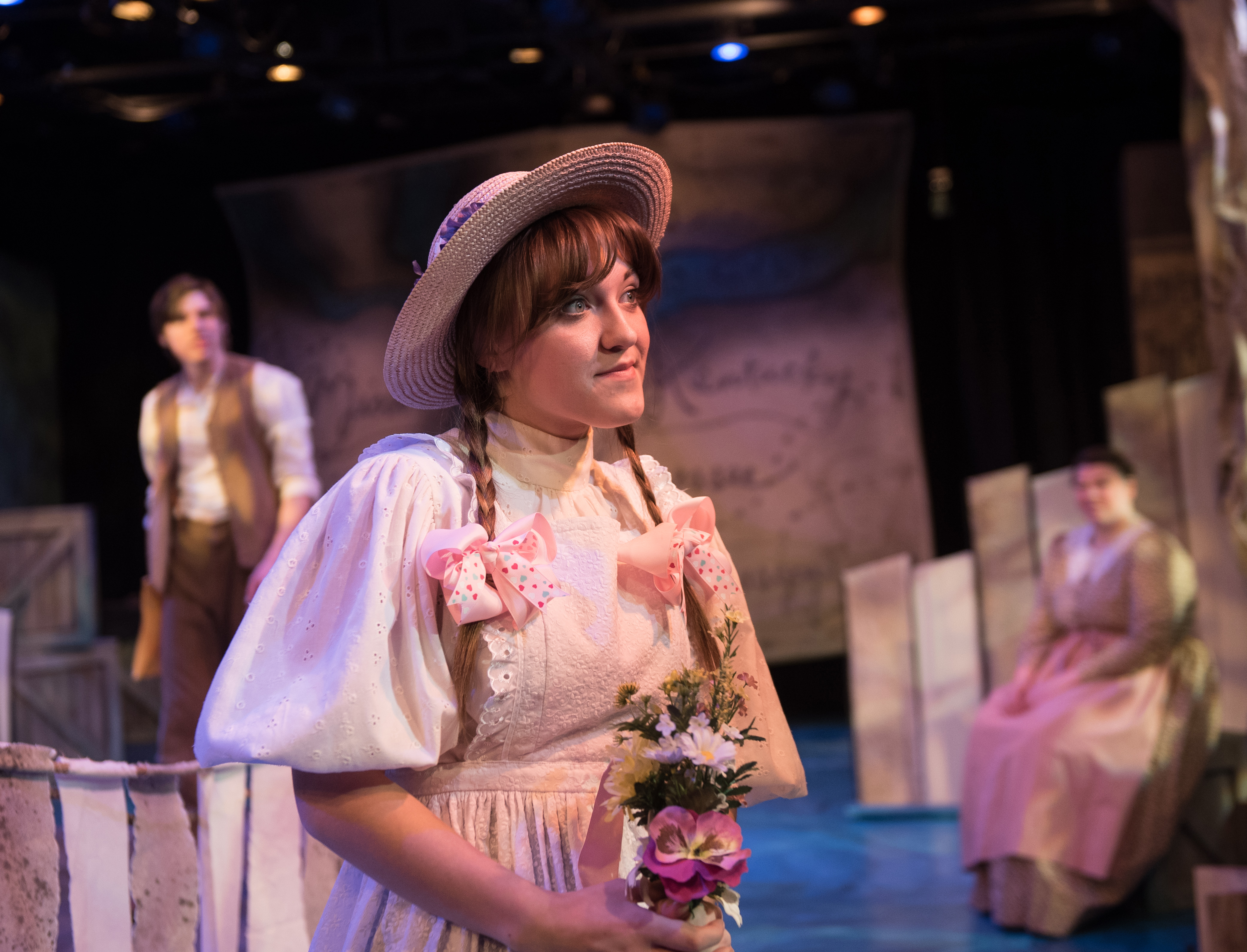
Rachel Jones. Photo by Aaron Sutten.

Huck and Tom and the Mighty Mississippi
James Hendley, center. Alvan Bolling II, Caitlin Sneed, left. Rachel Jones, right. Photo by Aaron Sutten.

Huck and Tom and the Mighty Mississippi
Alvan Bolling II and Joel White. Photo by Aaron Sutten.

Huck and Tom and the Mighty Mississippi
Joel White, Alvan Bolling II, Caitlin Sneed, Rachel Jones, and James Hendley. Photo by Aaron Sutten.

OEDIPUS: Greek Tragedy in a Black Southern Church

OEDIPUS:A GOSPEL MYTH

A Theater Review by Julinda D. Lewis

At: The Firehouse Theatre, 1609 W. Broad Street, RVA 23220

Performances: February 1-23, 2019; 7:30 PM evenings and 4:00 PM Sunday matinees; Acts of Faith Talkbacks on February 10 & 17

Ticket Prices: $15 – $35

Info: (804) 355-2001 or firehousetheatre.org

Pride. Fate. Abuse of power. Patricide. Incest. Here’s a good one: hamartia (the fatal flaw that leads to the downfall of the tragic hero). Make no mistake about it; Oedipus: A Gospel Myth is a classic Greek tragedy with all the elements and accoutrements. It’s just set in a black church in the south in the 1920s.

Instead of a Greek chorus, there’s a soulful gospel trio (Shantell Dunnaville, Shalimar Hickman Fields, and Shalandis Wheeler Smith – whose names all just happen to start with the same letter). Instead of choir robes, they wore a version of a simple Greek tunic or chiton over bedazzled golden shirts. In addition to traditional music, including a beautiful rendition of the new-to-me “Rusty Old Halo,” sung by Fields, the trio provided ongoing silent reactions to the tragedy. One could just imagine them gossiping about what they had seen and heard after the service. Michael Jones accompanied them on piano, behind their pew that occupies the left side of the stage and provided the soundscape as well. Billy Dye was the music consultant – his first time working on a Firehouse Theatre production – and he and Gonzalez drew maximum creative power from these three singers and single musician.

For those not familiar with the story of Oedipus (maybe you slept through it in high school), it might help to review a brief synopsis prior to seeing the show. Even with the change of setting and an all-black cast, the integrity of the story remains. Oedipus, our tragic hero, was born to the king and queen of Thebes, but a prophecy warned that Oedipus would kill his father and marry his mother. To thwart the prophecy, infant Oedipus was bound and left on a mountain to die. Of course, he didn’t die there, or there would be no story. And, of course, one can see parallels with biblical characters and stories.

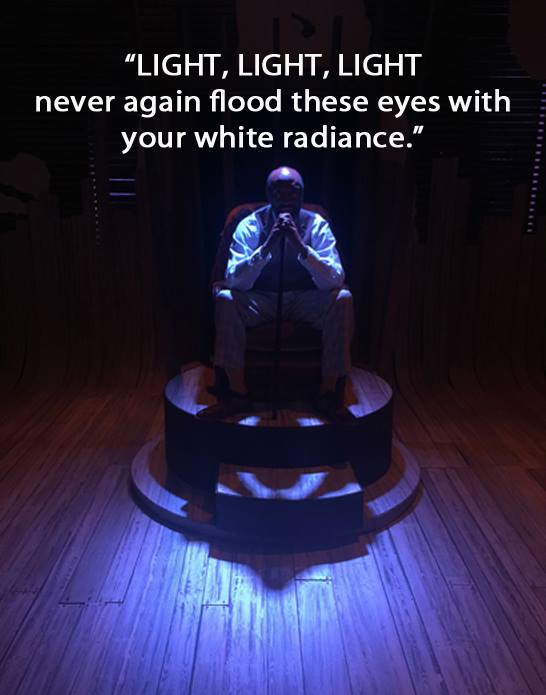
This version of Oedipus: A Gospel Myth may be the brainchild of director/set designer Vinnie Gonzalez and his stellar cast, including dl Hopkins as Oedipus, Jeremy V. Morris as the Preacher, Toney Q. Cobb as Teiresias/the Messenger, and Patricia Alli as Jocasta, but the author is still listed as Sophocles. If you have a hard time imagining a black southern congregation relating to the language and mythology of ancient Greece, just remember that they have already been steeped in the language and parables of the King James Bible.

It’s not entirely clear that the congregation, with input from the audience, is performing Sophocles’ play in a dramatic sermon that juxtaposes the flawed nature of humankind with mankind’s role in destiny, that attempts to reconcile the contradictions between God’s grace and human suffering. At times it seems that there are two stories running parallel, with occasional intersection.

Morris begins his role early, greeting audience members in his preacher’s robe as we file into the theater. One might expect a collection plate to be passed.  Morris presides from his pulpit, on the right. Centerstage is Oedipus’ throne, set on a raised platform with seven intimidating posts that made me think of The Emperor Jones.  Hopkins is dressed in trousers and a double-breasted vest, and uses a cane which, along with his slight limp, are significant factors.

Both give intense performances, with extended sermons and soliloquies. R.O. Crews, as Jocasta’s brother, Kreon, gave a strong, more subtle performance. His role provided background information as well as took the edge off the otherwise unrelenting tragedy. There were few light moments, but in Act One there was a reference to “making Thebes great again.” Keaton Hillman was a silent servant throughout the first act but was charged with delivering the most devastating news of the entire drama in Act Two. This is quite graphic, but if you want to find out what happens, you’ll have to go see it for yourself.

The cast also includes J. Ron Fleming, Jr. as the Shepherd, Miles Hopkins as a Servant Boy, and Akilah Matthews and Rayden Tyler as Oedipus’ young daughters. Steven Koehler’s lighting is subtle, sometimes shining through the horizontal slats that make up the rear walls. Gonzalez has taken the floor boards and extended them part of the way the rear walls, which have intermittent patches of what could be broken bits of plaster.

Oedipus: A Gospel Myth has a running time of about 120 minutes, with one intermission, but the first act does seem to drag a bit, while the second act races along to the shocking revelations. Even with no prior knowledge of the story, or of the genre of Greek tragedy in general, my theater partner found this to be a moving and powerful drama that touched on very human issues.

And if any of this sounds vaguely familiar, there was an all-black musical, The Gospel at Colonus, that premiered at Brooklyn Academy of Music in 1983. It was based on the second work in Sophocles’ trilogy of Theban tragedies (Oedipus Rex, Oedipus at Colonus, and Antigone) and the cast included gospel singers and church choirs.

Julinda D. Lewis is a dancer, teacher, and writer who was born in Brooklyn, NY and now lives in Eastern Henrico County.

———-

Photo Credits: Bill Sigafoos

Acts of Faith logoOedipus.1

Oedipus.2
Keaton Hillman, dl Hopkins and Toney Q. Cobb

Oedipus.3
dl Hopkins

Oedipus.4
dl Hopkins, rehearsal photo


STARR FOSTER DANCE: CRAVE…what if?

STARR FOSTER DANCE: Crave – a New Work

A Dance Review by Julinda D. Lewis

At: TheatreLAB The Basement, 300 East Broad Street, RVA 23219

Performances: February 1-3: Friday @8PM; Saturday @3:00, 5:00 & 8:00 PM; Sunday @1:00 PM & 3:00 PM

Ticket Prices: $12

Info: (804) 304-1523, https://www.brownpapertickets.com/event/4033169

Starrene Foster’s new work, Crave, poses the question, “What if, in one moment, you had changed your mind during your journey. And if so, how would that change affect the final outcome?” The ways in which she responds to this prompt are intriguing, thought-provoking, and sensual.

On entering The Basement performance space, there is a small exhibit by four participating artists. Douglas Hayes (the company’s art director) showed a pair of digital duotone prints showing the same model, in the same pose and lighting, but one was taken in 2003 and the other in 2019. Wolfgang Jasper’s charcoal drawing, “Frictionless Pivot” and digital print “Communal Madness” show the same elements, but one has been digitally reconfigured. Beth B. Jasper’s “Negotiation,” created with pen and ink on rice paper started as two separate drawings but ended as two panels, with the initial shape in one flipped over. And Fiona Ross’ “Staves #25C” and “Staves #28C” follow specific rules of placement that lead to different outcomes. A brief study of the artwork will prove helpful when watching Crave.

Our programs were marked with a letter “N” or “S,” indicating whether we were to start out seated on the North Stage or South Stage of the performance space.  There are about twenty seats on each side, and a wall – I mean a curtain – separates the two sides. During the 10-minute intermission, the audience members change sides.

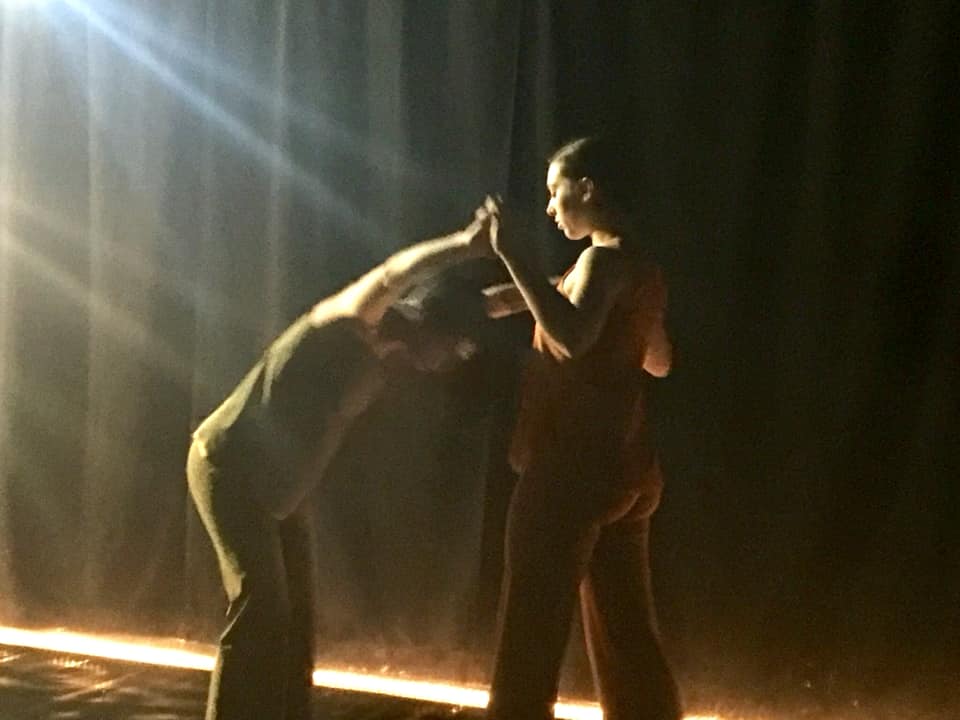
We started on the North Stage, where Kierstin Kratzer and Mattie Rogers danced with a quiet intensity that sometimes pulled me to the edge of my seat. Billy Curry’s original score was a soundscape of trains, industrial noises, and rhythmic music. Foster, who frequently uses dark lighting, did not disappoint, but there were bright lights overhead that created a not unpleasant, somehow softened glare. We could see the dancer’s faces, but not their features. We knew they were looking at each other, but we couldn’t see their eyes. They were dressed in monochromatic slightly loose, softly flowing tunics and pants that became part of the choreography.

Kratzer and Rogers sometimes flowed together organically, sometimes challenged one another, lifting, pushing, pulling; one would occasionally head butt the other in the belly, and one stood vibrating as if receiving an electric shock from her partner’s fingers. The flow and variety of movement was mesmerizing, and before you knew it, it was intermission.

Changing to the South Stage, we saw Caitlin Cunningham and Kelsey Gagnon dancing, and like Wolfgang Jasper’s drawings, the elements were the same as those used by Kratzer and Rogers, but reconfigured. They were dressed identically to the other duo. They started from a similar position. There was that kick and high leg swing. That’s the same grab of the toe. There’s the vibratory movement – but different. It was all familiar, but all new. There was the sound of the train and yes, that upbeat rhythm. But there was a sense of déjà vu, a time shift or a manipulation of time and space.

One had a sense that the other duo was happening on the other side of the curtain, but try as I might, I never actually heard them. Having the audience move is rare, but it has been done before. It’s not always possible and the flexible and intimate space of The Basement was ideal for this elemental manipulation. It enhanced the sense that time and space had shifted. The cast members change, too. For some performances, Fran Beaumont and Cristina Peters will dance on the North Stage, while Shelby Gratz and Erick Hooten dance on the South Stage. With a running time of just about 45 minutes including intermission, Crave packs a lot of punch in a small space in a short time. There are only 6 performances over a 3-day period, so if you can this piece is worth seeing. Try really hard. I love the way Foster has manipulated all the elements – including her audience.

Julinda D. Lewis is a dancer, teacher, and writer who was born in Brooklyn, NY and now lives in Eastern Henrico County.

———-

Photo Credits: Starr Foster Dance by Douglas Hayes.