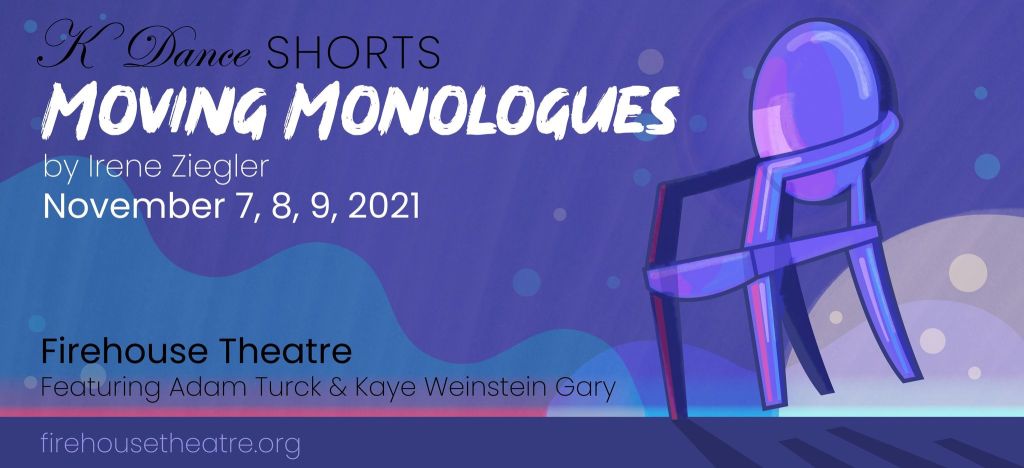
MOVING MONOLOGUES

KDance Shorts, Eighth Edition

A Dance-Theater Review by Julinda D. Lewis

Presented by: KDance, the Resident Dance Company at The Firehouse Theatre

At: The Firehouse Theatre, 1609 West Broad St., Richmond, RVA 23220

Performances: November 7-9, 2021

Ticket Prices: $25

Info: (804) 355-2001 or firehousetheatre.org.

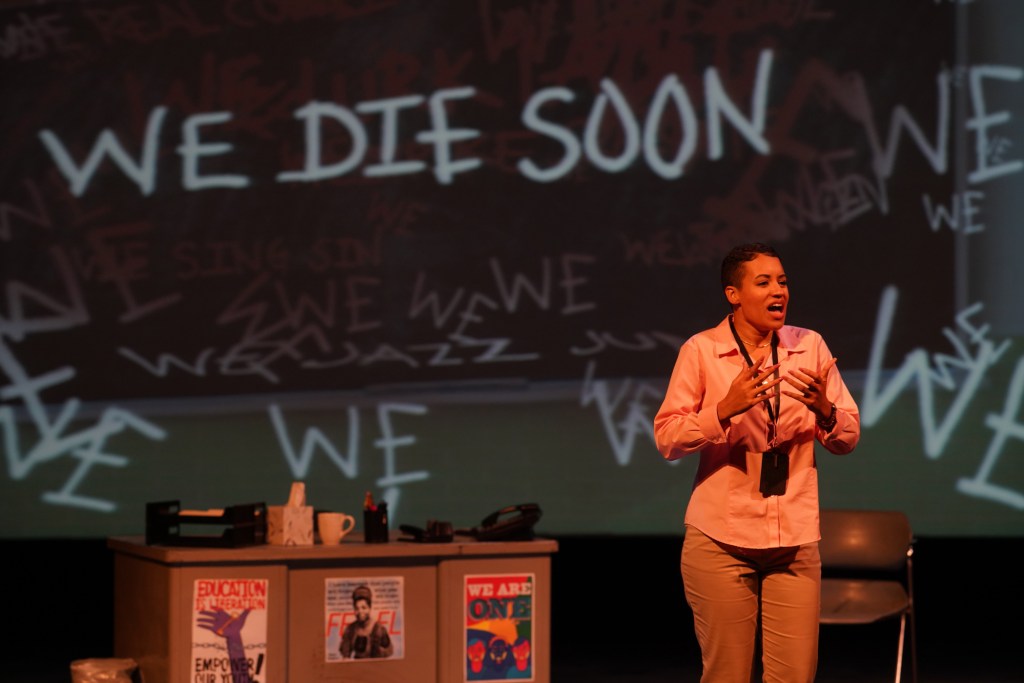
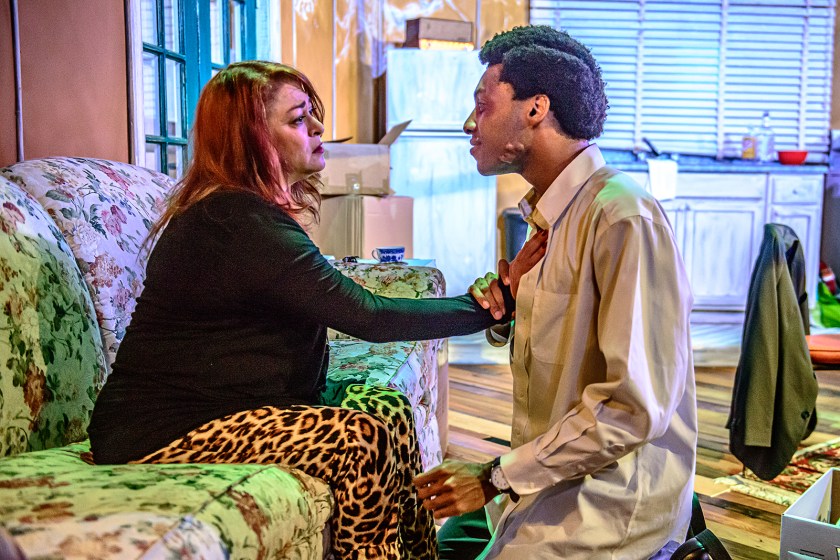
After eight years of presenting the annual Shorts program, Kaye Weinstein Gary still has new tricks up her sleeve. This year’s program, MOVING MONOLOGUES, was a collaboration between Gary (choreographer, director, performer), Adam Turck (actor), and Irene Ziegler (playwright). While previous Shorts programs have been marked by innovative storytelling combined with movement, this is the first time the stories were all connected.

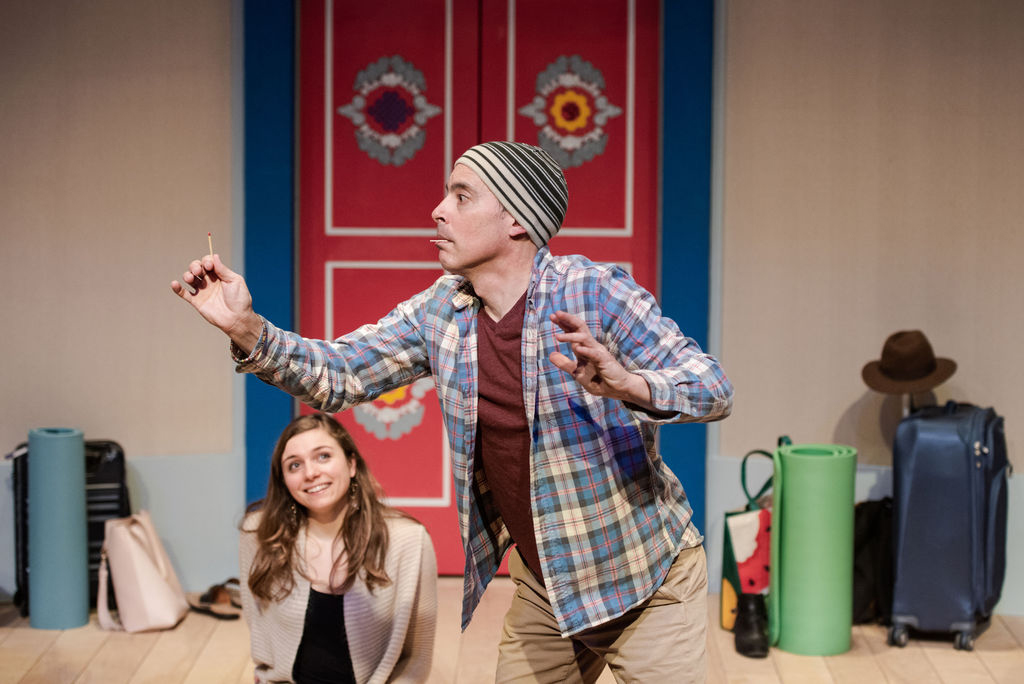
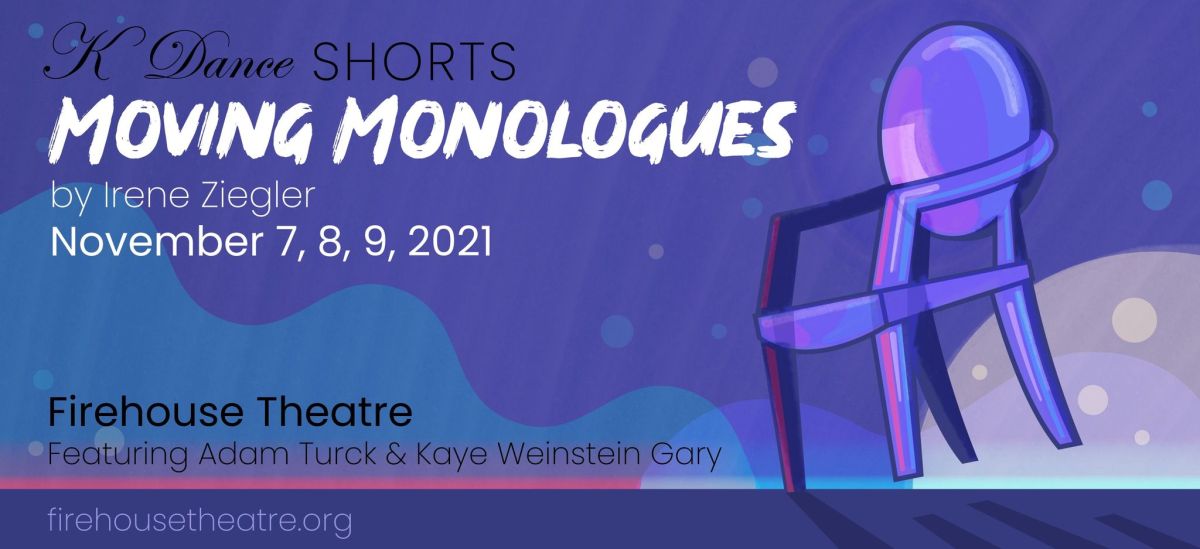
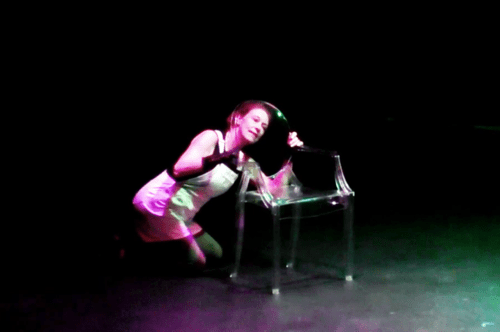
What a treat it was to reconnect with Kitty, the potty-mouthed fourth-grader introduced by Gary in her most recent YES! Dance Festival (April 2021, https://jdldancesrva.com/2021/05/01/k-dance/). Here, Ziegler has written additional monologues that introduce Kitty’s mother, grandmother, and dad, all of whom are embodied by Gary and Turck, after a brief introductory warm-up set to Erik Satie’s Piano Works #7, Nocturne II. The “Prologue” also introduces the program’s main prop: a pair of crystal clear “ghost” chairs that magically reflect and refract the light and create stunning visual effects.

“Thank you, sensei, for showing me the way.”

-Kitty

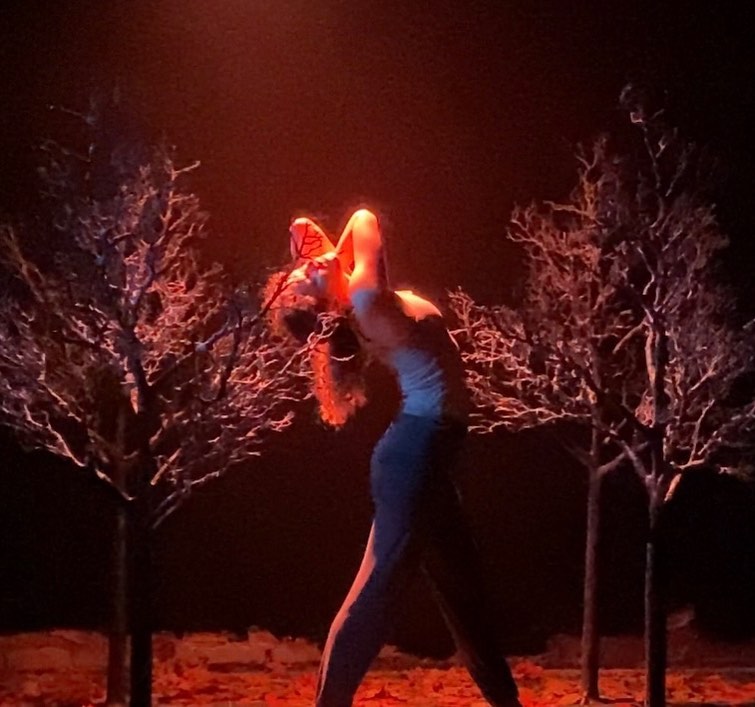
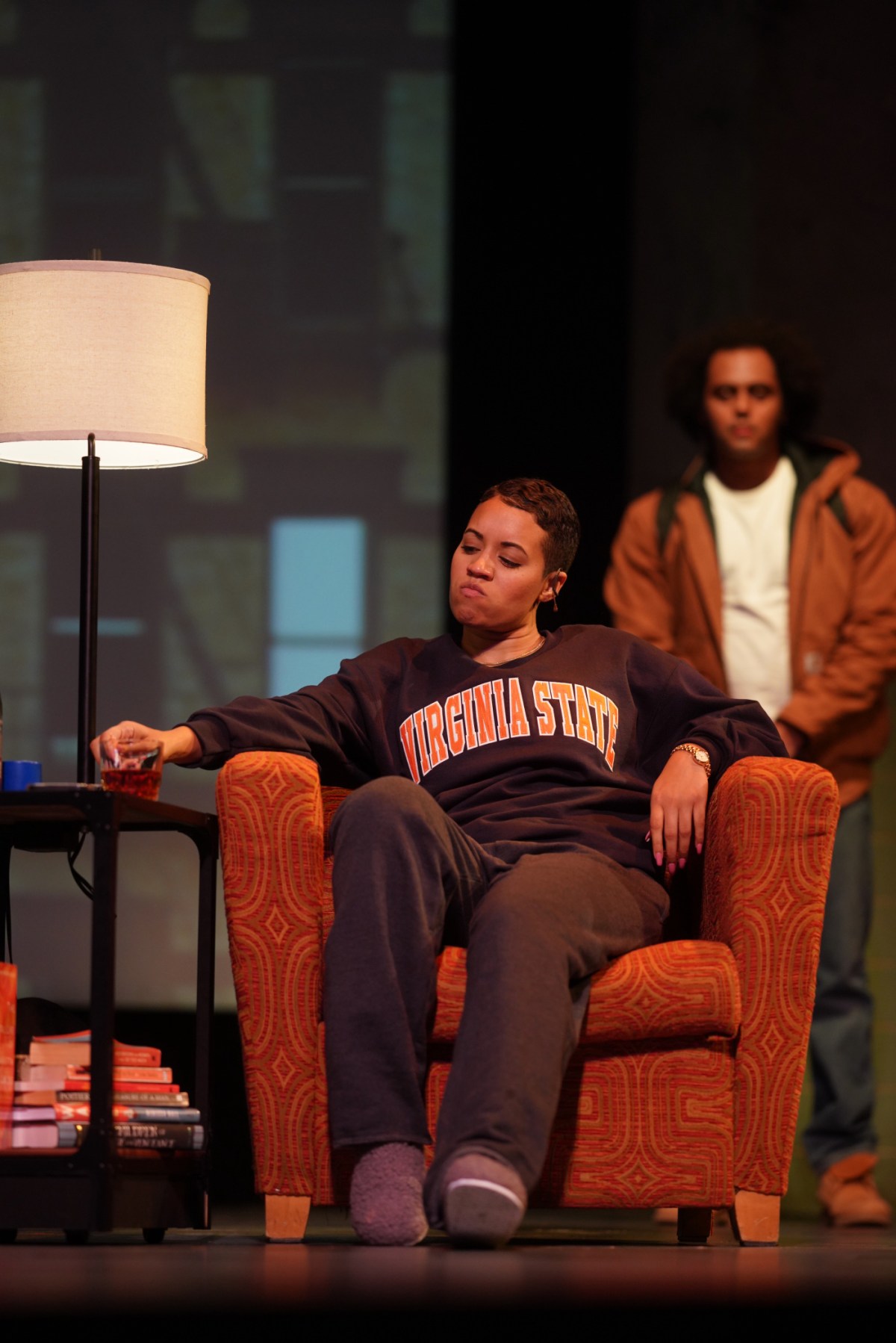
“Kitty” has been enhanced to point to connections with the new monologues. Against a background of Ana Roxanne’s non-melodic, ambient soundscape (it sounds like what your mind would sound like if you could record the sound), Kitty moves through postures of dejection and defiance – until she discovers the “superpower” of her imagination. “I have a superpower. Holy shit!” Oh, I did mention she’s been sent to her room because of her vocabulary, didn’t I? Dressed in purple leggings and white coverall shorts, Gary delightfully embodies the spirit of the fourth-grader.

But it just keeps getting better. Next up is Adam Turck as Kitty’s dad, Rodney. Dressed in shorts and carrying a gym bag, Turck, drops the bag just as the beat drops, and it’s MC Hammer’s Too Legit to Quit. Turck, a real-life certified personal trainer, moves through the paces of a man-twerk, slaps himself on the butt, and begins to record a hilariously awkward online dating profile.

“The best you can hope for is to find someone

whose baggage doesn’t clash with yours.”

-Rodney

After a bit of shadow play with a fabric veil, we get to meet Martha, Rodney’s mother. It isn’t clear whether she is in the early stages of dementia, or just lonely. When she receives a package from an unseen delivery man (a potential fourth character for a potential sequel) she drags out their interaction as long as possible. “Can you see me?” Martha asks. “I thought I was made of vapor.” Martha smells like loneliness and goes on eBay at night to order hope. Oh, and that package? It contained the cremated remains of her late husband.

The final monologue in this iteration of Moving Monologues has Rodney talking to his dad’s ashes and returning to the lake house where he spent time with his family when his father was alive, and his mother didn’t feel invisible. Is it just coincidence that the current occupant of the house is named Manny – the same as the delivery guy? The door has been left open to continue this series, much like a serial novel in words and movement.

Ziegler’s script make no direct mention of the pandemic, but Martha’s need to know that she exists feels very much like post-traumatic pandemic syndrome (I don’t know if that’s a real thing or not, but there is such a thing as Pandemic-related PTSD). It’s actually quite remarkable to watch Gary transform from the hopefulness of Kitty to the giddy despair of Martha. She does both so well, adapting her posture and movement dynamics to the character. The words and the movements are measured out teasingly, revealing just enough to keep the narrative flowing, but not enough to answer all our questions. A post-show discussion revealed just how much latitude there was for personal interpretation.

There were so many layers in this short piece, and multiple perspectives played out simultaneously – the same story told by different characters who are all connected. There was a through line, but the sections were not necessarily linear or chronological. In fact, I would be curious to see what would happen if these same five scenes were performed in a different order.

As for the cast, Gary is a dancer who is extremely comfortable with speaking and acting, and it was great to see Turck, an actor, moving with such abandon. MOVING MONOLOGUES is not fully dance and not fully theater but a hybrid niche that Gary claims as her own. While the piece could be performed by a cast of four (Kitty, Martha, Rodney, and Manny – or the Ghost Chair), I think it’s highly effective and serves the multi-layered effect to have it performed by just two. It was such a delight to see and hear these stories on stage, in person. Sometimes less really is more.

MOVING MONOLOGUES

Written by: Irene Ziegler

Cast:

Kaye Weinstein Gary

Adam Turk

Production Team:

K Dance Artistic Director: Kaye Weinstein Gary

Lighting Designer/Scenic Consultation: Matthew Landwehr

Assistant Lighting Designer: Casey Walsted

Production Stage Manager: Ginnie Willard

Assistant Stage Manager: Jason Wineberger

Sound Designer/Production Manager: Todd Labelle

Sound Operator: Emily Vial

Webmaster/Social Media: Emily Gerber

Graphic Artist: Douglas Fuchs

Run Time:

About 45 minutes with no intermission

Performance schedule:

Sunday, November 7 @3:00PM

Monday & Tuesday, November 8 & 9 @7:30PM

​”Everyone who enters Firehouse must be fully vaccinated and wear a face mask.”

Tickets:

$25
One-Time
Monthly
Yearly

Make a one-time donation

Make a monthly donation

Make a yearly donation

Choose an amount

¤5.00
¤15.00
¤100.00
¤5.00
¤15.00
¤100.00
¤5.00
¤15.00
¤100.00

Or enter a custom amount

¤

Your contribution is appreciated.

Your contribution is appreciated.

Your contribution is appreciated.

Click here to donate
to RVARt review
Click here to donate
to RVARt review
Click here to donate
to RVARt review
STARR FOSTER DANCE: {Your Name Here}

finding yourself in the movement

A Dance Review by Julinda D. Lewis

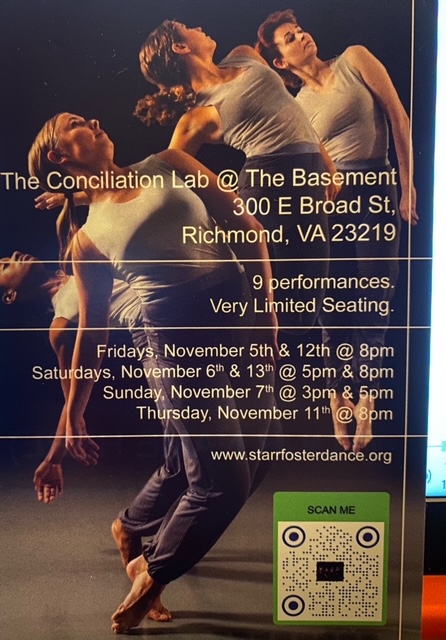
At: The Conciliation LAB @ The Basement, 300 East Broad Street, RVA 23219

Performances: November 5-7 and 11-13, 2021.

Ticket Prices: $13

Info: www.starrfosterdance.org, www.facebook.com/starrfosterdance, Instagram/starrfosterdance,   https://m.bpt.me/event/5281579

For their first home-based performance since February 2020, Starr Foster dance returned to The Basement (it was TheatreLab then, and Conciliation Lab now) with an innovative and timely choreographic work by Artistic Director Starrene Foster mysteriously titled {Your Name Here} finding yourself in the movement.

The trio is performed in an environment framed by four metal trees. Their branches are bare, and the floor is strewn with fall-colored leaves. When the audience walks in, the dancers are already onstage. They stand in a line, arms extended, holding hands. And they whisper. What they’re saying is never revealed. It could be a prayer. It could be confessions of past sins. It could be hope and dreams for the future. It could be the secret things you have not yet voiced to anyone else made manifest in this intimate public space.

I had been invited to a rehearsal of {Your Name Here} finding yourself in the movement a few days earlier, but here in this setting, with lights and an audience, it was an entirely new experience. And just two days earlier, I had seen a performance of Our Town, so perhaps the simplicity of that set and the everyday-ness of Thornton Wilder’s storytelling lingered and influenced how I saw {Your Name Here} finding yourself in the movement.

Or maybe it’s more obvious than that, because, after all, Foster did put you right in the title: {Your Name Here}. Julinda. Starr. Thomas. Albert. You. Yes, this work is about you. The everyday, ordinary you. The secret you. The post-pandemic. You. That’s why there are FOUR trees. One for each of the dancers. And the fourth one is for…you.

Trees. Trees represent life and growth. The tree of life. The tree of the knowledge of good and evil. Trees are symbols of wisdom, power, growth, and prosperity. In mythology, trees are home to spirits. They represent physical and spiritual nourishment and transformation. In winter, their branches are bare. In spring they burst forth with new life. In summer they bear fruit. In fall, they drop their leaves, and appear dead to the outside world, but inside, under the earth, where their roots dig deep, they are actively creating, preparing to repeat the cycle all over again. These trees are bare, and their leaves are scattered on the ground, the floor. This is where the dancers find themselves, where we find ourselves.

Foster has a new, pared down company of four women. The opening night cast consisted of Fran Beaumont, Ana Pavón, and Lydia Ross. Each has a moment or two to shine in this 37-minute long work, performed without intermission. Each of the three performs Foster’s choreography in Foster’s unique style – a contemporary genre that reflects stylistic and technical aspects of ballet, modern, post-modern pedestrianism, contact improvisation, and whatever else as needed – but each dancer also brings their own personality. Beaumont has a strong, powerful core wrapped up in a wide-eyed vulnerability, sort of like those iron gym weights that have a rubber outershell to keep you from hurting yourself too badly when you inevitably drop them. Ross’ perfect lines and cat-like softness so beautifully mask the technical expertise that power her hypnotic movement. Pavón is languid, unhurried. She is the one who takes an extended nap in the garden while Beaumont and Ross, continue on the journey, sometimes holding hands or leaning on one another.

The dancers move the trees from a straight line into a cozy, protective grove, then into a wandering tree line. Sometimes they lean into the branches, touching, stroking, gently fingering and shedding a handful of scattered leaves. Sometimes Beaumont and Pavón curl themselves around their trees, and at one point one of the three even dragged her tree along. They even tip over the trees and lie awkwardly but content beneath its branches. Sometimes life’s trials lead us back home, back to the place where we feel loved, nourished, renewed. Sometimes we have to plod along, carrying all our baggage with us for a while. Where do you see yourself in this scenario?

Foster first conceived of the idea – and the trees – then found the music of Sebastian Selke and Daniel Selke. The Berlin-born duo known as CEEYS plays piano and cello and the pieces Foster selected (“Eichenthal 302,” “Waende,” “Circa,” “Winter Sleep,” and “Strelka”) have repetitive motifs that support and expand the movement phrases Foster created. The lighting design bu Austin Harber is subtle, and much less dark than Foster has been known to favor. And if this seems like a lot of words for one 37-minute long work, well, that’s because so much is packed into

{Your Name Here} finding yourself in the movement and the open invitation to insert yourself and your story into this choreographic journey is so immersive. {Your Name Here} finding yourself in the movement is just what we need at this time.

{Your Name Here} finding yourself in the movement

Choreography by Starrene Foster

Cast

Fran Beaumont (Nov. 5, 7, 12, 13@5PM)

Anna Branch (Nov 6, 11, 13@8PM)

Ana Pavón

Lydia Ross

Music Composed and Performed by CEEYS

Sebastian Selke and Daniel Selke

“Eichtenthal 302,” “Waende,” “Circa,” “Winter Sleep,” and “Strelka”

Lighting Design by Austin Harber

———-

Julinda D. Lewis is a dancer, teacher, and writer who was born in Brooklyn, NY and now lives in Eastern Henrico County.

Photo Credits: Starr Foster Dance by Douglas Hayes. NOTE: Photos were not yet available at the time of posting.

OUR TOWN

“Does Anyone Ever Realize Life While They Live It?

A Theater Review by Julinda D. Lewis

At: The Ashland Theatre, 205 England Street, Ashland, VA 23005

Performances: November 3, 12 & 13, 2021

Ticket Prices: November 3: Pay What You Can. November 12 & 13: $10 donation.

Info: whistlestoptheatre@gmail.com

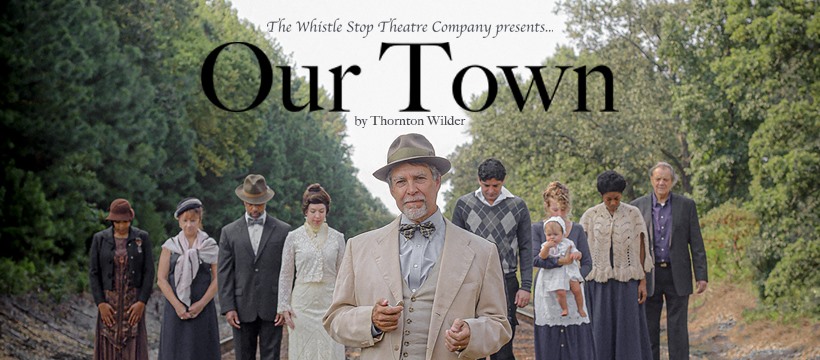
Nothing out of the ordinary happens in Thornton Wilder’s Pulitzer Prize-winning play, OUR TOWN, and that is precisely the point. But first, a confession: like many of you, I have heard of OUR TOWN, but this is the first time I have every actually seen it.

Presented in three acts, “Daily Life,” “Love and Marriage,” and “Death and Eternity,” the play – a metadrama, if you will, that is narrated by the Stage Manager (Craig Keeton) – follows the simple, everyday lives of two families who live in the fictional New Hampshire town of Grover’s Corners from 1901 to 1914. Children grow up. People fall in love and get married. Others die. And therein lies the thick of the plot.

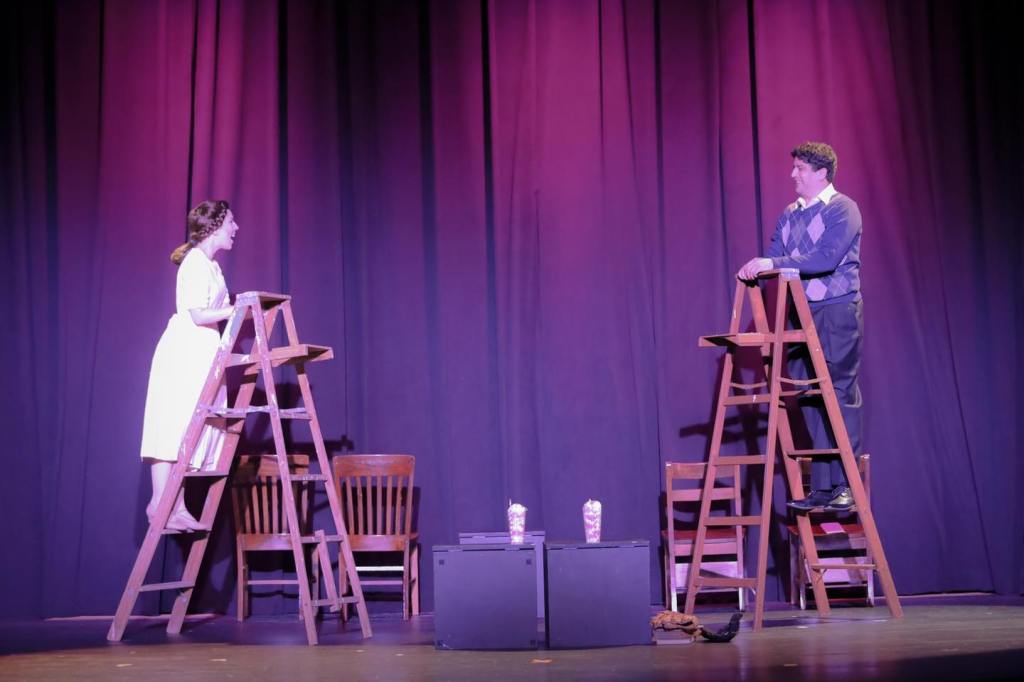
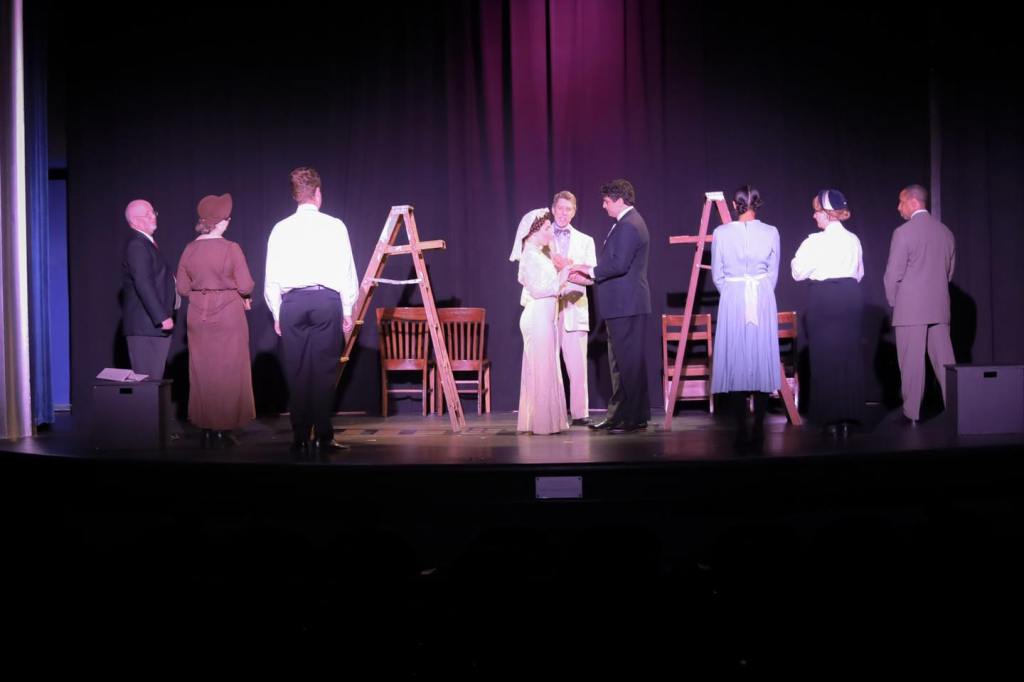
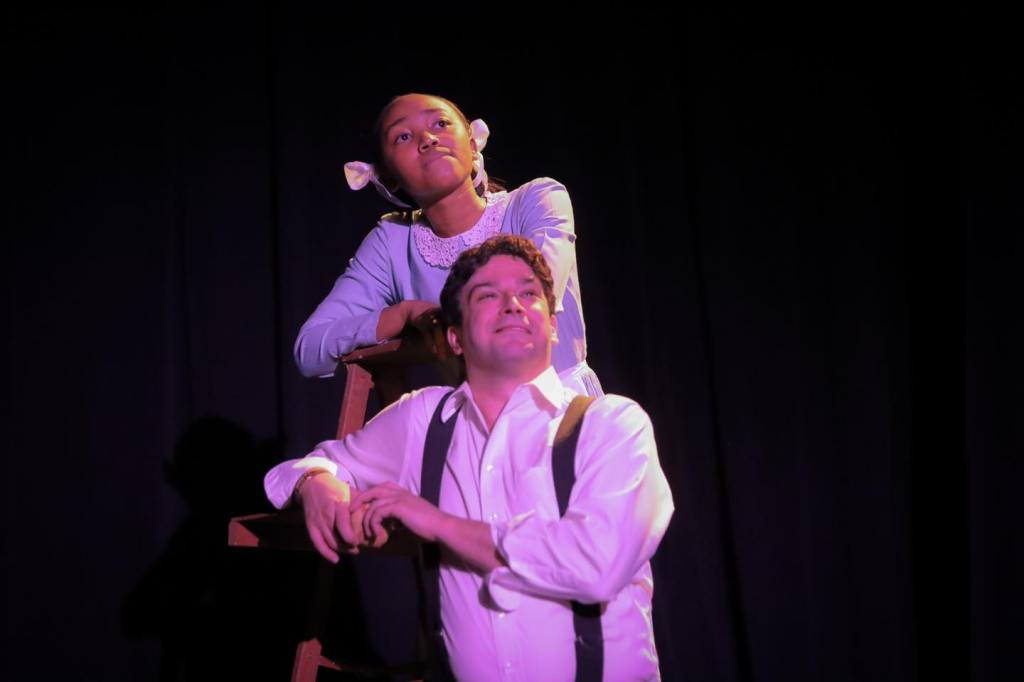
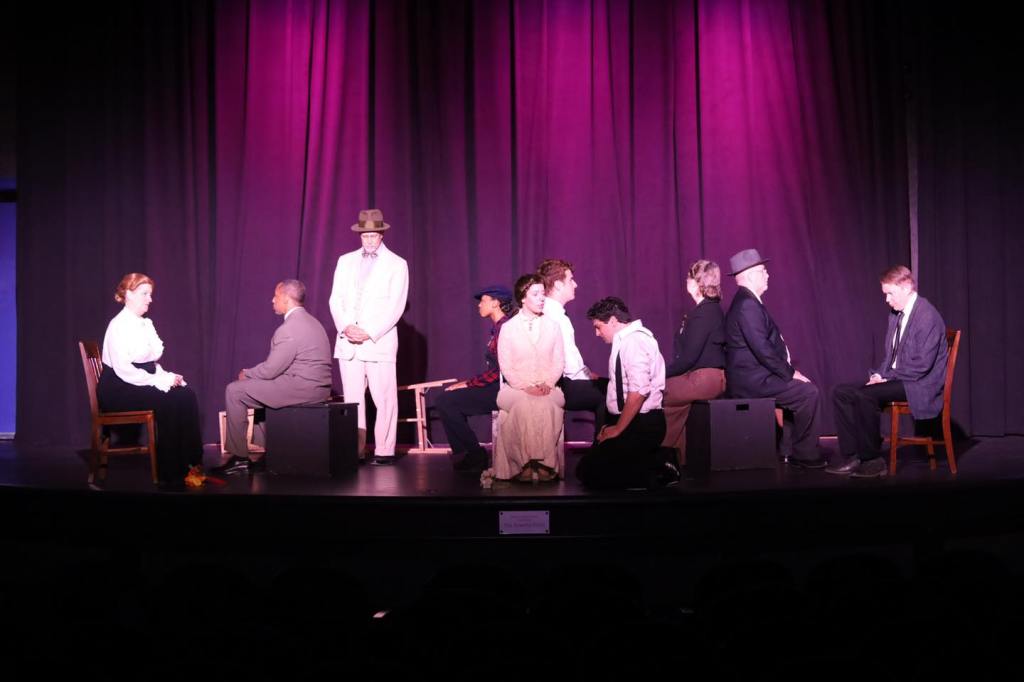
Using minimal props (four ordinary wooden chairs, two wooden ladders, and a couple of those all-purpose black cubes that most theater companies seem to have in stock) Wilder takes us on a languidly breath-taking journey that reveals the complexities and the beauty of life. Of every life. Of your life and mine. Do we take the time to look at one another? Do we really listen to one another? Are we really present in our own lives? Mrs. Webb (Barbara Keeton) insists that, as important as reading is, Wally (William Young) put his book down at the breakfast table. (I don’t need to tell you to translate that to today’s smartphone, but I just did.) Rebecca Gibbs (Ziona Tucker) sneaks into her brother’s room because his window has a better view of the full moon, and another character – I don’t remember which – takes time to enjoy the moon as well as the scent of Mrs. Gibbs’ heliotrope. (For those of us who had no clue, that’s a fragrant, often purple-colored flower often used to make perfume. And yes, to make another obvious statement, that’s example of taking time to stop and smell the, well, flowers…)

Emily’s mama assures her that she is, in fact, pretty. “You’re pretty enough for all normal purposes.”  And when Emily (Louise Keeton) can’t find a blue hair ribbon her mother left out for her, Mrs. Webb says, “if it were a snake it would have bitten you,” the exact words my own grandmother wielded on my youthful overlooking of the obvious. Simon Stimson, the organist and choir director for one of the town’s churches (there are multiple denominations, with the Congregationalists and Methodists near the center of town, the Baptists down by the river and the Catholics on the other side of the tracks), has a drinking problem. People gossip about him, but they also look out for him, and we never learn the cause of his unnamed troubles. The point is, OUR TOWN really is about the best of each and every one of us.

The play starts on May 7, 1901. Dr. Gibbs (John Gordon) is the overworked town doctor, there is a stable for the horses, and it is deemed downright weird for anyone to lock their doors at night. George Gibbs (Axle Burtness) and Emily Webb (Louise Keeton) meet in high school. Act 2 takes place three years later. It’s July 7, 1904, when students have graduated and turn their attention to marriage. George and Emily get married right after intermission.

SPOILER ALERT: Don’t read the next paragraph if you don’t know what happens in the third act.

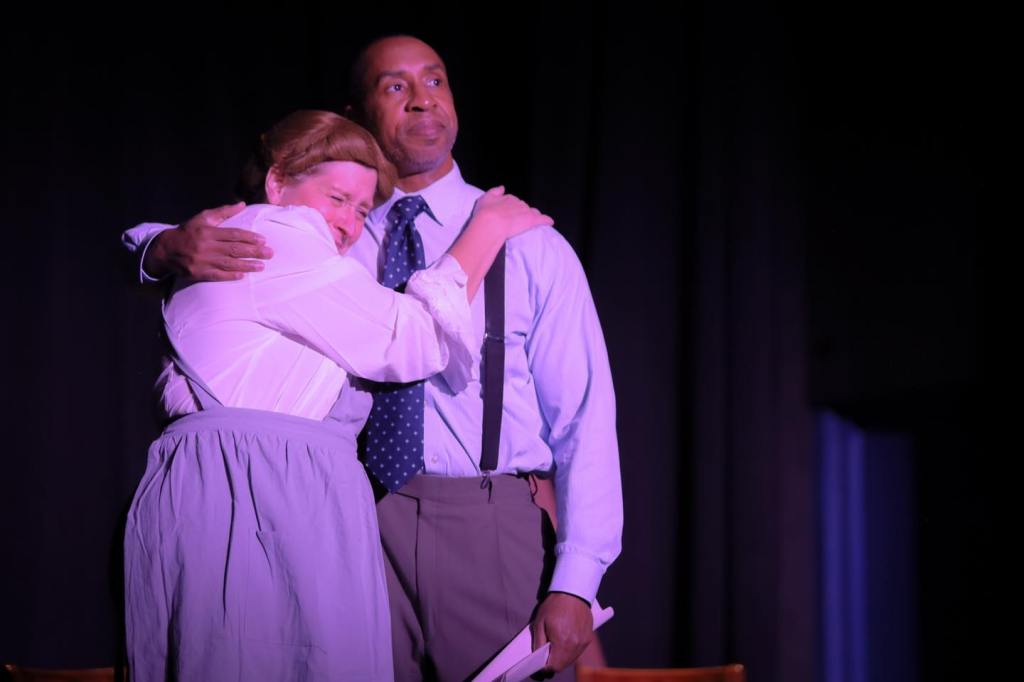
The third act takes place nine years later. It’s 1913. Horses are becoming a rare sight on the main streets and people have started locking their doors. Emily has died giving birth to her second child and the rest of the play takes place in the town cemetery after a philosophical monologue by the Stage Manager and a simple yet touching processional in which Emily is surrounded by her remaining family. (I won’t give away everything; even I have my limitations!)

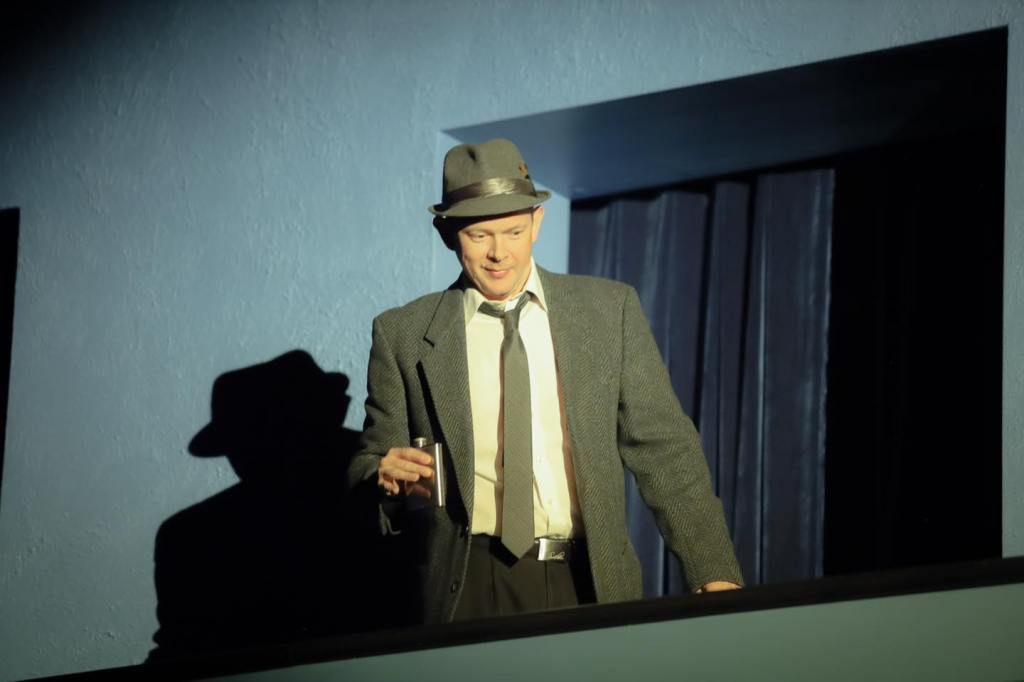
Some comic relief is provided by Dean Knight as Simon Stimson, the drunken choir director. Knight appears up in the balcony, usually with a bottle, or some sort of drinking prop in his hand. Props are rare commodities in OUR TOWN. Most actions are mimed by the ensemble, some with more clarity than others. A wonderfully awkward moment occurs when George visits his future father-in-law (Roger Reynolds on November 2, Frank Creasey on November 12 and 13) on the morning of the wedding. And the soft-spoken Emily gives George a piece of her mind, striding from the stage to the back of the audience, forcing us to turn and crane our necks like voyeurs watching a couple’s very public argument.

Some cast members have been given multiple roles. Most notably, Ziona Tucker gave little sister Rebecca Gibbs just the right amount of sassiness, balanced friendliness and servitude as newspaper boy, Howie Newsome appeared constrained as mortician Joe Stoddard with a long church jacket that appeared to have been misbuttoned. (Was that intentional, or no?). William Young also breezed through multiple roles as little brother Wally Webb, Si Crowell (who appears only as a visitor for his cousin’s death), and Sam Craig.

Director Matt Bloch maintains a languid pace that doesn’t feel weighted down and keeps the audience from becoming complacent by blatantly ignoring the parameters of the proscenium stage. Once we, the audience, become familiar with the characters and their rhythm, the pacing and flow seem quite natural – so natural that I couldn’t be sure if a few slight stumbles were first-night flubs or normal speech patterns. I also thought I detected some New England accents, but I didn’t see any credit for a dialect coach, so maybe I was just lulled by the atmosphere.

This production – my introductory production – of OUR TOWN is like theatrical baklava: rich and multi-layered, sweet with seductive savory bits mixed in, resulting in a satisfying treat. Two more performances remain as of this writing.

OUR TOWN

by Thornton Wilder

Cast

Craig Keeton as the Stage Manager
Axle Burtness as George Gibbs
Dean Knight as Simon Stimson 
Louise Keeton as Emily Webb
Roger Reynolds as Mr. Webb on Nov 3
Frank Creasy​ as Mr. Webb on Nov 12 & 13
John Gordon as Dr. Gibbs
Barbara Keeton as Mrs. Webb
William Young as Wally Webb, Si Crowell & Sam Craig
Annie Zannetti as Mrs. Gibbs
Ziona Tucker as Rebecca Gibbs, Howie Newsome & Joe Stoddard

Creative Team

Directed by Matt Bloch
Music direction by Michelle Bayliss 
Stage management by Kieran Rundle

FYI Notes

1.) Guests are required to present proof of vaccination at the door and remain masked unless consuming concessions. Children under the age of 12 may attend without proof of vaccination.
Guests may choose their own seats upon arrival and are encouraged to consider social distancing. 

2.) There are no physical tickets or seating assignments. Ticket confirmation emails will be sent the day before the show you purchased tickets for. If you purchase tickets the day of the show, you will not receive a confirmation email from the Whistle Stop. Please bring a copy of your PayPal confirmation in its place.

Julinda D. Lewis is a dancer, teacher, and writer who was born in Brooklyn, NY and now lives in Eastern Henrico County.

———-

Photo Credits: Kieran Rundle

One-Time
Monthly
Yearly

Make a one-time donation

Make a monthly donation

Make a yearly donation

Choose an amount

¤5.00
¤15.00
¤100.00
¤5.00
¤15.00
¤100.00
¤5.00
¤15.00
¤100.00

Or enter a custom amount

¤

Your contribution is appreciated.

Your contribution is appreciated.

Your contribution is appreciated.

Donate HERE to support RVArt reviewDonate HERE to support RVArt reviewDonate HERE to support RVArt review
RICHMOND BALLET: STUDIO TWO

Pairing a Balanchine Classic with a World Premiere by Tom Mattingly

RICHMOND BALLET 2021/22

STUDIO TWO, OCTOBER

A Dance Review with Historic Notes by Julinda D. Lewis

At: The Richmond Ballet, Canal Street Studios, 407 East Canal Street, RVA 23219

Performances: October 26-31, live. November 8-14, virtual.

Ticket Prices: In-Person Tickets start at $25; Virtual Tickets are $25.

Info: (804) 344-0906, etix.com, or richmondballet.com.

COVID-19 Protocols: Upon entering the theatre, all audience members ages 12 and above are required to show printed or digital proof of full vaccination against COVID-19 or of a professionally-administered negative COVID-19 test taken within 72 hours of the performance. Patrons ages 18 and above will also need to show a photo ID. All patrons ages 2 and above will continue to be required to wear masks.Please note: Proof of a negative COVID test is not required for children under the age of 12.

THE STUDIO TWO PROGRAM:

Allegro Brillante
Choreography by George Balanchine
Music by Peter Ilyich Tchaikovsky

Staging by Jerri Kumery

Costumes by Karinska

Lighting Design by Catherine Girardi

Jahreszeiten, a World Premiere

Choreographyby Tom Mattingly
Music by Dr. Goetz Oestlind

Costume design by Emily Morgan

Lighting Design by Catherine Girardi

Original Artwork by Court Watson
Pianist: Dr. Douglas-Jayd Burn

STUDIO TWO: OPENING NIGHT

As is customary with the Richmond Ballet Studio Series performances, a classic is often paired with a new work. The pairing of George Balanchine’s joyous Allegro Brillante with Tom Mattingly’s new Jahreszeiten (German for seasons) proved to be a particularly auspicious coupling.

Allegro Brilliante, created was by Mr. Balanchine in 1956 for Maria Tallchief (to whom he was married from 1946-1951) and Nicholas Magallanes. He once described this joyful, kick-up-your-heels celebration in ballet as, “everything I know about classical ballet in thirteen minutes.” Considering who said that, that’s a lot of ballet knowledge packed into a short ballet.

Simple yet elegant, Allegro Brilliante, set to Tchaikovsky’s “Piano Concerto No. 3,” is notable for its courtliness without the distraction of excessive embellishment and the floor patterns of the four supporting couples as they interact with and support the lead dancers, Eri Nishihara and Colin Jacob. Jacob was introduced after the program as one of the nine members new to the company this year. It’s far too soon to ascertain who will become regularly paired, but this couple delivered a performance that was satisfyingly balanced between technique and energy.

The curtain opened on four couples spiraling counterclockwise around a brightly lit stage: Kaeley Anderson, Courtney Collier, Celeste Gaiera, Sara Joan Smith, Roland Jones, Khayom Khojaev, Paul Piner, and Roland Wagstaff. The constantly shifting patterns and interweaving interactions are a perfect match for the music and give the impression that there are more dancers onstage than there actually are. Company artistic director indicated it’s been fifteen years since Richmond Ballet last performed Allegro Brillante. I feel honored to have been able to catch it this time around.

If the name Tom Mattingly sounds familiar to some, it’s because he first came to Richmond Ballet as a 17-year-old trainee where, he says, he learned to be an adult, and a professional. Mattingly returned to Richmond to present a work in the 2018 New Works Festival, Mattingly subsequently turned that into a full length work. Jahreszeiten is his second world premiere set on Richmond Ballet.

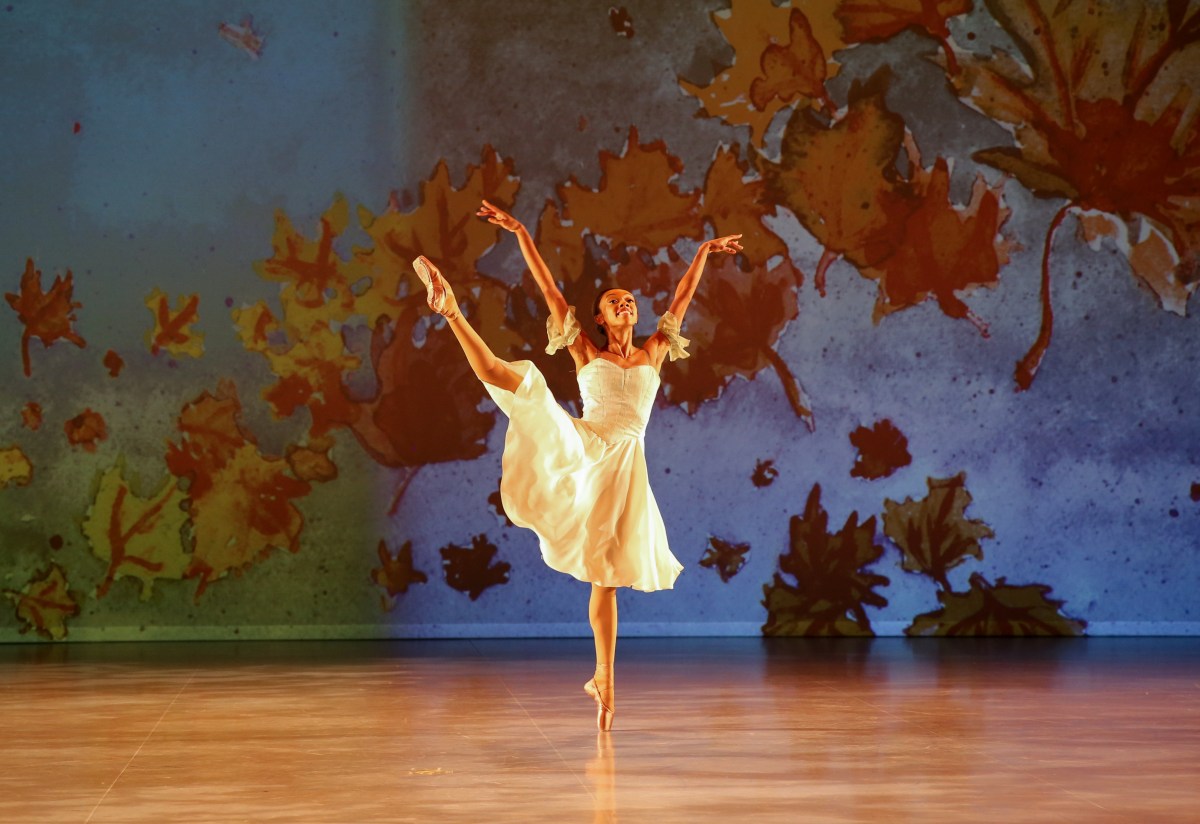
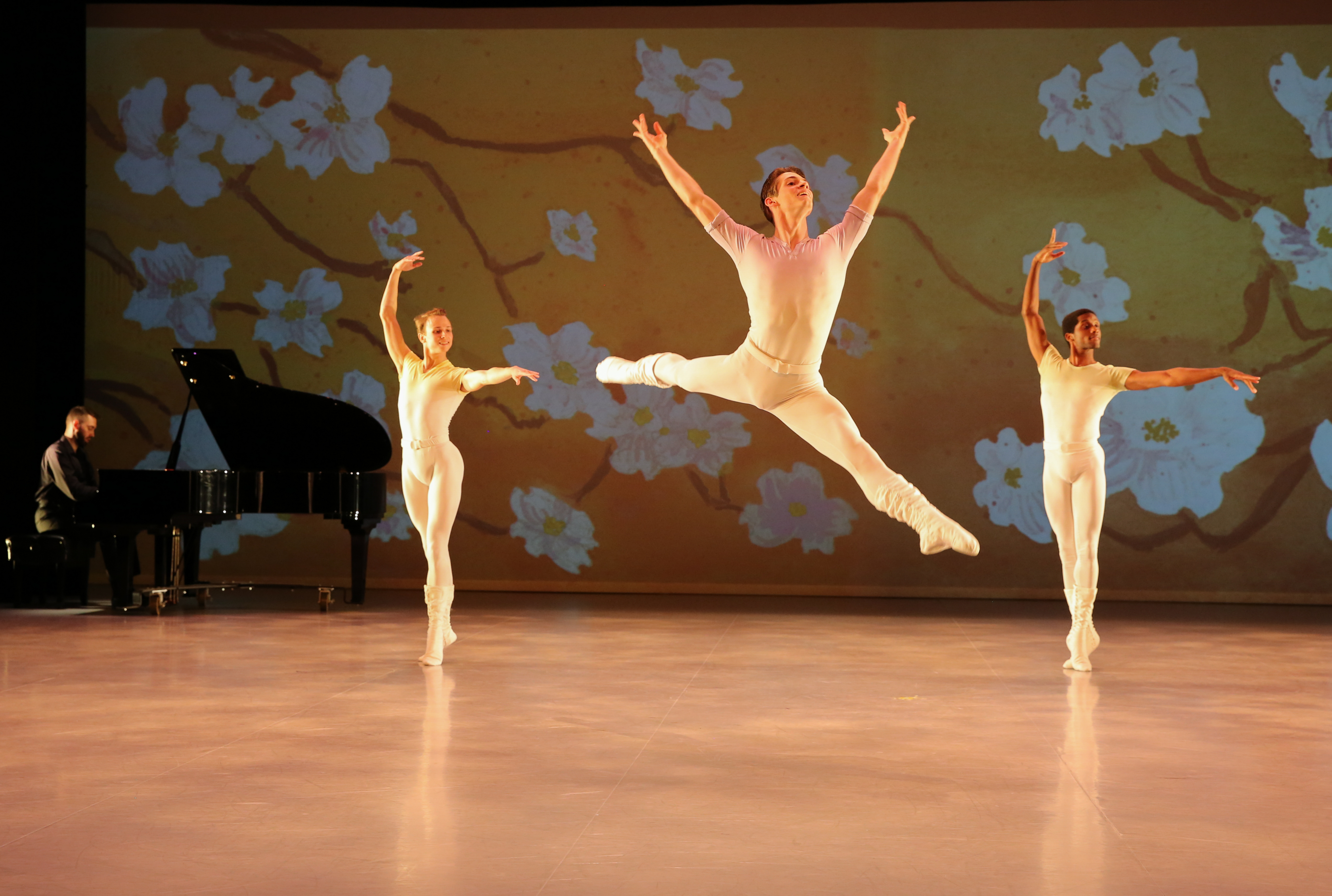
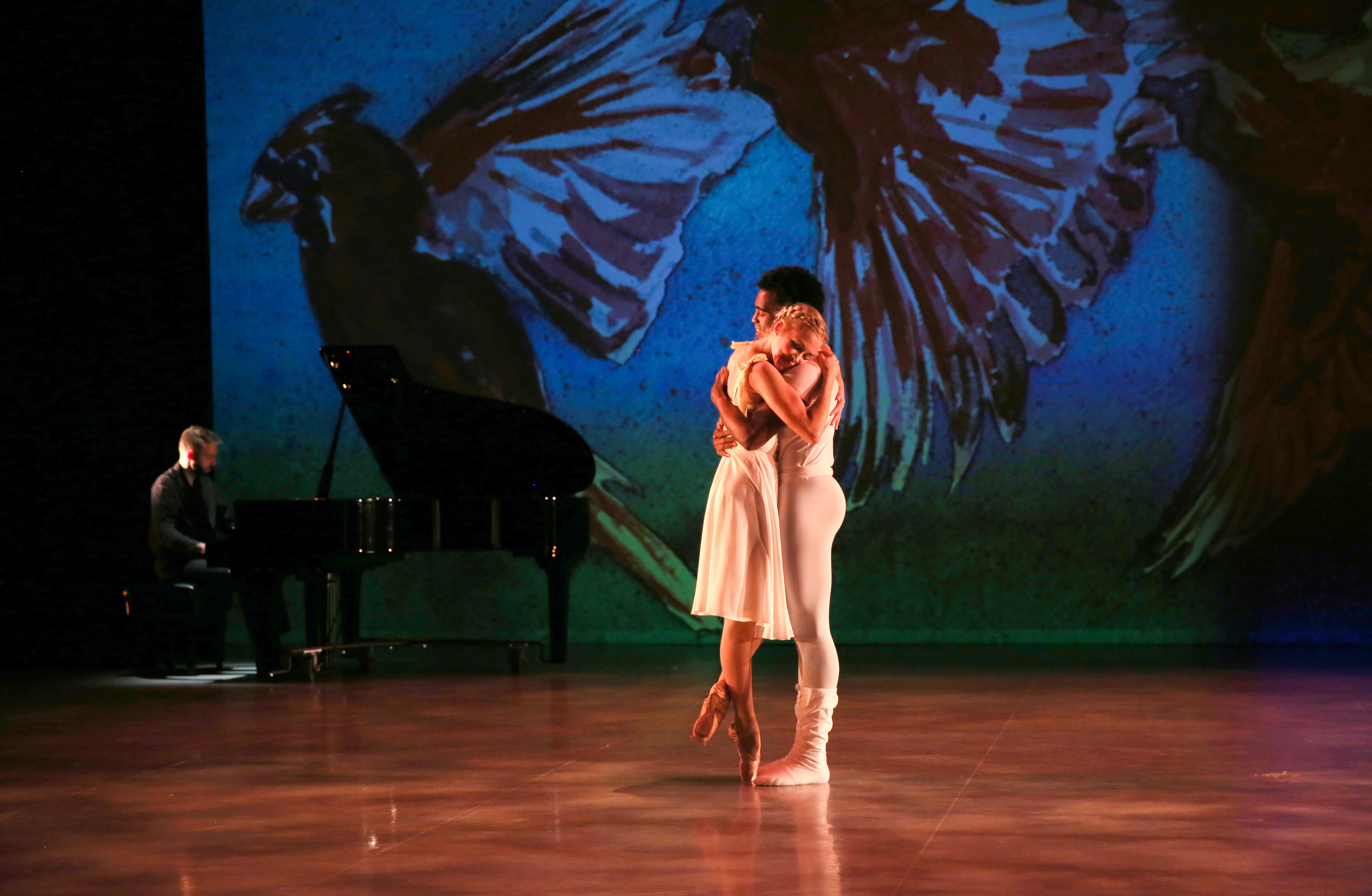
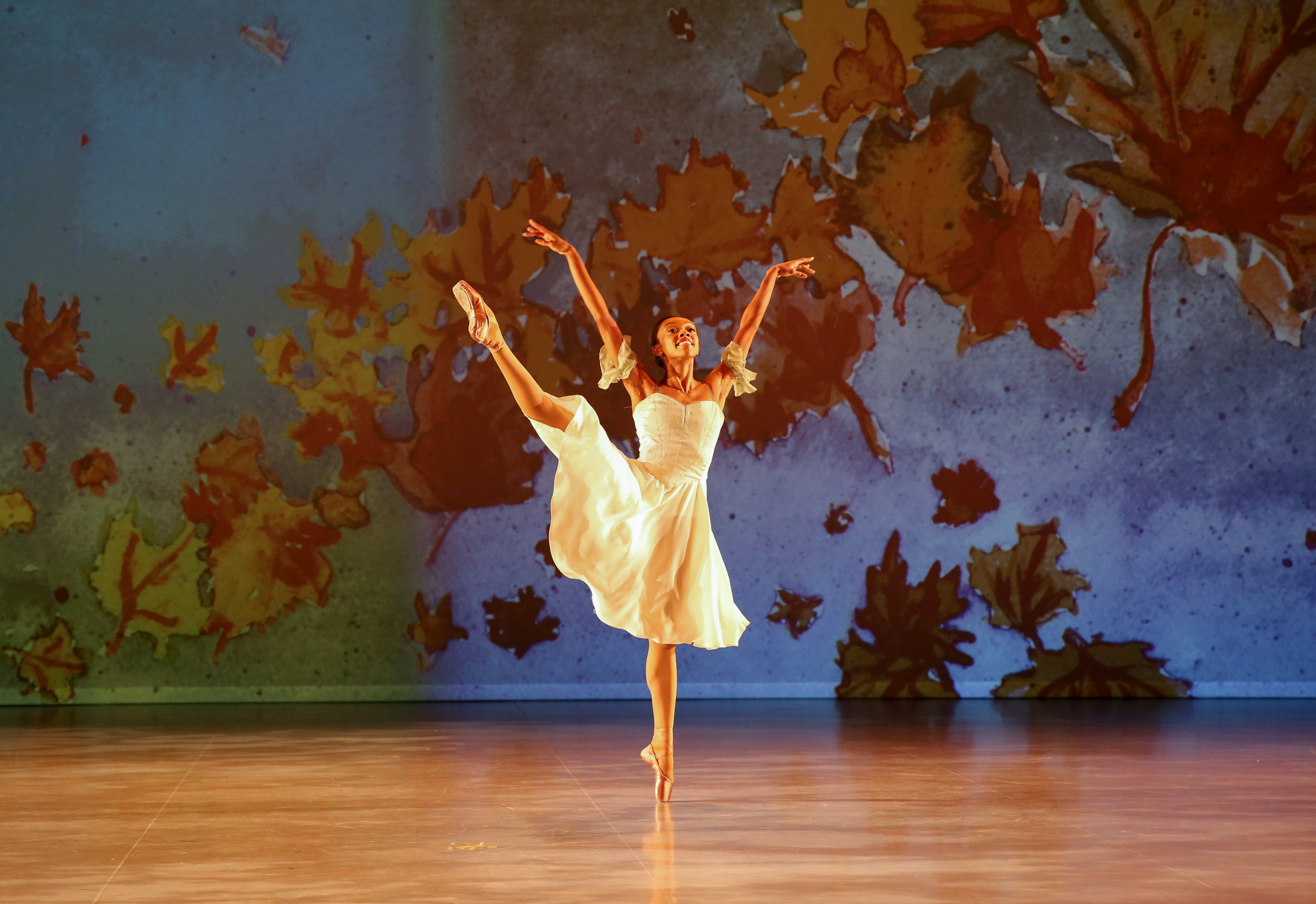
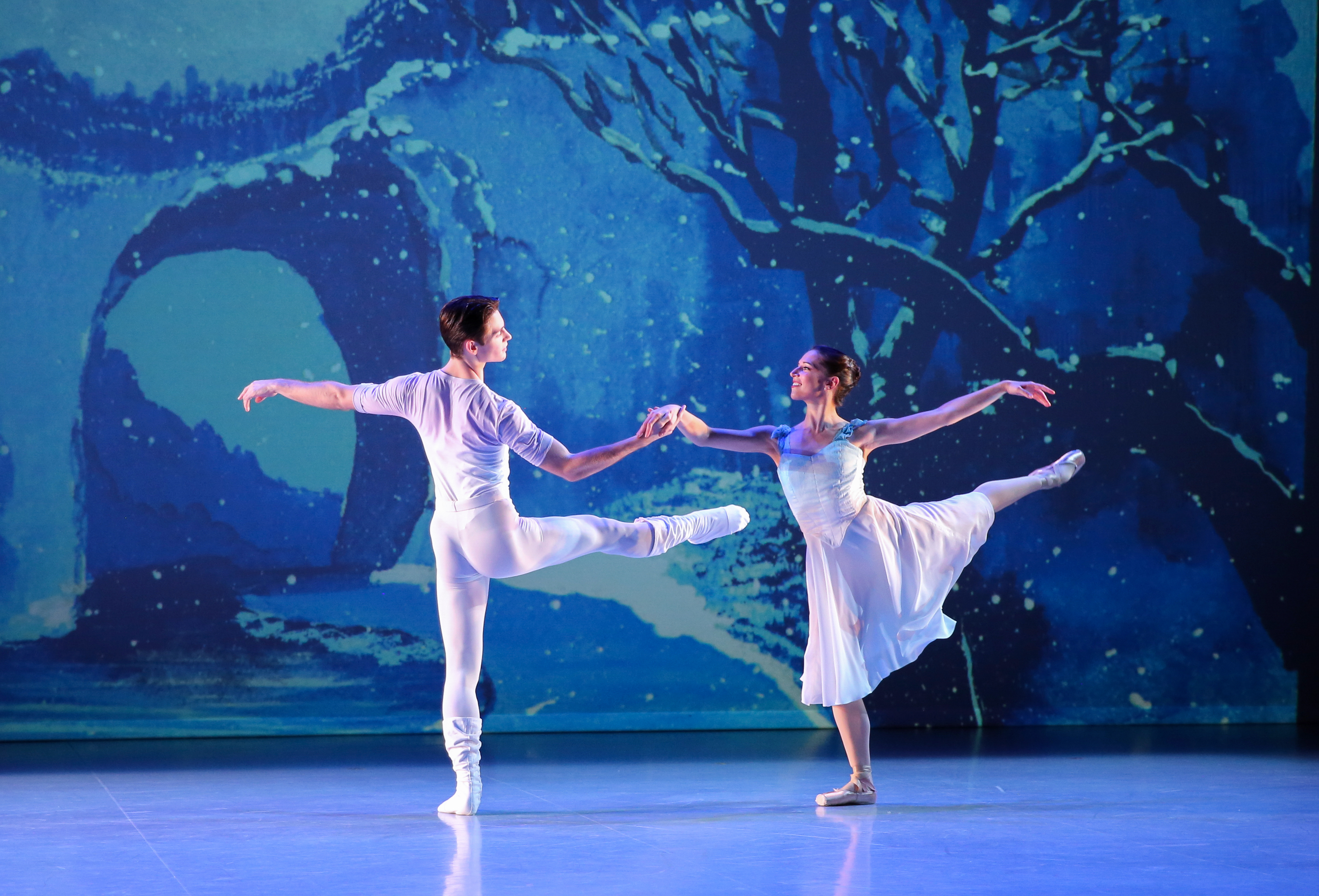
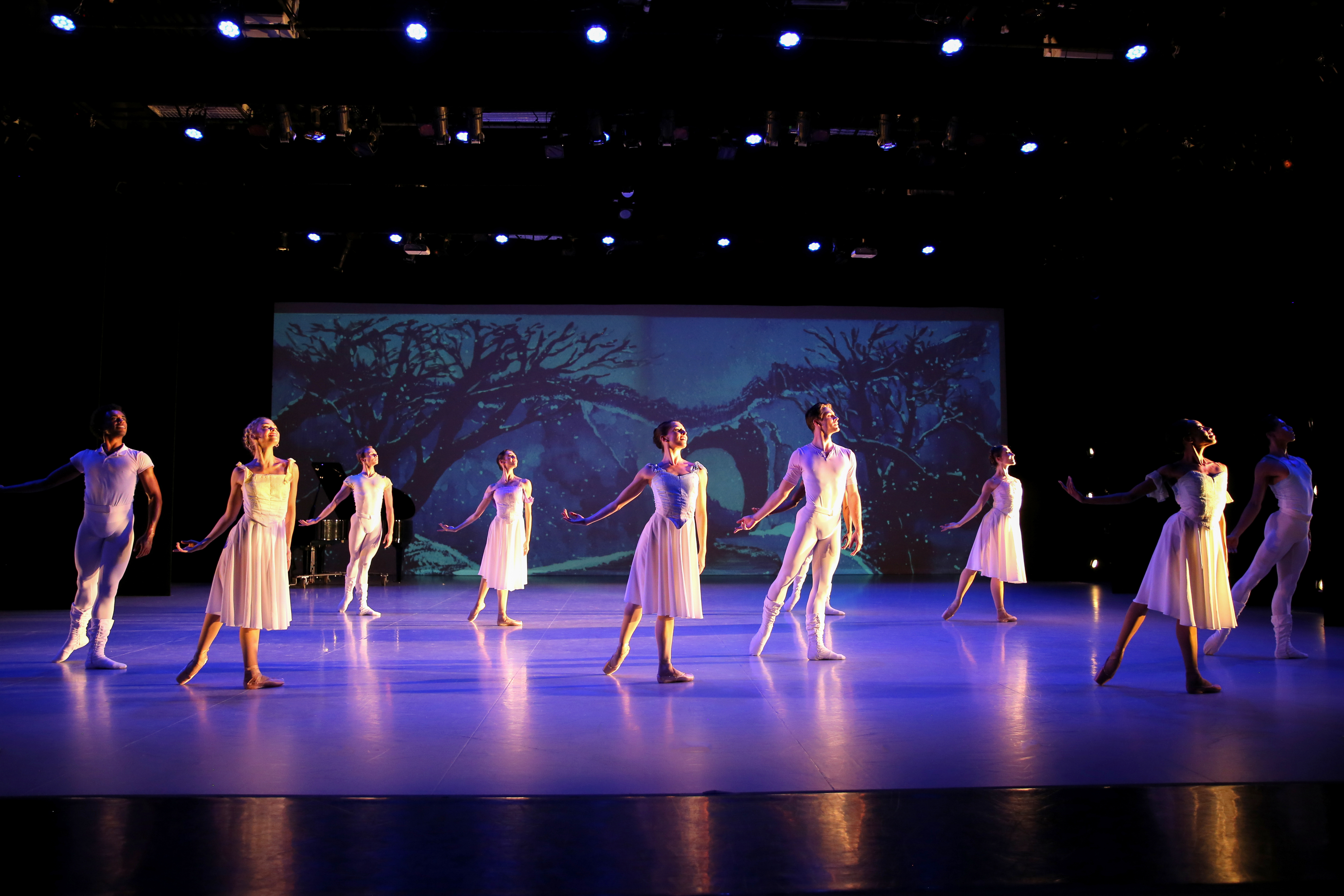
A visual treat, Court Watson’s original paintings representing four seasons highlights the flora, fauna, and landmarks of Virginia. Instead of designing backdrops, Watson had the paintings projected in super high definition resolution on the back wall, in contrast to the unadorned elegance of Balanchine’s Allegro Brillante. Mattingly’s interweaving patterns of movement and constantly reformatted groupings of dancers are a perfect contemporary complement to Balanchine’s work.

Watson created a watercolor of flowering dogwood branches (Spring), a painting of cardinals (Summer), one of fall leaves, and a final one of first snow of winter falling softly over a bridge. Emily Morgan designed hand-painted costumes in neutral colors that would pick up the light to reflect the changing seasons, and Catherine Girardi designed lighting that united all the visual elements. But that’s not all.

Jahreszeiten, which even Stoner Winslett had to struggle to pronounce, is a true collaboration. In searching the internet for music, Mattingly came across Dr. Goetz Oestlind’s work and was surprised to learn that Oestlind is a living contemporary composer who was more than happy to grant Mattingly the right to use six piano sonatas for this work. Not only was Tuesday night the premiere of Mattingly’s ballet, it was also the American premiere of Oestlind’s music and the first time it had been performed by another other than the composer himself. The pianist, Dr. Douglas-Jayd Burn (son of Richmond Ballet’s ballet master, Malcolm Burn and Jasmine Grace, a faculty member at the School of the Richmond Ballet), felt that he should be as committed as the dancers. “I should dance with the music as well,” he said, so he performed the challenging sonatas live onstage without benefit of sheet music. That’s right, he spent weeks memorizing the score.

Mattingly’s choreography ranged from full group movements that reflected the growth and activity of spring to a lingering, unhurried solo for the sultry days of summer. Playful, competitive posturing complemented the release of fall, and romantic duets and dramatic lighting signaled the vagaries of winter. The World Premiere cast included Sabrina Holland, Naomi Robinson, Marjorie Sherman, Izabella Tokev, and Naomi Wilson, as well as Enrico Hipolito, Patrick Lennon, Jack Miller, Zacchaeus Page, and Ira White.

Speaking of his work – on video and live onstage after the premiere – Mattingly spoke of his process as collaboration versus control. He also recalled, “When I was a small child I wanted to be Robert Joffrey.” Now, as the newly appointed Artistic Director of Ballet Des Moines, he wants to be a moving force in ballet, both creatively and administratively.

NOTE: Virtual tickets are $25. For patrons who would prefer to watch from the comfort of home, we are pleased to offer virtual access to Studio Two. On Monday, November 8th, virtual ticket buyers will receive an email with information on how to access the performance recording, which will be available to stream through Sunday, November 14th. Tickets can be purchased online at etix.com or by phone at 804.344.0906 x224. The deadline to purchase virtual tickets is 12:00pm Friday, November 12th.

Photo Credits: Sarah Ferguson. All rights reserved.

One-Time
Monthly
Yearly

Make a one-time donation

Make a monthly donation

Make a yearly donation

Choose an amount

¤5.00
¤15.00
¤100.00
¤5.00
¤15.00
¤100.00
¤5.00
¤15.00
¤100.00

Or enter a custom amount

¤

Your contribution is appreciated.

Your contribution is appreciated.

Your contribution is appreciated.

support rvart review with a
one-time donation or
monthly subscription
click here to Donate
support rvart review with a
one-time donation or
monthly subscription
click here to Donate
support rvart review with a

one-time donation or
monthly subscription
click here to Donate

PIPELINE

The Poetry of Oppression

A Theater Review by Julinda D. Lewis
At: The November Theatre Arenstein Stage. 114 West Broad Street, RVA 23220

Performances: October 15 – November 7, 2021

Ticket Prices: $36-$56. Discounted group rates and rush tickets available.

Info: (804) 282-2620 or www.virginiarep.org

From the striking set, designed by Brian Barker, to the physical interpretation of Gwendolyn Brooks’ poetry by actor Trevor Lawson, to the stunning and sometimes prophetically pixilated projections by Dasia Gregg, the VaRep production of Dominique Morisseau’s PIPELINE grabs your attention and doesn’t give it back for the full 90 minutes that the play runs.

The playwright, Morisseau, the director, VaRep’s Katrinah Carol Lewis, and the indomitable cast, headed by Sasha Wakefield and Trevor Lawson, pack so much content and context into these 90 minutes it may be days, if not weeks, before the full effect is fully unpacked. The title, PIPELINE, refers to the “school to prison pipeline,” that convergence of zero-tolerance school disciplinary policies and law enforcement policies that work together to shuttle black boys into the criminal justice system. Harsh penalties, high rates of suspension and expulsion, and legal actions resulting in higher rates of incarceration for students of color – especially boys – have led to a rising American epidemic over the past two decades. Heavy stuff for a play that, somehow, manages to make us laugh at regular intervals.

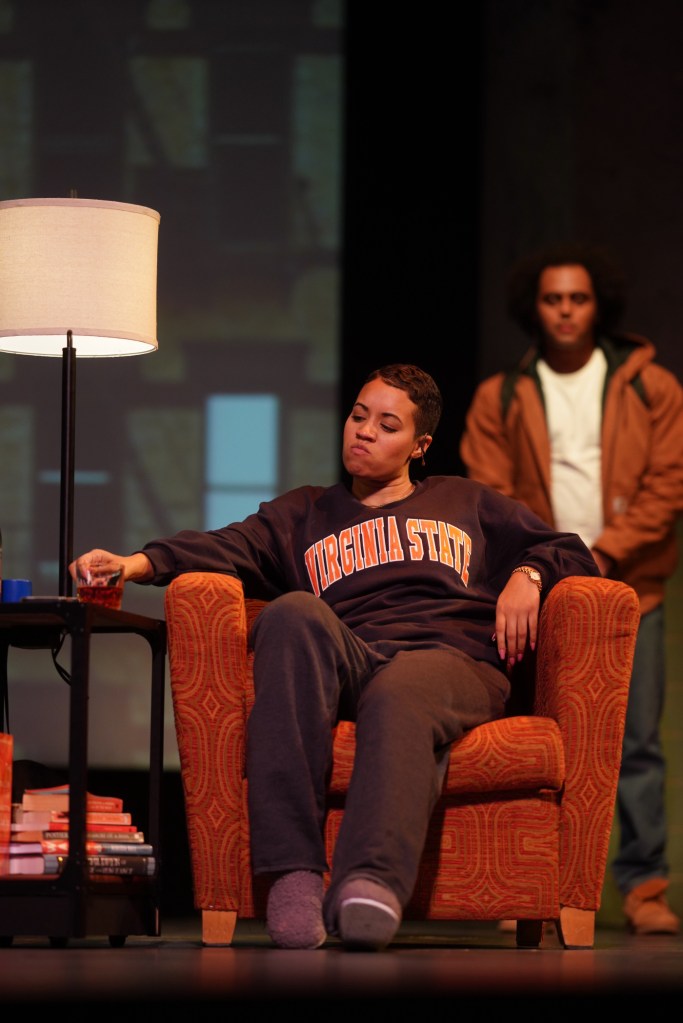
Central to the story is Omari, a bright young man learning how to navigate life while containing the anger of generations of systemic racism compounded by immediate family dysfunction. His mother, Nya, a teacher in a public high school, is raising him with little direct help from her ex-husband, Xavier, a businessman. The only thing Omari’s parents seem to agree on is that he should attend an expensive private boarding school from which he is about to be expelled – and possibly worse – after an altercation with a teacher became physical.

That’s the short synopsis. There’s much more. Morisseau, Lewis, and this powerful cast gradually peel back and reveal the many and complex layers of each character and their relationships with one another. It’s not just the complex, loving, and very raw relationship between Omari and his mother Nya, although that is the primary relationship. There is also the explosive relationship between Omari and his father, Xavier – one that remains tantalizingly unresolved at the play’s end. In one scene, Nya has a confrontation with her son’s girlfriend, Jasmine, which resembles nothing less than a smoldering and potentially deadly tango. Then there are Nya’s relationships with her co-workers, Laurie, a fellow teacher (Laine Satterfield) and Dun, her school’s security guard (Todd Patterson). Lest I forget, kudos to Patterson and director Lewis for developing such a nuanced character for Patterson. Dun is an interesting guy, one of the “good guys,” and Patterson sinks his teeth into this role and doesn’t let go until he turns it into a supporting role worthy of attention. A brief scene with all three men – Shabazz, Lawson, and Patterson – explores a multitude of emotions and connections in just a few words.

Another supporting role of note is Jessie Jordan as the spunky girlfriend who respectfully goes toe-to-toe with the self-assured and rather intimidating Nya. Jessie/Jasmine has brains and beauty (frequently reminding all within earshot that she’s “cute”) and knows how to use both. She is also prone to misspeak common idioms, resulting in lines like, “There’s a lot of fish in the swimming pool.” Laine Satterfield plays Nya’s friend and co-worker as the comic sidekick, the sassy white chick. But lest we forget that scar on her forehead is a reminder of reconstructive surgery as the result of being assaulted by a student’s parents in their tough inner city school. Her heart is in the right place, but that doesn’t keep her from teetering on the brink of burnout.

It’s interesting, and perhaps significant, that Xavier, who is supposed to be a co-parent, doesn’t make a physical appearance until about halfway through the play. Iman Shabazz begins his portrayal of Xavier with dignity and grace, but we soon realize that he can barely control the same feelings of rage he wants his own son to control. Sasha Wakefield plays Omari’s mother with fragile confidence. It isn’t easy for Nya to give up her right to be right; it takes a major scare for her to consider alternatives.

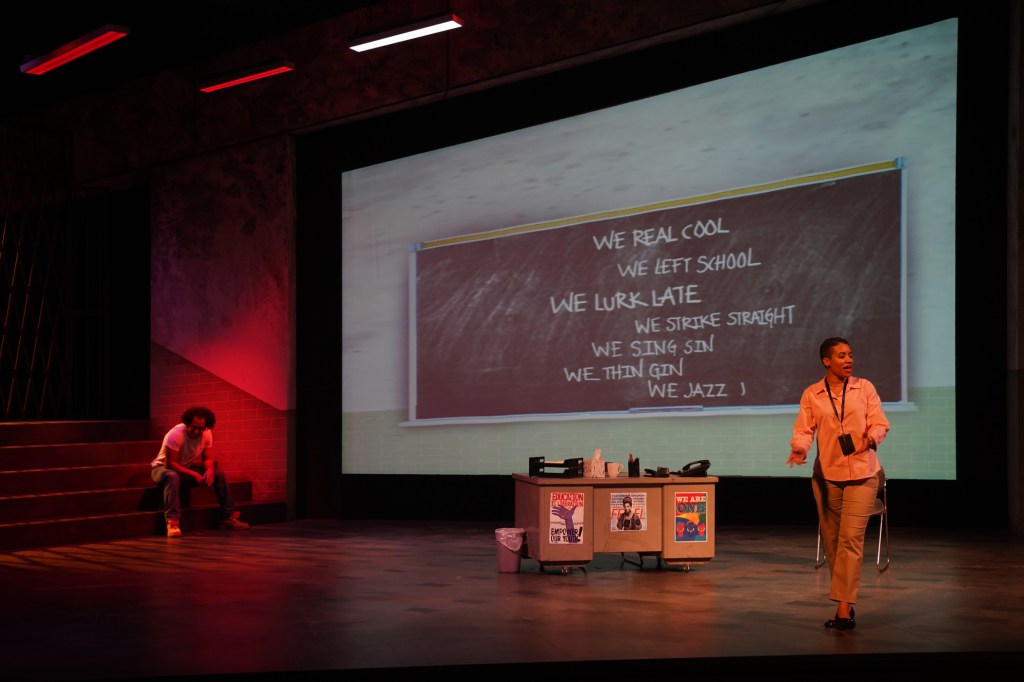
So that leaves Omari. Trevor Lawson is called on to portray Omari through raw, brutal movement, using non-verbal language as much as he uses words. And the words he has been given are not just dialogue. Fueled by the words, works, and legacy of Richard Wright’s Native Son, Ralph Ellison’s Invisible Man, and most prominently Gwendolyn Brooks’ poetry, “We Real Cool,” Omari’s speech and movement reflect the cadence of poetry, the intensity of Wright’s Bigger Thomas character, and the philosophy of Ellison’s Invisible Man.Omari shows love and care for his mother, even though he knows of her flaws. While he hasn’t yet come to a place of maturity where he can make peace with his father, he strives to improve the relationship with his mother, creating a list of instructions for her to follow. “Like a list?” she asks. No, he says, “like scripture.” Omari also takes care to distance himself from Jasmine to keep her from experiencing the fallout of his own troubles. “I know why Bigger Thomas did what he did, and I hate that I know,” Omari says at one point.

Like Omari’s non-verbal monologues, Dasia Gregg’s multi-layered and sometimes chaotic projections fill in what words are inadequate or too clumsy to communicate, and Kelsey Cordrey’s sound design splendidly supports the emotional and ambient context. Brian Barker’s set is made of modules that roll in and out quickly – a classroom, a dorm room, a hospital waiting room, a teacher’s break room – further reinforcing the emotional landscape and offering temperature checks of the cultural environment.

Relevant, real, and raw, PIPELINE is a compelling look at life as some Americans know it that may seem foreign, even alien, to many. PIPELINE, for those who listen, explains why there are marches and protests, and debates on systemic racism, defunding the police, and Critical Race Theory. Perhaps some may be more receptive to this mode of learning about these difficult issues, but they must be talked about, one way or another. PIPELINE does not offer solutions, but it makes these issues real and personal, and that’s a start.

Pipeline

by Dominique Morisseau

Cast

Nya – Sasha Wakefield

Omari – Trevor Lawson

Jasmine – Jessie Jordan

Xavier – Iman Shabazz

Laurie – Laine Satterfield

Dun – Todd Patterson

Voiceover – Desirèe Dabney

Xavier Understudy – William Anderson

Jasmine Understudy – Khadijah Franks

Creative Team

Direction: Katrinah Carol Lewis

Scenic Design: Brian Barker

Costume Design: Nia S. Banks

Lighting Design: Steven Koehler

Projection Design: Dasia Gregg

Sound Design: Kelsey Cordrey

Stage Management: Justin Janke

Julinda D. Lewis is a dancer, teacher, and writer who was born in Brooklyn, NY and now lives in Eastern Henrico County.

———-

Photo Credits: Jay Paul

One-Time
Monthly
Yearly

Make a one-time donation

Make a monthly donation

Make a yearly donation

Choose an amount

¤5.00
¤15.00
¤100.00
¤5.00
¤15.00
¤100.00
¤5.00
¤15.00
¤100.00

Or enter a custom amount

¤

Click here to support RVArt Review.
Large or Small; One-time or Monthly.
Your contribution is appreciated.

Your contribution is appreciated.

Your contribution is appreciated.

DonateDonate monthlyDonate yearly

NEVERMORE!

Edgar Allan Poe: The Final Mystery

A Theater Review by Julinda D. Lewis
Produced by: CAT (Chamberlayne Actors Theatre)

At: Atlee High School (indoors), 9414 Atlee Station Rd., Mechanicsville, VA 23116 & Gayton Kirk Presbyterian Church (outdoors), 11421 Gayton Rd., Henrico, VA 23238

Performances: October 8-10, 2021, at Atlee High School & October 15-16, 2021, at Gayton Kirk

Ticket Prices: $24 General Admission; $20 Seniors

Info: (804) 262-9760 or https://onthestage.tickets/chamberlayne-actors-theatre

Many individuals and companies went into the pandemic not knowing what to expect from these unprecedented times and came out strong. For CAT, the Chamberlayne Actors Theatre, self-tagged as “Richmond’s professional theater with the community heart,” things are, well, complicated. Prior to the lockdown, CAT had been in delicate negotiations with the owners of their long-time home on No. Wilkinson Road in Henrico County. Now they are producing their first show in 18 months under the banner “stray CATs,” and a hobo stick has been added to their logo kitty. The temporarily homeless theater company good-naturedly bills their 2021-2022 season as a “touring” season.

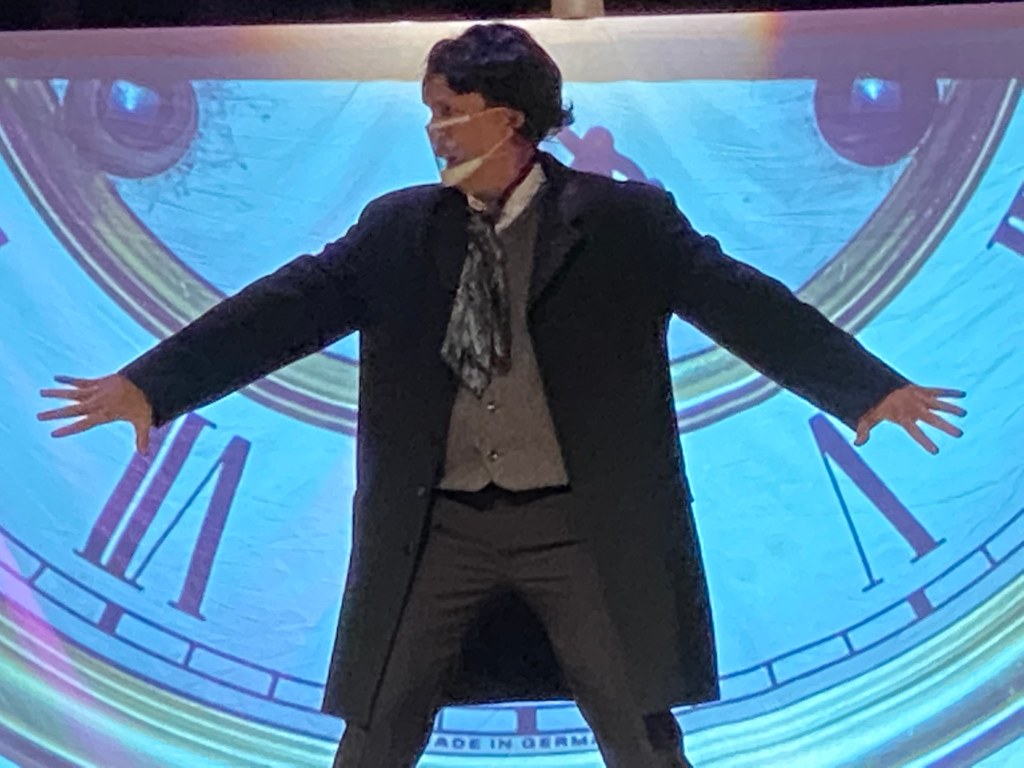
CAT has long had a tradition of producing an annual mystery, and this year’s opening show is based on a real-life mystery. On September 27, 1849, Edgar Allen Poe boarded a ferry in Richmond, VA, headed to New York. He never made it to New York. He was found wandering around Baltimore, MD, October 3, delirious. He was hospitalized and died a few days later, on October 7, without ever regaining full cognition. They say truth is stranger than fiction; who could make up something like that?
Julian Wiles’ NEVERMORE!: Edgar Allan Poe: The Final Mystery (1994) enlists Poe’s own life, poems, and stories to explore what might have happened during the final five days of Poe’s life, which remain an unsolved mystery. A full-length play in two acts with one intermission, NEVERMORE! is being performed as a collaboration between CAT and the Atlee HS’s Raider Players, many of whom have worked with CAT as interns, actors, or crew members over the years. Further strengthening this tie, CAT’s Executive Board President, Charles A. Wax, is also a Drama teacher at Atlee HS.

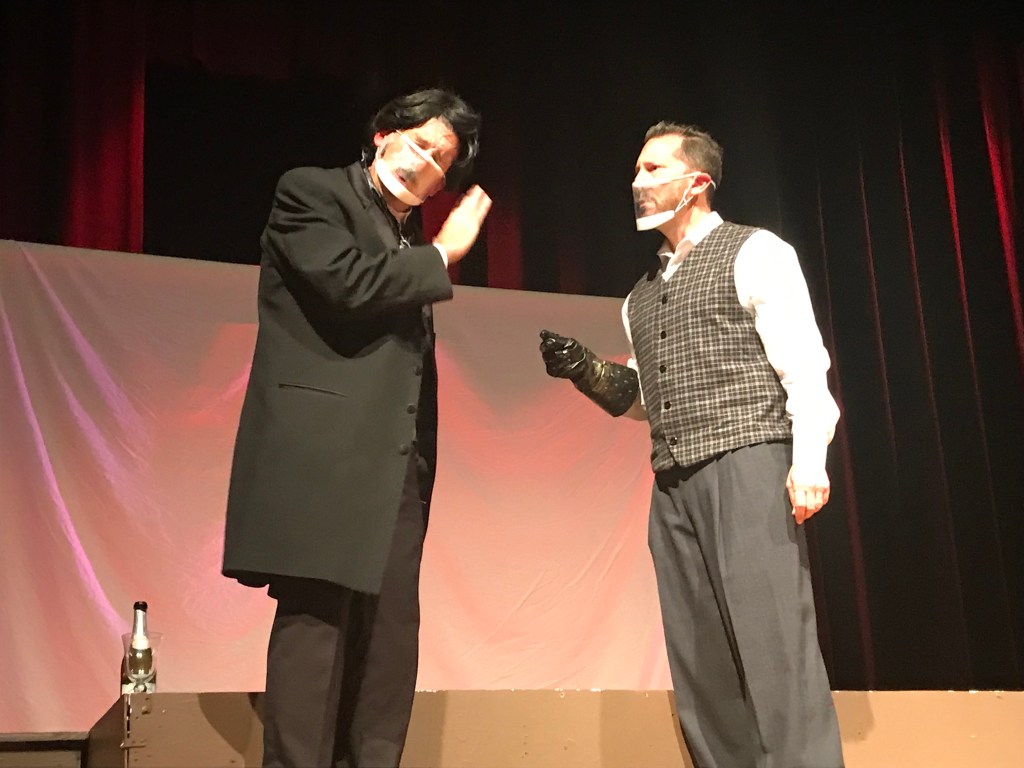
NEVERMORE! has a cast of four principals: Mark Lacy as Edgar Allan Poe, John Marshall as his friend Jeremiah Reynolds, Paige Reisenfeld as Capt. Nimrod aka Satan/Lucifer, and Caitlin Nolan as Poe’s mysterious love interest, Annabel Lee. There is also an eight-member Ensemble made up of both professional and student actors: Sandra Clayton, William Henry, Mary Huhmann, Barbara Johnson, Maddie Moralez, Carter Mullen, Audrey Sparrow, and Camden Sparrow.

The play’s synopsis is promises to be interesting, and the script calls for a number of attention-grabbing magic tricks and the cast approached the production with enthusiasm. But there were several impediments to the successful execution of this show.

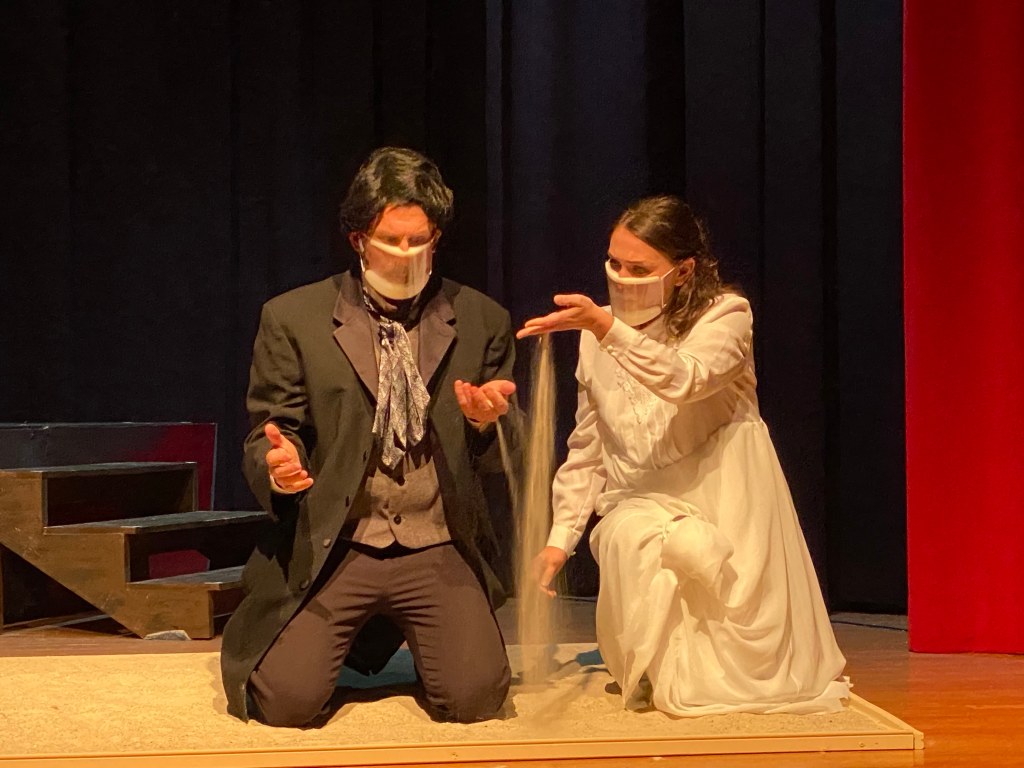
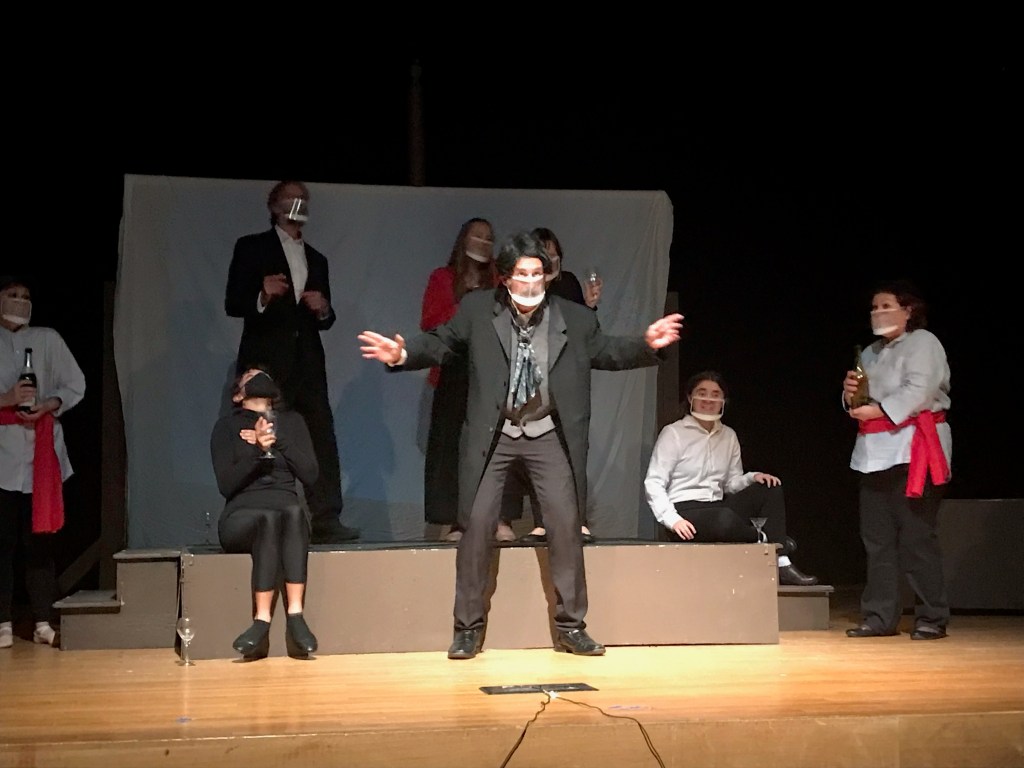
First, due to COVID-19 and the protocols of the venue, a Hanover County public school, everyone had to wear masks – including the actors. They all wore the ones with clear windows, so we could see most of their faces and watch their lips move, but the sound was still muffled, and the masks were distracting, giving a kind of sci-fi or horror-movie look to what would otherwise have been a classic traditional mystery.

Second, the uncredited set design was a rough-hewn affair consisting of three platforms of varying sizes and heights, with a few steps, and a sheet or sail stretched across the middle platform that was used to project the background scenes. The screen appeared to get swallowed up in the vastness of the stage.

Third, the company was unable or chose not to execute all the magic tricks as described in the script. To be clear, they did include a couple of disappearances or character switches and one attention-grabbing return from the dead. Overall, given the blended cast, the location, and the very real challenges of a new space, a blended cast and crew (many of whom played multiple roes or wore multiple crew hats) and an on-going pandemic that led to last minute cast changes, NEVERMORE! looks and feels more like a high school production than a professional one. The actors appeared to occupy the space, rather than own it and given the short run in two different venues, I really don’t see a way for this production to meet its own or the audience’s expectations.

NEVERMORE! Edgar Allan Poe: The Final Mystery

Written by Julian Wiles

Directed by Charles A. Wax and Jon Piper

CAST:

Mark Lacy as Edgar Allan Poe

Paige Reisenfeld as Captain Nimrod

John Marshall as Reynolds

Caitlin Nolan as Annabel Lee

ENSEMBLE: Mary Huhmann, Sandra Clayton, William Henry, Maddie Moralez, Audrey Sparrow, Barbara Johnson, Carter Mullen, and Camden Sparrow

CREATIVE TEAM:

Stage Manager: Sue Howells

Assistant Stages Manager: Drake Leskowyak

Lighting Design: Jason Lucas

Sound Design: Jenn Fisher

Costume Design: Alison Eichler

Lights Operator: Jason Lucas

Sound Operator: Jenn Fisher

Program and Graphics:: Jason Lucas

Photos provided by Ann Davis

Performance Schedule:

Friday, October 8 at 8pm – Atlee High School (inside)

Saturday, October 9 at 8pm – Atlee High School (inside)

Sunday, October 10 at 2:30pm – Atlee High School (inside)

Friday, October 15 at 8pm – The Gayton Kirk (outside)

Saturday, October 16 at 8pm – The Gayton Kirk (outside)

One-Time
Monthly
Yearly

Make a one-time donation

Make a monthly donation

Make a yearly donation

Choose an amount

¤5.00
¤15.00
¤100.00
¤5.00
¤15.00
¤100.00
¤5.00
¤15.00
¤100.00

Or enter a custom amount

¤

Your contribution is appreciated.

Your contribution is appreciated.

Your contribution is appreciated.

THANK YOU FOR YOUR DONATION
TO SUPPORT RVART REVIEW.
THANK YOU FOR YOUR DONATION
TO SUPPORT RVART REVIEW.
THANK YOU FOR YOUR DONATION
TO SUPPORT RVART REVIEW.

THE NICETIES

“Get over it! It did not happen to you!”

A Theater Review by Julinda D. Lewis

Produced by: The Conciliation Lab

At: The Basement, 300 E. Broad Street, RVA 23219

Performances: October 1-16, 2021.

Ticket Prices: $30 General Admission; $20 Senior/Industry (RVATA); $10 Student/Teacher (with valid ID)

Info: (804) 506-3533; 349-7616 or https://theconciliationlab.org/

NOTE: Proof of vaccination or a negative COVID test within 48 hours of the performance must be shown at the box office.

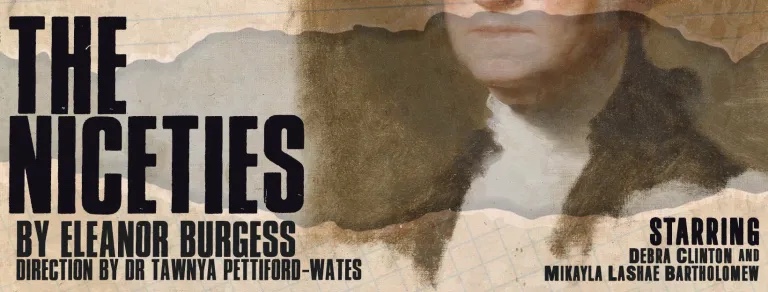
The title of Eleanor Burgess’ two-person play is deceptive, to say the least.

THE NICETIES.

n. pl. ni·ce·ties

1. The quality of showing or requiring careful, precise treatment: the nicety of a diplomatic exchange.

2. Delicacy of character or feeling; fastidiousness; scrupulousness.

3. A fine point, small detail, or subtle distinction: the niceties of etiquette.

4. An elegant or refined feature; an amenity: the niceties of civilized life.

(freedictionary.com)

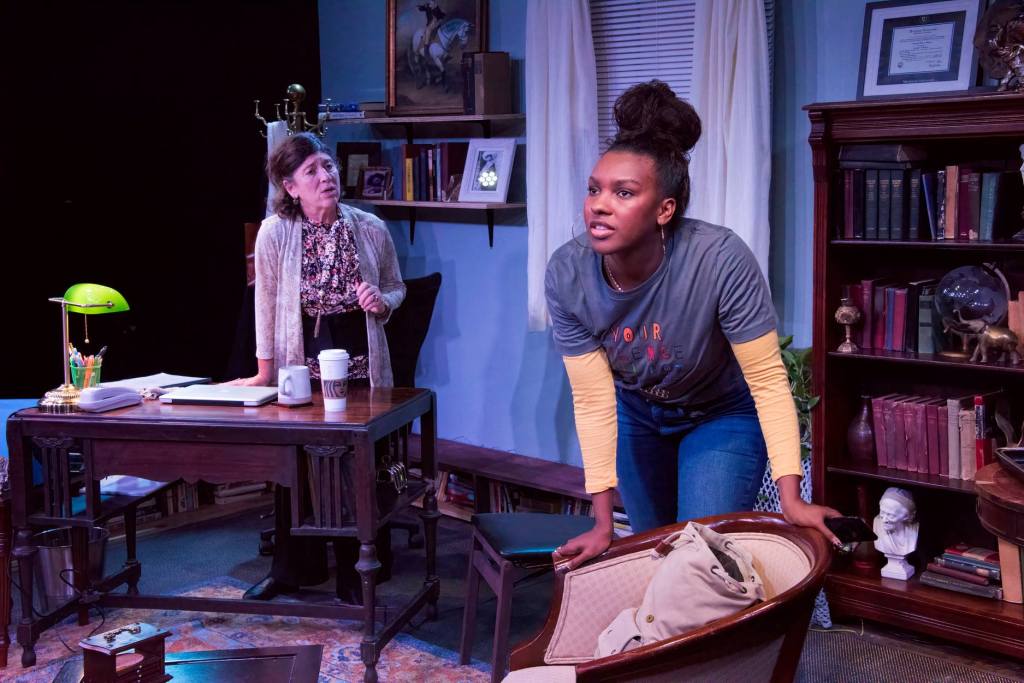
Under the precise, insightful, and nuanced eye of director Dr. Tawnya Pettiford-Wates, an encounter between Zoe, a black student at a liberal arts college in a prestigious university and her white history professor, Janine, a 1960s style feminist, turns into an explosive debate that leaves fallout on a nuclear scale.

The two disagree on a key tenet of Zoe’s paper, the impact of slavery on the outcome of the American Revolution. At first I was unclear who initiated this meeting. A synopsis of the play in the program indicates that Zoe is called into her professor’s office to discuss her paper, while Dr. T. and Zoe (Mikayla LaShae Bartholomew) hold the view that Zoe initiated the meeting to make sure she’s on the right track before submitting the final paper. It’s a small detail, but knowing how the actors see it provides some insight into the development of the play.

“It is easier to be pro-equality

when there is a subjugated minority in your midst.” – Zoe

Burgess apparently does not subscribe to the minimalist school. THE NICETIES is complex and wordy – and you will want to hold on to every word in this dense and razor sharp script. This is a version of the historical realism genre; it is intense and relevant, with mentions of President Obama, the election of Trump, and the possibility of a woman president. It is a play that made the audience talk back, bringing to mind the experience of attending a predominantly Black church or attending a movie in a Black neighborhood – until the final scene of Act One sent the entire theater into an uproar. No need for a spoiler alert, ’cause I’m not telling – I want you to see this for yourself.

“Evidence drives back ignorance.” – Janine

What started out as a seemingly simple discussion about the proper placement of commas, subject-verb agreement, and grammatical parallelism subtly escalates into a debate about history, politics, and racism. Debra Clinton plays the role of Professor Janine Bosco. I know Debra Clinton as an actress and director, but I did not see Clinton on stage at The Basement. Clinton inhabited the role of Janine and all I saw on stage was Janine. Thanks to Janine’s inability to listen, we learned a lot more about her that we – or Zoe – needed to know. Thanks to Janine’s inability to listen, we learned of Janine’s struggles to become a tenured woman professor in a previously all-male academic environment. This made it all the more difficult to see her as a monster, as indeed she is.

“Everyone is tired of hearing about racism.” – Janine

Zoe initially appears, in turn, distracted by her constantly buzzing cell phone and on the verge of exploding. She is smart, opinionated, and a deeply committed social activist (and I quickly identified Bartholomew as an academic and spiritual protégé of Dr. T). If she were white, especially a white male, she would be called confident, but she is Black and a woman, so she is most likely to be labelled as aggressive, angry, threatening. But Burgess and Dr. T. make sure we also see her as vulnerable and hurting. “What do you want?” Janine asks her at one point. To which Zoe responds, “I want this to be your problem!”

“Greatness does not come from a supportive environment.” – Janine

This is my first time seeing Bartholomew on stage, and I hope it won’t be the last. She gave a nuanced and intense performance as Zoe, making us empathize with her but without sugar-coating her flaws. Zoe wants, needs, and demands to be heard. She wants to be respected. She is tired of waiting and being “nice” so others will feel comfortable. The character of Zoe embodies if not personifies the mission of The Conciliation Lab: a social justice theater organization dedicated to the process of CONciliation, not REconciliation, because you cannot re-do something that has not been done before.

“In all my classes, I write down what I shouldn’t have to hear.” – Zoe

Act Two is one of the rawest and most revealing scenes I have ever witnessed in theater. A large portrait of George Washington on a horse has been removed from Janine’s office wall, but a copy of Kathleen Stockett’s 2009 novel, The Help is prominently displayed on a table and Janine proudly pulls out a copy of a book by journalist Ta-Nehisi Paul Coates, widely known for his work on African Americans and white supremacy. It’s the academic equivalent of saying, “but, I have Black friends!” Micro-aggressions in academia take many forms. But there’s more. Much more. The fallout from Act One also leads to some not-so-subtle consequences, from articles and blogs to marches and death threats. So how does it end? How is it all resolved? Well, that depends on which worldview you most relate to, and which experiences you bring to the table.

THE NICETIES is the kind of play that should have a discussion after each performance – especially when the audience is as diverse as it was for Saturday’s opening night performance. There was so much said, so much packed into Burgess’ many words, and so much that still needs to be unpacked. The beauty of the arts is that art can open the door to the hard conversations, and we need to take advantage of these opportunities when they are made available – especially in safe spaces. Note the dates, below, when post-show conversations will be available, when planning to buy your tickets.

Faith Carlson has created a professor’s office that is stereotypical and filled it with familiar props: books, pictures, a laptop. I especially liked her “fourth wall,” a super low bookcase that framed the space, with the audience (about 50 seats for this production) seated on three sides. Austin Harber’s lighting was subtle and washed the actors in a warm light that was often gentler than their words demanded, and Kelsey Cordrey’s sound design heavily favored hyped hip hop beats that fuel the train that Janine called a quest for freedom and Zoe described as an engine for racial oppression.

THE NICETIES

Written by Eleanor Burgess

Directed by Dr. Tawnya Pettiford-Wates

CAST:

Mikayla LaSahae Bartholomew as Zoe

Debra Clinton as Janine

CREATIVE TEAM:

Scenic Design: Faith Carlson

Lighting Design: Austin Harber

Sound Design: Kelsey Cordrey

Costume Design: Amber Martinez

Props Design: Faith Carlson

Production Stage Management: Crimson Piazza

Assistant State Management: Emily Ellen

Associate Direction: Heather Falks

Photo Credits: Production photos by Tom Topinka.

Performance Schedule:

Friday, October 1 at 8pm – Preview

Saturday, October 2 at 8pm – Opening Night

Thursday, October 7 at 8pm – College Night with post-show discussion

Friday, October 8 at 8pm

Saturday, October 9 at 8pm

Sunday, October 10 at 3pm – Matinee with post-show discussion

Tuesday, October 12 at 8pm – Industry Night

Thursday, October 14 at 8pm

Friday, October 15 at 8pm

Saturday, October 16 at 8pm – Closing Night

One-Time
Monthly
Yearly

Make a one-time donation

Make a monthly donation

Make a yearly donation

Choose an amount

¤5.00
¤15.00
¤100.00
¤5.00
¤15.00
¤100.00
¤5.00
¤15.00
¤100.00

Or enter a custom amount

¤

Your contribution is appreciated.

Your contribution is appreciated.

Your contribution is appreciated.

click here to support rvart review.
thank you!
click here to support rvart review.
thank you!
click here to support rvart review.
thank you!

SMALL MOUTH SOUNDS

The Cadence Theatre Company Reboots Show Interrupted by Pandemic

“Once you see the ocean, you may not be able to return to the well.”

A Second-Look Theater Review by Julinda D. Lewis

By: Virginia Rep/Cadence Theatre Company

At: Theatre Gym, Virginia Repertory Center, 114 West Broad Street, Richmond, VA 23220

Performances: September 23 – October 3, 2021.

Ticket Prices: $40.

Info: (804) 282-2620 or https://va-rep.org/_small-mouth-cadence-theatre.html

NOTE1: This show contains brief nudity, adult content, and the burning of incense and herbal cigarettes. Recommended for patrons 18+ (ID required). Patrons under the age of 18 must be accompanied by an adult.

NOTE2: Due to the staging requirements of this production, we will not be offering late seating.

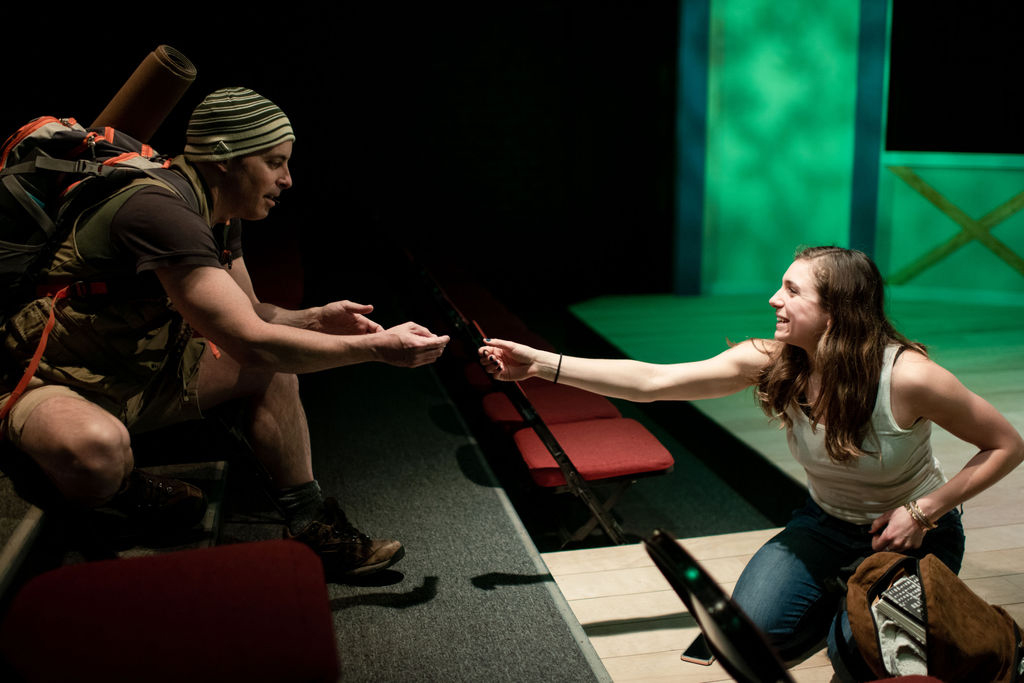
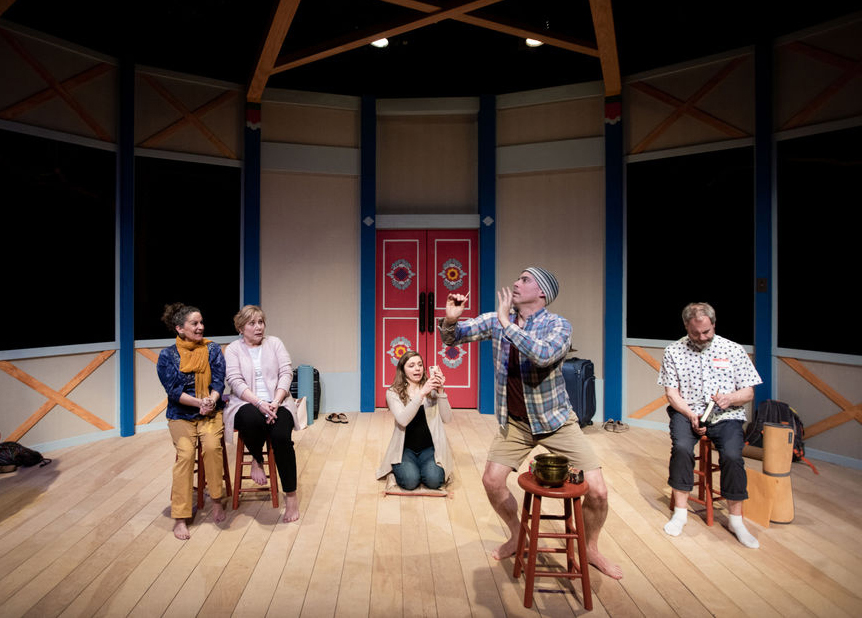
SMALL MOUTH SOUNDS originally opened in March 2020 and was cut off mid-run by “The Great Pandemic.” I reviewed it here under the title SMALL MOUTH SOUNDS: A Play Without Words, and was more than happy to return for the reboot that opened in the same space September 23. (Hmmm, I wonder if Emily Hake Massie’s lovely new-age yurt set remained in place during the long intermission?) At any rate, it didn’t seem to be necessary to write a whole new review, since what I wrote the first time seemed to withstand the test of time. (I even enjoyed reading it myself!) What I will do is note the differences, changes, updates, and tricks of my own mind, and then re-post the original review below to save you the time of having to search for it. (You’re welcome!)

There have been a few changes since the time BC*. The actors enter wearing masks, which they remove on entering the yurt, and they pass around a bottle of hand sanitizer when the unseen Teacher has an uncontrollable coughing fit. There is also an amusing little bit of choreographed movement involving the choice of whether to shake hands or substitute a fist bump or elbow bump. And perhaps most significantly, Evan Nastaff has replaced Adam Valentine as Rodney, the passive-aggressive instructor.

I don’t know whether it was an effect of memory or time or actual changes, but it seems that the first time around I learned more about some of these characters. Memory does deceive, but I thought Ned, the only character who has a sizeable speaking role, had two meetings with The Teacher, and my memory insisted that not only had Alicia managed to receive a strong enough signal in the mountains of upstate New York to leave a message for her estranged boyfriend, Fred, but that we had learned more detail about the strained relationship between Joan (Jenny Hundley) and Judy (Lauren Leinhaas-Cook). Well, after reading my original review I concede that memory is not a reliable witness. But this much is true: Jenny Hundley appears to have developed her character, Joan, even further; her facial expressions are hilarious.

Still, I am SURE Adam Valentine gave us a full frontal, whereas Evan Nastaff teased the audience and flashed his fellow cast members. Nastaff filled this role nicely and fit in with the original cast as if had been born for the role.

*NOTE: Yes. You guessed correctly. “BC” means Before COVID-19.

MY ORIGINAL REVIEW OF MARCH 8, 2020:

It isn’t often that someone writes a play that requires the actors to take a vow of silence. But that is exactly what happens in Beth Wohl’s play, Small Mouth Sounds (premiered in 2015), when six people in search of themselves – or something or someone other than their themselves – arrive at an upstate New York center for a silent retreat. Small Mouth Sounds was inspired by the author’s own retreat experience.

Naturally, things do not unfold smoothly as each character reveals their special brand of quirkiness or unveils their personal demons. Judy and Joan are a couple – two middle-aged women who are struggling to shoulder the burden of Judy’s cancer diagnosis. Alicia is a young woman who apparently just broke up with someone named Fred; she keeps dialing his number and is constantly distracted by her forbidden cell phone. She is perturbed to discover that she has been assigned a male roommate.

Ned and Rodney are two of the most interesting members of this unlikely collection of people. Ned has had an unimaginable string of bad luck: he fell off a mountain and broke his skull; his wife started sleeping with his younger brother; he started drinking and joined AA only to have his sponsor commit suicide, and his dog got run over by a car. That’s just a small sampling of all that he’s been through. Rodney is a passive aggressive yoga instructor who smugly and silently snubs everyone else, shows off his yoga skills, removes his wedding ring as soon as he arrives, and is the first to strip down for the clothing optional lakeside activities.

Oh yes, there is a bit of nudity – full frontal – and some “herbal tobacco” and Palo Santo wood gets burned onstage. This play is recommended for viewers 18 years and older. But, to get back to the cast, one of the greatest surprises comes in the final scene from the mild-mannered Jan.

This group of seekers comes under the care and watchful eye of a gruff-voiced guru, an unseen and nameless Teacher who coughs and sneezes into her microphone and appears to be on the verge of a breakdown. The audience never sees the Teacher, Marisa Guida, until she comes out to take her bow at the end. Guida is the only character allowed to speak throughout the play. [Note: Guida did not come out for a bow in the reboot.]

The marvelous cast consists of Lauren Leinhaas-Cook as Judy (the one with cancer); Jenny Hundley as her partner Joan (the bubbly one who always seems to have a small wrapped candy); Maura Mazurowski as Alicia (the young one with all the bags and baggage – and snacks); Jim Morgan as Ned (the one who has all the bad luck); Adam Valentine as Rodney (the passive-aggressive yoga instructor); and Larry Cook as Jan (the one whose secret I will not reveal here, but about whom I will post a nagging question at the end of this review). What makes them all so marvelous is that, except for a rather long monologue by Ned, and a brief but sharp exchange between Joan and Judy, we learn all we know about these characters through facial expressions, gestures, and a few grunts. In order to successfully carry off a play in which the main characters are all required to take a vow of silence, these actors had to act their butts off!

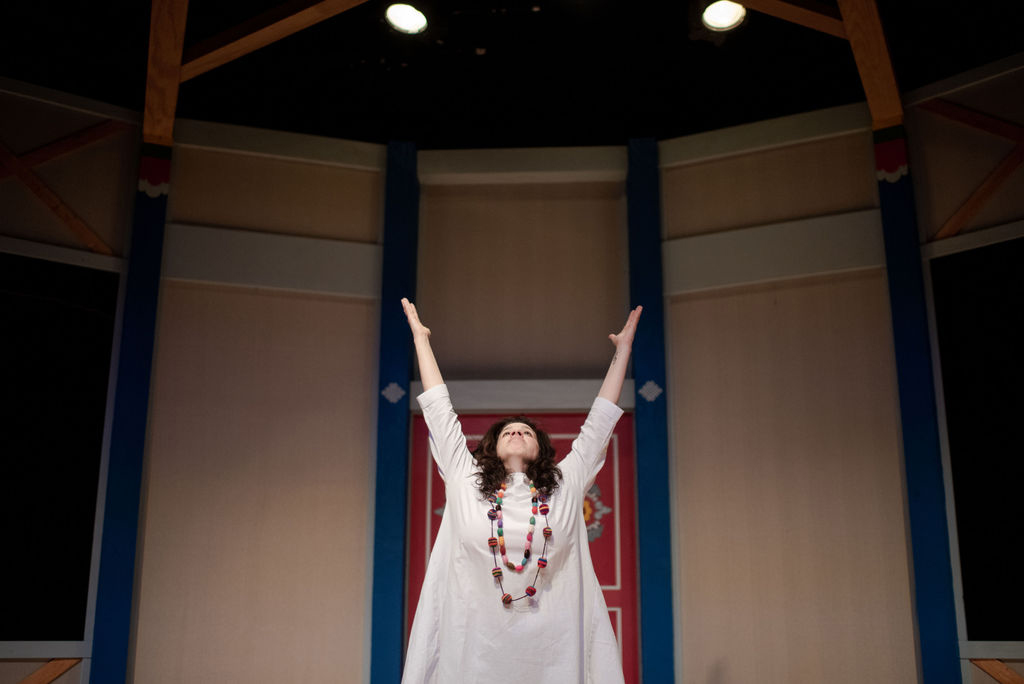
Running 70 minutes with no intermission, Small Mouth Sounds is set in a yurt-shaped structure with large open windows and chakra symbols painted on the walls. The only furniture is a few backless wooden stools (which Judy emphatically complains about) and some floor pillows. At night, the campers make do with their yoga mats as they fight mosquitos and shiver at the sounds of growling bears and other unknown animals. Actors enter down the center aisle, sometimes rather noisily, and the top of the set extends over the audience making us feel that we are inside the experience – or experiment, which I believe is the word used in the opening seconds – perhaps even in the position of the Teacher.

Joey Luck designed the sound – a variety of ambient sounds including insects and birds and a bear or two, assorted snorts and grunts, and a torrential rainstorm. Rusty Wilson, Irene Ziegler, and the cast members contributed voice-overs and other vocals sounds. Sarah Grady’s costumes helped define the characters. This entire delightful production was directed by Laine Satterfield with a balance of structure and freedom that allowed humor to emerge quite naturally. The pacing was unhurried, yet never lagged, and the scenes perfectly captured the juxtaposition of the meditative environment with the characters’ personalities and problems. In her Director’s Note, Satterfield describes how, during their first week of rehearsal, the cast members lived key moments of their characters’ lives and even worked out timelines and bios.

[NOTE: The final paragraph of the original review was omitted as it contained the March 2020 production dates, which might have proven confusing to readers.]

**********

SPOILER ALERT

Now, for that question regarding Jan and his secret. . .Do not read this paragraph if you don’t want to know before you go. . .

So, in the final scene, it is revealed that Jan does not speak English. My question is, how was he able to read his information packet and follow the instructions of the Teacher? Hmm???

**********

To provide the highest level of safety, all patrons attending a show at the theatre are required to show proof of vaccination, or proof that they have received a negative COVID test by a professional technician within 48 hours of the performance date/time.

Patrons may show the vaccination card or a photo of the card on their phones when they arrive for the performance. If you are unable to be vaccinated, you may provide proof of a Rapid COVID-19 antigen test taken within 48 hours of your performance. At home tests will not be accepted.

In accordance with current city, state, and CDC guidance, face masks are REQUIRED at all times while you are in the building, regardless of whether or not you have been vaccinated.

Please see the VaRep Covid Safety FAQ for details.

SMALL MOUTH SOUNDS

Written by Bess Wohl

Directed by Laine Satterfield

CAST:

Teacher: Marisa Guida

Judy: Lauren Leinhaas-Cook

Joan: Jenny Hundley

Alicia: Maura Mazurowski

Ned: Jim Morgan

Rodney: Evan Nasteff

Jan: Larry Cook

Voice-Over Credits: Rusty Wilson as “Fred,” Irene Ziegler as “Voicemail Guidance,” & other recorded vocal sounds including “The Bear,” performed by The Cast

CREATIVE TEAM:

Assistant Director: Kelsey Schneider (original, pre-pandemic); Jessie Fidler (current reboot)

Scenic Designer: Emily Hake Massie

Costume Designer: Sarah Grady

Lighting Designer: Andrew Bonniwell

Properties Designer: Ellie Wilder

Scenic Charge: Emily Hake Massie

Sound Designer: Joey Luck

Dramaturg: Lissa Ray

Technical Director: Tommy Hawfield

Stage Manager: Alleigh Scantling

Production Managers: Alleigh Scantling (both original & reboot); Kerri Lynch (original) & Ginnie Willard (reboot)

SETTING & TIME:

Upstate New York. Present day. Late summer.

DETAILS:

Performed in one act without intermission.

There is brief nudity, adult content, and the burning of Palo Santo wood and herbal tobacco.

Parental discretion advised.

Photos by: Jason Collins Photography

One-Time
Monthly
Yearly

Make a one-time donation

Make a monthly donation

Make a yearly donation

Choose an amount

¤5.00
¤15.00
¤100.00
¤5.00
¤15.00
¤100.00
¤5.00
¤15.00
¤100.00

Or enter a custom amount

¤

Your contribution is appreciated.

Your contribution is appreciated.

Your contribution is appreciated.

Donations for rvart review
are welcome and accepted here.
Donations for rvart review
are welcome and accepted here.
Donations for rvart review
are welcome and accepted here.

VINCENT RIVER

Shattering the Safety of Home

A Theater Review by Julinda D. Lewis

At: Richmond Triangle Players at the Robert B. Moss Theatre, 1300 Altamont Ave, RVA 23230

Performances: September 23 – October 10, 2021.

Ticket Prices: $30-35; $10 for Students.

Info: (804) 346-8113 or rtriangle.org. Richmond Triangle Theater has returned to full-capacity seating and requires proof of vaccine or recent negative PCR test results for entry. See the theater’s website for their COVID-19 precautions, digital programs, and more.

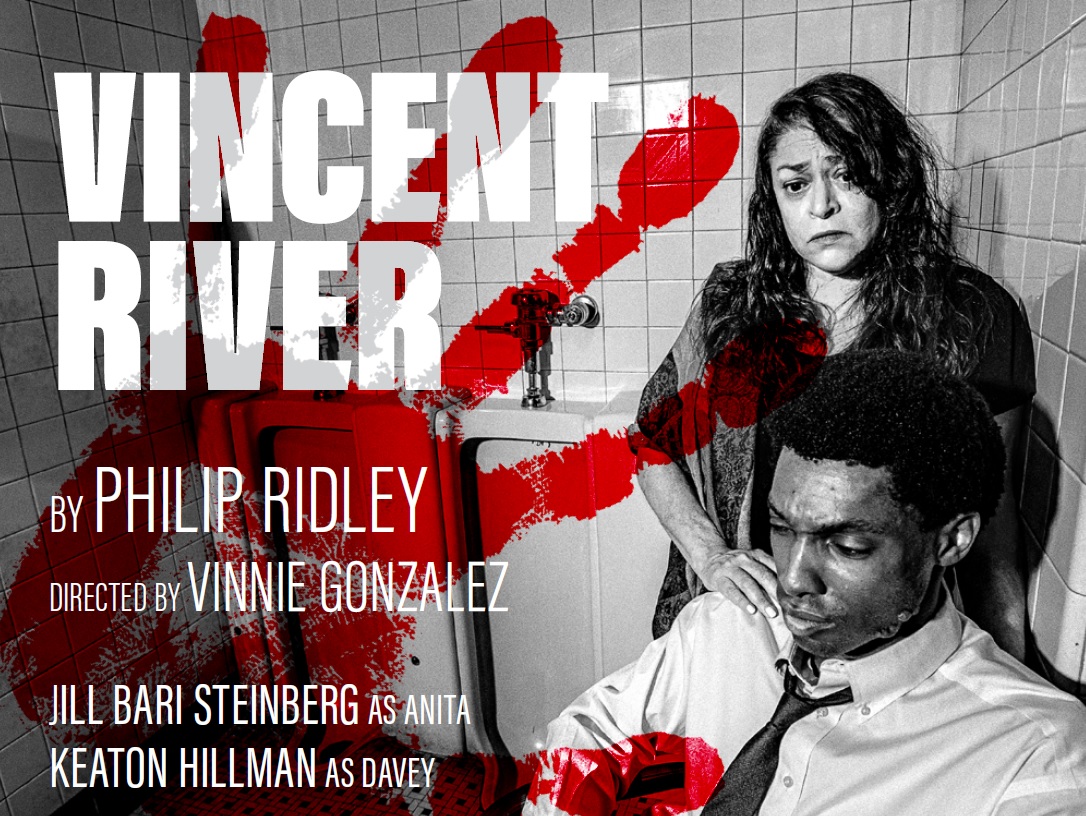
VINCENT RIVER, a two-character play by Philip Ridley, is both stunningly simple and amazingly convoluted. Jill Bari Steinberg and Keaton Hillman keep the audience enthralled for an hour and 45 minutes – with no intermission – as the story unfolds. It’s almost a theatrical form of clickbait. You couldn’t turn away even if you wanted to because you have to find out how the story ends and once you do you almost wish you had never stumbled across the announcement or whatever it was that drew you into this dark and sticky web of events. Yes, it’s that intense. For some, this story will bring back memories – or flashbacks – of The Laramie Project, produced by RTP in September 2018.

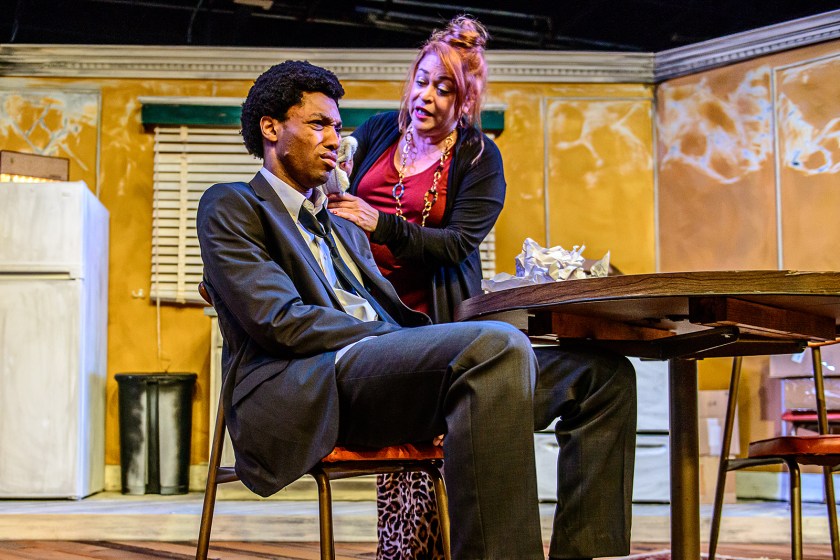
For starters, it’s prerequisite to read the advertisement or teasers for VINCENT RIVER or you might start out at a disadvantage. By intent, not much is revealed in the first scenes. The entire play takes place in the shabby apartment (well, they call it a flat, since the story takes place in East London) of Anita, a woman of apparently modest means with a long and troubled past. Her only child, Vincent River, was recently found murdered in an abandoned rail station and the newspapers had a field day composing sensational and scandalous headlines like, “Vincent River, Homosexual Victim.” Things got so bad Anita had to move from the flat she had shared with her son.

One rainy day there is a knock at Anita’s door and in stumbles Davey, a young man (I thought he initially said he was 17, but later announced he was 16) with an astonishing and painful story to tell – if only he could bring himself to speak. We know something is up because Davey has been stalking Anita for some time, and when he finally gets up the nerve to approach her, he appears reluctant to talk. It seems that Davey was the one who found Vincent’s body. But, of course, there’s more.

After much fiery deliberation the two strangers, Vincent’s mother Anita and young Davey, make a pact to tell each other all they know about Davey, in an attempt to fill in the gaps surrounding his mysterious murder. Given the seedy location and the gory details, it’s pretty obvious this was a homophobic hate crime, but why, exactly is Davey here, and what does Vincent’s death matter to him – those are the burning questions. The answers elicit shock, anger, grief, anger, disbelief, and anger. But you’ll have to go see the play to find out all the details.

At one point in his retelling, Davey tells a story about riding on a roller coaster with his mother as a youth. The roller coaster is an apt metaphor for the way this this dramatic narrative unfolds, just as the lost innocence of youth implants suggestions that make it possible to feel empathy for Davey even as we condemn his actions. Initially, I found Davey’s demeanor and reluctance to talk annoying and I thought some of facial expressions were overly exaggerated, but as the story unfolds he settled into a rhythm that seduced his audience and carried us along with him to the dark and tangled end.

Gradually, the balance of power shifts from Anita to Davey. It’s fascinating to follow this transfer, that is aided and abetted by a variety of addictive agents, including booze, pills, marijuana, sex, and even reflexology, but mainly by Davey’s words. Much of the story is told as a lengthy and emotional monologue by Davey (something Hillman has proven himself adept at in more than one show) as Anita sits quietly, allowing every imaginable emotion to pass over her face and through her posture. The two actors must be physically and emotionally exhausted after each performance of VINCENT RIVER.

All of this – the story, the emotions – is supported by Candace Hudert’s sound design which includes subtle undertones of music so soft they are mere suggestions, and a soundscape of rain that is every bit as affective in guiding the audience’s emotions as the musical cues in classic horror films,

Director Vinnie Gonzalez has done his job with transparency and gentleness even though much of the language is explosive, the actions harsh, and the consequences disastrous. Moments of humor – as when Anita raises the wide blinds to expose a tiny window – take the edge off and give the audience a chance to breathe. Gonzalez’s set, built with angled walls and recessed a bit deeper than most sets at RTP, is filled with shabby furniture, peeling paint, unintentionally exposed brick, and dangling crown molding. A floor made of salvaged wooden boards provides a surprisingly sturdy foundation for the chaos that inhabits the room. Cigarette and marijuana smoke (theatrical, of course) waft through the air and there’s also plenty of booze and pills – even though the flat’s water has been shut off.

Costume designer Margarette Joyner has arrayed Steinberg in a jumble of bright colors, including disparately patterned socks and shoes and animal print bell bottoms while Hillman wears a conservative suit, dress shoes, a white button down shirt and tie. Both characters are given colorful language as well. Speaking of language, kudos to dialect designer Erica Hughes for coaching Steinberg and Hillman in what sounded to my ear like authentic British accents. VINCENT RIVER reminds us to be careful what we ask for.

VINCENT RIVER

Written by Philip Ridley

Directed by Vinnie Gonzalez

CAST:

Jill Bari Steinberg as Anita

Keaton Hillman as Davey

CREATIVE TEAM:

Scenic Design by Vinnie Gonzalez

Costume Design by Margarette Joyner

Lighting Design by Austin Harber

Sound Design by Candace Hudert

Intimacy Direction by Raja Benz

Dialect Design by Erica Hughes

Hair and Make Up Design by Luke Newsome

Properties Design by Tom Moehring

Projection Design by Aisthesis Productions and Undefined Media LLC

Production Stage Manager: Lauren Langston

Photo Credits: John MacLellan

One-Time
Monthly
Yearly

Make a one-time donation

Make a monthly donation

Make a yearly donation

Choose an amount

¤5.00
¤15.00
¤100.00
¤5.00
¤15.00
¤100.00
¤5.00
¤15.00
¤100.00

Or enter a custom amount

¤

Your contribution is appreciated.

Your contribution is appreciated.

Your contribution is appreciated.

Donate here to support RVART ReviewDonate here to support RVART ReviewDonate here to support RVART Review

WAR IN PIECES

Four New One-Act Plays Written by Four Veterans

A Theater Review by Julinda D. Lewis

Presented by: The Firehouse Theatre in partnership with the Virginia War Memorial Foundation and the Mighty Pen Project; Co-Produced by David Robbins

At: The Firehouse, 1609 West Broad St., Richmond, RVA 23220

Performances: September 23 – October 30, 2021

Ticket Prices: $35 general & $30 military

Info: (804) 355-2001 or firehousetheatre.org.

We have grown accustomed to being asked for proof of vaccination and being required to wear masks inside theaters, but this is the first time I remember a pre-show warning to Veterans in the audience: These productions include moments of loud sound effects of combat, gunfire, and explosions, harsh and graphic language, and content.

I vaguely remember writing a preview about this festival back in the pre-pandemic days. Producing Artistic Director Joel Bassin shared, in his pre-show greeting, that the first reading and initial meet and greet for this festival was held in December 2019 – in the “time before.” The real deal far exceeded any expectations I may have held. The point is this festival is a collection of four new plays written by military veterans who share not only “tipping-point” life or death moments from their lives, but also, in black and white videos, the process that led them to the finished product. And these finished – or evolving – products are compelling pieces of theater that bear the imprimatur of authenticity.

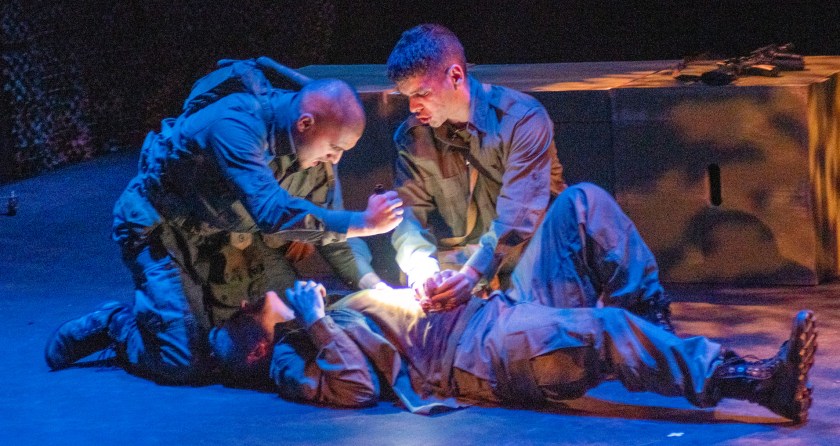
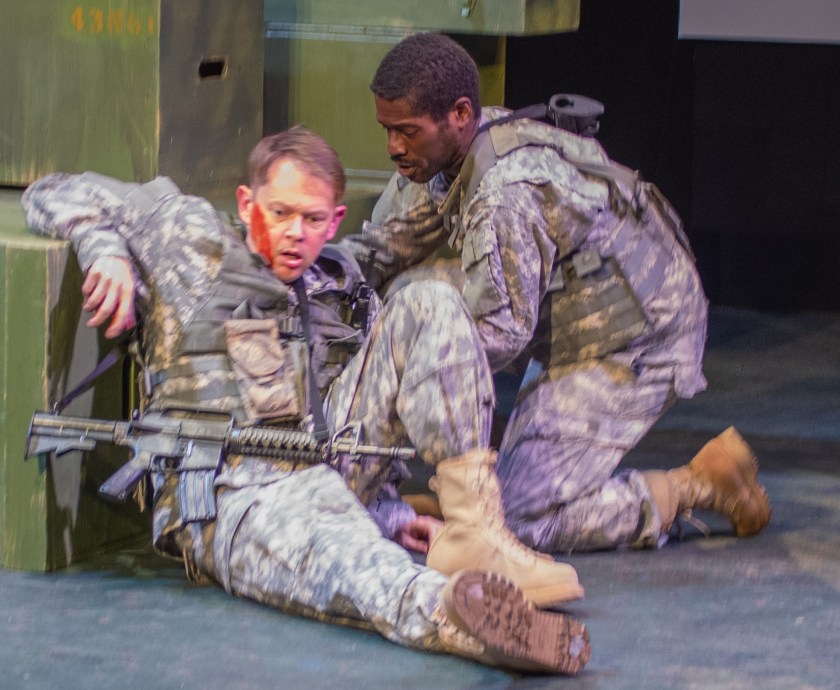
In GUARDIAN ANGELS, a severely wounded Marine is rescued by an Army medivac. But this rescue is extraordinary on several levels. The Army helicopter wasn’t even supposed to be in the area, and in spite of the dire situation, author Robert Waldruff manages to wring out a moment of humor when he requires the Marine Lieutenant (Dean Knight) to utter words of respect for the rival Army rescue team. There is also a supernatural element provided by Alvan Bolling II as the Chaplain and Dani Brown who plays multiple characters wearing a traditional white nurse’s uniform. The one scene I found odd – and distracting – was the robotic voice used by the Doctor (Dean Knight). Perhaps there is a reasonable, military reason for this choice.

The first half of the program closed with SOAR, the only one of the four one-act plays written by a woman Veteran. Rachel Landsee. Irene Kuykendall was outstanding as the military lawyer and wife, Rachel. Her husband, Adam (Dean Knight) was also an officer, and the focus of SOAR included the strains military life puts on relationships, the demands made on women, especially if they become pregnant while in service, as well as philosophical discussions of the validity of sending US troops to Iraq and Afghanistan. For me, this was the most complex and layered of the four pieces, and its appeal is enhanced by the presence of a sort of Greek chorus meets four-part harmony a cappella group composed of four of the male ensemble members. SOAR turned out to be a mini-musical, powered by foot-stomping, finger-snapping military cadence, soulful rhythms, and the bluesy strains of Nina Simone’s “Feeling Good.”

Birds flying high, you know how I feel

Sun in the Sky, you know how I feel

Breeze driftin’ on by, you know how I feel

It’s a new dawn

It’s a new day

It’s a new life for me…

Whereas the works in the first half of the program focused on some of the more practical, blood and guts aspects of war in sometimes poetic ways, the works in the second half tackled similar subject matter in a somewhat more abstract, yet at the same time more emotionally powered and even spiritual manner.

In BONNE ANNÉE, directed by Firehouse Producing Artistic Director Joel Bassin, playwright David M. Aldridge invites the audience to meet his inner voice. This voice, audible only to him, told him when to stop, where to look for booby traps, when the enemy was coming, and continued to serve him well after returning home. BONNE ANNÉE is staged as a monologue featuring Jonathan Hardison as David, just ten days back from Viet Nam and obviously fragile in ways yet unrevealed. As David speaks, in a surprising soft and controlled voice, he gradually reveals details of the horrors he encountered, as well as one quirky but important little detail: Bonne Année, the French phrase for Happy New Year, has been assimilated into Vietnamese culture. These two simple words take on a chilling and supernatural effect in the final moments of the play.

BONNE ANNÉE includes a few supporting roles played by Linda Beringer, Dean Knight, and Dani Brown, and a quartet of menacing Young Men (Alvan Bolling II, Erik DeMario, Jimmy Mello, and Makai Walker). As if sight and sound were not enough, BONNE ANNÉE engages the sense of smell with a pan of sizzling bacon playing a subsidiary role in a key part of David’s monologue.

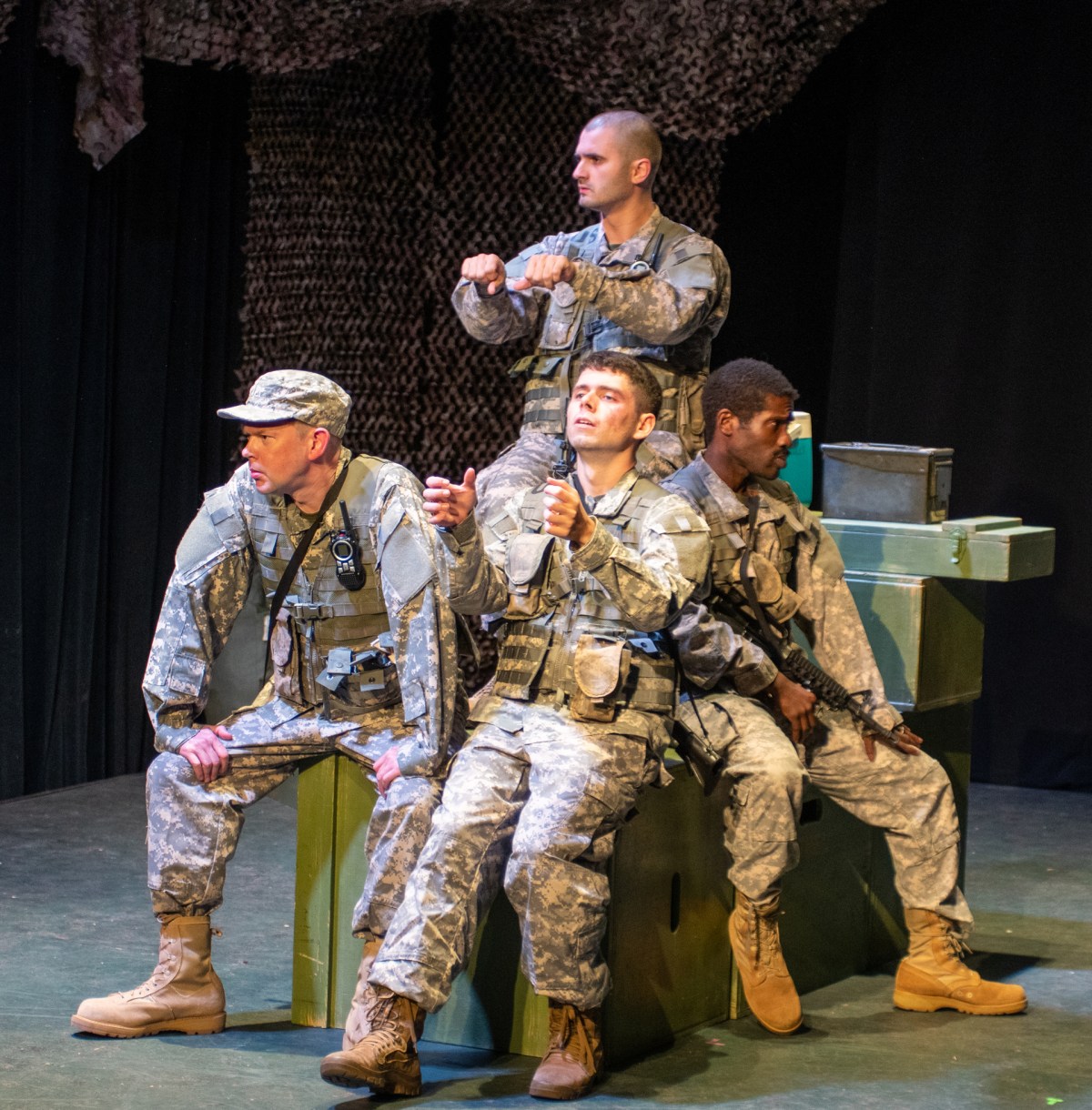
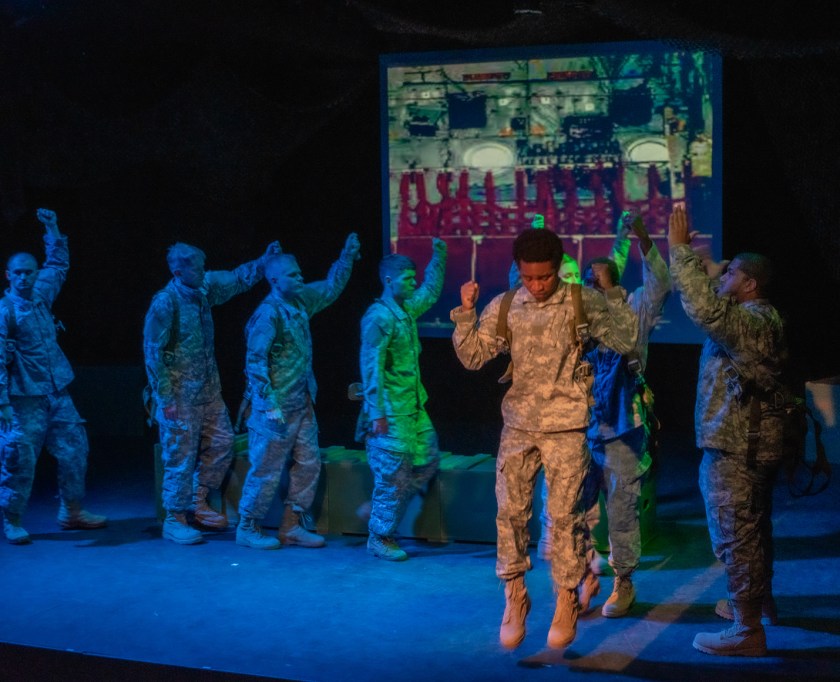
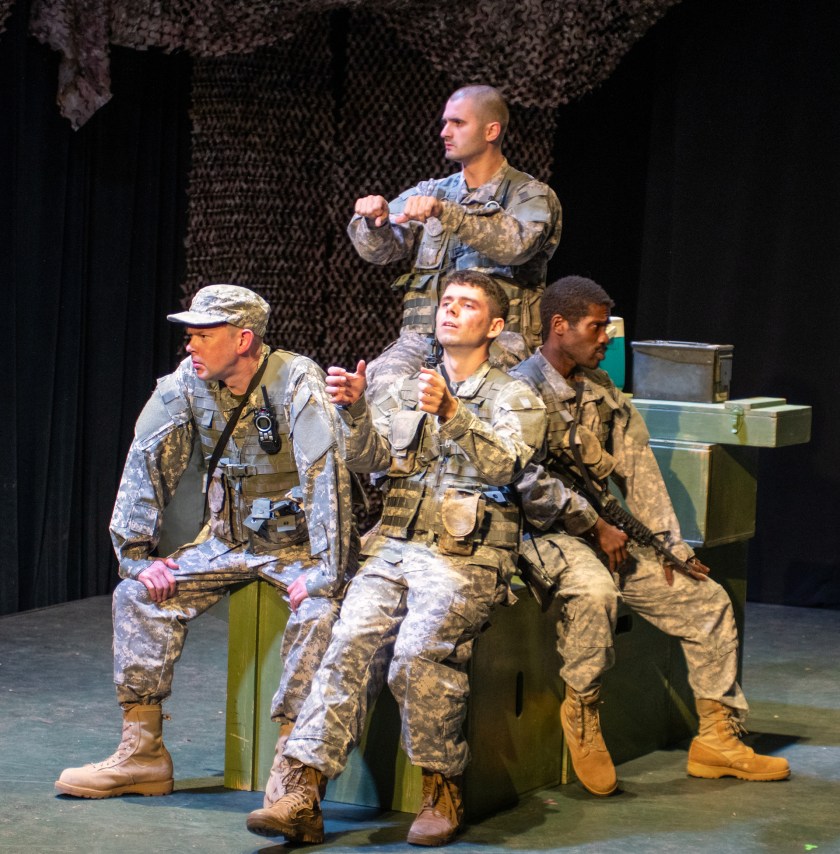
Last but certainly not least, the evening closed with Chuck Williamson’s introduction to SKYLINE in which he speaks about life in Fort Polk, Louisiana, before guiding us into a story of a convoy where everything that can go wrong goes wrong. Set in Bagdad, SKYLINE is packed with endearing and very human details, such as the men playing cards for snacks, and ends with the team (Erik DeMario, Keydron Dunn, Dean Knight, and Jimmy Mello) assuming a kick-ass superhero pose that encapsulates the heart and soul of each of these characters, who are all obviously real people. The convoy may not have been a successful mission, but these four actors conveyed a genuine sense of comraderie that was unmistakable and moving.

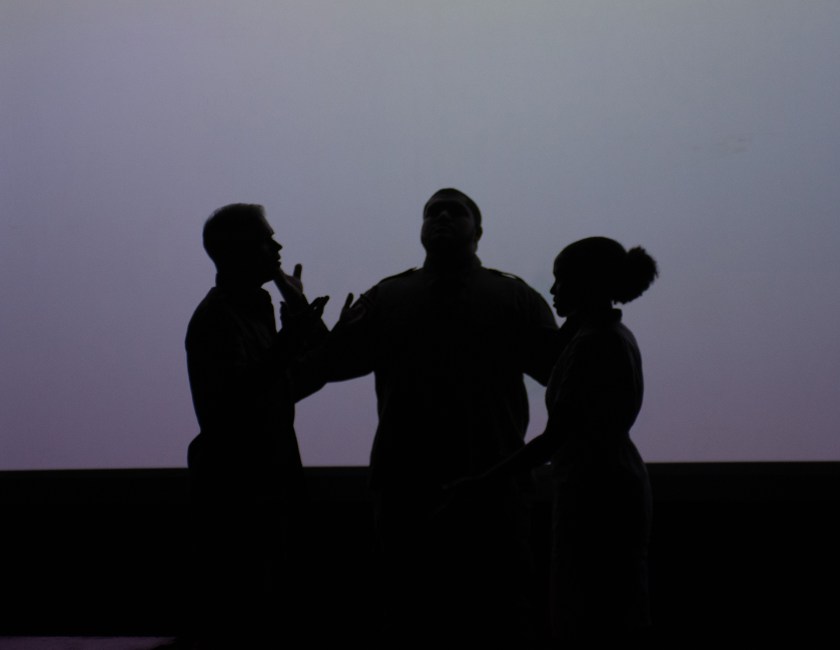
While each play stands alone, presenting them together draws a more comprehensive picture of war and its personal consequences. The ensemble and directors started the evening in unity. All 10 actors entered and took seats on the scattered wooden crates. Their backs were to the audience as they joined us in watching Robert Waldruff’s introductory video, setting the tone and pace for the scenes that followed. WAR IN PIECES is not for the faint of heart.

“There is no movie

that can show the terror

of one little firefight.”

The set has been kept simple, with a series of boxes serving as buildings, vehicles, furniture, and other assorted props. The space is beautifully lit by Andrew Bonniwell whose camouflage shaded lighting has a three-dimensional quality, and Mark Messing’s sound score is outstanding. Transitions on opening night were surprisingly smooth, and I have no doubt that this production that will mature beyond mere theatrics as the ensemble continues to work together sharing these very personal and very graphic stories. This is the sort of production that lingers with the performers and the audience.

Irene Kuykendall made a deep impression as Rachel in SOAR. Dean Knight proved versatile in multiple roles, and showed unexpected discernment as Rachel’s husband, Adam. It was good to see Jimmy Mello onstage again, as well as Jonathan Hardison, Alvan Bolling II, and Dani Brown. Keydron Dunn may be almost unrecognizable to those who remember him from pre-pandemic productions as he cut his locs after being drafted into this production, but his distinctive voice remains the same. Linda Beringer, who has an impressive acting resume, assumed only a small supporting role here (but it did involve bacon!), and I am not yet familiar with the work of Erik DeMario or Makai Walker, both of whom are third year theatre students at VCU. I expect we will see more of them in the near future.

WAR IN PIECES

Cast:

Linda Beringer

Alvan Bolling II

Dani Brown

Erik DeMario

Keydron Dunn

Jonathan Hardison

Dean Knight

Irene Kuykendall

Jimmy Mello

Makai Walker

Production Team:

GUARDIAN ANGELS Written by Robert Waldruff & Directed by Foster Solomon

SOAR Written by Rachel Landsee & Directed by Kerrigan Sullivan

BONNE ANNÉE – Written by David M. Aldridge & Directed by Joel Bassin

SKYLINE – Written by Chuck Williamson & Directed by Todd Labelle

Costume Designer – Anna Bialkowski

Lighting Designer – Andrew Bonniwell

Sound Designer – Mark Messing

Set & Projection Consultant – Dasia Gregg

Choreographer for SOAR – Kayla Xavier

Dramaturg – Lindy Bumgarner

Stage Managers – Emma Avelis, Kasey Britt, Claire Bronchick, Grace Brown, Emily Vial

Festival Co-Producer – David Robbins

Festival Coordinator – Emily Vail

Run Time:

About 2 hours, including one 15-minute intermission

Performance schedule:

Thursdays, Fridays, and Saturdays, September 23 – October 30 @ 7:30 PM

Sundays, October 3, 17 & 23 @3:00 PM

Sunday performances include a Post-Performance Talkback

Tickets:

$35 general

$30 military, and first responders

Photos: Bill Sigafoos

One-Time
Monthly
Yearly

Make a one-time donation

Make a monthly donation

Make a yearly donation

Choose an amount

¤5.00
¤15.00
¤100.00
¤5.00
¤15.00
¤100.00
¤5.00
¤15.00
¤100.00

Or enter a custom amount

¤

Your contribution in any amount is appreciated.

Your contribution is appreciated.

Your contribution is appreciated.

Donate here to
support rvart review
Donate here to
support rvart review
Donate here to
support rvart review