Richmond Ballet: Moving Art Two

A World Premiere, A Virginia Premiere, and A Revival

A Dance Review

Program By: The Richmond Ballet

At: Virginia Museum of Fine Arts, Leslie Cheek Theater, on the Armstrong Family Stage in Honor of Richmond, 200 N. Arthur Ashe Boulevard, RVA 23220

Performances: May 8-18, 2025

Ticket Prices: $25 – $85 ($85 – $125 on opening night)

Info: (804) 344-0906, etix.com, or richmondballet.com

THE PROGRAM

SLUMP

Choreography by Joshua L. Peugh

Music by Klezmer Juice, Yma Sumac, Ella Fitzgerald

Costumes Provided by Richmond Ballet

Lighting Design by Nathan W. Scheuer

World Premiere: June 21, 2012 by Bruce Wood Dance Project at Booker T. Washington’s <Montgomery Arts Theater, Dallas, TX; Richmond Ballet Premiere: May 8, 2025, Leslie Cheek Theater, Virginia Museum of Fine Arts, Richmond, VA

ECHOING PAST      

Choreography by Stoner Winslett

Music by Fanny Mendelssohn-Hensel

Costume Design by Susan Cologne

Lighting Design by Nathan W. Scheuer

Pianist: Joanne Kong

World Premiere: May 15, 1996 by Richmond Ballet at Leslie Cheek Theater, Virginia Museum of Fine Arts, Richmond, VA

FADING CREATURES

Choreography by Yury Yanowsky

Music by Senking and Henryk Gorecki

Costumes by Christi Owen after Original Costume Design by Emily Morgan

Lighting Design by Nathan W. Scheuer

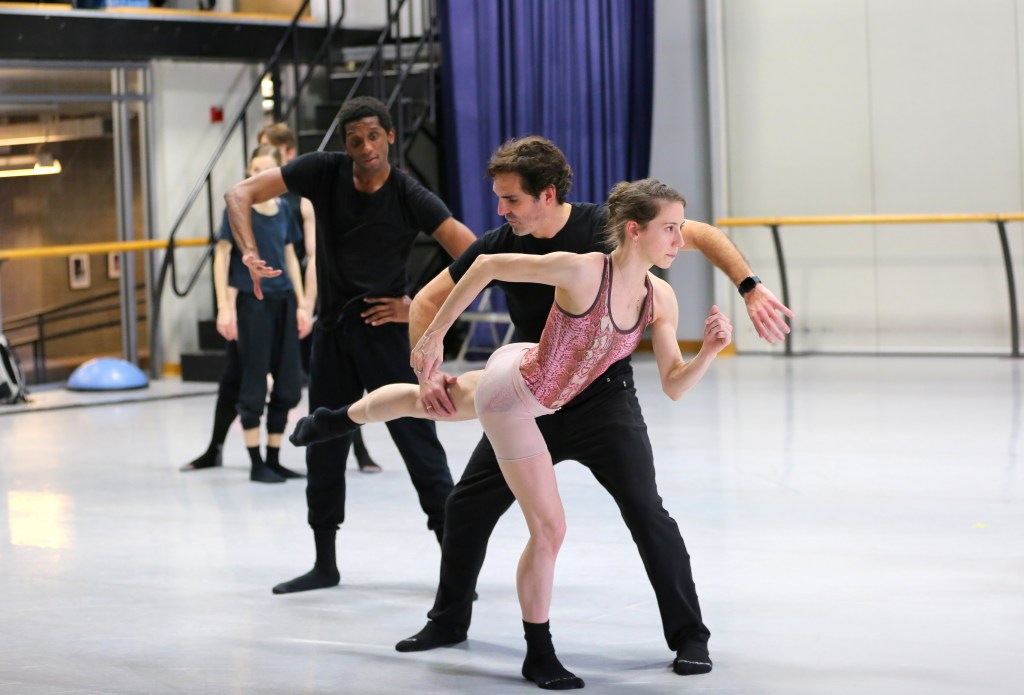
Following their March 2025 return to the VMFA’s Leslie Cheek Theater after an absence of 30 years, Richmond Ballet’s Moving Art Two program offered an audience pleasing trio of works. In order, the audience enjoyed a quirky modern Richmond premiere, a revival of a more classically themed ballet by founding artistic director Stoner Winslett, and a world premiere of a work that began as an entry in the Richmond Ballet’s 2023 New Works Festival. Interestingly, and to my surprise, most of the people I chatted with after the show were most drawn to the more contemporary works.

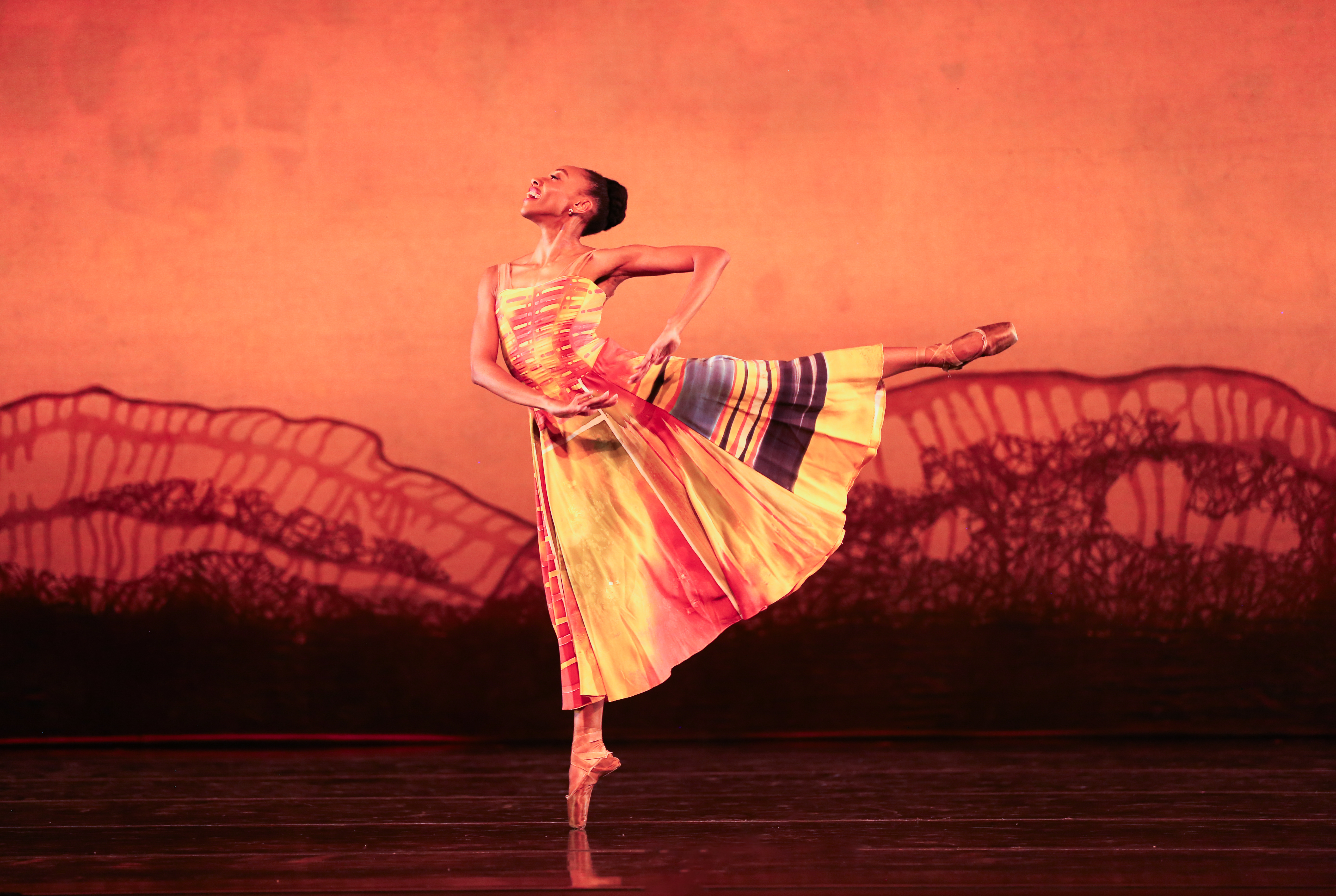
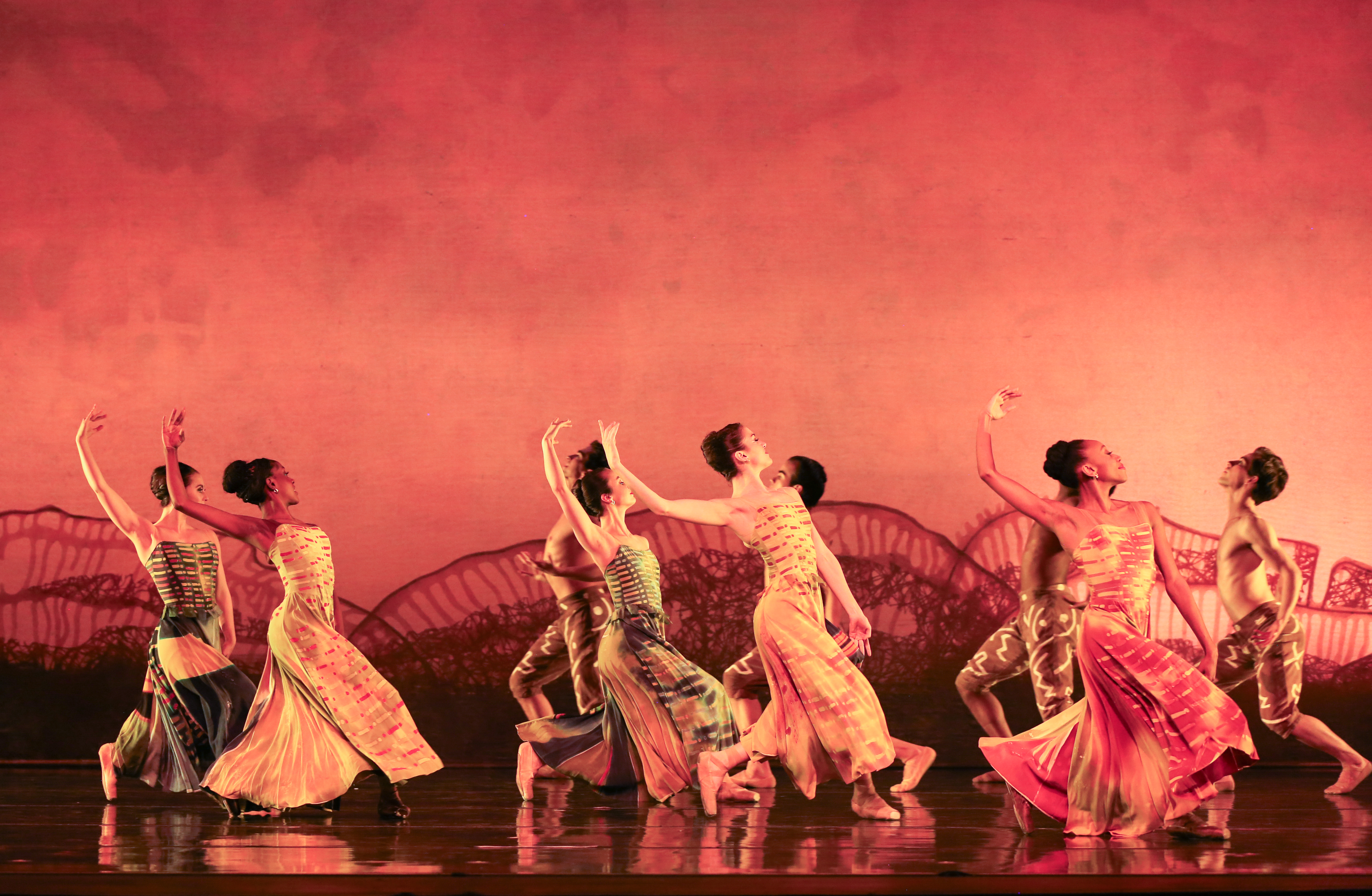
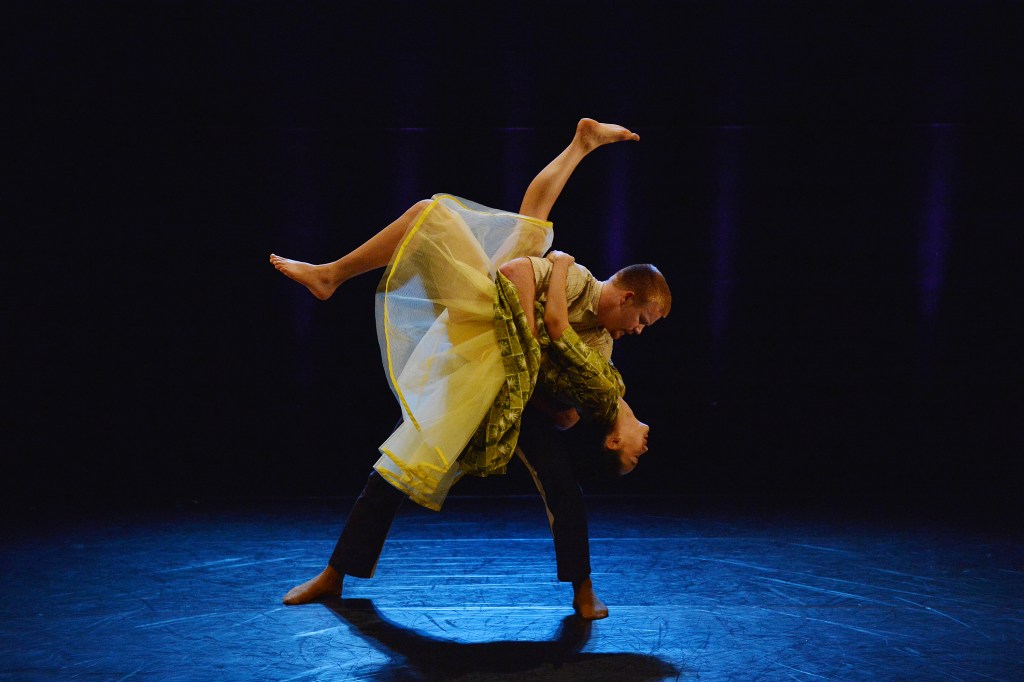
The program opened with a colorful, upbeat work by Joshua L. Peugh, the New Mexico-based founder and artistic director of Dark Circles Contemporary Dance. Slump defies categorization with its musical environment ranging from Klezmer Juice (described online as Jewish Soul musicians) to Peruvian singer Yma Sumac to jazz icon Ella Fitzgerald. The women are dressed in 1950s-style party dresses with crinoline underskirts that give a sassy nod to tulle tutus while emphasizing the pointedly un-classical and often upside-down lifts with one leg hooked around the partner’s neck.

At one point the men perform a rubbery, jelly-legged movement that used to be known as “eccentric” dancing, and later they walk with what my grandmother would have called a “switch,” as if mocking their female partners.  The partner dancing includes the kind of weight-bearing that remind me of when little girls dance with their feet planted atop their daddies’ feet like life-sized rag dolls. They slouch, they drop, they roll in joyous freedom. The women’s wide-legged stance, the men’s swirling hips, the flirtatious and irreverent partnering all seemed to be as much fun for the dancers as it was for the audience.

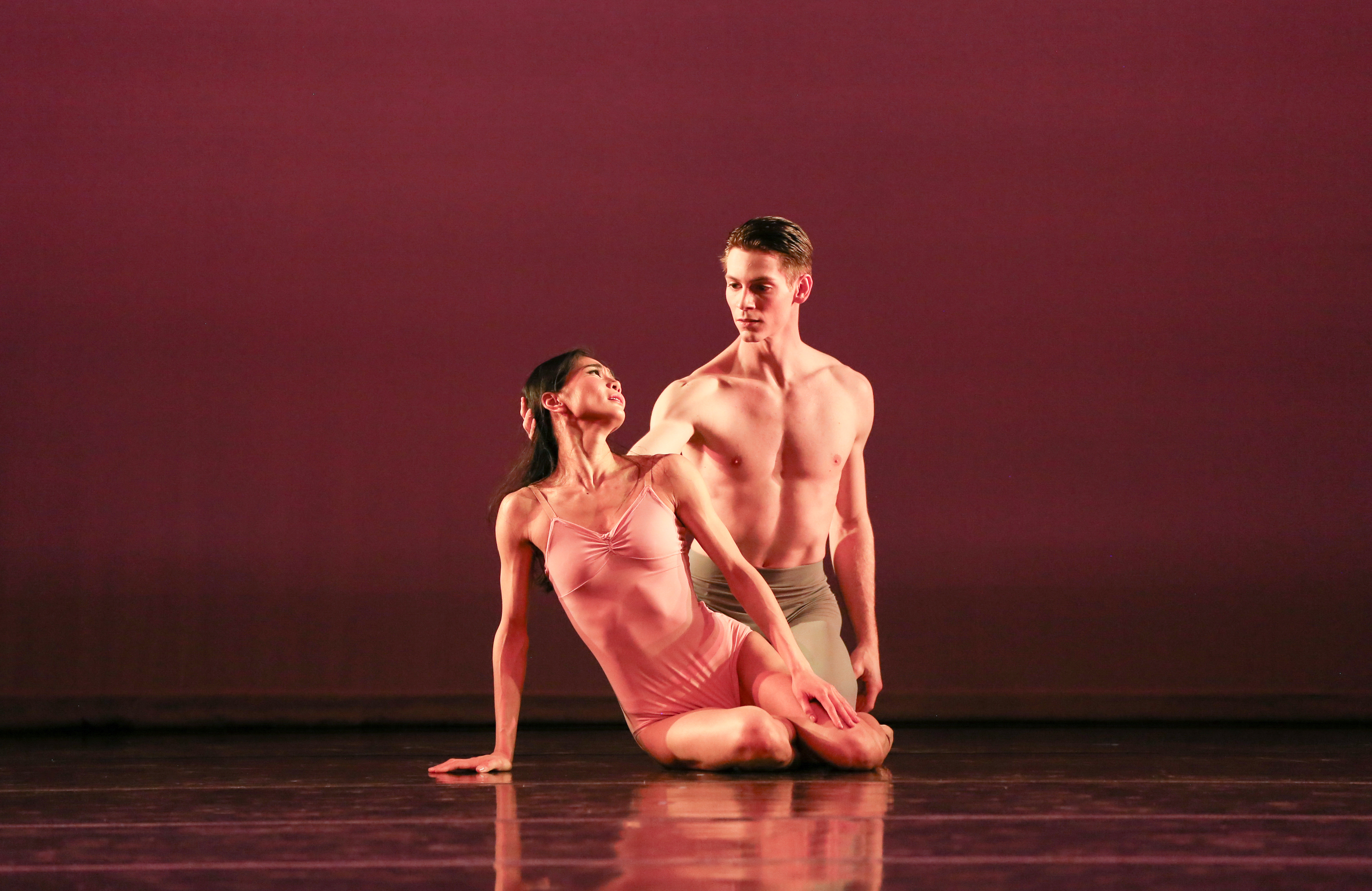
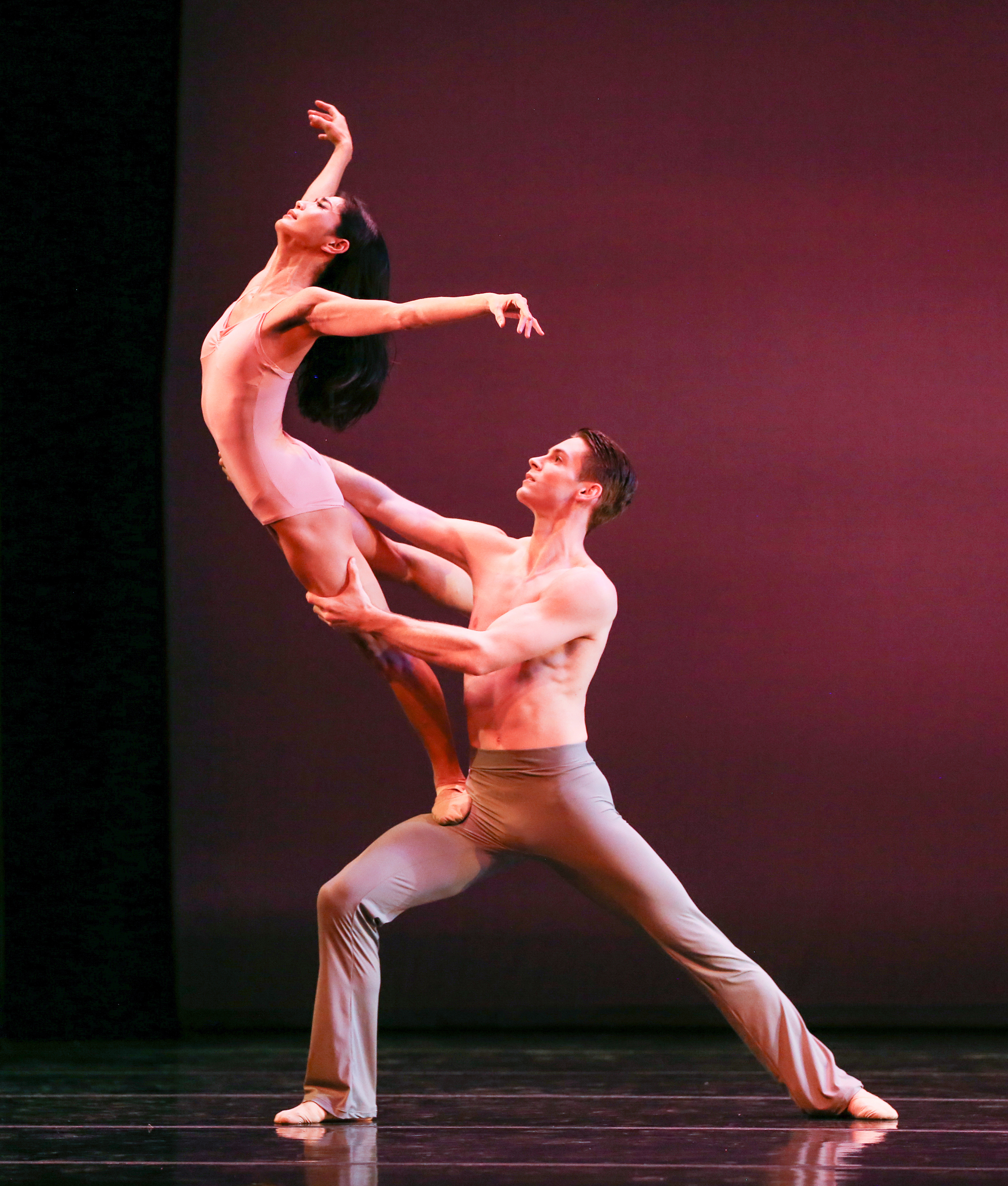
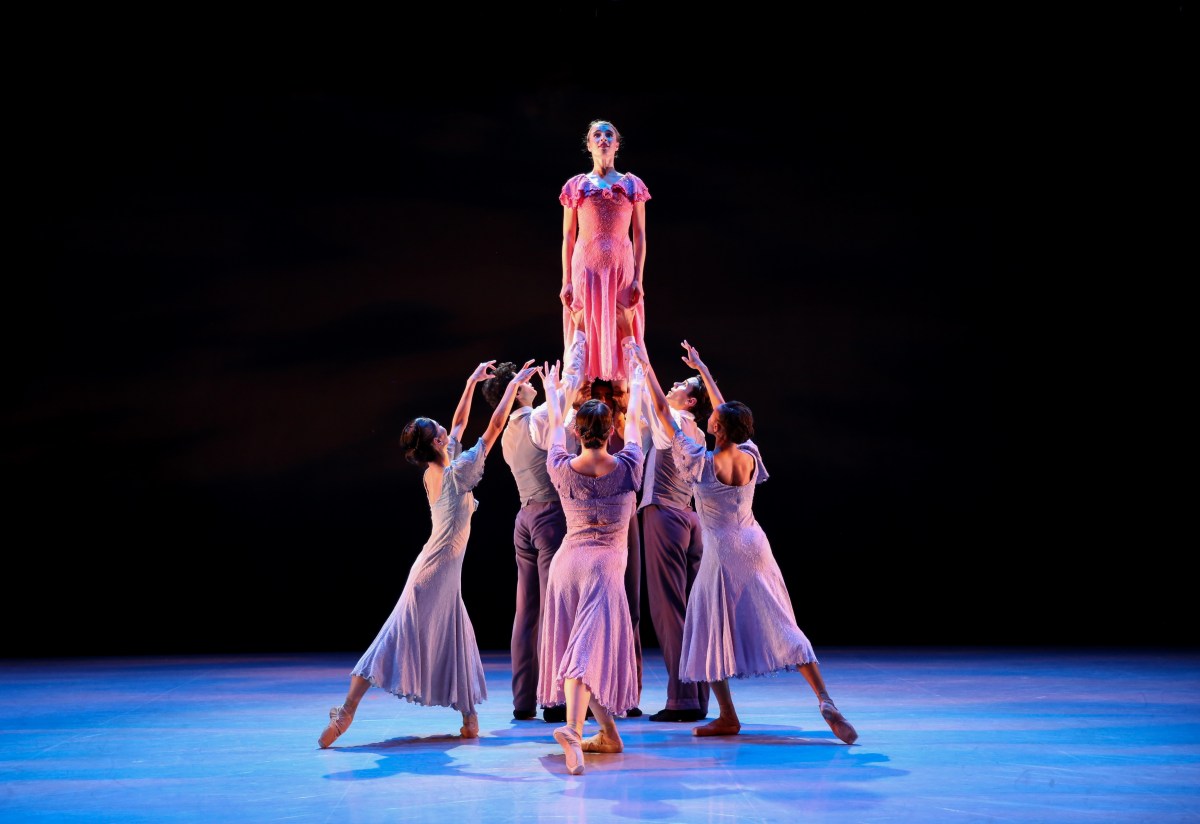
Stoner Winslett’s Echoing Past was in stark contrast to the shenanigans of Slump. Described as a ballet about one woman’s journey, looking back while moving forward, the work is set to music by Fanny Mendelssohn-Hensel and played live by pianist Joanne Kong. Originally titled “Das Alte Jahr” (“The Old Year”), the ballet was choreographed in honor of Leslie Peck, a former member of the New York City Ballet, a recognized authority on Balanchine ballets, and a former ballet mistress with Richmond Ballet.

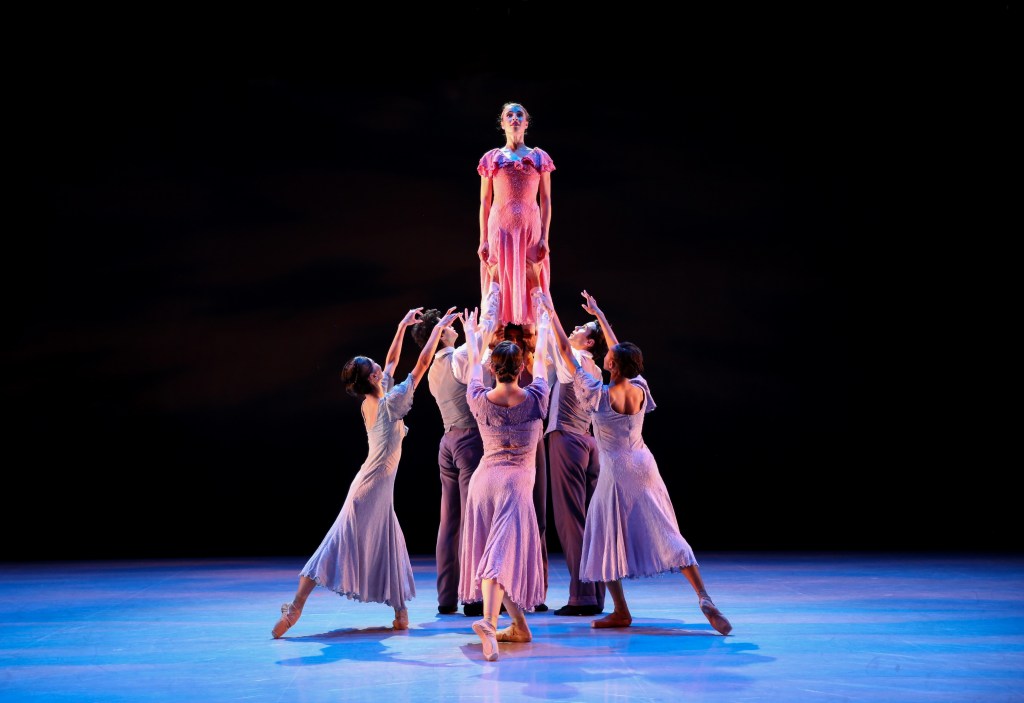
Eri Nishihara represents this woman, with Annika Kuo, Kaitlin Roemer, and Kennady Jackson dancing the roles of her past selves. Nishihara wears pink while the past selves are dressed in gray. Nishihara seamlessly trades places with her past selves, sometimes dancing back-to-back or mirroring the other women, as the peace evolves into a rich and satisfying conclusion. The ballet may be a metaphor for the company itself. Echoing Past was first performed at the VMFA in 1996, and Winslett formally stepped down as Artistic Director just under a year ago, in July 2024. So, the ballet somewhat mirrors Winslett’s own journey as artistic director, choreographer, and a woman in a position that is still dominated by men.

Yury Yanowsky, a former principal dancer with the Boston Ballet, first introduced Richmond audiences to his work Fading Creatures as a part of the Richmond Ballet’s New Works Festival in 2023. Inspired by Salvador Dali’s familiar melting clocks, the work begins with the feeling of a sci-fi ritual as the dancers lie on the floor with small lights hoovering over them. Once the lights have ascended and the dancers have risen from the floor, the dancers adopt an athletic style of movement – muscular, posed, poised, measured, abstract.

While inhabiting the lower level, the dancers flip, slide, reach, and lunge, but once the lights rise above them like a constellation, the dancers’ movements become bolder and more sinuous at the same time. Sometimes they appear to float or glide, only to suddenly run and freeze, or rewind and repeat, bending and stretching time, ending with a sudden stop!

What a satisfying conclusion to the company’s 2024-2025 season, the first under the artistic leadership of Ma Cong. Much like the woman in Echoing Past, perhaps intentionally so, this season has been marked by reflection and change and concluded on a rich and satisfying note.

The Richmond Ballet 2025-2026 season begins with Moving Art One, September 11-21 featuring Wild Seet Love by Trey McIntrye and a world premiere by Ma Cong.

Moving Art Two, October 16-26 is scheduled to present Slice to Sharp by Jorma Elo, a world premiere by Andrea Schermoly, and French Twist by Ma Cong. The Nutcracker will be performed at Dominion Energy Center December 6-23 and Giselle will be performed there February 13-15. The season will continue with Moving Art Three, the company’s New Works Festival with works by Natasha Adorlee, David Morse, Price Suddarth, and Serkan Usta from March 19-29, and conclude May 14-24 with Moving Art Four with George Balanchine’s Apollo, John Butler’s After Eden, and a world premiere by Val Caniparoli.

———-

Julinda D. Lewis is a dancer, teacher, and writer who was born in Brooklyn, NY and now lives in Eastern Henrico County. When not writing about theater and dance, she teaches dance history at VCU and low impact dance fitness classes to seasoned movers like herself and occasionally gets to perform.
One-Time
Monthly
Yearly

Make a one-time, monthly, or annual donation to support rvart review

Make a monthly donation

Make a yearly donation

Choose an amount

$5.00
$15.00
$100.00
$5.00
$15.00
$100.00
$5.00
$15.00
$100.00

Or enter a custom amount

$

Your contribution is appreciated.

Your contribution is appreciated.

Your contribution is appreciated.

DonateDonate monthlyDonate yearly
RICHMOND BALLET: MOVING ART ONE

Ballet Celebrates First Program on the New VMFA Stage

A Dance Review

Performance By: The Richmond Ballet

At: Virginia Museum of Fine Arts, Leslie Cheek Theater, Richmond Ballet Stage, 200 N. Arthur Ashe Boulevard, RVA 23220

Performance Dates: March 20-30, 2025

Ticket Prices: $25 – $85 ($85 – $125 on opening night)

Info: (804) 344-0906, etix.com, or richmondballet.com

THE PROGRAM

PENTAPTYCH

Choreography by Ma Cong

Music by Ryan Lott

Costume Design by Emma Kingsbury

Lighting Design by Les Dickert

Visual Artist: Eric Sall

World Premiere: September 14, 2018, Tulsa Ballet, Tulsa Ballet’s Studio K Theatre, Tulsa, OK. Richmond Ballet Premiere: March 20, 2025, Leslie Cheek Theater, Virginia Museum of Fine Arts, Richmond, VA

AFTER THE RAIN Pas de Deux

Choreography by Christopher Wheeldon, OBE

Music by Arvo Pärt

Staged by Jason Fowler and Craig Hall

Costume Design by Holly Hynes

Lighting Design by Les Dickert after Original Design by Mark Stanley

Pianist: Dr. Douglas-Jayd Burn

Violinist: Karen Johnson

World Premiere: January 22, 2005, New York City Ballet, New York State Theater, New York, NY. Richmond Ballet Premiere: March 20, 2025, Leslie Cheek Theater, Virginia Museum of Fine Arts, Richmond, VA

LAMBARENA

Choreography by Val Caniparoli

Music by Johann Sebastian Bach and traditional African (as arranged by Pierre Akendengué and Hughes de Courson)

African Dance Consultants: Dr. Zakarya Diouf, Naomi Johnson-Diouf, Ibrahima O. Diouf

Scenic and Costume Design by Lisa J. Pinkham, Recreated by Les Dickert

Staged by Maiqui Manosa

World Premiere: March 28, 1995, San Francisco Ballet, War Memorial Opera House, San Francisco, CA. Richmond Ballet Premiere: March 20, 2025, Leslie Cheek Theater, Virginia Museum of Fine Arts, Richmond, VA

—–

In celebration of the very first performance of the Richmond Ballet’s new Moving Art series – replacing the long-time, popular Studio Series – current Artistic Director Ma Cong, Founding Artistic Director Stoner Winslett, and VMFA Director and CEO Alex Nyerges shared the stage on Thursday evening, March 20, for an enthusiastic pre-show welcome. There was a full house for this gala event, and all performances of the March 20-30 program were already sold out.

Moving Art One marks the return of the Richmond Ballet to the VMFA  after last performing there in the 1990s and the first major renovation of the Leslie Cheek Theater stage since it was built some 70 years ago. The renovations include widening the stage to better accommodate ballet, new lighting for the house and the stage, and upgraded A-V equipment. A press release indicates that the performers’ dressing rooms and restrooms and the green room have also been upgraded. The theater seats 472 audience members, and the seating has reportedly been refurbished but in my opinion the seats are still a bit too tight and would probably not be comfortable for all audience members, and the raking does not allow for an unobstructed view if you are vertically challenged, or if a tall person sits in front of you. But that’s just my two cents.

As with the Studio Series performances, the Moving Art series consists of a program of three works and features both classical and contemporary ballets produced in an intimate setting (as compared to, say, the 1,800-seat Carpenter Theatre where large works such as The Nutcracker Ballet or Cinderella are performed).

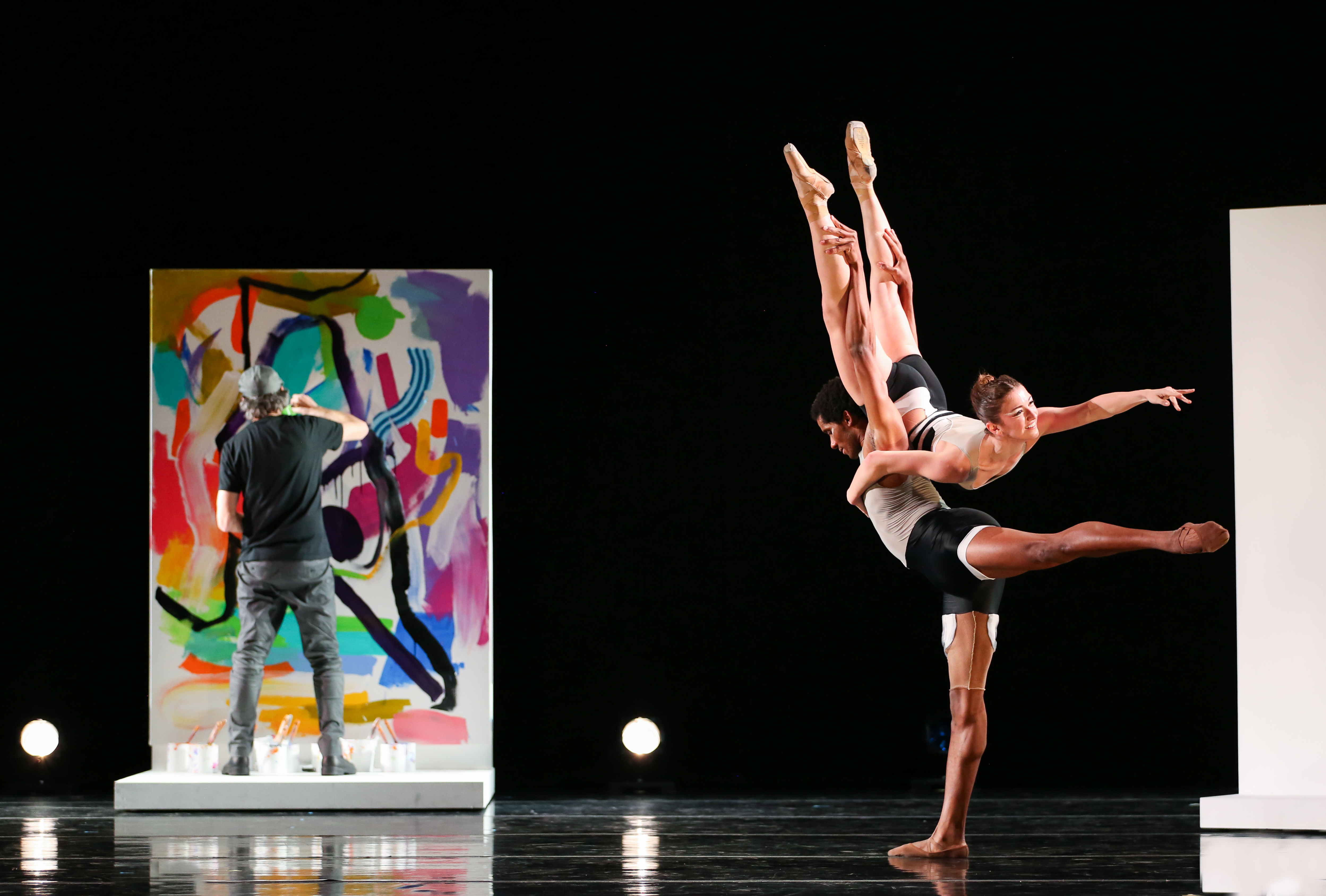
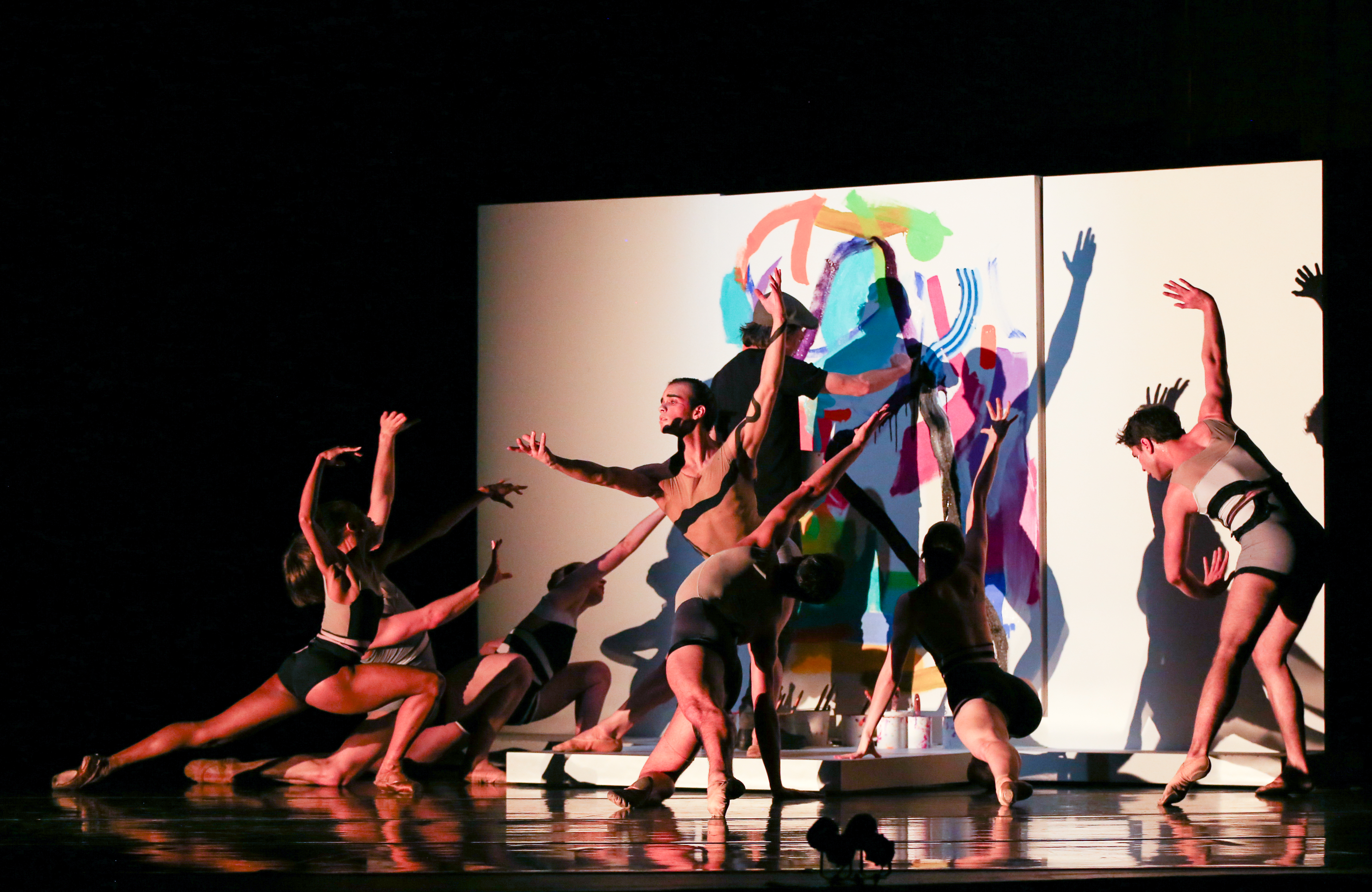
Moving Art One opened with the world premiere of Ma Cong’s Pentaptych (def., a work of art consisting of five panels or sections). There is a live artist onstage, Eric Sall, who interacts with the dancers and creates a large, colorful abstract painting. The bold brushstrokes are a stark contrast to the black, white, and gray costumes worn by the dancers – except for one dancer whose costume appears to be a part of or an inspiration for the painting. The ballet is of the contemporary genre, and the dancers’ monochrome costumes, paired with the abstract, ethereal, and sometimes athletic stretching motions and the original score by Ryan Lott, for a moment I had a flashback of sitting in Merce Cunningham’s Westbeth studio in Manhattan’s artists’ community, watching his company perform. (For those not familiar with Cunningham’s work – this is a positive comparison, and you should look him up!) The finished painting, by the way, is available for purchase via an online auction. The proceeds are to benefit the Richmond Ballet.

The classical portion of the program was provided by Eri Nishihara and Jack Miller, performing the pas de deux from Christopher Wheeldon’s After the Rain. Commissioned for a New York City Ballet program in honor of George Balanchine’s birthday, the ballet is in two parts. The first part is a dance for three couples, and the second part, the pas de deux, is often performed separately, as it was here on the new Richmond Ballet Stage. The dance is set to music by Arvo Pärt, played live by Dr. Douglas-Jayd Burn and Karen Johnson, and is notable for placing the ballerina in flat shoes instead of en pointe.

It is a stunningly beautiful and tender ballet in which the male dancer, Miller, sometimes lifts his partner is the most unexpected ways – for example, frozen into a position that I can only describe rather awkwardly as table-like. Another moment, Nishihara gently caresses her partner’s face while he stands strong and unmoving, or she perches delicately on his extended thigh. Burn’s piano and Johnson’s violin emit gentle, almost ambient sounds, like, yes, like raindrops. The piece ends with a silent embrace and the partners gently melt into one another.

Val Caniparoli’s Lambarena is much more difficult to write about, not because it was not beautifully performed, but because I am not sure what to think of it. Colorful, energetic, and fun, the work is performed to a rather unique blend of music by Johann Sebastian Bach and traditional African (what part of Africa?) music arranged by Pierre Akendengué and Hughes de Courson.

Performed by the full company, the work serves as a showcase for dancer Naomi Robinson who leads the women in leaping lightly like gazelles over the savanna. (This brought back another memory, that of seeing a herd of gazelles dashing through the grasslands of Kenya.) In a later section, they held their arms back and arched, reminding me of ostriches – and the beautiful solo Awassa Astrige created by Asadata Dafora (1932). The men, at times, reminded me of giraffes – also common to Kenya and other parts of East Africa. There was lots of light footwork and hip action unlike anything one usually sees in a traditional ballet. Sometimes I heard strains of a stringed instrument that reminded me of a berimbau – a one-stringed instrument I’m familiar with from Brazilian dance and capoeira (a Brazilian martial art/dance). I believe the berimbau originated in Angola, in southwestern Africa. The music also incorporated choral sections and clapping.

Overall, the work is sassy and joyous, and performed with extraordinary energy. My dilemma, perhaps, comes from recent discussions I have been having with my dance history students at VCU, where we have been mulling over the differences between cultural appreciation and cultural appropriation. The program lists African Dance Consultants – Dr. Zakarya Diouf, Naomi Johnson-Diouf, and Ibrahima O. Diouf – and the company hosted a Community Dance Class with local dance organization Ezibu Muntu on March 16, shortly before the opening of the Moving Art One program.

Still, I felt a certain uneasiness as I watched – and enjoyed – Lambarena, and watched others enjoying it, too. I appreciated it, but there does seem to be more than a little cultural appropriation – context? accreditation? intent? Acknowledgement – beyond the generic designation of “African” – or at least an appearance thereof. I need to look more deeply into Caniparoli’s inspiration and motivation before making a final decision on this work.

In the meantime, while I’m rummaging around in the stack of dance history, if you can’t get to see Moving Art One, there will be a Moving Art Two, running from May 8 – 18. That program will include Joshua L. Peugh’s Slump, a ballet about modern courtship, Stoner Winslett’s Echoing Past (set to a score by Fanny Mendelssohn-Hensel), and Yury Yanowsky’s newly completed Fading Creatures, a work-in-progress he introduced at Richmond Ballet’s 2023 New Works Festival. It draws inspiration from the melting clocks of Salvador Dalí’s popular painting The Persistence of Memory.

—–

Julinda D. Lewis is a dancer, teacher, and writer who was born in Brooklyn, NY and now lives in Eastern Henrico County. When not writing about theater and dance, she teaches dance history at VCU and low impact dance fitness classes to seasoned movers like herself and occasionally performs.

One-Time
Monthly
Yearly

Make a one-time, monthly or annual donation to show how much you love rvart review

Make a monthly donation

Make a yearly donation

Choose an amount

$5.00
$15.00
$100.00
$5.00
$15.00
$100.00
$5.00
$15.00
$100.00

Or enter a custom amount

$

Your contribution is appreciated.

Your contribution is appreciated.

Your contribution is appreciated.

DonateDonate monthlyDonate yearly