
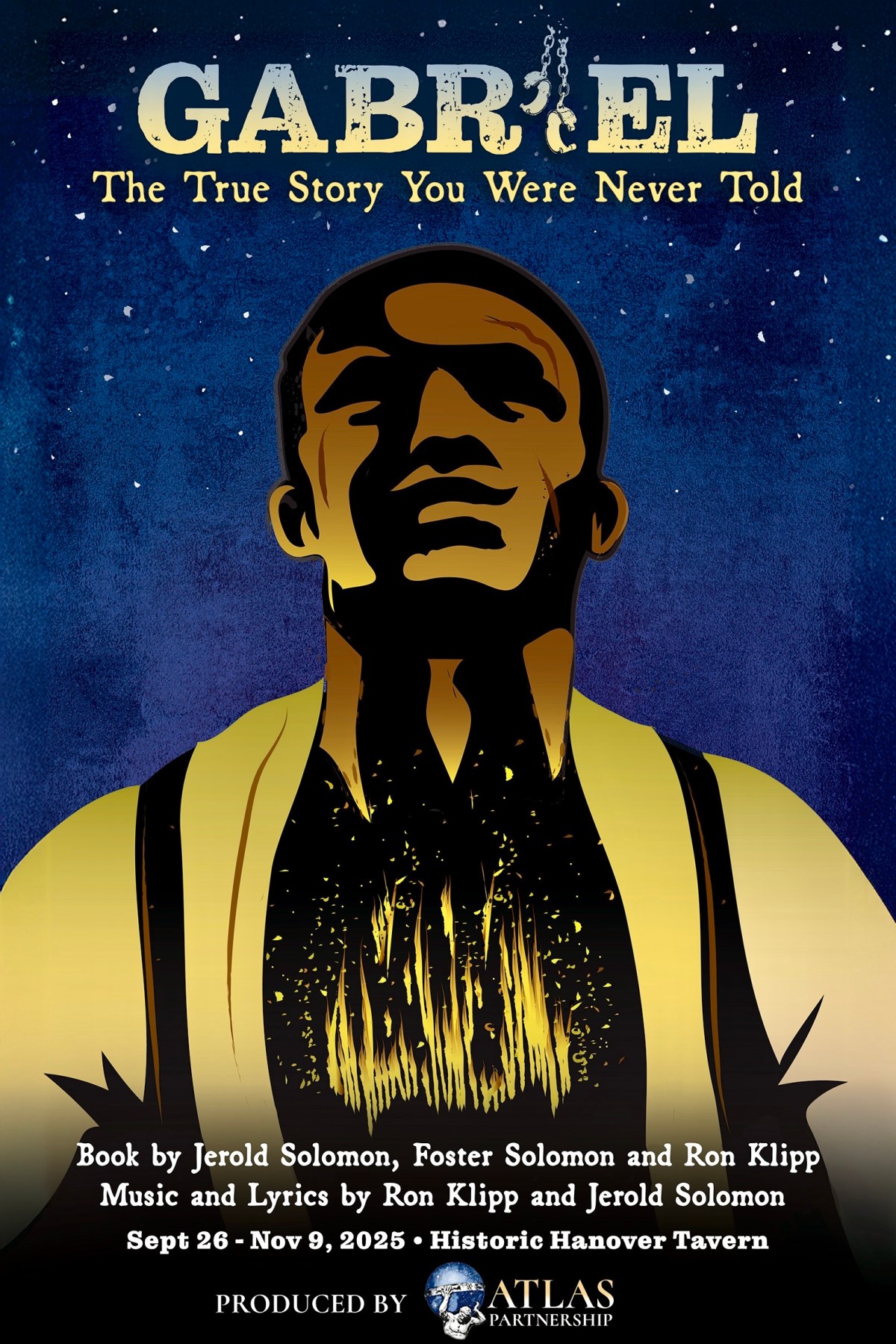
“Death or Liberty”
A Reflection on a History-filled Theater Experience by Julinda D Lewis
Produced by: ATLAS Partnership
At: Hanover Tavern, 13181 Hanover Courthouse Rd, Hanover VA 23069
Performances: September 26 – November 9, 2025
Ticket Price: $49
Info: (804) 310-3493 or https://www.atlaspartnership.org/projects/gabriel or gabrielticket.com
No Justice, No Peace
I Can’t Breathe
Say Their Names
Black Lives Matter
Lost, Buried, Forgotten
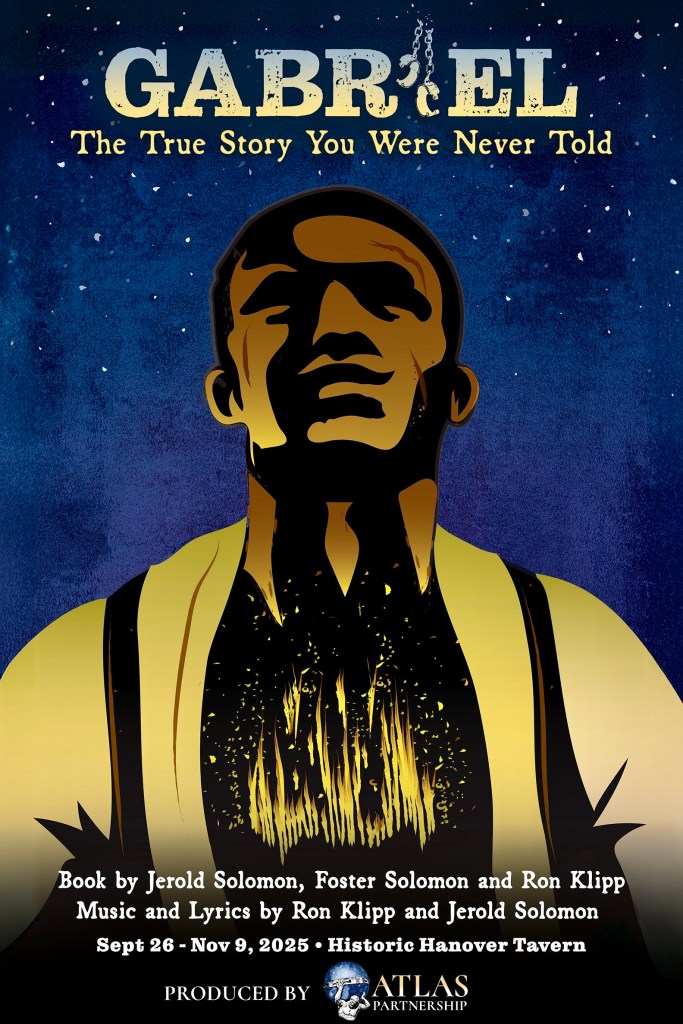
Gabriel: The True Story You Were Never Told, is a powerful deterrent to Lost, Buried, Forgotten. To borrow a tagline from another historically oppressed group of people, Never Forget! Gabriel’s Rebellion of 1800 was such a devastating event that, as co-author and director Foster Solomon says in his Director’s Note, “in its aftermath the government began an active campaign to wipe all knowledge of it from history.” And as we all know, history repeats itself…
Near the end of this fleshed-out and wonderfully revised musical, James Monroe, Governor of Virginia from 1799-1802, insists that Gabriel – pardon me, General Gabriel – needs to be silenced, not because he is dangerous, but because he is right. Just let that sink in a moment – and then reflect on current headlines…In a powerful scene that is as hilarious as it is tragic, a shackled General Gabriel recites Monroe’s own words, striking him with reason and the evidence of his own contradiction.
Monroe, you see, was a staunch advocate of liberty, independence, and a free and educated populace. He served under General George Washington and took a bullet in the shoulder during the Battle of Trenton in 1776. But he, like other founding fathers, believed these ideals applied only to white people. Enslaved people made it possible for him and his family to live in prosperity.
After Gabriel’s Rebellion in August 1800, Monroe encouraged the passage of harsh laws that severely restricted educational opportunities for Black people, the ability of Black people to assemble together, and the movement of free and enslaved Black people within the Commonwealth of Virginia. As a two-term US President (1817-1825) and with the help of the American Colonization Society, Monroe encouraged the “resettling” of free Black Americans to West Africa and used government funds to establish a settlement there which became the nation of Liberia. The capital, Monrovia, was named for him. There’s more, so much more, but let’s talk about Gabriel: The True Story You Were Never Told.
Bracketed by opening and closing scenes of people wearing Black Lives Matter tee-shirts and carrying protest signs, Gabriel resurrects and honors the story of General Gabriel, leader of the largest insurrection of enslaved people in the Commonwealth of Virginia. It was surpassed in size and effect, I believe, only by the Haitian Revolution in the Colony of Saint-Domingue on the island of Hispaniola (1791-1804) and the German Coast Uprising of January 1811 in Louisiana. The Haitian Revolution successful abolished slavery, but at great cost; the people of Haiti have yet to recover from the economic devastation visited upon them by the government of France. A militia and the US Army suppressed the Louisiana Rebellon, leaving the heads of some of the insurrectionists displayed on poles as a warning against future rebellion.
This is not a happy, care-free musical. This is the story of how an enslaved blacksmith – a literate Black man who had learned to read and write alongside the son of his master – became the leader of a movement to end slavery in Virginia. Gabriel’s plan extended over ten counties and the cities of Richmond, Norfolk, and Petersburg. His people had weapons – handmade scythes and muskets they planned to obtain from the prison armory in Richmond. If not for a torrential rainfall the night the plan was to executed and the betrayal of two enslaved men, hoping to obtain leniency and their own freedom, who knows how the history of slavery in Virginia and the US might have been changed on that fateful night.
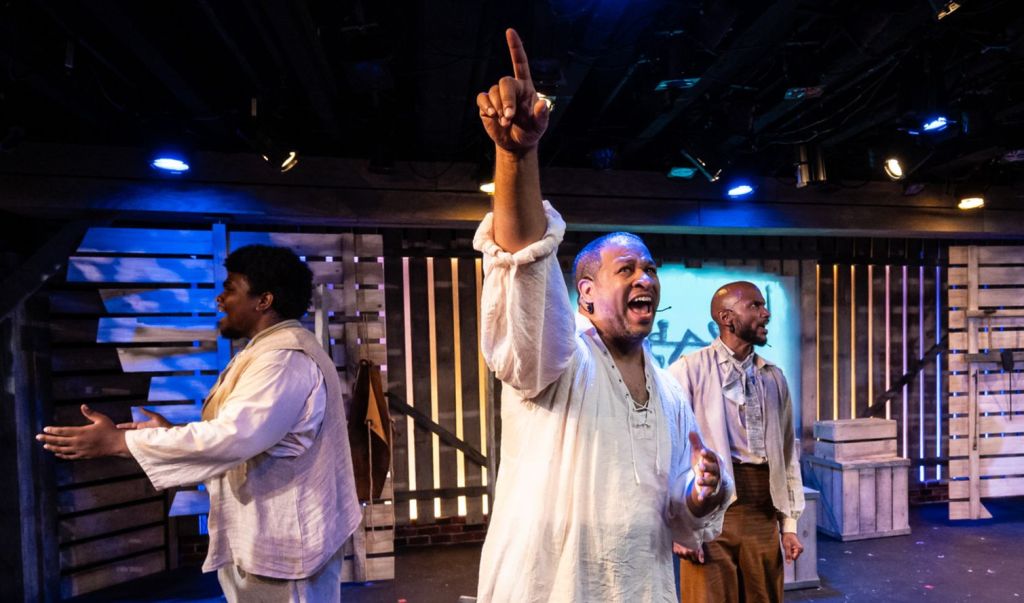
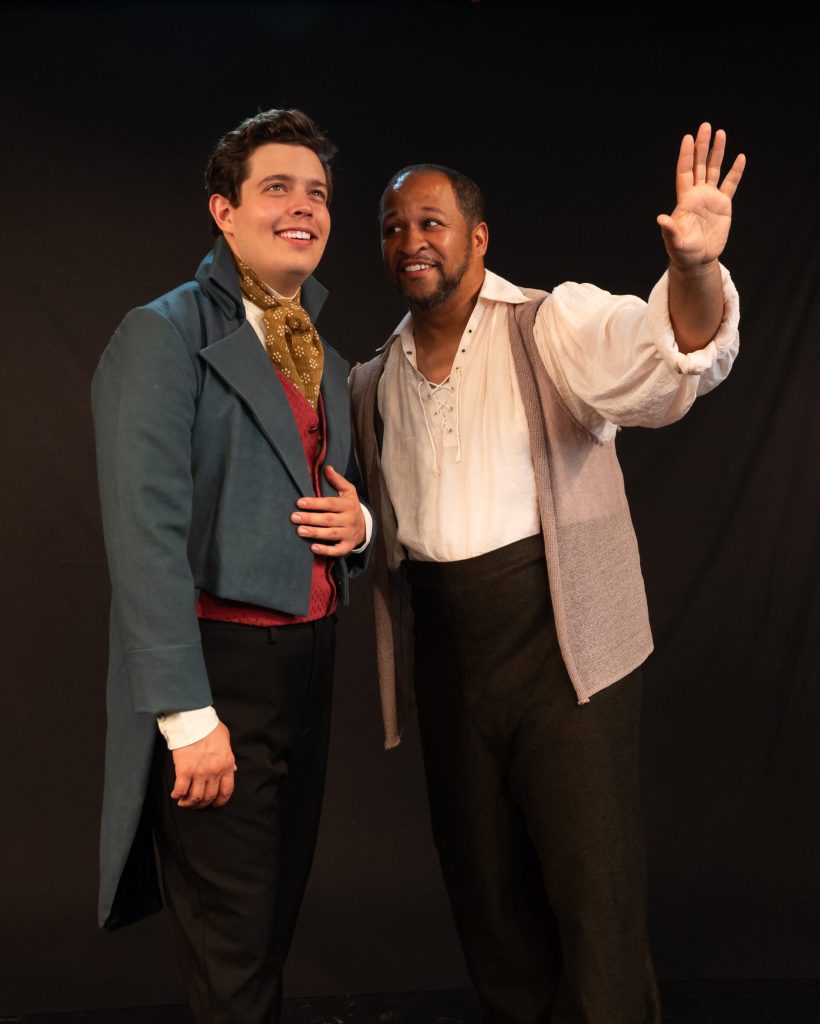
One of the authors, Jerold E. Solomon, plays the role of General Gabriel, an initially reluctant leader whose story, once lost, buried, forgotten, is being retold and taking on even greater significance in light of the chaotic political climate of 2025. One thing of many that stands out is that Solomon does not strut about and puff out his chest as the leader. Instead, he is humble, reluctant, reflective, and admittedly imperfect. This stands in stark contrast to the role of Thomas Prosser, Jr., owner of the Henrico County plantation where Gabriel resides. Joshua Mullins plays the role of Prosser, Jr. with a permanent smirk on his face.
While, at first, we are led to believe that the young Prosser, unlike his father, has some sympathy for the enslaved people under his care, it gradually becomes clear that he was not only weak but complicit and a supercilious liar. Coupled with the portrayal of young Prosser’s fiancée, Lucy (Rebekah Nogueira) as more of a “man” in the patriarchal, arrogant meaning of the word than he will ever be, the white characters are portrayed almost as caricatures, while the enslaved people are more rounded, more nuanced.
Young Prosser is obligated to please first his father then his fiancée and future father-in-law, a judge who presides over the slave courts. Lucy is entitled and steeled for battle; she always gets her way, and her way, as a woman who had barely more legal standing than a Black man in 1800, was to bully her father and fiancé. Both Nogueira and Mullins give excellent performances, but neither character has any redeeming qualities and while separately they are despicable, together they are unbearably cruel. The irony of Mullins singing abut being free was not lost on me – or the rest of the audience for that matter. Great acting, because at the end of the show, I did not want to see either of them; I am sure I would have reacted with disgust!
Among the show’s standouts is David Watkins who played the role of Jack Ditcher, Gabriel’s second-in-command. Watkins is no stranger to Richmond stages, having appeared in Detroit 67 (Firehouse) and Satchmo at the Waldorf and War in Pieces (both Virginia Rep), but something about him seemed so familiar. His fire-stirring speeches to the initially reluctant Gabriel, whom he meets in prison, are essential to the movement of the plot – both literally and figuratively. His admonition to Gabriel to “stoke the fire, feed the flames” was soul-stirring.
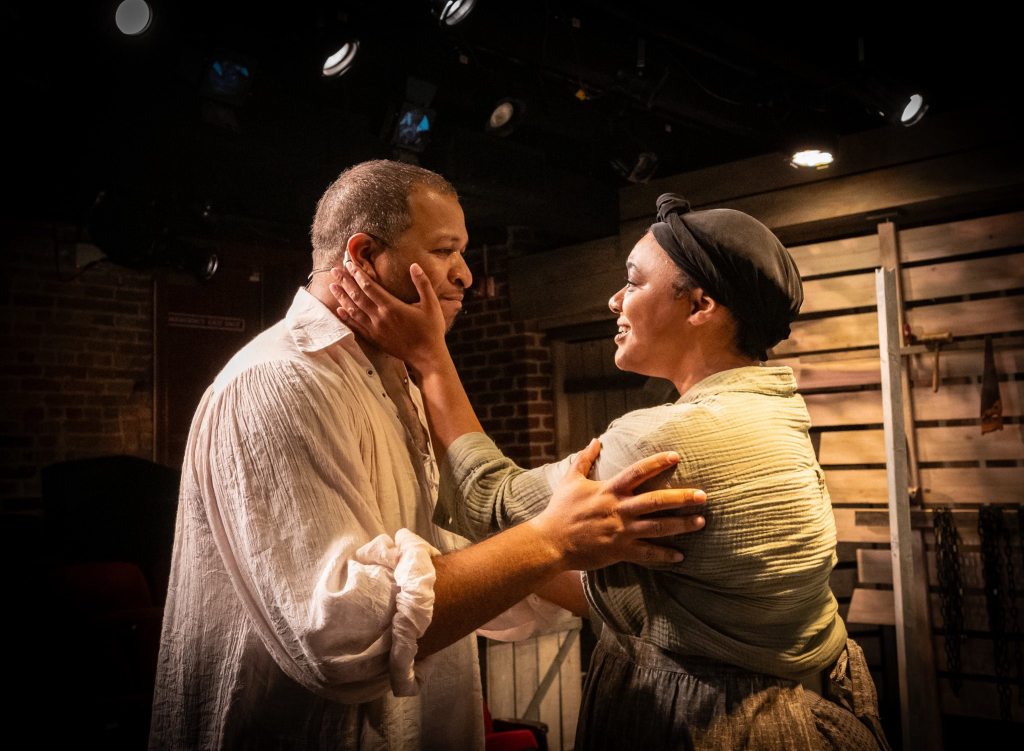
But the performance that was really earth-shaking, for me, was given by Zakiyyah Jackson, who plays Gabriel’s love interest and helpmeet, Nanny. Jackson, who did herself proud in both the Artsies-award winning How Black Mothers Say I Love You (2023) and the more recent Strange Loop (2025), both at Richmond Triangle Players truly outdid herself. Her singing was clear, shattering, heartfelt. She did say, during the opening night reception, that she had been under the weather during A Strange Loop, but this is one of her strongest performances ever. Bravo!
The cast was rounded out by Dale R. Heiskill as Gabriel’s brother Martin, Sydney Graves as Nanny’s siter Delia, and Cameron Caple and Taesean Blanding as Ben and Billy, respectively – young Black men on the plantation. Robert Fix filled the aristocratic shoes of Gov. Monroe while Michael (Mac) McMullen filled the roles of Absalom Johnson (the white man Gabriel was tried for assaulting) and Captain Taylor (who carried Gabriel to a short-lived safety in Norfolk after the failed insurrection) while Rachel Rose Gilmour played the role of Lucy’s (only?) friend and Richmond theater veteran Bev Appleton covered the roles of Thomas Prosser Sr and Lucy’s father, the Judge.
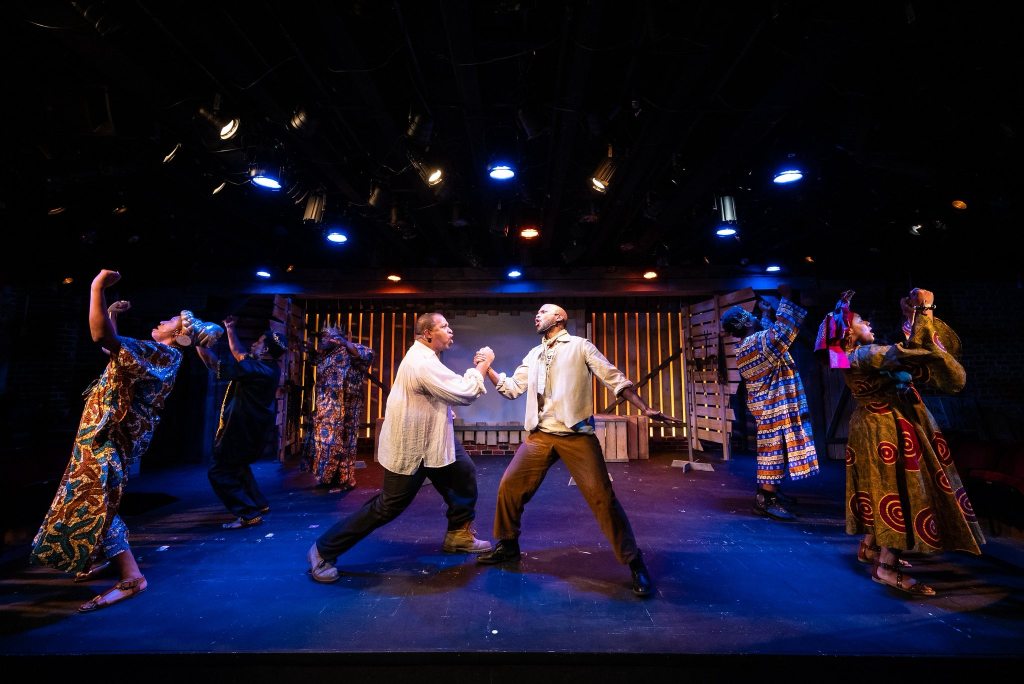
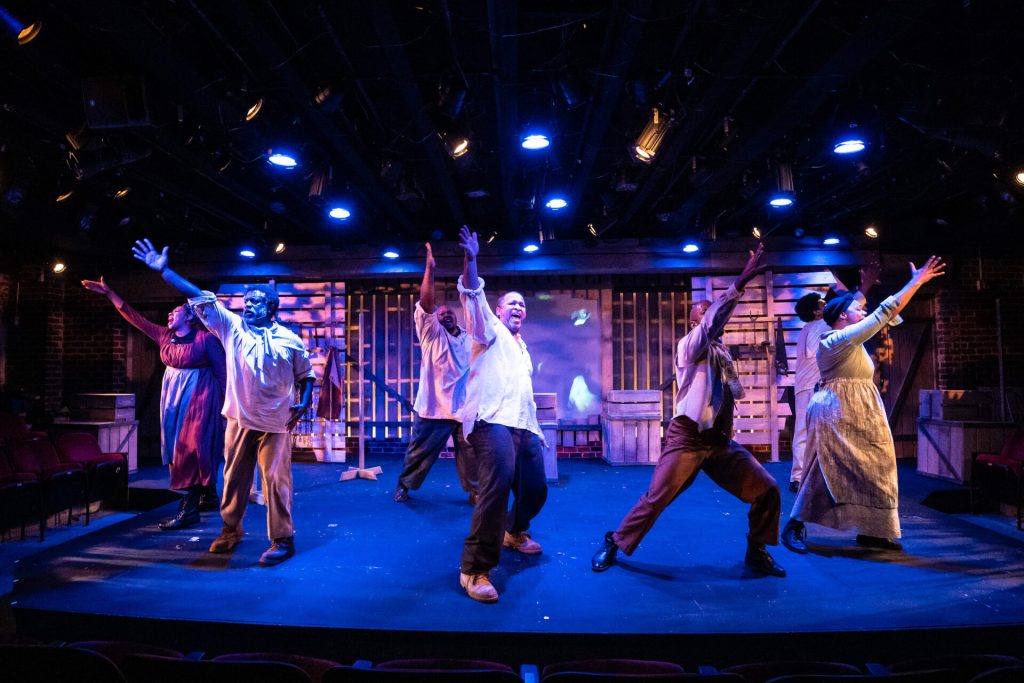
Chris Raintree created a simple, functional set of rough wooden slats that defined Gabriel’s blacksmithing shop and boxes that transformed into all the other furniture needed. This set was beautifully lit by Alleigh Scantling, enhanced Dasia Gregg’s projections, and ensconced in a soundscape designed, I presume, by audio advisor Ron Sinko. Leslie Owens-Harrington, whose choreography has been too-long absent from Richmond stages, contributed movement that was at times organic, at times warrior-like, and sometimes – as when the host of ancestors appeared, entering through all the aisles – reverent.
But this is a musical, and the music was a key component. As I have already stated, the vocals were often memorable, sometimes soaring into the operatic range, but the instrumentals were a constant support and, at times, I wish the band had been visible.
Keith Walker and Sue Griffin dressed the cast to emphasize the sense of opposition. The white people wore beautiful fabrics with neat stitching while the enslaved population wore plain, drab, rough-hewn fabrics. In scenes where the African ancestors appeared, however, the cast was adorned with Kente and brightly colored African prints accessorized with gold jewelry, elaborate head wraps, and even crowns.
The location of the production became an integral part of the show when it was revealed that Hanover Tavern had once housed seven of Gabriel’s followers. Historic signs in the lobby provide additional background, including details of Gabriel’s betrayal by another enslaved man on board the three-masted schooner, Mary, en route to Norfolk on the night of August 30, 1800, the subsequent trials, resulting in twenty-six of the conspirators being condemned to death by hanging – for which the enslavers required reimbursement! – and the steps taken to suppress any further attempts to end slavery. Before his death, one said: “I have nothing more to offer than what General Washington would have had to offer, had he been taken by the British and put to trial by them. I have adventured my life in endeavouring to obtain the liberty of my countrymen and am a willing sacrifice in their cause: and I beg, as a favour, that I may be immediately led to execution. I know that you have pre-determined to shed my blood, why then all this mockery of a trial?”
Death or Liberty.
They meant what they said, and they said what they meant.
—–
NOTE: Read my article, “Gabriel’s Song” for Richmond Magazine, September 9, 2022 https://richmondmagazine.com/arts-entertainment/stage-screen/gabriel-firehouse-theatre/
—–
Julinda D. Lewis is a dancer, teacher, and writer who was born in Brooklyn, NY and now lives in Eastern Henrico County. When not writing about theater, she teaches dance history at VCU and low impact dance fitness classes to seasoned movers like herself and occasionally performs. Julinda was recently awarded the Dean’s Distinguished Adjunct Faculty Award 2023-24 Academic Year by VCU School of the Arts and the 2025 Pioneer Award in Dance Ministry by Transformation International Worship Ministries, Newport News, VA.
—–
GABRIEL: The True Story You Were Never Told
Book by Jerold Solomon, Foster Solomon, and Ron Klipp
Music and Lyrics by Ron Klipp and Jerold Solomon
CAST
Gabriel – Jerold E. Solomon
Thomas Prosser, Jr. – Joshua Mullins
Nanny – Zakiyyah Jackson
Ditcher – David Watkins
Lucy – Rebekah Nogueira
Martin, u/s Gabriel – Dale R. Heiskill
Delia, u/s Nanny – Sydnee Graves
Gov. Monroe – Robert Fix
Ben, u/s Billy – Cameron Caple
Absalom Johnson/Captain Taylor, u/s Thomas Jr – Mac McMullen
Thomas Prosser Sr/Judge – Bev Appleton
Ensemble, u/s Lucy – Rachel Rose Gilmour
u/s Gov Monroe, Prosser Sr, Absalom, Captain Taylor – Matt Bloch
u/s Delia – Jianna Hurt
MUSIC
Music Director, Conductor, Keyboards – Ron Klipp
Assistant Music Director – Billy Dye
Drum/Percussion – Bentley Cobb
Guitar – Jeff Lindquist
PRODUCTION TEAM & CREW
Director – Foster Solomon
Resident Historian – Prof. Ana Edwards
Pastoral Advisor – Rev. Dr. Rodney D. Waller
Set Design – Chris Raintree
Co-Costume Design – Keith Walker & Sue Griffin
Lighting Design – Alleigh Scantling
Audio Advisor – Ron Sinko
Choreography – Leslie Owens-Harrington
Music Direction – Ron Klipp
Projection Design – Dasia Gregg
Technical Director/Production Management – Bill Jenkins
Stage Management – Shawanna Hall
Assistant Stage Management – Tariq Karriem
For This Production:
Light Board Operator: Shawanna Hall
Sound Board Operator: Steve Jones
Sound Board Operator Standby: Mike Jones
Wardrobe Assistant: Tariq Karriem
House Manager: Gina Maria McKenzie, Aubrey Mitten
Hanover Tavern Executive Director: David Deal
Hanover Tavern Associate Director: Brooke Adams
Performance Schedule:
September 26 – November 9, 2025. Previews Sept 26, 28 & Oct 2. Opening Night October 3. Performances Thursdays, Fridays, Saturdays @7:30PM and Sundays @3:00PM. Pay What You Will October 9. Wednesday Matinee October 22 @2:00PM
Tickets: $49. Group Discounts available.
Information: (804) 310-3493 or https://www.atlaspartnership.org/projects/gabriel or gabrielticket.com
Run Time: about 3 hours, with one 15-minute intermission
Setting: Thomas Prosser’s Plantation in Henrico County, VA and in and around Richmond, VA and Norfolk, VA, 1799-1800
Premiere: Gabriel the Musical was originally developed and produced at Firehouse Theatre, Richmond, VA, September 2022. https://richmondmagazine.com/arts-entertainment/stage-screen/gabriel-firehouse-theatre/
Photos: Aaron Sutton
Make a one-time, monthly, or annual donation to support rvart review
Make a monthly donation
Make a yearly donation
Choose an amount
Or enter a custom amount
Thank you! Your contribution is truly appreciated.
Your contribution is appreciated.
Your contribution is appreciated.
DonateDonate monthlyDonate yearly
 RVArt Review