
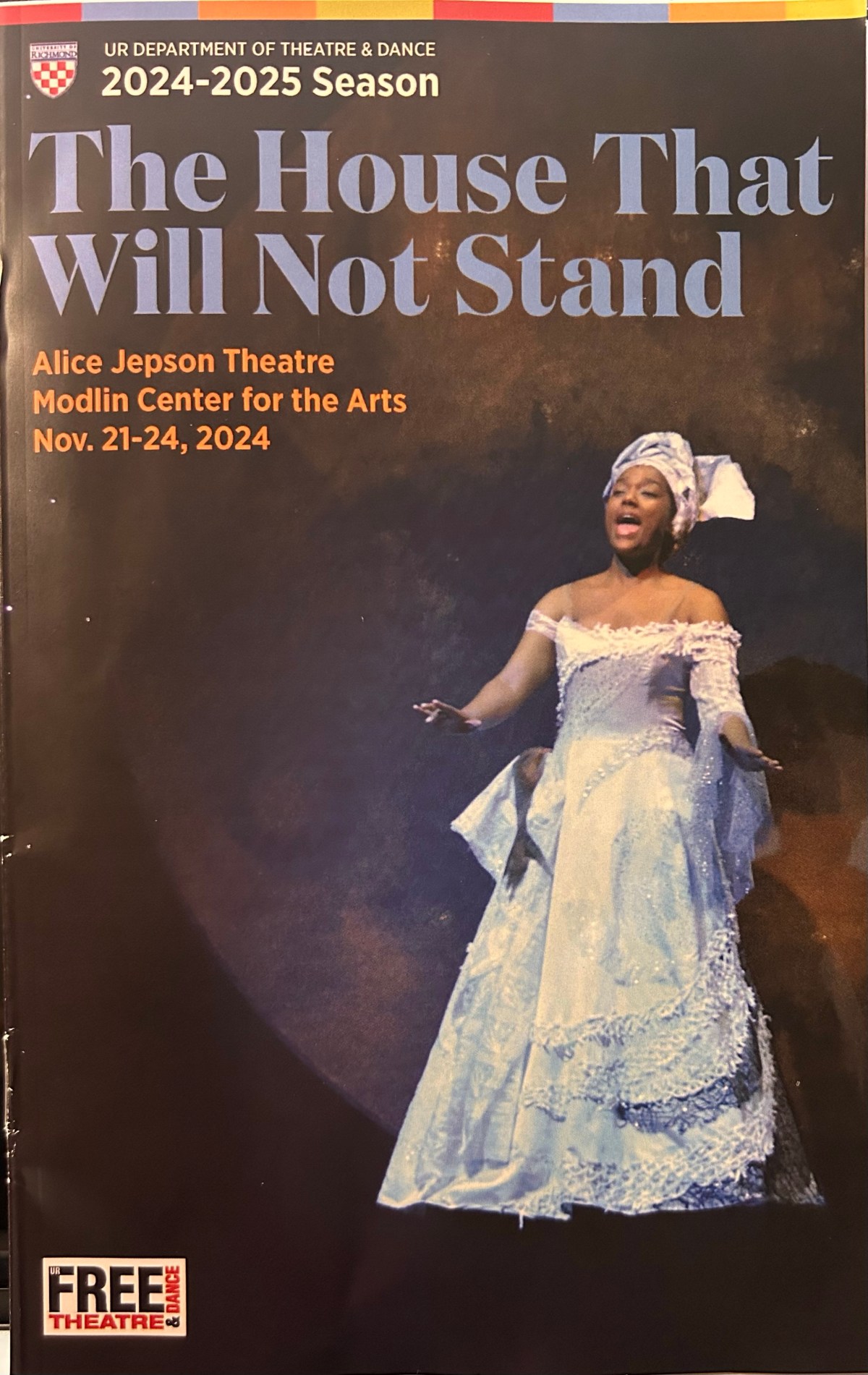
You May Be the Wealthiest Colored Woman in New Orleans, But You Built This House on Sand
A Theater Reflection by Julinda D. Lewis
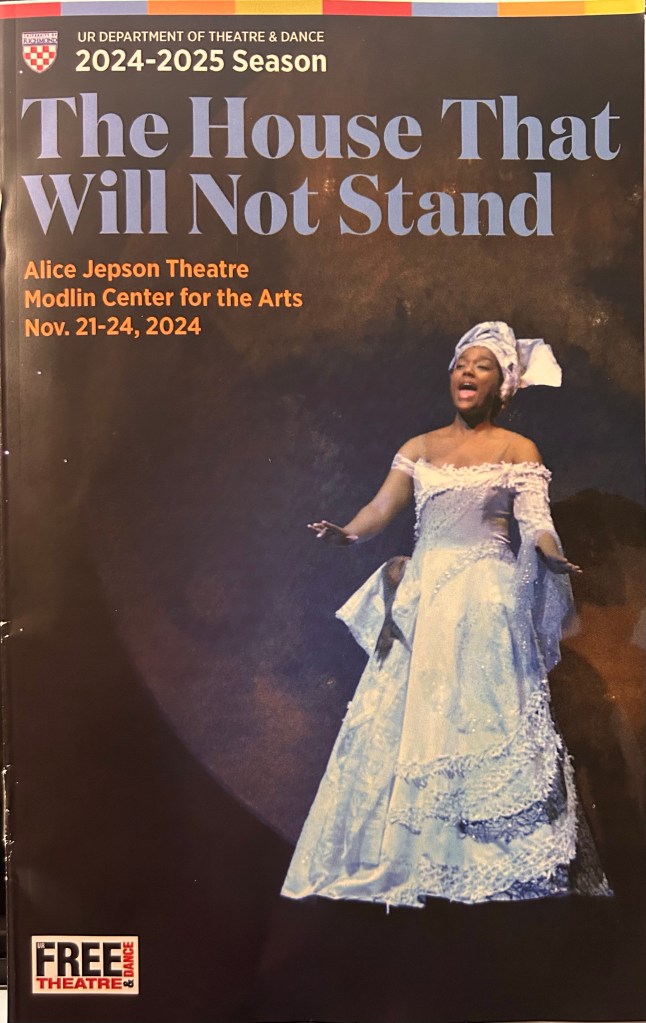
Produced by: UR Free Theatre & Dance
At: Alice Jepson Theatre, Modlin Center for the Arts, 453 Westhampton Way, University of Richmond, VA 23173
Performances: November 21-24, 2024
Ticket Prices: FREE
Info: (804) 289-8980 or modlinarts@richmond.edu
———-
This play was not on my radar – my list of local 2024-25 productions to view for consideration for the Richmond Theatre Community Circle awards, but at the last minute I heard about it from people whose opinion I trust, and I realized I had time in my often complicated schedule to see the very last show. I am so glad I did.
I learned a lot from this 19th century historic drama – a tale that is so very relevant today. This household of free Creole and enslaved Black women in New Orleans on the cusp of the transfer of the Louisiana territory from France to the USA redefines what it means to be free. A lengthy quote from director Lucretia Marie Anderson seems appropriate here:
In my initial reading of this play, I was transported back to that sense of grief and longing that pervaded the household of Bernarda [Alba, by Federico Garcia Lorca] and the stark and witty differences in how Gardley infused his memories from his own upbringing by resilient, resourceful, catty, joyful, spiritual, and heartbroken Black women in New Orleans. Creating the world in which the women in this play exist has been an honor and a collaboration with all of the magic we could muster.
This is a hauntingly beautiful play that captures the power, the magic, the tragedy, and the strength of the recently widowed Beartrice Albans and her three daughters: Maude Lynn [run the names together, without a breath], the pious one, Odette, the dark one, and Agnès, the one most desperate to break away.
Even the supporting characters all hold major roles: Makeda is the Haitian slave of Beartrice, La Veuve is Beartrice’s catty arch enemy, and Marie Josephine is Beartrice’s “crazy” sister who is kept hidden away in the attic. A most unusual central figure – the leading man, one might say, is Lazare Albans, the deceased white man who was Beartrice’s lover and the father of her three daughters. Lazare, who died just hours ago as the play begins, holds a prominent position as a corpse resting in state on the family’s dining room table.
To understand The House That Will Not Stand, one needs to know a bit about New Orleans cultural history. There was a practice, prevalent from the 1600s to the 1800s) known as plaçage. A way to circumvent the laws preventing interracial marriages, plaçage allowed free women of color (light-skinned Black, mixed race, Creole) to set up households with their white lovers. Unlike common-law marriages or strictly commercial exchanges, like prostitution plaçage provided the women with homes, acknowledged the children, and assigned some contractual rights to income, property, and even limited rights to inheritance.
In The House That Will Not Stand, not only is Beartrice’s family under attack, but the entire system is about to fall. The transfer of the Louisiana Territory to US law will mean that free women of color, who owned property and even slaves of their own – would be subject to be sold into slavery. For Beartrice, the attack was more immediate Lazare’s white wife, whom he apparently never legally divorced, has the legal right to claim his house and property simply because she is white. His will, leaving his estate to Beartrice and his daughters, has little no bearing under US law – and this is one of the places where the past seems to overlap with the present.
While Beartrice is fighting for her daughters – adamant that they should not be sold into the plaçage system, her daughter Agnès sees the arrangement as a way to meet a handsome lover and escape the tight discipline of her over-bearing mother While Beartrice is fighting for her own freedom, her house servant, Makeda is fighting for her own freedom. Beartrice has repeatedly reneged on her promise to sign Makeda’s manumission (freedom) papers. While Beartrice is fighting for her freedom, and that of her daughters, and Makeda is hellbent on walking away from slavery, Beartrice’s own sister is imprisoned in the attic – apparently for the “crime” of loving a Black man, a drummer.
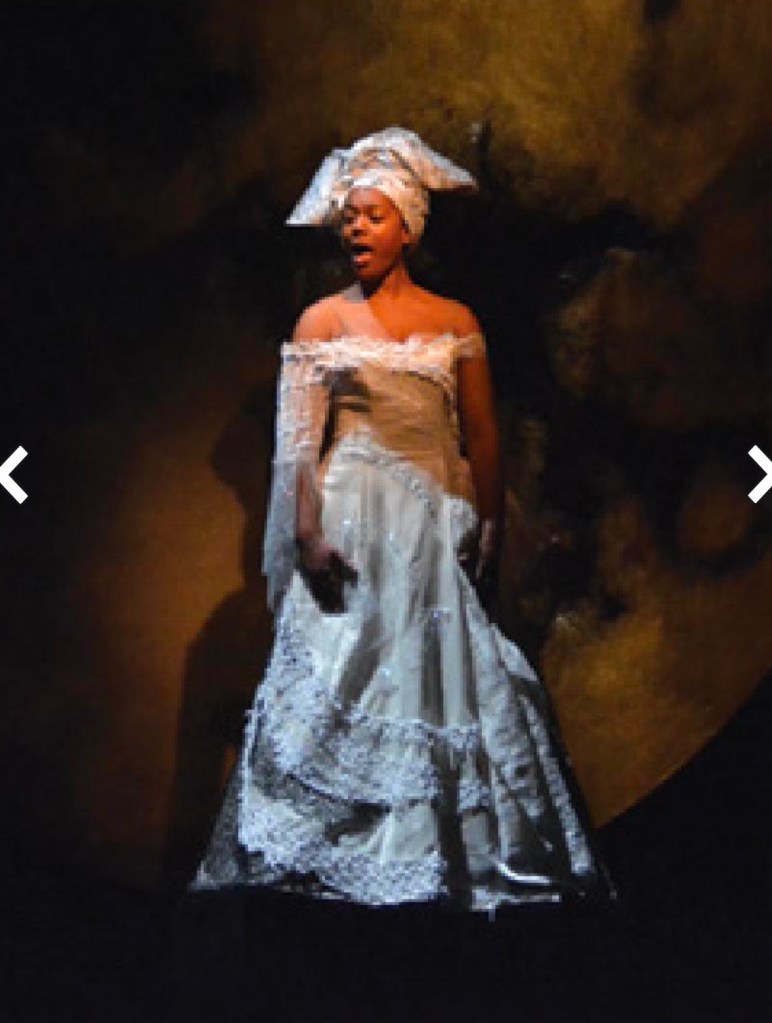
An intricate, multi-leveled set and absolutely stunning costumes supported this cast of strong, beautiful women. Dr. Tiffany (Doc) Jana wore the role of Beartrice Albans as if it were a mantle bestowed upon her by the ancestors. Nia Simone was beautiful and cunning as the eldest sister, Agnès, who seemed to be cracking under the social pressure to be “placed” well. Melanie Sanchez was adept at covering Maude Lynn in a façade of syrupy sweetness that, in the end, failed to completely sheath her claws. Mikaela Craft was heartbreakingly naïve as the beautiful younger sister who was burdened with the “curse” of having darker skin than her sisters and mother.
I wouldn’t be mad with Zakiyyah Jackson if she tried to claim the title of lead for her role as what I would dare to describe as the twice-enslaved Makeda (twice, because she was held as chattel by another woman of color). Marjie Southerland, the attic dwelling sister, Marie, found freedom only by dancing off into the arms of her deceased lover, never to be seen again – and no one else in her house seemed to find that odd? Makeda had her black bag of tricks, but Marie’s magic may have been more powerful, as it was all in her mind and the swing of dancing hips. Shalandis Wheeler Smith brought the tea, the laughs, and stirred up the trouble as the catty La Veuve. But no matter how messy she tried to be, Beartrice was able to match her, word for word, without batting an eye. These women may have been dressed as genteel ladies, but underneath their bustle and layers of lace, they were tough as nails and twice as hard.
I unknowingly selected the perfect seat, an aisle seat in the last row, where the actors made entrances and exits, where the masked drummer appeared, and where Marie flew off to find her final freedom.
Lazare was also a constant presence. While his body lay cooling on the dining room table – a practice I have heard of, but never experienced – he did make an appearance as an apparition in the mirror when Makeda, at Marie’s request, allowed his spirit to possess her body to confirm the true cause of his death. Let’s just say that when a woman who doesn’t normally cook offers you a pie, don’t eat it.
There was so much history and culture to process in these two hours: the whole social system of plaçage, the body in the dining room, the covered mirrors, the aunt in the attic, the colorism and caste system, the Creole balls, the white wife and the colored mistress, a woman seeking freedom in a relationship with a man who could never see her as an equal, the fear of the approaching Yankees, the fear of losing a familiar way of life, a preference for the devil you know rather than the uncertainty of the devil you only know of…What does freedom look like to you?
What an amazing household, and how deftly they were managed for an immersive viewing experience by Lucretia Marie Anderson. Gardley has written a masterful collaboration of drama, humor, family dynamics, tragedy, history, social (in)justice, liberation, and magic. This is a work that deserves to be seen by a larger audience. I can only imagine what a life-affirming and yet draining experience it must have been for the cast.
———-
Julinda D. Lewis is a dancer, teacher, and writer who was born in Brooklyn, NY and now lives in Eastern Henrico County. When not writing about theater, she teaches dance history at VCU and low impact dance fitness classes to seasoned movers like herself, and occasionally performs. Her most recent (ad)venture was the premiere of a solo work, The Waters of Babylon or Psalm 137 Revisited: a Post-Exodus Reflection in Movement Choreographed From Collective Memories for the debut of the Critical Race Theatre Project, right here at RTP in August 2024.
———-
THE HOUSE THAT WILL NOT STAND
By Marcus Gardley
Directed by Lucretia Marie Anderson
Cast
Dr. Tiffany (Doc) Jana … as Beartrice Albans
Nia Simone …… as Agnès Albans
Melanie Sanches …… as Maude Lynn Albans
Mikaela Craft …… as Odette Albans
Zakiyyah Jackson …… as Makeda
Shalandis Wheeler Smith as La Veuve
Majie Southerland …… as Marie Josephine
Bill Blair …… as Lazare
Production & Design
Playwright …… Marcus Gardley
Director …… Lucretia Marie Anderson
Scenic Design …… Emmy Weldon
Costume Design …… Johann Stegmeir
Lighting & Sound Design Maja E. white
Vocal Direction & Composition
…… Mara Smith
Choreography …… Deandra Clarke
Production Stage Management
…… Holly Trenbath
Assistant Stage Manager Leland Solesby
Drummer …… Austin Martin
Props Crew …… David Hensley, Leah Marchetti
Board Operators …… Jerry Chen, Charlotte Donelan,
Tina Li, Louisa Stringer, Gareth Woo
Run Crew …… Gabrielle Lindsay, Leah Marchetti
Wardrobe Crew …… Chuhan Fang, Taylo Harris, Maddi Lewis
Director of Costume …. Heather Hogg
Technical Supervisor & Fight Choreographer
…… Phil Hayes
Technical Assistant …… Tomya Pryor
Lighting & Sound Supervisor
…… Robby Williams
Guest Costume Artists Tinia Crider, Robyn Gebhart, Karl Green,
Susan Rich
Costume Shop Staff ….. Eliza Hummerstone, Jaize Francis, Alisha Tosto,
Michael Florentin
Electrics Crew …… Alex Broening, Connor Smith, Bonny Bruzos
Scene Shop Staff …… Hope Amberger, Fitch Melson, Jake Litman,
Megan Montoya
Scene Shop Assistants .. Patrick Michael, Cameron Peterson, Felicia Chen
Scenic Artists …… Tyeon Ford, Leah Marchetti, Darcel Pham
Scenic Carpenters & Painters
…… Jonathan Beagle, Jaleel Grinnage, Taylo Harris,
Rachell Lee, Jason Liang, Ly Nguyen, Vanessa
Romero, Louisa Stringer, Zachiah Zook
Production Manager & Dialect Coach
…… Erica Hughes
Poster Design …… Jeane Minnix
Setting & Time
The home of Beartrice, a free colored woman, New Orleans, Louisiana Territory,1830s
Run Time
Approximately two hours, with one intermission
Schedule of Performances
Thursday, November 21, 7:30PM
Friday, November 22, 7:30 PM
Saturday, November 23, 7:30PM
Sunday, November 24, 2:00PM
Ticket Information
FREE, Reservations Required.
Info: (804) 289-8980 or modlinarts@richmond.edu
Photo Credit
Unavailable

Make a one-time donation
to support RVART Review (jdldances)
this publication is a labor of love
and exists only with your donations
Make a monthly donation
Make a yearly donation
Choose an amount
Or enter a custom amount
Your contribution in any amount is greatly appreciated.
Your contribution is appreciated.
Your contribution is appreciated.
DonateDonate monthlyDonate yearly
 RVArt Review