
One Door Closes, Another Opens
A Dance Review
By: The Richmond Ballet
At: The Richmond Ballet Studio Theatre, 407 E Canal St, RVA 23219
Performances: September 17-22, 2024
Ticket Prices: $25 – $51
Info: (804) 344-0906, etix.com, or richmondballet.com
THE PROGRAM
EN CHALANT
Choreography by Ma Cong
Music by Nils Frahm, Hauschka, and Jóhann Jóhannsson
Costume Design by Rebecca Turk
Lighting Design by Trad A Burns
World Premiere: September 17, 2024, Richmond Ballet, Richmond Ballet Studio Theatre, Richmond, VA
WHAT’S GOING ON
Choreography by Val Caniparoli
Music by Leonard Cohen, Bob Dylan, Marvin Gaye, Meanie, Buffy Sainte-Marie, Jimmie Rodgers, Pete Seeger
Assistant to the Choreographer: Maiqui Manosa
Staged by Jerri Kumery
Costume Design by Susan Roemer
Lighting and Projection Design by Trad A Burns
Music Research by Lauren Morrison
World Premiere: May 10, 2022, Richmond Ballet, Richmond Ballet Studio Theatre, Richmond, VA
Fifteen years ago Ma Cong presented his first work for the Richmond Ballet as a guest artist participating in the company’s annual New Works Festival. This week, he presented his first full length work as the newly installed Artistic Director of the Richmond Ballet.
“En Chalant,” a work he described as “the complete opposite of nonchalant” is an abstract ballet that takes its inspiration from the music – in this case a selection of contemporary classic compositions by three composers, two German and one Icelandic, known for their contemporary classic work infused with elements of electronic music or, in one case, prepared piano.
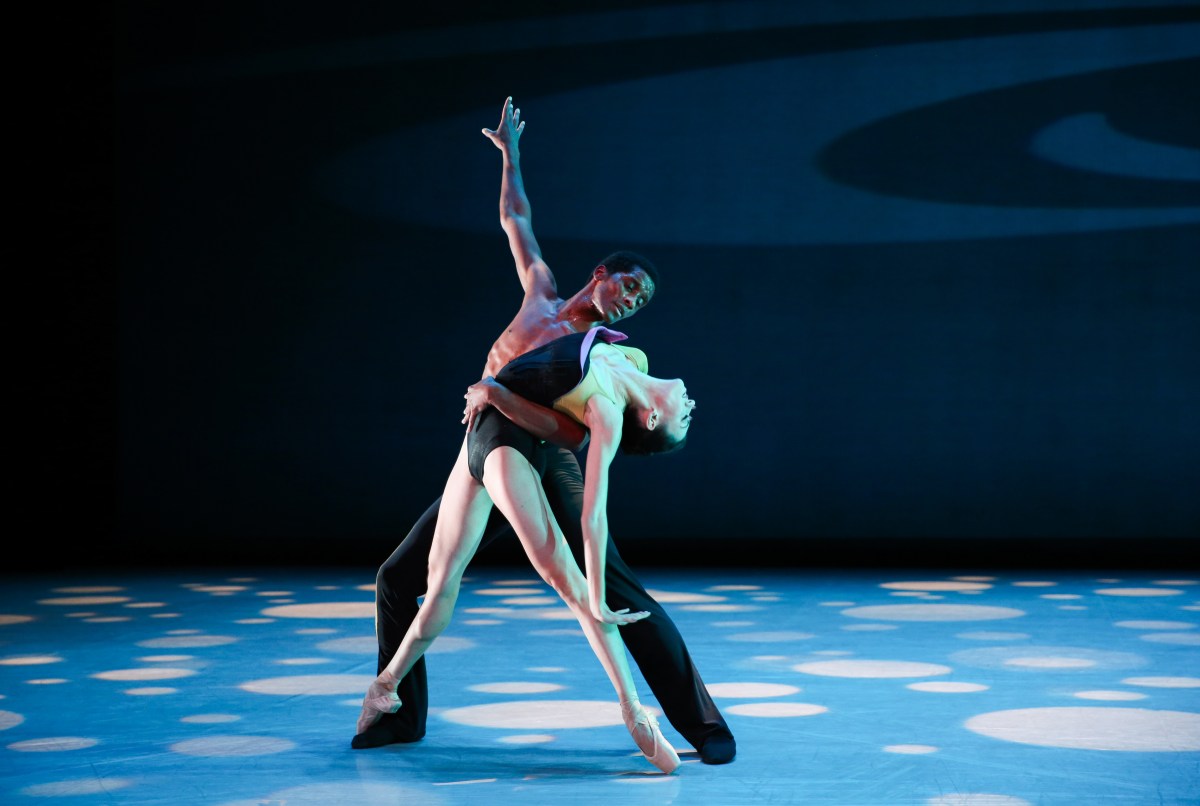
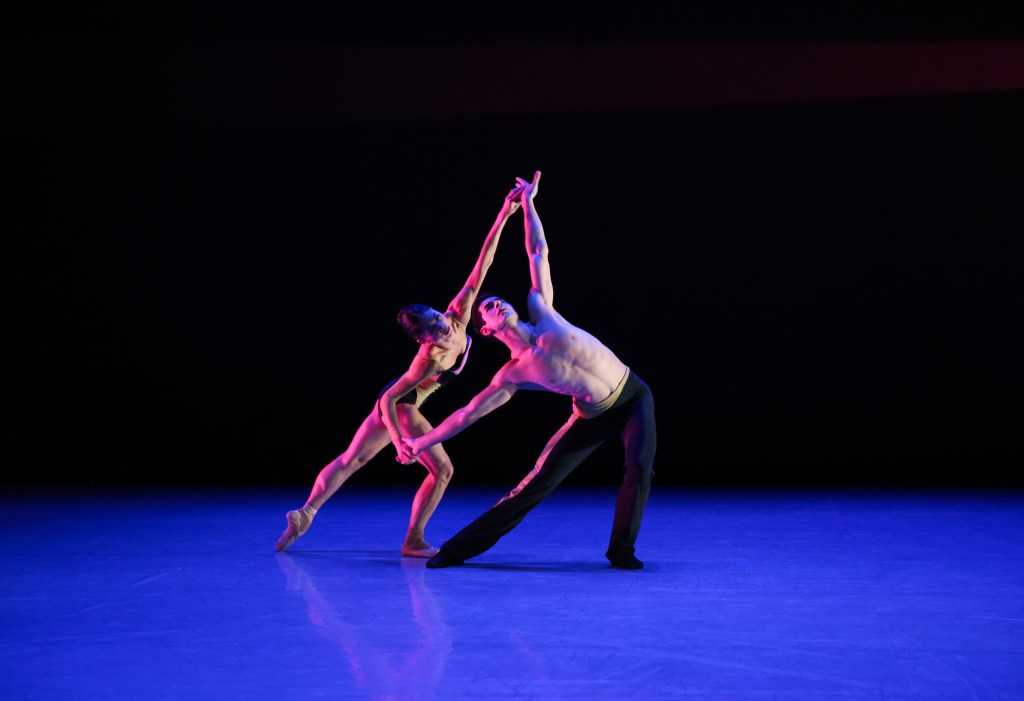
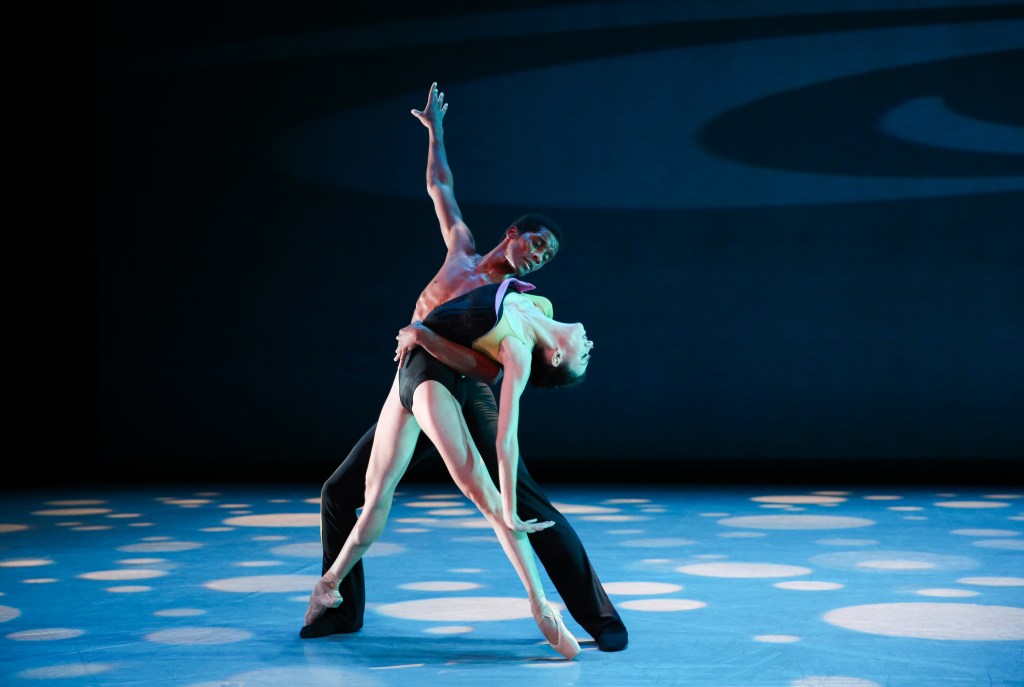
In Ma’s own words, “En Chalant” is an exploration into “the deeply human feeling of seeking connection through the shared experience of music.” To the viewer, it is a stunningly beautiful work with its simple black and nude costuming that praises the human form. Designer Rebecca Turk explained that the limb-lengthening design – featuring a soft sculpted neckline for the women and bare chest for the men – was inspired by the lines of the calla lily. Abstract, elegant, and edgy was the goal and the achievement. Trad A. Burns took his cue from the music and movement in designing the lighting that started off as a sort of wavy sun burst that evolved throughout the development of the dance, eventually returning to its original shape. “I hear music in color,” he said during the opening night post-performance discussion.
The first movement, “Radar,” by Volker Bertelmann who performs under the name Hauschka, floods the stage with motion – quick, winding, lively, purposeful, yet lighthearted. The second section, set to the music of Nils Frahm, “Some,” strives to achieve new shapes in partnering. Ma succeeds in bringing the music to human form, combining both classical and contemporary elements of the music and dance.
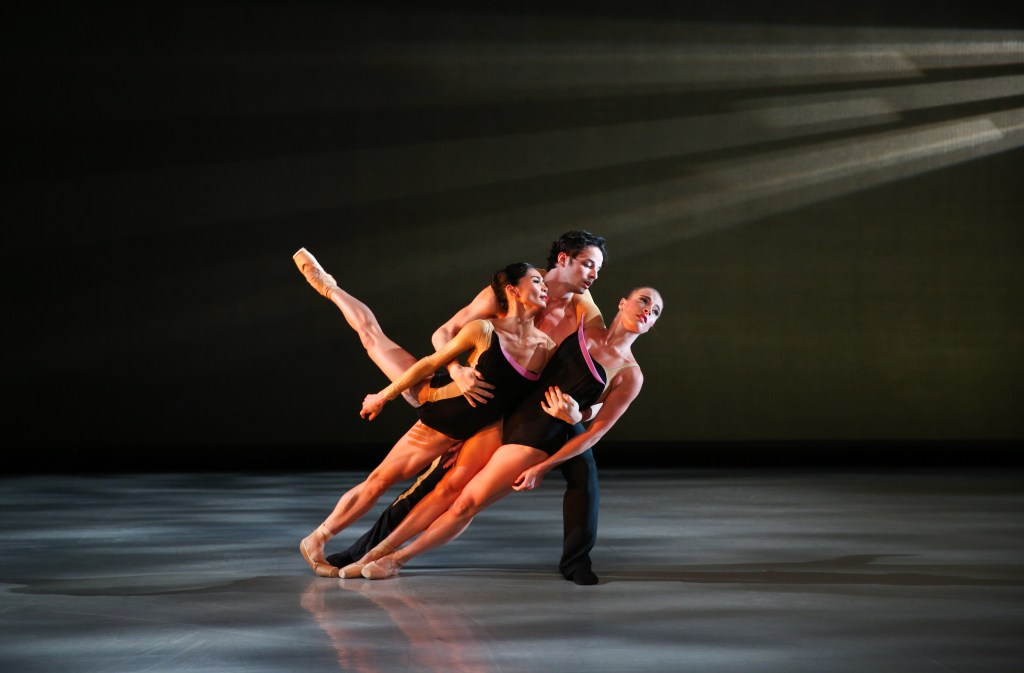
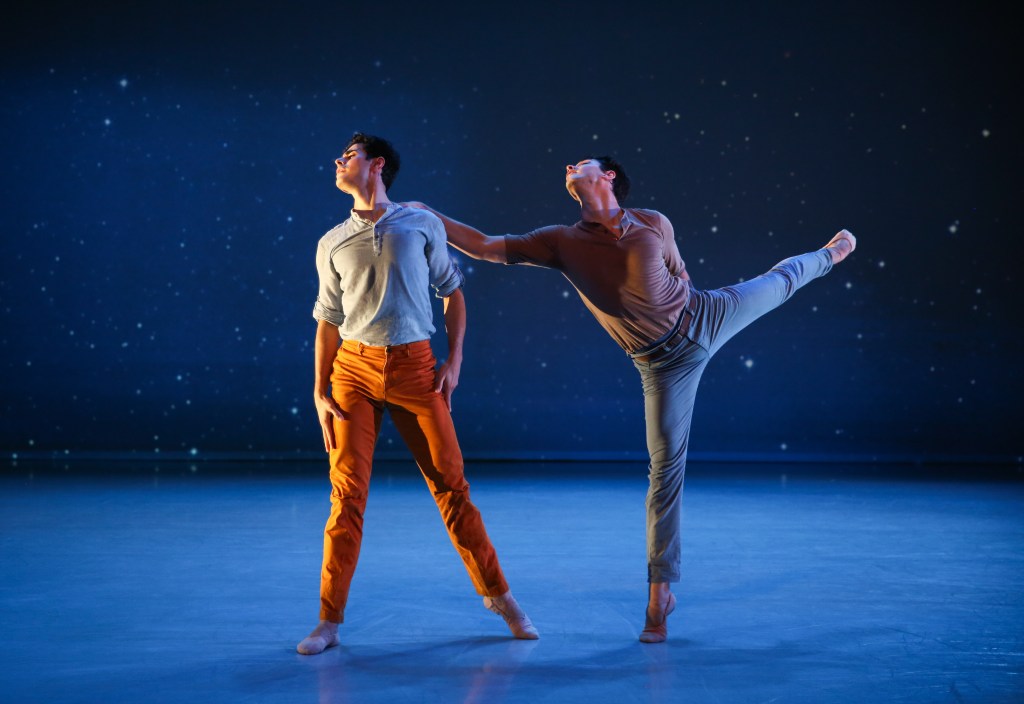
In the third section, performed to Jóhann Jóhannsson’s “Payphone,” further explores partnering, extending to a trio that somehow still manages to feel like a duet, as when Aleksey Babayev seemingly effortlessly supports Eri Nishihara and Celeste Gaiera in tandem. By the fourth movement, Burns’ projection has evolved from a sunburst to a single horizontal shaft to four radiating bars, to a galaxy – an animated swirl of not-quite concentric not-quite circles. The piece turns somewhat moody, somewhat futuristic, and I thought I heard a thunderclap in the distance near the end of Jóhannsson’s “The Rocket Builder (Lo Pan!).”
For the final section, Ma returns to Bertelmann/Hauschka and Burns resurrects the original sun ray and bathes the stage in a golden glow. Classical ballet lines both blend and contrast with quirky contemporary shapes and movements: big and open versus small and inward, sort of like if Balanchine met Fosse.
WE NEED LEADERS NOT IN LOVE WITH MONEY BUT IN LOVE WITH JUSTICE. – MLK, Jr.
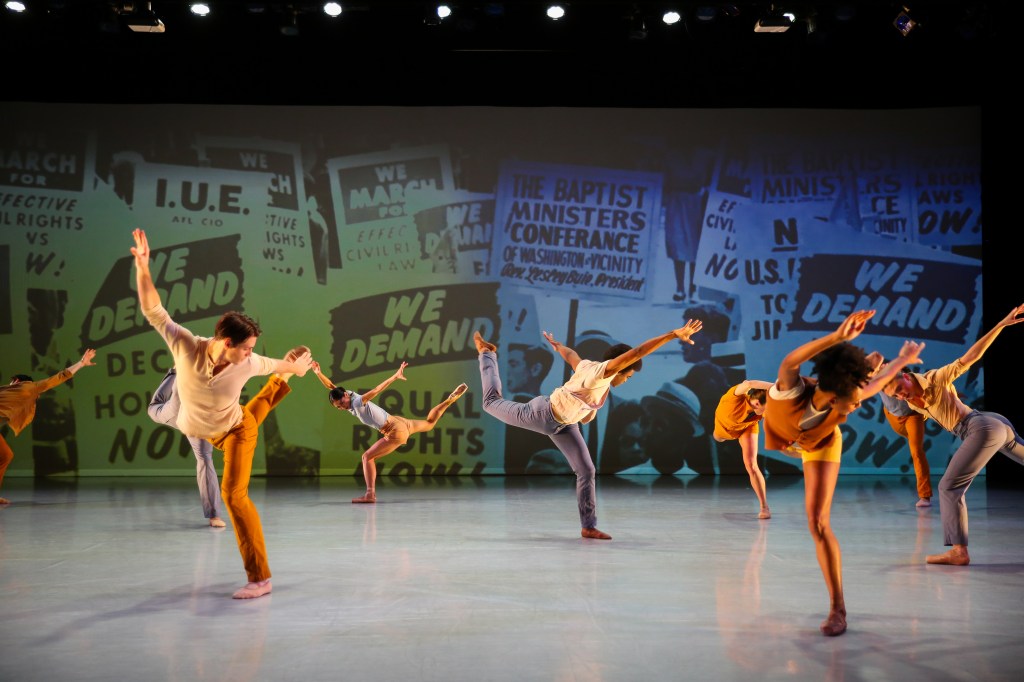
The second half of the program saw the return of Val Caniparoli’s “What’s Going On,” a contemporary work that begins and ends with quotes by the Rev. Dr. Martin Luther King, Jr. and features protest songs and music by artists familiar to those of us who were in high school during the final years of the Vietnam war: Marvin Gaye’s “What’s Going On,” Buffy Sainte-Marie’s “Little Wheel Spin and Spin,” Melanie’s gospel-folk protest song from Woodstock, 1969 “Lay Down (Candles in the Rain),” Bob Dylan’s “All Along the Watchtower,” which became Jimi Hendrix’s biggest hit, as well as his “Things Have Changed,” Pete Seeger’s “Where Have all the Flowers Gone?” and more.
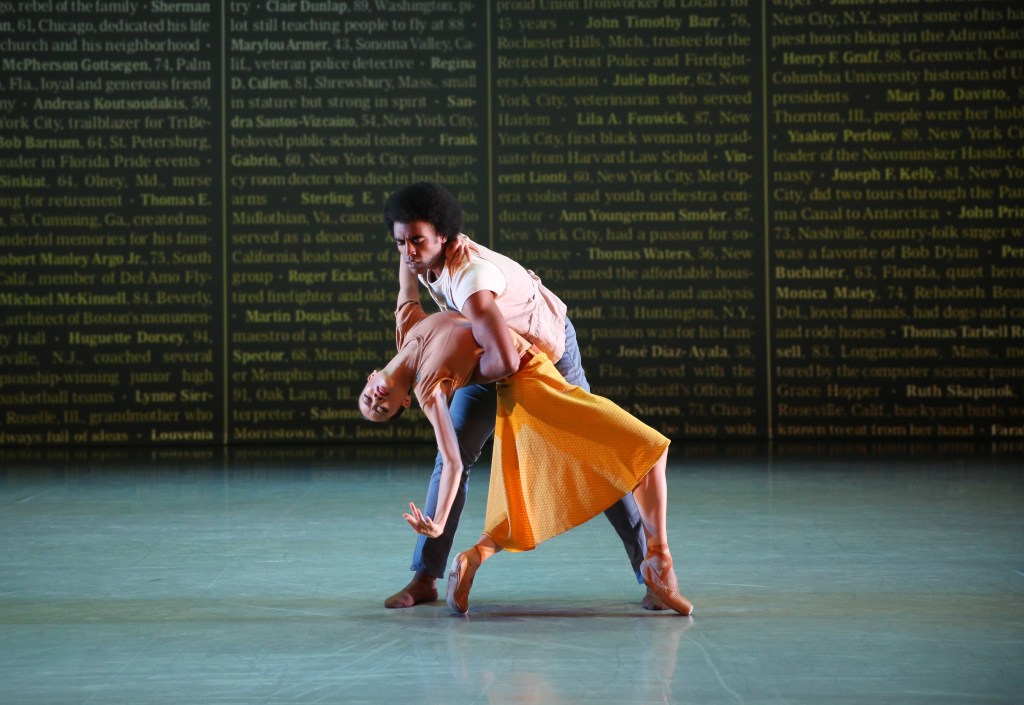
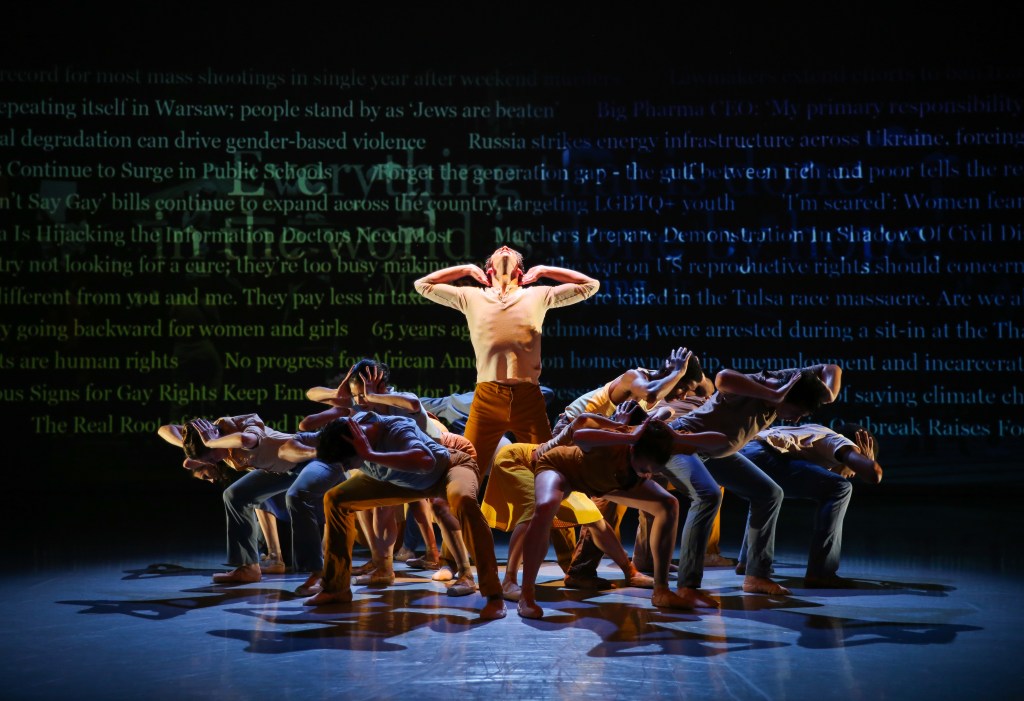
While the soundtrack is from the hey day of the Boomer generation, the subject matter spans decades and generations: the Civil Rights movement, AIDS, COVID-19, forest fires, climate change, equality, equity, decent housing, measles, childhood vaccines, the pandemic of 1918, Woodstock, big pharma, the Tulsa race massacre, the war on reproductive rights, the murder of trans people, the hanging of a man in Iran for being homosexual, the list goes on…And yes, there is a list – a projection of news articles, photos of anti-war protestors. This is the backdrop for Caniparoli’s “exploration of the modern human experience,” a work that uses music, visual images, and a blend of ballet, contemporary dance, and social dance to remind us of where we came from, and stirring up memories for some and planting the seeds of history in others. Dressed in everyday clothing, with lots of denim and a subdued brown – lighter than brown but deeper than tan – in various styles from skirts and dresses to shorts and jumpsuits, the dancers march, leap, stride.
In one striking scene, Izabella Tokev performs a tortured solo, to Pete Seeger’s “Where Have All the Flowers Gone?” as Alejandro Marino Hechavarria (how I love to say that name) and Ira White stride backwards in a low lunge across the back of the stage and as the song ends she slides into a prostrate position that mirrors the projection of a woman stretched forlornly across the grave a soldier who was returned home in a wooden box.
There is much to hear, see, and think about in “What’s Going On?” Caniparoli may have intended the final song, Bob Dylan’s “Things Have Changed” and the full group finale as an uplifting, hopeful conclusion, but are we really there yet? This work is dynamic and moving yet at the same time disturbing. In some ways, it reminds me of the group works created by Talley Beatty (e.g., “The Road of the Phoebe Snow”) and Donald McKayle (e.g., “Blues Suite”) and other creative expressions of embodied resistance in the 1950s and 1960s and beyond, but that would take us into a discussion of cultural identity and appropriation versus appreciation, and that’s a whole other article.
This is the kind of work that deserves a post-performance discussion – every single time it is performed.
EVERYTHING THAT IS DONE IN THE WORLD IS DONE BY HOPE. -MLK, Jr.
Finally, this program marks the end of the Richmond Ballet’s Studio series that started in 2002. During the past 22 years, 60 new works were premiered in the studio theatre as well as 33 New Works Festival sketches or works-in-progress. In March 2025, the Richmond Ballet will move the studio series to the Virginia Museum of Fine Arts, under the banner of Moving Art. Moving Art 1 begins March 20 with works by Ma Cong, Christopher Wheeldon, and Val Caniparoli. In Ma’s work, “Pentaptych,” a painter will be onstage with the dancers creating a one-of-a-kind painting for each performance. Moving Art 2 begins May 8, and will feature works by Joshua L. Peugh, Stoner Winslett, the company’s recently retired artistic director, and Yury Yanowsky, who will show the completed version of a work he began at the 2023 New Works Festival.
And of course, The Nutcracker returns to Dominion Energy Center beginning December 7 and Cinderella will be looking for her prince February 14-16. There is much to do, much to look forward to in the coming months.
———-
Julinda D. Lewis is a dancer, teacher, and writer who was born in Brooklyn, NY and now lives in Eastern Henrico County. When not writing about theater, she teaches dance history at VCU and low impact dance fitness classes to seasoned movers like herself, and occasionally performs. Her most recent (ad)venture was the premiere of a solo work, The Waters of Babylon or Psalm 137 Revisited: a Post-Exodus Reflection in Movement Choreographed From Collective Memories for the debut of the Critical Race Theatre Project, right here at RTP in August 2024.
———-
Photos by Sarah Ferguson (background images in “What’s Going On” photos licensed for remix)
RICHMOND BALLET:
STUDIO FINALEOne Door Closes, Another OpensA Dance Review By: The Richmond BalletAt:
The Richmond Ballet Studio Theatre, 407 E Canal St, RVA 23219Performances: September 17-22, 2024Ticket Prices: $25 – $51Info: (804) 344-0906, etix.com, or
richmondballet.com THE PROGRAMEN CHALANTChoreography by Ma CongMusic by Nils Frahm, Hauschka, and Jóhann JóhannssonCostume Design by Rebecca TurkLighting Design by Trad A BurnsWorld Premiere: September 17, 2024, Richmond Ballet, Richmond Ballet Studio
Theatre, Richmond, VAWHAT’S GOING ONChoreography by Val CaniparoliMusic by Leonard Cohen, Bob Dylan, Marvin
Gaye, Meanie, Buffy Sainte-Marie, Jimmie Rodgers, Pete SeegerAssistant to the Choreographer: Maiqui ManosaStaged by Jerri KumeryCostume Design by Susan RoemerLighting and Projection Design by Trad A BurnsMusic Research by Lauren MorrisonWorld Premiere: May 10, 2022, Richmond Ballet,
Richmond Ballet Studio Theatre, Richmond, VA Fifteen years ago Ma Cong presented his first work for the
Richmond Ballet as a guest artist participating in the company’s annual New
Works Festival. This week, he presented his first full length work as the newly
installed Artistic Director of the Richmond Ballet. “En Chalant,” a work he described as “the complete opposite of
nonchalant” is an abstract ballet that takes its inspiration from the music – in
this case a selection of contemporary classic compositions by three composers,
two German and one Icelandic, known for their contemporary classic work infused
with elements of electronic music or, in one case, prepared piano. In Ma’s own words, “En Chalant” is an exploration into “the deeply
human feeling of seeking connection through the shared experience of music.” To
the viewer, it is a stunningly beautiful work with its simple black and nude
costuming that praises the human form. Designer Rebecca Turk explained that the
limb-lengthening design – featuring a soft sculpted neckline for the women and bare
chest for the men – was inspired by the lines of the calla lily. Abstract,
elegant, and edgy was the goal and the achievement. Trad A. Burns took his cue
from the music and movement in designing the lighting that started off as a
sort of wavy sun burst that evolved throughout the development of the dance,
eventually returning to its original shape. “I hear music in color,” he said during
the opening night post-performance discussion. The first movement, “Radar,” by Volker Bertelmann who performs
under the name Hauschka, floods the stage with motion – quick, winding, lively,
purposeful, yet lighthearted. The second section, set to the music of Nils
Frahm, “Some,” strives to achieve new shapes in partnering. Ma succeeds in bringing
the music to human form, combining both classical and contemporary elements of
the music and dance. In the third section, performed to Jóhann Jóhannsson’s “Payphone,” further explores
partnering, extending to a trio that somehow still manages to feel like a duet,
as when Aleksey Babayev seemingly effortlessly supports Eri Nishihara and Celeste
Gaiera in tandem. By the fourth movement, Burns’ projection has evolved from a
sunburst to a single horizontal shaft to four radiating bars, to a galaxy – an animated
swirl of not-quite concentric not-quite circles. The piece turns somewhat
moody, somewhat futuristic, and I thought I heard a thunderclap in the distance
near the end of Jóhannsson’s “The Rocket Builder (Lo Pan!).” For the final section, Ma returns to Bertelmann/Hauschka
and Burns resurrects the original sun ray and bathes the stage in a golden
glow. Classical ballet lines both blend and contrast with quirky contemporary
shapes and movements: big and open versus small and inward, sort of like if
Balanchine met Fosse. WE NEED
LEADERS NOT IN LOVE WITH MONEYBUT IN
LOVE WITH JUSTICE. – MLK, Jr.The second half of the program saw the return
of Val Caniparoli’s “What’s Going On,” a contemporary work that begins and ends with quotes by the Rev.
Dr. Martin Luther King, Jr. and features protest songs and music by artists
familiar to those of us who were in high school during the final years of the Vietnam
war: Marvin Gaye’s “What’s Going On,” Buffy Sainte-Marie’s “Little Wheel Spin
and Spin,” Melanie’s gospel-folk protest song from Woodstock, 1969 “Lay Down
(Candles in the Rain),” Bob Dylan’s “All Along the Watchtower,” which became
Jimi Hendrix’s biggest hit, as well as his “Things Have Changed,” Pete Seeger’s
“Where Have all the Flowers Gone?” and more. While the soundtrack is from the hey day of
the Boomer generation, the subject matter spans decades and generations: the
Civil Rights movement, AIDS, COVID-19, forest fires, climate change, equality,
equity, decent housing, measles, childhood vaccines, the pandemic of 1918,
Woodstock, big pharma, the Tulsa race massacre, the war on reproductive rights,
the murder of trans people, the hanging of a man in Iran for being homosexual,
the list goes on…And yes, there is a list – a projection of news articles, photos
of anti-war protestors. This is the backdrop for Caniparoli’s “exploration of
the modern human experience,” a work that uses music, visual images, and a
blend of ballet, contemporary dance, and social dance to remind us of where we
came from, and stirring up memories for some and planting the seeds of history
in others. Dressed in everyday clothing, with lots of denim and a subdued brown
– lighter than brown but deeper than tan – in various styles from skirts and
dresses to shorts and jumpsuits, the dancers march, leap, stride. In one striking scene, Izabella Tokev performs
a tortured solo, to Pete Seeger’s “Where Have All the Flowers Gone?” as
Alejandro Marino Hechavarria (how I love to say that name) and Ira White stride
backwards in a low lunge across the back of the stage and as the song ends she slides
into a prostrate position that mirrors the projection of a woman stretched
forlornly across the grave a soldier who was returned home in a wooden box. There is much to hear, see, and think about in
“What’s Going On?” Caniparoli may have intended the final song, Bob Dylan’s “Things
Have Changed” and the full group finale as an uplifting, hopeful conclusion,
but are we really there yet? This work is dynamic and moving yet at the same
time disturbing. In some ways, it reminds me of the group works created by
Talley Beatty (e.g., “The Road of the Phoebe Snow”) and Donald McKayle (e.g., “Blues
Suite”) and other creative expressions of embodied resistance in the 1950s and
1960s and beyond, but that would take us into a discussion of cultural identity
and appropriation versus appreciation, and that’s a whole other article. This is the kind of work that deserves a post-performance
discussion – every single time it is performed. EVERYTHING THAT IS DONE IN THE WORLDIS DONE BY HOPE. -MLK, Jr. Finally, this program marks the end of the Richmond Ballet’s
Studio series that started in 2002. During the past 22 years, 60 new works were
premiered in the studio theatre as well as 33 New Works Festival sketches or
works-in-progress. In March 2025, the Richmond Ballet will move the studio
series to the Virginia Museum of Fine Arts, under the banner of Moving Art.
Moving Art 1 begins March 20 with works by Ma Cong, Christopher Wheeldon, and
Val Caniparoli. In Ma’s work, “Pentaptych,” a painter will be onstage with the
dancers creating a one-of-a-kind painting for each performance. Moving Art 2
begins May 8, and will feature works by Joshua L. Peugh, Stoner Winslett, the
company’s recently retired artistic director, and Yury Yanowsky, who will show
the completed version of a work he began at the 2023 New Works Festival. And of course, The Nutcracker returns to Dominion
Energy Center beginning December 7 and Cinderella will be looking for
her prince February 14-16. There is much to do, much to look forward to in the
coming months. ———-Julinda D. Lewis is a dancer, teacher, and writer who was born in Brooklyn, NY
and now lives in Eastern Henrico County. When not writing about theater, she
teaches dance history at VCU and low impact dance fitness classes to seasoned
movers like herself, and occasionally performs. Her most recent (ad)venture was
the premiere of a solo work, The Waters of Babylon or Psalm 137 Revisited: a
Post-Exodus Reflection in Movement Choreographed From Collective Memories
for the debut of the Critical Race Theatre Project, right here at RTP in August
2024.

 RVArt Review